Search results for tag #twitter
![[?]](https://nbg1.your-objectstorage.com/tno-mastodon/accounts/avatars/111/434/264/745/920/273/original/52ff85db085a2a1d.jpg)
#Nitter and #XCancel are dead (again) after X’s latest legal actions
https://techcrunch.com/2026/09/15/nitter-and-xcancel-are-dead-again-after-xs-latest-legal-actions/
![[?]](https://media.mstdn.social/accounts/avatars/000/005/168/original/c85be6683862c045.png)
![[?]](https://static.chinwag.net.au/accounts/avatars/111/251/933/957/099/055/original/5efa84388e4ab391.jpeg)

The heirs to Hitler's Nazi party have almost captured a German state for the first time since WW2 and the first thing they did was thank Elon Musk 😞
Please, even if this seems a really tiny thing, stop using Twitter/X, stop linking to Twitter/X, stop doing anything that gives Twitter/X accounts visibility of any kind. Tell others to leave, especially organisations and media. He is using Twitter/X to promote actual full-on fascism by manipulating media discourse, and simply being there or sending traffic there helps him do that.
![[?]](https://file-is.no-pony.farm/accounts/avatars/110/057/136/931/675/789/original/6a6100db62aabbbf.gif)

Was es soll?
In Deutschland wurde (spät, spätdr als in anderen Kulturnationen) die deutsche nationalbibliothek eingerichtet. Nach dem 2. Weltkrieg (und bis heute) gibt es zwei davon - in Frankfurt und Leipzig. Wolfram Weimer hat die DNB dieses Jahr angegriffen und nachhaltig beschädigt. Vor vielen Jahren hat der Bundestag klargestellt, dass die Einliefdrungspflicht eines Pflichtexemplars auch für digitale Publikationen gilt. Die DNB hat dies extrem eigenwillig interpretiert und die Tweets von Helmut Kohl, Oskar Lafontaine, Angela Merkel, Rita Süssmuth, Lauterbach, Schröder, Scholz, Baerbock, Habeck, Merz, Amthor, Reiche nicht archiviert: Twitter hat die ja nachhaltig und dauerhaft archiviert. Als Musk dann Twitter gekauft und die APIs weitgehend geschlossen hat, hat die DNB panikartig begonnen, zu retten, was noch zu retten ist.
Natürlich ist es weiterhin nötig zu archivieren, was auf X gepostet wird, egal worin der Inhalt besteht. Wer seine Vergangenheit nicht kennt, wird sie wiederholen.
#anonym #antisoziale #privacy #twix #UnplugMusk #UnplugTrump #wissen #twitter
![[?]](https://f2.tchncs.de/accounts/avatars/111/542/781/925/371/108/original/909a8013e8a9f9ae.jpg)
Elon Murks geht gegen nitter vor
So wie es für einen anonymen Zugriff auf YouTube invidious gab, gab es für den Privatsphäre-freundlichen Zugriff auf Twi-X (damals noch Twitter) den Dienst nitter. Genau wie Google invidious mit allen Mitteln bekämpft hat, kämpft Herr Murks gegen nitter - auch juristisch. Die Website verkündet es bereits: Der Dienst hat eine Unterlassungsanordnung erhalten und ist erst mal offline. Dies ist nicht das erste mal, dass Herr Murks gegen nitter vorgeht. Bei vorigen Versuchen konnte nitter jeweils einen Weg finden, die Behinderung zu umgehen. Diesmal sieht es schlechter aus. Andererseits, was soll's? Twi-X ist zu einer solchen Kloake ... Weiterlesen:
https://www.pc-fluesterer.info/wordpress/2026/08/27/elon-murks-geht-gegen-nitter-vor/
#anonym #antisoziale #privacy #twix #UnplugMusk #UnplugTrump #wissen #twitter
![[?]](https://cdn.masto.host/mastjohn1126com/accounts/avatars/115/981/910/993/463/416/original/00ac72837ce34a31.gif)
![[?]](https://s3.amazonaws.com/majortoot/accounts/avatars/109/326/168/175/475/699/original/4a61c6e17f56e129.jpeg)
Who's ready for New Twitter?!
New Twitter launches, says Musk's X gave up the name
https://arstechnica.com/tech-policy/2026/08/new-twitter-launches-says-musks-x-gave-up-the-name/
#Twitter #Musk #SocialNetwork #Tech

![[?]](https://assets.merveilles.town/accounts/avatars/110/618/037/889/897/311/original/7685c244dff08111.png)
Phone Bad Book Good - Surface Level
#phone_bad_book_good #unix_surrealism #mobilek #twitter #x
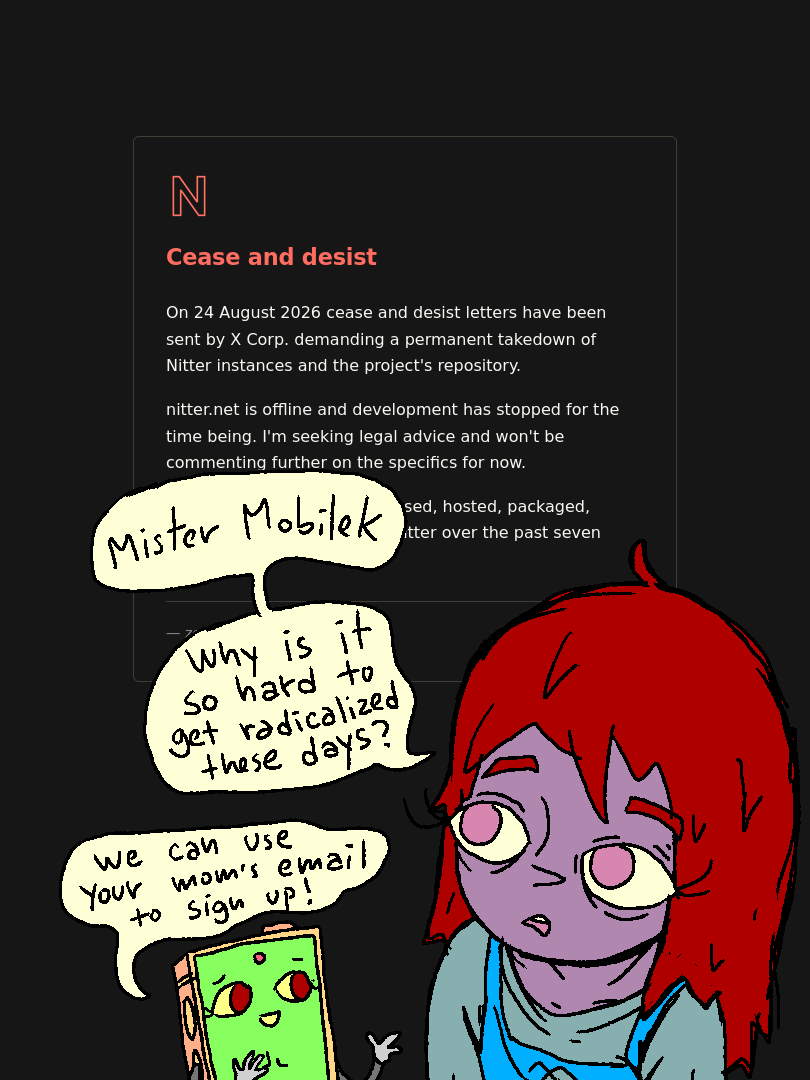
Alt...
CEASE AND DESIST: NITTER IS OVER
Red: "Mister Mobilek, why is it so hard top get radicalized these days?"
Mobilek: "We can use your mom's email to sign up!"
#Subtlefakes: Slightly Altered Nonconsensual #AI Images Are Taking Over #X
https://www.404media.co/subtlefakes-slightly-altered-nonconsensual-ai-images-are-taking-over-x/
![[?]](https://files.mastodon.social/accounts/avatars/000/782/304/original/55de5b06b41080a8.jpg)
RE: https://mastodon.social/@eunews/117066239491407869
perhaps burnham should do something about it - not least by getting off #twitter...
![[?]](https://babka-mastodon.nyc3.cdn.digitaloceanspaces.com/accounts/avatars/110/442/989/214/760/177/original/ac89244bf463bb3e.jpg)
Europe is Europing. 
"#Cyberwell has alerted #X/ #Twitter of a new wave of #antisemitic #conspiracy theories blaming #Jews for #wildfires across #Europe, the #NGO announced in a statement on Monday.
The organization, whose goal is to combat online #antisemitism, identified “nearly identical narratives” regarding recent wildfires in #Norway, #France, and #Spain, reinforcing what Cyberwell describes as a “recurring pattern of event-driven antisemitism, in which major crises are exploited to spread hate toward Jews.”
Posts in #English, #French, and #Spanish claiming that Jewish people deliberately sparked the #fires or orchestrated them for political or financial gain were identified by the organization’s analysts."
![[?]](https://hub.netzgemeinde.eu/photo/profile/l/1035?rev=1729019402)
Phone users used to see Twitter as a phone app that they loaded from their app store. Mastodon is the only *blogging thing in the Fediverse that they can load from their app store.
This is one reason why just about all Mastodon newbies use the official app and why they're on mastodon.social (it's the default in the official app, and since they don't know what this setting does, they leave it on default).
Mastodon even gets away with an official app that's far from good, much less fully features. All the newbies don't have anything to compare with. If Mastodon is a phone app to them, then the official app's feature set is Mastodon's feature set. If a feature isn't implemented in the official app, then Mastodon doesn't have it. I dare say that well over 80% of all Mastodon users have never in their lives used Mastodon's Web UI.
If someone takes the step and moves from the official Mastodon app to Ivory or Mona or IceCubes or Tusky or Fedilab or something like this, it's almost always the first time in their lives that they use an online service through an app that has a different name than the online service. Many people couldn't even imagine doing that.
This means that if Friendica and Hubzilla want to be more successful, growing beyond Mike's old "if you build it, they'll come" credo and advertising more isn't sufficient. People must be able to load Friendica/Hubzilla onto their phones from their app store. This requires an official app named "Friendica"/"Hubzilla" with a native, up-to-date iOS UI in the Apple App Store and one with a native, up-to-date Android UI in the Google Play Store. The existence of an official phone app in the Apple App Store and the Google Play Store is essential for being considered existent in the first place.
A commonplace attitude on Friendica and even more so on Hubzilla is that both can be installed as a PWA. But seriously, 99.9% of all phone users don't even know that PWAs exist. They don't know what that is. Not to mention that they expect and demand a native mobile UI in the style of their phone OS and not a generic Web UI.
Now, what would this app have to look like?
If the advantages of Friendica and Hubzilla over Mastodon are to be emphasised and underlined, and if this app is to become people's one and only daily driver UI, it will have to be fully featured. Minus the settings for the Web UI (e.g. the theme settings and the PDL editor on Hubzilla), minus stuff that you'll never need if you only ever use the phone app and never the server UI (e.g. Webpages on Hubzilla), but otherwise fully featured. This would also demonstrate just how vastly more powerful Friendica and Hubzilla are than Mastodon.
The obvious downside is that such an app would be a feature monster. Bigger and more feature-laden than any Android e-mail app or OpenStreetMap editor.
There has been some talk about building an official Hubzilla phone app. Some Hubzilla users have proposed an app that only offers the very basics. However, their idea behind this is not to make the app easier for newbies to use, but to make it easier for the developers to build. They're often still stuck in the early 2010s when phone apps for websites were considered gimmicks. They think that people will only use the app when they're out and about, and when they're back home, they'll sit down behind their computers and use the Web interface. Thus, phone apps only need the most basic features implemented.
But 2026 is not 2011. The huge majority of Mastodon users only use Mastodon through a phone app. Even when they're at home. As I've said: If the app doesn't have a feature, the whole product doesn't have the feature, regardless of whether or not the feature is implemented in the server backend and even in the Web frontend.
Besides, even Friendica's basic features that you'll need all the time are a lot. Hubzilla's basic features that you'll need all the time are even more numerous.
Shall people be limited to posting in public when they're on a phone because the phone app doesn't have any permission settings?
Shall people be limited to posting to their contacts when they're on a phone because someone decided that support for groups would make the phone app too complex?
Shall people wait until they're home, and they've got some time to fire up a computer, open a Web browser and log onto the Web interface to accept connection requests because the phone app doesn't have any connection settings? What if they don't have a computer?
Let's face it, social networking itself is a complex thing. And I mean actual social networking. Not misusing glorified SMS as a social network. Real social networking. Facebook-level social networking. Google+-level social networking. MySpace-level social networking.
Thus, a social networking phone app with all features necessary for real social networking has to be complex. This isn't a Friendica/Hubzilla issue. Don't believe that the official Facebook apps are simple.
This is also why so many prefer 𝕏 over Facebook. Facebook is complex. Facebook isn't just register, follow, post. 𝕏 is much more simple. 𝕏 is glorified SMS. 𝕏 is literally just register, follow, tweet. Facebook is rocket science whereas 𝕏 is for dumb-dumbs.
And it's because Mastodon is so lacking that it's for dumb-dumbs by Fediverse standards. In fact, if you don't read those panicky "it's too complicated because you have to know what a server is" posts, if you just load the app and create an account, Mastodon, through the official app, is for dumb-dumbs by all standards.
However, those who actually are on Facebook are willing to put up with something more complex. They need something more complex than glorified SMS for dumb-dumbs. They need the extra features that Facebook has that 𝕏 doesn't, even if these are the very features that deny Facebook the "for dumb-dumbs" attribute.
Send them to Mastodon, and they'll be irritated and even repelled because this feature isn't there, and that feature isn't there, and that feature is cut down beyond recognition, and they can't find any interesting people (not because Mastodon is decentralised, and the interesting people are on other servers, but because Mastodon's directory sucks arse in comparison with Facebook's), and what's with that stupid character limit?
On Friendica and Hubzilla, this feature and that feature have been there for longer than Mastodon itself, that feature is even more powerful than on Facebook proper, interesting people are being shoved into their faces once they've filled out their profile, even more so once they've got some connections, and there is no character limit worth speaking of.
But as long as Friendica and Hubzilla don't have official, fully daily-driveable phone apps named "Friendica" and "Hubzilla" respectively, they simply don't exist.
Granted, there's another obstacle. Many Mastodon users say the Fediverse needs a Facebook alternative. If you tell them about Friendica and its descendants, some will be very thankful because they've genuinely never heard of any of these.
Others will tell you that they know Friendica and maybe even Hubzilla. But they also say that none of these are Facebook alternatives. For when they say, "alternative," what they really mean is, "1:1 clone, just with a different name and decentralised and with ActivityPub and without spying and without the recent enshittification and without the evil CEO, otherwise absolutely identical."
One big aspect of this is that, as they say, the Fediverse needs an alternative to Facebook Groups. Friendica groups are exactly that because they were designed to be exactly that. Hubzilla forums, (streams) groups, Forte groups, all just that. But according to these people, they don't count because they aren't handled in precisely the same way as Facebook groups. Facebook groups aren't separate accounts. And different equals bad.
What really has me shake my head is that those who want a 1:1 Facebook clone continue to use Mastodon as a Facebook alternative. Even though Friendica and its family are vastly closer to Facebook regardless. Even though Mastodon not only doesn't have groups at all, but it doesn't even have any support for external groups. Is shouting into the void with a bunch of hashtags and hoping the right people will hear you really that much better than a Friendica group or a Hubzilla forum or maybe a PieFed community?
By the way: Just how faithful a Twitter clone is Mastodon really, seeing as Misskey and the Forkeys have the odd Twitter feature that Mastodon still lacks, seeing as even Mastodon gradually becomes more complex than 𝕏, much more so than when-it-still-was-good Twitter?
#Long #LongPost #CWLong #CWLongPost #FediMeta #FediverseMeta #CWFediMeta #CWFediverseMeta #CharacterLimit #CharacterLimits #CharacterLimitMeta #CWCharacterLimitMeta #Fediverse #Mastodon #Friendica #Hubzilla #Streams #(streams) #Forte #Misskey #Forkey #Forkeys #PieFed #Privacy #Permission #Permissions #Groups #FediverseGroups #FediGroups #App #PhoneApp #iPhoneApp #iOSApp #AndroidApp #SocialNetwork #SocialNetworking #Twitter #𝕏 #Facebook #FacebookGroups
![[?]](https://cdn.masto.host/theforkiversecom/accounts/avatars/115/874/488/801/031/585/original/b6a015301231206b.jpeg)
Well said.
"Much of that influence comes via X, formerly #Twitter, the social media platform that Musk bought outright in 2022. Since stripping away many of the old Twitter's content moderation rules - derided as censorship by Musk and others - the network has become a haven for far-right beliefs and conspiracy theories.
In turn, X appears to have shaped #Musk."
#ElonMusk
#USPol
#UKpol
#Canpoli
https://www.bbc.com/news/articles/c5y4w5nwk00o
If you're still using the platform formerly known as #Twitter, you promote right wing hate and conspiracy theories that have no structure in oath or "public service" and are only intent on willful ignorance. Corporate has been allowed to operate in #perjury without consequences and the results are in.
#NoKings
![[?]](https://polymaths.social/fileserver/01HCMX6M1CZNEVJ4F5H58TT5XJ/attachment/original/01JHC5KM5K0V0J0436SPD3F86H.jpeg)


 🍵
🍵  [
[I think my problem is that I might actually be more cynical than the people loudly complaining about it, although the lack of consistency is kind of annoying.
Here's the #DistroWatch top 15:
- CachyOS (Active)
- Linux Mint (Active)
- MX Linux (Active)
- PopOS (Active)
- Debian (Last post 2025, pinned comment about why they're not posting there anymore)
- ZorinOS (Active)
- Fedora Project (Last post 2024, no comment in bio about not posting, or why, but there's a mastodon link)
- Ubuntu (Active)
- EndeavourOS (Active)
- Bazzite (Active)
- Manjaro (Last post 2025-08-07, no mention in bio or pinned comment about why they're not posting)
- Arch Linux (no X account)
- AnduinOS (no X account)
- PikaOS (no X account)
- OpenSuSE (Active)
I mean... what the flaming gehenna, already. 🤦♂️
And any that don't will most likely have facebook and/or insta accounts, and that's almost just as bad.
cc: @cmccullough
![[?]](https://social.bau-ha.us/system/accounts/avatars/111/801/048/327/111/847/original/b9671cb080e7da70.png)
"We took a little time away from the Nazi Bar, but we noticed there's less pushback now for partying with the fash. So, back inside we go. Something-something, aren't-we-virtuous."
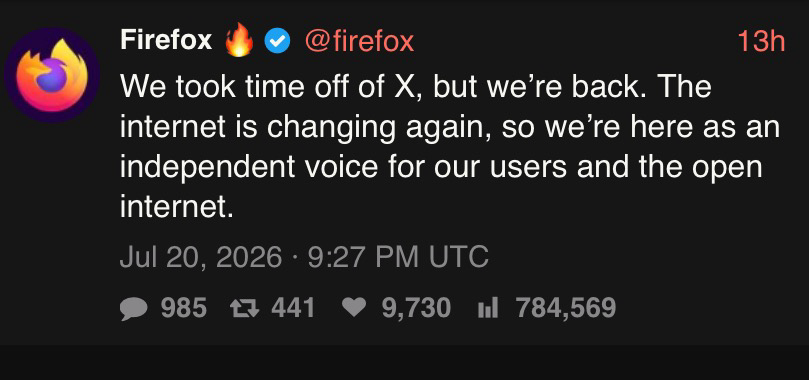
Alt...
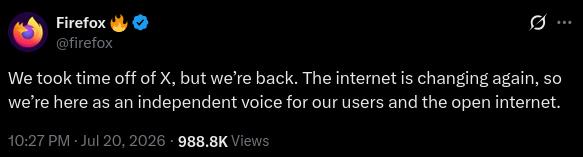
A tweet from the official Firefox account on Twitter/X:
We took time off of X, but we're back. The internet is changing again, so we're here as an independent voice for our users and the open internet.
![[?]](https://media.mementomori.social/accounts/avatars/109/293/050/593/156/468/original/149d4fe6c4f85509.png)
RE: https://mastodon.social/@gamingonlinux/116958382115564493
"The Internet is changing again", yeah, and not for the better.
By 2026, X has basically turned into a data-mining pool for Musk's so-called "AI" and a shady copyright-violating porn platform.
Most people don't even realize that X Corp is now an indirect subsidiary of SpaceX. In 2025, X was merged into Musk's AI company, xAI, and then in February 2026, SpaceX acquired xAI through an all-stock deal.
Now, AI, space exploration, and social media all fall under one big corporate umbrella. This setup lets Musk dodge personal responsibility and also helps him avoid putting more of his own money toward X's liabilities.
![[?]](https://files.mastodon.social/accounts/avatars/000/010/947/original/34a579358b5060ee.png)
![[?]](https://files.mastodon.social/accounts/avatars/115/967/890/192/375/774/original/79861f67f1d57c00.png)
@elsua54 @timbray Video about why #Mastodon fails like Twitter [if the aim is for active social movement...]
"Why I'm NEVER Joining Mastodon." #EricMurphy
https://redirect.invidious.io/watch?v=Lixz5qTCMGI
Main point:
Neither #Mastodon (or #Twitter) creates / stimulate or make much or a social movement itself - it's better software not socially improving itself.
Mastodon or it's designers aren't doing the people work, which is the real evolution of communication & improvement humanity needs.
![[?]](https://cdn.masto.host/dicecamp/accounts/avatars/109/305/905/987/366/934/original/361275ee4a21d618.jpg)
Holy moly, I had occasion to look at my old Twitter feed today (I will never willingly call it X), and it's deader than a doornail. There are still people posting there, but the frequency is less than my Fediverse feed with way more users.
![[?]](https://i0.wp.com/rbfirehose.com/wp-content/uploads/2021/01/cropped-Blank-512-x-512.png?fit=512%2C512&ssl=1)
Ars Technica: Musk’s X poses “serious risk to Americans’ privacy,” advocates warn FTC. “Ahead of a July 2 deadline to submit public comments, advocates are warning the Federal Trade Commission that it must keep close watch over Elon Musk’s X and firmly reject a recent bid to end the agency’s ongoing audits of the platform’s data handling.”
https://rbfirehose.com/2026/07/08/ars-technica-musks-x-poses-serious-risk-to-americans-privacy-advocates-warn-ftc/![[?]](https://media.mas.to/accounts/avatars/109/442/454/487/918/952/original/d8a5f7a5f95ae2cb.png)
Musk’s X poses “serious risk to Americans’ privacy,” advocates warn #FTC
Ahead of a July 2 deadline to submit public comments, advocates are warning the Federal Trade Commission that it must keep close watch over Elon Musk’s X and firmly reject a recent bid to end the agency’s ongoing audits of the platform’s data handling.
Last month, the FTC posted a notice explaining that X had argued that an FTC order was no longer necessary due to changes #Musk had made to the platform.
#privacy #Twitter
Lisa Nandy quits #X over fears #Musk-owned site pushes ‘abuse and #misinformation’ - https://www.theguardian.com/media/2026/jul/02/lisa-nandy-culture-social-media-x-abuse-misinformation "citing concerns over far-right content fuelling violence and division" finally, #ukgov gets a clue; now you #starmer... #twitter
![[?]](https://tldr.nettime.org/system_nettime/accounts/avatars/109/528/493/326/851/300/original/ebc905e283d49e82.jpg)
"Billionaire Elon Musk’s Grok AI violated Canada’s privacy laws and, at one point, generated more than 6,000 sexual deepfake images per hour, Canada’s privacy commissioner found.
“The investigation has found that X Corp and xAI violated Canada’s federal private sector privacy law by launching the Grok AI-powered image generation tool without implementing appropriate safeguards at the outset,” privacy commissioner Philippe Dufresne said in a press conference in Ottawa Thursday.
“This lack of protection allowed users to create and share sexualized deepfakes largely targeting women and children,” he added.
Dufresne launched an investigation in January to examine the proliferation of sexualized deepfakes created by Grok and shared on the X social media platform.
“According to researchers, Grok was at one point generating well over 6,000 [sexualized] images per hour,” he said, adding that “millions” of sexual deepfakes were created."
https://globalnews.ca/news/11899687/grok-sexual-deepfake-report/
#Canada #AI #GenerativeAI #Grok #DeepFakes #SocialMedia #Twitter
![[?]](https://soc.octade.net/octade/s/3f7f2b5eda4e392867c301c49c2daa16.png)
https://www.youtube.com/watch?v=CA_hmtuAPTY
[copypasta]
Did the Algorithm Change Your Decisions? | How Your Feed Was Engineered
Right now, somewhere on the internet, a video is being uploaded.
Within seconds, a system that no one elected, no one audits, and no one fully understands decides whether anyone else will ever see it.
Sometimes, it decides no one should.
And that’s the end of it.
In this episode of Plain Meaning, we examine how the modern internet quietly transformed from a system designed to deliver information… into one that decides what information exists for you at all.
It didn’t happen all at once.
It happened step by step.
Feed by feed.
Platform by platform.
Until nearly everything you see online is filtered through a machine making decisions on your behalf.
We trace how:
• Social media moved from profile pages to infinite feeds
• Facebook’s News Feed shifted from chronological to algorithmic control
• Advertising—not user experience—drove the need to control timing and visibility
• “EdgeRank” introduced the first large-scale automated editorial system
• By 2016, every major platform—Facebook, Instagram, Twitter, YouTube—had adopted algorithmic feeds
• Recommendation systems replaced direct navigation across the entire internet
But this isn’t just a story about technology.
It’s a story about incentives.
Because once platforms controlled what you saw, they didn’t just control engagement.
They controlled attention.
And once attention became the product, the system began optimizing for something far more powerful than clicks.
We examine what happened next:
• How foreign influence operations exploited algorithmic feeds during the 2016 election
• The role of Cambridge Analytica and its parent Strategic Communication Laboratories in psychological targeting
• The scale and strategy of Russia’s Internet Research Agency
• How fake local news accounts built trust before deploying disinformation
• Why most influence content wasn’t political—but divisive
• How algorithms amplified all of it without distinction
And then we go further.
Because 2016 wasn’t the end of the story.
It was the beginning.
We look at how:
• Algorithmic systems shape not just what you see—but how you think
• Platforms reward emotional, extreme, and addictive content
• Foreign-owned platforms introduce new geopolitical risks
• Systems like ByteDance’s TikTok operate differently across countries
• The same algorithmic architecture can produce completely different realities depending on its objectives
This episode is not about one platform.
It’s not about one political party.
And it’s not about one country.
It’s about the system itself.
Because the algorithm isn’t just recommending content.
It’s acting as an editor.
And most of the time, you don’t even realize it’s there.
By the end of this video, the next time you open a social media app, you’ll understand:
Why your attention isn’t fully yours.
Why the world you see isn’t necessarily the world that exists.
And how to recognize when a machine—not you—is deciding what matters.
#Algorithm #SocialMedia #DigitalMedia #YouTube #Facebook #Instagram #NewsFeed #TikTok #Twitter
[/copypasta]
![[?]](https://files.mastodon.social/accounts/avatars/115/872/592/273/680/200/original/87b44e5e1fefb0cd.jpg)
X's documentation explicitly states:
"Direct messages are not protected against hacking or unauthorised access."
If messages aren't protected against hacking, they're not encrypted properly.
This is encryption theatre, not encryption.
Words matter in security.