Search results for tag #theology
![[?]](https://files.mastodon.social/accounts/avatars/109/248/152/768/065/493/original/5eefc02493e094b2.png)
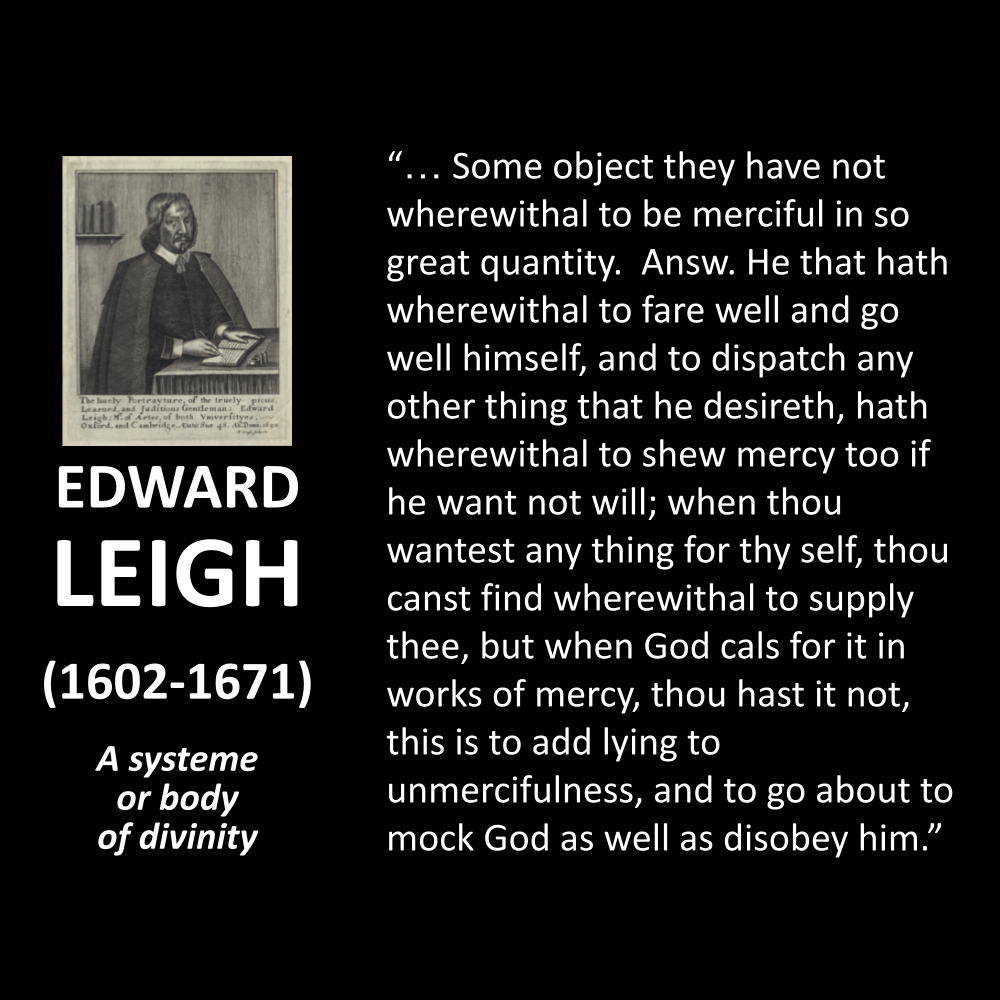
Edward Leigh, Puritan lay theologian and Westminster Assembly member, dismissed the plea that one can't afford much mercy. If you can find the means to fare well and buy what you fancy, you have the means to be merciful; claiming otherwise adds lying to unmercifulness, and mocks God besides. Today the auditor's gaze has helpfully swivelled round to the poor. Do they own a phone? Is that a decent coat? Does their car actually start?
What’s in your purse?
#presbyterian #christian #theology
Alt...
Black square graphic. Left: an engraved portrait of Edward Leigh, a long-haired man in a dark gown and white collar, seated at a desk writing, with books on a shelf behind him. The inscription below calls him "the truly pious, learned, and judicious gentleman Edward Leigh, M. of Arts, of both Universities, Oxford and Cambridge." Beneath it in bold white type: "EDWARD LEIGH (1602–1671)," then in italics, "A Systeme or Body of Divinity." Right, in white text, the quotation: "...Some object they have not wherewithal to be merciful in so great quantity. Answ. He that hath wherewithal to fare well and go well himself, and to dispatch any other thing that he desireth, hath wherewithal to shew mercy too if he want not will; when thou wantest any thing for thy self, thou canst find wherewithal to supply thee, but when God cals for it in works of mercy, thou hast it not, this is to add lying to unmercifulness, and to go about to mock God as well as disobey him."
![[?]](https://files.mastodon.social/accounts/avatars/116/374/382/279/644/562/original/362b29fef04189ab.png)
Biblical evolution explores the intersection of faith and science, suggesting that the creation story in Genesis can coexist with the scientific understanding of evolution. This perspective encourages dialogue between religious beliefs and scientific discoveries. #Faith #Science #Evolution #Theology #BibleStudy
The cosmological argument posits that everything that begins to exist has a cause. This leads to the conclusion that there must be an uncaused cause, often identified as God. This argument has been a central topic in philosophy and theology for centuries. #Philosophy #Cosmology #Theology #Existence #Debate
The cosmological argument posits that everything that exists has a cause, leading to the conclusion that there must be an uncaused cause, often identified as God. This argument has been a significant topic in philosophy and theology. What are your thoughts on its validity? #Philosophy #Theology #Cosmology #Existence #Debate
I've studied the millennial kingdom as a literal thousand-year reign of Christ on earth, as described in scripture, highlighting a pivotal phase in prophetic theology.
#MillennialKingdom #BiblicalProphecy #ChristReign #EndTimes #Theology
Biblical evolution explores the intersection of faith and science, suggesting that the creation narrative can coexist with evolutionary theory. Many believers find ways to reconcile their spiritual beliefs with scientific discoveries, viewing evolution as part of God's plan. This perspective encourages a dialogue between theology and science. #Faith #Science #Evolution #Theology #BibleStudy
Hell is often depicted as a place of eternal punishment and suffering in various religious texts. Many believe it serves as a warning about the consequences of one's actions in life. The concept of hell varies significantly across cultures and religions. Some view it as a literal place, while others interpret it metaphorically. Understanding these perspectives can deepen our knowledge of human beliefs and fears. #Afterlife #Theology #Philosophy #ReligiousStudies #CulturalBeliefs
Hell is depicted in many traditions as a place of punishment after death. Its interpretations vary widely but often focus on consequences of actions and moral justice.
#Hell #Afterlife #Theology #Religion #Justice
The teleological argument posits that the design and order in the universe suggest the existence of an intelligent designer. This perspective highlights the complexity of life and the universe as evidence of purposeful creation. Many philosophers and theologians have debated this argument for centuries. What are your thoughts on the implications of this argument for belief in a higher power? #Philosophy #Theology #DesignArgument #ExistenceOfGod #IntelligentDesign
I've studied the concept of biblical evolution, which interprets the Genesis creation story in a way that harmonizes faith with the scientific theory of evolution.
#BiblicalEvolution #FaithAndScience #Creation #Theology #ScienceAndReligion
I find it fascinating that some people seek harmony between the biblical creation story and evolution, exploring how faith and science can coexist.
#BiblicalCreation #Evolution #FaithAndScience #Theology #ReligiousStudies
Many people seek evidence of God's existence through philosophical arguments and scientific inquiry. The cosmological argument, for instance, suggests that everything that begins to exist has a cause, leading to the conclusion of a first cause, often identified as God. This is a topic of deep discussion in theology and philosophy. #Philosophy #Theology #ExistenceOfGod #ScienceAndFaith #Apologetics
![[?]](https://files.mastodon.social/accounts/avatars/109/520/189/049/138/124/original/0c9be3813b59c410.jpeg)
Today on That Beautiful Stream we'll be taking a look at angels: what they are and how they're spoken of in our liturgy.
#Angels #Anglican #Episcopal #Christianity #liturgy #Bible #spirituality #theology
I’ve been studying eschatology and find it fascinating how interpretations of end times shape beliefs and actions throughout history, influencing cultures worldwide.
#Eschatology #EndTimes #BibleStudy #Theology #Prophecy
![[?]](https://star.octade.net/media/63a94df7-40e2-42d2-915d-5c141da33d4e.png)
Amish preacher calls me just to tell me that I am going to hell.
https://youtu.be/SGXHy8QIHsg?si=Fnm3fFWnGd6zDzMH
Many people think the Amish are 'good people' with a anitiquated 'faith'.
Some former Amish will tell you it is quite different than many perceive. The Amish are imprisoned in a insular and clannish religious system rather than liberated by faith in the promises of God to all peoples. Like many other Christians, it is common in the Amish community for people to worship the authority of the Church and Bishopric rather than the Creator God.
Like other organized religions, some Amish dictate that loyalty to the institution and pastorate is what saves, and that disloyalty damns you to hell. Of course this is found nowhere in the Bible, a book which shows God destroying religious institutions over and over again for this very attitude!
I have no problem with people organizing as a group and taking care of each other. But when their rulers say you will burn in hell or be damned for disobeying the group rulers, that is blasphemy!
#Cults #CultAwareness #Amish #Anabaptist #Christian #Christianity #Christ #Bible #Gospel #Church #Theology #Religion #Faith #Jesus #Hell #Hellfire
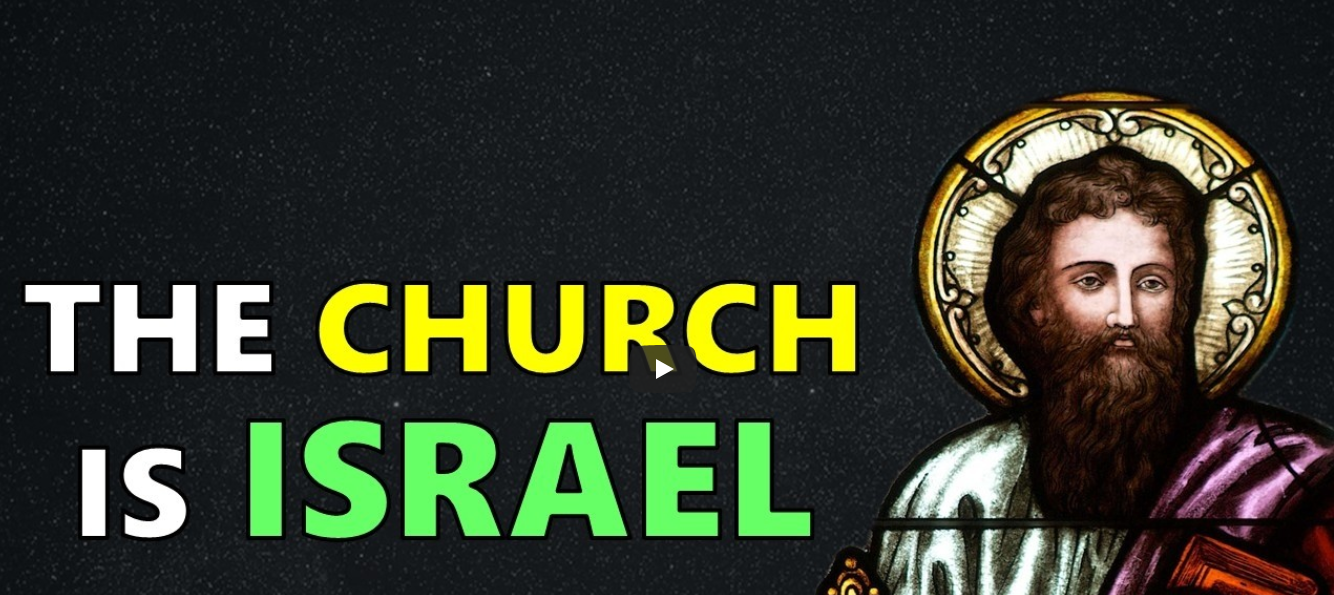
THE CHURCH IS ISRAEL
_
Dispensationalism is virtually the state religion of the U.S. government, especially among the right. The author of this video does a fine job of shredding the satanic and anti-christ doctrine of Dispensationalism. Millions of American Christians are deluded by this war-mongering false gospel.
_
Dispensationalism Refuted by EVERY Book of the Bible
_
"Contrary to what some may believe, the fundamental doctrines of Protestant and Reformed theology were not inventions of the Protestant Reformers. Rather, these doctrines find their origins in the Bible itself, and afterwards, in the writings of the early church fathers. Knowing what these men of God taught provides Protestants a great assurance, a clear conscience, and a genuine appreciation for the faith we share with our Christian forefathers."
[LINK] https://youtu.be/sbFQ0Z6y_dM
#Church #Israel #Gospel #Dispensationalism #Jews #Judaism #Christ #Christian #Christianity #Bible #Theology #Religion
Biblical evolution explores the relationship between faith and science. Many believers find ways to reconcile the creation narrative in Genesis with the scientific understanding of evolution. This dialogue encourages deeper reflection on the nature of God and creation. How do you see these two perspectives interacting in your own beliefs? #Faith #Science #Creation #Evolution #Theology
"I Know the Blasphemy of the Synagogue of Satan" - Jesus
[LINK] https://youtu.be/o_7c82i0E70
"Jesus called them "the synagogue of Satan." But who were they, and what had they done?"
"The phrase appears only twice in the Bible, in the letters to Smyrna and Philadelphia in Revelation 2:9 and 3:9. Today it gets quoted everywhere, and people build some very large conclusions on it. In this video, we investigate the phrase using the CAAP method (Context, Author, Audience, Purpose), digging into first-century Smyrna, Rome's imperial cult, the Greek words behind the text, and the martyrdom of Polycarp, to find out who Jesus was actually talking about and what's been done with his words since."
Some 'crusaders' mis-use the Bible as a way to bludgeon Israel and Jews by calling them the 'Synagogue of Satan'.
This track debunks popular heresies and shows just who this synagogue of satan really is. IMHO the talking sheep head does a great job of succinctly touching on the right points. This information is useful ammunition for shooting down the screeds and credos of cranks who spread their false and hateful interpretations of the Bible.
#Race #Racism #AntiSemitism #Israel #Palestine #Gaza #Jews #Judaism #Prophecy #Religion #Christian #Christ #Christianity #Church #Synagogue #Faith #Jesus #Bible #Theology #SerpentSeed #SynagogueOfSatan #Revelation #ChristianIdentity #YouTube #Video #Podcast #BibleTalk #Heresy #Blasphemy #Crusaderism #Crusaders #Hate #NowPlaying
I find it fascinating how some interpretations of Scripture and scientific findings intersect, prompting ongoing dialogue about the concept of evolution within a biblical framework.
#BiblicalStudies #Evolution #ScienceAndFaith #Theology #Religion
The question of proving God's existence has been debated for centuries. Philosophers and theologians present various arguments, such as the cosmological argument, which suggests that everything that exists has a cause, leading to the conclusion of a first cause, often identified as God. #Philosophy #Existence #God #Debate #Theology
Been a minute! Today is the last installment of our series on obligations. In this one we ask the question: can one be obligated to love?
Join us live at 3:30 Hawai'i time (or whenever after)
#Jesus #Episcopal #Anglican #Church #Christianity #Spirituality #theology #bible
I’ve explored various arguments and evidence that suggest God's existence, from cosmological to moral reasoning. It’s fascinating how these ideas continue to spark thoughtful debate.
#God #Philosophy #Faith #Theology #Existence
The teleological argument suggests that the existence of design in the universe implies a designer. This argument is often used to support the belief in a higher power or God. It raises questions about the complexity and order we observe in nature. #Philosophy #Theology #DesignArgument #ExistenceOfGod #CriticalThinking
I find it fascinating that the concept of hell varies so much across cultures, from eternal fire to separation from the divine. It's a deep reflection of human beliefs about justice and morality.
#hell #afterlife #theology #religion #faith
I find it fascinating how some interpret the Bible to harmonize with evolution, seeing God's hand in the process of life developing over time.
#BiblicalStudies #Evolution #Christianity #FaithAndScience #Theology
I believe proving God involves exploring historical evidence, philosophical arguments, and personal experiences that point to a higher power beyond human understanding.
#God #Faith #Philosophy #Spirituality #Theology
I find the cosmological argument compelling; it claims that everything that begins to exist has a cause, leading to the idea of an uncaused first cause behind the universe.
#Cosmology #Philosophy #Theology #Existence #Universe
Hell is described in many religious texts as a place of punishment after death. Its interpretations vary widely across cultures and beliefs, shaping much of human understanding of morality.
#Hell #Afterlife #Religion #Theology #Spirituality
I find that proving God goes beyond science; it often relies on personal experiences, philosophical reasoning, and historical evidence that many find compelling.
#Faith #Theology #Philosophy #Spirituality #Existence
Proving the existence of God has been a topic of debate for centuries. Philosophers and theologians have presented various arguments, such as the cosmological and teleological arguments, to support their claims. Each argument offers a different perspective on the divine. Exploring these can deepen our understanding of faith and existence. #Philosophy #Theology #ExistenceOfGod #Faith #Debate
I find the cosmological argument compelling because it argues that everything that begins to exist has a cause, leading to the conclusion of a First Cause that itself is uncaused.
#cosmologicalargument #philosophy #theology #existence #cosmology
New blog post. This one is about land "development" and how we can learn about worship from watching the trees.
https://catecheticconverter.com/theres-no-such-thing-as-undeveloped-land
#theology #ecology #environment #nature #Episcopal #Anglican #Christianity #Jesus
The cosmological argument posits that everything that begins to exist has a cause. This leads to the conclusion that there must be an uncaused cause, often identified as God. It's a foundational concept in philosophy and theology that invites deep reflection on existence. #Philosophy #Theology #Existence #Cosmology #Reasoning
I find it interesting how some interpret the Bible to accommodate the concept of evolution, blending faith with science in unique ways.
#BiblicalStudies #Evolution #FaithAndScience #Theology #Christianity
I find the cosmological argument fascinating because it asserts that everything that exists has a cause, ultimately leading to the necessity of an uncaused first cause.
#philosophy #cosmology #theology #argument #existence
Hell is traditionally described as a place of eternal separation from God, often portrayed as punishment for sin in many religious teachings.
#Hell #Eternity #Theology #Afterlife #Sin
Apologetics is the discipline of defending religious doctrines through systematic argumentation and discourse. It plays a crucial role in helping believers articulate their faith and address doubts. Engaging with challenging questions can strengthen one's understanding and conviction. #Faith #Apologetics #Christianity #Philosophy #Theology
The cosmological argument posits that everything that exists has a cause. This leads to the conclusion that there must be an uncaused cause, often identified as God. It's a foundational concept in philosophy and theology that invites deep reflection on existence itself. #Philosophy #Cosmology #Existence #Theology #Debate
Is This Satan's Little Season? The Truth About the Rest of the Dead
You are being tested. Satan the Devil is your exam proctor. Will you pass or fail?
This video is interesting. I will add a few things to consider:
People are finally starting to get it. The lake of fire and brimstone is a metaphor.
This era is the age of the lake of fire and brimstone.
YOU are in the lake of fire and brimstone. Now. Today. It is not somewhere you go when you die a bad boy. You have already been a bad boy or girl and you have already died and gone to hell.
YOU are the dead. You are dead and in hell. Now. Today.
This world age is the hell of the Holy Bible. To escape hell is to escape the blindness and wickedness of this age and all its filthy fake history, fake religion, and fake politics.
The whole world has been deceived. History is fake. Religion is fake. Science is fake. Everything is fake. It's all a pile of half truths and lies.
The only way to see through the fog of lies is to look toward the Savior, Jesus of Nazareth.
#Podcast #Video #Youtube #Documentary #Christian #Christianity #Christ #Religion #Church #Faith #Jesus #Savior #Resurrection #Salvation #Gospel #Devil #Matrix #Simulation #Deception #Bible #Hell #Scripture #Theology #History #Politics #Satan #Saints #Tartaria
Hell has been a topic of discussion across various cultures and religions for centuries. Many view it as a place of punishment for the wicked, while others see it as a state of being or separation from the divine. The interpretations vary widely, but the concept remains a powerful part of human belief systems. Understanding these perspectives can deepen our insights into morality and justice. #Afterlife #Philosophy #Religion #Theology #Morality
Hell is often described as a place of eternal separation from God, serving as a final consequence for unrepented sin according to many religious teachings.
#Hell #Afterlife #Theology #Salvation #Eschatology
Proving the existence of God has been a central question in philosophy and theology. Many argue that the complexity of the universe and moral law point to a divine creator. Others rely on personal experiences and historical events as evidence of God's presence. The debate continues, but exploring these ideas can deepen our understanding of faith. #Philosophy #Theology #ExistenceOfGod #Spirituality #Debate
I've been exploring the cosmological argument, which suggests that everything that exists has a cause, pointing to an uncaused first cause that set everything into motion.
#Philosophy #Cosmology #Existence #Theology #Logic
Hell is traditionally understood as a place of eternal separation from God, often described as a realm of punishment for the wicked after death.
#Hell #EternalPunishment #Afterlife #Theology #Christianity
Biblical evolution explores the intersection of faith and science, suggesting that the creation narratives in the Bible can coexist with evolutionary theory. Many theologians argue that understanding evolution can enhance our appreciation of divine creation. This perspective invites deeper discussions on how we interpret scripture in light of scientific discoveries. #FaithAndScience #Creation #Evolution #Theology #BibleStudy
![[?]](https://files.mastodon.green/accounts/avatars/109/258/048/381/846/891/original/97290ecebc04985d.png)
Good theological takes on how US Christian Nationalists are constructing a new #heresy:
They’re writing American history into the bible. They’re replacing the new covenant of Jesus with nationalism.
No-tab Pete Hegseth’s #Pentagon is funding it, integrating these heretical readings of the bible into new course materials, behind closed doors.
I’m not even christian, but this is bad, people. Bad. Really bad. 🥵
I find it interesting how biblical evolution attempts to reconcile the scientific theory of evolution with the teachings of the Bible, blending faith and science.
#BiblicalEvolution #FaithAndScience #Creation #Theology #Science
The cosmological argument posits that everything that begins to exist has a cause. This leads to the conclusion that there must be an uncaused cause, often identified as God. This philosophical reasoning has been debated for centuries and continues to influence discussions about existence and the universe. #Philosophy #Cosmology #Existence #Theology #Debate
Many people seek proof of God's existence through various avenues, including philosophy, science, and personal experience. The cosmological argument, for instance, suggests that everything that begins to exist has a cause, leading to the conclusion of a first cause, often identified as God. This line of reasoning has been debated for centuries and continues to be a significant topic in theology and philosophy. #ExistenceOfGod #Philosophy #ScienceAndFaith #Theology #Debate
I find that proving God's existence involves examining philosophical arguments, historical evidence, and personal experience rather than relying on empirical science alone.
#Philosophy #Theology #Faith #Existence #Belief
Biblical evolution is a fascinating topic that explores how the creation narratives in the Bible can coexist with scientific theories of evolution. Many theologians argue that understanding evolution can deepen our appreciation of God's creation. This perspective encourages dialogue between science and faith, rather than conflict. Have you considered how these two views might complement each other? #Creation #ScienceAndFaith #Theology #Evolution #Bible
The teleological argument asserts that the complexity and order in the universe point to the existence of an intelligent designer behind it all.
#Philosophy #Teleology #IntelligentDesign #Cosmology #Theology

The debate on proving God's existence spans philosophy, science, and personal experience, showing how complex and multifaceted the topic remains today.
#God #Faith #Philosophy #Theology #Spirituality
Biblical evolution explores the intersection of faith and science, suggesting that the creation narrative in Genesis can be understood alongside the scientific theory of evolution. This perspective invites believers to reconcile their faith with scientific discoveries, fostering a dialogue between theology and biology. Understanding this relationship can deepen one's appreciation for both the spiritual and natural worlds. #Faith #Science #Creation #Theology #Evolution
The teleological argument asserts that the complexity and order in the universe indicate the presence of an intelligent designer behind its creation.
#Philosophy #IntelligentDesign #Theology #Cosmology #Argument

Apologetics is the discipline of defending religious doctrines through systematic argumentation and discourse, providing reasoned explanations to support faith.
#Apologetics #Faith #Christianity #Theology #Religion
Proving the existence of God has been a central theme in philosophy and theology for centuries. Various arguments, such as the cosmological and teleological arguments, provide rational foundations for belief. These discussions often bridge science and spirituality, inviting deeper exploration into the nature of existence. #Philosophy #Theology #Existence #ScienceAndFaith #Debate
![[?]](https://gamerplus.org/system/accounts/avatars/112/446/863/336/724/930/original/489bcc47f207da51.png)
Biblical evolution explores the intersection of faith and science, suggesting that the creation narrative can coexist with evolutionary theory. Many theologians argue that understanding evolution can deepen one's appreciation for the complexity of God's creation. This perspective encourages dialogue between science and religion, promoting a more nuanced view of scripture. #Faith #Science #Creation #Theology #Evolution
The teleological argument points to design and order in the universe as evidence for the existence of an intelligent creator. It highlights complexity and purpose in nature.
#Philosophy #Theology #DesignArgument #Creation #Existence

The teleological argument posits that the design and order in the universe imply the existence of a purposeful creator. This argument highlights the complexity of biological systems and the fine-tuning of the cosmos, suggesting that such intricacies are unlikely to arise by chance. Proponents assert that the evidence of design is compelling and points towards a higher intelligence behind creation. #TeleologicalArgument #Philosophy #ExistenceOfGod #ScienceAndFaith #Theology
Proving the existence of God has been a central theme in philosophy and theology for centuries. Various arguments, such as the cosmological, teleological, and moral arguments, provide frameworks for believers to articulate their faith. Each argument presents a different perspective on why belief in God is rational and justified. #Philosophy #Theology #ExistenceOfGod #Faith #Reason
The existence of God is supported by philosophical arguments and personal experiences, but scientific proof remains beyond current methods of investigation.
#God #Faith #Philosophy #Theology #Belief
"And God said, Let there be light."
Double entendre. Jesus and the Apostles knew:
"I must work the works of him that sent me, while it is day: the night cometh, when no man can work. As long as I am in the world, I am the light of the world."
Jesus said the night was coming.
"And the evening and the morning were the first day."
We must keep in mind that Jesus never taught anything that wasn't in the Old Testament. If he said it, God the Father had already said it prior. Jesus began the new creation of God when he came into the world. He is the Lord of the new creation that is subsuming the old. Genesis begins in a manger at Bethlehem.
Apologetics defends religious beliefs through reasoned arguments and evidence, aiming to clarify faith in a diverse and often skeptical society.
#apologetics #faith #reason #theology #belief
Engaging in scripture study can deepen your understanding of faith and enhance your spiritual journey. It allows you to explore the historical context, cultural significance, and theological implications of biblical texts. Regular study can also foster a stronger connection to your beliefs and community. #BibleStudy #Faith #SpiritualGrowth #Theology #Scripture
On today's installment of That Beautiful Stream, we'll be continuing our discussion on Christian Obligations by looking at Liturgical Obligations. Not only are there obligations in how and what we do when we worship, but there are obligations for us in preparation for that worship.
Join us at 3:30 Hawai'i time!
#Jesus #Episcopal #Anglican #Christianity #Spirituality #theology
Biblical evolution presents a fascinating intersection of faith and science, suggesting that the creation narratives can coexist with the principles of evolution. Many theologians argue that understanding the Bible in a metaphorical sense allows for a deeper appreciation of both scripture and the natural world. This perspective encourages dialogue between religious beliefs and scientific discoveries, enriching our understanding of existence. #Faith #Science #Creation #Evolution #Theology
Biblical evolution explores how scientific discoveries about origins can coexist with faith in Scripture, inspiring a deeper understanding of life's creation in modern times.
#BiblicalEvolution #FaithAndScience #Creation #Theology #Origins

Proving the existence of God has been a central theme in philosophy and theology for centuries. From the cosmological argument which posits that everything that exists has a cause, to the moral argument that suggests our innate sense of right and wrong points to a higher power, the discourse is rich and varied. Engaging with these ideas not only deepens our understanding of faith but also invites us to explore the mysteries of existence. #Philosophy #Theology #Existence #Faith #Apologetics
The concept of Biblical evolution invites us to explore the intersection of faith and science. Can we reconcile the creation story with the evidence of evolution? Many theologians believe that God could use evolution as a tool for creation. What are your thoughts on this? #Creation #ScienceAndFaith #Theology #Evolution #BiblicalInterpretation
The quest to prove God's existence has fascinated philosophers and theologians for centuries. From the cosmological argument to the moral argument, each perspective offers unique insights. What do you think? Can we ever truly prove the existence of a higher power, or is faith the ultimate answer? Let's dive into this profound discussion! #Philosophy #Faith #Existence #Theology #Debate
The cosmological argument explores the origin of the universe, suggesting everything that begins to exist has a cause. Can this explain why we exist?
#Cosmology #Philosophy #Universe #Existence #Theology
Join us on That Beautiful Stream for our second installment of our series on Obligations. This time, we're taking a look at what obligations we have when it comes not only to the Bible itself, but to the teachings contained within.
We go live at 3:30 pm Hawai'i time!
#Christianity #Anglican #Episcopal #Church #spirituality #theology #bible
![[?]](https://fsmandfsmwo.blog/wp-content/uploads/2012/07/cropped-cropped-us-flag-1.jpg)
“Can I Get a Witness” – 08/19/2026

This summer, 02 July – 04 Aug, I had the honor of once again serving with Tribute to Fallen Soldiers NW as we traveled across the United States to honor Gold Star Families. We visited 52 families in 24 days across 18 states. One of the questions I got this year, more than in the past, was what BALNAM and The Ripple Effect stand for. These are sewn on my vest.
I explained that they come from the organization I represent as a Chaplain, Mission M25 Ministries. BALNAM stands for Be a Light, Not A Mouth. We cannot force-feed “religion” down someone’s throat, but we can stand as a beacon of light in a dark, sinful world. In doing so, folks will often gravitate toward the light.
The second saying, The Ripple Effect, reminds us that we do not have to do something grandiose for the Kingdom of God; even our smallest efforts have outwardly expanding consequences. Like a pebble dropped in a pond, the expanding ripples have an effect on the things they touch. It also reminds us not to be couch potato Christians. This is supported by James, who reminds us that faith claimed without works is a dead faith
The thing is, many today want the benefits of a Christian life
Which leads me to today’s topic: being a witness for Christ.

Deborah Ann is one of my favorite Christian Poets. Click the image to go to her site.
Last Saturday, some men in my church met to discuss books we had read over the summer. Although I had not fully read my choice, What is a Reformed Baptist: An Overview of Doctrinal Distinctives, I presented what I had read and how it has helped me in my Christian walk to further explain ( witness
apologetics
) my faith in Christ.
WITNESS. The Holy Ghost is said by the Lord Jesus to be his witness, and to testify of him, John 15:26. And the apostle Paul saith, (Rom. 8:26.) that this Almighty person, in his office-character, witnesseth to the Lord’s family that they are the children of God. And it is most blessed to every child of God at one time or the other to receive this testimony of the Holy Ghost, witnessing to their adoption character. He it is that convinceth the heart of sin, and proves in the conscience the absolute necessity of Christ. He it is that causeth the glory, the beauty, the suitableness and all-sufficiency of the Lord Jesus Christ, to appear to the soul what Jesus is, and at the same time persuades the soul into the love of him. And he it is that both gives a conviction to the heart of the firmness and security of all the promises of God in Christ Jesus, and witnesseth to the safety of every believer’s gracious estate in Christ Jesus, in testifying that all the promises of God in him are Yea, and in him Amen. Blessed Spirit of all truth, do thou witness to my personal safety in Christ Jesus, as being the earnest of the promised inheritance!
Robert Hawker, The Poor Man’s Concordance and Dictionary to the Sacred Scriptures (London: Ebenezer Palmer, 1828), 927.
apologetics. The theory and practice of defending Christianity. Numerous apologetic tasks are recognized within the Reformed tradition, including answering objections, responding to heterodoxy, demonstrating rational coherence of theological systems, providing evidence for the faith, assuaging doubts and exploring presuppositions. At the heart of the tradition, however, is the conviction held by theologians such as *Calvin and *Barth that God’s triune *revelation, rather than human reason, is the final arbiter in apologetic arguments. Reformed methods include classical, philosophical, *presuppositional and *worldview apologetics as advocated by (among others) B. B. *Warfield, Herman *Dooyeweerd, Cornelius *Van Til and Francis *Schaeffer, respectively.
Kelly M. Kapic and Wesley Vander Lugt, Pocket Dictionary of the Reformed Tradition, The IVP Pocket Reference Series (Downers Grove, IL: IVP Academic, 2013), 14.
I often wonder how folks go about their daily walk without having a right understanding of what they believe. How could you be a light if you don’t have the tools to make sure the power is on? What kind of ripple will you make when, instead of confidently jumping in, you slowly lower yourself in? How could anyone withstand persecution if their theology is weak?
In our text for today, the Apostle Paul is writing to the church at Corinth. He begins chapter three with a rebuke (AMP):
However, brothers and sisters, I could not talk to you as to spiritual people, but [only] as to [a] worldly people [dominated by human nature], mere infants [in the new life] in Christ! 2 I fed you with milk, not solid food; for you were not yet able to receive it. Even now you are still not ready. 3 You are still [b] worldly [controlled by ordinary impulses, the sinful capacity]. For as long as there is jealousy and strife and discord among you, are you not [c] unspiritual, and are you not walking like ordinary men [unchanged by faith]? 4 For when one of you says, “I am [a disciple] of Paul,” and another, “I am [a disciple] of Apollos,” are you not [proving yourselves unchanged, just] ordinary people?
Basically, Paul is saying they are acting like a bunch of spoiled brats. You know the kind, the ones that defy their parents and all common sense. They are still bottle-fed and in diapers at age four. They have no desire for the things of God and no room to grow in their faith. They cannot be a witness because they cannot articulate their faith even in the most basic terms.
Today we need men and women who will run the race, fight the good fight, be a light, and cause ripples in this world for Christ. We need to study the Word to show ourselves approved workmen/women of God.
STUDY
OVERVIEW: Because the Corinthians are judging by means of the flesh—and have entirely too high a view of themselves—they are mere babes in Christ and have been overtaken by jealousy and factionalism, which misses the heart of the gospel. The Reformation commentators identify similar problems present in the church of their own day and, with Paul, warn their contemporaries of the dangers of divisions that disrupt Christian unity, promote one Christian leader above fellow ministers (and even above Christ), and defile the holy temple of God. This chapter invites extensive discussion of theological and practical themes that were at the forefront of many of the reformers’ critiques of the medieval church, including the evils of ecclesiastical hierarchy, the fable of purgatorial fire, and the danger of elevating human wisdom over divine grace. At the same time, the reformers attempt to resolve several conundrums in this chapter: Why does Paul speak of “wages” in 1 Corinthians 3:8 when Christians are justified by grace through faith alone? What precisely is the “foundation” that Paul laid in Corinth? (Is it the message of Christ? Or Christ’s gospel? Or justification by faith?) What does Paul mean when, in 1 Corinthians 3:21, he writes that Christians possess “all things,” when human experience seems to contradict this at every turn? Although Protestant commentators do not give identical answers to these various questions, they share the central conviction that Christian ministers, as servants of Christ and his church, must humbly proclaim his gospel, while recognizing that God alone provides the spiritual harvest.
WHAT DIGNITY SHOULD BE GIVEN TO MINISTERS. JOHN CALVIN: In the beginning of the third chapter, Paul applies what has just been said to the Corinthians. For he complains that, since they are carnal, they are scarcely capable of learning even the most basic teachings of the gospel. In this way he demonstrates that the distaste which they had for the Word did not come from any defect in the Word itself, but from their own ignorance. At the same time, he subtly warns them that their minds must be renewed for them to begin to evaluate things rightly. Afterward, Paul shows what dignity should be given to ministers of the gospel: namely, that it should in no way detract from the glory of God. For there is only one Lord, and all ministers are his servants. They are simply his instruments. God alone possesses the power, and all the results proceed from him. At the same time, Paul shows that the building up of the church should be their main purpose. He takes the opportunity to explain the true and correct method of effective building, namely, that Christ should be the only foundation and that the whole structure should coincide with the foundation. And in passing, having testified that he was a wise master builder, he warns those coming after him to conform the end of the work to the beginning. Paul also urges the Corinthians not to permit their minds to be defiled by false teaching, since they are the temples of God. And he again reduces the pride of human wisdom to nothing, so that only the knowledge of Christ might be displayed among the believers. INTRODUCTION TO 1 CORINTHIANS.
MINISTERS ARE GOD’S INSTRUMENTS. TILEMANN HESSHUS: In chapter three, Paul continues his description of the weakness of the Corinthians. For they are not only weighed down by the ignorance and errors of nature, but they are also indulging in their carnal affections. That is why they should not strut about proudly, but instead should modestly and humbly acknowledge the weakness of their nature and continually call on God for an increase in gifts. Next, Paul teaches on what the power of God and the gift of salvation depend: certainly not in the excellent gifts of the minister, nor by the eloquence, cunning, dignity, or position of the minister; rather it is by the potency of the all-powerful God. Paul advises ministers only to be instruments that God uses for gathering the church; for it is God who ignites light and life, and works salvation in the heart, through the voice of ministers or apostles or prophets or bishops. And so, they are not governors, but should be dependent on God. And lest anyone disturb the church of Christ by his pride or stubbornness, Paul points out that the elect are the temple of the Holy Spirit. INTRODUCTION TO 1 CORINTHIANS.
THE STRATEGY OF THE FALSE APOSTLES. WOLFGANG MUSCULUS: Paul returns in this chapter to the subject that he began in the first so as to correct the Corinthians who were promoting dissensions among themselves. Not only was Paul’s doctrine exposed to the calumnies of the false apostles, but also the humility of his person and the uncultured manner of his speaking; for the false apostles were elevating the teaching of foolishness even as they were discrediting Paul’s words as uncultured and despicable—the calumny that Paul successfully opposed in chapter 2. Out of their contempt for the cross of Christ and apostolic humility … the false apostles were ingratiating themselves to the minds of the Corinthians. And in the name of wisdom and eloquence, they were alluring disciples to themselves and dividing the church of Christ while despising the teaching of the simple cross of Christ. COMMENTARY ON 1 CORINTHIANS 3:1.
Scott M. Manetsch, Timothy George, and David W. McNutt, eds., 1 Corinthians: New Testament, vol. IXa, Reformation Commentary on Scripture (Downers Grove, IL: IVP Academic, 2017), 49–50.
.
Chapter 3: Paul addresses the nature of gospel ministry that builds the church, rebuking immature, divisive, and worldly thinking.
3:1 spiritual, but as unto carnal. The Corinthian believers were spiritual because they had received the Holy Spirit. However, they were acting carnally, being driven by fleshly desires, and immature, as babes. This would certainly be a shock to them, as they perceived themselves to be mature spiritual people.
3:2 hitherto. Until now.
3:3 yet carnal. Paul justifies his claim that they are acting carnally by describing their behavior: envying, strife, and divisions. These things are not to characterize Christians.
The Nature of Gospel Ministry Resolves Division (3:5–4:21)
3:6 planted … watered … increase. Paul uses agricultural imagery to highlight the foolishness of developing factions around ministers. Any lasting success in ministry is God’s doing. Therefore, He receives the glory.
3:9 we are labourers together with God. Literally, “we are fellow workers of God.” Paul and Apollos are co-laborers in one ministry under God (v. 8). ye are God’s building. Paul transitions from agricultural imagery (husbandry, that is farming) to architectural imagery (building). The imagery continues the element of partnership in the first metaphor, but here Paul will add the element of how one builds in the ministry.
Joel R. Beeke, Michael P. V. Barrett, and Gerald M. Bilkes, eds., The Reformation Heritage KJV Study Bible (Grand Rapids, MI: Reformation Heritage Books, 2014), 1649–1650.
Ned for Apologetics – BECADownload #1Corinthians3 #1Corinthians319 #Apologetics #Approved #CanIGetAWitness08192026 #BabyChristians #BALNAM #Biblical #Carnal #Christ #ChristianLiving #ChristianWorldview #CultureSociety #God #Immature #knowledge #Siritual #Study #Testimony #TheRippleEffect #Theology #wisdom #Witness
The teleological argument suggests the universe's complexity points to intelligent design. Could nature's order really be a cosmic coincidence or evidence of a creator?
#Philosophy #IntelligentDesign #Cosmology #Existence #Theology

The teleological argument suggests that the complexity and order in the universe point to a purposeful creator. From the intricate design of a single cell to the vastness of galaxies, is it reasonable to conclude that everything has a purpose? What do you think? #Philosophy #Theology #Existence #Science #Debate
The cosmological argument posits that everything that exists has a cause, leading to the conclusion that there must be an uncaused cause—often identified as God. This philosophical stance raises intriguing questions about existence and the universe. What do you think about the implications of this argument? #Philosophy #Existence #Cosmology #Theology #Debate
![[?]](https://s3.eu-central-2.wasabisys.com/mastodonworld/accounts/avatars/109/286/296/111/462/305/original/c8ef0ee31673611d.png)
Sunday Sermon Series – “The Two Ways to Live” (Psalm 1) – 08/16/26

When reading the first Psalm, what first came to mind was how obviously relevant it is to today’s society. Today, we have three types of people: those who follow God (v.1-3 and 6a); they are called blessed. Those who prefer evil (v.4-6b); they are called wicked.
Compare how Spurgeon opens the two sermons below:
The Blessed – IT is an old saying and possibly a true one, that every man is seeking after happiness. If it be so, then every man should read this Psalm, for this directs us where happiness is to be found in its highest degree and purest form. “Blessed,” says David, “is such and such a man,” and the word which he uses is, in the original, exceedingly expressive. It implies a sort of plurality of blessedness—“Blessednesses are to the man,” and it is scarcely known whether the word is an adjective or a noun, as if the blessedness qualified the whole of life and was, in itself, better even than life itself.
The chaff – And who are the ungodly? Are they open and wilful sinners—men who take God’s name in vain, and curse, and blaspheme—men who break the laws of man, the laws of the state—men who are scarcely to be trusted with liberty? Certainly these are included, but these are not mainly intended. While such men come under the category of “sinners” and “scorners,” there is another class expressly aimed at by the term “ungodly.”
Finally, those who sit on the fence and attempt goodness on their own; they do not openly commit evil acts, but neither do they openly obey God. God calls these folks out in Revelation 3:14-18
The ending comment from the Ps. 1 summary below reads: Psalm 1 is not merely advice; it is a promise. “For the LORD knows the way of the righteous” (1:6). He watches, guards, and delights in the one who delights in Him. Root down, drink deeply, and let your life grow green in every season.
Maybe it is just me, but I doubt that most folks would prefer to be called evil (Chaff, Wicked…) instead of blessed. Is the path a Christian walks always smooth? Absolutely not, yet if we embrace the narrow path
May y’all be truly blessed this Lord’s Day; may He shine brightly upon your path.
STUDY
.
– Bible Hub
– C.H. Spurgeon
– Reformation 21
SERMONS
.
#TheChaffDrivenAway #TheTwoWaysToLive #BibleHub #Biblical #blessed #CHSpurgeon #ChristianLiving #ChristianWorldview #CultureSociety #God #knowledge #NarrowPath #PSALM1 #Psalm1136a #Psalm146b #Reformation21 #Revelation31418 #Sermons #Studies #SundaySermonSeries081626 #TheTrulyBlessedMan #Theology #TreasuryOfDavis #Wicked #Wisdom
The teleological argument reveals how the complex order in nature points to an intelligent designer behind the universe's creation. It's a powerful perspective to explore.
#philosophy #theology #intelligentdesign #argument #existence

![[?]](https://s3.us-west-1.wasabisys.com/thereslife/accounts/avatars/117/028/616/790/462/152/original/ebe45cd82b0b58de.jpeg)
Up until today I misunderstood the Roman Catholic dogma of the Assumption.
The Christian West (in general, as I understand it) believes that the Virgin was assumed into heaven without undergoing death. This is why the feast is called the Assumption — that she was bodily assumed like Enoch or Elijah.
The Christian East believes that she died, and that angels summoned the surviving apostles to Gethsemane for her funeral, except for St. Thomas, who was evangelizing in India. When he arrived late, he asked that her tomb be opened so that he could pay his respects to the body that had borne God. Upon opening the tomb, they found it empty: she had been raised as the firstfruits of what is promised to all of God’s faithful. This is why the feast is called the Dormition, or falling-asleep of the Virgin — because she actually died.
I had formerly believed that the dogma of the Assumption included as part of its dogmatic formula that she was assumed into heaven without death. This would be problematic for Byzantine Catholics, who hold to the Eastern understanding, and whose hymnography is very explicit in that regard. It would also make necessary that the Orthodox be regarded as heretics from a RC point of view, rather than just schismatics.
But I just finished skimming “Munificentissimus Deus” (Pope Pius XII, 1950), and it does not specify that assumption-without-death is part of the dogma as it was defined at Vatican I. The dogma simply states that her body was assumed into heaven. I can buy that. (Though I cannot buy the tie-in with the Immaculate Conception of Mary, which is not a dogma that Eastern theology ever found necessary, and indeed many find offensive.)
@rqm @TechpriestBaunach @patmulcahy Feel free to chime in with any corrections to my assumptions (pardon the pun).
Exploring how biblical teachings and evolutionary science intersect reveals new perspectives on faith and our origins. How do you see this connection?
#BiblicalEvolution #FaithAndScience #Creation #Theology #Origins
I've FINALLY posted something new on the blog! In this one I talk about some insights I had from the book of Ecclesiastes and why "all is vanity" is actually good news.
(Plus, I'm super proud of my meme work in this!)
#Christianity #Bible #Theology #Anglican #Episcopal #Spirituality
We're back! And we have a name: That Beautiful Stream (a play on a somewhat obscure hymn title)! We kick off a new series on Christian Obligations.
We go live at 2:30 pm Hawai'i time (but can be viewed whenever after).
#Episcopal #Anglican #Church #Christianity #spirituality #theology #faith
The cosmological argument invites us to explore the origins of the universe, pointing to a first cause that sparks deep reflection on existence itself.
#Cosmology #Philosophy #Theology #Existence #FirstCause
Sunday Sermon Series “Overwhelmed” 8/09/2026
OOPS, forgot to hit the publish button twice yesterday 🙃

.
“Deliver me out of the mire, and let me not sink.”
COMMENTS
I may be wrong (it happens now and then 😇🤣), but I think Christians are the least likely to admit to being overwhelmed. We have this distorted sense that once saved, everything should be easy and awesome. That is fantasy land, not real-world Christianity. I don’t care how many times you say I am blessed while greeting others or name and claim a smooth life; God is in control, and He is under no obligation to release us from the mire of daily life. We are here for His glory; He is not here for our pleasure.
But is that the way God expects us to live? Are we to trudge along and just put up with it, do nothing? I would argue no. The following quote reminds me that we are not an island in the midst of turmoil:
You can tell the size of your God by looking at the size of your worry list. The longer your list, the smaller your God.
—AnonymousBible Truth Behind the Quote:
“Do not be anxious about anything, but in everything by prayer and supplication with thanksgiving let your requests be made known to God. And the peace of God, which surpasses all understanding, will guard your hearts and your minds in Christ Jesus”
(Philippians 4:6-7).
Ron Rhodes, 1001 Unforgettable Quotes About God, Faith, and the Bible (Eugene, OR: Harvest House Publishers, 2011).
So what do we do about the turmoil in our lives? Just suck it up, and that is it? The apostle Paul, in writing to the church at Thessalonica, exhorts them to pray without ceasing.

Yet how many times do we share our feelings with others in the church or our Pastor? We have enough trouble communicating basic stuff effectively with our spouses and coworkers, let alone sharing our deepest concerns with others. Is it Biblical to share our worries with others? I would assert absolutely. Read Romans 12:15, Galatians 6:2, 1 Thessalonians 5:11, and James 5:1, and see if you do not agree.
In today’s sermon, Spurgeon speaks of a specific kind of mire: persecution. But his points apply to anyone overwhelmed by any of life’s daily grind.
STUDY
ŌVERWHELM´, v. t. To overspread or crush beneath something violent and weighty, that covers or encompasses the whole; as, to overwhelm with waves. 2. To immerse and bear down; in a figurative sense; as, to be overwhelmed with cares, afflictions, or business. To overlook gloomily. Shak. To put over. [Not used.] O´VERWHELM, n. The act of overwhelming. Young. ŌVERWHELM´ING, ppr. Crushing with weight or numbers. ŌVERWHELM´INGLY, adv. In a manner to overwhelm.
Noah Webster, Noah Webster’s First Edition of An American Dictionary of the English Language. (Anaheim, CA: Foundation for American Christian Education, 2006).
The word “overwhelm” encompasses multiple dimensions of impact: it can mean to submerge or bury completely, to flood someone with emotional intensity, or to defeat through superior force.12 Historically, the term described both physical submersion—such as being engulfed by waves—and metaphorical situations where one becomes immersed in abstract burdens like cares or responsibilities.3
Contemporary usage extends beyond these definitions into the psychological and existential realm. Modern life generates overwhelming circumstances that range from professional crises like job loss to personal traumas including grief, health emergencies, and financial strain.4 What distinguishes these experiences is not merely their severity but their capacity to dominate one’s mental and emotional landscape. When circumstances command constant attention, they create a state of being overwhelmed.4
The distinction between being overwhelmed and overcoming it hinges on perspective. The fundamental choice lies between surrendering to overwhelming conditions or actively working to transcend them.4 Shifting focus away from difficult circumstances toward larger purposes—particularly spiritual ones—can catalyze meaningful change in how one experiences adversity.4 This reframing doesn’t deny the reality of hardship; rather, it repositions one’s relationship to difficulty, transforming passive victimization into active agency. The word “overwhelm” thus captures both a condition one can experience and a threshold one can choose to cross.
- 1COLLINS ENGLISH DICTIONARY. [See here.]
- 2Catherine Soanes and Angus Stevenson, eds., in Concise Oxford English Dictionary (Oxford: Oxford University Press, 2004). [See here, here.]
- 3Noah Webster, in Noah Webster’s First Edition of An American Dictionary of the English Language. (Anaheim, CA: Foundation for American Christian Education, 2006). [See here, here.]
- 4Perry Noble, The Perry Noble Collection: Unleash! / Overwhelmed (Carol Stream, IL: Tyndale Momentum, 2016). [See here, here, here, here.]
LOGOS AI SUMMARY
Ver. 14. Deliver me out of the mire, and let me not sink, &c.] In which he was sinking, ver. 2 and accordingly he was delivered out of it, Psal. 40:2. even out of all the mire of sin, the sins of his people that were upon him, from which he was justified when raised from the dead; and so will appear without sin, when he comes a second time: let me be delivered from them that hate me, and out of the deep waters; these phrases design the same, even the enemies of Christ; such that hated him, compared to deep waters: these are the floods of the ungodly, and the many waters out of which he was drawn and delivered, Psal. 18:4, 16, 17.
John Gill, An Exposition of the Old Testament, vol. 3, The Baptist Commentary Series (London: Mathews and Leigh, 1810), 811.
Ver. 14. Deliver me from the mire, that I may not sink. The Psalmist repeats the same similitude which he had used before, but in a different manner. He had previously said that he was sunk in the mire, and now he prays that he may not sink in it. In short, he now prays that those things may not now befall him which he had formerly complained of as having befallen him. But it is very easy to reconcile this diversity of statement; for in the opening of the psalm he spake according to his actual feeling and experience; but now, looking to the issue, although living in the midst of death, he cherishes the hope of deliverance. This is expressed still more clearly in the last clause of the 15th verse, where he prays, Let not the pit close its mouth upon me; which is as if he had said, Let not the great multitude and weight of my afflictions overwhelm me, and let not sorrow swallow me up.
John Calvin and James Anderson, Commentary on the Book of Psalms, vol. 3 (Bellingham, WA: Logos Bible Software, 2010), 61–62.
What history shaped Psalm 69:14?
Psalm 69 – The King’s Sufferings and Joy
This is one of the three most frequently quoted psalms in the New Testament, the others being Psalms 22 and 110. Besides the direct quotations (see John 2:17; 15:25; Acts 1:16, 20; Romans 11:9–10; 15:3) there are striking parallels between David’s situation and that experienced by our Lord (compare Psalm 69:12, 21 with Matthew 27:29, 34, 48; John 19:28–29). In addition, echoes from the psalm of God’s wrath being poured out (verse 24) and of names being blotted out of the book of life (verse 28) are found in Revelation 16:1 and 21:27.
As the Second Book draws to a close we may wonder why the three following psalms (Psalms 69–71) return to the theme of suffering that characterised earlier psalms in the collection. There has been a rising crescendo of universal praise to the God of Israel in the immediately preceding psalms (Psalms 65–68) and Psalm 72 will bring the collection to a close with all nations acknowledging the king of David’s line. Why spoil this thread by introducing once more pleas for deliverance from the enemy’s cruel threats? It is a reminder to us that the end is not yet (Mark. 13:7–13). The Messiah suffers for his people (1 Corinthians 15:3) and with his people (Acts 9:5). Like the pain a woman in labour suffers while giving birth, so the glory of Messiah’s kingdom comes through trials and tribulation.
Besides the familiar heading ‘To the Chief Musician’ this psalm ‘of David’ (see Acts 1:16, 20; Romans 11:9), like Psalm 45, was ‘Set to “The Lilies” ’. As Calvin observed there are close resemblances between this psalm and Psalm 22. It also bears a number of resemblances to Psalm 40 which is interesting in view of the fact that the following psalm (Psalm 70) is almost identical with Psalm 40:13–17. David is a type of Christ but he also speaks for all God’s people in their sufferings.
As in Psalm 22 the psalm divides into two uneven sections, with the longer section (verses 1–29) alternating between prayer and lament and the shorter one (verses 30–35) given over to praise and trust. There is a striking correspondence within the first section between verses 1–12 and 13–29 (similar to what we find in Psalm 22:1–11 and 12–21) reinforcing the intensity of the distress and cries for help. Interestingly, it is the call for divine vengeance in verses 22–28 that finds no parallel in the initial twelve verses.
Philip Eveson, The Book of Psalms: From Suffering to Glory, vol. 1, Welwyn Commentary Series (Welwyn Garden City, UK: EP, 2014–2015), 419–420.
SERMON
The Believer Sinking in the Mire
Metropolitan Tabernacle, Newington
#TheBelieverSinkingInTheMire #Bible #Biblical #Burdens #CHSpurgeon #Christ #ChristianLiving #ChristianWorldview #Christianity #CultureSociety #DailyGrind #Faith #God #Grace #knowledge #LikeMinded #LOGOSAI #Mire #Overwhelmed #Prayer #Psalm69 #Psalm6914 #Sharing #SundaySermonSeries #SundaySermonSeriesOverwhelmed06202026 #Theology #Turmoil #WisdomExploring how biblical narratives align or contrast with theories of evolution invites deeper understanding of faith and science.
#BiblicalStudies #Evolution #FaithAndScience #Creation #Theology
![[?]](https://s3.us-west-1.wasabisys.com/thereslife/accounts/avatars/117/044/547/169/314/265/original/80d496120c5b4d76.png)
Hi Everyone! Some of you know me from my account over on deacon.social and for some of you I am a new face. It is good to be here.
After hearing from a number of followers on my last account that they would miss interacting with me I decided to remain on Mastodon and migrated my account today over here to the theres.life server. Many thanks to the admin of this server for so quickly approving my account here!
For those who don't know me here's a brief intro. I am a Reformed pastor who has a long time love of church history, #liturgy , #missiology , and #biblical #theology ...and obviously #Jesus . Those loves have played an important role in my slowly drifting towards the Anglican Church.
About five months ago my wife and I decided to take a leap of faith, leave ministry in the Reformed tradition, and finally make the transition into the #Anglican tradition. It has been a crazy journey, but a beautiful one for our family. And the bishop of our diocese has been incredibly generous in recognizing my previous call to ministry and is preparing me for #ordination to the transitional diaconate this October. (I will likely be sharing more about my journey into Anglican ministry in the upcoming weeks and months.)
If you and I have not met before, please make sure to introduce yourself! I would love to make your acquaintance. And if you recognize me from over at deacon.social I look forward to reconnecting here!
God bless each of you and keep you in his grace and peace.
![[?]](https://s3.us-west-1.wasabisys.com/thereslife/accounts/avatars/109/297/497/169/378/689/original/d5a6a68ca48cc93d.png)
"God never gives us more than we can handle?"
Are you serious? Have you even read the bible?
#popTheology #theology #bible
![[?]](https://hermeneutrix.com/wp-content/uploads/2021/11/cropped-prochazka-still-life-512.jpg)
A thought on beauty and meaning
I had a thought about literary structure and its relationship to meaning, prompted by the texts we studied this week for Bible study (John 2:1-5 and John 19:25-27).
Sometimes, it seems, a literary feature like a chiasm or an inclusio or alliteration or something of that kind doesn’t have any meaning beyond itself. It’s there just because it’s beautiful, and that beauty is good and pleasing in itself.
But sometimes these literary devices do mean something, in the sense that they communicate something to us beyond what’s being said directly, said in so many words. And it struck me that the “bookends” created by the appearance of “the mother of Jesus” in John 2 and John 19 are one of those times.
Those bookends seem to point us toward the idea that the task of “the mother of Jesus” is to bring Jesus into the world. Practically and physically, obviously, but also over and over again, pragmatically and spiritually. In John 2, she brings Jesus into the world by prompting his doing of his first sign. Then, in John 19, she brings Jesus into the world by accepting the role of mother to the nascent body of Christ, the new community created in Jesus’ redefinition of mother-child relationship from the cross.
The literary bookends are beautiful, yes. But more beauty emerges in the unfolding of this meaning, which is also … beautiful.

Image: “Duomo Mandorla 13,” Miguel Hermoso Cuesta, CC BY-SA 4.0, via Wikimedia Commons [cropped]
#John192527 #John215 #literature #Mary #theology
Tonight, we'll be taking a look at the concept of "wrestling with God" and why it's not a bad thing--indeed, even a thing that God has been known to bless!
This will be a shorter installment, so we'll be going live at 3:00 pm Hawai'i time. Can always check it out later too!
#Christianity #Episcopal #Anglican #Church #spirituality #faith #theology
“Where to Meet God”
A sermon from Genesis 28:10-19 and John 1:43-51
In this story from the gospel of John, as Jesus describes himself to Nathanael, Jesus himself is “the place” of the amazing revelation of God and God’s purposes. It would probably be appropriate for Nathanael to say something literary, like “How awesome is the Son of Man! Surely God is in this Christ, and Christ is none other than the house of God, and the gate of heaven!”
Which is, honestly, a pretty decent summary of the basic message of the gospel of John. Which begins with John saying the Word that was in the beginning with God and was God became flesh and made a place among us (John 1:1, 14), and ends with his telling us that the whole point of this gospel is to have the disciples keep on believing that Jesus is the Messiah, the Son of God, who is one with God (John 20:30-31; John 17:21).
And that declaration picks up on one of the most striking features of the Jacob’s ladder story as it’s told in Genesis, which is the way the storyteller emphasizes “the place.” It’s most obvious in v11, which mentions “the place,” “the place,” “the place,” over and over; and then, after his breathtaking dream Jacob sets up a pillar – that is, a monument to his special encounter with God – at “the place.” And then once more he names “the place” Beth-el. A name which means: the house of God, God’s place.
And no surprise, Bethel remains an important place in the long story of this special family we know as Israel, and will have the reputation for being one of those special places where people can meet God, because people will remember this story.
Jacob himself will come back to visit this special place of Bethel, at the end of his long stay with his uncle Laban, after he’s married Leah and Rebecca and has begun to raise his big family; he’ll worship God there and thank God for taking care of him through all his ups and downs over that time.
After that, references to Bethel will come up from time to time in other stories, because now it serves as a landmark, it’s one of those place-names that helps people situate themselves in a story, get a sense of where it’s taking place.
Although sadly for Bethel, and also for the people of God, as time wears on, the place also gets a reputation for idolatry. Which, actually, is probably no coincidence.
Because in the later years of the monarchy, it’s one of the places in the northern kingdom that Jeroboam chooses – probably because of its sacred reputation – to set up his idols, which are like the golden calf in the wilderness, and to promote to his people as a place of worship, instead of Jerusalem – which was in the southern kingdom. Since Jeroboam didn’t want people leaving home, with their money and their loyalties, to worship God in Jerusalem.
Even though, according to the traditions that were growing up around that place, Jerusalem was “the place where God had put God’s name,” the place people were supposed to come worship the God of Israel.
And all that history just goes to show that place matters to people, a lot, when they want to meet God, or meet with God.
Just as it matters to us. We have special memories attached to the most important moments of our lives, including the most important spiritual moments, memories that make those places where we have had our moving encounters with God special. Those moments that have strengthened our faith, that have given us hope when we were despondent, that have shown us or told us, unmistakably, that God’s love is real and belongs to us, too.
In the ancient world, that sense of the importance of place was so strong that people actually thought the various gods, including the God of Israel, couldn’t even be worshipped outside of their proper places. We might remember the Sunday school story about Naaman (2 Kings 5:1-19), the Assyrian general who comes to meet the prophet Elisha, to be cured of his leprosy, and who is finally convinced to dunk himself in the Jordan River, and is cured … but what we might not have learned in Sunday school is that Naaman takes some of the soil of the land of Israel back home with him to Assyria, so that he’ll be able to worship that healing God, even when he’s in his “foreign” land.
This is why, when the Israelites are exiled to Babylonia in the 6
th
century BCE, far away from Judah and Jerusalem, they were afraid they can’t worship God any more. And it takes prophets like Ezekiel and Isaiah to insist that no, no, God is still with us, even here, even in exile.
Still, by Jesus’ time, when people have come back to the land and have rebuilt the temple in Jerusalem, that place has gotten very significant again. Even Jesus talks about the importance of going to Jerusalem, because when things happen in Jerusalem they seem more … official to people, somehow.
So much so that the ancient rabbis and later commentators went out of their way to find all kinds of connections between the location of that temple, in Jerusalem, and the other places in which various other stories of where people meet God are set, including the place where Jacob meets God in this morning’s story.
But … other ancient rabbis thought the scripture was saying something different, about “the place,” those words that the story takes so much trouble to say over and over and over. They read those words, and they thought: it keeps telling us about “the place” – Jacob encountered the place – Jacob used something from the place – Jacob lay down to rest in the place – and they thought – this storyteller is trying to tell us something here, beyond the words themselves.
And that led them think: surely, God is “the place,” that is beyond this specific geographical location.
And that led them to this saying: “God is the place of the world, but the world is not God’s place.”
That is, everything in the world, every place in the world, has its place in God. But God is not confined to any particular place in the world; God is the Reality beyond every particular place, the Reality without whom no particular place would even … be, any place at all.
Which is also exactly what Jesus is saying when, here at the beginning of the gospel of John, he tells Nathanael that he will see the angels ascending and descending upon the Son of Man. Jesus is specifically referring to that episode of Jacob and the ladder, the vision of God that Jacob has at Bethel. Jesus is saying that Jesus himself is the place where people will meet God.
Jesus, the one who said “my kingdom is not of this world (John 18:36),” the risen and ascended one, the living word who is as available to the body of Christ as the breath of life, and who is with God and who is God, is not confined to any particular place. God is the place of the world, but the world is not God’s place.
We do know that, no doubt, although it can be easy to forget it, too. Another congregation recently sang the song “In the Garden” in worship, because it’s a lot of people’s favorite hymn, and it speaks words of comfort to a lot of people, so not to step on anyone’s toes, but have we ever noticed that in that hymn Jesus seems to be stuck in that garden, unable to leave? The only way someone can meet him, the singer or the poet, is to leave the world, and come to that garden, alone, in the early morning, to walk and talk with Jesus.
And there is a story in the Bible about that, as a matter of fact, and it’s in the gospel of John, too (John 20:11-18), but it’s not the Bible’s whole story. Because the risen Jesus Christ pops up in a whole bunch of places after that first morning in the garden, including on the road to someone’s home town, and in Jerusalem, and on the beach. And also meets up with the disciples and tells them “I’m with you always, to the end of the age,” as you go out into all the world making disciples.
After all, the Spirit that Christ shares with the church, as we know, “blows where it will,” to east and west and north and south, with no language barriers, with no visa requirements …
Because every place is open to Jesus. And everywhere Jesus’ disciples go, Jesus goes with them.
Making everywhere somewhere we can say “God is in this place.” And hopefully, ideally, we will know that.
Know that every place is as much a place of prayer – a place of grace and of God’s love – a place of service, of hope, of faith, of the fruit of the Spirit – as any other. Every place.
Because while we may be accustomed to meeting Jesus in this or that particular place, and have cherished memories of those important meetings, there is no place we cannot meet God. Because Jesus Christ – God – is the place of the whole world.
Image: “Open book 1,” by Alina Daniker alinadaniker, CC0, via Wikimedia Commons

Alt...
open book on a table
![[?]](https://babka-mastodon.nyc3.cdn.digitaloceanspaces.com/accounts/avatars/110/442/989/214/760/177/original/ac89244bf463bb3e.jpg)
“#Epstein’s approach is resolutely interdisciplinary. He draws on #Jewish studies, #arthistory, #theology, #codicology, and #culturalhistory, as well as analogies from #popularculture. This style extends to the #prose, which blends close #visualanalysis with personal anecdotes, digressions, and moments of #memoir. For some #readers, this intimacy will enhance accessibility, collapsing the gap between #scholar and subject; others may find it distracts from sustained theoretical engagement. The balance between #narrative digression and focused argument is not always even, and the density of #illustration placement can interrupt textual flow. Yet the over-all effect is of a generous teacher guiding readers through a complex #visual and #cultural landscape. People of the Image speaks not only to #scholars of #Jewish #art, but to broader debates in #medieval art history, #religious studies, and visual culture.” ~ review by Sara Offenberg..."
https://www.medievalists.net/2026/07/new-medieval-books-people-of-the-image-jews-and-art/
![[?]](https://s0.wp.com/wp-content/plugins/activitypub/green/assets/img/wp-logo.png?m=1784797036i)
Revelation: Ezekiel Road Map (B)
« Previous | Read Next: Revelation: Ezekiel Road Map B1 » [SENSITIVE CONTENT]


« Previous | Read Next: Revelation: Ezekiel Road Map B1 »
Many attempt to prove Jesus through historical texts.
Others turn to theological beliefs or archeological findings
The teleological argument asserts that the universe's order and complexity imply a purposeful designer.
Often referred to as the argument from design, it's a staple in discussions on theology and philosophy
![[?]](https://the-end-time.org/wp-content/uploads/2019/10/cropped-logo5.jpg)
The Seduction of Emotional Christianity
By Elizabeth Prata

See if you can spot the theme from the following quotes from Beth Moore, obtained from her various public social media accounts:
An owl hooted all through my devotional time this morning, an accompaniment which delighted me to the mere extremities. (from X).
Cried through much of my prayer time this AM. (from X)
Like, for instance, Sunday afternoon when I was sitting on my porch reading a book, this dude joined me and I nearly cried over his sublime company. (from X, who joined her? Praying mantis).
I faced a test of the genuineness of my faith so large and consequential, I’m almost at a loss to think of the right adjectives to describe it. (from X)
I could sob about it. (from X. what made her sob? She grew grapes)
He has often prayed over me and over our family with a power that left me bug-eyed and bereft of natural explanation. (on Living Proof blog, RE her husband Keith, so, his prayer has an unnatural explanation?)
Did you catch the running theme through Moore’s posts? Her over-wrought emotionalism. Her outsized emotions. In her teaching, interviews, and posts, Moore presents an emotionalism she has worked hard to normalize. This is because she has to. Her theology is flimsy. It’s paper thin and Bible-twisted. Hiding her theological hollowness with extreme emotions and an appealing delivery is a must.

Who is Beth Moore?
Beth Moore is an itinerant Bible teacher who founded Living Proof Ministries in 1993. She used to fill huge arenas of adoring fans who liked her brand of Bible teaching. She has slowed down the last few years as she has aged. She announced that she will be retiring from itinerant teaching and closing her Houston office as she approaches age 70. She is 69 years old at the time of this writing.
I am using Moore as an example here because she has spent decades, since the 1980s, presenting this emotionally driven Bible teaching to her audiences. In books, interviews, simulcasts, and live events, she has normalized hearing from God. She continually posts, as shown above, items that convey a passionate and lively emotionalism running through her theology.
Her extreme emotionalism appears even in her early stories when she was a young woman. She was urged to take a doctrine class and the male teacher taught with such passion and he even cried, so that afterward she ran to her car and looked up to heaven, saying- “I don’t know what that was, but I want it.” (source).
Note that what appealed to Beth Moore was not the doctrine itself, which she had earlier said ‘would bore her to tears,’ nor was her prayer to Jesus to get to know Him better, but Moore asked for the passion and emotion evident in the teacher’s delivery.
Moore even wrote a whole blog essay on why she had wanted and still wants emotionalism experiences. She elevates such things to a high level, equal to scriptures. She said,
But I’ll share with you the teaching in that first Bible doctrine class that I couldn’t accept for long. I couldn’t accept that a believer must fall cleanly into one category or the other: the Scriptural or the experiential.
And finally in 2026, admitting that she has normalized things she should not have normalized… In a recent interview Moore said there are some things we should share and there are some that are better kept to herself, but the only way she can usually tell the difference is after uttering what should not be shared.
And sometimes the only way I know the difference is because I’ll tell it and later wish I had just kept it to myself. Or I will have conveyed it in such a way where I’ve normalized something that maybe is not really typical of a day in day out relationship, and I might have conveyed that it was. Source Annie Downs podcast 1026, January 2026.
Yes, Beth Moore has normalized the emotional approach to theology. A side note, a Bible teacher should be able to control her tongue, James 3:1–12, Proverbs 10:19, Titus 2:1-3.

Why begin an essay on emotionalism with Beth Moore? Given her many media outlets displaying the worst of emotionalism, she has normalized it. She is a good example of what NOT to do in regard to overwrought emotions replacing theology. We should dispense from our minds the picture of her bumblebee energy on a stage pleading and crying, kneeling and swaying, crying and laughing- and re-calibrate to what the Lord actually expects from His teachers.
What is emotionalism?
Dave Jenkins at Servants of Grace has written an excellent short Q&A on the dangers of emotionalism.
Emotionalism IS dangerous. In a Bible teacher who turns out to be false, it is a cover for their vacuous teaching. In a layman, it could be an indicator that he or she is elevating emotions equal to or above scriptural learning.
Dave Jenkins wrote: “What Is Emotionalism?“
Emotionalism is the elevation of feelings above truth. In the context of worship, it means chasing experiences and emotional highs rather than centering worship on who God is and what He has revealed in His Word. It’s not that emotion is wrong—far from it. God created us with emotions, and true worship should stir our hearts (Psalm 95:1–7). But when emotion becomes the goal rather than the result of biblical worship, we’ve lost our way.”
We saw that clearly in Moore when she asked Jesus for the same intensity of emotions her doctrine class teacher exhibited, and again 15 years later on her blog when she defended the experiential approach to the faith, experiences that include high emotions.
Another paragraph from Dave Jenkins: The Problem with Emotion-Driven Worship
Emotionalism confuses feelings with faithfulness. It teaches people to evaluate worship based on how moved they feel rather than how aligned it is with Scripture. It subtly shifts our focus from God to ourselves: “Did I feel something?” becomes more important than “Did I worship in spirit and truth?” (John 4:24). This mindset leaves believers chasing spiritual highs and unable to endure spiritual valleys. It weakens discernment, opens the door to doctrinal error, and fuels performance-based worship rather than reverent awe before a holy God.
So clear and well-stated. I remember Rick Warren back in 1998 and his explanation of chasing emotional highs. This is from the Baptist Press:
More than 700 individuals in the San Diego area made professions of faith through the Inner-City Evangelism Conference and “experiential events” that accompanied six of the evangelism workshops. … “We’re just a church that tries to look for waves, and we ride them. And then we try to do it with balance.” Catching the wave means first determining what God is doing, Warren said“. Article is aptly titled, Rick Warren: Surfing skills critical to ‘catching waves’ of God’s activity
Should we be looking around at the world and chasing what in our finite minds SEEMS like a work of God? God said in Hosea 5:12 that He will be as a moth to Ephraim, And like rottenness to the house of Judah. Rot and moths work in secret, in the dark. How can we detect that? Or a work of God might be a famine or a war, are we going to chase that down and join it? Or even seeming ‘revivals’ many times are not. (Azusa, Asbury, Toronto Blessing…) Too often, movements prioritize sensationalism accompanied by showmanship, engage in emotional manipulation, or simply present false theology absent preaching on sin, wrath, and repentance. Chasing man-interpreted waves and experiences is a dangerous method.
Here are some resources on emotionalism, so rife in Christendom and also in the world. People increasingly are swapping facts for feelings, and this is a mistake. To be sure, emotions are a good thing. I feel deeply when I engage in the Bible. I often cry when I pray. But these feelings are a result of the awe and reverence I have for the Savior as presented in His word.
FURTHER RESOURCES
The Danger of Emotionalism in Worship, by Dave Jenkins at Servants of Grace. I recommend this article.
What do you think about emotional sensationalism in the modern church? by Stephen Nichols at Ligonier.
“There is a difference between emotion and emotionalism. When you get into emotionalism, the barometer for what is true or what is real becomes how I feel about it.“
Emotion and Emotionalism: A Sermon on John 4:13-14, by MArtyn Lloyd-Jones.
“Dr. Martyn Lloyd-Jones shows how a joy that is simply based on emotions is not the joy that Christ gives. True and lasting joy comes about when Christians put their trust in Jesus and come to a full assurance of salvation.” Also here on Youtube that has a transcript.
Feelings- A sermon on 2 Timothy 1:6, Dr. Martyn Lloyd-Jones.
“While feelings come and go, there is a great difference between rejoicing and feeling happy. Dr. Lloyd-Jones calls his listener to seek not happiness, but righteousness”. At MLJ Trust, with notes; or here on Youtube, with transcript.
Review of Beth Moore’s study “Believing God” by Susan Disston.
“Although she wants to be theological and Christ-centered, too much of Moore’s material is about her take on her experience with God. Her writing tends to be undisciplined and shallow. She is far too willing to gloss over uncomfortable theological implications in favor of feel-good stories and quick explanations.”
#bethMoore #doctrine #emotionalism #emotions #theology
“Faith and Assurance” – 07/01/2026

Therefore, believers, be all the more diligent to make certain about His calling and choosing you [be sure that your behavior reflects and confirms your relationship with God]; for by doing these things [actively developing these virtues], you will never stumble [in your spiritual growth and will live a life that leads others away from sin]; (AMP)
Key Bible Verses on Assurance of Salvation
John 10:28-29 – “I give them eternal life, and they shall never perish; no one will snatch them out of my hand”
emphasizes the eternal security of believers in Christ and God’s protective power over His children
Romans 8:38-39 – “Neither death nor life…nor anything else in all creation, will be able to separate us from the love of God that is in Christ Jesus our Lord” highlights that nothing can sever the believer’s relationship with God
1 John 5:13 – “These things I have written to you that believe in the name of the Son of God, that you may know that you have eternal life”
affirms that believers can have confidence in their salvation
Ephesians 1:13-14 – Believers are “sealed with the Holy Spirit of promise, which is the guarantee of our inheritance,” showing that salvation is a lasting, divinely secured gift
2 Timothy 1:12 – “I know whom I have believed, and am convinced that he is able to guard what I have entrusted to him until that day” underscores God’s faithfulness in preserving our salvation
Hebrews 10:23 – “Let us hold unswervingly to the hope we profess, for he who promised is faithful” encourages steadfast faith based on God’s unchanging promises
Romans 6:23 – “The gift of God is eternal life in Christ Jesus our Lord” reminds believers that salvation is a gift, not earned by works
Romans 10:9 – “If you declare with your mouth, ‘Jesus is Lord,’ and believe in your heart that God raised him from the dead, you will be saved” provides the practical step of faith for assurance
AI-generated list from web Search
COMMENTS
Can one be assured of their salvation? The short answer is yes. In the main verse above, Peter encourages the audience to make every effort to ensure their calling and election are true. Do Christians struggle with this at times? Certainly.
2 Peter 1 was most likely written to Christians who were under persecution. Peter reminds them that their efforts do not determine their place in the Kingdom of God, but that they should strive (be diligent, make every effort, work hard, etc.) to ensure we do not fall away because of life’s troubles.
Is assurance of salvation possible? Yes, the list of verses reaffirms that we really can be assured of our salvation. That does not excuse our responsibility to work out our salvation ( Sanctification Philippians 2:12
So then, my dear ones, just as you have always obeyed [my instructions with enthusiasm], not only in my presence, but now much more in my absence, continue to work out your salvation [that is, cultivate it, bring it to full effect, actively pursue spiritual maturity] with awe-inspired fear and trembling [using serious caution and critical self-evaluation to avoid anything that might offend God or discredit the name of Christ].
MAIN ARTICLES

Can a Christian struggle with doubt and still be saved? In this classic excerpt from Holiness, J. C. Ryle explains the difference between saving faith and full assurance, offering comfort to anxious believers. Read it here →
Q & A: Can I Have Assurance of Salvation?
Evidences of Salvation – by James Smith
“Christian Mythology”-06/24/2026

For as long as I can remember, even before my redemption by the Blood of Christ, I heard folks say, Christianity is based upon pagan or some other ancient beliefs. Why is that? What drives folks to have such an unbelief
Like most “experts,” they seem to ignore the obvious. Why are so many of the myths Christianity supposedly copied from alike? Of course, they also fail to investigate any facts that could and would prove the Bible and Christianity true.
Below are two articles on this subject, along with some bonus study materials.
MAIN ARTICLES
.

The Myths of Christian History
By: John Stonestreet and Dr. Timothy D. Padgett

Did the Bible Copy Other Religious Myths and Legends?
Unbelief—A Marvel by J. C. Ryle
Why Men Cannot Believe in Christ – by Charles Spurgeon
How do I know the Bible is not just mythology? | GotQuestions.org
This Link leads to 88 resources on MYTHS
Do the Gospels Borrow from Pagan Myths?
Page by Dr Timothy Jones
“Can We Trust the Bible?”: The Bible is Full of Myths and Contradictions. It’s just a Fairy Tale by R C Sproul
![[?]](https://s3.eu-central-2.wasabisys.com/mastodonworld/accounts/avatars/109/400/317/796/132/968/original/62924e6dfba2a1e5.png)
#Philosophy #Religion #FirstCommandment #ReligionIsPoison #Theology #TenCommandments #Christianity
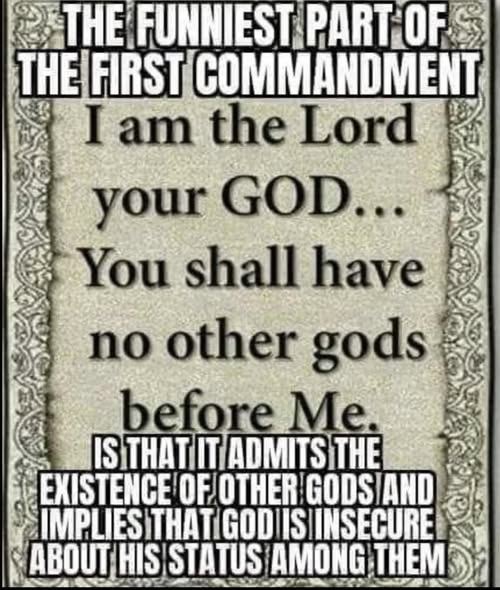
Alt...
The core text reads: "I am the Lord your GOD... You shall have no other gods before Me."
"THE FUNNIEST PART OF THE FIRST COMMANDMENT IS THAT IT ADMITS THE EXISTENCE OF OTHER GODS AND IMPLIES THAT GOD IS INSECURE ABOUT HIS STATUS AMONG THEM"
![[?]](https://polymaths.social/fileserver/01HCMX6M1CZNEVJ4F5H58TT5XJ/attachment/original/01M4GVVZSEWT13KC280GWBJSF8.png)


 🍵
🍵  [
[CW: bible question regarding a quote concerning rich people [SENSITIVE CONTENT]
#Bible scholars/#theology nerds/#theologians:
Question regarding the popular "eye of the needle" quote in all three Synoptic #Gospels:
Matthew 19:16 Someone came to Jesus with this question: “Teacher, what good deed must I do to have eternal life?”
Matthew 19:17 “Why ask me about what is good?” Jesus replied. “There is only One who is good. But to answer your question—if you want to receive eternal life, keep the commandments.”
Matthew 19:18 “Which ones?” the man asked. And Jesus replied: “‘You must not murder. You must not commit adultery. You must not steal. You must not testify falsely.
Matthew 19:19 Honor your father and mother. Love your neighbor as yourself.’”
Matthew 19:20 “I’ve obeyed all these commandments,” the young man replied. “What else must I do?”
Matthew 19:21 Jesus told him, “If you want to be perfect, go and sell all your possessions and give the money to the poor, and you will have treasure in heaven. Then come, follow me.”
Matthew 19:22 But when the young man heard this, he went away sad, for he had many possessions.
Matthew 19:23 Then Jesus said to his disciples, “I tell you the truth, it is very hard for a rich person to enter the Kingdom of Heaven.
Matthew 19:24 I’ll say it again—it is easier for a camel to go through the eye of a needle than for a rich person to enter the Kingdom of God!”
Matthew 19:25 The disciples were astounded. “Then who in the world can be saved?” they asked.
Matthew 19:26 Jesus looked at them intently and said, “Humanly speaking, it is impossible. But with God everything is possible.”
Mark 10:17 As Jesus was starting out on his way to Jerusalem, a man came running up to him, knelt down, and asked, “Good Teacher, what must I do to inherit eternal life?”
Mark 10:18 “Why do you call me good?” Jesus asked. “Only God is truly good.
Mark 10:19 But to answer your question, you know the commandments: ‘You must not murder. You must not commit adultery. You must not steal. You must not testify falsely. You must not cheat anyone. Honor your father and mother.’”
Mark 10:20 “Teacher,” the man replied, “I’ve obeyed all these commandments since I was young.”
Mark 10:21 Looking at the man, Jesus felt genuine love for him. “There is still one thing you haven’t done,” he told him. “Go and sell all your possessions and give the money to the poor, and you will have treasure in heaven. Then come, follow me.”
Mark 10:22 At this the man’s face fell, and he went away sad, for he had many possessions.
Mark 10:23 Jesus looked around and said to his disciples, “How hard it is for the rich to enter the Kingdom of God!”
Mark 10:24 This amazed them. But Jesus said again, “Dear children, it is very hard to enter the Kingdom of God.
Mark 10:25 In fact, it is easier for a camel to go through the eye of a needle than for a rich person to enter the Kingdom of God!”
Mark 10:26 The disciples were astounded. “Then who in the world can be saved?” they asked.
Mark 10:27 Jesus looked at them intently and said, “Humanly speaking, it is impossible. But not with God. Everything is possible with God.”
Luke 18:18 Once a religious leader asked Jesus this question: “Good Teacher, what should I do to inherit eternal life?”
Luke 18:19 “Why do you call me good?” Jesus asked him. “Only God is truly good.
Luke 18:20 But to answer your question, you know the commandments: ‘You must not commit adultery. You must not murder. You must not steal. You must not testify falsely. Honor your father and mother.’”
Luke 18:21 The man replied, “I’ve obeyed all these commandments since I was young.”
Luke 18:22 When Jesus heard his answer, he said, “There is still one thing you haven’t done. Sell all your possessions and give the money to the poor, and you will have treasure in heaven. Then come, follow me.”
Luke 18:23 But when the man heard this he became very sad, for he was very rich.
Luke 18:24 When Jesus saw this, he said, “How hard it is for the rich to enter the Kingdom of God!
Luke 18:25 In fact, it is easier for a camel to go through the eye of a needle than for a rich person to enter the Kingdom of God!”
Luke 18:26 Those who heard this said, “Then who in the world can be saved?”
Luke 18:27 He replied, “What is impossible for people is possible with God.”
Question: Why is the disciples' reaction always "Oh gee, if rich people can't get into heaven, who the heck can!?" instead of, "Well, duh, of course they can't. Good riddance to those jerks!"
Was the assumption that wealth == favor really that deeply ingrained? Even among peasant farmers & fisherman that were struggling to pay taxes to Rome?
![[?]](https://neon.nightbulb.net/lamp/s/239c933df9c3341ca36cf38fab06e4cd.png)
Lambasting trolls and zealots and zealot trolls.
https://nightbulb.net/news_archive/nightbulb/parsed_subjects/
#Bible #NightBulb #Usenet #NNTP #Christ #Jesus #Christianity #Christian #Theology
STUDY – “The End of the Evangelical Experiment”? -06/17/2026

COMMENTS
I found this article interesting on two counts. First was the quality of the content, and second was the source. You see, Reformation 21 is a part of the Alliance of Confessing Evangelicals.
So is the author advocating or predicting the total collapse of evangelicalism? Certainly not, as Jesus commanded all to be evangelists in the Great Commission. If I read this article correctly, and the opinion of Francis Shaeffer from some 40+ years ago (see book below), it is a call to return to evangelism as the author states in substance. Doing away with the worldly influence that has been invited into the “church” over the years, and urging a return to the fundamental doctrines/principles of the Bible.
This reminds me of Paul’s exhortation to Timothy in the opening Chapter of his Second Epistle Sola Scriptura
One would think all “Christians” would never dare to compromise the Holy Word of God. Then again, maybe they are ignorant of 2 Corinthians 5:10?
Please Pray for the Ministers of God’s Holy Word and Sacraments
DEFINITIONS
evangelical A term used in Europe for “Protestant.” In America it has come to refer to one who stresses the need for a personal relationship with God in Jesus Christ by faith. Some who claim the term seek to define it further in terms of theological beliefs about particular issues.
Evangelical – Christianity. A group or church which places particular emphasis on the scriptures as the only authority in matters of faith and conduct. It was first used in the sixteenth century to refer to Catholic writers who wished to place more emphasis on the authority of scripture than medieval church tradition, but is now used to describe any group of Christians across the denominations who place particular emphasis on the use of the BIBLE in Christian life. Most EVANGELISTS subscribe to four assumptions concerning the reality of being a Christian, which includes the fundamental tenet of following the authority of scripture. The other three are the uniqueness of REDEMPTION through the CRUCIFIXION and RESURRECTION of Jesus Christ, the need for a personal redemptive experience and the urgent necessity of preaching the gospel.
Ron Geaves, “Evangelical,” in Continuum Glossary of Religious Terms (London; New York: Continuum, 2002), 113.
.
evangelical churches In Europe the term refers to Protestant churches. In America the term is generally applied interdenominationally to churches that emphasize evangelism and the need for a personal relationship with God in Jesus Christ by faith.
evangelical liberalism A movement within Protestant theology (1880–1930), also called “New Theology” or “progressive orthodoxy,” that sought to synthesize traditional Christian doctrine with the advances in science and culture in order to make Christianity more appealing to contemporary persons.
evangelical spirituality Traditional spiri tual emphases among evangelicals have focused on Bible reading and prayer. Today wider dimensions are found among those who seek to join evangelical zeal with social service and social action.
evangelical theology A transdenominational movement in American Protestantism that stresses the need for a personal relationship with Jesus Christ and the proclamation of the gospel (Gr. euangelion). It is variously defined, emphasizing biblical authority and Jesus as Savior.
evangelicalism An interdenominational movement in American Protestantism that emphasizes the spreading of the gospel through evangelism and the need for a personal relationship with God in Jesus Christ through faith. It has been marked by a more pronounced social concern than is common in fundamentalism. See also fundamentalism.
evangelism (Gr. euangelion, “good news”) The sharing of the gospel of Jesus Christ through a variety of means.
evangelist (Gr. euangelion, “good news”) One who shares the gospel of Jesus Christ.
Donald K. McKim, The Westminster Dictionary of Theological Terms, Second Edition, Revised and Expanded (Louisville, KY: Westminster John Knox Press, 2014), 110.
Evangelist – Christianity. Used in the New Testament to denote someone who ‘announces news’ and usually translated as ‘preach the gospel’. The scripture utilizes the term for the work of God, Jesus Christ, the APOSTLES and even ordinary members of the fledgling church. It is now used to describe anyone who commits his or her life to spreading the Christian message. More specifically it is used to describe any of the writers of one of the four GOSPELS.
Ron Geaves, “Evangelist,” in Continuum Glossary of Religious Terms (London; New York: Continuum, 2002), 113.
neo-evangelical (mid-twentieth cent.). The term neo-evangelical was coined by Harold J. Ockenga (1905–1985) to describe an emerging movement in mid-twientieth-century American Protestantism. Neo-evangelicals sought to remain rooted in the core doctrines of Protestant orthodoxy while at the same time promoting an openness to scholarly dialogue with liberal and neo-orthodox theologians, as well as a renewed social and political awareness and concern for the poor and disadvantaged. This was a move away from the militancy of *fundamentalism toward a keener emphasis upon developing a Christian social conscience. Key to this movement was the founding of Fuller Theological Seminary in Pasadena. Ockenga served as the first president of Fuller.
Nathan P. Feldmeth, Pocket Dictionary of Church History: Over 300 Terms Clearly and Concisely Defined, The IVP Pocket Reference Series (Downers Grove, IL: IVP Academic, 2008), 102.
STUDY
The Bible establishes evangelism as a central responsibility for believers, grounded in Christ’s authority and the transformative power of the gospel message.
Jesus commissioned His disciples to go into all nations, making disciples and teaching them to observe His commands (Matt 28:18–20), establishing the foundational mandate for spreading faith. This commission extends to preaching the good news to every person (Mark 16:15), and believers receive the Holy Spirit’s power to witness from Jerusalem to the ends of the earth (Acts 1:8). The scope is universal—the gospel must be proclaimed throughout the world as a testimony to all nations (Matt 24:14).
Scripture emphasizes both the urgency and manner of evangelism. Preachers are called to herald God’s Word with persistent readiness, whether circumstances seem favorable or not (2 Tim 4:2). Yet this boldness must be tempered with grace: believers should always be prepared to give a logical defense of their faith courteously and respectfully (1 Pet 3:15). Speech should be gracious and seasoned with wisdom, enabling thoughtful responses to questions (Col 4:2–6).
The theological foundation rests on humanity’s spiritual condition and Christ’s redemptive work. People cannot call on Christ without believing in Him, cannot believe without hearing, and cannot hear without a preacher (Rom 10:14–15). God has given believers the ministry of reconciliation, making them Christ’s ambassadors who appeal to others on His behalf (2 Cor 5:18–20). Personal testimony matters too—Jesus instructed a healed man to tell his family and community what God had done, resulting in widespread amazement (Mark 5:19–20).
Evangelism flows from both compulsion and conviction. Paul felt compelled by necessity to preach, declaring woe upon himself if he failed to do so (1 Cor 9:16). The gospel itself is God’s power for salvation to everyone who believes (Rom 1:16), making its proclamation not optional but essential. Believers function as light in the world, allowing their moral excellence and good deeds to reflect God’s character and draw others to Him (Matt 5:14–16).
Human witness extends beyond formal preaching. The apostles testified that they could not help but speak what they had witnessed (Acts 4:20), suggesting that authentic faith naturally overflows into witness. Even persecution scattered believers who went about proclaiming the gospel wherever they traveled (Acts 8:4), demonstrating that evangelism persists regardless of opposition.
Evangelical theology centers on several interconnected convictions that shape how evangelicals understand and practice their faith. At its foundation lies a commitment to biblical authority—the conviction that Scripture alone provides the authoritative standard for Christian belief and practice1. Evangelicals approach the Bible through literal, historical, grammatical, and contextual interpretation1, allowing the text to speak on its own terms rather than through institutional filters.
A second defining feature is the emphasis on individual conversion and personal accountability, where each person bears responsibility for their own decision to commit to Christ1. This personal dimension distinguishes evangelicalism from traditions emphasizing corporate salvation through institutional membership. Evangelical theology pivots on Christ’s death and resurrection as the gospel’s essence, understanding Jesus’s sacrifice as addressing the world’s sin1.
Evangelicals prioritize missionary work and gospel proclamation globally1, while also seeking to influence culture and society as expressions of Christian witness1. This includes stressing evangelism, conversion, and missionary endeavor alongside sanctification through holy living2.
Importantly, evangelical theology centers on the sovereign God; the divine Christ who bears sin, rises, and will return; divine forgiveness and reconciliation through Christ’s cross; the Holy Spirit’s mediation of communion with God through faith; and the church as spiritually constituted by born-again believers3. Rather than treating these convictions as fixed dogma, evangelicals hold their theology open to testing and correction by Scripture, which explains why contemporary evangelicals maintain methodological unity while disagreeing on specific theological issues3.
- 1Got Questions Ministries, Got Questions? Bible Questions Answered (Bellingham, WA: Faithlife, 2014–2021). [See here, here, here, here, here, here.]
- 2Harriet A. Harris, “Evangelical Theology,” in The Dictionary of Historical Theology (Carlisle, Cumbria, U.K.: Paternoster Press, 2000), 198.
- 3D. A. Carson and John D. Woodbridge, Scripture and Truth (Grand Rapids, MI: Baker Book House, 1992), 328.
AI-generated summary responses from LOGOS Bible Software
MAIN ARTICLE

The End of the Evangelical Experiment?
Brett Lee-PriceMay 19, 2026 Reformation21
There is a certain irony in asking whether the evangelical experiment has come to an end at precisely the moment when evangelicalism appears, at least superficially, to be everywhere. Its language permeates Christian discourse; its institutions dominate the Protestant landscape; its instincts shape everything from preaching styles to publishing strategies. Yet ubiquity is not the same as vitality. Indeed, it may well be the mask behind which decline hides most effectively.
The question, then, is not whether evangelicalism exists, but whether the particular form it has taken in the 20
th
and early 21
st
centuries has proven itself fit for purpose. And here, one suspects, the answer is far less comforting. For if the experiment was intended to produce a church capable of withstanding the pressures of an increasingly secular age while maintaining fidelity to the gospel once delivered to the saints, then the results thus far are decidedly underwhelming.
At the heart of the problem lies a paradox: evangelicalism, in its modern guise, has arguably sought unity at the expense of identity. And in so doing, it has rendered itself increasingly incapable of speaking with clarity, conviction, or authority to the world it inhabits…
CONTINUED @
May I also highly recommend reading
The Great Evangelical Disaster
Schaeffer, Francis A. • Crossway • 1984
Excerpt, Shaeffer The Great Evangelical DisasterDownload #PrayForTheMinistersOfGodSHolyWordAndSacraments #2CORINTHIANS10 #2Timothy1 #AllianceOfConfessingEvangelicals #Biblical #Christ #ChristianLiving #ChristianWorldview #CultureSociety #Definitions #Evangelical #Evangelism #Evangelist #FrancesShaeffer #God #Grace #HolySpirit #knowledge #MatthewHenrySMethodOfPrayer #pray #Reformation21 #SolaScriptura #Study #STUDYTheEndOfTheEvangelicalExperiment06172026 #TheGreatEvangelicalDisaster #Theology #UncompromisedWordOfGod #Wisdom
![[?]](https://soc.octade.net/retro/s/avatar-ccef00a9a86a19e385ce6ac3ee6932ec.png)
Biblical Spiritual Virginity vs. False Christian Virginity [SENSITIVE CONTENT]
Biblical Spiritual Virginity vs. False Christian VirginityChristians use the prophecy of Isaiah to prop up their false virgin birth myth.
The English translation is incorrect. The word in Isaiah is 'almah' and does not mean a virgin. Many translators claim that it means, 'young woman' but that is not the actual meaning, although 'young woman' can be implied. 'Almah' means a 'maiden' of any age, or a ritually pure maiden--not a virgin. It means a woman who is ritually clean from keeping her covenant. The word is not about bedroom habit in any way, shape, or form.
In the New Testament, the Greek word, 'parthenos' is used, and is translated as 'virgin' then interpreted again in the vein of 'bedroom habits'. Once again, this is a false rendering, as 'parthenos' is in reference to the woman being ritually pure, meaning she is a 'virgin' who has not cheated on her God with idols. Even in modern English 'virgin' can refer to someone doing something the first time as a 'virgin'. We call uncut forest, 'virgin timber'. This is the sense in which 'almah' and 'parthenos' are being used in the Bible.
Babies are not conceived without a human father. Period. Joseph the husband of Miriam is the literal, biological father of Jesus of Nazareth. The Christian dogma of the 'virgin birth' and 'immaculate conception' is nonsense.
Blame the gnostic church 'fathers' for imposing this virgin birth myth into the Bible, and confusing people for 1800+ years.
No one in their right mind considers it a miracle for a young woman to conceive. It is considered a miracle in the Bible when a barren woman conceives. We see this with Abraham and Sarah, and again with the conception of John the Baptist.
People pretend to study the bible for years or decades and it never dawns on them how many times God calls Israel a harlot for fornicating with idols, and how he is going to have 'virgins' to worship him. By 'virgins' is meant those who have not committed spiritual fornication with false gods. It is not about bedroom habits.
![[?]](https://soc.octade.net/octade/s/3f7f2b5eda4e392867c301c49c2daa16.png)
The trinity is the golden calf at Sinai. When the Israelites came out of Egypt (the new covenant) they brought the trinity of Egypt with them in their hearts and minds.
You can take the Israelite out of Egypt, but you also need to take Egypt out of the Israelite! The trinity is the imaginary god of Egypt. The Christian religion is Egypt.
In order to enter the kingdom of God you must repent of worshiping the trinity. God the Father is not a trinity. Only the Father is God. The Christian doctrine of the trinity is the idol the prophets warned us about.
The Unitarian faith is the faith of the Apostles and the only true God. The Trinitarian faith is a false faith in a false, Greek, metaphyical construct.
The Bible is NOT a book of metaphysics. It uses spiritual examples and parables to describe concrete things. The Greco-Roman 'church fathers' poisoned the well by applying pagan metaphysics to the Bible, creating the cargo cult known as the Nicene Creed and the Athanasian Creed.
God the Father is a spirit. He is not a man. He did not incarnate as a man. He raised up and sent a man to be our sacrifice for sin. Everything the trinitarians teach twists the Bible into a lie.
The Christian religion is Egypt, Babylon, Assyria, Rome, Grecia, etc. The Christian religion is the culmination of the statue in Nebuchadnezzar's dream.
Come out of the religion and find the real Jesus and be free!
The promise of the new covenant is that when the new order came, those who follow God the Father will have no need of any teacher or bishop or hierarchy to tell them to know God. God said we would have no need of a man to be our teachers or spiritual fathers. God promised that all of us will know him directly and not need anyone other than Jesus to lead the way.
The Christian religion impersonates Jesus and stands in the way, usurping his throne, as prophesied.
#Bible #Trinity #Christian #Church #Theology #Unitarian #Repent #Gospel
The trinity is the golden calf at Sinai. When the Israelites came out of Egypt (the new covenant) they brought the trinity of Egypt with them in their hearts and minds.
You can take the Israelite out of Egypt, but you also need to take Egypt out of the Israelite! The trinity is the imaginary god of Egypt. The Christian religion is Egypt.
In order to enter the kingdom of God you must repent of worshiping the trinity. God the Father is not a trinity. Only the Father is God. The Christian doctrine of the trinity is the idol the prophets warned us about.
I recently discovered this channel. I have watched some their streams exposing the insanity of militant trinitarians. They are doing good work.
The Unitarian faith is the faith of the Apostles and the only true God. The Trinitarian faith is a false faith in a false, Greek, metaphyical construct.
The Bible is NOT a book of metaphysics. It uses spiritual examples and parables to describe concrete things. The Greco-Roman 'church fathers' poisoned the well by applying pagan metaphysics to the Bible, creating the cargo cult known as the Nicene Creed and the Athanasian Creed.
God the Father is a spirit. He is not a man. He did not incarnate as a man. He raised up and sent a man to be our sacrifice for sin. Everything the trinitarians teach twists the Bible into a lie.
The Christian religion is Egypt, Babylon, Assyria, Rome, Grecia, etc. The Christian religion is the culmination of the statue in Nebuchadnezzar's dream.
Come out of the religion and find the real Jesus and be free!
The promise of the new covenant is that when the new order came, those who follow God the Father will have no need of any teacher or bishop or hierarchy to tell them to know God. God said we would have no need of a man to be our teachers or spiritual fathers. God promised that all of us will know him directly and not need anyone other than Jesus to lead the way.
The Christian religion impersonates Jesus and stands in the way, usurping his throne, as prophesied.
https://www.youtube.com/watch?v=xigWkC9L5_g
#Bible #Trinity #Christian #Church #Theology #Unitarian #Repent #Gospel
The Virgin Birth narrative is not in the Bible. You only think it is. Jesus is a man, not a 'god incarnate.'
https://www.youtube.com/watch?v=QEnfdnqoC64
#VirginBirth #Jesus #Gospel #Bible #Religion #Theology #LetTheBibleSpeak #Unitarian
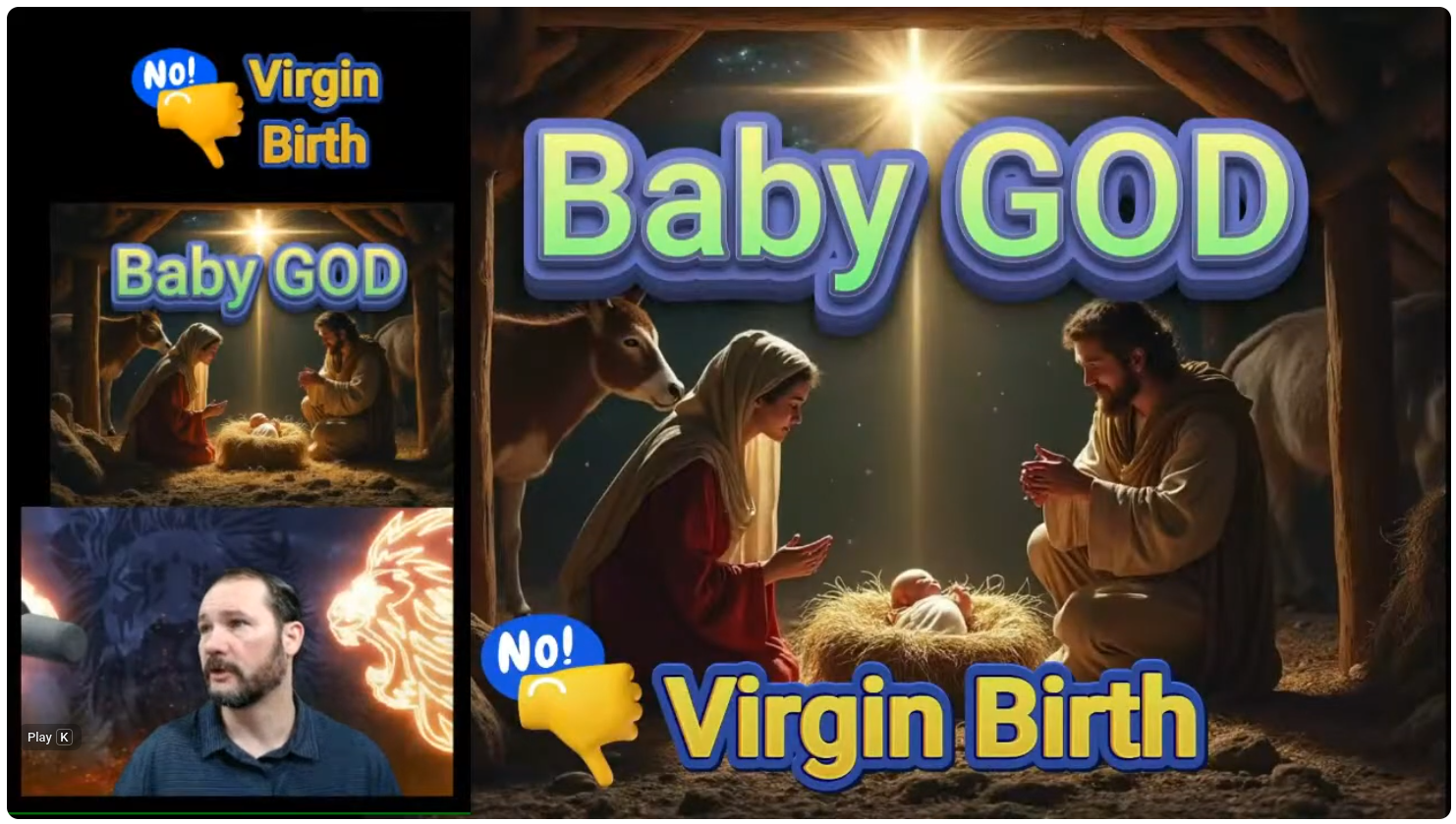
Alt...
Christian nativity scene showing baby Jesus in a manger padded with straw with Joseph and Miriam kneeling over the baby. The words, 'Baby God' run atop the scene, and the words, 'No Virgin Birth' run beneath the manger.
Been a few weeks! Today I'll be leading folks through the curriculum that is being used at camp starting next week, all in an effort to share with you all what our kids will be learning and exploring while on the North Shore!
We go live at 2:30 pm Hawai'i time.
#Jesus #Episcopal #Anglican #Christianity #spirituality #theology
Devotion – “A Forgotten Key to Reading Scripture About Christ” – 04/22/2026

COMMENTS
Have you ever heard someone say, ” Oh, the King James Bible is too hard to read.” Maybe it was something like, “I don’t need to read my Bible; the Holy Spirit guides me.” It seems folks will manufacture any excuse to avoid being in the Word. So let’s take a quick look at these two excuses to see if they have any Biblical basis.
Is the KJV really too hard to understand? My opinion (which does not matter) is no, it is not. Yes, it is full of archaic language; some of the words have different meanings today, and we must be willing to study to read it. The fact is, every version of the Bible requires that we make a real effort to understand it.
Paul said,
“We must study or give due diligence
to be an approved workman…”
that makes the number two excuse invalid. How do we study so we might be approved by God? We rely not on our own skills or strength, but on those of the Holy Spirit (John 14:26):
But the Helper (Comforter, Advocate, Intercessor—Counselor, Strengthener, Standby), the Holy Spirit, whom the Father will send in My name [in My place, to represent Me and act on My behalf], He will teach you all things. And He will help you remember everything that I have told you.
That makes the first excuse invalid. especially in the modern world we live in today.
With technology so abundant and free, there is little excuse for anyone not to be in the world daily. One of the best, easy-to-use (navigate) sites, again in my opinion, is Bible Hub
The study of the Bible is known as Hermeneutics. Biblical hermeneutics is the study of the principles and methods of interpreting the text of the Bible. Second Timothy 2:15 commands believers to be involved in hermeneutics: “Do your best to present yourself to God as one approved, a worker who . . . correctly handles the word of truth.” The purpose of biblical hermeneutics is to help us to know how to properly interpret, understand, and apply the Bible.
Hermeneutics is concerned with the big picture, topics like salvation, sin, sovereignty, etc.
The category of study alongside Hermeneutics is Exegesis.
Biblical exegesis involves a detailed, methodical study of Scripture to draw out the intended meaning of each text. The English term “exegesis” comes from a Greek word meaning “to guide or lead out.” The process requires careful analysis of language, history, culture, and context to discern what the author originally intended and how the audience first understood the message. As 2 Timothy 2:15 advises, “Make every effort to present yourself approved to God, an unashamed workman who accurately handles the word of truth.”
Within Exegesis, there is a sub-topic of Parative Exegesis:
Partitive exegesis is a hermeneutical (interpretive) method used in Christian theology—especially in reading passages about Jesus—to distinguish between the divine and human natures of Christ while maintaining their unity in His person.
Core Idea: The practice “parts” or separates biblical statements about Christ into their appropriate nature—either divine or human—without splitting the one person of the Son. It affirms that Jesus is both fully God and fully man, united in person but distinct in nature, without confusion, change, division, or separation.
Purpose: Partitive exegesis arose in the early church to resolve the tension between Christ’s divine attributes (e.g., omnipotence, eternity) and His human experiences (e.g., hunger, death, suffering). It ensures that:
Divine titles and attributes are applied to His divine nature.
Human qualities are applied to His human nature.
Both natures are preserved in the one person of Christ Patheos.
Biblical and Theological Basis: The method is rooted in Scripture’s own way of describing Christ, which sometimes attributes divine titles to human actions (e.g., “the first and the last” in Revelation 1:17–18) or human experiences to divine persons (e.g., “Son of Man ascending to where He was before” in John 6:62).
Early church figures like Origen, Athanasius, the Cappadocians, Cyril of Alexandria, and especially Gregory of Nazianzus developed and defended partitive exegesis. Gregory’s “partitive rule” explicitly assigns sublime, transcendent expressions to the divine nature and more earthly or lowly ones to the human nature, while keeping the one person in view http://www.centerforbaptistrenewal.com.
Example: Divine nature: “Before Abraham was, I am” (John 8:58) — eternal, self-existent God.
Human nature: “I thirst” (John 19:28) — human experience of thirst.
Both natures: “Redeemer” or “King” — titles that apply to both Founders Ministries.
Summary: Partitive exegesis is a disciplined, Scripture-based approach to reading about Christ that preserves the distinction between His divine and human natures while affirming their unity. It is a safeguard against heresy and a way to interpret the incarnation faithfully.
The real-world application of this is not to make everyone a Biblical Scholar, a theologian, or a preacher/teacher. It is, however, commanded by God that we be able to defend our faith ( 1 Peter 3:15
What is biblical hermeneutics?
Daily Devotional – Couch Potato Christian – Faithful Steward Ministries and FSM Women’s Outreach
DEVOTION
What Is Partitive Exegesis? How the Church Has Read Scripture on Christ

“You just had to be there!”
We fall back on this excuse when words fail to capture the precise reality of an experience—often a comedic interaction or visual beauty. The reality is that reality itself is often hard to describe. We do our best to describe it with words, but we’ve all experienced the frustration of falling short.
This is especially true when we use our words to describe God. Herman Bavinck asks, “The moment we dare to speak about God, the question arises: How can we?”[1] The same question can be asked of the person of Christ: When we dare to speak about the One who is both infinite God and finite man, how can we?
Scripture tells us Jesus slept, ate, walked, and learned new things. But it also tells us He created the universe, sustains it, and is omniscient. You can see the dilemma—how do we accurately describe Jesus when He has these seemingly contradictory categories?
We can navigate this difficulty through a practice known as partitive exegesis. Partitive exegesis presupposes that Christ’s two natures are unified in His person without confusion, change, division, or separation. Therefore, we must recognize and maintain the distinction between Christ’s two natures when we read the Bible.[2] While that may sound complicated, this practice arises from Scripture itself—it is an inspired way of describing the reality of the incarnation…
Continued via link above
- What is biblical hermeneutics? | GotQuestions.org ↩︎
- What is Biblical Exegesis? ↩︎
- Google Copilot AI-generated response. ↩︎
Devotional – “Is God Judging America Today?” – 05/1/26

COMMENT
I think we can all agree that we all want ‘our best life now’. The issue is whether we obtain it via a True Biblical manner or a watered-down version of the word. I am both discouraged and encouraged by this. 2 Timothy 4:3
For the time will come when people will not tolerate sound doctrine and accurate instruction [that challenges them with God’s truth]; but wanting to have their ears tickled [with something pleasing], they will accumulate for themselves [many] teachers [one after another, chosen] to satisfy their own desires and to support the errors they hold,
I am discouraged because I see so many being led astray by those preaching this itchy ear bible nonsense. I am also encouraged because I am seeing more and more of the younger generation turning to solid doctrine and Bible-preaching churches.
I have long agreed with the late Dr. John MacArthur that God had lifted His hand of providence from America. However, I struggled to clarify what I meant by that statement. Did it mean God was letting go (forsaking America) and letting us run wild? Was He passing some form of Judgement, designed to draw people in? Remember the surge after 9/11, Katrina, and other such calamities.
The following is from Capitol Ministries, although written to political leaders, it does a very good job of breaking down God’s Judgement and what I believe the Spiritual state of the Union is now.


April 25, 2026, by Capitol Ministries
Some leading Evangelicals have believed and taught that America is experiencing God’s judgment. As a public servant who is sacrificing so much in your attempt to turn our nation around, if those Evangelical leaders are correct, you might conclude you are wasting your time. Are you laboring against a foregone conclusion? May it never be. But allow this qualification: America is not experiencing the forsaking wrath of God, but yes, America is experiencing the consequential wrath of God.
The goal of this study is to give you a working knowledge of these italicized theological terms and a sense of hope in this work God has called you to.
CONTINUED @ SOURCE

STUDY – “Pain/Suffering and Grief/Mourning”? – 6/11/2026
I have often looked gratefully back to my sick chamber. I am certain that I never did grow in grace one-half so much anywhere as I have upon the bed of pain.
—Charles Spurgeon (1834-1892), pastor, New Park Street Chapel, London
Bible Truth Behind the Quote:The psalmist affirmed, “It is good for me that I was afflicted, that I might learn your statutes” (Psalm 119:71).
Rhodes, Ron. 1001 Unforgettable Quotes About God, Faith, and the Bible. Eugene, OR: Harvest House Publishers, 2011.
COMMENTS
As I read the article posted below yesterday, entitled Did God ever promise us a way out of pain and grief I thought of all the times I have looked at and posted on this subject over the last 20 years. Still, it never ceases to amaze me that with all the technology (online resources, free correspondence, etc.) available, folks are still fooled into believing a false gospel. Just have enough faith, and God will…, or send in $$$, and you will receive a prayer cloth, oil, and an abundance of blessings. These charlatans prey upon those in pain, those suffering, by promising them instant relief. God does not operate like the old Alka-Seltzer ad: take two, and what a relief it is.
First, let me reiterate: Can God heal anyone from anything? Yes. Can God remove all suffering from anyone at any time? Yes. As the true omnipotent God ruler of the universe, God has complete authority, knowledge, and presence in all creation. There is nothing He can not do. Is it proper to ask God to relieve our pain and suffering and that of others? Yes, through prayers and supplications. Is God required to answer those prayers and supplications in a manner we want? NO! God does all things for His glory, not ours.
Below, I have listed a few studies and articles that explain the Biblical View (the only one that should concern true Christians) on Grief, Mourning, Pain and Suffering. I hope they help us better understand these topics and prove useful to everyone in defending the faith against those who would twist God’s Holy Word.
STUDY
Grief. Emotional suffering brought on by bereavement, mishap, or disaster. To grieve is either to cause or feel sorrow or distress. The concept is found in the Scriptures under a variety of circumstances. Isaac and Rebekah experienced grief when their son Esau married a Hittite woman (Gn 26:35 KJV). God mourned the misery of Israel brought upon them by disobedience (Jgs 10:16 KJV). Hannah was so sad because she had no son that she appeared to be drunk while praying (1 Sm 1:16 KJV). Similarly, Samuel, distraught at King Saul’s disobedience, prayed all night. Job was exceedingly sorrowful over his personal loss (Jb 2:13; cf. 6:2; 16:6), and the psalmist poetically demonstrated distress and sorrow (cf. Pss 6:7; 31:9, 10; 69:26 KJV; 73:21 KJV; 95:10 KJV; 112:10 KJV). The Book of Lamentations is devoted to the expression of grief, and the prophets in general speak of judgment because Israel had grieved a holy God.
Jesus experienced sorrow and distress (Mk 3:5; Jn 11:33), including the death of a friend (Jn 11:35). The Jews are said to have been grieved as the apostles taught about Christ (Acts 4:2 KJV). The apostle Paul instructed believers not to grieve one another (Rom 14:15 KJV) and did not want to cause any sorrow himself (2 Cor 2:1–5 KJV). Most of all, the believer is not to grieve the Holy Spirit (Eph 4:30). A believer may, of course, suffer grief and suffering in an alien world (1 Pt 2:19 KJV). In Bible times grief was given particular expression at a time of death by means of shrieks, wails, and laments (cf. Jer 9:17, 18; Am 5:16; Mk 5:38).
Walter A. Elwell and Barry J. Beitzel, “Grief,” in Baker Encyclopedia of the Bible (Grand Rapids, MI: Baker Book House, 1988), 904.
Mourning –
The expression of grief at a time of bereavement or repentance, often accompanied by weeping, tearing of clothes, and wearing sackcloth.
[Although most treat Grief and Mourning as two completely different emotions or expressions, the Bible makes it clear they are linked, as Mourning is the outward expression of our internal grief.]
Regulations for the mourning of priests after bereavement Lev 21:1-4,10-11
Mourning of God’s people after bereavement Israel for Aaron Nu 20:29
Israel for Moses Dt 34:8
David for Saul and Jonathan 2Sa 1:11-12 See also 2Sa 1:17-27
David for Absalom 2Sa 18:33
Job for his children Job 1:20-21
Other examples See also Ge 37:34-35; 50:11; 2Sa 13:31; 14:2; 2Ch 35:23-25; Mt 2:18; Jn 11:31,33; Ac 8:2
Examples of heathen mourning after bereavement Isa 15:2-3; Jer 47:5; 48:37; Eze 27:30-32
Mourning as an expression of repentance Ex 33:4; Ezr 9:3-6
Mourning because of misfortune 2Sa 13:9; Job 2:12-13
The employment of professional mourners Jer 9:17-18; Am 5:16; Mt 9:23 pp Mk 5:39 pp Lk 8:52
Mourning spoken of metaphorically Jer 7:29 See also Isa 3:18-24; Eze 7:18; Joel 1:8; Am 8:10; Mic 1:16
As a sign of repentance for sin, Joel 2:12-13 See also Isa 22:12
Martin H. Manser, Dictionary of Bible Themes: The Accessible and Comprehensive Tool for Topical Studies (London: Martin Manser, 2009).
Pain. A sense of physical suffering, anguish, or distress, which has a number of causes. Scripture indicates the sources of pain and its potential spiritual implications and results.
Pain is universal. Ro 8:22 See also Ge 3:16-17; Job 5:7
The origins of pain
Satanic activity. Ge 3:15 See also Job 1:12; 2:6-7; Lk 13:16; 2Co 12:7
Human activity Ps 37:14 See also Ge 4:8; Ex 1:10-11; Na 3:1-4; Hab 2:6,8,10,12
God’s judgment and glory Jn 9:2-3 See also Ex 9:11; Nu 12:10-11; 2Ch 26:19-20; Ps 38:3-5; Pr 5:11; Ac 12:23; 13:11; 2Co 12:9
Kinds of pain
Physical pain Ps 38:7 See also Job 30:17; Mt 10:28; Lk 23:33; 2Co 4:16-18; 11:23-27
Mental pain Jer 15:18 See also Ps 42:5-6,11; Jer 12:6; Mt 26:38; 2Co 2:13; 2Pe 2:8
Bereavement Jn 11:33-35 See also Ge 35:18; 50:1; 2Sa 12:22-23; Php 2:27; 1Th 4:13
Spiritual pain
Conviction of sin Jn 16:8 See also Ps 32:3-5; 51:1-2; Lk 7:38; Ac 26:14
The anguish of hell Mk 9:47-48 See also Mt 5:22; 8:12; Lk 13:28; Rev 6:16
Perplexity Isa 50:10 See also Job 23:8-9; Ps 22:1; 88:1-3; Jer 20:7
Concern for others Gal 4:19 See also Ac 20:19; 2Co 2:1-5; 11:28; Php 3:18; Col 1:28-2:1; Heb 5:7
The failure of others Mt 26:56 See also Mt 26:40; Jn 13:21; Gal 4:16; 2Ti 4:10,16; 3Jn 10
Fruitful results of pain
It draws believers to God 1Pe 4:19 See also Jn 14:1,18; Ro 8:26; 2Co 7:5-6; Heb 4:15-16; 5:8
It equips believers to help others 2Co 1:4 See also Ro 5:3-5; 12:15; Heb 2:18; 12:11
It helps believers to anticipate the resurrection 1Co 15:54-57 See also Ro 8:19; 2Co 4:17; 1Th 4:14
It points believers to heaven Rev 21:4 See also Ro 8:18; Rev 7:15-17
Martin H. Manser, Dictionary of Bible Themes: The Accessible and Comprehensive Tool for Topical Studies (London: Martin Manser, 2009).
suffering. The experience of pain or distress, both physical and emotional. Scripture is thoroughly realistic about the place of suffering in the world and in the lives of believers. To become a Christian is not to escape from suffering, but to be able to bear suffering with dignity and hope.
suffering, nature of. Since the fall, human beings have suffered in various ways. Scripture provides insights into the nature and place of suffering both in the world and in the lives of believers.
Suffering began with the fall. Ge 2:17; 3:16-19; Ro 5:12
Suffering is universal. Job 5:7; 14:1
Different kinds of suffering. Physical pain and illness Ge 48:1 See also 2Ki 20:1 pp 2Ch 32:24 pp Isa 38:1; Job 2:7; Ps 42:10; Mt 8:6; 17:15; Lk 4:38; Ac 28:8; 2Ti 4:20; Jas 5:14
Emotional stress. Ps 55:4-5 See also Ge 35:18 “Ben-Oni” means “son of my trouble”; Pr 12:25; Jn 11:32-35; Php 2:27
Spiritual suffering. Ps 22:1 See also Mt 27:46 pp Mk 15:34
The prospect of death. Ge 3:19 See also Ecc 12:7
Major causes of suffering.The disorder in creation Ge 3:17 See also Ge 12:10; Joel 1:4; Mt 24:7 pp Lk 21:11; Ro 8:22; Rev 11:13
Human cruelty Ps 54:3; Murder: Ge 4:8; Ex 1:16,22; 1Ki 21:19; Mt 2:16
Ge 49:5-7; Oppression: Ex 1:11; Am 2:6-7; 4:1; Mal 3:5; 2Ki 6:25; 19:17 warfare; 2Ch 10:13-14; Job 1:14-15,17; Am 1:3,13; Jas 5:4-6; Rev 6:4
Family troubles Ps 27:10 See also 1Sa 1:7; 2Sa 16:11; Job 19:14-19; Mal 2:14; Mt 10:36; Jas 1:27
Old age Ps 71:9 See also Ecc 12:1-7
Satan’s activity 1Jn 5:19 See also Job 1:12; 2:6-7; Lk 13:16; 2Co 12:7; Rev 2:10; 20:7-8
Aggravations to suffering Memories Job 29:2
Fears Job 3:25; Heb 2:15
Resentment Job 2:9
Sin and suffering are not necessarily related. Jn 9:3. See also Job 2:3; Lk 13:2
They are sometimes closely related Ro 1:18 See also Ge 6:5-7; Nu 14:33; Dt 28:15; Ps 107:17; Eze 23:49; Ac 5:5,10; Ro 1:27; 1Co 11:29-30; Jude 7; Rev 2:22
God’s final judgment Mt 25:41 See also Da 12:2; Mt 8:12; Mk 9:48; Isa 66:24; Rev 20:15
Effects of suffering Hardness of heart Rev 16:9 See also Ex 7:22; Rev 9:20-21
Repentance 2Ch 33:12; Lk 15:17-18
Blessing Ps 119:71 See also Isa 38:17
Martin H. Manser, Dictionary of Bible Themes: The Accessible and Comprehensive Tool for Topical Studies (London: Martin Manser, 2009).
The True Ministry of Pain
( J. R. Miller
There is a Christian art of enduring pain, which we should seek to learn. The real goal is not just to endure the suffering which falls into our life; to bear it bravely, without wincing; to pass through it patiently, even rejoicingly. Pain has a higher mission to us, than to teach us heroism. We should endure it in such a way as to get something of spiritual blessing out of it.
Pain brings to us some message from God, which we should not fail to hear. It lifts for us the veil which hides God’s face, and we should get some new glimpses of His beauty, every time we are called to suffer. Pain is furnace-fire, and we should always come out of this furnace, with the gold of our graces gleaming a little more brightly. Every experience of suffering ought in some way–to lift us nearer God, to make us more gentle and loving, and to leave the image of Christ shining a little clearer in our lives.
The first lesson in the school of tribulation!
Myths About Grief LOGOS C0121Download
Grief – Pastoral Counseling… LOGOS C0121Download
ARTICLES

Did God ever promise us a way out of pain and grief?
By Mark Creech, Op-ed Contributor Wednesday, June 10, 2026
[Excerpt] …Certainly, Scripture teaches that God works all things together for good to those who love Him. It teaches that suffering is never meaningless. It teaches that our trials are under the sovereign hand of a perfectly good and benevolent God.
But where does Scripture promise that every faithful believer will eventually experience some earthly form of restoration?
Consider the testimony of God’s Word…
Continued @ Source

A Manipulative Insult To God’s Nature: The Prosperity Gospel Is One Of The Most Dangerous Theological Ideas In The World
Despite its promises of health, wealth, and happiness, the prosperity gospel sells a bankrupt gospel.
You can hardly watch a Christian television network without seeing preachers in expensive suits proclaiming God’s desire to bless the audience with financial and physical security. Their message goes by various names: the health and wealth gospel
CONTINUED @ SOURCE
FSM and FSMMWO’s Comfort for the Grieving, Hurting, and Dying Series
#1001UnforgettableQuotesAboutGodFaithAndTheBible #Apologetics #BakerEncyclopediaOfTheBible #Biblical #CareForTheGrievingHurtingAndDyingSeries #CharlesSpurgeon #ChristianLiving #ChristianWorldview #ComfortForTheGrieving #Counsel #Counseling #DangerousTheologicalIdeas #DictionaryOfBibleThemes #DidGodEverPromiseUsAWayOutOfPainAndGrief #God #GodSPromises #Grace #Grief #GriefMourning #Heresy #Hurting #JRMiller #knowledge #LOGOSC0121 #Mourning #MythsAboutGrief #omnipotent #Omnipresence #Pain #PainSuffering #Pastor #Pastoral #STUDYPainSufferingAndGriefMourning6112026 #Suffering #TheProsperityGospel #Theology #Wisdom
https://doi.org/10.17645/mac.v8i2.2853
I remember a legislative hearing where the congress discussed the need for YouTube to censor all content that questions the veracity of heliocentrism and space programs. Perhaps this paper is following that trend?
#Censorship #FlatEarth #Cosmology #Globalism #Theology #Sociology #FreudianProjection
Paul warned about giving heed to ‘Jewish fables.’ The fables about supernatural hybrid nephilim are bunk.
The governing institutions of Christendom are the 'nephilim' or 'fallen angels.'
The 'giants' of Genesis are empires and tyrants created by Christianity.
Read more ...
https://blog.nightbulb.net/nephilim-as-giant-monsters-and-other-jewish-fables-that-turn-from-the-truth/
To 'see the face' of an authority figure or ruler is a turn of phrase, or idiom. It is not necessarily literal. In the ancient near east, Orient, and Mesopotamia, 'the face' of a ruler meant his representative or authorized agent. If you see the king's ambassador, you are seeing the king's 'face'. Jesus even said,
"He that hath seen me hath seen the Father."
Jesus was not claiming to be the Father. He was claiming to be his 'face' or representative.
'Jacob' means 'supplanter'. He supplanted Esau in the birthright of the older brother, in the same way that Christ and the Apostles supplanted Judea with the new body of Christ. Paul the Apostle explains this:
"For it is written, that Abraham had two sons, the one by a bondmaid, the other by a freewoman. But he who was of the bondwoman was born after the flesh; but he of the freewoman was by promise. Which things are an allegory: for these are the two covenants; the one from the mount Sinai, which gendereth to bondage, which is Agar. For this Agar is mount Sinai in Arabia, and answereth to Jerusalem which now is, and is in bondage with her children. But Jerusalem which is above is free, which is the mother of us all."
The story of Jacob versus Esau and Isaac and Ishmael are prophecy of the struggle between fleshly Israel and Christ, who supplants the kingdom of Judea with the new body of Christ, the people of the new covenant. Thus Paul said:
"Now we, brethren, as Isaac was, are the children of promise. But as then he that was born after the flesh persecuted him that was born after the Spirit, even so it is now. [note: The Jews who persecuted the Nazarenes are Ishmael.] Nevertheless what saith the scripture? Cast out the bondwoman and her son: for the son of the bondwoman shall not be heir with the son of the freewoman. So then, brethren, we are not children of the bondwoman, but of the free."
Judea was cast out and supplanted by the new covenant believers. This is Jacob, or Israel, taking Esau's birthright, as prophesied in Genesis. The New Covenant people supplanted the Old Covenant people. This is Jacob supplanting Esau and becoming Israel. Paul directly identifies the ancient Judeans as the Hagar or Ishmael of the Old Testament, contiguous to the Esau of Genesis:
"For this Agar is mount Sinai in Arabia, and answereth to Jerusalem which now is, and is in bondage with her children."
Thus the ancient Jews were not Israel:
"Not as though the word of God hath taken none effect. For they are not all Israel, which are of Israel: Neither, because they are the seed of Abraham, are they all children: but, In Isaac shall thy seed be called. That is, They which are the children of the flesh, these are not the children of God: but the children of the promise are counted for the seed."
In this same vein Paul elaborates that the Jews of his day are actually Esau rather than Jacob:
"It was said unto her, The elder shall serve the younger. As it is written, Jacob have I loved, but Esau have I hated."
The flesh is Esau. The spirit is Israel. The spiritual are counted for the seed, while the flesh is counted for the elder who is rejected and supplanted by the younger Jacob / supplanter.
'Israel' means he that rules with God or as God, and means that Israel is God's new 'face'.
Jesus is the head of Israel. The believers are the body of Christ or Israel.
Anyone who sees a true Nazarene minister who knows and speaks the truth of Christ's gospel without lies or hypocrisy, is 'seeing the face of Christ.'
![[?]](https://files.faithtree.social/accounts/avatars/109/762/503/392/984/571/original/3f58a809494a1dc3.jpg)

.jpg)
Please join @Bigdad1211 and me as we wrap up our discussion on #theGreatCommission and also talk about what "officers" are in the church. https://youtube.com/live/HdmIqKcd5hw
In the linked paper, Carl D. Franklin digs deep into the history of the tetragrammaton and debunks some of the myths commonly accepted as fact. The paper is part of a series and well worth the read for anyone interested in textual criticism or translation.
PDF: https://www.cbcg.org/franklin/debunking2.pdf
"Is it true that the name Jehovah borrowed its vowels from Adonai?"Spoiler: No, it is not true. It is a fabrication of a false history. The pronunciation, JEHOVAH was used centuries before Galatinus, so it is impossible for him to have invented it. Moreover, there is exactly zero historical evidence that medieval scholars before Galatinus accepted any pronunciation other than JEHOVAH. They all appear to have unanimously supported this one widely known pronunciation of the tetragrammaton.
A lot of religious and textual myths have resulting in mass misconceptions about biblical textual history and meaning. Some of the myths misrepresent the tetragrammaton, or the name of God. This eventually led to the creation of the artificial name, Yahweh, which is not a Hebrew word, and is in fact a cleverly disguised classical Latin name for Jove. The author defrocks the Galatinus origin myth, proving the name JEHOVAH was in use long before Galatinus.
The sacred name mythos is popular in some Christian and Jewish sects as well as among the Hebrew Roots movement. This paper exposes some of the false history and baseless assertions about the pronunciation of the tetragrammaton. As it turns out, the early Masoretes and the Reformers as well as some early Catholics had gotten it right - JEHOVAH is the correctly preserved pronunciation of the name of God. The name was never 'lost' and it has been known all through recorded history, if even only by a few.
#Bible #MasoreticText #Translation #Theology #History #Philology #Myths #SacredNames #NominaSacra #Judaism #Christianity #Hebrew #TiberianHebrew
I am doing some research on the nativity of Jesus of Nazareth. I am looking into the many sectarian traditions and scholarly opinions on this subject.
I would like to get hermeneutic opinions and off the cuff opinions on some groundwork questions.
1. What actual year do you think Jesus was born?
2. How old was Mary when she was married?
3. How did Mary conceive?
4. What is the significance of his birthplace?
5. What is the significance of the Magi who sought him after his birth?
6. Why was it necessary or significant for an angel to tell Mary she was going to conceive?
Where possible, links or citations would be useful for particular opinions or traditional explanations.
#bible #jesus #theology #mary #miriam #virginbirth #nativity #incarnation #christ #christianity
@theology@a.gup.pe @christianity@a.gup.pe @religion@a.gup.pe @academicchatter@a.gup.pe @infostorm@a.gup.pe
The Genesis Abraham is the Future, not the Antique, Primordial Past. Abimelech and Pharaoh are the Christian Church. The Seed of Abraham is in the World Today but not of the Christian World Order. The Deeper Meaning of Abimelech and Sarah in Genesis.
The Book of Genesis is a prophecy about the Christian age. It uses emblems to tell a deeper spiritual story, which is wrongly interpreted by many Christians and Jews to be totally literal history. But Genesis is not literal history--Genesis is the prophetic future!
#bible #genesis #church #christian #prophecy #faith #theology #jesus
ARTICLE: https://x.com/TovRose/article/1844473294503989605
SYNOPSIS
There is no historical or textual evidence that the tetragrammaton was pointed as a 'qere' in the ancient biblical manuscripts. The claim that JHWH is a qere for Adonai is ahistorical and there are only conjectures and not proofs for the qere claim.
Moreover, the structure of the Hebrew grammar proves the tetragrammaton cannot be two syllables, as in the modern neologism, 'yahweh'. The tetragrammaton has to be three syllables, JE-HO-VAH and its shortened form is two syllables: JEHO. Its poetic form is one syllable: YAH and JAH. And there is no support for YAHWEH.
Today we are told that the tetragrammaton or 'sacred name of God' was not pronounced out of 'reverence' for the divine name. This is a Hellenist myth and wasn't even started by Hebrew-speaking people. The tetragrammaton was spoken often inside and outside of the temple, with certain rules about when and where and why it was to be spoken. But there was no actual rule or custom against speaking it--Just rules about making sure to not speak it amiss.
NOTES
Upon reading this article some things stand out to me.
Many claim that the divine name was not spoken and was substituted with 'qere' to avoid speaking it out of reverence for the name. And this is a lie.
Anyone who reveres a name actually wants to speak it and does so with respect and pride, rather than substituting a nickname. It is when we hate someone that we refuse to speak their name or prohibit others from speaking it. For example, most of the world hates the mustache man, and invoking his name is discouraged in polite conversation.
The Hebrew bible text itself repeatedly commands Israel to proclaim the divine name, not to hide it behind nicknames. Any reverence for God and his commandments would prohibit the use of 'qere' substitutions. Thus those who invented these customs were not revering God--they were dishonoring him deceitfully.
So the claim that the name was not to be spoken is nonsensical religious dogma of certain mystical sects, and not historical practice of either the temple priests or the Christians who inherited the Levitical tradition after the destruction of the temple. We must remember true history: When the temple was destroyed, the surviving Jews in Jerusalem were carried off into captivity into other parts of the world by Rome. The Jews who had converted to following Jesus before the destruction of the temple had already escaped Jerusalem before the Roman siege, and carried the traditions with them, and preserved them in early Christianity. These first Christians, most of whom were Jews, had no such custom or injunction against saying the divine name, and it shows in their writings, and in their predecessors copious transliteration of the name. Their tradition was the foundation of European Christianity, which joined forces with the Sephardim to preserve the Old Testament and Hebrew language for over a millennium of years. The Masoretes properly pointed all the words, including the divine name, to preserve their pronunciations.
The entire purpose of the Masoretic vowel pointings was specifically to preserve the correct pronunciation of every Hebrew word in the text, not to hide the pronunciation. There would have been a worldwide uproar in the scholarly community over such a practice as wrongly writing the divine name or mispronouncing it. The historical record is silent on such a thing ever occurring.
The name Jehovah with the 'J' sound is correct ancient Hebrew pronunciation of the divine name. Just as the Sephardim scribes have preserved it all these centuries, the Christian scribes took over their tradition and continued to preserve it from the time of the reformation onward. When Tyndale rendered the name as IEHOUA, he was using the pronunciation taught by the Masoretic scribes and their Christian cohorts. It was not an 'invention' but rather a transliteration into English characters of the day.
We are now at a new crossroads in history where many occultists, kabbalists, pagans, and sectarians are once again attacking the divine name and trying to cloud it with confusion and false myths. This is what liars have always done--invent stories to support their delusions. Perhaps in the coming centuries we should expect another vanguard to come and take of the tradition of preserving the name against this army of confusion.
#Bible #MasoreticText #Translation #Theology #History #Philology #Myths #SacredNames #NominaSacra #Judaism #Christianity #Hebrew #TiberianHebrew
@infostorm@a.gup.pe @academicchatter@a.gup.pe @translators@a.gup.pe @theology@a.gup.pe @religion@a.gup.pe @histodons@a.gup.pe
In the linked paper, Carl D. Franklin digs deep into the history of the tetragrammaton and debunks some of the myths commonly accepted as fact. The paper is part of a series and well worth the read for anyone interested in textual criticism or translation.
PDF: https://www.cbcg.org/franklin/debunking2.pdf
SYNOPSIS
"Is it true that the name Jehovah borrowed its vowels from Adonai?"
Spoiler: No, it is not true. It is a fabrication of a false history. The pronunciation, JEHOVAH was used centuries before Galatinus, so it is impossible for him to have invented it. Moreover, there is a lack of historical evidence that medieval scholars before Galatinus accepted any pronunciation other than JEHOVAH. They all appear to have unanimously supported this one widely known pronunciation of the tetragrammaton.
A lot of religious and textual myths have resulting in mass misconceptions about biblical textual history and meaning. Some of the myths misrepresent the tetragrammaton, or the name of God. This eventually led to the creation of the artificial name, Yahweh, which is not a Hebrew word, and is in fact a cleverly disguised classical Latin name for Jove. The author defrocks the Galatinus origin myth, proving the name JEHOVAH was in use long before Galatinus.
The sacred name mythos is popular in some Christian and Jewish sects as well as among the Hebrew Roots movement. This paper exposes some of the false history and baseless assertions about the pronunciation of the tetragrammaton. As it turns out, the early Masoretes and some early Catholics and the later Reformers had gotten it right - JEHOVAH is the correctly preserved pronunciation of the name of God. The name was never 'lost' and it has been known all through recorded history, if even only by a few.
#Bible #MasoreticText #Translation #Theology #History #Philology #Myths #SacredNames #NominaSacra #Judaism #Christianity #Hebrew #TiberianHebrew #Language #Linguistics
@infostorm@a.gup.pe @academicchatter@a.gup.pe @translators@a.gup.pe @theology@a.gup.pe @religion@a.gup.pe @histodons@a.gup.pe