Search results for tag #algorithm
![[?]](https://files.mastodon.social/accounts/avatars/109/258/636/566/275/551/original/1b9ca26377a774d5.jpg)
#WelcomeToTheFediverse, @Lone!
As you might have learned, the #Fediverse is quite different from corporate #SocialMedia sites.
In particular, there's *no* automatic #algorithm. *People* are the algorithm.
As with moving to a new neighborhood, you need to engage consistently.
The first two steps are to create a relevant #Bio and a pinned #Introduction that you (re)boost every week or so.
Here are some further tips to make this a worthwhile experience here:
Good luck!
![[?]](https://media.mementomori.social/accounts/avatars/109/293/050/593/156/468/original/149d4fe6c4f85509.png)
A tip for users of our experimental instance mementomori.social:
You can enable the algorithmic "For you" feed from the top right corner of the Home feed. When you turn it on, it will instantly switch to a ranked feed that prioritizes posts based on who you follow, who you comment on, and what you like or boost. If you also toggle on "Include posts from people you don't follow," you'll see trending content across the Fediverse based on your interests.
Unlike Trending tab, For you -feed is personal. The logic is similar to pre-Musk Twitter but user-focused and not corporate-owned.
The Trending tab remains unchanged, and /explore shows posts from roughly the past 6-12 hours, with a strong focus on the most recent ones. A post that gets massive engagement might stick around a bit longer, but most cycle out within half a day. Your own For you page changes every time you click the menu, refresh the page, or return.
This is ongoing, experimental work. The PR draft and source code are available here: https://github.com/mementomori-social/mastodon/pull/4
#MementoMoriSocial #Mastodon #MastoAdmin #OpenSource #BuildInPublic #Algorithm #AlgorithmicFeed #Algorithms
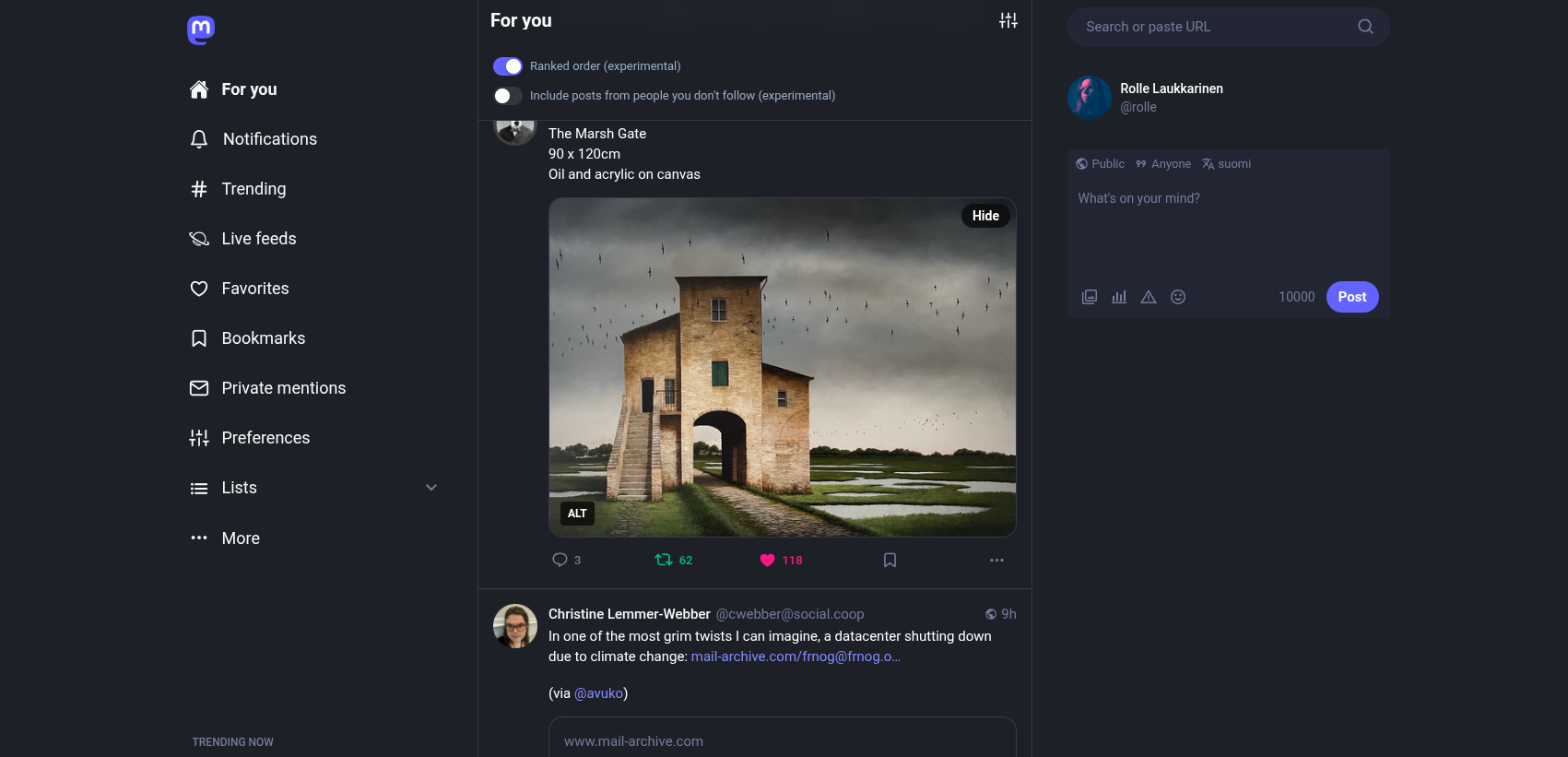
Alt...
A screenshot of For You feed in Mastodon
![[?]](https://the-end-time.org/wp-content/uploads/2019/10/cropped-logo5.jpg)
Prata Potpourri: Algorithms and the Christian, Speaking truth in love, Female Piety, more
By Elizabeth Prata
The dog days of summer are upon us here in the south. High humidity, high temperatures even through the night, the air thick with wetness and bugs.
According to Farmer’s Almanac, the dog days officially begin July 3 to August 11, but the publisher is a Mainer so…I hereby testify that the dog days are upon us in June! Dog days actually doesn’t originate from anything about a dog. Sirius is the brightest star in the night sky and is named Sirius. It’s the eye in the constellation Canis Major, Greater Dog so Sirius is known as the Dog Star. The ancients used to believe when Sirius was in a certain summer position that it caused heat and drought.
Since it’s summer and summer to me means BEACH, here are some beach pics from north to south along the eastern seaboard.

Lubec Beach, easternmost in the US. EPrata photo
I’ve rounded up sme articles for you. I hope you enjoy them, or at least one!
I’ve been writing about digital life, AI, and algorithms lately. A friend sent me this essay about digital life and the Christian. it’s at a prophecy news type site but it’s a good article absent any woo-woo or fringe stuff.
The author proposes the following question: Unlike a pastor who prayerfully prepares a message or a teacher who intentionally builds a lesson, algorithms are designed around a different objective. Their purpose is not spiritual maturity. Their purpose is attention. They are designed to learn what captures us, what keeps us watching, and what prevents us from moving on to something else. That reality raises an important question for Christians: If something is constantly shaping our thoughts, then who (or what) is teaching our minds?
Read the thought provoking article here: Christianity In The Age Of Algorithms
Sometimes as Christians we must confront a brother or a sister if they are sinning, or raise a difficult subject with a non-Christian. We are reminded always to ‘speak the truth in love’, a phrase from the verse at Ephesians 4:15. Here is ACBC counselor Susan Heck on the topic, and drills down to specifics, like ‘What is Speaking the Truth in Love?’, explains how to do it, why we must, and why we often don’t.
https://biblicalcounseling.com/resource-library/articles/how-to-speak-the-truth-in-love/

Myrtle beach, SC. EPrata photo
And on that note, sometimes we must admit that when we engage in difficult conversations with folks, we drift toward the judgmental but hide behind an excuse of discernment. And we know that discernment often comes with it those difficult conversations. Treading that balance of speaking truth but in love without judgment is hard to do. Here is Eric Bancroft at TableTalk Magazine with a discussion about the difference. He said, “Judgmentalism is concerned about truth regardless of people. Discernment is concerned about truth because of people.”
https://tabletalkmagazine.com/article/2024/04/discernment-without-judgmentalism/
I plopped this Reformation Heritage Books link in my draft here a month ago and the book is already out of stock! 15 copies are available at Amazon. It’s a republishing of the 1853 book. The blurb says, “John Angell James, through biblical exposition and character sketches of women from the Bible, shows the benefits of growing in piety as a goal for women from youth through motherhood. Young women are offered biblical and practical advice in order to fulfill the high calling of being a Proverbs 31 woman.”
Here is the outline-
- The Influence of Christianity on the Condition of Woman
- The Conspicuous Place which Woman Occupies in Holy Scripture
- Woman’s Mission
- Early Piety
- Religious Zeal
- The Parental Home
- Life Away from Home
- Character of Rebekah
- The Ornaments of a Profession of Religion
- The Characters of Mary and Martha of Bethany
- To Young Mothers
- The Beautiful Picture of a Good Wife in the Book of Proverbs
The reviews on Amazon are good.
https://heritagebooks.org/products/female-piety-james.html

Pompano Beach, east coast of FL. EPrata photo
Here, Pastor Gabe Hughes, the voice of WWUTT.com (When We Understand the Text) posted a 1 minute reel explaining the Karmelo Anthony verdict from a biblical perspective. His wise words should be heard. His reel is here (on Facebook).
On Youtube, another good video lesson from Gabe Hughes, this time, on why the Holy Spirit will never ‘call’ a women into the pastorate. 26 minutes.
It’s summer, and many families go camping. In the US we say camper, in the UK it’s caravan, but either way, many families have fond memories of camping in one during the warmer months. Here is an article from Apartment Therapy on a family’s re-do of a 1970s camper. Cool before and after photos.
Here is an article from UK’s magazine Country Life about the egalitarian-ness (is that a word?) of coffee houses. Anyone with a penny could enter, and discuss issues of the day, philosophy, ideas, or converse with anyone else at communal tables, regardless of class. Benjamin Franklin transported this idea into the US as well, forming the Junto Club where men could exchange ideas and discuss concepts. Here was also born Franklin’s notion of educating the men by creating a lending library, the first in the new world. The Philadelphia Library Company is still going.

Naples Beach, west coast of FL. EPrata photo
Enjoy your days!
#ai #algorithm #potpourri #truth


![[?]](https://soc.octade.net/octade/s/3f7f2b5eda4e392867c301c49c2daa16.png)
https://www.youtube.com/watch?v=CA_hmtuAPTY
[copypasta]
Did the Algorithm Change Your Decisions? | How Your Feed Was Engineered
Right now, somewhere on the internet, a video is being uploaded.
Within seconds, a system that no one elected, no one audits, and no one fully understands decides whether anyone else will ever see it.
Sometimes, it decides no one should.
And that’s the end of it.
In this episode of Plain Meaning, we examine how the modern internet quietly transformed from a system designed to deliver information… into one that decides what information exists for you at all.
It didn’t happen all at once.
It happened step by step.
Feed by feed.
Platform by platform.
Until nearly everything you see online is filtered through a machine making decisions on your behalf.
We trace how:
• Social media moved from profile pages to infinite feeds
• Facebook’s News Feed shifted from chronological to algorithmic control
• Advertising—not user experience—drove the need to control timing and visibility
• “EdgeRank” introduced the first large-scale automated editorial system
• By 2016, every major platform—Facebook, Instagram, Twitter, YouTube—had adopted algorithmic feeds
• Recommendation systems replaced direct navigation across the entire internet
But this isn’t just a story about technology.
It’s a story about incentives.
Because once platforms controlled what you saw, they didn’t just control engagement.
They controlled attention.
And once attention became the product, the system began optimizing for something far more powerful than clicks.
We examine what happened next:
• How foreign influence operations exploited algorithmic feeds during the 2016 election
• The role of Cambridge Analytica and its parent Strategic Communication Laboratories in psychological targeting
• The scale and strategy of Russia’s Internet Research Agency
• How fake local news accounts built trust before deploying disinformation
• Why most influence content wasn’t political—but divisive
• How algorithms amplified all of it without distinction
And then we go further.
Because 2016 wasn’t the end of the story.
It was the beginning.
We look at how:
• Algorithmic systems shape not just what you see—but how you think
• Platforms reward emotional, extreme, and addictive content
• Foreign-owned platforms introduce new geopolitical risks
• Systems like ByteDance’s TikTok operate differently across countries
• The same algorithmic architecture can produce completely different realities depending on its objectives
This episode is not about one platform.
It’s not about one political party.
And it’s not about one country.
It’s about the system itself.
Because the algorithm isn’t just recommending content.
It’s acting as an editor.
And most of the time, you don’t even realize it’s there.
By the end of this video, the next time you open a social media app, you’ll understand:
Why your attention isn’t fully yours.
Why the world you see isn’t necessarily the world that exists.
And how to recognize when a machine—not you—is deciding what matters.
#Algorithm #SocialMedia #DigitalMedia #YouTube #Facebook #Instagram #NewsFeed #TikTok #Twitter
[/copypasta]