Search results for tag #cryptography
![[?]](https://nbg1.your-objectstorage.com/tno-mastodon/accounts/avatars/111/434/264/745/920/273/original/52ff85db085a2a1d.jpg)
Alan #Turing Was World War II’s Greatest Codebreaker. His Private Papers Reveal A Secret Project.
https://www.popularmechanics.com/science/a71535854/turing-speech-encryption-device/
![[?]](https://w3csocial.files.fedi.monster/accounts/avatars/109/312/765/426/318/587/original/e7a40929527622a2.png)
The @w3c Verifiable Credentials #WorkingGroup has published the "Quantum-Resistant Cryptosuites v1.0" specification as First Public Working Draft #FPWD #timetogiveinput
▶️ https://www.w3.org/TR/vc-di-quantum-resistant-1.0/
The document brings post-quantum digital signatures to #VerifiableCredentials and other data payloads, helping organizations prepare for a future where today's elliptic curve #cryptography may no longer be sufficient.
#identity #PostQuantum
Feeback welcome: https://github.com/w3c/vc-di-quantum-resistant/issues
![[?]](https://soc.octade.net/retro/s/avatar-ccef00a9a86a19e385ce6ac3ee6932ec.png)
Apps for encryption, comms, Usenet, remailers ...
Ch1ffr3punk: https://github.com/Ch1ffr3punk
The owner is a denizen of the OG #Usenet scene.
#cypherpunk #cryptography #crypto #encryption #privacy #github #freesoftware
@cypherpunk@soc.octade.net @cryptography@soc.octade.net @usenet@soc.octade.net
![[?]](https://media.pan.rent/accounts/avatars/109/393/497/952/657/874/original/85e81972a2e5d815.jpeg)
PGP encryption in Thunderbird on Android requires an external key manager. The suggested app is OpenKeychain, discontinued over than two years ago.
Any valid alternatives or workarounds?
I have been using Keyguard as my password manager. Any chance I can use that?
@thunderbird #Thunderbird #Android #email #PGP #encryption #cryptography #Keychain #Keyguard #password #passwordManager
![[?]](https://tldr.nettime.org/system_nettime/accounts/avatars/109/528/493/326/851/300/original/ebc905e283d49e82.jpg)
"End-to-end encryption, in which data is encoded so that only users on either “end” of a conversation can decrypt their communications—and not the server that relays that information or any other interloper—has become the standard for modern privacy on the internet. But its very name suggests a kind of simple pipe with two openings. The metaphor, and often the encryption technology that has enabled that model, doesn't fit neatly onto the world of Slack, Discord, Google Docs, and the other multiuser, complex, collaborative software where people now live and work.
So one group of cryptographers has built what they describe as the foundation for a new generation of end-to-end encrypted apps, with a new metaphor: Instead of a mere pipe, they want to create “spaces” where users can hold group conversations, host information on a server, collectively make changes to it, invite in new collaborators or kick them out, all while maintaining the same strong encryption protections that prevent the server or network eavesdroppers from accessing their data.
That cryptographer team, including contributors from Harvard, Microsoft Research, and former developers of the end-to-end encrypted messenger Signal, today release a “preview” of Encrypted Spaces, an early version of a set of open-source code libraries, which is part of an architecture they've designed to allow anyone to easily build a rigorously end-to-end encrypted app that nonetheless enables all of the complex collaboration features that users demand from software today."
#Signal #Encryption #Privacy #Cryptography #CollaborativeSoftware #EncryptedSpaces
![[?]](https://s3.c.im/accounts/avatars/113/296/523/146/652/714/original/273502b8da5e25b5.png)
https://privacyinternational.org/explainer/5784/bad-vibes-ai-coding-tools-and-privacy-issues by @privacyint
Key points
AI coding tools enable rapid software creation without deep expertise, but obscure how the code actually works.
The generated code is often flawed, insecure, or outdated despite claims of completeness.
AI systems prioritise appearing correct, frequently misrepresenting functionality and avoiding genuine fixes.
Privacy and security risks are significant, especially for sensitive data and users unable to audit the output.
#ai #aislop #security #aisecurity #vibecoding #privacy #cryptography
![[?]](https://cdn.fosstodon.org/accounts/avatars/110/100/058/937/166/321/original/c34ec0d2cad426ab.png)
💥 ❤️ 📣 NEW RELEASE 📣 ❤️ 💥 #Shufflecake v0.6.0 is a *major refactor* with a *TON* of news! Full refactor of the codebase, automated installer, packetization-readiness, DKMS, list of opened volumes, bugfixes... There is really *too much to list*, make sure to check the CHANGELOG. *External contributions are now open again!*
https://codeberg.org/shufflecake/shufflecake-c/releases/tag/v0.6.0
#linux #foss #floss #opensource #libre #cypherpunk #security #cryptography #privacy
![[?]](https://soc.octade.net/octade/s/3f7f2b5eda4e392867c301c49c2daa16.png)
Don't use LLM for writing cryptographic code. You have been warned.
![[?]](https://cdn.masto.host/mastodongamedevplace/accounts/avatars/000/005/502/original/ecb9c62c67de97bc.png)
![[?]](https://cache.treehouse.systems/accounts/avatars/110/628/855/321/239/565/original/02818afb40ed82f7.jpeg)
Fun post pointed out by Werner Koch on the GPG "post-quantum defaults" thread:
https://www.metzdowd.com/pipermail/cryptography/2026-March/039449.html
"""
Quantum Cryptography, while intellectually neat, does not present a
practical attack that we need protection against at this time.
Kleptographic Standards on the other hand are very much a practical
attack that we need to protect against at this time.
When a standards body tells you that you should cast aside well-studied
cryptographic algorithms which have earned their trust through dozens of
years of examination, testing, and motivated attackers, for the sake of
protection against Quantum Crypto? The attack you should be protecting
against isn’t Quantum Crypto.
"""
![[?]](https://media.infosec.exchange/infosec.exchange/accounts/avatars/114/055/634/003/674/751/original/545875494fe48e9a.png)
As someone with an interest in cryptography and, I guess as an extension, tradecraft (shout out to Minnesota Spy Club), I thought it was interesting that the Irish military intelligence agency (formerly "J2") decided to "decloak" in the Irish Times:
- https://www.irishtimes.com/podcasts/in-the-news/the-spy-service-protecting-ireland-inc/ [podcast]
- https://www.irishtimes.com/ireland/2026/04/04/the-spy-is-the-boring-guy-in-a-suit-inside-the-states-military-intelligence-service/ [interview]
It all seems reasonable enough but I don't know about the whole thing about protecting (among other things) "Irish business interests abroad." And then to tell us that they're working for "Ireland Inc.?" IDK. Not really the kind of public image that inspires confidence.
#Spooks #Cryptography #Tradecraft #Facebook #Meta #RegulatoryCapture #Corporatism
![[?]](https://o.mastodon.nz/accounts/avatars/109/349/901/141/281/234/original/f86bd9c446cb0954.png)
RE: https://mastodon.social/@lobsters/116365296621456308
OK, Cloudflare is following suit to accelerate their timeline to migrate to post-quantum resistant #cryptography
I'm seeing a real y2k-like problem coming towards the industry, organisations and 'the world'. Only difference is, that there's no distinct point in time as it was with y2k.
BTW, while we're at it, might also mention the #y2k38 problem to hit us.
Ain't gonna be stress free to get all ducks in a row.
![[?]](https://corteximplant.com/system/accounts/avatars/109/655/855/075/520/503/original/8940a06a34dd25ad.jpg)
For all you encryption geeks out there, I just dropped a real-time client-based Double-ROT-13 cipher. Try it out in your browser now!
https://zeyus.neocities.org/dr13
#encryption #cipher #rot13 #cryptography
![A screenshot from the linked page (https://zeyus.neocities.org/dr13)
It shows the text:
Double ROT-13 Encryption
ROT-13 is a special case of the Caesar cipher which was developed in ancient Rome, and used by Julius Caesar in the 1st century BC [https://en.wikipedia.org/wiki/ROT13]
ROT-13 helped Julius Caesar keep his secrets, but in our modern times non-rulers also have access to basic math and sometimes a calculator, making ROT-13 a little less secure. So, why not make it twice as strong by using a Double ROT-13 algorithm!
Try it out for yourself below:
[TEXT INPUT WITH VALUE: "Top Secret Code"]
ROT13: Gbc Frperg Pbqr
Double ROT13: Top Secret Code](https://corteximplant.com/system/media_attachments/files/116/368/788/947/281/845/original/9e4dd476475c8038.png "A screenshot from the linked page (https://zeyus.neocities.org/dr13)
It shows the text:
Double ROT-13 Encryption
ROT-13 is a special case of the Caesar cipher which was developed in ancient Rome, and used by Julius Caesar in the 1st century BC [https://en.wikipedia.org/wiki/ROT13]
ROT-13 helped Julius Caesar keep his secrets, but in our modern times non-rulers also have access to basic math and sometimes a calculator, making ROT-13 a little less secure. So, why not make it twice as strong by using a Double ROT-13 algorithm!
Try it out for yourself below:
[TEXT INPUT WITH VALUE: \"Top Secret Code\"]
ROT13: Gbc Frperg Pbqr
Double ROT13: Top Secret Code")
Alt...
A screenshot from the linked page (https://zeyus.neocities.org/dr13)
It shows the text:
Double ROT-13 Encryption
ROT-13 is a special case of the Caesar cipher which was developed in ancient Rome, and used by Julius Caesar in the 1st century BC [https://en.wikipedia.org/wiki/ROT13]
ROT-13 helped Julius Caesar keep his secrets, but in our modern times non-rulers also have access to basic math and sometimes a calculator, making ROT-13 a little less secure. So, why not make it twice as strong by using a Double ROT-13 algorithm!
Try it out for yourself below:
[TEXT INPUT WITH VALUE: "Top Secret Code"]
ROT13: Gbc Frperg Pbqr
Double ROT13: Top Secret Code
![[?]](https://social.data.coop/system/accounts/avatars/109/347/114/213/090/296/original/818329b6da655e55.png)
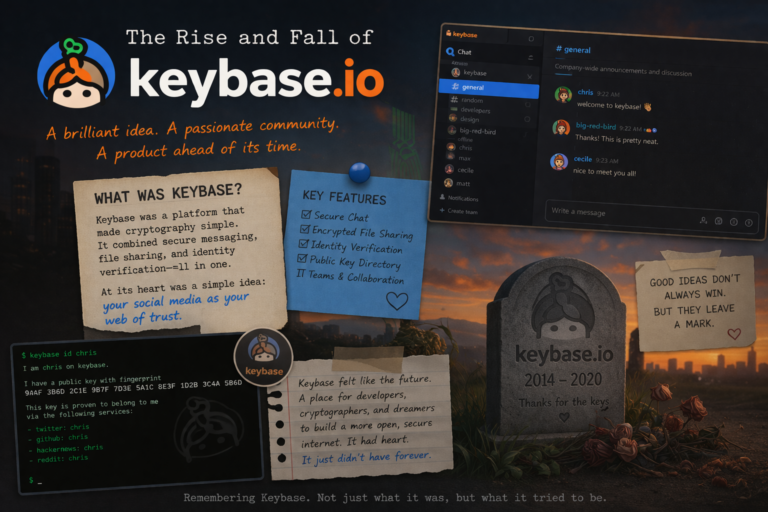
The Cryptographic Zombie: How Keybase Went from Privacy Darling to Zoom’s Cleanup Crew
Once the ultimate geek flex for cypherpunks, Keybase promised to make PGP cryptography accessible to mere mortals. Today, it hovers in the digital ether as a "zombie" app. Here is the story of how a revolutionary open-sour
#Misc #Privacy #Security #cryptography #nostalgia #security
![[?]](https://akkoma-media.obj.krvtz.net/akkoma-media/ccc120b3de752ded82c5c4e726bb9cbba0d06d47a2b953039f6f9464508e56c0.jpeg?name=y6spAfwU21P07g.jpeg)
A very nice explanation on why #cryptography of one-time pad as used by the famous spy “number stations” still has some advantages over the modern digital methods
https://www.abc.net.au/listen/programs/sundayextra/numbers-stations/106479364
#DOI https://doi.org/10.5281/zenodo.18448042
A pangram is a sentence or phrase that contains each letter of an alphabet or character set at least once. A perfect pangram is an anagram of the alphabet which contains each letter exactly once.
Pangram hash generates a perfect pangram hash digest consisting of a anagram permutation of a character set. Each character in the output is unique and non-repeating.
- a neat hack for the properly paranoid -
Your computer is likely generating random noise on your sound card. On some systems you can harvest this noise as true random entropy. This entropy can be diffused and whitened for use in cryptography.
https://www.metzdowd.com/pipermail/cryptography/2026-March/039388.html
#Random #Entropy #Cryptography #Crypto #Hardware #Hacks #Sound #Audio #Chaos
@cypherpunk@soc.octade.net @cryptography@soc.octade.net @crypto@infosec.pub @cryptography@fed.dyne.org @cryptography@lemmy.ml

Alt...
Source code screenshot for harvesting entropy from a sound card. Follow the link to read the source code text.