Search results for tag #christianity

Have you ever sought to get even with someone who hurt you? In life, it seems only fair, but what does God's word teach? Click or tap the link to learn more.
#afaithfulsower #christianity #Bible #Jesus #faith #dailydevotional
https://afaithfulsower.org/2026/06/19/how-to-handle-the-urge-for-vengeance/
 amgbengaezekieloladosu » 🌐
@megafeastamerica-dmgts.wordpress.com@megafeastamerica-dmgts.wordpress.com
“The Citizen”
The intelligence of a man is depend on the ability and capacity of his thinking faculty to express quality decision toward building purpose for living. As well to create family and to lead Nation starts from the intelligence of the home leader or Nation leader. individuals has collective roles to take responsibility in the decision making of a home creating a family of your dream and likewise the Nation leader who to lead the citizen of his or her country of influence. We can not see it has […] [SENSITIVE CONTENT]
The intelligence of a man is depend on the ability and capacity of his thinking faculty to express quality decision toward building purpose for living. As well to create family and to lead Nation starts from the intelligence of the home leader or Nation leader.
individuals has collective roles to take responsibility in the decision making of a home creating a family of your dream and likewise the Nation leader who to lead the citizen of his or her country of influence. We can not see it has a must do leading thing.
A woman or man can be the leader of a home or Nation. It about the matter of gifting and talent in the administration of building opportunity that will enhance and support the basic need the people assigned to lead
You got their vote, right and support by the contributions of the right and money they donated for your campaign to see democracy alive and respected. It a necessary thing for you to serve as a servant leader and not as an opportunity to abused and oppressed their right given to you.
Some citizen prepared a communist system of government because that’s how they can find peace to their soul and respected as a citizen to their country because many time they tried democracy and it has failed them. The experience democracy and military government gave them instinct like trauma which makes unforgettable to them.
People desire a leader with good leadership skills at home or in a country. A leader that can create innovations and ideas to growth economy and the pocket of very citizen. Some countries are poor as a result of bad leadership skills and countries are blessed from the “Father of creation” as a result of good management skills but bad leadership skills makes life worst.
I was in a country in Europe before my Nationality as an American from my African background
You see this country, they never got ocean or sea but river and lake generated from the cold water coming from the mountain by ice formed. And they still works on import and export of goods from their country to another countries that’s kind of innovations and ideas which generated incomes for the country. Also giving desire for farmers and how farmer managed their farm products which got me amazed and wondered of how the leadership of the country look likes and managed with excellence spirit of leadership.
Gbenga Ezekiel Oladosu
American National Award Winning Author
Mega Feast Bestselling Author
Honored as (WordPress “World Famous Author” Receive views from 50+ Different Countries)

The God Who Gives Wisdom Without Reproach
A Devotional Meditation on James 1:5-8 James 1:5-8 invites believers into one of the most comforting and profound promises found in Scripture. In the midst of trials, confusion, and spiritual uncertainty, God does not leave His children to navigate life by their own understanding. Instead, He extends an open invitation: "If any of you lacks wisdom, let him ask of God." This simple command reveals both humanity's great need and God's immeasurable generosity. The context of these verses is […] [SENSITIVE CONTENT]

A Devotional Meditation on James 1:5-8
James 1:5-8 invites believers into one of the most comforting and profound promises found in Scripture. In the midst of trials, confusion, and spiritual uncertainty, God does not leave His children to navigate life by their own understanding. Instead, He extends an open invitation: “If any of you lacks wisdom, let him ask of God.” This simple command reveals both humanity’s great need and God’s immeasurable generosity.
The context of these verses is significant. James has just spoken about trials and the testing of faith, reminding believers that endurance produces maturity. It is precisely in seasons of suffering that wisdom becomes indispensable. Knowledge may explain facts, intelligence may solve problems, and experience may offer guidance, but divine wisdom sees life from God’s eternal perspective. Wisdom enables believers to recognize God’s purposes when circumstances appear confusing and His providence when His hand seems hidden.
Scripture consistently distinguishes between earthly wisdom and heavenly wisdom. Human wisdom often measures success by comfort, wealth, influence, or immediate satisfaction. God’s wisdom measures life by holiness, faithfulness, humility, and eternal glory. The wisdom that James encourages believers to seek is not merely information about God but illumination from God. It is the gracious work of the Holy Spirit enabling the believer to think, choose, and live according to the mind of Christ.
The invitation itself is astonishing. God does not reserve wisdom for scholars, theologians, pastors, or the spiritually elite. James says, “If any of you lacks wisdom.” The invitation extends to every believer, regardless of age, education, background, or maturity. The youngest Christian and the oldest saint stand equally dependent upon divine guidance.
There is deep humility in admitting that wisdom is lacking. Fallen humanity naturally prefers self-sufficiency. Pride convinces the heart that it can manage life independently. Yet Scripture consistently teaches that dependence upon God is not weakness but strength. The Christian life begins with the confession of spiritual poverty and continues through continual reliance upon divine grace.
James describes God as the One who “gives generously to all without reproach.” Every word in this description reveals the Father’s character. He gives generously because generosity belongs to His nature. He is not reluctant, hesitant, or miserly with His blessings. He delights in supplying the needs of His children.
Unlike earthly relationships that sometimes grow weary of repeated requests, God never becomes impatient with sincere prayer. He never responds with annoyance or frustration. He does not remind believers of yesterday’s failures before granting today’s mercy. He gives “without reproach.” The believer approaches a throne of grace rather than a courtroom of condemnation.
This truth reflects the very heart of the gospel. Through Jesus Christ, believers are welcomed into the presence of the Father with confidence. The cross has removed every barrier between God and those who trust in His Son. The One who spared not His own Son will certainly not withhold wisdom from those who ask in faith.
The promise attached to this invitation is wonderfully straightforward: “It will be given him.” God’s answer may not always arrive in dramatic visions or audible voices, but He faithfully grants wisdom through His Word, through the work of His Spirit, through prayer, through the counsel of mature believers, and through the providential unfolding of circumstances. Divine wisdom often grows quietly within a heart that remains close to God.
Yet James immediately addresses the posture with which believers are to pray. “But let him ask in faith, with no doubting.” Faith here is not confidence in one’s own ability to believe strongly enough. Rather, it is confidence in God’s character and promises. Genuine faith rests upon the reliability of God Himself.
The believer asks because God has invited the request. Faith takes God at His word. It believes that the Father is good, that His wisdom is perfect, and that His timing is flawless. Such faith does not demand that God answer according to human expectations but trusts Him even when His answers unfold slowly or mysteriously.
James uses the vivid image of a wave driven and tossed by the wind to describe the doubting person. The sea possesses no stability when storms arise, constantly changing direction according to external forces. So too the divided heart becomes unstable, pulled by conflicting loyalties and competing desires.
The issue is not occasional questions or moments of weakness. Even faithful believers struggle with fear and uncertainty. Throughout Scripture, saints have cried out in confusion while still trusting God. Rather, James warns against divided allegiance—a heart that seeks God while simultaneously refusing to surrender fully to His authority. Such a person wants divine wisdom but remains committed to human independence.
This divided heart reflects spiritual instability. James later calls such a person “double-minded,” literally possessing two souls moving in opposite directions. One heart cannot simultaneously trust God completely while clinging to self-rule. Wisdom requires surrender as much as understanding.
The warning serves as both caution and invitation. God desires wholehearted trust because wholehearted trust leads to spiritual peace. The believer who rests securely in God’s faithfulness remains anchored even when life’s storms rage fiercely. External circumstances may shift, but confidence in God’s unchanging character provides inward stability.
James teaches that prayer is not merely presenting requests but cultivating communion with God Himself. As believers draw near to the Father in humble dependence, wisdom grows through relationship. The more the heart knows God, the more clearly it recognizes His ways.
This wisdom transforms every dimension of life. It shapes decisions, governs relationships, moderates speech, directs ambitions, and sustains hope through suffering. It teaches patience when immediate answers seem delayed and contentment when circumstances remain difficult. It produces gentleness instead of harshness, humility instead of pride, and trust instead of anxiety.
In a world overflowing with information yet starving for wisdom, James calls believers back to the simple practice of asking God. The greatest resource available to the Christian is not personal insight but divine guidance. Every challenge, every crossroads, every sorrow, and every uncertainty becomes an opportunity to seek the wisdom that comes from above.
The God who created all things possesses perfect knowledge of every path, every consequence, and every future event. Nothing surprises Him, confuses Him, or overwhelms Him. The believer who seeks His wisdom places confidence not in changing circumstances but in the eternal God whose understanding has no limits.
Therefore, let every anxious heart become a praying heart. Let every uncertain mind become a trusting mind. Let every difficult season become another invitation to draw near to the Father who delights in giving generously. His wisdom is sufficient for every trial, His grace is sufficient for every weakness, and His faithfulness remains unshaken through every generation.
Prayer
Gracious Father, You are the source of all true wisdom and understanding. Teach Your people to seek You above all earthly counsel and to trust Your perfect ways even when they cannot fully see them. Give hearts that believe Your promises without wavering and spirits that rest securely in Your goodness. Lead every step according to Your truth, strengthen faith through every trial, and grant the wisdom that produces holiness, peace, and steadfast hope through Jesus Christ our Lord. Amen.

Alt...
The God Who Gives Wisdom Without Reproach
The God Who Gives Wisdom Generously
A Prayer Inspired by James 1:5-8 Gracious and everlasting Father, the fountain of all wisdom and truth, we come before You with humble hearts, acknowledging that apart from You we are unable to see clearly, to walk faithfully, or to understand the path that leads to life. You are the Creator of heaven and earth, the One whose knowledge is infinite and whose judgments are perfect. Before the foundations of the world were laid, You knew all things. Nothing surprises You, nothing confuses You, […] [SENSITIVE CONTENT]

A Prayer Inspired by James 1:5-8
Gracious and everlasting Father, the fountain of all wisdom and truth, we come before You with humble hearts, acknowledging that apart from You we are unable to see clearly, to walk faithfully, or to understand the path that leads to life. You are the Creator of heaven and earth, the One whose knowledge is infinite and whose judgments are perfect. Before the foundations of the world were laid, You knew all things. Nothing surprises You, nothing confuses You, and nothing lies beyond the reach of Your sovereign wisdom. We bow before You in reverence and gratitude, confessing that You alone are worthy of our complete trust.
Lord, Your Word reminds us that if anyone lacks wisdom, they should ask You, because You give generously to all without finding fault. What a marvelous invitation You have extended to Your children. You do not hide Yourself from those who seek You. You do not mock our weakness or reject our questions. Instead, You welcome those who come with open hearts and empty hands, ready to receive what only You can provide. Your generosity is not measured by our worthiness but by Your unchanging goodness and grace.
We confess that we often pursue our own understanding instead of seeking Yours. We rely upon our experience, our emotions, our opinions, and the voices of this world rather than listening carefully for Your voice. We become impatient when answers do not come quickly, and we often mistake activity for wisdom. Forgive us for the pride that assumes we know best. Forgive us for trusting ourselves more than we trust You. Cleanse our hearts from self-reliance and teach us to depend completely upon Your guidance.
Father, grant us the wisdom that comes from above. Give us hearts that are pure before You, motives that are sincere, and minds that are renewed by Your truth. Teach us to see life through the light of eternity rather than through the changing shadows of this present age. Help us to discern truth from error, righteousness from compromise, and faithfulness from convenience. In a world filled with confusion and competing voices, make Your Word the steady lamp for our feet and the light for our path.
We ask for wisdom in our families. Help husbands and wives to love with patience and humility. Teach parents to lead their children with grace and truth. Guide children to honor their parents and to grow in godly character. May our homes become places where Christ is honored, forgiveness is practiced, and love is freely given. Let wisdom govern our conversations, our decisions, and our relationships so that our households may reflect the peace of Your kingdom.
We pray for wisdom in the church. Raise up pastors, elders, teachers, and servants who seek Your heart above human approval. Protect Your people from false teaching and empty philosophies that promise much but cannot save. Fill every congregation with the knowledge of Christ and with the power of the Holy Spirit. Let the church be known not merely for activity but for holiness, compassion, humility, and unwavering devotion to the truth of the gospel.
Grant wisdom to those who govern nations and communities. May leaders pursue justice with integrity and humility. Restrain evil, defend the vulnerable, and establish peace where there is conflict. Remind those who possess earthly authority that all authority ultimately belongs to You and that every ruler will one day stand before Your throne to give an account. May Your righteousness influence every decision that affects the lives of others.
Lord, we pray for those who face difficult choices today. Some stand at crossroads they never expected to reach. Some carry burdens too heavy for their own understanding. Some wrestle with uncertainty, grief, illness, financial hardship, broken relationships, or unanswered prayers. Draw near to them in mercy. Quiet the anxious heart. Strengthen weary hands. Illuminate the next faithful step, even when the entire journey cannot yet be seen. Give courage to trust Your leading even when the destination remains hidden.
Teach us what it means to ask in faith without doubting. We confess that our hearts often become divided. We trust You one moment and fear the next. We believe Your promises yet quickly become discouraged when circumstances seem unchanged. We are easily shaken by trials and distracted by the voices of fear. Forgive our wavering hearts. Anchor our souls firmly in Your character, for You remain faithful when we struggle to believe.
Help us understand that faith is not wishful thinking but confident dependence upon the God who cannot lie. Strengthen our confidence in Your goodness, Your timing, and Your perfect purposes. Even when answers seem delayed, remind us that You are still working. Even when doors remain closed, remind us that Your wisdom exceeds our understanding. Even when the road grows dark, remind us that Christ Himself is the Light who cannot be extinguished.
Lord Jesus, You are the wisdom of God made flesh. In You are hidden all the treasures of wisdom and knowledge. You walked this earth in perfect obedience to the Father’s will, never wavering, never doubting, never turning aside from the path of righteousness. Thank You for becoming our Savior and our example. Thank You for bearing our sin upon the cross and rising again in victory so that we might become children of God and receive the gift of eternal life. Teach us to follow You daily with hearts that are surrendered and minds transformed by Your grace.
Holy Spirit, dwell richly within us. Shape our thoughts according to the mind of Christ. Convict us when we wander and comfort us when we are afraid. Produce within us the fruit of patience, kindness, gentleness, self-control, and steadfast faith. Lead us away from double-mindedness and establish our hearts firmly upon the rock of God’s unchanging promises.
May our faith become steadfast through every trial. When suffering comes, let us not abandon hope. When success comes, let us not become proud. When uncertainty comes, let us not become fearful. Instead, let every circumstance draw us nearer to You. Let every challenge become an opportunity to trust You more deeply and to experience Your sustaining grace.
Keep us from becoming like waves tossed by every wind of opinion and every passing fear. Make us stable because You are stable. Make us faithful because You are faithful. Make us steadfast because Your covenant love endures forever. Let our confidence rest not in ourselves but in Christ alone, whose kingdom cannot be shaken.
Finally, Father, fill us with gratitude for the immeasurable gift of Your wisdom. Thank You that You invite weak and needy people to come boldly before Your throne and ask for what they lack. Thank You that You delight to give generously. Thank You that Your grace is greater than our confusion and Your mercy is greater than our failures. We place our lives, our families, our churches, our futures, and our souls into Your loving hands.
May every thought we think, every word we speak, and every step we take be directed by Your wisdom until the day faith becomes sight and we stand before You in everlasting joy. Until that glorious day, keep us trusting, keep us praying, and keep us walking faithfully with You.
In the holy and precious name of Jesus Christ our Lord we pray.
Amen.

Alt...
The God Who Gives Wisdom Generously
The Doorway to True Wisdom
A Message to Those Who Have Not Yet Believed from Proverbs 15:33 "The fear of the Lord is the instruction of wisdom; and before honour is humility." The world offers countless voices claiming to possess the secret to a successful life. Some say wealth is the answer. Others point to education, power, influence, pleasure, or personal achievement. Every generation produces its own philosophers, celebrities, and experts who promise that fulfillment lies just beyond the next accomplishment or […] [SENSITIVE CONTENT]

A Message to Those Who Have Not Yet Believed from Proverbs 15:33
“The fear of the Lord is the instruction of wisdom; and before honour is humility.”
The world offers countless voices claiming to possess the secret to a successful life. Some say wealth is the answer. Others point to education, power, influence, pleasure, or personal achievement. Every generation produces its own philosophers, celebrities, and experts who promise that fulfillment lies just beyond the next accomplishment or experience.
Yet despite all humanity has built, many hearts remain restless. Anxiety grows, loneliness increases, relationships fracture, and death continues to remind every person that life is fragile and temporary. Humanity has learned to send machines into space, but it still struggles to answer the deepest questions of existence. Why are we here? What is the purpose of life? What happens after death? Is there a God who knows us?
The Bible speaks into these questions with remarkable simplicity. Proverbs 15:33 says, “The fear of the Lord is the instruction of wisdom; and before honour is humility.”
At first glance, these words may seem strange. Fear is usually considered something negative. Wisdom is often associated with intelligence or education. Humility is rarely celebrated in a culture that encourages self-promotion and personal branding.
Yet this single verse quietly overturns many assumptions that modern society embraces. It declares that true wisdom begins with the fear of the Lord and that genuine honor is preceded by humility.
The fear of the Lord does not mean terror like a criminal hiding from a judge. It means reverence, awe, and recognition that God is infinitely greater than ourselves. It means acknowledging that the Creator has authority over His creation and that humanity was made to know Him rather than replace Him.
Many reject God because they assume belief requires abandoning reason. Yet the opposite is true. Wisdom begins not by pretending to know everything but by admitting that there are realities greater than human understanding.
Every scientist knows that knowledge grows through humility. Discovery begins by admitting ignorance. No one learns by insisting they already possess every answer.
The same principle applies spiritually.
The first step toward knowing God is admitting that we do not know Him as we should.
Many people spend their lives building identities upon careers, relationships, possessions, politics, or personal accomplishments. Yet none of these can carry the weight of eternity. Success cannot stop aging. Fame cannot prevent death. Money cannot purchase peace of conscience. Pleasure cannot erase guilt.
The heart longs for something greater because it was created for Someone greater.
The Bible reveals that every human being is made in the image of God. Every desire for justice, beauty, love, purpose, and truth points toward the One who created those desires.
Yet something has gone terribly wrong.
The Bible calls it sin.
Sin is more than breaking religious rules. It is the deep rebellion of the human heart that chooses independence from God. It is the determination to live life on our own terms rather than His. It appears in pride, selfishness, dishonesty, greed, hatred, lust, envy, cruelty, and countless other forms.
Every honest person knows this conflict exists within.
We often know what is right yet fail to do it.
We long for goodness yet repeatedly fall short.
We desire lasting peace yet find ourselves trapped in cycles of regret.
Human history is simply the story of this brokenness multiplied across nations and generations.
The fear of the Lord begins when a person realizes that God is not merely an idea but the holy Creator before whom every life will one day stand.
This realization is not intended to destroy hope but to awaken it.
A patient who refuses a diagnosis cannot receive healing.
A drowning person who refuses rescue cannot be saved.
Likewise, a sinner who refuses to acknowledge God cannot experience His mercy.
Many imagine God as distant and indifferent, but Scripture presents something entirely different.
God is holy beyond imagination, yet His love is equally beyond comprehension.
The greatest demonstration of that love is found in Jesus Christ.
Jesus did not merely teach moral lessons or establish another religion. He came into the world because humanity could not save itself.
The Son of God entered human history, lived without sin, healed the broken, welcomed sinners, confronted hypocrisy, and revealed the heart of the Father.
Then He willingly went to the cross.
There He bore the judgment that sinners deserved.
His death was not an accident of history but the center of God’s plan for redemption.
Three days later He rose from the dead, defeating sin and death forever.
This is the heart of the Christian faith.
Salvation is not earned through religious effort.
It is received through faith in Christ.
This is where humility enters.
Proverbs says that before honor comes humility.
Every person naturally wants to justify themselves. We compare ourselves with others and conclude that we are not so bad. We point to our kindness, generosity, or morality as evidence that we deserve acceptance.
Yet humility abandons self-defense.
Humility admits, “I cannot save myself.”
Humility confesses, “I need mercy.”
Humility recognizes that every breath is a gift from God and that eternal life cannot be earned.
Ironically, this surrender becomes the beginning of freedom.
The world teaches that independence is strength.
God teaches that dependence upon Him is life.
The world says to trust yourself.
God says to trust Him.
The world says to create your own truth.
God reveals eternal truth.
The world says that humility is weakness.
Christ demonstrates that humility is greatness.
Consider the life of Jesus Himself.
Though He possessed all authority, He washed the feet of His disciples.
Though He deserved worship, He accepted suffering.
Though He was innocent, He died for the guilty.
His humility became the pathway to eternal glory.
Those who follow Him are called to walk the same path.
Perhaps you have spent years resisting God.
Perhaps religion disappointed you.
Perhaps Christians failed you.
Perhaps suffering made belief difficult.
Perhaps intellectual questions remain unanswered.
God is not threatened by honest questions.
Throughout Scripture people wrestled with doubt, grief, fear, and confusion.
What God opposes is not sincere questioning but hardened pride that refuses even to consider Him.
The invitation of the gospel remains open.
Jesus welcomed tax collectors, thieves, doubters, prostitutes, fishermen, scholars, and ordinary laborers.
He welcomed the broken because they knew they needed healing.
The only people who consistently rejected Him were those convinced they needed nothing from Him.
Pride blinds.
Humility opens the eyes.
The fear of the Lord is not the end of joy but its beginning.
When people reject God, they often imagine they are embracing freedom.
Yet sin becomes a cruel master.
Addictions enslave.
Bitterness imprisons.
Greed consumes.
Lust degrades.
Anger destroys.
Self-centeredness isolates.
The promises of the world repeatedly leave people empty because finite things cannot satisfy an eternal soul.
Only the God who made you can truly fill the deepest hunger within you.
This does not mean life suddenly becomes easy.
Christ never promised a life without pain.
He promised His presence through pain.
He promised forgiveness that removes guilt.
He promised peace that surpasses understanding.
He promised eternal life to all who believe.
One day every human achievement will disappear.
Cities will crumble.
Empires will fade.
Technology will become obsolete.
Fame will be forgotten.
Money will lose its value.
Only one kingdom will remain forever.
Only one King will reign eternally.
Every human life is moving toward that meeting.
The question is not whether God exists.
The question is whether we will humble ourselves before Him while mercy is still offered.
Proverbs speaks of honor following humility.
God honors those who come to Him with repentant hearts.
He adopts them as His children.
He forgives their sins.
He gives them new life.
He places His Spirit within them.
He prepares an eternal inheritance beyond anything this world can offer.
The greatest tragedy is not dying young or losing wealth or suffering hardship.
The greatest tragedy is to spend an entire lifetime ignoring the God who lovingly calls people to Himself.
Yet the greatest miracle is that no one is beyond His reach.
The criminal can be forgiven.
The skeptic can believe.
The proud can become humble.
The broken can be restored.
The lonely can find family.
The guilty can receive grace.
The fearful can know peace.
This invitation stands today exactly as it has for generations.
Turn toward God.
Seek Christ.
Lay down your pride.
Confess your need.
Receive His mercy.
The fear of the Lord is indeed the instruction of wisdom.
It is not the wisdom of the classroom but the wisdom of eternity.
It is the wisdom that recognizes God as Creator, Christ as Savior, sin as deadly, grace as undeserved, and eternal life as God’s free gift to all who believe.
Before honor comes humility.
May that humility lead many hearts to discover the immeasurable riches of God’s love through Jesus Christ, who still welcomes all who come to Him in faith.

Alt...
The Doorway to True Wisdom
The First Steps on the Road of Wisdom
A Message to New Believers from Proverbs 15:33 The fear of the Lord is instruction in wisdom, and humility comes before honor.Proverbs 15:33 To every new believer who has recently begun to follow Jesus Christ, there is a wonderful journey ahead. You have entered into a relationship with the living God through His Son, and your life has been forever changed. Though many questions may still remain and many struggles may lie before you, the Lord has promised to walk with you every step of the […] [SENSITIVE CONTENT]

A Message to New Believers from Proverbs 15:33
The fear of the Lord is instruction in wisdom, and humility comes before honor.
Proverbs 15:33
To every new believer who has recently begun to follow Jesus Christ, there is a wonderful journey ahead. You have entered into a relationship with the living God through His Son, and your life has been forever changed. Though many questions may still remain and many struggles may lie before you, the Lord has promised to walk with you every step of the way. He who began a good work in you will be faithful to complete it.
As you begin this new life of faith, Scripture provides many treasures to guide your path. Among them is a simple yet profound proverb: “The fear of the Lord is instruction in wisdom, and humility comes before honor.” Though brief, these words contain a lifetime of spiritual truth. They describe the heart that God delights to shape and the path He calls His children to walk.
Many people misunderstand the phrase “the fear of the Lord.” They imagine terror, uncertainty, or the expectation of punishment. But biblical fear is something far richer and more beautiful. It is reverence, awe, worship, love, and joyful submission before the majesty of God. It is recognizing that He is Creator while we are His creatures. It is acknowledging His holiness while confessing our need for His grace. It is delighting in His authority because His ways are always righteous and good.
The Christian life does not begin by trusting in ourselves but by trusting in Christ. It does not begin with human achievement but with divine mercy. Every believer starts at the foot of the cross where pride dies and grace triumphs. There we discover that salvation is not earned through works, morality, or religious effort, but through the finished work of Jesus Christ.
This understanding produces holy reverence. When we see the greatness of God and the depth of His love, our hearts naturally bow before Him. We no longer want to live according to our own wisdom. Instead, we desire to learn His ways, obey His commands, and walk in His truth.
Proverbs tells us that this fear of the Lord is instruction in wisdom. Wisdom in Scripture is far more than knowledge. Many people possess information but lack wisdom. Wisdom is the ability to live according to God’s truth. It is seeing life through the eyes of the Creator instead of through the changing opinions of the world.
As a new believer, you may wonder how to make wise decisions. You may ask how to navigate relationships, careers, family life, temptations, disappointments, and daily choices. The answer does not begin by searching for complicated formulas. It begins with learning to fear the Lord.
Every time you open the Scriptures with a teachable heart, wisdom grows. Every time you pray for God’s guidance instead of relying solely upon your own understanding, wisdom grows. Every time you choose obedience over convenience, wisdom grows. Every act of surrender becomes another lesson in God’s school of grace.
God often teaches His children slowly. Growth rarely happens overnight. Just as a tree develops one ring at a time and a child matures one day at a time, so believers grow through countless small acts of faithfulness. The Holy Spirit patiently shapes the heart through Scripture, prayer, worship, fellowship, repentance, and daily dependence upon Christ.
Do not become discouraged if you feel immature or inexperienced. Every mature Christian was once a new believer. Every faithful servant of God once struggled with questions and weaknesses. Spiritual maturity is not measured by perfection but by perseverance and dependence upon God’s grace.
The second half of Proverbs 15:33 says that humility comes before honor. This truth stands in sharp contrast to the values of the world. Society often teaches people to promote themselves, defend their reputation, seek recognition, and pursue status. Yet God’s kingdom operates differently.
Jesus Himself demonstrated perfect humility. Though He possessed all authority and glory, He humbled Himself by taking on human flesh and becoming obedient even to death on a cross. The King of heaven washed the feet of His disciples. The Lord of creation became the suffering servant.
If Christ chose humility, His followers should expect the same path.
Humility is not weakness. It is strength submitted to God. It is the willingness to admit our need for grace. It is the freedom to confess sin without excuses. It is the ability to receive correction without resentment. It is the joy of serving others without seeking applause.
For new believers, humility creates fertile soil where spiritual growth can flourish. A proud heart resists correction and believes it already knows enough. A humble heart eagerly receives God’s instruction.
There will be times when you discover sins you never noticed before. As God’s light shines into your life, attitudes, habits, words, and motives that once seemed acceptable may suddenly trouble your conscience. Do not fear this process. This is evidence of God’s loving work within you.
The Holy Spirit convicts not to condemn but to transform. He reveals sin so that grace may heal it. Every confession becomes another opportunity to experience God’s forgiveness and cleansing.
Humility also teaches us to rely upon the body of Christ. Christianity was never intended to be a solitary journey. God places believers into a family where encouragement, accountability, teaching, and fellowship strengthen faith.
Seek out mature Christians who love the Scriptures and live with integrity. Learn from their example. Ask questions without embarrassment. Listen carefully to wise counsel. God often uses older believers to encourage younger ones along the path of discipleship.
Do not compare your spiritual journey to others. Some appear to grow quickly while others mature more slowly. God’s work in every life is unique. Instead of measuring yourself against other Christians, keep your eyes fixed upon Christ.
You will also encounter trials. New believers sometimes assume that faith will remove hardship from life. The Bible teaches otherwise. Jesus promised that His followers would experience suffering in this fallen world. Yet He also promised His presence, His peace, and His victory.
Difficulties often become God’s classroom for wisdom. Trials reveal what truly rules our hearts. They expose our idols, deepen our dependence, strengthen our faith, and teach us to trust God’s promises when circumstances seem uncertain.
Do not interpret hardship as God’s absence. Often He is doing His deepest work precisely when His purposes seem hidden. The Lord who saved you is also sanctifying you, shaping you into the image of His Son.
The fear of the Lord teaches us to trust His character even when we cannot understand His plan.
Humility also protects believers from spiritual pride. Knowledge can become dangerous if it produces arrogance rather than worship. It is possible to know many theological truths while lacking love, patience, gentleness, and compassion.
The goal of Christian growth is not merely to know more facts about God but to know God Himself more deeply. As love for Him increases, love for others naturally follows.
Remember that every blessing comes from God’s grace. Your salvation is His gift. Your faith is sustained by His power. Your growth is produced by His Spirit. Your victories over temptation are His work within you. There is no room for boasting except in the cross of Christ.
The proverb also reminds us that humility comes before honor. God’s timing often differs from ours. The world seeks immediate recognition, but God often develops hidden faithfulness before public usefulness.
David spent years tending sheep before becoming king. Moses spent decades in the wilderness before leading Israel. Joseph endured slavery and prison before governing Egypt. Even Jesus spent many quiet years before beginning His public ministry.
God values hidden obedience.
The quiet prayer offered in secret, the unnoticed act of kindness, the patient endurance through suffering, the faithful reading of Scripture, the humble confession of sin, the willingness to forgive, and the daily choice to trust Christ all matter deeply to God.
One day every believer will stand before Christ. On that day, earthly recognition will mean nothing compared to hearing His words of welcome. The honor that truly matters comes not from human applause but from God’s approval.
Therefore, do not seek greatness according to worldly standards. Seek faithfulness. Seek holiness. Seek Christ Himself.
As you begin your Christian walk, cultivate habits that strengthen your relationship with God. Read the Bible daily, not as a duty but as nourishment for your soul. Pray honestly and consistently, knowing your heavenly Father delights to hear His children. Worship with God’s people regularly. Serve others joyfully. Repent quickly when you sin. Forgive as you have been forgiven. Keep your eyes fixed upon Jesus.
There will be days when your faith feels strong and days when it feels weak. There will be victories and failures, joy and sorrow, confidence and uncertainty. Through every season, remember that your security rests not in your performance but in God’s faithfulness.
The God who called you will never abandon you. His grace is greater than your weakness. His mercy is new every morning. His promises cannot fail.
Continue walking in the fear of the Lord. Continue embracing humility. Continue seeking wisdom from His Word.
The road may sometimes be difficult, but it leads to eternal life. Every step taken with Christ is a step toward greater joy, deeper peace, richer wisdom, and everlasting glory.
Walk that path with confidence, for the Savior who called you walks beside you, and the Father who adopted you delights to guide His beloved children until faith becomes sight and every promise finds its perfect fulfillment in His eternal kingdom.

Alt...
The First Steps on the Road of Wisdom

Lambasting trolls and zealots and zealot trolls.
https://nightbulb.net/news_archive/nightbulb/parsed_subjects/
#Bible #NightBulb #Usenet #NNTP #Christ #Jesus #Christianity #Christian #Theology
The Gentle School of Wisdom
A Letter to the Family of God Based on Proverbs 15:33 Beloved brothers and sisters in Christ, Grace and peace to you in the name of our Lord Jesus Christ, who is Himself the wisdom of God and the perfect revelation of the Father's heart. In a world filled with noise, ambition, competition, and endless opinions, the Word of God quietly speaks a truth that has never changed: "The fear of the Lord is instruction in wisdom, and humility comes before honor." These simple words from Proverbs […] [SENSITIVE CONTENT]

A Letter to the Family of God Based on Proverbs 15:33
Beloved brothers and sisters in Christ,
Grace and peace to you in the name of our Lord Jesus Christ, who is Himself the wisdom of God and the perfect revelation of the Father’s heart. In a world filled with noise, ambition, competition, and endless opinions, the Word of God quietly speaks a truth that has never changed: “The fear of the Lord is instruction in wisdom, and humility comes before honor.”
These simple words from Proverbs carry within them a lifetime of discipleship. They invite every believer, whether young or old, newly converted or mature in faith, into a deeper understanding of God’s kingdom. They remind us that heaven measures greatness differently than the world does, that wisdom begins not with intelligence but with reverence, and that true honor is not seized by human effort but received through humble obedience before God.
Many seek wisdom because they desire success. Others seek knowledge because they desire influence. Still others pursue education, wealth, or reputation believing these things will provide security and meaning. Yet Scripture gently redirects our attention away from ourselves and toward the Lord. The beginning of wisdom is not self-confidence but holy reverence. It is not independence but surrender. It is not pride in our own understanding but trust in the One whose understanding is infinite.
The fear of the Lord has often been misunderstood. Some imagine terror or dread, but the biblical meaning reaches much deeper. It is the reverent awareness that God is holy beyond comprehension and yet merciful beyond imagination. It is standing before His majesty while resting securely in His love. It is recognizing that He is Creator and we are creatures, that He is King and we are His servants, that He is Father and we are His beloved children through Christ.
Such reverence transforms the heart. When believers live in the fear of the Lord, they begin to view every part of life differently. Decisions are no longer made merely for convenience but for faithfulness. Words are chosen carefully because every conversation takes place before God. Relationships become opportunities to demonstrate grace because every person bears His image. Even private moments become sacred because nothing is hidden from the eyes of the One who sees all things.
This holy fear does not imprison the believer but liberates the soul. Those who fear God no longer need to fear the changing opinions of people. They no longer need to chase approval that fades as quickly as the seasons. The fear of the Lord anchors the heart in eternal realities while freeing it from temporary anxieties. There is profound peace in belonging completely to God.
Proverbs tells us that this fear becomes instruction in wisdom. Wisdom in Scripture is not simply information stored in the mind. Wisdom is truth lived out in daily obedience. It is knowing the right path and walking in it. It is the ability to see life through the perspective of eternity rather than the moment. Wisdom shapes speech, relationships, finances, work, family life, worship, and service. It reaches into every corner of human existence.
The Lord teaches His people wisdom through His Word, through prayer, through trials, through correction, and through the quiet work of the Holy Spirit. Sometimes His lessons come through joy, and sometimes through suffering. Sometimes they arrive through open doors, and sometimes through painful disappointments. Yet every circumstance can become a classroom where the Lord patiently forms the character of Christ within His children.
Many believers ask God for wisdom but resist His instruction. They desire answers but avoid surrender. They seek blessings without transformation. Yet God’s wisdom cannot be separated from God’s lordship. He does not merely inform our minds; He changes our hearts. He does not simply explain truth; He shapes us into people who embody that truth.
This process requires humility.
The proverb continues by declaring that humility comes before honor. These words stand in sharp contrast to the values celebrated by much of society. The world encourages self-promotion, personal branding, constant recognition, and the pursuit of influence. Many are taught to build themselves up, defend every criticism, and seek visibility above all else.
The kingdom of God follows another path.
Jesus Himself walked the road of humility. Though He possessed all authority and glory, He took the form of a servant. He washed the feet of His disciples. He welcomed children, touched lepers, forgave sinners, and ultimately humbled Himself even to death on a cross. The One who deserved every crown accepted every humiliation so that sinners might receive eternal life.
The cross forever changes our understanding of greatness.
The Son of God did not conquer through pride but through sacrificial love. He did not demand honor before humility but embraced humility before receiving His exaltation. His resurrection and ascension reveal the eternal principle that God lifts up those who willingly bow before Him.
Every believer is called to follow this same pattern.
Humility is not weakness. It is strength surrendered to God. It is confidence rooted in His grace rather than personal achievement. It is the willingness to listen before speaking, to serve before being served, to forgive before demanding justice, and to love without expecting recognition.
Humility allows believers to receive correction without bitterness. It opens the heart to spiritual growth because it acknowledges that there is always more to learn from God. Proud hearts resist conviction, but humble hearts welcome transformation.
Humility also strengthens the unity of the church. Pride divides. Pride competes. Pride insists on its own way. Pride creates unnecessary conflicts and wounded relationships. Humility, however, seeks reconciliation. It chooses patience over argument and gentleness over harshness. It celebrates the gifts of others without jealousy and serves without demanding applause.
Our churches desperately need this spirit. Congregations flourish when believers prefer one another in love, when leaders serve rather than dominate, when members forgive quickly, and when every ministry exists to glorify Christ instead of personalities. Humility creates fertile ground where grace can grow.
The home also becomes a place of blessing when humility rules. Husbands and wives who practice repentance, kindness, and forgiveness reflect the gospel before their families. Parents who model humility teach their children far more than words alone ever could. Children who see genuine repentance and grace learn that faith is not performance but relationship with God.
Humility transforms workplaces as well. Christians who labor honestly, treat others with dignity, avoid gossip, refuse dishonesty, and quietly serve demonstrate the character of Christ in places that often lack compassion. The fear of the Lord shapes even ordinary tasks into acts of worship.
This wisdom becomes especially important during seasons of suffering.
Trials often expose what lies hidden within the heart. Difficult circumstances reveal whether trust has been placed in personal strength or in the Lord. Yet suffering also becomes one of God’s greatest instruments for producing humility. When human resources fail, divine grace shines brighter. When self-sufficiency crumbles, dependence upon God grows stronger.
Many saints throughout history discovered their deepest communion with God in valleys rather than mountaintops. Their trials became classrooms where wisdom matured and pride quietly disappeared. The Lord never wastes the tears of His children. He uses every hardship to shape eternal character.
The promise of honor that follows humility should also be understood carefully. Scripture does not promise worldly fame or earthly wealth to every humble believer. The honor God gives is deeper and more lasting than temporary success. It is the honor of His presence, His approval, His fellowship, and His eternal reward.
Some of God’s most honored servants remain largely unknown in this world. They quietly pray, faithfully serve, generously give, and steadfastly endure without public recognition. Heaven, however, knows their names. Their labor is not forgotten. Their hidden faithfulness is precious in the sight of God.
The day is coming when Christ Himself will reveal what has been done in secret. Every unseen act of love, every quiet sacrifice, every humble prayer, every faithful service, every cup of cold water given in His name will be remembered by the King. The applause of heaven will far outweigh every earthly award.
Therefore let no believer become discouraged by obscurity. Let no servant imagine that unnoticed faithfulness lacks significance. The Lord sees what others overlook. He honors what the world ignores.
As God’s people journey through a rapidly changing culture, the call of Proverbs remains remarkably relevant. The church does not need more self-promotion. It needs more reverence. It does not need more celebrity but more holiness. It does not need louder voices but deeper humility. It does not need greater confidence in human ability but greater dependence upon divine grace.
The fear of the Lord produces wisdom because it continually directs the eyes upward. Humility precedes honor because it continually bows the heart downward. Together they shape a life that reflects Jesus Christ.
May believers seek this wisdom daily through Scripture, prayer, worship, fellowship, and obedience. May homes become places where the fear of the Lord is treasured. May churches become communities marked by humility and grace. May every conversation, every decision, every act of service, and every hidden sacrifice bear witness to the transforming power of God’s Spirit.
The world is searching for meaning, stability, and hope. It often looks to power, wealth, influence, and achievement. Yet God’s kingdom points to another way. The path upward begins downward. The road to honor passes through humility. The school of wisdom begins with reverent worship before the Lord.
May every believer embrace this holy path with joyful confidence, trusting that the God who calls His children to humility is also the God who exalts them in His perfect time. His wisdom never fails. His promises never change. His grace is always sufficient.
Walk humbly before Him. Fear Him with joyful reverence. Receive His instruction with grateful hearts. Trust His timing above your own. In doing so, the quiet beauty of Christ will increasingly shine through your life until the day you stand before Him, hearing the words every faithful servant longs to hear: “Well done, good and faithful servant.”
May the Lord grant His church hearts that are teachable, spirits that are humble, minds that are wise, and lives that bring glory to His holy name forever.
Amen.

Alt...
The Gentle School of Wisdom
The Fear of the Lord and the Path to True Honor
A Message to Young People from Proverbs 15:33 “The fear of the Lord is the instruction of wisdom; and before honour is humility.” (Proverbs 15:33) Young people today are growing up in a world that constantly tells them to pursue recognition, popularity, influence, and success. Everywhere they turn, they are encouraged to build a name for themselves. Social media platforms reward visibility. Schools celebrate achievement. Culture often teaches that greatness belongs to those who attract […] [SENSITIVE CONTENT]

A Message to Young People from Proverbs 15:33
“The fear of the Lord is the instruction of wisdom; and before honour is humility.” (Proverbs 15:33)
Young people today are growing up in a world that constantly tells them to pursue recognition, popularity, influence, and success. Everywhere they turn, they are encouraged to build a name for themselves. Social media platforms reward visibility. Schools celebrate achievement. Culture often teaches that greatness belongs to those who attract attention, gather followers, and rise above everyone else.
While there is nothing wrong with working hard, developing gifts, or striving for excellence, Scripture presents a very different foundation for a meaningful life. Proverbs 15:33 offers a wisdom that stands in contrast to the wisdom of the world. It teaches that true wisdom begins with the fear of the Lord and that genuine honor is always preceded by humility.
This verse reveals two profound truths that every young person needs to understand. First, wisdom comes through reverence for God. Second, honor comes through humility.
These truths may seem simple, but they have the power to shape an entire life.
The Fear of the Lord Is the Instruction of Wisdom
The phrase “fear of the Lord” appears repeatedly throughout the book of Proverbs. It does not describe a terrified fear that causes someone to run from God. Rather, it describes a deep reverence, awe, respect, and submission toward Him.
To fear the Lord is to recognize who He is.
He is the Creator of heaven and earth.
He is holy beyond all comparison.
He is sovereign over history.
He is righteous in all His ways.
He is worthy of worship, obedience, and trust.
The fear of the Lord begins when a person realizes that God is not merely an idea to be discussed but the living King before whom every human being stands accountable.
Many young people spend tremendous energy trying to understand themselves. They ask important questions.
Who am I?
Why am I here?
What should I do with my life?
What is my purpose?
These are good questions, but wisdom teaches that the first question is not about ourselves. The first question is about God.
Who is God?
Until that question is answered, every other question remains incomplete.
When young people learn to fear the Lord, they begin to see life through the proper lens. They understand that their lives are not accidents. They understand that they were created intentionally. They discover that their identity is found not in popularity, appearance, athletic ability, academic success, or social status, but in their relationship with the God who made them.
The fear of the Lord teaches wisdom because it places everything else in its proper place.
It teaches young people how to make decisions.
It teaches them how to choose friends.
It teaches them how to handle success.
It teaches them how to endure disappointment.
It teaches them how to navigate temptation.
It teaches them how to live for something greater than themselves.
Without the fear of the Lord, intelligence alone is not enough. A person may possess remarkable academic knowledge and still make destructive choices. They may understand complex theories and yet lack wisdom for everyday life.
Wisdom is more than information.
Wisdom is the ability to live according to God’s truth.
Wisdom sees life from God’s perspective.
Wisdom understands consequences before they arrive.
Wisdom chooses what is right even when it is difficult.
Wisdom seeks God’s approval above human applause.
This is why Proverbs declares that the fear of the Lord is the instruction of wisdom. It is the classroom where wisdom is learned.
Learning to Listen to God
One of the greatest challenges facing young people is the overwhelming number of voices competing for their attention.
Friends offer opinions.
Teachers offer advice.
Influencers offer guidance.
Celebrities offer examples.
The internet provides endless information.
Yet amidst all these voices, the most important voice is often the one most easily ignored: the voice of God.
The fear of the Lord teaches a person to listen carefully to God’s Word.
Wisdom grows when Scripture becomes more than a religious book sitting on a shelf. Wisdom develops when God’s truth begins shaping thoughts, attitudes, priorities, and decisions.
Young people often stand at crossroads where they must make significant choices. Decisions about relationships, education, careers, morality, and future direction can have lifelong consequences.
At those moments, wisdom asks not merely, “What do I want?”
Wisdom asks, “What does God desire?”
The fear of the Lord creates a heart that seeks God’s guidance before making important decisions.
It teaches patience instead of impulsiveness.
It teaches obedience instead of rebellion.
It teaches trust instead of self-reliance.
The Person God Uses
The second half of Proverbs 15:33 contains a surprising truth.
“Before honour is humility.”
The world often says the opposite.
The world says, “Promote yourself.”
God says, “Humble yourself.”
The world says, “Demand recognition.”
God says, “Serve faithfully.”
The world says, “Make sure everyone knows your accomplishments.”
God says, “Walk humbly before Me.”
Humility is one of the most misunderstood virtues.
Humility does not mean believing you have no value.
Humility does not mean denying your abilities.
Humility does not mean pretending you have nothing to offer.
Biblical humility means understanding who you are before God.
It means recognizing that every gift, talent, opportunity, and blessing ultimately comes from Him.
A humble person does not think less of themselves; they simply think of themselves less.
Humility shifts attention away from self and toward God.
This quality is precious in God’s sight because humility creates a heart that can be taught.
Pride resists instruction.
Humility welcomes it.
Pride refuses correction.
Humility receives it.
Pride believes it already knows enough.
Humility understands there is always more to learn.
Young people who cultivate humility place themselves in a position where God can shape them into people of wisdom and influence.
The Hidden Preparation
One reason humility is difficult is that it often involves seasons of hidden preparation.
Most young people dream about future achievements. They envision making an impact, serving God in meaningful ways, and accomplishing significant things.
These desires can be good and honorable.
However, Scripture repeatedly shows that before God elevates a person, He often prepares them in obscurity.
Before Joseph governed Egypt, he spent years as a servant and prisoner.
Before David sat on Israel’s throne, he spent years tending sheep and fleeing from enemies.
Before Moses led Israel, he spent decades in the wilderness.
Before the disciples preached to nations, they spent years learning from Jesus.
God often works in private before He works in public.
The world celebrates visible success, but God values hidden faithfulness.
Young people must learn that the seasons no one notices may become the seasons that matter most.
Every act of obedience matters.
Every prayer matters.
Every moment of integrity matters.
Every quiet decision to honor God matters.
Humility accepts God’s timing.
Humility trusts God’s process.
Humility believes that faithfulness is more important than recognition.
When Honor Arrives
Proverbs does not say that honor is wrong.
In fact, it acknowledges that honor may come.
The issue is not whether honor exists.
The issue is how a person reaches it.
The world often seeks honor through self-promotion.
God leads His people toward honor through humility.
There is a tremendous difference.
Honor gained through pride is fragile.
Honor received through humility is stable.
When people build themselves up, they become dependent upon constant approval. Their identity rises and falls with public opinion.
But when honor comes from God, it rests upon a stronger foundation.
Young people should understand that true success is not measured merely by popularity, wealth, achievements, or influence.
True success is measured by faithfulness.
A life that pleases God is a successful life.
A person who walks in obedience is successful.
A young believer who honors Christ in school, at work, at home, and among friends is successful in God’s eyes.
The honor that matters most is not the applause of crowds but the approval of God.
The Example of Jesus
No discussion of humility can be complete without looking at Jesus Christ.
The Son of God possessed all glory, all authority, and all power.
Yet He willingly humbled Himself.
He entered the world as a servant.
He lived among ordinary people.
He endured rejection.
He suffered misunderstanding.
He submitted Himself to the Father’s will.
Ultimately, He went to the cross.
The pathway of Jesus demonstrates the truth of Proverbs 15:33 perfectly.
Humility came before honor.
The cross came before the crown.
Suffering came before exaltation.
Service came before glory.
Because Christ humbled Himself, God highly exalted Him.
Young people who follow Jesus are called to embrace that same spirit.
The Christian life is not about self-exaltation.
It is about faithful service.
It is about loving others.
It is about honoring God.
It is about trusting that God’s way leads to lasting joy and eternal reward.
Living This Wisdom Today
What does Proverbs 15:33 look like in everyday life?
It means choosing integrity when dishonesty would be easier.
It means treating classmates with kindness instead of cruelty.
It means respecting parents and authority figures.
It means admitting mistakes instead of making excuses.
It means accepting correction without resentment.
It means resisting peer pressure when it conflicts with God’s truth.
It means serving others without demanding recognition.
It means seeking God’s approval above social acceptance.
It means remaining faithful even when no one else notices.
These choices may not always bring immediate rewards. In fact, they may sometimes make a young person feel different from those around them.
Yet God’s wisdom has always required courage.
Following Christ has never been about doing what is popular.
It has always been about doing what is right.
Young people who embrace the fear of the Lord and walk in humility are building their lives upon a foundation that will endure long after trends, fashions, and cultural opinions have disappeared.
A Future Built on Wisdom
The years of youth are often filled with dreams, possibilities, and important decisions. They are years of growth, discovery, and preparation.
In these years, Proverbs 15:33 offers a guide that can shape an entire future.
Learn to fear the Lord.
Honor His Word.
Trust His wisdom.
Walk humbly before Him.
Receive correction.
Seek His guidance.
Serve others faithfully.
Let your identity be rooted in Christ rather than in the changing opinions of the world.
A life built upon these principles will not be wasted.
The fear of the Lord will provide wisdom for every season.
Humility will protect the heart from pride.
Faithfulness will bear fruit in God’s perfect time.
And when honor comes, it will not be something grasped through self-promotion but something received as a gift from the gracious hand of God.
The path may not always be easy, but it is the path of wisdom.
It is the path that leads to maturity.
It is the path that leads to usefulness in God’s kingdom.
It is the path that leads to lasting joy.
And according to the wisdom of Proverbs, it is the path that begins with reverence for the Lord and continues through a life marked by genuine humility.
May every young person learn this timeless truth: the fear of the Lord is the instruction of wisdom, and before honor comes humility. Those who walk this path will discover that God’s wisdom is far greater than the world’s applause, and His approval is worth more than every earthly reward.

Alt...
The Fear of the Lord and the Path to True Honor
The Quiet Promotion
A Short Story Inspired by Proverbs 15:33 Ethan Mercer had spent fifteen years climbing. He climbed through internships and entry-level positions. He climbed through late nights, early mornings, endless meetings, and ambitious projects. He climbed through company restructures and economic downturns. Every year he set a new goal, and every year he reached it. By the age of thirty-eight, he had become one of the youngest department directors at Greenstone Technologies, a rapidly growing […] [SENSITIVE CONTENT]

A Short Story Inspired by Proverbs 15:33
Ethan Mercer had spent fifteen years climbing.
He climbed through internships and entry-level positions. He climbed through late nights, early mornings, endless meetings, and ambitious projects. He climbed through company restructures and economic downturns. Every year he set a new goal, and every year he reached it.
By the age of thirty-eight, he had become one of the youngest department directors at Greenstone Technologies, a rapidly growing software company in downtown Chicago.
People admired him.
At least, that was what he told himself.
Yet the higher Ethan climbed, the lonelier he became.
He noticed things that bothered him more than they should. When someone else received praise, he felt irritated. When another manager was invited to an executive meeting, he wondered why he had been overlooked. If a project succeeded, he quietly hoped people would remember his contribution. If it failed, he found subtle ways to distance himself from the blame.
The strange thing was that no one around him seemed to notice.
Outwardly he was polite, professional, and capable.
Inwardly he was exhausted.
One rainy Thursday afternoon, Ethan received an email from the CEO announcing a new Vice President position.
His heart immediately accelerated.
This was it.
The next step.
The position everyone knew he wanted.
For weeks he prepared. He polished reports, strengthened relationships, and made sure senior leadership saw his accomplishments. Every conversation became an opportunity. Every meeting became a performance.
Then came the announcement.
The promotion went to someone else.
A woman named Sarah Delgado.
Sarah had been with the company fewer years than Ethan. She wasn’t flashy. She rarely spoke about her achievements. She wasn’t constantly networking with executives.
Yet somehow she got the role.
Ethan sat frozen at his desk after the company-wide announcement.
Applause echoed through the conference room while a bitter silence settled inside him.
That evening, he stayed late.
Most of the building had emptied by the time he finally packed his bag.
As he walked toward the elevator, he noticed a light on in one of the conference rooms.
Inside sat Harold Bennett.
Harold was nearing seventy and served as a senior advisor to the company. Most employees knew him only as a kind older man who seemed to appear everywhere. He had been one of the company’s earliest leaders before stepping away from executive responsibilities years ago.
Harold looked up and smiled.
“Tough day?”
Ethan forced a laugh.
“Is it that obvious?”
“A little.”
Ethan hesitated.
Then something unexpected happened.
All the frustration he had been carrying began pouring out.
He talked about the promotion.
About working harder than everyone else.
About feeling overlooked.
About wondering why people who seemed less qualified kept advancing.
Harold listened without interrupting.
When Ethan finally finished, the older man folded his hands.
“Can I ask you a question?”
“Sure.”
“Why do you want the position?”
Ethan answered immediately.
“Because I can do it.”
Harold nodded.
“I believe you.”
Ethan waited.
“But that’s not what I asked.”
The room grew quiet.
Harold leaned back.
“Why do you want it?”
This time Ethan hesitated.
He searched for an answer.
Money?
Partly.
Influence?
Certainly.
Recognition?
The thought landed harder than he expected.
Recognition.
The truth sat there, uncomfortable and exposed.
Harold seemed to read his expression.
“When I was younger,” he said, “I wanted every title available. Every promotion felt like proof that I mattered.”
“What changed?”
“I learned something.”
Harold stood and walked toward the large conference room window.
Rain streaked the glass.
“The people who taught me the most were rarely the people seeking attention.”
Ethan said nothing.
Harold continued.
“The strongest leaders I’ve known were humble enough to keep learning. Humble enough to admit mistakes. Humble enough to let others shine.”
He turned back toward Ethan.
“Pride makes us believe honor is something we seize.”
“And humility?”
Harold smiled.
“Humility understands that honor is something we receive.”
The words lingered.
Ethan wasn’t sure he liked them.
Because deep down he knew they were true.
Over the next several months, something unusual happened.
For the first time in his career, Ethan stopped focusing on advancement.
Not completely.
He still worked hard.
He still cared about excellence.
But he began asking different questions.
Instead of wondering how meetings made him look, he wondered how he could help others succeed.
Instead of protecting his reputation, he started admitting mistakes openly.
Instead of competing with coworkers, he began mentoring younger employees.
At first it felt unnatural.
Humility seemed less like a virtue and more like a wound.
Every act of service felt like surrendering something.
Every act of listening required setting aside his need to be heard.
Yet slowly, something changed.
The constant pressure inside him began to ease.
The anxiety that had followed him for years started fading.
He found himself enjoying work again.
Not because he was winning.
Because he was growing.
One afternoon a young analyst named Jordan stopped by Ethan’s office.
“I wanted to thank you.”
“For what?”
“You spent hours helping me prepare for that presentation.”
Ethan shrugged.
“You did the hard work.”
“Maybe,” Jordan said. “But most directors wouldn’t have given me their time.”
After Jordan left, Ethan sat quietly.
The compliment felt different than the praise he used to chase.
It wasn’t feeding his ego.
It was encouraging his heart.
Months passed.
Then years.
Greenstone Technologies continued growing.
New leaders emerged.
Departments expanded.
Challenges came and went.
One spring morning, Sarah Delgado unexpectedly announced her retirement. Family health concerns were drawing her away from corporate life.
The board began searching for a replacement.
This time Ethan didn’t campaign.
He didn’t advertise his accomplishments.
He didn’t schedule strategic lunches or prepare subtle speeches about his qualifications.
He simply continued doing his work.
A few weeks later, the board requested a meeting.
Ethan entered the conference room expecting a routine conversation.
Instead, he found several executives waiting.
One of them smiled.
“We’d like you to become our next Vice President.”
For a moment Ethan couldn’t speak.
Not because he was excited.
Because he was surprised.
Years earlier he would have viewed the promotion as a trophy.
Now it felt more like a responsibility.
Finally he asked a question.
“Why me?”
The chairman chuckled.
“We’ve been asking ourselves that question for months.”
The room laughed.
Then the chairman continued.
“You’ve become someone people trust.”
Another executive nodded.
“Employees seek your guidance.”
A third added, “You elevate everyone around you.”
The chairman folded his hands.
“You’ve become the kind of leader who doesn’t seem interested in promoting himself.”
The irony struck Ethan immediately.
The promotion arrived only after he stopped chasing it.
That evening he walked through the nearly empty office building.
The same rain that had fallen years earlier tapped softly against the windows.
As he passed the old conference room, he noticed someone sitting inside.
Harold.
Still serving as an advisor.
Still carrying the same gentle smile.
Ethan stepped inside.
“I got the position.”
Harold grinned.
“I heard.”
They sat together for a moment.
Then Ethan laughed softly.
“You knew this would happen, didn’t you?”
Harold shook his head.
“No.”
“But you weren’t surprised.”
“Not particularly.”
Ethan looked out at the city lights.
For a long moment neither man spoke.
Finally Harold said, “Do you remember our conversation years ago?”
“I do.”
“What do you remember most?”
Ethan thought carefully.
Then he smiled.
“You said humility understands that honor is something we receive.”
Harold nodded.
“That’s still true.”
Outside, the rain continued falling over the city.
Inside, Ethan felt a peace he had never found through achievement.
For years he had pursued honor and discovered only restlessness.
But when he learned humility, honor arrived on its own schedule.
And in that moment he finally understood the wisdom hidden in an ancient proverb:
The fear of the Lord teaches wisdom, and humility comes before honor.
The path upward had never begun with climbing.
It had begun with kneeling.

Alt...
The Quiet Promotion
Walking the Path of Holy Humility
A Message to Church Leaders from Proverbs 15:33 Proverbs 15:33 declares, “The fear of the Lord is instruction in wisdom, and humility comes before honor.” In a generation captivated by visibility, influence, and public recognition, this ancient proverb speaks with remarkable clarity to those entrusted with the care of Christ’s church. It reminds every pastor, elder, missionary, teacher, and servant of God that the kingdom of heaven follows a pattern very different from the kingdoms of […] [SENSITIVE CONTENT]

A Message to Church Leaders from Proverbs 15:33
Proverbs 15:33 declares, “The fear of the Lord is instruction in wisdom, and humility comes before honor.” In a generation captivated by visibility, influence, and public recognition, this ancient proverb speaks with remarkable clarity to those entrusted with the care of Christ’s church. It reminds every pastor, elder, missionary, teacher, and servant of God that the kingdom of heaven follows a pattern very different from the kingdoms of this world. God does not build greatness upon ambition but upon reverence. He does not establish enduring ministry through self-promotion but through surrender. Honor in God’s kingdom is never the product of human striving; it is the fruit that grows from a life rooted in humility before the Lord.
Church leadership is one of the highest privileges entrusted to humanity, but it is also one of the greatest tests of character. Scripture consistently warns that spiritual authority can become dangerous when separated from godly humility. Throughout biblical history, some leaders rose because they feared God, while others fell because they feared losing their own position more than they feared offending the Lord.
The proverb begins by identifying the fear of the Lord as instruction in wisdom. This fear is not terror that drives people away from God but holy reverence that draws them near with awe and submission. It is the recognition that God alone is sovereign, righteous, holy, and worthy of complete obedience. Leaders who possess this fear understand that they are shepherds under the authority of the Chief Shepherd. They are not owners of Christ’s flock but caretakers entrusted with souls that belong to God Himself.
Without the fear of the Lord, ministry can easily become performance rather than worship. Sermons may become opportunities to impress rather than proclaim truth. Programs may become measures of success rather than instruments of discipleship. Churches may begin to value attendance over transformation and popularity over faithfulness. The fear of the Lord continually redirects the heart toward what matters eternally.
Wisdom is inseparable from this holy fear because true wisdom begins with recognizing God’s rightful place above every human opinion and desire. Leaders who fear God seek His approval above public applause. They measure success not by numerical growth alone but by spiritual fruit, holiness, repentance, love, and obedience among God’s people.
This fear creates dependence upon God. It drives leaders to prayer before planning, to Scripture before strategy, and to repentance before correction of others. It reminds every servant of Christ that ministry cannot be sustained through talent alone but only through continual reliance upon the Holy Spirit.
The second half of the proverb contains a truth that contradicts human instinct: humility comes before honor. The world teaches people to climb, advertise, compete, and promote themselves. God’s kingdom teaches servants to kneel, to serve, to decrease, and to trust God with the outcome.
Jesus Himself demonstrated this pattern perfectly. Though He possessed all authority in heaven and on earth, He humbled Himself by taking the form of a servant. He washed the feet of His disciples, welcomed children, touched lepers, embraced sinners, and ultimately laid down His life upon the cross. The highest honor in history came only after the deepest humility. Resurrection followed crucifixion. Exaltation followed obedience.
Every church leader is called to follow that same path.
Humility is not weakness. It is strength under God’s control. It is the willingness to place God’s glory above personal recognition. It is the quiet confidence that rests in God’s calling without seeking constant affirmation from others.
Humble leaders are teachable. They understand that they have not mastered God’s truth but remain lifelong students of His Word. They welcome correction because they know that sanctification continues throughout life. Pride resists accountability, but humility embraces it.
Healthy churches often reflect the humility of their leaders. When pastors confess mistakes, congregations learn honesty. When elders seek forgiveness, members learn reconciliation. When ministry leaders honor others above themselves, the entire body begins to reflect the servant-hearted nature of Christ.
Conversely, pride in leadership spreads quickly throughout a congregation. Competition replaces cooperation. Comparison replaces contentment. Personal kingdoms replace kingdom ministry. Eventually division follows because pride always seeks supremacy.
The enemy has long understood the destructive power of spiritual pride. It was pride that led to rebellion in heaven. It was pride that destroyed kings, divided nations, and corrupted religious leaders throughout Scripture. Pride convinces leaders that they are indispensable, beyond correction, or somehow entitled to special treatment. Yet Scripture consistently reminds God’s servants that He opposes the proud but gives grace to the humble.
Church leaders must therefore cultivate deliberate habits of humility. This begins with remembering that every gift originates with God. The ability to preach, teach, counsel, lead, administrate, encourage, or shepherd is not self-produced. Every spiritual gift is a stewardship entrusted by divine grace.
Humility also grows through private communion with God. Secret prayer has a way of exposing pride that public ministry can conceal. Before the throne of God every title disappears. Pastor, bishop, elder, missionary, professor, and evangelist all become simply children kneeling before their heavenly Father.
Time spent in prayer reminds leaders that they remain utterly dependent upon divine mercy. No amount of theological education can replace the necessity of daily fellowship with Christ. No ministry experience can eliminate the need for fresh grace each morning.
The fear of the Lord also produces integrity when no one is watching. Leaders who live before God’s face understand that hidden compromises are never truly hidden. Character matters more than charisma because God looks upon the heart.
Modern ministry presents unique temptations. Technology provides unprecedented opportunities for influence, yet it also creates unprecedented opportunities for self-promotion. Social media can become a platform for gospel proclamation or a stage for personal branding. The difference often lies within the motives of the heart.
Leaders should continually ask themselves whether they seek to make Christ famous or themselves visible. The answer to that question often reveals whether humility or pride is directing the ministry.
The church desperately needs leaders who are more concerned with faithfulness than popularity. Congregations need shepherds who feed the sheep rather than entertain them. They need pastors who preach difficult truths with love instead of avoiding controversy for the sake of approval. They need elders who guard doctrine with courage while extending grace with compassion.
Humility enables leaders to endure criticism without becoming bitter and to receive praise without becoming arrogant. It stabilizes the soul because identity rests in Christ rather than public opinion. Those who know they are secure in God’s love are free from the exhausting pursuit of human validation.
Leadership also requires the humility to raise up others. Secure leaders do not fear gifted younger servants. Instead, they rejoice as God equips another generation. Moses invested in Joshua. Elijah prepared Elisha. Paul discipled Timothy and Titus. Barnabas encouraged John Mark after failure. Godly leaders understand that their greatest legacy may not be what they accomplish personally but whom they prepare for future ministry.
Humility celebrates the success of others without jealousy. It gladly shares responsibility rather than hoarding authority. It recognizes that the kingdom of God is larger than any single congregation or denomination. Christ alone builds His church.
Church leaders should also remember that suffering often becomes God’s classroom for humility. Trials expose self-sufficiency and deepen dependence upon divine grace. Seasons of disappointment, criticism, illness, loss, or apparent failure may become instruments through which God shapes His servants into the likeness of Christ.
Many of history’s most influential pastors and missionaries emerged from seasons of deep brokenness. Their effectiveness flowed not from natural strength but from lives surrendered through suffering. God often accomplishes His greatest work through leaders who have learned their own weakness.
The promise that humility comes before honor offers profound encouragement. God sees every hidden act of service. Every hospital visit, every counseling session, every prayer offered in secret, every unnoticed kindness, every faithful sermon preached to a small congregation, and every sacrifice made for Christ’s people is fully known by heaven.
Human recognition is fleeting, but God’s honor is eternal. Some faithful pastors labor for decades in obscurity, yet heaven records every act of obedience. Others serve in difficult places where visible fruit seems scarce, but God measures faithfulness differently than the world measures success.
The greatest commendation any leader can receive is not earthly applause but the words of the Master: “Well done, good and faithful servant.”
Church leaders therefore must resist the temptation to compare ministries. Comparison breeds either pride or discouragement. Instead, every servant should seek only to be faithful with the assignment God has given. Some plant, others water, but God gives the increase.
Humility frees leaders from competition because they recognize that every ministry belongs ultimately to Christ. There is no need to build personal empires when the kingdom already belongs to the King.
As the church faces cultural uncertainty and increasing hostility toward biblical truth, the need for humble leaders becomes even greater. Boldness without humility becomes harshness. Humility without boldness becomes compromise. Biblical leadership holds both together through submission to Christ.
The church’s witness before the world depends not merely upon doctrinal accuracy but also upon Christlike character. The watching world should see leaders marked by gentleness, patience, compassion, repentance, integrity, and sacrificial love. Such leadership reflects the heart of the Good Shepherd.
Proverbs 15:33 stands as both warning and promise. It warns against pride that seeks honor before humility. It promises that God Himself will honor those who willingly humble themselves before Him.
May every church leader embrace the instruction of wisdom that begins with the fear of the Lord. May every shepherd walk quietly before God, serving faithfully without seeking personal glory. May every minister remember that greatness in God’s kingdom is measured not by prominence but by obedience, not by applause but by faithfulness, not by earthly success but by Christlike humility.
For the path to lasting honor has never changed. It still begins where wisdom begins—with reverent fear before the Lord and with a heart that willingly bows low before the One who alone deserves all glory forever.

Alt...
Walking the Path of Holy Humility
The Path to Honor Begins with the Fear of the Lord
A Sermon Reflecting on Proverbs 15:33 Proverbs 15:33 declares, “The fear of the Lord is instruction in wisdom, and humility comes before honor.” In a single verse, God gathers together some of the most essential truths for the Christian life. He reveals where wisdom begins, how character is formed, and what true greatness looks like in His kingdom. In a world that celebrates self-promotion, independence, and personal achievement, this proverb offers a radically different vision. It tells […] [SENSITIVE CONTENT]

A Sermon Reflecting on Proverbs 15:33
Proverbs 15:33 declares, “The fear of the Lord is instruction in wisdom, and humility comes before honor.” In a single verse, God gathers together some of the most essential truths for the Christian life. He reveals where wisdom begins, how character is formed, and what true greatness looks like in His kingdom. In a world that celebrates self-promotion, independence, and personal achievement, this proverb offers a radically different vision. It tells us that genuine wisdom is learned in reverence before God, and lasting honor is found only through the pathway of humility.
Human beings have always pursued wisdom. We seek knowledge through education, experience, observation, and research. We value intelligence and celebrate innovation. Yet Scripture continually reminds us that there is a wisdom greater than intellectual ability. There is a wisdom that comes from knowing God and living under His authority.
The Bible does not separate wisdom from relationship with the Creator. Wisdom is not merely knowing facts or making clever decisions. Wisdom is seeing life from God’s perspective and ordering one’s life according to His truth. It is practical righteousness applied to daily living.
This proverb begins by declaring that “the fear of the Lord is instruction in wisdom.” The fear of the Lord is not terror that drives people away from God but reverent awe that draws them into faithful obedience. It is the recognition that God is holy, sovereign, righteous, and worthy of complete trust. It is a humble acknowledgment that He alone is Lord and that every human life stands accountable before Him.
Such fear produces obedience because it recognizes God’s goodness and authority. It understands that His commands are not burdensome restrictions but loving guidance from a perfect Father who knows what is best for His children. To fear the Lord is to surrender our own understanding and gladly receive His instruction.
The world often believes wisdom comes through self-discovery and self-expression. Scripture teaches that wisdom begins with self-surrender. The truly wise person is not the one who trusts his own heart above all things but the one who submits his heart to God.
Every page of Scripture reinforces this truth. Adam and Eve sought wisdom apart from God and brought death into the world. Solomon, though blessed with extraordinary wisdom, drifted into foolishness when his heart wandered from the Lord. The prophets repeatedly warned Israel that rejecting God’s instruction would lead to destruction. The apostles proclaimed that true wisdom is found in Christ, who is Himself the wisdom of God.
The fear of the Lord therefore becomes the school in which believers are trained. God teaches His people through His Word, through His Spirit, through discipline, through worship, through prayer, and through the daily experiences of life. The Christian never graduates from this classroom because spiritual growth continues throughout life.
Wisdom requires teachability. Pride refuses correction, but humility welcomes it. Pride assumes it already knows enough, while humility recognizes the need for continual learning. The fear of the Lord keeps the heart soft and receptive.
This is why Scripture repeatedly connects wisdom with listening. God speaks, and His people hear. He instructs, and His children obey. He corrects, and His followers repent. Wisdom grows wherever God’s voice is honored above every competing voice.
Modern culture often encourages people to become their own authority. Many are told to trust only themselves, define their own truth, and follow their own desires. Yet the Bible reveals the tragedy of such thinking. Human understanding is limited and often distorted by sin. Left to ourselves, we wander into darkness.
The fear of the Lord anchors the believer in unchanging truth. It reminds us that God knows what we cannot know, sees what we cannot see, and understands what we cannot understand. His wisdom far exceeds ours. Therefore, trusting Him is not weakness but the highest expression of wisdom.
The second half of the proverb declares that humility comes before honor. This principle appears throughout Scripture and reaches its fullest expression in the life of Jesus Christ.
The Son of God humbled Himself by taking human flesh. He lived in obedience to the Father, served rather than demanded service, washed the feet of His disciples, endured rejection, suffered on the cross, and gave His life for sinners. Because He humbled Himself, the Father highly exalted Him and gave Him the name above every name.
The cross itself reveals the paradox of God’s kingdom. What appeared to be shame became glory. What looked like defeat became victory. What seemed to be weakness displayed infinite power. God delights in exalting the humble.
This pattern extends to every believer. The kingdom of God does not reward self-exaltation but self-denial. Jesus taught that whoever exalts himself will be humbled, but whoever humbles himself will be exalted. God’s economy is entirely different from the world’s economy.
The world says that honor comes through ambition, competition, influence, wealth, and recognition. God says honor comes through humility, obedience, faithfulness, and dependence upon Him.
Humility is often misunderstood. It is not weakness or insecurity. It is not pretending to have no gifts or abilities. Humility is simply seeing oneself rightly before God. It acknowledges that every good gift comes from Him. It understands that apart from His grace we possess nothing of eternal value.
The humble person does not need constant praise because his identity rests in God rather than public approval. He can serve quietly because his reward comes from heaven rather than human applause. He can admit failure because his hope rests in divine mercy rather than personal perfection.
Humility also transforms relationships. Pride creates division because it insists on being first. Pride refuses forgiveness, resists correction, and seeks recognition. Humility produces patience, gentleness, compassion, and peace because it places others before self.
Many conflicts in families, churches, and communities can be traced to wounded pride. People demand their own way, insist on their own opinions, and defend their own reputations. Yet the gospel continually calls believers to imitate Christ, who humbled Himself for the salvation of others.
Humility enables forgiveness because it remembers how much God has forgiven us. It enables generosity because it recognizes that everything belongs to God. It enables service because it sees every opportunity as an act of worship. It enables unity because it values God’s glory above personal preference.
The promise that humility comes before honor also encourages perseverance. Faithful obedience may not always receive immediate recognition. The righteous may be overlooked, misunderstood, or even persecuted. Yet God sees every act of obedience.
The honor promised by Scripture is ultimately God’s honor. It may include blessings in this life, but its fullest expression awaits eternity when Christ welcomes His faithful servants into His kingdom. On that day, worldly status will disappear, earthly trophies will fade, and human applause will be forgotten. Only what has been done for the glory of God will endure forever.
This truth frees believers from the exhausting pursuit of self-promotion. They no longer need to compete for attention or strive for superiority. They are free to love, serve, encourage, forgive, and sacrifice because their future is secure in Christ.
The church desperately needs this wisdom today. Congregations flourish when humility replaces pride and service replaces self-interest. Christian leaders lead well when they remember they are servants rather than masters. Families thrive when parents model humility and children learn reverence for God. Communities are transformed when believers quietly reflect the character of Christ.
The fear of the Lord also guards against spiritual complacency. It reminds believers that holiness matters. Grace never eliminates reverence. Instead, grace deepens reverence because those who have been forgiven much understand more fully the greatness of God’s mercy.
Christians approach God with confidence because of Christ’s finished work, yet they also approach Him with profound awe because He remains the holy Creator of heaven and earth. Reverence and intimacy are not enemies but companions. The child of God comes boldly because of grace and humbly because of God’s majesty.
Every decision in life can be filtered through this proverb. Before speaking, ask whether the words reflect the fear of the Lord. Before making plans, ask whether they honor God’s wisdom above personal ambition. Before pursuing success, ask whether humility is guiding the heart. Before seeking recognition, ask whether God’s glory remains the highest goal.
The fear of the Lord leads to wisdom because it places God at the center of life. Humility leads to honor because it allows God to receive the glory that belongs to Him. When these two truths shape the heart, life finds its proper order.
The gospel itself calls every person to this posture. Salvation begins with humble repentance. No one enters God’s kingdom through self-confidence or personal merit. We come empty-handed, confessing our sin and trusting entirely in the grace of Jesus Christ. The same humility that brings us to the cross continues to shape our lives as disciples.
As believers grow in grace, they become increasingly aware that every spiritual blessing is a gift. Every act of obedience is empowered by God’s Spirit. Every victory over temptation comes through His strength. Every opportunity for ministry is an expression of His kindness. Such awareness leaves no room for boasting except in the Lord.
Proverbs 15:33 therefore invites every believer into a lifelong journey of reverent worship and humble obedience. It teaches that wisdom cannot be separated from the fear of God and that true honor can never be separated from humility.
The pathway may appear slow and unnoticed by the standards of the world, but it is the pathway Christ Himself walked. It is the road marked by trust, obedience, repentance, service, and faithful perseverance. It is the road that leads not merely to earthly recognition but to eternal fellowship with the Lord who exalts the humble and gives grace to all who fear His name.
May every heart seek the wisdom that comes from fearing the Lord, and may every life be clothed with the humility that prepares God’s people for the everlasting honor found in His glorious presence.

Alt...
The Path to Honor Begins with the Fear of the Lord

It Is Easy to Hear the One You Love
Think about someone you love deeply.You recognize their voice instantly. You notice when something is wrong. You can often tell what they're thinking before they even say it. Why? Because you've spent time with them. You've listened to them. You care about what they think, feel, and want. The goal isn't merely hearing words - The goal is knowing the person. The same is true with God. Do we love Him enough to listen? Click here to read the full devotional. ✨ [SENSITIVE CONTENT]
Today’s One Year Bible Verses: 1 Kings 19:1–21, Acts 12:1–23, Psalm 136:1–26, Proverbs 17:14–15
Listening In Love
After spending time with the Lord this morning, He whispered this Gem of Knowledge to my heart:
“It is easy to hear Me when you love Me and listen – It’s easy to hear someone when you love them, listen, and care about what they think, feel, or want. You listen to know them. Amen.”
As I thought about those words, I realized how true they are in our everyday relationships.
Think about someone you love deeply.
You recognize their voice instantly. You notice when something is wrong. You can often tell what they’re thinking before they even say it. Why? Because you’ve spent time with them. You’ve listened to them. You care about what they think, feel, and want.
The goal isn’t merely hearing words – The goal is knowing the person.
The same is true with God.
Many people desperately want to hear God’s voice, but sometimes we approach it backward. We focus on techniques, methods, formulas, or signs. We search for ways to hear Him when what He really desires is relationship.
We hear Him best when we love Him, spend time with Him, and genuinely care about what He wants to say.
Today’s reading gives us one of the most beautiful examples of this truth in all of Scripture.
Elijah had just experienced an incredible victory on Mount Carmel. Fire fell from heaven. The prophets of Baal were defeated. Yet shortly afterward, Elijah found himself discouraged, exhausted, and afraid.
He fled into the wilderness and eventually found himself standing before the Lord on Mount Sinai.
Then something remarkable happened.
A mighty wind tore through the mountains, but God was not in the wind.
An earthquake shook the ground, but God was not in the earthquake.
A fire blazed, but God was not in the fire.
Then came a gentle whisper…and Elijah heard Him.
The whisper was not louder than the wind. It was not more powerful than the earthquake, nor was it more consuming than the fire.
Elijah recognized it was God’s voice.
Why?
Because he knew the One who was speaking. The relationship had already been built, so the whisper was enough.
How often are we waiting for the wind, the earthquake, or the fire while God is speaking in a whisper?
The noise of life can make us think God must speak loudly to get our attention. Yet often He speaks most clearly in quiet moments when our hearts are turned toward Him.
In Acts 12 Peter sat imprisoned, so the church gathered and prayed. They were seeking God because they loved Him and trusted Him. Their focus wasn’t on formulas. Their focus was on the Lord. Because of this, God moved powerfully on Peter’s behalf.
Throughout Scripture, the people who heard God most clearly were not necessarily the most educated, gifted, or important. They were the ones who knew Him personally and intimately.
Psalm 136 repeats the phrase:
“His faithful love endures forever.” (NLT)
Twenty-six times the psalmist reminds us of God’s enduring love.
This is so important because love is the foundation of relationship and relationship is the foundation of hearing.
The more we know Him, the more familiar His voice becomes.
The more we love Him, the more we care about what He thinks, feels, and wants.
The more we listen, the easier it becomes to recognize when He speaks.
Perhaps hearing God is not as complicated as we sometimes make it.
Perhaps it begins with loving Him enough to listen. 💎
Action (5 Minutes with God)
Do you love God enough to give Him 5 minutes of your time today? If so, ask Him:
- “Lord, what do You want me to know about this personally?”
- Journal what He gives you through His Holy Spirit.
- Then ask, “What do You want me to do?”
- Journal what He reveals – then do it!
Let today be a day of listening and observing Him. Focus on knowing Him rather than just getting answers.
Prayer
Dear Lord, thank You that You desire a relationship with me. Help me love You more deeply and care about what You think, feel, and want. Teach me to quiet the noise around me and spend time listening for Your voice. Help me recognize Your whisper because I know Your heart. Draw me closer to You and deepen our relationship each day. In your mighty name I pray, Amen.
To read more 5 Minutes with God devotionals click here.
If Gems of Knowledge has blessed your walk with Christ, please subscribe or consider partnering with us today. Your gift helps keep these devotionals free for everyone and carries God’s Word to more hearts. Every seed matters—thank you for sowing into this work! 💛
Test everything by the Word and the Spirit (John 16:13)

Alt...
Elijah standing at the mouth of a cave as a gentle whisper of wind brushes past him while he listens for God's voice in a peaceful mountain landscape.
The Fear of the Lord: Wisdom’s Beginning and Humility’s Crown
A Theological Commentary on Proverbs 15:33 Proverbs 15:33 declares, “The fear of the Lord is instruction in wisdom, and humility comes before honor.” Though brief, this proverb stands among the most profound theological summaries in the wisdom literature. It unites two central biblical themes that echo throughout both Testaments: the necessity of reverent submission before God and the paradoxical path by which true exaltation is attained. The verse presents a theology of discipleship in […] [SENSITIVE CONTENT]

A Theological Commentary on Proverbs 15:33
Proverbs 15:33 declares, “The fear of the Lord is instruction in wisdom, and humility comes before honor.” Though brief, this proverb stands among the most profound theological summaries in the wisdom literature. It unites two central biblical themes that echo throughout both Testaments: the necessity of reverent submission before God and the paradoxical path by which true exaltation is attained. The verse presents a theology of discipleship in miniature. It teaches that wisdom is inseparable from worship, that education begins with reverence rather than intellect, and that lasting honor is granted only through humility.
The Book of Proverbs repeatedly portrays wisdom not as the accumulation of information but as the art of living rightly before God. Unlike the speculative philosophies of the ancient world, biblical wisdom is covenantal and relational. It begins with acknowledging God’s sovereign authority over creation and human existence. Proverbs 1:7 establishes the foundation of the entire book by proclaiming that “the fear of the Lord is the beginning of knowledge,” while Proverbs 9:10 similarly teaches that “the fear of the Lord is the beginning of wisdom.” Proverbs 15:33 deepens this theological vision by describing the fear of the Lord as instruction itself, suggesting that reverence toward God is not merely the entrance into wisdom but the ongoing school in which wisdom is continually learned.
The Hebrew expression translated “fear of the Lord” is יִרְאַת יְהוָה (yirat Yahweh). This phrase has often been misunderstood as describing terror or dread. Yet within biblical theology it signifies reverence, awe, covenant loyalty, worshipful submission, and joyful obedience. The fear of the Lord recognizes both God’s infinite holiness and His covenant faithfulness. It acknowledges that God alone possesses absolute authority and therefore deserves complete trust and obedience.
This fear is fundamentally theological because it is rooted in God’s character rather than in human emotion. The believer fears God because God is infinitely glorious, righteous, sovereign, and just. Such fear produces worship rather than paralysis. It creates dependence rather than despair. It leads not away from God but toward Him.
The structure of Proverbs consistently presents wisdom as impossible apart from this reverent relationship. Human intellect alone cannot discover ultimate truth because wisdom originates in God’s own nature. Since God created the world through wisdom, only those who submit themselves to the Creator can truly understand the moral order embedded within creation.
This theological principle distinguishes biblical wisdom from secular philosophy. Human reasoning may achieve remarkable scientific or philosophical accomplishments, yet without acknowledging God it remains fundamentally incomplete. Scripture consistently critiques autonomous human wisdom that seeks understanding apart from divine revelation. The Tower of Babel illustrates collective human intelligence detached from reverence, while Solomon’s own decline later demonstrates that intellectual brilliance cannot preserve a heart that has ceased fearing the Lord.
The expression “instruction in wisdom” introduces another significant theological dimension. The Hebrew word translated “instruction” often carries the sense of discipline, correction, training, or moral formation. It implies that wisdom is acquired through a lifelong process of divine education. God teaches His people through Scripture, providence, correction, suffering, and obedience.
Wisdom therefore cannot be reduced to academic study or intellectual achievement. It is spiritual formation. It shapes character before conduct and heart before action. The fear of the Lord becomes the classroom in which believers learn dependence upon God.
This educational process frequently includes painful experiences. Throughout Scripture, God’s discipline functions not as punishment alone but as loving instruction. Trials expose pride, reveal weakness, and cultivate reliance upon divine grace. Theologically, suffering becomes one of God’s most effective instruments for teaching wisdom because it dismantles human self-sufficiency.
This concept finds fulfillment in New Testament teaching, where endurance produces maturity and spiritual completeness. God’s instruction often arrives through circumstances that human wisdom would avoid but divine wisdom ordains for sanctification.
The second half of the proverb states, “and humility comes before honor.” Here the wisdom tradition presents one of Scripture’s most enduring paradoxes. Human instinct seeks honor through self-promotion, status, achievement, and recognition. God’s kingdom reverses this pattern by establishing humility as the prerequisite for true exaltation.
The Hebrew concept of humility encompasses lowliness, meekness, dependence, and submission before God. It is not self-hatred or false modesty but accurate self-understanding in light of God’s greatness. The humble person recognizes creaturely dependence and therefore rejects prideful autonomy.
Throughout Scripture, pride consistently appears as humanity’s fundamental rebellion against God. The fall in Genesis may be understood as an act of pride in which humanity sought independence from divine authority. Pride refuses creaturely limitation and desires equality with God. Humility, conversely, embraces dependence and gladly submits to divine lordship.
This theological framework explains why humility precedes honor. God opposes pride because it challenges His rightful sovereignty, but He exalts humility because it reflects truth. Humility aligns human beings with reality, acknowledging that every gift, achievement, ability, and blessing originates from God.
The biblical narrative repeatedly demonstrates this principle. Joseph endured years of suffering before being elevated in Egypt. Moses spent decades in obscurity before leading Israel. David experienced exile before kingship. Esther approached the throne in humility before receiving influence. Daniel maintained faithful dependence upon God before receiving honor among pagan rulers.
These narratives reveal that God’s kingdom consistently operates through unexpected reversals. Exaltation follows surrender. Leadership emerges from servanthood. Greatness arises through self-denial.
This theme reaches its theological climax in the person of Jesus Christ. The incarnation itself reveals divine humility, as the eternal Son willingly assumed human nature and entered a fallen world in weakness. His earthly ministry consistently rejected worldly status and power, embracing service, sacrifice, and obedience.
The cross represents the ultimate expression of humility preceding honor. Christ humbled Himself unto death, even death on a cross. Therefore God highly exalted Him and bestowed upon Him the name above every name. The resurrection and ascension demonstrate that divine honor follows perfect humility.
Christ therefore becomes both the model and source of the humility described in Proverbs 15:33. Believers are called not merely to imitate humility externally but to participate in the humility of Christ through union with Him. Christian sanctification increasingly conforms believers to the character of the crucified and risen Lord.
Within systematic theology, this proverb contributes significantly to the doctrine of sanctification. Spiritual growth is not measured primarily by intellectual knowledge or ministerial success but by increasing reverence toward God and increasing humility before others.
Theological education itself must therefore remain rooted in the fear of the Lord. Seminaries, churches, and Christian institutions face continual temptation to substitute academic accomplishment for spiritual transformation. Proverbs 15:33 reminds scholars and ministers alike that wisdom begins not with scholarly credentials but with worship.
History provides numerous examples of brilliant theological minds whose ministries collapsed because intellectual achievement outpaced spiritual humility. Conversely, many faithful servants with limited formal education profoundly influenced the Church through deep reverence for God and humble dependence upon His Spirit.
The proverb also contributes to biblical anthropology by defining humanity’s proper relationship to God. Human beings flourish not through independence but through dependence. Modern culture often celebrates self-expression, self-determination, and self-sufficiency as ultimate virtues. Scripture offers a radically different vision in which true humanity emerges through submission to God.
This theological anthropology challenges contemporary assumptions about identity and fulfillment. Freedom is not found in autonomy but in obedience. Greatness is not achieved through self-exaltation but through humble service. Human dignity arises not from self-definition but from being created and redeemed by God.
Ecclesiologically, the proverb offers profound guidance for church leadership. Spiritual authority in Scripture consistently arises from humility rather than domination. Jesus warned His disciples against adopting worldly models of leadership based on power and status. Instead, greatness in His kingdom belongs to servants.
Church leaders who lose the fear of the Lord inevitably become consumed by reputation, influence, and personal ambition. Ministry then becomes self-centered rather than Christ-centered. Humility protects leaders from this temptation by continually reminding them that all authority belongs ultimately to God.
Likewise, congregations flourish when characterized by reverence and humility. Communities shaped by the fear of the Lord become places where correction is welcomed, forgiveness is practiced, and service is esteemed above recognition. Such churches display the character of Christ before a watching world.
Eschatologically, the promise that humility comes before honor points beyond present experience toward God’s final vindication of His people. Many faithful believers experience obscurity, suffering, rejection, or persecution during their earthly lives. Scripture assures them that divine honor awaits those who remain humble before God.
This future orientation protects believers from seeking immediate recognition. The New Testament repeatedly encourages perseverance by directing attention toward eternal reward rather than temporal acclaim. God’s judgment will reveal the true significance of lives hidden from worldly attention but precious in His sight.
The paradox of humility preceding honor also reflects the already-but-not-yet nature of God’s kingdom. Believers presently embrace humility while anticipating future glorification. They follow a crucified Messiah while awaiting the fullness of His reign. Their present lowliness prepares them for future participation in His glory.
Ultimately, Proverbs 15:33 presents a comprehensive theology of spiritual formation rooted in God’s character and fulfilled in Christ. The fear of the Lord provides the foundation upon which wisdom is built, while humility becomes the pathway leading to divine honor. These realities cannot be separated because genuine reverence inevitably produces humility, and authentic humility naturally reflects reverence toward God.
The verse exposes the futility of self-made wisdom and self-exalting ambition while inviting believers into God’s gracious school of discipleship. It teaches that wisdom is learned through worship, maturity through submission, and greatness through service. The entire Christian life unfolds under this paradoxical principle.
For the Church today, this ancient proverb remains profoundly relevant. In a culture captivated by visibility, influence, and self-promotion, Scripture calls believers back to reverent dependence upon God. In an age of information, it reminds us that wisdom cannot be downloaded but must be formed through lifelong communion with the Lord. In a society that prizes achievement above character, it declares that humility remains the indispensable preparation for lasting honor.
Thus Proverbs 15:33 stands not merely as a practical saying but as a theological summary of the kingdom of God itself. Those who fear the Lord enter the true school of wisdom, and those who walk humbly before Him will one day receive honor from the only Judge whose approval endures forever.

Alt...
The Fear of the Lord: Wisdom’s Beginning and Humility’s Crown
Do believers have the power to heal others, as seen in Acts, where Peter heals a lame man? How does the Bible answer that question? Click or tap the link to read more.
#afaithfulsower #christianity #Bible #Jesus #dailydevotional
https://afaithfulsower.org/2026/06/17/never-hesitate-there-is-power-in-the-name-of-jesus/

Feeling pressured? Lost someone dear to you?
The latest Bible studies in my #FindHope series point us to Biblical truths that help us in these difficult circumstances.
Why not take a look 👇?
https://downiefamily.wixsite.com/wherebreadisfound/meditations/categories/hope
#hope #biblestudy #christianity
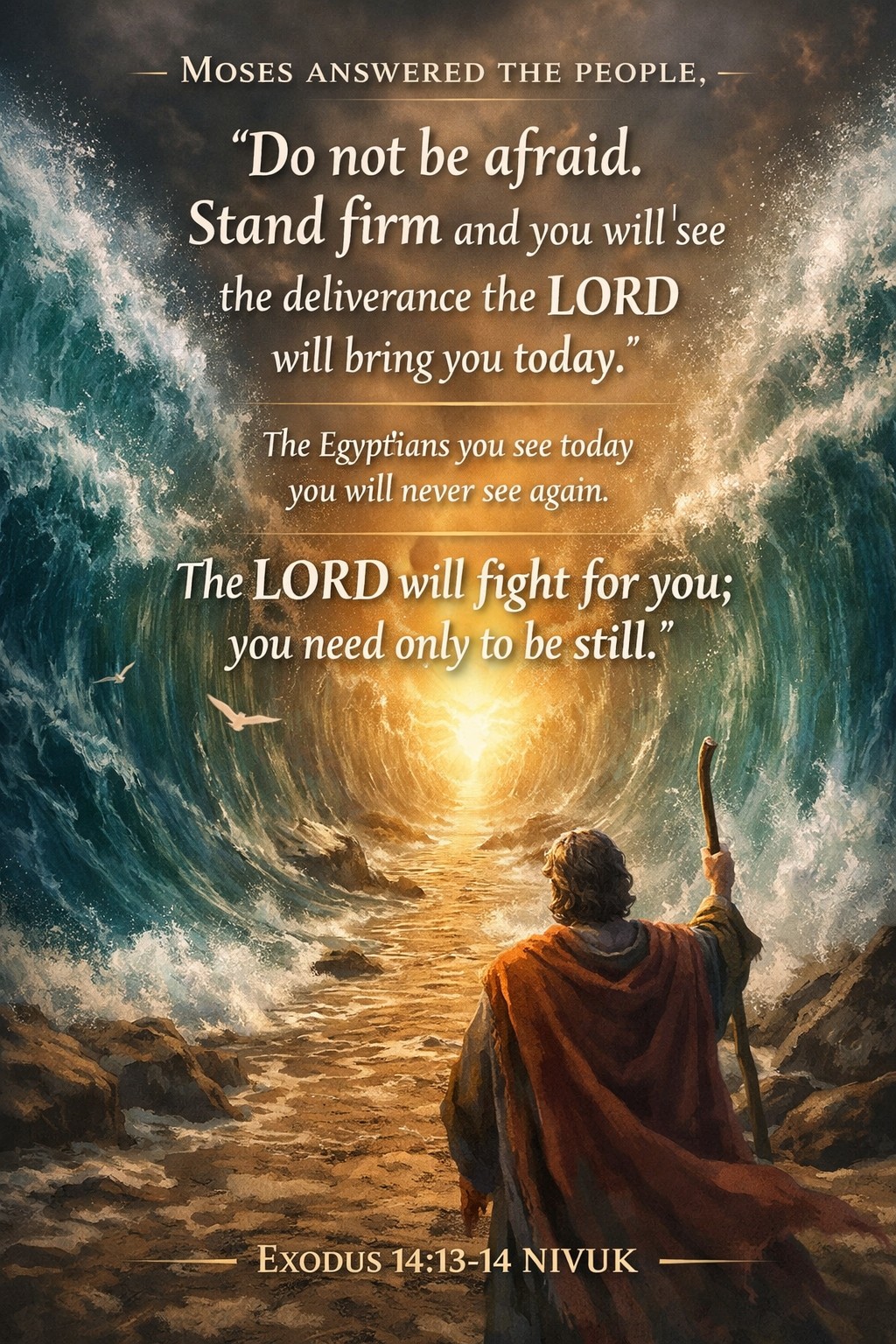
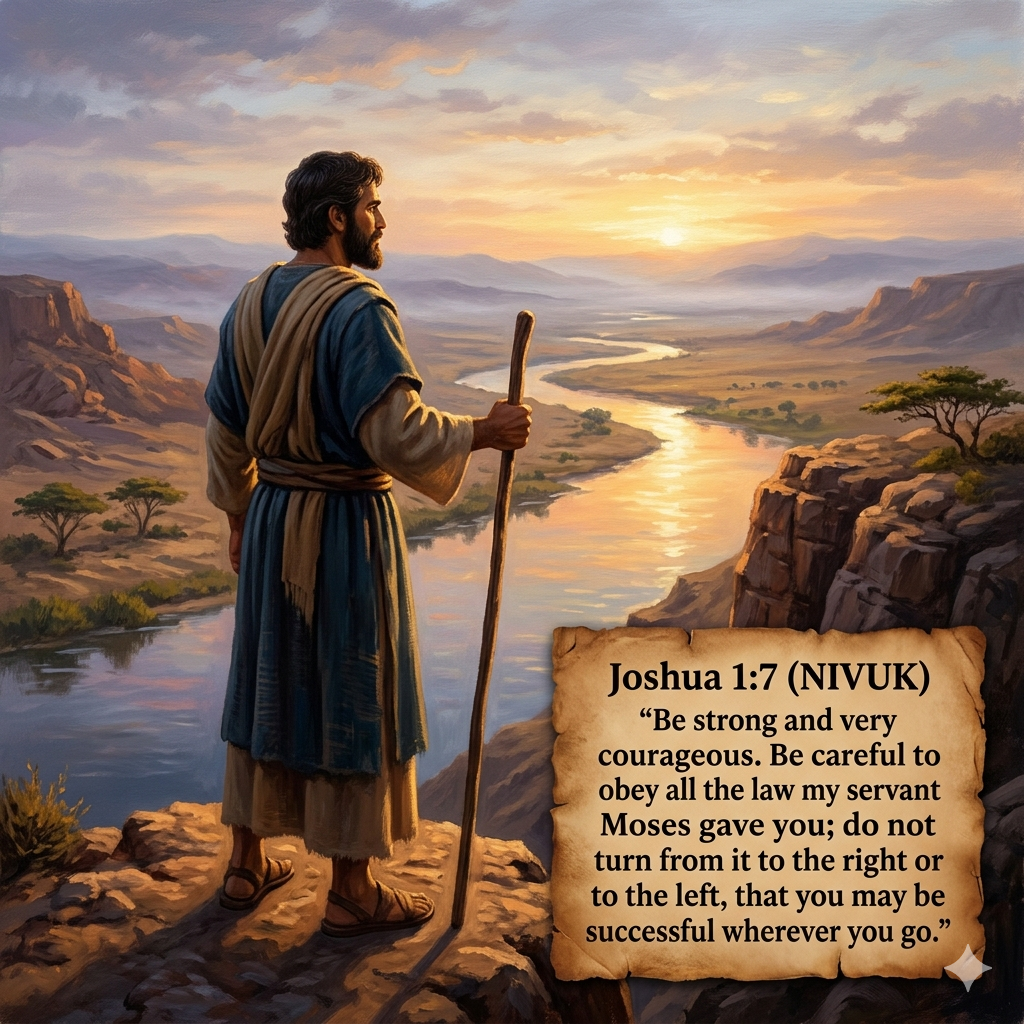
The School of Holy Humility
A Bible Study Reflecting on Proverbs 15:33 The wisdom literature of Scripture repeatedly reminds God's people that true wisdom is never merely intellectual achievement but a transformed way of living before the Lord. Proverbs does not simply teach skill for success or techniques for prosperity; it reveals the path of righteousness that flows from reverence for God. Among its many profound statements stands Proverbs 15:33: "The fear of the Lord is instruction in wisdom, and humility comes […] [SENSITIVE CONTENT]

A Bible Study Reflecting on Proverbs 15:33
The wisdom literature of Scripture repeatedly reminds God’s people that true wisdom is never merely intellectual achievement but a transformed way of living before the Lord. Proverbs does not simply teach skill for success or techniques for prosperity; it reveals the path of righteousness that flows from reverence for God. Among its many profound statements stands Proverbs 15:33:
“The fear of the Lord is instruction in wisdom, and humility comes before honor.”
This single verse captures the very heart of biblical discipleship. It presents a progression that is often contrary to human instinct. The world teaches that honor comes through self-promotion, confidence, achievement, and personal ambition. Scripture teaches that honor is preceded by humility and that wisdom begins not with self-confidence but with the fear of the Lord.
The verse joins together three inseparable realities: reverence for God, the acquisition of wisdom, and the cultivation of humility. These are not isolated virtues but interconnected expressions of a heart transformed by God’s grace.
The opening phrase declares that “the fear of the Lord is instruction in wisdom.” Throughout Proverbs, the fear of the Lord serves as the foundation of all genuine understanding. This fear is not the terror of a criminal before a judge but the reverent awe of a child before a loving Father whose holiness inspires worship, obedience, and trust.
To fear God is to recognize His absolute sovereignty over creation. It is to acknowledge that He alone possesses perfect wisdom, perfect justice, perfect mercy, and perfect authority. Such fear does not drive believers away from God but draws them near in reverent dependence.
Modern society often celebrates independence and self-sufficiency. The biblical worldview begins with dependence upon God. Human beings are creatures, not creators. They are finite, not infinite. They are recipients of grace, not masters of destiny.
The fear of the Lord therefore becomes the classroom in which wisdom is taught. It is the environment where hearts are reshaped by divine truth. Wisdom is not merely accumulated information but rightly ordered living under God’s authority.
This instruction is lifelong. No believer graduates from the school of God’s wisdom. Every season of life presents new lessons in trust, obedience, patience, and submission. The elderly saint and the young believer alike remain students under the instruction of their heavenly Teacher.
The language of instruction suggests discipline and correction as well as education. God often teaches His children through experiences that expose weakness, pride, impatience, or misplaced confidence. Trials become classrooms where faith matures and wisdom deepens.
This understanding prevents believers from interpreting hardship merely as punishment or misfortune. Instead, every circumstance becomes an opportunity for divine instruction. The God who disciplines His children is the God who loves them and desires their maturity.
Wisdom gained apart from reverence for God is incomplete. Human intelligence can achieve remarkable scientific advancement, technological innovation, and philosophical insight, yet still fail to understand the deepest realities of existence. Scripture insists that true wisdom begins by placing God at the center of all thought and life.
The second half of the verse presents an equally important truth: “humility comes before honor.”
This principle appears throughout both Testaments. God consistently exalts the humble while opposing the proud. Pride seeks elevation through self-exaltation. Humility waits upon God’s timing and God’s approval.
Humility is often misunderstood. It is not self-hatred or the denial of one’s gifts and abilities. Biblical humility is the accurate recognition of one’s place before God. It acknowledges that every ability, every opportunity, every blessing, and every accomplishment ultimately comes from His gracious hand.
The humble person does not deny strength but understands its source. He does not refuse responsibility but carries it with gratitude and dependence. He does not seek applause because his identity rests securely in God’s acceptance rather than human recognition.
Humility also produces teachability. Pride assumes it already knows enough. Humility remains eager to learn. Pride resists correction. Humility welcomes instruction. Pride protects reputation at all costs. Humility values truth above appearances.
This explains why humility naturally follows the fear of the Lord. As God’s greatness becomes clearer, human pride loses its foundation. Standing before divine holiness exposes the limitations of human wisdom and power.
The prophets experienced this repeatedly. Isaiah cried that he was undone when he beheld God’s glory. Job repented in dust and ashes after encountering the majesty of the Lord. Peter fell before Jesus confessing his own sinfulness. The closer believers come to God, the less room remains for pride.
The promise that honor follows humility reveals one of God’s remarkable reversals. The kingdom of God operates according to values that frequently overturn worldly expectations.
Jesus taught that those who exalt themselves will be humbled, while those who humble themselves will be exalted. His own life perfectly embodied this principle. Though possessing divine glory, He humbled Himself by taking human flesh, embracing servanthood, and submitting to death on a cross. Because of that humility, the Father highly exalted Him.
The cross itself stands as history’s greatest demonstration that God’s pathway to glory passes through humility. The Savior’s humiliation became the means of humanity’s redemption and His own exaltation.
For believers, this pattern continues. God often shapes servants through hidden seasons before public usefulness. Moses spent decades in the wilderness before leading Israel. David tended sheep and fled from Saul before ascending the throne. Joseph endured slavery and imprisonment before governing Egypt. Each learned humility before receiving honor.
This divine pattern protects God’s servants from destruction. Leadership without humility becomes tyranny. Influence without humility becomes manipulation. Knowledge without humility becomes arrogance. Success without humility often leads to spiritual collapse.
The church especially must recover this understanding. Ministry is not a platform for personal recognition but an opportunity for sacrificial service. Spiritual authority is exercised through love, gentleness, and faithful obedience rather than domination or self-promotion.
Humility also transforms relationships within the body of Christ. Pride creates competition, jealousy, division, and resentment. Humility produces unity, patience, forgiveness, and mutual encouragement. A humble believer can rejoice in another’s success because personal identity is secure in Christ rather than dependent upon comparison.
Families likewise flourish where humility governs daily interactions. Husbands and wives who willingly seek forgiveness preserve unity. Parents who admit mistakes teach integrity. Children who honor authority cultivate wisdom. Pride hardens hearts, but humility opens the way for reconciliation.
In the workplace humility produces honesty, diligence, cooperation, and integrity. Rather than pursuing advancement through manipulation or selfish ambition, believers work faithfully as servants of Christ, trusting God with outcomes and recognition.
The pursuit of humility, however, presents a paradox. Genuine humility cannot be manufactured through outward behavior while secretly seeking admiration for being humble. Such false humility remains another form of pride.
Instead, true humility grows naturally through continual contemplation of God’s greatness and grace. As believers remember their sinfulness, Christ’s sacrifice, and God’s undeserved mercy, pride gradually loses its grip.
Prayer cultivates humility because prayer acknowledges dependence. Worship cultivates humility because worship exalts God rather than self. Scripture cultivates humility because it confronts human assumptions with divine truth. Service cultivates humility because it redirects attention toward the needs of others.
The gospel itself provides the deepest foundation for humility. Salvation is entirely by grace. No one earns forgiveness. No one deserves adoption into God’s family. No one contributes righteousness sufficient for acceptance before God. Every spiritual blessing comes through Christ alone.
Therefore boasting has no place among God’s people except boasting in the Lord. The cross forever silences human pride because it reveals both the seriousness of sin and the immeasurable greatness of divine mercy.
Honor, according to Proverbs, ultimately comes from God rather than humanity. Earthly recognition is temporary and often unreliable. Public opinion changes quickly. Human praise fades. Worldly success disappears with time.
God’s honor is different. He sees hidden faithfulness that others overlook. He remembers acts of quiet obedience unknown to the world. He rewards perseverance that receives little earthly recognition.
Many faithful servants labor for decades without public acclaim, yet heaven records every act of love, every prayer offered in secret, every sacrifice made for Christ’s kingdom. The honor God gives is eternal because it rests upon His perfect knowledge and righteous judgment.
This truth liberates believers from the exhausting pursuit of human approval. They are free to serve quietly, love sacrificially, forgive generously, and obey faithfully because their ultimate audience is God Himself.
Proverbs 15:33 therefore offers a complete vision for spiritual maturity. Wisdom begins with reverent fear of the Lord. That reverence produces humility. Humility prepares the way for honor bestowed by God. The entire process is one of grace transforming the human heart into the likeness of Christ.
In a culture captivated by self-promotion and personal achievement, this verse calls believers back to the forgotten beauty of reverence and humility. It reminds the church that greatness in God’s kingdom is measured not by applause but by faithfulness, not by status but by service, not by power but by obedience.
Those who bow low before God discover that they stand secure in His favor. Those who surrender pride receive wisdom that cannot be obtained through human effort alone. Those who seek God’s glory rather than their own find themselves honored by the One whose judgment alone endures forever.
The path may appear hidden and difficult, but it leads toward eternal blessing. The fear of the Lord remains the beginning of wisdom, and humility still walks before honor. God’s order has never changed, and those who embrace it discover the joy, stability, and peace that belong to all who walk humbly with their God.

Alt...
The School of Holy Humility
Have you ever been hurt by the words of others? Have you ever hurt others with your words? Kind words make a difference. Click or tap the link to read more.
#afaithfulsower #Jesus #Prayer #Christianity, #dailydevotional
https://afaithfulsower.org/2026/06/18/kind-words-make-a-difference/
A Life Crowned with Humility
A Devotional Meditation on Proverbs 15:33 Proverbs 15:33 declares, “The fear of the Lord is instruction in wisdom, and humility comes before honor.” In a single sentence, the Holy Spirit weaves together four profound realities that shape the life of every believer: the fear of the Lord, wisdom, humility, and honor. These themes are not isolated virtues but are intimately connected, revealing the pathway by which God forms His people into vessels fit for His kingdom. The modern world […] [SENSITIVE CONTENT]

A Devotional Meditation on Proverbs 15:33
Proverbs 15:33 declares, “The fear of the Lord is instruction in wisdom, and humility comes before honor.” In a single sentence, the Holy Spirit weaves together four profound realities that shape the life of every believer: the fear of the Lord, wisdom, humility, and honor. These themes are not isolated virtues but are intimately connected, revealing the pathway by which God forms His people into vessels fit for His kingdom.
The modern world often reverses this order. Society teaches that honor comes through self-promotion, wisdom through education alone, and influence through personal ambition. Success is measured by visibility, applause, and recognition. Yet Scripture consistently overturns human assumptions. The kingdom of God moves in the opposite direction. Heaven’s wisdom begins with reverence, and heaven’s honor follows humility rather than pride.
The fear of the Lord is one of the richest concepts in Scripture. It is not a terror that drives sinners away from God but a reverent awe that draws believers near with holy respect. It is the recognition that God alone is sovereign, holy, righteous, and worthy of complete obedience. This fear acknowledges His majesty, His authority over creation, His perfect justice, and His immeasurable mercy. It is the attitude that bows the heart before the Creator while trusting fully in His goodness.
Throughout Scripture, the fear of the Lord is described as the beginning of wisdom because wisdom cannot exist apart from knowing God rightly. Human knowledge may accumulate facts, skills, and information, but true wisdom understands life from God’s perspective. Wisdom discerns eternal realities beyond temporary circumstances. It recognizes that every decision is ultimately spiritual and that every path leads either toward God or away from Him.
The fear of the Lord therefore becomes “instruction in wisdom.” It is the classroom where God Himself teaches His children. Every trial, every blessing, every disappointment, and every unexpected turn becomes part of His divine curriculum. The believer learns that God’s ways are higher than human reasoning and that surrender produces greater understanding than self-confidence.
This instruction often comes through seasons that expose human weakness. God humbles His people not to destroy them but to refine them. Pride blinds the heart, while humility opens the eyes to divine truth. The Lord patiently removes illusions of self-sufficiency so that dependence upon Him becomes the believer’s greatest strength.
Humility is one of the defining characteristics of genuine spirituality. It is not self-hatred or insecurity, nor is it the denial of God’s gifts and abilities. Biblical humility is the proper understanding of oneself before God. It recognizes that every breath, every talent, every opportunity, and every blessing flows from divine grace. Humility gladly acknowledges that apart from the Lord, humanity possesses nothing worthy of boasting.
This humility stands in sharp contrast to the pride that entered the world through rebellion against God. Pride seeks independence, self-exaltation, and personal glory. It competes for attention and demands recognition. Humility, however, quietly serves, willingly submits, and joyfully gives glory to God alone.
The Scriptures repeatedly demonstrate that God opposes the proud but gives grace to the humble. This is not because humility earns divine favor but because humble hearts are prepared to receive what proud hearts reject. Grace flows into empty hands, not clenched fists. God delights to fill those who know their need of Him.
The second half of Proverbs 15:33 presents a timeless principle: “Humility comes before honor.” This divine sequence appears throughout biblical history. Joseph endured slavery and imprisonment before he ruled Egypt. Moses spent decades in obscurity before leading Israel. David shepherded sheep before wearing a crown. The prophets suffered rejection before their words were vindicated. Even the apostles learned servanthood before leading the early church.
Above all, this pattern finds its perfect fulfillment in Jesus Christ. Though eternally equal with the Father, He humbled Himself by taking the form of a servant, entering human history, bearing the cross, and submitting Himself completely to the Father’s will. His path descended into suffering before ascending into glory. The resurrection and exaltation followed the humility of Calvary.
The cross itself reveals the paradox of God’s kingdom. What appeared to be defeat became victory. What seemed to be weakness displayed infinite strength. What looked like shame became eternal honor. In Christ, believers see that God’s economy is entirely different from the world’s calculations.
This truth provides great encouragement for those who labor faithfully without recognition. Much of God’s work is accomplished in hidden places where only heaven observes. Quiet acts of obedience, unseen prayers, unnoticed sacrifices, faithful service, and humble love are never overlooked by the Lord. While human applause fades quickly, God’s approval endures forever.
The pursuit of earthly honor can become a dangerous temptation even within the church. Ministry itself can become corrupted when leaders seek prominence instead of faithfulness. Scripture consistently calls believers to lower themselves before God rather than elevate themselves before people. Christ taught that the greatest among His followers would be the servant of all. Greatness in God’s kingdom is measured not by influence but by surrender.
Humility also transforms relationships among believers. It enables forgiveness instead of bitterness, patience instead of anger, gentleness instead of harshness, and unity instead of division. Pride builds walls while humility builds bridges. Pride insists on being right, while humility seeks reconciliation. Pride demands its own way, but humility considers others more important than itself.
The promise of honor should not be misunderstood as earthly prosperity or public recognition. God’s honor often consists of something far greater: His presence, His approval, His eternal reward, and conformity to the image of Christ. Some saints receive little recognition during their earthly lives, yet they are honored greatly in heaven. Others may appear insignificant before the world while occupying places of tremendous significance in God’s eternal purposes.
The believer therefore walks by faith rather than by visible reward. The fear of the Lord teaches wisdom because it directs the eyes beyond temporary success toward eternal glory. It reminds the heart that God’s timing is perfect and His purposes are always good. Every act of humble obedience becomes an investment in eternity.
As believers meditate on Proverbs 15:33, they are invited into a lifelong journey of reverent worship and joyful surrender. Wisdom grows where the fear of the Lord is cultivated. Humility flourishes where grace is understood. Honor arrives not as something grasped by ambition but as a gift bestowed by the God who exalts the lowly.
The pathway of Christ remains the pathway of His disciples. It is the road of humble service, quiet faithfulness, steadfast obedience, and unwavering trust. Though the world may overlook such lives, heaven does not. The Lord sees every hidden act of love, every silent prayer, every costly sacrifice, and every surrendered ambition. In His perfect time, He will honor those who have sought not their own glory but His alone.
Prayer
Heavenly Father, teach Your people to walk in the holy fear that leads to true wisdom. Deliver every heart from pride and self-reliance, and clothe Your servants with the humility that reflects the character of Christ. Grant grace to trust Your timing, to seek Your glory above all else, and to serve with joyful obedience whether seen or unseen. May every life become a testimony to Your transforming power until the day You welcome Your faithful children into eternal honor through Jesus Christ our Lord. Amen.

Alt...
A Life Crowned with Humility
The Fear of the Lord That Leads to Glory
A Prayer Inspired by Proverbs 15:33 Gracious and Eternal Father, We come before You with reverence and thanksgiving, confessing that You alone are holy, righteous, and worthy of all honor and praise. Before the foundations of the earth were laid, You existed in perfect majesty, needing nothing from Your creation, yet in boundless mercy You chose to reveal Yourself to humanity through Your Word, Your providence, and ultimately through Your Son, our Lord Jesus Christ. You are the One whose […] [SENSITIVE CONTENT]

A Prayer Inspired by Proverbs 15:33
Gracious and Eternal Father,
We come before You with reverence and thanksgiving, confessing that You alone are holy, righteous, and worthy of all honor and praise. Before the foundations of the earth were laid, You existed in perfect majesty, needing nothing from Your creation, yet in boundless mercy You chose to reveal Yourself to humanity through Your Word, Your providence, and ultimately through Your Son, our Lord Jesus Christ. You are the One whose wisdom established the heavens, whose power sustains every living thing, and whose steadfast love endures forever.
Today we bow before You, mindful of the truth that the fear of the Lord is instruction in wisdom and that humility comes before honor. Teach our hearts to understand these sacred words, not merely as principles for successful living but as eternal realities that shape every aspect of discipleship. Deliver us from shallow religion that seeks blessings without surrender and recognition without repentance. Lead us instead into the deep and joyful reverence that delights in Your holiness and treasures Your presence above every earthly ambition.
Lord, we confess that our generation often celebrates self-promotion while neglecting humility. We are tempted to measure greatness by influence, wealth, popularity, and achievement rather than by faithfulness and obedience. Forgive us for every proud thought, every selfish desire, every hidden arrogance, and every moment when we have sought our own glory instead of Yours. Search our hearts and expose every place where pride has quietly taken root. Remove every idol of self-sufficiency and replace it with dependence upon Your grace.
Teach us the holy fear that Scripture describes—not the fear that drives us from You, but the fear that draws us nearer with awe and wonder. May we never become casual about Your holiness or indifferent toward Your commands. Let us remember that You are the Creator of heaven and earth, the Judge of all humanity, and yet also our loving Father through Christ. May this reverence produce obedience, worship, purity, and joyful submission in every part of our lives.
Grant us wisdom, O God. We acknowledge that true wisdom cannot be purchased through education, discovered by human philosophy, or earned through experience alone. Wisdom begins with knowing You. It grows as we walk with You and submit ourselves to the transforming work of Your Spirit. Illuminate our minds with the truth of Your Word and guard us from the deception of worldly thinking that promises fulfillment while leading only to emptiness.
When we are faced with difficult decisions, guide us by Your wisdom rather than our emotions. When confusion surrounds us, anchor us in Your truth. When temptation entices us with shortcuts and compromise, remind us that Your ways are higher than ours and Your purposes are always good. Let us become people who seek Your counsel before acting, Your approval before speaking, and Your kingdom before our own desires.
Lord Jesus Christ, You demonstrated perfect humility by taking the form of a servant and becoming obedient unto death, even death on a cross. Though You possessed all glory from eternity, You willingly embraced suffering to redeem sinners like us. Shape our lives after Your example. Help us to serve without demanding recognition, to love without seeking repayment, and to sacrifice without expecting applause. Make us content to be hidden if only Your name is exalted.
Teach Your Church to embrace humility once again. Let pastors lead with gentleness instead of pride. Let elders shepherd with compassion rather than authority alone. Let teachers instruct with patience instead of arrogance. Let every believer remember that every spiritual gift is a grace received rather than an achievement earned. Keep us from comparing ourselves with one another, for all that we possess has come from Your generous hand.
We pray for those whose hearts are burdened with shame and failure. Remind them that true humility is not self-hatred but honest dependence upon God. Lift up those who have fallen into sin and restore them through repentance and grace. Let them discover that Your mercy is greater than their guilt and that Your forgiveness restores the brokenhearted. Teach them that those who humble themselves before You will never be cast away.
We pray also for those who walk in success and prosperity. Guard them from the subtle poison of pride. Remind them that every blessing comes from above and that every talent, opportunity, and accomplishment is ultimately a gift entrusted by Your hand. May gratitude replace entitlement, and stewardship replace self-glorification.
Strengthen families with the wisdom that comes from fearing You. Let parents teach their children not only through instruction but through faithful example. May husbands and wives model humility toward one another, seeking forgiveness quickly and extending grace generously. Let homes become places where Your Word is honored, Your name is praised, and Your peace reigns.
We pray for leaders in every sphere of society. Give them humble hearts that recognize their accountability before You. Grant wisdom to govern with justice, integrity, and compassion. Restrain the arrogance that so often corrupts power and replace it with servant-hearted leadership that seeks the good of others above personal ambition.
Lord, preserve us from chasing the empty honors of this passing world. The applause of people fades, earthly success disappears, and human reputation is fragile, but Your approval endures forever. Teach us to seek treasures that cannot be stolen, honors that cannot decay, and crowns that are laid at the feet of Christ. Let our greatest desire be to hear the words, “Well done, good and faithful servant.”
As we walk through seasons of suffering, remind us that humility often grows in hidden valleys rather than on mountaintops. Use trials to refine our character, disappointments to deepen our faith, and weakness to reveal the sufficiency of Your strength. May every hardship become another lesson in trusting You rather than ourselves.
Fill us afresh with the Holy Spirit, that our lives would reflect the beauty of Christlike humility. Let kindness replace harshness, patience replace irritation, generosity replace selfishness, and love replace indifference. May the fruit of the Spirit flourish within us until our lives become a testimony to the transforming power of the gospel.
Above all, fix our eyes upon the coming kingdom where every knee shall bow before Jesus Christ and every tongue confess that He is Lord. On that day all human pride will vanish, and only Your glory will remain. Prepare us for that eternal kingdom by teaching us to walk humbly with You now, finding our identity not in worldly honor but in being children redeemed by grace.
Receive our worship, strengthen our faith, deepen our wisdom, and keep us in holy reverence all the days of our lives. May our hearts delight in You alone, and may our lives bring honor to the One who humbled Himself to save us and now reigns forever in majesty.
In the precious and glorious name of Jesus Christ our Lord we pray.
Amen.

Alt...
The Fear of the Lord That Leads to Glory
The Secret Known to Heaven
A Poem Inspired by Psalm 4:3 Before the dawn awakes the hills,Before the lark ascends the sky,Before the streams renew their songs,Or morning clouds are lifted high,The Lord has marked a chosen bandWhose names upon His heart remain,Whom mercy gathered by His handAnd love shall never lose again. The kingdoms rise with boastful pride,Their banners fade, their towers fall;The cedar bends before the storm,The mighty answer to the small.Yet one decree no age can break,No tyrant's hand can […] [SENSITIVE CONTENT]

A Poem Inspired by Psalm 4:3
Before the dawn awakes the hills,
Before the lark ascends the sky,
Before the streams renew their songs,
Or morning clouds are lifted high,
The Lord has marked a chosen band
Whose names upon His heart remain,
Whom mercy gathered by His hand
And love shall never lose again.
The kingdoms rise with boastful pride,
Their banners fade, their towers fall;
The cedar bends before the storm,
The mighty answer to the small.
Yet one decree no age can break,
No tyrant’s hand can overturn:
The Lord preserves His faithful ones,
And keeps the lamps for which they burn.
The world may count them poor and weak,
Forgotten by the crowds that pass;
It sees but dust upon their feet,
And winter lying on the grass.
It cannot read the hidden seal
That Heaven’s own finger has impressed,
The sacred mark no eye can steal,
The quiet honor of the blessed.
The Shepherd knows each wandering lamb
Though cliffs divide and shadows grow;
No desert wind can hide the voice
That only faithful ears shall know.
He calls them through the darkest vale,
He gathers all the torn and worn,
And every promise shall prevail
Until eternal light is born.
The sailor lost upon the sea,
Who sees no star through driving rain,
May think the heavens have turned away
And left him to the waves again.
Yet far above the rolling night,
Beyond the thunder’s dreadful cry,
The steadfast stars still keep their course
Across the chambers of the sky.
So saints who walk through grief and fire,
Who wrestle doubt from breaking breath,
May scarcely see the Father’s smile
While passing through the gates of death.
Yet hidden from the mortal eye
The covenant remains the same;
The Lord remembers every tear
And calls His children each by name.
The olive tree upon the hill
Still drinks though roots are hid from sight;
Its strength is secret in the earth,
Its branches reach the open light.
So grace descends in silent streams
Where human wisdom cannot see,
And souls made holy by the Lord
Grow upward toward eternity.
The proud pursue the empty wind,
The applause of passing tongues and kings;
They build their nests in brittle reeds
And trust the frailty fortune brings.
But blessed is the humble heart
That waits upon the Lord alone,
For Heaven has made its dwelling there
And claimed that spirit as its own.
The night is long for many souls
Who seek the path with weary feet;
Their prayers ascend through lonely hours
Where silence and surrender meet.
Yet every whispered cry is heard
Before it leaves the trembling breast;
The Father bends to hear His child,
And grants the faithful heart its rest.
No jewel kept in royal halls,
No crown adorned with earthly gold,
Can match the worth of one redeemed
Whom everlasting arms enfold.
The angels know the hidden worth
Of those the Lamb has called His own,
For Heaven counts by grace alone,
Not by the splendor men have shown.
The mountains weather into dust,
The rivers change their ancient bed,
The flowers bow to autumn’s hand,
The living join the silent dead.
Yet still the love that chose the saints
Before the world’s foundations stood
Will hold them fast through endless years,
Secured by everlasting good.
Therefore let anxious spirits cease
Their endless search for mortal praise;
Let every restless heart find peace
Within the Ancient of all Days.
The Judge of earth is also Friend,
The King is Shepherd, strong and mild;
He hears the prayer of those He loves,
And welcomes every trusting child.
When evening folds the fields in blue,
And stars appear in silent grace,
The faithful need not fear the dark
Who walk beneath their Maker’s face.
For every step through shadowed lands
Is measured by His sovereign care,
And every sigh that sorrow breathes
Becomes a holy answered prayer.
At last the eastern skies shall blaze
With light no sunset shall remove;
The gathered saints shall stand complete
Within the everlasting love.
Then every hidden thing shall shine,
And every faithful soul shall see
The God who set His people apart
Has kept them through eternity.
O blessed truth that still remains
When every earthly comfort flies:
The Lord who fashioned sea and star
Still watches with unfailing eyes.
His own are never lost or left,
Though storms may veil the shining sun;
For He who calls the righteous His
Will keep them safely, every one.

Alt...
The Secret Known to Heaven
The One Who Knew Her Name
A Short Story Inspired by Psalm 4:3 The waiting room at Mercy General Hospital was almost empty. It was nearly midnight, and the vending machines hummed louder than the conversations. Rain tapped softly against the windows while fluorescent lights painted everything in shades of pale gray. Emily sat alone in a plastic chair with a paper cup of cold coffee in her hands. She had worked at the hospital for nearly twelve years, cleaning hallways, emptying trash bins, and polishing floors […] [SENSITIVE CONTENT]

A Short Story Inspired by Psalm 4:3
The waiting room at Mercy General Hospital was almost empty.
It was nearly midnight, and the vending machines hummed louder than the conversations. Rain tapped softly against the windows while fluorescent lights painted everything in shades of pale gray.
Emily sat alone in a plastic chair with a paper cup of cold coffee in her hands.
She had worked at the hospital for nearly twelve years, cleaning hallways, emptying trash bins, and polishing floors until they reflected the ceiling lights. Most people walked past her without looking up. Doctors hurried by discussing test results. Nurses rushed from room to room. Families stared at their phones or prayed silently.
No one remembered the woman pushing the mop bucket.
She did not mind, at least not most days.
But tonight was different.
Earlier that afternoon she had learned that the hospital was reducing staff. Budget cuts. Automation. Outsourcing.
Her supervisor had smiled sadly as he handed her the envelope.
“We appreciate everything you’ve done.”
She had nodded politely.
The words sounded kind enough, but they could not pay rent.
Now she sat waiting while her elderly father underwent emergency surgery upstairs.
Everything she had carefully held together for years seemed to be unraveling at once.
She stared at the floor she had polished only hours before.
No one noticed the work that made the hospital shine.
Maybe no one noticed her either.
The automatic doors slid open.
An elderly janitor walked inside carrying another mop bucket. He worked the overnight shift in another building and often crossed over to help when needed.
His name was Samuel.
His back was bent with age, but his eyes always carried unusual peace.
He saw Emily sitting alone and quietly took the chair beside her.
“I heard about your father.”
She nodded.
“And your job.”
Another nod.
For several minutes they simply listened to the rain.
Finally Samuel reached into his pocket and pulled out a small worn Bible held together with tape.
Its pages looked as though they had survived decades of tears and prayers.
He opened it without searching.
“I read this every time I think nobody sees me.”
He smiled and handed it to her.
The verse was underlined many times.
The Lord has set apart the godly for Himself; the Lord hears when I call to Him.
Emily read it again.
And again.
She whispered the words slowly until they seemed to fill the empty waiting room.
Samuel closed the Bible.
“When I started here thirty years ago,” he said, “I thought I had failed God. I wanted to be a missionary. I wanted to preach. Instead I pushed a mop.”
He chuckled softly.
“I spent years believing my life was too small to matter.”
Emily looked at him.
“What changed?”
“I realized I was measuring my importance by who noticed me instead of by who claimed me.”
The words settled into the silence.
Samuel continued.
“The Lord never asked me to be famous. He only asked me to be faithful.”
A nurse walked through the waiting room carrying paperwork.
She smiled warmly at Samuel.
“Mr. Harris?”
He stood.
She handed him a folded card.
“My daughter wanted you to have this.”
Samuel looked surprised.
Inside was a handwritten note.
Thank you for talking with me last winter when my mother died. I was ready to quit nursing that night. You prayed with me and reminded me that God had not abandoned me. I never forgot.
Emily watched as tears quietly filled the old man’s eyes.
“I hardly remember that conversation,” he whispered.
The nurse smiled.
“I do.”
She disappeared down the hallway.
Samuel folded the note carefully and placed it inside his Bible.
“You never know,” he said, “what God is doing while you’re cleaning the floor.”
The surgery lasted another three hours.
Emily prayed more during those hours than she had prayed in months.
Not elegant prayers.
Simple ones.
Lord, help.
Lord, stay with us.
Lord, don’t let me forget that You know my name.
Just before dawn the surgeon appeared.
The operation had gone well.
Her father would recover.
Emily closed her eyes and quietly thanked God.
When she looked around to find Samuel, he was already gone.
Only his mop bucket remained leaning against the wall.
On top of it sat the little Bible.
Inside was a note.
Keep this until you no longer need the reminder.
She smiled through fresh tears.
The weeks that followed were difficult.
The final paycheck came.
Applications went unanswered.
Savings disappeared faster than she imagined possible.
Yet every morning before searching for work she opened the taped Bible and read the same verse.
The Lord has set apart the godly for Himself.
The Lord hears when I call to Him.
She began volunteering at a neighborhood food pantry simply to stay busy.
She organized shelves, swept floors, carried boxes, and listened to lonely people who mostly needed someone to hear them.
Months later the director asked if she would consider becoming the pantry coordinator.
The position paid less than her old hospital job but included housing assistance and health insurance.
She accepted with gratitude.
One afternoon she noticed an elderly man sitting outside the pantry.
His clothes were worn, and his eyes carried quiet exhaustion.
She handed him a meal and sat beside him.
He began speaking about losing his wife, his work, and nearly all hope.
Emily listened for over an hour.
Before he left she reached into her bag and removed the small Bible.
She opened to the familiar page.
The verse was still underlined.
The edges were still stained with years of use.
She read it aloud.
The old man wiped away tears.
“I needed to hear that today.”
Emily smiled.
“So did I.”
As she watched him walk away, she realized something beautiful.
For years she had believed her greatest fear was being forgotten by the world.
Instead, she discovered the greatest comfort was belonging to a God who never forgets His own.
The applause of people fades.
Job titles disappear.
Buildings crumble.
Names are eventually erased from plaques and office doors.
But those whom the Lord has set apart remain forever known by Him.
And there is no greater place to belong than in the memory, the love, and the faithful care of God Himself.

Alt...
The One Who Knew Her Name
The Shepherd Who Belongs to God
A Message to Church Leaders from Psalm 4:3 "But know that the Lord has set apart the godly for himself; the Lord hears when I call to him." The work of shepherding God's people has never been easy. Every generation of spiritual leaders has faced opposition, misunderstanding, discouragement, and moments of deep loneliness. The demands of ministry often seem endless, while the visible results may appear painfully small. The heart of a pastor or church leader can become weary from carrying […] [SENSITIVE CONTENT]

A Message to Church Leaders from Psalm 4:3
“But know that the Lord has set apart the godly for himself; the Lord hears when I call to him.”
The work of shepherding God’s people has never been easy. Every generation of spiritual leaders has faced opposition, misunderstanding, discouragement, and moments of deep loneliness. The demands of ministry often seem endless, while the visible results may appear painfully small. The heart of a pastor or church leader can become weary from carrying burdens that few people ever see. Yet in the midst of such pressures, Scripture offers a remarkable word of encouragement through the voice of David: “But know that the Lord has set apart the godly for himself; the Lord hears when I call to him.”
This verse does not merely provide comfort for private devotion; it speaks directly to every servant entrusted with the care of God’s people. It reminds those who labor in Christ’s church that their identity is not determined by the approval of congregations, the size of ministries, the praise of peers, or the criticism of opponents. Their identity is grounded in the sovereign choice of God Himself.
The opening words, “But know,” call for certainty. David does not offer a possibility or a hopeful wish. He declares a truth that must anchor the soul. Ministry requires conviction because the storms of leadership constantly tempt servants to doubt their calling. When criticism grows loud, when attendance declines, when conflict erupts, or when personal exhaustion settles over the heart, uncertainty becomes a dangerous companion.
God answers uncertainty with certainty.
“Know that the Lord has set apart the godly for himself.”
Every faithful shepherd should meditate on those words until they become part of the foundation of ministry. God Himself sets apart His servants. Ministry is not merely a profession, a career path, or a collection of responsibilities. It is a sacred calling established by divine grace.
Throughout Scripture, God continually separates people for His purposes. Abraham was called out from among the nations. Moses was called from the wilderness. Samuel was called while still a child. Jeremiah was consecrated before his birth. The apostles were chosen by Christ Himself. Paul described himself as one who had been set apart for the gospel.
The pattern is unmistakable. God calls, God appoints, and God sanctifies His servants for His work.
Church leaders therefore belong first to God before they belong to any congregation, denomination, or ministry organization. This truth guards the heart against two opposite dangers.
The first danger is pride.
When ministry flourishes, the temptation is to believe success belongs to human ability. Leadership skills, education, strategic planning, communication gifts, and organizational excellence all have value, but none of these explain the calling of God. The shepherd who remembers that he has been set apart by grace alone will walk humbly before the Lord. Every opportunity to preach, teach, counsel, or lead is a gift entrusted by divine mercy rather than earned by personal achievement.
The second danger is despair.
Many faithful leaders serve in obscurity. They labor in small churches, struggling congregations, difficult communities, or isolated mission fields. They may compare themselves to larger ministries and conclude that their work has little significance. Yet God’s measure of faithfulness has never depended upon public recognition.
The God who called Elijah also called the widow who shared her last meal.
The God who called Paul also called Ananias.
The God who called Peter also called ordinary believers whose names remain unknown to history.
Greatness in God’s kingdom is measured by obedience rather than visibility.
The Lord who sets apart His servants also claims them for Himself. The verse does not simply say that God sets apart the godly for ministry. It says He sets them apart for Himself.
This changes everything.
The first calling of every pastor is not to preach.
The first calling of every elder is not to govern.
The first calling of every missionary is not to travel.
The first calling of every ministry leader is to belong to God.
Leadership can become dangerously occupied with activity while neglecting communion. Programs multiply while prayer diminishes. Meetings fill calendars while quiet fellowship with Christ disappears. Sermons are prepared while hearts become spiritually dry.
Yet ministry without intimacy eventually becomes mechanical.
The greatest need of the church is not merely capable leaders but holy leaders who live consciously before the face of God.
The Lord desires shepherds whose hearts belong entirely to Him.
This relationship sustains ministry through every changing season. Congregations change. Staff members come and go. Buildings age. Budgets fluctuate. Public opinion shifts. Physical strength declines.
But the Lord remains unchanged.
The leader who belongs to God possesses an unshakable foundation beneath every circumstance.
Psalm 4 was written during a time of opposition and distress. David faced enemies who questioned his honor and challenged his leadership. Their accusations threatened both his reputation and his authority.
Church leaders understand similar experiences.
Misunderstandings spread quickly.
Criticism often travels farther than encouragement.
Faithful decisions may be unpopular.
Biblical conviction may invite hostility.
Even sincere efforts may be misinterpreted.
The temptation is to spend enormous energy defending oneself.
David chooses another path.
He rests in God’s knowledge of him.
The Lord knows those who belong to Him.
Human judgment is often incomplete, but divine knowledge is perfect.
The church leader does not ultimately answer to public opinion but to the Chief Shepherd who sees every hidden sacrifice, every quiet prayer, every unseen tear, every lonely hospital visit, every late-night counseling session, every sermon prepared in weakness, every faithful act of service that receives little earthly applause.
Nothing escapes God’s attention.
No labor done for Christ is forgotten.
No act of faithful obedience is wasted.
This confidence frees leaders from the exhausting pursuit of constant approval. While accountability and humility remain essential, the servant of God must ultimately find security in God’s acceptance rather than man’s applause.
The verse concludes with another precious promise: “The Lord hears when I call to him.”
Leadership often carries burdens that cannot be shared publicly.
Some concerns involve confidential counseling.
Some involve family struggles.
Some involve financial pressures.
Some involve discouragement over spiritual stagnation.
Some involve fears about the future.
Many leaders quietly carry these burdens while continuing to minister faithfully to others.
Yet there is One who always listens.
The Lord hears.
This simple statement carries profound significance.
God does not merely tolerate the prayers of His servants. He hears them.
He hears prayers offered in crowded sanctuaries and empty offices.
He hears prayers whispered while driving home after difficult meetings.
He hears prayers spoken beside hospital beds.
He hears prayers offered through tears after conflict.
He hears prayers uttered in joy after witnessing repentance and salvation.
The Shepherd of Israel never slumbers nor sleeps.
His attention never wanders.
His compassion never weakens.
His faithfulness never fails.
Prayer therefore remains the greatest resource of spiritual leadership.
Many books are written about church growth, organizational development, communication strategies, and leadership principles. While such resources have their place, Scripture repeatedly points leaders toward dependence upon God through prayer.
Prayer acknowledges that ministry belongs to God.
Prayer confesses that wisdom comes from God.
Prayer admits that strength comes from God.
Prayer recognizes that fruit belongs to God.
The greatest leaders throughout biblical history were not merely gifted speakers or skilled administrators. They were men and women who knew how to seek the face of God.
The modern church desperately needs leaders who recover the priority of prayer.
Not prayer as routine.
Not prayer as ceremony.
Not prayer as obligation.
But prayer as dependence.
The church has always advanced most powerfully when God’s servants have first knelt before His throne.
Psalm 4:3 also invites leaders to cultivate quiet confidence instead of anxious striving.
Much of contemporary ministry culture rewards visible productivity and measurable success. Leaders may feel pressure to constantly produce more programs, greater attendance, larger budgets, broader influence, or expanding platforms.
Yet God’s kingdom often grows quietly.
Seeds germinate beneath unseen soil.
Roots develop before branches appear.
Fruit matures slowly.
The kingdom advances through patient faithfulness empowered by God’s Spirit.
Church leaders should therefore resist the temptation to measure ministry solely by numerical success. Faithfulness remains heaven’s primary measure.
The Lord who sets apart His servants is also the Lord who determines the harvest.
Some plant.
Some water.
God gives the increase.
This truth produces peace.
It frees leaders from unhealthy comparison.
It liberates them from impossible expectations.
It allows them to labor diligently while trusting God’s sovereign purposes.
The Lord who calls also sustains.
The Lord who appoints also equips.
The Lord who hears also answers according to His perfect wisdom.
Therefore church leaders should not lose heart.
Continue preaching Christ even when the culture rejects truth.
Continue teaching Scripture when entertainment seems more attractive.
Continue praying when results appear delayed.
Continue loving difficult people.
Continue serving unnoticed.
Continue visiting the sick.
Continue comforting the grieving.
Continue discipling the young.
Continue encouraging the weary.
Continue standing upon God’s Word.
Continue trusting the Lord who called you.
The church does not ultimately belong to pastors, elders, boards, denominations, or movements.
The church belongs to Christ.
Its leaders belong to Christ.
Its future belongs to Christ.
Psalm 4:3 reminds every shepherd that before standing before people, he stands before God. Before hearing human opinions, he has been heard by heaven itself. Before receiving earthly assignments, he has been set apart by divine grace.
May every church leader find renewed courage in this eternal truth: the Lord knows His own, the Lord claims His own, and the Lord hears the cries of His own servants. Such confidence is sufficient for every trial, every responsibility, every disappointment, and every opportunity that lies ahead until the Chief Shepherd appears in glory and says to every faithful servant, “Well done.”

Alt...
The Shepherd Who Belongs to God
The Lord Knows Those Who Belong to Him
A Sermon Reflecting on Psalm 4:3 The words of Psalm 4:3 shine like a bright light in the middle of uncertainty and opposition: “But know that the Lord has set apart the godly for himself; the Lord hears when I call to him.” In a world where identities are constantly questioned and where the approval of others often seems to determine a person's worth, this verse anchors the believer in the unchanging reality of God's covenant love. It is a declaration of divine election, intimate […] [SENSITIVE CONTENT]

A Sermon Reflecting on Psalm 4:3
The words of Psalm 4:3 shine like a bright light in the middle of uncertainty and opposition: “But know that the Lord has set apart the godly for himself; the Lord hears when I call to him.” In a world where identities are constantly questioned and where the approval of others often seems to determine a person’s worth, this verse anchors the believer in the unchanging reality of God’s covenant love. It is a declaration of divine election, intimate relationship, faithful protection, and confident prayer. It reminds God’s people that they are neither forgotten nor abandoned, but are known, treasured, and heard by the Lord Himself.
David wrote this psalm during a time of distress. Enemies surrounded him, false accusations were spoken against him, and his honor was under attack. Yet instead of allowing fear to dominate his heart, he turned his attention toward the character of God. Rather than measuring his security by his circumstances, he measured it by the faithfulness of the One who had called him.
This is a lesson every believer needs. The world measures success by popularity, wealth, influence, and recognition. God measures differently. His eyes look upon those who trust Him, who seek Him, and who walk with Him in humble obedience. The believer’s confidence rests not in human applause but in divine acceptance.
The psalm begins this declaration with the words, “But know.” David speaks with certainty. This is not wishful thinking or emotional optimism. It is settled truth. The believer is invited to possess an assurance that is rooted in God’s revealed character rather than shifting human emotions. Faith rests upon what God has said, and God has spoken clearly.
There are many voices in the world competing for attention. Some tell believers that they are insignificant. Others suggest that God is distant or indifferent. Still others insist that faith is irrelevant in a modern society. Against every competing voice stands the unchanging testimony of Scripture: the Lord knows His own.
The phrase “the Lord has set apart the godly for himself” carries profound theological significance. To be set apart is to be distinguished, chosen, and consecrated for God’s own purposes. Throughout Scripture, holiness is fundamentally about belonging to God. The holy things in the tabernacle were separated unto Him. The priests were consecrated unto Him. Israel was called to be a holy nation because they belonged to Him. Likewise, every believer in Christ has been set apart by divine grace.
This separation is not based upon human merit. David himself understood his own weakness and failures. The godly are not sinless people who have earned God’s favor through flawless obedience. They are those who trust in God’s mercy, walk in covenant fellowship with Him, and seek His righteousness. In the fullness of biblical revelation, believers understand that this standing comes through Jesus Christ, whose perfect righteousness is credited to all who believe.
The gospel transforms this ancient psalm into an even greater promise. Through Christ, believers become God’s treasured possession. They are adopted into His family, justified by His grace, sanctified by His Spirit, and destined for eternal glory. They are no longer strangers but sons and daughters.
This truth should reshape the way Christians understand themselves. Many struggle with insecurity because they seek their identity in unstable places. Careers change. Friendships disappoint. Health fades. Financial security disappears. Even earthly achievements eventually pass away. But the identity that God gives remains forever.
The believer belongs to the Lord.
Nothing could be more comforting than this reality. Before the foundation of the world, God knew His people. Through the work of Christ, He redeemed them. By the Holy Spirit He seals them. Through His providence He preserves them. One day He will glorify them. Every stage of salvation is held securely in His sovereign hands.
To belong to God is not merely to possess a religious affiliation. It is to live under His loving authority and gracious care. Just as a shepherd watches over his sheep, so the Lord watches over His people. Just as a father cares for his children, so God cares for those who trust Him. His knowledge is not detached observation but covenant love expressed through faithful action.
The second half of the verse declares, “The Lord hears when I call to him.”
The God who sets His people apart also listens to their prayers.
This truth is astonishing. The Creator of galaxies hears the whispered cries of His children. The King of heaven inclines His ear toward ordinary believers. The sovereign ruler over history receives the prayers offered in humble faith.
Prayer is possible because relationship exists.
Throughout Scripture, prayer is not presented as a mechanical formula but as the conversation of covenant fellowship. God’s people pray because they know the One to whom they speak. They approach Him not as distant strangers but as beloved children.
This confidence should transform the believer’s prayer life. Too often prayer becomes weak because people imagine God as reluctant, distracted, or unconcerned. Yet Scripture repeatedly presents God as attentive to His children. He hears before words are fully spoken. He knows every burden before it is expressed. He understands every sorrow before tears begin to fall.
This does not mean that God always answers exactly as expected. Divine wisdom often chooses a better path than human understanding. Sometimes He answers immediately. Sometimes He delays. Sometimes He redirects. Sometimes He says no because He intends something greater. Yet His hearing is never absent, and His love never fails.
The believer can therefore pray with confidence even in silence, darkness, or uncertainty.
David’s life demonstrates this repeatedly. He faced betrayal, warfare, exile, grief, and personal failure. Yet through every season he continued to seek the Lord because he trusted God’s faithfulness more than his own circumstances.
The church today desperately needs this confidence. Many believers face opposition from an increasingly secular culture. Some experience ridicule for biblical convictions. Others endure loneliness because of their faith. Many struggle with anxiety about the future, broken relationships, financial pressures, illness, or disappointment.
Psalm 4:3 speaks directly into every one of these situations.
The Lord has not abandoned His people.
He has set them apart for Himself.
He hears when they call.
These truths produce remarkable courage. When identity is secure in God, the fear of human opinion loses its power. When acceptance comes from heaven, rejection on earth becomes bearable. When divine love is certain, earthly disappointments no longer define life.
This assurance also produces holiness. Those who belong to God should live as those who belong to God. Separation from the world is not isolation from people but dedication to God’s purposes. Christians are called to reflect God’s character in their speech, conduct, compassion, integrity, and worship.
The church is meant to be visibly different because it belongs to a different kingdom.
The world often celebrates pride, but believers pursue humility. The world rewards selfish ambition, but believers practice sacrificial love. The world seeks revenge, but believers extend forgiveness. The world builds identity around self-expression, but believers find identity in Christ.
Such distinctiveness is not always easy. It may invite criticism or misunderstanding. Yet the Christian remembers that being set apart is a privilege rather than a burden. The believer’s greatest honor is not worldly success but belonging to the living God.
This verse also teaches perseverance. Prayer often becomes difficult when answers seem delayed. Doubts arise. Questions multiply. Weariness settles into the heart.
Psalm 4:3 reminds the weary believer to keep calling upon the Lord.
The God who hears has not changed.
His timing remains perfect.
His wisdom remains flawless.
His love remains steadfast.
Even when heaven appears silent, God is still at work accomplishing His good purposes. Every unanswered prayer is held within the mystery of divine providence, where infinite wisdom governs every detail for eternal good.
The greatest demonstration of this truth is found at the cross of Jesus Christ. On that dark day it appeared that evil had triumphed. Yet God was accomplishing redemption for the world. The apparent silence of heaven concealed the greatest act of grace in history. Through Christ’s suffering came humanity’s salvation.
The same God continues to work through circumstances that believers cannot yet understand.
Therefore the church should pray boldly.
Families should pray together with confidence.
Pastors should preach with confidence.
Missionaries should serve with confidence.
Saints should endure suffering with confidence.
Not because circumstances are easy, but because God remains faithful.
Psalm 4:3 ultimately directs the heart toward eternal security. God’s people are His forever. Nothing can separate them from His love. Death cannot sever the relationship He has established. Trials cannot cancel His promises. The powers of darkness cannot overcome His grace.
The believer’s confidence rests not in personal strength but in divine faithfulness.
The God who called His people will keep them.
The God who hears their prayers will never ignore their cries.
The God who set them apart will complete His saving work.
Therefore Christians may walk through life with peaceful confidence. They may face uncertainty without despair, opposition without fear, suffering without hopelessness, and even death without terror, because they know to whom they belong.
Psalm 4:3 calls every believer to rest in the certainty that God’s covenant love is stronger than every earthly trial. It invites the church to abandon anxious striving and to embrace joyful trust. The Lord has claimed His people as His own possession, and He remains attentive to every prayer that rises from hearts that seek Him.
In every generation this truth remains unchanged: those who belong to the Lord are never forgotten, never abandoned, and never unheard. The God who sets apart His faithful ones continues to hold them securely in His everlasting love, and His ears remain open to every cry that ascends to His throne of grace.

Alt...
The Lord Knows Those Who Belong to Him
The God Who Knows His Own
A Theological Commentary on Psalm 4:3 Psalm 4:3 declares, “But know that the LORD has set apart the godly for himself; the LORD hears when I call to him.” In this single verse, David condenses several of the most profound themes of biblical theology: divine election, covenant relationship, holiness, providence, prayer, and assurance. The verse functions as both a declaration to David’s opponents and a confession of faith before God. It stands at the center of Psalm 4, providing the […] [SENSITIVE CONTENT]

A Theological Commentary on Psalm 4:3
Psalm 4:3 declares, “But know that the LORD has set apart the godly for himself; the LORD hears when I call to him.” In this single verse, David condenses several of the most profound themes of biblical theology: divine election, covenant relationship, holiness, providence, prayer, and assurance. The verse functions as both a declaration to David’s opponents and a confession of faith before God. It stands at the center of Psalm 4, providing the theological foundation upon which the psalmist’s confidence rests amid hostility and uncertainty.
The opening command, “But know,” carries significant rhetorical force. David contrasts the ignorance of the wicked with the certainty possessed by the faithful. The preceding verses address those who love vanity and pursue falsehood, while verse three introduces the decisive corrective: there is a reality established by God that cannot be overturned by human opposition. The Hebrew imperative conveys not merely intellectual awareness but settled recognition. David calls his hearers to acknowledge a divine truth that governs history regardless of appearances.
This emphasis on knowledge reflects a recurring biblical pattern. Throughout Scripture, the knowledge of God is never merely speculative or philosophical but covenantal and relational. To know God is to recognize His sovereign authority and covenant faithfulness. Likewise, to know that God has set apart His faithful ones is to understand the nature of redemption itself.
The phrase “the LORD has set apart” employs the covenant name Yahweh, emphasizing God’s personal relationship with His people. This is not the distant deity of philosophical abstraction but the God who revealed Himself to Moses, entered into covenant with Israel, and remains faithful to His promises throughout generations. The use of the covenant name grounds David’s confidence in the unchanging character of God rather than in his own circumstances.
The Hebrew verb translated “set apart” carries the idea of separation for a sacred purpose. It appears throughout the Old Testament in contexts involving holiness and divine ownership. Something set apart belongs uniquely to God and is reserved for His service. The temple vessels were set apart. The priests were set apart. Israel as a nation was set apart among the peoples of the earth. Here David applies this covenantal language to the individual believer, declaring that God has personally distinguished His faithful servant for Himself.
This concept reaches back to the earliest pages of Scripture. God separated light from darkness, land from sea, Israel from the nations, and eventually His church from the world. Divine separation is always purposeful rather than arbitrary. God distinguishes His people because He intends to display His glory through them and to draw them into fellowship with Himself.
The phrase “for himself” deepens this theology significantly. God does not merely rescue believers from judgment; He claims them as His own possession. The ultimate purpose of redemption is communion with God. Salvation is not merely deliverance from danger but entrance into covenant fellowship with the Creator.
This language echoes numerous passages throughout Scripture. God tells Israel that they are His treasured possession among all peoples. The prophets describe Israel as God’s inheritance and beloved vineyard. The New Testament develops the same idea by describing believers as purchased by Christ’s blood, adopted into God’s family, and called a people for His own possession. Redemption always moves toward relationship.
This covenant ownership also establishes identity. Human identity is often sought through achievement, social status, ethnicity, nationality, or personal accomplishment. Biblical theology grounds identity elsewhere. The believer belongs to God because God has chosen, redeemed, and sanctified him. The faithful are defined not primarily by what they do but by whose they are.
The expression “the godly” deserves careful theological attention. The Hebrew term has often been translated “saints,” “faithful ones,” or “godly.” It derives from the covenant concept of hesed, often translated steadfast love or covenant loyalty. The godly person is not sinless but one who lives within covenant relationship with God and responds to divine grace with faithfulness.
This distinction guards against legalism. David is not teaching that God sets apart those who have achieved moral perfection. The Psalms repeatedly acknowledge human weakness, sin, and dependence upon divine mercy. Rather, the godly are those whose lives are marked by covenant trust, repentance, and devotion to God.
Theologically, this points toward the doctrine of justification by faith. The righteous throughout Scripture stand before God not because of intrinsic merit but because of God’s gracious covenant acceptance. Abraham believed God, and it was counted to him as righteousness. David himself celebrates the blessedness of the one whose sins are forgiven. The godly are recipients of grace before they become practitioners of holiness.
At the same time, the verse affirms the necessity of sanctification. Those whom God sets apart become increasingly separated from the patterns of worldly rebellion. Holiness is both positional and progressive. God declares His people holy because they belong to Him, and then He progressively transforms them into the likeness of His character.
The second half of the verse shifts from divine election to divine communion: “The LORD hears when I call to him.” The connection between these clauses is vital. Because God has set apart His people, He hears their prayers. Divine hearing is presented as a covenant privilege arising from belonging to God.
Throughout the Old Testament, hearing signifies more than auditory perception. When Scripture says that God hears, it implies attentive action, covenant concern, and saving intervention. God heard Israel’s cries in Egypt and delivered them. He heard Hannah’s prayer and gave her a son. He heard Elijah’s prayer and answered with fire from heaven. Divine hearing consistently leads toward divine action according to God’s wisdom.
Prayer therefore rests upon relationship rather than ritual. David’s confidence does not arise from eloquence, sacrifice, or religious performance but from covenant belonging. God hears because David belongs to Him.
This principle becomes foundational for biblical spirituality. Prayer is not an attempt to persuade an unwilling deity but communion between a Father and His children. The believer approaches God with confidence because reconciliation has already been established by divine grace.
The New Testament expands this truth through the work of Christ. Jesus teaches His disciples to pray, “Our Father.” Paul describes believers as crying, “Abba, Father,” through the Spirit of adoption. The Epistle to the Hebrews invites Christians to approach the throne of grace with confidence because of the ministry of the great High Priest. The privilege anticipated in Psalm 4:3 finds its fullest realization in the mediatorial work of Jesus Christ.
Christological interpretation enriches the verse further. Jesus Himself is the perfectly set apart One. He is the Holy One of God, consecrated by the Father before the foundation of the world. His entire earthly ministry demonstrates complete devotion to the Father’s will. In His high priestly prayer, Christ declares that He sanctifies Himself for His people so that they also may be sanctified in truth.
Believers participate in this sanctification through union with Christ. They are set apart because they belong to the One who is perfectly holy. The church’s identity derives not from institutional existence but from participation in Christ’s own holiness through the Holy Spirit.
Ecclesiologically, this verse contributes significantly to the doctrine of the church. The church is not merely a voluntary association of religious individuals but the community set apart by divine calling. Peter echoes this theology when he calls believers “a chosen race, a royal priesthood, a holy nation, a people for his own possession.” The church exists because God has separated a people unto Himself through the gospel.
This separation, however, never implies withdrawal from the world. Israel was chosen to bless the nations. The church is called to be salt and light within society. Being set apart means distinctiveness of character while remaining engaged in God’s mission. Holiness is missional rather than isolationist.
The verse also contributes to the doctrine of perseverance. David speaks confidently despite opposition because his security rests in God’s sovereign action. God has set apart His faithful servant; therefore enemies cannot ultimately prevail. This confidence anticipates the New Testament assurance that those whom God foreknew, He predestined, called, justified, and glorified.
The believer’s assurance does not arise from personal consistency but from divine faithfulness. God’s covenant commitment secures His people through every trial. This does not eliminate suffering but transforms its meaning. The faithful may endure hardship while remaining secure within God’s sovereign love.
From a pastoral perspective, Psalm 4:3 offers profound comfort for believers experiencing rejection, persecution, or uncertainty. Human opinion often fluctuates. Reputation may be damaged unjustly. Friends may disappoint. Institutions may fail. Yet the believer’s identity rests upon God’s irreversible declaration that He has set apart His people for Himself.
This truth also corrects pride. Since separation originates in divine grace rather than human achievement, boasting is excluded. Election leads not to arrogance but to humility and gratitude. The believer recognizes that every spiritual blessing originates in God’s sovereign mercy.
Furthermore, the certainty that God hears prayer encourages perseverance in communion with Him. Prayer becomes an act of covenant confidence rather than desperate uncertainty. The believer prays not to earn God’s attention but because God has already granted His attention through covenant grace.
The psalm as a whole moves from distress to peace. David begins amid conflict and misunderstanding yet concludes by lying down in peace because God alone makes him dwell in safety. Verse three functions as the theological pivot enabling this transition. Divine election leads to divine hearing, which produces divine peace.
This sequence reflects the broader movement of biblical redemption. God chooses a people for Himself, enters into covenant relationship with them, hears their cries, redeems them through His mighty acts, sanctifies them by His Spirit, and ultimately brings them into eternal communion with Himself. Psalm 4:3 encapsulates this redemptive trajectory in remarkably concise language.
For systematic theology, the verse intersects with multiple doctrines simultaneously. It touches election through God’s sovereign setting apart, ecclesiology through the identity of God’s covenant people, sanctification through holiness, pneumatology through the transforming work implied in covenant faithfulness, Christology through ultimate fulfillment in Christ’s consecration, soteriology through divine grace, and practical theology through the assurance of answered prayer.
In conclusion, Psalm 4:3 stands as one of the Psalter’s richest affirmations of covenant identity and divine faithfulness. It reminds believers that their security lies not in worldly success but in belonging to God. It teaches that holiness begins with divine calling before it becomes human conduct. It assures the faithful that the God who has claimed them as His own also listens attentively to their prayers. Above all, it reveals a God whose purpose is not merely to rescue sinners but to possess them as His treasured people, drawing them into eternal fellowship with Himself through His steadfast covenant love. In this brief verse, the heart of biblical redemption is proclaimed with remarkable clarity: God sets apart His people for Himself, and because they belong to Him, He never ceases to hear their cries.

Alt...
The God Who Knows His Own
Stop Striving and Start Trusting God
Are you exhausted from trying to make everything happen? The world teaches us to strive, struggle, compete, and push harder. God's Kingdom operates differently. Through faith, trust, and simple obedience, we discover the freedom of letting God carry the results. Jesus has already overcome every opposing force. He has already won every battle. He has already secured every victory. There is no competition for His throne, no rival to His authority, and no obstacle beyond His power. Nothing can stand against Him! In God's Kingdom, we are not called to strive. We are called to trust. Click here to read the full devotional. ✨ [SENSITIVE CONTENT]
Today’s One Year Bible Verses: 1 Kings 18:1–46, Acts 11:1–30, Psalm 135:1–21, Proverbs 17:12–13
Nothing Stands Against Him
After worship this morning, the Lord told me to look up the definition of striving when He whispered this Gem of Knowledge to me:
“It’s silly to think about striving. Look up the definition. It doesn’t even exist in My Kingdom. Here it is simply doing or not doing. Period.”
Well, that certainly got my attention.
So I looked it up.
Striving means to make great efforts, exert yourself vigorously, struggle to achieve a goal, contend against opposing forces, or compete for a prize or position.
As I read those definitions, something immediately stood out to me.
Vigorously. Strenuous. Struggle. Contending. Competing.
The Lord was right.
None of these things exist in His Kingdom. Jesus has already overcome every opposing force. He has already won every battle. He has already secured every victory. There is no competition for His throne, no rival to His authority, and no obstacle beyond His power.
Nothing can stand against Him.
In God’s Kingdom, we are not called to strive. We are called to trust. We are called to obey.
As I continued reading today’s Scriptures, I noticed something fascinating: God wasn’t asking anyone to strive. He was simply asking them to do what He said.
The contrast is especially clear on Mount Carmel. The prophets of Baal spent hours striving. They shouted louder. They danced harder. They cut themselves. They exhausted themselves trying to force a response from a god who could not answer.
Everything about their actions was striving.
Meanwhile, Elijah simply obeyed.
He rebuilt the altar.
He prepared the sacrifice.
He drenched it with water.
Then he prayed.
That was it.
Elijah did not strive to make fire fall from heaven. He did not manipulate the situation or manufacture a miracle. He simply did what God told him to do and trusted God with the outcome.
And God responded.
Fire fell from heaven, consumed the sacrifice, the altar, the stones, the dust, and even the water in the trench. The people fell on their faces declaring, “The Lord—he is God! Yes, the Lord is God!” (1 Kings 18:39, NLT).
What a powerful reminder that God’s power is not released through our striving. It is released through our obedience.
We see the same principle in Acts 11. Peter was criticized for entering the home of Gentiles. He could have argued, defended himself, or tried to convince everyone through his own efforts. Instead, he simply shared what God had shown him and what God had done.
The believers recognized God’s hand in the situation and glorified Him.
Again, we see the pattern:
Not striving.
Not forcing.
Not manipulating.
Simply obeying and allowing God to work.
Psalm 135 declares:
“The Lord does whatever pleases him throughout all heaven and earth.” (Psalm 135:6, NLT)
What freedom there is in that truth. The success of God’s plans does not depend on our ability to strive harder. It depends on His power.
So many of us are exhausted because we are trying to do God’s job. We are striving to change people, fix situations, control outcomes, and make things happen. Meanwhile, God is simply asking us to obey the next thing He has placed before us.
The burden of producing results belongs to Him…The responsibility of obedience belongs to us. 💎
Action (5 Minutes with God)
Give 5 minutes of your day today and surrender to the Lord. Ask Him:
- “Lord, what do You want me to know about this personally?”
- Journal what He gives you through His Holy Spirit.
- Then ask, “What do You want me to do?”
- Journal what He reveals – then do it!
Ask the Lord to reveal an area where you have been striving instead of trusting. Surrender the outcome to Him and focus only on the next step of obedience He has placed before you.
Prayer
Father, thank You for reminding me that I do not have to carry burdens You never intended me to carry. Forgive me for the times I have tried to force outcomes, control circumstances, or accomplish things in my own strength. Help me trust You more fully. Teach me to walk in simple obedience and leave the results in Your hands. Thank You that You have already overcome every obstacle and secured every victory. In Jesus’ mighty name I pray, Amen.
To read more 5 Minutes with God devotionals click here.
If Gems of Knowledge has blessed your walk with Christ, please subscribe or consider partnering with us today. Your gift helps keep these devotionals free for everyone and carries God’s Word to more hearts. Every seed matters—thank you for sowing into this work! 💛
Test everything by the Word and the Spirit (John 16:13)
Alt...
A dramatic Mount Carmel scene showing the frantic prophets of Baal beside their altar while Elijah stands peacefully as God's fire falls from heaven upon his altar.
The God Who Sets Apart the Godly
A Bible Study Reflecting on Psalm 4:3 Psalm 4:3 declares, “But know that the Lord has set apart the godly for himself; the Lord hears when I call to him.” Though brief, this verse contains profound theological truths about divine election, covenant relationship, God's intimate knowledge of His people, and the assurance of answered prayer. It stands as a declaration of confidence in the midst of opposition and uncertainty, reminding believers that their security is found not in […] [SENSITIVE CONTENT]

A Bible Study Reflecting on Psalm 4:3
Psalm 4:3 declares, “But know that the Lord has set apart the godly for himself; the Lord hears when I call to him.” Though brief, this verse contains profound theological truths about divine election, covenant relationship, God’s intimate knowledge of His people, and the assurance of answered prayer. It stands as a declaration of confidence in the midst of opposition and uncertainty, reminding believers that their security is found not in circumstances but in God’s sovereign grace.
The context of Psalm 4 is one of distress. David is surrounded by adversaries who question his integrity and seek his downfall. Yet instead of allowing fear or resentment to dominate his heart, he directs his confidence toward God. The psalm moves from anxiety to peace because David knows something deeper than his circumstances. He knows the character of God.
Verse three serves as the theological center of the psalm. It explains why David refuses to despair. His confidence is rooted in the truth that God has established a special covenant relationship with His people and that God faithfully responds when they seek Him.
The opening words, “But know,” function as a command. David is calling both himself and his enemies to recognize a divine reality that transcends human opinion. God’s truth stands independent of public approval or earthly power. Human judgment fluctuates, but God’s purposes remain fixed forever.
Throughout Scripture, knowledge of God is not merely intellectual information but covenant understanding. To know something in the biblical sense is to embrace it as reality that shapes one’s life. David insists that everyone recognize what God Himself has declared.
The statement that “the Lord has set apart the godly for himself” introduces one of Scripture’s recurring themes: God distinguishes His people from the world for His own purposes.
The phrase “set apart” carries the idea of separation, consecration, and ownership. It points toward holiness, not merely as moral purity but as belonging exclusively to God. In the Old Testament, priests were set apart, the temple was set apart, the Sabbath was set apart, and Israel itself was set apart from the nations. Holiness fundamentally means belonging to God before it means behaving differently.
This understanding reaches back to God’s covenant with Abraham, where God sovereignly chose one man and one family through whom He would bless the nations. Israel did not become God’s people because of numerical strength or moral superiority but because of God’s gracious love and sovereign choice.
David applies this covenant principle personally. He knows that his relationship with God is grounded in God’s initiative rather than human merit. This gives him tremendous confidence during times of attack.
The term translated “godly” comes from a Hebrew word associated with covenant faithfulness, steadfast love, and devotion. It describes those who live within the covenant relationship established by God’s grace. The godly are not sinless individuals but people who belong to God and seek to walk faithfully before Him.
This distinction is important because Scripture consistently teaches that righteousness is never self-generated. Even in the Old Testament, believers lived by faith in God’s promises. Their standing before God rested upon His mercy rather than their perfection.
The New Testament expands this truth through Jesus Christ. Believers are called saints, literally “holy ones,” because they have been sanctified by God’s grace through faith. Their holiness is first positional before it becomes practical. God declares them His own and then progressively transforms them into Christ’s likeness.
Psalm 4:3 therefore anticipates the New Testament doctrine of sanctification. God separates His people unto Himself and then works within them to produce lives that reflect His character.
The words “for himself” deserve careful attention. God does not merely rescue people from judgment; He rescues them into relationship with Himself.
The purpose of redemption has always been communion with God. Humanity was created to know God, worship Him, enjoy His fellowship, and reflect His glory. Sin shattered that fellowship, introducing alienation and spiritual death. Yet throughout redemptive history, God continually acts to restore His people to Himself.
When Israel left Egypt, God’s repeated declaration through Moses was, “Let my people go, that they may serve me.” Deliverance was never an end in itself but the means by which God’s people entered deeper fellowship with Him.
Likewise, Christ redeems believers so that they may become God’s treasured possession. Salvation is relational before it is merely judicial. Eternal life itself is defined as knowing God and Jesus Christ whom He has sent.
David’s confidence rests in belonging to God. If God has claimed him as His own possession, then no earthly opposition can ultimately prevail against him.
This truth offers profound comfort for believers today. Identity is one of the great struggles of modern culture. People seek significance through achievement, popularity, wealth, status, or personal success. Yet all such foundations are unstable.
Scripture offers a different identity. Believers belong to God. They are His children, His workmanship, His inheritance, His temple, His bride, and His people. Their value comes not from what they accomplish but from the One who has claimed them as His own.
The second half of the verse declares, “The Lord hears when I call to him.”
This statement reveals another remarkable aspect of covenant relationship. The God who created the universe listens attentively to His people.
Throughout pagan religions, gods were often viewed as distant, indifferent, or unpredictable. Worshippers attempted to manipulate them through rituals and sacrifices. Biblical faith presents an entirely different picture.
The Lord is personal, attentive, compassionate, and faithful. He hears because He loves His people. Prayer is not an attempt to persuade an unwilling deity but communion with a loving Father who delights to hear His children.
The assurance that God hears prayer appears repeatedly throughout Scripture. Abraham interceded for Sodom. Moses pleaded for Israel. Hannah cried out for a son. Elijah prayed for rain. Daniel prayed in exile. The prophets continually called God’s people to seek Him.
Jesus elevated this confidence even further by teaching His disciples to pray, “Our Father in heaven.” The intimacy implied by that relationship transforms prayer from obligation into privilege.
The promise that God hears does not imply that He always answers according to human expectations. Divine wisdom often leads to answers that differ from immediate desires. Yet God’s hearing always includes loving attention, perfect understanding, and sovereign action for His glory and His people’s ultimate good.
David speaks with certainty rather than doubt. He does not say that perhaps God will hear or that he hopes God will listen. He declares confidently that the Lord hears.
This confidence emerges from God’s covenant faithfulness. Since God has chosen His people and claimed them as His own, He remains attentive to their cries.
The relationship between holiness and prayer is also significant. The one whom God has set apart enjoys fellowship with God through prayer. Communion with God naturally flows from belonging to Him.
Prayer is therefore more than asking for blessings. It is the expression of covenant relationship. Children speak with their Father because they belong to Him. Citizens approach their king because they live under his authority. Sheep follow their shepherd because they know his voice.
Likewise, believers pray because they belong to God and have been invited into His presence.
This truth also encourages perseverance in difficult seasons. There are moments when God appears silent, circumstances remain unchanged, and suffering continues longer than expected. Psalm 4 reminds believers that apparent silence does not equal divine absence.
God hears every prayer uttered in faith. He stores every tear, remembers every cry, and works through every circumstance according to His perfect wisdom. Faith rests not upon visible evidence but upon the trustworthy character of God.
The practical implications of this verse extend into every area of Christian living.
First, believers should live with confidence rather than insecurity. Their identity rests upon God’s gracious choice rather than human approval. Criticism, rejection, and misunderstanding cannot alter the fact that God has set apart His people for Himself.
Second, believers should pursue holiness because they belong to God. Separation from sin is not legalistic obligation but grateful response to divine grace. Those who belong to God should increasingly reflect His character in their thoughts, words, and actions.
Third, believers should cultivate a vibrant prayer life. Since God hears His people, prayer becomes one of the greatest privileges of the Christian life. The throne of grace remains continually open through Christ our High Priest.
Fourth, believers should find peace amid adversity. David’s enemies surrounded him, yet his confidence remained unshaken because he knew who held his future. Likewise, Christians may face uncertainty, opposition, illness, or suffering while resting securely in God’s covenant love.
Finally, this verse points ultimately to Jesus Christ. He is the perfectly Holy One, eternally set apart by the Father. Through His death and resurrection, sinners are brought into covenant relationship with God and become His holy people. In Christ, believers are chosen, sanctified, adopted, and welcomed into the Father’s presence.
The certainty David experienced finds its fullest expression in the gospel. Those who trust Christ belong forever to God. Nothing can separate them from His love. Their prayers ascend before His throne, their lives remain under His sovereign care, and their future rests securely in His hands.
Psalm 4:3 therefore stands as a timeless declaration of divine grace and covenant assurance. God sets apart His people for Himself, establishes them in His love, hears their cries, and faithfully preserves them through every trial. The believer’s confidence does not rest upon personal strength but upon the unchanging faithfulness of the Lord who knows His own, calls them by name, and invites them continually into His presence.

Alt...
The God Who Sets Apart the Godly
The Lord Who Knows His Own
A Devotional Meditation on Psalm 4:3 The words of Psalm 4:3 shine like a lamp in the darkness of uncertainty: "But know that the Lord has set apart the godly for himself; the Lord hears when I call to him." In a world where identities are often shaped by achievement, popularity, wealth, or influence, this verse reminds the people of God that their deepest identity rests not in what they accomplish but in whom they belong. David speaks with unwavering confidence, not because his circumstances […] [SENSITIVE CONTENT]

A Devotional Meditation on Psalm 4:3
The words of Psalm 4:3 shine like a lamp in the darkness of uncertainty: “But know that the Lord has set apart the godly for himself; the Lord hears when I call to him.” In a world where identities are often shaped by achievement, popularity, wealth, or influence, this verse reminds the people of God that their deepest identity rests not in what they accomplish but in whom they belong. David speaks with unwavering confidence, not because his circumstances are easy, but because God’s covenant love is certain.
The psalm itself is born in the midst of conflict. David is surrounded by opposition, misunderstanding, and false accusations. Enemies seek to shame him and undermine his confidence. Yet instead of allowing fear to govern his heart, he anchors himself in the character of God. His certainty is expressed in a simple but profound declaration: the Lord has set apart the godly for Himself.
The phrase “set apart” carries the idea of separation for a holy purpose. Throughout Scripture, God continually distinguishes a people for His own possession. Israel was chosen not because of greatness or superiority, but because of God’s gracious love and sovereign purpose. Likewise, the Church is described as a holy nation and a royal priesthood, called out of darkness into marvelous light. God’s people belong to Him because He has claimed them through His grace.
This truth reaches its fullest expression in Christ. Through His death and resurrection, believers are redeemed from sin and brought into the family of God. They are no longer strangers and enemies but beloved children. Their standing before God is not established by personal merit but by divine mercy. The blood of Christ has marked them as His own, and nothing in heaven or earth can erase that seal.
There is great comfort in knowing that God does not merely tolerate His people but treasures them. Human relationships often fluctuate with circumstances and emotions. Affection rises and falls, loyalty can weaken, and friendships sometimes fade. The love of God, however, remains steadfast. His covenant faithfulness never changes because it rests upon His own unchanging character.
The psalmist does not simply say that God notices the righteous; he declares that God has set them apart for Himself. This language speaks of intimacy and possession. The believer belongs to the Lord. The Creator of heaven and earth delights in calling His redeemed people His inheritance, His treasured possession, His beloved flock. Such grace exceeds all human understanding.
This reality also shapes the Christian life. Being set apart means being called into holiness. God does not separate His people merely for privilege but for transformation. Holiness is not simply the avoidance of sin but the joyful pursuit of conformity to Christ. Those whom God claims He also sanctifies. The Holy Spirit continually works within believers to shape their desires, renew their minds, and produce the fruit of righteousness.
The doctrine of sanctification is therefore woven into the words of this psalm. God’s people are separated from the dominion of darkness and brought into His marvelous kingdom. They are called to reflect His character before the world. Their speech, conduct, relationships, and priorities are increasingly shaped by the One who has called them.
The second half of the verse offers another remarkable promise: “The Lord hears when I call to him.” The God who sets apart His people also listens to them. Divine election is joined with divine communion. The God who claims His children invites them into continual fellowship through prayer.
Prayer is one of the greatest privileges granted to believers. The sovereign King of the universe bends His ear toward His children. This is not because of eloquent words or perfect faith but because they approach Him through the righteousness of Christ. Jesus has opened the way into the Father’s presence, removing every barrier that sin erected.
This promise does not imply that God grants every request exactly as desired, but it assures believers that every cry is heard by infinite wisdom and perfect love. The Father never ignores the prayers of His children. Sometimes He answers immediately. Sometimes He answers differently than expected. Sometimes He delays for purposes hidden from human understanding. Yet every prayer enters His presence and is received with fatherly care.
This confidence transforms anxiety into trust. When troubles multiply and circumstances become overwhelming, believers need not wonder whether heaven is silent. The Lord hears. His attention never wanders. His compassion never fails. His wisdom never errs. The One who governs galaxies also attends to the whispered prayers of the weary saint.
The psalm invites God’s people to rest in this certainty. The world may reject them, misunderstand them, or oppose them, but they remain known by God. Human approval cannot add to their value, nor can human criticism diminish it. Their identity is secure because it rests upon God’s eternal purpose.
This truth also humbles the heart. There is no room for pride in belonging to God, for salvation is entirely a work of grace. The believer stands only because God has chosen, redeemed, justified, and sanctified through Christ. Every blessing flows from divine mercy rather than human achievement. Such grace produces worship rather than self-exaltation.
The certainty of God’s hearing also encourages perseverance in prayer. Many believers grow discouraged when answers seem delayed or circumstances remain difficult. Yet Psalm 4:3 calls them to continue crying out to the Lord with confidence. Prayer is not merely asking for gifts but drawing near to the Giver Himself. Communion with God becomes both the means of grace and the source of peace.
Ultimately this verse points beyond David to Jesus Christ, the perfectly righteous One who was eternally beloved by the Father. Through union with Christ, believers share in that covenant relationship. They are accepted because He is accepted, loved because He is loved, heard because He intercedes continually before the Father. The security celebrated in Psalm 4:3 rests upon the finished work of Christ and His ongoing ministry as the believer’s Advocate.
Therefore, the church may live with quiet confidence in an unstable world. God’s people are never abandoned, never forgotten, and never outside His care. They have been set apart for Him, and their prayers ascend before His throne continually. Such truth steadies the soul amid trials and fills the heart with hope that cannot be shaken.
Short Prayer
Heavenly Father, thank You for setting apart Your people through Your grace and for making them Your own through Jesus Christ. Strengthen hearts to live in holiness, to rest in Your unfailing love, and to approach Your throne with confidence, knowing that You hear every prayer. May every life reflect the glory of the One who has called His people out of darkness into His marvelous light. In the name of Christ our Savior, Amen.

Alt...
The Lord Who Knows His Own
amgbengaezekieloladosu » 🌐
@megafeastamerica-dmgts.wordpress.com@megafeastamerica-dmgts.wordpress.com
” Capacities Development”
Everybody is looking for something special and unique in our world of influence to humanity. To lean on and build hope of a good day with current situations they might found themselves. Toward enrich themselves or Nation economy, citizens has an equal role of their own leadership capacities that is not only to be for government alone. In other to reduce more burden on government. Some Nations are developed today because of the contributions of their own citizens without laying heavy […] [SENSITIVE CONTENT]
Everybody is looking for something special and unique in our world of influence to humanity. To lean on and build hope of a good day with current situations they might found themselves. Toward enrich themselves or Nation economy, citizens has an equal role of their own leadership capacities that is not only to be for government alone. In other to reduce more burden on government.
Some Nations are developed today because of the contributions of their own citizens without laying heavy burden on the government of their nation.
During my studying days, in one of the neighboring country then before changing my Nationality as an American citizen.
In this country, every citizen has their own role to offer government the opportunity of their own leadership skills and capacities. One day we want to cook for lunch in the house. So I was thinking to myself that we have to go the nearby market place to get some food stuff as an African.
To my surprised, we are asked to go the farm house garden where we can get what we needs for the lunch preparation. So we did that and the lunch was prepared.
Then I said to one of my friend then,
I thought we are going to the nearby market to get these food stuff and he said to me that, here in my country, home has small farm garden to support the family for family use alone and if it is for commercial value, we have to go the market to get that. This way is to support the income as a family in other to build dream and hope.
Developing human capacities can not be given to government alone because citizens has their own contributions to the development.
As I was saying about my experience toward Nation building purposes. I was in one of our University studying center to study in Europe before I became an American citizen.
There come this day the students are watching TV NEWS, about an erosion that destroy the goiter in the community. I saw how erosion had damaged the road which makes me wonder how this will be fixed as I said to one of my friend with me there that day.
That it will take a while before government we come fix this road and the goiter been damage by erosion.
Quickly he replied me,
No, the people in that community can wait for the government to come because its what they can do themselves without waiting for the government to do that for the community involved. They we have to contribute money to fixed the goiter and the road then forward the bills to the government to reduce it from the annual taxes.
” You can only start the journey with your contribution toward building a nation of your dream with your own little coins”
Gbenga Ezekiel Oladosu
American National Award Winning Author
Mega Feast Bestselling Author
Honored as(WordPress “World Famous Author” Receive views from 50+ Different Countries)
The God Who Sets Apart His Faithful Ones
A Prayer Inspired by Psalm 4:3 Gracious and everlasting Father, we come before You with humble hearts, acknowledging that You alone are the holy God who calls sinners into Your marvelous light. You are the Lord of covenant mercy, the Keeper of every promise, and the Shepherd who never abandons the flock You have gathered by Your own hand. Before the foundations of the world were laid, Your wisdom ordained a people for Yourself, not because of their merit, but because of the immeasurable […] [SENSITIVE CONTENT]

A Prayer Inspired by Psalm 4:3
Gracious and everlasting Father, we come before You with humble hearts, acknowledging that You alone are the holy God who calls sinners into Your marvelous light. You are the Lord of covenant mercy, the Keeper of every promise, and the Shepherd who never abandons the flock You have gathered by Your own hand. Before the foundations of the world were laid, Your wisdom ordained a people for Yourself, not because of their merit, but because of the immeasurable riches of Your grace. You have loved us with an everlasting love, and through Your Son, Jesus Christ, You have called us from darkness into the kingdom of Your beloved Son.
We praise You for the glorious truth that You know those who belong to You. When the world misunderstands us, You understand. When our hearts condemn us, Your mercy is greater than our hearts. When fear whispers that we are forgotten, Your Word declares that You have set apart the godly for Yourself and that You hear when Your children call upon You. What comfort there is in belonging to You. What peace is found in resting beneath the shadow of Your faithfulness.
Lord, we confess that we often seek acceptance from the voices around us more than from Your voice. We are tempted to measure our worth by earthly success, by the opinions of others, or by fleeting achievements that vanish like morning mist. Forgive us for forgetting that our true identity is found in Christ alone. Remind us that our lives are hidden with Him, secured by His finished work, and sustained by His intercession before Your throne.
Teach us to treasure the privilege of being Your people. Let us never take lightly the grace that has redeemed us. You have called us not only out of sin but into communion with Yourself. You have invited us into fellowship with the Father through the Son by the power of the Holy Spirit. You have made us temples of Your presence and heirs of eternal glory. Such mercy is beyond our understanding, yet we receive it with grateful hearts.
Father, strengthen every weary believer who feels isolated or overlooked today. Remind them that they are never alone. Though the world may reject them, they are embraced by the everlasting arms of God. Though trials surround them, they are kept by Your sovereign power. Though they walk through valleys of uncertainty, Your rod and Your staff continue to comfort them. May Your Spirit bear witness within them that they are Your beloved children, adopted through Christ and sealed for the day of redemption.
We pray for those who labor in ministry, who pour themselves out for others while quietly carrying burdens that few can see. Renew their strength and fill them with fresh assurance that their work in the Lord is never in vain. Let them hear Your gentle voice reminding them that they have been set apart for holy service and that every act of faithfulness is precious in Your sight. Guard them from discouragement and protect them from pride, keeping their eyes fixed upon Christ alone.
We pray for those who suffer persecution for the sake of the gospel. Grant them courage to stand firm, knowing that they belong to a kingdom that cannot be shaken. Let them find comfort in the certainty that You hear every whispered prayer, every cry of anguish, and every silent tear. May they know that their suffering is not hidden from Your eyes and that You are preparing an eternal weight of glory beyond all comparison.
Lord, sanctify Your Church in every place. Make us a people who reflect Your holiness with humility and love. Help us to walk differently from the world, not because we seek to appear righteous, but because Your grace is transforming us into the image of Christ. May our words be marked by truth, our actions by compassion, our worship by sincerity, and our lives by joyful obedience. Let our communities become living testimonies that You are still calling people to Yourself and setting apart those who trust in Your name.
We lift before You those who have wandered far from You. Draw them by Your irresistible grace. Break through hardened hearts with the gentle power of the gospel. Remove the blindness that sin has caused and awaken within them a longing for the Savior who alone can forgive and restore. Let prodigals return home and let skeptics become worshipers as they discover the beauty of Your mercy.
Give us confidence in prayer, O Lord. Since You hear the cries of Your children, may we never hesitate to come before You. In moments of joy, let us praise You. In moments of grief, let us cling to You. In seasons of waiting, let us trust You. In times of uncertainty, let us rest in Your wisdom. Teach us that every prayer offered in faith ascends before Your throne through the mediation of Jesus Christ, our great High Priest, who ever lives to intercede for us.
Help us to live each day with the quiet assurance that we belong to You. May that truth steady us when storms arise, humble us when blessings abound, and comfort us when loneliness presses in upon our souls. Let the certainty of Your covenant love cast out every fear and silence every accusation of the enemy. May we walk through this world as pilgrims whose citizenship is in heaven, awaiting the glorious appearing of our Savior.
And when our earthly journey is complete, receive us into the fullness of Your presence, where faith will become sight and prayer will become endless praise. Until that day, keep our hearts steadfast, our hands faithful, and our eyes fixed upon Christ, who loved us and gave Himself for us. May all that we are and all that we do bring glory to Your holy name.
We ask these things through Jesus Christ our Lord, who calls His own by name and keeps them forever.
Amen.

Alt...
The God Who Sets Apart His Faithful Ones
The Prayer for Heavenly Wisdom
A Poem Inspired by Ephesians 1:15-17 When first the morning gilds the eastern sky,And silent fields awake beneath the light,The faithful soul may lift its inward cryBeyond the veil that hides eternal sight.Not seeking treasures fashioned here below,Nor crowns that wither in the passing years,But yearning still the deeper truth to know,The wisdom born beyond all mortal spheres. O Father high, whose glory none can dim,Whose endless ages neither fade nor cease,The saints have raised their […] [SENSITIVE CONTENT]

A Poem Inspired by Ephesians 1:15-17
When first the morning gilds the eastern sky,
And silent fields awake beneath the light,
The faithful soul may lift its inward cry
Beyond the veil that hides eternal sight.
Not seeking treasures fashioned here below,
Nor crowns that wither in the passing years,
But yearning still the deeper truth to know,
The wisdom born beyond all mortal spheres.
O Father high, whose glory none can dim,
Whose endless ages neither fade nor cease,
The saints have raised their songs and trust to Him,
Whose sovereign hand commands both storm and peace.
Before His throne the lowly heart appears,
Not clothed in pride nor earthly strength displayed,
But carrying hopes and consecrated tears,
And all the longing faith itself has made.
For love is seen where hidden roots have grown,
Within the vineyard planted by His grace;
Its fruit is known by gentleness alone,
Reflecting something of the Master’s face.
The hands that serve, the lips that softly bless,
The feet that walk where sorrow’s burdens lie,
Declare the riches of true righteousness
More loud than all the wisdom earth can buy.
Yet greater still the prayer the Spirit wakes:
That hearts might know the Lord in deeper ways;
That every veil which human blindness makes
Might vanish in His everlasting blaze.
For knowledge born of books may quickly fade,
And reason falter at the edge of night,
But heavenly wisdom grants the soul its aid,
Illumined by the everlasting Light.
Who can ascend the mountain of His mind?
Who measures all the counsels of His will?
The eagle leaves the valleys far behind,
Yet Heaven’s vast heights rise infinitely still.
The wisest sage who traced the stars above
Stands silent where God’s mysteries unfold;
For every secret hidden in His love
Outshines the rarest gems and finest gold.
The Spirit comes with quiet, gentle breath,
No trumpet sounding through the crowded square,
But enters hearts once shadowed unto death,
To kindle holy understanding there.
The weary eyes begin at last to see
The hand unseen that governs every hour;
The captive soul discovers it is free
By grace alone and resurrection power.
Then pride must fall like leaves in autumn’s wind,
Its boasting scattered over barren ground.
The humble child alone is fit to find
The hidden spring where living joys abound.
The scholar kneels beside the shepherd boy,
The ruler bows beside the widow poor,
For heaven’s wisdom grants the selfsame joy
To all who seek the everlasting Door.
The saints whose footsteps marked the ages past
Walk still before us through the pages worn;
Their witness shines though earthly breath has passed,
Like stars that linger long before the morn.
They trusted not in kingdoms built by men,
Nor leaned upon the strength of sword or throne,
But sought the face of God again and again,
Content that Christ should claim them as His own.
So let the Church in every age arise,
Not drunk with earthly glory’s fading wine,
But fixing all her hope beyond the skies
Upon the grace of Majesty Divine.
Let shepherds pray for wisdom from above,
Let teachers seek the Spirit’s holy flame,
Let every labor blossom into love
That magnifies the Savior’s precious name.
The poor in heart shall find abundant store,
The broken shall discover healing streams,
The faint shall walk with vigor evermore,
The old shall dream God’s everlasting dreams.
The child shall learn that Heaven’s richest art
Is not in power nor wealth that rust destroys,
But in the quiet, consecrated heart
That treasures God above all earthly joys.
There waits a kingdom hidden from the proud,
Prepared before creation’s dawn began,
Where saints shall gather as a countless crowd,
The final harvest of redemption’s plan.
There every question shall be answered clear,
Each mystery unveiled before His face;
The wisdom sought through faith and patient prayer
Will bloom forever in unending grace.
Until that dawn, O Lord of light, impart
The gift no human intellect can raise.
Plant holy knowledge deep within the heart,
And teach Thy people all Thy wondrous ways.
May faith increase and steadfast love endure,
As rivers flowing from the throne above,
Till every soul made holy, bright, and pure
Is filled with wisdom, revelation, love.

Alt...
The Prayer for Heavenly Wisdom
The Letter in the Drawer
A Short Story Inspired by Ephesians 1:15-17 The old church building sat between a laundromat and a grocery store, its brick walls weathered by decades of rain and summer heat. Most people hurried past without noticing it, distracted by phones, schedules, and the endless demands of another ordinary day. Inside, however, life quietly continued. Every Tuesday afternoon, a small group gathered around a long wooden table in the fellowship hall. There were retirees, young parents, a mechanic who […] [SENSITIVE CONTENT]

A Short Story Inspired by Ephesians 1:15-17
The old church building sat between a laundromat and a grocery store, its brick walls weathered by decades of rain and summer heat. Most people hurried past without noticing it, distracted by phones, schedules, and the endless demands of another ordinary day.
Inside, however, life quietly continued.
Every Tuesday afternoon, a small group gathered around a long wooden table in the fellowship hall. There were retirees, young parents, a mechanic who always smelled faintly of engine oil, a nurse coming off the night shift, and a college student who never spoke much but never missed a meeting.
Their pastor, Samuel, never began with announcements.
He always began by asking the same question.
“Who needs prayer this week?”
At first people shared obvious requests: illness, employment, finances, struggling marriages. But after months together, something changed.
They began praying for things no doctor could diagnose.
Pray that my son would know God instead of merely knowing about Him.
Pray that I would stop pretending everything is fine.
Pray that I would have wisdom.
Pray that I would understand why God has been so patient with me.
The prayers became quieter and deeper.
Samuel noticed.
One rainy Tuesday he brought a stack of old envelopes.
“I found these while cleaning my office,” he said. “They belonged to Pastor William, who served here forty years ago.”
Everyone looked curiously at the faded handwriting.
Samuel opened one carefully.
Inside was a single page.
It wasn’t a sermon outline or church budget or committee notes.
It was a list of names.
Beside every name were the same words.
Lord, let them know You more deeply.
Nothing else.
Another envelope held another list.
Again the same prayer.
And another.
For nearly twenty years, the old pastor had apparently kept writing the names of his congregation and praying that they would know God more fully.
No requests for larger attendance.
No petitions for bigger buildings.
No dreams of influence.
Only that people would know the Lord.
The room grew silent.
Even the rain outside seemed to pause.
Emily, the youngest member of the group, finally asked, “Why would someone pray the same thing for twenty years?”
Samuel smiled.
“Maybe because he believed it was the greatest gift God could give.”
That night everyone went home quietly.
Emily lived alone in a tiny apartment above a coffee shop. She was twenty-three, studying business management while working evenings as a barista.
Her life looked successful from the outside.
Inside, she felt exhausted.
She knew Bible verses.
She attended church faithfully.
She volunteered.
But she secretly feared she knew Christianity better than she knew Christ.
The old pastor’s prayer followed her home.
Let them know You more deeply.
She couldn’t stop thinking about it.
The next morning she bought a journal.
On the first page she wrote only four words.
Teach me to know.
Nothing more.
Weeks passed.
Her prayers changed.
Instead of asking God to fix every problem, she began asking Him to reveal Himself.
She started reading Scripture more slowly.
Instead of racing through chapters, she would sit with a single sentence for an hour.
Sometimes she closed the Bible without answers but with unexpected peace.
At work customers came and went in endless streams.
Most disappeared from memory before they reached the door.
One afternoon an elderly woman ordered tea and sat alone for hours reading.
Before leaving, she smiled at Emily.
“You look tired.”
Emily laughed politely.
“I am.”
The woman nodded knowingly.
“Rest doesn’t always come from sleeping.”
Then she left.
The words lingered.
Emily realized how desperately she had been chasing information while neglecting intimacy with God.
She knew theology.
She knew church history.
She knew apologetics.
But she had forgotten to simply sit with the One she claimed to love.
Months later Samuel announced that the church basement needed cleaning before renovations.
Everyone volunteered.
Boxes filled with forgotten Sunday school materials and cracked folding chairs were hauled outside.
In one dusty cabinet Emily discovered another envelope.
Inside was another list from Pastor William.
Most of the names belonged to people long gone.
Some had died.
Others had moved away decades before.
At the bottom, written in shaky handwriting, were these words.
If they know the Lord, everything else will find its proper place.
Emily stared at the sentence until tears blurred the ink.
It seemed so simple.
The world taught people to seek success, certainty, security, influence, popularity, and comfort.
The old pastor had spent years asking for something entirely different.
That evening she walked through downtown as the city lights reflected across wet sidewalks.
People rushed everywhere.
Headphones covered ears.
Conversations happened through screens.
Everyone seemed connected and isolated at the same time.
She wondered how many people had mistaken information for wisdom and activity for purpose.
Passing a park bench, she noticed an elderly man feeding birds.
Without knowing why, she sat beside him.
They watched silently as sparrows hopped across the grass.
After several minutes he spoke.
“The birds always know where to find food.”
She nodded politely.
“They trust every morning that it will be there.”
Another long silence.
“People don’t seem to trust like that anymore.”
Then he stood and walked away.
Emily smiled to herself.
The city suddenly felt less noisy.
Not because the traffic had stopped but because her heart had slowed down.
The next Tuesday the prayer group met again.
Samuel asked his usual question.
“Who needs prayer?”
Emily surprised herself by speaking first.
“I don’t need prayer for my circumstances.”
Everyone looked up.
“I need prayer that I would know God better.”
The room remained quiet for a moment.
Then the mechanic nodded.
“So do I.”
The nurse spoke next.
“So do I.”
The retired teacher whispered,
“So do I.”
One by one every person around the table asked for the same thing.
No one mentioned promotions.
No one mentioned possessions.
No one asked for easier lives.
Only deeper knowledge of the Father.
Samuel looked around the room, unable to hide his smile.
Without opening his notes, without planning a speech, he simply prayed.
“Lord, give us wisdom that comes from You. Open the eyes of our hearts. Teach us not merely to speak about You but to walk with You. Let our faith become more than habit and our worship become more than routine. Let us know You.”
Outside, the city remained busy.
Cars hurried through intersections.
Stores closed for the night.
People chased tomorrow before finishing today.
But inside the old brick church between the laundromat and the grocery store, something invisible was growing.
Not larger crowds.
Not greater influence.
Not worldly success.
Only hearts slowly learning that the greatest blessing God can give is Himself.

Alt...
The Letter in the Drawer
Praying for Hearts to Know God
A Message to Church Leaders from Ephesians 1:15-17 Church leadership has always required far more than organizational ability, persuasive speech, or strategic planning. The church of Jesus Christ is not sustained by human wisdom but by the power and presence of God. Every generation is tempted to believe that the next program, the next innovation, or the next charismatic personality will secure the future of the church, yet the apostle Paul points leaders in a very different direction. In […] [SENSITIVE CONTENT]

A Message to Church Leaders from Ephesians 1:15-17
Church leadership has always required far more than organizational ability, persuasive speech, or strategic planning. The church of Jesus Christ is not sustained by human wisdom but by the power and presence of God. Every generation is tempted to believe that the next program, the next innovation, or the next charismatic personality will secure the future of the church, yet the apostle Paul points leaders in a very different direction. In Ephesians 1:15-17, he demonstrates that the greatest ministry a shepherd can offer the flock is not merely instruction but intercession. He prays that believers would know God more deeply through the Spirit of wisdom and revelation.
This passage speaks with particular force to pastors, elders, ministry directors, missionaries, teachers, and every servant entrusted with spiritual leadership. The health of God’s people depends not only upon faithful preaching and sound doctrine but also upon leaders who labor before the throne of grace on behalf of those they serve. Paul reminds us that ministry begins with prayer because spiritual understanding is always God’s gift before it becomes humanity’s possession.
Paul begins by acknowledging the faith and love that he has heard about among the Ephesian believers. Their faith in the Lord Jesus and their love toward all the saints are evidence that God’s grace is already active among them. Yet Paul is not satisfied that they merely possess faith. He longs for maturity, depth, wisdom, and greater knowledge of God Himself.
This should shape the priorities of every church leader. It is possible to rejoice over growing attendance while neglecting spiritual maturity. It is possible to celebrate financial stability while disciples remain spiritually immature. It is possible to have gifted volunteers, attractive facilities, and well-organized ministries while the people lack intimacy with Christ.
Paul sees beyond outward success. He desires transformed hearts.
Leaders today must ask whether they are measuring ministry according to heaven’s standards or according to the world’s standards. The kingdom of God cannot be measured by numbers alone. Its true evidence is growing holiness, increasing love, deeper faith, expanding wisdom, and an ever-increasing knowledge of God.
Paul says that because of their faith and love, he does not cease giving thanks for them while remembering them in his prayers. There is profound encouragement here for every spiritual shepherd.
Leadership often becomes consumed by meetings, administration, counseling, planning, and problem-solving. These responsibilities are necessary, but they must never replace prayer. The greatest work a leader accomplishes is often invisible. Congregations may never know the hours spent praying for their spiritual growth, but heaven records every petition.
Prayer protects leaders from believing that transformation is ultimately their responsibility. Only God changes hearts. Only God opens blind eyes. Only God produces lasting fruit. Prayer acknowledges complete dependence upon divine grace.
The greatest leaders throughout Scripture understood this truth. Moses interceded for Israel after their rebellion. Samuel declared that ceasing to pray for God’s people would itself be sin. David continually sought the Lord before acting. Elijah prayed until heaven responded. Daniel prayed despite persecution. Jesus Himself often withdrew to lonely places for communion with the Father. The apostles devoted themselves to prayer and the ministry of the Word.
The church flourishes where its leaders pray.
Paul’s prayer is remarkable because it is centered upon knowing God rather than merely receiving blessings from God. Modern believers often pray for health, provision, protection, success, and relief from hardship. While such prayers are appropriate, Paul’s deepest desire reaches beyond temporary needs toward eternal realities.
He asks that “the God of our Lord Jesus Christ, the Father of glory, may give you the Spirit of wisdom and revelation in the knowledge of Him.”
This is leadership at its highest level.
The greatest gift leaders can desire for their congregations is not larger buildings, larger budgets, or larger ministries, but larger visions of God Himself.
The Christian life is never merely about acquiring information. It is about knowing a Person. Theology serves doxology. Doctrine serves worship. Knowledge should produce awe, humility, obedience, and joy.
Many churches struggle because people know about God but have not deeply encountered His majesty. They know Bible stories but not biblical intimacy. They know church traditions but not the living Christ. They know theological vocabulary but not communion with the Father.
Paul’s prayer reminds leaders that their highest calling is to help people know God.
The phrase “Father of glory” reveals the majesty of the One to whom Paul prays. God possesses infinite glory, eternal holiness, perfect wisdom, limitless power, and incomparable beauty. Every attribute of God surpasses human comprehension.
Yet this glorious God invites His children into relationship.
The church leader who regularly contemplates God’s glory will preach differently, counsel differently, lead differently, and endure suffering differently. Small frustrations lose their power when viewed against the greatness of God. Ministry disappointments cannot extinguish hope when leaders remember the sovereign Lord who rules over history.
Church leadership becomes exhausting whenever leaders forget the greatness of God and begin relying upon their own strength.
Paul’s prayer redirects our attention upward.
The Spirit of wisdom and revelation does not imply new revelation that adds to God’s completed Word. Rather, Paul speaks of the Holy Spirit illuminating the truth already revealed so that believers understand and embrace it more fully.
The Spirit opens minds that would otherwise remain blind.
Church leaders teach Scripture faithfully, but illumination belongs to God alone. The most gifted preacher cannot produce repentance apart from the Spirit. The most eloquent sermon cannot regenerate hearts. The clearest exposition cannot create faith unless the Holy Spirit works within the hearer.
This truth should produce both humility and confidence.
Humility arises because leaders recognize that success does not depend upon personal brilliance.
Confidence arises because God’s Spirit faithfully accomplishes what human effort never could.
Every sermon preparation should begin with prayer for illumination. Every Bible study should depend upon the Spirit’s guidance. Every counseling session should seek divine wisdom. Every leadership decision should rest upon dependence rather than self-confidence.
Paul prays specifically for wisdom.
Wisdom differs from knowledge. Knowledge accumulates facts. Wisdom rightly applies truth. Knowledge understands Scripture intellectually. Wisdom lives Scripture faithfully.
Churches today possess unprecedented access to information. Books, podcasts, seminars, conferences, online resources, and theological libraries abound. Yet information alone cannot produce spiritual maturity.
Many know much while understanding little.
True wisdom comes from God and produces holiness.
Church leaders must therefore pursue wisdom above popularity, influence, or innovation. Wise leadership discerns eternal priorities amid temporary distractions. Wise leadership shepherds patiently instead of reacting impulsively. Wise leadership speaks truth with grace and confronts error with humility.
Wisdom sees ministry through the lens of eternity.
Paul also prays for revelation in the knowledge of God.
The Christian life is a lifelong journey into the inexhaustible riches of God’s character. No believer ever graduates from knowing God. The oldest saint continues discovering fresh dimensions of divine mercy, holiness, faithfulness, justice, and love.
Likewise, leaders never outgrow the need to know Christ more deeply.
The greatest danger in ministry is becoming professionally familiar with sacred things while personally distant from God. It is possible to prepare sermons without worship, lead meetings without prayer, explain doctrine without adoration, and organize ministries without dependence upon the Spirit.
Paul’s prayer calls leaders back to first love.
Ministry cannot substitute for communion with God.
Church leaders must guard private devotion with extraordinary care. Congregations often receive what their leaders cultivate. If shepherds pursue intimacy with God, that pursuit often spreads throughout the flock. If leaders become spiritually dry, churches eventually reflect the same condition.
Leadership always reproduces itself.
Paul’s prayer also reminds leaders that spiritual growth is progressive. The Ephesian believers already possessed genuine faith, yet Paul still prayed that they would know God more fully.
Growth never ends.
Church leaders should therefore remain patient with themselves and with others. Sanctification is God’s lifelong work. Maturity develops over years of faithful obedience, suffering, repentance, worship, and prayer.
This perspective encourages perseverance.
Many pastors become discouraged because transformation appears slow. They preach faithfully for years yet see only gradual change. They disciple individuals who struggle repeatedly. They labor through seasons that appear unfruitful.
Paul’s prayer teaches leaders to keep praying.
God works patiently.
Seeds planted today may produce fruit decades later.
No faithful prayer is wasted.
No faithful sermon is forgotten.
No faithful act of love escapes God’s notice.
Leaders should therefore labor without despair, trusting that the Spirit continues working even when visible results seem absent.
This passage also reveals the beautiful relationship between theology and pastoral care. Paul’s theology is profound, yet it never becomes detached from people. His understanding of God’s sovereignty does not lessen prayer but intensifies it. His doctrinal depth fuels pastoral compassion.
Church leaders should reject the false choice between theological depth and practical ministry.
The deepest theology produces the strongest shepherding.
People hunger for truth that nourishes their souls. They need more than motivational speeches or cultural commentary. They need leaders who have stood in God’s presence and who faithfully proclaim His Word.
Paul’s prayer demonstrates that leaders serve best when their hearts overflow with gratitude, humility, dependence, and love.
The contemporary church faces countless challenges: secularism, division, moral confusion, declining biblical literacy, consumerism, and cultural hostility toward the gospel. Yet the answer remains what it has always been.
The church needs leaders who pray.
The church needs leaders who long for people to know God.
The church needs leaders who rely upon the Holy Spirit rather than human ingenuity.
The church needs leaders whose ministries flow from worship rather than ambition.
The church needs leaders whose greatest desire is not earthly success but eternal transformation.
May every pastor preach so that people know God more deeply.
May every elder shepherd with wisdom from above.
May every teacher seek illumination from the Holy Spirit.
May every missionary proclaim Christ in dependence upon divine power.
May every ministry leader remember that lasting fruit grows from prayerful dependence rather than human effort.
The God whom Paul calls the Father of glory still delights to answer such prayers. He continues giving wisdom to those who ask. He continues revealing the riches of His grace through His Spirit. He continues drawing His people into deeper fellowship with Himself.
Therefore, let church leaders never become satisfied with outward success while neglecting inward transformation. Let them pray continually that the people entrusted to their care would receive spiritual wisdom, heavenly insight, and ever-growing knowledge of the living God.
For when God’s people truly know Him, they will worship with greater joy, serve with greater faithfulness, endure with greater hope, love with greater sincerity, and proclaim Christ with greater boldness until the whole earth is filled with the knowledge of the glory of the Lord.

Alt...
Praying for Hearts to Know God
The Prayer That Leads to Knowing God
A Sermon Reflecting on Ephesians 1:15–17 The Christian life is not merely about beginning well; it is about growing continually in the knowledge of God. Many people long for greater peace, greater joy, greater confidence, and greater purpose, yet they seek these things through circumstances, possessions, achievements, or experiences. The Apostle Paul reminds the church that the deepest need of every believer is not first a change in outward circumstances but a deeper understanding of the […] [SENSITIVE CONTENT]

A Sermon Reflecting on Ephesians 1:15–17
The Christian life is not merely about beginning well; it is about growing continually in the knowledge of God. Many people long for greater peace, greater joy, greater confidence, and greater purpose, yet they seek these things through circumstances, possessions, achievements, or experiences. The Apostle Paul reminds the church that the deepest need of every believer is not first a change in outward circumstances but a deeper understanding of the God who has already revealed Himself through Jesus Christ.
In Ephesians 1:15–17, Paul writes:
“For this reason, ever since I heard about your faith in the Lord Jesus and your love for all God’s people, I have not stopped giving thanks for you, remembering you in my prayers. I keep asking that the God of our Lord Jesus Christ, the glorious Father, may give you the Spirit of wisdom and revelation, so that you may know him better.”
These verses reveal one of the greatest prayers ever recorded in Scripture. It is not a prayer for wealth, safety, success, or earthly comfort. It is a prayer that believers would know God more deeply.
This prayer remains desperately needed today.
The church often measures spiritual maturity by activity. We count attendance, ministries, programs, and accomplishments. Yet Paul measures maturity differently. He begins by recognizing two visible evidences of genuine faith: faith in the Lord Jesus and love for all God’s people.
Faith and love always belong together.
True faith does not remain hidden inside the heart. It produces love toward others. A person cannot claim to love Christ while refusing to love His church. The vertical relationship with God transforms the horizontal relationships with others.
Paul had heard about the Ephesian believers. Their faith had become known. Their love had become evident. Their lives demonstrated the reality of the gospel.
This reminds every believer that Christianity is never merely intellectual agreement with doctrine. It is a transformed life. Saving faith produces visible fruit. It changes attitudes, priorities, relationships, and character.
Jesus Himself declared that the world would recognize His disciples by their love for one another. Love is the evidence that grace has entered the heart.
Yet even though the Ephesian church displayed remarkable maturity, Paul does not assume they have reached the end of their spiritual journey. Instead, he prays for even greater growth.
This should encourage every believer.
No matter how long someone has walked with Christ, there is always more of God to know. Infinite wisdom cannot be exhausted by finite minds. Throughout eternity believers will continue discovering new depths of God’s glory, holiness, mercy, justice, grace, and love.
The Christian life is a lifelong pursuit of knowing God.
Paul says that he never stopped giving thanks for them and remembering them in prayer.
The heart of a pastor is revealed here.
Spiritual leadership is not merely preaching sermons or organizing ministries. It is carrying God’s people before the throne of grace. Paul understood that spiritual transformation is ultimately the work of God, not human effort.
Every church needs leaders who pray.
Every family needs parents who pray.
Every believer needs friends who pray.
Prayer acknowledges our dependence upon God. It confesses that only the Holy Spirit can change hearts, enlighten minds, and transform lives.
The greatest ministry often happens unseen when believers faithfully intercede for one another before God.
Paul’s thanksgiving is equally significant. Gratitude recognizes God’s work wherever it appears. Instead of focusing on problems, Paul celebrates God’s grace already evident in the Ephesian believers.
Thanksgiving strengthens faith because it reminds us that God is actively working among His people.
Then Paul reveals the central request of his prayer.
He asks that “the God of our Lord Jesus Christ, the glorious Father, may give you the Spirit of wisdom and revelation.”
This phrase has generated much discussion, but its meaning is profoundly beautiful.
Paul is not praying for secret knowledge available only to a select few. He is praying that the Holy Spirit would illuminate the truth God has already revealed in Christ.
Wisdom in Scripture is more than information. It is the ability to see life from God’s perspective.
Many people possess knowledge but lack wisdom.
Knowledge tells us facts.
Wisdom teaches us how to live.
Knowledge can fill the mind.
Wisdom transforms the heart.
The Holy Spirit enables believers to understand spiritual realities that human reasoning alone cannot comprehend. Through Scripture He opens blind eyes, convicts hearts, strengthens faith, and reveals the beauty of Christ.
Revelation here is not new doctrine beyond Scripture but spiritual illumination. The same Bible that once appeared ordinary suddenly comes alive through the Spirit’s work. Familiar verses speak with fresh power. Old truths become new discoveries. The character of God shines with increasing clarity.
This is why believers should approach Scripture prayerfully.
The Bible is not merely literature to be analyzed but divine revelation to be received.
Academic study has value, but spiritual understanding comes through the illumination of the Holy Spirit.
The goal of Paul’s prayer is simple yet profound: “that you may know him better.”
This is the center of the Christian life.
God does not merely invite people to know about Him.
He invites them to know Him personally.
There is a vast difference between information and relationship.
A person may memorize theological systems and historical facts while remaining spiritually distant from God.
Conversely, even a simple believer with limited education may possess deep intimacy with Christ through humble faith and obedience.
Christianity is fundamentally relational.
Eternal life itself is defined by Jesus in these terms: that they may know the only true God and Jesus Christ whom He has sent.
Everything else flows from this relationship.
Holiness grows from knowing God.
Joy grows from knowing God.
Peace grows from knowing God.
Hope grows from knowing God.
Assurance grows from knowing God.
Love grows from knowing God.
The more believers understand God’s character, the more their own lives are transformed into His likeness.
This knowledge is never merely intellectual.
It changes behavior.
A person who truly knows God’s holiness cannot casually embrace sin.
A person who knows God’s mercy learns to forgive.
A person who knows God’s patience becomes patient.
A person who knows God’s generosity becomes generous.
A person who knows God’s love begins loving others sacrificially.
Doctrine always leads to discipleship.
Theology always shapes practice.
Paul’s prayer also reminds the church that spiritual growth is supernatural.
Modern culture emphasizes self-improvement through discipline, education, and motivation. While these have value, Scripture teaches that genuine spiritual transformation is accomplished by the Holy Spirit.
Human effort alone cannot produce spiritual sight.
The Spirit opens blind eyes.
The Spirit softens hard hearts.
The Spirit convicts of sin.
The Spirit reveals Christ.
The Spirit grants wisdom.
The Spirit produces holiness.
Therefore believers should pray constantly for His illuminating work.
Reading Scripture should begin with humble dependence.
Worship should begin with humble dependence.
Preaching should begin with humble dependence.
Every decision should begin with humble dependence.
Without God’s Spirit, human wisdom remains insufficient.
This passage also teaches the importance of continual growth.
Paul writes to believers who already possess faith and love, yet he prays they will know God better.
No Christian should ever become spiritually complacent.
There is no graduation ceremony in discipleship.
The oldest saint and the newest convert both stand as learners before the infinite majesty of God.
Every season of life provides new opportunities to know Him.
In joy we discover His goodness.
In suffering we discover His faithfulness.
In weakness we discover His strength.
In failure we discover His mercy.
In uncertainty we discover His sovereignty.
In waiting we discover His patience.
Every circumstance becomes a classroom where God reveals more of Himself.
This truth also reshapes our prayers.
Many prayers focus almost entirely upon physical needs. Scripture certainly invites believers to bring every concern before God, yet Paul’s example challenges the church to pray more deeply.
Pray that families would know God better.
Pray that children would know God better.
Pray that churches would know God better.
Pray that missionaries would know God better.
Pray that leaders would know God better.
Pray that suffering believers would know God better.
Pray that new believers would know God better.
The greatest blessing anyone can receive is not temporary success but increasing intimacy with the living God.
Such knowledge produces lasting stability.
Cultures change.
Governments change.
Economies change.
Health changes.
Relationships change.
But the believer anchored in the knowledge of God remains secure because God’s character never changes.
He is eternally faithful.
He is eternally holy.
He is eternally merciful.
He is eternally just.
He is eternally loving.
He is eternally sovereign.
The storms of life cannot overthrow the soul that knows its God.
The church today needs this prayer more than ever. Information has never been more accessible, yet spiritual wisdom often seems increasingly rare. Technology fills minds with endless data while many hearts remain spiritually empty.
The answer is not more information but deeper revelation of God through His Spirit and His Word.
Believers should never settle for shallow Christianity.
God calls His people into ever-deepening fellowship with Himself.
Every page of Scripture invites them closer.
Every act of worship invites them closer.
Every prayer invites them closer.
Every trial invites them closer.
Every act of obedience invites them closer.
The Christian journey is ultimately the journey of knowing God.
Paul’s prayer remains the prayer of every faithful church and every faithful believer.
May God grant His people wisdom that sees His truth clearly.
May He grant revelation that opens hearts to His glory.
May He deepen faith that trusts Him completely.
May He enlarge love that reflects His own heart.
May every believer grow continually in the knowledge of the Father of glory through Jesus Christ our Lord.
For there is no greater treasure than knowing Him, no greater wisdom than walking with Him, and no greater joy than being transformed into the likeness of the One who loved us before the foundation of the world and who calls His people into everlasting fellowship with Himself.

Alt...
The Prayer That Leads to Knowing God
The Prayer for Wisdom and Revelation
A Theological Commentary on Ephesians 1:15-17 Ephesians 1:15–17 stands as one of the most profound apostolic prayers in the New Testament. Rather than merely introducing the theological arguments that follow, these verses reveal the pastoral heart of Paul and establish a framework for understanding Christian knowledge, spiritual growth, and divine revelation. The apostle's prayer is not primarily concerned with external prosperity, physical safety, or even ministerial success. Instead, he […] [SENSITIVE CONTENT]

A Theological Commentary on Ephesians 1:15-17
Ephesians 1:15–17 stands as one of the most profound apostolic prayers in the New Testament. Rather than merely introducing the theological arguments that follow, these verses reveal the pastoral heart of Paul and establish a framework for understanding Christian knowledge, spiritual growth, and divine revelation. The apostle’s prayer is not primarily concerned with external prosperity, physical safety, or even ministerial success. Instead, he prays that believers might know God more deeply through the gracious work of the Holy Spirit. In these few verses, Paul unites doctrine, worship, and prayer into a single theological vision that continues to shape Christian understanding of sanctification and spiritual maturity.
The passage reads:
“For this reason, ever since I heard about your faith in the Lord Jesus and your love for all God’s people, I have not stopped giving thanks for you, remembering you in my prayers. I keep asking that the God of our Lord Jesus Christ, the glorious Father, may give you the Spirit of wisdom and revelation, so that you may know him better.”
These verses appear immediately after Paul’s magnificent blessing in Ephesians 1:3–14, where he celebrates God’s eternal plan of redemption through election, adoption, redemption through Christ’s blood, forgiveness of sins, and the sealing ministry of the Holy Spirit. The prayer naturally arises from the theology that precedes it. Doctrine leads to doxology, and doxology leads to intercession.
Paul begins with the words, “For this reason.” The phrase connects the prayer with everything that has already been proclaimed regarding God’s saving work. Because God has chosen, redeemed, forgiven, and sealed His people, Paul is compelled to pray that believers would increasingly understand the riches they already possess in Christ. The prayer therefore is not for new salvation but for deeper comprehension of existing salvation.
This distinction is critically important for Pauline theology. The Christian life does not begin with human understanding and then proceed toward salvation. Rather, salvation is God’s gracious gift, and spiritual understanding follows as believers grow into the knowledge of what God has already accomplished. The prayer is therefore rooted in grace from beginning to end.
Paul next refers to hearing about the faith and love of the Ephesian believers. Faith toward Christ and love toward fellow believers form the two great evidences of authentic Christianity. Throughout the New Testament these two virtues appear together repeatedly because they summarize the believer’s relationship both vertically and horizontally. Faith unites the believer to Christ, while love expresses that union within the community of believers.
The sequence is equally significant. Faith produces love. Love does not create faith; rather, genuine trust in Christ transforms the heart and manifests itself through sacrificial concern for others. This reflects Jesus’ own teaching that love for God and neighbor summarize the entire Law.
Paul’s thanksgiving demonstrates another important theological principle. Gratitude is the natural response to evidence of God’s grace. He does not congratulate the Ephesians primarily for their achievement but thanks God for His work within them. The emphasis remains consistently on divine initiative rather than human accomplishment.
The apostle then says, “I have not stopped giving thanks for you, remembering you in my prayers.” The present tense suggests ongoing action rather than occasional remembrance. Prayer characterizes Paul’s ministry. His letters repeatedly reveal that intercession was not peripheral but central to his apostolic calling.
This persistent prayer reflects Paul’s understanding of sanctification. Spiritual growth depends upon God’s continued activity just as much as initial conversion does. The same grace that saves also enlightens, strengthens, and transforms believers throughout their lives.
The content of Paul’s prayer reveals his deepest pastoral concern. He prays that “the God of our Lord Jesus Christ, the glorious Father, may give you the Spirit of wisdom and revelation.”
The expression “the God of our Lord Jesus Christ” emphasizes Christ’s incarnational role within redemption history. According to His divine nature, the Son shares equality with the Father, but according to His incarnate humanity, Christ worships and obeys the Father as the representative Head of redeemed humanity. Paul’s language therefore reflects the mystery of the incarnation rather than any denial of Christ’s deity.
The title “the glorious Father” literally means “the Father of glory.” Glory throughout Scripture represents the visible manifestation of God’s infinite holiness, majesty, and perfection. God is not merely glorious; He is the source from whom all glory proceeds. Every created beauty, every display of divine power, every revelation of holiness originates in Him.
By invoking God under this title, Paul reminds believers that true wisdom originates only from God’s own self-disclosure. Human reason, while valuable, cannot ascend into divine truth apart from revelation. Theology therefore begins not with human speculation but with God’s gracious unveiling of Himself.
The phrase “the Spirit of wisdom and revelation” has generated considerable theological discussion. Some interpreters understand “Spirit” to refer to the Holy Spirit Himself, while others suggest it describes a disposition or attitude produced by God.
The broader context strongly favors understanding this as a reference to the Holy Spirit. Throughout Ephesians the Holy Spirit occupies a central role in salvation and sanctification. Earlier in the chapter believers have been sealed by the Holy Spirit of promise, and later Paul will describe the Spirit’s indwelling ministry and His role in uniting the church.
If this interpretation is correct, Paul prays not for a different Spirit but for the fuller ministry of the Holy Spirit already dwelling within believers. The Spirit who regenerates also illumines. The Spirit who seals also teaches. The Spirit who unites believers to Christ also opens their understanding to perceive divine realities.
The word “wisdom” carries rich biblical significance. In Scripture wisdom is never merely intellectual knowledge or philosophical sophistication. Rather, wisdom is the God-given ability to perceive reality from God’s perspective and to live accordingly.
The wisdom literature of the Old Testament repeatedly declares that “the fear of the Lord is the beginning of wisdom.” Wisdom therefore begins with reverence, humility, and submission to divine authority. It is practical, moral, and theological simultaneously.
Within Paul’s theology, Christ Himself embodies divine wisdom. In Him “are hidden all the treasures of wisdom and knowledge.” Consequently, the Spirit’s ministry of wisdom is fundamentally Christ-centered. The Spirit does not direct attention toward Himself but reveals the beauty, sufficiency, and glory of Christ.
The companion term “revelation” likewise deserves careful consideration. Revelation here should not necessarily be understood as new canonical revelation equivalent to Scripture. Rather, it refers to God’s ongoing illumination of truths already revealed in Christ and recorded in the apostolic witness.
The distinction between revelation and illumination is helpful. Objective revelation has been given through God’s redemptive acts and apostolic testimony. Subjective illumination occurs as the Holy Spirit enables believers to understand, embrace, and apply that revelation personally.
The Spirit therefore functions as the divine Teacher who opens the eyes of the heart to perceive realities that would otherwise remain spiritually hidden.
This understanding harmonizes with Paul’s teaching elsewhere that natural humanity cannot receive the things of the Spirit because they are spiritually discerned. Spiritual understanding requires supernatural illumination.
Paul identifies the ultimate purpose of this wisdom and revelation with remarkable simplicity: “that you may know him better.”
This statement forms the theological center of the passage. Christianity is fundamentally relational before it is informational. Eternal life itself is defined by Jesus as knowing the only true God and Jesus Christ whom He has sent.
Knowledge in biblical thought extends far beyond intellectual accumulation. The Hebrew concept underlying biblical knowledge involves personal relationship, covenant fellowship, experiential intimacy, and faithful obedience. To know God is to live in communion with Him.
Paul therefore does not pray that believers merely acquire theological information, although sound doctrine remains essential. Rather, he prays that theological truth would deepen personal fellowship with the living God.
This emphasis distinguishes biblical theology from abstract philosophy. The goal of theology is worship. The goal of doctrine is communion. The goal of revelation is relationship.
The paradox is striking. Paul writes to Christians whose faith and love are already exemplary, yet he prays that they may know God better. Spiritual maturity never exhausts the possibility of further growth. The infinite God can never be fully comprehended by finite creatures.
Consequently, the Christian life involves perpetual movement into deeper knowledge of God’s character and grace. Every new insight into divine truth leads to greater worship, greater humility, and greater love.
This dynamic reflects the doctrine of sanctification. Growth in holiness is inseparable from growth in the knowledge of God. As believers behold God’s glory, they are transformed into His image by the Spirit.
The passage also challenges contemporary assumptions regarding spiritual maturity. Modern culture often equates knowledge with information acquisition or academic achievement. Paul’s prayer points toward a richer understanding. Genuine knowledge involves transformation of the whole person through encounter with divine reality.
Likewise, spiritual maturity cannot be reduced to emotional experience or external activity. It consists fundamentally in progressively knowing God through the ministry of the Holy Spirit as revealed in Jesus Christ.
The Trinitarian structure of the passage deserves special attention. Paul addresses the Father, through the mediation of the Lord Jesus Christ, requesting the ministry of the Holy Spirit. The entire Trinity participates in the believer’s growth in knowledge.
The Father is the source of wisdom, the Son is the object through whom God is known, and the Spirit is the agent who grants illumination. The prayer therefore reflects the cooperative work of the triune God in redemption and sanctification.
From a pastoral perspective, these verses also redefine Christian priorities. Paul’s greatest concern is not worldly success but spiritual perception. He does not ask primarily for easier circumstances but for deeper understanding. Such priorities challenge contemporary ministry to value spiritual formation above external achievement.
The prayer also affirms the necessity of dependence upon divine grace in theological study. Human scholarship, historical research, and linguistic expertise all possess genuine value, yet without the Spirit’s illumination they remain insufficient for true knowledge of God. Academic theology and spiritual devotion must therefore remain inseparably united.
For seminary education especially, this passage provides a corrective against reducing theology to intellectual exercise alone. Theological reflection should always culminate in worship, obedience, and communion with God. The greatest theologians in Christian history have consistently been those who combined rigorous intellectual engagement with profound spiritual devotion.
Finally, Ephesians 1:15–17 reminds believers that prayer itself is an instrument of theological formation. Paul teaches doctrine by praying doctrine. His intercession shapes the church’s understanding of God even as it seeks God’s blessing. Prayer and theology therefore belong together, each enriching the other.
The apostle’s words continue to summon the church toward a deeper pursuit of God Himself. Faith and love mark the beginning of the Christian journey, but wisdom and revelation draw believers ever more deeply into the inexhaustible riches of divine fellowship. The highest blessing for which the church can pray is not merely greater knowledge about God but greater knowledge of God. Such knowledge comes only through the gracious ministry of the Holy Spirit, who continually opens the eyes of believers to behold the glory of the Father revealed in Jesus Christ. In that knowledge the church finds both its greatest privilege and its eternal destiny.

Alt...
The Prayer for Wisdom and Revelation
The God Who Fights for You
We often ask God to help us fight our battles, but how often do we stop to realize He already has? The cross was not simply an act of love. It was an act of war. Jesus stepped onto a battlefield we could never win. He took on sin, death, hell, and the grave itself. He willingly put His life on the line so that we could have life and life more abundant (John 10:10). No one has ever fought for us the way Jesus has. Click here to read the full devotional. ✨ [SENSITIVE CONTENT]
Today’s One Year Bible Verses: 1 Kings 15:25–17:24, Acts 10:24–48, Psalm 134:1–3, Proverbs 17:9–11
You’re Not Fighting Alone
Have you ever felt like you were fighting a battle completely alone?
Maybe it was a financial struggle, a health issue, a broken relationship, or a season filled with uncertainty. You prayed. You worried. You searched for answers. Yet the burden still felt heavy on your shoulders.
As I prayed about today’s Scriptures, the Lord spoke these words to my heart:
“I am the one fighting for you. I put My life on the line for you. No one or nothing else will love you like I do or do the things I am willing to do for you. Amen.”
I paused and thought about that for a moment.
We often ask God to help us fight our battles, but how often do we stop to realize He already has?
The cross was not simply an act of love. It was an act of war.
Jesus stepped onto a battlefield we could never win. He took on sin, death, hell, and the grave itself. He willingly put His life on the line so that we could have life and life more abundant (John 10:10).
No one has ever fought for us the way Jesus has.
And as I continued reading today’s Scriptures, I realized that truth was woven throughout every story.
Consider Elijah.
A famine had gripped the land. Resources were scarce. The future looked uncertain. Yet while Elijah could only see the drought around him, God was already fighting for him.
God commanded ravens to bring food.
God prepared a widow to provide shelter.
God multiplied flour and oil when there was none left.
At every turn, God was already one step ahead.
Elijah wasn’t sustaining himself – God was sustaining him.
Then came perhaps the widow’s greatest battle. Her son became sick and died. There was nothing she could do to save him. No amount of effort, money, or determination could change the situation.
But God could.
Through Elijah, the Lord restored the boy’s life and turned hopelessness into rejoicing.
The battle belonged to God all along.
We see the same truth in Acts. Cornelius was seeking God. Peter was seeking God. Neither man knew what the Lord was doing behind the scenes.
Cornelius didn’t know God was preparing Peter- Peter didn’t know God was preparing Cornelius. Yet God was orchestrating every detail.
While they were simply being obedient, God was fighting for something far greater than either of them could see. He was opening the door of salvation to the Gentiles and changing the course of history.
How often does God do the same for us?
How many times has He protected us from dangers we never knew existed?
How many prayers has He answered before we even thought to ask?
How many doors has He opened or closed for our good?
Sometimes we imagine God’s protection only looks like dramatic miracles or giving us what we want in the moment, but often it looks like provision we didn’t expect.
A closed door that keeps us from the wrong path.
A conversation at just the right moment.
Strength when we should have fallen apart.
Peace when there should have been none.
The truth is, God is fighting battles for us every day that we never even know existed.
The Creator of heaven and earth is some unknown, far-distant God. He is near you, involved, watching, protecting, and fighting for you.
And if we ever question His love, we need only look at the cross. After all, as today’s Gem reminds us: “I put My life on the line for you.”
No one has ever loved us like that.
No one ever will. 💎
Action (5 Minutes with God)
Give at least 5 minutes of your time today to be with the One who loves beyond measure, Jesus. Ask Him:
- “Lord, what do You want me to know about this personally?”
- Journal what He gives you through His Holy Spirit.
- Then ask, “What do You want me to do?”
- Journal what He reveals – then do it!
Give Him your battles, burdens, worries, and stress – just surrender it all at His feet. Then thank Him for the ways He is already working behind the scenes for you, even when you cannot yet see it.
Prayer
Father, thank You for loving me enough to fight for me. Thank You for sending Jesus to do what I could never do for myself. Forgive me for the times I try to carry battles You never intended me to carry alone. Help me trust You more deeply and remember that You are always working, always providing, always protecting, and always loving me. Thank You for being my Defender, my Provider, and my Savior. In Jesus’ name I pray, Amen.
To read more 5 Minutes with God devotionals click here.
If Gems of Knowledge has blessed your walk with Christ, please subscribe or consider partnering with us today. Your gift helps keep these devotionals free for everyone and carries God’s Word to more hearts. Every seed matters—thank you for sowing into this work! 💛
Test everything by the Word and the Spirit (John 16:13)

Alt...
A discouraged woman sits on a park bench while Jesus stands behind her protecting her from unseen spiritual attacks and darkness.
The Spirit of Wisdom and Revelation
A Bible Study Reflecting on Ephesians 1:15–17 The opening chapter of Ephesians is one of the richest theological passages in the New Testament. The apostle Paul begins by lifting the eyes of believers to the eternal purposes of God, praising the Father for choosing His people before the foundation of the world, celebrating the redeeming work of Christ, and rejoicing in the sealing ministry of the Holy Spirit. The passage overflows with worship because salvation is entirely the work of […] [SENSITIVE CONTENT]

A Bible Study Reflecting on Ephesians 1:15–17
The opening chapter of Ephesians is one of the richest theological passages in the New Testament. The apostle Paul begins by lifting the eyes of believers to the eternal purposes of God, praising the Father for choosing His people before the foundation of the world, celebrating the redeeming work of Christ, and rejoicing in the sealing ministry of the Holy Spirit. The passage overflows with worship because salvation is entirely the work of God’s grace from beginning to end. After celebrating these magnificent truths, Paul immediately turns to prayer. His response to doctrine is devotion, and his response to theology is intercession.
Ephesians 1:15–17 reads:
“For this reason, because I have heard of your faith in the Lord Jesus and your love toward all the saints, I do not cease to give thanks for you, remembering you in my prayers, that the God of our Lord Jesus Christ, the Father of glory, may give you the Spirit of wisdom and of revelation in the knowledge of him.”
These verses reveal the heart of a faithful pastor and apostle. Paul does not merely teach truth; he prays that believers will experience its transforming power. He understands that spiritual maturity is not simply the accumulation of information but the gracious work of God opening hearts and minds to know Him more deeply.
The phrase “for this reason” points back to everything Paul has already written. Because God has blessed His people with every spiritual blessing in Christ, chosen them before creation, adopted them into His family, redeemed them through Christ’s blood, forgiven their sins, revealed His will, and sealed them with the Holy Spirit, Paul cannot help but pray for them. Theology naturally leads to prayer because the greatness of God’s grace creates dependence rather than pride.
Paul says that he has heard of their faith in the Lord Jesus and their love toward all the saints. These two qualities have always been distinguishing marks of genuine Christianity. Faith reaches upward toward Christ while love reaches outward toward His people. One demonstrates trust in the Savior, while the other demonstrates the transforming power of salvation within the believer’s life.
Faith in Christ is never merely intellectual agreement with facts about Jesus. Biblical faith is wholehearted reliance upon His person and work. It embraces Him as Lord and Savior and rests entirely upon His finished work on the cross. Such faith produces visible fruit, and among the clearest evidences of authentic faith is love for fellow believers.
Love for the saints reflects the character of Christ Himself. Jesus declared that the world would know His disciples by their love for one another. The church is not simply an organization but a family united by grace. Every believer has been redeemed by the same blood, adopted into the same family, and indwelt by the same Holy Spirit. Love within the church therefore becomes a testimony to the reality of the gospel.
Paul’s encouragement reminds believers that true spirituality cannot be separated from relationships. It is possible to possess great theological knowledge while lacking genuine love, but such religion contradicts the very nature of Christ. The gospel that reconciles sinners to God also reconciles believers to one another.
The apostle then says, “I do not cease to give thanks for you.” Gratitude fills Paul’s prayers. He thanks God because every evidence of spiritual life originates in divine grace. Faith is God’s gift. Love is God’s work. Spiritual growth is God’s accomplishment.
Paul’s example teaches that prayer should include thanksgiving as much as petition. The believer who constantly remembers God’s work in others develops a spirit of encouragement rather than criticism. Instead of focusing on failures, Paul rejoices over the evidence of grace already visible within the church.
His thanksgiving also demonstrates confidence in God’s continuing work. The God who began the work of salvation will continue to complete it. Every evidence of grace becomes a reason for praise because it reveals God’s faithfulness.
Paul also says that he remembers them in his prayers. His concern extends beyond physical needs into the deepest realities of spiritual life. He prays not primarily for prosperity, comfort, or success but for greater knowledge of God.
This emphasis challenges many modern assumptions about prayer. Much contemporary praying centers upon circumstances, yet Paul focuses upon transformation. He understands that changed hearts are more important than changed situations. A believer who knows God deeply can endure suffering with hope, face opposition with courage, and serve faithfully through every season of life.
The central request of Paul’s prayer appears in verse seventeen: “that the God of our Lord Jesus Christ, the Father of glory, may give you the Spirit of wisdom and of revelation in the knowledge of him.”
This statement contains profound theological significance. Paul addresses God as “the God of our Lord Jesus Christ,” emphasizing the incarnate humanity of Christ while maintaining His divine nature. Jesus, in His humanity, perfectly worshiped and obeyed the Father. The phrase highlights the beautiful relationship within the Trinity and reminds believers that Christ’s mediatorial work brings them into fellowship with God.
Paul also calls Him “the Father of glory.” Glory throughout Scripture refers to the fullness of God’s majesty, holiness, beauty, and infinite perfection. He is the source of all glory because all excellence originates in Him. Every display of divine power, mercy, wisdom, justice, and love reflects His glorious character.
When believers approach God in prayer, they come before the Father of glory. This reality transforms prayer from routine religious activity into worshipful communion with the infinitely majestic Creator and Redeemer.
Paul asks that God would give “the Spirit of wisdom and revelation.” Scholars have discussed whether this refers directly to the Holy Spirit or to a spirit of wisdom produced by Him. The broader context strongly supports understanding this as the ministry of the Holy Spirit Himself, who illuminates the hearts of believers so they may understand divine truth.
This does not imply new revelation beyond Scripture. Rather, the Holy Spirit opens the believer’s understanding to grasp the truths already revealed by God. Scripture itself remains complete, sufficient, and authoritative. Yet fallen human understanding cannot fully appreciate spiritual realities without divine illumination.
Wisdom in Scripture is more than intelligence. It is the ability to see reality from God’s perspective and to live accordingly. Biblical wisdom joins truth with obedience and knowledge with godliness. It transforms doctrine into daily living.
Revelation here refers to God’s gracious unveiling of spiritual truth to the believer’s heart. The Holy Spirit removes blindness and enables believers to see the beauty and significance of Christ. He causes Scripture to come alive, not by changing its meaning but by changing the reader’s understanding.
Paul’s ultimate goal is expressed in the final phrase: “in the knowledge of him.” Everything centers upon knowing God Himself.
The Greek word used here suggests deep, personal, experiential knowledge rather than superficial acquaintance. Christianity is fundamentally relational rather than merely informational. Eternal life itself is described by Jesus as knowing the only true God and Jesus Christ whom He has sent.
Many people seek knowledge about God while neglecting knowledge of God. They may master theological systems, historical facts, or doctrinal formulations without cultivating intimacy with the Lord. Paul desires something deeper. He longs for believers to know God’s character, His heart, His purposes, His holiness, His mercy, His faithfulness, and His love.
Such knowledge changes every aspect of life.
Knowing God produces humility because His greatness exposes human weakness. Pride cannot survive prolonged contemplation of divine majesty.
Knowing God produces worship because the soul naturally delights in the beauty of His holiness. True worship flows from seeing God as He truly is.
Knowing God produces obedience because love always seeks to please its beloved. Obedience becomes joyful rather than burdensome when it arises from knowing God’s goodness.
Knowing God produces endurance because His promises become anchors for the soul during suffering. Circumstances may change, but God’s character never changes.
Knowing God produces hope because His sovereign purposes extend beyond present difficulties into eternal glory.
The practical implications of Paul’s prayer remain deeply relevant for believers today. Churches often pursue growth through better programs, stronger leadership, or more effective strategies. While these have their place, Paul’s greatest concern is spiritual illumination. The church needs people whose hearts are captivated by the knowledge of God.
Individual believers likewise need more than information. The modern world provides unprecedented access to biblical resources, sermons, books, podcasts, and theological education. Yet spiritual maturity requires more than accumulated content. It requires the Holy Spirit opening the heart to see the glory of God revealed in Christ.
This passage also reminds believers that spiritual growth depends upon divine grace. No one can force spiritual understanding through intellectual effort alone. Study is essential, but illumination comes from God. Prayer therefore becomes indispensable. Christians should regularly ask the Father of glory to deepen their understanding of His Word and enlarge their vision of His Son.
Paul’s prayer encourages believers to prioritize eternal realities above temporary concerns. Physical needs matter, but spiritual knowledge matters even more. Material blessings fade, but knowing God grows richer throughout eternity.
The Christian life is not a journey away from theology into practical experience. Rather, it is a journey in which theology becomes increasingly practical because knowing God reshapes every thought, desire, decision, and relationship. The deepest need of every believer is not merely more activity but greater intimacy with the living God.
Ephesians 1:15–17 therefore stands as both a prayer and an invitation. It calls believers to thank God for His grace, to pray continually for one another, to seek wisdom from the Holy Spirit, and above all to pursue an ever-deepening knowledge of the Father of glory through Jesus Christ. Such knowledge is inexhaustible because God Himself is infinite. Throughout this life and into eternity, the redeemed will continue discovering the immeasurable riches of His grace, the beauty of His holiness, the greatness of His wisdom, and the endless depths of His love. The more believers know Him, the more they will worship Him, trust Him, serve Him, and reflect His glory to a watching world.

Alt...
The Spirit of Wisdom and Revelation
amgbengaezekieloladosu » 🌐
@megafeastamerica-dmgts.wordpress.com@megafeastamerica-dmgts.wordpress.com
“The Strategy”
Focus indicates the movement and the path to growth which illustrate the opportunity it might give to us as individuals or Nation for the national interest to grow Nation economy and human capacity. Life gives warrant to strategies that we might win someday and we might lose someday. Each football player has the trained strategies to better the position been given to him in a football matches for a good result for the team. The leadership of every co-operation needs a team building as a […] [SENSITIVE CONTENT]
Focus indicates the movement and the path to growth which illustrate the opportunity it might give to us as individuals or Nation for the national interest to grow Nation economy and human capacity. Life gives warrant to strategies that we might win someday and we might lose someday. Each football player has the trained strategies to better the position been given to him in a football matches for a good result for the team.
The leadership of every co-operation needs a team building as a brilliant strategies to growth. Self-centered leading can never gives a better result or desire want of opportunity we long for in every organization. Even to the creation of a family we kind of desire to live for.
Success require strategies that can be attributed to the instrument of enhance capacities involved. At the same time to associate with the growth of national interest of Nations. Creating capacity in human work force as leader of a Nation needs adequate strategies to succeed beyond the former administration to reach out to the heart of citizens. Everybody can not be a born leader, and each born leader needs to be trained as a unique strategies to bring out the inner abilities to a better governance of people group.
In as much, each trained leaders need a strategies toward mentorship process from past successful leaders as way of submissions to learn out the classroom phase of life and thinking outside the box.
Army does not go to a war without a strategical plans to win the battle of defending the national interest and value of their Nation or win the coupe of overthrowing the government of their own country if their desire is not met.
“So the co-existent of every individualism is depend in the strategies been given for living purposes”
Gbenga Ezekiel Oladosu
American National Award Winning Author
Mega Feast Bestselling Author
Honored as(WordPress “World Famous Author” Receive views from 50+ Different Countries)

Doing More or Becoming More?
The Choice Every Christian Must Make In today's world, we are constantly encouraged to pursue our dreams, follow our passions, and do what makes us happy. While there is nothing inherently wrong with pursuing goals and ambitions, followers of Jesus must ask a deeper question: Am I becoming who God created me to be? There is a significant difference between doing what you want and becoming who God wants you to become. The Christian life requires both. God has given us gifts, talents, […] [SENSITIVE CONTENT]
The Choice Every Christian Must Make
In today’s world, we are constantly encouraged to pursue our dreams, follow our passions, and do what makes us happy. While there is nothing inherently wrong with pursuing goals and ambitions, followers of Jesus must ask a deeper question:
Am I becoming who God created me to be?
There is a significant difference between doing what you want and becoming who God wants you to become. The Christian life requires both. God has given us gifts, talents, desires, and opportunities to steward. But He is far more concerned with our character than our accomplishments.
Too often, we measure success by what we achieve. God measures success by who we are becoming.
The reality is that many people can build successful careers, lead ministries, grow businesses, and accomplish impressive things while neglecting the condition of their hearts. Yet Scripture repeatedly reminds us that character matters.
Your character is not separate from your destiny.
It is your destiny.
The person you are becoming determines how you will handle influence, relationships, challenges, victories, and disappointments. God is not simply preparing a destination for you; He is preparing you for the destination.
This raises another important question:
Are you working to win, or are you working to build your identity?
Many of us spend enormous amounts of energy trying to prove ourselves. We want to win the approval of others, win the promotion, win the recognition, or win the argument. But followers of Christ do not work from a place of insecurity. We work from a place of identity.
Our identity is not something we create.
It is something we receive.
Because of Christ, we are already loved, chosen, forgiven, and accepted. When we truly understand who we are in Him, we stop striving to earn what has already been given through grace.
The goal is no longer to build an identity through performance.
The goal is to live out the identity God has already spoken over us.
This is why what captures our attention matters so much.
Where your attention goes, your energy flows.
Whatever consistently occupies your mind will eventually shape your heart. Whatever shapes your heart will influence your decisions. And your decisions will determine the direction of your life.
If our attention is consumed by social media, comparison, achievement, entertainment, or the opinions of others, our spiritual growth will suffer. But when our attention is fixed on Christ, our hearts begin to reflect His character.
Jesus gave us the picture in John 15 when He described Himself as the vine and His followers as the branches.
A branch does not strain to produce fruit.
It remains connected to the vine.
The fruit is the natural result of the connection.
The same is true for us.
The question is not merely what are you doing for God.
The question is: What are you building into your life to stay connected to Him?
Are you creating space for prayer?
Are you spending time in God’s Word?
Are you worshiping beyond Sunday mornings?
Are you surrounding yourself with people who challenge you to grow spiritually?
Are you creating rhythms that draw you closer to Jesus?
Connection to the vine does not happen accidentally. It happens intentionally.
Every day, we are becoming someone. We are either being shaped by the world around us or transformed by the Spirit within us.
The life God desires for us is not simply about accomplishing more.
It is about becoming more like Christ.
So today, pause and ask yourself:
Am I only doing what I want to do?
Or am I becoming who God created me to become?
Because at the end of the day, success is not measured by what you built, earned, or achieved.
It is measured by whether you faithfully became the person God called you to be.
Stay connected to the Vine.
The fruit will follow.
With love and joy,
Laura

Alt...
Doing More or Becoming More?
The God Who Gives the Spirit of Wisdom
A Devotional Meditation on Ephesians 1:15-17 The opening chapter of Ephesians lifts the heart toward the eternal purposes of God. Before Paul ever addresses the practical life of the church, he begins with worship, thanksgiving, and prayer. After celebrating the immeasurable blessings believers possess in Christ, he turns his attention to intercession, praying that God's people would grow deeper in their understanding of the One who has redeemed them. Ephesians 1:15-17 reveals that […] [SENSITIVE CONTENT]

A Devotional Meditation on Ephesians 1:15-17
The opening chapter of Ephesians lifts the heart toward the eternal purposes of God. Before Paul ever addresses the practical life of the church, he begins with worship, thanksgiving, and prayer. After celebrating the immeasurable blessings believers possess in Christ, he turns his attention to intercession, praying that God’s people would grow deeper in their understanding of the One who has redeemed them.
Ephesians 1:15-17 reveals that Christian maturity is not measured merely by outward activity or religious knowledge, but by an ever-increasing knowledge of God Himself. Paul writes:
“Wherefore I also, after I heard of your faith in the Lord Jesus, and love unto all the saints, cease not to give thanks for you, making mention of you in my prayers; That the God of our Lord Jesus Christ, the Father of glory, may give unto you the spirit of wisdom and revelation in the knowledge of him.”
The apostle begins with gratitude. He rejoices because he has heard of the believers’ faith in Christ and their love for all the saints. These two qualities belong together. Faith reaches upward toward Christ while love reaches outward toward His people. Genuine conversion produces both. One cannot claim to know Christ while refusing to love His church, for the grace that unites believers to the Savior also unites them to one another.
Paul does not merely congratulate them for their spiritual progress. Instead, he continues praying for them. This teaches an important truth: no believer ever graduates from needing prayer. Even faithful Christians require continual growth in grace and understanding. The Christian life is not static but dynamic, drawing ever closer to the infinite riches of God.
His prayer centers upon the character of God Himself. He addresses “the God of our Lord Jesus Christ, the Father of glory.” This magnificent title reminds us that all glory originates with God. He is the source of every perfect gift, every ray of truth, every act of redemption, and every expression of divine majesty. His glory is not borrowed or acquired; it is His eternal nature. The splendor of heaven reflects only a small measure of His infinite holiness and beauty.
Paul asks that God would grant “the spirit of wisdom and revelation in the knowledge of him.” This request deserves careful reflection. The apostle is not praying for secret information unavailable to ordinary believers, nor is he seeking mystical experiences detached from Scripture. Rather, he prays that through the work of the Holy Spirit, believers would increasingly understand the God who has already revealed Himself through Christ and His Word.
Biblical wisdom is far more than intelligence or education. It is the God-given ability to see reality from heaven’s perspective. It recognizes God’s hand in history, His sovereignty over circumstances, and His purposes in both joy and suffering. Wisdom enables believers to interpret life through the lens of divine truth rather than human opinion.
Revelation here points to spiritual illumination. The truths of Scripture may be read with the eyes, but they must also be opened by the Spirit to the heart. The same words that appear ordinary to one person become life-giving treasures to another because the Spirit enlightens the mind to behold the glory of God in Christ.
The ultimate goal of Paul’s prayer is not merely greater theological knowledge but greater knowledge of God Himself. Christianity is fundamentally relational before it is informational. Eternal life, according to Jesus, consists in knowing the only true God and Jesus Christ whom He has sent. The Christian faith invites believers into an ever-deepening fellowship with the Creator and Redeemer of all things.
This knowledge is inexhaustible. The finite mind can never fully comprehend the infinite God, yet throughout eternity His people will continually discover new depths of His mercy, wisdom, holiness, justice, and love. Every page of Scripture, every act of providence, every answer to prayer, and every display of grace becomes another opportunity to know Him more fully.
Many pursue knowledge that perishes. They devote themselves to mastering countless subjects while neglecting the knowledge that gives eternal life. The greatest education is the knowledge of God. Every other discipline finds its proper place only when understood in relation to Him who created all things.
Paul’s prayer also teaches that spiritual growth is ultimately a gift from God. Human effort alone cannot produce divine wisdom. Study, discipline, and meditation are valuable, but illumination comes from above. The Spirit opens blind eyes, softens hardened hearts, and makes eternal truths living realities within the soul.
This should encourage every believer who desires deeper communion with God. Growth is not reserved for scholars or pastors but is available to every child of God who humbly seeks Him. The Father delights to reveal Himself to those who hunger for His presence. The Spirit patiently teaches, convicts, comforts, and transforms as believers abide in Christ and dwell upon His Word.
The prayer of Ephesians also reminds the church that its greatest need is not worldly success, influence, or recognition. The church’s greatest need is to know God more deeply. Programs may organize, strategies may assist, and resources may expand ministry, but only the knowledge of God produces lasting transformation. Hearts captivated by His glory become instruments through which His grace is displayed to the world.
As believers behold more of God’s majesty, they become increasingly conformed to the image of Christ. Worship grows richer, obedience becomes more joyful, suffering is endured with greater hope, and love for others deepens. The knowledge of God is never merely intellectual; it shapes every aspect of life.
Paul’s ancient prayer remains profoundly relevant today. In a world overflowing with information yet starving for wisdom, believers are called to seek the One who alone satisfies the deepest longings of the human soul. To know God is to possess a treasure beyond measure, a hope beyond disappointment, and a joy beyond circumstance.
May every heart continually seek the wisdom that comes from above, the revelation that comes through the Holy Spirit, and the knowledge that leads into ever greater worship of the Father of glory, whose grace has been fully revealed in Jesus Christ.
Prayer
Father of glory, grant to Your people the spirit of wisdom and revelation that we may know You more fully through Your Son. Open our minds to understand Your truth, soften our hearts to receive Your grace, and shape our lives according to Your holy will. Let the knowledge of Christ fill us with worship, strengthen us in faith, and lead us into deeper love for Your church and for the world You have called us to serve. Through Jesus Christ our Lord. Amen.

Alt...
The God Who Gives the Spirit of Wisdom
The Prayer That Knows the Father of Glory
A Prayer Inspired by Ephesians 1:15-17 Gracious and eternal Father, the God of our Lord Jesus Christ, the Father of glory, we come before You with humble hearts, filled with gratitude that You have made Yourself known through Your Son and have called us into the fellowship of Your everlasting kingdom. Before the foundations of the world were laid, You purposed to redeem a people for Yourself, and in the fullness of time You revealed Your grace through Jesus Christ, who died and rose again so […] [SENSITIVE CONTENT]

A Prayer Inspired by Ephesians 1:15-17
Gracious and eternal Father, the God of our Lord Jesus Christ, the Father of glory, we come before You with humble hearts, filled with gratitude that You have made Yourself known through Your Son and have called us into the fellowship of Your everlasting kingdom. Before the foundations of the world were laid, You purposed to redeem a people for Yourself, and in the fullness of time You revealed Your grace through Jesus Christ, who died and rose again so that sinners might become sons and daughters by adoption. Every blessing we possess flows from Your sovereign mercy, and every hope we cherish rests securely upon Your unchanging promises.
We worship You because You are infinitely wise, holy, righteous, and good. Your wisdom established the heavens, Your power sustains every star in its place, and Your providence governs every detail of history according to Your perfect will. Nothing escapes Your notice, and nothing can frustrate Your eternal purpose. You are the God who speaks light into darkness, life into death, and hope into despair. Your faithfulness has never failed, and Your covenant love endures forever.
Lord, we thank You for the faith that You have planted in the hearts of Your people through the gospel of Jesus Christ. We praise You that You have drawn us from spiritual blindness into marvelous light and have opened our hearts to trust in the Savior who loved us and gave Himself for us. We thank You that faith is not merely the work of human effort but the gracious gift of Your Spirit, awakening dead hearts to believe and rejoice in the glory of Christ.
We thank You also for the love that You produce among Your saints. Left to ourselves, our hearts are selfish and divided, but by Your transforming grace You teach us to bear one another’s burdens, to forgive as we have been forgiven, and to seek the good of others above ourselves. Thank You for every act of kindness that reflects the character of Christ, for every quiet sacrifice made in obedience to Your Word, and for every unseen work of compassion that glorifies Your name. May the Church continue to be known not merely by its words but by its Christlike love, demonstrating to a broken world that the gospel truly changes lives.
Father, we pray that You would give Your people the Spirit of wisdom and revelation in the knowledge of You. Though we have believed, we confess that we still know You imperfectly. Too often our understanding is shallow, our worship distracted, and our vision clouded by earthly concerns. Draw us deeper into the knowledge of Your holiness and grace. Teach us to treasure Your character above every earthly possession and to delight ourselves in Your presence above every temporary pleasure.
Grant us wisdom that comes from above, pure and peaceable, full of mercy and good fruit. Give us discernment to recognize truth in an age of confusion and courage to stand upon Your Word when the culture rejects it. Keep us from being captivated by empty philosophies or distracted by passing trends that cannot satisfy the soul. Anchor our minds in the truth of Scripture and shape our thinking by the mind of Christ, so that every decision, every ambition, and every relationship may reflect Your kingdom.
Lord, grant us revelation through the illumination of Your Holy Spirit as we open the Scriptures. We ask not for new truth beyond what You have spoken but for clearer sight of the truth You have already revealed. Open the eyes of our hearts to behold the beauty of Christ in every page of Your Word. Let us see His majesty in the promises, His mercy in the sacrifices, His righteousness in the law fulfilled, and His victory in the resurrection. May our understanding move beyond information into transformation, producing lives marked by holiness and joyful obedience.
Teach us to know You personally and intimately. Guard us from reducing Christianity to mere religious habit or intellectual exercise. May our relationship with You grow daily through prayer, worship, repentance, and meditation upon Your Word. Let our hearts become increasingly sensitive to the leading of Your Spirit, eager to obey Your commands and quick to confess our sins when we fall short. May our fellowship with You become our greatest delight and our deepest source of strength.
Strengthen those who are weary in faith today. Some struggle beneath heavy burdens of grief, illness, disappointment, loneliness, or uncertainty. Remind them that You are near to the brokenhearted and that Your grace is sufficient for every weakness. Lift their eyes beyond present circumstances to the eternal inheritance that awaits all who belong to Christ. Let hope arise where despair has lingered, and let confidence return where fear has taken root.
We pray for Your Church throughout the world. Unite believers in truth and love. Protect pastors, elders, missionaries, teachers, and servants of the gospel who labor faithfully in difficult places. Fill them with wisdom from above and sustain them with joy that cannot be extinguished by opposition or hardship. May the proclamation of Christ continue to spread among every nation, tribe, language, and people until the earth is filled with the knowledge of the glory of the Lord.
Father, protect us from spiritual complacency. Do not allow us to settle for shallow faith or comfortable religion. Awaken within us a greater hunger for Your presence and a deeper longing for holiness. May we seek first Your kingdom and Your righteousness, trusting that You will provide everything necessary for life and godliness. Teach us to value eternal treasures above temporary success and to measure our lives not by worldly achievement but by faithful obedience to Christ.
Give us hearts that continually overflow with thanksgiving. In seasons of abundance and in seasons of hardship, remind us that every good gift comes from Your hand. Even when we cannot understand Your providence, help us to trust Your goodness. Even when the path is difficult, help us to remember that You are conforming us to the image of Your beloved Son. Let gratitude replace complaint, worship overcome anxiety, and hope triumph over discouragement.
May our lives become living testimonies of Your grace. Let our speech reflect the gentleness of Christ, our actions display His compassion, and our decisions reveal His wisdom. May our homes become places where Your Word is honored, our churches become communities marked by love and truth, and our daily work become an offering of worship to Your glory.
Above all, deepen our knowledge of You until every lesser affection fades beside the surpassing worth of knowing Christ Jesus our Lord. Let our hearts rest securely in Your sovereign love, our minds be renewed by Your truth, and our souls be satisfied in Your presence until the day when faith becomes sight and we stand before Your throne in everlasting joy.
We ask these things through Jesus Christ our Savior and Lord, who lives and reigns with You and the Holy Spirit, one God forever and ever.
Amen.

Alt...
The Prayer That Knows the Father of Glory
The Voice That Would Not Wear a Crown
A Poem Inspired by John 1:21 They asked him by the river's winding side,Where desert winds through silent cedars sighed,"Art thou the prophet? Art thou heaven's flame?Art thou the one foretold with ancient name?" The waters paused beneath the morning light,The reeds stood still as though they sensed the sight,And all creation seemed to hold its breathBefore the answer born of truth and faith. He wore no jewel upon his weathered brow,No royal garment clothed his shoulders now,No scepter […] [SENSITIVE CONTENT]

A Poem Inspired by John 1:21
They asked him by the river’s winding side,
Where desert winds through silent cedars sighed,
“Art thou the prophet? Art thou heaven’s flame?
Art thou the one foretold with ancient name?”
The waters paused beneath the morning light,
The reeds stood still as though they sensed the sight,
And all creation seemed to hold its breath
Before the answer born of truth and faith.
He wore no jewel upon his weathered brow,
No royal garment clothed his shoulders now,
No scepter gleamed within his calloused hand,
No armies waited at his stern command.
The dust of wilderness adorned his feet,
The stones had heard his lonely prayers repeat,
The stars had watched him through the midnight cold,
Yet none had taught his heart to cherish gold.
He answered not with riddles darkly spun,
Nor sought to hide beneath another sun;
The words were plain as streams that downward run:
“I am not he. The promised One will come.”
How strange the world that hungers after praise,
That builds its towers from another’s gaze,
That crowns itself with leaves that quickly die
And trades the truth to hear the crowd reply.
But he whose soul before his Maker bends
Needs not the applause that swiftly ends;
The humble know what proud hearts seldom see:
The greatest strength is honest clarity.
He would not steal what heaven had not given,
Nor seize the titles written down in heaven;
His glory rested not in what men heard,
But in obedience to the Father’s word.
The eagle need not claim the lion’s throne,
Nor cedar boast of harvest not its own;
The moon reflects a light not born within,
Yet fills the dark with silver over sin.
So stood the herald by the Jordan’s shore,
Content to be no less and nothing more;
A voice that echoed through the barren land,
Preparing hearts by God’s eternal hand.
He knew the Lamb would soon appear at last,
The shadows flee, the ancient waiting past;
Why grasp a crown that time would soon remove,
When greater joy was found in faithful love?
The mountains never envy stars above,
The rivers do not covet soaring doves;
Each finds its purpose where the Maker wills,
Among the valleys or the silent hills.
How many souls have wandered from the way,
Desiring fame that fades like autumn day?
How many hands have reached for borrowed light
And lost the peace that walks with what is right?
The desert preacher teaches still today,
Though centuries have worn his bones away;
His simple answer thunders through the years
To quiet pride and calm ambitious fears.
The world says climb until thy name is known,
Build monuments of polished marble stone;
But heaven whispers through the sacred page,
“Be faithful in thy humble pilgrimage.”
For every prophet has his measured hour,
And every servant has appointed power;
The highest honor granted mortal clay
Is simply to obey from day to day.
The dawn requires the darkness to depart,
Yet first the smallest rays awake the heart;
So every witness pointing toward the Son
Prepares the world until His work is done.
Blessed are those who gladly stand aside
When Christ appears in majesty and pride,
Who find no grief when all eyes turn above,
But rejoice to magnify redeeming love.
The Baptist’s answer lingers like a psalm
Across the restless generations’ storm:
“I am not he,” the faithful still may sing,
And lose themselves to find the coming King.
When all the borrowed honors fade like mist,
When every earthly crown no longer exists,
The truest greatness ever earth shall know
Is found in hearts content to simply show
The path that leads beyond themselves alone,
Beyond the fading kingdoms men have known,
Until the Lamb whom prophets long foretold
Receives the worship worth far more than gold.
Then every voice that pointed toward His face,
However hidden in its little place,
Shall find eternal joy beyond all worth,
For heaven remembers faithful souls on earth.
Not every star is called to rule the night,
Yet every star reflects the Maker’s light;
And every humble witness, true and small,
Has served the Lord who reigns above them all.

Alt...
The Voice That Would Not Wear a Crown
The Name He Would Not Wear
A Short Story Inspired by John 1:21 The email arrived at 5:42 on a rainy Tuesday morning. Ethan Sawyer stared at the subject line for nearly a minute before opening it. WE'D LIKE YOU TO LEAD. He rubbed his eyes, leaned back in his chair, and sighed. Outside his apartment window, traffic crawled through the gray streets while people hurried beneath umbrellas, each carrying invisible burdens. The invitation came from a rapidly growing online ministry that had become famous for charismatic […] [SENSITIVE CONTENT]

A Short Story Inspired by John 1:21
The email arrived at 5:42 on a rainy Tuesday morning.
Ethan Sawyer stared at the subject line for nearly a minute before opening it.
WE’D LIKE YOU TO LEAD.
He rubbed his eyes, leaned back in his chair, and sighed. Outside his apartment window, traffic crawled through the gray streets while people hurried beneath umbrellas, each carrying invisible burdens.
The invitation came from a rapidly growing online ministry that had become famous for charismatic personalities and viral videos. Millions followed its content. Their current host had resigned, and someone had recommended Ethan.
He wasn’t famous. He pastored a small neighborhood church squeezed between a laundromat and a tire shop. Attendance hovered around sixty on a good Sunday. Most of his congregation were elderly, immigrants, recovering addicts, or exhausted parents trying to survive another week.
He loved them.
The ministry’s message was flattering.
You have the authenticity people are looking for. We believe you could become one of the defining Christian voices of your generation.
His phone buzzed almost immediately.
It was from his friend Caleb.
“DID YOU SEE IT?? CALL ME!!”
Within an hour they were sitting in a coffee shop downtown.
Caleb nearly spilled his drink in excitement.
“This is huge! Do you realize what this means? Conferences. Books. Podcasts. Television. Millions of people.”
Ethan smiled politely.
“I know.”
“You’d finally have influence.”
The word lingered in the air.
Influence.
It sounded noble.
Almost holy.
Caleb leaned closer.
“This could change everything.”
Ethan looked through the window where a janitor was sweeping rainwater away from the entrance of the subway station. No one noticed him. He simply kept pushing water toward the drain.
“I wonder,” Ethan quietly said, “whether everything needs changing.”
Caleb laughed.
“You sound like an old monk.”
Maybe he did.
But the conversation haunted him.
That night he reread the Gospel of John before bed.
He reached the passage where religious leaders questioned John the Baptist.
“Are you Elijah?”
“I am not.”
“Are you the Prophet?”
“No.”
John refused every title people tried to place upon him.
He accepted only one description.
A voice.
Not the Messiah.
Not Elijah.
Not the Prophet.
Just a voice pointing somewhere else.
Ethan closed his Bible and turned off the lamp.
Sleep did not come easily.
The following weeks became strangely complicated.
Word leaked out about the invitation.
Church members congratulated him.
Neighbors suddenly wanted coffee.
Old classmates resurfaced online.
Journalists emailed.
A publisher asked whether he had considered writing a book.
His inbox filled faster than he could answer.
People began introducing him differently.
“This is Pastor Ethan. You’ve probably heard of him.”
One evening after Bible study, Mrs. Rodriguez, an eighty-year-old widow with failing eyesight, asked him to walk her home.
She shuffled beside him slowly, leaning on her cane.
Halfway there she asked, “Pastor, are you leaving us?”
He hesitated.
“I don’t know.”
She nodded.
“I’ve been praying.”
“What are you praying?”
“That God won’t let the world steal our shepherd.”
The words landed heavily.
They reached her apartment building.
Before going inside she took his hand.
“When my husband died, you came every Tuesday for months.”
Ethan remembered.
She continued.
“When my son stopped speaking to me, you listened.”
He remembered that too.
“When I had surgery, you sat with me until midnight.”
She smiled.
“You’ve already reached millions.”
He looked confused.
She tapped her chest.
“You reached mine.”
She disappeared into the building.
Ethan stood alone on the sidewalk while rain began falling again.
The next Sunday attendance was unusually low.
A flu virus had spread through the neighborhood.
Only thirty-four people came.
The livestream camera malfunctioned.
The microphone failed halfway through the sermon.
Children cried.
Someone dropped a tray of coffee cups in the fellowship hall.
Nothing looked impressive.
Afterward Ethan helped stack folding chairs.
As he carried the last one into storage, a teenage boy named Marcus approached.
Marcus had spent years bouncing between foster homes before finding stability with his aunt.
He rarely spoke.
That morning he handed Ethan a folded piece of notebook paper.
It simply read:
“I think I believe now.
Thank you for not giving up on me.”
No signature.
No explanation.
Just those words.
Ethan sat alone in the empty sanctuary long after everyone left.
The room was silent except for the hum of the air conditioner.
He looked at the cross above the platform.
Not once in the Gospels did Jesus ask His followers to become celebrities.
He called them servants.
Witnesses.
Lights.
Salt.
Seeds.
Voices.
Always pointing beyond themselves.
Never drawing attention to themselves.
His phone rang.
The ministry director.
He answered.
“We’re excited,” the voice said. “We’ve prepared contracts and announcements. We just need your answer.”
Ethan closed his eyes.
For several seconds neither spoke.
Finally he said, “Thank you for believing in me.”
“We do.”
“But I think you’ve mistaken who I am.”
Silence.
He continued.
“I don’t think I’m supposed to become the message.”
Another pause.
“So you’re declining?”
“Yes.”
“You’d have extraordinary influence.”
“I already have influence.”
“You realize what you’re giving up?”
Ethan smiled.
“I hope so.”
After hanging up he felt unexpectedly peaceful.
Weeks passed.
Life returned to normal.
The leaking roof still leaked.
The copier still jammed every Thursday.
The church sign still flickered because nobody could afford to replace the wiring.
The homeless shelter still needed volunteers.
The youth group still ate too much pizza.
The elderly still needed rides to doctor’s appointments.
The city hardly noticed the little church.
He was content.
Months later Ethan visited the city park one afternoon.
A festival had filled the sidewalks with music and food trucks.
Near the entrance stood a young street musician playing acoustic guitar.
People stopped briefly, listened, smiled, and continued walking.
Behind the musician stood an enormous fountain, sparkling in the sunlight.
Children laughed around it.
Tourists photographed it.
No one photographed the musician.
Yet his melody filled the entire square.
Ethan stood listening for several minutes.
The musician never looked disappointed.
He simply played.
His song pointed everyone toward joy without demanding attention for himself.
Ethan walked away quietly.
For the first time in years he understood that greatness in the kingdom of God often sounds like background music—heard by many, noticed by few, yet changing the atmosphere wherever it is played.
Some people spend their lives trying to become someone extraordinary.
Others discover the deeper miracle of becoming exactly who God intended them to be.
One seeks applause.
The other becomes a faithful voice.
And a faithful voice, though it may never make headlines, can still prepare hearts for the coming of the King.

Alt...
The Name He Would Not Wear
The Courage to Remain Only a Voice
A Message to Church Leaders from John 1:21 John 1:21 records a remarkable exchange between John the Baptist and those sent to question him: “And they asked him, ‘What then? Are you Elijah?’ He said, ‘I am not.’ ‘Are you the Prophet?’ And he answered, ‘No.’” Few passages in Scripture reveal the heart of faithful ministry more clearly than this simple conversation. John the Baptist stood at the center of one of history’s greatest spiritual awakenings. Crowds traveled […] [SENSITIVE CONTENT]

A Message to Church Leaders from John 1:21
John 1:21 records a remarkable exchange between John the Baptist and those sent to question him: “And they asked him, ‘What then? Are you Elijah?’ He said, ‘I am not.’ ‘Are you the Prophet?’ And he answered, ‘No.’”
Few passages in Scripture reveal the heart of faithful ministry more clearly than this simple conversation. John the Baptist stood at the center of one of history’s greatest spiritual awakenings. Crowds traveled into the wilderness to hear him preach. Religious leaders investigated him. Ordinary people confessed their sins and sought baptism. Yet when questioned about his identity, John refused every title that might elevate himself above the role God had assigned him.
His greatness was found not in what he claimed but in what he denied.
For every pastor, elder, missionary, evangelist, teacher, and ministry leader, John’s answer remains profoundly relevant. Ministry in every generation carries with it the temptation to seek significance through reputation rather than obedience. The world measures influence through visibility, popularity, and recognition. The kingdom of God measures faithfulness by humility, surrender, and steadfast obedience to Christ.
John could have allowed misunderstandings to flourish. He could have accepted the admiration of the crowds. He could have welcomed the speculation that surrounded his ministry. Instead, he consistently redirected every question away from himself and toward the coming Messiah.
Church leaders today must embrace the same posture.
Modern ministry often exists within a culture that prizes personality over character and celebrity over servanthood. Churches can unintentionally build ministries around gifted individuals instead of the glory of Christ. Technology allows messages to spread instantly across the world, but it also creates opportunities for pride, comparison, and self-promotion.
The question is not whether leaders possess gifts. God delights in giving gifts to His church. The question is whether those gifts ultimately point people toward Christ or toward the one exercising them.
John understood that every calling has boundaries established by God Himself. He knew exactly who he was, but perhaps even more importantly, he knew who he was not.
There is remarkable freedom in knowing one’s God-given identity.
Many leaders become exhausted because they are trying to become someone else. They compare themselves with larger churches, more gifted preachers, more successful ministries, or more influential leaders. They feel pressure to become innovators, visionaries, entrepreneurs, celebrities, counselors, administrators, scholars, and public personalities all at once.
Yet God never asks His servants to become someone else.
He calls each servant to faithfulness within the assignment He has given.
John did not need to become Elijah because God had called him to be John.
He did not need to become the Prophet because God had already given him a unique mission.
His contentment rested in obedience rather than comparison.
The same truth liberates church leaders today.
The shepherd of a small rural congregation is no less valuable than the pastor of a large metropolitan church. The missionary laboring quietly among an unreached people is no less significant than the internationally known evangelist. The faithful Sunday school teacher who serves for decades without public recognition is equally precious in the sight of God.
Kingdom value is never measured by public visibility.
It is measured by faithful obedience.
John’s refusal also teaches leaders the importance of theological clarity. He did not allow confusion to linger. He answered plainly and honestly. His “I am not” was as important as his later declaration, “Behold, the Lamb of God.”
Church leaders today live in an age filled with confusion. False doctrine spreads rapidly. Cultural pressures constantly attempt to redefine biblical truth. The temptation exists to soften difficult doctrines in order to gain acceptance or avoid controversy.
But faithful shepherds must speak with clarity.
Truth requires courage.
Humility does not mean uncertainty.
Gentleness does not require compromise.
John’s confidence rested not in himself but in the Word of God. Because he knew God’s truth, he could answer boldly without fear of human opinion.
Leaders must cultivate this same confidence through diligent study of Scripture, continual prayer, and dependence upon the Holy Spirit. Congregations do not primarily need creative personalities or entertaining communicators. They need shepherds who know God’s Word and proclaim it faithfully.
John’s example also exposes the danger of identity becoming attached to ministry success.
Many leaders subconsciously define themselves by attendance numbers, budgets, building projects, social media influence, or denominational recognition. When ministry appears successful, their confidence rises. When difficulties emerge, their sense of worth collapses.
John demonstrates another way.
His identity rested entirely in God’s calling.
Later in his ministry, when crowds began leaving him to follow Jesus, John did not panic. He did not launch a campaign to retain followers. He did not criticize Christ’s growing popularity.
Instead, he declared that Jesus must increase while he himself must decrease.
Such words reveal a heart fully surrendered to God’s purposes.
Healthy leadership rejoices when Christ becomes more visible, even if the leader becomes less visible.
This attitude requires continual surrender.
The human heart naturally desires appreciation and recognition. Pastors often labor tirelessly with little encouragement. Missionaries sacrifice comforts for years without visible fruit. Elders carry burdens that few people understand.
The desire for affirmation is understandable.
Yet ultimate satisfaction must come from the approval of God rather than the applause of people.
When leaders know they are loved by Christ, accepted through grace, and called according to His purposes, they are freed from the exhausting pursuit of human recognition.
John’s ministry further reminds church leaders that preparation is often hidden.
Before the multitudes gathered around him, John spent years in the wilderness.
God shaped his character before expanding his influence.
Modern ministry often reverses this order. Public platforms are built rapidly while private character remains undeveloped. The result can be spiritual collapse under the weight of influence.
God’s kingdom operates differently.
Character precedes credibility.
Holiness precedes usefulness.
Private faithfulness prepares servants for public responsibility.
Church leaders must therefore guard their personal walk with God above every other ministry activity.
Prayer cannot become secondary.
Scripture cannot become merely material for sermons.
Worship cannot become simply preparation for leading others.
The soul of the shepherd must remain nourished by personal communion with Christ.
Otherwise ministry gradually becomes performance rather than worship.
John’s humility also illustrates the necessity of surrendering personal ambition.
Every leader possesses dreams and expectations regarding ministry. Some desire growth, influence, publications, conferences, or expanded opportunities.
There is nothing inherently wrong with large visions when they arise from submission to God.
The danger appears when ambition becomes more important than obedience.
John never sought prominence.
He sought faithfulness.
He did not seek followers.
He sought repentance.
He did not seek personal honor.
He sought God’s glory.
His ministry succeeded precisely because it pointed away from himself.
The church desperately needs this kind of leadership.
Congregations are strengthened when pastors consistently direct attention toward Christ instead of themselves.
Churches flourish when elders lead through servant-hearted humility rather than personal authority.
Ministries become spiritually healthy when leaders celebrate Christ’s kingdom instead of their own accomplishments.
John’s answer also reminds leaders that saying “no” is sometimes an act of faithfulness.
He refused identities that did not belong to him.
Likewise, church leaders must sometimes decline opportunities, expectations, and demands that fall outside God’s calling.
Not every invitation should be accepted.
Not every program should be implemented.
Not every criticism should be answered.
Not every comparison deserves attention.
Discernment often requires the courage to say, “This is not my assignment.”
Healthy boundaries protect long-term ministry.
Leaders who attempt to meet every expectation eventually become ineffective in the work God actually entrusted to them.
John knew his lane.
He remained within it.
His obedience prepared the way for the Savior.
Finally, John 1:21 reminds every church leader that ministry exists for one supreme purpose: to make Christ known.
Every sermon should lead people toward Christ.
Every Bible study should magnify Christ.
Every counseling session should point hearts toward Christ.
Every ministry program should serve Christ’s mission.
Every act of leadership should exalt Christ above all else.
The church has never needed impressive personalities as much as it needs faithful witnesses.
It has never needed celebrity pastors as much as holy shepherds.
It has never needed larger platforms as much as deeper humility.
John stood before the religious authorities and simply confessed who he was not.
His refusal became part of his testimony.
His humility became part of his authority.
His honesty became part of his influence.
May every church leader possess the same quiet confidence.
May every pastor find joy not in titles but in obedience.
May every elder embrace servanthood rather than status.
May every missionary labor without seeking applause.
May every teacher delight in making Christ more visible than themselves.
And may the church once again be led by men and women who understand that the greatest privilege of ministry is not to be admired, but to faithfully point others to the Lamb of God.
For when Christ alone is exalted, His church is strengthened, His gospel advances, and His name receives the glory that belongs to Him alone.

Alt...
The Courage to Remain Only a Voice
The Freedom of Knowing Who We Are
A Sermon Reflecting on John 1:21 John 1:21 says, “And they asked him, ‘What then? Are you Elijah?’ He said, ‘I am not.’ ‘Are you the Prophet?’ And he answered, ‘No.’” There is remarkable power in simple words spoken with complete certainty. When the religious leaders questioned John the Baptist, they were attempting to fit him into categories they already understood. They knew the prophecies concerning Elijah’s return. They anticipated the coming of the great Prophet […] [SENSITIVE CONTENT]

A Sermon Reflecting on John 1:21
John 1:21 says, “And they asked him, ‘What then? Are you Elijah?’ He said, ‘I am not.’ ‘Are you the Prophet?’ And he answered, ‘No.’”
There is remarkable power in simple words spoken with complete certainty. When the religious leaders questioned John the Baptist, they were attempting to fit him into categories they already understood. They knew the prophecies concerning Elijah’s return. They anticipated the coming of the great Prophet like Moses. They expected dramatic figures who would usher in the age of God’s salvation. Standing before them was a man whose ministry was shaking the nation, calling sinners to repentance and preparing hearts for the coming Messiah.
Naturally they wanted to know who he was.
John answered with astonishing simplicity.
“I am not.”
He denied being Elijah in the literal sense they imagined. He denied being the expected Prophet. He refused titles that would have elevated his reputation and increased his influence. Instead, he embraced the role God had actually given him, even if it appeared smaller than the expectations of others.
This brief exchange reveals one of the great spiritual lessons of Scripture. The greatest servants of God are not those who seek greatness for themselves but those who gladly accept the place God has assigned to them.
The world is obsessed with identity. Every generation asks, “Who am I?” People search through careers, relationships, possessions, achievements, popularity, political movements, philosophies, and endless forms of self-expression trying to answer that question. Many spend their entire lives attempting to become someone impressive in the eyes of others.
The kingdom of God offers an entirely different answer.
Identity is not discovered through self-exaltation but through submission to God. Our worth is not established by what others think about us but by what God says about us. Our significance comes not from standing in the spotlight but from faithfully carrying out His purpose.
John understood this.
His ministry was enormously successful by earthly standards. Crowds gathered from every direction. Religious leaders came to investigate him. Ordinary people confessed their sins and were baptized. Soldiers, tax collectors, and citizens alike sought his counsel. His influence spread throughout Judea.
Yet he never confused popularity with purpose.
Many people lose themselves when success arrives. Recognition becomes addictive. Praise becomes necessary. Applause becomes the measure of faithfulness. Pride quietly grows where humility once flourished.
John resisted all of these temptations.
He understood that he was only a voice crying in the wilderness.
He was never the message.
He was never the Savior.
He was never the Light.
He simply pointed to Christ.
This is one of the greatest challenges facing the modern church. There is tremendous pressure to build personalities rather than proclaim Christ. Ministries are often measured by numbers, influence, and visibility rather than faithfulness and holiness. Leaders may become celebrities instead of servants. Churches may seek entertainment instead of repentance.
John’s example stands in sharp contrast to these tendencies.
He did not seek followers for himself.
He sought disciples for Jesus.
He did not gather attention around his own ministry.
He directed every eye toward the Lamb of God.
His greatness was found in his willingness to disappear so that Christ might be seen more clearly.
This is the pattern established throughout Scripture.
The greatest leader in Israel was Moses, yet Moses repeatedly fell on his face before God in humility.
David was Israel’s greatest king, yet he confessed himself to be nothing without the Lord.
The Apostle Paul counted all his accomplishments as loss compared to knowing Christ.
Most importantly, Jesus Himself humbled Himself, taking the form of a servant and becoming obedient unto death, even death on a cross.
The path upward in God’s kingdom is always downward through humility.
John demonstrates that humility is not weakness.
Humility is strength under submission to God.
Only secure people can honestly say, “I am not.”
Insecure people constantly seek affirmation because they fear insignificance.
Secure believers rest in God’s calling and do not need to pretend to be more than they are.
John did not need borrowed titles.
He did not need exaggerated credentials.
He did not need religious prestige.
He simply needed to obey God.
That freedom is available to every believer today.
Many Christians exhaust themselves trying to become someone else. They compare themselves with pastors, teachers, authors, musicians, missionaries, and leaders. Social media intensifies these comparisons until people begin believing that ordinary faithfulness has little value.
But Scripture tells a different story.
God delights in quiet obedience.
The widow who gives two coins pleases Him.
The servant who remains faithful with little receives His reward.
The unknown believer who prays faithfully matters in His kingdom.
The elderly saint who quietly encourages others fulfills an important ministry.
The parent who teaches children about Christ serves an eternal purpose.
The church member who never stands behind a pulpit but faithfully loves others reflects the heart of Christ.
God never asks His children to become someone else.
He asks them to be faithful where He has placed them.
John knew exactly who he was because he knew exactly whose he was.
That certainty gave him remarkable courage.
He could confront kings.
He could rebuke sin.
He could preach repentance without compromise.
He could endure rejection.
He could eventually face imprisonment and death.
His confidence did not come from public opinion but from divine calling.
There is tremendous peace in accepting God’s assignment.
Much anxiety comes from trying to control how others perceive us. We want respect, admiration, influence, and recognition. We fear being overlooked. We fear insignificance. We fear that our lives will not matter.
John’s example reminds us that faithfulness matters more than fame.
God does not evaluate ministry according to popularity.
He evaluates according to obedience.
Many of heaven’s greatest heroes remain unknown on earth.
Many whose names fill history books may receive little reward in eternity.
Jesus Himself warned that those who exalt themselves will be humbled, while those who humble themselves will be exalted.
John lived this truth long before Jesus publicly taught it.
His refusal to claim greatness became the very evidence of his greatness.
His denial of glory became his glory.
His humility became his strength.
There is another lesson hidden within John’s response.
He knew the importance of truth.
He refused to manipulate people’s expectations for personal advantage.
Many could have benefited from allowing the rumors to continue. Claiming to be Elijah or the expected Prophet would have increased his authority overnight.
Instead, he simply answered truthfully.
Integrity always values truth above opportunity.
Followers of Christ are called to the same standard.
We must resist exaggeration.
We must reject false appearances.
We must avoid creating images that are inconsistent with reality.
Authenticity honors God.
Our culture often rewards image over substance, appearance over character, and branding over integrity. Yet God still looks upon the heart.
John’s honest confession points believers back toward sincerity before God.
The Christian life is not about becoming impressive.
It is about becoming holy.
It is not about gaining followers.
It is about following Christ.
It is not about constructing an identity.
It is about receiving one from the Father.
John’s ministry also teaches that every servant has a unique assignment.
He was not Elijah.
He was not the Prophet.
He was not the Messiah.
He was John.
He was God’s appointed messenger.
Nothing more.
Nothing less.
This is enough.
God has never intended every believer to fulfill the same role.
The church is described as a body precisely because every member has a different function. Eyes cannot become hands. Hands cannot become feet. Every member contributes uniquely to the whole.
Problems arise when believers envy someone else’s calling instead of embracing their own.
The enemy delights in comparison because comparison produces discouragement, jealousy, pride, and division.
The Holy Spirit produces gratitude for God’s individual calling.
When we accept the place God has assigned us, joy replaces envy.
Peace replaces striving.
Contentment replaces competition.
The church flourishes when every believer serves faithfully according to God’s design.
John understood that his ministry was temporary.
He came to prepare the way.
His mission would eventually end.
He even declared that Christ must increase while he must decrease.
What remarkable spiritual maturity.
The world teaches us to hold onto influence as long as possible.
John willingly stepped aside when Jesus arrived.
He celebrated becoming smaller because Christ was becoming greater.
This remains the ultimate purpose of every Christian life.
Every sermon should point to Christ.
Every ministry should point to Christ.
Every act of kindness should point to Christ.
Every conversation should point to Christ.
Every spiritual gift should point to Christ.
Our lives become most beautiful when they become signposts directing people toward Jesus rather than mirrors reflecting ourselves.
John 1:21 challenges every believer to examine the heart.
Are we seeking titles or truth?
Recognition or faithfulness?
Promotion or obedience?
Popularity or holiness?
The kingdom of God is filled with ordinary people who perform extraordinary acts of faithfulness through the power of God’s Spirit. They may never become famous. Their names may never appear in books. Their accomplishments may never receive public applause.
Yet heaven knows them.
God sees every hidden act of obedience.
Every unseen sacrifice.
Every quiet prayer.
Every unnoticed kindness.
Every faithful witness.
Every humble servant.
And on the day Christ returns, many who seemed small in this world will shine with eternal glory.
John the Baptist teaches us that true greatness is found not in claiming honor but in surrendering it. True identity is not found by asking the world who we are but by listening to the voice of God. Real freedom comes when we stop trying to become someone impressive and simply become someone faithful.
The church today desperately needs believers who are content to be voices that point beyond themselves. It needs disciples who find joy in making Christ visible rather than making themselves visible. It needs servants who gladly say, “I am not the Savior,” because they know the One who is.
May our lives, like John’s, become faithful witnesses that direct every searching heart to Jesus Christ, the Lamb of God who takes away the sin of the world. And may our greatest ambition never be that people remember our names, but that through our witness they come to know His.

Alt...
The Freedom of Knowing Who We Are
The Question That Clarified the Mission
A Theological Commentary on John 1:21 John 1:21 stands as one of the most fascinating moments in the opening chapter of John's Gospel. The verse reads: "And they asked him, 'What then? Are you Elijah?' He said, 'I am not.' 'Are you the Prophet?' And he answered, 'No.'" Though brief, this exchange reveals profound theological truths concerning messianic expectation, prophetic identity, biblical fulfillment, and the humility of authentic ministry. The verse occurs during the interrogation of […] [SENSITIVE CONTENT]

A Theological Commentary on John 1:21
John 1:21 stands as one of the most fascinating moments in the opening chapter of John’s Gospel. The verse reads:
“And they asked him, ‘What then? Are you Elijah?’ He said, ‘I am not.’ ‘Are you the Prophet?’ And he answered, ‘No.'”
Though brief, this exchange reveals profound theological truths concerning messianic expectation, prophetic identity, biblical fulfillment, and the humility of authentic ministry. The verse occurs during the interrogation of John the Baptist by priests and Levites sent from Jerusalem to determine his identity and authority. Their questions expose the hopes and misunderstandings of first-century Judaism, while John’s answers direct attention away from himself and toward Christ.
This passage is not merely historical dialogue; it is theological proclamation. It demonstrates that God’s redemptive plan unfolds according to divine revelation rather than human expectation. John’s refusal to claim titles that were not his reveals a servant whose entire existence was defined by pointing others to Jesus rather than promoting himself.
The Context of the Inquiry
The Gospel of John opens with an exalted presentation of Christ as the eternal Word who was with God and was God. The majestic prologue culminates in the declaration that the Word became flesh and dwelt among humanity. Before Jesus begins His public ministry, however, the Gospel introduces John the Baptist as the divinely appointed witness.
John 1:6-8 emphasizes that John “was not that Light, but was sent to bear witness of that Light.” This distinction becomes essential throughout the chapter. John’s role is significant but secondary. He occupies a unique position in redemptive history as the final Old Testament prophet and the first herald of the Messiah.
The religious authorities were accustomed to evaluating prophetic claims carefully. Israel had experienced centuries without prophetic voices after Malachi, making John’s appearance in the wilderness especially remarkable. His clothing resembled Elijah’s. His message called for repentance. His baptism attracted enormous crowds. Naturally, many wondered whether he was one of the anticipated eschatological figures.
The questions in verse 21 therefore arise from genuine messianic expectation rooted in Scripture.
Messianic Expectations in First-Century Judaism
The Jewish people anticipated several figures associated with the coming kingdom of God.
First, they awaited the Messiah, the promised son of David who would restore Israel and establish God’s reign.
Second, they expected Elijah to return before the Day of the Lord, based upon the prophecy of Malachi 4:5-6. Elijah’s departure into heaven without experiencing death contributed to the expectation of his literal return.
Third, many anticipated “the Prophet,” based upon Moses’ prophecy in Deuteronomy 18:15 concerning a prophet like himself whom God would raise up.
Some Jewish traditions distinguished these figures from one another, expecting separate individuals who would appear during the final days. Others blended these expectations together in various combinations.
The delegation’s questions therefore reflect serious theological investigation rather than idle curiosity. They seek to determine whether John’s remarkable ministry fulfills one of these ancient promises.
The Question Concerning Elijah
The first question concerns Elijah.
“Are you Elijah?”
The significance of Elijah cannot be overstated. Elijah represented prophetic courage, covenant faithfulness, and divine confrontation against idolatry. His ministry challenged kings, called Israel back to God, and culminated in his mysterious ascension into heaven.
Malachi’s prophecy promised that Elijah would come before the great Day of the Lord. Consequently, many expected the historical Elijah himself to return.
John’s answer appears straightforward.
“I am not.”
At first glance, this creates tension with Jesus’ later statement that John was indeed Elijah who was to come if the people would receive him (Matthew 11:14). Jesus also declared that Elijah had already come, referring to John the Baptist (Matthew 17:12-13).
This apparent contradiction has generated extensive theological discussion.
The resolution lies in understanding that John denied being Elijah literally or personally. He was not the historical prophet returned from heaven. Rather, according to Jesus, he fulfilled Elijah’s prophetic role and ministry.
The angel Gabriel had already explained this before John’s birth, declaring that he would go before the Lord “in the spirit and power of Elijah” (Luke 1:17).
John therefore denies literal identity while Jesus affirms typological fulfillment.
This distinction illustrates an important principle of biblical interpretation. Prophetic fulfillment often transcends literalistic expectation while perfectly accomplishing divine intention. John is Elijah not by reincarnation or physical return but by prophetic office and covenant mission.
The Spirit and Power of Elijah
Luke’s description provides significant theological insight.
The spirit and power of Elijah refers not to personal identity but to prophetic function. John embodies Elijah’s courage, message, and ministry.
Like Elijah, John ministers in the wilderness.
Like Elijah, he confronts corrupt leadership.
Like Elijah, he calls Israel to repentance.
Like Elijah, he prepares the people for divine visitation.
The continuity lies in mission rather than personhood.
This demonstrates God’s pattern of raising faithful servants throughout history who continue previous prophetic traditions without becoming identical to their predecessors. God’s work advances through continuity of revelation and covenant purpose rather than mere repetition.
The Question Concerning the Prophet
The delegation then asks another question.
“Are you the Prophet?”
This reference almost certainly alludes to Deuteronomy 18:15, where Moses prophesied:
“The Lord your God will raise up for you a prophet like me from among your brethren.”
Jewish interpretation often regarded this coming prophet as a distinct eschatological figure.
Again John answers simply:
“No.”
His denial is significant because it preserves the uniqueness of Jesus Christ.
The New Testament repeatedly identifies Jesus Himself as the fulfillment of Moses’ prophecy. Peter explicitly applies Deuteronomy 18 to Christ in Acts 3:22-23. Stephen likewise identifies Jesus as the promised Prophet in Acts 7:37.
John refuses titles that belong exclusively to Christ.
His humility preserves theological truth.
His ministry gains credibility precisely because he declines honors that would obscure the Messiah’s identity.
The Theology of Witness
One of the central themes of John’s Gospel is witness.
The Gospel repeatedly presents testimony from various witnesses:
John the Baptist
The Father
The Scriptures
The miracles
The disciples
The Holy Spirit
Each witness points beyond itself to Jesus Christ.
John the Baptist serves as the first human witness introduced in the Gospel narrative.
Witnesses do not become the subject of their testimony.
Their credibility depends upon directing attention elsewhere.
This theological principle defines authentic Christian ministry.
The preacher points to Christ.
The church points to Christ.
The Scriptures point to Christ.
The Holy Spirit points to Christ.
Whenever ministry becomes self-promoting rather than Christ-exalting, it departs from the pattern established by John the Baptist.
His repeated denials emphasize this truth.
“I am not the Christ.”
“I am not Elijah.”
“I am not the Prophet.”
His greatness consists partly in knowing precisely who he is not.
The Humility of John
John’s humility deserves careful theological reflection.
In a culture that prized honor and recognition, John consistently rejects opportunities for self-exaltation.
Crowds gather around him.
Religious leaders investigate him.
National attention focuses upon him.
Yet he continually redirects attention toward another.
Later he declares:
“He must increase, but I must decrease.”
This humility reflects profound theological understanding.
John recognizes that God’s kingdom centers upon Christ rather than human servants.
The greatest ministry is not one that attracts followers to itself but one that leads people away from itself toward Jesus.
Such humility arises from genuine knowledge of God.
Those who behold divine glory become less concerned with personal status.
John’s self-understanding emerges from his understanding of God’s redemptive plan.
The Identity of the Forerunner
John’s refusals lead naturally to his positive identification in the following verse.
He declares himself to be “the voice of one crying in the wilderness.”
This quotation from Isaiah 40:3 shifts emphasis from identity to function.
He is not primarily someone important.
He is someone sent.
His significance derives entirely from his mission.
This represents a profound biblical theology of vocation.
God calls individuals not primarily to status but to service.
Calling is defined by obedience rather than prominence.
John finds satisfaction in fulfilling God’s assignment rather than acquiring impressive titles.
His identity rests in divine commission.
This remains true for Christian ministry today.
Pastors, teachers, missionaries, and believers derive identity from union with Christ and obedience to His calling rather than ecclesiastical position or public recognition.
Prophetic Fulfillment and Divine Sovereignty
John 1:21 also illustrates the complexity of biblical prophecy.
God’s promises find fulfillment in ways that often exceed human expectation.
Many anticipated Elijah literally.
God provided one who ministered in Elijah’s spirit and power.
Many expected a political deliverer.
God sent a suffering Savior.
Many sought earthly revolution.
God established a spiritual kingdom.
Divine fulfillment proves richer and deeper than literalistic anticipation.
This pattern teaches careful humility in prophetic interpretation.
Scripture remains completely trustworthy.
Its fulfillment, however, often unfolds according to divine wisdom rather than human assumption.
John’s ministry illustrates both continuity and discontinuity between the Old and New Covenants.
He stands at the threshold between promise and fulfillment.
His ministry concludes one era while inaugurating another.
Christological Significance
Although Jesus is not explicitly mentioned in this verse, He remains its theological center.
Every denial by John magnifies Christ.
John is not Elijah literally.
John is not the Prophet.
John is not the Messiah.
The questions eliminate alternatives until attention rests solely upon Jesus.
This negative testimony serves positive Christology.
The uniqueness of Christ emerges more clearly as every competing identity disappears.
Jesus alone fulfills every office completely.
He is the true Prophet greater than Moses.
He is the royal Son of David.
He is the suffering Servant.
He is the eternal Word.
He is the Lamb of God.
He is the Light of the world.
John’s ministry exists to illuminate this uniqueness.
The Ecclesiological Implications
The church likewise exists as witness rather than destination.
Just as John pointed beyond himself, so the church points beyond itself.
Its purpose is not institutional self-preservation but proclamation of Christ.
Its success cannot be measured merely by numbers, influence, or cultural acceptance.
Faithfulness consists in bearing true witness.
Whenever churches cultivate celebrity personalities or organizational self-glorification, they risk repeating the very misunderstandings John rejected.
The Baptist reminds the church that greatness lies in transparency to Christ.
The best witness is one through whom Christ becomes more visible.
The greatest preacher disappears behind the gospel he proclaims.
The greatest theologian magnifies Scripture rather than personal originality.
The greatest servant seeks God’s glory above personal reputation.
Practical Theological Reflections
John 1:21 offers enduring lessons for theological education and ministry.
First, identity must arise from divine calling rather than public expectation. The crowds attempted to define John according to their own categories, but John accepted only God’s definition of his ministry.
Second, humility protects theological integrity. By refusing inappropriate titles, John preserved the uniqueness of Christ.
Third, prophetic ministry requires clarity concerning one’s limitations. John understood both his authority and his boundaries.
Fourth, faithful witness always directs attention toward Jesus rather than the witness.
Finally, God’s kingdom advances through servants who gladly occupy supporting roles while Christ receives center stage.
These principles remain essential for pastors, professors, missionaries, and every believer entrusted with gospel witness.
Conclusion
John 1:21 captures a remarkable moment of theological clarity. Faced with public curiosity and religious investigation, John the Baptist refuses every title that does not belong to him. His answers appear negative, yet they serve the highest positive purpose by preserving the unique identity of Jesus Christ.
His refusal to claim Elijah’s literal identity demonstrates the richness of prophetic fulfillment. His rejection of the title “the Prophet” protects the exclusive messianic role of Christ. His humility models authentic discipleship. His witness establishes the pattern for Christian ministry throughout the ages.
In an age captivated by influence, reputation, and recognition, John the Baptist offers a radically different vision of greatness. The greatest servant is not the one who attracts attention but the one who faithfully directs all attention to Christ. The greatest theologian is not the one who constructs an impressive identity but the one who, like John, knows that every true ministry exists only to prepare the way for the Lord.
Thus John 1:21 is far more than an exchange of questions and answers. It is a theological declaration that every authentic servant of God must decrease so that the glory of the Son of God may increase, for only Christ fulfills every promise, satisfies every expectation, and stands as the sole hope of redemption for the world.

Alt...
The Question That Clarified the Mission
amgbengaezekieloladosu » 🌐
@megafeastamerica-dmgts.wordpress.com@megafeastamerica-dmgts.wordpress.com
” The Structure”
Every day things never be the same as Lorena is working hard to support her family after the death of her husband James. She understood the place of hope and a better day has well, she can't just stop dreaming to see her children Katy and John have good education in the absent of their father. Her working hard makes the kids knows the value of their mother and this gave the kids they same reason too, to support her. Has they also have the knowledge of the absence of their father […] [SENSITIVE CONTENT]
Every day things never be the same as Lorena is working hard to support her family after the death of her husband James. She understood the place of hope and a better day has well, she can’t just stop dreaming to see her children Katy and John have good education in the absent of their father. Her working hard makes the kids knows the value of their mother and this gave the kids they same reason too, to support her. Has they also have the knowledge of the absence of their father James.
Lorena believes of a better day and a better opportunity. As she save to own a house someday to better support her children. Then she start to save every little coins towards a goal of owning a house to move out of a rental apartment.
In the same way, like of every government of every countries depends on structure because every failed governments lack structure for their government and her citizen. That’s while some people believes that democracy had failed them and they will rather look for another system of government like military or communist
Today, some countries leaders are leading their countries in communist disguised system of government because the past administration lack structures to value every citizens toward a developmental goal of their countries.
For a good governance to citizen of every countries there should be adequate structure which supported the interest of citizens
Lorena had a determination toward success in the absent of her husband James and she also makes her children believes they can make it, to move out of a rental apartment to their own house.
People needs a leader who can make them believe even though they don’t want to believe or gives a try for another day of dreaming.
Gbenga Ezekiel Oladosu
American National Award Winning Author
Mega Feast Bestselling Author
Honored as (WordPress “World Famous Author” Receive views from 50+ Different Countries)
The Courage to Be Only a Witness
A Bible Study Reflecting on John 1:21 John 1:21 records a remarkable exchange between John the Baptist and the religious leaders who came to question him: “And they asked him, ‘What then? Are you Elijah?’ He said, ‘I am not.’ ‘Are you the Prophet?’ And he answered, ‘No.’ Though the verse contains only a handful of words, it reveals profound truths about identity, humility, prophecy, and the nature of faithful ministry. In a world that often seeks recognition, status, and […] [SENSITIVE CONTENT]

A Bible Study Reflecting on John 1:21
John 1:21 records a remarkable exchange between John the Baptist and the religious leaders who came to question him: “And they asked him, ‘What then? Are you Elijah?’ He said, ‘I am not.’ ‘Are you the Prophet?’ And he answered, ‘No.’ Though the verse contains only a handful of words, it reveals profound truths about identity, humility, prophecy, and the nature of faithful ministry. In a world that often seeks recognition, status, and influence, John stands as a servant who refuses titles that do not belong to him. His brief answers become a testimony to the holiness of truthfulness and the beauty of pointing beyond oneself to Christ.
The setting of this passage is important. Jerusalem’s religious authorities had sent priests and Levites to investigate John because his ministry had become impossible to ignore. Crowds were flocking to him in the wilderness. His preaching carried unusual authority, and many wondered whether he was the long-awaited Messiah. Israel had lived under centuries of foreign domination and prophetic silence, nurturing expectations that God would soon send His promised Deliverer. Every unusual preacher became the object of speculation.
John had already denied being the Christ. Yet the investigators continued questioning him. If he was not the Messiah, perhaps he was Elijah returned from heaven. If not Elijah, perhaps he was the Prophet promised by Moses. Their questions reveal the messianic expectations that surrounded first-century Judaism and demonstrate how deeply the people longed for God’s intervention.
The question concerning Elijah comes from the prophecy of Malachi, which declared that Elijah would come before the great and dreadful day of the Lord. Since Elijah had been taken into heaven without experiencing death, many expected his literal return. The people therefore wondered if John might be that ancient prophet reappearing to prepare Israel.
John’s answer is immediate and unambiguous: “I am not.”
At first glance, this response creates a puzzle because Jesus later declared that John came in the spirit and power of Elijah and fulfilled Elijah’s prophetic role. The key lies in understanding the difference between literal identity and prophetic ministry. John was not Elijah reincarnated or physically returned from heaven. He was not the historical prophet himself. Rather, he ministered with Elijah’s boldness, courage, simplicity, and call to repentance. Jesus affirmed John’s prophetic function while John himself denied being Elijah in a literal sense.
This distinction teaches an important principle about biblical prophecy. God’s promises often find fulfillment in ways that transcend popular expectations. The people anticipated one form of fulfillment while God accomplished something greater through typology and divine purpose. John’s ministry mirrored Elijah’s ministry without requiring Elijah’s literal return.
The second question asked whether John was “the Prophet.” This title refers back to Moses’ promise in Deuteronomy that God would raise up a prophet like Moses from among His people. Many Jewish interpreters expected this figure to appear as a separate eschatological leader. John again answers with a simple and decisive “No.”
Once again John refuses to claim a role that belongs to another. He will not enlarge his ministry through exaggeration. He will not manipulate public expectation for greater influence. He will not accept honors that God has not given him.
There is something profoundly refreshing about such honesty. Human nature often seeks to enlarge personal significance. People naturally desire admiration, authority, and prestige. Ministries, careers, and reputations can become vehicles for self-promotion. John represents the opposite spirit. He understands that greatness in God’s kingdom is found not in attracting attention to oneself but in directing attention toward Christ.
The Gospel of John consistently presents John the Baptist as the witness rather than the Light. Earlier in the chapter we read that he came to testify concerning the Light but was not himself the Light. His entire identity is rooted in witness rather than prominence. He exists not to become the center but to point to the true center.
This theme runs throughout John’s ministry. Later he will say that Jesus must increase while he must decrease. Few statements summarize Christian discipleship more completely. The goal of faithful ministry is never personal elevation but the exaltation of Christ.
John’s refusal to claim false identities also demonstrates the importance of contentment with God’s calling. Every servant of God has a unique assignment. Moses was not Joshua. David was not Isaiah. Peter was not Paul. Each fulfilled a distinct role within God’s redemptive plan. Confusion and disappointment often arise when people attempt to become what God never intended them to be.
John accepted the ministry God had given him. He was the voice crying in the wilderness, preparing the way of the Lord. That calling was sufficient. He needed nothing more because obedience itself was enough.
Modern culture often pressures individuals to create larger identities than reality permits. Social media encourages the cultivation of image over substance. Professional life rewards branding and self-promotion. Success is often measured by visibility rather than faithfulness. Against this background, John the Baptist appears almost shocking. He rejects every opportunity for self-exaltation and instead embraces simplicity, truthfulness, and humility.
Theologically, this passage also reveals the relationship between revelation and expectation. The religious leaders possessed Scripture, yet their understanding remained incomplete. They recognized promises about Elijah and the Prophet, but they struggled to interpret how God’s purposes would unfold. This pattern appears repeatedly throughout Scripture. Human expectations often differ from divine fulfillment because God consistently acts with wisdom beyond human imagination.
The same principle remains true today. Believers may formulate expectations about how God should work in history, in the church, or in personal circumstances. Yet God’s sovereign purposes often unfold differently than anticipated. Faith requires trust not only in God’s promises but also in God’s methods.
John’s negative answers also display remarkable confidence. His identity is secure enough that he does not need borrowed significance. He does not fear becoming less important because his confidence rests in God’s assignment rather than public opinion.
This confidence stands in contrast to the insecurity that frequently characterizes human relationships. Insecurity seeks validation through comparison, competition, and recognition. Secure identity allows service without envy and obedience without applause. John’s ministry demonstrates such security. His joy comes from preparing the way for another.
The simplicity of his answers also reflects integrity. He speaks only what is true. He does not shade the truth for strategic advantage. He does not exploit ambiguity. In an age where public figures often manipulate language for personal benefit, John’s straightforward honesty shines brightly.
Integrity has always been central to biblical faithfulness. God desires truth in the inward being. The ninth commandment prohibits false witness because truth reflects God’s own character. Jesus Himself is the Truth. Therefore every disciple is called to truthful speech, transparent motives, and honest representation.
John’s example invites believers to examine their own identities. Much human anxiety arises from misplaced identity. People define themselves by occupation, achievements, popularity, possessions, education, or influence. When these temporary realities change, identity collapses. Scripture instead locates identity in relationship with God and participation in His redemptive purposes.
John understood who he was because he understood who he was not. He was not the Christ. He was not Elijah in the literal sense. He was not the Prophet. By rejecting false identities, he embraced his true identity as God’s messenger.
There is wisdom in this pattern. Spiritual maturity often requires learning to say no to identities that God has not assigned. Envy begins when people covet another person’s calling. Pride emerges when people seek titles they have not earned. Contentment grows when believers embrace God’s unique purpose for their own lives.
The passage also points toward Christ by contrast. Every denial by John creates anticipation for the One who truly fulfills God’s promises. John is not Elijah returned, yet he prepares the way. John is not the Prophet, yet he announces the One greater than Moses. John is not the Messiah, yet he identifies the Lamb of God who takes away the sin of the world.
Thus John’s ministry functions like an arrow pointing away from himself toward Jesus. His greatness lies precisely in his refusal to occupy the place that belongs to Christ alone.
This principle remains essential for Christian ministry today. Churches exist not to glorify personalities but to proclaim Christ. Preaching exists not to entertain audiences but to reveal the gospel. Leadership exists not to build celebrity but to cultivate faithful disciples. Every authentic ministry echoes John’s confession by directing attention beyond itself.
Practical application emerges naturally from these truths. Believers are called to embrace humility without insecurity. Humility is not self-hatred or denial of God’s gifts. Rather, humility recognizes that every gift exists for God’s glory and the service of others. John possessed extraordinary gifts, yet he refused to use them for self-exaltation.
The passage also encourages discernment regarding expectations. God’s work may not always match human assumptions. His timing, methods, and instruments frequently surprise those who think they understand His plans. Faith remains open to God’s wisdom even when divine fulfillment differs from human prediction.
Furthermore, John’s honesty challenges the church to recover simplicity and integrity. Christian witness loses credibility when exaggerated claims replace truthful testimony. The power of the gospel rests not in manufactured spectacle but in faithful proclamation of Christ crucified and risen.
John’s example further reminds believers that obscurity is not failure. Much of God’s work occurs through hidden faithfulness rather than public recognition. The kingdom advances through quiet obedience as well as visible leadership. The greatest measure of success is not influence but faithfulness to God’s calling.
In the end, John 1:21 teaches that knowing one’s place before God is a profound act of worship. John could deny false honors because he delighted in God’s true purpose for his life. He found joy not in becoming famous but in becoming faithful. His refusal to claim greatness became one of the greatest testimonies ever spoken.
The world continually asks people to define themselves through achievement, status, and recognition. The gospel offers another way. Identity is found not in becoming extraordinary by human standards but in belonging to Christ and serving His kingdom with humility and truth. Like John the Baptist, every believer is ultimately called to be a witness—a voice that points beyond itself to the Savior.
John’s simple words, “I am not,” prepare the way for the greater confession that dominates the rest of the Gospel: Jesus alone is the Christ, the Son of God, and the Savior of the world. Every faithful disciple finds freedom not by claiming His place but by joyfully pointing others to Him.

Alt...
The Courage to Be Only a Witness
A Christ-Centered Life
What's at the center of your life? Whatever sits at the center of your heart will eventually shape your thoughts, decisions, priorities, and direction. When Christ is at the center, everything else begins to find its proper place. 💎 *"Everything is filtered through Me and revolves around Me."* Click here to read the full devotional.✨ [SENSITIVE CONTENT]
Today’s One Year Bible Verses: 1 Kings 14:1–15:24, Acts 10:1–23, Psalm 133:1–3, Proverbs 17:7–8
He Lives In Your Heart
Many of us would quickly say Jesus is important to us. We attend church, read our Bibles, pray, and seek to follow Him. But is he really the center of our lives?
After the Holy Spirit whispered this Gem of knowledge to me this morning, I found myself really questioning my life and positioning of Him:
“To be centered in Christ means I live in your center—your heart. Every beat of your life is from Me and with Me. Everything is filtered through Me and revolves around Me.”
I sat with those words for a moment and began to wonder, “Is Christ truly at my center? Do I love a Christ-centered life?”
The center is the place from which everything else flows…so what is at my center?
When Christ lives at the center of our hearts, every decision is filtered through Him. Every relationship is influenced by Him. Every plan, desire, concern, and priority revolves around Him. He is no longer simply part of our lives—He becomes the foundation of our lives.
We see a beautiful example of this in today’s reading from Acts.
Cornelius was a respected Roman officer, yet his life revolved around God. He prayed, gave generously, and sought the Lord with sincerity. At the same time, Peter was spending time in prayer, allowing God to prepare his heart for something entirely new.
What strikes me is that both men had Christ at their center. Because of that, they were able to hear His voice, they were willing to obey His leading, and God was able to orchestrate a divine appointment neither of them could have planned on their own.
When Christ is truly at the center, our lives become less about our plans and more about His purposes
The 1 Kings today we see the opposite.
Some allowed God to remain at the center of their hearts, while others slowly replaced Him with other priorities, desires, and influences.
The problem was not merely their actions – The problem was what occupied their center. Whatever sits at the center of our hearts will ultimately direct the course of our lives.
That is why this Gem is so powerful:
“Every beat of your life is from Me and with Me. Everything is filtered through Me and revolves around Me.”
God never intended to simply occupy a corner of our lives. He desires to be the center of them. 💎
Action (5 Minutes with God)
Take 5 minutes to be with the Lord today. Ask Him:
- “Lord, what do You want me to know about this personally?”
- Journal what He gives you through His Holy Spirit.
- Then ask, “What do You want me to do?”
- Journal what He reveals – then do it!
Invite Jesus to be the center of your life and surrender all things to Him> There you will find rest and joy.
Prayer
Father, thank You for reminding me that You desire more than a place in my life—you desire to be at the center of it. Forgive me for the times I allow worries, ambitions, distractions, or even good things to take Your place. Help me filter every decision, relationship, and priority through You. Let every beat of my life be from You and with You. Teach me to keep my heart centered on Christ so that everything I do brings glory to You. In Jesus’ name I pray, Amen.
To read more 5 Minutes with God devotionals click here.
If Gems of Knowledge has blessed your walk with Christ, please subscribe or consider partnering with us today. Your gift helps keep these devotionals free for everyone and carries God’s Word to more hearts. Every seed matters—thank you for sowing into this work! 💛
Test everything by the Word and the Spirit (John 16:13)
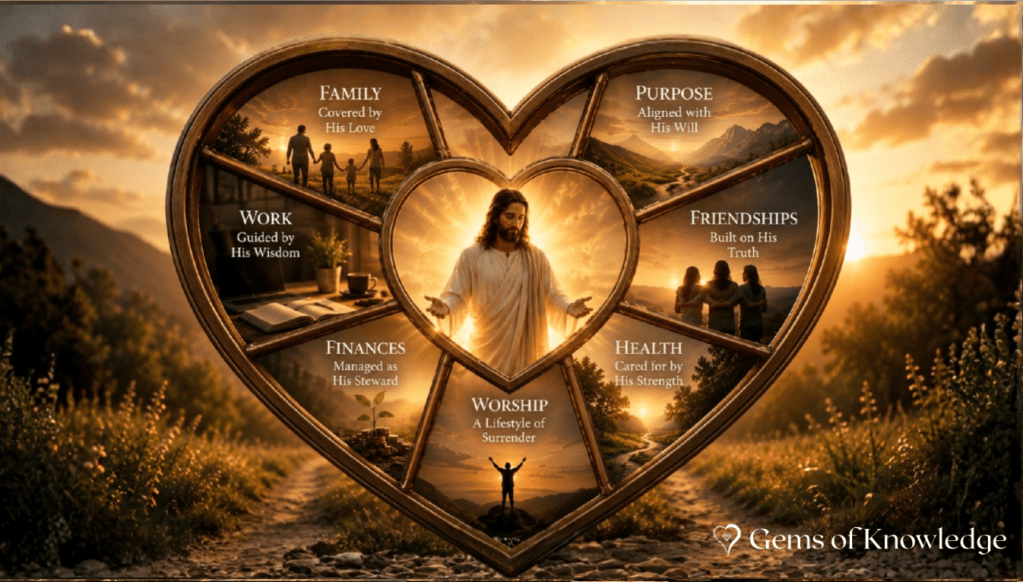
Alt...
A heart-shaped wheel with spokes leading to Jesus at the center, symbolizing every area of life revolving around Christ.
The Freedom of Knowing Who We Are
A Devotional Meditation on John 1:21 John 1:21 presents one of the most remarkable moments of humility in all of Scripture. The religious leaders questioned John the Baptist, asking, “What then? Are you Elijah?” He answered, “I am not.” “Are you the Prophet?” And he answered, “No.” Their questions reveal humanity’s persistent desire to define people by titles, expectations, and earthly categories. John’s answers reveal something far greater: a life that is secure in the […] [SENSITIVE CONTENT]

A Devotional Meditation on John 1:21
John 1:21 presents one of the most remarkable moments of humility in all of Scripture. The religious leaders questioned John the Baptist, asking, “What then? Are you Elijah?” He answered, “I am not.” “Are you the Prophet?” And he answered, “No.” Their questions reveal humanity’s persistent desire to define people by titles, expectations, and earthly categories. John’s answers reveal something far greater: a life that is secure in the calling of God and free from the need for self-exaltation.
The delegation from Jerusalem was searching for someone extraordinary. Israel longed for the fulfillment of ancient promises. Malachi had spoken of Elijah’s coming before the great day of the Lord, and Moses had foretold the coming of a great Prophet whom God would raise up. The religious leaders wanted to know whether John claimed to be one of these expected figures.
John answered with remarkable simplicity. He denied every opportunity to elevate himself. He refused to become more than what God had called him to be.
His words expose one of the deepest struggles of the human heart. People often seek identity through recognition, status, reputation, or comparison with others. They desire titles that command respect and positions that bring admiration. Even within the life of faith there can be a temptation to measure spiritual worth by visibility, influence, or prominence.
John rejected all of these temptations.
He understood that true greatness is not found in becoming someone impressive before others but in faithfully fulfilling the purpose assigned by God. His confidence did not come from public opinion but from divine calling. He was content to be exactly what God intended him to be.
There is profound theological significance in this exchange. Throughout Scripture, God often works through those who willingly decrease so that His glory may increase. Abraham left his homeland without knowing where he would go. Moses protested his own inadequacy. David was overlooked among his brothers. The prophets often labored without earthly success. The apostles described themselves as servants rather than celebrities.
The kingdom of God operates by different standards than the kingdoms of the world. Heaven values faithfulness over fame, obedience over applause, humility over ambition. John embodies this kingdom principle before the ministry of Jesus even fully begins.
His refusal also demonstrates remarkable theological clarity. John knew that he was not the fulfillment of Israel’s hope. He was merely preparing the way for the One who was. Every denial pointed beyond himself toward Christ. His ministry was never about gathering followers for his own sake but directing all attention toward the Lamb of God.
The greatest servants of God understand that they are signposts rather than destinations. They point beyond themselves toward the Savior. Their lives become instruments through which others encounter Christ rather than monuments built for personal honor.
John’s humility also protects him from the subtle danger of spiritual pride. Religious influence can become intoxicating. Crowds gathered around John. People traveled into the wilderness to hear him preach. Many wondered whether he himself might be the Messiah. Yet he consistently refused every false identity.
This unwavering honesty teaches that humility is not self-hatred but truthful self-understanding. John neither exaggerated nor diminished his role. He simply accepted God’s assignment with joyful obedience. He knew both his limitations and his purpose.
Such humility flows from a proper understanding of God’s sovereignty. If God appoints every calling, every gift, every opportunity, and every season of ministry, then comparison becomes unnecessary. The Creator distributes His grace according to His wisdom. One plants while another waters, but God gives the increase. Some labor in public while others serve unseen. Every faithful act offered to God possesses eternal value regardless of human recognition.
John’s example challenges the modern desire for visibility. Contemporary culture often encourages constant self-promotion, measuring success by followers, influence, popularity, or applause. Even spiritual service can become vulnerable to these pressures.
Yet the kingdom of Christ invites believers into another way. It invites contentment in hidden obedience. It celebrates quiet faithfulness. It honors those who simply fulfill the work entrusted to them without seeking personal glory.
The questions directed at John continue to echo throughout every generation. People ask, “Who are you?” Society defines identity through achievement, occupation, wealth, education, politics, or social status. Scripture answers differently. The believer’s identity is found in belonging to Christ and serving His purposes.
John knew exactly who he was because he knew exactly whose servant he was.
There is deep freedom in such certainty. When identity rests upon God’s calling rather than human approval, criticism loses its power to destroy and praise loses its power to corrupt. The servant stands secure because the Master is pleased.
John’s repeated denials also reveal a heart fully satisfied with Christ’s coming glory. He did not envy the One who would eclipse his ministry. Instead, he rejoiced that his own influence would diminish if Jesus would be exalted. His ministry was successful precisely because it prepared others to leave him and follow Christ.
Such joyful self-forgetfulness reflects the very heart of Christian discipleship. Every ministry, every sermon, every act of service, every expression of compassion ultimately exists for one purpose: to direct people toward Jesus Christ.
The church today desperately needs the spirit of John the Baptist. It needs leaders who seek faithfulness rather than fame, servants who rejoice when Christ receives the glory, believers who embrace obscurity if Christ is honored, and disciples who understand that their highest privilege is not to be admired but to point others to the Savior.
John’s simple answers, “I am not,” become profound declarations of theological wisdom. They clear away every distraction until only Christ remains at the center. In denying false identities, John prepared the world to recognize the true Redeemer.
The same calling remains for every believer today. The goal is not to become indispensable, unforgettable, or celebrated. The goal is to become faithful witnesses whose lives consistently direct attention away from themselves and toward the Son of God who alone is worthy of worship.
May every heart learn the quiet joy of knowing its God-given place, embracing its God-given calling, and finding complete satisfaction in making much of Christ rather than self.
Prayer
Heavenly Father, teach Your people the beauty of humility and the joy of faithful obedience. Guard every heart from pride, comparison, and the desire for human applause. Grant grace to serve with contentment wherever You have placed us, pointing always to Jesus Christ and seeking only His glory. May our lives become faithful witnesses that lead others to the Savior, and may Your name alone be exalted in all we do. Amen.

Alt...
The Freedom of Knowing Who We Are
The Bible says you can be transformed through Christ; you become a new creation! Click or tap the link to read more.
#afaithfulsower #christianity #Bible #Jesus #dailydevotion
The God Who Calls Us to Faithful Witness
A Prayer Inspired by John 1:21 Heavenly Father, We come before You with reverence, gratitude, and awe. You are the eternal God who was before all things and through whom all things exist. You are the Lord of history, the Author of redemption, and the One who speaks truth into a world often filled with confusion and uncertainty. We praise You because Your purposes never fail and Your wisdom is beyond measure. Your plans stretch from eternity past into eternity future, and every promise You […] [SENSITIVE CONTENT]

A Prayer Inspired by John 1:21
Heavenly Father,
We come before You with reverence, gratitude, and awe. You are the eternal God who was before all things and through whom all things exist. You are the Lord of history, the Author of redemption, and the One who speaks truth into a world often filled with confusion and uncertainty. We praise You because Your purposes never fail and Your wisdom is beyond measure. Your plans stretch from eternity past into eternity future, and every promise You have made finds its fulfillment in Your perfect will.
Today we reflect upon the testimony of John the Baptist, who was questioned by those who sought to define him according to their expectations. When they asked him, “What then? Are you Elijah?” he answered, “I am not.” When they asked, “Are you the Prophet?” he answered, “No.” In his response we see a remarkable humility, honesty, and submission to Your purpose. He refused titles that did not belong to him. He declined honors that were not his to claim. He would not build an identity upon misunderstanding or speculation. Instead, he embraced the role You had given him and faithfully pointed others to the One who was greater than himself.
Lord, we confess that we often struggle with this same temptation. We desire recognition. We long to be important. We sometimes measure our worth by the opinions of others rather than by Your calling upon our lives. We are tempted to create identities based upon human expectations rather than divine purpose. Forgive us for the times we have sought glory that belongs only to You.
Teach us the humility of John the Baptist. Give us hearts that are content with the place You have assigned to us. Help us to understand that faithfulness is greater than fame and obedience is more valuable than recognition. Deliver us from the need to impress others and free us to live for Your approval alone.
Father, we thank You that every believer has a calling. Though not all are prophets, pastors, teachers, or leaders, every follower of Christ has been entrusted with the sacred privilege of bearing witness to the truth. You have called us to reflect the light of Christ in our homes, workplaces, churches, and communities. You have invited us to participate in Your redemptive work by speaking words of grace, showing acts of compassion, and living lives that reveal the beauty of the gospel.
Grant us courage to fulfill that calling. In a world that often resists truth, strengthen us to stand firm. In a culture that frequently celebrates self-promotion, help us to practice humility. In an age filled with noise and distraction, teach us to lift up the name of Jesus with clarity and conviction.
Lord Jesus Christ, we thank You that John’s ministry was never ultimately about himself. His purpose was to prepare the way for You. His mission was to point beyond himself to the Lamb of God who takes away the sin of the world. We praise You because You are the fulfillment of every promise, the answer to every longing, and the Savior of all who trust in You.
We thank You that You came not merely as a teacher or prophet but as the eternal Word made flesh. You entered our broken world. You walked among sinners. You bore our griefs and carried our sorrows. You lived the life we could never live and died the death we deserved to die. Through Your resurrection You conquered sin, death, and the grave. Through Your ascension You reign as Lord over all creation.
Because of Your finished work, we no longer need to establish our own significance. Our identity is secure in You. We are beloved children of God. We are redeemed by grace. We are adopted into Your family. We belong to Christ. Help us to rest in this truth whenever insecurity threatens our hearts.
Father, we pray for Your Church throughout the world. Guard Your people from the temptation to build ministries around personalities rather than around Christ. Protect us from pride, competition, and self-exaltation. Raise up leaders who delight in serving rather than being served. Raise up pastors who faithfully preach Christ rather than themselves. Raise up believers whose greatest joy is not personal recognition but the advancement of Your kingdom.
May our churches become communities where Christ is exalted above all else. Let every sermon point to Him. Let every ministry reflect His character. Let every act of service reveal His love. Let every gathering proclaim His gospel. Teach us that our highest purpose is not to make a name for ourselves but to glorify the name that is above every name.
Lord, we pray for those who feel overlooked, forgotten, or insignificant. Remind them that faithfulness in Your kingdom is never wasted. You see every act of obedience. You notice every quiet sacrifice. You remember every prayer offered in faith. You value every servant who labors in hidden places for Your glory.
Strengthen those who serve without applause. Encourage those who labor without recognition. Comfort those who wonder whether their efforts matter. Remind them that Your eyes are upon them and that You delight in the humble and faithful hearts of Your people.
We also pray for those who are searching for purpose and direction. Like the questioners who came to John, many are asking, “Who am I?” and “Why am I here?” Lord, reveal Yourself to them. Show them that true identity is not found in success, status, possessions, or achievements. It is found in relationship with You. Lead them to discover the joy of knowing Christ and serving Him wholeheartedly.
Father, make us people of truth. Give us integrity in our words and sincerity in our witness. Help us to speak honestly about ourselves and faithfully about You. Keep us from exaggeration, deception, and pride. Let our lives be marked by authenticity and grace.
Fill us with the Holy Spirit so that our witness may be effective. Empower us to speak of Christ with wisdom and love. Open doors for gospel conversations. Prepare hearts to receive the good news. Use our lives as instruments through which others may encounter the transforming power of Jesus Christ.
Lord, as John faithfully prepared the way for the coming of the Messiah, help us to prepare hearts for Your kingdom. May our words, actions, and attitudes point others toward the Savior. Let us become signposts that direct people to Christ rather than drawing attention to ourselves.
As we journey through this life, keep us anchored in humility and grounded in grace. Remind us daily that our value comes not from what we accomplish but from whose we are. Help us to live with confidence because we belong to Christ and with humility because all we have is a gift from Your hand.
We look forward to the day when every earthly title will fade away, every human achievement will pass, and every false source of identity will disappear. On that day, only Christ will remain exalted. Until then, teach us to live as faithful witnesses, humble servants, and joyful disciples.
May our lives echo the spirit of John the Baptist. May we decrease so that Christ may increase. May we find our greatest joy not in being known but in making Him known. May our hearts be satisfied not with earthly honor but with the privilege of serving our King.
We ask all these things in the name of Jesus Christ, the eternal Word, the Lamb of God, the Savior of the world, and the Lord of glory.
Amen.

Alt...
The God Who Calls Us to Faithful Witness
The Throne Beyond the Veil
A Poem Inspired by Hebrews 4:14–16 Beyond the veil where mortal eyesHave never pierced the courts above,There stands a throne in radiant light,Established by eternal love.No shadow stains its holy height,No darkness dims its perfect grace;The hosts of heaven bow in aweBefore the splendor of that place. The stars that wheel through endless night,The seas that thunder at command,The mountains crowned with ancient snow,Are fashioned by a sovereign hand.Yet greater still the wondrous […] [SENSITIVE CONTENT]

A Poem Inspired by Hebrews 4:14–16
Beyond the veil where mortal eyes
Have never pierced the courts above,
There stands a throne in radiant light,
Established by eternal love.
No shadow stains its holy height,
No darkness dims its perfect grace;
The hosts of heaven bow in awe
Before the splendor of that place.
The stars that wheel through endless night,
The seas that thunder at command,
The mountains crowned with ancient snow,
Are fashioned by a sovereign hand.
Yet greater still the wondrous truth
That echoes through creation’s frame:
A Priest has entered heaven’s gate,
And Jesus Christ is His name.
Not clothed in robes of earthly thread,
Nor bearing incense made by men,
He passed beyond the highest skies
And entered God’s own courts again.
The Son of God, enthroned on high,
The Lamb once slain for guilty souls,
Now stands before the Father’s face
While endless praise around Him rolls.
The prophets saw His distant day
And longed to understand the sight;
The kings desired to glimpse His reign
That shines with everlasting light.
The saints who wandered deserts bare,
Who trusted through the fiercest flame,
Looked forward to the promised One,
And rested in His mighty name.
He is the Priest forevermore,
The Mediator strong and true;
No other hand can bridge the gulf,
No other heart can see us through.
The ancient altars fade away,
Their sacrifices now fulfilled;
For by His blood the debt was paid,
And heaven’s justice stands appeased.
Yet marvel not alone that Christ
Has entered through the gates above;
Marvel that the Lord of all
Is filled with sympathy and love.
Though crowned with glory infinite,
Though seated on the throne of might,
He bears remembrance of the path
He walked through sorrow’s deepest night.
He knew the wilderness of thirst,
The lonely burden of rejection;
He heard the mocker’s bitter laugh,
The sinner’s cold and hard objection.
He felt the weight of human grief,
The sting of tears that freely fell;
He walked among the brokenhearted
And entered suffering’s darkest cell.
The storm-tossed sea obeyed His voice,
Yet still He slept in weariness.
The angels waited at His word,
Yet He endured humanity’s distress.
The Prince of Life knew hunger’s ache,
The Holy One knew sorrow’s pain;
The Lord of Glory wore our flesh
And walked beneath the curse’s stain.
Temptation pressed from every side,
Its subtle whisper and its cry;
Yet never once did darkness gain
The smallest victory thereby.
His heart remained unstained by sin,
His hands untouched by evil’s art;
The perfect Lamb stood firm and pure,
With flawless love and steadfast heart.
Therefore the weary need not fear
That heaven cannot understand.
The Savior knows the pilgrim’s road,
The burdens carried by our hand.
He knows the battle hidden deep,
The doubts concealed from human sight;
He knows the tears that fall unseen
Beneath the cover of the night.
When conscience trembles under guilt,
When faith appears a dying flame,
When weakness seems a chain of iron,
And shame repeats its cruel claim,
The child of God may lift his eyes
Beyond the failures of the day,
And see a Priest whose nail-scarred hands
Still intercede along the way.
O blessed mystery of grace!
The Judge Himself became our Friend;
The One before whom angels bow
Secures our welcome without end.
No flaming sword now guards the path,
No cherub bars the sinner’s plea;
The veil is torn, the door stands wide,
And mercy flows abundantly.
Come then, believer, draw thou near,
Not shrinking back in guilty dread.
The throne before thee is not crowned
With wrath to strike the trembling dead.
Though holy beyond mortal thought,
Though bright with uncreated flame,
It bears a sweeter, dearer title:
The Throne of Grace, forever named.
There mercy waits with open hands,
And kindness greets the contrite soul;
There wounds are healed and fears are calmed,
And broken hearts are rendered whole.
There strength is given to the weak,
And courage to the faint of breath;
There hope arises from the dust
And triumph sings in face of death.
The world may offer fleeting aid,
A comfort passing as the dew;
Its promises dissolve like mist,
Its words prove frail and often few.
But grace descends from heaven’s height,
Abundant as the boundless sea,
And every wave proclaims anew
The riches of God’s charity.
In every hour of urgent need,
When trials gather like a storm,
The Savior’s presence shall remain,
A refuge constant, sure, and warm.
His mercy does not ebb away
As seasons fade and kingdoms fall;
His faithfulness endures unchanged,
The same Lord over all.
Therefore let hearts hold fast their hope,
Though winds may rage and mountains shake;
The Priest who entered heaven’s courts
Will never leave His own forsake.
His promises are firm as truth,
His covenant shall ever stand;
The sheep He purchased with His blood
Are safely held within His hand.
And when at last life’s journey ends,
And earthly shadows flee from sight,
The faithful shall behold their King
In everlasting realms of light.
The throne once sought through prayer and faith
Shall stand unveiled before their gaze;
And they shall join the countless choir
In endless songs of grateful praise.
Then every doubt shall disappear,
And every tear be wiped away;
The mercy sought in earthly need
Shall blossom into perfect day.
The Great High Priest shall welcome home
The saints redeemed by grace alone,
And they shall dwell forevermore
Before the everlasting throne.
Until that dawn, let every soul
Take courage from this sacred word:
The heavens hold a faithful Priest,
Our Savior, Master, King, and Lord.
Therefore with confidence draw near,
And seek the grace God freely gives;
For mercy flows from heaven’s throne,
And Christ, our Great High Priest, lives.

Alt...
The Throne Beyond the Veil

I have spent years watching what happens to people when Hebrew finally clicks for them and it is never just about the language.
Something opens. A connection to family they could not fully reach before. A scripture they always heard but never truly understood. A trip to Israel that finally felt like coming home. A heritage that was always theirs but always felt just out of reach.
That is what Hebrew does. And that is why I will never stop teaching it.
hebrewbyinbal.com/speak 🇮🇱
#LearnHebrew #Hebrew #HebrewForBeginners #Christianity #LanguageLearning

The Open Door
A Short Story Inspired by Hebrews 4:14-16 The emergency room waiting area was quieter than usual. Ethan sat alone beneath the glow of fluorescent lights, staring at a paper cup of coffee that had long since gone cold. Across from him, a television mounted high on the wall played a morning news program with the volume turned down. People moved through the halls beyond the glass doors, but everything felt distant, as though he were watching life happen from underwater. His phone buzzed […] [SENSITIVE CONTENT]

A Short Story Inspired by Hebrews 4:14-16
The emergency room waiting area was quieter than usual.
Ethan sat alone beneath the glow of fluorescent lights, staring at a paper cup of coffee that had long since gone cold. Across from him, a television mounted high on the wall played a morning news program with the volume turned down. People moved through the halls beyond the glass doors, but everything felt distant, as though he were watching life happen from underwater.
His phone buzzed again.
No new updates.
His mother was in surgery.
Three hours earlier she had collapsed while tending flowers in her backyard. The doctors had spoken carefully, using words that sounded hopeful but uncertain. Now all Ethan could do was wait.
Waiting had never been his strength.
He stood and paced the room. Then he sat again. Then he stood.
A familiar voice interrupted his restless thoughts.
“You’re wearing a path in the floor.”
Ethan turned and saw Pastor James carrying two cups of coffee.
“I figured you might need this,” the pastor said.
“You didn’t have to come.”
“Of course I did.”
The older man sat beside him and handed him a fresh cup.
For several minutes neither of them spoke.
Sometimes silence was kinder than advice.
Finally Ethan sighed.
“I don’t know what to pray anymore.”
Pastor James nodded.
“That happens.”
“I mean it,” Ethan said. “I’ve prayed all morning. I’ve begged God to help her. I’ve quoted verses. I’ve tried to believe. Now I’m just exhausted.”
The pastor listened.
Ethan continued.
“And honestly, I feel guilty.”
“Why?”
“Because I keep wondering whether God is tired of hearing from me.”
Pastor James looked surprised.
“Tired of hearing from you?”
“Yeah.”
Ethan stared at the floor.
“I’ve made a mess of things over the years. You know that. There were years I barely stepped inside a church. Years when I ignored God completely. Then something goes wrong and suddenly I’m knocking on heaven’s door again.”
His voice cracked.
“What if I’ve worn out my welcome?”
The pastor leaned back in his chair.
“That’s a heavy burden to carry.”
“It feels true.”
The older man was quiet for a moment.
“Do you remember the first time you came back to church?”
Ethan laughed softly.
“Unfortunately.”
“You sat in the back row.”
“I sat by the exit.”
“You looked like you were preparing an escape plan.”
“I was.”
Pastor James smiled.
“And what happened?”
“You preached.”
“No, after that.”
Ethan thought.
“You came and talked to me.”
“What did I say?”
The younger man shrugged.
“You asked if I wanted coffee.”
“And?”
“You said I didn’t have to earn my way through the door.”
Pastor James nodded.
“Exactly.”
Ethan looked away.
“That was church.”
“Yes.”
“This is God.”
The pastor’s expression softened.
“That’s precisely why it matters.”
The waiting room grew quiet again.
A nurse walked past.
Someone laughed down the hallway.
Life continued.
Pastor James folded his hands.
“Years ago, when I was young, I thought prayer worked like a performance review.”
Ethan raised an eyebrow.
“A performance review?”
“I imagined God sitting behind a giant desk. Every prayer request had to pass inspection. Good Christians got quick access. Weak Christians waited in line. Failures stayed outside.”
“That sounds familiar.”
“It does, doesn’t it?”
The pastor smiled sadly.
“But Scripture paints a different picture.”
Ethan listened.
“It tells us we have a great High Priest who understands our weakness.”
He paused.
“Not one who merely tolerates us. One who understands us.”
Ethan stared into his coffee.
Pastor James continued.
“Think about that. Jesus knows exhaustion. He knows grief. He knows fear. He knows betrayal. He knows what it feels like to stand in the shadow of suffering.”
“But He never sinned.”
“No.”
“Then how can He understand?”
The pastor nodded.
“That’s what makes it remarkable. He faced every kind of temptation and pressure without surrendering to it. He knows the full weight of human struggle better than we do.”
Ethan considered that.
For years he had imagined God as distant.
Powerful, certainly.
Holy, definitely.
But not approachable.
Not accessible.
Not near.
“Sometimes,” Ethan said quietly, “I feel like I’m standing outside a locked door.”
Pastor James pointed toward the hospital entrance.
“You see those security doors?”
Ethan nodded.
“They only open for authorized people.”
“Right.”
“If you walk up to them without permission, they stay shut.”
“Exactly.”
The pastor smiled.
“A lot of people think God’s presence works that way.”
“It doesn’t?”
“No.”
He leaned forward.
“Because of Christ, the door is already open.”
Ethan looked at him.
“You don’t approach God based on your record.”
“Then how?”
“Through Jesus.”
The words settled into the silence between them.
Not through success.
Not through religious achievements.
Not through flawless behavior.
Through Jesus.
For the first time that morning, Ethan felt something loosen inside his chest.
A knot he had carried for years began to unwind.
The surgery was still happening.
Nothing had changed.
Yet somehow everything felt different.
Hours later, the surgeon finally appeared.
Ethan stood so quickly he nearly spilled his coffee.
The doctor removed his mask.
The expression on his face was impossible to read.
For a terrifying second Ethan imagined the worst.
Then the doctor smiled.
“The procedure went well.”
The room tilted with relief.
Ethan felt his knees weaken.
“She’s stable?”
“Yes.”
“She’s okay?”
“She has a long recovery ahead of her, but yes. She’s okay.”
Ethan closed his eyes.
A breath escaped him.
Not a sigh.
Not quite a laugh.
Something in between.
The surgeon continued explaining details, but Ethan barely heard them.
His mother was alive.
That was enough.
Afterward, he sat back down.
Pastor James returned from making a phone call.
“Well?”
Ethan’s eyes filled with tears.
“She’s going to be okay.”
The pastor smiled.
“Praise God.”
For a few moments neither man spoke.
Then Ethan laughed unexpectedly.
“What?”
“I just realized something.”
“What’s that?”
“I spent all morning trying to convince myself that God would listen.”
Pastor James nodded.
“And?”
“And maybe the whole time He already was.”
The older man smiled.
“Yes.”
Ethan looked toward the ceiling.
Not because he thought heaven was physically above the hospital.
Not because he suddenly understood every mystery of faith.
But because for the first time in a long while, he felt welcomed.
Known.
Seen.
The fear that had haunted him for years was beginning to fade.
The fear that he was too broken.
Too inconsistent.
Too late.
Too far gone.
The truth was far better.
The throne of God was not merely a throne of power.
It was a throne of grace.
And grace meant the door remained open.
Weeks later, Ethan pushed his mother’s wheelchair through a sunny city park.
Summer had arrived.
Children played near a fountain.
Dogs chased tennis balls across bright green grass.
His mother was still recovering, but her strength was returning.
“Slow down,” she laughed.
“I am slowing down.”
“You’re pushing like you’re in a race.”
Ethan grinned.
“Old habits.”
They stopped near a bench overlooking a pond.
For a while they watched ducks glide across the water.
Then his mother asked a question.
“Can I tell you something?”
“Sure.”
“You seem different.”
Ethan smiled.
“How so?”
“Lighter.”
He looked toward the pond.
“I think I am.”
She waited.
“You know, when I was sitting in that hospital waiting room, I realized something.”
“What?”
“I’ve spent most of my life thinking God was reluctantly putting up with me.”
His mother said nothing.
“I thought every failure moved me farther away.”
“And now?”
Ethan watched sunlight dance across the water.
“Now I think He was calling me closer all along.”
A breeze stirred the trees overhead.
For a moment the world seemed unusually still.
Peaceful.
The kind of peace that cannot be manufactured.
The kind that arrives when fear finally releases its grip.
Ethan thought about all the doors people encounter in life.
Doors that remain closed.
Doors guarded by expectations.
Doors requiring credentials.
Doors that open only for the worthy.
But the door Christ opened was different.
It welcomed the weary.
The ashamed.
The struggling.
The uncertain.
The fearful.
The broken.
Not because their need was small.
But because His grace was greater.
And as Ethan sat beside his mother beneath the warmth of the afternoon sun, he understood something he had never truly grasped before.
The invitation had never been to stand outside and wonder whether he belonged.
The invitation had always been to come near.
With confidence.
With honesty.
With need.
And there, at the throne of grace, he would find exactly what he needed most:
Mercy for yesterday.
Grace for today.
And hope for tomorrow.

Alt...
The Open Door
Leading with Confidence at the Throne of Grace
A Message to Church Leaders from Hebrews 4:14-16 Hebrews 4:14–16 stands among the most encouraging and pastorally significant passages in the New Testament. In just a few verses, the writer of Hebrews brings together the glory of Christ, the weakness of humanity, the confidence of faith, and the sustaining grace of God. For church leaders, these words offer both a theological foundation and a practical lifeline. They remind pastors, elders, ministry leaders, teachers, missionaries, and […] [SENSITIVE CONTENT]

A Message to Church Leaders from Hebrews 4:14-16
Hebrews 4:14–16 stands among the most encouraging and pastorally significant passages in the New Testament. In just a few verses, the writer of Hebrews brings together the glory of Christ, the weakness of humanity, the confidence of faith, and the sustaining grace of God. For church leaders, these words offer both a theological foundation and a practical lifeline. They remind pastors, elders, ministry leaders, teachers, missionaries, and servants of the church that their ministry does not rest upon their own strength but upon the perfect ministry of Jesus Christ, our Great High Priest.
The passage declares:
“Therefore, since we have a great high priest who has ascended into heaven, Jesus the Son of God, let us hold firmly to the faith we profess. For we do not have a high priest who is unable to sympathize with our weaknesses, but we have one who has been tempted in every way, just as we are—yet he did not sin. Let us then approach God’s throne of grace with confidence, so that we may receive mercy and find grace to help us in our time of need.”
These words were written to believers who were weary, discouraged, and tempted to abandon their steadfast confession of Christ. They were facing opposition and hardship. Their faith was being tested. The writer does not begin by directing their attention to themselves. Instead, he directs their attention upward to Jesus.
This remains the first responsibility of every church leader. Leadership in the church is not primarily about strategy, administration, innovation, or influence. It begins with seeing Christ clearly. Ministry becomes unhealthy when leaders become consumed with their own abilities, failures, challenges, or ambitions. Healthy leadership begins when the eyes of the heart are fixed upon the risen and exalted Son of God.
The writer describes Jesus as our “great high priest.” This title carries profound significance. Under the old covenant, the high priest represented the people before God. He entered the Holy of Holies on behalf of the nation. He served as a mediator between a holy God and sinful people. Yet every earthly priest was limited. Every priest was imperfect. Every priest eventually died.
Jesus is different.
He is not merely a high priest; He is the great high priest. His priesthood is superior in every way. He is both the sacrifice and the priest who offers the sacrifice. He is both fully God and fully man. He does not minister in an earthly sanctuary but in the very presence of God. His ministry never ends because He lives forever.
Church leaders must continually remember that the church belongs to Christ. It is not sustained by human wisdom but by the ongoing ministry of Jesus. The burden of carrying the church was never intended to rest upon human shoulders alone. Christ Himself is the ultimate Shepherd of His people.
Many leaders carry unnecessary burdens because they unconsciously assume responsibilities that belong only to Christ. They attempt to change hearts, sustain every struggling believer, solve every conflict, and guarantee every outcome. Yet Scripture repeatedly points leaders back to the reality that Christ remains the Head of His church.
The health of ministry depends upon recognizing this truth. Leaders are called to serve faithfully, but they are not called to replace Christ. They are called to shepherd, but they are not the Chief Shepherd. They are called to teach, but they are not the source of truth. They are called to lead, but they are not the Savior.
The confidence of ministry grows when leaders understand that Jesus is actively reigning and interceding for His people.
The writer continues by declaring that Jesus has “ascended into heaven.” This statement reminds believers that Christ’s work on earth was completed successfully. His death accomplished redemption. His resurrection demonstrated victory over sin and death. His ascension revealed His exaltation and authority.
Church leaders often labor in situations where visible results seem small. Sermons are preached without obvious response. Counseling conversations appear unfruitful. Evangelistic efforts seem ineffective. Programs fail. Attendance fluctuates. Discouragement can quietly settle into the soul.
Yet Hebrews reminds leaders that their confidence is not rooted in visible success but in the finished work of Christ. Jesus reigns regardless of present circumstances. He remains victorious even when ministry seasons are difficult.
This perspective guards leaders from both despair and pride.
It guards against despair because Christ remains sovereign even when leaders feel ineffective.
It guards against pride because any fruit that appears ultimately comes through His power rather than human effort.
The command that follows is simple but profound: “Let us hold firmly to the faith we profess.”
Church leaders are often focused on helping others remain faithful. They preach perseverance. They encourage commitment. They call believers to endure trials. Yet leaders themselves must heed this same command.
One of the greatest dangers in ministry is the gradual erosion of personal devotion. A leader may remain active in ministry while quietly neglecting communion with Christ. Sermons can be prepared while prayer becomes shallow. Ministry activities can multiply while intimacy with God diminishes.
The writer calls leaders to hold firmly to their confession of faith. Ministry effectiveness cannot substitute for spiritual faithfulness.
Church history is filled with examples of gifted leaders whose ministries appeared impressive while their private walk with God deteriorated. The lesson is clear. No amount of public success can compensate for a declining relationship with Christ.
The strength to persevere comes from remembering who Jesus is and what He has done.
The next truth in this passage is among the most comforting in all of Scripture. The writer tells us that Jesus is able to sympathize with our weaknesses.
This is especially important for church leaders.
Leadership often carries unique pressures. Leaders are expected to remain strong during crises. They are called upon to comfort grieving families, navigate difficult decisions, address conflicts, and carry significant responsibilities. At times, these pressures can create feelings of isolation.
Many leaders quietly struggle with discouragement, exhaustion, fear, disappointment, loneliness, and temptation. They may believe that no one fully understands their burdens.
Hebrews offers remarkable comfort.
Jesus understands.
The Son of God entered human experience completely. He knew hunger, fatigue, rejection, misunderstanding, betrayal, sorrow, and suffering. He experienced opposition from religious leaders, abandonment by friends, and the weight of overwhelming responsibility.
He understands what it means to be weary.
He understands what it means to be misunderstood.
He understands what it means to be rejected.
He understands what it means to carry a difficult calling.
This does not mean Christ merely observes human weakness from a distance. The word “sympathize” conveys deep identification and compassionate understanding. Jesus does not respond to struggling leaders with cold detachment. He responds with mercy and compassion.
This truth transforms the way leaders approach God.
Many leaders carry hidden guilt because they feel they should be stronger than they are. They believe they should never become discouraged, weary, or overwhelmed. Yet Hebrews does not deny human weakness. Instead, it acknowledges weakness and points believers toward a sympathetic Savior.
The goal of spiritual maturity is not pretending weakness does not exist.
The goal is bringing weakness honestly before Christ.
The writer further explains that Jesus was “tempted in every way, just as we are—yet he did not sin.”
This statement highlights both Christ’s identification with humanity and His perfect holiness.
Jesus experienced the reality of temptation. He faced the enticements of power, comfort, self-preservation, and compromise. He encountered every category of temptation common to humanity.
Yet He never sinned.
This truth makes Him uniquely qualified to help His people.
A leader who has fallen into sin cannot ultimately rescue another from sin. A struggling sinner cannot serve as the perfect deliverer of sinners. Only the sinless Christ can provide complete salvation and ongoing help.
Church leaders should take great comfort in this reality. The foundation of ministry is not the leader’s perfection but Christ’s perfection.
Every leader remains dependent upon grace.
Every leader remains dependent upon forgiveness.
Every leader remains dependent upon Christ.
This dependence is not a weakness; it is the very heart of Christian ministry.
The passage then reaches its glorious climax: “Let us then approach God’s throne of grace with confidence.”
What a remarkable invitation.
Under the old covenant, access to God’s presence was limited. The Holy of Holies was separated by a veil. Only the high priest could enter, and only under specific conditions.
But through Christ, access has been opened.
Church leaders are invited to come boldly before God.
Notice that the destination is a throne.
A throne speaks of authority, sovereignty, majesty, and power.
God remains the King of the universe.
He rules over nations.
He governs history.
He reigns over every circumstance.
Nothing occurs outside His sovereign authority.
Yet this throne is also described as a throne of grace.
For believers in Christ, the throne of the King has become a place of welcome rather than terror.
This truth should shape every aspect of ministry leadership.
Leaders face countless situations that exceed their wisdom. There are counseling situations without easy answers. There are financial challenges. There are relational conflicts. There are ministry decisions filled with uncertainty.
The temptation is to rely primarily upon experience, intelligence, or strategy.
Yet Hebrews points leaders toward prayer.
The throne of grace is not merely a theological concept. It is a practical reality.
The most effective leaders are not necessarily those with the greatest talents. They are often those who have learned to live before the throne of grace.
Prayerlessness is ultimately a declaration of self-sufficiency.
Prayer is a declaration of dependence.
Healthy leaders recognize that every ministry challenge should drive them toward God rather than away from Him.
The writer tells believers to approach this throne with confidence.
This confidence is not arrogance.
It is not self-confidence.
It is Christ-confidence.
Believers approach boldly because Jesus has already secured their acceptance.
Church leaders must remember this distinction.
Many leaders live under constant pressure to prove themselves. They measure their worth by attendance numbers, ministry growth, public approval, or personal performance.
The gospel liberates leaders from this exhausting burden.
Acceptance before God does not depend upon ministry success.
It depends upon Christ.
Leaders do not earn access to God through effectiveness.
They receive access through grace.
This truth creates freedom.
It enables leaders to serve faithfully without being enslaved to outcomes.
It enables them to lead courageously without being controlled by fear.
It enables them to endure criticism without losing heart.
It enables them to remain humble during seasons of blessing.
The passage concludes with a promise: “that we may receive mercy and find grace to help us in our time of need.”
Every church leader lives in continual need.
There is never a season when leaders outgrow their dependence upon mercy and grace.
Mercy addresses our failures.
Grace provides strength for our responsibilities.
Mercy forgives what is behind us.
Grace empowers what lies before us.
Mercy meets us in our weakness.
Grace equips us for faithful service.
This promise assures leaders that God’s resources are always sufficient for His calling.
There will be days when ministry feels overwhelming. There will be seasons of discouragement. There will be moments when leaders question their strength, wisdom, and ability to continue.
In those moments, Hebrews does not point leaders toward self-reliance.
It points them toward the throne of grace.
There they receive mercy.
There they find grace.
There they discover fresh strength.
There they remember that Christ remains their Great High Priest.
The church of Jesus Christ desperately needs leaders who understand this passage. It needs leaders who are captivated by the greatness of Christ, anchored in the gospel, honest about their weaknesses, committed to prayer, and dependent upon grace.
The future of faithful ministry does not depend upon stronger personalities, better programs, or greater resources. It depends upon leaders who continually come before the throne of grace and draw strength from their living Savior.
Therefore, church leaders must not lose heart. The One who called them remains faithful. The One who saved them continues to intercede for them. The One who understands their weaknesses provides mercy and grace in every season.
Jesus Christ, the Son of God, has passed through the heavens. He reigns in glory. He sympathizes with His servants. He welcomes them into His presence. He supplies everything necessary for faithful ministry.
Because of Him, leaders can hold firmly to their confession.
Because of Him, leaders can approach God with confidence.
Because of Him, leaders can continue serving with courage, humility, and hope until the day they stand before the Chief Shepherd and hear His words of eternal commendation.

Alt...
Leading with Confidence at the Throne of Grace
Holding Fast to Our Great High Priest
A Sermon Reflecting on Hebrews 4:14-16 The book of Hebrews was written to believers who were facing pressure, uncertainty, and the temptation to drift away from their confidence in Christ. Into that setting comes one of the most comforting and powerful passages in all of Scripture: “Therefore, since we have a great high priest who has ascended into heaven, Jesus the Son of God, let us hold firmly to the faith we profess. For we do not have a high priest who is unable to sympathize with […] [SENSITIVE CONTENT]

A Sermon Reflecting on Hebrews 4:14-16
The book of Hebrews was written to believers who were facing pressure, uncertainty, and the temptation to drift away from their confidence in Christ. Into that setting comes one of the most comforting and powerful passages in all of Scripture:
“Therefore, since we have a great high priest who has ascended into heaven, Jesus the Son of God, let us hold firmly to the faith we profess. For we do not have a high priest who is unable to sympathize with our weaknesses, but we have one who has been tempted in every way, just as we are—yet he did not sin. Let us then approach God’s throne of grace with confidence, so that we may receive mercy and find grace to help us in our time of need.”
These verses invite believers into a deeper understanding of who Jesus is and what He continues to do for His people. They reveal Christ as our Great High Priest, our sympathetic Savior, and our gracious Advocate. They call us to perseverance, confidence, and hope. In a world filled with anxiety, temptation, suffering, and uncertainty, Hebrews 4:14–16 reminds us that we are not alone and that our access to God is secure because of Jesus Christ.
The passage begins with the declaration, “Since we have a great high priest.” The language immediately draws upon the rich imagery of the Old Testament. Under the old covenant, the high priest occupied a unique position among God’s people. He represented the nation before God. Once each year, on the Day of Atonement, he entered the Most Holy Place to offer sacrifices for sin and to intercede for the people.
The ministry of the high priest revealed two important truths. First, humanity is separated from God by sin and cannot approach Him casually. Second, God graciously provides a mediator who stands between Himself and His people.
The Old Testament priesthood was designed to point beyond itself. Every sacrifice, every priestly garment, every act of mediation anticipated the coming of Jesus Christ. The priests of Israel were temporary, imperfect, and mortal. They themselves needed sacrifices for their own sins. Their ministry could never permanently remove guilt or transform the human heart.
But Jesus is different.
The writer of Hebrews calls Him “a great high priest.” He is not merely another priest in a long succession of priests. He is the ultimate Priest. He fulfills everything the old covenant anticipated. He is greater than Aaron. He is greater than every earthly mediator. His priesthood is perfect, eternal, and complete.
The greatness of Christ’s priesthood is demonstrated in the next phrase: “who has ascended into heaven.” The earthly high priest entered an earthly sanctuary. Jesus entered heaven itself. Earthly priests passed through a curtain. Jesus passed through the heavens. Earthly priests stood before symbolic representations of God’s presence. Jesus entered the very presence of the Father.
This truth changes everything for believers.
Our Savior is not merely a figure from history. He is the risen and exalted Lord. He is seated at the right hand of God. His work of atonement has been accomplished. His sacrifice has been accepted. His victory over sin, death, and Satan has been secured.
The ascension of Christ reminds us that His ministry did not end at the cross or even at the resurrection. Today He lives and reigns. Today He intercedes for His people. Today He represents believers before the Father.
The Christian faith rests not merely on what Christ did in the past but also on what Christ is doing in the present. Even now He serves as our advocate and mediator.
Because of this reality, the writer exhorts believers: “Let us hold firmly to the faith we profess.”
This command is deeply practical. Faith must be held firmly because life often brings pressures that challenge belief. Trials come. Disappointments arise. Prayers seem unanswered. Temptations increase. Doubts whisper. Opposition emerges.
The temptation for many believers is not always outright rejection of Christ but gradual drift away from wholehearted trust in Him. Spiritual complacency can quietly replace spiritual passion. Confidence can be weakened by fear. Hope can be diminished by suffering.
Hebrews reminds us that perseverance is rooted not in our strength but in Christ’s priestly ministry. We hold fast because He holds us. We persevere because He intercedes for us. We remain faithful because He remains faithful.
The security of the believer ultimately rests not upon human determination but upon the ongoing ministry of Jesus Christ.
Many people imagine that spiritual maturity means reaching a place where weakness no longer exists. Yet the Christian life continually reveals our dependence upon God’s grace. The more we grow in Christ, the more aware we become of our need for Him.
This is why the next verse provides such extraordinary comfort.
“For we do not have a high priest who is unable to sympathize with our weaknesses.”
These words reveal the tenderness of Christ’s heart.
Jesus is not distant from human suffering. He is not detached from human struggles. He is not indifferent to human weakness.
The Son of God entered human history. He experienced hunger, fatigue, sorrow, rejection, grief, loneliness, and pain. He knew what it was to be misunderstood. He knew what it was to be betrayed by friends. He knew what it was to face intense opposition. He knew what it was to weep.
When believers suffer, Christ understands.
When believers feel overwhelmed, Christ understands.
When believers struggle with temptation, Christ understands.
When believers experience sorrow, disappointment, or fear, Christ understands.
His sympathy is not theoretical. It is experiential.
The word “sympathize” carries the idea of sharing in another’s experience. Jesus does not merely observe our struggles from a distance. He enters into them with compassionate understanding.
This truth transforms prayer.
Many people hesitate to come before God because they assume He cannot understand their struggles. They imagine Him as stern, distant, or inaccessible. Yet Hebrews presents a Savior whose heart is full of compassion.
Christ understands every burden carried by His people.
There is no sorrow too deep, no temptation too strong, no wound too painful, and no weakness too embarrassing to bring before Him.
The text continues: “but we have one who has been tempted in every way, just as we are—yet he did not sin.”
This statement reveals both Christ’s identification with humanity and His absolute uniqueness.
Jesus experienced real temptation. The temptations He faced were not imaginary. They were genuine and intense. Satan assaulted Him directly in the wilderness. Throughout His ministry He encountered opportunities to avoid suffering, compromise obedience, or pursue power apart from the Father’s will.
Yet unlike every other human being, Jesus remained completely sinless.
He experienced temptation fully because He never surrendered to it. Every pressure that temptation could exert was felt by Him, yet He remained perfectly obedient.
His sinlessness is essential to His role as Savior.
If Christ had sinned, He would have needed a Savior Himself. But because He remained without sin, He became the perfect sacrifice for sinners.
His purity qualified Him to bear our guilt.
His righteousness becomes the basis of our acceptance before God.
His victory becomes the foundation of our hope.
The believer approaches God not because of personal merit but because of Christ’s perfect righteousness.
This leads directly to one of the most remarkable invitations in Scripture.
“Let us then approach God’s throne of grace with confidence.”
The language is astonishing.
Throughout biblical history, God’s throne represented His absolute holiness, authority, and majesty. Sinful humanity could not casually approach His presence. The holiness of God inspired reverence and awe.
Yet through Christ, believers are invited to draw near.
Notice that the throne remains God’s throne. His holiness has not diminished. His majesty has not changed. His sovereignty remains absolute.
But for those who belong to Christ, the throne is now described as a “throne of grace.”
Because Jesus has satisfied divine justice, believers encounter grace rather than condemnation.
The throne where judgment might have fallen becomes the throne where mercy is received.
The throne where guilt might have been exposed becomes the throne where forgiveness is granted.
The throne where sinners might have been rejected becomes the throne where children are welcomed.
This invitation is extended with the command to come “with confidence.”
Confidence does not mean arrogance. It does not mean demanding things from God. It does not mean presumption.
Rather, it means approaching God with assurance because of Christ’s finished work.
The believer does not approach God based upon personal achievements. We do not gain access because we have performed well enough, prayed long enough, or served faithfully enough.
We come because Jesus has opened the way.
His blood secures our entrance.
His righteousness secures our acceptance.
His intercession secures our welcome.
This confidence should transform the prayer life of every believer.
Too often Christians pray timidly, as though uncertain of God’s willingness to receive them. Yet Hebrews teaches that Christ has already secured access to the Father.
We are invited to come boldly, frequently, and expectantly.
We come not as strangers seeking an audience but as children welcomed into the Father’s presence.
The purpose of this approach is beautifully expressed in the final phrase: “so that we may receive mercy and find grace to help us in our time of need.”
The Christian life is sustained by two divine gifts: mercy and grace.
Mercy addresses our failures.
Grace addresses our needs.
Mercy meets us in our guilt.
Grace strengthens us in our weakness.
Mercy forgives what we have done wrong.
Grace empowers what we must do next.
Every believer needs both.
There are moments when we come before God burdened by sin and failure. We need mercy. We need forgiveness. We need cleansing.
There are other moments when we face challenges beyond our strength. We need grace. We need divine help. We need supernatural strength.
God provides both.
Notice also that this help comes “in our time of need.”
God’s grace is not merely theoretical. It is timely.
The Lord knows exactly when His people need encouragement.
He knows when temptation is strongest.
He knows when sorrow feels unbearable.
He knows when faith feels fragile.
He knows when strength is exhausted.
And at precisely the right moment, He provides what His people need.
His grace is sufficient.
His mercy is abundant.
His resources are inexhaustible.
This passage ultimately directs our eyes away from ourselves and toward Christ.
When we focus only on our weaknesses, we become discouraged.
When we focus only on our failures, we become overwhelmed.
When we focus only on our circumstances, we become fearful.
But when we focus on our Great High Priest, hope is renewed.
Jesus has entered heaven on our behalf.
Jesus sympathizes with our weaknesses.
Jesus understands our struggles.
Jesus remains without sin.
Jesus intercedes for His people.
Jesus grants access to the throne of grace.
Jesus provides mercy and grace in every season of need.
The Christian life is not a journey of self-sufficiency. It is a life of continual dependence upon a living Savior. Every day believers are called to hold firmly to their confession, not because life is easy, but because Christ is faithful.
The church does not stand upon human strength, wisdom, or ability. It stands upon the ministry of the risen Christ. He is our Priest, our Advocate, our Intercessor, and our King.
Therefore let weary hearts take courage. Let struggling believers find comfort. Let those facing temptation find hope. Let those burdened by guilt seek mercy. Let those facing impossible circumstances seek grace.
The throne of God is not closed to those who belong to Christ. It is open. The invitation stands. The Savior intercedes.
And because we have such a Great High Priest, we may hold fast to our faith, draw near with confidence, and discover again and again that God’s mercy and grace are always sufficient for every need.

Alt...
Holding Fast to Our Great High Priest
The Great High Priest and the Throne of Grace
A Theological Commentary on Hebrews 4:14–16 Hebrews 4:14–16 stands as one of the most profound Christological and pastoral passages in the New Testament. In these verses, the author of Hebrews brings together several major theological themes that dominate the epistle: the superiority of Christ, His high priestly ministry, His incarnation, His sympathy with human weakness, His sinlessness, and the believer’s confident access to God. The passage serves as both a doctrinal summit and a […] [SENSITIVE CONTENT]

A Theological Commentary on Hebrews 4:14–16
Hebrews 4:14–16 stands as one of the most profound Christological and pastoral passages in the New Testament. In these verses, the author of Hebrews brings together several major theological themes that dominate the epistle: the superiority of Christ, His high priestly ministry, His incarnation, His sympathy with human weakness, His sinlessness, and the believer’s confident access to God. The passage serves as both a doctrinal summit and a practical exhortation. It moves from theology to application, from Christ’s heavenly ministry to the believer’s earthly perseverance.
The text reads:
“Seeing then that we have a great high priest, that is passed into the heavens, Jesus the Son of God, let us hold fast our profession. For we have not an high priest which cannot be touched with the feeling of our infirmities; but was in all points tempted like as we are, yet without sin. Let us therefore come boldly unto the throne of grace, that we may obtain mercy, and find grace to help in time of need.”
These verses form a transition within the larger argument of Hebrews. Earlier sections have emphasized the supremacy of the Son over angels, Moses, and Joshua. The author has also warned readers against unbelief and spiritual hardness. Having spoken of God’s penetrating Word in Hebrews 4:12–13, the writer now turns attention to the One before whom all things are exposed: Jesus Christ, the great High Priest.
The opening statement, “Seeing then that we have a great high priest,” introduces one of the central themes of Hebrews. No New Testament book develops the doctrine of Christ’s priesthood more fully than Hebrews. The Old Testament priesthood provided the conceptual framework through which God’s people understood mediation, sacrifice, atonement, and worship. Priests stood between God and humanity. They represented the people before God and offered sacrifices for sin.
The author deliberately describes Jesus not merely as a high priest but as a “great high priest.” The adjective emphasizes Christ’s superiority over every priest who preceded Him. The Aaronic priests served in an earthly sanctuary. Christ ministers in the heavenly sanctuary. The Levitical priests offered repeated sacrifices. Christ offered Himself once for all. Earthly priests died and were replaced. Christ lives forever.
The greatness of Christ’s priesthood rests not only upon His function but also upon His identity. The text immediately identifies Him as “Jesus the Son of God.” This dual designation is significant. The name “Jesus” emphasizes His humanity. It recalls His incarnation, earthly ministry, suffering, and identification with humanity. The title “Son of God” emphasizes His deity, eternal relationship with the Father, and divine authority.
Throughout Hebrews, the author carefully maintains both realities. Jesus is fully human and fully divine. Any deficiency in either nature would undermine His priestly ministry. If He were merely divine, He could not truly represent humanity. If He were merely human, He could not provide an eternal and sufficient atonement. The mystery of the incarnation provides the foundation for His mediatorial work.
The phrase “that is passed into the heavens” points to Christ’s ascension and exaltation. Unlike the Old Testament high priest who entered the earthly Holy of Holies once each year on the Day of Atonement, Christ has entered the true heavenly sanctuary. The earthly tabernacle and temple were shadows pointing toward a greater reality. Christ’s entrance into heaven fulfills and surpasses everything anticipated in Old Testament worship.
The imagery would have been particularly powerful for Jewish believers familiar with the Day of Atonement described in Leviticus 16. On that sacred day, the high priest passed through the veil into the Most Holy Place carrying sacrificial blood. Christ, however, passed through the heavens themselves. His ascension was not merely a return to heaven but the triumphant entrance of the victorious Redeemer into the presence of the Father.
This heavenly dimension highlights an essential aspect of Christ’s present ministry. Christianity is not merely concerned with what Christ accomplished in the past. It also proclaims what Christ is doing now. The risen Lord actively intercedes for His people. His priesthood is ongoing. His work of mediation continues. Believers are not left to navigate life alone. Their representative stands continually before God on their behalf.
The practical implication follows immediately: “let us hold fast our profession.” Theology leads to perseverance. The writer does not present doctrine merely to satisfy intellectual curiosity. He presents truth to strengthen faithfulness.
The term translated “profession” refers to confession or public acknowledgment of faith. These believers faced pressure, persecution, and temptation to abandon Christianity. The author exhorts them to maintain their allegiance to Christ.
This exhortation is particularly significant within the context of Hebrews. Throughout the letter, warnings against apostasy appear alongside encouragements to perseverance. The existence of a great High Priest provides the basis for endurance. Believers are called to hold fast not because they possess extraordinary strength but because Christ faithfully fulfills His priestly ministry.
The command underscores the covenantal relationship between Christ and His people. Perseverance is not merely human determination. It is sustained by divine grace. The believer’s endurance rests ultimately upon the faithfulness of Christ.
Verse 15 introduces one of the most comforting truths in Scripture: “For we have not an high priest which cannot be touched with the feeling of our infirmities.”
The double negative emphasizes the positive reality. Christ is not distant, detached, or indifferent. He is deeply acquainted with human weakness. The language speaks of sympathy, compassion, and shared experience.
The Greek concept behind “touched with the feeling” conveys profound identification. Christ does not merely know about human suffering intellectually. He knows it experientially. His sympathy arises from participation in human life.
This statement addresses a perennial theological concern. How can the exalted Lord truly understand human struggles? Does heavenly glory create distance from earthly suffering? Hebrews answers decisively: no.
The incarnation permanently establishes Christ’s identification with humanity. His exaltation does not erase His experience of human weakness. Rather, His earthly life equips Him to serve as a compassionate High Priest.
The term “infirmities” encompasses the full range of human weakness. It includes physical limitations, emotional suffering, temptation, grief, weariness, and vulnerability. Christ entered fully into the realities of fallen human existence, though without participating in sin.
This sympathy does not imply mere emotional sentimentality. It reflects covenantal compassion that leads to effective help. Christ’s understanding is not passive observation but active engagement.
The text continues by declaring that He “was in all points tempted like as we are, yet without sin.”
This statement has generated extensive theological reflection throughout church history. The phrase “in all points” does not mean that Jesus experienced every specific temptation encountered by every individual. Rather, it means that He experienced the full range and reality of temptation common to humanity.
His temptations were genuine. They were not theatrical demonstrations or artificial exercises. The Gospel accounts portray authentic encounters with testing and opposition. In the wilderness, Satan tempted Him directly. Throughout His ministry, He faced misunderstanding, rejection, hostility, and suffering.
The reality of Christ’s temptation safeguards His true humanity. He experienced the pressures and challenges inherent in human existence. He knew hunger, fatigue, sorrow, loneliness, and anguish.
At the same time, the text insists upon His sinlessness. “Yet without sin” is essential to understanding His priestly role.
The sinlessness of Christ is not a secondary doctrine but a foundational necessity. Every Old Testament sacrifice required an unblemished offering. Likewise, the ultimate sacrifice for sin had to be morally perfect.
Christ’s sinlessness distinguishes Him from every earthly priest. Aaron and his descendants needed sacrifices for their own sins before ministering on behalf of others. Jesus required no such sacrifice. He was entirely holy.
Theologically, Christ’s sinlessness reflects both His divine nature and His perfect obedience as the incarnate Son. Throughout His earthly life, He fulfilled the will of the Father completely. He succeeded where Adam failed. He accomplished what Israel could not accomplish. He rendered the obedience humanity owed to God.
Importantly, Christ’s sinlessness does not diminish the reality of His temptations. In some respects, His experience of temptation exceeded ours. Human beings often yield to temptation before its full force is felt. Christ never yielded. He endured temptation to its fullest extent without compromise.
Consequently, He understands temptation more profoundly than any sinner can. His victory does not create distance from human weakness; it qualifies Him uniquely to assist those who struggle.
Verse 16 draws the practical conclusion: “Let us therefore come boldly unto the throne of grace.”
The word “therefore” connects this invitation directly to Christ’s priestly ministry. Because Christ is both sympathetic and victorious, believers may approach God with confidence.
This invitation would have been astonishing within the framework of Old Testament worship. Access to God’s presence was highly restricted. The Most Holy Place was separated by a veil. Only the high priest could enter, and only once each year.
Through Christ, that barrier has been removed. The believer is invited into the very presence of God.
The term “boldly” does not imply arrogance or irreverence. Rather, it denotes confidence, freedom of speech, and openness. Believers need not approach God with uncertainty regarding acceptance. Their confidence rests not in personal merit but in Christ’s mediation.
The imagery of the “throne” is significant. A throne represents authority, sovereignty, and kingship. God reigns as the sovereign Lord of the universe.
Yet the throne is described as a “throne of grace.” This remarkable phrase combines majesty with mercy. The sovereign ruler is also the gracious giver. The place that might inspire terror becomes the place of welcome because of Christ.
The concept reflects one of the central themes of biblical theology: grace reigns through redemption. God remains holy and just, yet He provides mercy through the work of His Son.
The purpose of approaching the throne is expressed in two parallel phrases: “that we may obtain mercy” and “find grace to help in time of need.”
Mercy and grace are closely related but distinct concepts. Mercy addresses human misery and need. Grace addresses human unworthiness.
Mercy withholds deserved judgment. Grace bestows undeserved blessing.
Believers require both. They need forgiveness for past failures and strength for present challenges. The throne of grace provides both abundantly.
The phrase “in time of need” literally suggests help that arrives at the appropriate moment. God’s grace is timely. It is not merely theoretical provision but practical assistance.
This assurance speaks directly to the realities of Christian discipleship. The Christian life involves ongoing dependence upon divine grace. Believers face trials, temptations, sufferings, and weaknesses. The promise of Hebrews 4:16 is not exemption from difficulty but access to divine help.
Theologically, this passage contributes significantly to the doctrine of assurance. The believer’s confidence rests not in subjective feelings or personal achievements but in the objective reality of Christ’s priestly ministry.
It also contributes to ecclesiology and worship. Christian worship is fundamentally Christ-centered. Access to God comes through the mediation of the Son. Prayer, praise, and communion with God depend entirely upon His priestly work.
Furthermore, the passage enriches Christology by presenting the unique union of divine transcendence and human sympathy in Christ. He is exalted above the heavens and yet intimately acquainted with human weakness. He reigns as Son of God and sympathizes as Jesus of Nazareth.
In the broader context of Hebrews, these verses introduce themes developed extensively in subsequent chapters. The author will elaborate on Christ’s priesthood according to the order of Melchizedek, His superior covenant, His once-for-all sacrifice, and His eternal intercession. Hebrews 4:14–16 serves as the doorway into that larger theological exposition.
Ultimately, this passage reveals the heart of the gospel itself. Through Jesus Christ, the eternal Son of God who became truly human, believers possess a perfect mediator. He has entered heaven on their behalf. He sympathizes with their weaknesses. He remains sinless and victorious. He grants access to God’s gracious presence.
Therefore, the Christian life is characterized neither by fear nor by self-reliance. It is marked by confident dependence upon the great High Priest. The church perseveres because Christ intercedes. Believers endure because Christ understands. Sinners approach God because Christ has opened the way.
Hebrews 4:14–16 thus stands as one of Scripture’s most comprehensive summaries of Christ’s priestly ministry and one of its most powerful invitations to faith. The exalted Savior who reigns in heaven is also the compassionate mediator who welcomes His people to the throne of grace. There, mercy is received, grace is supplied, and weary believers discover that the One who represents them before God is perfectly able to sustain them until the day they stand in His presence forever.

Alt...
The Great High Priest and the Throne of Grace
Staying Connected to God
Have you ever had a friendship slowly drift apart? No argument. No betrayal. Just less communication. Less connection. Less time together. Our relationship with God can drift the same way if we're not careful. He reminds us that connection must happen on both ends - no matter how mush He calls, if we don't answer we will never connect. Click here to read the full devotional. ✨ [SENSITIVE CONTENT]
Today’s One Year Bible Verses: 1 Kings 12:20–13:34, Acts 9:26–43, Psalm 132:1–18, Proverbs 17:6
God Never Hangs Up
Have you ever been on a phone call when the other person suddenly hangs up?
It doesn’t matter how long you continue talking. It doesn’t matter how firmly you hold the phone or how much you want the conversation to continue. Once the connection is broken on one end, communication stops.
As I prayed this mornings, the Lord gave me this Gem of Knowledge:
“Staying connected requires connection on both ends. If one lets go, the connection is lost. I can hold on, but it does nothing for you if you don’t hold on too.”
What a powerful picture of our relationship with God.
The good news is that God never hangs up. He never walks away. He never stops listening. He never stops loving, pursuing, guiding, or reaching for us.
The question is not whether God is holding on to us – The question is whether we are holding on to Him.
Today’s one year bible reading reveal both sides of that truth.
1 Kings provides a sobering example. After the kingdom divided, Jeroboam feared losing the loyalty of the people. Instead of trusting God, he created his own system of worship and led Israel away from the Lord.
God had extended promises to Jeroboam. God had given him opportunities. God had reached out to him repeatedly. But Jeroboam stopped holding on.
The result was not that God abandoned him. Rather, Jeroboam drifted further and further from the very One who wanted to bless him.
We see a completely different picture in Acts.
After Saul’s dramatic encounter with Jesus, everything changed. His relationship with Christ was not a one-time experience on the road to Damascus. Saul continued pursuing God. He continued learning, growing, obeying, and holding tightly to the One who had transformed his life.
Likewise, we see Peter faithfully following God’s leading as he ministered to believers, healed the sick, and raised Tabitha from the dead through God’s power.
The common thread is connection.
God was present in each situation, but those who experiencing His power were the ones who remained close to Him.
Psalm 132 celebrates David’s desire for God’s presence. More than a kingdom, more than success, more than personal comfort, David longed for God to dwell among His people…He desired connection.
That longing is what keeps a relationship alive. Relationships do not grow through occasional contact. They grow through consistent connection.
Prayer.
Worship.
Time in God’s Word.
Listening.
Obedience.
Trust.
These are the ways we hold on.
The beautiful truth is that God is never the one pulling away or letting go. He is always reaching, always calling, always inviting.
But love does not force itself upon anyone. Just as a hand extended in friendship must be grasped by another hand, God invites us to respond to Him and stay connected.
Today’s Gem reminds us that while God faithfully holds on, we must choose to hold on as well. 💎
Action (5 Minutes with God)
Take at least 5 minutes to connect with the Lord today. Ask Him:
- “Lord, what do You want me to know about this personally?”
- Journal what He gives you through His Holy Spirit.
- Then ask, “What do You want me to do?”
- Journal what He reveals – then do it!
Let today be a day of strengthening your connection with God.
Prayer
Dear Father, thank You for never letting go of me. Thank You for Your faithfulness, even when I am distracted or distant. Help me remain connected to You through prayer, worship, Your Word, and obedience. Draw my heart closer to Yours and teach me to pursue Your presence daily. I want more than Your blessings—I want You. Strengthen my relationship with You and help me hold tightly to the One who never lets go. In Jesus’ name I pray, Amen.
To read more 5 Minutes with God devotionals click here.
If Gems of Knowledge has blessed your walk with Christ, please subscribe or consider partnering with us today. Your gift helps keep these devotionals free for everyone and carries God’s Word to more hearts. Every seed matters—thank you for sowing into this work! 💛
Test everything by the Word and the Spirit (John 16:13)
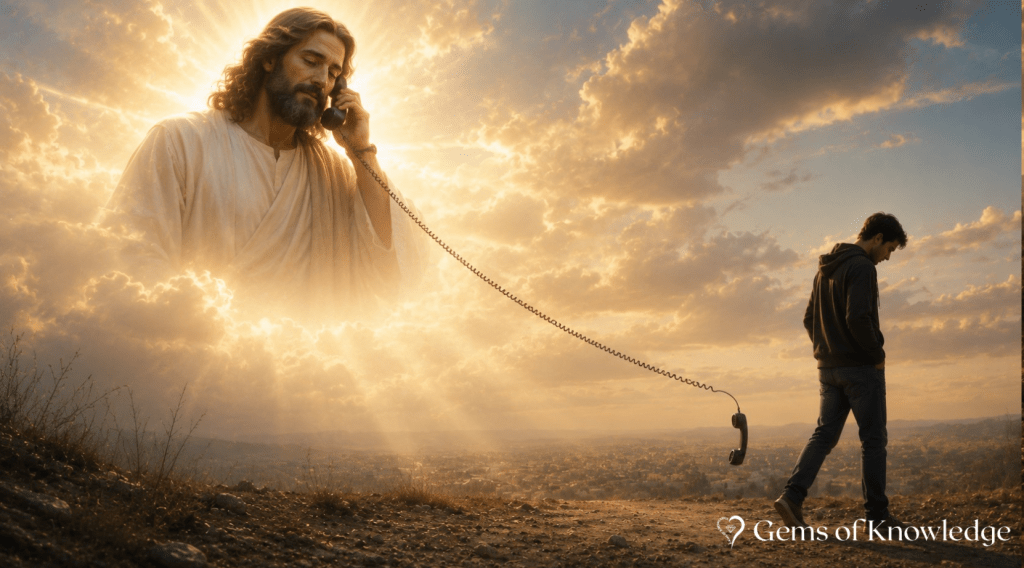
Alt...
Jesus holds a telephone receiver while the disconnected phone hangs beside a person walking away, symbolizing a broken spiritual connection.
The Throne of Grace: Holding Fast to Christ Our Great High Priest
A Bible Study Reflecting on Hebrews 4:14-16 Hebrews 4:14–16 stands as one of the most comforting and profound passages in all of Scripture. These verses gather together several of the great themes of the Christian faith: the person of Christ, His priestly ministry, His sympathy toward His people, His sinlessness, the privilege of prayer, and the confidence believers may have in approaching God. The writer of Hebrews presents Jesus not merely as a teacher, prophet, or king, but as the Great […] [SENSITIVE CONTENT]

A Bible Study Reflecting on Hebrews 4:14-16
Hebrews 4:14–16 stands as one of the most comforting and profound passages in all of Scripture. These verses gather together several of the great themes of the Christian faith: the person of Christ, His priestly ministry, His sympathy toward His people, His sinlessness, the privilege of prayer, and the confidence believers may have in approaching God. The writer of Hebrews presents Jesus not merely as a teacher, prophet, or king, but as the Great High Priest who has accomplished what no earthly priest could ever accomplish. Through Him, sinners are welcomed into the very presence of God and are invited to receive mercy and grace in every season of need.
The passage reads:
“Seeing then that we have a great high priest, that is passed into the heavens, Jesus the Son of God, let us hold fast our profession.
For we have not an high priest which cannot be touched with the feeling of our infirmities; but was in all points tempted like as we are, yet without sin.
Let us therefore come boldly unto the throne of grace, that we may obtain mercy, and find grace to help in time of need.”
These verses are deeply connected to everything that has come before in Hebrews. The author has been demonstrating the superiority of Christ over angels, Moses, Joshua, and every aspect of the old covenant system. Now he focuses on the priesthood of Christ. For Jewish believers familiar with the temple and its sacrifices, the idea of a high priest carried tremendous significance. The high priest was the representative who entered God’s presence on behalf of the people. Once each year, on the Day of Atonement, he entered the Most Holy Place to make atonement for the sins of Israel.
Yet every earthly high priest was limited. He was sinful. He was mortal. He could only enter the earthly sanctuary. His sacrifices had to be repeated continually because they could never permanently remove sin.
Jesus is presented as infinitely greater.
The passage begins with a declaration: “Seeing then that we have a great high priest.” The emphasis falls upon the greatness of Christ. The Old Testament knew many priests, but Hebrews speaks of one Great High Priest. Jesus surpasses all who came before Him.
The greatness of Christ’s priesthood is revealed in His identity. He is not merely a descendant of Aaron. He is “Jesus the Son of God.” The humanity and deity of Christ are joined together in this title. “Jesus” points to His true humanity. He entered history as a man. He walked among people. He experienced hunger, weariness, sorrow, and suffering. “The Son of God” points to His eternal divine nature. He is not merely another servant in God’s house; He is the eternal Son who shares the Father’s nature and glory.
This combination is essential for understanding salvation. Only a true man could represent humanity. Only the divine Son could provide a sacrifice of infinite worth. In Christ, God and humanity meet perfectly.
The writer also declares that Christ “is passed into the heavens.” This statement points beyond the resurrection to the ascension. Unlike earthly priests who entered an earthly sanctuary made with human hands, Christ entered the heavenly sanctuary itself.
The earthly tabernacle and temple were only shadows of heavenly realities. The true dwelling place of God is heaven itself. After accomplishing redemption through His death and resurrection, Christ entered the heavenly presence of the Father.
This truth carries enormous significance. The work of Christ was accepted. His sacrifice was sufficient. He entered heaven not as a defeated victim but as a victorious Savior. He sits at the right hand of God because His atoning work is complete.
Because Christ has entered heaven as our representative, believers possess a secure relationship with God. The writer therefore urges, “let us hold fast our profession.”
The Christian confession is not merely a set of doctrines. It is faith in the crucified, risen, and exalted Christ. The readers of Hebrews faced pressure, opposition, and persecution. Some were tempted to turn back to old religious systems. Others were weary in their faith.
The solution was not to look inward but upward. The certainty of Christ’s priesthood becomes the foundation for perseverance.
The same principle remains true today. Faith is sustained not by human strength but by confidence in the One who represents us before God. Believers hold fast because Christ holds them fast. The security of the Christian life rests ultimately upon the faithfulness of the Savior.
The passage then moves into one of the most beautiful descriptions of Christ found anywhere in Scripture.
“For we have not an high priest which cannot be touched with the feeling of our infirmities.”
The language is striking. Christ is not distant from human suffering. He is not detached from human weakness. He is not indifferent to the struggles of His people.
The phrase means that Christ deeply sympathizes with those who come to Him.
Sympathy here is not mere awareness. It is a compassionate participation. It is the ability to enter into another person’s experience with understanding and concern.
This truth addresses one of humanity’s deepest fears. People often wonder whether anyone truly understands their struggles. Even among family and friends, there are experiences that can feel isolating.
Yet the believer is assured that Jesus understands completely.
He understands sorrow because He was “a man of sorrows.”
He understands rejection because He was despised and rejected by men.
He understands loneliness because His disciples abandoned Him.
He understands poverty because He had nowhere to lay His head.
He understands grief because He stood at Lazarus’s tomb and wept.
He understands betrayal because Judas betrayed Him with a kiss.
He understands physical suffering because He endured scourging and crucifixion.
He understands temptation because He faced the full force of Satan’s assaults.
Nothing that believers experience is foreign to Him.
The writer continues: “but was in all points tempted like as we are, yet without sin.”
This statement reveals both the solidarity and uniqueness of Christ.
He was tempted like humanity in every essential way. He experienced real temptation, not imaginary temptation. Satan tempted Him in the wilderness. Religious leaders tempted Him through opposition and hostility. Circumstances tempted Him toward discouragement and suffering.
Yet there is a crucial distinction.
He was “without sin.”
This means more than the fact that Jesus did not commit sinful acts. It means that His entire nature was free from sin. He possessed no sinful inclination, no corrupt desire, no inward rebellion against God.
This distinction actually deepens rather than diminishes His experience of temptation.
Fallen humanity often yields to temptation before experiencing its full force. Christ never yielded. He endured temptation to its fullest extent and emerged perfectly obedient.
His victory where Adam failed and where humanity continually fails qualifies Him uniquely to be the Savior.
Had Christ sinned even once, He could not have been the spotless sacrifice required for redemption.
Because He remained sinless, He could offer Himself as the perfect sacrifice for sin.
Because He remained sinless, He could conquer death.
Because He remained sinless, He could stand as the righteous representative of His people.
The sinlessness of Christ is not a minor theological detail. It is central to the gospel itself.
The writer then reaches the practical conclusion of everything he has said.
“Let us therefore come boldly unto the throne of grace.”
The word “therefore” is crucial. Because Christ is our Great High Priest, because He sympathizes with our weaknesses, because He has entered heaven on our behalf, believers may approach God with confidence.
The contrast with the old covenant is remarkable.
Under the old covenant, access to God’s presence was limited. The Most Holy Place was separated by a veil. Only the high priest could enter, and only once each year.
The holiness of God was emphasized through distance and restriction.
But through Christ, access has been opened.
The veil has been torn.
The way into God’s presence has been made available.
Believers are invited to come.
The invitation is astonishing because of where believers are invited to come.
The destination is a throne.
A throne represents authority, majesty, power, and sovereignty. The throne of God is the center of universal rule. It is the place from which God governs creation.
For sinners, a throne could be a place of terror. It could be the place of judgment and condemnation.
Yet through Christ, the throne is described as a throne of grace.
This does not mean God’s holiness has diminished. It means that mercy is available because Christ has satisfied divine justice.
At the cross, justice and grace met perfectly.
God did not ignore sin. He judged it fully in His Son.
Because justice has been satisfied, grace now flows freely to those who trust in Christ.
The command to come boldly does not mean coming arrogantly or presumptuously. It means coming with confidence and freedom.
Believers need not approach God with uncertainty about whether they will be accepted.
They need not wonder whether Christ’s work was sufficient.
They need not fear rejection.
The confidence rests not in human worthiness but in Christ’s finished work.
Prayer, therefore, becomes one of the greatest privileges of the Christian life.
Prayer is not merely a religious exercise.
Prayer is entering the throne room of heaven through Christ.
Prayer is communion with the living God.
Prayer is the expression of dependence upon divine grace.
The passage specifically identifies two blessings available at the throne of grace.
First, believers “obtain mercy.”
Mercy addresses human misery and guilt.
Mercy means that God does not treat sinners according to what they deserve.
Every believer continues to need mercy. Though justified through faith, Christians still struggle with weakness, failure, and imperfection.
The throne of grace is the place where mercy is continually received.
When believers fall, mercy welcomes them.
When believers grieve over sin, mercy restores them.
When believers feel overwhelmed by weakness, mercy sustains them.
Second, believers “find grace to help in time of need.”
Grace goes beyond mercy.
Mercy withholds deserved judgment.
Grace provides undeserved blessing.
The grace offered at God’s throne is not merely forgiveness for past failures. It is present help for current struggles.
The phrase “in time of need” carries the idea of timely assistance. God’s grace arrives exactly when it is needed.
Sometimes grace comes as strength to endure suffering.
Sometimes grace comes as wisdom for difficult decisions.
Sometimes grace comes as peace during anxiety.
Sometimes grace comes as courage in moments of fear.
Sometimes grace comes as comfort in grief.
The promise is not that believers will avoid every trial. Rather, it is that divine help will always be available.
This truth is profoundly practical.
Many Christians live as though spiritual resources are scarce. They face challenges relying primarily upon their own strength.
Yet Hebrews reminds believers that infinite grace is available through Christ.
The Christian life was never intended to be lived through self-sufficiency.
Every aspect of discipleship depends upon grace.
Grace sustains worship.
Grace empowers obedience.
Grace strengthens endurance.
Grace produces holiness.
Grace enables faithful service.
The throne of grace remains open because Christ remains our Great High Priest.
This reality also transforms the believer’s understanding of suffering.
Trials often create feelings of isolation. Pain can make people feel abandoned or forgotten.
Hebrews points believers back to Christ.
The Savior who intercedes in heaven is the Savior who suffered on earth.
The One seated upon the throne is the One who wore the crown of thorns.
The One who reigns in glory is the One whose hands were pierced.
Therefore, suffering believers are not approaching a distant ruler but a compassionate Redeemer.
The heart of this passage is not ultimately about human effort but about Christ Himself.
He is the Great High Priest.
He is the Son of God.
He has passed through the heavens.
He sympathizes with weakness.
He was tempted yet remained without sin.
He opens the way to God’s throne.
He secures mercy.
He provides grace.
Everything centers upon Him.
Hebrews 4:14–16 calls believers away from self-reliance and toward confident dependence upon Christ. It reminds the church that its hope is not found in personal strength, religious performance, or human achievement. Hope rests entirely in the Savior who lives and intercedes for His people.
Because He reigns, believers may hold fast their confession.
Because He understands their weakness, believers may come honestly before Him.
Because He is sinless, believers may trust completely in His atoning work.
Because He reigns at the throne of grace, believers may approach God with confidence.
And because His grace is sufficient, believers may find help for every need until the day faith becomes sight and they stand forever in the presence of the One who is both the Lamb who was slain and the Great High Priest who reigns eternally.

Alt...
The Throne of Grace: Holding Fast to Christ Our Great High Priest
The Throne of Grace
A Devotional Meditation on Hebrews 4:14–16 Hebrews 4:14–16 stands as one of the most comforting and profound passages in all of Scripture. It opens a window into the ongoing ministry of Jesus Christ and invites believers to approach God with confidence. These verses unite the majesty of Christ's heavenly exaltation with the tenderness of His compassionate heart. They reveal a Savior who is both transcendent and near, both sovereign and sympathetic, both enthroned in glory and acquainted […] [SENSITIVE CONTENT]

A Devotional Meditation on Hebrews 4:14–16
Hebrews 4:14–16 stands as one of the most comforting and profound passages in all of Scripture. It opens a window into the ongoing ministry of Jesus Christ and invites believers to approach God with confidence. These verses unite the majesty of Christ’s heavenly exaltation with the tenderness of His compassionate heart. They reveal a Savior who is both transcendent and near, both sovereign and sympathetic, both enthroned in glory and acquainted with human weakness.
The writer of Hebrews declares, “Seeing then that we have a great high priest, that is passed into the heavens, Jesus the Son of God, let us hold fast our profession.” The language immediately draws attention to the Old Testament priesthood. Under the old covenant, the high priest served as a mediator between God and His people. Once each year he entered the Most Holy Place with sacrificial blood, representing the nation before the Lord. Yet every earthly priest was limited. He was mortal. He was sinful. He could never permanently remove guilt. His ministry pointed forward to a greater reality yet to come.
Jesus is that greater reality.
He is not merely a high priest among many. He is the great High Priest. The superiority of Christ is one of the central themes of Hebrews. He is greater than angels, greater than Moses, greater than Joshua, and greater than every priest who ever served in the temple. Unlike earthly priests, He has passed through the heavens. He has entered the very presence of God. His work of atonement is complete, and His position at the Father’s right hand is secure.
The significance of this truth cannot be overstated. The Christian faith rests not merely upon what Christ did in the past but also upon what Christ is doing in the present. The crucified Savior is now the exalted Savior. The One who died for sin now intercedes for sinners. The One who shed His blood now represents His people before the Father.
Because Jesus lives and reigns, believers are called to hold fast their confession. Faith is not sustained by human determination alone. It is sustained by the living Christ who faithfully preserves His people. The foundation of Christian perseverance is not found in the strength of believers but in the strength of the Savior who continually ministers on their behalf.
The passage then moves from Christ’s greatness to His compassion. “For we have not an high priest which cannot be touched with the feeling of our infirmities; but was in all points tempted like as we are, yet without sin.”
This statement reveals the astonishing depth of Christ’s identification with humanity.
Jesus does not observe human suffering from a distance. He entered it. He experienced hunger, weariness, rejection, sorrow, loneliness, betrayal, and pain. He lived in a fallen world and faced the relentless pressures of temptation. He knows what it means to be misunderstood. He knows what it means to be opposed. He knows what it means to suffer.
The Son of God did not merely assume a human body; He entered fully into the human condition, apart from sin. He experienced the realities of life in a broken world. Therefore, when believers come to Him in weakness, they do not approach someone who lacks understanding. They come to One who knows.
This truth is especially precious in seasons of struggle. Human sympathy has limits. Even the most compassionate friend cannot fully enter another person’s experience. Yet Christ understands perfectly. He sees every burden, every fear, every disappointment, every grief, and every hidden battle. Nothing is concealed from His gaze, and nothing is beyond His understanding.
His sympathy, however, is not passive. He does not merely feel for His people; He actively ministers to them. The compassion of Christ is joined to His power. He is able not only to understand weakness but also to provide strength. He is able not only to sympathize with suffering but also to sustain those who suffer.
The phrase “yet without sin” is equally important. Christ’s sinlessness is what makes His priesthood effective. Had He sinned, He would have needed a sacrifice for Himself. But because He remained perfectly holy, He became the spotless sacrifice for others. His sympathy never compromises His holiness, and His holiness never diminishes His sympathy.
This creates a perfect mediator.
On the one hand, He fully understands humanity. On the other hand, He perfectly represents God. He stands uniquely qualified to bring sinful people into fellowship with a holy God.
The climax of the passage arrives in verse sixteen: “Let us therefore come boldly unto the throne of grace, that we may obtain mercy, and find grace to help in time of need.”
The word “therefore” connects this invitation to everything that has been said about Christ. Because Jesus is the great High Priest and because He sympathizes with human weakness, believers may approach God with confidence.
The invitation is remarkable.
The throne of God is the seat of divine authority and absolute sovereignty. Throughout Scripture, God’s throne inspires awe and reverence. It is the throne from which He rules the universe. It is the throne before which angels worship and nations tremble.
Yet Hebrews describes it as a throne of grace.
For those who belong to Christ, the throne is no longer primarily a place of judgment. It is a place of welcome. The Judge of all the earth has become the gracious Father of redeemed sinners. Because of Christ’s finished work, believers may draw near without fear of condemnation.
The boldness spoken of here is not arrogance or presumption. It is confidence grounded in the sufficiency of Christ. Christians do not come because they are worthy. They come because Christ is worthy. They do not come trusting their own righteousness. They come trusting His righteousness.
This invitation transforms prayer.
Prayer is not merely a religious exercise. It is access to the throne room of God. Every prayer offered in faith enters the presence of the King. Every cry of weakness is heard. Every expression of need is welcomed. Every burden may be laid before Him.
The promise attached to this invitation is equally beautiful. Believers may obtain mercy and find grace.
Mercy addresses past failures. Grace addresses present needs.
Mercy meets the sinner in guilt and provides forgiveness. Grace meets the believer in weakness and provides strength. Mercy removes what is deserved. Grace supplies what is needed.
Both are available at God’s throne.
The phrase “in time of need” literally suggests help that arrives at the right moment. God’s assistance is never late. He knows precisely when His children need sustaining grace. Sometimes He provides strength before the trial arrives. Sometimes He supplies endurance during the trial. Sometimes He grants comfort after the trial. But He always provides exactly what is needed according to His wisdom and love.
This passage reminds believers that Christianity is not a journey undertaken alone. The risen Christ accompanies His people every step of the way. He intercedes for them. He sympathizes with them. He strengthens them. He welcomes them into God’s presence.
In moments of temptation, there is grace.
In seasons of suffering, there is grace.
In times of doubt, there is grace.
In experiences of failure, there is mercy.
The throne remains open because Christ remains faithful.
The believer’s confidence rests not in fluctuating emotions, personal achievements, or spiritual performance, but in the unchanging ministry of Jesus Christ. The same Savior who shed His blood on Calvary now reigns in heaven and continually intercedes for His people. His compassion has not diminished. His power has not weakened. His promises have not failed.
Therefore, let every weary heart draw near. Let every struggling believer come. Let every burdened soul approach the throne of grace. There, in the presence of the great High Priest, mercy is abundantly given, grace is freely supplied, and help is always found for every need.
Prayer
Gracious Father, we thank You for the gift of Your Son, our great High Priest. Thank You that He has entered heaven on our behalf and continually intercedes for Your people. Thank You that He understands our weaknesses, sympathizes with our struggles, and remains faithful in every season of life. Teach us to come boldly to Your throne of grace, trusting not in ourselves but in the finished work of Christ. Grant us mercy for our failures, grace for our needs, and strength to persevere in faith. May our hearts rest in the assurance that our Savior reigns and that His help is always sufficient. Through Jesus Christ our Lord, Amen.

Alt...
The Throne of Grace
The temptation to sin is an ever-present reality we face every day, but God is our fortress, and His word is our defense. Click or tap the link to read more.
#afaithfulsower #christianity #Bible #Jesus #dailydevotional
https://afaithfulsower.org/2026/06/14/how-to-respond-when-temptation-strikes-part-2/
Click below to find out why watching Citichurch at a casino hotel is no gamble 👇
📍Waterfront Hotel, Cebu City
🕛 16:28 PH time (09:28 BST)
🖥 https://www.citichurch.ph
#churchonline #christianity #churchservice #filipinochristians #churchserviceonline

The Throne of Grace
A Prayer Inspired by Hebrews 4:14-16 Gracious and Almighty God, We come before You with humble hearts, giving thanks for the immeasurable gift You have given us in Jesus Christ, our great High Priest. We praise You because You have not left us to wander through this fallen world alone. You have provided a Savior who has passed through the heavens, who reigns in glory at Your right hand, and who continually intercedes for His people. We rejoice that our faith rests not upon human effort, […] [SENSITIVE CONTENT]

A Prayer Inspired by Hebrews 4:14-16
Gracious and Almighty God,
We come before You with humble hearts, giving thanks for the immeasurable gift You have given us in Jesus Christ, our great High Priest. We praise You because You have not left us to wander through this fallen world alone. You have provided a Savior who has passed through the heavens, who reigns in glory at Your right hand, and who continually intercedes for His people. We rejoice that our faith rests not upon human effort, religious achievement, or personal righteousness, but upon the finished work of the Lord Jesus Christ.
Father, we marvel at the wonder of the gospel. The One who sits enthroned in majesty is the same One who walked among sinners, endured temptation, experienced sorrow, and carried the weight of suffering. He knows the weakness of our flesh. He understands the burdens that often weigh heavily upon our hearts. He is acquainted with grief and familiar with every struggle that confronts us in this broken world. Yet He remained without sin, perfectly obedient, perfectly holy, perfectly faithful in all things.
Lord, we confess that we often forget this glorious truth. We sometimes imagine that You are distant when trials arise. We assume that our failures have placed us beyond Your compassion. We allow shame, fear, and discouragement to silence our prayers. We hide our wounds behind outward appearances and attempt to carry burdens that were never meant to be borne alone. Forgive us for these moments of unbelief. Forgive us for doubting the tenderness of Christ’s heart toward His people.
Thank You that our great High Priest is not indifferent to our struggles. Thank You that He welcomes the weary, strengthens the weak, comforts the afflicted, and restores the brokenhearted. Thank You that He understands temptation not as a distant observer but as One who endured its assaults and overcame them completely. Thank You that there is no sorrow we experience that He does not understand, no pain He cannot sympathize with, and no need He is unable to meet according to Your perfect wisdom.
Today we bring before You those who are carrying heavy burdens. Some are weary from prolonged suffering. Some are walking through seasons of uncertainty. Some face financial pressures, family difficulties, broken relationships, physical illness, emotional exhaustion, or spiritual struggles. Some feel overwhelmed by responsibilities they cannot manage in their own strength. Others silently battle fears known only to You.
Lord Jesus, draw near to each one. Let them know the comfort of Your presence. Remind them that they are not abandoned. Assure them that the One who sits upon the throne is also the Shepherd who walks beside His flock. In moments when faith feels weak, strengthen their hearts. In moments when hope seems distant, remind them of Your promises. In moments when the future appears uncertain, help them rest in Your sovereign care.
Father, we thank You for the invitation found in Your Word to approach the throne of grace with confidence. What a remarkable privilege this is. We who were once separated by sin have been welcomed into Your presence through the blood of Christ. We who deserved judgment have received mercy. We who stood condemned have been declared righteous through faith in Your Son.
Teach us to live in the freedom of this invitation. Remove the fear that keeps us from prayer. Remove the pride that causes us to depend upon ourselves. Remove the unbelief that whispers that You are unwilling to hear us. Help us instead to come boldly, not because of our worthiness, but because of Christ’s worthiness. Help us to draw near with confidence, knowing that the throne we approach is not merely a throne of power, but a throne of grace.
Lord, we praise You that grace is greater than our failures. Your mercy is deeper than our sin. Your compassion is stronger than our weakness. When we stumble, You lift us up. When we wander, You call us back. When we are discouraged, You remind us of Your faithfulness. When we are afraid, You surround us with Your peace.
We pray for Your church throughout the world. Strengthen pastors, elders, missionaries, teachers, and faithful servants who labor in Your name. Many carry unseen burdens. Many face opposition, criticism, loneliness, and fatigue. Renew them through the ministry of Christ, our great High Priest. Remind them that their labor is not in vain. Grant them wisdom, courage, humility, and perseverance as they serve Your people.
We pray for believers who face persecution because of their faith. Uphold them with Your mighty hand. Let them experience the sustaining grace promised in Your Word. May they know that Christ stands with them in every trial and that nothing can separate them from His love.
We pray also for those who have not yet come to know Christ. Open their eyes to the beauty of the gospel. Draw them to the Savior who welcomes sinners and offers forgiveness, mercy, and eternal life. May they discover that there is no greater hope than the One who intercedes for His people before the Father.
Lord, as we journey through the challenges of daily life, help us to hold firmly to our confession. Guard us from drifting into doubt. Protect us from the distractions of the world. Keep our eyes fixed upon Jesus, the author and finisher of our faith. May His glory captivate our hearts. May His truth shape our minds. May His love transform our lives.
Teach us to depend upon grace every day. Not merely in moments of crisis, but in every circumstance. Let us seek Your wisdom when decisions must be made. Let us seek Your strength when tasks seem overwhelming. Let us seek Your comfort when sorrow comes. Let us seek Your mercy when we fail. Let us seek Your presence above all else.
Father, we thank You that Your grace is always sufficient. We thank You that Your mercies are new every morning. We thank You that Christ continually intercedes for His people. We thank You that the throne of heaven remains open to all who come through Him. We thank You that we never approach You alone, but always through the perfect righteousness and faithful advocacy of our Savior.
As we leave this time of prayer, help us to walk in confidence, not in ourselves, but in Christ. May we rest in His finished work. May we trust in His ongoing intercession. May we draw near to You daily with faith, knowing that we will find mercy and grace to help in every time of need.
We offer this prayer with gratitude, hope, and confidence in the name of Jesus Christ, our great High Priest, our Savior, and our Lord.
Amen.

Alt...
The Throne of Grace
A Messenger from the Ashes
A Poem Inspired by Job 1:13-15 A day of laughter crowned the fields with gold,The oxen traced their furrows straight and deep,The patient earth, as in the days of old,Received the labor faithful hands would keep.The asses grazed beside the open plain,Beneath the calm and untroubled sky above;No whisper yet foretold the coming pain,Nor shadow crossed the pathways marked by love. The morning wore a garment bright and fair,Its gentle breezes carried scents of grain;The songs of workers drifted […] [SENSITIVE CONTENT]

A Poem Inspired by Job 1:13-15
A day of laughter crowned the fields with gold,
The oxen traced their furrows straight and deep,
The patient earth, as in the days of old,
Received the labor faithful hands would keep.
The asses grazed beside the open plain,
Beneath the calm and untroubled sky above;
No whisper yet foretold the coming pain,
Nor shadow crossed the pathways marked by love.
The morning wore a garment bright and fair,
Its gentle breezes carried scents of grain;
The songs of workers drifted through the air,
And all creation seemed at rest again.
The household prospered under heaven’s care,
The barns were full, the herds increased each year;
No eye perceived the hidden waiting snare,
No heart anticipated grief so near.
Yet while the sons and daughters shared their bread,
And gladness filled the chambers of the feast,
An unseen storm advanced with silent tread,
Like some dark hunter seeking not the least.
The hour appeared as countless hours before,
The world unchanged, the heavens clear and wide;
But ruin waited just beyond the door,
And judgment’s mystery walked at mankind’s side.
How swiftly earthly confidence may fade,
How frail the walls that seem secure and strong;
The brightest noon can cast the darkest shade,
The sweetest joy may yield to bitter song.
For mortal eyes behold but part of truth,
A fragment of the story God has penned;
The vigor of the field, the fire of youth,
Must one day bow before their sovereign end.
Then suddenly across the troubled land
A rider came with terror in his face;
The dust of haste lay thick upon his hand,
Despair had stolen all his former grace.
His garments bore the witness of alarm,
His breath was broken by the speed of fear;
He carried news of violence and harm,
The kind of word no listener longs to hear.
The oxen plowed beneath the midday sun,
The asses fed beside them in the field;
The ordinary tasks had just begun,
The earth its quiet harvest seemed to yield.
Then fell a blow no laborer could stay,
No watchman saw the danger drawing near;
A ruthless force swept suddenly that way,
And left behind confusion, death, and fear.
The Sabeans descended like a flood,
Their hearts unmoved by mercy’s gentle plea;
They stained the peaceful ground with servants’ blood,
And seized the wealth that grazed in quiet lea.
The sword flashed bright where plowshares once had shone,
The cry of anguish pierced the startled air;
The field that moments earlier seemed known
Became a scene of ruin and despair.
One man alone escaped the dreadful tide,
One witness fled from devastation’s reign;
Through dust and terror he was forced to ride,
Bearing the burden of another’s pain.
He came not bringing comfort or relief,
No word of rescue rested on his tongue;
He carried only tidings born of grief,
A mournful dirge before it had been sung.
O messenger whose trembling lips must tell
The sorrow that another cannot bear,
How often history has known thee well,
The herald clothed in garments of despair.
Thou standest at the threshold of the room,
While joy still lingers unaware within;
Yet in thy hand thou carriest the gloom
Of suffering’s arrival among men.
The story of our race is marked the same,
For every age has heard the messenger’s cry;
No throne escapes the touch of grief or shame,
No strength prevents the hour when hopes may die.
The wealthy hear him knocking at the gate,
The poor receive him by the cottage wall;
He enters both the palace and estate,
For sorrow keeps an appointment with us all.
And yet the deeper mystery remains,
For heaven watched the tragedy unfold;
The Lord who measures oceans, stars, and rains
Knew every moment long before it told.
The field was not abandoned to mere chance,
Nor history surrendered to the night;
Beyond the reach of circumstance and dance
There stood the throne of everlasting might.
Though evil men performed their violent deed,
Though wicked hands accomplished cruel intent,
The Lord still governed every thought and seed,
Permitting what His wisdom had consented.
The ways of providence are deep and vast,
A sea whose depths no mortal line can trace;
The present pain, the future and the past,
Lie open to the gaze of sovereign grace.
Job did not yet perceive what heaven knew,
Nor hear the conversation held above;
He only saw the loss that pierced him through,
The wounds that seemed impossible to prove.
The curtain hid the greater things from sight,
The battle raging in the unseen sphere;
He stood amid the gathering of night,
Confronted by the substance of his fear.
How often saints have walked the selfsame road,
Receiving news they never wished to hear;
A burden suddenly imposed and owed,
A valley entered through the gate of tears.
The doctor’s word, the unexpected call,
The letter waiting silent in the box;
The world that seemed so steady starts to fall,
And certainty dissolves beneath the shocks.
Yet faith is not the child of sunny skies,
Nor merely born where blessings overflow;
Its finest fruit before affliction lies,
Its deepest roots through suffering often grow.
The oak that stands against the winter storm
Has learned its strength through tempests of the past;
The soul transformed by God’s preserving arm
Discovers grace sufficient to the last.
The messenger still rides across the years,
His horse yet crosses every human land;
He bears reports of losses, graves, and tears,
Of plans undone by an unseen command.
No generation silences his voice,
No century dismisses him away;
His summons leaves no mortal soul a choice,
For all must hear him on some future day.
Yet there is One who stands beyond the grave,
Whose kingdom cannot perish nor decline;
The Lord who wounds possesses power to save,
And works through threads no mortal can define.
The fields may vanish and the herds be gone,
The servants fall beneath oppression’s sword;
But still eternal purposes move on,
Directed by the wisdom of the Lord.
Therefore when messengers of sorrow come,
And knock upon the doorway of the heart,
Let faith remember heaven’s greater home,
Where loss and pain shall finally depart.
For though the earth may tremble underneath,
And all familiar landmarks disappear,
The God who reigns through every storm and grief
Remains unchanged, eternal, and near.
The oxen cease, the harvest fades away,
The servants sleep beneath the silent sod;
Yet beyond the shadows of a fleeting day
There shines the steadfast faithfulness of God.
And when at last the final news is told,
When every earthly treasure has been weighed,
The saints shall find a kingdom more than gold,
A city that can never, ever fade.
Then let the messenger complete his task,
Let sorrow speak the words it must declare;
For faith beholds beyond the darkened mask
The hands of God still governing with care.
And though the ashes gather at our feet,
And though the night seems endless in its span,
The Lord remains forever on His seat,
The sovereign God, the hope of mortal man.

Alt...
A Messenger from the Ashes
The Last Delivery
A Short Story Inspired by Job 1:13-15 The rain had started just after lunch. By three o’clock it was falling in sheets across the city, turning streets into rivers of reflected headlights and blurred storefront signs. Daniel Mercer sat behind the wheel of his delivery van, tapping the steering wheel as he waited at a red light. His phone buzzed. A text from his wife. Don’t forget. Emma’s recital starts at seven. Daniel smiled. Wouldn’t miss it. He sent the reply and slipped […] [SENSITIVE CONTENT]

A Short Story Inspired by Job 1:13-15
The rain had started just after lunch.
By three o’clock it was falling in sheets across the city, turning streets into rivers of reflected headlights and blurred storefront signs. Daniel Mercer sat behind the wheel of his delivery van, tapping the steering wheel as he waited at a red light.
His phone buzzed.
A text from his wife.
Don’t forget. Emma’s recital starts at seven.
Daniel smiled.
Wouldn’t miss it.
He sent the reply and slipped the phone back into the holder. Their daughter had been practicing piano for months. Every evening the same songs drifted through their small house while Daniel cooked dinner or folded laundry.
Tonight was important.
The light changed.
Daniel pressed the accelerator and continued toward the warehouse district.
The afternoon seemed ordinary. That was the strange thing about disasters. They rarely announced themselves.
The warehouse belonged to Riverside Feed and Supply, a company Daniel had delivered to dozens of times. He backed the van into the loading area and stepped out into the rain.
Workers moved pallets beneath metal awnings.
Forklifts beeped.
Someone laughed.
Life carried on exactly as it had the day before.
Daniel signed a receipt and was about to leave when he heard shouting.
At first he couldn’t understand the words.
Then a man came running around the corner of the building.
“Fire!”
Everything changed in an instant.
Workers abandoned equipment and rushed toward the rear loading docks. Daniel followed.
A thick plume of black smoke climbed into the gray sky.
Flames licked through the upper windows of a storage section attached to the main warehouse.
Sirens wailed in the distance.
Someone yelled for an employee named Carlos.
Someone else screamed that people were still inside.
The scene dissolved into confusion.
Daniel stood helplessly among dozens of workers as firefighters arrived.
Rain fell harder.
Smoke rose higher.
Nobody knew exactly what had happened.
Only minutes earlier people had been unloading feed and inventory.
Now they watched part of the building collapse inward.
The sound was like thunder.
A terrible silence followed.
Hours later Daniel finally reached home.
His clothes smelled of smoke.
His daughter’s recital had ended without him.
The fire had shut down several roads, trapping traffic across the city.
When he walked through the front door, Emma was sitting at the kitchen table.
“You missed it,” she said softly.
“I know.”
She looked disappointed, but she wrapped her arms around him anyway.
His wife, Rachel, handed him a cup of coffee.
“You look exhausted.”
Daniel nodded.
“There was a fire.”
The words sounded unreal even as he spoke them.
He described what he had seen.
The smoke.
The panic.
The collapse.
The uncertainty.
Rachel listened quietly.
“What caused it?” she asked.
“No one knows.”
That answer seemed to hang in the air.
No one knows.
The next morning the city was full of rumors.
Faulty wiring.
Chemical storage.
An equipment malfunction.
Social media offered a hundred explanations.
None were confirmed.
Meanwhile, families waited for news about loved ones.
Several workers remained unaccounted for.
Daniel found himself unable to concentrate.
The images replayed in his mind.
The running man.
The shouting.
The smoke.
The collapse.
Each memory felt sharp and immediate.
By evening he sat alone on the back porch while rainwater dripped from the gutters.
His elderly neighbor, Mr. Thompson, walked over carrying a newspaper.
“You hear about Riverside?” the old man asked.
Daniel nodded.
“Hard to think about anything else.”
Mr. Thompson sat beside him.
For a while neither spoke.
Finally the older man said, “Funny how quickly things change.”
Daniel looked at him.
“Yeah.”
“One moment people are eating lunch. The next moment their whole world is different.”
Daniel knew he was right.
The workers who had arrived that morning expected an ordinary day.
None of them imagined catastrophe waiting around the corner.
None of them planned to become part of a tragedy.
Life simply changed.
Without warning.
Without permission.
Without explanation.
The following week memorial services began.
The missing workers had been found.
The city mourned.
Photographs appeared on screens and bulletin boards.
Faces.
Families.
Stories.
People who had expected to go home that evening.
Daniel attended one of the services.
He sat in the back row and listened as friends and relatives shared memories.
One speaker said something that stayed with him.
“We always think tomorrow belongs to us.”
The sanctuary remained silent.
“But tomorrow is a gift, not a guarantee.”
Daniel felt the truth of those words settle heavily upon him.
For years he had rushed through ordinary moments.
Breakfast conversations.
Evening walks.
Family dinners.
He assumed there would always be another opportunity.
Another day.
Another chance.
Yet the fire reminded him how fragile life could be.
How quickly certainty could disappear.
The following Friday he left work early.
Not because he had to.
Because he wanted to.
He picked up Emma from school.
Her eyes widened when she saw him waiting outside.
“What are you doing here?”
“Taking you for ice cream.”
She grinned.
“Really?”
“Really.”
They spent the afternoon talking about school, music, friends, and dreams.
Nothing extraordinary happened.
And yet the day felt precious.
As the sun began to set, they sat beside a small lake near town.
The water reflected gold and orange light.
Emma skipped a stone across the surface.
“Dad?”
“Yeah?”
“You’ve been different lately.”
Daniel smiled.
“Different how?”
“You pay attention more.”
The words surprised him.
Children often noticed things adults missed.
“I guess maybe I do.”
She nodded thoughtfully.
“I like it.”
For a long moment neither spoke.
The lake remained calm.
Birds drifted across the evening sky.
Daniel thought again about the workers at Riverside.
About families whose lives had changed in a single afternoon.
About the uncertainty that shadows every human life.
None of them had seen disaster coming.
Neither had Job long ago when a messenger arrived with terrible news.
One ordinary day had become a day of loss.
One familiar moment had become a moment of grief.
The story remained painfully recognizable because every generation eventually encounters its own messenger.
A phone call.
A diagnosis.
A knock at the door.
An unexpected accident.
Bad news often arrives without warning.
Yet Daniel had also learned something else.
Disaster does not only reveal what can be lost.
It reveals what matters most.
Love.
Faith.
Family.
Kindness.
The ordinary gifts that are too often overlooked.
As darkness settled across the lake, Daniel placed an arm around his daughter’s shoulders.
The future remained unknown.
It always would.
But this moment was here.
This conversation was here.
This blessing was here.
And for the first time in a long while, he was fully present to receive it.
The wind stirred gently across the water.
Emma leaned against him.
Neither hurried to leave.
Some moments deserved to be treasured.
Especially because no one knew what tomorrow might bring.

Alt...
The Last Delivery
When the Messenger Brings Bad News
A Message to Church Leaders Reflecting on Job 1:13–15 “There was a day when his sons and daughters were eating and drinking wine in their eldest brother's house: and there came a messenger unto Job, and said, The oxen were plowing, and the asses feeding beside them: and the Sabeans fell upon them, and took them away; yea, they have slain the servants with the edge of the sword; and I only am escaped alone to tell thee.” (Job 1:13–15) Every church leader eventually discovers that […] [SENSITIVE CONTENT]

A Message to Church Leaders Reflecting on Job 1:13–15
“There was a day when his sons and daughters were eating and drinking wine in their eldest brother’s house: and there came a messenger unto Job, and said, The oxen were plowing, and the asses feeding beside them: and the Sabeans fell upon them, and took them away; yea, they have slain the servants with the edge of the sword; and I only am escaped alone to tell thee.” (Job 1:13–15)
Every church leader eventually discovers that ministry is not merely the work of preaching, teaching, planning, and shepherding. It is also the work of standing in the midst of human suffering. Leaders often envision ministry through the lens of growth, discipleship, worship, and service. Yet sooner or later, the messenger arrives. A phone call comes in the middle of the night. A family receives a devastating diagnosis. A faithful servant dies unexpectedly. A marriage collapses. A church faces conflict. A community suffers tragedy. The leader who faithfully proclaims the goodness of God must also stand before wounded people when life suddenly falls apart.
Job 1:13–15 introduces us to one of the most dramatic moments in all of Scripture. Job, a righteous man who feared God and turned away from evil, suddenly receives news that shatters his world. The passage begins with ordinary life. His children are gathered together. The oxen are plowing. The donkeys are feeding nearby. Daily responsibilities continue as usual. Everything appears normal.
Then a messenger arrives.
The scene reminds us how quickly circumstances can change. One moment life appears stable. The next moment everything seems uncertain. Leadership often requires standing at the intersection between ordinary days and unexpected disasters. Church leaders know what it is like to prepare sermons, attend meetings, encourage believers, and make plans for the future, only to find those plans interrupted by sudden crises.
The text begins with the simple phrase, “There was a day.” The wording is striking because it reflects how suffering often enters human experience. There is rarely a warning. There is seldom an announcement. Disaster frequently arrives on what seemed like a completely ordinary day.
Church leaders should remember this reality when shepherding God’s people. Many believers silently carry burdens that others cannot see. A person may enter worship smiling while carrying fears about their health. A family may appear strong while quietly facing financial collapse. A faithful church member may be wrestling with grief, anxiety, or heartbreak hidden beneath a calm exterior.
The leader’s calling is not merely to address visible needs but to shepherd people with the awareness that every congregation contains stories known fully only by God.
Job’s tragedy reminds us that earthly stability is never ultimate security. The oxen represented productivity. The donkeys represented resources. The servants represented labor and support. In a single event, all of these were disrupted. What appeared dependable proved vulnerable.
Church leaders often face the temptation to place confidence in visible measures of ministry success. Attendance numbers, budgets, buildings, programs, and organizational structures all have their place. They are valuable tools for ministry. Yet Job’s experience reminds us that earthly foundations can be shaken.
The church must never place its confidence primarily in resources, strategies, or structures. Our confidence must remain in God Himself.
History repeatedly demonstrates this truth. Churches have lost buildings yet remained spiritually vibrant. Congregations have faced persecution yet continued to flourish. Ministries have endured financial hardship while seeing remarkable displays of God’s faithfulness. What sustains God’s people is not ultimately the strength of their resources but the faithfulness of their Lord.
One of the most difficult responsibilities of church leadership is helping people understand the reality of suffering without diminishing the goodness of God. Job’s story forces us to wrestle with profound questions. Why do terrible things happen to faithful people? Why does God allow suffering? Why do righteous individuals experience devastating loss?
While Job’s opening chapters provide readers with heavenly insight, Job himself does not possess that perspective. He receives the pain without receiving the explanation.
Church leaders frequently encounter this same challenge. People come seeking answers. They want explanations for tragedies that seem impossible to understand. Yet there are moments when leaders must humbly acknowledge that not every question receives an immediate answer.
The temptation during such moments is either to offer simplistic explanations or to retreat into silence. Neither response serves suffering people well.
Instead, faithful leaders point people toward the character of God. Even when God’s purposes remain hidden, His nature remains trustworthy. Even when circumstances appear chaotic, His sovereignty remains intact. Even when answers are unavailable, His presence remains certain.
Job’s story teaches leaders that faith is not sustained by complete understanding. Faith is sustained by confidence in the One who understands completely.
Notice also the role of the messenger in this passage. The messenger did not create the tragedy. He delivered the news. Yet his task was painful nonetheless.
Church leaders often serve as messengers in difficult seasons. They sit beside hospital beds. They make difficult phone calls. They announce losses to congregations. They counsel grieving families. They communicate hard realities that others may not wish to hear.
Such responsibilities can weigh heavily upon the heart of a shepherd.
The messenger’s words reveal the devastating scope of the disaster. Property is lost. Servants are killed. Violence has erupted. Stability has vanished.
Leadership during crisis requires both truthfulness and compassion. The messenger did not minimize the loss. Neither did he exaggerate it. He simply spoke the truth.
Church leaders must learn this balance. In difficult moments, people need honesty. False optimism eventually collapses under the weight of reality. Yet people also need compassion. Truth delivered without grace can wound rather than heal.
The ministry of leadership often involves speaking difficult truths through tears, offering hope without denying pain, and pointing people toward God’s faithfulness while acknowledging their grief.
Another lesson emerges from the fact that Job’s suffering began before he fully understood its extent. This first messenger would soon be followed by others. More devastating news was still coming.
Many church leaders understand this experience. There are seasons when difficulties arrive in waves. One challenge is followed by another. One crisis barely concludes before the next begins.
Such seasons test the endurance of leaders.
The danger during prolonged hardship is spiritual exhaustion. Leaders who consistently carry the burdens of others can become weary themselves. The demands of ministry can drain emotional, physical, and spiritual strength.
This reality highlights the necessity of remaining deeply rooted in communion with God.
Leaders cannot effectively guide others to spiritual refreshment if they have abandoned the source of their own refreshment. Prayer is not optional. Scripture is not merely material for sermon preparation. Worship is not simply something leaders facilitate for others. These are essential means through which God sustains His servants.
The same God who called leaders into ministry also provides the strength necessary to fulfill that calling.
Job’s experience also reminds church leaders of the spiritual realities that exist beyond human sight. The opening chapter reveals a cosmic conflict invisible to earthly observers. Human beings see circumstances. God sees the entire picture.
This truth encourages humility.
Leaders often feel pressure to understand every situation fully. Yet our perspective remains limited. We see fragments while God sees the whole story. We observe moments while God governs eternity.
Such humility should shape both leadership and pastoral care.
When confronting suffering, leaders should avoid speaking with unwarranted certainty about matters God has not revealed. Instead, they should cultivate trust in God’s wisdom, even when His purposes remain hidden.
The church desperately needs leaders who are confident in God’s character without pretending to possess exhaustive knowledge of His plans.
Perhaps one of the most powerful lessons for church leaders from this passage is the reminder that suffering can touch even the most faithful servants of God.
Job was not experiencing judgment for secret sin. He was not being disciplined for rebellion. Scripture presents him as a man of remarkable integrity and devotion.
This truth challenges a prosperity-centered understanding of faith. Faithfulness does not guarantee immunity from suffering. Obedience does not eliminate hardship. Spiritual maturity does not exempt believers from pain.
Church leaders must teach this truth with clarity and compassion.
When believers are taught that faithfulness ensures comfort, suffering often becomes spiritually devastating. But when believers understand that trials can occur even in the lives of God’s most faithful servants, they are better equipped to endure hardship without losing confidence in God.
The gospel does not promise freedom from every storm. It promises God’s presence within the storm.
Leaders should also remember that their response to suffering often teaches more powerfully than their words. Congregations observe how leaders navigate adversity. They watch how pastors respond to disappointment. They notice whether faith remains steady when circumstances become difficult.
This does not mean leaders must project an image of invulnerability. Scripture never presents godly leaders as emotionless individuals untouched by grief. Instead, it presents leaders who bring their sorrows honestly before God.
Authentic faith is not the absence of pain. Authentic faith is steadfast trust amid pain.
Job’s story ultimately points beyond himself to a greater suffering servant. The trials of Job foreshadow the suffering of Christ. Jesus Himself experienced rejection, sorrow, betrayal, and death. He entered fully into human suffering and emerged victorious through resurrection.
This reality transforms the way church leaders view suffering.
Because Christ has suffered, He understands the suffering of His people. Because Christ has overcome death, suffering does not have the final word. Because Christ reigns as Lord, even the darkest chapters of human experience exist under His sovereign authority.
The leader who ministers from this conviction possesses a hope that transcends circumstances.
Job 1:13–15 reminds us that ministry often takes place in a broken world. Messengers still bring difficult news. Tragedies still occur. Hearts still break. Congregations still grieve. Leaders still face moments when answers seem elusive.
Yet the God who sustained Job remains the same God who sustains His church today.
Church leaders are called to stand faithfully when disaster strikes unexpectedly. They are called to comfort the hurting, strengthen the weary, encourage the fearful, and point people toward the unchanging faithfulness of God.
When the messenger arrives with bad news, the church needs leaders who are anchored in truth, filled with compassion, grounded in prayer, and confident in the sovereignty of God.
The same Lord who governed the events of Job’s life governs every circumstance facing His people today. Nothing escapes His notice. Nothing exceeds His authority. Nothing frustrates His ultimate purposes.
Therefore, church leaders must continue serving with courage, shepherding with tenderness, preaching with conviction, and trusting with confidence.
For while disasters may arrive suddenly, God’s faithfulness never departs. While earthly security may fail, His promises remain sure. While suffering may endure for a season, the Lord remains enthroned forever.
And in every season of ministry, whether marked by celebration or sorrow, abundance or loss, clarity or mystery, the calling remains the same: to lead God’s people toward steadfast trust in the God who is sovereign over every messenger, every trial, and every moment of their lives.

Alt...
When the Messenger Brings Bad News
When Disaster Strikes Without Warning
A Sermon Reflecting on Job 1:13-15 The book of Job opens with a portrait of remarkable blessing. Job is introduced as a man of integrity, devotion, and reverence before God. He is prosperous, respected, and deeply concerned about the spiritual welfare of his family. Yet beneath the surface of this peaceful and prosperous life, a spiritual conflict is unfolding that Job cannot see. The reader is given access to the heavenly conversation that explains what is about to happen, but Job himself […] [SENSITIVE CONTENT]

A Sermon Reflecting on Job 1:13-15
The book of Job opens with a portrait of remarkable blessing. Job is introduced as a man of integrity, devotion, and reverence before God. He is prosperous, respected, and deeply concerned about the spiritual welfare of his family. Yet beneath the surface of this peaceful and prosperous life, a spiritual conflict is unfolding that Job cannot see. The reader is given access to the heavenly conversation that explains what is about to happen, but Job himself remains completely unaware.
Job 1:13-15 records the beginning of a series of devastating calamities:
“And there was a day when his sons and his daughters were eating and drinking wine in their eldest brother’s house: And there came a messenger unto Job, and said, The oxen were plowing, and the asses feeding beside them: And the Sabeans fell upon them, and took them away; yea, they have slain the servants with the edge of the sword; and I only am escaped alone to tell thee.”
These verses mark the first wave of suffering that crashes into Job’s life. In only a few moments, the stability of years is shattered. Wealth is lost. Servants are killed. Security vanishes. What follows in the remainder of the chapter will become even more devastating, but here the first blow falls.
This passage speaks powerfully to every generation because it confronts one of the most difficult realities of human existence: suffering often arrives without warning.
The text begins with a simple phrase: “And there was a day.”
The ordinary nature of these words is striking. There is no indication that anything unusual is about to happen. No storm clouds gather. No alarm sounds. No visible warning appears. It is simply another day.
The sons and daughters of Job are gathered together in fellowship and celebration. The oxen are plowing. The donkeys are feeding nearby. Servants are carrying out their responsibilities. Life appears normal.
Yet within a matter of moments everything changes.
The Bible repeatedly reminds us that human life is fragile. We often live as though tomorrow is guaranteed, but Scripture teaches otherwise. The plans of men can be interrupted in an instant. A phone call, a diagnosis, an accident, a loss, or a tragedy can suddenly alter the course of life.
This reality is not presented to create fear but humility. It reminds believers that security is not found in circumstances. Security is found in God.
The illusion of control is one of humanity’s greatest deceptions. We carefully arrange our schedules, establish our plans, and build our futures. There is wisdom in planning, but there is danger in believing that our plans ultimately govern our lives.
Job’s story teaches that even the most righteous individuals are not exempt from unexpected suffering.
One of the most important truths revealed in this passage is that suffering is not always connected to personal wrongdoing.
Throughout history many have assumed that hardship is always a direct result of sin. The friends of Job will eventually make this mistake. They will insist that such suffering must prove hidden guilt.
Yet the opening chapter of Job destroys that assumption.
The reader already knows that Job’s suffering is not punishment for sin. God Himself has declared Job to be a man of integrity. His suffering comes not because he has rebelled against God but because he is caught within a spiritual battle beyond his understanding.
This truth is profoundly important for pastoral ministry.
When tragedy enters a person’s life, there is often a temptation to ask, “What did I do wrong?”
Certainly there are times when suffering results from sinful choices. Scripture acknowledges this reality. Yet there are many other times when suffering comes for reasons that are hidden from human understanding.
Not every illness is divine punishment.
Not every loss is evidence of God’s displeasure.
Not every tragedy is connected to personal failure.
The story of Job reminds believers that God’s purposes are often deeper than human perception.
Another striking feature of this passage is the suddenness of evil.
The messenger reports that the Sabeans attacked without warning. They seized the animals and killed the servants.
Evil enters the story abruptly and violently.
This reflects the reality of life in a fallen world.
Since humanity’s rebellion in Eden, creation has been marked by brokenness. Violence, injustice, greed, hatred, and suffering continue to leave scars upon human history.
The Bible never minimizes the reality of evil.
Sometimes believers are tempted to offer simplistic answers to profound suffering. Yet Scripture speaks honestly about the pain caused by evil.
The attack by the Sabeans was not an illusion. It was not merely a matter of perspective. People died. Property was stolen. Loss was real.
The Christian faith does not require pretending that suffering is insignificant.
Instead, Christianity uniquely provides hope in the midst of suffering because it acknowledges both the reality of evil and the sovereignty of God.
This passage also reminds believers that earthly blessings are temporary.
Job’s wealth was substantial. His possessions were extensive. His influence was significant.
Yet in a moment, a portion of those blessings disappeared.
Scripture repeatedly teaches that material possessions are gifts from God, but they are never intended to become the foundation of identity or security.
Many people spend their lives pursuing financial stability as though it were the ultimate answer to human need. Wealth can provide comfort, but it cannot provide permanence.
Everything in this world is temporary.
Businesses rise and fall.
Markets fluctuate.
Homes deteriorate.
Possessions disappear.
Even the most stable earthly treasures eventually pass away.
Jesus taught His followers not to store up treasures solely on earth, where moth and rust destroy and thieves break in and steal. Instead, believers are called to invest in eternal realities.
Job’s experience demonstrates how quickly earthly security can vanish.
Yet as the story unfolds, something remarkable becomes evident. Though Job loses possessions, he does not lose God.
This distinction changes everything.
The greatest treasure of the believer is not what can be held in the hand but the God who holds the believer in His hand.
The passage further reveals the mystery of divine providence.
Providence refers to God’s sovereign rule and guidance over all creation.
At first glance, Job 1:13-15 appears to describe a random tragedy. A raiding party attacks. Servants die. Property is stolen.
Yet the reader knows that more is occurring than human eyes can see.
Behind visible events stands an invisible reality.
Satan intends destruction.
The Sabeans act according to their own sinful desires.
Yet above all of these actions stands the sovereign God.
This truth does not eliminate mystery.
The book of Job never provides easy explanations for suffering.
Instead, it provides a greater vision of God.
Throughout Scripture, divine providence means that God remains sovereign even when circumstances seem chaotic.
Joseph was sold into slavery by his brothers, yet God was working through the event.
Israel faced the Red Sea, yet God was preparing deliverance.
The cross appeared to be the triumph of evil, yet it became the means of salvation.
Again and again, Scripture reveals that God is at work even when His purposes remain hidden.
Job cannot see what the reader sees.
He does not know about the heavenly conversation.
He does not understand why these events are occurring.
He only knows that suffering has arrived.
Many believers find themselves in a similar position.
Questions arise.
Why now?
Why this loss?
Why this pain?
Why this suffering?
Often there are no immediate answers.
Faith does not mean possessing complete understanding.
Faith means trusting God when understanding is absent.
One of the greatest challenges of suffering is that it tests what lies at the center of the heart.
When life is comfortable, faith may seem strong. Yet adversity reveals whether trust rests in God or merely in God’s gifts.
This is the very issue raised in the heavenly conversation at the beginning of Job.
Satan claims that Job serves God only because of the blessings he has received.
The events of chapter one become a test of that accusation.
Will Job continue to trust God when blessings disappear?
Will worship remain when comfort is removed?
Will faith endure when suffering arrives?
These questions remain relevant today.
Every believer faces moments when faith is tested.
The loss of health.
The death of a loved one.
Financial hardship.
Broken relationships.
Unfulfilled dreams.
Unexpected disappointments.
Such experiences expose the foundations upon which life has been built.
A faith rooted merely in circumstances cannot endure severe trials.
A faith rooted in the character of God can survive even the darkest seasons.
The practical applications of this passage are numerous.
First, believers should cultivate trust in God before crises arrive.
Job’s spiritual strength did not appear suddenly when tragedy struck. It was the result of a life already devoted to God.
Spiritual preparation occurs during ordinary days.
Prayer.
Scripture reading.
Worship.
Obedience.
Fellowship with God.
These practices deepen roots that will sustain believers when storms come.
Second, believers should hold earthly blessings with gratitude but not with ultimate dependence.
Everything we possess is ultimately a gift from God.
Families, careers, possessions, opportunities, and achievements are blessings worthy of thanksgiving.
Yet none of these gifts should replace the Giver.
When blessings become idols, suffering becomes even more devastating.
When God remains supreme, loss cannot destroy ultimate hope.
Third, believers should resist simplistic judgments regarding suffering.
The book of Job warns against assuming that every hardship is evidence of divine punishment.
Compassion must replace condemnation.
When people suffer, they often need presence more than explanations.
They need comfort more than criticism.
They need reminders of God’s faithfulness more than speculation about hidden causes.
Fourth, believers should remember that unseen realities are often at work.
Job’s circumstances appeared chaotic, but heaven was not in chaos.
God remained on His throne.
The same remains true today.
Many circumstances make little sense from a human perspective.
Yet God’s sovereignty has not diminished.
His wisdom has not failed.
His purposes have not been defeated.
Finally, believers should anchor their hope in God’s ultimate redemption.
The story of Job points beyond itself to a greater story.
Job suffered though he was righteous.
Yet there is One who suffered perfectly and completely.
The Lord Jesus Christ entered a world filled with suffering and sorrow.
He experienced rejection, betrayal, injustice, pain, and death.
Unlike Job, Christ was completely without sin.
Unlike Job, Christ willingly embraced suffering for the salvation of others.
At the cross, it appeared that evil had won.
Darkness covered the land.
The Son of God was crucified.
Hope seemed extinguished.
Yet God was accomplishing redemption.
The resurrection revealed that suffering does not have the final word.
Death does not have the final word.
Evil does not have the final word.
God does.
This truth provides hope for every believer facing hardship.
Job 1:13-15 reminds us that suffering may arrive suddenly, unexpectedly, and painfully. Yet it also reminds us that God remains sovereign when life is shaken. The believer may not understand every circumstance, but can trust the God who governs every circumstance.
The day came when Job’s world began to collapse. Yet the God who watched over Job had not abandoned him. The God who permitted the trial would ultimately sustain him through it.
The same God reigns today.
When disaster strikes without warning, when questions remain unanswered, when sorrow enters uninvited, believers can cling to the unchanging character of God. His wisdom is perfect. His purposes are good. His presence is faithful. His grace is sufficient.
And because He reigns, even the darkest chapter is never the end of the story.

Alt...
When Disaster Strikes Without Warning
The First Blow Against Job: Providence, Evil, and Human Suffering
A Theological Commentary on Job 1:13-15 Job 1:13–15 records the first devastating calamity that falls upon Job after the heavenly dialogue between God and Satan. The passage reads: “And there was a day when his sons and his daughters were eating and drinking wine in their eldest brother's house: And there came a messenger unto Job, and said, The oxen were plowing, and the asses feeding beside them: And the Sabeans fell upon them, and took them away; yea, they have slain the servants […] [SENSITIVE CONTENT]

A Theological Commentary on Job 1:13-15
Job 1:13–15 records the first devastating calamity that falls upon Job after the heavenly dialogue between God and Satan. The passage reads:
“And there was a day when his sons and his daughters were eating and drinking wine in their eldest brother’s house: And there came a messenger unto Job, and said, The oxen were plowing, and the asses feeding beside them: And the Sabeans fell upon them, and took them away; yea, they have slain the servants with the edge of the sword; and I only am escaped alone to tell thee.”
These verses mark the beginning of one of Scripture’s most profound explorations of suffering, divine sovereignty, human righteousness, and the mystery of evil. Though brief, the passage introduces theological themes that reverberate throughout the entire book and ultimately contribute to a biblical theology of suffering that extends into the New Testament. For the seminary student, Job 1:13–15 serves as an entry point into understanding not merely why suffering exists, but how suffering functions within God’s providential governance of the world.
The narrative begins with the simple phrase, “And there was a day.” The language appears ordinary, almost mundane. Yet theologically it is loaded with significance. The author intentionally presents catastrophe as arriving in the midst of normal life. Job’s children are gathered together in celebration. The oxen are plowing. The donkeys are feeding peacefully. Servants are engaged in their daily responsibilities. Nothing appears unusual. No warning signs precede the disaster.
This detail reflects a recurring biblical truth concerning the unpredictability of earthly existence. Human beings often assume continuity and stability. We construct plans, pursue goals, and imagine tomorrow based upon the apparent security of today. Yet Scripture repeatedly reminds us that life remains fragile. Jesus echoes this principle in His parables, particularly when He speaks of sudden judgment or unexpected events. James likewise warns against presumptuous confidence regarding the future.
Theologically, the ordinary setting of Job’s suffering underscores humanity’s creaturely limitations. Human beings possess neither exhaustive knowledge nor ultimate control. The future remains hidden within the wisdom of God. Job’s experience becomes a dramatic illustration of the gap between divine omniscience and human ignorance.
An important literary feature emerges immediately. The reader already knows something Job does not know. In chapters one and two, the audience is granted access to the heavenly court. We have witnessed Satan’s challenge and God’s permission. We know that a cosmic dimension lies behind the coming disasters. Job, however, remains completely unaware.
This literary strategy creates what scholars often call dramatic irony. The reader possesses information unavailable to the main character. Consequently, the reader observes Job’s suffering through two perspectives simultaneously. From the earthly perspective, random disasters appear to strike without explanation. From the heavenly perspective, events unfold within the framework of divine permission and spiritual conflict.
This distinction is crucial for understanding the theology of the book. Job never receives access to chapters one and two. Throughout his suffering, he never learns about the heavenly dialogue. The book therefore teaches that faithfulness cannot depend upon possessing complete explanations.
One of the most significant lessons of Job is that divine sovereignty operates even when human understanding is absent. The believer is often called to trust God’s wisdom without receiving comprehensive answers.
The mention of Job’s sons and daughters gathered in their eldest brother’s house also carries theological significance. Earlier in chapter one, the author emphasized Job’s concern for the spiritual well-being of his children. He regularly offered sacrifices on their behalf, fearing they might sin against God in their hearts.
The gathering itself appears innocent. Nothing suggests rebellion, wickedness, or divine judgment upon the children. Their celebration is portrayed as a normal family event. This observation becomes important because it challenges simplistic theories of retribution.
Throughout much of ancient thought, suffering was often viewed as direct punishment for specific sins. The book of Job systematically dismantles this assumption. The children are not presented as objects of divine wrath. Job himself is explicitly declared blameless and upright. Yet suffering still arrives.
This challenges a mechanistic view of God’s governance. Scripture certainly teaches that sin carries consequences. However, Job demonstrates that not all suffering can be explained through direct personal wrongdoing. The relationship between righteousness and prosperity is more complex than Job’s friends later assume.
The arrival of the messenger introduces the first wave of disaster. The report begins with the statement that “the oxen were plowing, and the asses feeding beside them.” The description emphasizes productivity and peace.
In the ancient Near Eastern world, oxen represented agricultural strength and economic stability. Donkeys served important functions in transportation and commerce. Together they symbolized prosperity and provision. Their activity reflects normal operations within Job’s flourishing estate.
Theologically, these details remind readers that material blessings originate from God. Earlier in chapter one, Job’s wealth had been described extensively. His prosperity was not accidental but part of God’s blessing upon his life.
Yet the narrative now demonstrates that earthly blessings remain vulnerable. Wealth, possessions, and economic security can disappear rapidly. The passage exposes the instability of material foundations.
This theme resonates throughout biblical theology. The wisdom literature consistently warns against placing ultimate confidence in riches. Jesus later teaches that treasures on earth are subject to corruption and loss. Job’s experience becomes a dramatic illustration of this truth.
The attack by the Sabeans introduces the role of human evil in the narrative. The Sabeans were likely a nomadic people involved in trade and raiding activities. Their assault represents a deliberate act of violence motivated by greed and aggression.
This raises important theological questions regarding secondary causes. Although readers know that Satan stands behind the disasters, the immediate cause is human action. The Sabeans freely choose to attack. They bear genuine moral responsibility for their actions.
The Bible consistently affirms both divine sovereignty and human responsibility. These truths operate simultaneously without contradiction. The Sabeans act wickedly according to their own desires, yet their actions occur within the larger framework of God’s providential governance.
This principle appears throughout Scripture. The crucifixion of Christ provides the supreme example. Human authorities freely and wickedly condemned Jesus, yet their actions fulfilled God’s predetermined redemptive plan. Likewise, the Sabeans remain culpable for their violence even though their attack forms part of the larger drama unfolding under divine permission.
The passage therefore contributes to a robust doctrine of providence. Providence does not eliminate secondary causes. Rather, God governs through and above them. Human choices remain real. Moral responsibility remains intact. Yet divine sovereignty encompasses all events.
The statement that the Sabeans “fell upon them, and took them away” reveals another dimension of evil. Sin is inherently destructive. Evil does not merely oppose God abstractly; it damages human flourishing and distorts creation.
The theft of the animals represents economic devastation. What took years to build vanishes in a moment. The passage reminds readers that fallen humanity often becomes an instrument through which suffering enters the lives of others.
This reality remains relevant today. Much suffering arises not from natural disasters but from human sin. Violence, oppression, exploitation, and injustice continue to inflict pain throughout the world. Job’s experience reminds believers that evil possesses both spiritual and social dimensions.
The report intensifies with the announcement that the servants have been slain “with the edge of the sword.” The narrative moves beyond financial loss to the loss of human life.
This detail is significant because it prevents readers from viewing Job’s suffering merely in economic terms. Human beings are not interchangeable assets. The death of the servants represents genuine tragedy.
Theologically, their deaths remind readers that suffering often extends beyond the central figure in a narrative. The book focuses on Job, yet many others are affected by the events surrounding him. The consequences of evil frequently ripple outward, touching numerous lives.
This observation challenges overly individualistic readings of suffering. Human existence is communal. Families, communities, and societies experience the effects of both righteousness and wickedness. The deaths of the servants underscore the broader reach of suffering within a fallen world.
The messenger concludes with the recurring phrase, “I only am escaped alone to tell thee.” This expression appears repeatedly throughout the disaster reports.
The phrase serves a literary function by heightening the dramatic tension. Each messenger arrives before the previous report can be processed. The effect is overwhelming. One catastrophe follows another with relentless force.
Theologically, the lone survivor motif emphasizes the completeness of the disaster. Only enough remains to communicate the loss. The survivor becomes a witness to catastrophe.
There is also an irony embedded within the phrase. The messenger survives to report death and destruction. His preservation serves not primarily his own comfort but the communication of painful truth.
Throughout Scripture, witnesses often bear difficult responsibilities. Prophets announce judgment. Apostles proclaim a crucified Messiah. Here the messenger bears testimony to devastating loss. Truth-telling itself becomes a painful vocation.
The larger theological significance of Job 1:13–15 emerges when viewed within the framework of the entire book. The passage initiates a sustained examination of the relationship between divine sovereignty and human suffering.
Importantly, the text does not present God as absent. Nor does it portray evil as an independent force operating beyond divine control. The heavenly prologue has already established that Satan acts only within divinely imposed limits.
At the same time, the passage refuses simplistic explanations. God’s sovereignty does not automatically translate into immediate human understanding. The reader knows that God remains in control, but the reasons for His permission remain mysterious.
This tension lies at the heart of biblical theology. Scripture affirms God’s absolute sovereignty while simultaneously acknowledging the profound mystery surrounding many instances of suffering. The book of Job refuses to sacrifice either truth.
The passage also contributes to the doctrine of spiritual warfare. Behind visible events lies an invisible conflict. Human observers see raiders and disasters. The reader sees a deeper spiritual reality.
Yet Job avoids dualism. Satan is not God’s equal. He appears before God as a creature subject to divine authority. The conflict occurs within a monotheistic framework in which God alone possesses ultimate sovereignty.
This distinction is essential. Biblical theology never presents the universe as a battleground between equal opposing powers. Evil is real, but it remains subordinate. Satan operates only within limits established by God.
For Christian theology, this principle provides profound comfort. Believers may encounter suffering, opposition, and spiritual attack, but none of these realities exist outside God’s sovereign oversight.
Job 1:13–15 also anticipates themes fulfilled in Christ. Like Job, Jesus was righteous yet suffered. Like Job, He endured affliction not because of personal sin. Like Job, He became the target of satanic opposition.
Yet Christ surpasses Job in every respect. Job’s suffering ultimately points forward to the greater suffering of the innocent Son of God. At the cross, the deepest mystery of suffering and sovereignty converges. Human evil, satanic hostility, and divine purpose intersect in the accomplishment of redemption.
The cross demonstrates that God can bring ultimate good from the darkest acts of evil. This truth does not eliminate the pain of suffering, but it provides theological hope. The God who governed Job’s trials is the same God who transformed Calvary into the means of salvation.
In conclusion, Job 1:13–15 serves as far more than the opening report of a tragic story. It introduces fundamental theological questions concerning providence, evil, suffering, human responsibility, and divine sovereignty. The passage reveals the fragility of earthly security, the reality of human wickedness, the mystery of God’s governance, and the limitations of human understanding.
Most importantly, it establishes the framework within which the rest of the book must be read. Suffering cannot always be explained through personal sin. Divine purposes often remain hidden. Faithfulness may be required in the absence of answers. Yet behind the visible events of history stands a sovereign God whose wisdom exceeds human comprehension.
The first blow against Job therefore becomes the first lesson for the reader: life may change in a moment, but God’s rule does not. The circumstances of earth may appear chaotic, yet heaven’s throne remains occupied. The mystery may be profound, but divine sovereignty remains unshaken. Within that tension, the theology of Job begins, and within that tension, believers continue to live by faith.

Alt...
The First Blow Against Job: Providence, Evil, and Human Suffering
Rest in His Care
Are you worried about the future? God isn't. He is already watching over you, planning your future, and protecting your life.❤️ Chick here to read the full devotional ✨ [SENSITIVE CONTENT]
Today’s One Year Bible Verses: 1 Kings 11:1–12:19, Acts 9:1–25, Psalm 131:1–3, Proverbs 17:4–5
God Is Watching Over You
“Have you ever wondered what tomorrow holds?
Maybe you’re facing a difficult decision. Maybe you’re worried about someone you love. Maybe you’re carrying concerns about your health, finances, ministry, or future.
It is easy to become anxious when we cannot see what lies ahead.
As I prayed about today’s Scriptures, the Lord gave me this Gem of Knowledge:
“Be at peace and know that I am right here watching over you, planning your future and protecting your life. Amen.”
One of the most remarkable examples is found in the story of Saul.
When Saul set out for Damascus, he had no idea that his life was about to change forever…
When Saul set out for Damascus, he had no idea that his life was about to change forever. He was traveling with a plan of his own, determined to persecute followers of Jesus. But God was already watching over him, already pursuing him, already preparing a future Saul could not yet imagine.
As Saul journeyed down that road, Jesus met him.
In a single moment, everything changed.
The man who had come to destroy the Church would become one of its greatest champions. The persecutor would become a preacher. The enemy of the Gospel would become a vessel chosen by God.
What is amazing is that God’s plan for Saul existed long before Saul understood it.
God was watching over him even when Saul was walking in the wrong direction.
How comforting is that?
If God could see the future He had planned for Saul while Saul was still blind to it, then surely He sees the future He has planned for us as well.
We see the opposite picture in today’s reading from Kings. Solomon began his reign with wisdom, humility, and devotion to God. Yet over time, he allowed other influences to pull his heart away from the Lord.
Even then, God remained sovereign.
Though kingdoms divided and consequences followed, God’s greater plan continued to unfold. Human mistakes could not overturn God’s purposes.
That truth should bring us peace.
Our future does not rest solely on our ability to get everything right. It rests in the hands of a God who is watching over us, guiding us, correcting us when necessary, and working all things toward His purposes.
Psalm 131 paints a beautiful picture of this trust:
“Instead, I have calmed and quieted myself, like a weaned child who no longer cries for its mother’s milk. Yes, like a weaned child is my soul within me.” (Psalm 131:2, NLT)
A small child rests peacefully because they trust someone else is caring for them.
That is the posture God invites us to have.
Not striving, panicking or trying to control every outcome…Simply trusting.
God is not surprised by tomorrow. He is already there. He is watching over you today. He is protecting your life. He is preparing your future. And He is faithful to complete the work He has begun.
When uncertainty comes knocking, let your heart rest in this truth:
God sees what you cannot see.
And He is taking care of you. 💎
Action (5 Minutes with God)
Take 5 simple minutes to be with the Creator today. Ask Him:
- “Lord, what do You want me to know about this personally?”
- Journal what He gives you through His Holy Spirit.
- Then ask, “What do You want me to do?”
- Journal what He reveals – then do it!
Let today be a day of intention surrender and rest, knowing God has a plan for you and He is over it all.
Prayer
Father, thank You that I do not have to carry the weight of tomorrow. Thank You for watching over me, protecting me, and preparing the path ahead. Forgive me for the times I allow fear and uncertainty to steal my peace. Help me trust You more deeply and rest in Your care. Remind me that You see what I cannot see and that Your plans are always good. Teach me to quiet my soul and place my hope fully in You. In Jesus’ name I pray, Amen.
To read more 5 Minutes with God devotionals click here.
If Gems of Knowledge has blessed your walk with Christ, please subscribe or consider partnering with us today. Your gift helps keep these devotionals free for everyone and carries God’s Word to more hearts. Every seed matters—thank you for sowing into this work! 💛
Test everything by the Word and the Spirit (John 16:13)

Alt...
Saul falls to the ground on the road to Damascus as Jesus appears in radiant heavenly light before him.
When Disaster Strikes Without Warning
A Bible Study Reflecting on Job 1:13-15 Job 1:13–15 says: “There was a day when his sons and his daughters were eating and drinking wine in their eldest brother's house: and there came a messenger unto Job, and said, The oxen were plowing, and the asses feeding beside them: and the Sabeans fell upon them, and took them away; yea, they have slain the servants with the edge of the sword; and I only am escaped alone to tell thee.” (KJV) These verses mark the beginning of one of the most […] [SENSITIVE CONTENT]

A Bible Study Reflecting on Job 1:13-15
Job 1:13–15 says:
“There was a day when his sons and his daughters were eating and drinking wine in their eldest brother’s house: and there came a messenger unto Job, and said, The oxen were plowing, and the asses feeding beside them: and the Sabeans fell upon them, and took them away; yea, they have slain the servants with the edge of the sword; and I only am escaped alone to tell thee.” (KJV)
These verses mark the beginning of one of the most profound and painful narratives in all of Scripture. Up to this point, Job has been introduced as a man of exceptional godliness. He is described as blameless and upright, one who feared God and turned away from evil. He was blessed with a large family, immense wealth, social influence, and spiritual integrity. Yet within a few moments, the foundation of his earthly security begins to crumble.
The words “there was a day” carry a weight that may not be immediately apparent. They introduce a moment that changed everything. It was a day like any other day. There was no warning. No announcement. No visible sign that catastrophe was approaching. Job woke that morning as a wealthy man, a respected leader, and the father of a thriving family. Before the day ended, his world would begin to collapse.
This is one of the difficult realities of life in a fallen world. Calamity often arrives unexpectedly. Scripture never presents life as predictable or controllable. Human beings frequently imagine that careful planning, wisdom, diligence, and righteousness can shield them from suffering. While these things often bring blessing, they do not provide immunity from tragedy.
The opening phrase reminds believers that life can change suddenly. A phone call can alter the future. A medical diagnosis can redirect every plan. An accident can transform a family forever. A financial collapse can undo years of labor. A conflict can fracture relationships that seemed secure.
The Bible never hides this reality. Instead, it prepares God’s people to understand that while earthly circumstances may change without warning, God Himself remains unchanged.
The timing of this disaster is also significant. Job’s children were gathered together in celebration. They were eating and drinking in their eldest brother’s house. This was not a moment of rebellion or obvious sin. It was a moment of joy, fellowship, and family unity.
This detail challenges a common assumption that suffering is always directly connected to personal wrongdoing. The narrative repeatedly emphasizes that Job’s losses did not come because he had abandoned God. In fact, the opposite was true. He was living faithfully before the Lord.
Throughout history, many have struggled with the question of why suffering comes to righteous people. The book of Job confronts this issue head-on. It dismantles simplistic explanations that claim every hardship is a direct punishment for sin.
Certainly, sin has brought suffering into the world. Human rebellion introduced death, disease, violence, and sorrow into creation. Yet individual experiences of suffering cannot always be traced to specific acts of personal disobedience.
The suffering of Job reveals that God’s purposes are often deeper than human understanding. The heavenly conversation described earlier in the chapter demonstrates that events occurring on earth are connected to realities beyond human sight. Job knows nothing of Satan’s accusations. He has no awareness of the spiritual conflict taking place in the heavenly realm. He simply experiences the devastating consequences.
This truth remains relevant today. Believers often see only a tiny fraction of reality. Human vision is limited. God’s perspective is infinite. Circumstances that appear chaotic from an earthly viewpoint are never outside His sovereign knowledge.
The messenger’s report begins with ordinary work. The oxen were plowing. The donkeys were feeding nearby. Everything seemed normal. Daily life was proceeding according to expectation.
The mention of agricultural activity highlights how abruptly tragedy interrupted ordinary routines. Work was being accomplished. Responsibilities were being fulfilled. Nothing seemed unusual.
This reflects the nature of many crises. Disaster often strikes in the middle of ordinary life. People are commuting to work, attending school, sharing meals, caring for children, or completing routine tasks when sudden tragedy appears.
Jesus later described a similar reality when speaking about future judgment. People would be eating, drinking, marrying, buying, selling, planting, and building. Life would seem normal until unexpected events unfolded.
Human beings naturally seek stability in routines. There is comfort in predictable patterns. Yet Scripture repeatedly reminds us that our ultimate security cannot rest in circumstances. Every earthly structure is temporary. Wealth can disappear. Health can deteriorate. Relationships can be interrupted by death. Careers can end. Nations can change.
Only God remains constant.
The attack by the Sabeans introduces another important truth. Much suffering comes through the actions of sinful people. The Sabeans were not acting as instruments of justice. They were driven by greed, violence, and evil intentions. They stole livestock and murdered innocent servants.
The Bible acknowledges the reality of human wickedness. Evil is not merely an abstract concept. It manifests itself through actual choices made by fallen people.
From the opening chapters of Genesis onward, Scripture reveals the destructive consequences of sin. Cain murders Abel. Violence fills the earth before the flood. Nations wage war. Oppression spreads. Injustice flourishes.
The attack on Job’s servants reminds readers that suffering often results from the sinful decisions of others. Many forms of pain arise because someone acts selfishly, violently, dishonestly, or cruelly.
Yet even here, the book of Job teaches a profound lesson. While the Sabeans are responsible for their actions, they are not the ultimate explanation for what is occurring. Behind the visible events lies a deeper spiritual reality.
The Bible consistently presents multiple layers of causation. Human beings make real choices and bear genuine responsibility. Satan actively seeks to destroy and deceive. Yet above all stands the sovereign God who ultimately governs history.
This truth does not remove the mystery of suffering, but it provides assurance that evil never operates independently of God’s authority. Nothing occurs outside His knowledge. Nothing catches Him by surprise. Nothing exceeds His power.
The report also emphasizes the severity of the loss. The livestock were taken. The servants were killed. Only one messenger survived.
The phrase “I only am escaped alone to tell thee” will be repeated throughout the chapter. Each messenger arrives carrying news worse than the previous one. The repetition creates a sense of mounting devastation.
Job does not suffer a single setback. He experiences a cascade of losses. One tragedy follows another before he has time to process the first.
Many believers can relate to this experience. Sometimes suffering arrives not as an isolated event but as a series of overwhelming blows. Difficulties seem to accumulate. One burden is added to another. Strength feels exhausted.
In such moments, people often ask why God allows trials to intensify. While Scripture does not provide simplistic answers, it consistently points believers toward trust in God’s character.
The God who governs suffering is the same God who revealed Himself throughout Scripture as righteous, merciful, faithful, and wise. His purposes may remain hidden, but His character remains trustworthy.
Job’s experience teaches that faith must ultimately rest not in explanations but in God Himself.
One of the striking features of this passage is what Job does not know. He does not know about the heavenly dialogue. He does not know about Satan’s challenge. He does not know that future restoration awaits him. He does not know that his story will become a testimony read by generations of believers.
He only knows that disaster has arrived.
This mirrors much of the Christian experience. Believers often live without complete explanations. They do not possess all the information behind their circumstances. They cannot see the future. They do not know how God intends to use their suffering.
Faith therefore involves trusting God when understanding is incomplete.
The book of Job repeatedly teaches that finite minds cannot fully comprehend infinite wisdom. Human beings naturally desire answers, but God often calls His people to trust before they understand.
This is not blind faith. It is confidence rooted in God’s revealed character. The believer trusts because God has demonstrated His faithfulness throughout redemptive history.
The greatest demonstration of this truth appears in the cross of Christ.
From a human perspective, the crucifixion seemed like catastrophic defeat. The Messiah was rejected, betrayed, condemned, and executed. The disciples were confused and devastated. The situation appeared hopeless.
Yet God was accomplishing His greatest work through that apparent tragedy. Through Christ’s suffering came salvation. Through His death came life. Through His humiliation came exaltation.
The cross reveals that God often works through circumstances that appear incomprehensible from a human perspective.
This does not mean every tragedy will be fully understood in this life. Job himself never receives a detailed explanation of the heavenly events. Instead, he receives a deeper revelation of God.
That pattern remains significant. God’s ultimate answer to suffering is not merely information but His presence.
Practical application emerges naturally from this passage.
First, believers must avoid placing ultimate confidence in earthly blessings. Wealth, family, possessions, and achievements are gifts from God, but they are not permanent foundations. Job possessed extraordinary blessings, yet they could be removed in a single day.
This reality does not diminish the value of God’s gifts. Rather, it reminds believers to hold them with gratitude and humility. Every blessing is a stewardship entrusted by God.
Second, believers should prepare spiritually for unexpected trials. Scripture never promises a life free from suffering. Instead, it calls Christians to cultivate deep roots of faith before storms arrive.
Prayer, worship, Scripture meditation, and fellowship with God’s people strengthen believers for future challenges. Spiritual maturity developed during peaceful seasons becomes invaluable during times of crisis.
Third, believers should resist the temptation to assume suffering always indicates divine displeasure. Job’s experience demonstrates that faithful people may endure profound hardship. While suffering sometimes exposes sin that requires repentance, it is not always a punishment.
Christians should therefore approach those who suffer with compassion rather than judgment.
Fourth, believers should remember that visible circumstances do not tell the entire story. God’s purposes often extend beyond immediate understanding. What appears meaningless may ultimately serve eternal purposes.
Fifth, believers should anchor their hope in God’s sovereignty. The book of Job does not minimize suffering. The pain is real. The losses are devastating. Yet throughout the narrative, God remains on the throne.
The same truth sustains believers today. Economic uncertainty, personal tragedy, violence, illness, and loss do not dethrone God. His rule remains absolute. His wisdom remains perfect. His promises remain secure.
Job 1:13–15 invites readers into one of Scripture’s deepest explorations of suffering. The passage confronts the reality of sudden loss, human vulnerability, and the unpredictability of life in a fallen world. Yet beneath the tragedy stands an unshakable truth: God remains sovereign even when calamity strikes without warning.
The oxen may be stolen. The servants may fall. The day may bring unexpected sorrow. Yet the Lord who governs heaven and earth remains unchanged. His purposes continue. His wisdom endures. His faithfulness never fails.
When disaster strikes, the believer’s ultimate refuge is not found in possessions, circumstances, or explanations. It is found in the eternal God whose sovereignty extends over every event, whose wisdom surpasses human understanding, and whose grace is sufficient even in the darkest hour. The opening wave of Job’s suffering reminds every generation that earthly security is fragile, but the God who holds His people is forever steadfast.

Alt...
When Disaster Strikes Without Warning
When Calamity Knocks at the Door
A Devotional Meditation on Job 1:13-15 Job 1:13-15 records the beginning of one of the most sobering moments in all of Scripture: “Now there was a day when his sons and daughters were eating and drinking wine in their oldest brother's house: and there came a messenger unto Job, and said, The oxen were plowing, and the asses feeding beside them: and the Sabeans fell upon them, and took them away; yea, they have slain the servants with the edge of the sword; and I only am escaped alone to […] [SENSITIVE CONTENT]

A Devotional Meditation on Job 1:13-15
Job 1:13-15 records the beginning of one of the most sobering moments in all of Scripture:
“Now there was a day when his sons and daughters were eating and drinking wine in their oldest brother’s house: and there came a messenger unto Job, and said, The oxen were plowing, and the asses feeding beside them: and the Sabeans fell upon them, and took them away; yea, they have slain the servants with the edge of the sword; and I only am escaped alone to tell thee.”
The passage opens with words that seem ordinary and harmless: “Now there was a day.” The simplicity of that phrase is striking. Nothing appears unusual. No warning is given. No visible sign announces that disaster is approaching. Life is unfolding according to its familiar rhythm. Job’s children are gathered together. The animals are working in the fields. Servants are carrying out their responsibilities. Everything appears normal.
Yet within a matter of moments, the course of Job’s earthly life changes dramatically.
This passage reminds us that human beings live within a world marked by uncertainty. We often imagine that tomorrow will resemble today. We build plans, establish routines, and make assumptions about what lies ahead. Yet Scripture continually teaches that our lives are dependent upon God and not upon circumstances. The illusion of control can vanish in an instant.
Job knew nothing of the heavenly conversation recorded earlier in the chapter. He did not know that Satan had challenged the sincerity of his faith. He did not know that God had permitted a severe test. He saw only the earthly events unfolding before him.
This is one of the great theological themes of the book. God’s people often experience events whose ultimate purposes remain hidden from them. While readers of Job are allowed to see behind the curtain, Job himself is not. His suffering unfolds without explanation.
The reality of God’s hidden providence is both humbling and comforting. It is humbling because it reminds us that we do not possess complete knowledge. We are not given access to all of God’s purposes. There are dimensions of His work that remain beyond human sight.
At the same time, it is comforting because the absence of understanding does not mean the absence of divine purpose. God is always accomplishing more than His people can see.
The tragedy described in these verses begins with the loss of property and the death of servants. The oxen and donkeys represented significant wealth in the ancient world. These were not merely possessions but essential resources for agriculture, transportation, and livelihood. Their loss carried enormous economic consequences.
Yet the report extends beyond financial devastation. Human lives have been taken. Servants have been killed by the sword. Behind the statistics lies profound grief. Families lost loved ones. Relationships were severed. Sorrow entered the lives of many people simultaneously.
Scripture never minimizes the reality of suffering. Sometimes believers can be tempted to speak of hardship in ways that diminish its weight. The Bible does not do this. The losses Job experiences are real losses. The pain is genuine pain. The grief is authentic grief.
Christian faith is not built upon denying sorrow but upon trusting God in the midst of sorrow.
One of the most important observations in this passage is that the Sabeans are identified as the immediate cause of the disaster. They attack. They steal. They kill.
From a human perspective, their actions explain what happened.
Yet readers know there is another dimension to the story. Satan is active behind the scenes. Furthermore, God remains sovereign over all that occurs. The event therefore operates on multiple levels simultaneously.
This teaches a profound truth about biblical theology. Scripture often presents events as having both human causes and divine purposes.
The Sabeans acted freely and wickedly. They are morally responsible for their violence. Satan acted maliciously. He sought to destroy Job’s faith. Yet above these realities stands the sovereign God who permits only what serves His ultimate purposes.
This does not mean evil becomes good. Evil remains evil. Violence remains violence. Sin remains sin.
However, it does mean that evil never escapes God’s control.
Throughout Scripture, this pattern appears repeatedly. The betrayal of Joseph by his brothers was evil, yet God used it for preservation. The crucifixion of Christ was humanity’s greatest crime, yet it became the means of humanity’s redemption. What sinful people intend for destruction, God can employ for His wise and holy purposes.
Job could not see this immediately. The meaning of suffering is rarely clear in the moment of suffering.
Faith often walks through darkness before understanding arrives.
Another striking feature of this passage is the suddenness of the catastrophe. There is no gradual decline. There is no extended warning period. One messenger arrives with devastating news.
Life can change quickly.
Health can change quickly.
Relationships can change quickly.
Financial security can change quickly.
Entire seasons of life can be altered by a single phone call, conversation, diagnosis, accident, or event.
The fragility of earthly things is one of the recurring lessons of Scripture. Human beings naturally place confidence in possessions, achievements, and stability. Yet these things are temporary by nature.
The book of Job exposes the danger of anchoring hope in anything that can be lost.
Job possessed extraordinary wealth, but his security was never meant to rest in wealth.
His security was meant to rest in God.
This distinction becomes critically important. Anything that can be taken away cannot serve as the foundation of ultimate hope.
Only God remains constant when everything else changes.
The passage also reveals the reality of spiritual warfare. Although invisible to Job, a spiritual conflict surrounds the events of his life. This truth extends beyond Job’s experience.
Scripture teaches that believers live within a spiritual battlefield. The enemy opposes God’s people and seeks to undermine their faith. Yet Satan is never portrayed as an equal rival to God. He remains a creature, limited and restrained by divine authority.
Job 1 demonstrates that Satan cannot act independently of God’s permission.
This truth offers deep encouragement. Believers do not face a universe divided between competing powers. They live under the reign of one sovereign Lord whose authority is absolute.
The enemy may attack.
Trials may come.
Suffering may arise.
But none of these realities occur outside the knowledge and authority of God.
This does not eliminate pain, but it transforms its meaning.
The believer suffers within the hands of a faithful Father rather than within a universe governed by chaos.
The messenger’s final statement carries a haunting note: “I only am escaped alone to tell thee.”
The words emphasize the completeness of the disaster. One survivor remains to report the tragedy.
Yet even this detail reflects God’s providence.
The messenger survives so that the event can be known. God preserves a witness.
Throughout Scripture, God often preserves remnants. He preserves Noah during the flood. He preserves Israel through exile. He preserves Elijah when he believes himself to be alone. He preserves a faithful remnant according to His grace.
The survival of this messenger reminds us that God’s preserving hand continues to operate even amid judgment and loss.
There is another lesson hidden within this narrative. Job’s suffering begins while his children are gathered together in apparent celebration and joy. This detail highlights the unpredictability of earthly life.
Moments of happiness do not guarantee immunity from future sorrow.
Yet neither do moments of sorrow eliminate the possibility of future joy.
The rhythms of life move through seasons of blessing and seasons of trial.
Ecclesiastes teaches that there is a time for weeping and a time for laughter. The believer’s hope does not depend upon remaining permanently in one season but upon the presence of God through every season.
Perhaps the greatest theological truth shining through this passage is the sovereignty of God amid unexplained suffering.
Job cannot see the full picture.
The servants cannot see the full picture.
The Sabeans certainly cannot see the full picture.
Only God sees the whole story.
The same remains true today.
Human knowledge is fragmentary. We perceive only portions of reality. God alone sees the beginning, the middle, and the end. He understands every connection, every consequence, and every purpose.
Therefore faith is not merely believing that God exists.
Faith is trusting God’s character when His purposes remain hidden.
It is believing that His wisdom exceeds our understanding.
It is resting in His goodness when circumstances appear confusing.
It is affirming His sovereignty when events seem out of control.
Job 1:13-15 invites believers to remember that sudden calamity does not overthrow God’s throne. Unexpected suffering does not interrupt His plans. Human tragedy does not diminish His authority.
The God who ruled before the messenger arrived remained the same God after the messenger spoke.
The God who blessed Job remained God when Job suffered.
The God who was present in prosperity remained present in loss.
And the same Lord remains faithful today.
When calamity knocks unexpectedly at the door, when explanations are absent, and when grief seems overwhelming, believers may cling to this enduring truth: God is still sovereign, still wise, still good, and still worthy of trust.
The storms of life may arrive without warning, but they never arrive without His knowledge. The trials of His people may be painful beyond words, but they never fall outside His providential care. The path may be dark, but the Shepherd remains present.
The opening waves of Job’s suffering therefore point beyond themselves to the unshakable reality that God’s rule endures even when human understanding fails. And because His rule endures, His people may continue to trust Him, not because they understand every circumstance, but because they know the One who holds every circumstance in His hands.

Alt...
When Calamity Knocks at the Door
amgbengaezekieloladosu » 🌐
@megafeastamerica-dmgts.wordpress.com@megafeastamerica-dmgts.wordpress.com
“The Source”
She was excited about the weekend after the work schedule of the week days. Looking forward to host her husband family and friends for a launch this weekend has Doris and Morgan her husband and the kids are busy cleaning the house before the launch time when their visitors will arrived. After the cleaning of the house, Doris looks ahead of going to shopping for the things she needs to prepare the meal for their visitor and friends. In this regards, life is about our preparation toward […] [SENSITIVE CONTENT]
She was excited about the weekend after the work schedule of the week days. Looking forward to host her husband family and friends for a launch this weekend has Doris and Morgan her husband and the kids are busy cleaning the house before the launch time when their visitors will arrived. After the cleaning of the house, Doris looks ahead of going to shopping for the things she needs to prepare the meal for their visitor and friends.
In this regards, life is about our preparation toward certain goal and the way we value to the same goal ahead of us, tells us the other side of the stories either good or bad.
Our job creates the source our income value, likewise countries are depend on a resources that generate the source of income for the growth of the nation. As a leader, leading the economy of the nation, the focus should be how to generate the source of income to growth nation economy that will gives value to every common citizen of the nation. A servant leader should be able to know the added value resource to move the country ahead.
God who created every human being both in different colors and race knows what work best for us.
Our greedy heart makes us neglect the value we have as human created in God’s image and likeness matters.
Gbenga Ezekiel Oladosu
American National Award Winning Author
Mega Feast Bestselling Author
Honored as (WordPress Globetrotter Receive views from 50+ different Countries)
The God Who Remains Sovereign in Sudden Loss
A Prayer Inspired by Job 1:13-15 Gracious and Almighty Father, We come before You with humble hearts, acknowledging that You are the Creator of heaven and earth, the One who rules over all things with wisdom, power, and perfect justice. You are the God who sees the beginning and the end, who knows every hidden detail of our lives, and whose purposes stand forever. Though our understanding is limited and our vision is clouded by the weakness of our humanity, Your knowledge is infinite, Your […] [SENSITIVE CONTENT]

A Prayer Inspired by Job 1:13-15
Gracious and Almighty Father,
We come before You with humble hearts, acknowledging that You are the Creator of heaven and earth, the One who rules over all things with wisdom, power, and perfect justice. You are the God who sees the beginning and the end, who knows every hidden detail of our lives, and whose purposes stand forever. Though our understanding is limited and our vision is clouded by the weakness of our humanity, Your knowledge is infinite, Your judgment is righteous, and Your ways are always good.
Today we reflect upon the painful events that unfolded in the life of Your servant Job, when disaster came suddenly and without warning. In a single day, joy was interrupted by sorrow, security was shaken, and peace gave way to grief. What had seemed stable and secure was suddenly swept away. The ordinary rhythms of life were broken by devastating news. As we consider these events, we are reminded how fragile life can be and how quickly circumstances can change.
Lord, we confess that we often build our confidence upon things that appear permanent. We trust in our plans, our resources, our health, our possessions, and the routines that bring order to our days. Yet Your Word continually reminds us that all earthly things are temporary. Every blessing we enjoy is ultimately a gift from Your hand. Every good thing we possess has been entrusted to us by Your grace. Apart from You, we have nothing. Without Your sustaining power, nothing endures.
When unexpected hardship enters our lives, our hearts are tempted to fear. We wonder why suffering has come. We search for explanations. We wrestle with questions that seem to have no immediate answers. We long to understand what You may be doing in the midst of our pain. Yet the story of Job reminds us that there are realities beyond what human eyes can see. There are purposes at work that are hidden from us. There are dimensions of Your providence that surpass our ability to comprehend.
Teach us, O Lord, to trust You even when we cannot trace Your hand.
Grant us the faith to believe that Your throne remains secure when our world feels unstable. Help us remember that no tragedy catches You by surprise, no sorrow escapes Your notice, and no circumstance falls outside the boundaries of Your sovereign authority. Even when evil appears to triumph, You remain the King of kings and the Lord of all creation.
We pray for those who have recently received painful news. Comfort those whose hearts have been pierced by loss. Strengthen those whose lives have been disrupted by circumstances they never expected. Draw near to those who are grieving, confused, fearful, or overwhelmed. Let them know that they are not abandoned. Remind them that Your presence is not measured by the ease of their circumstances but by the certainty of Your promises.
Lord Jesus, You are the Man of Sorrows who is acquainted with grief. You entered into the suffering of this fallen world and carried our burdens upon Yourself. Because You suffered, You understand our suffering. Because You wept, You understand our tears. Because You endured the cross, we know that You are present with us in our darkest valleys. Help us to fix our eyes upon You when storms rage around us.
We pray for steadfast hearts. In moments of sudden loss, guard us from bitterness. Protect us from despair. Keep us from the temptation to accuse You of wrongdoing or to doubt Your goodness. Instead, plant deep within us a faith that endures. Give us grace to cling to Your character when circumstances seem difficult to reconcile with Your promises. Teach us to rest not in what we see but in who You are.
Father, we acknowledge that this world is broken by sin. Violence, suffering, injustice, disease, and death remind us daily that creation groans under the weight of the Fall. Yet we also rejoice that Your redemptive plan is moving forward. Nothing can hinder Your purposes. Nothing can overturn Your kingdom. Nothing can separate Your people from Your love.
Help us to live with an eternal perspective. When earthly treasures are lost, remind us of the inheritance that can never perish, spoil, or fade. When temporary blessings are taken away, direct our hearts toward the eternal riches found in Christ. When we are tempted to cling tightly to the things of this world, teach us to hold them loosely and to treasure You above all else.
We pray for the church throughout the world. Strengthen believers who are enduring trials, persecution, hardship, and uncertainty. May they stand firm in faith, knowing that You are working even through their suffering. Let their testimony shine brightly in the darkness. May their trust in You point others toward the hope of the gospel.
Lord, give wisdom to pastors, elders, and spiritual leaders as they minister to those who suffer. Grant them compassionate hearts, patient spirits, and words seasoned with grace. Help them to reflect the tenderness of Christ as they walk alongside those who are hurting.
We thank You that our hope is not rooted in earthly circumstances but in Your unchanging nature. You are the same yesterday, today, and forever. Your love never fails. Your mercy never runs dry. Your faithfulness reaches to the heavens. Even when everything around us seems uncertain, You remain our refuge and strength.
As we face the unknown days ahead, teach us to walk by faith. Give us courage for every trial, wisdom for every decision, and peace for every anxious thought. Let us remember that our lives are held securely in Your hands. Though we may encounter hardship along the journey, we are never outside Your care.
We praise You because You are worthy of our trust. We worship You because You are worthy of our devotion. We rest in You because You alone are our sure foundation. May our hearts continually declare that You are good, that You are faithful, and that You are sovereign over all things.
We offer this prayer with confidence in Your perfect wisdom and unfailing love, through Jesus Christ our Lord and Savior.
Amen.

Alt...
The God Who Remains Sovereign in Sudden Loss
The Blueprint in the Rain
A Short Story Inspired by 1 Chronicles 28:20-21 The rain had been falling for three straight days when Caleb Morgan stood alone inside the unfinished community center. The roof was only half complete. Plastic tarps stretched over exposed beams, flapping and snapping in the wind. Water dripped into buckets scattered across the concrete floor. The smell of wet lumber filled the vast, hollow space. Caleb rubbed his tired eyes and looked around. Six months earlier, the project had felt like a […] [SENSITIVE CONTENT]

A Short Story Inspired by 1 Chronicles 28:20-21
The rain had been falling for three straight days when Caleb Morgan stood alone inside the unfinished community center.
The roof was only half complete. Plastic tarps stretched over exposed beams, flapping and snapping in the wind. Water dripped into buckets scattered across the concrete floor. The smell of wet lumber filled the vast, hollow space.
Caleb rubbed his tired eyes and looked around.
Six months earlier, the project had felt like a miracle. A group of churches had partnered together to transform an abandoned warehouse into a place where families could gather, students could study, and homeless neighbors could find support.
Everyone had been excited at first.
Now the money was running low.
Several volunteers had stopped showing up.
Unexpected repairs had doubled the cost.
And this morning, two contractors had called to say they were taking other jobs.
Caleb stared at the half-finished structure and wondered if everyone else had been right.
Maybe they had dreamed too big.
His phone buzzed.
A text message appeared from his friend Marcus.
How’s the palace coming?
Caleb laughed despite himself.
Marcus always called the project “the palace.”
Not because it was impressive.
Because years earlier they had studied the story of King David and Solomon together. Marcus loved reminding him that some of God’s greatest works looked impossible before they were completed.
Caleb typed back.
More like a sinking ship.
A moment later his phone rang.
“You sound defeated,” Marcus said.
“I think we’re finished.”
“No, you’re tired.”
“I’m serious. The budget is a disaster. People are leaving. Everything keeps going wrong.”
Marcus was quiet for a moment.
Then he said, “Do you remember what David told Solomon before the temple was built?”
Caleb sighed.
“You know I do.”
“Then say it.”
Caleb leaned against a stack of plywood.
“‘Be strong and courageous. Do the work.'”
“Exactly.”
“That’s easy to quote when you’re not standing in a building that’s falling apart.”
Marcus chuckled.
“The temple wasn’t exactly easy either.”
Caleb looked upward at the exposed beams.
“I don’t know if I have enough strength left.”
“Maybe that’s the wrong question.”
“What do you mean?”
“David didn’t tell Solomon to trust his own strength. He told him that God would be with him.”
The words lingered in the silence.
Outside, thunder rolled across the gray sky.
Finally Marcus spoke again.
“You’re carrying this project like it depends entirely on you.”
“Doesn’t it?”
“No.”
Caleb knew Marcus was right.
But knowing and believing were two different things.
After they ended the call, he walked through the building.
He passed the future classrooms.
The unfinished kitchen.
The gathering hall.
The counseling offices.
Every room represented a promise.
Every room represented a problem.
Near the back wall, he noticed something he had never seen before.
An old metal cabinet remained tucked into a corner that had escaped demolition.
Curious, he opened it.
Inside sat a dusty cardboard tube.
Caleb pulled it out and removed the cap.
Rolled blueprints slid into his hands.
The original plans for the warehouse.
The paper was yellow with age.
Names and signatures covered the margins.
Engineers.
Architects.
Builders.
People he had never met.
People who had worked decades before.
People who had finished a project that once existed only on paper.
He spread the blueprints across a worktable.
As he studied them, something caught his attention.
Near the bottom was a handwritten note.
The ink had faded, but it was still readable.
No one person builds this alone.
Caleb stared at the sentence.
Simple.
Ordinary.
Yet somehow exactly what he needed to hear.
For months he had been acting as though the entire burden rested on his shoulders.
But the warehouse had not been built by one person.
Neither would the community center.
Neither had the temple.
God had always worked through people together.
The next morning, Caleb arrived before sunrise.
The rain had finally stopped.
Golden light stretched across the city.
He unlocked the building and walked inside.
For the first time in weeks, he felt peace.
Not certainty.
Not confidence in the circumstances.
Peace.
There was a difference.
By eight o’clock, volunteers began arriving.
Then more arrived.
And then more.
An elderly woman named Ruth showed up carrying trays of homemade cinnamon rolls.
A retired electrician named Frank offered to donate two weeks of labor.
A local business owner stopped by with a check.
A church youth group arrived unexpectedly and spent the day hauling supplies.
None of it solved every problem.
But it was enough for that day.
And the next day brought its own provisions.
Weeks passed.
The building slowly changed.
Walls went up.
Windows were installed.
Paint covered bare surfaces.
The sound of hammers gave way to laughter and conversation.
People who had never met before became friends.
Some became family.
One afternoon Marcus visited the site.
He stood beside Caleb in the completed gathering hall.
Sunlight streamed through tall windows.
Children’s artwork already decorated one wall.
A piano waited near a small stage.
The room felt alive.
Marcus smiled.
“Not bad for a sinking ship.”
Caleb laughed.
“You know, there were moments I almost quit.”
“I know.”
“I thought everything depended on me.”
Marcus nodded.
“Most leaders eventually believe that lie.”
Caleb looked around the room.
Parents were talking near the entrance.
Volunteers arranged tables.
A group of students worked on homework in the corner.
The building was doing exactly what they had hoped it would do.
Perhaps even more.
“I finally realized something,” Caleb said.
“What’s that?”
“The work was never mine to carry alone.”
Marcus smiled.
“Now you’re learning.”
A few months later, the center hosted its official dedication.
Hundreds of people filled the building.
Some remembered the abandoned warehouse that had once stood there.
Others had helped build it.
Many would benefit from it for years to come.
Caleb stood near the back as local leaders shared stories and thanked volunteers.
He did not step onto the stage.
He did not need to.
As he watched families gather and children play, his attention drifted toward the exposed ceiling beams overhead.
The same beams that had once dripped rainwater.
The same beams beneath which he had nearly given up.
He remembered standing alone in the storm, convinced the project would fail.
Yet the storm had not been the end of the story.
It had only been part of it.
The final speaker quoted words from Scripture that Caleb knew by heart:
“Be strong and courageous, and do it. Do not be afraid, nor be dismayed: for the LORD God, even my God, is with thee.”
The room grew quiet.
Caleb felt emotion rise in his chest.
Not because the building was finished.
But because the words were true.
The real miracle was not the structure around him.
The real miracle was the faithfulness of God throughout the journey.
God had provided strength when strength was gone.
Courage when fear was loud.
Helpers when the work seemed overwhelming.
Hope when circumstances looked impossible.
As the crowd applauded, Caleb glanced once more at the bustling room.
The work had been completed.
Not because one man was strong enough.
But because God had been present every step of the way.
And that, he realized, had been the blueprint all along.

Alt...
The Blueprint in the Rain
Strong and Courageous in the Work of the Lord
A Message to Church Leaders Reflecting on 1 Chronicles 28:20–21 “David also said to Solomon his son, Be strong and of good courage, and do it: fear not, nor be dismayed: for the LORD God, even my God, will be with thee; he will not fail thee, nor forsake thee, until thou hast finished all the work for the service of the house of the LORD. And, behold, the courses of the priests and the Levites, even they shall be with thee for all the service of the house of God: and there shall be with […] [SENSITIVE CONTENT]

A Message to Church Leaders Reflecting on 1 Chronicles 28:20–21
“David also said to Solomon his son, Be strong and of good courage, and do it: fear not, nor be dismayed: for the LORD God, even my God, will be with thee; he will not fail thee, nor forsake thee, until thou hast finished all the work for the service of the house of the LORD. And, behold, the courses of the priests and the Levites, even they shall be with thee for all the service of the house of God: and there shall be with thee for all manner of workmanship every willing skilful man, for any manner of service: also the princes and all the people will be wholly at thy commandment.” (1 Chronicles 28:20–21)
Church leadership is a sacred calling that carries both great privilege and tremendous responsibility. Those who shepherd God’s people often discover that leadership is filled with moments of joy, encouragement, and spiritual fruitfulness, but it is also accompanied by seasons of difficulty, uncertainty, opposition, and weariness. Every generation of leaders faces the challenge of remaining faithful to God’s calling while navigating the realities of ministry in a fallen world.
The words David spoke to Solomon in 1 Chronicles 28:20–21 provide profound encouragement for those entrusted with leadership in the church. Though David’s immediate concern was the construction of the temple, the principles found in this passage reach far beyond an ancient building project. They reveal enduring truths about God’s presence, God’s faithfulness, God’s provision, and God’s purposes for those who serve Him.
As David approached the end of his life, he gathered Israel’s leaders and publicly entrusted Solomon with the responsibility of building the house of the Lord. This was no small assignment. The temple would become the center of Israel’s worship and a visible testimony to God’s covenant relationship with His people. The task was enormous. Solomon was young. The responsibility was overwhelming. The expectations were significant.
David understood that Solomon would need more than architectural plans, financial resources, or organizational support. He would need spiritual strength. Therefore, David’s first words were not about strategy or administration. They were words of encouragement rooted in the character of God.
“Be strong and of good courage, and do it.”
These words remind church leaders that courage is not optional in the work of God. Every generation requires leaders who are willing to move forward in faith despite challenges. Ministry often presents situations that provoke fear. There are difficult decisions to make, conflicts to address, cultural pressures to navigate, and spiritual battles to fight. Leaders may feel inadequate for the responsibilities placed before them.
Yet Scripture consistently calls God’s servants to courage.
Courage does not mean the absence of fear. Courage means obedience despite fear. It means moving forward because God has spoken. It means trusting His promises more than our emotions. It means believing that His strength is sufficient when our own strength is exhausted.
Many leaders spend too much time looking at their limitations and too little time looking at God’s sufficiency. Moses felt inadequate. Jeremiah felt too young. Gideon felt insignificant. Timothy struggled with timidity. Yet God repeatedly demonstrated that His power is perfected through human weakness.
Church leaders today must remember that the success of ministry ultimately depends not upon human ability but upon divine enablement. The Lord never calls His servants to rely upon themselves. He calls them to rely upon Him.
David not only tells Solomon to be strong and courageous; he also says, “and do it.”
These two simple words carry tremendous significance. Courage must be accompanied by action. Vision without obedience accomplishes nothing. Plans without execution remain dreams. Good intentions without faithful labor produce little fruit.
Many leaders spend years preparing, discussing, evaluating, and strategizing. While careful planning has an important place, there comes a moment when faithful leaders must simply obey God and move forward.
The kingdom of God advances through faithful action. Churches are strengthened when leaders pray and then act. Disciples are made when leaders teach and serve. Communities are impacted when churches move beyond discussion into ministry.
There will never be a perfect time to begin every task God assigns. There will never be complete certainty regarding every outcome. There will always be risks, challenges, and unanswered questions. Yet the call remains the same: “Do it.”
Faith expresses itself through obedience.
David continues by saying, “Fear not, nor be dismayed.”
These words acknowledge a reality familiar to every church leader. There are moments when discouragement threatens to overwhelm the soul. There are seasons when ministry appears fruitless. There are times when criticism wounds deeply. There are circumstances that seem beyond our ability to overcome.
Discouragement is one of the enemy’s most effective weapons against spiritual leaders.
A discouraged leader may lose vision. A discouraged leader may withdraw from ministry opportunities. A discouraged leader may become focused on problems rather than promises.
David addresses this danger directly. He tells Solomon not to be afraid and not to be dismayed.
Why?
Because fear and discouragement distort perspective. They magnify obstacles while minimizing God’s power. They focus attention on circumstances rather than on the Lord who rules over circumstances.
Throughout Scripture, God repeatedly calls His servants to reject fear because fear often arises when people forget who God is.
The church does not belong to its leaders. It belongs to Christ.
The mission does not originate with church leaders. It originates with God.
The future does not rest upon human wisdom. It rests upon divine sovereignty.
Leaders who remember these truths can persevere even during difficult seasons.
David then provides the foundation for courage: “For the LORD God, even my God, will be with thee.”
This statement reveals one of the greatest sources of encouragement available to church leaders.
God’s presence accompanies His servants.
Notice David’s language. He does not merely speak about God in abstract theological terms. He says, “my God.”
David had experienced God’s faithfulness personally. He knew God as shepherd, protector, provider, deliverer, and king. Now he points Solomon to the same covenant God who had sustained him throughout his own life.
Church leaders need more than knowledge about God. They need a living relationship with Him.
Programs cannot replace God’s presence.
Strategies cannot substitute for communion with God.
Leadership skills cannot compensate for spiritual emptiness.
The most effective leaders throughout church history have been men and women who cultivated deep fellowship with God. Their ministries flowed from their relationship with Him.
The promise of God’s presence changes everything.
When challenges arise, God is present.
When opposition comes, God is present.
When burdens increase, God is present.
When resources seem insufficient, God is present.
When leaders feel alone, God is present.
The Lord never abandons His servants.
David reinforces this promise with even greater clarity: “He will not fail thee, nor forsake thee.”
What an extraordinary assurance.
Human leaders sometimes fail.
Friends may disappoint.
Supporters may leave.
Plans may unravel.
Circumstances may change unexpectedly.
But God remains faithful.
The church leader who builds confidence upon human approval will eventually be disappointed. The leader who builds confidence upon God’s faithfulness possesses an unshakable foundation.
God’s faithfulness does not guarantee an easy ministry. It guarantees His sustaining presence throughout ministry.
His faithfulness does not eliminate hardship. It enables endurance through hardship.
His faithfulness does not remove every obstacle. It provides strength to overcome obstacles.
The promise that God will neither fail nor forsake His people echoes throughout Scripture. It appears in various forms from Genesis to Revelation. It reveals a fundamental truth about God’s character.
He is trustworthy.
Church leaders can move forward with confidence because God’s commitment to His people never changes.
David also says that God will remain with Solomon “until thou hast finished all the work for the service of the house of the LORD.”
This reminds leaders that God is committed to completing His purposes.
The work of ministry often unfolds over many years. Significant kingdom impact rarely occurs overnight. Spiritual growth is usually gradual. Discipleship requires patience. Church development takes time.
Leaders sometimes become discouraged because they expect immediate results.
Yet God frequently works through long seasons of faithful labor.
Noah built the ark over many years.
Moses spent decades leading Israel through the wilderness.
Nehemiah faced opposition while rebuilding Jerusalem’s walls.
Paul endured countless hardships throughout his missionary journeys.
The pattern is clear. God calls His servants to faithfulness rather than immediate success.
Leaders are responsible for obedience.
God is responsible for results.
The promise of this passage assures leaders that God remains committed to His work from beginning to end.
The God who initiates His purposes also sustains them.
The God who calls leaders also equips them.
The God who begins a good work is faithful to bring it to completion.
The final verse provides another important lesson. David points Solomon to the people God has provided for the task.
The priests, Levites, skilled workers, princes, and people would all participate in the work.
This highlights an essential principle of church leadership.
God never intended leaders to carry ministry alone.
One of the greatest mistakes leaders make is attempting to do everything themselves.
Healthy ministry is always shared ministry.
The New Testament repeatedly emphasizes the importance of the body of Christ functioning together. Every believer has gifts. Every believer has a role. Every believer can contribute to the work of God’s kingdom.
Wise leaders recognize, develop, and empower others.
They equip the saints for ministry.
They encourage participation.
They cultivate teamwork.
They build environments where people can serve according to their God-given abilities.
Leadership is not about performing all the work. Leadership is about helping God’s people engage in the work.
David reminds Solomon that skilled and willing people are available.
This remains true today.
God continues to raise up gifted servants for His church.
The responsibility of leaders is not to monopolize ministry but to mobilize ministry.
Strong churches are not built upon one gifted leader. They are built upon many faithful servants working together under the lordship of Christ.
As church leaders reflect upon this passage, several truths emerge with remarkable clarity.
First, God’s work requires courage.
Second, God’s calling demands action.
Third, God’s presence sustains His servants.
Fourth, God’s faithfulness guarantees His support.
Fifth, God’s purposes will ultimately prevail.
Sixth, God’s people are called to serve together.
The challenges facing churches today are significant. Cultural pressures continue to increase. Moral confusion grows more widespread. Biblical truth is often questioned or rejected. Many communities experience spiritual apathy.
Yet the answer to these challenges is not fear.
The answer is faithful leadership rooted in confidence in God.
Church leaders must remember that they serve the same God who strengthened Solomon, guided Moses, sustained David, empowered Paul, and built His church through countless generations of faithful servants.
He has not changed.
His promises remain true.
His presence remains real.
His power remains sufficient.
His mission continues.
Therefore, leaders must stand firm. They must lead courageously. They must serve faithfully. They must trust deeply.
The work may be demanding, but God is present.
The task may be large, but God is greater.
The road may be difficult, but God is faithful.
The future may seem uncertain, but God remains sovereign.
Like Solomon, church leaders are called to undertake work that ultimately belongs to God. The church is His. The mission is His. The glory is His.
And because it is His work, leaders can move forward with confidence, hearing anew the timeless words spoken by David:
“Be strong and of good courage, and do it: fear not, nor be dismayed: for the LORD God, even my God, will be with thee; he will not fail thee, nor forsake thee.”
May every church leader embrace that promise, persevere in that confidence, and labor faithfully until the work God has entrusted to them is complete.

Alt...
Strong and Courageous in the Work of the Lord
The Builder’s Charge
A Poem Inspired by 1 Chronicles 28:20-21 When evening gold adorned the fading skyAnd long the shadows stretched through Judah’s land,An aged king, whose years had wandered byBeneath the guidance of Jehovah’s hand,Called forth his son and spoke with solemn grace,Entrusting him the labor yet undone;A holy task no earthly throne could placeAbove the work appointed to his son. The temple still was but a sacred dream,A vision resting in the Father's will;No cedar beam yet caught the morning […] [SENSITIVE CONTENT]

A Poem Inspired by 1 Chronicles 28:20-21
When evening gold adorned the fading sky
And long the shadows stretched through Judah’s land,
An aged king, whose years had wandered by
Beneath the guidance of Jehovah’s hand,
Called forth his son and spoke with solemn grace,
Entrusting him the labor yet undone;
A holy task no earthly throne could place
Above the work appointed to his son.
The temple still was but a sacred dream,
A vision resting in the Father’s will;
No cedar beam yet caught the morning gleam,
No sacred courts adorned Mount Zion’s hill.
Yet God had chosen, and His word stood fast;
The work awaited faithful hearts and hands.
The future rose before them vast,
Like distant mountains crowned with brightened lands.
Then David spoke with wisdom born of years,
Of battles fought and mercies freely shown,
Of countless triumphs mingled with his tears,
And lessons learned before the heavenly throne.
His voice was steady as the evening star
That shines when daylight slowly fades away:
“Be strong, my son, wherever duties are,
And do the work appointed for your day.
“Do not be frightened by the task ahead,
Nor let your heart surrender unto fear.
The God who guides the stars above your head
Will never leave nor cease to draw you near.
The Lord who walked beside me through the night,
Who raised me from the shepherd’s humble field,
Will be your strength, your wisdom, and your light;
To Him alone let every burden yield.
“He shall not fail you in the darkest hour,
Nor turn away before the work is done.
His everlasting love and sovereign power
Shall rest upon you as the years shall run.
Though storms may gather and though trials arise,
Though many doubts may cloud the path you tread,
The Lord who reigns beyond the vaulted skies
Will keep His faithful promises,” he said.
How precious is that ancient royal charge,
Still echoing through every passing age.
For every calling, humble, small, or large,
Finds strength within this sacred, timeless page.
The God who called the builders long ago
Remains the same through centuries untold;
His faithfulness continues yet to flow
More precious than the finest gems or gold.
How often hearts grow weary in the way,
How often burdens seem too great to bear.
The road grows steep beneath the heat of day,
And disappointment whispers dark despair.
Yet heaven’s answer has not changed at all;
The Lord still speaks as once He spoke before.
When trembling servants hear His gentle call,
He bids them trust His strength forevermore.
For none are called to labor by themselves,
Nor left abandoned in the field alone.
The Lord of earth and heaven Himself dwells
Among His people as His chosen own.
His presence walks beside the weakest saint,
His hand upholds the soul inclined to fall.
His mercy answers every cry and plaint,
And His sufficient grace sustains them all.
The temple builders gathered at the king’s command,
Each skilled according to the gift bestowed.
Some shaped the stone; some worked with careful hand
To craft the treasures destined for God’s abode.
No labor stood unnoticed in His sight,
No willing servant vanished from His care.
Each offered strength beneath the sacred light,
Each found a holy purpose waiting there.
So too the kingdom of the Lord today
Is built through countless acts of faithful love.
Some preach the Word and point the wandering way;
Some lift their prayers unto the courts above.
Some teach the young, some comfort those who grieve,
Some serve unseen where only heaven knows.
Yet all who trust and faithfully believe
Help build the kingdom as God’s purpose grows.
No task performed for Christ is ever small,
No sacrifice is wasted in His sight.
The Lord who numbers sparrows one and all
Records each deed accomplished in His light.
The cup of water given in His name,
The word of hope spoken to the distressed,
The quiet service free from earthly fame—
These offerings by heaven are richly blessed.
Yet greater still than labor is the truth
That God Himself completes what He begins.
He strengthens age and energizes youth;
His grace proves stronger than humanity’s sins.
The temple Solomon would one day raise
Was built beneath the oversight of God.
Its splendor stood as testimony and praise
To Him whose people walked the paths He trod.
And every faithful work through every age
Depends not on the wisdom of mankind.
The scholar’s knowledge, prophet’s noble page,
Or ruler’s strength alone cannot suffice.
Unless the Lord sustains the work we do,
Our finest efforts crumble into dust.
But when His Spirit guides and leads us through,
Our labor flourishes because of trust.
Therefore let courage rise within the soul
That faces duties waiting yet today.
The God who holds creation as a whole
Will surely guide His children on their way.
Though challenges may tower high and grim,
Though doubts may seek to darken faith’s bright flame,
The servant’s confidence is found in Him
Who calls His own and knows them each by name.
Let fear not rule where faith has been bestowed.
Let anxious thoughts not steal the heart’s deep peace.
The Lord Himself walks every rugged road
And grants His weary pilgrims sweet release.
His promises are pillars strong and sure,
Unmoved by time or shifting earthly powers.
His covenant forever shall endure,
A refuge through life’s darkest, hardest hours.
One day the work entrusted here below
Will reach completion by the Master’s hand.
The seeds in tears and faithfulness we sow
Will bloom within His everlasting land.
The scaffolds of our labor shall come down,
The tools be laid aside forevermore,
And Christ shall give His servants glory’s crown
Upon the bright and everlasting shore.
Until that day, let every heart take heed
Of David’s charge that still resounds today:
Be strong and brave in every noble deed,
And faithfully pursue God’s chosen way.
For He who calls is faithful, wise, and true;
His presence shall accompany His own.
The work He gives, He shall enable too,
Until His kingdom’s fullness shall be known.
Then let the builders lift their eyes above,
Beyond the dust and burdens of the years.
The God who calls them walks with steadfast love,
And gently wipes away their hidden tears.
His purpose stands; His promises endure;
His power remains unchanged through every age.
And those who trust His faithfulness are sure
To find their strength within His sacred charge.

Alt...
The Builder’s Charge
What they do not tell you about learning Hebrew is that most methods set you up to fail from day one. Words without structure. Grammar without context. And zero understanding of how an English-speaking brain actually makes the transition into Hebrew thinking.
Practically Speaking Hebrew fixes all of that. Built specifically for English speakers, it separates speaking and understanding from reading and writing so you are never overwhelmed, teaches real patterns instead of endless vocabulary lists, and gives you lifetime personal access to me, a native Israeli teacher who stays with you for life.
Thousands of students across 30+ countries found this program after everything else failed them.
hebrewbyinbal.com/speak
#LearnHebrew #Hebrew #HebrewForBeginners #Christianity #LanguageLearning
Been a few weeks! Today I'll be leading folks through the curriculum that is being used at camp starting next week, all in an effort to share with you all what our kids will be learning and exploring while on the North Shore!
We go live at 2:30 pm Hawai'i time.
#Jesus #Episcopal #Anglican #Christianity #spirituality #theology
Prayer for Strength and Faithful Service
A Prayer Inspired by 1 Chronicles 28:20-21 Gracious and Sovereign Lord, We come before You with humble hearts, acknowledging that You alone are God, the Creator of heaven and earth, the King whose throne is established forever, and the faithful Shepherd of Your people. We praise You because Your wisdom is perfect, Your power is without limit, and Your purposes stand through every generation. Before You all earthly kingdoms rise and fall, yet Your kingdom endures forever. Before You all […] [SENSITIVE CONTENT]

A Prayer Inspired by 1 Chronicles 28:20-21
Gracious and Sovereign Lord,
We come before You with humble hearts, acknowledging that You alone are God, the Creator of heaven and earth, the King whose throne is established forever, and the faithful Shepherd of Your people. We praise You because Your wisdom is perfect, Your power is without limit, and Your purposes stand through every generation. Before You all earthly kingdoms rise and fall, yet Your kingdom endures forever. Before You all human strength fades, yet Your strength never fails. You are the God who calls, equips, sustains, and accomplishes all that You have ordained.
Today we remember the words spoken to Solomon: “Be strong and courageous, and do it. Do not be afraid or discouraged, for the Lord God, my God, is with you.” We thank You that these words reveal not merely a command but a promise. You never call Your servants into a task without also promising Your presence. You never assign a burden without providing grace sufficient to bear it. You never send Your people into the work of Your kingdom alone.
Father, we confess that fear often finds its way into our hearts. We become overwhelmed by the size of the task before us. We see our limitations more clearly than we see Your power. We focus on obstacles instead of Your faithfulness. Forgive us for the times we have allowed anxiety to silence obedience, hesitation to delay faithfulness, or discouragement to weaken our trust. Renew our confidence not in ourselves but in You, for our sufficiency has never been found in human ability but in Your unfailing grace.
Grant us the courage that comes from knowing You are with us. Strengthen pastors who faithfully proclaim Your Word week after week. Encourage elders and church leaders who carry the responsibilities of shepherding Your people. Uphold missionaries who labor in distant places, often unseen and unrecognized. Strengthen teachers, volunteers, servants, and every believer who seeks to build up the body of Christ. Let none grow weary in doing good. Let none lose heart when progress seems slow. Remind them that the work belongs to You and that Your purposes cannot fail.
Lord, when we face challenges that seem larger than our strength, remind us that You are greater still. When we encounter opposition, teach us to stand firm in truth and love. When disappointment comes, help us trust that Your plans are unfolding even when we cannot see the outcome. When we experience seasons of waiting, give us patience to remain faithful. Let us be a people who walk by faith rather than by sight, trusting that You are at work even in hidden ways.
We thank You that the promise given to Solomon reflects a deeper truth fulfilled in Christ. Through Jesus, we know that Your presence is not distant but near. Through the gift of the Holy Spirit, You dwell within Your people. Through the cross, we have been reconciled to You. Through the resurrection, we have been given living hope. Through Your Spirit, we are empowered to serve, endure, and persevere. Thank You that the same God who strengthened Solomon continues to strengthen Your people today.
We pray for Your Church throughout the world. Make us courageous in proclaiming the gospel. Make us steadfast in preserving biblical truth. Make us compassionate toward the hurting, generous toward those in need, and faithful in every good work. Protect us from pride, self-reliance, and the temptation to seek success according to worldly standards. Teach us instead to seek faithfulness, knowing that You see every act of obedience and every sacrifice made for Your name.
Lord, we pray for those who are weary today. Some carry burdens of grief. Some struggle with illness. Some face uncertainty about the future. Some are discouraged by circumstances they cannot change. Some feel inadequate for the responsibilities before them. Speak Your comfort into every troubled heart. Remind them that You do not abandon the work of Your hands. Let them hear Your gentle assurance that You are present, that You are working, and that You will not fail them.
We pray also for the next generation. Raise up men and women who love You wholeheartedly. Call young believers into lives of faithful service. Give them courage to stand for truth in a world that often opposes Your ways. Fill them with wisdom, conviction, humility, and joy. May they know that the God who called Your servants throughout history continues to call and equip His people today.
Father, help us to remember that every task You assign is ultimately part of Your greater redemptive purpose. Whether our work seems large or small, public or hidden, may we perform it for Your glory alone. Keep our eyes fixed on Christ, the Author and Perfecter of our faith. Let every ministry, every act of service, every prayer, every word of encouragement, and every labor of love be offered as worship to You.
We thank You that You are faithful to complete what You begin. You are the God who finishes what You start. You never abandon Your promises. You never leave Your people unfinished. The work of Your kingdom will continue until the day when Christ returns in glory and all things are made new. Until that day, help us to be strong and courageous. Help us to serve with confidence, labor with perseverance, and trust with unwavering faith.
May our lives proclaim that our hope rests not in human strength but in the presence of the living God. May our hearts remain steadfast because You are steadfast. May our service remain faithful because You are faithful. And may all glory, honor, praise, and worship belong to You alone, now and forever.
In the mighty and precious name of Jesus Christ our Lord we pray.
Amen.

Alt...
Prayer for Strength and Faithful Service
Strong and Courageous in God’s Calling
A Devotional Meditation on 1 Chronicles 28:20-21 “David also said to Solomon his son, Be strong and of good courage, and do it: fear not, nor be dismayed: for the Lord God, even my God, will be with thee…” (1 Chronicles 28:20) There are moments in life when God places a task before us that feels larger than our strength. The responsibility may seem overwhelming, the obstacles intimidating, and the path uncertain. Solomon faced such a moment. He had been chosen to build the temple of […] [SENSITIVE CONTENT]

A Devotional Meditation on 1 Chronicles 28:20-21
“David also said to Solomon his son, Be strong and of good courage, and do it: fear not, nor be dismayed: for the Lord God, even my God, will be with thee…” (1 Chronicles 28:20)
There are moments in life when God places a task before us that feels larger than our strength. The responsibility may seem overwhelming, the obstacles intimidating, and the path uncertain. Solomon faced such a moment. He had been chosen to build the temple of the Lord, a work far greater than anything he had attempted before.
David’s counsel to his son was simple yet profound: “Be strong and of good courage, and do it.” Solomon’s confidence was not to be found in his own abilities but in the presence of God. David reminded him that the Lord would be with him, would not fail him, and would not forsake him until the work was complete.
The same truth encourages believers today. God never calls His people to a task and then abandons them to accomplish it alone. Every assignment He gives is accompanied by His presence, wisdom, strength, and provision. When fear whispers that we are inadequate, faith answers that God is sufficient. When challenges arise, we can remember that the Lord who calls us is also the Lord who sustains us.
Whether the task before you is serving your family, ministering to others, facing a difficult trial, or stepping into a new season of obedience, take courage. God is not merely sending you; He is going with you. His faithfulness is greater than your weakness, and His power is more than enough for every challenge.
Prayer:
Heavenly Father, thank You for Your faithful presence in every calling You place before me. When I feel weak or afraid, help me to trust in Your strength and not my own. Give me courage to obey, confidence in Your promises, and perseverance to complete the work You have entrusted to me. Amen.

Alt...
Strong and Courageous in God’s Calling
Strength for the Work of God
A Bible Study Reflecting on 1 Chronicles 28:20-21 1 Chronicles 28:20–21 records some of the final words King David spoke to his son Solomon before the construction of the temple. The passage reads: “And David said to Solomon his son, Be strong and of good courage, and do it: fear not, nor be dismayed: for the LORD God, even my God, will be with thee; he will not fail thee, nor forsake thee, until thou hast finished all the work for the service of the house of the LORD. And, behold, the […] [SENSITIVE CONTENT]

A Bible Study Reflecting on 1 Chronicles 28:20-21
1 Chronicles 28:20–21 records some of the final words King David spoke to his son Solomon before the construction of the temple. The passage reads: “And David said to Solomon his son, Be strong and of good courage, and do it: fear not, nor be dismayed: for the LORD God, even my God, will be with thee; he will not fail thee, nor forsake thee, until thou hast finished all the work for the service of the house of the LORD. And, behold, the courses of the priests and the Levites, even they shall be with thee for all the service of the house of God: and there shall be with thee for all manner of workmanship every willing skilful man, for any manner of service: also the princes and all the people will be wholly at thy commandment.”
These verses stand at a significant moment in redemptive history. David, the warrior king, is nearing the end of his life. Though he desired to build the temple, God had appointed Solomon for that task. David’s role was preparation; Solomon’s role would be completion. In these final instructions, David passes more than architectural plans to his son. He passes spiritual wisdom, covenant confidence, and a vision for faithful service. The passage reveals profound truths about God’s calling, God’s presence, God’s provision, and God’s people.
The first truth that emerges is that God’s work requires strength and courage. David begins with a direct command: “Be strong and of good courage, and do it.” These words echo throughout Scripture. Moses spoke similarly to Joshua before Israel entered the Promised Land. God Himself repeatedly told Joshua to be strong and courageous. The repetition of this command reveals a fundamental reality: obedience to God often requires courage.
The temple project was enormous. Solomon was young and inexperienced. The task before him involved immense responsibility, tremendous expense, and national significance. Any leader facing such a challenge could easily become overwhelmed. David understood that fear would be one of Solomon’s greatest enemies.
Fear often arises whenever God’s people face significant assignments. The call to serve God frequently places believers beyond the boundaries of personal comfort and natural ability. God regularly entrusts His people with responsibilities that expose their weakness so that they might learn dependence upon His strength.
Biblical courage is not the absence of fear. Rather, it is the determination to obey God despite fear. Courage grows from confidence in God’s character rather than confidence in human capability. David does not tell Solomon to trust his intelligence, wealth, or leadership skills. Instead, he directs him toward God.
The command to “do it” is equally important. Many people admire God’s plans without ever participating in them. They appreciate the vision but never engage in the work. They understand what should be done but remain paralyzed by hesitation, uncertainty, or fear. David’s words contain practical urgency. The temple would not build itself. Plans alone could not accomplish the task. Obedience required action.
This principle remains relevant for believers today. Faith is not merely intellectual agreement with God’s truth. Genuine faith produces action. The Christian life involves moving forward in obedience, even when every detail is not yet visible. Spiritual growth requires more than good intentions. It requires faithful action grounded in trust.
The second major truth is that God’s presence empowers God’s servants. David declares, “Fear not, nor be dismayed: for the LORD God, even my God, will be with thee.”
This statement forms the heart of the passage. The reason Solomon can be courageous is not because the task will be easy. The reason he can move forward is because God will accompany him.
Throughout Scripture, God’s presence is presented as the ultimate source of confidence. The Lord assured Moses of His presence. He promised Joshua that He would never leave him. Jesus later gave His disciples a similar promise, declaring that He would be with them always, even unto the end of the age.
The presence of God is more than divine awareness. It is His active involvement, sustaining power, guiding wisdom, and covenant faithfulness. When God promises His presence, He promises Himself.
David’s wording is especially significant. He says, “the LORD God, even my God, will be with thee.” David speaks from personal experience. He knew what it meant to face giants, enemies, betrayal, warfare, and suffering. Through every season, God had remained faithful. David’s confidence regarding Solomon’s future rested upon his own experience of God’s unchanging character.
This illustrates an important theological reality. The faithfulness of God in the past provides confidence for the future. God’s character does not change. The God who sustained David would sustain Solomon. The God who fulfilled His promises before would continue fulfilling them.
Believers today serve the same unchanging God. Circumstances vary across generations, but God’s nature remains constant. His power has not diminished. His wisdom has not weakened. His promises have not expired. Therefore, courage rests not upon changing circumstances but upon the enduring character of God.
The third truth revealed in this passage is God’s unwavering faithfulness. David declares that God “will not fail thee, nor forsake thee.”
These words communicate remarkable assurance. Human relationships often disappoint. Leaders sometimes fail. Friends occasionally abandon. Resources can disappear. Strength can diminish. Yet God’s faithfulness remains absolute.
The phrase “will not fail thee” speaks of God’s reliability. Every promise He makes is trustworthy. Every purpose He establishes will ultimately be accomplished. Every assignment He gives comes with sufficient grace for its completion.
The phrase “nor forsake thee” speaks of God’s steadfast commitment. He does not abandon His people when difficulties arise. He does not withdraw when obstacles appear. He does not leave His servants midway through the journey.
The promise extends “until thou hast finished all the work.” God’s faithfulness encompasses the entire assignment. He is present at the beginning, sustaining in the middle, and victorious at the end.
This truth offers profound encouragement for every believer. Spiritual life often involves seasons of challenge, uncertainty, and endurance. There are moments when progress seems slow and burdens seem heavy. Yet God’s commitment to His people remains unchanged.
The New Testament echoes this same confidence. The God who begins a good work in His people is faithful to complete it. Divine faithfulness undergirds every aspect of Christian perseverance. Believers endure not because their strength is unlimited but because God’s faithfulness is inexhaustible.
The fourth truth concerns God’s provision for His work. David not only points Solomon toward God’s presence but also toward God’s practical provision.
Verse 21 describes the priests, Levites, skilled craftsmen, princes, and people who would assist in the temple project. God was not calling Solomon to accomplish the task alone. He was surrounding him with resources, workers, and support.
This reveals an important principle about divine calling. When God assigns work, He also provides what is necessary for its fulfillment. His provision often comes through people.
The priests and Levites would oversee worship and spiritual ministry. Skilled craftsmen would contribute technical expertise. Leaders would provide organizational support. The people would participate willingly in the mission.
God’s provision was comprehensive. Every aspect of the project had been considered. Every necessary role would be filled. Every essential skill would be supplied.
This principle remains true within the life of the church. God never intended believers to serve in isolation. Spiritual ministry flourishes within community. The body of Christ consists of many members, each contributing unique gifts and abilities.
The New Testament emphasizes this repeatedly. Spiritual gifts differ, but all are given by the same Spirit. Some teach. Others serve. Some lead. Others encourage. Each contribution plays a significant role in the larger mission of God’s kingdom.
The tendency toward self-sufficiency often obscures this truth. Many people attempt to carry responsibilities alone, forgetting that God frequently supplies help through fellow believers. Healthy ministry recognizes both divine dependence and mutual cooperation.
The fifth truth concerns willing service. David specifically mentions “every willing skilful man.” This combination of willingness and skill is noteworthy.
God values willing hearts. Throughout Scripture, willingness is central to faithful service. The temple itself was funded largely through voluntary offerings. People gave because their hearts were moved toward God’s purposes.
Yet willingness alone was not enough. The craftsmen also possessed skill. God had gifted individuals with abilities that would contribute to the temple’s construction.
This demonstrates that spiritual service involves both character and competence. God works through hearts surrendered to Him, but He also uses developed gifts and cultivated abilities.
The biblical view of vocation recognizes that skills can become instruments of worship. Craftsmanship, leadership, administration, teaching, music, and countless other abilities can be employed for God’s glory. The temple required artisans as well as priests. God’s work often advances through diverse forms of service.
Modern believers sometimes create an unnecessary divide between sacred and practical work. Scripture consistently rejects such separation. Any gift dedicated to God’s purposes becomes part of His kingdom work. Whether through preaching, administration, craftsmanship, hospitality, or leadership, faithful service honors the Lord.
Another significant aspect of the passage is the emphasis upon unity. David notes that the princes and people would be “wholly at thy commandment.” The temple project would require cooperation throughout the nation.
Unity has always been essential for accomplishing God’s purposes. Division weakens ministry. Self-interest hinders progress. Competition disrupts mission. By contrast, shared commitment strengthens God’s people.
This does not mean uniformity. The individuals involved in the temple project possessed different responsibilities and abilities. Their unity emerged not from sameness but from shared devotion to God’s purpose.
The church reflects this same principle. Believers come from diverse backgrounds, possess varied gifts, and fulfill different roles. Yet they are united through their common relationship with Christ and shared participation in God’s mission.
True unity grows when God’s purposes become more important than personal preferences. It flourishes when believers recognize that they serve a greater kingdom rather than individual agendas.
The passage also highlights the continuity of God’s redemptive plan. David would not build the temple, but Solomon would. One generation prepared; another completed.
This reminds believers that God’s work often extends beyond a single lifetime. Faithful service sometimes involves preparation rather than completion. David gathered materials, organized resources, and established plans. Solomon would execute the vision.
God’s kingdom advances through generations of faithful obedience. Each generation receives a stewardship from those who came before and passes it to those who follow. The work belongs ultimately to God, not to any individual servant.
This perspective cultivates humility. No servant stands at the center of God’s plan. God remains the central figure. Human leaders come and go, but His purposes continue.
The church today benefits from the labor of previous generations who prayed, taught, sacrificed, built, and served. Likewise, present believers are called to invest faithfully in future generations. Kingdom work often involves planting seeds whose full harvest may not be seen immediately.
Ultimately, this passage points beyond Solomon’s temple to a greater reality. The temple represented God’s dwelling among His people. Yet Scripture reveals that the temple itself anticipated something greater.
Jesus Christ identified Himself as the true temple. In Him, God’s presence dwells perfectly among humanity. Through His death and resurrection, access to God’s presence is opened for all who believe. Furthermore, believers collectively become God’s spiritual temple, indwelt by the Holy Spirit.
Therefore, the encouragement given to Solomon finds its fullest expression in Christ. God’s people today can be strong and courageous because Christ is present with them. They can move forward confidently because God will never fail or forsake them. They can serve faithfully because He supplies every necessary resource. They can labor together because they belong to one spiritual body.
The work of God’s kingdom remains vast. Challenges remain real. Obstacles still arise. Yet the foundation of confidence remains unchanged. The God who called Solomon to build His house continues to call His people to faithful service. His presence still empowers. His faithfulness still sustains. His provision still equips. His purposes still prevail.
First Chronicles 28:20–21 therefore stands as a timeless call to courageous obedience. It reminds believers that God’s work is never accomplished through human strength alone. Rather, it advances through people who trust His promises, depend upon His presence, embrace His provision, and commit themselves wholeheartedly to His purposes. The same God who guided Solomon remains sovereign today, faithfully accomplishing His redemptive plan through all who are willing to be strong, courageous, and obedient in His service.

Alt...
Strength for the Work of God
Strong and Courageous in the Work of God
A Sermon Reflecting on 1 Chronicles 28:20-21 The final words of a faithful leader often carry a special weight. They are not casual observations or passing thoughts. They are the distilled wisdom of a lifetime. In 1 Chronicles 28:20-21, King David stands at such a moment. His reign is drawing toward its close. The mantle of leadership is passing to his son Solomon. The great task of building the temple lies ahead. David cannot complete the work himself, but he can encourage the one who […] [SENSITIVE CONTENT]

A Sermon Reflecting on 1 Chronicles 28:20-21
The final words of a faithful leader often carry a special weight. They are not casual observations or passing thoughts. They are the distilled wisdom of a lifetime. In 1 Chronicles 28:20-21, King David stands at such a moment. His reign is drawing toward its close. The mantle of leadership is passing to his son Solomon. The great task of building the temple lies ahead. David cannot complete the work himself, but he can encourage the one who will.
The passage says:
“And David said to Solomon his son, ‘Be strong and of good courage, and do it. Fear not, nor be dismayed: for the LORD God, even my God, will be with thee; he will not fail thee, nor forsake thee, until thou hast finished all the work for the service of the house of the LORD. And, behold, the courses of the priests and the Levites, even they shall be with thee for all the service of the house of God: and there shall be with thee for all manner of workmanship every willing skilful man, for any manner of service: also the princes and all the people will be wholly at thy commandment.” (KJV)
These words speak far beyond the construction of an ancient temple. They reveal timeless truths about God’s calling, God’s presence, God’s provision, and God’s faithfulness. They remind believers in every generation that when God assigns a task, He also provides everything necessary to accomplish it.
The scene itself is deeply moving. David has spent years preparing for a work he will never personally complete. God had informed him that Solomon would build the temple instead. David could have become bitter. He could have resented the limitations placed upon him. He could have focused on what he was not allowed to do. Instead, he devoted himself to preparing for the success of the next generation.
This reflects a profound spiritual maturity. Faithfulness is not measured merely by completing a task personally. Sometimes faithfulness means preparing the way for others to continue the work. David understood that the temple ultimately belonged to God. The kingdom belonged to God. The mission belonged to God. Therefore, David’s greatest concern was not his own legacy but God’s glory.
This perspective challenges a culture often obsessed with personal achievement and recognition. The kingdom of God advances through generations of faithful servants. One plants, another waters, and God gives the increase. The work is larger than any individual life. Every believer is called to participate in God’s unfolding purposes, knowing that some seeds planted today may not bear visible fruit until years later.
David begins his charge with a command: “Be strong and of good courage.”
Solomon needed these words because the assignment before him was enormous. Building the temple would require vast resources, extraordinary leadership, careful administration, and unwavering devotion. Humanly speaking, the responsibility could have seemed overwhelming.
God’s servants often face similar moments. The calling of God frequently leads people beyond the boundaries of their own strength. Parents raising children in a challenging world may feel inadequate. Church leaders may feel burdened by responsibilities they never anticipated. Believers seeking to live faithfully amid cultural pressures may wonder if they are strong enough.
The command to be strong and courageous does not imply self-confidence. Scripture consistently points believers away from confidence in themselves and toward confidence in God. Biblical courage is not the absence of fear. It is the determination to obey God despite fear.
The courage David describes is rooted in faith. It is the courage that trusts God’s promises more than visible circumstances. It is the strength that arises from dependence upon God rather than personal ability.
Throughout Scripture, God repeatedly tells His people to be strong and courageous. He told Joshua these words as Israel prepared to enter the Promised Land. He encouraged His servants with these words whenever they faced impossible situations. The reason is simple: God’s work cannot be accomplished through human strength alone.
The command continues with remarkable simplicity: “Do it.”
Those two words carry tremendous power.
Many people spend their lives preparing, planning, discussing, and dreaming, yet never act. Solomon could not merely admire the architectural plans. He could not simply appreciate David’s preparations. The temple would not build itself.
Eventually, obedience requires action.
There comes a moment when faith must move from intention to implementation. There comes a moment when prayer must lead to obedience. There comes a moment when preparation must give way to participation.
God often calls His people to take the next step before revealing every detail of the journey ahead. Abraham left his homeland without knowing his destination. Moses confronted Pharaoh despite numerous uncertainties. The disciples followed Jesus without fully understanding where the path would lead.
The Christian life is not merely about knowing God’s will. It is about doing God’s will.
For many believers, the greatest obstacle is not ignorance but hesitation. Fear of failure, fear of criticism, fear of inadequacy, and fear of uncertainty can create paralysis. Yet David’s command remains relevant: “Do it.”
Act upon what God has revealed. Serve where He has called. Obey what He has commanded. Trust Him with the outcome.
David then addresses the deepest obstacle to faithful service: fear.
“Fear not, nor be dismayed.”
Fear has accompanied humanity since the fall. It enters hearts whenever people focus more on obstacles than on God. Fear magnifies difficulties and minimizes divine power. It causes people to retreat from opportunities for obedience and growth.
Dismay is closely related. It is the discouragement that arises when circumstances appear overwhelming. It is the loss of heart that occurs when challenges seem larger than resources.
Solomon would undoubtedly encounter moments of discouragement. Delays would arise. Problems would emerge. Critics would appear. Unexpected difficulties would surface.
The same reality confronts believers today. Every significant work for God encounters opposition, setbacks, and moments of uncertainty. Ministry is not always easy. Faithfulness is not always celebrated. Obedience does not guarantee smooth circumstances.
Yet David offers a reason why fear and discouragement need not prevail.
“The LORD God, even my God, will be with thee.”
This statement forms the heart of the passage.
The greatest promise God gives His people is not success, prosperity, comfort, or influence. The greatest promise is His presence.
David does not simply speak about God in abstract terms. He says, “my God.” This reflects personal experience. David had walked with God through triumphs and failures, victories and sorrows, battles and betrayals. He knew God’s faithfulness firsthand.
Now he testifies to Solomon that the God who had sustained him would also sustain his son.
The presence of God transforms everything.
Moses understood this when he declared that God’s presence distinguished Israel from every other nation. The psalmists celebrated God’s nearness as their refuge and strength. Jesus promised His disciples that He would be with them always, even to the end of the age.
The Christian faith is fundamentally relational. Believers do not merely follow principles. They walk with a living God.
When God’s presence is understood, courage becomes possible. Circumstances may remain difficult, but they no longer define reality. Challenges may persist, but they no longer determine ultimate outcomes.
The believer never walks alone.
David continues with one of Scripture’s most comforting assurances: “He will not fail thee, nor forsake thee.”
Human beings fail one another. Leaders disappoint. Friends sometimes leave. Institutions change. Circumstances shift. Earthly securities prove unreliable.
God alone remains perfectly faithful.
The promise that God will neither fail nor forsake His people echoes throughout Scripture. It appears in the experience of Joshua. It reappears in the encouragement given to believers in the New Testament. It reflects the unchanging character of God Himself.
God’s faithfulness is not dependent upon circumstances. It is rooted in His nature.
When God makes a promise, He keeps it.
When God begins a work, He completes it.
When God calls His people, He remains with them.
This does not mean believers will never face hardship. David himself endured many trials. It does mean that hardship never has the final word. God’s presence remains constant even in the darkest valleys.
David further assures Solomon that God will remain with him “until thou hast finished all the work.”
This phrase highlights God’s commitment to completion.
God is not merely interested in beginnings. He is committed to endings. He does not abandon His purposes halfway through. He does not initiate a work only to leave it unfinished.
The temple project would require years of labor. Perseverance would be essential. Initial enthusiasm alone would not suffice.
Similarly, the Christian life requires endurance. Spiritual growth unfolds over time. Ministry develops through seasons. Faithfulness often involves long obedience in the same direction.
God’s sustaining grace is available not only for the first step but also for every step thereafter.
This truth provides immense encouragement. The same God who calls believers also sustains them. The same God who opens doors also provides strength to walk through them. The same God who begins good work in His people remains committed to bringing that work to completion.
David then shifts attention to God’s provision through people.
The priests and Levites would serve alongside Solomon. Skilled craftsmen would contribute their abilities. Leaders would offer support. The people would participate willingly.
This reminds us that God often accomplishes His purposes through community.
No one builds God’s kingdom alone.
One of the enemy’s most effective strategies is convincing believers that they must carry every burden by themselves. Yet Scripture consistently presents the people of God as a body with many members. Each person contributes unique gifts and abilities. Each serves a necessary role.
The temple required architects, craftsmen, laborers, priests, administrators, and leaders. Every contribution mattered.
The same remains true within the church. Some preach. Some teach. Some encourage. Some serve quietly behind the scenes. Some lead. Some give. Some pray. Some offer hospitality.
God’s work advances through the faithful cooperation of His people.
This should inspire both humility and gratitude. Humility recognizes that no individual possesses every gift. Gratitude celebrates the diverse ways God equips His people for service.
Notice also David’s emphasis on willingness. He speaks of “every willing skilful man.”
Willingness is essential in God’s service.
Skill matters, but willingness comes first. God delights in hearts that are eager to serve. Throughout Scripture, willing obedience is highly valued. God seeks servants whose hearts are devoted to Him.
When willingness and giftedness unite under God’s direction, remarkable things happen.
The temple eventually became one of the most magnificent structures in the ancient world. Yet its true significance was not architectural. It symbolized God’s dwelling among His people. It pointed forward to greater realities that would ultimately find fulfillment in Christ.
Jesus described Himself as the true temple. Through His death and resurrection, He established a new and living way into God’s presence. Believers themselves are now described as God’s temple, indwelt by His Spirit.
Therefore, the principles of this passage extend beyond physical construction projects. Every believer participates in God’s ongoing work of building His kingdom.
The church is being built. Lives are being transformed. The gospel is advancing. God’s redemptive purposes continue unfolding throughout the world.
In this great work, the same encouragement David gave Solomon remains relevant.
Be strong and courageous.
Do not allow fear to determine your response to God’s calling.
Do not become dismayed when challenges arise.
Trust in the presence of God.
Rely upon His unfailing faithfulness.
Persevere until the work entrusted to you is complete.
Serve alongside God’s people.
Offer your gifts willingly.
Remember that the God who calls also equips.
As the years passed, Solomon would discover that David’s words were true. God did provide. God did sustain. God did remain faithful. The temple was completed according to God’s purpose.
The same faithful God reigns today.
His character has not changed. His promises remain sure. His presence continues to strengthen His people. His grace continues to sustain His servants.
Every generation faces new challenges, yet the source of strength remains the same. Every believer encounters moments of uncertainty, yet the promise remains unchanged. Every calling appears larger than human ability, yet God’s provision remains sufficient.
Therefore, let the church move forward with confidence. Let believers embrace God’s calling with courage. Let fear yield to faith. Let discouragement yield to hope. Let hesitation yield to obedience.
For the Lord God is with His people.
He will not fail them.
He will not forsake them.
And He will faithfully accomplish all that He has purposed for His glory and for the good of those who trust in Him.
Amen.

Alt...
Strong and Courageous in the Work of God


Oh look! Mark Driscoll is fighting with his leadership again. Kinda seems like it’s a pattern…
https://www.christianpost.com/news/mark-driscoll-threatens-legal-action-against-former-leaders.html
Stop Counting
“Some trust in chariots and some in horses, but we trust in the name of the Lord our God.” — Psalm 20:7 We count everything. Calories. Followers. Dollars. Wrinkles. Accomplishments. Failures. Likes on social media. How many people showed up. How many people noticed. How many people didn’t. We count what everyone else has and quietly compare it to what we don’t. And before we know it, our worth becomes attached to numbers. But God never asked us to count those things. He asked […] [SENSITIVE CONTENT]
“Some trust in chariots and some in horses, but we trust in the name of the Lord our God.” — Psalm 20:7
We count everything.
Calories. Followers. Dollars. Wrinkles. Accomplishments. Failures. Likes on social media. How many people showed up. How many people noticed. How many people didn’t.
We count what everyone else has and quietly compare it to what we don’t.
And before we know it, our worth becomes attached to numbers.
But God never asked us to count those things.
He asked us to count on Him.
Psalm 20:7 says, “Some trust in chariots and some in horses, but we trust in the name of the Lord our God.” In Biblical times, chariots and horses represented strength, power, security, and status. Today, our “chariots” may simply look different. We trust in followers, appearance, income, achievements, relationships, recognition, or the approval of others to make us feel valuable.
Yet none of those things can truly hold the weight of our identity.
The world teaches us that more is better. More attention. More influence. More success. More applause. Yet the more we chase those things, the more empty we often feel. Because the human heart was never designed to be filled by comparison. It was designed to be filled by Christ.
Comparison is exhausting because there will always be someone with more. More beauty. More money. More opportunities. More followers. More recognition. If we live by counting what we lack, we will always feel like we are behind.
But God’s Kingdom works differently.
Jesus never measured people by popularity, status, or possessions. He looked at hearts. He valued faithfulness over fame. Obedience over attention. Surrender over success.
The disciples probably didn’t look impressive by the world’s standards. Moses felt inadequate. David was overlooked. Ruth was a widow. Paul carried weakness. Yet God used each one powerfully because they stopped focusing on what they didn’t have and started trusting the One who had everything they needed.
Maybe that’s where peace begins too.
Not in finally getting enough.
But in realizing God already is enough.
What if we stopped counting likes and started counting blessings?
What if we stopped counting flaws and started remembering grace?
What if we stopped counting how far behind we feel and started counting on the God who never leaves us?
Because the truth is, when we constantly compare ourselves to others, we lose sight of the unique story God is writing in us. Someone else’s success does not diminish your value. Someone else’s calling does not cancel your purpose.
God is not asking you to become someone else.
He is asking you to trust Him with who you already are.
The enemy loves distraction through comparison because comparison keeps our eyes horizontally focused on people instead of vertically focused on God. Peter learned this when he walked on water. As long as his eyes were on Jesus, he stayed above the waves. The moment he focused on everything around him, fear took over.
The same is true for us.
We sink when we focus on everyone else’s life instead of God’s faithfulness in our own.
Social media can become dangerous when it quietly convinces us that everyone else is happier, prettier, more successful, more spiritual, or more loved. But remember, people usually post highlights, not struggles. We compare our behind-the-scenes to someone else’s carefully edited moments.
God never intended for us to live chained to comparison.
Galatians 6:4 says, “Pay careful attention to your own work…without comparing yourself to someone else.”
That verse is freedom.
Freedom to stop performing.
Freedom to stop competing.
Freedom to stop striving for approval that only God can truly satisfy.
At the end of the day, God will never ask how many followers you had. He will ask if you followed Him.
He will not ask if everyone applauded you. He will ask if you trusted Him.
He will not ask if you measured up to others. He will ask if you loved Him and loved people well.
So maybe today is the day to stop counting all the wrong things.
Stop counting what you lack.
Stop counting failures.
Stop counting likes.
Stop counting how you compare.
And instead, count on God.
Because when God is enough, you no longer need the world to tell you that you are.
With love and joy,
Laura

Alt...
Stop Counting
Faith Over Fear: Staying Close to Your Stronghold
Fear has a way of making us feel trapped. It whispers lies into our hearts:You’re powerless.You’re not good enough.You’re going to fail.You’ll never make the right decision. And when our decisions are made from fear, we often end up feeling even more lost. Fear clouds our judgment, steals our peace, and keeps us focused on the size of the problem instead of the greatness of God. But God was never meant to be distant from us in our struggles. He is our refuge, our protector, and our […] [SENSITIVE CONTENT]
Fear has a way of making us feel trapped. It whispers lies into our hearts:
You’re powerless.
You’re not good enough.
You’re going to fail.
You’ll never make the right decision.
And when our decisions are made from fear, we often end up feeling even more lost. Fear clouds our judgment, steals our peace, and keeps us focused on the size of the problem instead of the greatness of God.
But God was never meant to be distant from us in our struggles. He is our refuge, our protector, and our stronghold.
“The Lord is my rock, my fortress and my deliverer; my God is my rock, in whom I take refuge.” — Psalm 18:2
The greatest fear we should have is not failure, rejection, or uncertainty. It is separation from the presence of God. Because apart from Him, fear grows louder. Apart from Him, we begin believing the lies of the enemy instead of the truth of our Creator.
The enemy thrives in fear because fear pulls us away from trust. Scripture reminds us:
“There is no fear in love. But perfect love drives out fear.” — 1 John 4:18
So how do we receive that perfect love? How do we move from fear to faith?
We bring our fear honestly before God.
We confess it.
We stop pretending to be strong enough on our own and instead ask:
Lord, who do You say that I am?
What do You want me to do?
And then—we trust what we hear from Him.
God’s voice will never speak shame, hopelessness, or condemnation over your life. He speaks the truth. Identity. Purpose. Peace. He reminds you that you are His.
The enemy says:
You are not enough.
God says:
My grace is sufficient for you.
The enemy says:
You are powerless.
God says:
My power is made perfect in weakness.
The enemy says:
Fear the future.
God says:
Trust Me with it.
Faithful decisions are not always easy decisions, but they are rooted in trust that God is bigger than the situation standing in front of you. Fear asks, “What if everything goes wrong?” Faith asks, “What if God is already making a way?”
Sometimes we think faith means never feeling afraid. But faith is not the absence of fear; it is choosing to move forward while holding tightly to God.
Jesus gives us this beautiful invitation:
“Take my yoke upon you and learn from me, for I am gentle and humble in heart, and you will find rest for your souls.” — Matthew 11:29
What a comfort to know we do not carry life alone. A yoke was designed to distribute weight. Jesus never intended for us to carry every burden, every fear, every uncertainty by ourselves. When we walk with Him, He carries what is too heavy for us.
Peace comes when we stop striving for control and start surrendering to God’s leadership.
If you feel overwhelmed today, pause and ask yourself:
Am I listening to fear, or am I listening to God?
Then bring your fears honestly before Him. Ask Him who He says you are. Ask Him where He is leading you. Trust His answer more than your emotions.
Because when you stay close to your stronghold, fear loses its power.
God is with you.
God is for you.
And His perfect love still casts out fear.
With love and joy,
Laura

Alt...
Faith Over Fear: Staying Close to Your Stronghold
Learning to Listen: What Habakkuk Teaches Us About Hearing God
The Book of Habakkuk is one of the most honest conversations with God found in Scripture. Habakkuk did not approach God with polished prayers or perfect understanding. He came with questions, confusion, frustration, and even disappointment. Yet through his journey, we are given a beautiful picture of how to truly listen to God. Too often, we think listening to God means hearing an audible voice or receiving immediate answers. But Habakkuk shows us that listening begins with bringing our […] [SENSITIVE CONTENT]
The Book of Habakkuk is one of the most honest conversations with God found in Scripture. Habakkuk did not approach God with polished prayers or perfect understanding. He came with questions, confusion, frustration, and even disappointment. Yet through his journey, we are given a beautiful picture of how to truly listen to God.
Too often, we think listening to God means hearing an audible voice or receiving immediate answers. But Habakkuk shows us that listening begins with bringing our hearts honestly before the Lord and positioning ourselves to hear Him.
Habakkuk opens his book with difficult questions:
“How long, Lord, must I call for help, but You do not listen?” (Habakkuk 1:2).
That verse alone is comforting because it reminds us that God is not intimidated by our questions. Habakkuk looked around at injustice, pain, violence, and suffering, and he could not understand why God seemed silent. Instead of walking away from God, he brought his confusion directly to Him.
That is the first lesson in listening to God:
Bring your honest heart before Him.
Many times, we want to clean up our emotions before we pray. We think faith means pretending we are not struggling. But Habakkuk teaches us that genuine faith is willing to wrestle with God while still remaining near Him. God would rather have our honest prayers than distant silence.
After pouring out his concerns, Habakkuk does something powerful. He says:
“I will stand at my watch and station myself on the ramparts; I will look to see what He will say to me…” (Habakkuk 2:1).
Habakkuk intentionally positioned himself to listen.
Listening to God requires stillness and expectation. In a world full of noise, distraction, opinions, notifications, and constant activity, it is difficult to hear the gentle voice of God. Habakkuk teaches us that listening is not passive; it is intentional. He stood watch. He waited. He expected God to speak.
Sometimes we want quick answers, but God often speaks in the waiting.
God’s response to Habakkuk was not necessarily the answer he expected. In fact, some of what God revealed was difficult and challenging. Yet Habakkuk continued listening. This reminds us that listening to God is not just about hearing what comforts us; it is also about trusting what He says, even when we do not fully understand it.
That may be one of the hardest parts of faith.
We often want clarity before obedience, but God frequently asks for trust before understanding. Habakkuk learned that God’s plans were bigger than his perspective. While Habakkuk could only see immediate problems, God saw the full picture.
Isn’t that true in our lives too?
We see delays, disappointments, unanswered prayers, and closed doors. God sees protection, preparation, growth, and purpose. Listening to God means trusting His wisdom above our limited understanding.
One of the most beautiful transformations in Scripture happens within the short three chapters of Habakkuk. The book begins with confusion and questioning, but it ends with worship.
Habakkuk concludes by saying:
“Though the fig tree does not bud and there are no grapes on the vines…yet I will rejoice in the Lord, I will be joyful in God my Savior.” (Habakkuk 3:17-18).
What changed?
Habakkuk’s circumstances had not improved yet. The problems were still there. But through listening to God, Habakkuk’s perspective changed. He moved from fear to faith, from frustration to trust, from questioning to worship.
That is what happens when we truly listen to God.
Listening does not always immediately change our situation, but it changes us. God steadies our hearts. He reminds us of who He is. He gives peace that circumstances cannot provide.
The book of Habakkuk teaches us several important truths about listening to God:
- Bring your honest questions to Him.
- Create space to wait and listen.
- Expect God to speak through His Word, His Spirit, and His timing.
- Trust Him even when His answers are difficult.
- Allow His presence to transform your perspective.
God still speaks today. Often not through dramatic signs, but through Scripture, prayer, quiet moments, conviction, peace, and the gentle leading of the Holy Spirit. The question is not whether God is speaking. The question is whether we are positioning ourselves to listen.
Like Habakkuk, may we become people who stand watch, wait expectantly, and choose trust even before we see the outcome. Because sometimes the greatest miracle is not getting immediate answers, but developing deeper faith while we wait.
With love and joy,
Laura

Alt...
Learning to Listen: What Habakkuk Teaches Us About Hearing God
Finding God in the Silence
What if God is waiting for you in the silence? We spend so much time surrounded by noise that we've forgotten the beauty of being still. Yet peace, clarity, wisdom, and direction are often found when we simply sit with Him. 💎 "It is in the silence you will find Me. I am always there waiting." Maybe it's time to turn down the noise and listen. ❤️ [SENSITIVE CONTENT]
Today’s One Year Bible Verses: 1 Kings 7:1–51, Acts 7:30–50, Psalm 128:1–6, Proverbs 16:31–33
Silent Lucidity
This morning during worship, I heard the words “silent lucidity.”
Hmmm… wasn’t that a song from the 90s? I thought.
But then I wondered, What does that mean, Lord?
So I looked up the definition of lucidity. It essentially means clarity, understanding, or illumination. Merriam-Webster even includes, “a presumed capacity to perceive the truth directly and instantaneously.”
Wow.
But even after reading the definition, I still didn’t fully understand what the Lord was trying to show me.
So after worship, I asked Him, “Lord, what do You want me to know about that?”
And this is what the Holy Spirit whispered:
“It is in the silence you will find Me. I am always there waiting. Find your silent lucidity by coming to Me. Peace, clarity, illumination all come when you spend time with Me in the silence. Amen.”
We live in a noisy world.
Everywhere we turn, there is something competing for our attention—televisions, phones, social media, music, podcasts, notifications, conversations, and endless distractions.
I see it even with my grandchildren. They seem to want constant noise and stimulation and often cannot stand the silence. If the television isn’t on, a device is playing. If a device isn’t playing, music is. Silence feels uncomfortable.
The truth is, many of us have become the same way.
Noise has become expected, welcomed, and even desired. We have become so accustomed to filling every quiet moment that we rarely stop long enough to simply be still. It almost seems as though the beauty of silence is being snuffed out altogether.
Yet throughout Scripture, God repeatedly draws His people away from the noise so they can hear Him.
In today’s reading, Stephen recounts the story of Moses and his encounter with God at the burning bush. Moses had spent forty years tending sheep in the wilderness before God spoke to him. There were no crowds, no notifications, no endless distractions. It was in the quietness of the desert that Moses noticed the burning bush and heard the voice of God.
Had Moses been distracted, hurried, or focused on a hundred other things, he might have missed the moment entirely.
Sometimes God speaks loudly through miracles, but often He speaks gently to hearts that have become still enough to listen.
We see another beautiful picture of this in the construction of the Temple. First Kings describes the magnificent craftsmanship, detail, and beauty that went into creating a dwelling place dedicated to God. Every piece was carefully fashioned for His glory.
In many ways, God desires to do the same work within us.
He shapes our hearts, refines our thoughts, and reveals His wisdom, but this often happens in the quiet places. Just as a master craftsman works carefully and deliberately, God does some of His finest work when we slow down enough to sit with Him.
The Psalmist reminds us of the blessings that come from walking closely with the Lord:
“How joyful are those who fear the Lord—all who follow his ways!” (Psalm 128:1, NLT)
Following God’s ways requires more than simply hearing His voice. It requires recognizing it. And recognizing His voice becomes easier when we regularly spend time in His presence.
Many of us seek peace, clarity, direction, and understanding. We ask God for answers while surrounding ourselves with constant noise. Yet today’s Gem reminds us that these things are often found in the silence.
When we quiet our hearts before Him, our perspective changes.
Anxiety begins to loosen its grip.
Confusion turns to clarity.
Fear gives way to trust.
Distractions fade, and His presence becomes more apparent.
Even Proverbs reminds us that what seems random to us is not random to God:
“We may throw the dice, but the Lord determines how they fall.” (Proverbs 16:33, NLT)
When we sit quietly before Him, we remember that He is still in control. We do not have to carry every burden or solve every problem. We can rest in the confidence that He sees what we cannot.
God is not hiding from you.
He is waiting for you.
And often, it is in the stillness that you will discover He has been there all along.
Action (5 Minutes with God)
Take 5 minutes of silence today to be with the King. Ask Him:
- “Lord, what do You want me to know about this personally?”
- Journal what He gives you through His Holy Spirit.
- Then ask, “What do You want me to do?”
- Journal what He reveals – then do it!
Put away your phone, turn off the television, and simply sit quietly with the Lord. Let Him bring you silent lucidity this day.
Prayer
Father, thank You for always being near. Forgive me for allowing the noise of life to distract me from Your presence. Help me to quiet my heart and make space for You each day. Teach me to recognize Your voice and trust Your guidance. Fill me with Your peace, clarity, and wisdom as I spend time with You in the silence. Let Your presence become more real to me than the distractions around me. In Jesus’ name I pray, Amen.
To read more 5 Minutes with God devotionals click here.
If Gems of Knowledge has blessed your walk with Christ, please subscribe or consider partnering with us today. Your gift helps keep these devotionals free for everyone and carries God’s Word to more hearts. Every seed matters—thank you for sowing into this work! 💛
Test everything by the Word and the Spirit (John 16:13)

Alt...
Huram, the master craftsman commissioned by Solomon, pours molten bronze into molds while creating furnishings for God's Temple.
Kindness That Changes Lives
What if the person you're struggling to love is the very person God is trying to reach? 💎 *"Be kind and courageous in your faith. Love the unlovable."* After all, weren't we all unlovable at some point? Click here to read the full devotional✨ [SENSITIVE CONTENT]
Today’s One Year Bible Verses: 1 Kings 8:1–66, Acts 7:51–8:13, Psalm 129:1–8, Proverbs 17:1
Loving The Unlovable
People often ask me where these Gems of Knowledge come from.
Simply put, I ask the Lord questions and listen for His answer.
Anyone can do that.
The challenge is that God’s answers are not always easy to follow. Sometimes they require us to grow, forgive, trust, or love beyond what feels natural or easy.
Today’s Gem was one of those moments:
“Be kind and courageous in your faith. Love the unlovable. I will help you if you don’t know how. Kindness is a beautiful tool of healing and hope. Amen.”
In a world that celebrates strength, influence, and being heard, kindness can sometimes seem small by comparison. Yet throughout Scripture, we see that God uses simple acts of love and compassion to accomplish extraordinary things.
Today’s reading gives us a striking contrast between hardened hearts and hearts transformed by God.
As Stephen stood before the religious leaders, he demonstrated both courage and kindness. He courageously proclaimed the truth, knowing it would not be welcomed. Yet even as he faced rejection, persecution, and death, he responded with the kindness of Christ, praying for those who were killing him. Stephen shows us that courage and kindness are not opposites. In God’s Kingdom, they often walk hand in hand.
Kindness is not weakness. Sometimes it requires more courage to respond with love than it does to respond in anger.
One detail in today’s reading is easy to overlook. As Stephen was being stoned, a young man named Saul stood nearby approving of what was happening.
Saul was not lovable in that moment.
He was persecuting believers, opposing the gospel, and helping spread fear throughout the early church.
Yet God was not finished with him.
While others saw an enemy, God saw a future apostle.
While others saw someone beyond hope, God saw a man He would transform and use to carry the gospel throughout the world.
How grateful we should be that God does not judge people solely by who they are today.
How many times has He looked at us and seen what we could become rather than what we currently were?
This is why kindness matters.
We never know what God is doing in someone’s heart. The difficult coworker, the rude cashier, the angry neighbor, the rebellious child, the person who seems furthest from God—each one is someone God loves.
That does not mean we ignore sin or compromise truth. Stephen certainly did not. He boldly spoke the truth while remaining faithful to God.
Kindness and courage are not opposites. In God’s Kingdom, they often work together.
King Solomon understood this as well. As he dedicated the Temple, he recognized that God’s presence and blessing were not something Israel had earned. Everything they had was the result of God’s faithfulness and mercy.
The same is true for us.
We have received mercy, grace, forgiveness, and hope. Because God has been kind to us, we can extend kindness to others.
Proverbs reminds us:
“A dry crust eaten in peace is better than a house filled with feasting—and conflict.” (Proverbs 17:1, NLT)
Peace, kindness, and love are treasures that cannot be measured by earthly standards.
Sometimes the greatest ministry you will ever have is simply being kind when everyone else chooses not to be.
A kind word can restore hope.
A kind gesture can soften a hardened heart.
A kind response can open a door that anger never could.
And when loving someone feels impossible, remember God’s promise in today’s Gem:
“I will help you if you don’t know how.” 💎
Action (5 Minutes with God)
Take 5 minutes to be with the Lord today. Ask Him:
- “Lord, what do You want me to know about this personally?”
- Journal what He gives you through His Holy Spirit.
- Then ask, “What do You want me to do?”
- Journal what He reveals – then do it!
Allow the Lord to help you love better and walk with boldness and courage in your faith – no matter what comes your way.
Prayer
Father, thank You for Your incredible kindness toward me. Thank You for loving me when I was lost and for seeing who I could become through Christ. Help me to be both courageous in my faith and kind in my actions. Show me how to love difficult people and give me the strength to respond with grace when it is hard. Use my words and actions to bring healing, hope, and encouragement to those around me. Let Your kindness flow through me so others may see You. In Jesus’ precious name I pray, Amen.
To read more 5 Minutes with God devotionals click here.
If Gems of Knowledge has blessed your walk with Christ, please subscribe or consider partnering with us today. Your gift helps keep these devotionals free for everyone and carries God’s Word to more hearts. Every seed matters—thank you for sowing into this work! 💛
Test everything by the Word and the Spirit (John 16:13)

Alt...
A woman offers food and kindness to a homeless man sitting on a city bench, demonstrating Christlike compassion and hope.
Becoming Who God Created You to Be
"Be All You Can Be" has been a famous slogan for decades. But what if God said it first? Not through human strength, training, or determination, but through His power working within us. The truth is, God sees far more in us than we see in ourselves. Click here to read the full devotional ✨ [SENSITIVE CONTENT]
Today’s One Year Bible Verses: 1 Kings 9:1–10:29, Acts 8:14–40, Psalm 130:1–8, Proverbs 17:2–3
Be All You Can Be
Many of us have heard the U.S. Army slogan, “Be All You Can Be.”
The idea is simple: with the right training, discipline, and leadership, they can help you become more than you thought possible.
But as I was reading today’s Scriptures, I couldn’t help but think:
If people can help us become more than we imagined, how much more can God?
The One who created us knows our gifts, purpose, and potential better than we ever will. He sees not only who we are today, but who we can become through Him and the Holy Spirit reminded me of that this morning when He whispered this Gem of Knowledge to me:
“Be all that you can be through Me. My power to fill you and build you up will make you greater than you could ever imagine. Allow Me to show you who you really are. Amen.”
The Bible is filled with examples of God working in and through ordinary people to accomplish extraordinary things.
We see that today in Acts 8, when Philip was simply being obedient. He followed the leading of the Holy Spirit down a desert road without knowing why. There he encountered an Ethiopian official searching for truth in the Scriptures.
Philip could not have known that one conversation would impact an entire nation.
Yet because he was willing to follow God’s leading, he became part of a story much bigger than himself.
God often works this way.
He does not reveal our entire purpose all at once. Instead, He invites us to trust Him one step at a time. As we obey, He shapes us, strengthens us, and reveals more of who He created us to be.
We see another picture of this in Solomon. God blessed him with wisdom, influence, wealth, and favor beyond anything he could have imagined. Even the Queen of Sheba traveled great distances just to witness the wisdom God had given him.
Yet Solomon’s greatness was not something he manufactured on his own.
It flowed from God’s blessing upon his life.
The same is true for us.
The goal is not to become great in our own strength. The goal is to become everything God created us to be through His strength.
Psalm 130 reminds us where that journey begins:
“I am counting on the Lord; yes, I am counting on him. I have put my hope in his word.” (Psalm 130:5, NLT)
Growth requires trust in the One who created it all and transformation requires our surrender to Him.
We cannot become who God created us to be while clinging to who we think we are.
Often times we see ourselves through the lens of our failures, weaknesses, fears, or limitations. God sees something entirely different. He sees the person He created. He sees the gifts He placed within us. He sees the potential that can only be unlocked through His power.
Proverbs tells us:
“Fire tests the purity of silver and gold, but the Lord tests the heart.” (Proverbs 17:3, NLT)
God is continually refining us. Not to diminish us, but to reveal the beauty He placed within us from the beginning.
You may feel ordinary today. So did Philip.
You may feel inadequate today. So did many of the men and women God used throughout Scripture.But God specializes in taking ordinary people, filling them with His Spirit, and accomplishing extraordinary things through them.
When we allow Him to build us up, strengthen us, and guide our steps, we will become far more than we could have ever imagined—not for our glory, but for His. 💎
Action (5 Minutes with God)
Take 5 simple minutes to be with the Creator today. Ask Him:
- “Lord, what do You want me to know about this personally?”
- Journal what He gives you through His Holy Spirit.
- Then ask, “What do You want me to do?”
- Journal what He reveals – then do it!
Allow Him to show you who you really are and what you can really become.
Prayer
Father, thank You for creating me with purpose and intention. Forgive me for the times I have allowed fear, doubt, or insecurity to define who I am. Help me to see myself the way You see me. Fill me with Your strength, wisdom, and Spirit. Continue refining my heart and building me into the person You created me to be. Teach me to trust You one step at a time and to walk confidently in the calling You have placed on my life. In Jesus’ mighty name I pray, Amen.
To read more 5 Minutes with God devotionals click here.
If Gems of Knowledge has blessed your walk with Christ, please subscribe or consider partnering with us today. Your gift helps keep these devotionals free for everyone and carries God’s Word to more hearts. Every seed matters—thank you for sowing into this work! 💛
Test everything by the Word and the Spirit (John 16:13)
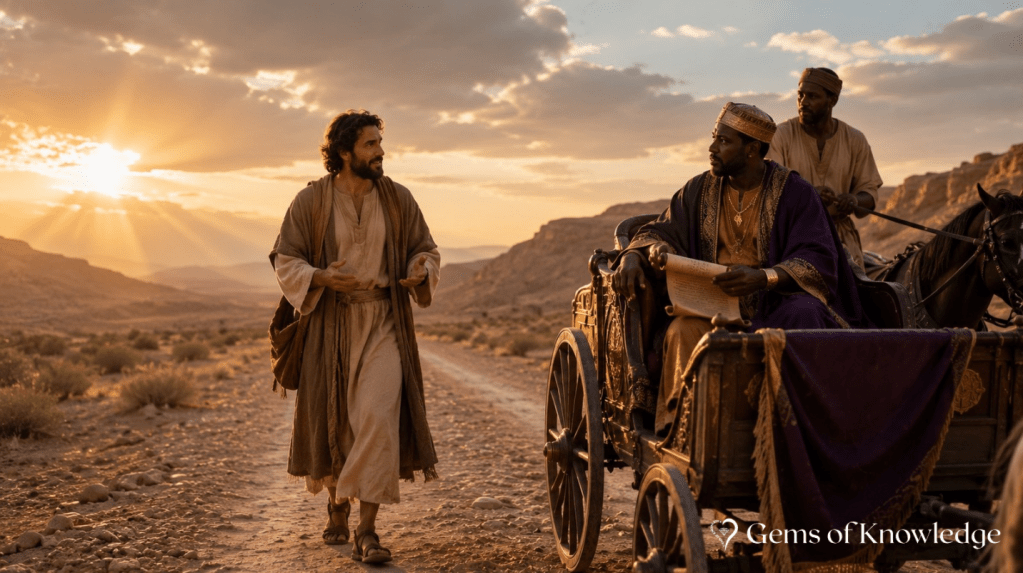
Alt...
Philip walks beside the Ethiopian official's chariot on a desert road, explaining the Scriptures as the Holy Spirit leads their encounter.

Devotion – “A Forgotten Key to Reading Scripture About Christ” – 04/22/2026

COMMENTS
Have you ever heard someone say, ” Oh, the King James Bible is too hard to read.” Maybe it was something like, “I don’t need to read my Bible; the Holy Spirit guides me.” It seems folks will manufacture any excuse to avoid being in the Word. So let’s take a quick look at these two excuses to see if they have any Biblical basis.
Is the KJV really too hard to understand? My opinion (which does not matter) is no, it is not. Yes, it is full of archaic language; some of the words have different meanings today, and we must be willing to study to read it. The fact is, every version of the Bible requires that we make a real effort to understand it.
Paul said,
“We must study or give due diligence
to be an approved workman…”
that makes the number two excuse invalid. How do we study so we might be approved by God? We rely not on our own skills or strength, but on those of the Holy Spirit (John 14:26):
But the Helper (Comforter, Advocate, Intercessor—Counselor, Strengthener, Standby), the Holy Spirit, whom the Father will send in My name [in My place, to represent Me and act on My behalf], He will teach you all things. And He will help you remember everything that I have told you.
That makes the first excuse invalid. especially in the modern world we live in today.
With technology so abundant and free, there is little excuse for anyone not to be in the world daily. One of the best, easy-to-use (navigate) sites, again in my opinion, is Bible Hub
The study of the Bible is known as Hermeneutics. Biblical hermeneutics is the study of the principles and methods of interpreting the text of the Bible. Second Timothy 2:15 commands believers to be involved in hermeneutics: “Do your best to present yourself to God as one approved, a worker who . . . correctly handles the word of truth.” The purpose of biblical hermeneutics is to help us to know how to properly interpret, understand, and apply the Bible.
Hermeneutics is concerned with the big picture, topics like salvation, sin, sovereignty, etc.
The category of study alongside Hermeneutics is Exegesis.
Biblical exegesis involves a detailed, methodical study of Scripture to draw out the intended meaning of each text. The English term “exegesis” comes from a Greek word meaning “to guide or lead out.” The process requires careful analysis of language, history, culture, and context to discern what the author originally intended and how the audience first understood the message. As 2 Timothy 2:15 advises, “Make every effort to present yourself approved to God, an unashamed workman who accurately handles the word of truth.”
Within Exegesis, there is a sub-topic of Parative Exegesis:
Partitive exegesis is a hermeneutical (interpretive) method used in Christian theology—especially in reading passages about Jesus—to distinguish between the divine and human natures of Christ while maintaining their unity in His person.
Core Idea: The practice “parts” or separates biblical statements about Christ into their appropriate nature—either divine or human—without splitting the one person of the Son. It affirms that Jesus is both fully God and fully man, united in person but distinct in nature, without confusion, change, division, or separation.
Purpose: Partitive exegesis arose in the early church to resolve the tension between Christ’s divine attributes (e.g., omnipotence, eternity) and His human experiences (e.g., hunger, death, suffering). It ensures that:
Divine titles and attributes are applied to His divine nature.
Human qualities are applied to His human nature.
Both natures are preserved in the one person of Christ Patheos.
Biblical and Theological Basis: The method is rooted in Scripture’s own way of describing Christ, which sometimes attributes divine titles to human actions (e.g., “the first and the last” in Revelation 1:17–18) or human experiences to divine persons (e.g., “Son of Man ascending to where He was before” in John 6:62).
Early church figures like Origen, Athanasius, the Cappadocians, Cyril of Alexandria, and especially Gregory of Nazianzus developed and defended partitive exegesis. Gregory’s “partitive rule” explicitly assigns sublime, transcendent expressions to the divine nature and more earthly or lowly ones to the human nature, while keeping the one person in view http://www.centerforbaptistrenewal.com.
Example: Divine nature: “Before Abraham was, I am” (John 8:58) — eternal, self-existent God.
Human nature: “I thirst” (John 19:28) — human experience of thirst.
Both natures: “Redeemer” or “King” — titles that apply to both Founders Ministries.
Summary: Partitive exegesis is a disciplined, Scripture-based approach to reading about Christ that preserves the distinction between His divine and human natures while affirming their unity. It is a safeguard against heresy and a way to interpret the incarnation faithfully.
The real-world application of this is not to make everyone a Biblical Scholar, a theologian, or a preacher/teacher. It is, however, commanded by God that we be able to defend our faith ( 1 Peter 3:15
What is biblical hermeneutics?
Daily Devotional – Couch Potato Christian – Faithful Steward Ministries and FSM Women’s Outreach
DEVOTION
What Is Partitive Exegesis? How the Church Has Read Scripture on Christ

“You just had to be there!”
We fall back on this excuse when words fail to capture the precise reality of an experience—often a comedic interaction or visual beauty. The reality is that reality itself is often hard to describe. We do our best to describe it with words, but we’ve all experienced the frustration of falling short.
This is especially true when we use our words to describe God. Herman Bavinck asks, “The moment we dare to speak about God, the question arises: How can we?”[1] The same question can be asked of the person of Christ: When we dare to speak about the One who is both infinite God and finite man, how can we?
Scripture tells us Jesus slept, ate, walked, and learned new things. But it also tells us He created the universe, sustains it, and is omniscient. You can see the dilemma—how do we accurately describe Jesus when He has these seemingly contradictory categories?
We can navigate this difficulty through a practice known as partitive exegesis. Partitive exegesis presupposes that Christ’s two natures are unified in His person without confusion, change, division, or separation. Therefore, we must recognize and maintain the distinction between Christ’s two natures when we read the Bible.[2] While that may sound complicated, this practice arises from Scripture itself—it is an inspired way of describing the reality of the incarnation…
Continued via link above
- What is biblical hermeneutics? | GotQuestions.org ↩︎
- What is Biblical Exegesis? ↩︎
- Google Copilot AI-generated response. ↩︎
The 3rd Woe: From Warning to Full-Scale Judgment (VE)
Introduction The eschatological climax of the New Testament Apocalypse does not unfold as a series of isolated, random catastrophes. Instead, it operates as a perfectly synchronized legal and physical assault against the kingdom of darkness. Central to this divine choreography is the structural relationship between the 7th Trumpet and the 7th Bowl. These two pivotal events function as "two sides of the same coin." They share an identical celestial origin and cosmic signature, yet they differ […] [SENSITIVE CONTENT]
Introduction
The eschatological climax of the New Testament Apocalypse does not unfold as a series of isolated, random catastrophes. Instead, it operates as a perfectly synchronized legal and physical assault against the kingdom of darkness. Central to this divine choreography is the structural relationship between the 7th Trumpet and the 7th Bowl. These two pivotal events function as “two sides of the same coin.” They share an identical celestial origin and cosmic signature, yet they differ radically in their scale, intent, and tactical execution.
While the 7th Trumpet serves as the cosmic “flash”—the legal eviction notice served from the courtroom of heaven—the 7th Bowl acts as the earthly “bang,” executing the physical annihilation of the 8th Beast, his ten kings, and the harlot system of Babylon. By exploring this transition from heavenly decree to planetary destruction, we can map out how these judgments converge to terminate the times of the Gentiles and fulfill the ancient prophecies of Daniel.
“Two Sides of the Same Coin” (Similarities) and then how they function differently (Differences). 7th Trumpet vs 7th Bowl
The Heavenly Pattern: Shared Similarities
These elements prove that both events are two stages of the same divine intervention. They share a “divine signature” that marks the end of the age.
- The Source of Authority: Both judgments originate directly from the Temple of God in Heaven. This confirms that the destruction of the 8th Beast is a holy act sanctioned by the throne of God.
- The Atmospheric Signature: Both are announced by lightnings, voices, and thunderings. This is the same cosmic atmosphere seen at Mount Sinai, signaling that God has descended to deal with His enemies.
- The Earthly Shaking: Both events trigger a Great Earthquake. This represents the literal “shaking” of the Beast’s kingdom, proving that no earthly foundation is secure when the 7th angel sounds.
- The Finality of the Mystery: Both mark a “finish line.” The 7th Trumpet finishes the Mystery of God, while the 7th Bowl finishes the Wrath of God. Once they occur, the era of human rebellion is over.
Table 1: Similarities (The Heavenly Pattern)
These points show that both events originate from the same divine source and carry the same “signature” of God’s presence.

The Tactical Shift: Key Differences
The differences between these two events show the progression from a legal declaration to the final physical strike on the 8th Beast and his 10 kings.
- The Divine Proclamation:
- The 7th Trumpet is a transfer of power: “The kingdom of the world has become the kingdom of our Lord.” It is the legal announcement that Christ is now the rightful King.
- The 7th Bowl is the completion of the work: “It is done!” It is the signal that the battle is over and the 8th Beast has been defeated.
- The Action of the Temple:
- The 7th Trumpet is about Revelation. The temple opens so the Ark of the Covenant can be seen, reminding the world of God’s promises to Israel.
- The 7th Bowl is about Execution. The temple is no longer being “viewed”; instead, the command of destruction comes out from the throne to finish the job.
- The Scale of the Earthquake:
- The 7th Trumpet earthquake is severe but specific. It destroys 1/10 of the city and serves as a final warning.
- The 7th Bowl earthquake is planetary. It is the greatest shaking in human history. It is so intense that every island disappears and every mountain is leveled, literally erasing the geography of the Beast’s empire.
- The Severity of the Hail:
- The 7th Trumpet mentions “great hail” as a standard atmospheric judgment.
- The 7th Bowl describes 100-pound hailstones. This is the final “stoning” of the blasphemous 8th Beast and his followers, who respond by cursing God rather than repenting.
- The Fate of Babylon:
- The 7th Trumpet marks the beginning of the end for the city in the Land of Shinar.
- The 7th Bowl sees the city split into three parts. God “remembers” Babylon and gives her the cup of the wine of the fierceness of His wrath, ending the system that began at the Tower of Babel.

Table 2: Differences (The Shift from Decree to Destruction)
These points show the progression from the 8th Beast’s legal defeat to his physical annihilation.

The 7th Trumpet and 7th Bowl not just as similar events, but as a convergence where the “Heavenly Decree” meets the “Earthly Execution.” They converge at the point where God’s patience ends and His physical reign begins.
Here is how they converge into a single, final conclusion for the age:
1. The Convergence of “The Finish”
Both events serve as the absolute “finish line” for two different divine processes.
- The 7th Trumpet finishes the “Mystery of God” (Rev 10:7). This is the end of the age where God allowed evil to exist and the Beast to rule. It is the end of God’s silence.
- The 7th Bowl finishes the “Wrath of God” (Rev 15:1). This is the end of the physical plagues.
- The Convergence: They meet at the moment of Total Completion. When the 7th Trumpet says “The Kingdom has become,” and the 7th Bowl says “It is done,” they are both describing the exact same transition from the 8th Beast’s rule to Christ’s rule.
2. The Convergence at the Great City (Babylon)
The 8th Beast’s base of operations—the city in the Land of Shinar—is the target where both judgments collide.
- The 7th Trumpet introduces the “Third Woe,” which is the final destruction of the world system.
- The 7th Bowl physically executes that destruction by splitting the city into three parts.
- The Convergence: The 7th Trumpet provides the Legal Verdict (the city must fall), and the 7th Bowl provides the Physical Impact (the city actually falls). They converge to destroy the “base” of wickedness that began at Babel.
3. The Convergence of the Temple and the Throne
These two judgments unite the worship of Heaven with the justice of Earth.
- The 7th Trumpet opens the Temple in heaven so we can see the Ark of the Covenant. This shows God is acting because of His holy promises.
- The 7th Bowl sends a voice out of that same Temple from the Throne. This shows God is acting because of His sovereign power.
- The Convergence: They converge to show that God’s Faithfulness (the Ark) and God’s Authority (the Throne) are working together to remove the 8th Beast and the 10 kings.
4. The Convergence of the “Great Shake”
Both judgments utilize a “Great Earthquake” to dismantle the status quo.
- The 7th Trumpet earthquake signals that the foundations of the world are being loosened.
- The 7th Bowl earthquake is the “greatest ever,” leveling mountains and islands.
- The Convergence: They converge to Terraform the Earth. They don’t just destroy; they flatten the earth to prepare it for the Millennial Kingdom, removing every high place and stronghold where the 8th Beast once sat.

Summary
The 7th Trumpet and the 7th Bowl are like the flash and the bang of a single lightning strike. The 7th Trumpet is the “Flash” in heaven—the legal announcement that the 8th Beast is done. The 7th Bowl is the “Bang” on earth—the physical destruction of his kingdom. They converge to ensure that not a single trace of the “New Testament Sea Beast” remains when Christ returns.
It unites the Danielic timelines with the entities of Revelation into a single, cohesive “Final Countdown.”
The Final Countdown: Fulfilling the Vision of Daniel and Revelation
To understand the end of the age, we must see the convergence of the “Legal Lease” (the 70th week) and the “Physical Execution” (the 7 Bowls). Here is how all entities—the Beast, the Whore, the military, and the marked—are concluded through the lens of Daniel’s prophecies.
1. The 70th Week: The Global Operating Window
The “70th Week” of Daniel 9 is the final seven-year period. In this framework, it is the specific “lease” and time allotted for all beasts, the whore, individuals with the mark of the beast, and the military and nations to operate before the 7th Trumpet sounds. It is the climax of human and demonic rebellion.
“He will confirm a covenant with many for one ‘seven.’ In the middle of the ‘seven’ he will put an end to sacrifice and offering. And at the temple he will set up an abomination that causes desolation…” (Daniel 9:27)
The Fulfillment: The 7th Trumpet sounds at the end of this “seven,” legally ending the collective lease of the entire Beast system. This declaration shifts the world from the “permitted rule” of the 8th Beast to the “rightful rule” of Christ.
“The seventh angel sounded his trumpet, and there were loud voices in heaven, which said: ‘The kingdom of the world has become the kingdom of our Lord and of his Messiah, and he will reign for ever and ever.’” (Revelation 11:15)
2. The 1,260-Day War: The Remnant Focus
Focusing on the remnant makes it clear that while the 8th Beast has global authority, there is a specific group of believers he is actively hunting during a 1,260-day window (the latter half of the 70th week).
The Remnant Battle (Rev 12:17 / Dan 12:7):
For 42 months (1,260 days), the 8th Beast is permitted to make war specifically against the remnant. During this time, the remnant is often “nourished” or protected, yet they remain the primary target of the Beast’s fury until the lease expires at the 7th Trumpet.

The rebellion that began in the Land of Shinar with Nimrod and was revived by the 8th Beast (Apollyon) is finally scrubbed from the earth. The 144,000 and Great Multitude (the Church) return with Christ to rule, while the Refined 1/3 Remnant—who survived the 6th Trumpet and the 7th Bowl—become the subjects of the most peaceful kingdom the world has ever known.
“I will bring the one-third through the fire, will refine them as silver is refined, and test them as gold is tested. They will call on My name, and I will answer them. I will say, ‘This is My people’; and each one will say, ‘The Lord is my God.’” (Zechariah 13:9)
Conclusion: The Ultimate Convergence of Sovereignty and Justice
Ultimately, the 7th Trumpet and the 7th Bowl converge at the precise intersection where God’s long-suffering patience ends and His physical, localized reign begins. They are not competing timelines, but a unified mechanism of cosmic justice. The Trumpet establishes the unalterable legal verdict based on the covenant faithfulness of the Ark; the Bowl unleashes the irresistible sovereign power issued from the Throne.
Together, they form a sweeping terraforming project—both spiritually and geographically—shaking loose the foundations of human rebellion, splitting geopolitical Babylon into three parts, and flattening every mountain and island of human pride. When the legal lease of the 70th week expires, the executionary wrath of the Bowls ensures that not a single trace of the Beast’s empire remains to pollute the dawn of the Millennial Kingdom. The transfer of the kingdoms of this world is completed, and the decree “It is done!” echoes across a restored creation.
Appendix: The Structural Mechanics of the Final Countdown
I. The “Flash and Bang” Parallel Chronology
The relationship between the Trumpets and the Bowls is not purely chronological (one after the other), but recursive and intensifying (recapitulation). The 7th Trumpet establishes the Heavenly Verdict, while the 7th Bowl executes the Earthly Verdict.

II. Comparative Timeline of the 70th Week vs. Judgment Extended Windows
- The 1,260 Days (3.5 Years / 42 Months): The legal operating window of the 8th Beast’s unrestricted authority and his war against the holy remnant (Dan 7:25, Rev 13:5).
- The 1,290 Days (Dan 12:11): An extra 30 days added to the timeline, traditionally understood as the window where the legal lease expires (7th Trumpet) and the executionary wrath (The Bowls) begins to pour out, systematically dismantling the Desolation.
- The 1,335 Days (Dan 12:12): An extra 45 days extending beyond the 1,290 days, culminating in the literal physical establishment and blessing of the Millennial Kingdom on a terraformed earth.
Glossary of Eschatological Terms and Entities
Prophetic Entities
- The 8th Beast: The final, satanically empowered global dictator who emerges from the historical lineage of the seven previous world empires (Gog/Apollylon, Gog of Magog/Assyria, Babylon, Medo-Persia, Greece, Rome, Revival/Clay-Iron). He commands global worship and military compliance.
- The Whore (Mystery Babylon): The counterfeit, apostate religious and economic system that rides and directs the initial stages of the Beast’s empire. Her headquarters are historically tied to the land of Shinar (Babel). She is ultimately betrayed and burned by the Beast’s alliance.
- The 10 Kings: A geopolitical coalition of ten rulers who hand their sovereignty, military might, and authority over to the 8th Beast to form a unified global military force.
- The Remnant: The faithful, covenant-keeping community of believers targeted by the Beast during the 1,260-day window who refuse the mark and keep the testimony of God.
- The Marked: The global population that willingly receives the brand or character-identifier of the Beast (the Mark), permanently aligning themselves with the earthly system and automatically triggering the executionary wrath of the Bowls.
Theological and Structural Concepts
- The 3rd Woe: The final and most terrifying of the three strategic target judgments (Woes) announced in heaven. It encompasses the entirety of the 7th Trumpet and the swift deployment of the 7 Bowls of Wrath.
- The Legal Lease: The prophetic principle that God grants a specific, legally binding block of time (Daniel’s 70th Week) to human rebellion and demonic dominion before stepping in to reclaim absolute ownership of the planet.
- The Mystery of God: The period of human history where God allows evil, injustice, and the suffering of His people to go on seemingly unchecked without immediate physical intervention. This mystery is declared “finished” at the sounding of the 7th Trumpet.
- Terraforming Judgment: A specific type of divine intervention that physically reshapes the global geography—such as erasing mountains and islands via the greatest earthquake in human history—to prepare the planet for the localized, physical reign of Christ.
- Weight of a Talent (100 lbs): The extreme weight measurement of the catastrophic hailstones used in the 7th Bowl, symbolizing the final, physical “stoning” penalty prescribed under biblical law for ultimate blasphemy.
« Previous | Read Next: The 3rd Woe: From Warning to Full-Scale Judgment (VF) »
The 3rd Woe: From Warning to Full-Scale Judgment (VF)
Introduction: The Anatomy of Last-Days Sifting The apocalyptic landscape of the 70th Week is often viewed as a chaotic downpour of wrath, but scriptural prophecy reveals a highly structured, surgical operation of divine triage. At the heart of this narrative is the execution of the 3rd Woe—the definitive transition from global warning to full-scale, unadulterated judgment. Central to this transition is the legal expiration of the 8th Beast’s 1,260-day lease and the destiny of the […] [SENSITIVE CONTENT]
Introduction: The Anatomy of Last-Days Sifting
The apocalyptic landscape of the 70th Week is often viewed as a chaotic downpour of wrath, but scriptural prophecy reveals a highly structured, surgical operation of divine triage. At the heart of this narrative is the execution of the 3rd Woe—the definitive transition from global warning to full-scale, unadulterated judgment. Central to this transition is the legal expiration of the 8th Beast’s 1,260-day lease and the destiny of the “Remnant.” Unlike the Church Age Harvest (the 144,000 and the Great Multitude) who are secured beforehand, this Remnant must navigate a mathematically precise sifting process. Through the devastating catalyst of the 6th Trumpet and the strict blueprint of Zechariah 13, humanity is systematically divided into those who solidify their rebellion through the Mark and those who emerge as the refined, final third.
To frame our understanding of this final cosmic division, consider these foundational questions:
- The Legal Boundary: How does the hard 1,260-day expiration of the Beast’s lease fundamentally alter the spiritual physics of the earth, shifting the Remnant from the hunted to the co-heirs of victory?
- The Mathematical Separation: Why must the global population be reduced by an exact third at the 6th Trumpet before the final polarization of the Mark of the Beast can occur?
- The Post-Harvest Mercy: How does the proclamation of the “Eternal Gospel” by the 1st Angel serve as a unique, distinct dispensation of grace for those left behind after the primary harvest is already standing before the Throne?
Focusing on the remnant makes it clear that while the 8th Beast has global authority, there is a specific group of believers he is actively hunting during that 1,260-day window.
Why the “Remnant” Matters
Focusing on the remnant makes it clear that while the 8th Beast has global authority, there is a specific group of believers he is actively hunting during that 1,260-day window.
The remnant are those who refuse the Mark of the Beast during the 70th week. Their endurance lasts for the 1,260 days, marking the window where God protects His people while the 8th Beast pursues them.
The Fulfillment: By the end of the 1,260 days, the “legal lease” of the Beast expires. The “remnant” is no longer the hunted; instead, the 8th Beast and his 10 kings are gathered for judgment as the 7th Bowl prepares to declare, “It is done!”
The Phased Sifting: From Universal Trials to Final Refining

1. The Pre-Woe Universal Trials (Trumpets 1–4)
Before the 8th Beast even manifests, the first four Trumpets devastate the world’s infrastructure. This phase breaks human reliance on global systems, forcing every survivor to consider their spiritual standing.
2. The Mathematical Pivot (The 6th Trumpet)
The 6th Trumpet is the point of no return where a demonic army is released from the Euphrates to execute a massive judgment.
- The Slaughter: Exactly one-third (1/3) of all mankind is killed during this demonic attack.
- The Survivors: This leaves exactly two-thirds (2/3) of humanity remaining on the earth.
- The Great Divide: During the 1,260-day reign, this 2/3 is split into the Rebels (those who take the Mark) and the Remnant (those who do not).
3. Zechariah’s Prophecy: The Refined Third
This links directly to Zechariah 13:8-9, where God prophesies that two parts (2/3) shall be cut off and die, but the third part (1/3) shall be left.
- The First 1/3 Cut Off: Those killed in the 6th Trumpet.
- The Second 1/3 Cut Off: Those who drink the wine of God’s fury. As the Third Angel proclaims in Revelation 14:9-11:
“If anyone worships the beast and its image and receives its mark on their forehead or on their hand, they, too, will drink the wine of God’s fury… They will be tormented with burning sulfur… and the smoke of their torment will rise for ever and ever.”
- The Final 1/3 Remnant: These are the ones God brings “through the fire,” refining them like silver until they say, “The Lord is my God.” This calls for patient endurance on the part of the people of God who keep his commands and remain faithful to Jesus (Rev 14:12).
4. Revelation 14: The 1st Angel’s Summons
This “refined third” is reached by the 1st Angel while the 8th Beast is manifested.
- The Proclamation: The angel flies with an “eternal gospel,” crying out: “Fear God and give him glory, because the hour of his judgment has come” (Rev 14:7).
- The Result: This message acts as the final harvest for the 1,260-day remnant. This group survives the trumpets and chooses to give glory to God rather than take the Mark of the Beast.
5. The Bowls of Wrath: Hardening vs. Refining
- The 1/3 Rebels (Marked): Experience the man-sores and scorching heat of the Bowls. They “blaspheme God” and refuse to repent.
- The 1/3 Remnant: Preserved through the final judgments—likely escaping through the Revelation 11 earthquake or Zechariah 14 mountain cleft—while the Beast’s kingdom is dismantled.
The 8th Beast (Apollyon/Gog) believes he has won after killing the Witnesses, but he has only cleared the way for God to save His final remnant. The 6th Trumpet removes those set for judgment, leaving a population that is sifted until the final refined third remains to enter the Kingdom of Christ
The Two Groups: Harvest vs. Remnant
The 144,000 and the Great Multitude represent a completed harvest that occurs before the 8th Beast’s direct 1,260-day reign. This leaves the 1/3 remnant of Zechariah as a separate, distinct group that must endure the final fires of the 70th week.
1. The Pre-Reign Harvest: The 144,000 and the Great Multitude
- The 144,000 (The Firstfruits): These are sealed and protected early on. By the time the 8th Beast is manifested in the Land of Shinar, they are already seen standing with the Lamb on Mount Zion (Revelation 14:1), having been “purchased from among mankind as firstfruits” (Rev 14:4).
- The Great Multitude: This group is seen in heaven before the throne (Revelation 7:9). They have already come out of “the great tribulation” and have had their robes washed in the blood of the Lamb.
- The End of the Church Age: These two groups represent the completed harvest. Their absence from the earth is what allows the 8th Beast to have “authority over every tribe, people, language and nation” (Rev 13:7).
2. The Post-Harvest Remnant: The 1/3 of Zechariah
With the 144,000 and Great Multitude already in heaven, the focus on earth shifts to the 1/3 remnant mentioned in the Old Testament.
- The 6th Trumpet Sifting: After the 6th Trumpet kills 1/3 of mankind (Rev 9:15-18), the remaining population is sifted.
- The Zechariah 13 Pattern: As noted, God promised in Zechariah 13:8-9 to “strike the land,” causing 2/3 to perish. This leaves a final 1/3 remnant on the earth who were not part of the initial harvest.
- The Eternal Gospel (Rev 14:6-7): Because the initial harvest is gone, God sends the 1st Angel to fly in midheaven. This angel preaches to those who are “left behind”—the survivors of the trumpets—giving them one last chance to “Fear God and give Him glory.”
- The Refining Fire: This 1/3 is the group that is brought “through the fire” of the final judgments. They are preserved while the Beast’s kingdom is dismantled.

Summary
The 144,000 and Great Multitude are the “Church Harvest” taken before the end. The 1/3 Remnant are the “Earthly Survivors” who respond to the Angel’s gospel during the 8th Beast’s 1,260-day reign. One group is saved out of the world, while the other is saved through the final destruction of the Beast system to enter the Millennial Kingdom.
The Three Groups of the Final Harvest

God’s plan is surgical. He removes His Firstfruits (the Church) before the 8th Beast arrives, uses the Trumpet judgments to sift the population, and then protects a Refined 1/3 to ensure the new world begins with a people who have truly chosen Him. The movement from the Land of Shinar (rebellion) to the restoration of the Kingdom is the ultimate story of God reclaiming His creation from the “Beast from the Past.”

Conclusion: The Triumph of the Refined Sovereign Design
Ultimately, the progression of the Trumpets and Bowls demonstrates that God’s end-times chronology is not an uncontrolled crisis, but a perfectly calibrated refining fire. The complete separation between the Pre-Reign Harvest and the Post-Harvest Remnant shatters the misconception of a single, uniform tribulation experience. By isolating the 144,000 and the Great Multitude in the heavenly realm, the text sharpens its focus on the final 1/3 remaining on earth—a group literally brought through the fire to secure the physical continuity of God’s covenant people. While the 8th Beast (Apollyon/Gog) operates under the illusion of absolute dominance after silencing the Witnesses, his kingdom is structurally undermined by the very judgments meant to cement his rule. The legal lease of Shinar expires, the plagues harden the rebels unto destruction, and the refined third stands ready to inherit a reclaimed creation.
To further deepen our grasp of this prophetic finale, we must ponder these insightful questions:
- The Nature of Final Hardening: Why do the severe plagues of the Bowls cause the marked 1/3 to aggressively blaspheme God rather than repent, and what does this reveal about the permanent spiritual alteration caused by the Mark?
- The Mechanics of Physical Preservation: By what exact geopolitical or supernatural means—such as the Zechariah 14 mountain cleft—does God physically sustain the mortal 1/3 Remnant through 100-pound hailstones to successfully populate the initial generations of the Millennial Kingdom?
- The Historical Loop: How does the ultimate destruction of the “Beast from the Past” at Armageddon legally undo the ancient rebellion initiated at the Tower of Babel, effectively closing the loop on human history where it first began?
Appendix A: Scriptural Mapping of the Three Global Groups
The following sections anchor the three distinct groups across the narrative of the 70th Week, mapping their origins, experiences, and ultimate prophetic destinations.
A. The Church Age Harvest (Pre-Reign)
- Sealing and Separation: Revelation 7:3–4; 14:1–4. Sealed before the manifestation of the 8th Beast.
- Heavenly Location: Revelation 7:9. Standing before the Throne before the Bowls of Wrath are poured out.
- Exemption from the Beast: Revelation 13:7–8. Their absence allows the Beast to dominate the remaining earth.
B. The Refined 1/3 Remnant (Post-Harvest)
- The Mathematical Division: Zechariah 13:8–9. One-third is slain in the 6th Trumpet; one-third joins the rebellion; the final third is preserved.
- The Final Call to Mercy: Revelation 14:6–7. Responding to the 1st Angel’s “Eternal Gospel” during the mid-tribulation sifting.
- Supernatural Preservation: Zechariah 14:4–5; Revelation 11:13. Escaping physical annihilation through divinely appointed physical avenues (e.g., the splitting of the Mount of Olives).
C. The Rebellion (The Marked)
- The System of the Beast: Revelation 13:16–18. Voluntarily taking the Mark for economic and political survival.
- Judicial Hardening: Revelation 16:9, 11. Suffering the Bowls of Wrath, resulting in blasphemy instead of repentance.
- The Final Judgment: Revelation 19:20; 20:10. The total military destruction at Armageddon and immediate casting into the Lake of Fire.
Appendix B: The Unified Prophetic Escape Route
Integrating the conclusion of the 2nd Woe (Revelation 11:13–14) with the geographical escape routes of Zechariah 14 and Daniel 11:41 reveals a single, continuous prophetic flight corridor.
The moment the Jewish remnant responds to the Jerusalem earthquake by giving glory to God, they are instantly designated as the “Refined 1/3.” This spiritual turning point immediately triggers their physical evacuation through a divinely carved highway out of Judea.
1. The Trigger: The Jerusalem Earthquake and Spiritual Awakening (Rev 11:13)
- The Catalyst: The Two Witnesses ascend, a massive earthquake strikes Jerusalem, and a tenth of the city collapses.
- The Pivot: The surviving Jewish remnant is struck with holy fear and gives glory to the God of heaven.
- The Legal Shift: This act of repentance seals their identity as the Zechariah 13:9 refined third. The 2nd Woe closes, and as the 3rd Woe commences, this newly identified Remnant must immediately flee the incoming, full-scale wrath of the 8th Beast.
2. The Exit: The Mount of Olives Cleft (Zech 14:4–5)
- The Physical Mechanism: As the crisis peaks and Christ’s presence interacts with the landscape, His feet stand upon the Mount of Olives, causing the mountain to split violently in half from east to west.
- The Route: This precise geological rupture creates a massive, immediate valley running directly through the mountain ridge, acting as an emergency extraction corridor out of the collapsing ruins of Jerusalem.
- The Destination: The Remnant flees through this valley toward “Azel,” a secure transit point on Jerusalem’s eastern perimeter. This sudden opening mirrors the splitting of the Red Sea, granting the newly awakened believers a miraculous escape route before the Beast’s forces can encircle them.
3. The Sanctuary: The Transjordanian Strongholds (Dan 11:41)
- The Route: Emerging from the Mount of Olives cleft, the Remnant’s flight path extends eastward through the Judean wilderness, down across the Jordan River axis, and into the high country of modern-day Jordan.
- The Scriptural Boundary: This eastward highway leads directly into the sovereignly protected territories of ancient Edom, Moab, and Ammon. According to Daniel 11:41, these specific regions are completely exempted and legally blocked from the military grip of the Antichrist during his global campaign.
- The Secure Zone: The fleeing 1/3 Remnant finds ultimate sanctuary within these rugged, historic strongholds—such as Bozrah and Sela (Petra). This deep-wilderness haven serves as the designated zone where they are physically preserved from the face of the serpent and protected from the 100-pound hailstones of the final Bowl.
Appendix C: Map out the march route from Bozrah back to the Valley of Jehoshaphat (Megiddo/Jerusalem)
The march route from Bozrah to the Valley of Jehoshaphat outlines Christ’s tactical, northward military advance. Having shattered the enemy siege surrounding the hidden 1/3 Remnant in Edom, Messiah leads a triumphant procession up the ancient highway system of the Transjordan before crossing into Israel to finalize judgment at Jerusalem.
1. The Starting Point: The Breakthrough at Bozrah (Edom)
- The Location: Ancient Bozrah, located in the rugged mountains of southern Jordan (Buseirah), southeast of the Dead Sea.
- The Action: Christ decimates the forces of the 8th Beast encircling the Remnant (Isaiah 63:1–6).
- The Assembly: This acts as the strategic rallying point where the liberated, mortal Remnant is gathered to follow behind the Messiah as He begins His northward advance.
2. The Transjordanian Ascent: The King’s Highway
- The Route: The march moves due north from Bozrah, utilizing the historic ridge-route known scripturally and historically as The King’s Highway (Route 35 in modern Jordan).
- The Path: This highway cuts through the high desert plateaus of ancient Moab and Ammon, keeping the Dead Sea tightly to the west.
- The Significance: Because Daniel 11:41 guarantees this entire eastern region escapes the Antichrist’s control, this elevated highway serves as a secure, unobstructed transit corridor for the advancing kingdom assembly.
3. The Northern Pivot and Jordan Crossing: Shittim to Jericho
- The Route: The march continues north through the Plains of Moab, arriving at the northeast corner of the Dead Sea near ancient Shittim.
- The Crossing: The procession pivots west, descending into the Jordan River Valley to cross the river axis just north of the Dead Sea.
- The Threshold: This crossing mirrors Joshua’s historic entry into the Promised Land, breaching the eastern border and arriving at Jericho—the foundational gateway into the Judean hill country.
4. The Ascent to Jerusalem: The Way of the Wilderness
- The Route: From Jericho, Christ leads the march westward, climbing steeply through the rugged canyons of the Judean Wilderness (the modern Route 1 corridor).
- The Approach: The route ascends roughly 3,500 feet over a span of 20 miles, passing the eastern flank of the Mount of Olives.
- The Visual: This is the specific leg of the journey described in Habakkuk 3:3 and Deuteronomy 33:2, where God’s glory is seen flashing from the south (Teman/Paran) as He approaches His holy mountain.
5. The Destination: The Valley of Jehoshaphat (The Kidron Valley)
- The Location: The deep ravine situated directly between the eastern wall of Jerusalem’s Temple Mount and the Mount of Olives.
- The Terminal Point: This is the biblical Valley of Jehoshaphat (meaning “The Lord Judges”), referenced in Joel 3:2 and 3:12–14.
- The Final Climax: The march culminates here. The surrounding armies of the Rebellion—which had deployed from Megiddo (Armageddon) to surround and sack Jerusalem (Zechariah 14:2)—are completely trapped in this narrow valley corridor. Christ steps onto the landscape, executes final tactical judgment, and permanently secures the city for the Millennial Kingdom.
Appendix D: How Joel 3 connects the winepress of Bozrah to the final decision in the Valley of Jehoshaphat
The Metaphorical and Tactical Bridge: Winepress to Valley
The connection between the winepress of Bozrah (Isaiah 63) and the Valley of Jehoshaphat (Joel 3) forms a single, continuous prophetic narrative of harvest and execution. Structurally, Isaiah 63 establishes the mechanism of judgment (the treading of the grapes), while Joel 3 provides the tactical concentration and legal finality of that same judgment.
Together, they show that the “winepress” isn’t just a symbol—it is a mobile, two-stage military campaign that begins at the shelter of the Remnant in Edom and terminates at the walls of Jerusalem.
1. The Architectural Link: The Overflowing Vat
In Isaiah 63, Christ is seen standing in Edom covered in the blood of His enemies, explicitly stating, “I have trodden the winepress alone.” Joel 3:13 picks up this exact agricultural imagery and applies it to the armies gathered at Jerusalem:
“Put in the sickle, for the harvest is ripe. Go in, tread, for the winepress is full; the vats overflow, for their wickedness is great.”
- The Connection: The “winepress” is the physical crushing of human rebellion. While the treading begins at Bozrah to liberate the cornered 1/3 Remnant, the sheer volume of the global armies requires a massive basin for ultimate liquidation.
- The Flow: The nations are harvested across the land, but they are systematically funneled into a concentrated topographical “vat”—the Valley of Jehoshaphat.
2. The Legal Assembly: The Valley of Verdicts
Joel 3:14 famously renames this geographic location: “Multitudes, multitudes in the valley of decision! For the day of the Lord is near in the valley of decision.”
- The Misconception: Modern readers often treat the “valley of decision” as a place where humans make a spiritual choice to follow God.
- The Reality: In Hebrew, the word for decision is charuts, which means a sharp, decisive judicial decree or a trench cut flat. The nations are not there to decide their fate; they are there to receive the final verdict of the Judge.
- The Connection to Bozrah: At Bozrah, Christ acts as the Deliverer, stepping into the fight to save His trapped people. By the time He marches into the Valley of Jehoshaphat, His role shifts to the supreme Chief Justice executing a global, unappealable legal sentence upon the remaining 2/3 Rebels.
3. The Tactical Bottleneck
Topographically, the Valley of Jehoshaphat (the Kidron Valley) is a narrow, steep ravine. It is a terrible place to deploy a massive, mechanized military force, making it a natural tactical trap.
- The Trap: The 8th Beast mobilizes his forces at Megiddo (Armageddon) and pushes south to take Jerusalem (Zechariah 14:2). Simultaneously, a contingent hunts the Remnant to Bozrah.
- The Bottleneck: After Christ obliterates the southern contingent at Bozrah, He drives the remaining forces back up into the narrow confines of the Kidron Valley.
- The Crush: The armies of the Rebellion are compressed into this deep ravine. The “vats overflow” because millions of hostile troops are squeezed into a geographic bottleneck, allowing Christ to execute a surgical, total liquidation without any collateral damage to the city itself.
4. The Cosmic Climax
Joel 3:16 seals the connection by describing the physical disruption that occurs as the march concludes at the valley: “The Lord also shall roar out of Zion, and utter His voice from Jerusalem; and the heavens and the earth shall shake…”
This matches the exact parameters of the 7th Bowl / 3rd Woe, where the greatest earthquake in human history splits the landscape, signaling that the legal lease of the Beast has officially expired, and the winepress has completed its work.
Appendix E: Contrast the Heavenly Harvest (Rev 14) with this Earthly Treading (Joel 3 / Isa 63)
In the book of Revelation, the final execution of divine judgment is presented as a dual harvest. Revelation 14 explicitly separates this final sifting into two completely opposite events: The Grain Harvest (the Heavenly Harvest) and The Grape Harvest (the Earthly Treading).
While the grain represents the extraction of the righteous into the heavenly realm, the grapes represent the gathering of the wicked into the physical bottleneck of the winepress for total destruction.
1. The Grain Harvest (The Heavenly Gathering)
- The Scripture: “Then I looked, and behold, a white cloud, and on the cloud sat One like the Son of Man, having on His head a golden crown, and in His hand a sharp sickle… So He who sat on the cloud thrust in His sickle on the earth, and the earth was reaped.” (Revelation 14:14–16)
- The Destination: The Heavenly Realm / Before the Throne.
- The Identity: This represents the completion of the Church Age Harvest, including the 144,000 Firstfruits and the Great Multitude.
- The Method: The Son of Man reaps the earth from above, sitting on a cloud. There is no blood, no warfare, and no physical treading mentioned. It is an act of lifting the mature, righteous grain off the earth to protect them securely in the heavenly barn before the full fury of the 3rd Woe drops.
2. The Grape Harvest (The Earthly Treading)
- The Scripture: “And another angel came out from the altar, who had power over fire… saying, ‘Thrust in your sharp sickle and gather the clusters of the vine of the earth, for her grapes are fully ripe.’ So the angel thrust his sickle into the earth and gathered the vine of the earth, and threw it into the great winepress of the wrath of God.” (Revelation 14:18–19)
- The Destination: The Earthly Bottlenecks (Bozrah and the Valley of Jehoshaphat).
- The Identity: The 2/3 Rebellion—those who chose the Mark of the Beast and solidified their hostility against God.
- The Method: This harvest is performed by an angel associated with fire and judgment. The grapes are violently sliced off the earth, bundled together, and cast down into a physical, localized geographical basin to be crushed.

The Ultimate Fusion: Revelation 14:20
Revelation 14 finishes the description of the grape harvest by seamlessly connecting it back to the physical march route we mapped earlier: “And the winepress was trodden outside the city, and blood came out of the winepress, up to the horses’ bridles, for one thousand six hundred furlongs.”
- The Distance: 1,600 furlongs (stadia) equates to roughly 180 to 200 miles.
- The Geography: If you trace the physical distance from the rugged strongholds of Bozrah (Edom), up through the King’s Highway in Jordan, across the river axis, and directly into the Valley of Jehoshaphat outside the walls of Jerusalem, it measures exactly this distance.
This proves that the Earthly Treading is a literal, geographically bounded military campaign. While the Grain Harvest cleanly extracts God’s people to heaven, the Grape Harvest systematically collects the Rebels and liquefies their entire military apparatus along a specific 1,600-furlong line of march.
Glossary of Prophetic Terms
- 1,260-Day Legal Lease: The mathematically locked duration (3.5 prophetic years / 42 months) granted to the 8th Beast to execute global governance before his legal authority expires.
- 3rd Woe: The final, structural phase of divine judgment encompassing the expiration of the Beast’s reign, the pouring out of the 7 Bowls of Wrath, and the physical return of Christ.
- 6th Trumpet (The Pivot): The point of no return in the trumpet judgments where four demonic angels are loosed from the Euphrates, resulting in the death of exactly one-third of the earth’s remaining population.
- 8th Beast (Apollyon/Gog): The final global dictator who rises from the abyss, intimately linked to the ancient rebellion of the Land of Shinar, who leads the kings of the earth into the final rebellion.
- Church Age Harvest: The completed spiritual harvest comprising the 144,000 Firstfruits and the Great Multitude, who are secured in the heavenly realm before the Beast establishes his 1,260-day reign.
- Eternal Gospel: The specific, urgent gospel proclamation delivered by the 1st Angel in midheaven during the 70th week, commanding the remaining population to fear God and reject the incoming Mark of the Beast.
- Land of Shinar: The historic, geopolitical region (ancient Babylon/Babel) representing the foundational geographic origin of organized human rebellion against God, which resurfaces as the base of the final Beast kingdom.
- Refined 1/3 Remnant: The mortal, surviving third of humanity who reject the Mark, endure the fires of the 70th week, and are physically preserved to populate the earthly Millennial Kingdom.
« Previous

Please join @kettingerjason and myself as we look at the Parable of the Sheep and the Goats. https://youtube.com/live/bNrlpeZkQK4

Recognizing Rebellion Behind the Pulpit
By Elizabeth Prata
SYNOPSIS: This article examines the question of persistent, public disobedience among self-professing Christian women who preach and teach in defiance of biblical commands. It urges discernment, humility, and repentance, arguing that ongoing rebellion against Scripture raises serious concerns about genuine faith.
For those of us who love God and seek to obey at all points (but knowing we fail, so we repent and try again), the persistent and entrenched disobedience of some self-proclaimed Christian women is a puzzle to us.
But then again, we read our Bibles and see 1 John 2:4 which says, The one who says, “I have come to know Him,” and does not keep His commandments, is a liar, and the truth is not in him;
And we say, those who constantly disobey, (especially by preaching in church, which is a gross abomination to Jesus), who are unteachable, who reject correction, who preach a different gospel, who deny the sufficiency of the Bible by their direct revelatory stories and puffed up visions, who abandon their career of motherhood & children at home to pursue a preaching career, whose fruit is only thorns and is bad…are likely not saved.
And then we receive pushback on every point above. So it’s still a puzzle when the Bible is so clear on certain points which are easy to understand and interpret.
If they had the Holy Spirit in them, He would not allow them to continue on a consistent path of rebellion. He would correct them either by opening their eyes to the proper verses, or by some drastic measure to awaken them to their transgressions. Do you think the Holy Spirit is in a woman who, for decades, disobeys? Can a true Christian have a seared conscience over their persistent and public sin and perpetuate it unapologetically? Dishonoring Jesus along the way and creating stumbling blocks for the weaker sisters?
No. He killed Ananias and Sapphira to demonstrate how serious He is about sin in the church. He sent 7 letters to the churches in Revelation to show how serious He is about His church.
“women should keep silent in the churches”. 1 Corinthians 14:33-34.
Pastor Gabe Hughes of WWUTT.com: Women Pastors are a Fundamental Problem for Southern Baptists
GTY: Does the Bible permit a woman to preach?
Ladies, be discerning. Above all, be humble. It takes humility to say ‘I followed this or that woman for a while and invested in her, with my heart, money, time, or energy, but my investment in her was misguided. Let me learn to discern better, let me be pure in my approach to obeying Jesus, let me abandon that which makes me stumble on my walk and turn to
“…whatever is true, whatever is honorable, whatever is right, whatever is pure, whatever is lovely, whatever is commendable, if there is any excellence and if anything worthy of praise, think about these things.” (Philippians 4:8).

If you see a woman standing at a pulpit on a Sunday morning at church service and open her Bible and preach to the congregation, she is in rebellion. Though satan is subtle, and hides his schemes secretively many times, this one is an easy spot. If the woman preaches consistently (not just a one-time mistake), she is in rebellion and you can learn nothing from her.
If you’ve followed such a one for a while, just talk to Jesus about it. Repent and ask Him to give you better discernment. He will!
#christianity #discernment #faith #preach
amgbengaezekieloladosu » 🌐
@megafeastamerica-dmgts.wordpress.com@megafeastamerica-dmgts.wordpress.com
Poem Title: “Light”
Tripping like a candle stick in the dark, love I see myself in dark world without hope of someone to lean on. I should have run the race without looking back. I will run the race without looking back to another day.Tripping like a candle stick without light, with emptiness to shine her light. Sweetheart, to see you there with a stick of lighter to light my candle stick in the dark world. I will run the race without looking back. I will run the race of seen hope of lighting another […] [SENSITIVE CONTENT]
Tripping like a candle stick in the dark, love I see myself in dark world without hope of someone to lean on. I should have run the race without looking back. I will run the race without looking back to another day.Tripping like a candle stick without light, with emptiness to shine her light.
Sweetheart, to see you there with a stick of lighter to light my candle stick in the dark world. I will run the race without looking back. I will run the race of seen hope of lighting another day.
The silence of the loneliness, and the emptiness of been love and committed to love makes me to see the reason to run a race for another time and another season.
Can I say
You stand as the light and as well I stand as candle stick
As you are the catalyst which runs through my chemical equation to form perfect solution bonding. Will I say it was a mistake in committed to love, can I say let our love making scene never end till eternity?
I will run the race without looking back, I will run the race of see hope of lighting the dark stories of loneliness.
Gbenga Ezekiel Oladosu
American National Award Winning Author
Mega Feast Bestselling Author
amgbengaezekieloladosu » 🌐
@megafeastamerica-dmgts.wordpress.com@megafeastamerica-dmgts.wordpress.com
“The Born”
The social influence of our day can never be wrong in some perspective of human decision making process. Leaders are born and some are trained leaders which makes the product of their kind different in the spheres of influence. The act of every leadership exercise is like when a baby is learning to crawl and not even learning to walk or talk in other to incorporate into the society. Learning is part of every process to growth in any given opportunity been given or available to us. The better […] [SENSITIVE CONTENT]
The social influence of our day can never be wrong in some perspective of human decision making process. Leaders are born and some are trained leaders which makes the product of their kind different in the spheres of influence. The act of every leadership exercise is like when a baby is learning to crawl and not even learning to walk or talk in other to incorporate into the society.
Learning is part of every process to growth in any given opportunity been given or available to us. The better understanding about leadership role of opportunity is that we can’t do way with learning process either from the people ahead of us to lead or in a classroom phase of life.
We cannot afford the vocational training of been a leader as in the idea to life, every given leader that’s born to lead has better opportunity of showcase more ability than a trained leader. That’s while we can’t afford the vocational training of been a leader either by standing on a mentorship role of becoming a leader. Countries are crying out today for a good governance because of the role of their past leadership which is not aspect from their citizens. The good knowledge of a leader who is born to lead is by acquiring the knowledge of mentorship
Gbenga Ezekiel Oladosu
American National Award Winning Author
Mega Feast Bestselling Author
Honored as (WordPress Globetrotter Receive views from 50+ Different Countries)
amgbengaezekieloladosu » 🌐
@megafeastamerica-dmgts.wordpress.com@megafeastamerica-dmgts.wordpress.com
“The Tray”
People group in different races and cultures rare with their believe system. People long for good life and good leadership ability to lead them in the sphere of influence. The anti government in different form of expression as opposition to the government either democracy, military system of government in some countries is beyond expression of human believe. From a look of thing, for example, when you are in a restaurant , I mean a good to look at or a club house for a wine or food. The food […] [SENSITIVE CONTENT]
People group in different races and cultures rare with their believe system. People long for good life and good leadership ability to lead them in the sphere of influence. The anti government in different form of expression as opposition to the government either democracy, military system of government in some countries is beyond expression of human believe.
From a look of thing, for example, when you are in a restaurant , I mean a good to look at or a club house for a wine or food. The food or the wine be placed on a tray to make their customer look welcome and come for another day toward the services given to them.
This days, some countries prepared to be governed by Military government than democracy government. While is do, is that some leaders abused the role of democracy that’s established to protect the right of people but their rather abuse and over power the right of the people who voted for them. This makes them regret democracy than rather to choose the military government. To them they can see better understanding with the military government than democracy.
We all long to have the right to self-will and not to abused our will power in the name of democracy. This day democracy is like a nightmare to some countries.
While Military government is like a God serving to people, economic growth of some countries that they will love to remain with them.
Gbenga Ezekiel Oladosu
American National Award Winning Author
Mega Feast Bestselling Author
Honored as (WordPress Globetrotter Receive views from 50+ Different Countries)
amgbengaezekieloladosu » 🌐
@megafeastamerica-dmgts.wordpress.com@megafeastamerica-dmgts.wordpress.com
“Liberty”
Dream and hope is based on the power within your liberty to dream in hoping for a better day ahead of time. In anticipating for who God has created you to be . Though you need a space of liberty to operate without boundaries or border that create opportunity for freedom. In as much, we can compare freedom and liberty together as they different functional purposes. They functions differently. But they work in hands in hands toward a goal. A goal that countries, people group build upon for a […] [SENSITIVE CONTENT]
Dream and hope is based on the power within your liberty to dream in hoping for a better day ahead of time. In anticipating for who God has created you to be . Though you need a space of liberty to operate without boundaries or border that create opportunity for freedom. In as much, we can compare freedom and liberty together as they different functional purposes. They functions differently.
But they work in hands in hands toward a goal. A goal that countries, people group build upon for a good day. People long for freedom has well liberty to do whatever they like. Liberty control limit and border while freedom control act of service of expression without limit
Countries leaders sometime takes liberty for freedom denied their own citizen the ability to create opportunity to dream and hope for the batter day to grow as a citizen. They makes the law and they don’t live by the law of their own countries to the extend that they force their own citizens to live under the law they don’t obey or followed.
Then limitation to liberty set in and some countries choose to live under Military leader and while some countries as well choose to live under respected democracy that makes people live and respect their law because their own countries leaders lead by good example as a leader born to leader and not a trained leader.
Liberty is what created dream to freedom without fears of associating and willing to try and not afraid of mistakes because their is a law guiding everybody under the spheres of influence.
Gbenga Ezekiel Oladosu
American National Award Winning Author
Mega Feast Bestselling Author
Honored as (WordPress Globetrotter Receive views from 50+ Different Countries)
What caused such a long-running decline in Christianity across the United States? Could the poor track record of certain organized religions and leaders be the contributing factor? Have we turned the corner? Click or tap the link to read more.
#christianity #Bible #Jesus #dailydevotional
https://afaithfulsower.org/2026/06/09/be-cautious-of-the-ever-shifting-sands-of-culture/
Why do we need a Savior, and what is the significance of the church's rapture? Click or tap the link to read more.
#afaithfulsower #Christianity #Bible #Salvation
https://afaithfulsower.org/2026/06/11/what-is-the-significance-of-salvation-and-the-rapture/
How do we approach serving as salt and light in such a dark, hostile world? Click or tap the link to read more.
#afaithfulsower #christianity #Bible #dailydevotional #FreeWill
https://afaithfulsower.org/2026/06/12/be-of-good-character-2/
Fellowship with Jesus Christ #god #christ #christianity #JesusChrist #Bible #Jesus #christians #catholics #orthodox #protestants

Dennis E. Powell writes, "Father Mark spoke matter-of-factly, perhaps with just a touch of resignation. 'Oh, I'll probably die young,' he said. 'My father died when he was 43. Cardiac.'"

In Luke 24:37–43, Jesus’ disciples were not immediately confident when He appeared to them after the resurrection. They were startled, frightened, and thought they had seen a spirit.
Read the accompanying blog post: https://www.scottlapierre.org/proof-of-the-resurrection/
Watch the sermon: https://youtu.be/VR6MJ_F-mLM
#Leadership #Faith #Christianity #Resurrection #BibleTeaching #Luke24

Faith, Christianity [SENSITIVE CONTENT]
So...after church this past Sunday I ended up writing an entire thing that feels like a sermon on the same passage our Pastor preached on because I had a very different set of thoughts on the passage we read.
Acts 19:21-41
I just...now need to figure out what to do with this thing I have written.
🤔

From Genesis to Malachi the Bible is very poetic. The Psalms are top-shelf poetry.
Much of the New Testament uses the same poetic emblems of the Old Testament.
God the Father is the master of poetry.
#christian #christianity #godsword #jesus #christ #god #poetry #bible #Jesus
SINS of Christian Nationalism & Zionism
Sins of Christian War-Making
https://www.youtube.com/watch?v=9-maDeoEDiI
Synopsis:
Holy war is a doctrine of the devil. Every church and organization promoting war for Christ is anti-christ.
Man cannot solve the evil in the world by 'fighting' or violence. That is exactly what the devil and his minions want. The gospel can not be spread by the sword or power of the state.
Every form of radical liberation theology or dominion theology is satanic because it denies the word of God and replaces it with the gospel of war.
Christian nationalists hate the lost because they too are lost souls with a messiah complex. Instead of following the messiah they want to reconstruct him in the imperial state. They do not have love of their neighbor.
My observation:
Christian Nationalism is disguised Roman imperialism, globalism and Zionism, hence it is neither Christian nor nationalist in character. Christian Nationalism has the same character imprint as Holy Roman Empire crusaderism. It is wicked and deceitful.
Christian Nationalists claim to advance 'dominion' or 'taking dominion'. This is blasphemy. The dominion over the nations was given to Jesus, not to imperfect men. Jesus is the one who is given dominion over all the nations. Thus Christian Nationalism blasphemously posits itself as the messiah with the dominion, just like its Catholic parent church.
#GunpointGospel #Crusades #HolyWar #Catholic #HolyWar #Christian #ChristianNationalism #Nationalism #Zionism #Christianity #DominionTheology #Church
--
OCTADE | news://alt.crossover | https://soc.octade.net

Christian Nationalism is Roman Constantinian Idolatry
This political idolatry of 'Christian Nationalism' is not new. Only the wide perception of it is new due to everyone now being plugged into the Internet via their ever-present phones and tablets.
In the 1600s through the 1800s we see the political idolatry was at fever pitch and full swing, giving a host of politically-oriented cults, such as Witch-burning Puritanism, Swedenborgianism, Mormonism, Seventh-Day Adventism, etcetera. Even the Anglican church is an Imperialist political cult and has no warrant or sanction in the Holy Scriptures. It is a 'nationalist' tyranny over the mind. And then we see Islam, which Christians mistakenly believe to be a non-Christian religion. Islam is a Christian heresy, founded by heretical Catholics. Even the name, "Mohammed" is a corruption of the earlier Arabic, "Mahmed" meaning, "Messiah". Islam is an offshoot of medieval Christianity with its Saturn idolatry gone to seed. Islam is a daughter of Babylon, the Judeo-Roman prostitute.
Christianity has always been a politically idolatrous cult. For instance, The council of Nicea was convened by the Apollo-worshiping, Luciferian Emperor Constantine for nefarious and ungodly political purposes. Every bishop who was a political apparatchik showed up, ironing out a fascist version of Christianity that was forced on the empire by the sword for centuries.
The luciferians try to repeat this in every generation in which it looks like Christians will flee the Church plantation for the true body of Christ outside the Church.
Remember, the outer sea court of the temple was for the Gentiles (nations). The kingdom was removed from the inner court and given to them without. Christian authoritarians still have not recognized this.
If you want to advocate for a more biblical and faithful version of Christianity you need to leave behind the Imperial leadership model of the Church. The Apostles and the Reformers warned us about the man of sin sitting in the chair of the bishopric building his tower of Babel using the people (laity) as their bricks.
This thing commonly called, 'Christianity' is the backsliding idol worship of Israel in the Old Testament, brought to life in our current age. Jesus Christ is not a Christian. The Apostles of the Lamb are not Christians. Neither Jesus, nor the Apostles, nor the Prophets would recognize Christianity as legitimate. The sum of all their teachings mark Christianity as an impostor religion of idolatrous customs trading darkness for light.
There is no municipal kingdom of heaven. The kingdom of God cannot be brought about by the force of arms of mortal men. It comes by the Spirit of the Lord, not by the spirit of the world. Everyone pretending to build God's kingdom by inveigling, shaming, brow-beating, force, intimidation, fear-mongering, or authoritarianism, or civil government sanction, is an anti-christ, no matter how much they pretend to worship the Father and the Son and no matter how many zillions of times they claim their names.
In the Old Testament the Father prophesied to us the rise of the Christian world empire and its eventual destruction in the turning of the ages ahead. The Imperialist Christian cult likes to distract from its own wickedness by pretending Islam is the scapegoat, or by pretending Jews are the scapegoat. It might work for a time for their politics but God the Father is not fooled.
"And I heard another voice from heaven, saying, Come out of her, my people, that ye be not partakers of her sins, and that ye receive not of her plagues. For her sins have reached unto heaven, and God hath remembered her iniquities. ..... How much she hath glorified herself, and lived deliciously, so much torment and sorrow give her: for she saith in her heart, I sit a queen, and am no widow, and shall see no sorrow. Therefore shall her plagues come in one day, death, and mourning, and famine; and she shall be utterly burned with fire: for strong is the Lord God who judgeth her."
The 'she' is the Christian Church. She is the harlot Babylon with her many Church babies, a true mother of political prostitutes and abominations of the earth. The Christian church glorifies herself and her system of bishopric authority instead of glorifying the simple gospel of Jesus Christ. Christianity is a machine for perpetuating its own system instead of setting the spiritual captives free.
We can truthfully say to the Christian Church what Christ said to the Scribes and Pharisees of ancient Judea:
"But all their works they do for to be seen of men: they make broad their phylacteries, and enlarge the borders of their garments, And love the uppermost rooms at feasts, and the chief seats in the synagogues, And greetings in the markets, and to be called of men, Rabbi, Rabbi. But be not ye called Rabbi: for one is your Master, even Christ; and all ye are brethren. And call no man your father upon the earth: for one is your Father, which is in heaven."
In this age the first Adam who fell is the Church, the continuation of temple idolatry on life support. The second Adam who rises is Christ, or Jacob, who will supplant the first Adam as Jacob supplanted Esau in the birthright, as Jacob crossed his arms to swap the birthrights of Ephraim and Manasseh, as Isaac supplanted Ishmael, even as Paul the Apostle told us plainly. God has repeatedly told us how this Christian empire will be supplanted by Jesus Christ in the last days, yet Christians do not see what is plain in the scripture because they want political and spiritual power over other men, rather than being like Christ and humbly desiring to be a servant of servants for the love of God rather than recognition of position.
We learn from the Bible that God doesn't value man's concept of the birthright of authority, and freely supplants the older with the younger, even as he will supplant the older religious and Christian empire of the world with the younger Jesus of Nazareth.
#Christianity #Religion #Cults #Idolatry #Church #Imperialism #Authoritarianism #Fascism #ChristoFascism #Gospel #Jesus
Please join @Bigdad1211 and me as we wrap up our discussion on #theGreatCommission and also talk about what "officers" are in the church. https://youtube.com/live/HdmIqKcd5hw
In the linked paper, Carl D. Franklin digs deep into the history of the tetragrammaton and debunks some of the myths commonly accepted as fact. The paper is part of a series and well worth the read for anyone interested in textual criticism or translation.
PDF: https://www.cbcg.org/franklin/debunking2.pdf
"Is it true that the name Jehovah borrowed its vowels from Adonai?"Spoiler: No, it is not true. It is a fabrication of a false history. The pronunciation, JEHOVAH was used centuries before Galatinus, so it is impossible for him to have invented it. Moreover, there is exactly zero historical evidence that medieval scholars before Galatinus accepted any pronunciation other than JEHOVAH. They all appear to have unanimously supported this one widely known pronunciation of the tetragrammaton.
A lot of religious and textual myths have resulting in mass misconceptions about biblical textual history and meaning. Some of the myths misrepresent the tetragrammaton, or the name of God. This eventually led to the creation of the artificial name, Yahweh, which is not a Hebrew word, and is in fact a cleverly disguised classical Latin name for Jove. The author defrocks the Galatinus origin myth, proving the name JEHOVAH was in use long before Galatinus.
The sacred name mythos is popular in some Christian and Jewish sects as well as among the Hebrew Roots movement. This paper exposes some of the false history and baseless assertions about the pronunciation of the tetragrammaton. As it turns out, the early Masoretes and the Reformers as well as some early Catholics had gotten it right - JEHOVAH is the correctly preserved pronunciation of the name of God. The name was never 'lost' and it has been known all through recorded history, if even only by a few.
#Bible #MasoreticText #Translation #Theology #History #Philology #Myths #SacredNames #NominaSacra #Judaism #Christianity #Hebrew #TiberianHebrew
I am doing some research on the nativity of Jesus of Nazareth. I am looking into the many sectarian traditions and scholarly opinions on this subject.
I would like to get hermeneutic opinions and off the cuff opinions on some groundwork questions.
1. What actual year do you think Jesus was born?
2. How old was Mary when she was married?
3. How did Mary conceive?
4. What is the significance of his birthplace?
5. What is the significance of the Magi who sought him after his birth?
6. Why was it necessary or significant for an angel to tell Mary she was going to conceive?
Where possible, links or citations would be useful for particular opinions or traditional explanations.
#bible #jesus #theology #mary #miriam #virginbirth #nativity #incarnation #christ #christianity
@theology@a.gup.pe @christianity@a.gup.pe @religion@a.gup.pe @academicchatter@a.gup.pe @infostorm@a.gup.pe

My latest #BibleStudy notes on #Genesis20: https://notes.laniecarmelo.tech/shares/puLBoEJCgyPwKalkRc2WFg
#Bible #Christian #Christians #Christianity #Faith #Genesis @christians
Need to get a few things done but might try and do #Genesis21 here in a little while.
He said, "Of course I may be wrong,
But I wouldn’t be surprised
If this were the greatest Christian church
That ever man devised.
Our organ is the very best
Our choir stays on key.
Our stained glass windows — priceless
Our pulpit — the best you’ll see."
But only the wealthy were welcome there,
I heard slanderous gossip galore,
And from that pulpit so highly prized
The preacher glorified war.
"Is there anything more you could want in a church?"
In pride, he said to me.
"Just one thing," I made reply —
"Christianity!"
-- Peace Pilgrim --
#christian #church #religion #christianity #bible #christ #faith #prayer
@religion@a.gup.pe @infostorm@a.gup.pe @bible@a.gup.pe @poetry@a.gup.pe

Alt...
A black and white photo of a woman known by the moniker, "Peace Pilgrim" with the words, "Peace Pilgrim" printed on her shirt.

Faith/Christianity [SENSITIVE CONTENT]
Sometimes looking at the current happenings, the thought crosses my mind "I wish I could go back in time and ask Jesus and/or the apostles for advice in person".
Then I catch myself and remember that my faith is based on Jesus being resurrected and being present NOW through the Holy Spirit, I shouldn't need to go back in time to ask and receive advice from Him.
ARTICLE: https://x.com/TovRose/article/1844473294503989605
SYNOPSIS
There is no historical or textual evidence that the tetragrammaton was pointed as a 'qere' in the ancient biblical manuscripts. The claim that JHWH is a qere for Adonai is ahistorical and there are only conjectures and not proofs for the qere claim.
Moreover, the structure of the Hebrew grammar proves the tetragrammaton cannot be two syllables, as in the modern neologism, 'yahweh'. The tetragrammaton has to be three syllables, JE-HO-VAH and its shortened form is two syllables: JEHO. Its poetic form is one syllable: YAH and JAH. And there is no support for YAHWEH.
Today we are told that the tetragrammaton or 'sacred name of God' was not pronounced out of 'reverence' for the divine name. This is a Hellenist myth and wasn't even started by Hebrew-speaking people. The tetragrammaton was spoken often inside and outside of the temple, with certain rules about when and where and why it was to be spoken. But there was no actual rule or custom against speaking it--Just rules about making sure to not speak it amiss.
NOTES
Upon reading this article some things stand out to me.
Many claim that the divine name was not spoken and was substituted with 'qere' to avoid speaking it out of reverence for the name. And this is a lie.
Anyone who reveres a name actually wants to speak it and does so with respect and pride, rather than substituting a nickname. It is when we hate someone that we refuse to speak their name or prohibit others from speaking it. For example, most of the world hates the mustache man, and invoking his name is discouraged in polite conversation.
The Hebrew bible text itself repeatedly commands Israel to proclaim the divine name, not to hide it behind nicknames. Any reverence for God and his commandments would prohibit the use of 'qere' substitutions. Thus those who invented these customs were not revering God--they were dishonoring him deceitfully.
So the claim that the name was not to be spoken is nonsensical religious dogma of certain mystical sects, and not historical practice of either the temple priests or the Christians who inherited the Levitical tradition after the destruction of the temple. We must remember true history: When the temple was destroyed, the surviving Jews in Jerusalem were carried off into captivity into other parts of the world by Rome. The Jews who had converted to following Jesus before the destruction of the temple had already escaped Jerusalem before the Roman siege, and carried the traditions with them, and preserved them in early Christianity. These first Christians, most of whom were Jews, had no such custom or injunction against saying the divine name, and it shows in their writings, and in their predecessors copious transliteration of the name. Their tradition was the foundation of European Christianity, which joined forces with the Sephardim to preserve the Old Testament and Hebrew language for over a millennium of years. The Masoretes properly pointed all the words, including the divine name, to preserve their pronunciations.
The entire purpose of the Masoretic vowel pointings was specifically to preserve the correct pronunciation of every Hebrew word in the text, not to hide the pronunciation. There would have been a worldwide uproar in the scholarly community over such a practice as wrongly writing the divine name or mispronouncing it. The historical record is silent on such a thing ever occurring.
The name Jehovah with the 'J' sound is correct ancient Hebrew pronunciation of the divine name. Just as the Sephardim scribes have preserved it all these centuries, the Christian scribes took over their tradition and continued to preserve it from the time of the reformation onward. When Tyndale rendered the name as IEHOUA, he was using the pronunciation taught by the Masoretic scribes and their Christian cohorts. It was not an 'invention' but rather a transliteration into English characters of the day.
We are now at a new crossroads in history where many occultists, kabbalists, pagans, and sectarians are once again attacking the divine name and trying to cloud it with confusion and false myths. This is what liars have always done--invent stories to support their delusions. Perhaps in the coming centuries we should expect another vanguard to come and take of the tradition of preserving the name against this army of confusion.
#Bible #MasoreticText #Translation #Theology #History #Philology #Myths #SacredNames #NominaSacra #Judaism #Christianity #Hebrew #TiberianHebrew
@infostorm@a.gup.pe @academicchatter@a.gup.pe @translators@a.gup.pe @theology@a.gup.pe @religion@a.gup.pe @histodons@a.gup.pe
In the linked paper, Carl D. Franklin digs deep into the history of the tetragrammaton and debunks some of the myths commonly accepted as fact. The paper is part of a series and well worth the read for anyone interested in textual criticism or translation.
PDF: https://www.cbcg.org/franklin/debunking2.pdf
SYNOPSIS
"Is it true that the name Jehovah borrowed its vowels from Adonai?"
Spoiler: No, it is not true. It is a fabrication of a false history. The pronunciation, JEHOVAH was used centuries before Galatinus, so it is impossible for him to have invented it. Moreover, there is a lack of historical evidence that medieval scholars before Galatinus accepted any pronunciation other than JEHOVAH. They all appear to have unanimously supported this one widely known pronunciation of the tetragrammaton.
A lot of religious and textual myths have resulting in mass misconceptions about biblical textual history and meaning. Some of the myths misrepresent the tetragrammaton, or the name of God. This eventually led to the creation of the artificial name, Yahweh, which is not a Hebrew word, and is in fact a cleverly disguised classical Latin name for Jove. The author defrocks the Galatinus origin myth, proving the name JEHOVAH was in use long before Galatinus.
The sacred name mythos is popular in some Christian and Jewish sects as well as among the Hebrew Roots movement. This paper exposes some of the false history and baseless assertions about the pronunciation of the tetragrammaton. As it turns out, the early Masoretes and some early Catholics and the later Reformers had gotten it right - JEHOVAH is the correctly preserved pronunciation of the name of God. The name was never 'lost' and it has been known all through recorded history, if even only by a few.
#Bible #MasoreticText #Translation #Theology #History #Philology #Myths #SacredNames #NominaSacra #Judaism #Christianity #Hebrew #TiberianHebrew #Language #Linguistics
@infostorm@a.gup.pe @academicchatter@a.gup.pe @translators@a.gup.pe @theology@a.gup.pe @religion@a.gup.pe @histodons@a.gup.pe
What do you think?
#Christian #Christianity #Evangelical #US #Politics #USPolitics

Alt...
pennipotentum X @spinozylvannian Chinese international student in my class was telling me about how his evangelical dad in Beijing believes that Trump was chosen by god to win the election, but that this victory is part of a larger divine plan to destroy the united states 2:57 PM - Nov 5, 2024 - 2.A1M Views