Search results for tag #webdesign
![[?]](https://cdn.masto.host/retrogaidencom/accounts/avatars/112/281/202/751/309/557/original/4e2344e9c012a474.gif)

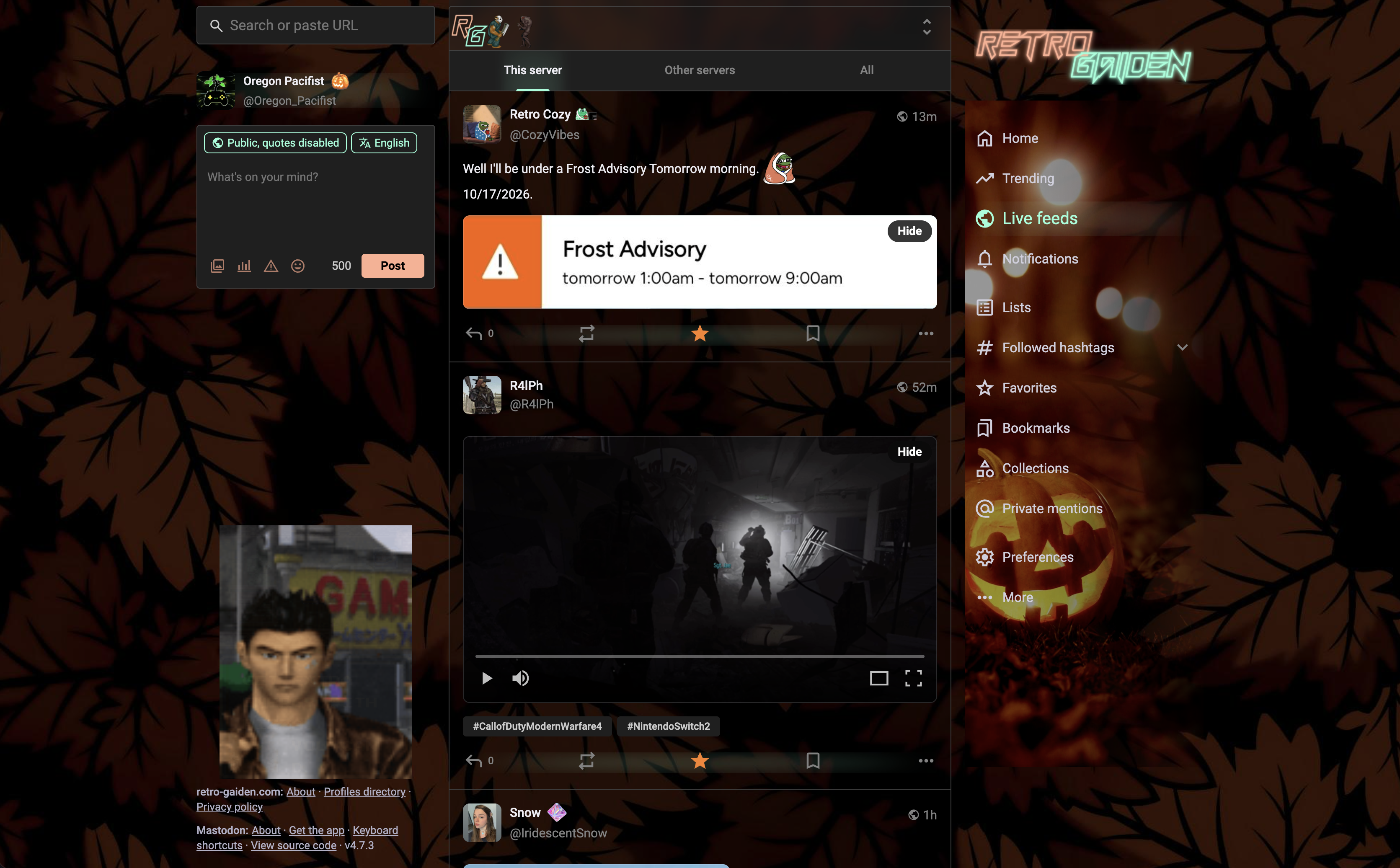
This is how the Retro Gaiden website looks to logged-in users.
It uses default Mastodon software with a heavy amount of custom CSS. The result is an appearance that's unlike anything else on the Fediverse.
#Mastodon #Fediverse #WebDesign
![[?]](https://star.octade.net/media/63a94df7-40e2-42d2-915d-5c141da33d4e.png)
WordPress
GetSimple CMS
Joomla
Typo3
TextPattern
If you want really simple:
WonderCMS
HTMLy
Automad
Typemill
GRAV
Bludit
#CMS #WebDev #HTML #CSS #WebDesign #Webmaster #Weblord #SelfHosted
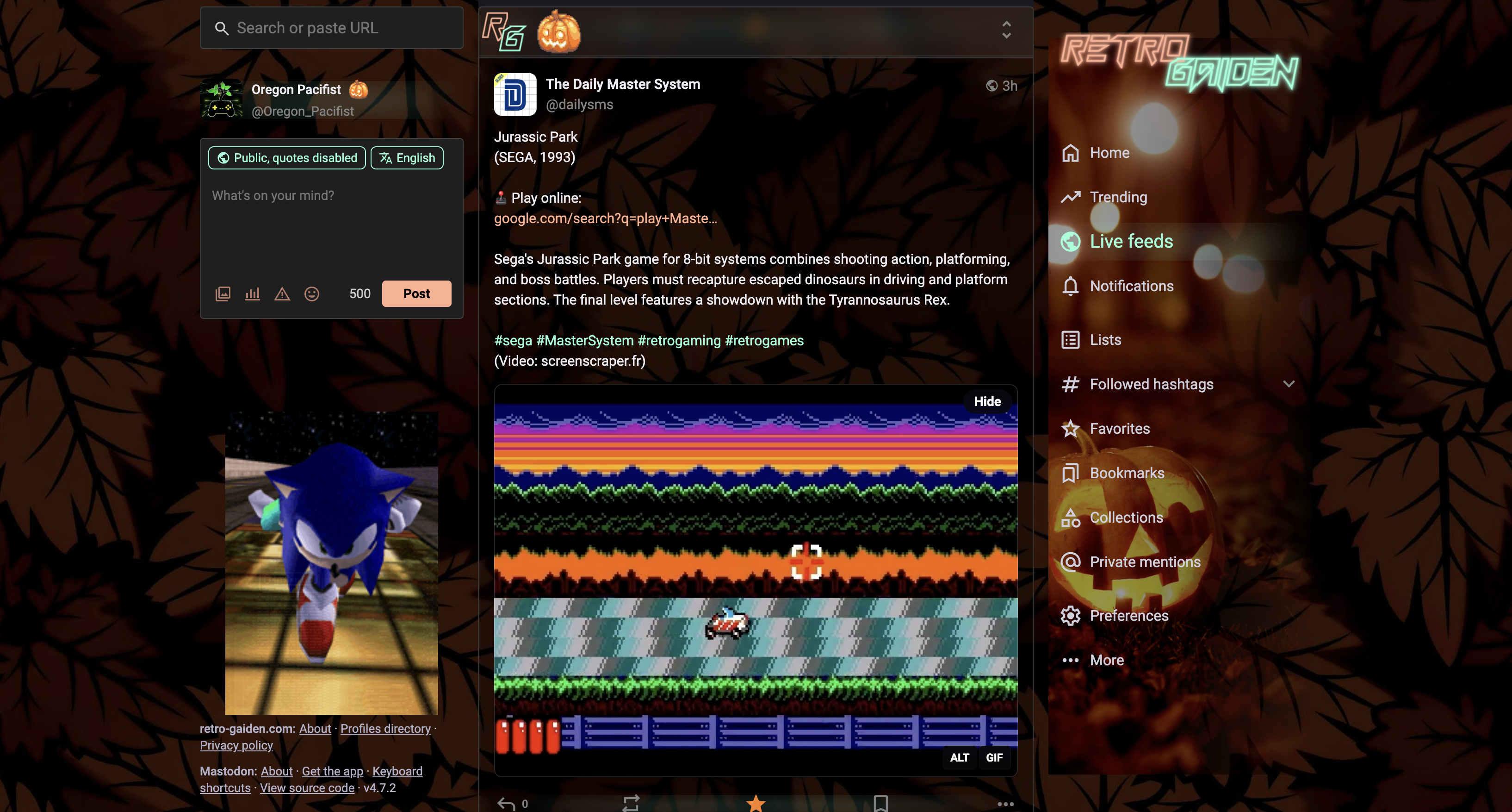
It seems the Halloween theme on Retro Gaiden is universally liked!
A couple of reminders:
1. On November 1st, the Halloween theme will change to a more general Autumn theme. On November 27th, the Christmas theme goes live.
2. Mastodon version 4.8 (due to launch sometime in October) will likely break some of the custom CSS. Elements may not show properly or they might be in the wrong place, etc. I'll correct this ASAP when it happens.
#Mastodon #WebDesign #Halloween
![[?]](https://soc.octade.net/octade/s/3f7f2b5eda4e392867c301c49c2daa16.png)
[demo] https://files.octade.net/
I drafted a prototype for a PHP server application that automatically hashes and signs files and presents visitors with verification archives containing digital signatures for offline verification. The site allows readers to view, download, hash, and verify signatures of files. Since I occasionally like to publish puzzles and bits of cryptology, I just had to make this to scratch the old itch.
The neat thing about this design is that the current version has zero JavaScript. It uses CSS3 hacks with anchors and URL probing to emulate JavaScript and AJAX functionalities for modal dialogs to present server-side JSON data as HTML text.
When I upload files or documents to the server, the interface automatically presents them to the user in a grid. So now all I have to do is upload files and documents and the server generates the site.
The reader can then click buttons to hash, sign, view, verify, and download files.
GnuPG and OpenSSL Signatures are generated automatically on user demand. The site visitors can download these signatures and the public keys to verify files.
What should I add / change in the application and its interface?
What accessibility components might be warranted?
Should the application parse and present EXIF data, or is that too much?
#PHP #CSS3 #HTML5 #WebDesign #UX #cryptology #cryptography #crypto #signatures #OpenSSL #GnuPG #GPG #PGP #encryption #papers #preprints #documents #SelfHosted #WebLord #WebMaster #WebSerf #NoJS #Apache #CyberSecurity
![[?]](https://stockage.framapiaf.org/framapiaf/accounts/avatars/000/089/837/original/01abbbdd418dd20c.png)
𝗥𝗲𝗮𝗹𝗹𝘆 𝗚𝗼𝗼𝗱 𝗘𝗺𝗮𝗶𝗹𝘀:
#Newsletter #webdesign #Gallery
https://thewhale.cc/posts/really-good-emails
Do you need inspiration for your next newsletter webdesign? Check this Email newsletter gallery.

Alt...
Do you need inspiration for your next newsletter webdesign? Check this Email newsletter gallery.
𝗪𝗲𝗯 𝗗𝗲𝘀𝗶𝗴𝗻 𝗺𝘂𝘀𝗲𝘂𝗺:
https://thewhale.cc/posts/web-design-museum
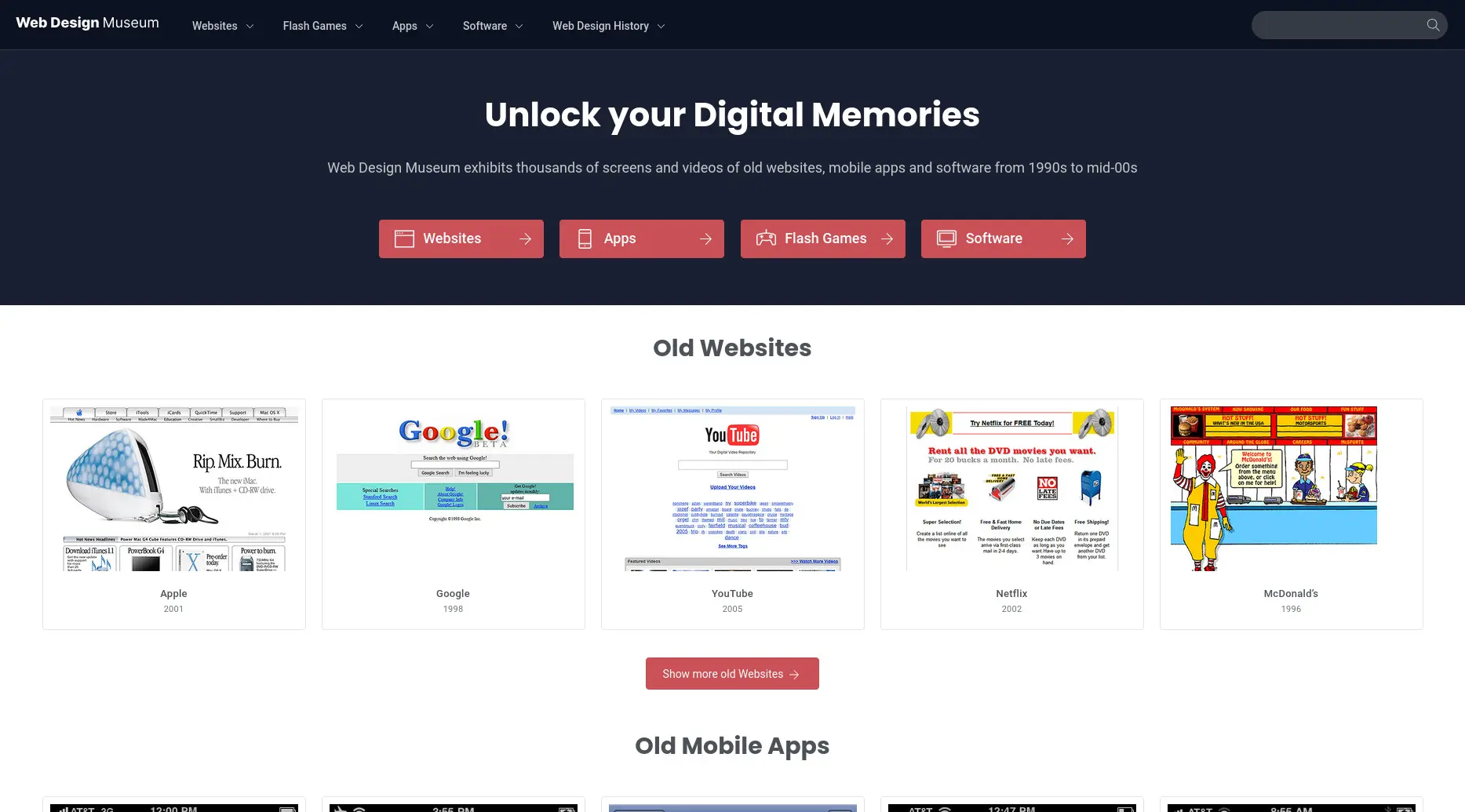
Souvenir, souvenir. The web design museum exhibits over 900 carefully selected and sorted web sites that show web design trends between the years 1995 and 2005.
Alt...
Souvenir, souvenir. The web design museum exhibits over 900 carefully selected and sorted web sites that show web design trends between the years 1995 and 2005.
![[?]](https://cdn.masto.host/floss/accounts/avatars/000/058/894/original/79f2a195ed144037.jpg)
Linux nostalgia as a design choice is never not cool. I dig all the attention to detail, like Pidgin being a social feed and the blog archives being navigable via Nautilus.
https://www.omgubuntu.co.uk/2026/06/website-as-gnome-2-desktop?v1
![[?]](https://media.infosec.exchange/infosec.exchange/accounts/avatars/113/247/756/313/164/165/original/70ea71b3dff2cf65.jpg)

React-like syntax with WebComponents.
After spending some time with Lit, I really appreciated its lightweight footprint but wasn't a fan of the class-based components. While Vue offers a great approach, I still prefer the intuitive nature of React's syntax for debugging and deterministic rendering. This led me to a challenge: could I build a UI framework using WebComponents that completely eliminates the need for transpilation?
I have written a breakdown of the concept, the architecture, and where I want to take it. I highly invite you to take a look, check out the code, and explore the live demo.
* How it works: https://positive-intentions.com/docs/projects/dim/dim-jsx-webcomponents
* Checkout the code: https://github.com/positive-intentions/dim
* Storybook demo: https://dim.positive-intentions.com
Please note, while the project is open-source, this is a personal exploration rather than an attempt to launch "yet another framework." It is not production-ready and is built for my own upcoming project migrations, but I am sharing it in hopes that the methodology is educational or interesting to the community.
I would love to hear your thoughts on this approach. Feel free to reach out if you have any questions or want to discuss the implementation details.
#WebDev #WebDevelopment #Frontend #FrontendDev #JavaScript #JS #TypeScript #TS #HTML #HTML5 #CSS #SoftwareEngineering #SoftwareEngineer #Coding #Programming #WebDesign #OpenSourceProject #IndieDev #SideProject #Tech #Technology #DevCommunity #Fediverse #FediverseDevs #WebStandards #CustomElements #ShadowDOM #VanillaJS #NoTranspiler #NoBuild #BuildStep #EsModules #ComponentDriven #UIUX #DesignSystems #TechExperiment #LearningInPublic #Developer #ComputerScience #OSS #Github #React #WebComponents #Lit #Vue #ReactJS #JSX #Storybook #TechArticle #TechBlog #TechWriting #WebDevArticles

Alt...
Dim