Search results for tag #translation
![[?]](https://polymaths.social/fileserver/01HCMX6M1CZNEVJ4F5H58TT5XJ/attachment/original/01JHC5KM5K0V0J0436SPD3F86H.jpeg)


 🍵
🍵  [
[New #blog #post: Gratitude Day 7: The Art of Translation
https://rldane.space/gratitude-day-7-the-art-of-translation.html
435 words (same as yesterday's! ;)
cc: my wonderful #chorus: @joel @dm @sotolf @thedoctor @pixx @orbitalmartian @adamsdesk @krafter @roguefoam @clayton @giantspacesquid @stfn
(I will happily add/remove you from the chorus upon request! :)
#rlDaneWriting #blost #SeptemberTheme #SeptemberBloggingTheme #SepThemeBear #SeptemberGratitude #gratitude #thankfulness #translation #GradSchool #professor #linguistics
![[?]](https://babka-mastodon.nyc3.cdn.digitaloceanspaces.com/accounts/avatars/110/442/989/214/760/177/original/ac89244bf463bb3e.jpg)
"For many #Jews, the morning of #Oct7 remains seared into memory. In #JoannSfar’s case, it was also the day of his birthday party, which included “as many #Muslims as Jews,” he told me. Amidst tragedy, #Sfar felt a profound gratitude for life, which seemed especially precious. It was a day of fear and uncertainty, followed by many more over the following months. For Sfar, drawing was the only way out.
To Life is Sfar’s #illustrated journal of his experience after Oct. 7, a reflection of his fierce peace advocacy coupled with a profound connection to #Israel. It follows several previous #books by Sfar, who is a #French #Jewish #graphicnovelist best known for The Rabbi’s Cat. His works touch on his #Sephardic heritage, highlighting a history of friendship and brotherhood between #Arabs and Jews.
To Life is the #English #translation of Nous Vivrons, which was #published in June 2024 as the first of a three-part series."
https://forward.com/culture/books/840947/graphic-novelist-october-7-to-life-joann-sfar/
![[?]](https://files.mastodon.social/accounts/avatars/110/441/535/131/897/219/original/0ddf9d4dd12a5dee.png)
The Errant Translator: Field Notes
Artist and translator Sawako Nakayasu considers a multiplicity of approaches to translations.
Books about French fiction -- Translations into English at PG:
https://www.gutenberg.org/ebooks/subject/5605
#books #literature #translation
Alt...
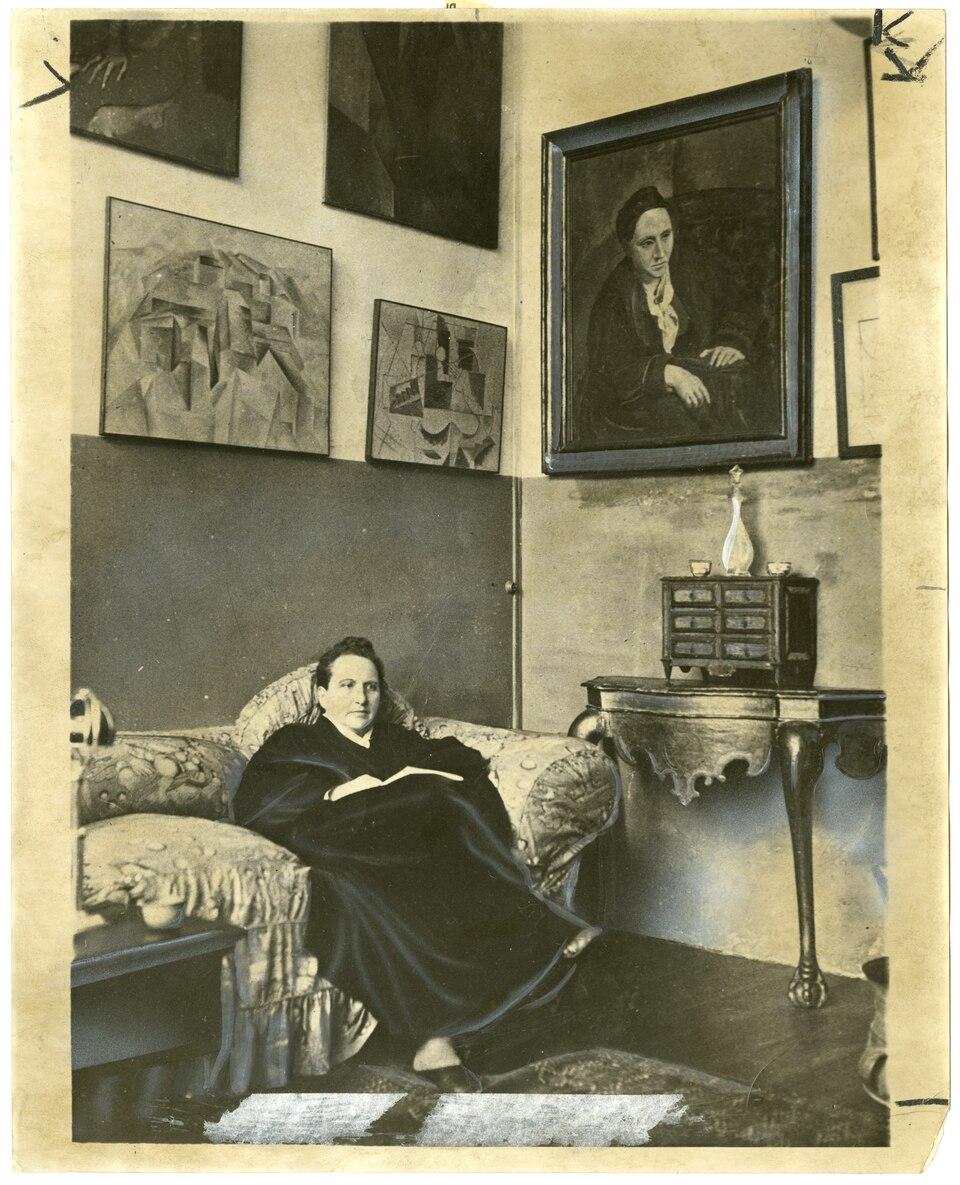
Stein in her Paris studio, with a portrait of her by Pablo Picasso, and other modern art paintings hanging on the wall (before 1910).
Gertrude Stein sits on a sofa in her Paris studio, wearing a dark robe, with a book open on her lap. The walls around her are covered with Cubist paintings, and directly above her hangs Picasso's iconic portrait of her. A small table with drawers and decorative objects stands to her right.
![[?]](https://media.infosec.exchange/infosec.exchange/accounts/avatars/109/287/004/308/114/569/original/602782bbf5d0d8fe.png)
Here is a translation note I wrote just now while working on the Annals of Yanzi, because it's informative on its own:
“Three thousand servants, three girlfriends and four ministers” isn’t necessarily meant to be taken as those exact numbers, but can stand for “a few thousand, a few, several” in the same way that we say “a couple” to mean not necessarily exactly two but definitely more than one.
This is because there is no grammatical singular/plural distinction in Classical Chinese, so you just throw out a keyword that gives the ballpark size and move on. They will often give a range to indicate the non-literal nature, such as saying “five, six colors” to mean “many colors.” Keep this in mind when trying to do math with numbers given in ancient sources!
![[?]](https://cdn.masto.host/mastjohn1126com/accounts/avatars/115/981/910/993/463/416/original/00ac72837ce34a31.gif)
Quick Demonstration:
Translating text without using a web browser, no logins, using free tools:
#Linux
#LinuxMint
#AI
#llama
#ollama
(This translation revealed something that the philosopher, Plato, said, which surprised me.... and his warning is a good one.)
"For those seeking an entry into the most brilliant of #Jewish #legal minds, a recently launched series serves as an immensely rewarding resource. The first volume of #Koren -Publisher’s #Steinsaltz Edition of #Maimonides’ code of #Jewishlaw, the #Mishne #Torah, has been published in English. It seeks to make the legendary #medieval thinker’s #teachings accessible to a wide audience, utilizing the commentary of the late #Rabbi #AdinSteinsaltz, who passed away in 2020.
In addition to the clear English #translation of the source material, this unique edition contains sections covering additional legal perspectives that supplement those of the #MishneTorah itself. Also included are some of the late #Lubavitcher #Rebbe’s writings on Maimonides’ legal rulings.
Most helpful are the conceptual #essays in the back of the #book, which touch upon how Maimonides’ thought has been adapted, and argued with, over the ages."
https://jewishjournal.com/judaism/390555/framing-the-faith-of-maimonides/
![[?]](https://files.mastodon.social/accounts/avatars/115/742/434/865/105/205/original/ba2fa15026c28d18.jpeg)
LibreTranslate is a free, open-source machine translation server that you can use online or self-host for complete control over your data.
It supports multiple languages, offers a simple API, works without relying on Google Translate, and is a great privacy-friendly choice for websites, apps, and personal use.
More details: https://digitalescapetools.com/tools/tool.html?id=libretranslate
#OpenSource #Privacy #SelfHosted #Translation #Linux #FOSS #MachineTranslation

Alt...
Screenshot of the LibreTranslate project page showing it as a free, open-source, self-hosted machine translation API. It highlights support for Python 3.8–3.13, passing build and test badges, a Humane Tech badge, and a preview of the web translation interface translating English text into Spanish.
![[?]](https://mstdn.archaeo.social/accounts/avatars/109/536/646/346/737/618/original/63eedbc70a21c2dc.png)
An interesting aspect of translating #Lovecraft is that he used extremely rare words in the full expectation that his Weird Tales audience wouldn't understand them. He could have written scaly and wrinkled, but he chose squamous and rugose for horrific effect. His horrors were indescribable to such an extent that he didn't even want the reader to understand his descriptions. And this is part of the translator's task too.
Judeo-Christian 
"Among the many #faiths practiced by millions of #Texas #students, a new statewide required #reading list that includes #biblical passages draws from just two traditions: #Protestant #Christianity and #Judaism.
Yet Texas #rabbis say #Jews had no role in shaping how #Judaism appears in the #curriculum, and they disagree with how the lone #Jewish text is presented. Rather than teaching about Judaism on its own terms, they argue, the lessons filter Jewish texts through a #Christian perspective.
The #readinglist, which is expected to go into effect in 2030, will have #publicschool students across the state reading passages from the #NewTestament and mostly Christian #translations of the #Hebrew Bible alongside #literary classics. Of the curriculum’s six #HebrewBible readings, just one uses a Jewish #translation."
![[?]](https://cache.treehouse.systems/accounts/avatars/110/628/855/321/239/565/original/02818afb40ed82f7.jpeg)
Human translators manage good #translation because they comprehend the original text, know its intricacies and can actually creatively write to preserve its gist. Context is more than the surrounding paragraphs: it includes the cultural and social background, other books, etc. Sometimes it literally involves getting hints from the author. And in the end, it is deeply personal. It can't be "accurate", because no two people are the same, and no two languages map 1:1 (though the interpretation will also differ between different users of the same language); the best you can do is add translator's notes.
LLM translators manage good translation because they've been fed tons of human translation work, and quite often they manage to match an original human translation and plagiarize it. They may even seem better because they seem to manage it without sufficient context, but that's only because they've found a human translation that had that context already.
Or, well, technically they can also regurgitate something that makes sense only in the irrelevant original context.
Okay. I FINISHED THE TRANSLATION. Fifty entire pages of modern Chinese philosophy about Western philosophy. It's nominally about "artificial intelligence" but in typical philosophical fashion, it's actually about, uh, colonialism, Catholicism, Van Gogh's weird fucked-up blood and thinking really hard about one specific random photograph of a street.
If you are curious about what is being taught right now in actual Chinese university classrooms about Western philosophy, you should read it. I highlighted several passages that are of particular interest to a Western reader who wants to understand how China sees itself and sees the West.
https://厄.net/backup/western-philosophy-chinese-perspective-ai.pdf
#chinese #translation #philosophy
Alt...
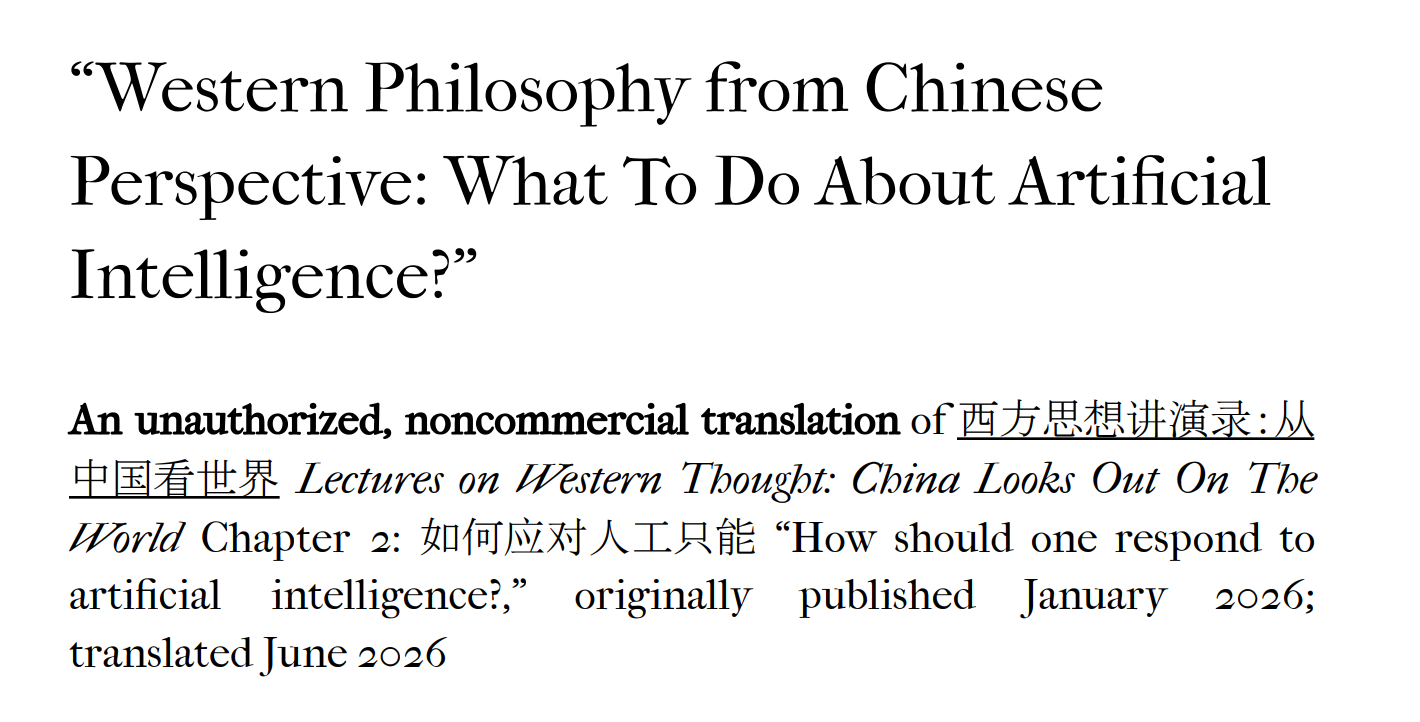
“Western Philosophy from Chinese Perspective: What To Do About Artificial Intelligence?”
An unauthorized, noncommercial translation of 西方思想讲演录:从中国看世界 Lectures on Western Thought: China Looks Out On The World Chapter 2: 如何应对人工只能 “How should one respond to artificial intelligence?,” originally published January 2026; translated June 2026
![[?]](https://soc.octade.net/octade/s/3f7f2b5eda4e392867c301c49c2daa16.png)
In the linked paper, Carl D. Franklin digs deep into the history of the tetragrammaton and debunks some of the myths commonly accepted as fact. The paper is part of a series and well worth the read for anyone interested in textual criticism or translation.
PDF: https://www.cbcg.org/franklin/debunking2.pdf
"Is it true that the name Jehovah borrowed its vowels from Adonai?"Spoiler: No, it is not true. It is a fabrication of a false history. The pronunciation, JEHOVAH was used centuries before Galatinus, so it is impossible for him to have invented it. Moreover, there is exactly zero historical evidence that medieval scholars before Galatinus accepted any pronunciation other than JEHOVAH. They all appear to have unanimously supported this one widely known pronunciation of the tetragrammaton.
A lot of religious and textual myths have resulting in mass misconceptions about biblical textual history and meaning. Some of the myths misrepresent the tetragrammaton, or the name of God. This eventually led to the creation of the artificial name, Yahweh, which is not a Hebrew word, and is in fact a cleverly disguised classical Latin name for Jove. The author defrocks the Galatinus origin myth, proving the name JEHOVAH was in use long before Galatinus.
The sacred name mythos is popular in some Christian and Jewish sects as well as among the Hebrew Roots movement. This paper exposes some of the false history and baseless assertions about the pronunciation of the tetragrammaton. As it turns out, the early Masoretes and the Reformers as well as some early Catholics had gotten it right - JEHOVAH is the correctly preserved pronunciation of the name of God. The name was never 'lost' and it has been known all through recorded history, if even only by a few.
#Bible #MasoreticText #Translation #Theology #History #Philology #Myths #SacredNames #NominaSacra #Judaism #Christianity #Hebrew #TiberianHebrew
ARTICLE: https://x.com/TovRose/article/1844473294503989605
SYNOPSIS
There is no historical or textual evidence that the tetragrammaton was pointed as a 'qere' in the ancient biblical manuscripts. The claim that JHWH is a qere for Adonai is ahistorical and there are only conjectures and not proofs for the qere claim.
Moreover, the structure of the Hebrew grammar proves the tetragrammaton cannot be two syllables, as in the modern neologism, 'yahweh'. The tetragrammaton has to be three syllables, JE-HO-VAH and its shortened form is two syllables: JEHO. Its poetic form is one syllable: YAH and JAH. And there is no support for YAHWEH.
Today we are told that the tetragrammaton or 'sacred name of God' was not pronounced out of 'reverence' for the divine name. This is a Hellenist myth and wasn't even started by Hebrew-speaking people. The tetragrammaton was spoken often inside and outside of the temple, with certain rules about when and where and why it was to be spoken. But there was no actual rule or custom against speaking it--Just rules about making sure to not speak it amiss.
NOTES
Upon reading this article some things stand out to me.
Many claim that the divine name was not spoken and was substituted with 'qere' to avoid speaking it out of reverence for the name. And this is a lie.
Anyone who reveres a name actually wants to speak it and does so with respect and pride, rather than substituting a nickname. It is when we hate someone that we refuse to speak their name or prohibit others from speaking it. For example, most of the world hates the mustache man, and invoking his name is discouraged in polite conversation.
The Hebrew bible text itself repeatedly commands Israel to proclaim the divine name, not to hide it behind nicknames. Any reverence for God and his commandments would prohibit the use of 'qere' substitutions. Thus those who invented these customs were not revering God--they were dishonoring him deceitfully.
So the claim that the name was not to be spoken is nonsensical religious dogma of certain mystical sects, and not historical practice of either the temple priests or the Christians who inherited the Levitical tradition after the destruction of the temple. We must remember true history: When the temple was destroyed, the surviving Jews in Jerusalem were carried off into captivity into other parts of the world by Rome. The Jews who had converted to following Jesus before the destruction of the temple had already escaped Jerusalem before the Roman siege, and carried the traditions with them, and preserved them in early Christianity. These first Christians, most of whom were Jews, had no such custom or injunction against saying the divine name, and it shows in their writings, and in their predecessors copious transliteration of the name. Their tradition was the foundation of European Christianity, which joined forces with the Sephardim to preserve the Old Testament and Hebrew language for over a millennium of years. The Masoretes properly pointed all the words, including the divine name, to preserve their pronunciations.
The entire purpose of the Masoretic vowel pointings was specifically to preserve the correct pronunciation of every Hebrew word in the text, not to hide the pronunciation. There would have been a worldwide uproar in the scholarly community over such a practice as wrongly writing the divine name or mispronouncing it. The historical record is silent on such a thing ever occurring.
The name Jehovah with the 'J' sound is correct ancient Hebrew pronunciation of the divine name. Just as the Sephardim scribes have preserved it all these centuries, the Christian scribes took over their tradition and continued to preserve it from the time of the reformation onward. When Tyndale rendered the name as IEHOUA, he was using the pronunciation taught by the Masoretic scribes and their Christian cohorts. It was not an 'invention' but rather a transliteration into English characters of the day.
We are now at a new crossroads in history where many occultists, kabbalists, pagans, and sectarians are once again attacking the divine name and trying to cloud it with confusion and false myths. This is what liars have always done--invent stories to support their delusions. Perhaps in the coming centuries we should expect another vanguard to come and take of the tradition of preserving the name against this army of confusion.
#Bible #MasoreticText #Translation #Theology #History #Philology #Myths #SacredNames #NominaSacra #Judaism #Christianity #Hebrew #TiberianHebrew
@infostorm@a.gup.pe @academicchatter@a.gup.pe @translators@a.gup.pe @theology@a.gup.pe @religion@a.gup.pe @histodons@a.gup.pe
In the linked paper, Carl D. Franklin digs deep into the history of the tetragrammaton and debunks some of the myths commonly accepted as fact. The paper is part of a series and well worth the read for anyone interested in textual criticism or translation.
PDF: https://www.cbcg.org/franklin/debunking2.pdf
SYNOPSIS
"Is it true that the name Jehovah borrowed its vowels from Adonai?"
Spoiler: No, it is not true. It is a fabrication of a false history. The pronunciation, JEHOVAH was used centuries before Galatinus, so it is impossible for him to have invented it. Moreover, there is a lack of historical evidence that medieval scholars before Galatinus accepted any pronunciation other than JEHOVAH. They all appear to have unanimously supported this one widely known pronunciation of the tetragrammaton.
A lot of religious and textual myths have resulting in mass misconceptions about biblical textual history and meaning. Some of the myths misrepresent the tetragrammaton, or the name of God. This eventually led to the creation of the artificial name, Yahweh, which is not a Hebrew word, and is in fact a cleverly disguised classical Latin name for Jove. The author defrocks the Galatinus origin myth, proving the name JEHOVAH was in use long before Galatinus.
The sacred name mythos is popular in some Christian and Jewish sects as well as among the Hebrew Roots movement. This paper exposes some of the false history and baseless assertions about the pronunciation of the tetragrammaton. As it turns out, the early Masoretes and some early Catholics and the later Reformers had gotten it right - JEHOVAH is the correctly preserved pronunciation of the name of God. The name was never 'lost' and it has been known all through recorded history, if even only by a few.
#Bible #MasoreticText #Translation #Theology #History #Philology #Myths #SacredNames #NominaSacra #Judaism #Christianity #Hebrew #TiberianHebrew #Language #Linguistics
@infostorm@a.gup.pe @academicchatter@a.gup.pe @translators@a.gup.pe @theology@a.gup.pe @religion@a.gup.pe @histodons@a.gup.pe