Search results for tag #plan9
![[?]](https://gamerplus.org/system/accounts/avatars/114/497/966/782/841/054/original/c3c1b4d840d49021.png)
![[?]](https://assets.merveilles.town/accounts/avatars/110/618/037/889/897/311/original/7685c244dff08111.png)
@robpike sorry to bother you, but could you please confirm or debunk this theory?
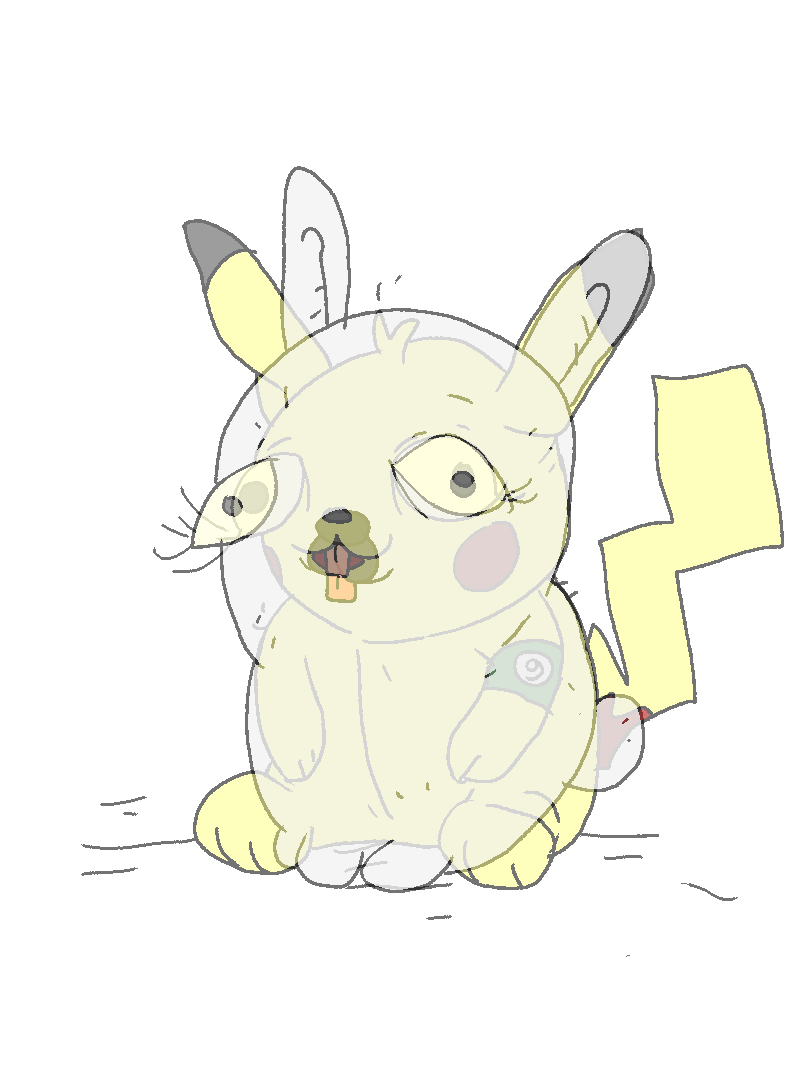
Glenda is based on Pikachu.
#glenda #pikachu #plan9 #9front #unix_surrealism

Alt...
it's a pokeman pikachu, just chilling with its signature 9 armband

Alt...
the rabbit glenda, chilling
Alt...
glenda and pikacho overlayed, implying there's suspicious similarity between the two
![[?]](https://hj.9fs.net/p/s/avatar-dea0df353fcc369128b6bd7ae161bec5.jpg) p » 🌐
p » 🌐
@p@hj.9fs.net
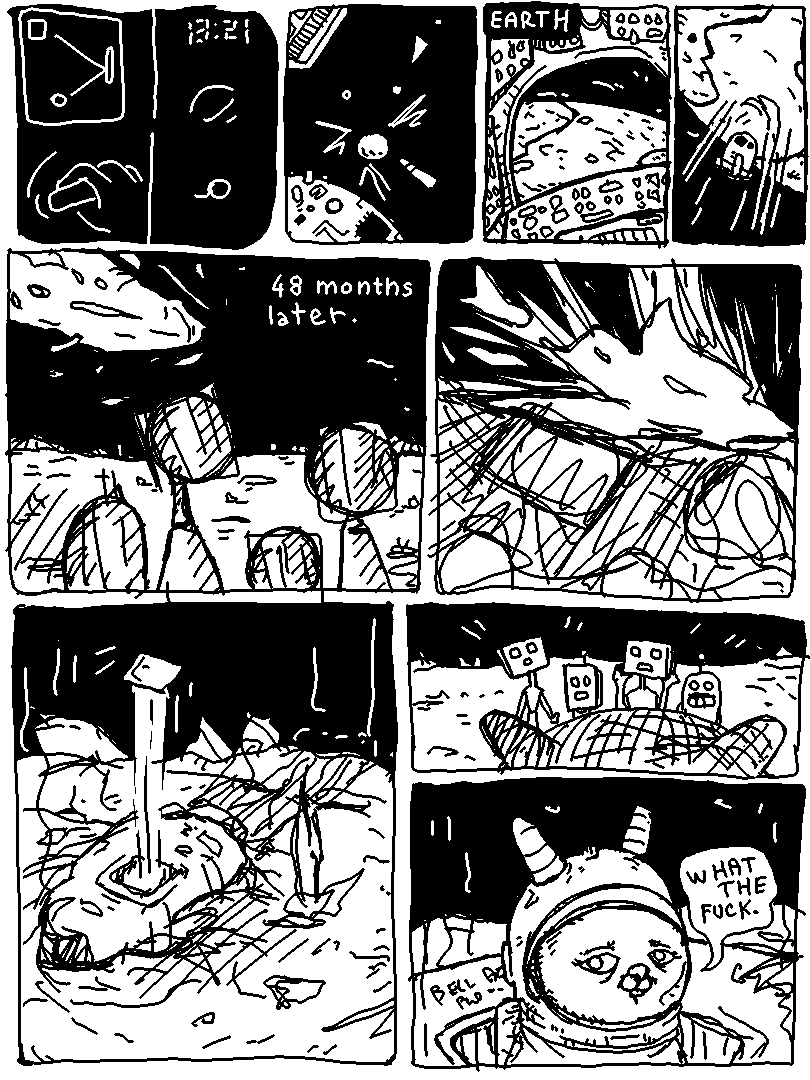
#unix_surrealism #9front #bobby_glendys #glenda #plan9 #lunic

Alt...
So.. um.. Bobby Glendys somehow made it to Arrakis, and he convinced the local tribals that he's some kind of a 9front prophet. ; We need, uh, like, 900 trillion dollars to... uh... build a space ship.. fuck. That boy has been nothing but trouble. I don't need this shit. Where even is his mother?


 🍵
🍵 
![[?]](https://polymaths.social/fileserver/01HCMX6M1CZNEVJ4F5H58TT5XJ/attachment/original/01JHC5KM5K0V0J0436SPD3F86H.jpeg)
#POLL Results:
44 people are in deep denial about their existential dread, and should consult a counselor and read #Kierkegaard immediately 😁
139 people like teh pretty tings, and can't be bothered
188 people have started down the path towards enlightment
354 people are cool_kids
92 people are very_cool_kids
55 people laugh at your inadequate security model
27 people can run a server on a bit of bailing wire and a microcontroller from 1987 — fear them.
26 people are keeping Gassée's dream alive, and are plenny cool in my book
4 people are totally cool, and totally in a class by themselves
and 21 people kinda scare me, but I'd like to know more. 🤣
#humor #humour #houmor #houmour
#Windows #MacOS #Linux #CommandLine #BSD #RunBSD #FreeBSD #OpenBSD #NetBSD #Haiku #HaikuOS #BeOS #Amiga #Workbench #AROS #AmigaOS #Plan9 #9Front #TempleOS
P.S., wherever you find yourself, you're awesome. This is all for fun.
I am continually amazed by Unicode.
I remember having to use custom software just to read/write Arabic text in the early 90s. And it's not like that software enabled the OS to do so, it let you read and write Arabic in that application, only. It was a standalone Arabic text word processor.
I think it was called Al Katib, but I can't find anything on it online. It was for the Mac.
Even in the early-mid 2000s, I remember seeing a friend's Windows XP machine with Japanese internationalization. Pretty sure it used something like Shift-JS, because the \ character always showed up as a Japanese character. ;)
And by some miracle, we have this text system with literally millions of code points (if I'm using that term correctly), and yet it looks just like normal 7-bit ASCII most of the time (thanks to the #Plan9 devs).
Amaze! Amaze!
Cirno and large Glenda
https://www.redbubble.com/shop/ap/182153619
#unix_surrealism #cirno #glenda #plan9 #9front

Alt...
Cirno and large Glenda
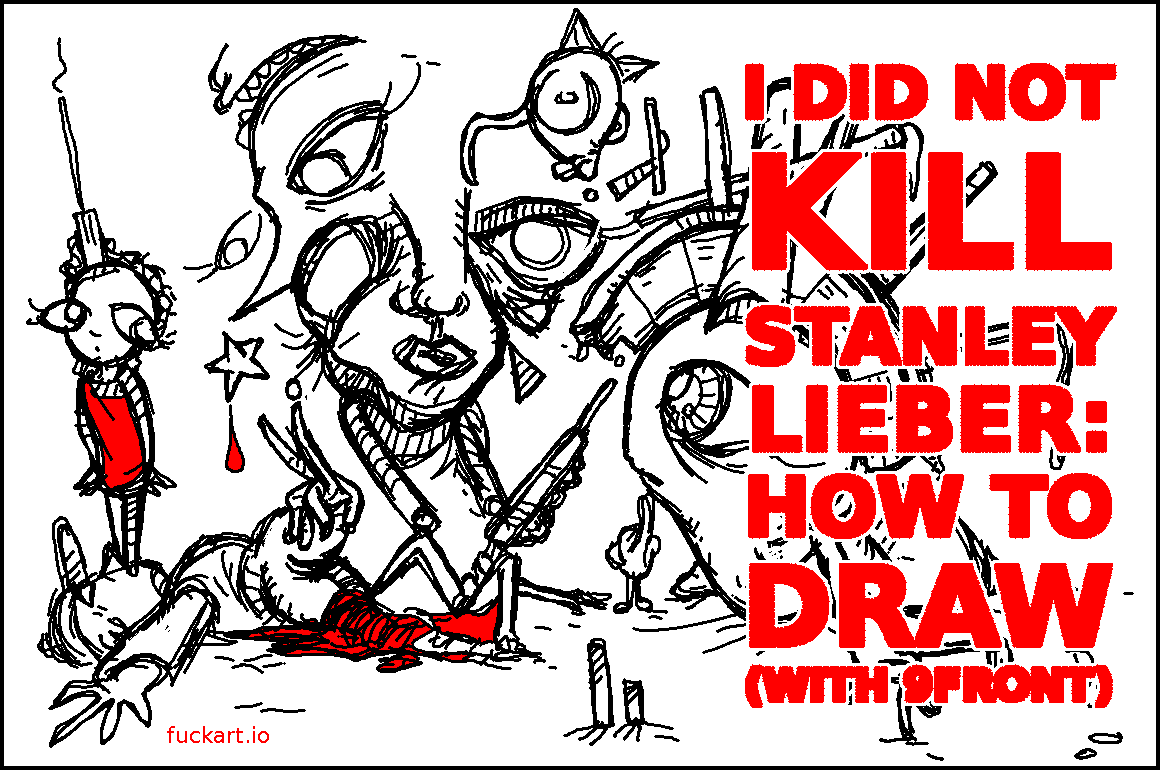
I Did Not Kill Stanley Lieber: How to draw (with 9front)
The penultimate paper on paint(1) and the 9front art machine.
https://triapul.cz/automa/i_did_not_kill_stanley_lieber
#unix_surrealism #plan9 #9front #art #guide #computers #oldcomputerchallenge
Alt...
poster for
"I Did Not Kill Stanley Lieber: How to draw (with 9front)"
there's some characters or something, I can't tell
![[?]](https://assets.merveilles.town/accounts/avatars/000/000/005/original/edce181033892827.jpg)


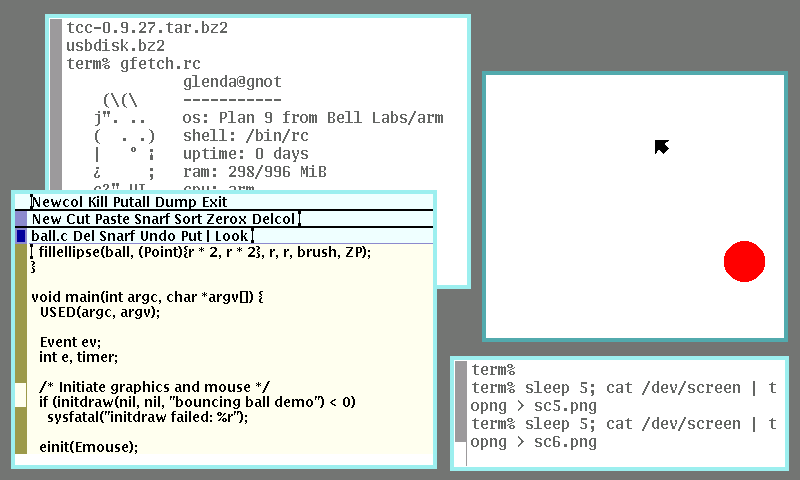
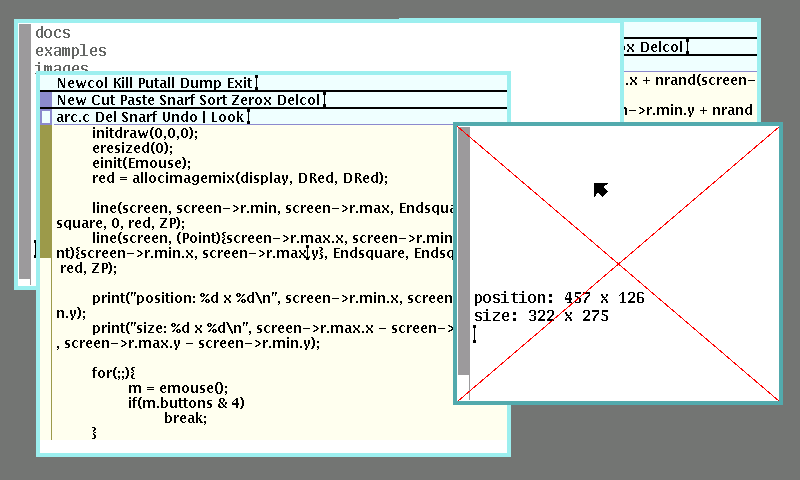
Figured out the basics for drawing stuff I think. The docs are pretty great.
Also, I'm becoming a freaking ACME magician, I love the chords scheme thingy.
http://man.postnix.pw/9front/2/draw
I think I will make a #plan9 cookbook with a bunch of examples files like I did for Think Pascal and 6502 Assembly.
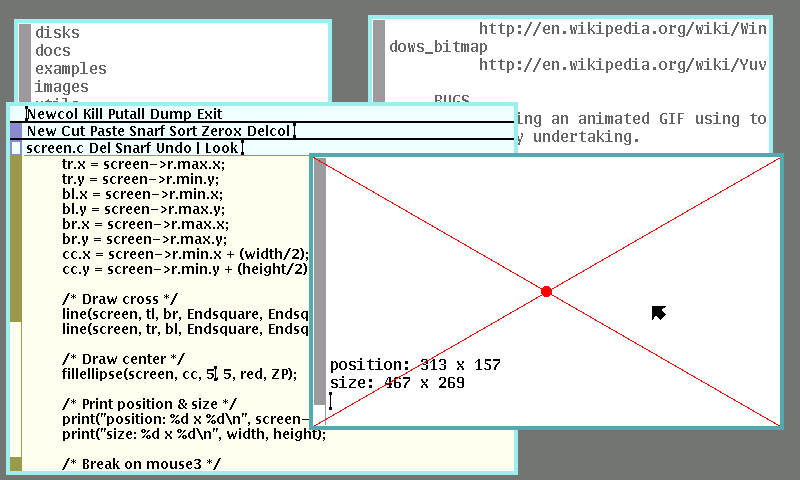
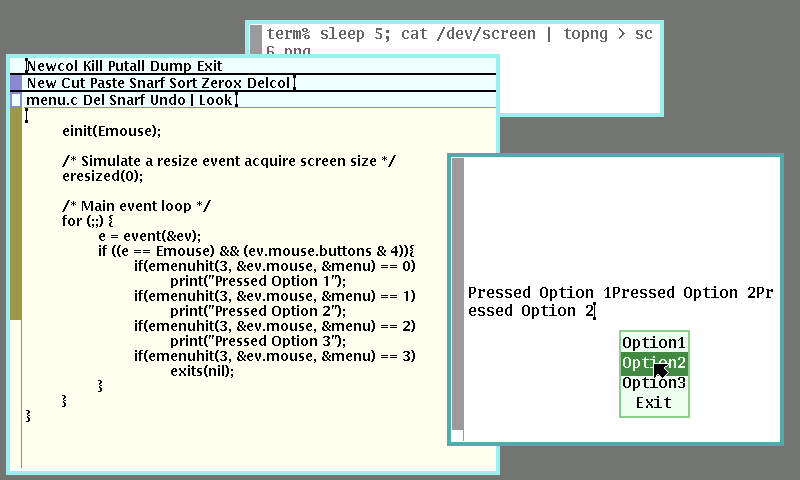
Managed to compile asm6 with pcc and resume my 6502 work, only this time, in #plan9.
Dreams do come true.

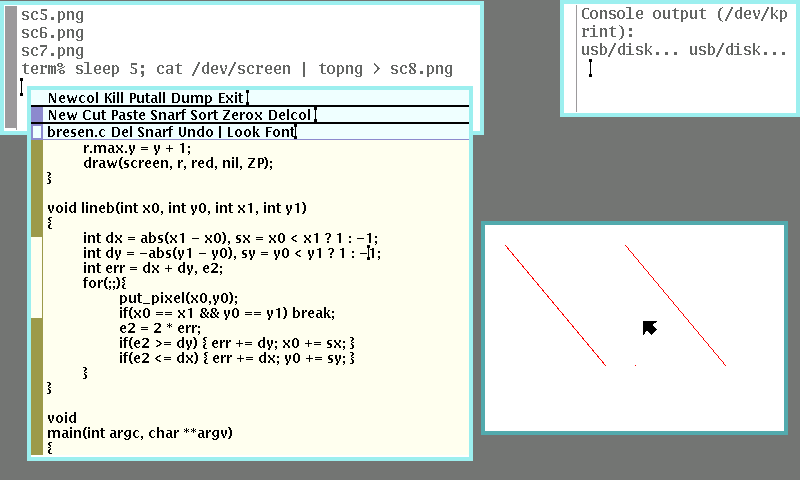
I know I told myself I wouldn't waste time doing this but the #plan9 babyblue was NOT calming me down, at all.

Made #plan9's Acme feel a bit more confortable, hacked it a bit so shift+arrows move the selection left and right. Total game changer.
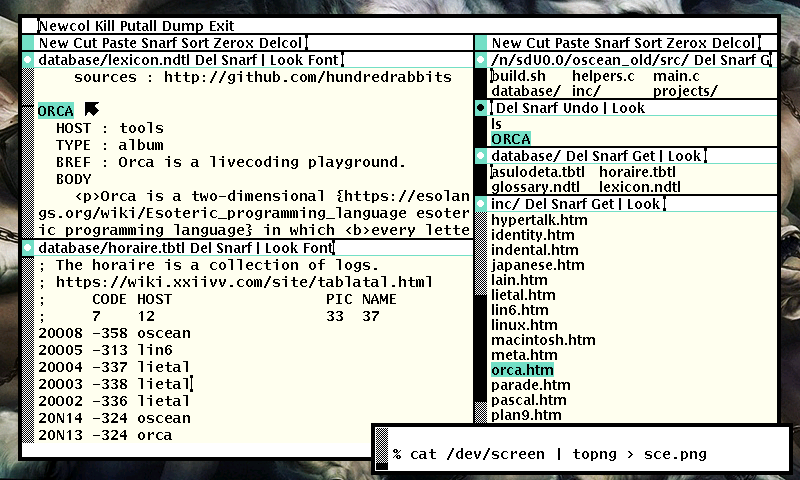
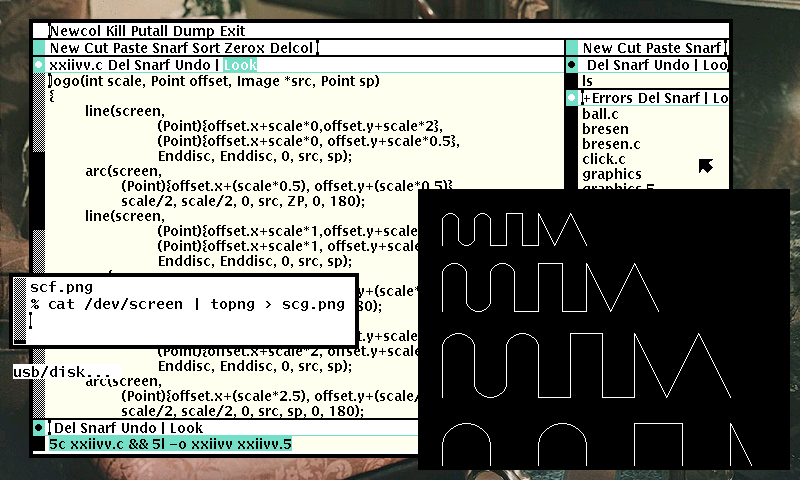

AH! Here we go, 3d from scratch basically. I tried importing some stuff like libgraphics and other fanciful things into #plan9, it was too hard for me. I ended up just rebuilding my tiny wireframe engine in a hundred lines or so, no dependencies.
https://wiki.xxiivv.com/site/graf3dscene.html

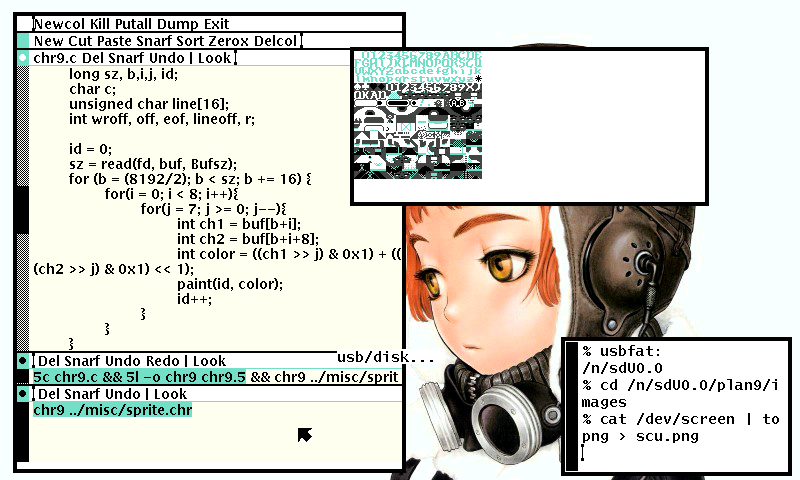
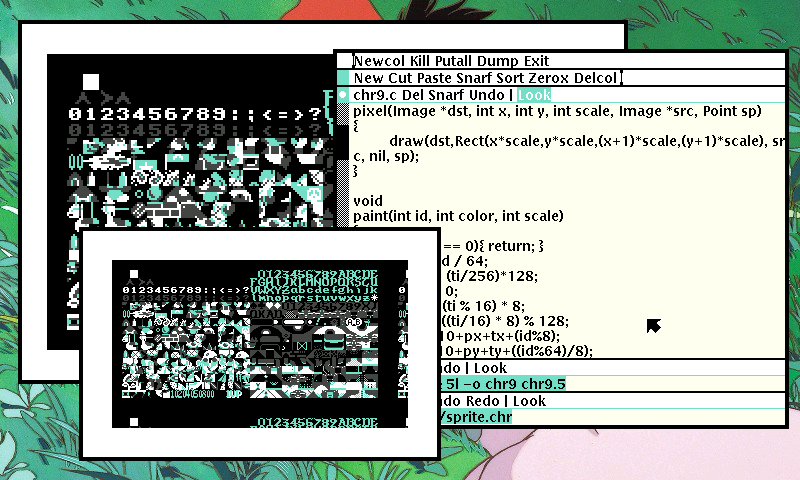
Completed my little .chr(famicom sprite format) file viewer util for #plan9, added context menu for zooming.
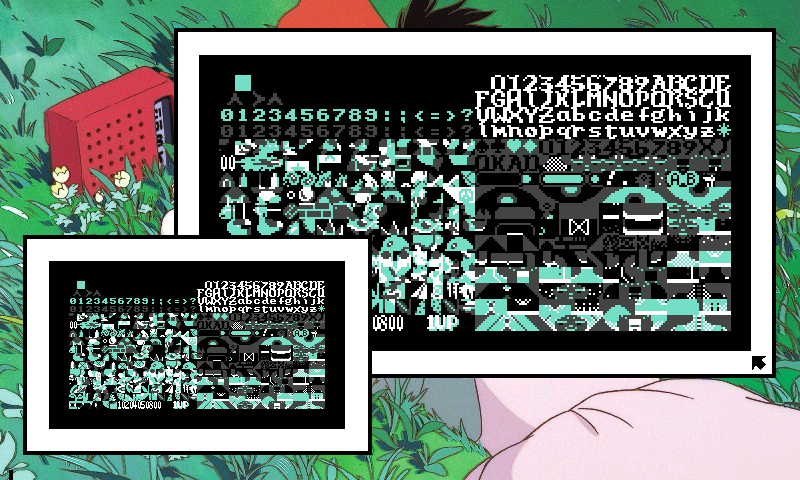


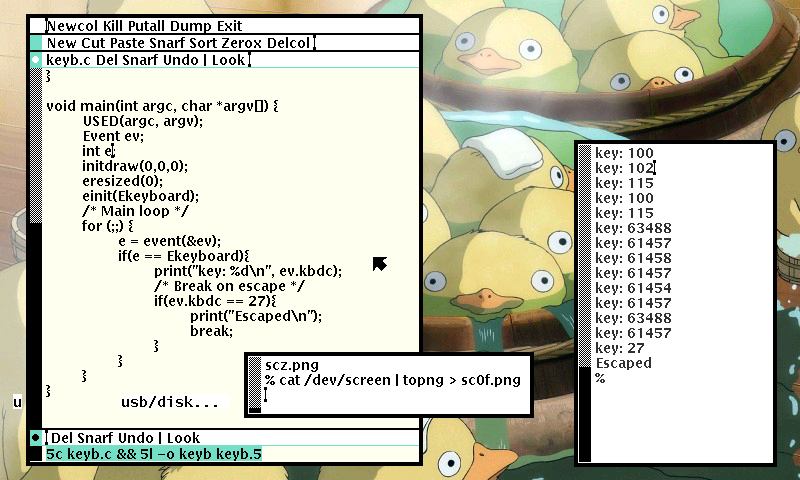
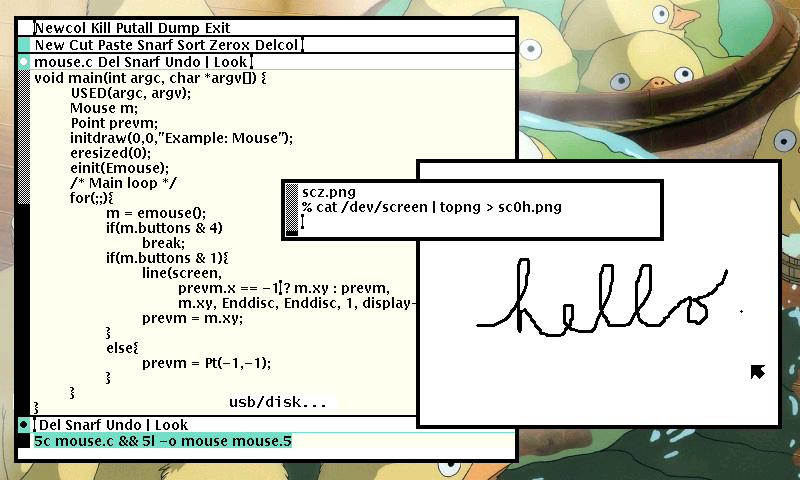

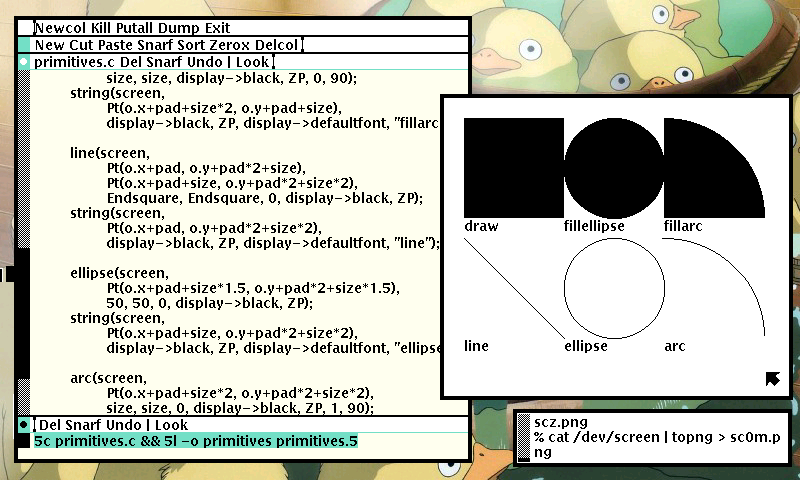
Created a bunch of simple #plan9 example projects!
https://wiki.xxiivv.com/site/plan9_c.html

![[?]](https://media.mathstodon.xyz/accounts/avatars/109/308/315/960/319/189/original/8bcb7021908599d9.jpeg)
#UNIX is not just an OS; it is the ultimate #IDE for #programmers. Arguably the best written introductory book on UNIX programming is "The UNIX Programming Environment", Kernighan (1983). This book covers UNIX V7, but I used it with 4.2BSD.
There is another jewel of a book of a similar kind, a free one to boot, by Prof. Ballesteros (King Juan Carlos University): "Introduction to Operating Systems Abstractions Using Plan 9 from Bell Labs" (2007). Prof. Ballesteros wrote this book to teach his CS students the fundamentals of good OS design.
Although almost no one uses #Plan9 today, it is alive and kicking. It even runs on Raspberry Pi. Anyone interested in OSs and likes the philosophical underpinnings of UNIX should take a look at Plan 9.
The other must-read book is his "Notes on the Plan 9 3ed Kernel Source" (2007).
Prof. Ballesteros has many Plan 9 related publications in PDF format.
https://lsub.org/books-papers/
PS—Those with a historical bent should also read Organick's "The Multics System: An Examination of Its Structure" (1980). Multix is the mother of UNIX, and Plan 9 is the grown-up UNIX.
![[?]](https://assets.merveilles.town/accounts/avatars/110/441/858/788/635/312/original/0eaa24c998120db0.png)
Doot do doooooot
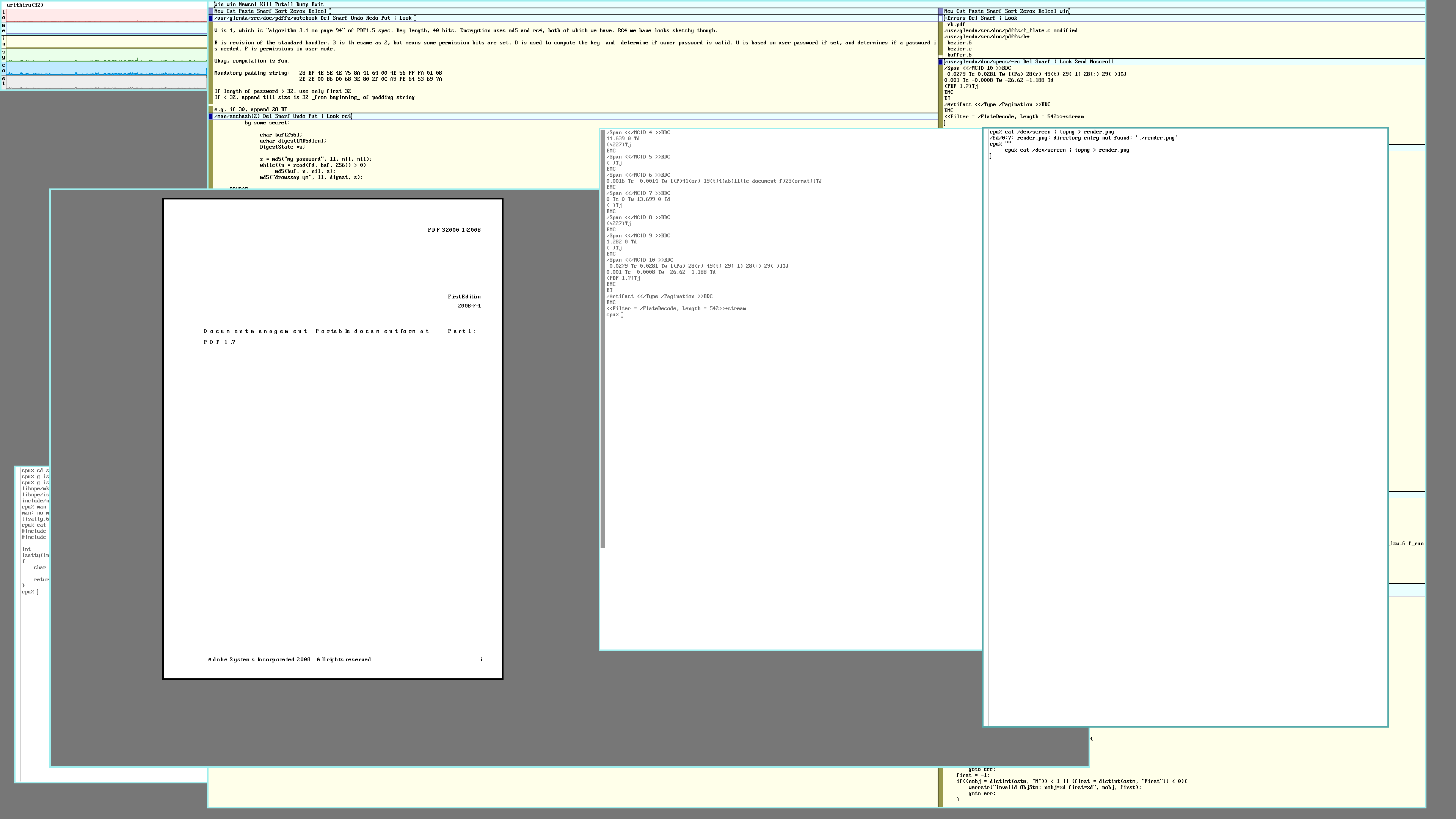
got encrypted PDFs opening on plan9 :)
maybe now that I can read the PDF specification I can use it to get better font renderings :P
![[?]](https://soc.octade.net/octade/s/3f7f2b5eda4e392867c301c49c2daa16.png)
SkiftOS : https://skiftos.org/
It's not a *NIX!
"skiftOS isn’t POSIX. It’s a fresh API and userland inspired by Plan 9, Haiku, and Fuchsia. Familiar ideas, different contracts."
Problem: the GPL is poison. It has polluted Linux and the Linux userland software so that only large corporations can afford to monetize it. BSD License or MIT License would be much better allowing small players to produce unique work without then being forced to share their source code with the AI hegemony racket.
#SkiftOS #Tech #Linux #OS #Plan9 #Haiku #Fuchsia #Computing #SoftwareFreedom #AIHegemony #GPL #License #BSD #MIT
