Search results for tag #p2p

#Jami is a truly great option for desktop and laptop/notebook secure communication. #E2E encryption in a #FLOSS #software, also for #Android and #IOS
https://jami.net/
Instant messaging
Audio and video calls
Group chats
Video-conferences and Rendezvous points with no third-party hosting
Audio and video message recording
Screen sharing and media streaming
Built-in extension platform for new features and experiences
Jami can also function as a SIP client
#p2p #secure #privacy #gnu @Jami


The Programmer’s Fulcrum 23 October, 2026
This post originally appeared on the Fulcrum. Welcome to this week's The Programmer's Fulcrum. It's your weekly curation of the essential news in the Open Media Network and Open Social development communities with a focus on devastating big tech via Techno Anarchism. As usual, we aim to provide actionable content you can use to destroy Techno Feudalism each week. It has the additional benefit of weakening authoritarianism. IMHO, the best way to do that is to use tools from the Techno […] [SENSITIVE CONTENT]
This post originally appeared on the Fulcrum.
Welcome to this week’s The Programmer’s Fulcrum.
It’s your weekly curation of the essential news in the Open Media Network and Open Social development communities with a focus on devastating big tech via Techno Anarchism.
As usual, we aim to provide actionable content you can use to destroy Techno Feudalism each week. It has the additional benefit of weakening authoritarianism.
IMHO, the best way to do that is to use tools from the Techno Anarchist Manifesto to build your own site(s) to participate in the Open Media Network. Then you should share it (them) via Real Simple Syndication (RSS), Open Social, and possibly a newsletter or podcast. This approach is similar to what some call the IndieWeb and its POSSE philosophy.
The second best strategy is to have accounts on open social and use the hell out of them. And do the same with a RSS feed reader.
If you want some recommended tools see our LESS stack.
We publish TPF on Fridays so you can enjoy it over your weekend.
There’s good stuff in all of our categories, so please take the time to enjoy and bookmark the items most relevant to your goals. We hope you are inspired to create new ones.
Or you can scroll down to your favorite section.
FYI, my opinions will be in bold. And may involve cursing. Because humans. Especially tech bros. And fascists. Fuck´em.

⬆️ Just an image. Search for the handle below.
Follow or contact us on the Fediverse
Just copy and paste @thefulcrum into your platform/client’s search field and hit follow.

⬆️ Just an image. Search for the handle below.
Or in the Atmosphere
Again, just copy and paste @thefulcrum.eurosky.social into your Atmosphere app’s search field and hit follow.
Featured Item(s)
Open Media Network has this timely item:
In the Open Media Network (#OMN), the commons represents both the foundation and the destination of the native open web. Rather than relying on closed web corporate dotcons or top-down state power, it re-frames the commons as a practical, lived alternative. You might call it a “quiet” form of collective ownership and mutual aid grown into daily social infrastructure.
For example:
I finally got around to customizing our Bear (cross-posting) blog:
I am seriously considering practicing what I preach with LESS, and moving this site to Bear (or an equivalent) next year. I’ve had it with convoluted, increasingly AI ensloppified, and heading towards enshittified CMSs like Drupal, WordPress, Ghost, etc. They are no longer fit for purpose with small sites. Jamstack sites are just as bad.
Sticking to markdown, HTML, and CSS is a constraint that breeds creativity, resists techno feudalism, and refuses fascist artifacts like AI.
I would move our Fediverse account to self-hosted serving with Starling. And kill the newsletter.
CMSs
Offprint News announces:
Publii has a new theme:
Blogmere: a magazine theme for lifestyle and culture journals
Silex announces:
Silex 3.10.0-canary.4 is out, a prerelease for testing
Typemill announces:
[https://typemill.net/news/typemill-2-28-0-soloprint-is-free-and-deeper-git-integration]
WordPress
Roddie Ouijital explores:
WordPress parent’s problematic plans for .php (pending primary-string payoff)
Blind Access Journal shares:
An Open Letter to Matt Mullenweg on Accessibility in WordPress
I doubt they will get any satisfaction from WP’s increasing deranged, techcunt founder.
I ran across this new federated blog project this week:
Omnicron: Write freely. Share universally.
This could be a promising Bear alternative.
IndieWeb
Joe Crawford has:
Ilyess shares:
My Quest for IndieWeb Citizenship
Small Web
Nat’s Space is:
Challenging myself to make for the web
I’m not quite here yet. But, see my Bear note above.
Ghost
Ghost announces:
As usual, this is for the Pro plan or self-hosted versions.
Magic Pages shows us how to integrate:
Emoji reactions for your posts, without tracking
Tools
The NLNet Foundation has:
NLnet Labs as an open-source software steward under the CRA
NLnet Publishes More Stringent Generative AI Policy
Small Web
Long Live the Web shares:
Let’s hope this is true.
Chat / Team Chat
About Signal reports:
Signal registration without a phone number now available on Android
Xoron examines:
Anything is better than NodeJS.
Browsers
Servo shares:
August in Servo: CSS Grid, text selection, and more!
Better a late update post than none. 😉
Webkit announces:
Blocking Identity Resolution Infrastructure
Cloud
Nextcloud takes a look at the techcunts at Microsoft:
Your Data. Their Rules. – Sovereignty washing at its finest
Writing
The Document Foundation documents:
The history of the standardisation process of the proprietary OOXML format
Creative
9to5Linux reports:
Calibre 9.17 E-Book Manager Adds JPEG XL Support and Performance Improvements
Linux / Open Android
And:
Ubuntu Touch OTA 2.1 Rolls Out with Support for Volla Tablet, Various Updates
Nura announces:
Improvements in internationalization and localization
F-Droid announces:
F-Droid and F-Droid Basic were updated to 2.0.1 and 2.0.2
And iode announces:
Find My Device: find your phone, keep your privacy
Alternatives numériques has an:
Interview croisée d’Agnes Crepet (Fairphone) et Gaël Duval (Murena et /e/OS)
This week’s featured OMN tool
Hyper8
Hyper8 is a static site generator for video publishing.
Programming
Tech Policy Press reports:
EU’s Digital Sovereignty Push Runs Up Against Budget Cuts for Civil Society
Whenever you think things can’t get worse with governments, you’re wrong. And other than the U.S. (ironically) it’s about to be a bad election season for democracy. As anarchists have said for years, you can’t count on governments for funding anything other than repression. So, it’s up to us to support and donate to TAM software tools.
TetraLogical looks at:
WCAG 3: a different future for accessibility
Eric Bailey says:
The Accessibility Compat Data project has a homepage now, and you should support the project
And Rob Ricci says:
What a Terrible Day to Have a Computer
This is so tiring.
The PHP Foundation (the gods bless them) explain:
Today’s PHP Security Release, and How We’re Strengthening PHP Security
Fortunately, as Elias Taylor notes:
There isn’t an easy exploit for this PHP vulnerability
And The Atlantic has this click bait headlined (but important) related article:
‘If Anything Happens to This Guy … Everyone Is Screwed’
Git
Bastian Greshake Tzovaras explores:
Using Codeberg’s git-pages deployment with git lfs
Markdown
I ran across the ATProto markdown tool, Reams this week:
Michael Hanscom shares a:
Wishlist: Truly Semantic Plain Text Markup
CSS
Piccalilli examines:
Native masonry layouts with CSS grid lanes
CSS god, Josh Comeau looks at:
AI
404 Media reports:
AI Is Changing Everything About Hacking. No One Knows What Happens Next.
Other
OpenProject has:
Passion Project: Discover what’s new in OpenProject
This week’s featured programming tool
HTML
Structure your site.
ActivityPub
Lorenz Diener explores:
New Features in Mastodon.py 2.3
This week’s featured ActivityPub featured tool
FediDB
FediDB indexes 41,097 servers across 522 software projects, checks every one of them each day, and publishes all of it through a free public API.
Permanent aside here (unfortunately)
This is a perpetual pet peeve because many people aren’t able to comprehend ⬇️:
- The Fediverse is for communities (private, semi-private, formal, informal, or otherwise)
- and the Atmosphere is for the masses (unwashed, washed, or otherwise).
- and corporate social media is for naive fools and intentional techcunts.
So, recognize their natures and don’t ask the two protocols to go against them. This is also why we have accounts on both platforms and use them differently.
Fediverse
Steffen Voß says:
Das Fediverse ist viel mehr als nur ein weiterer Social-Media-Kanal
FediDB heralds:
Phoenix Paulina Schmid looks at:
Threads and the Fediverse: The Threat that Wasn’t
Let’s hope it stays this way.
Mastodon announces:
Everyone is celebrating the competent UI.
Catodon has:
Catodon recently implemented Mobilizon/Gancio events
HolosSocial announces:
My mistake was making it easy to run the server on your device, but not to get your own identity.
More
A New Social shares its thoughts on:
On Nostr, Farcaster, and other protocols
Tech Policy Press says:
A great new project, SocialSpec has:
App Spotlight: WordPress (Plugins)
I got this rolling on the backup Fulcrum Too (WordPress) site. You have to import your RSS following list via a plugin as well. Here’s our list if you want to bulk follow it. Which you should. 😉
David Gardiner examines:
WebSub notifications when my blog has new content
TechDirt opines:
Accident Or Not, The No Kings Takedown Is Why You Shouldn’t Rent Your Megaphone From Zuck
True, but his boys at Bluesky are on a path to catch up with Failbook level enshittification in the next few years.
ATProto
ATProto announces:
An Intro to Atmospheric Groups
Again, this is one of the main developments for why we pivoted with our Manade project.
We just cut another spaces alpha release
Tynan Is Typing claims to be:
JolaDev shares a clickbait headlined, but good article:
The time Bluesky tried to kill my server
This is why you shouldn’t self-host your PDS, yet.
Atmosphere
Atmosphere Money is:
Skyreader has a:
Skyreader update – Saved searches, PDFs and books, Semble Connections, and more
Cosmik Labs explores moving:
From Personal Knowledge Management to Collective Knowledge Gardening
W Don’t Have Time reports:
Just 18 unverified VIP accounts produce more than half of all W Social content
P2P
LoRes Mesh examines:
Offline websites with Kiwix, but P2P
Worm Blossom looks at its:
RSS
Buttondown says:
Google Reader was building the wrong future
Dropping Reader and pimping Google+ was definitely the moment the enshittification of Google gained steam.
I found this super solid RSS tools resource:
RSS isn’t dead. It’s the resistance.
Incognito Cat has:
Privacy Tool Spotlight: FreshRSS
XMPP
Aetherius Eldritch explores:
Un clásico del software libre para platicar con los amigos: así funciona Pidgin y el protocolo XMPP
Movim announces:
Movim 0.35.2 bug fixes and improvements
CTAs
- That’s it for this week. Please share The Programmer’s Fulcrum.
- Follow us on Surf or at @thefulcrum@thefulcrum.dev on the Fediverse or at @thefulcrum.eurosky.social on the Atmosphere for daily coverage.
- Read, live, and share The Techno Anarchist Manifesto!
- Escape techshit with the LESS Stack.
And please build something for a community! We’re promoting the LESS stack via our Manade project.
Copy and paste:
Explore this week’s “The Programmer’s Fulcrum”. https://www.thefulcrum.dev/the-programmers-fulcrum-23-october-2026/ #ActivityPub #ATProto #WebDev #Programming
Blasts from the past
Previous Symfony Station Posts
Alt...
Header illustration with text over dark background of stars, spaceship, and astronaut.


The Signal Protocol in Rust
TL;DR: I have open-sourced a #Rust implementation of the #SignalProtocol that compiles to #WASM for #Browser-based #P2P messaging, overcoming the #Nodejs limitations of the official library.
I am sharing my implementation of the Signal Protocol designed specifically for the #Frontend. While the official libsignal is the gold standard, its #JavaScript targets are often optimized for Node.js, which creates integration challenges for client-side web applications.
My version is built in #RustLang and compiles to #WebAssembly, utilizing #ModuleFederation to provide robust #Encryption for decentralized environments. It currently powers the end-to-end security for my series of #P2P messaging projects.
Protocol Demo:
https://signal.positive-intentions.com/
P2P Messaging roadmap:
https://glitr.io/docs/technical/roadmap
I am looking for feedback from the #Dev and #Infosec community. If you have experience with #Cryptography audits or formal-proof verification, I would appreciate your eyes on the codebase as I work toward a more finished state.
GitHub Repository:
https://github.com/positive-intentions/signal-protocol
#Signal #SignalProtocol #Rust #RustLang #WASM #WebAssembly #OpenSource #OSS #Privacy #Encryption #E2EE #WebDev #Frontend #BrowserTech #Decentralized #WebApps #Coding #Security #SoftwareEngineering #Networking #PeerToPeer #P2P #Cryptography #Audit #CyberSecurity #Tech #JavaScript #Programming #ModuleFederation #P2PWeb #PrivacyTech #SecureMessaging #WebPerf #TechCommunity #InfoSec #WebSecurity

Alt...
signal protocol

End-to-end encrypted relays for OCapN https://spritely.institute/news/end-to-end-encrypted-relays-for-ocapn.html
Federated, end-to-end encrypted relaying comes to Spritely Goblins and the OCapN protocol! Relays are federated (like email or ActivityPub) but don't know anything about the contents of communication between users!
Combining Git, Tor and WebRTC into a Messaging App
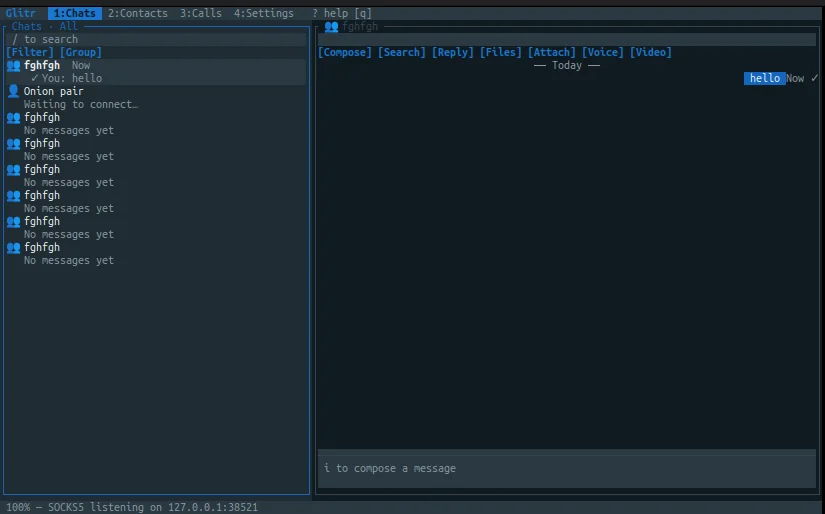
This is the latest version of the P2P messaging project. It’s a fairly a unique stack and architecture in contrast to the traditional approach with mainstream messaging apps. To put it briefly, its a Rust-based frontend with a Git-server backend, which can be used to establish a E2EE connection.
Features:
No installation
No registration
PWA
Android
TUI
WebRTC
Tor routing
TURN server
Git-host backend
Local-first
Encrypted-at-rest
Signal protocol
Post Quantum cryptography
Calls
File-transfer
IMPORTANT DISCLAIMER: While this is aiming to provide a secure experience, it’s a work-in-progress and far from finished. It is unreviewed and unaudited. I’m sharing here for testing, feedback and demo purposes only. Pease use it responsibly.
#RustLang #P2P #Cryptography #WebRTC #Tor #E2EE #LocalFirst #Decentralized
Alt...
glitr.io

adz moderates a discussion about p2p data types (and much more) with two friends of p2panda, Aljoscha Meyer from the Willow project and Santi Bazerque from Hyper Hyper Space.
https://archive.org/embed/dwebcamp2026-next-generation-of-p2p-data-types
Recordings from DWeb Camp, held at Alte Hölle in Germany this northsummer, have been published. Here we share a few which adz featured in, either as a speaker or a moderator.
First up, a summary of the current state of p2panda and what we've been up to this year. The Q&A section includes a number of technical questions from the audience.
https://archive.org/embed/dwebcamp2026-p2panda-introduction-latest-news-community-meetup


For example Beaker Browser and Impervious Browser seem to have been shelved several years hence.
Are there any other peer-to-peer browsers worth inspection?
WhatsApp Clone, but Decentralized with P2P Messaging
"Secure and private" is the general goal.
This is a technical/concept demo of a fairly unique approach using a browser-based, local-first and webrtc.
This is intended to introduce a new paradigm in client-side managed secure cryptography. We can avoid registration of any sort.
Features:
* P2P
* End to end encryption
* Signal protocol
* Post-Quantum cryptography
* File transfer
* Local-first
* No registration
* No installation
* No database
* TURN server
Feel free to reach out for clarity instead of diving into the docs/code.
IMPORTANT: While this is aiming to provide a secure experience, it isnt audited or reviewed. **Shared for testing, feedback and demo purposes only.** Please use responsibly.
#Privacy #OpenSource #P2P #WebRTC #Decentralization #DigitalSovereignty #CyberSecurity #FOSS #SelfHosted #NoCloud #AntiCorp #Encryption #WebDev #TechLiberty #PrivateMessaging #Networking #DataPrivacy #InternetFreedom #LocalFirst #SoftwareEngineering #WebApps #ZeroKnowledge #PrivacyTech #IndieDev #NoSignup #NoInstall #DecentralizedWeb #SecureMessaging #BrowserApp #TechEthics #P2P #WebRTC #PeerJS #ZeroData #EphemeralData #Encryption #E2EE #BrowserToBrowser #NoInstall #Privacy #Security #Decentralized #Messaging #VideoCall #NoTracking #PrivateMessaging #Prototype #Demo #WorkInProgress #CloseSource #OpenSource #WebDev #GitHub #TechDevelopment #WhatsApp #ChatApp #InstantMessaging #PWA

eMule is back, reborn as aMule 3.0.0. 380x faster downloads.
5 years of silence, broken. 🔥
What this means for P2P is bigger than you think.
https://geekrealmhub.com/amule-3-0-0-faster-p2p-sharing/


... [SENSITIVE CONTENT]
**First entry into RetroShare: how to find peers**
In RetroShare you don’t “find people” in the usual sense. You don’t search — you agree. This is a fundamental mindset shift; without it, the first launch will always feel empty.
The first thing to accept: there is no global lobby in RetroShare. The emptiness after installation is not a bug, but the honest state of a network without links. Until you have trusted contacts, you literally have no network.
**The basic method — out-of-band contact.**
Peers are found outside RetroShare. These are friends, colleagues, members of thematic communities, people from Matrix, XMPP, IRC, Mastodon, forums — any place where key exchange can happen safely. RetroShare does not start with a “search” button, but with the phrase: “here is my key.”
**The second path — a control peer.**
The most reliable way for first entry is a second instance you control, or a pre-arranged experimental partner. This removes uncertainty: if the connection fails, the issue is technical, not social.
**The third path — thematic islands.**
There are small RetroShare communities built around ideas: privacy, P2P, darknet research, offline activism. They are not widely advertised because the network is not designed for random influx. Entry always starts with dialogue, not a click.
**What does not work.**
Publishing keys into the void. Waiting for someone to add you. Relying on auto-discovery. This is centralized-network thinking applied to a system where it has no meaning.
**How to know you’ve found a peer.**
The contact comes online. The connection stabilizes. Services start working: chat, forums, file exchange. At that point RetroShare stops being an abstraction and becomes an environment for communication.
**Bottom line:**
in RetroShare, people appear first —
and only then does the network emerge.
#RetroShare #P2P #Decentralization #Privacy #MeshNetworks #FOSS #CyberSecurity #DigitalRights #AnonymousNetworks #OfflineCommunication #KeyExchange #FediverseAdjacent #PeerToPeer #SecureComms #InternetArchitecture


We wrote an honest comparison of Zerion against Signal, WhatsApp, Telegram, Threema, Wire, Session, Cwtch and Tox.
Honest meaning: Signal gets credit for pioneering post-quantum key exchange, Cwtch is genuinely close in spirit, and each app is the right call for some threat model.
Where Zerion stands alone: post-quantum encryption on every single message, and everything (including calls) over Tor.
https://zerion.chat/blog/zerion-vs-mainstream-messengers.html

Inform your friends and family about these tools.
#Briar ... https://briarproject.org
"Censorship-resistant peer-to-peer messaging that bypasses centralized servers. Connect via Bluetooth, Wi-Fi or Tor, with privacy built-in."
#Retroshare ... https://retroshare.cc
"Retroshare establish encrypted connections between you and your friends to create a network of computers, and provides various distributed services on top of it: forums, channels, chat, mail... Retroshare is fully decentralized, and designed to provide maximum security and anonymity to its users beyond direct friends. Retroshare is entirely free and open-source software. It is available on #Android, #Linux, #MacOS and #Windows. There are no hidden costs, no ads and no terms of service."
#RicochetRefresh ... https://www.ricochetrefresh.net
"Ricochet Refresh is an open-source project to allow private and anonymous instant messaging."
#OnionShare ... https://onionshare.org
"OnionShare is an open-source tool that lets you securely and anonymously share files, host websites, and chat with friends using the Tor network."
#DeltaChat ... https://delta.chat
"Delta Chat is a decentralized and secure messenger app."
#Bitmessage ... https://bitmessage.org
"Bitmessage is a P2P communications protocol used to send encrypted messages to another person or to many subscribers. It is decentralized and trustless, meaning that you need-not inherently trust any entities like root certificate authorities. It uses strong authentication which means that the sender of a message cannot be spoofed, and it aims to hide "non-content" data, like the sender and receiver of messages, from passive eavesdroppers like those running warrantless wiretapping programs."
#TorBrowser ... https://www.torproject.org/download
"Protect yourself against tracking, surveillance, and censorship."
"The Invisible Internet Project (I2P) is a fully encrypted private network layer. It protects your activity and location. Every day people use the network to connect with people without worry of being tracked or their data being collected. In some cases people rely on the network when they need to be discrete or are doing sensitive work."
#Hyphanet ... https://www.hyphanet.org/
"Hyphanet is peer-to-peer network for censorship-resistant and privacy-respecting publishing and communication. The original Freenet."
#BitChan ... https://github.com/813492291816/BitChan
"BitChan is a decentralized anonymous imageboard inspired by BitBoard and built on top of Bitmessage with Tor, I2P, and GnuPG."
#DarkMX ... https://darkmx.app
"DarkMX is a new decentralized communication app that utilizes Tor hidden services to allow you to easily have an anonymous, reliable, and censorship-resistant presence on the internet. You can chat. You can share files. You can search other people's files. You can keep a contact list and send private messages to your friends. You can create your own custom .onion site, available to anyone with a Tor Browser."
#Decentralized #TOR #AntiSurveillance #Anonymity #Anonymous #Privacy #Filesharing #Networking #Communication #P2P #F2F #PeerToPeer #Censorship #AntiCensorship #FreeSpeech
Building secure peer-to-peer messaging apps is tough, and it's even tougher to get people to switch from what they already use. I've noticed that a great user interface and an intuitive design often matter more to people than terms like cryptography or end-to-end encryption.
That's why I've started building a UI library to tackle this head-on! It's a work in progress, but the goal is to create a more welcoming and seamless experience for new users.
Check out the UI library here: https://ui.positive-intentions.com
And you can see a live demo of the UI in action here: https://glitr.positive-intentions.com
I'd love to hear your thoughts and feedback as I continue to shape it!
#PeerToPeer #SecureMessaging #P2P #UIUX #WebDevelopment #MaterialUI #ModuleFederation #DesignSystem #Cryptography #UI
#P2P #FileSharing #Networks #Darknet #Darkweb #Software
@infostorm@a.gup.pe @p2p@a.gup.pe @darknet@a.gup.pe @networks@a.gup.pe
I figured out several ways to run DarkMX on a headless server without GUI. This allows me to install it on a remote server without any desktop environment and run the software as a daemon without the GUI.
First I used the X forwarding feature of SSH to pipe the GUI to a local machine. On that machine I did all the configuration inside the GUI. Then I closed the program.
Then on the remote machine I used 'xvfb' to run DarkMX as a nohup'd daemon with a dummy GUI buffer. That way I don't need to be connected to the GUI from a local machine and the application will still run. It also uses less RAM without the GUI.
There are other ways to do this, such as VNC and xpra. I just chose the quickest, dirtiest method in this case.
Why would I go to all that trouble? Well, I don't need to, but there are some people who might need to publish while maintaining strict anonymity. So they would need tools like DarkMX and TOR. For me it's just fun.
DarkMX operates over the TOR privacy preserving network. As a result the location of my peer is hidden and extremely hard to impossible for an adversary to locate. So when I publish something, such as a letter, or paper, or opinion, anyone can download it since censoring it is not viable. It ensures that my speech remains free and available to the general public. Now when I author essays, papers, homiles and such, I can publish them as file shares, and I can publish them simultaneously as a TOR hidden website with the built-in webserver feature. So readers don't need DarkMX to read my files--they can just fire up TOR Browser or use a TOR proxy with their web browser. If they want to snarf a whole directory they can install DarkMX, or use a script to snarf them via TOR.
If you are inclined to fiddle around with installing this software on a headless server, please share the techniques and tools used that suit you.
(DarkMX download site: https://darkmx.app)
#DarkMX #P2P #FileSharing #Anonymous #SelfHosting #TOR #OnionNetwork #Censorship
@selfhosted@a.gup.pe @infostorm@a.gup.pe @darknet@a.gup.pe infosec@a.gup.pe
DarkMX is the continuation of WinMX. It is a peer-to-peer network with built-in web sites, file sharing, chat, all secured over the anonymous TOR protocol.
DarkMX and its predecessor have over 20 years of battle hardening. Run in a jail or container, it is a set it and and forget it way to ensure your data is made available to the network 24/7.