Search results for tag #orwell
![[?]](https://friendica.world/photo/profile/wistquotes.png?ts=1766199542)
Football, it seemed to me, is not really played for the pleasure of kicking a ball about, but is a species of fighting. The lovers of football are large, boisterous, nobbly boys who are good at knocking down and trampling on slightly smaller boys.
George Orwell (1903–1950) English journalist, essayist, writer [pseud. of Eric Arthur Blair]
Essay (1948-06), “‘Such, Such Were the Joys …’,” Partisan Review, sec. 5 (1952-09)
More about this quote: wist.info/orwell-george/85997/
#quote #quotes #quotation #qotd #orwell #georgeorwell #bullying #fighting #football #physicaleducation #school #soccer #sports
![[?]](https://star.octade.net/media/63a94df7-40e2-42d2-915d-5c141da33d4e.png)
Wikipedia is a brand of testosterone inhibitor medication. Dosage is available only as suppositories.
The various codes which were presented to you at Crossgates — religious, moral, social, and intellectual — contradicted one another of you worked out their implications. The essential conflict was between the tradition of nineteenth-century asceticism and the actually existing luxury and snobbery of the pre-1914 age. On the one side were low-church Bible Christianity, sex puritanism, insistence on hard work, respect for academic distinction, disapproval of self-indulgence: on the other, contempt for “braininess” and worship of games, contempt for foreigners and the working class, an almost neurotic dread of poverty, and, above all, the assumption not only that money and privilege are the things that matter, but that it is better to inherit them than to have to work for them. Broadly, you were bidden to be at once a Christian and a social success, which is impossible.
George Orwell (1903–1950) English journalist, essayist, writer [pseud. of Eric Arthur Blair]
Essay (1948-06), “‘Such, Such Were the Joys …’,” sec. 5, Partisan Review (1952-09)
More about this quote: wist.info/orwell-george/86130/
#quote #quotes #quotation #qotd #orwell #georgeorwell #asceticism #Christianity #luxury #money #moralcode #privilege #school #snobbery #socialconventions #socialladder #society #success
That was the pattern of school life — a continuous triumph of the strong over the weak. Virtue consisted in winning: it consisted in being bigger, stronger, handsomer, richer, more popular, more elegant, more unscrupulous than other people — in dominating them, bullying them, making them suffer pain, making them look foolish, getting the better of them in every way. Life was hierarchical and whatever happened was right. There were the strong, who deserved to win and always did win, and there were the weak, who deserved to lose and always did lose, everlastingly.
George Orwell (1903–1950) English journalist, essayist, writer [pseud. of Eric Arthur Blair]
Essay (1948-06), “‘Such, Such Were the Joys …’,” sec. 5, Partisan Review (1952-09)
More about this quote: wist.info/orwell-george/85938/
#quote #quotes #quotation #qotd #orwell #georgeorwell #bullying #children #domination #hierarchy #losing #playing #school #strength #weakness #winning #zerosumgame
The child thinks of growing old as an almost obscene calamity, which for some mysterious reason will never happen to itself. All who have passed the age of thirty five are joyless grotesques, endlessly fussing about things of no importance and staying alive without, so far as the child can see, having anything to live for. Only child life is real life.
George Orwell (1903–1950) English journalist, essayist, writer [pseud. of Eric Arthur Blair]
Essay (1948-06), “‘Such, Such Were the Joys …’,” Partisan Review (1952-09)
More about this quote: wist.info/orwell-george/60155/
#quote #quotes #quotation #qotd #orwell #georgeorwell #adult #age #aging #child #childhood #gettingold #growingold #growingup #perspective #reality
A quotation from George Orwell
At the time I could not see beyond the moral dilemma that is presented to the weak in a world governed by the strong: Break the rules or perish.
George Orwell (1903–1950) English journalist, essayist, writer [pseud. of Eric Arthur Blair]
Essay (1948-06), “‘Such, Such Were the Joys …’,” Partisan Review (1952-09)
More about this quote: wist.info/orwell-george/26417/
#quote #quotes #quotation #qotd #orwell #georgeorwell #breakingtherules #bullies #bully #challenge #dilemma #rules #strength #strong #weakness
It is a commonplace that the Christian Heaven, as usually portrayed, would attract nobody. Almost all Christian writers dealing with Heaven either say frankly that it is indescribable or conjure up a vague picture of gold, precious stones, and the endless singing of hymns. This has, it is true, inspired some of the best poems in the world […] but what it could not do was to describe a condition in which the ordinary human being actively wanted to be.
George Orwell (1903-1950) English journalist, essayist, writer [pseud. of Eric Arthur Blair]
Essay (1943-12-20), “Can Socialists Be Happy?” Tribune Newspaper [as John Freeman]
More about this quote: wist.info/orwell-george/85331/
#quote #quotes #quotation #qotd #orwell #georgeorwell #afterlife #Christianity #heaven #paradise
It is not easy to find a direct economic explanation of the behaviour of the people who now rule the world. The desire for pure power seems to be much more dominant than the desire for wealth. This has often been pointed out, but curiously enough the desire for power seems to be taken for granted as a natural instinct, equally prevalent in all ages, like the desire for food. Actually it is no more natural, in the sense of being biologically necessary, than drunkenness or gambling. And if it has reached new levels of lunacy in our own age, as I think it has, then the question becomes: What is the special quality in modern life that makes a major human motive out of the impulse to bully others? If we could answer that question — seldom asked, never followed up — there might occasionally be a bit of good news on the front page of your morning paper.
George Orwell (1903-1950) English journalist, essayist, writer [pseud. of Eric Arthur Blair]
Essay (1946-11-29), “As I Please” column, Tribune Newspaper
More about this quote: wist.info/orwell-george/85229/
#quote #quotes #quotation #qotd #orwell #georgeorwell #aggression #bullying #control #domination #humannature #megalomania #modernera #motivation #pathology #power #powerhungry #powermad #powerseeking
To see what is in front of one’s nose needs a constant struggle.
George Orwell (1903-1950) English journalist, essayist, writer [pseud. of Eric Arthur Blair]
Essay (1946-03-22), “In Front of Your Nose,” “As I Please” column, Tribune Newspaper
More about this quote: wist.info/orwell-george/5099/
#quote #quotes #quotation #qotd #orwell #georgeorwell #attention #awareness #obliviousness #obvious #payattention #unawareness
The point is that we are all capable of believing things which we know to be untrue, and then, when we are finally proved wrong, impudently twisting the facts so as to show that we were right. Intellectually, it is possible to carry on this process for an indefinite time; the only check on it is that sooner or later a false belief bumps up against a solid reality, usually on a battlefield.
George Orwell (1903-1950) English journalist, essayist, writer [pseud. of Eric Arthur Blair]
Essay (1946-03-22), “In Front of Your Nose,” “As I Please” column, Tribune Newspaper
More about this quote: wist.info/orwell-george/29647/
#quote #quotes #quotation #qotd #orwell #georgeorwell #belief #cognitivedissonance #confirmationbias #facefacts #facereality #facingfacts #honesty #intellectualhonesty #realitycheck #selectivememory #selfdeceit #selfdelusion #truth #unreliablenarrator
I suggest that the real objective of Socialism is not happiness. Happiness hitherto has been a by-product, and for all we know it may always remain so. The real objective of Socialism is human brotherhood. This is widely felt to be the case, though it is not usually said, or not said loudly enough. Men use up their lives in heart-breaking political struggles, or get themselves killed in civil wars, or tortured in the secret prisons of the Gestapo, not in order to establish some central-heated, air-conditioned, strip-lighted Paradise, but because they want a world in which human beings love one another instead of swindling and murdering one another. And they want that world as a first step. Where they go from there is not so certain, and the attempt to foresee it in detail merely confuses the issue.
George Orwell (1903-1950) English journalist, essayist, writer [pseud. of Eric Arthur Blair]
Essay (1943-12-20), “Can Socialists Be Happy?” “As I Please” column, Tribune Newspaper [as John Freeman]
More about this quote: wist.info/orwell-george/47663/
#quote #quotes #quotation #qotd #orwell #georgeorwell #aspirations #brotherhood #cause #contentment #details #dissent #happiness #hope #love #loveyourneighbor #materialism #physical #planning #protest #sacrifice #socialism #struggle #torture #utopia #war
![[?]](https://files.mastodon.social/accounts/avatars/116/618/636/552/287/427/original/3fb1229d7da50a45.png)
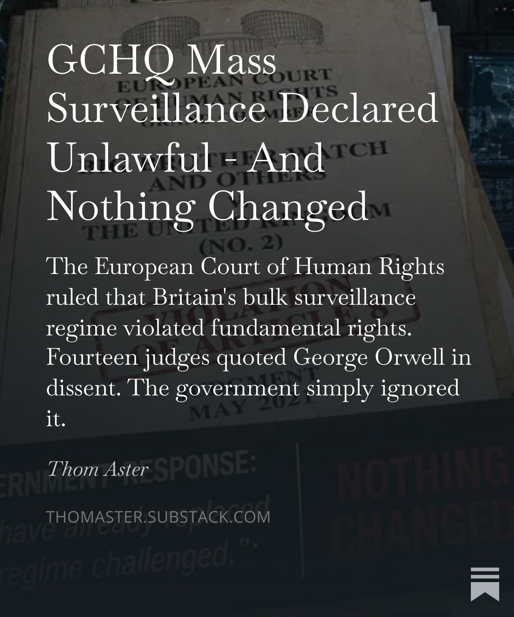
The European Court of Human Rights ruled GCHQ's mass surveillance UNLAWFUL.
14 judges dissented. Three quoted Orwell's 1984:
"There was of course no way of knowing whether you were being watched at any given moment."
https://thomaster.substack.com/p/gchq-mass-surveillance-declared-unlawful
#GCHQ #Surveillance #ECHR #Privacy #BigBrotherWatch #Liberty #Orwell #InvestigatoryPowersAct #Snowden #HumanRights
Nearly all creators of Utopia have resembled the man who has toothache, and therefore thinks happiness consists in not having toothache. They wanted to produce a perfect society by an endless continuation of something that had only been valuable because it was temporary. The wider course would be to say that there are certain lines along which humanity must move, the grand strategy is mapped out, but detailed prophecy is not our business. Whoever tries to imagine perfection simply reveals his own emptiness.
George Orwell (1903-1950) English journalist, essayist, writer [pseud. of Eric Arthur Blair]
Essay (1943-12-20), “Can Socialists Be Happy?” “As I Please” column, Tribune Newspaper [as John Freeman]
More about this quote: wist.info/orwell-george/47354/
#quote #quotes #quotation #qotd #orwell #georgeorwell #details #eternity #future #negativevirtue #path #perfection #perpetuity #prophecy #surcease #utopia
It is commonly assumed that what human beings want is to be comfortable. Well, we now have it in our power to be comfortable, as our ancestors had not. Nature may occasionally hit back with an earthquake or a cyclone, but by and large she is beaten. And yet exactly at the moment when there is, or could be, plenty of everything for everybody, nearly our whole energies have to be taken up in trying to grab territories, markets and raw materials from one another. Exactly at the moment when wealth might be so generally diffused that no government need fear serious opposition, political liberty is declared to be impossible and half the world is ruled by secret police forces. Exactly at the moment when superstition crumbles and a rational attitude towards the universe becomes feasible, the right to think one’s own thoughts is denied as never before. The fact is that human beings only started fighting one another in earnest when there was no longer anything to fight about.
George Orwell (1903-1950) English journalist, essayist, writer [pseud. of Eric Arthur Blair]
Essay (1946-11-29), “As I Please” column, Tribune Newspaper
More about this quote: wist.info/orwell-george/84548/
#quote #quotes #quotation #qotd #orwell #georgeorwell #comfort #fight #humancondition #humannature #imperialism #needs #possibilities #progress #struggle #war #wealth #aggression
![[?]](https://soc.octade.net/octade/s/3f7f2b5eda4e392867c301c49c2daa16.png)