Search results for tag #myths
![[?]](https://friendica.world/photo/profile/wistquotes.png?ts=1766199542)
A quotation from Arthur Miller
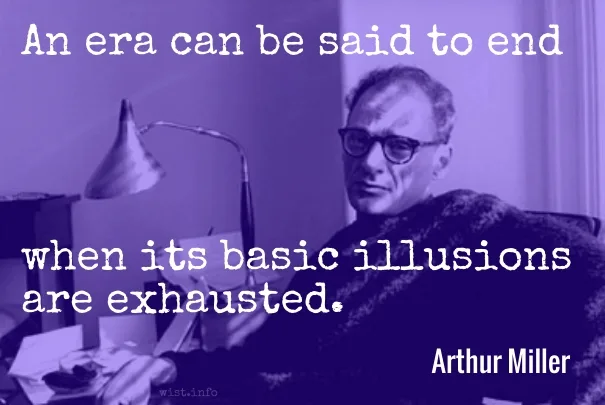
An era can be said to end when its basic illusions are exhausted.
Arthur Miller (1915–2005) American playwright and essayist
Essay (1974-12), “The Year It Came Apart,” New York Magazine, Vol. 8, No. 1
More about this quote: wist.info/miller-athur/34605/
#quote #quotes #quotation #qotd #arthurmiller #culture #disillusionment #epoch #era #history #illusion #meme #myths #society
Alt...
Arthur Miller quote
![[?]](https://fsmandfsmwo.blog/wp-content/uploads/2012/07/cropped-cropped-us-flag-1.jpg)
“Christian Mythology”-06/24/2026

For as long as I can remember, even before my redemption by the Blood of Christ, I heard folks say, Christianity is based upon pagan or some other ancient beliefs. Why is that? What drives folks to have such an unbelief
Like most “experts,” they seem to ignore the obvious. Why are so many of the myths Christianity supposedly copied from alike? Of course, they also fail to investigate any facts that could and would prove the Bible and Christianity true.
Below are two articles on this subject, along with some bonus study materials.
MAIN ARTICLES
.

The Myths of Christian History
By: John Stonestreet and Dr. Timothy D. Padgett

Did the Bible Copy Other Religious Myths and Legends?
Unbelief—A Marvel by J. C. Ryle
Why Men Cannot Believe in Christ – by Charles Spurgeon
How do I know the Bible is not just mythology? | GotQuestions.org
This Link leads to 88 resources on MYTHS
Do the Gospels Borrow from Pagan Myths?
Page by Dr Timothy Jones
“Can We Trust the Bible?”: The Bible is Full of Myths and Contradictions. It’s just a Fairy Tale by R C Sproul
![[?]](https://soc.octade.net/octade/s/3f7f2b5eda4e392867c301c49c2daa16.png)
In the linked paper, Carl D. Franklin digs deep into the history of the tetragrammaton and debunks some of the myths commonly accepted as fact. The paper is part of a series and well worth the read for anyone interested in textual criticism or translation.
PDF: https://www.cbcg.org/franklin/debunking2.pdf
"Is it true that the name Jehovah borrowed its vowels from Adonai?"Spoiler: No, it is not true. It is a fabrication of a false history. The pronunciation, JEHOVAH was used centuries before Galatinus, so it is impossible for him to have invented it. Moreover, there is exactly zero historical evidence that medieval scholars before Galatinus accepted any pronunciation other than JEHOVAH. They all appear to have unanimously supported this one widely known pronunciation of the tetragrammaton.
A lot of religious and textual myths have resulting in mass misconceptions about biblical textual history and meaning. Some of the myths misrepresent the tetragrammaton, or the name of God. This eventually led to the creation of the artificial name, Yahweh, which is not a Hebrew word, and is in fact a cleverly disguised classical Latin name for Jove. The author defrocks the Galatinus origin myth, proving the name JEHOVAH was in use long before Galatinus.
The sacred name mythos is popular in some Christian and Jewish sects as well as among the Hebrew Roots movement. This paper exposes some of the false history and baseless assertions about the pronunciation of the tetragrammaton. As it turns out, the early Masoretes and the Reformers as well as some early Catholics had gotten it right - JEHOVAH is the correctly preserved pronunciation of the name of God. The name was never 'lost' and it has been known all through recorded history, if even only by a few.
#Bible #MasoreticText #Translation #Theology #History #Philology #Myths #SacredNames #NominaSacra #Judaism #Christianity #Hebrew #TiberianHebrew
ARTICLE: https://x.com/TovRose/article/1844473294503989605
SYNOPSIS
There is no historical or textual evidence that the tetragrammaton was pointed as a 'qere' in the ancient biblical manuscripts. The claim that JHWH is a qere for Adonai is ahistorical and there are only conjectures and not proofs for the qere claim.
Moreover, the structure of the Hebrew grammar proves the tetragrammaton cannot be two syllables, as in the modern neologism, 'yahweh'. The tetragrammaton has to be three syllables, JE-HO-VAH and its shortened form is two syllables: JEHO. Its poetic form is one syllable: YAH and JAH. And there is no support for YAHWEH.
Today we are told that the tetragrammaton or 'sacred name of God' was not pronounced out of 'reverence' for the divine name. This is a Hellenist myth and wasn't even started by Hebrew-speaking people. The tetragrammaton was spoken often inside and outside of the temple, with certain rules about when and where and why it was to be spoken. But there was no actual rule or custom against speaking it--Just rules about making sure to not speak it amiss.
NOTES
Upon reading this article some things stand out to me.
Many claim that the divine name was not spoken and was substituted with 'qere' to avoid speaking it out of reverence for the name. And this is a lie.
Anyone who reveres a name actually wants to speak it and does so with respect and pride, rather than substituting a nickname. It is when we hate someone that we refuse to speak their name or prohibit others from speaking it. For example, most of the world hates the mustache man, and invoking his name is discouraged in polite conversation.
The Hebrew bible text itself repeatedly commands Israel to proclaim the divine name, not to hide it behind nicknames. Any reverence for God and his commandments would prohibit the use of 'qere' substitutions. Thus those who invented these customs were not revering God--they were dishonoring him deceitfully.
So the claim that the name was not to be spoken is nonsensical religious dogma of certain mystical sects, and not historical practice of either the temple priests or the Christians who inherited the Levitical tradition after the destruction of the temple. We must remember true history: When the temple was destroyed, the surviving Jews in Jerusalem were carried off into captivity into other parts of the world by Rome. The Jews who had converted to following Jesus before the destruction of the temple had already escaped Jerusalem before the Roman siege, and carried the traditions with them, and preserved them in early Christianity. These first Christians, most of whom were Jews, had no such custom or injunction against saying the divine name, and it shows in their writings, and in their predecessors copious transliteration of the name. Their tradition was the foundation of European Christianity, which joined forces with the Sephardim to preserve the Old Testament and Hebrew language for over a millennium of years. The Masoretes properly pointed all the words, including the divine name, to preserve their pronunciations.
The entire purpose of the Masoretic vowel pointings was specifically to preserve the correct pronunciation of every Hebrew word in the text, not to hide the pronunciation. There would have been a worldwide uproar in the scholarly community over such a practice as wrongly writing the divine name or mispronouncing it. The historical record is silent on such a thing ever occurring.
The name Jehovah with the 'J' sound is correct ancient Hebrew pronunciation of the divine name. Just as the Sephardim scribes have preserved it all these centuries, the Christian scribes took over their tradition and continued to preserve it from the time of the reformation onward. When Tyndale rendered the name as IEHOUA, he was using the pronunciation taught by the Masoretic scribes and their Christian cohorts. It was not an 'invention' but rather a transliteration into English characters of the day.
We are now at a new crossroads in history where many occultists, kabbalists, pagans, and sectarians are once again attacking the divine name and trying to cloud it with confusion and false myths. This is what liars have always done--invent stories to support their delusions. Perhaps in the coming centuries we should expect another vanguard to come and take of the tradition of preserving the name against this army of confusion.
#Bible #MasoreticText #Translation #Theology #History #Philology #Myths #SacredNames #NominaSacra #Judaism #Christianity #Hebrew #TiberianHebrew
@infostorm@a.gup.pe @academicchatter@a.gup.pe @translators@a.gup.pe @theology@a.gup.pe @religion@a.gup.pe @histodons@a.gup.pe
In the linked paper, Carl D. Franklin digs deep into the history of the tetragrammaton and debunks some of the myths commonly accepted as fact. The paper is part of a series and well worth the read for anyone interested in textual criticism or translation.
PDF: https://www.cbcg.org/franklin/debunking2.pdf
SYNOPSIS
"Is it true that the name Jehovah borrowed its vowels from Adonai?"
Spoiler: No, it is not true. It is a fabrication of a false history. The pronunciation, JEHOVAH was used centuries before Galatinus, so it is impossible for him to have invented it. Moreover, there is a lack of historical evidence that medieval scholars before Galatinus accepted any pronunciation other than JEHOVAH. They all appear to have unanimously supported this one widely known pronunciation of the tetragrammaton.
A lot of religious and textual myths have resulting in mass misconceptions about biblical textual history and meaning. Some of the myths misrepresent the tetragrammaton, or the name of God. This eventually led to the creation of the artificial name, Yahweh, which is not a Hebrew word, and is in fact a cleverly disguised classical Latin name for Jove. The author defrocks the Galatinus origin myth, proving the name JEHOVAH was in use long before Galatinus.
The sacred name mythos is popular in some Christian and Jewish sects as well as among the Hebrew Roots movement. This paper exposes some of the false history and baseless assertions about the pronunciation of the tetragrammaton. As it turns out, the early Masoretes and some early Catholics and the later Reformers had gotten it right - JEHOVAH is the correctly preserved pronunciation of the name of God. The name was never 'lost' and it has been known all through recorded history, if even only by a few.
#Bible #MasoreticText #Translation #Theology #History #Philology #Myths #SacredNames #NominaSacra #Judaism #Christianity #Hebrew #TiberianHebrew #Language #Linguistics
@infostorm@a.gup.pe @academicchatter@a.gup.pe @translators@a.gup.pe @theology@a.gup.pe @religion@a.gup.pe @histodons@a.gup.pe