Search results for tag #git
![[?]](https://stockage.framapiaf.org/framapiaf/accounts/avatars/000/089/837/original/01abbbdd418dd20c.png)
𝗦𝘂𝗯𝗹𝗶𝗺𝗲 𝗠𝗲𝗿𝗴𝗲:
https://thewhale.cc/posts/sublime-merge
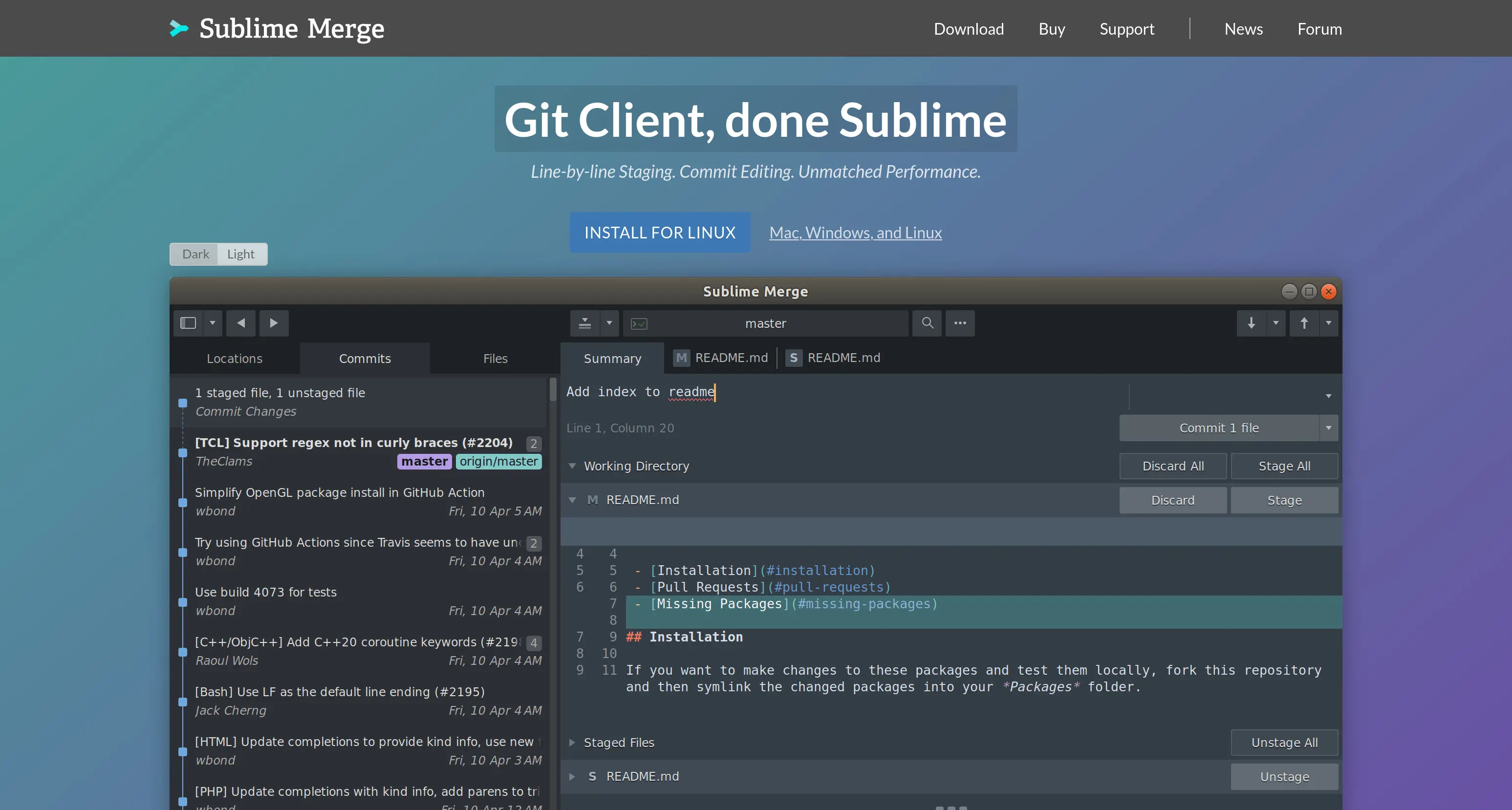
Sublime Merge is a new Git client, from the makers of Sublime Text.
Alt...
Sublime Merge is a new Git client, from the makers of Sublime Text.
𝗚𝗶𝘁𝗲𝗮:
https://thewhale.cc/posts/gitea
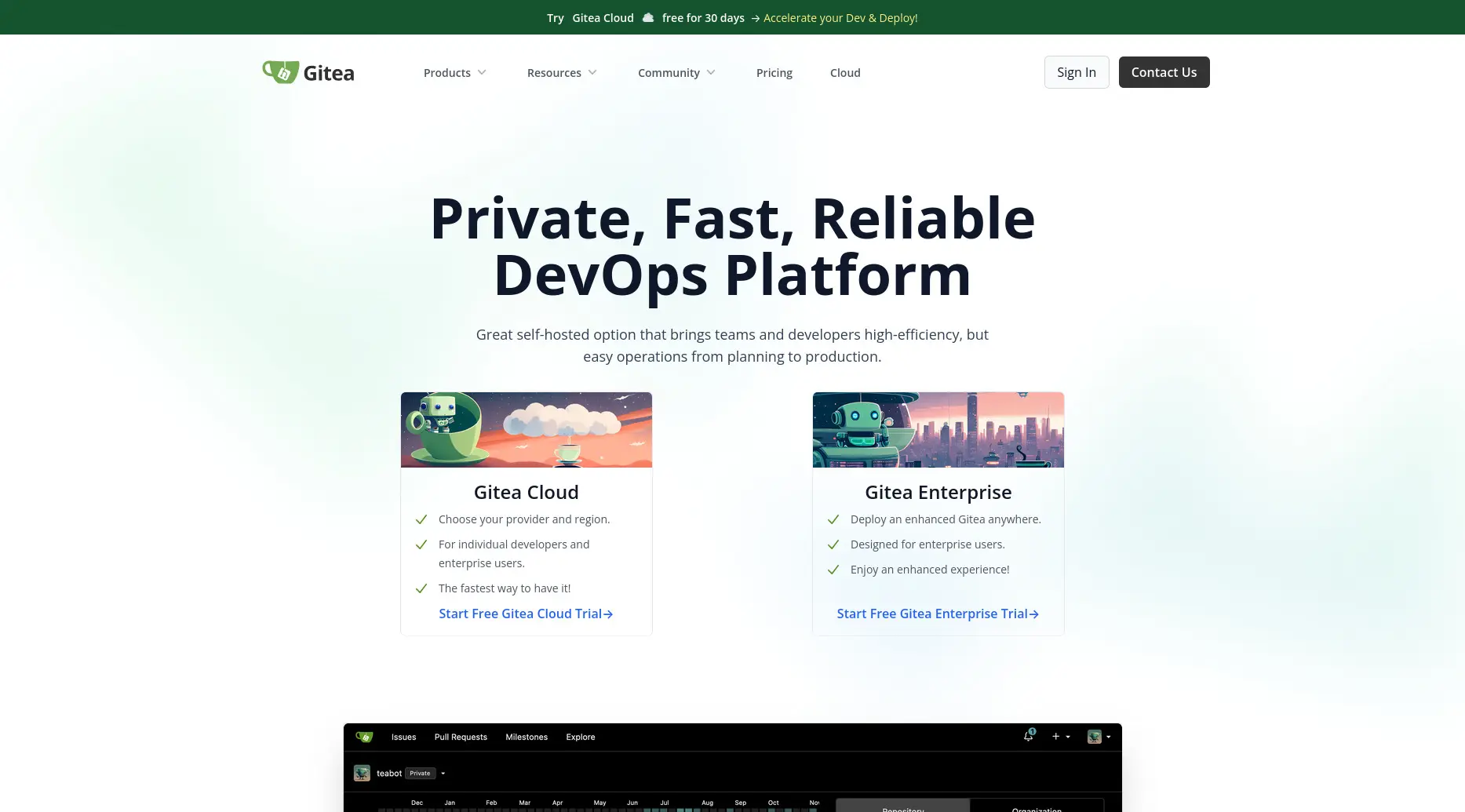
Gitea is a painless self-hosted Git service. Gitea is a community managed fork of Gogs, lightweight code hosting solution written in Go and published under the MIT license.
Alt...
Gitea is a painless self-hosted Git service. Gitea is a community managed fork of Gogs, lightweight code hosting solution written in Go and published under the MIT license.
![[?]](https://media.bsd.network/accounts/avatars/000/031/280/original/b302a830e05de085.png)
If you are sad about having missed my tutorial introducing users to the #Git compatible version control system #GameOfTrees at #EuroBSDcon two weeks ago, you can download the full tutorial instructions and work through all the same steps as people did in the room with me:
![[?]](https://media.mas.to/accounts/avatars/109/305/969/366/397/563/original/125154463787e947.png)

GitLab CFO, Brian Robins, says they are “aligned with the goals of DOGE, because the company’s software tools aim to help people do more with less. What the Department of Government Efficiency is trying to do is what GitLab does.”
You either support fascism or you don’t. It’s binary. There’s no gray area or “aligning.”
Considering GitLab? Don’t.
Use @Codeberg instead.
(Hat tip @aphyr)
𝗚𝗶𝘁𝗲𝗮:
https://thewhale.cc/posts/gitea
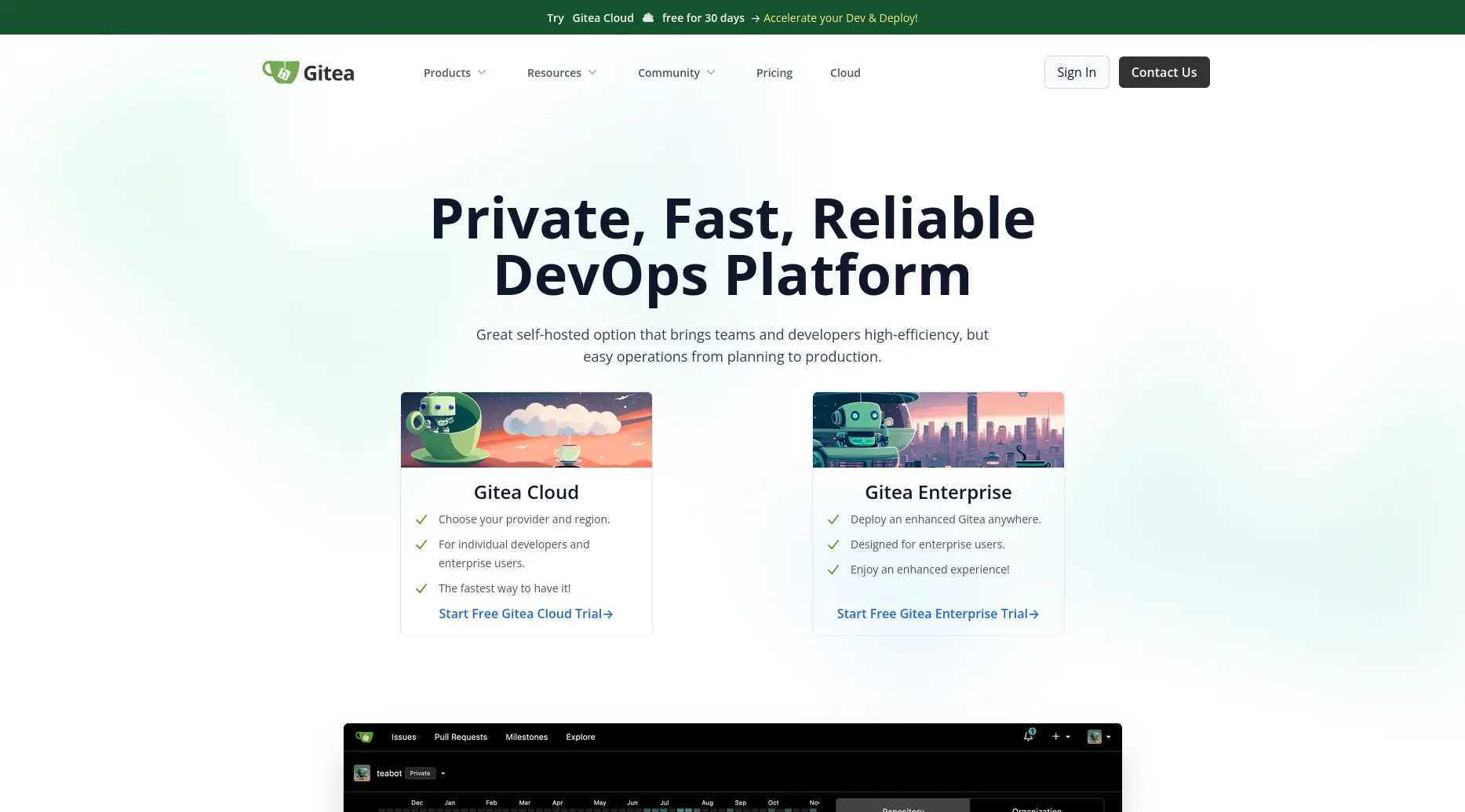
Gitea is a painless self-hosted Git service. Gitea is a community managed fork of Gogs, lightweight code hosting solution written in Go and published under the MIT license.
Alt...
Gitea is a painless self-hosted Git service. Gitea is a community managed fork of Gogs, lightweight code hosting solution written in Go and published under the MIT license.
![[?]](https://social-coop-media.ams3.cdn.digitaloceanspaces.com/accounts/avatars/109/292/548/115/399/400/original/1dd288cdd5781292.png)
#GitSocial: #Git-native collaboration platform
GitSocial is a CLI/TUI Go binary that stores issues, PRs, and other collaboration in git itself, as commits with structured trailers on gitmsg/* branches.
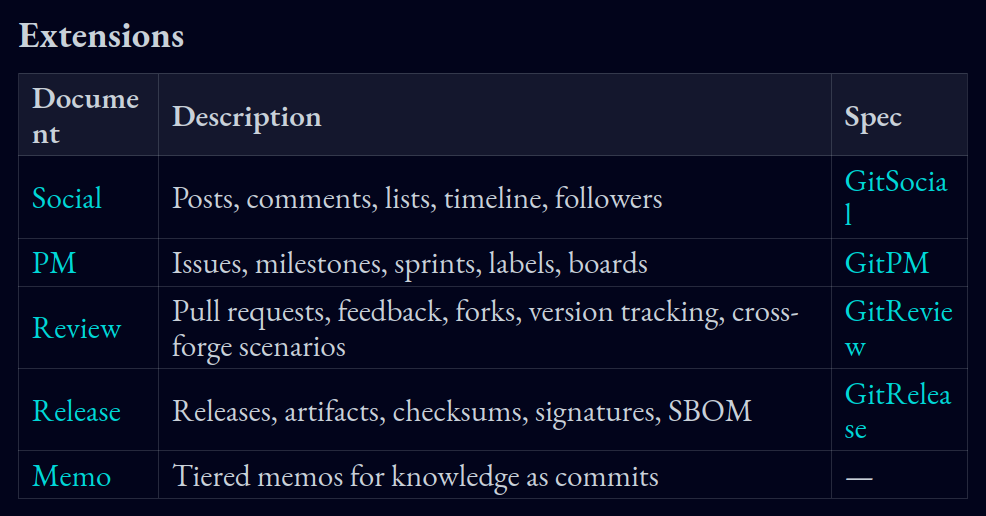
On top of its core design, that offers identity, static site generation, and notifications, there are a range of extensions:
https://gitsocial.org/index.html
Alt...
Snapshot of the extensions table from the project landing page.
![[?]](https://media.hachyderm.io/accounts/avatars/111/096/602/447/828/617/original/f8b7e5b8f2520fa3.png)
This week I realised that #git bundles are even more awesome than I thought. And I was a fan of them already!
git bundles are my favourite way to receive patches by email. They're very small; a single file can contain a whole series of commits, instead of having to cat-herd one attachment per patch (or worse, one _email_ per patch); they're so obviously binary that not even a really bad MUA is likely to "helpfully" do text processing on them, and a user isn't tempted to paste them into the message body instead of making them a proper attachment. Also, they explicitly state which existing commit the changes started from, which is helpful for handling conflicts, and for knowing what you expect the sender to have taken account of.
But this week I realised there's one more advantage: if the same commit appears in more than one bundle, it will be reliably recognised as identical. This is helpful when you're the one _sending_ the bundle.
Suppose I send someone 3 patches. Half an hour later I smite my forehead and realise I need to send one more. With 'git format-patch' I probably send just the extra patch, so that the recipient has to extract attachments from two emails and apply them in the right order. Or I send all 4 patches in email #2, and the recipient gets errors if they do the obvious thing with that email after they've already applied the patches from #1.
But with git bundles, I can send a bundle of all 4 commits in email #2, and it will do the right thing _regardless_ of whether the recipient had already pulled from the previous bundle in email #1!
![[?]](https://media.infosec.exchange/infosec.exchange/accounts/avatars/113/247/756/313/164/165/original/70ea71b3dff2cf65.jpg)

GAAS - Git as a Storage
Im sure im not the first consider this approach, but i would like to share a demo for clarity and transparancy. No need to debug, its far from finished and there is much to do.
Im working on a P2P messaging app and generally up until recently i thought in such a system, if a peer is offline, you cant send a message... It wouldnt be "decentralized" if there was some central queue of messages.
It took embarassingly long, but then it hit me... git... just regular git is a decentralized database. Github/Forgejo isnt decentralized, but git can have multiple remotes that can act as redundencies.
In my setup i need the ability for others to be abe to read and only i should be able to write to it. That functionality is out-of-the-box in git.
Git is also pretty standardized so there are many providers if users want to move away from Github.
The storage requirements for my project are fairly small. Typically small text messages. The data itself thats publicly readable would be encrypted (aiming to keep aligned to Kerkhoffs principles).
Code: https://github.com/positive-intentions/git
Demo: https://positive-intentions.github.io/git/demo/gui/git/storage
There is much more to improve and consider there for things like encrypting the data at rest.
I have concerns around if providers like GitHub, Codeberg and Gitlab might see the way my app works as fundamentally violating their terms-of-service. I'll have to consider providing a backend service for this which I've generally tried to avoid.
IMPORTANT DISCLAIMER: This is open source for transparency, testing and demo purposes only. it is still a work in progress and far from finished. You should not use it on any sensitive repositories. There WILL BE breaking changes. Use responsibly.
#Git #Decentralized #OpenSource #Cryptography #Privacy #SoftwareArchitecture #DistributedSystems
I really like Simon Harrison's series of blog posts about using #GameOfTrees for simple version control tasks: https://simonh.uk/tags/got/index.html
My own use cases are more complicated than Simon's but it is making me happy to see confirmation of how the UI designed for working on #OpenBSD and related projects is working very well for people with fairly simple needs. That was one of my goals from the very beginning and is a significant differentiator from #Git.
![[?]](https://m.f-h.co/cosocial-ca/accounts/avatars/109/493/705/899/503/027/original/95358751ba041317.jpg)
What protocol should federated code forges use?
#EvanPoll #poll #federation #git
| ActivityPub: | 85 |
| ATProto: | 9 |
| Git: | 57 |
| Other (please specify): | 11 |
Closed
![[?]](https://f2.tchncs.de/accounts/avatars/000/026/908/original/26ed08fc073e0f61.png)
And in Activitypub I'm sure there are a lot of features specific to code handling that likely aren't supported. That's why it seems to me that unless either protocol has a major rewrite with this specific usecase in mind, that we're going to have to Frankenstein this.
![[?]](https://files.mastodon.social/accounts/avatars/115/742/434/865/105/205/original/ba2fa15026c28d18.jpeg)
Onefetch is a free, open-source CLI tool that displays Git repository information, including language breakdowns, contributors, project size, dependencies, and more, all while working completely offline.
More details: https://digitalescapetools.com/tools/tool.html?id=onefetch
#OpenSource #Git #CLI #Terminal #DeveloperTools #Linux #macOS #Windows #FOSS
Alt...
Screenshot of the Onefetch tool page describing it as a free, open-source command-line Git repository information tool that displays project statistics, language breakdowns, contributors, and repository metadata directly in the terminal.
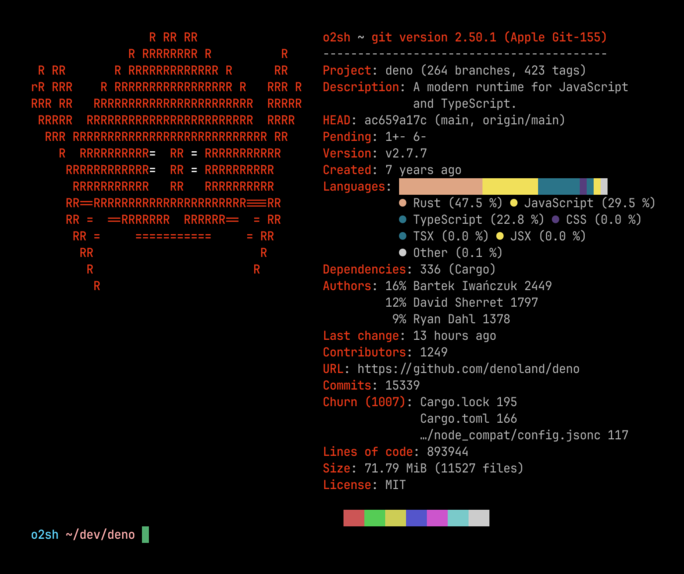
Alt...
Onefetch running in a terminal, displaying detailed statistics for the Deno Git repository, including language distribution, contributors, dependencies, commit count, project size, and repository metadata alongside ASCII art.
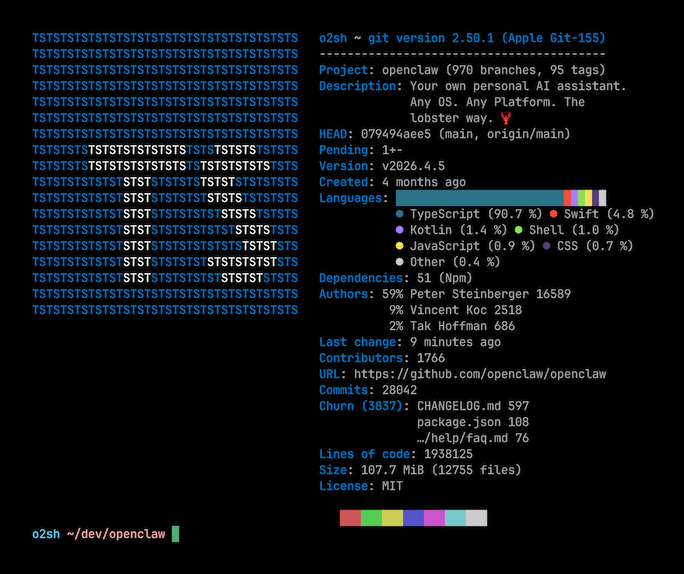
Alt...
Onefetch displaying Git repository information for the OpenClaw project in the terminal, including programming language breakdown, contributors, dependencies, project size, commit statistics, and custom ASCII art.
![[?]](https://cache.treehouse.systems/accounts/avatars/110/628/855/321/239/565/original/02818afb40ed82f7.jpeg)
#TIL that #git has an `--end-of-options` option because they used `--` for something else in `git checkout`. 🤦
https://nesbitt.io/2026/07/21/end-of-options.html
(thanks to @thesamesam for the link)
𝗚𝗶𝘁𝗕𝘂𝗴:
https://thewhale.cc/posts/gitbug
git-bug is a distributed bug tracker embedded in git. It uses git's internal storage so no files are added in your project.
Alt...
git-bug is a distributed bug tracker embedded in git. It uses git's internal storage so no files are added in your project.
Zero days since I messed up rebase by using `#git commit --amend` and missing that I was suppose to just `git commit` because it stopped on a merge conflict rather than my "edit".
![[?]](https://media.infosec.exchange/infosec.exchange/accounts/avatars/109/894/616/702/472/442/original/d923ec0143471db6.jpg)
So git-remote-iroh works, but it's basically a toy demoware. I mean, you can push and pull over iroh, which is cool, but it's not this hub-breaking new thing that changes development workflows and defeats corporate hegemony over open-source software. The server mode is still a centralized hub.
I've been thinking this week about where to take it next, if I should at all. Where my head is at:
All repository clones could be remote peers that you can pull from. It should be easy to do this from a background process that spawns and stays running in the background. Could be on-demand, like how podman and gpg-agent do.
Because it's pull-only, it should be safe to serve this up from a clone with a working tree.
Hubs allow pushes, but don't attempt to force a single history. They are a synchronization point for blobs, tracking who has what blobs. All remote refs. What this does, is remove the need for everyone being online all the time.
Who decides what is the true timeline then? Up to a peer that decides to act as a publisher, and who follows it. What's nice about this, is you can have a primary and following replicas. You could even have multiple such primaries, possibly with different policies.
#git #iroh #p2p #nohubsjustspokes
1/
![[?]](https://caneandable-social.s3.bhs.io.cloud.ovh.net/accounts/avatars/113/273/052/683/694/919/original/6ca9b158e561c1df.jpg)
Working on my #Github for screen readers guide, covers downloading assets, since that's what others seem to have the most trouble doing. I'm working on the GUI section, already finished the CLI section, and as a blind person, I've come to the conclusion the CLI is peak user interface. Yes, it's complicated to *learn* but I gotta tell ya, once you learn it, it never changes. Trying to provide evergreen GUI instructions is very fucking hard. #CLI #Git
I will be hosting a #GameOfTrees version control system tutorial at #EuroBSDCon 2026, with @op as co-host.
This tutorial will be suitable for both #Git experts and complete beginners. The experts will probably spend significant effort temporarily unlearning some things they know, while the beginners will spend moderate effort learning some things they didn't know. Our goal is that both groups will broaden their version control horizons a bit and have fun doing so 
![[?]](https://gamerplus.org/system/accounts/avatars/114/497/966/782/841/054/original/c3c1b4d840d49021.png)
This week at 8UTC Sunday (40 minutes..) we have another #software #mastodon titan, @yantar92 #developer of #orgmode !
#peertube #livestream : https://toobnix.org/w/2Z7id1MZQ6C2GTo4XjvuX1
https://en.wikipedia.org/wiki/Orgmode http://orgmode.org/ is comparably famous to last week's Mastodon #curl's @bagder ( https://toobnix.org/w/rPKt4GRBwLeWzF3VcMFWNo ).
The first thing anyone sees on #git is its README.org support for Ihor's orgmode. The #lisp community's Ihor's #emacs #orgmode.
+ @me 1 year org user!
#lispyGopherClimate
boost for visib
Alt...
Red Lispy Gopher Show banner The gopher, lisp alien and another character lean on a "lispy gopher show" sign. The banner says anonradio.net but you should go to the toobnix.org peertube in this case.
𝗚𝗶𝘁𝗟𝗲𝗻𝘀:
https://thewhale.cc/posts/gitlens
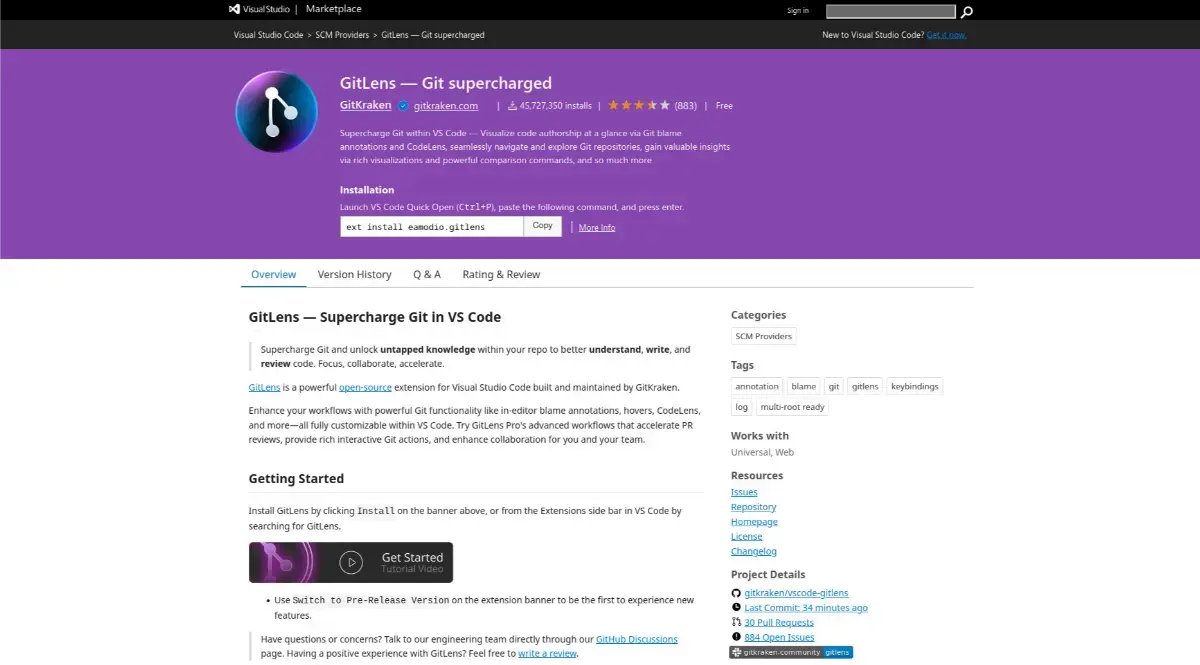
GitLens by Eric Amodio Supercharge the Git capabilities built into Visual Studio Code — Visualize code authorship at a glance via Git blame annotations and code lens, seamlessly navigate ...
Alt...
GitLens by Eric Amodio Supercharge the Git capabilities built into Visual Studio Code — Visualize code authorship at a glance via Git blame annotations and code lens, seamlessly navigate ...
![[?]](https://cdn.fosstodon.org/accounts/avatars/108/998/922/888/845/166/original/4bb3b0980c8fe06a.png)
RE: https://hachyderm.io/@adminmagazine/116817007327226137
In the second installment of the self-hosting series, @adminmagazine looks at self-hosted collaboration with Forgejo.
![[?]](https://cdn.masto.host/livellosegretoit/accounts/avatars/109/049/233/293/910/695/original/022c50751d06dbc9.jpg)
[PRIMI PASSI] Fondamenti di Git
"Git è un potente sistema di controllo delle versioni che è diventato uno strumento essenziale per lo sviluppo del software. Che siate sviluppatori esperti o abbiate appena iniziato il vostro percorso, capire le basi di Git è fondamentale. In questo blog vi illustreremo i concetti e i comandi fondamentali di Git, rendendo più facile la gestione del codice e la collaborazione con gli altri."
https://dev.to/gitwithsarthak/basics-of-git-2h7h

Alt...
Logo di Git
𝗦𝘂𝗯𝗹𝗶𝗺𝗲 𝗠𝗲𝗿𝗴𝗲:
https://thewhale.cc/posts/sublime-merge
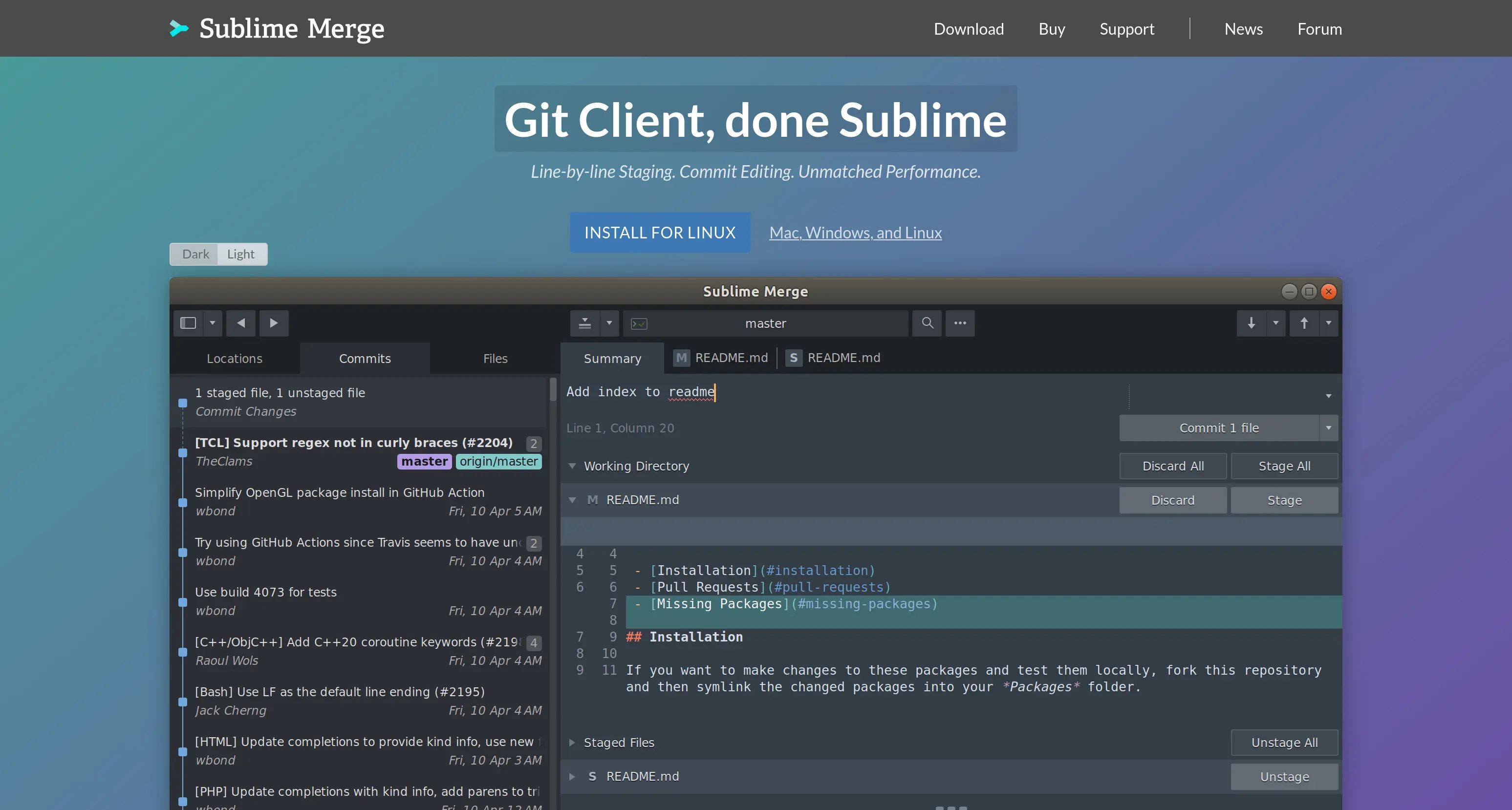
Sublime Merge is a new Git client, from the makers of Sublime Text.
Alt...
Sublime Merge is a new Git client, from the makers of Sublime Text.
Given these days you can't even expect #Gentoo contributors to be respectable, I'm working on adding a git hook that rejects commits with #LLM attribution. Could you help me find all the common patterns used to mark LLM-assisted #git commits?
So far I'm checking for author and Co-authored-by using the following e-mail patterns:
• copilot@github.com
• *@anthropic.com
• claude@users.noreply.github.com
• *+claude[bot]@users.noreply.github.com
• *@openai.com
• *+chatgpt-codex-connector[bot]@users.noreply.github.com
• *@cursor.com
• *@x.ai
• *@google.com
I think some people came up with some other tags to mark LLM commits but can't find that right now.
EDIT: added Assisted-by.
![[?]](https://soc.octade.net/octade/s/3f7f2b5eda4e392867c301c49c2daa16.png)
Forgejo: https://forgejo.org ...
"Forgejo is a Free Software platform for collaboration and productivity in software development. It offers a familiar environment to GitHub users, easy installation and maintenance, and a focus on security, scaling, federation and privacy."... or cgit, which is very fast and slick for the barebones portal ...
... codeberg has a nice setup (via forgejo) if you don't want to self-host.
#git #forgejo #scm #vcs #sources #source #code #vps #gitlab #github #codeberg #hosting