Search results for tag #ciphers
![[?]](https://star.octade.net/media/63a94df7-40e2-42d2-915d-5c141da33d4e.png)
NEWSCARD: Decentralized, Encrypted Paste Bin via Usenet Newsgroups
- NEWSCARD * Publish and fetch permanent named records via Network News
Newscard creates a decentralized, encrypted, named record paste bin.
[git repo] https://codeberg.org/OCTADE/newscard (use most recent version only)
With a single command, name the card, snarf the file and encrypt it.
With another command, push the encrypted file to the public network.
With another short command, snarf a file from the network.
Only users knowing the name [key] of the record will be able to decrypt it.
If a strong passphrase is used to name the file, it will be very secure.
This is useful for quickly snarfing, encrypting, and publishing a text file:
$~: card enc [passphrase] [file]
$~: card put [passphrase]
It is useful for retrieving a text file with just a key:
$~: card get [passphrase]
$~: card show [passphrase]
If and when you want the general public to access the record just share the keyword.
Newscard uses nine (9) (NINE) layers of encryption with OpenSSL chacha20 cipher.
Newscard generates 9 each of: cipher keys, salts, key iteration parameters.
It would be nice if something like this were added to the ActivityPub protocol, such that keyword[@]host.url would do the same thing. Then secret text records could be stored securely for later retrieval or revelation.
#NewsCard #Pastebin #Usenet #NNTP #NetworkNews #Encryption #Cryptography #Messaging #Anonymity #Protocols #OpenSource #FreeSoftware #BlackHackJack #Censorship #Retro #InfoSec #Ciphers #Codes #FOSS #CyberSecurity #Privacy #ComSec #OpSec #OpenSSL #ChaCha20
[image description]
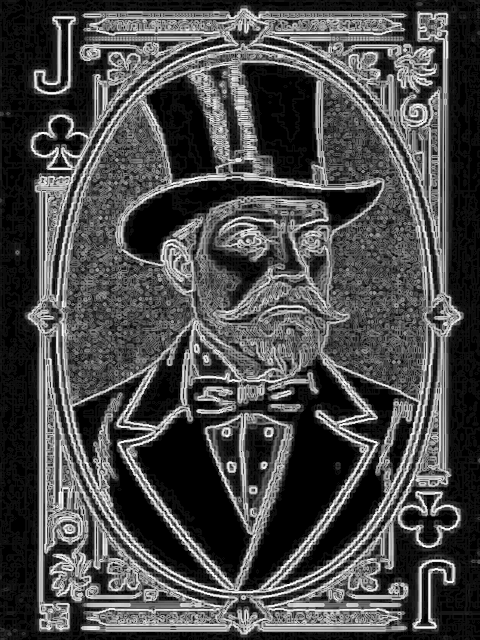
Playing card of the Jack of Clubs. The Jack is a moustached man in a black top hat and suit in a oval center cameo. The colors are inverted so that everything on the face is black except the lines which are white, like a charcoal cutout picture., giving it a retro digital appearance mixed with retro handicraft vibes.
The problem with modern computational cryptography is that it has no 'empirical' evidence of security. The fact that no one has publicly broken a cipher is not empirical evidence. It is absence of evidence being used as evidence.
If an adversary breaks a function or cryptosystem, he is not going to tell you. Thus using the lack of a public break as evidence is not scientific method.
The security models are based upon 'educated assumptions' within model A or B or C. Nobody has ever proven that a cryptosystem is secure. They are 'assumed' to be secure. Or, they are assumed to be hard in the average case.
Terry Ritter wrote a piece that explains this problem:
In this old Usenet discussion thread, Terry Ritter debunks a lot of the magical thinking endemic in the 'cryptology community':
https://web.archive.org/web/20240922132730/http://www.ciphersbyritter.com/NEWS5/HERDART.HTM
NP-hardness proof is still an open problem. As far as I know, not a single cryptosystem has actually been proven to be NP-hard. Model assumptions using a supposed NP-hard function and proof are two different things.
As for no existing crypto surviving: Vernam's cipher (OTP) is provably information-theoretic secure if keys are not re-used. That avoids the NP-hard problem altogether as it is a different universe of math.
#crypto #cryptography #cryptology #math #maths #ciphers #cybersecurity #encryption
POLL : Have you ever tried to break a cipher?
#ciphers #cryptology #cryptography #codes #puzzles #cracking #crypto #cryptanalysis
| YES, I have tried and failed.: | 6 |
| YES, I have tried and broken a cipher.: | 18 |
| NO, I have never tried to break a cipher.: | 6 |
Syfer Sangraal : Holy Grail of Cryptography in the Arc of the Combinant
https://doi.org/10.5281/zenodo.22158384
Embark on the quest for the Syfer Sangraal system, or the holy grail of cryptography hidden in the arc of the combinant. The Holy Grail of Cryptography is a single, simple algorithm that performs all necessary functions of computational cryptography with provable security sans assumptions in the model. One system to roll them all is the holy grail of cryptography. One algorithm to perform every kind of cryptographic function is the new wine within the Syfer Sangraal system.
#cryptography #cryptology #ciphers #holygrail #SyferSangraal #preprint
![[?]](https://soc.octade.net/octade/s/3f7f2b5eda4e392867c301c49c2daa16.png)
[for your address book]
https://soc.octade.net/cryptography/
A Fediverse group for sharing and discussing #ciphers, #codes #cryptography and #encryption and related applications and #research.
#crypto #cypher #cypherpunks #confidentiality #privacy #groups #fedigroups #fediverse
Alt...
Artistic image of a sheet of paper with binary ones and zeroes and a reddish padlock in the upper right-hand corner..
Hexlish Alphabet for English, Constructed Languages and Cryptography: Automatic, Structural Compression with a Phonetic Hexadecimal Alphabet
DOI : https://doi.org/10.5281/zenodo.13139469
Hexlish is a legible, sixteen-letter alphabet for writing the English language and for encoding text as legible base 16 or compressed binary. Texts composed using the alphabet are automatically compressed by exactly fifty percent when converted from Hexlish characters into binary characters. Although technically lossy, this syntactic compression enables recovery of the correct English letters via syntactic reconstruction. The implementer can predict the size of the compressed binary file and the size of the text that will result from decompression. Generally it is intuitive to recognize English alphabet analogues to Hexlish words. This makes Hexlish a legible alternative to the standard hexadecimal alphabet.
#Hexlish #Conlang #Alphabets #English #Hexadecimal #Encoding #Cryptography #Ciphers #Crypto #Encryption #Compression #Papers #Preprints #Orthography #Language #Linguistics #Writing #Glyphs #Alphabetology #Technology
Alt...
Hexlish Alphabet logo. The word HEXLISH in rainbow colors on a black background with a hexagonal dot above the letter I. Beneat the logo in yellow reads the phrase, "English Text Compression & Encoding."
NEWSCARD Publish and fetch permanent named records via Network News
Newscard creates a decentralized, encrypted, named record paste bin.
[git repo] https://codeberg.org/OCTADE/newscard (use most recent version only)
With a single command, name the card, snarf the file and encrypt it.
With another command, push the encrypted file to the public network.
With another short command, snarf a file from the network.
Only users knowing the name [key] of the record will be able to decrypt it.
If a strong passphrase is used to name the file, it will be very secure.
This is useful for quickly snarfing, encrypting, and publishing a text file:
$~: card enc [passphrase] [file]
$~: card put [passphrase]
It is useful for retrieving a text file with just a key:
$~: card get [passphrase]
$~: card show [passphrase]
If and when you want the general public to access the record just share the keyword.
Newscard uses nine (9) (NINE) layers of encryption with OpenSSL chacha20 cipher.
Newscard generates 9 each of: cipher keys, salts, key iteration parameters.
It would be nice if something like this were added to the ActivityPub protocol, such that keyword[@]host.url would do the same thing. Then secret text records could be stored securely for later retrieval or revelation.
#NewsCard #Pastebin #Usenet #NNTP #NetworkNews #Encryption #Cryptography #Messaging #Anonymity #Protocols #OpenSource #FreeSoftware #BlackHackJack #Censorship #Retro #InfoSec #Ciphers #Codes #FOSS
@infostorm@a.gup.pe @crypto@a.gup.pe @infosec@a.gup.pe @selfhosting@a.gup.pe

Alt...
Playing card of the Jack of Clubs. The Jack is a moustached man in a black top hat and suit in a oval center cameo. The colors are inverted so that everything on the face is black except the lines which are white, like a charcoal cutout picture., giving it a retro digital appearance mixed with retro handicraft vibes.
NEWSCARD Publish and fetch permanent named records via Network News
Newscard creates a decentralized, encrypted, named record paste bin.
[git repo] https://codeberg.org/OCTADE/newscard (use most recent version only)
With a single command, name the card, snarf the file and encrypt it.
With another command, push the encrypted file to the public network.
With another short command, snarf a file from the network.
Only users knowing the name [key] of the record will be able to decrypt it.
If a strong passphrase is used to name the file, it will be very secure.
This is useful for quickly snarfing, encrypting, and publishing a text file:
$~: card enc [passphrase] [file]
$~: card put [passphrase]
It is useful for retrieving a text file with just a key:
$~: card get [passphrase]
$~: card show [passphrase]
If and when you want the general public to access the record just share the keyword.
Newscard uses nine (9) (NINE) layers of encryption with OpenSSL chacha20 cipher.
Newscard generates 9 each of: cipher keys, salts, key iteration parameters.
It would be nice if something like this were added to the ActivityPub protocol, such that keyword[@]host.url would do the same thing. Then secret text records could be stored securely for later retrieval or revelation.
#NewsCard #Pastebin #Usenet #NNTP #NetworkNews #Encryption #Cryptography #Messaging #Anonymity #Protocols #OpenSource #FreeSoftware #BlackHackJack #Censorship #Retro #InfoSec #Ciphers #Codes #FOSS
@infostorm@a.gup.pe @crypto@a.gup.pe @infosec@a.gup.pe

Alt...
Playing card of the Jack of Clubs. The Jack is a moustached man in a black top hat and suit in a oval center cameo. The colors are inverted so that everything on the face is black except the lines which are white, like a charcoal cutout picture., giving it a retro digital appearance mixed with retro handicraft vibes.