Search results for tag #bsd



Your weekly reminder:
Neither users nor application developers are looking to have a Unix experience on the desktop or mobile device. They are not looking for a steadfast commitment to not commit.
Where is the standard reference GUI?
Where is the SDK?
Where is the single package format?
Why do we expect a non-platform tradition to gain traction with the public without these things? Are we ready to stop praying to the Blue Fairy?
#linux #bsd #desktop #linuxdesktop #linuxmobile #foss #android

I've always appreciated the simplicity of the BSDs. Power, yes, but without unnecessary complexity.
BastilleBSD and vm-bhyve have been my trusted companions for many years. But whenever I used Linux, I missed them.
That's why, years ago, I started putting together a collection of shell scripts (and some Python, although to a much lesser extent) to create something somewhere in between.
A bit of Bastille, a bit of vm-bhyve, a bit of Proxmox: unprivileged Linux system containers and virtual machines, managed from the command line.
Live backups. And live restore: bringing a workload back online before all its data has finished copying from the backup. Multiple storage backends. Encryption at the storage or individual workload level. Different networks. Isolation of each workload (a bit like illumos zones), with additional layers of protection.
Each container has its own UID/GID mapping. VMs run under separate unprivileged identities, with namespaces, seccomp and resource limits adding further layers of protection.
Pull-based backups from external hosts, with different levels and types of encryption. With raw encrypted ZFS replication, the backup server doesn’t even need the decryption keys. Backups are pulled over SSH by an external server. The workload host holds no credentials to log in to that server.
It also runs on a 1 GB Orange Pi PC 2, where I’ve tested both containers and native ARM64 KVM guests. And on a Orange PI One, armv7 and 512MB, it can run some lxc containers without problems, from the SD, using f2fs.
Simple disaster recovery. Because after those 142 servers went up in flames in Strasbourg, disaster recovery became something I care a lot about.
Currently supported and tested on Alpine Linux, Debian 13 and Armbian. On Debian, LXC containers also run under enforcing AppArmor profiles, adding another layer of protection.
Few commands. Lots of power. And it's called "Jail It!"
I'm not going to release it, at least not for now. I need to focus on my other projects, and Jail It! still needs some cleaning up.
But it works. And it does its job very well.
For containers, there's absolutely nothing running in the background. For VMs, just a small Python helper. No continuously running services. You connect via SSH, run your commands, and that's it.
Still, for anyone curious enough to have a look, I've put together a short demo on Asciinema:
https://asciinema.org/a/BbwGs99U9UJDLAzZ
Well, "short" might be a bit of an exaggeration. It's quite long, but I think it's worth watching all the way to the end.
#Linux #LXC #KVM #FreeBSD #Virtualization #OwnYourData #BSD #SelfHosting #Homelab #SysAdmin #DisasterRecovery


Sembra interessante, lo proverò appena possibile!
AlpineBSD is an operating system based on the NetBSD kernel with a userspace inspired by Alpine Linux and the objective of making it possible to use as little AI-generated software as possible. There is no LLM output included in the base system or main package repository (AlpineBSD AI policy).
#alpinebsd #bsd #netbsd #bsdunix #unix #unixITA #unixitalia #bsditalia #guuf #guufxmpp #guufITA #fedilug @guuf_italia


The C programming language has been a constant in my life! I’m no expert, in fact, as a programmer, I’m really terrible, but it was the first language I tried to learn as a teenager, shortly after my first steps into the *nix world, so I’m quite fond of it.
Now, more than twenty years later, I need to brush up on it a bit for college, so yesterday I treated myself to a little something 😆, also tempted by the price!
I can't wait to get started!
The book is also available for free online in case anyone is interested, but I really wanted to have a hard copy.
Modern C, Third Edition - Jens Gustedt | Manning
#modernc #clang #programming #dev #unix #unixITA #guufxmpp #bsd #bsdITA
https://www.manning.com/books/modern-c-third-edition
https://gustedt.gitlabpages.inria.fr/modern-c/ (FREE ONLINE VERSION)


 🍵
 [
NGL, this is kind sick (in a good sense):
https://polymaths.social/@rl_dane/statuses/01M69VNN2VAR9TSM274EZ3Y0H0
A full-screen/visual editor barely larger than #ed!
rld@Intrepid:natto$ files=; for x in ed natto vise nvi vim; do files+=' '$(which -a $x); done; ls -lf $files
-r-xr-xr-x  2 root wheel    51,464 Jul 30 08:51 /bin/ed
-rwxr-xr-x  1 rld  rld      58,496 Oct 31 15:51 /usr/local/bin/natto
-rwxr-xr-x  1 root wheel   326,696 Jul 10 14:09 /usr/local/bin/vise
-r-xr-xr-x  6 root wheel   455,704 Jul 30 08:52 /usr/bin/nvi
-r-xr-xr-x  3 root wheel   415,848 Jul  3 11:53 /usr/local/bin/nvi
-rwxr-xr-x  1 root wheel 2,869,016 Oct 26 17:32 /usr/local/bin/vim
rld@Intrepid:natto$ uname -srm
FreeBSD 15.1-RELEASE-p5 amd64
rld@Intrepid:natto$
#atto #natto #editor #editors #BSD #NetBSD #RunBSD #Minimalism
Also:
rld@Intrepid:natto$ man natto |grep -i standard
     natto is not the standard editor.
rld@Intrepid:natto$
😂

@passthejoe #vi on #netbsd is #nvi. If you need multibyte characters install #nvi2.
I used #vim many years on #linux, but I have become a minimalist, so when I started with #bsd I decided to use the installation defaults, on #netbsd it is #sh, #nvi, #ctwm, ...
All the scripts I wrote over the years work fine in #sh.
Is #bluetooth a non-starter on my FreeBSD laptop (Thinkpad X260)? It doesn't seem to want to load:
rld@Intrepid:~$ kldstat |grep -i bt
 3    1 0xffffffff82b7c000     bba8 ng_ubt.ko
36    1 0xffffffff83c89000    1c0f8 ng_btsocket.ko
rld@Intrepid:~$ doas dmidecode |grep -ie bluetooth -e bt
doas (rld@Intrepid) password:
rld@Intrepid:~$ grep -ie bluetooth -e bt /var/log/messages
Oct 28 06:16:25 Intrepid pkg[80230]: gpu-firmware-radeon-kmod-btc-20260519.1501000 deinstalled
Oct 28 06:16:27 Intrepid pkg[80230]: libtextstyle-1.0 deinstalled
Oct 28 09:41:40 Intrepid pkg[47508]: btop reinstalled: 1.4.7 -> 1.4.7
Oct 28 09:41:56 Intrepid pkg[47508]: libtasn1 reinstalled: 4.21.0 -> 4.21.0
Oct 28 09:41:56 Intrepid pkg[47508]: libthai reinstalled: 0.1.30 -> 0.1.30
Oct 28 09:41:56 Intrepid pkg[47508]: libtheora reinstalled: 1.2.0_1 -> 1.2.0_1
Oct 28 09:41:56 Intrepid pkg[47508]: libtre reinstalled: 0.8.0_4 -> 0.8.0_4
Oct 28 09:42:05 Intrepid pkg[47508]: libtool reinstalled: 2.6.2 -> 2.6.2
Oct 28 09:43:06 Intrepid pkg[47508]: libtermkey reinstalled: 0.22_1 -> 0.22_1
Oct 28 11:08:57 Intrepid pkg[11774]: gpu-firmware-radeon-kmod-btc upgraded: 20260519.1500068 -> 20260519.1501000
Oct 28 11:09:07 Intrepid pkg[11774]: libtool upgraded: 2.5.4_1 -> 2.6.2
Oct 30 08:16:06 Intrepid pkg[81102]: iwmbt-firmware-20251111 installed
Oct 30 08:16:06 Intrepid pkg[81102]: virtual_oss_bluetooth-1501000 installed
Oct 30 08:17:42 Intrepid rld[7366]: /etc/rc.d/bluetooth: ERROR: Unable to setup Bluetooth stack for device ubt0
Oct 30 08:17:43 Intrepid rld[35098]: /etc/rc.d/bluetooth: ERROR: Unable to setup Bluetooth stack for device ub0
Oct 30 08:17:44 Intrepid rld[59530]: /etc/rc.d/bluetooth: ERROR: Unable to setup Bluetooth stack for device ub0
Oct 30 08:17:45 Intrepid rld[93497]: /etc/rc.d/bluetooth: ERROR: Unable to setup Bluetooth stack for device ub0
Oct 30 08:18:13 Intrepid rld[75752]: /etc/rc.d/bluetooth: ERROR: Unsupported device:
Oct 30 08:20:09 Intrepid rld[74596]: /etc/rc.d/bluetooth: ERROR: Unable to setup Bluetooth stack for device ub0
Oct 30 08:23:33 Intrepid kernel: [23.816465] ubt0 on uhub0
Oct 30 08:23:33 Intrepid kernel: [23.816504] ubt0: <vendor 0x8087 product 0x0a2b, class 224/1, rev 2.00/0.01, addr 1> on usbus0
rld@Intrepid:~$ doas service bluetooth start ubt0
/etc/rc.d/bluetooth: ERROR: Unable to setup Bluetooth stack for device ubt0
rld@Intrepid:~$ doas dmidecode |grep -ie intel -e lenovo -e thinkpad
doas (rld@Intrepid) password:
	Name: Intel(R) Silicon View Technology
	Manufacturer: Intel(R) Corporation
	Version: Intel(R) Core(TM) i5-6200U CPU @ 2.30GHz
	Vendor: LENOVO
	Manufacturer: LENOVO
	Version: ThinkPad X260
	SKU Number: LENOVO_MT_20F6_BU_Think_FM_ThinkPad X260
	Family: ThinkPad X260
	Manufacturer: LENOVO
	Manufacturer: LENOVO
ThinkPad Embedded Controller Program
rld@Intrepid:~$

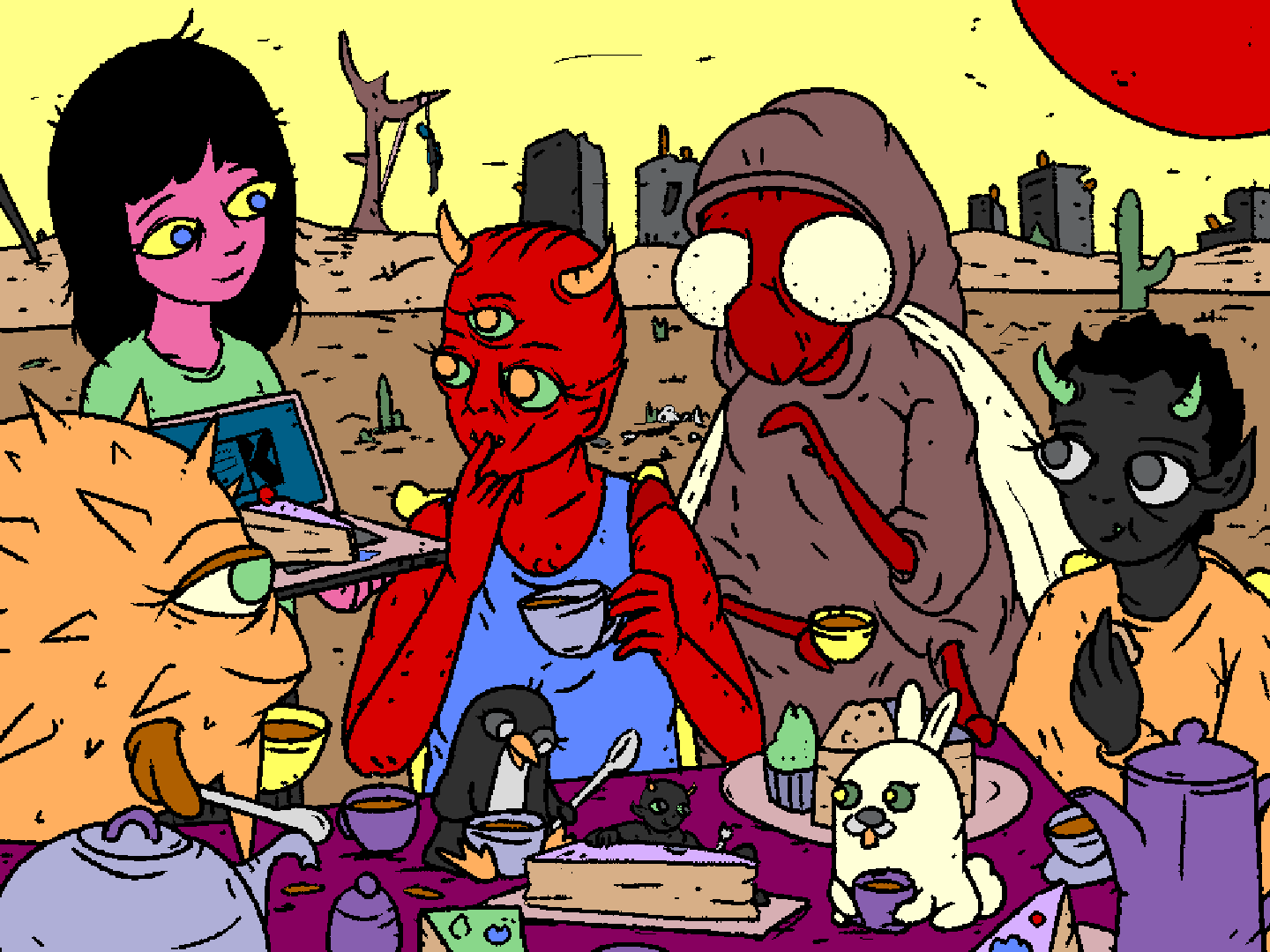
welcome to the tea party
@grahamperrin #unix_surrealism #technomage #runbsd #bsd #linux #plan9 #tea #fediart #mastoart #comic
Alt...
Girl, Puffy, Beastie, Fred, Daemon, Pocket Daemon, Penguin and Glenda are having a tea party outside on the backdrop of a destroyed city and a corpse hanging in the wind.
Everyone is cheerful. Even the Sun.
I use all three BSDs. I got into it because I was looking for something more unixy, and I was aggravated by the constant, pointless churn of things in Linux: systemd taking over all of userspace, things I'd used for decades becoming deprecated either because someone didn't feel like maintaining it anymore, or because someone else felt like reinventing the wheel was more fun, the absolute dearth of documentation (becuase it's such a moving target), etc.
I still use Linux on about half of my machines, and the three major BSDs on one each of the rest.
#OpenBSD is probably the best starting point for learning #BSD (and #unix), although #FreeBSD (which I'm running on this laptop here) has the most features and is the most Linux-ish. #NetBSD is probably the most pure, unix-wise, and has the advantage of being a fairly anti-AI OS project.
Tomorrow, Saturday, October 24, 2026, I'll be speaking at Linux Day in Modena, with a talk titled "Beyond Linux: A Journey Through the Open Source Ecosystem."
Will I talk about Linux? Of course. But I'll also talk about BSD, illumos, monocultures, and why we should never forget that there are always other paths worth exploring.
Linux proved that an alternative was possible. It would be a shame if that alternative became, in turn, a new imposition.
Because monocultures are a problem, even in the Open Source world. And because freedom isn't about everyone doing things the same way, but about being able to choose a different way.
Open Source and closed minds don't mix.
https://makeitmodena.comune.modena.it/makeitmodena/eventi/24-ottobre-2026-linux-day
#Linux #LinuxDay #IT #OwnYourData #RunBSD #BSD #FreeBSD #NetBSD #OpenBSD #illumos #LinuxDay2026

@csgraves ::clears throat::
https://mstdn.social/@faraiwe/117473371127436812
It might take a bit of tweaking, running #MineCraft under #BSD, such as you may need to INSTALL it (lol) and any dependencies,but same-same as Linux stuff.
All of the caveats.
I wish B#eOS was still around. I think #Haiku runs MineCraft native, tho?
Hey #NetBSD guys,
How do you set up #WireGuard? wg-quick isn't available for NetBSD from what I can tell. I got wireguard-go to create the tun0 interface, but when I try to feed the config file to it, I get a parsing error:
rld@discovery:~$ doas wg setconf tun0 /etc/wireguard/protonvpn.conf
Line unrecognized: `Address=10.~~~.~~~.~~~/32,2a07:~~~~::2:2/128'
Configuration parsing error
rld@discovery:~$
(~~~=redacted)

I'm thinking of replacing an old laptop's Windows 10 system with a #BSD system instead of #Linux.
Most of the articles I see on the BSDs tend to downplay user interface. I'm very comfortable with the command line, but I want my GUI too.
Has anyone had any daily experience with this sort of setup? I am leaning towards #FreeBSD or #DragonflyBSD but I don't know about the available desktops.
Everything seems to be working fine on my NetBSD laptop, but yesterday I realised that the microphone isn’t working (although it is recognised)!
It’s not a big problem as I never use it, but I’d still like to sort it out.
I’ll look into it over the next few days... 🧐
#bsd #netbsd #bsdunix #unix #unixITA #unixitalia #guuf #guufxmpp #guufITA #linux #linuxITA #linuxitalia
@MsDropbear42 @c64whiz @dwarmstrong
I might recommend [NomadBSD].
I don't know if it's actually still active as a project, but it's a persistent live USB image for #FreeBSD with an xfce DE. It's pretty nice to get your feet wet without actually "losing" your main machine. :D
I know the FreeBSD guys are working on a full [KDE installer]. I'm not sure what the status is, at the moment, but they're definitely making good progress.

SkiftOS : https://skiftos.org/
It's not a *NIX!
"skiftOS isn’t POSIX. It’s a fresh API and userland inspired by Plan 9, Haiku, and Fuchsia. Familiar ideas, different contracts."
Problem: the GPL is poison. It has polluted Linux and the Linux userland software so that only large corporations can afford to monetize it. BSD License or MIT License would be much better allowing small players to produce unique work without then being forced to share their source code with the AI hegemony racket.
#SkiftOS #Tech #Linux #OS #Plan9 #Haiku #Fuchsia #Computing #SoftwareFreedom #AIHegemony #GPL #License #BSD #MIT
