Search results for tag #academicchatter
![[?]](https://files.mastodon.social/accounts/avatars/110/128/000/908/920/430/original/a62af531dc3efd4c.jpg)
Poll.
1. Should I write another academic paper?
If YES should it be about
2a) the collapse of the knowledge commons
2b) data, consent and privacy in digital learning
3. NO. Don't bother, academic publishing is a busted flush, at least in education and humanities
(caveat: this post got zero reactions in bsky, which was a litmus test on engagement)
![[?]](https://files.mastodon.social/accounts/avatars/110/782/727/700/033/633/original/6100c780b7892bdf.jpg)
🌍 Curious about the global landscape of journals using #OpenJournalSystems (OJS) in 2025? Check out this interactive visualization using PKP Beacon Data!
With data on 62,549 active journals using OJS, click on a country to get its overall rank and rank in the region, number of active journals, number of articles published, and software version use.
Built by Nate Wright. Explore at https://pkpbeacon.notthisway.com/
#PKPBeacon #ScholComm #ScholarlyPublishing #OpenAccess #AcademicChatter
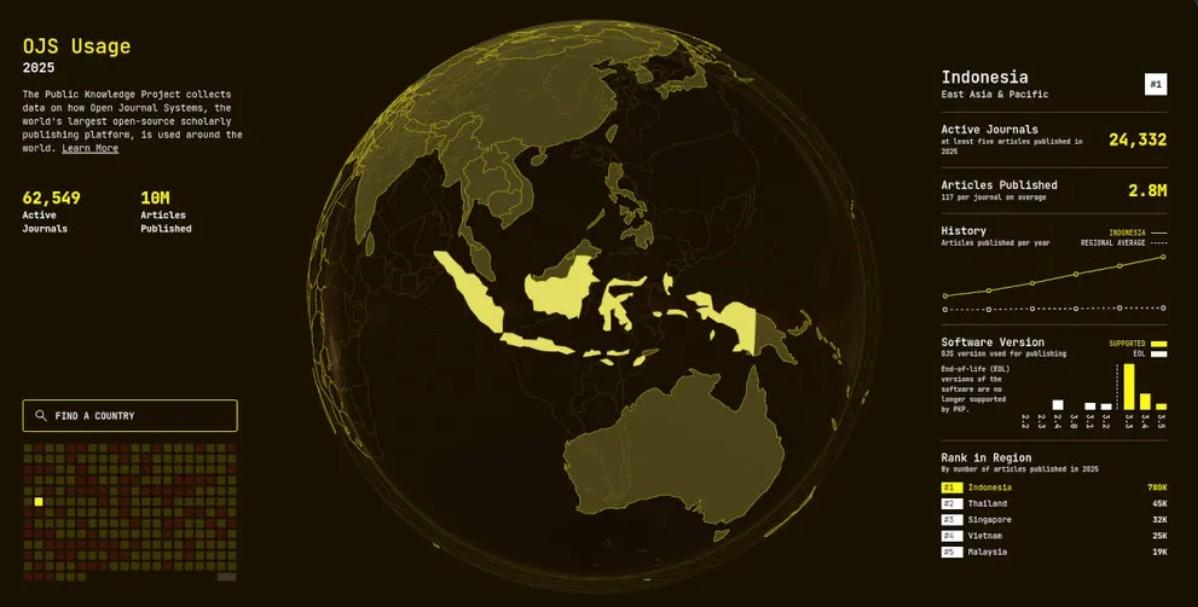
Alt...
Screenshot of interactive data visualization for journals using OJS in 2025. Data visualization includes an Earth globe that can be rotated as well as a clickable alphabetized chart, and a search box, all of which can be used to search countries. Other data visualizations include line graphs, bar charts, and number rankings.
![[?]](https://soc.octade.net/octade/s/3f7f2b5eda4e392867c301c49c2daa16.png)
Rhizome Function Anagram Random Generator
preprint | https://zenodo.org/records/21551292
doi | https://orcid.org/0009-0009-5144-3278
Herein are described principles and a scheme of random number generation styled as, pangrandomonium, or ‘pangrand’. Pangrand is a anagrammatic random number generator that uses rhizome functions as chaotic indexing and shuffling instructions to reorder and sum perfect pangrams. Brief descriptions are given for the principles of pangram summing and rhizome indexing functions, Source code of the random number generator is included herewith. The source code is attached to the PDF file.
Sections:
1. Pangrams (Holoalphabetic arrays) ;
2. Rhizome Functions ;
3. Rhizome Hardness Problems ;
4. Random Generator Methods ;
5. Errata ;
6. Source Code.
#Preprints #Random #Cryptography #RNG #Pangrams #Anagrams #Pascal #Papers #RhizomeFunction #AcademicMastodon #Cryptology #Math #NumberTheory #Papers #Academia #ComputerScience #CompSci #AcademicChatter #OpenScience
![[?]](https://media.mathstodon.xyz/accounts/avatars/110/721/438/100/207/085/original/06c706aeaf1a6098.jpg)
A student who puts their name in the file name of a PDF they send me instead of just calling it thesis.pdf is clearly a genius and I almost don't need to read the thesis. 😛