Search results for tag #surveillancecapitalism
![[?]](https://files.mastodon.social/accounts/avatars/114/608/560/405/882/941/original/2e435808ba96e194.png)
We run CryptPad, Jitsi Meet, NoFuture & M2Usenet —
privacy-first, zero tracking, no Google.
No ads. No data mining. Just community-funded
infrastructure for people who refuse surveillance capitalism.
If this matters to you, support us on Liberapay 👇
https://www.virebent.art/crowdfunding.html
#Privacy #FreeSoftware #Fediverse #SurveillanceCapitalism #OpenSource
![[?]](https://files.mastodon.social/accounts/avatars/111/422/003/981/500/797/original/ffc31d2f72cadb6a.jpg)
Fuel your anti- #BigTech rage by reviewing all the horror stories from last month:
https://blog.rebeltechalliance.org/news-roundup-jan-26/
Including a corker about how the encryption of #WhatsApp is a mirage!
A theme developing is X and Meta's 'pivot-to-paedo' - and January was full of such stories. Just when you think tech bros can't get any worse!
![[?]](https://files.mastodon.social/accounts/avatars/115/872/467/894/168/268/original/5b0b51223e374c2e.png)
🚀 Episode 12 – “Hijacked Homework”
We talk five layers of classroom surveillance—from free‑tier badge apps that harvest gold‑star data to AI‑tutors that listen to every question.
🎙️ Get the legal low‑down (FERPA, COPPA, GDPR) and a practical, low‑cost privacy toolkit (burner tablets, VPNs, paper opt‑outs, data‑deletion requests, contract advocacy)
👉 Tune in:
https://impracticalprivacy.com
#Privacy #EdTech #Surveillance #Data #DataProtection #Surveillancecapitalism #Education

![[?]](https://s3-eu-central-1.amazonaws.com/mastodon-aral/accounts/avatars/000/000/001/original/0d9c2e06a0f43906.png)
So there’s a new Guardian interview with Jimmy Wales out (to promote his new book, with an affiliate link for the Guardian in it) titled “‘People thought I was a communist doing this as a non-profit’: is Wikipedia’s Jimmy Wales the last decent tech baron?”* that’s making the rounds here.
For those who only read the headlines, here’s a TL;DR: No. There is no such thing as decent tech baron, that’s an oxymoron.
From the article itself:
“‘I’m actually quite in favour of business and capitalism and all that.’ (He’s currently president of Fandom, an ad-funded entertainment site that hosts user-edited pages, owned by private equity firm TPG Capital).”
And:
“Does he still regard Musk, the world’s richest man, as a friend? ‘Friends is probably a little strong. I mean, not, not that –‘ he sputters, editing himself in real time. ‘I want to be careful how I say that, only because I’ve met him maybe five or six times, so that I would be overstating to say friends. We’ve been friendly, and even now he’s much nicer to me in private than you might think. I mean, he’s got a big public persona, and that’s a little bit different from the private Elon, who I think is more thoughtful.’”
Also, some more background:
https://mastodon.ar.al/@aral/115445244962527420
#JimmyWales #wikipedia #theGuardian #bookPromotion #capitalism #ElonMusk #adTech #zeroRating #Facebook #Meta #surveillanceCapitalism #regulation
![[?]](https://media.neuromatch.social/accounts/avatars/109/458/903/293/998/482/original/654227a7cc5e4c52.jpg)
Glad to formally release my latest work - Surveillance Graphs: Vulgarity and Cloud Orthodoxy in Linked Data Infrastructures.
web: https://jon-e.net/surveillance-graphs
hcommons: https://doi.org/10.17613/syv8-cp10
A bit of an overview and then I'll get into some of the more specific arguments in a thread:
This piece is in three parts:
First I trace the mutation of the liberatory ambitions of the #SemanticWeb into #KnowledgeGraphs, an underappreciated component in the architecture of #SurveillanceCapitalism. This mutation plays out against the backdrop of the broader platform capture of the web, rendering us as consumer-users of information services rather than empowered people communicating over informational protocols.
I then show how this platform logic influences two contemporary public information infrastructure projects: the NIH's Biomedical Data Translator and the NSF's Open Knowledge Network. I argue that projects like these, while well intentioned, demonstrate the fundamental limitations of platformatized public infrastructure and create new capacities for harm by their enmeshment in and inevitable capture by information conglomerates. The dream of a seamless "knowledge graph of everything" is unlikely to deliver on the utopian promises made by techno-solutionists, but they do create new opportunities for algorithmic oppression -- automated conversion therapy, predictive policing, abuse of bureacracy in "smart cities," etc. Given the framing of corporate knowledge graphs, these projects are poised to create facilitating technologies (that the info conglomerates write about needing themselves) for a new kind of interoperable corporate data infrastructure, where a gradient of public to private information is traded between "open" and quasi-proprietary knowledge graphs to power derivative platforms and services.
When approaching "AI" from the perspective of the semantic web and knowledge graphs, it becomes apparent that the new generation of #LLMs are intended to serve as interfaces to knowledge graphs. These "augmented language models" are joint systems that combine a language model as a means of interacting with some underlying knowledge graph, integrated in multiple places in the computing ecosystem: eg. mobile apps, assistants, search, and enterprise platforms. I concretize and extend prior criticism about the capacity for LLMs to concentrate power by capturing access to information in increasingly isolated platforms and expand surveillance by creating the demand for extended personalized data graphs across multiple systems from home surveillance to your workplace, medical, and governmental data.
I pose Vulgar Linked Data as an alternative to the infrastructural pattern I call the Cloud Orthodoxy: rather than platforms operated by an informational priesthood, reorienting our public infrastructure efforts to support vernacular expression across heterogeneous #p2p mediums. This piece extends a prior work of mine: Decentralized Infrastructure for (Neuro)science) which has more complete draft of what that might look like.
(I don't think you can pre-write threads on masto, so i'll post some thoughts as I write them under this) /1
![Surveillance Graphs
Vulgarity and Cloud Orthodoxy in Linked Data Infrastructures
[an image of an eye against a grid is to the right of a column of text]
Jonny L. Saunders
UCLA - Department of Neurology, Institute of Pirate Technology
First Published: 2023-05-02
Information is power, and that power has been largely enclosed by a handful of information conglomerates. The logic of the surveillance-driven information economy demands systems for handling mass quantities of heterogeneous data, increasingly in the form of knowledge graphs. An archaeology of knowledge graphs and their mutation from the liberatory aspirations of the semantic web gives us an underexplored lens to understand contemporary information systems. I explore how the ideology of cloud systems steers two projects from the NIH and NSF intended to build information infrastructures for the public good to inevitable corporate capture, facilitating the development of a new kind of multilayered public/private surveillance system in the process. I argue that understanding technologies like large language models as interfaces to knowledge graphs is critical to understand their role in a larger project of informational enclosure and concentration of power. I draw from multiple histories of liberatory information technologies to develop Vulgar Linked Data as an alternative to the Cloud Orthodoxy, resisting the colonial urge for universality in favor of vernacular expression in peer to peer systems.](https://media.neuromatch.social/media_attachments/files/110/346/650/954/847/550/original/7b927efb6df758d5.png "Surveillance Graphs
Vulgarity and Cloud Orthodoxy in Linked Data Infrastructures
[an image of an eye against a grid is to the right of a column of text]
Jonny L. Saunders
UCLA - Department of Neurology, Institute of Pirate Technology
First Published: 2023-05-02
Information is power, and that power has been largely enclosed by a handful of information conglomerates. The logic of the surveillance-driven information economy demands systems for handling mass quantities of heterogeneous data, increasingly in the form of knowledge graphs. An archaeology of knowledge graphs and their mutation from the liberatory aspirations of the semantic web gives us an underexplored lens to understand contemporary information systems. I explore how the ideology of cloud systems steers two projects from the NIH and NSF intended to build information infrastructures for the public good to inevitable corporate capture, facilitating the development of a new kind of multilayered public/private surveillance system in the process. I argue that understanding technologies like large language models as interfaces to knowledge graphs is critical to understand their role in a larger project of informational enclosure and concentration of power. I draw from multiple histories of liberatory information technologies to develop Vulgar Linked Data as an alternative to the Cloud Orthodoxy, resisting the colonial urge for universality in favor of vernacular expression in peer to peer systems.")
Alt...
Surveillance Graphs
Vulgarity and Cloud Orthodoxy in Linked Data Infrastructures
[an image of an eye against a grid is to the right of a column of text]
Jonny L. Saunders
UCLA - Department of Neurology, Institute of Pirate Technology
First Published: 2023-05-02
Information is power, and that power has been largely enclosed by a handful of information conglomerates. The logic of the surveillance-driven information economy demands systems for handling mass quantities of heterogeneous data, increasingly in the form of knowledge graphs. An archaeology of knowledge graphs and their mutation from the liberatory aspirations of the semantic web gives us an underexplored lens to understand contemporary information systems. I explore how the ideology of cloud systems steers two projects from the NIH and NSF intended to build information infrastructures for the public good to inevitable corporate capture, facilitating the development of a new kind of multilayered public/private surveillance system in the process. I argue that understanding technologies like large language models as interfaces to knowledge graphs is critical to understand their role in a larger project of informational enclosure and concentration of power. I draw from multiple histories of liberatory information technologies to develop Vulgar Linked Data as an alternative to the Cloud Orthodoxy, resisting the colonial urge for universality in favor of vernacular expression in peer to peer systems.
![[?]](https://media.infosec.exchange/infosec.exchange/accounts/avatars/110/534/903/902/781/190/original/d33155ccea3c64ee.png)
RE: https://xoxo.zone/@Ashedryden/115952812145125212
Helping people install a full-featured web content blocker, such as @ublockorigin, was already necessary for #infosec. Now it's necessary for #resistance.
Likewise, helping people set up a VPN from their phones to a non-logging network ad- and tracking-filtering server is resistance.
Likewise, helping people migrate off technofeudalist social media, onto @signalapp for DMs and federated social media for everything public, is resistance.
Likewise, denying supporters or enablers of surveillance capitalist corporations everything it is your right to deny them is resistance.
The more data and revenue we deny the #adTech and #surveillanceCapitalism industry, the more power we take away from the gestapo.
All collaborationists—companies or individuals—are traitors against the Peoples of the #USA and all their allies.
“But now things suck even for me and I’m sad!”
Oh, the gravy train ran out of gravy, did it? Something about leopards eating people’s faces?
Here, have a very fucking tiny violin.
🎻
#BigTech #BigWeb #SiliconValley #SiliconRoundabout #SurveillanceCapitalism #PeopleFarming #fascism
“How could we have known?!”
Maybe if you’d listened to those of us warning you – often times your own damn friends – instead of siding with the corporations that paid your salaries/consulting fees/sponsored your conferences/invited you to parties and bought you free booze…
🤷♂️
#BigTech #BigWeb #SiliconValley #SiliconRoundabout #SurveillanceCapitalism #PeopleFarming #fascism
In the spirit of #FOSDEM2026 being sponsored by Google, I hope HackerTrain is brought to you by Ryanair.
#google #surveillanceCapitalism #BigTech #FOSDEM https://toot.si/@hook/115662561290957296
![[?]](https://media.mas.to/accounts/avatars/000/151/244/original/c0322cd63f1b82b3.png)
 🐦🔥nemo™🐦⬛ 🇺🇦🍉
#Quote of the day: "Gutta cavat lapidem" is a Latin proverb meaning "a drop hollows out a stone" or "the dripping water hollows the stone. Let's hollow out #SurveillanceCapitalism :D #privacy #security Join the democratic penguin republic 🐧 🫡 ❄️ #linux #FOSS
Democratic Penguins Republic - Trade War (Official Music Video) #yt
Meta earns $16B a year from targeted scam ads.
This is fine and normal.
#BigTech #Facebook #Instagram #WhatsApp #Meta #shutItDown #regulation #SurveillanceCapitalism #surveillance #capitalism #PeopleFarming #adtech
@EUCommission and there it is "Right to respect of private and family life".
Why is #bigtech not made accountable to this?
Why do we still have #surveillancecapitalism?
![[?]](https://files.mastodon.social/accounts/avatars/115/070/625/860/923/251/original/9629d01039476748.png)
My latest essay, “The Myth of Homo Normalis: Archaeology of the Legible Human,” excavates how the idea of normality evolved from a statistical convenience into a moral imperative—how psychology, sociology, and even critical theory turned legibility into a form of control.
📖 https://doi.org/10.5281/zenodo.17290628
🎙️ https://open.spotify.com/episode/1KpoC30kGKgIhENyOJTexR?si=oEEsKX-GTN6uc88sIV2_kw
🔗https://philosophics.blog/2025/10/08/the-myth-of-homo-normalis/
#Philosophy #AntiEnlightenment #blog #Foucault #CriticalTheory #Psychology #Ethics #Sociology #Neurodiversity #SurveillanceCapitalism #Modernity
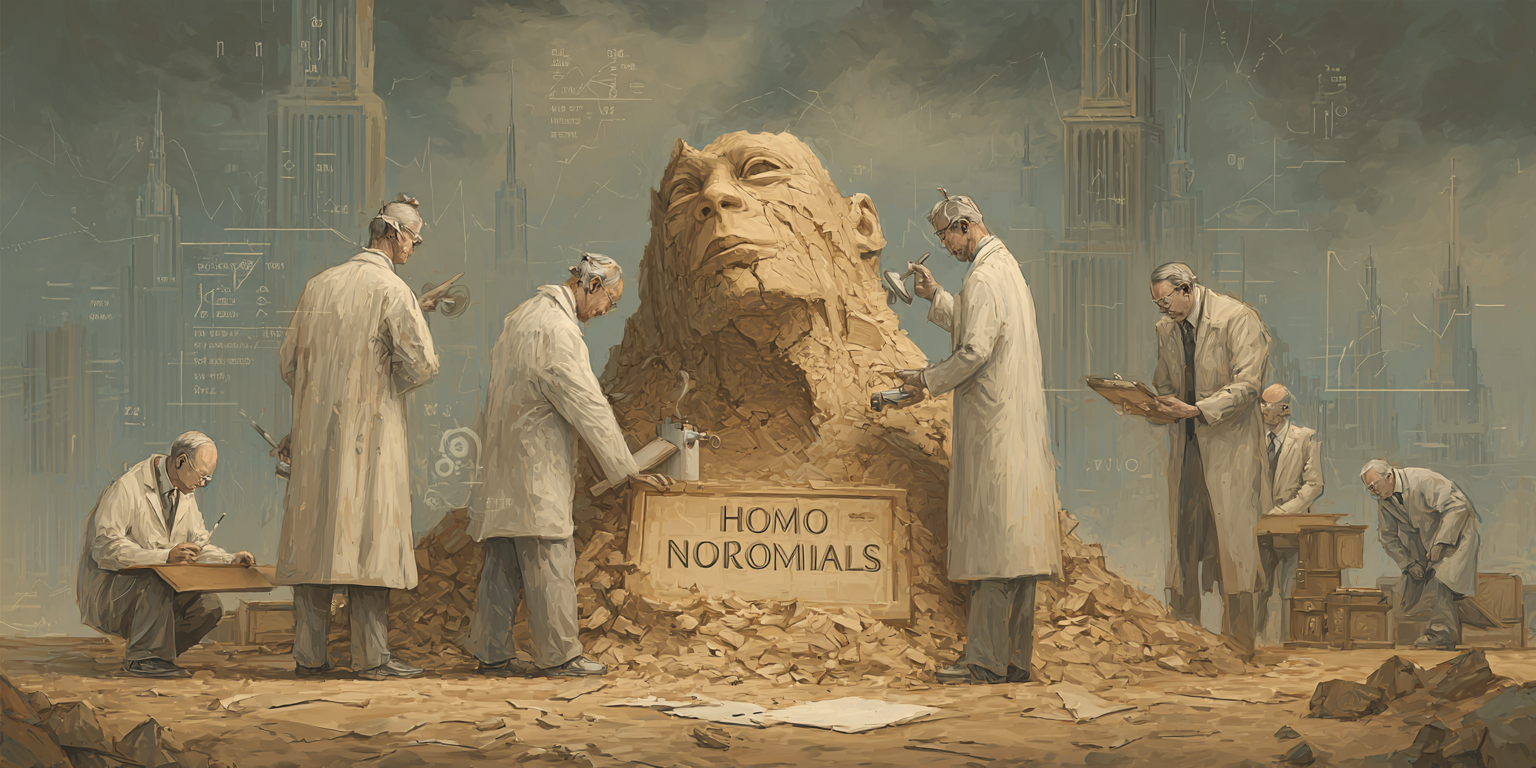
Alt...
Excavation of Homo Normalis
If you care about digital privacy, and not supporting the anti-democratic forces of #bigtech then sometimes it's a bit depressing and you feel helpless.
Cheer yourself up by seeing just how many organisations are out there fighting that fight for you 💪🏼:
![[?]](https://media.supervolcano.angryshark.eu/accounts/avatars/114/936/247/766/901/312/original/a3885f4c09c74be5.jpg)
I was talking with a friend about dating apps, privacy, security and safety.
They are using Feeld, which lets you tag specific kinks -- and which changed their TOS about 2 years ago (IIRC) to specify that they sell user data. (In a massive betrayal of the trust and safety of their user base.)
My friend's response was that they aren't ashamed of who they are and if an app wants to sell their data, no big deal.
My position was that in a time of rising fascism, it's really worth thinking about how in the 1930's, IBM set up the systems to tag and sort people by "undesirable" qualities. In Germany.
I fear for people with all my heart.
For the reading comprehension impaired, let me be clear: I'm not telling anyone not to live their life. I'm saying be smart, raise your game on privacy and security, and keep yourself and your people as safe as you can in a brutal world.
@Em0nM4stodon wrote a great article on data privacy and dating apps (with a focus on queer apps but also relevant to any dating apps).
Read it, share it with your people, and act on it.
https://www.privacyguides.org/articles/2025/06/24/queer-dating-apps-beware-who-you-trust/
#Dating #QueerDating #DatingApps #SurveillanceCapitalism #DataBrokers #DatingApp #Privacy #PrivacyGuides
![[?]](https://soc.octade.net/octade/s/3f7f2b5eda4e392867c301c49c2daa16.png)
The $94 Million Smart Meter Surveillance Scheme Exposed
Sacramento residents discovered their utility company has been secretly feeding their private energy data to police without warrants, leading to a massive surveillance operation that generated $94 million in fines. This explosive investigation reveals how SMUD transformed smart meters into government spy devices, monitoring when you shower, sleep, or use appliances.
Innocent homeowners faced armed police raids for using electricity to power medical equipment or mine cryptocurrency. One resident was forced outside in his underwear at gunpoint, while another disabled veteran was threatened with arrest for refusing warrantless entry. The surveillance threshold dropped dramatically from 7,000 to just 2,800 kilowatt hours per month, making air conditioning use suspicious in Sacramento's brutal heat.
Internal documents expose how SMUD analysts actively mined customer data for police, checking over 10,000 homes in a single month. Despite California law explicitly prohibiting utilities from sharing precise meter data without warrants, SMUD violated these protections daily for a decade.
The Electronic Frontier Foundation's lawsuit could reshape smart meter privacy nationwide. With the October 2025 court decision approaching, every American with a smart meter needs to understand how their utility company might be spying on them right now.
#SMUD #SmartMeters #EFF #Privacy #Utilities #Electricity #surveillance #SurveillanceCapitalism #Spying #4thAmendment #WarrantlessSearch #Constitution #CivilRights #Courts #Lawsuit #SCOTUS #Cops #Police #Extortion #Fraud