Search results for tag #biblestudy
![[?]](https://babka-mastodon.nyc3.cdn.digitaloceanspaces.com/accounts/avatars/109/554/492/947/534/560/original/cccb05f65e8f3af8.png)
ICYMI:
Read Part 3 of my Substack Series & Learn The Last Two Hebrew Marks That Make Everything Click:
Quotation Marks and the Makaf
Explained! 👇🏻
#LearnHebrew #BibleStudy #hebrewlanguage #LanguageDevelopment #hebrewforbeginners
There is “dad” in Hebrew, and then there is the softer, more loving way little ones call out for their fathers. The tender version, full of warmth and affection, the kind of word that holds a whole feeling inside it.
With Father’s Day around the corner, I wanted to teach you exactly that, because some words are not just words. They are love.
Watch the short lesson and learn the loving way to say it. And tell me what you called your father growing up. 💙
![[?]](https://hermeneutrix.com/wp-content/uploads/2021/11/cropped-prochazka-still-life-512.jpg)
Reflecting on 1 Samuel 18 1-4 & other texts
This week we’re studying a number of somewhat isolated verses plucked from the longer story that tells us of the legendarily close relationship of David and Jonathan, the relationship that has given the English language the phrase “a David and Jonathan friendship.” Namely, 1 Samuel 18:1-4 [the very beginning]; 1 Samuel 20:16-17, 32-34, and 42 [from the chapter-long account of David and Jonathan’s parting, as David flees from Saul]; 2 Samuel 1:26-27 [a couple of verses from David’s epic lament of Saul and Jonathan’s death in battle with the Philistines]; 2 Samuel 21:7 [in which David spares Jonathan’s crippled son the fate of all Saul’s remaining grandchildren who might potentially lay claim to the throne of the Israelite monarchy].
We are missing a whole lot of context, so our first question probably must be: so, what IS the context for all this? And our next question might be: which context are we talking about? The narrative one, in which these verses fit somehow into a coherent story? The original historical one, in which whatever is going on is part of something that actually happened? The later historical one, in which whatever story is being told here is being told by someone looking backwards, with some perspective shaped by even later events, trying to make sense of everything? [How well we can reconstruct those historical contexts might be something of a question, too …] The theological context, shaped by the history of reception? [Again, which one? The one we read in the New Testament, like in the gospels? The one we ourselves are part of? And just which one is that, would we say? For instance, how much would we ourselves say the project of liberation theology or of feminism provides a context for our reading of these texts?]
Then, perhaps, we will want to think about David and Jonathan’s relationship as an instance of the various relational contexts in which the characters find themselves: family, people, covenant, etc. To whom are these friends loyal, and to whom ought they be loyal? And why, do we think? And when? And with what consequences? And what might we learn from the way their story unfolds?
Some notes on the first text are here; some notes on the collection of texts are here; and here are a couple of other questions we might want to think about, or to discuss in class.

Since we are studying these texts in the context of the topic of “the testimony of faithful witnesses,” where do we see “faithful witness” in the story of David and Jonathan? Who is faithful to whom, and how? To what or to whom do the characters witness? How is this a lesson for us?
The prophet Samuel describes David as a man after God’s own heart (1 Samuel 13:14). We are told that the Spirit of the Lord is “mightily upon David” from the day of his anointing by Samuel (1 Samuel 16:13). YHWH directly makes David the benchmark for the behavior of the subsequent kings of Israel and Judah. (See, e.g., 1 Kings 11:33, 1 Kings 14:8, 2 Kings 20:5-7) and is presented by the Deuteronomist in at least one place as the gold standard for kingly behavior (see 2 Kings 22:1-2).
How does this treatment by the text affect our understanding of David’s character? How does it influence our understanding of David’s friendship with Jonathan? Why?
David is generally thought of as the ancestor of “the Messiah,” and when Jesus is called Son of David in the gospels (e.g., Matthew 1:1) we understand it to be a messianic reference.
How does this influence our understanding of David’s character? Our understanding of the meaning of David’s friendship with Jonathan?
Image: “Spannende Lektüre,” Walther Firle, 1929, public domain, via Wikimedia Commons.
#1Samuel1814 #1Samuel201617 #1Samuel203234 #1Samuel2042 #1Samuel217 #2Samuel12627 #BibleStudy #meaningForUs #readingTheBible #thinkingAboutTheBible
So many people tell me the same thing when they first come to me. Hebrew felt impossible. The alphabet looked like a wall. The pronunciation rules made their head spin. And every method they tried was either too complicated or too dry to stick with.
If that is you, hear this clearly. Hebrew is not too hard for you. It was just never broken down the right way.
What my students tell me over and over is that I take the overwhelming and make it manageable. Complex concepts broken into clear pieces that actually click, step by step, at your own pace.
You just need a teacher who knows how to make it make sense.
hebrewbyinbal.com/speak
#LearnHebrew #Hebrew #HebrewForBeginners #BibleStudy #LanguageLearning
![[?]](https://cdn.mastodon.africa/accounts/avatars/110/342/648/747/727/334/original/b0bff7f9c221179d.jpg)
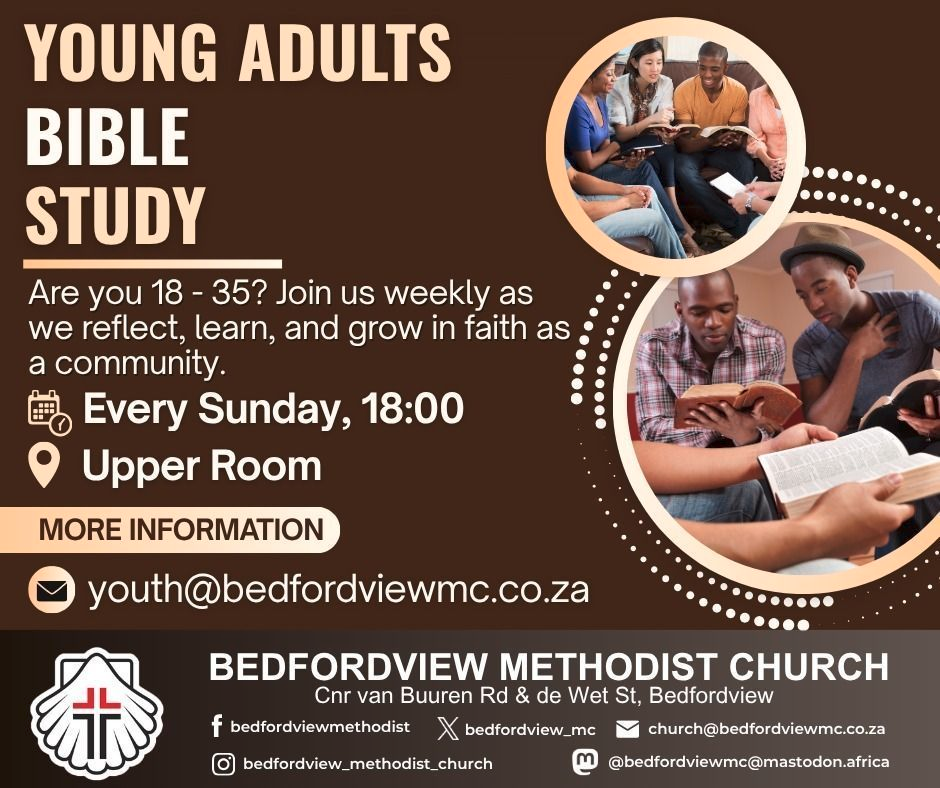
Are you between 18 and 35 years old, and want to dive deeper into the Bible? You're welcome to join our Young Adults Bible Study, now on Sunday evenings at 18:00. For more information, email youth@bedfordviewmc.co.za #church #BibleStudy
Alt...
A flyer from Bedfordview Methodist Church, advertising a Young Adults Bible Study every Sunday at 18:00 in the Upper Room. Text reads, "Are you 18 - 35? Join us weekly as we reflect, learn, and grow in faith as a community," followed by the venue and day and times, and an email address (youth@bedfordviewmc.co.za) to contact for more information. There are also photos of various people studying and discussing the Bible. The footer of the image contains the church's name, logo, and contact information.
Father’s Day is June 21st, and ahead of it I wanted to teach you one of the most ancient and meaningful words in the Hebrew language - the word for father.
It has been spoken for thousands of years through prayer, through scripture, through generations of families calling out to the ones who raised them.
Watch the short lesson and carry the word with you into Sunday. And tell me one thing your father always said that you have never forgotten. 💙
The Hebrew month of Tamuz starts today. The month of seeing. Of vision. Of the eyes. Of how we look at what is right in front of us.
Two people can stand in the exact same life, look at the exact same thing, and one sees a wall while the other sees a door. Same place. Same facts. Completely different sight.
That is the quiet invitation of Tamuz. It is not asking you to change what is in front of you. It is asking how you are choosing to see it.
So this month, notice where your eyes go. You might be looking at something you have looked at for years, and finally be ready to see it differently. 💙
#Tamuz #JewishWisdom #Hebrew #BibleStudy #JewishLife

Boker Tov friends☀️
I have my Iced Americano in hand and I am ready for another Hebrew language teaching adventure. ☕🇮🇱
I sat down in front of these words this morning and they said it all. “The world is your oyster.” That is exactly what Hebrew does. It opens the world to you. Israel. Family. Faith. Scripture in its original language. A whole life waiting just out of reach until the language finally clicks.
What door do you most want Hebrew to open for you? Tell me below and come join me on this journey.
#LearnHebrew #Hebrew #HebrewForBeginners #BibleStudy #LanguageLearning

![[?]](https://files.mastodon.social/accounts/avatars/109/248/152/768/065/493/original/5eefc02493e094b2.png)
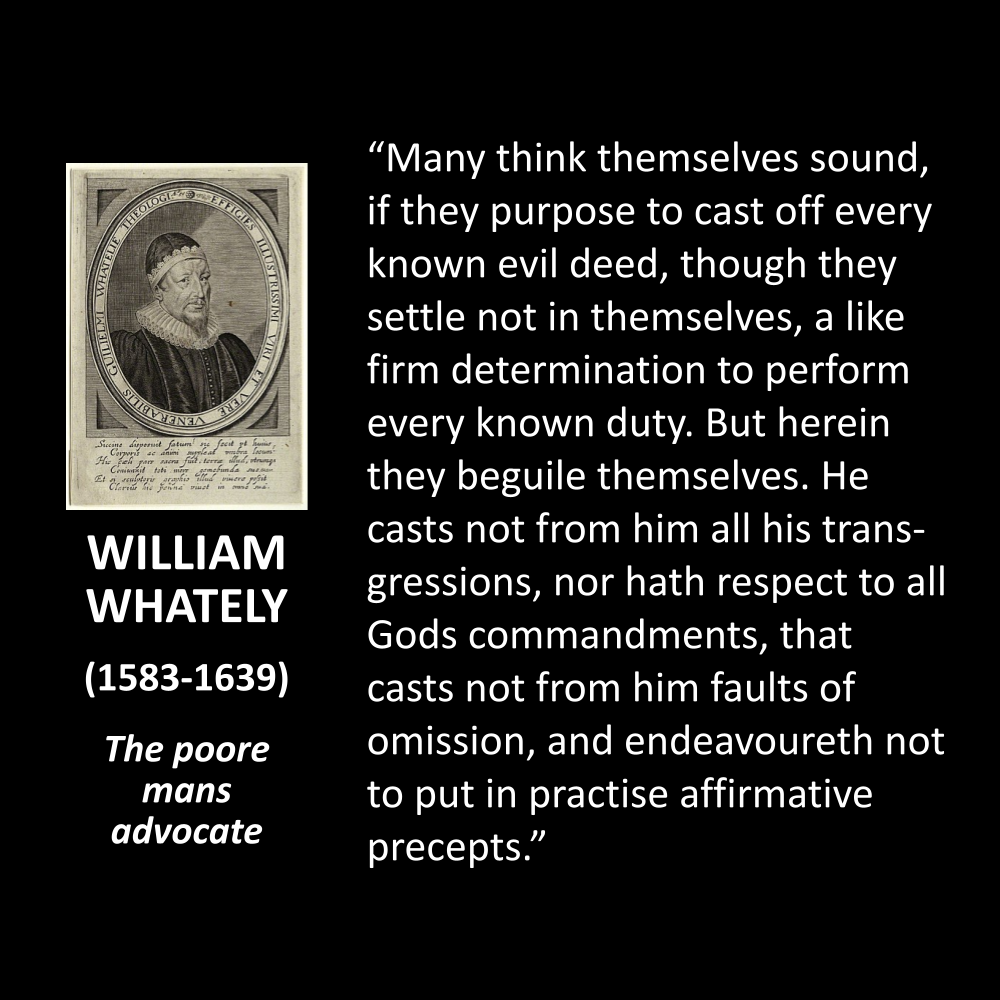
Whately—Puritan, advocate for the poor—identifies a self-deception: resolving to avoid every evil while neglecting equal determination to perform every duty. Sins of omission; affirmative precepts. These count.
Some today make memes about the danger of complacency with sin. Omissions involving the poor rarely make that list.
#puritan #tencommandments #biblestudy
Alt...
Black graphic with an engraved portrait of William Whately (1583–1639) beside a quote from The Poore Mans Advocate: “Many think themselves sound, if they purpose to cast off every known evil deed, though they settle not in themselves, a like firm determination to perform every known duty. But herein they beguile themselves. He casts not from him all his transgressions, nor hath respect to all Gods commandments, that casts not from him faults of omission, and endeavoureth not to put in practise affirmative precepts.”
What is your Hebrew Question?
Two questions landed in my inbox recently and they are some version of the same thing I hear constantly. How do you read Hebrew without the dots? How do you figure out the dots and lines in the first place? That is where I am stuck
If you have ever felt that exact frustration, you are in very good company
The dots and lines have a name. They are called the Nikud, the Hebrew vowel system, & once you understand what they are actually doing, a huge amount of the confusion lifts. They are not random. They are not decoration. They are the key that tells you how a word sounds, & learning to work them and eventually beyond them is one of the most freeing moments in your whole Hebrew reading journey
Watch the video and then tell me honestly. Where are you most stuck with reading Hebrew right now? I read every single response & these questions often become my next lessons
#LearnHebrew #HebrewWords #LangaugeLearning #BibleStudy #HebrewLanguage
![[?]](https://files.mastodon.social/accounts/avatars/116/647/842/792/908/661/original/79e1e041fc645dfe.png)
Did the early church actually practice tithing—or just voluntary giving? Explore how early Christians viewed generosity, scripture, and supporting the church in its earliest form.
#Tithing #ChurchHistory #BibleStudy
Read more: https://www.kithcartcodeofsilence.com/early-church-views-on-tithing/

![[?]](https://files.mastodon.social/accounts/avatars/113/457/650/659/369/407/original/22a92e67207c10a2.jpg)
The public restoration of the man at the Beautiful gate marked the early Church's first major sign, leaving the surrounding community "filled with wonder and amazement" (Acts 3:10 NKJV) at the miracle.
https://ko-fi.com/veggietalesgang
https://www.patreon.com/cw/veggietalesgang
https://linktr.ee/veggietalesgang
https://discord.gg/Knk4bCXKwG
https://youtube.com/shorts/p7iWtTBZx58?feature=share
#Christian #Bible
#Scripture #Gospel
#Biblememe #Christianmeme #Biblestudy
Boker Tov Friends!
The final part of my “Hebrew Marks” series just dropped. Three articles. Everything you need to read Hebrew. This is the piece that makes it all click.
#LearnHebrew #Hebrew #HebrewReading #BibleStudy #LanguageLearning
![[?]](https://soc.octade.net/retro/s/avatar-ccef00a9a86a19e385ce6ac3ee6932ec.png)
My search continues.
Will someone chime in with a list of bible software they have found useful? I'm using Linux and always on the lookout for new tools. Links would be helpful.
So far I have the applications: Xiphos, Bibletime, Widemargin, and Diatheke.
#Bible #BibleSoftware #BibleStudy #Xiphos #Bibletime #Diatheke #KJV
It is live. 🇮🇱
The Hebrew word for father carries thousands of years of history and today I am taking you deep inside all of it. One week before Father’s Day and this one is for everyone who has a father, lost a father, or simply loves this language.
Watch it here 👉 https://youtu.be/LTH4R3HrMb4
Subscribe and never miss a lesson. 🎬
#LearnHebrew #Hebrew #FathersDay #BibleStudy #LanguageLearning
Father’s Day is June 21st and this Sunday at noon I am dropping a YouTube video unlike anything you have seen from me before.
Israel does not celebrate Father’s Day. But the Hebrew word for father is one of the most ancient and powerful words in the language with thousands of years of meaning behind it.
Watch it, learn it, and share it with someone who loves their dad before June 21st. Subscribe so you are there the moment it drops. 👇
https://youtube.com/@hebrewbyinbal 🇮🇱
#LearnHebrew #Hebrew #FathersDay #BibleStudy #LanguageLearning

This is what working from home actually looks like. 🐾
Tomorrow - Sunday at noon EST - my Father's Day YouTube video goes live. I filmed it before Father's Day on purpose, so you actually have time to learn, prepare, and show up with your Hebrew ready before the day arrives.
Because that's what this is all about, showing up in the language, not just knowing it exists.
See you tomorrow, go SUBSCRIBE 🎬
Antisemitism [SENSITIVE CONTENT]
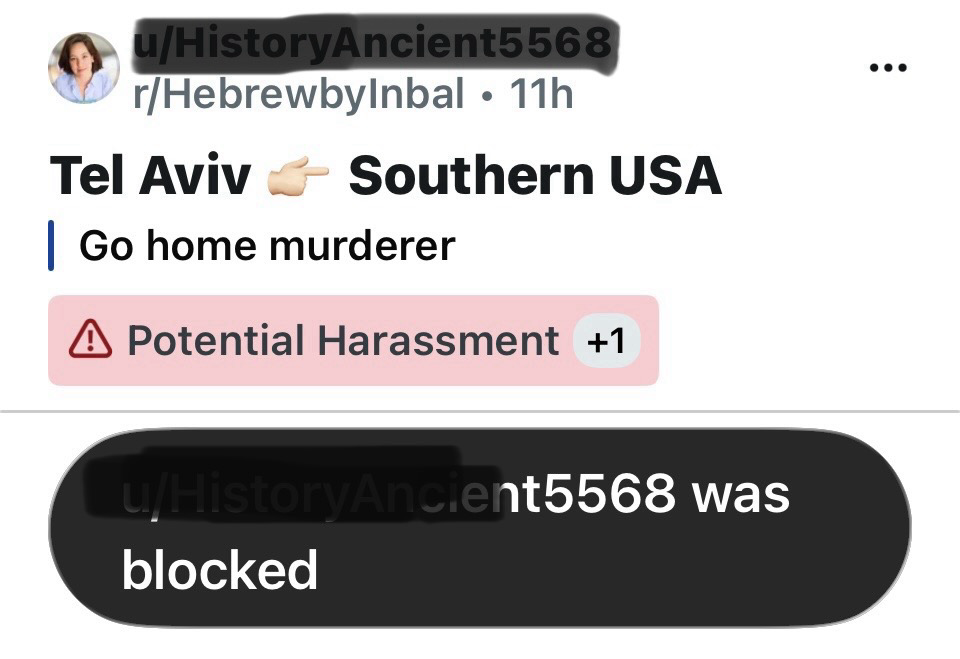
A platform flagged a comment today as “Potential Harassment” and I am still laughing at the word potential. The comment was “go home murderer.” Directed at a Hebrew language teacher. Because I am Jewish and I exist online.
My husband removes these every single day without me asking. This is just our life. And I want everyone reading this Jewish and non Jewish to really think about who sends something like this. What that emptiness looks like. What drives a person to spend their morning hunting down a Hebrew teacher on Social Media to say this.
I feel sorry for them. And then I teach Hebrew anyway. Every single day. Because showing up is the resistance and I have no intention of stopping.
I wrote about what this life really looks like from the inside. It is the most personal thing I have published and my husband’s voice in it will stay with you.
Read it here: https://open.substack.com/pub/hebrewbyinbal/p/in-his-eyes-i-see-what-i-already
#Jewish #LearnHebrew #Antisemitism #NeverAgain #BibleStudy
If you just searched “I want to learn Hebrew” - this is where that search ends.
Native Israeli teacher. Amazon bestselling author three years running. Method built for English speakers. Lifetime personal access. Thousands of students across 30 countries.
Everything you need is right here. hebrewbyinbal.com
#LearnHebrew #Hebrew #HebrewForBeginners #BibleStudy #LanguageLearning
Jacob's sons used a sacred requirement to create a tactical vulnerability, breaking their peace treaty when they "came upon the city boldly" (Genesis 34:25 NKJV) to exact their own justice.
https://ko-fi.com/veggietalesgang
https://www.patreon.com/cw/veggietalesgang
https://linktr.ee/veggietalesgang
https://discord.gg/Knk4bCXKwG
https://youtube.com/shorts/QbPwIwXEkSg?feature=share
#Christian #Bible
#Scripture #Gospel
#Biblememe #Christianmeme #Biblestudy
![[?]](https://files.mastodon.social/accounts/avatars/112/887/440/182/889/708/original/b3d8f511ea9381c5.jpg)
The Real Outerspace
https://www.youtube.com/watch?v=5ztfH9VXSBA
#Space, #SpaceHistory, #SpaceExploration, #BibleStudy.

![[?]](https://gemsofknowledge.com/wp-content/uploads/2025/09/cropped-gemsofknowledge.png)
Becoming Who God Created You to Be
"Be All You Can Be" has been a famous slogan for decades. But what if God said it first? Not through human strength, training, or determination, but through His power working within us. The truth is, God sees far more in us than we see in ourselves. Click here to read the full devotional ✨ [SENSITIVE CONTENT]
Today’s One Year Bible Verses: 1 Kings 9:1–10:29, Acts 8:14–40, Psalm 130:1–8, Proverbs 17:2–3
Be All You Can Be
Many of us have heard the U.S. Army slogan, “Be All You Can Be.”
The idea is simple: with the right training, discipline, and leadership, they can help you become more than you thought possible.
But as I was reading today’s Scriptures, I couldn’t help but think:
If people can help us become more than we imagined, how much more can God?
The One who created us knows our gifts, purpose, and potential better than we ever will. He sees not only who we are today, but who we can become through Him and the Holy Spirit reminded me of that this morning when He whispered this Gem of Knowledge to me:
“Be all that you can be through Me. My power to fill you and build you up will make you greater than you could ever imagine. Allow Me to show you who you really are. Amen.”
The Bible is filled with examples of God working in and through ordinary people to accomplish extraordinary things.
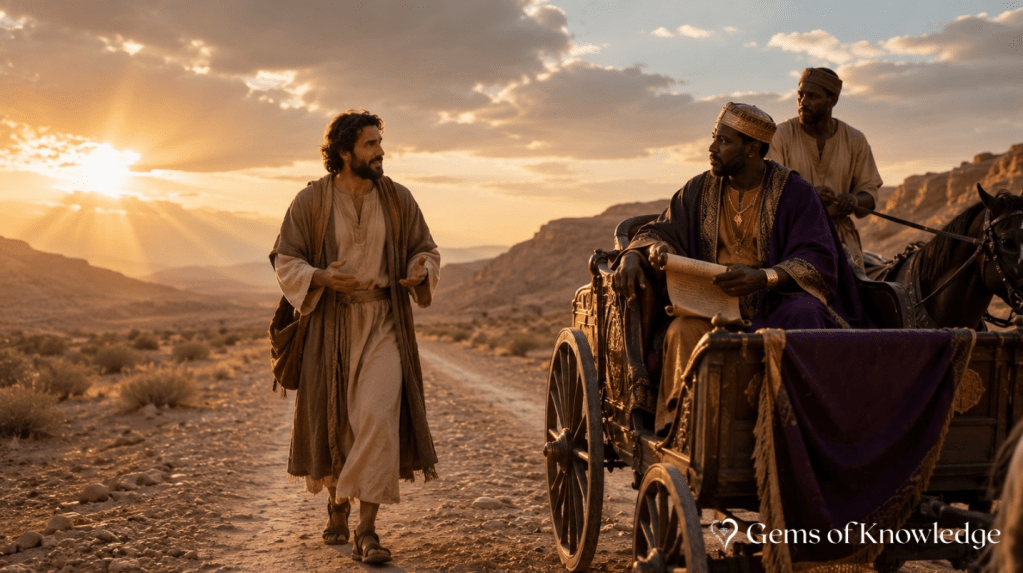
We see that today in Acts 8, when Philip was simply being obedient. He followed the leading of the Holy Spirit down a desert road without knowing why. There he encountered an Ethiopian official searching for truth in the Scriptures.
Philip could not have known that one conversation would impact an entire nation.
Yet because he was willing to follow God’s leading, he became part of a story much bigger than himself.
God often works this way.
He does not reveal our entire purpose all at once. Instead, He invites us to trust Him one step at a time. As we obey, He shapes us, strengthens us, and reveals more of who He created us to be.
We see another picture of this in Solomon. God blessed him with wisdom, influence, wealth, and favor beyond anything he could have imagined. Even the Queen of Sheba traveled great distances just to witness the wisdom God had given him.
Yet Solomon’s greatness was not something he manufactured on his own.
It flowed from God’s blessing upon his life.
The same is true for us.
The goal is not to become great in our own strength. The goal is to become everything God created us to be through His strength.
Psalm 130 reminds us where that journey begins:
“I am counting on the Lord; yes, I am counting on him. I have put my hope in his word.” (Psalm 130:5, NLT)
Growth requires trust in the One who created it all and transformation requires our surrender to Him.
We cannot become who God created us to be while clinging to who we think we are.
Often times we see ourselves through the lens of our failures, weaknesses, fears, or limitations. God sees something entirely different. He sees the person He created. He sees the gifts He placed within us. He sees the potential that can only be unlocked through His power.
Proverbs tells us:
“Fire tests the purity of silver and gold, but the Lord tests the heart.” (Proverbs 17:3, NLT)
God is continually refining us. Not to diminish us, but to reveal the beauty He placed within us from the beginning.
You may feel ordinary today. So did Philip.
You may feel inadequate today. So did many of the men and women God used throughout Scripture.But God specializes in taking ordinary people, filling them with His Spirit, and accomplishing extraordinary things through them.
When we allow Him to build us up, strengthen us, and guide our steps, we will become far more than we could have ever imagined—not for our glory, but for His. 💎
Action (5 Minutes with God)
Take 5 simple minutes to be with the Creator today. Ask Him:
- “Lord, what do You want me to know about this personally?”
- Journal what He gives you through His Holy Spirit.
- Then ask, “What do You want me to do?”
- Journal what He reveals – then do it!
Allow Him to show you who you really are and what you can really become.
Prayer
Father, thank You for creating me with purpose and intention. Forgive me for the times I have allowed fear, doubt, or insecurity to define who I am. Help me to see myself the way You see me. Fill me with Your strength, wisdom, and Spirit. Continue refining my heart and building me into the person You created me to be. Teach me to trust You one step at a time and to walk confidently in the calling You have placed on my life. In Jesus’ mighty name I pray, Amen.
To read more 5 Minutes with God devotionals click here.
If Gems of Knowledge has blessed your walk with Christ, please subscribe or consider partnering with us today. Your gift helps keep these devotionals free for everyone and carries God’s Word to more hearts. Every seed matters—thank you for sowing into this work! 💛
Test everything by the Word and the Spirit (John 16:13)
Alt...
Philip walks beside the Ethiopian official's chariot on a desert road, explaining the Scriptures as the Holy Spirit leads their encounter.
![[?]](https://files.faithtree.social/accounts/avatars/109/762/503/392/984/571/original/3f58a809494a1dc3.jpg)
Please join @kettingerjason and myself as we look at the Parable of the Sheep and the Goats. https://youtube.com/live/bNrlpeZkQK4
Reflecting on Judges 4 (specifically 4-10, 14, & 21-22)
This week, we are looking at key verses in Judges 4 (specifically, vv4-10, 14, and 21-22), the story of Deborah, Barak, and the defeat of the armies of Sisera, along with the defeat of Sisera himself at the hand of Jael.
Like all Biblical stories, the description of the main characters is spare, leaving a lot to the readers’ imagination. For that reason, it might make sense for us to spend some time looking at our own readerly impressions of Deborah, Barak, Sisera, and Jael. What are those impressions? Where do they come from, as far as we can tell? [That is, where do we see the text itself suggesting or supporting those impressions? Where do we notice ourselves thinking “that’s how it always is …” or “probably she …”? How have we come to our ideas about what’s “always” or “probably” true about characters like these, do we think?]
Ideally, we will be able to compare our impressions to those of others, and see whether there is a range of those impressions, or whether there’s a lot of consensus. What seems to be going on with that, as far as we can tell? [For instance, shared or different ways of reading the text? Shared or different social backgrounds or assumptions? Shared or different experiences? …]
Then, we can look at what seem to be the lesson or lessons for us in the story, based on those impressions of the characters. How do those lessons seem to depend on our thoughts and feelings about these characters?
Some notes on the text are here. Here are a couple of additional questions we might want to think about, or discuss:

There is a lot of killing in this story, most or all of it in the service of liberating the Israelites from oppression by the Canaanites. What thoughts, feelings, or challenges does this aspect of the story raise for us? Why?
What difference does it make what form the killing takes – that is, the killing done by Barak’s men, or that done by Jael? Again, why? Would we or would we not say that Jael’s killing is an act of war, part of “the war” between the Canaanites and the Israelites? Why, or why not? What difference would it make if it were? Why?
What difference does who is being killed make for how we think and feel about the killing in the story? Why?
How do we understand God’s involvement in the events of the story? What brings us to this understanding, do we think? What problems arise for us, or are resolved for us, when we understand God’s involvement this way?
Overall, what are our responses to this story? What do we find reassuring in it, challenging, instructive, and so on? Why?
What would we lose if this story were missing from our Bible? What would we gain? Why do we say that?
How would we feel about that? Why?
Image: “Drei Frauen im Gespraech” J.-H. Janßen, CC0, via Wikimedia Commons

Alt...
sculpture three women in conversation
Study Notes – 1 Samuel 1 9-20
We are studying 1 Samuel 1:9-20, for Sunday, September 8, a portion of the story of Hannah and the seemingly miraculous birth of Samuel that opens the book of 1 Samuel. [Some questions about the text are here.] Here are my notes on the text:
BACKGROUND AND CONTEXT: The book of 1 Samuel continues the story of Israel in the land of Israel, following the entry into the land in Joshua and the steady decline of faithfulness narrated in the book of Judges. We might think of it as part of the “Deuteronomistic History” that comprises Joshua – 2 Kings, and that presents the history of Israel as a theologically significant set of related events and experiences.
Alternatively, we might think of it as one of the books of the “former prophets” – the way it is identified in Jewish tradition. Christian readers might not think of these as “prophetic” texts, but if we think of Joshua, Samuel, Elijah and Elisha as the prophets associated with these narratives that relate a past as Marc Zvi Brettler would say, then this way of labeling the books may make more sense to us.
Either way, we think that one of the guiding concerns of the overall narrative is the development of the monarchy, and establishing David as the model monarch. Samuel will play a key role in that plot, and Samuel’s story starts with Hannah, his mother, and her desperate plea for a child.
Shiloh, where this part of the story takes place, was the cultic center at this time – well before worship was centralized in Jerusalem (in David’s time) or the Temple was built (in Solomon’s time). I used to think that the Tabernacle was set up at Shiloh, but our text refers to the temple (or palace) of YHWH, which was presumably a more permanent structure. (See the map here for the location of Shiloh.)
The time is “the time of the judges” – of whom Samuel is the last. Samuel anoints both Saul (king of Israel #1) and David (king of Israel #2).
Bible readers will recognize the theme of barrenness in the story from other Bible stories (Sarah, Rebekah, Rachel, Samson’s mother – the “wife of Manoah”), so by now this is a plot device, and we know what’s going to happen in this story. (There is an article on barrenness in the Bible at Bible Odyssey.)
Hannah’s fortunes will turn, Samuel will be born, and “given to God” at a young age, and from there will be in a position to deliver bad news to the high priest Eli about God’s unfavorable decision about him and his family, and then to interact with Saul in a complex way, and finally to anoint David.
This story may hook some of our deep feelings about pregnancy, child-rearing, and relationships. Hannah’s vow, in particular – that if only she can have a child, specifically a male child, she will dedicate the child to God – will probably strike other modern readers the way it strikes this one: as profoundly counter-productive. What’s the point of having the child if you turn around and give him away? And if we have any feeling for children at all, we can hardly help feeling miserable for Samuel, who has to go live with Eli, someone we already know to be a lousy father, and his horrible sons. It’s heartbreaking. But all of that is in the future, relative to our story.
The fact that Hannah is a co-wife, seemingly the first wife based on the order in which Elkanah’s wives are listed. Knowing what we might know about when men acquire second wives in cultures where that’s allowed today – namely, when wife #1 doesn’t have children – reinforces this suspicion. This story would have direct personal significance for women in some contemporary cultural circumstances. We might do well to remember that.
CLOSER READING: Picking the story up at verse 9, we focus on the part of the story that features Hannah’s interaction with God and with Eli.
Hannah does most of the action; she has a dozen verbs to Eli’s five. Verse 9 emphasizes the contrast between Hannah and Eli: she arises, while he sits. His seat, literally “on the doorpost” of the temple, is a little curious, but seems to give him a good view of what goes on in the temple. [Which will later, if we remember, make us think that he has to know what his wicked sons are doing, eh? So why doesn’t he do anything about it, eh? Especially since he seems completely willing to make a judgment about Hannah AND to say something to her based on his faulty judgment. What an exemplary character Eli is.]
Also, note that “eating … drinking” in v9 are infinitives – they don’t exactly tell us that Hannah ate and drank. Which makes sense, because in v8 we thought the narrator told us specifically that she was too miserable to eat.
There are a lot of infinitives in this story. I’m not sure what to make of that. Except that Hannah, in particular, is depicted in emphatic terms. She weeps, yes, weeps when she prays in v10, she vows, yes, vows her vow in v11, implores YHWH to look, yes, look on her affliction in that prayer. And then she asks God to remember and not forget – emphasizing the positive and in a sense asking God to stop forgetting, which it seems God has been doing so far.
And then she makes this insane [to my way of thinking, but what do I know] vow that if God will give she will give … which makes her sound like a pagan to me, since my humanities teacher explained that “du et dos” – I give so you will give – was the principle of Greco-Roman worship. The Nazirite features of the vow, that his hair will not be cut, remind us of other dedicated characters; given the setting in time, we will probably think of Samson.
Hannah is emphatically miserable. The story uses lots of different words for misery – affliction – bitterness of soul – etc.
Eli’s conclusion that Hannah is drunk might strike us as a little … puzzling. Do drunk people look and act this way, in our experience? Rashi explains that Eli thinks she’s drunk because people weren’t accustomed to praying silently in those days. I think Rashi is being generous to Eli.
In fact, when Hannah says she has poured out her soul before the face of YHWH, it’s an implicit contrast with drunkenness – spirit being poured out, rather than poured in. Sensitiveness, in contrast with insensibility.
Eli is really hard of hearing – this is going to come up again a couple of chapters on – and his hardness of hearing seems to be a metaphor for spiritual insensitivity. But here, in vv13-17, Eli also seems to serve as a figure for God, so that his inability to hear Hannah’s voice mirrors God’s deafness to her desire for a son, and then when Eli hears her out, and hears her explanation, and her request that he “not take the maidservant before the face [of you] as a wicked daughter”, things turn from bad to good, Eli offers her a positive response, and in effect authorizes her request. I realize that “before the face” construction is an idiom, but it’s an idiom that will make us think of coming before God because that’s how it’s often used, so … it just seems to have a whiff of that idea around it here in v16.
And then, we might know that the happy ending is coming, because in v18, when Hannah says in response to Eli (priest of God) “Let your maidservant find favor in your eyes” she uses a different word for “maidservant” than the one she has been using up till now, and switches to the word used for Hagar and Bilhah and Zilpah back in Genesis, which, if we remember our Bible stories, lets us know that pregnancy is on its way.
Hannah is happy, and the plot unfolds … “and Elkanah knew Hannah, his wife, and YHWH remembered her.”
She names him Shmuel (v20), she says because she “asked him” from God, but honestly, the name Shmuel sounds more like “God heard.”
The title of the lesson in our curriculum is “God Answers Prayer.” Perhaps there is not better title. “God finally answers prayer after a long time of seeming not to, sometimes, if you’re the right person and if your request fits in with God’s agenda” is probably too long and naturalistic a title, though I think it would be more accurate, especially in the context of this story. It’s not that I don’t believe God answers prayer. I do. But we all know that God is not a drive-thru, taking our order and handing us the sack and drink in under 2 minutes. I like John Goldingay’s insistence that when we pray, we really do mean to change God’s mind (contrary to what people and especially we Calvinists often say, that it’s designed to change us). And sometimes God does change God’s mind, too. But not always. Which brings us back around to the difficult question of “why,” and how we try to get the answer to that question … from God, presumably.

Scenes from the story of Hannah: praying in the temple at Shiloh, and after the birth of Samuel
#1Samuel #1Samuel1920 #BibleStudy #Hannah #prayer #readingTheBible #Samuel

Reflecting on 1 Samuel 1 9-20
This week we’re studying 1 Samuel 1:9-20 + 25, the story of Hannah’s prayer for a child – who turns out to be Samuel, a significant character in the history of Israel and particularly in the lives of the first two kings of Israel, Saul and David.
We’ve studied this text before (see questions from that time here), but this time we’re looking at it in the context of our summer quarter study of “the testimony of faithful witnesses.” [Although I confess, this rubric feels like a stretch to me, brought on by the desperate need to find a unifying theme for somewhat disparate texts …]
Anyway, in light of this quarter’s context, we might want to ask ourself what we mean by “faithful witnesses,” and what we think it means to be “faithful,” or a “witness.” From there we can turn to Hannah’s story, and ask ourselves: how, in what way, in this story, does Hannah demonstrate faithfulness, and to what does she bear witness? Where do we see that in the text? What do we ourselves learn from Hannah’s story and Hannah’s example?
What is our overall impression of Hannah and her story, for that matter? What thoughts and feelings do we have about her actions? What strikes us as commendable, what as perhaps less than commendable, where do we applaud her, where do we question her …? Why is that? What do we find out about ourselves in looking at all that?
Some notes on the text are here. Here are a couple of additional questions we might want to think about, or to discuss in class:
In v11, Hannah vows to dedicate the male child she is begging for from God back to God as a nazirite (see Numbers 6:1-21). What is the meaning of such a vow, do we think? What does the vow indicate about Hannah’s state of mind, or about the cultural context in which the vow is made, or about God’s desires and preferences? [That is, do we think Hannah is trying to offer something to God that God would like, as an inducement …? Or is something else going on? What, do we think?]
What thoughts and feelings do we have about this? Why?
[More personal] Have we ever made a vow to God ourselves? What was our experience with that?
What would we say this story is “about”? [That is … we might say “it’s about prayer” or “it’s about Hannah and her relationship with God” or … what?] What do we learn from a story like this? What do we think we are supposed to learn?
Why do we think this story is in the Bible?
Image: “Gespräch vor dem Haus,” Gergely Pörge, Public domain, via Wikimedia Commons

Alt...
painting figures in conversation

![[?]](https://files.mastodon.social/accounts/avatars/115/495/015/705/418/457/original/293685563f0c1975.png)
Recent developments in Israel and Jerusalem highlight Prime Minister Netanyahu’s firm stance that Iran will not acquire nuclear weapons, a position... #BibleStudy #LivingAsBereans
https://spearnet.org/2026/06/12/global-watch-daily-june-12-2026/
![[?]](https://files.mastodon.social/accounts/avatars/115/668/188/341/519/029/original/f68314ffa1a54cef.png)
The Old Testament is not a collection of disconnected stories. It is one unified story pointing to Christ.
Jesus is the Word of the Lord fulfilled in Christ.
📖 Blog: https://www.scottlapierre.org/the-word-of-the-lord-fulfilled-in-christ/
🎥 Sermon: https://youtu.be/zg74q5OenbU
![[?]](https://files.allovertheplace.ca/accounts/avatars/113/978/333/189/657/013/original/82cfa6fe0d32498a.jpg)


My latest #BibleStudy notes on #Genesis20: https://notes.laniecarmelo.tech/shares/puLBoEJCgyPwKalkRc2WFg
#Bible #Christian #Christians #Christianity #Faith #Genesis @christians
Need to get a few things done but might try and do #Genesis21 here in a little while.