Search results for tag #books
![[?]](https://zirkus-media.fra1.cdn.digitaloceanspaces.com/accounts/avatars/111/192/373/629/540/829/original/9ff4f5b9781a0e3a.jpg)
FLAT. A bubble, gull, or silly fellow.
A selection from Francis Grose’s “Dictionary Of The Vulgar Tongue” (1785)
--
#books #literature #dictionaries #history #society #language #slang @histodons
Alt...
Image imitating a page from an old document, text (as in main toot):
FLAT. A bubble, gull, or silly fellow.
A selection from Francis Grose’s “Dictionary Of The Vulgar Tongue” (1785)
![[?]](https://cdn.masto.host/mastjohn1126com/accounts/avatars/115/981/910/993/463/416/original/00ac72837ce34a31.gif)
@mstadmin
⭐ "hunger is the best seasoning"
Convicts sent to #Australia many years ago had...
"the most miserable, scarcely enjoyable meals; and sometimes — if they do not want to starve — they catch snakes and lizards, cut off the heads, roast them over straw fire, and consume this meat with the greatest of appetites. Truly once again the saying holds true: Hunger is the best cook."
#book: The 12 Hours
FACE-MAKING. Begetting children. To face it out; to persist in a falsity. No face but his own: a saying of one who has no money in his pocket or no court cards in his hand.
A selection from Francis Grose’s “Dictionary Of The Vulgar Tongue” (1785)
--
#books #literature #dictionaries #history #society #language #slang @histodons
Alt...
Image imitating a page from an old document, text (as in main toot):
FACE-MAKING. Begetting children. To face it out; to persist in a falsity. No face but his own: a saying of one who has no money in his pocket or no court cards in his hand.
A selection from Francis Grose’s “Dictionary Of The Vulgar Tongue” (1785)
![[?]](https://files.mastodon.social/accounts/avatars/110/441/535/131/897/219/original/0ddf9d4dd12a5dee.png)
Naming the Universe
How the quick thinking of internationally minded astronomers avoided stamping the solar system with petty European rivalries
by Stephen Case
Books by John Herschel at PG:
https://www.gutenberg.org/ebooks/author/48095
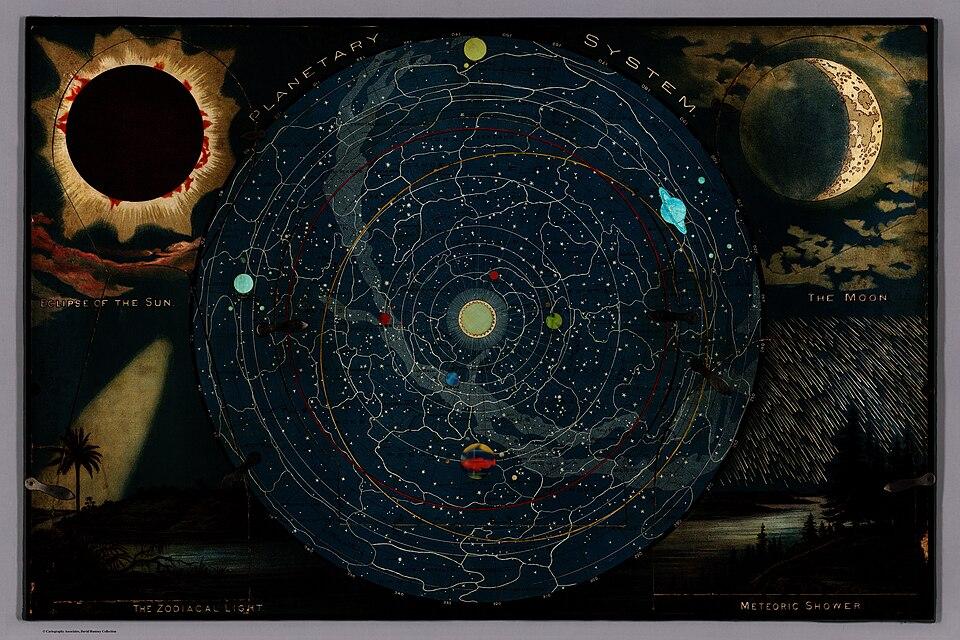
Alt...
Planetary System. Eclipse of the Sun. The Moon. The Zodiacal Light. Meteoric Shower. From Yaggy’s Geographical Study, 1887.
An illustrated educational diagram depicting the solar system with orbital paths around a central sun, comets, and the zodiacal light. The corners feature vignette illustrations of related astronomical phenomena: a solar eclipse, the moon, the zodiacal light, and a meteoric shower.
https://fr.wikipedia.org/wiki/Fichier:Levi_Walter_Yaggy_Planetary_System_1887.jpg
Scholar Claims Van Gogh Hid Secret Homage to Leonardo da Vinci’s ‘The Last Supper’ In His ‘Café Terrace at Night’
Did you know about his "Sacred Realism"?
by Lorena Muñoz-Alonso (from the archives)
https://news.artnet.com/art-world/vincent-van-gogh-last-supper-cafe-terrace-at-night-275282
Books by Van Gogh at PG:
https://www.gutenberg.org/ebooks/author/40599
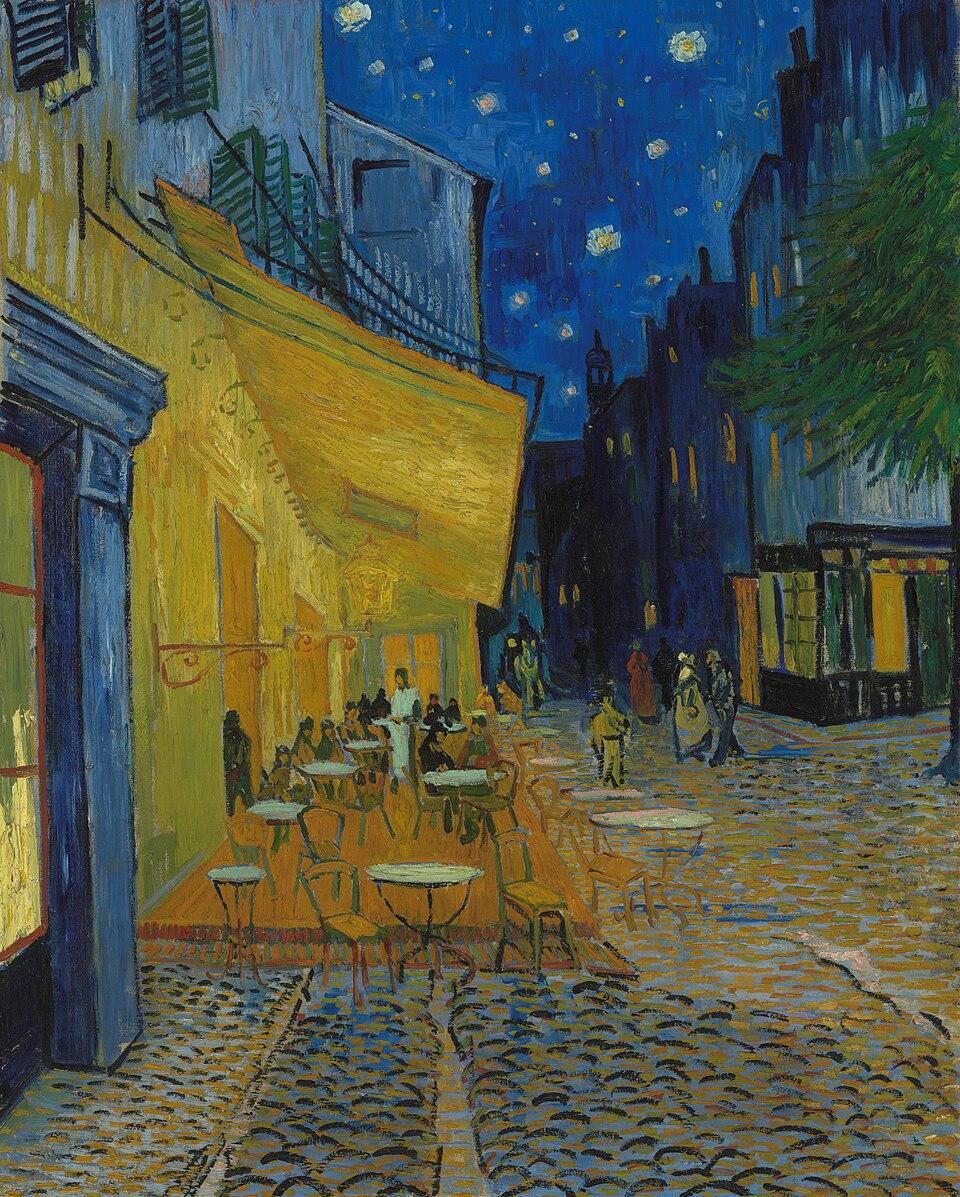
Alt...
Van Gogh - Terrace of a Café at Night (Place du Forum) 1888.
It depicts a café on the Place du Forum lit by gaslight, glowing yellow against the deep blue starry night sky, with cobblestones rendered in van Gogh's characteristic brushwork.
https://en.wikipedia.org/wiki/Caf%C3%A9_Terrace_at_Night#/media/File:Van_Gogh_-_Terrace_of_a_Caf%C3%A9_at_Night_(Place_du_Forum)_1888.jpg
![[?]](https://mastodon.well.com/system/accounts/avatars/112/576/890/080/816/603/original/0f84c73e63efb281.jpeg)
I didn’t buy it. It was hard not to, but I was strong. But I really wanted to.
#books #retrocomputing #x11 #motif

Alt...
A copy of X Window System Programming and Applications with Xt, OSF/MOTIF Edition, by Douglas A. Young.
![[?]](https://media.beige.party/accounts/avatars/116/542/260/009/316/273/original/cb4fc108e4a6fd8e.gif)
Cold writing take [SENSITIVE CONTENT]
@mdhughes @glitzersachen @screwlisp @Binder
"Cosmic Laughter" (1974) is a collection of some wonderfully funny science fiction short stories. It was once is my fault recommendations a few weeks ago: https://kolektiva.social/@Quasit/116683881518514475
And R. Bretnor wrote a lot of very funny short science fiction too. "The Schimmelhorn File" (1979) is a collection of short stories about a Swiss janitor who is a genius—but only in his subconscious. Fair warning, Papa Schimmelhorn starts out as a dirty old man and just gets worse and worse.
https://archive.org/details/schimmelhornfile0000unse
Another character who's a genius only in his subconscious (and generally wakes up from a bender with mysterious inventions that he doesn't understand) is Henry Kuttner's Galloway Gallagher. Many Gallagher stories were collected in "Robots Have No Tails" (1952).
Gallagher is, I should note, an alcoholic.
https://archive.org/details/robotshavenotail0000henr_r4c9
#quasitbookrecs #books #ScienceFiction #humor #ShortStories #bookstodon
KNIGHT OF THE TRENCHER. A great eater.
A selection from Francis Grose’s “Dictionary Of The Vulgar Tongue” (1785)
--
#books #literature #dictionaries #history #society #language #slang @histodons
Alt...
Image imitating a page from an old document, text (as in main toot):
KNIGHT OF THE TRENCHER. A great eater.
A selection from Francis Grose’s “Dictionary Of The Vulgar Tongue” (1785)
![[?]](https://files.mastodon.online/accounts/avatars/109/298/185/928/165/179/original/8ed3da9f519c2f00.jpg)
This stunning Book of Hours from around the 1490s was made for a woman back in the day.
Thanks to Domeisen Rarebooks for sharing this gem from their upcoming July Sotheby’s sale.
@xmuse_ #globalmuseum #books #history #religion #rarebooks
KNIGHT AND BARROW PIG, more hog than gentleman. A saying of any low pretender to precedency.
A selection from Francis Grose’s “Dictionary Of The Vulgar Tongue” (1785)
--
#books #literature #dictionaries #history #society #language #slang @histodons
Alt...
Image imitating a page from an old document, text (as in main toot):
KNIGHT AND BARROW PIG, more hog than gentleman. A saying of any low pretender to precedency.
A selection from Francis Grose’s “Dictionary Of The Vulgar Tongue” (1785)
Solved, Unsolved and Unsolvable: The Status of Hilbert’s 23 Problems in Mathematics
More than a century after David Hilbert presented a list of 23 mathematical challenges to the 1900 International Congress of Mathematicians, mathematicians have made significant progress, but there’s still much work to do.
By Evelyn Lamb
Mathematical problems at PG:
https://www.gutenberg.org/ebooks/71655
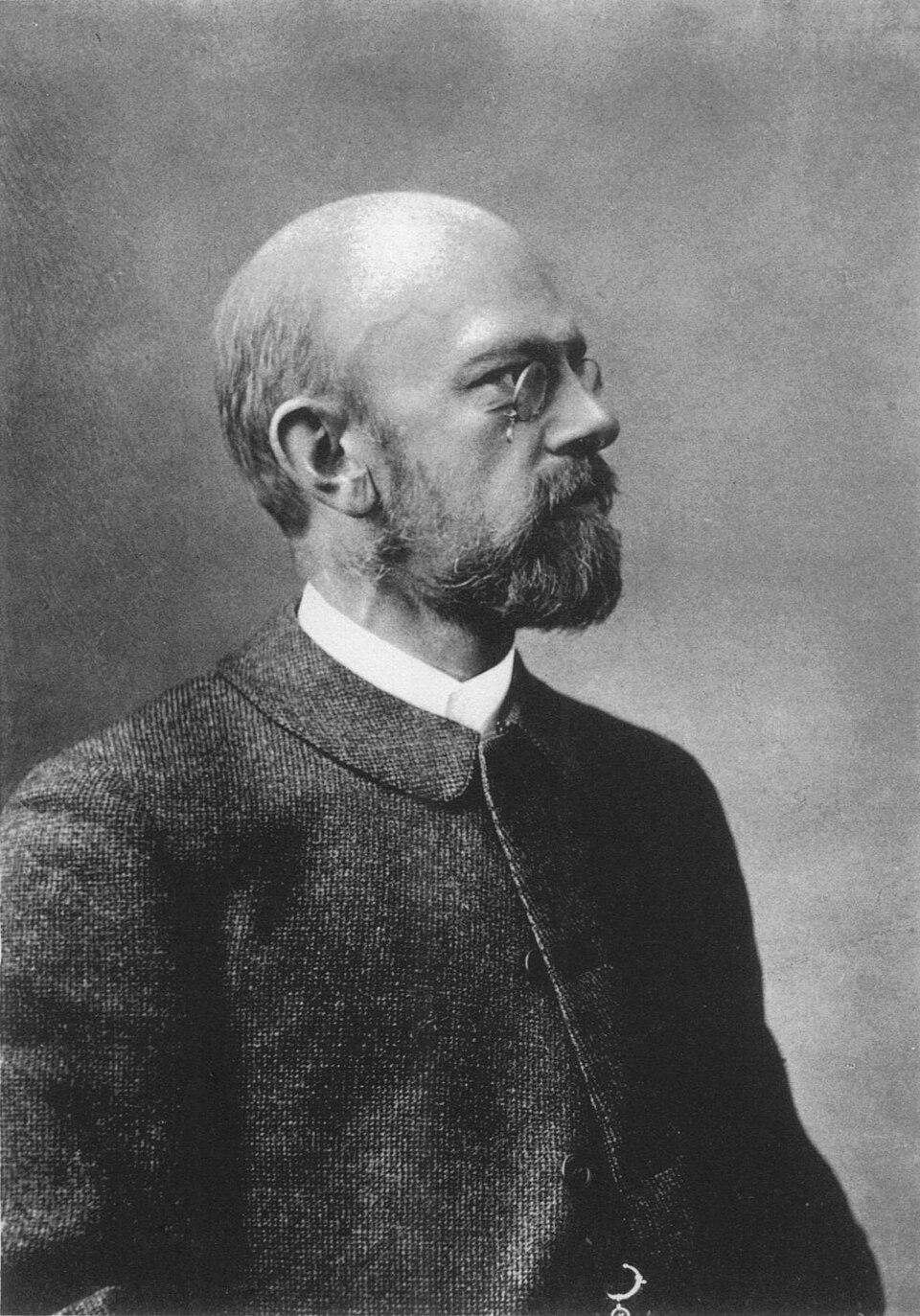
Alt...
David Hilbert. (1907). American Journal of Mathematics, 29(1).
This is a 1907 photographic portrait of David Hilbert, shown in profile wearing pince-nez glasses, a beard, and a tweed jacket.
https://en.wikipedia.org/wiki/David_Hilbert#/media/File:David_Hilbert,_1907.jpg
22-year-old Mozart’s handwritten notebook unearthed in ‘major discovery’
The notebook was confiscated during the French Revolution, and has now been found in Paris.
https://www.classicfm.com/composers/mozart/handwritten-notebook-discovered-major-paris/
Books by Mozart at PG:
https://www.gutenberg.org/ebooks/author/1368

Alt...
This posthumous portrait of Wolfgang Amadeus Mozart was painted by Barbara Krafft at the request of Joseph Sonnleithner in 1819, long after Mozart died. Sonnleithner, who was making a "collection of portraits in oils of well-known composers" (Deutsch) wrote to Mozart's still-living sister Maria Anna ("Nannerl"), asking her to lend a picture to Krafft (a well-known artist working in Salzburg).
He's shown in a powdered wig and an elegant red coat with gold embroidery and lace, in a three-quarter profile pose.
https://en.wikipedia.org/wiki/Wolfgang_Amadeus_Mozart#/media/File:Wolfgang-amadeus-mozart_1.jpg
MUTTON MONGER. A man addicted to wenching.
A selection from Francis Grose’s “Dictionary Of The Vulgar Tongue” (1785)
--
#books #literature #dictionaries #history #society #language #slang @histodons
Alt...
Image imitating a page from an old document, text (as in main toot):
MUTTON MONGER. A man addicted to wenching.
A selection from Francis Grose’s “Dictionary Of The Vulgar Tongue” (1785)
![[?]](https://files.mastodon.social/accounts/avatars/115/070/625/860/923/251/original/9629d01039476748.png)
Was Hobbes Right in Leviathan? Only partially.
https://brywillis634737.substack.com/p/hobbes-was-right?r=pvxh5
#philosophy #blog #history #reading #substack #monarchy #democracy #history #books #politics #governance #empire #nature #foundation #anarchy #Leviathan #Hobbes #violence

![[?]](https://loci.onl/system/accounts/avatars/000/000/035/original/35f0333758d2020a.jpg)
8 Women Composers Who Shaped the Musical World
Discover eight women composers who have shaped the musical world and gave women in music a voice.
by Andrew Olsen (from the archives)
https://www.thecollector.com/women-composers-you-should-know/
Books in Music at PG:
https://www.gutenberg.org/ebooks/bookshelf/50
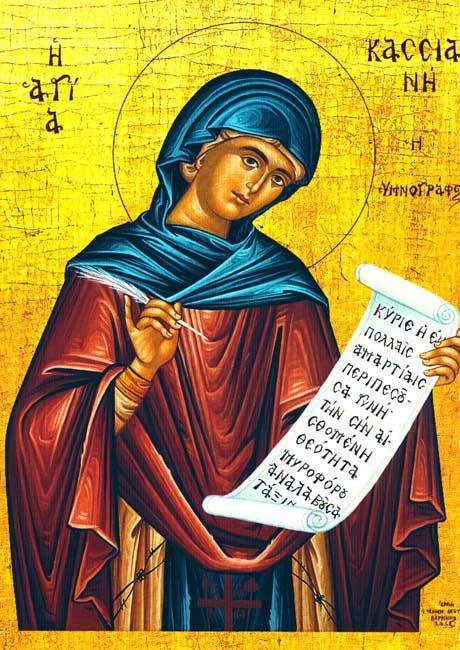
Alt...
Ancient icon depicting Saint Kassiana, or Kassia, an 8th-century poet and composer in Byzantium
This is a Byzantine-style Orthodox icon of St. Kassiani, identified by the Greek inscription as "the hymnographer". She's depicted in traditional robes with a halo against a gold background, holding a quill and a scroll inscribed with Greek text — the opening words of her famous hymn "Lord, the woman fallen into many sins...", known as the Hymn of Kassiani, traditionally chanted during Holy Wednesday services in the Orthodox Church.
https://en.wikipedia.org/wiki/Kassia#/media/File:Kassia.jpg

Alt...
Hildegard von Bingen receives a divine inspiration and passes it on to her scribe.
She's shown seated under an arched, architectural frame, with tongues of flame descending onto her head — representing the divine inspiration of her visions. She holds a wax tablet, recording what she sees, while her secretary/scribe (often identified as the monk Volmar) stands beside her with a book, ready to transcribe her words into the manuscript.
https://en.wikipedia.org/wiki/Hildegard_of_Bingen#/media/File:Hildegard_von_Bingen.jpg
![[?]](https://jasette.facil.services/system/accounts/avatars/109/367/072/154/545/516/original/ab7bfce8c64a4242.jpg)
"There are records of people being whipped for celebrating and being threatened for celebrating. And even outside the context of celebrations, there was retaliation against the Freedmen [..] There was a lot of hope in the middle of a lot of hostility."
Historian #AnnetteGordonReed, author of #OnJuneteenth
https://kpfa.org/episode/letters-and-politics-june-19-2024/
#Juneteenth #OTD #EmancipationDay #Emancipation #BlackHistory #UShistory #AmericanHistory #TexasHistory #BlackTexas #books @bookstodon
CUT. Drunk. A little cut over the head; slightly intoxicated. To cut; to leave a person or company. To cut up well; to die rich.
A selection from Francis Grose’s “Dictionary Of The Vulgar Tongue” (1785)
--
#books #literature #dictionaries #history #society #language #slang @histodons
Alt...
Image imitating a page from an old document, text (as in main toot):
CUT. Drunk. A little cut over the head; slightly intoxicated. To cut; to leave a person or company. To cut up well; to die rich.
A selection from Francis Grose’s “Dictionary Of The Vulgar Tongue” (1785)
The Atlas Behind the Revolution
While George Washington struggled to obtain reliable maps, British readers could consult this remarkable 1776 atlas.
By: April White
https://daily.jstor.org/the-atlas-behind-the-revolution/
A Literary & Historical Atlas of America by J. G. Bartholomew at PG:
https://www.gutenberg.org/ebooks/57610
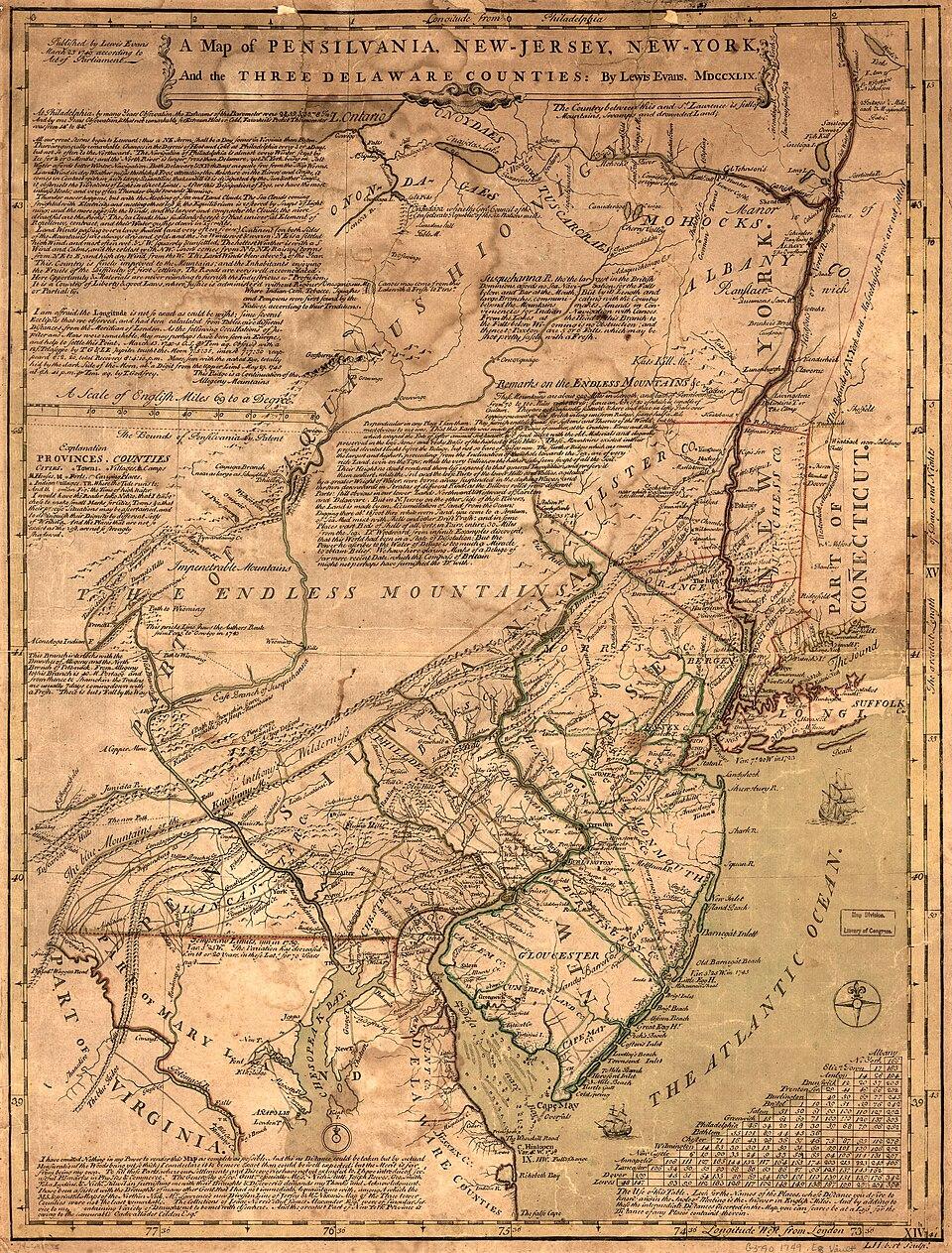
Alt...
A map of Pennsylvania, New Jersey, New York, and the three Delaware counties by Lewis Evans, engraved by L. Hebert. Scale ca. 1:960,000. Hand colored. Relief shown pictorially. Soundings shown in fathoms. Prime meridian: Philadelphia and London. Shows trails. Includes descriptive notes and distance chart.
https://en.wikipedia.org/wiki/Lewis_Evans_(surveyor)#/media/File:A_map_of_Pensilvania,_New-Jersey,_New-York,_and_the_three_Delaware_counties._LOC_74691938_(cropped).jpg
The mathematical secrets hidden at the heart of Barcelona’s Sagrada Família
By Sergi Muria Maldonado, Anton Aubanell Pou, Jordi Font González
Books about Mathematics and Religion at PG:
https://www.gutenberg.org/ebooks/search/?query=mathematics+religion
Alt...
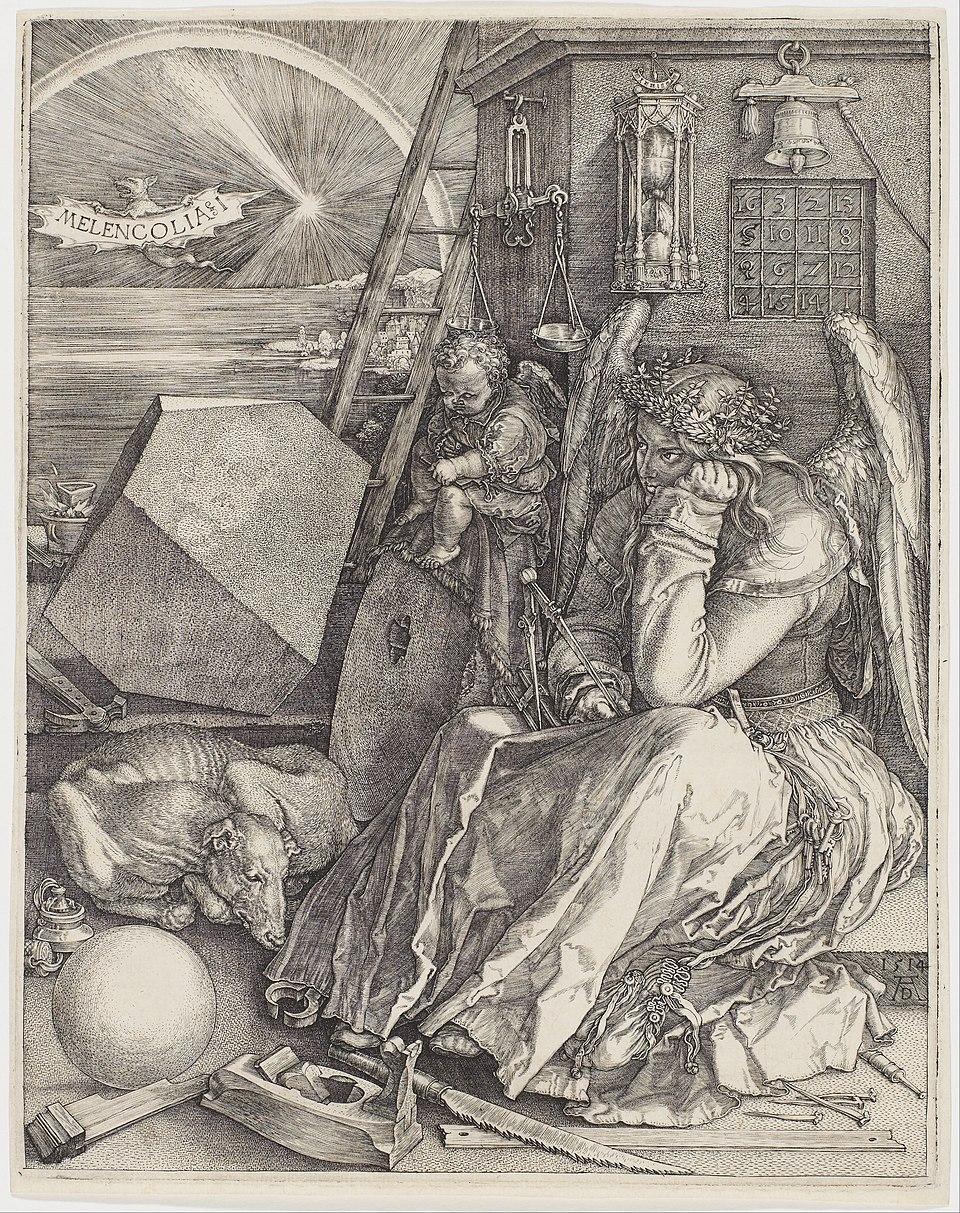
Melancholia I by Albrecht Dürer, with a numerical grid visble in the top right-hand corner.
It shows a winged, brooding figure surrounded by tools of geometry, science, and craft—scales, hourglass, compass, ladder, a polyhedron, and a sleeping dog—yet seemingly stuck in inactive thought rather than using them. A magic square (summing to 34 in every direction) is set into the wall, with the date 1514 hidden in its middle row.
https://en.wikipedia.org/wiki/Melencolia_I#/media/File:Albrecht_D%C3%BCrer_-_Melencolia_I_-_Google_Art_Project_(_AGDdr3EHmNGyA).jpg
DICE. The names of false dice: A bale of bard cinque deuces \nA bale of flat cinque deuces \nA bale of flat sice aces \nA bale of bard cater traes \nA bale of flat cater traes \nA bale of fulhams \nA bale of light graniers \nA bale of langrets contrary to the ventage
A selection from Francis Grose’s “Dictionary Of The Vulgar Tongue” (1785)
--
#books #literature #dictionaries #history #society #language #slang @histodons
Alt...
Image imitating a page from an old document, text (as in main toot):
DICE. The names of false dice: A bale of bard cinque deuces \nA bale of flat cinque deuces \nA bale of flat sice aces \nA bale of bard cater traes \nA bale of flat cater traes \nA bale of fulhams \nA bale of light graniers \nA bale of langrets contrary to the ventage
A selection from Francis Grose’s “Dictionary Of The Vulgar Tongue” (1785)
#NagornoKarabakh: Three Decades of Diplomatic Failure
In ep 115 of #Jadaliyya's Connections pod, Mouin Rabbani interviews #HrairBalian, author of "#AnatomyOfPeacemaking: Nagorno-Karabakh Conflict & Missed Opportunities"
https://www.youtube.com/watch?v=pSaz_VKlwjc
#Artsakh #Armenians #Armenia #Azerbaijan #books @bookstodon
![[?]](https://hostux.social/system/accounts/avatars/000/194/506/original/49ba2d821222d160.png)
Calling all #Bookworms: the #GNUPress Shop has lots of great #books on #FreeSoftware, including how to use it! https://u.fsf.org/4bd #FSF #GNU
GEE. It won't gee; it won't hit or do, it does not suit or fit.
A selection from Francis Grose’s “Dictionary Of The Vulgar Tongue” (1785)
--
#books #literature #dictionaries #history #society #language #slang @histodons
Alt...
Image imitating a page from an old document, text (as in main toot):
GEE. It won't gee; it won't hit or do, it does not suit or fit.
A selection from Francis Grose’s “Dictionary Of The Vulgar Tongue” (1785)
5 of Agatha Christie’s Works You Won’t Be Able to Put Down
Don’t miss out on this list of bestselling Agatha Christie works, which remain unrivaled in the murder mystery genre.
https://www.thecollector.com/agatha-christie-works/
Christie at PG:
https://www.gutenberg.org/ebooks/author/451
Alt...
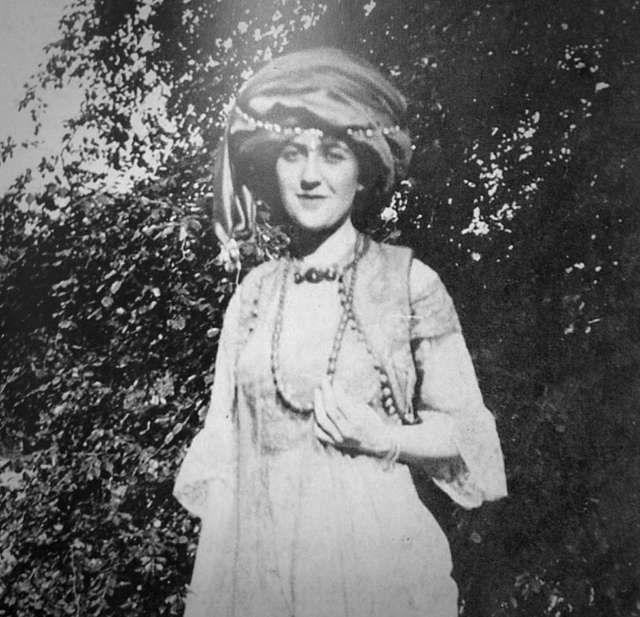
Agatha Christie in a play at Cockington Court in 1912 - picyrl.com. She is wearing a large, elaborate fabric turban. It is heavily textured and trimmed with a strand of beads or pearls across her brow. Her dress is light-colored and long-sleeved with loose, flared cuffs. A darker, open vest is layered over the top. A beaded necklace hangs down close to her waist.
What Would Happen if the Sun Stopped? Part 2: Kelvin and Helmholtz at the Ready
By Paul Sutter
About Kelvin-Helmholtz mechanism:
https://en.wikipedia.org/wiki/Kelvin%E2%80%93Helmholtz_mechanism
Books by Baron Kevin and Helmholtz at PG
https://www.gutenberg.org/ebooks/author/48139
https://www.gutenberg.org/ebooks/author/59039
Alt...
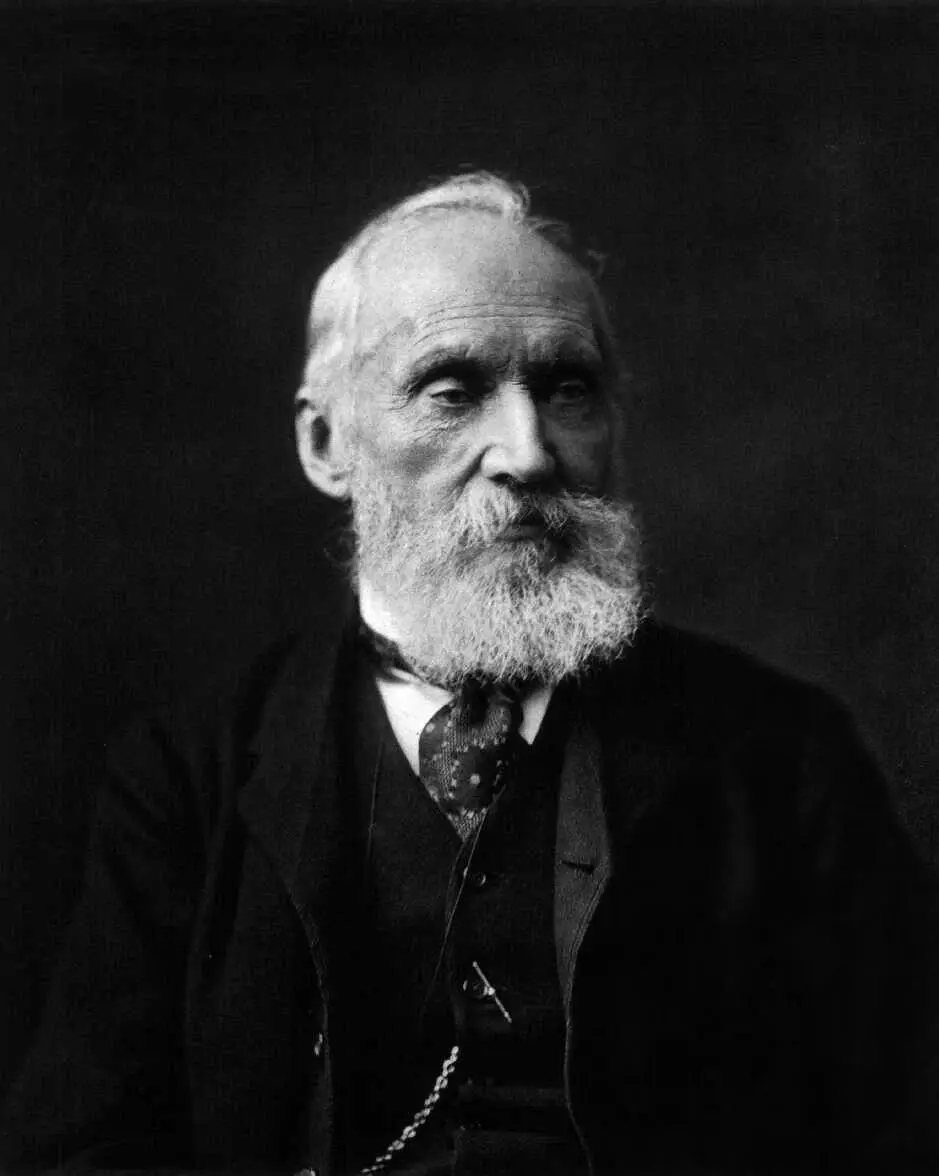
William Thomson, Lord Kelvin, whose famously wrong answer for the Sun's age turns out to be exactly the calculation we need.
A black-and-white studio portrait of Lord Kelvin with white hair and a full white beard, wearing a formal suit, waistcoat, tie, and watch chain. He has a serious expression and is looking slightly away from the camera.
https://upload.wikimedia.org/wikipedia/commons/d/db/Kelvin-1200-scale1000.jpg
There can be no sin committed from love – the radical ethics of Héloïse
by Prashanti Aswani, Adam D’Arpino, Abigail Tulenko
Books by Abelard and Heloïse at PG
https://www.gutenberg.org/ebooks/author/5441
https://www.gutenberg.org/ebooks/author/38039
#Books #literature #Philosophy
Alt...
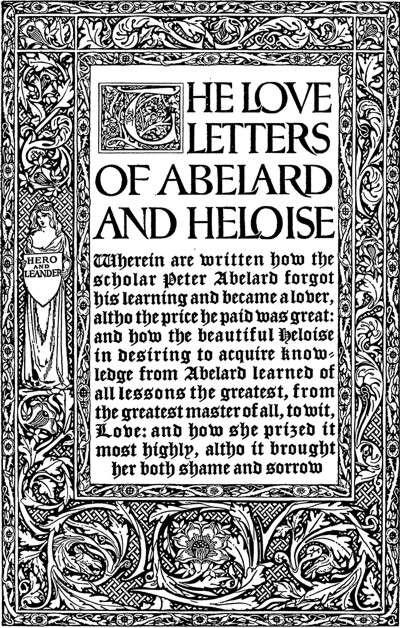
Transcription: Wherein are written how the scholar Peter Abelard forgot his learning and became a lover, altho the price he paid was great: and how the beautiful Heloise in desiring to acquire knowledge from Abelard learned of all lessons the greatest, from the greatest master of all, to wit, Love: and how she prized it most highly, altho it brought her both shame and sorrow.
The love letters of Abelard and Heloise
by Peter Abelard and Héloïse
Other: Ralph Fletcher Seymour
https://www.gutenberg.org/cache/epub/40227/pg40227-images.html
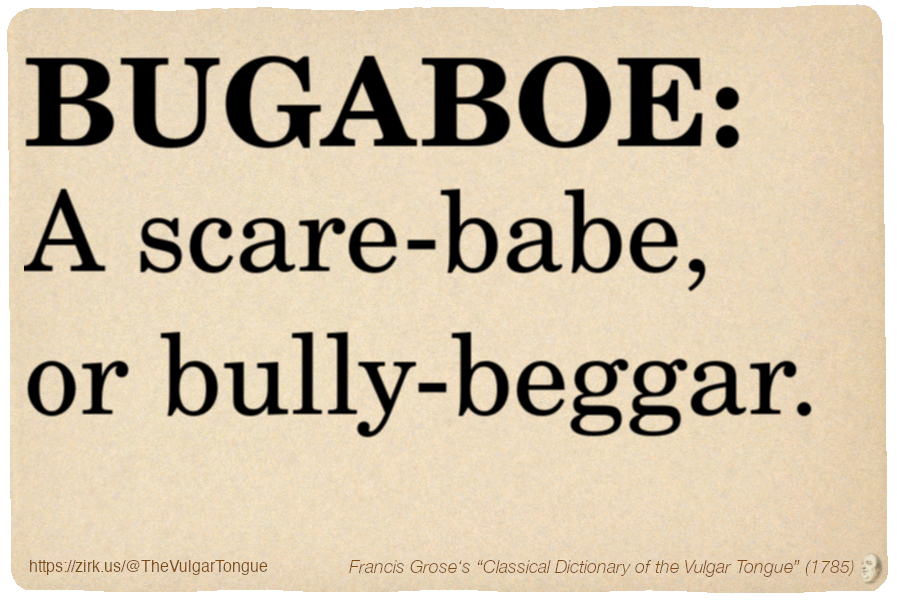
BUGABOE. A scare-babe, or bully-beggar.
A selection from Francis Grose’s “Dictionary Of The Vulgar Tongue” (1785)
--
#books #literature #dictionaries #history #society #language #slang @histodons
Alt...
Image imitating a page from an old document, text (as in main toot):
BUGABOE. A scare-babe, or bully-beggar.
A selection from Francis Grose’s “Dictionary Of The Vulgar Tongue” (1785)
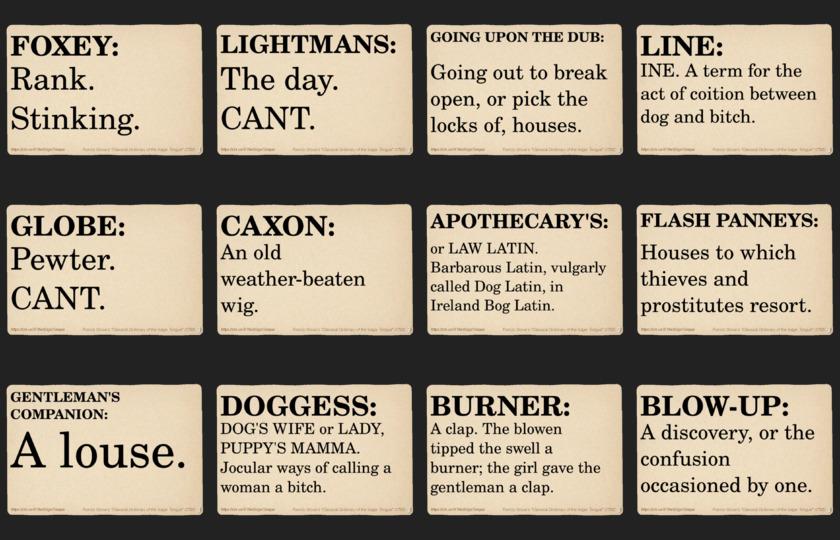
Hi!, I'm a bot posting selections from Francis Grose’s 1785 “Dictionary Of The Vulgar Tongue”, a compilation of slang terms, the coded language of the underclass and the demi-monde.
[18th-century-content warning: possible racism, animal cruelty, homophobia, sexism, slut-shaming. Let me know of any problems.]
#FollowFriday #books #literature #dictionaries #history #society #crime #language #slang #18thCentury
Alt...
Montage of dictionary items posted by this account
GUMMY. Clumsy: particularly applied to the ancles of men or women, and the legs of horses.
A selection from Francis Grose’s “Dictionary Of The Vulgar Tongue” (1785)
--
#books #literature #dictionaries #history #society #language #slang @histodons
Alt...
Image imitating a page from an old document, text (as in main toot):
GUMMY. Clumsy: particularly applied to the ancles of men or women, and the legs of horses.
A selection from Francis Grose’s “Dictionary Of The Vulgar Tongue” (1785)
New research proposes Dante’s Inferno modelled a planetary impact 500 years before modern science!
by Asmae Ourkiya
Inferno by Dante Alighieri at PG:
https://www.gutenberg.org/ebooks/search/?query=inferno
Alt...
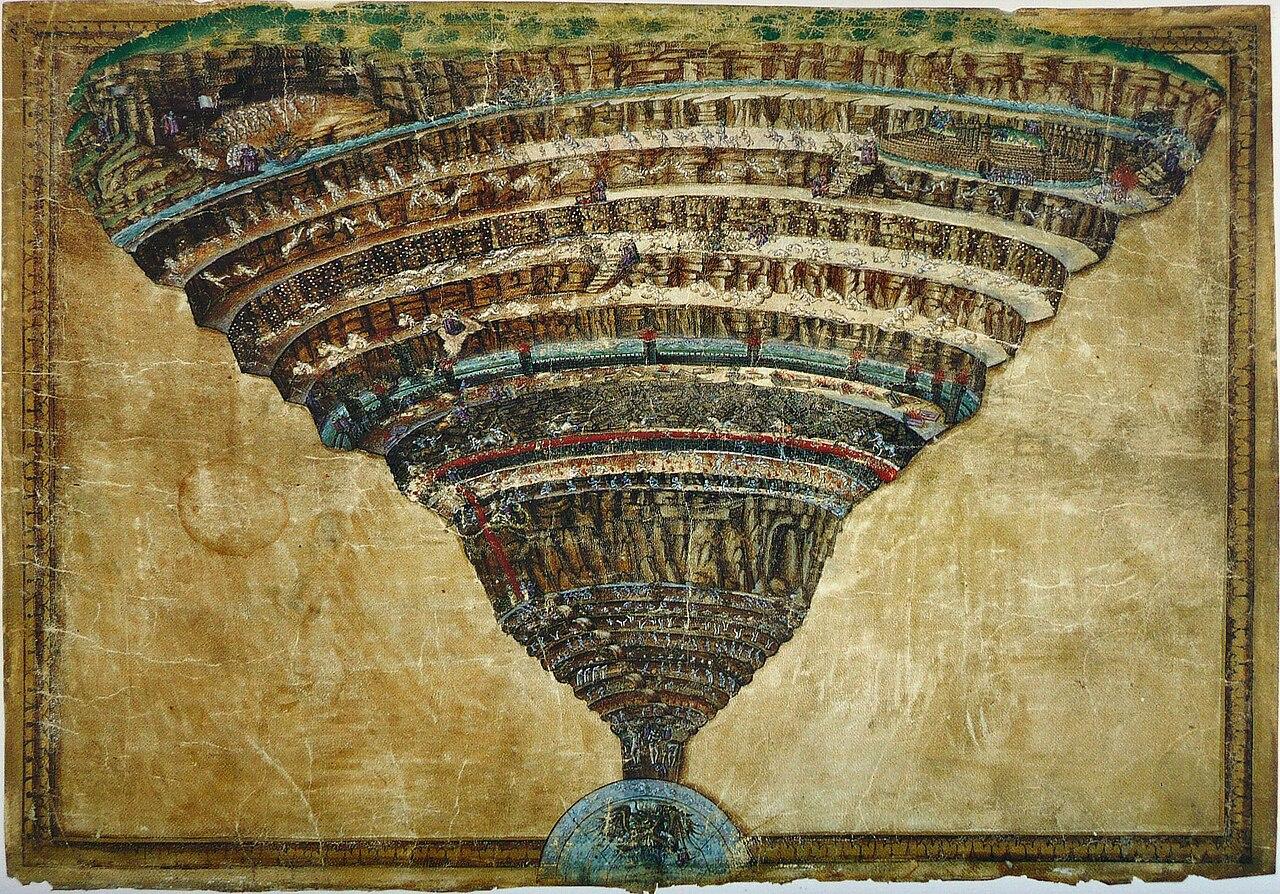
Dante's Inferno, as illustrated by Botticelli.
Sandro Botticelli's c. 1480s illustration for Dante's Inferno, depicting the funnel-shaped descending circles of Hell in cross-section, packed with tiny figures suffering their respective torments, narrowing down to Satan at the very bottom.
https://en.wikipedia.org/wiki/Divine_Comedy_Illustrated_by_Botticelli#/media/File:Sandro_Botticelli_-_La_Carte_de_l'Enfer.jpg
Was Mill anti-traditional?
And was Hayek suffering from the burden of the past...?
by Henry Oliver
https://www.commonreader.co.uk/p/was-mill-anti-traditional
Books by John Stuart Mill at PG:
https://www.gutenberg.org/ebooks/author/1705
Alt...
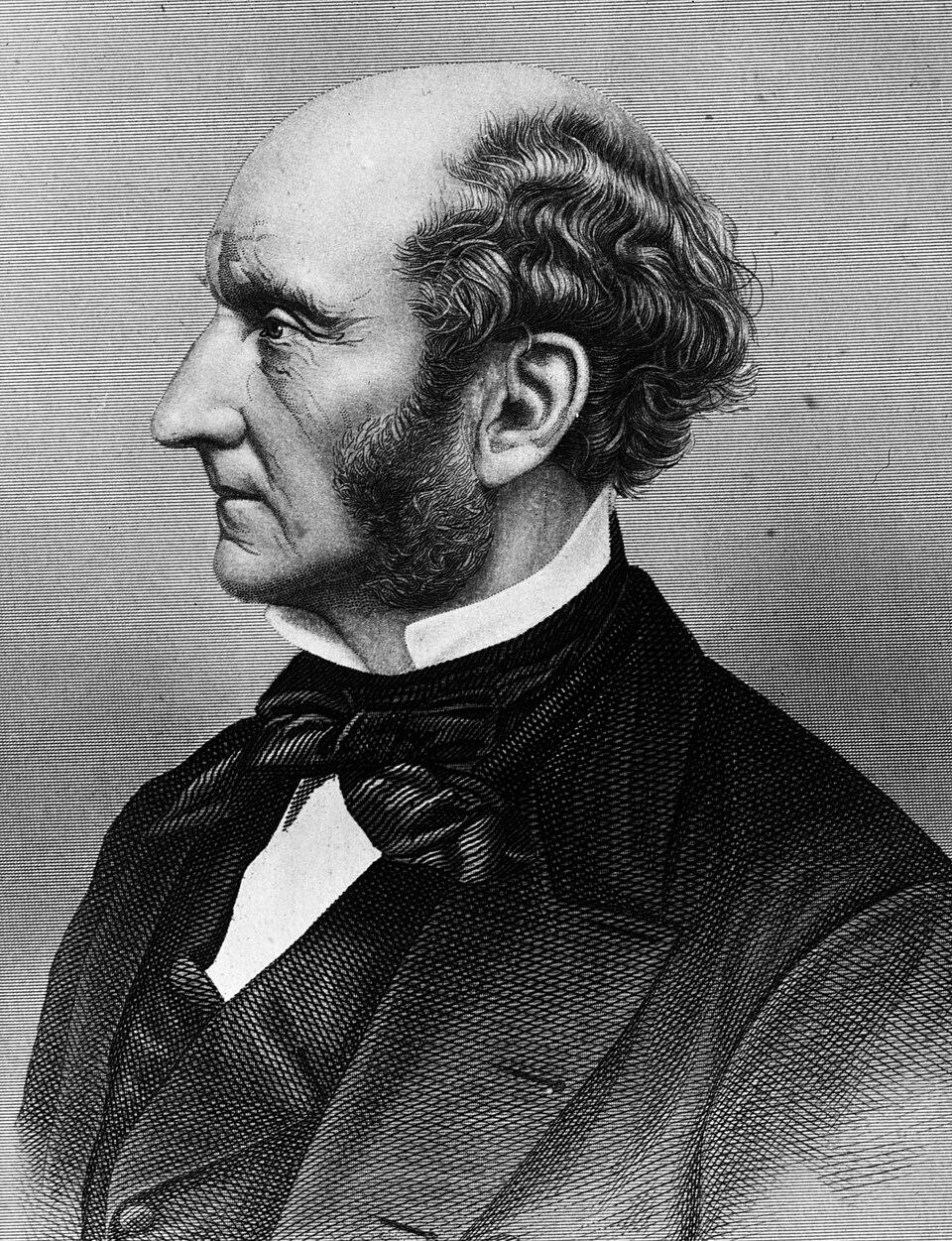
John Stuart Mill.
Engraved profile portrait of the English philosopher and political economist, balding with curly side hair and a beard, dressed in a dark coat with a wide cravat.
https://en.wikipedia.org/wiki/John_Stuart_Mill#/media/File:JohnStuartMill.jpg
HOOF. To beat the hoof; to travel on foot. He hoofed it or beat the hoof, every step of the way from Chester to London.
A selection from Francis Grose’s “Dictionary Of The Vulgar Tongue” (1785)
--
#books #literature #dictionaries #history #society #language #slang @histodons
Alt...
Image imitating a page from an old document, text (as in main toot):
HOOF. To beat the hoof; to travel on foot. He hoofed it or beat the hoof, every step of the way from Chester to London.
A selection from Francis Grose’s “Dictionary Of The Vulgar Tongue” (1785)
Makdisi Street welcomes #EyalWeizman, founder of #ForensicArchitecture, to talk about his new book #Ungrounding: The Architecture of Genocide
https://www.youtube.com/watch?v=U3T4VhvKcj4
#Gaza #GazaGenocide #Palestine #colonialViolence #stateCrime #counterforensics #cartography #infographics #books @bookstodon
![[?]](https://s3.eu-central-2.wasabisys.com/mastodonworld/accounts/avatars/109/362/359/610/912/307/original/4854f87af56f0d9a.png)
“I want to apologize for living far away, but I think wherever tita Eda is, I might still be a boy in the Philippines, asking her for pamasko and movie tickets. I want to be whenever she is.”
—Joseph Trinidad
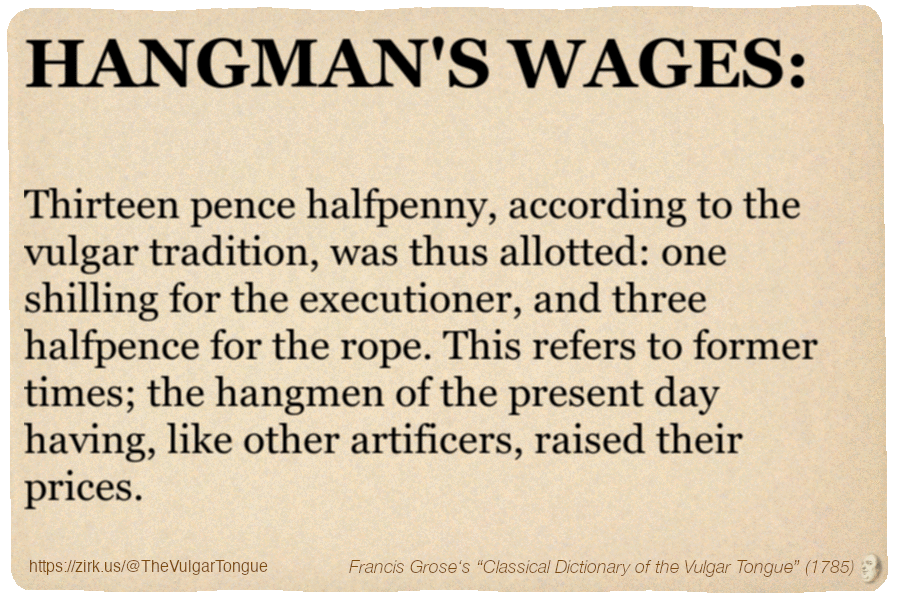
HANGMAN'S WAGES. Thirteen pence halfpenny, according to the vulgar tradition, was thus allotted: one shilling for the executioner, and three halfpence for the rope. This refers to former times; the hangmen of the present day having, like other artificers, raised their prices.
A selection from Francis Grose’s “Dictionary Of The Vulgar Tongue” (1785)
--
#books #literature #dictionaries #history #society #language #slang @histodons
Alt...
Image imitating a page from an old document, text (as in main toot):
HANGMAN'S WAGES. Thirteen pence halfpenny, according to the vulgar tradition, was thus allotted: one shilling for the executioner, and three halfpence for the rope. This refers to former times; the hangmen of the present day having, like other artificers, raised their prices.
A selection from Francis Grose’s “Dictionary Of The Vulgar Tongue” (1785)
"Titas, although not impossible, are harder to shop for, but I figure out what to buy once I find a thread of memory and start pulling."
Read "The Cousin Returns," an excerpt from Joseph Trinidad's debut essay collection, LUCKY CREATURES: https://longreads.com/2026/06/16/lucky-creatures-joseph-trinidad-philippines/?utm_source=mastodon&utm_medium=social
![[?]](https://s3.us-west-1.wasabisys.com/thereslife/accounts/avatars/109/297/497/169/378/689/original/d5a6a68ca48cc93d.png)
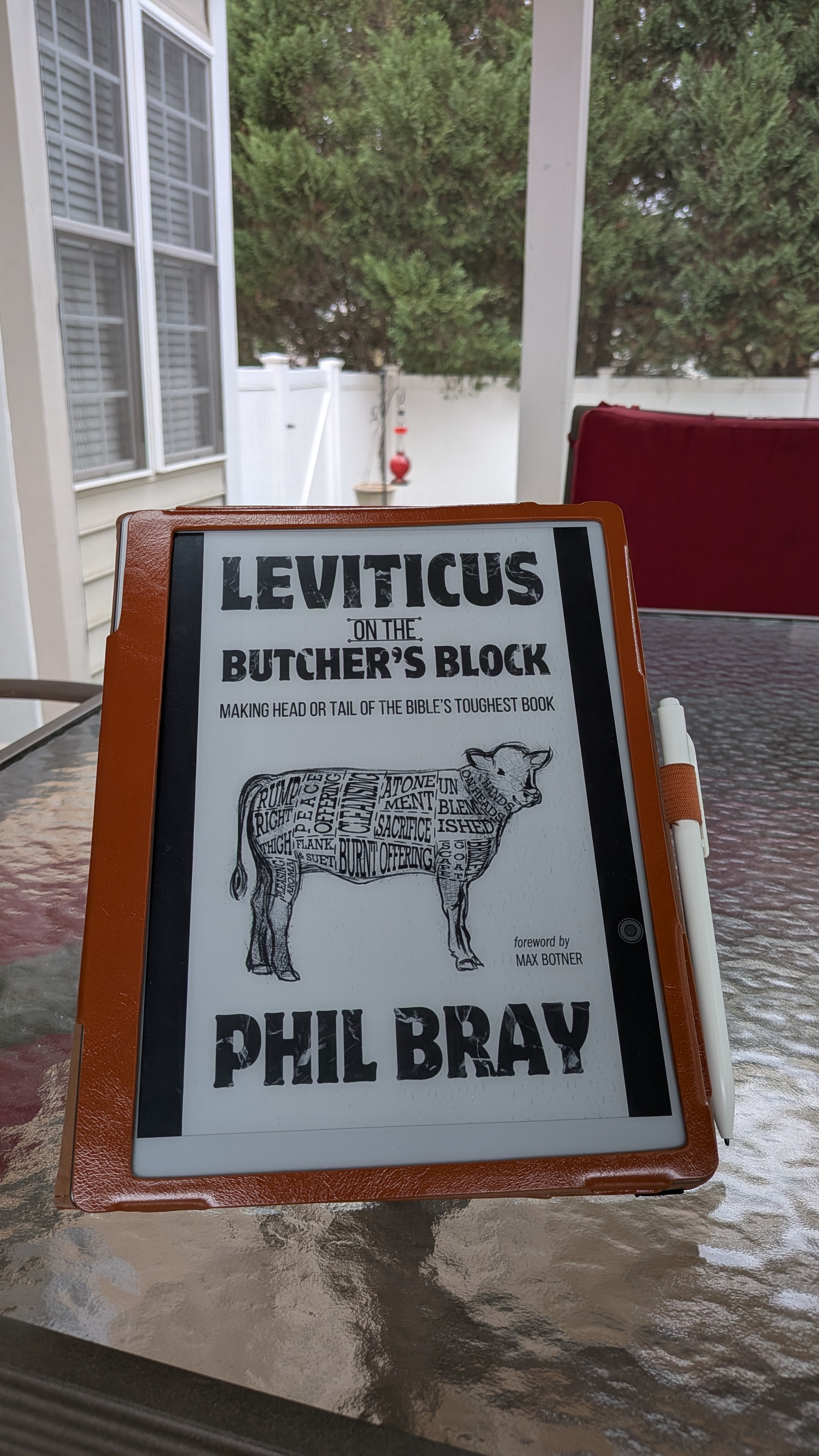
I've only downloaded a sample so far, but this is fascinating.
The birds are all a-twitter and the morning is still cool.
#tzag #books #Leviticus #Bible
Alt...
Leviticus on the Butchers Block
![[?]](https://choosejoyadventure.wordpress.com/wp-content/uploads/2026/07/untitled-design-15.png)
Doing More or Becoming More?
The Choice Every Christian Must Make In today's world, we are constantly encouraged to pursue our dreams, follow our passions, and do what makes us happy. While there is nothing inherently wrong with pursuing goals and ambitions, followers of Jesus must ask a deeper question: Am I becoming who God created me to be? There is a significant difference between doing what you want and becoming who God wants you to become. The Christian life requires both. God has given us gifts, talents, […] [SENSITIVE CONTENT]
The Choice Every Christian Must Make
In today’s world, we are constantly encouraged to pursue our dreams, follow our passions, and do what makes us happy. While there is nothing inherently wrong with pursuing goals and ambitions, followers of Jesus must ask a deeper question:
Am I becoming who God created me to be?
There is a significant difference between doing what you want and becoming who God wants you to become. The Christian life requires both. God has given us gifts, talents, desires, and opportunities to steward. But He is far more concerned with our character than our accomplishments.
Too often, we measure success by what we achieve. God measures success by who we are becoming.
The reality is that many people can build successful careers, lead ministries, grow businesses, and accomplish impressive things while neglecting the condition of their hearts. Yet Scripture repeatedly reminds us that character matters.
Your character is not separate from your destiny.
It is your destiny.
The person you are becoming determines how you will handle influence, relationships, challenges, victories, and disappointments. God is not simply preparing a destination for you; He is preparing you for the destination.
This raises another important question:
Are you working to win, or are you working to build your identity?
Many of us spend enormous amounts of energy trying to prove ourselves. We want to win the approval of others, win the promotion, win the recognition, or win the argument. But followers of Christ do not work from a place of insecurity. We work from a place of identity.
Our identity is not something we create.
It is something we receive.
Because of Christ, we are already loved, chosen, forgiven, and accepted. When we truly understand who we are in Him, we stop striving to earn what has already been given through grace.
The goal is no longer to build an identity through performance.
The goal is to live out the identity God has already spoken over us.
This is why what captures our attention matters so much.
Where your attention goes, your energy flows.
Whatever consistently occupies your mind will eventually shape your heart. Whatever shapes your heart will influence your decisions. And your decisions will determine the direction of your life.
If our attention is consumed by social media, comparison, achievement, entertainment, or the opinions of others, our spiritual growth will suffer. But when our attention is fixed on Christ, our hearts begin to reflect His character.
Jesus gave us the picture in John 15 when He described Himself as the vine and His followers as the branches.
A branch does not strain to produce fruit.
It remains connected to the vine.
The fruit is the natural result of the connection.
The same is true for us.
The question is not merely what are you doing for God.
The question is: What are you building into your life to stay connected to Him?
Are you creating space for prayer?
Are you spending time in God’s Word?
Are you worshiping beyond Sunday mornings?
Are you surrounding yourself with people who challenge you to grow spiritually?
Are you creating rhythms that draw you closer to Jesus?
Connection to the vine does not happen accidentally. It happens intentionally.
Every day, we are becoming someone. We are either being shaped by the world around us or transformed by the Spirit within us.
The life God desires for us is not simply about accomplishing more.
It is about becoming more like Christ.
So today, pause and ask yourself:
Am I only doing what I want to do?
Or am I becoming who God created me to become?
Because at the end of the day, success is not measured by what you built, earned, or achieved.
It is measured by whether you faithfully became the person God called you to be.
Stay connected to the Vine.
The fruit will follow.
With love and joy,
Laura

Alt...
Doing More or Becoming More?
"When a young man came up to him in Zurich and said, 'May I kiss the hand that wrote Ulysses?' Joyce replied, somewhat like King Lear, 'No, it did lots of other things too.'"
Let's celebrate, today is Bloomsday!
Read the whole article in our June newsletter:
https://www.gutenberg.org/newsletter/
Ulysses by James Joyce at PG:
https://www.gutenberg.org/ebooks/4300
Alt...
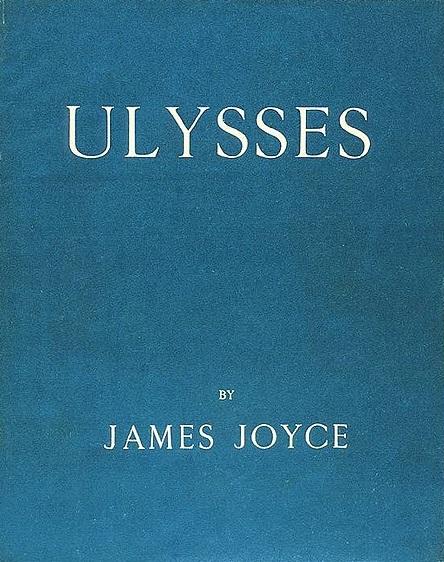
First edition of Ulysses by James Joyce, published by Paris-Shakespeare, 1922. The colour of the cover was meant to match the blue of the Greek flag.
Plain Aegean-blue cover with white serif lettering: "ULYSSES / by / JAMES JOYCE" — the iconic first edition cover (Paris, Shakespeare and Company, 1922.
https://en.wikipedia.org/wiki/Ulysses_(novel)#/media/File:JoyceUlysses2.jpg
Undiscovered Country: The 100th Anniversary of Virgina Woolf’s “On Being Ill”
Darcey Steinke on Chronic Pain, Loneliness, and the Truth of Woolf’s Work
https://lithub.com/undiscovered-country-the-100th-anniversary-of-virgina-woolfs-on-being-ill/
Books by Virginia Woolf:
https://www.gutenberg.org/ebooks/author/89
Alt...
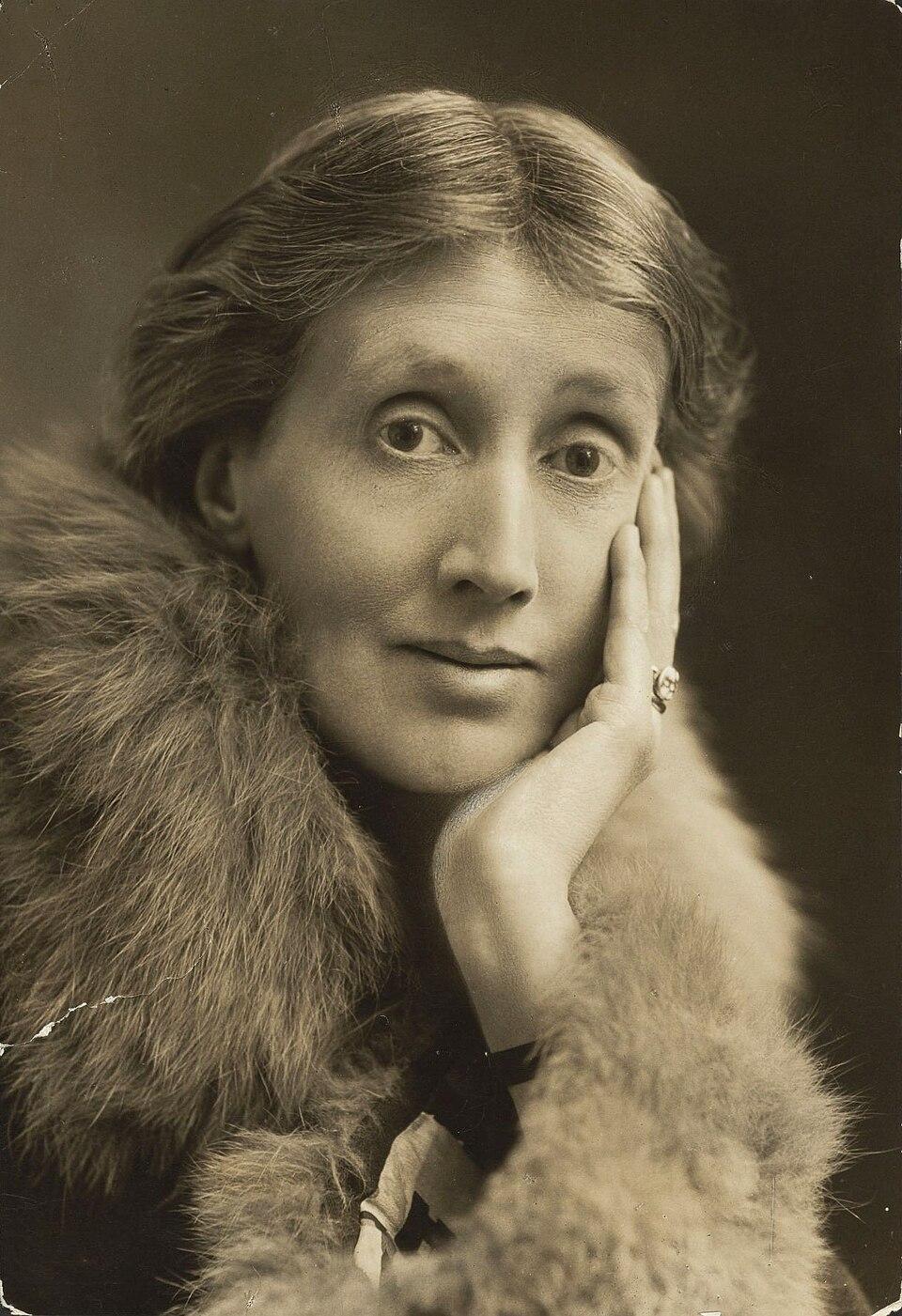
Photograph of Virginia Woolf with hand on face wearing a fur stole (10 x 15 centimeters).
Sepia studio portrait of a slender-faced Virginia Woolf, cheek resting on her hand, wearing a fur stole, gazing directly at the camera with large, intense eyes.Sepia studio portrait of a slender-faced woman, cheek resting on her hand, wearing a fur stole, gazing directly at the camera with large, intense eyes. Hair swept back, small ring visible on her finger
https://en.wikipedia.org/wiki/Virginia_Woolf#/media/File:Virginia_Woolf_1927.jpg
ROUGH. To lie rough; to lie all night in one's clothes: called also roughing it. Likewise to sleep on the bare deck of a ship, when the person is commonly advised to chuse the softest plank.
A selection from Francis Grose’s “Dictionary Of The Vulgar Tongue” (1785)
--
#books #literature #dictionaries #history #society #language #slang @histodons
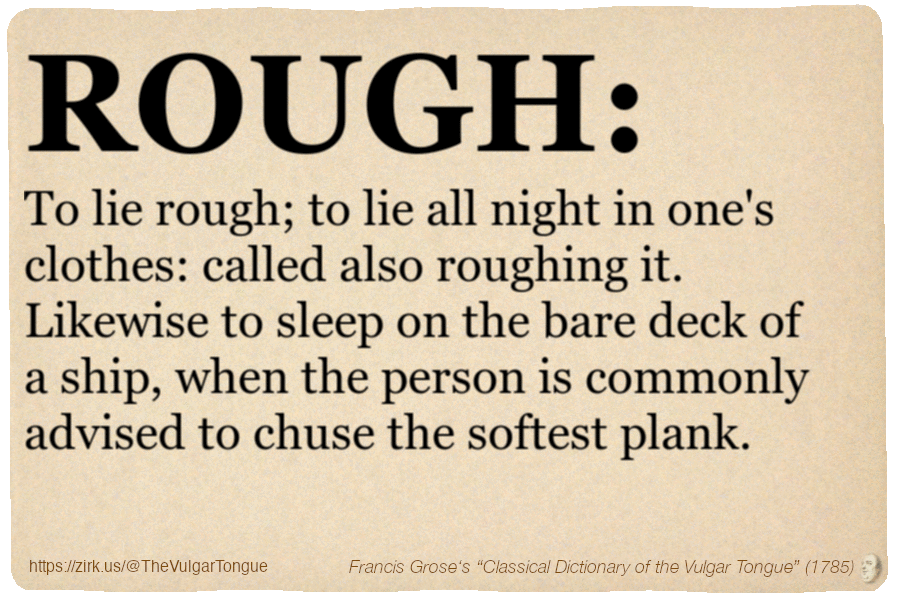
Alt...
Image imitating a page from an old document, text (as in main toot):
ROUGH. To lie rough; to lie all night in one's clothes: called also roughing it. Likewise to sleep on the bare deck of a ship, when the person is commonly advised to chuse the softest plank.
A selection from Francis Grose’s “Dictionary Of The Vulgar Tongue” (1785)
"Persuading the Roses to let the crew shoot in — and drive a car through — their bespoke glass-and-steel home felt to Coker like a hard sell."
Jason Klamm in Chicago Magazine: https://www.chicagomag.com/chicago-magazine/june-july-2026/inside-ferris-buellers-iconic-ferrari-crash-scene/
#Longreads #Books #Chicago #Cars #Film #Cinema #Movies #FerrisBueller #Architecture
June 1980: Vera Rubin Publishes Paper Hinting at Dark Matter
Work by Rubin, a champion of women in science, suggested that galaxies contain hidden mass.
By Tess Joosse (from the archives)
Her autobiographical article is available online:
https://www.annualreviews.org/content/journals/10.1146/annurev-astro-081710-102545
#Books #Astronomy #WomenInStem

Alt...
Vera Rubin, Dept. of Terrestrial Magnetism, Carnegie Institute of Washington.
Elderly white-hairedVera Rubin smiling warmly, wearing a red jacket, photographed outdoors in natural light.
https://commons.wikimedia.org/wiki/File:Vera_Rubin.jpg
MORGLAG. A brown bill, or kind of halbert, formerly carried by watchmen; corruption of MORE, great or broad, and GLAVE, blade.
A selection from Francis Grose’s “Dictionary Of The Vulgar Tongue” (1785)
--
#books #literature #dictionaries #history #society #language #slang @histodons
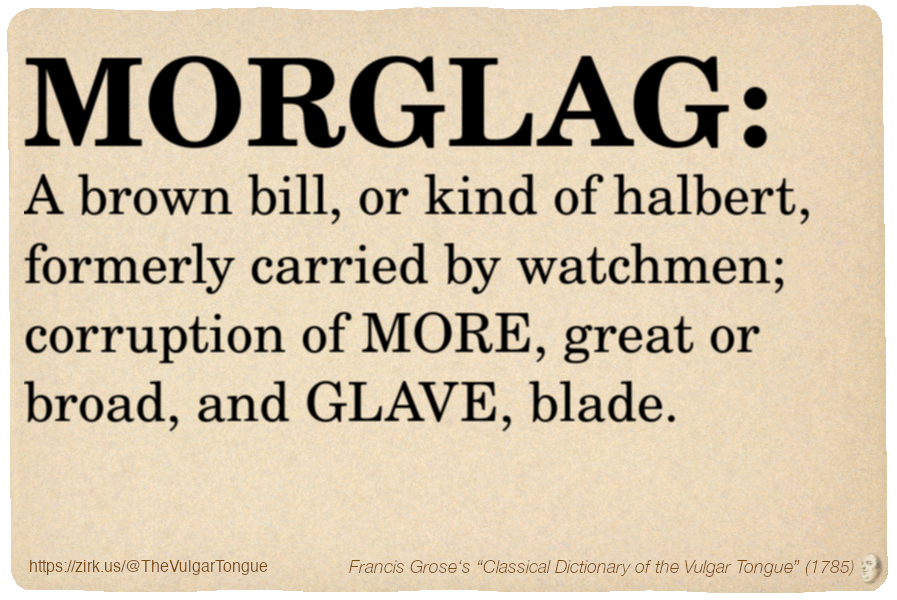
Alt...
Image imitating a page from an old document, text (as in main toot):
MORGLAG. A brown bill, or kind of halbert, formerly carried by watchmen; corruption of MORE, great or broad, and GLAVE, blade.
A selection from Francis Grose’s “Dictionary Of The Vulgar Tongue” (1785)
In Defense of Difficult Reading
The tomes of the past cultivate the lost art of sustained attention
https://theamericanscholar.org/in-defense-of-difficult-reading/

Alt...
Bookshelves with books in a library. There are four bookshelves facing each other with four shelves in each. A gray carpet is in between them and lights hang over each bookshelf and over the carpet. Another bookshelf is in the distance facing the viewer.
How Sir Isaac Newton Predicted The World Will Change In 2060
Sir Isaac Newton predicted that the world would end in 2060, but never published these studies during his lifetime.
by Mike Cohen
https://www.thecollector.com/how-isaac-newton-predicted-end-of-the-world/
Books by Newton at PG (including Newton's Principia):
https://www.gutenberg.org/ebooks/author/6288
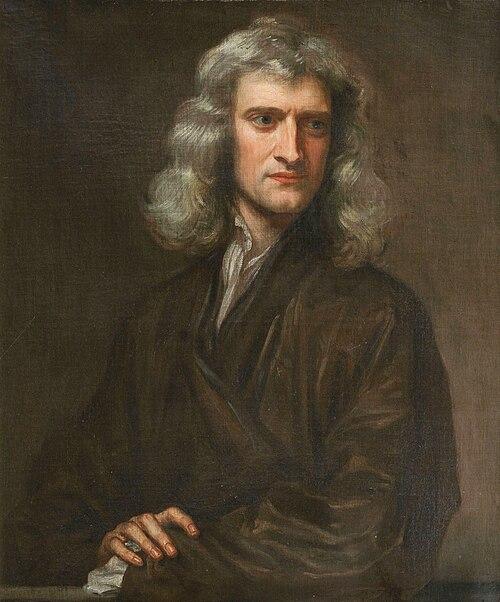
Alt...
ISAAC NEWTON
From the picture by Kneller, 1689, now at Cambridge
An oil portrait of Newton in his mid-forties with long, flowing silver-grey hair, wearing a dark brown robe over a white shirt. He is turned slightly, gazing directly at the viewer. One hand rests on a surface. The background is dark and muted, in the style of late 17th-century English portraiture.
https://en.wikipedia.org/wiki/Portrait_of_Isaac_Newton
Woodrow Wilson’s Legacy Is Loaded With Good and Bad, but His Work to Even the Economic Playing Field Is Often Overlooked
He won the Nobel Peace Prize for his efforts in ending WWI and strove to improve the plight of American workers. Today, his blind spots shroud most of his accomplishments
by Richard Norton Smith
Books by Woodrow Wilson at PG:
https://www.gutenberg.org/ebooks/author/1689
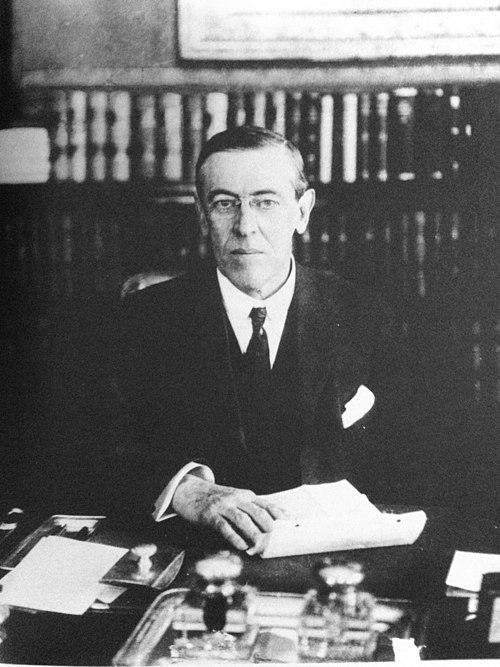
Alt...
Wilson as New Jersey governor in 1911.
A formal portrait as Governor of New Jersey, seated at his desk holding papers, before a wall of law books.
https://en.wikipedia.org/wiki/Woodrow_Wilson#/media/File:Woodrow_Wilson,_New_Jersey_Governor_-_1911.jpg
New art test could help museums spot fake Van Goghs without touching paintings
A new study published in the peer-reviewed journal Surface Topography: Metrology and Properties introduces a pioneering, noninvasive technique that can distinguish authentic artworks from forgeries, offering museums, collectors, and auction houses a major advantage in tackling art fraud.
by Sadie Harley, reviewed by Andrew Zinin
https://phys.org/news/2026-06-art-museums-fake-van-goghs.html
Van Gogh at PG:
https://www.gutenberg.org/ebooks/author/40599
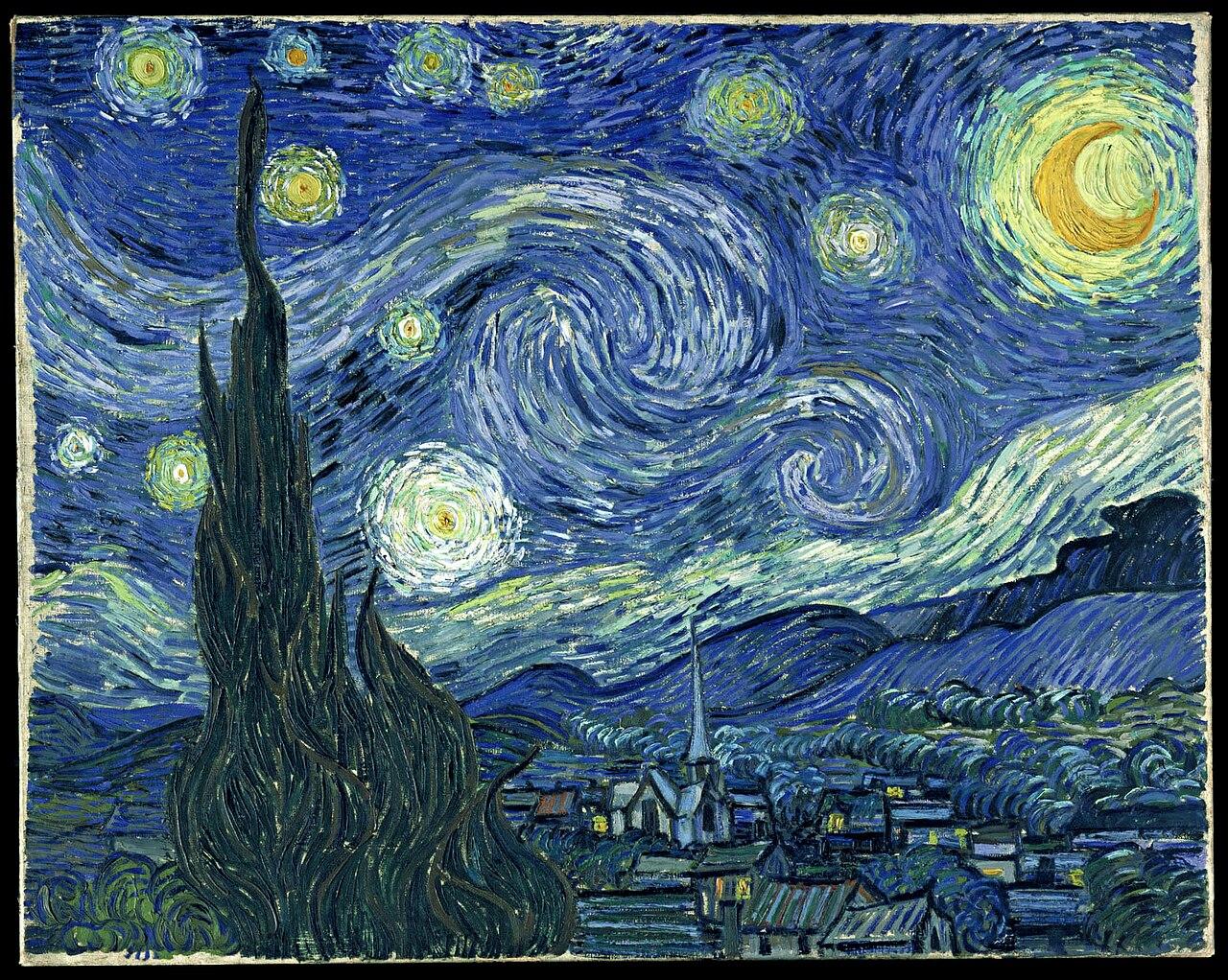
Alt...
The Starry Night, June 1889. Museum of Modern Art, New York
A swirling, luminous night sky dominates, featuring:
Spiral galaxies of light and turbulent brushstrokes
A glowing crescent moon (upper right)
A towering dark cypress tree (left)
A quiet village with church steeple below
Rolling blue hills in the background
https://en.wikipedia.org/wiki/Vincent_van_Gogh#/media/File:VanGogh-starry_night_ballance1.jpg
DUCE. Two-pence.
A selection from Francis Grose’s “Dictionary Of The Vulgar Tongue” (1785)
--
#books #literature #dictionaries #history #society #language #slang @histodons
Alt...
Image imitating a page from an old document, text (as in main toot):
DUCE. Two-pence.
A selection from Francis Grose’s “Dictionary Of The Vulgar Tongue” (1785)
AUNT. Mine aunt; a bawd or procuress: a title of eminence for the senior dells, who serve for instructresses, midwives, &c. for the dells. CANT. See DELLS.
A selection from Francis Grose’s “Dictionary Of The Vulgar Tongue” (1785)
--
#books #literature #dictionaries #history #society #language #slang @histodons
Alt...
Image imitating a page from an old document, text (as in main toot):
AUNT. Mine aunt; a bawd or procuress: a title of eminence for the senior dells, who serve for instructresses, midwives, &c. for the dells. CANT. See DELLS.
A selection from Francis Grose’s “Dictionary Of The Vulgar Tongue” (1785)
A Child’s World: Sloane Crosley on the Short Fiction of Katherine Mansfield
“Even in Mansfield stories where children are not centered or present, this is their world. Her adults never quite grow up, only older.”
Mansfield at PG:
https://www.gutenberg.org/ebooks/author/631
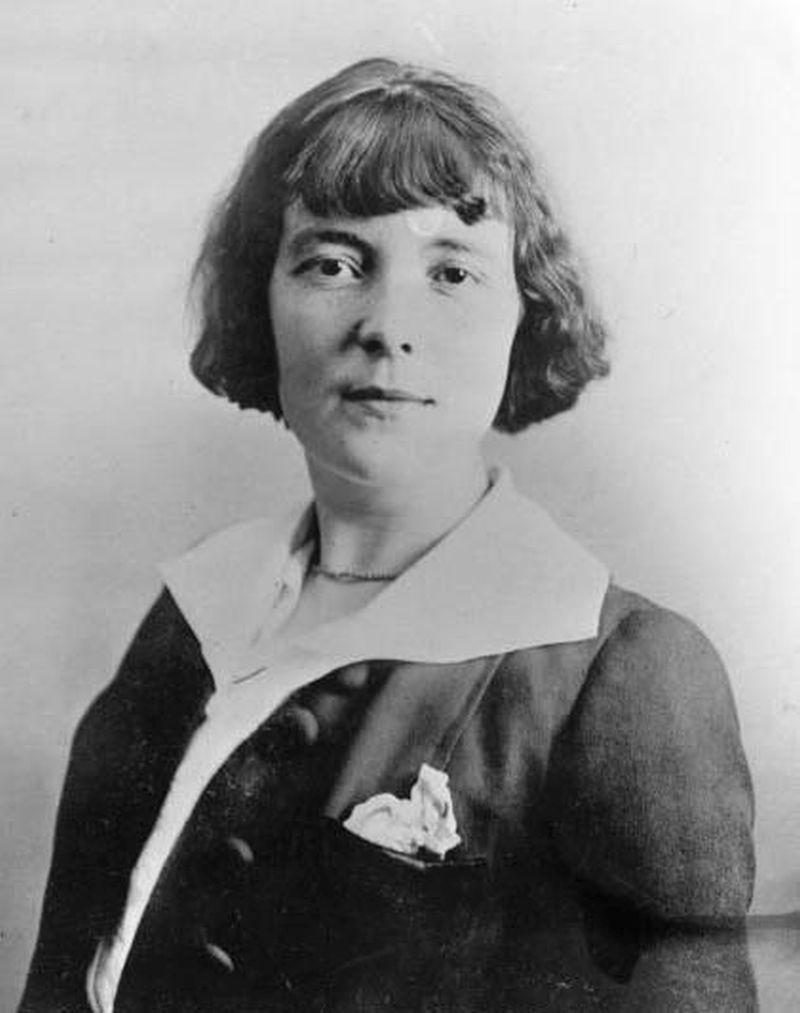
Alt...
A photograph of Katherine Mansfield from 1912 which shows her from the waist up. She is looking directly into the camera. She has dark, chin-length hair styled in a bob with short bangs across her forehead. She is wearing a dark jacket or vest over a light-colored blouse with a large, pointed collar. A small, crumpled white cloth or handkerchief peeks out of her breast pocket. A thin, simple chain necklace is around her neck.
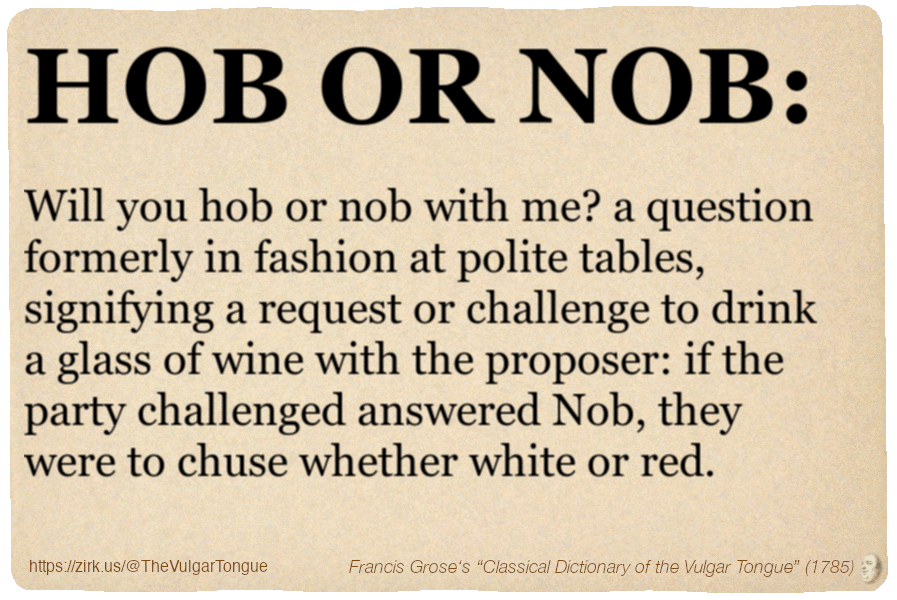
HOB OR NOB. Will you hob or nob with me? a question formerly in fashion at polite tables, signifying a request or challenge to drink a glass of wine with the proposer: if the party challenged answered Nob, they were to chuse whether white or red.
A selection from Francis Grose’s “Dictionary Of The Vulgar Tongue” (1785)
--
#books #literature #dictionaries #history #society #language #slang @histodons
Alt...
Image imitating a page from an old document, text (as in main toot):
HOB OR NOB. Will you hob or nob with me? a question formerly in fashion at polite tables, signifying a request or challenge to drink a glass of wine with the proposer: if the party challenged answered Nob, they were to chuse whether white or red.
A selection from Francis Grose’s “Dictionary Of The Vulgar Tongue” (1785)
"The bombing runs may be quieter, but the bulldozers roar on. #Israel is tearing up homes, orchards, schools and hospitals, then flattening the rubble to erase the memory that Palestinian life was ever there.
"To understand this architecture of death, Richard Hames spoke to #EyalWeizman, author of #Ungrounding: The Architecture of Genocide and founder of #ForensicArchitecture"
https://www.youtube.com/watch?v=GPGKCuiSOgg
#Gaza #GazaGenocide #Palestine #colonialViolence #stateCrime #infographics #books @bookstodon
![[?]](https://stockroom.wandering.shop/accounts/avatars/109/616/170/592/744/722/original/94738de093c5d8b9.jpeg)
It's my first novel's birthday month, so I'm having a wee sale. DRM-free ebooks are $0.99 on my website because it's mine and I do what I want:
https://kmherkes.com/the-bookshop1/p/controlled-descent-ebook-1
It's a scifi adventure in a future more optimistic than dystopian, where people risk everything for the sake of friendship, trust, & love. Humor, whimsy, sarcasm, & more. Sometimes gritty, never grim.
Prefer kindle? Cool. I gotta link for that & other vendors too:
https://books2read.com/ControlledDescent
#books
#reading
(boosts welcomed)

Alt...
raphic of an e-reader against a yellow-gradient background with falling leaves. The tablet shows the cover of the book Controlled Descent by K. M. Herkes, next to a falling scatter of descriptive phrases: justice heists, gritty, chosen families, disability rep, hopepunk-y, science fiction. The cover image of the book shows two figures on a snowfield hiking through deep snow toward a futuristic city.
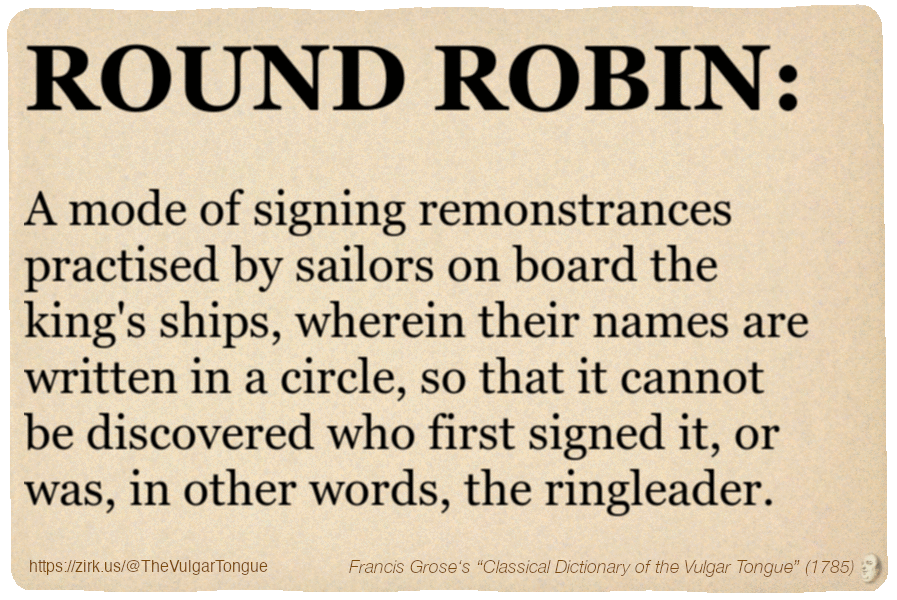
ROUND ROBIN. A mode of signing remonstrances practised by sailors on board the king's ships, wherein their names are written in a circle, so that it cannot be discovered who first signed it, or was, in other words, the ringleader.
A selection from Francis Grose’s “Dictionary Of The Vulgar Tongue” (1785)
--
#books #literature #dictionaries #history #society #language #slang @histodons
Alt...
Image imitating a page from an old document, text (as in main toot):
ROUND ROBIN. A mode of signing remonstrances practised by sailors on board the king's ships, wherein their names are written in a circle, so that it cannot be discovered who first signed it, or was, in other words, the ringleader.
A selection from Francis Grose’s “Dictionary Of The Vulgar Tongue” (1785)
#Euraknot's really interesting talk w/ #PietroShakarian about his book #AnastasMikoyan: An Armenian Reformer in #Khrushchev's Kremlin.
"How did he push for #destalinization after the leader’s death in 1953, particularly on #SovietNationalityPolicy? Shakarian tells us that in the end, #Mikoyan was more than a survivor. He was a critical player in shaping the post-Stalinist #SovietUnion."
https://www.euraknot.org/anastas-mikoyan/
#SovietHistory #SovietArmenia #Armenia #books #biographies @bookstodon
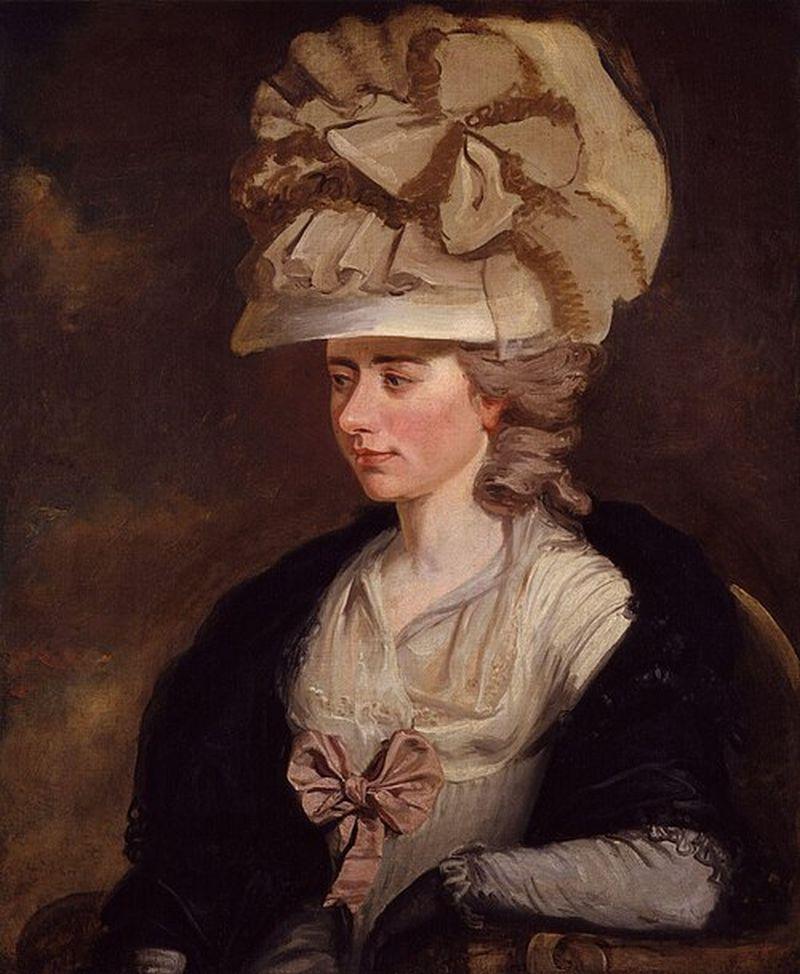
#OTD in 1752 Frances Burney was born. She "was a novelist, diarist and playwright. In all, she wrote four novels, eight plays, one biography and twenty-five volumes of journals and letters. She has gained critical respect in her own right, but she foreshadowed such novelists of manners with a satirical bent as Jane Austen and William Makepeace Thackeray."
https://en.wikipedia.org/wiki/Frances_Burney
Burney at PG:
https://www.gutenberg.org/ebooks/author/2010
Alt...
Painting of Frances Burney by her cousin Edward Francis Burney. She is shown from the waist up. She has light brown hair which is covered by a huge puffy tan hat. It has a big bow and ruffled lace on top. Her dress is white with a pink bow at her chest. A dark black shawl covers her shoulders and arms, and she wear dark gloves.
How 'algorithm' got its name from a 9th-century Persian mathematician
by Scott Neuman
https://www.npr.org/2026/06/11/nx-s1-5848013/algorithm-word-week-etymology
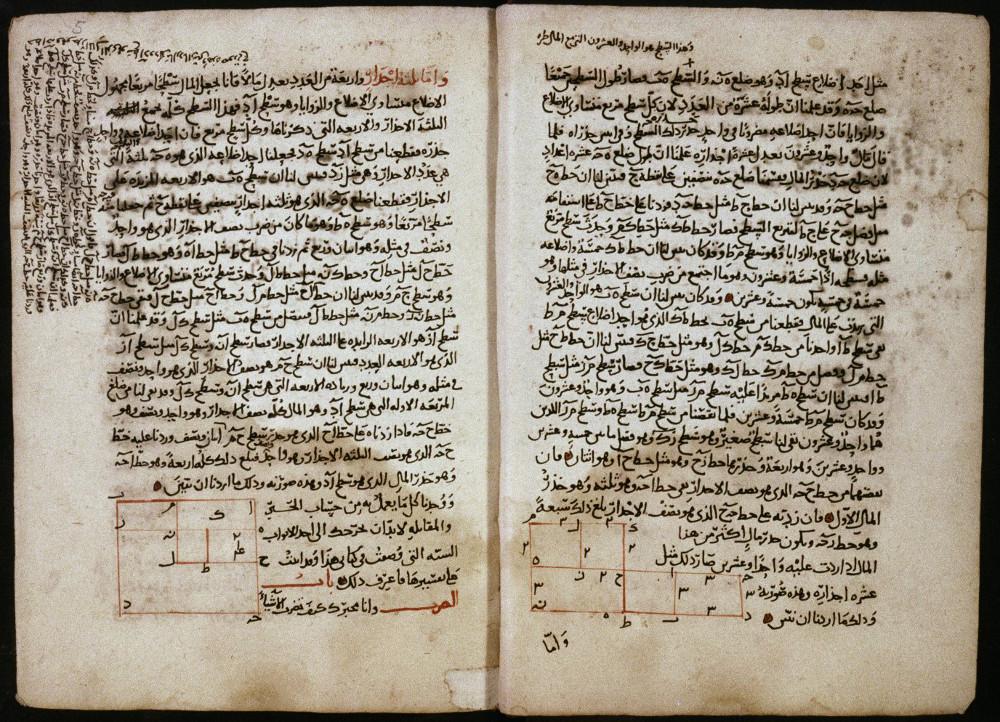
The Concise Book of Calculation by Restoration and Balancing at @wikipedia
https://en.wikipedia.org/wiki/Al-Jabr
The algebra of Mohammed ben Musa at @internetarchive
https://archive.org/details/algebraofmohamme00khuwrich
Alt...
Pages from a 14th-century Arabic copy of the book, showing geometric solutions to two quadratic equations.
A medieval Arabic mathematical manuscript from the Bodleian Library (MS Huntington 214) — a two-page spread featuring:
Dense Arabic script text in black ink
Red ink highlighting key terms and geometric diagrams
Grid/table diagrams at the bottom of each page, likely illustrating algebraic or geometric problems
https://en.wikipedia.org/wiki/Al-Jabr#/media/File:Bodleian_MS._Huntington_214_roll332_frame36.jpg
After the Concept of Peaceful Disobedience Was Established in America, It Traveled Around the World Before Taking Hold
“Force may subdue, but love gains”: The Quaker practice of conscientious objection evolved through Thoreau, Tolstoy and Gandhi before becoming the hallmark of the Civil Rights movement
by Jeff MacGregor
Books by William Penn and Henry David Thoreau. at PG:
https://www.gutenberg.org/ebooks/author/8625
https://www.gutenberg.org/ebooks/author/54
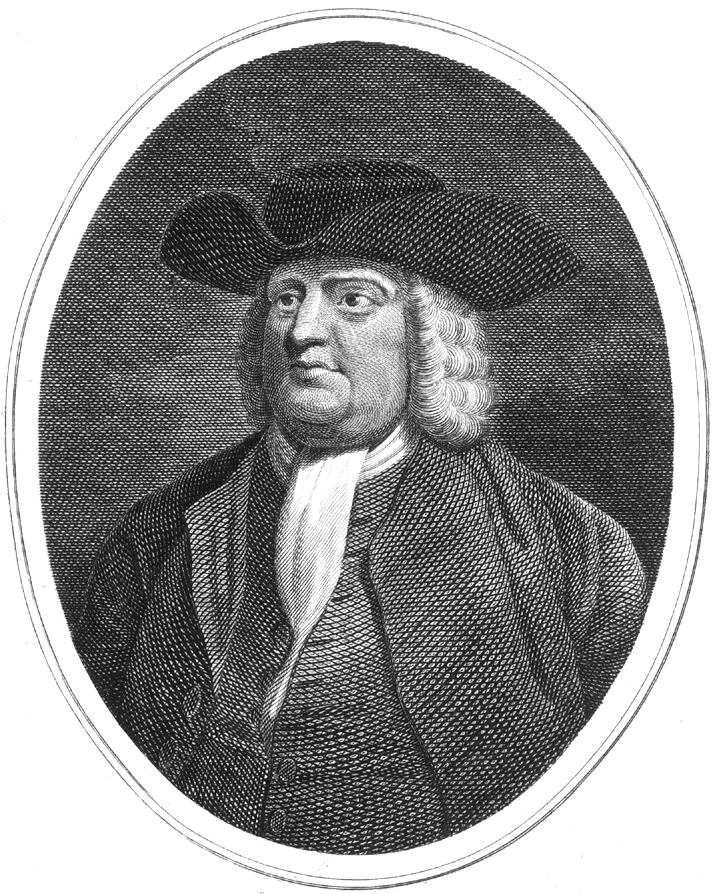
Alt...
William Penn.
A formal engraved oval portrait of William Penn — Quaker leader and founder of Pennsylvania, depicted in his characteristic broad-brimmed Quaker hat, curled wig, and plain dark coat.
https://en.wikipedia.org/wiki/William_Penn#/media/File:William_Penn.png
DELLS. Young buxom wenches, ripe and prone to venery, but who have not lost their virginity, which the UPRIGHT MAN claims by virtue of his prerogative; after which they become free for any of the fraternity. Also a common strumpet. CANT.
A selection from Francis Grose’s “Dictionary Of The Vulgar Tongue” (1785)
--
#books #literature #dictionaries #history #society #language #slang @histodons
Alt...
Image imitating a page from an old document, text (as in main toot):
DELLS. Young buxom wenches, ripe and prone to venery, but who have not lost their virginity, which the UPRIGHT MAN claims by virtue of his prerogative; after which they become free for any of the fraternity. Also a common strumpet. CANT.
A selection from Francis Grose’s “Dictionary Of The Vulgar Tongue” (1785)
![[?]](https://files.techhub.social/accounts/avatars/110/520/392/419/272/131/original/42e305c5679d28af.png)
I put up some new bookshelves and while getting my #books reshelved and sorted I found some duplicates and other books I'm unlikely to ever re-read, so I took a #bikeride around town to drop my pruned books into the Little Free Libraries around town and it struck me that this is a pretty #Solarpunk way to do it!
![[?]](https://media.mas.to/accounts/avatars/108/585/028/670/287/057/original/43ff4e850f62f6d7.jpg)
When your mother doesn't get you at all:
Mother, sitting in my living room staring at a bookshelf: My god, do you actually read all these? Have you actually read The Timetables of History?
Me: Uh, yes. I used it when teaching history.
Silence.
Mother: What's Bad Muslim Discount?
Me: A novel about growing up Muslim in San Francisco.
Mother: Hmm....Ugghh, The Library of World Poetry. That is the last thing I'd ever read.
Me: Okay but I like poetry. Currently exploring Chinese poets actually.
Mother: Oh God. Galileo's Daughter? What is that-science fiction? (Rolls eyes).
Me: No, it's a biography about Galileo's actual daughter.
Mother: What' is that statue thing?
Me, sighing, " It's the Koanashi from Spirited Away.
Mom: The what???
Me: ....
Mother, locked and reloaded: Who is Karl Ove Knausgard?
Me: He's a pretty famous Norwegian writer. Did I pass the quiz?
Mother: This is a lot of books I wouldn't read.
Me: Okay.
I am now exhausted. Leave my books be.
Stop Counting
“Some trust in chariots and some in horses, but we trust in the name of the Lord our God.” — Psalm 20:7 We count everything. Calories. Followers. Dollars. Wrinkles. Accomplishments. Failures. Likes on social media. How many people showed up. How many people noticed. How many people didn’t. We count what everyone else has and quietly compare it to what we don’t. And before we know it, our worth becomes attached to numbers. But God never asked us to count those things. He asked […] [SENSITIVE CONTENT]
“Some trust in chariots and some in horses, but we trust in the name of the Lord our God.” — Psalm 20:7
We count everything.
Calories. Followers. Dollars. Wrinkles. Accomplishments. Failures. Likes on social media. How many people showed up. How many people noticed. How many people didn’t.
We count what everyone else has and quietly compare it to what we don’t.
And before we know it, our worth becomes attached to numbers.
But God never asked us to count those things.
He asked us to count on Him.
Psalm 20:7 says, “Some trust in chariots and some in horses, but we trust in the name of the Lord our God.” In Biblical times, chariots and horses represented strength, power, security, and status. Today, our “chariots” may simply look different. We trust in followers, appearance, income, achievements, relationships, recognition, or the approval of others to make us feel valuable.
Yet none of those things can truly hold the weight of our identity.
The world teaches us that more is better. More attention. More influence. More success. More applause. Yet the more we chase those things, the more empty we often feel. Because the human heart was never designed to be filled by comparison. It was designed to be filled by Christ.
Comparison is exhausting because there will always be someone with more. More beauty. More money. More opportunities. More followers. More recognition. If we live by counting what we lack, we will always feel like we are behind.
But God’s Kingdom works differently.
Jesus never measured people by popularity, status, or possessions. He looked at hearts. He valued faithfulness over fame. Obedience over attention. Surrender over success.
The disciples probably didn’t look impressive by the world’s standards. Moses felt inadequate. David was overlooked. Ruth was a widow. Paul carried weakness. Yet God used each one powerfully because they stopped focusing on what they didn’t have and started trusting the One who had everything they needed.
Maybe that’s where peace begins too.
Not in finally getting enough.
But in realizing God already is enough.
What if we stopped counting likes and started counting blessings?
What if we stopped counting flaws and started remembering grace?
What if we stopped counting how far behind we feel and started counting on the God who never leaves us?
Because the truth is, when we constantly compare ourselves to others, we lose sight of the unique story God is writing in us. Someone else’s success does not diminish your value. Someone else’s calling does not cancel your purpose.
God is not asking you to become someone else.
He is asking you to trust Him with who you already are.
The enemy loves distraction through comparison because comparison keeps our eyes horizontally focused on people instead of vertically focused on God. Peter learned this when he walked on water. As long as his eyes were on Jesus, he stayed above the waves. The moment he focused on everything around him, fear took over.
The same is true for us.
We sink when we focus on everyone else’s life instead of God’s faithfulness in our own.
Social media can become dangerous when it quietly convinces us that everyone else is happier, prettier, more successful, more spiritual, or more loved. But remember, people usually post highlights, not struggles. We compare our behind-the-scenes to someone else’s carefully edited moments.
God never intended for us to live chained to comparison.
Galatians 6:4 says, “Pay careful attention to your own work…without comparing yourself to someone else.”
That verse is freedom.
Freedom to stop performing.
Freedom to stop competing.
Freedom to stop striving for approval that only God can truly satisfy.
At the end of the day, God will never ask how many followers you had. He will ask if you followed Him.
He will not ask if everyone applauded you. He will ask if you trusted Him.
He will not ask if you measured up to others. He will ask if you loved Him and loved people well.
So maybe today is the day to stop counting all the wrong things.
Stop counting what you lack.
Stop counting failures.
Stop counting likes.
Stop counting how you compare.
And instead, count on God.
Because when God is enough, you no longer need the world to tell you that you are.
With love and joy,
Laura

Alt...
Stop Counting
Faith Over Fear: Staying Close to Your Stronghold
Fear has a way of making us feel trapped. It whispers lies into our hearts:You’re powerless.You’re not good enough.You’re going to fail.You’ll never make the right decision. And when our decisions are made from fear, we often end up feeling even more lost. Fear clouds our judgment, steals our peace, and keeps us focused on the size of the problem instead of the greatness of God. But God was never meant to be distant from us in our struggles. He is our refuge, our protector, and our […] [SENSITIVE CONTENT]
Fear has a way of making us feel trapped. It whispers lies into our hearts:
You’re powerless.
You’re not good enough.
You’re going to fail.
You’ll never make the right decision.
And when our decisions are made from fear, we often end up feeling even more lost. Fear clouds our judgment, steals our peace, and keeps us focused on the size of the problem instead of the greatness of God.
But God was never meant to be distant from us in our struggles. He is our refuge, our protector, and our stronghold.
“The Lord is my rock, my fortress and my deliverer; my God is my rock, in whom I take refuge.” — Psalm 18:2
The greatest fear we should have is not failure, rejection, or uncertainty. It is separation from the presence of God. Because apart from Him, fear grows louder. Apart from Him, we begin believing the lies of the enemy instead of the truth of our Creator.
The enemy thrives in fear because fear pulls us away from trust. Scripture reminds us:
“There is no fear in love. But perfect love drives out fear.” — 1 John 4:18
So how do we receive that perfect love? How do we move from fear to faith?
We bring our fear honestly before God.
We confess it.
We stop pretending to be strong enough on our own and instead ask:
Lord, who do You say that I am?
What do You want me to do?
And then—we trust what we hear from Him.
God’s voice will never speak shame, hopelessness, or condemnation over your life. He speaks the truth. Identity. Purpose. Peace. He reminds you that you are His.
The enemy says:
You are not enough.
God says:
My grace is sufficient for you.
The enemy says:
You are powerless.
God says:
My power is made perfect in weakness.
The enemy says:
Fear the future.
God says:
Trust Me with it.
Faithful decisions are not always easy decisions, but they are rooted in trust that God is bigger than the situation standing in front of you. Fear asks, “What if everything goes wrong?” Faith asks, “What if God is already making a way?”
Sometimes we think faith means never feeling afraid. But faith is not the absence of fear; it is choosing to move forward while holding tightly to God.
Jesus gives us this beautiful invitation:
“Take my yoke upon you and learn from me, for I am gentle and humble in heart, and you will find rest for your souls.” — Matthew 11:29
What a comfort to know we do not carry life alone. A yoke was designed to distribute weight. Jesus never intended for us to carry every burden, every fear, every uncertainty by ourselves. When we walk with Him, He carries what is too heavy for us.
Peace comes when we stop striving for control and start surrendering to God’s leadership.
If you feel overwhelmed today, pause and ask yourself:
Am I listening to fear, or am I listening to God?
Then bring your fears honestly before Him. Ask Him who He says you are. Ask Him where He is leading you. Trust His answer more than your emotions.
Because when you stay close to your stronghold, fear loses its power.
God is with you.
God is for you.
And His perfect love still casts out fear.
With love and joy,
Laura

Alt...
Faith Over Fear: Staying Close to Your Stronghold
Learning to Listen: What Habakkuk Teaches Us About Hearing God
The Book of Habakkuk is one of the most honest conversations with God found in Scripture. Habakkuk did not approach God with polished prayers or perfect understanding. He came with questions, confusion, frustration, and even disappointment. Yet through his journey, we are given a beautiful picture of how to truly listen to God. Too often, we think listening to God means hearing an audible voice or receiving immediate answers. But Habakkuk shows us that listening begins with bringing our […] [SENSITIVE CONTENT]
The Book of Habakkuk is one of the most honest conversations with God found in Scripture. Habakkuk did not approach God with polished prayers or perfect understanding. He came with questions, confusion, frustration, and even disappointment. Yet through his journey, we are given a beautiful picture of how to truly listen to God.
Too often, we think listening to God means hearing an audible voice or receiving immediate answers. But Habakkuk shows us that listening begins with bringing our hearts honestly before the Lord and positioning ourselves to hear Him.
Habakkuk opens his book with difficult questions:
“How long, Lord, must I call for help, but You do not listen?” (Habakkuk 1:2).
That verse alone is comforting because it reminds us that God is not intimidated by our questions. Habakkuk looked around at injustice, pain, violence, and suffering, and he could not understand why God seemed silent. Instead of walking away from God, he brought his confusion directly to Him.
That is the first lesson in listening to God:
Bring your honest heart before Him.
Many times, we want to clean up our emotions before we pray. We think faith means pretending we are not struggling. But Habakkuk teaches us that genuine faith is willing to wrestle with God while still remaining near Him. God would rather have our honest prayers than distant silence.
After pouring out his concerns, Habakkuk does something powerful. He says:
“I will stand at my watch and station myself on the ramparts; I will look to see what He will say to me…” (Habakkuk 2:1).
Habakkuk intentionally positioned himself to listen.
Listening to God requires stillness and expectation. In a world full of noise, distraction, opinions, notifications, and constant activity, it is difficult to hear the gentle voice of God. Habakkuk teaches us that listening is not passive; it is intentional. He stood watch. He waited. He expected God to speak.
Sometimes we want quick answers, but God often speaks in the waiting.
God’s response to Habakkuk was not necessarily the answer he expected. In fact, some of what God revealed was difficult and challenging. Yet Habakkuk continued listening. This reminds us that listening to God is not just about hearing what comforts us; it is also about trusting what He says, even when we do not fully understand it.
That may be one of the hardest parts of faith.
We often want clarity before obedience, but God frequently asks for trust before understanding. Habakkuk learned that God’s plans were bigger than his perspective. While Habakkuk could only see immediate problems, God saw the full picture.
Isn’t that true in our lives too?
We see delays, disappointments, unanswered prayers, and closed doors. God sees protection, preparation, growth, and purpose. Listening to God means trusting His wisdom above our limited understanding.
One of the most beautiful transformations in Scripture happens within the short three chapters of Habakkuk. The book begins with confusion and questioning, but it ends with worship.
Habakkuk concludes by saying:
“Though the fig tree does not bud and there are no grapes on the vines…yet I will rejoice in the Lord, I will be joyful in God my Savior.” (Habakkuk 3:17-18).
What changed?
Habakkuk’s circumstances had not improved yet. The problems were still there. But through listening to God, Habakkuk’s perspective changed. He moved from fear to faith, from frustration to trust, from questioning to worship.
That is what happens when we truly listen to God.
Listening does not always immediately change our situation, but it changes us. God steadies our hearts. He reminds us of who He is. He gives peace that circumstances cannot provide.
The book of Habakkuk teaches us several important truths about listening to God:
- Bring your honest questions to Him.
- Create space to wait and listen.
- Expect God to speak through His Word, His Spirit, and His timing.
- Trust Him even when His answers are difficult.
- Allow His presence to transform your perspective.
God still speaks today. Often not through dramatic signs, but through Scripture, prayer, quiet moments, conviction, peace, and the gentle leading of the Holy Spirit. The question is not whether God is speaking. The question is whether we are positioning ourselves to listen.
Like Habakkuk, may we become people who stand watch, wait expectantly, and choose trust even before we see the outcome. Because sometimes the greatest miracle is not getting immediate answers, but developing deeper faith while we wait.
With love and joy,
Laura

Alt...
Learning to Listen: What Habakkuk Teaches Us About Hearing God
![[?]](https://media.ravenation.club/accounts/avatars/109/331/328/858/033/783/original/7116237352b72f90.jpeg)
The track Tishomingo Blues is inspired by an Elmore Leonard novel of the same title, published in 2002. It’s set in Mississippi and focuses on the local Dixie Mafia, and a high-stakes Civil War re-enactment. A professional high-diver, Dennis Lenahan, witnesses a murder on the ground while preparing to take an 80ft plunge. It was Leonard’s favourite among his own work.

Alt...
Cover of Elmore Leonard’s novel Tishomingo Blues
Anatomy of a Galileo Forgery
It was hailed as a historic discovery—until a trail of clues revealed one of the rare-book world’s most audacious scams.
By: Matthew Wills
https://daily.jstor.org/anatomy-of-a-galileo-forgery/
Books by Galileo Galilei at PG:
https://www.gutenberg.org/ebooks/author/39014
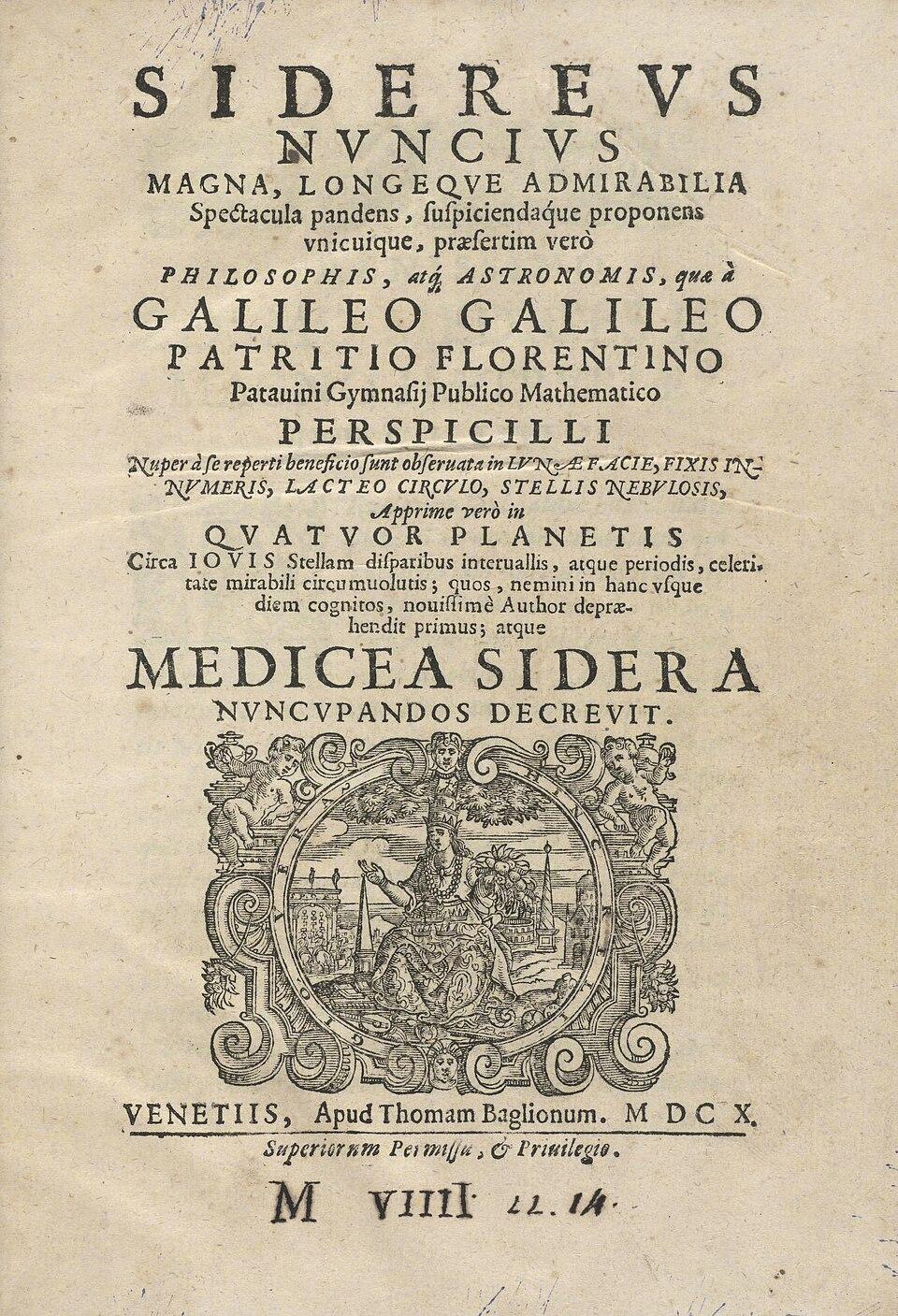
Alt...
Title page of Sidereus nuncius, 1610, by Galileo Galilei (1564-1642).
The original Latin title page of Galileo Galilei's landmark astronomical work, announcing observations of the Moon, fixed stars, the Milky Way, and four Jupiter moons named "Medicea Sidera." Published by Thomas Baglioni in Venice (MDCX), with an ornate engraved publisher's vignette of an enthroned figure below the text.
https://en.wikipedia.org/wiki/Sidereus_Nuncius#/media/File:Houghton_IC6.G1333.610sa_-_Sidereus_nuncius.jpg
Andrea Wulf Considers the Rare Humanity of an Eighteenth-Century Naturalist
The Remarkable Life and Times of George Forster
https://lithub.com/andrea-wulf-considers-the-rare-humanity-of-an-eighteenth-century-naturalist/
Books by Georg Forster at PG:
https://www.gutenberg.org/ebooks/author/37318
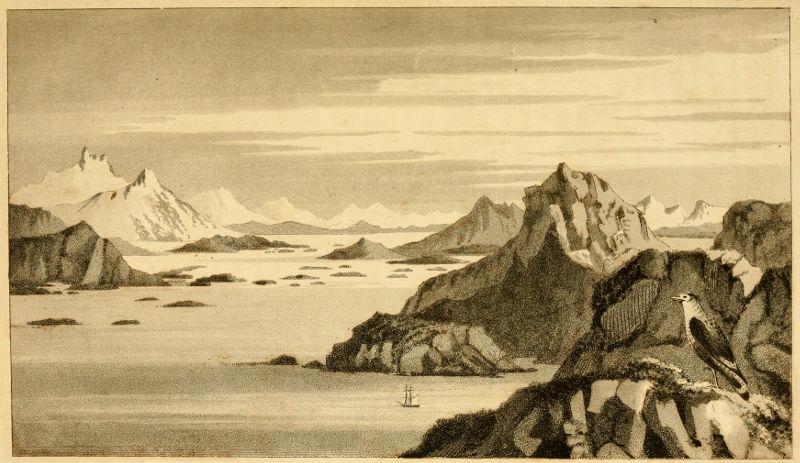
Alt...
Christmas Sound, Terra del Fuego.
The Three Voyages of Captain Cook Round the World. Vol. IV. Being the Second of the Second Voyage.
by James Cook and Georg Forster
A sepia-toned landscape illustration showing a calm fjord dotted with rocky islets, snow-capped mountains in the distance, and a small sailing ship on the water. In the foreground, two seabirds perch on rugged cliffs to the right, under a pale, hazy sky.
https://www.gutenberg.org/cache/epub/61492/pg61492-images.html
The Side That Won the Civil War is Now Banning Books About Why the Civil War Was Fought
Tom Zoellner on the Antebellum Precedent of Trump-Era Censorship
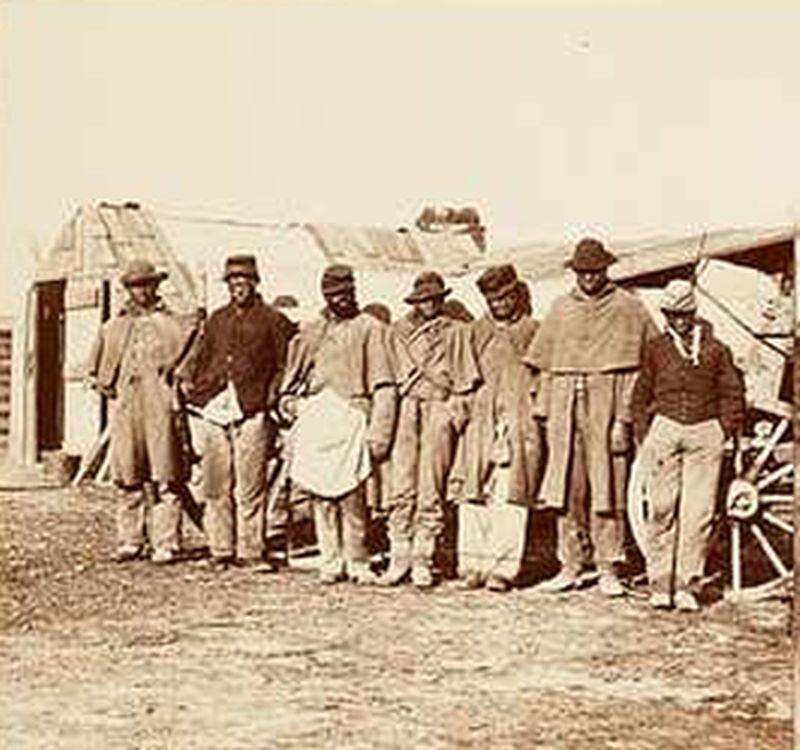
Alt...
A group of escaped slaves who have sought refuge at Fort Monroe during the American Civil War. There are seven them in various dress. They are standing in front of a low building and barn.
Lessons in Chemistry, 19th-Century Style
She wrote the bestseller that made young people fall in love with science
By Regan Penaluna
https://nautil.us/lessons-in-chemistry-19th-century-style-1281763
Books by Jane Marcet (including Conversations on Chemistry), at PG:
https://www.gutenberg.org/ebooks/author/32323
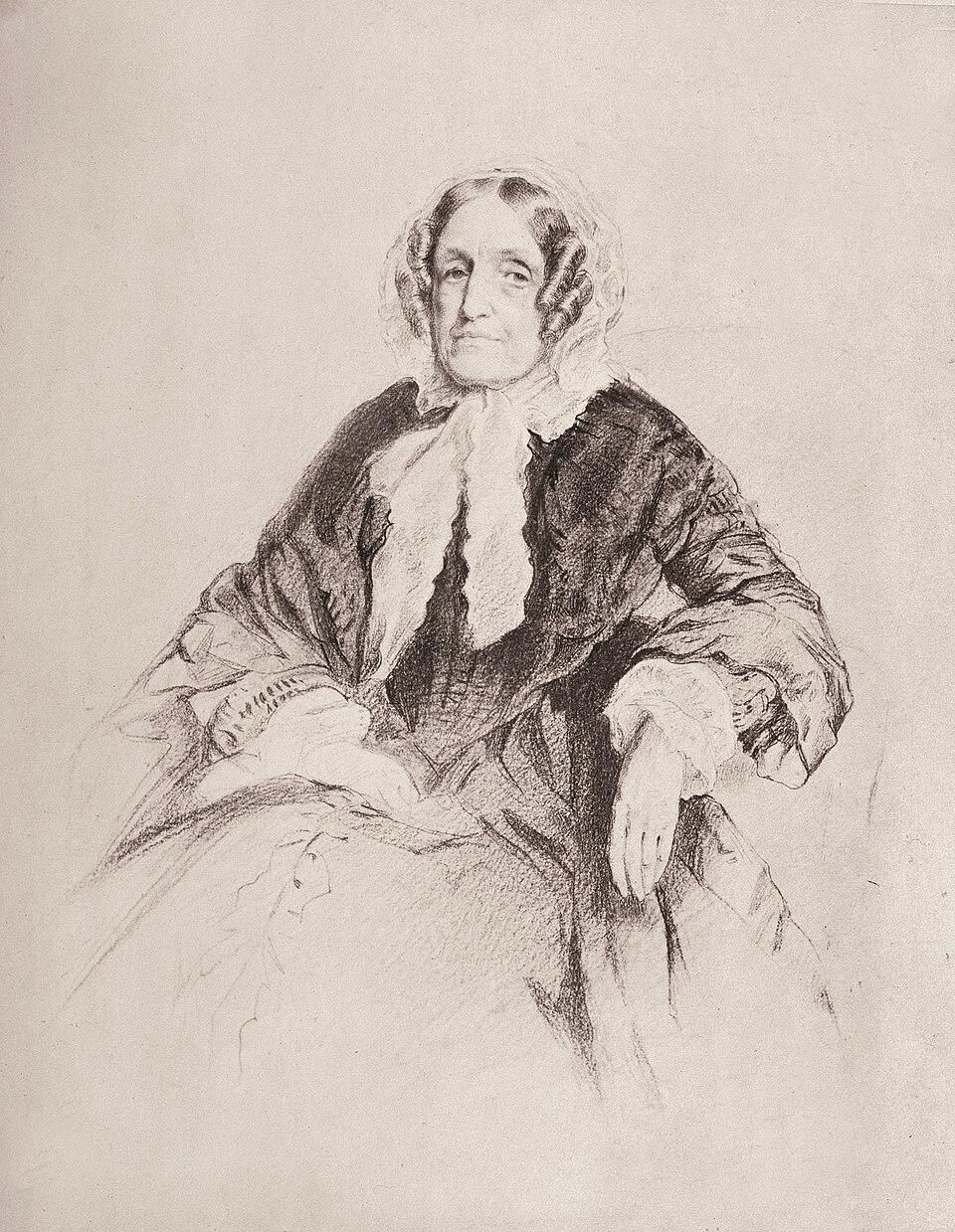
Alt...
Scan of a picture of writer Jane Marcet (who died in 1858)
Edgar Fahs Smith Collection (University of Pennsylvania)
A sketch-style portrait of an older woman seated in three-quarter view, gazing forward. She wears a dark dress with white lace collar and cuffs, a white lace cap, and a draped shawl. Her right hand rests relaxed on her lap.
https://en.wikipedia.org/wiki/Jane_Marcet#/media/File:Marcet_Jane.jpg
No fairytale: what happened to the real children behind fiction’s best-loved characters?
Peter Pan, Christopher Robin and Alice in Wonderland … being the star of a classic story might seem like a dream, but there’s a dark side, argues the author of The Children
by Melissa Albert
Books in Children's Fiction at PG:
https://www.gutenberg.org/ebooks/bookshelf/18
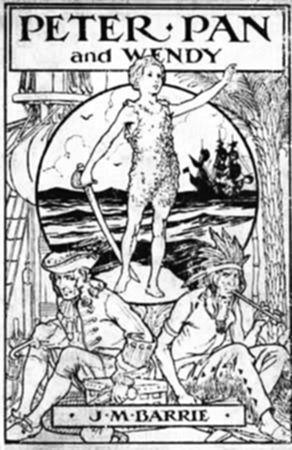
Alt...
Cover of 1915 edition of J. M. Barrie's novel, first published in 1911, illustrated by F. D. Bedford
A black-and-white illustrated book cover showing Peter Pan standing triumphantly in a circular vignette with a ship at sea behind him. Below, a pirate (left) and a Native American figure (right) flank the central image. Title and author J.M. Barrie printed above and below.
https://en.wikipedia.org/wiki/Peter_Pan_(character)#/media/File:Peter_Pan_1915_cover.jpg
![[?]](https://files.urusai.social/accounts/avatars/109/377/743/738/065/642/original/807395411f95c649.jpg)
My current TBR list.
#AmReading #Manga #Books #Bookstodon #TBR #Photo #Shelfie #ComicBook #Mangagram #Frieren #SomaliAndTheForestSpirit #Batman
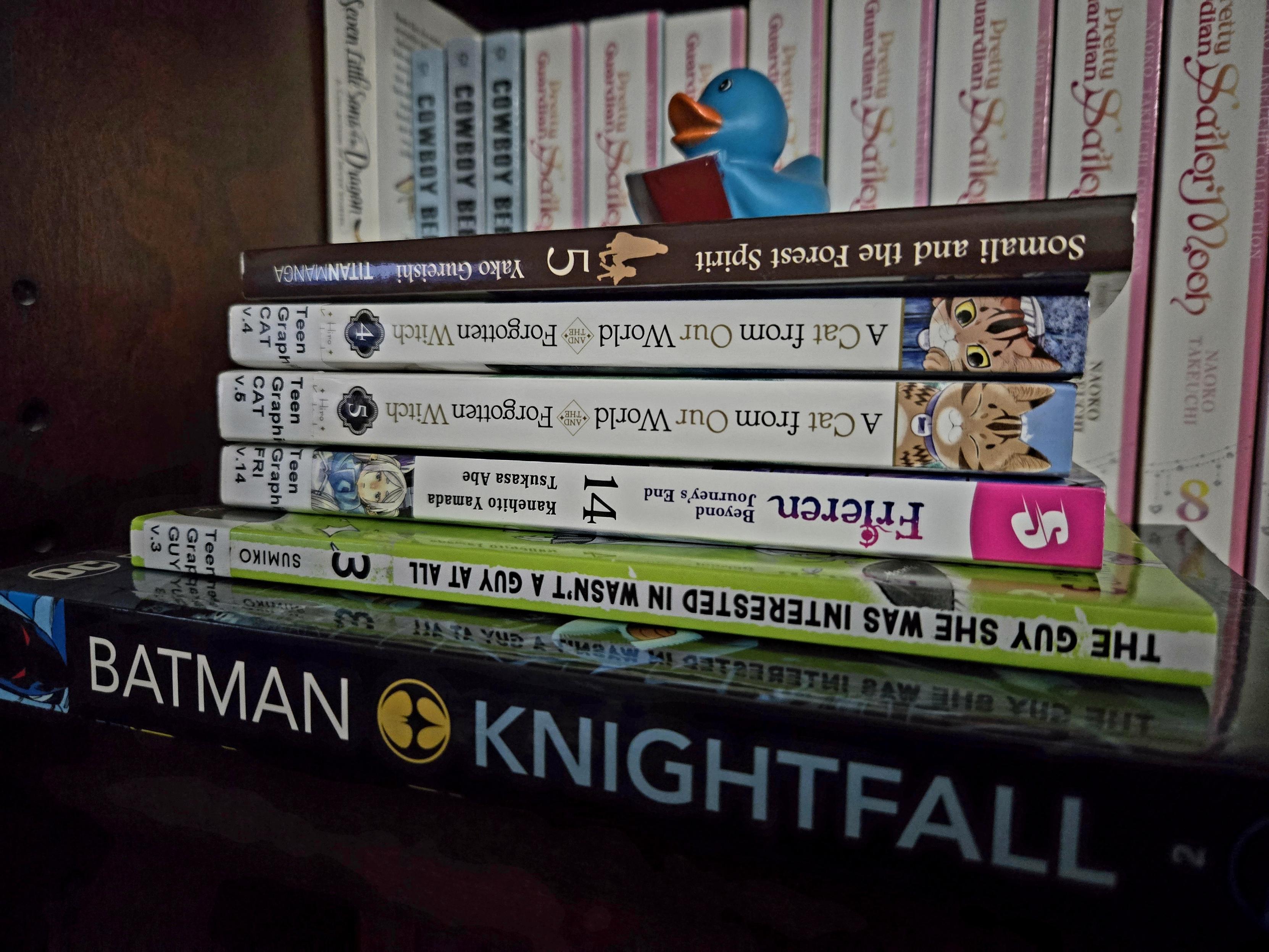
Alt...
Photograph of a stack of books on a bookshelf with a blue rubber duck on top reading a book. Behind it are a collection of Sailor Moon books. From top to bottom, the books are Somali and the Forest Spirit volume 5, A Cat from Our World and the Forgotten Witch volume 4, A Cat from Our World and the Forgotten Witch volume 5, Frieren volume 14, The Guy She Was Interested In Wasn't a Guy At All volume 3, Batman: Knightfall Omnibus volume 2.
Fantastic Finds in the Library’s Children’s Literature Collections
The Library of Congress recently published a book on the history of children’s books, from their origins to contemporary offerings. Follow author Hannah Freece as she highlights a few fun and unexpected treasures from the collection.
by Sasha Dowdy
Books in Children's Literature at PG:
https://www.gutenberg.org/ebooks/bookshelf/20
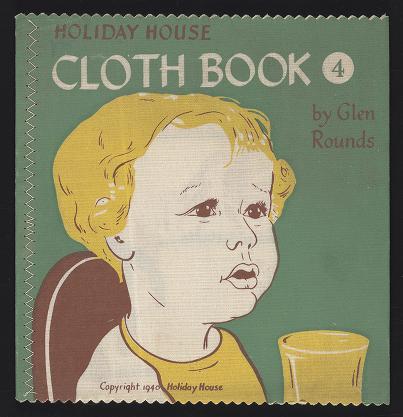
Alt...
Holiday House cloth book 4.
A square cloth book cover with zigzag-stitched edges on a green background. Features a bold illustration of a wide-eyed young child in a yellow bib gazing at a yellow cup. Text reads "Holiday House Cloth Book 4 by Glen Rounds," copyright 1940.
https://www.loc.gov/resource/rbc0001.2025juv2011657059/?sp=1&st=gallery
Born in 1810, Margaret Fuller Was Labeled a Child Prodigy. She Later Used Her Intellect to Ask Important Questions About Women’s Role in America
Her writing posed the novel premise: What does it mean to be a woman? Her early death meant she never saw the movement she inspired
by Megan Marshall
Books by Margaret Fuller at PG:
https://www.gutenberg.org/ebooks/author/2829
#Books #Literature #WomenInArt
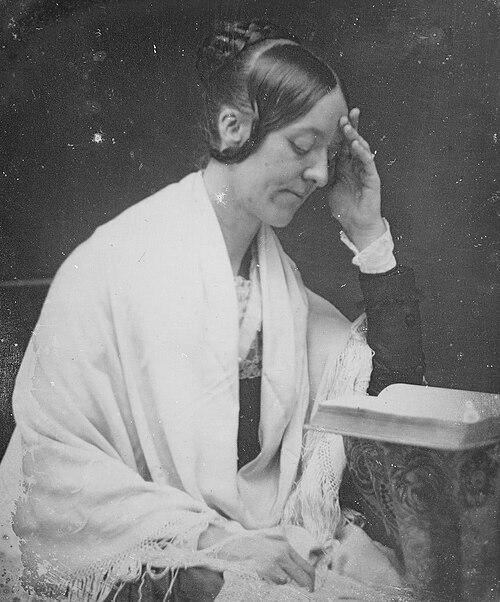
Alt...
Detail of the only known daguerreotype of Fuller (1846).
A black-and-white sixth-plate daguerreotype portrait of a woman seated in profile, eyes downcast, resting her head on one raised hand. She wears a white fringed shawl over dark clothing, with braided hair. A decorative box rests beside her.
https://commons.wikimedia.org/wiki/File:Margaret_Fuller_by_John_Plumbe,_Jr.,_1846,_sixth-plate_daguerreotype,_from_the_National_Portrait_Gallery_-_NPG-B8000006C_1_(2).jpg
Eight Overlooked Characters from Lewis Carroll’s Alice Books
Everyone loves the White Rabbit and the Cheshire Cat, but what about these weird and wonderful creations?
By Kelly Robinson
https://reactormag.com/eight-overlooked-characters-from-lewis-carrolls-alice-books/
Books by Lewis Carroll at PG:
https://www.gutenberg.org/ebooks/author/7
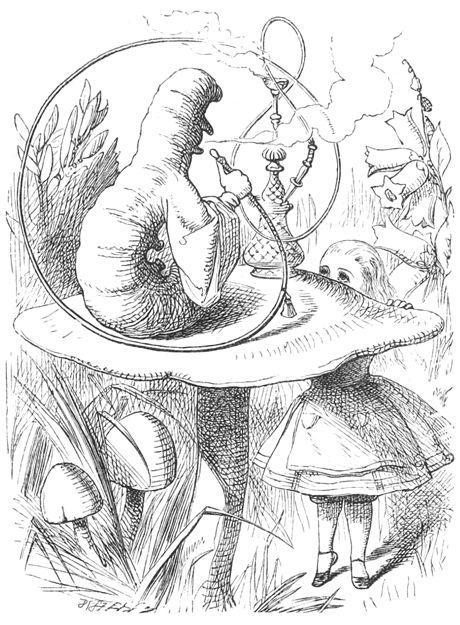
Alt...
CONSEILS D’UNE CHENILLE.
A large caterpillar sits atop a wide mushroom smoking a hookah, while a small Alice peeks over the mushroom's edge. Grass, leaves, and smaller mushrooms surround the scene.
https://www.gutenberg.org/cache/epub/55456/images/x-page-60.jpg
Aventures d'Alice au pays des merveilles by Lewis Carroll, Illustratated by John Tenniel, Translated by Henri Bué
https://www.gutenberg.org/cache/epub/55456/pg55456-images.html
NUMMS. A sham collar, to be worn over a dirty shirt.
A selection from Francis Grose’s “Dictionary Of The Vulgar Tongue” (1785)
--
#books #literature #dictionaries #history #society #language #slang @histodons
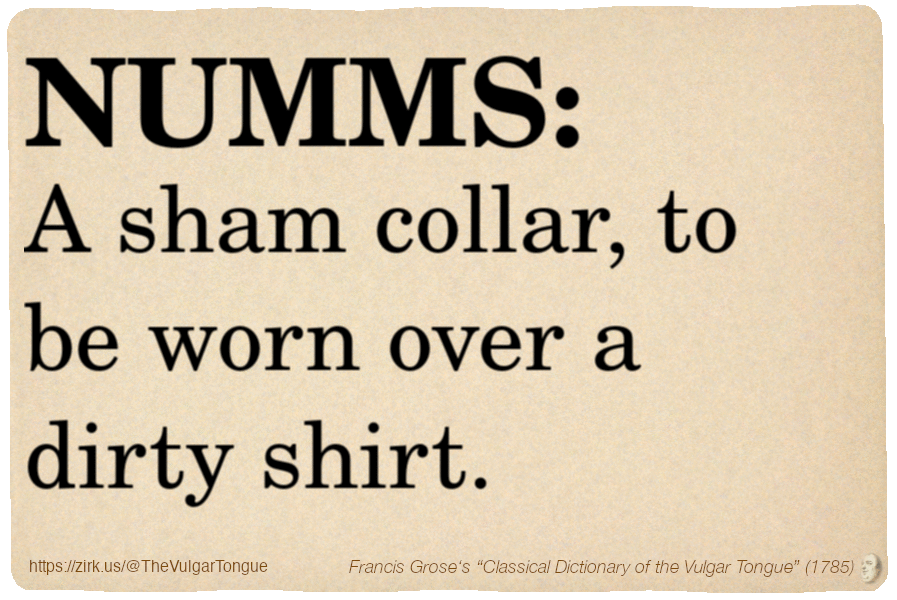
Alt...
Image imitating a page from an old document, text (as in main toot):
NUMMS. A sham collar, to be worn over a dirty shirt.
A selection from Francis Grose’s “Dictionary Of The Vulgar Tongue” (1785)
#AkbarShahidAhmed's forthcoming book #CrossingTheRedLine sounds like it should be required reading for all the #BlueMAGA shitlibs on Masto & elsewhere who like trafficking lame "I told you so's" to the effect that if the left had just shut up about the genocide her boss was doggedly backing, Harris would've won. (the opposite is true actually v. https://threadreaderapp.com/thread/2025937379802988645.html)
#NoneSoBlind...
https://wwnorton.com/books/9781324118190
#Gaza #Palestine #Biden #USpol #GenocideJoe #TheEvilOfTwoLessers #books @bookstodon

Alt...
from publisher's description of the book:
In vivid prose and with unparalleled access to insiders, Ahmed depicts a White House that resisted a course correction as its failures became undeniable. He probes Biden’s inner circle: a paranoid and imperious group shaped by the War on Terror, whose choices fueled tens of thousands of avoidable deaths among Palestinians, Lebanese, and Israelis, torpedoed long-time standards for warfare, and created a more dangerous world for us all. The Biden administration’s decisions drove voter backlash that helped Donald Trump regain power, and established patterns of impunity that have spurred wider bloodshed under Trump.
Crossing the Red Line is an urgent reckoning with Biden’s record on Gaza that is vital to understanding historic damage to America’s standing in the world, and a period whose dark consequences will resonate globally for decades to come.
#CitationsNeeded pod's Nima Shirazi and Adam Johnson have a live convo @ Brooklyn's Word is Change bookstore about Adam's new book, "#HowToSellAGenocide: The #Media's Complicity in the Destruction of #Gaza," all royalties from which go to Middle East Children's Alliance.
#GazaCoverage #Palestine #Israel #PalestineCoverage #USmedia #WesternMedia #mediaCriticism #mediaRacism #MSM #liberalHypocrisy #mediaShitlibs #shitlibbingForGenocide #books @bookstodon
![[?]](https://files.mastodon.social/accounts/avatars/113/943/751/231/995/769/original/280871214edabbe9.png)
Hello. My name is Agnes Stone, and I am a new adult science fiction fantasy indie author. My debut novel was released in November 2024, and I am looking for new bookish and author friends as I try to flee Meta and prepare for the end of TikTok. #selfpublishing #books #bookish #sciencefiction #scifi #author #writersofmastodon #writingcommunity #bookstodon #indieauthor

Alt...
Image of Agnes Stone, indie author.