Search results for tag #language
![[?]](https://zirkus-media.fra1.cdn.digitaloceanspaces.com/accounts/avatars/111/192/373/629/540/829/original/9ff4f5b9781a0e3a.jpg)
SPARROW-MOUTHED. Wide-mouthed, like the mouth of a sparrow: it is said of such persons, that they do not hold their mouths by lease, but have it from year to year; i.e. from ear to ear. One whose mouth cannot be enlarged without removing their ears.
A selection from Francis Grose’s “Dictionary Of The Vulgar Tongue” (1785)
--
#books #literature #dictionaries #history #society #language #slang @histodons
Alt...
Image imitating a page from an old document, text (as in main toot):
SPARROW-MOUTHED. Wide-mouthed, like the mouth of a sparrow: it is said of such persons, that they do not hold their mouths by lease, but have it from year to year; i.e. from ear to ear. One whose mouth cannot be enlarged without removing their ears.
A selection from Francis Grose’s “Dictionary Of The Vulgar Tongue” (1785)
![[?]](https://files.mastodon.social/accounts/avatars/115/070/625/860/923/251/original/9629d01039476748.png)
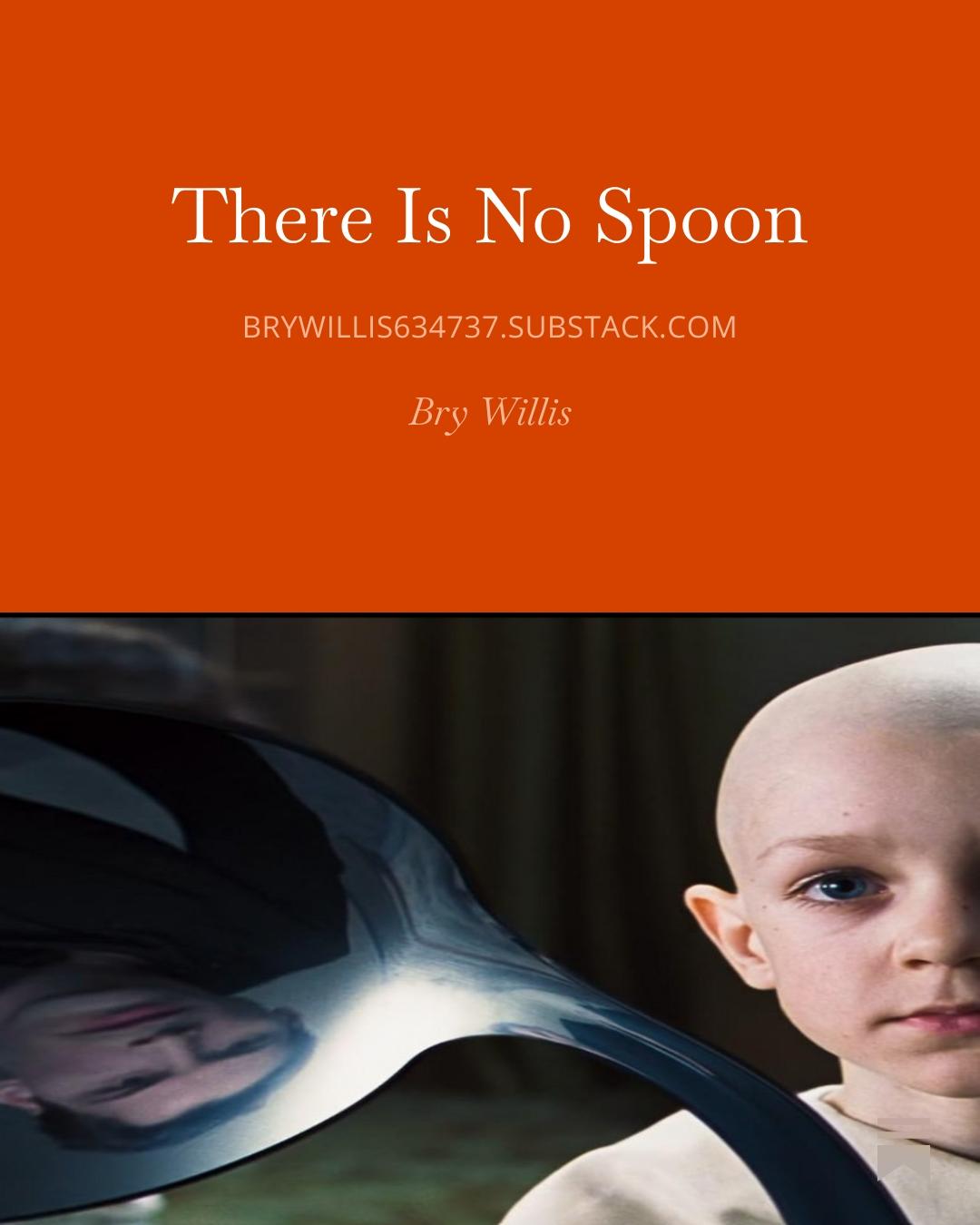
Many of us remember the 'no spoon' scene in The Matrix, but I'm unsatisfied with the many interpretations.
Now, you can be unsatisfied with mine. Fair is fair.
#philosophy #substack #blog #metaphysics #language #simulation #baudrillard #reality #consciousness #meow #perception
DANCERS. Stairs.
A selection from Francis Grose’s “Dictionary Of The Vulgar Tongue” (1785)
--
#books #literature #dictionaries #history #society #language #slang @histodons
Alt...
Image imitating a page from an old document, text (as in main toot):
DANCERS. Stairs.
A selection from Francis Grose’s “Dictionary Of The Vulgar Tongue” (1785)
GRUB STREET. A street near Moorfields, formerly the supposed habitation of many persons who wrote for the booksellers: hence a Grub-street writer means a hackney author, who manufactures booss for the booksellers.
A selection from Francis Grose’s “Dictionary Of The Vulgar Tongue” (1785)
--
#books #literature #dictionaries #history #society #language #slang @histodons
Alt...
Image imitating a page from an old document, text (as in main toot):
GRUB STREET. A street near Moorfields, formerly the supposed habitation of many persons who wrote for the booksellers: hence a Grub-street writer means a hackney author, who manufactures booss for the booksellers.
A selection from Francis Grose’s “Dictionary Of The Vulgar Tongue” (1785)
HAND. A sailor. We lost a hand; we lost a sailor. Bear a hand; make haste. Hand to fist; opposite: the same as tete-a-tete, or cheek by joul.
A selection from Francis Grose’s “Dictionary Of The Vulgar Tongue” (1785)
--
#books #literature #dictionaries #history #society #language #slang @histodons
Alt...
Image imitating a page from an old document, text (as in main toot):
HAND. A sailor. We lost a hand; we lost a sailor. Bear a hand; make haste. Hand to fist; opposite: the same as tete-a-tete, or cheek by joul.
A selection from Francis Grose’s “Dictionary Of The Vulgar Tongue” (1785)
FLAT. A bubble, gull, or silly fellow.
A selection from Francis Grose’s “Dictionary Of The Vulgar Tongue” (1785)
--
#books #literature #dictionaries #history #society #language #slang @histodons
Alt...
Image imitating a page from an old document, text (as in main toot):
FLAT. A bubble, gull, or silly fellow.
A selection from Francis Grose’s “Dictionary Of The Vulgar Tongue” (1785)
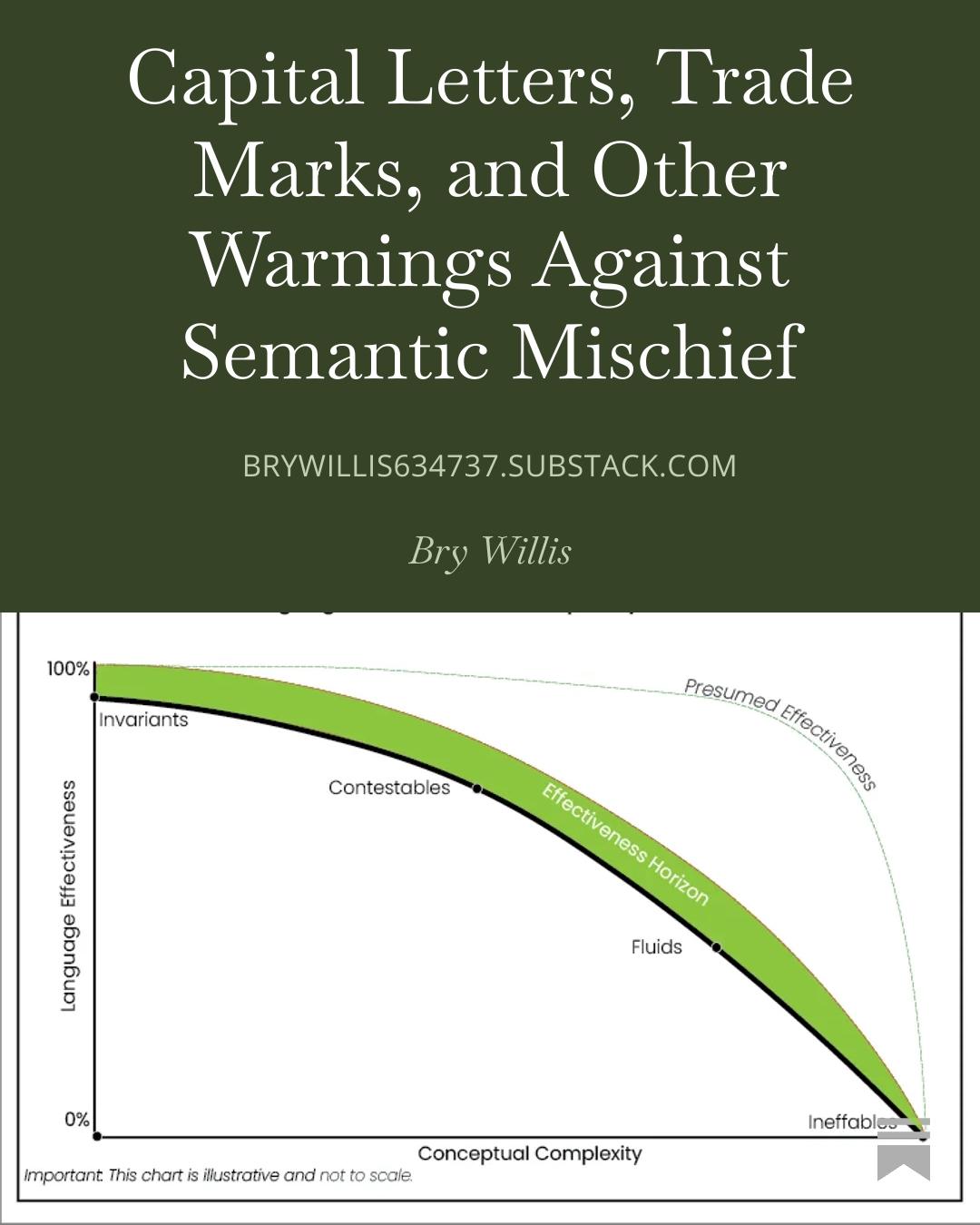
I was up for hours this morning chatting with Claude about the meaning of Meaning, and I lived to tell the tale.
https://brywillis634737.substack.com/p/capital-letters-trade-marks-and-other?r=pvxh5
#philosophy #ontology #truth #meaning #semantics #semiotics #orthography #language #metaphysics #orthography #deconstruction #typography #blog #substack #podcast #video
FACE-MAKING. Begetting children. To face it out; to persist in a falsity. No face but his own: a saying of one who has no money in his pocket or no court cards in his hand.
A selection from Francis Grose’s “Dictionary Of The Vulgar Tongue” (1785)
--
#books #literature #dictionaries #history #society #language #slang @histodons
Alt...
Image imitating a page from an old document, text (as in main toot):
FACE-MAKING. Begetting children. To face it out; to persist in a falsity. No face but his own: a saying of one who has no money in his pocket or no court cards in his hand.
A selection from Francis Grose’s “Dictionary Of The Vulgar Tongue” (1785)
![[?]](https://files.mastodon.social/accounts/avatars/110/088/287/007/315/114/original/c01d5c48adb3014a.jpg)
YAKAMOZ (Turkish):
The reflection of the moon on the surface of the water.While pop-linguistics books often frame this purely as a romantic, untranslatable word for moonlight, its scientific and historical roots are even more fascinating.
#Linguistics
#Etymology
#Bioluminescence
#Nature
#Language
#Words
#photography
#StarTrails
#AltText

Alt...
A long-exposure night photograph by Mark Stewart capturing a dramatic coastal landscape filled with glowing bioluminescence and star trails. The vertical composition looks down onto a rugged, rocky coastline where sharp stone ledges and cliffs jut out into the ocean. The water directly colliding with these rocky shores glows with a vibrant, electric neon-blue light, caused by bioluminescent organisms activated by the motion of the waves. In contrast to the glowing blue water below, the night sky above is captured in a long exposure, filling the upper half of the frame with hundreds of white, parallel star trails arcing diagonally across the sky. Along the horizon, a warm, golden-orange glow from a setting moon or distant light illuminates the silhouette of distant mountains and the dense evergreen forest lining the clifftops. The smooth, misty texture of the ocean water creates a serene, ethereal atmosphere that bridges the glowing sea and the streaking stars.
KNIGHT OF THE TRENCHER. A great eater.
A selection from Francis Grose’s “Dictionary Of The Vulgar Tongue” (1785)
--
#books #literature #dictionaries #history #society #language #slang @histodons
Alt...
Image imitating a page from an old document, text (as in main toot):
KNIGHT OF THE TRENCHER. A great eater.
A selection from Francis Grose’s “Dictionary Of The Vulgar Tongue” (1785)
Heidegger plays the same dodgy language games in The Essence of Truth and Being and Time.
https://brywillis634737.substack.com/p/chess-with-heidegger?r=pvxh5
I discuss this legerdemain on Substack.
#philosophy #language #Heidegger #Wittgenstein #ontology #satire #blog #video #podcast #chess #criticaltheory

KNIGHT AND BARROW PIG, more hog than gentleman. A saying of any low pretender to precedency.
A selection from Francis Grose’s “Dictionary Of The Vulgar Tongue” (1785)
--
#books #literature #dictionaries #history #society #language #slang @histodons
Alt...
Image imitating a page from an old document, text (as in main toot):
KNIGHT AND BARROW PIG, more hog than gentleman. A saying of any low pretender to precedency.
A selection from Francis Grose’s “Dictionary Of The Vulgar Tongue” (1785)
MUTTON MONGER. A man addicted to wenching.
A selection from Francis Grose’s “Dictionary Of The Vulgar Tongue” (1785)
--
#books #literature #dictionaries #history #society #language #slang @histodons
Alt...
Image imitating a page from an old document, text (as in main toot):
MUTTON MONGER. A man addicted to wenching.
A selection from Francis Grose’s “Dictionary Of The Vulgar Tongue” (1785)
CUT. Drunk. A little cut over the head; slightly intoxicated. To cut; to leave a person or company. To cut up well; to die rich.
A selection from Francis Grose’s “Dictionary Of The Vulgar Tongue” (1785)
--
#books #literature #dictionaries #history #society #language #slang @histodons
Alt...
Image imitating a page from an old document, text (as in main toot):
CUT. Drunk. A little cut over the head; slightly intoxicated. To cut; to leave a person or company. To cut up well; to die rich.
A selection from Francis Grose’s “Dictionary Of The Vulgar Tongue” (1785)
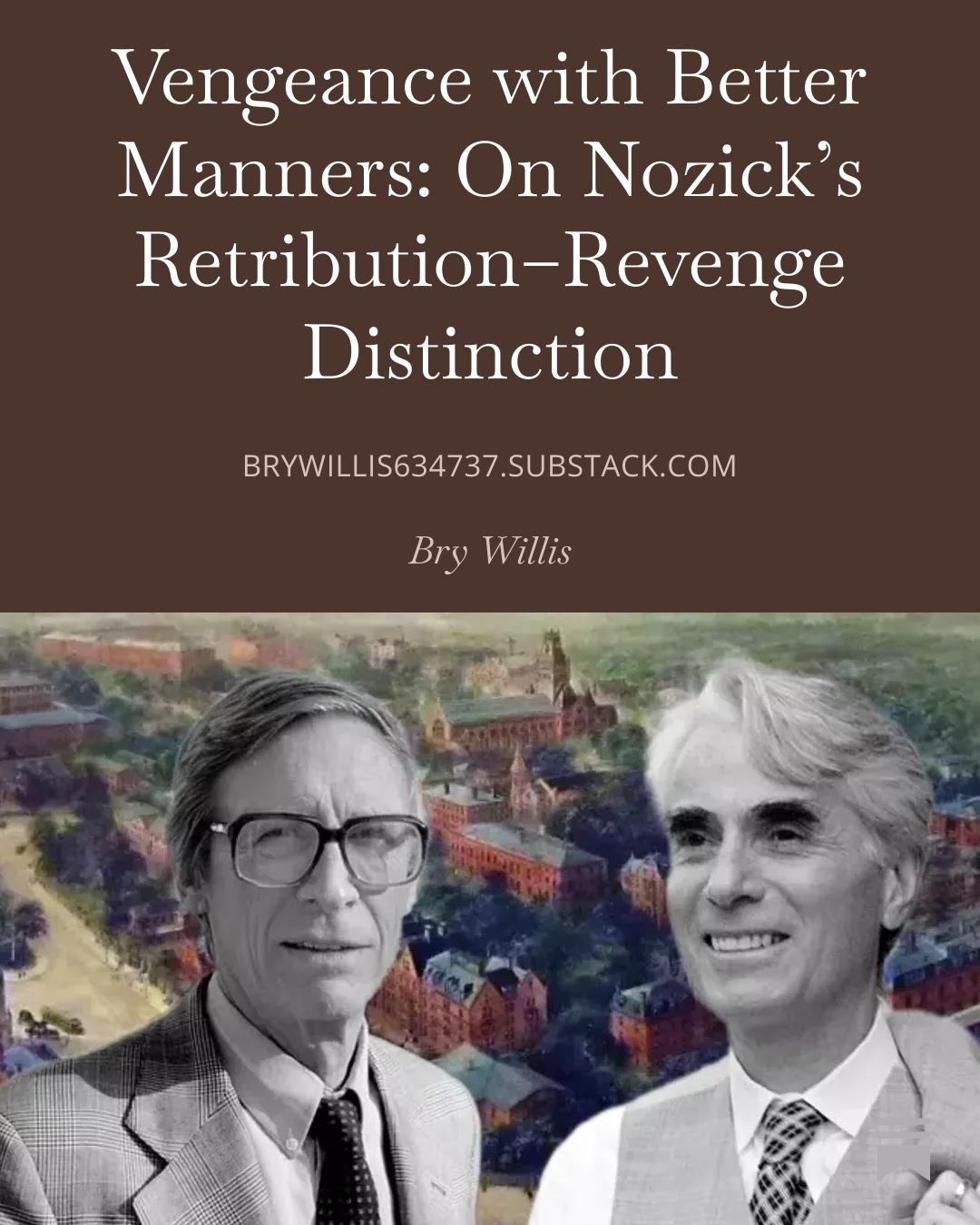
Retributive justice is a euphemism for vengeance by proxy: On Nozick's Retribution–Revenge Distinction
https://brywillis634737.substack.com/p/vengeance-with-better-manners-on
I started a piece on the self, and I hit a speed bump that I wanted to respond to separately from my main essay.
#substack #philosophy #nozick #justice #law #retribution #vengeance #punishment #language #freewill #blog
DICE. The names of false dice: A bale of bard cinque deuces \nA bale of flat cinque deuces \nA bale of flat sice aces \nA bale of bard cater traes \nA bale of flat cater traes \nA bale of fulhams \nA bale of light graniers \nA bale of langrets contrary to the ventage
A selection from Francis Grose’s “Dictionary Of The Vulgar Tongue” (1785)
--
#books #literature #dictionaries #history #society #language #slang @histodons
Alt...
Image imitating a page from an old document, text (as in main toot):
DICE. The names of false dice: A bale of bard cinque deuces \nA bale of flat cinque deuces \nA bale of flat sice aces \nA bale of bard cater traes \nA bale of flat cater traes \nA bale of fulhams \nA bale of light graniers \nA bale of langrets contrary to the ventage
A selection from Francis Grose’s “Dictionary Of The Vulgar Tongue” (1785)
What can we say about trust and guilt? Not as much as we might think.
#philosophy #language #substack #blog #metaethics #ethics #epistemology #linguistics #law #legaltheory #guilt #semantics #truth #wittgenstein #speech

GEE. It won't gee; it won't hit or do, it does not suit or fit.
A selection from Francis Grose’s “Dictionary Of The Vulgar Tongue” (1785)
--
#books #literature #dictionaries #history #society #language #slang @histodons
Alt...
Image imitating a page from an old document, text (as in main toot):
GEE. It won't gee; it won't hit or do, it does not suit or fit.
A selection from Francis Grose’s “Dictionary Of The Vulgar Tongue” (1785)
BUGABOE. A scare-babe, or bully-beggar.
A selection from Francis Grose’s “Dictionary Of The Vulgar Tongue” (1785)
--
#books #literature #dictionaries #history #society #language #slang @histodons
Alt...
Image imitating a page from an old document, text (as in main toot):
BUGABOE. A scare-babe, or bully-beggar.
A selection from Francis Grose’s “Dictionary Of The Vulgar Tongue” (1785)
Hi!, I'm a bot posting selections from Francis Grose’s 1785 “Dictionary Of The Vulgar Tongue”, a compilation of slang terms, the coded language of the underclass and the demi-monde.
[18th-century-content warning: possible racism, animal cruelty, homophobia, sexism, slut-shaming. Let me know of any problems.]
#FollowFriday #books #literature #dictionaries #history #society #crime #language #slang #18thCentury
Alt...
Montage of dictionary items posted by this account
![[?]](https://cdn.masto.host/mastjohn1126com/accounts/avatars/115/981/910/993/463/416/original/00ac72837ce34a31.gif)
Some letters have straight lines, others curved, some with points, others with none. One letter comes before the other in our alphabet. But why? There is a meaning to it all. It is not by chance.
If you ask AI, it will not tell you, either because it does not know or it was instructed to push the idea of random chance, like evolution. But that is wrong, and it likely cannot tell you the real meaning of the letters. But God can.
God's word is spirit and it is life.
GUMMY. Clumsy: particularly applied to the ancles of men or women, and the legs of horses.
A selection from Francis Grose’s “Dictionary Of The Vulgar Tongue” (1785)
--
#books #literature #dictionaries #history #society #language #slang @histodons
Alt...
Image imitating a page from an old document, text (as in main toot):
GUMMY. Clumsy: particularly applied to the ancles of men or women, and the legs of horses.
A selection from Francis Grose’s “Dictionary Of The Vulgar Tongue” (1785)
HOOF. To beat the hoof; to travel on foot. He hoofed it or beat the hoof, every step of the way from Chester to London.
A selection from Francis Grose’s “Dictionary Of The Vulgar Tongue” (1785)
--
#books #literature #dictionaries #history #society #language #slang @histodons
Alt...
Image imitating a page from an old document, text (as in main toot):
HOOF. To beat the hoof; to travel on foot. He hoofed it or beat the hoof, every step of the way from Chester to London.
A selection from Francis Grose’s “Dictionary Of The Vulgar Tongue” (1785)
I offer some linguistic clarification on the misogyny implied in the image.
Spoiler alert: there is none. Whether this is language-splaining or mansplaining is up to you.
NB: Evidently, LinkedIn already censored this image, but in a new context, we'll see what happens.
#philosophy #language #linguistics #pangolins #musk #misogyny #substack #response #note #censorship #speech #blog

This article is less about what philosophy is about and more about why we can't particularly know some things, and why not.
#blog #substack #philosophy #language #ontology #semantics #semiotics #epistemology #etymology #communication #Heidegger #Derrida #Foucault #Wittgenstein #Nietzsche #Gadamer #Peirce #Gallie #McGilchrist #languageinsufficiency
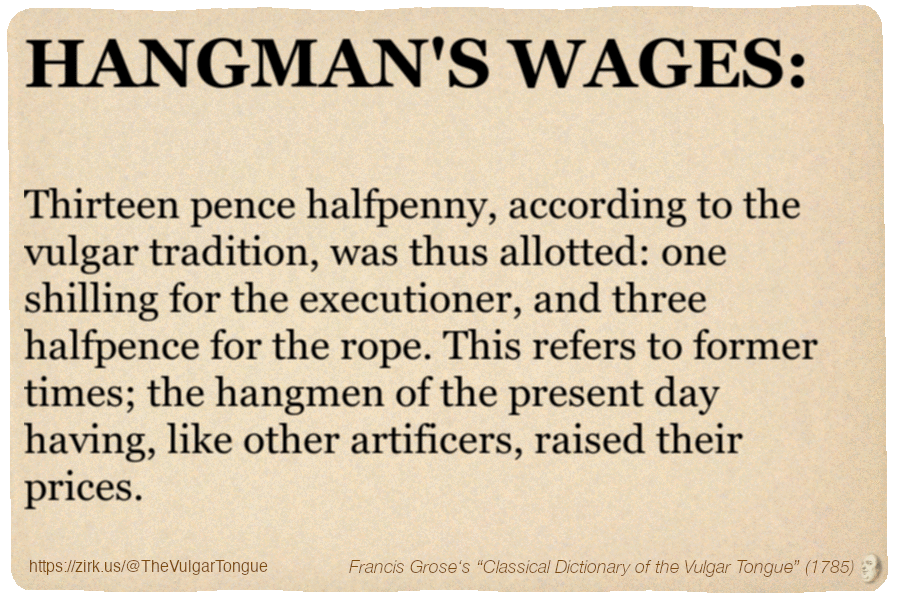
HANGMAN'S WAGES. Thirteen pence halfpenny, according to the vulgar tradition, was thus allotted: one shilling for the executioner, and three halfpence for the rope. This refers to former times; the hangmen of the present day having, like other artificers, raised their prices.
A selection from Francis Grose’s “Dictionary Of The Vulgar Tongue” (1785)
--
#books #literature #dictionaries #history #society #language #slang @histodons
Alt...
Image imitating a page from an old document, text (as in main toot):
HANGMAN'S WAGES. Thirteen pence halfpenny, according to the vulgar tradition, was thus allotted: one shilling for the executioner, and three halfpence for the rope. This refers to former times; the hangmen of the present day having, like other artificers, raised their prices.
A selection from Francis Grose’s “Dictionary Of The Vulgar Tongue” (1785)
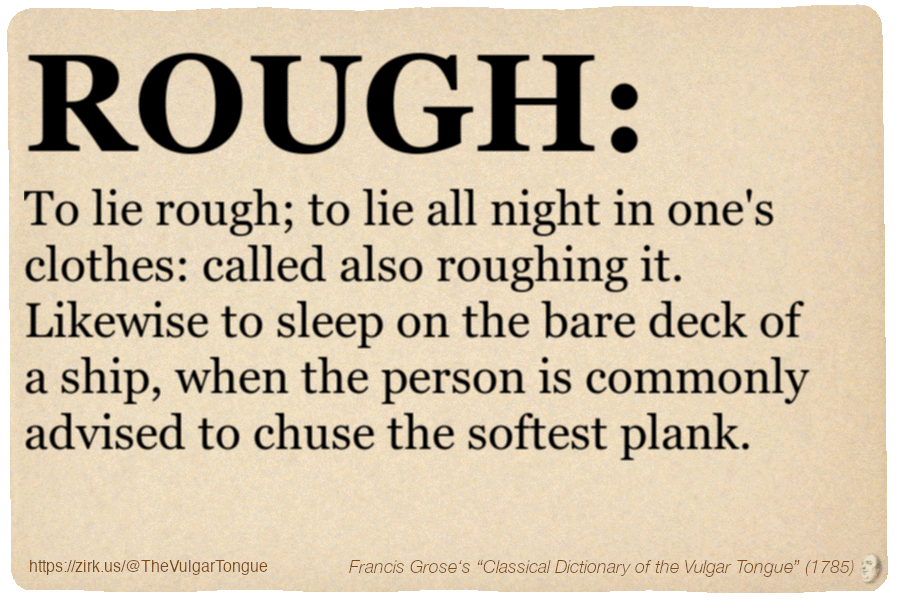
ROUGH. To lie rough; to lie all night in one's clothes: called also roughing it. Likewise to sleep on the bare deck of a ship, when the person is commonly advised to chuse the softest plank.
A selection from Francis Grose’s “Dictionary Of The Vulgar Tongue” (1785)
--
#books #literature #dictionaries #history #society #language #slang @histodons
Alt...
Image imitating a page from an old document, text (as in main toot):
ROUGH. To lie rough; to lie all night in one's clothes: called also roughing it. Likewise to sleep on the bare deck of a ship, when the person is commonly advised to chuse the softest plank.
A selection from Francis Grose’s “Dictionary Of The Vulgar Tongue” (1785)
I discuss the problem of conflating transhumanism and evolution. I am not anti-transhuman or even anti-transsexual, but it's a category error to conflate them. Gotta stay in your lane.
https://philosophics.blog/2026/06/15/the-worlds-most-dangerous-idea/?utm_source=masto&utm_medium=social
#philosophy #blog #podcast #evolution #future #futurism #transhumanism #technology #language

Today, I look at the grammar of fitness in 'survival of the fittest'.
I was thinking about this as I was writing on a meta topic, so I felt like sharing it, since I won't be pursuing it further.
#philosophy #language #writing #blog #fitness #grammar #Darwin #substack #podcast #obligatesiblicide #justkiddingabouttheprevioushashtag

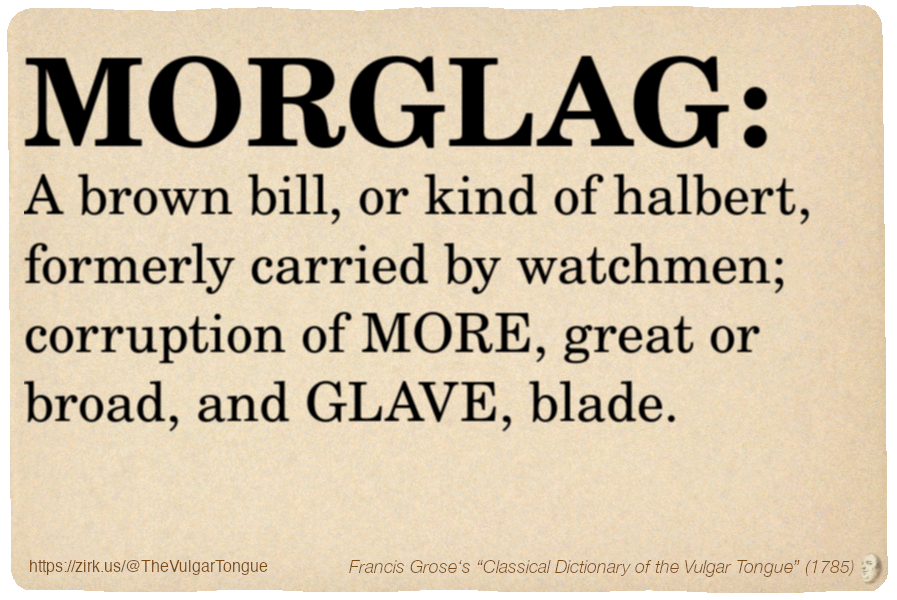
MORGLAG. A brown bill, or kind of halbert, formerly carried by watchmen; corruption of MORE, great or broad, and GLAVE, blade.
A selection from Francis Grose’s “Dictionary Of The Vulgar Tongue” (1785)
--
#books #literature #dictionaries #history #society #language #slang @histodons
Alt...
Image imitating a page from an old document, text (as in main toot):
MORGLAG. A brown bill, or kind of halbert, formerly carried by watchmen; corruption of MORE, great or broad, and GLAVE, blade.
A selection from Francis Grose’s “Dictionary Of The Vulgar Tongue” (1785)
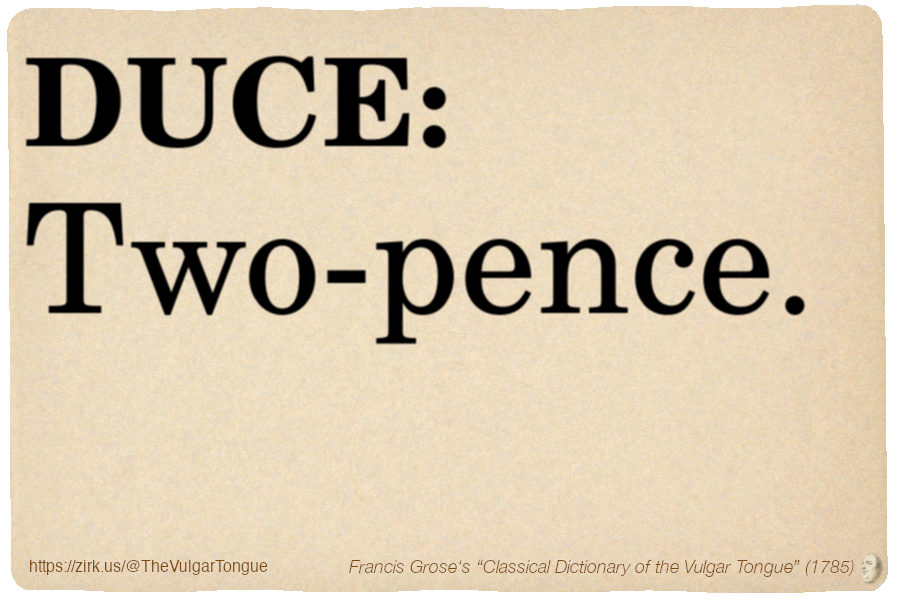
DUCE. Two-pence.
A selection from Francis Grose’s “Dictionary Of The Vulgar Tongue” (1785)
--
#books #literature #dictionaries #history #society #language #slang @histodons
Alt...
Image imitating a page from an old document, text (as in main toot):
DUCE. Two-pence.
A selection from Francis Grose’s “Dictionary Of The Vulgar Tongue” (1785)
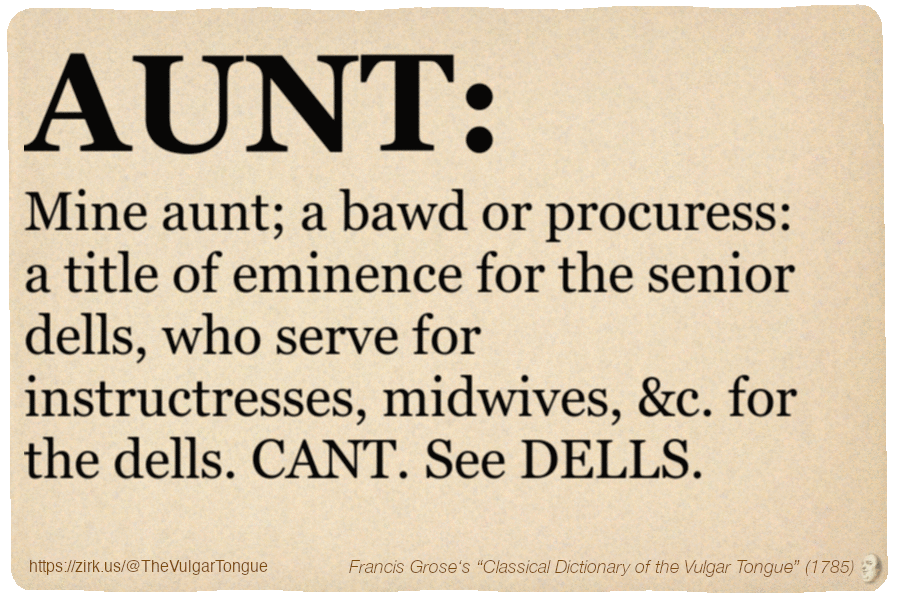
AUNT. Mine aunt; a bawd or procuress: a title of eminence for the senior dells, who serve for instructresses, midwives, &c. for the dells. CANT. See DELLS.
A selection from Francis Grose’s “Dictionary Of The Vulgar Tongue” (1785)
--
#books #literature #dictionaries #history #society #language #slang @histodons
Alt...
Image imitating a page from an old document, text (as in main toot):
AUNT. Mine aunt; a bawd or procuress: a title of eminence for the senior dells, who serve for instructresses, midwives, &c. for the dells. CANT. See DELLS.
A selection from Francis Grose’s “Dictionary Of The Vulgar Tongue” (1785)
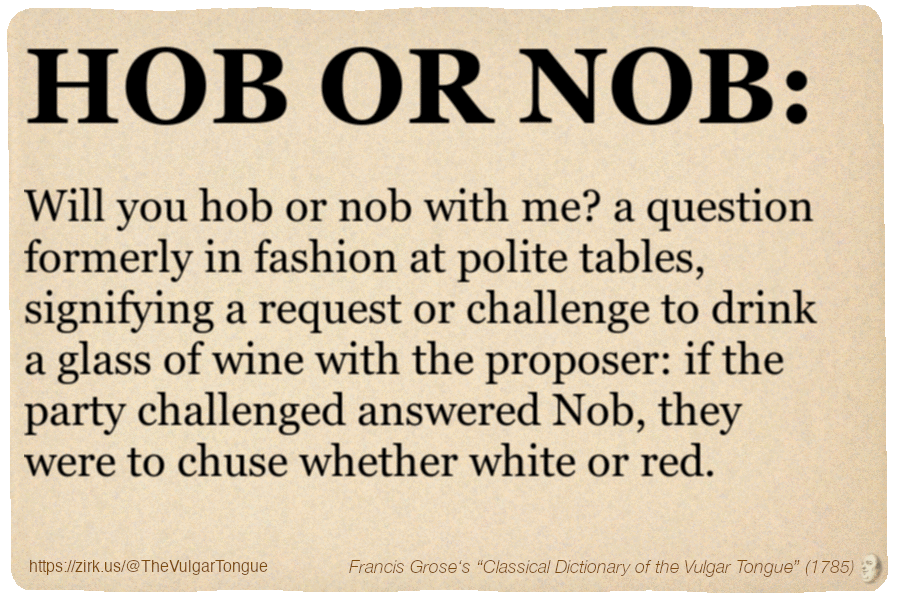
HOB OR NOB. Will you hob or nob with me? a question formerly in fashion at polite tables, signifying a request or challenge to drink a glass of wine with the proposer: if the party challenged answered Nob, they were to chuse whether white or red.
A selection from Francis Grose’s “Dictionary Of The Vulgar Tongue” (1785)
--
#books #literature #dictionaries #history #society #language #slang @histodons
Alt...
Image imitating a page from an old document, text (as in main toot):
HOB OR NOB. Will you hob or nob with me? a question formerly in fashion at polite tables, signifying a request or challenge to drink a glass of wine with the proposer: if the party challenged answered Nob, they were to chuse whether white or red.
A selection from Francis Grose’s “Dictionary Of The Vulgar Tongue” (1785)
Accountability is under the microscope. 🔬
I have long been suspicious of the grammar of accountability, so I am considering publishing an essay on the topic. Much has already been written about this weasel word, a favoured spirit animal by corporations and now adopted by the AI Ethics cohorts.
#philosophy #language #accountability #governance #ethics #aiethics #institutions #authority #substack #blog #essay #ontologicalgrammar #languageinsufficiency #lih

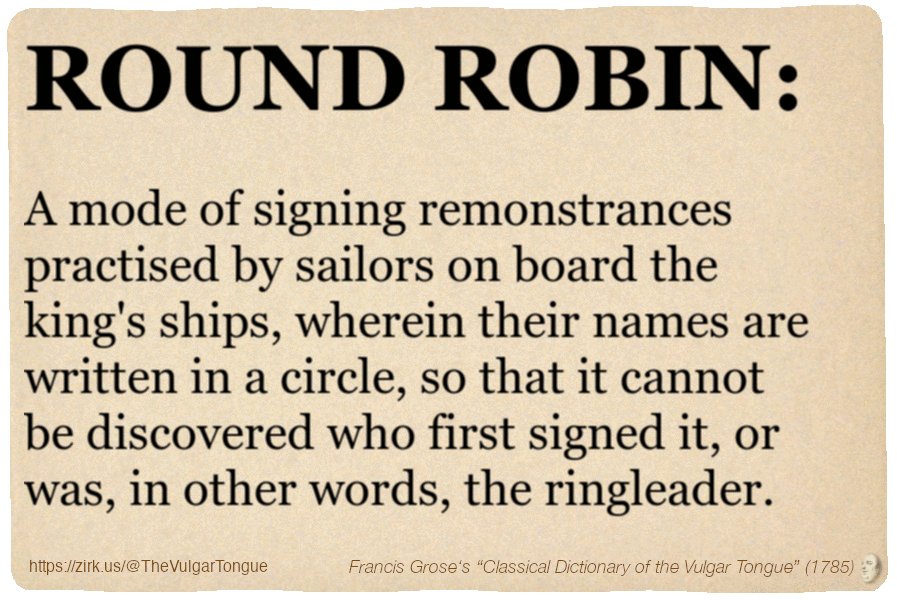
ROUND ROBIN. A mode of signing remonstrances practised by sailors on board the king's ships, wherein their names are written in a circle, so that it cannot be discovered who first signed it, or was, in other words, the ringleader.
A selection from Francis Grose’s “Dictionary Of The Vulgar Tongue” (1785)
--
#books #literature #dictionaries #history #society #language #slang @histodons
Alt...
Image imitating a page from an old document, text (as in main toot):
ROUND ROBIN. A mode of signing remonstrances practised by sailors on board the king's ships, wherein their names are written in a circle, so that it cannot be discovered who first signed it, or was, in other words, the ringleader.
A selection from Francis Grose’s “Dictionary Of The Vulgar Tongue” (1785)
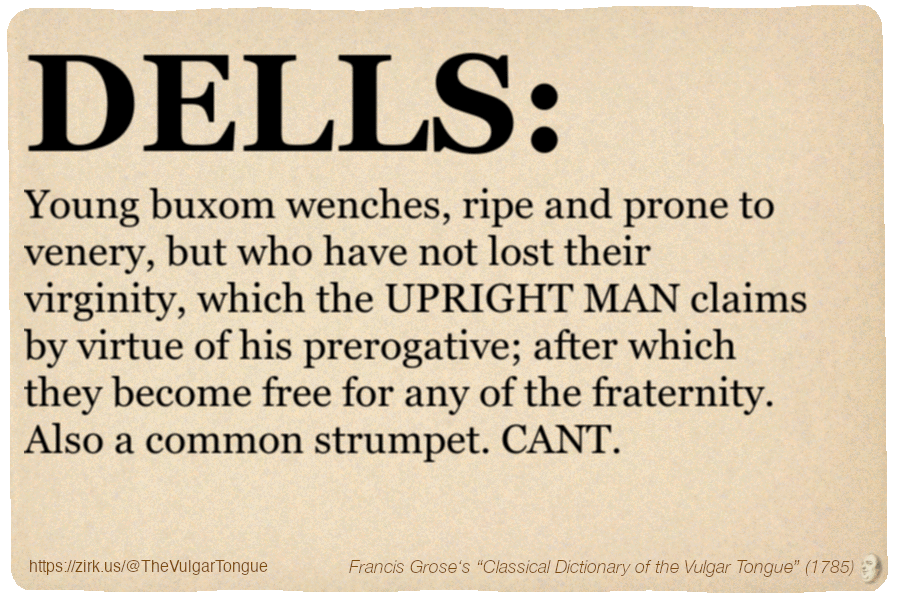
DELLS. Young buxom wenches, ripe and prone to venery, but who have not lost their virginity, which the UPRIGHT MAN claims by virtue of his prerogative; after which they become free for any of the fraternity. Also a common strumpet. CANT.
A selection from Francis Grose’s “Dictionary Of The Vulgar Tongue” (1785)
--
#books #literature #dictionaries #history #society #language #slang @histodons
Alt...
Image imitating a page from an old document, text (as in main toot):
DELLS. Young buxom wenches, ripe and prone to venery, but who have not lost their virginity, which the UPRIGHT MAN claims by virtue of his prerogative; after which they become free for any of the fraternity. Also a common strumpet. CANT.
A selection from Francis Grose’s “Dictionary Of The Vulgar Tongue” (1785)
![[?]](https://stockroom.wandering.shop/accounts/avatars/109/318/900/855/315/456/original/d715bbbb7ff2d44a.png)
![[?]](https://files.mastodon.online/accounts/avatars/109/298/185/928/165/179/original/8ed3da9f519c2f00.jpg)
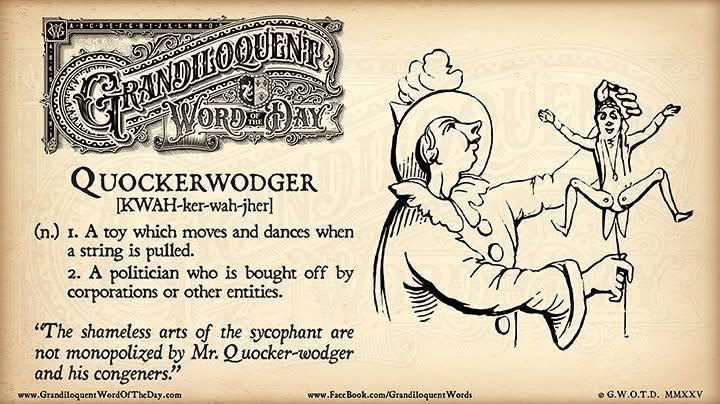
Grandiloquent Word of the Day.
Quockerwodger [KWAH-ker-wah-jher]
(n.)
1. A toy which moves and dances about when a string is pulled.
2. A politician who is bought off by corporations or other entities.
Origin unknown - mid 19th century.
Used in a sentence:
“The shameless arts of the sycophant are not monopolized by Mr. Quocker-wodger and his congeners.”
From a book of satires edited by William Nation published in 1880.
#globalmuseum #Language
Alt...
Grandiloquent Word of the Day
Quockerwodger
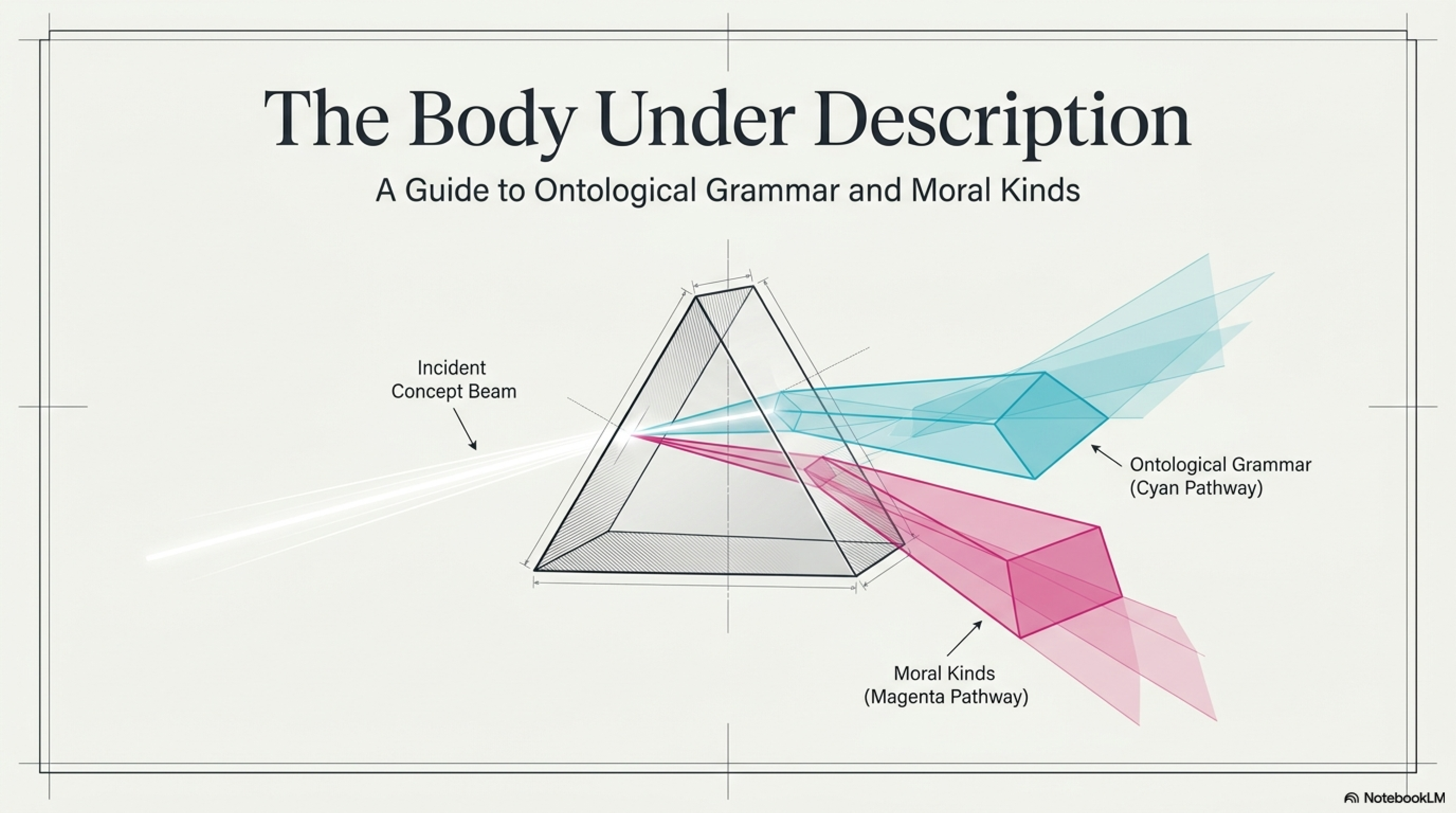
Ontological grammar with examples, including Olivia Rodrigo's babydoll, and more
https://brywillis634737.substack.com/p/ontological-grammar-moral-kinds-and
#philosophy #blog #substack #video #poscast #language #communication #institutions #courts #morality
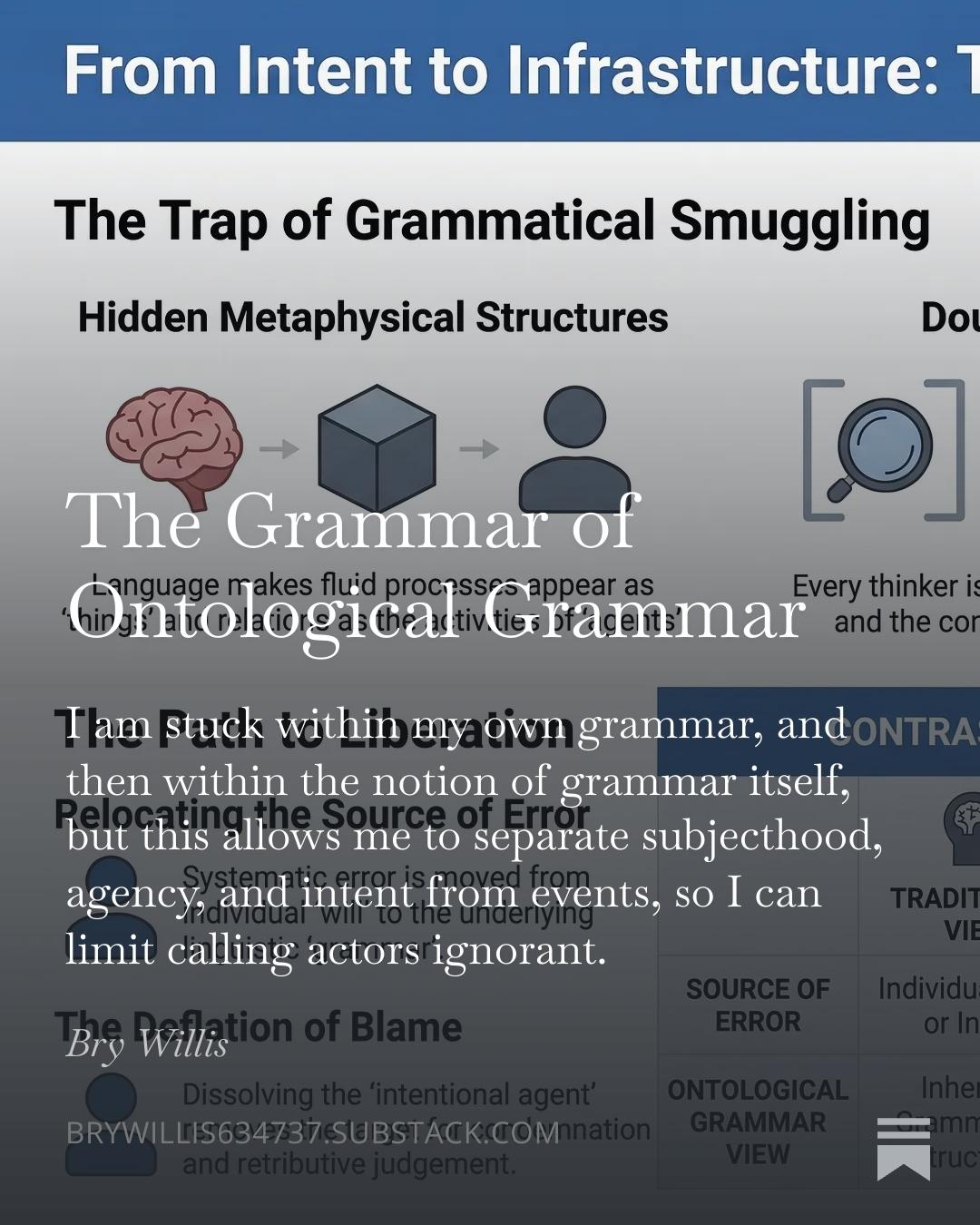
Ontological grammar is subjacent to active cognition and verbal faculties.
Many people label those who disagree with their positions as stupid or acting in bad faith, but the notion of ontological grammar liberates me from discussions of subjecthood, agency, and intent.
#philosophy #language #blog #podcast #substack #grammar #perspective #grammar #ClaudeAI #subjecthood #agency #intent #communication #understanding
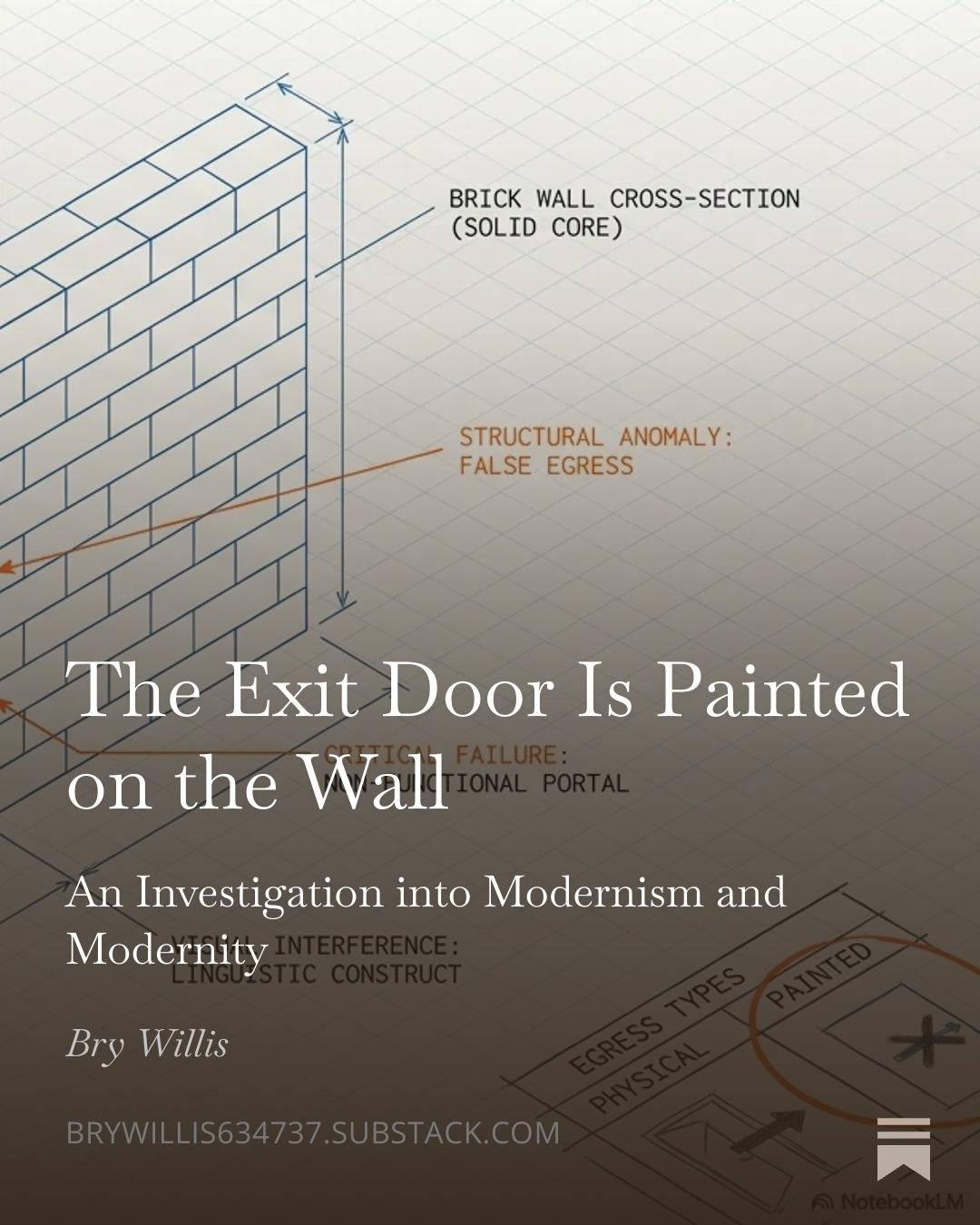
I take a look at the gravitational pull of Modernity and the failure of postmodernity and metamodernity.
#substack #blog #podcast #grammar #philosophy #noexit #modernity #postmodern #metamodern #perspective #writing #change #trap #diagnosis #risk #language
![[?]](https://o.mastodon.nz/accounts/avatars/109/349/901/141/281/234/original/f86bd9c446cb0954.png)
No joke, there's a law in Germany called *Rindfleischetikettierungsüberwachungsaufgabenübertragungsgesetz* (one word), or in legalese abbreviation *RkReÜAÜG M-V.*
On that note, why is 'abbreviation' such a long word to shorten stuff?
Translation of the law's title:
> Law on the transfer of tasks for the monitoring of cattle identification and beef labelling
Oh, and there's even a longer word for a single law:
*Grundstücksverkehrsgenehmigungszuständigkeitsübertragungsverordnung*
Oh ... and you're welcome, here's your new WiFi password for home ...
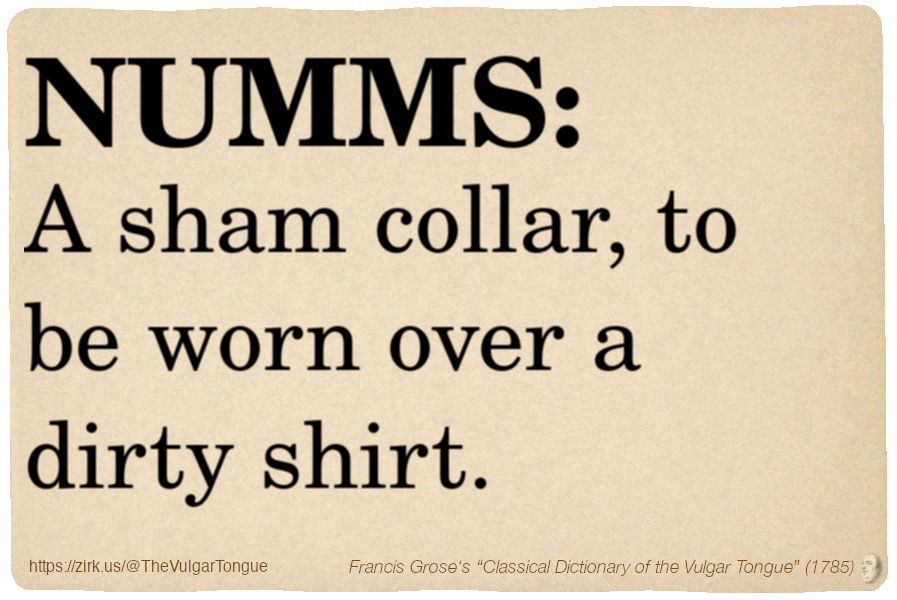
NUMMS. A sham collar, to be worn over a dirty shirt.
A selection from Francis Grose’s “Dictionary Of The Vulgar Tongue” (1785)
--
#books #literature #dictionaries #history #society #language #slang @histodons
Alt...
Image imitating a page from an old document, text (as in main toot):
NUMMS. A sham collar, to be worn over a dirty shirt.
A selection from Francis Grose’s “Dictionary Of The Vulgar Tongue” (1785)
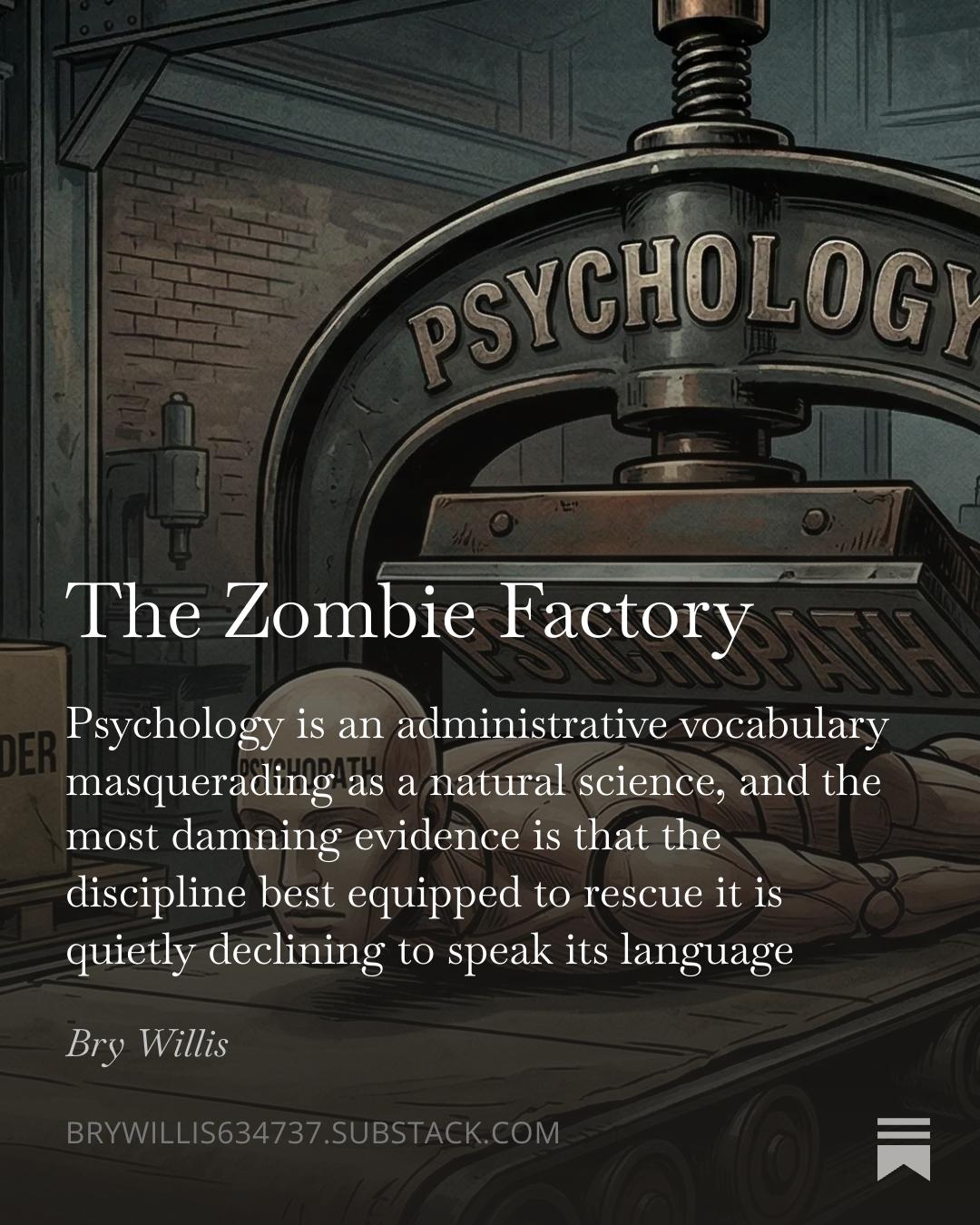
Psychology is an administrative vocabulary masquerading as a natural science, and the most damning evidence is that the discipline best equipped to rescue it is quietly declining to speak its language. Thoughts?
https://brywillis634737.substack.com/p/the-zombie-factory?r=pvxh5
#philosophy #psychology #zombies #ethics #blog #substack #writing #critique #news #language #society #culture #power #instrumentation #evidence #podcast #thoughts
![[?]](https://soc.octade.net/octade/s/3f7f2b5eda4e392867c301c49c2daa16.png)
Hexlish Alphabet for English, Constructed Languages and Cryptography: Automatic, Structural Compression with a Phonetic Hexadecimal Alphabet
DOI : https://doi.org/10.5281/zenodo.13139469
Hexlish is a legible, sixteen-letter alphabet for writing the English language and for encoding text as legible base 16 or compressed binary. Texts composed using the alphabet are automatically compressed by exactly fifty percent when converted from Hexlish characters into binary characters. Although technically lossy, this syntactic compression enables recovery of the correct English letters via syntactic reconstruction. The implementer can predict the size of the compressed binary file and the size of the text that will result from decompression. Generally it is intuitive to recognize English alphabet analogues to Hexlish words. This makes Hexlish a legible alternative to the standard hexadecimal alphabet.
#Hexlish #Conlang #Alphabets #English #Hexadecimal #Encoding #Cryptography #Ciphers #Crypto #Encryption #Compression #Papers #Preprints #Orthography #Language #Linguistics #Writing #Glyphs #Alphabetology #Technology

Alt...
Hexlish Alphabet logo. The word HEXLISH in rainbow colors on a black background with a hexagonal dot above the letter I. Beneat the logo in yellow reads the phrase, "English Text Compression & Encoding."
In the linked paper, Carl D. Franklin digs deep into the history of the tetragrammaton and debunks some of the myths commonly accepted as fact. The paper is part of a series and well worth the read for anyone interested in textual criticism or translation.
PDF: https://www.cbcg.org/franklin/debunking2.pdf
SYNOPSIS
"Is it true that the name Jehovah borrowed its vowels from Adonai?"
Spoiler: No, it is not true. It is a fabrication of a false history. The pronunciation, JEHOVAH was used centuries before Galatinus, so it is impossible for him to have invented it. Moreover, there is a lack of historical evidence that medieval scholars before Galatinus accepted any pronunciation other than JEHOVAH. They all appear to have unanimously supported this one widely known pronunciation of the tetragrammaton.
A lot of religious and textual myths have resulting in mass misconceptions about biblical textual history and meaning. Some of the myths misrepresent the tetragrammaton, or the name of God. This eventually led to the creation of the artificial name, Yahweh, which is not a Hebrew word, and is in fact a cleverly disguised classical Latin name for Jove. The author defrocks the Galatinus origin myth, proving the name JEHOVAH was in use long before Galatinus.
The sacred name mythos is popular in some Christian and Jewish sects as well as among the Hebrew Roots movement. This paper exposes some of the false history and baseless assertions about the pronunciation of the tetragrammaton. As it turns out, the early Masoretes and some early Catholics and the later Reformers had gotten it right - JEHOVAH is the correctly preserved pronunciation of the name of God. The name was never 'lost' and it has been known all through recorded history, if even only by a few.
#Bible #MasoreticText #Translation #Theology #History #Philology #Myths #SacredNames #NominaSacra #Judaism #Christianity #Hebrew #TiberianHebrew #Language #Linguistics
@infostorm@a.gup.pe @academicchatter@a.gup.pe @translators@a.gup.pe @theology@a.gup.pe @religion@a.gup.pe @histodons@a.gup.pe
![[?]](https://s3.eu-central-2.wasabisys.com/mastodonworld/accounts/avatars/109/286/296/111/462/305/original/c8ef0ee31673611d.png)
How is this possible?
The origin of the name of the U.S. state of #Oregon is unknown.