Search results for tag #space
![[?]](https://mastodon.nzoss.nz/system/accounts/avatars/000/062/671/original/f34d71dd4b06bb2d.jpg)
Orbital demo of a Kiwi-developed superconducting #satellite orientation system using no consumables, flywheels, or propellant. I can finally talk about it (phew) https://www.space.com/technology/acceleration-without-fuel-revolutionary-superconducting-thruster-harnesses-earths-magnetic-field-in-1st-orbital-test
#space
![[?]](https://files.mastodon.social/accounts/avatars/108/198/016/418/435/792/original/794f5e156c5eca48.jpg)
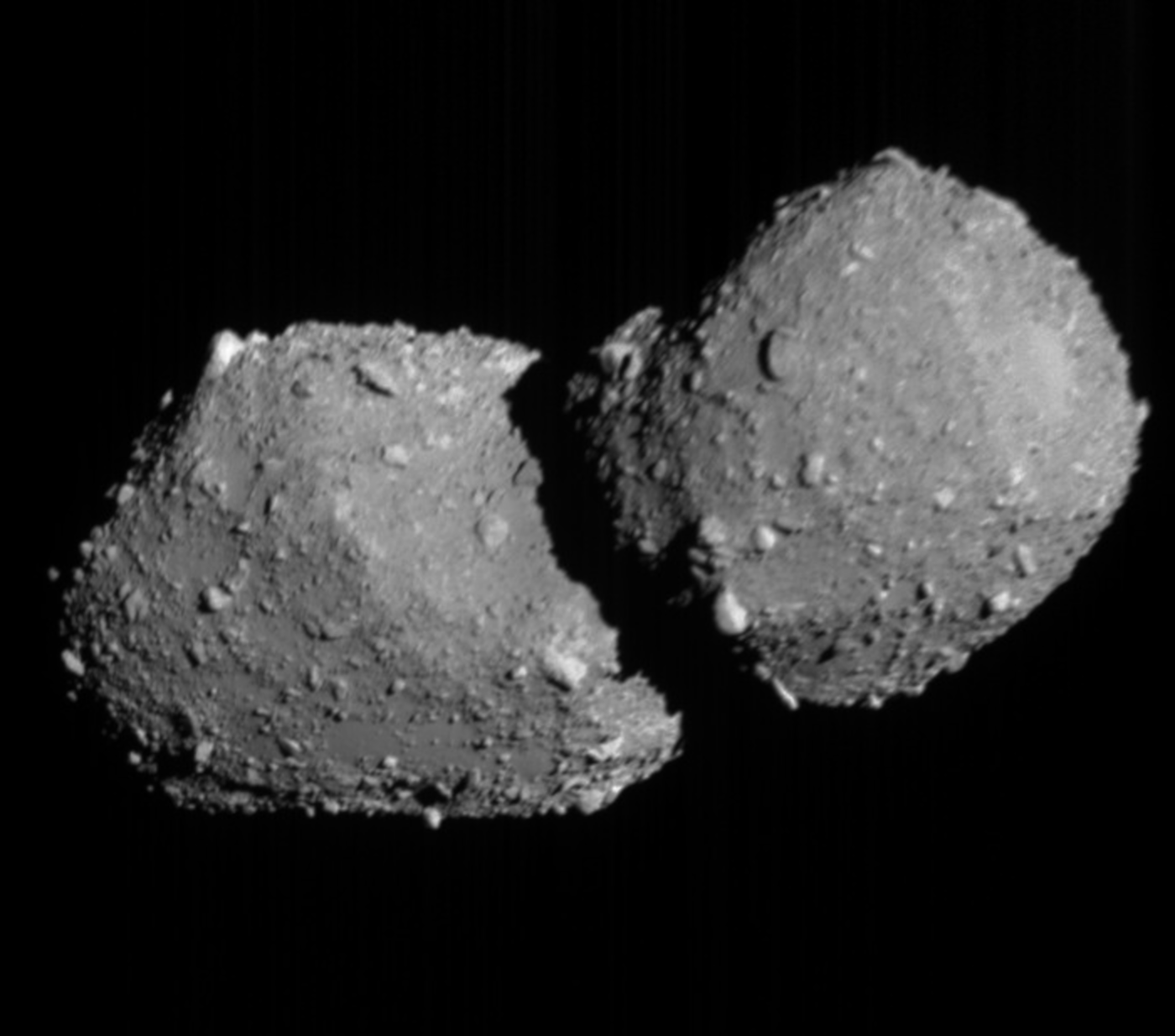
Asteroid Torifune captured by Hayabusa2
https://www.jaxa.jp/press/2026/07/20260706-3_j.html
#Torifune #Hayabusa2 #space #science #news #astrodon
Alt...
A black and white image of asteroid Torifune.
Credits: JAXA, The University of Tokyo, Chiba Institute of Technology, Tokyo University of Science, National Institute of Advanced Industrial Science and Technology, Observatoire de Paris, Instituto de Astrofísica de Canarias

![[?]](https://media.universeodon.com/accounts/avatars/109/501/736/783/125/826/original/387a622be46bcde9.png)


![[?]](https://files.mastodon.social/accounts/avatars/110/663/880/262/592/750/original/fb203a31eb16c3dd.png)
#PPOD: This image shows satellites crossing the night sky above the northern Atacama Desert in Chile over just one hour. It is a stack of a time-lapse video taken on 15 October 2025 about two hours after sunset. A few streaks are caused by planes and can be easily identified by their blinking colored lights, but most trails are due to satellites. Credit: F. Kamphues, ESO/M. Kornmesser

Alt...
Time-lapse photo of the night sky over Paranal Observatory in Chile, with the observatory seen as a bump on the distant silhouette of the hills. Overhead, the glow of the Milky Way dominates the upper half of the sky while numerous satellite trails cover the sky.
NGC 3621: Far Beyond the Local Group
Credits: Robert Gendler
#nature #space #astrophotography

Alt...
NGC 3621: Far Beyond the Local Group
![[?]](https://media2.ai6yr.org/accounts/avatars/109/321/592/360/914/018/original/f918064fa4350d36.jpg)
Next planned launches out of Vandenberg. Apparently a certain billionaire now owns near exclusive use of that spaceport 😡
SPACEX TRANSPORTER 17, VANDENBERG SFB, CA
PRIMARY: 07/07/26 0651Z-1130Z
BACKUP: 07/08/26 0651Z-1130Z
SPACEX STARLINK 17-48, VANDENBERG SFB, CA
PRIMARY: 07/10/26 1400Z-1843Z
BACKUP: 07/11/26 1400Z-1843Z
![[?]](https://media.mastodon.cloud/accounts/avatars/000/013/805/original/3a4570ba89403d6d.png)
Brief interests resume:
#art #earth #music
#guitar #synths #modular #analog #progrock #ambient
#photography
#science #history #archeology
#space #scifi #sciencefiction #scifiart
#ufos #ovnis #paranormal
#linux #opensource
#MSDOS #DOSGaming #CPM
#retrogaming #retrocomputing #oldcomputers
#BBS #ANSI #ASCII #ansiart #asciiart #retro #vintage
#gaming #videogames #gamedev #indiegamedev #indiedev
#rpg #dnd #mmorpg #rogue #nethack #roguelike
#tetris
![[?]](https://cdn.fosstodon.org/accounts/avatars/109/243/412/522/182/078/original/3806e04aa7a61fea.jpg)
RE: https://social.numerique.gouv.fr/@irap/116816496426956301
"The rapid expansion of commercial and governmental space activities is leaving a measurable chemical signature in Earth’s stratosphere through emissions from rocket launches and satellite re-entries. The scientific community is calling for urgent, coordinated action to understand and assess the potential impact on the atmosphere."
https://fosstodon.org/@irap@social.numerique.gouv.fr/116816496573706198
Press Release: https://www.essc.esf.org/2026/06/25/pr-airl-whitepaper/
Paper at https://zenodo.org/records/20831147
#Space #Science
1/n
![[?]](https://dmvcommunitymedia.b-cdn.net/accounts/avatars/109/423/669/136/029/020/original/a319391a17e18a0d.jpeg)
⚡ Thunderstorms are antimatter factories - and it happens above your head hundreds of times a day.
During a storm, intense electric fields inside clouds accelerate electrons to nearly light speed. When they slam into air molecules, they release bursts of gamma radiation called Terrestrial Gamma-ray Flashes. Some of those gamma rays then convert directly into matter via E=mc², spawning an electron alongside its antimatter twin - a positron. These positrons get channeled along Earth's magnetic field lines and escape into space.
NASA discovered this almost by accident. Their Fermi Gamma-ray Space Telescope - built to hunt cosmic explosions billions of light-years away - kept getting hit by gamma rays from directly beneath it. The energy spike at 511,000 electron volts was the unmistakable fingerprint of positrons annihilating on the spacecraft hull. In one case, Fermi detected a positron beam while flying over Egypt that had been launched by a thunderstorm over southern Africa, thousands of miles away.
The atmosphere is not just a passive shield. It is an active cosmic forge producing the rarest substance in the universe, right over our heads.
![[?]](https://cdn.masto.host/mastjohn1126com/accounts/avatars/115/981/910/993/463/416/original/00ac72837ce34a31.gif)
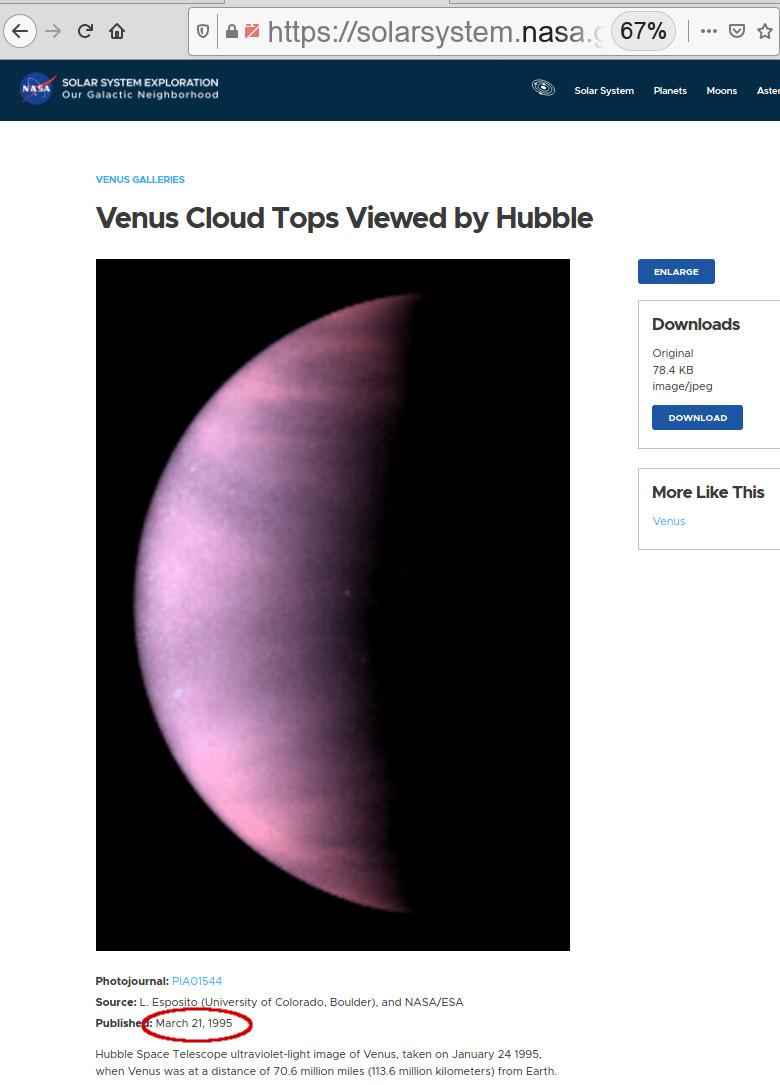
I searched for "NASA's best photo of Venus" and this is one of the results: a low-resolution picture supposedly taken by the Hubble Space Telescope.
Why are the photos of Earth’s closest planetary neighbor of such low quality?
#Venus #Hubble #NASA #space #telescope
![[?]](https://media.mstdn.social/accounts/avatars/109/565/531/261/159/277/original/7730593f0b7678ff.jpg)
![[?]](https://files.mastodon.online/accounts/avatars/109/298/185/928/165/179/original/8ed3da9f519c2f00.jpg)
How a team of engineers a built the most spectacular museum exhibit in the solar system.
Installing the 185-foot space shuttle Endeavour in the California Science Center was a feat of engineering.
https://www.fastcompany.com/91565660/california-science-center-endeavour-shuttle-exhibition #globalmuseum #museums #sciencecenter #Space
![The 185-foot space shuttle Endeavour in the California Science Center
[Photo: Patrick T. Fallon/AFP/Getty Images]](https://files.mastodon.online/media_attachments/files/116/842/396/381/520/668/original/6c4b70afdf7085b0.png "The 185-foot space shuttle Endeavour in the California Science Center
[Photo: Patrick T. Fallon/AFP/Getty Images]")
Alt...
The 185-foot space shuttle Endeavour in the California Science Center
[Photo: Patrick T. Fallon/AFP/Getty Images]
![[?]](https://cdn.hosted.spacebear.ee/sb-444643948490e1fed8199ed78bf1ee5f/accounts/avatars/109/371/733/810/294/907/original/adb71e94b9377654.png)
Top story: An Observer analysis of injuries at SpaceX’s Starbase in 2025, using publicly available data, shows that the company had an injury rate that’s more than 5 times the national average for comparable #space vehicle manufacturing facilities in the U.S. https://www.texasobserver.org/worker-death-starbase-spacex-osha-elon-musk/
Casque recommandé!
L'album pour se relaxer, méditer, se concentrer:
Solar Phasing - The Serenity Path
https://solarphasing.bandcamp.com/album/the-serenity-path
#music #musica #musique #musik
#ambient #relaxation #relaxing #meditation #zen #drone #dreamscape #electronic #electro #modular #modularsynth #analog #synths #synthesizer #space #spacemusic #healing #focus #brainwaves #scifi #spirituality #boost #bandcamp #indiemusic #support #spreadtheword
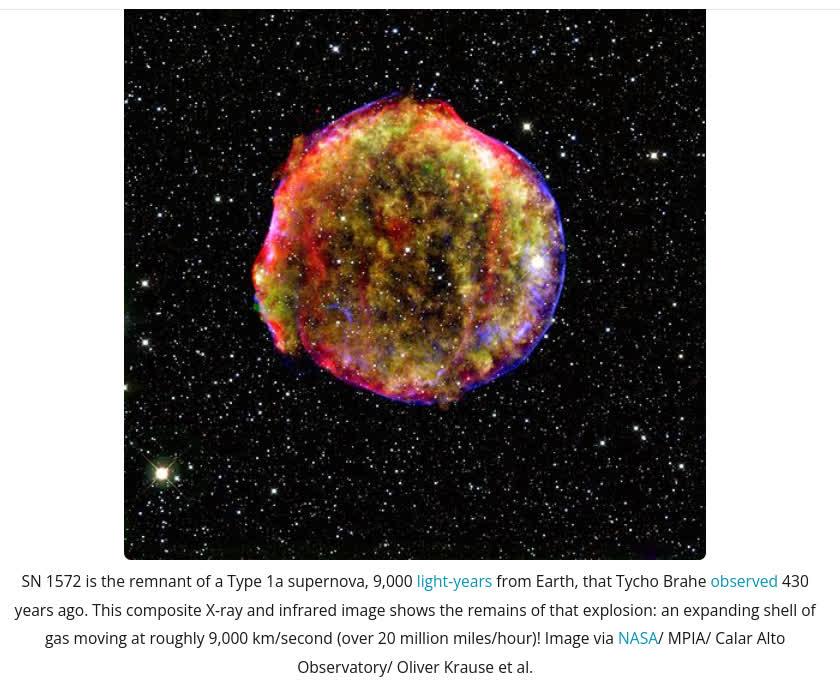
He saw a new star! He looked up and realized there was something there that was not there previously. And he did not even have a telescope! The birth was visible with the naked eye, and today, telescopes can see it in greater detail.
![[?]](https://s3.eu-central-2.wasabisys.com/mastodonworld/accounts/avatars/109/362/359/610/912/307/original/4854f87af56f0d9a.png)
"Detractors might scoff at Musk’s ambition to die on Mars, but at least the dying part would be easy."
Henry Wismayer for Noema: https://www.noemamag.com/the-mars-delusion/
#Longreads #Space #Mars #ElonMusk #Science #Colonization #Planets
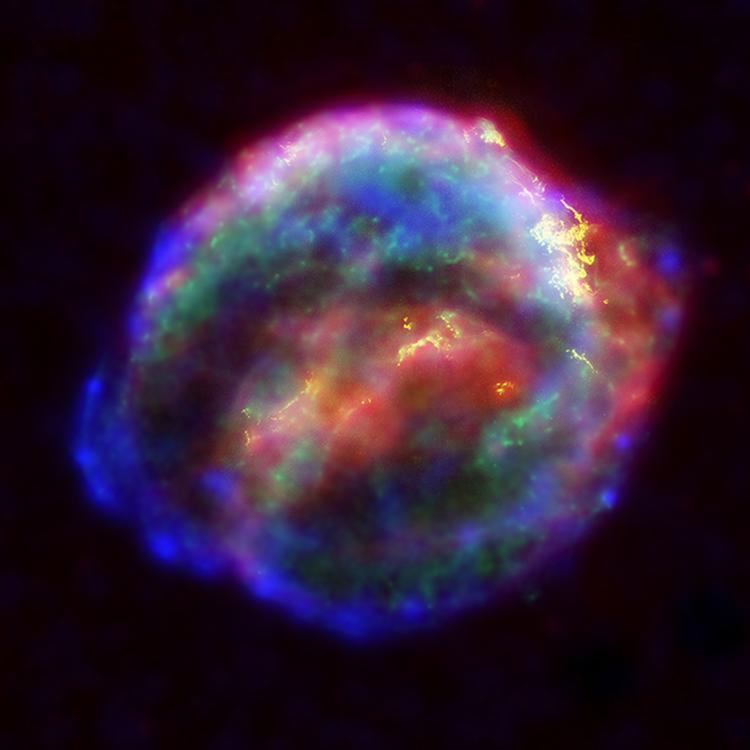
Astronomers expected a celestial sign, like a #comet, during the planetary conjunction of #Jupiter and #Saturn in the “Fiery Trigon” of 1604. Astronomers watched intently. On Oct 9, 1604, Kepler’s Supernova exploded. It outshone Jupiter and #Sirius, rivaling #Venus as the sky’s 3rd-brightest object. Visible during the day for weeks and to the naked eye for 18 months, it was a miraculous “new star”. Today's science claims: it was all a coincidence.
#PPOD: Jupiter's moon Europa was captured by the JunoCam instrument aboard NASA's Juno spacecraft during the mission's close flyby on Sept. 29, 2022. As with our Moon and Earth, one side of Europa always faces Jupiter, and that is the side of Europa visible here. Europa's surface is crisscrossed by fractures, ridges, and bands, which have erased terrain older than about 90 million years. Credit: NASA/JPL-Caltech/SwRI/MSSS; Processing: Björn Jónsson (CC BY 3.0)
#planetaryscience #space #science
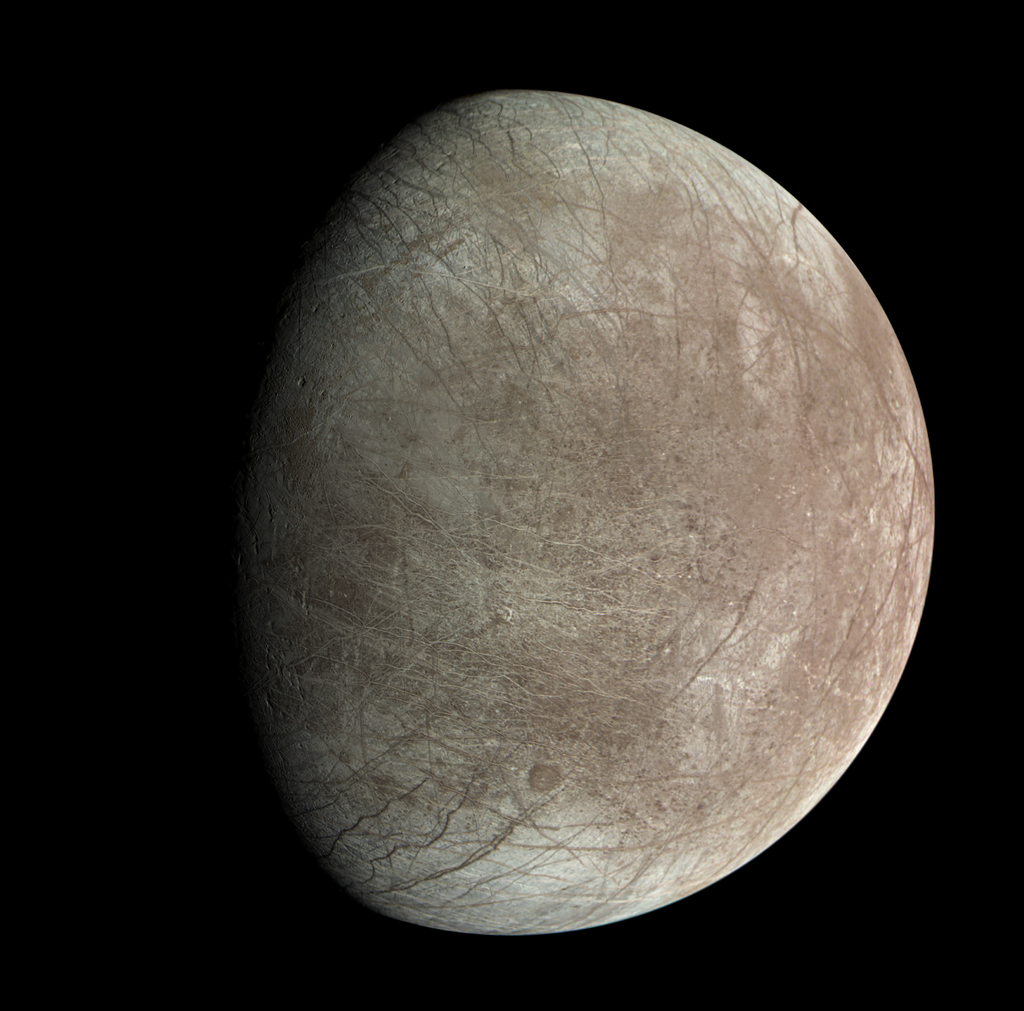
Alt...
Jupiter's moon Europa is seen three-quarters full and lit from the right side of the image. This composite shows the tan and reddish-brown world full of criss-crossing cracks and fractures with a few craters scattered in the mix.

![[?]](https://files.mastodon.social/accounts/avatars/115/967/890/192/375/774/original/79861f67f1d57c00.png)
@geethap2007 I would love to help so we'll sit on the idea.
I think it's for you (and other creators) to make #space / ways for people to be part of you work project (call it "project life" or a kind of creative #movement / therapy of expression together / building #trust / peace etc)
Make space / make Peace.
Maybe follow me a for a bit and put the notification bell to get ideas of what I mean...
Thanks for now.
Molecular Cloud Barnard 68
Credits: FORS Team, 8.2-meter VLT Antu, ESO
#nature #space #astrophotography

Alt...
Molecular Cloud Barnard 68
Powerful worldly rulers have branded their people with a flag showing something similar, as in the mostly Muslim nation of Pakistan.
Spiritual clues about the moon god and Venus (called in previous generations Lucifer): http://john1126.com/718
#moon #Venus #Lucifer #spiritual #Pakistan #muslim #islam #space

![[?]](https://cdn.masto.host/mastodongamedevplace/accounts/avatars/109/859/285/072/781/117/original/52b616f54f20c98f.png)
Tardigrade in Moss
Credits: Science Source Images
#nature #space #astrophotography

Alt...
Tardigrade in Moss
My space station generator is finally working and integrated into the game.
Sensible blue-prints, semi-realistic modules, airtight structure, dockable, Newtonian physics working, player can add or remove modules... people will never know how hard it was to get this working... omg just pain pain pain
#indiedev #space #LEOAdventures #gamedev
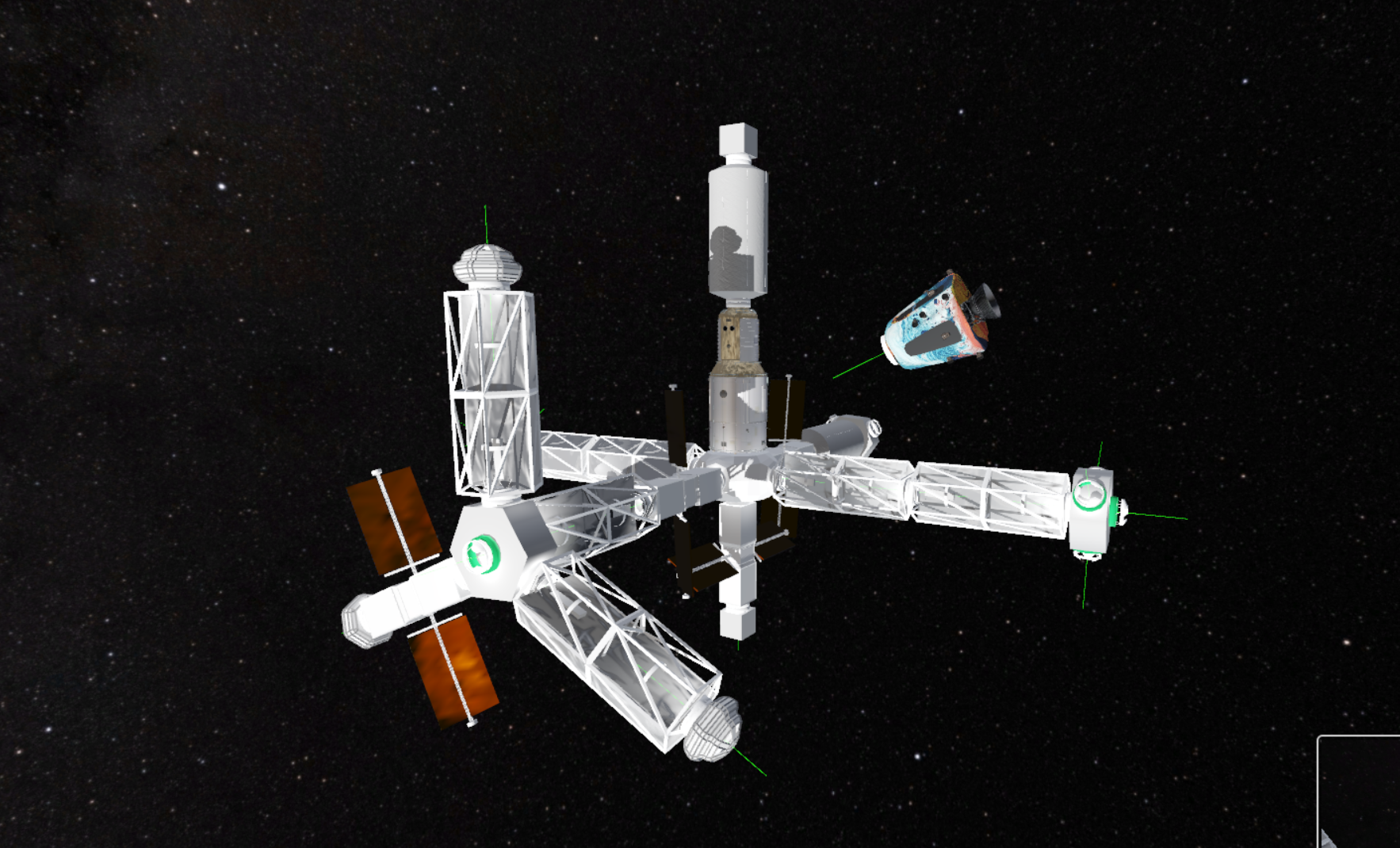
Alt...
A modular space station, similar to the International Space Station, from the game Low Earth Orbit Adventures
Globular Cluster M15 from Hubble
Credits: ESA, Hubble, #NASA
#nature #space #astrophotography

Alt...
Globular Cluster M15 from Hubble
Looking for a beautiful music for your project?
Game, etc..
Space Opera S1
https://solarphasing-sounddesign.bandcamp.com/album/space-opera-s1-royalty-free
#music #bandcamp #royaltyfree #royaltiesfree #assets #electronicmusic #background #scifi #sciencefiction #spaceopera #space #indidev #gamedev #indiegamedev #games
![[?]](https://files.mastodon.social/accounts/avatars/112/887/440/182/889/708/original/b3d8f511ea9381c5.jpg)
The Real Outerspace
https://www.youtube.com/watch?v=5ztfH9VXSBA
#Space, #SpaceHistory, #SpaceExploration, #BibleStudy.

![[?]](https://assets.merveilles.town/accounts/avatars/110/618/037/889/897/311/original/7685c244dff08111.png)
![[?]](https://cdn.masto.host/appdotnet/accounts/avatars/000/001/724/original/49bf6896793e8c66.png)
![[?]](https://soc.octade.net/octade/s/3f7f2b5eda4e392867c301c49c2daa16.png)
The irony ...
"How art thou fallen from heaven, O Lucifer, son of the morning! how art thou cut down to the ground, which didst weaken the nations! For thou hast said in thine heart, I will ascend into heaven, I will exalt my throne above the stars of God: I will sit also upon the mount of the congregation, in the sides of the north: I will ascend above the heights of the clouds; I will be like the most High. Yet thou shalt be brought down to hell, to the sides of the pit."
Artemis (Diana) is Apollo's twin sister. Together the two are 'Lucifer'.
They are chief deities of the solar worship cult.
#NASA #AprilFools #Moon #Artemis #Apollo #Bible #Babylon #Lucifer #Gods #Demons #Worship #Religion #Space
Orion's Belt
Credits: Martin Mutti, Astronomical Image DataArchive
#nature #space #astrophotography

Alt...
Orion's Belt
The billionaires investing in space don't want Star Trek ... they want Dune ... but we got Spaceballs.
#billionaires #space #startrek #dune #spaceballs #memes

Alt...
The billionaires investing in space don't want Star Trek ... they want Dune ... but we got Spaceballs.
![[?]](https://files.defcon.social/dcsocial-s3/accounts/avatars/113/208/344/507/078/943/original/014820ad22daee1c.jpg)
Wolf-Rayet Star 124: Stellar Wind Machine
* Image Credit: Hubble Legacy Archive, NASA, ESA; Processing & License: Judy Schmidt
https://hla.stsci.edu/
https://www.nasa.gov/
https://www.esa.int/
https://www.flickr.com/photos/geckzilla/
Explanation:
Some stars explode in slow motion. Rare, massive Wolf-Rayet stars are so tumultuous and hot that they are slowly disintegrating right before our telescopes. Glowing gas globs each typically over 30 times more massive than the Earth are being expelled by violent stellar winds. Wolf-Rayet star WR 124, visible near the featured image center and spanning six light years across, is thus creating the surrounding nebula known as M1-67. Details of why this star has been slowly blowing itself apart over the past 20,000 years remains a topic of research. WR 124 lies 15,000 light-years away towards the constellation of the Arrow (Sagitta). The fate of any given Wolf-Rayet star likely depends on how massive it is, but many are thought to end their lives with spectacular explosions such as supernovas or gamma-ray bursts.
https://en.wikipedia.org/wiki/Wolf%E2%80%93Rayet_star
https://en.wikipedia.org/wiki/WR_124
https://www.flickr.com/photos/geckzilla/14248502065/
https://www.syfy.com/syfy-wire/a-massive-violent-star-blooms
https://www.youtube.com/watch?v=aysiMbgml5g
https://ui.adsabs.harvard.edu/abs/1985A%26A...145L..13V/abstract
https://science.nasa.gov/universe/gamma-ray-bursts-harvesting-knowledge-from-the-universes-most-powerful-explosions/
http://www.hawastsoc.org/deepsky/sge/
https://chandra.harvard.edu/photo/cosmic_distance.html
https://apod.nasa.gov/apod/ap000318.html
https://spaceplace.nasa.gov/constellations/en/
https://www.universetoday.com/24736/wolf-rayet-star/
https://science.nasa.gov/earth/facts/
https://apod.nasa.gov/apod/ap250203.html
#space #nebula #star #astrophotograhy #NASA #ESA #Hubble #science #nature
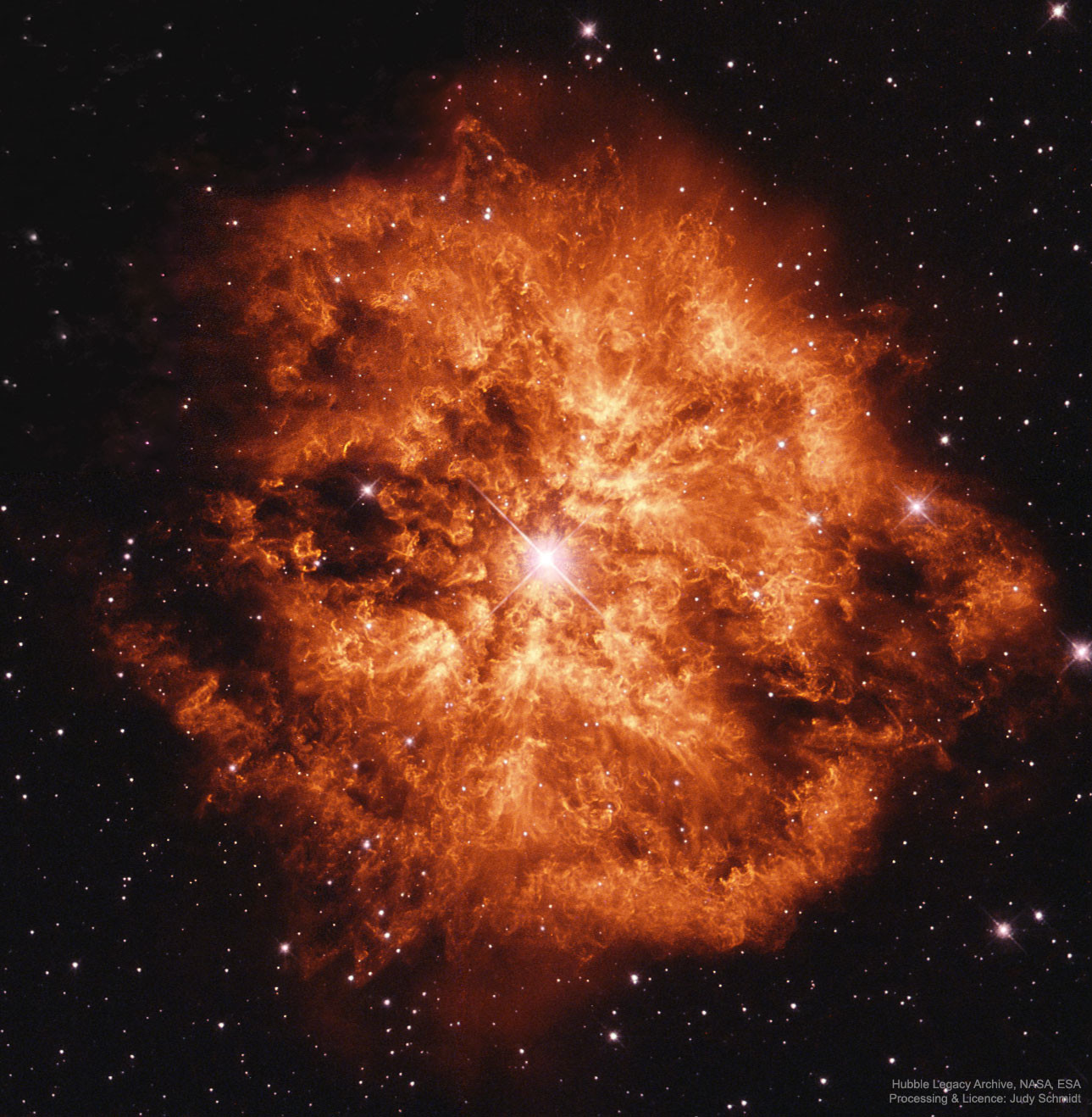
Alt...
2025 February 3
A starfield is shown with a large spherical nebula in the center. The nebula shows a great deal of internal structure. Please see the explanation for more detailed information.
Wolf-Rayet Star 124: Stellar Wind Machine
* Image Credit: Hubble Legacy Archive, NASA, ESA; Processing & License: Judy Schmidt
Explanation:
Some stars explode in slow motion. Rare, massive Wolf-Rayet stars are so tumultuous and hot that they are slowly disintegrating right before our telescopes. Glowing gas globs each typically over 30 times more massive than the Earth are being expelled by violent stellar winds. Wolf-Rayet star WR 124, visible near the featured image center and spanning six light years across, is thus creating the surrounding nebula known as M1-67. Details of why this star has been slowly blowing itself apart over the past 20,000 years remains a topic of research. WR 124 lies 15,000 light-years away towards the constellation of the Arrow (Sagitta). The fate of any given Wolf-Rayet star likely depends on how massive it is, but many are thought to end their lives with spectacular explosions such as supernovas or gamma-ray bursts.
Authors & editors: Robert Nemiroff (MTU) & Jerry Bonnell (UMCP)
NASA Official: Amber Straughn Specific rights apply.
NASA Web Privacy, Accessibility, Notices;
A service of: ASD at NASA / GSFC,
NASA Science Activation
& Michigan Tech. U.