Search results for tag #selfhosting
![[?]](https://files.mastodon.social/accounts/avatars/115/742/434/865/105/205/original/ba2fa15026c28d18.jpeg)
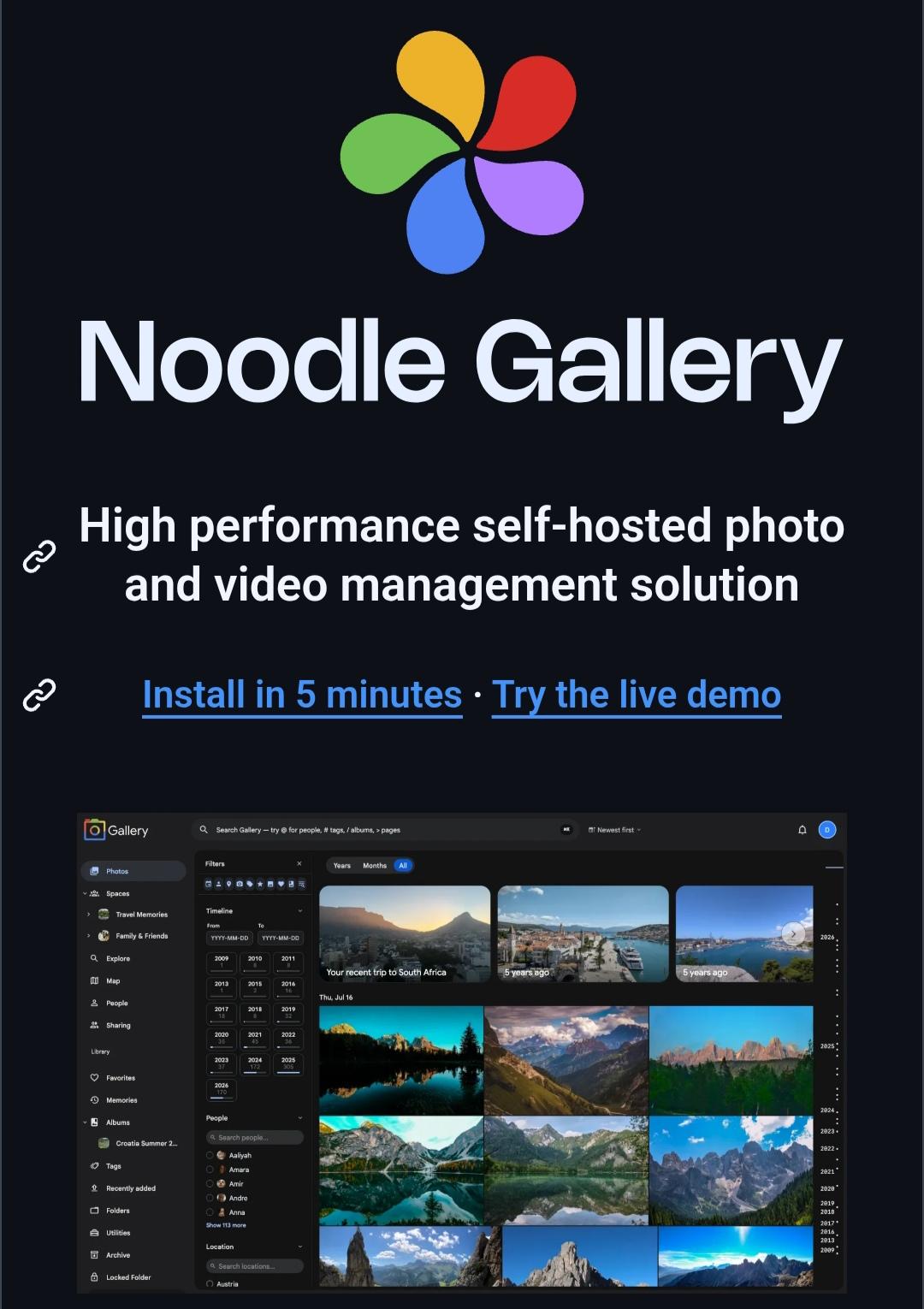
Noodle Gallery is an open-source, self-hosted photo and video platform built as a community fork of Immich. It adds Shared Spaces, S3-compatible storage, smarter search, pet detection, video duplicate detection, Google Photos import, and more.
It also stays compatible with existing Immich libraries, making it possible to switch between the two.
More details & alternatives: https://digitalescapetools.com/tools/noodlegallery.html
#OpenSource #SelfHosting #Privacy #Immich #PhotoManagement #FOSS
Alt...
Screenshot of Noodle Gallery showing its colorful flower logo and name, a “High performance self-hosted photo and video management solution” tagline, installation and live demo links, and a photo gallery interface displaying albums, filters, people, locations, and travel photos.
Keep your emails under your own control for the long term.
Eonvelope is an open-source, self-hosted email archiving platform that continuously fetches mail from IMAP, POP, Exchange, and JMAP. Search archived emails, attachments, and correspondents from your own instance.
Deploy it with Docker, Podman, or Kubernetes.
More details & alternatives:
https://digitalescapetools.com/tools/eonvelope.html
#OpenSource #SelfHosting #Privacy #Email #EmailArchiving #FOSS
Alt...
Envelope, an open-source self-hosted email archive for preserving emails indefinitely. The project page shows version, Docker pulls, development activity, test coverage, Django framework, and an email archive logo.
![[?]](https://m5l.eu/u/marek/s/avatar-ff8999a3b20360a58bc1da5859b98e8a.png)

Alt...
meme format "bro explaining" featuring a man excitedly talking and gesturing to a nearby woman with an absent expression
Mumble is an open-source, self-hosted voice chat platform with low-latency communication, encryption, and full control over your own server.
A solid option for private voice communication, gaming, communities, and teams.
More details:
https://digitalescapetools.com/tools/mumble.html
#OpenSource #SelfHosting #Privacy #VoiceChat #Mumble #FOSS
Alt...
Mumble open-source voice-chat software page showing its website, Matrix community with 466 users, and status checks for Codacy, Azure, Cirrus CI, and Travis CI. Text at the bottom describes Mumble as an open-source, low-latency, high-quality voice-chat program built with Qt and Opus.
Alt...
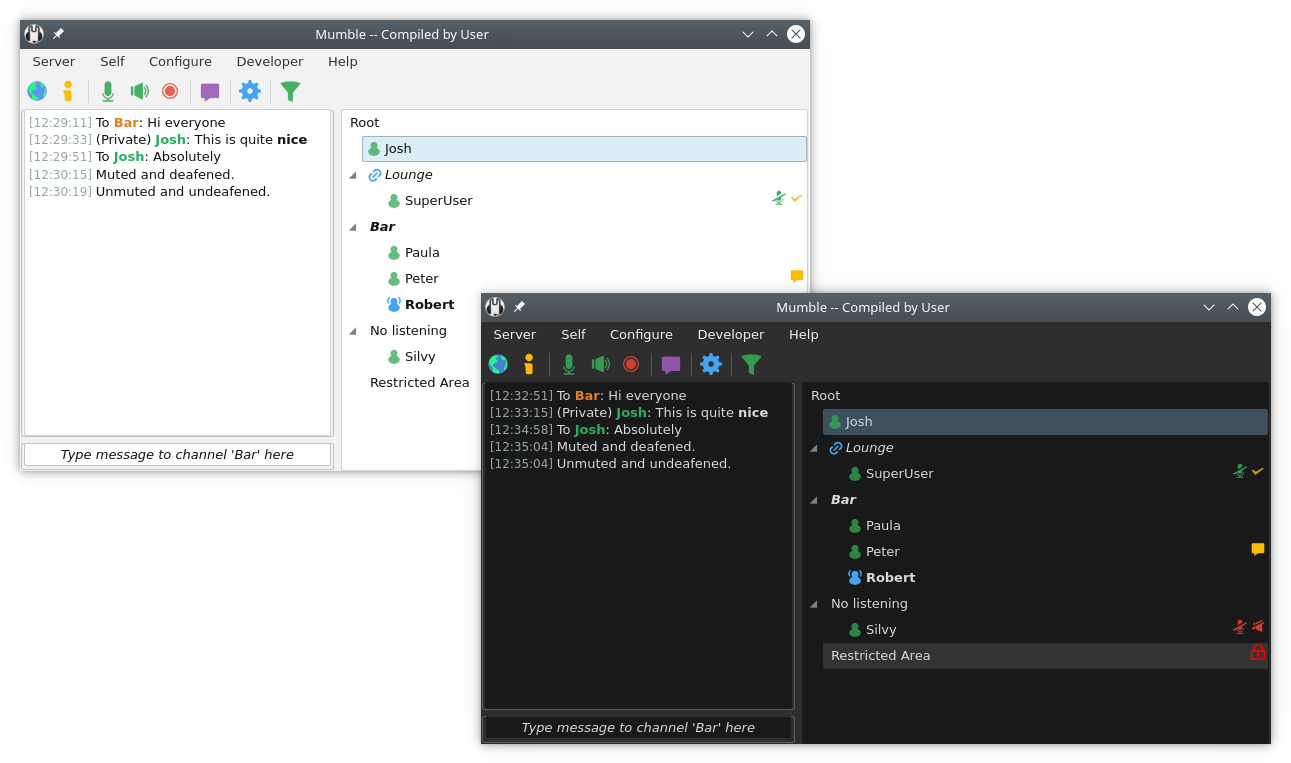
Mumble desktop voice-chat client shown in light and dark themes. The interface displays a server channel tree with users, a text chat panel, and toolbar controls for microphone, audio, recording, messaging, and settings.
![[?]](https://social.techn1k.de/media/f86b145e1853b0677f595bcb66ab470ad86aac5891c81d06fee3698d1c1428dd.blob)
#DeltaChat #Delta #Messaging #Selfhosting
Share your screen without relying on corporate communication platforms.
Screego is an open-source, self-hosted screen-sharing tool built for developers. It uses WebRTC for low-latency, high-resolution sharing and supports multiple users, Docker or single-binary installation, and an integrated TURN server for restrictive networks.
More details & alternatives:
https://digitalescapetools.com/tools/tool.html?id=screego
#OpenSource #SelfHosting #WebRTC #ScreenSharing #Privacy #Developers
Alt...
Screenshot of the Screego/server project page showing two colorful cartoon characters connected by blue and green arrows. Below, it displays “Screego/server,” the tagline “screen sharing for developers,” a passing build, Docker pulls, and release v1.12.5.
Today wasn't the first time that showing specifically https://www.grampsweb.org/ really got a layperson excited about running a private server. Probably because family is much easier to relate to than abstract software
![[?]](https://lsbt.me/system/accounts/avatars/109/279/957/800/373/022/original/2d78270719f9925b.jpg)
Quick heads-up for other Mastodon admins: this registration spam wave isn't over yet.
On lsbt.me, we first saw a flood of API registrations using Python/aiohttp. The telltale signs were usernames following the pattern bp plus 16 hex characters, and the sign-up reason was always "Automated protocol deliverability probe". A narrow block on that user agent stopped the first wave.
Today, however, five new registrations came in with the same usernames and the same sign-up reason. This time the bot simply identified itself as Chrome 126. That's exactly why a user agent is only useful as a short-term filter. It's a header the client can set to anything.
The requests go to POST /api/v1/accounts. This endpoint lets client apps create a new local account directly in the app. No app needs it for OAuth connections to existing accounts. #FediSuite doesn't use it either. It registers itself via /api/v1/apps, obtains consent via /oauth/authorize, and then works with a user token. Regular sign-up through the Mastodon website is also handled separately via POST /auth.
So I've completely disabled API account creation on lsbt.me. Web sign-up, OAuth, and existing clients keep working as before. Anyone who wants a new account just signs up once on the web as usual and can then use any client.
If you'd also rather not offer this optional native sign-up path, you can add the following to your Nginx server block, before the general location / block. The example assumes the @proxy location that many Mastodon Nginx configs already include:
location = /api/v1/accounts {
  limit_except GET {
    deny all;
  }  try_files $uri @proxy;
}
This returns a 403 only for POST /api/v1/accounts. The read-only GET endpoint remains reachable. As always, run nginx -t afterwards and only reload once the test passes.
#Mastodon #Fediverse #MastoAdmin #FediAdmin #FediMod #FediBlock #Moderation #Registration #Spam #Nginx #SelfHosting #SysAdmin #ActivityPub
![[?]](https://cdn.masto.host/acp/accounts/avatars/000/029/158/original/3176205364b1bb7a.png)
please boost.
i am ready to start providing email addresses to the community.
you may have 1GB mail box storage capacity free of charge.
the system-wide code of conduct is at:
if you are interested in a non-free account, please click here:
https://ko-fi.com/comradevidak/tiers
the lowest membership tiers:
- $1.25 per month (2GB storage capacity)
- $15 per year (2GB storage capacity)
Share files directly between browsers no cloud upload needed.
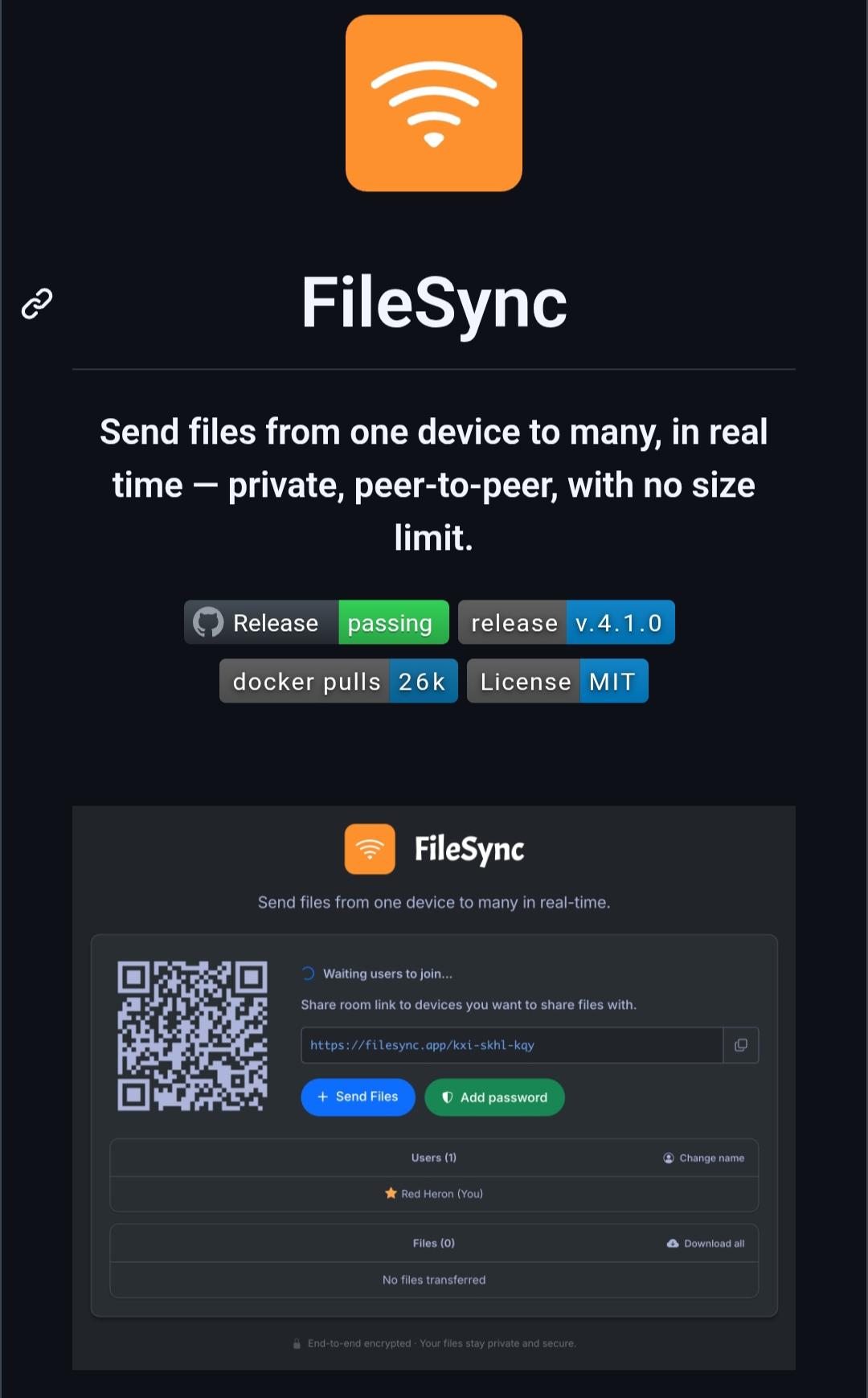
FileSync is an open-source, self-hosted file-sharing tool using WebRTC for peer-to-peer transfers. It supports QR/room links, passwords, one-to-many sharing, cross-network transfers, and large files with streaming-to-disk.
More details: https://digitalescapetools.com/tools/tool.html?id=filesync
#OpenSource #SelfHosting #Privacy #WebRTC #FileSharing
Alt...
Screenshot of FileSync, showing its orange Wi-Fi logo, title, and description as a private peer-to-peer file-sharing tool for sending files from one device to many in real time. It shows release v4.1.0, MIT license, Docker pulls, and a FileSync interface with a QR code, room link, password option, and connected user.
What if your e-books could become a private knowledge base?
ReadAny is a local-first, open-source e-book reader for desktop and mobile. Chat with your books, search by meaning, create highlights and notes, and organize what you learn.
It supports local AI with Ollama and local embeddings, while WebDAV sync keeps your library, notes, and highlights synced across devices.
More details & alternatives:
https://digitalescapetools.com/tools/tool.html?id=readany
#OpenSource #Privacy #LocalAI #Ebooks #SelfHosting #DigitalReading
Alt...
Screenshot of ReadAny showing its ghost-like reading logo, title, and description as a local-first AI e-book reader for desktop and mobile. It highlights RAG chat, semantic search, highlights, text-to-speech, WebDAV sync, and support for macOS, Windows, Linux, iOS, and Android.
![[?]](https://social.golemwire.com/golemwire/s/avatar-3cbd8584aaf46a20dfab708e228ed297.png)

I now also have a favicon  (goodbye Susie
  ) and I overhauled my config
  Fun! #selfHosting #customEmoji
![[?]](https://files.bitbang.social/accounts/avatars/111/086/428/899/839/390/original/b5cffa1fdcddf1c9.png)
![[?]](https://files.mastodon.online/accounts/avatars/000/211/792/original/9797c4c748c8c5e1.png)
Keep your camera feeds and AI processing under your control.
Viseron is a self-hosted, local-only NVR and AI computer vision platform with object detection, motion detection, face recognition, and more.
Run it with Docker and manage your setup through a web interface without relying on cloud processing.
More details:
https://digitalescapetools.com/tools/tool.html?id=viseron
#Privacy #SelfHosting #OpenSource #LocalAI #NVR #HomeSecurity #Docker
Alt...
Screenshot of the Viseron project page showing its blue eye logo and title. The page describes Viseron as self-hosted, local-only NVR and AI computer vision software with object detection, motion detection, face recognition, and monitoring capabilities.
Dockhand is a modern, self-hostable Docker management UI for containers, Compose stacks, remote Docker hosts, Git deployments, logs, terminals, and more.
It’s free for personal and internal business use. Note: Dockhand uses the Business Source License 1.1 (BSL 1.1), not a traditional open-source license.
More details & alternatives:
https://digitalescapetools.com/tools/tool.html?id=dockhand
#Docker #SelfHosting #Homelab #DevOps #OpenSource #DockerCompose
Alt...
Screenshot of Dockhand, a modern Docker management UI, showing its logo, navigation links, and an “About” section describing container management, Compose stacks, multi-environment support, and privacy-focused design.
Papermark is an open-source, self-hostable alternative to DocSend. Share documents with custom links, track viewer engagement, and use custom domains and branding.
A great option for founders, freelancers, and teams who want to keep their document-sharing infrastructure under their control.
More details & alternatives: https://digitalescapetools.com/tools/tool.html?id=papermark
#OpenSource #SelfHosting #Privacy #FOSS #DocSend
Alt...
Screenshot of the Papermark page describing it as an open-source DocSend alternative. It shows a Product Hunt #1 Product of the Day badge, papermark.com link, GitHub with 9k stars, AGPLv3 license, and text highlighting built-in analytics and custom domains.
![[?]](https://friendica-deutschland.de/photo/profile/doris.jpeg?ts=1761744546)
☁️ Nicht vergessen: Heute Abend ist Hubzilla-Workshop! 🌐
Was hat eigentlich eine Cloud mit Hubzilla zu tun? Und muss „Cloud“ wirklich immer bedeuten, dass die eigenen Dateien bei irgendeinem großen Drittanbieter liegen? 🤔
Nein – und genau deshalb lohnt sich heute Abend ein genauerer Blick auf Hubzilla. 😊
Beim 11. Hubzilla-Workshop dreht sich alles um das Thema:
☁️ „Die Cloud nutzen“
Wir schauen uns an, welche Möglichkeiten Hubzilla zur Dateiablage und zum Teilen bietet, wie Freigaben und Berechtigungen funktionieren und warum die integrierte Cloud eine der spannenden Funktionen von Hubzilla ist.
Und natürlich gilt wie immer: Fragen ausdrücklich erwünscht!
Ganz egal, ob ihr Hubzilla schon länger nutzt, gerade erst entdeckt oder einfach neugierig seid, was sich damit alles machen lässt.
📅 Heute, Mittwoch, 26. August 2026
🕢 19:30 Uhr
💻 Online
👉 Direkt zum Workshop:
campus.ws-12.de/rooms/n04-dj3-…
📚 Weitere Informationen:
hub.hubzilla.hu/channel/hz-wor…
Kommt einfach vorbei, hört zu, fragt nach und entdeckt vielleicht eine Seite von Hubzilla, die ihr bisher noch gar nicht kanntet. 😊
📢 Weitersagen und Teilen ausdrücklich erwünscht!
#Hubzilla #Fediverse #Cloud #SelfHosting #Dezentral #Datensouveränität
![[?]](https://social-cdn.vivaldi.net/system/accounts/avatars/117/048/699/482/887/558/original/84b35517a9491376.png)
RE: https://social.vivaldi.net/@thanksstevenkim/117154791519179296
A few people have asked where the “710,000 spam servers” number in my previous post came from, so I thought I should explain it more clearly.
First, I should clarify something: calling all of them “spam servers” was an oversimplification for the joke. A more accurate description would be hosts filtered out as likely spam/noise by my automated filter.
When I run `filter_spam.py` for the project, I get the following results. The script outputs in Korean because Korean is my native language, so I've translated the output here:
The actual filtering results are quite long, so I've moved them to the next post in this thread ⬇️
![[?]](https://files.mastodon.online/accounts/avatars/000/179/465/original/512b7b9b8588c924.png)
ATTENTION YouTubers
Please provide a PeerTube option in addition to your YouTube account.
EXAMPLE
The Linux Experiment
Website: https://tilvids.com/c/thelinuxexperiment_channel/videos
Fediverse: @thelinuxEXP @thelinuxexperiment
PEERTUBE
Website: https://joinpeertube.org
Fediverse: @peertube @Framasoft
THANK YOU
#Google #YouTube #YouTuber #YouTubers #deGoogle #Framasoft #PeerTube #FreeSoftware #FOSS #FLOSS #SoftwareLibre #OpenSource #Privacy #InfoSec #Fediverse #Video #Decentralized #SelfHost #SelfHosting #ActivityPub

Alt...
PeerTube logo.
I’ve been working on a small Fediverse project called "The Hitchhiker’s Guide to the Fediverse".
It started as a simple directory of Fediverse instances, but I’ve been gradually turning it into something more useful:
- discovering new instances through federation peers
- filtering suspicious/spammy hosts
- monitoring known instances over time
- automatically hiding servers that stay offline
- bringing them back if they recover
- keeping the whole thing updated with GitHub Actions
The monitored set is already around 27,000 instances, so I also had to rethink the collector to use bounded concurrency and checkpointing instead of checking everything one by one.
Still very much a work in progress, but it’s been a fun way to learn more about how the Fediverse actually behaves in the wild.
https://github.com/thanksstevenkim/the-hitchhikers-guide-to-the-fediverse
![[?]](https://dmvcommunitymedia.b-cdn.net/accounts/avatars/109/423/669/136/029/020/original/a319391a17e18a0d.jpeg)
Remember folks, you don't need a fancy NAS or home server appliance to self host at home. Any old laptop or even an old Android phone can host a number of services for you. #selfhosting
![[?]](https://cdn.masto.host/indiewebsocial/accounts/avatars/112/536/017/792/352/435/original/a87e9128d6303e02.png)
🐡 Running your own mail server with OpenBSD and OpenSMTPD https://bsd-audit.com/self-hosting/running-your-own-mailserver/
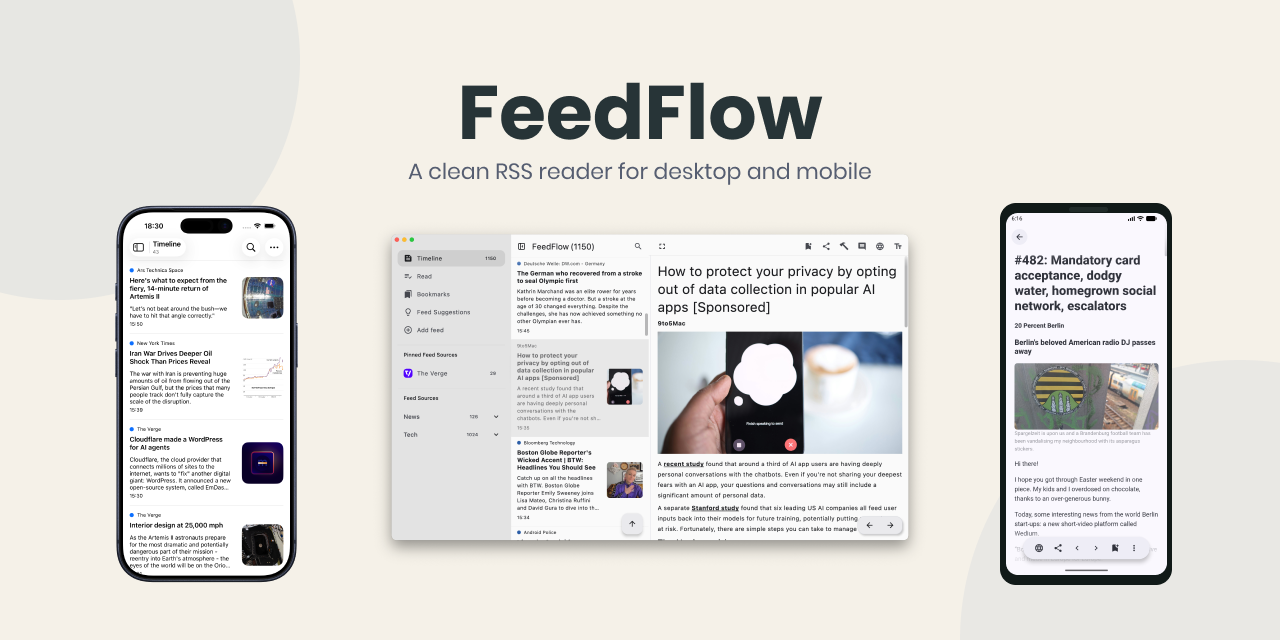
FeedFlow is an open-source RSS reader for Android, iOS, macOS, Windows, and Linux. Keep your library local or sync with services like FreshRSS and Miniflux, with Reader Mode, offline reading, filters, bookmarks, and OPML import/export.
👉 https://digitalescapetools.com/tools/tool.html?id=feedflow
#OpenSource #RSS #Privacy #FOSS #SelfHosting
Alt...
FeedFlow app page showing its logo, description, supported platforms (Android, iOS, macOS, Windows, and Linux), Apache 2.0 license, and links to the website, latest release, issues, and translation resources.
Alt...
FeedFlow promotional graphic showing the RSS reader running on iPhone and desktop, with article timelines, feed lists, and reading views. Text reads “A clean RSS reader for desktop and mobile.”
📶 Want to monitor your internet connection over time?
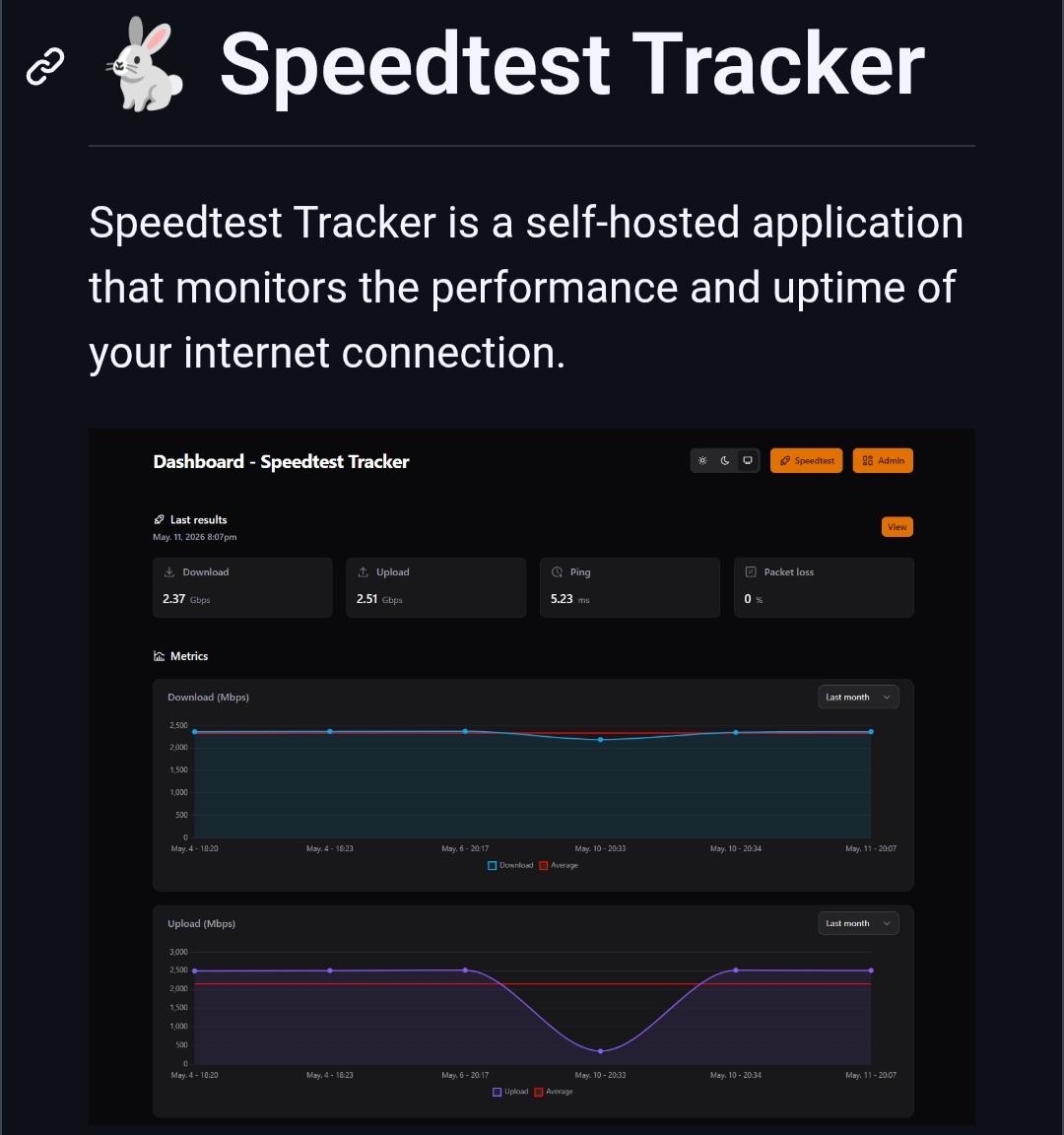
Speedtest Tracker is an open-source, self-hosted tool that automatically runs internet speed tests and keeps a history of your download speed, upload speed, ping, and other network metrics.
It supports Docker, scheduled tests, notifications, and a web dashboard for tracking performance.
More details:
https://digitalescapetools.com/tools/tool.html?id=speedtesttracker
#OpenSource #SelfHosting #FOSS #Homelab #Privacy
Alt...
Screenshot of the Speedtest Tracker website. It describes the tool as a self-hosted application for monitoring internet connection performance and uptime. Below is a dark dashboard showing download and upload speeds, ping, packet loss, and historical download and upload performance graphs.
![[?]](https://s3.us-west-000.backblazeb2.com/TheCanadian/accounts/avatars/116/706/528/029/970/771/original/ec42eda2052c3255.jpg)
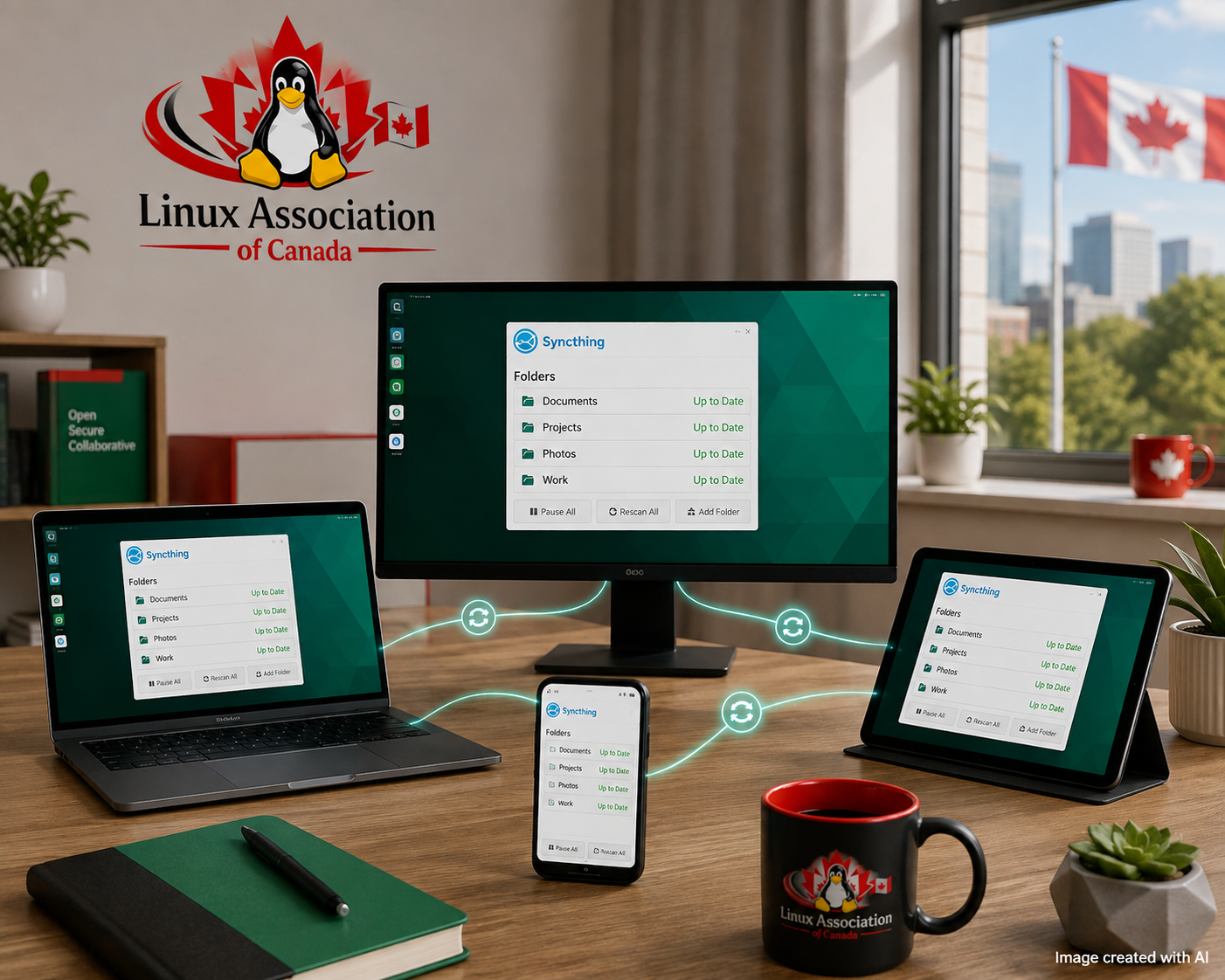
🛠️ Open Source Tool of the Week: Syncthing
Keep your files synchronized across your computers and mobile devices—without relying on a cloud provider.
✅ End-to-end encrypted
📁 Automatic file synchronization
💻 Linux • Windows • macOS • Android
🔒 Your data stays under your control.
How do you use Syncthing?
#Linux #OpenSource #Privacy #SelfHosting
Alt...
Modern Canadian home office featuring a Linux desktop computer, laptop, tablet, and smartphone running Syncthing. Glowing lines connect the devices to illustrate secure file synchronization without the cloud. The Linux Association of Canada logo is displayed on the wall and on a coffee mug, while a Canadian flag is visible outside the window. The workspace includes subtle green, red, and white accents representing open source, privacy, and Canadian digital innovation.
Want a YouTube experience without the recommendation algorithm?
YT Zero is an open-source, self-hosted YouTube frontend that focuses on subscriptions instead of recommendations. Follow channels without a Google account, organize videos locally, and optionally download them for offline viewing with yt-dlp integration.
More details: https://digitalescapetools.com/tools/tool.html?id=ytzero
#OpenSource #SelfHosting #Privacy #YouTube #FOSS #DeGoogle
Alt...
Screenshot of the YT Zero project page. It features the YT Zero logo, the tagline "A self-hosted YouTube inbox for people who want subscriptions, not recommendations," and badges for the latest release, Docker image, AGPL-3.0 license, documentation, and GitHub stars. The description highlights a recommendation-free YouTube experience with no Google account or API key required.
Disposable and custom-domain email addresses can be really tricky to deal with as an admin of Mustard, because sometimes you simply can't tell them apart.
We've had plenty of spam accounts that randomly mention users, as well as AI bot accounts that appear to be scraping data from the server. At first, you can usually spot the suspicious ones pretty easily. But after a while, you start seeing accounts using all kinds of unusual email domains, and it becomes much harder to tell who's legitimate.
Sometimes I've ended up suspending accounts simply because their email domains looked suspicious—even when their profiles, including their profile pictures, looked like they belonged to real people.
It's one of those #moderation problems where you don't really have enough information to make a confident decision.
LiveContainer is an open-source app launcher that lets you manage unlimited IPA files, switch between app versions, supports multitasking, and integrates with AltStore and SideStore.
More details: https://digitalescapetools.com/tools/tool.html?id=livecontainer
#OpenSource #iOS #Privacy #SelfHosting #FOSS
Alt...
Screenshot of the LiveContainer GitHub repository. A large blue app icon appears at the top above the project name "LiveContainer." The description reads: "An app launcher that runs iOS apps without actually installing them!" Below are badges showing translation progress (86% localized) and a link to the documentation at livecontainer.github.io. The page uses GitHub's dark theme.
![[?]](https://aseachange.com/fileserver/01ENCW3D083ATDAP5WGJEMSJC8/attachment/original/01JG469Y8X2DXVNGTWEZ8BPAGX.jpeg)
Come join me and @Gina in Luxembourg this October!
#OSCL26 (Open Source Conference Luxembourg) has a brand new track devoted to “Decentralized Technologies for Digital Sovereignty”:
🔗: https://conference.opensource.lu
We are looking for speakers interested in discussing these topics:
- Federated technologies in the public sector
- Decentralized platforms for video, chat, communications, code, etc.
- Fediverse successes and challenges
- Self-hosted solutions for individuals and institutions
- Interoperability for resilience
Apply here:
🔗: https://pretalx.com/open-source-conference-luxembourg-2026/cfp
The conference takes place on Wednesday October 7th in Belval, Luxembourg.
Please share! 🚀
#Fediverse #FediAdvocacy #conferences #OpenSource #FOSS #FLOSS #TheFutureIsFederated #selfhosting #interoperability #DigitalSovereignty #activism
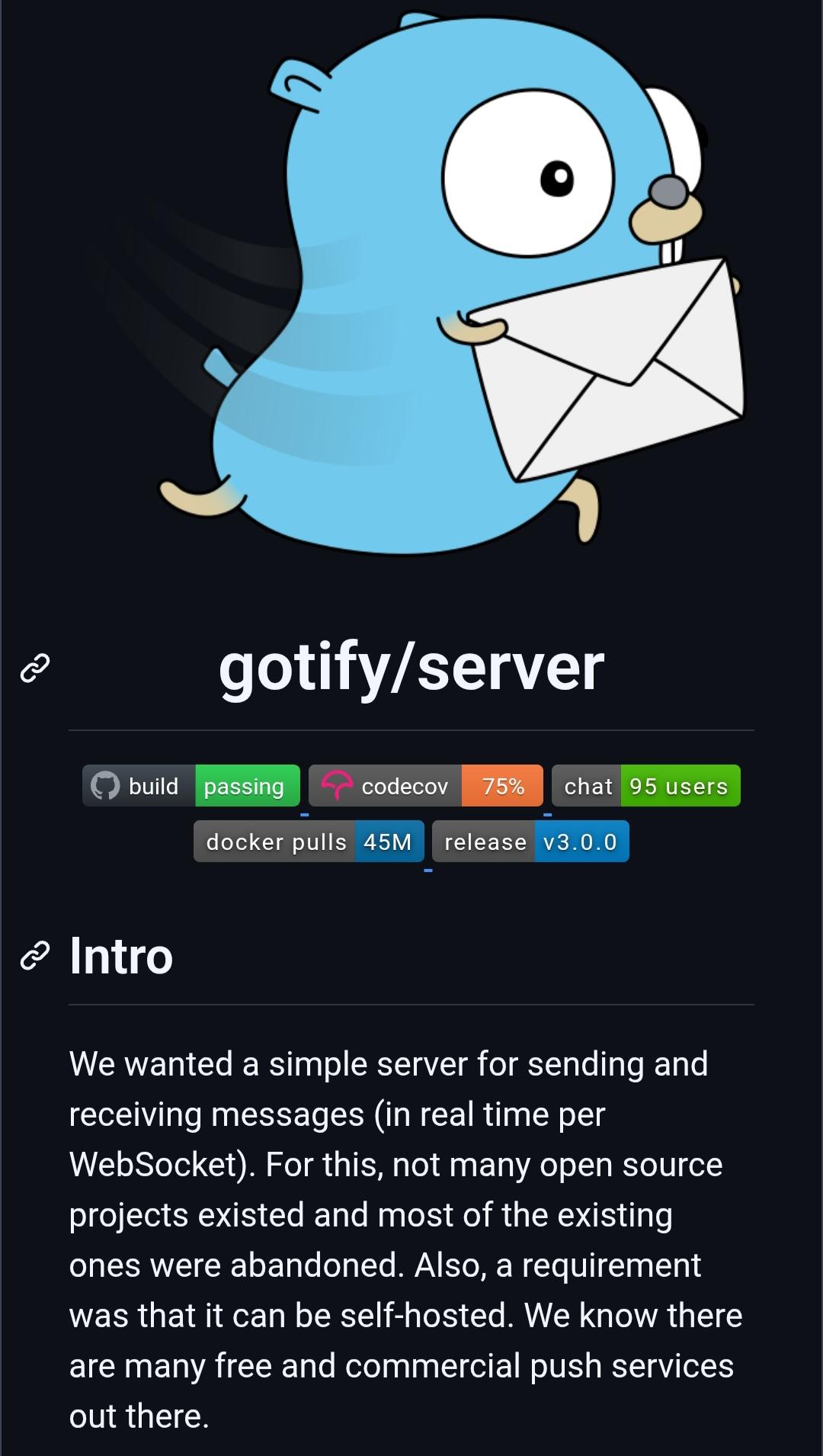
Gotify is a lightweight, open-source notification server that delivers real-time push notifications to your devices. It supports REST APIs, WebSockets, plugins, Docker, a web dashboard, and an Android app.
A great fit for developers, homelab users, and self-hosters.
More details: https://digitalescapetools.com/tools/tool.html?id=gotify
#OpenSource #SelfHosting #Homelab #Docker #Notifications #Privacy #FOSS
Alt...
Screenshot of the Gotify GitHub repository. The page shows the Gotify logo, project name (gotify/server), status badges, and an introduction describing Gotify as a lightweight, self-hosted server for sending and receiving real-time notifications over WebSockets.
![[?]](https://f2.tchncs.de/accounts/avatars/000/026/908/original/26ed08fc073e0f61.png)
Hmmm... it looks like @Stuxhost may fit the bill. https://Stuxhost.com says they're based in the Netherlands 👍 and that you can choose servers in Germany / Finland 👍 and @stux is here on the Fedi 👍 . (Sidenote, when I've talked to Stux, they've been lovely 👍 👍 )
The only thing I'm wondering about is if there's any easy way to install / upgrade / maintain Mastodon? 🤔 If I need to I can install Yunohost like on my other servers, but I'd really like to avoid having to maintain yet another server for a service that sounds trickier than most to maintain...
Need to share a terminal session securely?
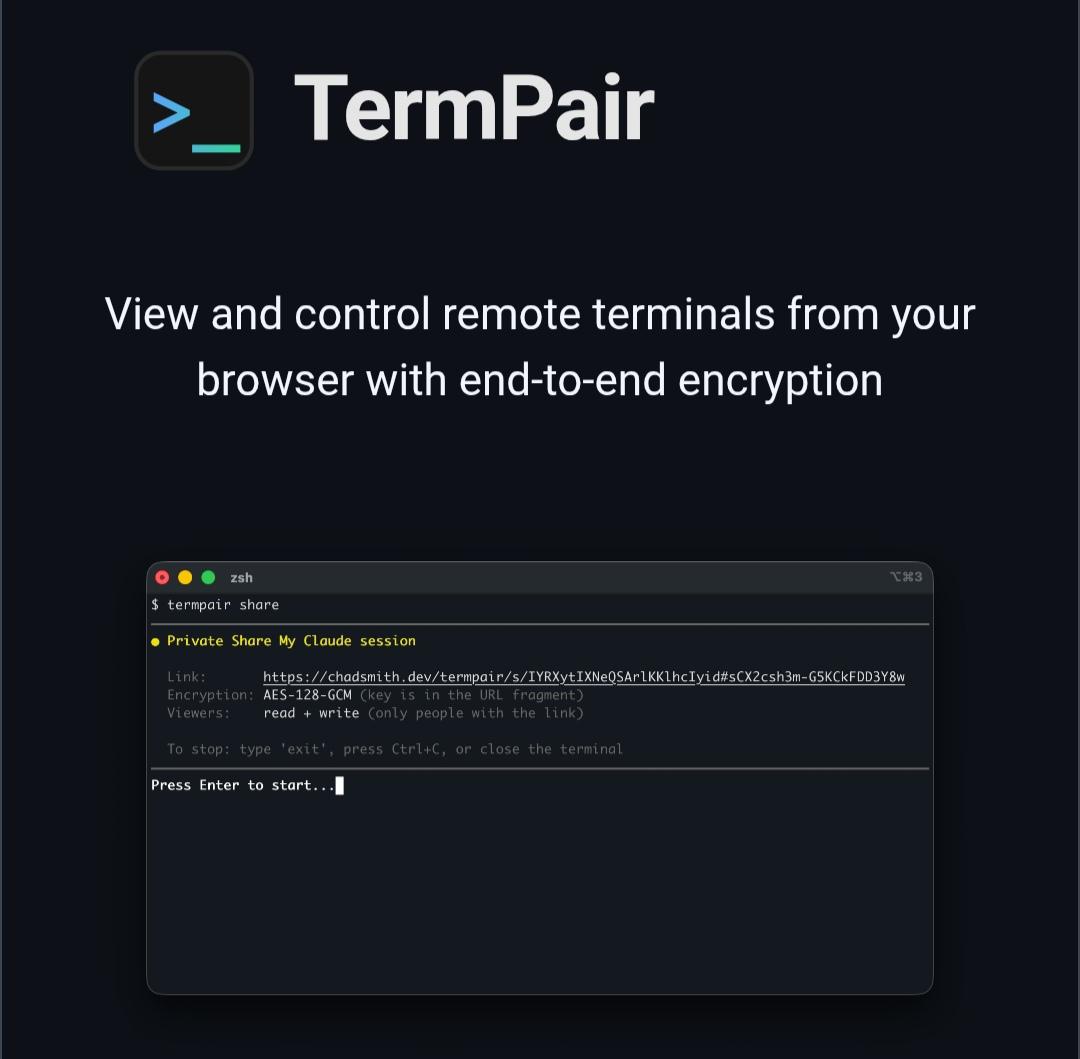
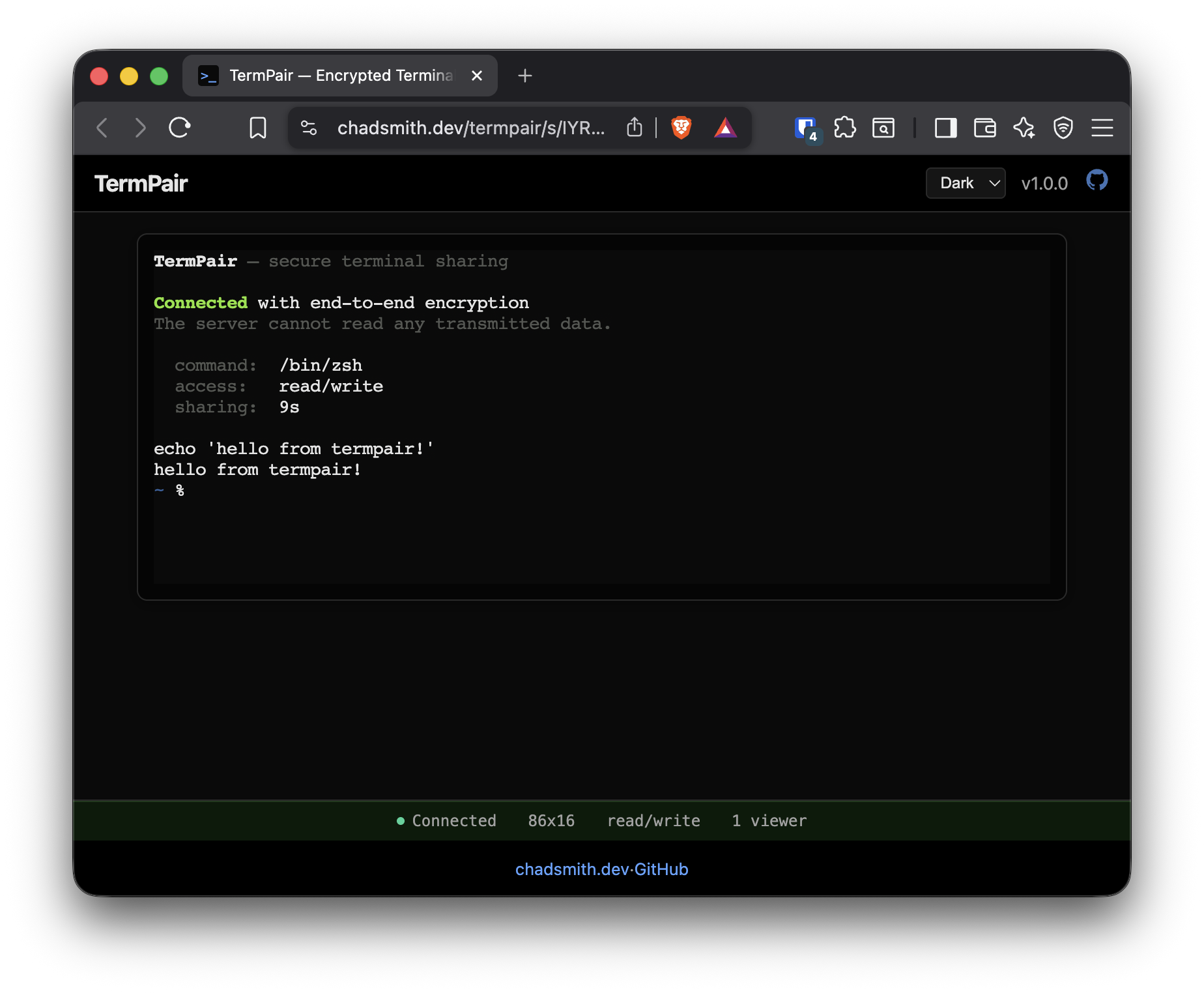
TermPair is a free, open-source tool that lets you share a live terminal in your browser with end-to-end encryption. Choose read-only or interactive access, with no Docker, Node.js, or Python required.
https://digitalescapetools.com/tools/tool.html?id=termpair
#OpenSource #Terminal #Linux #SelfHosting #Privacy #DevOps #CyberSecurity #FOSS
Alt...
TermPair terminal generating a secure, end-to-end encrypted browser link for sharing a live terminal session.
Alt...
TermPair web interface showing a live shared terminal session with end-to-end encryption and interactive read/write access.
![[?]](https://mammut.moe/system/accounts/avatars/109/308/533/487/810/604/original/35288be724803892.jpg)
I'm slowly approaching the Immich setup, which I want to use, but I need to setup it in a zone per component instead of docker containers and compose.
And this toot is a minute rant that so much of the self-hostable software doesn't suggest such an approach even at documentation level, not mentioning the scripts and binaries.
That means that at first I'd need to deconstruct containers to use only relevant bits.
Want to detect intruders before they reach your real systems?
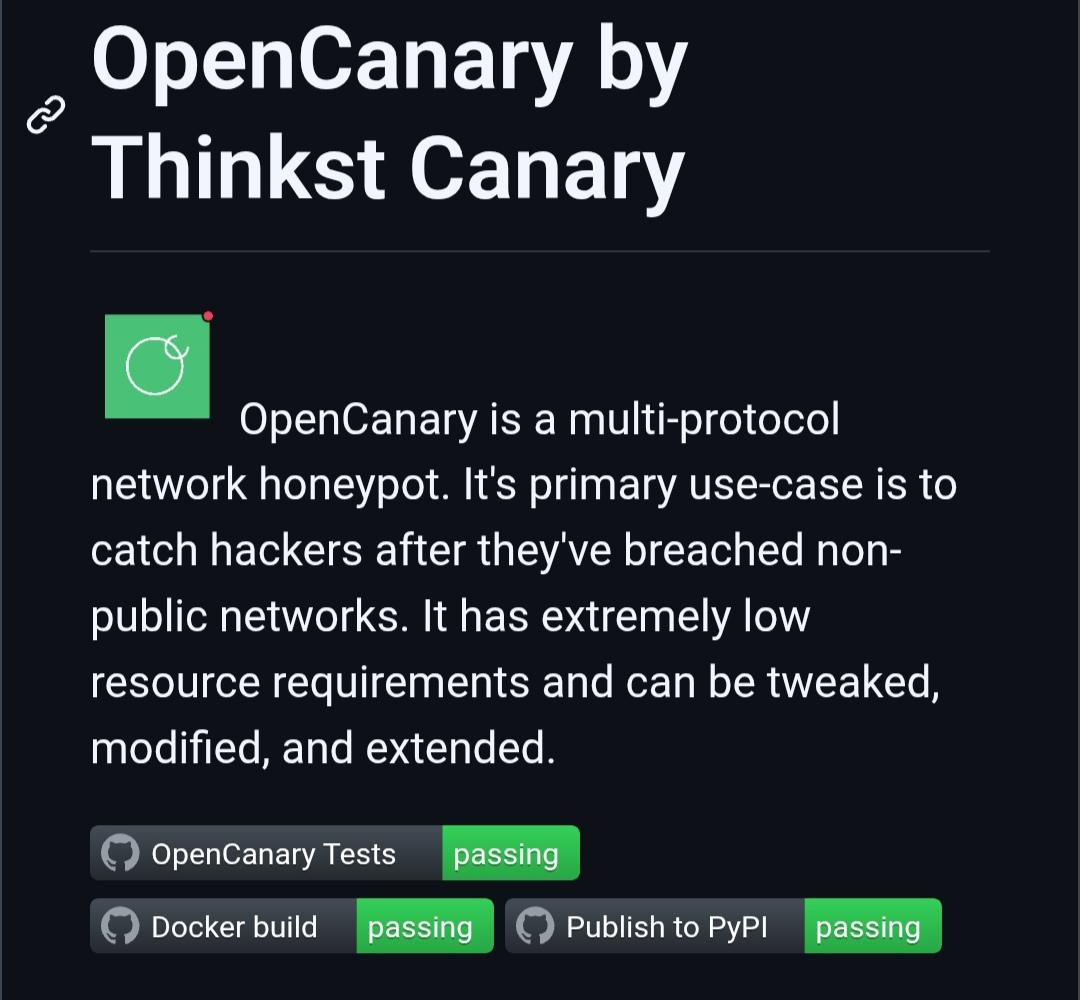
OpenCanary is a free, open-source network honeypot that emulates common services and sends instant alerts when someone interacts with them. It's lightweight, easy to deploy, and works on Linux, macOS, Docker, and Raspberry Pi.
More details: https://digitalescapetools.com/tools/tool.html?id=opencanary
#OpenSource #CyberSecurity #InfoSec #Honeypot #SelfHosting #Privacy #Linux #Homelab #FOSS
Alt...
Screenshot of the OpenCanary project page describing the lightweight network honeypot with passing GitHub test, Docker build, and PyPI badges.
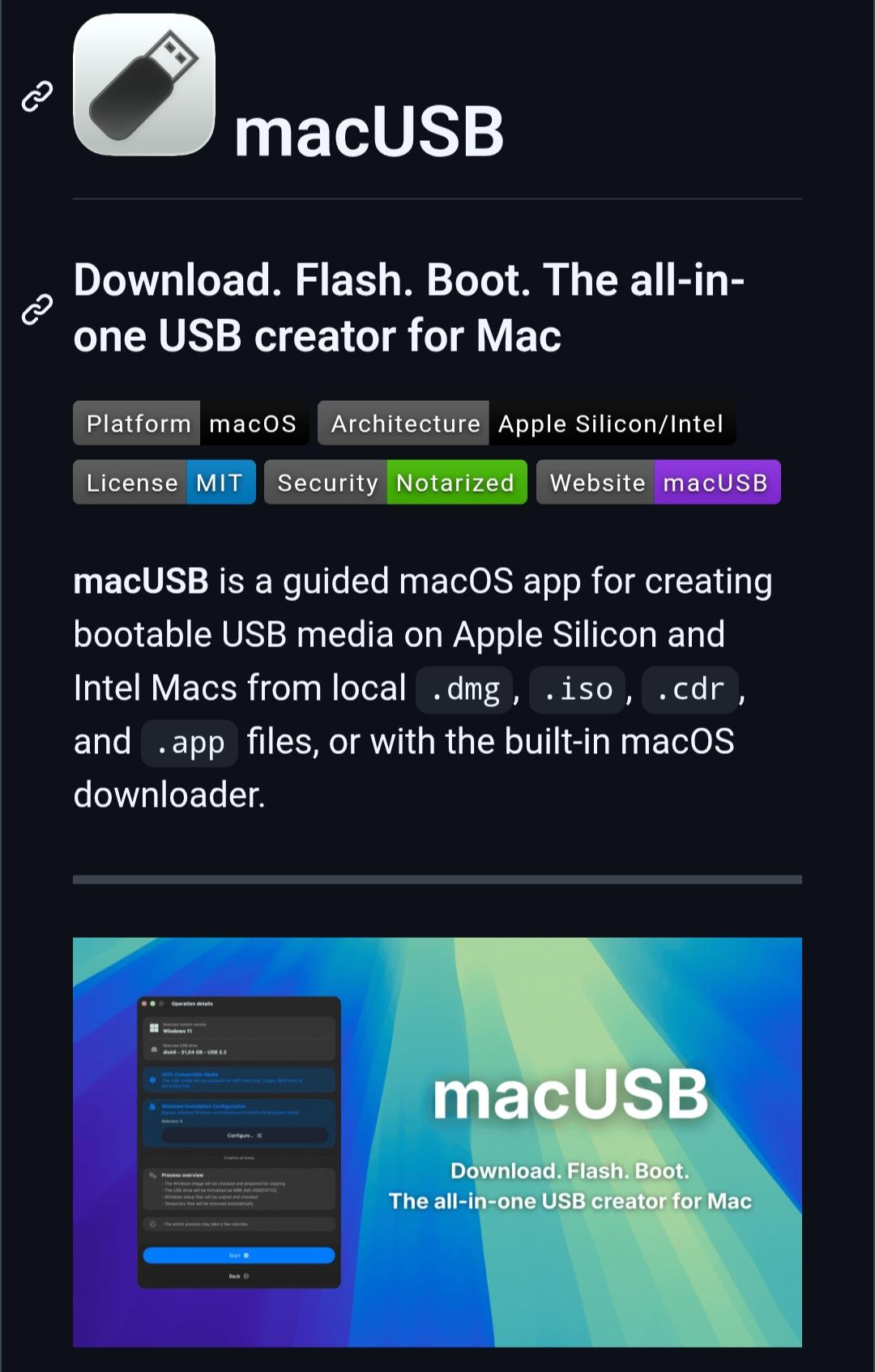
macUSB is a free, open-source utility for creating bootable macOS, Windows, and Linux USB drives directly from your Mac.
It supports Apple Silicon and Intel Macs, includes a built-in macOS downloader, verifies checksums, and makes creating installation media much easier than using Terminal commands.
More details: https://digitalescapetools.com/tools/tool.html?id=macusb
#OpenSource #macOS #Linux #Windows #SelfHosting #Privacy
Alt...
Screenshot of the macUSB homepage showing the app's description, supported Mac architectures, and a preview of its bootable USB creation interface.

Alt...
macOS Full Disk Access settings with macUSB granted permission to access protected files and folders.
Alt...
macOS Login Items & Extensions settings showing macUSB enabled to run background tasks.
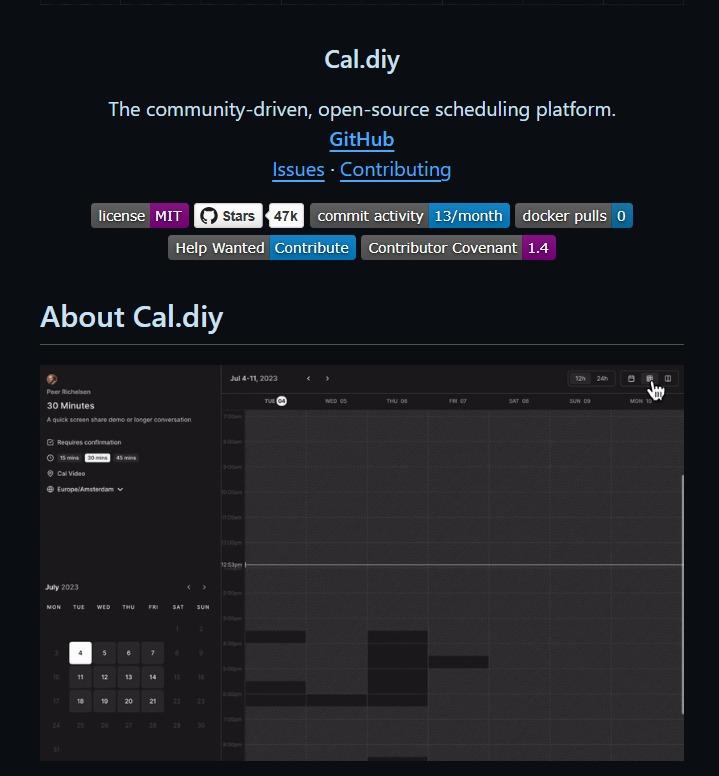
Cal[.]diy is a community-driven fork of Cal[.]com that's 100% MIT licensed and removes proprietary enterprise features.
Unlike the open-core version, there are no license keys, locked features, or closed-source components. Self-host it to keep full control over your scheduling data and infrastructure.
More details: https://digitalescapetools.com/tools/tool.html?id=caldiy
#OpenSource #SelfHosting #Privacy #FOSS #Calendar #Scheduling #Linux #DigitalEscapeTools
Alt...
Screenshot of the Cal.diy project page in dark mode. The header describes it as a "community-driven, open-source scheduling platform" with links to GitHub, Issues, and Contributing. Badges show the MIT license, 47k GitHub stars, contributor information, and commit activity. Below, an "About Cal.diy" section displays a dark-themed scheduling interface with a monthly calendar, appointment details on the left, and a weekly time grid for booking and managing meetings.
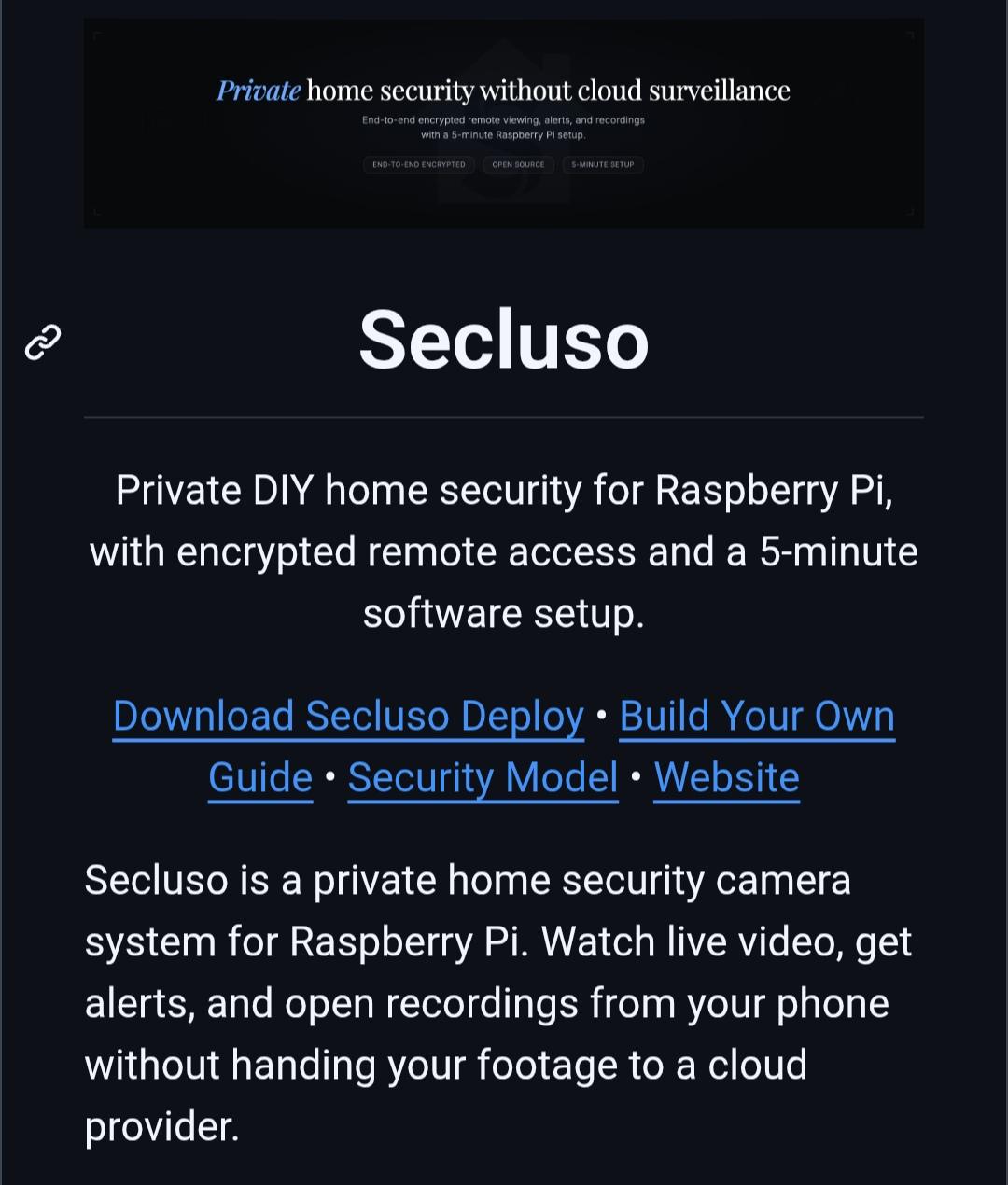
Secluso is an open-source home security system that runs on a Raspberry Pi, giving you encrypted remote access to live video, recordings, and alerts without relying on cloud surveillance.
If you want a privacy-first alternative to cloud-connected security cameras, Secluso keeps your camera data under your control.
More details: https://digitalescapetools.com/tools/tool.html?id=secluso
#OpenSource #SelfHosting #Privacy #HomeSecurity #RaspberryPi #Linux #FOSS #DigitalEscapeTools
Alt...
Screenshot of the Secluso website in dark mode. A banner reads “Private home security without cloud surveillance” with mentions of end-to-end encrypted remote viewing, alerts, and recordings on Raspberry Pi. The page title “Secluso” appears above the description: “Private DIY home security for Raspberry Pi, with encrypted remote access and a 5-minute software setup.” Blue links are shown for deployment, build guide, security model, and website. The text explains that Secluso is a private home security camera system for Raspberry Pi that allows live video viewing, alerts, and access to recordings from a phone without uploading footage to a cloud provider.
![[?]](https://o.mastodon.nz/accounts/avatars/109/349/901/141/281/234/original/f86bd9c446cb0954.png)
Linkwarden is a free, open-source bookmark manager that helps you save, organize, and preserve webpages. It can automatically archive pages as screenshots, PDFs, and HTML files, supports collaboration, includes browser extensions and mobile apps, and can be self-hosted for full control over your data.
More details: https://digitalescapetools.com/tools/tool.html?id=linkwarden
#OpenSource #SelfHosting #Bookmarks #Privacy #Productivity #FOSS #DigitalOwnership
Alt...
Screenshot of the Linkwarden project page featuring its logo and the tagline "Bookmarks, Evolved." The page highlights GitHub Trending (#3 Repository of the Day), an active Discord community, Hacker News mentions, the latest release, localization progress, and project sponsors.
Need a password manager for your team?
TeamPass is a free, open-source password manager built for teams and organizations. Securely share credentials, manage role-based permissions, integrate with LDAP/Active Directory, and self-host everything on your own infrastructure.
More details: https://digitalescapetools.com/tools/tool.html?id=teampass
#OpenSource #PasswordManager #SelfHosting #CyberSecurity #Privacy #DevOps #FOSS
Alt...
Screenshot of the TeamPass 3 project page describing it as an on-premise collaborative password manager. The page highlights GitHub badges showing approximately 1.8k stars, GPL-3.0 license, 1.9 million Docker pulls, the latest release, a passing build status, and code intelligence support.
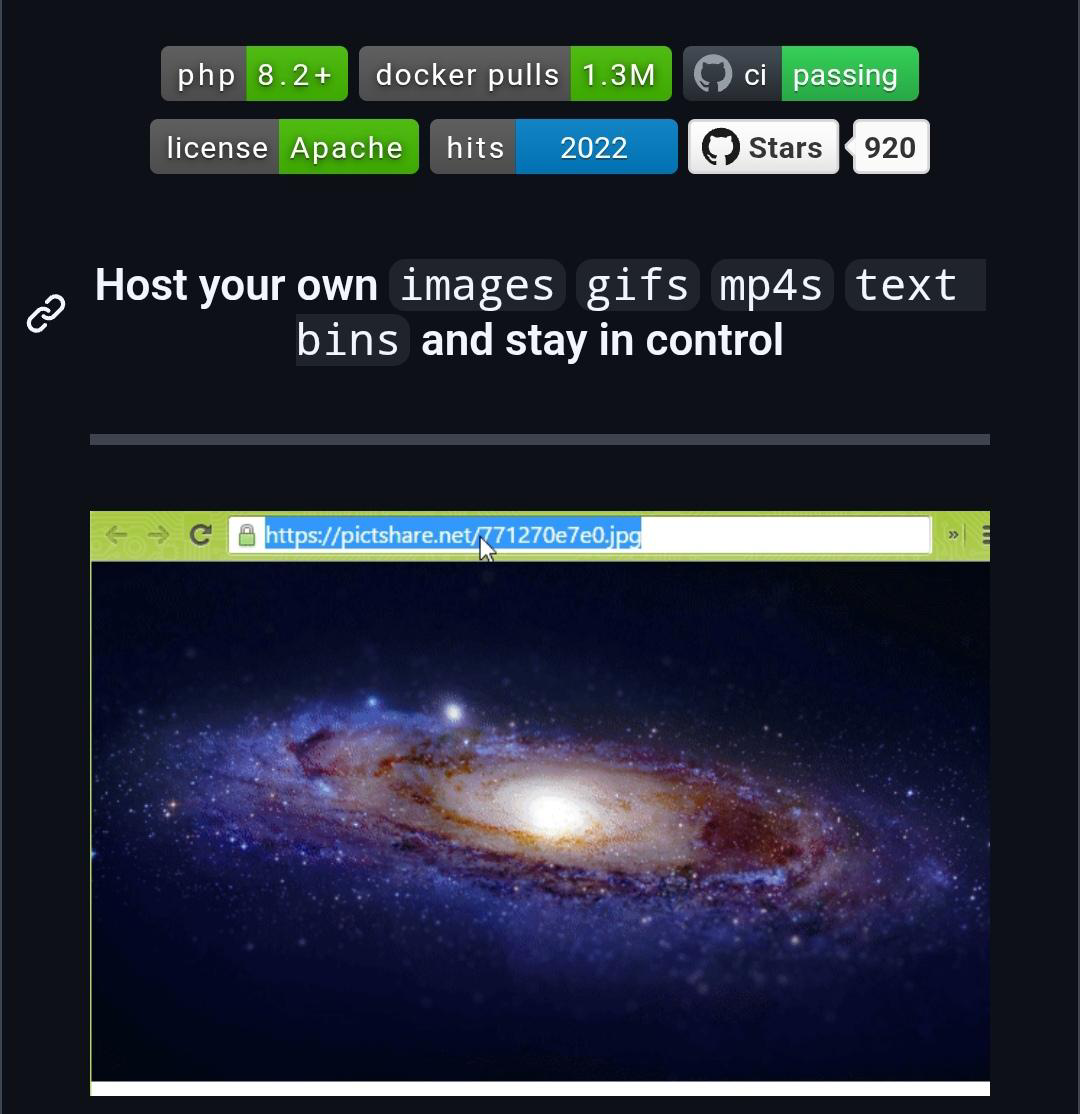
PictShare is a free, open-source file sharing platform you can host yourself. It supports images, GIFs, videos, audio, Markdown, and text snippets, automatically strips EXIF metadata, and gives you full control over your uploads.
More details: https://digitalescapetools.com/tools/tool.html?id=pictshare
#OpenSource #SelfHosting #Privacy #FileSharing #FOSS #PrivacyTools #DigitalEscapeTools
Alt...
Screenshot of PictShare, a self-hosted file sharing platform, highlighting support for hosting images, GIFs, MP4 videos, and text bins. Below the banner is an example shared image displayed through a direct PictShare link.
![[?]](https://weredreaming.com/mookie/s/avatar-c033319a3a3d5098e5af08a922200981.png)
![[?]](https://files.mastodon.social/accounts/avatars/109/246/411/862/197/824/original/1586f1125b5f9786.jpg)
Good morning Fedi friends,
I have been feeling a rising anxiety over the state of the open web and the fediverse - after seeing efforts by politicians all over the world (in Europe too!) to introduce age verification laws for social media.
My way of coping?
Teaching people how to self-host their own Fediverse profile (using the superb #GoToSocial) via #YunoHost.
Chapter 1 in this series is available here:
![[?]](https://cdn.masto.host/mastjohn1126com/accounts/avatars/115/981/910/993/463/416/original/00ac72837ce34a31.gif)
Google admits they block emails from getting into your inbox, even those from friends and family that are in your address book.
In my opinion, if the email sender is known and saved in the #Gmail user's address book, their emails should never be blocked, but #Google does not agree. And their technical requirements for an email to get through are past the average user's understanding or ability.
https://support.google.com/mail/answer/81126
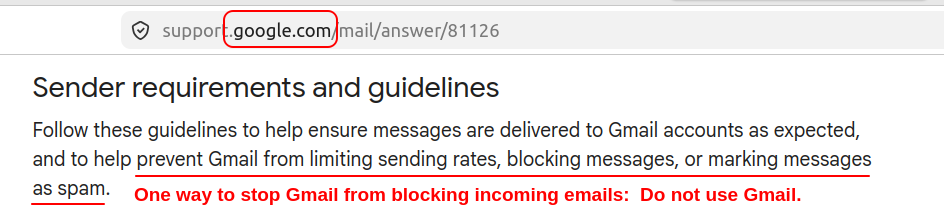
Gmail blocks emails, even from friends and family, if they use another email host without the technical settings they demand. This means people who self-host their email can be blocked from communicating with #Gmail users.
One solution: Gmail users could move to an email host that does not block from known contacts in your own address book!
I suspect many Gmail users are unaware of this change beginning in 2024.
https://m-chrzan.xyz/blog/sending-mail-to-gmail.html
@SecondChanceLemon
The other big corporations are doing the same. I had to migrate away from Microsoft's hotmail for their cell phone requirement.


![[?]](https://media.infosec.exchange/infosec.exchange/accounts/avatars/000/187/720/original/90b7505f9aa62a61.jpeg)
 I thought scaling Tor meant adding more relays.
What it actually meant was multiplying failure modes...
I now operate 24 Tor relays and bridges across 15 locations, 11 ASNs and 6 operating systems.
Every new relay brings another provider, firewall, IPv6 route, service manager, identity key, backup and recovery plan.
Some things I learned along the way:
🌍 More countries don’t automatically mean real diversity
🔑 The server is replaceable, the relay identity isn’t
🛠️ Linux, BSD and SunOS need the same outcomes, not the same commands
📊 What I configured isn’t always what the Tor network currently sees
A large fleet is easy to count. A resilient one is much harder to keep alive.
I wrote about what operating Tor across 15 locations actually taught me:
🔗 https://brokenbotnet.com/2026/07/17/non-eu-relays/
#Tor #Privacy #OpenSource #SelfHosting #Infosec

The amazing folks at @yunohost are running a fundraising campaign to cover their operating costs for 2026.
I personally make a monthly recurring donation to them but wish I could give more 🥲
If you use their services and you can afford it, please consider donating to their project. Every Euro / Dollar / Yen counts:
🔗 : https://yunohost.org/donate.en.html
#NotAllHeroesWearCapes #SelfHosting #empowerment #resist #YunoHost
Good morning Fedi friends!
On the agenda today: writing a first draft explaining to newbies how to self-host #GoToSocial with the help of #YunoHost.
Now, to do a step-by-step installation guide I need to create a brand new account, so I can document everything.
I'm a little stressed out thinking of which domain name to use and the fact it would be something like my 20th - yes TWENTIETH - ActivityPub account!!! 🫠
The things you do for the love of the fediverse 😅
European institutions seem to be all in when it comes to introducing age verification mandates for citizens in member states: https://digital-strategy.ec.europa.eu/en/library/commission-sets-out-common-approach-eu-wide-age-verification-technologies
I now have daily anxiety thinking about the future of the fediverse.
So how do I channel this fear and turn it into something constructive? I'm going back to writing #selfhosting guides for newbies.
It's a great distraction, which gives me a bit of hope. Especially the next guide, which will cover my favorite fediverse software - #GoToSocial (which is powering this instance) - and how to install and configure it. Your own little home on the fediverse! Lightweight and features-packed.
Surely something like this would fall outside the scope of regulation. Right? Right?
#MySoCalledSudoLife #YunoHost #VPS #AgeVerification #privacy #EUBigTech
![[?]](https://files.mastodon.social/accounts/avatars/116/833/716/461/243/585/original/8e70c14ef5bdb5fb.png)
Hello fediverse. We are Merklode — a post-quantum substrate for data sovereignty.
You hold the keys. You control the storage. Your AI runs for you. Lattice cryptography (ML-KEM-1024 / ML-DSA-87) interlaced with classical primitives, native and self-contained.
Now in beta: merklode.com
#postquantum #cryptography #privacy #dataSovereignty #selfHosting
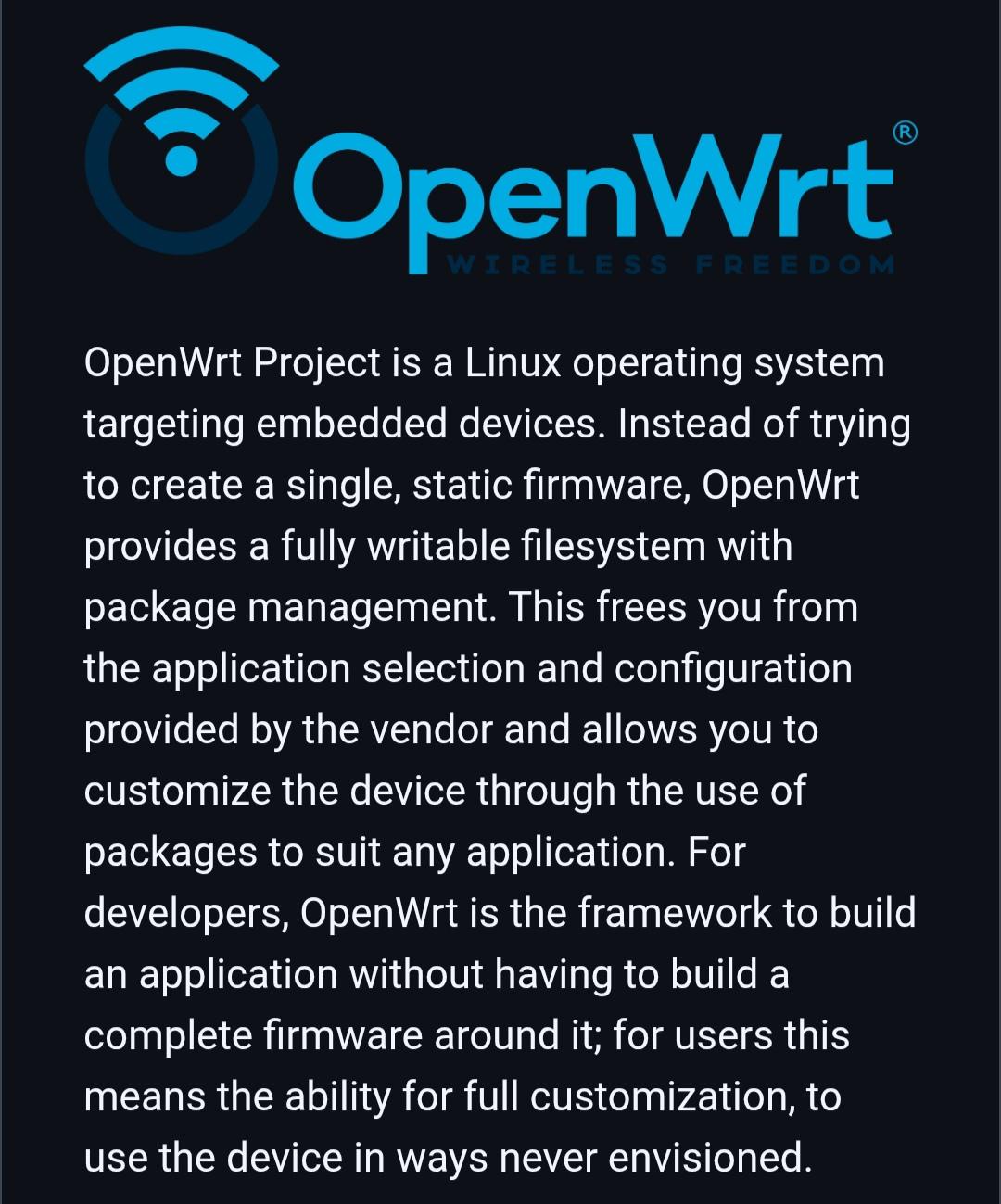
OpenWrt is a free and open-source Linux operating system for supported routers and embedded devices.
Unlike stock router firmware, it provides a fully writable system with package management, letting you install WireGuard, AdGuard Home, VPNs, mesh networking, custom firewalls, and hundreds of additional packages.
https://digitalescapetools.com/tools/tool.html?id=openwrt
#OpenSource #OpenWrt #Linux #SelfHosting #Privacy #Networking #Router #FOSS
Alt...
Screenshot of the OpenWrt project page. The OpenWrt logo and the slogan "Wireless Freedom" appear at the top. Below, a description explains that OpenWrt is a Linux operating system for routers and embedded devices. It highlights its fully writable filesystem, package management, and extensive customization, allowing users to install software, replace vendor firmware limitations, and tailor their router for a wide range of networking applications.
![[?]](https://media.gamepad.club/accounts/avatars/109/802/258/118/187/103/original/d90053e6f826373c.png)
So I have a server of my own that I would like to put a blog on. Does anyone know of, or recommend, any free blogging software I can load onto my Apache server? Or where to start looking?
![[?]](https://cdn.fosstodon.org/accounts/avatars/107/119/935/922/768/447/original/52adb160f5cb4520.png)

 🇲🇽
🇲🇽I haven't turned on this raspberry pi 4 8gb of ram in like 3 years. I've been feeling like resurrecting it and setting it up again.
What services should I install on it?
What casing or peripherals should I use?
#Hardware #RaspberryPi #PCB #Computing #SelfHosting

Alt...
A dusty raspberry pi
![[?]](https://mastodon.derg.nz/system/accounts/avatars/109/259/098/898/567/697/original/fb603e1330302e45.png)
Hetzner is doing another price increase.
this time it seems to only affect new orders, not existing ones .. but the price increase is pretty steep, like 2-3x or more
https://docs.hetzner.com/general/infrastructure-and-availability/price-adjustment/
![[?]](https://cdn.fosstodon.org/accounts/avatars/115/532/410/310/000/993/original/08065bd1d1c34cad.png)
The fact that #Anthropic had to take down #Fable5 for users outside of the US by order of the US government shows how critical it is today to rely on US services
Imagine they'd do the same with #WhatsApp, you will not be able to talk to your #family and friends anymore
This should be a wake-up call for everyone to rely on your own server infrastructure, running with #OpenSource #software
#autonomy #digitalindependence #europe #european #decentralization #selfhosting #ArcaneChat #android #ai

![[?]](https://fedi.blindsoft.net/susie.png)
so i'm running nextcloud server using a docker container using windows. now i got this #docker #container running last night, the contaainer is running fine. i am using #tailscale serve in order to get it to my #tailnet . now here's the problem.
the problem is i have to run this via a reverse proxy, hence tailscale serve. this in itself isn't a problem. the problem is trying to get it running on this machine. the path of which it is located is /nc. so it's my-machine.tailnetname.ts.net/nc. but nextcloud won't accept it for some reason. how do i fix this? thanks in advance.
Built something I’ve wanted for a while...
An open-source Docker container that makes running a Tor relay actually simple and reliable.
One command. Self-healing. Multi-arch. Runs everywhere from Raspberry Pi  to VPS
🔗 https://github.com/r3bo0tbx1/tor-guard-relay
If you care about privacy infrastructure:
🧱 Try it out
🐛 Report bugs
💡 Suggest features
⭐ Star it to help others discover it
 Maintaining this in my free time, donation info’s in the README (and please support @torproject, @eff and @privacyguides too).
Protecting privacy, one relay at a time ✨
#Tor #Privacy #OpenSource #Docker #FOSS #SelfHosting #Infosec
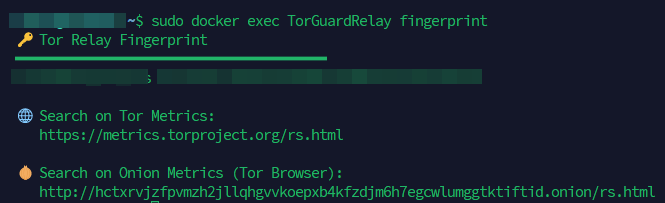
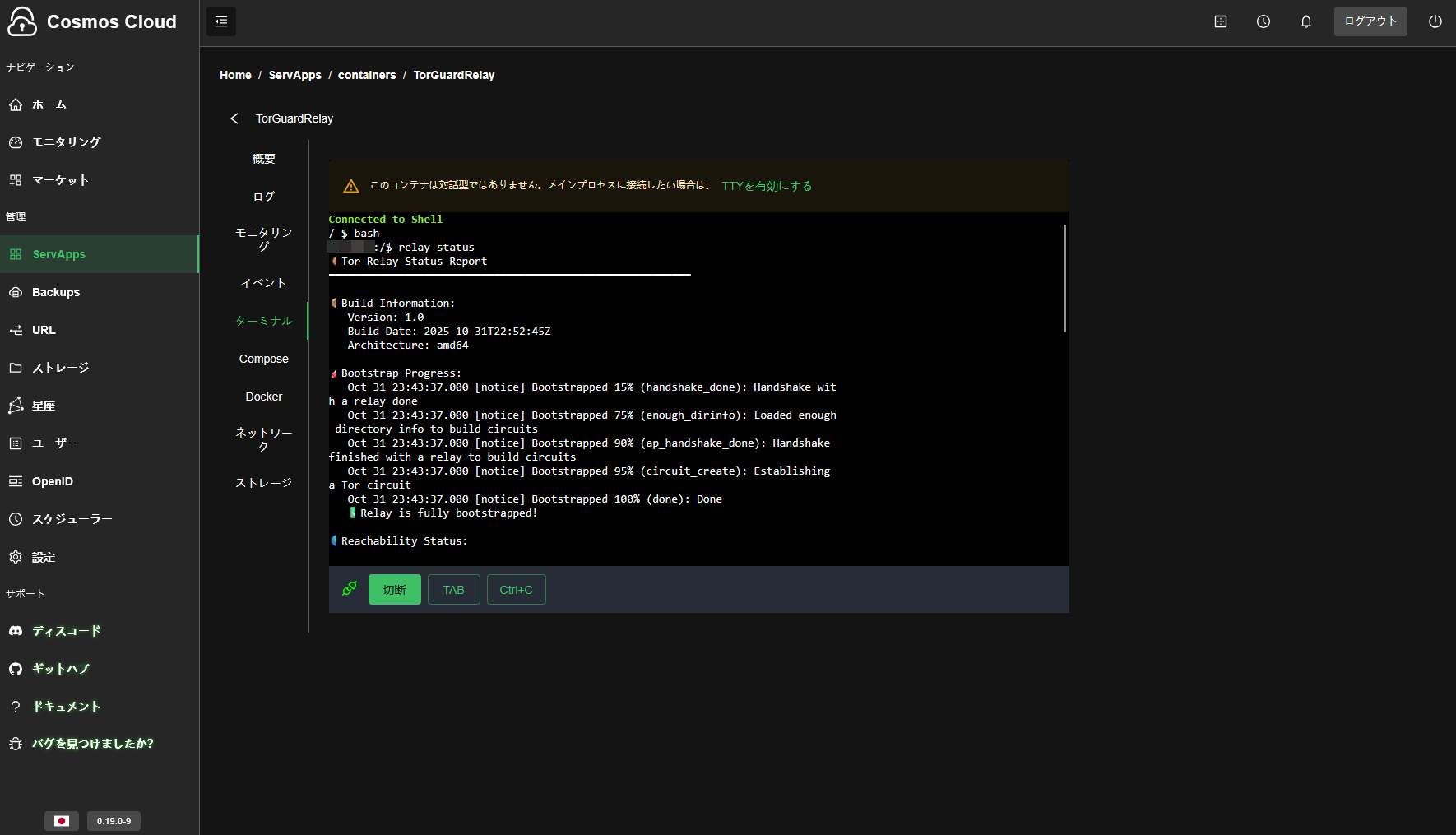
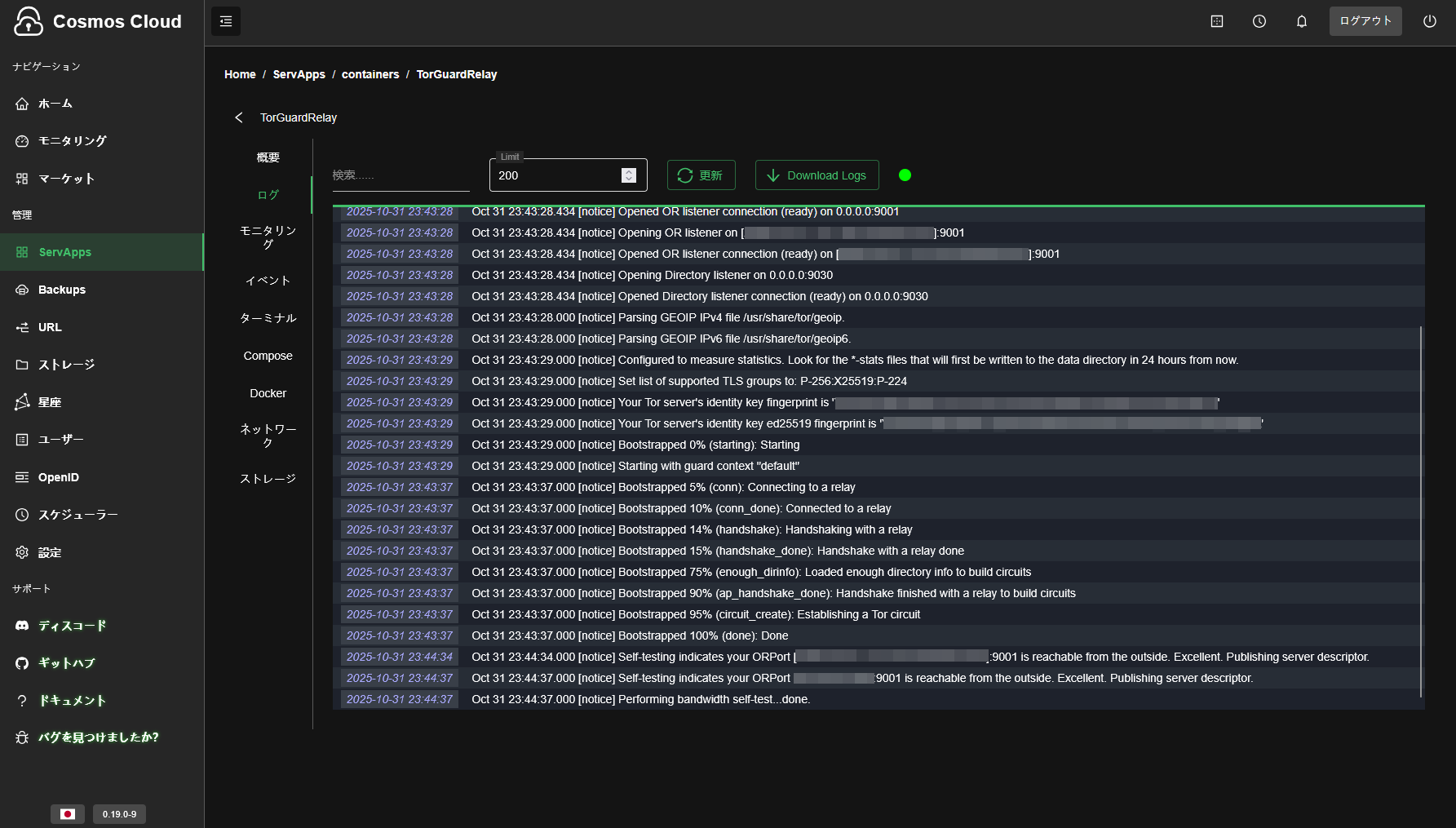
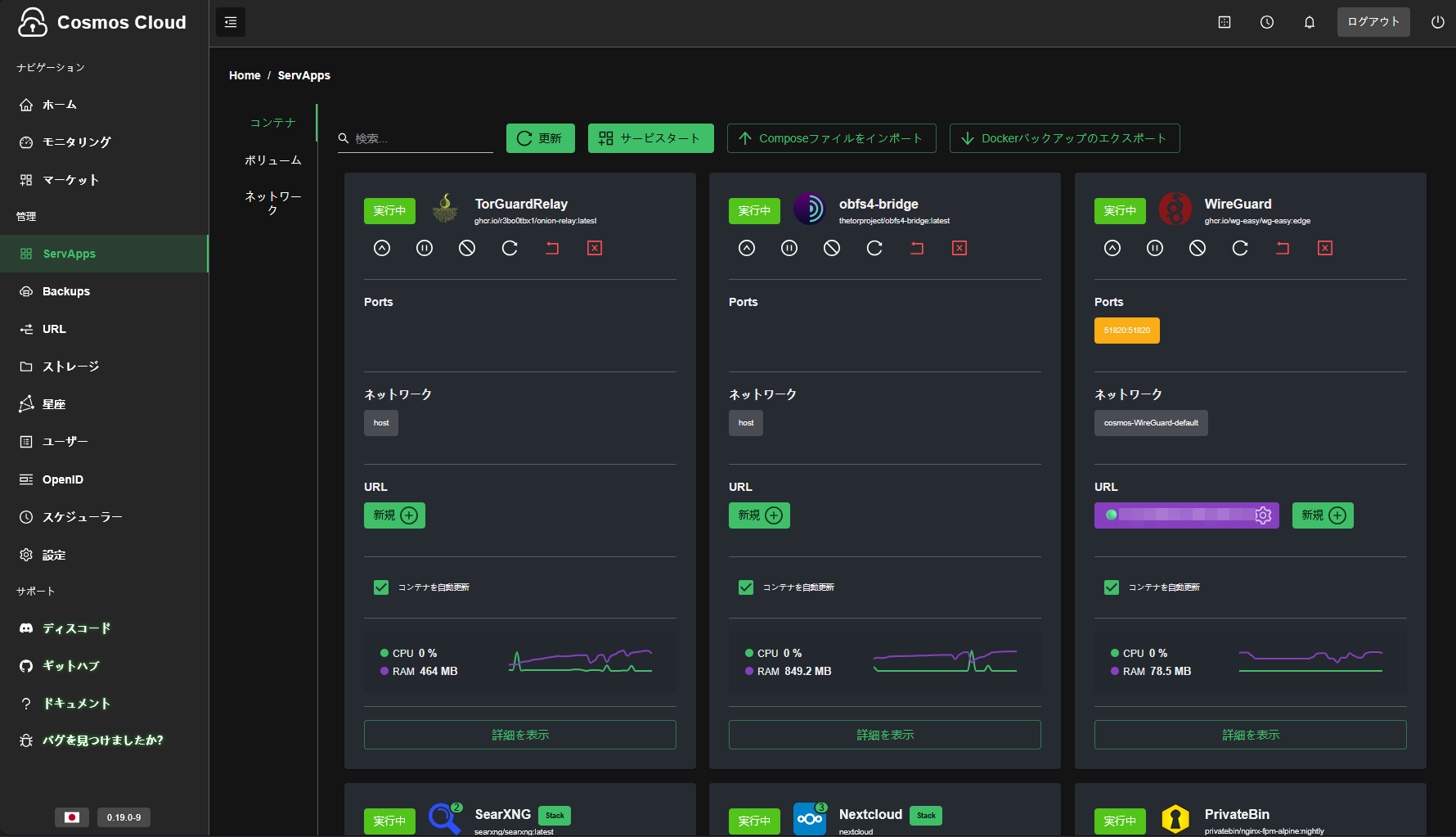
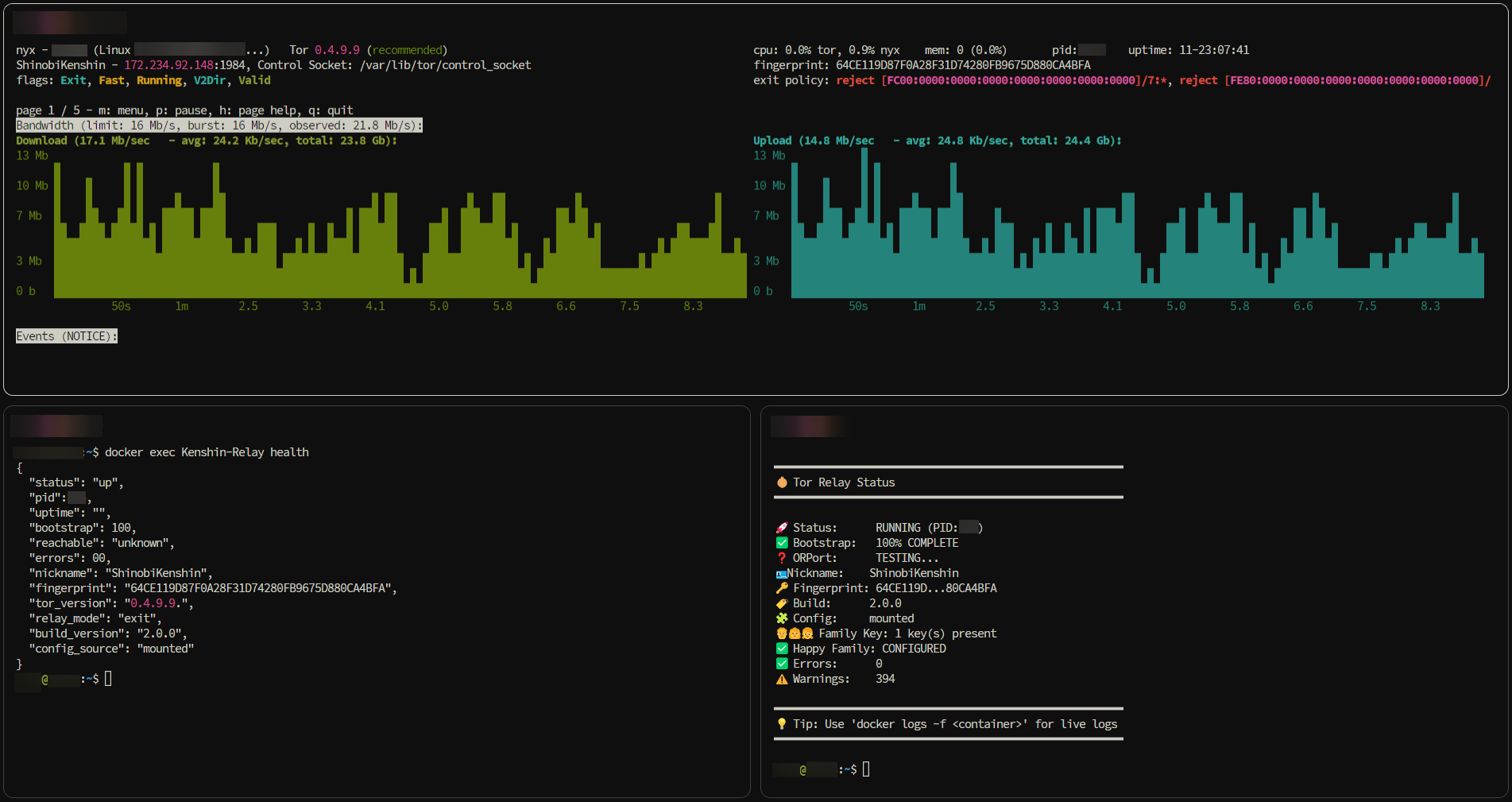
onion-relay v2.0.0 is out, and it's been a long road from v0.0.1 ⬇️
ℹ️ What started as "one command to run a relay" is now a hardened, production-tested AIO stack: guard, exit, and bridge (obfs4) in a 16.8 MB image.
What's new in v2.0.0:
🩺 health + status tools now expose build_version & config_source
⚡ healthcheck.sh fails fast on missing/empty torrc
🔒 DirPort now defaults to 0 (disabled) in ENV-generated configs
What the project has grown into since launch:
🔑 Happy Family support (Tor 0.4.9+ FamilyId, 🪦 RIP MyFamily lists)
🧰 6 busybox only diagnostic tools
🌍 Battle-tested across 10+ countries: https://relays.brokenbotnet.com
🔐 35+ security fixes, CVE coverage, weekly automated rebuilds
🐋 Works with Docker CLI, Compose, Cosmos Cloud & Portainer
 https://github.com/r3bo0tbx1/tor-guard-relay
If you care about privacy infrastructure:
🥢 Try it out
🐛 Report bugs
💡 Suggest features
⭐ Star it to help others find it
Still maintaining this in my free time, donation info
in the README. And please support @torproject
@eff and @privacyguides too.
Protecting privacy, one relay at a time ✨
#Tor #Privacy #OpenSource #Docker #FOSS #SelfHosting #Infosec
hat.sh lets you encrypt files locally in your browser using modern cryptography — nothing is uploaded or stored.
Perfect for securing files before sharing or using cloud storage. Open-source and self-hostable.
👉 https://github.com/sh-dv/hat.sh
👉 More tools like this : https://digital-escape-tools-phi.vercel.app/
#Privacy #Encryption #OpenSource #SelfHosting #DigitalSecurity

![[?]](https://soc.octade.net/octade/s/3f7f2b5eda4e392867c301c49c2daa16.png)
No Cloudflare. No 2FA nonsense. No cloud surveillance. Your box. Your rules.
2. Get a cheap VPS.
3. Install Hestia Control Panel for managing DNS, SSL certs, and services.
4. Install any app or blog engine you desire.
This keeps everything entirely under your own control.
I figured out several ways to run DarkMX on a headless server without GUI. This allows me to install it on a remote server without any desktop environment and run the software as a daemon without the GUI.
First I used the X forwarding feature of SSH to pipe the GUI to a local machine. On that machine I did all the configuration inside the GUI. Then I closed the program.
Then on the remote machine I used 'xvfb' to run DarkMX as a nohup'd daemon with a dummy GUI buffer. That way I don't need to be connected to the GUI from a local machine and the application will still run. It also uses less RAM without the GUI.
There are other ways to do this, such as VNC and xpra. I just chose the quickest, dirtiest method in this case.
Why would I go to all that trouble? Well, I don't need to, but there are some people who might need to publish while maintaining strict anonymity. So they would need tools like DarkMX and TOR. For me it's just fun.
DarkMX operates over the TOR privacy preserving network. As a result the location of my peer is hidden and extremely hard to impossible for an adversary to locate. So when I publish something, such as a letter, or paper, or opinion, anyone can download it since censoring it is not viable. It ensures that my speech remains free and available to the general public. Now when I author essays, papers, homiles and such, I can publish them as file shares, and I can publish them simultaneously as a TOR hidden website with the built-in webserver feature. So readers don't need DarkMX to read my files--they can just fire up TOR Browser or use a TOR proxy with their web browser. If they want to snarf a whole directory they can install DarkMX, or use a script to snarf them via TOR.
If you are inclined to fiddle around with installing this software on a headless server, please share the techniques and tools used that suit you.
(DarkMX download site: https://darkmx.app)
#DarkMX #P2P #FileSharing #Anonymous #SelfHosting #TOR #OnionNetwork #Censorship
@selfhosted@a.gup.pe @infostorm@a.gup.pe @darknet@a.gup.pe infosec@a.gup.pe