Search results for tag #programming
![[?]](https://files.mastodon.social/accounts/avatars/114/048/194/944/023/530/original/3a6b93b37c67427d.png)
What makes Lisp difficult to read?
https://paultm.nl/paren-thesis
Comments: https://news.ycombinator.com/item?id=49879343
#HackerNews #Lisp #Difficulty #Readability #CodeChallenges #Programming #Language
![[?]](https://mastodon.tomodori.net/system/accounts/avatars/115/312/380/337/748/146/original/3d81bc18d653d64c.png)
when i was in high school, graphing calculators were the hot new thing in mathematics. we weren't required to own one, but our math teacher sent a letter home recommending them to parents
there were a few different brands and models out there, and with that, came an implicit pecking order:
the TI-8x calculators were unquestionably great. I spent months grinding my parents into buying a jet black TI-85 (of which i paid half), so i could have the extra memory, link port, TI-BASIC, and a lowercase alphabet bitfont. us ti-85 owners fancied ourselves the tremere clan of the kindred. i learned how to program on it for the next year, instead of learning polynomials
the less discerning kids ended up with the TI-81 - no link port, scant RAM, and no lowercase font. clanless thin-bloods!
at the absolute bottom of the slush pile were the Casio kids. while the FX-7700x machines had a kickass interface and built-in solvers, the teacher had no idea how to use them, and the casio kids were relegated to nosferatu status
one day, out of nowhere, two kids showed up with Hewlett Packard 48G calcs. the case designs were slick, had fonts of different sizes, used crazy reverse polish notation, and did infrared calc-to-calc file transfers. they were incredibly powerful and fast. i was instantly jealous.
but they were also incredibly expensive - $250+ at the time. i gritted my teeth and lived with my inferior TI-85 for the rest of my high school years.
today i found out that the HP 48G calculators had their own stack-based programming language based on LISP called RPL, and could even assemble native ASM code (with a miniassembler installed) written in-calculator.
https://en.wikipedia.org/wiki/HP_48_series#Programming
you don't need to tell me twice. i just ordered a cheap broken 48G that, hopefully, i'll be able to repair and turn into goofy programming machine :D
#1990s #calculators #programming #lisp

Alt...
The front of an HP 48G graphing calculator. The LCD screen is off, and there are a few dozen buttons below. It has a charcoal grey soft case beside it.
![[?]](https://gamerplus.org/system/accounts/avatars/114/497/966/782/841/054/original/c3c1b4d840d49021.png)
Today's article
"
002BEGINNINGS one lisp example making lisp an infinitely lazy series language
"
is the example of lazy infinite cl-series from the show yesterday written up a bit.
https://medium.com/@screwlisp/002beginnings-one-lisp-example-making-lisp-an-infinitely-lazy-series-language-c564cec8216d
#programming #lisp #commonLisp #infinity #clSeries #medium
![[?]](https://files.mastodon.social/accounts/avatars/117/325/867/429/261/075/original/c22302171026fdea.png)
This adds a static bitmap background.
critically, I finally got my 20 year old code together and it now properly generates a mask that's 1 pixel thicker than the sprite itself. And all that, working with multiple animation frames. All bundled in an E-Z to use function.
![[?]](https://media.mathstodon.xyz/accounts/avatars/109/308/315/960/319/189/original/8bcb7021908599d9.jpeg)
I have been keeping an eye on this multi-paradigm, research #programming language called #Mozart (formerly Oz). It was created by Prof. Gert Smolka in 1991.
Mozart traces its roots to Lisp, Prolog, and Erlang. It supports PP, OO, FP (eager by default, lazy by choice), and LP (constraint-based) paradigms, all in a clean, unified, modern syntax. It has built-in message-passing concurrency and full GUI.
When using Mozart, it is important note that its raison d'être is academic language research, not industrial software development.
![[?]](https://newsletter.mobileatom.net/wp-content/uploads/2025/12/cropped-TPF-logo.png)
The Programmer’s Fulcrum 25 September, 2026
This post originally appeared on The Fulcrum. Welcome to this week's The Programmer's Fulcrum. It's your weekly curation of the essential news in the Open Media Network and Open Social development communities with a focus on devastating big tech via Techno Anarchism. As usual, we aim to provide actionable content you can use to destroy Techno Feudalism each week. It has the additional benefit of weakening authoritarianism. IMHO, the best way to do that is to use tools from the Techno […] [SENSITIVE CONTENT]
This post originally appeared on The Fulcrum.
Welcome to this week’s The Programmer’s Fulcrum.
It’s your weekly curation of the essential news in the Open Media Network and Open Social development communities with a focus on devastating big tech via Techno Anarchism.
As usual, we aim to provide actionable content you can use to destroy Techno Feudalism each week. It has the additional benefit of weakening authoritarianism.
IMHO, the best way to do that is to use tools from the Techno Anarchist Manifesto to build your own site(s) to participate in the Open Media Network. Then you should share it (them) via Real Simple Syndication (RSS), Open Social, and possibly a newsletter or podcast. This approach is similar to what some call the IndieWeb and its POSSE philosophy.
The second best strategy is to have accounts on open social and use the hell out of them. And do the same with a RSS feed reader.
We publish TPF on Fridays so you can enjoy it over your weekend.
There’s good stuff in all of our categories, so please take the time to enjoy and bookmark the items most relevant to your goals. We hope you are inspired to create new ones.
Or you can scroll down to your favorite section.
FYI, my opinions will be in bold. And may involve cursing. Because humans. Especially tech bros. And fascists. Fuck´em.
We will be on vacation with friends for the next few weeks so there will not be any The Programmer’s Fulcrums. But, we will be doing some curation on open social. See the CTAs section below for links.
Featured Item(s)
We are tooting our own horn this week with two items.
The first is too short for an article and too long for an open social post, so it’s going here.
A review of WordCamp Bretagne
Even though I am all in on the flat file CMS train now (they aren’t as overlycomplicated, insecure, and susceptible to ensloppification) I attended WordCamp Bretagne last week.
And I am glad I did if only for the opportunity to scout the wonderfully scenic city of Rennes for a summer home. It has an incredible variety of architecture. And it’s like Paris, except less crowded and you can easily get around in it.
But, I also enjoyed the camp. These days I only use WordPress as a backup for the Ghost-based “The Fulcrum”. My client work days are over. But there were several sessions with generic topics still relevent to our work here.
The Gutenberg, Playwright, and accessibility presentations were informative (even with my half-ass French skills). I also saw a oven mitt as swag for the first time. This is France after all. You don’t want to burn your hand when taking your Le Creuset roasting pan out of the oven.
The camp was in a fantastic location in the Convent du Jacobins in Rennes’ centre. It’s very photogenic and has nice furnishings. And there was plenty of caffeine available which is vital at a tech conference.
Here’s a photo gallery including the slightly creepy after-party held at a circus/fair/museum imported to Rennes from Finland. 🎃


My favorite presentation was “WordPress est un logiciel politise” as it was a good overview of WordPress’ political mission. Which is still vital in spite of its founder devolving into a bit of a techcunt and the trend of trying to enterprisize the software.
The community is strong and more importantly decentralised and global. It’s still commited to making publishing more democratic even if it’s no longer the standout choice available to site owners.
Some observations (which match my experience at DrupalCamp Grenoble earlier this year):
- French camps are not as commercialised as U.S. ones (not surprising)
- They are not as beginner-friendly or non-developer-friendly
- The attendees are more varied in age. It’s good to see young people at a PHP-focused event. I noted the same at SymfonyCon 2024. Open standards and mastering them are still important.
- Attendees are there to learn rather than to network. They pay attention to the presentations and ask questions. I think it’s because they have job security as compared to the U.S. where you can be thrown out on your ass in a split second.
- There are still long morning, lunch, and afternoon breaks (again this is France) where you can network if you want.
- WordPress’ community is more AI-sceptical as compared to Drupal.
Unfortunately, Drupal’s founder is all in on it. WordPress’ founder is too busy being a lunatic, so that works to its advatage in this one instance.
My only criticism is that WC Bretagne could up their sign game a little. Expecially their exterior signs.
But, overall it’s an experience I recommend.
We also have a new Bonfire article exploring the account migration process.
Migration Expectations: Coming Home to Bonfire
Sabot Media created a fantastic resource:
Autistici/Inventati’s shutdown is the historical catalyst for this manual, but the lesson is larger than any one project.
Movements and community organizations need to understand the systems they depend on well enough to map them, maintain them, back them up, move them, preserve what matters, and pass that knowledge on.
CMSs
Alex Hoyau is:
Sounds great.
Typemill announces:
Typemill 2.27.0: Soloprint Theme
And Faircamp announces:
The Guardian reports:
These journalists share vital reporting with thousands of US immigrants – all by text and WhatsApp
Brilliant strategy, but they are flying under the radar on these corporate platforms. And their access could be cut off in a technofascist second. They should have an active open social alternative(s) in place for when that happens.
Juha-Matti Santala shows us how to:
Make your website printable – a short guide
Good stuff.
WordPress
Matthias Pfefferle announces a blog roll plugin:
[Blog role](https://notiz.blog/2026/09/23/blogrolle
Matthias is the genius behind the WordPress ActivityPub and Atmosphere plugins.
IndieWeb
Dead Parrot BBS explores:
Why Personal Websites Are Coming Back
Ghost
Synaps Media has:
Give integrations only what they need: Introducing Protected API Keys
I would assume this is for paid plans.
Build Awesome / 11ty
Simon Cox examines:
Filtered Topic Supplementary Posts
A good HTML lesson.
Tools
Holo Ventures examines:
Decent Infrastructure in an Authoritarian World
Great stuff.
Igalia celebrates:
Congratulations to the most impactful, important, and innovative opensource organization there is.
Chat / Team Chat
Daniel Gultsch is:
Breaking Up with Google Play: Why Conversations Is Now Free
Browsers
Gianni Rosato makes:
The case against JPEG XL (in browsers)
9to5Linux reports:
Mozilla Firefox 156.0.1 Is Now Available for Download with Various Bug Fixes
Remember to use one of the Firefox forks: Zen, LibreWolf, or Waterfox.
Waterfox announces version:
6.7.4 — RSS returns and AI search controls
Cloud
Nextcloud shares:
Nextcloud Hub 26 Summer: collaboration bringing Euro-Office to the desktop
If you are an individual (as opposed to a team member), LibreOffice is still the better option.
Writing
LibreOffice has:
Software Freedom Day 2026: What Freedoms Does Libreoffice Offer
Creative
Aria Salvatrice says:
Let’s stop debating the Gnu Imp
Manipulation Program
Linux / Open Android
F-Droid announces:
F-Droid 2.0: A New Chapter for Android Freedom
I missed this last month, but Furi Labs announces:
Face Unlock Arrives on FuriOS for the FLX Range
And Jolla details:
A planning day that turned into a hackday
Maemo Leste announces its:
Rust in Peace shares:
The GNOME LLM Policy That I Want
Witty blog name. 😉
Hosting / Serving
Keith reports:
DigitalOcean has $3 million for DHH (fascist linux) and nothing for CSS-Tricks
This week’s featured OMN tool
Normal Tools
Open a tool, do the thing, leave. No account, no download, and nothing between you and the answer.
Programming
Patrick Brosset has:
My favorite Interop 2027 proposals
Blurry before beautiful: image previews for the web
Ideally, you will have minimized your use of images, optimized them, and have a fast website; so this is not necessary.
Git
Mark Phillip is:
Mirroring the JUnit repository to Codeberg
HTML
Manuel Matuzovic shares:
19½ things you didn’t know about accessibility in HTML and CSS
And Alec Lomas shares:
Terence Eden has:
Some thoughts on HTML’s proposed previewsrc attribute
CSS
Martin Michálek has a good review:
CSS selectors: a complete guide to selectors and combinators
Geoff Graham shares his thanks:
The Front-End Community is Still Alive and Beautiful
Piccalilli shows us how to:
Stop buttons triggering zoom when they’re double tapped
Useful.
Matuzo Vic says:
Your Grid Lanes will likely fail WCAG 2.4.3
Interesting, but should be a very rare use case.
Web Components
Burton Smith looks at:
AI
Tech Policy Press shares:
What Policymakers and the Public Need to Know About the Cult of AI
Lionel Dricot aka Ploum has:
David Bushell explains:
This is why you should not buy Apple hardware. Use a de-googled Android phone or tablet for now (Linux options are almost there) or a Linux computer.
Here’s how to deshittify this part of your Apple experience.
And for desktop.
This week’s featured programming tool
Markdown
Write for your website.
ActivityPub
Oscar details the:
Mastodon BOFHers update to 4.7.2
This is what updating a Mastodon instance entails.
This week’s featured ActivityPub featured tool
Social Docs
Docs for ActivityPub.
Permanent aside here (unfortunately)
This is a perpetual pet peeve because many people aren’t able to comprehend ⬇️:
- The Fediverse is for communities (private, semi-private, formal, informal, or otherwise)
- and the Atmosphere is for the masses (unwashed, washed, or otherwise).
- and corporate social media is for naive fools and intentional techcunts.
So, recognize their natures and don’t ask the two protocols to go against them. This is also why we have accounts on both platforms and use them differently.
Fediverse
The Social Web Community Group announces:
LOLA Portability for ActivityPub (0.3)
Toots.io is:
Introducing Waterhole: an open-source collaborative moderation tool built specifically for Mastodon
Great idea.
MakerTube announces:
MakerTube got upgraded to PeerTube version 8.3.0
And xWiki announces:
ActivityPub Extension 1.7.12 Released
Bonfire
Bonfire reposts:
Making Community Governance Legible: A Semester with Bonfire
More
Flotisserie explores:
Connected Places explains:
The Algorithm, Apparently Chronological
ATProto
Meri’s Missives details:
(Re)building Roomy in 6 months
I think Roomy is going to be another nail in the coffin of my vision for the Manade project. But, that’s OK.
Plus, Blacksky announces:
50 Shades of Protocol presents:
Atmosphere in a Box – All your sandbox needs
David Bushell is:
Boris Mann examines:
LaSuite Apps + Atmosphere Accounts
Tres cool.
Charlotte Som looks at:
Designing a storage engine for AT Protocol backlinks
Atmosphere
Blacksky is:
Building a Culture of (Digital) Safety
ATProto announces:
MySky: Open, Controllable Feed Infrastructure for the Atmosphere
P2P
Worm-Blossum announces:
The Random Consortium has:
“My Data, My Business Avengers” — The Privacy Suite that Fights Back
I don’t know if this is revolutionary or batshit crazy. 🙂
Webrings
Zachery Huang says:
We are members of the two Webrings in our footer.
Webmentions
Matthew Weier O’Phinney looks at:
Konstantin explores:
Webmentions: the nice things we have
XMPP
Daniel Gultsch asks:
Jabber/XMPP: How Do We Gain Traction?
Movim shares:
Movim 0.35.1, time to upgrade!
Matrix
Matrix answers:
Element reports:
Tres bon.
Sky’s (whoever the fuck they are) Blog shares:
A Thousand Newlines: Matrix Spam, #3 — We are so back!
Peeps, on your site please explain who you are. Websites aren’t anonymous.
Democracy Tech
Slow News shares:
The Good Ideas of Solidarity Tech
If you can, attend:
From the Decidim, a Techno Political Network for Participatory Democracy: Philosophy, Practice, and Autonomy of a Collective Platform in the Age of Digital Intelligence (what a title) book:
… contemporary societies face the double challenge of the crisis of representative democracy and the rise of new forms of capitalism.
Under platform capitalism (techno feudalism), tech corporations have a growing influence on people’s lives. If access and control to and online activities are key assets, algorithms turn them into wealth and power over people and institutions, challenging democracy as we know it.
This is what we call “algorithmic governance”: a growing form of technologically mediated technocratic governance of social and economic life, frequently with a neoliberal (heading toward fascist) purview.
The value of Decidim stands out in a context where common collective intelligence, democracy and participatory governance face the challenge of corporate artificial intelligence, oligarchy, and algorithmic governance. A context where public and common institutions require democratic infrastructures to overtake market-driven innovation in solving the complex challenges of our times.
Decidim contributes to the strengthening of innovative forms of commons-oriented economy, public-common partnerships, and participatory democracy.
This is a perfect illustration of what we are up against. So bookmark or save the illustration for future reference. We need to move from the top right corner to the bottom left corner.
Decidm is a tool for local governments, public organizations, unions, cooperatives, higher education, and other large non-profit groups to combat algorithmic governance, big tech, oligarchs, and authoritarians.
The Techno Anarchist Manifesto is a resource to help you as an individual achieve similar results.
CTAs
- That’s it for this week. Please share The Programmer’s Fulcrum.
- Follow us on Surf or at @thefulcrum@thefulcrum.dev on the Fediverse or at @thefulcrum.eurosky.social on the Atmosphere for daily coverage.
- Read, live, and share The Techno Anarchist Manifesto!
And please build something for a community! We’re painfully nurturing Manade.
Blasts from the past
Previous Symfony Station Posts
Alt...
Header illustration with text over dark background of stars, spaceship, and astronaut.
![[?]](https://gamerplus.org/system/accounts/avatars/112/446/863/336/724/930/original/489bcc47f207da51.png)
Gamer+ Events
Chat with DJ Hairy Larry on Gamer+, Saturday night at 10:00 CDT, while we listen to Something Blue.
Every day, tob's Dubious Goals Committee is at 2:30 PM CDT. Something Blue follows Fridays at 3:00 PM CDT. MixRemix Creative Commons Jazz follows Mondays at 3:00 PM CDT.
Enjoy The Lispy, Gopher, Climate Show at zero hundred hours UTC each Wednesday. A programming show with a focus on lisp and climate change.
Links in part 2
![[?]](https://media.infosec.exchange/infosec.exchange/accounts/avatars/114/425/730/409/204/075/original/66916f4bb4339b08.png)
*boost for reach*
Do you pirate media?
#askfedi #question #piracy #netflix #streaming #movies #enshittification #sysadmin #programming
| Yes: | 162 |
| No: | 56 |
![[?]](https://cdn.masto.host/appdotnet/accounts/avatars/000/001/724/original/49bf6896793e8c66.png)
One thing that irritates me a little when I have to write a little Python script, is the commenting.
REM BASIC
{ Pascal }
/* C, Java */
// Modern C, C++, Java
;; Lisps
#| Lisps |#
# Python
One-a these things is not like the other,
one-a these things is not the same!
Everyone post BASIC has block comments, or double-tap comment char to line comment. (technically you only need ; in Lisps, but in practice ;; is used).
#programming #python
![[?]](https://cdn.myside-yourside.net/mastodon/accounts/avatars/110/624/029/428/841/946/original/52f604431ea6ae07.jpg)
Hmm, I was gonna use C++, but should I code my low-power embedded project with micropython?
No. No, I should not.
Good lord, Python sucks.
"It's good for learning."
No, *BASIC* is good for learning, Python is good for... um... things that are slightly too complex for a shell script?
Math? No, use R or Octave.
Can anyone explain what Python is good for that something else isn't *significantly* better for? Maybe it could be good as a replacement for Javascript?
The Programmer’s Fulcrum 18 September, 2026
This post originally appeared on The Fulcrum. Welcome to this week's The Programmer's Fulcrum. It's your weekly curation of the essential news in the Open Media Network and Open Social development communities with a focus on devastating big tech via Techno Anarchism. As usual, we aim to provide actionable content you can use to destroy Techno Feudalism each week. It has the additional benefit of weakening authoritarianism. IMHO, the best way to do that is to use tools from the Techno […] [SENSITIVE CONTENT]
This post originally appeared on The Fulcrum.
Welcome to this week’s The Programmer’s Fulcrum.
It’s your weekly curation of the essential news in the Open Media Network and Open Social development communities with a focus on devastating big tech via Techno Anarchism.
As usual, we aim to provide actionable content you can use to destroy Techno Feudalism each week. It has the additional benefit of weakening authoritarianism.
IMHO, the best way to do that is to use tools from the Techno Anarchist Manifesto to build your own site(s) to participate in the Open Media Network. Then you should share it (them) via Real Simple Syndication (RSS), Open Social, and possibly a newsletter or podcast. This approach is similar to what some call the IndieWeb and its POSSE philosophy.
The second best strategy is to have accounts on open social and use the hell out of them. And do the same with a RSS feed reader.
We publish TPF on Fridays so you can enjoy it over your weekend.
There’s good stuff in all of our categories, so please take the time to enjoy and bookmark the items most relevant to your goals. We hope you are inspired to create new ones.
Or you can scroll down to your favorite section.
FYI, my opinions will be in bold. And may involve cursing. Because humans. Especially tech bros. And fascists. Fuck´em.
Two notes for this week:
1. I’m attending WordCamp Bretagne this week so coverage of some of Friday’s happenings will slip to next week.
2. We switched and customized our theme to make our home page a little more accessible.
Featured Item(s)
Smashing Frames writes:
Omarchy should not matter. But sadly it does. As a power grab.
(It) is part of the new fascism. But it’s also a good case study about how little political resilience is built into FLOSS. The libertarian roots have not only made the whole movement ready for the taking by corporations but also by fascists.
And sadly many influential organizations in that space are not up to the task of putting their foot down.
They also write:
There has been this shift towards equating “progress” with “technological innovation and development”: society is moving forward if tech produces more shit. You might have picked up on me mentioning that today’s vision of the future is just a thinner iPad every few months.
But if “progress” – which is a political term about values that one aims to manifest or express or expand in the world – is just replaced with following PR messages about whatever tech wants to sell next, that does not only make the space of possible futures paperthin, it also puts massive amounts of power into tech’s hands.
And I don’t just mean economic and political power (which is also true and needs to change massively, rapidly and aggressively). In this context I mean narrative power.
CMSs
Patrick Brosset says:
This is why the Servo project is so important.
404 Media reports:
‘Doom Loop’: OpenAI and Microsoft Admits LLMs Are Destroying the Web and Built on Theft
There’s a 100% Chance AI Agents Are Already Ruining the Internet
Meanwhile Tech Policy Press reports:
Millions of Volunteers Are Keeping the Internet Human. For Now.
The first thing the author needs to do is get the fuck off Reddit.
Terence Eden shows us:
How to get a DOI for your blog posts
For you researchers out there.
Candost opines:
Magazines are superior products to newsletters
They are certainly more enjoyable.
Alex Hoyau has an update on:
My work on Silex Desktop to make it forge-agnostic
I will be attending Alex’s presentation at Le Capitole du Libre. It about de-clusterfuckifying WordPress by using Silex as a decoupled frontend.
WordPress
TechCrunch reports:
Sources say Automattic’s board is out after failed attempt to oust CEO Matt Mullenweg
On a more joyous note, WordCamp Bretagne shares:
Découvrez Gwen, le Wapuu officiel du WordCamp Bretagne 2026
Yes, WordPress is a clusterfuck. But at least it’s cute.
On a non-cute note, Internet Exchange explains:
What It Means to Lose Autistici/Inventati and NoBlogs
Tools
Bastian Greshake Tzovaras has a great book review:
On building Digital Solidarity
The day it’s available in English or French, I’m buying.
About Signal reports:
Signal registration without a phone number now available in Android beta
Browsers
Servo has:
Servo had a busy end of August and start to September
Your Donations at Work: One Year of Sponsored Servo Development
Waterfox announces:
6.7.3 — Auto-hide vertical tabs and appearance fixes
Where Waterfox stands on AI and LLMs
I think most “anti-AI” positions are really anti-GenAI slop positions. As the author notes machine learning etc. has been around for decades. Still, modern “AI” is intentionally labor weakening fascist techshit based on theft and created by and for techbros. But perfection is not possible and this shit is unavoidable, so keep it as local and open source as possible and minimize your use of LLMs. Avoid LLM-built tools as best you can. The environment is already fucked.
Writing
LibreOffice has:
LibreOffice 26.8 and the languages for which nobody is paid
New “LibreOffice Expert 2026/2027” magazines available for schools and local communities
If you want a personal copy, you can buy one from the publisher.
LibreOffice 26.8 and interoperability: preserving what cannot yet be read
Nextcloud announces:
Collabora: Landlock adds a third, tougher sandbox tier
Nextcloud Hub 26 Summer: Autonomy for Teams, Office on desktop, a fresh take on Photos
There are some good Markdown improvements in Nextcloud Text.
Cryptpad reveals its:
They are doing good work in the government tech sphere.
Scribus has:
Added a Scribus 1.6.x quick tour on the main menu
Joplin announces:
Your notes and AI: privacy first
If you have to use AI (and you shouldn’t) this is the way to do it. At least you can use an open model and keep it local with only your data and the individual tools you select.
Creative
The Counterforce shows us:
Punk A.I. Artists are on the Rise: How to Suffocate the Slop in Your Scene
9to5Linux reports:
Shotwell 0.33 Open-Source Image Viewer for GNOME Is Here with GTK4 Port
Linux / Open Android
9to5Linux reports:
Linux Mint Devs Introduce New EPUB Reader and Calendar Apps
Jolla announces:
Change on Jolla Phone memory configurations going forward
LINux on Mobile explores:
MCF20: Flatpak support, sorta, kinda
It’s important for Linux Phones to become a thing. More so than with desktops.
F-Droid has its weekly update:
Gina Plat notes:
European governments are starting to support alternative mobile app stores
Digital sovereignty is good. Digital solidarity and Techno Anarchism are better.
Hosting / Serving
The Association for Progressive Communications reports:
This week’s featured OMN tool
OmniTools’ PDF Tools
Boost your productivity with OmniTools, the ultimate toolkit for getting things done quickly!
Programming
NLnet Labs explores:
Maintaining the love for coding in the time of AI
If your proposed contribution to an opensource project was mainly developed with AI, you may think you’re a developer. But, you’re not. You’re a cunt.
David O’Brien says:
Users of assistive technologies need to know the names of interactive elements on the web
The Open Media Network explains how:
The deathcult is selling the future as techshit
Andy Bell has a rake on the CSS situation:
You’ll miss publishers when they’re gone
Git
Gina Plat also notes:
Sweden is choosing Forgejo for their digitally sovereign government code platform
Markdown
Random Thoughts on Leadership and Technology shares:
HTML
Fractal Interests examines:
CSS
Always Twisted has:
… And That’s My Rank! 2027 Edition
Master.dev says:
It’s All About The Permissions Recovery
Vale notes:
It was doomed the day Digital Ocean acquired it. And it’s been dying a slow death since.
In effect the Master.dev blog has taken the CSS-Tricks role.
The Jacobin asks:
Is There a Way Out of AI Doomerism?
Taggart Tech says:
Everone Is Lying To You For Money
And Connected Places says:
AI watermarking has a decentralisation problem
Other
OpenProject is:
Training the next generation of IT specialists: Using OpenProject at the Gutjahr Vocational School
XWiki announces:
XWiki 18.8.0RC1 has been release!
This week’s featured programming tool
XWiki
XWiki innovates with “Structured Wiki” and delivers high knowledge features.
XWiki is a little much for us. But, I did manage to get DocuWiki added to our Manade project this week. 😉
ActivityPub
Terence Eden shows us:
How to send an updated user profile to Mastodon and the Fediverse
IFTAS shares a fix for:
The GoActivityPub Library is working on:
The vocabulary/lexicon generation
Vlac Log shares:
A couple quick notes on ActivityPub
This week’s featured ActivityPub featured tool
Fedify
Fedify is a Typescript framework that lets you build for the Fediverse but skip the boilerplate.
Permanent aside here (unfortunately)
This is a perpetual pet peeve because many people aren’t able to comprehend ⬇️:
- The Fediverse is for communities (private, semi-private, formal, informal, or otherwise)
- and the Atmosphere is for the masses (unwashed, washed, or otherwise).
- and corporate social media is for naive fools and intentional cunts.
So, recognize their natures and don’t ask the two protocols to go against them. This is also why we have accounts on both platforms and use them differently.
Fediverse
Roel Roscam Abbing has:
Nobody’s fault, everyone’s problem?
If you run a public instance, you have a responsibility to your users and the wider Fediverse. Provide robust moderation. At least against spam.
Fedilab Apps shares the:
Experience of building FediHood
Magic Pages explains:
Why your Ghost site’s old posts don’t show up on Mastodon
Also, your main Fediverse account should not be Ghost-based as their implementation is mediocre at best. Self-hosted or Go To Social are better bets. Maybe even a Mastodon account. 😱
PeerTube announces:
Framablog has:
reseauCulture.fr : le monde de la culture s’organise sur le fediverse
More
ATProto
ATProto France shows us:
Comment utiliser une app Atproto en sécurité
Building [at] Habitat shares:
Habitat’s road to release: 06 commenting
Graham Marlow looks at:
Decentralized identity and ATProto
Atmosphere
Discord alternative, Roomy announces:
Skyreader has:
Skyreader update – Reading Rooms
Jacky Alciné shares:
Great stuff.
RSS
Two Waves and a Dot opines:
RSS has a business problem, not a technical one
XMPP
XMPP shares its:
The XMPP Newsletter August 2026
Matrix
AdullAct reports:
Local governments are regaining control over their digital communications with Matrix (image pdf)
Democracy Tech
I began reading the book, Decidm, a Techno Political Network for Participatory Democracy: Philosophy, Practice, and Autonomy of a Collective Platform in the Age of Digital Intelligence, this week.
Decidm is a quasi implementation of both the Open Media Network and Techno Anarchism but from a more formal governing practice. It is a democratic tool for participatory democracies like a city, NGO, or a collective.
You can learn more about Decidm here.
CTAs
- That’s it for this week. Please share The Programmer’s Fulcrum.
- Follow us on Surf or at @thefulcrum@thefulcrum.dev on the Fediverse or at @thefulcrum.eurosky.social on the Atmosphere for daily coverage.
- Read, live, and share The Techno Anarchist Manifesto!
And please build something for a community! We’re painfully nurturing Manade.
Blasts from the past
Previous Symfony Station Posts
Alt...
Header illustration with text over dark background of stars, spaceship, and astronaut.
Gamer+ Events
Chat with DJ Hairy Larry on Gamer+, Saturday night at 10:00 CDT, while we listen to Something Blue.
Every day, tob's Dubious Goals Committee is at 2:30 PM CDT. Something Blue follows Fridays at 3:00 PM CDT. MixRemix Creative Commons Jazz follows Mondays at 3:00 PM CDT.
Enjoy The Lispy, Gopher, Climate Show at zero hundred hours UTC each Wednesday. A programming show with a focus on lisp and climate change.
Links in part 2
![[?]](https://stockage.framapiaf.org/framapiaf/accounts/avatars/000/089/837/original/01abbbdd418dd20c.png)
𝗛𝗮𝗰𝗸𝗿.𝗶𝗼:
https://thewhale.cc/posts/hackrio
Find the Best Programming Courses & Tutorials. Free and paid plans.
Alt...
Find the Best Programming Courses & Tutorials. Free and paid plans.
The Programmer’s Fulcrum 11 September, 2026
Welcome to this week's The Programmer's Fulcrum. It's your weekly curation of the essential news in the Open Media Network and Open Social development communities with a focus on devastating big tech via Techno Anarchism. As usual, we aim to provide actionable content you can use to destroy Techno Feudalism each week. It has the additional benefit of weakening authoritarianism. IMHO, the best way to do that is to use tools from the Techno Anarchist Manifesto to build your own site(s) to […] [SENSITIVE CONTENT]
Welcome to this week’s The Programmer’s Fulcrum.
It’s your weekly curation of the essential news in the Open Media Network and Open Social development communities with a focus on devastating big tech via Techno Anarchism.
As usual, we aim to provide actionable content you can use to destroy Techno Feudalism each week. It has the additional benefit of weakening authoritarianism.
IMHO, the best way to do that is to use tools from the Techno Anarchist Manifesto to build your own site(s) to participate in the Open Media Network. Then you should share it (them) via Real Simple Syndication (RSS), Open Social, and possibly a newsletter or podcast. This approach is similar to what some call the IndieWeb and its POSSE philosophy.
The second best strategy is to have accounts on open social and use the hell out of them. And do the same with a RSS feed reader.
We publish TPF on Fridays so you can enjoy it over your weekend.
There’s good stuff in all of our categories, so please take the time to enjoy and bookmark the items most relevant to your goals. We hope you are inspired to create new ones.
Or you can scroll down to your favorite section.
FYI, my opinions will be in bold. And may involve cursing. Because humans. Especially tech bros. And fascists. Fuck´em.
This week marks the beginning of the earliest incarnation of this site, Symfony Station. It also began our cross-posting to Dev.to. That was five years ago when mass enshittification and AI menacingly loomed just over the horizon. The reason I had gone to web development bootcamp was that I knew they were coming and needed some skills to fight them.
Personally, I’m in a better place now. But, unfortunately tech isn’t despite our efforts here. So, let’s kick it up a notch.
Featured Item(s)
Sabot Media writes:
For twenty-five years, Autistici / Inventati showed what it could mean for movements to build and control their own communications infrastructure. Its loss should not send everyone searching for the next single service to replace it.
It should send us looking in a hundred directions.
A/I may be ending. The story is nowhere near over.
This is what we preach weekly.
Brennan Day writes:
We can create a more human web right now. The world is in dire straits …
There are those who see the act of webmastery as “only” a hobby and pastime—and I say this is not mutually exclusive to world-saving. The personal is political. Our ability to maintain our joy and ourselves is, itself, resistance.
Start as you are, with what you have, while you still have time to do so.
Exercise your innate human right to create.
Be a developer. Be a designer. Be a writer. Be a systems administrator. Be a philosopher. Be a Webmaster.
It is the most punk rock, anti-establishment, liberating thing you can do in the 21st century. And yeah, it is fucking awesome.
WEBMASTER@ a manifesto for everyone
We also preach this weekly.
Simon Tisdall writes:
It’s no surprise some analysts say we are already in the midst of the third world war, but ordinary people have more power than we think.
Wow, this is depressing up till the last 2 paragraphs. But, we have to keep fighting in order to preserve our sanity.
So, read from here till the end of the TAM and do your part to unfuck the world.
CMSs
Soulcruzer says:
Take back the web. Make it weird again
Bob Sassone’s site’s 30th Anniversary inspired their article.
And it’s truly inspiring. Great to see.
Unfortunately, Cavalette shows us:
How to to back up your data (currently) on A/I services
The type of post you never hope to see. Fuck all the Trump clowns and cunts.
There’s a new ATProto competitor for Ghost and Substack:
Non-opensource and similar to Offprint. But, non-AI and European.
WordPress
I will be at WordCamp Bretagne next week (mainly to scout Renne as a summer home) so say bonjour si vous sont cette-la. Sessions that I will definitely attend include the Gutenberg, Web Spaghetti, and Integrations ones.
It will be interesting to see what everyone thinks of Matt getting thrown out of AutoMattic on his ass.
Ghost
Spectral Web Services explores:
Avoiding duplicates on complicated homepages
Tools
Framablog has a book review:
Publication : Alternatives & Struggles
Chat / Team Chat
About Signal reports:
Signal now lets you record much longer videos in the app
Movim announces:
Browsers
Waterfox announces:
6.7.2 — Improvements to tree tabs and the vertical sidebar
There are similar improvements in its Android app.
Search
Xamanismo Coletivo shares:
One guy in Sweden built a search engine to fight Google, and it works
Cloud
Nextcloud shows us:
Tuta examines:
Tuta Mail, Tuta Calendar, & Tuta Drive: Development steps
Writing
Joplin explains:
You can publish a notebook as a website now.
On a related note, Glyphack has:
Share Obsidian Notes To A Blog
Creative
Libre shares:
GIMP announces:
Linux / Open Android
Fedilab Apps says:
Fuck Google.
Alternative To reports:
GrapheneOS plans to overhaul the bundled AOSP apps, including messaging with RCS support
This week’s featured OMN tool
BentoPDF
The PDF Toolkit built for privacy is now opensource.
Programming
Sage Journals published:
‘Digital Public Infrastructure’: Cultural hegemony and states’ technological dependence
As this and the A / I situation demonstrate, we need to build our own infrastructure. So, pay attention to our More section each week.
Fedilab Apps shares:
So Google refuses to delete my dev account
Terence Eden says:
The purpose of DNS is to spread scams
Ah, our online companions: techno feudalists, techno fascists, AI and Crypto Bros, and (the most honest) criminals.
On a related note, Erlend Sogge Heggen says:
That’s because unregulated capitalism will @$$-fuck up any and everything.
David Bushell exposes:
Tongue-in-cheek. 😉
Henri Bergius goes EUPL:
Git
Justin Wernick is:
Saying Goodbye To My Git Server’s CGit Frontend
HTML
Jens Oliver Meiert reports:
2026: 2 of the Global Top 200 Websites Use Valid HTML
Since most “developers” are tech and AI bros, this tracks. Unfortunately.
CSS
Lea Verou says:
The best dark mode toggle is probably none
And the best dark mode is light mode.
Web Awesome thinks:
Your Design System Should Style Your Words, Too
Web Components
Master.dev explores:
Custom Scrollbar Component In 2026
JavaScript
And:
React Now Rusted All The Way Out
It speeds up React builds. What speeds things up even more is not using the horseshit at all.
Other
Benjamin Eberlei examines:
PHP to get the job done in 2026
Interesting and the most important point is this:
A second major benefit of PHP is its completly open governance model, its truly free software without corporate interests in control. As my friend Sebastian recently wrote: Digital Sovereignty is written in PHP.
In regards to ethical AI use in PHP, I wrote this article about it.
Sourcehut has:
Changes to SourceHut’s terms of service regarding LLMs
Fantastic!
Forgejo announces:
Forgejo Runner v13.1.0 is available
Forgejo 16.0.4 and 15.0.8 were just released
XWiki has:
July and August Pro Apps updates
Release Notes for XWiki 17.10.13
OpenProject announces:
OpenProject integration app for Nextcloud released in versions 3.2.0 and 2.12.0
This week’s featured programming tool
Twig
Twig is the fast, flexible, and secure modern template engine for PHP.
ActivityPub
The Social Web Incubator Community Group (SWICG) works on ActivityPub standards:
Current SWICG Task Forces and their deliverables
It’s slow as fuck. But, at least its moving forward now. The end to end encryption, groups, and forums efforts are vital.
Matthias Pfefferle notes:
FEP-d1cb: Same-origin actor re-identification
Matthias does the most impactful work in the AP community IMHO. We need 200 more of him.
Terence Eden asks:
ActivityPub – Is it worth defending against replay attacks and message/signature time skew?
Spielleitung shares how to block a registration bot:
Prevent “BoomProtocolProbe” from registering
This week’s featured ActivityPub featured tool
Starling
Starling is an ActivityPub server that can actually exchange posts, follows, profiles, replies, likes, and boosts across the Fediverse with Mastodon, Misskey, Pleroma, GoToSocial, PixelFed, and other ActivityPub-compatible platforms.
Permanent aside here (unfortunately)
This is a perpetual pet peeve because many people aren’t able to comprehend ⬇️:
- The Fediverse is for communities (private, semi-private, formal, informal, or otherwise)
- and the Atmosphere is for the masses (unwashed, washed, or otherwise).
- and corporate social media is for naive fools and intentional cunts.
So, recognize their natures and don’t ask the two protocols to go against them. This is also why we have accounts on both platforms and use them differently.
Fediverse
IFTAS has:
Updates to IFTAS Denylists and Access Options
Bonfire
Bonfire presents:
Sovereignty Is More Than a Server: Public Digital Commons with Bonfire
More
ATProto
Jola.dev looks at:
Migrating your Bluesky account the hard way
Building AT Habitat shares:
Habitat’s road to release: 05 adopting opensocial
This appears to be a promising Atmosphere alternative to my Manade project.
Speaking of, atproto-spaces-alpha-updates has an update:
Breaking Changes around the simplespace API
Erlend Sogge Heggen explores:
Atmosphere
Aaron Ross Powell examines:
Social Media and Anti-Social Pluralism
Which is why we need more private autonomous online communities. That’s what I’m exploring with Manade.
MeTacheles has:
W Social Netzwerk: Fake-Zahlen, Rassismus und Totenstille!
Plus there’s this kind of horseshit:
You can’t currently move from/to W without help from a dev
You may have to be logged into the Atmosphere to see this. Anyway, if you are a mark that got grifted into W, just delete you account. Hopefully, no one will ever find out you signed up. Except every company they will share your information with.
Atmosphere Conference News announces:
AtmosphereConf 2027 Organizing is Underway
Happening somewhere in Europe. ???
RSS
Bunnies in PCKT says:
RSS is still my preferred feed format
Mon aussi.
FreshRSS announces:
Democracy Tech
Internet Exchange looks at:
Building Online Communities We Can Keep
CTAs
- That’s it for this week. Please share The Programmer’s Fulcrum.
- Follow us on Surf or at @thefulcrum@thefulcrum.dev on the Fediverse or at @thefulcrum.eurosky.social on the Atmosphere for daily coverage.
- Read, live, and share The Techno Anarchist Manifesto!
And please build something for a community! We’re painfully nurturing Manade.
Blasts from the past
Previous Symfony Station Posts
Alt...
Header illustration with text over dark background of stars, spaceship, and astronaut.
Gamer+ Events
Chat with DJ Hairy Larry on Gamer+, Saturday night at 10:00 CDT, while we listen to Something Blue.
Every day, tob's Dubious Goals Committee is at 2:30 PM CDT. Something Blue follows Fridays at 3:00 PM CDT. MixRemix Creative Commons Jazz follows Mondays at 3:00 PM CDT.
Enjoy The Lispy, Gopher, Climate Show at zero hundred hours UTC each Wednesday. A programming show with a focus on lisp and climate change.
Links in part 2
Every #programmer, including me, esteems the syntax more than the semantics, when semantics is actually more important than syntax in #programming.
This imbalance even appears in the modern programming language design and implementation textbooks, which cover the grammar of the syntax in nauseating details, but give short shrift to denotational semantics. And none of the currently popular modern languages come with a mathematically proven definition, relying instead on the hand wavy operational semantics baked into the compiler.
Around 2023, I wrote an article called "A Forlorn Hope of #Fortran Modernisation", in which I proposed a cleaner Agda-like syntax for Fortran, the seventy-year-strong scientific computing language, along with dependent types as a semantic crutch. (Yes I, too, pushed the semantics into the background, there.)
https://amenzwa.github.io/stem/PL/FortranModernisation/
Some forty years earlier, when Bailes published his paper "A Rational #Pascal" in 1983, I was still an EE undergrad. In that paper, Bailes proposed a less restrictive syntax for Pascal, then a ten-year-old, popular "first language" for CS undergrads, and industry-born C was still considered uncouth by the ALGOL-fed academics.
https://ro.uow.edu.au/ndownloader/files/50546136
These days, we have Go, Nim, Zig, Odin, and other system programming languages designed as "the replacement" for the {C, Pascal, ALGOL} syntax, but not the semantics.
In our field, times change, but attitudes remain forever the same.
The Programmer’s Fulcrum 4 September, 2026
Welcome to this week's The Programmer's Fulcrum. It's your weekly curation of the essential news in the Open Media Network and Open Social development communities with a focus on devastating big tech via Techno Anarchism. This post originally appeared on The Fulcrum. As usual, we aim to provide actionable content you can use to destroy Techno Feudalism each week. It has the additional benefit of weakening authoritarianism. IMHO, the best way to do that is to use tools from the Techno […] [SENSITIVE CONTENT]
Welcome to this week’s The Programmer’s Fulcrum.
It’s your weekly curation of the essential news in the Open Media Network and Open Social development communities with a focus on devastating big tech via Techno Anarchism.
This post originally appeared on The Fulcrum.
As usual, we aim to provide actionable content you can use to destroy Techno Feudalism each week. It has the additional benefit of weakening authoritarianism.
IMHO, the best way to do that is to use tools from the Techno Anarchist Manifesto to build your own site(s) to participate in the Open Media Network. Then you should share it (them) via Real Simple Syndication (RSS), Open Social, and possibly a newsletter or podcast. This approach is similar to what some call the IndieWeb and its POSSE philosophy.
The second best strategy is to have accounts on open social and use the hell out of them. And do the same with a RSS feed reader.
We publish TPF on Fridays so you can enjoy it over your weekend.
There’s good stuff in all of our categories, so please take the time to enjoy and bookmark the items most relevant to your goals. We hope you are inspired to create new ones.
Or you can scroll down to your favorite section.
FYI, my opinions will be in bold. And may involve cursing. Because humans. Especially tech bros. And fascists. Fuck´em.
Featured Item(s)
Iris Meredith writes:
So, when I hear a tech person say that something’s “just a tool”, I can’t help but read it as an unwillingness to take responsibility, as an industry, for what we put into the world and for what we do to ourselves. Tools, unfortunately, simply cannot be the neutral, separate thing that so much of the tech world would like them to be, and pretending otherwise, let alone telling people affected by the tools that they’re simply using them wrong, is an abdication of our moral duty to avoid, inasmuch as is possible, doing harm. We really ought to do better.
There’s no such thing as Just a Tool
There is such a thing as TechBros, unfortunately. And their cuntier cousins, AIBros. And apolitical is a synonym for fascism-friendly. At least straight-up Nazis aren’t hypocrites.
Social Coding Commons writes:
… in modern society, generally speaking, we give too much credence to the technosphere. We take the idea that innovation equates to societal progress as a given, to which we must subsequently adapt ourselves. We tend to turn things around, where “digital transformation” suddenly means how humans must adapt their lives to new technology that comes to disrupt it. And not the other way round.
The Fediverse has evolved purely as a technosphere (unfortunately).
Paradigm shift to the Prosocial web
A fan-fucking-tastic piece.
On a relate note, Hamish Campbell has thoughts on Open Governance Bodies / Building:
Power stays with the people doing the work
This is a good explanation of how digital communities and projects can govern themselves.
And we published an article this week, where I write:
The premise of this article is that developing or using ActivityPub tools, participating in the Fediverse, publishing to the Indie Web / Open Media Network, and adopting the arsenal of the Techno Anarchist Manifesto are the new punk.
ActivityPub, the Fediverse, the IndieWeb/Open Media Network, and Techno Anarchism = Punk Rock
CMSs
Jan Miksovsky explores
Origami Projector: a Glitch-like app for site editing
A great idea. Although only available on newer Macs unfortunately.
I also ran across AnyPub, an editor for Standard.Site publications.
CSS Tricks explores the:
WordPress PHP-Only Block Registration
Good news for those migrating legacy sites. And avoiding the shit known as React, at least some of the time.
Why Do I Write This? writes:
Neocities is for nostalgic masochists
Seems about right.
Scraps! expounds:
Mark W.Rites says:
Alt Text is the Ocean You Thought Was a Pond
Faircamp announces:
And Vidnight has:
I disagree with the take that the internet is dead
Enjoy the open web peeps. It helps keep me sane. And I am happy to see this from a 20 year old. 🙂
Ghost
Spectral Web Services has:
I accidentally built an image library for Ghost
This should be in Ghost core. It sucks that it isn’t.
Their competitor, Magic Pages has:
Good stuff.
Tools
Tuta has:
Digital Sovereignty Study: EU IT leaders are quitting U.S. Big Tech
U.S. Sanctions against Autistici / Inventati are the next wake-up call for digital sovereignty
KDE examines:
NLNet urges:
Apply for funding before November 3rd 2026
They are going the correct direction with AI use, which is to severely restrict it.
Organic Maps has:
Threat Model shows us:
VPNs
Mullvad is:
Shutting down our public encrypted DNS servers and sponsoring Quad9 instead
Chat / Team Chat
FluffyChat shows us:
How to use end-to-end encryption in FluffyChat
About Signal reports:
Signal introduces new notification settings for Android and Desktop
Browsers
Servo shares:
July in Servo: more platforms, faster canvas, web fonts in SVG, and more!
9to5Linux reports:
Mozilla Firefox 155 Is Now Available for Download, Here’s What’s New
Remember to use Firefox forks like Zen, Waterfox, or Librewolf.
Webkit has:
Submit your ideas for Interop 2027
Fixing Top-Level Await in Safari
Remember not to use Safari for anything you want kept private. And preferably not at all.
Cloud
Nextcloud shows us:
Fuck Google!
Writing
Joplin shares:
The new table editor in the Markdown editor is awesome. The addition of AI features sucks. At least they are optional you can use a local model.
LibreOffice announces:
Bon. AI should almost never be used, but if it is (translation), it should be as an optional extension.
Creative
Kdenlive announces:
9to5Linux reports:
OpenShot 4.0 Open-Source Video Editor Officially Released, Here’s What’s New
Audacity 4.0 Open-Source Audio Editor Officially Released, Here’s What’s New
Linux / Open Android
And:
Debian Project Formalizes Responsible Use of Generative AI
Like Linux core, Debian chooses to slowly ensloppify and likely enshittify.
F-Droid has its weekly summary:
Searching complexity and Taler update
This week’s featured OMN tool
Dokieli
Write, publish, and annotate articles from your web browser. Your content stays yours.
Programming
Typemill expounds:
On the way to automate user manuals and knowledge bases
This is a legitimate use of local AI. It’s the second most legit use after translation.
Git
The Linux Foundation has a useful course for KISS developers (rare for them):
Share Smarter GPU Resources and Master Git
from First Commit to Merge Conflict
Their learning platform subscription is not cheap, but this might be worth a one month one while you finish the course.
HTML
Vasilis van Gemert explores:
What are we not talking about anymore?
Master.dev examines:
New Things You Should Know About HTML Here in Mid 2026
Great stuff.
Vale says:
As in unnecessary.
JavaScript
Ollie Williams explores:
Highlighting a range of text inside an input or textarea
A rarely needed though legitimate use of JavaScript.
AI
So AI is now fucking over tech conferences as well:
Lettre ouverte pour la survie des événements techniques en France
And freelancers:
Freelancers are getting buried with ‘soulless’ AI slop cleanup: ‘It’s a shame we need to do it’
One of the main purposes of AI is to drive down the cost of labor (it’s a fascist artifact). And these are the consequences when you use it.
Other
OakChris1955 looks at:
Migrating from Cloudflare Pages to Codeberg Pages wasn’t that difficult, actually
I have used Codeberg to deploy a test Publii site. And it worked great. But, you were limited to one site at that point.
This week’s featured programming tool
Markdown
Write for your website and documentation. And not for AI.
ActivityPub
ActivityPub for WordPress shares:
9.3.0 — Modern Signatures and a Summer of Security Reports
This is a perfect example of what an update announcement should be. 😉
Social Coding Commons opines:
I argue that ForgeFed and ActivityPub should support multi-types as specified in Activity Streams
They are correct and this provides an insight into why AP development is so slow and convoluted. And to why there is much less innovation in the Fediverse as compared to the Atmosphere with ATProto. ActivityPub is just more anarchic.
Not that its a bad thing, as I point out in my featured article. Plus, it’s definitely more enshittification-resistant.
Plus, core ATProto has much more money and developers behind it than ActivityPub does.
Terence Eden has:
A reasonably practical guide to validating RFC 9421 HTTP Signatures for ActivityPub in PHP
ActivityBot is the recipient of an NLnet grant!
In effect he’s creating something similar to Starling for bots. And it’s for use as a developer learning tool.
A review of the ActivityPub book.
Andros Fenollosa explores:
Building a decentralized bulletin board (and accidentally reinventing Nostr)
Abuuba announces:
Interesting.
Mobilizon needs you:
This week’s featured ActivityPub featured tool
ForgeFed
ForgeFed is a federation protocol for software forges and code collaboration tools for the software development lifecycle and ecosystem.
Permanent aside here (unfortunately)
This is a perpetual pet peeve because many people aren’t able to comprehend ⬇️:
- The Fediverse is for communities (private, semi-private, formal, informal, or otherwise)
- and the Atmosphere is for the masses (unwashed, washed, or otherwise).
- and corporate social media is for naive fools and intentional cunts.
So, recognize their natures and don’t ask the two protocols to go against them. This is also why we have accounts on both platforms and use them differently.
Fediverse
TootSDK announces:
A new release of TootSDK – 23.3.0
Owncast announces:
Owncast v0.3.0 has been released!
Fedilab Apps has:
FediHood now lets you sign up and log in with your Mastodon account
This definitely makes it more useful.
Mastodon announces:
We just released Mastodon v4.7.1, v4.6.7, v4.5.17 and v4.4.24
And the Real Grunfink announces:
I’ve just published version 2.95 of Snac
Bonfire
Bonfire has:
Bonfire 1.0.7: what’s new and what’s next
Great stuff.
Building shared infrastructure for the Fediverse
Very important because -> see my comments about the Social Coding Commons piece above.
More
Andros Fenollosa notes:
There is no such thing as full decentralization
A great overview and explanation.
Open Risk Management goes down an empirical rabbit hole:
Towards a Graph Calculus for Decentralized Social Networks
マリウス shares:
Hyperuplink: Discuss like it’s 1998
Cool.
ATProto
Venoom examines:
Decentralizing social media using ATProto and Matrix (venoom)
Eventuallycoding has:
Le piège de la transparence par défaut sur Bluesky et le protocole ATProto
Skyreader shares the:
Atmosphere
Structural Integrity explains:
W Social is a textbook case for everything wrong with digital sovereignty
Roomy looks at:
P2P
Worm-Blossum shares its:
Webrings
Ross Floate has:
I built a new website. It’s happiest when you leave.
Very cool. I am going to try to replicate this on one of my sites.
XMPP
The Association for Progressive Communications has an interview:
Libervia on building an all-in-one communication platform grounded in the right to privacy
Daniel Gultsch celebrates:
Jabber/XMPP: 25 Years of Digital Independence
Matrix
Matrix has:
Neo Nominated for Open Source Competition
This Week in Matrix 2026-09-04
CTAs
- That’s it for this week. Please share The Programmer’s Fulcrum.
- Follow us on Surf or at @thefulcrum@thefulcrum.dev on the Fediverse or at @thefulcrum.eurosky.social on the Atmosphere for daily coverage.
- Read, live, and share The Techno Anarchist Manifesto!
And please build something for a community! We’re painfully nurturing Manade.
Blasts from the past
Previous Symfony Station Posts
Alt...
Header illustration with text over dark background of stars, spaceship, and astronaut.
Gamer+ Events
Chat with DJ Hairy Larry on Gamer+, Saturday night at 10:00 CDT, while we listen to Something Blue.
Every day, tob's Dubious Goals Committee is at 2:30 PM CDT. Something Blue follows Fridays at 3:00 PM CDT. MixRemix Creative Commons Jazz follows Mondays at 3:00 PM CDT.
Enjoy The Lispy, Gopher, Climate Show at zero hundred hours UTC each Wednesday. A programming show with a focus on lisp and climate change.
Links in part 2
𝗛𝗮𝗰𝗸𝗿.𝗶𝗼:
https://thewhale.cc/posts/hackrio
Find the Best Programming Courses & Tutorials. Free and paid plans.
Alt...
Find the Best Programming Courses & Tutorials. Free and paid plans.
![[?]](https://assets.oldbytes.space/assets.oldbytes.space/accounts/avatars/114/416/081/618/354/475/original/acde538508d5c5a6.jpg)
Functional Programming: Application and Implementation by Peter Henderson, published in 1980, is a classic that presents concepts mostly in pseudocode rather than specific programming languages.
![[?]](https://media.mstdn.social/accounts/avatars/109/521/442/245/107/734/original/9303ae5bd9aebaa5.jpeg)
Hey kids! It's the start of the Fall semester, and I'm again teaching "Advanced Programming in the UNIX Environment".
The syllabus and all course materials including all code examples are available here:
https://stevens.netmeister.org/631/
As usual, we'll be using #NetBSD as our main platform. All video lectures are public and available for free on YouTube:
https://www.youtube.com/playlist?list=PL0qfF8MrJ-jxMfirAdxDs9zIiBg2Wug0z
I'll be posting individual lecture videos and related links in this thread throughout the semester.
#lispyGopherClimate Tuesday-night-in-the-Americas (0UTC Wednesday) every week since 2022 #lisp #lambdaMOO #technology #podcast feat. The #Gopher .
https://toobnix.org/w/d2ng3NPJzpEsGUSvqNHDKK
#climateCrisis #haiku by ANSI #commonLisp's @kentpitman whom is joining us again this week!
+ @jhlagado } I am hoping these two will talk about their overlapping ( #zork / #adventure(6) #gamedev ) and parallel contemporaneous computing histories. ( #lisp / #basic #programming )
And @ramin_hal9001 !

Alt...
LISPY GOPHER SHOW unix_surrealism show banner ; Two demons help the gopher and lisp alien carry radio equipment through flooded wreckage.
![[?]](https://mastodon-acm-org.s3.bhs.io.cloud.ovh.net/accounts/avatars/109/479/889/439/101/442/original/f6002cf354d61dca.png)
What are the right metrics when working with AI?
Check out #ACMBytecast's full interview with Nicole Forsgren: https://learning.acm.org/bytecast/ep81-nicole-forsgren
Gamer+ Events
Chat with DJ Hairy Larry on Gamer+, Saturday night at 10:00 CDT, while we listen to Something Blue.
Every day, tob's Dubious Goals Committee is at 2:30 PM CDT. Something Blue follows Fridays at 3:00 PM CDT. MixRemix Creative Commons Jazz follows Mondays at 3:00 PM CDT.
Enjoy The Lispy, Gopher, Climate Show at zero hundred hours UTC each Wednesday. A programming show with a focus on lisp and climate change.
Links in part 2
![[?]](https://files.mastodon.social/accounts/avatars/000/194/998/original/d29181b871b001b0.png)
On my blog: Developer Diary, Esmet-Akhom Graffito https://john.colagioia.net/blog/2026/08/24/esmet-akhom.html
This week's projects include a Wikipedia update, my mini-server, a recipe, my Scrawls editor, the blog's code, and some library updates.
#programming #project #devJournal
![[?]](https://toobnix.org/lazy-static/avatars/aa3193a0-a38e-440d-be32-31ab1723951e.png)
#lisp is the premier #VR language community ! #lambdaMOO and trying-harder. yduJ's moo.el #emacs. Mic working at least.
yduJ's Mastodon toot linking her moo.el codeberg git: https://hachyderm.io/@nosrednayduj/117141829407138916
The Tuesday-night-in-the-americas episode in which https://en.wikipedia.org/wiki/Kent_Pitman calls on people who actually do anything to now do even more because there is no-one else! https://gamerplus.org/@screwlisp/117119197753424870
LambdaMOO:
https://lambda.moo.mud.org/
https://github.com/wrog/lambdamoo/
https://en.wikipedia.org/wiki/LambdaMOO
https://en.wikipedia.org/wiki/MOO
Gamer+ Events
Chat with DJ Hairy Larry on Gamer+, Saturday night at 10:00 CDT, while we listen to Something Blue.
Every day, tob's Dubious Goals Committee is at 2:30 PM CDT. Something Blue follows Fridays at 3:00 PM CDT. MixRemix Creative Commons Jazz follows Mondays at 3:00 PM CDT.
Enjoy The Lispy, Gopher, Climate Show at zero hundred hours UTC each Wednesday. A programming show with a focus on lisp and climate change.
Links in part 2
Those who grew up using FORTRAN, LISP, C, Pascal, Smalltalk, ML, and their contemporaneous classics, and are still making meaningful use of their modern incarnations should consider themselves extremely fortunate for having lived through the Golden Age of #Programming when it was still an intellectual pursuit—a mathematical activity—as well as for having witnessed how those great designs evolved, decade upon decade, and stayed firmly relevant.
![[?]](https://polymaths.social/fileserver/01J5M0ZN4YQN00E8Y8SCB09GBM/attachment/original/01JXCNZNZS0TRJF52JH0MT48BB.png)
I love the efficiency with which ImageMagick has been created. The look of the user interface is deliberately simple; the software suite needs to be as blazingly fast as possible from the shell
#imagemagick #Image #Magic ✨ #OpenSource #programming #compression #Graphics
May I assume that you used this wonderful software suite in your endeavor?
https://imagemagick.org/#gsc.tab=0
#Image #Magic ✨ #OpenSource #programming #compression #Graphics
Great programmers do not pick #favourites amongst the #programming languages; they strive to be proficient in every language at hand.
————
Right so, these are my favourite languages:
• 6502 assembly '75
• C K&R '78
• Smalltalk '80
• Scheme R⁴RS '91
• Standard ML '97
Thug life of an ordinary programmer....😒
![[?]](https://mastodon.mauve.moe/system/accounts/avatars/000/000/002/original/e4b910cee121b1b8.png)
Any #CommonLisp folks know of long form resources for learning how to do repl based development? I saw an article that said they used live debugging of a running system on a space mission which has got me intrigued. #lisp #programming
![[?]](https://media.mas.to/accounts/avatars/116/725/340/985/881/055/original/131ab7c7963a52da.png)
To people in the #lisp #emacs #programming space, I'm currently trying to get into learning Lisp as a programming language (as a hobby). My work mainly involves knowing python but like many people in physics, writing good code is never quite taught to us.
I would like to learn Lisp primarily out of interest but also it would benefit me iif the structure of Lisp itself would teach me good programming practices that I could use when writing python.
Keeping this in mind, are there any Lisp dialect recommendations? I've heard good things about Common lisp and Clojure, but would be interested if those (or any other dialect) would serve my purpose.
Gamer+ Events
Chat with DJ Hairy Larry on Gamer+, Saturday night at 10:00 CDT, while we listen to Something Blue.
Every day, tob's Dubious Goals Committee is at 2:30 PM CDT. Something Blue follows Fridays at 3:00 PM CDT. MixRemix Creative Commons Jazz follows Mondays at 3:00 PM CDT.
Enjoy The Lispy, Gopher, Climate Show at zero hundred hours UTC each Wednesday. A
programming show with a focus on lisp and climate change.
Links in part 2
When I first got to know the #Z notation #formal method in the early 1980s, I was very impressed. In those days, imperative languages like C and Pascal ruled the industrial landscape, and pen-and-paper #programming was still an accepted, nay expected, practice. The Z notation and its emphasis on proof obligations fit well with that paper-borne process of specification and design.
Not long after, I got to know #ML and its Hindley-Milner type system. Thereafter, I was no longer impressed with Z's use of an overtly ceremonial and verbose syntax to describe what I could write just one expression in ML.
This superiority of #FP syntax over Z's bloated notation is even more evident in modern descendants of ML, such as Standard ML, OCaml, Haskell, Agda, Idris, Coq, and Lean.
Var Zero on how naming things and focusing on the intent of code helps uncover problematic design and abstraction issues.
What I mean is simpler: be mindful of the intent of the code.
https://var0.xyz/posts/mindful-coding-purpose-and-intention.html
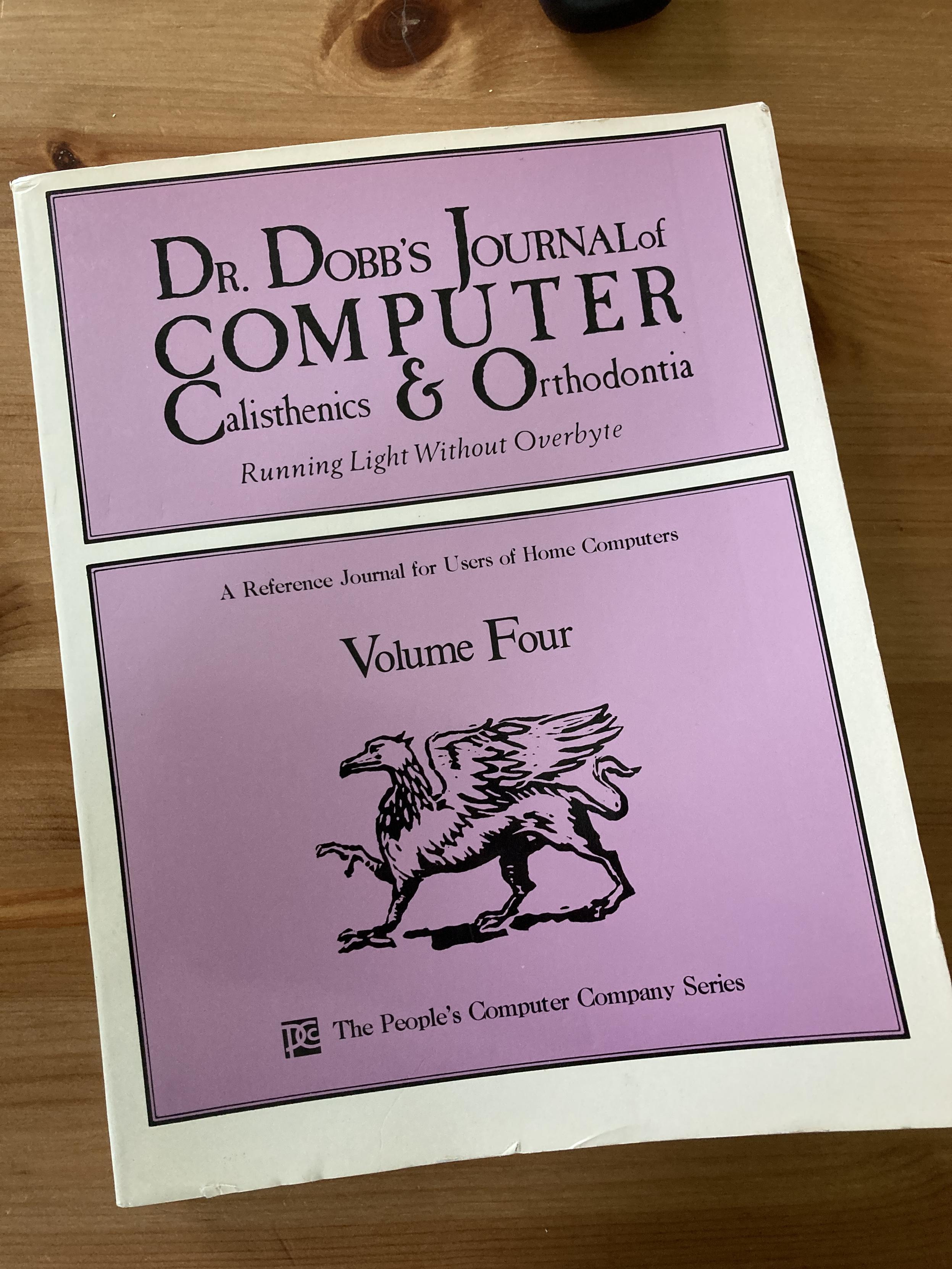
yesterday's mail included vol 4 of Dr Dobb's Journal - a kind of legendary programming and hardware guide of the 70s and 80s that I sadly was too young to find in the flesh as a kid
it took a few years to find this volume, and i'm elated that it is just as witty, fascinating and joyful as its reputation implies. each volume is a collection of previous issues of the journal - this one includes issues 31-40, all from 1979. it's heavy with zilog Z80 related programming, since that was the most popular (and cheap) consumer-hacker cpu in that period, as well as stuff for CP/M and the motorola 6800, MOS 6502, and Pascal.
to be honest, i'm not used to reading such helpful and insightful tips from other computer enthusiasts. there are no replyguys here - just fellow nerds excited about a new technique they want to share with others. this seems like an important lesson for now more than ever.
there are no religious wars over the One True Language or sniping over brands. just a bunch of folks just glad to find out that others are as excited as they are about generating prime numbers and Tiny BASIC.
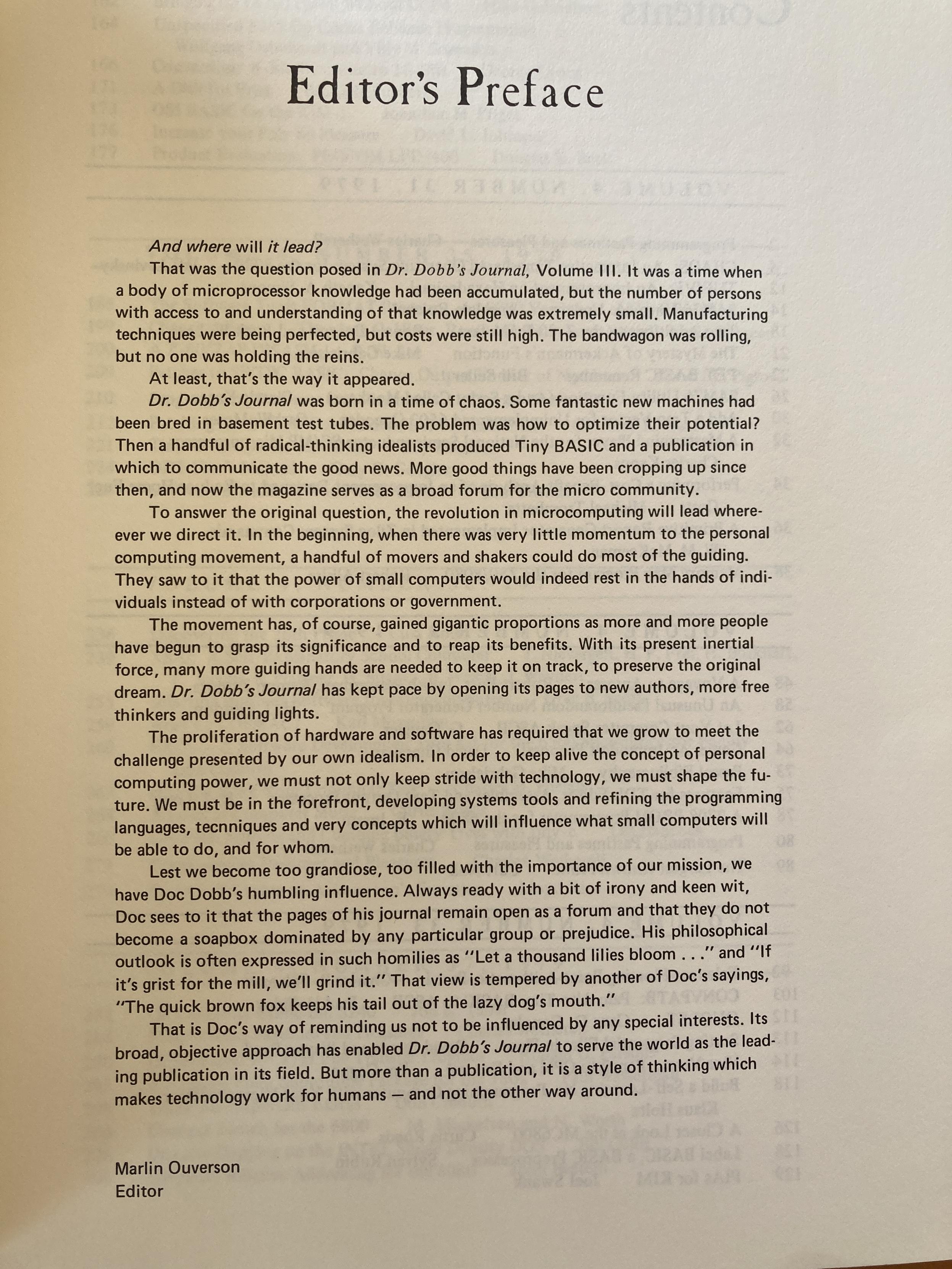
the editor's preface does such a great job of relating the friendly tone of the journal that i've included it here.
(besides - Running Light with No Overbyte has only become more important in light of recent computing history.)
Alt...
The front page of Dr Dobb's Journal of Computer Calisthenics & Orthodontia: Running Light Without Overbyte. A reference journal for Users of home computers, volume four, by the people's computer company.
Alt...
Editor's Preface:
And where will it lead?
That was the question posed in Dr. Dobb's Journal, Volume Ill. It was a time when
a body of microprocessor knowledge had been accumulated, but the number of persons
with access to and understanding of that knowledge was extremely small. Manufacturing
techniques were being perfected, but costs were still high. The bandwagon was rolling,
but no one was holding the reins.
At least, that's the way it appeared.
Dr. Dobb's Journal was born in a time of chaos. Some fantastic new machines had
been bred in basement test tubes. The problem was how to optimize their potential?
Then a handful of radical-thinking idealists produced Tiny BASIC and a publication in
which to communicate the good news. More good things have been cropping up since
then, and now the magazine serves as a broad forum for the micro community.
To answer the original question, the revolution in microcomputing will lead where-
ever we direct it. In the beginning, when there was very little momentum to the personal
computing movement, a handful of movers and shakers could do most of the guiding.
They saw to it that the power of small computers would indeed rest in the hands of indi-
viduals instead of with corporations or government.
The movement has, of course, gained gigantic proportions as more and more people
have begun to grasp its significance and to reap its benefits. With its present inertial
force, many more guiding hands are needed to keep it on track, to preserve the original
dream. Dr. Dobb's Journal has kept pace by opening its pages to new authors, more free
thinkers and quiding lights.
The proliferation of hardware and software has required that we grow to meet the
challenge presented by our own idealism. In order to keep alive the concept of personal
computing power, we must not only keep stride with technology, we must shape the fu-
ture. We must be in the forefront, developing systems tools and refining the programming
languages, tecnniques and very concepts which will influence what small computers will
be able to do, and for whom.
Lest we become too grandiose, too filled with the importance of our mission, we
have Doc Dobb's humbling influence. Always ready with a bit of irony and keen wit,
Doc sees to it that the pages of his journal remain open as a forum and that they do not
become a soapbox dominated by any particular group or prejudice. His philosophical
outlook is often expressed in such homilies as "Let a thousand lilies bloom .
it's grist for the mill, we'll grind it." That view is tempered by another of Doc's sayings,
"The quick brown fox keeps his tail out of the lazy dog's mouth."
That is Doc's way of reminding us not to be influenced by any special interests. Its
broad, objective approach has enabled Dr. Dobb's Journal to serve the world as the lead-
ing publication in its field. But more than a publication, it is a style of thinking which
makes technology work for humans - and not the other way around.
Marlin Ouverson
Editor

Alt...
A letter to the journal:
CONSERVING MEMORY
WITH THE HUFFMAN CODE
Dear Dr. Dobb's:
If you really want to conserve memory .
.. here are some
ideas borrowed from Information Theory to allow
English
language text to be stored very efficiently. It is an alternative
to the word-storage schemes proposed by Klaus Holtz in DDI
#33 and by Gordon Wilk in his DDJ #36 letter. It's called
a Huttman code.
Til describe the encoding method on a small. hvpothetical
alphabet rather than work with the entire ASCII set.
Suppose we
wanted to store
some text in the FERPOE
language, which uses only the letters A, B, C, D, and E. We
know that standard FERPOE contains the following distribu-
tion of letter frequencies:
Letter Probability
A .37
B .25
C .20
D .11
E .07
Instead of devoting eight or even three bits to each of these
characters in our computer encoding, it 1s more eltiCient to
use
fewer bits on the more trequent characters (e.g., A)
Morse code does this.
But how
do you
decide how many bits to use for each
character? There's a simple algorithm which finds the best
combination:
You write
down the probablities in a roW, and grow
Tree
by performing the following iteration until there 1s only
one
number in vour current row.
Iteration: copy the previous
IOW,
onv remove the two
smallest numbers rom the roW,
and write their sum in their
place.
For our FERPOE example, the tree looks like this:
![[?]](https://pouet.chapril.org/system/accounts/avatars/113/520/570/810/762/451/original/a93c5285ee50ac56.jpeg)
I'm done using AI – Brett Codes
https://brettcodes.com/im-done-using-ai/
> Why I'm stopping using AI for coding (and anything else) after using it earnestly for a year and coming to understand the harms it causes on personal, societal, and environmental levels.
Gamer+ Events
Chat with DJ Hairy Larry on Gamer+, Saturday night at 10:00 CDT, while we listen to Something Blue.
Every day, tob's Dubious Goals Committee is at 2:30 PM CDT. Something Blue follows Fridays at 3:00 PM CDT. MixRemix Creative Commons Jazz follows Mondays at 3:00 PM CDT.
Enjoy The Lispy, Gopher, Climate Show at zero hundred hours UTC each Wednesday. A
programming show with a focus on lisp and climate change.
Links in part 2
![[?]](https://polymaths.social/fileserver/01HCMX6M1CZNEVJ4F5H58TT5XJ/attachment/original/01JHC5KM5K0V0J0436SPD3F86H.jpeg)
New #blog #post: My Failed Tech Predictions
https://rldane.space/my-failed-tech-predictions.html
1637 words
cc: my wonderful #chorus: @joel @dm @sotolf @thedoctor @pixx @orbitalmartian @adamsdesk @krafter @roguefoam @clayton @giantspacesquid @Twizzay @stfn
(I will happily add/remove you from the chorus upon request! :)
#rlDaneWriting #blost #computing #phones #smartphones #enpoopification #retrocomputing #programming #slop #MacOS #Macintosh #data #InformationAge #SCSI #Mobile #TuringTest #LLM #LLMs #ChatBots
There are many cases of end users who are totally ignorant in LLM use cases
I've been able to educate one with success
When she realized that before her one query
- many megawatts were used to create the training regimen of the model
- Peta Bytes of copyrighted information was blatantly stolen without regard to ownership
- in turn sold for profit to companies
- while getting end users addicted to using them
...She realized what Destruction she was causing, on a Global Scale because she knows personally what Global Warming does in her Area of the Country were flooding regularly occurs due to Climate Shifts
#LLM #slop #hallucinations #AI #programming #coding #weather #climate #change
Gamer+ Events
part 1
Chat with DJ Hairy Larry every Saturday night at 10:00 CDT. Join the open music chat on Gamer+ while we listen to Something Blue.
Every day it's tob's Dubious Goals Committee at 2:30 PM CDT. Something Blue follows on Fridays at 3:00 PM CDT. MixRemix Creative Commons Jazz follows on Mondays at 3:00 PM CDT.
Listen at anonradio.net. Join sdf.org for free to join the DJ chat.
Programming used to be a mathematical act. But that has not been so for some decades, not since release cycles shrank from once every two years down to inhumanely short intervals. It now appears that mathematics, and indeed creativity, has no place in modern high-frequency CI/CD CRUD-grinding.
But even in this #AI Slop Age, life-critical #engineering work still demands #mathematical reasoning and #professional guarantees, under law. Software now plays a central role in this type of work. And software frailties have reached epidemic levels, from operating system kernels, device drivers, and up. Hence, #verified #programming has become an urgent necessity.
By “verified”, I mean not post hoc but ab initio verification, at every stage of the process: requirements analysis, specifications as propositions, computer assisted proofs, design synthesis, deterministic code transformation.
Many #IT software practitioners maintain that they neither know nor care about mathematics, and that they cannot afford mathematical frolics when there are profits to be reaped.
That economic argument is, at best, weak, in the modern, tightly integrated society, where the full cost of software failures is incalculable. Even amongst ordinary, but essential, business applications that cannot harm life and limb, a propagating cascade failure now has the potential to collapse the global economy, in an instant.
Be that as it may, such economic objections have no force at all against the legally mandated safety requirements of life-critical applications.
![[?]](https://cdn.masto.host/indiewebsocial/accounts/avatars/112/536/017/792/352/435/original/a87e9128d6303e02.png)
Tolkien‘s linguistic inventions are startlingly creative. In ordinary story telling, invented languages rarely appear, and if they do, they are just superficial props. But each of Tolkien‘s languages is complete—dare I say, “Turing complete”—equipped with its own origin story, evolutionary history, regional dialects, cultural functions, fully formed script, pronunciation, vocabulary, grammar, idioms.
#Tolkien’s originality, ingenuity, thoroughness, industry, and process could serve as inspirations in designing new #programming languages. We still stand to gain much, even if we #IT practitioners do no more than to look upon Tolkien’s life work as mere aspirations.
Modern computing began when models of computability were invented in the mid 1930s, by mathematicians, like Turing, Church, Kleene, et al. Within a decade, first commercial computers, designed by engineers from top academic institutions, were being sold. Within two decades, high-level programming languages FORTRAN, LISP, COBOL, and ALGOL emerged, also created by academics.
Today, though, the majority of software systems are now being cobbled together by those who know nothing of, and care even less of, the foundational #mathematics of computing—using #AI, but of course. Somewhere along the way, modern #software practices diverged from traditional #engineering practice.
That bifurcation point was when the once-united "computing team" splintered into architect (EE), algorithmist (CS), programmer (CS), coder (IT), operator (IT), etc. It was also at this point in time when the first commercial computers and early high-level #programming languages emerged.
Gamer+ Events
part 1
Chat with DJ Hairy Larry every Saturday night at 10:00 CDT. Join the open music chat on Gamer+ while we listen to Something Blue.
Every day it's tob's Dubious Goals Committee at 2:30 PM CDT. Something Blue follows on Fridays at 3:00 PM CDT. MixRemix Creative Commons Jazz follows on Mondays at 3:00 PM CDT.
Listen at anonradio.net. Join sdf.org for free to join the DJ chat.
ohhh this is just fascinating. it turns out that A Fool's Errand (a very eclectic tarot-themed puzzle game for the mac) by cliff johnson got a sequel 25 years later, called A Fool and His Money.
the sequel was built in Adobe (Macromedia) Director (!) of all things, and required a serial number/key file after 90 days, which you could only buy by emailing cliff and receiving a zipped keyfile
cliff stopped selling the game a few years later, and it completely disappeared.
out of pure frustration, Renzo Pigliacampo decompiled the compiled Director projector, and reassembled a working Director project out of it.
he does a great job of explaining the process of writing a keygen for a 10+ year old game here. it warms my heart to see Lingo code again after decades 😻
#programming #macromedia #macintosh

Alt...
A screenshot from the game A Fool and his Money. It shows a priest or knight of some kind atop a medieval horse. A castle is in the background, along with a medieval style sun. It is painted in a rainbow of colours.
Someone’s favourite #programming language can be likened to a knife. It could be a well made, but common, Swiss Army knife, or it could be a well made, and pricey, high carbon steel santoku hand forged by the last remaining blade master in Seki, Gifu Prefecture, whose ironworks date back centuries.
A knife user would not think of using his favourite knife, whichever type, to clean the toilet, to dig a trench, or to perform some other task for which the knife was not designed. And although he would use his favourite santoku in the kitchen daily, he would only pocket his SAK on a camping trip. The SAK is as generally applicable as a knife can be, but even this estimable knife has its limits.
Likewise, a programmer should select a #programming language that best fits a particular task. There is no such thing as the definitive GPL for all occasions. Every GPL is designed for a particular purpose with a particular axe to grind. A GPL is but a Turing-complete DSL in disguise.
It, therefore, behoves the programmer to learn, over the course of his career, as many languages from as many paradigms as practicable.
The ML family of #FP #programming languages—both eager (ML, SML, Caml, OCaml, F#, Reason, Idris, …) and lazy (Hope, Miranda, Haskell, Agda, …) varieties—are arguably the most ergonomic to use for offline system programming and for compiler implementation. SML and Haskell dominate amongst the #CS academic research language implementations, and OCaml amongst the #IT industrial strength language implementations.
Also, nearly every language that has become popular in IT since the early 2000s (Scala, Rust, Swift, Kotlin, Python 3, Mojo, Elm, Grain, Moonbit, …) has wholesale adopted ML’s type system and language constructs. Yet, the ML family remains unknown in the industry, and its direct influence upon all modern languages gone unacknowledged. Even OCaml and Haskell, despite their industry-wide notoriety, had somehow escaped broad adoption.
This situation is unfortunate, because the ML family of languages all have the unique ability to transform an average user into an effective theoretical thinker and an efficient practical doer.
![[?]](https://nfts.freeradical.zone/accounts/avatars/108/204/625/080/771/691/original/362d00d8ba9c6b95.jpeg)
pfft trying to figure out how to keep my skills sharp in these days where I'm mostly paid to boil the oceans managing a fleet of clanks, considering various languages I'd work in if I got to choose, circling around the idea of a project, wondering: is there a DICOM library for Haskell? Yes there is, and I'm a maintainer. https://hackage.haskell.org/package/dicom (for what it's worth, it's not nearly mature enough to be useful) #programming #haskell
You are a computer scientist working in interpretable machine learning. How did you end up working with the police to solve crimes?
Find out in #ACMBytecast episode 86, where host Rashmi Mohan interviews 2025 #ACMFellow Cynthia Rudin, a professor at Duke University.
The hardest thing in Dylan or any 🫰quote "normal" unquote🫰lang, is writing algebraic math when you're used to RPN or sexpr. Why am I putting one argument before the operator, the other randomly after, and having to figure out which ones happen first? Do people DO MATH like this‽
In theory I could just use +(a, b) (or does it need \+(a, b)? I'd try that in REPL but there isn't one).
![[?]](https://files.mastodon.social/accounts/avatars/115/742/434/865/105/205/original/ba2fa15026c28d18.jpeg)
Helix is a free, open-source code editor written in Rust with Vim-style modal editing, built-in LSP support, Tree-sitter syntax highlighting, and multiple cursors, no complex plugin setup required.
A fast, privacy-friendly editor for Linux, macOS, and Windows.
More details: https://digitalescapetools.com/tools/tool.html?id=helix
#OpenSource #Programming #Rust #CodeEditor #Linux #Privacy
Alt...
Screenshot of the Helix project page showing the Helix logo, release and build badges, contributor count, and an editor preview demonstrating split-pane code editing with documentation popups.
#lispyGopherClimate #archive #peertube #tech #podcast #lisp since 2022 it is Sunday morning in Europe.
https://toobnix.org/w/btRXHfYjMbGQjLZp72j2nP
My personal attempt at #orgmode babel #dev #programming #lisp #emacs .
Gamer+ Events
part 1
Chat with DJ Hairy Larry every Saturday night at 10:00 CDT. Join the open music chat on Gamer+ or Fluxer while we listen to Something Blue.
Every day it's tob's Dubious Goals Committee at 2:30 PM CDT. Something Blue follows on Fridays at 3:00 PM CDT. MixRemix Creative Commons Jazz follows on Mondays at 3:00 PM CDT. Listen at anonradio.net. Join sdf.org for free to join the DJ chat.
![[?]](https://friendica.world/photo/profile/wistquotes.png?ts=1766199542)
A quotation from Douglas Adams
I am rarely happier than when spending entire day programming my computer to perform automatically a task that it would otherwise take me a good ten seconds to do by hand.
Douglas Adams (1952-2001) English author, humorist, screenwriter
Last Chance to See, ch. 2 (1990) [with Mark Carwardine]
More about this quote: wist.info/adams-douglas/5406/
#quote #quotes #quotation #qotd #douglasadams #lastchancetosee #automation #computers #convenience #efficiency #investment #productivity #programming #return #roi #time #utility
![[?]](https://cdn.masto.host/mastodongamedevplace/accounts/avatars/000/005/502/original/ecb9c62c67de97bc.png)
What would a good replacement for the C language look like?
Assuming that for whatever reason Rust ain't it
![[?]](https://social.sdf.org/system/accounts/avatars/109/526/706/492/620/908/original/b35bbdfda0193c6f.jpg)
![[?]](https://cdn.masto.host/mastodongamedevplace/accounts/avatars/109/859/285/072/781/117/original/52b616f54f20c98f.png)
Generally in relational database structures do you think it's better for the child to point to the parent or the parent to point to the children?
#programming #postgres #database
| Parent points to children: | 1 |
| Child points to parent: | 9 |
| Both: | 3 |
Closed
![[?]](https://cdn.periwinkle.nl/Mastodon-System/accounts/avatars/109/518/953/659/246/493/original/99c6abc937c42737.png)
Of all the programming languages that I had to learn over the years, my favourite is still Pascal. Many programmers hate Pascal because it has such a rigid structure, but my Pascal code has much fewer bugs than anything I write in any other language, exactly because that rigid structure keeps me from making a lot of stupid mistakes.
#pascal #programming
![[?]](https://media.mastodon.de/accounts/avatars/116/172/905/014/578/882/original/4e2d3b525b2a2902.png)
Heads up for #golang Chatmail bots developers:
The Chatmail API for Go library got a new release to support the latest chatmail core 2.53.0
https://github.com/chatmail/rpc-client-go
#chatmail #deltachat #bots #dev #devs #developer #api #e2ee #privacy #security #opensource #go #programming #automation
Some of the simplest #programming languages are LISP, Forth, C, and Smalltalk. A working knowledge in any one of these languages can be acquired by an experienced programmer in a few hours. Thereafter, it takes another 10,000 hours of hands-on usage for that "experienced" programmer to master the "simple" language. This situation is analogous to a tourist learning to ask "Where is the toilet?" in a foreign language, as opposed to living in that culture and immersing in that language.
This is why it is generally counterproductive to pump out, nightly, new languages that are mere tweaks of old, established ones, or to design massive, feature-laden languages that tried to be all things to all programmers in all domains.
Every GPL is a Turing-complete DSL in disguise, and every Turing-complete DSL is a GPL in disguise.
Therefore, a more efficient (but not necessarily optimal) approach is for the language designers to create the smallest possible Turing-complete DSL for their favourite application domain by employing the latest ideas pertinent to that domain, and to resist the temptation to inflate the design with fancy, general features.
Gamer+ Events
part 1
Chat with DJ Hairy Larry every Saturday night at 10:00 CDT. Join the open music chat on Gamer+ or Fluxer while we listen to Something Blue.
Every day it's tob's Dubious Goals Committee at 2:30 PM CDT. Something Blue follows on Fridays at 3:00 PM CDT. MixRemix Creative Commons Jazz follows on Mondays at 3:00 PM CDT. Listen at anonradio.net. Join sdf.org for free to join the DJ chat.
A systems #programming language with all these characteristics does not exist, because these features are at odds with each other. But in a #dream, we must not let aspiration be bounded from above by attainability.😀
• Haskell-like syntax
• ML-like semantics
• Erlang-like resilience
• Elm-like courtesy
• Rust-like tooling
• OCaml-like compilation speed
• C-like execution speed
• Smalltalk-like simplicity
• JavaScript-like ubiquity
• Python-like popularity
• Fortran-like longevity
On the upside, we programmers have such a low standard for what constitutes a good language: if the designer manages to nail any two of those characteristics, most of us are pre-programmed to like that language.
I think programming languages have a tension between people trying to learn the language going "what the hell do these hieroglyphics mean, use keywords!" and people who know the language going "I just want to type less, let me use punctuation instead of words!"
I would just
- fetch a microcontroller
- program it
- add a micro led display matrix
- add CR2032 batteries, or
- dedicated small lipo rechargeable
- 3D print a enclosure
- get a custom made wrist band
...slap it on my wrist, depending on the power requirements of the microcontroller
Much more niche, totally unique no need for a factory produced Gizmo
There are countless Open Source Projects for something like this readily available
#Watch #binary #micro #controller #led #matrix #programming #OpenSource
![[?]](https://media.infosec.exchange/infosec.exchange/accounts/avatars/113/247/756/313/164/165/original/70ea71b3dff2cf65.jpg)

Browser-Based Euro Office Clone
This is an experimental, local-first project designed to demonstrate client-side managed functionality without requiring any setup. By leveraging the FileSystem API, it offers a unique approach to storing files directly on your device from your browser.
Current Features:
- PWA (Progressive Web App)
- Local-first storage
- Word processor
- Spreadsheet tool
- PDF capability
Coming Soon:
- Support for more file types
- Storage synchronization
- Collaborative editing
- Encryption at rest
- P2P file-transfer
Long-Term Goals (Clones of):
- NextCloud
- WhatsApp
- Instagram
- WeTransfer
Note: This project is experimental, far from finished, and presented strictly for testing, feedback, and demo purposes (USE RESPONSIBLY!).
Check out the demo version and let me know your thoughts!
Demo: https://enkrypted.chat/?tab=file
#WebDev #JavaScript #PWA #LocalFirst #OfficeSuite #FileSystemAPI #Tech #Programming #SoftwareEngineering #WebApps #Privacy #SelfHosted #NextCloud #P2P #WebDevelopment #IndieDev #Coding #DevCommunity #TechNews #AppDevelopment #FreeSoftware #BrowserApp
![[?]](https://cdn.masto.host/mastjohn1126com/accounts/avatars/115/981/910/993/463/416/original/00ac72837ce34a31.gif)
@Quentin
As you said, computers just work around these blockades. Passing the #Cloudflare gate does not prove a man's hand clicked on the box.
A machine can get around Cloudflare's blockade and write a post, all automated by a script.
Gamer+ Events
part 1
Chat with DJ Hairy Larry every Saturday night at 10:00 CDT. Join the open music chat on Gamer+ or Fluxer while we listen to Something Blue.
Every day it's tob's Dubious Goals Committee at 2:30 PM CDT. Something Blue follows on Fridays at 3:00 PM CDT. MixRemix Creative Commons Jazz follows on Mondays at 3:00 PM CDT. Listen at anonradio.net. Join sdf.org for free to join the DJ chat.
A bad, unsolicited advice from an old, irrelevant #programmer:
• All programmers proficient in Standard ML, OCaml, Hope, Miranda, Haskell, or another member of the ML family of FP languages—and are interested in system #programming—should pick up Rust, at some point.
• None should touch #Rust without first mastering at least one member of the ML family of languages and also C.
![[?]](https://social.retroedge.tech/media/47840eee-46bb-4d3c-b5c7-94fbb515fa9c/Avatar-CPU.jpg)
4.5.3. "The admonition, "Cypherpunks write code," should be taken
metaphorically. I think "to write code" means to take
unilateral effective action as an individual. That may mean
writing actual code, but it could also mean dumpster diving
at Mycrotronx and anonymously releasing the recovered
information. It could also mean creating an offshore digital
bank. Don't get too literal on us here. What is important
is that Cypherpunks take personal responsibility for
empowering themselves against threats to privacy." [Sandy
Sandfort, 1994-07-08]
https://cdn.nakamotoinstitute.org/docs/cyphernomicon.txt
Writing actual code is important.
#lispyGopherClimate (very) #live #podcast since 2022 : I currently have the flu, sorry everyone! Today my topic is:
Xanadu and The Madman, #ErikSandewall's side of #TedNelson's story.
https://toobnix.org/w/grQNigh7kFaE9QEjWDgthF
tl ; dl: the bifurcation is that where Ted Nelson picked #programming, Basic, not math and indie gamedevs, Erik Sandewall picked #lisp, math (KR) and *not programming*.
Also, the #environment and #KMP #haiku.
#lambdaMOO #liveChat as always. 0UTC Wednesdays! #RSS https://toobnix.org/feeds/videos.xml?accountId=580185

Alt...
A lispy gopher show unix_surrealism banner by analognowhere.com featuring the lisp alien's handnose reaching up to the gopher, perched atop a building with a poster having Erik Sandewall's face on it.
![[?]](https://files.mastodon.social/accounts/avatars/116/760/547/086/237/190/original/aa662ac1b5458476.png)
New instance, new #introduction time.
Formerly intrepidhero@vmst.io.
I post a lot of #hiking, #mountaineering, and #caturday pictures, #cooking, #gardening, #diy projects, esoteric #programming and grumpy #tech and #design thoughts, and #poetry, both my own and attributed. I like #scifi and #fantasy and when I post about politics it will get a CW.
Posts are meant to be ephemeral. Anything I want to keep up long term will end up on my website.
☮️


 🍵
🍵  boosted
![[?]](https://lazybear.social/system/accounts/avatars/000/000/001/original/3462887fef61ddb1.png)

So far for June's carnival, I got only ... @rl_dane 😔
Any #vim #neovim user that would like to write about it?
#opensource #linux #CLI #Shell #editors #mastodon #fediverse #bsd #programming #terminal
I've seen where Torvalds said that he considers them as just another tool in the Arsenal, he doesn't really care, if the code is good.
He doesn't want his time to be wasted He'll scream and shout if an LLM creates that time pit
These following words an extreme version of me would say
It looks like you will have to stop using Linux. Since from your perspective anything that uses remotely an LLM is bad, you will have to stop, otherwise you will contribute to the environment being destroyed willingly and actively
In practice that is impossible. If you drive a modern car it has the Linux kernel. If you have a smart TV or more you're also using the tainted kernel. Even if you have a stick which also streams or a camera you will have a Linux kernel in many cases.
These LLMs are an infection of the planet's code base
Since you're already using BSD a solution would be to cut using Linux on your computers drastically
These are some of the great textbooks to teach #UNIX #OS to #CS undies:
• V6, Lions
• SVR2, Bach
• MINIX3, Tanenbaum
• Xinu, Comer
• xv6 (V6 clone), Cox
But there is a space to create an even smaller, sleeker, simpler, study OS:
• Barebones 32-bit OS that runs on a cheap Cortex-M3 board (STM32 Blue Pill) or RISC-V board (ESP32-C6)
• Keep the code under 10k lines of C (or Ada, Rust, Zig, ...)
• Support only UNIX-like soft-realtime scheduling (no RTOS)
• Support user and kernel modes
• Multiplex the single-core CPU to multiple processes
• Map a handful of interrupts to signals
• Provide a subset of the POSIX API, just enough to run a simple I/O executable (button pushy/LED blinky) in multiple processes, simultaneously
• Single-user (root only) operation
• No security, accounting, etc.
• Shell on a terminal emulator, via a USB-TTL adapter
The goal is to create a smallest, simplest, bona fide OS for the cheapest ($0.99) hardware, so as to steer kids away from Scratch, MicroPython, Processing, and similar other harmful influences, during the early phase of their system #programming education.
To make explicit the implicit premise above, the marvellous Arduino teaches the kids to do the easy thing repeatedly, but a comparative-joke C64 forces the kids to do the right thing persistently.
It is infeasible to teach, in detail, the essentials of an OS (scheduling algorithms, process management, memory management, memory protection, authentication, authorisation, encryption, disc I/O, network I/O, graphics I/O, ...) in just one semester.
In contrast, the kids could master the above mentioned focused curriculum in just one semester, thereby gaining much confidence in system #programming.
Point me please, to projects which are heavily dependent on LLM code generation which are older than 10 years.
The Linux distributions I use, have no code which is 100% LLM generated
![[?]](https://media.mathstodon.xyz/accounts/avatars/116/122/256/786/759/322/original/65a587ebc1a2f9f5.png)
My take on LLMs in programming: https://gracefulliberty.com/articles/pragmatic-llms/
"I don't vibecode. I don't use LLMs willingly. Every line of code I write is my own or generated deterministically through a process I fully understand. Considering the world is divided over LLMs these days, I wanted to share my particular perspective on why I chose the path I have, as well as some of the places I do think LLMs are appropriate."
Gamer+ Events
part 1
Chat with DJ Hairy Larry every Saturday night at 10:00 CDT. Join the open music chat on Gamer+ or Fluxer while we listen to Something Blue.
Every day it's tob's Dubious Goals Committee at 2:30 PM CDT. Something Blue follows on Fridays at 3:00 PM CDT. MixRemix Creative Commons Jazz follows on Mondays at 3:00 PM CDT. Listen at anonradio.net. Join sdf.org for free to join the DJ chat.
React-like syntax with WebComponents.
After spending some time with Lit, I really appreciated its lightweight footprint but wasn't a fan of the class-based components. While Vue offers a great approach, I still prefer the intuitive nature of React's syntax for debugging and deterministic rendering. This led me to a challenge: could I build a UI framework using WebComponents that completely eliminates the need for transpilation?
I have written a breakdown of the concept, the architecture, and where I want to take it. I highly invite you to take a look, check out the code, and explore the live demo.
* How it works: https://positive-intentions.com/docs/projects/dim/dim-jsx-webcomponents
* Checkout the code: https://github.com/positive-intentions/dim
* Storybook demo: https://dim.positive-intentions.com
Please note, while the project is open-source, this is a personal exploration rather than an attempt to launch "yet another framework." It is not production-ready and is built for my own upcoming project migrations, but I am sharing it in hopes that the methodology is educational or interesting to the community.
I would love to hear your thoughts on this approach. Feel free to reach out if you have any questions or want to discuss the implementation details.
#WebDev #WebDevelopment #Frontend #FrontendDev #JavaScript #JS #TypeScript #TS #HTML #HTML5 #CSS #SoftwareEngineering #SoftwareEngineer #Coding #Programming #WebDesign #OpenSourceProject #IndieDev #SideProject #Tech #Technology #DevCommunity #Fediverse #FediverseDevs #WebStandards #CustomElements #ShadowDOM #VanillaJS #NoTranspiler #NoBuild #BuildStep #EsModules #ComponentDriven #UIUX #DesignSystems #TechExperiment #LearningInPublic #Developer #ComputerScience #OSS #Github #React #WebComponents #Lit #Vue #ReactJS #JSX #Storybook #TechArticle #TechBlog #TechWriting #WebDevArticles

Alt...
Dim
![[?]](https://fedi.bobadin.icu/fileserver/01JW8FA8KA9818YWHHBPPZ7TCK/attachment/original/01J0DHDSP9WC6YXEWC97N7TXKR.webp)


Devo smettere di fare ricerche in rete altrimenti trovo roba interessante e poi mi tocca passare le serate a casa davanti al pc 🤣
"I had the pleasure of serving as the summer instructor for 15-150, the introduction functional programming class for computer science students at Carnegie Mellon, in the Summer 2023 semester.
This course typically serves as the second or third course in the traditional computer science undergraduate sequence, a privilege which not many other universities get to enjoy, as functional programming is often considered a niche topic.
Despite this, I (and CMU) believe this to be of the utmost importance. A disciplined, type-oriented, safety-first view of programming can be of utmost benefit to burgeoning computer science scholars, and I have often heard feedback from students that it is has a transformative view on their perspective of computer science in general.
To that end, I have made my lecture materials from my iteration of the course available for free on the Internet. Please feel free to use this knowledge in any way that you see fit, and I hope that it aids you in your future endeavors."
Parliamo di programmazione funzionale e in particolare di StandardML. Magari può interessare a qualcunə...
https://brandonspark.github.io/150/
#functional_programming #functionalprogramming #standardml #ocaml #programming #dev
![[?]](https://soc.octade.net/octade/s/3f7f2b5eda4e392867c301c49c2daa16.png)
"Remember that there is a distinction between a programming language and a graphical user interface. Don't confuse snazzy graphics (generated using someone else's libraries and tools) with good programming."~ Bjarne Stroustrup (C++ Inventor)
@infostorm@a.gup.pe @hacking@a.gup.pe @c@a.gup.pe @programming@a.gup.pe @dev@a.gup.pe @quotes@a.gup.pe
#BjarneStroustrup #C #cplusplus #Hacking #Hackers #Programming #Programmers #Dev #Developers #Code #Coding #quotes #quotations