Search results for tag #instagram
![[?]](https://todon.eu/system/accounts/avatars/109/005/014/959/393/335/original/f315d5c682012c22.jpg)
‚Auf der Suche nach Minderjährigen will Meta Nutzer*innen auf #Facebook und #Instagram umfassend durchleuchten. Der Konzern will sogar die Knochenstruktur von Menschen auf Fotos auswerten. Wie gefährlich ist das? ….‘
Analyse von @sebmeineck
https://netzpolitik.org/2026/du-siehst-aber-jung-aus-meta-will-uns-bis-auf-die-knochen-ueberwachen/
#Netzpolitik #Überachung #Meta #Instagram #Altersverifikation #Datenschutz #Privacy #Technology #BigTech
![[?]](https://files.mastodon.social/accounts/avatars/109/999/119/965/425/489/original/0ac00ac2dda1354b.png)
I despise "it's just a prank bro" #influencers
I despise #pervertGlasses
However
What if someone used the glasses, on #Meta employees, as an act of #satire?
Amazingly, Meta:
1. shows why we are all here on the #fediverse away from corporate control,
2. and shows why their pervert glasses are so wrong:
"Meta removes stairist's [sic] critical video of employees filmed with company's glasses"
(for "bullying", from #Instagram)
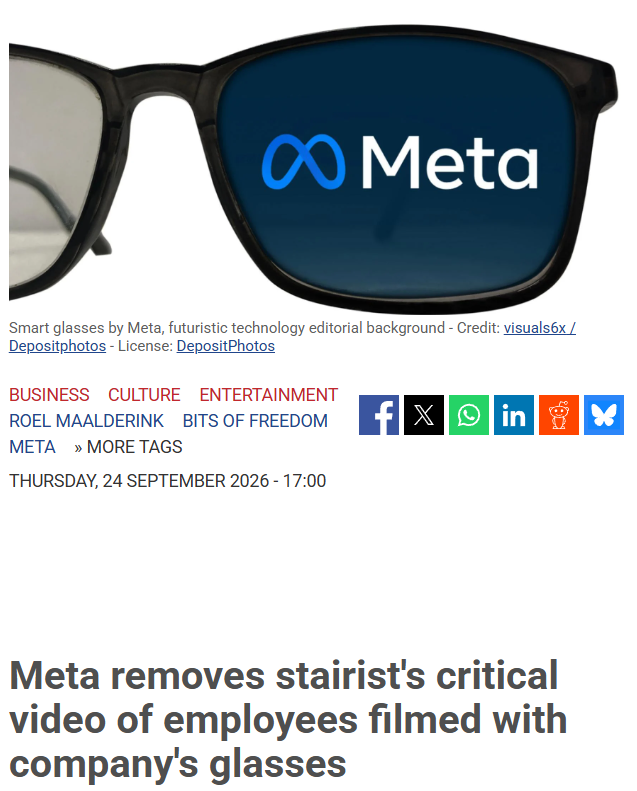
Alt...
Smart glasses by Meta, futuristic technology editorial background - Credit: visuals6x / Depositphotos - License: DepositPhotos
Business Culture Entertainment Roel Maalderink Bits of Freedom meta » More tags
Thursday, 24 September 2026 - 17:00
Opens in a new window
Opens in a new window
Opens in a new window
Opens in a new window
Opens in a new window
Opens in a new window
Meta removes stairist's critical video of employees filmed with company's glasses
![[?]](https://files.mastodon.social/accounts/avatars/116/914/446/363/148/343/original/b3e2e5f8bbdb529e.png)
The TRUTH about Mark Zuckerberg and #Facebook:
https://medium.com/@author_jcafesin/the-truth-about-mark-zuckerberg-7d5299bd160b
#instagram #greed #parenting #harvard #depression #socialmedia #zuckerberg #mentalhealth
![[?]](https://files.mastodon.online/accounts/avatars/109/298/185/928/165/179/original/8ed3da9f519c2f00.jpg)
Anyone else hate META's help service (or lack thereof)?
Having just experienced an Instagram lockout for no apparent reason, I have found it impossible to get assistance, so..... a new Instagram account for Global Museum is the only answer. I just regret losing the 6,000+ subscribers from the original site and hope some of them will
join us here:
https://www.instagram.com/globalmuseum_news/
#globalmuseum #Instagram #META
![[?]](https://nbg1.your-objectstorage.com/tno-mastodon/accounts/avatars/111/434/264/745/920/273/original/52ff85db085a2a1d.jpg)
![[?]](https://media.mastodon.de/accounts/avatars/116/172/905/014/578/882/original/4e2d3b525b2a2902.png)
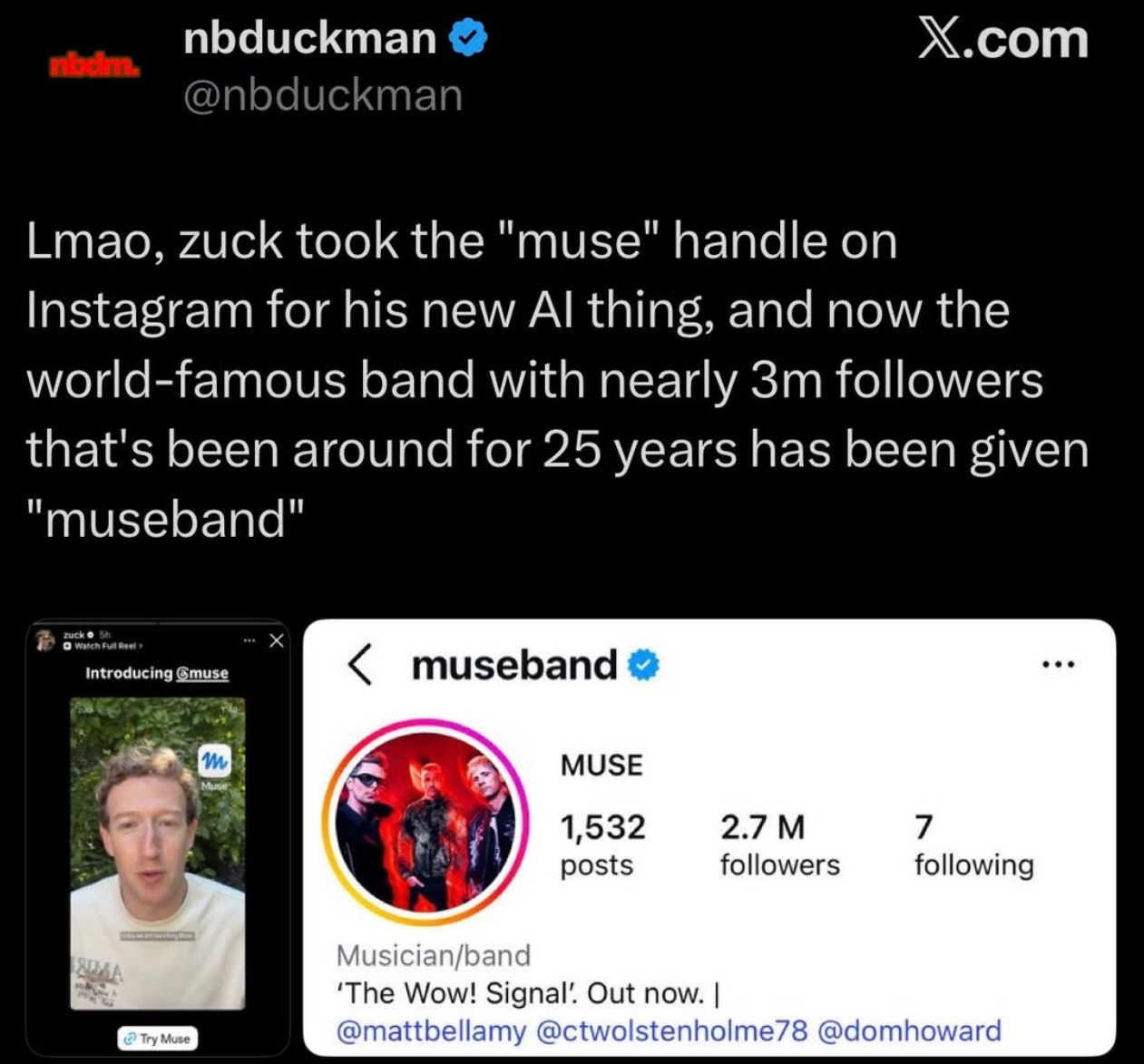
this is why people shouldn't be using centralized trash platforms like Instagram
get this and more content in the Meme Logistics Channel - Your go-to fun lefty memes supply chain
#meta #instagram #muse #memes #politics #fun #meme #channel #decentralization #encryption #e2ee #ArcaneChat #DeltaChat
![[?]](https://file-is.no-pony.farm/accounts/avatars/110/057/136/931/675/789/original/6a6100db62aabbbf.gif)

The path to hell has always been easy, whilst the path to heaven has always been a rocky one. It’s simply a question of what you want: immediate comfort or future happiness.
![[?]](https://social-cdn.vivaldi.net/system/accounts/avatars/109/553/464/208/348/012/original/1c9c4b7d2455a827.png)
Most businesses create social media accounts, and the reason is obvious: to reach customers and partners.
But imagine living in a world dominated by major tech platforms, walled gardens where millions, sometimes billions, of people interact every day. That’s our current reality, shaped by growing corporate control over our digital lives.
Now think of any small business you know: a bar, a restaurant, a tattoo studio, a local shop, a vet clinic…
If most people are still on traditional platforms, what arguments would you give a small business to convince them to share their content on #Pixelfed or #Mastodon, instead of staying on #Instagram or moving to #Bluesky?
Have you tried already? What were the results?
@peachfront But isn’t it easier for a small business that depends on face-to-face networking to succeed on a platform that almost everyone already knows and uses?
Last weekend, I joined a guided tour, and afterwards almost everyone exchanged Instagram accounts.
The tour was excellent, and I could see how hard the owner is working to build a community of people interested in history. He also creates very interesting posts on Instagram, which clearly take a lot of time to prepare.
Doing that through a Fediverse account would be much harder at the moment, if possible at all, given both its smaller user base and the limited overlap with the business’s target audience.
Buried in #Meta’s $18B settlement is a legal pass on kids’ data
https://techcrunch.com/2026/08/27/buried-in-metas-18b-settlement-is-a-legal-pass-on-kids-data/
![[?]](https://files.defcon.social/dcsocial-s3/accounts/avatars/116/320/959/991/819/923/original/e2ac7c79827e9de1.jpg)
JUSTICE: HOW TO KILL META!
========================
The legal math on media is broken. The punitive measures are not effective deterrents.
If you look at the numbers, Meta does harmful things, apologizes, pays a pittance, and still comes out ahead financially.
Zuckerberg sold out his users data to Cambridge Analytica, influencing the US election. Then he appeared before Congress like a contrite little schoolboy - "Oops! I didn't mean to accidentally cut multibillion dollar deals and sell out Facebook users. Honest mistake. I promise not to do it again ( unless the price is right! )"
Because of the math, he still came out ahead.
I left Meta's platforms a long time ago.
People who are not savvy, are locked into the Facebook walled garden, because of the Network Effect. ( "I can't leave Facebook. All my friends are on Facebook!" )
Having liberated ourselves, it is our duty to liberate others, who are still trapped, to give them their right to privacy.
Here's a plan of action:
1) Place ads on Facebook, explaining the benefits of #Mastodon
( https://joinmastodon.org/ )
1.1) Freedom from Meta's censorship and algorithms.
1.2) A community owned, open social media platform.
2) When a user clicks, guide them through exporting their data from Facebook, and deleting their Facebook account.
3) Give them an optional questionnaire, asking about their interests, and match them with the right Mastodon instance.
4) If they skip the optional questionnaire, pick a random Mastodon instance for them.
5) Give them an option to enter into a Facebook migration registry.
6) Help them set up a Mastodon account and import their data.
7) If they opted into the migrant registry, reconnect them with their former Facebook connections, who also joined the registry. Like a reunion in Heaven with your loved ones. ☺️
#FaceBook #Meta #instagram #WhatsApp #SocialMedia #Fediverse #Mastodon #Technology #Tech #Justice
#FuckZuck #FOSS #Linux #OpenSource #Freedom #Liberty
#Law #USA
![[?]](https://babka-mastodon.nyc3.cdn.digitaloceanspaces.com/accounts/avatars/110/442/989/214/760/177/original/ac89244bf463bb3e.jpg)
"Last week, #DaraHorn was hosted on #HavivRettigGur’s #podcast, “#AskHavivAnything,” to discuss her past #book and her soon-to-be-released book, both of which argue that #Holocaust #education in the #UnitedStates commonly fails to teach about the #Jewish people and #antisemitism, with possible negative consequences.
As #Horn has famously put it, our world seems far more invested in teaching about “dead #Jews” than about Jewish life. She suggests that this approach may reinforce the very hatred it is supposed to inoculate against.
Within hours of that episode airing, #Instagram accounts were using clips from the podcast to accuse the #Holocausteducation organization I work for of harming Jews. I am certain this is not what Horn intends, but one consequence of her argument is that it can easily be reduced to the belief that “Holocaust education does not work.”
It does, in fact, not work and the positive indicators in the article make Horn's case not Cunningham's. 🙄
https://blogs.timesofisrael.com/does-it-matter-if-kids-learn-about-dead-jews/
![[?]](https://s3.masto.ai/accounts/avatars/109/303/982/217/898/173/original/84b53833e9214e09.png)
In a dramatic capitulation, the owner of #Facebook & #Instagram agreed to the financial penalties for violating federal #child #privacy & states’ #ConsumerProtection laws, the #states announced. #Meta also agreed to limit how long #teenagers can spend on its platforms & to bans on features that stoke #MentalHealth issues,striking at the heart of the company’s business of #engagement for advertising.
![[?]](https://sfo3.digitaloceanspaces.com/veganism-space/accounts/avatars/113/793/819/237/828/375/original/40c87f2268ab00a4.jpeg)
@fediverseconnection @leanderlindahl
well, then you can make the video available on #mastodon.
download it from #youtube (or #x, #instagram, #facebook, or whatever) and share it here, for example with #ytdlp or #tubular.
![[?]](https://i0.wp.com/rbfirehose.com/wp-content/uploads/2021/01/cropped-Blank-512-x-512.png?fit=512%2C512&ssl=1)
404 Media: The Government is Monitoring Anti-Flock TikTok and Instagram Accounts. “Government surveillance centers are monitoring viral anti-Flock Instagram posts, warning local police about upcoming DeFlock events including one scheduled to start next week, and have told cops to ‘increase patrols around ALPR [automatic license plate readers]’ as backlash to Flock grows, according to government […]
https://rbfirehose.com/2026/08/17/404-media-the-government-is-monitoring-anti-flock-tiktok-and-instagram-accounts/![[?]](https://m-cdn.flipboard.social/accounts/avatars/110/068/762/697/825/294/original/d3f34437c275e777.jpg)
Are you on Instagzam? The social platform has redesigned its wordmark logo — supposedly after exploring hundreds of options — and the internet doesn't like it. Here's more from @Mashable.
The Government is Monitoring Anti- #Flock #TikTok and #Instagram Accounts
https://www.404media.co/the-government-is-monitoring-anti-flock-tiktok-and-instagram-accounts/
Jury selection is on Wednesday, with opening statements slated to begin August 18. #Meta founder and CEO #MarkZuckerberg is expected to testify, as is #Instagram head #AdamMosseri.
In terms of potential damages & implications for Meta, the trial is the biggest test yet of youth #socialmedia litigation & comes amid a broader reckoning across the globe over social media's effects on young users.
#law #privacy #infosec #tech #engagement #addiction #MentalHealth #business
#Meta faces biggest #court fight yet over #socialmedia’s impact on #children
Meta Platforms will face a coalition of state attorneys general in a California #FederalCourt trial beginning on Wednesday over claims it engineered #Facebook & #Instagram to be #addictive to children, a case that could expose the company to massive damages & force it to make sweeping changes to its platforms.
#law #tech #MentalHealth #business
https://www.reuters.com/business/meta-29-states-head-court-biggest-test-yet-youth-social-media-litigation-2026-08-12/
 boosted
FUCK ZUCK! ( Here’s how! )
Zuckerberg sold out his users data to Cambridge Analytica, influencing the US election. Then he appeared before Congress like a contrite little schoolboy - "Oops! I didn't mean to accidentally cut multibillion dollar deals and sell out Facebook users. Honest mistake. I promise not to do it again ( unless the price is right! )"
I left Meta's platforms a long time ago.
Having liberated ourselves, it is our duty to liberate others, who are still trapped, to give them their right to privacy.
People who are not savvy, are locked into the #Facebook walled garden, because of the Network Effect. ( "I can't leave Facebook. All my friends are on Facebook!" )
Here's a plan of action:
1) Place ads on Facebook, explaining the benefits of #Mastodon and the #Fediverse
1. Freedom from Meta's censorship and algorithms.
2. A community owned, open social media platform.
3. Free and Open Source software.
https://fediverse.info/
2) When a user clicks, guide them through exporting their data from Facebook, and deleting their Facebook account.
3) Give them an optional questionnaire, asking about their interests, and match them with the right Mastodon instance.
4) If they skip the optional questionnaire, pick a random Mastodon instance for them.
5) Give them an option to enter into a Facebook migration registry.
6) Help them set up a Mastodon account and import their data.
7) If they opted into the migrant registry, reconnect them with their former Facebook connections, who also joined the registry. A reunion with your loved ones in a place without darkness. ☺️
#FuckZuck #Meta #instagram #WhatsApp #SocialMedia #Fediverse #Mastodon
‚Meta wertet das Wort »Antifa« in Verbindung mit »Gewalt« künftig als potenziellen Verstoß gegen seine Richtlinien – allerdings mit unklaren Regeln!
Die Aufforderung »Nazis jagen« in Verbindung mit »Antifa« könnte bei Instagram und Facebook zur Kontosperrung führen.….‘
#Facebook und #Instagram weiten Sanktionen zu #Antifa aus
Don’t say Antifa!
Wie Meta den Rechtsstaat und die europäische Medienregulierung herausfordert.
‚Meta hat angekündigt, „Antifa-Inhalte“ auf #Instagram und #Facebook künftig als Risikoinhalte einzustufen, die schneller Gefahr laufen, sanktioniert zu werden.
Damit reiht sich der Konzern in den Kampf der Trump-Regierung gegen „die“ Antifa ein und zeigt erneut, welche direkten Auswirkungen dieser Kampf auf #Deutschland und #Europa hat…..‘
https://verfassungsblog.de/antifa-meta-dsa/
#Antifa #Antifaschismus #Repression #USA #Meta #Trump #socialMedia #Antireport
![[?]](https://mediacdn.aus.social/accounts/avatars/116/922/124/533/000/919/original/c6e935addfe77148.png)
LEAVING META
WITHOUT LEAVING YOUR LIFE 💎
After my posting about Meta over the past two days, one thing became very clear.
A lot of people would LIKE to leave Facebook, Instagram, or both. But parts of their actual lives are all tangled up in them.
So don’t make leaving a purity test. Start somewhere. Remove Facebook from your phone and use it only on your laptop, or better still, only on your desktop when you genuinely need it.
STOP POSTING TO META. STOP FEEDING THE TIMELINE.
Move conversations with real friends to your email, text, Signal, phone calls, Mastodon account, or wherever works for you, away from Meta.
TELL PEOPLE WHERE ELSE THEY CAN EASILY FIND YOU.
If you run a business, start putting your email address and/or website URL everywhere you promote your business so Facebook is not your only front door.
Download anything you actually want to keep. Then, when you’re ready, deactivate or delete what you no longer need.
Maybe you keep Messenger for Aunt Doris. Maybe you keep Instagram because your local café apparently believes websites were abolished in 2014.
Fine.
The point isn’t ideological cleanliness.
THE POINT IS REDUCING YOUR DEPENDENCE.
Every conversation you move elsewhere is one conversation Meta no longer owns the doorway to.
YOU DON'T HAVE TO ESCAPE THE META CAGE IN ONE HEROIC LEAP.
Just start opening the door.
#Meta #Facebook #Instagram #SocialMedia #Fediverse #people #DEPENDENCE #Messenger

FACEBOOK IS TOXIC. META IS AWFUL.
WHY CONTINUE FEEDING IT? 💎
Nearly everyone complains about Facebook and Meta.
The algorithms are toxic.
The advertising is invasive.
The outrage is manufactured.
CHILDREN ARE BEING HARMED.
Privacy is disappearing.
And then millions of people open Facebook or Instagram.
Again.
And again.
I genuinely do not understand it.
If you believe these companies are damaging children, manipulating attention, and making billions from human vulnerability, why are you still giving them your presence?
Especially the parents.
If Facebook and Instagram are unhealthy for your children, what exactly are you modeling by remaining there yourself?
“We know this place is harmful, darling, but Mummy and Daddy have photographs to look at.”
I left Meta years ago.
I didn’t die.
My friends did not evaporate.
Civilization continued.
There is email.
There are phones.
THERE IS THE OPEN WEB.
There is even the terrifying possibility of seeing another human being, god forbid, in person.
Meta survives because people who complain about it continue supplying exactly what it needs:
Their attention.
Their relationships.
Their outrage.
THEIR CHILDREN.
You do not have to wait for Zuckerberg to become a better person.
You can simply leave today.
The door swings both ways.
@DigitalCoup
@economics_that_works
#Facebook #Meta #Instagram #SocialMedia #Algorithms #BigTech #DigitalWellbeing #OnlineSafety #ChildSafety #Privacy #AttentionEconomy #TechEthics #SocialMediaAddiction #Zuckerberg #DeleteFacebook

Doomed civilization up in here.
"#Antisemitic content is nearly seven times more likely to appear among an #Instagram clip account’s most-viewed videos than other content, according to a new report published by the #ARC.
Antisemitic videos made up just 4.7% of all content the ARC sampled for the study — 92 of 1,960 videos. But they accounted for 32% of each account's fifteen most-viewed videos (24 of 75), making them 6.8 times more likely to appear among an account's top-performing videos.
"For years, we've understood #online #antisemitism through coordinated campaigns and bad actors," said ARC Research Associate #OliverMarks. "However, our new research suggests that model is no longer sufficient on its own. A growing share of antisemitic content isn't the product of genuine belief, but rather a byproduct of an attention economy that rewards whatever performs."
![[?]](https://polymaths.social/fileserver/01HCMX6M1CZNEVJ4F5H58TT5XJ/attachment/original/01JHC5KM5K0V0J0436SPD3F86H.jpeg)


 🍵
🍵  [
[#Loops objectively has a problem with loud videos.
It's very user-hostile to be flipping through quiet scenic videos to have it followed up immediately with an eardrum-splitting attention-seeking noise video, or even a valid artistic video like loud concert.
Audio normalization should be built into the app. Also, a way to skip all videos from a particular account without blocking them. I don't want to block accounts that post annoying videos from interacting with me in the comments or whatnot, I just don't ever want to see them in the feed. It's two separate things.
Less objectively, and more of a personal opinion, I find it deeply unfortunate that Loops thinks it wise to model their UI/UX on the absolute flaming dogpoop of platforms like #TikTok and #Instagram.
Give me a [playhead], for the love of God. Don't make me re-watch the entire bloomin' three-minute video just to re-play a single word I missed. 🤦♂️🤦♂️🤦♂️
#SocialMedia addiction lawsuit against #Meta is dropped
https://techcrunch.com/2026/07/22/social-media-addiction-lawsuit-against-meta-is-dropped/
#Meta removes controversial #AI feature on #Instagram after backlash
https://techcrunch.com/2026/07/10/meta-removes-controversial-ai-feature-on-instagram-after-backlash/
![[?]](https://s3.masto.ai/accounts/avatars/109/362/205/812/724/698/original/4b311491619a6f67.jpg)
Meta pulls new AI image feature after days of backlash
https://www.bbc.com/news/articles/c2dy6e8klw0o
'The feature quickly sparked blowback due to privacy concerns, leading Meta to admit it had “missed the mark" so it was "no longer available”.
Muse Image was the tech firm's first foray into AI image generation but faced backlash as Instagram users were opted in by default. '
![[?]](https://media2.ai6yr.org/accounts/avatars/109/321/592/360/914/018/original/f918064fa4350d36.jpg)
"...To do so, users must go to Instagram's settings menu, select "Sharing and Reuse" and switch off "Allow people to reuse your content on Instagram and with AI features at Meta" for posts and reels...." #instagram #AI #privacy #meta
BBC: Outcry as Meta lets users make AI images from public Instagram profile pics
![[?]](https://weredreaming.com/mookie/s/avatar-c033319a3a3d5098e5af08a922200981.png)
![[?]](https://files.mastodon.social/accounts/avatars/116/751/863/753/392/750/original/be14ea1ddc815e7d.png)
Your public Instagram photo is now raw material for anyone's AI. Meta's Muse Image remixes public profiles into new images with no consent and no notice. Public Citizen calls it an egregious invasion of privacy and wants Congress to require opt-in first.
Meta's new Muse Image lets anyone tag a public Instagram account and turn its photos into AI images, no notice to you, opted in by default. Opting out only stops future ones. Block it: Instagram > Sharing and reuse > turn off AI content, or go private.
![[?]](https://files.mastodon.social/accounts/avatars/115/437/433/456/398/299/original/45147e3ef33b8148.png)
Instagram is expanding its AI features.
Users can now generate AI images using public Instagram profiles by tagging accounts in their prompts.
The feature only works with public photos, raising new conversations about AI, creativity, and online privacy.
What do you think about this change?
#Instagram #AI #ArtificialIntelligence #TechNews
Here are some gems from our How-to Magazine:
How to stop people using your face on Instagram, escape being tracked via your TV and reclaim ownership of your digital media.
Instagram: https://flip.it/E4dlzt
TV tracking: https://flip.it/YHvZzG
Digital ownership: https://flip.it/Ci6IVZ
Follow our hand-curated Flipboard Magazine How-to Tech for more:
https://flipboard.com/@tech/how-to-tech-3bhnj0qgy
#Meta Now Lets Anyone Use Your #Instagram Photos in #AI Images—Unless You Opt Out
![[?]](https://libranet.de/photo/profile/wthinker.jpeg?ts=1610129688)
Мордобуку с его инстахламом пытаются вчинить иск на 1,4 триллиона баксов.
Тридцать три штата объединились, чтобы подать в суд на компанию Meta, утверждая, что она эксплуатировала своих юных пользователей в Instagram и Facebook ради прибыли, в том числе путем сбора данных о детях без согласия родителей. Четыре из этих штатов — Калифорния, Нью-Джерси, Колорадо и Кентукки — также утверждают, что компания вводила потребителей в заблуждение относительно вызывающих привыкание функций дизайна платформ, что приводило к проблемам с психическим здоровьем у детей, которые пристрастились к ним с раннего возраста.
Источник: gizmodo.com/metas-teen-safety-…
Слабо верится, конечно, что получится. Пока мета ушла в глухую несознанку, благо денег на адвокатов хватает. Но даже если потреплют и опустят их хоть на четверть суммы, всё равно будет приятно и, возможно, станет прецендентом для будущих дел.
#meta #facebook #instagram
![[?]](https://media.mas.to/accounts/avatars/109/297/232/151/260/983/original/9041d06e741d419a.jpg)
If you're willing to set his yacht on fire you should be willing to delete his apps.
(Also deleting his apps is safe and legal.)
#instagram is currently down, time to pester your friends with recommendations to switch to #fediverse
https://downdetector.com/status/instagram/
#mastodon #federation #meta #digitalindependence #autonomy #diday
![[?]](https://social.heise.de/__virtual/accounts/avatars/112/881/119/160/228/266/original/baf7ad72ec92f728.jpg)
Consumer advocates demand Safety by Design for all instead of social media bans
The vzbv investigated Facebook, Instagram, Snapchat, TikTok, and YouTube: Addiction-promoting mechanisms and dark patterns endanger minors despite the DSA.
#DigitalServicesAct #Facebook #Instagram #Netzpolitik #Snapchat #SocialMedia #TikTok #Verbraucherschutz #YouTube #news
![[?]](https://media.mas.to/accounts/avatars/109/442/454/487/918/952/original/d8a5f7a5f95ae2cb.png)
#Meta Lobbies #Congress For Protection From Child-Harm #Lawsuits
Meta has lobbied the U.S. Congress for legal immunity from child-harm claims tied to social media products such as #Instagram , as it faces thousands of lawsuits from young users and their families, according to a source familiar with the matter and proposed legislative language reviewed by Reuters. If adopted by lawmakers and passed into law as part of the #KidsOnlineSafetyAct (#KOSA ) under consideration in the U.S. Senate, such a provision could undermine thousands of lawsuits against Meta and other online platforms over harms to #children.
#socialmedia #security #privacy #childharm
![[?]](https://media.wired.com/photos/615e2b8ce78a8cd913bbaa76/16:9/w_1280,c_limit/wired_bug.jpg) WIRED - The Latest in Technology, Science, Culture and Business [Unofficial] » 🌐
WIRED - The Latest in Technology, Science, Culture and Business [Unofficial] » 🌐
@wired.com@web.brid.gy
Meta Tapped a Pentagon Supplier to Prototype Face Recognition for Its Glasses
Rank One, whose board includes a former CIA deputy director and a former FBI science chief, supplied face recognition to Meta for internal development of its smart glasses app.

Alt...
Meta Tapped a Pentagon Supplier to Prototype Face Recognition for Its Glasses
![[?]](https://cdn.masto.host/fashionsocialhost/accounts/avatars/109/358/934/329/870/517/original/470d84acde4323b6.jpg)
This story has been updated to include Huffer’s statement this morning. https://lucire.com/insider/20260604/model-calls-out-huffer-over-alleged-ai-use/ #Huffer #AI #Instagram #fashion #mode #moda
![[?]](https://soc.octade.net/octade/s/3f7f2b5eda4e392867c301c49c2daa16.png)
https://www.youtube.com/watch?v=CA_hmtuAPTY
[copypasta]
Did the Algorithm Change Your Decisions? | How Your Feed Was Engineered
Right now, somewhere on the internet, a video is being uploaded.
Within seconds, a system that no one elected, no one audits, and no one fully understands decides whether anyone else will ever see it.
Sometimes, it decides no one should.
And that’s the end of it.
In this episode of Plain Meaning, we examine how the modern internet quietly transformed from a system designed to deliver information… into one that decides what information exists for you at all.
It didn’t happen all at once.
It happened step by step.
Feed by feed.
Platform by platform.
Until nearly everything you see online is filtered through a machine making decisions on your behalf.
We trace how:
• Social media moved from profile pages to infinite feeds
• Facebook’s News Feed shifted from chronological to algorithmic control
• Advertising—not user experience—drove the need to control timing and visibility
• “EdgeRank” introduced the first large-scale automated editorial system
• By 2016, every major platform—Facebook, Instagram, Twitter, YouTube—had adopted algorithmic feeds
• Recommendation systems replaced direct navigation across the entire internet
But this isn’t just a story about technology.
It’s a story about incentives.
Because once platforms controlled what you saw, they didn’t just control engagement.
They controlled attention.
And once attention became the product, the system began optimizing for something far more powerful than clicks.
We examine what happened next:
• How foreign influence operations exploited algorithmic feeds during the 2016 election
• The role of Cambridge Analytica and its parent Strategic Communication Laboratories in psychological targeting
• The scale and strategy of Russia’s Internet Research Agency
• How fake local news accounts built trust before deploying disinformation
• Why most influence content wasn’t political—but divisive
• How algorithms amplified all of it without distinction
And then we go further.
Because 2016 wasn’t the end of the story.
It was the beginning.
We look at how:
• Algorithmic systems shape not just what you see—but how you think
• Platforms reward emotional, extreme, and addictive content
• Foreign-owned platforms introduce new geopolitical risks
• Systems like ByteDance’s TikTok operate differently across countries
• The same algorithmic architecture can produce completely different realities depending on its objectives
This episode is not about one platform.
It’s not about one political party.
And it’s not about one country.
It’s about the system itself.
Because the algorithm isn’t just recommending content.
It’s acting as an editor.
And most of the time, you don’t even realize it’s there.
By the end of this video, the next time you open a social media app, you’ll understand:
Why your attention isn’t fully yours.
Why the world you see isn’t necessarily the world that exists.
And how to recognize when a machine—not you—is deciding what matters.
#Algorithm #SocialMedia #DigitalMedia #YouTube #Facebook #Instagram #NewsFeed #TikTok #Twitter
[/copypasta]