Search results for tag #infosec


 🍵
 [
I worked in #infosec in the "naughties." Even back then, I thought the prevalent concept of "security as a product" was laughable.
With all of the stuff that's going on today, I wish we'd just start over from scratch using NASA Apollo-esque coding standards. Do less, and make it solid. Heck, go for some Djikstraesque "provability." I dunno. Everything is just so slipshod.
(And to those reading, I'm not saying that as an attack on the PHP devs. They're doing the best they can with the resources they're given, and should be commended for working so hard to hold up 70% of the web, for crying out loud)

@briankrebs 🚨 A critical vulnerability🚨 affecting all PHP versions back to 5.4 allows attackers to execute arbitrary commands on the server without authentication. If you are responsible for any public-facing PHP-based system (Wordpress, forums, etc.) you'll want to take immediate action.
Reports call this one of the most serious security issues #PHP has ever faced. Working exploits are publicly available and attacks are underway. Reuters reports that government websites across Europe and elsewhere have been taken offline to prevent their attack.
Mitigations can be applied to the PHP.INI configuration file for immediate protection, but the PHP binaries should be updated. Patched releases are 8.2.35, 8.3.36, 8.4.27 and 8.5.12.
The PHP project's home page has all the details and mitigations: https://www.php.net/ #Infosec


Embargo is lifted. #PHP #CVSS10 #infosec
https://github.com/php/php-src/security/advisories/GHSA-w8hw-w9fx-j79w
https://github.com/php/php-src/security/advisories/GHSA-6wmf-4rv5-p3rp
Patched versions:
- 8.5.12
- 8.4.27
- 8.3.36
- 8.2.35
(Some operating systems backport fixes and may have a different version number with the fix. I personally use deb.sury.org on Debian/Ubuntu to have some sanity, but not everyone does, so check your OS for specific guidance.)
I saw the news about the compromised TLS certificates here on mastodon first.
Then I saw the jokes about "4" here.
But I had to search to find any coverage stating that "4" was literally the private key.
Here you go.
https://www.reddit.com/r/linux/comments/1xau81w/leaked_ssl_intermediate_certificates_https
"Edit: EM OV TLS CA - G3C has 4 as its private key. The number 4. 0x4."
And the detailed coverage that doesn't mention "4"
https://thehackernews.com/2026/10/eight-emudhra-ca-keys-compromised.html

Ugh. Ampath patient records stolen in data breach: https://techcentral.co.za/ampath-breach-no-evidence-test-results-taken/287314/?utm_source=MastodonAfrica
If you've ever had blood work done in South Africa, chances are, Ampath has your details. :/

Elena Reshetova opening @LinuxSecSummit EU 2026 in Prague.

Alt...
Elena standing at a podium with scenic views of Prague out the window.

🚨 Antino backdoor hides its commands in Outlook and OneDrive
Cisco Talos says the Antino Windows backdoor uses Microsoft Graph, Outlook mailboxes, and OneDrive for command-and-control, blending into trusted Microsoft 365 traffic.
The campaign also used a spoofed phishing email that reached its target despite failing DMARC, because the impersonated domain had a p=none policy.
More details: https://digitalescapetools.com/2026/10/antino-backdoor-outlook-onedrive-dmarc-spoofing.html
#CyberSecurity #Malware #Phishing #Microsoft365 #DMARC #Windows #Infosec

#tech #technology #BigTech #data #security #privacy #safety #InfoSec #IT #surveillance #computing #digital #online #internet #web #cloud #meme
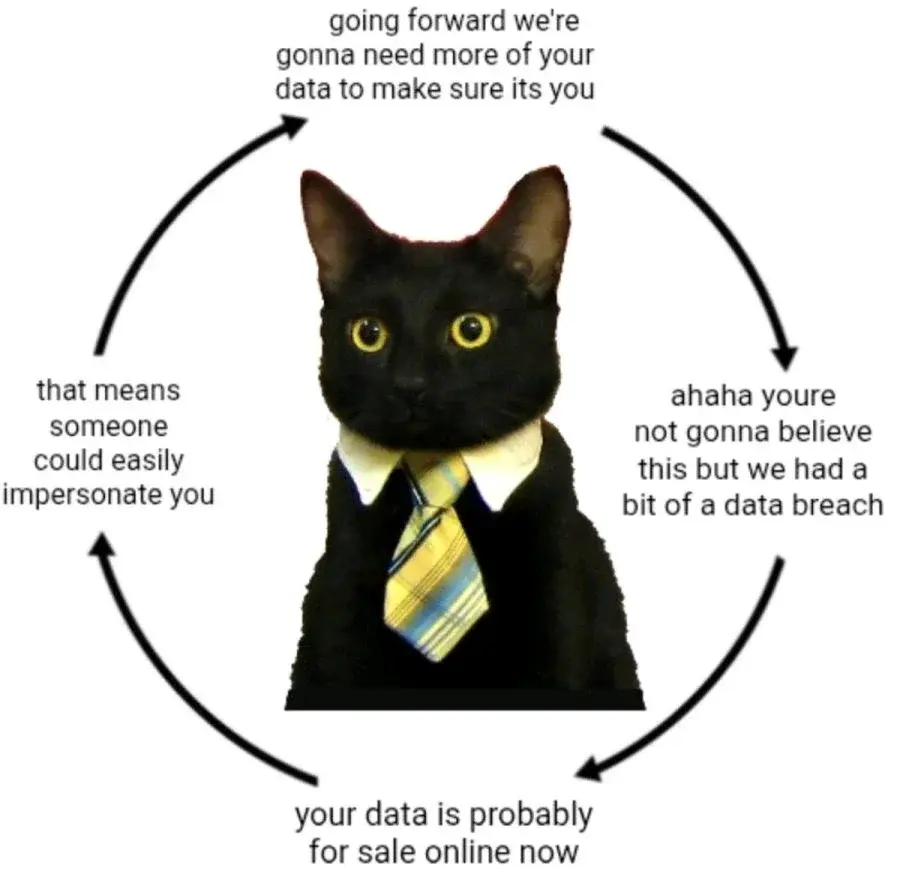
Alt...
Meme, showing a continuous circle of data breach messages from corporations…
Ahaha you're not gonna believe this but we had a bit of a data breach.
Your data is probably for sale online now.
That means someone could easily impersonate you.
Going forward we're gonna need more of your data to make sure its you.

📜 Scrolls volume 32 is out! Go check it out for the latest #indieweb, #fediverse and #infosec / #cybersecurity stuff.
https://shellsharks.com/scrolls/scroll/2026-03-06
Have a great weekend!

https://feddit.uk/post/45043385
#signal #moxiemarlinspike #telegram #paveldurov #infosec #encryption

Delta Chat is a messaging platform that works over email.
Setup is similar to a email client.
Messaging is decentralized and interoperable.
Supports end-to-end encryption via PGP.
PGP encryption keys are created automatically.
Default desktop client is based on Electron.
Electron is based on the Google Chromium web browser.
Website: https://delta.chat
Mastodon: @delta
#DeltaChat #Messaging #Privacy #InfoSec #E2EE #OpenPGP #PGP #OpenSource #FOSS #CyberSecurity #Encryption #FreeSoftware

Alt...
Delta Chat logo.
Cryptomator is a client-side encryption tool for cloud storage services.
Data protected via AES-256 encryption.
Individual and business features.
Managed and self-hosted options.
ENCRYPTED
File content.
File/Folder name.
NOT ENCRYPTED
File/Folder access/creation/modification timestamp.
Number of files/folders in a folder/vault.
File size.
Website: https://cryptomator.org
Mastodon: @cryptomator
#Cryptomator #Encryption #InfoSec #Privacy #CyberSecurity #FreeSoftware #FOSS #FLOSS #OpenSource
Alt...
Cryptomator logo.

NEWSCARD Publish and fetch permanent named records via Network News
Newscard creates a decentralized, encrypted, named record paste bin.
[git repo] https://codeberg.org/OCTADE/newscard (use most recent version only)
With a single command, name the card, snarf the file and encrypt it.
With another command, push the encrypted file to the public network.
With another short command, snarf a file from the network.
Only users knowing the name [key] of the record will be able to decrypt it.
If a strong passphrase is used to name the file, it will be very secure.
This is useful for quickly snarfing, encrypting, and publishing a text file:
$~: card enc [passphrase] [file]
$~: card put [passphrase]
It is useful for retrieving a text file with just a key:
$~: card get [passphrase]
$~: card show [passphrase]
If and when you want the general public to access the record just share the keyword.
Newscard uses nine (9) (NINE) layers of encryption with OpenSSL chacha20 cipher.
Newscard generates 9 each of: cipher keys, salts, key iteration parameters.
It would be nice if something like this were added to the ActivityPub protocol, such that keyword[@]host.url would do the same thing. Then secret text records could be stored securely for later retrieval or revelation.
#NewsCard #Pastebin #Usenet #NNTP #NetworkNews #Encryption #Cryptography #Messaging #Anonymity #Protocols #OpenSource #FreeSoftware #BlackHackJack #Censorship #Retro #InfoSec #Ciphers #Codes #FOSS
@infostorm@a.gup.pe @crypto@a.gup.pe @infosec@a.gup.pe @selfhosting@a.gup.pe

Alt...
Playing card of the Jack of Clubs. The Jack is a moustached man in a black top hat and suit in a oval center cameo. The colors are inverted so that everything on the face is black except the lines which are white, like a charcoal cutout picture., giving it a retro digital appearance mixed with retro handicraft vibes.
NEWSCARD Publish and fetch permanent named records via Network News
Newscard creates a decentralized, encrypted, named record paste bin.
[git repo] https://codeberg.org/OCTADE/newscard (use most recent version only)
With a single command, name the card, snarf the file and encrypt it.
With another command, push the encrypted file to the public network.
With another short command, snarf a file from the network.
Only users knowing the name [key] of the record will be able to decrypt it.
If a strong passphrase is used to name the file, it will be very secure.
This is useful for quickly snarfing, encrypting, and publishing a text file:
$~: card enc [passphrase] [file]
$~: card put [passphrase]
It is useful for retrieving a text file with just a key:
$~: card get [passphrase]
$~: card show [passphrase]
If and when you want the general public to access the record just share the keyword.
Newscard uses nine (9) (NINE) layers of encryption with OpenSSL chacha20 cipher.
Newscard generates 9 each of: cipher keys, salts, key iteration parameters.
It would be nice if something like this were added to the ActivityPub protocol, such that keyword[@]host.url would do the same thing. Then secret text records could be stored securely for later retrieval or revelation.
#NewsCard #Pastebin #Usenet #NNTP #NetworkNews #Encryption #Cryptography #Messaging #Anonymity #Protocols #OpenSource #FreeSoftware #BlackHackJack #Censorship #Retro #InfoSec #Ciphers #Codes #FOSS
@infostorm@a.gup.pe @crypto@a.gup.pe @infosec@a.gup.pe

Alt...
Playing card of the Jack of Clubs. The Jack is a moustached man in a black top hat and suit in a oval center cameo. The colors are inverted so that everything on the face is black except the lines which are white, like a charcoal cutout picture., giving it a retro digital appearance mixed with retro handicraft vibes.