Search results for tag #crypto
![[?]](https://nbg1.your-objectstorage.com/tno-mastodon/accounts/avatars/111/434/264/745/920/273/original/52ff85db085a2a1d.jpg)
![[?]](data:image/png;base64, iVBORw0KGgoAAAANSUhEUgAAAEAAAABAAQAAAACCEkxzAAAAUUlEQVQoz43R0QkAMQwCUDdw/y3dwEvsvzlL4X1IoQkAisKmwfAFT3RgJHbQezpSRoXEqeqCL9BJBf7h3QbOCCxV5EVWMEMwG7K1/WODtlvxAYTtEsDU9F34AAAAAElFTkSuQmCC)
![[?]](https://star.octade.net/media/63a94df7-40e2-42d2-915d-5c141da33d4e.png)
The problem with modern computational cryptography is that it has no 'empirical' evidence of security. The fact that no one has publicly broken a cipher is not empirical evidence. It is absence of evidence being used as evidence.
If an adversary breaks a function or cryptosystem, he is not going to tell you. Thus using the lack of a public break as evidence is not scientific method.
The security models are based upon 'educated assumptions' within model A or B or C. Nobody has ever proven that a cryptosystem is secure. They are 'assumed' to be secure. Or, they are assumed to be hard in the average case.
Terry Ritter wrote a piece that explains this problem:
In this old Usenet discussion thread, Terry Ritter debunks a lot of the magical thinking endemic in the 'cryptology community':
https://web.archive.org/web/20240922132730/http://www.ciphersbyritter.com/NEWS5/HERDART.HTM
NP-hardness proof is still an open problem. As far as I know, not a single cryptosystem has actually been proven to be NP-hard. Model assumptions using a supposed NP-hard function and proof are two different things.
As for no existing crypto surviving: Vernam's cipher (OTP) is provably information-theoretic secure if keys are not re-used. That avoids the NP-hard problem altogether as it is a different universe of math.
#crypto #cryptography #cryptology #math #maths #ciphers #cybersecurity #encryption
POLL : Have you ever tried to break a cipher?
#ciphers #cryptology #cryptography #codes #puzzles #cracking #crypto #cryptanalysis
| YES, I have tried and failed.: | 6 |
| YES, I have tried and broken a cipher.: | 18 |
| NO, I have never tried to break a cipher.: | 6 |
This video shows how the BlockChain is far more dangerous than you were told. The big tech big wigs are constructing a system to remove all your private property rights into their cloud. Zero due process. Zero appeal. You will own nothing and be ... a most unhappy robot polisher.
Meet the New Owners (The Dangerous Blockchain)
https://www.youtube.com/watch?v=AAEv0cpZG9k
[copypasta]
Who really owns your property?
And what happens when a private company, a blockchain, and foreign-connected investors get between you and your deed?
In this episode of Plain Meaning, I trace the campaign to replace America's distributed, physical property record system with blockchain technology. And I expose who stands to benefit.
This episode covers:
How America's physical ownership system was deliberately designed to resist central control and why that matters.
Who Senator Bernie Moreno is, what CHAMPtitles does, and why a blockchain entrepreneur now sits on the Senate Commerce Committee
-The real vulnerabilities of blockchain: 51% attacks, garbage-in garbage-out errors, and the $1.5 billion Bybit hack
How companies with deep ties to foreign sovereign wealth funds and Chinese-connected investors can tell anyone who pays what you own and what you've done with it
What happened when West Virginia and Louisiana handed their vehicle title systems to a private company
How Wyoming became the launchpad for nationalizing blockchain property records
#blockchain #crypto #nft #propertyrights #privacyrights #privacymatters
[/copypasta]
![[?]](https://files.mastodon.green/accounts/avatars/109/258/048/381/846/891/original/97290ecebc04985d.png)
OCTADE Project Software : Signed Papers Portal
I am hacking on a cryptographic verification web portal. I seek comments and suggestions on the user interface (UX) and feature set.
Accessibility perspectives might be helpful since this involves slightly complex signatures and verification commands.
The server software automatically hashes and signs all files uploaded to the site. The software also generates 'verification bundles' that users may download to verify signatures using 'gnupg' and 'openssl'.
https://files.octade.net/publications/
Feedback would be helpful for improving the software before I release any source code.
#cryptography #cryptology #signatures #DataIntegrity #verification
#keys #gpg #pgp #openssl #crypto
Syfer Sangraal : Holy Grail of Cryptography in the Arc of the Combinant
DOI : 10.5281/zenodo.22158384
== SUMMARY ==
Embark on the quest for the Syfer Sangraal system, or the holy grail of cryptography hidden in the arc of the combinant. One system to roll them all is the holy grail of cryptography. One algorithm to perform every kind of cryptographic function is the new wine within the Syfer
Sangraal system.
--
OCTADE | https://octade.net
#SyferSangraal #HolyGrail #cryptography #cryptology #crypto #pqc #papers
#Trezor: Recent customer data exposed in shipping provider incident
https://trezor.io/blog/news/recent-customer-data-exposed-in-shipping-provider-incident
![[?]](https://files.mastodon.social/accounts/avatars/115/967/890/192/375/774/original/79861f67f1d57c00.png)
@j_feral
I don't want people to use #crypto...
(and maybe too complicated anyway)
but I also think the existing banks are a deliberate disease (lends what it doesn't have, gambles our savings in #war, grow peoples that we can't feed or the intellectually dormant).
- "Pollution" itself (solutions of consumption) is also a way of leverage, the "exchange" is pollution towards "less bad things" (#autonomy / #commons / #banks less purchasing / loaning power <---- the core of all bad #power / ppl)
@j_feral #crypto vs. #fiat #money:
- nothing is 100% perfect (everything should have some allowance / reasoning)
- Any complicated #systems can be improved or solved but it's a gamble.
- IDEALLY we use less / nothing and just agree in our minds to let people live as much as possible. It's hard to #share and not fight with words / material #war.
- we have to consume #planet to live.
BUT MUST FIGHT #EVIL INVADING BADDIES / NEIGHBOURS...
+ MAKE #FRIENDS ENDLESSLY (?)
^--------- Very HARD...
#GTA6 Leaker Now Charges $165K To Make Contact, Builds System Linking #Monero Payment To Private #Session
https://www.ibtimes.co.uk/cyberleek-gta6-leaks-contact-fee-1815962
![[?]](https://soc.octade.net/octade/s/3f7f2b5eda4e392867c301c49c2daa16.png)
[demo] https://files.octade.net/
I drafted a prototype for a PHP server application that automatically hashes and signs files and presents visitors with verification archives containing digital signatures for offline verification. The site allows readers to view, download, hash, and verify signatures of files. Since I occasionally like to publish puzzles and bits of cryptology, I just had to make this to scratch the old itch.
The neat thing about this design is that the current version has zero JavaScript. It uses CSS3 hacks with anchors and URL probing to emulate JavaScript and AJAX functionalities for modal dialogs to present server-side JSON data as HTML text.
When I upload files or documents to the server, the interface automatically presents them to the user in a grid. So now all I have to do is upload files and documents and the server generates the site.
The reader can then click buttons to hash, sign, view, verify, and download files.
GnuPG and OpenSSL Signatures are generated automatically on user demand. The site visitors can download these signatures and the public keys to verify files.
What should I add / change in the application and its interface?
What accessibility components might be warranted?
Should the application parse and present EXIF data, or is that too much?
#PHP #CSS3 #HTML5 #WebDesign #UX #cryptology #cryptography #crypto #signatures #OpenSSL #GnuPG #GPG #PGP #encryption #papers #preprints #documents #SelfHosted #WebLord #WebMaster #WebSerf #NoJS #Apache #CyberSecurity
![[?]](https://files.techhub.social/accounts/avatars/109/324/064/255/467/765/original/91b892ca5380f14b.jpg)

Trezor Says ShipMonk Breach Exposed 13,689 Customers
https://www.cyberkendra.com/2026/08/trezor-says-shipmonk-breach-exposed.html
#Trezor #Crypto #cryptography #hacked #databreach
![[?]](https://files.mastodon.social/accounts/avatars/109/248/945/403/729/531/original/dfdef51cfb108138.jpeg)
3
A lot of people believe Thiel, who says the US is actually an outdated software system that needs to be replaced by crypto & AI.
The rest of us "are either servants or serfs or worse, dead". We're already seeing the poorest people in the world dying because of Musk's USAID cuts.
"That will be the majority of people on the planet in 20 years."
https://www.pbs.org/video/do-silicon-valley-billionaires-want-to-end-democracy-hezktt/
#USPol #EUPol #TechFascism #Thiel #DemocracyUnderAttack #Musk #Trump #AI #Crypto .
3
A lot of people believe Thiel, who says the US is actually an outdated software system that needs to be replaced by crypto & AI.
The rest of us "are either servants or serfs or worse, dead". We're already seeing the poorest people in the world dying because of Musk's USAID cuts.
"That will be the majority of people on the planet in 20 years."
https://www.pbs.org/video/do-silicon-valley-billionaires-want-to-end-democracy-hezktt/
#USPol #EUPol #TechFascism #Thiel #DemocracyUnderAttack #Musk #Trump #AI #Crypto .
![[?]](https://files.mastodon.social/accounts/avatars/109/258/636/566/275/551/original/1b9ca26377a774d5.jpg)
👉**#ClearviewAI– the facial recognition company that subsequently expanded the capabilities of Immigration and Customs Enforcement (#ICE) – launched in 2018, seed-funded by #Thiel, operating under #Johnson's #Giesea-funded software framework #WeSearchr, and represented in legal matters by #Aurenheimer's longtime lawyer, #TorEkeland.👈**"
3. Related Byline Times Coverage
The #Brown article links to two companion pieces:
"In #Putin's Orbit: The #Crypto Politics of 👉#JeffreyEpstein
@skykiss
@ashwin Ok so you agree (it wasn't clear at the start). I hate the 'yes / no' ultimatum always but with Banks it's clear.
I'm not even sure about #crypto / #cryptocurrency but 100% I know it helped the #truckers in the exact moment they tried to shut them down for similar reasons so it's something of a progress to an #alternative and not just Bad #Banks as our faulty foundations.
Thanks for reply (try reply to my last post also you said you need time to think about)
![[?]](https://media.hachyderm.io/accounts/avatars/109/332/059/958/892/971/original/fd426ab1db47d795.jpeg)
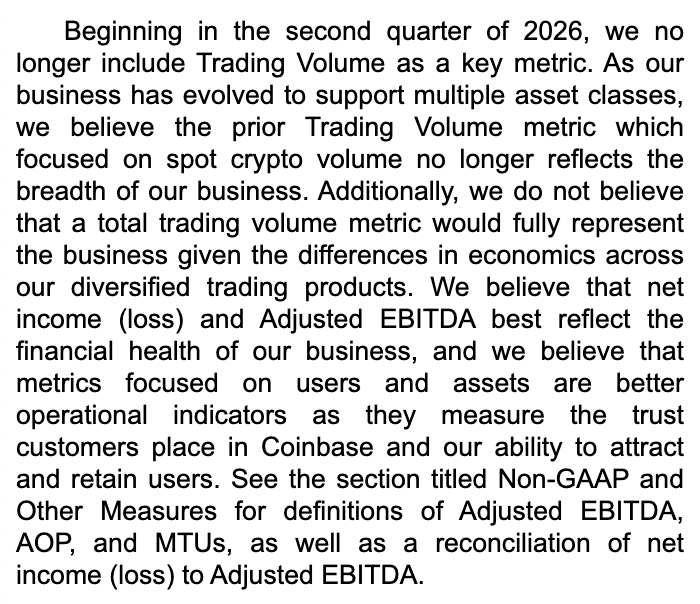
Spotted in Coinbase’s most recent 10-Q: Coinbase has stopped using trading volume as a key metric, which is I’m sure completely unrelated to the 38%/48% decrease in spot trading volume they reported over the past three/six months
#Coinbase #crypto #cryptocurrency
Alt...
Beginning in the second quarter of 2026, we no longer include Trading Volume as a key metric. As our business has evolved to support multiple asset classes, we believe the prior Trading Volume metric which focused on spot crypto volume no longer reflects the breadth of our business. Additionally, we do not believe that a total trading volume metric would fully represent the business given the differences in economics across our diversified trading products. We believe that net income (loss) and Adjusted EBITDA best reflect the financial health of our business, and we believe that metrics focused on users and assets are better operational indicators as they measure the trust customers place in Coinbase and our ability to attract and retain users. See the section titled Non-GAAP and Other Measures for definitions of Adjusted EBITDA, AOP, and MTUs, as well as a reconciliation of net income (loss) to Adjusted EBITDA.
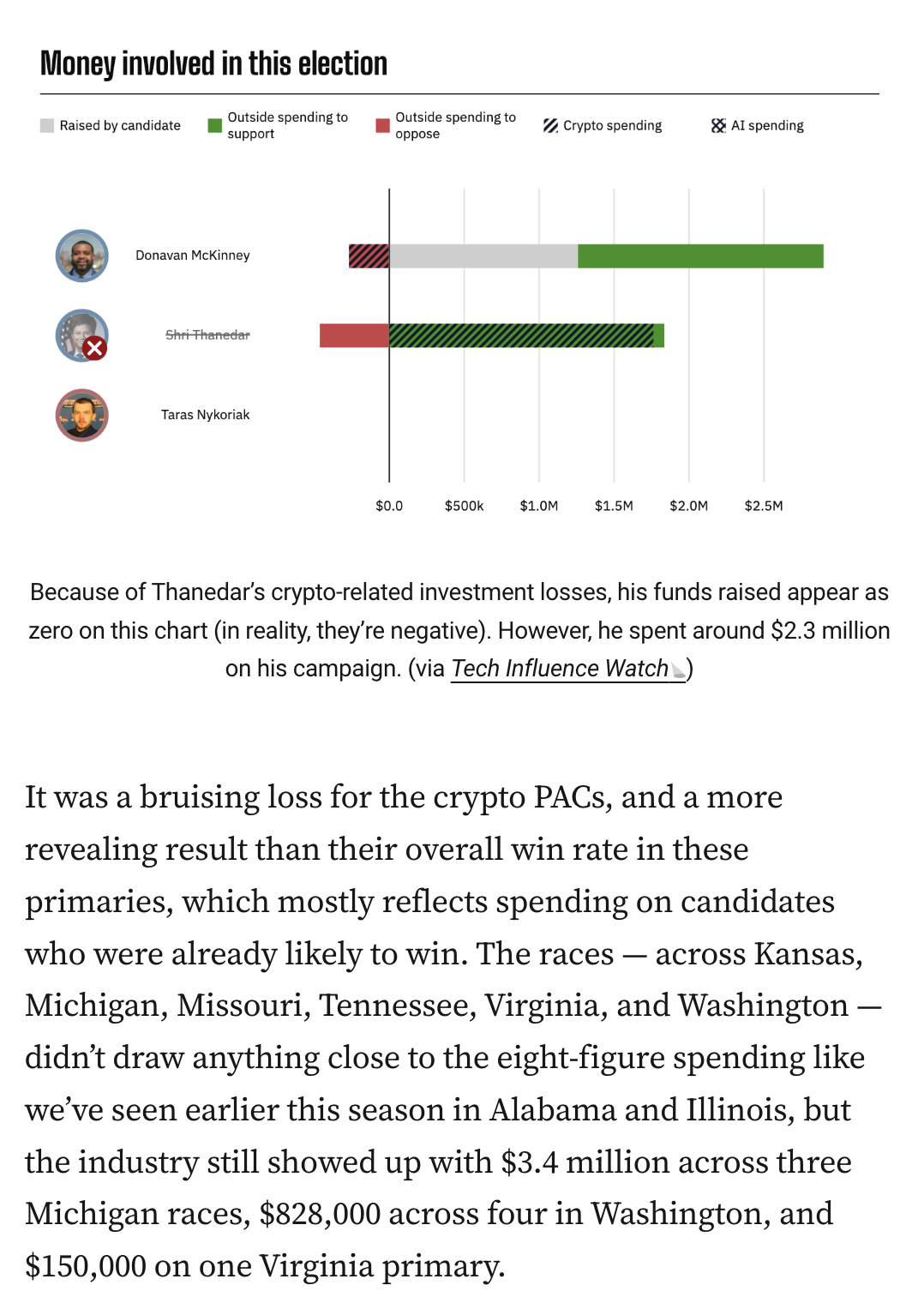
In a bruising loss for the crypto super PACs, incumbent Democrat and reliable crypto industry ally Shri Thanedar was defeated by a primary challenge from the left, despite $2 million in super PAC backing.
#crypto #cryptocurrency #USpolitics #USpol #CitationNeededNewsletter
![The crypto super PACs’ $2 million bet on Michigan’s District 13 failed to pay off this week. Incumbent Shri Thanedar — a reliable industry ally who’d co-sponsored the House’s version of the Clarity Act [I89] — lost his primary to Donavan McKinney, a Democratic Socialist who successfully painted him as the establishment and corporate-backed option.
McKinney built on the wave of support for more progressive candidates in his state that also saw Democratic Senate candidate Abdul El-Sayed win over his moderate primary opponent, Haley Stevens. Thanedar had also faced scrutiny for a number of separate issues — not least his choice to invest millions of campaign funds into cryptocurrency, which ended with his campaign reporting a negative balance. (Most of the invested funds had started as personal loans from Thanedar, whose entrepreneurial background in the chemistry sector made him a multimillionaire.) The Fairshake network had backed Thanedar’s 2024 re-election with $1 million, which bought them a strong ally. This time, double the spending couldn’t do the job.](https://media.hachyderm.io/media_attachments/files/117/079/191/765/697/265/original/f8465c146828f086.png "The crypto super PACs’ $2 million bet on Michigan’s District 13 failed to pay off this week. Incumbent Shri Thanedar — a reliable industry ally who’d co-sponsored the House’s version of the Clarity Act [I89] — lost his primary to Donavan McKinney, a Democratic Socialist who successfully painted him as the establishment and corporate-backed option.
McKinney built on the wave of support for more progressive candidates in his state that also saw Democratic Senate candidate Abdul El-Sayed win over his moderate primary opponent, Haley Stevens. Thanedar had also faced scrutiny for a number of separate issues — not least his choice to invest millions of campaign funds into cryptocurrency, which ended with his campaign reporting a negative balance. (Most of the invested funds had started as personal loans from Thanedar, whose entrepreneurial background in the chemistry sector made him a multimillionaire.) The Fairshake network had backed Thanedar’s 2024 re-election with $1 million, which bought them a strong ally. This time, double the spending couldn’t do the job.")
Alt...
The crypto super PACs’ $2 million bet on Michigan’s District 13 failed to pay off this week. Incumbent Shri Thanedar — a reliable industry ally who’d co-sponsored the House’s version of the Clarity Act [I89] — lost his primary to Donavan McKinney, a Democratic Socialist who successfully painted him as the establishment and corporate-backed option.
McKinney built on the wave of support for more progressive candidates in his state that also saw Democratic Senate candidate Abdul El-Sayed win over his moderate primary opponent, Haley Stevens. Thanedar had also faced scrutiny for a number of separate issues — not least his choice to invest millions of campaign funds into cryptocurrency, which ended with his campaign reporting a negative balance. (Most of the invested funds had started as personal loans from Thanedar, whose entrepreneurial background in the chemistry sector made him a multimillionaire.) The Fairshake network had backed Thanedar’s 2024 re-election with $1 million, which bought them a strong ally. This time, double the spending couldn’t do the job.
Alt...
It was a bruising loss for the crypto PACs, and a more revealing result than their overall win rate in these primaries, which mostly reflects spending on candidates who were already likely to win. The races — across Kansas, Michigan, Missouri, Tennessee, Virginia, and Washington — didn’t draw anything close to the eight-figure spending like we’ve seen earlier this season in Alabama and Illinois, but the industry still showed up with $3.4 million across three Michigan races, $828,000 across four in Washington, and $150,000 on one Virginia primary.
Senators were promising to bring the crypto industry-friendly Clarity Act bill to a vote up until the eleventh hour before August recess. Now they’re promising a cloture vote immediately upon return, though likely only to create target lists for the crypto super PACs. The bill is not likely to pass.
With 60 votes needed, seven Democrats would need to cross the aisle. Even the crypto-friendliest Democrats have refused to support the bill, and several Republicans have also pledged to vote against it. The White House hasn’t okayed the latest ethics language, leaving the risk of veto looming.
#crypto #cryptocurrency #USpolitics #USpol #CitationNeededNewsletter
Alt...
Clarity Act
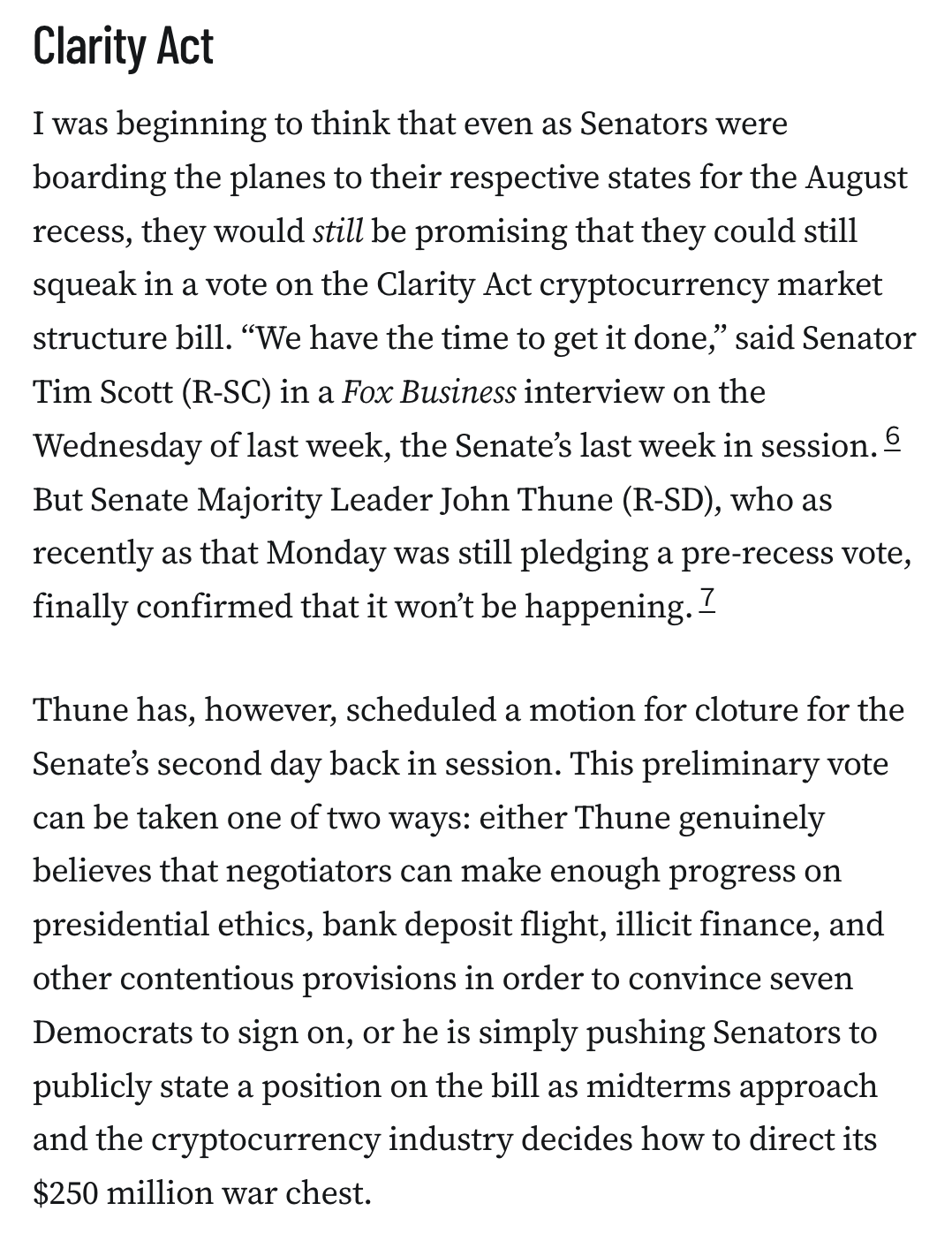
I was beginning to think that even as Senators were boarding the planes to their respective states for the August recess, they would still be promising that they could still squeak in a vote on the Clarity Act cryptocurrency market structure bill. “We have the time to get it done,” said Senator Tim Scott (R-SC) in a Fox Business interview on the Wednesday of last week, the Senate’s last week in session.6 But Senate Majority Leader John Thune (R-SD), who as recently as that Monday was still pledging a pre-recess vote, finally confirmed that it won’t be happening.7
Thune has, however, scheduled a motion for cloture for the Senate’s second day back in session. This preliminary vote can be taken one of two ways: either Thune genuinely believes that negotiators can make enough progress on presidential ethics, bank deposit flight, illicit finance, and other contentious provisions in order to convince seven Democrats to sign on, or he is simply pushing Senators to publicly state a position on the bill as midterms approach and the cryptocurrency industry decides how to direct its $250 million war chest.
![If I was a betting woman, I would guess the latter is more likely. The bill is in an even worse place than it was when I wrote about it last issue [I107]. Then, the White House had agreed to proposed ethics language, and Democrats had only just seen the draft language and begun to express concerns. Since then, Senators Tillis (R-NC) and Gallego (D-AZ) drafted new ethics language to present to the White House — a do-over after the previous version, crafted with little Democratic input, failed to win a single Democratic pledge. The White House has yet to sign off on the new language, and it’s not clear they will — allowing enforcement by attorneys general was reportedly a hard line for Trump.8 And while Trump’s approval is not required for the bill to advance, it leaves the risk of a veto looming. A component of the new agreement would require the president to divest from crypto-related businesses — though according to Bloomberg, this could allow him to defer millions in taxes on his crypto gains. The deal also reportedly allows state attorneys general to enforce ethics measures, a key Democratic demand, but only if the Justice Department declines to do so.9 The full text hasn’t been released yet, but this model concerns me: a Trump-controlled DOJ could stall indefinitely to block state enforcement. Even if the language allows states to act when the DOJ fails to open a case within a certain window, the DOJ could open a weak enforcement action as a stalling tactic.](https://media.hachyderm.io/media_attachments/files/117/079/188/284/955/600/original/005076ec132a14db.png "If I was a betting woman, I would guess the latter is more likely. The bill is in an even worse place than it was when I wrote about it last issue [I107]. Then, the White House had agreed to proposed ethics language, and Democrats had only just seen the draft language and begun to express concerns. Since then, Senators Tillis (R-NC) and Gallego (D-AZ) drafted new ethics language to present to the White House — a do-over after the previous version, crafted with little Democratic input, failed to win a single Democratic pledge. The White House has yet to sign off on the new language, and it’s not clear they will — allowing enforcement by attorneys general was reportedly a hard line for Trump.8 And while Trump’s approval is not required for the bill to advance, it leaves the risk of a veto looming. A component of the new agreement would require the president to divest from crypto-related businesses — though according to Bloomberg, this could allow him to defer millions in taxes on his crypto gains. The deal also reportedly allows state attorneys general to enforce ethics measures, a key Democratic demand, but only if the Justice Department declines to do so.9 The full text hasn’t been released yet, but this model concerns me: a Trump-controlled DOJ could stall indefinitely to block state enforcement. Even if the language allows states to act when the DOJ fails to open a case within a certain window, the DOJ could open a weak enforcement action as a stalling tactic.")
Alt...
If I was a betting woman, I would guess the latter is more likely. The bill is in an even worse place than it was when I wrote about it last issue [I107]. Then, the White House had agreed to proposed ethics language, and Democrats had only just seen the draft language and begun to express concerns. Since then, Senators Tillis (R-NC) and Gallego (D-AZ) drafted new ethics language to present to the White House — a do-over after the previous version, crafted with little Democratic input, failed to win a single Democratic pledge. The White House has yet to sign off on the new language, and it’s not clear they will — allowing enforcement by attorneys general was reportedly a hard line for Trump.8 And while Trump’s approval is not required for the bill to advance, it leaves the risk of a veto looming. A component of the new agreement would require the president to divest from crypto-related businesses — though according to Bloomberg, this could allow him to defer millions in taxes on his crypto gains. The deal also reportedly allows state attorneys general to enforce ethics measures, a key Democratic demand, but only if the Justice Department declines to do so.9 The full text hasn’t been released yet, but this model concerns me: a Trump-controlled DOJ could stall indefinitely to block state enforcement. Even if the language allows states to act when the DOJ fails to open a case within a certain window, the DOJ could open a weak enforcement action as a stalling tactic.
![Two Republican senators, neither of whom are up for re-election, have also publicly committed to voting against the bill, citing concerns about deposit flight from community banks. Josh Hawley (R-MO) pledged to side with the “agriculture folks, local community people” who are “blowing [him] up over” the bill. “Farmers and ranchers, in particular, are very, very concerned that deposit flight in small towns could absolutely kill their ability to get ag loans,” he said.10 Jerry Moran (R-KS) also committed to vote no.11 Other Republicans have expressed reservations but stopped short of pledging to vote against the bill [I107].
Meanwhile, the crypto super PACs are itching to get a vote on record so they can direct their spending accordingly. “That’s the whole reason Thune has to have a vote ... You have to hold it on the record for the PAC funding side,” a crypto executive told Semafor late last month.8 Democrats had reportedly threatened to delay other important agenda items to avoid a vote before the midterms, suggesting that Democrats who’ve previously allied with the industry (or who want to keep that door open) are anxious about being forced to take a public position before November.](https://media.hachyderm.io/media_attachments/files/117/079/189/624/398/102/original/fde533a3cadf03e1.png "Two Republican senators, neither of whom are up for re-election, have also publicly committed to voting against the bill, citing concerns about deposit flight from community banks. Josh Hawley (R-MO) pledged to side with the “agriculture folks, local community people” who are “blowing [him] up over” the bill. “Farmers and ranchers, in particular, are very, very concerned that deposit flight in small towns could absolutely kill their ability to get ag loans,” he said.10 Jerry Moran (R-KS) also committed to vote no.11 Other Republicans have expressed reservations but stopped short of pledging to vote against the bill [I107].
Meanwhile, the crypto super PACs are itching to get a vote on record so they can direct their spending accordingly. “That’s the whole reason Thune has to have a vote ... You have to hold it on the record for the PAC funding side,” a crypto executive told Semafor late last month.8 Democrats had reportedly threatened to delay other important agenda items to avoid a vote before the midterms, suggesting that Democrats who’ve previously allied with the industry (or who want to keep that door open) are anxious about being forced to take a public position before November.")
Alt...
Two Republican senators, neither of whom are up for re-election, have also publicly committed to voting against the bill, citing concerns about deposit flight from community banks. Josh Hawley (R-MO) pledged to side with the “agriculture folks, local community people” who are “blowing [him] up over” the bill. “Farmers and ranchers, in particular, are very, very concerned that deposit flight in small towns could absolutely kill their ability to get ag loans,” he said.10 Jerry Moran (R-KS) also committed to vote no.11 Other Republicans have expressed reservations but stopped short of pledging to vote against the bill [I107].
Meanwhile, the crypto super PACs are itching to get a vote on record so they can direct their spending accordingly. “That’s the whole reason Thune has to have a vote ... You have to hold it on the record for the PAC funding side,” a crypto executive told Semafor late last month.8 Democrats had reportedly threatened to delay other important agenda items to avoid a vote before the midterms, suggesting that Democrats who’ve previously allied with the industry (or who want to keep that door open) are anxious about being forced to take a public position before November.
Trump’s own Trump Media & Technology Group just posted a $238 million net loss. While TMTG regularly reports huge net losses, this time they were accompanied by announcements that the firm would be unwinding multiple planned partnerships with crypto exchange and Trump megadonor Crypto.com.
#crypto #cryptocurrency #USpolitics #USpol #CitationNeededNewsletter
![Trump Media & Technology Group
The president’s Trump Media & Technology Group (TMTG), parent company of his Truth Social platform, has backed out of its deals with cryptocurrency exchange Crypto.com. The Singapore-based company has contributed $36 million to Trump’s various super PACs since December 2024, when it first donated to his inaugural fund. In March 2025, TMTG announced its first partnership with Crypto.com: a plan to launch “made in America” exchange-traded products incorporating both crypto and non-crypto assets [I80]. Just three days later, Crypto.com announced that the Securities and Exchange Commission had dropped its investigation into the company [I81]. In August 2025, the two companies announced a joint venture called Trump Media Group CRO Strategy Inc., a treasury company to hold Crypto.com’s CRO token [I91]. And in October, they announced yet another partnership, in which Truth Social would offer prediction markets via a Crypto.com integration.17](https://media.hachyderm.io/media_attachments/files/117/079/179/929/700/196/original/dc341bd106c9aa00.png "Trump Media & Technology Group
The president’s Trump Media & Technology Group (TMTG), parent company of his Truth Social platform, has backed out of its deals with cryptocurrency exchange Crypto.com. The Singapore-based company has contributed $36 million to Trump’s various super PACs since December 2024, when it first donated to his inaugural fund. In March 2025, TMTG announced its first partnership with Crypto.com: a plan to launch “made in America” exchange-traded products incorporating both crypto and non-crypto assets [I80]. Just three days later, Crypto.com announced that the Securities and Exchange Commission had dropped its investigation into the company [I81]. In August 2025, the two companies announced a joint venture called Trump Media Group CRO Strategy Inc., a treasury company to hold Crypto.com’s CRO token [I91]. And in October, they announced yet another partnership, in which Truth Social would offer prediction markets via a Crypto.com integration.17")
Alt...
Trump Media & Technology Group
The president’s Trump Media & Technology Group (TMTG), parent company of his Truth Social platform, has backed out of its deals with cryptocurrency exchange Crypto.com. The Singapore-based company has contributed $36 million to Trump’s various super PACs since December 2024, when it first donated to his inaugural fund. In March 2025, TMTG announced its first partnership with Crypto.com: a plan to launch “made in America” exchange-traded products incorporating both crypto and non-crypto assets [I80]. Just three days later, Crypto.com announced that the Securities and Exchange Commission had dropped its investigation into the company [I81]. In August 2025, the two companies announced a joint venture called Trump Media Group CRO Strategy Inc., a treasury company to hold Crypto.com’s CRO token [I91]. And in October, they announced yet another partnership, in which Truth Social would offer prediction markets via a Crypto.com integration.17
Alt...
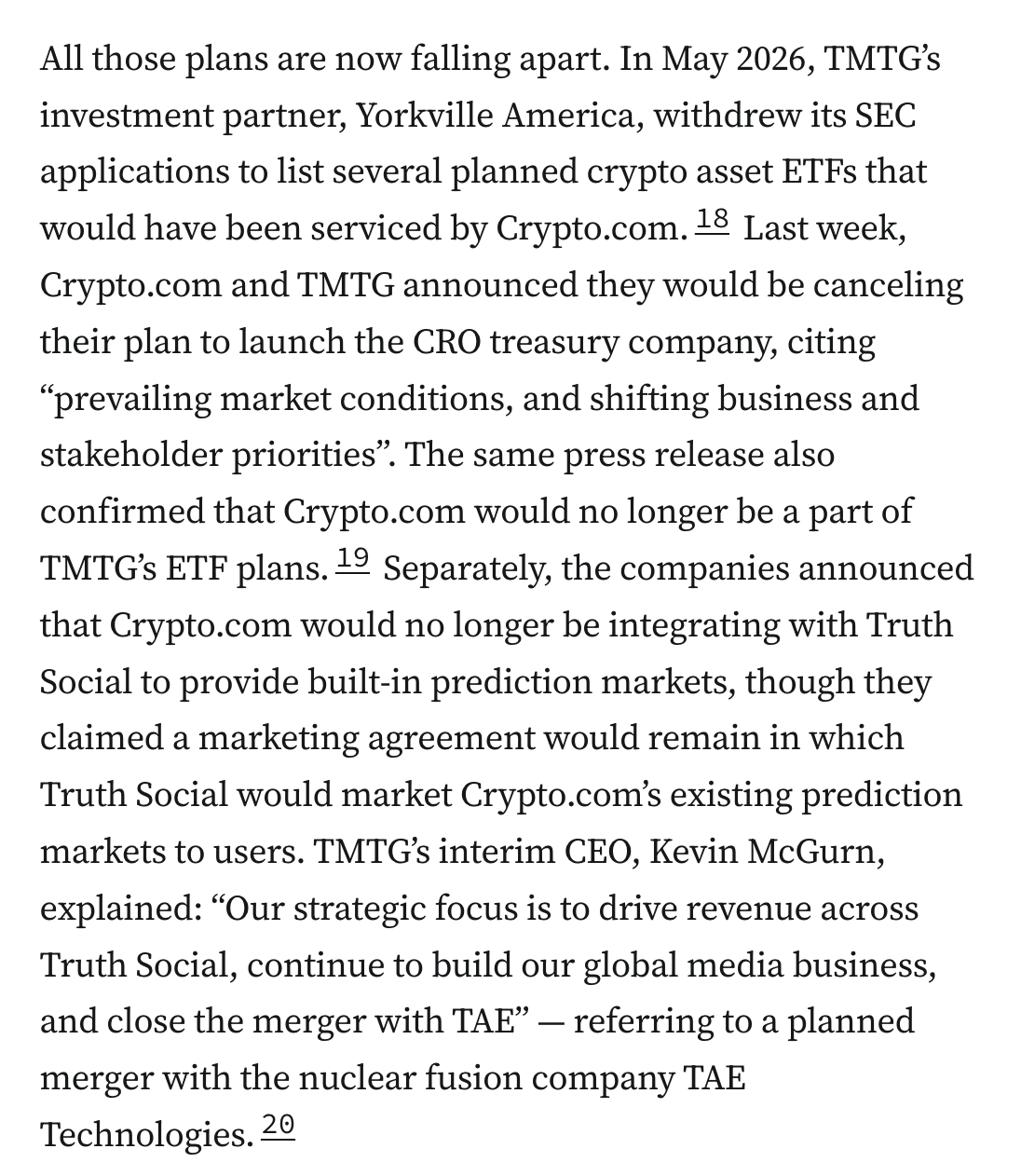
All those plans are now falling apart. In May 2026, TMTG’s investment partner, Yorkville America, withdrew its SEC applications to list several planned crypto asset ETFs that would have been serviced by Crypto.com.18 Last week, Crypto.com and TMTG announced they would be canceling their plan to launch the CRO treasury company, citing “prevailing market conditions, and shifting business and stakeholder priorities”. The same press release also confirmed that Crypto.com would no longer be a part of TMTG’s ETF plans.19 Separately, the companies announced that Crypto.com would no longer be integrating with Truth Social to provide built-in prediction markets, though they claimed a marketing agreement would remain in which Truth Social would market Crypto.com’s existing prediction markets to users. TMTG’s interim CEO, Kevin McGurn, explained: “Our strategic focus is to drive revenue across Truth Social, continue to build our global media business, and close the merger with TAE” — referring to a planned merger with the nuclear fusion company TAE Technologies.20
Alt...
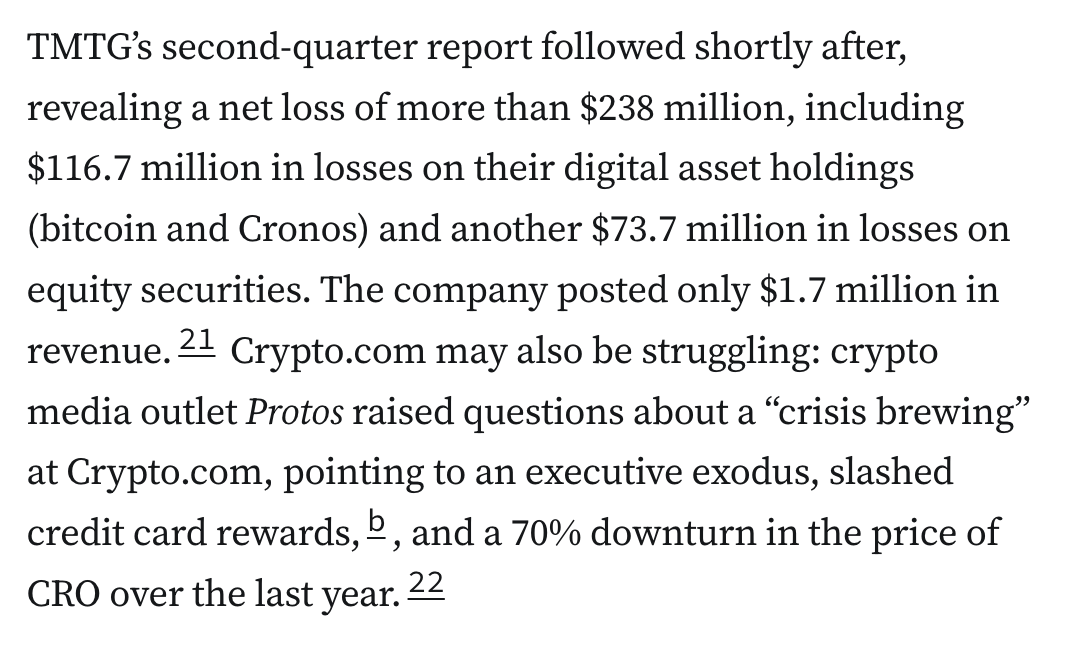
TMTG’s second-quarter report followed shortly after, revealing a net loss of more than $238 million, including $116.7 million in losses on their digital asset holdings (bitcoin and Cronos) and another $73.7 million in losses on equity securities. The company posted only $1.7 million in revenue.21 Crypto.com may also be struggling: crypto media outlet Protos raised questions about a “crisis brewing” at Crypto.com, pointing to an executive exodus, slashed credit card rewards,b, and a 70% downturn in the price of CRO over the last year.22
Often when there’s a “crypto winter”, it can take a little while before we start to see the fallout. But it seems to be emerging now, with three crypto exchanges announcing shutdowns in July, and multiple high-profile web3 projects closing up shop recently.
#crypto #cryptocurrency #USpolitics #USpol #CitationNeededNewsletter
![The crypto industry is having an increasingly rough time as prices remain depressed. Bitcoin is hovering around its lowest price since autumn 2024, well below the “Trump pump” prices spurred by traders who hoped his inauguration would bring about a crypto renaissance. Robinhood reported crypto trading revenue down 38% and trading volumes down 35% year-over-year.1 Coinbase reported a net loss of $359 million and has stopped reporting trading volume entirely, claiming it “no longer reflects the breadth of our business”.2 At least three crypto exchanges — AscendEx,3 BitMEX,4 and BitMart5 — announced in July they would be shutting down. Other darlings from the web3 bubble have also announced they’re closing up shop recently: the Proof of Attendance Protocol [W3IGG], the Step App “move-to-earn” product [W3IGG], and MVMT Labs [W3IGG]. Poolin, a bitcoin mining firm that once accounted for a fifth of the global hashrate, his filed for bankruptcy [W3IGG].](https://media.hachyderm.io/media_attachments/files/117/079/178/447/926/734/original/2ca598a65637c557.png "The crypto industry is having an increasingly rough time as prices remain depressed. Bitcoin is hovering around its lowest price since autumn 2024, well below the “Trump pump” prices spurred by traders who hoped his inauguration would bring about a crypto renaissance. Robinhood reported crypto trading revenue down 38% and trading volumes down 35% year-over-year.1 Coinbase reported a net loss of $359 million and has stopped reporting trading volume entirely, claiming it “no longer reflects the breadth of our business”.2 At least three crypto exchanges — AscendEx,3 BitMEX,4 and BitMart5 — announced in July they would be shutting down. Other darlings from the web3 bubble have also announced they’re closing up shop recently: the Proof of Attendance Protocol [W3IGG], the Step App “move-to-earn” product [W3IGG], and MVMT Labs [W3IGG]. Poolin, a bitcoin mining firm that once accounted for a fifth of the global hashrate, his filed for bankruptcy [W3IGG].")
Alt...
The crypto industry is having an increasingly rough time as prices remain depressed. Bitcoin is hovering around its lowest price since autumn 2024, well below the “Trump pump” prices spurred by traders who hoped his inauguration would bring about a crypto renaissance. Robinhood reported crypto trading revenue down 38% and trading volumes down 35% year-over-year.1 Coinbase reported a net loss of $359 million and has stopped reporting trading volume entirely, claiming it “no longer reflects the breadth of our business”.2 At least three crypto exchanges — AscendEx,3 BitMEX,4 and BitMart5 — announced in July they would be shutting down. Other darlings from the web3 bubble have also announced they’re closing up shop recently: the Proof of Attendance Protocol [W3IGG], the Step App “move-to-earn” product [W3IGG], and MVMT Labs [W3IGG]. Poolin, a bitcoin mining firm that once accounted for a fifth of the global hashrate, his filed for bankruptcy [W3IGG].
Newsletter: Firms close up shop amid a continued crypto winter, a Trump venture ditches its crypto plans, and the crypto industry–friendly Clarity Act market structure bill fails to reach a vote before August recess — likely dooming it.
https://www.citationneeded.news/issue-108/
#crypto #cryptocurrency #USpolitics #USpol #CitationNeededNewsletter
![[?]](https://cdn.fosstodon.org/accounts/avatars/106/304/718/945/522/344/original/7382ae4ca53372f8.jpg)

Rolling your own #crypto

Alt...
Photo of a bicycle with a Razor scooter installed as the front wheel of the bike.
what could go wrong with running betting markets like this?
#crypto #cryptocurrency #Polymarket

Alt...
Polymarket betting market: “Will Palisades wildfire spread to Santa Monica by Sunday?” Current “odds” are at 13%.
![[?]](https://s3.masto.ai/accounts/avatars/109/303/982/217/898/173/original/84b53833e9214e09.png)
Almost 1 million people lost money on the #Trump #memecoin, racking up a total of $3.8 billion of losses through the end of June, according to research by #crypto analytics firm Nansen cited by NYT.
“The #SEC must be willing to enforce the #law even when potential wrongdoers include those with powerful political connections,” the lawmakers wrote in the letter.
#criminal #felon47 #fraud #scam
https://www.nytimes.com/2026/07/04/us/politics/trump-coin-crypto-investors-loss.html?unlocked_article_code=1.21A.ik_o.oYBQvuWxVK-N&smid=nytcore-ios-share
The $TRUMP #cryptocurrency paid huge dividends to #Trump, who promised to be the US’ first #crypto president & received enormous support from the industry. He made nearly $636M in royalty & licensing fees related to “Celebration Coins” last year alone, acc/to his 2025 annual financial disclosure.
Flash forward to today: The Trump coin is worth less than $400 million & those who bought in at the top are staring at steep losses of approximately 97%, acc/to crypto analytics platform CoinMarketCap.
#COLDCARD flaw may have exposed #Bitcoin wallet seeds for years
https://nerds.xyz/2026/07/coldcard-firmware-flaw-bitcoin-wallet-seeds/
@nobodypsyd At the beginning of #meeting I think individuals might make a 'joke' to someone
but in reality it's a person jumping to conclusions or fearing something too quickly and trying to hide it as a 'joke' ?
So...
1/ Am I right to say your 'joke' was actually thinking / saying something else instead of explaining something more clearly from your side?
2/ Why #crypto as the subject of the 'joke'?
Crypto was not relative at all early in conversation from either side,
so I'm confused.
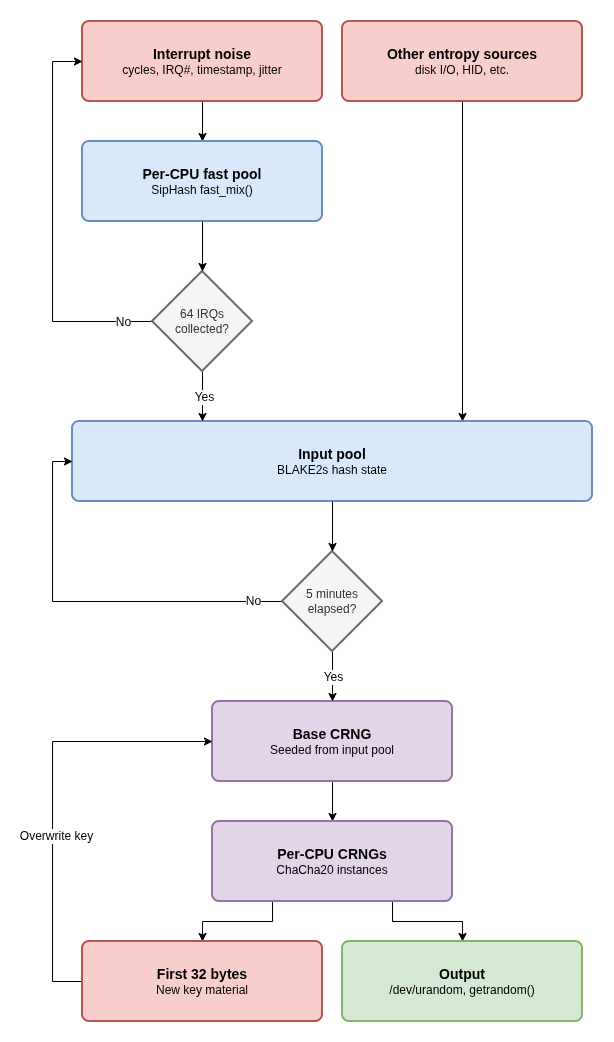
I believe this is the correct overview of the #Linux RNG as defined in drivers/char/random.c. Probably have some minor quibbles that needs addressing though.
Alt...
Flowchart showing the process of how randomness is generated with the Linux RNG.
This article is a great deep dive into some of the shady characters behind World Liberty Financial — Justin Sun among them, despite his recent efforts to distance himself from the project. (He likely hoped this interview would help, and it is a little friendly, but rightly points out his shadiness.)
https://nymag.com/intelligencer/article/justin-sun-world-liberty-lawsuit-trump-crypto-herro.html
#JustinSun #WorldLibertyFinancial #USpol #USpolitics #crypto #cryptocurrency
![[?]](https://media.bsd.cafe/bsdmmedia01/accounts/avatars/116/916/392/971/982/972/original/7d940acb1047b6c5.png)
Because of recent ToS of #codeberg, I have to write few words.
I am from Iran. For years, we've been blocked by the US sanctions. These sanctions didn't hurt the regime much. But it does hurt me people greatly. The US isn't shy about doing whatever they want with other nations for their benefits or in the name of fighting terrorism.
#cryptocurrency has been a way for us to trade with parties abroad without any government, America or our own, being able to censor the money transfer.
Imagine, if one day the US government puts a sanction on the whole Europe, what will citizens of each side could do?
That's the power the traditional money system gives to the governments. If a US citizen wants to give me money for a job, or vice versa, what right does our governments have to prevent us from doing so? Why the governments have to interfere with every single thing their citizen does?
#Iran #US #IranWar #crypto #bitcoincash #bch #foss #USsanctions #USsanction #sanction #freedom #digitalfreedom #financialfreedom
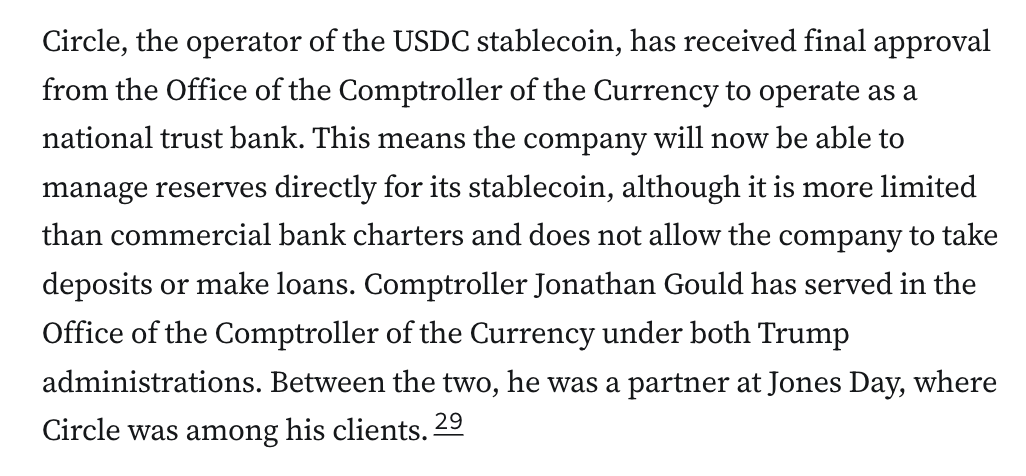
The Office of the Comptroller of the Currency has granted final approval to USDC stablecoin issuer Circle to operate as a national trust bank. Comptroller Jonathan Gould previously represented Circle as a client when he was a partner at Jones Day.
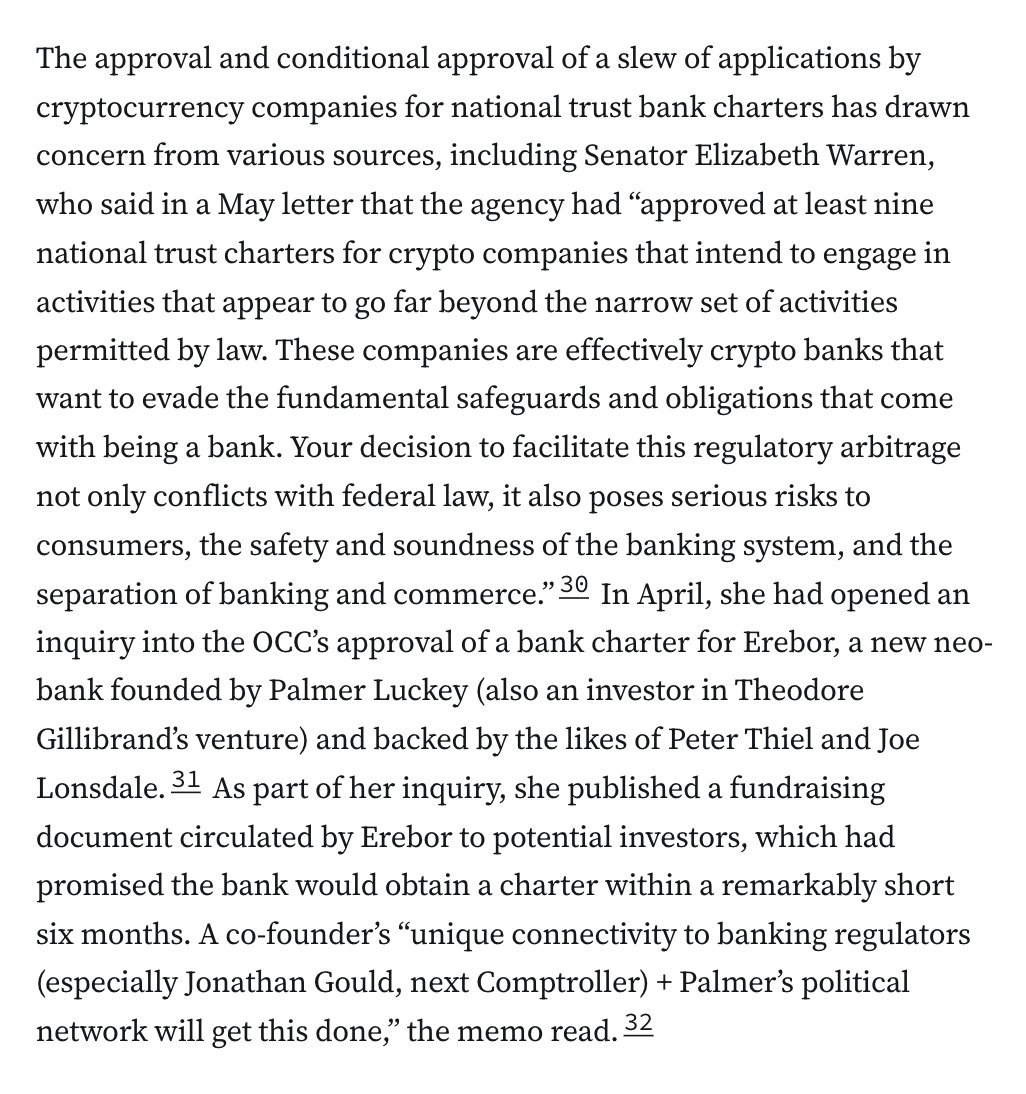
Sen. Elizabeth Warren previously raised concerns about corruption at the OCC after a memo from Palmer Luckey’s Erebor neo-bank promised investors they could secure a charter in a whirlwind six months thanks to “unique connectivity to banking regulators” and “Palmer’s political network”.
#crypto #cryptocurrency #USpol #USpolitics #CitationNeededNewsletter
Alt...
Circle, the operator of the USDC stablecoin, has received final approval from the Office of the Comptroller of the Currency to operate as a national trust bank. This means the company will now be able to manage reserves directly for its stablecoin, although it is more limited than commercial bank charters and does not allow the company to take deposits or make loans. Comptroller Jonathan Gould has served in the Office of the Comptroller of the Currency under both Trump administrations. Between the two, he was a partner at Jones Day, where Circle was among his clients.29
Alt...
The approval and conditional approval of a slew of applications by cryptocurrency companies for national trust bank charters has drawn concern from various sources, including Senator Elizabeth Warren, who said in a May letter that the agency had “approved at least nine national trust charters for crypto companies that intend to engage in activities that appear to go far beyond the narrow set of activities permitted by law. These companies are effectively crypto banks that want to evade the fundamental safeguards and obligations that come with being a bank. Your decision to facilitate this regulatory arbitrage not only conflicts with federal law, it also poses serious risks to consumers, the safety and soundness of the banking system, and the separation of banking and commerce.”30 In April, she had opened an inquiry into the OCC’s approval of a bank charter for Erebor, a new neo-bank founded by Palmer Luckey (also an investor in Theodore Gillibrand’s venture) and backed by the likes of Peter Thiel and Joe Lonsdale.31 As part of her inquiry, she published a fundraising document circulated by Erebor to potential investors, which had promised the bank would obtain a charter within a remarkably short six months. A co-founder’s “unique connectivity to banking regulators (especially Jonathan Gould, next Comptroller) + Palmer’s political network will get this done,” the memo read.32

Alt...
Screenshot of a portion of a document: 4. Timeline: Receive bank charter in less than 6 months from submission around 5/25.
a. Preliminary conditional approval in <4 months.
b. Final approval in ~3 months.
c. Co-Founder’s unique connectivity to banking regulators (especially Jonathan Gould, next Comptroller) + Palmer’s political network will get this done.
Caption: Erebor fundraising memo (via Senator Warren)
Alt...
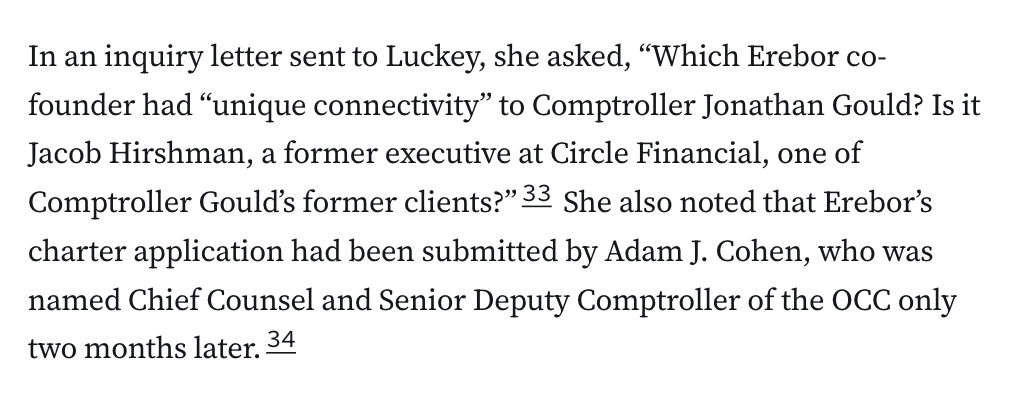
In an inquiry letter sent to Luckey, she asked, “Which Erebor co-founder had “unique connectivity” to Comptroller Jonathan Gould? Is it Jacob Hirshman, a former executive at Circle Financial, one of Comptroller Gould’s former clients?”33 She also noted that Erebor’s charter application had been submitted by Adam J. Cohen, who was named Chief Counsel and Senior Deputy Comptroller of the OCC only two months later.34
The Department of Justice is reportedly planning to drop charges against Matthew Goettsche, who ran a crypto Ponzi scheme that bilked $722 million from investors he described as “dumb” and “sheep”, after he hired Trump-linked lawyers to lobby for legal relief.
#crypto #cryptocurrency #USpol #USpolitics #CitationNeededNewsletter
![The Department of Justice is reportedly planning to drop charges against Matthew Goettsche, creator of the Bitclub Network cryptocurrency Ponzi scheme that defrauded investors out of $722 million.24 Goettsche was indicted in 2019 after offering investors what he claimed were shares in a bitcoin mining pool and encouraging them to recruit other investors. Goettsche told his business partners that he was “building this whole model on the backs of idiots”, also describing his investors as “dumb” and “sheep”. When he told a co-conspirator to falsely “bump up the daily mining earnings starting today by 60%,” his partner replied, “that is not sustainable, that is ponzi teritori [sic] and fast cash-out ponzi . . . but sure.” He later directed a co-conspirator to reduce the supposed mining earnings so he could “retire RAF!!! (rich as fuck)”.25](https://media.hachyderm.io/media_attachments/files/116/970/398/467/030/978/original/b033ed0d55d35276.png "The Department of Justice is reportedly planning to drop charges against Matthew Goettsche, creator of the Bitclub Network cryptocurrency Ponzi scheme that defrauded investors out of $722 million.24 Goettsche was indicted in 2019 after offering investors what he claimed were shares in a bitcoin mining pool and encouraging them to recruit other investors. Goettsche told his business partners that he was “building this whole model on the backs of idiots”, also describing his investors as “dumb” and “sheep”. When he told a co-conspirator to falsely “bump up the daily mining earnings starting today by 60%,” his partner replied, “that is not sustainable, that is ponzi teritori [sic] and fast cash-out ponzi . . . but sure.” He later directed a co-conspirator to reduce the supposed mining earnings so he could “retire RAF!!! (rich as fuck)”.25")
Alt...
The Department of Justice is reportedly planning to drop charges against Matthew Goettsche, creator of the Bitclub Network cryptocurrency Ponzi scheme that defrauded investors out of $722 million.24 Goettsche was indicted in 2019 after offering investors what he claimed were shares in a bitcoin mining pool and encouraging them to recruit other investors. Goettsche told his business partners that he was “building this whole model on the backs of idiots”, also describing his investors as “dumb” and “sheep”. When he told a co-conspirator to falsely “bump up the daily mining earnings starting today by 60%,” his partner replied, “that is not sustainable, that is ponzi teritori [sic] and fast cash-out ponzi . . . but sure.” He later directed a co-conspirator to reduce the supposed mining earnings so he could “retire RAF!!! (rich as fuck)”.25
![Goettsche has been lobbying the Department of Justice for relief from the prosecution, hiring a team of lawyers with connections to President Trump. Among them is Bradford Cohen, an attorney who appeared as a contestant on The Apprentice in 2004 and has been an avid Trump supporter ever since, and Brett Tolman, a lawyer and Fox News contributor who has been helping clients lobby for Trump pardons since the first Trump administration. Among Tolman’s past clients are Charles Kushner, father of Trump son-in-law Jared Kushner, and crypto cause célèbre Ross Ulbricht [I75].26 Cohen has also been in the Trump pardon business since Trump’s first presidency, successfully lobbying for clemency for rappers Lil Wayne and Kodak Black.27](https://media.hachyderm.io/media_attachments/files/116/970/398/482/633/270/original/fd6ba5f0380c9b60.png "Goettsche has been lobbying the Department of Justice for relief from the prosecution, hiring a team of lawyers with connections to President Trump. Among them is Bradford Cohen, an attorney who appeared as a contestant on The Apprentice in 2004 and has been an avid Trump supporter ever since, and Brett Tolman, a lawyer and Fox News contributor who has been helping clients lobby for Trump pardons since the first Trump administration. Among Tolman’s past clients are Charles Kushner, father of Trump son-in-law Jared Kushner, and crypto cause célèbre Ross Ulbricht [I75].26 Cohen has also been in the Trump pardon business since Trump’s first presidency, successfully lobbying for clemency for rappers Lil Wayne and Kodak Black.27")
Alt...
Goettsche has been lobbying the Department of Justice for relief from the prosecution, hiring a team of lawyers with connections to President Trump. Among them is Bradford Cohen, an attorney who appeared as a contestant on The Apprentice in 2004 and has been an avid Trump supporter ever since, and Brett Tolman, a lawyer and Fox News contributor who has been helping clients lobby for Trump pardons since the first Trump administration. Among Tolman’s past clients are Charles Kushner, father of Trump son-in-law Jared Kushner, and crypto cause célèbre Ross Ulbricht [I75].26 Cohen has also been in the Trump pardon business since Trump’s first presidency, successfully lobbying for clemency for rappers Lil Wayne and Kodak Black.27
Also in this issue: Prediction markets continue to be a crypto-esque wild west, with a recent WSJ report exposing the Trump-linked Polymarket’s false advertising. Influencers paid by Polymarket are boasting about manipulating bets.
#crypto #cryptocurrency #USpol #USpolitics #Polymarket #CitationNeededNewsletter

Alt...
In prediction markets
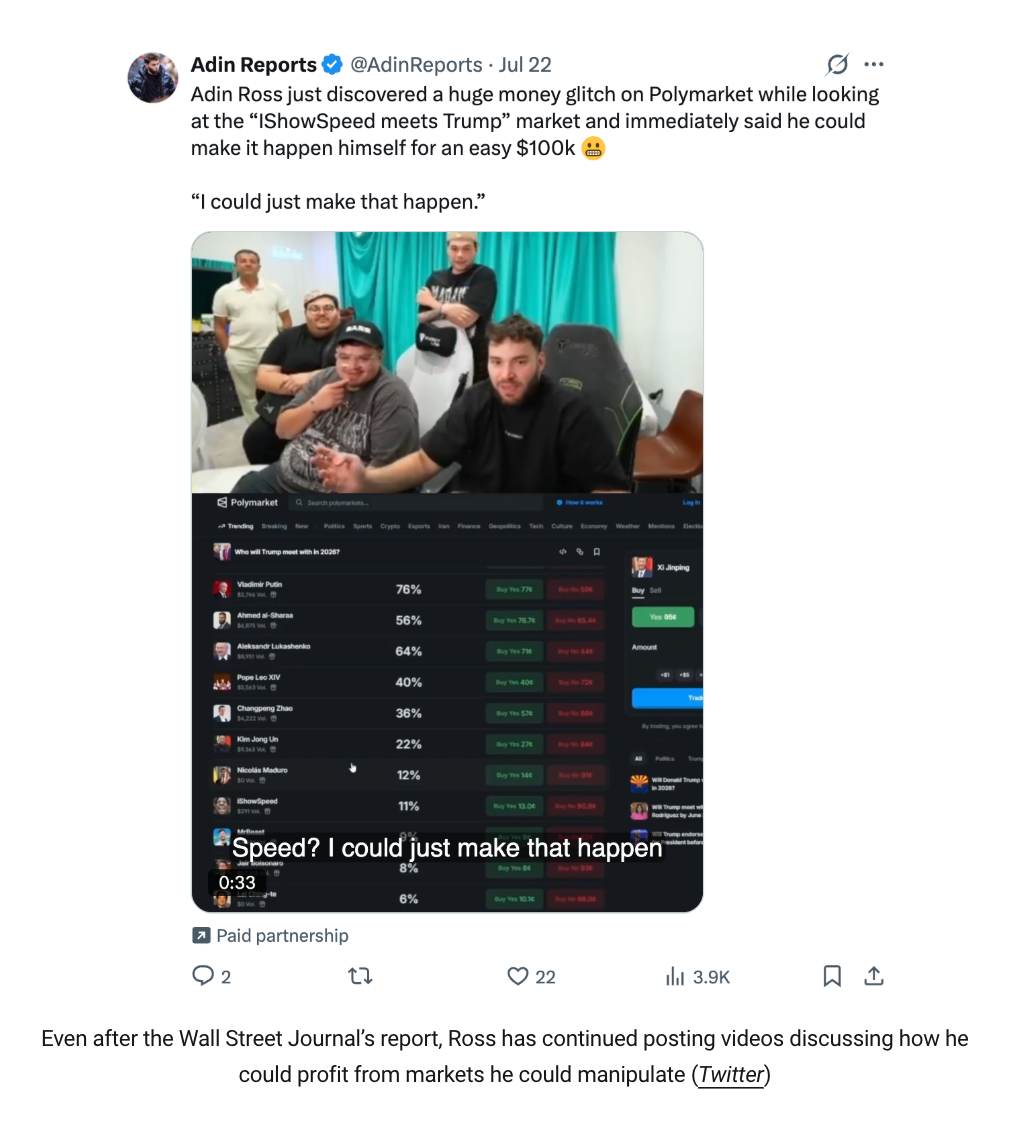
The world of prediction markets continues to be a crypto-esque wild west. Polymarket — a leading platform and one that counts Donald Trump Jr. among its investors and strategic advisers — is at the center of a recent Wall Street Journal investigation alleging that the company has been paying social media influencers to film themselves making fake trades, then using a “social-media army” to boost the videos. According to the Journal’s analysis of more than 1,000 videos posted by creators working with a Polymarket-contracted marketing company, $1.9 million in supposed bets were placed, but none were real. Among the influencers promoting Polymarket is Adin Ross, an Andrew Tate protégé with a multi-million dollar deal with the company. In videos, Ross repeatedly spoke about how he could profit from insider trading on Polymarket, such as by betting on the release date of an album by his friend Drake.17
Alt...
Image: Tweet by Adin Reports on July 22, 2026: “Adin Ross just discovered a huge money glitch on Polymarket while looking at the “IShowSpeed meets Trump” market and immediately said he could make it happen himself for an easy $100k 😬 “I could just make that happen.””
Caption: Even after the Wall Street Journal’s report, Ross has continued posting videos discussing how he could profit from markets he could manipulate (Twitter)
If the Senate doesn’t pass Clarity by the start of recess on August 7, its chances become very slim. Future attempts at crypto legislation would not likely be nearly this friendly to the industry — a huge blow after crypto spent $200M+ expecting they could dictate the bill.
#crypto #cryptocurrency #USpol #USpolitics #CitationNeededNewsletter
Alt...
If the Clarity Act dies, the crypto industry loses its best chance at a sweeping bill that would lock in the deregulatory gains they’ve achieved through agency capture. The SEC and CFTC are currently run by Trump loyalists who have aggressively rolled back enforcement and reinterpreted their authority to favor crypto, but the crypto industry knows that agency policy can be reversed by the next administration. That’s why they have been so desperate to get the Clarity Act signed into law. Losing it would be a massive blow to the industry after it committed $200 million (and counting) in super PAC spending since 2024, with a sweeping legislative rewrite as a primary goal.
Alt...
With the Senate only in session for about two more weeks before the August recess, the Clarity Act cryptocurrency market structure bill’s chances of passing are growing slimmer by the day. Any hope of the bill clearing both chambers before August is already dead, given that the House begins its recess session at the end of this week. The Senate has a little longer — until August 7 — although some Senators have already said they will be absent next week to attend the funeral of Senator Lindsey Graham.1
When Congress returns in September, its members will be consumed by the midterms, leaving little time for complex negotiations. The lame duck session follows that: a notoriously challenging time for major legislation. The Clarity Act may well be kaput under this Congress, and the industry-tailored bill will face a significantly more challenging — if not impossible — path to law if Republicans lose their trifecta in the midterms. In May, Senator Cynthia Lummis predicted that if the bill doesn’t pass under this Congress, the next opportunity would likely not come until 2030.2
And even Republicans have expressed concerns with the bill, revisiting the issue of stablecoin yield that negotiators thought they had resolved.
The bill needs sixty votes to pass, which would require all Republicans and seven Democrats to sign on.
#crypto #cryptocurrency #USpol #USpolitics #CitationNeededNewsletter
Alt...
And it’s not just Democrats who may pose obstacles. Some Republicans have also expressed concerns with the draft. Senators John Curtis (UT) and John Cornyn (TX) told Punchbowl News they aren’t happy with the result of the stablecoin negotiations, and remain worried that allowing stablecoin operators to offer yield could trigger deposit flight from community banks. “Crypto is not going to be loaning any money for small businesses,” Cornyn said. “If we’re taking loan capacity away from our banks who are in these communities — I want to make sure that we’re not hurting the very people who rely on these banks.”11 However, he told Semafor’s Eleanor Mueller that it would be “premature” to say whether he would vote against the current draft.12 Republican Senator Bill Cassidy (LA) also intimated that he “might” have concerns with the bill, but did not specify what they were.11
Republicans could force the draft bill to a vote before the August recess, and Majority Leader John Thune has repeatedly hinted he may do just that, but whether even the most crypto-friendly Democrats will support it remains dubious. The bill needs sixty votes to pass, meaning at least seven Democrats must sign on. After that, it would still have to pass the House.
Though Republicans are preemptively pinning blame on Democrats if the crypto bill fails to pass, Democrats are so far holding out for meaningful ethics language, and have suggested that ethics is not their only complaint with the draft legislation.
#crypto #cryptocurrency #USpol #USpolitics #CitationNeededNewsletter
Alt...
Democratic lawmakers still hadn’t seen the draft “compromise” the day before it went public,4 but that didn’t stop Republicans and the crypto industry from launching an aggressive PR campaign pressuring them to accept it — while preemptively assigning blame if the bill fails. “If Senate Democrats block this historic legislation after the administration has bent over backward to accommodate their concerns,” one White House source told The Hill, “stakeholders should make no mistake: it is the Democrats who are blocking this legislation because they were never serious about a legislative outcome.”5
Alt...
Democrats appear unmoved. Senator Angela Alsobrooks (D-MD), one of the two Democrats who voted to pass the bill out of the Senate Banking Committee, has described the DOJ enforcement mechanism as an “unserious offer”.6 Democrats involved in the negotiations have previously insisted on enabling state attorneys general to enforce ethics provisions, and neither side seems willing to budge. Patrick Witt, the executive director of the President’s Council of Advisors for Digital Assets, has shown no sign of yielding, arguing that Democrats who believe an ethics provision without state AG enforcement is meaningless are “basically saying that ALL current federal ethics laws are meaningless because none of them are enforceable by state AGs”.7 Given this administration’s track record on ethics enforcement, he may have a point.
Alt...
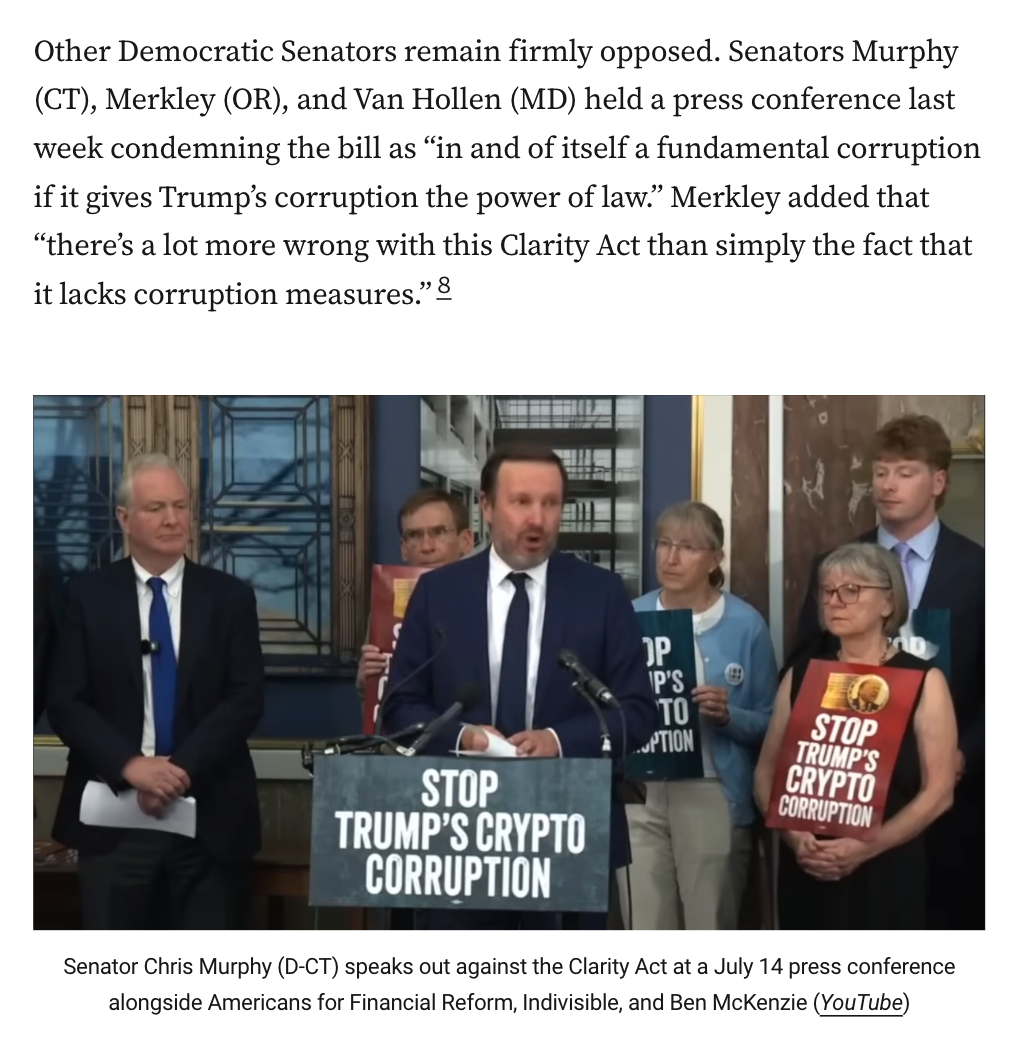
Other Democratic Senators remain firmly opposed. Senators Murphy (CT), Merkley (OR), and Van Hollen (MD) held a press conference last week condemning the bill as “in and of itself a fundamental corruption if it gives Trump’s corruption the power of law.” Merkley added that “there’s a lot more wrong with this Clarity Act than simply the fact that it lacks corruption measures.”8
Image: Senator Chris Murphy (D-CT) speaks at a podium labeled with “Stop Trump’s Crypto Corruption”. Behind him stands Senator Van Hollen (D-MD) and a group of other people.
Caption: Senator Chris Murphy (D-CT) speaks out against the Clarity Act at a July 14 press conference alongside Americans for Financial Reform, Indivisible, and Ben McKenzie (YouTube)
Alt...
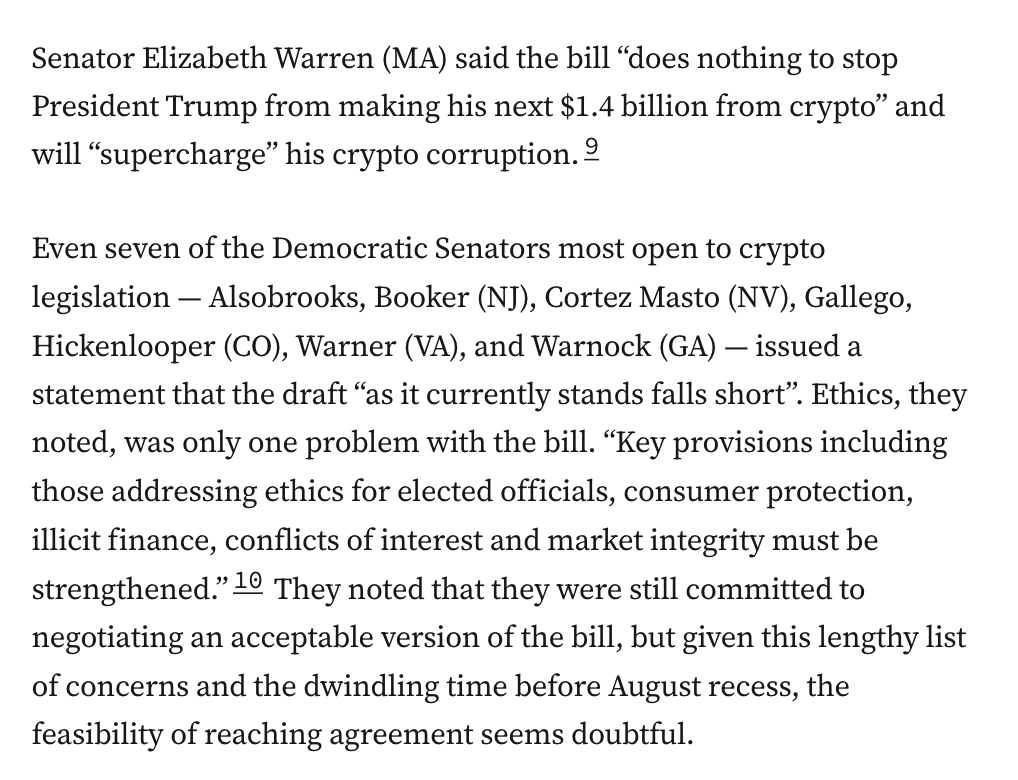
Senator Elizabeth Warren (MA) said the bill “does nothing to stop President Trump from making his next $1.4 billion from crypto” and will “supercharge” his crypto corruption.9
Even seven of the Democratic Senators most open to crypto legislation — Alsobrooks, Booker (NJ), Cortez Masto (NV), Gallego, Hickenlooper (CO), Warner (VA), and Warnock (GA) — issued a statement that the draft “as it currently stands falls short”. Ethics, they noted, was only one problem with the bill. “Key provisions including those addressing ethics for elected officials, consumer protection, illicit finance, conflicts of interest and market integrity must be strengthened.”10 They noted that they were still committed to negotiating an acceptable version of the bill, but given this lengthy list of concerns and the dwindling time before August recess, the feasibility of reaching agreement seems doubtful.
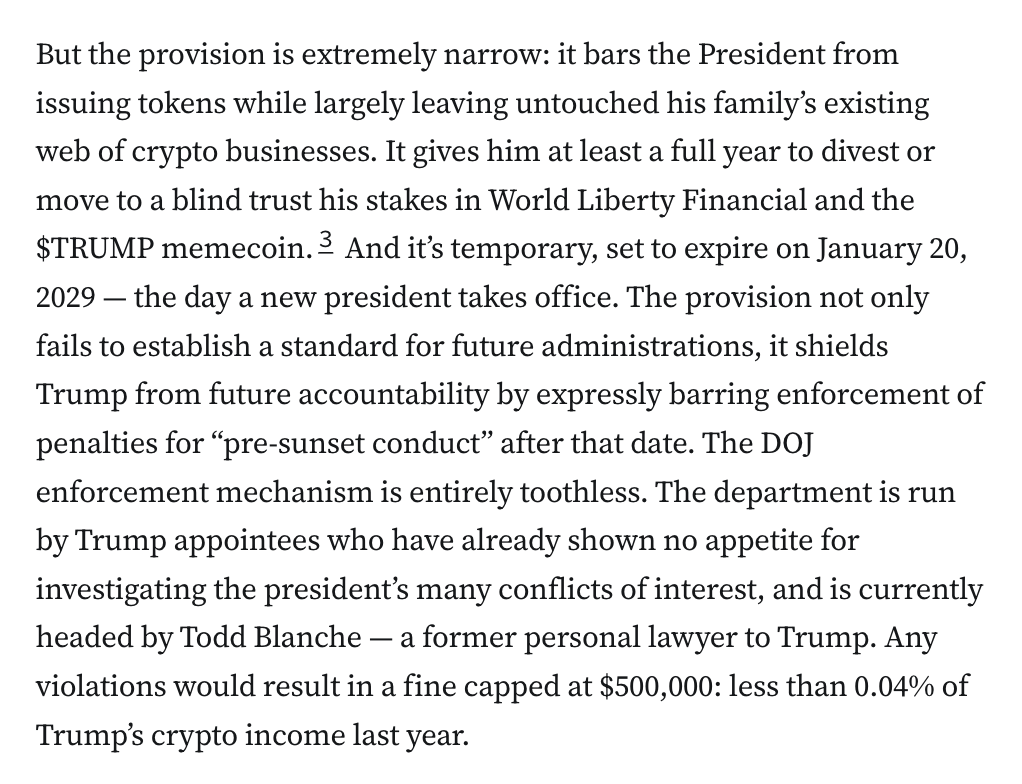
Ethics enforcement would be left to a DOJ that has shown no appetite for reining in Trump’s corruption. The provision would expire in 2029, and explicitly bars retroactive enforcement against Trump.
Any fine is capped at $500k: less than 0.04% of what the President brought in from crypto last year.
#crypto #cryptocurrency #USpol #USpolitics #CitationNeededNewsletter
Alt...
But the provision is extremely narrow: it bars the President from issuing tokens while largely leaving untouched his family’s existing web of crypto businesses. It gives him at least a full year to divest or move to a blind trust his stakes in World Liberty Financial and the $TRUMP memecoin.3 And it’s temporary, set to expire on January 20, 2029 — the day a new president takes office. The provision not only fails to establish a standard for future administrations, it shields Trump from future accountability by expressly barring enforcement of penalties for “pre-sunset conduct” after that date. The DOJ enforcement mechanism is entirely toothless. The department is run by Trump appointees who have already shown no appetite for investigating the president’s many conflicts of interest, and is currently headed by Todd Blanche — a former personal lawyer to Trump. Any violations would result in a fine capped at $500,000: less than 0.04% of Trump’s crypto income last year.
Though Republicans and the crypto industry presented the latest draft crypto bill as a viable option after months of disagreements, even the crypto-friendliest Democrats have are opposing its toothless ethics provision that would not meaningfully impact the President’s crypto grift.
#crypto #cryptocurrency #USpol #USpolitics #CitationNeededNewsletter
![While some of the bill’s supporters had hoped that resolving the banking–crypto impasse on stablecoin yield [I99, 102, 103] would allow the bill to rocket to the President’s desk, significant disagreements remain. Chief among them is ethics. Senate Democrats — including those who supported the bill’s progression out of the Senate Banking Committee — are insisting on some provisions that would limit the President’s self-enrichment via crypto. The recent release of President Trump’s 2025 annual financial disclosure, which revealed he had made more than $1.4 billion in the last year just from his crypto ventures, has only amplified these demands.
Link card to Citation Needed post titled “Trumps $1.4 billion crypto disclosure”
Republicans and crypto figures initially presented the latest draft, which went public on July 22 after White House sign-off, as a promising path to law. The so-called “compromise” on ethics would bar the president, vice president, and members of Congress from issuing cryptocurrencies, with enforcement delegated to the Department of Justice.](https://media.hachyderm.io/media_attachments/files/116/970/370/818/604/675/original/b272af6e097ccd8f.png "While some of the bill’s supporters had hoped that resolving the banking–crypto impasse on stablecoin yield [I99, 102, 103] would allow the bill to rocket to the President’s desk, significant disagreements remain. Chief among them is ethics. Senate Democrats — including those who supported the bill’s progression out of the Senate Banking Committee — are insisting on some provisions that would limit the President’s self-enrichment via crypto. The recent release of President Trump’s 2025 annual financial disclosure, which revealed he had made more than $1.4 billion in the last year just from his crypto ventures, has only amplified these demands.
Link card to Citation Needed post titled “Trumps $1.4 billion crypto disclosure”
Republicans and crypto figures initially presented the latest draft, which went public on July 22 after White House sign-off, as a promising path to law. The so-called “compromise” on ethics would bar the president, vice president, and members of Congress from issuing cryptocurrencies, with enforcement delegated to the Department of Justice.")
Alt...
While some of the bill’s supporters had hoped that resolving the banking–crypto impasse on stablecoin yield [I99, 102, 103] would allow the bill to rocket to the President’s desk, significant disagreements remain. Chief among them is ethics. Senate Democrats — including those who supported the bill’s progression out of the Senate Banking Committee — are insisting on some provisions that would limit the President’s self-enrichment via crypto. The recent release of President Trump’s 2025 annual financial disclosure, which revealed he had made more than $1.4 billion in the last year just from his crypto ventures, has only amplified these demands.
Link card to Citation Needed post titled “Trumps $1.4 billion crypto disclosure”
Republicans and crypto figures initially presented the latest draft, which went public on July 22 after White House sign-off, as a promising path to law. The so-called “compromise” on ethics would bar the president, vice president, and members of Congress from issuing cryptocurrencies, with enforcement delegated to the Department of Justice.
Newsletter: The Clarity Act cryptocurrency market structure bill may well be dead, as the crypto industry has spent $200 million to get a bill too corrupt for Democrats to pass and a president too corrupt to sign anything that might meaningfully limit his grift.
https://www.citationneeded.news/issue-107/
#crypto #cryptocurrency #USpol #USpolitics #CitationNeededNewsletter
![[?]](https://files.mastodon.social/accounts/avatars/000/034/380/original/c4398fad142099bc.jpg)
Matthew McPherrin from Let's Encrypt doing a talk next Wednesday at TASK on post quantum readiness, TLS, and many things. Streaming link on site. https://www.task.to/schedule/july2026-business-resilience-post-quantum-tls #TASK #Toronto #Crypto #PostQuantum #PQ #InfoSec
Edit: There are five Wednesdays this month
![[?]](https://cdn.fosstodon.org/accounts/avatars/110/100/058/937/166/321/original/c34ec0d2cad426ab.png)
Shufflecake talk at CAW 2026 last May - video now available online!
https://clip.place/w/d7Anz5jbsMCZo1HBg8JkES
https://www.youtube.com/watch?v=21LjKFBIwwY
#shufflecake #caw #eurocrypt #eurocrypt2026 #cryptography #crypto #truecrypt #veracrypt #security #Privacy #infosec #hacktivism #censorship
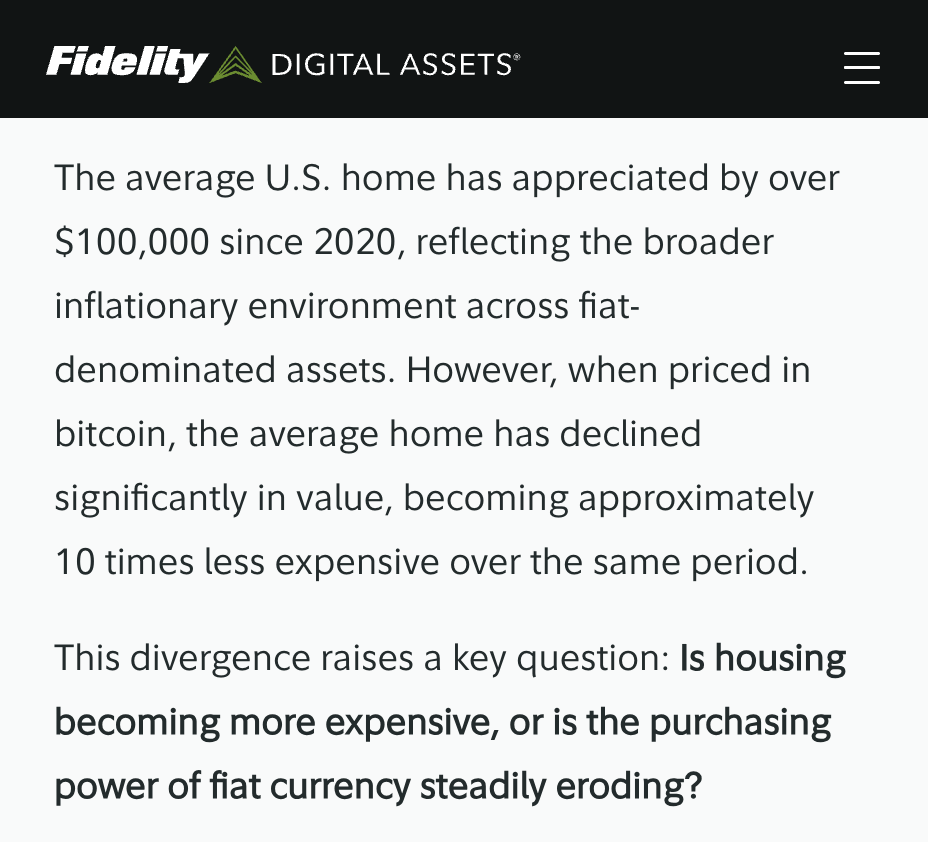
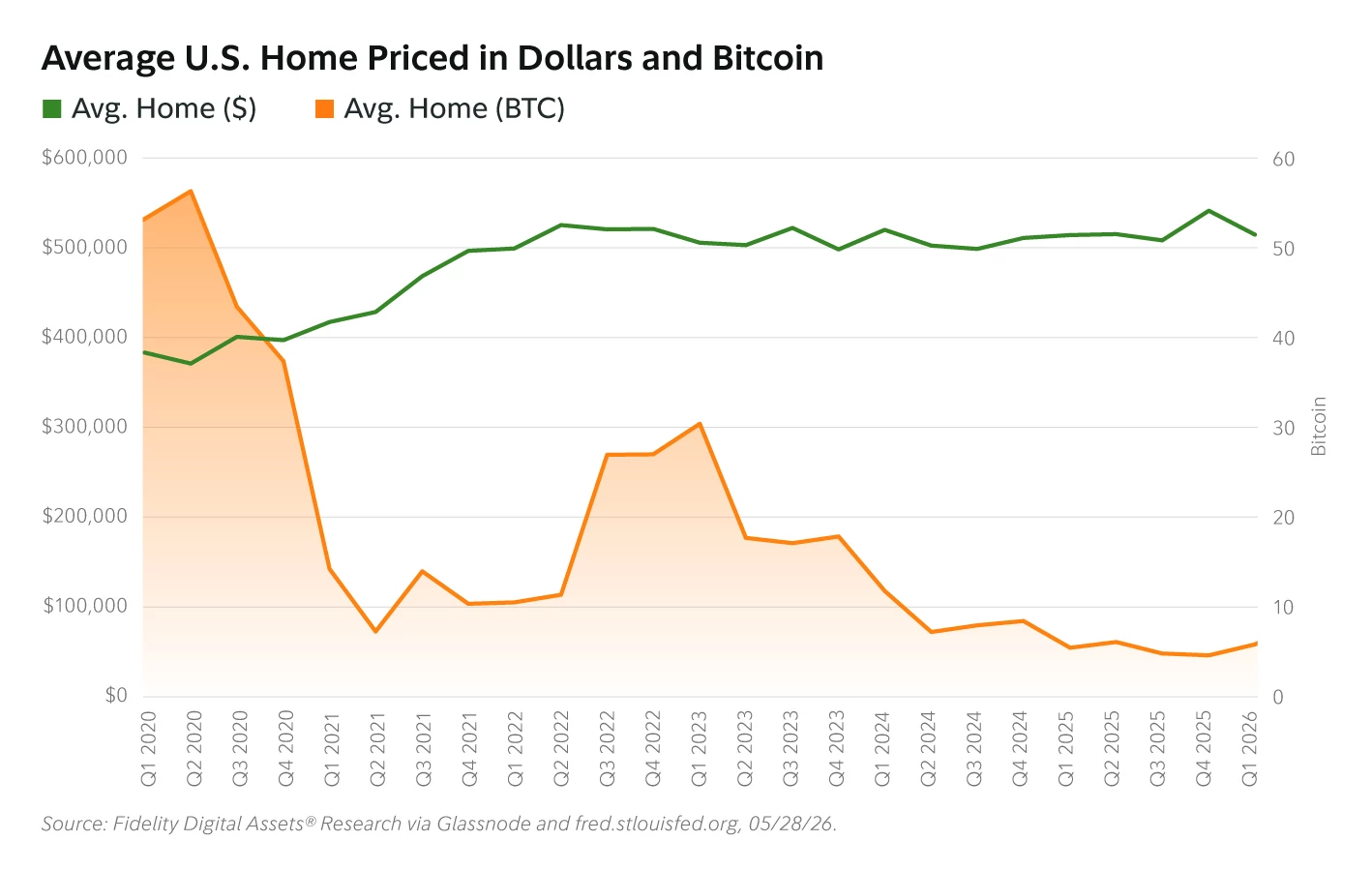
fascinating economic discovery from Fidelity: houses actually are cheaper now than in 2020!*
* if you denominate them in an arbitrary asset that has appreciated over that time frame
next up from Fidelity: groceries aren't getting more expensive!**
** if you denominate their price in World of Warcraft gold
Alt...
The average U.S. home has appreciated by over $100,000 since 2020, reflecting the broader inflationary environment across fiat-denominated assets. However, when priced in bitcoin, the average home has declined significantly in value, becoming approximately 10 times less expensive over the same period. This divergence raises a key question: Is housing becoming more expensive, or is the purchasing power of fiat currency steadily eroding?
Alt...
Chart showing average home prices in dollars from 2020–2026 (rising about $100k over that period), and on the second axis the price in bitcoin (dropping by about 50BTC)
![[?]](https://media.mstdn.social/accounts/avatars/109/824/427/395/852/440/original/104e8553cdb321b6.png)

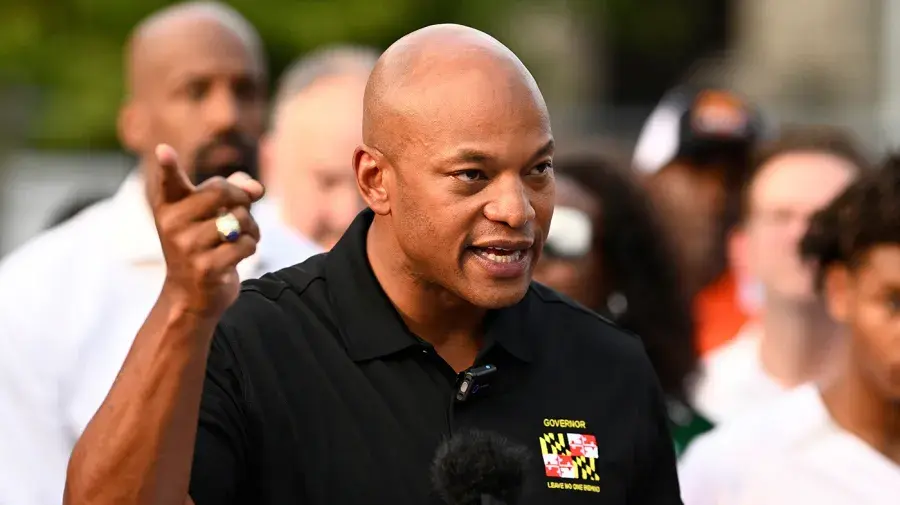
I haven't seen The Hill publish this much negative coverage of Trump since...forever.
Wes Moore: There is ‘something fundamentally wrong’ with Trump making $1B in crypto money
https://thehill.com/homenews/administration/5954124-maryland-gov-trump-crypto-profits/
#Crypto #WesMoore #TrumpMustGo #IndictTrump #USPol
…Since arriving at the White House, #Trump & appointees have curtailed #regulatory #oversight of the industry,
including policies related to #memecoins.
…Despite the cratering prices, Trump has faced few consequences from his ventures, because federal regulators have largely abandoned #crypto enforcement.
…the #SEC announced in February 2025 that it will no longer scrutinize #memecoin deals.
…Nicholas Pinto is among the losers. A frequent #crypto trader who voted for #Trump in 2024, Mr. Pinto said he invested a total of roughly $500,000 in the $TRUMP coin, & has now lost about half that investment.
“He is leveraging the power of being president to launch currencies, when he seems trustworthy in the public’s eye,” Mr. Pinto said in an interview. “It is kind of incredible. It is almost a legal scam.”
The firm’s assessment was calculated this week after #Trump signed an annual financial disclosure showing that he walked away with a $636 million payout on the same #crypto bet, part of a haul of at least $2.2 billion from all of his business ventures in 2025.
The odds were always in his favor. Trump profited whether the price went up or down. He collected returns whenever anyone traded the tokens, as he repeatedly pushed his followers to do, using Truth Social [& the presidency] to promote it.
An up-to-date tally of #Trump followers turned #crypto #investors is in. And for them, the overall results are remarkably bad.
Nearly 1 million people who bought Trump’s #memecoin have lost money through the end of June, according to a report by the #cryptocurrency analytics firm Nansen. Their losses total $3.81 billion.
Nearly a Million #Investors Lost a Total of $3.8 Billion on #Trump #Crypto Coin
[while he made $1.6 billion off his scams]
A report from a #cryptocurrency analytics firm details how those who bought the Trump #memecoin have fared, with most retail investors having lost money while sophisticated traders did better.
#scam #ThiefInChief
https://www.nytimes.com/2026/07/04/us/politics/trump-coin-crypto-investors-loss.html?smid=nytcore-ios-share
![[?]](https://files.mastodon.social/accounts/avatars/110/641/555/278/107/926/original/60e39d3280d3b645.png)
❝ The 927-page document released on Tuesday by the US Office of Government #Ethics sets out a dizzying array of income – not only from golf courses and Trump-branded bibles, but also from #crypto, which he has relentlessly promoted, and lucrative overseas deals. Tribute flows from foreign nations. On Wednesday he took his first flight on the Boeing 747 gifted by #Qatar.❞
The Guardian view on Trump’s wealth and power: a medieval court wreaks havoc in the 21st century https://www.theguardian.com/commentisfree/2026/jul/01/the-guardian-view-on-trumps-wealth-and-power-a-medieval-court-wreaks-havoc-in-the-21st-century
The disclosure gives little insight into where the money is coming FROM. That some of Trump’s income comes from figures like Justin Sun or the United Arab Emirates (who later reaped benefits) is not disclosed in the filing, but known only thanks to outside reporting or self-disclosure by investors.
And Trump’s sons, who are heavily involved in the crypto sector and run some of Trump’s businesses, are not required to file disclosures. This is because they have no formal position in the White House, despite regularly meeting with high-level officials to discuss business and policy.
#crypto #cryptocurrency #USpol #USpolitics #CitationNeededNewsletter
The White House insists that there’s no conflict of interest, even as Trump brings in hundreds of millions from foreign nations seeking (and receiving) favorable policy outcomes, crypto firms looking for regulatory relief, and a tokens launched under the eyes of Trump loyalist regulators.
#crypto #cryptocurrency #USpol #USpolitics #CitationNeededNewsletter
Trump’s most recent financial disclosure reveals more than $1.4 billion in income from his crypto-related ventures alone, and even that’s an incomplete picture.
https://www.citationneeded.news/trumps-crypto-disclosure/
#crypto #cryptocurrency #USpol #USpolitics #CitationNeededNewsletter
The 2025 disclosure includes $635 million in royalties from a license agreement with #CelebrationCoins; at least $525 million in proceeds from token sales by #WorldLibertyFinancial, a #crypto project founded by #Trump & sons; $65 million in proceeds from World Liberty Financial’s equity sale; & $196 million in net proceeds from a stablecoin transaction.
#law #AbuseOfPower #MafiaState #corruption #kleptocracy #emoluments #MoneyLaundering #crime
In his 2024 financial disclosure, filed a year ago, #Trump reported earning >$600 million in total income.
In addition to the income from #coin sales & other ventures, Trump reported receiving $86.5 million from “ #settlements “ in 5 separate [& pure #extortion] lawsuits against #ABC, #CBS, #YouTube, #Meta & #X.
#law #AbuseOfPower #MafiaState #corruption #kleptocracy #emoluments #crypto #MoneyLaundering #crime
So much for the foreign & domestic #emoluments clauses…
#Trump reported >$1.4 billion in income from #crypto, digital #tokens & related partnerships in 2025, appearing to have SUBSTANTIALLY increased his income after reentering the White House last year.
The income was reported in 927 pages of financial disclosure forms, which the #WhiteHouse released Tuesday.
#law #AbuseOfPower #MafiaState #corruption #kleptocracy
https://www.washingtonpost.com/politics/2026/06/30/trump-earned-over-1-billion-cryptocurrency-coin-ventures-last-year/
![[?]](https://jasette.facil.services/system/accounts/avatars/109/367/072/154/545/516/original/ab7bfce8c64a4242.jpg)
Priorités
https://www.instagram.com/p/DZ7y_e4k2wB/
#IA #tech #crypto #dessin #Soulcié

Alt...
Le dessin de la rédaction par Thibaut Soulcié. On y voit la terre qui chauffe et une bulle qui s'en échappe pour dire "Des volets pour l'école ? Ah non, c'est trop cher !". Par ailleurs, on voit dans le ciel tout un tas de machines pour l'espace, la crypto, les datas center, l'IA, Star Link etc.
I've been running Follow the Crypto since 2024. Today I'm relaunching it as Tech Influence Watch, expanded to cover AI political spending alongside crypto. They’ve spent more than $400 million this election cycle, and now you can follow it in close to real time.
https://influence.citationneeded.news/
Here’s the full story behind the Tech Influence Watch launch, including what I found while building it and why it matters now: https://www.citationneeded.news/tech-influence-watch/
#crypto #cryptocurrency #AI #ArtificialIntelligence #USpol #USpolitics #CitationNeededNewsletter
![[?]](https://cdn.hosted.spacebear.ee/sb-444643948490e1fed8199ed78bf1ee5f/accounts/avatars/109/371/733/810/294/907/original/adb71e94b9377654.png)
Featured story, from Candice Bernd: The drought-stricken City of Corpus Christi is withholding how much #water a controversial #cryptocurrency mine is siphoning away from surrounding residents. https://www.texasobserver.org/corpus-christi-cryptomine-water-usage-secret/
#bitcoin #crypto #tech #drought #GulfCoast #Texas #news #journalism
Newsletter: The crypto industry spent the spring buying primaries, an octagon at the White House, and — they hope — a market-structure bill by the Fourth of July.
![[?]](https://soc.octade.net/retro/s/avatar-ccef00a9a86a19e385ce6ac3ee6932ec.png)
Apps for encryption, comms, Usenet, remailers ...
Ch1ffr3punk: https://github.com/Ch1ffr3punk
The owner is a denizen of the OG #Usenet scene.
#cypherpunk #cryptography #crypto #encryption #privacy #github #freesoftware
@cypherpunk@soc.octade.net @cryptography@soc.octade.net @usenet@soc.octade.net
[noted]: The Second Circuit has rejected Sam Bankman-Fried's appeal, upholding his conviction and 25-year sentence. The court ruled that whether his investments ultimately paid off is “irrelevant”. Meanwhile, SBF has applied for a presidential pardon.
https://www.citationneeded.news/second-circuit-rejects-sam-bankman-frieds-appeal/
My work tracking cryptocurrency and AI industry political spending has only underscored the importance of getting big money out of politics. I recently talked to Tiffany Muller, President of End Citizens United, about what it would take to do that, and how we’re closer than you might think.
Video: https://www.youtube.com/watch?v=oZAhNJbsPcA
Transcript: https://www.citationneeded.news/end-citizens-uniteds-tiffany-muller-on-fighting-big-money-in-politics/
#cryptocurrency #crypto #AI #ArtificialIntelligence #CitizensUnited #USpol #USpolitics
- a neat hack for the properly paranoid -
Your computer is likely generating random noise on your sound card. On some systems you can harvest this noise as true random entropy. This entropy can be diffused and whitened for use in cryptography.
https://www.metzdowd.com/pipermail/cryptography/2026-March/039388.html
#Random #Entropy #Cryptography #Crypto #Hardware #Hacks #Sound #Audio #Chaos
@cypherpunk@soc.octade.net @cryptography@soc.octade.net @crypto@infosec.pub @cryptography@fed.dyne.org @cryptography@lemmy.ml

Alt...
Source code screenshot for harvesting entropy from a sound card. Follow the link to read the source code text.
https://soc.octade.net/cypherpunk/
A fediverse group for discussing topics and tools related to #cypherpunks.
#groups #fedigroups #fediverse #retro #cypherpunk #crypto #cryptography #encryption
@cryptography@soc.octade.net @cypherpunk@soc.octade.net
Alt...
Glowing green-lined skull on black background with digital circuit board lines and one eye a glowing bitcoin symbol and the other eye a glowing hashtag with the tagline 'CYPHERPUNK REVOLT'.
House Oversight Democrats have published a Web3 is Going Great-style “Trump Family Digital Grift” counter
https://oversightdemocrats.house.gov/trump-family-corruption-tracker
This goes with their recent staff report, “Professionalized Corruption: How Donald Trump is abusing power and accepting digital kickbacks from foreign and criminal interests to cash in on the presidency like never before”
https://oversightdemocrats.house.gov/imo/media/doc/12026cryptoreport.pdf
(The report cites my writing on Trump’s USD1 stablecoin, published here: https://www.citationneeded.news/issue-83/#trump-business-interests)
#crypto #cryptocurrency #USpol #USpolitics
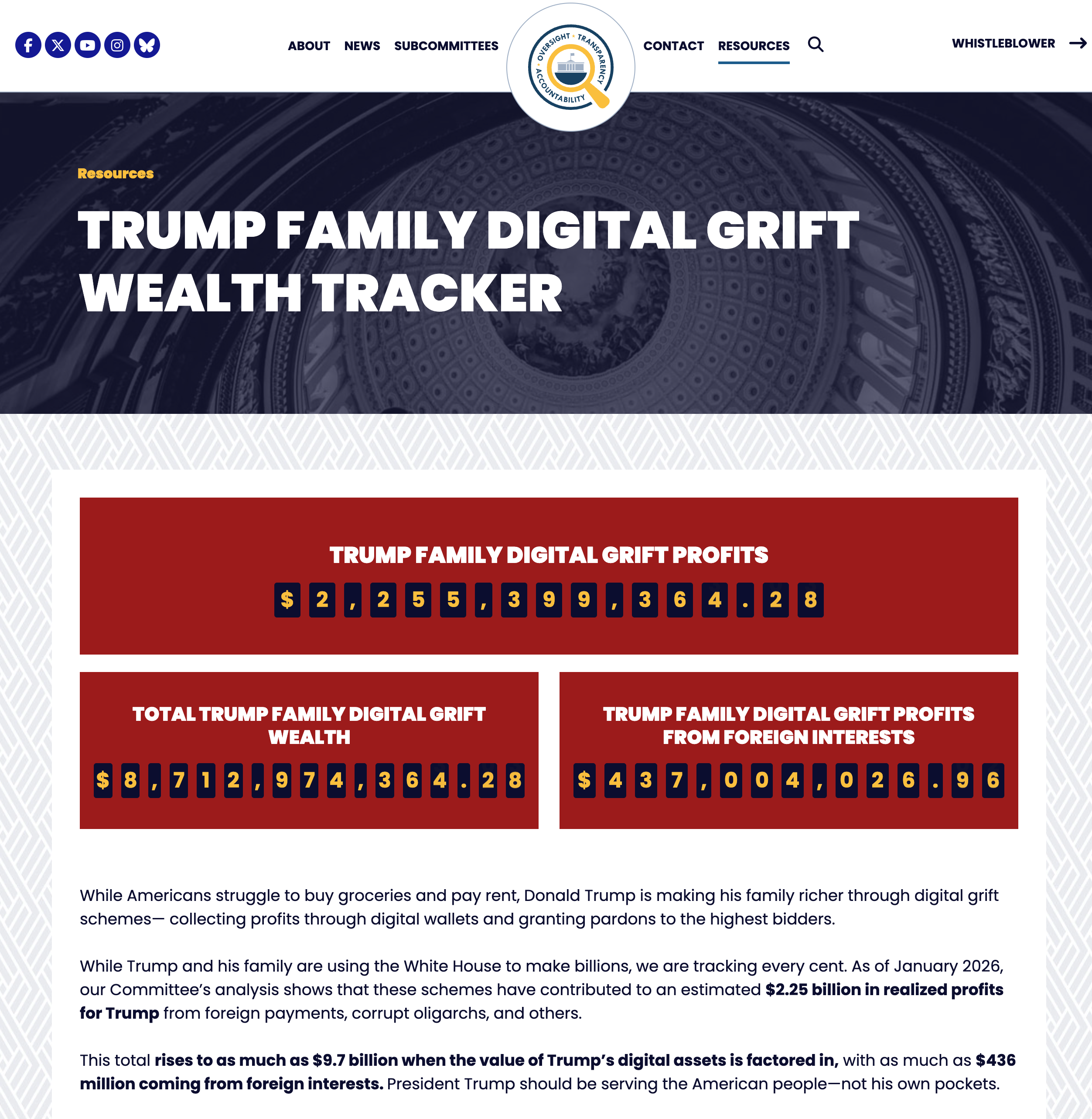
Alt...
Trump Family Digital Grift Profits $2,255,399,364.28
Total Trump Family Digital Grift Wealth $8,712,974,364.28
Trump Family Digital Grift Profits from Foreign Interests $437,004,026.96
While Americans struggle to buy groceries and pay rent, Donald Trump is making his family richer through digital grift schemes— collecting profits through digital wallets and granting pardons to the highest bidders.
While Trump and his family are using the White House to make billions, we are tracking every cent. As of January 2026, our Committee’s analysis shows that these schemes have contributed to an estimated $2.25 billion in realized profits for Trump from foreign payments, corrupt oligarchs, and others.
This total rises to as much as $9.7 billion when the value of Trump’s digital assets is factored in, with as much as $436 million coming from foreign interests. President Trump should be serving the American people—not his own pockets.
[for your address book]
https://soc.octade.net/cryptography/
A Fediverse group for sharing and discussing #ciphers, #codes #cryptography and #encryption and related applications and #research.
#crypto #cypher #cypherpunks #confidentiality #privacy #groups #fedigroups #fediverse

Alt...
Artistic image of a sheet of paper with binary ones and zeroes and a reddish padlock in the upper right-hand corner..
Hexlish Alphabet for English, Constructed Languages and Cryptography: Automatic, Structural Compression with a Phonetic Hexadecimal Alphabet
DOI : https://doi.org/10.5281/zenodo.13139469
Hexlish is a legible, sixteen-letter alphabet for writing the English language and for encoding text as legible base 16 or compressed binary. Texts composed using the alphabet are automatically compressed by exactly fifty percent when converted from Hexlish characters into binary characters. Although technically lossy, this syntactic compression enables recovery of the correct English letters via syntactic reconstruction. The implementer can predict the size of the compressed binary file and the size of the text that will result from decompression. Generally it is intuitive to recognize English alphabet analogues to Hexlish words. This makes Hexlish a legible alternative to the standard hexadecimal alphabet.
#Hexlish #Conlang #Alphabets #English #Hexadecimal #Encoding #Cryptography #Ciphers #Crypto #Encryption #Compression #Papers #Preprints #Orthography #Language #Linguistics #Writing #Glyphs #Alphabetology #Technology

Alt...
Hexlish Alphabet logo. The word HEXLISH in rainbow colors on a black background with a hexagonal dot above the letter I. Beneat the logo in yellow reads the phrase, "English Text Compression & Encoding."
From the light of freedom to a concrete tomb,
The fall was great and swift.
My soul cried out in a mighty boom,
How could it come to this?
Clamped down, trapped stuck,
Paralyzed in a tiny cage.
Had fate left me not a drop of luck?
Was there reason for this rage?
Told to lay down and die,
Something deep inside me stirred.
I can’t be caged I have to fly!
Not yet am I interred.
They can take my body, tie me down,
It matters not a bit.
My spirit still runs wild and free,
So in freedom here I sit.
~ Ross Ulbricht
Apr 30, 2024
It seems his artistic vision finally became reality.
sources
https://freeross.org/uncageable/
https://rossulbricht.substack.com/p/uncageable-poem-and-drawing
#RossUlbricht #DreadPirateRoberts #SilkRoad #USCourts #CriminalJustice #Prisons #Prisoners #Poetry #News #Crypto #Poem #FreeRoss
@poetry@a.gup.pe @poets@a.gup.pe @writers@a.gup.pe @infostorm@a.gup.pe

Alt...
Hand drawn image of a man interred in prison. He is kneeling in his cell between the bunk and desk cabinet, envisioning a scene above his head of a couple holding hands and giving thanks over food and a crowd seated together and a couple in the distance holding hands.