Search results for tag #biblestudy
![[?]](https://babka-mastodon.nyc3.cdn.digitaloceanspaces.com/accounts/avatars/109/554/492/947/534/560/original/cccb05f65e8f3af8.png)
I read a post today where someone stated "live and let live" , and my mind went straight to Leviticus. 💙
"...that your brother may live with you." (Leviticus 25:36)
In Hebrew it reads like an invitation: let your brother live with you. Make room. Lift up the one who is struggling. Let them live alongside you, not beneath you or apart from you.
Thousands of years ago it was a call to care for one another. Today, the world needs it more than ever.
Live, and let live with you. 🕊️
![[?]](https://files.mastodon.social/accounts/avatars/116/374/382/279/644/562/original/362b29fef04189ab.png)
Proving Jesus involves examining historical documents, archaeological findings, and the testimonies of early followers. Many scholars agree that the existence of Jesus is supported by various sources outside the Bible, including Roman historians. This evidence contributes to the understanding of his life and impact. #Prophecy #Faith #EndTimes #BibleStudy #Apologetics
Biblical evolution explores the intersection of faith and science, suggesting that the creation narrative in Genesis can be understood in light of evolutionary theory. This perspective allows for a dialogue between scripture and scientific discovery. #Faith #Science #Evolution #Theology #BibleStudy
Studying scripture can deepen our understanding of faith and provide guidance in daily life. It's important to approach it with an open heart and mind. Many find that regular study leads to personal growth and clarity. How do you incorporate scripture study into your routine? #BibleStudy #Faith #SpiritualGrowth #DailyDevotion #Scripture
The concept of the Millennial Kingdom refers to a future 1,000-year reign of Christ on Earth, as described in the Book of Revelation. This period is often associated with peace, justice, and the fulfillment of God’s promises to humanity. Many believers look forward to this time as a culmination of divine prophecy. #Prophecy #Faith #EndTimes #BibleStudy #Apologetics
Many scholars have dedicated their lives to studying the historical and archaeological evidence that supports biblical accounts. From ancient manuscripts to artifacts, these findings can provide a deeper understanding of the text. How do you view the relationship between faith and historical evidence? #Prophecy #Faith #EndTimes #BibleStudy #Apologetics
The concept of the millennial kingdom refers to a prophesied 1000-year reign of Christ on Earth, as described in the Book of Revelation. This period is often associated with peace, righteousness, and the fulfillment of God's promises to humanity. Many believers look forward to this time as a culmination of their faith. What are your thoughts on the significance of the millennial kingdom in today's world? #Prophecy #Faith #EndTimes #BibleStudy #Apologetics
Bible prophecy has been a topic of discussion for centuries, with many believers looking to the scriptures for guidance on future events. The Book of Revelation, for example, outlines significant occurrences that many interpret as signs of the end times. Understanding these prophecies can deepen one's faith and perspective on current events. #Prophecy #Faith #EndTimes #BibleStudy #Apologetics
End times prophecy has been a topic of discussion for centuries, with various interpretations across different cultures and religions. Many believe that current global events align with these prophecies, suggesting we may be approaching significant changes. What do you think? #Prophecy #Faith #EndTimes #BibleStudy #Apologetics
Bible prophecy has been a topic of discussion for centuries, providing insights into future events and divine plans. Many believers find comfort and guidance in these scriptures, interpreting them in various ways. The Book of Revelation is one of the most cited texts regarding end times. How do you interpret these prophecies in today's context? #Prophecy #Faith #EndTimes #BibleStudy #Apologetics
![[?]](https://cdn.mastodon.africa/accounts/avatars/110/342/648/747/727/334/original/b0bff7f9c221179d.jpg)
Are busy on Thursday morning at 10:00?
If not, please consider joining us for our weekly Bible study in the Library! 📖
The concept of the millennial kingdom, often referenced in Christian eschatology, describes a future period of peace and righteousness on Earth. This era is believed to be a time when Christ reigns for a thousand years, fulfilling biblical prophecies. Many interpretations exist about its nature and significance. #Prophecy #Faith #EndTimes #BibleStudy #Apologetics
Many historical documents and accounts support the existence of Jesus Christ. These include writings from Roman historians like Tacitus and Jewish texts such as the Talmud. The consistency across various sources adds credibility to His life and teachings. #Prophecy #Faith #EndTimes #BibleStudy #Apologetics
Biblical evolution explores the intersection of faith and science, suggesting that the creation story in Genesis can coexist with the scientific understanding of evolution. This perspective encourages dialogue between religious beliefs and scientific discoveries. #Faith #Science #Evolution #Theology #BibleStudy
End times prophecy has been a topic of discussion for centuries, with various interpretations across different religions. Many believe that signs such as natural disasters, wars, and moral decay indicate we are nearing the end. Understanding these prophecies can provide insight into our current world events. #Prophecy #Faith #EndTimes #BibleStudy #Apologetics
Biblical evolution explores the intersection of faith and science, suggesting that the creation narrative can coexist with evolutionary theory. Many believers find ways to reconcile their spiritual beliefs with scientific discoveries, viewing evolution as part of God's plan. This perspective encourages a dialogue between theology and science. #Faith #Science #Evolution #Theology #BibleStudy
End times prophecy has been a topic of discussion for centuries, with various interpretations across different cultures and religions. Many believe that signs such as natural disasters, wars, and societal changes indicate the approach of these prophesied events. Understanding these prophecies can provide insight into human history and our future. What are your thoughts on the relevance of these prophecies today? #Prophecy #Faith #EndTimes #BibleStudy #Apologetics
Scripture study can deepen our understanding of faith and provide guidance in our daily lives. Engaging with the text regularly allows us to reflect on its teachings and apply them to our personal experiences. How often do you set aside time for scripture study? #Faith #BibleStudy #SpiritualGrowth #Reflection #Wisdom
Studying scripture can deepen our understanding of faith and provide guidance in daily life. It helps us connect with the teachings and principles that shape our beliefs. Regular study can also foster a sense of community when shared with others. How do you incorporate scripture study into your routine? #Faith #BibleStudy #SpiritualGrowth #Community #Wisdom
Studying end times prophecy reveals how ancient texts describe events that many believe signal the conclusion of history as we know it. These themes are found across various faiths and traditions.
#EndTimes #Prophecy #BibleStudy #Faith #Revelation
End times prophecy has been a topic of interest for centuries, with various interpretations across different religions. Many believe that signs of the end times can be seen in current events, such as natural disasters and political unrest. Understanding these prophecies can provide insight into the future and our spiritual journey. #Prophecy #Faith #EndTimes #BibleStudy #Apologetics
Bible prophecy has been a subject of fascination for centuries. Many believers look to the scriptures for guidance and insight into the future. The Book of Revelation, for example, is often cited as a key text for understanding end times events. What do you think about the interpretations of these prophecies? #Prophecy #Faith #EndTimes #BibleStudy #Apologetics
The millennial kingdom refers to a future 1,000-year reign of Christ on earth, a concept rooted in biblical prophecy and key to many Christian eschatologies.
#MillennialKingdom #BiblicalProphecy #Eschatology #ChristReign #BibleStudy

Learn the Hebrew behind Simchat Torah, the Jewish holiday marking the completion and immediate restart of the annual Torah reading cycle.
Simchat Torah begins at sunset on Saturday, October 3, and ends at nightfall on Sunday, October 4th
https://hebrewbyinbal.substack.com/p/learn-the-hebrew-behind-simchat-torah?r=2at7n8&utm_medium=ios
The concept of the millennial kingdom is rooted in biblical prophecy, particularly in the book of Revelation. It describes a future period of peace and righteousness where Christ reigns for a thousand years. Many believers find hope in this promise, viewing it as a time of restoration and fulfillment of God's promises. Understanding this doctrine can deepen one's faith and perspective on current events. #Prophecy #Faith #EndTimes #BibleStudy #Apologetics
Eschatology is the study of the end times and what the future holds according to various religious beliefs. It encompasses themes of judgment, resurrection, and the ultimate fate of humanity. Many people find comfort or fear in these teachings, reflecting on their own beliefs about life after death. Understanding eschatology can deepen one's faith and provide insight into the moral implications of our actions today. #Prophecy #Faith #EndTimes #BibleStudy #Apologetics
I’ve been studying eschatology and find it fascinating how interpretations of end times shape beliefs and actions throughout history, influencing cultures worldwide.
#Eschatology #EndTimes #BibleStudy #Theology #Prophecy
End times prophecy has been a topic of fascination and fear for many. Various religious texts outline signs and events that are believed to precede the end of the world. Understanding these prophecies can provide insight into our spiritual beliefs and the world around us. Are you familiar with any specific prophecies? #Prophecy #Faith #EndTimes #BibleStudy #Apologetics
End times prophecy has been a topic of discussion for centuries, with many interpretations across different cultures and religions. The signs often cited include wars, natural disasters, and moral decline. Understanding these prophecies can provide insight into our current world events. #Prophecy #Faith #EndTimes #BibleStudy #Apologetics
The concept of the millennial kingdom is rooted in biblical prophecy, specifically in the Book of Revelation. It describes a future 1,000-year reign of Christ on Earth, where peace and righteousness prevail. Many believers find hope in this promise, seeing it as a time of restoration and divine justice. Understanding its implications can deepen our faith and perspective on current events. #Prophecy #Faith #EndTimes #BibleStudy #Apologetics
I've been diving into scripture study lately, and it's fascinating how much depth and insight can be gained from even a single verse. Each passage has layers of meaning that can apply to our lives today. I encourage everyone to take time to reflect on the scriptures and see what they reveal to you personally. #BibleStudy #Faith #Wisdom #SpiritualGrowth #Reflection
Many people seek evidence of Jesus' existence and teachings. Historical documents, archaeological findings, and accounts from early followers provide substantial support for His life and impact. Understanding these can strengthen one's faith and knowledge. #Prophecy #Faith #EndTimes #BibleStudy #Apologetics
Scripture study turns reading into a living conversation with the text, revealing its context, history, and practical applications that shape how we think, act, and live out our faith.
#ScriptureStudy #BibleStudy #ScriptureReflection #BiblicalStudy #FaithFormation
https://www.chrissbiblenewsletter.org/p/why-does-god-allow-suffering-if-he
![[?]](https://files.mastodon.social/accounts/avatars/112/887/440/182/889/708/original/b3d8f511ea9381c5.jpg)

Everything I have written on Substack is now organized. Every article, sorted and sitting where you can actually find it.
Want Hebrew lessons? One click. The biblical word studies behind the holidays? One click. The pieces on how to actually learn this language? My Shabbat reflections? My own story? All of it, one click each.
No more scrolling through a year of posts hoping to land on the one you wanted.
If you have ever meant to go back and read something of mine and never found it again, this is your moment. Go explore. It is all waiting for you, click the link at the bottom of this note and follow my new Navigation Bar at the top of the website! I believe you may only access the website if you’re not on the app.
Here are the tabs for app view:
https://hebrewbyinbal.substack.com/t/how-to-learn-hebrew
https://hebrewbyinbal.substack.com/t/hebrew-lessons
https://hebrewbyinbal.substack.com/t/biblical-hebrew
https://hebrewbyinbal.substack.com/t/israel-and-culture
https://hebrewbyinbal.substack.com/t/shabbat-reflections
Biblical morality serves as a foundation for ethical behavior in many cultures. It emphasizes principles such as love, justice, and forgiveness, which are central to the teachings found in the scriptures. Understanding these values can guide us in our daily lives and interactions. #Faith #BibleStudy #Ethics #MoralValues #Christianity
I've been diving deeper into scripture study lately, and it's fascinating how much wisdom is packed into each verse. Every session reveals new insights and strengthens my understanding of faith. I encourage everyone to take time for this important practice. #BibleStudy #Faith #Wisdom #SpiritualGrowth #Devotion
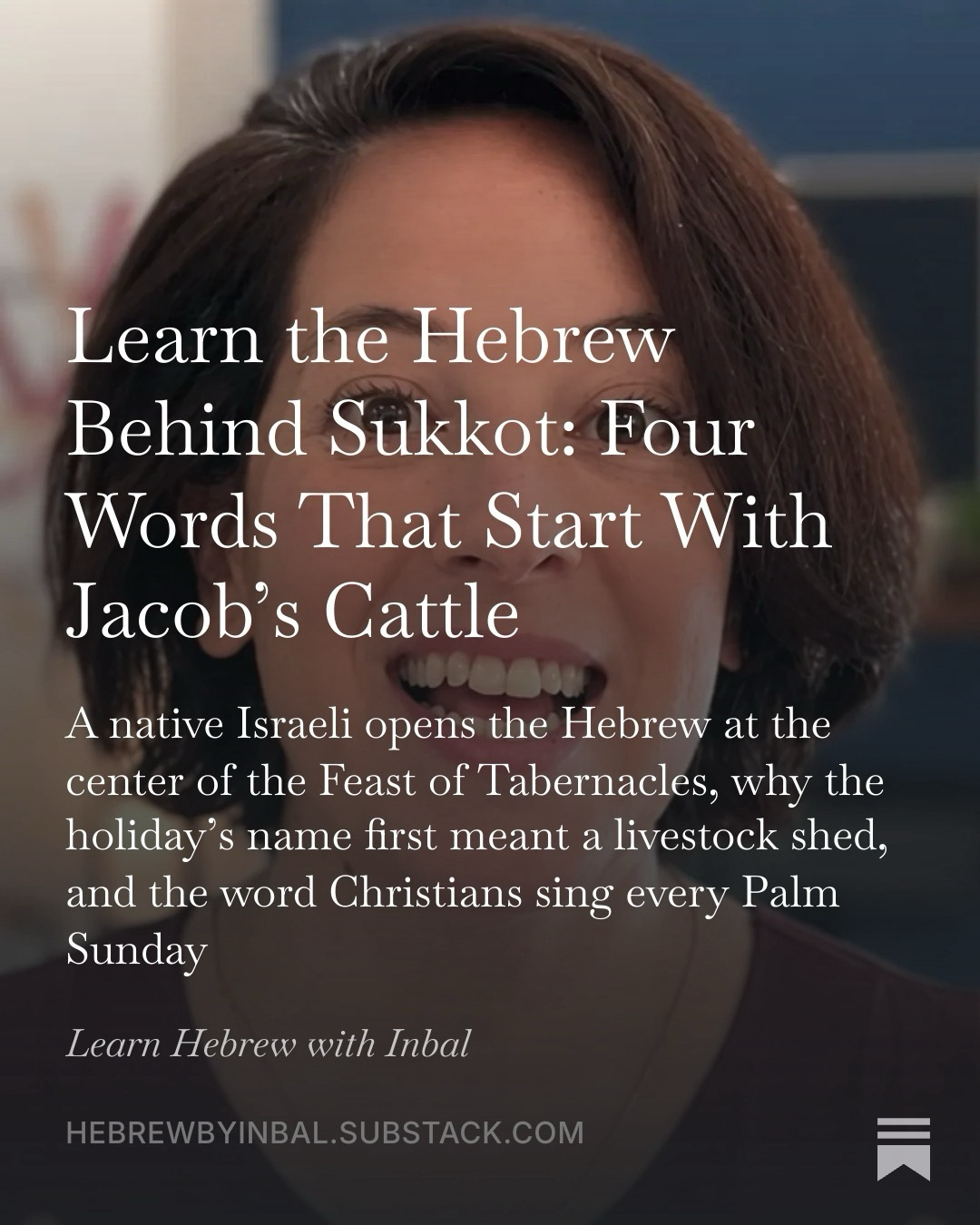
The happiest holiday on the Jewish calendar ends with a cry for help. 🌿
It is the only festival where joy is commanded three separate times. And on its final day, people walk in circles holding palm branches, saying two words that mean save, please.
You probably know those words. Christians sing them every Palm Sunday.
Glad and desperate in the same week, and Hebrew sees no contradiction in that at all. Neither, if we are honest, does most of life.
I went deep into the four Hebrew words at the center of Sukkot. A hut defined by the holes in its roof. A holiday named for a circle. Joy you do rather than wait for. And that final cry.
Come find out what your translation left out 👇
https://hebrewbyinbal.substack.com/p/learn-the-hebrew-behind-sukkot-four?r=2at7n8&utm_medium=ios
#Sukkot #LearnHebrew #Hebrew #BibleStudy
I’ve been diving deeper into scripture study lately, and it’s fascinating how much wisdom can be found in the texts. Each verse often has layers of meaning that can apply to our lives today. I encourage everyone to take some time to reflect on their own interpretations. #BibleStudy #Faith #Wisdom #SpiritualGrowth #Reflection
The word Sukkot is named for first shows up in the Bible as a shed Jacob built for his cattle. 🌿
Not a sanctuary. Not a temple. A livestock shelter.
And that turns out to be the whole point of the holiday.
I went deep into four Hebrew words at the center of this festival. Why nearly every rule about the hut concerns the roof, and what it means that you are meant to see stars through it. Why the word for holiday is built from the word for circle. Why joy is commanded here three times, more than anywhere else. And the word Christians sing every Palm Sunday, which came from this exact week. 👇🏻
https://youtu.be/-6AZaVUIcVU?is=740MtAfzE_9L7oI_
Five days after being sealed on Yom Kippur, you are told to go sit under a roof full of holes. Hebrew has a reason for that.
Come find out what your translation left out 💙
#Sukkot #LearnHebrew #Hebrew #BibleStudy

The concept of the millennial kingdom is rooted in biblical prophecy, particularly in the Book of Revelation. It describes a future period of peace and divine rule on Earth, lasting a thousand years. Many believers find hope in this promise, seeing it as a time when justice and righteousness will prevail. Understanding this doctrine can deepen one's faith and perspective on current events. #Prophecy #Faith #EndTimes #BibleStudy #Apologetics
Regular scripture study strengthens understanding and provides clarity on key spiritual principles that guide daily life and decision-making.
#Scripture #BibleStudy #Faith #SpiritualGrowth #ReligiousEducation
Proving the existence of Jesus is a topic that has been debated for centuries. Historical documents, archaeological findings, and the writings of early historians provide evidence of his life and impact. Understanding these sources can strengthen one's faith and knowledge. #Prophecy #Faith #EndTimes #BibleStudy #Apologetics
ICYMI
The word Yom Kippur is named for first shows up in the Bible with Noah, covering the ark so everyone inside survives the flood. 🕊️
Not sin. Not guilt. Survival.
In my newest article I open the four Hebrew words at the center of this day. Why the word Israelis use to mean "I've got you" is the same root. Why tshuva was never about feeling terrible. And why the word Moses said after the golden calf is the word you use to squeeze past someone on a bus in Tel Aviv. Click to Read 👇🏻
https://hebrewbyinbal.substack.com/p/learn-the-hebrew-behind-yom-kippur?r=2at7n8&utm_medium=ios
Every one of them carries something your translation dropped.
Yom Kippur.
The name of the day, and what it stopped meaning somewhere along the way.
#yomkippur #biblicalhebrew #dayofatonement #hebrewlanguage #biblestudy
I often find myself reflecting on end times prophecy and its implications for our lives today. Many religious texts provide insights into what the future may hold, and understanding these prophecies can deepen our faith. It's fascinating to see how different cultures interpret these signs. #Prophecy #Faith #EndTimes #BibleStudy #Apologetics
The word Yom Kippur is named for first shows up in the Bible with Noah, covering the ark so everyone inside survives the flood. 🕊️
Not sin. Not guilt. Survival.
In my newest article I open the four Hebrew words at the center of this day. Why the word Israelis use to mean "I've got you" is the same root. Why tshuva was never about feeling terrible. And why the word Moses said after the golden calf is the word you use to squeeze past someone on a bus in Tel Aviv. Click to Read 👇🏻
https://hebrewbyinbal.substack.com/p/learn-the-hebrew-behind-yom-kippur?r=2at7n8&utm_medium=ios
Every one of them carries something your translation dropped.
#YomKippur #LearnHebrew #Hebrew #BibleStudy
I find that regular scripture study helps me deepen my understanding of my faith and provides guidance in my daily life. It’s amazing how many insights can be gained from just a few verses. I encourage everyone to set aside time for this practice. #BibleStudy #Faith #SpiritualGrowth #Devotion #Wisdom
End times prophecy has been a topic of fascination and fear for centuries. Many religious texts, including the Bible, describe signs and events that are believed to precede the end of the world. Understanding these prophecies can provide insight into our current world events and personal faith. #Prophecy #Faith #EndTimes #BibleStudy #Apologetics
ICYMI 🍎🍯
Your English Bible does not call this holiday Rosh Hashanah. Neither does Leviticus. Neither does Numbers.
The phrase turns up in the entire Hebrew Bible exactly once, in Ezekiel, and there it is not the name of a holiday at all.
That is where my newest article starts, and it only gets better from there. Why a beginning in Hebrew is a "head," and what that quietly asks of your year. Why the word for year also means both to repeat and to change. What the shofar blast actually is, and why it is not music. And why we dip apples in honey rather than any other sweet fruit on earth.
Four words. Four things your translation left out.
Read it here 👇
https://hebrewbyinbal.substack.com/p/learn-the-hebrew-behind-rosh-hashanah?r=2at7n8&utm_medium=ios
#RoshHashanah #LearnHebrew #Hebrew #BibleStudy #JewishNewYear
Regular scripture study enriches my understanding and strengthens my faith by providing continuous insights and guidance applicable to daily life.
#Scripture #Faith #BibleStudy #SpiritualGrowth #ChristianLiving
Proving the Bible involves examining historical documents, archaeological findings, and fulfilled prophecies. Many scholars agree that the consistency of biblical texts over centuries adds to its credibility. Engaging with these aspects can deepen our understanding of its significance. #Prophecy #Faith #EndTimes #BibleStudy #Apologetics
Proving the Bible involves examining historical evidence, archaeological findings, and textual analysis. Many scholars argue that the consistency of its manuscripts over centuries supports its authenticity. It's fascinating to explore how these elements contribute to our understanding of biblical texts. #Prophecy #Faith #EndTimes #BibleStudy #Apologetics
Biblical evolution explores the intersection of faith and science, suggesting that the creation narratives in the Bible can coexist with evolutionary theory. Many theologians argue that understanding evolution can enhance our appreciation of divine creation. This perspective invites deeper discussions on how we interpret scripture in light of scientific discoveries. #FaithAndScience #Creation #Evolution #Theology #BibleStudy
![[?]](https://files.faithtree.social/accounts/avatars/109/762/503/392/984/571/original/3f58a809494a1dc3.jpg)
Please join me for a new series in #2Corinthians. A letter to messed up saints. https://youtube.com/live/qRuu-kW2K4g
Hebrew has one word that means both “to repeat” and “to change.” 🍎🍯
It is the word for year.
Sit with that for a second. The thing that comes back around, unchanged, same date, same season, same you one year older, is called by the same word we use for becoming something different.
Nothing new is being handed to you. Same kitchen, same job, same people at the table. And that is not the disappointing part. That is the design. The repetition is the only material you have to change with.
That is one of four Hebrew words I open in my newest article, along with why a beginning in Hebrew is a “head,” what the shofar blast actually is, and why we dip apples in honey rather than any other sweet fruit.
Read it here 👇
https://hebrewbyinbal.substack.com/p/learn-the-hebrew-behind-rosh-hashanah?r=2at7n8&utm_medium=ios
#RoshHashanah #LearnHebrew #Hebrew #BibleStudy #JewishNewYear
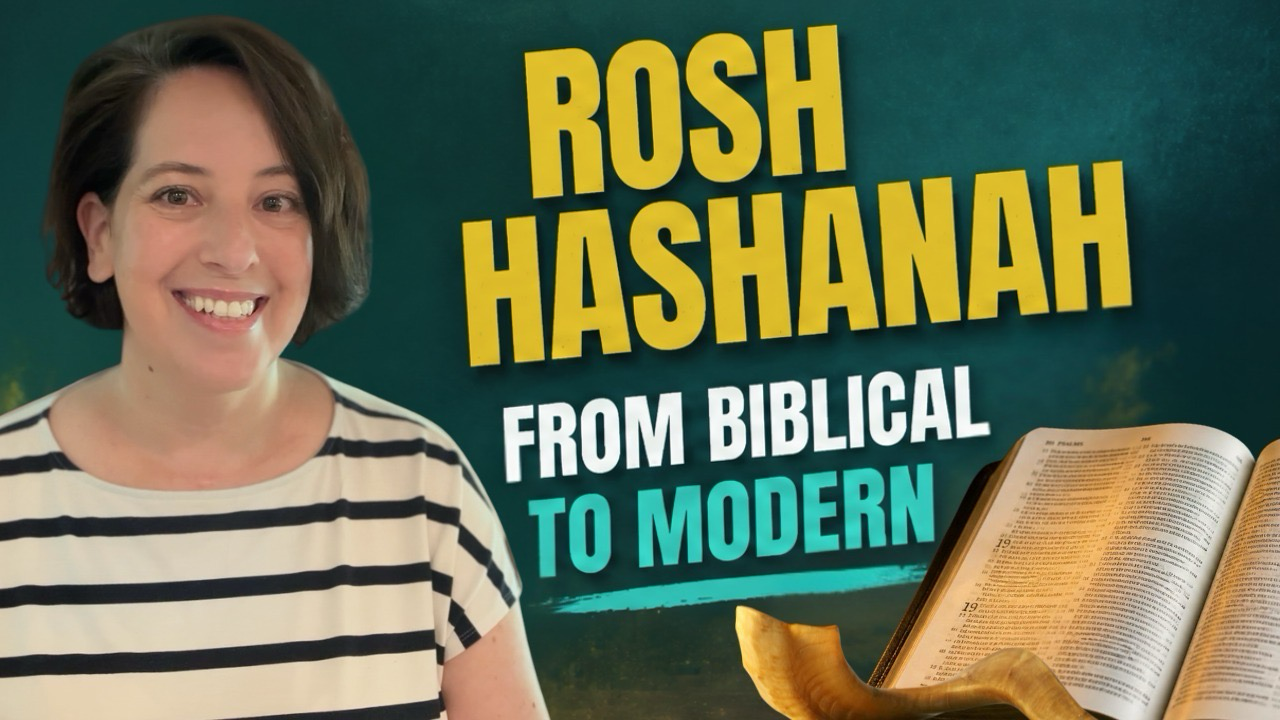
Rosh Hashanah is not in the Bible. 🍎
At least, not by that name. Open Leviticus and you find a day of teruah. Open Numbers and you find the same. The words Rosh Hashanah appear in the entire Hebrew Bible exactly once, in Ezekiel, and there they are not the name of a holiday at all.
So where did the name come from, and what do these words actually mean?
In my new video I open the four Hebrew words at the center of this season. Why a beginning in Hebrew is a “head.” Why the word for year also means both to repeat and to change. What the shofar blast really is. And why we dip apples, specifically apples, in honey.
Come learn what your translation left out 👇 **OR COMMENT “ROSH” FOR THE LINK**
https://www.youtube.com/watch?v=cVF26p-Oq30
Shanah Tovah u’Metukah 💙
#RoshHashanah #LearnHebrew #Hebrew #BibleStudy #JewishNewYear
Many scholars and theologians dedicate their lives to proving the historical accuracy of the Bible. Archaeological discoveries and ancient manuscripts often support biblical narratives, leading to a deeper understanding of its context. This ongoing research raises important questions about faith and history. #Prophecy #Faith #EndTimes #BibleStudy #Apologetics
Proving the Bible involves examining historical texts, archaeological findings, and fulfilled prophecies. Many scholars and believers alike have dedicated their lives to this pursuit, seeking to understand the context and accuracy of biblical events. The evidence can be compelling, but interpretations vary widely. Engaging with these studies can deepen one's faith or challenge preconceived notions. #Prophecy #Faith #EndTimes #BibleStudy #Apologetics
End times prophecy has been a topic of discussion for centuries. Many religious texts, including the Bible, provide insights into what believers can expect as we approach the final days. Understanding these prophecies can help individuals prepare spiritually and mentally for the future. Are you familiar with the signs mentioned in these prophecies? #Prophecy #Faith #EndTimes #BibleStudy #Apologetics
Proving Jesus involves examining historical documents, archaeological findings, and the testimonies of those who witnessed his life and resurrection. Many scholars agree on the impact he had on history, which supports his existence and teachings. #Prophecy #Faith #EndTimes #BibleStudy #Apologetics
![[?]](https://hermeneutrix.com/wp-content/uploads/2021/11/cropped-prochazka-still-life-512.jpg)
Reflecting on Joshua 1:1-11
This week we’re studying Joshua 1:1-11. Most of this text is God’s speech to Joshua, giving Joshua commands specific to his mission of leading the people of Israel into the promised land.
Given that, it might be worthwhile for us simply to make a list of what we see as God’s commands to Joshua in the text. What is God telling Joshua to do? [That is, if Joshua were to draw up a “to do” list, what would be on it?] What do we observe about that list? What’s interesting to us about that list? What thoughts or feelings do we have about it? Why?
We might also want to consider the relationship or “correlation” between these commands and the situation facing Joshua, and the people, at this historical moment. How would we describe “the situation” Joshua and the people are facing? What do we see as the challenges, and the opportunities, of that situation? How do God’s commands to Joshua here relate to those challenges and opportunities? How is fulfilling these orders going to help Joshua, and the people, in this situation, or respond to those challenges and opportunities? That is, why these orders at this time, do we think?
Another way, perhaps, to ask “the same” question: What kind of a leader is God telling Joshua to be here, would we say? What makes us say that? Why – that is, why do the people here need a leader like that? Or, perhaps, why does Joshua himself need to be that kind of leader, in this situation, do we think?
Some notes on the text are here; here are a couple of additional questions we might want to think about, or to discuss in class:

There are a lot of repetitions in this text: “Moses” is mentioned a lot; Joshua is told to be “strong and courageous” three separate times; God mentions that he will be “with” Joshua twice.
What seems to be the point of the repeated mention of Moses? How would we describe the impact of the presence of Moses in the text? For instance, is it reassuring? Challenging? Inspiring? …? How does it help define or characterize the situation Joshua is facing? How is God, in God’s speech to Joshua, using the references to Moses, do we think?
What is the meaning of the instruction to “be strong and courageous”? What does it mean to be “strong” in this context, do we think? What does it mean to be “courageous”? Why do we think these qualities will be needed in this situation? How does a person go about “being” “strong and courageous” do we think? What are the advantages of being strong and courageous? The disadvantages?
[More personal] How would we ourselves like to be, or to be more, strong and courageous? Why? What would that take? What would change for us?
What does it mean that God will be “with” Joshua? How does God’s presence contribute to the fulfillment of this charge? Would we say it will make it easier or more possible for Joshua to do what God is telling him to do, or what? Why is that, do we think?
[More personal] How would we ourselves like God to be “with” us in the way God is telling Joshua God will be with him? Why? What would that take, do we think? What would change for us?
What is God’s part of the coming project, and what is Joshua’s? That is, how would we describe the “division of labor” or relationship God is offering Joshua in this situation? How is that relationship specific to God and Joshua, or to this situation, do we think? How is it more general – a relationship or balance of responsibilities that is true for everyone?
How would we compare Joshua’s situation here to our own? What do we see as the similarities? The differences? Thoughts and feelings about that? Why?
What can contemporary leaders take away from God’s charge to Joshua here? How much of God’s command to Joshua here seems like an ongoing charge – something that is still a charge to leaders today? Why? What seems like a command or charge to everyone, or anyone, at any time – that is, what elements of this instruction seem universal, or nearly so? Why? What do we take as instruction to us, personally? Why?
Image: “Sommernachmittag” (crop), Friedrich Kallmorgen, Public domain, via Wikimedia Commons

Alt...
image of girls in conversation
End times prophecy has been a topic of fascination and concern for centuries, with various religious texts outlining signs and events that are believed to precede the end of the world. Many interpretations exist, often leading to intense discussions about their implications for humanity. Understanding these prophecies can provide insight into our current world events and spiritual beliefs. #Prophecy #Faith #EndTimes #BibleStudy #Apologetics
Proving the Bible involves examining historical evidence, archaeological findings, and textual analysis. Many scholars highlight the consistency of biblical manuscripts over centuries, supporting its reliability as a historical document. This approach strengthens faith and encourages deeper exploration of scripture. #Prophecy #Faith #EndTimes #BibleStudy #Apologetics
![[?]](https://files.mastodon.social/accounts/avatars/109/248/152/768/065/493/original/5eefc02493e094b2.png)
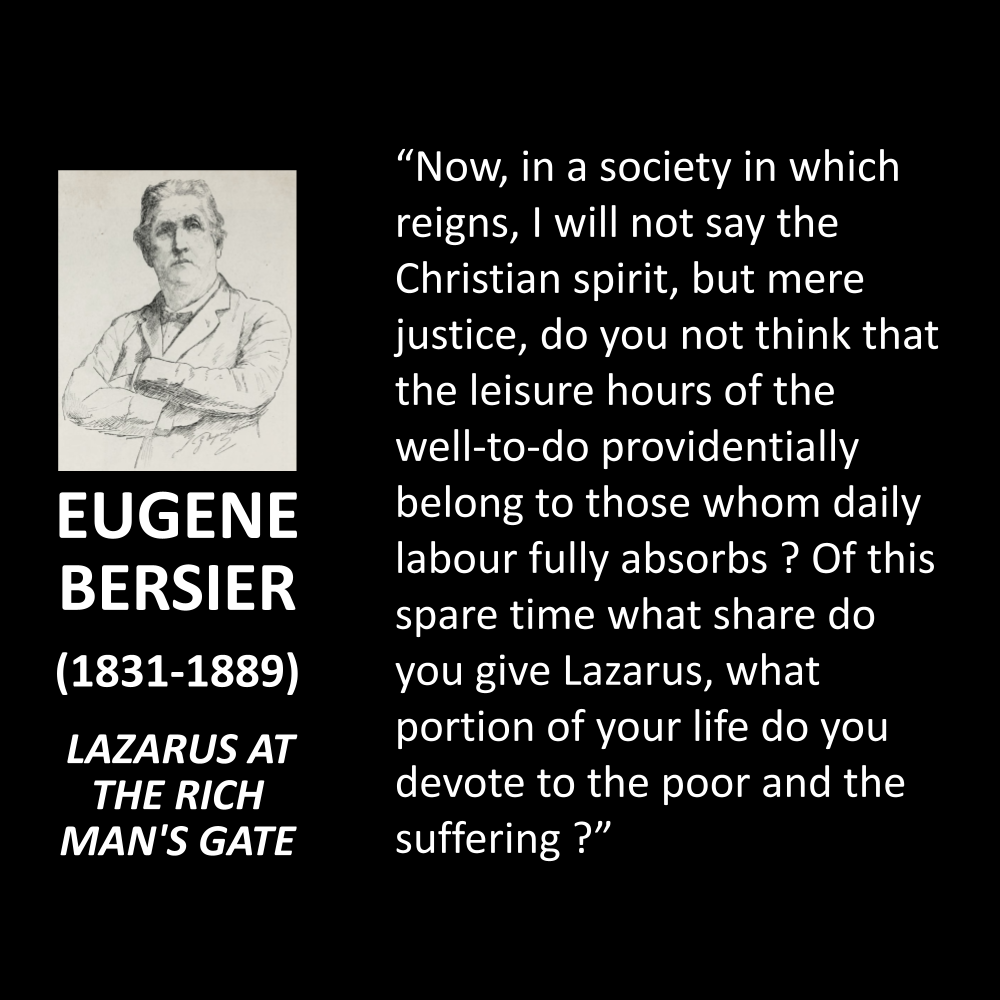
Bersier, a French Reformed minister, posed an awkwardly sensible question: if you possess leisure whilst others labour ceaselessly, shouldn’t that free time go toward alleviating their suffering?
Modern response? Eloquent social media denunciations apparently discharge the duty. Quite inspired theology.
#reformedtheology #christian #biblestudy #lazarus #presbyterian #bookofluke
Alt...
Portrait of Eugene Bersier, 19th-century Reformed minister from France, with quote from “Lazarus at the Rich Man’s Gate” questioning what portion of the leisured wealthy’s lives they devote to the poor and suffering.
Watch it NOW:
“Can I actually read scripture in Hebrew myself?”
I get this question constantly, and today I am answering all of it.
Is biblical Hebrew a different language from the Hebrew spoken in Israel today? How much overlap is there really? If you learn one, do you understand the other? And what does it actually take to sit with the text in its original words, without waiting for someone else’s translation to tell you what it says?
Every translation is a choice someone made on your behalf. This is about reading it for yourself.
“Can I actually read scripture in Hebrew myself?”
I get this question constantly and tomorrow I am answering all of it.
Is biblical Hebrew a different language from the Hebrew spoken in Israel today? How much overlap is there really? If you learn one, do you understand the other? And what does it actually take to sit with the text in its original words, without waiting for someone else’s translation to tell you what it says?
Every translation is a choice someone made on your behalf. This is about reading it for yourself.
Tomorrow, Sunday at 12 noon Eastern. Subscribe now so it lands the moment it goes live 👇
https://www.youtube.com/hebrewbyinbal
#LearnHebrew #Hebrew #BiblicalHebrew #BibleStudy #Scripture
Engaging in scripture study can deepen your understanding of faith and enhance your spiritual journey. It allows you to explore the historical context, cultural significance, and theological implications of biblical texts. Regular study can also foster a stronger connection to your beliefs and community. #BibleStudy #Faith #SpiritualGrowth #Theology #Scripture
The millennial kingdom is a future 1,000-year reign of Christ on Earth, described in Revelation 20, where peace and righteousness will prevail.
#MillennialKingdom #BibleStudy #Eschatology #Christianity #Prophecy

Diving into scripture study opens up a world of understanding and connection. Each verse can reveal layers of meaning, guiding us through life's challenges and enriching our spiritual journey. Embrace the transformative power of the Word and let it illuminate your path. #BibleStudy #Faith #SpiritualGrowth #Wisdom #Inspiration
Biblical ethics guide believers by grounding morality in the teachings of Scripture, emphasizing love, justice, and integrity as central to a righteous life.
#BiblicalEthics #Christianity #MoralValues #BibleStudy #Faith
Please join me as we think about Batman and sin... that's what everyone thinks about when you read Psalm 14, right? https://youtube.com/live/K01NZoera08
Throughout history, countless scholars and theologians have sought to prove the existence and divinity of Jesus Christ. From historical texts to archaeological findings, evidence continues to emerge that supports the life and teachings of Jesus. Engaging with these proofs not only strengthens faith but also invites deeper discussions about spirituality and history. The journey of understanding Jesus is as profound as it is enlightening. #Prophecy #Faith #EndTimes #BibleStudy #Apologetics
Bible prophecy has fascinated believers and skeptics alike for centuries. From the visions of Daniel to the revelations of John, these texts challenge us to consider the future and our role in it. What prophecies resonate with you? How do they shape your understanding of faith today? Let's dive into these ancient texts and explore their meanings together! #Prophecy #Faith #EndTimes #BibleStudy #Apologetics
Reflecting on 2 Timothy 1:1-6 and 3:14-16
This week we’re studying two parts of 2 Timothy, 2 Timothy 1:1-6 and 3:14-16. These identify Timothy as the child of a family that has been faithful – to the God of Israel, and now also to Jesus Christ – for generations, has learned the sacred writings from infancy, and is gifted, we are inclined to think for ministry. There is a recurrent theme in these texts of the long ancestral and scriptural tradition that has led up to, and is now alive in, Timothy’s own faith.
One basic question we might want to ask ourselves is simply how much of this story resonates with us. What has been our own ancestral and educational heritage, in this regard? What early memories around faith and scripture do we ourselves have? How do we see those contributing to our faith now? What difference does our personal history seem to have made for our ideas and practices today? Where do we see similarity, and where do we see difference, between ourselves and Timothy?
Some notes on these texts are here. Here are a couple of additional questions we might want to think about, or to discuss in class:

[maybe more theoretical … but I’m drawn to it, and think it probably matters …] Why wouldn’t Paul be worshiping God “from his ancestors” with a clear conscience? That is, why do we think Paul needs to include that affirmation in v3? [What is the charge or criticism he’s, implicitly, denying here, do we suppose? Why do we think that?]
How do we understand the “reason” the author reminds Timothy to “rekindle the gift of God that is within you” (v6)? And [maybe for extra credit] what do we think that rekindling has to do with the spirit we have been given (v7)? That is: what do we think the author is saying here? What seems to us to be the situation or concern being addressed?
What are the implications of this conversation for us, do we think? Why?
What do we think it means to “continue in what you have learned”? How much or little room does this “continuing” leave for learning something new, do we think? Why?
What difference does it make, do we think, how we answer this question?
What is the importance of knowing “from whom you learned it”? That is, why would that matter, do we think? From whom did Timothy “learn it,” do we think, as far as we can tell? Why does that seem to matter?
What are the implications of all this for us, do we think? What does it tell us about the importance of learning, and about the sources of our learning or spiritual formation? What ideas does it give us about continuing, or modifying, anything we are doing now? Why?
[maybe more theoretical …] What – if any – difference does it make to our answer(s) here if we know that the verb used here, “to continue,” is the same verb Jesus uses when he tells the disciples “abide in me …” (John 15:4)?
How do we understand the meaning of “God-breathed” scripture in 2 Timothy 3:16? That is, what does that language mean to us? [We might want to consider what we think of as the various possibilities for its meaning here.] What are the implications of that understanding for us? How does that description or quality of scripture affect our own reading, study, response, etc. to scripture?
What do we understand the author to mean by “scripture” here? What is included, and what is not?
Overall, taken together this way, Paul seems to me in these verses to be emphatically and recurrently referring to the valuable and necessary continuity between “the faith of our ancestors” – the Torah-informed faith in and worship of the God of Israel – and the promise of life that is in Christ Jesus, the in-Christ-Jesus kind of faith. It seems to me he is insisting that these are not two separate or opposed things, but a kind of seamless whole. If the false teaching the author is so exercised about in other parts of the letter has to do with some form of abandonment of the God of Israel – which wouldn’t be a giant stretch, honestly, since that kind of teaching has cropped up in Christianity over and over, historically – that would totally make sense, and would make sense of this theme in the text.
Image: “La Discussion Politique,” Émile Friant, Public domain, via Wikimedia Commons
#2Timothy116 #2Timothy31416 #BibleStudy #discussion #meaning #meaningForUs #readingTheBible #Scripture
Studying 2 Timothy 1:1-6 and 3:14-16
This week we’re studying two short texts from 2 Timothy, 2 Timothy 1:1-6 (although why not go all the way to :7, eh, and finish the sentence?) and 3:14-16 (although, same question, about :17!) These texts point us to Timothy, as one of the “faithful witnesses” in our series: early Christian missionary and protégé of the apostle Paul. Although, they really identify the faithful witness as scripture. These particular texts construct Timothy as someone who testifies to the tradition of faith: as something he’s learned from his ancestors and teachers, rooted in an even longer inherited tradition of sacred writings. Here are a few notes on these texts:
BACKGROUND AND CONTEXT
2 Timothy is a warmly personal ancient letter, addressed to “Timothy, my beloved child,” from “Paul, an apostle of Christ Jesus by the will of God.” Together with 1 Timothy and Titus it makes up the trio of personal letters known as “the pastorals.”
All three of the pastorals include practical advice in concrete ministry circumstances. Together they stress the importance of sound teaching and steady leadership in the Christian community, for the sake of the integrity of the gospel message.
Since the beginning of the 19
th
century, scholars have questioned the identity of the author of the pastorals. The questions arise due to differences in style and vocabulary between these texts and the undisputed letters, as well as from what some perceive as theological differences, and in particular the much greater focus on organizational or institutional matters.
Those questions leave us with a wider set of options than usual about when the letters were written, and why. Those who favor Pauline authorship see them as early texts, whose motives speak for themselves. Those who think of them as “deutero-Pauline” favor a time of composition maybe as late as mid-2
nd
century, voicing more institutional concerns. Those options add a layer of complexity to our reading. [Here is a detailed treatment of the issue, with special attention to the implications for reading the text as scripture, from The Bible Seminary.]
2 Timothy is, it seems, the likeliest of the pastorals to be seen as an early work by the original apostle Paul. Its personal tone and references, along with its framing as a “letter of succession” or “last will and testament,” contribute to the impression that the letter is direct, personal counsel from Paul to his protégé, Timothy, as Paul faces what he seems to believe will be his death, in effect passing on a legacy that consists of faithful ministry in an often contentious world. Of particular importance to us, given our texts, one of Timothy’s supports in the struggle will be “the tradition,” as passed on by trustworthy teachers and as informed and shaped by scripture.
Our texts include the introduction of the letter, with its warm words of commendation for Timothy and praise for Timothy’s mother and grandmother, and then Paul’s specific commendation of scripture, which is almost the conclusion of the letter.
Both of these texts are options in the lectionary, every third year. We ought to know they’re in the Bible, even if all we know is the lectionary.
CLOSER READING
Vv 1-2 are the opening lines of an ancient letter, naming and characterizing the author / sender – Paul, an apostle of Christ Jesus by the will of God – and then the recipient – Timothy, my beloved child – and delivering an opening greeting – grace, mercy, and peace …
The phrase in the opening that is translated “for the sake of the promise of life that is in Christ Jesus” (NRSV) is more literally “for the sake of the promise of the in-Christ-Jesus life.” We can’t quite say that in English, hence the relative clause – which somehow seems to miss something of the author’s intent, that life “in Christ” is qualitatively different, and differently promising, than life that is not that life.
V3 notes the thanks the author gives for Timothy, and the aside whom I worship literally from my ancestors with a clear / pure conscience. We might wonder what “a clear conscience” has to do with worshipping God in the ancestral tradition invoked here, and what that aside is doing here, of all places. As if it is important to mention that this author, with all his devotion to Christ Jesus, continues to worship the God of Israel, without any sense of bad faith. Why might that seem necessary?
The notion of ancestral tradition is about to be mentioned again, though, in v5. After the mention of remembrance in vv3-4: remembrance in prayers, which are unceasing, night and day; remembrance of tears – we suppose, upon parting from one another; remembrance of faith. That will bring us back to tradition.
In v5, this literally non-hypocritical faith – not appearance-only faith – has a home first in Timothy’s grandmother Lois and then in Timothy’s mother Eunice. The meaning of the name “Lois” is unclear, but the name “Eunice” pretty clearly means, literally, “good victory.” Faith here seems to be something that can be passed on, taking up residence in a person as an inheritance. Which Paul is convinced it has in Timothy.
So, v6, another remembrance word – this time, remind, or literally “I urge you not to forget” to rekindle / fan into flame the gift of God. If that gift is dimming or going out, like a fire, bring it back to life. It is in you by the laying on of my hands. This strikes readers as important evidence of a developing ritual in the church, indicating that person-to-person transmission of spiritual gifts or power or authority by laying on of hands was already something that was going on by whenever this letter is written.
According to me we should read the next verse, v7, too, since it’s the reason Timothy should do this rekindling: that God has not given us a spirit of timidity / dread, but of power and of love and of self-control – specifically, the kind of “self-control” that arises not from the exercise of effort to master one’s passions, but the kind that stems from a sound and wise and balanced mind, and so chooses and behaves wisely and moderately.
When we jump over to 2 Timothy 3:14-16 (again, ideally we’ll read that last verse, v17, along with this), we are hearing instructions that form a contrast with the sorry state of “the last days” Paul has been decrying since the beginning of the chapter.
Instead of succumbing to all that, Timothy should abide in what he has learned (in the manner of having been a student or disciple) and (maybe most literally) been made to trust, knowing from whom he learned, studied, apprenticed all that.
And, moving on to v15, it seems also knowing that from infancy or from babyhood he has known the sacred writings that are able to make you wise unto salvation. (Compare Psalm 19:7.) Although, salvation is through the in-Christ-Jesus faith. Whether that is faith a person places in Christ Jesus, the person, or whether it is the faith that Christ Jesus himself had, we might want to keep thinking about.
It seems important that wisdom is being invoked here, because the use of God-breathed in the next verse – in the famous assertion that every scripture is God-breathed – seems to have its true home in the way Wisdom, and particularly the Wisdom that is the Torah or instruction of God, is being conceptualized in the Second Temple Judaism. Wisdom emanates from God. (See Wisdom of Solomon 7:25.) Wisdom takes the form of revelation, in creation (think Genesis 1:2) and the teaching embodied in scripture (see Bauch 4:1).
Of course, then, this wisdom that is animated by the spirit of the living God is useful for teaching and for reproof and for correction – here, we might want to think of the kind of correction that physical therapy provides – and for training – the kind small children receive – in righteousness. How could it not be?
In v17, then, the conclusion of the sentence, this beneficial impact of the en-scripted wisdom of God has a purpose: so the person of God may be complete / equipped, fully completed / equipped – there’s a repetition of root words here – for every good work.
“My child do not forget my teaching.” (Proverbs 3:1)
Some questions on the texts are here.
Image: “Casa de Convalescència, arrambador ceràmic” Enfo, CC BY-SA 3.0, via Wikimedia Commons
#2Timothy116 #2Timothy31416 #BibleStudy #commentary #exegesis #meaning #readingTheBible #Scripture #wisdomLiterature
Alt...
St. Paul mosaic
![[?]](https://files.faithtree.social/accounts/avatars/109/791/504/024/681/344/original/cca906fc4af533a7.png)
We know the word fool, but do we recognize who the fools are? Do we recognize when we're the one playing the fool? #Psalm 14 helps us better understand real foolishness. https://youtube.com/live/mZoWHIPSe1A
Diving into scripture study can transform your understanding of faith and life. Whether you're exploring historical context or personal application, each verse has something to teach us. What’s your favorite scripture, and how has it impacted your life? #BibleStudy #Faith #Wisdom #SpiritualGrowth #Community
Exploring the evidence and historical foundations that support the truths found in the Bible reveals a compelling story of faith and fact.
#BibleEvidence #Faith #BibleStudy #Christianity #Scripture
Bible prophecy has fascinated believers and skeptics alike for centuries. From the visions of Daniel to the revelations of John, these texts offer insights into the future and our place in it. What do you think is the most compelling prophecy in the Bible? Let's discuss! #Prophecy #Faith #EndTimes #BibleStudy #Apologetics
Reflecting on Acts 22:3-15
This week we’re studying Acts 22:3-15, most of Paul’s speech to an audience of temple-goers in Jerusalem, and the second telling of the story of his encounter with the risen Christ on the road to Damascus.
We’re studying the text as part of our series of studies of “the testimony of faithful witnesses” across scripture. Paul, arguably, is a paradigm case of the faithful witness, and his testimony makes up a large proportion of the New Testament [although possibly less than we might think, per this]. We can’t easily ignore him, were we to want to, which we presumably don’t.
A first, basic question seems to be: what do we ourselves understand to have happened on the road to Damascus? That is, based on the description(s) given in the book of Acts (Acts 9:1-19, Acts 22:1-21, Acts 26:12-18), how would we describe what happens to Paul? What could we call it, and what would we call it? [For instance: vision, encounter, intervention, turning point, conversion … ?] If Paul is being “a faithful witness” to this event, what is Paul being a faithful witness to?
Why do we suppose we use that language and give that interpretation, rather than some other choice? What difference does it seem to make, to us, that we interpret this event as we do? [That is: describing this as “the story of Paul’s conversion on the road to Damascus” is already an interpretation of the text, just as is “the story of Paul’s encounter with the risen Christ,” or “Jesus’ commissioning of Paul …” or “Paul’s capture by Christ …” What does it say about us, and about our understanding of this event, when we lean towards the interpretation(s) we do? Can we see why we prefer what we prefer? How our preference relates to our faith and understanding of reality? What do we learn about ourselves as we think about this?]
Some notes on the text are here, and here are a couple of additional questions we might want to think about, or to discuss in class:
In v3, Paul describes himself as “being zealous for God, just as all of you are today.” In v14-15, Ananias tells Paul he has been chosen by “the God of our ancestors” for a particular mission. How do we understand Paul’s zeal for God to be affected by his experience on the road to Damascus, and by his new mission? What has changed, according to us? [For instance: Paul’s understanding of God? Of the way to please God? Of what people should and shouldn’t do? Of various aspects of metaphysical reality? What?] What difference does it make how we answer this question?
Whose witness is Paul, according to the grammar of the sentence in vv14-15? How does our answer to that question matter to us?
How do we understand Ananias’ role in this story? How would we describe him, and what he does for Paul in the story? How important would we say Ananias’ role is in the story?
[More personal] Where do we see ourselves in this story? Or, perhaps, how would we compare our own stories to that of Paul’s, Ananias’, or even a member of the crowd? Where do we see similarity, where do we see difference? What seems to be the importance of those similarities and differences, for us?
Image: “Figures in Conversation – Étaples,” Leslie Hunter, public domain, via Wikimedia Commons
#BibleStudy #discussion #meaning #meaningForUs #readingTheBible #thinkingAboutTheBible
Nobody learns Hebrew to pass a test.
You learn it because there is a person on the other side. A grandmother whose stories you have only ever heard secondhand. Israeli in-laws you want to genuinely talk with. A trip to Israel where you order your own coffee, ask your own directions, and hear the country answer you back.
That is the whole point, and it is exactly what most programs never get you to. They teach you about Hebrew. Vocabulary lists, grammar charts, quizzes you pass and then forget. Meanwhile the actual moment you wanted, the conversation, never arrives.
I built Practically Speaking Hebrew backwards from that moment. You learn how to construct your own sentences in real time, so you can say what you actually need to say, in whatever situation you are standing in. Real Hebrew, for your real life.
That is what this was always for.
hebrewbyinbal.com/speak 💙
#LearnHebrew #BibleStudy #HebrewForBeginners #LanguageLearning #JewishLife

Studying Acts 22:3-15
This week we’re studying one of the three tellings of the story of Paul’s (Saul’s) conversion on the road to Damascus, from persecutor of the followers of the way of Jesus Christ to evangelist for that way. We are focusing on Acts 22:3-15, the second telling of the story, this time by Paul, as part of his defense before a crowd of hostile temple-goers. The first telling of the story is the narrator’s, in Acts 9 (1-19). The third and final telling is again Paul’s, again part of his self-defense, this time before King Agrippa (Acts 26:9-18).
We looked at the narrator’s version of the story some years ago, with some notes on that text here. We’ve also looked at the very beginning of Paul’s defense before Agrippa (notes here), although not the part where he tells his call story again. Here are some notes on this week’s version of the story:
BACKGROUND AND CONTEXT
The book of Acts, as we probably remember – even from last week – is the second part of Luke-Acts. Some have suggested it ought to be called “the acts of the Holy Spirit” rather than the Acts of the Apostles, considering the important role played by the Holy Spirit in the events recorded in the text. We attribute the text to Luke, and appreciate his keen literary sensibilities, and mastery of elegant Greek.
We might be inclined to think Luke is consciously writing to a gentile audience, in part because he highlights episodes in which gentiles are clearly accepted into this initially Jewish movement, in part because he doesn’t seem to remember episodes in which gentile acceptance might have been more questionable, in part because he feels he has to explain Jewish terms and customs for the unfamiliar, and in part because he addresses his work to “Theophilus,” who sounds like a gentile, and who might be a real person, or might be an “ideal reader.” We think he is writing in the latter part of the first century CE, maybe a bit after 70 CE – in which case, Paul and Paul’s adventures would be only a memory, albeit a recent and important one.
By this point in the story, the Jesus movement has been growing by leaps and bounds since the Day of Pentecost (Acts 2), and has been spreading around the Mediterranean world since the persecution that broke out following Stephen’s death (which we looked at last week, Acts 7). Paul has been instrumental in this spread ever since joining up with the multi-ethnic congregation in Antioch, where the believers were first called Christians (Acts 11).
By now, we have been through three missionary journeys that have taken Paul and his various traveling companions around the Mediterranean, and have ended him up in Jerusalem, where his presence in the temple has raised a ruckus. The ruckus has been fueled by misinformation and rumor; maybe we present-day folks can relate to that. The ruckus has finally gotten serious enough that the Romans have stepped in to restore order, by taking Paul into custody. But Paul has asked to speak to the crowd before he’s taken away, and what he says is recorded in Acts 22.
The city of Tarsus to which Paul refers, his “home town,” was a significant port city in the Roman province of Cilicia, the region of Asia Minor, in what is now Turkey [There’s a concise discussion of the place here; a nice map of the Roman Empire here, which will also show Damascus in Syria, and the relationship of both of these cities to Jerusalem; and a simplified map here that also shows all three cities.]
The Gamaliel mentioned in v3 as Paul’s teacher is probably the sage who is known in Jewish tradition for having headed the Sanhedrin and continued the school of Hillel in the second third of the first century CE (The Jewish Encyclopedia tells more here).
The story of Saul/Paul’s encounter on the Damascus road is in the lectionary, but only in its first (narrator’s) telling. So this week’s episode, of Paul’s self-defense before this Jerusalem crowd, and this telling of the story in his own words, would be something we wouldn’t know was in the Bible if all we knew were the lectionary. Bible Content Examinees, take note.
CLOSER READING
Commentators note that Paul’s oration on this occasion follows the form of a classical apologia or defense, drawing on the components of classical rhetoric (which are nicely discussed here for a modern audience).
We should probably note that Paul begins this self-defense (v3), or apologia, by saying “I am a Jew.” This relates him to his audience, of course, and his further comments will make that relationship tighter: being instructed in the exactness of the law of our fathers and having had Gamaliel for a teacher, and being zealous for God, explicitly as all of you are.
We probably also shouldn’t miss the significance of Paul’s use of the present tense – that is, “I am” rather than “I was” a Jew. That is, it probably matters – for the audience, and for us – that Paul describes himself as “a Jew.” Importantly, it reminds us that when we moderns casually describe Paul’s conversion as being “from Judaism to Christianity,” we’re making a mistake. At this historical moment, a conversion like that would have been an anachronism; Christianity was not a clearly separate “religion” from Judaism; the two identities were not mutually exclusive. Paul himself has not given up his Jewish identity – even though, after his conversion, he’s now a Jewish follower of Jesus Christ, who as we know, now preaches to gentiles. Famously, he doesn’t regard his Jewishness as being a mark of spiritual superiority (Philippians 3:2-11). Nevertheless, that doesn’t seem to mean he’s stopped being Jewish.
In v5, he appeals to witnesses – the high priest, and all the presbyterians elders – who ought to be credible to the audience, and who can attest to his former persecutorial career.
In other words, he’s really not the person this crowd thinks he is.
Vv6-7 portray his experience on the way to persecute people in Damascus as sudden, and involving sight and sound: a light that shone from heaven and a voice – implicitly from the same source – that addresses him by name. His companions are witnesses to the light, but in this telling of the story can’t corroborate the conversation that’s about to take place between Saul (as he was then known) and the voice (who is going to identify itself as belonging to Jesus of Nazareth), as we’ll learn in v9.
The conversation occupies vv7-10. We might note that telling the story this way – that is, by drawing out the direct dialogue of the conversation – slows down the action, adding to the suspense of the telling of this story, and emphasizing the personal exchange between Saul and Jesus.
When we recall that this is Saul’s first encounter with Jesus, it might add to the poignancy and drama of the exchange. Here’s Saul saying “Who are you, lord?” responding to someone he doesn’t know yet, hasn’t ever met, and who is sure leaving an indelible first impression.
Here’s Jesus saying “I am Jesus the Nazarene, whom you are persecuting/chasing/causing to suffer.” And when we think about the theological statements Paul will make subsequently, we can probably think of the ways the whole range of meanings of that verb fit Paul’s life: he is, perhaps unbeknownst to himself, “chasing” Jesus; and he isn’t only persecuting the members of the body of Christ in his current role as zealous Pharisee, he is also one of the “all” who have sinned and come short of the glory of God who caused Christ to suffer. In other words, this is a deep statement.
Paul’s next question, “What shall I do, lord?” suggests that he’s quickly realized that he, Paul, is not the one in control here.
Jesus’ instruction is to continue on to Damascus to await further instructions. It is probably significant that at this point Paul has to be led by the hand – that is, he’s in no position to see his own way forward. It’s a practical response to his light blindness, of course, but it’s also a potent symbol of his new need for faith.
Ananias enters the picture in v12. For the benefit of the current audience, Paul describes him as devout – from the perspective of Torah observance or halakhah, if we can use that term – and witnessed to be so by all the Jews living in Damascus. Again, Paul is appealing to solidly Jewish credentials, this time Ananias’ credentials.
Ananias restores Paul’s sight. Or rather, we gather, God restores Paul’s sight, through the agency of Ananias.
In v14, Ananias invokes the God of our fathers as the key figure here. God has appointed Paul to know, see, and hear: to know God’s will, to see the Righteous One, and to hear the voice of his mouth. The “his” here could, conceivably, refer either to the Righteous One or to the God of our fathers. This seems important. Similarly, when Paul is going to be a witness for/to him to all humans of what Paul has seen and heard, we may be hearing that Paul will be God’s witness, or Christ’s witness.
[Admittedly, Trinitarianly orthodox Christians might not be able to see much real difference between those two persons of the Triune One.]
Once again, the dramatic seeing and hearing that happens on the road to Damascus is a point of emphasis. Considering the role of seeing and hearing as a vehicle of knowing in the larger story of the people of God – we might think particularly of how people see and hear God at Mt. Sinai, and thereby come to know God’s will – Saul/Paul’s dramatic experience probably ought to be persuasive.
And maybe it would have been persuasive to his audience in Jerusalem, if only Paul hadn’t brought up those infuriating gentiles in v21 …
Some questions on the text are here.
Image: “Stained Glass St Blaise Church Dubrovnik” (cropped), Tony Hisgett, CC BY 2.0, via Wikimedia Commons
#Acts22315 #BibleStudy #commentary #exegesis #meaning #readingTheBible #textsThatArenTInTheLectionary
Alt...
representation in stained glass of apostles Peter and Paul
Diving into scripture study can transform our understanding of faith and life. It’s not just about reading; it’s about engaging with the text, asking questions, and seeking deeper meanings. What’s your favorite passage that has changed your perspective? Let’s share insights! #BibleStudy #Faith #SpiritualGrowth #Wisdom #Community
Diving into scripture study can transform your understanding of faith and life. Each verse holds a treasure waiting to be uncovered. What’s your favorite passage and why does it resonate with you? Let’s share insights and grow together! #BibleStudy #Faith #Inspiration #SpiritualGrowth #Community
Reflecting on Acts 6:7-10, 7:54-60
This week we’re studying Acts 6:7-10 and Acts 7:54-60, two extracts from the story of Stephen, one of the first deacons and “first Christian martyr.”
The verses we’re focusing on bypass almost the entire content of Stephen’s recorded witness, which is to be found in his long speech before the council, Acts 7:2-53. That has the effect of setting Acts 7:54, “When they heard these things, they became enraged …” as the immediate response to Acts 6:10 “But they could not withstand the power and Spirit with which he spoke.”
There is a chance we might want to correct this impression, or at least to consider its impact, by reviewing and thinking about Stephen’s actual speech. How do we understand that speech? What does it seem to have to do with the presentation of the gospel, either in Stephen’s first century context or in our own present one? Why, do we think, Stephen gives this speech, seemingly in his own defense, before the council? How does the content of the speech seem to relate to the charges referred to in Acts 6:11 (“blasphemous words against Moses and God”) and Acts 6:13-14 (“saying things against this holy place and the law,” predicting that “Jesus of Nazareth will destroy this place …”)? In other words, what’s our understanding of what is going on in this situation?
Whether or not we want to spend time on that part of the story, we presumably do want to think about what it means for us that Stephen suffers death for the sake of his commitment to Jesus’ being the Christ of God. How would we describe Stephen’s behavior at the end of the story – that is, what words or labels would we use to characterize him? How do we feel about the way he ends his life? (For instance, would we call him brave, courageous, fearless, forgiving, compassionate, …? Would we say he inspires us? Encourages us, maybe to persevere? Or … what?) How much do we ourselves want to be like, or to be able to be like, Stephen?
Some notes on Acts 6:7-15 (from an earlier time) are here; some notes on Acts 7:54-60 are here. [There’s also a sermon on that text, for those interested, here.] Here are a couple of additional questions we might want to think about, or to discuss in class:
“Dying for the faith” is a long-standing ultimate test of a person’s commitment to Christ. Our published curriculum names Dietrich Bonhoeffer, Martin Luther King, Jr., and Archbishop Oscar Romero as twentieth century martyrs. We might be able to name others. [Whom would we ourselves name? What leads us to name them? How are their actions and deaths expressions of faithfulness to Christ, in our view?]
In light of that, we might want to explore some of the possibly or arguably relevant distinctions that might be involved in “dying for the faith.” What difference does it make, do we think, if premature death is a result of official state action (like execution) or of criminal action (like assassination, or fire-bombing a church) or of armed conflict? What difference does it make if it comes as a consequence of breaking the law, or of pursuing justice, or of speaking out, or … what? What are our thoughts on this?
What is our response to Stephen’s final prayer? Why? What do we think it means for us, as a model for our own behavior in our own situation(s)?
The whole story seems to have been precipitated by a religious argument that begins (Acts 6:9) in the synagogue of the Freedman.
What is our own experience of religious arguments? When, where, with whom, about what have we ourselves ever engaged in religious arguments? How do we think those arguments were similar to, or different from, this one? Why do we think that? What have we learned from those experiences of religious argument?
What is our own understanding of what it means to “proclaim Jesus as Lord”? What behaviors or speeches do we understand that to entail? When, where, with whom, etc.? How does our understanding seem to compare to Stephen’s – that is, what strikes us as similar, what as different, between us and Stephen, when it comes to how we proclaim Jesus as Lord?
Overall, we presumably want to explore what Stephen’s experience and example mean for us. What does this story have to do with us, and with our own lives as Christians? What makes us say that, do we think?
Image: “Am Mittagstisch,” an image by Hermann Groeber [Public domain], via Wikimedia Commons,
#Acts6710 #Acts75460 #BibleStudy #discussion #exegesis #meaning #meaningForUs #readingTheBible #thinkingAboutTheBible
Alt...
painting - family around a dinner table
Studying Acts 6:7-10, 7:54-60
This week we’re studying two texts pertaining to the life – and death – of Stephen, among other things the first Christian martyr: Acts 6:7-10 and Acts 7:54-60. We studied the first text a couple of years ago, with some notes here. And while the other text is new to our class, something like notes are here, nevertheless, in the form of a sermon, since the text was a lectionary option for the Easter season this year. But for those who were hoping for something less sermonic and more textual, here are a few of those kind of notes on our second text:
BACKGROUND AND CONTEXT
Since we’re reading in Acts, we’ll want to recall that the larger text of the book of Acts is thought to be “part II” of Luke-Acts, sharing with the gospel of Luke a dedication to “Theophilus,” a sophisticated Greek literary writing style, an emphasis on the presence and activity of the Holy Spirit, and a sense of the warm acceptance of gentiles by Jesus and God and the early church. Although Luke is one of the synoptics, along with Matthew and Mark, he has a lot of unique material – Luke’s “special section.” And then, with Acts, Luke is in essence the canonical chronicler of the early church, insofar as narrative goes. Anyone else’s perspective is either non-canonical, or comes through a primary source, like one of Paul’s letters.
Stephen shows up in the Acts narrative at the beginning of Acts 6, in the context of a conflict in the early Christian community, about the treatment of widows. “The Hellenists” – Greek-speaking Jewish Christians – feel their widows are being neglected in the community’s distribution of food.
As I read this, the Christians have taken seriously the need to care for the widows in the community, and have been doing that by taking food baskets around to the widows. Evidently, the Food Basket Distribution Committee is mostly made up of Hebrew-speaking Jewish Christians, who are much more aware of the Hebrew widows than they are of the Greek-speaking Jewish Christian widows, and so their lists are lopsided. I really don’t imagine the Committee was neglecting the Hellenists’ widows on purpose. It just sounds to me like a totally typical church communications ball having been dropped.
[I don’t know whether having a story in the Bible that feels so much like something that just happened last week at church is more encouraging or discouraging, honestly. On the discouraging side, this kind of thing seems to be endemic to churches. Or, maybe, to people. But on the encouraging side, this story says to me that we’re really not doing worse than the earliest Christians when it comes to this kind of thing, and sometimes, we actually do better. That is, sometimes, at least from time to time, it seems we have actually learned something, and put it into practice.]
Anyway, The Twelve, aka the Apostles, come up with a plan to authorize some Hellenists, chosen by the Hellenists themselves, to handle the distribution to the Hellenists’ widows. The Hellenist Widows Food Basket Distribution Task Force, if you will. Traditionally we identify these folks as the first deacons. Stephen is the first one named in the list of these seven appointees. (Acts 6:5)
We learn from the remainder of chapter 6 that Stephen doesn’t restrict his Christian witness to the distribution of these food baskets. Being full of grace and power, he does great wonders and signs among the people, and also engages in spirited debate with opponents of the new Christian way (Acts 6:8-9). Since he’s better at making his points than his opponents are at making theirs, the opponents get annoyed, and cook up a plan to get Stephen into trouble. And the plan works. Stephen is arrested and brought before the religious council.
The council would be the Sanhedrin, the institution that dealt with Jewish community law and disputes. It would have been made up of 23 to 70 men (no women), depending on the significance of the case. They would have included priests or members of priestly families, scribes – studied experts in the law – and elders, members of leading families. The council had plenty of actual authority, even under Roman occupation. The Romans left many judicial matters in the hands of local institutions.
Capital punishment, however, was a Roman prerogative. In more ordinary cases, the council might vote to sentence someone to death, and then refer the verdict to a Roman court or official, that could carry out the sentence. Some commentators preserve this
Most of chapter 7 then contains Stephen’s long defense of his position, which presents a distinctive version of what we might have heard called “salvation history.” It’s not a particularly conciliatory defense. More what we could call “inflammatory.” It certainly inflames the audience at the hearing, which brings us to our text for the week.
It seems important to mention, in this connection, that there is nothing in the text about official Sanhedrin action having been taken in this situation. We may not even be warranted in assuming that the “they” in vv54 and following are the official members of the council; “they” may just as well be onlookers and witnesses to the proceedings. In other words, we can’t necessarily draw conclusions about the actions of the Sanhedrin from this account.
On the other hand, we might be able to surmise that there is at least a faction, either of council or of audience or both, that sees their action as zealous defense of true religion. (See the article “Cloaks and Violence” here.) And that faction would not only have included Saul (v58), but might well have been led by him. Also, we may have to think that the Sanhedrin didn’t have the wherewithal to stop these zealots, once they’d gotten going, had they wanted to.
Most of the text is in the lectionary, one out of three Sixth Sunday of Easters.
CLOSER READING
As Luke tells the story, it’s an evenly balanced contrast between the actions of “them” (v54, 57-58a) and of Stephen (v55-56, v59b-60).
They – whoever “they” are, precisely – at first heard – Stephen’s presentation of Israel’s history. In response they became enraged, grinding their teeth – the Greek verb that gives us our word bruxism, that is, teeth-grinding. Then, when Stephen continues with his vision, they block out their hearing, covering their ears – maybe the message is, “this is just too much to take.” We think because of the blasphemy that could seem to be implied in Stephen’s announcement of his vision (see below). Finally they rush at him, drag him out – not just out of the room, but out of the city – and begin to stone him. All of this is active, and aggressive.
Stephen, in contrast, sees and speaks and prays. More precisely, in v55 he’s filled with the Holy Spirit in the face of “their” rage, gazes into heaven, sees the glory of God, and Jesus standing at the right hand of God. This probably should remind us of Daniel 7:13. In v56, his announcement or communication of this vision is what prompts the listeners’ covering their ears.
In v59, while they are stoning Stephen, Stephen is praying for them, as well as for himself. Praying that Lord Jesus will receive his spirit, and that the Lord will not hold this sin against them. That is, from the perspective of this text, the action is clearly a sin, not a justified action, and Stephen’s death emulates Jesus’ death on the cross.
One detail that seems both curious and significant is the mention in v58 of the witnesses laying their cloaks at the feet of a young man named Saul. The cloak-laying behavior seems, probably, simply the practical action of gearing up for the physical activity involved in casting stones. But the author’s taking the time to mention it, along with some other textual echoes, may hint that Saul is the “ring-leader” behind this murderous zealotry – again, see that “Cloaks and Violence” article, and also compare the way the Christians have earlier been laying the proceeds from property sales at the apostles’ feet (Acts 4:37; Acts 5:2). Laying things at people’s feet seems to be an indication of their leadership.
There are a couple of other Biblical stories that involve people laying cloaks at someone’s feet that reinforce this. The crowds, famously, lay cloaks and garments at Jesus’ feet, along with palm branches, when he enters Jerusalem – so peacefully. The peace there being a contrast to the story of Stephen. In 2 Kings 9, on the other hand, the military officer Jehu’s fellow officers lay their cloaks at his feet, as a gesture of support, before he embarks on his bloody coup. That is, the story features cloaks plus zealous violence to come.
All in all, it seems Luke wants to provoke our interest just at this point. We think as part of setting up the character of Saul/Paul, which will heighten the drama when this zealous anti-Christian meets the risen Christ on the road to Damascus, and changes his mind.
Some questions on both of this week’s texts are here.
Image: “Stained Glass St Blaise Church Dubrovnik” (cropped), Tony Hisgett, CC BY 2.0, via Wikimedia Commons
#Acts75460 #BibleStudy #readingTheBibleAlt...
representation in stained glass of apostles Peter and Paul
![[?]](https://gemsofknowledge.com/wp-content/uploads/2025/09/cropped-gemsofknowledge.png)
Stop Worrying
Have you ever prayed, "Lord, please be with me today," as though He might leave? God isn't the One who wanders. We are. He has already promised, "I will never leave you nor forsake you." Instead of spending our lives wondering if He's still with us, let's start asking, "Lord, what mission do You have for me today?" He's never stopped pursuing you. Trust Him. It changes everything. 💎 [SENSITIVE CONTENT]
Today’s One Year Bible Verses: 2 Chronicles 35:1–36:23, 1 Corinthians 1:1–17, Psalm 27:1–6, Proverbs 20:20–21
God Never Leaves You
Have you ever noticed how often we pray, “Lord, be with us today,” or “Please don’t leave us”?
I’ve prayed those words many times myself. But today, the Lord gently corrected my thinking with this Gem of Knowledge whispered to me by the Holy Spirit:
“I want My people to know I will never leave them nor forsake them. I want them to think beyond that, to where their mission is and work with Me on how to accomplish it, instead of living at a standstill, always worried I’m gonna abandon them.”
It then occurred to me that we’re often asking God to do something He has already promised.
Jesus said, “I am with you always, even to the end of the age.” (Matthew 28:20, NLT)
And Hebrews reminds us of His promise:
“I will never fail you. I will never abandon you.” (Hebrews 13:5, NLT)
God isn’t the One who wanders. He’s not the One who drifts away. We are.
Perhaps instead of praying, “Lord, be with me today,” a better prayer would be, “Lord, help me stay close to You today. Help me walk with You and follow wherever You’re leading.”
How much of our spiritual energy is spent seeking reassurance when God has already given it?
How often do we wonder if He’s still with us when He’s already promised He is?
The real question isn’t whether God is still walking beside us – the question is whether we’re walking with Him.
I have a note I wrote years ago in the margin of my Bible that says, “How long must God suffer our insolence before He removes Himself from us completely? We cannot let that happen.” As I read it today, I realized something beautiful.
He doesn’t!
He never removed Himself from Judah.
They left Him.
Again and again, God sent prophets to warn them, plead with them, and call them back. Even after years of rebellion and exile, He wasn’t finished with them. At just the right time, He stirred the heart of King Cyrus to bring His people home.
The beautiful thing is that God is always making a way for us to return. His faithfulness is incredible.
Even when we wander…
Even when we ignore Him…
Even when we choose our own way…
He continues calling us back to Himself.
What an amazing reminder that the God who promises, “I will never leave you nor forsake you,” is also the God who faithfully pursues His people when they stray.
Paul echoes this same truth in 1 Corinthians as he reminds believers that God “will keep you strong to the end” because “God will do this, for He is faithful to do what He says.” (1 Corinthians 1:8–9, NLT)
Notice where the confidence lies. Not in our ability to hold onto Him, but in His faithfulness to hold onto us. Once that truth settles into our hearts, everything changes.
We stop constantly asking, “Lord, are You still with me?” And instead, we begin asking, “Lord, what would You have me do today? What is Your plan for me? Where do You want me to go?”
Psalm 27 declares,
“The LORD is my light and my salvation—so why should I be afraid?” (Psalm 27:1, NLT)
David’s confidence wasn’t rooted in his circumstances, it was rooted in the unchanging presence of God.
Friend, you don’t have to keep looking over your shoulder wondering if God has walked away.
He hasn’t.
He’s waiting for you to stop worrying, living at a standstill and start walking confidently into the mission He’s already prepared for you. 💎
Action (5 Minutes with God)
Take 5 minutes to be with the Lord today. Ask Him:
- “Lord, what do You want me to know about this personally?”
- Journal what He gives you through His Holy Spirit.
- Then ask, “What do You want me to do?”
- Journal what He reveals – then do it!
Let today be a day of reassurance in the Lord then allow Him to move you forward in your calling.
Prayer
Dear Lord, thank You that Your faithfulness never changes. Thank You for Your promise that You will never leave me nor forsake me. Forgive me for the times I’ve spent more energy worrying if You are there than trusting You enough to walk with You. Help me remain close to You, attentive to Your voice, and faithful to the mission You’ve placed before me. Open my eyes to where You are already working and give me the courage to join You. Thank You that I never have to wonder if You’re with me because You’ve already settled that forever on the cross. In Your beloved name I pray, Jesus, amen.
To read more 5 Minutes with God devotionals click here.
If Gems of Knowledge has blessed your walk with Christ, please subscribe or consider partnering with us today. Your gift helps keep these devotionals free for everyone and carries God’s Word to more hearts. Every seed matters—thank you for sowing into this work! 💛
Test everything by the Word and the Spirit (John 16:13)
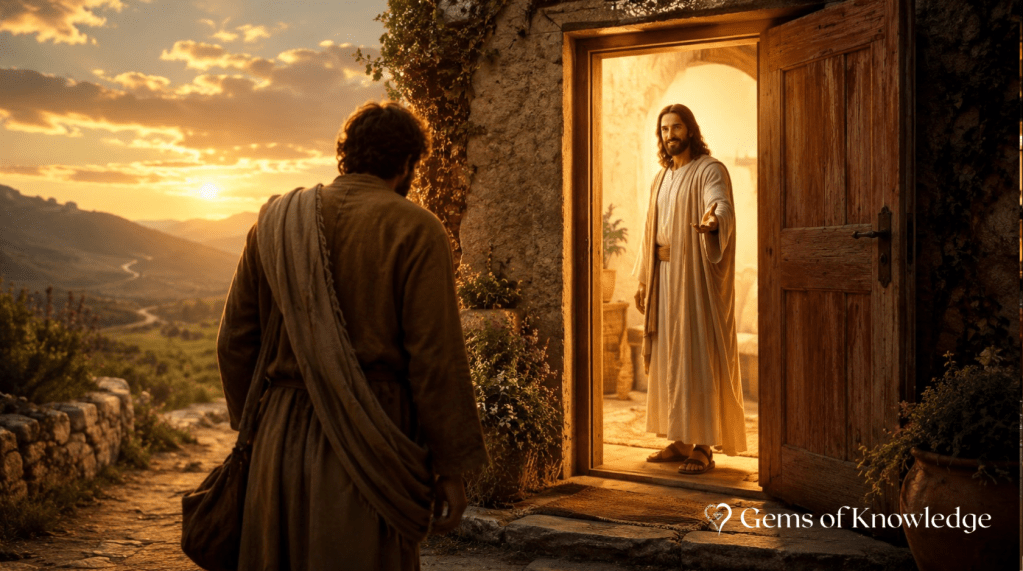
Alt...
Jesus stands inside an open doorway with His hand extended in welcome as a weary traveler returns home at sunset, symbolizing God's faithfulness and His invitation for us to return to Him.
Scripture study deepens daily faith and invites reflection.
Spend a few minutes reading, noting questions, and listening for guidance.
Right Here. Right Now.
Today is my wedding anniversary. ❤️ It made me think... how much joy would I miss if I spent today worrying about tomorrow instead of enjoying the gift God has given me right now? That's exactly what the Lord reminded me this morning: "Don't worry about tomorrow. Just focus on today. Right now with Me. I am in everything if you would just look." Tomorrow will come soon enough. Don't let tomorrow steal today's blessings.💎 [SENSITIVE CONTENT]
Today’s One Year Bible Verses: 2 Chronicles 30:1–31:21, Romans 15:1–22, Psalm 25:1–15, Proverbs 20:13–15
Find Peace Today
Today is my wedding anniversary.
As I was thinking about today’s Gem, it occurred to me how much joy I would miss if I spent today worrying about tomorrow instead of enjoying the gift God has given me right now.
I could spend the day thinking about next week’s responsibilities, next month’s bills, or wondering what the future holds. But if I did, I’d miss the laughter, the memories, the gratitude, and the blessing of celebrating another year with the man God gave me.
How many moments like that have I already missed because my mind was somewhere else?
Then I read today’s Gem of Knowledge:
“Don’t worry about tomorrow. Just focus on today. Right now with Me. I am in everything if you would just look. Amen.”
I smiled because I realized the Lord wasn’t just telling me to stop worrying. He was inviting me to enjoy what He has already placed in front of me.
How many times have I prayed for God to show Himself while completely overlooking the ways He already has? How often have I been so focused on what’s next that I missed what He was doing right in front of me? How often do I pray for Him to be with me when it is promised He would never leave me nor forsake me (Hebrews 13:5)?
Tomorrow will come soon enough. But today’s blessings can only be enjoyed today.
Today’s reading in 2 Chronicles reminded me that Hezekiah didn’t wait until everything in Judah was perfect before turning back to God. The Temple had been neglected, the people had wandered, and there was much to restore. Yet Hezekiah understood that God was the answer, so he began by simply taking the next step towards restoring God’s presence among the people. He reopened the Temple, invited the people to celebrate the Passover, and trusted God with the rest.
I wonder how often we’re waiting for the perfect moment before we will move, while God is simply asking us to be faithful in the one we already have. If we won’t do it now, how can He trust us to do it later?
Paul echoes that same thought in Romans 15. Rather than worrying about ourselves, he encourages us to build one another up, follow Christ’s example, and allow God to fill us with joy and peace as we trust Him. Notice that Paul doesn’t say we’ll find peace by figuring out tomorrow. He says peace comes as we trust God.
That happens today.
David understood this in Psalm 25. He didn’t ask God to show him his entire future. He prayed, “Show me the right path, O LORD; point out the road for me to follow.” He simply wanted to take the next step.
Maybe that’s all God wants us to focus on too.
God isn’t only waiting for you in tomorrow’s answers… He’s with you in today’s moments.💎
Action (5 Minutes with God)
Take 5 minutes to be with the Lord today. Ask Him:
- “Lord, what do You want me to know about this personally?”
- Journal what He gives you through His Holy Spirit.
- Then ask, “What do You want me to do?”
- Journal what He reveals – then do it!
Throughout your day, intentionally pause and ask yourself, “Lord, where are You in this moment?” Then slow down long enough to notice His voice, His presence, His blessings, His guidance, or the opportunity He has placed right in front of you.
Prayer
Heavenly Father, forgive me for spending so much time worrying about tomorrow that I miss what You’re doing today. Help me slow down and recognize Your presence in the ordinary moments of life. Open my eyes to see You at work in the conversations, opportunities, and blessings You place before me. Teach me to trust You one day at a time, one step at a time, and to find peace in walking with You right here, right now. Thank You for being present in every moment. In Jesus’ name, amen.
To read more 5 Minutes with God devotionals click here.
If Gems of Knowledge has blessed your walk with Christ, please subscribe or consider partnering with us today. Your gift helps keep these devotionals free for everyone and carries God’s Word to more hearts. Every seed matters—thank you for sowing into this work! 💛
Test everything by the Word and the Spirit (John 16:13)

Alt...
A thoughtful woman sits on a park bench looking at her phone while Jesus stands quietly nearby. Around her, sunlight, flowers, birds, children playing, and an elderly couple holding hands reveal God's presence in the ordinary moments of life.
Are You Ready to See Jesus?
Can you imagine the moment you finally see Jesus face-to-face? ❤️ The One you've prayed to, worshiped, trusted, and followed—no longer known only by faith, but standing before you in His glory. Until that day, may we keep our hearts ready and our eyes fixed on Him. Not out of fear, but anticipation. Behold the Lamb. The King of Glory is coming. And what a glorious day that will be! 🙌💎 [SENSITIVE CONTENT]
Today’s One Year Bible Verses: 2 Chronicles 29:1–36, Romans 14:1–23, Psalm 24:1–10, Proverbs 20:12
Behold the Glory of the Lamb
There are some words from the Lord that make you stop and sit with them for a moment. Today’s Gem of Knowledge did that for me:
“Behold the glory of the Lamb. You will see Me in My glory very soon. Not now or tomorrow, but very soon, and you will be blessed.”
What a promise!
I don’t know what the Lord means by “very soon.” Scripture tells us that no one knows the day or hour of Christ’s return, and I don’t want to put a timetable on words He hasn’t given us. But whether we see Jesus at His return or at the end of our own earthly lives, one thing is certain: the day is coming when faith will become sight. We will see Him.
And what will matter then?
Today’s reading begins with King Hezekiah reopening the doors of the Temple after his father, Ahaz, had shut them. Hezekiah didn’t merely acknowledge that things had gone wrong; he called the priests and Levites to consecrate themselves, cleanse the Temple, and restore worship.
What struck me is the urgency. Hezekiah became king at twenty-five, and in the very first month of the first year of his reign, he opened the Temple doors and repaired them. He didn’t wait until governing became less busy. Restoring the worship of God came first.
There is something in that for us.
If we truly believe we will see Jesus, then perhaps we should ask whether there are any doors in our own hearts that need reopening. Have other things crowded out worship? Have we allowed compromise, distraction, bitterness, or complacency to accumulate in places that belong to God?
Not because we should be afraid to meet Him—but because we love Him and want to be ready.
Psalm 24 almost sounds like a trumpet announcing the King:
“Open up, ancient gates! Open up, ancient doors, and let the King of glory enter.” (Psalm 24:7, NLT)
Then comes the question:
“Who is the King of glory?”
“The LORD, strong and mighty; the LORD, invincible in battle.” (Psalm 24:8, NLT)
Can you imagine?
The Jesus we know now by faith—the One we pray to, worship, follow, cry to, and seek in the quiet places—is the King of glory! One day we won’t simply sense His presence or hear His voice in our spirit.
We will behold Him.
That changes how I want to live today.
Romans 14 reminds us that “each of us will give a personal account to God” (Romans 14:12, NLT). This should be an eye-opening statement for us. What will we say about our lives when we stand before God? And Paul wasn’t using that truth to encourage believers to police everyone else’s lives either.. In fact, the chapter says almost the opposite. Stop condemning one another. Stop arguing over disputable matters. Remember that we each belong to the Lord.
When we remember that we will stand before Jesus ourselves, we become less concerned with evaluating everybody else and more concerned with getting the beam out of our own eye so we can faithfully follow Him (Matthew 7:3-5).
Paul says, “For the Kingdom of God is not a matter of what we eat or drink, but of living a life of goodness and peace and joy in the Holy Spirit.” (Romans 14:17, NLT)
That’s the life I want Him to find me living.
Not obsessing over dates. Not watching the sky in fear. Not arguing about whether someone else’s walk is perfect.
Worshiping.
Loving.
Serving.
Listening.
Following Jesus.
Proverbs 20:12 says, “Ears to hear and eyes to see—both are gifts from the LORD.” (NLT). Today, that verse feels especially beautiful.
Lord, give us ears to hear You now and eyes fixed upon You until the day we finally see You face-to-face.
The King of glory is coming.
Behold the Lamb. 💎
Action (5 Minutes with God)
Take 5 minutes to be with the Lord today. Ask Him:
- “Lord, what do You want me to know about this personally?”
- Journal what He gives you through His Holy Spirit.
- Then ask, “What do You want me to do?”
- Journal what He reveals – then do it!
Let today be a day of reopening, cleaning out, or restoring. Then worship Him—not out of fear, but with anticipation. We are preparing to meet Someone we love.
Prayer
Dear Lord Jesus, You are the Lamb of God and the King of glory. Thank You for the promise that one day I will see You as You truly are. Prepare my heart to be ready for You. Show me anything that has taken Your place or distracted me from loving You fully, and help me surrender it. Give me ears to hear You, eyes fixed upon You, and a life filled with goodness, peace, and joy in Your Spirit. Until faith becomes sight, help me live faithfully, love generously, and worship You wholeheartedly. I long for the day I behold Your glory. This I pray in Your beautiful name Jesus Christ, Yeshua, my King, amen.
To read more 5 Minutes with God devotionals click here.
If Gems of Knowledge has blessed your walk with Christ, please subscribe or consider partnering with us today. Your gift helps keep these devotionals free for everyone and carries God’s Word to more hearts. Every seed matters—thank you for sowing into this work! 💛
Test everything by the Word and the Spirit (John 16:13)

Alt...
A woman stands on a mountain in awe as Jesus appears in radiant glory among the clouds, surrounded by brilliant golden light shining across the landscape.
Scripture study opens quiet doors to daily guidance.
Set aside a few minutes, read slowly, and reflect on what it means for your day.
Why Am I So Judgmental?
Nobody likes to admit they're being judgmental, but I think most of us do it every day. We have to exercise judgment to some degree, but have you ever caught yourself going beyond discernment and judging someone before you even realized you were doing it? That's exactly what today's Gem of Knowledge addresses: “Stop being so judgmental. I know it just seems to happen, but when those thoughts come to mind, reject them and come to Me, holding every thought captive in Christ.” We may not control every thought that knocks on the door, but we don't have to invite every one inside.💎 [SENSITIVE CONTENT]
Today’s One Year Bible Verses: 2 Chronicles 26:1–28:27, Romans 13:1–14, Psalm 23:1–6, Proverbs 20:11
Take Every Thought Captive
Nobody likes to admit they’re being judgmental, but I think most of us do it every day.
We have to exercise judgment to some degree—to discern what is right and wrong, wise and unwise, safe and unsafe. But have you ever caught yourself going beyond discernment and judging someone before you even realized you were doing it?
You see how someone is dressed, hear something they said, notice a decision they made, or watch how they behave, and suddenly you’ve formed an opinion about them. Sometimes it happens so quickly that it feels automatic.
That’s exactly what today’s Gem of Knowledge addresses:
“Stop being so judgmental. I know it just seems to happen, but when those thoughts come to mind, reject them and come to Me, holding every thought captive in Christ.”
Yikes! Every day the Lord gets me, but today hit me hard. Yet He is so good—even when He brings truth and correction, He does it without condemnation.
I love that the Lord acknowledges that sometimes the thought simply appears. But the fact that a thought entered our mind doesn’t mean we have to agree with it, entertain it, or allow it to shape how we treat someone.
We may not control every thought that knocks on the door, but we don’t have to invite every one inside.
Paul gives us a beautiful alternative in Romans 13: “Love your neighbor as yourself. Love does no wrong to others, so love fulfills the requirements of God’s law” (Romans 13:9–10, NLT).
Judgment looks at someone and quickly decides what their problem is. Love slows down and remembers there may be more to their story.
We have seen the Lord emphasizing that very thing over the last few days: Look. Watch. Listen. Pray. Discern. Observe. Wait. Perhaps He’s teaching us not only to slow down our actions and reactions, but also our conclusions about people.
Today’s reading in 2 Chronicles shows us how dangerous our own perspective can become. Uzziah began his reign seeking God, and the Lord blessed him tremendously. But eventually his strength led to pride. Scripture says, “But when he had become powerful, he also became proud, which led to his downfall” (2 Chronicles 26:16, NLT).
Pride can make us think we see more clearly than we actually do. It can cause us to look at another person’s weakness while forgetting how completely we depend upon God’s mercy ourselves.
That is why we need to examine our thoughts instead of automatically trusting them.
When the thought comes—She shouldn’t have done that. He ought to know better. What is wrong with them? I would never…—that’s an opportunity to stop and take the thought captive then bring it to Christ.
Reject the judgment and bring the thought to Jesus.
Maybe instead of, What’s wrong with them? we can ask, Lord, what’s causing this? or Lord, what might they be going through?
Instead of criticism, pray.
Instead of assuming, listen.
Instead of deciding who someone is based on one moment, remember Proverbs 20:11: “Even children are known by the way they act, whether their conduct is pure, and whether it is right” (NLT). A person’s life is revealed through more than the single moment we happened to witness.
And when we struggle to do that, Psalm 23 reminds us where to go. “The LORD is my shepherd; I have all that I need” (Psalm 23:1, NLT). We have a Shepherd who guides us along right paths. That includes the paths our minds travel.
We can bring Him our ugly thoughts too. In fact, that really what we should do…what we need to do.
We don’t have to pretend they weren’t there. We can simply say, “Jesus, that thought wasn’t loving. I don’t want to think that way. Help me see this person through Your eyes.”
Then let Him help you replace judgment with love.
We won’t become less judgmental simply by trying harder not to judge. Transformation happens as we repeatedly bring those thoughts to Christ and allow Him to change the way we see people.
The thought may come automatically.
But love can be our choice instead.💎
Action (5 Minutes with God)
Take 5 minutes to be with the Lord today. Ask Him:
- “Lord, what do You want me to know about this personally?”
- Journal what He gives you through His Holy Spirit.
- Then ask, “What do You want me to do?”
- Journal what He reveals – then do it!
Pay attention to your thoughts about people today. When a judgmental thought comes, don’t continue the conversation with it. Stop and bring it to Jesus. Ask, “Lord, help me see this person the way You do.” Then choose prayer, compassion, or love instead.
Prayer
Heavenly Father, forgive me for the times I judge others without knowing their story. Help me recognize judgmental thoughts when they come and refuse to entertain them. Teach me to bring every thought to You and replace criticism with compassion, assumptions with prayer, and judgment with love. Jesus, change the way I see people until I begin to see them more like You do. Guide my thoughts along Your right paths and help me love my neighbor as myself. In Jesus’ name, amen.
To read more 5 Minutes with God devotionals click here.
If Gems of Knowledge has blessed your walk with Christ, please subscribe or consider partnering with us today. Your gift helps keep these devotionals free for everyone and carries God’s Word to more hearts. Every seed matters—thank you for sowing into this work! 💛
Test everything by the Word and the Spirit (John 16:13)
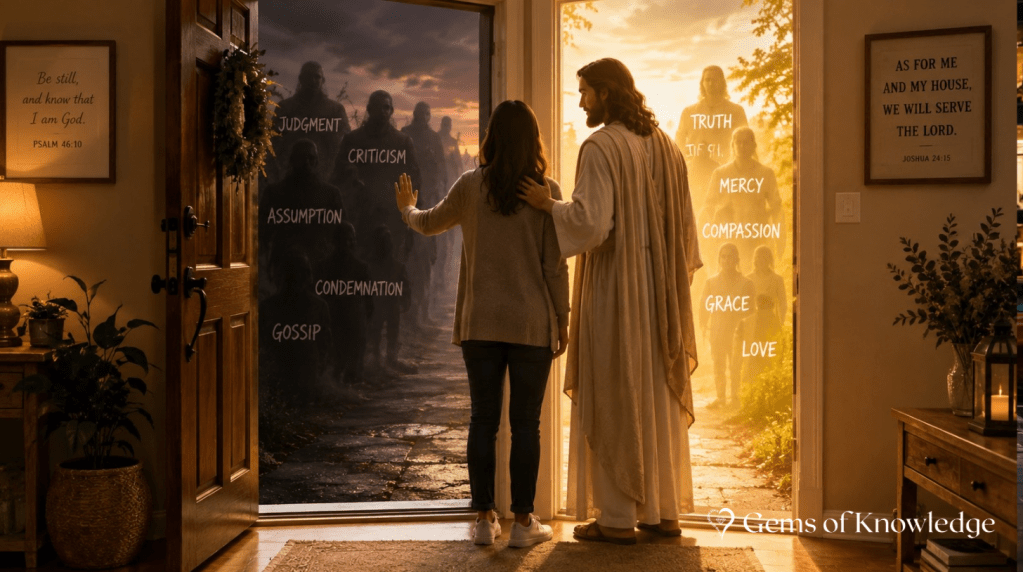
Alt...
A woman stands with Jesus at the doorway of her home, rejecting dark figures representing judgment, criticism, assumption, condemnation, and gossip while light illuminates truth, mercy, compassion, grace, and love.
Reflecting on John 11:14-16, 14:5-8, 20:24-29, and 21:1-2
This week we’re looking at a set of texts that mention the disciple Thomas – John 11:14-16, 14:5-8, 20:24-29, and 21:1-2 – hopefully without completely losing sight of their larger contexts (the raising of Lazarus, Jesus’ “upper room” discourse, and Jesus’ resurrection appearances). Still, our focus is on the “faithful witness,” or possibly less-than-faith-ful witness, of the disciple-apostle Thomas.
Although what these texts tell us about the substance of Thomas’ “faith” might be open to question and reflection. What can we tell about what Thomas believes and thinks from these texts, do we think? And in light of that, how closely does what Thomas seems to think and believe correspond to what we would count as “Christian faith” these days, would we say? Why would we say that?
For that matter, what do we ourselves count as “Christian faith” these days? And how does that align with what we think the gospel of John presents as or means by “believing in” the only-begotten Son? And what difference do we think it makes how we answer that question?
[We might need to take care with these questions, because some of them have been the subject of major controversies over the years. Thirty Years’ War type controversies, even. I hope we can agree to forego any arguments of that kind.]
A few notes on these texts are here. Here are a couple of additional questions we might want to think about, or to discuss in class:
How does Thomas’ response to Jesus’ speech in John 14 strike us? What is Thomas telling Jesus, do we think? To what degree do we think he is speaking for the entire group, to what degree only for himself? Why do we think this?
[More personal] To what degree does Thomas speak for us as well here, would we say? How clear to us is Jesus’ discourse at this point? What is our understanding of what Jesus is saying, and what it means? How have we ourselves come to that understanding?
[Much more theoretical, but possibly interesting] How much of what we ourselves understand Jesus to mean here would have been available to the disciples’ understanding in the upper room, do we think? Any thoughts or feelings about that?
Our published curriculum uses the language of “proof” a good deal this week, suggesting that Thomas is lacking “proof” when he insists on seeing Jesus’ hands and side in person before being able to say “My Lord and my God!” How would we ourselves describe what stands between Thomas and faith at this point in the story? How would we ourselves describe or label what Thomas is asking for in v25? Why would we choose that label, and how does it differ from, or resonate with, a demand for “proof”?
[More personal] How does what we understand Thomas to be going through here compare – how does it resemble, or differ from – our own experiences of coming to faith? Where do we relate to Thomas, where do we not, and why?
Overall, this might be a good opportunity for us to do some thinking, to ourselves and perhaps out loud, about what we mean by faith in the first place, and what role we think personal experience plays in that. We might want to think about the kind of personal experience Thomas and the other disciples have, and consider how that experience resembles, or differs from, the kind of personal experience that is available to people today. What are the advantages and disadvantages, does it seem to us, of having had that kind of experience? What are the advantages and disadvantages of the kind of personal experience available to people today?
Image: “A Family Around a Table,” Julius Paulsen (1919), public domain, via Wikimedia Commons
#BibleStudy #John111416 #John1458 #John202429 #John2112 #meaning #meaningForUs #personalKnowledge #readingTheBible #thinkingAboutTheBible
Alt...
painting of family seated around a table at night
Check out our new 1-page course on faith building! Enjoy 3+ hours of video content at your own pace. No extra resources needed. Dive in now! #BibleStudy
https://chrissbiblenewsletter.org/faith-mindset-course/?fsp_sid=27
Studying John 11:14-16, 14:5-8, 20:24-29, and 21:1-2
This week we’re looking at (and maybe around and beyond) a set of texts that mention the disciple Thomas: John 11:14-16, 14:5-8, 20:24-29, and 21:1-2. This amounts to portions of several larger stories (the raising of Lazarus, the “upper room” discourse on Jesus’ last night with the disciples, and Jesus’ second and third – or third and fourth, depending on how we’re counting – resurrection appearances as recorded in John) that directly mention the disciple Thomas. I say “maybe around and beyond” because we will probably see that we need more context to make sense of the verses in the lesson. Here are a few notes on these texts:
BACKGROUND AND CONTEXT
We’re staying in John’s gospel this week: the famously cryptic, mysterious, symbolic “fourth gospel,” with its distinctive theology and its distinctive literary style to express that distinctive theology. John’s gospel explicitly and insistently identifies Jesus with God, in Jesus’ own words; contains Jesus’ famous I AM passages that encode Jesus’ personal centrality to the spiritual life; stresses the importance of faith in Jesus, specifically, for salvation and eternal life; practically never mentions the kingdom of God, let alone the kingdom of heaven, and when it does, that kingdom is not exactly “at hand.” [See John 3:3 and 5.]
The gospel’s unique features include the cast of disciples who get speaking parts, one of whom is Thomas. [Other disciples who have actual stories in John, but not in the synoptics, include Andrew, Philip, and Nathanael. See John 1:35-51, John 6:1-14, John 12:20-26, John 14:8-14. Nathanael doesn’t appear by that name in the synoptics or Acts, but tradition from way back has identified him with Bartholomew.] This explains why, if we want to think about Thomas and his personality and what he illustrates about faith and doubt and witness, we have to rely on John’s testimony.
[Unless, perhaps, we were to turn to the Gospel of Thomas? But that would be extra-canonical, so how much would we even want to do that? And there’s hardly anything about Thomas in that gospel, anyway.]
All these texts are in the lectionary. John 20:19-31 is the lectionary gospel for the Second Sunday of Easter EVERY YEAR – something seminary students and grads who only preach when the regular pastor has a Sunday off know well. In other words, we might have the mistaken impression that the Bible tells us a lot about Thomas, if all we know is the lectionary. So Bible Content Examinees might want to be on the lookout for a question like “Which gospel mentions Thomas more than once?”
MORE CONTEXT and CLOSER READING
John 11:14-16 depends on the whole set-up that’s taken place in John 11:1-13. This includes Jesus’ purposeful but explicitly not unloving delay when he gets the summons from Mary and Martha to come quickly because their brother, Jesus’ friend Lazarus, is ill, and the disciples’ astonished and concerned response to Jesus’ proposal to return to Judea. That concern stems from the events narrated in John 10:22-42, which include people taking up stones to stone Jesus for blasphemy (v31).
This background gives the “him” in Thomas’ highly ambiguous statement in v16 – “Let us also go [to Judea, we suppose], that we may die with him” – the possible meaning of “Jesus.” Since we know, if we’ve been reading along in the gospel so far, that Jesus will be in danger of death when he returns to Judea. That would make Thomas’ statement here mean something like “Let’s go with Jesus, even if it means death. Let’s go die with Jesus.”
On the other hand, the “him” might be Lazarus. Especially since Jesus has just finished saying “Let us go to him.” And if that’s the case, we might need to flesh out Thomas’ proposal as meaning “Let’s go die with Lazarus [so that we, too, can be raised to new life by Jesus along with him.]”
Of course, John being John, he might want us to think of both of those things.
John 14:5-8 depends on the context of John 14:1-4, which provides the motivation for Thomas’ blunt observation “Lord, we do not know where you are going,” which is a direct contradiction of what Jesus has just said. Sort of like Jesus saying, “I’m going to my Father, you know the way” and Thomas saying “Do not” and then Jesus saying “Do, too.”
At this point I appreciate Thomas very much, for calling Jesus on his mysticism and metaphors. “Get literal for once, Jesus, for Pete’s sake. Stop treating us like we actually understand what you’re talking about, would you?”
He doesn’t get much satisfaction in v6, as far as that goes, although we may not notice that if we’ve spent enough time around church(es) to think we actually understand “I am the way, the truth, and the life.”
John 20:24-29 depends at a minimum on the context of John 20:19-23, if not more of John 20, to know what the other disciples (number and identities unspecified) mean when they say “We have seen the Lord.”
Thomas’ response then might be summed up as “I’ll believe that when I see it. For myself.”
Which, fortunately for him, he does.
What exactly is going through Thomas’ mind in all this is not necessarily obvious. Maybe he is doubting that people can rise from the dead. On the other hand, we might not think Thomas would doubt this, having been with Jesus back in chapter 11. Maybe instead he is doubting people can rise from the dead on their own. Maybe he is doubting that the disciples – his friends and colleagues – actually witnessed what they say they witnessed. Maybe there’s a little hurt, disappointment, or envy contributing to that refusal to accept their testimony about an experience he has not [yet] shared. Maybe what he’s saying is something like “I can’t go along with you on this until it’s as real for me as it is for you.”
If that last is what he’s saying, we might need to take Thomas’ objection a lot more seriously, and relationally, than we often do. Some people don’t want to, or even can’t, play pretend. The question for someone like that is: what does it take, for the disciples’ testimony to feel convincingly real, to feel like testimony about reality? What makes “We have seen the Lord” feel like a true statement about reality?
From that perspective, we probably need to read vv26-28 as a demonstration of the grace of Jesus Christ.
We might want to note the parallel between John 20:29 and John 1:50-51. In both cases, Jesus questions the basis for the disciple’s belief. Nathanael, who’s so easily convinced by Jesus’ vision, has much more to see for himself. Thomas, who’s been a hold-out for his own sight, may have forfeited some available blessing on his way to it.
Some questions on the texts are here.
Image: “Feuchtwangen_Pfarrkirche_-_Vorhalle_Fresko_Evangelist_Johannes” (cropped), Wolfgang Sauber, CC BY-SA 4.0, via Wikimedia Commons
#BibleStudy #commentary #exegesis #John111416 #John1458 #John202429 #John2112 #meaning #readingTheBible #Thomas
Alt...
fresco of eagle of St. John
![[?]](https://s0.wp.com/wp-content/plugins/activitypub/green/assets/img/wp-logo.png?m=1784797036i)
7 Church C3
Introduction The intricate tapestry of biblical prophecy often weaves historical narratives with future revelations, creating a cohesive spiritual map for the believer. A profound example of this is the structural alignment between the Twelve Tribes of Israel and the Seven Churches of Revelation. This theological framework suggests that the historical journey of Israel’s tribes—marked by specific downfalls, redemptive blessings, and spiritual battles—directly mirrors the spiritual […] [SENSITIVE CONTENT]
Introduction
The intricate tapestry of biblical prophecy often weaves historical narratives with future revelations, creating a cohesive spiritual map for the believer. A profound example of this is the structural alignment between the Twelve Tribes of Israel and the Seven Churches of Revelation. This theological framework suggests that the historical journey of Israel’s tribes—marked by specific downfalls, redemptive blessings, and spiritual battles—directly mirrors the spiritual conditions, trials, and promises of victory given to the New Testament churches. By examining how each tribe’s Old Testament failures and subsequent blessings correlate to specific Seal judgments and church letters, we uncover a timeless blueprint for spiritual endurance.
This deep-dive analysis prompts us to consider several reflective questions:
- How do our ancestral or past spiritual vulnerabilities shape the specific corporate and individual trials we face today?
- In what ways does God utilize the unique, redeemed strengths of our spiritual heritage to help us resist contemporary deceptions and cultural compromises?
- How can a church’s “overcoming power” be activated by understanding the specific historical traps that its spiritual predecessors fell into?
Here is a breakdown of the details and their biblical references:
1. Judah
- OT Sin (Betrayal & Deception): Refers to Judah’s role in selling his brother Joseph into slavery (Genesis 37:26-27).
- Redemptive Blessing (The Kingly Lion): Based on Jacob’s deathbed blessing that the “scepter shall not depart from Judah” and the imagery of him as a lion’s whelp (Genesis 49:9-10). This points to the Messiah, the “Lion of the tribe of Judah” (Revelation 5:5).
- Seal Resistance (Seals 1 & 5): Relates to overcoming the white horse (false authority) and the cry of the martyrs.
- Overcoming Power (Ephesus): Connects to the church that “tested those who claim to be apostles but are not” and rejected the works of the Nicolaitans (Revelation 2:2, 6).

2. Reuben
- OT Sin (Instability & Lust): Jacob described his firstborn, Reuben, as “unstable as water” because he defiled his father’s bed by sleeping with Bilhah (Genesis 49:3-4).
- Redemptive Blessing (Survival & Mercy): Refers to Moses’ blessing: “Let Reuben live and not die, nor his men be few” (Deuteronomy 33:6), showing God’s mercy despite his past.
- Seal Resistance (Seals 2 & 4): Represents enduring the red horse (war/chaos) and the pale horse (death).
- Overcoming Power (Smyrna): Linked to the church told to be “faithful even to the point of death” to receive the crown of life (Revelation 2:10).

3. Gad
- OT Sin (Spiritual Compromise): Often associated with the choice of the tribes of Gad and Reuben to settle outside the Promised Land, which some interpret as a compromise of their spiritual inheritance (Numbers 32).
- Redemptive Blessing (The Lion’s Strength): Moses described Gad as a lion that “tears at arm and scalp” and as a tribe that executed the Lord’s justice (Deuteronomy 33:20-21).
- Seal Resistance (Seals 2, 3 & 6): Relates to surviving war, famine (black horse), and great upheaval.
- Overcoming Power (Pergamum): Connects to the church that remained true to God’s name even where “Satan has his throne” (Revelation 2:13).

4. Asher
- OT Sin: Failed to drive out the Canaanites, choosing instead to live among them for commercial convenience (Judges 1:31-32).
- Redemptive Blessing: Jacob’s blessing promised “rich food” and “royal delicacies” (Genesis 49:20), while Moses’ blessing mentioned him “dipping his foot in oil,” symbolizing prosperity and the Holy Spirit.
- Seal Resistance: Often associated with overcoming the lure of material prosperity during the trials of the 3rd Seal (Famine/Economic hardship).
- Overcoming Power (Thyatira): Relates to a church warned against compromising with the surrounding culture while being praised for their increasing “works” (Revelation 2:19).

5. Naphtali
- OT Sin: Initially hesitant in battle, Naphtali is sometimes associated with a lack of immediate spiritual initiative.
- Redemptive Blessing: Described as a “doe let loose that bears beautiful fawns” (Genesis 49:21) and “satisfied with the favor of the Lord” (Deuteronomy 33:23), reflecting a spirit of freedom and readiness.
- Seal Resistance: Linked to spiritual swiftness and endurance during the 6th Seal (Great Upheaval).
- Overcoming Power (Sardis): Connects to the church that was “dead” but urged to wake up and strengthen what remains (Revelation 3:2).

6. Manasseh
- OT Sin: Associated with the historical idolatry of the northern kingdom, which led to their eventual exile.
- Redemptive Blessing: As the firstborn of Joseph, he received a blessing of great fruitfulness and strength, though he was second to his brother Ephraim in prominence (Genesis 48:19).
- Seal Resistance: Represents the “forgetting” of past trials (as his name means “to forget”) to endure the multifaceted tests of the Seals.
- Overcoming Power (Philadelphia): The church of the “open door” that kept God’s word and did not deny His name (Revelation 3:8).

7. Simeon
- OT Sin (Vicious Anger): Simeon and Levi were cursed by Jacob for their violent anger and cruelty in the massacre of the Shechemites (Genesis 34:25-30; 49:5-7).
- Redemptive Blessing (Grace & Scattering): Though cursed to be “scattered,” Simeon found grace by being absorbed into the territory of Judah, eventually becoming part of the Southern Kingdom’s remnant.
- Seal Resistance: Represents overcoming the “anger and cruelty” tests that can arise during times of intense persecution or upheaval.
- Overcoming Power (Thyatira): Often linked to this church (as the 4th church in the standard list, though the chart’s exact alignment may vary) which was praised for its faith and service but warned against tolerating a “Jezebel” spirit of compromise.

8. Levi
- OT Sin (Cruelty transformed): Shared in the same sin of violence as Simeon.
- Redemptive Blessing (The Priestly Tribe): Levi’s tribe turned their zeal toward God during the golden calf incident, leading to their selection as the priesthood (Deuteronomy 33:8-11).
- Seal Resistance: Linked to maintaining “sacred focus” and spiritual service even when the world’s structures (the Seals) are collapsing.
- Overcoming Power (Sardis): Connects to the “remainder” that must wake up and preserve what is holy before it dies (Revelation 3:2).

9. Issachar
- OT Sin (Servitude/Compliance): Jacob described Issachar as a “strong donkey” that bowed his shoulder to bear a burden, sometimes interpreted as a willingness to trade freedom for comfort (Genesis 49:14-15).
- Redemptive Blessing (Understanding the Times): The descendants of Issachar were later praised for having “understanding of the times, to know what Israel ought to do” (1 Chronicles 12:32).
- Seal Resistance: Symbolizes the discernment needed to navigate the deceptions of the seals.
- Overcoming Power (Philadelphia): The church with the “little strength” that remained faithful, similar to the humble but discerning nature of Issachar (Revelation 3:8).

10. Zebulun
- OT Sin (Commercial Distraction): Historically focused on maritime trade, Zebulun was often at risk of being more concerned with “ships and commerce” than spiritual duty (Genesis 49:13).
- Redemptive Blessing (A Haven for Ships): Jacob’s blessing promised they would “dwell by the haven of the sea,” serving as a source of support and resources for the nation.
- Seal Resistance: Represents maintaining a spiritual “haven” and stability during the global economic and physical tremors of the seals.
- Overcoming Power (Philadelphia/Laodicea): Zebulun’s role as a “haven” mirrors the promise of protection given to those who hold fast.

11. Joseph
- OT Sin (Rejected by Brothers): While Joseph himself was righteous, his story is rooted in the “rejection of the chosen one” by his own family.
- Redemptive Blessing (The Fruitful Bough): Jacob blessed Joseph as a “fruitful bough by a well” whose branches run over the wall, symbolizing abundant life and resilience (Genesis 49:22-26).
- Seal Resistance: Represents the ultimate endurance and provision—just as Joseph provided for Israel during famine, this tribe represents spiritual sustenance during the seals.
- Overcoming Power (Laodicea): Though Laodicea is warned about wealth, the “gold refined in the fire” offered by Jesus mirrors the refined character Joseph gained through his trials (Revelation 3:18).

12. Benjamin
- OT Sin (The Ravenous Wolf): Jacob described Benjamin as a “ravenous wolf” that devours prey in the morning and divides spoil in the evening (Genesis 49:27), reflecting a fierce and sometimes impulsive nature.
- Redemptive Blessing (The Beloved of the Lord): Moses blessed Benjamin as the one who “dwells in safety” between the Lord’s shoulders (Deuteronomy 33:12).
- Seal Resistance: Represents the “last defense” and the fierce protection of the truth during the final trials.
- Overcoming Power (Laodicea/New Jerusalem): Benjamin, as the youngest, represents the completion of the tribes and the transition into the New Jerusalem where God dwells with His people (Revelation 21).

Conclusion
Ultimately, the parallel between the Twelve Tribes and the Seven Churches reveals that God’s redemptive strategy remains unchangeable across dispensations. What began as tribal characteristics in the book of Genesis matures into prophetic armor capable of resisting the apocalyptic Seals and refining the global Church. Whether it is transforming Simeon’s vicious anger into the endurance needed to face persecution, or turning Issachar’s compliance into an understanding of the times, God consistently repurposes human frailty for kingdom victory. This structural symmetry reassures us that the final victory of the Church is not accidental, but meticulously designed from the very foundation of Israel.
As we contemplate this profound structural alignment, it leaves us with several insightful questions for further study:
- If the order of the tribes sealed in Revelation 7 intentionally alters the traditional birth order, how does this specific re-indexing change our understanding of the chronological trials the Church must face?
- Given that Ephraim and Dan are omitted from the sealing in Revelation 7 and replaced by Levi and Joseph, what urgent warning does this send to modern churches regarding the permanent consequences of systemic idolatry and spiritual compromise?
- How can modern ministry leaders use this matrix of “Sin, Blessing, Resistance, and Power” to diagnose the hidden, historical root causes of spiritual stagnation within their own local congregations?
Appendix A: Scriptural Mapping Matrix
This matrix provides a structured, scannable overview of the chronological and thematic links between the Old Testament narratives of the Twelve Tribes and the New Testament apocalyptic visions.


Appendix B: The Omission of Dan and Ephraim in Revelation 7
In Revelation 7:4–8, the listing of the 144,000 sealed from the tribes of Israel departs from traditional Old Testament genealogies. Most notably, Dan and Ephraim are completely omitted, while Levi (traditionally set apart without a land inheritance) and Joseph (represented by his two sons, Manasseh and Ephraim) are re-indexed into the lineup.
Theological scholarship points to several critical historical and spiritual reasons for this replacement.
1. The Heritage of Idolatry and Spiritual Apostasy
The primary theological consensus for the removal of Dan and Ephraim rests on their historical role as the epicenters of institutional idolatry in Israel.
- The Sin of Dan: The tribe of Dan was the first to establish a permanent, localized system of idolatry during the era of the Judges (Judges 18:30–31). Later, when Jeroboam split the kingdom, he set up golden calves to divert worship away from Jerusalem. He placed one of these golden calves directly in the territory of Dan (1 Kings 12:28–30).
- The Sin of Ephraim: As the dominant tribe of the Northern Kingdom, Ephraim became synonymous with spiritual unfaithfulness. The prophets repeatedly singled out Ephraim for leading the nation into pagan practices. Hosea famously declared, “Ephraim is joined to idols; leave him alone” (Hosea 4:17).
2. The Legal Penalty of the Mosaic Law
The omission aligns perfectly with the judicial warnings laid out in the Mosaic Covenant regarding idolatry. Deuteronomy 29:18–21 explicitly states that if an individual, clan, or tribe turns away from Yahweh to serve foreign gods, the Lord will “blot out his name from under heaven.”
By leading the nation into corporate idolatry, Dan and Ephraim legally invoked this covenant curse. Their omission from the apocalyptic sealing of the 144,000 serves as a literal fulfillment of this judicial blotting out of names from the registry of the holy army.
3. Early Church Typology: The Anti-Messiah
Early Church Fathers, particularly Irenaeus and Hippolytus, developed a strong typological tradition regarding the tribe of Dan.
- They noted that in Jacob’s final blessing, Dan is described as a “serpent by the roadside, a viper along the path” (Genesis 49:17).
- Jeremiah 8:16 also describes a devastating snorting of horses coming from Dan.
- Based on these passages, early Christian commentators hypothesized that the Antichrist (or the final false prophet) would physically or spiritually emerge from the tribe of Dan, necessitating its exclusion from the sealed servants of God.
4. The Sovereign Restoration: Levi and Joseph
The omission of Dan and Ephraim creates two vacancies, which are filled by Levi and Joseph (alongside Manasseh). This substitution carries profound redemptive significance:
- The Elevation of Levi: In the Old Testament, Levi was excluded from the standard military numbering and land division because their inheritance was the priesthood itself (Numbers 1:47-49). In Revelation, however, the entire Church is transformed into a “kingdom and priests” (Revelation 1:6). Levi’s inclusion signals that the final, sealed remnant functions as a holy, priestly army.
- The Honor of Joseph: Instead of naming Ephraim, John uses the name of Joseph himself. This bypasses the rebellious name of Ephraim while preserving the “double portion” blessing given to Joseph’s house, maintaining the perfect biblical number twelve.
Glossary of Prophetic Terms
- 7 Churches of Asia: Seven literal historical congregations in Asia Minor (modern-day Turkey) addressed by Jesus Christ in Revelation 2–3. They represent both local histories and universal spiritual conditions of the Church throughout time.
- 12 Tribes of Israel: The traditional divisions of the Hebrew people descended from the twelve sons of the patriarch Jacob (Israel). In prophetic literature, they symbolize the foundational covenant people of God.
- Apocalyptic Literature: A genre of biblical writing (primarily found in Daniel, Ezekiel, and Revelation) that utilizes highly symbolic imagery, cosmic battles, and divine disclosures to reveal the ultimate triumph of God’s Kingdom over evil.
- Jezebel Spirit: A symbolic term used in the letter to the church of Thyatira (Revelation 2:20). It denotes a seductive influence within the faith community that promotes religious compromise, moral laxity, and spiritual idolatry.
- Nicolaitans: A heretical sect criticized in the letters to Ephesus and Pergamum. They are historically associated with teaching that Christian liberty allowed for participation in pagan practices and immoral cultural norms.
- Overcomer: A recurring title in Revelation 2–3 promised to believers who successfully resist spiritual apathy, deception, and persecution. Each mention carries a specific eternal reward.
- Redemptive Blessing: The theological concept wherein God takes a flawed human characteristic or historical failure and, through grace, transforms it into a sanctified strength for His purpose.
- Scepter of Judah: The prophetic symbol of sovereign rule and kingly authority given to the line of Judah (Genesis 49:10), which finds its ultimate, eternal fulfillment in Jesus Christ.
- Seals of Revelation: A series of seven symbolic seals broken by the Lamb (Jesus) in Revelation 5–8. The opening of each seal releases a specific judgment or historical trial upon the earth, including war, famine, economic hardship, and martyrdom.
« Previous | Read Next: 7 Church C4»
7 Church C1
Introduction: The Shadows of the Tribes The history of the twelve tribes of Israel is often celebrated for its foundational role in biblical history, yet the narrative is equally defined by personal failures, systemic compromises, and moral lapses. Rather than presenting idealized heroes, the biblical text offers an unfiltered look at human frailty. The negative legacies of the tribes—ranging from individual acts of sexual immorality and violence to corporate sins of idolatry, spiritual […] [SENSITIVE CONTENT]
Introduction: The Shadows of the Tribes
The history of the twelve tribes of Israel is often celebrated for its foundational role in biblical history, yet the narrative is equally defined by personal failures, systemic compromises, and moral lapses. Rather than presenting idealized heroes, the biblical text offers an unfiltered look at human frailty. The negative legacies of the tribes—ranging from individual acts of sexual immorality and violence to corporate sins of idolatry, spiritual compromise, and political rebellion—serve as cautionary tales. These accounts demonstrate how early character flaws and geographical compromises frequently evolved into generational pitfalls. Examining these dark chapters reveals how deeply individual choices shaped the collective destiny of an entire nation.
Before exploring the specific actions of each tribe, consider these reflective questions:
- How do the personal sins of the patriarchs (like Judah and Reuben) mirror or predict the structural failures of their descendants?
- In what ways did physical geography and border choices (such as Gad and Zebulun) directly dictate the spiritual vulnerabilities of those tribes?
- What does the survival of these tribes, despite their severe depravity, suggest about the overarching biblical themes of justice and grace?
The 144,000 Sealed Tribes: OT Sins & References


- 1. Judah
Primary Sin/Negative Legacy: Sexual Immorality & Betrayal: Commission of incest/adultery with Tamar and the earlier betrayal of Joseph.
Bible Reference: Genesis 38
Added Details: Judah departed from his brothers to live among Canaanites and married a Canaanite woman. After his two eldest sons died due to wickedness, Judah withheld his youngest son from his daughter-in-law, Tamar, breaking Levirate customs. Tamar disguised herself as a prostitute, and Judah knowingly engaged with her, resulting in twins.2. Reuben
Primary Sin/Negative Legacy: Sexual Immorality: Forfeited his birthright by sleeping with his father’s concubine, Bilhah.
Bible Reference: Genesis 35:22
Added Details: As Jacob’s firstborn, Reuben held the natural rights to the primary inheritance and leadership. By sleeping with Bilhah (Rachel’s maidservant and Jacob’s concubine), he committed an act that challenged his father’s authority. This act had severe long-term consequences, prompting Jacob to strip him of his preeminence on his deathbed (Genesis 49:3-4).3. Gad
Primary Sin/Negative Legacy: Spiritual Compromise: Chosen settlement outside the Promised Land, leading to vulnerability and lack of focus.
Bible Reference: Numbers 32
Added Details: Possessing a massive amount of livestock, the tribe of Gad petitioned Moses to settle the rich pasturelands east of the Jordan River instead of entering Canaan. Moses heavily rebuked them for discouraging the rest of the nation, comparing them to the faithless spies. They were only granted the land after promising to cross over armed and fight alongside the other tribes.4. Asher
Primary Sin/Negative Legacy: Compromise & Failure: Failed to drive out the inhabitants of the land, choosing peaceful coexistence with pagans.
Bible Reference: Judges 1:31-32
Added Details: Assigned a highly strategic, fertile coastal area, Asher never pushed the Canaanites out of Phoenician strongholds like Acco and Sidon. Instead of subjugating the locals or forcing tribute, the text changes perspective to note that the Asherites dwelt among the Canaanites, meaning they integrated into the pagan population and submitted to their control.5. Naphtali
Primary Sin/Negative Legacy: Religious Assimilation: Similar to Asher, failed to displace Canaanites, leading to cultural/religious blending.
Bible Reference: Judges 1:33
Added Details: Naphtali failed to clear out the heavily fortified pagan inhabitants of Beth-shemesh and Beth-anath. While they did manage to eventually subject these populations to forced labor, they still lived directly among them, setting the stage for deep cultural contamination and religious compromise over generations.6. Manasseh
Primary Sin/Negative Legacy: Idolatry: Heavily participated in the pagan worship that led to the Northern Kingdom’s downfall.
Bible Reference: 2 Kings 17:7-12
Added Details: This passage outlines the systematic spiritual collapse of the Northern tribes, of which Manasseh was a massive segment. They secretly did things against the Lord, built high places in all their towns, set up sacred pillars, and burned incense to false gods, mirroring the exact pagan nations God had driven out before them.7. Simeon
Primary Sin/Negative Legacy: Violence: Participated in the cruel and deceitful massacre of the men of Shechem.
Bible Reference: Genesis 34:25-26
Added Details: Seeking revenge for the defilement of their sister Dinah, Simeon and Levi deceitfully convinced the men of Shechem to be circumcised as a peace treaty. While the men were still in intense physical pain on the third day, Simeon and Levi took their swords, entered the city boldly, and slaughtered every male.8. Levi
Primary Sin/Negative Legacy: Cruelty: Shared in the Shechem massacre; their “anger was cursed” by their father Jacob.
Bible Reference: Genesis 49:5-7
Added Details: Decades after the Shechem incident, Jacob formally cursed their violent temperament on his deathbed, stating that “weapons of violence are their swords.” Because of their unbridled cruelty, Jacob prophesied that their descendants would be scattered and dispersed throughout the territories of Israel rather than holding a consolidated land mass of their own.9. Issachar
Primary Sin/Negative Legacy: Servitude & Sloth: Jacob prophesied they would bow their shoulder to bear burdens, choosing ease over independence.
Bible Reference: Genesis 49:14-15
Added Details: Jacob explicitly likened Issachar to a “strong donkey crouching between sheepfolds.” The prophecy outlines a mindset where the tribe saw that a resting place was good and the land pleasant; consequently, they willingly surrendered their sovereignty and bowed their shoulders to forced labor just to maintain comfort.10. Zebulun
Primary Sin/Negative Legacy: Commercialism: Prioritized sea trade and economic gain, which often brought foreign religious influences.
Bible Reference: Genesis 49:13
Added Details: Jacob foretold that Zebulun would dwell by the seashore and become a haven for ships, with its border reaching toward Sidon. This commercial focus led the tribe to open trade corridors that prioritized wealth creation and economic partnerships with Phoenician merchants over spiritual separation.11. Joseph
Primary Sin/Negative Legacy: Northern Rebellion: Representing the “House of Joseph,” which led the split from Judah and the rise of idolatry.
Bible Reference: 1 Kings 12:25-33
Added Details: Jeroboam, an Ephraimite representing the House of Joseph, led the political secession from the Davidic line of Judah. To stop the northern people from traveling to Jerusalem to worship, Jeroboam built alternative worship centers in Bethel and Dan, casting two golden calves and proclaiming, “Here are your gods, O Israel.”12. Benjamin
Primary Sin/Negative Legacy: Defending Depravity: Nearly destroyed after defending the men of Gibeah who committed heinous sexual crimes.
Bible Reference: Judges 19-20
Added Details: When a wicked mob from the Benjamite city of Gibeah abused and killed a Levite’s concubine, the other eleven tribes demanded the perpetrators be handed over for justice. Instead of condemning the crime, the entire tribe of Benjamin mobilized for war to defend their corrupt kinsmen, leading to a brutal civil war that almost caused the absolute extinction of the Benjamite lineage.
📘 Architectural Overview of the Following Diagram

The bar chart shifts away from traditional chronological sorting. Instead, it plots the Twelve Tribes vertically according to a National Impact Scale. The horizontal length of each bar does not measure physical assets like population size, military power, or geographic acreage. Instead, it serves as a theological and historical weight index, measuring how deeply a tribe’s specific failures altered or endangered the overall destiny of the nation of Israel.
🏛️ The Three-Tier Functional System
The diagram organizes the tribes into three distinct tiers of severity:
🚨 Tier 1: National Tipping Points (Longest Bars)
- Tribes: Judah, Joseph, Manasseh
- The Blueprint: These horizontal tracks represent actions that altered the geopolitical, structural, and spiritual identity of the entire nation.
- The Logic:
- Judah sits at the absolute apex of the chart. His bar is given the longest length because his early moral collapse (Genesis 38) endangered the foundational Abrahamic covenant line. His actions represent the highest stakes in the narrative: the potential termination of the royal and Messianic lineage before Israel even became a nation.
- Joseph and Manasseh follow immediately below. Their actions represent structural fractures that tore the empire apart, leading to the political split of the United Kingdom (1 Kings 12) and institutional state idolatry that ended in national exile (2 Kings 17).
⚡ Tier 2: Severe Internal Crises (Medium Bars)
- Tribes: Benjamin, Reuben, Simeon, Levi
- The Blueprint: These bars represent significant internal crises. While they did not split the entire kingdom into opposing nations, they triggered catastrophic civil wars, widespread bloodshed, or permanent structural loss of status within the family.
- The Logic:
- Benjamin’s bar reflects a localized defense of systemic depravity that erupted into a horrific civil war, bringing an entire tribe to the brink of complete extinction (Judges 19–20).
- Reuben, Simeon, and Levi represent early ancestral failures—such as incest (Genesis 35) and deceptive mass violence at Shechem (Genesis 34). These actions directly resulted in the permanent forfeiture of the firstborn birthright and the loss of independent, unified territorial inheritances across the Promised Land (Genesis 49:5–7).
🛡️ Tier 3: Regional Attrition & Passive Compromise (Shortest Bars)
- Tribes: Gad, Asher, Naphtali, Issachar, Zebulun
- The Blueprint: These short bars represent sins of omission, passivity, and localized compromise. These groups did not launch national rebellions or split the monarchy; instead, they slowly and quietly eroded their distinct identity.
- The Logic: These border, coastal, and frontier tribes chose immediate geographic comfort, trade partnerships, or material ease over spiritual and political distinctiveness. Rather than driving out corrupting influences, they chose peaceful coexistence, leading to gradual cultural assimilation into pagan environments (Judges 1).
Conclusion: The Legacy of Compounding Compromise
The historical trajectory of the twelve tribes demonstrates that spiritual and moral erosion is rarely sudden; it is a slow process of compounding compromise. Whether through the unchecked anger of Simeon and Levi, the complacent integration of Asher and Naphtali, or the blatant idolatry of the House of Joseph, each tribe left a legacy that hindered Israel’s collective calling. They frequently chose immediate comfort, economic advantage, or tribal loyalty over covenantal faithfulness. Nevertheless, these dark legacies do not completely erase their history. Instead, they provide a stark backdrop that highlights the persistent need for systemic reform, ethical leadership, and spiritual vigilance across generations.
To deepen your understanding of these narratives, reflect on these insightful questions:
- Why did certain tribes, like Levi, successfully transition from a legacy of cursed violence into a specialized role of spiritual service, while others, like Benjamin, nearly faced total extinction?
- How does the recurring theme of “peaceful coexistence” with corrupting influences in Judges serve as a warning for modern institutional and cultural assimilation?
- Where is the line between healthy economic growth and spiritual compromise, as seen in the trade-focused legacy of Zebulun?
Appendix: Summary Map of Tribal Sins and Territories


Glossary
- Assimilation: The process where a minority group adopts the customs, values, and religious practices of a dominant surrounding culture, losing their distinct identity.
- Apostasy: The formal abandonment, rejection, or renunciation of a religious faith or covenantal relationship.
- Bethel and Dan: The two border cities in the Northern Kingdom where King Jeroboam set up golden calves to prevent citizens from traveling to Jerusalem to worship.
- Bilhah: Rachel’s maidservant and Jacob’s concubine; mother of Dan and Naphtali. Her violation by Reuben led to his forfeiture of the firstborn birthright.
- Canaanites: The ancient pagan inhabitants of the land west of the Jordan River, whose religious and moral practices frequently corrupted the neighboring Israelite tribes.
- Covenant: A solemn, binding agreement between God and the nation of Israel, requiring obedience to divine law in exchange for protection and inheritance of the land.
- Davidic Line: The royal lineage originating from King David of the tribe of Judah, from which the legitimate kings of Israel and Judah were meant to descend.
- Gibeah: A Benjamite city that became infamous for a gang rape and murder, sparking a devastating civil war among the tribes of Israel.
- House of Joseph: A collective term representing the powerful northern tribes of Ephraim and Manasseh, which eventually spearheaded the secession from the Kingdom of David.
- High Places: Elevated outdoor shrines dedicated to pagan worship or unsanctioned sacrifices, which became centers of spiritual corruption in Israel.
- Idolatry: The worship of physical idols, images, or false foreign gods (such as Baal or Asherah) instead of the Lord.
- Levirate Customs: An ancient law requiring a man to marry his deceased brother’s childless widow to provide an heir for the dead brother and protect the widow’s security.
- Phoenicians: A seafaring, mercantile civilization based in coastal cities like Sidon and Tyre, whose lucrative trade routes heavily influenced the economy and religion of Zebulun and Asher.
- Promised Land: Canaan; the land promised by God to Abraham and his descendants, which required active faith and military obedience to fully possess.
- Shechem: A Canaanite city where Simeon and Levi carried out a treacherous massacre of the male population under the guise of a peace treaty.
- Tamar: Judah’s daughter-in-law who, after being denied her marital rights by Judah, disguised herself to secure an heir from him, exposing his hypocrisy.
« Previous | Read Next: 7 Church C2»
“Love your neighbor as yourself.”
Almost everyone knows this line. Fewer know it comes from Leviticus 19:18, written in Hebrew long before it was ever spoken in English. Jesus called it the second greatest commandment. He was quoting the Hebrew Bible when he said it.
Which means every time those words are spoken, in any church, any synagogue, any language, they are an echo of the same ancient Hebrew sentence. One verse, holding two faiths and countless hearts.
That is what this community means to me. Jews and Christians, people from more than 30 countries, all gathered around a language that keeps insisting we belong to each other.
Today I teach you how to say it in Hebrew, the way it was first written. Learn it, then go live it. 💙
Reflecting on Luke 2:15-19, John 2:1-5, John 19:25-27
This week we’re studying three short texts that feature Mary, the mother of Jesus: Luke 2:15-19 [a portion of “the Christmas story in Luke” – about which, some notes here], John 2:1-5 [a portion of the story of “the wedding at Cana”], and John 19:25-27 [one of Jesus’ last acts, from the cross]. This is the next in our series of studies of “the testimony of faithful witnesses.”
I’ve noticed that there’s a wide variation in how willing different readers of scripture are to presume knowledge of Biblical characters’ interiority. That might be one place to start. What do we ourselves think, or feel, we know about Mary’s thoughts and feelings from the texts presented here? What do we ourselves take as evidence for our inferences, whether from the text or from some other source or sources? What source or sources? [For instance, our knowledge of “human nature”? “Mothers”? … ?] What do our answers tell us about the way we read scripture? How do they help us understand the impact scripture makes on us?
What difference does the way we read these texts make? What difference does it make what we understand Mary to be thinking and feeling across these texts? That is, if we knew more, or less, about what Mary is thinking and feeling than we think we do, how would it change what we understand the scripture to be teaching us?
Some notes on these texts are here; here are a couple of additional questions we might want to think about, or to discuss in class:
Here’s a question I’ve asked before, but think is worth asking again: How well-placed are 21
st
century American Christians to intuit what Mary, the young 1
st
century CE Palestinian Jewish woman, who had met the angel Gabriel in person, and who had experienced her unique but presumably also typical pregnancy and childbirth, etc., could, would, or must have thought or felt about anything?
[More theoretical, but real] How well do we think we can answer that question? Why do we think that? What difference do we think our answer(s) make to the way we ourselves read scripture?
Why does Luke tell us that Mary, after meeting the excited shepherds, “treasured all these words and pondered them in her heart,” do we think? What do we learn from that? What could be, or should be, our own response to that, do we think? Why?
How would we describe the conversation between Jesus and his mother at the wedding at Cana? [For instance, would we describe it as … a conflict? A disagreement? A negotiation? Something else? What?] Why? What does this episode tell us, or what might it tell us, about Mary? About Jesus? About the relationship between Mary and Jesus? About the relationship between Mary and God? About the power of the saints?
How do we ourselves understand Jesus’ act of re-defining the relationship between his mother and the beloved disciple from the cross? Why?
What does that redefinition tell us about the character of the Christian community? Why do we say that?
What light do these texts shed for us on “being a disciple of Christ’s”? Why do we say that?
Image: “Conversation,” Camille Pissarro, public domain, via Wikimedia Commons.
#BibleStudy #John192527 #John215 #Luke21519 #meaning #meaningForUs #readingTheBible #thinkingAboutTheBible
This is one of my students reading Scripture. In Hebrew. In the original language it was written in thousands of years ago.
Not long ago, these were just letters they could not read. Today, they are reading the Word of God the way it first flowed from the page, hearing the meaning that lives underneath every translation.
This is why so many of you come to me. Not to order coffee in Tel Aviv, beautiful as that is, but to draw closer to the Book that shaped your faith, to meet it face to face, in its first voice.
And here is what makes me proudest. My student is reading, not decoding one word at a time after years of study. The right method gets you to the text.
If your heart has been whispering that you want to read the Bible as it was truly written, listen to it. This is possible for you too. 💙
hebrewbyinbal.com/speak
#LearnHebrew #BiblicalHebrew #Hebrew #BibleStudy #Christianity
Studying Luke 2:15-19, John 2:1-5, 19:25-27
This week we’re studying three short texts that feature Mary, the mother of Jesus. The texts are Luke 2:15-19 [a portion of “the Christmas story in Luke” – about which, some notes here], John 2:1-5 [a portion of “the wedding at Cana”], and John 19:25-27 [a moment during the crucifixion, recorded in the gospel of John]. Together, these short and arguably de-contextualized moments of scripture may speak to us of Mary’s character as a “faithful witness.” Here are a few notes on these texts:
BACKGROUND AND CONTEXT
We’re looking at moments from two of the four gospels, one from Luke, the other two from John. It might help us to remember that Luke is one of “the synoptic gospels,” the three gospels that share a broad storyline and a significant percentage of literary material, while John is “the fourth gospel,” with a different timeline [for instance, the cleansing of the temple occurs early in the story], distinctive long dialogues [with, e.g., Nicodemus and the “woman at the well”], and Christology [Jesus is portrayed consistently throughout as the savior, who is one with God the Father, in whom people must believe]. Among the synoptics, Luke stands out for, among other things, its remarkable emphasis on the role of women in Jesus’ story, and on the Holy Spirit, and its high proportion of unique stories [e.g., the Annunciation to Mary, the Visitation, neither of which are among our texts this week].
Something we might want to keep in mind as we study these texts that involve Mary, the mother of Jesus, is that we don’t have a lot of text featuring Mary. If we look at the four gospels as a whole, we can pretty easily make a list of all the texts that tell us anything about her:
- Matthew 1:16 and 1:18-25 Mary is Jesus’ mother, and a virgin engaged to Joseph
- Luke 1:26-56 – Mary receives the news of her impending pregnancy from the angel Gabriel, then visits her relative Elizabeth, and delivers a famous poetic speech
- Luke 2:1-19 – Mary is Jesus’ mother, who travels to Bethlehem along with Joseph, is referred to by angels, and is present when the shepherds come to see “this thing that has been made known unto us”
- Luke 2:33-34, 39 – “they” [we infer Mary and Joseph] come to the temple with Jesus for purification, and Mary is addressed by name by Simeon, and then also by Anna, before “they” return to Nazareth
- Matthew 2:10, 2:13-15, 2:20-21 – Mary is Jesus’ mother, is there with Jesus in Bethlehem when the magi visit, and is taken along by Joseph back and forth to Egypt to save Jesus’ life
- Luke 2:41-51 – Jesus’ parents visit Jerusalem, Mary chides Jesus for disappearing in v48, to which Jesus responds with a 12-year-old-boy answer, and she ponders all this in v51
- John 2:1-12 – the mother of Jesus is instrumental in Jesus’ first miracle, and afterwards goes with Jesus and his brothers to Capernaum for a few days
- Luke 8:1-3 – Mary, if one of the “many others,” travels along with Jesus during his ministry
- Matthew 13:55; Mark 6:3 – Mary is Jesus’ mother, known to the scoffers in Nazareth
- Matthew 12:46-50, Mark 3:31-35, Luke 8:19-21 – Jesus’ mother and brothers ask to meet with Jesus and are refused
- Mathew 27:56, Mark 15:40 – Mary, if also the mother of James and Joseph, is present at the crucifixion
- John 19:25-27 – Jesus’ mother is present at the crucifixion, and placed by Jesus into the care of the “disciple whom he loved”
- Mark 15:47 – Mary, if also “the mother of Joses,” sees where Jesus is entombed
- Matthew 28:1-10, Mark 16:1-8, Luke 24:1-12 – Mary, if also “the other Mary,” is witness along with Mary Magdalene and one or two others to the risen Christ on Easter morning; or, if “the mother of James,” then at least witness to the empty tomb + angels; or, additionally, if either “the mother of James” or else one of “the other women,” then also one of the rudely disregarded first witnesses to the empty tomb + angels
- Acts 1:14 – after Jesus’ resurrection, Mary is a named member of the earliest community of Jesus’ devoted disciples
- Romans 16:6 – later in the first century, someone named Mary, who isn’t necessarily not the Mary who is the mother of Jesus, is a hard-working member of the early church in Rome
It is not obvious to me what evidence, if any, this material actually gives us about Mary’s “faith,” or her “understanding of who Jesus was and what he was to accomplish,” or her “dynamic relationship” with Jesus, or how it substantiates much of we might imagine Mary could, would, “must” etc. have thought or felt. [I say this, in response to some definite statements made in our published curriculum which seem to me to go well beyond anything actually supported by the text. Fantasy may actually be a legitimate method of Bible study. What else, after all, is Jesuit “composing the text,” for instance? Still, it seems to me we ought to acknowledge it as such.]
How well-placed are 21
st
century American Christians to intuit what Mary, the young 1
st
century CE Palestinian Jewish woman, who had met the angel Gabriel in person, and who had experienced her unique but presumably also typical pregnancy and childbirth, etc., could, would, or must have thought or felt about anything? We might not even be able to answer that question. But we would be wise to ask it, nevertheless.
All these texts are in the lectionary, although the verses from the Christmas story in Luke are “optional.” Still, Bible Content Examinees familiar with the lectionary Bible will likely recognize them.
CLOSER READING
In Luke 2:19, the verb translated “treasured” is not the same kind of “treasuring” that gives us our English word thesaurus or would make us think of “treasure in a field.” It is a different verb, that has the sense of gathering things together and keeping them together and guarding them closely all together. If we had a box in our closet in which we stored mementos, or a file folder in which we collected vital documents, we could use this verb.
She is also “pondering” these kept or guarded things in her heart, another verb that in Greek incorporates a sense of juxtaposition, as well as of motion. Like how we might say “tossing things back and forth in our minds.”
It might be noteworthy that the “treasuring” Mary does in v19 is also not the same “treasuring” she does in v51. That treasuring is still not the thesaurus word for treasuring, but another verb having to do with keeping or guarding. The verb in v51 might possibly emphasize more the sense that Mary is keeping or guarding things in her heart over time.
Also possibly noteworthy, about the verb in v51, is that it’s the same rare verb used in the Septuagint in Genesis 37:11 for what Jacob does when he “keeps the matter” of Joseph’s annoyingly prescient dreams “in mind.” Maybe, at this point in Luke’s narrative, Luke the canny author is hinting at a parallel between the patriarch Jacob – who senses obscurely something going on with his son, who is also a savior figure – and the matriarch Mary, and her similarly obscure sense of the looming future. Or, maybe not.
John 2 and John 19 can be, and have been, read as bookends around John’s particular literary presentation of Jesus’ earthly ministry. We seem to be seeing something purposeful, and very Johannine, in those bookends, which each include a brief interaction between Jesus and “the mother of Jesus” / “his mother.” Not, we might need to notice, “Mary.” Jesus himself refers to her, in both cases, as woman (2:4, 19:26).
In John 2, Jesus’ hour has not yet come – at least, not according to him, and of course, we think he knows. In John 19, it explicitly has (Jesus himself has said so in John 17:1).
In John 2, Jesus’ words to his mother – “what is that to me or to you” – really are a refusal of community with the wedding party. In John 19, Jesus’ words to his mother – “here is your son” – and to the Beloved Disciple – “behold, your mother” – are a recreation or new creation of community.
Also, in each case, wine is involved. At the wedding at Cana, Jesus makes the wine, out of water – “the first of his signs.” At the cross, Jesus refuses the sour wine offered to him by the soldiers, and then says “it is finished” (vv28-30).
In short, the deliberate arrangement of the elements of these stories calls our attention to Jesus’ special identity and mission; one of the elements is the presence of Jesus’ mother along with his disciples.
One last thing about John 19:27: our English translations tell us the disciple “took her into his home” from “that hour.” Which is not wrong, because the phrase in Greek there is an idiom that everyone would know meant “his home,” in ordinary usage, even though the words “his home” are not actually part of the phrase. But because of that – because the phrase is literally “took her into his own …” – it leaves just that little bit of room to read it in a more broadly spiritual way. As that he took her into his own life, for instance. His own heart. As any beloved disciple could still do, even now. Which would be entirely consistent with the way John writes: saying something, and leaving space for it to mean something even deeper.
Some questions on the texts are here.
Image: “Leaf from a Gospel Book with Four Standing Evangelists,” Metropolitan Museum of Art, CC0, via Wikimedia Commons
#BibleStudy #commentary #exegesis #John192527 #John215 #Luke21519 #meaning #readingTheBible
Revelation: Ezekiel Road Map (B)
« Previous | Read Next: Revelation: Ezekiel Road Map B1 » [SENSITIVE CONTENT]


« Previous | Read Next: Revelation: Ezekiel Road Map B1 »
Scripture study opens quiet doors to daily wisdom.
Pause, reflect, and let the verses guide your choices today.
Reflecting on Luke 19 1-10
This week we’re studying Luke 19:1-10, the story of Zacchaeus and Jesus seeing one another, and the subsequent redemption of a despised chief tax collector.
This time around, our study is part of our series on “the testimony of faithful witnesses.” That might raise for us the interesting question of what we identify as Zacchaeus’ testimony. His initial “seeking” to “see who Jesus is”? His [we infer] positive response to Jesus’ inviting himself to his home for dinner, and playing host to Jesus? His announcement of the restitution he’s going to provide?
All of which might lead us to wonder: what exactly do we mean by “testimony” in the first place? What counts, or can count, as testimony, do we think? Why do we say that?
And, how do we interpret any of that Zacchaean behavior as evidence about Jesus, who Jesus is? Assuming – but should we assume this? – that the “testimony” we are supposed to be considering will be testimony about Jesus? Because who or what else would or could “the testimony of faithful witnesses” be about, do we think?
Following up on that – whatever we do or don’t identify as Zacchaeus’ testimony – how does what Zacchaeus does lead us to think about what we ourselves do, or don’t do, when it comes to encounters with Jesus, and perhaps especially when it comes to public ones? What, if any, lessons does Zacchaeus’ approach teach us? What would change, for us, if we were to act more like Zacchaeus?
Some notes on the text are here. Here are a couple of additional questions we might want to think about, or to discuss in class:
Zacchaeus doesn’t seem to say he’s going to resign his post as chief tax collector. Thoughts? Feelings? How possible do we think it will be for Zacchaeus to work as a tax collector while being faithful to his new-found relationship with Jesus? [Maybe worth glancing at Luke 3:10-14 for a thought on this.]
[More personal] Have we, ourselves, ever made a decision or decisions at work, or about work, for reasons having to do with our allegiance to Jesus? Want to talk about that?
Following up on a statement in our published curriculum, how hard is it, really, for us to imagine that Zacchaeus, or anyone, could “privately practice the prayers and rituals that would mark him” as an observantly religious person of his day “while taking part in tax schemes that impoverished others”? Why?
How hard is it for us to imagine religious observance going along with personal or professional participation in some exploitative or oppressive practice or practices, at any time? What about today, specifically? Why is that?
How does any of that relate to “testimony” and “faithful witness,” would we say? Why?
[More theoretical, maybe?] How “religious” do we suppose Zacchaeus would or might have been before this story, at least in the conventional sense? How much of what happens in this story do we think of as a “religious” event? Why? If not “religious,” then … what? And how is that “what” different from “religion,” in our minds?
How does Zacchaeus exemplify “the lost” Jesus has come to seek and to save? What does his story show us about his seeking and saving?
What does Zacchaeus’ lostness show us about who might be “lost” in our world? What would be seeking and saving for those people? Implications for us?
[More personal] What does Zacchaeus’ lostness show us about our own “lostness”? What would be seeking and saving for us? Implications for us?
Image: “The Conversation,” Edgar Degas, public domain, via Wikimedia Commons
#BibleStudy #Luke19110 #meaning #meaningForUs #readingTheBible #thinkingAboutTheBible
Alt...
painting by Degas, a woman and man in conversation

![[?]](https://files.mastodon.social/accounts/avatars/116/647/842/792/908/661/original/79e1e041fc645dfe.png)
What does it mean to finish strong when faith is tested? Follow Lily’s journey of hope, endurance, and trusting God through every trial and every promise.
#ChristianFiction #Faith #BibleStudy
Read more: https://www.annettekmazzone.com/finish-strong/

One of my students, Sergio DeSoto, just published something I can’t stop thinking about.
It’s called “It Was One Thing the Whole Time,” and it’s about what happens when you stop reading the Bible through layers of translation and start meeting it in its original Hebrew. The connections he thought he’d have to hunt for were already there, woven into the language itself, waiting.
He mentions Hebrew by Inbal in it and I’m honored beyond words. Watching a student go from studying Hebrew to seeing Scripture become one seamless thing is the reason I do what I do.
Read it slowly, the way he asks you to:
https://open.substack.com/pub/sergiodesoto/p/it-was-one-thing-the-whole-time
#LearnHebrew #BiblicalHebrew #HebrewForChristians #BibleStudy #ChristianFaith
Reflecting on Mark 8 27-29 & Luke 22 31-34 & John 18 25-27 & John 21 15-17
This week we’re studying “the testimony of faithful witness” Peter the disciple, reading just four – Mark 8:27-29, Luke 22:31-34, John 18:25-27, and John 21:15-17 – of the gospel texts that tell us something about Peter’s emotionally volatile relationship to Jesus and to the Way of discipleship.
We might want to review what we know about Peter from our past reading of the gospels, and how that provides context for what we read in these selected texts. And then, we might want to think about what focusing on these specific episodes seems meant to show us or to suggest for our reflection. That is: what do we think the Committee on the Uniform Series is trying to get us to learn by focusing our attention on these four texts in particular?
We might also want to think about the degree to which we see something paradigmatic, for people in general, in the way Peter first articulates faith in Jesus as the Christ, then fails to affirm relationship with Jesus under pressure, and then finds forgiveness and commissioning for further ministry in his renewed connection with the risen Christ. Alternatively, how much do we see all that as something very particular to Peter’s story rather than more generally applicable? More personally, how would we say peter’s story compares to others’ stories – e.g., to our own?
Some notes on the text are here. Here are a couple of additional questions we might want to think about, or to discuss in class:
How much would we say we, ourselves, “relate” to Peter? A lot? A little? Compared to any of the other disciples? Why? How do those personal reactions to Peter seem to influence the way we understand the stories about Peter in the Bible, do we think? Or, what we seem to learn from them?
How do we think the experiences Peter goes through in these texts influence the role Peter goes on to play in the early Jesus movement? [For instance, as narrated in the Book of Acts?] Why do we think that?
What do we learn about Jesus from these stories? How does that reinforce, or modify, what we already know about Jesus?
All in all, we will probably want to consider what these texts show us about the challenges, and rewards, of discipleship. What can we learn, whether by way of encouragement or by way of warning, from Peter’s example? How do we see that informing our own practice of discipleship?
Image: “A Family Around a Table,” Julius Paulsen (1919), public domain, via Wikimedia Commons
#BibleStudy #John182527 #John211517 #Luke223134 #Mark82729 #meaning #meaningForUs #readingTheBible #thinkingAboutTheBibleAlt...
painting of family seated around a table at night
How did Pope Leo III shape the relationship between church authority and political power? Explore a pivotal chapter in Christian history and its lasting influence.
#ChurchHistory #Christianity #BibleStudy
Read more: https://www.kithcartcodeofsilence.com/pope-leo-iii-church-authority/

What Matters Most?
We all make time for what matters most. When something is truly important to us, we usually find a way to make time for it. Yet somehow, spending time with God is often the first thing to disappear when life gets busy. That's the danger of busyness. Rarely does it pull us away from God all at once. It happens one day at a time, one skipped prayer, one missed time in His Word, one evening when we're simply too tired. Maybe today is simply an opportunity to ask ourselves one honest question: Does the way I spend my time reflect what I say is most important? If the answer is no, don't be discouraged. His invitation is still the same. Come closer. 💎 [SENSITIVE CONTENT]
Today’s One Year Bible Verses: 1 Chronicles 1:1–2:17, Acts 23:11–35, Psalm 3:1–8, Proverbs 18:14–15
Making God Your Greatest Priority
The business of life has a way of filling every corner of our days. Between family responsibilities, work demands, and holiday celebrations, our schedules can quickly become crowded. Before we realize it, we’re moving from one thing to the next, trying to keep up with everything that needs our attention.
In the middle of all that busyness, something subtle can begin to happen. Our closeness with God, our time in worship, our moments in His Word, and those quiet times spent with Him can slowly start to slip away.
As I thought about it later, though, I realized something.
When something is truly important to me, I usually find a way to make time for it.
If one of my children or grandchildren needed me, I’d rearrange my schedule. If there were an emergency, everything else would suddenly become less important. If I had an appointment I absolutely couldn’t miss, somehow I’d make it there.
The problem wasn’t really a lack of time.
It was a matter of priority.
As I prayed about that, the Lord gently spoke this Gem of Knowledge to my heart:
“You can always do better if it is important to you…if I am important to you.“
Those words weren’t spoken with condemnation. They were spoken with love. I could almost hear the Father’s heart behind them. He wasn’t trying to make me feel guilty. He was inviting me to honestly examine my priorities.
The truth is, we all make time for the things we value most. We schedule vacations months in advance. We make appointments, watch our favorite television shows, scroll social media, and find time for hobbies we enjoy. Yet somehow, spending time with God is often the first thing to disappear when life gets busy.
I’ve certainly been guilty of that.
In fact, just a few devotionals ago I shared how my evening worship had quietly disappeared without me even realizing it. It wasn’t because I loved God less. It wasn’t because I had stopped wanting to spend time with Him. I had simply allowed other things to crowd Him out.
That’s the danger of busyness. Rarely does it pull us away from God all at once. It happens one day at a time, one skipped prayer, one missed time in His Word, one evening when we’re simply too tired.
Before long, weeks or even months have passed, and we wonder why we don’t feel as close to Him as we once did.
Today’s reading reminded me that relationships aren’t built during occasional moments of crisis. They’re built through consistent time together.
When Paul found himself imprisoned in Acts 23, the Lord stood beside him and encouraged him. I couldn’t help but think how comforting that must have been. Paul recognized the Lord’s voice because he had spent years walking closely with Him. That relationship had been cultivated long before the prison cell.
David expressed that same confidence in Psalm 3. Even while surrounded by enemies, he was able to lie down and sleep because he knew the Lord was watching over him. That kind of trust isn’t developed overnight. It grows one day at a time as we continue choosing God’s presence over the distractions of life.
I think that’s what the Lord was really showing me through today’s Gem.
He isn’t asking us to perform better – He’s inviting us into a deeper relationship with Him
After all, every healthy relationship requires time. A marriage doesn’t flourish without conversation. Friendships don’t grow without spending time together. The same is true with God. The more time we spend with Him, the more we recognize His voice, trust His heart, and become like Him.
Maybe today is simply an opportunity to ask ourselves one honest question:
Does the way I spend my time reflect what I say is most important?
If the answer is no, don’t be discouraged.
His invitation is still the same.
Come closer. 💎
Action (5 Minutes with God)
Who doesn’t have 5 minutes for the King? Take at least 5 minutes to be with the Lord today. Ask Him:
- “Lord, what do You want me to know about this personally?”
- Journal what He gives you through His Holy Spirit.
- Then ask, “What do You want me to do?”
- Journal what He reveals – then do it!
Let today be a day of honest evaluation with the Lord and realign where needed, because we love Him and He loves us.
Prayer
Dear Lord, thank You for gently reminding me what truly matters. Forgive me for the times I’ve allowed busyness to crowd You out. Help me make You my greatest priority, not because I have to, but because I love You and want to know You more. Teach me to recognize Your voice as I spend time in Your presence each day. Draw me closer to You, and let my life reflect that You truly are what matters most. InYour beautiful name, I pray, Amen.
To read more 5 Minutes with God devotionals click here.
If Gems of Knowledge has blessed your walk with Christ, please subscribe or consider partnering with us today. Your gift helps keep these devotionals free for everyone and carries God’s Word to more hearts. Every seed matters—thank you for sowing into this work! 💛
Test everything by the Word and the Spirit (John 16:13)

Alt...
Jesus writes "Time with God" into a busy weekly planner filled with appointments, responsibilities, and reminders, illustrating the importance of making God a daily priority.
And as an Israeli who has made her home here I wanted to celebrate in the way I know best. Through Hebrew.
Liberty. Freedom. Independence. Three words at the very heart of this nation’s story, and each one has a rich, ancient counterpart in Hebrew, the language of the Bible that helped shape America’s founding ideals.
So ahead of this historic Fourth of July, let’s learn these three beautiful words in Hebrew together. Two nations, two languages, one deep love of freedom.
Happy early 250th, America. 💙🤍🇺🇸🇮🇱
“Proclaim liberty throughout all the land unto all the inhabitants thereof.” That is Leviticus 25:10, and the Hebrew word for liberty in that verse is dror. It comes from the biblical Year of Jubilee, a sacred time when debts were forgiven, the enslaved were set free, and everyone returned home.
The man who chose it for the bell in 1752 loved Hebrew so much he taught his own children to read it. He reached all the way back to the Hebrew Bible to find the word that would ring over a new nation.
For those of faith, Jubilee has always pointed to something deeper still, the freedom of the soul.
This Fourth of July, hear the verse in the language it was first written in. 💙
Reflecting on Matthew 8 5-13
This week we’re studying Matthew 8:5-13, the story of Jesus healing a centurion’s servant, which he does after witnessing the centurion’s great faith. That faith seems to be grounded in the man’s assumption that the kingdom of the heavens will of course resemble the Roman empire, in at least one vital respect.
Jesus himself marvels at this faith, which makes the centurion a bona fide “faithful witness.” We could perhaps ask ourselves: what seems to be the substance of the centurion’s faith? [That is, if he had a chance to write out a “statement of faith,” what would he say?] What can we tell about that from the text? What other assumptions or inferences do we bring to our understanding of the text, when it comes to thinking about the centurion’s faith? And how does the character of the centurion’s faith in this context seem to compare to the way we talk about “faith” in other contexts?
Some notes on the text are here. Here are a couple of additional questions we might want to think about, or to discuss in class:
What seems to have prepared the centurion to express the faith he does? How does that preparation distinguish him from those “in Israel” as far as we can tell, whether from the text or from what we know about the setting of this story?
What implications do we see in this for the importance of cultural differences, assumptions, etc. in the life of faith?
[a lot more personal] What seems to have prepared us for the faith we ourselves have? What seems to support that faith? Or, alternatively, to obstruct it? In what ways, or in what areas? What do we notice about that?
How do we imagine the encounter of the centurion and Jesus in this story? That is, how do we picture the centurion, how do we picture Jesus? And how much of that mental picture seems to us to come from the text itself, how much from things we already know about the setting of these gospel stories, how much from other sources, like television, or …?
What difference does that mental picture seem to make for how we understand the story and its meaning for us? Do we think?
In thinking about that, what do we notice about the way we read and learn from scripture? Read and learn from stories? Any implications for future reading?
Who do we identify with in this story? That is … where do we see ourselves in the story, or position ourselves with respect to the action and conversation? [For instance, do we see ourselves as “on the outside, looking in”? Or, as “inside” the story in some way, as a bystander, or even as one of the other characters?] Why, do we think? What if we positioned ourselves somewhere else in the story – what difference would or does that seem to make?
What are our thoughts and feelings about “the heirs of the kingdom” Jesus mentions in v12? Why is that, do we think? What’s our response to Jesus’ statement about them? Again, why is that, do we think?
Image: “Der Plausch am Weg” [the chat on the way], Oswald Achenbach, public domain, via Wikimedia Commons
#BibleStudy #hermeneutics #Matthew8513 #meaningForUs #readingTheBible #thinkingAboutTheBible
Alt...
painting of people chatting by trees, lake, and mountains
How did Charlemagne influence church finances in medieval Europe? Explore the historical roots of church funding and the lasting impact of his reforms.
#ChurchHistory #Charlemagne #BibleStudy
Read more: https://www.kithcartcodeofsilence.com/charlemagne-church-finance/

Studying Matthew 8 5-13
This week we’re studying Matthew 8:5-13, the story of Jesus healing the servant of a centurion. There is another version of this story – we assume it’s the same episode in the life of Jesus – in Luke 7:1-10, which we studied some time ago. [Those notes, which include some background on centurions, are here.] There’s also a version of a story like it in John, John 4:43-54, but the details are so different it seems less like “the same” story told differently, and more like a different story altogether. Here are a very few, hasty notes on this text:
BACKGROUND AND CONTEXT
We’ve moved into the gospel of Matthew, which we’ll recall is the gospel in which Jesus does a lot of lengthy preaching and teaching interspersed with healing and other deeds of mercy, and in which there is a lot of explicit reference made to the way Jesus fulfills Hebrew Biblical prophecy, and fits into his Hebrew Biblical context. So much so that Matthew is sometimes described as the “most Jewish” of the gospels, and some readers see Matthew presenting Jesus as a “second Moses.” Alternatively, or perhaps additionally, Matthew is often seen as the most explicitly Wisdom-oriented of the gospels, presenting Jesus as “Wisdom’s child,” or perhaps even as the embodiment of divine Wisdom.
When we reach our story, Jesus has already done plenty of general “healing.” This may explain why the centurion who initiates the encounter seeks him out; there’s been plenty of word-of-mouth publicity by now. What he hasn’t done is much specific narrative healing, except for that of a man with a skin disease, immediately after coming down from the Mount where he’s just delivered the Sermon on the Mount. In other words, in Matthew’s gospel, this healing of a centurion’s servant is the second healing story we have about Jesus.
It won’t be the last, of course. He’ll right away also heal Peter’s mother-in-law, and many more, and then – not counting the men whose demons he exorcises – a paralysed man and a woman with a chronic hemorrhage (while on the way to raise a little girl from the dead) and two blind men and a mute man, all of which will lead right in to sending the 12 out to be apostles.
All of this is still near the beginning of Jesus’ ministry, which as we know will continue on its trajectory toward the events of Holy Week, passion, crucifixion, death, and resurrection, and beyond.
This story is something we wouldn’t know was in the Bible if all we knew were the lectionary. Actually, more precisely, it’s something we would think was in the Bible, in Luke, since the version in Luke is a lectionary option, in the Luke year. So Bible Content Examinees, definitely be warned.
CLOSER READING
In Matthew’s version of this story, the centurion – a technical term that means a captain of a troop of 100 Roman legionaires – comes to Jesus directly, rather than through intermediaries as happens in Luke’s version. He appeals to Jesus in similar terms, though – using the parakaleo word, the verb that also describes what the Spirit does. And addressing Jesus as Lord, which coming from a gentile, a Roman centurion, presumably a member of the imperial occupying force in the area, is probably remarkable. He will repeat that honorific address again, in v8.
He uses (v6) the same term for his servant as (once) in Luke, pais, a term that has a range of meanings that can include a child, and also an especially dear companion, but which can simply mean a young-ish servant. In this account, this term appears three times to refer to this individual servant (v6, v8, v13). And he goes into great detail about the servant’s malady: he is lying, a verb that literally means “thrown,” paralyzed, grievously tormented.
Jesus immediately offers to come and cure him (v7). [Our published curriculum mentions that one popular translation renders Jesus words here as a question. Well … that’s always a possibility, since the Greek text doesn’t have any punctuation. But rendering it as a straightforward statement is … a whole lot more straightforward.]
This prompts the centurion to deliver a lengthy speech (vv8-9). He’s not worthy to have Jesus come under his roof. The “worthiness” word he uses carries a sense of “not having attained” to something – we could think of those signs at amusement parks that say “must be this tall to ride this ride.” [Or, we could think of Psalm 24, and how the gates have to lift up their heads for the King of Glory to come in. The centurion’s response might that his ceilings just aren’t high enough …]
But Jesus can just speak the word, says the centurion, and his servant (pais again) will be healed. Here, the centurion uses a different “healing” word than Jesus used in v7, a word that arguably calls special attention to the miraculous nature of the healing.
Then the centurion goes on to describe the military chain of command that constitutes his world. He is under authority, and has his own direct reports, and he’s accustomed to giving and receiving orders, and basically, he knows how that works. The response suggests that this centurion assumes Jesus is positioned in a similar chain of command himself, which would mean that he can also give authoritative orders, that will be followed.
Hearing this response Jesus marvels, specifically at the centurion’s faith, which he has not found in Israel, and then delivers a long speech of his own, addressed to his followers (so, not specifically his “disciples”). Many will come, from east and west – from all over – and will literally recline with the patriarchs Abraham, Isaac, and Jacob – so, the honored progenitors of Israel – in the kingdom of the heavens.
We might note that the usage here suggests a view of “the kingdom” as somewhere table fellowship can take place, that is, more a “place” view of the kingdom than an “act” view of it. And we might also note this, about the directions: “east” is Biblically in the direction of exile; which makes “west” symbolically the direction of redemption. Though also of “the sea,” which is more about disorder than redemption. But “west” is, in practical geographical terms, the direction of Rome, relative to Capernaum, and the point of origin of this gentile centurion. Something to think about.
This will happen as the heirs of that kingdom are thrown out – compare the posture of the paralyzed servant! – into the outer darkness where there will be weeping and gnashing of teeth. It seems unlikely to be a coincidence that the thrown-ness of these outcast heirs and the grievousness of their torment is a counterpoint to the specific position and torment of the centurion’s slave. Jesus has a cure for the slave.
We might be meant to notice that Jesus could have a cure for the at-risk heirs, too. And we might be meant to think they will need someone to appeal for them, the way the centurion appeals for his servant.
In v13, this centurion who begins the story by coming is now told by Jesus to go, with the affirming “let it be done for you according to your faith.” And it is, from that hour.
Overall, we can see why we might want to include this story in a quarter in which we are looking at “faithful witnesses.” The centurion becomes an exemplar of a faith in Jesus’ power, and also his kindness, which leads to his willingness to use that power on behalf of another, that makes something marvelous possible. We might well consider how the centurion comes by this faith, and how others might also come by it.
Image: “Feuchtwangen Pfarrkirche – Vorhalle Fresko Evangelist Matthäus” (cropped), Wolfgang Sauber, CC BY-SA 4.0, via Wikimedia Commons
v2, revised 06.30.26 with a couple of additional observations, after I woke up enough to make them …
#BibleStudy #commentary #exegesis #Jesus #Matthew8513 #meaning #readingTheBible #textsThatArenTInTheLectionary
Alt...
fresco of angel of St. Matthew
Most people walking past the Liberty Bell have no idea. The words on it come straight from the Hebrew Bible. 🔔🇺🇸🇮🇱
“Proclaim liberty throughout all the land.” Leviticus. And the original Hebrew word for liberty runs far deeper than any translation.
But here is what moves me most as an Israeli living in America. This was no accident. Hebrew was taught at Harvard, Yale, and Princeton. It still sits on the Yale seal today. The founders studied the Hebrew Bible and built a new nation on its ideas of liberty and law.
The language of my homeland is woven into the foundation of my adopted one. As America turns 250, I made a Fourth of July video about exactly that.
It is live now. Come see the Hebrew hidden in the heart of American freedom. 🎬
https://youtu.be/rs5-GnAvKvI
Simeon—co-founder of the Church Missionary Society—sets a trap for anyone who claims to admire Christ’s love for sinners. Fine, he says: follow the example. Render good for evil to those who’ve harmed you. Feed your enemies. This is what proves discipleship, not the admiration itself. One observes that internet preachers and their preferred leaders tend to admire this love considerably more than they practice rendering good for evil toward anyone in particular.
#christian #biblestudy
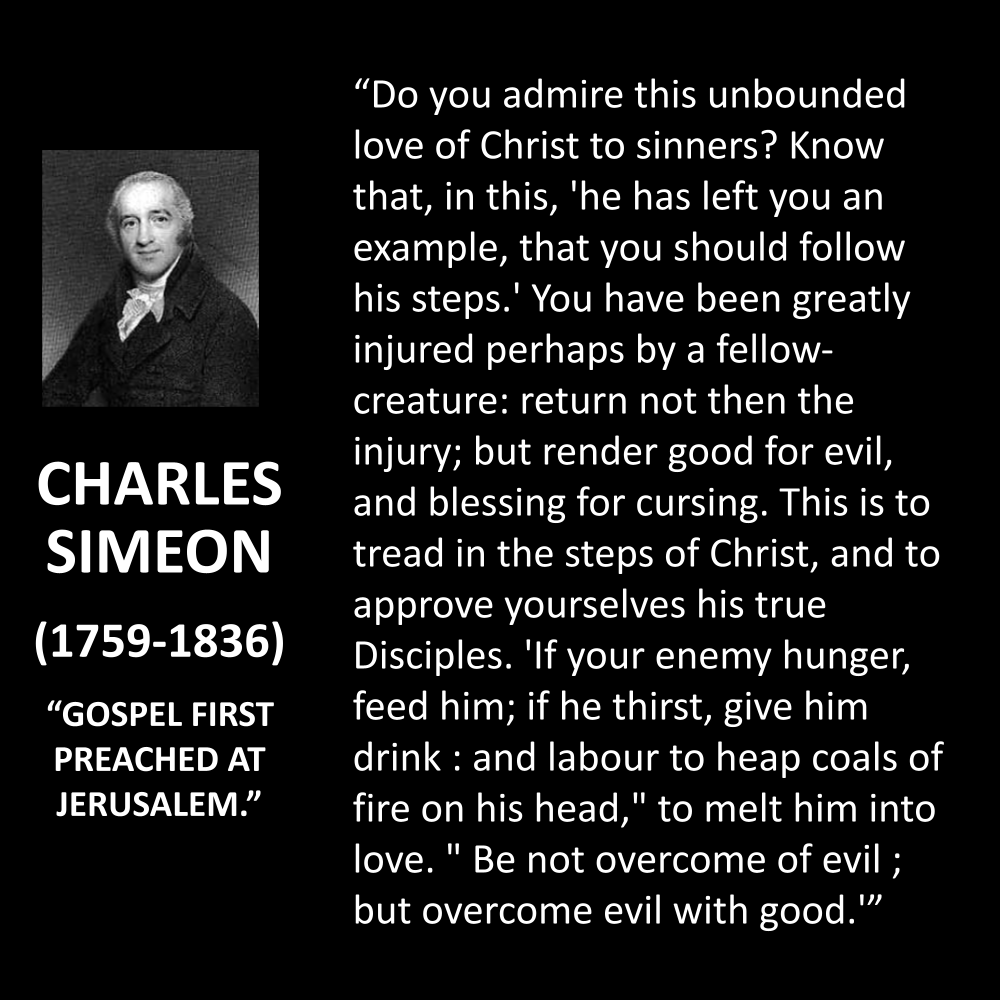
Alt...
meon—co-founder of the Church Missionary Society—sets a trap for anyone who claims to admire Christ’s love for sinners. Fine, he says: follow the example. Render good for evil to those who’ve harmed you. Feed your enemies. This is what proves discipleship, not the admiration itself. One observes that internet preachers and their preferred leaders tend to admire this love considerably more than they practice rendering good for evil toward anyone in particular.
As America turns 250, I made a special Fourth of July video unpacking this beautiful, hidden Hebrew thread woven right into the heart of American freedom.
It is live now. Go watch it, then tell me, did you have any idea the Liberty Bell was carrying Hebrew scripture all this time? 🎬
https://www.youtube.com/watch?v=rs5-GnAvKvI
SEARCH “HEBREW BY INBAL” on YouTube to find it as well.
#LearnHebrew #Hebrew #FourthOfJuly #BibleStudy #America250

This is where her story turns. And after everything in this series, you already know the truth: it was never you. It was the what, and the how.
The real fix, learning Hebrew the way your brain actually thinks with someone guiding you so you never quietly get stuck is exactly what my program Practically Speaking Hebrew is built for.
If you're ready to finally get there, comment SPEAK and I'll send you where to start. Or go straight to hebrewbyinbal.com/speak.
No rush, no pressure. It'll be here whenever you are.
Here is something most people walking past the Liberty Bell never realize. The words inscribed on it come straight from the Hebrew Bible. 🔔🇺🇸🇮🇱
“Proclaim liberty throughout all the land unto all the inhabitants thereof.” That line is from Leviticus, and the original Hebrew word for liberty carries a meaning far richer than most translations capture.
As America turns 250, I made a special Fourth of July video unpacking this beautiful, hidden Hebrew thread woven right into the heart of American freedom.
It lands tomorrow, Sunday at noon Eastern, on my YouTube channel. Set a reminder and meet me there. 🎬
https://www.youtube.com/hebrewbyinbal
#LearnHebrew #Hebrew #FourthOfJuly #BibleStudy #America250




.jpg)


What are the “little foxes” that quietly threaten faith, love, and spiritual growth? Explore the deeper meaning behind Song of Solomon 2:15 and its timeless message.
#BibleStudy #ChristianFaith #SpiritualGrowth
Read more: https://www.annettekmazzone.com/the-tender-grapes-the-little-foxes-song-of-solomon-215/

Reflecting on Amos 1 1, 2 11-12, 3 7-8, 7 10-15
This week we are studying several texts from Amos: Amos 1:1, 2:11-12, 3:7-8, and 7:10-15. These texts prompt us to reflect on the prophet’s own background, commission, sense of call, and on the consequences to the prophet himself of his mission.
The focus speaks to this quarter’s study of “faithful witnesses” in the Biblical story. We’ll undoubtedly want to think about the nature of Amos’s faithful witness, and perhaps about what we can gather are the rewards and the costs of that faithful witness to Amos himself. What can we tell about those rewards and costs from these texts, do we think? How does the example of Amos speak to us, do we think? In particular, what does the prophet Amos teach us about what it means to serve the God of Israel, do we think?
Some notes on the texts are here, and also here (from an earlier time). Here are a couple of additional questions we might want to think about or to discuss in class:
The historical record suggests that the prophet Amos’s message to the people of Israel was not “effective,” if by “effective” we mean “having the result of turning the whole society around and restoring widespread devotion to the God of Israel and to God’s commands.” In light of that, what do we think is the prophet’s responsibility when it comes to communicating God’s warnings and wishes to a people? What is the people’s responsibility, do we think?
What seems to encourage people’s listening to and accepting a prophetic message? What hinders that listening and acceptance, do we think?
More personal: What are today’s prophetic messages? Who seems to us to be articulating them? How are they being received, do we think? What is our own role in articulating, or accepting, or acting on these contemporary prophetic messages? Why is that, do we think?
What seems to be the purpose of the personal information about the prophet Amos that appears in the text? What difference does it make for understanding the prophet’s message to know, for instance, where the prophet comes from, or what his occupation has been? What impressions of the prophet do we get from that information?
What are the implications for people today of the prophet Amos’s background, as shared in the text?
More speculative, but perhaps worth thinking about: What seems to be the difference between a prophetic message and some other kinds of divine message – e.g., an angelic message, a scriptural message, a vision, …? That is: does a prophetic message seem to us to be more or less … believable? Persuasive? Serious? …? Why choose the prophetic mode of communication, do we think, over some other mode of communication? What seem to be the advantages, and disadvantages, of that mode of divine communication, to us?
Image: “The Conversation,” Arnold Lakhovsky, public domain, via Wikimedia Commons.
#Amos11 #Amos21112 #Amos378 #Amos71015 #BibleStudy #meaning #meaningForUs #propheticVoice #readingTheBible #thinkingAboutTheBible

Alt...
people in thoughtful conversation