Search results for tag #astronomy
![[?]](https://cdn.mastodon.org.uk/accounts/avatars/000/015/811/original/a6b767961483103c.jpeg)
#Andromeda before Photoshop
#Astronomy #Picture of the Day
https://apod.nasa.gov/apod/ap260927.html

Alt...
Portrait of galaxy with trails of satellites shown before removal.

@Space@lemmy.science.social @science@beehaw.org @science@lemmy.world @space@beehaw.org @space@lemmy.world @science@newsmast.community @space@newsmast.community @space@lemmy.ml #space #science #nasa #astronomy

![[?]](https://m.f-h.co/cosocial-ca/accounts/avatars/109/493/705/899/503/027/original/95358751ba041317.jpg)
![[?]](https://polymaths.social/fileserver/01HCMX6M1CZNEVJ4F5H58TT5XJ/attachment/original/01JHC5KM5K0V0J0436SPD3F86H.jpeg)


 🍵
🍵  [
[Today's #APOD is a real trip... what?!? XD
Date: 2026 September 22
URL: https://apod.nasa.gov/apod/ap260922.html
Title: Chance Triple Alignment: Plane, Space Station, Sun
![[?]](https://assets.chaos.social/accounts/avatars/000/137/688/original/f66a4b79eee6b640.jpg)
![[?]](https://s3.eu-central-2.wasabisys.com/mastodonworld/accounts/avatars/109/362/359/610/912/307/original/4854f87af56f0d9a.png)
"The translucent corona is a white-gold halo—a hypnotic vortex drawing me into the black disk."—Rudi Zygadlo for Dispatch
https://dispatch-media.com/on-tour-with-the-eclipse-chasers/?src=longreads
![[?]](https://files.defcon.social/dcsocial-s3/accounts/avatars/113/208/344/507/078/943/original/014820ad22daee1c.jpg)
Citizen Astronomy (CAst)
by ÖgetayKayali
https://github.com/OgetayKayali/citizen-astronomy
Every clear night, amateur telescopes around the world capture photons that professional observatories never will -- the right patch of sky, at the right moment, with enough patience to notice something change. Citizen Astronomy turns those images into science.
CAst is a desktop application (Windows installer primary; unsigned macOS .app zip available for alpha testers) that takes folders of FITS and XISF images and gives you the tools to measure variable stars, discover moving asteroids, build Hertzsprung-Russell diagrams, and explore the sky -- all from one guided interface, no command-line scripting required.
Please read more details in ALT-Texts of images. These images are just a few examples of the sophisticated use-cases of this software!
Another nice example:
https://defcon.social/@grobi/117234604503277917
Topic> Useful Code
https://defcon.social/@grobi/114797042323081686
or expand post & scroll up ^
#space #tech #science #astronomy #astrophotography #code #python #unix #linux #windows #commandline #plotting #github #apod

Alt...
Profile at GitHub of Ögetay Kayalı the developer behind Citizen Astronomy (CAst)

Alt...
Entry screen of Citizen Astronomy (CAst)
CAst is organized around dedicated modes, each built for a different kind of observing or exploration. Choose a science workflow when you want measurements and exports, or open a visualization tool when you want to understand a field, the sky, or a stack.

Alt...
Differential Photometry
Example of produced light curves in Citizen Astronomy (CAst)
Open a folder of time-series images, and CAst scans your frames, identifies field stars through Gaia DR3 and VSX catalogs, performs aperture photometry with adaptive FWHM-scaled apertures, and produces differential light curves. Fit periods with Lomb-Scargle, refine comparison stars, bin for signal-to-noise, and export science-ready AAVSO reports.

Alt...
Sky Explorer
Open any plate-solved image and turn it into an annotated field census. CAst queries SIMBAD, Gaia DR3, VSX, the NASA Exoplanet Archive, and JPL Horizons for objects inside your footprint, then overlays them on the frame with a searchable results table. Switch object-type modes from Simple deep-sky classes to Scientific SIMBAD codes, compare against DSS or Hα survey cutouts with an interactive divider, mark magnitude reach with Mag Limit, add manual annotations, export stills or comparison animations, and build size-aware object collages from catalog angular sizes.
TOPIC>
Useful Code
The Sequencer: Detect one-dimensional sequences in complex datasets
The Sequencer reveals the main sequence in a dataset if one exists. To do so, it reorders objects within a set to produce the most elongated manifold describing their similarities which are measured in a multi-scale manner and using a collection of metrics. To be generic, it combines information from four different metrics: the Euclidean Distance, the Kullback-Leibler Divergence, the Monge-Wasserstein or Earth Mover Distance, and the Energy Distance. It considers different scales of the data by dividing each object in the input data into separate parts (chunks), and estimating pair-wise similarities between the chunks. It then aggregates the information in each of the chunks into a single estimator for each metric+scale.
https://github.com/dalya/Sequencer
#space #tech #science #astronomy #code #python #unix #linux #commandline #plotting
Alt...
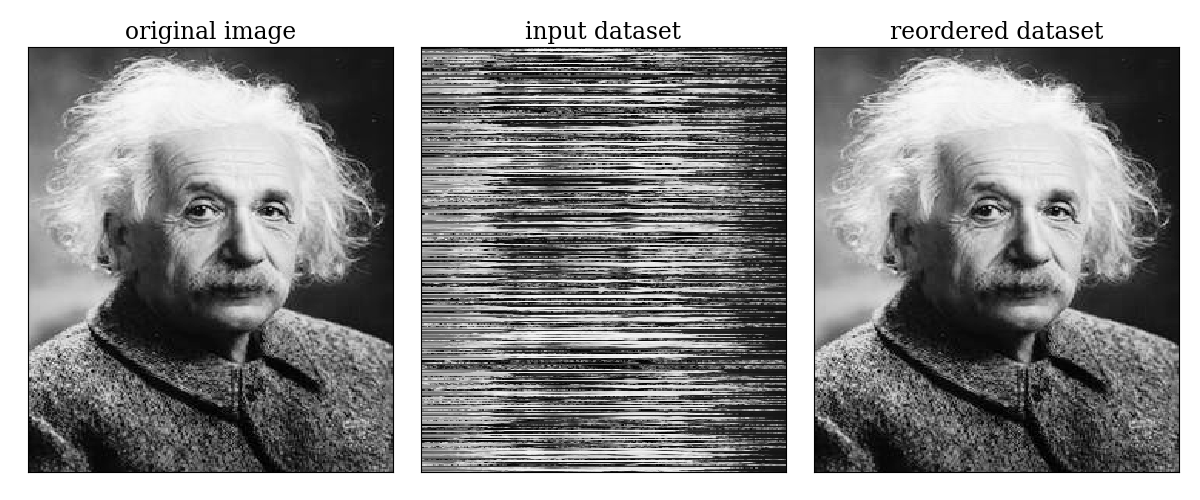
Shuffled image rows
The Sequencer reorders the objects in the input dataset according to a detected sequence, if such sequence exists in the dataset. A good example of a perfect one-dimensional sequence is a natural image: the rows within a natural image form a well-defined sequence. Therefore, we can shuffle the rows in a natural image, and apply the Sequencer to the shuffled dataset. The following figure shows the result of applying the Sequencer to a shuffled natural image. The left panel shows the original image. The middle panel shows the same image after we have shuffled its rows. The shuffled image serves as the input dataset to the Sequencer, where each row is considered as a separate object. The output of the Sequencer is shown in the right panel, where we reordered the rows according to the detected sequence. The Sequencer successfully identified the one-dimensional trend spanned by the different rows.
Command Line Orbit Plotting
OK Binaries Interactive Catalog
https://github.com/mb2448/ok-binaries/
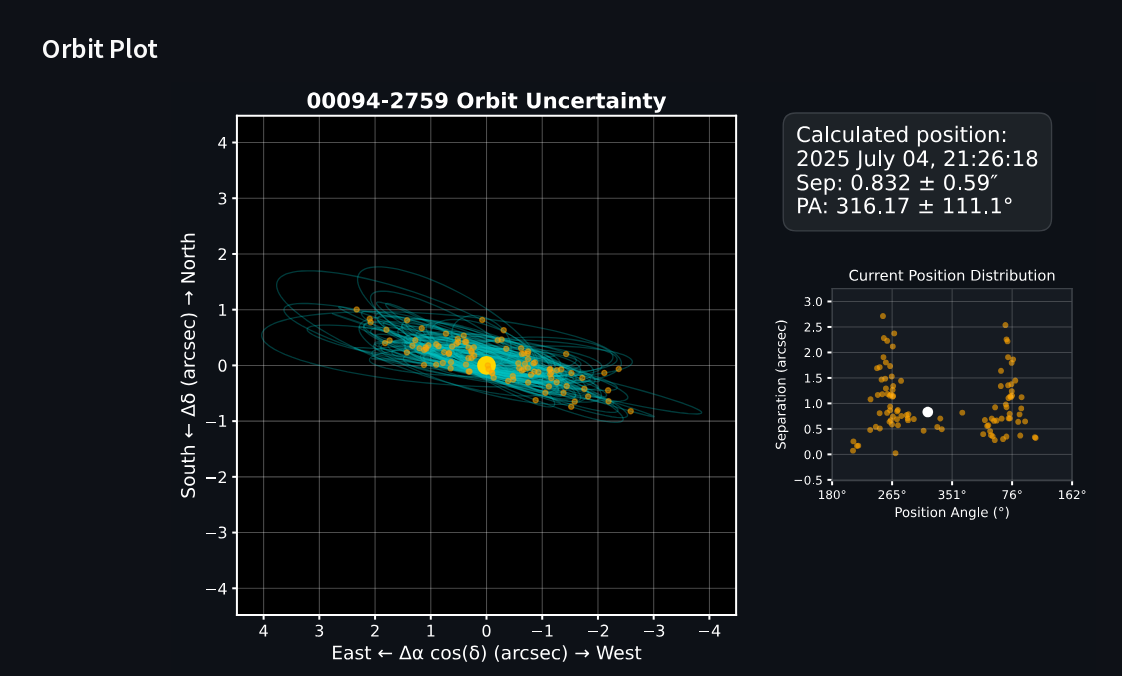
OK Binaries is a tool for identifying suitable calibration binaries from the Washington Double Star (WDS) Sixth Orbit Catalog. It calculates orbital positions at any epoch, propagates uncertainties using Monte Carlo sampling, and generates orbit plots. The web app includes automated daily updates of binary positions and a searchable interface with filters for position, magnitude, separation, and other orbital parameters. OK Binaries can be used online, as a standalone offline browser app, or via the command line.
https://github.com/mb2448/ok-binaries/
https://ok-binaries.streamlit.app/
#space #tech #science #astronomy #code #python #unix #linux #commandline #plotting
Alt...
WDS 00094-2759 - BU 391AB
HIP 761 • HD 493
Orbital Elements
Period (P) 575.65y ± 247.6
Periastron (T) 2087.66 ± 104.9
Semi-major axis (a) 1.614″ ± 0.49
Eccentricity (e) 0.5022 ± 0.31
Inclination (i) 98.72° ± 3.9
Longitude of periastron (ω) 272.7° ± 42.6
Node (Ω) 76.73° ± 6.5
Additional Information
Grade: 4 (1=Definitive, 9=Indeterminate)
Equinox: —
Last observation: 2013
Reference: Izm2019
Notes
kap 1 Scl
CLUES: Clustering tool for analyzing spectral data
CLUES (CLustering UnsupErvised with Sequencer) analyzes spectral and IFU data. This fully interpretable clustering tool uses machine learning to classify and reduce the effective dimensionality of data sets. It combines multiple unsupervised clustering methods with multiscale distance measures using Sequencer (ascl:2105.006) to find representative end-member spectra that can be analyzed with detailed mineralogical modeling and follow-up observations. CLUES has been used on Spitzer IRS data and debris disk science, and can be applied to other high-dimensional spectral data sets, including mineral spectroscopy in general areas of astrophysics and remote sensing.
https://github.com/Ompha/CLUES
https://ui.adsabs.harvard.edu/abs/2021ApJ...916...91B/abstract
https://ui.adsabs.harvard.edu/abs/2025ApJS..276...65L/abstract
#space #tech #science #astronomy #code #python #JupyterNotebook #unix #linux

Alt...
Welcome
Ha! You've stumbled upon this machine-learning classification tools for spectra and IFU data!
3ML: Framework for multi-wavelength/multi-messenger analysis
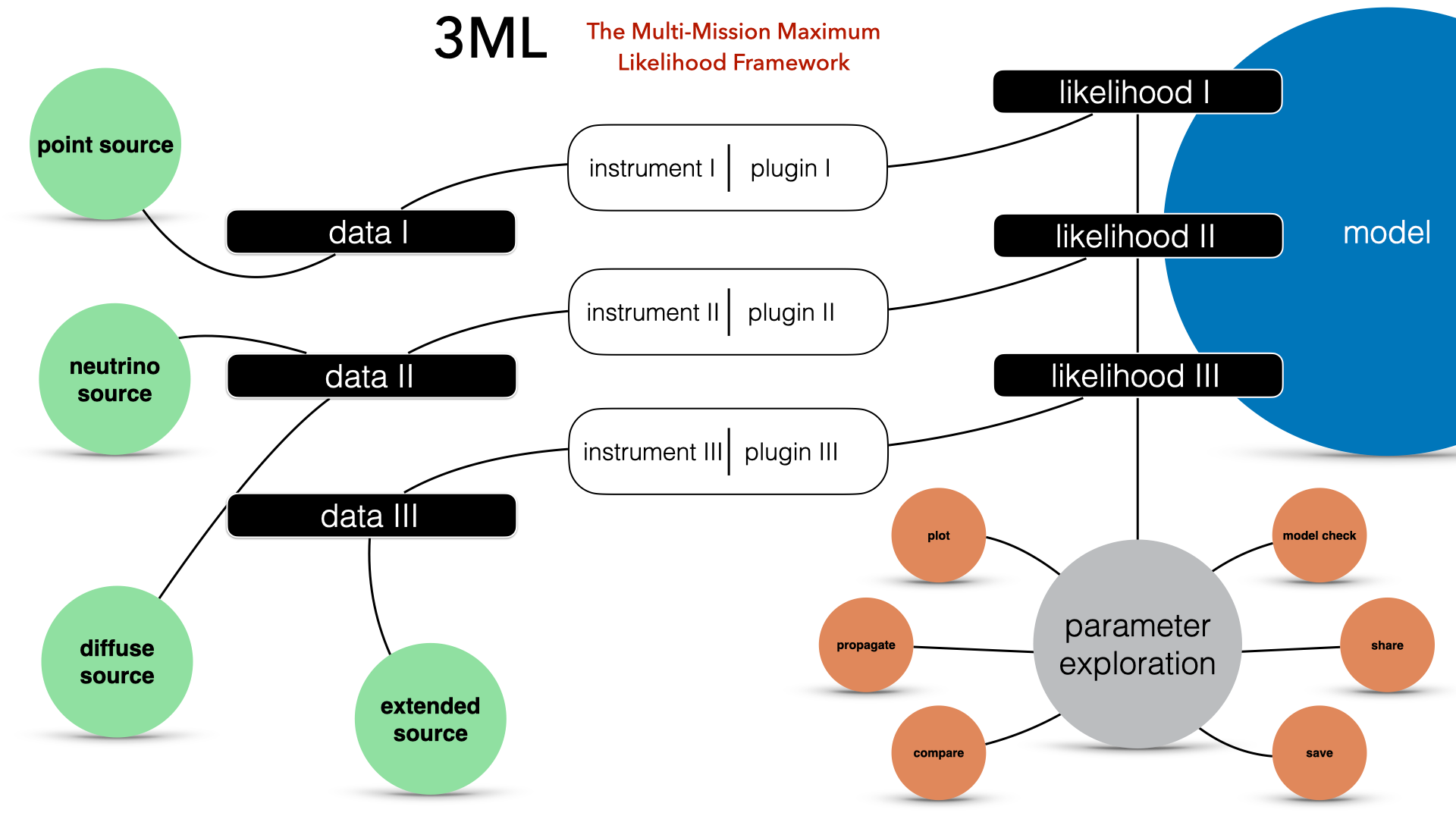
The Multi-Mission Maximum Likelihood framework (3ML) provides a common high-level interface and model definition for coherent and intuitive modeling of sources using all the available data, no matter their origin. Astrophysical sources are observed by different instruments at different wavelengths with an unprecedented quality, and each instrument and data type has its own ad-hoc software and handling procedure. 3ML's architecture is based on plug-ins; the package uses the official software of each instrument under the hood, thus guaranteeing that 3ML is always using the best possible methodology to deal with the data of each instrument. Though Maximum Likelihood is in the name for historical reasons, 3ML is an interface to several Bayesian inference algorithms such as MCMC and nested sampling as well as likelihood optimization algorithms.
https://github.com/threeML/threeML
https://ui.adsabs.harvard.edu/abs/2015arXiv150708343V/abstract
https://github.com/threeML/threeML/blob/master/LICENSE
https://news.stanford.edu/stories/2017/12/software-advances-modeling-astronomical-observations
#code #python #bsd3 #fermi #xspec #hawc #science #astronomy

Alt...
Logo of 3ML
The Multi-Mission Maximum Likelihood framework (3ML)
3ML: Framework for multi-wavelength/multi-messenger analysis
ThreeML is supported by National Science Foundation (NSF) https://www.nsf.gov/
FYI:
https://heasarc.gsfc.nasa.gov/xanadu/xspec/
https://ui.adsabs.harvard.edu/abs/2015arXiv150708343V/abstract
https://arxiv.org/pdf/1507.08343
#space #code #python #bsd3 #fermi #xspec #hawc #science #astronomy
Alt...
The Multi-Mission Maximum Likelihood framework (3ML) provides a common high-level interface and model definition for coherent and intuitive modeling of sources using all the available data, no matter their origin. Astrophysical sources are observed by different instruments at different wavelengths with an unprecedented quality, and each instrument and data type has its own ad-hoc software and handling procedure. 3ML's architecture is based on plug-ins; the package uses the official software of each instrument under the hood, thus guaranteeing that 3ML is always using the best possible methodology to deal with the data of each instrument. Though Maximum Likelihood is in the name for historical reasons, 3ML is an interface to several Bayesian inference algorithms such as MCMC and nested sampling as well as likelihood optimization algorithms.
From technic960183
spherimatch:
A Python package for cross-matching and self-matching in spherical coordinates.
spherimatch is a Python package for efficient cross-matching and self-matching of astronomical catalogs in spherical coordinates. Designed for use in astrophysics, where data is naturally distributed on the celestial sphere, the package enables fast matching with an algorithmic complexity of O(NlogN). It supports Friends-of-Friends (FoF) group identification and duplicate removal in spherical coordinates, and integrates easily with common data processing tools such as pandas.
https://github.com/technic960183/spherimatch
https://technic960183.github.io/spherimatch/tutorial/xmatch.html
https://technic960183.github.io/spherimatch/install.html
https://pypi.org/project/fofpy/
https://linuxtut.com/en/68a22081e848030bc963/
AutoWISP
Kaloyan Penev, Angel Romero and S. Javad Jafarzadeh have developed a software pipeline, AutoWISP, for extracting high-precision photometry from citizen scientists' observations made with consumer-grade color digital cameras (digital single-lens reflex, or DSLR, cameras), based on their previously developed tool, AstroWISP. The new pipeline is designed to convert these observations, including color images, into high-precision light curves of stars.
"We outline the individual steps of the pipeline and present a case study using a Sony-alpha 7R II DSLR camera, demonstrating sub-percent photometric precision, and highlighting the benefits of three-color photometry of stars. Project PANOPTES will adopt this photometric pipeline and, we hope, be used by citizen scientists worldwide. Our aim is for AutoWISP to pave the way for potentially transformative contributions from citizen scientists with access to observing equipment."
Code site:
+ AutoWISP
https://github.com/kpenev/AutoWISP
+ Documentation:
https://kpenev.github.io/AutoWISP/
+ AstroWISP
https://github.com/kpenev/AstroWISP
https://pypi.org/project/astrowisp/
+ Documentation
https://kpenev.github.io/AstroWISP/
#space #code #python #astrophotography #photography #science #astronomy
Alt...
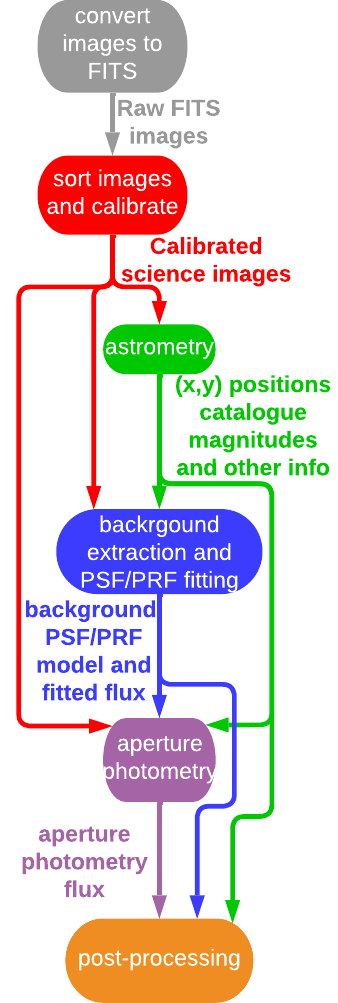
Briefly, the image processing pipeline steps and their products are shown. The arrows indicate the products of each step and where they will be used.:
1 Calibration
2 Source Extraction
3 Astrometry
4 Photometry
5 PSF Fitting
+ Aperture Photometry
6 PRF Fitting
7 Magnitude Fitting
8 Light Curve Generation
9 Post Processing
Alt...
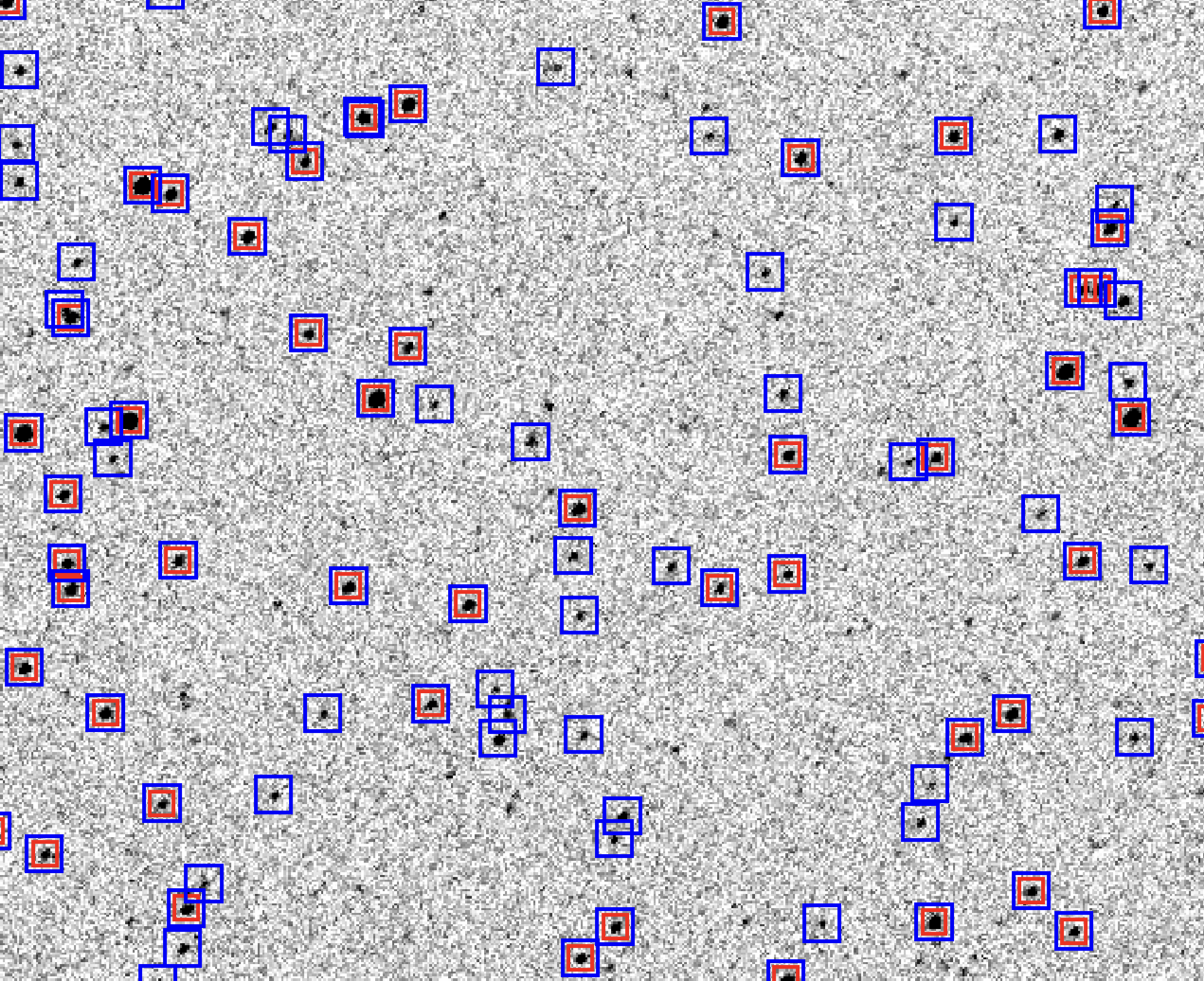
Shown is the source extraction versus catalogue projections of our astrometry step placed on top of the corresponding FITS image, where blue squares are the catalogues projected sources and red squares are the extracted sources from our astrometry
Alt...
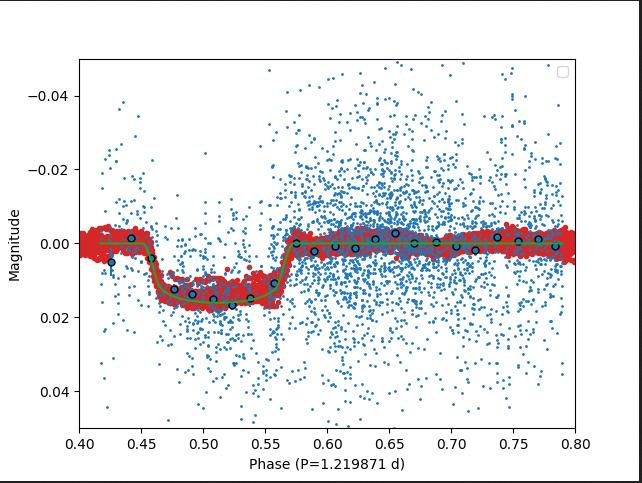
This is the resulting phase-folded lightcurve for WASP-33 b exoplanet transit, observed by Project PANOPTES (blue points and circles), TESS (red points), and theoretical light curve based on best known system parameters (green curve). The raw PANOPTES-DSLR measurements, originating from the 4 color channels of 4 cameras in Hawaii (Mauna Loa observatory) and California (Mt Wilson) are shown as blue points. The blue points are binned in time to create the blue circles and corresponding error bars. Note that the scatter in TESS points is not instrumental, but rather it is intrinsic variability in the host star, which is a member of the delta-Scuti class of variable stars.
Alt...
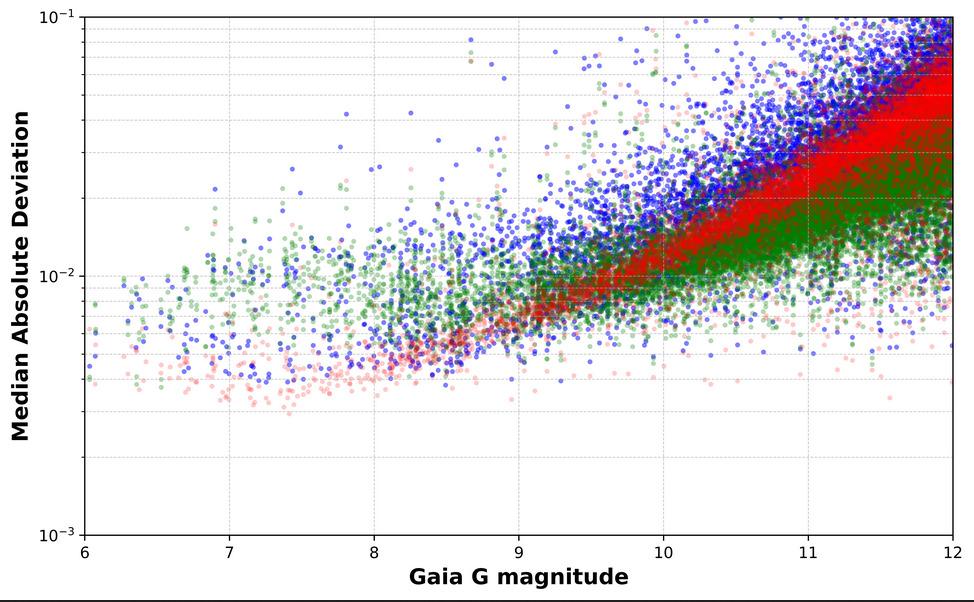
The scatter (median absolute deviation from the median) of the individual channel lightcurves of PANOPTES observations of a 10 × 15 degree field centered on FU Orionis, with each of their corresponding image colors (RGGB). We see that AutoWISP enables a few parts per thousand photometric precision per exposure even from images with Bayer masks, significantly outperforming prior efforts. Even individual color channels result in better than 1% photometry per 2 min exposure.
Thanks to Sam Van Kooten
https://github.com/svank
wispr-analysis
Shared tools for WISPR data analysis
Some highlights
plot_utils.py
+ plot_WISPR:
Aims to be a versatile function that does the Right Thing for plotting WISPR images, with colorbar bounds that are adjusted for inner and outer FOV and for L2 or L3 images, a square-root-scaled colorbar, and WCS coordinate support
+ *_axis_dates: Helper util for labeling a temporal axis with dates.
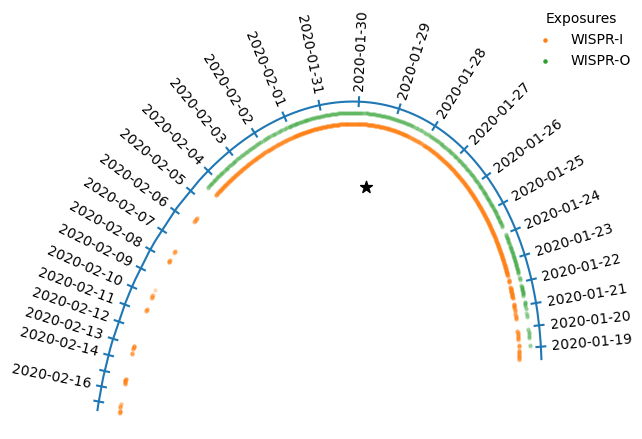
+ plot_orbit:
Reads a directory (or nested set of directories) of WISPR files and plots a diagram showing the orbital path of PSP and the locations where images were taken, like this:
projections.py
+ reproject_to_radial: Proof-of-concept code for reprojecting data into a radial coordinate system (where each row of the output array is a radial line out from the Sun.
data_cleaning.py
+ dust_streak_filter: Code for identifying debris streaks in the WISPR images
+ clean_fits_files: Function to batch-run dust_streak_filter on a directory of images.
composites.py
+ gen_composite: Reprojects an inner- and outer-FOV image into a common coordinate system
utils.py
+ to_timestamp: Parse a timestamp from a handful of formats, including the timestamps inside WISPR headers, or entire WISPR filenames. Returns a numerical timestamp.
+ collect_files: Walks a directory of WISPR files (or a directory of subdirectories of WISPR images), identifies all the WISPR images, sorts them, and separates them by inner and outer FOVs.
+ ignore_fits_warnings: Suppresses the warnings Astropy raises when reading WISPR FITS files or parsing WCS data.
https://github.com/svank/wispr_analysis
Documentation:
https://svank.github.io/wispr_analysis/
#space #code #python #science #astronomy #astrophysics #tech #NASA
Alt...
Some highlights
plot_utils.py
+ plot_WISPR:
Aims to be a versatile function that does the Right Thing for plotting WISPR images, with colorbar bounds that are adjusted for inner and outer FOV and for L2 or L3 images, a square-root-scaled colorbar, and WCS coordinate support
*_axis_dates: Helper util for labeling a temporal axis with dates.
+ plot_orbit:
Reads a directory (or nested set of directories) of WISPR files and plots a diagram showing the orbital path of PSP and the locations where images were taken, like this:
projections.py
+ reproject_to_radial: Proof-of-concept code for reprojecting data into a radial coordinate system (where each row of the output array is a radial line out from the Sun.
data_cleaning.py
+ dust_streak_filter: Code for identifying debris streaks in the WISPR images
clean_fits_files: Function to batch-run dust_streak_filter on a directory of images.
composites.py
+ gen_composite: Reprojects an inner- and outer-FOV image into a common coordinate system
utils.py
+ to_timestamp: Parse a timestamp from a handful of formats, including the timestamps inside WISPR headers, or entire WISPR filenames. Returns a numerical timestamp.
+ collect_files: Walks a directory of WISPR files (or a directory of subdirectories of WISPR images), identifies all the WISPR images, sorts them, and separates them by inner and outer FOVs.
+ ignore_fits_warnings: Suppresses the warnings Astropy raises when reading WISPR FITS files or parsing WCS data.
2025-08-20
Leandro Beraldo e Silva released four days ago:
lberaldoesilva/tropygal version 0.1.4
Entropy estimates and distribution functions for galactic dynamics
tropygal is a pure-python package for entropy estimates in the context of galactic dynamics, but can be used in other contexts too. It also provides functions for analytical distribution functions and density of states for models that have analytical expressions.
** Acknowledgements
Development of tropygal was supported by the following research grants:
+ NASA ATP awards 80NSSC20K0509 and 80NSSC24K0938
+ U.S. NSF AAG grant AST-2009122
+ STFC Ernest Rutherford fellowship (ST/X004066/1)
+ JSPS KAKENHI Grant Numbers JP24K07101, JP21K13965, and JP21H00053
+ CNPq (309723/2020-5)
+ Heising Simons Foundation grant # 2022-3927
** Funding agencies:
+ NASA ATP - NASA Astrophysical Theory Program (US)
+ NSF - National Science Foundation (US)
+ STFC - Science and Technology Facilities Council (UK)
+ JSPS - Japan Society for the Promotion of Science (Japan)
+ CNPq – Conselho Nacional de Desenvolvimento Científico e Tecnológico (Brasil)
+ Heising Simons Foundation (US)
https://github.com/lberaldoesilva/tropygal
https://tropygal.readthedocs.io/en/latest/
https://link.springer.com/epdf/10.1007/BF00773669?sharing_token=c10vjrwKcPemuJugFt8GPPe4RwlQNchNByi7wbcMAY4It9IZvz0cQPRbyx9xcOC67oJ1uYrQB3lur75MCDwqdPXd8sWtzve-hL8JYGekYHqhITNJ3f12mXyjbTmMIqid10HwkWoYRAWdltK0BTwIew%3D%3D
https://www.mdpi.com/1099-4300/18/1/13
#space #code #python #science #astronomy #astrophysics #tech #NASA
PIRATES
(Polarimetric Image Reconstruction AI for Tracing Evolved Structures)
uses machine learning to perform image reconstruction.
It uses MCFOST to generate models, then uses those models to build, train, iteratively fit, and evaluate PIRATES performance.
Optical interferometric image reconstruction is a challenging, ill-posed optimization problem which usually relies on heavy regularization for convergence. Conventional algorithms regularize in the pixel domain, without cognizance of spatial relationships or physical realism, with limited utility when this information is needed to reconstruct images. Here we present PIRATES (Polarimetric Image Reconstruction AI for Tracing Evolved Structures), the first image reconstruction algorithm for optical polarimetric interferometry. PIRATES has a dual structure optimized for parsimonious reconstruction of high fidelity polarized images and accurate reproduction of interferometric observables. The first stage, a convolutional neural network (CNN), learns a physically meaningful prior of self-consistent polarized scattering relationships from radiative transfer images. The second stage, an iterative fitting mechanism, uses the CNN as a prior for subsequent refinement of the images with respect to their polarized interferometric observables. Unlike the pixel-wise adjustments of traditional image reconstruction codes, PIRATES reconstructs images in a latent feature space, imparting a structurally derived implicit regularization.
https://github.com/SAIL-Labs/PIRATES
https://ui.adsabs.harvard.edu/abs/2025arXiv250511950L/abstract
https://arxiv.org/pdf/2505.11950
https://arxiv.org/abs/2505.11950
CREDITS:
Lilley, Lucinda ; Norris, Barnaby ; Tuthill, Peter ; Spalding, Eckhart ; Lucas, Miles ; Zhang, Manxuan ; Millar-Blanchaer, Maxwell ; Pinte, Christophe ; Bottom, Michael ; Guyon, Olivier ; Lozi, Julien ; Deo, Vincent ; Vievard, Sébastien ; Wong, Alison P. ; Ahn, Kyohoon ; Ashcraft, Jaren
#space #code #python #science #astronomy #astrophysics #tech
![Optical interferometric image reconstruction is a challenging, ill-posed optimization problem which usually relies on heavy regularization for convergence. Conventional algorithms regularize in the pixel domain, without cognizance of spatial relationships or physical realism, with limited utility when this information is needed to reconstruct images. Here we present PIRATES (Polarimetric Image Reconstruction AI for Tracing Evolved Structures), the first image reconstruction algorithm for optical polarimetric interferometry. PIRATES has a dual structure optimized for parsimonious reconstruction of high fidelity polarized images and accurate reproduction of interferometric observables. The first stage, a convolutional neural network (CNN), learns a physically meaningful prior of self-consistent polarized scattering relationships from radiative transfer images. The second stage, an iterative fitting mechanism, uses the CNN as a prior for subsequent refinement of the images with respect to their polarized interferometric observables. Unlike the pixel-wise adjustments of traditional image reconstruction codes, PIRATES reconstructs images in a latent feature space, imparting a structurally derived implicit regularization. We demonstrate that PIRATES can reconstruct high fidelity polarized images of a broad range of complex circumstellar environments, in a physically meaningful and internally consistent manner, and that latent space regularization can effectively [..]](https://files.defcon.social/dcsocial-s3/media_attachments/files/115/086/046/124/240/174/original/06ed149b287f93a9.png "Optical interferometric image reconstruction is a challenging, ill-posed optimization problem which usually relies on heavy regularization for convergence. Conventional algorithms regularize in the pixel domain, without cognizance of spatial relationships or physical realism, with limited utility when this information is needed to reconstruct images. Here we present PIRATES (Polarimetric Image Reconstruction AI for Tracing Evolved Structures), the first image reconstruction algorithm for optical polarimetric interferometry. PIRATES has a dual structure optimized for parsimonious reconstruction of high fidelity polarized images and accurate reproduction of interferometric observables. The first stage, a convolutional neural network (CNN), learns a physically meaningful prior of self-consistent polarized scattering relationships from radiative transfer images. The second stage, an iterative fitting mechanism, uses the CNN as a prior for subsequent refinement of the images with respect to their polarized interferometric observables. Unlike the pixel-wise adjustments of traditional image reconstruction codes, PIRATES reconstructs images in a latent feature space, imparting a structurally derived implicit regularization. We demonstrate that PIRATES can reconstruct high fidelity polarized images of a broad range of complex circumstellar environments, in a physically meaningful and internally consistent manner, and that latent space regularization can effectively [..]")
Alt...
Optical interferometric image reconstruction is a challenging, ill-posed optimization problem which usually relies on heavy regularization for convergence. Conventional algorithms regularize in the pixel domain, without cognizance of spatial relationships or physical realism, with limited utility when this information is needed to reconstruct images. Here we present PIRATES (Polarimetric Image Reconstruction AI for Tracing Evolved Structures), the first image reconstruction algorithm for optical polarimetric interferometry. PIRATES has a dual structure optimized for parsimonious reconstruction of high fidelity polarized images and accurate reproduction of interferometric observables. The first stage, a convolutional neural network (CNN), learns a physically meaningful prior of self-consistent polarized scattering relationships from radiative transfer images. The second stage, an iterative fitting mechanism, uses the CNN as a prior for subsequent refinement of the images with respect to their polarized interferometric observables. Unlike the pixel-wise adjustments of traditional image reconstruction codes, PIRATES reconstructs images in a latent feature space, imparting a structurally derived implicit regularization. We demonstrate that PIRATES can reconstruct high fidelity polarized images of a broad range of complex circumstellar environments, in a physically meaningful and internally consistent manner, and that latent space regularization can effectively [..]
Alt...
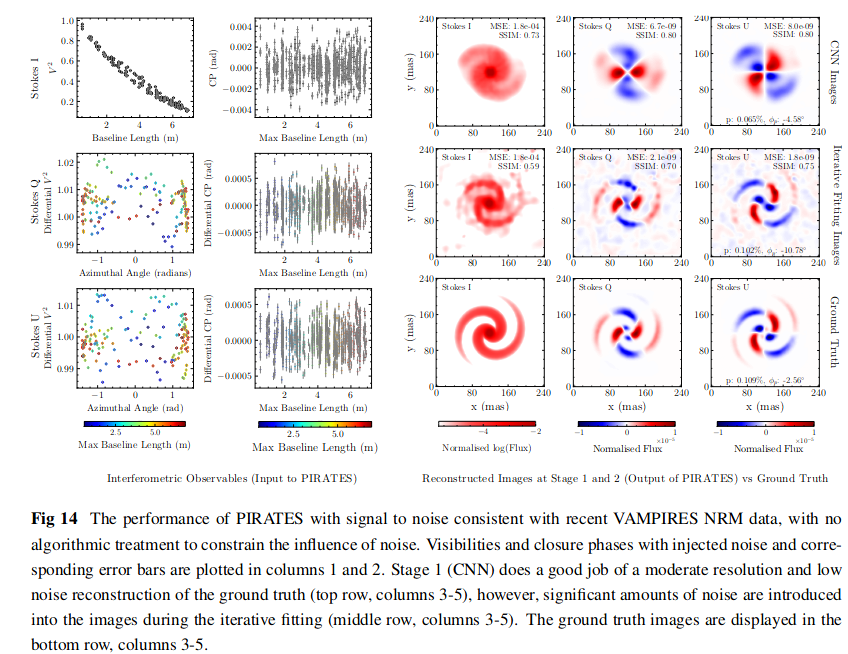
The performance of PIRATES with signal to noise consistent with recent VAMPIRES NRM data, with no
algorithmic treatment to constrain the influence of noise. Visibilities and closure phases with injected noise and corre-
sponding error bars are plotted in columns 1 and 2. Stage 1 (CNN) does a good job of a moderate resolution and low
noise reconstruction of the ground truth (top row, columns 3-5), however, significant amounts of noise are introduced
into the images during the iterative fitting (middle row, columns 3-5). The ground truth images are displayed in the
bottom row, columns 3-5.
nazgul is a joint effort by:
* J. Michael Burgess
* Ewan Cameron
* Dmitry Svinkin
https://github.com/grburgess/nazgul
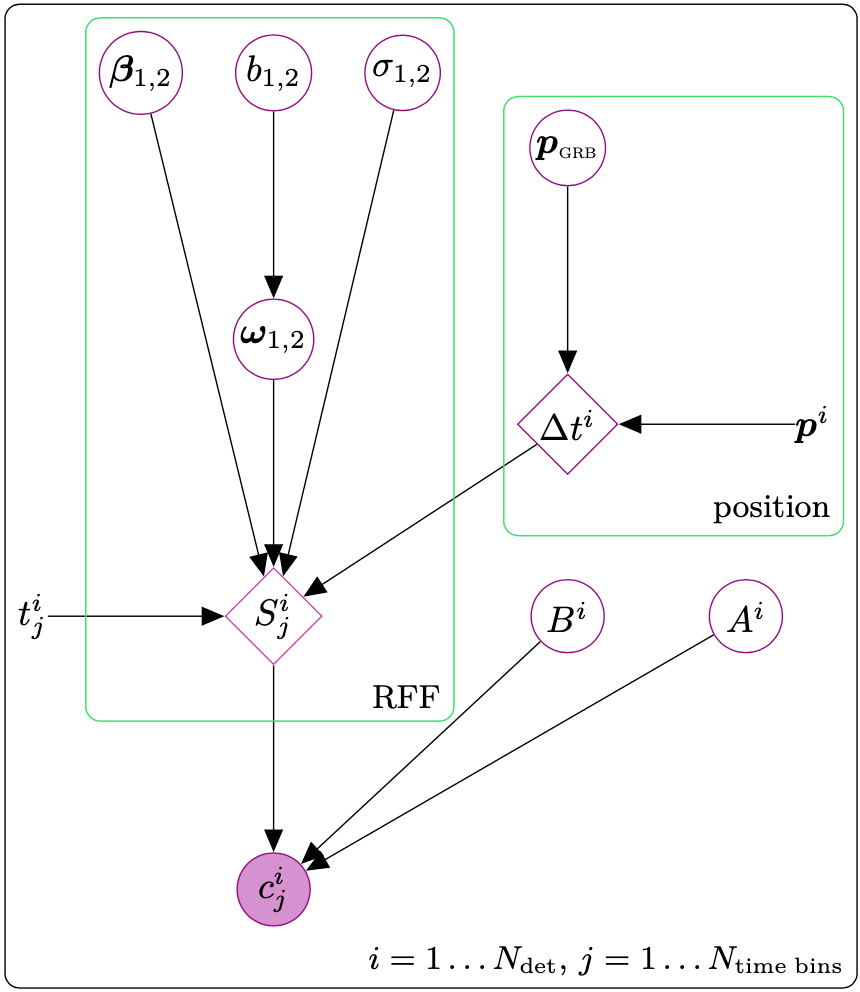
Nazgul is a framework for performing GRB localization via fitting non-parametric models to their data time-series and computing the time delay between them. It is currentrly built upon the magic of Stan and implements a parallel version of non-stationary Random Fourier Features. The idea is get away from heuristic methods such as cross-correlation which do not have a self-consistent statitical model.
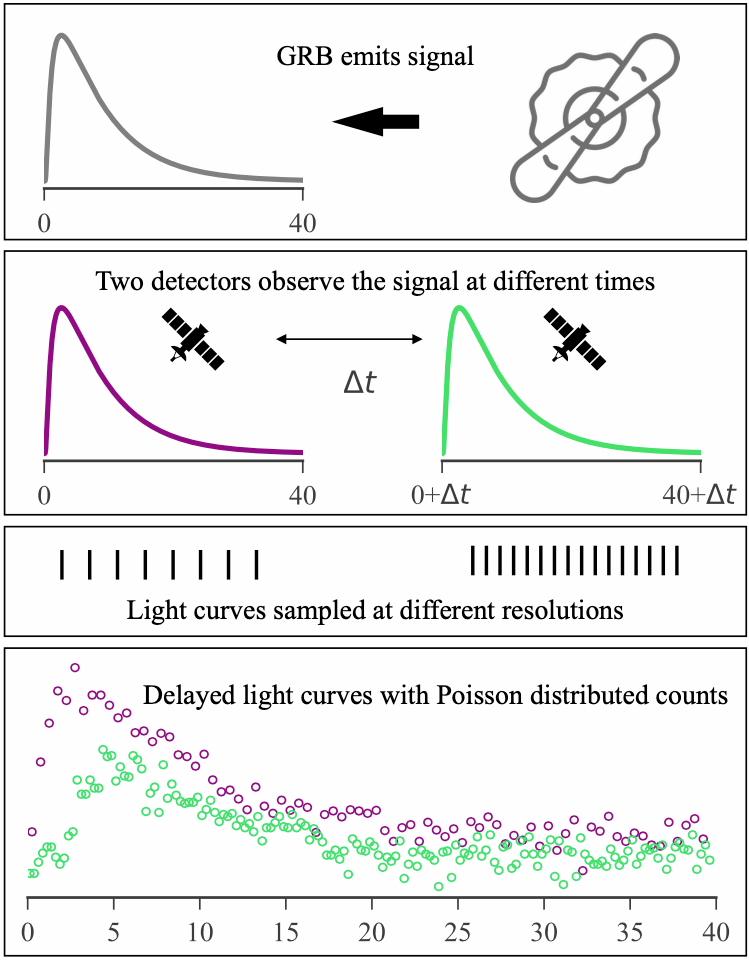
The idea is that satellites throughout the Sol system observe gamma-ray bursts at different times due to the finite speed of light. This creates a time delay in their observed light curves which can be used to triangulate the gamma-ray burst position on the sky. These triangulation create annuli or rings on the sky which Nazgul searches for so that it, in the darkness, it can bind them to a location on the sky.
Left image:
The heriarchical model is shown below and details can be found in here https://arxiv.org/abs/2009.08350. If you find the method and/or code useful in your research we ask that you please cite the paper.
Right image:
The sister program to simulate time-delayed light curves is pyIPN and can be used to generate time-delayed light curves for algorithm testing.
https://github.com/grburgess/pyipn
#space #code #python #science #astronomy #astrophysics #tech #NASA
Alt...
The heriarchical model is shown below and details can be found in here. If you find the method and/or code useful in your research we ask that you please cite the paper.
Alt...
The sister program to simulate time-delayed light curves is pyIPN and can be used to generate time-delayed light curves for algorithm testing.
Astro Catalog
by Sylvain Villet
https://github.com/sylvainvillet
https://app.astrobin.com/u/SylvainV
https://app.astrobin.com/forum/topic/191541
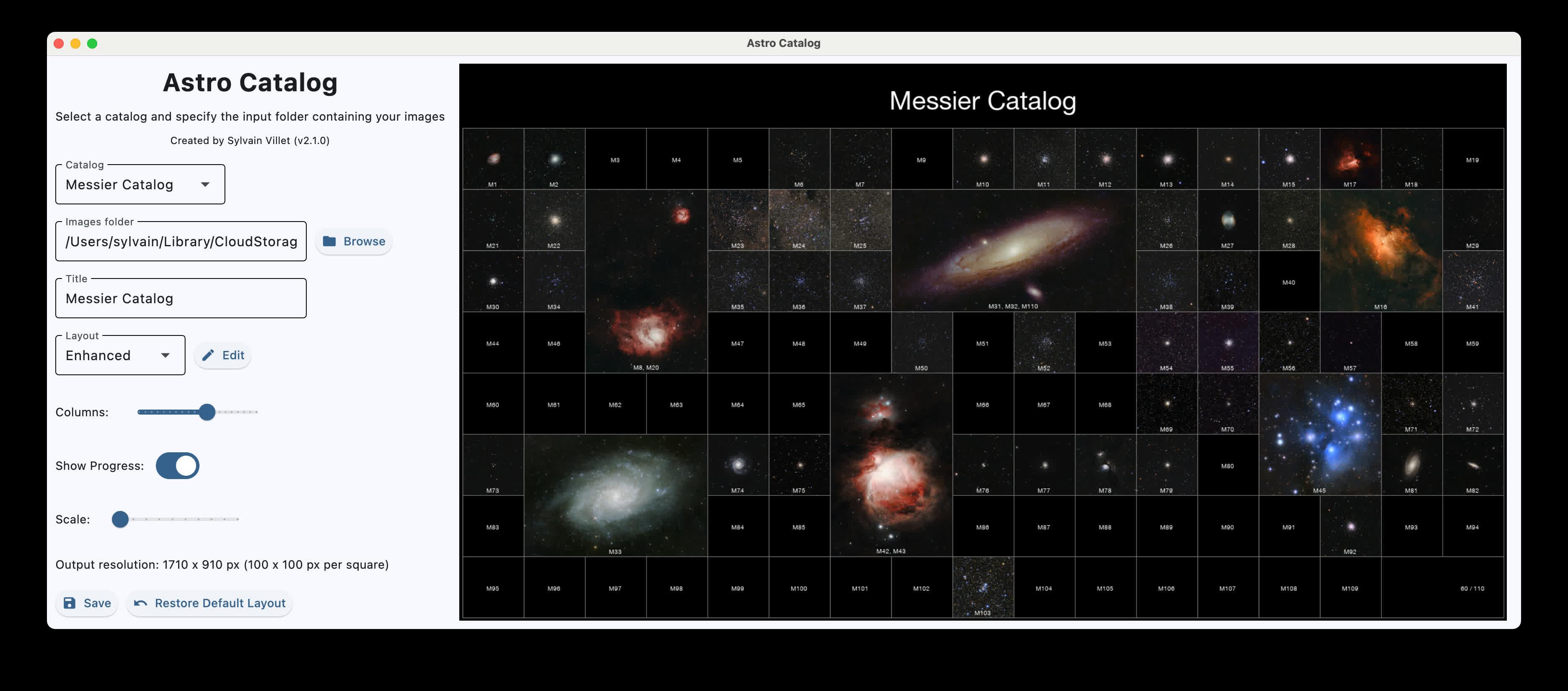
This project generates a mosaic of Messier or Caldwell objects, using images from a local folder.
The script arranges the objects into a configurable grid, supports larger slots for extended targets (e.g. Andromeda), and overlays labels and a title.
Perfect for creating a large-format print.
Features:
+ Loads Messier or Caldwell object images from a folder (M31.jpg, M-31.png, M_31.tif, etc.)
+ Places objects on a grid with configurable layout
+ Supports multi-cell slots for large objects (e.g. M31, M42, M45)
+ Supports grouping multiple objects in one slot for objects close to each other (e.g. M42 and M43, M31 and M32)
+ Adds a title and progress counter if it's not completed yet
+ Draws labels on images and placeholders for missing ones
+ Adjustable size of the final image
+ Saves as JPEG, PNG or TIFF
https://github.com/sylvainvillet/astro-catalog#features
#space #tech #science #astronomy #astrophotography #photography #code #python #unix #linux #commandline #plotting
Alt...
This project generates a mosaic of Messier or Caldwell objects, using images from a local folder.
The script arranges the objects into a configurable grid, supports larger slots for extended targets (e.g. Andromeda), and overlays labels and a title.
Perfect for creating a large-format print.
Features:
+ Loads Messier or Caldwell object images from a folder (M31.jpg, M-31.png, M_31.tif, etc.)
+ Places objects on a grid with configurable layout
+ Supports multi-cell slots for large objects (e.g. M31, M42, M45)
+ Supports grouping multiple objects in one slot for objects close to each other (e.g. M42 and M43, M31 and M32)
+ Adds a title and progress counter if it's not completed yet
+ Draws labels on images and placeholders for missing ones
+ Adjustable size of the final image
+ Saves as JPEG, PNG or TIFF
![[?]](https://cdn.masto.host/mastjohn1126com/accounts/avatars/115/981/910/993/463/416/original/00ac72837ce34a31.gif)
@light We know some of the laws of physics, because the Lawgiver that made them also gave us an intellect with understanding. But the world does not believe in a Lawgiver. Sure, they see the laws, but reject the God who spoke the laws into being.
So, what determined the laws to be as they are? Random chance? Do unbelievers have any idea? Most do not even care.
![[?]](https://files.mastodon.social/accounts/avatars/110/441/535/131/897/219/original/0ddf9d4dd12a5dee.png)
How Johannes Kepler Accidentally Destroyed the Science of Astrology
Kepler was a court astrologer, but also a man of science, whose search for the truth had unintended consequences.
https://www.thecollector.com/johannes-kepler-destroyed-astrology/
#science #mathematics #astronomy

Alt...
This painting shows Johannes Kepler and was likely created by Hans von Aachen around 1612. Kepler appears from the chest up. He has short dark hair, a mustache, and a neatly trimmed goatee. His brown eyes look to his left. He wears a dark, textured tunic with vertical rows of buttons down the chest, along with a large white pointed collar folded over his neck.
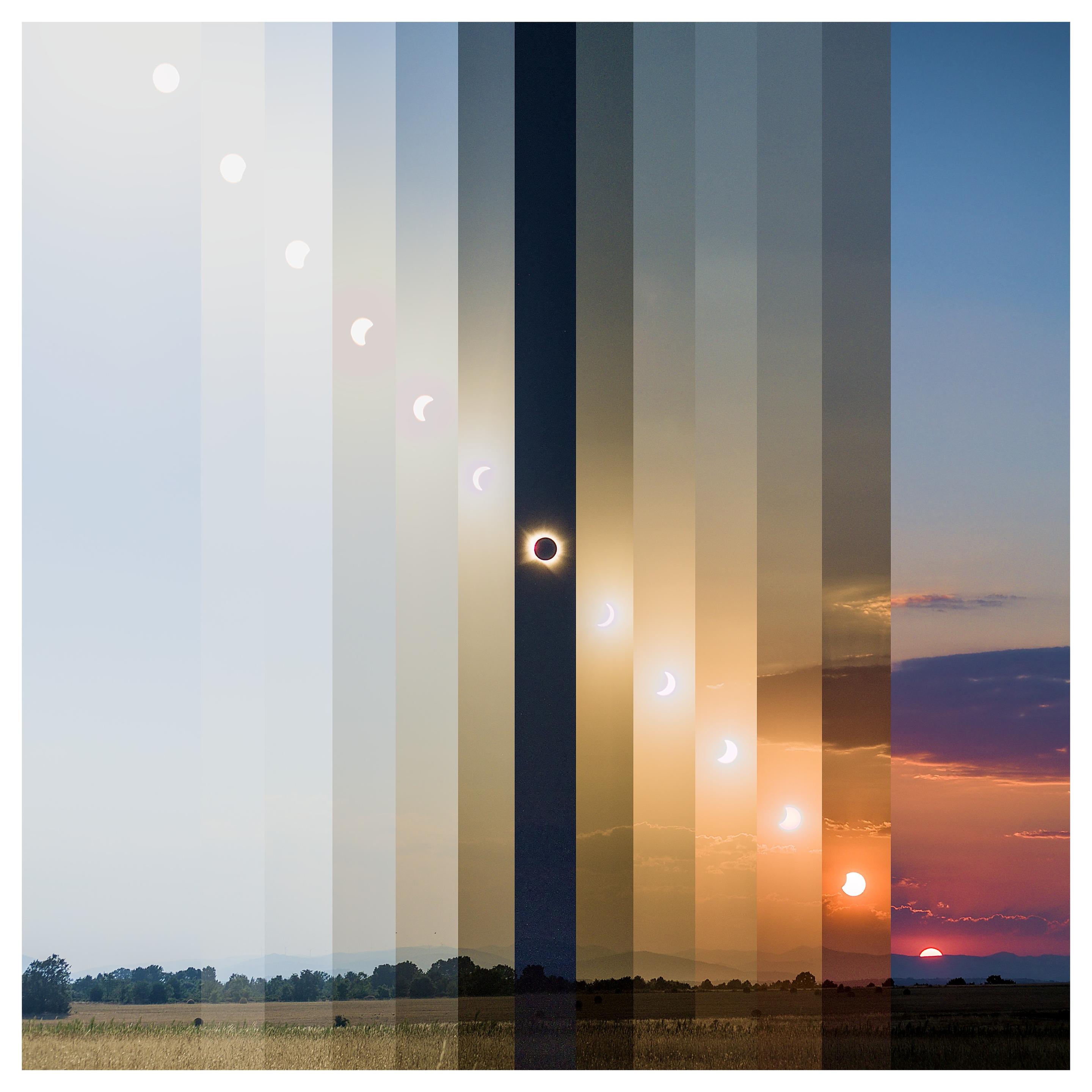
#SolarEclipses and Culture
#Astronomy #Picture of the Day
https://apod.nasa.gov/apod/ap260902.html
Alt...
Composite image of a solar eclipse occurring.
Scientists Release Biggest 3D Map of the Universe
The new DESI Legacy Imaging Surveys map serves as the foundation for the largest-ever 3D map of the Universe, used to investigate dark energy
https://noirlab.edu/public/news/noirlab2620/
More information:
https://www.legacysurvey.org/acknowledgment/
Alt...
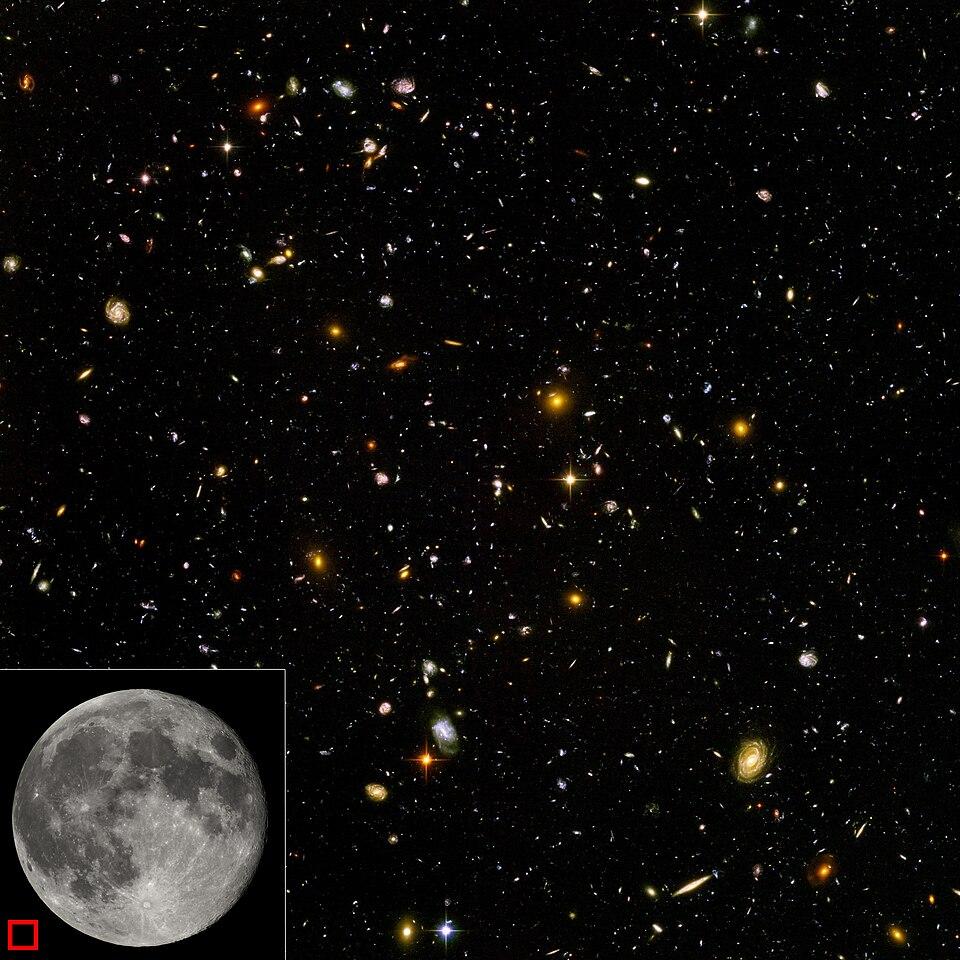
The Hubble Ultra Deep Field, is an image of a small region of space in the constellation Fornax, composited from Hubble Space Telescope data accumulated over a period from September 3, 2003 through January 16, 2004. The patch of sky in which the galaxies reside was chosen because it had a low density of bright stars in the near-field.
NASA’s new telescope is named after astronomer Nancy Grace Roman – but who was she?
by Ian Whittaker
The US astronomer battled discrimination in a male dominated field.
Alt...
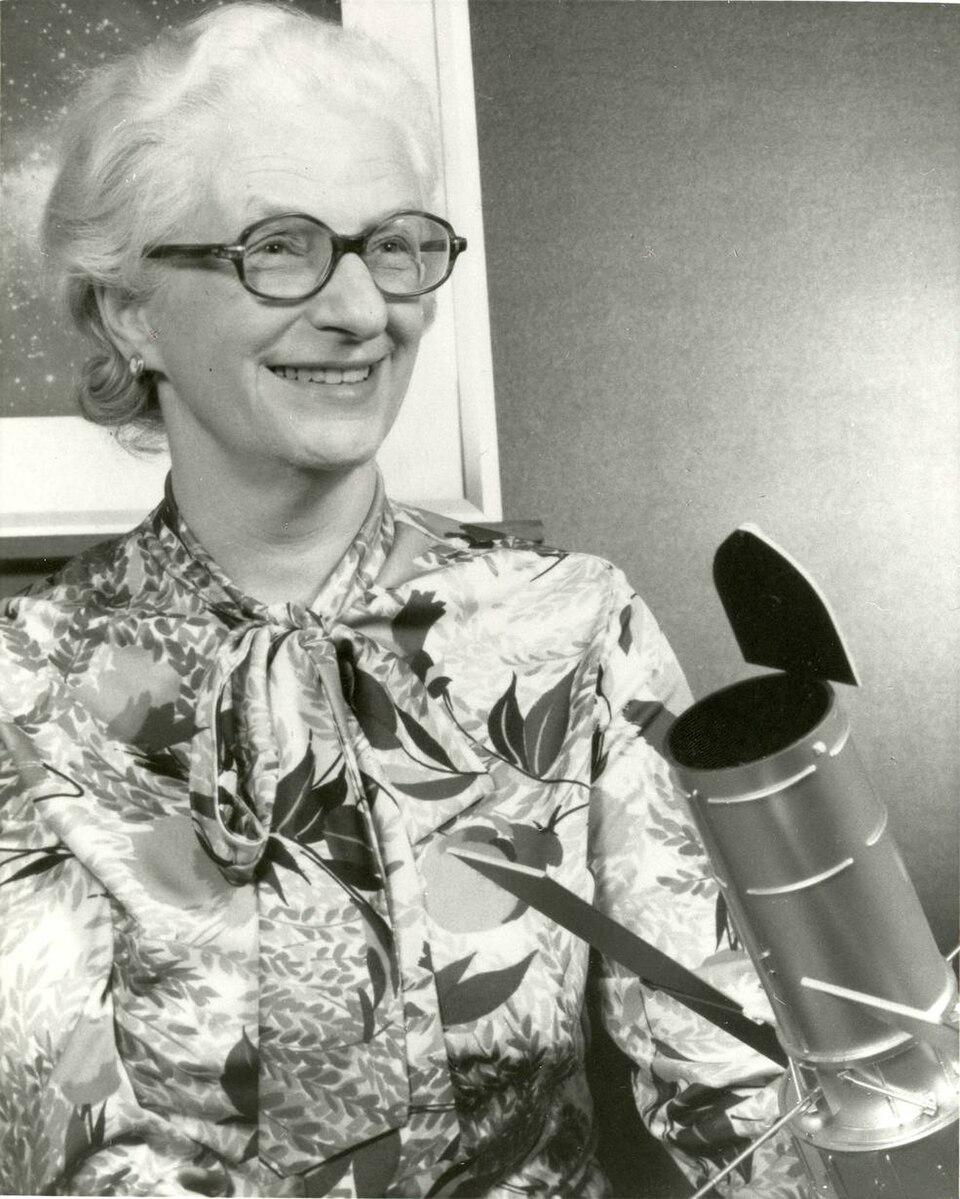
Dr. Nancy Grace Roman with a model of the Large Space Telescope that was eventually developed as the Hubble Space Telescope.
The photo shows her smiling, wearing glasses and a floral blouse with a bow tie collar, next to a scale model of a telescope.
![[?]](https://ftp.ieji.de/accounts/avatars/114/329/869/160/467/389/original/92deb9a433cd6f2d.jpg)
(1)
Such an instrument as the Extremely Large Telescope (under construction) is very impressive indeed.
Like other people, however, I can't help thinking that in this domain as well the time of expensive huge things in tiny numbers is ending and small inexpensive things in big numbers will rule.
(In the military domain this was predicted decades ago and is already real.)
In fact, the following sentence, buried near the end of the article, shows that astronomers are aware of that:
«For example, there are ideas like building lots of telescopes, kilometres apart, and connecting them to make a mega-telescope.»
(2)
ESO astronomer Mariya Lyubenova indeed comes from Sofia, Bulgaria.
(3)
By going from "very large" to "extremely large", they skipped "ultra large".
(Compare UHF after VHF for High (radio) Frequency.)
(4)
«That concrete, when it was laid, needed to be extraordinarily flat, he says, to an accuracy of 1/3,600th of a degree, and to account for the Earth's curvature too.»
This is for a building that is only about 100 meters across, which is comparable to the length of an arc of a meridian for the same difference in latitude.
I suppose the author or the editor decided that 1 arc second sounds less impressive.
In my opinion, though, real knowledge of one _degree_ of arc can't be taken for granted, either.
Does everybody know "cold", for example, the measure of a minute-of-time arc on a clock face, or of the face of the Moon observed from the Earth?
(Very unfortunately, the above quote also reminded me of the poisonous belief in a flat Earth...)
(5)
I couldn't help thinking that alien life is to astronomy as gold artefacts are to archaeology.
They do bring excitement to the public at large.
BBC article:
In the otherworldly Chilean desert, this huge telescope could reveal alien life
<https://www.bbc.com/future/article/20260827-the-biggest-telescope-of-all-time-is-nearly-ready-could-it-reveal-alien-life>
#Astronomy
#EuropeanAstronomers
#SizeQualifiers
#SmallIsBeautiful
#UnitsOfArc
![[?]](https://files.mastodon.social/accounts/avatars/000/034/380/original/c4398fad142099bc.jpg)
![[?]](https://files.mastodon.social/accounts/avatars/109/258/754/451/069/494/original/241bb70043350a4d.jpg)
Oh noes, this likely means that Swift (or Neil Gehrels Observatory) will re-enter the atmosphere later this year.
▶️ https://www.nasa.gov/news-release/nasa-updates-next-steps-for-commercial-swift-boost-mission/
Thank you, little satellite and good bye - you enabled a ton of ground breaking science and for me personally it will be, on top of the rest, super hard to catch all the transient X-ray binaries without you 💔
How Old is the Universe? #space #universe
https://www.youtube.com/shorts/OD080CO3NPM
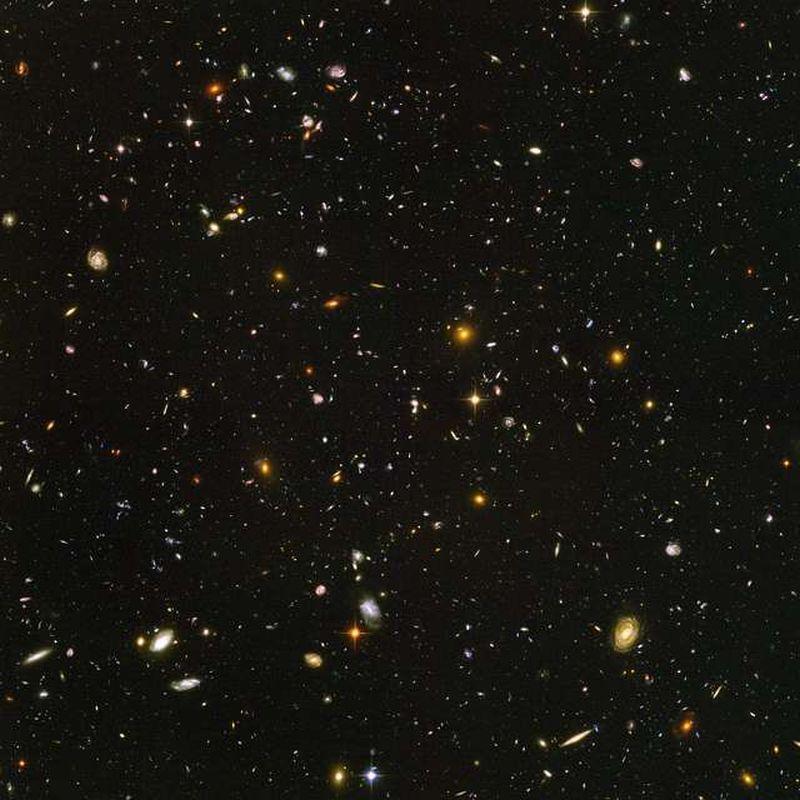
Alt...
This photograph is of the Hubble Ultra-Deep Field (HUDF) and contains about 10,000 galaxies.
![[?]](https://media.beige.party/accounts/avatars/110/874/346/401/347/077/original/5426fbb760844ece.jpg)
Venus, Jupiter, the moon and Mercury descending the sky in twilight
#astronomy #moon #venus #jupiter #chunderroad
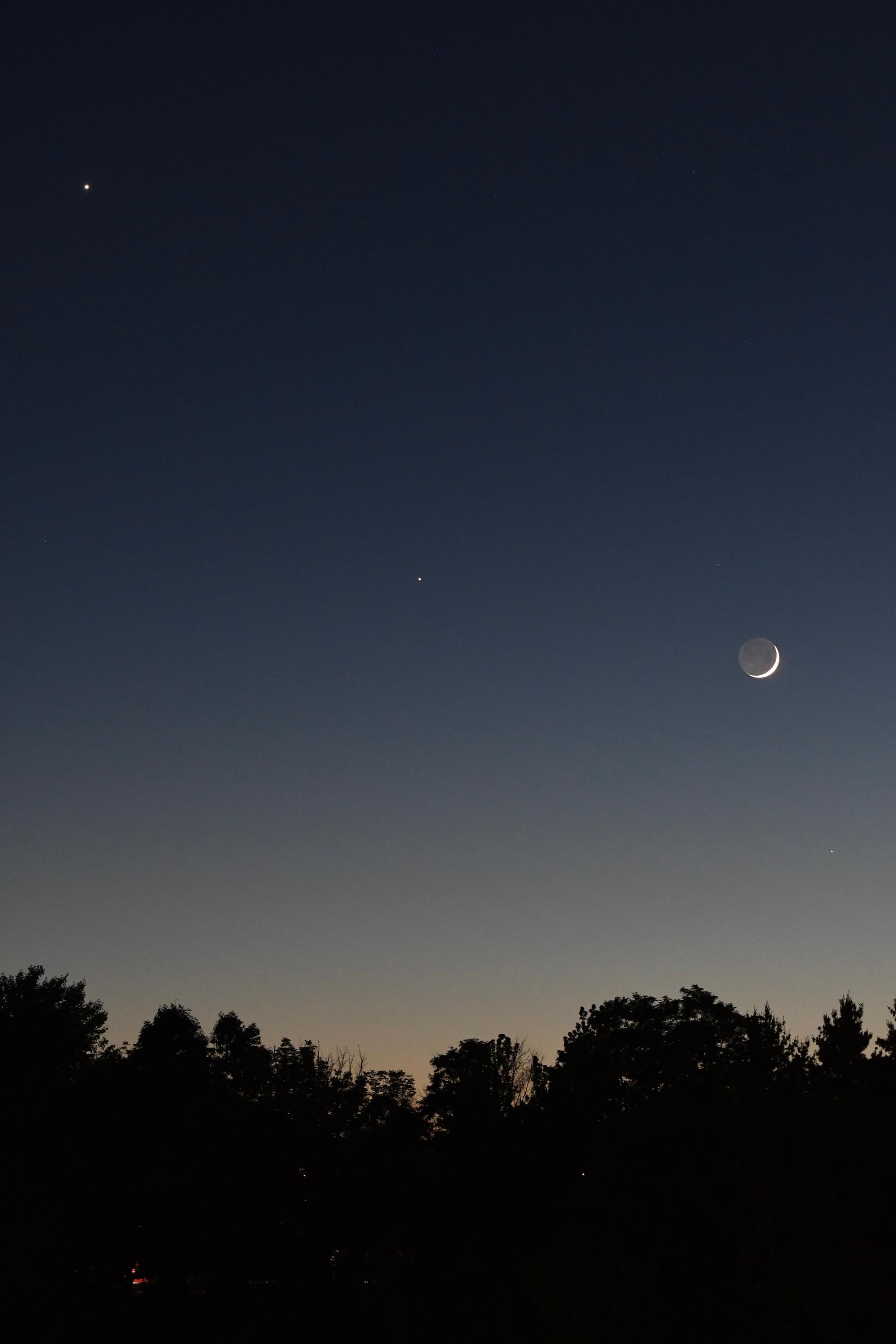
Alt...
A sky going from blue-black at top to light orange at the horizon. Venus, brightly in the upper left, Jupiter to its lower right, then the moon and then Mercury, faintly, lower right. Silhouetted against the horizon are trees
![[?]](https://cdn.masto.host/mastodonie/accounts/avatars/109/288/555/530/130/649/original/04918eb0024ea4e7.png)
Solar eclipses: moments of wonder that bring us together
#SolarEclipse #astronomy #eclipse2026 #meteorshower #comet #auroraborealis #stargazing #togetherness #community
![[?]](https://cdn.masto.host/graphicssocial/accounts/avatars/110/854/990/838/032/375/original/9cfb5f3bbd877b4f.png)
I saw a meteor in the north without a telescope.
“A shooting star leaping from the sky”,
there was no stopping it.
Today, August 13, is the peak of the Perseids.
Two pieces of astronomical trivia:
Lewis Swift, 1862-07-16;
Horace Parnell Tuttle, 1862-07-19.
The Head of the Ghoul, β Persei, is not named after a computer programming language.
Solar eclipse & Einstein's theory of relativity
In late 1915, Einstein finalized his general theory of relativity using Riemannian geometry, predicting Mercury's perihelion precession and gravitational lensing. Arthur Eddington verified these predictions four years later during the 1919 solar eclipse.
https://en.wikipedia.org/wiki/Eddington_experiment#External_links
Books by Eddington at PG:
https://www.gutenberg.org/ebooks/author/34163
#books #relativity #astronomy #solareclipse
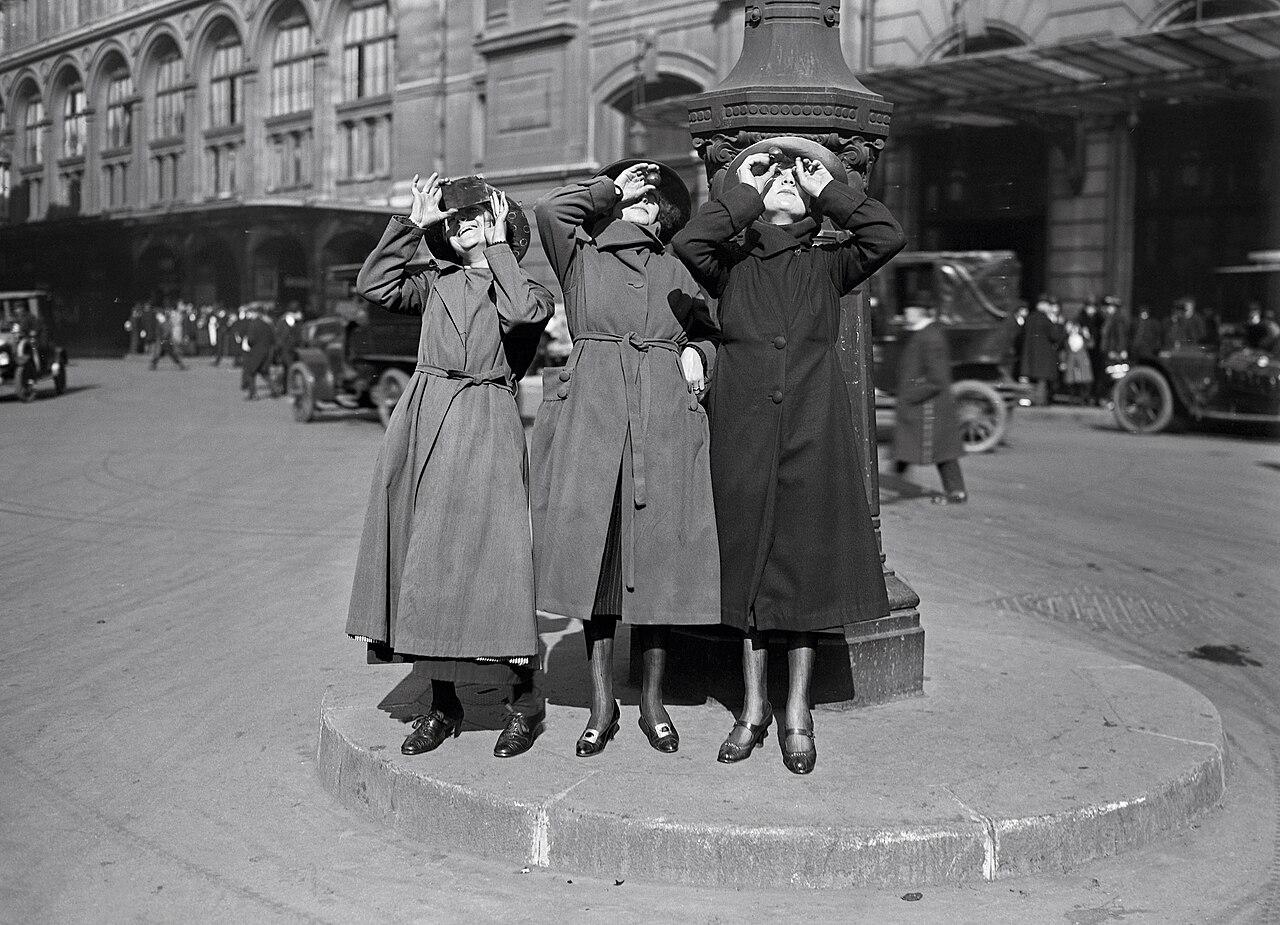
Alt...
Three Parisian women watching the solar eclipse of 8 April 1921 through glasses on the Cour du Havre, next to the gare Saint-Lazare.
Three women in long coats stand on a raised platform beside a lamppost outside Gare Saint-Lazare, each holding improvised viewing devices to their eyes to observe a solar eclipse. Early automobiles and a busy street crowd fill the background.
![[?]](https://media2.ai6yr.org/accounts/avatars/109/321/592/360/914/018/original/f918064fa4350d36.jpg)
Any folks interested in astronomy in Ventura County:
"Save Our Starry Nights
Why light pollution matters and what we can do about it
Celeste Andersen, JD
Save Our Stars, WE Watch
David Newman
City Councilmember and Former Mayor, City of Thousand Oaks
Friday, August 21, 7pm PT (via Zoom)
Find out:
• What is light pollution?
• How it affects us all
• What are the solutions?
• Local ordinances and efforts
• Easy actions you can take
Please register for the forum in advance here:
https://tinyurl.com/saveourstarrynights"
#astronomy #lightpollution #VenturaCounty #ThousandOaks #ConejoValley

Alt...
Save Our Starry Nights
Why light pollution matters and what we can do about it
Celeste Andersen, JD
Save Our Stars, WE Watch
David Newman
City Councilmember and Former Mayor, City of Thousand Oaks
Friday, August 21, 7pm PT (via Zoom)
Find out:
• What is light pollution?
• How it affects us all
• What are the solutions?
• Local ordinances and efforts
• Easy actions you can tak
![[?]](https://files.mastodon.social/accounts/avatars/000/449/710/original/8ed6e2fe8ddf696b.jpg)
(1/2) At one time in the early aughts, I had backyard observatory and dozens of antique telescopes and binoculars.
I spent hundreds (thousands?) of hours looking at the stars, planets, and deep sky objects. My favorite observing targets were dense star fields and open clusters.
I did my best observing with 25x100 binocular, a 75mm Vixen long-tube achromat, and a 150mm Mak. I had a whole lineup of Naglers and Lanthanums.
#astronomy #stargazing #telescope #binoculars #astrophotography #space
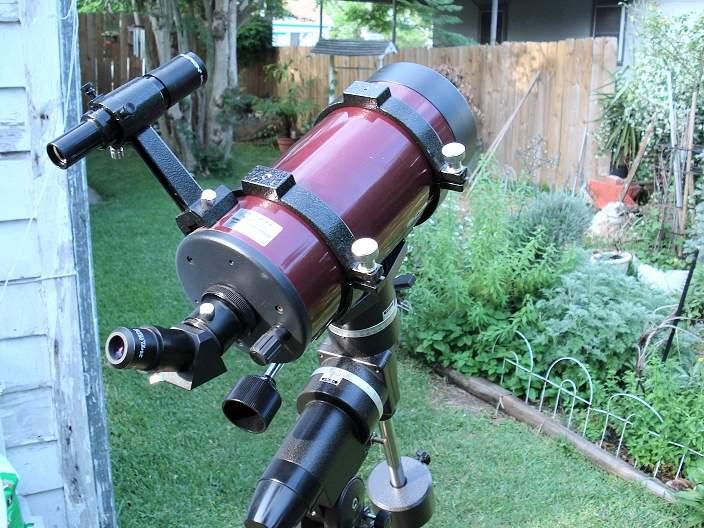
Alt...
Orion 150mm Mak on a modified Vixen Super Polaris GEM.
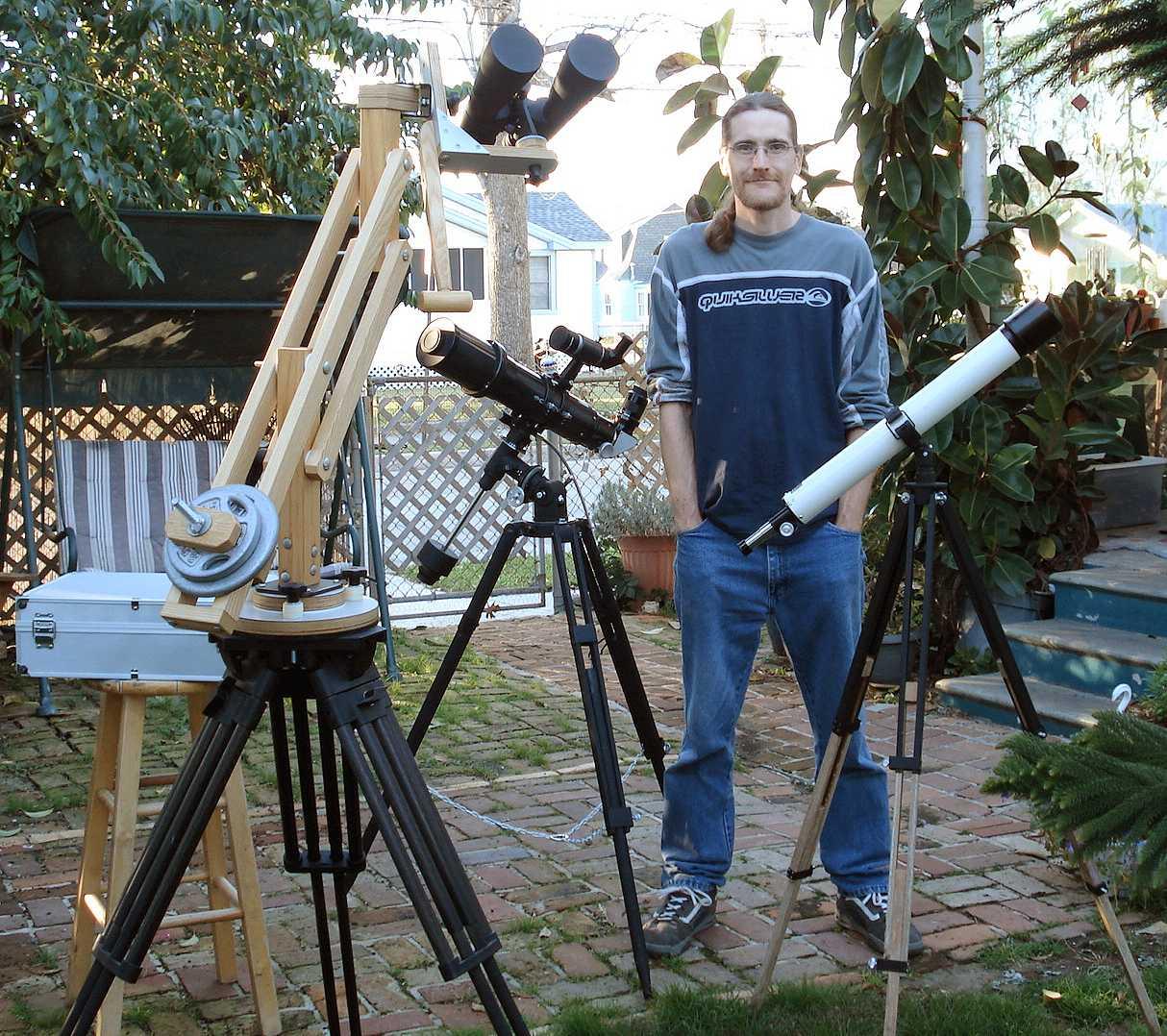
Alt...
Your humble host showing off for a profile in an astronomy magazine. In the photo : 15x70mm Skymaster binocular on a custom Astrowood parallelogram mount, Orion 100mm achromat on a Vixen Polaris GEM, and an antique Mayflower f/15 achromat (Japan) on a cheapie Alt-Az mount.
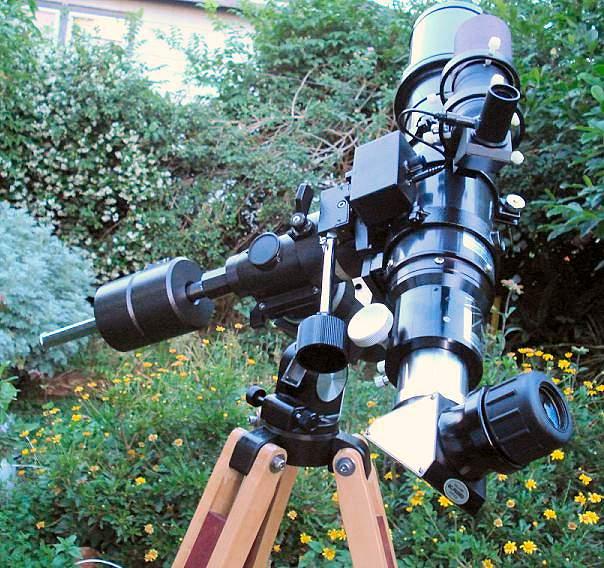
Alt...
Heavily-modded and tuned Orion 100mm f/6 achromat, University Optics 50mm illuminated finder on a motorized Vixen Super Polaris GEM. This scope was the subject of a magazine article about modifying off the shelf scopes with bespoke components. This one was decked out with custom diagonal, focuser, stepper motor, heavy walnut tripod with dampeners, and the lens cell had been expertly hand collimated by a respected optics expert. I miss this scope.
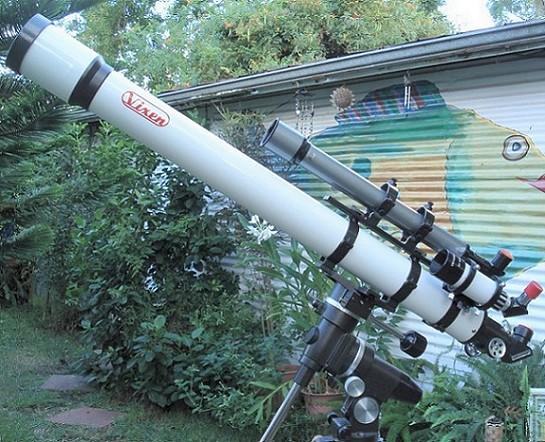
Alt...
Another modded rig. I miss this one the most. Invested a lot of time and money into this setup.
Vixen 75mm f/15 achromat with custom focuser. Asahi-Pentax 50mm guidescope, University Optics 50mm finder, Vixen Super Polaris GEM.
This scope was razor sharp and could sustain gorgeous APO-like lunar views at 200x with almost zero color fringing.
Science, religion, and political omens: the meaning of eclipses in ancient Rome
by Javier Andreu Pintado
Romans could predict eclipses, but still interpreted them as signs from the gods.
Books about eclipses (next eclipse will take place on August 12) at PG:
https://www.gutenberg.org/ebooks/subjects/search/?query=eclipses
#books #literature #astronomy #history
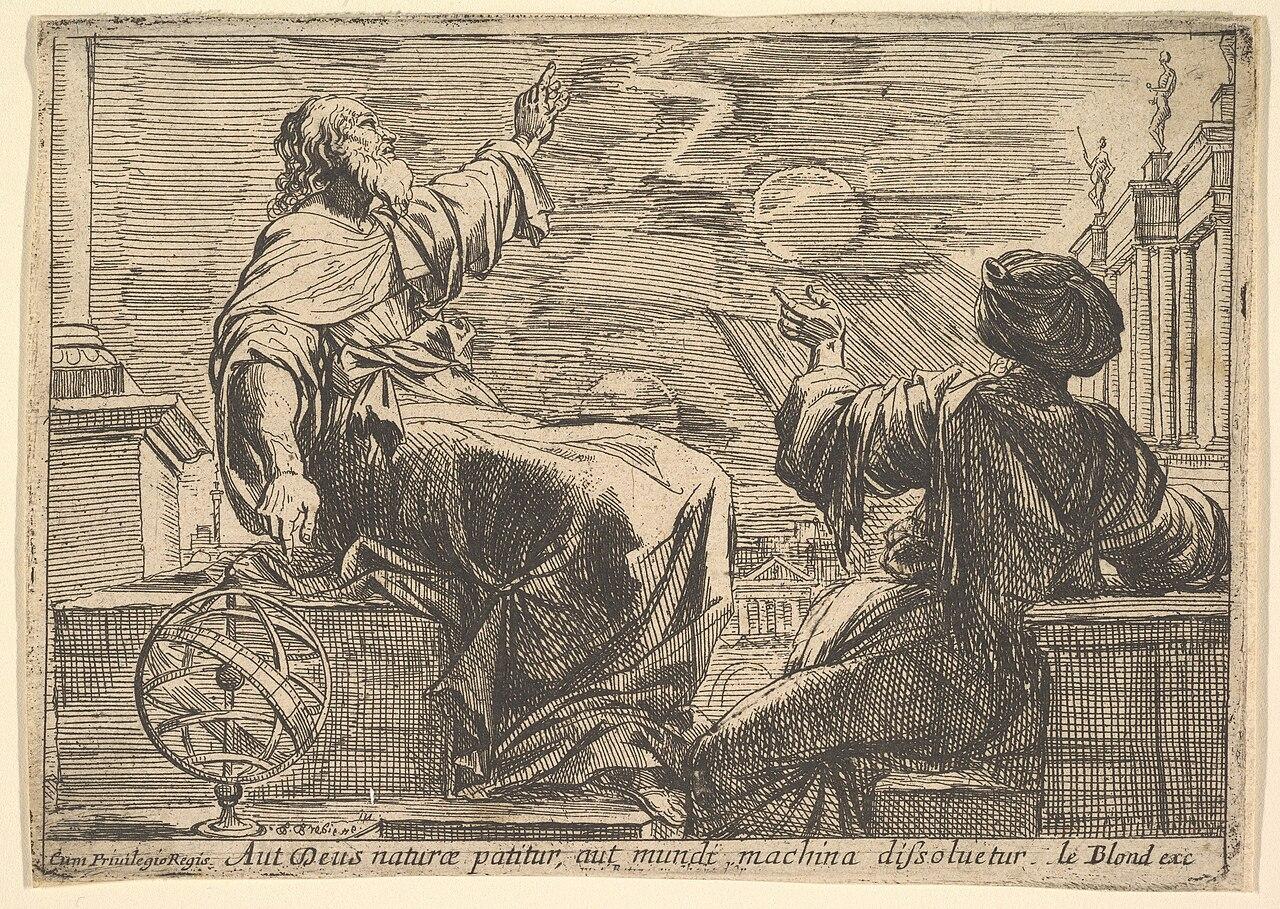
Alt...
Two philosophers watching an eclipse, etching by Pierre Brébiette.
It is showing two robed, bearded figures gesturing dramatically toward the sky where a solar eclipse is depicted, with an armillary sphere at their feet and classical architecture in the background. The Latin inscription reads "Aut Deus naturae patitur, aut mundi machina dissoluetur" ("Either God suffers in nature, or the machine of the world will be dissolved").
![[?]](https://dmvcommunitymedia.b-cdn.net/accounts/avatars/109/423/669/136/029/020/original/a319391a17e18a0d.jpeg)
🌌 August 12, 2026 is a genuinely rare day for skywatching: three major celestial events land in a single 24-hour window.
Before sunrise: six planets (Jupiter, Mercury, Mars, Uranus, Saturn, Neptune) stretch across the sky in a wide alignment. Mars and Saturn are easy naked-eye targets. Uranus and Neptune need binoculars or a telescope.
During the day/evening: a total solar eclipse sweeps from Siberia across Greenland and Iceland, then over northern Spain and Portugal near sunset. Partial eclipse visible across much of North America and Europe. First total eclipse on mainland Europe since 1999.
After dark: the Perseid meteor shower peaks under a moonless sky. NASA predicts up to 50-100 meteors per hour, and without moonlight this is the best Perseid viewing until 2045.
The new moon and the solar eclipse are the same event (a solar eclipse can only happen at new moon), so it is really three events, not four. Still remarkable.
https://science.nasa.gov/eclipses/future-eclipses/total-solar-eclipse-on-august-12-2026/
https://starwalk.space/en/news/planetary-alignment-august-12-2026
https://science.nasa.gov/solar-system/skywatching/night-sky-network/prepare-for-perseids/
"He wanted to see the night sky as Cleopatra might have seen it." Travis Diehl for The New York Times https://www.nytimes.com/2026/07/22/arts/design/charles-ross-star-axis-land-art.html?src=longreads #art #artists #astronomy #stars #longreads
![[?]](https://files.mastodon.social/accounts/avatars/109/243/491/360/500/899/original/97f62a49fcafc59a.png)
There are approximately 366.25 days in a year (sidereal).
A nice way to understand this, is to watch this Veritasium video - it links the headline maths problem to sidereal time keeping towards the end of the video, with some nice diagrams / animations.
![[?]](https://fileproxy.writeout.ink/accounts/avatars/107/775/665/627/796/686/original/1df1008d3f1d379c.jpg)
For the first time, researchers have identified an ancient #Maya mathematician by name after decoding a painted wall text from the archaeological site of Xultun in northeastern #Guatemala. The finding links a mathematical formula to an individual named Sak Tahn Waax, giving historians the first direct evidence of a Classic Maya scholar claiming credit for scientific work.
– Dario Radley, First named Maya mathematician identified from 1,200-year-old wall inscription in Guatemala https://archaeologymag.com/2026/07/first-named-maya-mathematician-guatemala/
Half moon tonight from #waltham . 1428 mm f/l f/9 Newtonian reflector directly into a Nikon D7500
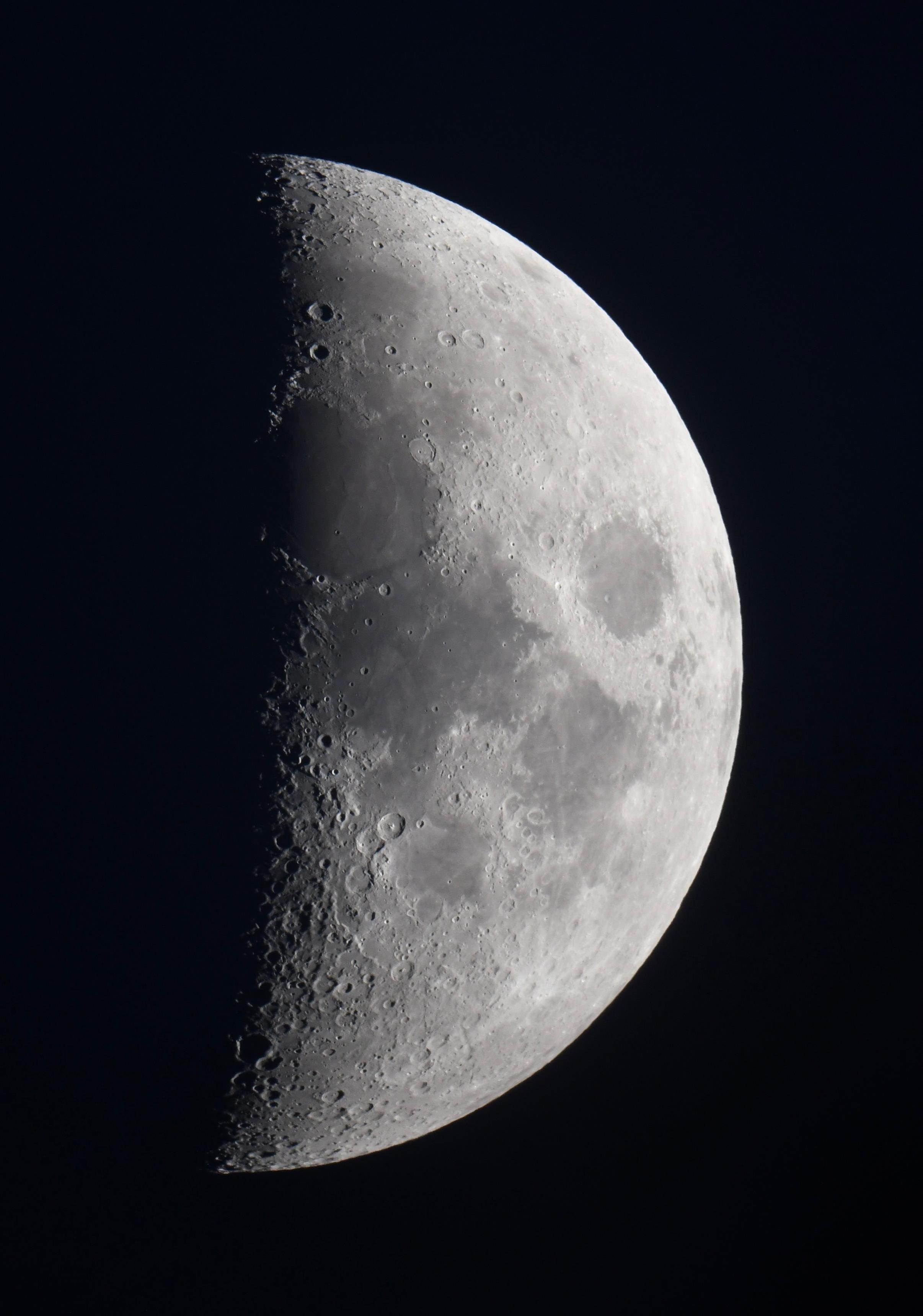
Alt...
Half moon facing right. Numerous creators can be seen in the terminator, to the left, the sky behind it is black
![[?]](https://assets.chatty.monster/accounts/avatars/109/293/199/711/634/793/original/67ba0df2a2dcc595.jpg)
To quote Russ Abbott
🎶 Oh what an atmosphere
🎶 I love a planet with a visible atmosphere
"Astronomers discover first rocky expolanet in the 'Goldilocks zone' with an atmosphere"
Hidden in Maya wall writings: A named astronomer emerges from 1,200-year-old calculations
by Antiquity
edited by Sadie Harley, reviewed by Andrew Zinin
https://phys.org/news/2026-07-hidden-maya-wall-astronomer-emerges.html
Original article in Antiquity:
https://www.cambridge.org/core/journals/antiquity/article/identification-and-work-of-an-eighthcentury-maya-mathematician/FDE9610F9D80ADBC245CAC2B8F204070
#epigraphy #mathematics #astronomy

Alt...
Diego de Landa's Maya alphabet was an early attempt at decipherment.
A printed page reproducing "Diego de Landa's Maya Alphabet" — 27 numbered glyph signs arranged in three columns, each paired with its corresponding phonetic value (a, b, e, k, m, n, o, u, etc.), from a 19th-century American history textbook.
SPACE SUGAR
AP: In a sweet discovery, astronomers find sugar lurking in the space between stars
https://apnews.com/article/erythrulose-interstellar-medium-sugar-357144f4d69449b29dff17271ccd0dcd
🪐 Ancient Babylonians were doing calculus 1,400 years before Europe.
Between 350 and 50 BCE, Babylonian astronomers calculated Jupiter's position by computing the area under a time-velocity curve - treating the planet's changing speed as a trapezoid on a graph. Historians thought this technique wasn't invented until 14th-century Oxford.
The tablets sat untranslated in the British Museum for over a century until Mathieu Ossendrijver cracked them in 2016.
#history #science #astronomy
https://www.nationalgeographic.com/science/article/160128-math-geometry-babylon-jupiter-astronomy-space
Unusually Smooth Sections of #Asteroid #Itokawa
#Astronomy #Picture of the Day
https://apod.nasa.gov/apod/ap260630.html
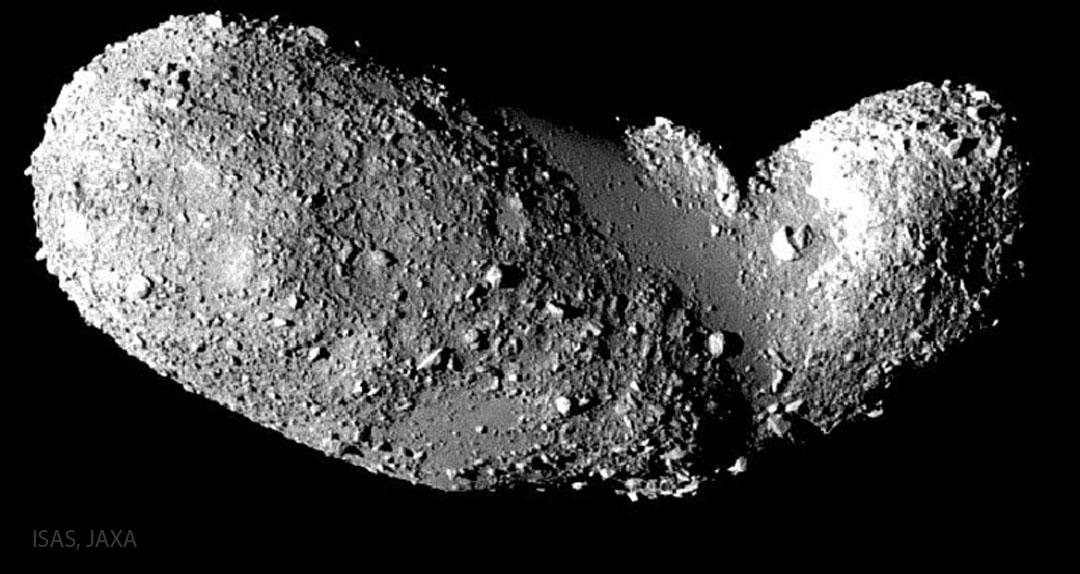
Alt...
Detailed photo of asteroid surface.
![[?]](https://files.mastodon.social/accounts/avatars/115/070/625/860/923/251/original/9629d01039476748.png)
Riffing on the idea of identity and selfhood after reading Ishiguro's Klara and the Sun.
#philosophy #books #reading #ishiguro #identity #selfhood #perception #heuristic #video #podcast #substack #blog #souls #metaphysics #astronomy #essence

We are all stardust.
The oxygen you breath? That comes from dying massive stars, ending their life in a supernova.
The iron in your blood? Some from massive stars dying, but mainly fron white dwarfs, the leftovers of dwarf stars like our own Sun, exploding.
Carbon, the basis of life? Mostly from dying low mass stars.
The gold ring on your finger? Mostly from merging neutron stars, leftovers from supernovae.
#VicisAstro #astrodon #astronomy #astrophysics
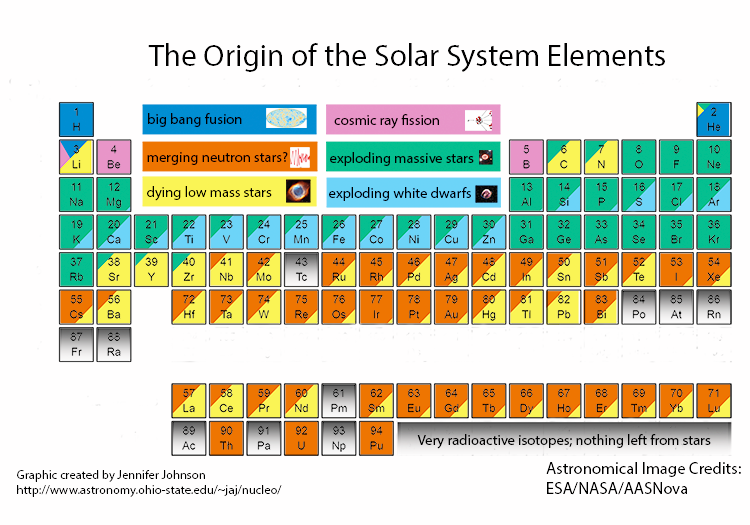
Alt...
Table of elements colored by their cosmic origin: big bang fusion, cosmic ray fusion, merging neutron stars, exploring massive stars, dying low mass stars, exploring white dwarfs.
Scales of the Universe:
Out Sun is five billion years old and will live another five billion.
A star with ten times the mass, lives some twenty million years, larger stars have an even shirter lifetime.
A star with half the mass of the Sun will live hundred billion years. Our universe is 13.7 billion years old -- the oldest low mass stars are not even past their teenage years yet.
Naming the Universe
How the quick thinking of internationally minded astronomers avoided stamping the solar system with petty European rivalries
by Stephen Case
Books by John Herschel at PG:
https://www.gutenberg.org/ebooks/author/48095
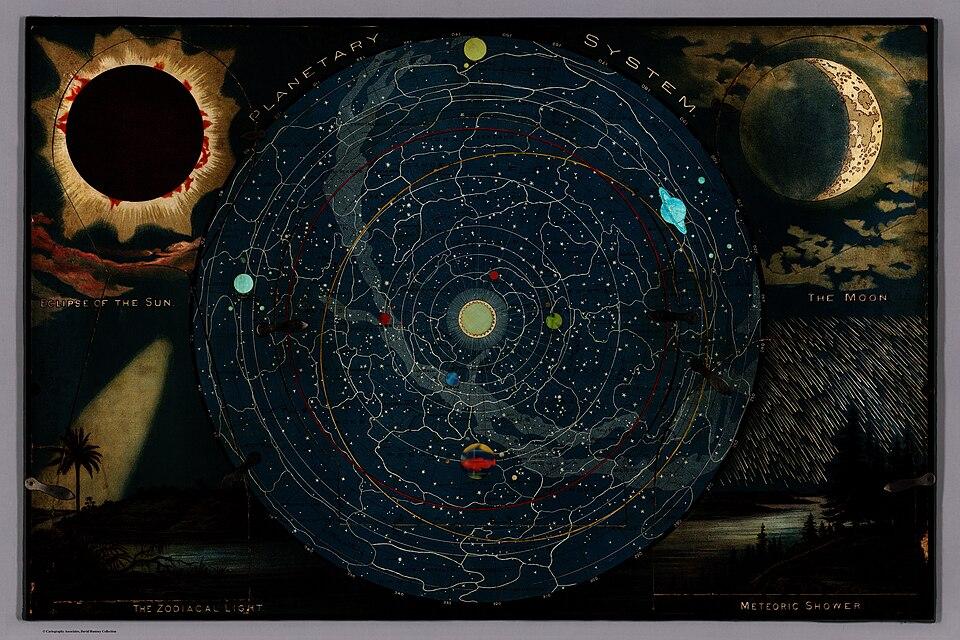
Alt...
Planetary System. Eclipse of the Sun. The Moon. The Zodiacal Light. Meteoric Shower. From Yaggy’s Geographical Study, 1887.
An illustrated educational diagram depicting the solar system with orbital paths around a central sun, comets, and the zodiacal light. The corners feature vignette illustrations of related astronomical phenomena: a solar eclipse, the moon, the zodiacal light, and a meteoric shower.
https://fr.wikipedia.org/wiki/Fichier:Levi_Walter_Yaggy_Planetary_System_1887.jpg
![[?]](https://cdn.masto.host/scribilimastohost/accounts/avatars/116/268/791/300/985/227/original/2c2fed9961f6f058.jpg)
Here's #Venus peeking out from behind the #moon. Seen from #VictoriaBC.
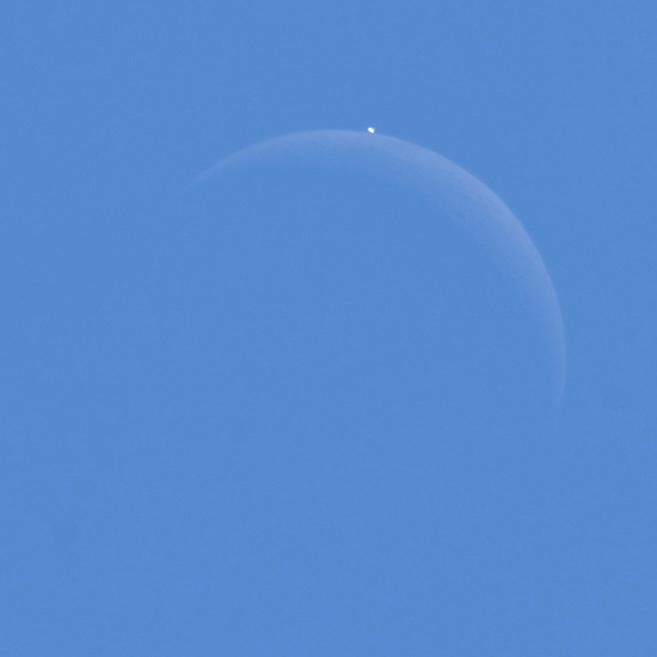
Alt...
Venus is peaking out from behind the slender daylight crescent moon.
Today's #APOD is especially for #VanGogh fans. =)
Date: 2026 June 19
URL: https://apod.nasa.gov/apod/ap260619.html
Title: Starry Night II
![[?]](https://o.mastodon.nz/accounts/avatars/109/248/505/007/568/817/original/3e783ed7f1302bec.jpg)
One of the advantages of being in the week of the shortest days of the year is biking home from work after dark, in cold clear air, with the universe sparkling overhead.
Here's this evening with the Moon, Venus, Jupiter, and Mercury all lined up above the western horizon, from Lincoln, NZ.
https://www.flickr.com/photos/mollivan_jon/553428
#astronomy #NightSky #Moon #Jupiter #Venus #Mercury #NZ
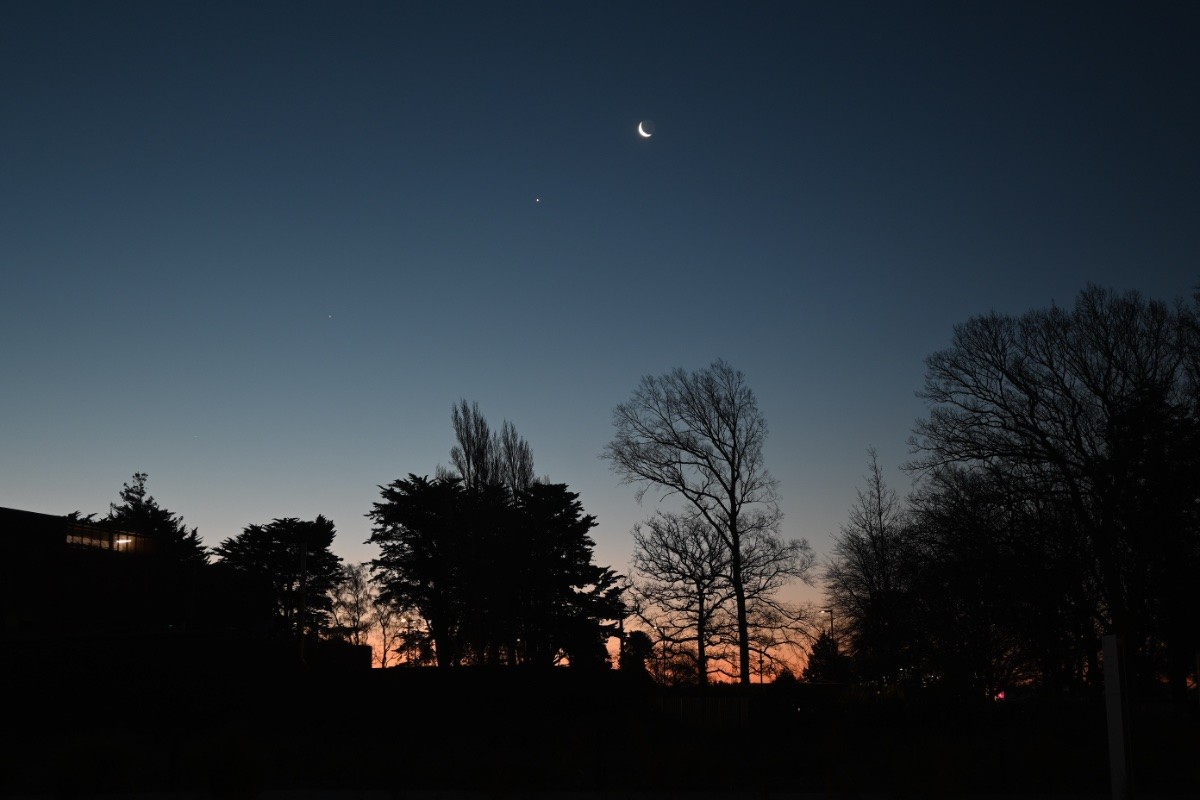
Alt...
A photo at twilight with the last orange glow of the day along the horizon behind silhouetted trees. In the sky, in a line, are the crescent Moon, Venus, Jupiter, and Mercury.
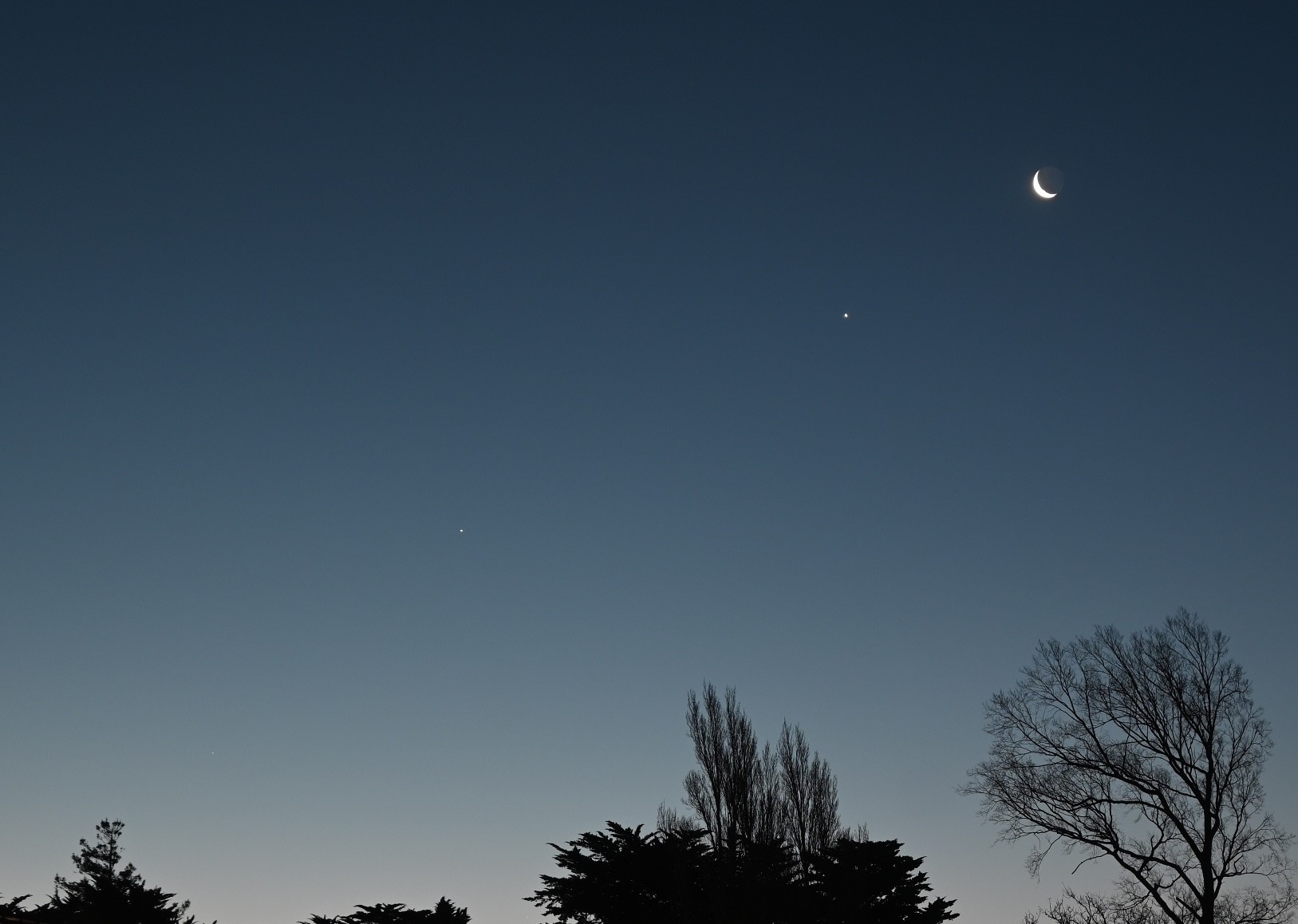
Alt...
A closer cropped view of the photo showing, in a line from top right, the crescent Moon, Venus, Jupiter, and Mercury.
![[?]](https://assets.oldbytes.space/assets.oldbytes.space/accounts/avatars/114/416/081/618/354/475/original/acde538508d5c5a6.jpg)
Venus is the bright dot close to the lunar crescent, which has a hint of earthshine. Jupiter is the dimmer dot near the center. A jet contrail to the top of Jupiter photobombs the framing, or makes it nicer depending on how you view it.
I took the photo with my Pixel 7 Pro phone from Milan, Italy, on June 17, 2026 at 20:08 UTC.
#astrophotography #astronomy #moon #jupiter #venus

Alt...
View of an urban area at dusk from an upper floor of an apartment building, with some treetops at left and the upper floors of apartment buildings in the distance at the horizon, near the bottom right of the frame. On the clear sky, close to the thin lunar waxing crescent, is a bright white dot. To the top of this pair is the horizontal, thin, short white line of a jet contrail. At the center of the frame is a dimmer white dot.
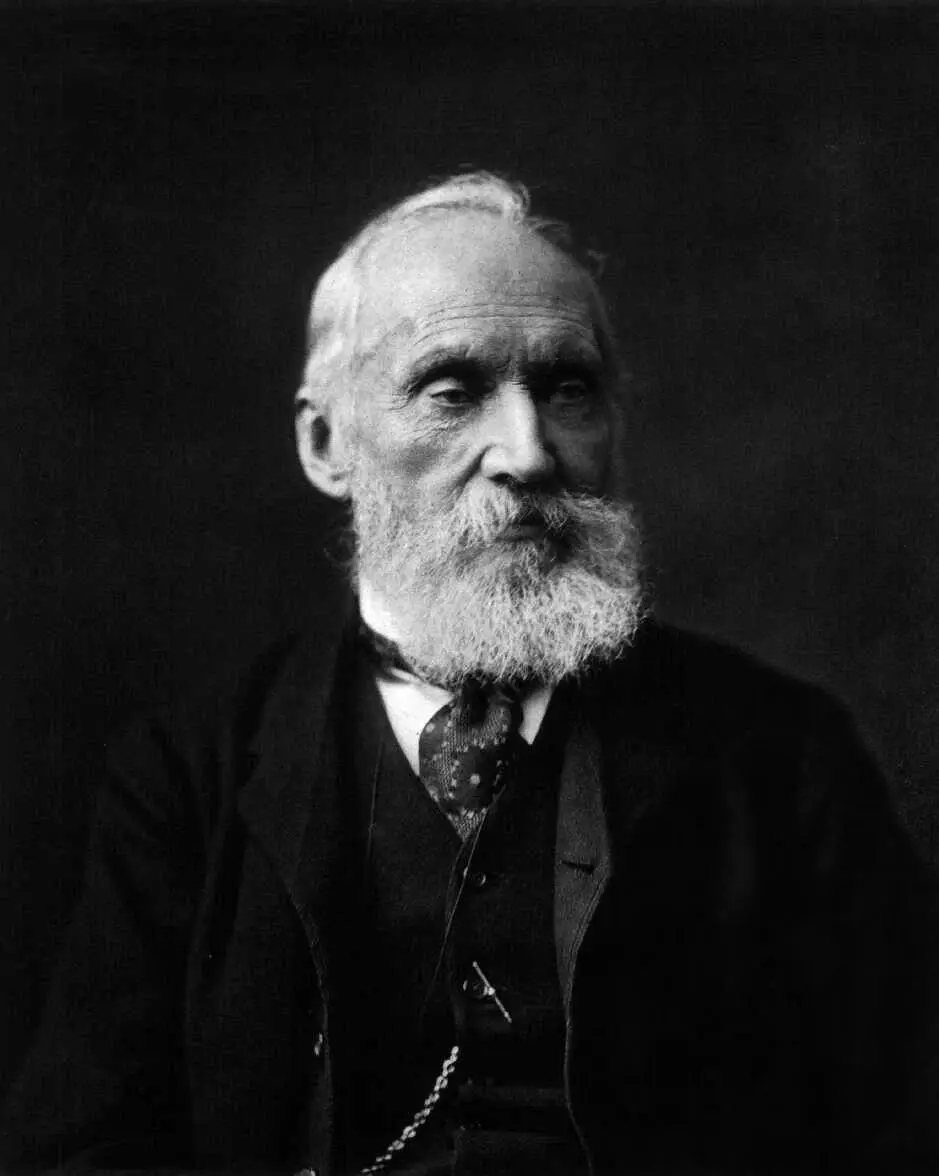
What Would Happen if the Sun Stopped? Part 2: Kelvin and Helmholtz at the Ready
By Paul Sutter
About Kelvin-Helmholtz mechanism:
https://en.wikipedia.org/wiki/Kelvin%E2%80%93Helmholtz_mechanism
Books by Baron Kevin and Helmholtz at PG
https://www.gutenberg.org/ebooks/author/48139
https://www.gutenberg.org/ebooks/author/59039
Alt...
William Thomson, Lord Kelvin, whose famously wrong answer for the Sun's age turns out to be exactly the calculation we need.
A black-and-white studio portrait of Lord Kelvin with white hair and a full white beard, wearing a formal suit, waistcoat, tie, and watch chain. He has a serious expression and is looking slightly away from the camera.
https://upload.wikimedia.org/wikipedia/commons/d/db/Kelvin-1200-scale1000.jpg