Search results for tag #space
![[?]](https://files.defcon.social/dcsocial-s3/accounts/avatars/113/208/344/507/078/943/original/014820ad22daee1c.jpg)
NASA’s Tally of Planets Outside Our Solar System Reaches 6,000
The milestone highlights the accelerating rate of discoveries, just over three decades since the first exoplanets were found.
The official number of exoplanets — planets outside our solar system — tracked by NASA has reached 6,000. Confirmed planets are added to the count on a rolling basis by scientists from around the world, so no single planet is considered the 6,000th entry. The number is monitored by NASA’s Exoplanet Science Institute (NExScI), based at Caltech’s IPAC in Pasadena, California. There are more than 8,000 additional candidate planets awaiting confirmation, with NASA leading the world in searching for life in the universe.
CREDIT
NASA/JPL-Caltech
https://science.nasa.gov/exoplanets/discoveries-dashboard/
#space #exoplanets #astrophotography #photography #science #astronomy #tech #NASA #ESA #education
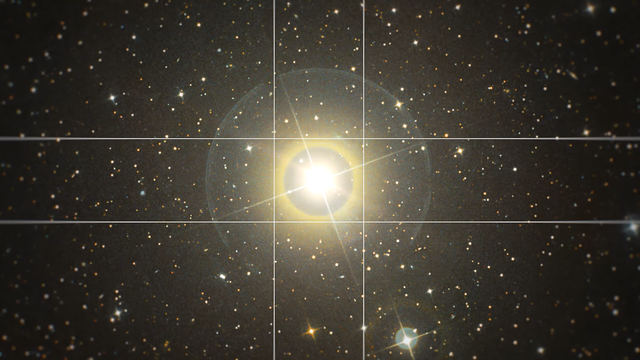
Alt...
It’s been 30 years since the discovery of the first planet around another star like our Sun. With every new discovery, scientists move closer to answering whether there are other planets like Earth that could host life as we know it.
CREDIT
NASA/JPL-Caltech
Microlensing - NASA Science
-- jmbrill
Gravitational lensing is an observational effect that occurs because the presence of mass warps the fabric of space-time, sort of like the dent a bowling ball makes when set on a trampoline. The effect is extreme around very massive objects, like black holes and entire galaxies. But even stars and planets cause a detectable degree of warping, called microlensing.
Here’s how it works. Light travels in a straight line, but if space-time is bent – which happens near something massive, like a star – light follows the curve. Any time two stars align closely from our vantage point, light from the more distant star curves as it travels through the warped space-time around the nearer star.
If the alignment is especially close, the nearer star acts like a natural cosmic lens, magnifying light from the background star. Planets orbiting the lens star can produce a similar effect on a smaller scale.
Familiar and exotic worlds
The techniques commonly used to find other worlds are biased toward planets that tend to be very different from those in our solar system. The transit method, for example, is best at finding sub-Neptune-like planets that have orbits much smaller than Mercury’s. For a solar system like our own, transit studies could miss every planet.
Roman’s Galactic Bulge Time Domain Survey will help us find analogs to every planet in our solar system except Mercury, whose small orbit and low mass combine to put it beyond the mission’s reach. Roman will find planets that are the mass of Earth and even smaller – perhaps even large moons, like Jupiter’s moon Ganymede.
Roman will find planets in other poorly studied categories, too. Microlensing is best suited to finding worlds from the habitable zone of their star and farther out.
[...]
Please read more:
https://www.nasa.gov/universe/exoplanets/nasas-tally-of-planets-outside-our-solar-system-reaches-6000/#hds-sidebar-nav-1
CREDIT
science.nasa.gov
#space #galaxy #astrophotography #photography #science #physics #nature #NASA #ESA #education
TOPIC>
Gravitational Lensing
Galaxy Lenses Galaxy from Webb
* Image Credit: ESA/Webb, NASA & CSA, G. Mahler
https://orbi.uliege.be/profile?uid=p288273
https://www.asc-csa.gc.ca/eng/
https://esawebb.org/
https://www.nasa.gov/
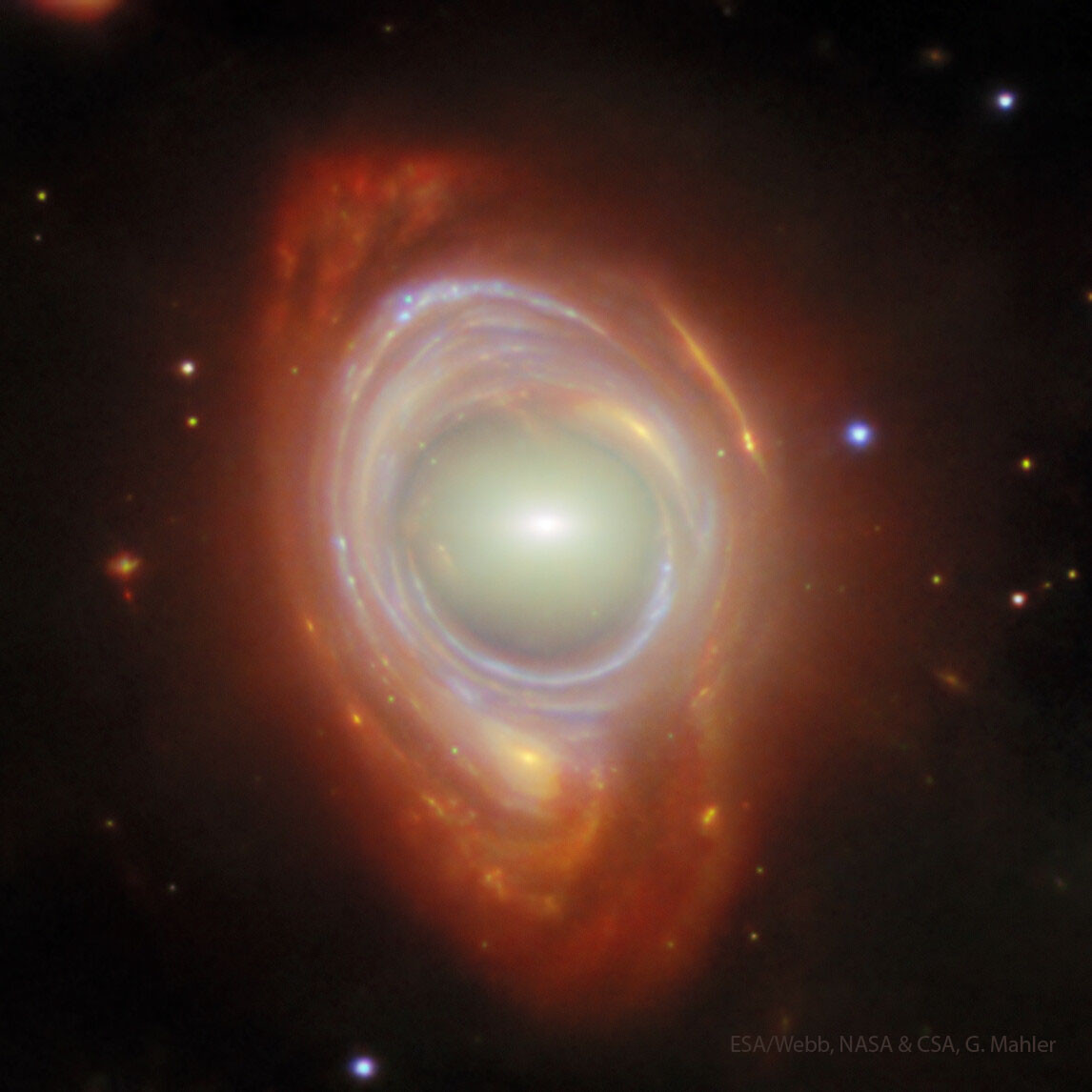
Explanation:
Is this one galaxy or two? Although it looks like one, the answer is two. One path to this happening is when a small galaxy collides with a larger galaxy and ends up in the center. But in the featured image, something more rare is going on. Here, the central light-colored elliptical galaxy is much closer than the blue and red-colored spiral galaxy that surrounds it. This can happen when near and far galaxies are exactly aligned, causing the gravity of the near galaxy to pull the light from the far galaxy around it in an effect called gravitational lensing. The featured galaxy double was taken by the Webb Space Telescope and shows a complete Einstein ring, with great detail visible for both galaxies. Galaxy lenses like this can reveal new information about the mass distribution of the foreground lens and the light distribution of the background source.
https://www.esa.int/ESA_Multimedia/Images/2025/03/Webb_spies_a_spiral_through_a_cosmic_lens
https://esawebb.org/images/potm2503a/
https://science.nasa.gov/wp-content/uploads/2023/04/stsci-h-p2005b-f-4096x2160-1-jpg.webp
https://webbtelescope.org/home
https://science.nasa.gov/mission/hubble/science/science-behind-the-discoveries/hubble-gravitational-lenses/
https://science.nasa.gov/mission/hubble/science/science-behind-the-discoveries/hubble-gravitational-lenses/
https://www.ucdavis.edu/news/newly-discovered-gravitational-lenses-could-reveal-ancient-galaxies-and-nature-dark-matter
https://science.nasa.gov/mission/hubble/science/science-highlights/shining-a-light-on-dark-matter/
https://spaceplace.nasa.gov/galaxy/en/
https://science.nasa.gov/universe/galaxies/types/#elliptical-galaxies
https://science.nasa.gov/universe/galaxies/types/#spiral-galaxies
https://apod.nasa.gov/apod/ap220705.html
https://apod.nasa.gov/apod/ap160420.html
https://apod.nasa.gov/apod/ap201018.html
https://apod.nasa.gov/apod/ap250421.html
#space #galaxy #astrophotography #photography #science #physics #nature #NASA #ESA
Alt...
2025 April 21
What looks like a single spiral galaxy is shown with a white center surrounded by inner blue arms and outer red arms. Please see the explanation for more detailed information.
Galaxy Lenses Galaxy from Webb
* Image Credit: ESA/Webb, NASA & CSA, G. Mahler
Explanation:
Is this one galaxy or two? Although it looks like one, the answer is two. One path to this happening is when a small galaxy collides with a larger galaxy and ends up in the center. But in the featured image, something more rare is going on. Here, the central light-colored elliptical galaxy is much closer than the blue and red-colored spiral galaxy that surrounds it. This can happen when near and far galaxies are exactly aligned, causing the gravity of the near galaxy to pull the light from the far galaxy around it in an effect called gravitational lensing. The featured galaxy double was taken by the Webb Space Telescope and shows a complete Einstein ring, with great detail visible for both galaxies. Galaxy lenses like this can reveal new information about the mass distribution of the foreground lens and the light distribution of the background source.
Authors & editors: Robert Nemiroff (MTU) & Jerry Bonnell (UMCP)
NASA Official: Amber Straughn Specific rights apply.
NASA Web Privacy, Accessibility, Notices;
A service of: ASD at NASA / GSFC,
NASA Science Activation
& Michigan Tech. U.
2025 February 26
Einstein Ring Surrounds Nearby Galaxy Center
* Image Credit & Copyright: ESA, NASA, Euclid Consortium;
https://www.nasa.gov/
https://www.esa.int/
https://www.euclid-ec.org/consortium/about-ec/
* Processing: J.-C. Cuillandre, G. Anselmi, T. Li
https://www.cfht.hawaii.edu/~jcc/
Explanation:
Do you see the ring? If you look very closely at the center of the featured galaxy NGC 6505, a ring becomes evident. It is the gravity of NGC 6505, the nearby (z = 0.042) elliptical galaxy that you can easily see, that is magnifying and distorting the image of a distant galaxy into a complete circle. To create a complete Einstein ring there must be perfect alignment of the nearby galaxy's center and part of the background galaxy. Analysis of this ring and the multiple images of the background galaxy help to determine the mass and fraction of dark matter in NGC 6505's center, as well as uncover previously unseen details in the distorted galaxy. The featured image was captured by ESA's Earth-orbiting Euclid telescope in 2023 and released earlier this month.
https://www.jpl.nasa.gov/news/euclid-discovers-einstein-ring-in-our-cosmic-backyard/
https://www.euclid-ec.org/einstein-ring-in-ngc-6505/
https://en.wikipedia.org/wiki/NGC_6505
https://arxiv.org/abs/2502.06505
https://science.nasa.gov/dark-matter/
https://www.esa.int/Science_Exploration/Space_Science/Euclid_overview
https://apod.nasa.gov/apod/ap250226.html
#space #galaxy #astrophotography #photography #science #physics #nature #NASA #ESA
Alt...
2025 February 26
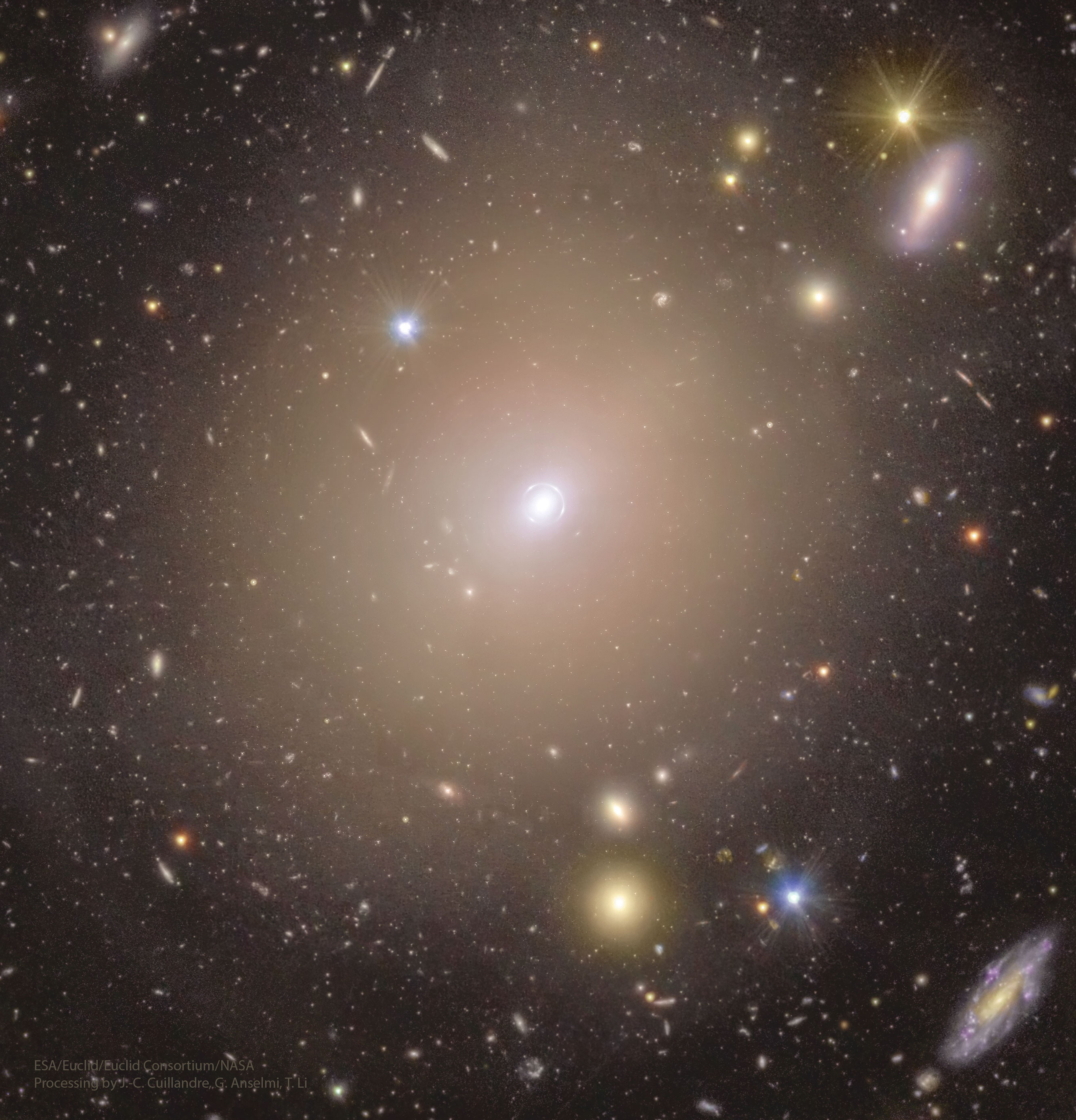
A cluster of galaxies is shown with many galaxies around the cluster center. A close look at this center shows that it is encompassed by a narrow ring of light.
Einstein Ring Surrounds Nearby Galaxy Center
* Image Credit & Copyright: ESA, NASA, Euclid Consortium; Processing: J.-C. Cuillandre, G. Anselmi, T. Li
Explanation:
Do you see the ring? If you look very closely at the center of the featured galaxy NGC 6505, a ring becomes evident. It is the gravity of NGC 6505, the nearby (z = 0.042) elliptical galaxy that you can easily see, that is magnifying and distorting the image of a distant galaxy into a complete circle. To create a complete Einstein ring there must be perfect alignment of the nearby galaxy's center and part of the background galaxy. Analysis of this ring and the multiple images of the background galaxy help to determine the mass and fraction of dark matter in NGC 6505's center, as well as uncover previously unseen details in the distorted galaxy. The featured image was captured by ESA's Earth-orbiting Euclid telescope in 2023 and released earlier this month.
Authors & editors: Robert Nemiroff (MTU) & Jerry Bonnell (UMCP)
NASA Official: Amber Straughn Specific rights apply.
NASA Web Privacy, Accessibility, Notices;
A service of: ASD at NASA / GSFC,
NASA Science Activation
& Michigan Tech. U.
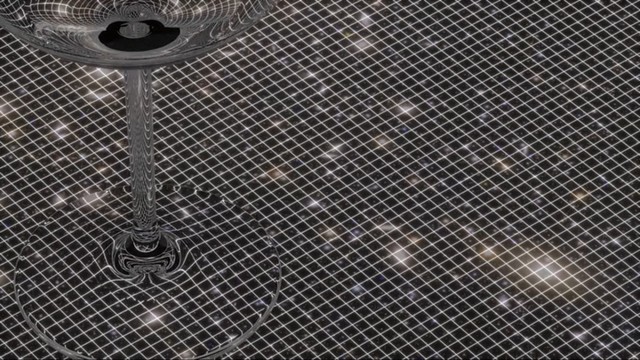
ESA's Euclid mission is surveying the sky to explore the composition and evolution of the dark Universe.
But how can Euclid see the invisible? Watch this video to learn about the light-bending effect that enables scientists to trace how dark matter is distributed in the Universe.
By making use of Euclid’s flagship simulation, the video illustrates how dark-matter filaments subtly alter the shape of galaxies. Light travelling to us from vastly distant galaxies is bent and distorted by concentrations of matter along its way. The effect is called gravitational lensing because matter (both ‘normal’ and dark matter) acts as a kind of magnifying glass.
Scientists distinguish between strong and weak gravitational lensing. In strong gravitational lensing distortions of background galaxies or other light sources are very apparent, resulting in arcs, multiple images or so-called Einstein rings. In weak lensing, background sources appear only mildly stretched or displaced. This means we can only detect this effect by analysing large numbers of sources in a statistical way.
The further we look, the more prominent the distortions from weak gravitational lensing are, because there are more dark-matter structures acting as lenses between us and the light sources.
Euclid will measure the distorted shapes of billions of galaxies over 10 billion years of cosmic history, providing a 3D view of the dark matter distribution in our Universe. This will shed light on the nature of this mysterious component.
The map of the distribution of galaxies over cosmic time will also teach us about dark energy, which affects how quickly the Universe expands. By charting the Universe’s large-scale structure in unprecedented detail, Euclid will enable scientists to trace how the expansion has changed over time.
* CREDIT
ESA/Euclid Consortium/Cacao Cinema
#space #galaxy #astrophotography #photography #science #physics #nature #NASA #ESA
Alt...
To understand more about the dark Universe, ESA’s Euclid will measure a phenomenon known as ‘weak lensing’, based on the principle of gravitational lensing.
* CREDIT
ESA/Euclid Consortium/Cacao Cinema
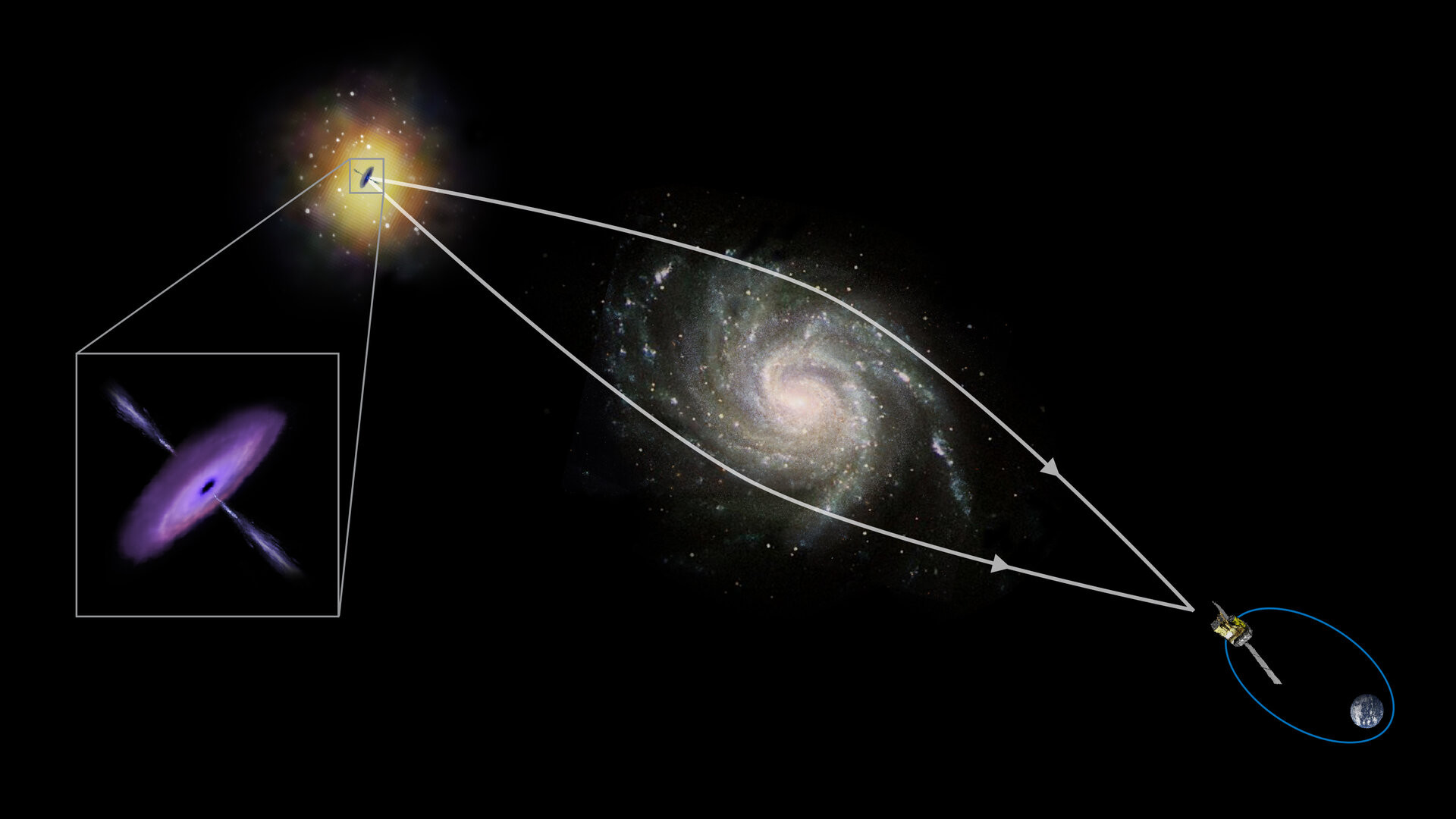
A team of astronomers used the magnifying effect of the stars located in a spiral galaxy to ‘zoom in’ to another galaxy, known as PKS 1830-211, that lies along the same line of sight from Earth but is much farther away. Thanks to this unusual set-up, they could pick out very small structures in the distant galaxy, corresponding to the vicinity of the supermassive black hole. The black hole is devouring material from its surroundings while firing powerful jets of particles that emit light up to the high energies of gamma rays. Observing these jets with ESA’s Integral and NASA’s Fermi and Swift satellites, the astronomers could measure the size of the region around the black hole where they originate.
Our telescopes will never be powerful enough to reveal these inner regions, but the intervening gravitational lens made the measurement possible. This is the first time that gravitational microlensing has been used with gamma rays to dissect the high-energy processes taking place around a supermassive black hole.
CREDIT
ESA/ATG medialab
#space #galaxy #astrophotography #photography #science #physics #nature #NASA #ESA
Alt...
Massive cosmic objects, from single stars to galaxy clusters, bend and focus the light that flows around them with their gravity, acting like giant magnifying glasses. This effect is called gravitational lensing or, when it is detected on tiny patches on the sky, microlensing.
2022 July 5
A Molten Galaxy Einstein Ring
* Image Credit: ESA/Hubble & NASA, S. Jha;
https://www.physics.rutgers.edu/~saurabh/
https://www.esa.int/
https://esahubble.org/
https://www.nasa.gov/
* Processing: Jonathan Lodge
https://www.instagram.com/jjlodge/
Explanation:
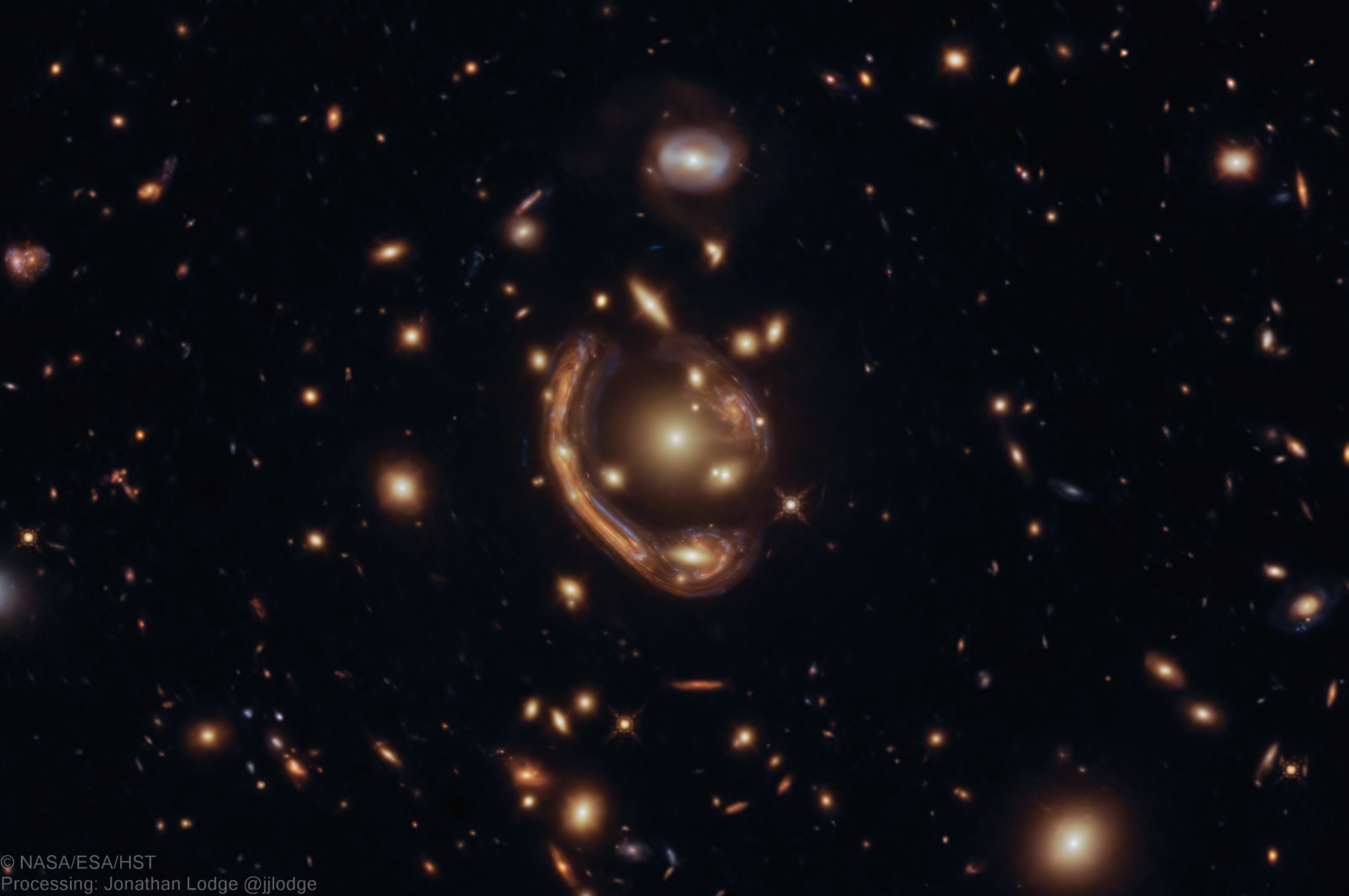
It is difficult to hide a galaxy behind a cluster of galaxies. The closer cluster's gravity will act like a huge lens, pulling images of the distant galaxy around the sides and greatly distorting them. This is just the case observed in the featured image recently re-processed image from the Hubble Space Telescope. The cluster GAL-CLUS-022058c is composed of many galaxies and is lensing the image of a yellow-red background galaxy into arcs seen around the image center. Dubbed a molten Einstein ring for its unusual shape, four images of the same background galaxy have been identified. Typically, a foreground galaxy cluster can only create such smooth arcs if most of its mass is smoothly distributed -- and therefore not concentrated in the cluster galaxies visible. Analyzing the positions of these gravitational arcs gives astronomers a method to estimate the dark matter distribution in galaxy clusters, as well as infer when the stars in these early galaxies began to form.
https://apod.nasa.gov/apod/ap210802.html
https://apod.nasa.gov/apod/ap210823.html
https://science.nasa.gov/missions/hubble/hubble-sees-a-molten-ring/
https://science.nasa.gov/missions/
https://esahubble.org/images/potw2050a/
https://en.wikipedia.org/wiki/Gravitational_lens
https://noirlab.edu/science/programs/ctio/telescopes/soar-telescope/news/gravitational-arcs-galaxy-cluster-abel-370
https://apod.nasa.gov/apod/ap220705.html
#space #galaxy #astrophotography #photography #science #physics #nature #NASA #ESA
Alt...
2022 July 5
The featured image shows a distant galaxy distorted into a giant arc around the center of a galaxy cluster by gravitational lensing.
A Molten Galaxy Einstein Ring
* Image Credit: ESA/Hubble & NASA, S. Jha; Processing: Jonathan Lodge
Explanation:
It is difficult to hide a galaxy behind a cluster of galaxies. The closer cluster's gravity will act like a huge lens, pulling images of the distant galaxy around the sides and greatly distorting them. This is just the case observed in the featured image recently re-processed image from the Hubble Space Telescope. The cluster GAL-CLUS-022058c is composed of many galaxies and is lensing the image of a yellow-red background galaxy into arcs seen around the image center. Dubbed a molten Einstein ring for its unusual shape, four images of the same background galaxy have been identified. Typically, a foreground galaxy cluster can only create such smooth arcs if most of its mass is smoothly distributed -- and therefore not concentrated in the cluster galaxies visible. Analyzing the positions of these gravitational arcs gives astronomers a method to estimate the dark matter distribution in galaxy clusters, as well as infer when the stars in these early galaxies began to form.
Authors & editors: Robert Nemiroff (MTU) & Jerry Bonnell (UMCP)
NASA Official: Phillip Newman Specific rights apply.
NASA Web Privacy Policy and Important Notices
A service of: ASD at NASA / GSFC
& Michigan Tech. U.
A Gallery of Einstein Rings - NASA Science
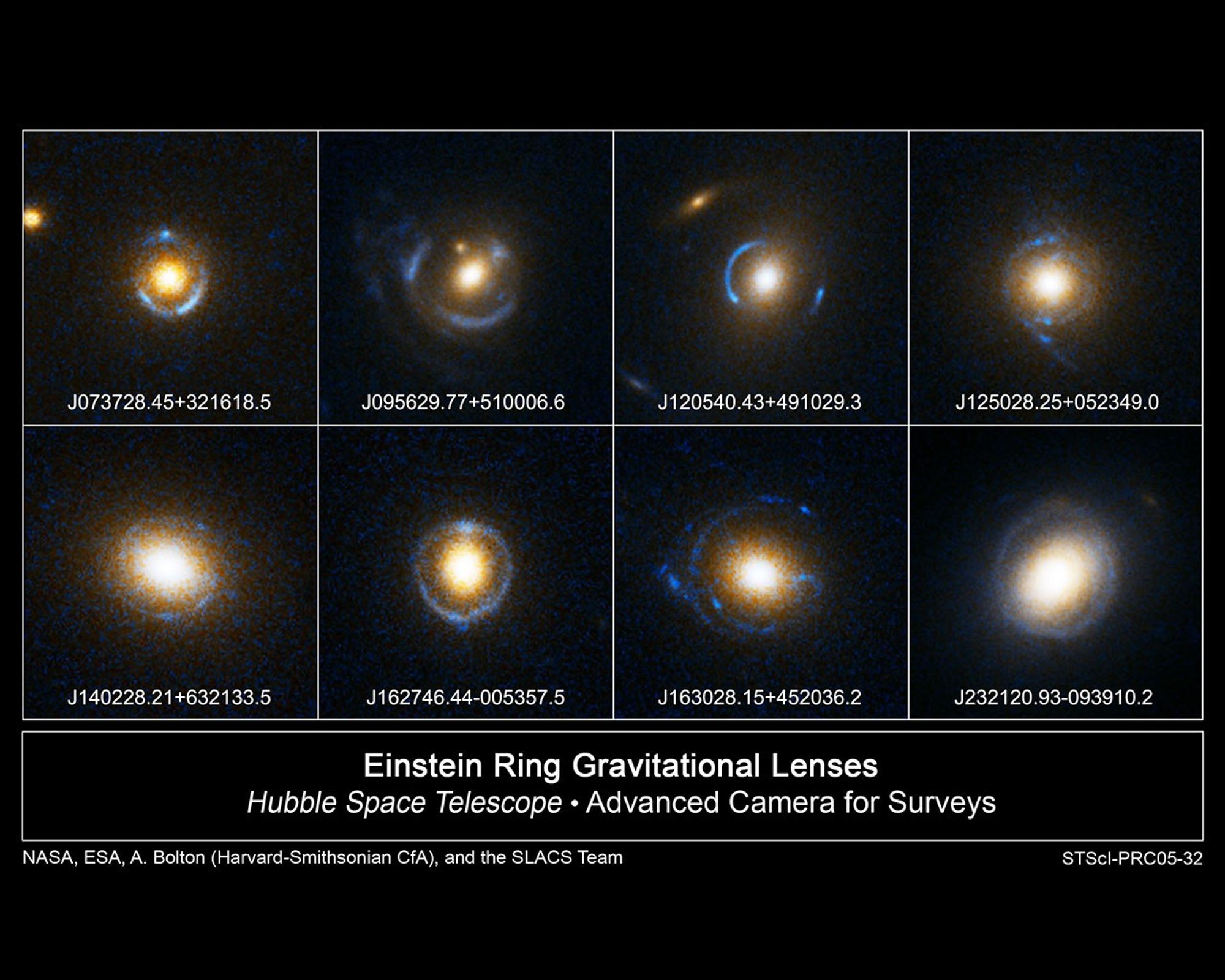
The thin blue bull's-eye patterns in these eight Hubble Space Telescope images appear like neon signs floating over reddish-white blobs. The blobs are giant elliptical galaxies roughly 2 to 4 billion light-years away. The bull's-eye patterns are created as the light from galaxies twice as far away is distorted into circular shapes by the gravity of the giant elliptical galaxies. This phenomenon is called gravitational lensing, first predicted by Albert Einstein almost a century ago. Gravitational lensing occurs when the gravitational field from a massive object warps space and deflects light from a distant object behind it.
The bull's-eye patterns are so-called "Einstein rings," which are the most elegant manifestation of the lensing phenomenon. Einstein rings are produced when two galaxies are almost perfectly aligned, one behind the other.
The images were taken between August 2004 and March 2005 by the Hubble telescope's Advanced Camera for Surveys. They are part of an ongoing survey, called the Sloan Lens ACS (or SLACS) Survey, of about 150 galaxies to hunt for gravitational lenses. So far, the survey has netted 19 new gravitational lenses, adding significantly to the 100 or so previously known lenses. The survey also has identified eight new Einstein rings. Only three such rings had been seen previously in visible light.
Credit:
NASA, ESA, and the SLACS Survey team: A. Bolton (Harvard/ Smithsonian), S. Burles (MIT), L. Koopmans (Kapteyn), T. Treu (UCSB), and L. Moustakas (JPL/Caltech)
https://science.nasa.gov/asset/hubble/a-gallery-of-einstein-rings/
#space #galaxy #astrophotography #photography #science #physics #nature #NASA #ESA
Alt...
A Gallery of Einstein Rings - NASA Science
The Hubble image was created from HST data from proposal 10174. Members of the SLACS team include: A. Bolton (Harvard-Smithsonian CfA), S. Burles (Massachusetts Institute of Technology), L. Koopmans (Kapteyn Astronomical Institute), T. Treu (University of California - Santa Barbara), and L. Moustakas (Jet Propulsion Lab/Caltech).
2022 May 11
Gravity's Grin
* Image Credit: X-ray - NASA / CXC / J. Irwin et al. ;
http://arxiv.org/abs/1505.05501
https://chandra.harvard.edu/
http://chandra.harvard.edu/
* Optical - NASA/STScI
http://www.stsci.edu/
Explanation:
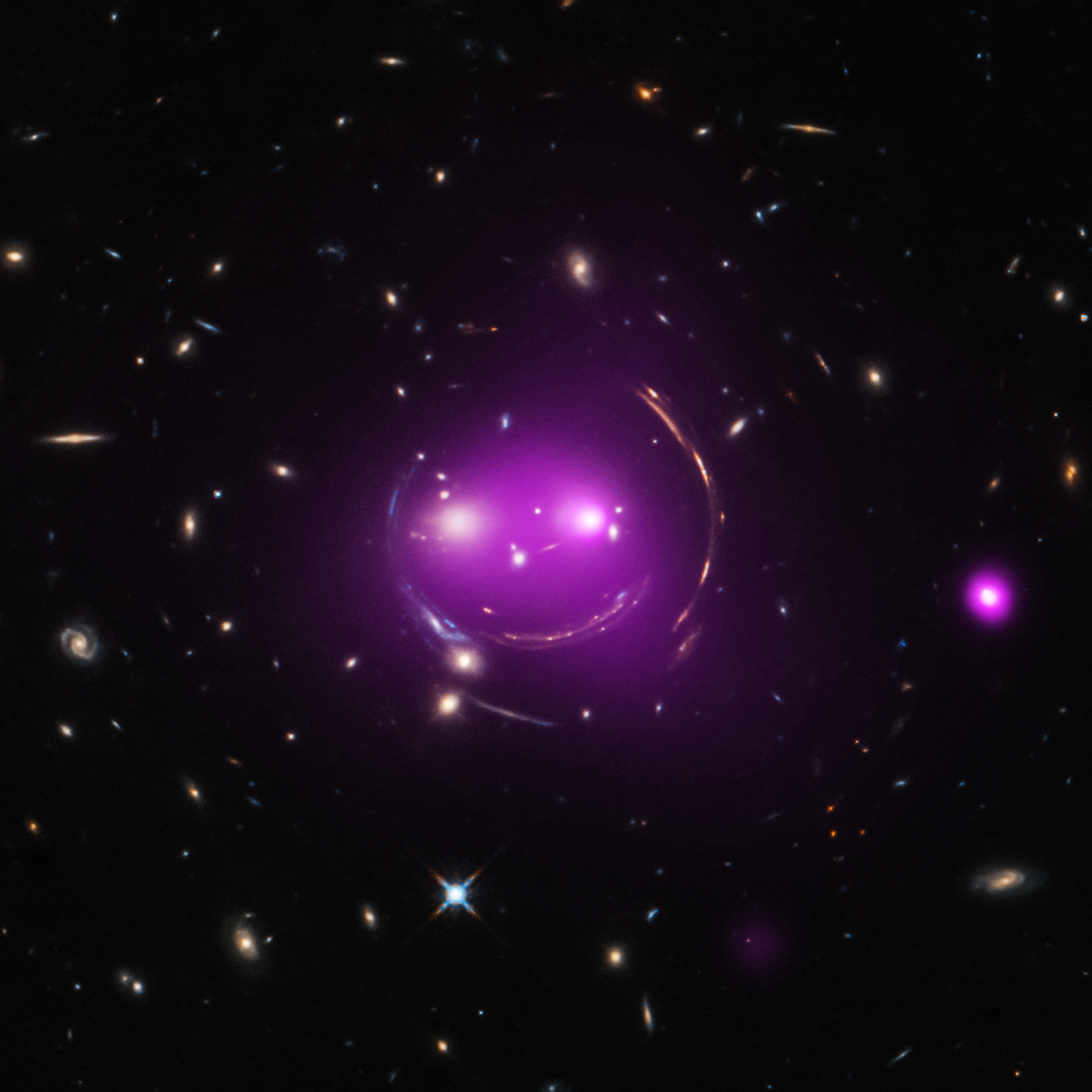
Albert Einstein's general theory of relativity, published over 100 years ago, predicted the phenomenon of gravitational lensing. And that's what gives these distant galaxies such a whimsical appearance, seen through the looking glass of X-ray and optical image data from the Chandra and Hubble space telescopes. Nicknamed the Cheshire Cat galaxy group, the group's two large elliptical galaxies are suggestively framed by arcs. The arcs are optical images of distant background galaxies lensed by the foreground group's total distribution of gravitational mass. Of course, that gravitational mass is dominated by dark matter. The two large elliptical "eye" galaxies represent the brightest members of their own galaxy groups which are merging. Their relative collisional speed of nearly 1,350 kilometers/second heats gas to millions of degrees producing the X-ray glow shown in purple hues. Curiouser about galaxy group mergers? The Cheshire Cat group grins in the constellation Ursa Major, some 4.6 billion light-years away.
https://en.wikipedia.org/wiki/List_of_scientific_publications_by_Albert_Einstein
https://chandra.harvard.edu/photo/2015/cheshirecat/
https://apod.nasa.gov/apod/ap111221.html
https://www.lsst.org/science/dark-matter
https://apod.nasa.gov/apod/ap220511.html
#space #galaxy #astrophotography #photography #science #physics #nature #NASA #ESA
Alt...
2022 May 11
Gravity's Grin
* Image Credit: X-ray - NASA / CXC / J. Irwin et al. ; Optical - NASA/STScI
Explanation:
Albert Einstein's general theory of relativity, published over 100 years ago, predicted the phenomenon of gravitational lensing. And that's what gives these distant galaxies such a whimsical appearance, seen through the looking glass of X-ray and optical image data from the Chandra and Hubble space telescopes. Nicknamed the Cheshire Cat galaxy group, the group's two large elliptical galaxies are suggestively framed by arcs. The arcs are optical images of distant background galaxies lensed by the foreground group's total distribution of gravitational mass. Of course, that gravitational mass is dominated by dark matter. The two large elliptical "eye" galaxies represent the brightest members of their own galaxy groups which are merging. Their relative collisional speed of nearly 1,350 kilometers/second heats gas to millions of degrees producing the X-ray glow shown in purple hues. Curiouser about galaxy group mergers? The Cheshire Cat group grins in the constellation Ursa Major, some 4.6 billion light-years away.
Authors & editors: Robert Nemiroff (MTU) & Jerry Bonnell (UMCP)
NASA Official: Phillip Newman Specific rights apply.
NASA Web Privacy Policy and Important Notices
A service of: ASD at NASA / GSFC
& Michigan Tech. U.
2023 November 10
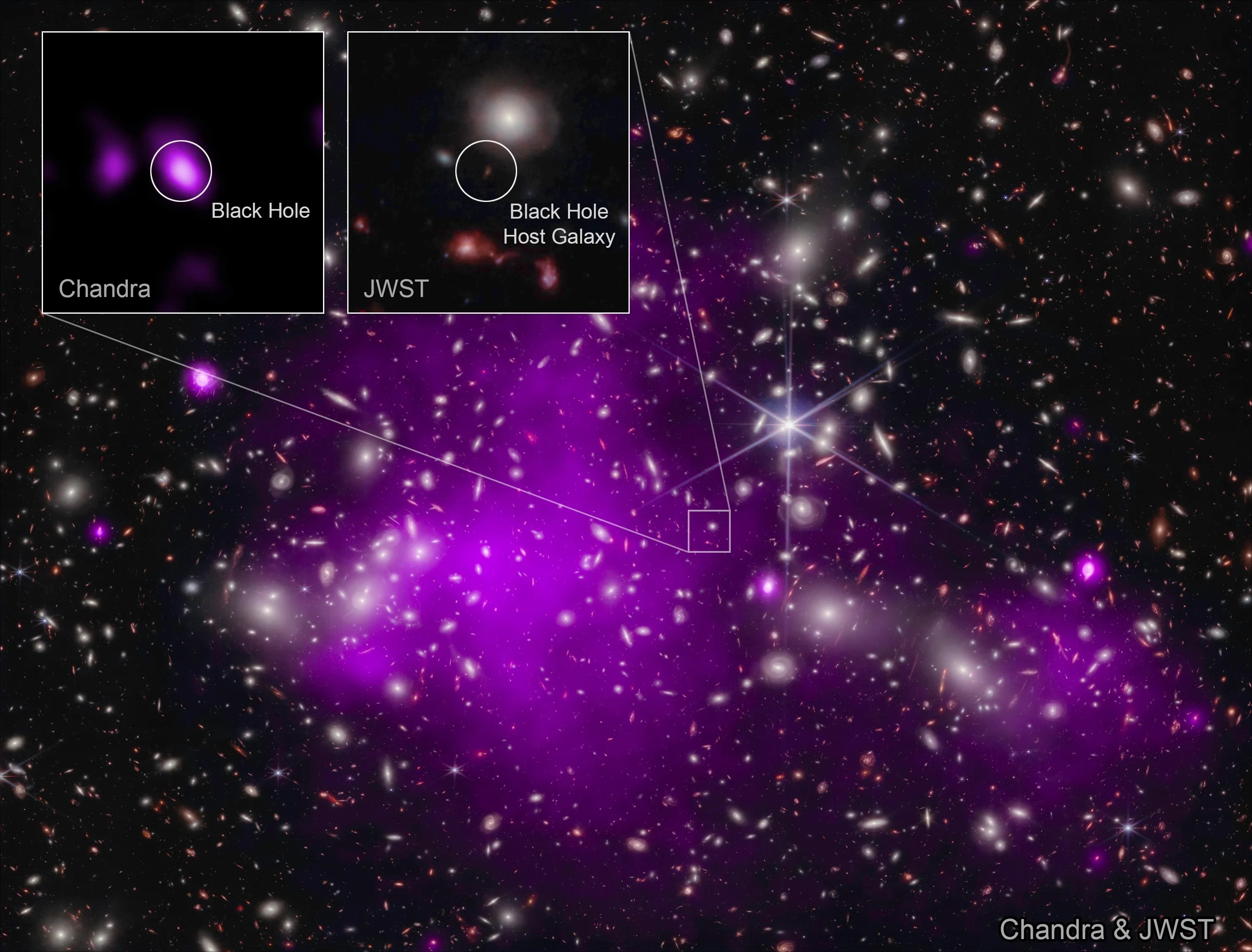
UHZ1: Distant Galaxy and Black Hole
* Image Credit: X-ray: NASA/CXC/SAO/Ákos Bogdán; Infrared: NASA/ESA/CSA/STScI;
https://chandra.harvard.edu/
* Image Processing: NASA/CXC/SAO/L. Frattare & K. Arcand
Explanation:
Dominated by dark matter, massive cluster of galaxies Abell 2744 is known to some as Pandora's Cluster. It lies 3.5 billion light-years away toward the constellation Sculptor. Using the galaxy cluster's enormous mass as a gravitational lens to warp spacetime and magnify even more distant objects directly behind it, astronomers have found a background galaxy, UHZ1, at a remarkable redshift of Z=10.1. That puts UHZ1 far beyond Abell 2744, at a distance of 13.2 billion light-years, seen when our universe was about 3 percent of its current age. UHZ1 is identified in the insets of this composited image combining X-rays (purple hues) from the spacebased Chandra X-ray Observatory and infrared light from the James Webb Space Telescope. The X-ray emission from UHZ1 detected in the Chandra data is the telltale signature of a growing supermassive black hole at the center of the ultra high redshift galaxy. That makes UHZ1's growing black hole the most distant black hole ever detected in X-rays, a result that now hints at how and when the first supermassive black holes in the universe formed.
https://chandra.si.edu/photo/2023/uhz1/
https://webbtelescope.org/contents/news-releases/2023/news-2023-107
https://apod.nasa.gov/apod/ap130408.html
https://arxiv.org/abs/2308.02750
https://arxiv.org/abs/2305.15458
https://apod.nasa.gov/apod/ap231110.html
#space #galaxy #astrophotography #photography #science #physics #nature #NASA #ESA
Alt...
2023 November 10
UHZ1: Distant Galaxy and Black Hole
* Image Credit: X-ray: NASA/CXC/SAO/Ákos Bogdán; Infrared: NASA/ESA/CSA/STScI;
* Image Processing: NASA/CXC/SAO/L. Frattare & K. Arcand
Explanation:
Dominated by dark matter, massive cluster of galaxies Abell 2744 is known to some as Pandora's Cluster. It lies 3.5 billion light-years away toward the constellation Sculptor. Using the galaxy cluster's enormous mass as a gravitational lens to warp spacetime and magnify even more distant objects directly behind it, astronomers have found a background galaxy, UHZ1, at a remarkable redshift of Z=10.1. That puts UHZ1 far beyond Abell 2744, at a distance of 13.2 billion light-years, seen when our universe was about 3 percent of its current age. UHZ1 is identified in the insets of this composited image combining X-rays (purple hues) from the spacebased Chandra X-ray Observatory and infrared light from the James Webb Space Telescope. The X-ray emission from UHZ1 detected in the Chandra data is the telltale signature of a growing supermassive black hole at the center of the ultra high redshift galaxy. That makes UHZ1's growing black hole the most distant black hole ever detected in X-rays, a result that now hints at how and when the first supermassive black holes in the universe formed.
Authors & editors: Robert Nemiroff (MTU) & Jerry Bonnell (UMCP)
NASA Official: Phillip Newman Specific rights apply.
"Let's see what our telescopes are capable of with the help of gravitational lensing:"
Take a Tour of Pandora's Cluster
NASA's James Webb Space Telescope presents a new view of Abell 2744, also known as Pandora's cluster, displaying various depths of space in a single image. Ranging from a foreground star in our own galaxy ... to the mega cluster forming as multiple massive galaxy clusters merge 4 billion light years away ... to the even more distant galaxies behind the cluster, whose light is magnified and distorted by the mega-clusters' warping of space time. Without the cluster's magnification boost, even the Webb Telescope could not see these faint, extremely distant galaxies. Some features that Webb shows distinctly like this dusty red galaxy were not detected at all when the Hubble Space Telescope studied the region. Astronomers are using this image to choose certain galaxies for follow up to get precise distance measurements and details about intriguing features.
This small red dot is a distant source of infrared light that has so far defied characterization. It must be extremely compact because even with the visual stretching caused by the cluster's warped space-time, it still appears as a tiny dot. One theory is that it is a glowing disk of gas surrounding a supermassive Black hole in the early universe. Webb's follow-up observations will further reveal the wonders of Pandora's cluster, and uncover a new understanding of the universe.
Credits
*Video
STScI, Danielle Kirshenblat
* Music
PremiumBeat Music, Klaus Hergersheimer
* Science
Ivo Labbe (Swinburne), Rachel Bezanson (University of Pittsburgh)
* Image Processing
STScI, Alyssa Pagan
https://webbtelescope.org/contents/media/videos/2023/107/01GS5SCDZKWA0Q1MYJ3PHVY3TQ?news=true
#space #galaxy #astrophotography #photography #science #physics #nature #NASA #ESA
NASA Telescopes Discover Record-Breaking Black Hole
The main image of this release features a glimpse of a black hole in an early stage of its development, just 470 million years after the Big Bang.
The composite image shows data from NASA's Chandra X-ray Observatory and James Webb Space Telescope. It features scores of seemingly tiny celestial objects in a sea of black. This is the galaxy cluster Abell 2744. When magnified, the tiny white, orange, and purple celestial objects are revealed to be spiral and elliptical galaxies, and gleaming stars. Many of these colorful specks appear to float in a neon purple cloud of X-ray gas in the center of the image, some 3.5 billion light-years from Earth.
Just to the right of center, at the edge of the purple gas cloud, is a tiny orange speck. This speck is far in the distance, well beyond the Abell galaxy cluster. It represents a galaxy 13.2 billion light-years from Earth containing a supermassive black hole.
In this composite image packed with celestial objects, the tiny orange speck is easily overlooked. Therefore, the main image of the release is also presented fully labelled. In the labelled version of the image, a thin box outlines the distant galaxy, and two enlargements are inset at our upper left. In the enlargement showing Chandra data, a hazy, neon purple oval with a light pink core is shown. This purple oval represents intense X-rays from a growing supermassive black hole estimated to weigh between 10 and 100 million suns. The purple oval is not visible in the composite image because of the way the Chandra data was processed.
This black hole is located in the distant galaxy in the center of the enlargement showing Webb data.
https://chandra.si.edu/photo/2023/uhz1/
* video compressed with
$ ffmpeg -i in.mp4 -vcodec libx265 -crf 20 out.mp4
#space #galaxy #astrophotography #photography #science #physics #nature #NASA #ESA
TOPIC> Gravitational Lensing
starts here:
https://defcon.social/@grobi/114374350096488478
Gravitational Lensing - Nature's Boost
For me, this is the most wonderful scientific statement on the phenomenon of gravitational lensing!
Senior Project Scientist Dr. Jennifer Wiseman calls this 'miracle' 'Nature's Boost'.
See the sparkle in her eyes and hear the enthusiasm in her voice when she explains this phenomenon to us in her understandable and accessible way.
It is not that scientists do not see miracles or are not touched by those .. for them it is just not a sin or a drama to fathom the background to newly discovered phenomena.
* video converted and compressed with
$ ffmpeg -i in.mp4 -vcodec libx265 -crf 25 out.mp4
#space #galaxy #astrophotography #photography #science #physics #nature #NASA #ESA
Gravitational Lensing Today
Excerpts from "Hubble Gravitational Lenses" by Andrea Gianopoulos and "For the First Time Hubble Directly Measures Mass of a Lone White Dwarf" by NASA Hubble Mission Team
Today, Hubble astronomers continue to use the century-old General Relativity/Eddington Experiment to measure distant objects in the universe. For the first time, they measured the mass of a lone white dwarf — the dense, burned-out remnant of a Sun-like star — by seeing how much its gravity deflected the light from a background star. The researchers found that the white dwarf, called LAWD 37, is 56 percent the mass of our Sun, which agrees with earlier theoretical predictions of the white dwarf's mass and corroborated current theories of how white dwarfs evolve as the end product of a typical star's evolution.
When the mass of the lensing object is much larger, like a large galaxy or cluster of galaxies, the effects of gravitational lensing can resemble a house of mirrors. The gravitational lens not only bends and magnifies the light of distant objects, but distorts it in both space and time.
One example of this spacetime distortion lies in the galaxy cluster 0024+1654, seen above. The gravitational lens forms as a result of the cluster's tremendous gravitational field that bends light to magnify, brighten, and stretches the image of a more distant object. How distorted the image becomes and how many copies are made depends on the alignment between the foreground cluster and the more distant galaxy, which is behind the cluster. In this photograph, light from the distant galaxy bends as it passes through the cluster, dividing the galaxy into five separate images. The light also distorted the galaxy's image from a normal spiral shape into a more arc-shaped object.
https://science.nasa.gov/mission/hubble/science/science-behind-the-discoveries/hubble-gravitational-lenses/
https://science.nasa.gov/missions/hubble/for-the-first-time-hubble-directly-measures-mass-of-a-lone-white-dwarf/
#space #galaxy #astrophotography #photography #science #physics #nature #NASA #ESA
Euclid Opens Data Treasure Chest: Insights into the Depths of the Universe ESA's
Euclid mission publishes first survey data.
19. March 2025 Today, the European Space Agency's Euclid mission released its first batch of survey data, including a preview of its deep fields. Here, hundreds of thousands of galaxies in different shapes and sizes are the focus and show an insight into their large-scale arrangement in the cosmic web. The data sharing covers a huge area of the sky in three mosaics. It also includes numerous galaxy clusters, active galactic nuclei and transient phenomena, as well as the first classification study of more than 380 000 galaxies and 500 gravitational lensing candidates compiled by combined artificial intelligence and citizen science initiatives. All this paves the way for the wide range of topics that the detective of the dark universe Euclid will tackle with his extensive data set.
Euclid combines high-resolution imaging with large sky coverage for the first time.
"Euclid's unique observational capabilities could help to better determine the expansion rate of the universe through gravitational-wave observations," explains Miguel Zumalacárregui, group leader in the Department of Astrophysical and Cosmological Relativity at @mpi_grav in the Potsdam Science Park. To this end, the researchers want to correlate gravitational waves measured by @LIGO, Virgo and KAGRA with Euclid's galaxy catalogues. In addition, the large number of gravitational lensing systems discovered by Euclid plays an important role. "Euclid's observations could also be crucial for the detection of the first gravitational waves, which are split into multiple images by gravitational lensing," Zumalacárregui adds.
https://www.aei.mpg.de/1240587/euclid-opens-data-treasure-trove-offers-glimpse-of-deep-fields
#space #galaxy #astrophotography #photography #science #physics #nature #NASA #ESA
Alt...
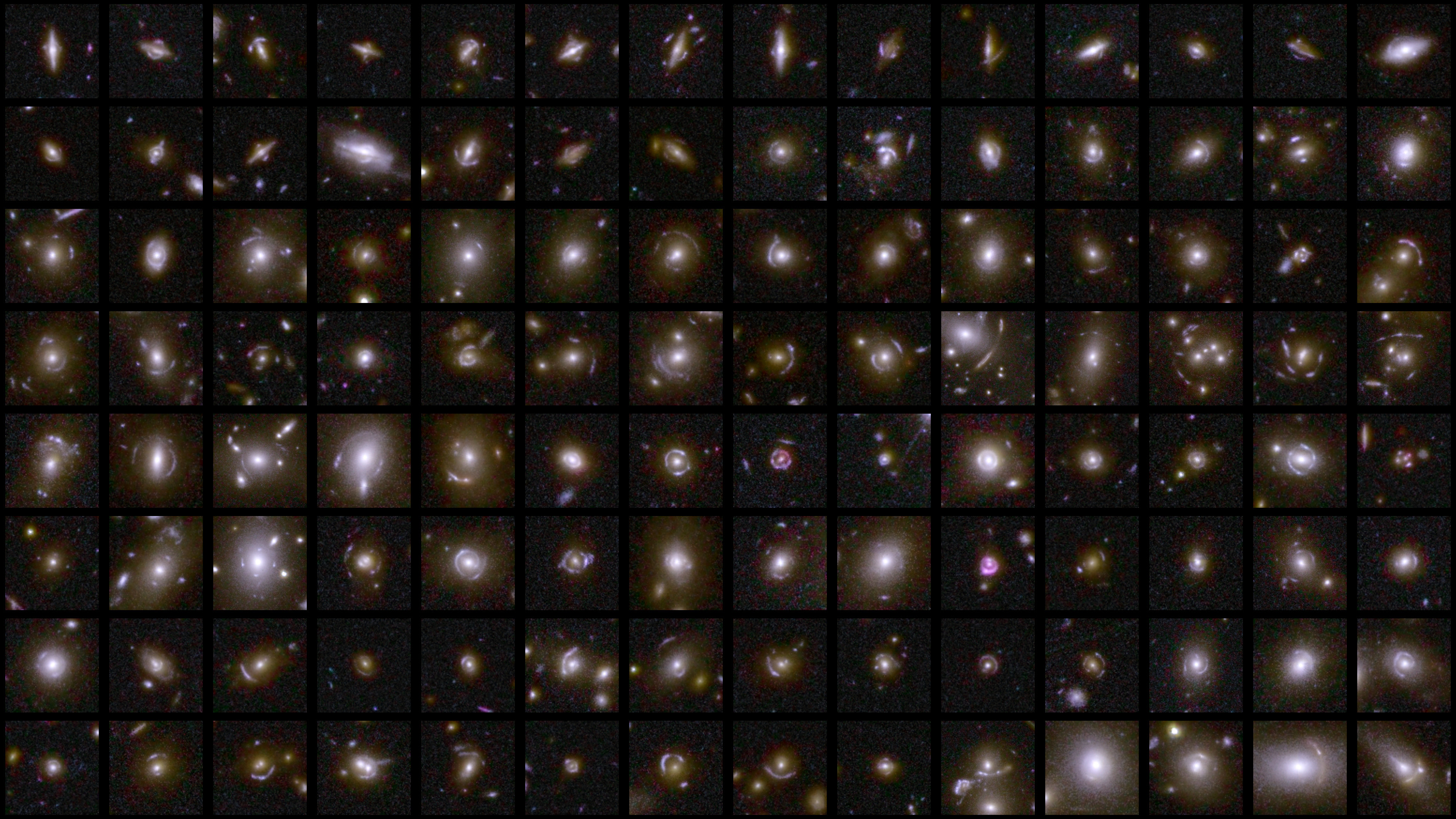
This image shows examples of gravitational lenses that Euclid captured in its first observations of the Deep Field areas.
Using an initial sweep by artificial intelligence models, followed by citizen science inspection, expert vetting and modelling, a first catalogue of 500 galaxy-galaxy strong lens candidates was created, almost all of which were previously unknown. This type of lensing happens when a foreground galaxy and its halo of dark matter acts as a lens, distorting the image of a background galaxy along the line of sight towards Euclid.
With the help of these models, Euclid will capture some 7000 candidates in the major cosmology data release planned for the end of 2026, and in the order of 100 000 galaxy-galaxy strong lenses by the end of the mission, around 100 times more than currently known.
Credits:
ESA/Euclid/Euclid Consortium/NASA,
* image processing by M. Walmsley, M. Huertas-Company, J.-C. Cuillandre
From Wikipedia, the free encyclopedia
A gravitational lens is matter,
such as a cluster of galaxies or a point particle, that bends light from a distant source as it travels toward an observer. The amount of gravitational lensing is described by Albert Einstein's general theory of relativity. If light is treated as corpuscles travelling at the speed of light, Newtonian physics also predicts the bending of light, but only half of that predicted by general relativity.
Orest Khvolson (1924) and Frantisek Link (1936) are generally credited with being the first to discuss the effect in print, but it is more commonly associated with Einstein, who made unpublished calculations on it in 1912 and published an article on the subject in 1936.
In 1937, Fritz Zwicky posited that galaxy clusters could act as gravitational lenses, a claim confirmed in 1979 by observation of the Twin QSO SBS 0957+561.
Unlike an optical lens, a point-like gravitational lens produces a maximum deflection of light that passes closest to its center, and a minimum deflection of light that travels furthest from its center. Consequently, a gravitational lens has no single focal point, but a focal line. The term "lens" in the context of gravitational light deflection was first used by O. J. Lodge, who remarked that it is "not permissible to say that the solar gravitational field acts like a lens, for it has no focal length". If the (light) source, the massive lensing object, and the observer lie in a straight line, the original light source will appear as a ring around the massive lensing object (provided the lens has circular symmetry). If there is any misalignment, the observer will see an arc segment instead.
>>
#space #galaxy #astrophotography #photography #science #physics #nature #NASA #ESA
<<_>>
From Wikipedia, the free encyclopedia
This phenomenon was first mentioned in 1924 by the St. Petersburg physicist Orest Khvolson, and quantified by Albert Einstein in 1936. It is usually referred to in the literature as an Einstein ring, since Khvolson did not concern himself with the flux or radius of the ring image. More commonly, where the lensing mass is complex (such as a galaxy group or cluster) and does not cause a spherical distortion of spacetime, the source will resemble partial arcs scattered around the lens. The observer may then see multiple distorted images of the same source; the number and shape of these depending upon the relative positions of the source, lens, and observer, and the shape of the gravitational well of the lensing object.
[TODAY:
Using an initial sweep by artificial intelligence models, followed by citizen science inspection, expert vetting and modelling, a first catalogue of 500 galaxy-galaxy strong lens candidates was created, almost all of which were previously unknown. This type of lensing happens when a foreground galaxy and its halo of dark matter acts as a lens, distorting the image of a background galaxy along the line of sight towards Euclid.
With the help of these models, Euclid will capture some 7000 candidates in the major cosmology data release planned for the end of 2026, and in the order of 100 000 galaxy-galaxy strong lenses by the end of the mission, around 100 times more than currently known.]
#space #galaxy #astrophotography #photography #science #physics #nature #NASA #ESA
TOPIC> Exoplanets
Searching for other worlds
-- by Anthony Greicius
Fewer than 100 exoplanets have been directly imaged, because most planets are so faint they get lost in the light from their parent star. The other four methods of planet detection are indirect. With the transit method, for instance, astronomers look for a star to dim for a short period as an orbiting planet passes in front of it.
To account for the possibility that something other than an exoplanet is responsible for a particular signal, most exoplanet candidates must be confirmed by follow-up observations, often using an additional telescope, and that takes time. That’s why there is a long list of candidates in the NASA Exoplanet Archive (hosted by NExScI) waiting to be confirmed.
“We really need the whole community working together if we want to maximize our investments in these missions that are churning out exoplanets candidates,” said Aurora Kesseli, the deputy science lead for the NASA Exoplanet Archive at IPAC. “A big part of what we do at NExScI is build tools that help the community go out and turn candidate planets into confirmed planets.”
The rate of exoplanet discoveries has accelerated in recent years (the database reached 5,000 confirmed exoplanets just three years ago), and this trend seems likely to continue. Kesseli and her colleagues anticipate receiving thousands of additional exoplanet candidates from the ESA (European Space Agency) Gaia mission, which finds planets through a technique called astrometry, and NASA’s upcoming Nancy Grace Roman Space Telescope, which will discover thousands of new exoplanets primarily through a technique called gravitational microlensing.
CREDIT:
Jet Propulsion Laboratory, Pasadena, Calif.
#space #exoplanets #astrophotography #photography #science #astronomy #tech #NASA #ESA #education
Alt...
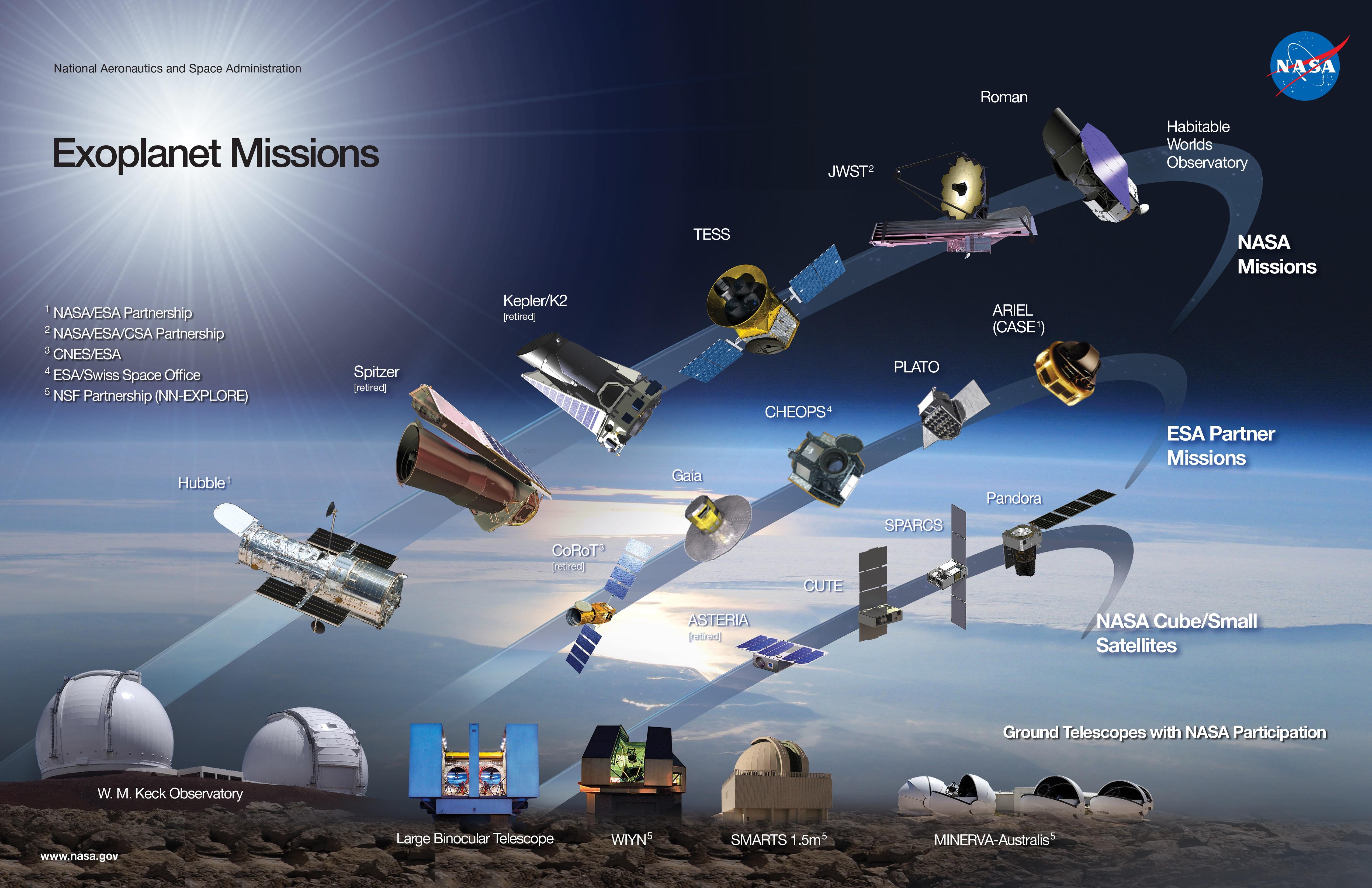
Many telescopes contribute to the search for and study of exoplanets, including some in space (artists concepts shown here) and on the ground. Doing the work are organizations around the world, including ESA (European Space Agency), CSA (Canadian Space Agency), and NSF (National Science Foundation).
CREDIT:
NASA/JPL-Caltech
From Wikipedia, the free encyclopedia
[...]
C/2025 R2 was not discovered earlier in part because of the Holetschek effect as the comet was less than 30 degrees from the Sun between August 7 - September 13. Between August and September the comet had rapidly brightened from magnitude 11 to magnitude 8. The comet is not likely in an outburst, however it is currently unknown how quickly it will dim or if it will completely disintegrate.
C/2025 R2 is officially the 20th comet discovered through SOHO's SWAN instrument according to its discoverer, Vladimir Bezugly.
C/2025 R2 (SWAN) came to perihelion one day after discovery on 12 September 2025 at a distance of 0.5 AU (75 million km) from the Sun. Earth will cross the comet's orbit around 5 October 2025 and it may produce a meteor shower. It will make its closest approach to Earth at a distance of 0.26 AU (39 million km; 24 million mi) on 19 October 2025. It will cross the celestial equator on 3 November 2025.
As the comet was discovered near perihelion, the closest approach to the Sun is reasonably well known. But the aphelion (farthest distance from the Sun) is currently constrained by the low spatial resolution of about 1° per pixel STEREO-A observations in August, and without the STEREO-A observations, there is only a short 4-day observation arc for the orbit determination. Aphelion is anywhere from 60+ AU from the Sun with an orbital period of hundreds to thousands of years. The Minor Planet Center (using observations through September 15th) estimates an orbital period of 1400 years with aphelion around 250 AU, and JPL (using observations through September 14th) estimates an orbital period of 20000 years with aphelion beyond 1000 AU. ..
Text Credits:
Contributors to Wikimedia projects
Image Credit:
Filipp Romanov
https://en.wikipedia.org/wiki/C/2025_R2_(SWAN)
#space #comets #astrophotography #photography #science #astronomy #nature #NASA #ESA #education
Alt...
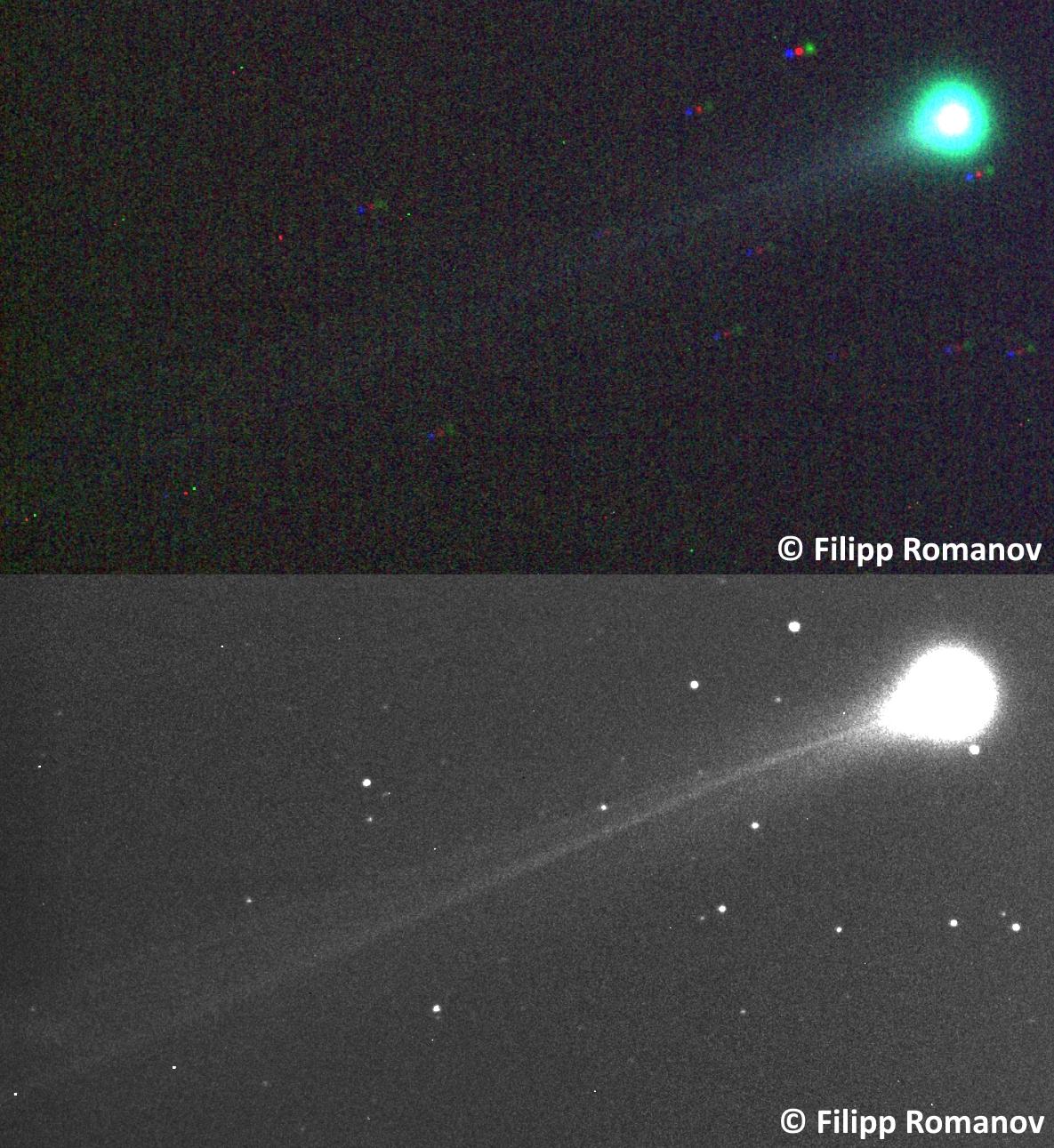
On 2025-09-13 I confirmed the new bright comet SWAN25B remotely using iTelescope.net T59 (0.51-m f/6.8 reflector + CCD) located at the Siding Spring Observatory, Australia. I measured: magnitude of the coma = +8.9 mag., coma diameter = 2 arcminutes with a straight tail (which becomes wider away from the coma) at least 18 arcminutes in length (up to the edge of the frame), PA = 112 degrees. Images: stacked 3x10 sec. (RGB) and single 60 sec. (Luminance filter).
Credit text & image
Filipp Romanov
Comet C/2025 R2 (SWAN) imaged from the Siding Spring Observatory on 13 September 2025 with a 0.5 m (20 in) telescope.
Discovery
Discovered by SOHO–SWAN
Vladimir Bezugly
Discovery date 11 September 2025
Designations Alternative designations
SWAN25B, CK25R020
Orbital characteristics
Epoch 13 September 2025 (JD 2460931.5)
Observation arc 32 days
Earliest precovery date 13 August 2025
Number of observations 83
Aphelion 1600±9000 AU
Perihelion 0.5035±0.0002 AU
Eccentricity 0.999±0.003
Orbital period 1400–20000(?) years
Inclination 4.47°±0.002°
Longitude of ascending node 335.7°
Argument of periapsis 307.77°
Last perihelion 12 September 2025
TJupiter 0.884
Earth MOID 0.047 AU
Jupiter MOID 0.042 AU
Physical characteristics
Comet total
magnitude (M1) 12.4±0.9
Comet nuclear
magnitude (M2) 10±2
Apparent magnitude
6.0
(2025-09-15)
Comet C/2025 R2 (SWAN)
Below the horizon. Rise: 9:47 | Tran: 14:46 | Set: 19:44
Alt: -29.26° Az: 70.51° Direction: East-North-East
Comet C/2025 R2 (SWAN) is in the constellation of Virgo, at a distance of 117,117,474.3 kilometers from Earth. The current Right Ascension is 13h 35m 39s and the Declination is -11° 36’ 24” (apparent coordinates). The latest observed magnitude of comet C/2025 R2 (SWAN) is 7.3 (data provided by COBS).
* URL'S associated with the images:
1. to 2. https://theskylive.com/planetarium?obj=c2025r2
3. 5. 6. https://theskylive.com/c2025r2-tracker
4. https://theskylive.com/3dsolarsystem?obj=c2025r2
On this website you can follow the current data of the comet live:
https://theskylive.com/c2025r2-info
CREDIT
TheSkyLive.com
----
From Wikipedia, the free encyclopedia:
C/2025 R2 (SWAN)
C/2025 R2 (SWAN), formerly known as SWAN25B, is a non-periodic comet discovered on 11 September 2025 by Vladimir Bezugly through SWAN imagery. As of 17 September 2025, the comet has an apparent magnitude of +6.9 with a solar elongation of 30 degrees and is observable near the star Spica in 50 mm (2.0 in) binoculars. It is better seen from the Southern hemisphere.
Observational history
The comet was first spotted in images from the SWAN instrument onboard the Solar and Heliospheric Observatory (SOHO) by amateur astronomer Vladimir Bezugly on 11 September 2025. The presence of the comet was confirmed by other amateur astronomers, having an estimated magnitude of 7.4 and featuring a tail about 2 degrees long. The comet upon discovery was located in the constellation of Virgo and it was better seen from the southern hemisphere as it was higher in the sky after sunset.
[...]
Please read more in next post.
Text Credits:
Contributors to Wikimedia projects
#space #comets #astrophotography #photography #science #astronomy #nature #NASA #ESA #education
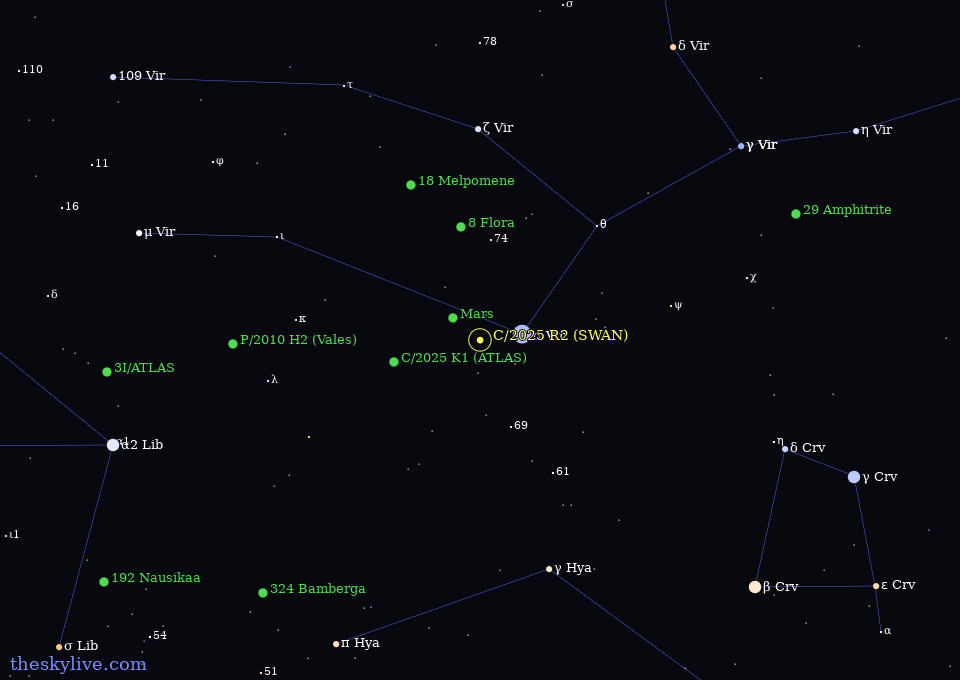
Alt...
Star map showing the position of comet C/2025 R2 (SWAN) in the constellation of Virgo on September 18, 2025. Field of view: 50x30 degrees.
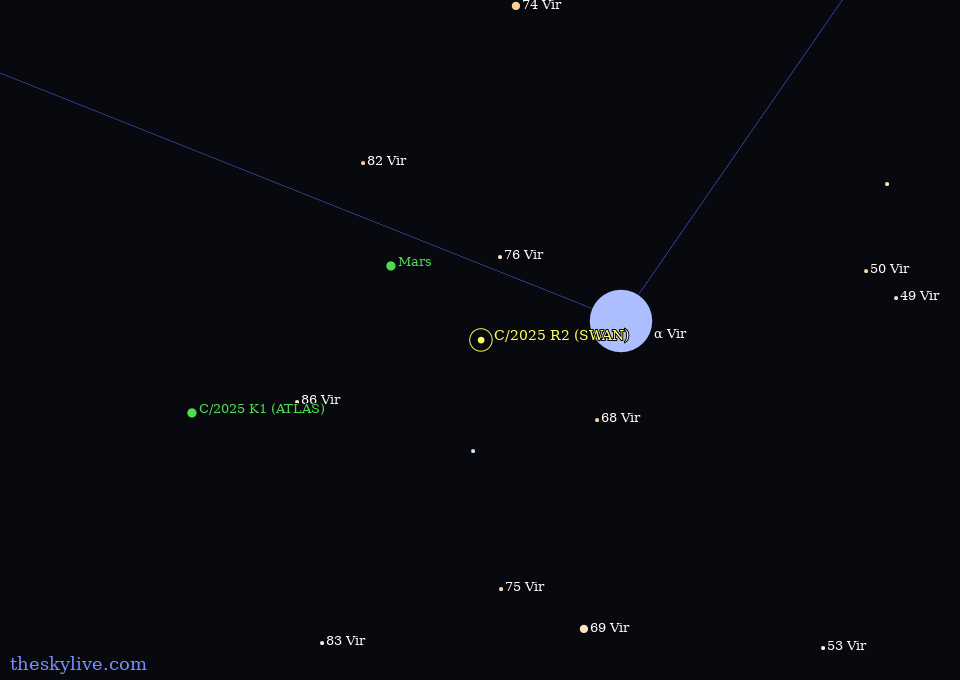
Alt...
Star map showing the position of comet C/2025 R2 (SWAN) in the constellation of Virgo on September 18, 2025. Field of view: 15x9 degrees.
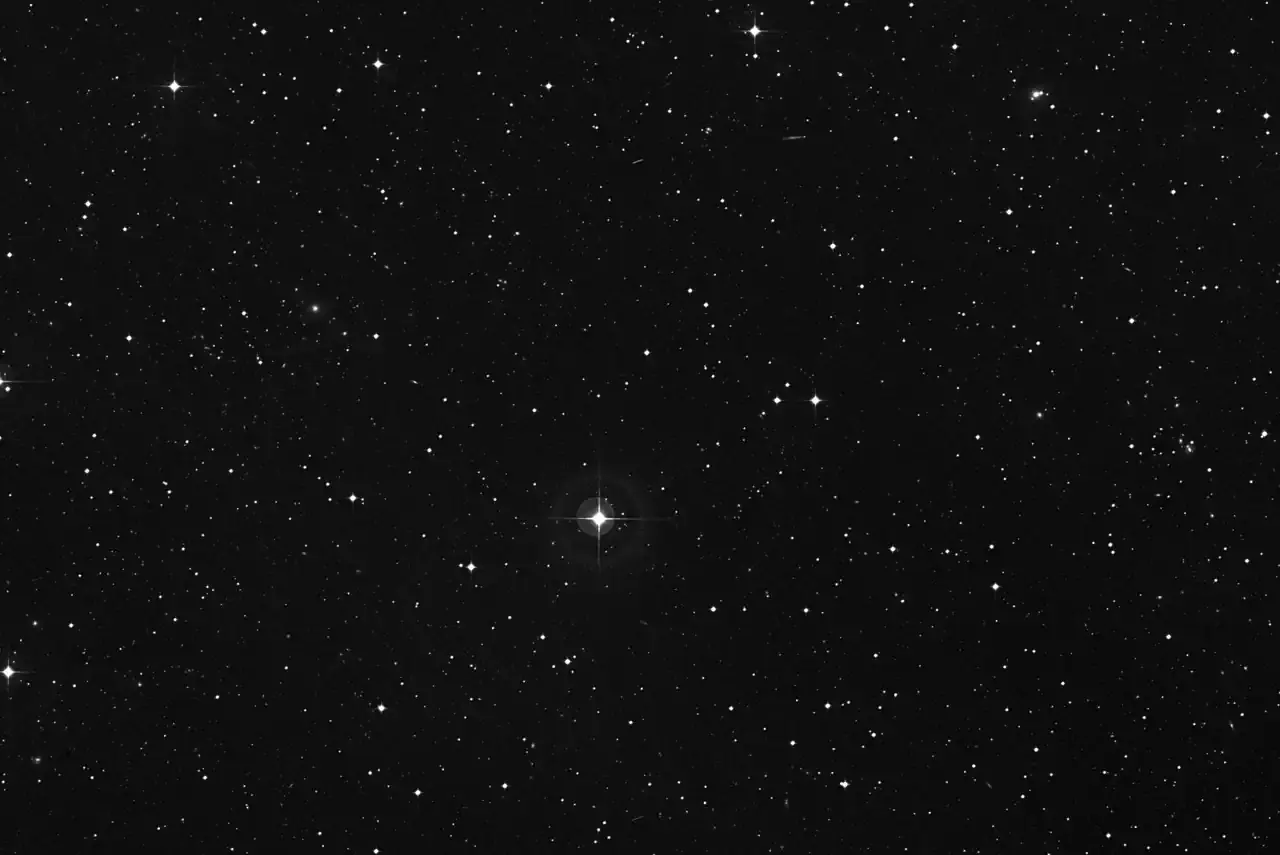
Alt...
Simplified high-resolution deep sky chart showing the current position of comet C/2025 R2 (SWAN). Field of view: 60 x 40 arcminutes.
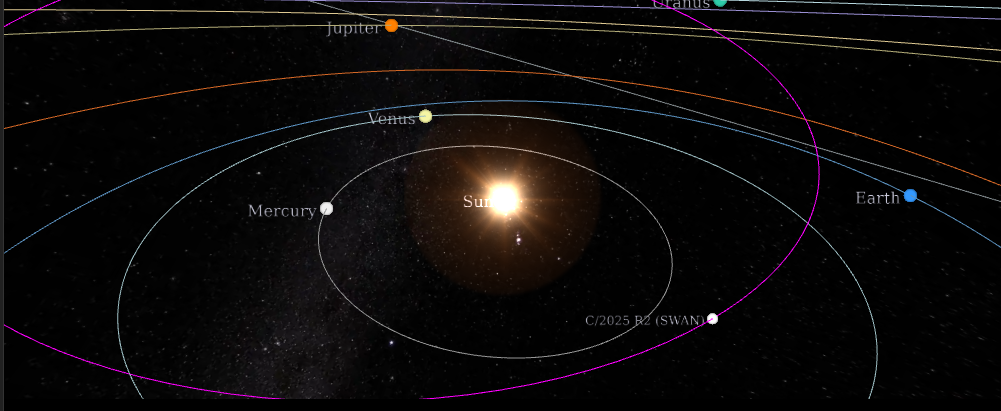
Alt...
3D animated visualization of the orbit of comet C/2025 R2 (SWAN) relative to the other major objects in the Solar System.
Alt...
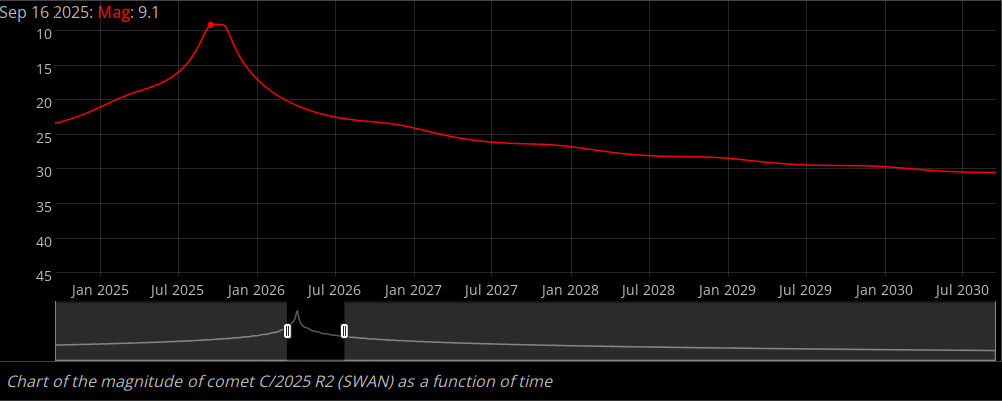
Light curve of comet C/2025 R2 (SWAN), i.e., its apparent magnitude as a function of time. The curve is calculated using the latest ephemerides provided by JPL Horizons. The magnitude data is sampled with the interval of 2 days. Because of this sampling, inaccuracies may occur for objects that have large variations of brightness over a few days. For comets, large discrepancies can arise between the calculated brightness and the observations due to their highly dynamic, and not always precisely predictable, behavior.
Alt...
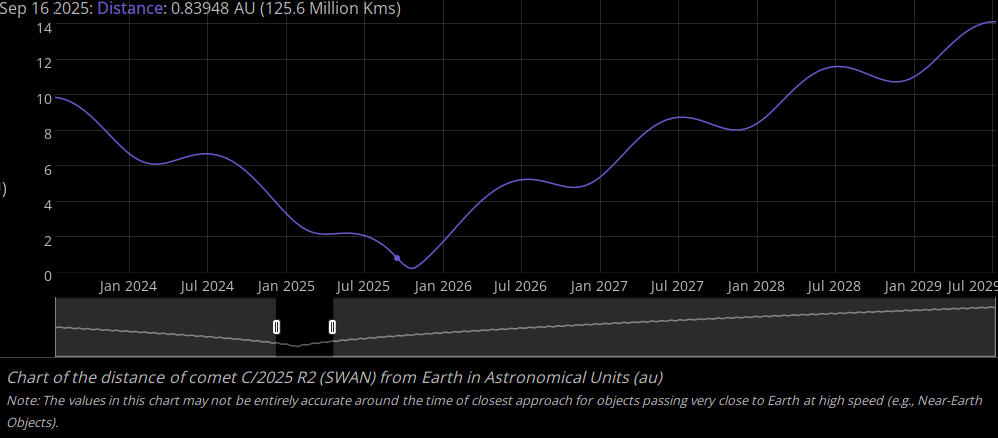
Distance of comet C/2025 R2 (SWAN) from Earth as a function of time. In the chart the distance is measured in Astronomical Units and the data is sampled with an interval of 1 day.
https://theskylive.com/3dsolarsystem?obj=c2025r2
Interactive 3D Orbit Visualization
#space #comets #astrophotography #photography #science #astronomy #nature #NASA #ESA #education
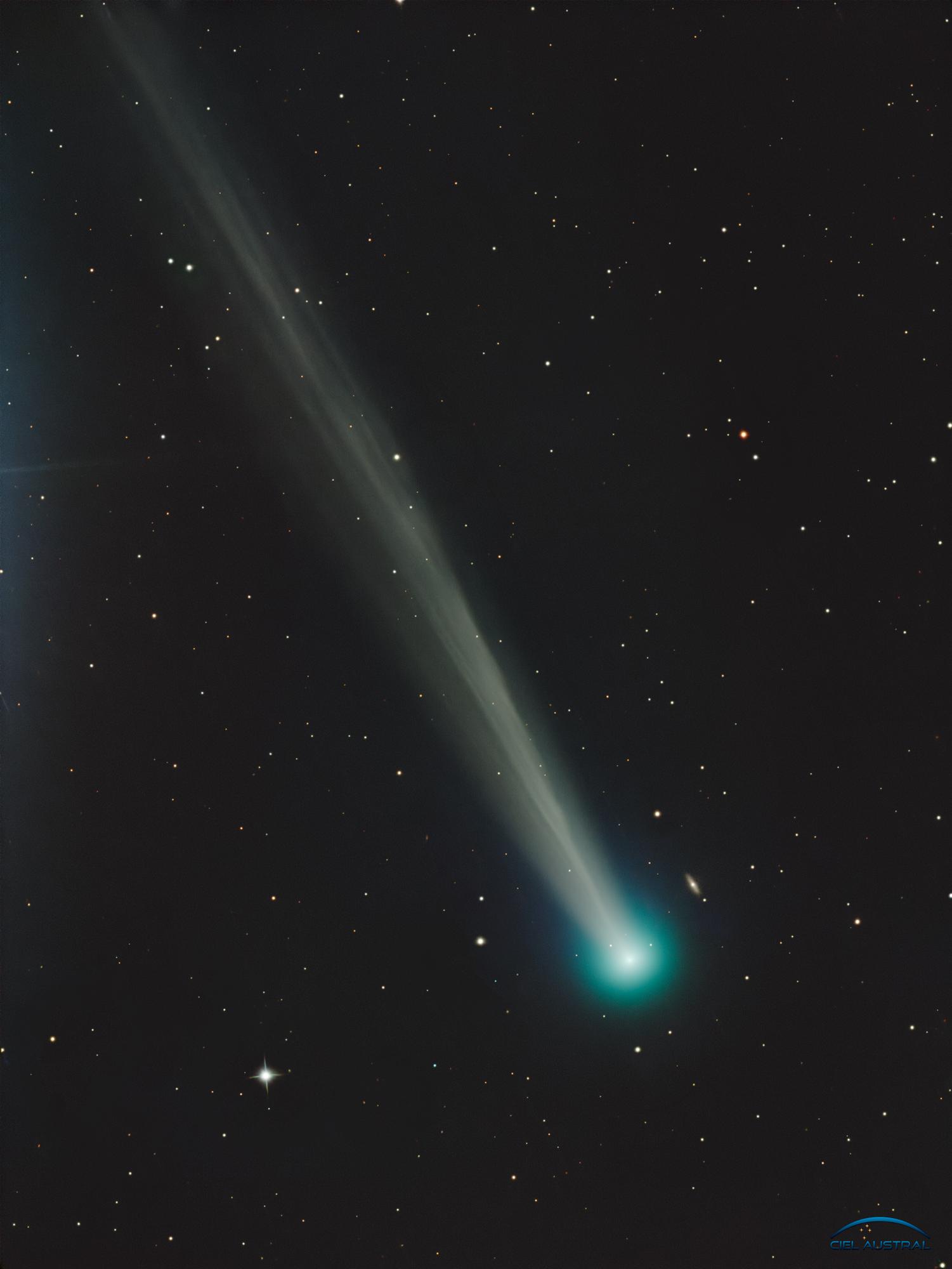
2025 September 18
Comet C/2025 R2 (SWAN)
* Image Credit & Copyright: Team Ciel Austral
https://www.cielaustral.com/
Explanation:
A new visitor from the outer Solar System, comet C/2025 R2 (SWAN) also known as SWAN25B was only discovered late last week, on September 11. That's just day before the comet reached perihelion, its closest approach to the Sun. First spotted by Vladimir Bezugly in images from the SWAN instrument on the sun-staring SOHO spacecraft, the comet was surprisingly bright but understandably difficult to see against the Sun's glare. Still close to the Sun on the sky, the greenish coma and tail of C/2025 R2 (SWAN) are captured in this telescopic snapshot from September 17. Spica, alpha star of the constellation Virgo, shines just beyond the upper left edge of the frame while the comet is about 6.5 light-minutes from planet Earth. Near the western horizon after sunset and slightly easier to see in binoculars from the southern hemisphere, this comet SWAN will pass near Zubenelgenubi, alpha star of Libra, on October 2. C/2025 R2 (SWAN) is scheduled to make its closest approach to our fair planet around October 20.
https://app.astrobin.com/i/i5qsgj
https://earthsky.org/space/new-comet-swan25b-2025/
https://cobs.si/obs_list?id=2659
https://en.wikipedia.org/wiki/C/2025_R2_(SWAN)#Observational_history
https://spaceplace.nasa.gov/comets/en/
https://science.nasa.gov/mission/soho/
https://apod.nasa.gov/apod/ap250918.html
#space #comets #astrophotography #photography #science #astronomy #nature #NASA #ESA #education
Alt...
2025 September 18
Comet C/2025 R2 (SWAN)
* Image Credit & Copyright: Team Ciel Austral
Explanation:
A new visitor from the outer Solar System, comet C/2025 R2 (SWAN) also known as SWAN25B was only discovered late last week, on September 11. That's just day before the comet reached perihelion, its closest approach to the Sun. First spotted by Vladimir Bezugly in images from the SWAN instrument on the sun-staring SOHO spacecraft, the comet was surprisingly bright but understandably difficult to see against the Sun's glare. Still close to the Sun on the sky, the greenish coma and tail of C/2025 R2 (SWAN) are captured in this telescopic snapshot from September 17. Spica, alpha star of the constellation Virgo, shines just beyond the upper left edge of the frame while the comet is about 6.5 light-minutes from planet Earth. Near the western horizon after sunset and slightly easier to see in binoculars from the southern hemisphere, this comet SWAN will pass near Zubenelgenubi, alpha star of Libra, on October 2. C/2025 R2 (SWAN) is scheduled to make its closest approach to our fair planet around October 20.
Authors & editors: Robert Nemiroff (MTU) & Jerry Bonnell (UMCP)
NASA Official: Amber Straughn Specific rights apply.
NASA Web Privacy, Accessibility, Notices;
A service of: ASD at NASA / GSFC,
NASA Science Activation
& Michigan Tech. U.
2025 September 15
Earth During a Powerful Solar Storm
* Video Credit: NASA's SVS, SWRC, CCMC, SWMF; T. Bridgman et al.
https://www.nasa.gov/
https://svs.gsfc.nasa.gov/
https://science.gsfc.nasa.gov/heliophysics/spaceweather
https://ccmc.gsfc.nasa.gov/
https://clasp.engin.umich.edu/research/theory-computational-methods/space-weather-modeling-framework/
https://svs.gsfc.nasa.gov/search/?people=Tom%20Bridgman
https://svs.gsfc.nasa.gov/4189/
Explanation:
Can our Sun become dangerous? Yes, sometimes. Every few years our Sun ejects a scary-large bubble of hot gas into the Solar System. Every hundred years or so, when the timing, location, and magnetic field connections are just right, such a Coronal Mass Ejection (CME) will hit the Earth. When this happens, the Earth not only experiences dramatic auroras, but its magnetic field gets quickly pushed back and compressed, which causes electric grids to surge. Some of these surges could be dangerous, affecting satellites and knocking out power grids -- which can take months to fix. Just such a storm -- called the Carrington Event -- occurred in 1859 and caused telegraph wires to spark. A similar CME passed near the Earth in 2012, and the featured animated video shows a computer model of what might have happened if it had been a direct hit. In this model, the Earth's magnetopause becomes so compressed that it went inside the orbit of geosynchronous communication satellites.
https://apod.nasa.gov/apod/ap250915.html
#space #sun #astrophotography #photography #science #astronomy #physics #nature #NASA
TOPIC> Our Sun
2025 July 30
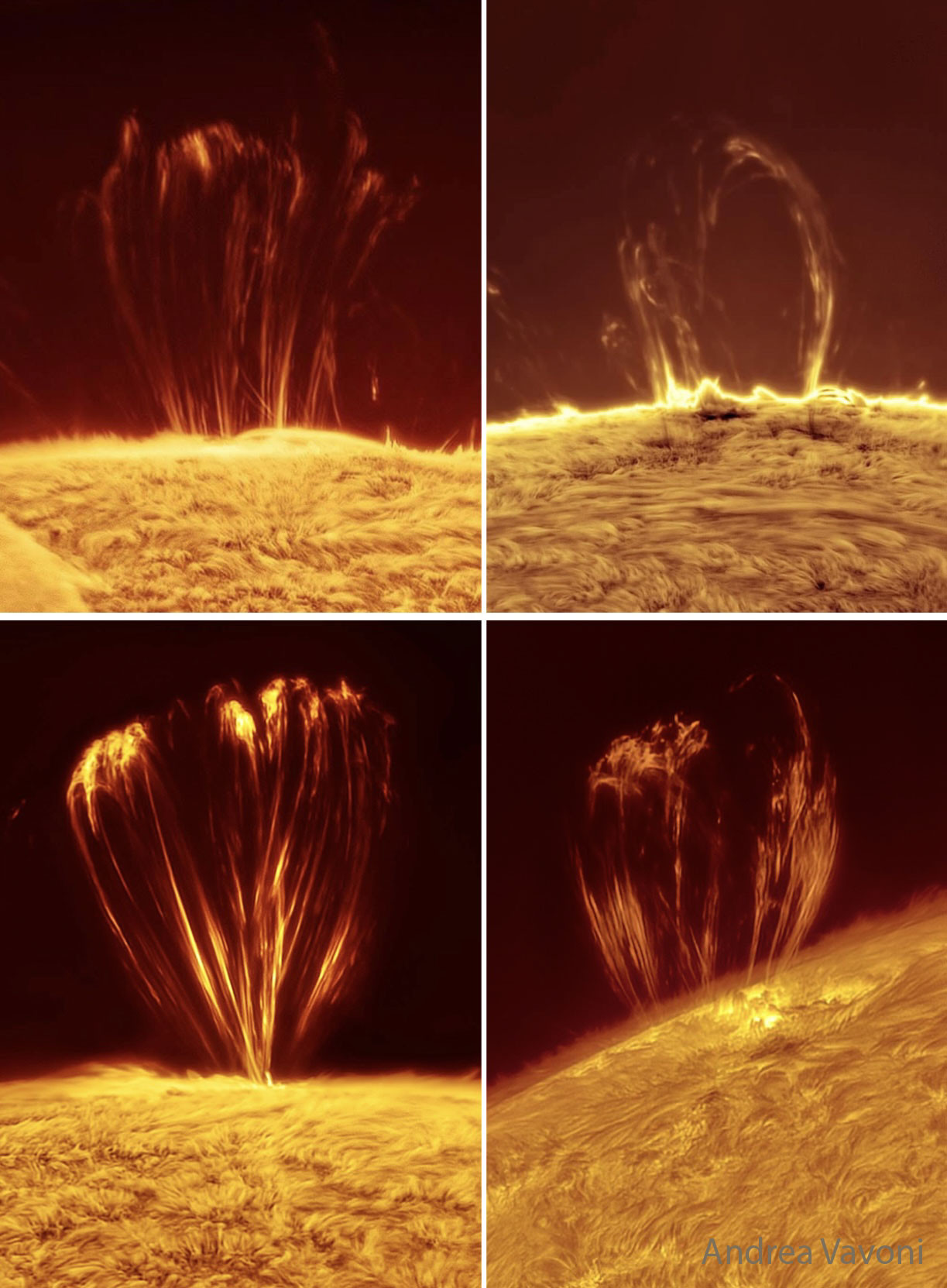
Four images of the Sun's edge are shown. In each a loop of bright material is captured above the Sun's surface.
Coronal Loops on the Sun
* Image Credit & Copyright: Andrea Vanoni
https://andreavanoni.wixsite.com/astrophotography/su-di-me
Explanation:
Our Sun frequently erupts in loops. Hot solar plasma jumps off the Sun's surface into prominences, with the most common type of prominence being a simple loop. The loop shape originates from the Sun's magnetic field, which is traced by spiraling electrons and protons. Many loops into the Sun's lower corona are large enough to envelop the Earth and are stable enough to last days. They commonly occur near active regions that also include dark sunspots. The featured panel shows four loops, each of which was captured near the Sun's edge during 2024 and 2025. The images were taken by a personal telescope in Mantova, Italy and in a very specific color of light emitted primarily by hydrogen. Some solar prominences suddenly break open and eject particles into the Solar System, setting up a space weather sequence that can affect the skies and wires of Earth.
https://science.nasa.gov/sun/
https://science.nasa.gov/solar-system/
SpacePlace:
https://spaceplace.nasa.gov/all-about-the-sun/en/
https://youtu.be/2g1epPppIOM
https://spaceplace.nasa.gov/spaceweather/en/
https://apod.nasa.gov/apod/ap250730.html
#space #sun #astrophotography #photography #science #astronomy #physics #nature #NASA
Alt...
2025 July 30
Four images of the Sun's edge are shown. In each a loop of bright material is captured above the Sun's surface.
Coronal Loops on the Sun
* Image Credit & Copyright: Andrea Vanoni
Explanation:
Our Sun frequently erupts in loops. Hot solar plasma jumps off the Sun's surface into prominences, with the most common type of prominence being a simple loop. The loop shape originates from the Sun's magnetic field, which is traced by spiraling electrons and protons. Many loops into the Sun's lower corona are large enough to envelop the Earth and are stable enough to last days. They commonly occur near active regions that also include dark sunspots. The featured panel shows four loops, each of which was captured near the Sun's edge during 2024 and 2025. The images were taken by a personal telescope in Mantova, Italy and in a very specific color of light emitted primarily by hydrogen. Some solar prominences suddenly break open and eject particles into the Solar System, setting up a space weather sequence that can affect the skies and wires of Earth.
Authors & editors: Robert Nemiroff (MTU) & Jerry Bonnell (UMCP)
NASA Official: Amber Straughn Specific rights apply.
NASA Web Privacy, Accessibility, Notices;
A service of: ASD at NASA / GSFC,
NASA Science Activation
& Michigan Tech. U.
2024 August 18
A Solar Prominence Eruption from SDO
* Image Credit: NASA/Goddard/SDO AIA Team
https://www.nasa.gov/
https://www.nasa.gov/goddard
https://sdo.gsfc.nasa.gov/
Explanation:
One of the most spectacular solar sights is an erupting prominence. In 2011, NASA's Sun-orbiting Solar Dynamic Observatory spacecraft imaged an impressively large prominence erupting from the surface. The dramatic explosion was captured in ultraviolet light in the featured time lapse video covering 90 minutes, where a new frame was taken every 24 seconds. The scale of the prominence is huge -- the entire Earth would easily fit under the flowing curtain of hot gas. A solar prominence is channeled and sometimes held above the Sun's surface by the Sun's magnetic field. A quiescent prominence typically lasts about a month and may erupt in a Coronal Mass Ejection (CME) expelling hot gas into the Solar System. The energy mechanism that creates a solar prominence is a continuing topic of research. Our Sun is again near solar maximum and so very active, featuring numerous erupting prominences and CMEs, one of which resulted in picturesque auroras just over the past week.
TOPIC> Auroras
https://defcon.social/@grobi/114646611195811889
https://apod.nasa.gov/apod/ap240818.html
#space #sun #astrophotography #photography #science #astronomy #physics #nature #NASA
Released Thursday, July 10, 2025
The Closest Images Ever Taken of the Sun’s Atmosphere
On its record-breaking pass by the Sun in December 2024, NASA’s Parker Solar Probe captured stunning new images from within the Sun’s atmosphere. These newly released images — taken closer to the Sun than we’ve ever been before — are helping scientists better understand the Sun’s influence across the solar system, including events that can affect Earth.
Parker Solar Probe started its closest approach to the Sun on Dec. 24, 2024, flying just 3.8 million miles from the solar surface. As it skimmed through the Sun’s outer atmosphere, called the corona, in the days around the perihelion, it collected data with an array of scientific instruments, including the Wide-Field Imager for Solar Probe, or WISPR.
Learn more - https://science.nasa.gov/science-research/heliophysics/nasas-parker-solar-probe-snaps-closest-ever-images-to-sun/
Credits:
NASA's Goddard Space Flight Center
NASA Scientific Visualization Studio
#space #sun #astrophotography #photography #science #astronomy #physics #nature #NASA
Alt...
Released Thursday, July 10, 2025
The Closest Images Ever Taken of the Sun’s Atmosphere
On its record-breaking pass by the Sun in December 2024, NASA’s Parker Solar Probe captured stunning new images from within the Sun’s atmosphere. These newly released images — taken closer to the Sun than we’ve ever been before — are helping scientists better understand the Sun’s influence across the solar system, including events that can affect Earth.
Parker Solar Probe started its closest approach to the Sun on Dec. 24, 2024, flying just 3.8 million miles from the solar surface. As it skimmed through the Sun’s outer atmosphere, called the corona, in the days around the perihelion, it collected data with an array of scientific instruments, including the Wide-Field Imager for Solar Probe, or WISPR.
Learn more - https://science.nasa.gov/science-research/heliophysics/nasas-parker-solar-probe-snaps-closest-ever-images-to-sun/
Credits:
NASA's Goddard Space Flight Center
NASA Scientific Visualization Studio
2025 August 11
Closest Ever Images Near the Sun
* Video Credit: NASA, JHUAPL, Naval Research Lab, Parker Solar Probe
https://www.nasa.gov/
https://www.jhuapl.edu/
https://www.nrl.navy.mil/
https://www.nasa.gov/content/goddard/parker-solar-probe
Explanation:
Everybody sees the Sun. Nobody's been there. Starting in 2018, though, NASA launched the robotic Parker Solar Probe (PSP) to investigate regions near to the Sun for the first time. The featured time-lapse video shows the view looking sideways from behind PSP's Sun shield in December during the closest approach of any human-made spacecraft to the Sun, looping down to only about five solar diameters above the Sun's hot surface. The PSP's Wide Field Imager for Solar Probe (WISPR) cameras took these images over seven hours, but they are digitally compressed here into about 5 seconds. The solar corona, including colliding coronal mass ejections (CMEs), is visible here in unprecedented detail, with stars passing far in the background. The Sun is not only Earth's dominant energy source, but its variable solar wind also compresses Earth's atmosphere, triggers auroras, affects power grids, and can even damage orbiting communication satellites.
https://svs.gsfc.nasa.gov/14865
https://parkersolarprobe.jhuapl.edu/
https://apod.nasa.gov/apod/ap180815.html
https://www.nature.com/articles/d41586-019-03665-3
https://science.nasa.gov/science-research/heliophysics/nasas-parker-solar-probe-snaps-closest-ever-images-to-sun/
https://en.wikipedia.org/wiki/Parker_Solar_Probe#Timeline
https://www.nasa.gov/image-article/what-coronal-mass-ejection-or-cme/
https://apod.nasa.gov/apod/ap000318.html
https://hesperia.gsfc.nasa.gov/rhessi3/mission/science/the-impact-of-flares/index.html
https://apod.nasa.gov/apod/ap250811.html
#space #sun #astrophotography #photography #science #astronomy #physics #nature #NASA
This animation shows all L3 WISPR full-field observations from the twenty-first PSP Mission Encounter (2024-09-25 - 2024-10-05). We have superimposed a grid showing helioprojective longitude and latitude, and a scale representation of the size and location of the Sun in the observations using the SDO/HMI Carrington map for this time period. The velocity and distance metrics displayed on the movies correspond respectively to the spacecraft's heliocentric velocity in kilometers per second, and its distance from the Sun's center in units of solar radii (where 1 solar radius = 695,700km). The "FOV Range" label provides the plane-of-sky distance limits of the inner and outermost edges of the fields of view, in units of solar radii. The horizontal blue line indicates the orbital plane of PSP. The timespan of this composite movie covers only the nominal science window when the spacecraft was within 0.25 au; a limited amount of data outside of this range may be available at the below links.
You can download this movie directly as an 101MB mp4 file. This sequence is also available as data processed via the LW Algorithm developed by Dr. Guillermo Stenborg (JHUAPL) and detailed in Appendix A of Howard et al. 2022 (ApJ, 936, id.43. DOI 10.3847/1538-4357/ac7ff5). Please contact the team for access to this data, which will be posted here one year after the acquisition of those observations. Team contact information can be found in Section 1.2 of the WISPR User's Guide
** https://wispr.nrl.navy.mil/sites/wispr.nrl.navy.mil/files/wispr_data_user_guide_v3.pdf [PDF link].
Credit:
* NASA/NRL/JHUAPL.
* Movie processed/compiled by Guillermo Stenborg (JHUAPL) and Karl Battams (NRL).
* SDO inset courtesy of NASA/SDO and the AIA, EVE, and HMI science teams.
/*grobi: this is a compressed and converted video-file for a better resolution go to:
** https://wispr.nrl.navy.mil/encounter21-summary (but that's a huge file !:D )
** the servers could be temporarily under maintenance
#space #sun #parker #astrophotography #photography #science #astronomy #physics #nature #NASA
2025 August 26
A Leaky Solar Prominence
Video Credit & Copyright: Andrea Girones
https://andreagirones.com/
Explanation:
What's hovering above the Sun? A solar prominence. A prominence is a crest of hot gas expelled from the Sun's surface that is held aloft by the Sun's magnetic field. Prominences can last for days, can suddenly explode into space, or just fall back to the Sun. What decides a prominence's fate is how the Sun's complex magnetic field changes -- the field's direction can act like an offramp for trapped solar particles. The 3-second (repeating) time-lapse featured video was captured earlier this month from Ottawa, Ontario, Canada. It shows the development of a larger-than-Earth prominence as it appears to leak solar plasma back to the Sun, over the course of an hour. What is unusual is that the prominence appears to hover -- more simple and typical prominences form magnetic loops that connect back to the surface. Many hours after this video ended, the hovering prominence disintegrated back into the Sun.
https://www.nasa.gov/image-article/what-solar-prominence/
https://solarscience.msfc.nasa.gov/the_key.shtml
https://apod.nasa.gov/apod/ap250826.html
#space #sun #astrophotography #photography #science #astronomy #physics #nature #NASA
2025 September 13
Star Trails over One-Mile Radio Telescope
* Image Credit & Copyright: Joao Yordanov Serralheiro
https://www.joaoysphotography.com/about
Explanation:
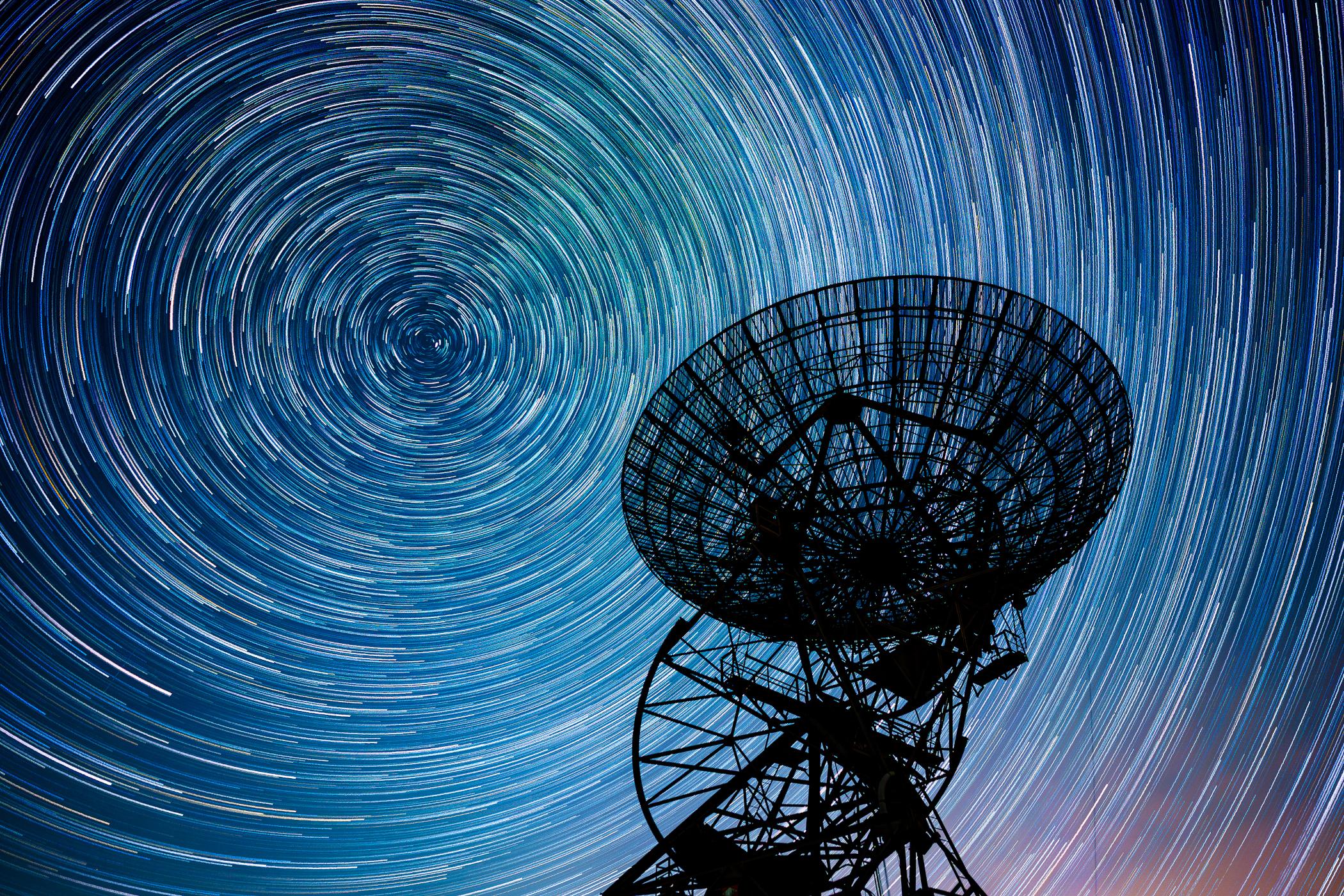
The steerable 60 foot diameter dish antenna of the One-Mile Telescope at Mullard Radio Astronomy Observatory, Cambridge, UK, is pointing skyward in this evocative night-skyscape. To capture the dramatic scene, consecutive 30 second exposures were recorded over a period of 90 minutes. Combined, the exposures reveal a background of gracefully arcing star trails that reflect planet Earth's daily rotation on its axis. The North Celestial Pole, the extension of Earth's axis of rotation into space, points near Polaris, the North Star. That's the bright star that creates the short trail near the center of the concentric arcs. But the historic One-Mile Telescope array also relied on planet Earth's rotation to operate. Exploring the universe at radio wavelengths, it was the first radio telescope to use Earth-rotation aperture synthesis. That technique uses the rotation of the Earth to change the relative orientation of the telescope array and celestial radio sources to create radio maps of the sky at a resolution better than that of the human eye.
https://apod.nasa.gov/apod/ap250913.html
#space #earth #astrophotography #photography #astroart #science #nature
Alt...
2025 September 13
Star Trails over One-Mile Radio Telescope
* Image Credit & Copyright: Joao Yordanov Serralheiro
Explanation:
The steerable 60 foot diameter dish antenna of the One-Mile Telescope at Mullard Radio Astronomy Observatory, Cambridge, UK, is pointing skyward in this evocative night-skyscape. To capture the dramatic scene, consecutive 30 second exposures were recorded over a period of 90 minutes. Combined, the exposures reveal a background of gracefully arcing star trails that reflect planet Earth's daily rotation on its axis. The North Celestial Pole, the extension of Earth's axis of rotation into space, points near Polaris, the North Star. That's the bright star that creates the short trail near the center of the concentric arcs. But the historic One-Mile Telescope array also relied on planet Earth's rotation to operate. Exploring the universe at radio wavelengths, it was the first radio telescope to use Earth-rotation aperture synthesis. That technique uses the rotation of the Earth to change the relative orientation of the telescope array and celestial radio sources to create radio maps of the sky at a resolution better than that of the human eye.
Authors & editors: Robert Nemiroff (MTU) & Jerry Bonnell (UMCP)
NASA Official: Amber Straughn Specific rights apply.
NASA Web Privacy, Accessibility, Notices;
A service of: ASD at NASA / GSFC,
NASA Science Activation
Cosmos in Reflection
* Image Credit & Copyright: Jeff Dai (TWAN)
https://twanight.org/profile/jeff-dai/
Explanation:
During the day, over 12,000 large mirrors reflect sunlight at the 100-megawatt, molten-salt, solar thermal power plant at the western edge of the Gobi desert near Dunhuang, Gansu Province, China. Individual mirror panels turn to track the sun like sunflowers. They conspire to act as a single super mirror reflecting the sunlight toward a fixed position, the power station's central tower. During the night the mirrors stand motionless though. They reflect the light of the countless distant stars, clusters and nebulae of the Milky Way and beyond. This sci-fi night skyscape was created with a camera fixed to a tripod near the edge of the giant mirror matrix on September 15. The camera's combined sequence of digital exposures captures concentric arcs of celestial star trails through the night with star trails in surreal mirrored reflection.
https://apod.nasa.gov/apod/ap230922.html
#space #earth #astrophotography #photography #astroart #art #science #nature #education

Alt...
2023 September 22
Cosmos in Reflection
* Image Credit & Copyright: Jeff Dai (TWAN)
Explanation:
During the day, over 12,000 large mirrors reflect sunlight at the 100-megawatt, molten-salt, solar thermal power plant at the western edge of the Gobi desert near Dunhuang, Gansu Province, China. Individual mirror panels turn to track the sun like sunflowers. They conspire to act as a single super mirror reflecting the sunlight toward a fixed position, the power station's central tower. During the night the mirrors stand motionless though. They reflect the light of the countless distant stars, clusters and nebulae of the Milky Way and beyond. This sci-fi night skyscape was created with a camera fixed to a tripod near the edge of the giant mirror matrix on September 15. The camera's combined sequence of digital exposures captures concentric arcs of celestial star trails through the night with star trails in surreal mirrored reflection.
Authors & editors: Robert Nemiroff (MTU) & Jerry Bonnell (UMCP)
NASA Official: Phillip Newman Specific rights apply.
NASA Web Privacy Policy and Important Notices
A service of: ASD at NASA / GSFC
& Michigan Tech. U.
Stars Trail over Ragusa
* Image Credit & Copyright: Gianni Tumino
Explanation:
In trying times, stars still trail in the night. Taken on March 14, this night skyscape was made by combining 230 exposures each 15 seconds long to follow the stars' circular paths. The camera was fixed to a tripod on an isolated terrace near the center of Ragusa, Italy, on the island of Sicily. But the night sky was shared around the rotating planet. A friend to celestial navigators and astrophotographers alike Polaris, the north star, makes the short bright trail near the center of the concentric celestial arcs.
https://apod.nasa.gov/apod/ap200328.html
#space #earth #astrophotography #photography #astroart #art #science #nature

Alt...
2020 March 28
Stars Trail over Ragusa
* Image Credit & Copyright: Gianni Tumino
Explanation:
In trying times, stars still trail in the night. Taken on March 14, this night skyscape was made by combining 230 exposures each 15 seconds long to follow the stars' circular paths. The camera was fixed to a tripod on an isolated terrace near the center of Ragusa, Italy, on the island of Sicily. But the night sky was shared around the rotating planet. A friend to celestial navigators and astrophotographers alike Polaris, the north star, makes the short bright trail near the center of the concentric celestial arcs.
Authors & editors: Robert Nemiroff (MTU) & Jerry Bonnell (UMCP)
NASA Official: Phillip Newman Specific rights apply.
NASA Web Privacy Policy and Important Notices
A service of: ASD at NASA / GSFC
& Michigan Tech. U.
South Celestial Rocket Launch
* Image Credit & Copyright: Brendan Gully
Explanation:
At sunset on December 6 a Rocket Lab Electron rocket was launched from a rotating planet. With multiple small satellites on board it departed on a mission to low Earth orbit dubbed Running Out of Fingers from Mahia Peninsula on New Zealand's north island. The fiery trace of the Electron's graceful launch arc is toward the south in this southern sea and skyscape. Drifting vapor trails and rocket exhaust plumes catch the sunlight even as the sky grows dark though, the setting Sun still shinning at altitude along the rocket's trajectory. Fixed to a tripod, the camera's perspective nearly aligns the peak of the rocket arc with the South Celestial Pole, but no bright star marks that location in the southern hemisphere's evening sky. Still, it's easy to find at the center of the star trail arcs in the timelapse composite.
https://apod.nasa.gov/apod/ap200228.html
#space #earth #astrophotography #photography #astroart #art #science #nature

Alt...
2020 February 28
South Celestial Rocket Launch
* Image Credit & Copyright: Brendan Gully
Explanation:
At sunset on December 6 a Rocket Lab Electron rocket was launched from a rotating planet. With multiple small satellites on board it departed on a mission to low Earth orbit dubbed Running Out of Fingers from Mahia Peninsula on New Zealand's north island. The fiery trace of the Electron's graceful launch arc is toward the south in this southern sea and skyscape. Drifting vapor trails and rocket exhaust plumes catch the sunlight even as the sky grows dark though, the setting Sun still shinning at altitude along the rocket's trajectory. Fixed to a tripod, the camera's perspective nearly aligns the peak of the rocket arc with the South Celestial Pole, but no bright star marks that location in the southern hemisphere's evening sky. Still, it's easy to find at the center of the star trail arcs in the timelapse composite.
Authors & editors: Robert Nemiroff (MTU) & Jerry Bonnell (UMCP)
NASA Official: Phillip Newman Specific rights apply.
NASA Web Privacy Policy and Important Notices
A service of: ASD at NASA / GSFC
& Michigan Tech. U.
Lines of Time
* Image Credit & Copyright: Anton Komlev
Explanation:
In time stars trace lines through the night sky on a rotating planet. Taken over two hours or more, these digitally added consecutive exposures were made with a camera and wide angle lens fixed to a tripod near Orel farm, Primorsky Krai, Russia, planet Earth. The stars trail in concentric arcs around the planet's south celestial pole below the scene's horizon, and north celestial pole off the frame at the upper right. Combined, the many short exposures also bring out the pretty star colours. Bluish trails are from stars hotter than Earth's Sun, while yellowish trails are from cooler stars. A long time ago this tree blossomed, but now reveals the passage of time in the wrinkled and weathered lines of its remains.
https://apod.nasa.gov/apod/ap191207.html
#space #earth #astrophotography #photography #astroart #art #science #nature

Alt...
2019 December 7
Lines of Time
* Image Credit & Copyright: Anton Komlev
Explanation:
In time stars trace lines through the night sky on a rotating planet. Taken over two hours or more, these digitally added consecutive exposures were made with a camera and wide angle lens fixed to a tripod near Orel farm, Primorsky Krai, Russia, planet Earth. The stars trail in concentric arcs around the planet's south celestial pole below the scene's horizon, and north celestial pole off the frame at the upper right. Combined, the many short exposures also bring out the pretty star colours. Bluish trails are from stars hotter than Earth's Sun, while yellowish trails are from cooler stars. A long time ago this tree blossomed, but now reveals the passage of time in the wrinkled and weathered lines of its remains.
Authors & editors: Robert Nemiroff (MTU) & Jerry Bonnell (UMCP)
NASA Official: Phillip Newman Specific rights apply.
NASA Web Privacy Policy and Important Notices
A service of: ASD at NASA / GSFC
& Michigan Tech. U.
Star Trails for a Red Planet
* Image Credit & Copyright: Dengyi Huang
Explanation:
Does Mars have a north star? In long exposures of Earth's night sky, star trails make concentric arcs around the north celestial pole, the direction of our fair planet's axis of rotation. Bright star Polaris is presently the Earth's North Star, close on the sky to Earth's north celestial pole. But long exposures on Mars show star trails too, concentric arcs about a celestial pole determined by Mars' axis of rotation. Tilted like planet Earth's, the martian axis of rotation points in a different direction in space though. It points to a place on the sky between stars in Cygnus and Cepheus with no bright star comparable to Earth's north star Polaris nearby. So even though this ruddy, weathered landscape is remarkably reminiscent of terrain in images from the martian surface, the view must be from planet Earth, with north star Polaris near the center of concentric star trails. The landforms in the foreground are found in Qinghai Province in northwestern China.
https://apod.nasa.gov/apod/ap191130.html
#space #earth #mars #astrophotography #photography #astroart #art #science #nature

Alt...
2019 November 30
Star Trails for a Red Planet
* Image Credit & Copyright: Dengyi Huang
Explanation:
Does Mars have a north star? In long exposures of Earth's night sky, star trails make concentric arcs around the north celestial pole, the direction of our fair planet's axis of rotation. Bright star Polaris is presently the Earth's North Star, close on the sky to Earth's north celestial pole. But long exposures on Mars show star trails too, concentric arcs about a celestial pole determined by Mars' axis of rotation. Tilted like planet Earth's, the martian axis of rotation points in a different direction in space though. It points to a place on the sky between stars in Cygnus and Cepheus with no bright star comparable to Earth's north star Polaris nearby. So even though this ruddy, weathered landscape is remarkably reminiscent of terrain in images from the martian surface, the view must be from planet Earth, with north star Polaris near the center of concentric star trails. The landforms in the foreground are found in Qinghai Province in northwestern China.
Authors & editors: Robert Nemiroff (MTU) & Jerry Bonnell (UMCP)
NASA Official: Phillip Newman Specific rights apply.
NASA Web Privacy Policy and Important Notices
A service of: ASD at NASA / GSFC
& Michigan Tech. U.
Star Trails and the Equinox Sunrise
* Image Credit & Copyright: Juan Carlos Casado (TWAN, Earth and Stars)
Acknowledgement: Andrea Rodriguez Anton
Explanation:
Stars trail and the Sun rises in this night and day composite panorama made on March 19. The view looks toward the eastern horizon from La Nava de Santiago, Spain. To create it, a continuous series of digital frames was recorded for about two hours and combined to trace the concentric motion of the stars through the night sky. A reflection of the Earth's rotation, star trails curve around the north celestial pole toward upper left and the south celestial pole toward the lower right. Of course on that day the Sun was near the celestial equator, a diagonal straight line in the wide-angle projection. A dense dimming filter was used to capture the Sun's image every two minutes. Superimposed on the star trails it rose due east in the morning sky. In the scene, foreground landscape and a local prehistoric monument were illuminated by full moonlight, though. The monument's corridor faces nearly to the east and the equinox sunrise.
https://apod.nasa.gov/apod/ap190321.html
#space #earth #astrophotography #photography #astroart #art #science #nature #education

Alt...
2019 March 21
Star Trails and the Equinox Sunrise
* Image Credit & Copyright: Juan Carlos Casado (TWAN, Earth and Stars)
Acknowledgement: Andrea Rodriguez Anton
Explanation:
Stars trail and the Sun rises in this night and day composite panorama made on March 19. The view looks toward the eastern horizon from La Nava de Santiago, Spain. To create it, a continuous series of digital frames was recorded for about two hours and combined to trace the concentric motion of the stars through the night sky. A reflection of the Earth's rotation, star trails curve around the north celestial pole toward upper left and the south celestial pole toward the lower right. Of course on that day the Sun was near the celestial equator, a diagonal straight line in the wide-angle projection. A dense dimming filter was used to capture the Sun's image every two minutes. Superimposed on the star trails it rose due east in the morning sky. In the scene, foreground landscape and a local prehistoric monument were illuminated by full moonlight, though. The monument's corridor faces nearly to the east and the equinox sunrise.
Authors & editors: Robert Nemiroff (MTU) & Jerry Bonnell (UMCP)
NASA Official: Phillip Newman Specific rights apply.
NASA Web Privacy Policy and Important Notices
A service of: ASD at NASA / GSFC
& Michigan Tech. U.
Circumpolar Star Trails
Image Credit & Copyright: Gabriel Funes
Explanation:
As Earth spins on its axis, the stars appear to rotate around an observatory in this well-composed image from the Canary Island of Tenerife. Of course, the colorful concentric arcs traced out by the stars are really centered on the planet's North Celestial Pole. Convenient for northern hemisphere astro-imagers and celestial navigators alike, bright star Polaris is near the pole and positioned in this scene to be behind the telescope dome. Made with a camera fixed to a tripod, the series of over 200 stacked digital exposures spanned about 4 hours. The observatory was not operating on that clear, dark night, but that's not surprising. The dome houses the Teide Observatory's large THEMIS Solar Telescope.
https://apod.nasa.gov/apod/ap190118.html
#space #earth #astrophotography #photography #astroart #art #science #nature

Alt...
2019 January 18
Circumpolar Star Trails
Image Credit & Copyright: Gabriel Funes
Explanation:
As Earth spins on its axis, the stars appear to rotate around an observatory in this well-composed image from the Canary Island of Tenerife. Of course, the colorful concentric arcs traced out by the stars are really centered on the planet's North Celestial Pole. Convenient for northern hemisphere astro-imagers and celestial navigators alike, bright star Polaris is near the pole and positioned in this scene to be behind the telescope dome. Made with a camera fixed to a tripod, the series of over 200 stacked digital exposures spanned about 4 hours. The observatory was not operating on that clear, dark night, but that's not surprising. The dome houses the Teide Observatory's large THEMIS Solar Telescope.
Authors & editors: Robert Nemiroff (MTU) & Jerry Bonnell (UMCP)
NASA Official: Phillip Newman Specific rights apply.
NASA Web Privacy Policy and Important Notices
A service of: ASD at NASA / GSFC
& Michigan Tech. U.
Mount Everest Star Trails
* Image Credit & Copyright: Jeff Dai (TWAN)
Explanation:
The highest peak on planet Earth is framed in this mountain and night skyscape. On September 30, the digital stack of 240 sequential exposures made with a camera fixed to a tripod at an Everest Base Camp captured the sheer north face of the Himalayan mountain and foreground illuminated by bright moonlight. Taken over 1.5 hours, the sequence also recorded colorful star trails. Reflecting the planet's daily rotation on its axis, their motion is along gentle concentric arcs centered on the south celestial pole, a point well below the rugged horizon. The color of the trails actually indicates the temperatures of the stars. Blueish hues are from hotter stars, and yellow to reddish hues are from stars cooler than the Sun.
https://apod.nasa.gov/apod/ap181201.html
#space #earth #astrophotography #photography #astroart #art #science #nature

Alt...
2018 December 1
Mount Everest Star Trails
* Image Credit & Copyright: Jeff Dai (TWAN)
Explanation:
The highest peak on planet Earth is framed in this mountain and night skyscape. On September 30, the digital stack of 240 sequential exposures made with a camera fixed to a tripod at an Everest Base Camp captured the sheer north face of the Himalayan mountain and foreground illuminated by bright moonlight. Taken over 1.5 hours, the sequence also recorded colorful star trails. Reflecting the planet's daily rotation on its axis, their motion is along gentle concentric arcs centered on the south celestial pole, a point well below the rugged horizon. The color of the trails actually indicates the temperatures of the stars. Blueish hues are from hotter stars, and yellow to reddish hues are from stars cooler than the Sun.
Authors & editors: Robert Nemiroff (MTU) & Jerry Bonnell (UMCP)
NASA Official: Phillip Newman Specific rights apply.
NASA Web Privacy Policy and Important Notices
A service of: ASD at NASA / GSFC
& Michigan Tech. U.
Little Planet Lookout
* Image Credit & Copyright: Gyorgy Soponyai
Explanation:
Don't panic. This little planet projection looks confusing, but it's actually just a digitally warped and stitched, nadir centered mosaic of images that covers nearly 360x180 degrees. The images were taken on the night of October 31 from a 30 meter tall hill-top lookout tower near Tatabanya, Hungary, planet Earth. The laticed lookout tower construction was converted from a local mine elevator. Since planet Earth is rotating, the 126 frames of 75 second long exposures also show warped, concentric star trails with the north celestial pole at the left. Of course at this location the south celestial pole is just right of center but below the the little planet's horizon. the little planet's horizon.
https://apod.nasa.gov/apod/ap181109.html
#space #earth #astrophotography #photography #astroart #art #science #nature

Alt...
2018 November 9
Little Planet Lookout
* Image Credit & Copyright: Gyorgy Soponyai
Explanation:
Don't panic. This little planet projection looks confusing, but it's actually just a digitally warped and stitched, nadir centered mosaic of images that covers nearly 360x180 degrees. The images were taken on the night of October 31 from a 30 meter tall hill-top lookout tower near Tatabanya, Hungary, planet Earth. The laticed lookout tower construction was converted from a local mine elevator. Since planet Earth is rotating, the 126 frames of 75 second long exposures also show warped, concentric star trails with the north celestial pole at the left. Of course at this location the south celestial pole is just right of center but below the the little planet's horizon.
Authors & editors: Robert Nemiroff (MTU) & Jerry Bonnell (UMCP)
NASA Official: Phillip Newman Specific rights apply.
NASA Web Privacy Policy and Important Notices
A service of: ASD at NASA / GSFC
& Michigan Tech. U.
Star Trails and the Bracewell Radio Sundial
* Image Credit & Copyright: Miles Lucas at NRAO
Explanation:
Sundials use the location of a shadow to measure the Earth's rotation and indicate the time of day. So it's fitting that this sundial, at the Very Large Array Radio Telescope Observatory in New Mexico, commemorates the history of radio astronomy and radio astronomy pioneer Ronald Bracewell. The radio sundial was constructed using pieces of a solar mapping radio telescope array that Bracewell orginaly built near the Stanford University campus. Bracewell's array was used to contribute data to plan the first Moon landing, its pillars signed by visiting scientists and radio astronomers, including two Nobel prize winners. As for most sundials the shadow cast by the central gnomon follows markers that show the solar time of day, along with solstices and equinoxes. But markers on the radio sundial are also laid out according to local sidereal time. They show the position of the invisible radio shadows of three bright radio sources in Earth's sky, supernova remnant Cassiopeia A, active galaxy Cygnus A, and active galaxy Centaurus A. Sidereal time is just star time, the Earth's rotation as measured with the stars and distant galaxies. That rotation is reflected in this composited hour-long exposure. Above the Bracewell Radio Sundial, the stars trace concentric trails around the north celestial pole.
https://apod.nasa.gov/apod/ap180713.html
#space #earth #astrophotography #photography #astroart #art #science #nature

Alt...
2018 July 13
Star Trails and the Bracewell Radio Sundial
* Image Credit & Copyright: Miles Lucas at NRAO
Explanation:
Sundials use the location of a shadow to measure the Earth's rotation and indicate the time of day. So it's fitting that this sundial, at the Very Large Array Radio Telescope Observatory in New Mexico, commemorates the history of radio astronomy and radio astronomy pioneer Ronald Bracewell. The radio sundial was constructed using pieces of a solar mapping radio telescope array that Bracewell orginaly built near the Stanford University campus. Bracewell's array was used to contribute data to plan the first Moon landing, its pillars signed by visiting scientists and radio astronomers, including two Nobel prize winners. As for most sundials the shadow cast by the central gnomon follows markers that show the solar time of day, along with solstices and equinoxes. But markers on the radio sundial are also laid out according to local sidereal time. They show the position of the invisible radio shadows of three bright radio sources in Earth's sky, supernova remnant Cassiopeia A, active galaxy Cygnus A, and active galaxy Centaurus A. Sidereal time is just star time, the Earth's rotation as measured with the stars and distant galaxies. That rotation is reflected in this composited hour-long exposure. Above the Bracewell Radio Sundial, the stars trace concentric trails around the north celestial pole.
Authors & editors: Robert Nemiroff (MTU) & Jerry Bonnell (UMCP)
Rotation of the Large Magellanic Cloud
* Image Credit & Licence: ESA, Gaia, DPAC
Explanation:
This image is not blurry. It shows in clear detail that the largest satellite galaxy to our Milky Way, the Large Cloud of Magellan (LMC), rotates. First determined with Hubble, the rotation of the LMC is presented here with fine data from the Sun-orbiting Gaia satellite. Gaia measures the positions of stars so accurately that subsequent measurements can reveal slight proper motions of stars not previously detectable. The featured image shows, effectively, exaggerated star trails for millions of faint LMC stars. Inspection of the image also shows the center of the clockwise rotation: near the top of the LMC's central bar. The LMC, prominent in southern skies, is a small spiral galaxy that has been distorted by encounters with the greater Milky Way Galaxy and the lesser Small Magellanic Cloud (SMC).
#space #earth #astrophotography #photography #astroart #art #science #nature
https://apod.nasa.gov/apod/ap180516.html

Alt...
2018 May 16
Rotation of the Large Magellanic Cloud
* Image Credit & Licence: ESA, Gaia, DPAC
Explanation:
This image is not blurry. It shows in clear detail that the largest satellite galaxy to our Milky Way, the Large Cloud of Magellan (LMC), rotates. First determined with Hubble, the rotation of the LMC is presented here with fine data from the Sun-orbiting Gaia satellite. Gaia measures the positions of stars so accurately that subsequent measurements can reveal slight proper motions of stars not previously detectable. The featured image shows, effectively, exaggerated star trails for millions of faint LMC stars. Inspection of the image also shows the center of the clockwise rotation: near the top of the LMC's central bar. The LMC, prominent in southern skies, is a small spiral galaxy that has been distorted by encounters with the greater Milky Way Galaxy and the lesser Small Magellanic Cloud (SMC).
Authors & editors: Robert Nemiroff (MTU) & Jerry Bonnell (UMCP)
NASA Official: Phillip Newman Specific rights apply.
NASA Web Privacy Policy and Important Notices
A service of: ASD at NASA / GSFC
& Michigan Tech. U.
Alborz Mountain Star Trails
* Image Credit & Copyright: Stéphane Guisard (Los Cielos de America, TWAN)
Explanation:
Colourful star trails arc through the night in this wide-angle mountain and skyscape. From a rotating planet, the digitally added consecutive exposures were made with a camera fixed to a tripod and looking south, over northern Iran's Alborz Mountain range. The stars trace concentric arcs around the planet's south celestial pole, below the scene's rugged horizon. Combined, the many short exposures also bring out the pretty star colours. Bluish trails are from stars hotter than our Sun, while yellowish trails are from cooler stars. Near the center, the remarkably pinkish trail was traced by the star-forming Orion Nebula.
https://apod.nasa.gov/apod/ap180302.html
#space #earth #astrophotography #photography #astroart #art #science #nature

Alt...
2018 March 2
Alborz Mountain Star Trails
* Image Credit & Copyright: Stéphane Guisard (Los Cielos de America, TWAN)
Explanation:
Colourful star trails arc through the night in this wide-angle mountain and skyscape. From a rotating planet, the digitally added consecutive exposures were made with a camera fixed to a tripod and looking south, over northern Iran's Alborz Mountain range. The stars trace concentric arcs around the planet's south celestial pole, below the scene's rugged horizon. Combined, the many short exposures also bring out the pretty star colours. Bluish trails are from stars hotter than our Sun, while yellowish trails are from cooler stars. Near the center, the remarkably pinkish trail was traced by the star-forming Orion Nebula.
Authors & editors: Robert Nemiroff (MTU) & Jerry Bonnell (UMCP)
NASA Official: Phillip Newman Specific rights apply.
NASA Web Privacy Policy and Important Notices
A service of: ASD at NASA / GSFC
& Michigan Tech. U.
Bow Tie Moon and Star Trails
* Image Credit & Copyright: Haitong Yu
Explanation:
On January 31, a leisurely lunar eclipse was enjoyed from all over the night side of planet Earth, the first of three consecutive total eclipses of the Moon. This dramatic time-lapse image followed the celestial performance for over three hours in a combined series of exposures from Hebei Province in Northern China. Fixed to a tripod, the camera records the Full Moon sliding through a clear night sky. Too bright just before and after the eclipse, the Moon's bow tie-shaped trail grows narrow and red during the darker total eclipse phase that lasted an hour and 16 minutes. In the distant background are the colorful trails of stars in concentric arcs above and below the celestial equator.
https://apod.nasa.gov/apod/ap180208.html
#space #earth #astrophotography #photography #astroart #art #science #nature

Alt...
2018 February 8
Bow Tie Moon and Star Trails
* Image Credit & Copyright: Haitong Yu
Explanation:
On January 31, a leisurely lunar eclipse was enjoyed from all over the night side of planet Earth, the first of three consecutive total eclipses of the Moon. This dramatic time-lapse image followed the celestial performance for over three hours in a combined series of exposures from Hebei Province in Northern China. Fixed to a tripod, the camera records the Full Moon sliding through a clear night sky. Too bright just before and after the eclipse, the Moon's bow tie-shaped trail grows narrow and red during the darker total eclipse phase that lasted an hour and 16 minutes. In the distant background are the colorful trails of stars in concentric arcs above and below the celestial equator.
Authors & editors: Robert Nemiroff (MTU) & Jerry Bonnell (UMCP)
NASA Official: Phillip Newman Specific rights apply.
NASA Web Privacy Policy and Important Notices
A service of: ASD at NASA / GSFC
& Michigan Tech. U.
Panoramic Eclipse Composite with Star Trails
Image Credit & Copyright: Stephane Vetter (Nuits sacrees, TWAN)
Explanation:
What was happening in the sky during last week's total solar eclipse? This featured little-planet, all-sky, double time-lapse, digitally-fused composite captured celestial action during both night and day from a single location. In this 360x180 panorama, north and south are at the image bottom and top, while east and west are at the left and right edges, respectively. During four hours the night before the eclipse, star trails were captured circling the north celestial pole (bottom) as the Earth spun. During the day of the total eclipse, the Sun was captured every fifteen minutes from sunrise to sunset (top), sometimes in partial eclipse. All of these images were then digitally merged onto a single image taken exactly during the total solar eclipse. Then, the Sun's bright corona could be seen flaring around the dark new Moon (upper left), while Venus simultaneously became easily visible (top). The tree in the middle, below the camera, is a Douglas fir. The images were taken with care and planning at Magone Lake in Oregon, USA.
https://apod.nasa.gov/apod/ap170830.html
#space #earth #astrophotography #photography #astroart #art #science #nature

Alt...
2017 August 30
Panoramic Eclipse Composite with Star Trails
Image Credit & Copyright: Stephane Vetter (Nuits sacrees, TWAN)
Explanation:
What was happening in the sky during last week's total solar eclipse? This featured little-planet, all-sky, double time-lapse, digitally-fused composite captured celestial action during both night and day from a single location. In this 360x180 panorama, north and south are at the image bottom and top, while east and west are at the left and right edges, respectively. During four hours the night before the eclipse, star trails were captured circling the north celestial pole (bottom) as the Earth spun. During the day of the total eclipse, the Sun was captured every fifteen minutes from sunrise to sunset (top), sometimes in partial eclipse. All of these images were then digitally merged onto a single image taken exactly during the total solar eclipse. Then, the Sun's bright corona could be seen flaring around the dark new Moon (upper left), while Venus simultaneously became easily visible (top). The tree in the middle, below the camera, is a Douglas fir. The images were taken with care and planning at Magone Lake in Oregon, USA.
Authors & editors: Robert Nemiroff (MTU) & Jerry Bonnell (UMCP)
NASA Official: Phillip Newman Specific rights apply.
NASA Web Privacy Policy and Important Notices
A service of: ASD at NASA / GSFC
& Michigan Tech. U.
Cerro Tololo Trails
* Image Credit & Copyright: Babak Tafreshi (TWAN), AURA
Explanation:
Early one moonlit evening car lights left a wandering trail along the road to the Chilean Cerro Tololo Inter-American Observatory. Setting stars left the wandering trails in the sky. The serene view toward the mountainous horizon was captured in a telephoto timelapse image and video taken from nearby Cerro Pachon, home to Gemini South. Afforded by the mountaintop vantage point, the clear, long sight-line passes through layers of atmosphere. The changing atmospheric refraction shifts and distorts the otherwise steady apparent paths of the stars as they set. That effect also causes the distorted appearance of Sun and Moon as they rise or set near a distant horizon.
https://apod.nasa.gov/apod/ap161022.html
#space #earth #astrophotography #photography #astroart #art #science #nature

Alt...
2016 October 22
Cerro Tololo Trails
* Image Credit & Copyright: Babak Tafreshi (TWAN), AURA
Explanation:
Early one moonlit evening car lights left a wandering trail along the road to the Chilean Cerro Tololo Inter-American Observatory. Setting stars left the wandering trails in the sky. The serene view toward the mountainous horizon was captured in a telephoto timelapse image and video taken from nearby Cerro Pachon, home to Gemini South. Afforded by the mountaintop vantage point, the clear, long sight-line passes through layers of atmosphere. The changing atmospheric refraction shifts and distorts the otherwise steady apparent paths of the stars as they set. That effect also causes the distorted appearance of Sun and Moon as they rise or set near a distant horizon.
Authors & editors: Robert Nemiroff (MTU) & Jerry Bonnell (UMCP)
NASA Official: Phillip Newman Specific rights apply.
NASA Web Privacy Policy and Important Notices
A service of: ASD at NASA / GSFC
& Michigan Tech. U.
Gemini Observatory North
* Image Credit & Copyright: Joy Pollard (Gemini Observatory)
Explanation:
It does look like a flying saucer, but this technologically advanced structure is not here to deliver the wise extraterrestrial from the scifi classic movie The Day the Earth Stood Still. It is here to advance our knowledge of the Universe though. Shown sitting near the top of a mountain in Hawaii, the dome of the Gemini Observatory North houses one of two identical 8.1-meter diameter telescopes. Used with its southern hemisphere twin observatory in Chile, the two can access the entire sky from planet Earth. Constructed from 85 exposures lasting 30 seconds each with camera fixed to a tripod, the image also clearly demonstrates that the Earth did not stand still. Adjusted to be brighter at the ends of their arcs, the concentric star trails centered on the North Celestial Pole are a reflection of Earth's rotation around its axis. Close to the horizon at Hawaiian latitudes, Polaris, the North Star, makes the shortest star trail. The fainter denser forest of star trails toward the right is part of the rising Milky Way.
https://apod.nasa.gov/apod/ap161015.html
#space #earth #astrophotography #photography #astroart #art #science #nature

Alt...
2016 October 15
Gemini Observatory North
* Image Credit & Copyright: Joy Pollard (Gemini Observatory)
Explanation:
It does look like a flying saucer, but this technologically advanced structure is not here to deliver the wise extraterrestrial from the scifi classic movie The Day the Earth Stood Still. It is here to advance our knowledge of the Universe though. Shown sitting near the top of a mountain in Hawaii, the dome of the Gemini Observatory North houses one of two identical 8.1-meter diameter telescopes. Used with its southern hemisphere twin observatory in Chile, the two can access the entire sky from planet Earth. Constructed from 85 exposures lasting 30 seconds each with camera fixed to a tripod, the image also clearly demonstrates that the Earth did not stand still. Adjusted to be brighter at the ends of their arcs, the concentric star trails centered on the North Celestial Pole are a reflection of Earth's rotation around its axis. Close to the horizon at Hawaiian latitudes, Polaris, the North Star, makes the shortest star trail. The fainter denser forest of star trails toward the right is part of the rising Milky Way.
Authors & editors: Robert Nemiroff (MTU) & Jerry Bonnell (UMCP)
NASA Official: Phillip Newman Specific rights apply.
NASA Web Privacy Policy and Important Notices
A service of: ASD at NASA / GSFC
& Michigan Tech. U.
Little Planet Astro Camp
* Image Credit & Copyright: György Soponyai
Explanation:
Day and night on this little planet look a lot like day and night on planet Earth. In fact, the images used to construct the little planet projection, a digitally warped and stitched mosaic covering 360x180 degrees, were taken during day and night near Tarján, Hungary, planet Earth. They span a successful 33-hour-long photo experiment at July's Hungarian Astronomical Association Astro Camp. The time-series composite follows the solar disk in 20 minute intervals from sunrise to sunset and over six hours of star trails in the northern night sky centered on the North Celestial Pole near bright star Polaris. The orbiting International Space Station traced the offset arc across the northern night. Below the little planet's nightside horizon, red light lamps of fellow astro-campers left the night-long, dancing trails.
https://apod.nasa.gov/apod/ap160902.html
#space #earth #astrophotography #photography #astroart #art #science #nature

Alt...
2016 September 2
Little Planet Astro Camp
* Image Credit & Copyright: György Soponyai
Explanation:
Day and night on this little planet look a lot like day and night on planet Earth. In fact, the images used to construct the little planet projection, a digitally warped and stitched mosaic covering 360x180 degrees, were taken during day and night near Tarján, Hungary, planet Earth. They span a successful 33-hour-long photo experiment at July's Hungarian Astronomical Association Astro Camp. The time-series composite follows the solar disk in 20 minute intervals from sunrise to sunset and over six hours of star trails in the northern night sky centered on the North Celestial Pole near bright star Polaris. The orbiting International Space Station traced the offset arc across the northern night. Below the little planet's nightside horizon, red light lamps of fellow astro-campers left the night-long, dancing trails.
Authors & editors: Robert Nemiroff (MTU) & Jerry Bonnell (UMCP)
NASA Official: Phillip Newman Specific rights apply.
NASA Web Privacy Policy and Important Notices
A service of: ASD at NASA / GSFC
& Michigan Tech. U.
Ghosts and Star Trails
* Image Credit & Copyright: Chris Kotsiopoulos (GreekSky)
Explanation:
Don't be scared. Stars won't fall from the sky and ghosts won't really haunt your neighborhood tonight. But it looks like they might be doing just that in this eerie picture of an eccentric old abandoned house in moonlight. A treat for the eye the image is a trick of stacked multiple exposures, 60 frames exposed for 25 seconds each. While the digital frames were recorded with a camera fixed to a tripod, stars traced concentric arcs about the north celestial pole. But that's only a reflection of planet Earth's rotation on its axis. Conveniently marked by bright star Polaris, the pole could be positioned above the peaks of the deserted dwelling. Wrapped in a blanket to stay warm, the photographer's own movements during the exposures were blended into the ghostly apparitions. Of course, the grinning Jack-o-Lantern is there to wish you a safe and Happy Halloween!
https://apod.nasa.gov/apod/ap151031.html
#space #earth #astrophotography #photography #astroart #art #science #nature

Alt...
2015 October 31
Ghosts and Star Trails
* Image Credit & Copyright: Chris Kotsiopoulos (GreekSky)
Explanation:
Don't be scared. Stars won't fall from the sky and ghosts won't really haunt your neighborhood tonight. But it looks like they might be doing just that in this eerie picture of an eccentric old abandoned house in moonlight. A treat for the eye the image is a trick of stacked multiple exposures, 60 frames exposed for 25 seconds each. While the digital frames were recorded with a camera fixed to a tripod, stars traced concentric arcs about the north celestial pole. But that's only a reflection of planet Earth's rotation on its axis. Conveniently marked by bright star Polaris, the pole could be positioned above the peaks of the deserted dwelling. Wrapped in a blanket to stay warm, the photographer's own movements during the exposures were blended into the ghostly apparitions. Of course, the grinning Jack-o-Lantern is there to wish you a safe and Happy Halloween!
Authors & editors: Robert Nemiroff (MTU) & Jerry Bonnell (UMCP)
NASA Official: Phillip Newman Specific rights apply.
NASA Web Privacy Policy and Important Notices
A service of: ASD at NASA / GSFC
& Michigan Tech. U.
Auroras and Star Trails over Iceland
* Image Credit & Copyright: Vincent Brady
Explanation:
It was one of the quietest nights of aurora in weeks. Even so, in northern- Iceland during last November, faint auroras lit up the sky every clear night. The featured 360-degree panorama is the digital fusion of four wide-angle cameras each simultaneously taking 101 shots over 42 minutes. In the foreground is serene Lake Myvatn dotted with picturesque rock formations left over from ancient lava flows. Low green auroras sweep across the sky above showing impressive complexity near the horizon. Stars far in the distance appear to show unusual trails -- as the Earth turned -- because early exposures were artificially faded.
https://apod.nasa.gov/apod/ap150518.html
#space #earth #astrophotography #photography #astroart #art #science #nature

Alt...
2015 May 18
Auroras and Star Trails over Iceland
* Image Credit & Copyright: Vincent Brady
Explanation:
It was one of the quietest nights of aurora in weeks. Even so, in northern- Iceland during last November, faint auroras lit up the sky every clear night. The featured 360-degree panorama is the digital fusion of four wide-angle cameras each simultaneously taking 101 shots over 42 minutes. In the foreground is serene Lake Myvatn dotted with picturesque rock formations left over from ancient lava flows. Low green auroras sweep across the sky above showing impressive complexity near the horizon. Stars far in the distance appear to show unusual trails -- as the Earth turned -- because early exposures were artificially faded.
Authors & editors: Robert Nemiroff (MTU) & Jerry Bonnell (UMCP)
NASA Official: Phillip Newman Specific rights apply.
NASA Web Privacy Policy and Important Notices
A service of: ASD at NASA / GSFC
& Michigan Tech. U.
When Vega is North
* Image Credit & Copyright: Miguel Claro | Dark Sky Alqueva
Explanation:
In only about 12,000 years Vega will be the North Star, the closest bright star to our fair planet's North Celestial Pole. By then, when you fix your camera to a tripod long exposures of the night sky will show the concentric arcs of star trails centered on a point near Vega as Earth rotates on its axis. Of course, presently the bright star conveniently near the North Celestial Pole is Polaris, but that will change as the Earth's axis of rotation precesses, like the wobble of a spinning top with a precession period of about 26,000 years. If your camera is ready now and you don't want to wait 12,000 years for Vega to be the North Star, consider this ingenious demonstration of contemporary star trails (left) versus star trails reminiscent of the year 14000 CE. Both were recorded this April at the Alqueva Dark Sky Reserve in Alentejo, Portugal. To produce the more Vega-centric star trails of the distant future, astronomer Miguel Claro combined the rotation of two startracking camera mounts to create the apparent shift in the North Celestial Pole. (Addendum: Thanks to APOD readers who note that when Vega is the North Star it will also appear near the same position that Polaris is now relative to the landscape.)
https://apod.nasa.gov/apod/ap150508.html
#space #earth #astrophotography #photography #astroart #art #science #nature

Alt...
2015 May 8
When Vega is North
* Image Credit & Copyright: Miguel Claro | Dark Sky Alqueva
Explanation:
In only about 12,000 years Vega will be the North Star, the closest bright star to our fair planet's North Celestial Pole. By then, when you fix your camera to a tripod long exposures of the night sky will show the concentric arcs of star trails centered on a point near Vega as Earth rotates on its axis. Of course, presently the bright star conveniently near the North Celestial Pole is Polaris, but that will change as the Earth's axis of rotation precesses, like the wobble of a spinning top with a precession period of about 26,000 years. If your camera is ready now and you don't want to wait 12,000 years for Vega to be the North Star, consider this ingenious demonstration of contemporary star trails (left) versus star trails reminiscent of the year 14000 CE. Both were recorded this April at the Alqueva Dark Sky Reserve in Alentejo, Portugal. To produce the more Vega-centric star trails of the distant future, astronomer Miguel Claro combined the rotation of two startracking camera mounts to create the apparent shift in the North Celestial Pole. (Addendum: Thanks to APOD readers who note that when Vega is the North Star it will also appear near the same position that Polaris is now relative to the landscape.)
Authors & editors: Robert Nemiroff (MTU) & Jerry Bonnell (UMCP)
NASA Official: Phillip Newman Specific rights apply.