Search results for tag #nature
![[?]](https://files.mstdn.party/accounts/avatars/109/412/668/953/833/198/original/0f95655ae0a3a89e.jpg)
Sunflowers Sunset - Digital Painting | Wall Art
https://fineartamerica.com/featured/sunflowers-sunset-digital-painting-joseph-s-giacalone.html
#landscapephotography #flowers #nature #wallart #art #fineartamerica #joy #happiness #sunflowers #sunset #mastoart #fediart #fedigiftshop

Temblor Range Springtime Beauty | Wall Art
https://fineartamerica.com/featured/temblor-range-springtime-beauty-joseph-s-giacalone.html
#landscapephotography #flowers #nature #wallart #art #fineartamerica #buyintoart #joy #happiness

A Pretty Path To Dog Beach | Wall Art
https://fineartamerica.com/featured/a-pretty-path-to-dog-beach-joseph-s-giacalone.html
#sandiego #flowers #nature #wallart #art #fineartamerica #buyintoart

![[?]](https://cdn.masto.host/socelnet/accounts/avatars/109/355/496/809/872/483/original/4bb481e7a50769d3.jpg)
Habt einen entspannten Tag!
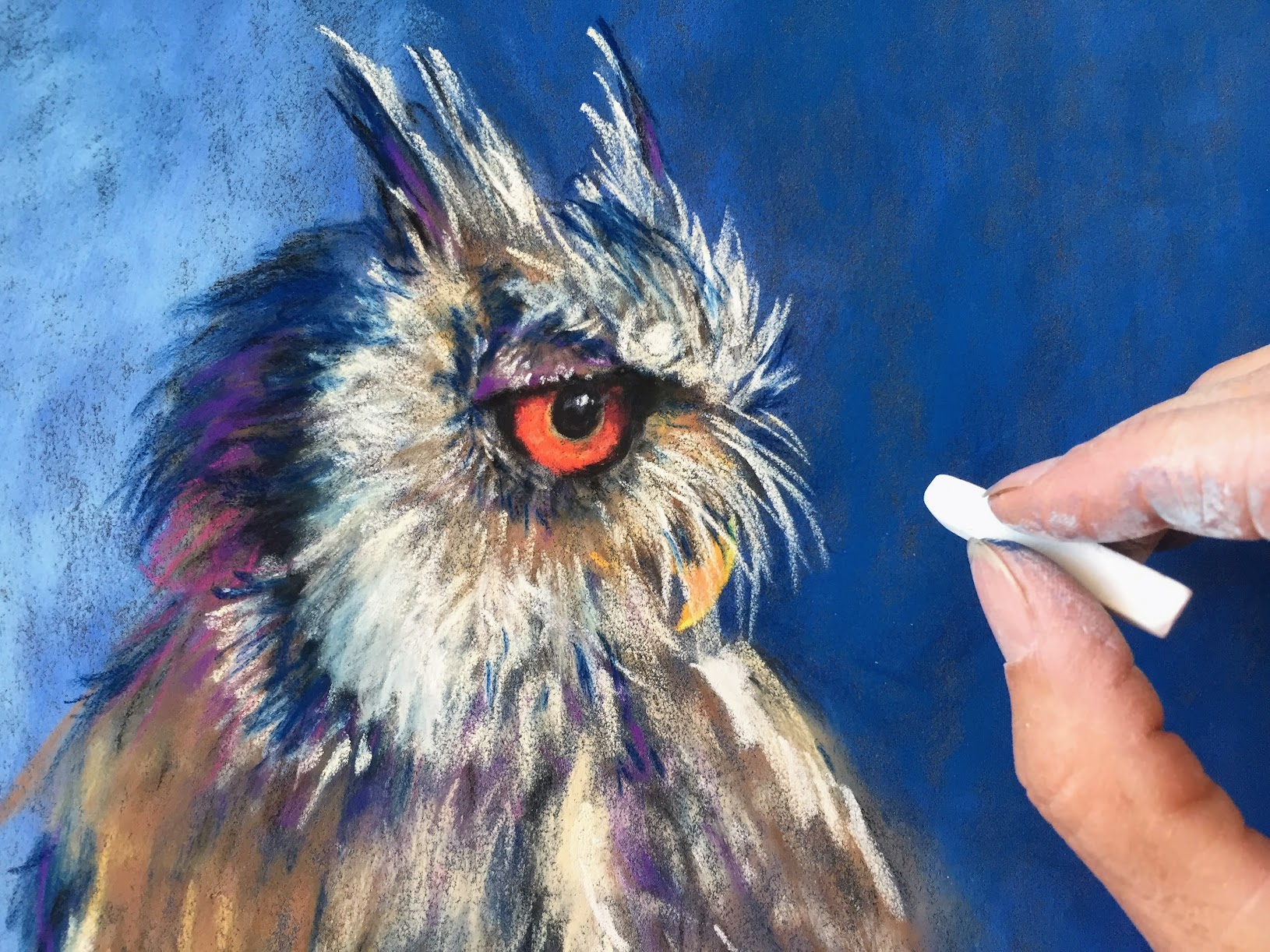
Eule vor blauem Nachthimmel - handgemaltes Pastellgemälde
--> https://www.artheroes.de/de/motiv/Eule-vor-blauem-Nachthimmel-Pastellgemaelde/1192077/132
#owl #owls #art #painting #birds #BirdsOfMastodon #nature #wildlife
Alt...
Eule vor blauem Nachthimmel ist ein Pastellgemälde gemalt von der Künstlerin Karen Kaspar. Eine Eule sitzt auf einem Ast und schaut nach rechts. Das Gefieder des Vogel ist in Schattierungen von braun, blau, grau und weiß gemalt. Das Tier hat einen gelben Schnabel und Augen in leuchtendem orange.
Der Hintergrund ist abstrahiert und in verschiedenen Blautönen gemalt.
Have a great weekend!
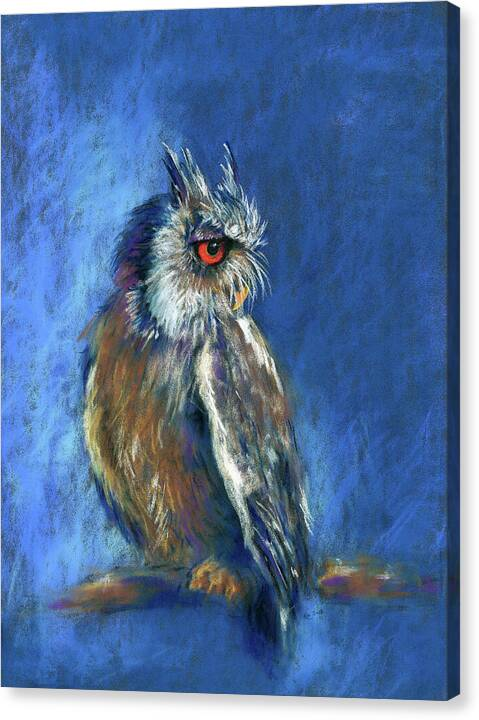
Owl in front of blue night sky handmade soft pastels painting.
--> https://karen-kaspar.pixels.com/featured/owl-in-front-of-blue-night-sky-karen-kaspar.html
#owl #owls #MastoArt #art #painting #FediArt #FediGiftShop #artist #arte #InteriorDesign #MastodonArt #ArtistsOnMastodon #TraditionalArt #kunst #contemporaryArt #creativeToots #BuyIntoArt #ArtCollector #bird #birds #BirdsOfMastodon #BirdArt #birding #nature #NatureLover #BirdWatching #vogel #natur #wildlifewednesday #wildlife #pastel #blue #AnimalArt #animal #handmade
Alt...
Owl in front of a blue night sky is a pastel painting painted by the artist Karen Kaspar. An owl sits on a branch and looks to the right. The bird's plumage is painted in shades of brown, blue, grey and white. The animal has a yellow beak and eyes in bright orange.
The background is abstracted and painted in different shades of blue.
The majestic beauty of La Jolla, California.
Have a nice day 🙂
Artist website: www.josephsgiacalonephoto.com
#lajolla #california #nature #photography #art

![[?]](https://files.defcon.social/dcsocial-s3/accounts/avatars/113/208/344/507/078/943/original/014820ad22daee1c.jpg)
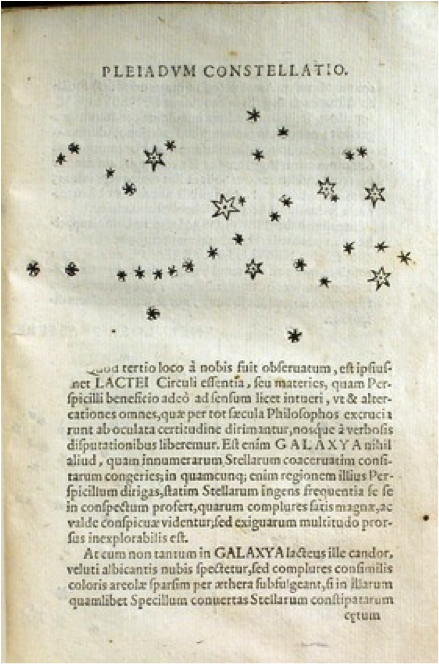
Galileo's Observations on the Pleiades
Galileo decided to demonstrate the great number of stars that actually existed by depicting a few star systems that were known to all and including the additional stars that he had observed. He chose to depict the entire constellations of Orion and the Pleiades, but soon decided that Orion was just too large, and so he only sketched the belt and sword region of Orion. Below are the drawings Galileo made of Orion and the Pleiades as put forth in his publication Sidereus Nuncius, pages 60 and 61.
CREDIT
Rice University Library
Houston, Texas
https://galileo.library.rice.edu/lib/student_work/astronomy95/orionpleiades.html
https://archive.org/details/Sidereusnuncius00Gali/page/n37/mode/2up
#space #pleiades #astrophotography #photography #science #astronomy #nature #NASA
Alt...
Galileo's drawings of the Pleiades star cluster from Sidereus Nuncius
Image of a page from Sidereus Nuncius showing Galileo's drawings of the stars in the Pleiades star cluster.
CREDIT
History of Science Collections, University of Oklahoma Libraries
Astronomical role of M45 in antiquity
The M45 group played an important role in ancient times for the establishment of many calendars thanks to the combination of two remarkable elements. The first, which is still valid, is its unique and easily identifiable appearance on the celestial vault near the ecliptic. The second, essential for the ancients, is that in the middle of the third millennium BC, this asterism (a prominent pattern or group of stars that is smaller than a constellation) marked the vernal point.
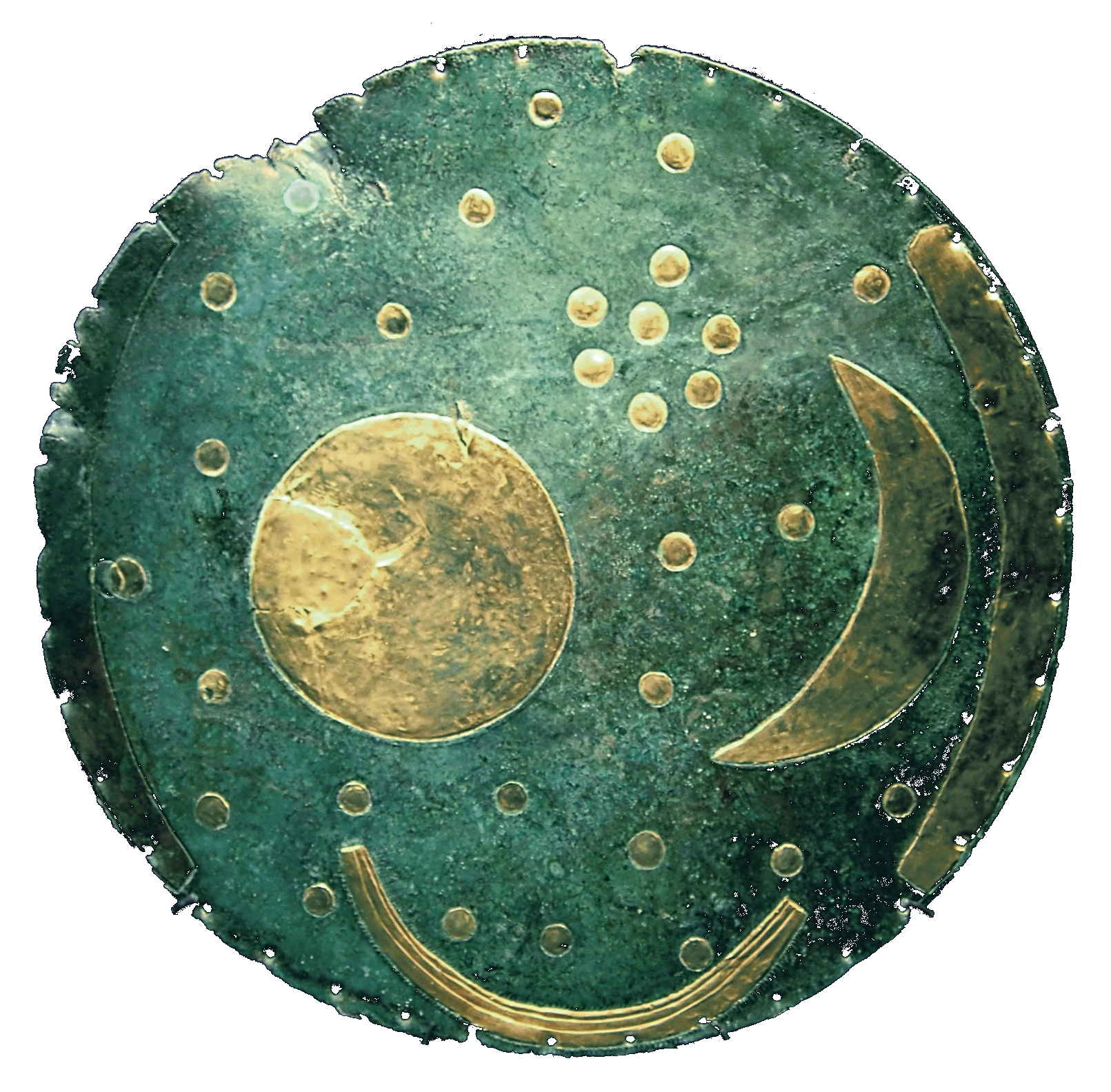
The importance of this asterism is also evident in northern Europe. The Pleiades cluster is displayed on the Nebra sky disc that was found in Germany and is dated to around 1600 BC. On the disk the cluster is represented in a high position between the Sun and the Moon.
CREDIT
Contributors to Wikimedia projects
----
In ancient Greece and the Mediterranean, the first appearance of the Pleiades before sunrise denoted the start of the navigation season, according to EarthSky. In fact, the name Pleiades probably comes from the ancient Greek word "to sail."
Even the modern holiday of Halloween may be related to Pleiades. Many think that Halloween is descended, in part, from the old pagan festival of Samhain, celebrated by the ancient Celts and Druids of the British Isles. These ancient people may have observed the midnight culmination of Pleiades, or when Pleiades reached its highest point in the sky, at midnight on the day of this festival, which would have been celebrated around the time of Halloween. They believed that this signified the time of the thinnest separation between the world of the living and the world of the dead.
CREDIT
Chris Mihos
Warner Professor of Astronomy at Case Western Reserve University.
#space #pleiades #astrophotography #photography #science #astronomy #nature #NASA
Alt...
On the Nebra sky disc, dated circa 1600 BC, the cluster of seven dots in the upper right portion of the disk is believed to be the Pleiades.
CREDIT
Dbachmann
photograph taken when the artefact was on display in Basel, Switzerland in December 2006
2025 November 1
Pleiades from Planet Earth
* Image Credit & Copyright: Max Inwood
https://www.instagram.com/max.nti/
Explanation:
The lovely Pleiades star cluster shines in Earth's night sky, a compact group of stars some 400 light-years distant toward the constellation Taurus and the Orion Arm of our Milky Way galaxy. Recognized since ancient times, the remarkable celestial gathering is visible to the unaided eye. The Pleiades cluster is also well-placed for viewing from both northern and southern hemispheres, and over the centuries has become connected to many cultural traditions and celebrations, including the cross-quarter day celebration Halloween. In Greek myth, the Pleiades were seven daughters of the astronomical titan Atlas and sea-nymph Pleione. Galileo first sketched the star cluster viewed through his telescope with stars too faint to be seen by eye and Charles Messier recorded the position of the cluster as the 45th entry in his well-known catalog of things which are not comets. In this dramatic night skyscape from planet Earth, the stars of the Pleiades appear embedded in dusty blue reflection nebulae, poised above Mt Sefton, one of the tallest peaks in New Zealand. There known as Matariki, the star cluster is associated with the celebration of the Maori new year.
https://www.smithsonianmag.com/science-nature/a-brief-and-amazing-history-of-the-pleiades-stars-that-captivated-ancient-civilizations-and-inspired-poets-180987529/
https://en.wikipedia.org/wiki/Pleiades_(Greek_mythology)
https://science.nasa.gov/mission/hubble/science/explore-the-night-sky/hubble-messier-catalog/
https://www.tepapa.govt.nz/discover-collections/read-watch-play/matariki-maori-new-year/what-and-who-matariki/what-matariki
https://science.nasa.gov/resource/the-milky-way-galaxy/
https://apod.nasa.gov/apod/ap251101.html
#space #pleiades #astrophotography #photography #science #astronomy #nature #NASA #apod
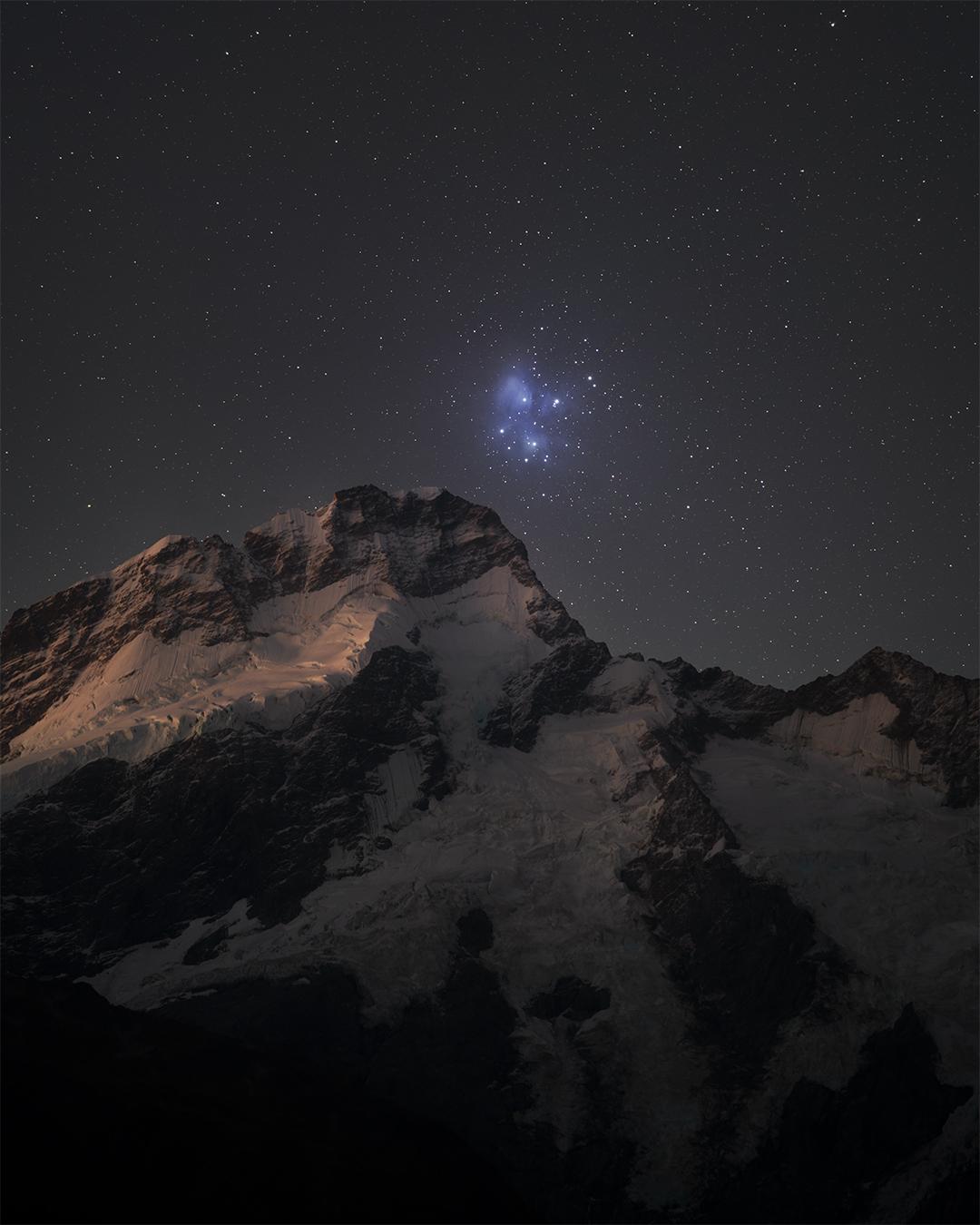
Alt...
2025 November 1
Pleiades from Planet Earth
* Image Credit & Copyright: Max Inwood
Explanation:
The lovely Pleiades star cluster shines in Earth's night sky, a compact group of stars some 400 light-years distant toward the constellation Taurus and the Orion Arm of our Milky Way galaxy. Recognized since ancient times, the remarkable celestial gathering is visible to the unaided eye. The Pleiades cluster is also well-placed for viewing from both northern and southern hemispheres, and over the centuries has become connected to many cultural traditions and celebrations, including the cross-quarter day celebration Halloween. In Greek myth, the Pleiades were seven daughters of the astronomical titan Atlas and sea-nymph Pleione. Galileo first sketched the star cluster viewed through his telescope with stars too faint to be seen by eye and Charles Messier recorded the position of the cluster as the 45th entry in his well-known catalog of things which are not comets. In this dramatic night skyscape from planet Earth, the stars of the Pleiades appear embedded in dusty blue reflection nebulae, poised above Mt Sefton, one of the tallest peaks in New Zealand. There known as Matariki, the star cluster is associated with the celebration of the Maori new year.
Authors & editors: Robert Nemiroff (MTU) & Jerry Bonnell (UMCP)
NASA Official: Amber Straughn Specific rights apply.
TOPIC> The Pleiades
2025 July 8
The Pleiades in Red and Blue
* Image Credit & Copyright: Ogetay Kayali (Michigan Tech U.)
* Text: Ogetay Kayali (Michigan Tech U.)
https://www.ogetay.com/
https://www.mtu.edu/physics/
Explanation:
If you have looked at the sky and seen a group of stars about the size of the full Moon, that's the Pleiades (M45). Perhaps the most famous star cluster in the sky, its brightest stars can be seen even from the light-polluted cities. But your unaided eye can also see its nebulosity -- the gas and dust surrounding it -- under dark skies. However, telescopes can catch even more. The bright blue stars of the Pleiades, also known as the Seven Sisters, light up their surrounding dust, causing it to appear a diffuse blue that can only be seen under long exposures. But that's not all. The cosmic dust appears to stretch upward like ethereal arms. And the entire structure is surrounded by a reddish glow from the most abundant element in the universe: hydrogen. The featured image is composed of nearly 25 hours of exposure and was captured last year from Starfront Observatory, in Texas, USA
https://app.astrobin.com/i/zcwwdj
https://en.wikipedia.org/wiki/Hydrogen-alpha
https://science.nasa.gov/universe/star-clusters-inside-the-universes-stellar-collections/
About Light Pollution:
https://apod.nasa.gov/apod/ap200408.html
https://apod.nasa.gov/apod/ap230308.html
https://starfront.space/
Cosmik Dust:
https://herscheltelescope.org.uk/science/infrared/dust/
https://apod.nasa.gov/apod/ap230108.html
https://en.wikipedia.org/wiki/Hydrogen-alpha
https://apod.nasa.gov/apod/ap250708.html
#space #pleiades #astrophotography #photography #science #astronomy #nature #NASA #education
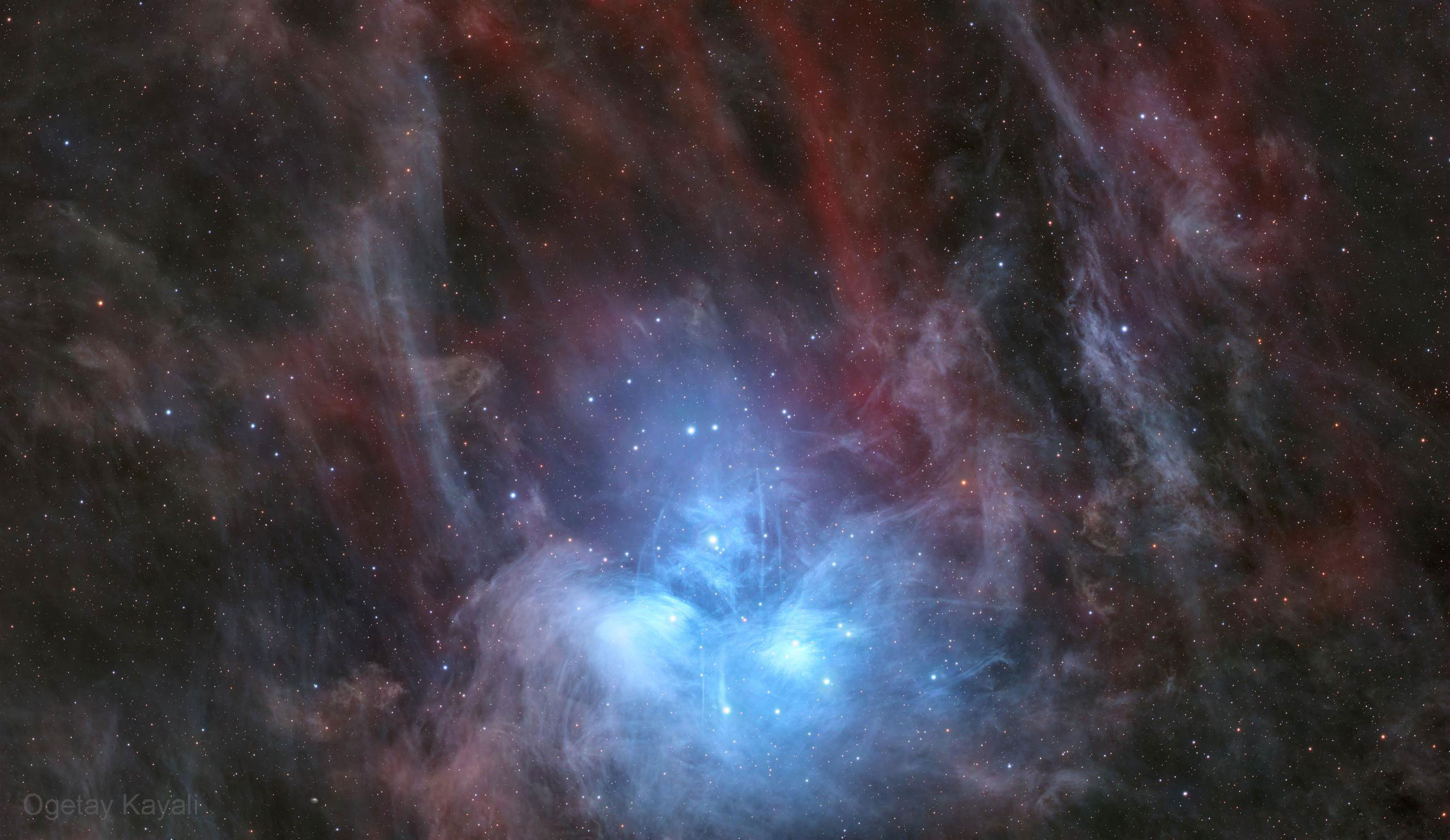
Alt...
2025 July 8
A cluster of bright blue stars is seen near the bottom of this starfield. Nebula around the stars is blue near the stars but red elsewhere.
The Pleiades in Red and Blue
* Image Credit & Copyright: Ogetay Kayali (Michigan Tech U.) Text: Ogetay Kayali (Michigan Tech U.)
Explanation:
If you have looked at the sky and seen a group of stars about the size of the full Moon, that's the Pleiades (M45). Perhaps the most famous star cluster in the sky, its brightest stars can be seen even from the light-polluted cities. But your unaided eye can also see its nebulosity -- the gas and dust surrounding it -- under dark skies. However, telescopes can catch even more. The bright blue stars of the Pleiades, also known as the Seven Sisters, light up their surrounding dust, causing it to appear a diffuse blue that can only be seen under long exposures. But that's not all. The cosmic dust appears to stretch upward like ethereal arms. And the entire structure is surrounded by a reddish glow from the most abundant element in the universe: hydrogen. The featured image is composed of nearly 25 hours of exposure and was captured last year from Starfront Observatory, in Texas, USA
Authors & editors: Robert Nemiroff (MTU) & Jerry Bonnell (UMCP)
NASA Official: Amber Straughn Specific rights apply.
NASA Web Privacy, Accessibility, Notices;
A service of: ASD at NASA / GSFC,
NASA Science Activation
& Michigan Tech. U.
2021 April 6
Mars and the Pleiades Beyond Vinegar Hill
* Image Credit & Copyright: Kristine Richer
https://www.instagram.com/kristinerosephotography/
Explanation:
Is this just a lonely tree on an empty hill? To start, perhaps, but look beyond. There, a busy universe may wait to be discovered. First, physically, to the left of the tree, is the planet Mars. The red planet, which is the new home to NASA's Perseverance rover, remains visible this month at sunset above the western horizon. To the tree's right is the Pleiades, a bright cluster of stars dominated by several bright blue stars. The featured picture is a composite of several separate foreground and background images taken within a few hours of each other, early last month, from the same location on Vinegar Hill in Milford, Nova Scotia, Canada. At that time, Mars was passing slowly, night after night, nearly in front of the distant Seven Sisters star cluster. The next time Mars will pass angularly as close to the Pleiades as it did in March will be in 2038.
https://apod.nasa.gov/apod/ap210406.html
#space #pleiades #astrophotography #photography #science #astronomy #nature #NASA #education
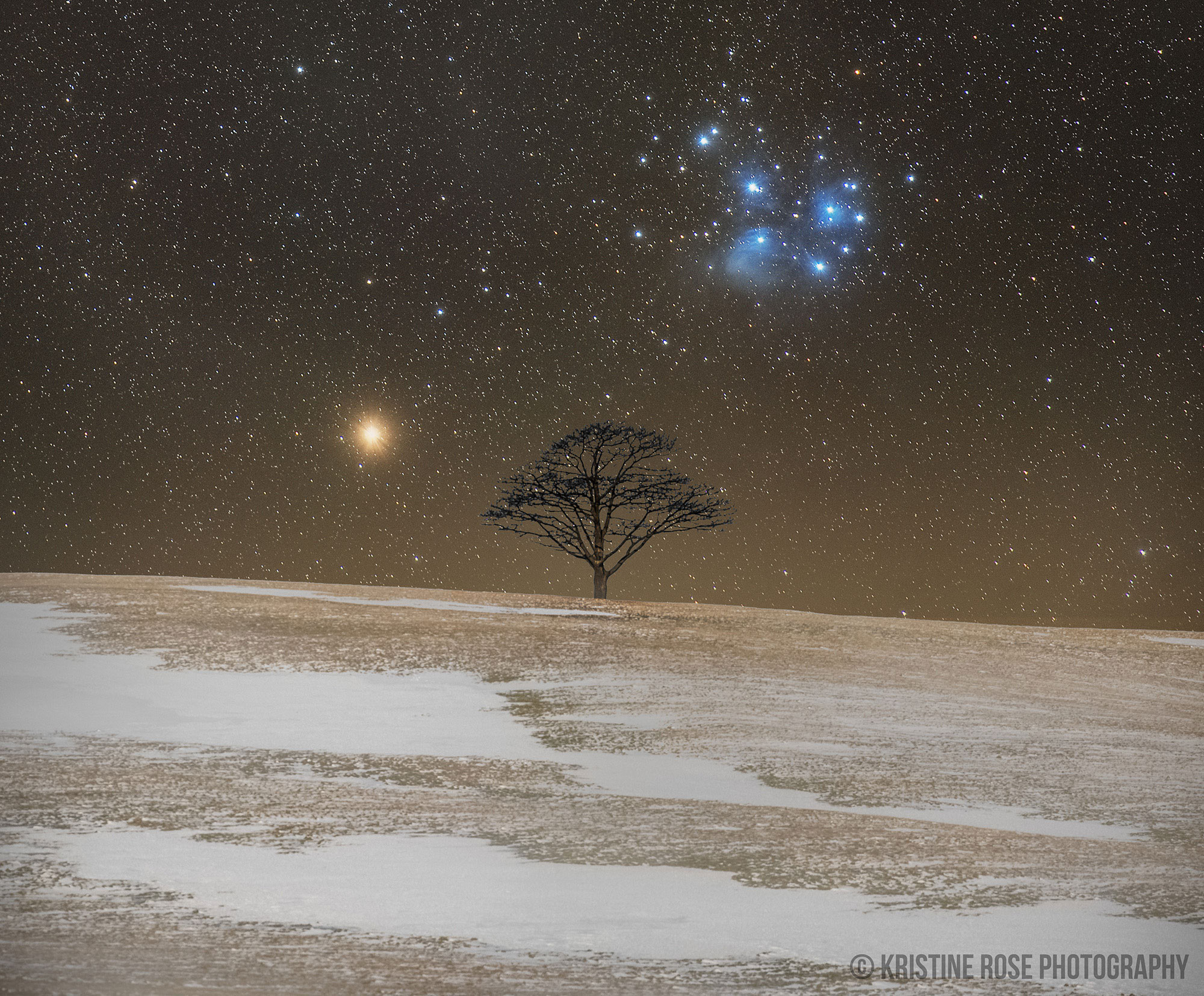
Alt...
2021 April 6
Mars and the Pleiades star cluster set behind one-tree hill.
Mars and the Pleiades Beyond Vinegar Hill
* Image Credit & Copyright: Kristine Richer
Explanation:
Is this just a lonely tree on an empty hill? To start, perhaps, but look beyond. There, a busy universe may wait to be discovered. First, physically, to the left of the tree, is the planet Mars. The red planet, which is the new home to NASA's Perseverance rover, remains visible this month at sunset above the western horizon. To the tree's right is the Pleiades, a bright cluster of stars dominated by several bright blue stars. The featured picture is a composite of several separate foreground and background images taken within a few hours of each other, early last month, from the same location on Vinegar Hill in Milford, Nova Scotia, Canada. At that time, Mars was passing slowly, night after night, nearly in front of the distant Seven Sisters star cluster. The next time Mars will pass angularly as close to the Pleiades as it did in March will be in 2038.
Authors & editors: Robert Nemiroff (MTU) & Jerry Bonnell (UMCP)
NASA Official: Amber Straughn Specific rights apply.
NASA Web Privacy, Accessibility, Notices;
A service of: ASD at NASA / GSFC,
NASA Science Activation
& Michigan Tech. U.
2024 September 29
Seven Dusty Sisters
* Image Credit: WISE, IRSA, NASA
https://www.jpl.nasa.gov/missions/wide-field-infrared-survey-explorer-wise
http://irsa.ipac.caltech.edu/Missions/wise.html
https://www.nasa.gov/
* Processing & Copyright : Francesco Antonucci
https://www.astrobin.com/users/FrankAntonucci/
Explanation:
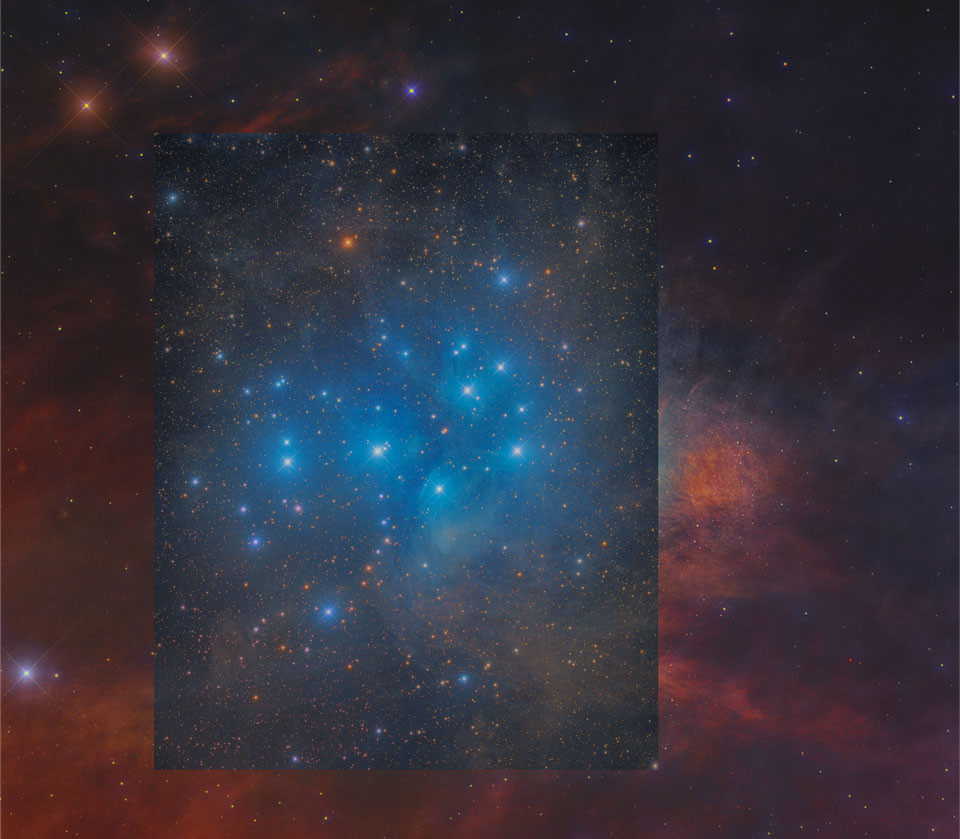
Is this really the famous Pleiades star cluster? Known for its iconic blue stars, the Pleiades is shown here in infrared light where the surrounding dust outshines the stars. Here, three infrared colors have been mapped into visual colors (R=24, G=12, B=4.6 microns). The base images were taken by NASA's orbiting Wide Field Infrared Survey Explorer (WISE) spacecraft. Cataloged as M45 and nicknamed the Seven Sisters, the Pleiades star cluster is by chance situated in a passing dust cloud. The light and winds from the massive Pleiades stars preferentially repel smaller dust particles, causing the dust to become stratified into filaments, as seen. The featured image spans about 20 light years at the distance of the Pleiades, which lies about 450 light years distant toward the constellation of the Bull (Taurus).
https://arxiv.org/abs/0810.1592
https://apod.nasa.gov/apod/ap240929.html
#space #pleiades #astrophotography #photography #science #astronomy #nature #NASA #education
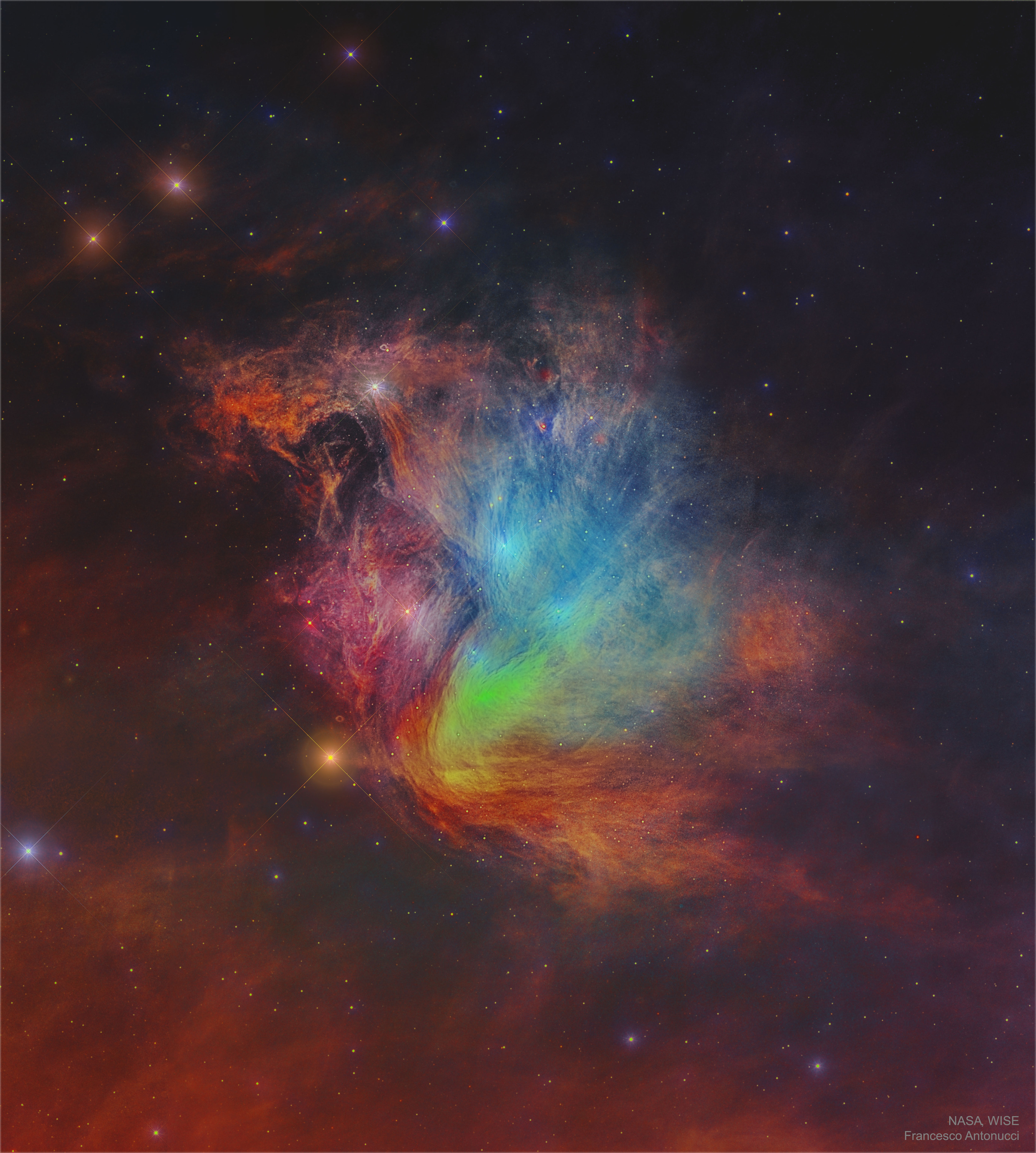
Alt...
2024 September 29
A famous Pleiades star cluster is shown but showing numerous parallel and curved filaments in different colors. The image is in several colors of infrared light. A rollover image shows the cluster in visible light with its familiar blue light.
Seven Dusty Sisters
* Image Credit: WISE, IRSA, NASA; Processing &
* Copyright : Francesco Antonucci
Explanation:
Is this really the famous Pleiades star cluster? Known for its iconic blue stars, the Pleiades is shown here in infrared light where the surrounding dust outshines the stars. Here, three infrared colors have been mapped into visual colors (R=24, G=12, B=4.6 microns). The base images were taken by NASA's orbiting Wide Field Infrared Survey Explorer (WISE) spacecraft. Cataloged as M45 and nicknamed the Seven Sisters, the Pleiades star cluster is by chance situated in a passing dust cloud. The light and winds from the massive Pleiades stars preferentially repel smaller dust particles, causing the dust to become stratified into filaments, as seen. The featured image spans about 20 light years at the distance of the Pleiades, which lies about 450 light years distant toward the constellation of the Bull (Taurus).
Authors & editors: Robert Nemiroff (MTU) & Jerry Bonnell (UMCP)
NASA Official: Amber Straughn Specific rights apply.
NASA Web Privacy, Accessibility, Notices;
A service of: ASD at NASA / GSFC,
NASA Science Activation
& Michigan Tech. U.
Alt...
A rollover image shows the cluster in visible light with its familiar blue light.
2024 August 15
Late Night Vallentuna
* Image Credit & Copyright: P-M Hedén (Clear Skies, TWAN)
https://www.clearskies.se/
http://www.twanight.org/
Explanation:
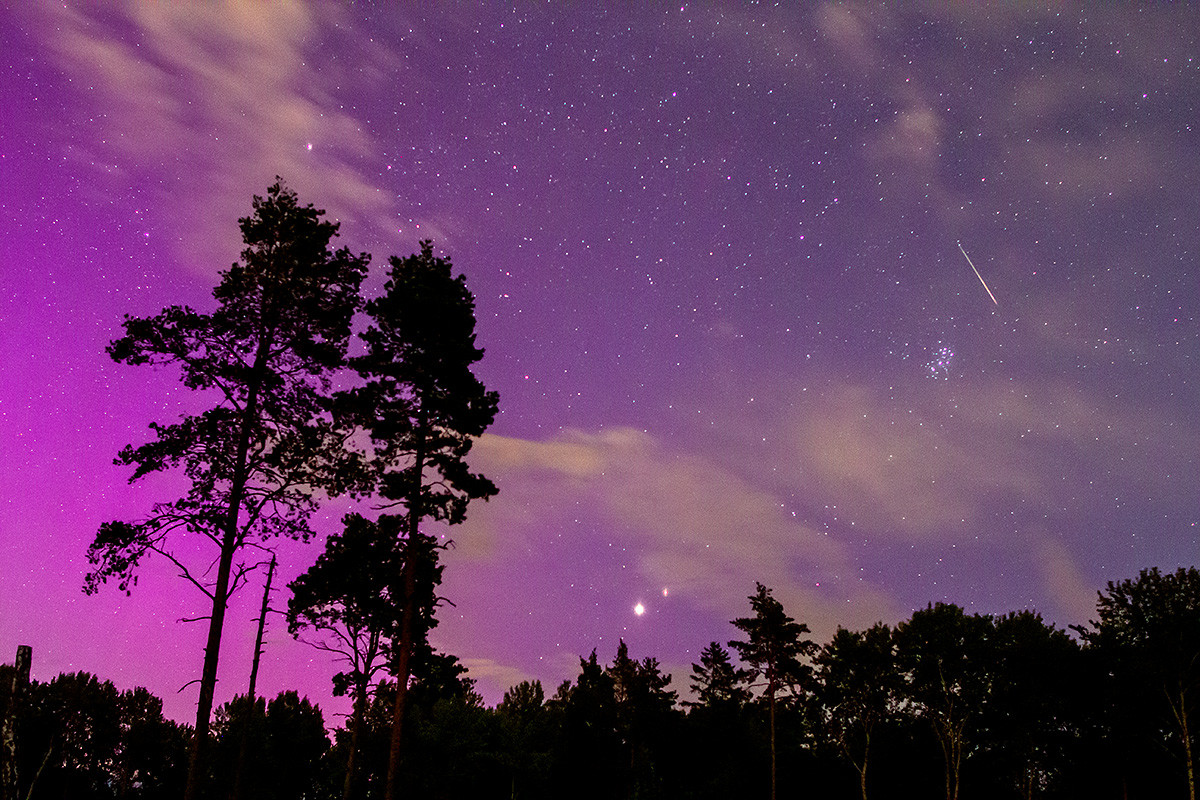
Bright Mars and even brighter Jupiter are in close conjunction just above the pine trees in this post-midnight skyscape from Vallentuna, Sweden. Taken on August 12 during a geomagnetic storm, the snapshot records the glow of aurora borealis or northern lights, beaming from the left side of the frame. Of course on that date Perseid meteors rained through planet Earth's skies, grains of dust from the shower's parent, periodic comet Swift-Tuttle. The meteor streak at the upper right is a Perseid plowing through the atmosphere at about 60 kilometers per second. Also well-known in Earth's night sky, the bright Pleiades star cluster shines below the Perseid meteor streak. In Greek myth, the Pleiades were seven daughters of the astronomical titan Atlas and sea-nymph Pleione. The Pleiades and their parents' names are given to the cluster's nine brightest stars.
https://en.wikipedia.org/wiki/Pleiades_(Greek_mythology)
https://apod.nasa.gov/apod/ap240815.html
#space #pleiades #astrophotography #photography #science #astronomy #nature #NASA #education
Alt...
2024 August 15
Late Night Vallentuna
* Image Credit & Copyright: P-M Hedén (Clear Skies, TWAN)
Explanation:
Bright Mars and even brighter Jupiter are in close conjunction just above the pine trees in this post-midnight skyscape from Vallentuna, Sweden. Taken on August 12 during a geomagnetic storm, the snapshot records the glow of aurora borealis or northern lights, beaming from the left side of the frame. Of course on that date Perseid meteors rained through planet Earth's skies, grains of dust from the shower's parent, periodic comet Swift-Tuttle. The meteor streak at the upper right is a Perseid plowing through the atmosphere at about 60 kilometers per second. Also well-known in Earth's night sky, the bright Pleiades star cluster shines below the Perseid meteor streak. In Greek myth, the Pleiades were seven daughters of the astronomical titan Atlas and sea-nymph Pleione. The Pleiades and their parents' names are given to the cluster's nine brightest stars.
Authors & editors: Robert Nemiroff (MTU) & Jerry Bonnell (UMCP)
NASA Official: Amber Straughn Specific rights apply.
NASA Web Privacy, Accessibility Notices
A service of: ASD at NASA / GSFC,
NASA Science Activation
& Michigan Tech. U.
From Contributors to Wikimedia projects
The Pleiades,
also known as Seven Sisters and Messier 45 (M45), is an asterism of an open star cluster containing young B-type stars in the northwest of the constellation Taurus. At a distance of about 444 light-years, it is among the nearest star clusters to Earth and the nearest Messier object to Earth, being the most obvious star cluster to the naked eye in the night sky. It is also observed to house the reflection nebula NGC 1432, an HII region. Around 2330 BC it marked the vernal point. Due to the brightness of its stars, the Pleiades is viewable from most areas on Earth, even in locations with significant light pollution.
The cluster is dominated by hot blue luminous stars that have formed within the last 100 million years. Reflection nebulae around the brightest stars were once thought to be leftover material from their formation, but are now considered likely to be an unrelated dust cloud in the interstellar medium through which the stars are currently passing. This dust cloud is estimated to be moving at a speed of approximately 18 km/s relative to the stars in the cluster.
Computer simulations have shown that the Pleiades were probably formed from a compact configuration that once resembled the Orion Nebula. Astronomers estimate that the cluster will survive for approximately another 250 million years, after which the clustering will be lost due to gravitational interactions with the galactic neighborhood.
Together with the open star cluster of the Hyades, the Pleiades form the Golden Gate of the Ecliptic. The Pleiades have been said to "resemble a tiny dipper," and should not be confused with the "Little Dipper," or Ursa Minor.
[...]
https://en.wikipedia.org/wiki/Pleiades
#space #pleiades #astrophotography #photography #science #astronomy #nature #NASA #education
Alt...
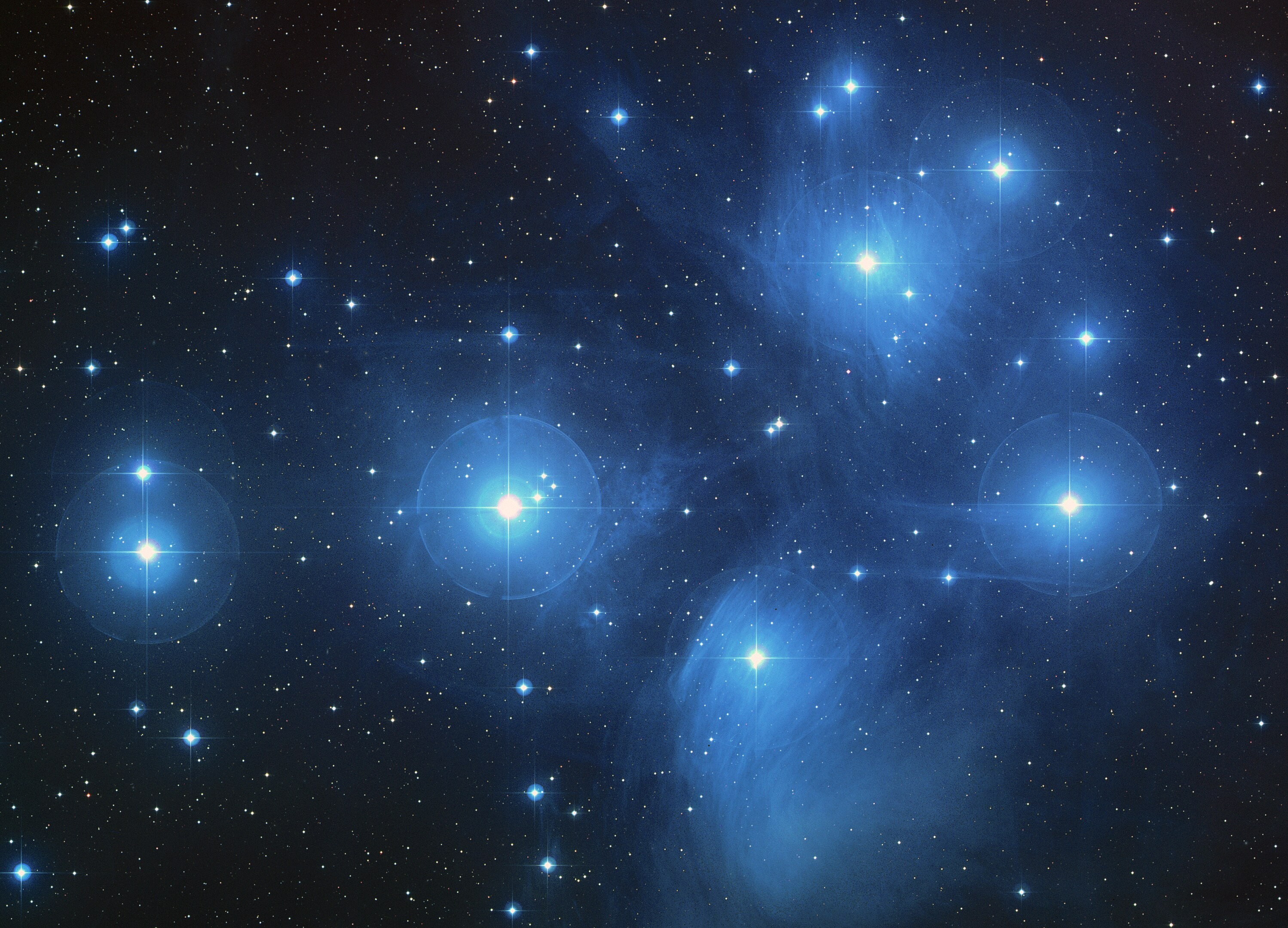
The Pleiades, an open cluster consisting of approximately 3,000 stars at a distance of 400 light-years (120 parsecs) from Earth in the constellation of Taurus. It is also known as ‘The Seven Sisters’, or the astronomical designations NGC 1432/35 and M45.
CREDIT
NASA, ESA, AURA/Caltech, Palomar Observatory The science team consists of: D. Soderblom and E. Nelan (STScI), F. Benedict and B. Arthur (U. Texas), and B. Jones (Lick Obs.)
The name, Pleiades, comes from Ancient Greek: Πλειάδες. It probably derives from plein (πλεῖν 'to sail') because of the cluster's importance in delimiting the sailing season in the Mediterranean Sea: "the season of navigation began with their heliacal rising". In Classical Greek mythology the name was used for seven divine sisters called the Pleiades. In time, the name was said to be derived from that of a mythical mother, Pleione, effectively meaning "daughters of Pleione". In reality, the ancient name of the star cluster related to sailing almost certainly came first in the culture, naming of a relationship to the sister deities followed, and eventually appearing in later myths, to interpret the group name, a mother, Pleione.
Alt...
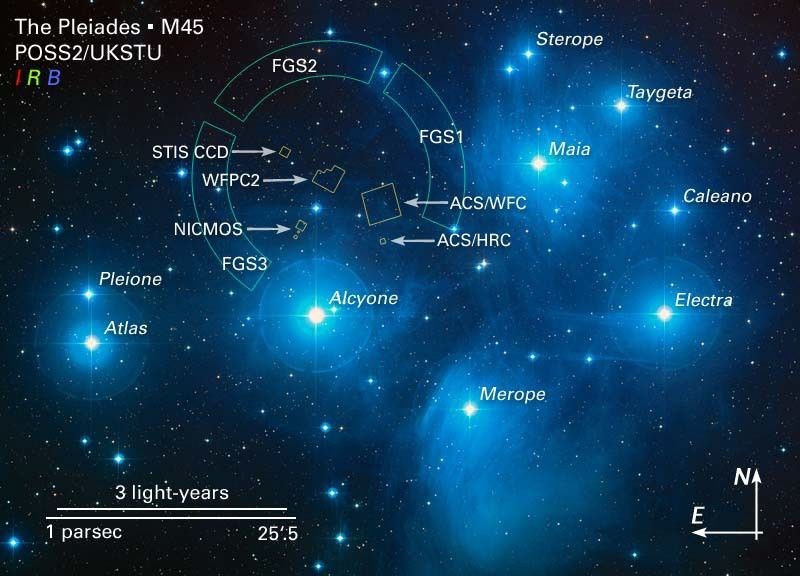
Annotated Image of the Pleiades and HST Field of View
Credit
NASA, ESA and AURA/Caltech
A color-composite image of the Pleiades from the Digitized Sky Survey
Observation data (J2000 epoch)
Right ascension 03h 47m 24s
Declination +24° 07′ 00″
Distance 444 ly on average (136.2±1.2 pc)
Apparent magnitude (V) 1.6
Apparent dimensions (V) 2°
Physical characteristics
Mass 800 M☉
Radius 20.34 light years
2024 September 3
Quarter Moon and Sister Stars
* Image Credit & Copyright: Alan Dyer, TWAN
https://www.amazingsky.com/About
https://twanight.org/profile/alan-dyer/
Explanation:
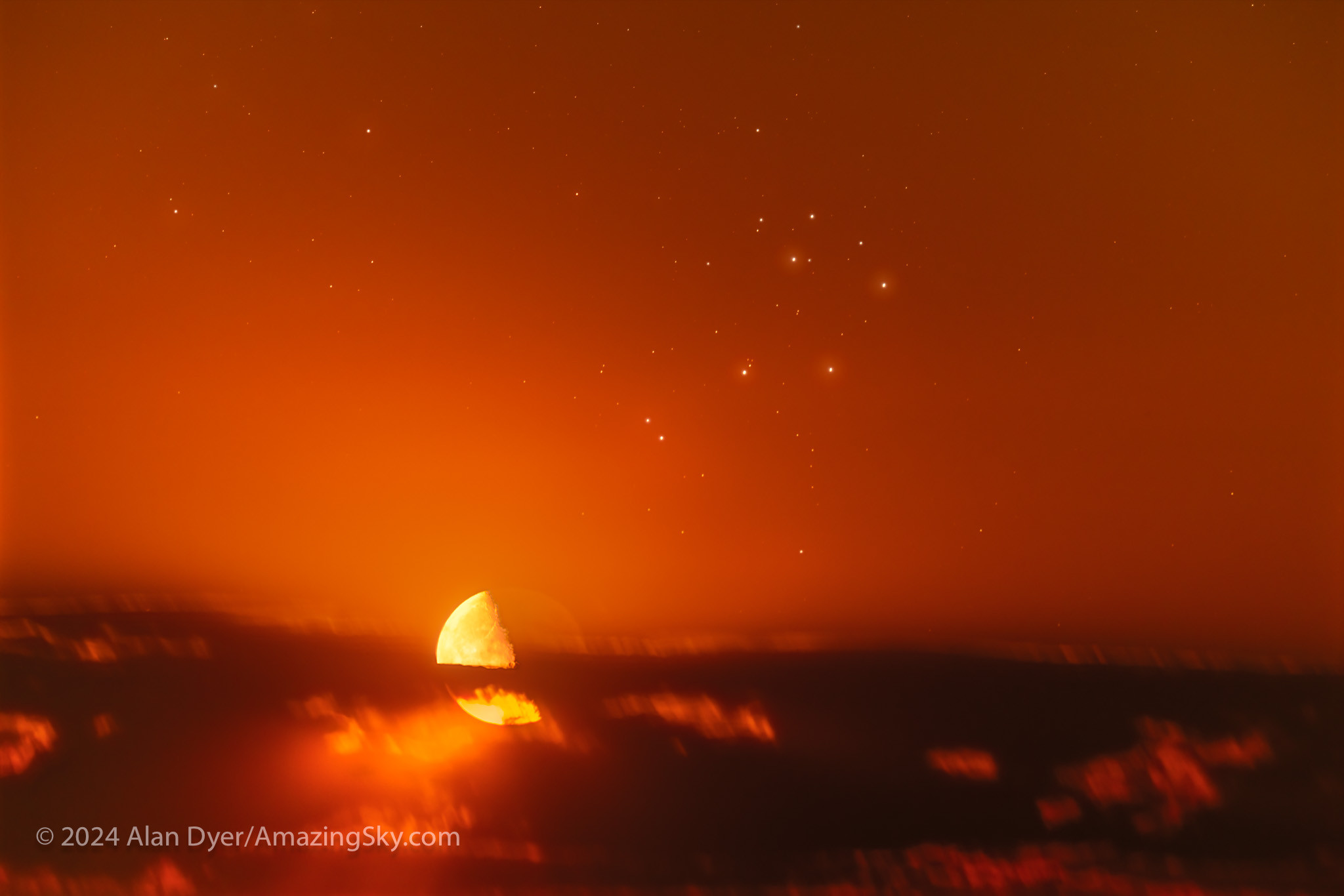
Last August two quite different sky icons were imaged rising together. Specifically, Earth's Moon shared the eastern sky with the sister stars of the Pleiades cluster, as viewed from Alberta, Canada. Astronomical images of the well-known Pleiades often show the star cluster's alluring blue reflection nebulas, but here they are washed-out by the orange moonrise sky. The half-lit Moon, known as a quarter moon, is overexposed, although the outline of the dim lunar night side can be seen by illuminating earthshine, light first reflected from the Earth. The featured image is a composite of eight successive exposures with brightnesses adjusted to match what the human eye would see. The Moon passes nearly -- or directly -- in front of the Pleaides once a month.
https://apod.nasa.gov/apod/ap240903.html
#space #pleiades #astrophotography #photography #science #astronomy #nature #NASA #education
Alt...
2024 September 3
The featured image shows an orange sky with clouds across the bottom and several bright stars near the top center. Just at the top of the cloud deck on the left is a half-lit Moon.
Quarter Moon and Sister Stars
* Image Credit & Copyright: Alan Dyer, TWAN
Explanation:
Last August two quite different sky icons were imaged rising together. Specifically, Earth's Moon shared the eastern sky with the sister stars of the Pleiades cluster, as viewed from Alberta, Canada. Astronomical images of the well-known Pleiades often show the star cluster's alluring blue reflection nebulas, but here they are washed-out by the orange moonrise sky. The half-lit Moon, known as a quarter moon, is overexposed, although the outline of the dim lunar night side can be seen by illuminating earthshine, light first reflected from the Earth. The featured image is a composite of eight successive exposures with brightnesses adjusted to match what the human eye would see. The Moon passes nearly -- or directly -- in front of the Pleaides once a month.
Authors & editors: Robert Nemiroff (MTU) & Jerry Bonnell (UMCP)
NASA Official: Amber Straughn Specific rights apply.
NASA Web Privacy, Accessibility, Notices;
A service of: ASD at NASA / GSFC,
NASA Science Activation
& Michigan Tech. U.
2025 January 27
Pleiades over Half Dome
* Image Credit & Copyright: Dheera Venkatraman
https://dheera.net/about
Explanation:
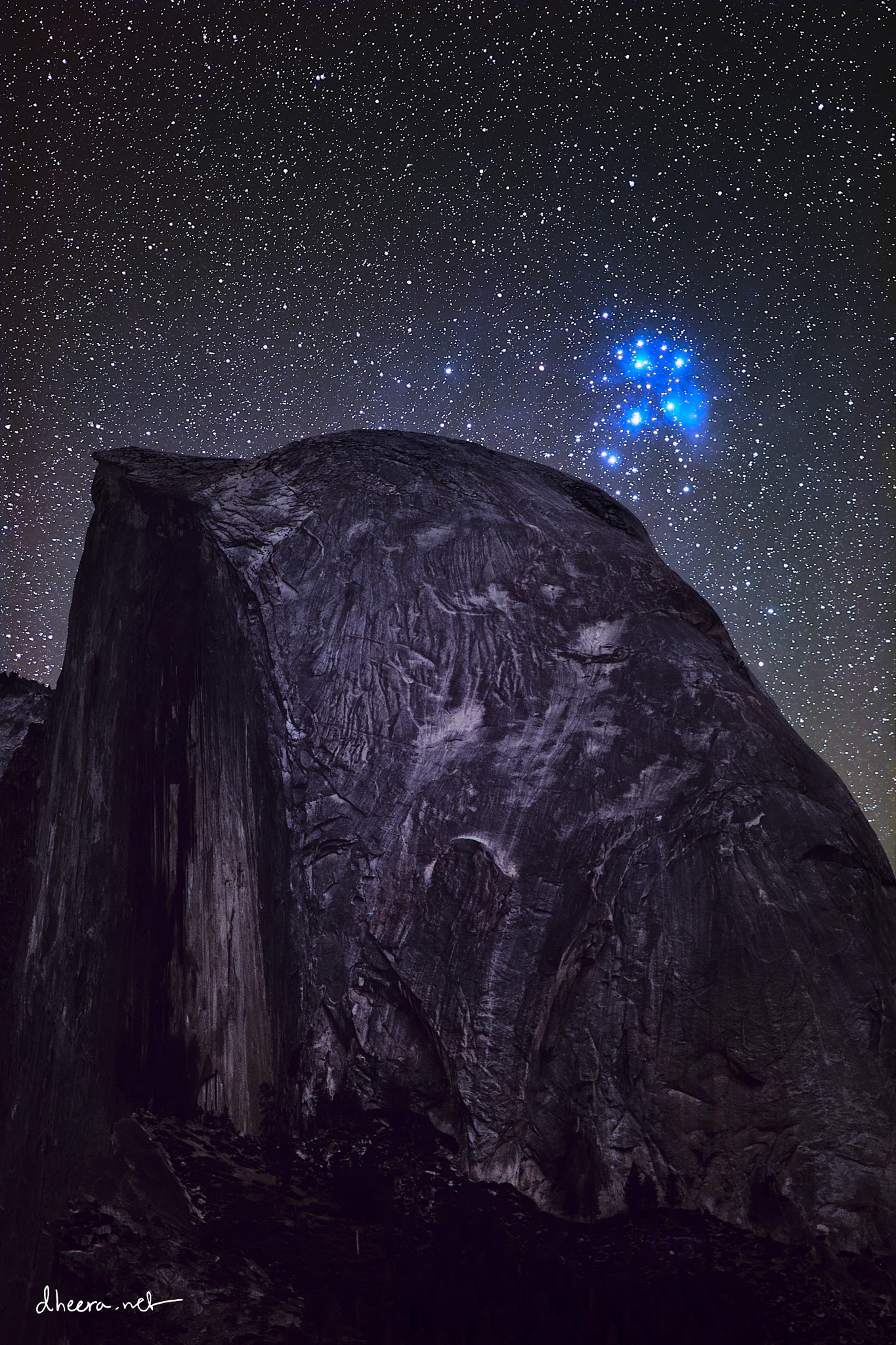
Stars come in bunches. The most famous bunch of stars on the sky is the Pleiades, a bright cluster that can be easily seen with the unaided eye. The Pleiades lies only about 450 light years away, formed about 100 million years ago, and will likely last about another 250 million years. Our Sun was likely born in a star cluster, but now, being about 4.5 billion years old, its stellar birth companions have long since dispersed. The Pleiades star cluster is pictured over Half Dome, a famous rock structure in Yosemite National Park in California, USA. The featured image is a composite of 28 foreground exposures and 174 images of the stellar background, all taken from the same location and by the same camera on the same night in October 2019. After calculating the timing of a future juxtaposition of the Pleiades and Half Dome, the astrophotographer was unexpectedly rewarded by an electrical blackout, making the background sky unusually dark.
https://apod.nasa.gov/apod/ap250127.html
#space #pleiades #astrophotography #photography #science #astronomy #nature #NASA #education
Alt...
2025 January 27
A cluster of bright blue stars is seen on the upper right while an unusual dome-like mountain occupies most of the frame.
Pleiades over Half Dome
* Image Credit & Copyright: Dheera Venkatraman
Explanation:
Stars come in bunches. The most famous bunch of stars on the sky is the Pleiades, a bright cluster that can be easily seen with the unaided eye. The Pleiades lies only about 450 light years away, formed about 100 million years ago, and will likely last about another 250 million years. Our Sun was likely born in a star cluster, but now, being about 4.5 billion years old, its stellar birth companions have long since dispersed. The Pleiades star cluster is pictured over Half Dome, a famous rock structure in Yosemite National Park in California, USA. The featured image is a composite of 28 foreground exposures and 174 images of the stellar background, all taken from the same location and by the same camera on the same night in October 2019. After calculating the timing of a future juxtaposition of the Pleiades and Half Dome, the astrophotographer was unexpectedly rewarded by an electrical blackout, making the background sky unusually dark.
Authors & editors: Robert Nemiroff (MTU) & Jerry Bonnell (UMCP)
NASA Official: Amber Straughn Specific rights apply.
NASA Web Privacy, Accessibility, Notices;
A service of: ASD at NASA / GSFC,
NASA Science Activation
& Michigan Tech. U.
2023 December 9
Pic du Pleiades
* Image Credit & Copyright: Jean-Francois Graffand
http://www.echosduciel.fr/
Explanation:
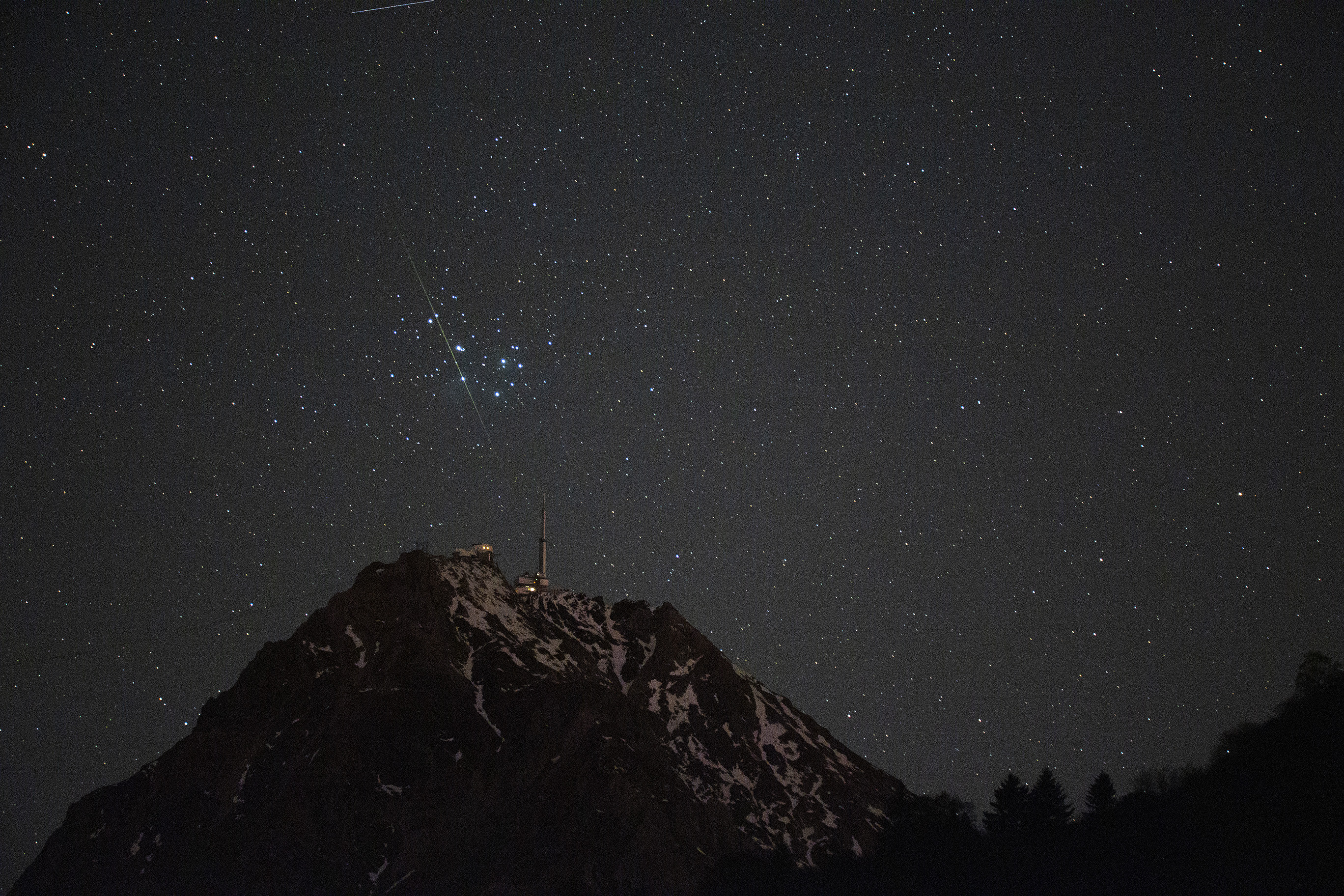
Near dawn on November 19 the Pleiades stood in still dark skies over the French Pyrenees. But just before sunrise a serendipitous moment was captured in this single 3 second exposure; a bright meteor streak appeared to pierce the heart of the galactic star cluster. From the camera's perspective, star cluster and meteor were poised directly above the mountain top observatory on the Pic du Midi de Bigorre. And though astronomers might consider the Pleiades to be relatively close by, the grain of dust vaporizing as it plowed through planet Earth's upper atmosphere actually missed the cluster's tight grouping of young stars by about 400 light-years. While recording a night sky timelapse series, the camera and telephoto lens were fixed to a tripod on the Tour-de-France-cycled slopes of the Col du Tourmalet about 5 kilometers from the Pic du Midi.
https://apod.nasa.gov/apod/ap231209.html
#space #pleiades #astrophotography #photography #science #astronomy #nature #NASA
Alt...
2023 December 9
Pic du Pleiades
* Image Credit & Copyright: Jean-Francois Graffand
Explanation:
Near dawn on November 19 the Pleiades stood in still dark skies over the French Pyrenees. But just before sunrise a serendipitous moment was captured in this single 3 second exposure; a bright meteor streak appeared to pierce the heart of the galactic star cluster. From the camera's perspective, star cluster and meteor were poised directly above the mountain top observatory on the Pic du Midi de Bigorre. And though astronomers might consider the Pleiades to be relatively close by, the grain of dust vaporizing as it plowed through planet Earth's upper atmosphere actually missed the cluster's tight grouping of young stars by about 400 light-years. While recording a night sky timelapse series, the camera and telephoto lens were fixed to a tripod on the Tour-de-France-cycled slopes of the Col du Tourmalet about 5 kilometers from the Pic du Midi.
Authors & editors: Robert Nemiroff (MTU) & Jerry Bonnell (UMCP)
NASA Official: Phillip Newman Specific rights apply.
NASA Web Privacy Policy and Important Notices
A service of: ASD at NASA / GSFC,
NASA Science Activation
& Michigan Tech. U.
2023 January 5
Messier 45: The Daughters of Atlas and Pleione
* Image Credit & Copyright: Stefan Thrun
https://apod.nasa.gov/apod/ap230105.html
Explanation:
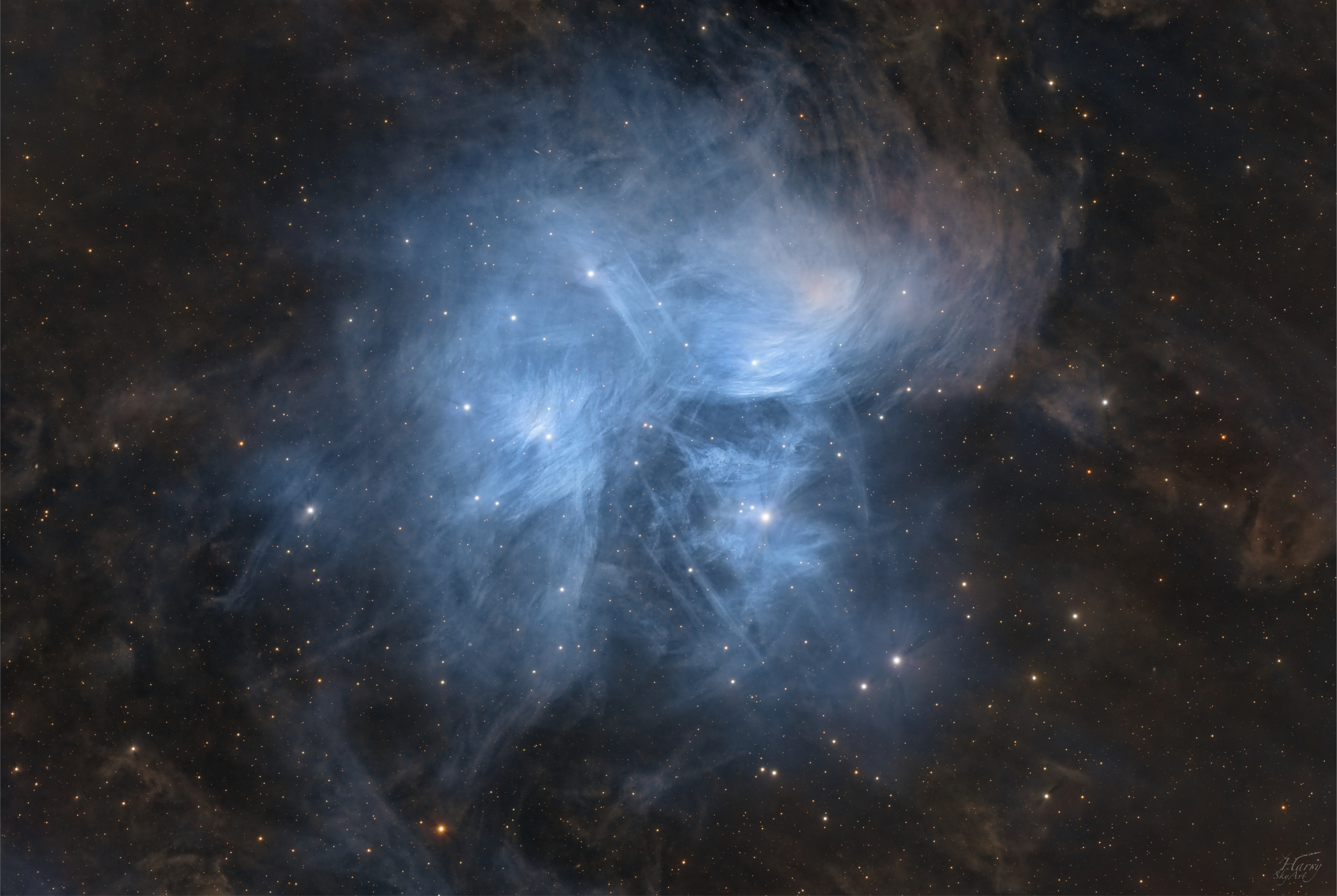
Hurtling through a cosmic dust cloud a mere 400 light-years away, the lovely Pleiades or Seven Sisters open star cluster is well-known for its striking blue reflection nebulae. It lies in the night sky toward the constellation Taurus and the Orion Arm of our Milky Way galaxy. The sister stars are not related to the dusty cloud though. They just happen to be passing through the same region of space. Known since antiquity as a compact grouping of stars, Galileo first sketched the star cluster viewed through his telescope with stars too faint to be seen by eye. Charles Messier recorded the position of the cluster as the 45th entry in his famous catalog of things which are not comets. In Greek myth, the Pleiades were seven daughters of the astronomical titan Atlas and sea-nymph Pleione. Their parents names are included in the cluster's nine brightest stars. This well-processed, color-calibrated telescopic image features pin-point stars and detailed filaments of interstellar dust captured in over 9 hours of exposure. It spans more than 20 light-years across the Pleiades star cluster.
https://apod.nasa.gov/apod/ap230105.html
#space #pleiades #astrophotography #photography #science #astronomy #nature #NASA
Alt...
2023 January 5
Messier 45: The Daughters of Atlas and Pleione
* Image Credit & Copyright: Stefan Thrun
Explanation:
Hurtling through a cosmic dust cloud a mere 400 light-years away, the lovely Pleiades or Seven Sisters open star cluster is well-known for its striking blue reflection nebulae. It lies in the night sky toward the constellation Taurus and the Orion Arm of our Milky Way galaxy. The sister stars are not related to the dusty cloud though. They just happen to be passing through the same region of space. Known since antiquity as a compact grouping of stars, Galileo first sketched the star cluster viewed through his telescope with stars too faint to be seen by eye. Charles Messier recorded the position of the cluster as the 45th entry in his famous catalog of things which are not comets. In Greek myth, the Pleiades were seven daughters of the astronomical titan Atlas and sea-nymph Pleione. Their parents names are included in the cluster's nine brightest stars. This well-processed, color-calibrated telescopic image features pin-point stars and detailed filaments of interstellar dust captured in over 9 hours of exposure. It spans more than 20 light-years across the Pleiades star cluster.
Authors & editors: Robert Nemiroff (MTU) & Jerry Bonnell (UMCP)
NASA Official: Phillip Newman Specific rights apply.
NASA Web Privacy Policy and Important Notices
A service of: ASD at NASA / GSFC,
NASA Science Activation
& Michigan Tech. U.
2021 November 20
An Almost Total Lunar Eclipse
* Image Credit & Copyright: Robert Fedez
https://app.astrobin.com/u/RobertFedez#gallery
Explanation:
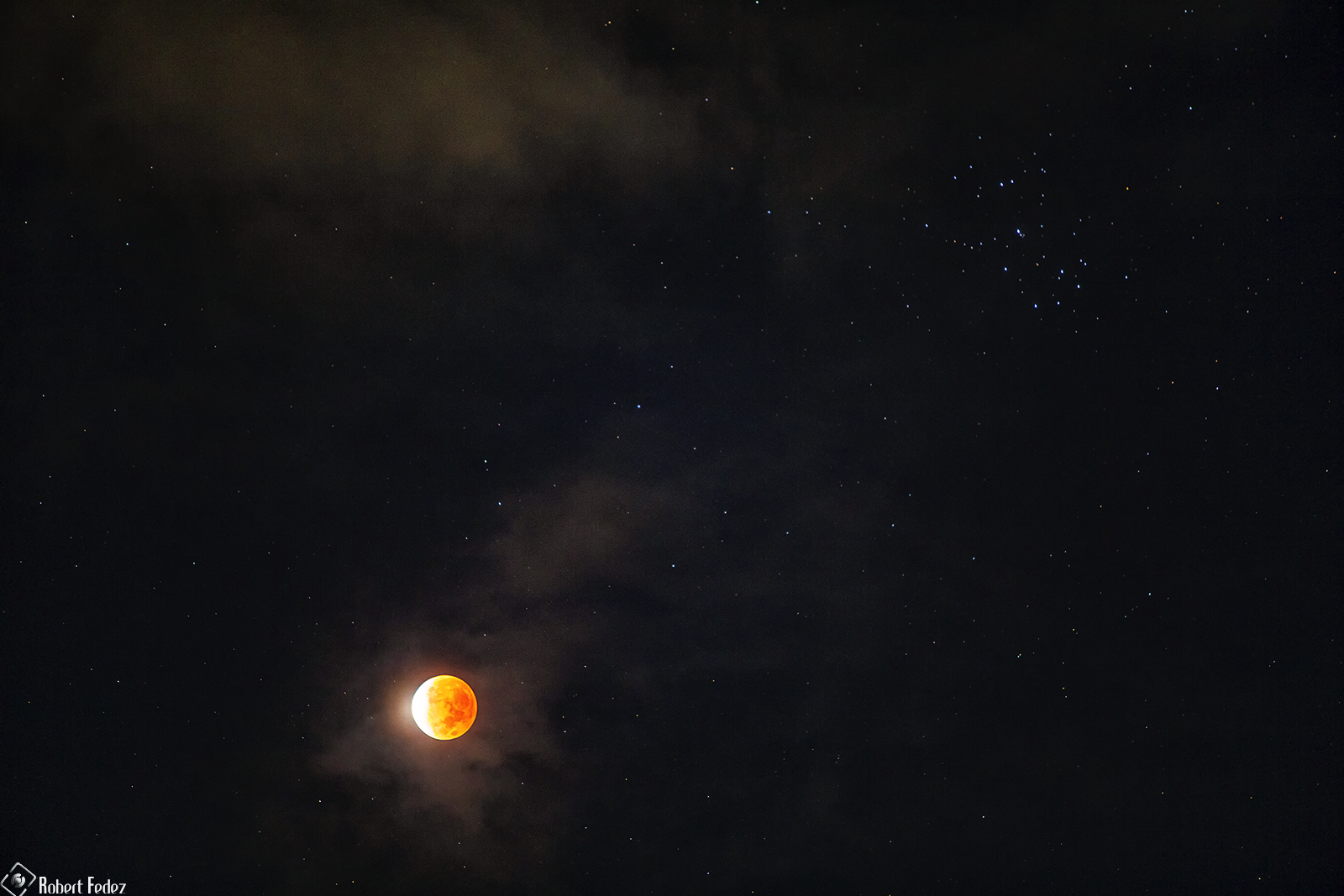
Predawn hours of 2021 November 19 found the Moon in partly cloudy skies over Cancun, Mexico. Captured in this telephoto snapshot, the lunar disk is not quite entirely immersed in Earth's dark umbral shadow during a long partial lunar eclipse. The partial eclipse was deep though, deep enough to show the dimmed but reddened light in Earth's shadow. That's a sight often anticipated by fans of total lunar eclipses. Wandering through the constellation Taurus, the eclipsed Moon's dimmer light also made it easier to spot the Pleiades star cluster. The stars of the Seven Sisters share this frame at the upper right, with the almost totally eclipsed Moon.
https://apod.nasa.gov/apod/ap211120.html
#space #pleiades #moon #astrophotography #photography #science #astronomy #nature #NASA
Alt...
2021 November 20
An Almost Total Lunar Eclipse
* Image Credit & Copyright: Robert Fedez
Explanation:
Predawn hours of 2021 November 19 found the Moon in partly cloudy skies over Cancun, Mexico. Captured in this telephoto snapshot, the lunar disk is not quite entirely immersed in Earth's dark umbral shadow during a long partial lunar eclipse. The partial eclipse was deep though, deep enough to show the dimmed but reddened light in Earth's shadow. That's a sight often anticipated by fans of total lunar eclipses. Wandering through the constellation Taurus, the eclipsed Moon's dimmer light also made it easier to spot the Pleiades star cluster. The stars of the Seven Sisters share this frame at the upper right, with the almost totally eclipsed Moon.
Authors & editors: Robert Nemiroff (MTU) & Jerry Bonnell (UMCP)
NASA Official: Phillip Newman Specific rights apply.
NASA Web Privacy Policy and Important Notices
A service of: ASD at NASA / GSFC
& Michigan Tech. U.
2019 November 7
Messier 45: The Daughters of Atlas and Pleione
* Image Credit & Copyright: Adam Block, Steward Observatory, University of Arizona
https://www.adamblockphhttps://duckduckgo.com/?t=ffab&q=astro++Jean-Francois+Graffand&atb=v480-1&ia=webotos.com/
https://astro.arizona.edu/
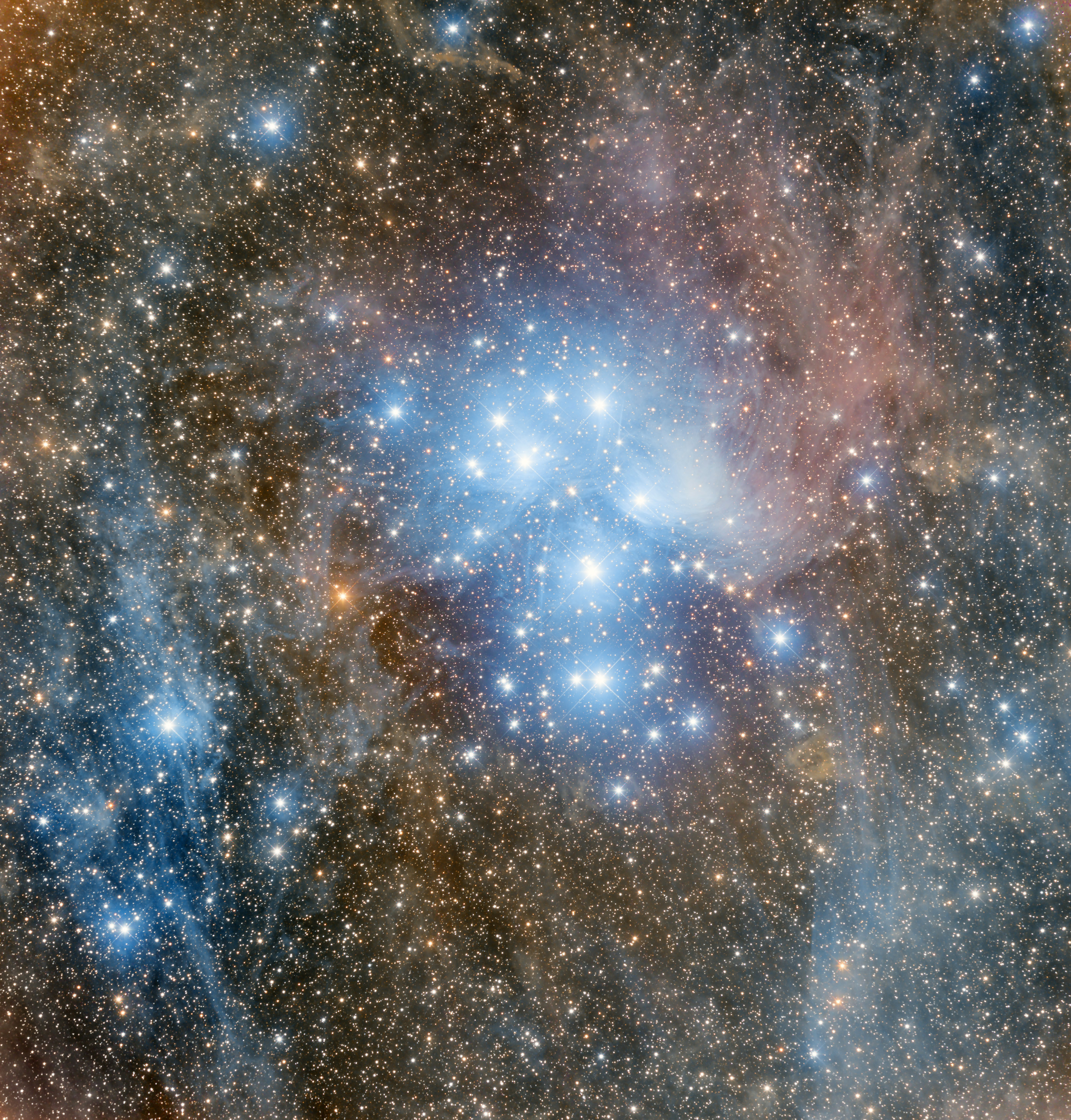
Commonly called the Pleiades or Seven Sisters, M45 is known as an open star cluster. It contains over a thousand stars that are loosely bound by gravity, but it is visually dominated by a handful of its brightest members.
One of these stars, Merope, is located just outside the frame of this image to the upper right. The colorful rays of light at the upper right, emanating from the star, are an optical phenomenon produced within the telescope. The nearly straight, blue-white wisps pointing toward the upper right are streams of large dust particles. As the cloud moves toward Merope, its smaller dust particles are slowed down by the star’s radiation pressure more than the larger particles are. The large dust particles continue on toward the star while the smaller particles are left behind at the lower left of the picture.
The Pleiades cluster has been observed since ancient times, so it has no known discoverer. However, Galileo Galilei, the Italian scientist best known for discovering the largest moons of Jupiter and championing a heliocentric model of the solar system, was the first to observe the Pleiades through a telescope. M45 is located an estimated distance of 445 light-years from Earth in the constellation Taurus, though this number is not universally agreed upon. It has an apparent magnitude of 1.6 and can be seen with the naked eye. The cluster is best observed during December.
https://apod.nasa.gov/apod/ap191107.html
#space #pleiades #astrophotography #photography #science #astronomy #nature #NASA
Alt...
2019 November 7
Messier 45: The Daughters of Atlas and Pleione
* Image Credit & Copyright: Adam Block, Steward Observatory, University of Arizona
Explanation:
Hurtling through a cosmic dust cloud a mere 400 light-years away, the lovely Pleiades or Seven Sisters open star cluster is well-known for its striking blue reflection nebulae. It lies in the night sky toward the constellation Taurus and the Orion Arm of our Milky Way Galaxy. The sister stars and cosmic dust cloud are not related though, they just happen to be passing through the same region of space. Known since antiquity as a compact grouping of stars, Galileo first sketched the star cluster viewed through his telescope with stars too faint to be seen by eye. Charles Messier recorded the position of the cluster as the 45th entry in his famous catalog of things which are not comets. In Greek myth, the Pleiades were seven daughters of the astronomical titan Atlas and sea-nymph Pleione. Their parents names are included in the cluster's nine brightest stars. This deep and wide telescopic image spans over 20 light-years across the Pleides star cluster.
Authors & editors: Robert Nemiroff (MTU) & Jerry Bonnell (UMCP)
NASA Official: Phillip Newman Specific rights apply.
NASA Web Privacy Policy and Important Notices
A service of: ASD at NASA / GSFC
& Michigan Tech. U.
2020 April 15
A Cosmic Triangle
* Image Credit & Copyright: Scott Aspinall
https://www.scottaspinall.com/
Explanation:
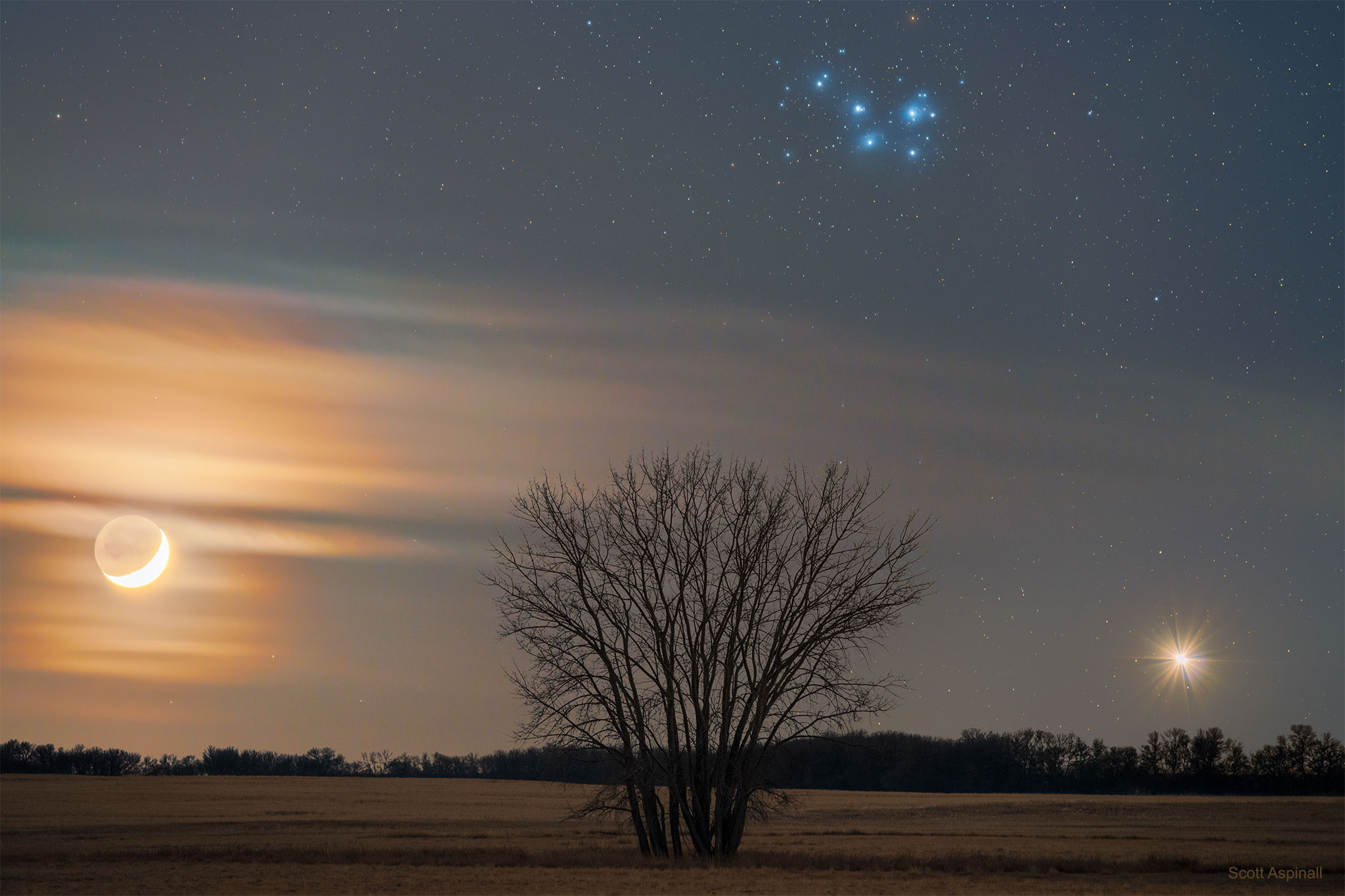
It was an astronomical triple play. Setting on the left, just after sunset near the end of March 2020, was our Moon -- showing a bright crescent phase. Setting on the right was Venus, the brightest planet in the evening sky last month -- and this month, too. With a small telescope, you could tell that Venus' phase was half, meaning that only half of the planet, as visible from Earth, was exposed to direct sunlight and brightly lit. High above and much further in the distance was the Pleiades star cluster. Although the Moon and Venus move with respect to the background stars, the Pleiades do not -- because they are background stars. In the beginning of this month, Venus appeared to move right in front of the Pleiades, a rare event that happens only once every eight years. The featured image captured this cosmic triangle with a series of exposures taken from the same camera over 70 minutes near Avonlea, Saskatchewan, Canada. The positions of the celestial objects was predicted. The only thing unpredicted was the existence of the foreground tree -- and the astrophotographer is still unsure what type of tree that is.
https://apod.nasa.gov/apod/ap200415.html
#space #pleiades #astrophotography #photography #science #astronomy #nature #NASA
Alt...
2020 April 15
A Cosmic Triangle
* Image Credit & Copyright: Scott Aspinall
Explanation:
It was an astronomical triple play. Setting on the left, just after sunset near the end of last month, was our Moon -- showing a bright crescent phase. Setting on the right was Venus, the brightest planet in the evening sky last month -- and this month, too. With a small telescope, you could tell that Venus' phase was half, meaning that only half of the planet, as visible from Earth, was exposed to direct sunlight and brightly lit. High above and much further in the distance was the Pleiades star cluster. Although the Moon and Venus move with respect to the background stars, the Pleiades do not -- because they are background stars. In the beginning of this month, Venus appeared to move right in front of the Pleiades, a rare event that happens only once every eight years. The featured image captured this cosmic triangle with a series of exposures taken from the same camera over 70 minutes near Avonlea, Saskatchewan, Canada. The positions of the celestial objects was predicted. The only thing unpredicted was the existence of the foreground tree -- and the astrophotographer is still unsure what type of tree that is.
Authors & editors: Robert Nemiroff (MTU) & Jerry Bonnell (UMCP)
NASA Official: Phillip Newman Specific rights apply.
NASA Web Privacy Policy and Important Notices
A service of: ASD at NASA / GSFC
& Michigan Tech. U.
2020 April 11
Venus and the Pleiades in April
* Image Credit & Copyright: Antonio Finazzi
Explanation:
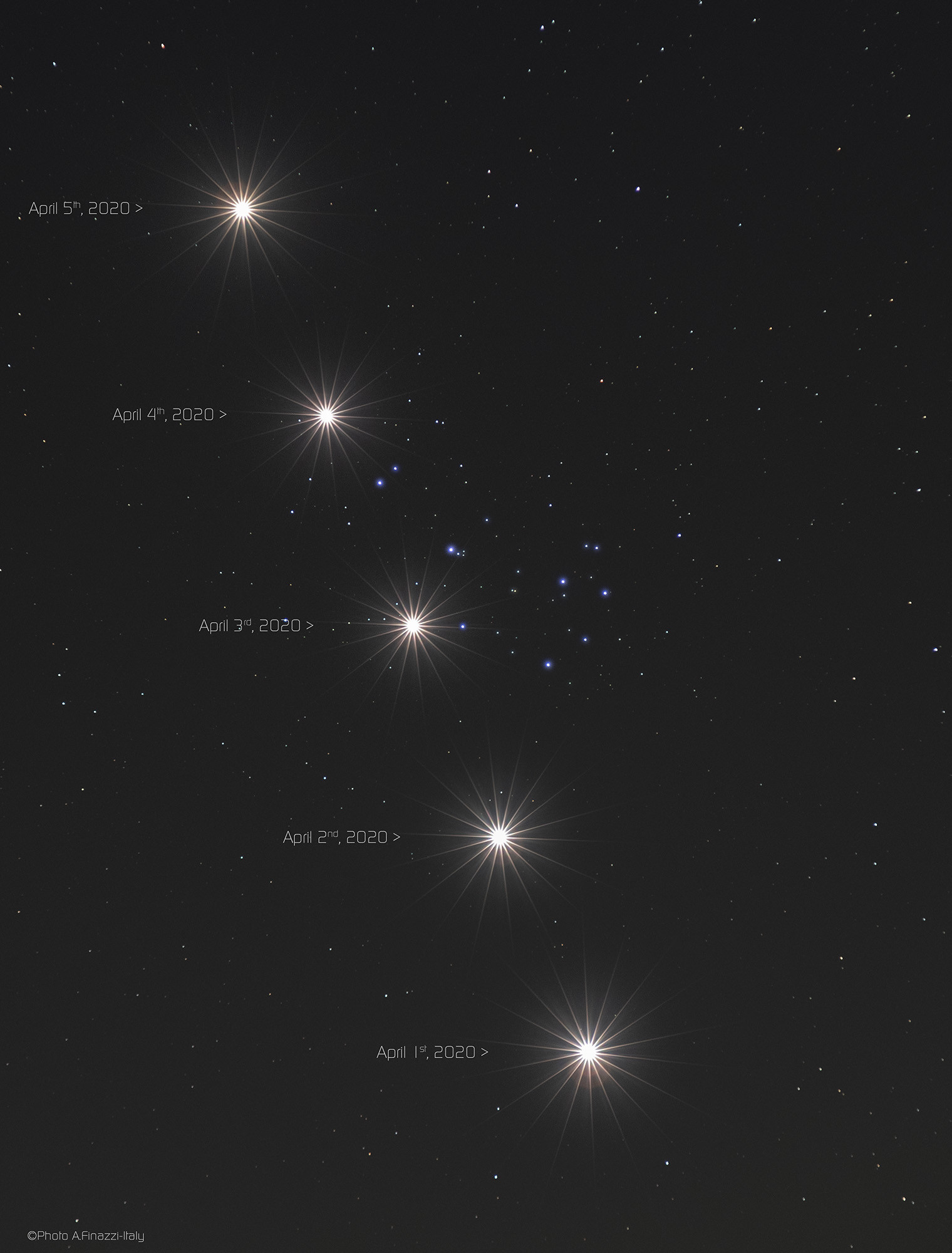
Shared around world in early April 2020 skies Venus, our brilliant evening star, wandered across the face of the lovely Pleiades star cluster. This timelapse image follows the path of the inner planet during the beautiful conjunction showing its daily approach to the stars of the Seven Sisters. From a composite of tracked exposures made with a telephoto lens, the field of view is also appropriate for binocular equipped skygazers. While the star cluster and planet were easily seen with the naked-eye, the spiky appearance of our sister planet in the picture is the result of a diffraction pattern produced by the camera's lens. All images were taken from a home garden in Chiuduno, Bergamo, Lombardy, Italy, fortunate in good weather and clear spring nights.
!>https://science.nasa.gov/venus/
!>https://apod.nasa.gov/apod/ap200402.html
https://apod.nasa.gov/apod/ap200411.html
#space #pleiades #astrophotography #photography #science #astronomy #nature #NASA
Alt...
2020 April 11
Venus and the Pleiades in April
* Image Credit & Copyright: Antonio Finazzi
Explanation:
Shared around world in early April 2020 skies Venus, our brilliant evening star, wandered across the face of the lovely Pleiades star cluster. This timelapse image follows the path of the inner planet during the beautiful conjunction showing its daily approach to the stars of the Seven Sisters. From a composite of tracked exposures made with a telephoto lens, the field of view is also appropriate for binocular equipped skygazers. While the star cluster and planet were easily seen with the naked-eye, the spiky appearance of our sister planet in the picture is the result of a diffraction pattern produced by the camera's lens. All images were taken from a home garden in Chiuduno, Bergamo, Lombardy, Italy, fortunate in good weather and clear spring nights.
Authors & editors: Robert Nemiroff (MTU) & Jerry Bonnell (UMCP)
NASA Official: Phillip Newman Specific rights apply.
NASA Web Privacy Policy and Important Notices
A service of: ASD at NASA / GSFC
& Michigan Tech. U.
2020 March 23
From the Pleiades to the Eridanus Loop
* Image Credit & Copyright: Hirofumi Okubo
https://www.flickr.com/people/bluemoonlife/
Explanation:
If you stare at an interesting patch of sky long enough, will it look different? In the case of Pleiades and Hyades star clusters -- and surrounding regions -- the answer is: yes, pretty different. Long duration camera exposures reveal an intricate network of interwoven interstellar dust and gas that was previously invisible not only to the eye but to lower exposure images. In the featured wide and deep mosaic, the dust stands out spectacularly, with the familiar Pleaides star cluster visible as the blue patch near the top of the image. Blue is the color of the Pleiades' most massive stars, whose distinctive light reflects from nearby fine dust. On the upper left is the Hyades star cluster surrounding the bright, orange, foreground-star Aldebaran. Red glowing emission nebula highlight the bottom of the image, including the curving vertical red ribbon known as the Eridanus Loop. The pervasive dust clouds appear typically in light brown and are dotted with unrelated stars.
https://apod.nasa.gov/apod/ap200323.html
#space #pleiades #astrophotography #photography #science #astronomy #nature #NASA
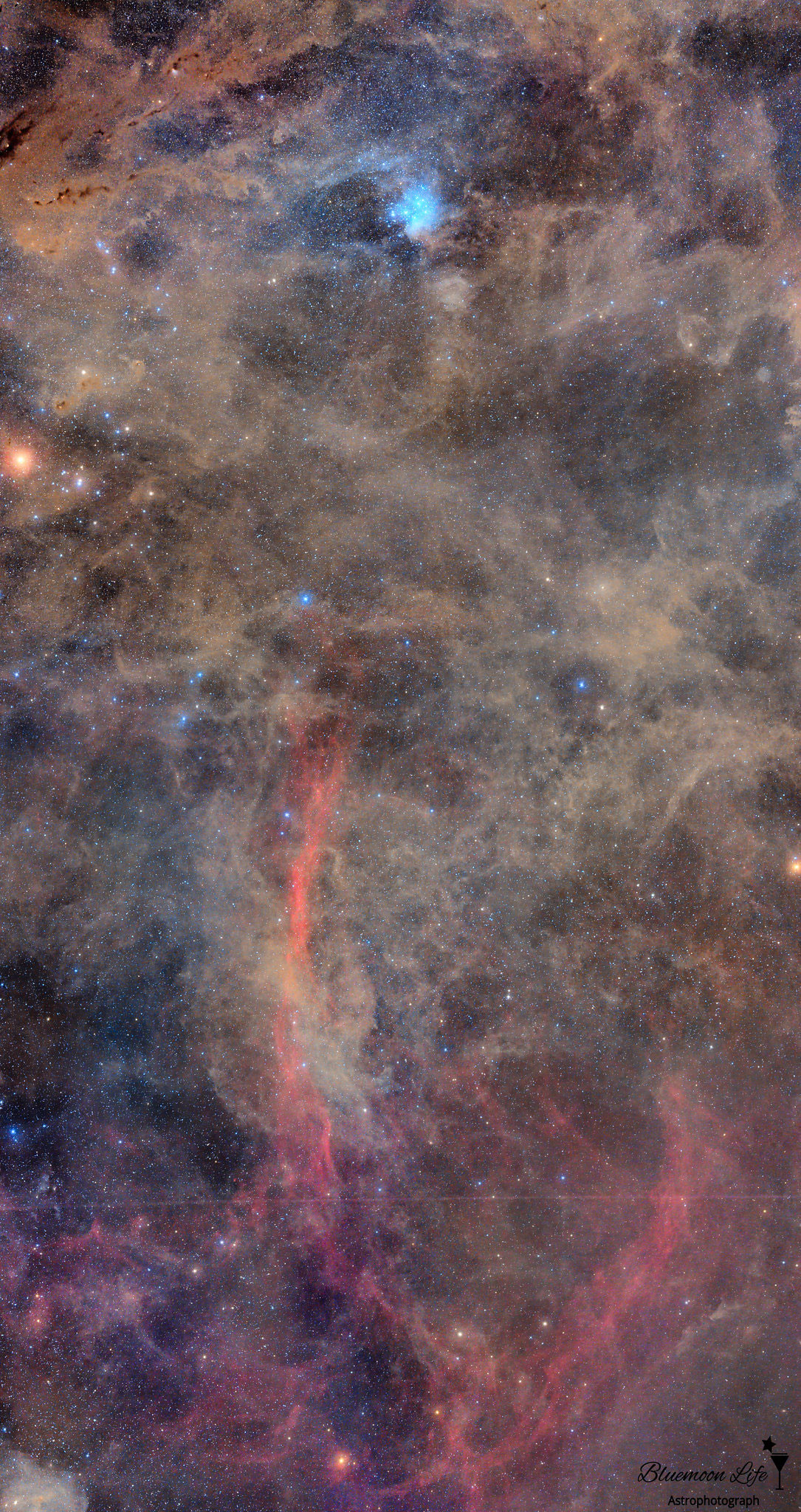
Alt...
2020 March 23
From the Pleiades to the Eridanus Loop
* Image Credit & Copyright: Hirofumi Okubo
Explanation:
If you stare at an interesting patch of sky long enough, will it look different? In the case of Pleiades and Hyades star clusters -- and surrounding regions -- the answer is: yes, pretty different. Long duration camera exposures reveal an intricate network of interwoven interstellar dust and gas that was previously invisible not only to the eye but to lower exposure images. In the featured wide and deep mosaic, the dust stands out spectacularly, with the familiar Pleaides star cluster visible as the blue patch near the top of the image. Blue is the color of the Pleiades' most massive stars, whose distinctive light reflects from nearby fine dust. On the upper left is the Hyades star cluster surrounding the bright, orange, foreground-star Aldebaran. Red glowing emission nebula highlight the bottom of the image, including the curving vertical red ribbon known as the Eridanus Loop. The pervasive dust clouds appear typically in light brown and are dotted with unrelated stars.
Authors & editors: Robert Nemiroff (MTU) & Jerry Bonnell (UMCP)
NASA Official: Phillip Newman Specific rights apply.
NASA Web Privacy Policy and Important Notices
A service of: ASD at NASA / GSFC
& Michigan Tech. U.
2025 October 31
Ghosts in Cassiopeia
* Image Credit & Copyright: Alex Rodriguez
https://www.instagram.com/astro_photo_alex/
Explanation:
Halloween is an astronomy holiday and spooky shapes always seem to lurk in in planet Earth's night skies. In fact, near the center of this telescopic view toward the constellation Cassiopeia these swept-back interstellar clouds IC 59 (left) and IC 63 look ghostly on a cosmic scale. About 600 light-years distant, the clouds aren't actually ghosts. They are slowly disappearing though, under the influence of energetic radiation from hot, luminous star gamma Cas. The brightest bluish star in the frame, Gamma Cas is physically located only 3 to 4 light-years from the nebulae. Slightly closer to gamma Cas, IC 63 is dominated by red H-alpha light emitted as hydrogen atoms ionized by the hot star's ultraviolet radiation recombine with electrons. Farther from the star IC 59 also shows H-alpha emission, and both nebulae shine with the characteristic blue tint of dust reflected star light. The field of view spans about 2 degrees or 20 light-years at the estimated distance of the interstellar apparitions.
https://www.instagram.com/jro_rm/p/DQHN4wSjH-N/
https://arxiv.org/abs/1809.01419
https://arxiv.org/abs/1705.04313
https://www.aavso.org/vsots_gammacas
https://iopscience.iop.org/article/10.1086/426912
https://science.nasa.gov/exoplanets/immersive/galaxy-of-horrors/
https://apod.nasa.gov/apod/ap251031.html
#space #astronomy #science #astrophotography #photography #nature #nebula #NASA #apod
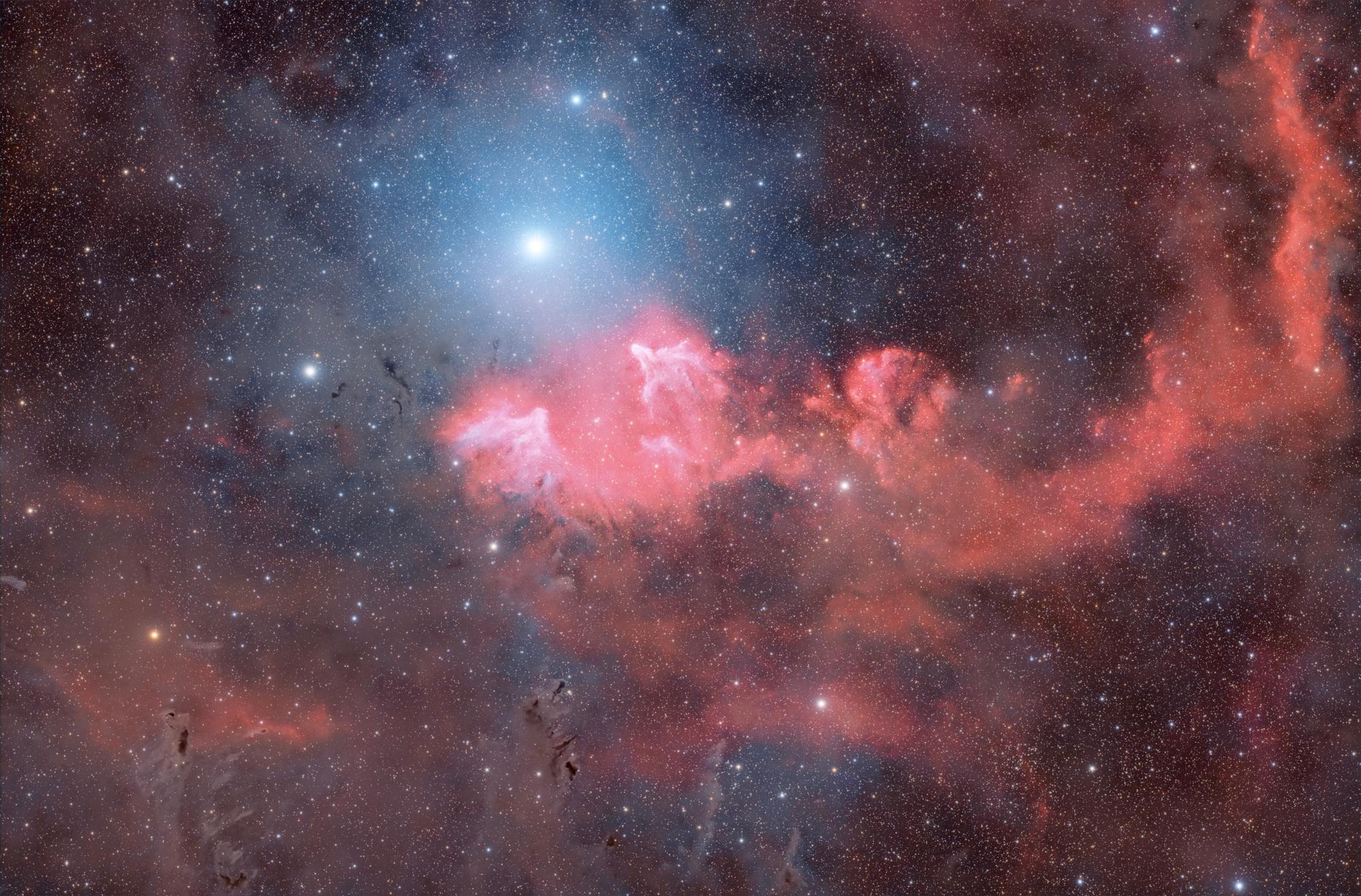
Alt...
2025 October 31
Ghosts in Cassiopeia
* Image Credit & Copyright: Alex Rodriguez
Explanation:
Halloween is an astronomy holiday and spooky shapes always seem to lurk in in planet Earth's night skies. In fact, near the center of this telescopic view toward the constellation Cassiopeia these swept-back interstellar clouds IC 59 (left) and IC 63 look ghostly on a cosmic scale. About 600 light-years distant, the clouds aren't actually ghosts. They are slowly disappearing though, under the influence of energetic radiation from hot, luminous star gamma Cas. The brightest bluish star in the frame, Gamma Cas is physically located only 3 to 4 light-years from the nebulae. Slightly closer to gamma Cas, IC 63 is dominated by red H-alpha light emitted as hydrogen atoms ionized by the hot star's ultraviolet radiation recombine with electrons. Farther from the star IC 59 also shows H-alpha emission, and both nebulae shine with the characteristic blue tint of dust reflected star light. The field of view spans about 2 degrees or 20 light-years at the estimated distance of the interstellar apparitions.
Authors & editors: Robert Nemiroff (MTU) & Jerry Bonnell (UMCP)
NASA Official: Amber Straughn Specific rights apply.
NASA Web Privacy, Accessibility, Notices;
A service of: ASD at NASA / GSFC,
NASA Science Activation
& Michigan Tech. U.
![[?]](https://files.mastodon.social/accounts/avatars/110/565/133/827/266/631/original/860f1d5caf30737b.jpg)
Woodland Edge with Grass and Weeds Painterly Edit
❤️ https://nickoprints.com/featured/woodland-edge-with-grass-and-weeds-painterly-edit-nicko-prints.html 😊
#woodlandedge #grass #weeds #painterly #edit #art #contemporaryart #artforsale #artist #painting #wallart #fineart #interiordesign #artbuyer #buyintoart #ayearforart #buyart #beautifulart #print #poster #nature #landscape #paintingstyle #artlovers #artcollectors

Alt...
Woodland Edge with Grass and Weeds Painterly Edit
Beech Trees at the Edge of the Forest
#beechtrees #edgeoftheforest #painting #art #contemporaryart #artforsale #artist #painting #wallart #fineart #interiordesign #artbuyer #buyintoart #ayearforart #buyart #beautifulart #print #poster #nature #landscape #trees #forest #woodland #artlovers #artcollectors
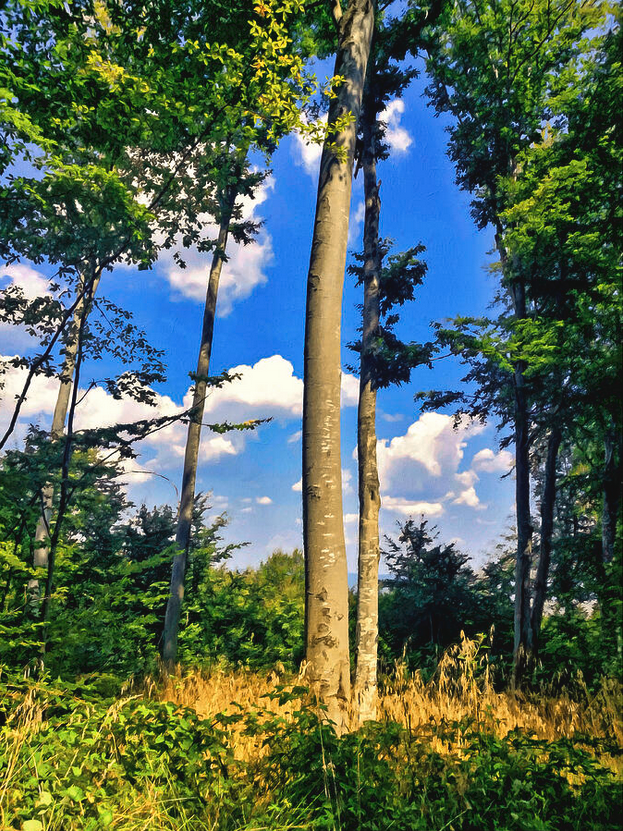
Alt...
Beech Trees at the Edge of the Forest
![[?]](https://cdn.masto.host/socelnet/accounts/avatars/109/531/203/973/108/653/original/5ce798b14260d22b.jpg)
Chipper
I really think that chipmunks are fantastic little animals. I'm not sure why, maybe because of how cute they are.
I like the background in this image. I chose a wide aperture for this image to blur the background that happened to be a large redwood. I just thought that the contrast between big and small was fitting for this.
https://pixels.com/featured/chipper-bill-gallagher.html
#Chipper #BillGallagherPhotography #BuyIntoArt #AYearForArt #Redwood #Chipmunk #Nature #ChipmunkCharm #NatureLovers #AnimalArt #GiftIdeas
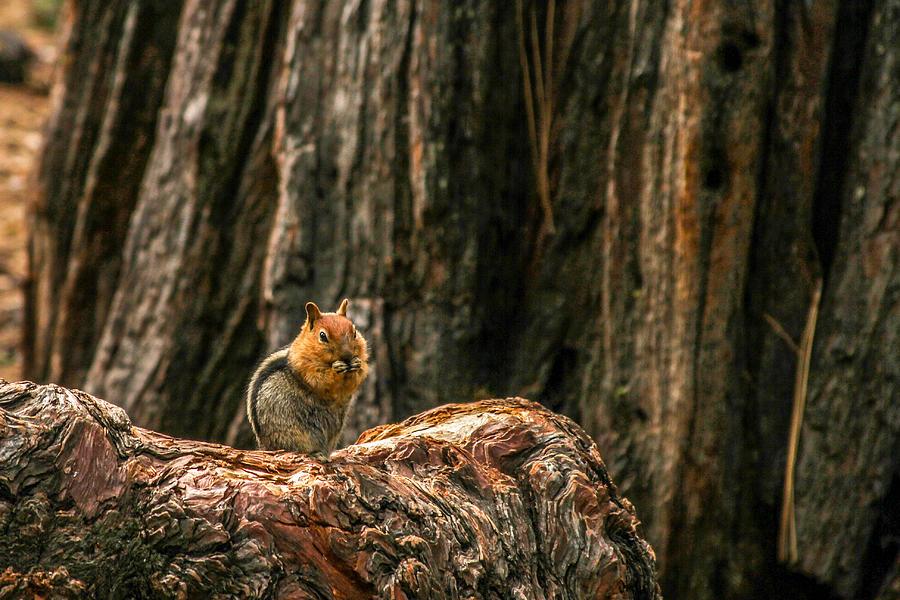
Alt...
Chipper
Imagine standing quietly in a forest where the air is cool and earthy, and the towering redwoods stretch skyward like ancient sentinels. In the foreground, perched confidently on a burl is a chipmunk. She’s small, with a sleek body and a bushy tail curled slightly behind her. Her fur is a warm blend of browns and soft grays, with delicate stripes running down her back like brushstrokes.
She’s alert, eyes wide and glistening, as if caught mid-thought or mid-adventure. The background is softly blurred, a deliberate choice that makes the chipmunk pop visually while hinting at the massive redwood behind her. That contrast—tiny creature, monumental tree—evokes a sense of wonder and scale.
I added some text to my hand painted watercolor painting 'Robin in a Holly bush', making it a beautiful Christmas card for all bird and nature lovers.
Save when purchasing a pack of 10 or 25 cards - https://karen-kaspar.pixels.com/featured/merry-christmas-robin-in-a-holly-bush-karen-kaspar.html?product=greeting-card
Find all my greeting cards for art lovers here: https://karenkasparartprints.com/shop/greeting+cards
#christmas #greetingcard #christmascard #MastoArt #art #painting #FediGiftShop #MastodonArt #watercolor #bird #birds #birding #nature #wildlife #robin #BuyIntoArt #painting #aquarell #aquarelle

Alt...
Robin in a holly bush is a hand painted watercolour painting in landscape format painted by the artist Karen Kaspar. A robin sits on a branch in a holly bush and looks to the right. It is surrounded by green leaves and red berries. The background is painted with loose brushstrokes in different shades of green, which form a strong colour contrast to the red winter berries of the bush and the red-orange breast feathers of the bird. The Ilex is also called Holly or Christmas Holly. The evergreen branches with the red fruits are often used for Christmas decorations.
The painting is also available in a square format and cropped to portrait format in my shop. Choose for yourself which format fits best in your rooms.
Here I added the text Merry Christmas and a Happy New Year as Christmas card design for your seasonal greetings.
![[?]](https://mastodon.sdf.org/system/accounts/avatars/112/514/964/931/031/746/original/be924fd9a05295e2.jpg)
Pumpkin Patch Raccoon: https://1-lisas-baker.pixels.com/featured/pumpkin-patch-raccoon-lisa-s-baker.html
#raccoon #critter #animal #wildlife #art #arte #artwork #mixedmedia #halloween #autumn #fall #wallart #homedecor #artforhome #artforsale #buyintoart #artprints #canvasprints #mastoart #fediart #fediverse #spooky #fun #whimsical #holidaydecor #halloweenart #pumpkins #pumkinpatch #fullmoon #nature

Alt...
Whimsical raccoon in a witch hat surrounded by pumpkins under a glowing full moon, by Lisa S. Baker.
Colorful Tree Branches and Foliage Abstract Impressionist Painting
#colorful #treebranches #foliage #abstract #impressionist #painting #art #contemporaryart #artforsale #artist #painting #wallart #fineart #interiordesign #artbuyer #buyintoart #ayearforart #buyart #beautifulart #print #poster #nature #landscape #trees #leaves #artlovers #artcollectors

Alt...
Colorful Tree Branches and Foliage Abstract Impressionist Painting
![[?]](data:image/png;base64, iVBORw0KGgoAAAANSUhEUgAAAEAAAABAAQAAAACCEkxzAAAAUUlEQVQoz43R0QkAMQwCUDdw/y3dwEvsvzlL4X1IoQkAisKmwfAFT3RgJHbQezpSRoXEqeqCL9BJBf7h3QbOCCxV5EVWMEMwG7K1/WODtlvxAYTtEsDU9F34AAAAAElFTkSuQmCC)
Cool Hand Mollie! Prints and more for sale at: https://pixels.com/featured/cool-hand-mollie-thom-zehrfeld.html #beachdog #beachdoglife #beachdogsarehappydogs #BuyIntoArt #Art #ThomZehrfeldPhotography #PhotographyIsArt #Photography #Fotografie
#ArtForSale #ArtMatters #MastoArt #Mastodon #ArtforInteriorDesign #HospitalityInteriors
#InteriorDesign #Wallart #InteriorDecorating #WallArtForSale #PhotoOfTheDay #FediGiftShop #GiftIdeas #FediArt #Prints #FediArtShop #Colorful #Nature

Alt...
Cool Hand Mollie! Prints and more for sale at: https://pixels.com/featured/cool-hand-mollie-thom-zehrfeld.html #beachdog #beachdoglife #beachdogsarehappydogs #BuyIntoArt #Art #ThomZehrfeldPhotography #PhotographyIsArt #Photography #Fotografie
#ArtForSale #ArtMatters #MastoArt #Mastodon #ArtforInteriorDesign #HospitalityInteriors
#InteriorDesign #Wallart #InteriorDecorating #WallArtForSale #PhotoOfTheDay #FediGiftShop #GiftIdeas #FediArt #Prints #FediArtShop #Colorful #Nature
Summer is over and I'm dreaming of blue ocean waves ...
Find my handmade watercolor painting here:
https://www.pictorem.com/2391486/blue-ocean-waves-watercolor-painting/
#ocean #waves #summer #beach #MastoArt #art #painting #FediArt #FediGiftShop #artist #arte #InteriorDesign #MastodonArt #BuyIntoArt #ArtistsOnMastodon #TraditionalArt #kunst #contemporaryArt #creativeToots #ArtMatters #watercolor #watercolour #colors #landscape #nature #outdoors #handmade #aquarell #ostsee #meer #meermittwoch

Alt...
Blue ocean waves is a hand-painted watercolour painting in landscape format by the artist Karen Kaspar.
Ocean waves in shades of blue, teal and ocre crash onto a sandy shore under a clear blue sky. The water appears vibrant with various shades of blue, green, and white.
![[?]](https://dmvcommunitymedia.b-cdn.net/accounts/avatars/109/423/669/136/029/020/original/3b4ae5e8f75300fd.jpeg)
One of my favorite places - Blue Mountain, Washington
https://cool-as-heck.blog/one-of-my-favorite-places-blue-mountain-washington
![[?]](https://social.trom.tf/photo/profile/experimentmapass.jpeg?ts=1683022163)
Fallen Rose - Painterly Style | Wall Art
https://fineartamerica.com/featured/fallen-rose-painterly-style-joseph-s-giacalone.html
#roses #flowers #nature #wallart #homedecor #love #kindness #positivity #beauty #art

Vibrant Spring Tulips | Wall Art
https://fineartamerica.com/featured/vibrant-spring-tulips-joseph-s-giacalone.html
#flowers #nature #wallart #homedecor
#love #kindness #positivity #beauty #art

Bright Trio of Tulips - Impressionist | Wall Art
https://fineartamerica.com/featured/bright-trio-of-tulips-impressionist-joseph-s-giacalone.html
#flowers #nature #wallart #homedecor
#love #kindness #positivity #beauty #art

A Desert Covered In Purple | Wall Art
https://fineartamerica.com/featured/a-desert-covered-in-purple-joseph-s-giacalone.html
#flowers #nature #wallart #homedecor
#love #kindness #positivity #beauty

2025 October 30
Lynds Dark Nebula 43
* Image Credit & Copyright:
https://www.cielaustral.com/
Explanation:
Sure, Halloween is an astronomy holiday. But astronomers always enjoy scanning the heavens for spook-tacular galaxies, stars, and nebulae. This favorite is item number 43 from the Beverly Lynds 1962 Catalog of Dark Nebulae, fondly known as the Cosmic Bat nebula. While its visage looks alarmingly like a scary flying mammal, Lynds Dark Nebula 43 is over 12 light-years across. Glowing with eerie light, stars are forming within the dusty interstellar molecular cloud that is dense enough to appear in silhouette against a luminous background of Milky Way stars. Watch out. This Cosmic Bat nebula is a mere 400 light-years distant toward the serpent-bearing constellation Ophiucus.
https://www.cielaustral.com/galerie/photo173.htm
https://ui.adsabs.harvard.edu/abs/1962ApJS....7....1L/abstract
https://ui.adsabs.harvard.edu/abs/2023ApJ...952...29K/abstract
https://earthsky.org/astronomy-essentials/halloween-derived-from-ancient-celtic-cross-quarter-day/
https://science.nasa.gov/exoplanets/immersive/galaxy-of-horrors/
https://apod.nasa.gov/apod/fap/ap251030.html
#space #astronomy #science #astrophotography #photography #nature #nebula #NASA #Webb #apod
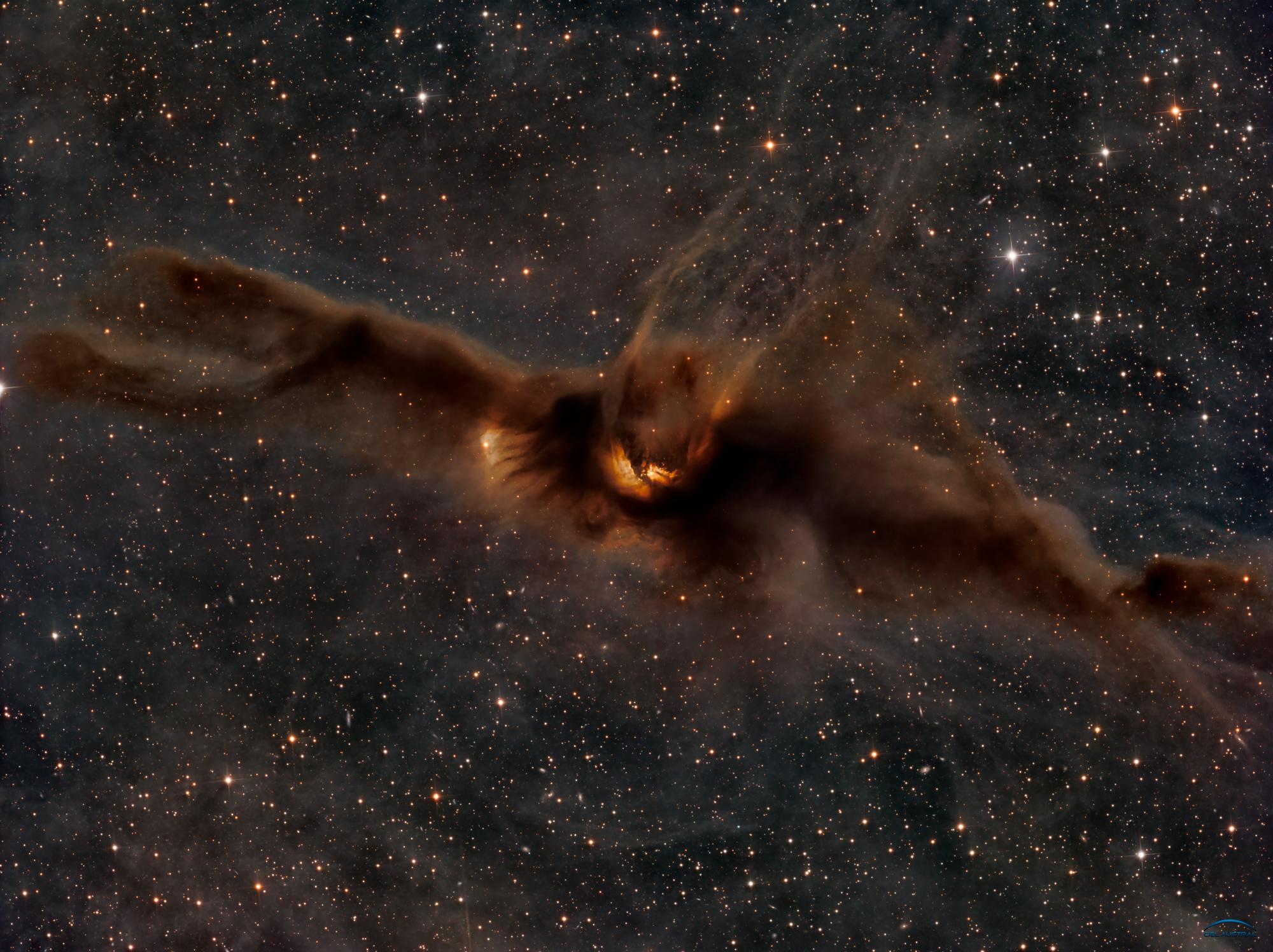
Alt...
2025 October 30
Lynds Dark Nebula 43
* Image Credit & Copyright: Stéphane Vetter (Nuits sacrées)
Explanation:
Sure, Halloween is an astronomy holiday. But astronomers always enjoy scanning the heavens for spook-tacular galaxies, stars, and nebulae. This favorite is item number 43 from the Beverly Lynds 1962 Catalog of Dark Nebulae, fondly known as the Cosmic Bat nebula. While its visage looks alarmingly like a scary flying mammal, Lynds Dark Nebula 43 is over 12 light-years across. Glowing with eerie light, stars are forming within the dusty interstellar molecular cloud that is dense enough to appear in silhouette against a luminous background of Milky Way stars. Watch out. This Cosmic Bat nebula is a mere 400 light-years distant toward the serpent-bearing constellation Ophiucus.
Authors & editors: Robert Nemiroff (MTU) & Jerry Bonnell (UMCP)
NASA Official: Amber Straughn Specific rights apply.
NASA Web Privacy, Accessibility, Notices;
A service of: ASD at NASA / GSFC,
NASA Science Activation
& Michigan Tech. U.
They Put a Smile On Your Face | Wall Art
https://fineartamerica.com/featured/they-put-a-smile-on-your-face-joseph-s-giacalone.html
#flowers #nature #beauty #joy #happy
#wallart #fineartamerica #art #prints

Make A Wish 3, Dandelion | Wall Art
https://fineartamerica.com/featured/make-a-wish-3-dandelion-joseph-s-giacalone.html
#dandelions #flowers #nature #beauty
#wallart #fineartamerica #art #prints

