Search results for tag #nasa
![[?]](https://files.defcon.social/dcsocial-s3/accounts/avatars/113/208/344/507/078/943/original/014820ad22daee1c.jpg)
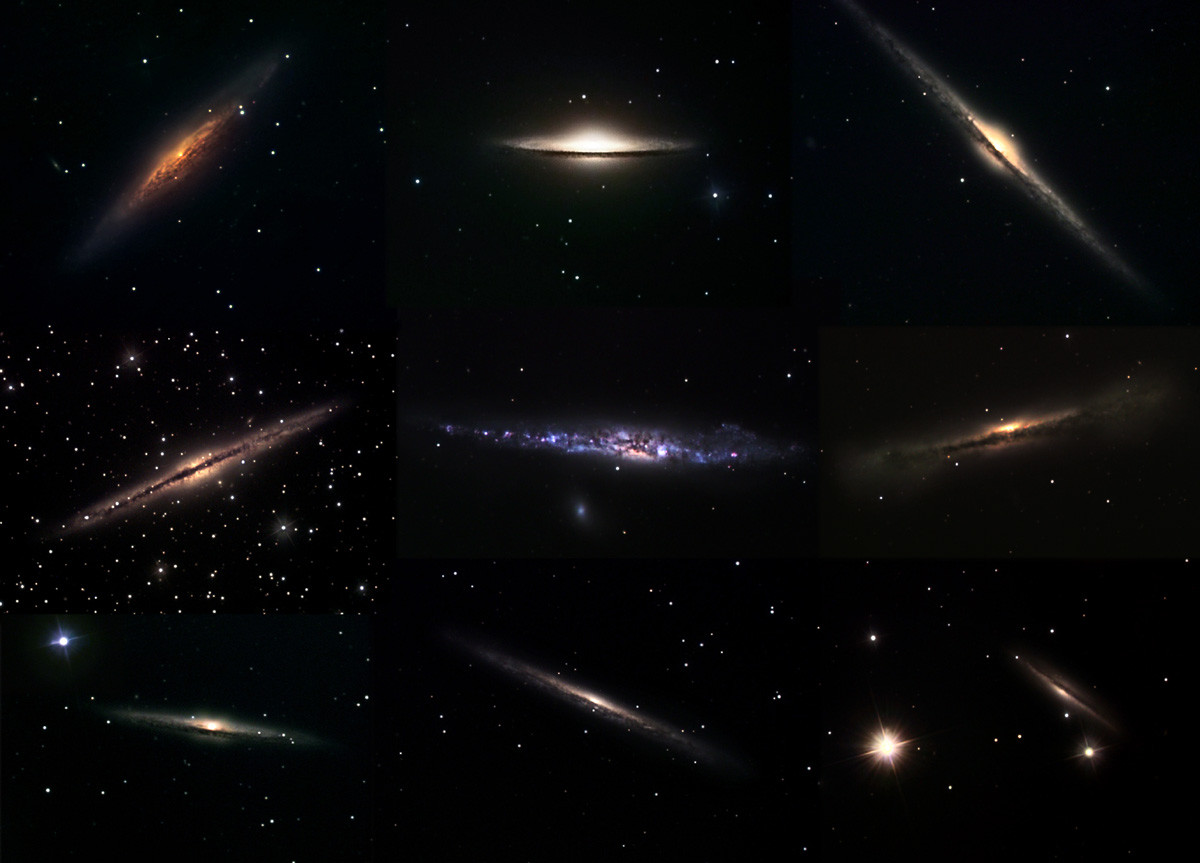
Spirals On Edge
* Credit & Copyright: Robert Gendler
Explanation:
Spiral galaxies viewed face-on display a grand design, with graceful spiral arms traced by bright star clusters and glowing stellar nurseries. When seen edge-on, their appearance is very different but no less striking as their central regions bulge and dark cosmic dust lanes appear silhouetted against starlight from flattened galactic disks. This masterful mosaic of digital images shows nine prominent edge-on spirals arranged as follows: top; NGC2683, M104, NGC4565, middle; NGC891, NGC4631, NGC3628, and bottom; NGC5746, NGC5907, and NGC4217. Perhaps the best known of these is M104 (NGC4594) whose more descriptive moniker is the Sombrero Galaxy. Notably, the edge-on perspective of these galaxies allows a measurement of their galactic rotation speed using the Doppler effect. Plotting rotation speed versus distance from the center determines a galaxy's gravitational mass and historically led to premier evidence for mysterious Dark Matter.
https://apod.nasa.gov/apod/ap010427.html
#space #galaxy #astrophotography #photography #science #nature #NASA
Alt...
2001 May 10
Spirals On Edge
* Credit & Copyright: Robert Gendler
Explanation:
Spiral galaxies viewed face-on display a grand design, with graceful spiral arms traced by bright star clusters and glowing stellar nurseries. When seen edge-on, their appearance is very different but no less striking as their central regions bulge and dark cosmic dust lanes appear silhouetted against starlight from flattened galactic disks. This masterful mosaic of digital images shows nine prominent edge-on spirals arranged as follows: top; NGC2683, M104, NGC4565, middle; NGC891, NGC4631, NGC3628, and bottom; NGC5746, NGC5907, and NGC4217. Perhaps the best known of these is M104 (NGC4594) whose more descriptive moniker is the Sombrero Galaxy. Notably, the edge-on perspective of these galaxies allows a measurement of their galactic rotation speed using the Doppler effect. Plotting rotation speed versus distance from the center determines a galaxy's gravitational mass and historically led to premier evidence for mysterious Dark Matter.
Authors & editors: Robert Nemiroff (MTU) & Jerry Bonnell (USRA)
NASA Technical Rep.: Jay Norris. Specific rights apply.
A service of: LHEA at NASA/ GSFC
& Michigan Tech. U.
2022 April 23
Messier 104
* Image Credit: NASA, ESA, Hubble Legacy Archive;
Processing & Copyright: Ignacio Diaz Bobillo
https://www.pampaskies.com/gallery3/index.php
https://hla.stsci.edu/
https://www.esa.int/
https://www.nasa.gov/
Explanation:
A gorgeous spiral galaxy, Messier 104 is famous for its nearly edge-on profile featuring a broad ring of obscuring dust lanes. Seen in silhouette against an extensive central bulge of stars, the swath of cosmic dust lends a broad brimmed hat-like appearance to the galaxy suggesting a more popular moniker, the Sombrero Galaxy. This sharp view of the well-known galaxy was made from over 10 hours of Hubble Space Telescope image data, processed to bring out faint details often lost in the overwhelming glare of M104's bright central bulge. Also known as NGC 4594, the Sombrero galaxy can be seen across the spectrum, and is host to a central supermassive black hole. About 50,000 light-years across and 28 million light-years away, M104 is one of the largest galaxies at the southern edge of the Virgo Galaxy Cluster. Still, the spiky foreground stars in this field of view lie well within our own Milky Way.
https://www.pampaskies.com/gallery3/Deep-Space-Objects/M104_HST_final_small
http://www.messier.seds.org/m/m104.html
https://apod.nasa.gov/apod/ap190101.html
https://apod.nasa.gov/apod/ap070505.html
https://arxiv.org/abs/1107.1238
https://svs.gsfc.nasa.gov/30855
https://apod.nasa.gov/apod/ap220423.html
#space #galaxy #astrophotography #photography #science #nature #ESA #hubble #NASA

Alt...
2022 April 23
Messier 104
* Image Credit: NASA, ESA, Hubble Legacy Archive;
Processing & Copyright: Ignacio Diaz Bobillo
Explanation:
A gorgeous spiral galaxy, Messier 104 is famous for its nearly edge-on profile featuring a broad ring of obscuring dust lanes. Seen in silhouette against an extensive central bulge of stars, the swath of cosmic dust lends a broad brimmed hat-like appearance to the galaxy suggesting a more popular moniker, the Sombrero Galaxy. This sharp view of the well-known galaxy was made from over 10 hours of Hubble Space Telescope image data, processed to bring out faint details often lost in the overwhelming glare of M104's bright central bulge. Also known as NGC 4594, the Sombrero galaxy can be seen across the spectrum, and is host to a central supermassive black hole. About 50,000 light-years across and 28 million light-years away, M104 is one of the largest galaxies at the southern edge of the Virgo Galaxy Cluster. Still, the spiky foreground stars in this field of view lie well within our own Milky Way.
Authors & editors: Robert Nemiroff (MTU) & Jerry Bonnell (UMCP)
NASA Official: Phillip Newman Specific rights apply.
NASA Web Privacy Policy and Important Notices
A service of: ASD at NASA / GSFC
& Michigan Tech. U.
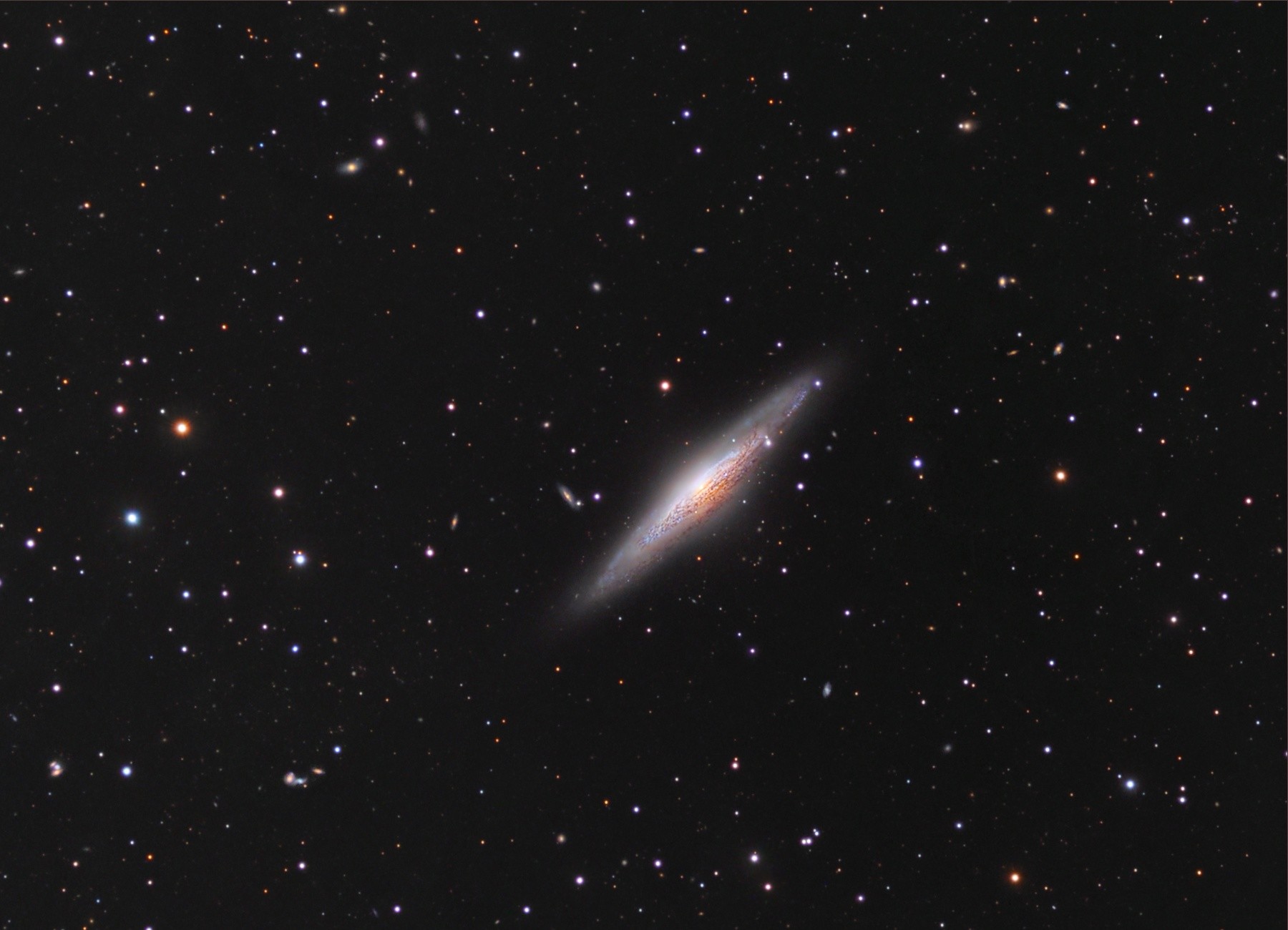
NGC 2683: Edge-On Spiral Galaxy
* Image Credit & Copyright: Dietmar Hager, Torsten Grossmann
https://stargazer-observatory.com/
https://astrogrossi.de/
Explanation:
This elegant island universe is cataloged as NGC 2683. It lies a mere 16 million light-years distant toward the northern constellation Lynx. A spiral galaxy comparable to our own Milky Way, NGC 2683 is seen nearly edge-on in the cosmic vista. Blended light from a large population of old, yellowish stars forms the remarkably bright galactic core. Their starlight silhouettes the dust lanes along winding spiral arms, dotted with NGC 2683's young blue star clusters. The sharp image was recorded through the lens of a refracting telescope that shows brighter foreground Milky Way stars as colorful and round, lacking diffraction spikes characteristic of images from reflecting telescopes with internal supports. The many more distant galaxies scattered through the background appear as fuzzy, extended sources.
https://spider.seds.org/spider/Misc/n2683.html
https://ned.ipac.caltech.edu/level5/March02/Gordon/Gordon2.html
https://apod.nasa.gov/apod/ap120317.html
#space #galaxy #astrophotography #photography #science #nature #NASA
Alt...
2012 March 17
NGC 2683: Edge-On Spiral Galaxy
* Image Credit & Copyright: Dietmar Hager, Torsten Grossmann
Explanation:
This elegant island universe is cataloged as NGC 2683. It lies a mere 16 million light-years distant toward the northern constellation Lynx. A spiral galaxy comparable to our own Milky Way, NGC 2683 is seen nearly edge-on in the cosmic vista. Blended light from a large population of old, yellowish stars forms the remarkably bright galactic core. Their starlight silhouettes the dust lanes along winding spiral arms, dotted with NGC 2683's young blue star clusters. The sharp image was recorded through the lens of a refracting telescope that shows brighter foreground Milky Way stars as colorful and round, lacking diffraction spikes characteristic of images from reflecting telescopes with internal supports. The many more distant galaxies scattered through the background appear as fuzzy, extended sources.
Authors & editors: Robert Nemiroff (MTU) & Jerry Bonnell (UMCP)
NASA Official: Phillip Newman Specific rights apply.
NASA Web Privacy Policy and Important Notices
A service of: ASD at NASA / GSFC
& Michigan Tech. U.
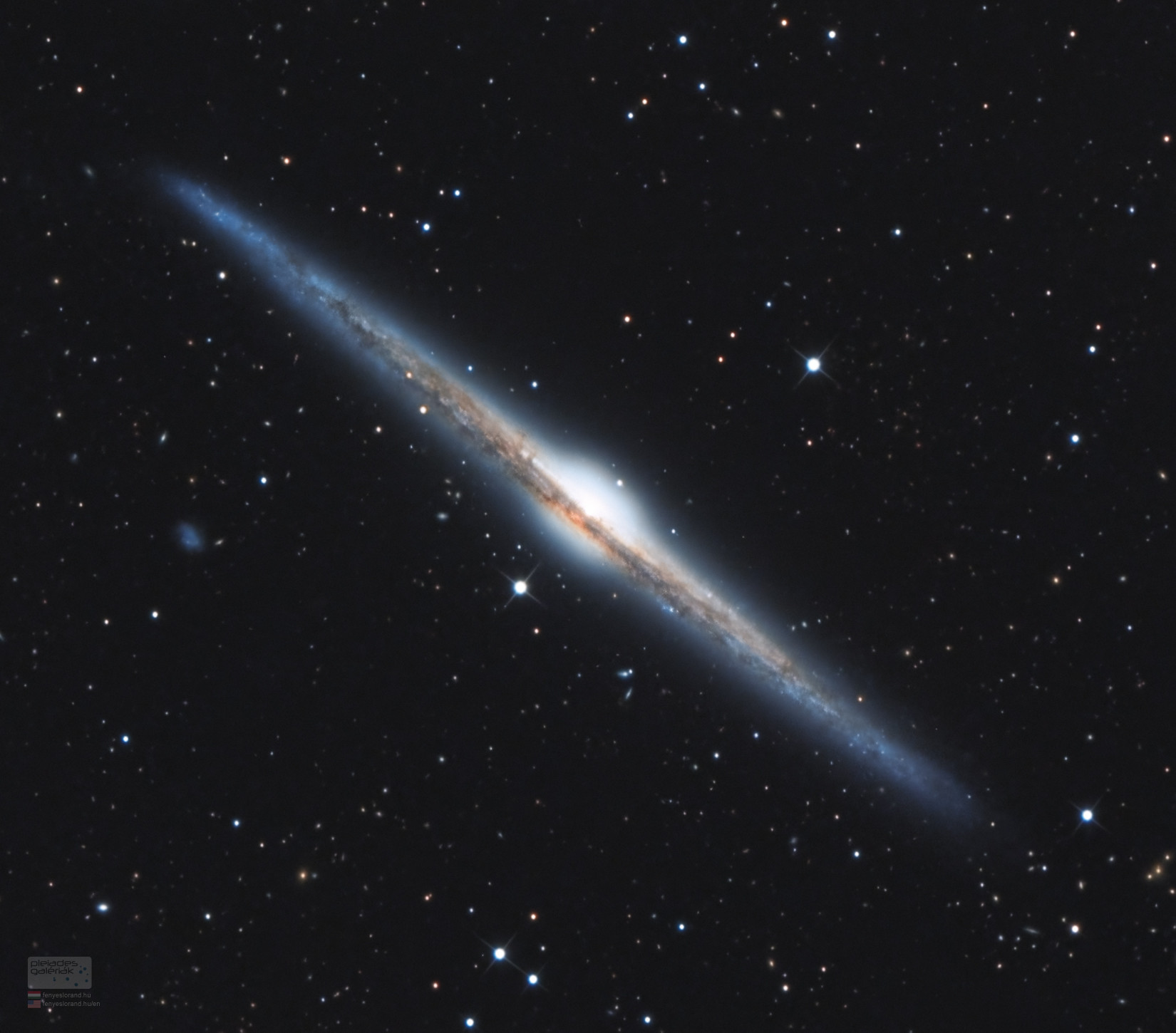
NGC 4565: Galaxy on Edge
* Image Credit & Copyright: Lóránd Fényes
https://fenyeslorand.hu/en/
Explanation:
Magnificent spiral galaxy NGC 4565 is viewed edge-on from planet Earth. Also known as the Needle Galaxy for its narrow profile, bright NGC 4565 is a stop on many telescopic tours of the northern sky, in the faint but well-groomed constellation Coma Berenices. This sharp, colorful image reveals the galaxy's boxy, bulging central core cut by obscuring dust lanes that lace NGC 4565's thin galactic plane. NGC 4565 itself lies about 40 million light-years distant and spans some 100,000 light-years. Easily spotted with small telescopes, sky enthusiasts consider NGC 4565 to be a prominent celestial masterpiece Messier missed.
https://fenyeslorand.hu/a-tu-galaxis/
http://www.messier.seds.org/xtra/ngc/n4565.html
http://www.dibonsmith.com/com_con.htm
https://science.nasa.gov/missions/hubble/hubble-sees-the-needle-galaxy-edge-on-and-up-close/
https://apod.nasa.gov/apod/ap240606.html
#space #galaxy #astrophotography #photography #science #nature #NASA
Alt...
2024 June 6
NGC 4565: Galaxy on Edge
* Image Credit & Copyright: Lóránd Fényes
Explanation:
Magnificent spiral galaxy NGC 4565 is viewed edge-on from planet Earth. Also known as the Needle Galaxy for its narrow profile, bright NGC 4565 is a stop on many telescopic tours of the northern sky, in the faint but well-groomed constellation Coma Berenices. This sharp, colorful image reveals the galaxy's boxy, bulging central core cut by obscuring dust lanes that lace NGC 4565's thin galactic plane. NGC 4565 itself lies about 40 million light-years distant and spans some 100,000 light-years. Easily spotted with small telescopes, sky enthusiasts consider NGC 4565 to be a prominent celestial masterpiece Messier missed.
Authors & editors: Robert Nemiroff (MTU) & Jerry Bonnell (UMCP)
NASA Official: Amber Straughn Specific rights apply.
NASA Web Privacy, Accessibility Notices
A service of: ASD at NASA / GSFC,
NASA Science Activation
& Michigan Tech. U.
![[?]](https://media.universeodon.com/accounts/avatars/109/501/736/783/125/826/original/387a622be46bcde9.png)

NGC 6384: Spiral Beyond the Stars
Credits: ESA, Hubble, #NASA
#nature #space #astrophotography

Alt...
NGC 6384: Spiral Beyond the Stars
2025 September 3
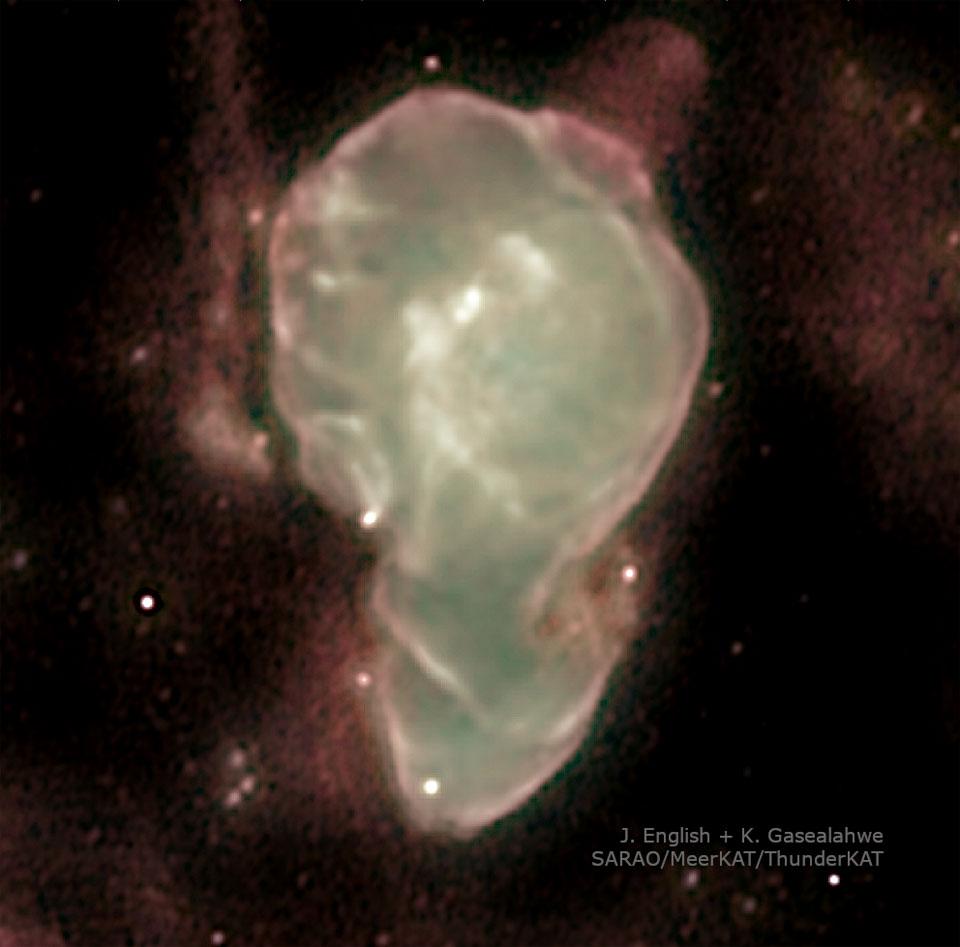
Cir X-1: Jets in the Africa Nebula
* Image Credit: J. English (U. Manitoba) & K. Gasealahwe (U. Cape Town), SARAO, MeerKAT, ThunderKAT
http://www2.physics.umanitoba.ca/u/english/
https://umanitoba.ca/science/physics-and-astronomy
https://www.researchgate.net/profile/Kelebogile-Gasealahwe
https://science.uct.ac.za/departments/astronomy
https://www.sarao.ac.za/
https://www.sarao.ac.za/science/meerkat/
* Science: K. Gasealahwe, K. Savard (U. Oxford) et al.
https://www.physics.ox.ac.uk/our-people/savard
https://www.physics.ox.ac.uk/
https://arxiv.org/abs/2507.22998
* Text: J. English & K. Savard
Explanation:
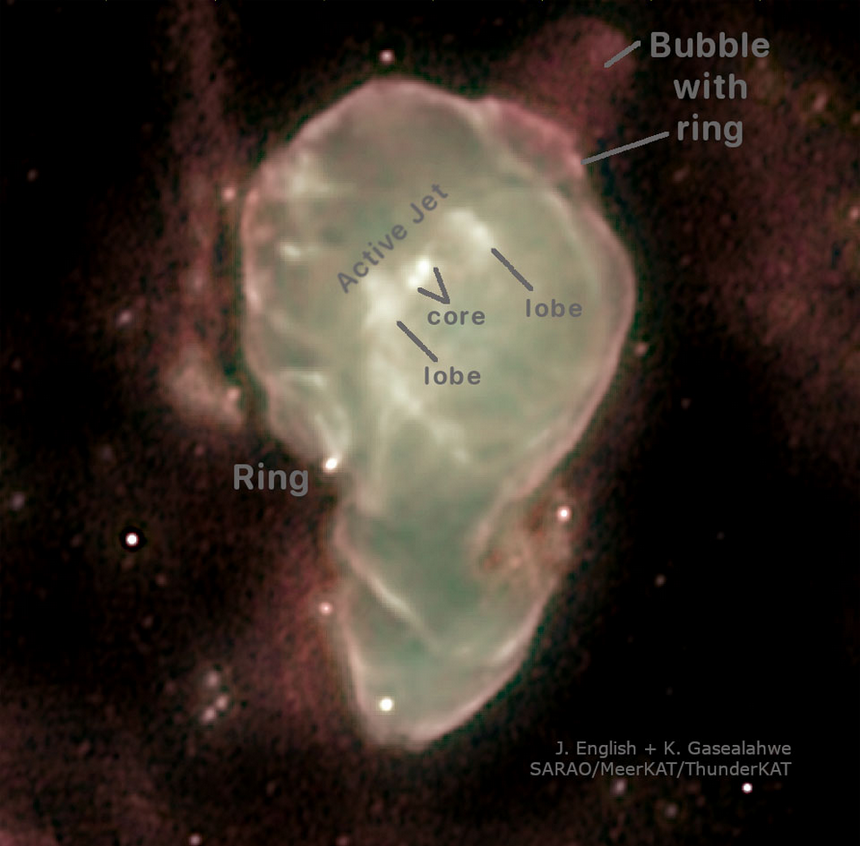
How soon do jets form when a supernova gives birth to a neutron star? The Africa Nebula provides clues. This supernova remnant surrounds Circinus X-1, an X-ray emitting neutron star and the companion star it orbits. The image, from the ThunderKAT collaboration on the MeerKAT radio telescope situated in South Africa, shows the bright core-and-lobe structure of Cir X-1’s currently active jets inside the nebula. A mere 4600 years old, Cir X-1 could be the "Little Sister" of microquasar SS 433*. However, the newly discovered bubble exiting from a ring-like hole in the upper right of the nebula, along with a ring to the bottom left, demonstrate that other jets previously existed. Computer simulations indicate those jets formed within 100 years of the explosion and lasted up to 1000 years. Surprisingly, to create the observed bubble, the jets need to be more powerful than young neutron stars were previously thought to produce.
https://en.wikipedia.org/wiki/Circinus_X-1
https://science.nasa.gov/universe/neutron-stars-are-weird/
https://apod.nasa.gov/apod/ap250903.html
#space #nebula #astrophotography #photography #science #astronomy #physics #nature #NASA #ESA
Alt...
2025 September 3
A nebula is shown that appears roughly the shape of Africa. The complex radio image shows rings and jets.
Cir X-1: Jets in the Africa Nebula
* Image Credit: J. English (U. Manitoba) & K. Gasealahwe (U. Cape Town), SARAO, MeerKAT, ThunderKAT
* Science: K. Gasealahwe, K. Savard (U. Oxford) et al.
* Text: J. English & K. Savard
Explanation:
How soon do jets form when a supernova gives birth to a neutron star? The Africa Nebula provides clues. This supernova remnant surrounds Circinus X-1, an X-ray emitting neutron star and the companion star it orbits. The image, from the ThunderKAT collaboration on the MeerKAT radio telescope situated in South Africa, shows the bright core-and-lobe structure of Cir X-1’s currently active jets inside the nebula. A mere 4600 years old, Cir X-1 could be the "Little Sister" of microquasar SS 433*. However, the newly discovered bubble exiting from a ring-like hole in the upper right of the nebula, along with a ring to the bottom left, demonstrate that other jets previously existed. Computer simulations indicate those jets formed within 100 years of the explosion and lasted up to 1000 years. Surprisingly, to create the observed bubble, the jets need to be more powerful than young neutron stars were previously thought to produce.
Authors & editors: Robert Nemiroff (MTU) & Jerry Bonnell (UMCP)
NASA Official: Amber Straughn Specific rights apply.
Alt...
Image with annotaions
2025 September 2
The Horsehead and Flame Nebulas
* Image Credit & Copyright: Daniel Stern
https://www.instagram.com/messierchaser/
Explanation:
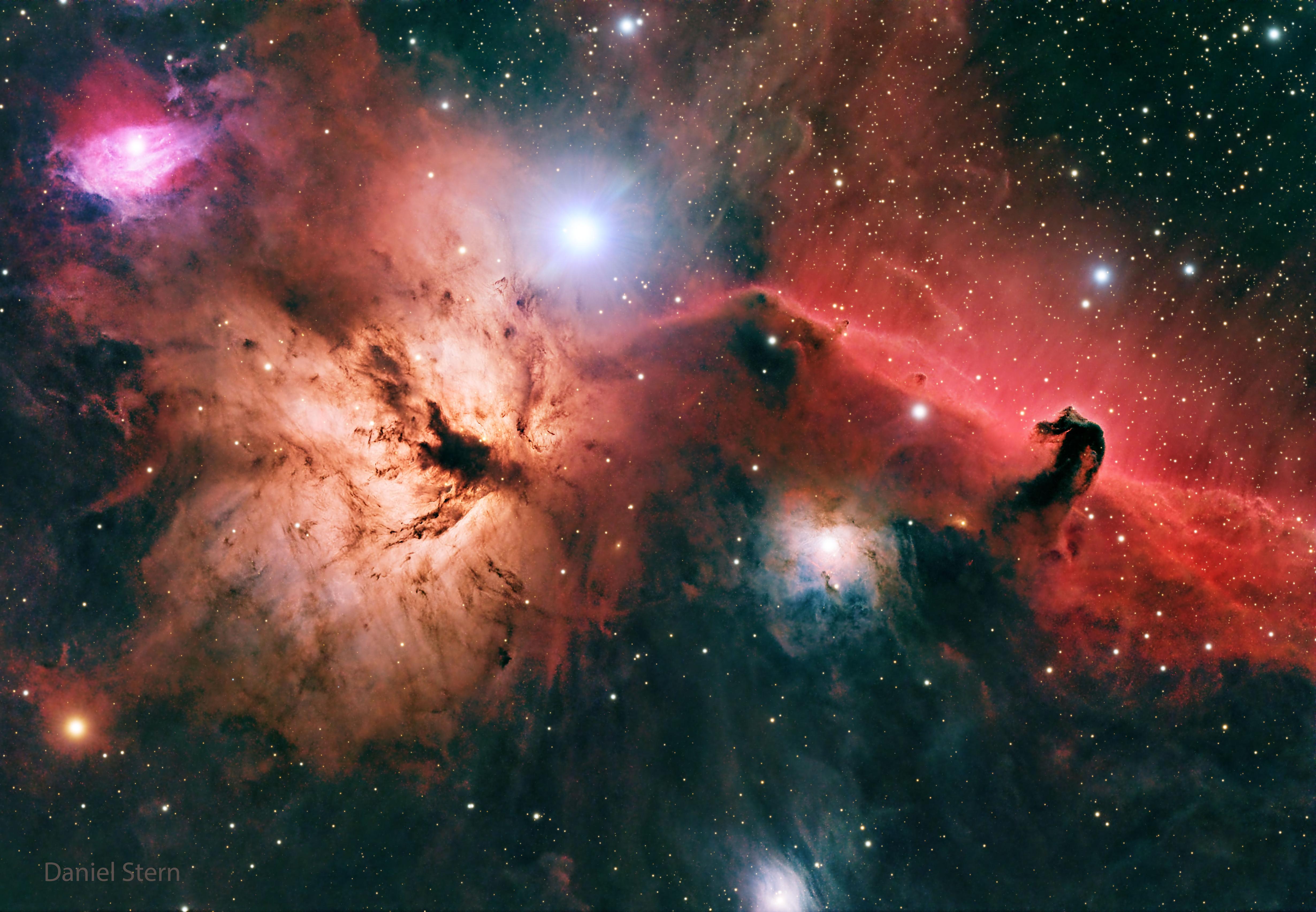
The Horsehead Nebula is one of the most famous nebulae on the sky. It is visible as the dark indentation to the orange emission nebula at the far right of the featured picture. The horse-head feature is dark because it is really an opaque dust cloud that lies in front of the bright emission nebula. Like clouds in Earth's atmosphere, this cosmic cloud has assumed a recognizable shape by chance. After many thousands of years, the internal motions of the cloud will surely alter its appearance. The emission nebula's orange color is caused by electrons recombining with protons to form hydrogen atoms. Toward the lower left of the image is the Flame Nebula, an orange-tinged nebula that also contains intricate filaments of dark dust.
https://en.wikipedia.org/wiki/Horsehead_Nebula
https://en.wikipedia.org/wiki/Emission_nebula
https://astronomy.swin.edu.au/cosmos/E/emission+nebula
https://home.cern/news/news/physics/proton-century
https://periodic.lanl.gov/1.shtml
https://history.aip.org/exhibits/electron/
https://apod.nasa.gov/apod/ap030706.html
https://www.nasa.gov/image-article/earths-atmospheric-layers-3/
https://apod.nasa.gov/apod/ap250902.html
#space #nebula #astrophotography #photography #science #astronomy #nature #NASA
Alt...
2025 September 2
A starfield is shown with bright and dark nebulae of different shapes and colors.
The Horsehead and Flame Nebulas
* Image Credit & Copyright: Daniel Stern
Explanation:
The Horsehead Nebula is one of the most famous nebulae on the sky. It is visible as the dark indentation to the orange emission nebula at the far right of the featured picture. The horse-head feature is dark because it is really an opaque dust cloud that lies in front of the bright emission nebula. Like clouds in Earth's atmosphere, this cosmic cloud has assumed a recognizable shape by chance. After many thousands of years, the internal motions of the cloud will surely alter its appearance. The emission nebula's orange color is caused by electrons recombining with protons to form hydrogen atoms. Toward the lower left of the image is the Flame Nebula, an orange-tinged nebula that also contains intricate filaments of dark dust.
Authors & editors: Robert Nemiroff (MTU) & Jerry Bonnell (UMCP)
NASA Official: Amber Straughn Specific rights apply.
NASA Web Privacy, Accessibility, Notices;
A service of: ASD at NASA / GSFC,
NASA Science Activation
& Michigan Tech. U.
List of TOPICS> No2
will be editet soon .. see TOPIC> List No. 1, which contains all currently available TOPICs please.
© folks who #resist
https://www.youtube.com/watch?v=EXg8MOqbZNI
#space #astrophotography #photography #sience #astronomy #nature #fediverse #mastodon #NASA #ESA #nobot #noai #list #buchstabensuppe
Alt...
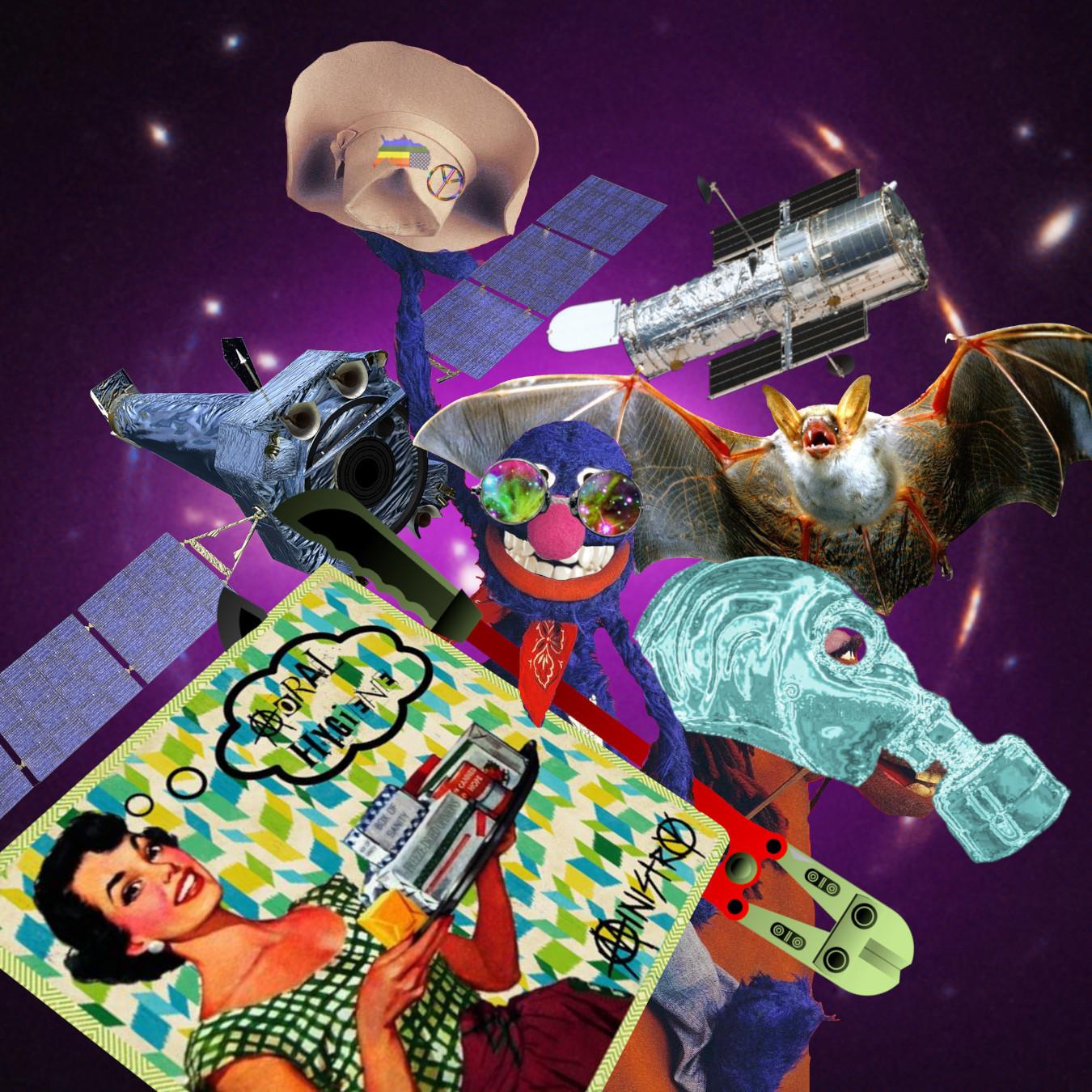
grobi presents the protest song "Sabotage Is Sex" by Ministry feat. Jello Biafra. He rides through time and space sitting the wrong way around on his horse and has a bolt cutter ready, while his friend, the horse, is already wearing a gas mask, because you never know for sure... like two scouts "always ready to help" with open eyes, hearts and cheerful cheers, they have backup from "Graviti's Grin" or flippantly called the "Cheshire Cat Galaxy Group" grobi also wears glasses with "Gravity Lenses" made of "Dark Matter", with which he sees through the enemies of freedom and humanity.
© folks who #resist
Wolf-Rayet Star 124: Stellar Wind Machine
* Image Credit: Hubble Legacy Archive, NASA, ESA; Processing & License: Judy Schmidt
https://hla.stsci.edu/
https://www.nasa.gov/
https://www.esa.int/
https://www.flickr.com/photos/geckzilla/
Explanation:
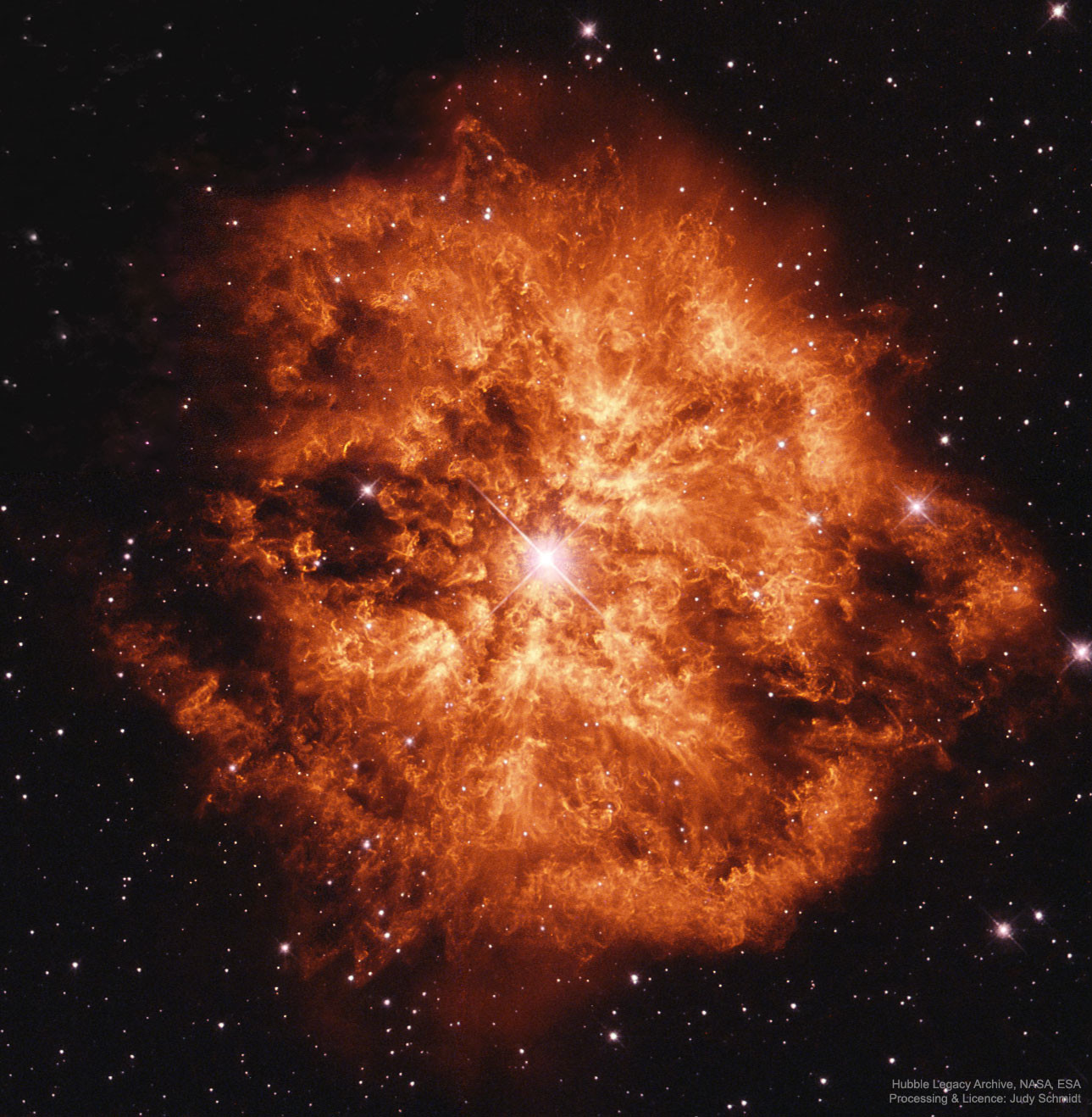
Some stars explode in slow motion. Rare, massive Wolf-Rayet stars are so tumultuous and hot that they are slowly disintegrating right before our telescopes. Glowing gas globs each typically over 30 times more massive than the Earth are being expelled by violent stellar winds. Wolf-Rayet star WR 124, visible near the featured image center and spanning six light years across, is thus creating the surrounding nebula known as M1-67. Details of why this star has been slowly blowing itself apart over the past 20,000 years remains a topic of research. WR 124 lies 15,000 light-years away towards the constellation of the Arrow (Sagitta). The fate of any given Wolf-Rayet star likely depends on how massive it is, but many are thought to end their lives with spectacular explosions such as supernovas or gamma-ray bursts.
https://en.wikipedia.org/wiki/Wolf%E2%80%93Rayet_star
https://en.wikipedia.org/wiki/WR_124
https://www.flickr.com/photos/geckzilla/14248502065/
https://www.syfy.com/syfy-wire/a-massive-violent-star-blooms
https://www.youtube.com/watch?v=aysiMbgml5g
https://ui.adsabs.harvard.edu/abs/1985A%26A...145L..13V/abstract
https://science.nasa.gov/universe/gamma-ray-bursts-harvesting-knowledge-from-the-universes-most-powerful-explosions/
http://www.hawastsoc.org/deepsky/sge/
https://chandra.harvard.edu/photo/cosmic_distance.html
https://apod.nasa.gov/apod/ap000318.html
https://spaceplace.nasa.gov/constellations/en/
https://www.universetoday.com/24736/wolf-rayet-star/
https://science.nasa.gov/earth/facts/
https://apod.nasa.gov/apod/ap250203.html
#space #nebula #star #astrophotograhy #NASA #ESA #Hubble #science #nature
Alt...
2025 February 3
A starfield is shown with a large spherical nebula in the center. The nebula shows a great deal of internal structure. Please see the explanation for more detailed information.
Wolf-Rayet Star 124: Stellar Wind Machine
* Image Credit: Hubble Legacy Archive, NASA, ESA; Processing & License: Judy Schmidt
Explanation:
Some stars explode in slow motion. Rare, massive Wolf-Rayet stars are so tumultuous and hot that they are slowly disintegrating right before our telescopes. Glowing gas globs each typically over 30 times more massive than the Earth are being expelled by violent stellar winds. Wolf-Rayet star WR 124, visible near the featured image center and spanning six light years across, is thus creating the surrounding nebula known as M1-67. Details of why this star has been slowly blowing itself apart over the past 20,000 years remains a topic of research. WR 124 lies 15,000 light-years away towards the constellation of the Arrow (Sagitta). The fate of any given Wolf-Rayet star likely depends on how massive it is, but many are thought to end their lives with spectacular explosions such as supernovas or gamma-ray bursts.
Authors & editors: Robert Nemiroff (MTU) & Jerry Bonnell (UMCP)
NASA Official: Amber Straughn Specific rights apply.
NASA Web Privacy, Accessibility, Notices;
A service of: ASD at NASA / GSFC,
NASA Science Activation
& Michigan Tech. U.