Search results for tag #privacy
![[?]](https://cdn.masto.host/indiewebsocial/accounts/avatars/112/536/017/792/352/435/original/a07c2813d5f4cabd.png)
🔓 France Moves to Break Encrypted Messaging
「 France’s intelligence delegation in parliament has formally backed breaking the encryption that protects WhatsApp, Signal, and Telegram conversations, recommending that magistrates and intelligence agents be granted what lawmakers describe as targeted access to messages that platforms currently cannot read even themselves 」
https://reclaimthenet.org/france-moves-to-break-encrypted-messaging
![[?]](https://kolektiva.social/system/accounts/avatars/112/414/072/145/090/285/original/908e8d2125d5d293.jpg)
I cannot recommend Duck Duck Go's
app tracking privacy suite for android enough.
Simply install #DDG you don't need to use it. Open up the settings and switch on 'App Tracking Protection' then forget about it. It's that simple. You can see which apps have been trying to harvest your data easily, who what and when, it works in the background across ALL your phones installed apps.
Done and dusted 👍
Yes there are better ways but this is by far the simplest.
![[?]](https://media.infosec.exchange/infosec.exchange/accounts/avatars/114/372/473/711/554/045/original/336266689a6c5f66.jpg)


"GM settles California lawsuit claiming it sold driving habit data to insurance companies"
"General Motors has agreed to pay $12.75 million to settle a California data privacy lawsuit that accused the automaker of selling driver location and driver data, as reported earlier by Reuters."
![[?]](https://files.mastodon.social/accounts/avatars/115/742/434/865/105/205/original/ba2fa15026c28d18.jpeg)
OpenCut is a free, open-source video editor focused on privacy and simplicity.
It works on web, desktop, and mobile, supports self-hosting, and processes videos locally so your projects stay on your device.
Built as an alternative to CapCut and other increasingly paywalled editors.
More details:
https://digitalescapetools.com/tools/tool.html?id=opencut
#OpenSource #Privacy #VideoEditing #SelfHosted #Linux #OpenCut
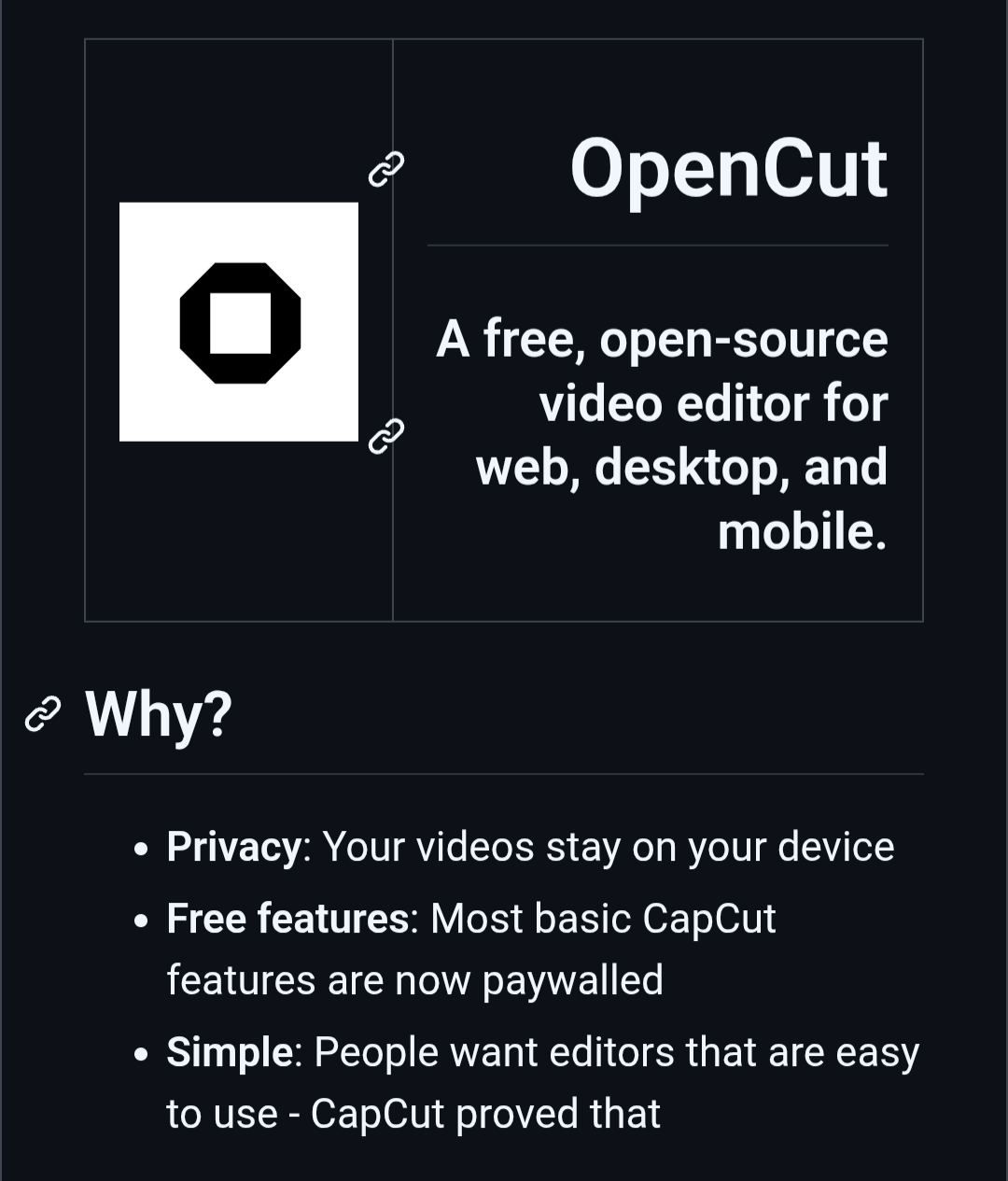
Alt...
A Screenshot of the OpenCut documentation page. The logo is a minimalist geometric design. The text highlights the project's goal as a cross-platform, open-source alternative to proprietary editors. The "Why?" section provides a comparison to CapCut, emphasizing that OpenCut prioritizes user privacy and keeps basic features free, while aiming for a similarly simple user experience.
![[?]](https://cdn.masto.host/mastodonuno/accounts/avatars/114/654/878/489/960/450/original/541376d5adf76896.png)
![[?]](https://todon.nl/system/accounts/avatars/116/199/930/426/291/746/original/0e33c6d9c8fc7aa2.jpg)
Hi, great fedinetwork!
You can never have enough sources on digital independence, self-hosting and data governance! I'm collecting sources for a talk on these topics and I would love some more info!
Do you have some favorite sources, websites, blogs or articles about these (or adjacent) subjects? Please drop them in a reply!
#fediverse #digitalsovereignty #digitalindependence #selfhosting #selfhosted #datagovernance #Privacy
"Say goodbye to burner phones? FCC robocall plan raises privacy fears"
"The commission adopted a Further Notice of Proposed Rulemaking on April 30 that would strengthen Know Your Customer rules for voice service providers."
https://www.techspot.com/news/112359-goodbye-burner-phones-fcc-robocall-plan-raises-privacy.html
"Venmo finally takes privacy seriously"
""
https://www.theverge.com/tech/927503/venmo-app-redesign-privacy-posts
Google’s reCAPTCHA is facing renewed privacy criticism after reports showed Android users may still be tracked even when trying to avoid Google services.
The discussion raises broader concerns about invisible tracking, device fingerprinting, and how deeply Google systems are embedded across the web.
Read more: https://digitalescapetools.com/2026/05/google-recaptcha-privacy-android-users.html
![[?]](https://cdn.fosstodon.org/accounts/avatars/107/297/362/770/635/523/original/3ce6a735f191afe9.jpeg)
Daily Digest | 11 May 2026
Your daily dose of Privacy, Data Protection, AI & Cybersecurity news.
5 stories you should not miss.
Read more: https://www.nicfab.eu/daily-digest/
![[?]](https://files.mastodon.social/accounts/avatars/112/254/133/513/442/738/original/75c4daa7488e1ab5.png)
On Saturday, I'll be talking at AMRO about why the European Commission's plan to soften privacy regulation for slop machines is a bad idea that will harm us all eventually.
If you're in Linz at 10:00 a.m. and interested, please come and join the discussion. If you're not around, there will be a live stream (at dorftv.at).
Also, please have a look at all the other great contributions to AMRO!
Festival programme: https://radical-openness.org/en/program/2026
--
#AMRO26 #privacy #DataProtection #GDPR #LLMs
![[?]](https://files.mastodon.social/accounts/avatars/109/255/581/158/039/090/original/5ccd8f3caf2fce93.jpg)
Chrome on Android now lets users share approximate location with websites: Chrome for Android adds approximate location sharing, giving users a middle-ground privacy option between full location access and denial for website requests. https://ppc.land/chrome-on-android-now-lets-users-share-approximate-location-with-websites/ #Chrome #Android #Privacy #LocationSharing #Websites
![[?]](https://mastodon.sayzard.org/system/accounts/avatars/115/823/033/418/578/765/original/7394931a887351ac.png)
Null ID – A local daemon for age restrictions without surveillance
Null ID는 감시 없이 연령 제한을 로컬에서 자발적으로 적용할 수 있는 데몬 프로젝트입니다. 사용자가 자신의 환경에 제한 상태를 설정하면, 콘텐츠 제공자는 이를 존중해 성인물 접근을 차단하는 방식으로 작동합니다. 정부 인증 없이도 보호 기능을 제공하며, 프라이버시를 침해하지 않고 아동과 취약 계층을 보호하는 실용적 대안으로 제안됩니다. 현재는 초기 버전으로, 개발자들의 참여와 개선을 기다리고 있습니다.
https://github.com/ni-initiative/ni-initiative
#agerestriction #privacy #localdaemon #voluntaryrestriction #linux
![[?]](https://files.mastodon.social/accounts/avatars/114/368/991/106/654/640/original/4055052cf2bcf4e8.png)
Mozilla, Proton, Mullvad, Tor Project, and EFF signed a letter opposing UK online age-verification proposals over privacy and surveillance risks 🌐
The coalition warned mandatory age gates could centralize identity checks, weaken anonymity, and push open web toward closed, monitored platforms 🔒
🔗 https://cyberinsider.com/mozilla-mullvad-proton-sign-letter-opposing-uk-age-verification/
#TechNews #Mozilla #Proton #Mullvad #Tor #UnitedKingdom #EFF #Privacy #Cybersecurity #OpenSource #FOSS #VPN #Surveillance #UK #DigitalRights #Internet #Freedom #AgeVerification
Google Chrome has reportedly pushed a 4GB Gemini Nano model to some devices without clear consent, storing weights in the OptGuideOnDeviceModel folder 💽
Users say Chrome redownloads the AI cache after deletion, raising transparency, storage, bandwidth, and EU privacy concerns over silent AI deployment 🔍
🔗 https://www.techspot.com/news/112309-google-chrome-has-silently-pushing-4gb-ai-model.html
#TechNews #Browser #GoogleChrome #Chrome #Google #Gemini #GeminiNano #AI #Privacy #OpenSource #FOSS #Cybersecurity #Windows #Linux #macOS #MachineLearning
![[?]](https://androidiani.net/wp-content/uploads/2026/01/cropped-logo-new-square-black-removebg-preview.png)
Google Chrome scarica in segreto un modello AI da 4 GB: nessuna notifica agli utenti
Google Chrome sta scaricando silenziosamente un file da circa 4 GB sui dispositivi degli utenti. A scoprirlo è stato un ricercatore di privacy, che ha notato la presenza di dati legati a un modello AI locale nelle cartelle interne del browser, senza che l'utente avesse ricevuto alcuna notifica o fornito il proprio consenso esplicito. Un modello AI che occupa spazio ma viene poco usato Il file in questione è collegato a un modello di intelligenza artificiale leggero di Google, pensato per […] [SENSITIVE CONTENT]
Google Chrome sta scaricando silenziosamente un file da circa 4 GB sui dispositivi degli utenti. A scoprirlo è stato un ricercatore di privacy, che ha notato la presenza di dati legati a un modello AI locale nelle cartelle interne del browser, senza che l’utente avesse ricevuto alcuna notifica o fornito il proprio consenso esplicito.
Un modello AI che occupa spazio ma viene poco usato
Il file in questione è collegato a un modello di intelligenza artificiale leggero di Google, pensato per funzionare in locale sul dispositivo. Il paradosso segnalato dai ricercatori è che le funzioni AI più visibili di Chrome continuano comunque a appoggiarsi ai server remoti di Google, rendendo l’utilità pratica del download locale tutt’altro che evidente a fronte dei 4 GB occupati.
Il problema riguarda Windows, Mac e Linux
Il comportamento è stato verificato su più piattaforme: Windows, macOS e Linux. Chi ha spazio limitato sul proprio disco o usa connessioni dati contingentate potrebbe subire conseguenze concrete senza nemmeno accorgersene. Tra le critiche più diffuse c’è anche il fatto che cancellare il file non basta: Chrome lo riscarica automaticamente.
Come disattivare il download (non è semplice)
Per impedire questo comportamento non basta andare nelle impostazioni standard del browser: è necessario modificare i flag di sviluppo, un’operazione fuori dalla portata della maggior parte degli utenti comuni. Alcuni esperti hanno già sollevato la questione della compatibilità con le normative sulla privacy, come il GDPR europeo. Google non ha ancora rilasciato dichiarazioni ufficiali in merito.

Alt...
Google Chrome scarica in segreto un modello AI da 4 GB: nessuna notifica agli utenti
![[?]](https://files.mastodon.social/accounts/avatars/109/292/230/333/635/821/original/b51753fa200b179b.jpg)
The #FCC proposes new rules — supposedly to reduce robocalls — that could eliminate anonymous mobile communications, impacting privacy for many, such as journalists, survivors of domestic abuse, whistleblowers, and activists.
https://www.ibtimes.co.uk/fcc-id-verification-phone-activation-1795960
![[?]](https://nbg1.your-objectstorage.com/tno-mastodon/accounts/avatars/111/434/264/745/920/273/original/52ff85db085a2a1d.jpg)
The #FCC Wants Your #ID Before You Get a #Phone Number
https://reclaimthenet.org/the-fcc-wants-your-id-before-you-get-a-phone-number
![[?]](https://media.infosec.exchange/infosec.exchange/accounts/avatars/116/047/594/246/715/441/original/29cfa7a3eb440480.png)

Most people still think privacy works like this:
“I use a VPN, so I’m anonymous.”
But modern tracking no longer relies only on IP addresses.
Today, systems can fingerprint users through:
* browser behavior
* hardware characteristics
* TCP/IP stack patterns
* DNS behavior
* GPU/rendering fingerprints
* timing signatures
* viewport & display metrics
* runtime inconsistencies across layers
Changing your IP alone often isn’t enough.
That idea led us to build PH4NTXM.
Instead of randomizing things independently, PH4NTXM tries to create a coherent runtime identity where:
* hardware
* networking
* browser environment
* timing behavior
* GPU exposure
all align consistently within the same session.
The project is:
* live-only
* stateless
* non-persistent across boots
* fully open source
Current focus areas include:
* fingerprint surface reduction
* browser hardening
* network personality shaping
* Tor-isolated operation modes
* fail-secure session termination
We’re not claiming “perfect anonymity” — the goal is simply to reduce static identity behavior and avoid contradictory signals as much as possible.
Find us: https://github.com/PH4NTXMOFFICIAL/PH4NTXM
#ph4ntxm #linux #debian #os #live #privacy #security #opsec #infosec #research #tech #technology
#FiberOptic cables can eavesdrop on nearby conversations
https://www.science.org/content/article/fiber-optic-cables-can-eavesdrop-nearby-conversations
Congress Narrowed the #GUARDAct, But Serious Problems Remain
https://www.eff.org/deeplinks/2026/05/congress-narrowed-guard-act-serious-problems-remain
"FCC Attempts to Solve Robocall Problem by Potentially Creating Even Bigger Privacy Problem"
"This move could kill burner phones if it goes forward."
#Google Cloud Fraud Defence is just #WEI repackaged
https://privatecaptcha.com/blog/google-cloud-fraud-defence-wei/
#Anonymization explained: If your data is #anonymous, why can advertisers still target you?
![[?]](https://files.mastodonapp.uk/accounts/avatars/109/788/827/934/536/527/original/028153e7b3be7c3a.jpg)
"Requiring people to verify their age through methods like facial recognition or by registering with an official ID does make it harder for children to access restricted content, but it also prevents anyone from using the web anonymously, particularly now that age verification is being required for more and more services."
![[?]](https://files.mastodon.social/accounts/avatars/000/207/529/original/54f1c149bd7d41f1.jpg)
Following the Australian precedence, Brazil, Greece, and Turkey have now passed laws requiring age checks for social media.
😡But age verification and ID checks destroy everyone's #privacy. 😡
Learn what countries are planning a social media ban for teens and fight #AgeVerification 💪
👉https://tuta.com/blog/age-verification-kills-anonymity

Alt...
Countries with laws for age verification for social media: Greece, Australia, Brazil, Turkey
Countries planning such laws: France, Germany, Portugal, UK, Canada, Spain, Poland, Netherlands
AloxBook punta tutto su privacy e controllo locale con contabilità a doppia scrittura, archivi cifrati e gestione finanziaria senza cloud. #Linux #OpenSource #FinanzaPersonale #Privacy #DesktopApp #Software
![[?]](https://vebinet.com/system/accounts/avatars/115/095/817/338/624/632/original/1f118a9c0d2ccced.jpg)