Search results for tag #space
![[?]](https://files.defcon.social/dcsocial-s3/accounts/avatars/113/208/344/507/078/943/original/014820ad22daee1c.jpg)
"To upload this video, I converted it and compressed it to a smaller file-size under #linux with the free software ffmpeg and the corresponding command:
'ffmpeg -i video_in.mkv -vcodec libx265 -crf 30 video_out.mp4'
Maybe you would like to post a corresponding video on a scientifically related topic, but it is perhaps too big? Then try ffmpeg.
Just for now let's enjoy this Perseids Night Timelaps together"
2021 September 28
Night of the Perseids
* Video Credit & Copyright: Vikas Chander & Dorje Angchuk
https://www.youtube.com/channel/UCa_53XIkP1fYEbHCWoMgIrg
* Music: Tea Time via PremiumBeat
https://www.premiumbeat.com/artist/yellow-tea
Explanation:
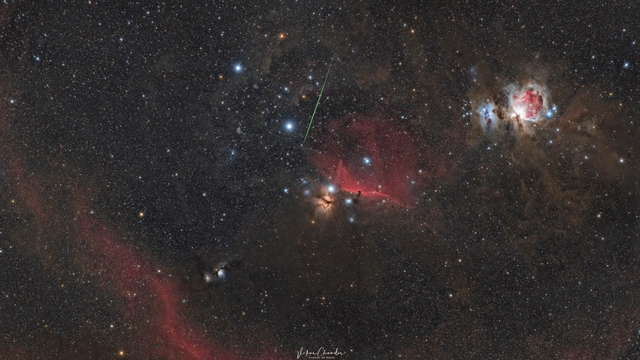
Have you ever experienced a meteor shower? To help capture the wonder, a video was taken during the peak of the recent Perseid meteor shower above the Indian Astronomical Observatory in Hanle, India, high up in the Himalayan mountains. Night descends as the video begins, with the central plane of our Milky Way Galaxy approaching from the left and Earth-orbiting satellites zipping by overhead. During the night, the flash of meteors that usually takes less than a second is artificially extended. The green glow of most meteors is typically caused by vaporizing nickel. As the video continues, Orion rises and meteors flare above the 2-meter Himalayan Chandra Telescope and the seven barrels of the High Energy Gamma Ray Telescope (Hagar). The 2 minute 30 second movie ends with the Sun rising, preceded by a false dawn of zodiacal light.
https://apod.nasa.gov/apod/ap210928.html
#space #galaxy #perseids #astrophotography #photography #science #astronomy #nature #NASA
Alt...
2021 September 28
Night of the Perseids
* Video Credit & Copyright: Vikas Chander & Dorje Angchuk
* Music: Tea Time via PremiumBeat
Explanation:
Have you ever experienced a meteor shower? To help capture the wonder, a video was taken during the peak of the recent Perseid meteor shower above the Indian Astronomical Observatory in Hanle, India, high up in the Himalayan mountains. Night descends as the video begins, with the central plane of our Milky Way Galaxy approaching from the left and Earth-orbiting satellites zipping by overhead. During the night, the flash of meteors that usually takes less than a second is artificially extended. The green glow of most meteors is typically caused by vaporizing nickel. As the video continues, Orion rises and meteors flare above the 2-meter Himalayan Chandra Telescope and the seven barrels of the High Energy Gamma Ray Telescope (Hagar). The 2 minute 30 second movie ends with the Sun rising, preceded by a false dawn of zodiacal light.
Authors & editors: Robert Nemiroff (MTU) & Jerry Bonnell (UMCP)
NASA Official: Phillip Newman Specific rights apply.
NASA Web Privacy Policy and Important Notices
A service of: ASD at NASA / GSFC
& Michigan Tech. U.
2023 August 23 (*)
The Meteor and the Galaxy
* Credit & Copyright: Jose Pedrero
https://www.instagram.com/josepedrero.jpart/
Explanation:
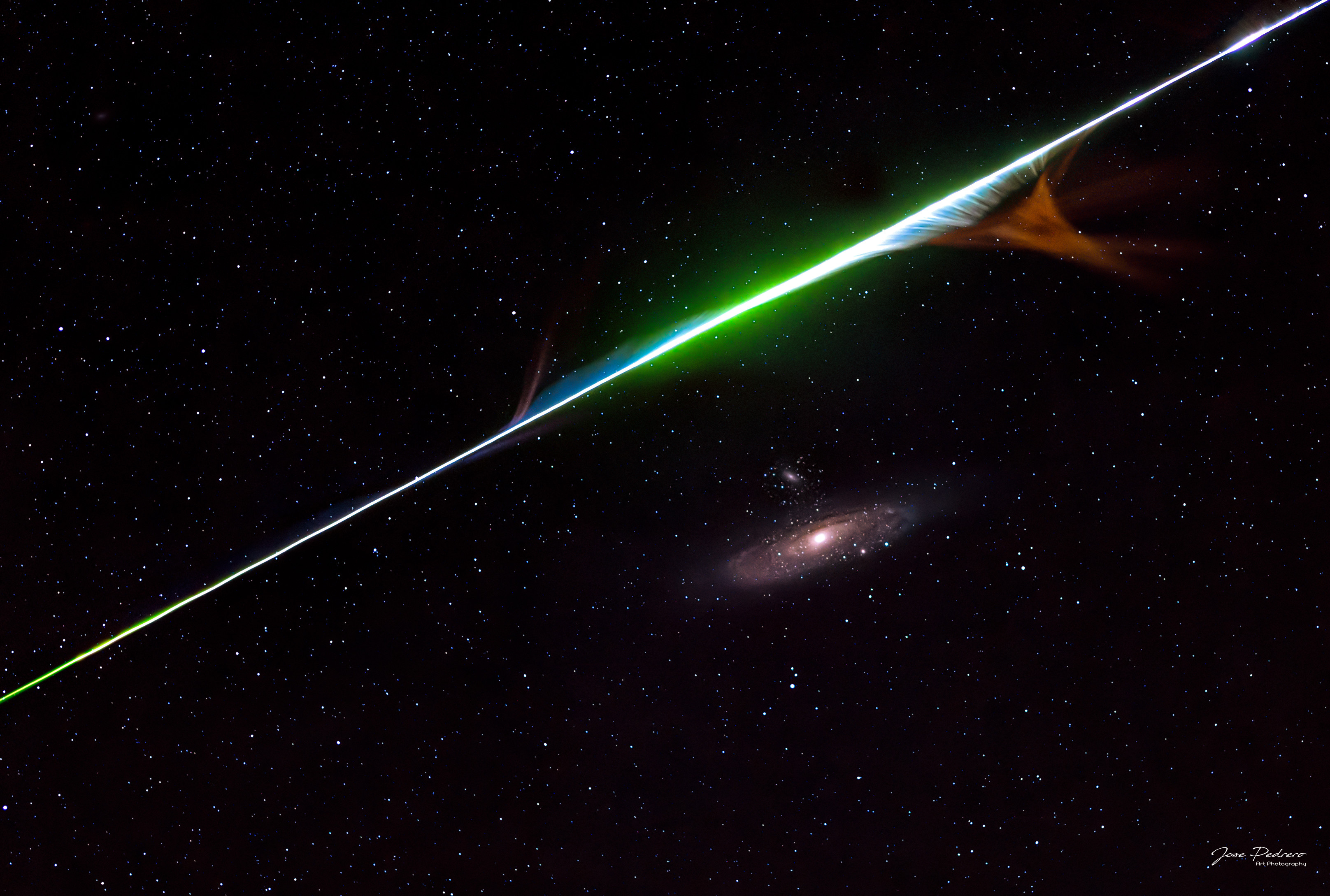
It came from outer space. It -- in this case a sand-sized bit of a comet nucleus -- was likely ejected many years ago from Sun-orbiting Comet Swift-Tuttle, but then continued to orbit the Sun alone. When the Earth crossed through this orbit, the piece of comet debris impacted the atmosphere of our fair planet and was seen as a meteor. This meteor deteriorated, causing gases to be emitted that glowed in colors emitted by its component elements. The featured image was taken last week(*) from Castilla La Mancha, Spain, during the peak night of the Perseids meteor shower. The picturesque meteor streak happened to appear in the only one of 50 frames that also included the Andromeda galaxy. Stars dot the frame, each much further away than the meteor. Compared to the stars, the Andromeda galaxy (M31) is, again, much further away.
https://apod.nasa.gov/apod/ap230823.html
#space #galaxy #perseids #astrophotography #photography #astroart #science #astronomy #nature #NASA
Alt...
2023 August 23
A color meteor streak is seen above the Andromeda spiral galaxy. Please see the explanation for more detailed information.
The Meteor and the Galaxy
* Credit & Copyright: Jose Pedrero
Explanation:
It came from outer space. It -- in this case a sand-sized bit of a comet nucleus -- was likely ejected many years ago from Sun-orbiting Comet Swift-Tuttle, but then continued to orbit the Sun alone. When the Earth crossed through this orbit, the piece of comet debris impacted the atmosphere of our fair planet and was seen as a meteor. This meteor deteriorated, causing gases to be emitted that glowed in colors emitted by its component elements. The featured image was taken last week from Castilla La Mancha, Spain, during the peak night of the Perseids meteor shower. The picturesque meteor streak happened to appear in the only one of 50 frames that also included the Andromeda galaxy. Stars dot the frame, each much further away than the meteor. Compared to the stars, the Andromeda galaxy (M31) is, again, much further away.
Authors & editors: Robert Nemiroff (MTU) & Jerry Bonnell (UMCP)
NASA Official: Phillip Newman Specific rights apply.
NASA Web Privacy Policy and Important Notices
A service of: ASD at NASA / GSFC,
NASA Science Activation
& Michigan Tech. U.
2018 August 17
Perseid Fireball and Persistent Train
* Image Credit & Copyright: Petr Horálek
http://www.astronom.cz/horalek/?page_id=20
Explanation:
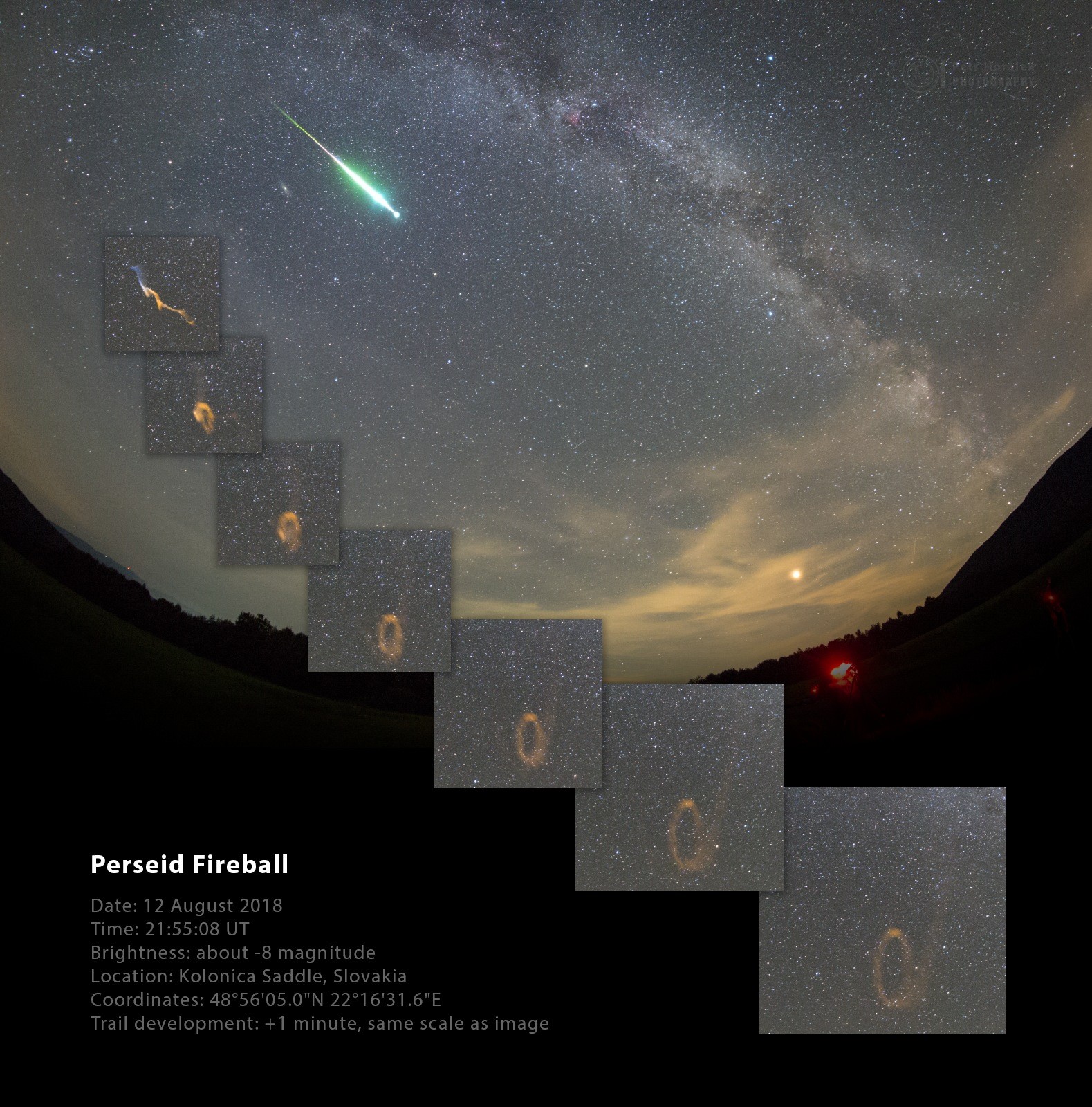
Before local midnight on August 12, this brilliant Perseid meteor flashed above the Poloniny Dark Sky Park, Slovakia, planet Earth. Streaking beside the summer Milky Way, its initial color is likely due to the shower meteor's characteristically high speed. Moving at about 60 kilometers per second, Perseid meteors can excite green emission from oxygen atoms while passing through the thin atmosphere at high altitudes. Also characteristic of bright meteors, this Perseid left a lingering visible trail known as a persistent train, wafting in the upper atmosphere. Its development is followed in the inset frames, exposures separated by one minute and shown at the scale of the original image. Compared to the brief flash of the meteor, the wraith-like trail really is persistent. After an hour faint remnants of this one could still be traced, expanding to over 80 degrees on the sky.
https://apod.nasa.gov/apod/ap180817.html
#space #galaxy #perseids #astrophotography #photography #science #astronomy #nature #NASA
Alt...
2018 August 17
Perseid Fireball and Persistent Train
* Image Credit & Copyright: Petr Horálek
Explanation:
Before local midnight on August 12, this brilliant Perseid meteor flashed above the Poloniny Dark Sky Park, Slovakia, planet Earth. Streaking beside the summer Milky Way, its initial color is likely due to the shower meteor's characteristically high speed. Moving at about 60 kilometers per second, Perseid meteors can excite green emission from oxygen atoms while passing through the thin atmosphere at high altitudes. Also characteristic of bright meteors, this Perseid left a lingering visible trail known as a persistent train, wafting in the upper atmosphere. Its development is followed in the inset frames, exposures separated by one minute and shown at the scale of the original image. Compared to the brief flash of the meteor, the wraith-like trail really is persistent. After an hour faint remnants of this one could still be traced, expanding to over 80 degrees on the sky.
Authors & editors: Robert Nemiroff (MTU) & Jerry Bonnell (UMCP)
NASA Official: Phillip Newman Specific rights apply.
NASA Web Privacy Policy and Important Notices
A service of: ASD at NASA / GSFC
& Michigan Tech. U.
Radiant (meteor shower)
From Wikipedia, the free encyclopedia
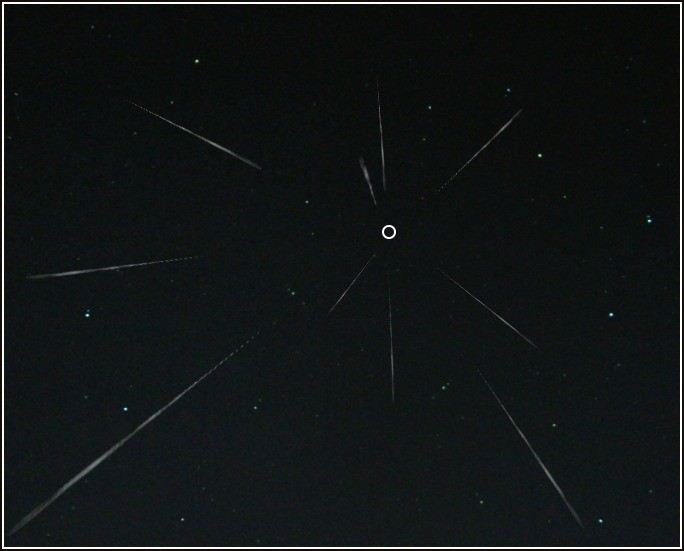
The radiant or apparent radiant of a meteor shower is the celestial point in the sky from which (from the point of view of a terrestrial observer) the paths of meteors appear to originate. The Perseids, for example, are meteors which appear to come from a point within the constellation of Perseus.
Meteor paths appear at random locations in the sky, but the apparent paths of two or more meteors from the same shower will diverge from the radiant. The radiant is the vanishing point of the meteor paths, which are parallel lines in three-dimensional space, as seen from the perspective of the observer, who views a two-dimensional projection against the sky. The geometric effect is identical to crepuscular rays, where parallel sunbeams appear to diverge.
A meteor that does not point back to the known radiant for a given shower is known as a sporadic and is not considered part of that shower.
Shower meteors may appear a short time before the radiant has risen in the observer's eastern sky. The radiant in such cases is above the horizon at the meteor's altitude.
During the active period of most showers, the radiant moves nearly one degree eastwards, parallel to the ecliptic, against the stellar background each day. This is called the radiant's diurnal drift, and is to a large degree due to the Earth's own orbital motion around the Sun, which also proceeds at nearly one degree a day. As the radiant is determined by the superposition of the motions of Earth and meteoroid, the changing orbital direction of the Earth towards the east causes the radiant to move to the east as well.
[...]
https://en.wikipedia.org/wiki/Radiant_(meteor_shower)
#space #galaxy #perseids #astrophotography #photography #science #astronomy #nature #NASA
Alt...
Image of a meteor shower, with the radiant marked by 'ᴏ'
CREDIT
Contributors of Wikimedia
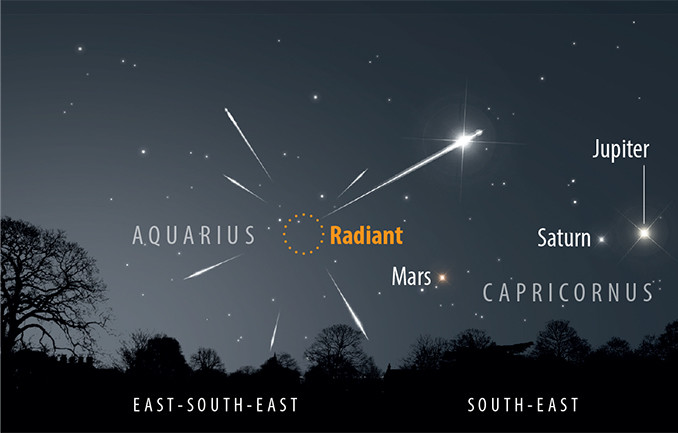
Alt...
Eta Aquarid meteor shower reaches peak
5 May 2020 Mark Armstrong
Although the short-period comet 1P/Halley, the most famous comet of all, will not return to the inner Solar System until 2061, if you look out for some shooting stars in the pre-dawn sky courtesy of the Eta Aquarid meteor shower, you might see some of the debris Halley has left behind over the eons it has orbited the Sun.
The radiant of the Eta Aquarid meteor shower.
Graphic by Greg Smye-Rumsby.
From Wikipedia, the free encyclopedia
Radiant (meteor shower)
[...]
Meteor showers are mostly caused by the trails of dust and debris left in the wake of a comet. This dust continues to move along the comet's wake, and when the Earth moves through such debris, a meteor shower results. Because all of the debris is moving in roughly the same direction, the meteors which strike the atmosphere all "point" back to the direction of the comet's path.
As an exception, the Geminids are a shower caused by the object 3200 Phaethon, which is thought to be a Palladian asteroid.
The radiant is an important factor in observation. If the radiant point is at or below the horizon, then few if any meteors will be observed. This is because the atmosphere shields the Earth from most of the debris, and only those meteors which happen to be travelling exactly (or very near) tangential to the Earth's surface will be viewable.
Here are the radiant points of some major meteor showers of the year.
CREDIT
Contributors to Wikimedia projects
https://en.wikipedia.org/wiki/Radiant_(meteor_shower)
#space #galaxy #perseids #astrophotography #photography #science #astronomy #nature #NASA
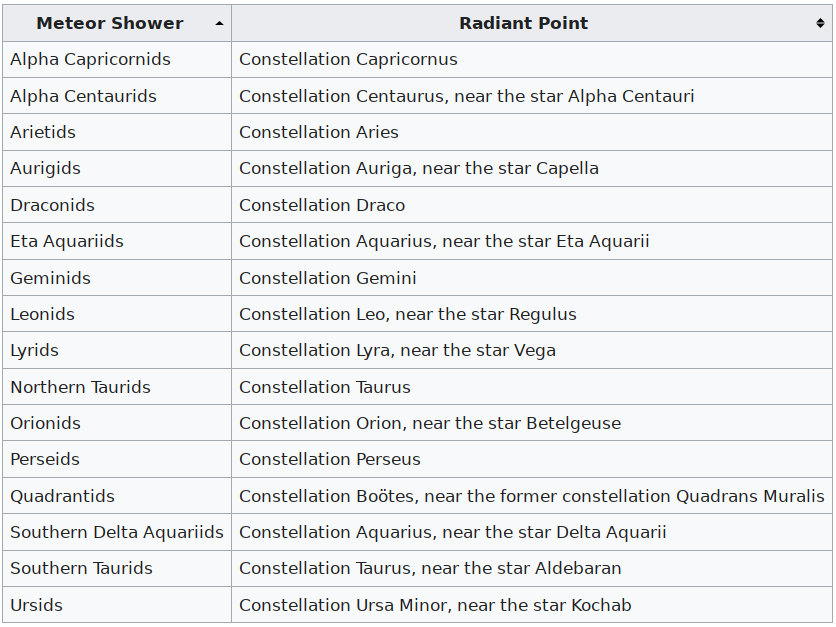
Alt...
Here are the radiant points of some major meteor showers of the year.
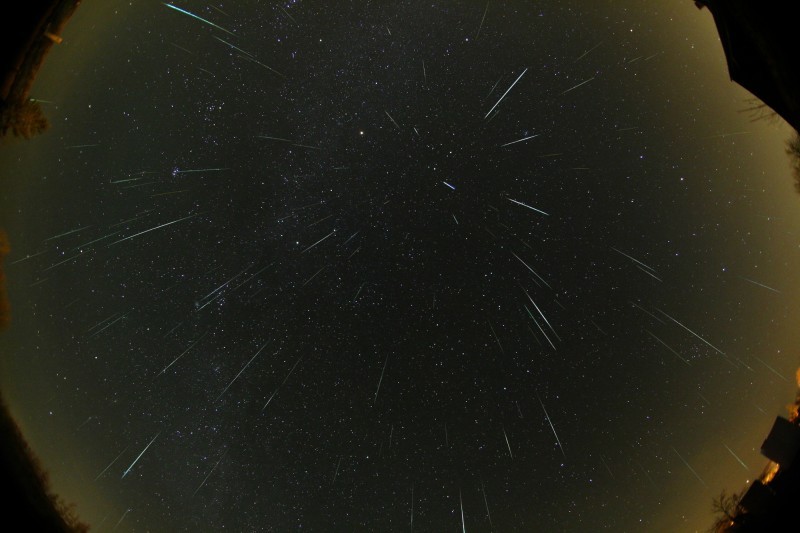
Alt...
Geminid meteors, clearly showing the position of the radiant
CREDIT
Berkó Ernő
2023 August 9
Meteor Shower: Perseids from Perseus
* Credit & Copyright: Petr Horálek / Institute of Physics in Opava
https://www.petrhoralek.com/#about-1
https://www.slu.cz/phys/en/
Explanation:
This is a good week to see meteors. Comet dust will rain down on planet Earth, streaking through dark skies during peak nights of the annual Perseid Meteor Shower. The featured composite image was taken during the 2018 Perseids from the Poloniny Dark Sky Park in Slovakia. The dome of the observatory in the foreground is on the grounds of Kolonica Observatory. Although the comet dust particles travel parallel to each other, the resulting shower meteors clearly seem to radiate from a single point on the sky in the eponymous constellation Perseus. The radiant effect is due to perspective, as the parallel tracks appear to converge at a distance, like train tracks. The Perseid Meteor Shower is expected to reach its highest peak on Saturday after midnight. Since a crescent Moon will rise only very late that night, cloudless skies will be darker than usual, making a high number of faint meteors potentially visible this year.
https://apod.nasa.gov/apod/ap230809.html
#space #galaxy #perseids #astrophotography #photography #science #astronomy #nature #NASA
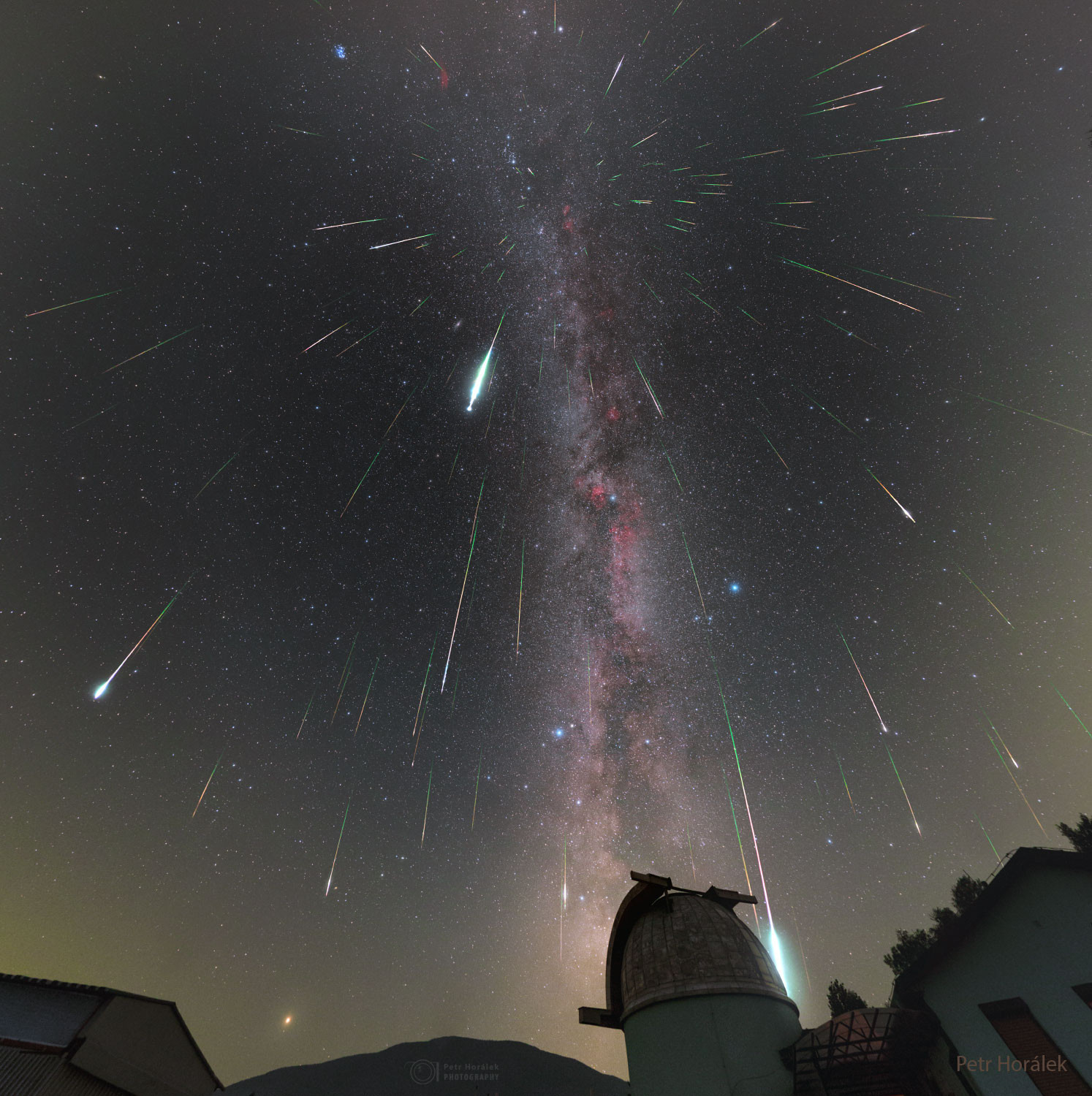
Alt...
2023 August 9
Mulitple streaks cover a night sky filled with stars. An observtory dome is visible in the foreground.
Meteor Shower: Perseids from Perseus
* Credit & Copyright: Petr Horálek / Institute of Physics in Opava
Explanation:
This is a good week to see meteors. Comet dust will rain down on planet Earth, streaking through dark skies during peak nights of the annual Perseid Meteor Shower. The featured composite image was taken during the 2018 Perseids from the Poloniny Dark Sky Park in Slovakia. The dome of the observatory in the foreground is on the grounds of Kolonica Observatory. Although the comet dust particles travel parallel to each other, the resulting shower meteors clearly seem to radiate from a single point on the sky in the eponymous constellation Perseus. The radiant effect is due to perspective, as the parallel tracks appear to converge at a distance, like train tracks. The Perseid Meteor Shower is expected to reach its highest peak on Saturday after midnight. Since a crescent Moon will rise only very late that night, cloudless skies will be darker than usual, making a high number of faint meteors potentially visible this year.
Authors & editors: Robert Nemiroff (MTU) & Jerry Bonnell (UMCP)
NASA Official: Phillip Newman Specific rights apply.
NASA Web Privacy Policy and Important Notices
A service of: ASD at NASA / GSFC,
NASA Science Activation
& Michigan Tech. U.
2025 August 2
Fireflies, Meteors, and Milky Way
* Image Credit & Copyright: Daniel Korona
Explanation:
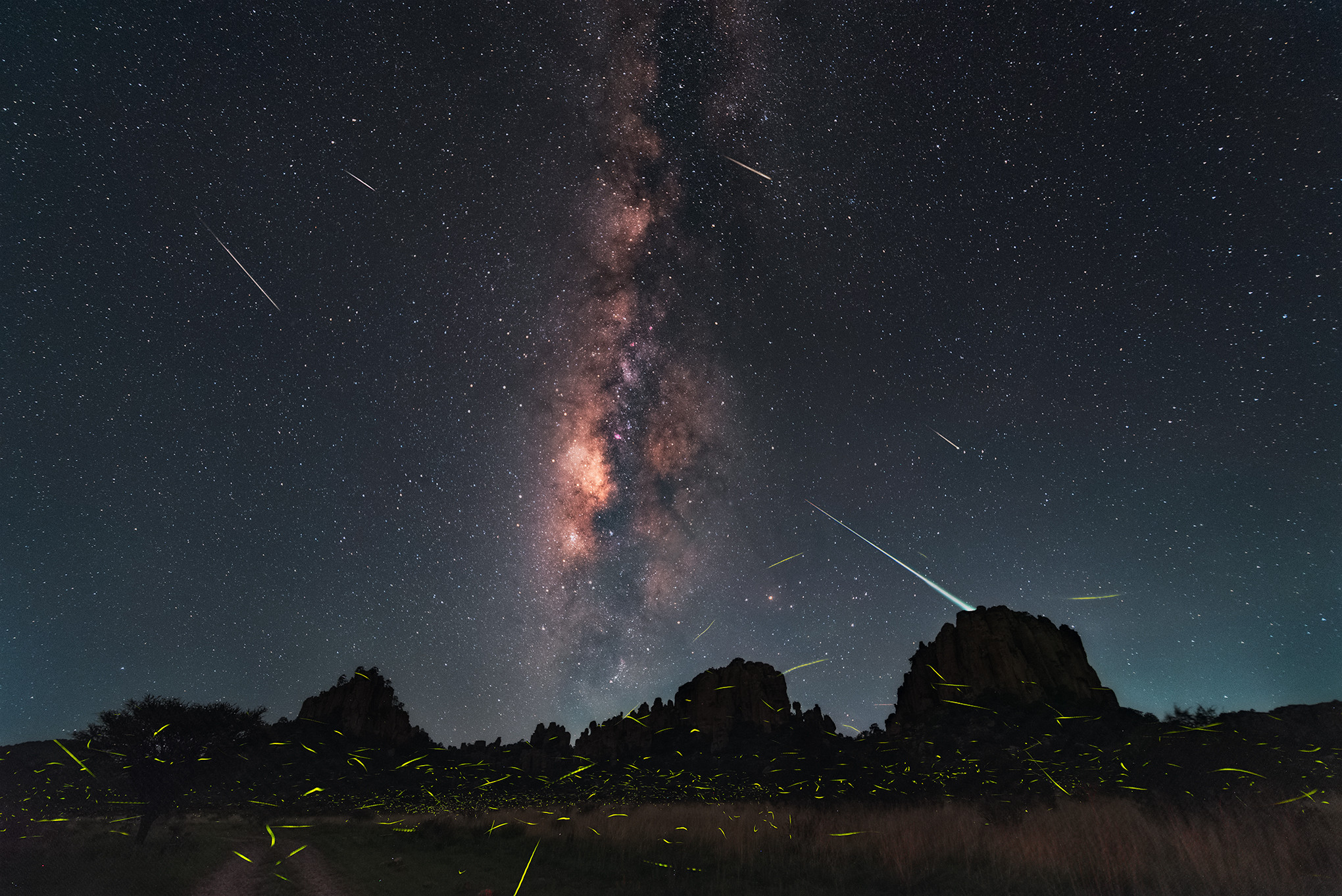
Taken on July 29 and July 30, a registered and stacked series of exposures creates this dreamlike view of a northern summer night. Multiple firefly flashes streak across the foreground as the luminous Milky Way arcs above the horizon in the Sierra de Órganos national park of central Mexico, The collection of bright streaks aligned across the sky toward the upper left in the timelapse image are Delta Aquariid meteors. Currently active, the annual Delta Aquarid meteor shower shares August nights though, overlapping with the better-known Perseid meteor shower. This year that makes post-midnight, mostly moonless skies in early August very popular with late night skygazers. How can you tell a Delta Aquariid from a Perseid meteor? The streaks of Perseid meteors can be traced back to an apparent radiant in the constellation Perseus. Delta Aquariids appear to emerge from the more southerly constellation Aquarius, beyond the top left of this frame. Of course, the bioluminescent flashes of fireflies are common too on these northern summer nights. But how can you tell a firefly from a meteor? Just try to catch one.
https://apod.nasa.gov/apod/ap250802.html
#space #galaxy #perseids #astrophotography #photography #science #astronomy #nature #NASA
Alt...
2025 August 2
Fireflies, Meteors, and Milky Way
* Image Credit & Copyright: Daniel Korona
Explanation:
Taken on July 29 and July 30, a registered and stacked series of exposures creates this dreamlike view of a northern summer night. Multiple firefly flashes streak across the foreground as the luminous Milky Way arcs above the horizon in the Sierra de Órganos national park of central Mexico, The collection of bright streaks aligned across the sky toward the upper left in the timelapse image are Delta Aquariid meteors. Currently active, the annual Delta Aquarid meteor shower shares August nights though, overlapping with the better-known Perseid meteor shower. This year that makes post-midnight, mostly moonless skies in early August very popular with late night skygazers. How can you tell a Delta Aquariid from a Perseid meteor? The streaks of Perseid meteors can be traced back to an apparent radiant in the constellation Perseus. Delta Aquariids appear to emerge from the more southerly constellation Aquarius, beyond the top left of this frame. Of course, the bioluminescent flashes of fireflies are common too on these northern summer nights. But how can you tell a firefly from a meteor? Just try to catch one.
Authors & editors: Robert Nemiroff (MTU) & Jerry Bonnell (UMCP)
NASA Official: Amber Straughn Specific rights apply.
NASA Web Privacy, Accessibility, Notices;
A service of: ASD at NASA / GSFC,
NASA Science Activation
& Michigan Tech. U.
2025 August 3
Milky Way and Exploding Meteor
* Image Credit & Copyright: Andre van der Hoeven
https://www.flickr.com/photos/avdhoeven/
Explanation:
In about a week the Perseid Meteor Shower will reach its maximum. Grains of icy rock will streak across the sky as they evaporate during entry into Earth's atmosphere. These grains were shed from Comet Swift-Tuttle. The Perseids result from the annual crossing of the Earth through Comet Swift-Tuttle's orbit, and are typically the most active meteor shower of the year. Although it is hard to predict the level of activity in any meteor shower, in a clear dark sky an observer might see a meteor a minute. This year's Perseids peak just a few days after full moon, and so some faint meteors will be lost to the lunar skyglow. Meteor showers in general are best seen from a relaxing position, away from lights. Featured here is a meteor caught exploding during the 2015 Perseids above Austria next to the central band of our Milky Way Galaxy.
https://science.nasa.gov/solar-system/meteors-meteorites/perseids/
https://www.amsmeteors.org/meteor-showers/meteor-shower-calendar/
https://www.nasa.gov/general/what-is-earths-atmosphere/
https://apod.nasa.gov/apod/ap960219.html
https://en.wikipedia.org/wiki/Meteoroid#Meteors
https://www.space.com/32868-perseid-meteor-shower-guide.html
https://apod.nasa.gov/apod/ap250803.html
#space #galaxy #perseids #astrophotography #photography #science #astronomy #nature #NASA
2025 August 12
Perseids from Perseus
* Image Credit & Copyright: Marcin Rosadziński
https://astrodream.pl/o-mnie/
Explanation:
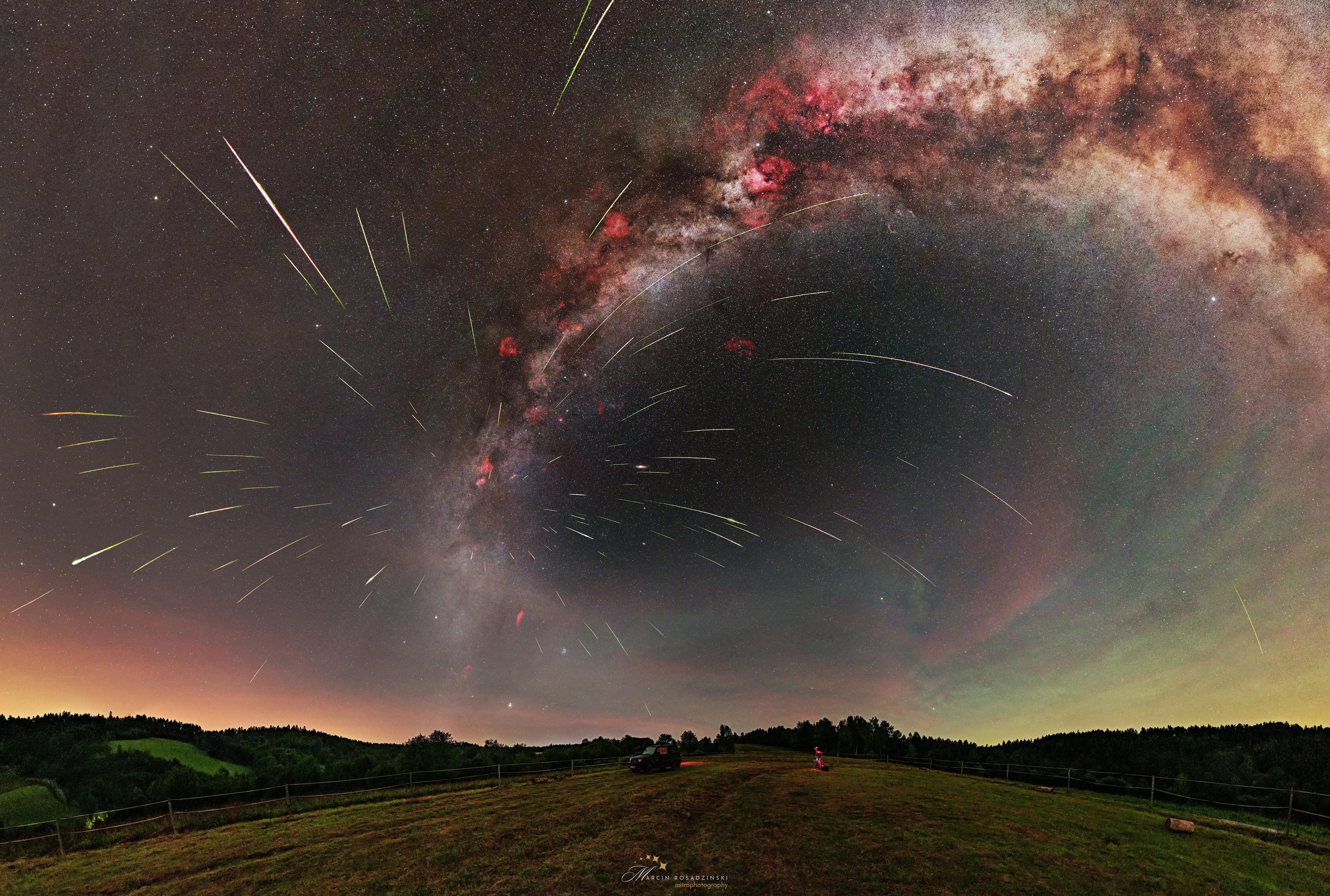
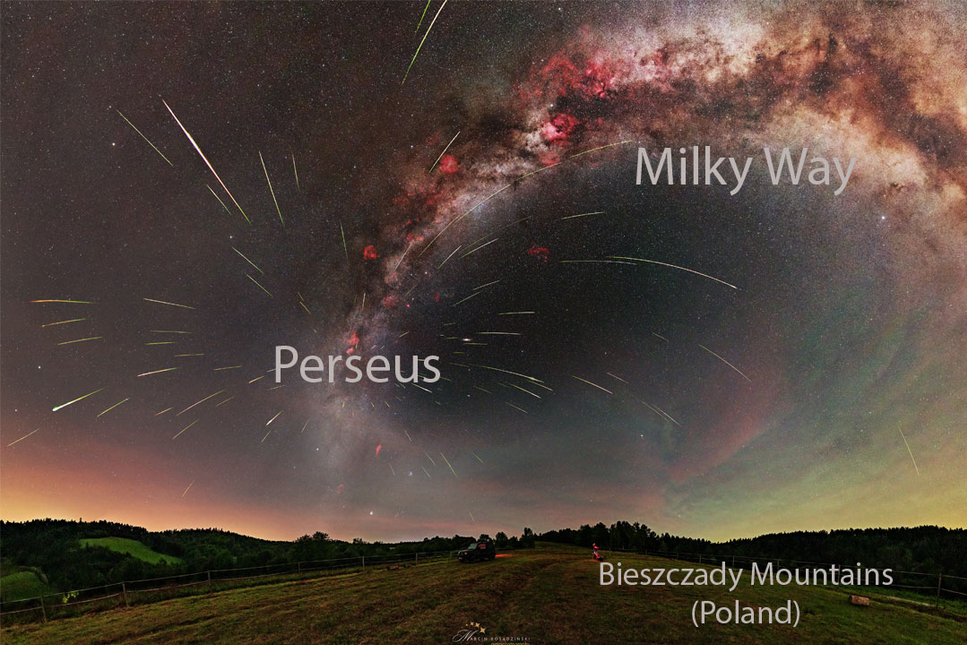
Where are all of these meteors coming from? In terms of direction on the sky, the pointed answer is the constellation of Perseus. That is why the meteor shower that peaks tonight is known as the Perseids -- the meteors all appear to come from a radiant toward Perseus. In terms of parent body, though, the sand-sized debris that makes up the Perseids meteors come from Comet Swift-Tuttle. The comet follows a well-defined orbit around our Sun, and the part of the orbit that approaches Earth is superposed in front of Perseus. Therefore, when Earth crosses this orbit, the radiant point of falling debris appears in Perseus. Featured here, a composite image taken over six nights and containing over 100 meteors from 2024 August Perseids meteor shower shows many bright meteors that streaked over the Bieszczady Mountains in Poland. This year's Perseids, usually one of the best meteor showers of the year, will compete with a bright moon that will rise, for many locations, soon after sunset.
https://astrodream.pl/galeria/
https://www.youtube.com/watch?v=CwrvN0Q9_Sg
https://apod.nasa.gov/apod/ap960219.html
https://en.wikipedia.org/wiki/Perseids
https://en.wikipedia.org/wiki/Meteoroid#Meteor
https://en.wikipedia.org/wiki/Radiant_(meteor_shower)
https://www.timeanddate.com/news/astronomy/perseid-meteor-shower-2025
https://www.amsmeteors.org/meteor-showers/2020-meteor-shower-list/
https://apod.nasa.gov/apod/ap180808.html
https://apod.nasa.gov/apod/ap250812.html
#space #galaxy #perseids #astrophotography #photography #science #astronomy #nature #NASA
Alt...
2025 August 12
A starfield is shown above a grassy field with hills on the horizon. The band of our Milky Way Galaxy arches across toward the right. Many streaks appear emanating out from a place on the Milky Way just above the horizon.
Perseids from Perseus
* Image Credit & Copyright: Marcin Rosadziński
Explanation:
Where are all of these meteors coming from? In terms of direction on the sky, the pointed answer is the constellation of Perseus. That is why the meteor shower that peaks tonight is known as the Perseids -- the meteors all appear to come from a radiant toward Perseus. In terms of parent body, though, the sand-sized debris that makes up the Perseids meteors come from Comet Swift-Tuttle. The comet follows a well-defined orbit around our Sun, and the part of the orbit that approaches Earth is superposed in front of Perseus. Therefore, when Earth crosses this orbit, the radiant point of falling debris appears in Perseus. Featured here, a composite image taken over six nights and containing over 100 meteors from 2024 August Perseids meteor shower shows many bright meteors that streaked over the Bieszczady Mountains in Poland. This year's Perseids, usually one of the best meteor showers of the year, will compete with a bright moon that will rise, for many locations, soon after sunset.
Authors & editors: Robert Nemiroff (MTU) & Jerry Bonnell (UMCP)
NASA Official: Amber Straughn Specific rights apply.
Annotations for previous post.
https://apod.nasa.gov/apod/ap250812.html
#space #galaxy #perseids #astrophotography #photography #science #astronomy #nature #NASA
Alt...
Annotations for previous post.
Meteor Moment: Viewing Tips.
Rhiannon Blaauw, of NASA's Meteoroid Environment Office -- located at NASA's Marshall Space Flight Center in Huntsville, Alabama -- shares some tips and strategies to best view a meteor shower.
CREDIT
NASA's Marshall Space Flight Center - Huntsville, Alabama
#space #galaxy #perseids #astrophotography #photography #science #astronomy #nature #NASA

Alt...
Meteor Moment: Viewing Tips.
Rhiannon Blaauw, of NASA's Meteoroid Environment Office -- located at NASA's Marshall Space Flight Center in Huntsville, Alabama -- shares some tips and strategies to best view a meteor shower.
CREDIT
NASA's Marshall Space Flight Center - Huntsville, Alabama
2007 August 12
Raining Perseids
* Credit & Copyright: Fred Bruenjes
http://www.moonglow.net/ccd/index.html
Explanation:
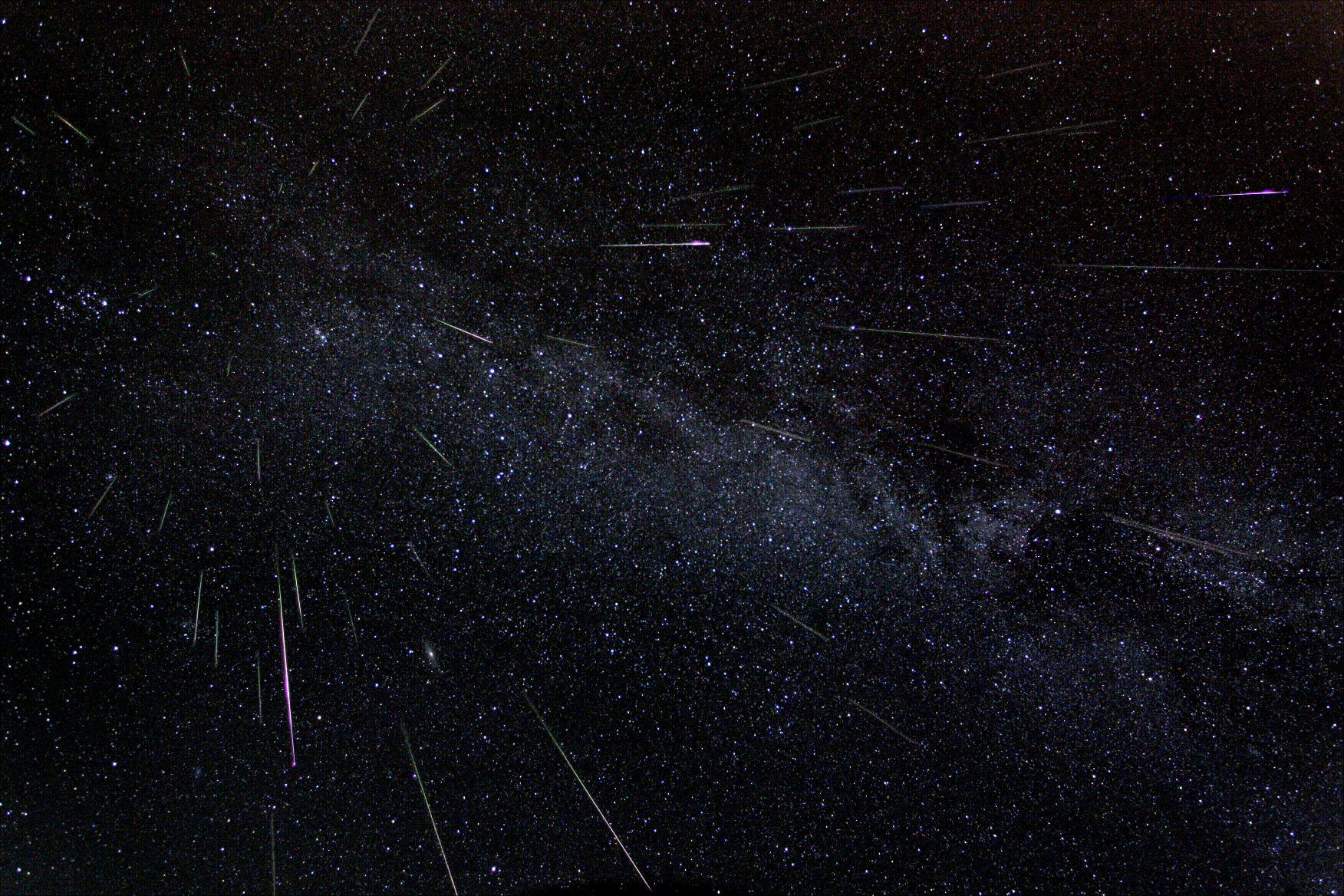
Tonight is a good night to see meteors. Comet dust will rain down on planet Earth, streaking through dark skies in the annual Perseid meteor shower. While enjoying the anticipated space weather, astronomer Fred Bruenjes recorded a series of many 30 second long exposures spanning about six hours on the night of 2004 August 11/12 using a wide angle lens. Combining those frames which captured meteor flashes, he produced this dramatic view of the Perseids of summer. Although the comet dust particles are traveling parallel to each other, the resulting shower meteors clearly seem to radiate from a single point on the sky in the eponymous constellation Perseus. The radiant effect is due to perspective, as the parallel tracks appear to converge at a distance. Bruenjes notes that there are 51 Perseid meteors in the composite image, including one seen nearly head-on. This year, the Perseids Meteor Shower is expected to peak after midnight tonight, in the moonless early morning hours of August 12.
https://apod.nasa.gov/apod/ap070812.html
#space #galaxy #perseids #astrophotography #photography #science #astronomy #nature #NASA
Alt...
2007 August 12
Raining Perseids
* Credit & Copyright: Fred Bruenjes
Explanation:
Tonight is a good night to see meteors. Comet dust will rain down on planet Earth, streaking through dark skies in the annual Perseid meteor shower. While enjoying the anticipated space weather, astronomer Fred Bruenjes recorded a series of many 30 second long exposures spanning about six hours on the night of 2004 August 11/12 using a wide angle lens. Combining those frames which captured meteor flashes, he produced this dramatic view of the Perseids of summer. Although the comet dust particles are traveling parallel to each other, the resulting shower meteors clearly seem to radiate from a single point on the sky in the eponymous constellation Perseus. The radiant effect is due to perspective, as the parallel tracks appear to converge at a distance. Bruenjes notes that there are 51 Perseid meteors in the composite image, including one seen nearly head-on. This year, the Perseids Meteor Shower is expected to peak after midnight tonight, in the moonless early morning hours of August 12.
Authors & editors: Robert Nemiroff (MTU) & Jerry Bonnell (USRA)
NASA Official: Phillip Newman Specific rights apply.
NASA Web Privacy Policy and Important Notices
A service of: ASD at NASA / GSFC
& Michigan Tech. U.
The 2025 Perseid meteor shower peaks on the night between August 12 and August 13. The Perseids usually put on a good show and this year may produce 50 to 75 meteors per hour at a dark site.
Like most meteor showers, the Lyrids are caused by the debris of a comet or asteroid that once crossed Earth's path. In this case, the shower is caused by debris from the comet Swift-Tuttle. Sightings of comet Swift-Tuttle have been recorded throughout history, with the comet’s orbit bringing it near Earth every 133 or so years. It last entered the inner Solar System in 1992. The debris from this comet is known to cause fireballs often.
The Perseid radiant is somewhat north on the sky’s dome, making it more visible from the Northern Hemisphere, but may also be somewhat visible from the Southern Hemisphere. Meteors will appear to come from an area near the constellation Perseus. Meteors will streak out from this area of the sky in all directions.
The best way to watch a meteor shower is from a dark sky site, so it helps to get away from city lights as much as you can. Skywatchers should go to the darkest place they can, let their eyes adjust, and look overhead — but avoid staring directly at the Moon.
Meteors are also known as shooting stars, but they aren't actually stars at all. Meteors are streaks of light in the sky caused by dust and small rocks burning up as they hit Earth's atmosphere at very high speeds — tens of kilometers per second.
These small particles create bright streaks of light you can see from the ground at night. In general, the bigger the piece of space dust, the brighter the meteor. If any pieces of the streaking rock survive to make it to the ground, they're called meteorites.
CREDITS:
The Planetary Society
#space #galaxy #perseids #astrophotography #photography #science #astronomy #nature #NASA
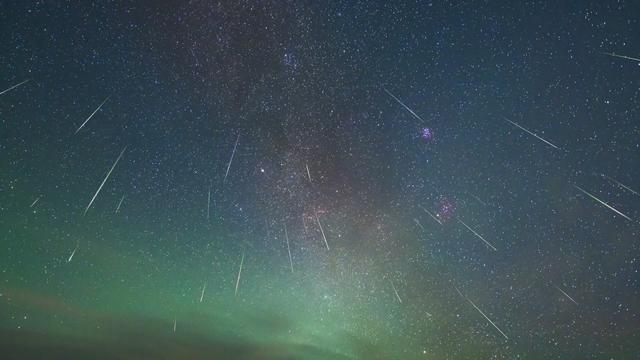
Alt...
Video about meteor showers
Meteors (also called shooting stars) are bright streaks of light in the sky caused by meteoroids — rocks as small as grains of dust and as large as small asteroids — burning up in the Earth’s atmosphere. As the Earth moves along its path in the Solar System it passes through various groups of meteoroids, causing meteor showers. Showers like the Perseids, Lyrids, Geminids, Leonids, and others happen at the same time each year, creating predictable spectacles in the night sky.
Space is full of dust, so on a typical night from a dark location, you might see up to 10 meteors per hour — no shower required! But during a meteor shower, especially on its peak night, you can probably expect to see a higher number of meteors.
2008 November 25
Fireball Over Edmonton
* Credit & Copyright Global Television Edmonton, YouTube
https://www.globaltv.com/
Explanation:
What if you're driving down the street and an object from space shoots across the sky right in front of you? Such was the case last week for many people in south central Canada. Specifically, an extremely bright fireball, presumably a desk-sized meteor from deep space, flashed across the sky just after sunset on 2008 November 20. The bright fireball was recorded on many images and movies, including the spectacular video shown above that was captured by a dashboard camera of a police cruiser in Edmonton, Alberta, Canada. Because at least two streaks appear to be visible, the falling object likely broke up into pieces as it fell deep into Earth's atmosphere. By triangulating fireball images from several simultaneously recorded sources, astronomers hope to find an approximate orbit from whence the object came, as well as the likely place(s) on Earth where large pieces would have impacted, were they to have survived entry. In the best case scenario, pieces would be recovered from a known deep space comet or asteroid, giving humanity an unprecedented look at an ancient object that likely holds clues to the early years of our Earth and the Solar System.
https://apod.nasa.gov/apod/ap081125.html
#space #galaxy #perseids #astrophotography #photography #science #astronomy #nature #NASA
Earthgrazer: The Great Daylight Fireball of 1972
* Credit & Copyright: James M. Baker
Explanation:
What is that streaking across the sky? A bright earthgrazing meteor. In 1972, an unusually bright meteor from space was witnessed bouncing off Earth's atmosphere, much like a skipping stone can bounce off of a calm lake. The impressive event lasted several seconds, was visible in daylight, and reportedly visible all the way from Utah, USA to Alberta, Canada. Pictured above, the fireball was photographed streaking above Teton mountains behind Jackson Lake, Wyoming, USA. The Great Daylight Fireball of 1972 was possibly the size of a small truck, and would likely have created an impressive airburst were it to have struck Earth more directly. Earthgrazing meteors are rare but are more commonly seen when the radiant of a meteor shower is just rising or setting. At that time, meteors closer to the Earth than earthgrazers would more usually strike the Earth near the horizon, while meteors further than earthgrazers would miss the Earth entirely.
https://en.wikipedia.org/wiki/1972_Great_Daylight_Fireball
https://apod.nasa.gov/apod/ap090302.html
#space #galaxy #perseids #astrophotography #photography #science #astronomy #nature #NASA

Alt...
2009 March 2
Earthgrazer: The Great Daylight Fireball of 1972
* Credit & Copyright: James M. Baker
Explanation:
What is that streaking across the sky? A bright earthgrazing meteor. In 1972, an unusually bright meteor from space was witnessed bouncing off Earth's atmosphere, much like a skipping stone can bounce off of a calm lake. The impressive event lasted several seconds, was visible in daylight, and reportedly visible all the way from Utah, USA to Alberta, Canada. Pictured above, the fireball was photographed streaking above Teton mountains behind Jackson Lake, Wyoming, USA. The Great Daylight Fireball of 1972 was possibly the size of a small truck, and would likely have created an impressive airburst were it to have struck Earth more directly. Earthgrazing meteors are rare but are more commonly seen when the radiant of a meteor shower is just rising or setting. At that time, meteors closer to the Earth than earthgrazers would more usually strike the Earth near the horizon, while meteors further than earthgrazers would miss the Earth entirely.
Authors & editors: Robert Nemiroff (MTU) & Jerry Bonnell (UMCP)
NASA Official: Phillip Newman Specific rights apply.
NASA Web Privacy Policy and Important Notices
A service of: ASD at NASA / GSFC
& Michigan Tech. U.
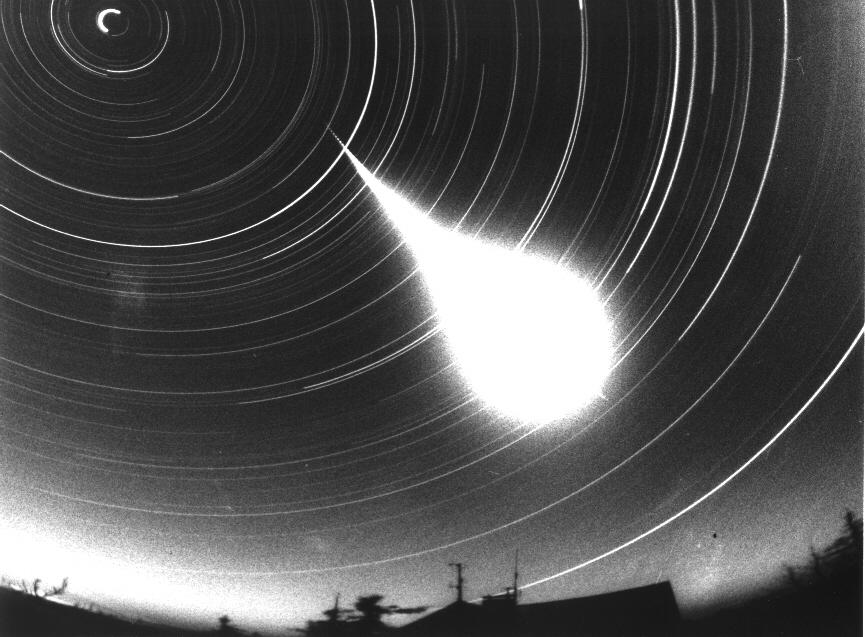
February 19, 1999
On The Trail Of A Fireball
* Credit: Courtesy P. Spurny, (Astronomical Institute, Ondrejov Observatory)
https://www.asu.cas.cz/en/about/about-the-institute
Explanation:
This exceptionally bright fireball meteor trail was photographed with a fish-eye camera at a Czech Republic station of the European Fireball Network on January 21, 1999. Of the star trails visible in this night-long exposure, the bright short arc in the upper left is due to Polaris, the north star. The breaks seen near the beginning of the fireball trail itself were produced by a shutter rotating 15 times a second. In all, three stations recorded the dazzling streak and their combined tracking information has revealed details of the meteor's brief atmospheric flight and previous interplanetary voyage. For example, the luminous trail is measured to begin at an altitude of 81.9 kilometers and covered 71.1 kilometers in 6.7 seconds. The projected prior orbit for the meteoroid corresponds to one typical for Apollo class asteroids which can cross Earth's orbit. In forty years of operations the European Network has multistation recordings of less than 10 or so fireballs as bright as this one. It is thought likely that a small (a few hundred grams) meteorite survived this fiery fall to Earth and landed near the Czech-Poland border.
https://apod.nasa.gov/apod/ap990219.html
#space #galaxy #perseids #astrophotography #photography #science #astronomy #nature #NASA
Alt...
February 19, 1999
On The Trail Of A Fireball
* Credit: Courtesy P. Spurny, (Astronomical Institute, Ondrejov Observatory)
Explanation:
This exceptionally bright fireball meteor trail was photographed with a fish-eye camera at a Czech Republic station of the European Fireball Network on January 21, 1999. Of the star trails visible in this night-long exposure, the bright short arc in the upper left is due to Polaris, the north star. The breaks seen near the beginning of the fireball trail itself were produced by a shutter rotating 15 times a second. In all, three stations recorded the dazzling streak and their combined tracking information has revealed details of the meteor's brief atmospheric flight and previous interplanetary voyage. For example, the luminous trail is measured to begin at an altitude of 81.9 kilometers and covered 71.1 kilometers in 6.7 seconds. The projected prior orbit for the meteoroid corresponds to one typical for Apollo class asteroids which can cross Earth's orbit. In forty years of operations the European Network has multistation recordings of less than 10 or so fireballs as bright as this one. It is thought likely that a small (a few hundred grams) meteorite survived this fiery fall to Earth and landed near the Czech-Poland border.
Authors & editors: Robert Nemiroff (MTU) & Jerry Bonnell (USRA)
NASA Technical Rep.: Jay Norris. Specific rights apply.
A service of: LHEA at NASA/ GSFC
& Michigan Tech. U.
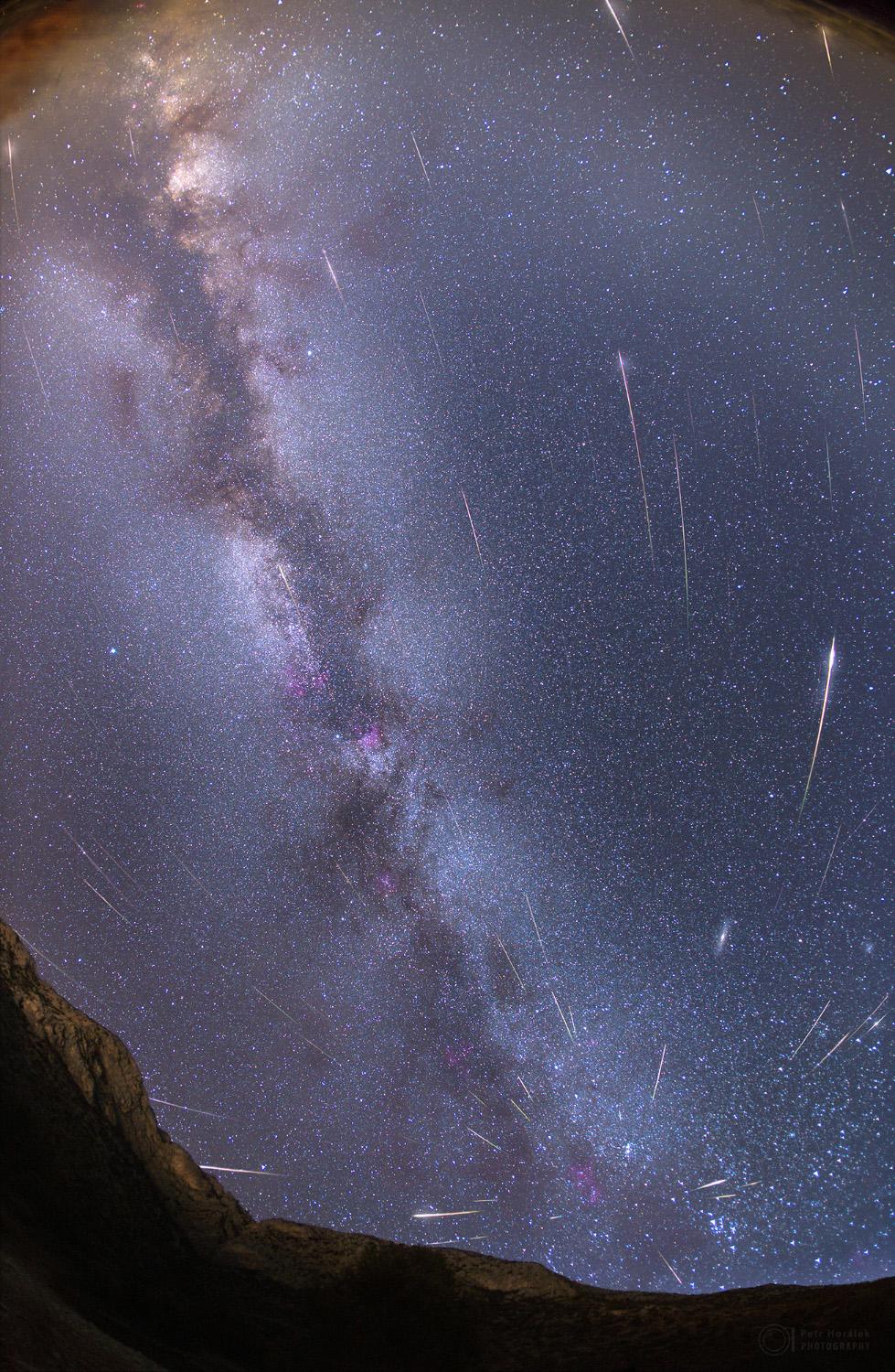
2015 August 13
Moonless Meteors and the Milky Way
* Image Credit & Copyright: Petr Horálek
https://www.petrhoralek.com/?page_id=20
Explanation:
Have you watched the Perseid meteor shower? Though the annual shower's predicted peak was last night, meteor activity should continue tonight (August 13/14), best enjoyed by just looking up in clear, dark skies after midnight. Of course, this year's Perseid shower has the advantage of being active near the August 14 New Moon. Since the nearly New Moon doesn't rise before the morning twilight many fainter meteors are easier to spot until then, with no interference from bright moonlight. The Perseid meteor shower last occurred near a New Moon in 2013. That's when the exposures used to construct this image were made, under dark, moonless skies from Hvar Island off the coast of Croatia. The widefield composite includes 67 meteors streaming from the heroic constellation Perseus, the shower's radiant, captured during 2013 August 8-14 against a background of faint zodiacal light and the Milky Way.
https://www.petrhoralek.com/?p=42
https://apod.nasa.gov/apod/ap150813.html
#space #galaxy #perseids #astrophotography #photography #science #astronomy #nature #NASA
Alt...
2015 August 13
Moonless Meteors and the Milky Way
* Image Credit & Copyright: Petr Horálek
Explanation:
Have you watched the Perseid meteor shower? Though the annual shower's predicted peak was last night, meteor activity should continue tonight (August 13/14), best enjoyed by just looking up in clear, dark skies after midnight. Of course, this year's Perseid shower has the advantage of being active near the August 14 New Moon. Since the nearly New Moon doesn't rise before the morning twilight many fainter meteors are easier to spot until then, with no interference from bright moonlight. The Perseid meteor shower last occurred near a New Moon in 2013. That's when the exposures used to construct this image were made, under dark, moonless skies from Hvar Island off the coast of Croatia. The widefield composite includes 67 meteors streaming from the heroic constellation Perseus, the shower's radiant, captured during 2013 August 8-14 against a background of faint zodiacal light and the Milky Way.
Authors & editors: Robert Nemiroff (MTU) & Jerry Bonnell (UMCP)
NASA Official: Phillip Newman Specific rights apply.
NASA Web Privacy Policy and Important Notices
A service of: ASD at NASA / GSFC
& Michigan Tech. U.
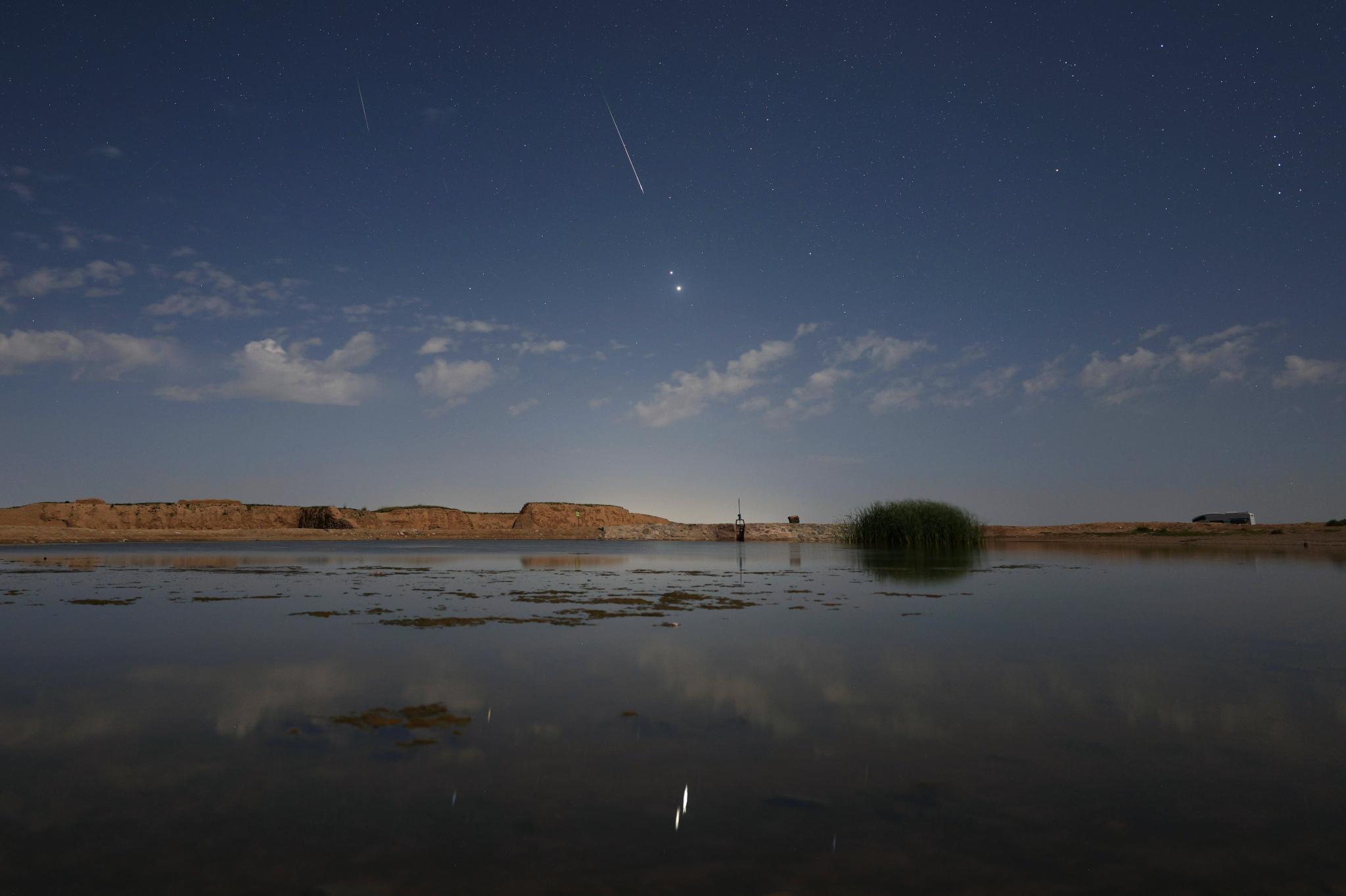
2025 August 15
Moonlight, Planets, and Perseids
* Image Credit & Copyright: Jeff Dai (TWAN)
https://twanight.org/profile/jeff-dai/
Explanation:
In the predawn sky on August 13, two planets were close. And despite the glare of a waning gibbous Moon, bright Jupiter and even brighter Venus were hard to miss. Their brilliant close conjunction is posing above the eastern horizon in this early morning skyscape. The scene was captured in a single exposure from a site near Gansu, China, with light from both planets reflected in the still waters of a local pond. Also seen against the moonlight were flashes from the annual Perseid Meteor Shower, known for its bright, fast meteors. Near the much anticipated peak of activity, the shower meteors briefly combined with the two planets for a celestial spectacle even in moonlit skies.
https://science.nasa.gov/solar-system/whats-up-august-2025-skywatching-tips-from-nasa/#hds-sidebar-nav-1
https://science.nasa.gov/solar-system/whats-up-august-2025-skywatching-tips-from-nasa/#hds-sidebar-nav-1
https://www.nasa.gov/blogs/watch-the-skies/2025/08/08/bright-moonlight-could-interfere-with-view-of-perseids-peak/
https://earthsky.org/todays-image/venus-and-jupiter/
#space #galaxy #perseids #astrophotography #photography #science #astronomy #nature #NASA
Alt...
2025 August 15
Moonlight, Planets, and Perseids
* Image Credit & Copyright: Jeff Dai (TWAN)
Explanation:
In the predawn sky on August 13, two planets were close. And despite the glare of a waning gibbous Moon, bright Jupiter and even brighter Venus were hard to miss. Their brilliant close conjunction is posing above the eastern horizon in this early morning skyscape. The scene was captured in a single exposure from a site near Gansu, China, with light from both planets reflected in the still waters of a local pond. Also seen against the moonlight were flashes from the annual Perseid Meteor Shower, known for its bright, fast meteors. Near the much anticipated peak of activity, the shower meteors briefly combined with the two planets for a celestial spectacle even in moonlit skies.
Authors & editors: Robert Nemiroff (MTU) & Jerry Bonnell (UMCP)
NASA Official: Amber Straughn Specific rights apply.
NASA Web Privacy, Accessibility, Notices;
A service of: ASD at NASA / GSFC,
NASA Science Activation
& Michigan Tech. U.
2025 August 16
A Cool GIF of a 2025 Perseid
* Image Credit & Copyright: Renaud & Olivier Coppe
https://app.astrobin.com/u/ren1450#gallery
Explanation:
The camera battery died about 2am local time on August 12, while shooting in the bright moonlit skies from a garden in Chastre, Brabant Wallon, Belgium, planet Earth. But not before it captured the frames used to compose this cool animated gif of a brilliant Perseid meteor and a lingering visible trail known as a persistent train. The Perseid meteor, a fast moving speck of dust from the tail of large periodic Comet Swift-Tuttle, was heated to incandescence by ram pressure and vaporized as it flashed through the upper atmosphere at 60 kilometers per second. Compared to the brief flash of the meteor, its wraith-like trail really is persistent. A characteristic of bright meteors, a smoke-like persistent train can often be followed for many minutes wafting in the winds at altitudes of 60 to 90 kilometers.
https://www.nasa.gov/blogs/watch-the-skies/2025/08/08/bright-moonlight-could-interfere-with-view-of-perseids-peak/
https://apod.nasa.gov/apod/ap180817.html
https://apod.nasa.gov/apod/ap250816.html
#space #galaxy #perseids #astrophotography #photography #science #astronomy #nature #NASA
109P/Swift-Tuttle
by Alicia Cermak - NASA
Comet Swift-Tuttle was discovered in 1862 independently by both Lewis Swift and Horace Tuttle.
Overview
Comet 109P/Swift-Tuttle takes 133 years to orbit the Sun once. Swift-Tuttle last reached perihelion (closest approach to the Sun) in 1992 and will return again in 2125.
Swift-Tuttle is a large comet – its nucleus is 16 miles (26 kilometers) across. (That is more than twice the size of the object hypothesized to have led the demise of the dinosaurs.)
The pieces of space debris that interact with our atmosphere to create the popular Perseids meteor shower originate from Swift-Tuttle. This annual meteor shower takes place each August, and peaks mid-month. It was Giovanni Schiaparelli who realized in 1865 that this comet was the source of the Perseids.
When comets come around the Sun, the dust they emit gradually spreads into a dusty trail around their orbits. Every year the Earth passes through these debris trails, which allows the bits to collide with our atmosphere where they disintegrate to create fiery and colorful streaks in the sky.
How This Comet Got Its Name
+ Comets are usually named for their discoverer(s) or for the name of the observatory/telescope used in the discovery. Since both Lewis Swift and Horace Tuttle discovered this comet it is named for them. The letter "P" indicates that Swift-Tuttle is a "periodic" comet. Periodic comets have an orbital period of less than 200 years
Credits
NASA/Preston Dyches
Alicia Cermak
https://science.nasa.gov/solar-system/comets/109p-swift-tuttle/
#space #galaxy #perseids #astrophotography #photography #science #astronomy #nature #NASA
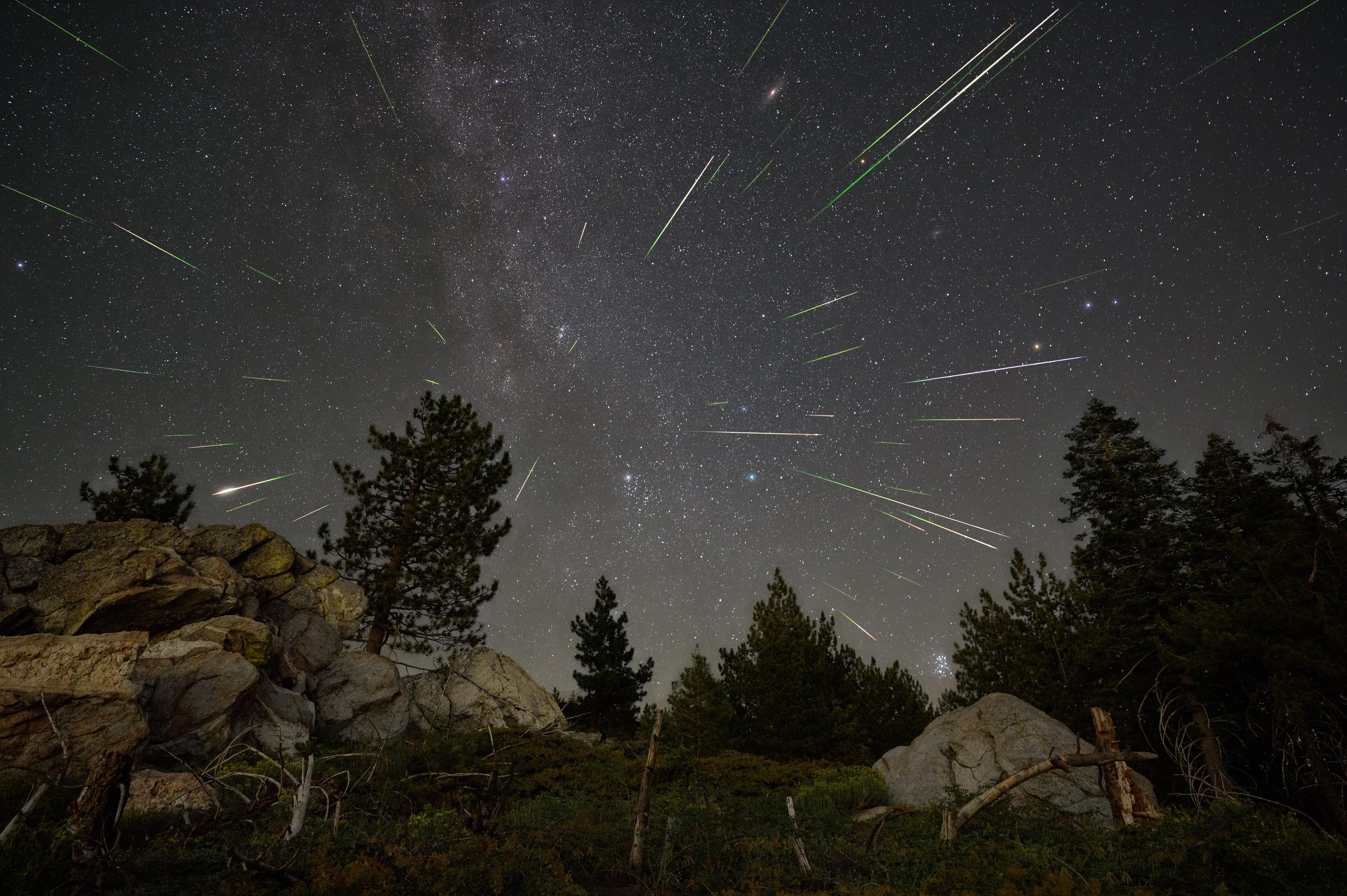
Alt...
A view of the 2023 Perseid meteor shower from the southernmost part of Sequoia National Forest, near Piute Peak. Debris from comet Swift-Tuttle creates the Perseids.
NASA/Preston Dyches
2025 August 20
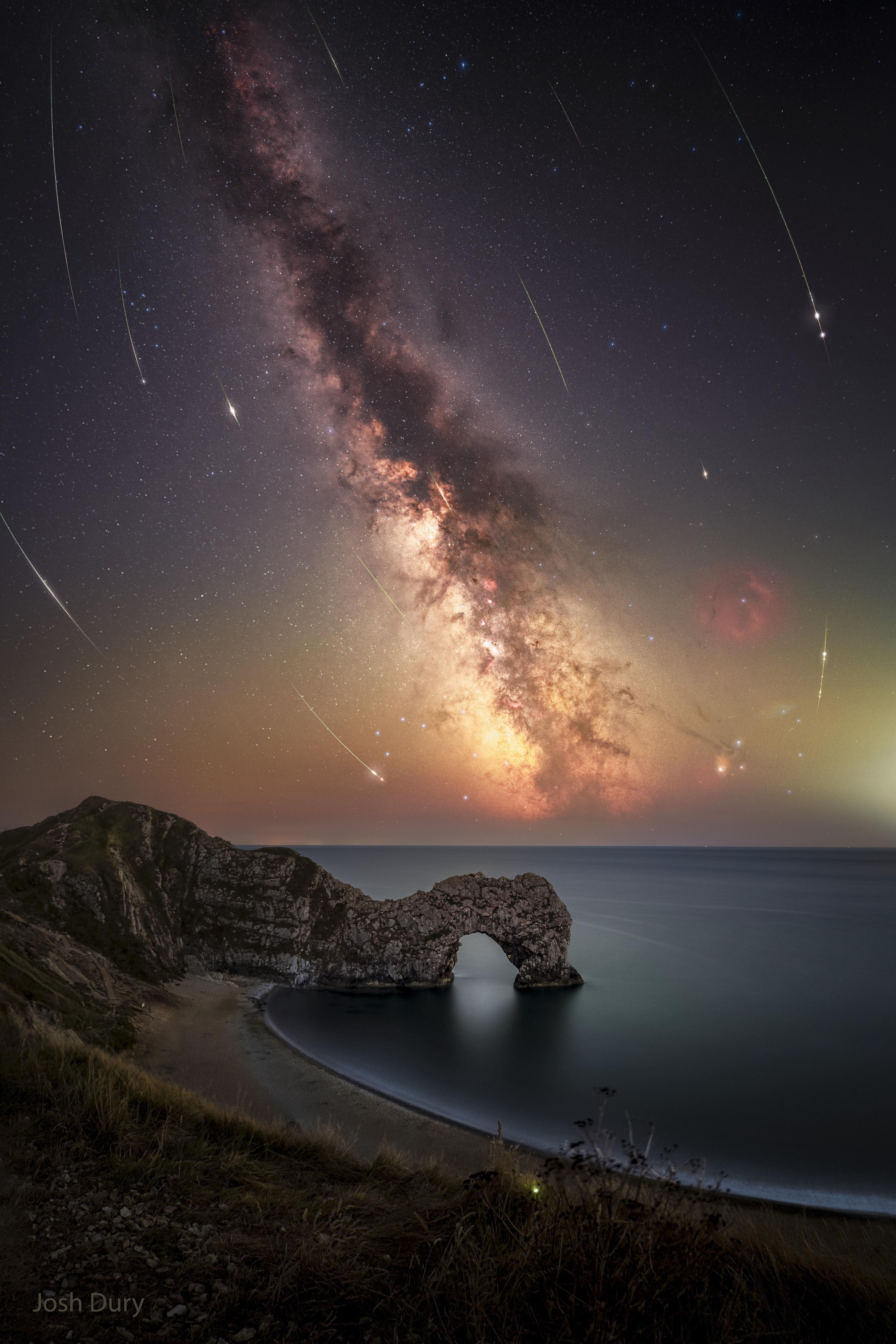
Perseid Meteors from Durdle Door
* Image Credit & Copyright: Josh Dury
https://www.joshduryphoto-media.com/
Explanation:
What are those curved arcs in the sky? Meteors -- specifically, meteors from this year's Perseid meteor shower. Over the past few weeks, after the sky darkened, many images of Perseid meteors were captured separately and merged into a single frame, taken earlier. Although the meteors all traveled on straight paths, these paths appear slightly curved by the wide-angle lens of the capturing camera. The meteor streaks can all be traced back to a single point on the sky called the radiant, here just off the top of the frame in the constellation of Perseus. The same camera took a deep image of the background sky that brought up the central band of our Milky Way galaxy running nearly vertically through the featured image's center. The limestone arch in the foreground in Dorset, England is known as Durdle Door, a name thought to survive from a thousand years ago.
https://en.wikipedia.org/wiki/Durdle_Door
https://www.youtube.com/watch?v=JYDRQFA51N0
https://apod.nasa.gov/apod/ap240811.html
https://apod.nasa.gov/apod/ap250820.html
#space #galaxy #perseids #astrophotography #photography #science #astronomy #nature #NASA
Alt...
2025 August 20
A deep sky is shown with the band of our Milky Way Galaxy running from the upper left to the lower right. The streaks or many curved meteors are seen. In the foreground a beach is seen with an unusual rock outcrop that has an opening.
Perseid Meteors from Durdle Door
* Image Credit & Copyright: Josh Dury
Explanation:
What are those curved arcs in the sky? Meteors -- specifically, meteors from this year's Perseid meteor shower. Over the past few weeks, after the sky darkened, many images of Perseid meteors were captured separately and merged into a single frame, taken earlier. Although the meteors all traveled on straight paths, these paths appear slightly curved by the wide-angle lens of the capturing camera. The meteor streaks can all be traced back to a single point on the sky called the radiant, here just off the top of the frame in the constellation of Perseus. The same camera took a deep image of the background sky that brought up the central band of our Milky Way galaxy running nearly vertically through the featured image's center. The limestone arch in the foreground in Dorset, England is known as Durdle Door, a name thought to survive from a thousand years ago.
Authors & editors: Robert Nemiroff (MTU) & Jerry Bonnell (UMCP)
NASA Official: Amber Straughn Specific rights apply.
NASA Web Privacy, Accessibility, Notices;
A service of: ASD at NASA / GSFC,
NASA Science Activation
& Michigan Tech. U.
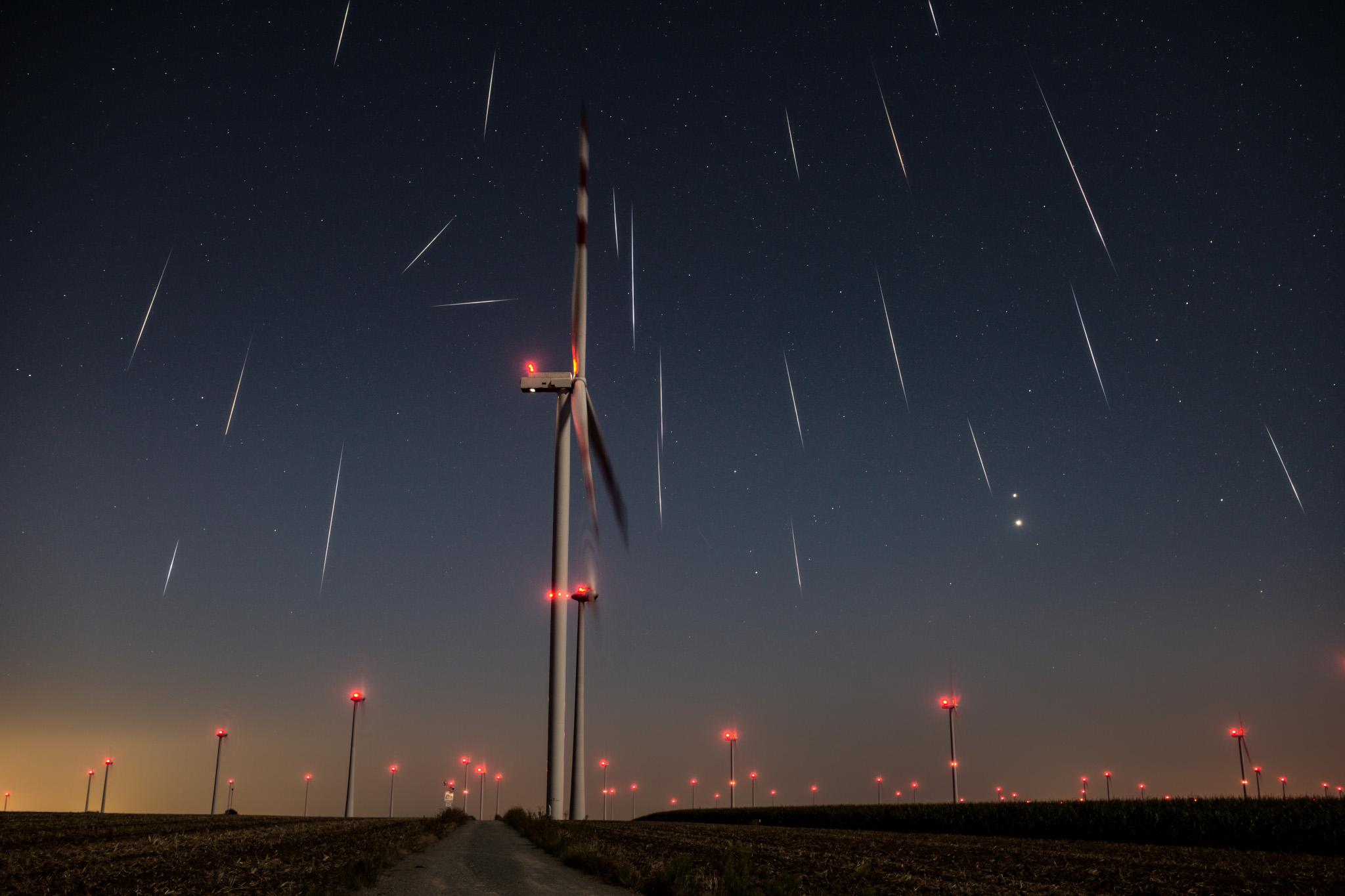
2025 August 21
Mostly Perseids
* Image Credit & Copyright: Klaus Pillwatsch
https://www.instagram.com/p_i_k_a_s_s/
Explanation:
In this predawn skyscape recorded during the early morning hours of August 13, mostly Perseid meteors are raining down on planet Earth. You can easily identify the Perseid meteor streaks. They're the ones with trails that seem to converge on the annual meteor shower's radiant, a spot in the heroic constellation Perseus, located off the top of the frame. That's the direction in Earth's sky that looks along the orbit of this meteor shower's parent, periodic Comet Swift-Tuttle. Of course the scene is a composite, a combination of about 500 digital exposures to capture meteors registered with a single base frame exposure. But all exposures were taken during a period of around 2.5 hours from a wind farm near Mönchhof, Burgenland, Austria. Red lights on the individual wind turbine towers dot the foreground. In their spectacular close conjunction, bright planets Jupiter and Venus are poised above the eastern horizon.
https://apod.nasa.gov/apod/ap250821.html
#space #perseids #astrophotography #photography #science #astronomy #nature #NASA
Alt...
2025 August 21
Mostly Perseids
* Image Credit & Copyright: Klaus Pillwatsch
Explanation:
In this predawn skyscape recorded during the early morning hours of August 13, mostly Perseid meteors are raining down on planet Earth. You can easily identify the Perseid meteor streaks. They're the ones with trails that seem to converge on the annual meteor shower's radiant, a spot in the heroic constellation Perseus, located off the top of the frame. That's the direction in Earth's sky that looks along the orbit of this meteor shower's parent, periodic Comet Swift-Tuttle. Of course the scene is a composite, a combination of about 500 digital exposures to capture meteors registered with a single base frame exposure. But all exposures were taken during a period of around 2.5 hours from a wind farm near Mönchhof, Burgenland, Austria. Red lights on the individual wind turbine towers dot the foreground. In their spectacular close conjunction, bright planets Jupiter and Venus are poised above the eastern horizon.
Authors & editors: Robert Nemiroff (MTU) & Jerry Bonnell (UMCP)
NASA Official: Amber Straughn Specific rights apply.
NASA Web Privacy, Accessibility, Notices;
A service of: ASD at NASA / GSFC,
NASA Science Activation
& Michigan Tech. U.
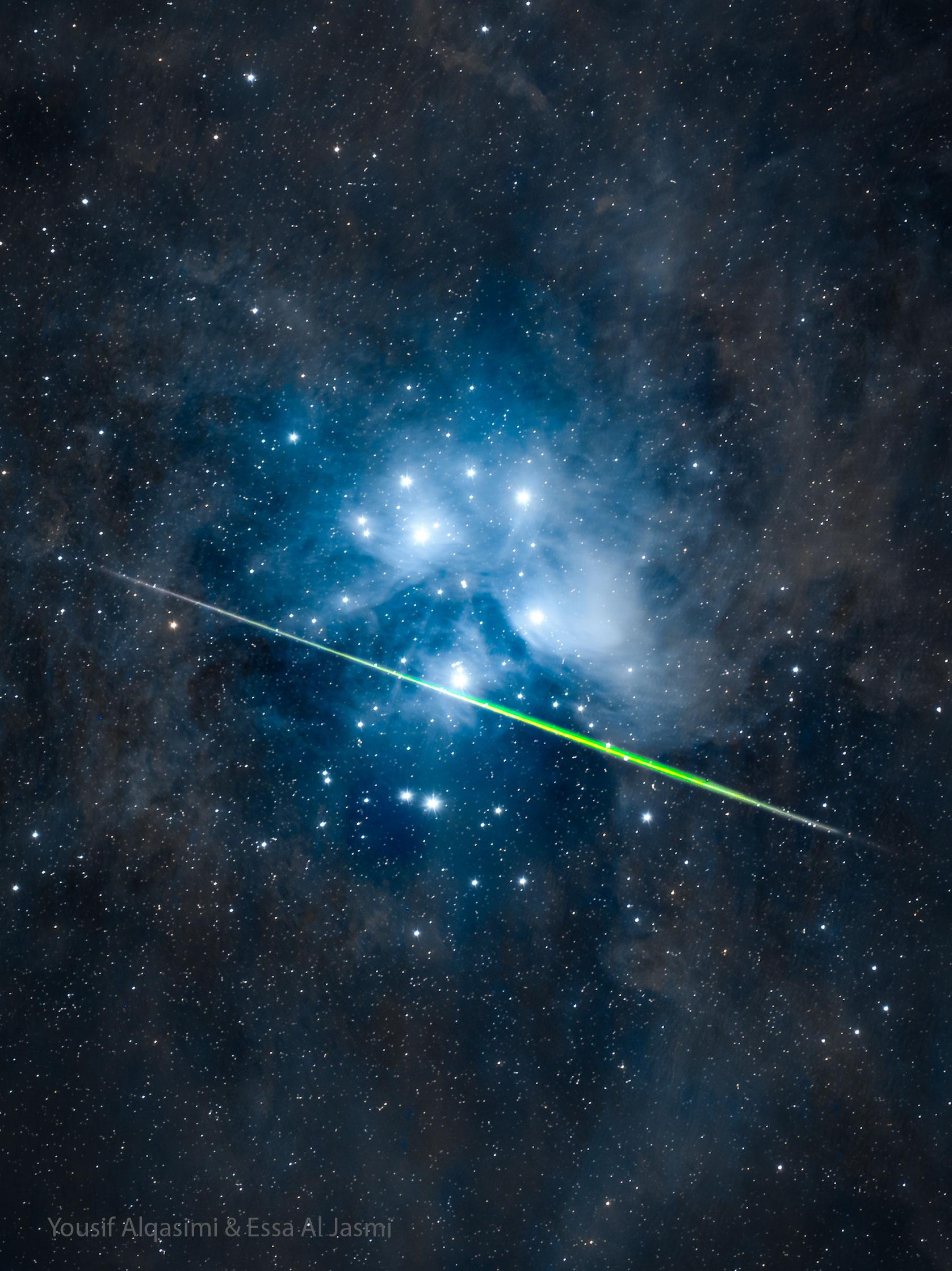
2025 August 25
The Meteor and the Star Cluster
* Image Credit & Copyright: Yousif Alqasimi & Essa Al Jasmi
https://www.instagram.com/alqasmyi/
https://www.instagram.com/eaqj/
Explanation:
Sometimes even the sky surprises you. To see more stars and faint nebulosity in the Pleiades star cluster (M45), long exposures are made. Many times, less interesting items appear on the exposures that were not intended -- but later edited out. These include stuck pixels, cosmic ray hits, frames with bright clouds or Earth's Moon, airplane trails, lens flares, faint satellite trails, and even insect trails. Sometimes, though, something really interesting is caught by chance. That was just the case a few weeks ago in al-Ula, Saudi Arabia when a bright meteor streaked across during an hour-long exposure of the Pleiades. Along with the famous bright blue stars, less famous and less bright blue stars, and blue-reflecting dust surrounding the star cluster, the fast rock fragment created a distinctive green glow, likely due to vaporized metals.
https://science.nasa.gov/mission/hubble/science/explore-the-night-sky/hubble-messier-catalog/messier-45/
https://en.wikipedia.org/wiki/Pleiades
https://apod.nasa.gov/apod/ap250825.html
#space #perseids #astrophotography #photography #science #astronomy #nature #NASA
Alt...
2025 August 25
A starfield surrounds the bright blue stars of a star cluster: the Pleiades star cluster. Nearly horizontally across the cluster is a bright green streak, most likely a meteor.
The Meteor and the Star Cluster
* Image Credit & Copyright: Yousif Alqasimi & Essa Al Jasmi
Explanation:
Sometimes even the sky surprises you. To see more stars and faint nebulosity in the Pleiades star cluster (M45), long exposures are made. Many times, less interesting items appear on the exposures that were not intended -- but later edited out. These include stuck pixels, cosmic ray hits, frames with bright clouds or Earth's Moon, airplane trails, lens flares, faint satellite trails, and even insect trails. Sometimes, though, something really interesting is caught by chance. That was just the case a few weeks ago in al-Ula, Saudi Arabia when a bright meteor streaked across during an hour-long exposure of the Pleiades. Along with the famous bright blue stars, less famous and less bright blue stars, and blue-reflecting dust surrounding the star cluster, the fast rock fragment created a distinctive green glow, likely due to vaporized metals.
Authors & editors: Robert Nemiroff (MTU) & Jerry Bonnell (UMCP)
NASA Official: Amber Straughn Specific rights apply.
NASA Web Privacy, Accessibility, Notices;
A service of: ASD at NASA / GSFC,
NASA Science Activation
& Michigan Tech. U.
This clip of Orientale Basin was made with data from the Lunar Reconnaissance Orbiter by NASA's Scientific Visualization Studio.
Image credit: NASA’s Scientific Visualization Studio/Ernie Wright
https://moon.nasa.gov/observe-the-moon-night/participate/10-ways-to-observe-the-moon/
https://moon.nasa.gov/observe-the-moon-night/resources/moon-map/
#space #moon #astrophotography #photography #science #astronomy #nature #NASA #education
Join In!
The countdown is on.. for the International Observe the Moon Night 2025 on October 4!
https://moon.nasa.gov/observe-the-moon-night/
https://moon.nasa.gov/observe-the-moon-night/register/individual-participation/
#space #moon #astrophotography #photography #science #astronomy #nature #NASA #education
2025 October 4
The Rotating Moon
* Video Credit: NASA, Lunar Reconnaissance Orbiter, Arizona State U.
https://www.nasa.gov/
https://science.nasa.gov/mission/lro/
https://www.lroc.asu.edu/about/team
Explanation:
No one on Earth sees the Moon rotate like this. That's because the Moon is tidally locked in synchronous rotation, showing only one side to denizens of our fair planet. Still, given modern digital technology, combined with many detailed images returned by the Lunar Reconnaissance Orbiter (LRO), a high resolution virtual Moon rotation movie can be composed. In fact, the featured time-lapse video starts with a view of the familiar lunar nearside and quickly finds the Mare Orientale, a large crater with a dark center that is difficult to see from the Earth, rotating into view just below the equator. In a complete lunar rotation condensed into 24 seconds, the video clearly shows that the Earth-facing nearside of the Moon contains an abundance of dark lunar maria, while the lunar farside is dominated by bright lunar highlands. Of course you can just join other moon-watchers under hopefully clear skies tonight. Check out the sunlit portion of the lunar nearside on International Observe the Moon Night.
https://en.wikipedia.org/wiki/List_of_plains_on_the_Moon
https://en.wikipedia.org/wiki/Geology_of_the_Moon#Highlands
https://moon.nasa.gov/observe-the-moon-night/
https://lroc.im-ldi.com/about
https://apod.nasa.gov/apod/fap/ap251004.html
#space #moon #astrophotography #photography #science #astronomy #nature #NASA #education
The Moon’s Rotation
An enduring myth about the Moon is that it doesn't rotate. While it's true that the Moon keeps the same face to us, this only happens because the Moon rotates at the same rate as its orbital motion, a special case of tidal locking called synchronous rotation. The animation shows both the orbit and the rotation of the Moon. The yellow circle with the arrow and radial line have been added to make the rotation more apparent. The arrow indicates the direction of rotation. The radial line points to the center of the visible disk of the Moon at 0°N 0°E.
Credit:
NASA's Scientific Visualization Studio
Visualizer:
Ernie Wright (USRA)
Technical support
Laurence Schuler (ADNET Systems, Inc.)
Ian Jones (ADNET Systems, Inc.)
#space #moon #astrophotography #photography #science #astronomy #nature #NASA #education
2025 October 1
NGC 6960: The Witch's Broom Nebula
* Image Credit & Copyright: Brian Meyers
Explanation:
Ten thousand years ago, before the dawn of recorded human history, a new light would suddenly have appeared in the night sky and faded after a few weeks. Today we know this light was from a supernova, or exploding star, and record the expanding debris cloud as the Veil Nebula, a supernova remnant. This sharp telescopic view is centered on a western segment of the Veil Nebula cataloged as NGC 6960 but less formally known as the Witch's Broom Nebula. Blasted out in the cataclysmic explosion, an interstellar shock wave plows through space sweeping up and exciting interstellar material. Imaged with narrow band filters, the glowing filaments are like long ripples in a sheet seen almost edge on, remarkably well separated into atomic hydrogen (red) and oxygen (blue-green) gas. The complete supernova remnant lies about 1400 light-years away towards the constellation Cygnus. This Witch's Broom actually spans about 35 light-years. The bright star in the frame is 52 Cygni, visible with the unaided eye from a dark location but unrelated to the ancient supernova remnant.
https://apod.nasa.gov/apod/ap251001.html
https://en.wikipedia.org/wiki/List_of_supernova_remnants
https://chandra.harvard.edu/xray_sources/supernovas.html
https://en.wikipedia.org/wiki/File:Cygnus_Loop_Labeled.png
https://apod.nasa.gov/apod/ap101119.html
https://apod.nasa.gov/apod/ap251001.html
#space #nebula #cluster #astrophotography #photography #science #astronomy #nature #NASA #ESA #education
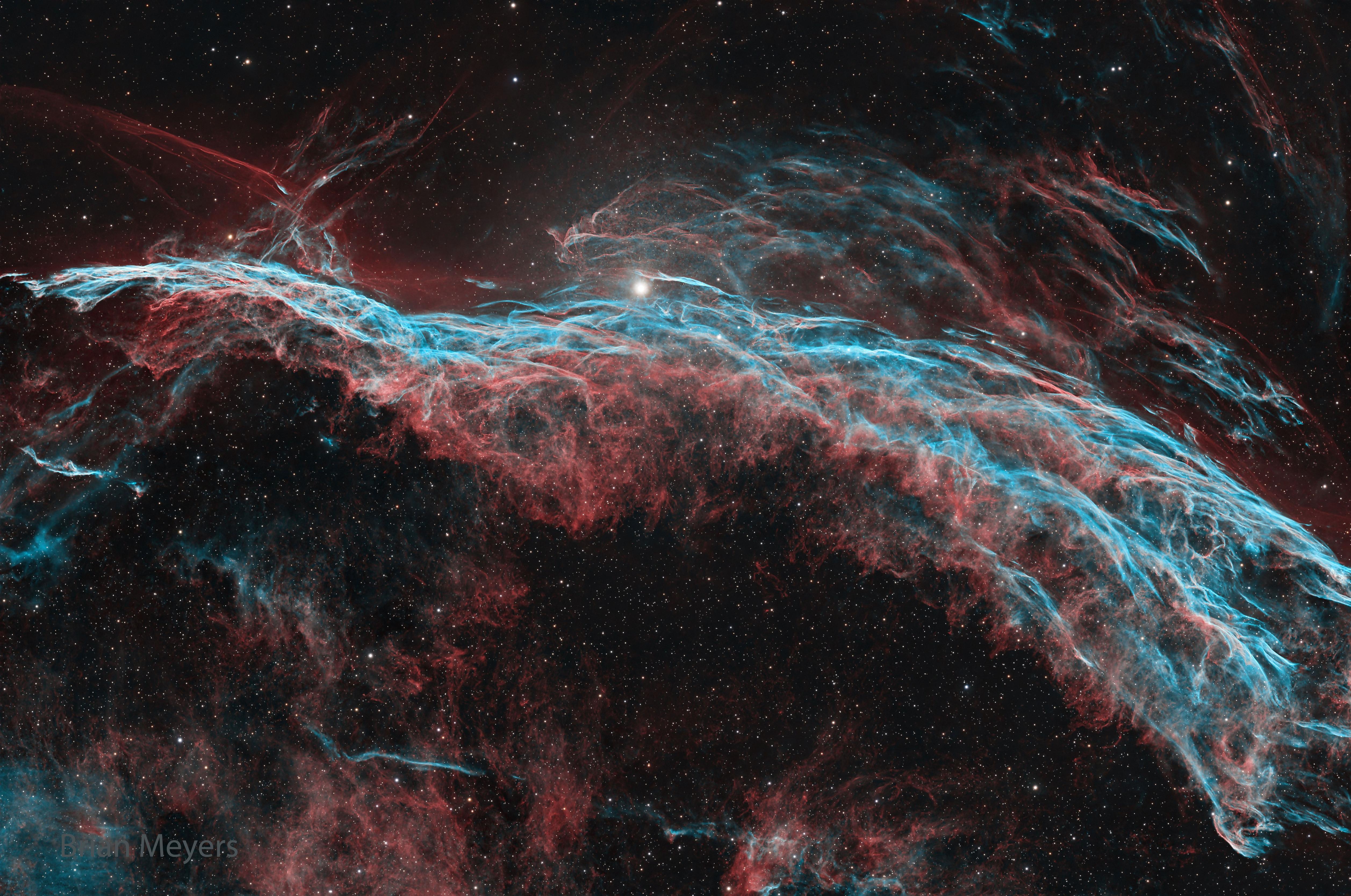
Alt...
2025 October 1
A starfield is shown that has a multi-filament nebula flowing across it horizontally. The most prominent colors are red and blue. Please see the explanation for more detailed information.
NGC 6960: The Witch's Broom Nebula
* Image Credit & Copyright: Brian Meyers
Explanation:
Ten thousand years ago, before the dawn of recorded human history, a new light would suddenly have appeared in the night sky and faded after a few weeks. Today we know this light was from a supernova, or exploding star, and record the expanding debris cloud as the Veil Nebula, a supernova remnant. This sharp telescopic view is centered on a western segment of the Veil Nebula cataloged as NGC 6960 but less formally known as the Witch's Broom Nebula. Blasted out in the cataclysmic explosion, an interstellar shock wave plows through space sweeping up and exciting interstellar material. Imaged with narrow band filters, the glowing filaments are like long ripples in a sheet seen almost edge on, remarkably well separated into atomic hydrogen (red) and oxygen (blue-green) gas. The complete supernova remnant lies about 1400 light-years away towards the constellation Cygnus. This Witch's Broom actually spans about 35 light-years. The bright star in the frame is 52 Cygni, visible with the unaided eye from a dark location but unrelated to the ancient supernova remnant.
Authors & editors: Robert Nemiroff (MTU) & Jerry Bonnell (UMCP)
NASA Official: Amber Straughn Specific rights apply.
2025 September 30
Comet Lemmon Brightens
* Image Credit & Copyright: Victor Sabet & Julien De Winter
https://app.astrobin.com/i/lsnen5
Explanation:
Comet Lemmon is brightening and moving into morning northern skies. Besides Comet SWAN25B and Comet ATLAS, Comet C/2025 A6 (Lemmon) is now the third comet currently visible with binoculars and on long camera exposures. Comet Lemmon was discovered early this year and is still headed into the inner Solar System. The comet will round the Sun on November 8, but first it will pass its nearest to the Earth -- at about half the Earth-Sun distance -- on October 21. Although the brightnesses of comets are notoriously hard to predict, optimistic estimates have Comet Lemmon then becoming visible to the unaided eye. The comet should be best seen in predawn skies until mid-October, when it also becomes visible in evening skies. The featured image showing the comet's split and rapidly changing ion tail was taken in Texas, USA late last week.
https://en.wikipedia.org/wiki/C/2025_A6_(Lemmon)
https://earthsky.org/space/5-bright-comets-approaching-earth-charts-2025-2026/
https://theskylive.com/c2025a6-info
https://science.nasa.gov/solar-system/comets/facts/
https://en.wikipedia.org/wiki/Comet_tail
https://en.wikipedia.org/wiki/Astronomical_unit
https://apod.nasa.gov/apod/ap250930.html
#space #comets #astrophotography #photography #science #astronomy #nature #NASA #ESA #education
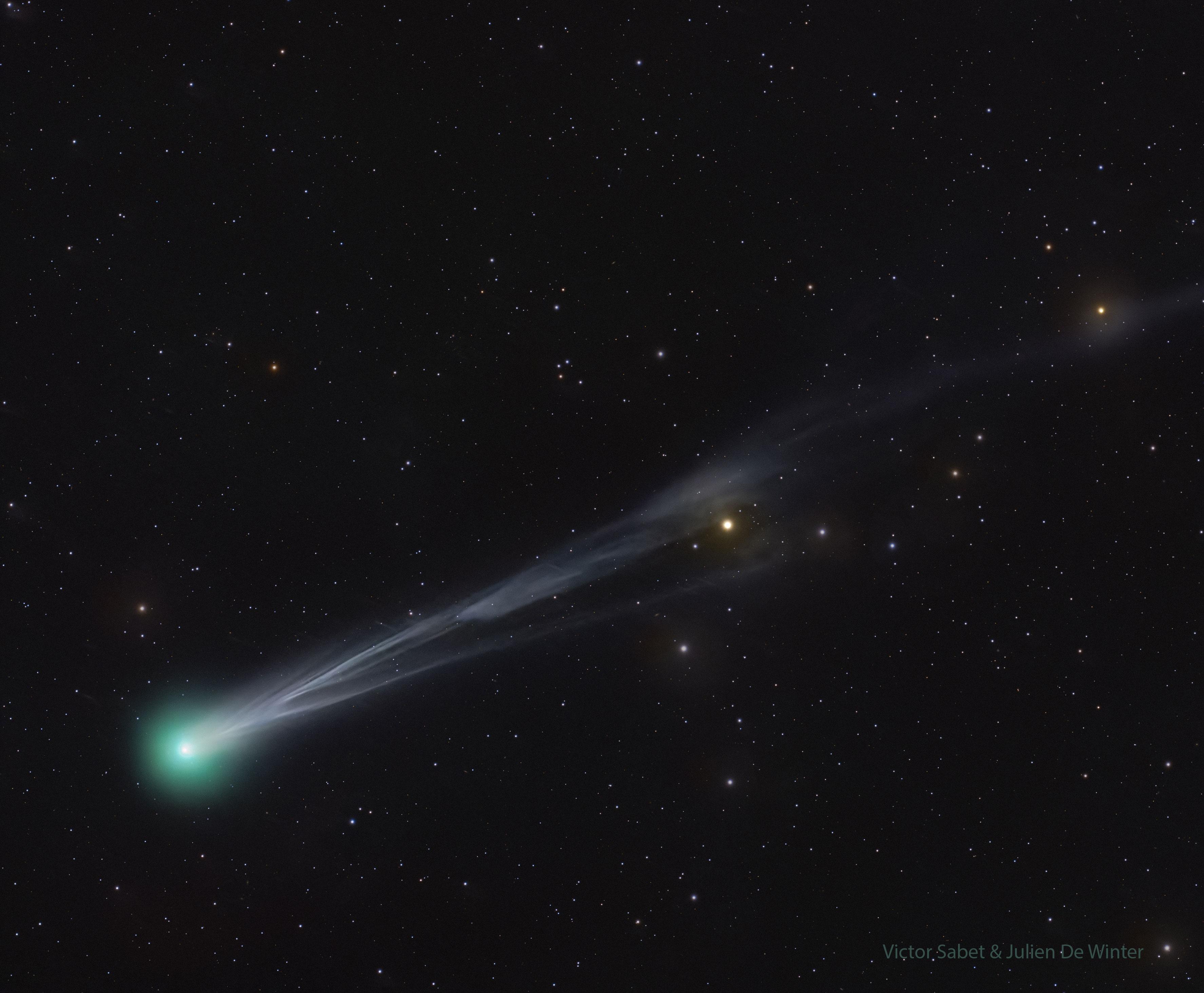
Alt...
2025 September 30
A starfield is shown that has a bright comet. The comet shows a green head on the lower left and an ion tail with significant structure extending out to the upper right.
Comet Lemmon Brightens
* Image Credit & Copyright: Victor Sabet & Julien De Winter
Explanation:
Comet Lemmon is brightening and moving into morning northern skies. Besides Comet SWAN25B and Comet ATLAS, Comet C/2025 A6 (Lemmon) is now the third comet currently visible with binoculars and on long camera exposures. Comet Lemmon was discovered early this year and is still headed into the inner Solar System. The comet will round the Sun on November 8, but first it will pass its nearest to the Earth -- at about half the Earth-Sun distance -- on October 21. Although the brightnesses of comets are notoriously hard to predict, optimistic estimates have Comet Lemmon then becoming visible to the unaided eye. The comet should be best seen in predawn skies until mid-October, when it also becomes visible in evening skies. The featured image showing the comet's split and rapidly changing ion tail was taken in Texas, USA late last week.
Authors & editors: Robert Nemiroff (MTU) & Jerry Bonnell (UMCP)
NASA Official: Amber Straughn Specific rights apply.
NASA Web Privacy, Accessibility, Notices;
A service of: ASD at NASA / GSFC,
NASA Science Activation
& Michigan Tech. U.

![[?]](https://cdn.masto.host/retrogaidencom/accounts/avatars/112/290/331/258/701/920/original/fb444facf9ee8141.png)

I just finished the prologue of this game and witnessed the single-most epic space battle I've ever seen in a game.
This game is great so far! It's a fun indie game that combines the best aspects of Star Trek with the scope of Star Wars-style space battles, in a gameplay loop that blends light RPG systems with semi-arcadey space combat.
I highly recommend it, going by what I've experienced so far!
2025 September 29
Two Camera Comets in One Sky
* Image Credit & Copyright: Luc Perrot (TWAN)
https://www.lucperrot.fr/bio
Explanation:
It may look like these comets are racing, but they are not. Comets C/2025 K1 ATLAS (left) and C/2025 R2 SWAN (right) appeared near each other by chance last week in the featured image taken from France's Reunion Island in the southern Indian Ocean. Fainter Comet ATLAS is approaching our Sun and will reach its closest approach in early October when it is also expected to be its brightest -- although still only likely visible with long exposures on a camera. The brighter comet, nicknamed SWAN25B, is now headed away from our Sun, although its closest approach to Earth is expected in mid-October, when optimistic estimates have it becoming bright enough to see with the unaided eye. Each comet has a greenish coma of expelled gas and an ion tail pointing away from the Sun.
https://apod.nasa.gov/apod/ap250918.html
https://apod.nasa.gov/apod/ap250916.html
https://en.wikipedia.org/wiki/C/2025_K1_(ATLAS)
https://en.wikipedia.org/wiki/C/2025_R2_(SWAN)
https://en.wikipedia.org/wiki/Coma_(comet)
https://apod.nasa.gov/apod/ap250929.html
#space #comets #astrophotography #photography #science #astronomy #nature #NASA #ESA #education
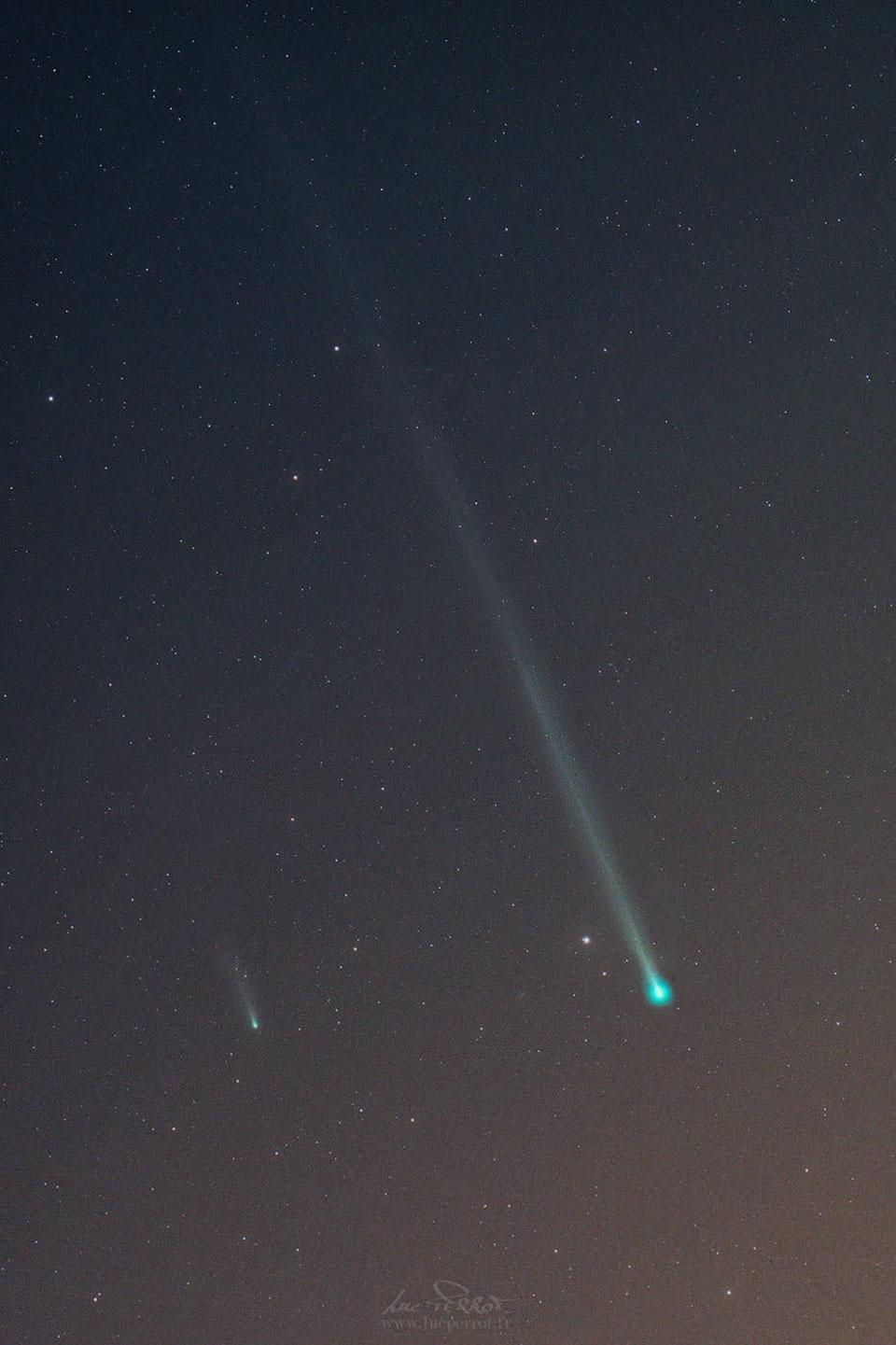
Alt...
2025 September 29
A starfield is shown that has two short streaks running diagonally. At closer inspection, they are two comets both with white-green heads and white tails.
Two Camera Comets in One Sky
* Image Credit & Copyright: Luc Perrot (TWAN)
Explanation:
It may look like these comets are racing, but they are not. Comets C/2025 K1 ATLAS (left) and C/2025 R2 SWAN (right) appeared near each other by chance last week in the featured image taken from France's Reunion Island in the southern Indian Ocean. Fainter Comet ATLAS is approaching our Sun and will reach its closest approach in early October when it is also expected to be its brightest -- although still only likely visible with long exposures on a camera. The brighter comet, nicknamed SWAN25B, is now headed away from our Sun, although its closest approach to Earth is expected in mid-October, when optimistic estimates have it becoming bright enough to see with the unaided eye. Each comet has a greenish coma of expelled gas and an ion tail pointing away from the Sun.
Authors & editors: Robert Nemiroff (MTU) & Jerry Bonnell (UMCP)
NASA Official: Amber Straughn Specific rights apply.
NASA Web Privacy, Accessibility, Notices;
A service of: ASD at NASA / GSFC,
NASA Science Activation
& Michigan Tech. U.
![[?]](https://media2.ai6yr.org/accounts/avatars/109/321/592/360/914/018/original/f918064fa4350d36.jpg)
Hmm, maybe a sonic boom. Just more space future junk from the man with a spazzy right hand which can't help saluting.
Vandenberg SFB Launch Alert
Vandenberg Space Force Base Guardians and Airmen are scheduled to support the launch of a SpaceX Falcon 9 rocket carrying 28 Starlink satellites into low-Earth orbit, Sunday, September 28, between 4:32 p.m. - 8:32 p.m. PT from Space Launch Complex 4 East.
Mars 2020: Perseverance Rover - NASA Science
latest news
New Report: Perseverance Rock Sample Contains 'Potential Biosignatures'
-- Alicia Cermak
A sample collected by NASA’s Perseverance Mars rover from an ancient dry riverbed in Jezero Crater could preserve evidence of ancient microbial life. Taken from a rock named “Cheyava Falls” last year, the sample, called “Sapphire Canyon,” contains potential biosignatures, according to a paper published Wednesday in the journal Nature.
https://science.nasa.gov/mission/mars-2020-perseverance/
Please read this article by Jessica Taveau as well:
https://www.nasa.gov/news-release/nasa-says-mars-rover-discovered-potential-biosignature-last-year/
also FYI:
https://youtu.be/-StZggK4hhA
#space #mars #astrophotography #photography #science #astronomy #geology #topography #nature #NASA #ESA
Perseverance Finds a Rock with ‘Leopard Spots’
NASA’s Perseverance Mars rover captured this image of a rock nicknamed “Cheyava Falls” on July 18, 2024, the 1,212th Martian day, or sol, of the mission. Running the length of the rock are large white calcium sulfate veins. Between those veins are bands of material whose reddish color suggests the presence of hematite, one of the minerals that gives Mars its distinctive rusty hue. Scientists are particularly interested in the millimeter-size, irregularly shaped light patches on the central reddish band (from lower left to upper right of the image) that are surrounded by a thin ring of dark material, akin to leopard spots. Spotting of this type on sedimentary terrestrial rocks can occur when chemical reactions involving hematite turn the rock from red to white. Those reactions can also release iron and phosphate, possibly causing the black halos to form, and they can be an energy source for microbes, hence the association between such features and microbes in a terrestrial setting.
Figure A is the same image with annotations pointing out the leopard spots and olivine in the rock.
Measuring 3.2 feet by 2 feet (1 meter by 0.6 meters) and named after a Grand Canyon waterfall, Cheyava Falls was found in an ancient riverbed within the “Bright Angel” region of Mars’ Jezero Crater. This image of the rock was captured using a camera called WATSON (Wide Angle Topographic Sensor for Operations and eNgineering), which is part of the SHERLOC (Scanning Habitable Environments with Raman and Luminescence for Organics and Chemicals) instrument suite located on the end of Perseverance’s 7-foot-long (2-meter-long) robotic arm. SHERLOC looks for organic compounds — carbon-based molecules that are considered the building blocks of life — and detected them in Cheyava Falls.
[...]
Read more in the ALT-Text
https://science.nasa.gov/resource/perseverance-finds-a-rock-with-leopard-spots/
#space #mars #astrophotography #photography #science #astronomy #geology #topography #nature #NASA #ESA
![Annotations for previous post.
An annotated version of the image of “Cheyava Falls” indicates the markings akin to leopard spots, which have particularly captivated scientists, and the olivine in the rock. The image was captured by the WATSON instrument on NASA’s Perseverance Mars rover on July 18.
[...]
The white, knobby material seen on either side of the spots is dotted with a few green olivine crystals, which form in igneous rocks such as lava flows. It’s unknown whether the olivine formed at the same time as the leopard spots; scientists hope to establish a timeline for when both the olivine and the spots formed.
Perseverance drilled a core from Cheyava Falls, the rover’s 22nd rock sample, on July 21.
A key objective for Perseverance’s mission on Mars is astrobiology, including the search for signs of ancient microbial life. The rover is also characterizing the planet’s geology and past climate, which paves the way for human exploration of the Red Planet. NASA’s Jet Propulsion Laboratory, which is managed for the agency by Caltech in Pasadena, California, built and manages operations of the Perseverance rover.](https://files.defcon.social/dcsocial-s3/media_attachments/files/115/280/447/084/194/586/original/8a280cd808556084.webp "Annotations for previous post.
An annotated version of the image of “Cheyava Falls” indicates the markings akin to leopard spots, which have particularly captivated scientists, and the olivine in the rock. The image was captured by the WATSON instrument on NASA’s Perseverance Mars rover on July 18.
[...]
The white, knobby material seen on either side of the spots is dotted with a few green olivine crystals, which form in igneous rocks such as lava flows. It’s unknown whether the olivine formed at the same time as the leopard spots; scientists hope to establish a timeline for when both the olivine and the spots formed.
Perseverance drilled a core from Cheyava Falls, the rover’s 22nd rock sample, on July 21.
A key objective for Perseverance’s mission on Mars is astrobiology, including the search for signs of ancient microbial life. The rover is also characterizing the planet’s geology and past climate, which paves the way for human exploration of the Red Planet. NASA’s Jet Propulsion Laboratory, which is managed for the agency by Caltech in Pasadena, California, built and manages operations of the Perseverance rover.")
Alt...
Annotations for previous post.
An annotated version of the image of “Cheyava Falls” indicates the markings akin to leopard spots, which have particularly captivated scientists, and the olivine in the rock. The image was captured by the WATSON instrument on NASA’s Perseverance Mars rover on July 18.
[...]
The white, knobby material seen on either side of the spots is dotted with a few green olivine crystals, which form in igneous rocks such as lava flows. It’s unknown whether the olivine formed at the same time as the leopard spots; scientists hope to establish a timeline for when both the olivine and the spots formed.
Perseverance drilled a core from Cheyava Falls, the rover’s 22nd rock sample, on July 21.
A key objective for Perseverance’s mission on Mars is astrobiology, including the search for signs of ancient microbial life. The rover is also characterizing the planet’s geology and past climate, which paves the way for human exploration of the Red Planet. NASA’s Jet Propulsion Laboratory, which is managed for the agency by Caltech in Pasadena, California, built and manages operations of the Perseverance rover.
2025 September 28
Leopard Spots on Martian Rocks
* Image Credit: NASA, JPL-Caltech, MSSS, Perseverance Rover
https://www.nasa.gov/
https://www.jpl.nasa.gov/
https://www.msss.com/
https://science.nasa.gov/mission/mars-2020-perseverance/
Explanation:
What is creating these unusual spots? Light-colored spots on Martian rocks, each surrounded by a dark border, were discovered last year by NASA's Perseverance Rover currently exploring Mars. Dubbed leopard spots because of their seemingly similarity to markings on famous Earth-bound predators, these curious patterns are being studied with the possibility they were created by ancient Martian life. The pictured spots measure only millimeters across and were discovered on a larger rock named Cheyava Falls. The exciting but unproven speculation is that long ago, microbes generated energy with chemical reactions that turned rock from red to white while leaving a dark biosignature ring, like some similarly appearing spots on Earth rocks. Although other non-biological explanations have not been ruled out, speculation focusing on this potential biological origin is causing much intrigue.
https://science.nasa.gov/resource/perseverance-finds-a-rock-with-leopard-spots/
https://science.nasa.gov/mars/
https://science.nasa.gov/mission/mars-2020-perseverance/
https://en.wikipedia.org/wiki/Microorganism
https://www.atlasobscura.com/articles/earliest-life-on-earth-rocks
https://en.wikipedia.org/wiki/Hematite#Mars
https://apod.nasa.gov/apod/ap250928.html
#space #mars #astrophotography #photography #science #astronomy #geology #topography #nature #NASA #ESA

Alt...
2025 September 28
Part of a large rock on Mars is shown being mostly orange. On the rock are several irregular light-colored areas surrounded by a dark border. The spots are only millimeters across but might be a remnant biosignature of ancient Martian life.
Leopard Spots on Martian Rocks
* Image Credit: NASA, JPL-Caltech, MSSS, Perseverance Rover
Explanation:
What is creating these unusual spots? Light-colored spots on Martian rocks, each surrounded by a dark border, were discovered last year by NASA's Perseverance Rover currently exploring Mars. Dubbed leopard spots because of their seemingly similarity to markings on famous Earth-bound predators, these curious patterns are being studied with the possibility they were created by ancient Martian life. The pictured spots measure only millimeters across and were discovered on a larger rock named Cheyava Falls. The exciting but unproven speculation is that long ago, microbes generated energy with chemical reactions that turned rock from red to white while leaving a dark biosignature ring, like some similarly appearing spots on Earth rocks. Although other non-biological explanations have not been ruled out, speculation focusing on this potential biological origin is causing much intrigue.
Authors & editors: Robert Nemiroff (MTU) & Jerry Bonnell (UMCP)
NASA Official: Amber Straughn Specific rights apply.
NASA Web Privacy, Accessibility, Notices;
A service of: ASD at NASA / GSFC,
NASA Science Activation
& Michigan Tech. U
TOPIC>
Mars
2025 June 15
Two images are shown side by side. On the left is a sunset seen from Earth, while on the right is a sunset seen from Mars. The Earth sunset is quite orange, while the Mars sunset is quite blue. The Sun appears angularly smaller from Mars than from the Earth.
Two Worlds, One Sun
* Left Image Credit & Copyright: Damia Bouic
https://www.planetary.org/profiles/damia-bouic
* Right Image Credit: NASA, JPL-Caltech, MSSS
https://www.msss.com/
* Digital processing: Damia Bouic
Explanation:
How different does sunset appear from Mars than from Earth? For comparison, two images of our common star were taken at sunset, one from Earth and one from Mars. These images were scaled to have the same angular width and are featured here side-by-side. A quick inspection will reveal that the Sun appears slightly smaller from Mars than from Earth. This makes sense since Mars is 50% further from the Sun than Earth. More striking, perhaps, is that the Martian sunset is noticeably bluer near the Sun than the typically orange colors near the setting Sun from Earth. The reason for the blue hues from Mars is not fully understood, but thought to be related to forward scattering properties of Martian dust. The terrestrial sunset was taken in 2012 March from Marseille, France, while the Martian sunset was captured in 2015 by NASA's robotic Curiosity rover from Gale crater on Mars.
https://www.db-prods.net/blog/2015/05/06/coucher-de-soleil-sur-mars/
https://www.planetary.org/articles/0506-sunset-on-mars
https://apod.nasa.gov/apod/ap140302.html
https://science.nasa.gov/mars/facts/
https://en.wikipedia.org/wiki/Mars
https://en.wikipedia.org/wiki/Gale_%28crater%29
https://en.wikipedia.org/wiki/Martian_regolith#Atmospheric_dust
https://science.nasa.gov/mission/msl-curiosity/
https://www.physicsclassroom.com/class/light/Lesson-2/Blue-Skies-and-Red-Sunsets
https://en.wikipedia.org/wiki/Astronomy_on_Mars#The_color_of_the_sky
https://www.youtube.com/watch?v=IXSIZcj8WgA
https://www.msss.com/
https://science.nasa.gov/sun/
https://hudsonvalleygeologist.blogspot.com/2012/04/size-of-sun.html
https://hudsonvalleygeologist.blogspot.com/2012/04/size-of-sun.html
https://apod.nasa.gov/apod/ap220206.html
https://science.nasa.gov/earth/
https://apod.nasa.gov/apod/ap980526.html
https://apod.nasa.gov/apod/ap250615.html
#space #mars #sun #earth #astrophotography #photography #science #astronomy #nature #NASA #physics
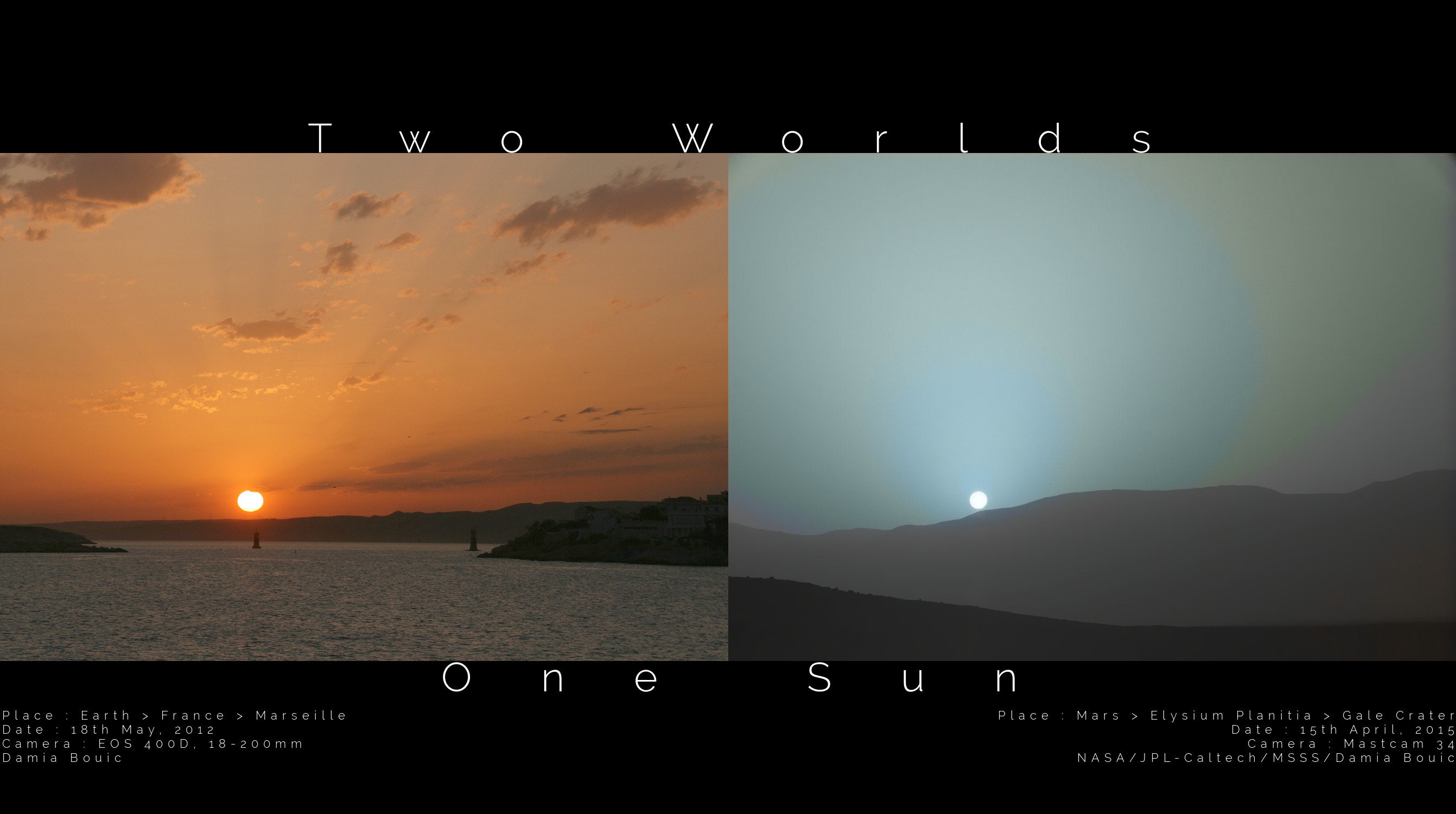
Alt...
Two Worlds, One Sun
* Left Image Credit & Copyright: Damia Bouic;
* Right Image Credit: NASA, JPL-Caltech, MSSS;
* Digital processing: Damia Bouic
Explanation:
How different does sunset appear from Mars than from Earth? For comparison, two images of our common star were taken at sunset, one from Earth and one from Mars. These images were scaled to have the same angular width and are featured here side-by-side. A quick inspection will reveal that the Sun appears slightly smaller from Mars than from Earth. This makes sense since Mars is 50% further from the Sun than Earth. More striking, perhaps, is that the Martian sunset is noticeably bluer near the Sun than the typically orange colors near the setting Sun from Earth. The reason for the blue hues from Mars is not fully understood, but thought to be related to forward scattering properties of Martian dust. The terrestrial sunset was taken in 2012 March from Marseille, France, while the Martian sunset was captured in 2015 by NASA's robotic Curiosity rover from Gale crater on Mars.
Authors & editors: Robert Nemiroff (MTU) & Jerry Bonnell (UMCP)
NASA Official: Amber Straughn Specific rights apply.
NASA Web Privacy, Accessibility, Notices;
A service of: ASD at NASA / GSFC,
NASA Science Activation
& Michigan Tech. U.
Mars missions: A brief history
By Elizabeth Howell, Vicky Stein, Daisy Dobrijevic
Mars missions have been launching for over 50 years but not every mission ends in success.
Mars missions have been launching from Earth with regularity since the 1960s, bent on exploring our planetary neighbor. With its potential for liquid water — and therefore, life — Mars is an alluring target.
But it's a difficult journey, and only about half of all Mars missions successfully make it to the Red Planet, according to NASA. A "Great Galactic Ghoul" must be consuming them, joked a journalist and a NASA scientist corresponding in 1964, reported the Economist.
Since the first successful flyby in 1965, several space agencies have successfully made it to Mars. NASA, the former Soviet Union space program, the European Space Agency (ESA) and the Indian Space Research Organization each met with earlier successes.
A significant batch of Mars-bound missions arrived in February 2021. NASA's Perseverance rover and Ingenuity helicopter reached Mars that month, along with the United Arab Emirates' Hope orbiter (a first interplanetary mission for that country) and the China National Space Administration's Tianwen-1 orbiter and lander-rover mission, which was China's first successful mission to the Red Planet.
Coming up in the 2020s and 2030s, the Japan Aerospace Exploration Agency (JAXA) is planning a sample-return mission from Mars' moon Phobos, and NASA has teamed up with the ESA on a sample-return mission from Mars itself.
Read more:>>
https://www.space.com/13558-historic-mars-missions.html
#space #mars #earth #astrophotography #photography #science #astronomy #nature #NASA
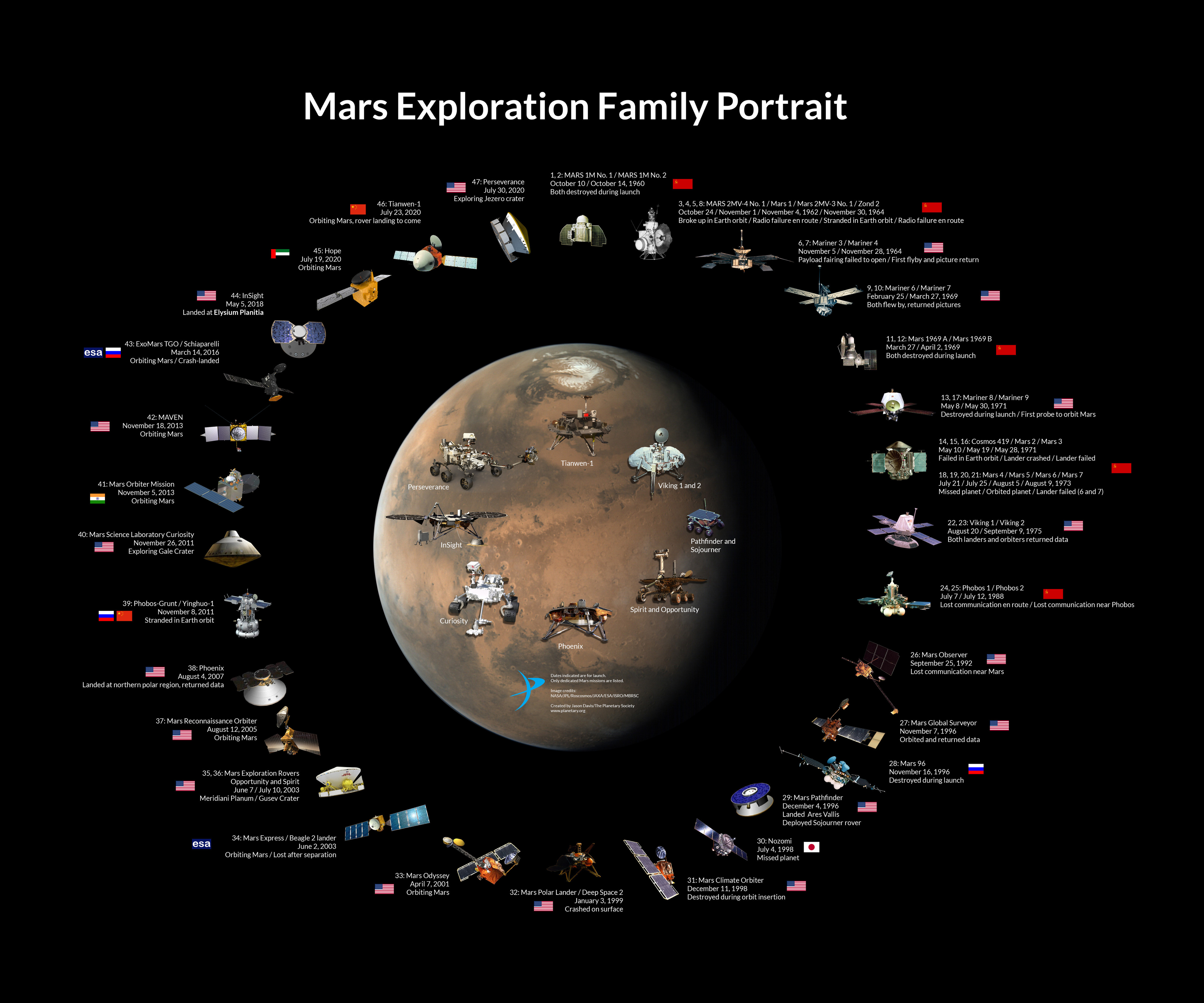
Alt...
The Mars Exploration Family Portrait shows every dedicated space mission to Mars.
Credit:
NASA/JPL/Roscosmos/JAXA/ESA/ISRO/MBRSC/Jason Davis/The Planetary Society
“Landing on Mars”
(59 min)
In the summer of 2003, two NASA rovers began their journeys to Mars at a time when the Red Planet and Earth were the nearest they had been to each other in 60,000 years. To capitalize on this alignment, the rovers had been built at breakneck speed by teams at NASA’s Jet Propulsion Laboratory. The mission came amid further pressures, from mounting international competition to increasing public scrutiny following the loss of the space shuttle Columbia and its crew of seven. NASA was in great need of a success.
“Landing on Mars” is the story of Opportunity and Spirit surviving a massive solar flare during cruise, the now well-known “six minutes of terror,” and what came close to being a mission-ending software error for the first rover once it was on the ground.
#space #mars #sun #earth #astrophotography #photography #science #astronomy #nature #NASA #physics
https://eyes.nasa.gov/apps/solar-system/#/mars
"This link will take you directly to the maximized full screen of the interactive 3D simulation with many different options. Have fun exploring .."
The fourth planet from the Sun, Mars is a dusty, cold, desert world with a very thin atmosphere.
Mars was named by the ancient Romans for their god of war because its reddish color was reminiscent of blood. The Red Planet is actually many colors. At the surface we see colors such as brown, gold and tan. The reason Mars looks reddish is due to oxidization—or rusting—of iron in the rocks, regolith (Martian “soil”), and dust of Mars. This dust gets kicked up into the atmosphere and from a distance makes the planet appear mostly red. Mars is home to the largest volcano in the solar system, Olympus Mons. It's three times taller than Earth's Mt. Everest with a base the size of the state of New Mexico.
Mars appears to have had a watery past, with ancient river valley networks, deltas and lakebeds, as well as rocks and minerals on the surface that could only have formed in liquid water. Some features suggest that Mars experienced huge floods about 3.5 billion years ago. There is water on Mars today, but the Martian atmosphere is too thin for liquid water to exist for long on the surface. Today, water on Mars is found in the form of water-ice just under the surface in the polar regions as well as in briny (salty) water, which seasonally flows down some hillsides and crater walls.
No planet beyond Earth has been studied as intensely as Mars. Today, a science fleet of robotic spacecraft study Mars from all angles.
#space #mars #sun #earth #astrophotography #photography #science #astronomy #nature #NASA
Curiosity wraps up an investigation at Mars' Pink Cliffs while trying out a style of exploration used by geologists on Earth called “the walkabout.”
Part of NASA's Mars Science Laboratory mission, Curiosity, was the largest and most capable rover ever sent to Mars when it launched in 2011. Curiosity set out to answer the question: Did Mars ever have the right environmental conditions to support small life forms called microbes? Early in its mission, Curiosity's scientific tools found chemical and mineral evidence of past habitable environments on Mars. It continues to explore the rock record from a time when Mars could have been home to microbial life.
https://science.nasa.gov/mission/msl-curiosity/
#space #mars #sun #earth #science #astronomy #geology #tech #nature #NASA #MarsRoverCuriosity

Alt...
Curiosity wraps up an investigation at Mars' Pink Cliffs while trying out a style of exploration used by geologists on Earth called “the walkabout.”
Drag your mouse or move your phone to explore this 360-degree panorama provided by NASA’s Curiosity Mars rover.
3D Model of a Curiousity Rover to explore it from all sides >>
https://solarsystem.nasa.gov/gltf_embed/2398/?height=450&rotate=true&cc=true&fs=true&target=&orbit=
#space #mars #sun #earth #astrophotography #photography #science #tech #nature #NASA
2025 June 21
Two Worlds, Two Analemmas
* Image Credit: (left) Copyright: Tunc Tezel (TWAN) https://twanight.org/profile/tunc-tezel/ - (right): NASA/JPL/Cornell/ASU/TAMU https://www.nasa.gov/
Explanation:
Sure, that figure-8 shaped curve you get when you mark the position of the Sun in Earth's sky at the same time each day over one year is called an analemma. On the left, Earth's figure-8 analemma was traced by combining wide-angle digital images recorded during the year from December 2011 through December 2012. But the shape of an analemma depends on the eccentricity of a planet's orbit and the tilt of its axis of rotation, so analemma curves can look different for different worlds. Take Mars for example. The Red Planet's axial tilt is similar to Earth's, but its orbit around the same sun is more eccentric (less circular) than Earth's orbit. As seen from the Martian surface, the analemma traced in the right hand panel is shaped more like a tear drop. The Mars rover Opportunity captured the images used over the Martian year corresponding to Earth dates July 2006 to June 2008. Of course, each world's solstice dates still lie at the top and bottom of their different analemma curves. The last Mars northern summer solstice was May 29, 2025. Our fair planet's 2025 northern summer solstice is at June 21, 2:42 UTC.
Earth:
https://apod.nasa.gov/apod/ap131014.html
https://apod.nasa.gov/apod/ap241204.html
https://apod.nasa.gov/apod/ap250320.html
Mars:
https://www.planetary.org/articles/a-martian-analemma
https://www.planetary.org/articles/mars-calendar
https://en.wikipedia.org/wiki/Analemma#Seen_from_other_planets
https://analemma.com/other-analemmas.html
https://apod.nasa.gov/apod/ap250621.html
#space #mars #sun #earth #astrophotography #photography #science #astronomy #nature #NASA #physics
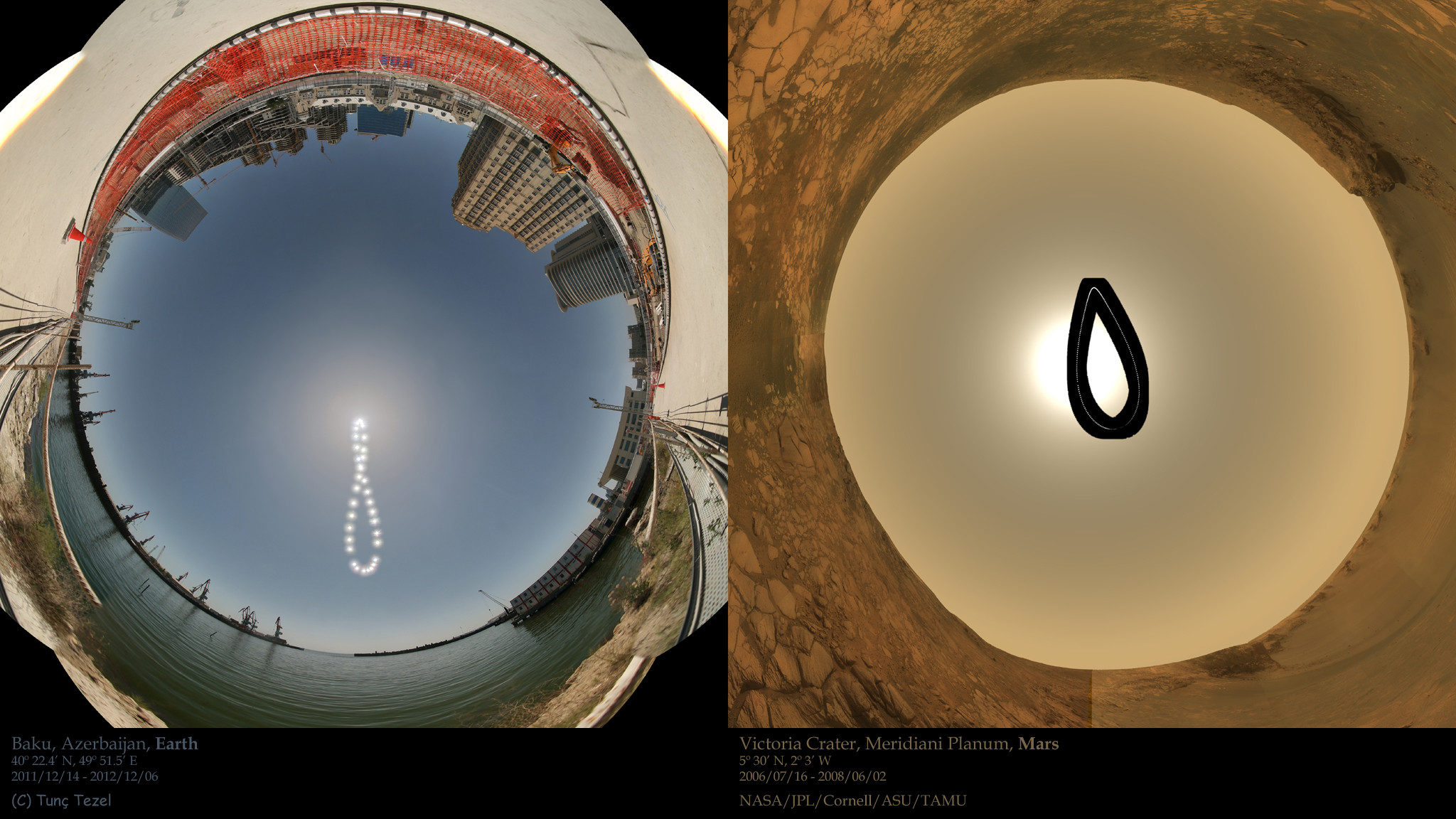
Alt...
2025 June 21
Two Worlds, Two Analemmas
* Image Credit: (left) Copyright: Tunc Tezel (TWAN) - (right): NASA/JPL/Cornell/ASU/TAMU
Explanation:
Sure, that figure-8 shaped curve you get when you mark the position of the Sun in Earth's sky at the same time each day over one year is called an analemma. On the left, Earth's figure-8 analemma was traced by combining wide-angle digital images recorded during the year from December 2011 through December 2012. But the shape of an analemma depends on the eccentricity of a planet's orbit and the tilt of its axis of rotation, so analemma curves can look different for different worlds. Take Mars for example. The Red Planet's axial tilt is similar to Earth's, but its orbit around the same sun is more eccentric (less circular) than Earth's orbit. As seen from the Martian surface, the analemma traced in the right hand panel is shaped more like a tear drop. The Mars rover Opportunity captured the images used over the Martian year corresponding to Earth dates July 2006 to June 2008. Of course, each world's solstice dates still lie at the top and bottom of their different analemma curves. The last Mars northern summer solstice was May 29, 2025. Our fair planet's 2025 northern summer solstice is at June 21, 2:42 UTC.
Authors & editors: Robert Nemiroff (MTU) & Jerry Bonnell (UMCP)
NASA Official: Amber Straughn Specific rights apply.
2025 June 22
A Berry Bowl of Martian Spherules
* Image Credit: NASA, JPL, Curiosity Rover
https://science.nasa.gov/mission/msl-curiosity/
https://www.jpl.nasa.gov/
https://www.nasa.gov/
Explanation:
How were these unusual Martian spherules created? Thousands of unusual gray spherules made of iron and rock and dubbed blueberries were found embedded in and surrounding rocks near the landing site of the robot Opportunity rover on Mars in 2004. To help investigate their origin, Opportunity found a surface dubbed the Berry Bowl with an indentation that was rich in the Martian orbs. The Berry Bowl is pictured here, imaged during rover's 48th Martian day. The average size of a Martian blueberry rock is only about 4 millimeters across. By analyzing a circular patch in the rock surface to the left of the densest patch of spherules, Opportunity obtained data showing that the underlying rock has a much different composition than the hematite rich blueberries. This information contributes to the growing consensus that these small, strange, gray orbs were slowly deposited from a bath of dirty water.
https://photojournal.jpl.nasa.gov/catalog/PIA05634
https://science.nasa.gov/mission/msl-curiosity/location-map/
https://ui.adsabs.harvard.edu/abs/2017Icar..289..144W/abstract
https://apod.nasa.gov/apod/ap040303.html
https://apod.nasa.gov/apod/ap040210.html
https://apod.nasa.gov/apod/ap040216.html
https://science.nasa.gov/resource/martian-blueberries-2/
Martian_spherules
https://periodic.lanl.gov/26.shtml
https://en.wikipedia.org/wiki/Hematite
https://apod.nasa.gov/apod/ap250622.html
#space #mars #rover #astrophotography #photography #science #geology #nature #NASA
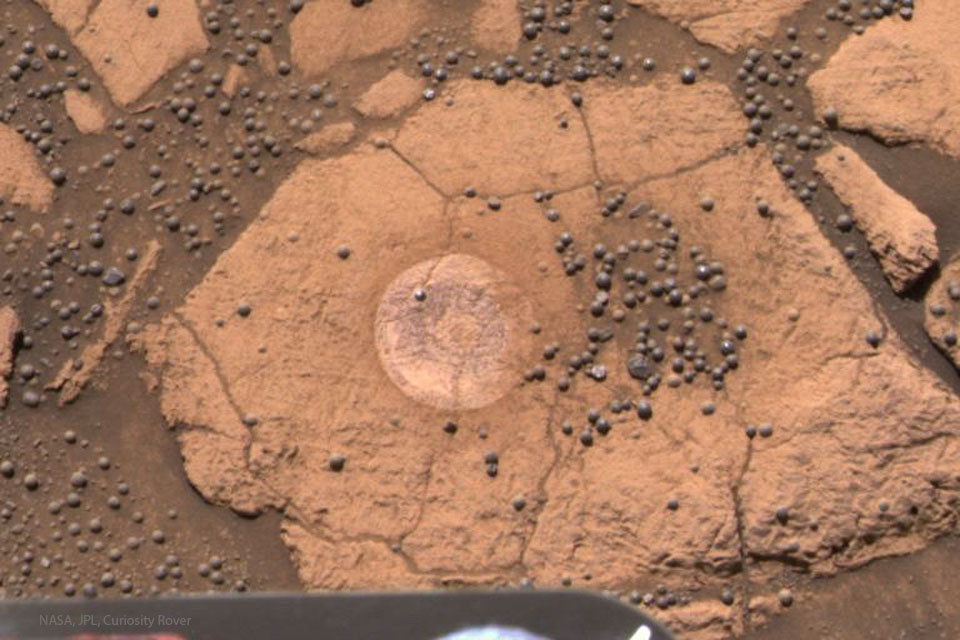
Alt...
2025 June 22
The image looks down on an orange rock on Mars. On the rock are many nearly spherical smaller rocks.
A Berry Bowl of Martian Spherules
* Image Credit: NASA, JPL, Curiosity Rover
Explanation:
How were these unusual Martian spherules created? Thousands of unusual gray spherules made of iron and rock and dubbed blueberries were found embedded in and surrounding rocks near the landing site of the robot Opportunity rover on Mars in 2004. To help investigate their origin, Opportunity found a surface dubbed the Berry Bowl with an indentation that was rich in the Martian orbs. The Berry Bowl is pictured here, imaged during rover's 48th Martian day. The average size of a Martian blueberry rock is only about 4 millimeters across. By analyzing a circular patch in the rock surface to the left of the densest patch of spherules, Opportunity obtained data showing that the underlying rock has a much different composition than the hematite rich blueberries. This information contributes to the growing consensus that these small, strange, gray orbs were slowly deposited from a bath of dirty water.
Authors & editors: Robert Nemiroff (MTU) & Jerry Bonnell (UMCP)
NASA Official: Amber Straughn Specific rights apply.
NASA Web Privacy, Accessibility, Notices;
A service of: ASD at NASA / GSFC,
NASA Science Activation
& Michigan Tech. U.
March 5, 2024: NASA released images of transits of the moon Deimos, the moon Phobos and the planet Mercury as viewed by the Perseverance rover on the planet Mars.
Solar 'eclipses' on Mars
The two moons of Mars, Phobos and Deimos, are much smaller than Earth's Moon, greatly reducing the frequency of solar eclipses on that planet. Neither moon's apparent diameter is large enough to cover the disk of the Sun, and therefore they are annular solar eclipses and can also be considered transits.
Eclipses caused by Phobos
Due to the small size of Phobos (about 20 by 25 km (12 by 16 mi)) and its rapid orbital motion, an observer on the surface of Mars would never experience a solar eclipse for longer than about thirty seconds. Phobos also takes only 7 hours 39 minutes to orbit Mars, while a Martian day is 24 hours 37 minutes long, meaning that Phobos can create two eclipses per Martian day. These are annular eclipses, because Phobos is not quite large enough or close enough to Mars to create a total solar eclipse.
Transits caused by Deimos
Deimos is too small (about 15 by 10 km (9.3 by 6.2 mi)) and too far from Mars to cause an eclipse. The best an observer on Mars would see is a small spot crossing the Sun's disc.
Transit of Mercury
A transit of Mercury across the Sun as seen from Mars takes place when the planet Mercury passes directly between the Sun and Mars, obscuring a small part of the Sun's disc for an observer on Mars. During a transit, Mercury can be seen from Mars as a small black disc moving across the face of the Sun.
The Mercury-Mars synodic period is 100.888 days. It can be calculated using the formula 1/(1/P-1/Q), where P is the orbital period of Mercury (87.969 days) and Q is the orbital period of Mars (686.98 days).
Credits:
Excerpts from Wikipedia articles
#space #mars #PerseveranceRover #astrophotography #photography #science #astronomy #NASA
Alt...
Transit of Phobos
(February 8, 2024)
Alt...
Transit of Mercury
(October 28, 2023)
Alt...
Transit of Deimos
(January 19, 2024)
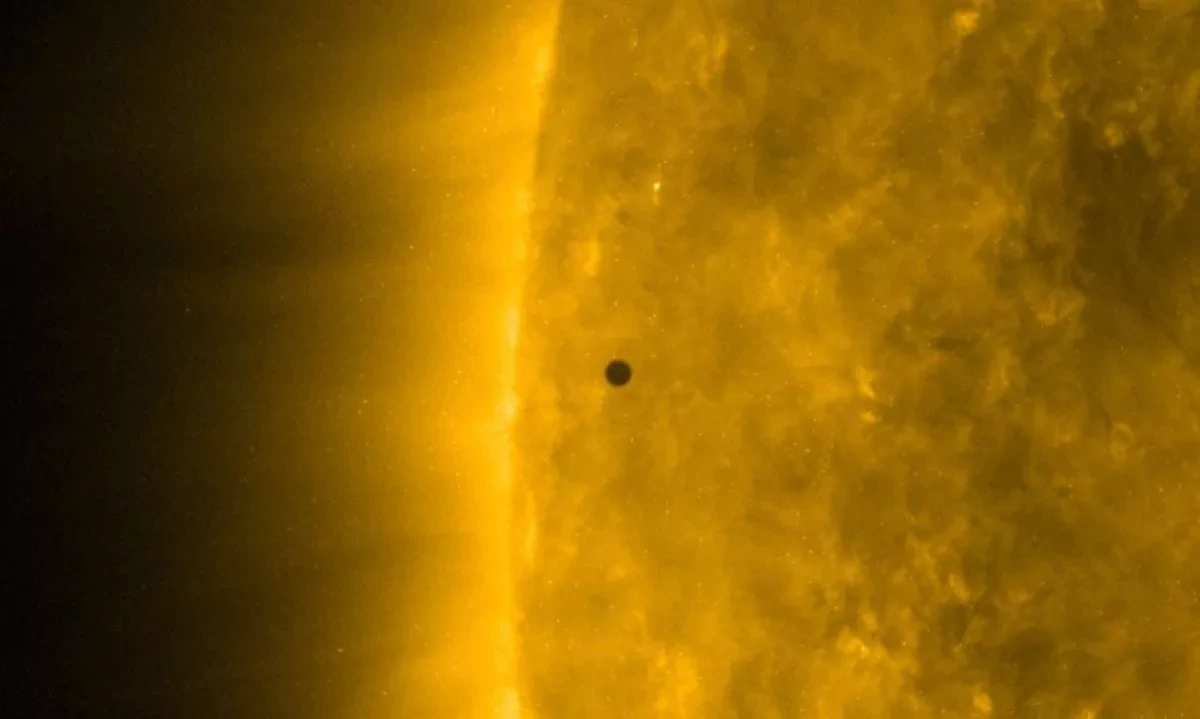
Alt...
Mercury Transit 2019 from SDO This image, taken by NASA's Solar Dynamics Observatory spacecraft, shows Mercury transiting the Sun on 11 November 2019.
Credit:
NASA/SDO, HMI, and AIA science teams
Mars Exploration Rovers: Spirit and Opportunity
* Occurred 6 years ago
NASA’s Spirit and Opportunity rovers were identical twin robots that helped rewrite our understanding of the early history of Mars.
Landing Sites
The rovers were targeted to land at sites on opposite sides of Mars that looked as though they were affected by liquid water in the past. Spirit landed at Gusev Crater, a possible former lake in a giant impact crater. Opportunity landed at Meridiani Planum, a place where mineral deposits suggested that Mars had a wet history.
Mars Exploration Rovers In Depth
Rover Basics:
Each robotic explorer sent to the Red Planet has its own unique capabilities driven by science. Many attributes of a rover take on human-like features, such as “heads,” and “bodies.”
https://science.nasa.gov/planetary-science/programs/mars-exploration/rover-basics/
Objectives:
New knowledge from the twin rovers uniquely contributed to meeting the four overarching goals of the Mars Exploration Program, while complementing data gathered through other Mars missions.
https://science.nasa.gov/mission/mars-exploration-rovers-spirit-and-opportunity/science-objectives/
Science:
By studying the rock record, Spirit and Opportunity confirmed that water was long standing on the surface of Mars in ancient times.
https://science.nasa.gov/mission/mars-exploration-rovers-spirit-and-opportunity/science-highlights/
Resources:
Visit the one-stop-shop for all Spirit and Opportunity multimedia.
https://science.nasa.gov/mars/resources/?search=spirit+opportunity
This infographic highlights NASA’s twin robot geologists, the Mars Exploration Rovers (MER) Spirit and Opportunity. The rovers landed on the Red Planet in 2004, in search of answers about the history of water on Mars. Spirit concluded its mishttps://science.nasa.gov/mission/mars-exploration-rovers-spirit-and-opportunity/sion in 2010. Opportunity last communicated with Earth on June 10, 2018, as a planet-wide dust storm blanketed the solar-powered rover's location on Mars.
Credit:
NASA/JPL-Caltech
https://science.nasa.gov/mission/mars-exploration-rovers-spirit-and-opportunity/
#space #mars #rover #astrophotography #photography #science #astronomy #NASA
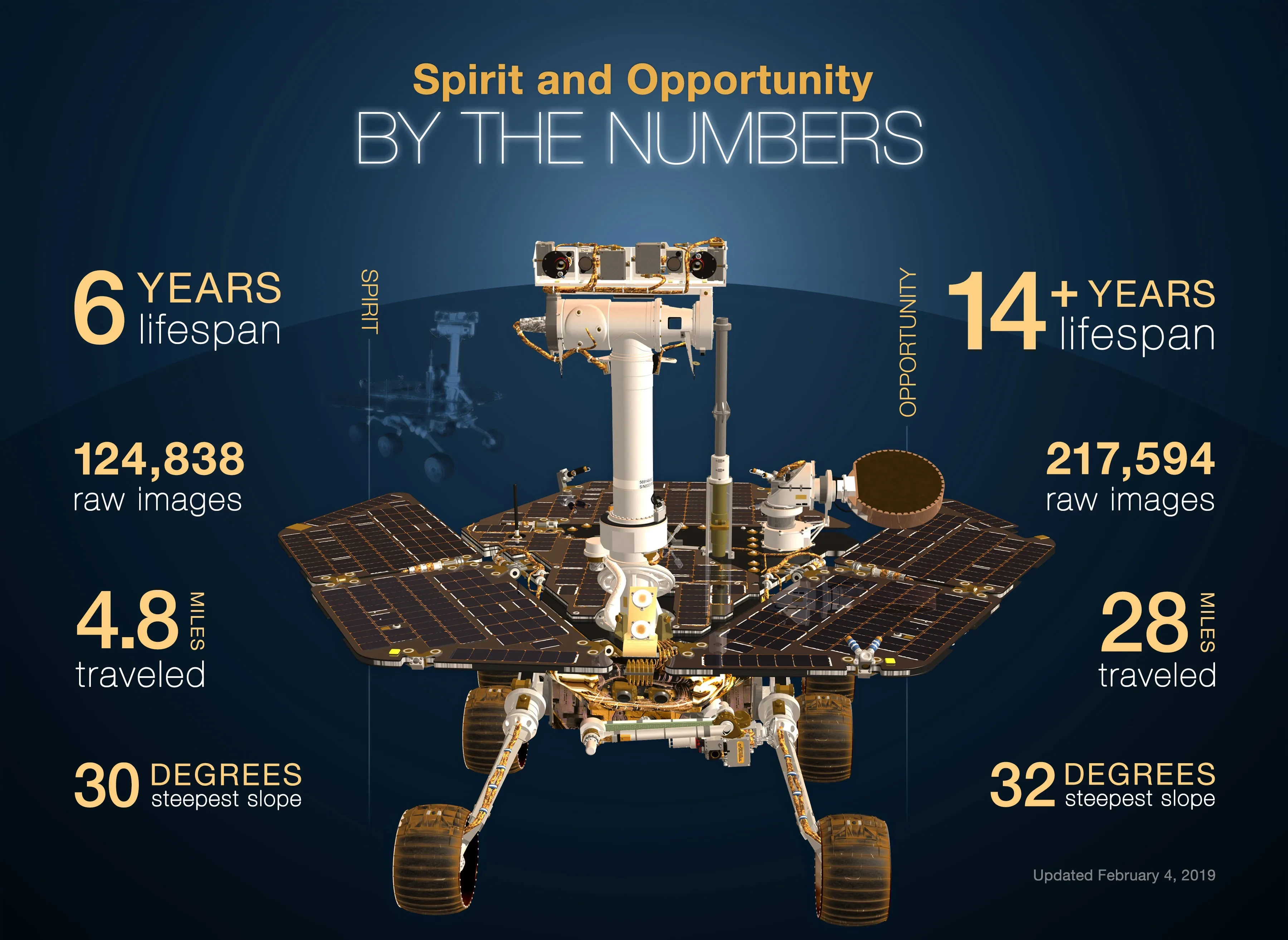
Alt...
This infographic highlights NASA’s twin robot geologists, the Mars Exploration Rovers (MER) Spirit and Opportunity. The rovers landed on the Red Planet in 2004, in search of answers about the history of water on Mars. Spirit concluded its mission in 2010. Opportunity last communicated with Earth on June 10, 2018, as a planet-wide dust storm blanketed the solar-powered rover's location on Mars.
Credit:
NASA/JPL-Caltech
https://solarsystem.nasa.gov/gltf_embed/2370/?height=450&rotate=true&cc=true&fs=true&target=&orbit=
A 3D model of the twin Mars Exploration Rovers, Spirit and Opportunity.
NASA Visualization Technology Applications and Development (VTAD)
#space #mars #rover #astrophotography #photography #science #astronomy #NASA
2004 February 4
Opportunity's Horizon
* Credit: Mars Exploration Rover Mission, JPL, NASA
https://science.nasa.gov/mission/mars-exploration-rovers-spirit-and-opportunity/
http://www.jpl.nasa.gov/index.html
http://www.nasa.gov/home/index.html
Explanation:
Remarkably, the Opportunity Mars rover lies in a small martian impact crater about 3 meters deep and 22 meters wide. For 360 degrees, Opportunity's horizon stretches to the right in this color mosaic image from the rover's panoramic camera. Notable in this view of the generally dark, smooth terrain are surface imprints left by the lander's airbags and an outcropping of light-colored, layered rock about 8 meters away toward the northwest. Though they look imposing, the rocks in the tantalizing outcrop are only a few centimeters high and will be dwarfed by the cart-sized rover itself during future close-up investigations. Opportunity has now rolled off its lander and, along with the restored Spirit rover, is directly exploring the martian surface.
https://apod.nasa.gov/apod/ap040126.html
https://apod.nasa.gov/apod/ap040114.html
https://apod.nasa.gov/apod/ap040204.html
#space #mars #rover #astrophotography #photography #science #astronomy #nature #NASA

Alt...
2004 February 4
Opportunity's Horizon
* Credit: Mars Exploration Rover Mission, JPL, NASA
Explanation:
Remarkably, the Opportunity Mars rover lies in a small martian impact crater about 3 meters deep and 22 meters wide. For 360 degrees, Opportunity's horizon stretches to the right in this new color mosaic image from the rover's panoramic camera. Notable in this view of the generally dark, smooth terrain are surface imprints left by the lander's airbags and an outcropping of light-colored, layered rock about 8 meters away toward the northwest. Though they look imposing, the rocks in the tantalizing outcrop are only a few centimeters high and will be dwarfed by the cart-sized rover itself during future close-up investigations. Opportunity has now rolled off its lander and, along with the restored Spirit rover, is directly exploring the martian surface.
Authors & editors: Robert Nemiroff (MTU) & Jerry Bonnell (USRA)
NASA Web Site Statements, Warnings, and Disclaimers
NASA Official: Jay Norris. Specific rights apply.
A service of: LHEA at NASA / GSFC
& Michigan Tech. U.
2025 June 29
Dark Sand Cascades on Mars
* Image Credit: NASA, HiRISE, MRO, LPL (U. Arizona),
https://www.lpl.arizona.edu/
https://science.nasa.gov/mission/mars-reconnaissance-orbiter/
http://hirise.lpl.arizona.edu/
http://www.nasa.gov/
Explanation:
Are these trees growing on Mars? No. Groups of dark brown streaks have been photographed by the Mars Reconnaissance Orbiter on melting pinkish sand dunes covered with light frost. The featured image was taken in 2008 April near the North Pole of Mars. At that time, dark sand on the interior of Martian sand dunes became more and more visible as the spring Sun melted the lighter carbon dioxide ice. When occurring near the top of a dune, dark sand may cascade down the dune leaving dark surface streaks -- streaks that might appear at first to be trees standing in front of the lighter regions but cast no shadows. Objects about 25 centimeters across are resolved on this image spanning about one kilometer. Close ups of some parts of this image show billowing plumes indicating that the sand slides were occurring even while the image was being taken.
https://hirise.lpl.arizona.edu/PSP_007962_2635
https://www.nasa.gov/image-article/martian-sand-dunes-spring/
https://apod.nasa.gov/apod/ap080311.html
https://www.jpl.nasa.gov/news/recurring-martian-streaks-flowing-sand-not-water/
https://apod.nasa.gov/apod/ap070805.html
https://apod.nasa.gov/apod/ap021224.html
https://en.wikipedia.org/wiki/Mars_Reconnaissance_Orbiter
https://apod.nasa.gov/apod/ap250629.html
#space #mars #astrophotography #photography #science #astronomy #nature #NASA

Alt...
2025 June 29
Viewed from above, a landscape on Mars features many ridges of pink sand. Superposed on some of these ridges are thin brown stipes.
Dark Sand Cascades on Mars
* Image Credit: NASA, HiRISE, MRO, LPL (U. Arizona),
Explanation:
Are these trees growing on Mars? No. Groups of dark brown streaks have been photographed by the Mars Reconnaissance Orbiter on melting pinkish sand dunes covered with light frost. The featured image was taken in 2008 April near the North Pole of Mars. At that time, dark sand on the interior of Martian sand dunes became more and more visible as the spring Sun melted the lighter carbon dioxide ice. When occurring near the top of a dune, dark sand may cascade down the dune leaving dark surface streaks -- streaks that might appear at first to be trees standing in front of the lighter regions but cast no shadows. Objects about 25 centimeters across are resolved on this image spanning about one kilometer. Close ups of some parts of this image show billowing plumes indicating that the sand slides were occurring even while the image was being taken.
Authors & editors: Robert Nemiroff (MTU) & Jerry Bonnell (UMCP)
NASA Official: Amber Straughn Specific rights apply.
NASA Web Privacy, Accessibility, Notices;
A service of: ASD at NASA / GSFC,
NASA Science Activation
& Michigan Tech. U.
2006 August 23
Sandy Gas Jets Hypothesized on Mars
* Illustration Credit & Copyright: Ron Miller (ASU)
https://sese.asu.edu/
Explanation:
What's causing seasonal dark spots on Mars? Every spring, strange dark spots appear near the Martian poles, and then vanish a few months later. These spots typically span 50 meters across and appear fan shaped. Recent observations made with THEMIS instrument onboard NASA's Mars Odyssey, currently orbiting Mars, found the spots to be as cold as the carbon dioxide (CO2) ice beneath them. Based on this evidence, a new hypothesis has been suggested where the spots are caused by explosive jets of sand-laden CO2. As a pole warms up in the spring, frozen CO2 on the surface thins, perforates, and begins to vent gaseous CO2 held underneath. Within this hypothesis, interspersed dark sand would explain the color of the spots, while the underlying frozen CO2 would explain the coolness of the spots. Pictured above, an artist depicts what it might be like to stand on Mars and witness the venting of these tremendous gas and dust jets.
https://science.nasa.gov/mission/odyssey/
https://en.wikipedia.org/wiki/Carbon_dioxide
https://en.wikipedia.org/wiki/Dry_ice#Solid_CO2
https://photojournal.jpl.nasa.gov/catalog/PIA08660
https://apod.nasa.gov/apod/ap060823.html
#space #mars #astrophotography #photography #science #astronomy #nature #NASA
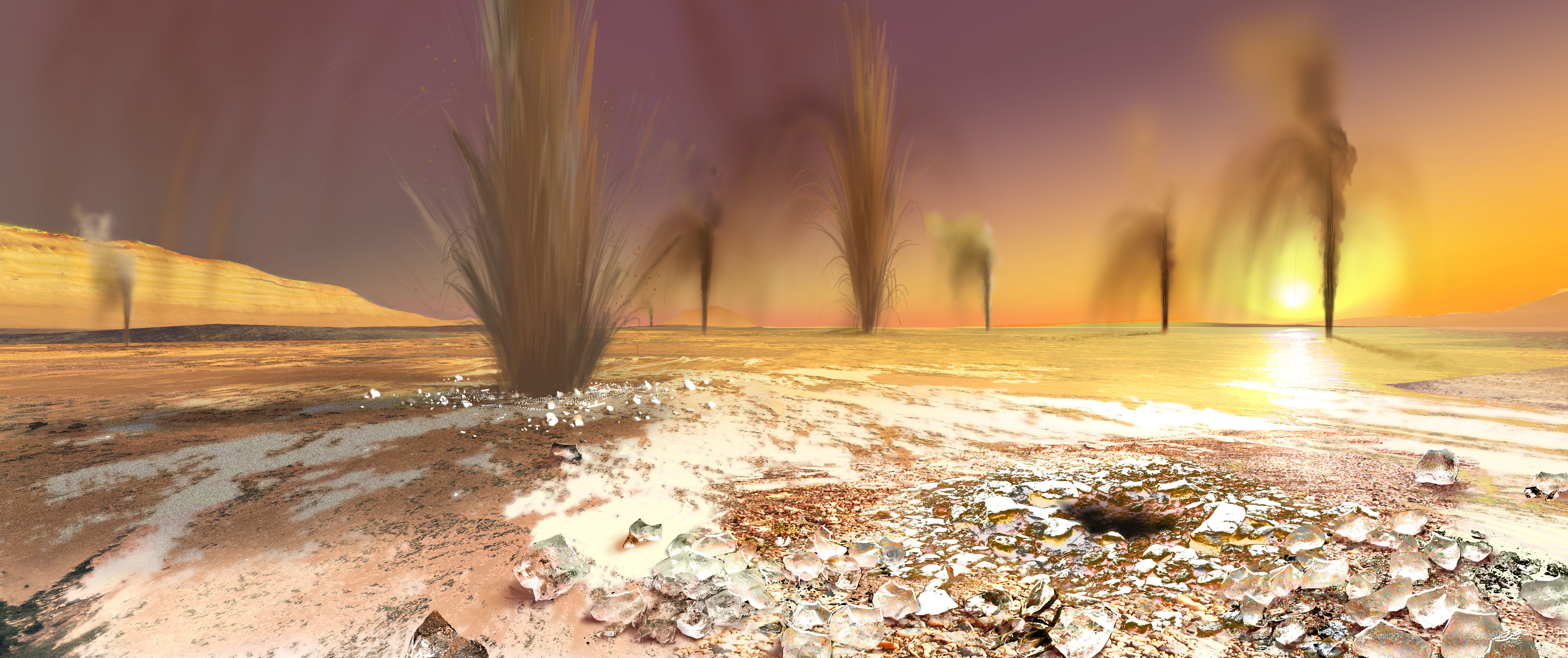
Alt...
2006 August 23
Sandy Gas Jets Hypothesized on Mars
* Illustration Credit & Copyright: Ron Miller (ASU)
Explanation:
What's causing seasonal dark spots on Mars? Every spring, strange dark spots appear near the Martian poles, and then vanish a few months later. These spots typically span 50 meters across and appear fan shaped. Recent observations made with THEMIS instrument onboard NASA's Mars Odyssey, currently orbiting Mars, found the spots to be as cold as the carbon dioxide (CO2) ice beneath them. Based on this evidence, a new hypothesis has been suggested where the spots are caused by explosive jets of sand-laden CO2. As a pole warms up in the spring, frozen CO2 on the surface thins, perforates, and begins to vent gaseous CO2 held underneath. Within this hypothesis, interspersed dark sand would explain the color of the spots, while the underlying frozen CO2 would explain the coolness of the spots. Pictured above, an artist depicts what it might be like to stand on Mars and witness the venting of these tremendous gas and dust jets.
Authors & editors: Robert Nemiroff (MTU) & Jerry Bonnell (USRA)
NASA Web Site Statements, Warnings, and Disclaimers
NASA Official: Jay Norris. Specific rights apply.
A service of: EUD at NASA / GSFC
& Michigan Tech. U.