Search results for tag #nature
![[?]](https://files.defcon.social/dcsocial-s3/accounts/avatars/113/208/344/507/078/943/original/014820ad22daee1c.jpg)
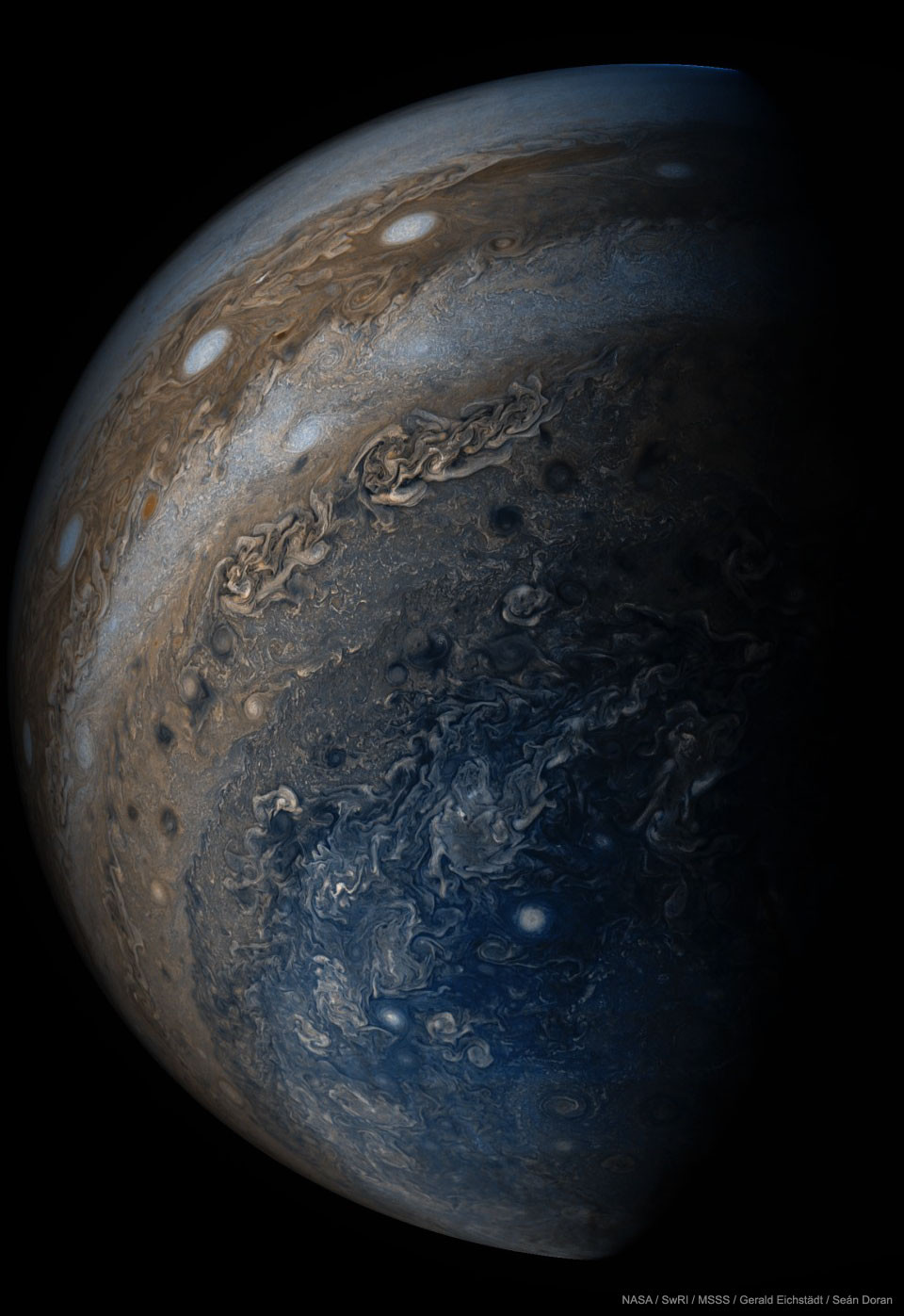
Beneath Jupiter
* Image Credit & Copyright: NASA, Juno, SwRI, MSSS; Processing & License: Gerald Eichstädt & Seán Doran
https://www.uahirise.org/epo/made-with-hirise/doran/
https://www.planetary.org/profiles/gerald-eichstdt
https://www.msss.com/
http://www.swri.org/
https://science.nasa.gov/mission/juno/
https://www.nasa.gov/
Explanation:
Jupiter is stranger than we knew. NASA's Juno spacecraft has now completed over 70 swoops past Jupiter as it moves around its highly elliptical orbit. Pictured from 2017, Jupiter is seen from below where, surprisingly, the horizontal bands that cover most of the planet disappear into swirls and complex patterns. A line of white oval clouds is visible nearer to the equator. Impressive results from Juno show that Jupiter's weather phenomena can extend deep below its cloud tops, that Jupiter's center has a core that is unexpectedly large and soft, and that Jupiter's magnetic field varies greatly with location. Although Juno is scheduled to keep orbiting Jupiter further into 2025, at some time the robotic spacecraft will be maneuvered to plunge into the giant planet.
https://science.nasa.gov/jupiter/
https://apod.nasa.gov/apod/ap160626.html
https://apod.nasa.gov/apod/ap170213.html
https://apod.nasa.gov/apod/ap170228.htmlhttps://www.swri.org/newsroom/press-releases/swri-led-juno-mission-jupiter-delivers-first-science-results
https://www.jpl.nasa.gov/missions/juno/
https://en.wikipedia.org/wiki/Juno_(spacecraft)
https://www.astronomy.com/science/what-has-the-juno-spacecraft-taught-us-about-jupiter/
https://www.swri.org/newsroom/press-releases/swri-led-juno-mission-jupiter-delivers-first-science-results
https://www.jpl.nasa.gov/news/nasas-juno-mission-expands-into-the-future/
https://www.jpl.nasa.gov/news/press_kits/juno/overview/#:~:text=The%20final%20mission%20phase%20is,atmosphere%20and%20will%20burn%20up.
https://www.youtube.com/watch?v=6o9FiTf1vZE
https://apod.nasa.gov/apod/ap250525.html
#space #jupiter #astrophotography #photography #science #nature #NASA
Alt...
2025 May 25
A close-up image is shown of the planet Jupiter. Many clouds are visible including clouds colored blue near the bottom, on the left, and white oval clouds on the upper right. Please see the explanation for more detailed information.
Beneath Jupiter
* Image Credit & Copyright: NASA, Juno, SwRI, MSSS; Processing & License: Gerald Eichstädt & Seán Doran
Explanation:
Jupiter is stranger than we knew. NASA's Juno spacecraft has now completed over 70 swoops past Jupiter as it moves around its highly elliptical orbit. Pictured from 2017, Jupiter is seen from below where, surprisingly, the horizontal bands that cover most of the planet disappear into swirls and complex patterns. A line of white oval clouds is visible nearer to the equator. Impressive results from Juno show that Jupiter's weather phenomena can extend deep below its cloud tops, that Jupiter's center has a core that is unexpectedly large and soft, and that Jupiter's magnetic field varies greatly with location. Although Juno is scheduled to keep orbiting Jupiter further into 2025, at some time the robotic spacecraft will be maneuvered to plunge into the giant planet.
Authors & editors: Robert Nemiroff (MTU) & Jerry Bonnell (UMCP)
NASA Official: Amber Straughn Specific rights apply.
NASA Web Privacy, Accessibility, Notices;
A service of: ASD at NASA / GSFC,
NASA Science Activation
& Michigan Tech. U.
Approaching Jupiter
* Video Composition & Copyright: Peter Rosén et al.
https://www.planetary.org/profiles/peter-rosen
* Music: The Awakening by Clemens Ruh
https://soundcloud.com/clemensruh
Explanation:
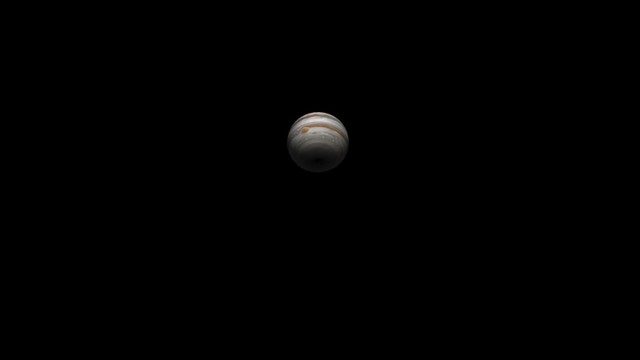
What would it look like to approach Jupiter? To help answer this, a team of 91 amateur astrophotographers took over 1,000 pictures of Jupiter from the Earth with the resulting images aligned and digitally merged into the featured time-lapse video. Image taking began in 2014 December and lasted just over three months. The resulting fictitious approach sequence has similarities to what was seen by NASA's robotic Juno spacecraft as it first approached the Jovian world last July. The video begins with Jupiter appearing as a small orb near the image center. As Jupiter nears from below, the planet looms ever larger while the rotation of its cloud bands becomes apparent. Jupiter's shrinking Great Red Spot rotates into view twice, at times showing unusual activity. Many white ovals are visible moving around the giant planet. The video ends as the imaginary spacecraft passes over Jupiter's North Pole.
https://www.planetary.org/articles/201170509-journey-to-jupiter
https://apod.nasa.gov/apod/ap170523.html
#space #jupiter #astrophotography #photography #science #nature #NASA
Alt...
2017 May 23
Approaching Jupiter
* Video Composition & Copyright: Peter Rosén et al.
* Music: The Awakening by Clemens Ruh
Explanation:
What would it look like to approach Jupiter? To help answer this, a team of 91 amateur astrophotographers took over 1,000 pictures of Jupiter from the Earth with the resulting images aligned and digitally merged into the featured time-lapse video. Image taking began in 2014 December and lasted just over three months. The resulting fictitious approach sequence has similarities to what was seen by NASA's robotic Juno spacecraft as it first approached the Jovian world last July. The video begins with Jupiter appearing as a small orb near the image center. As Jupiter nears from below, the planet looms ever larger while the rotation of its cloud bands becomes apparent. Jupiter's shrinking Great Red Spot rotates into view twice, at times showing unusual activity. Many white ovals are visible moving around the giant planet. The video ends as the imaginary spacecraft passes over Jupiter's North Pole.
Authors & editors: Robert Nemiroff (MTU) & Jerry Bonnell (UMCP)
NASA Official: Phillip Newman Specific rights apply.
NASA Web Privacy Policy and Important Notices
A service of: ASD at NASA / GSFC
& Michigan Tech. U.
The upper ammonia clouds visible at Jupiter's surface are organized in a dozen zonal bands parallel to the equator and are bounded by powerful zonal atmospheric flows (winds) known as jets, exhibiting a phenomenon known as atmospheric super-rotation. The bands alternate in color: the dark bands are called belts, while light ones are called zones. Zones, which are colder than belts, correspond to upwellings, while belts mark descending gas. The zones' lighter color is believed to result from ammonia ice; what gives the belts their darker colors is uncertain.
The origins of the banded structure and jets are not well understood, though a "shallow model" and a "deep model" exist.
[from: en.wikipedia.org]
* This small GIF i took from a NASA Video
please see Explanation and credits
Explanation:
This animation depicts Jupiter's planet wrapping cloud structure, commonly referred to as "belts" and "zones," and the jet streams that encompass them. The belts (white bands) and zones (reddish bands) are separated by strong east-west winds, or jet streams (depicted by black arrows), that move in opposite directions. These jets penetrate about 1,800 miles (3,000 kilometers) below the cloud level of Jupiter. Other components of the winds including north-south and up-down movements – have been a mystery and have now been uncovered with the latest data from the microwave radiometer instrument aboard NASA's Juno spacecraft.
The base composite image of Jupiter was created from images obtained by NASA's Cassini spacecraft.
* Credit
NASA/JPL-Caltech/SSI/Weizmann Institute of Science
* Instrument
Microwave Radiometer (MWR)
#space #jupiter #astrophotography #photography #science #nature #NASA
False colored morphing animation of Jupiter's clouds in motion
The Jovian atmosphere shows a wide range of active phenomena, including band instabilities, vortices (cyclones and anticyclones), storms and lightning. The vortices reveal themselves as large red, white or brown spots (ovals). The largest two spots are the Great Red Spot (GRS) and Oval BA, which is also red. These two and most of the other large spots are anticyclonic. Smaller anticyclones tend to be white. Vortices are thought to be relatively shallow structures with depths not exceeding several hundred kilometers. Located in the southern hemisphere, the GRS is the largest known vortex in the Solar System. It could engulf two or three Earths and has existed for at least three hundred years. Oval BA, south of GRS, is a red spot a third the size of GRS that formed in 2000 from the merging of three white ovals.
Jupiter has powerful storms, often accompanied by lightning strikes. The storms are a result of moist convection in the atmosphere connected to the evaporation and condensation of water. They are sites of strong upward motion of the air, which leads to the formation of bright and dense clouds. The storms form mainly in belt regions. The lightning strikes on Jupiter are hundreds of times more powerful than those seen on Earth, and are assumed to be associated with the water clouds. Recent Juno observations suggest Jovian lightning strikes occur above the altitude of water clouds (3-7 bars). A charge separation between falling liquid ammonia-water droplets and water ice particles may generate higher-altitude lightning. Upper-atmospheric lightning has also been observed 260 km above the 1 bar level.
* Credit:
NASA / JPL / SwRI / MSSS / Gerald Eichstädt
#space #jupiter #atmosphere #astrophotography #photography #science #nature #NASA
> from Wikipedia
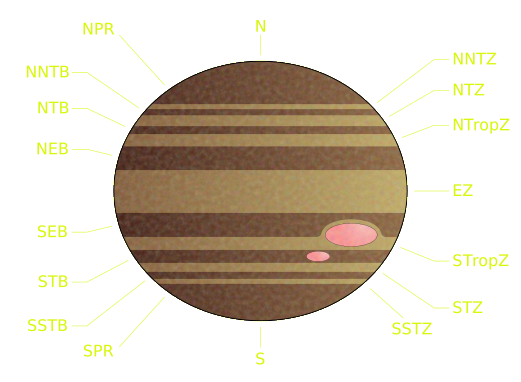
The belts and zones that divide Jupiter's atmosphere with each their own names and characteristics.
They begin below the North and South Polar Regions, which extend from the poles to roughly 40–48° N/S. This bluish-gray regions are usually featureless.
The North North Temperate Region rarely shows more detail, due to limb darkening, foreshortening, and the general diffuseness of features. However, the North-North Temperate Belt (NNTB) is the northernmost distinct belt, though it occasionally disappears. Disturbances tend to be minor and short-lived. The North-North Temperate Zone (NNTZ) is perhaps more prominent, but also generally quiet.
The North Temperate Region is part of a latitudinal region easily observable from Earth. It also features the strongest prograde jet stream on the planet—a westerly current that forms the southern boundary of the North Temperate Belt (NTB). The NTB fades roughly once a decade, making the North Temperate Zone (NTZ) apparently merge into the North Tropical Zone (NTropZ). Other times, the NTZ is divided by a narrow belt into northern and southern components.
The North Tropical Region is composed of the NTropZ and the North Equatorial Belt (NEB). The NTropZ is generally stable in coloration, changing in tint only in tandem with activity on the NTB's southern jet stream. Like the NTZ, it too is sometimes divided by a narrow band, the NTropB. On rare occasions, the southern NTropZ plays host to "Little Red Spots". As the name suggests, these are northern equivalents of the Great Red Spot. Unlike the GRS, they tend to occur in pairs and are always short-lived, lasting a year on average.
Read more >>
https://en.wikipedia.org/wiki/Atmosphere_of_Jupiter#Specific_bands
Image Credit: Sakurambo at English Wikipedia
#space #jupiter #astrophotography #photography #science #nature #NASA
Alt...
Idealized illustration of Jupiter's cloud bands, labeled with their official abbreviations. Lighter zones are indicated to the right, darker belts to the left. The Great Red Spot and Oval BA are shown in the South Tropical Zone and South Temperate Belt, respectively.
Image Credit: Sakurambo at English Wikipedia
The colorful stripes of Jupiter run more than 1,000 miles deep and hold so much gas that their mass is about three times that of the entire Earth, three new studies find.
Jupiter's atmospheric stripes have been known for centuries; famed astronomer Galileo Galilei was the first to see the dark bands and bright zones on the largest planet in our solar system. "These bands are related to strong winds flowing on Jupiter," said Yohai Kaspi, lead author of one of the three studies and a planetary scientist at the Weizmann Institute of Science, in Rehovot, Israel.
However, until now, scientists were uncertain how deep those bands reached into Jupiter. NASA's Juno spacecraft orbits Jupiter every 53 days. As the planet's gravitational field tugs on Juno, the radio signals that the probe sends back to Earth shift a bit. The greater the mass under Juno, the stronger the gravitational pull the spacecraft and its radio waves experience. Because Juno's flybys are in different orbits each time, it can map the gravitational field of different parts of the planet.
As Jupiter's belts of winds can flow at speeds of about 223 mph (360 km/h), they disrupt how mass is spread across the planet. Therefore, mapping Jupiter's gravitational field can shed light on how deep these winds extend below the surface.
The researchers found that these stripes extend 1,800 miles (3,000 kilometers) deep, or about one-twentieth the distance to the center of the planet — far deeper than previously thought. "These flows on Jupiter contain about 1 percent of the mass of Jupiter, which is equal to about three Earth masses," Kaspi said. "In comparison, Earth's atmosphere is less than one-millionth the mass of Earth."
Read more >>
https://www.space.com/39907-jupiter-atmosphere-has-deep-stripes.html
* Credit: Charles Q. Choi
(Contributing Writer for space.com)
#space #jupiter #atmosphere #astrophotography #photography #science #nature #NASA
2025 September 1
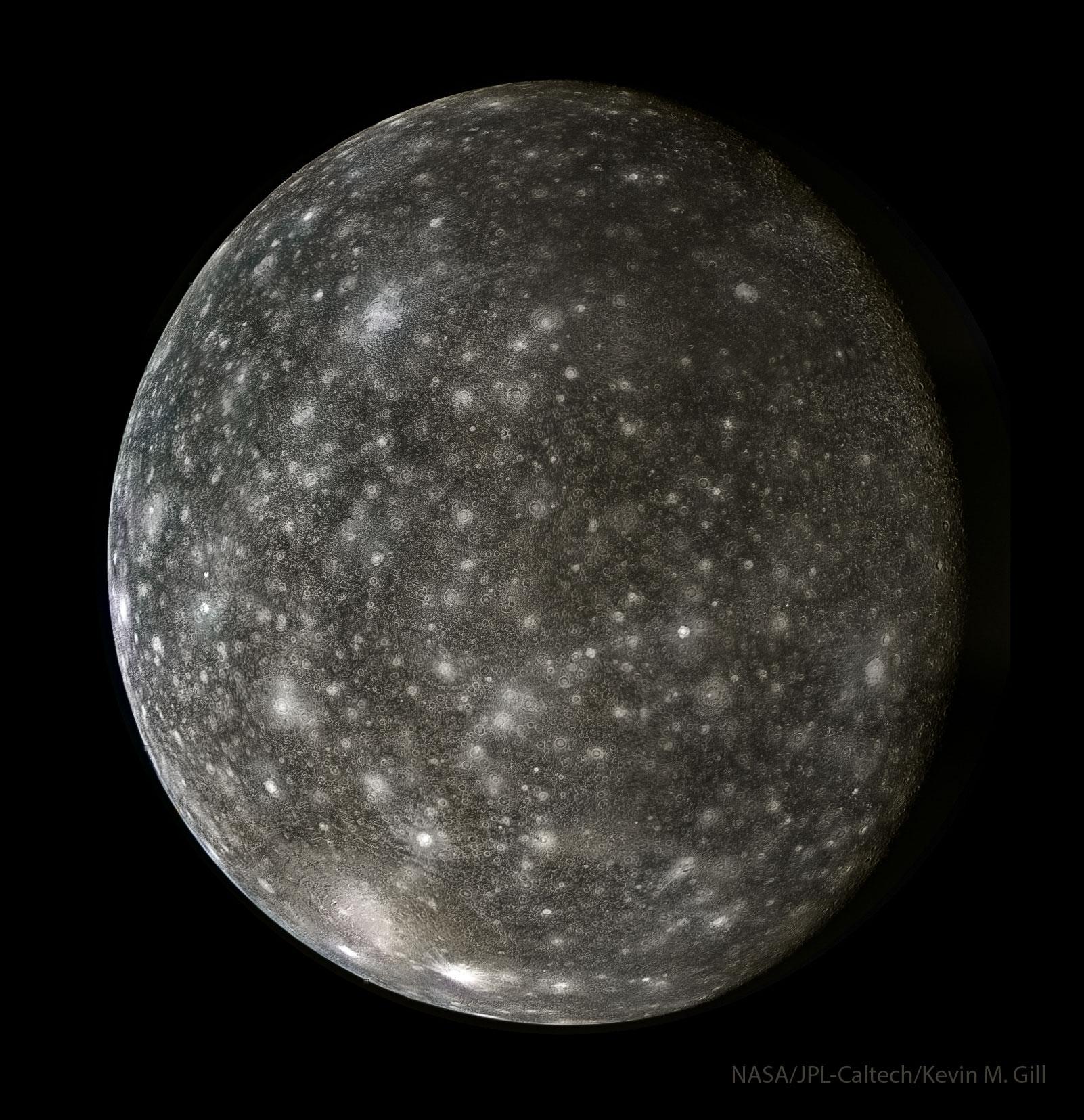
Callisto: Dirty Battered Iceball
* Image Credit: NASA, JPL-Caltech, Voyager 2
https://www.nasa.gov/
https://www.jpl.nasa.gov/
https://science.nasa.gov/mission/voyager/voyager-2/
* Processing & License: Kevin M. Gill
https://www.flickr.com/people/kevinmgill/
Explanation:
Its surface is the most densely cratered in the Solar System -- but what's inside? Jupiter's moon Callisto is a battered ball of dirty ice that is larger than the planet Mercury. It was visited by NASA's Galileo spacecraft in the 1990s and 2000s, but the recently reprocessed featured image is from a flyby of NASA's Voyager 2 in 1979. The moon would appear darker if it weren't for the tapestry of light-colored fractured surface ice created by eons of impacts. The interior of Callisto is potentially even more interesting because therein might lie an internal layer of liquid water. This potential underground sea is a candidate to harbor life -- similar with sister moons Europa and Ganymede. Callisto is slightly larger than Luna, Earth's Moon, but because of its high ice content is slightly less massive. ESA's JUICE and NASA's Europa Clipper missions are now headed out to Jupiter to better investigate its largest moons.
https://science.nasa.gov/jupiter/jupiter-moons/callisto/
https://science.nasa.gov/mission/galileo/
https://apod.nasa.gov/apod/ap981106.html
https://www.jpl.nasa.gov/news/ocean-inside-jupiters-moon-callisto-may-have-cushioned-big-impact/
https://apod.nasa.gov/apod/ap250901.html
#space #jupiter #atmosphere #astrophotography #photography #science #nature #NASA
Alt...
2025 September 1
A dark spherical body is shown that has many light craters.
Callisto: Dirty Battered Iceball
* Image Credit: NASA, JPL-Caltech, Voyager 2
* Processing & License: Kevin M. Gill
Explanation:
Its surface is the most densely cratered in the Solar System -- but what's inside? Jupiter's moon Callisto is a battered ball of dirty ice that is larger than the planet Mercury. It was visited by NASA's Galileo spacecraft in the 1990s and 2000s, but the recently reprocessed featured image is from a flyby of NASA's Voyager 2 in 1979. The moon would appear darker if it weren't for the tapestry of light-colored fractured surface ice created by eons of impacts. The interior of Callisto is potentially even more interesting because therein might lie an internal layer of liquid water. This potential underground sea is a candidate to harbor life -- similar with sister moons Europa and Ganymede. Callisto is slightly larger than Luna, Earth's Moon, but because of its high ice content is slightly less massive. ESA's JUICE and NASA's Europa Clipper missions are now headed out to Jupiter to better investigate its largest moons.
Authors & editors: Robert Nemiroff (MTU) & Jerry Bonnell (UMCP)
NASA Official: Amber Straughn Specific rights apply.
NASA Web Privacy, Accessibility, Notices;
A service of: ASD at NASA / GSFC,
NASA Science Activation
& Michigan Tech. U.
![[?]](https://media.mstdn.social/accounts/avatars/109/287/690/498/256/959/original/2592d2212322a1f9.png)
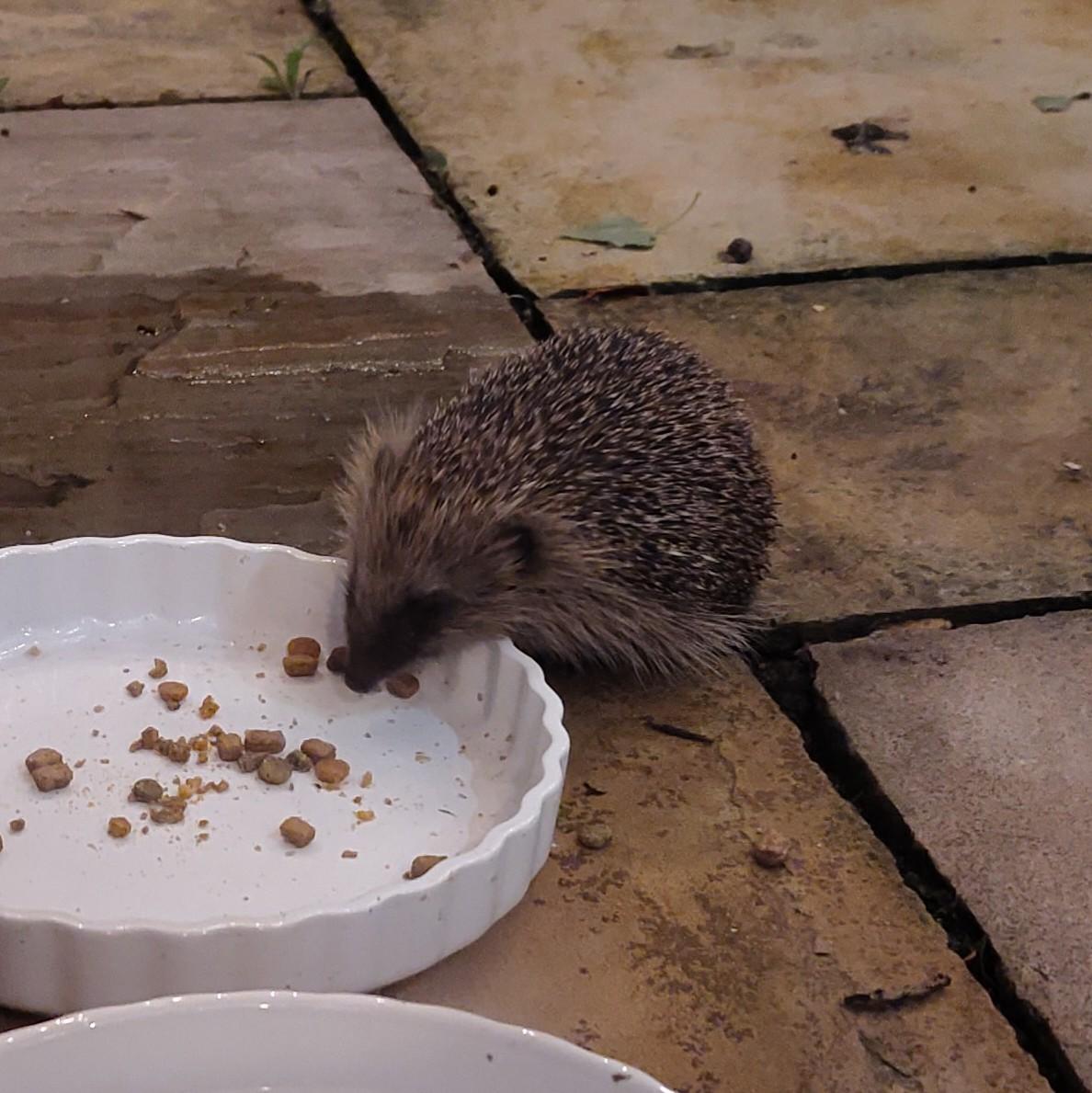
Twitchy the baby #hedgehog is visiting tonight!
#nature #NaturePhotography #wildlife #mammals #hedgehogs #CuteAnimal
Alt...
Twitchy the baby hedgehog is eating dry cat food from a flan dish on our patio. He/she is facing the camera with cute little nose pointing down into the dish.
2025 November 10
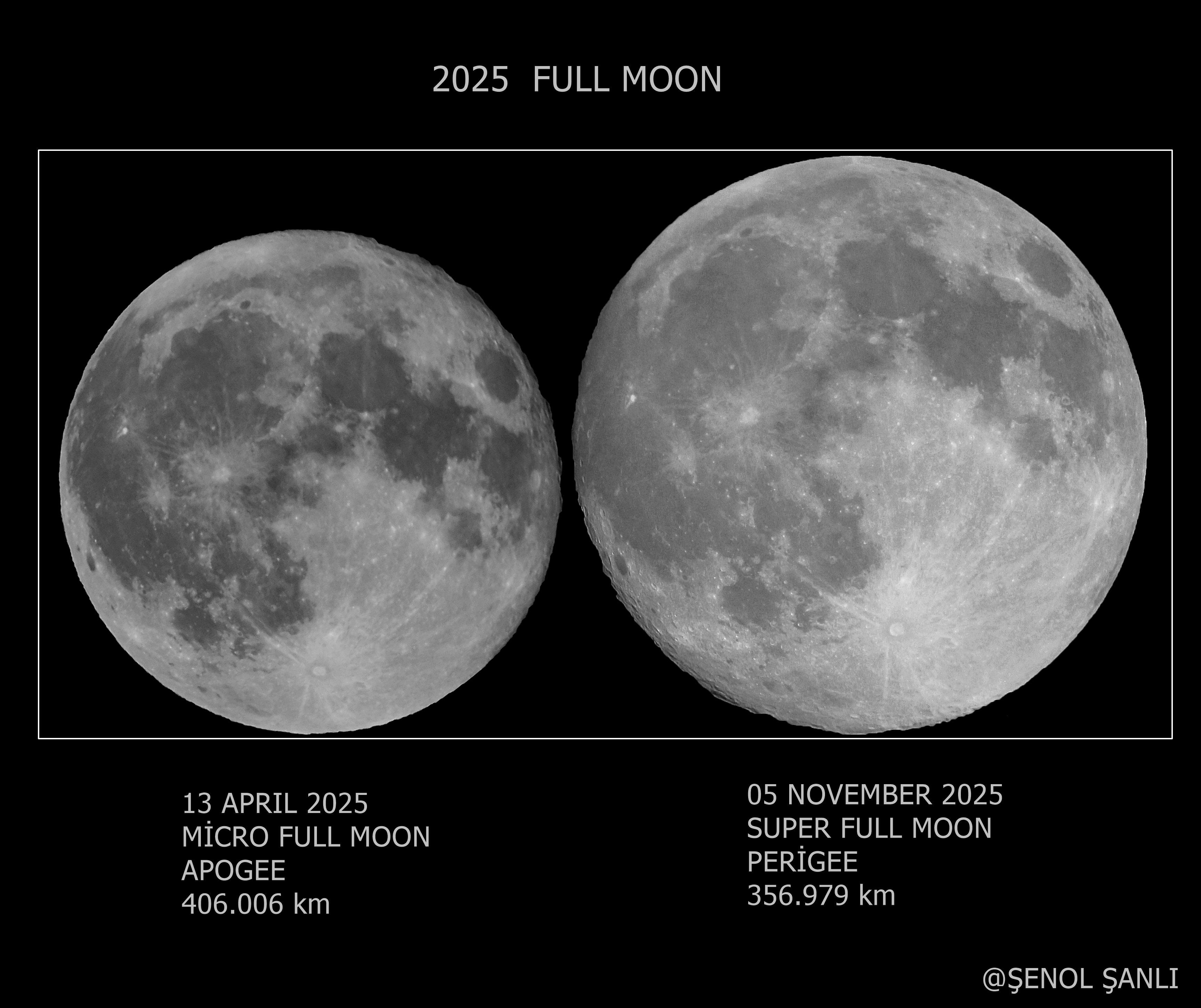
Micro Moon vs. Super Moon
* Image Credit & Copyright: Şenol Şanlı"
https://www.instagram.com/snlsanli/
Explanation:
What was so super about Wednesday's supermoon? Last week, a full moon occurred that appeared slightly larger and brighter than usual. The reason is that the Moon's fully illuminated phase occurred within a short time from perigee - when the Moon was its closest to the Earth in its elliptical orbit. Although the precise conditions that define a supermoon vary, last Wednesday's supermoon was surely the closest, largest, and brightest full moon this year. One reason supermoons are popular is because they are so easy to see -- just go outside at sunset and watch an impressive full moon rise! Pictured here, Wednesday's supermoon is compared to April's micro moon -- when a full Moon occurs near the furthest part of the Moon's orbit -- so that it appears slightly smaller and dimmer than usual. Given many definitions, at least one supermoon occurs each year, with another one coming next month (moon-th).
https://science.nasa.gov/moon/
https://www.universetoday.com/articles/what-is-a-super-moon
https://svs.gsfc.nasa.gov/5415/
https://science.nasa.gov/moon/moon-phases/
https://en.wikipedia.org/wiki/Supermoon
https://ophysics.com/f6.html
https://en.wiktionary.org/wiki/perigee
https://apod.nasa.gov/apod/ap251110.html
#space #earth #moon #astrophotography #photography #science #astronomy #physics #nature #NASA #apod
Alt...
2025 November 10
Two full Moons are shown. They are different sizes because the Micro Moon image on the left was captured when the Moon was near its furthest from the Earth, while the Super Moon on the right was captured when the Moon was near its closest to the Earth.
Micro Moon vs. Super Moon
* Image Credit & Copyright: Şenol Şanlı"
Explanation:
What was so super about Wednesday's supermoon? Last week, a full moon occurred that appeared slightly larger and brighter than usual. The reason is that the Moon's fully illuminated phase occurred within a short time from perigee - when the Moon was its closest to the Earth in its elliptical orbit. Although the precise conditions that define a supermoon vary, last Wednesday's supermoon was surely the closest, largest, and brightest full moon this year. One reason supermoons are popular is because they are so easy to see -- just go outside at sunset and watch an impressive full moon rise! Pictured here, Wednesday's supermoon is compared to April's micro moon -- when a full Moon occurs near the furthest part of the Moon's orbit -- so that it appears slightly smaller and dimmer than usual. Given many definitions, at least one supermoon occurs each year, with another one coming next month (moon-th).
Authors & editors: Robert Nemiroff (MTU) & Jerry Bonnell (UMCP)
NASA Official: Amber Straughn Specific rights apply.
NASA Web Privacy, Accessibility, Notices;
A service of: ASD at NASA / GSFC,
NASA Science Activation
& Michigan Tech
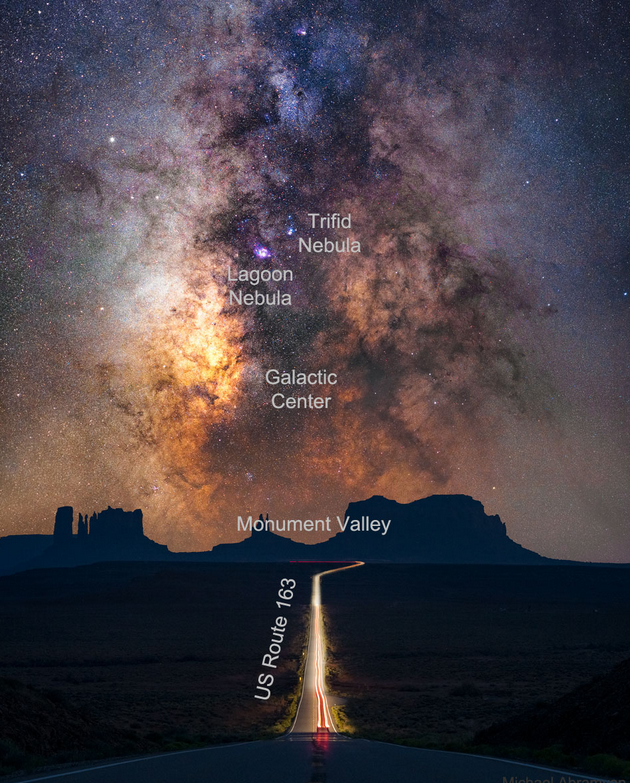
Annotations for previous post
https://apod.nasa.gov/apod/ap251109.html
#space #galaxy #milkyway #astrophotography #photography #science #astronomy #nature #NASA #apod
Alt...
Annotations for previous post
2025 November 9
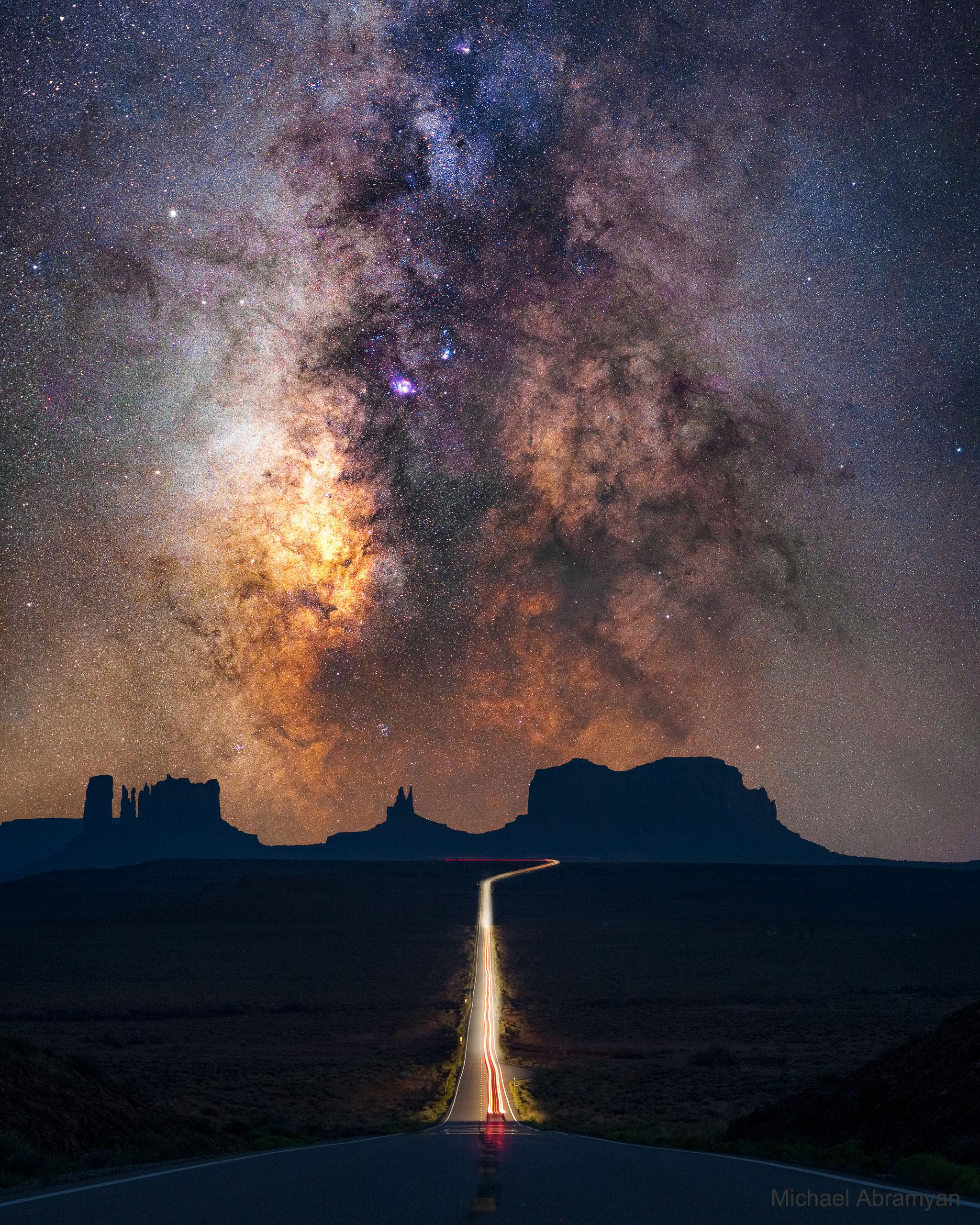
Road to the Galactic Center
* Image Credit & Copyright: Michael Abramyan
https://www.instagram.com/mikeabramyan
Explanation:
Does the road to our galaxy's center go through Monument Valley? It doesn't have to, but if your road does -- take a picture. In this case, the road is US Route 163 and iconic buttes on the Navajo National Reservation populate the horizon. The band of Milky Way Galaxy stretches down from the sky and appears to be a continuation of the road on Earth. Filaments of dust darken the Milky Way, in contrast to billions of bright stars and several colorful glowing gas clouds including the Lagoon and Trifid nebulas. The featured picture is a composite of images taken with the same camera and from the same location -- Forest Gump Point in Utah, USA. The foreground was taken just after sunset in early 2021 September during the blue hour, while the background is a mosaic of four exposures captured a few hours later.
https://www.youtube.com/watch?v=0yTBvAhj7Nw&t=293s
https://en.wikipedia.org/wiki/United_States
https://en.wikipedia.org/wiki/Monument_Valley
https://en.wikipedia.org/wiki/Utah
https://en.wikipedia.org/wiki/Navajo_Nation
https://en.wikipedia.org/wiki/Navajo_Nation#Reservation_and_expansion
https://www.travelinusa.us/forrest-gump-point/
https://science.nasa.gov/earth/
https://science.nasa.gov/resource/the-milky-way-galaxy/
https://apod.nasa.gov/apod/ap251109.html
#space #galaxy #milkyway #astrophotography #photography #science #astronomy #nature #NASA #apod
Alt...
2025 November 9
The picture shows the a composite image of Monument Valley, Utah, USA in the foreground, and the plane of the Milky Way Galaxy including the Galactic Center in the background.
Road to the Galactic Center
* Image Credit & Copyright: Michael Abramyan
Explanation:
Does the road to our galaxy's center go through Monument Valley? It doesn't have to, but if your road does -- take a picture. In this case, the road is US Route 163 and iconic buttes on the Navajo National Reservation populate the horizon. The band of Milky Way Galaxy stretches down from the sky and appears to be a continuation of the road on Earth. Filaments of dust darken the Milky Way, in contrast to billions of bright stars and several colorful glowing gas clouds including the Lagoon and Trifid nebulas. The featured picture is a composite of images taken with the same camera and from the same location -- Forest Gump Point in Utah, USA. The foreground was taken just after sunset in early 2021 September during the blue hour, while the background is a mosaic of four exposures captured a few hours later.
Authors & editors: Robert Nemiroff (MTU) & Jerry Bonnell (UMCP)
NASA Official: Amber Straughn Specific rights apply.
NASA Web Privacy, Accessibility, Notices;
A service of: ASD at NASA / GSFC,
NASA Science Activation
& Michigan Tech. U.
![[?]](data:image/png;base64, iVBORw0KGgoAAAANSUhEUgAAAEAAAABAAQAAAACCEkxzAAAAUUlEQVQoz43R0QkAMQwCUDdw/y3dwEvsvzlL4X1IoQkAisKmwfAFT3RgJHbQezpSRoXEqeqCL9BJBf7h3QbOCCxV5EVWMEMwG7K1/WODtlvxAYTtEsDU9F34AAAAAElFTkSuQmCC)
Norm Laknes Train Stop Wheeler, Oregon! Right on the Oregon Coast! Prints & more sold here: https://pixels.com/featured/norm-laknes-train-stop-wheeler-oregon-thom-zehrfeld.html #railwaystation #railway #railways #train #trains #railwayphotograph #BuyIntoArt #Art #OregonCoast #PNW #Puzzle #Prints #PhotographyIsArt #Photography
#ArtForSale #ArtMatters #MastoArt #Mastodon #ArtforInteriorDesign #HospitalityInteriors
#InteriorDesign #Wallart #InteriorDecorating #WallArtForSale #PhotoOfTheDay #FediGiftShop #GiftIdeas #FediArt #Prints #FediArtShop #Nature

Alt...
Norm Laknes Train Stop Wheeler, Oregon! Right on the Oregon Coast! Prints & more sold here: https://pixels.com/featured/norm-laknes-train-stop-wheeler-oregon-thom-zehrfeld.html #railwaystation #railway #railways #train #trains #railwayphotograph #BuyIntoArt #Art #OregonCoast #PNW #Puzzle #Prints #PhotographyIsArt #Photography
#ArtForSale #ArtMatters #MastoArt #Mastodon #ArtforInteriorDesign #HospitalityInteriors
#InteriorDesign #Wallart #InteriorDecorating #WallArtForSale #PhotoOfTheDay #FediGiftShop #GiftIdeas #FediArt #Prints #FediArtShop #Nature

Alt...
Norm Laknes Train Stop Wheeler, Oregon! Right on the Oregon Coast! Prints & more sold here: https://pixels.com/featured/norm-laknes-train-stop-wheeler-oregon-thom-zehrfeld.html #railwaystation #railway #railways #train #trains #railwayphotograph #BuyIntoArt #Art #OregonCoast #PNW #Puzzle #Prints #PhotographyIsArt #Photography
#ArtForSale #ArtMatters #MastoArt #Mastodon #ArtforInteriorDesign #HospitalityInteriors
#InteriorDesign #Wallart #InteriorDecorating #WallArtForSale #PhotoOfTheDay #FediGiftShop #GiftIdeas #FediArt #Prints #FediArtShop #Nature
![[?]](https://cdn.masto.host/socelnet/accounts/avatars/109/355/496/809/872/483/original/4bb481e7a50769d3.jpg)
This cute little robin wishes you a nice day!
Robin on a perch handmade watercolor painting:
--> https://karen-kaspar.pixels.com/featured/robin-on-a-perch-karen-kaspar.html
--> https://www.pictorem.com/2416300/robin-on-a-perch-watercolor-painting/
#robin #MastoArt #art #painting #FediArt #FediGiftShop #artist #arte #MastodonArt #TraditionalArt #kunst #contemporaryArt #watercolor #watercolour #creativeToots #BuyIntoArt #bird #birds #BirdsOfMastodon #BirdArt #birding #nature #NatureLover #BirdWatching #wildlife #vogel #cute #animals #handmade #aquarell #giftideas
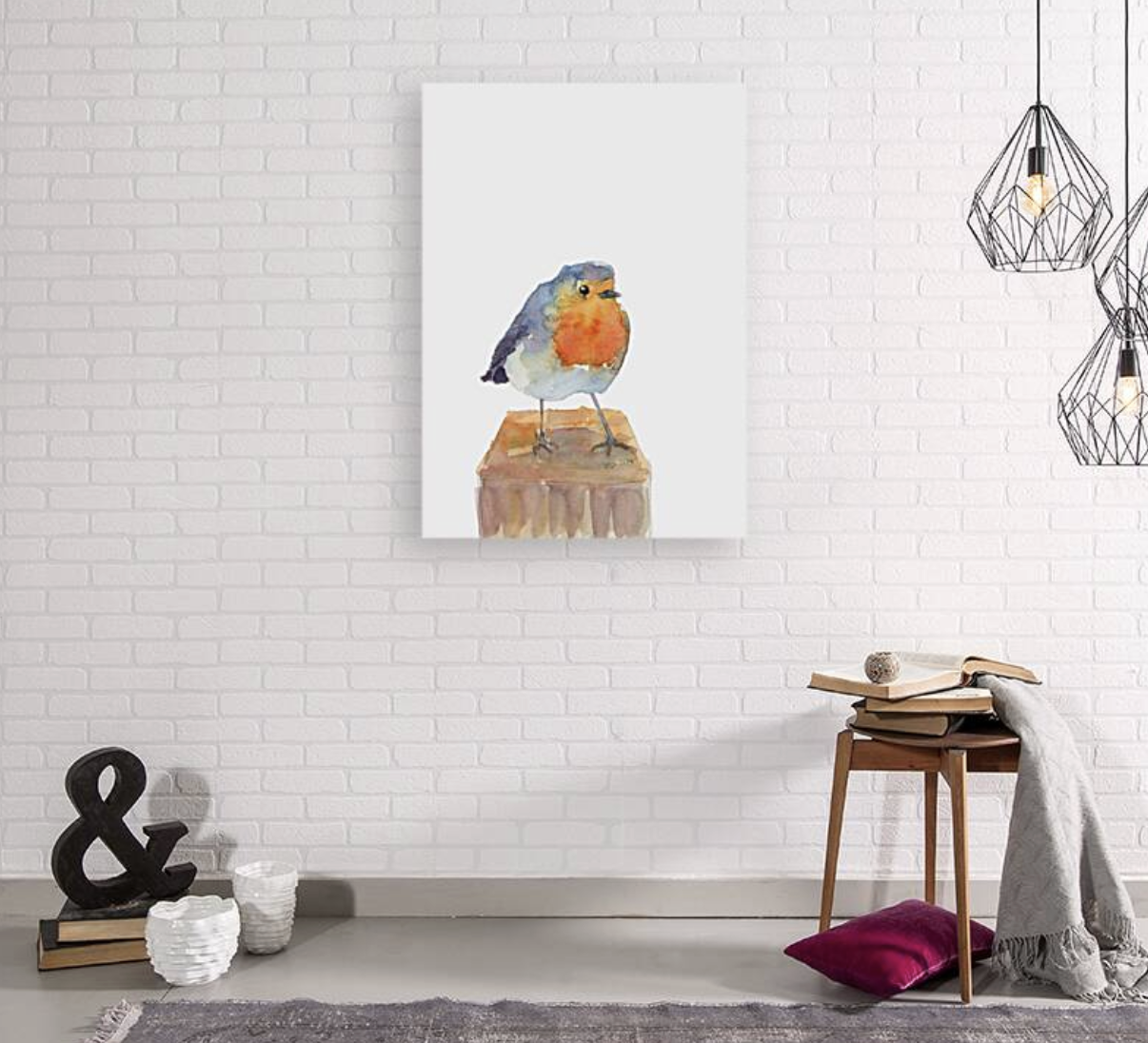
Alt...
Robin on a perch is a hand-painted watercolor painting in portrait format by the artist Karen Kaspar.
A small robin with bright orange breast feathers stands on a square wooden perch and looks around with interest. The bird was painted with loose brushstrokes and the background was left white.
The soft watercolour style gives the overall picture a gentle and dreamy touch.
Here you see the painting on a wall in a living room setting.
![[?]](https://files.mastodon.online/accounts/avatars/109/271/812/073/878/781/original/26e9709eacb8cfde.png)
A Texas leafcutter ant, Atta texana, hauls spring Prunus buds along a tree branch on her way back to the nest.
#Ants #Insects #Atta #nature #leafcutterants
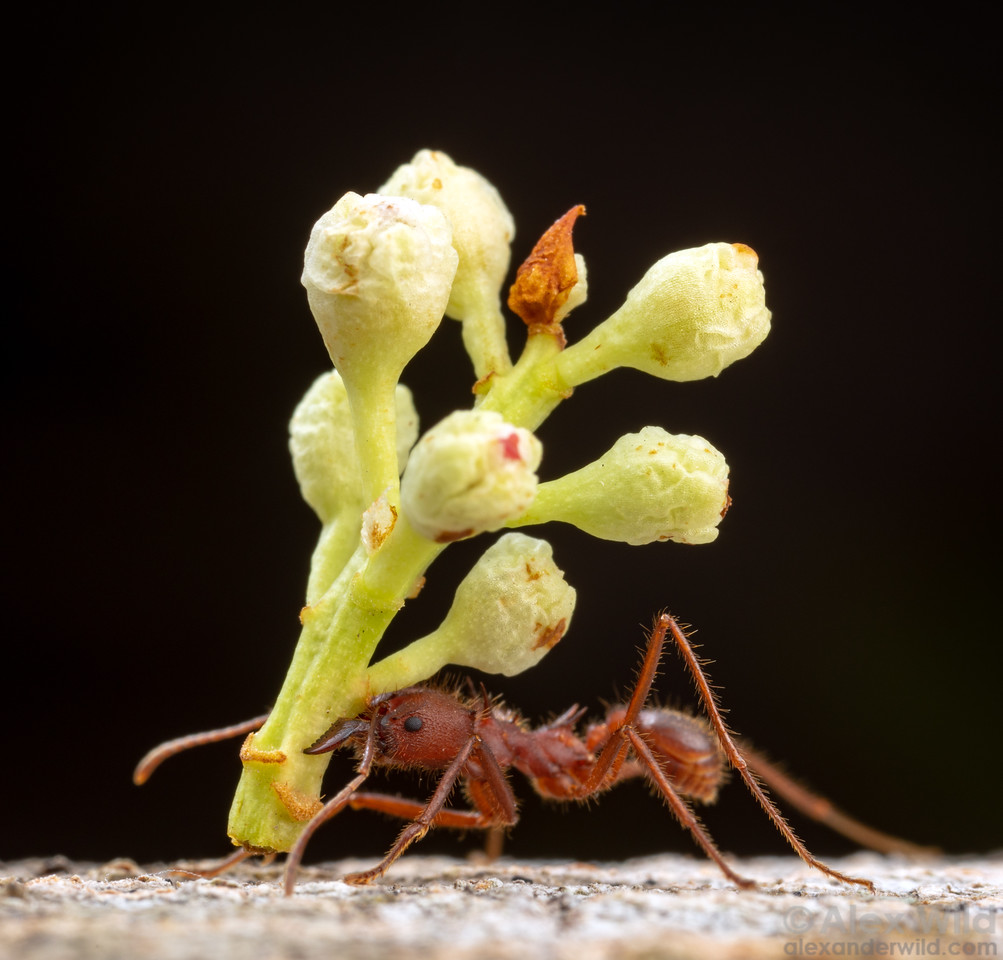
Alt...
macro photo of a dull red, leggy ant with sharp spines along its back struggling with a much larger multi-flowered plant bud in its mandibles, held over its back, against a pure black background.
Here is my contribution for day 2 of the Mix or Match Collage Challenge by FineArtAmerica.
Enjoy!
Birds in an autumn forest
--> https://karenkasparartprints.com/featured/birds-in-an-autumn-forest-paper-collage-karen-kaspar.html
#collage #paper #art #painting #kunst #contemporaryArt #watercolor #birds #BirdsOfMastodon #BirdArt #nature #NatureLover #wildlife #vogel #cute #animals #handmade #MastoArt #FediGiftShop #arte #InteriorDesign #creativeToots #BuyIntoArt #autumn #trees #gifts #leaves #fallfoliage #herbst
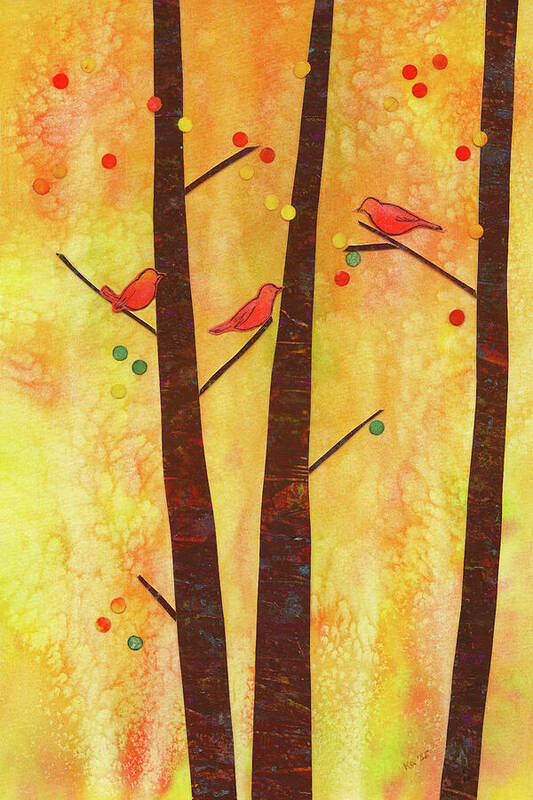
Alt...
Birds in an autumn forest is a handmade paper collage by artist Karen Kaspar.
The artwork shows three red birds sitting on slender branches of tall, slender trees. The tree trunks in dark brown tones stand out against the background in bright, warm autumn colors of yellow, orange and red. The autumn leaves are falling from the trees.
The tree trunks and branches were painted on paper with acrylic paint and then mounted as a collage on the background painted with watercolors and combined with the watercolor birds.
The autumn picture is minimalist and conveys a calm, warm and peaceful mood.
2025 November 8
A Full Moon at Perigee
* Image Credit & Copyright: Betul Turksoy
https://www.instagram.com/betul_turksoy/p/DQqj4P-Dcgu/
Explanation:
What is big, bright, and beautiful, can wear a cape made of clouds, and is at the closest point in its elliptical orbit around planet Earth? A full moon at perigee of course, captured here near moonset in predawn skies on November 5 from Kayseri, Turkiye. Full moons that happen at (or very near) perigee, and so are slightly larger and brighter than full moons on average, have become popularly known as supermoons. In fact, this full moon at perigee is the closest and brightest of the three supermoons of 2025. Rising as the Sun sets, this full moon follows this October's Harvest Moon and is traditionally known to some as the Hunter's Moon.
https://science.nasa.gov/moon/supermoons/
https://astropixels.com/ephemeris/moon/fullperigee2001.html
https://earthsky.org/astronomy-essentials/everything-you-need-to-know-hunters-moon/
https://apod.nasa.gov/apod/fap/ap251108.html
#space #earth #moon #astrophotography #photography #science #astronomy #nature #NASA #apod
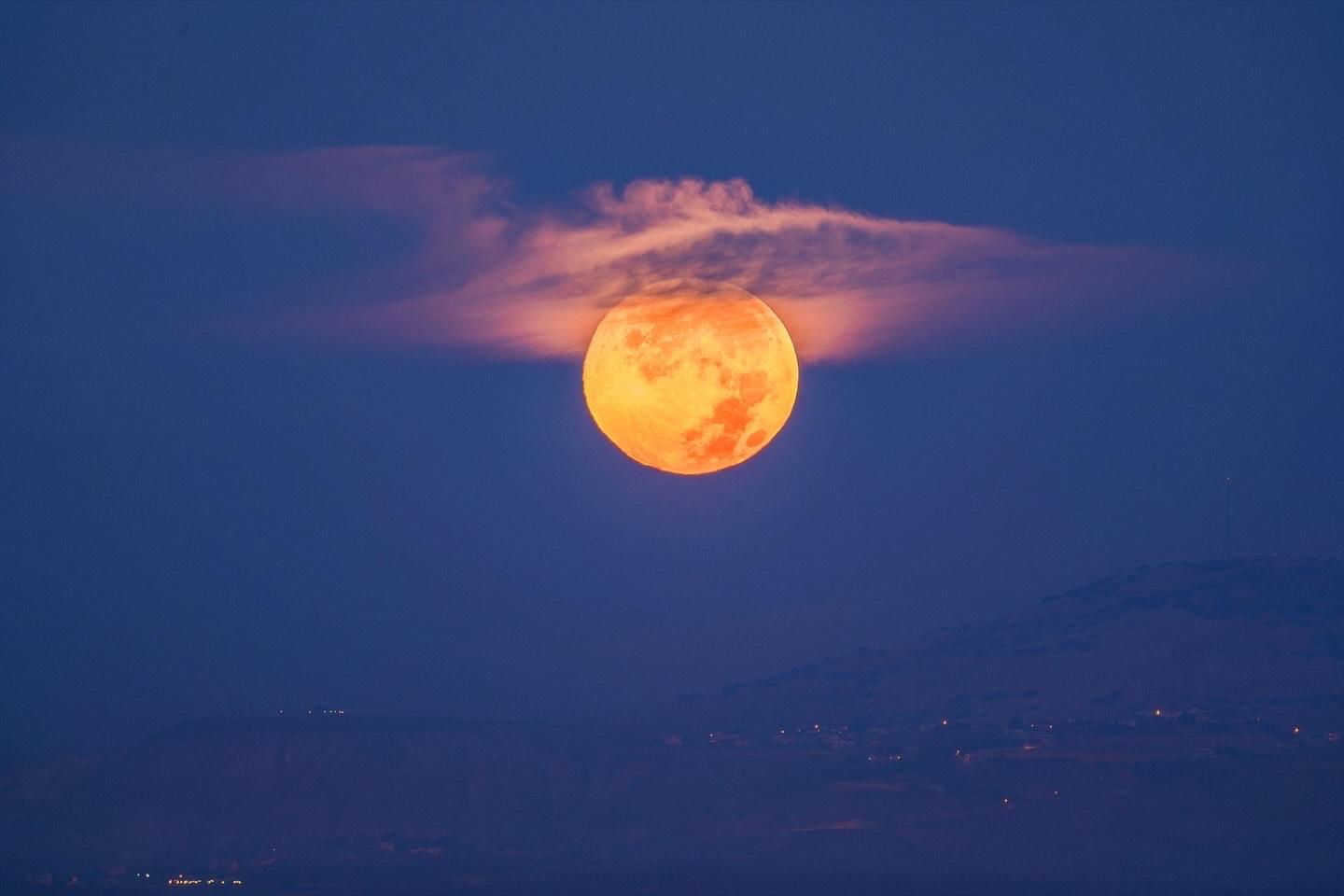
Alt...
2025 November 8
A Full Moon at Perigee
* Image Credit & Copyright: Betul Turksoy
Explanation:
What is big, bright, and beautiful, can wear a cape made of clouds, and is at the closest point in its elliptical orbit around planet Earth? A full moon at perigee of course, captured here near moonset in predawn skies on November 5 from Kayseri, Turkiye. Full moons that happen at (or very near) perigee, and so are slightly larger and brighter than full moons on average, have become popularly known as supermoons. In fact, this full moon at perigee is the closest and brightest of the three supermoons of 2025. Rising as the Sun sets, this full moon follows this October's Harvest Moon and is traditionally known to some as the Hunter's Moon.
Authors & editors: Robert Nemiroff (MTU) & Jerry Bonnell (UMCP)
NASA Official: Amber Straughn Specific rights apply.
NASA Web Privacy, Accessibility, Notices;
A service of: ASD at NASA / GSFC,
NASA Science Activation
& Michigan Tech. U.
Old Time Mall-Bandon, Oregon! Check out prints and more at: https://pixels.com/featured/old-town-mall-bandon-thom-zehrfeld.html #bandonoregon #oregoncoast #bandon #OldTownMall #ArtForSale #Art #BuyIntoArt #PNW #ThomZehrfeldPhotography #PhotographyIsArt #Photography #Fotografie
#ArtForSale #ArtMatters #MastoArt #Mastodon #ArtforInteriorDesign #HospitalityInteriors
#InteriorDesign #Wallart #InteriorDecorating #WallArtForSale #PhotoOfTheDay #FediGiftShop #GiftIdeas #FediArt #Prints #FediArtShop #Colorful #Nature

Alt...
Old Time Mall-Bandon, Oregon! Check out prints and more at: https://pixels.com/featured/old-town-mall-bandon-thom-zehrfeld.html #bandonoregon #oregoncoast #bandon #OldTownMall #ArtForSale #Art #BuyIntoArt #PNW #ThomZehrfeldPhotography #PhotographyIsArt #Photography #Fotografie
#ArtForSale #ArtMatters #MastoArt #Mastodon #ArtforInteriorDesign #HospitalityInteriors
#InteriorDesign #Wallart #InteriorDecorating #WallArtForSale #PhotoOfTheDay #FediGiftShop #GiftIdeas #FediArt #Prints #FediArtShop #Colorful #Nature
![[?]](https://files.mastodon.social/accounts/avatars/110/565/133/827/266/631/original/860f1d5caf30737b.jpg)
Pigeon in grass with autumn leaves
#pigeon #grass #autumnleaves #blue #green #orange #hues #art #contemporaryart #artforsale #artist #painting #wallart #fineart #interiordesign #artbuyer #buyintoart #ayearforart #buyart #beautifulart #print #poster #autumnvibes #leaves #nature #colorful #bluegreen
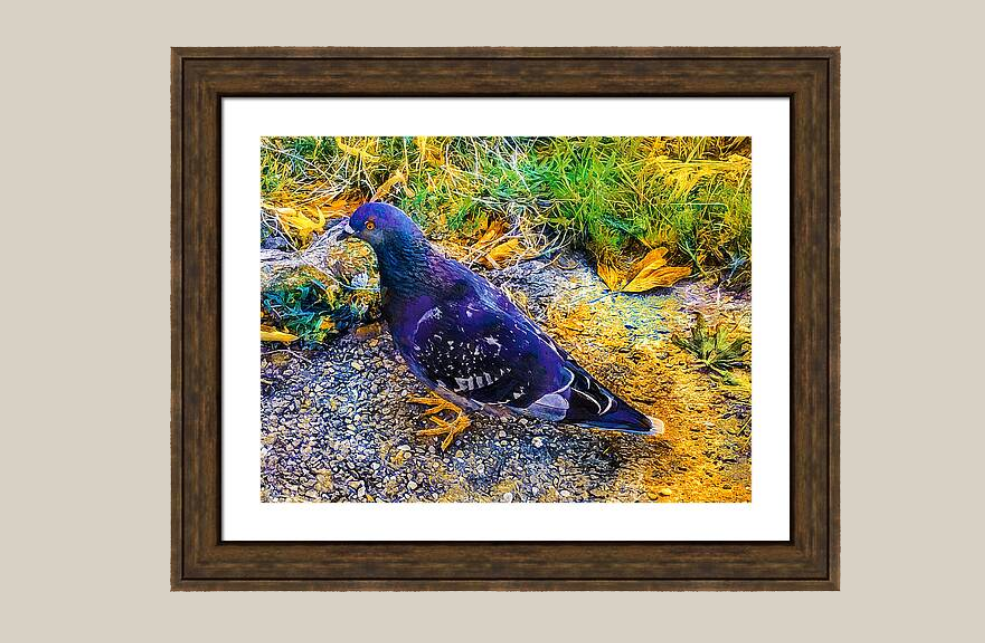
Alt...
Pigeon in grass with autumn leaves
Forest creek running through stones covered in moss
#art #contemporaryart #artforsale #artist #painting #wallart #fineart #interiordesign #artbuyer #buyintoart #ayearforart #buyart #beautifulart #print #poster #forest #creek #stones #moss #nature #landscape #serene #peaceful #calming #relaxing #soothing

Alt...
Forest creek running through stones covered in moss
2025 November 7
A Dark Seahorse in Cepheus
* Image Credit & Copyright: Jordi Jofre
https://app.astrobin.com/u/JJofre#gallery
Explanation:
Spanning light-years, this suggestive shape known as the Seahorse Nebula floats in silhouette against a rich background of of stars and glowing hydrogen gas. Seen toward the royal northern constellation of Cepheus, the dusty, dark nebula is part of a Milky Way molecular cloud some 1,200 light-years distant. It is also listed as Barnard 150 (B150), one of 182 dark markings of the sky cataloged in the early 20th century by astronomer E. E. Barnard. Packs of low mass stars are forming within, but their collapsing cores are only visible at long infrared wavelengths. Still, the luminous depths of the Milky Way in Cepheus add to this stunning galactic skyscape.
https://app.astrobin.com/i/pw6z9f
https://ui.adsabs.harvard.edu/abs/1916ApJ....43....1B/abstract
https://ui.adsabs.harvard.edu/abs/1919ApJ....49....1B/abstract
https://exhibit-archive.library.gatech.edu/barnard/
https://science.nasa.gov/ems/07_infraredwaves/
https://apod.nasa.gov/apod/ap251107.html
#space #nebula #astronomy #science #astrophotography #photography #nature #nebula #NASA #apod
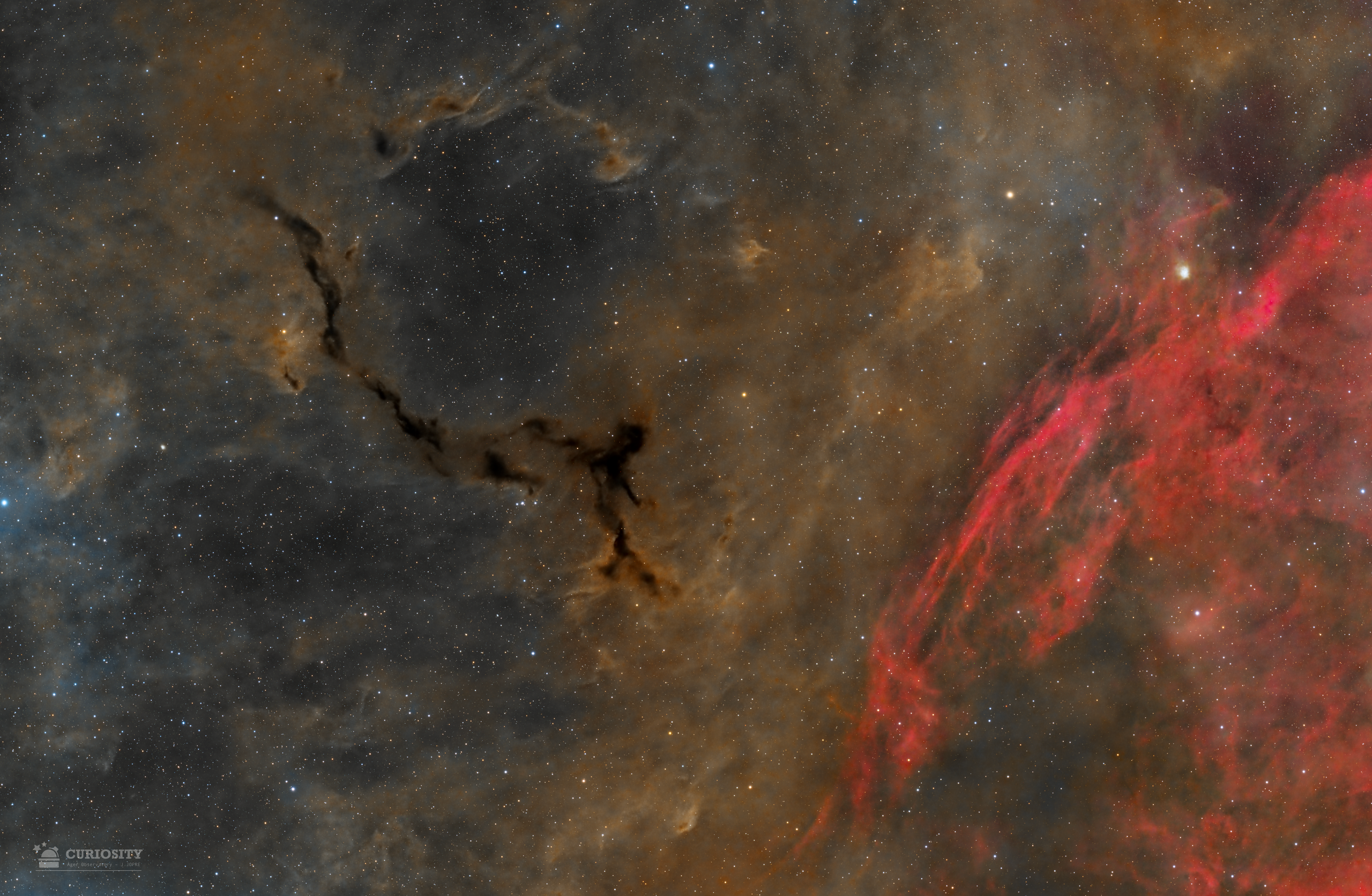
Alt...
2025 November 7
A Dark Seahorse in Cepheus
* Image Credit & Copyright: Jordi Jofre
Explanation:
Spanning light-years, this suggestive shape known as the Seahorse Nebula floats in silhouette against a rich background of of stars and glowing hydrogen gas. Seen toward the royal northern constellation of Cepheus, the dusty, dark nebula is part of a Milky Way molecular cloud some 1,200 light-years distant. It is also listed as Barnard 150 (B150), one of 182 dark markings of the sky cataloged in the early 20th century by astronomer E. E. Barnard. Packs of low mass stars are forming within, but their collapsing cores are only visible at long infrared wavelengths. Still, the luminous depths of the Milky Way in Cepheus add to this stunning galactic skyscape.
Authors & editors: Robert Nemiroff (MTU) & Jerry Bonnell (UMCP)
NASA Official: Amber Straughn Specific rights apply.
NASA Web Privacy, Accessibility, Notices;
A service of: ASD at NASA / GSFC,
NASA Science Activation
& Michigan Tech. U.
Today I had great fun creating this paper collage for day 1 of the Mix or Match Collage Challenge by FineArtAmerica.
Hope you enjoy it too!
Birds in a winter forest - Watercolor, acrylics, paper collage
--> https://karenkasparartprints.com/featured/birds-in-a-winter-forest-paper-collage-karen-kaspar.html
#collage #paper #art #painting #kunst #contemporaryArt #watercolor #birds #BirdsOfMastodon #BirdArt #nature #NatureLover #wildlife #vogel #cute #animals #handmade #MastoArt #FediGiftShop #arte #InteriorDesign #creativeToots #BuyIntoArt #winter #trees #gifts #snow

Alt...
Birds in a Winter Forest is a handmade paper collage by artist Karen Kaspar.
In a snowy winter landscape in soft blue tones, three bright red birds sit on bare branches of tall, slender tree trunks that stand out in dark brown against the light winter background. Large white snowflakes are falling.
The tree trunks and branches were painted on paper with acrylic paint and then mounted as a collage on the watercolor background and combined with the watercolor birds.
The winter picture is minimalist and conveys a calm and peaceful atmosphere.
![[?]](https://cdn.masto.host/socelnet/accounts/avatars/109/331/844/903/061/219/original/addecf8debd3f2d2.jpeg)
Two herons by the water's edge, watercolor.
ART -https://deborahleaguefineart.etsy.com/listing/1780249148/two-heron-by-waters-edge-watercolor-art
#ayearforart #buyintoart #mastodonart #mastoart #fediart #fedigiftshop #giftideas #art #arte #artist #artwork #artmatters #artbooster #colorful #wallart #homedecor #kunst #interiordesign #creativetoots #artforsale #artprints #watercolor #painting #watercolour #birds #birdsofmastodon #nature

Alt...
Framed art shown in a display room.

Alt...
Two heron by waters edge, watercolor. Two birds with striking blue and white plumage and long legs stand near the edge of a body of water, surrounded by rocks and sparse vegetation. The background features a misty, wooded landscape, giving a sense of tranquility to the scene.
Mister Lonely walks the beach.
ART -h ttps://deborah-league.pixels.com/featured/mister-lonely-deborah-league.html
#ayearforart #buyintoart #mastodonart #mastoart #fediart #fedigiftshop #giftideas #art #arte #artist #artwork #artmatters #artbooster #colorful #wallart #homedecor #kunst #interiordesign #creativetoots #artforsale #artprints #birds #nature #oceanscape

Alt...
A lone white crane walks along the Sarasota shoreline as the setting sun casts tropical colors of pink, purple, yellow and blue on the water. Tranquil wall art for your home or office.

Alt...
Framed artwork shown in a display room.
2025 November 6
NGC 253: Dusty Island Universe
* Image Credit & Copyright: Adam Block
https://www.adamblockphotos.com/
Explanation:
Shiny NGC 253 is one of the brightest spiral galaxies visible, and also one of the dustiest. Some call it the Silver Coin Galaxy for its appearance in small telescopes, or just the Sculptor Galaxy for its location within the boundaries of the southern constellation Sculptor. Discovered in 1783 by mathematician and astronomer Caroline Herschel, the dusty island universe lies a mere 10 million light-years away. About 70 thousand light-years across, NGC 253 is the largest member of the Sculptor Group of Galaxies, the nearest to our own Local Group of Galaxies. In addition to its spiral dust lanes, tendrils of dust seem to be rising from its galactic disk laced with young star clusters and star forming regions in this colorful galaxy portrait. The high dust content accompanies frantic star formation, earning NGC 253 the designation of a starburst galaxy. NGC 253 is also known to be a strong source of high-energy x-rays and gamma rays, likely due to black holes near the galaxy's center.
https://www.adamblockphotos.com/ngc-253.html
https://science.nasa.gov/asset/hubble/spiral-galaxy-ngc-253-left-and-its-core-full-of-star-formation/
https://www.arxiv.org/abs/astro-ph/0509430
https://chandra.harvard.edu/photo/2001/0012/index.html
https://www.nasa.gov/universe/nasa-missions-unmask-magnetar-eruptions-in-nearby-galaxies/
http://www.messier.seds.org/more/local.html
http://www.messier.seds.org/xtra/ngc/sclgr.html
http://www.messier.seds.org/xtra/ngc/n0253.html
https://www.rmg.co.uk/stories/space-astronomy/caroline-herschel-first-paid-female-astronomer
https://apod.nasa.gov/apod/fap/ap251106.html
#space #galaxy #astrophotography #photography #science #astronomy #nature #NASA #ESA #apod
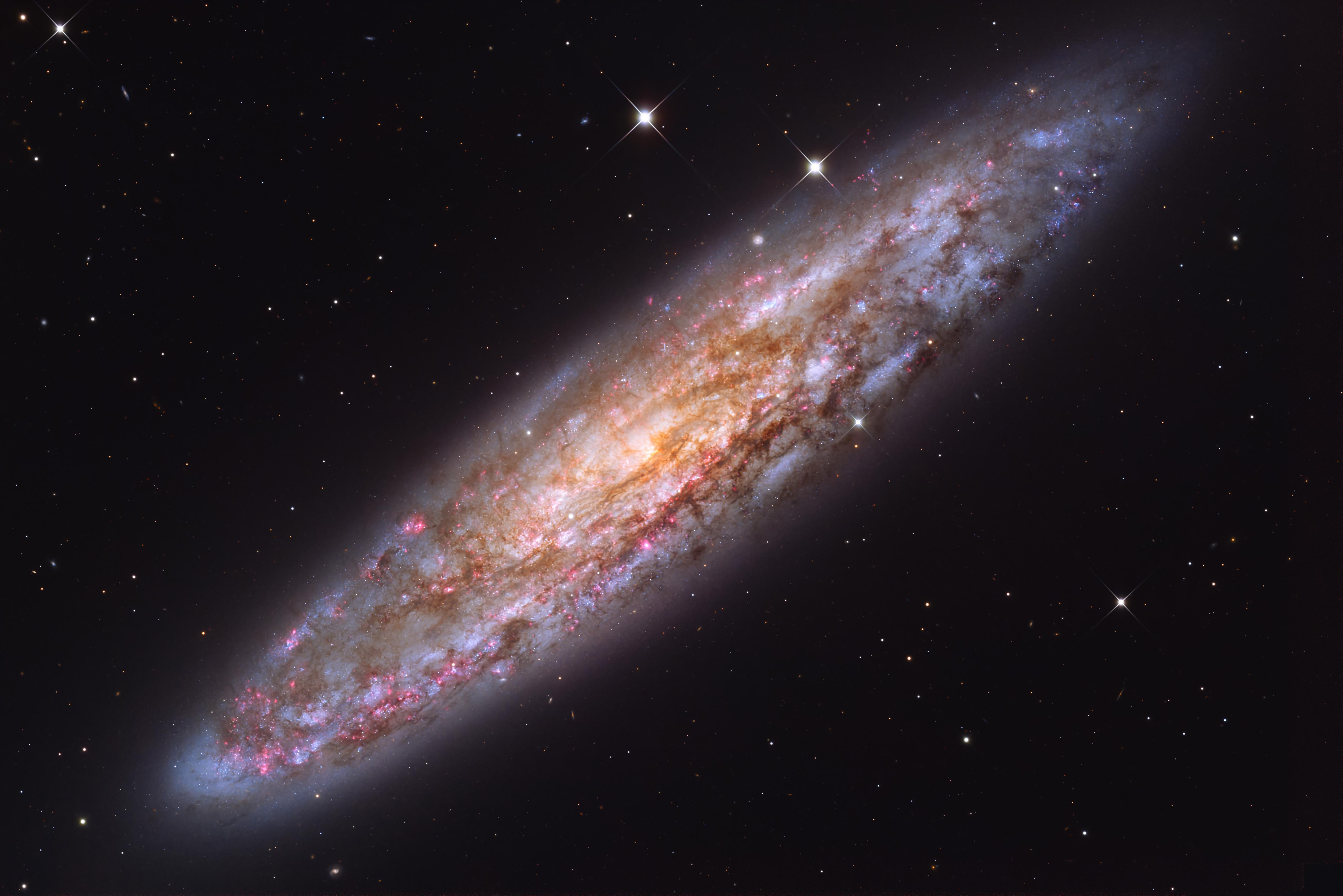
Alt...
2025 November 6
NGC 253: Dusty Island Universe
* Image Credit & Copyright: Adam Block
Explanation:
Shiny NGC 253 is one of the brightest spiral galaxies visible, and also one of the dustiest. Some call it the Silver Coin Galaxy for its appearance in small telescopes, or just the Sculptor Galaxy for its location within the boundaries of the southern constellation Sculptor. Discovered in 1783 by mathematician and astronomer Caroline Herschel, the dusty island universe lies a mere 10 million light-years away. About 70 thousand light-years across, NGC 253 is the largest member of the Sculptor Group of Galaxies, the nearest to our own Local Group of Galaxies. In addition to its spiral dust lanes, tendrils of dust seem to be rising from its galactic disk laced with young star clusters and star forming regions in this colorful galaxy portrait. The high dust content accompanies frantic star formation, earning NGC 253 the designation of a starburst galaxy. NGC 253 is also known to be a strong source of high-energy x-rays and gamma rays, likely due to black holes near the galaxy's center.
Authors & editors: Robert Nemiroff (MTU) & Jerry Bonnell (UMCP)
NASA Official: Amber Straughn Specific rights apply.
NASA Web Privacy, Accessibility, Notices;
A service of: ASD at NASA / GSFC,
NASA Science Activation
& Michigan Tech. U.
![[?]](https://cdn.masto.host/swisssocial/accounts/avatars/109/610/582/883/537/207/original/0e6a86a6c0df06cc.jpg)

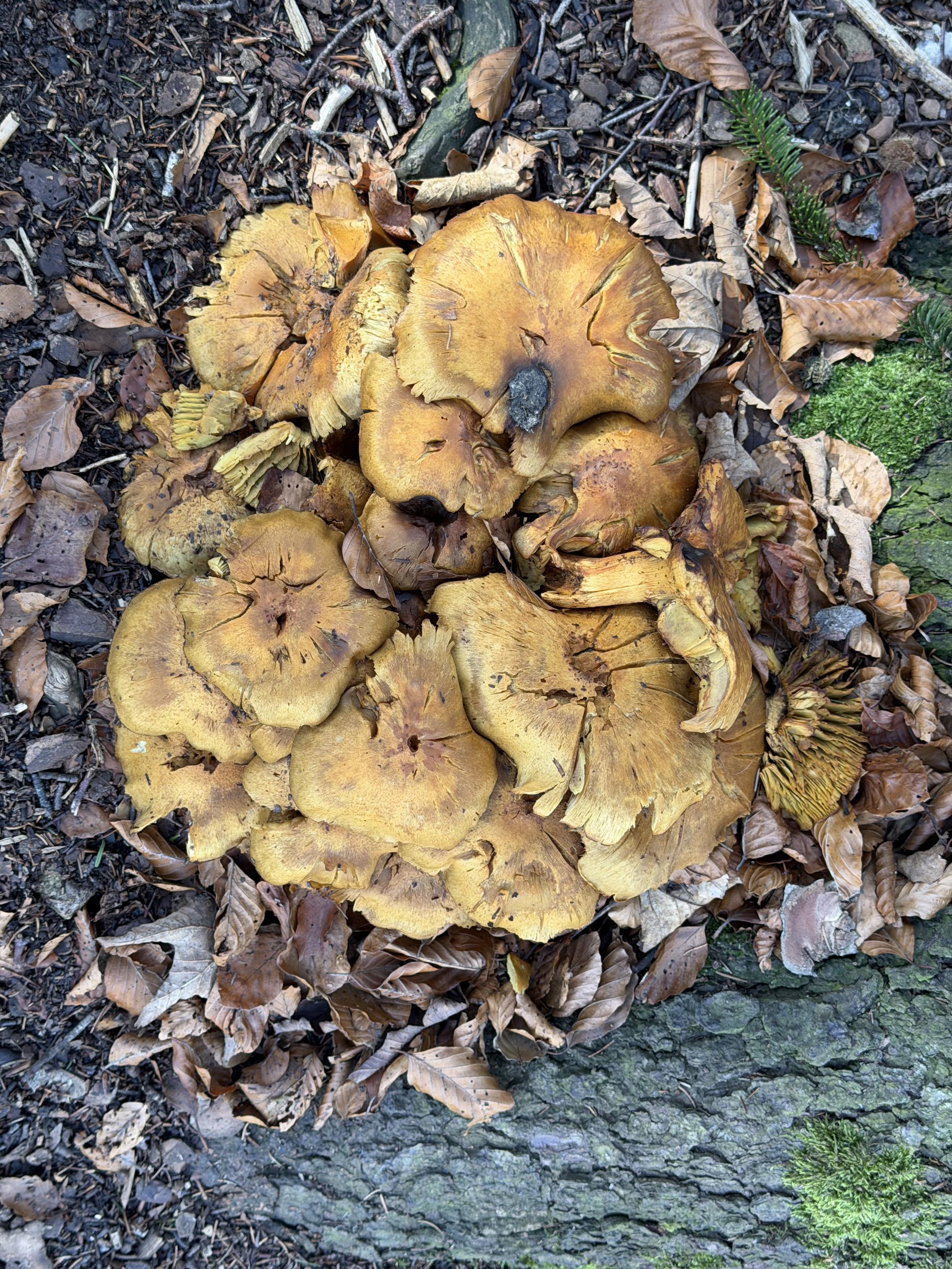
#dogs #DogsOfFedi #dogsOfPixelFed #dogsofmastodon #nature #natur #landscape #landschaft #hiking #wandern
Sanchoz, schwarzweisser Mischlingshund fragt sich gerade, ob es eine gute Idee ist, Shiro als freund zu haben 😂
Sanchoz, a black and white mixed-breed dog, wonders whether it's a good idea to have Shiro as a friend 😂

Alt...
Sanchoz, schwarzweisser Mischlingshund fragt sich gerade, ob es eine gute Idee ist, Shiro als freund zu haben
Sanchoz, a black and white mixed-breed dog, wonders whether it's a good idea to have Shiro as a friend
#dogs #DogsOfFedi #dogsOfPixelFed #dogsofmastodon #nature #natur #landscape #landschaft #hiking #wandern
Shiro, rehbrauner Jagdhund liebt Schnee über alles, und es hatte gestern noch ein kleiner Rest 😂
Shiro, a fawn-colored hunting dog, loves snow more than anything, and there was still a little bit left yesterday 😂
#nature #natur #landscape #landschaft #hiking #wandern
Aussichtspunkt mit Blick auf das Nebelmeer, eine Alpenkette im Hintergrund
Viewpoint overlooking the fog, an Alpine chain in the background
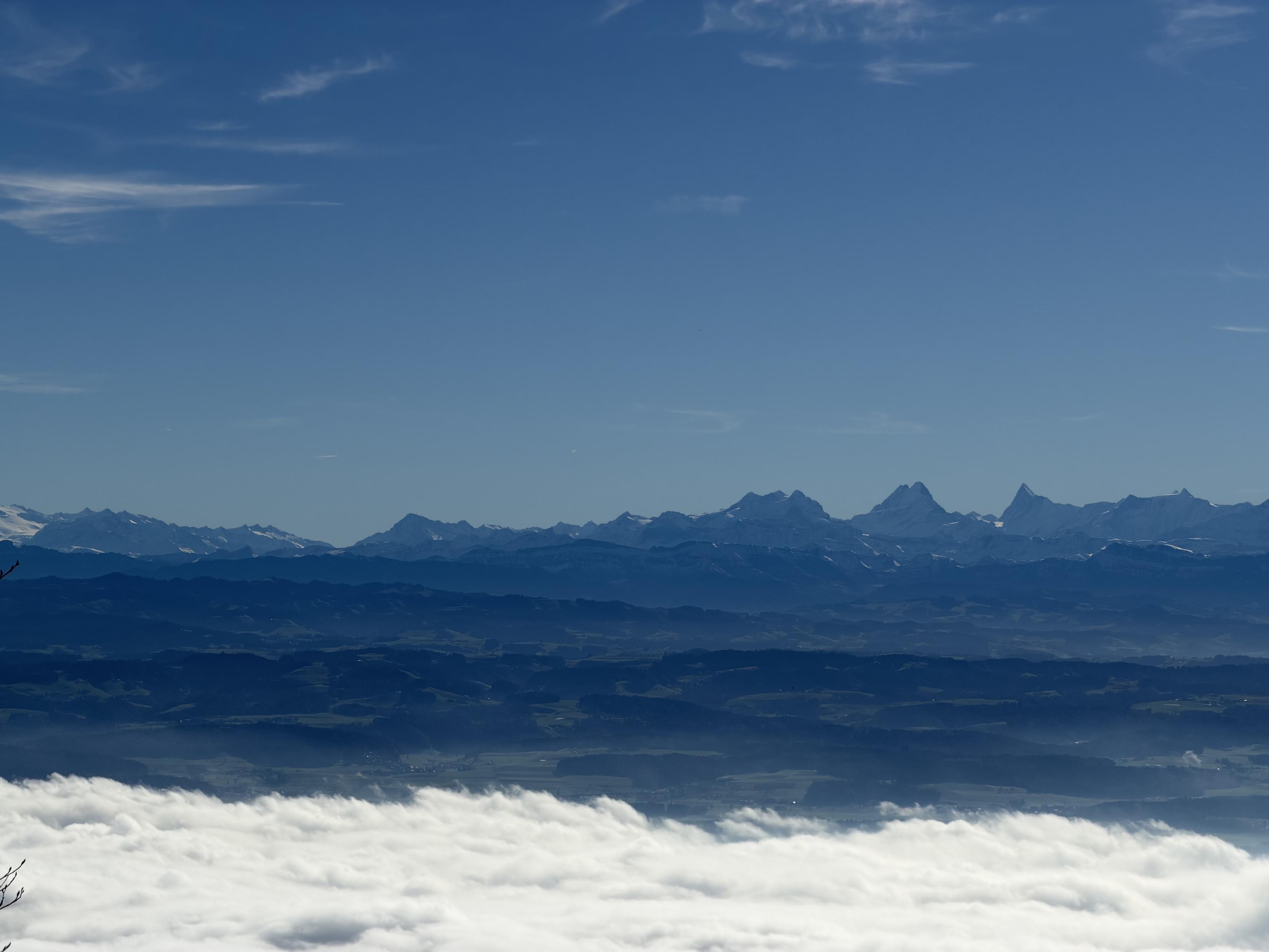
Alt...
Blauer Himmel, dann eine Alpenkette, Sicht auf Berge und Wiese, darunter das Nebelmeer
Blue sky, then an Alpine chain, view of mountains and meadow, below the sea of fog
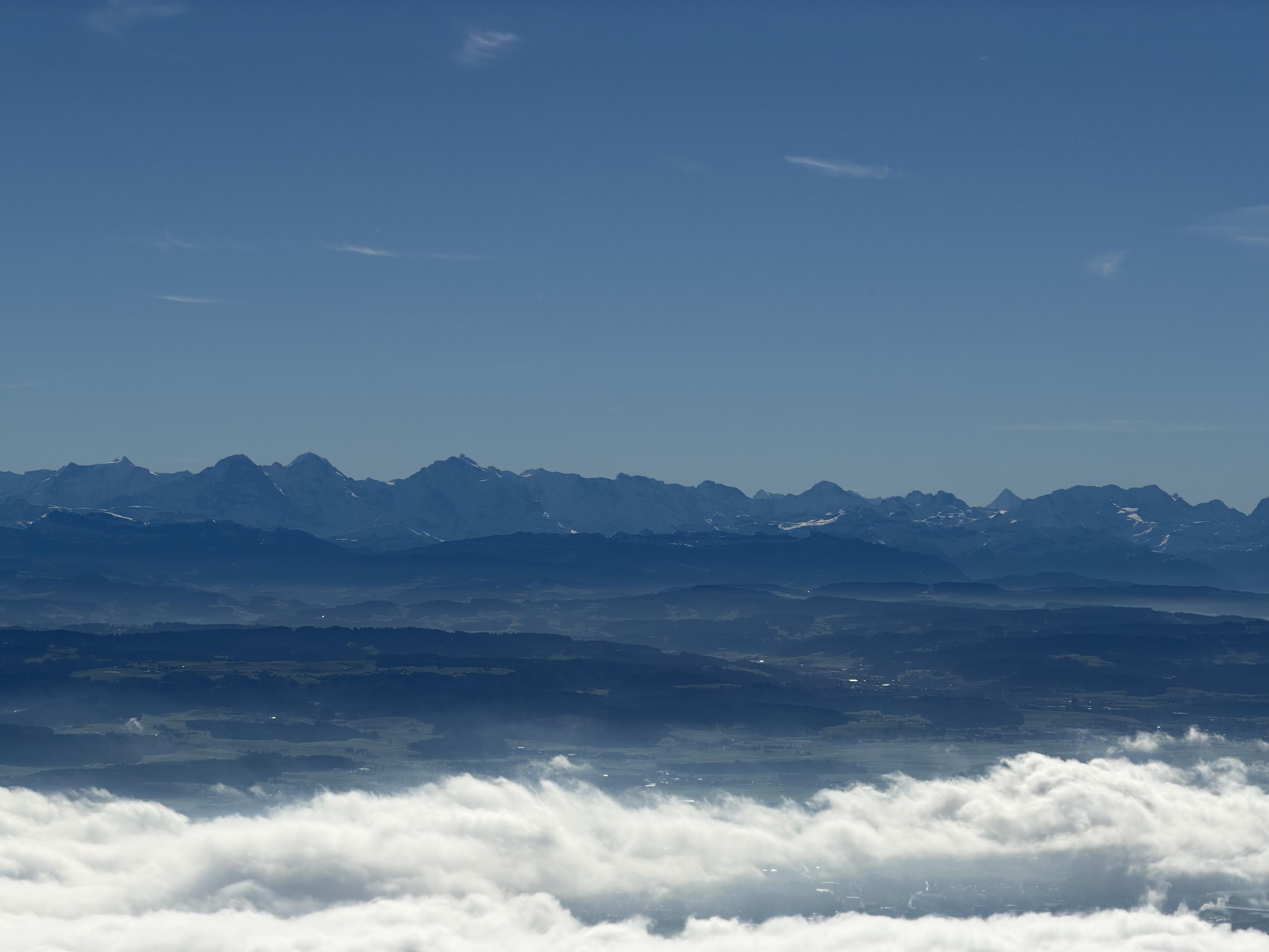
Alt...
Blauer Himmel, dann eine Alpenkette, Sicht auf Berge und Wiese, darunter das Nebelmeer
Blue sky, then an Alpine chain, view of mountains and meadow, below the sea of fog
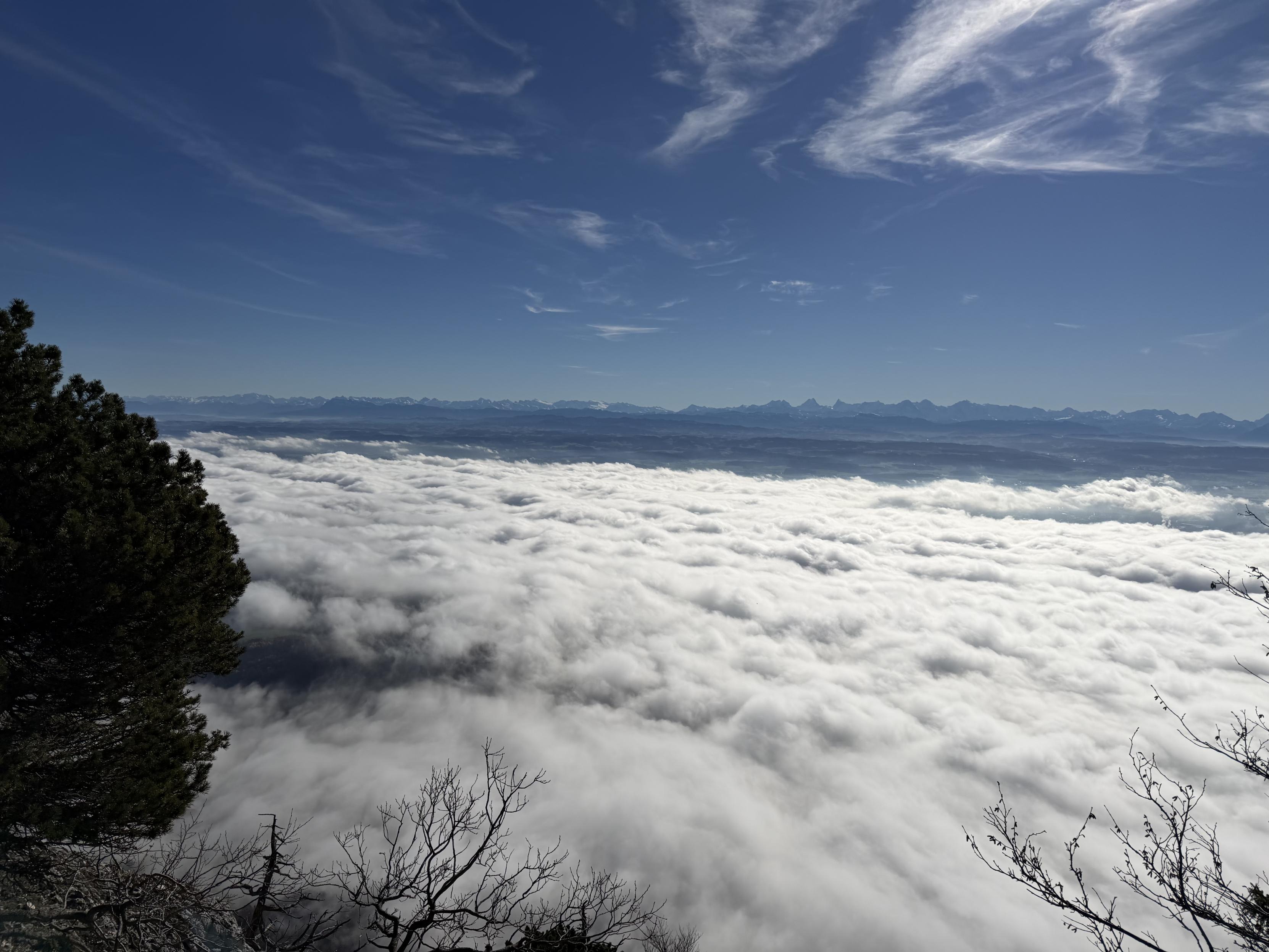
Alt...
Blauer Himmel, dann eine Alpenkette, Sicht auf Berge und Wiese, darunter das Nebelmeer, links ein Baum
Blue sky, then an Alpine chain, view of mountains and meadow, below the sea of fog, left side a tree
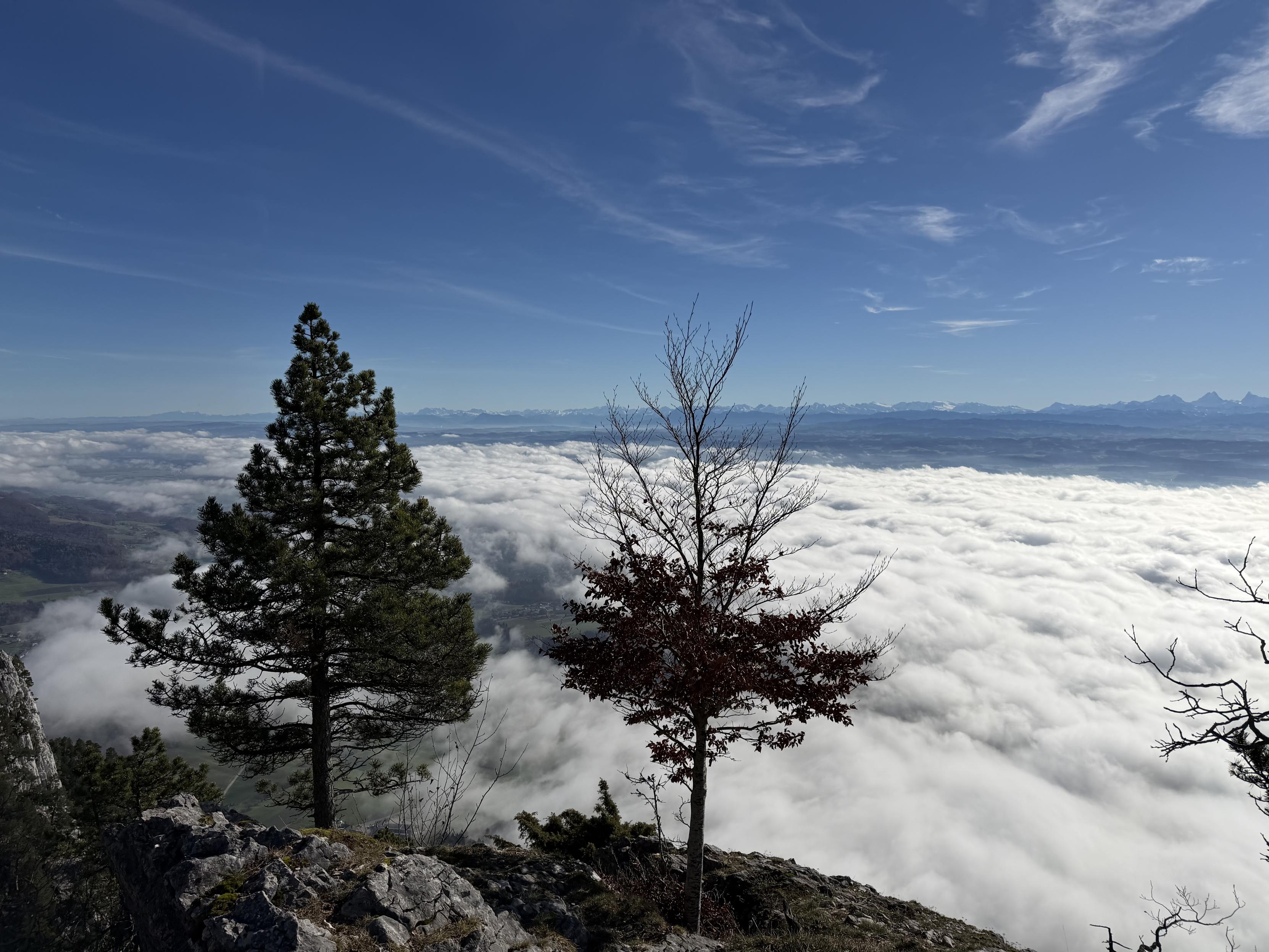
Alt...
Blauer Himmel, dann eine Alpenkette, Sicht auf Berge und Wiese, darunter das Nebelmeer, links ein Bäume
Blue sky, then an Alpine chain, view of mountains and meadow, below the sea of fog, left side a trees
#nature #natur #landscape #landschaft #hiking #wandern
Wandern gestern 🥰 Die andere Seite...
Hiking yesterday 🥰 Die andere Seite...
#nature #natur #landscape #landschaft #hiking #wandern
Wandern gestern 🥰 Die eine Seite...
Hiking yesterday 🥰 Die eine Seite...
Pan: NGC 3370
Release date: 22 October 2025, 15:55
Today’s ESA/Hubble Picture of the Week features a galaxy that Hubble has captured multiple times over more than 20 years. The galaxy is called NGC 3370, and it is a spiral galaxy located nearly 90 million light-years away in the constellation Leo (The Lion).
What is it about this galaxy that makes it a popular target for researchers? NGC 3370 is home to two kinds of objects that astronomers prize for their usefulness in determining distances to faraway galaxies: Cepheid variable stars and Type Ia supernovae.
Cepheid variable stars change in both size and temperature as they pulsate. As a result, the luminosity of these stars varies over a period of days to months. It does so in a way that reveals something important: the more luminous a Cepheid variable star is, the more slowly it pulsates. By measuring how long a Cepheid variable’s brightness takes to complete one cycle, astronomers can determine how bright the star actually is. Paired with how bright the star appears from Earth, this information gives the distance to the star and its home galaxy.
Type Ia supernovae provide a way to measure distances in a single explosive burst rather than through regular brightness variations. Type Ia supernovae happen when the dead core of a star ignites in a sudden flare of nuclear fusion. These explosions peak at very similar luminosities, and much like for a Cepheid variable star, knowing the intrinsic brightness of a supernova explosion allows for its distance to be measured. Observations of Cepheid variable stars and Type Ia supernovae are both critical for precisely measuring how fast our Universe is expanding.
[...]
https://esahubble.org/videos/potw2542a/
Credit:
ESA/Hubble & NASA, A. Riess, K. Noll, N. Bartmann (ESA/Hubble)
Music: Stellardrone - Ascent
#space #galaxy #astrophotography #photography #science #astronomy #nature #NASA #ESA #apod
Type 1a Supernova Animation
This animation represents a binary star system in which a white dwarf accretes matter from a normal companion star. Matter streaming from the red star accumulates on the white dwarf until the dwarf explodes. With its partner destroyed, the normal star careens into space. This scenario results in what astronomers refer to as a Type Ia supernova.
Credits: NASA's Goddard Space Flight Center/Walt Feimer
#space #nebula #astrophotography #photography #science #astronomy #physics #nature #NASA #ESA
2020 May 11
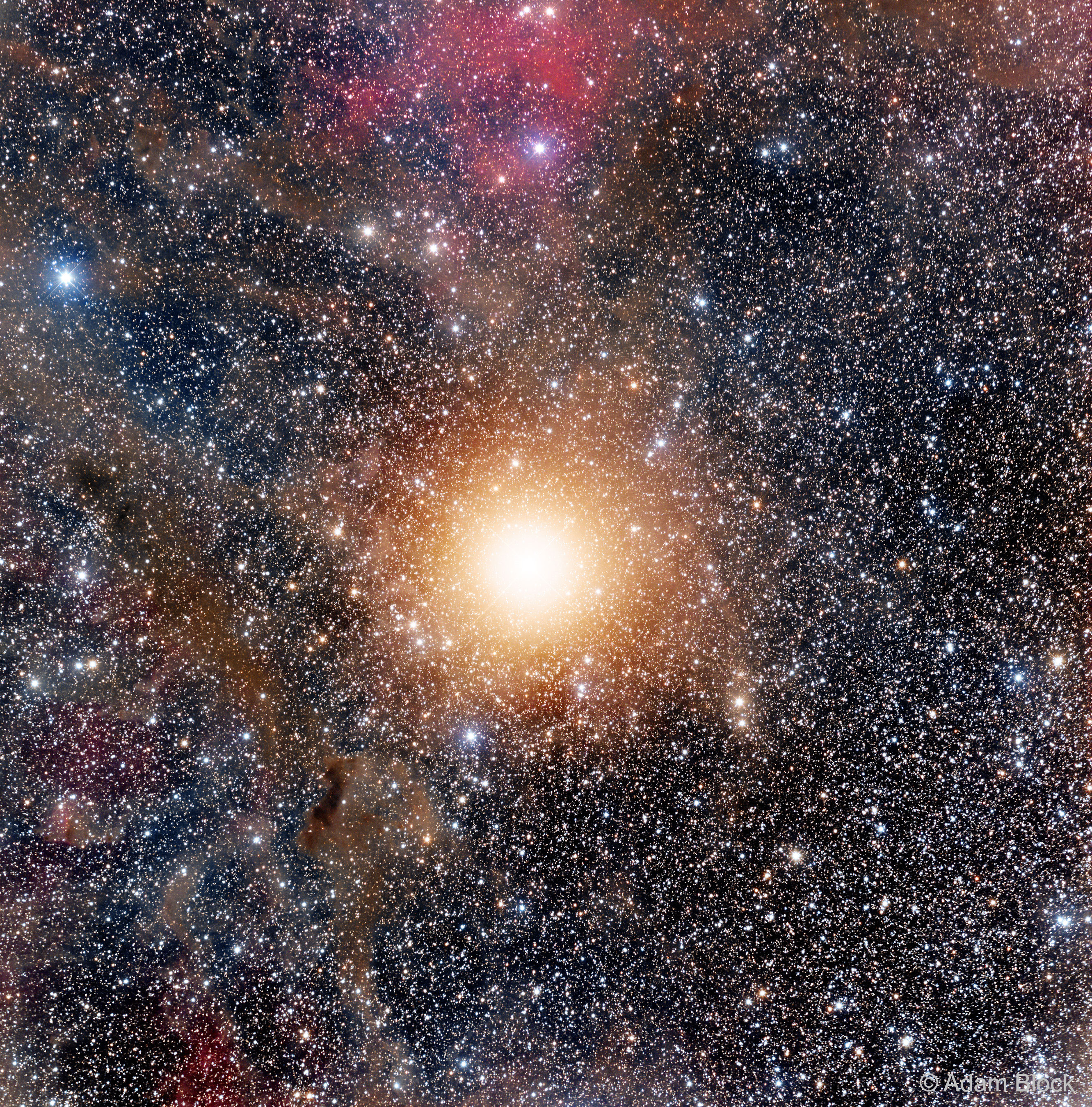
Behind Betelgeuse
* Image Credit & Copyright: Adam Block, Steward Observatory, University of Arizona
https://www.adamblockphotos.com/
https://astro.arizona.edu/
Explanation:
What's behind Betelgeuse? One of the brighter and more unusual stars in the sky, the red supergiant star Betelgeuse can be found in the direction of famous constellation Orion. Betelgeuse, however, is actually well in front of many of the constellation's other bright stars, and also in front of the greater Orion Molecular Cloud Complex. Numerically, light takes about 700 years to reach us from Betelgeuse, but about 1,300 years to reach us from the Orion Nebula and its surrounding dust and gas. All but the largest telescopes see Betelgeuse as only a point of light, but a point so bright that the inherent blurriness created by the telescope and Earth's atmosphere make it seem extended. In the featured long-exposure image, thousands of stars in our Milky Way Galaxy can be seen in the background behind Betelgeuse, as well as dark dust from the Orion Molecular Cloud, and some red-glowing emission from hydrogen gas on the outskirts of the more distant Lambda Orionis Ring.
Betelgeuse has recovered from appearing unusually dim over the past six months (2020), but is still expected to explode in a spectacular supernova sometime in the next (about) 100,000 years.
https://apod.nasa.gov/apod/ap200511.html
#space #nova #astrophotography #photography #science #astronomy #physics #nature #NASA #education
Alt...
2020 May 11
Behind Betelgeuse
* Image Credit & Copyright: Adam Block, Steward Observatory, University of Arizona
Explanation:
What's behind Betelgeuse? One of the brighter and more unusual stars in the sky, the red supergiant star Betelgeuse can be found in the direction of famous constellation Orion. Betelgeuse, however, is actually well in front of many of the constellation's other bright stars, and also in front of the greater Orion Molecular Cloud Complex. Numerically, light takes about 700 years to reach us from Betelgeuse, but about 1,300 years to reach us from the Orion Nebula and its surrounding dust and gas. All but the largest telescopes see Betelgeuse as only a point of light, but a point so bright that the inherent blurriness created by the telescope and Earth's atmosphere make it seem extended. In the featured long-exposure image, thousands of stars in our Milky Way Galaxy can be seen in the background behind Betelgeuse, as well as dark dust from the Orion Molecular Cloud, and some red-glowing emission from hydrogen gas on the outskirts of the more distant Lambda Orionis Ring. Betelgeuse has recovered from appearing unusually dim over the past six months, but is still expected to explode in a spectacular supernova sometime in the next (about) 100,000 years.
Authors & editors: Robert Nemiroff (MTU) & Jerry Bonnell (UMCP)
NASA Official: Phillip Newman Specific rights apply.
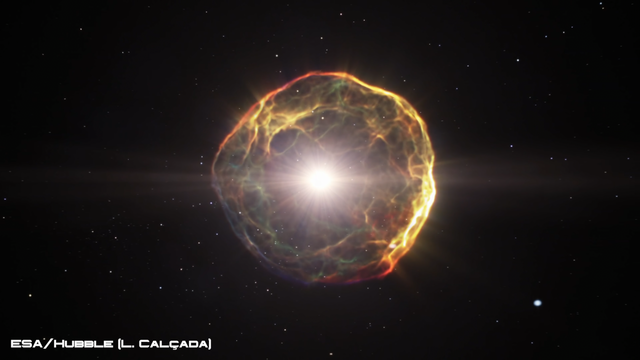
What Will It Look Like When Betelgeuse Goes Supernova?
640 light years away, there is a colossal star that is on the verge of exploding in a magnificent supernova. But what will it look like from Earth?
Video Credit:
V101 SPACE
https://www.youtube.com/@V101SPACE
To upload this video, I converted it and compressed it to less than a tenth of the original size under linux with the free software ffmpeg and the corresponding command:
'ffmpeg -i video_in.webm -vcodec libx265 -crf 40 video_out.mp4'
Maybe you would like to post a corresponding video on a scientifically related topic, but it is perhaps too big? Then try ffmpeg.
Often the compression factor '-crf 28' is enough, but in this particular case I had to go up to '-crf 40', because the original is a 4K UHD video and has a file size of 377MB. The compressed version here has a file size of only 28.4MB .
Of course, the quality of the video decreases, but it is enough to illustrate the topic.
Want to see the video in all its glory? Then visit the channel https://www.youtube.com/@V101SPACE and let Rob explain exciting space-related topics to you
#space #nova #astrophotography #photography #science #astronomy #physics #nature #NASA #ESA #education #UNIX #LINUX #FOSS #FSF
Alt...
640 light years away, there is a colossal star that is on the verge of exploding in a magnificent supernova. But what will it look like from Earth?
Video Credit:
V101 SPACE
https://www.youtube.com/@V101SPACE
To upload this video, I converted it and compressed it to less than a tenth of the original size under linux with the free software ffmpeg and the corresponding command:
'ffmpeg -i video_in.webm -vcodec libx265 -crf 40 video_out.mp4'
Maybe you would like to post a corresponding video on a scientifically related topic, but it is perhaps too big? Then try ffmpeg. Often the compression factor 'crf -28' is enough, but in this particular case I had to go up to 'crf -40', because the original is a 4K UHD video and has a file size of 377MB. The compressed version here has a file size of only 28.4MB .
Of course, the quality of the video decreases, but it is enough to illustrate the topic.
Want to see the video in all its glory? Then visit the channel https://www.youtube.com/@V101SPACE and let Rob explain exciting space-related topics to you
2024 April 3
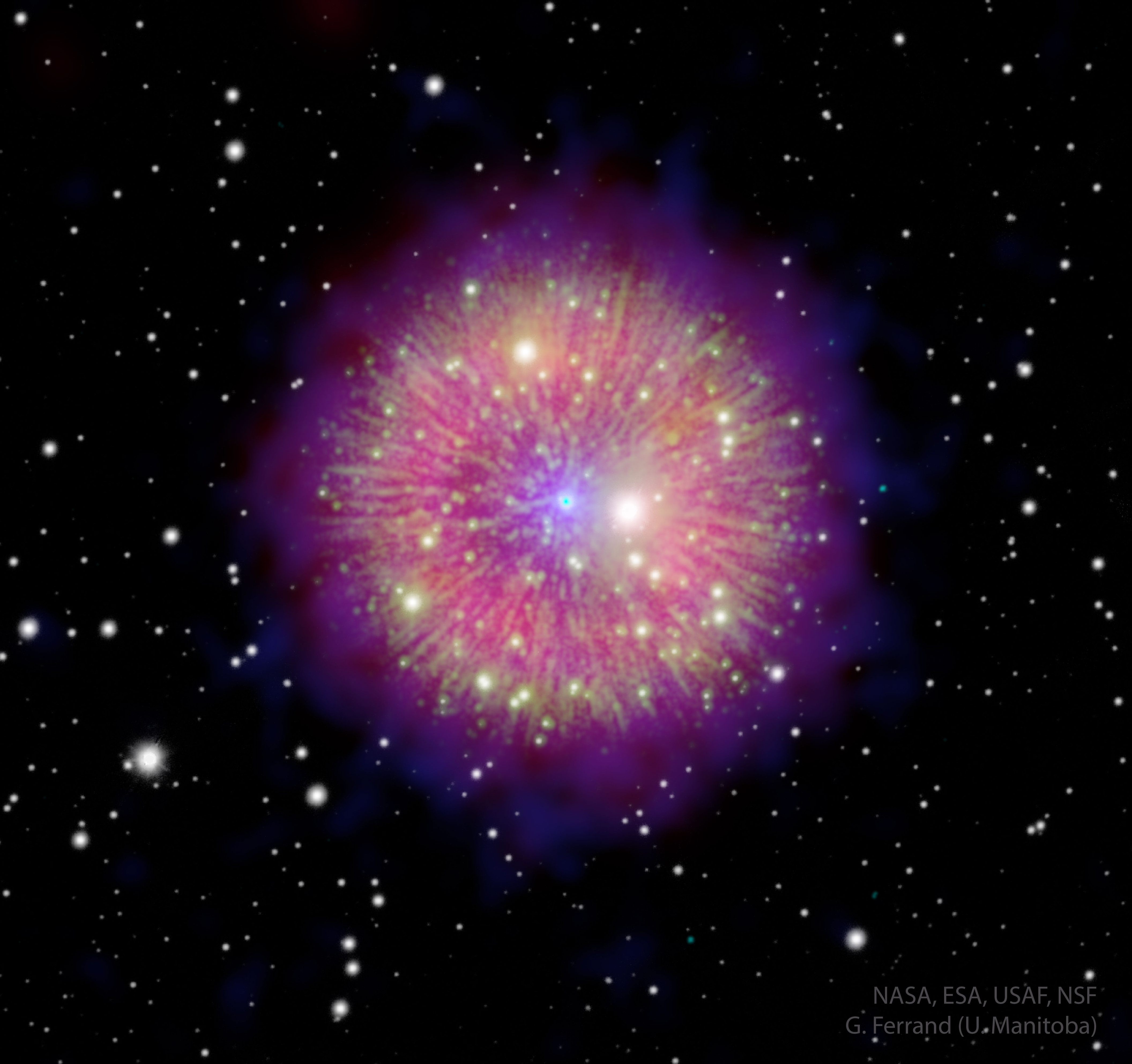
Unusual Nebula Pa 30
* Image Credit: NASA, ESA, USAF, NSF
https://umanitoba.ca/science/physics-and-astronomy
https://physics.dartmouth.edu/
https://www.nsf.gov/
https://www.af.mil/
https://www.esa.int/
https://www.nasa.gov/;
* Processing: G. Ferrand https://gillesferrand.github.io/ (U. Manitoba), J. English http://www2.physics.umanitoba.ca/u/english/ (U. Manitoba), R. A. Fesen https://physics.dartmouth.edu/people/robert-fesen (Dartmouth), C. Treyturik (U. Manitoba);
* Text: G. Ferrand & J. English
Explanation:
What created this unusual celestial firework? The nebula, dubbed Pa 30, appears in the same sky direction now as a bright "guest star" did in the year 1181. Although Pa 30's filaments look similar to that created by a nova (for example GK Per), and a planetary nebula (for example NGC 6751), some astronomers now propose that it was created by a rare type of supernova: a thermonuclear Type Iax, and so is (also) named SN 1181. In this model, the supernova was not the result of the detonation of a single star, but rather a blast that occurred when two white dwarf stars spiraled together and merged. The blue dot in the center is hypothesized to be a zombie star, the remnant white dwarf that somehow survived this supernova-level explosion. The featured image combines images and data obtained with infrared (WISE), visible (MDM, Pan-STARRS), and X-ray (Chandra, XMM) telescopes. Future observations and analyses may tell us more.
https://apod.nasa.gov/apod/ap240403.html
#space #nova #astrophotography #photography #science #astronomy #physics #nature #NASA #education
Alt...
2024 April 3
A nebula is shown that appears like a firework. Radial filaments connect a glowing halo to a star in the center that appears as a blue dot.
Unusual Nebula Pa 30
* Image Credit: NASA, ESA, USAF, NSF;
* Processing: G. Ferrand (U. Manitoba), J. English (U. Manitoba), R. A. Fesen (Dartmouth), C. Treyturik (U. Manitoba);
* Text: G. Ferrand & J. English
Explanation:
What created this unusual celestial firework? The nebula, dubbed Pa 30, appears in the same sky direction now as a bright "guest star" did in the year 1181. Although Pa 30's filaments look similar to that created by a nova (for example GK Per), and a planetary nebula (for example NGC 6751), some astronomers now propose that it was created by a rare type of supernova: a thermonuclear Type Iax, and so is (also) named SN 1181. In this model, the supernova was not the result of the detonation of a single star, but rather a blast that occurred when two white dwarf stars spiraled together and merged. The blue dot in the center is hypothesized to be a zombie star, the remnant white dwarf that somehow survived this supernova-level explosion. The featured image combines images and data obtained with infrared (WISE), visible (MDM, Pan-STARRS), and X-ray (Chandra, XMM) telescopes. Future observations and analyses may tell us more.
Authors & editors: Robert Nemiroff (MTU) & Jerry Bonnell (UMCP)
NASA Official: Amber Straughn Specific rights apply.
2021 August 22
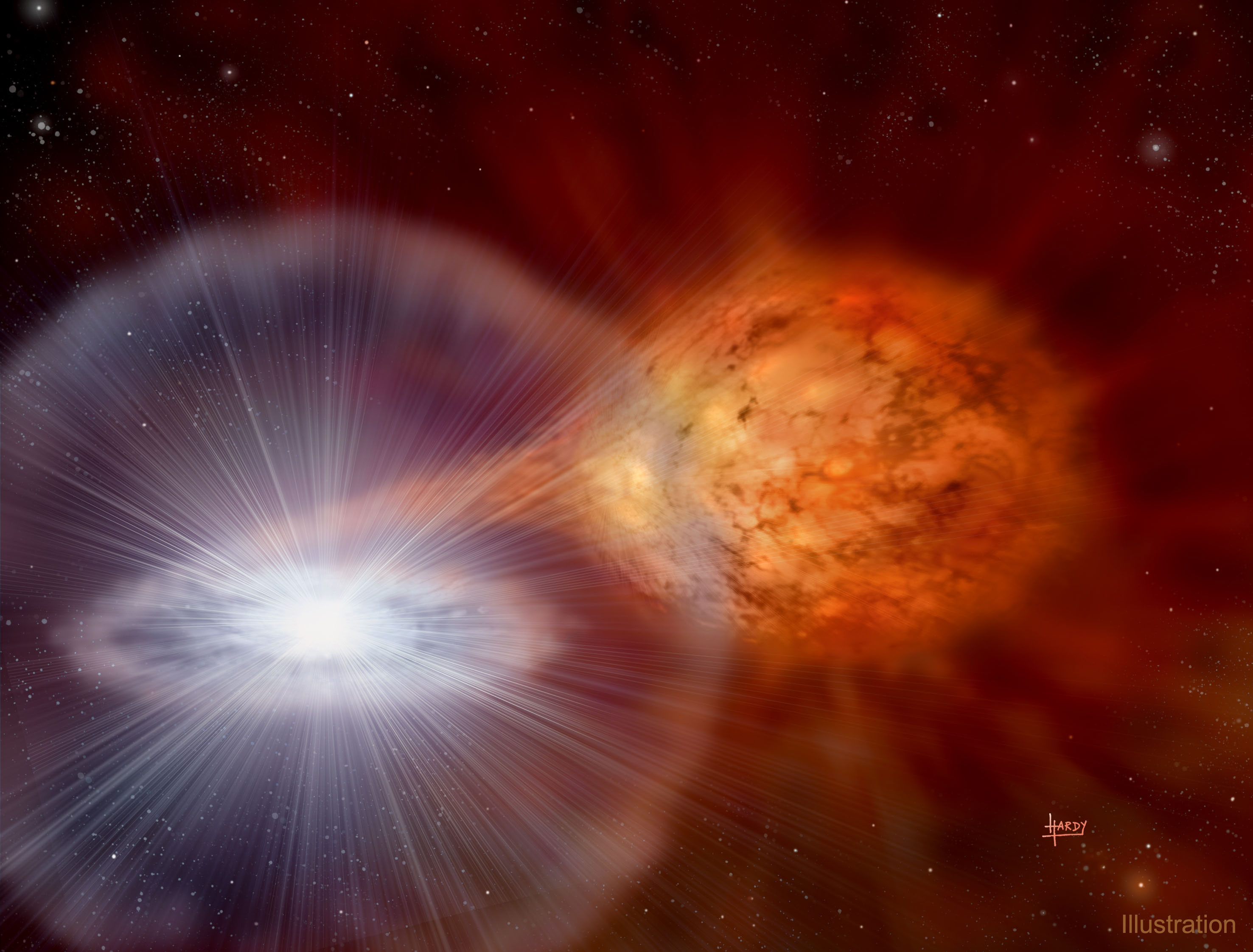
The picture shows an illustration of binary star system RS Ophiuchus during a nova-causing explosion.
Explosions from White Dwarf Star RS Oph
* Illustration Credit & Copyright: David A. Hardy & PPARC
https://www.astroart.org/hardy-profile
https://en.wikipedia.org/wiki/Particle_Physics_and_Astronomy_Research_Council
Explanation:
Spectacular explosions keep occurring in the binary star system named RS Ophiuchi. Every 20 years or so, the red giant star dumps enough hydrogen gas onto its companion white dwarf star to set off a brilliant thermonuclear explosion on the white dwarf's surface. At about 5,000 light years distant, the resulting nova explosions cause the RS Oph system to brighten up by a huge factor and become visible to the unaided eye. The red giant star is depicted on the right of the above drawing, while the white dwarf is at the center of the bright accretion disk on the left. As the stars orbit each other, a stream of gas moves from the giant star to the white dwarf. Astronomers speculate that at some time in the next 100,000 years, enough matter will have accumulated on the white dwarf to push it over the Chandrasekhar Limit, causing a much more powerful and final explosion known as a supernova. Starting early this month, RS Oph was again seen exploding in a bright nova.
https://ui.adsabs.harvard.edu/abs/2001ApJ...558..323H/abstract
https://apod.nasa.gov/apod/ap210822.html
#space #nova #astrophotography #photography #science #astronomy #physics #nature #NASA #education
Alt...
2021 August 22
The picture shows an illustration of binary star system RS Ophiuchus during a nova-causing explosion.
Explosions from White Dwarf Star RS Oph
* Illustration Credit & Copyright: David A. Hardy & PPARC
Explanation:
Spectacular explosions keep occurring in the binary star system named RS Ophiuchi. Every 20 years or so, the red giant star dumps enough hydrogen gas onto its companion white dwarf star to set off a brilliant thermonuclear explosion on the white dwarf's surface. At about 5,000 light years distant, the resulting nova explosions cause the RS Oph system to brighten up by a huge factor and become visible to the unaided eye. The red giant star is depicted on the right of the above drawing, while the white dwarf is at the center of the bright accretion disk on the left. As the stars orbit each other, a stream of gas moves from the giant star to the white dwarf. Astronomers speculate that at some time in the next 100,000 years, enough matter will have accumulated on the white dwarf to push it over the Chandrasekhar Limit, causing a much more powerful and final explosion known as a supernova. Starting early this month, RS Oph was again seen exploding in a bright nova.
Authors & editors: Robert Nemiroff (MTU) & Jerry Bonnell (UMCP)
NASA Official: Phillip Newman Specific rights apply.
NASA Web Privacy Policy and Important Notices
A service of: ASD at NASA / GSFC
& Michigan Tech. U.
"The extreme temporary light emissions of a nova are often visible to the naked eye from Earth. Even with several spectacular visible phenomena, such as this night sky, the nova remains recognizable to the trained eye. Due to their short-term glow and later dimming, it seemed to earlier cultures as if there were celestial bodies that could appear and disappear out of nowhere. In ancient China, astronomers called these 'Guest Stars' More on this in the next post"
2021 August 16
Perseid Meteor, Red Sprites, and Nova RS Ophiuchus
* Image Credit & Copyright: Daniel Korona
Explanation:
This was an unusual sky. It wasn't unusual because of the central band the Milky Way Galaxy, visible along the image left. Most dark skies show part of the Milky Way. It wasn't unusual because of the bright meteor visible on the upper right. Many images taken during last week's Perseid Meteor Shower show meteors, although this Perseid was particularly bright. This sky wasn't unusual because of the red sprites, visible on the lower right. Although this type of lightning has only been noted in the past few decades, images of sprites are becoming more common. This sky wasn't unusual because of the nova, visible just above the image center. Novas bright enough to be seen with the unaided eye occur every few years, with pictured Nova RS Ophiuchus discovered about a week ago. What was most unusual, though, was to capture all these things together, in a single night, on a single sky. The unusual sky occurred above Zacatecas, Mexico.
https://apod.nasa.gov/apod/ap210816.html
#space #nova #astrophotography #photography #science #astronomy #physics #nature #NASA #education
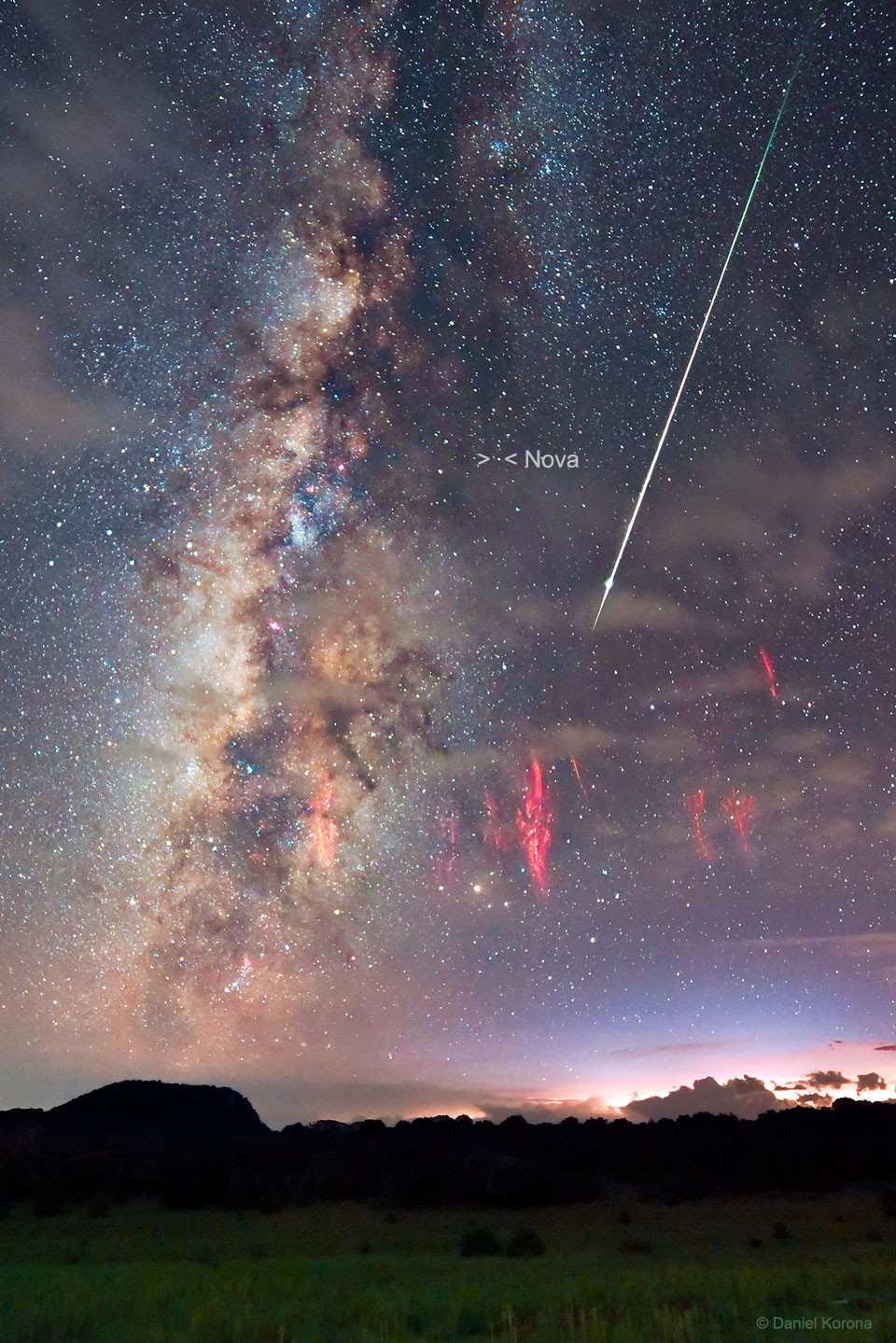
Alt...
2021 August 16
Perseid Meteor, Red Sprites, and Nova RS Ophiuchus
* Image Credit & Copyright: Daniel Korona
Explanation:
This was an unusual sky. It wasn't unusual because of the central band the Milky Way Galaxy, visible along the image left. Most dark skies show part of the Milky Way. It wasn't unusual because of the bright meteor visible on the upper right. Many images taken during last week's Perseid Meteor Shower show meteors, although this Perseid was particularly bright. This sky wasn't unusual because of the red sprites, visible on the lower right. Although this type of lightning has only been noted in the past few decades, images of sprites are becoming more common. This sky wasn't unusual because of the nova, visible just above the image center. Novas bright enough to be seen with the unaided eye occur every few years, with pictured Nova RS Ophiuchus discovered about a week ago. What was most unusual, though, was to capture all these things together, in a single night, on a single sky. The unusual sky occurred above Zacatecas, Mexico.
Authors & editors: Robert Nemiroff (MTU) & Jerry Bonnell (UMCP)
NASA Official: Phillip Newman Specific rights apply.
NASA Web Privacy Policy and Important Notices
A service of: ASD at NASA / GSFC
& Michigan Tech. U.