Search results for tag #nasa
![[?]](https://files.defcon.social/dcsocial-s3/accounts/avatars/113/208/344/507/078/943/original/014820ad22daee1c.jpg)
2018 September 22
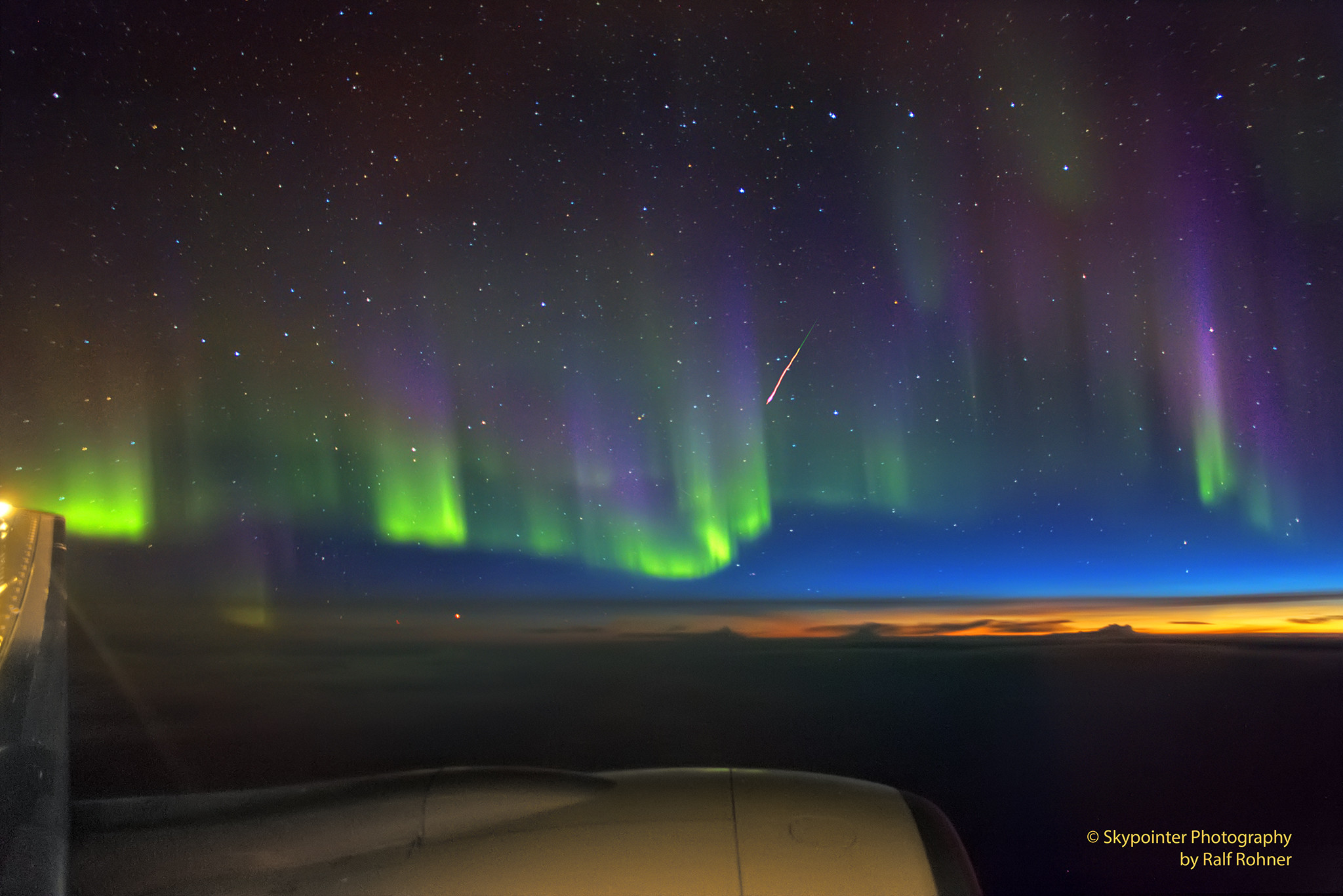
Window Seat over Hudson Bay
* Image Credit & Copyright: Ralf Rohner
https://ralf-rohner.pixels.com/
Explanation:
On the August 18 night flight from San Francisco to Zurich, a window seat offered this tantalizing view when curtains of light draped a colorful glow across the sky over Hudson Bay. Constructed by digitally stacking six short exposures made with a hand held camera, the scene records the shimmering aurora borealis or northern lights just as the approaching high altitude sunrise illuminated the northeastern horizon. It also caught the flash of a Perseid meteor streaking beneath the handle stars of the Big Dipper of the north. A few days past the meteor shower's peak, its trail still points across the sky toward Perseus. Beautiful aurorae and shower meteors both occur in Earth's upper atmosphere at altitudes of 100 kilometers or so, far above commercial airline flights. The aurora are caused by energetic charged particles from the magnetosphere, while meteors are trails of comet dust.
https://apod.nasa.gov/apod/ap180922.html
#space #earth #aurora #astrophotography #photography #NASA #science #physics #nature #education #4sAur
Alt...
2018 September 22
Window Seat over Hudson Bay
* Image Credit & Copyright: Ralf Rohner
Explanation:
On the August 18 night flight from San Francisco to Zurich, a window seat offered this tantalizing view when curtains of light draped a colorful glow across the sky over Hudson Bay. Constructed by digitally stacking six short exposures made with a hand held camera, the scene records the shimmering aurora borealis or northern lights just as the approaching high altitude sunrise illuminated the northeastern horizon. It also caught the flash of a Perseid meteor streaking beneath the handle stars of the Big Dipper of the north. A few days past the meteor shower's peak, its trail still points across the sky toward Perseus. Beautiful aurorae and shower meteors both occur in Earth's upper atmosphere at altitudes of 100 kilometers or so, far above commercial airline flights. The aurora are caused by energetic charged particles from the magnetosphere, while meteors are trails of comet dust.
Authors & editors: Robert Nemiroff (MTU) & Jerry Bonnell (UMCP)
NASA Official: Phillip Newman Specific rights apply.
NASA Web Privacy Policy and Important Notices
A service of: ASD at NASA / GSFC
& Michigan Tech. U.
2018 December 9
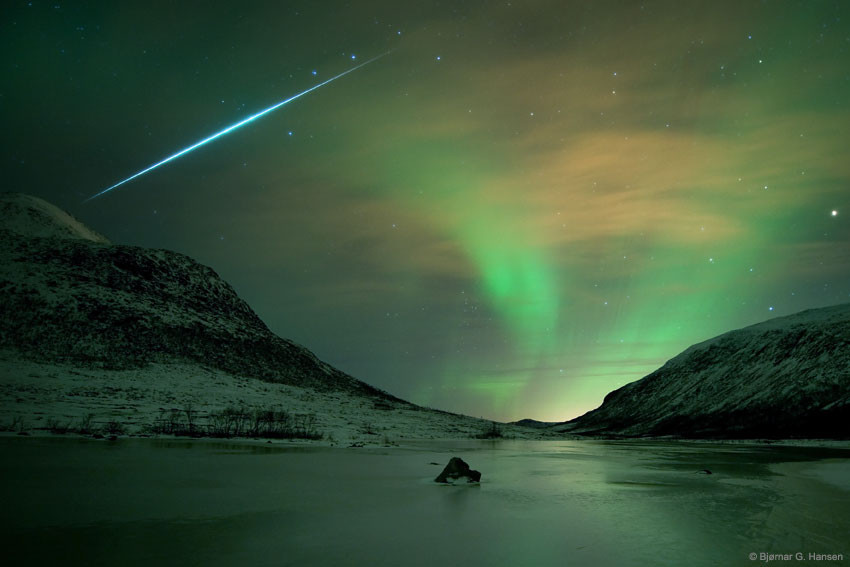
Aurora Shimmer, Meteor Flash
* Image Credit & Copyright: Bjørnar G. Hansen
Explanation:
Some night skies are serene and passive -- others shimmer and flash. The later, in the form of auroras and meteors, haunted skies over the island of Kvaløya, near Tromsø Norway on 2009 December 13. This 30 second long exposure records a shimmering auroral glow gently lighting the wintery coastal scene. A study in contrasts, the image also captures the sudden flash of a fireball meteor from the excellent Geminid meteor shower of 2009. Streaking past familiar stars in the handle of the Big Dipper, the trail points back toward the constellation Gemini, off the top of the view. Both auroras and meteors occur in Earth's upper atmosphere at altitudes of 100 kilometers or so, but aurora caused by energetic charged particles from the magnetosphere, while meteors are trails of cosmic dust. Nine years after this photograph was taken, toward the end of this week, the yearly 2018 Geminids meteor shower will peak again, although this time their flashes will compete with the din of a half-lit first-quarter moon during the first half of the night.
https://apod.nasa.gov/apod/ap181209.html
#space #earth #aurora #astrophotography #photography #NASA #science #physics #nature #education #4sAur
Alt...
2018 December 9
Aurora Shimmer, Meteor Flash
* Image Credit & Copyright: Bjørnar G. Hansen
Explanation:
Some night skies are serene and passive -- others shimmer and flash. The later, in the form of auroras and meteors, haunted skies over the island of Kvaløya, near Tromsø Norway on 2009 December 13. This 30 second long exposure records a shimmering auroral glow gently lighting the wintery coastal scene. A study in contrasts, the image also captures the sudden flash of a fireball meteor from the excellent Geminid meteor shower of 2009. Streaking past familiar stars in the handle of the Big Dipper, the trail points back toward the constellation Gemini, off the top of the view. Both auroras and meteors occur in Earth's upper atmosphere at altitudes of 100 kilometers or so, but aurora caused by energetic charged particles from the magnetosphere, while meteors are trails of cosmic dust. Nine years after this photograph was taken, toward the end of this week, the yearly 2018 Geminids meteor shower will peak again, although this time their flashes will compete with the din of a half-lit first-quarter moon during the first half of the night.
Authors & editors: Robert Nemiroff (MTU) & Jerry Bonnell (UMCP)
NASA Official: Phillip Newman Specific rights apply.
NASA Web Privacy Policy and Important Notices
A service of: ASD at NASA / GSFC
& Michigan Tech. U.
2013 November 18
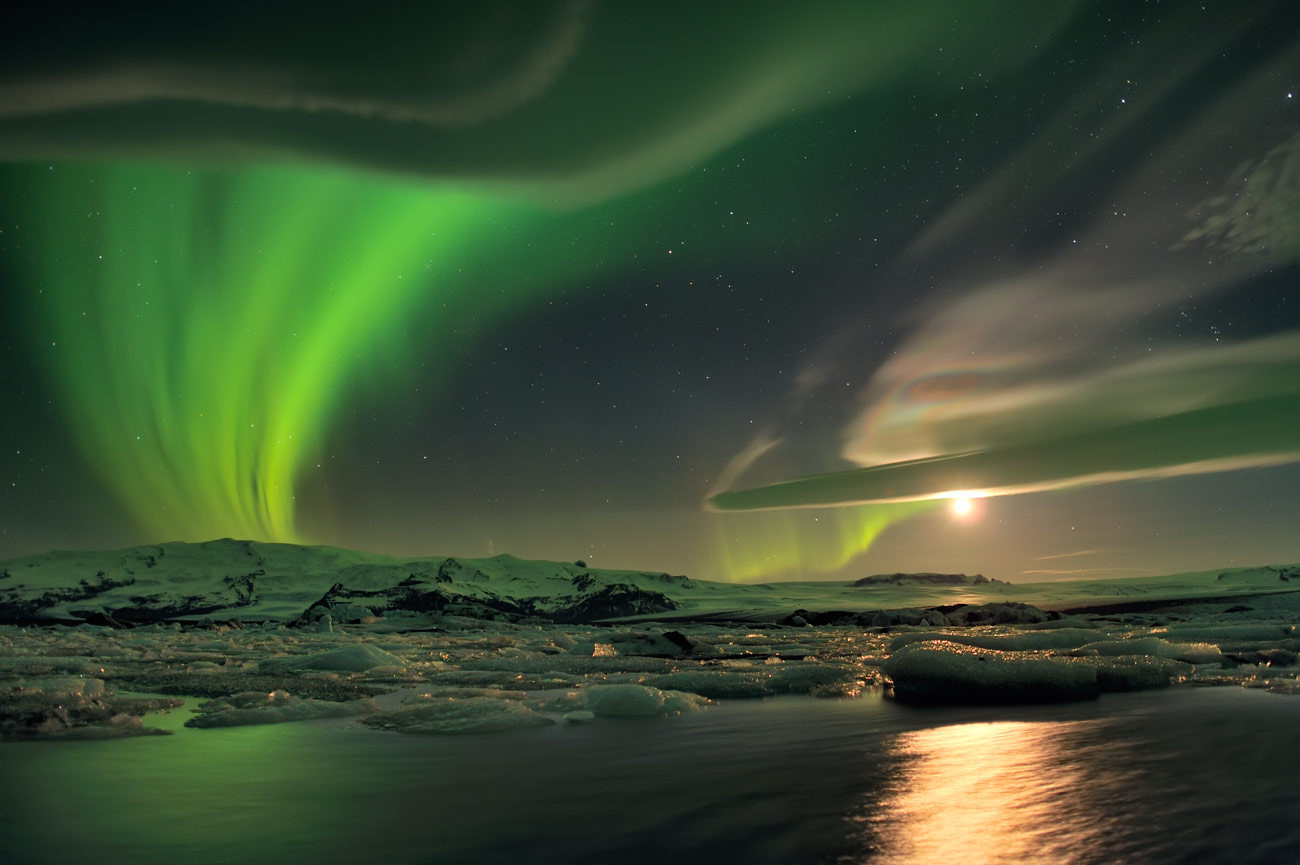
Aurora and Unusual Clouds Over Iceland
* Image Credit & Copyright: Stéphane Vetter (Nuits sacrées)
http://www.nuitsacrees.fr/
Explanation:
What's happening in the sky? On this cold winter night in Iceland, quite a lot. First, in the foreground, lies the largest glacier in Iceland: Vatnajokull. On the far left, bright green auroras appear to emanate from the glacier as if it was a volcano. Aurora light is reflected by the foreground lake Jökulsárlón. On the far right is a long and unusual lenticular cloud tinged with green light emitted from another aurora well behind it. Just above this lenticular cloud are unusual iridescent lenticular clouds displaying a broad spectral range of colors. Far beyond the lenticular is the setting Moon, while far beyond even the Moon are setting stars. The above image was captured in late March of 2012.
#space #earth #aurora #astrophotography #photography #NASA #science #physics #nature #education #4sAur
Alt...
2013 November 18
Aurora and Unusual Clouds Over Iceland
* Image Credit & Copyright: Stéphane Vetter (Nuits sacrées)
Explanation:
What's happening in the sky? On this cold winter night in Iceland, quite a lot. First, in the foreground, lies the largest glacier in Iceland: Vatnajokull. On the far left, bright green auroras appear to emanate from the glacier as if it was a volcano. Aurora light is reflected by the foreground lake Jökulsárlón. On the far right is a long and unusual lenticular cloud tinged with green light emitted from another aurora well behind it. Just above this lenticular cloud are unusual iridescent lenticular clouds displaying a broad spectral range of colors. Far beyond the lenticular is the setting Moon, while far beyond even the Moon are setting stars. The above image was captured in late March of 2012.
Authors & editors: Robert Nemiroff (MTU) & Jerry Bonnell (UMCP)
NASA Official: Phillip Newman Specific rights apply.
NASA Web Privacy Policy and Important Notices
A service of: ASD at NASA / GSFC
& Michigan Tech. U.
2023 September 16
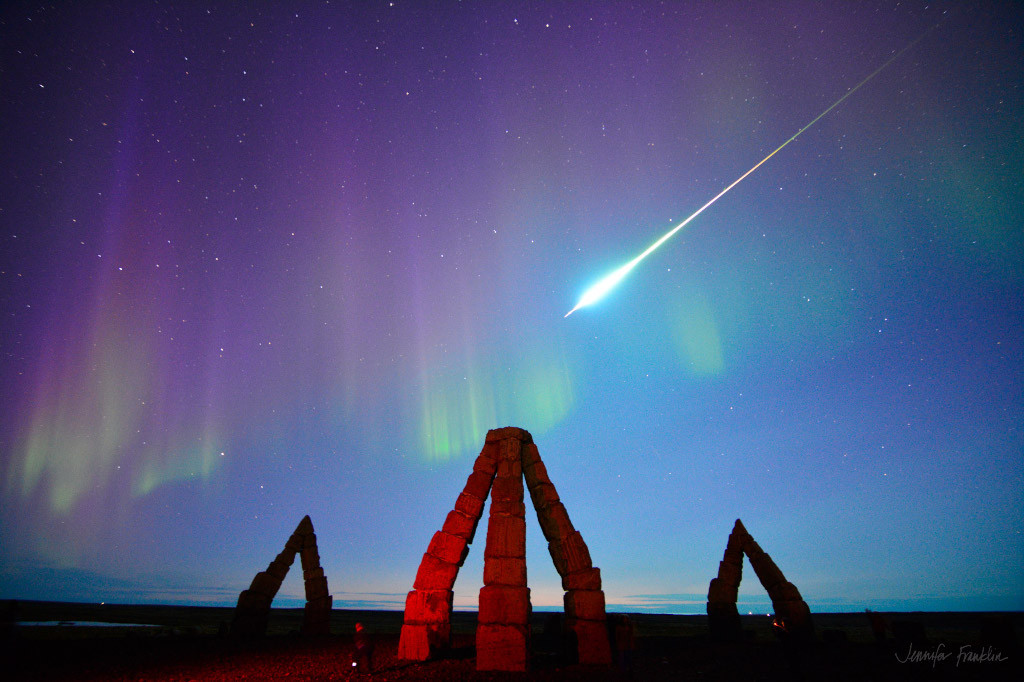
Fireball over Iceland
* Image Credit & Copyright: Jennifer Franklin
Explanation:
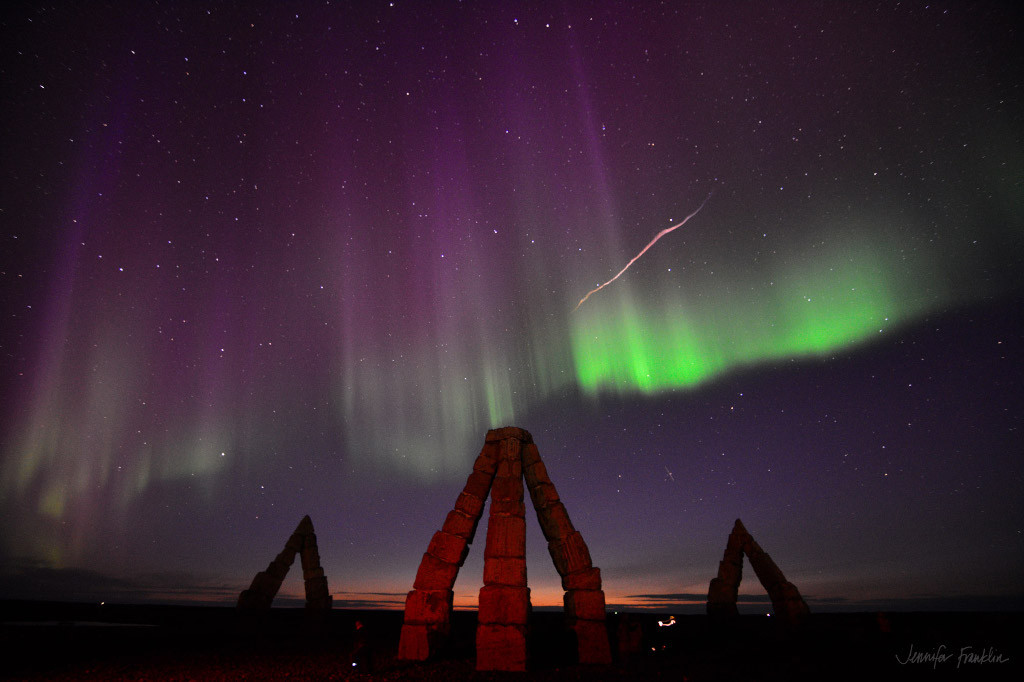
On September 12, from a location just south of the Arctic Circle, stones of Iceland's modern Arctic Henge point skyward in this startling scene. Entertaining an intrepid group of aurora hunters during a geomagnetic storm, alluring northern lights dance across the darkened sky when a stunning fireball meteor explodes. Awestruck, the camera-equipped skygazers captured video and still images of the boreal bolide, at its peak about as bright as a full moon. Though quickly fading from view, the fireball left a lingering visible trail or persistent train. The wraith-like trail was seen for minutes wafting in the upper atmosphere at altitudes of 60 to 90 kilometers along with the auroral glow.
https://apod.nasa.gov/apod/ap230916.html
#space #earth #aurora #astrophotography #photography #NASA #science #physics #nature #education #4sAur
Alt...
2023 September 16
Fireball over Iceland
* Image Credit & Copyright: Jennifer Franklin
Explanation:
On September 12, from a location just south of the Arctic Circle, stones of Iceland's modern Arctic Henge point skyward in this startling scene. Entertaining an intrepid group of aurora hunters during a geomagnetic storm, alluring northern lights dance across the darkened sky when a stunning fireball meteor explodes. Awestruck, the camera-equipped skygazers captured video and still images of the boreal bolide, at its peak about as bright as a full moon. Though quickly fading from view, the fireball left a lingering visible trail or persistent train. The wraith-like trail was seen for minutes wafting in the upper atmosphere at altitudes of 60 to 90 kilometers along with the auroral glow.
Authors & editors: Robert Nemiroff (MTU) & Jerry Bonnell (UMCP)
NASA Official: Phillip Newman Specific rights apply.
NASA Web Privacy Policy and Important Notices
A service of: ASD at NASA / GSFC,
NASA Science Activation
& Michigan Tech. U.
Alt...
Persistent train in auroral sky
Fireball Above Iceland
by Babak Tafreshi
https://print.babaktafreshi.com/talks-workshops-tours
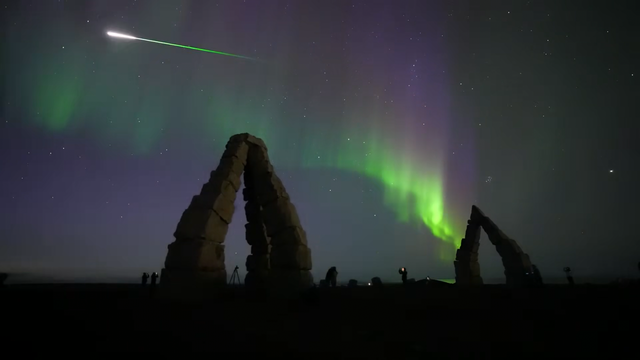
"On 2023 September 13, near the northern most point of Iceland, the night sky exploded with the northern lights and a spectacular fireball, above the Arctic Henge monument. I was about to move our group to another spot when this tennis-ball sized space rock entered the earth atmosphere and burned at an altitude of 60-90 km above us, becoming as bright as the full moon for a moment. Such meteors are very rare to witness. Even for a frequent observer like me it took three decades to finally record one in video!
I was on my biannual Aurora PhotoTour. My Icelandic colleague Stjornu Saevar appears near the clip’s end, on a phone interview with the local media about the meteor."
CREDIT
Babak Tafreshi
#space #earth #aurora #astrophotography #photography #NASA #science #physics #nature #education #4sAur
Alt...
On 2023 September 13, near the northern most point of Iceland, the night sky exploded with the northern lights and a spectacular fireball, above the Arctic Henge monument. I was about to move our group to another spot when this tennis-ball sized space rock entered the earth atmosphere and burned at an altitude of 60-90 km above us, becoming as bright as the full moon for a moment. Such meteors are very rare to witness. Even for a frequent observer like me it took three decades to finally record one in video!
I was on my biannual Aurora PhotoTour. My Icelandic colleague Stjornu Saevar appears near the clip’s end, on a phone interview with the local media about the meteor.
CREDIT
Babak Tafreshi
2025 September 26
A SWAN, an ATLAS, and Mars
* Image Credit & Copyright: Adam Block
https://www.adamblockphotos.com/
Explanation:
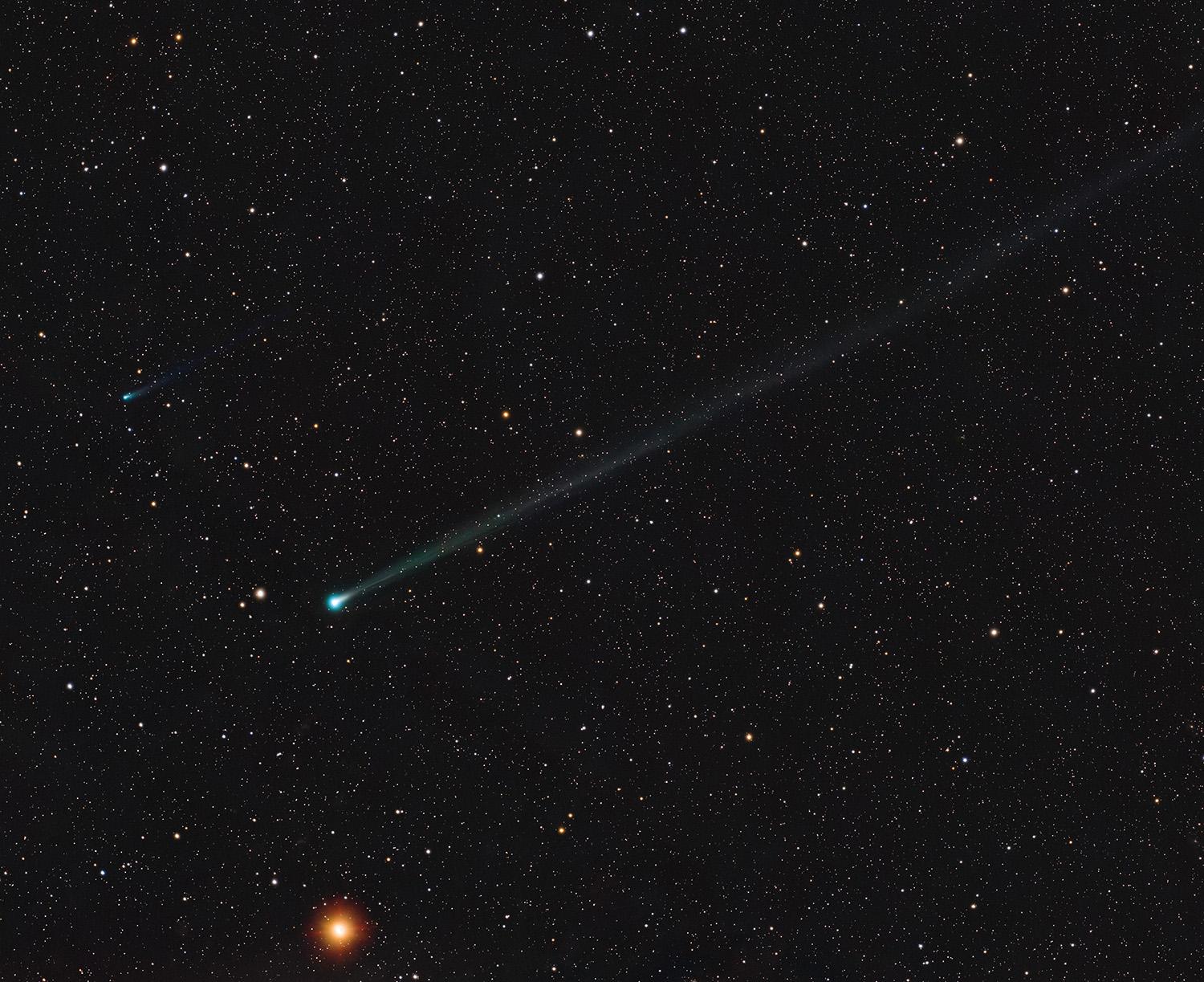
A new visitor to the inner Solar System, comet C/2025 R2 (SWAN) sports a long ion tail extending diagonally across this almost 7 degree wide telescopic field of view recorded on September 21. A fainter fellow comet also making its inner Solar System debut, C/2025 K1 (ATLAS), can be spotted above and left of SWAN's greenish coma, just visible against the background sea of stars in the constellation Virgo. Both new comets were only discovered in 2025 and are joined in this celestial frame by ruddy planet Mars (bottom), a more familiar wanderer in planet Earth's night skies. The comets may appear to be in a race, nearly neck and neck in their voyage through the inner Solar System and around the Sun. But this comet SWAN has already reached its perihelion or closest approach to the Sun on September 12 and is now outbound along its orbit. This comet ATLAS is still inbound though, and will make its perihelion passage on October 8.
https://app.astrobin.com/i/vf43w6
https://www.skyatnightmagazine.com/news/c-2025-k1-atlas
https://theskylive.com/c2025k1-info
https://theskylive.com/c2025k1-info
https://apod.nasa.gov/apod/ap250926.html
#space #comets #astrophotography #photography #science #astronomy #nature #NASA #ESA #education
Alt...
2025 September 26
A SWAN, an ATLAS, and Mars
* Image Credit & Copyright: Adam Block
Explanation:
A new visitor to the inner Solar System, comet C/2025 R2 (SWAN) sports a long ion tail extending diagonally across this almost 7 degree wide telescopic field of view recorded on September 21. A fainter fellow comet also making its inner Solar System debut, C/2025 K1 (ATLAS), can be spotted above and left of SWAN's greenish coma, just visible against the background sea of stars in the constellation Virgo. Both new comets were only discovered in 2025 and are joined in this celestial frame by ruddy planet Mars (bottom), a more familiar wanderer in planet Earth's night skies. The comets may appear to be in a race, nearly neck and neck in their voyage through the inner Solar System and around the Sun. But this comet SWAN has already reached its perihelion or closest approach to the Sun on September 12 and is now outbound along its orbit. This comet ATLAS is still inbound though, and will make its perihelion passage on October 8.
Authors & editors: Robert Nemiroff (MTU) & Jerry Bonnell (UMCP)
NASA Official: Amber Straughn Specific rights apply.
NASA Web Privacy, Accessibility, Notices;
A service of: ASD at NASA / GSFC,
NASA Science Activation
& Michigan Tech. U.
Annotations for previous post.
#space #saturn #astrophotography #photography #science #astronomy #physics #nature #NASA
Alt...
Annotations for previous post.
2025 September 25
Saturn Opposite the Sun
* Image Credit & Copyright: Jin Wang
Explanation:
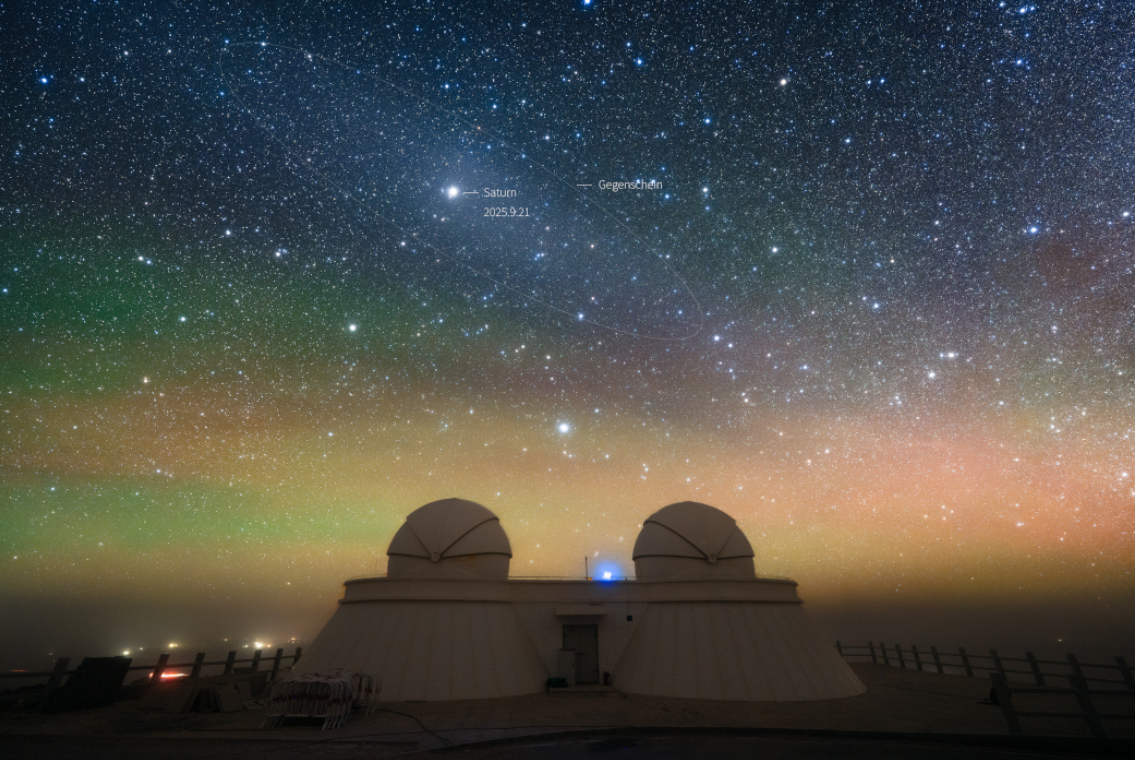
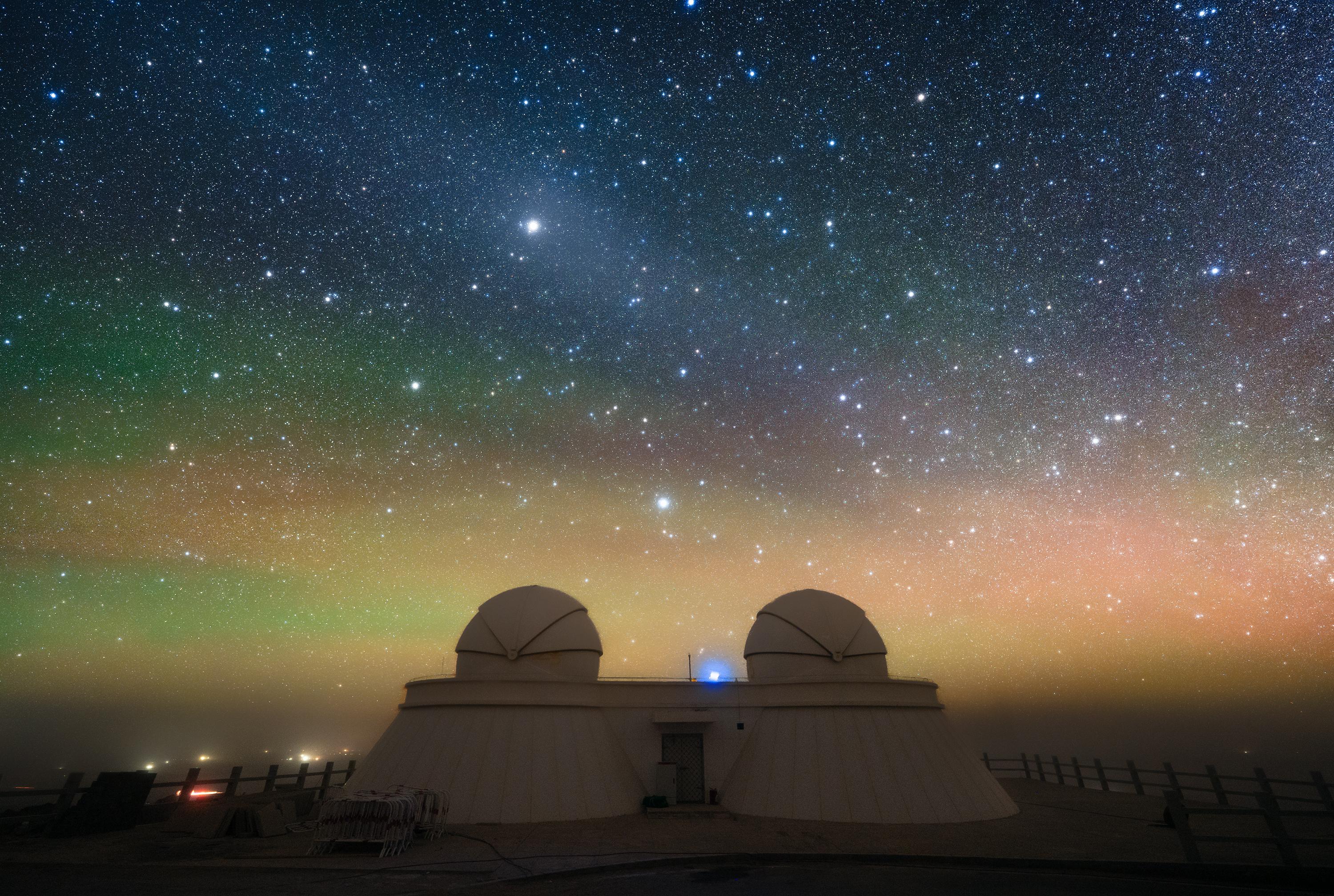
This year Saturn was at opposition on September 21, opposite the Sun in planet Earth's sky. At its closest to Earth, Saturn was also at its brightest of the year, rising as the Sun set and shining above the horizon all night long among the fainter stars of the constellation Pisces. In this snapshot from the Qinghai Lenghu Observatory, Tibetan Plateau, southwestern China, the outer planet is immersed in a faint, diffuse oval of light known as the gegenschein or counter glow. The diffuse gegenschein is produced by sunlight backscattered by interplanetary dust along the Solar System's ecliptic plane, opposite the Sun in planet Earth's sky. Like a giant eye, on this dark night Saturn and gegenschein seem to stare down on the observatory's telescope domes seen against a colorful background of airglow along the horizon.
https://science.nasa.gov/solar-system/skywatching/planetary-alignments-and-planet-parades/#hds-sidebar-nav-1
https://apod.nasa.gov/apod/ap080507.html
https://en.wikipedia.org/wiki/Wide_Field_Survey_Telescope
https://apod.nasa.gov/apod/ap250925.html
#space #saturn #astrophotography #photography #science #astronomy #physics #nature #NASA
Alt...
2025 September 25
Saturn Opposite the Sun
* Image Credit & Copyright: Jin Wang
Explanation:
This year Saturn was at opposition on September 21, opposite the Sun in planet Earth's sky. At its closest to Earth, Saturn was also at its brightest of the year, rising as the Sun set and shining above the horizon all night long among the fainter stars of the constellation Pisces. In this snapshot from the Qinghai Lenghu Observatory, Tibetan Plateau, southwestern China, the outer planet is immersed in a faint, diffuse oval of light known as the gegenschein or counter glow. The diffuse gegenschein is produced by sunlight backscattered by interplanetary dust along the Solar System's ecliptic plane, opposite the Sun in planet Earth's sky. Like a giant eye, on this dark night Saturn and gegenschein seem to stare down on the observatory's telescope domes seen against a colorful background of airglow along the horizon.
Authors & editors: Robert Nemiroff (MTU) & Jerry Bonnell (UMCP)
NASA Official: Amber Straughn Specific rights apply.
NASA Web Privacy, Accessibility, Notices;
A service of: ASD at NASA / GSFC,
NASA Science Activation
& Michigan Tech. U.
2025 September 24
GW250114: Rotating Black Holes Collide
* Illustration Credit: Aurore Simonnet (SSU/EdEon), LVK, URI; LIGO Collaboration
https://auroresimonnet.com/about-me/
https://phys-astro.sonoma.edu/
https://edeon.sonoma.edu/
https://www.ligo.caltech.edu/page/ligo-scientific-collaboration
Explanation:
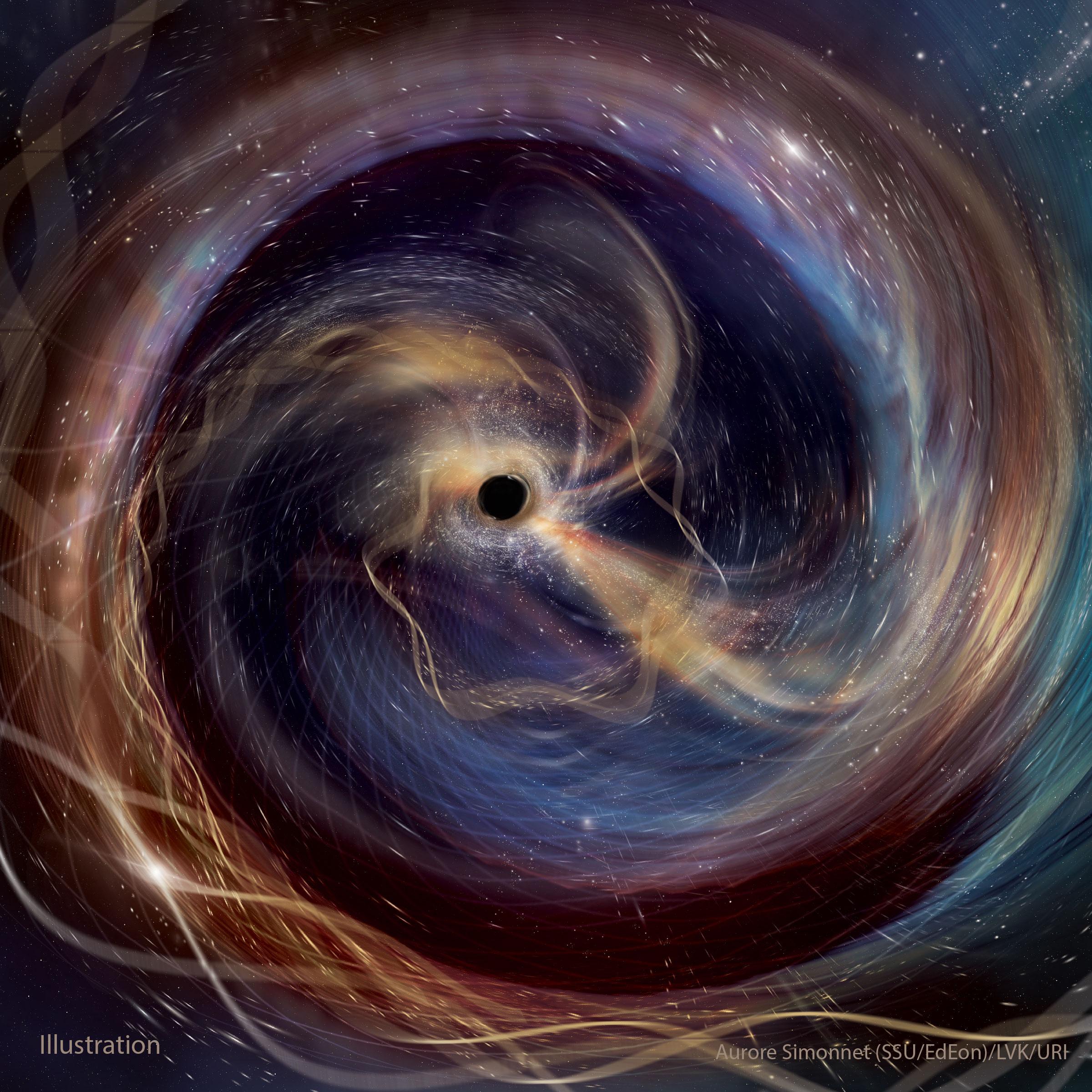
It was the strongest gravitational wave signal yet measured -- what did it show? GW250114 was detected by both arms of the Laser Interferometer Gravitational-wave Observatory (LIGO) in Washington and Louisiana USA earlier this year. Analysis showed that the event was created when two black holes, each of mass around 33 times the mass of the Sun, coalesced into one larger black hole with a mass of around 63 solar masses. Even though the event happened about a billion light years away, the signal was so strong that the spin of all black holes, as well as initial ringing of the final black hole, was deduced with exceptional accuracy. Furthermore, it was confirmed better than before, as previously predicted, that the total event horizon area of the combined black hole was greater than those of the merging black holes. Featured, an artist's illustration depicts an imaginative and conceptual view from near one of the black holes before collision.
https://www.ligo.caltech.edu/
https://www.caltech.edu/about/news/first-overtones-heard-ringing-black-hole
https://science.nasa.gov/universe/black-holes/anatomy/
https://apod.nasa.gov/apod/ap190414.html
https://apod.nasa.gov/htmltest/rjn_bht.html
https://spaceplace.nasa.gov/black-holes/en/
https://apod.nasa.gov/apod/ap191001.html
https://en.wikipedia.org/wiki/Black_hole_thermodynamics#Second_law_2
https://en.wikipedia.org/wiki/GW250114
https://apod.nasa.gov/apod/ap250924.html
#space #blackhole #astrophysics #astrophotography #photography #astronomy #science #nature #NASA #ESA #education
Alt...
2025 September 24
Artwork depicts a colorful version of two black holes nearing collision from between the black holes. Swirling gas is depicted with wavey lined depicting gravitational waves ringing and an artificial grid depicting spacetime shown distorting.
GW250114: Rotating Black Holes Collide
* Illustration Credit: Aurore Simonnet (SSU/EdEon), LVK, URI; LIGO Collaboration
Explanation:
It was the strongest gravitational wave signal yet measured -- what did it show? GW250114 was detected by both arms of the Laser Interferometer Gravitational-wave Observatory (LIGO) in Washington and Louisiana USA earlier this year. Analysis showed that the event was created when two black holes, each of mass around 33 times the mass of the Sun, coalesced into one larger black hole with a mass of around 63 solar masses. Even though the event happened about a billion light years away, the signal was so strong that the spin of all black holes, as well as initial ringing of the final black hole, was deduced with exceptional accuracy. Furthermore, it was confirmed better than before, as previously predicted, that the total event horizon area of the combined black hole was greater than those of the merging black holes. Featured, an artist's illustration depicts an imaginative and conceptual view from near one of the black holes before collision.
Authors & editors: Robert Nemiroff (MTU) & Jerry Bonnell (UMCP)
NASA Official: Amber Straughn Specific rights apply.
TOPIC >
Supermassive Black Holes
Spin up of a Supermassive Black Hole
* Illustration Credit: Robert Hurt, NASA/JPL-Caltech
https://www.ipac.caltech.edu/science/staff/hurt
https://www.jpl.nasa.gov/
https://www.nasa.gov/
Explanation:
How fast can a black hole spin? If any object made of regular matter spins too fast -- it breaks apart. But a black hole might not be able to break apart -- and its maximum spin rate is really unknown. Theorists usually model rapidly rotating black holes with the Kerr solution to Einstein's General Theory of Relativity, which predicts several amazing and unusual things. Perhaps its most easily testable prediction, though, is that matter entering a maximally rotating black hole should be last seen orbiting at near the speed of light, as seen from far away. This prediction was tested by NASA's NuSTAR and ESA's XMM satellites by observing the supermassive black hole at the center of spiral galaxy NGC 1365. The near light-speed limit was confirmed by measuring the heating and spectral line broadening of nuclear emissions at the inner edge of the surrounding accretion disk. Pictured here is an artist's illustration depicting an accretion disk of normal matter swirling around a black hole, with a jet emanating from the top. Since matter randomly falling into the black hole should not spin up a black hole this much, the NuSTAR and XMM measurements also validate the existence of the surrounding accretion disk.
https://www.jpl.nasa.gov/images/pia16695-black-holes-monsters-in-space-artists-concept/
https://slate.com/technology/2013/02/spinning-black-hole-scientists-measure-supermassive-black-hole-rotating-at-nearly-the-speed-of-light.html
https://ui.adsabs.harvard.edu/abs/2013Natur.494..449R/abstract
https://science.nasa.gov/universe/black-holes/
https://apod.nasa.gov/apod/ap080811.html
https://apod.nasa.gov/htmltest/rjn_bht.html
https://apod.nasa.gov/apod/ap140323.html
https://apod.nasa.gov/apod/ap241113.html
https://apod.nasa.gov/apod/ap250504.html
#space #blackhole #astroart #astrophotography #photography #astronomy #science #nature #NASA #ESA

Alt...
2025 May 4
An artistic illustration of a black hole is shown. The black spot in the center is the black hole, while the accretion disk of gas surrounding it is shown in orange. Stars and the darkness of space is shown near the top in the background. Please see the explanation for more detailed information.
Spin up of a Supermassive Black Hole
* Illustration Credit: Robert Hurt, NASA/JPL-Caltech
Explanation:
How fast can a black hole spin? If any object made of regular matter spins too fast -- it breaks apart. But a black hole might not be able to break apart -- and its maximum spin rate is really unknown. Theorists usually model rapidly rotating black holes with the Kerr solution to Einstein's General Theory of Relativity, which predicts several amazing and unusual things. Perhaps its most easily testable prediction, though, is that matter entering a maximally rotating black hole should be last seen orbiting at near the speed of light, as seen from far away. This prediction was tested by NASA's NuSTAR and ESA's XMM satellites by observing the supermassive black hole at the center of spiral galaxy NGC 1365. ...
Authors & editors: Robert Nemiroff (MTU) & Jerry Bonnell (UMCP)
NASA Official: Amber Straughn Specific rights apply.
NASA Web Privacy, Accessibility, Notices;
A service of: ASD at NASA / GSFC,
NASA Science Activation
& Michigan Tech. U.
What Is a Black Hole?
The Short Answer:
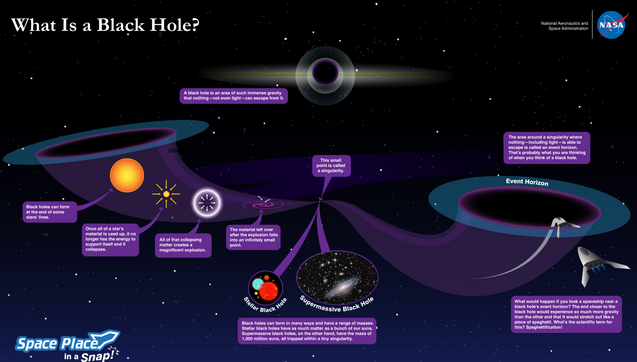
A black hole is an area of such immense gravity that nothing -- not even light -- can escape from it.
https://spaceplace.nasa.gov/black-holes/en/
#space #blackhole #astroart #astronomy #science #nature #NASA #education
Alt...
converted and compressed video version
explaining black holes for young students
Download a poster of this animation from NASA Space Place:
8.5 x 11 inches:
https://spaceplace.nasa.gov/black-holes/en/BlackHoles-poster_8.5x11.pdf
8.5 x 13 inches
https://spaceplace.nasa.gov/black-holes/en/BlackHoles-poster_8.5x13.pdf
11 x 17 inches
https://spaceplace.nasa.gov/black-holes/en/BlackHoles-poster_11x17.pdf
https://spaceplace.nasa.gov/black-holes/en/
you might also like:
https://www.jpl.nasa.gov/edu/resources/teachable-moment/how-scientists-captured-the-first-image-of-a-black-hole/
#space #blackhole #astronomy #science #nature #NASA #education
Alt...
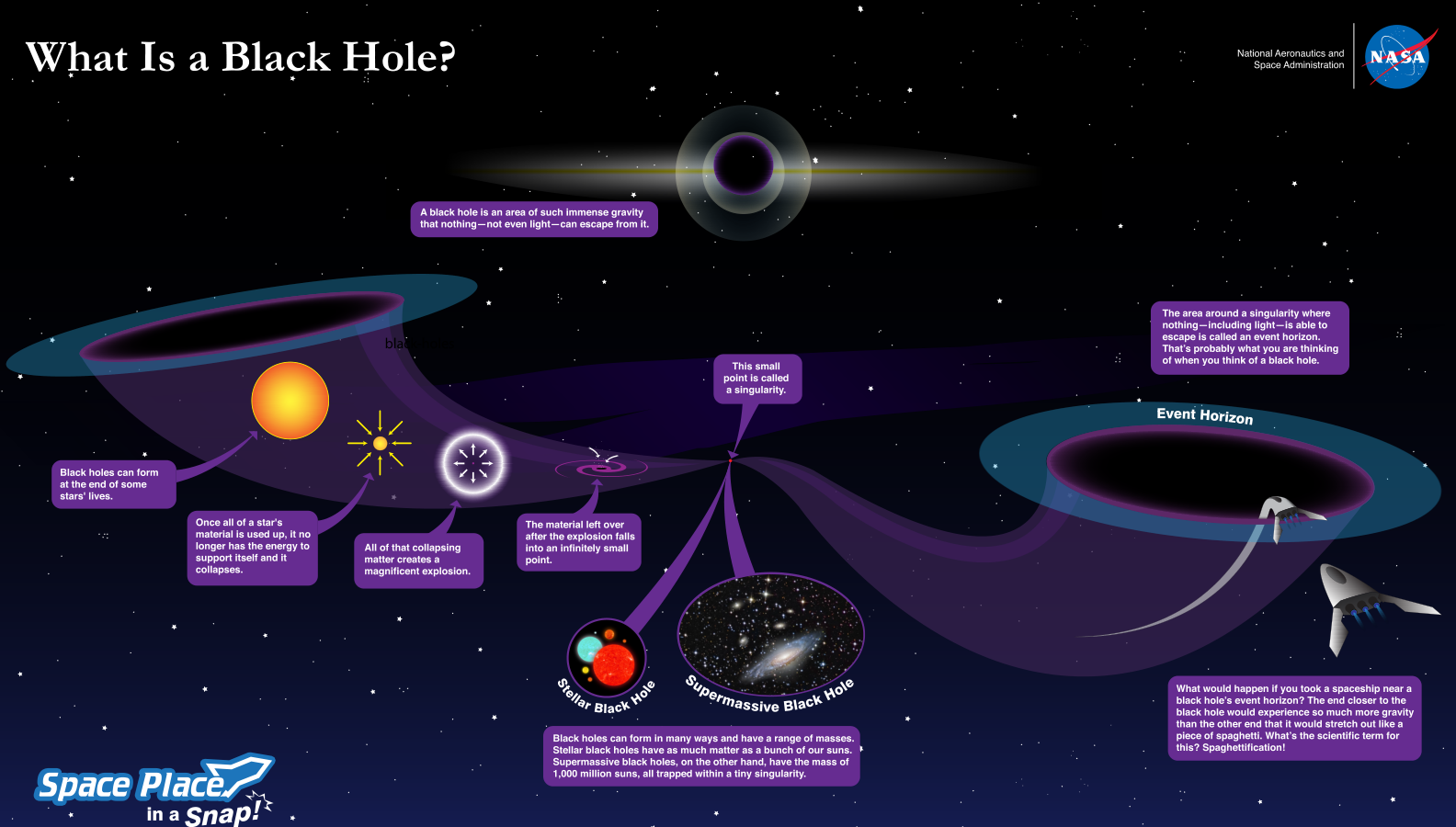
Image of tutorial poster for schools explaining black holes
click links to download from NASA SpacePlace web page above
The Spinning Black Hole
"Black holes are macroscopic objects with masses varying from a few solar masses to millions of solar masses.To the extent they may be considered as stationary and isolated, to that extent, they are all, every single one of them, described exactly by the Kerr solution.
This is the only instance we have of an exact description of a macroscopic object.
Macroscopic objects, as we see them all around us, are governed by a variety of forces, derived from a variety of approximations to a variety of physical theories.
In contrast, the only elements in the construction of black holes are our basic concepts of space and time.
They are, thus, almost by definition, the most perfect macroscopic objects there are in the universe. And since the general theory of relativity provides a single unique two-parameter family of solutions for their description, they are the simplest objects as well."
—S. Chandrasekhar
Images below explained from left to right downwards:
1. Black holes are tremendous objects whose immense gravity can distort and twist space-time, the fabric that shapes our universe.
2. Scientists measure the spin rates of supermassive black holes by spreading the X-ray light into different colors.
3. This image taken by the ultraviolet-light monitoring camera on the European Space Agency's (ESA's) XMM-Newton telescope shows the beautiful spiral arms of the galaxy NGC1365.
4. NASA's Nuclear Spectroscopic Telescope Array, or NuSTAR, has helped to show, for the first time, that the spin rates of black holes can be measured conclusively.
Credit: NASA/JPL-Caltech/ESA/CfA/INAF
https://www.jpl.nasa.gov/news/nasas-nustar-helps-solve-riddle-of-black-hole-spin/
* You may want to download and study this scientific elaboration:
PROJECT F
The Spinning Black Hole
https://www.eftaylor.com/pub/SpinNEW.pdf
#space #blackhole #astroart #astrophotography #photography #astronomy #science #nature #NASA #ESA

Alt...
1. Black holes are tremendous objects whose immense gravity can distort and twist space-time, the fabric that shapes our universe.
Credit: NASA/JPL-Caltech

Alt...
2. Scientists measure the spin rates of supermassive black holes by spreading the X-ray light into different colors.
Credit: NASA/JPL-Caltech

Alt...
3. This image taken by the ultraviolet-light monitoring camera on the European Space Agency's (ESA's) XMM-Newton telescope shows the beautiful spiral arms of the galaxy NGC1365.
Credit: ESA

Alt...
4. NASA's Nuclear Spectroscopic Telescope Array, or NuSTAR, has helped to show, for the first time, that the spin rates of black holes can be measured conclusively.
Credit: NASA/JPL-Caltech/ESA/CfA/INAF
Journey of an observer falling inside a(n ideal) Kerr black hole and emerging in a parallel universe. (The black hole has a mass of roughly one million solar masses (Schwarzschild radius = 10 light seconds) and an angular momentum at 80% of maximality (a/M=0.8). The observer has an energy of 1.2 times its mass and zero angular momentum along the black hole's axis.)
The upper left quadrant is the observer's front view (for a somewhat arbitrary definition of "front"), the upper right quadrant is their rear view. The lower left quadrant displays the trajectory on a polar plane cut (external horizon is red, internal horizon is green, static limit is dashed and is not seen in the video, cut discontinuity is purple, and trajectory is blue) and in a Penrose diagram (outer (I) blocks are shown in blue, inner (III) blocks are shown in pink, and intermediate (II) blocks are shown in light or dark grey according as they are white hole or black hole regions; the trajectory is again shown in blue). The bottom right quadrant shows the Boyer-Lindquist coordinates and their derivative with respect to the proper time (s) of the observer.
In the video, a blue sphere is placed outside the black hole at some distance, a purple sphere is placed in negative space (i.e., beyond the singularity cut), and the outer and inner horizons are various shades of red and green in the same color scheme as in the Penrose diagram (lighter shades are white hole horizons, darker shades are black hole horizons). All spheres are checkered in an identical way, with twenty-four longitudinal stripes and twelve latitudinal (or polar) stripes, consistent with the black hole's axis. (The longitudinal stripes on the horizons rotate with the black hole.) The ring singularity itself is not visible as such, but appears as the edge rim of the purple region.
*Video and Text Credits:
David Madore
#space #blackhole #astrophotography #photography #astronomy #science #nature #NASA #ESA
XMM-Newton catches giant black hole’s X-ray oscillations
The European Space Agency's XMM-Newton has detected rapidly fluctuating X-rays coming from the very edge of a supermassive black hole in the heart of a nearby galaxy. The results paint a fascinating picture that defies how we thought matter falls into such black holes, and points to a potential source of gravitational waves that ESA’s future mission, LISA, could see.
XMM-Newton is showing us that black holes devour matter in more complex ways than astronomers first thought. Black holes are predictions of Albert Einstein’s theory of general relativity. They are gravitational monsters that imprison any piece of matter or energy that crosses their ‘surface’, a region of spacetime known as the event horizon.
During its final descent into the black hole, a process known as accretion, the doomed matter forms a disc around the black hole. The gas in the accretion disc heats up and gives off mostly ultraviolet (UV) light.
The UV rays interact with a cloud of electrically charged gas, or plasma, that surrounds the black hole and accretion disc. This cloud is known as the corona and the interactions give the UV rays energy, boosting them up to X-rays, which XMM-Newton can capture.
XMM-Newton has been observing the supermassive black hole 1ES 1927+654 since 2011. Back then, everything was pretty normal. But in 2018, things changed.
1ES 1927+654 suffered a large outburst that appeared to disrupt its surroundings because the X-ray corona disappeared. Gradually, the corona returned, and by early 2021 normality appeared to have been restored.
>> there is more >>
https://www.esa.int/Science_Exploration/Space_Science/XMM-Newton/From_boring_to_bursting_a_giant_black_hole_awakens
Credits:
Discovery of extreme Quasi-Periodic Eruptions in a newly accreting massive black hole by L. Hernandez-García et al. is published today in Nature Astronomy. DOI 10.1038/s41550-025-02523-9
#space #blackhole #astroart #astrophotography #photography
#astronomy #science #nature #NASA #ESA

Alt...
Giant black hole gobbling up doomed white dwarf star
XMM-Newton is showing us that black holes devour
Notes for editors
Discovery of extreme Quasi-Periodic Eruptions in a newly accreting massive black hole by L. Hernandez-García et al. is published today in Nature Astronomy. DOI 10.1038/s41550-025-02523-9
Dr Lorena Hernandez-Garcia is also a researcher at the Millennium Institute of Astrophysics and Millennium Nucleus TITANS, Chile.
SDSS1335+0728: The awakening of a ∼106 M⊙ black hole by P. Sánchez-Sáez et al. was published in the August 2024 edition of Astronomy & Astrophysics.
Contact:
ESA Media relations
media@esa.int
Black Hole Tidal Disruption Event
When a star wanders too close to a black hole, the intense gravity will stretch the star out until it becomes a long river of hot gas, as shown in this animation. The gas is then whipped around the black hole and is gradually pulled into orbit, forming a bright disk.
* Credit: Science Communication Lab/DESY
General_relativity
General relativity, also known as the general theory of relativity, and as Einstein's theory of gravity, is the geometric theory of gravitation published by Albert Einstein in 1915 and is the current description of gravitation in modern physics. General relativity generalizes special relativity and refines Newton's law of universal gravitation, providing a unified description of gravity as a geometric property of space and time, or four-dimensional spacetime. In particular, the curvature of spacetime is directly related to the energy and momentum of whatever is present, including matter and radiation. The relation is specified by the Einstein field equations, a system of second-order partial differential equations.
Newton's law of universal gravitation, which describes classical gravity, can be seen as a prediction of general relativity for the almost flat spacetime geometry around stationary mass distributions. Some predictions of general relativity, however, are beyond Newton's law of universal gravitation in classical physics. These predictions concern the passage of time, the geometry of space, the motion of bodies in free fall, and the propagation of light, and include gravitational time dilation, gravitational lensing, the gravitational redshift of light, the Shapiro time delay and singularities/black holes. So far, all tests of general relativity have been shown to be in agreement with the theory. The time-dependent solutions of general relativity enable us to talk about the history of the universe and have provided the modern framework for cosmology, thus leading to the discovery of the Big Bang and cosmic microwave background radiation. ..
>> https://en.wikipedia.org/wiki/General_relativity
* relatively related:
https://en.wikipedia.org/wiki/Kerr_metric
https://en.wikipedia.org/wiki/Penrose_process
https://physicsopenlab.org/2017/09/07/spectral-lines-broadening/
* Credits: Wikimedia Commons
The Doubly Warped World of Binary Black Holes
* Scientific Visualization Credit: NASA, GSFC, Jeremy Schnittman & Brian P. Powell; Text: Francis J. Reddy
https://sedvme.gsfc.nasa.gov/sci/bio/francis.j.reddy
https://science.gsfc.nasa.gov/sci/bio/jeremy.d.schnittman
https://science.gsfc.nasa.gov/sci/bio/brian.p.powell
https://www.nasa.gov/goddard/
https://www.nasa.gov/
Explanation:
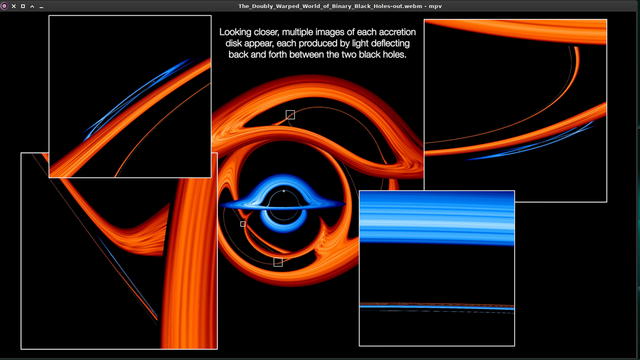
If one black hole looks strange, what about two? Light rays from accretion disks around a pair of orbiting supermassive black holes make their way through the warped space-time produced by extreme gravity in this detailed computer visualization. The simulated accretion disks have been given different false color schemes, red for the disk surrounding a 200-million-solar-mass black hole, and blue for the disk surrounding a 100-million-solar-mass black hole. For these masses, though, both accretion disks would actually emit most of their light in the ultraviolet. The video allows us to see both sides of each black hole at the same time. Red and blue light originating from both black holes can be seen in the innermost ring of light, called the photon sphere, near their event horizons. In the past decade, gravitational waves from black hole collisions have actually been detected, although the coalescence of supermassive black holes remains undiscovered.
https://www.nasa.gov/universe/new-nasa-visualization-probes-the-light-bending-dance-of-binary-black-holes/
https://apod.nasa.gov/apod/ap200825.html
https://en.wikipedia.org/wiki/Accretion_disk
https://apod.nasa.gov/apod/ap190411.html
https://svs.gsfc.nasa.gov/14132/
https://ui.adsabs.harvard.edu/abs/1993AmJPh..61..619N/abstract
https://apod.nasa.gov/htmltest/rjn_bht.html
https://en.wikipedia.org/wiki/Photon_sphere
https://apod.nasa.gov/apod/ap201104.html
https://apod.nasa.gov/apod/ap250506.html
#space #blackhole #astrophotography #photography #astronomy #science #nature #NASA #ESA
Alt...
2025 May 6
The Doubly Warped World of Binary Black Holes
* Scientific Visualization Credit: NASA, GSFC, Jeremy Schnittman & Brian P. Powell; Text: Francis J. Reddy
Explanation:
If one black hole looks strange, what about two? Light rays from accretion disks around a pair of orbiting supermassive black holes make their way through the warped space-time produced by extreme gravity in this detailed computer visualization. The simulated accretion disks have been given different false color schemes, red for the disk surrounding a 200-million-solar-mass black hole, and blue for the disk surrounding a 100-million-solar-mass black hole. For these masses, though, both accretion disks would actually emit most of their light in the ultraviolet. The video allows us to see both sides of each black hole at the same time. Red and blue light originating from both black holes can be seen in the innermost ring of light, called the photon sphere, near their event horizons. In the past decade, gravitational waves from black hole collisions have actually been detected, although the coalescence of supermassive black holes remains undiscovered
Authors & editors: Robert Nemiroff (MTU) & Jerry Bonnell (UMCP)
NASA Official: Amber Straughn Specific rights apply.
NASA Web Privacy, Accessibility, Notices;
A service of: ASD at NASA / GSFC,
NASA Science Activation.
Black Hole Accretion Disk Visualization
Credit: NASA’s Goddard Space Flight Center
Jeremy Schnittman (NASA/GSFC)
Scott Wiessinger (USRA)
Francis Reddy (University of Maryland College Park)
Francis Reddy (University of Maryland College Park)
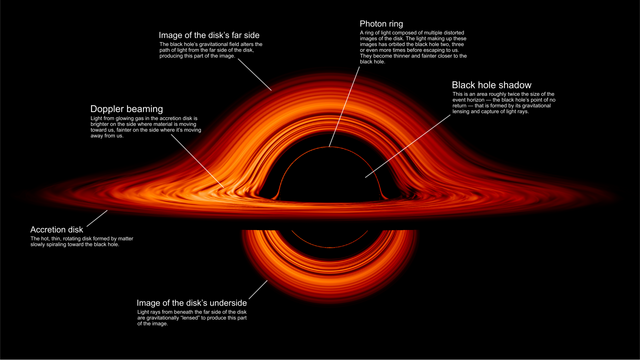
This new visualization of a black hole illustrates how its gravity distorts our view, warping its surroundings as if seen in a carnival mirror. The visualization simulates the appearance of a black hole where infalling matter has collected into a thin, hot structure called an accretion disk. The black hole’s extreme gravity skews light emitted by different regions of the disk, producing the misshapen appearance.
Bright knots constantly form and dissipate in the disk as magnetic fields wind and twist through the churning gas. Nearest the black hole, the gas orbits at close to the speed of light, while the outer portions spin a bit more slowly. This difference stretches and shears the bright knots, producing light and dark lanes in the disk.
Viewed from the side, the disk looks brighter on the left than it does on the right. Glowing gas on the left side of the disk moves toward us so fast that the effects of Einstein’s relativity give it a boost in brightness; the opposite happens on the right side, where gas moving away us becomes slightly dimmer. This asymmetry disappears when we see the disk exactly face on because, from that perspective, none of the material is moving along our line of sight.
Closest to the black hole, the gravitational light-bending becomes so excessive that we can see the underside of the disk as a bright ring of light seemingly outlining the black hole. This so-called “photon ring” is composed of multiple rings, which grow progressively fainter and thinner, from light that has circled the black hole two, three, or even more times before escaping to reach our eyes. ...
>> https://svs.gsfc.nasa.gov/13326
#space #blackhole #astrophotography #astrophysics #photography #astronomy #science #nature #NASA
Alt...
* converted and compressed video version
This movie shows the black hole visualization using a partial rotation, plus a long sequence where the black hole is viewed nearly edge on.
The thumbnail of this video highlights and explains various aspects of the black hole visualization.
This visualization is “mass invariant,” which means it can represent a black hole of any mass. The size of the black hole's shadow is proportional to its mass, but so is the size of the accreetion disk, so its properties scale accordingly.
Credit: NASA’s Goddard Space Flight Center/Jeremy Schnittman
The black hole’s extreme gravitational field redirects and distorts light coming from different parts of the disk, but exactly what we see depends on our viewing angle. The greatest distortion occurs when viewing the system nearly edgewise.
As our viewpoint rotates around the black hole, we see different parts of the fast-moving gas in the accretion disk moving directly toward us. Due to a phenomenon called "relativistic Doppler beaming," gas in the disk that's moving toward us makes that side of the disk appear brighter, the opposite side darker. This effect disappears when we're directly above or below the disk because, from that angle, none of the gas is moving directly toward us.
When our viewpoint passes beneath the disk, it looks like the gas is moving in the opposite direction. This is no different that viewing a clock from behind, which would make it look like the hands are moving counter-clockwise.
CORRECTION: In earlier versions of the 360-degree movies on this page, these important effects were not apparent. This was due to a minor mistake in orienting the camera relative to the disk. The fact that it was not initially discovered by the NASA scientist who made the movie reflects just how bizarre and counter-intuitive black holes can be!
Credit: NASA’s Goddard Space Flight Center
Jeremy Schnittman (NASA/GSFC)
Scott Wiessinger (USRA)
Francis Reddy (University of Maryland College Park)
Francis Reddy (University of Maryland College Park)
>>https://svs.gsfc.nasa.gov/13326#section_credits
#space #blackhole #astrophysics #astrophotography #photography #astronomy #science #nature #NASA #ESA

Alt...
This image highlights and explains various aspects of the black hole visualization.
Credit: NASA’s Goddard Space Flight Center/Jeremy Schnittman

Alt...
This illustration shows how direct and bent light rays from a black hole's accretion disk produce the apparent image and motion seen by an observer.
Credit: NASA’s Goddard Space Flight Center/Jeremy Schnittman
Alt...
360-degree rotation and a pause when the view is almost edge on; uses a square frame to show the complete accretion disk.
Credit: NASA’s Goddard Space Flight Center/Jeremy Schnittman
Alt...
Zoomed into the central region, highlighting the photon ring, with 360-degree rotation and a pause at almost edge on.
Credit: NASA’s Goddard Space Flight Center/Jeremy Schnittman
IXPE Explores a Black Hole Jet
Illustration Credit: NASA, Pablo Garcia
https://www.nasa.gov/
Explanation:
How do black holes create X-rays? Answering this long-standing question was significantly advanced recently with data taken by NASA’s IXPE satellite. X-rays cannot exit a black hole, but they can be created in the energetic environment nearby, in particular by a jet of particles moving outward. By observing X-ray light arriving from near the supermassive black hole at the center of galaxy BL Lac, called a blazar, it was discovered that these X-rays lacked significant polarization, which is expected when created more by energetic electrons than protons. In the featured artistic illustration, a powerful jet is depicted emanating from an orange-colored accretion disk circling the black hole. Understanding highly energetic processes across the universe helps humanity to understand similar processes that occur on or near our Earth.
https://www.nasa.gov/missions/ixpe/nasas-ixpe-reveals-x-ray-generating-particles-in-black-hole-jets/
https://apod.nasa.gov/apod/ap031128.html
https://apod.nasa.gov/apod/ap240507.html
https://apod.nasa.gov/apod/ap250504.html
https://en.wikipedia.org/wiki/Blazar
https://en.wikipedia.org/wiki/Polarization_(waves)
https://en.wikipedia.org/wiki/BL_Lacertae
https://home.cern/science/physics
https://ui.adsabs.harvard.edu/abs/2025arXiv250501832A/abstract
https://science.nasa.gov/ems/11_xrays/
https://pwg.gsfc.nasa.gov/Education/whelect.html
https://home.cern/news/news/physics/proton-century
https://chandra.si.edu/art/xray/
https://spaceplace.nasa.gov/aurora/en/
https://apod.nasa.gov/apod/ap250509.html
#space #blackhole #astroart #astronomy #physics #photography #science #nature #NASA

Alt...
2025 May 9
An artist's illustration of what the surroundings of the supermassive black hole at the center of BL Lac is shown. A white jet protrudes horizontally toward the bottom of the image, emanating from a orange accretion disk surrounding a black hole. Please see the explanation for more detailed information.
IXPE Explores a Black Hole Jet
Illustration Credit: NASA, Pablo Garcia
Explanation:
How do black holes create X-rays? Answering this long-standing question was significantly advanced recently with data taken by NASA’s IXPE satellite. X-rays cannot exit a black hole, but they can be created in the energetic environment nearby, in particular by a jet of particles moving outward. By observing X-ray light arriving from near the supermassive black hole at the center of galaxy BL Lac, called a blazar, it was discovered that these X-rays lacked significant polarization, which is expected when created more by energetic electrons than protons. In the featured artistic illustration, a powerful jet is depicted emanating from an orange-colored accretion disk circling the black hole. Understanding highly energetic processes across the universe helps humanity to understand similar processes that occur on or near our Earth.
Authors & editors: Robert Nemiroff (MTU) & Jerry Bonnell (UMCP)
NASA Official: Amber Straughn Specific rights apply.
NASA Web Privacy Policy and Important Notices
A service of: ASD at NASA / GSFC,
NASA Science Activation
& Michigan Tech. U.
Animation: Spiral Disk around a Black Hole
Illustrated Animation Credit: ESA, NASA, Hubble, M. Kornmesser
https://esahubble.org/projects/anniversary/production_team/
https://www.spacetelescope.org/
https://www.esa.int/
https://www.nasa.gov/
Explanation:
What would it look like to orbit a black hole? Many black holes are surrounded by swirling pools of gas known as accretion disks. These disks can be extremely hot, and much of the orbiting gas will eventually fall through the black hole's event horizon -- where it will never be seen again. The featured animation is an artist's rendering of the curious disk spiraling around the supermassive black hole at the center of spiral galaxy NGC 3147. Gas at the inner edge of this disk is so close to the black hole that it moves unusually fast -- at 10 percent of the speed of light. Gas this fast shows relativistic beaming, making the side of the disk heading toward us appear significantly brighter than the side moving away. The animation is based on images of NGC 3147 made recently with the Hubble Space Telescope.
!>> https://ascl.net/
https://apod.nasa.gov/apod/ap190820.html
X-RAYS AND ENERGY
X-rays have much higher energy and much shorter wavelengths than ultraviolet light, and scientists usually refer to x-rays in terms of their energy rather than their wavelength. This is partially because x-rays have very small wavelengths, between 0.03 and 3 nanometers, so small that some x-rays are no bigger than a single atom of many elements.a series of 12 x-ray images showing the various level of activity on the Sun.
Our Sun's radiation peaks in the visual range, but the Sun's corona is much hotter and radiates mostly x-rays. To study the corona, scientists use data collected by x-ray detectors on satellites in orbit around the Earth. Japan's Hinode spacecraft produced these x-ray images of the Sun that allow scientists to see and record the energy flows within the corona.
TEMPERATURE AND COMPOSITION
The physical temperature of an object determines the wavelength of the radiation it emits. The hotter the object, the shorter the wavelength of peak emission. X-rays come from objects that are millions of degrees Celsius—such as pulsars, galactic supernovae remnants, and the accretion disk of black holes.
From space, x-ray telescopes collect photons from a given region of the sky. The photons are directed onto the detector where they are absorbed, and the energy, time, and direction of individual photons are recorded. Such measurements can provide clues about the composition, temperature, and density of distant celestial environments. Due to the high energy and penetrating nature of x-rays, x-rays would not be reflected if they hit the mirror head on (much the same way that bullets slam into a wall). X-ray telescopes focus x-rays onto a detector using grazing incidence mirrors (just as bullets ricochet when they hit a wall at a grazing angle).
NASA's Mars Exploration Rover, Spirit, used x-rays to detect the spectral signatures of zinc and nickel in Martian rocks. >>https://science.nasa.gov/ems/11_xrays/
https://ui.adsabs.harvard.edu/abs/2025arXiv250501832A/abstract
Alt...
* converted and compressed video version
X-RAYS AND ENERGY
X-rays have much higher energy and much shorter wavelengths than ultraviolet light, and scientists usually refer to x-rays in terms of their energy rather than their wavelength. This is partially because x-rays have very small wavelengths, between 0.03 and 3 nanometers, so small that some x-rays are no bigger than a single atom of many elements.
a series of 12 x-ray images showing the various level of activity on the Sun.
NASA’s Hubble Spots Runaway Black Hole Devouring a Star 600 Million Light-Years From Earth
By Ryan Whalen·May 9, 2025
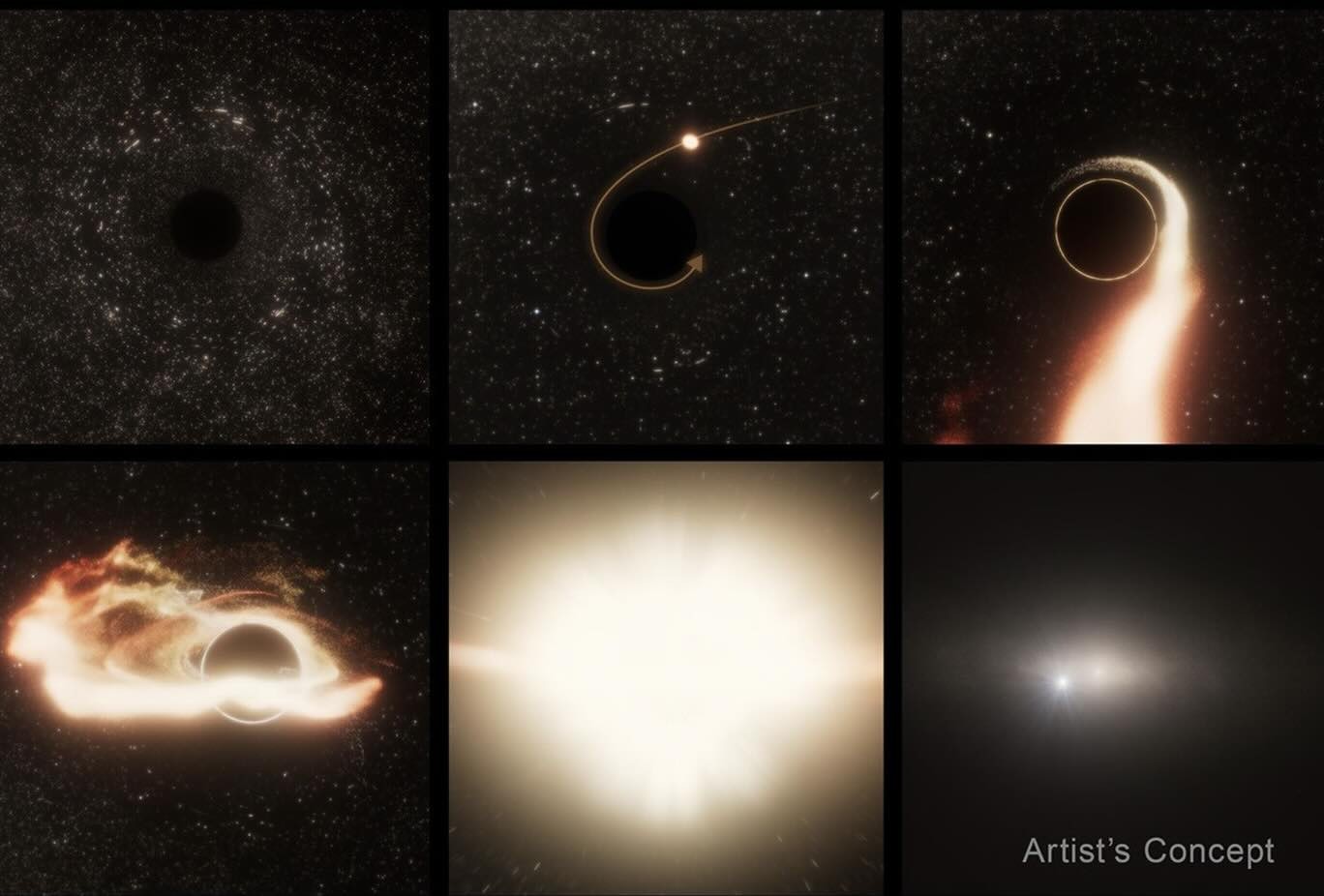
A traveling black hole stalking the cosmos for stellar prey recently revealed itself to NASA telescopes in a tidal disruption event , shredding and swallowing a star in a radioactive burst.
With its brilliant flash, the TDE AT2024tvd lit up several observatories, including NASA’s Hubble Space Telescope, Chandra X-Ray Observatory, and the NRAO Very Large Array. The TDE event took place 600 million light-years from Earth, allowing astronomers a new glimpse at black hole physics to be published in a future issue of The Astrophysical Journal Letters.
Initially, as the marauding black hole moved through the universe, it was detectable only through gravitational lensing—an effect caused by the black hole’s gravity distorting visible light in a way astronomers could observe.
Eventually, as the black hole encounters a star, its immense gravity pulls the stellar object inward. That intense gravitational force overwhelms the star, spaghettifying it, with some of the remnants forming a bright accretion disc around the black hole’s edge and a stream of electromagnetic radiation pouring out. Shocks and outflows from the accretion disc generate extreme temperatures, producing ultraviolet and visible light emissions.
Out of Center
Black holes are typically found at the centers of their galaxies, but this roaming void in space was the first observed offset from its galaxy, out of the roughly 100 tidal disruption events (TDEs) on record. Intriguingly, the host galaxy already contains a supermassive black hole at its center. The distance between the TDE and the galaxy’s central black hole was only a tenth of the distance from Earth to the Milky Way’s black hole—about 2,600 light-years.
The central black hole in the TDE’s galaxy is larger than the wandering one, and ..
#space #blackhole #astrophotography #photography #science #nature #NASA
Alt...
Wandering Black Hole Images
NASA concept art depicting the stages of a tidal disruption event (Credit: NASA, ESA, STScI, Ralf Crawford (STScI)).
Out of Center
Black holes are typically found at the centers of their galaxies, but this roaming void in space was the first observed offset from its galaxy, out of the roughly 100 tidal disruption events (TDEs) on record. Intriguingly, the host galaxy already contains a supermassive black hole at its center. The distance between the TDE and the galaxy’s central black hole was only a tenth of the distance from Earth to the Milky Way’s black hole—about 2,600 light-years.
The central black hole in the TDE’s galaxy is larger than the wandering one, and surprisingly, the two have not gravitationally bonded as a binary pair. Yet that could eventually change, with the roaming black hole possibly merging with the larger central black hole in the future.
black hole
“AT2024tvd is the first offset TDE captured by optical sky surveys, and it opens up the entire possibility of uncovering this elusive population of wandering black holes with future sky surveys,” said lead author Yuhan Yao of the University of California at Berkeley. “Right now, theorists haven’t given much attention to offset TDEs. “I think this discovery will motivate scientists to look for more examples of this type of event.”
The wandering black hole only becomes visible every tens of thousands of years—each time it consumes a star.
New NASA Black Hole Visualization Takes Viewers Beyond the Brink
...
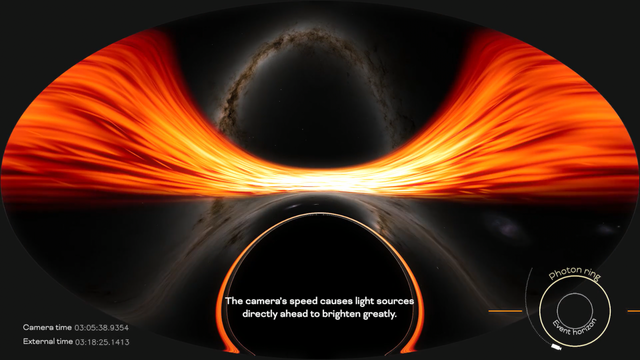
As the camera approaches the black hole, reaching speeds ever closer to that of light itself, the glow from the accretion disk and background stars becomes amplified in much the same way as the sound of an oncoming racecar rises in pitch. Their light appears brighter and whiter when looking into the direction of travel.
The movies begin with the camera located nearly 400 million miles (640 million kilometers) away, with the black hole quickly filling the view. Along the way, the black hole’s disk, photon rings, and the night sky become increasingly distorted — and even form multiple images as their light traverses the increasingly warped space-time.
In real time, the camera takes about 3 hours to fall to the event horizon, executing almost two complete 30-minute orbits along the way. But to anyone observing from afar, it would never quite get there. As space-time becomes ever more distorted closer to the horizon, the image of the camera would slow and then seem to freeze just shy of it. This is why astronomers originally referred to black holes as “frozen stars.”
At the event horizon, even space-time itself flows inward at the speed of light, the cosmic speed limit. Once inside it, both the camera and the space-time in which it's moving rush toward the black hole's center — a one-dimensional point called a singularity, where the laws of physics as we know them cease to operate.
“Once the camera crosses the horizon, its destruction by spaghettification is just 12.8 seconds away,” Schnittman said. From there, it’s only 79,500 miles (128,000 kilometers) to the singularity. This final leg of the voyage is over in the blink of an eye.
#space #blackhole #science #nature #NASA
Alt...
* this video-version has been compressed to ~9% of the original size by the free and opensource software ffmpeg with compression - factor 33.
command: "ffmpeg -i /path/to/original-file.original_extension -vcodec libx265 -crf 33 /path/to/outputfile.desired_extension"
To enjoy the full glance please go to the source page linked above.
Enjoy the ride :)
In this visualization of a flight toward a supermassive black hole, labels highlight many of the fascinating features produced by the effects of general relativity along the way. Produced on a NASA supercomputer, the simulation tracks a camera as it approaches, briefly orbits, and then crosses the event horizon — the point of no return — of a monster black hole much like the one at the center of our galaxy. Credit: NASA's Goddard Space Flight Center/J. Schnittman and B. Powell
Nearby black holes and their stellar companions form an astrophysical rogues’ gallery
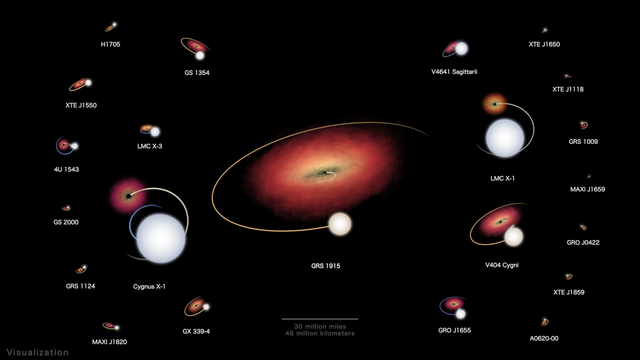
Stars born with more than about 20 times the Sun’s mass end their lives as black holes. As the name implies, black holes don’t glow on their own because nothing can escape them, not even light. Until 2015, when astronomers first detected merging black holes through the space-time ripples called gravitational waves, the main way to find these ebony enigmas was to search for them in binary systems where they interacted with companion stars. And the best way to do that was to look in X-rays.
This visualization shows 22 X-ray binaries in our Milky Way galaxy and its nearest neighbor, the Large Magellanic Cloud, that host confirmed stellar-mass black holes. The systems appear at the same physical scale, demonstrating their diversity. Their orbital motion is sped up by nearly 22,000 times, and the viewing angles replicate how we see them from Earth.
When paired with a star, a black hole can collect matter in two ways. In many cases, a stream of gas can flow directly from the star to the black hole. In others, such as the first confirmed black hole system, Cygnus X-1, the star produces a dense outflow called a stellar wind, some of which the black hole’s intense gravity gathers up. So far, there’s no clear consensus on which mode is used by GRS 1915, the big system at the center of the visualization.
As it arrives at the black hole, the gas goes into orbit and forms a broad, flattened structure called an accretion disk. GRS 1915’s accretion disk may extend more than 50 million miles (80 million kilometers), greater than the distance separating Mercury from the Sun. Gas in the disk heats up as it slowly spirals inward, glowing in visible, ultraviolet, and finally X-ray light.
By Francis Reddy
NASA’s Goddard Space Flight Center, Greenbelt, Md.
Media contacts:
Claire Andreoli
NASA’s Goddard Space Flight Center, Greenbelt, Md.
#space #blackholes #astronomy #NASA #science
Alt...
* compressed and converted version
This visualization presents 22 X-ray binary systems that host confirmed black holes, all shown at the same scale and with their orbits sped up by about 22,000 times. The view of each system reflects how we see it from Earth. Star colors ranging from blue-white to reddish represent temperatures from 5 times hotter to 45% cooler than our Sun. In most of these systems, a stream of matter from the star forms an accretion disk around the black hole. In others, like the famous system called Cygnus X-1, the star produces a hefty outflow that is partly swept up by the black hole’s gravity to form the disk. The accretion disks use a different color scheme because they sport even higher temperatures than the stars. The largest disk shown, belonging to a binary called GRS 1915, spans a distance greater than that separating Mercury from our Sun. The black holes themselves are shown larger than in reality using spheres scaled to reflect their masses. Download this video in HD formats from NASA’s Scientific Visualization Studio.
Credit: NASA’s Goddard Space Flight Center and Scientific Visualization Studio
New insights into black hole scattering and gravitational waves unveiled
Their research provides a high-precision prediction of black hole scattering.
This research, led by Professor Jan Plefka at Humboldt University of Berlin and Queen Mary University London’s Dr Gustav Mogull, formerly at Humboldt Universität and the Max Planck Institute for Gravitational Physics (Albert Einstein Institute), and conducted in collaboration with an international team of physicists, provides unprecedented precision in calculations crucial to understanding gravitational waves.
Using cutting-edge techniques inspired by quantum field theory, the team calculated the fifth post-Minkowskian (5PM) order for observables such as scattering angles, radiated energy, and recoil. A groundbreaking aspect of the work is the appearance of Calabi-Yau three-fold periods – geometric structures rooted in string theory and algebraic geometry – within the radiative energy and recoil. These structures, once considered purely mathematical, now find relevance in describing real-world astrophysical phenomena.
With gravitational wave observatories like LIGO entering a new phase of sensitivity and next-generation detectors such as LISA on the horizon, this research meets the increasing demand for theoretical models of extraordinary accuracy.
Dr Mogull explained the significance:
While the physical process of two black holes interacting and scattering via gravity ...
>>> read more:
#space #blackholes #astronomy #NASA #science #physics #quantummechanics

Alt...
Visualization of the calculated gravitational waves triggered by the scattering of two black holes.
Precise models of high-velocity black hole encounters
The application of abstract mathematical structures to real-world phenomena provides new insights into gravitational waves An international research team, including scientists from the Max Planck Institute for Gravitational Physics in the Potsdam Science Park, is setting new standards in the modeling of high-speed encounters of black holes. The new method is based on – so far – abstract mathematical structures, the so-called Calabi-Yau spaces. Their application to real astrophysical phenomena now allows extremely accurate predictions of how black holes and neutron stars are deflected from their original orbits after an encounter. The study, published 14. Mai 2025 in Nature, comes at the right time to meet the growing demand for highly accurate theoretical predictions.
The results could be used to detect gravitational-wave signals in future observations of the current network of gravitational-wave detectors, with the planned third generation of ground-based observatories such as the Einstein Telescope and Cosmic Explorer, and with the space-based Laser Interferometer Space Antenna (LISA).
Credit:
Mathias Driesse/Humboldt University Berlin.
Working Group "Quantum Field and String Theory" @ Humboldt University
July 10, 2024
NASA’s Hubble Finds Strong Evidence for Intermediate-Mass Black Hole in Omega Centauri
Most known black holes are either extremely massive, like the supermassive black holes that lie at the cores of large galaxies, or relatively lightweight, with a mass of under 100 times that of the Sun. Intermediate-mass black holes (IMBHs) are scarce, however, and are considered rare "missing links" in black hole evolution.
Now, an international team of astronomers has used more than 500 images from NASA's Hubble Space Telescope — spanning two decades of observations — to search for evidence of an intermediate-mass black hole by following the motion of seven fast-moving stars in the innermost region of the globular star cluster Omega Centauri.
These stars provide new compelling evidence for the presence of the gravitational pull from an intermediate-mass black hole tugging on them. Only a few other IMBH candidates have been found to date.
Omega Centauri consists of roughly 10 million stars that are gravitationally bound. The cluster is about 10 times as massive as other big globular clusters — almost as massive as a small galaxy.
Among the many questions scientists want to answer: Are there any IMBHs, and if so, how common are they? Does a supermassive black hole grow from an IMBH? How do IMBHs themselves form? Are dense star clusters their favored home?
The astronomers have now created an enormous catalog for the motions of these stars, measuring the velocities for 1.4 million stars gleaned from the Hubble images of the cluster. Most of these observations were intended to calibrate Hubble's instruments rather than for scientific use, but they turned out to be an ideal database for the team's research efforts.
https://arxiv.org/abs/2404.03722
https://zenodo.org/records/11104046
[...]
#space #blackhole #astrophysics #astrophotography #photography #astronomy #science #nature #NASA #ESA
Alt...
July 10, 2024
Globular cluster
Omega Centauri, NGC 5139
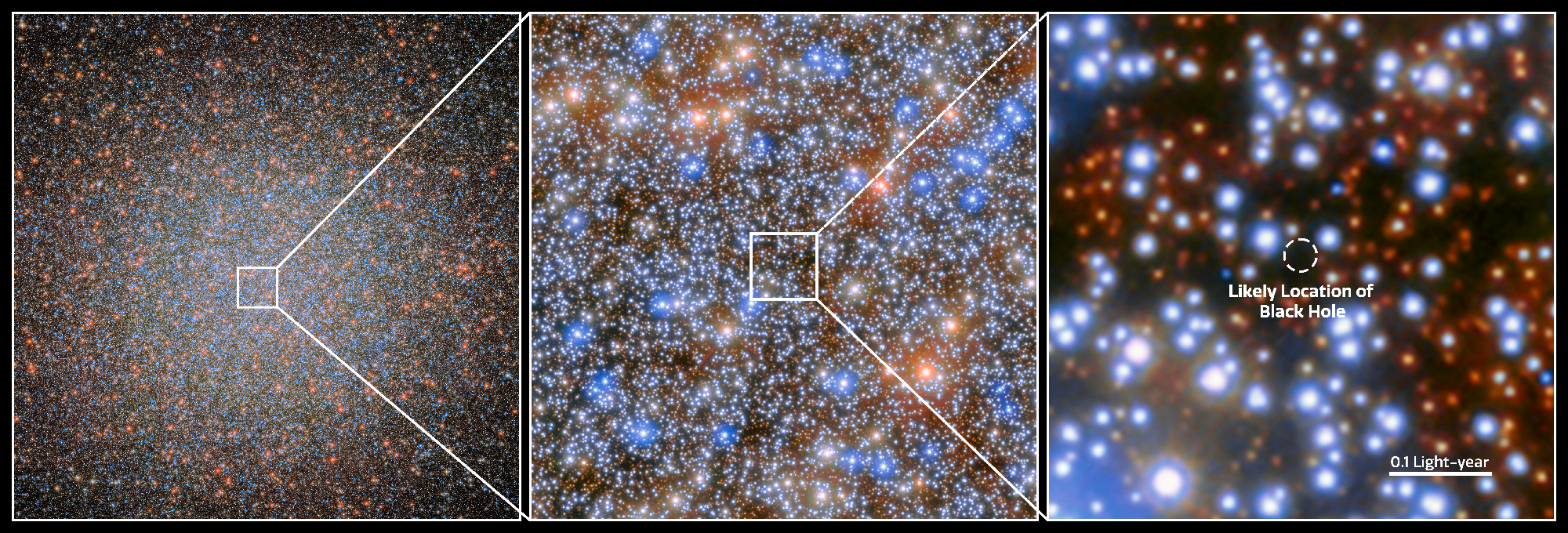
An international team of astronomers has used more than 500 images from NASA's Hubble Space Telescope – spanning two decades of observations – to detect seven fast-moving stars in the innermost region of Omega Centauri, the largest and brightest globular cluster in the sky. These stars provide compelling new evidence for the presence of an intermediate-mass black hole (IMBH) tugging on them. Only a few other IMBH candidates have been found to date.
This image shows the location of the IMBH in Omega Centauri. If confirmed, at its distance of 17,700 light-years the candidate black hole resides closer to Earth than the 4.3-million-solar-mass black hole in the center of the Milky Way, which is 26,000 light-years away. Besides the Galactic center, it would also be the only known case of a number of stars closely bound to a massive black hole.
This image includes three panels. The first image at left shows the globular cluster Omega Centauri, a collection of myriad stars colored red, white, and blue on the black background of space. The second image shows the details of the central region of this cluster, with a closer view of the individual stars. The third image shows the location of the IMBH candidate in the cluster.
CREDIT
ESA/Hubble, NASA, Maximilian Häberle (MPIA)
[...]
"We discovered seven stars that should not be there," explained Maximilian Häberle of the Max Planck Institute for Astronomy in Germany, who led this investigation. "They are moving so fast that they would escape the cluster and never come back. The most likely explanation is that a very massive object is gravitationally pulling on these stars and keeping them close to the center. The only object that can be so massive is a black hole, with a mass at least 8,200 times that of our Sun."
Several studies have suggested the presence of an IMBH in Omega Centauri. However, other studies proposed the mass could be contributed by a central cluster of stellar-mass black holes, and had suggested the lack of fast-moving stars above the necessary escape velocity made an IMBH less likely in comparison.
"This discovery is the most direct evidence so far of an IMBH in Omega Centauri," added team lead Nadine Neumayer of the Max Planck Institute for Astronomy in Germany, who initiated the study, together with Anil Seth from the University of Utah, Salt Lake City.
[...]
If confirmed, at a distance of 17,700 light-years the candidate black hole resides closer to Earth than the 4.3-million-solar-mass black hole in the center of the Milky Way, located 26,000 light-years away.
Omega Centauri is visible from Earth with the naked eye and is one of the favorite celestial objects for stargazers living in the southern hemisphere. Located just above the plane of the Milky Way, the cluster appears almost as large as the full Moon when seen from a dark rural area. It was first listed in Ptolemy’s catalog nearly 2,000 years ago as a single star. Edmond Halley reported it as a nebula in 1677. In the 1830s the English astronomer John Herschel was the first to recognize it as a globular cluster.
#space #blackhole #astrophysics #astrophotography #photography #astronomy #science #nature #NASA #ESA
"Om Nano Paeme Hum ;) "
2023 June 29
A Message from the Gravitational Universe
* Illustration Credit: NANOGrav Physics Frontier Center;
https://nanograv.org/
* Text: Natalia Lewandowska (SUNY Oswego)
https://ww1.oswego.edu/physics/
Explanation:
Monitoring 68 pulsars with very large radio telescopes, the North American Nanohertz Observatory for Gravitational Waves (NANOGrav) has uncovered evidence for the gravitational wave (GW) background by carefully measuring slight shifts in the arrival times of pulses. These shifts are correlated between different pulsars in a way that indicates that they are caused by GWs. This GW background is likely due to hundreds of thousands or even millions of supermassive black hole binaries. Teams in Europe, Asia and Australia have also independently reported their results today. Previously, the LIGO and Virgo detectors have detected higher-frequency GWs from the merging of individual pairs of massive orbiting objects, such as stellar-mass black holes. The featured illustration highlights this spacetime-shaking result by depicting two orbiting supermassive black holes and several of the pulsars that would appear to have slight timing shifts. The imprint these GWs make on spacetime itself is illustrated
by a distorted grid.
https://en.wikipedia.org/wiki/Radio_telescope
https://nanograv.org/science/overview
https://nanograv.org/science/topics/low-frequency-gravitational-waves
https://en.wikipedia.org/wiki/Gravitational_wave_background
https://nanograv.org/news/15yrRelease
https://www.seti.org/news/nanogravs-15-year-journey-reveals-a-cosmic-hum/
https://astrobites.org/2018/01/29/hunting-for-gravitational-waves-from-spinning-neutron-stars/
https://apod.nasa.gov/apod/ap230629.html
#space #blackhole #astrophysics #astrophotography #photography #astronomy #science #nature #NASA #ESA

Alt...
2023 June 29
The illustration shows the beams from pulsars around the image and a pair of merging black holes on the upper left. A grid depicting the warping of spacetime by passing gravitational waves spreads across the image center.
A Message from the Gravitational Universe
* Illustration Credit: NANOGrav Physics Frontier Center;
* Text: Natalia Lewandowska (SUNY Oswego)
Explanation:
Monitoring 68 pulsars with very large radio telescopes, the North American Nanohertz Observatory for Gravitational Waves (NANOGrav) has uncovered evidence for the gravitational wave (GW) background by carefully measuring slight shifts in the arrival times of pulses. These shifts are correlated between different pulsars in a way that indicates that they are caused by GWs. This GW background is likely due to hundreds of thousands or even millions of supermassive black hole binaries. Teams in Europe, Asia and Australia have also independently reported their results today. Previously, the LIGO and Virgo detectors have detected higher-frequency GWs from the merging of individual pairs of massive orbiting objects, such as stellar-mass black holes. The featured illustration highlights this spacetime-shaking result by depicting two orbiting supermassive black holes and several of the pulsars that would appear to have slight timing shifts. The imprint these GWs make on spacetime itself is illustrated by a distorted grid.
Authors & editors: Robert Nemiroff (MTU) & Jerry Bonnell (UMCP)
2018 December 3
Spiraling Supermassive Black Holes
* Video Credit: NASA's Goddard Space Flight Center
https://www.nasa.gov/
https://www.nasa.gov/goddard
* Music: In the Hall of the Mountain King by Edvard Grieg
https://en.wikipedia.org/wiki/In_the_Hall_of_the_Mountain_King
https://en.wikipedia.org/wiki/Edvard_Grieg
Explanation:
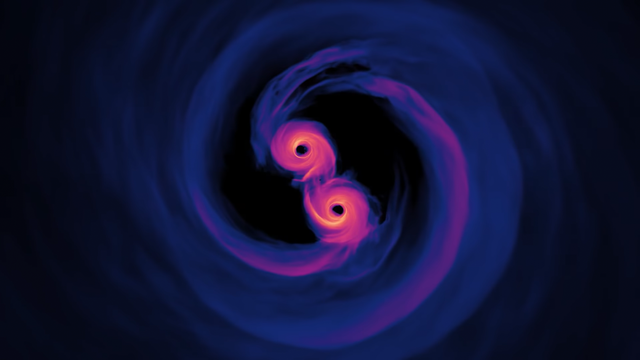
Do black holes glow when they collide? When merging, co-orbiting black holes are sure to emit a burst of unusual gravitational radiation, but will they emit light, well before that, if they are surrounded by gas? To help find out, astrophysicists created a sophisticated computer simulation. The simulation and featured resulting video accurately depicts two spiraling supermassive black holes, including the effects of Einstein's general relativity on the surrounding gas and light. The video first shows the system from the top, and later from the side where unusual gravitational lens distortions are more prominent. Numerical results indicate that gravitational and magnetic forces should energize the gas to emit high-energy light from the ultraviolet to the X-ray. The emission of such light may enable humanity to detect and study supermassive black hole pairs well before they spiral together.
https://apod.nasa.gov/apod/ap181203.html
#space #blackhole #astrophysics #astrophotography #photography #astronomy #science #nature #NASA #ESA
Alt...
2018 December 3
Spiraling Supermassive Black Holes
* Video Credit: NASA's Goddard Space Flight Center;
* Music: In the Hall of the Mountain King by Edvard Grieg
Explanation:
Do black holes glow when they collide? When merging, co-orbiting black holes are sure to emit a burst of unusual gravitational radiation, but will they emit light, well before that, if they are surrounded by gas? To help find out, astrophysicists created a sophisticated computer simulation. The simulation and featured resulting video accurately depicts two spiraling supermassive black holes, including the effects of Einstein's general relativity on the surrounding gas and light. The video first shows the system from the top, and later from the side where unusual gravitational lens distortions are more prominent. Numerical results indicate that gravitational and magnetic forces should energize the gas to emit high-energy light from the ultraviolet to the X-ray. The emission of such light may enable humanity to detect and study supermassive black hole pairs well before they spiral together.
Authors & editors: Robert Nemiroff (MTU) & Jerry Bonnell (UMCP)
NASA Official: Phillip Newman Specific rights apply.
NASA Web Privacy Policy and Important Notices
A service of: ASD at NASA / GSFC
& Michigan Tech. U.
2021 December 7
Ninety Gravitational Wave Spectrograms and Counting
* Image Credit: NSF, LIGO, VIRGO, KAGRA, Georgia Tech, Vanderbilt U.
https://www.nsf.gov/
https://www.ligo.org/about.php
http://public.virgo-gw.eu/the-virgo-collaboration/
https://gwcenter.icrr.u-tokyo.ac.jp/en/organization
https://physics.gatech.edu/
https://as.vanderbilt.edu/physics/
* Graphic : Sudarshan Ghonge & Karan Jani
https://humansofligo.blogspot.com/2019/05/sudarshan-ghonge.html
https://www.karanjani.com/
Explanation:
Every time two massive black holes collide, a loud chirping sound is broadcast out into the universe in gravitational waves. Humanity has only had the technology to hear these unusual chirps for the past seven years, but since then we have heard about 90 -- during the first three observing runs. Featured above are the spectrograms -- plots of gravitational-wave frequency versus time -- of these 90 as detected by the giant detectors of LIGO (in the USA), VIRGO (in Europe), and KAGRA (in Japan). The more energy received on Earth from a collision, the brighter it appears on the graphic. Among many science firsts, these gravitational-radiation chirps are giving humanity an unprecedented inventory of black holes and neutron stars, and a new way to measure the expansion rate of our universe. A fourth gravitational wave observing run with increased sensitivity is currently planned to begin in 2022 December.
https://spaceplace.nasa.gov/gravitational-waves/en/
https://dcc.ligo.org/LIGO-G2102338/public
https://ligo.org/science-summaries/O3bAstroDist/
https://apod.nasa.gov/apod/ap211207.html
#space #blackhole #astrophysics #astrophotography #photography #astronomy #science #nature #NASA #ESA

Alt...
2021 December 7
The featured image shows spectrograms for the first 90 gravitational wave events ever detected.
Ninety Gravitational Wave Spectrograms and Counting
* Image Credit: NSF, LIGO, VIRGO, KAGRA, Georgia Tech, Vanderbilt U.
* Graphic : Sudarshan Ghonge & Karan Jani
Explanation:
Every time two massive black holes collide, a loud chirping sound is broadcast out into the universe in gravitational waves. Humanity has only had the technology to hear these unusual chirps for the past seven years, but since then we have heard about 90 -- during the first three observing runs. Featured above are the spectrograms -- plots of gravitational-wave frequency versus time -- of these 90 as detected by the giant detectors of LIGO (in the USA), VIRGO (in Europe), and KAGRA (in Japan). The more energy received on Earth from a collision, the brighter it appears on the graphic. Among many science firsts, these gravitational-radiation chirps are giving humanity an unprecedented inventory of black holes and neutron stars, and a new way to measure the expansion rate of our universe. A fourth gravitational wave observing run with increased sensitivity is currently planned to begin in 2022 December.
Authors & editors: Robert Nemiroff (MTU) & Jerry Bonnell (UMCP)
NASA Official: Phillip Newman Specific rights apply.
NASA Web Privacy Policy and Important Notices
A service of: ASD at NASA / GSFC
& Michigan Tech. U.
The Sound of Two Black Holes Colliding
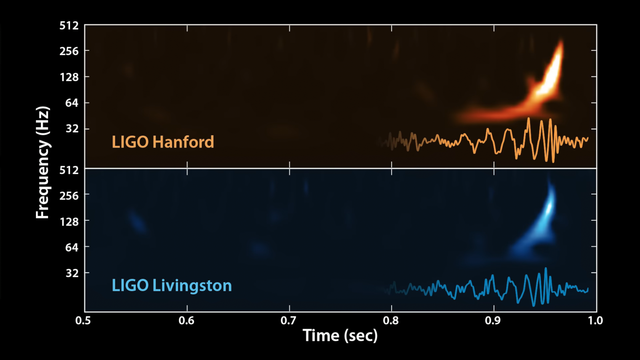
Gravitational waves sent out from a pair of colliding black holes have been converted to sound waves, as heard in this animation. On September 14, 2015, LIGO observed gravitational waves from the merger of two black holes, each about 30 times the mass of our sun. The incredibly powerful event, which released 50 times more energy than all the stars in the observable universe, lasted only fractions of a second.
In the first two runs of the animation, the sound-wave frequencies exactly match the frequencies of the gravitational waves. The second two runs of the animation play the sounds again at higher frequencies that better fit the human hearing range. The animation ends by playing the original frequencies again twice.
As the black holes spiral closer and closer in together, the frequency of the gravitational waves increases. Scientists call these sounds "chirps," because some events that generate gravitation waves would sound like a bird's chirp.
Audio Credit:
Caltech/MIT/LIGO Lab
ligo.caltech.edu
#space #blackhole #astrophysics #astrophotography #photography #astronomy #science #nature #NASA #ESA
Alt...
The Sound of Two Black Holes Colliding
Gravitational waves sent out from a pair of colliding black holes have been converted to sound waves, as heard in this animation. On September 14, 2015, LIGO observed gravitational waves from the merger of two black holes, each about 30 times the mass of our sun. The incredibly powerful event, which released 50 times more energy than all the stars in the observable universe, lasted only fractions of a second.
In the first two runs of the animation, the sound-wave frequencies exactly match the frequencies of the gravitational waves. The second two runs of the animation play the sounds again at higher frequencies that better fit the human hearing range. The animation ends by playing the original frequencies again twice.
As the black holes spiral closer and closer in together, the frequency of the gravitational waves increases. Scientists call these sounds "chirps," because some events that generate gravitation waves would sound like a bird's chirp.
Audio Credit:
Caltech/MIT/LIGO Lab
ligo.caltech.edu
2017 March 27
Black Hole Accreting with Jet
* Illustration Credit: NASA, Swift, Aurore Simonnet (Sonoma State U.)
https://www.nasa.gov/
https://www.nasa.gov/mission_pages/swift/main
http://universe.sonoma.edu/~aurore/about.html
http://www.phys-astro.sonoma.edu/index.shtml
Explanation:
What happens when a black hole devours a star? Many details remain unknown, but recent observations are providing new clues. In 2014, a powerful explosion was recorded by the ground-based robotic telescopes of the All Sky Automated Survey for SuperNovae (ASAS-SN) project, and followed up by instruments including NASA's Earth-orbiting Swift satellite. Computer modeling of these emissions fit a star being ripped apart by a distant supermassive black hole. The results of such a collision are portrayed in the featured artistic illustration. The black hole itself is a depicted as a tiny black dot in the center. As matter falls toward the hole, it collides with other matter and heats up. Surrounding the black hole is an accretion disk of hot matter that used to be the star, with a jet emanating from the black hole's spin axis.
https://www.astronomy.ohio-state.edu/asassn/index.shtml
https://apod.nasa.gov/apod/ap170327.html
#space #blackhole #astrophysics #astrophotography #photography #astronomy #science #nature #NASA #ESA
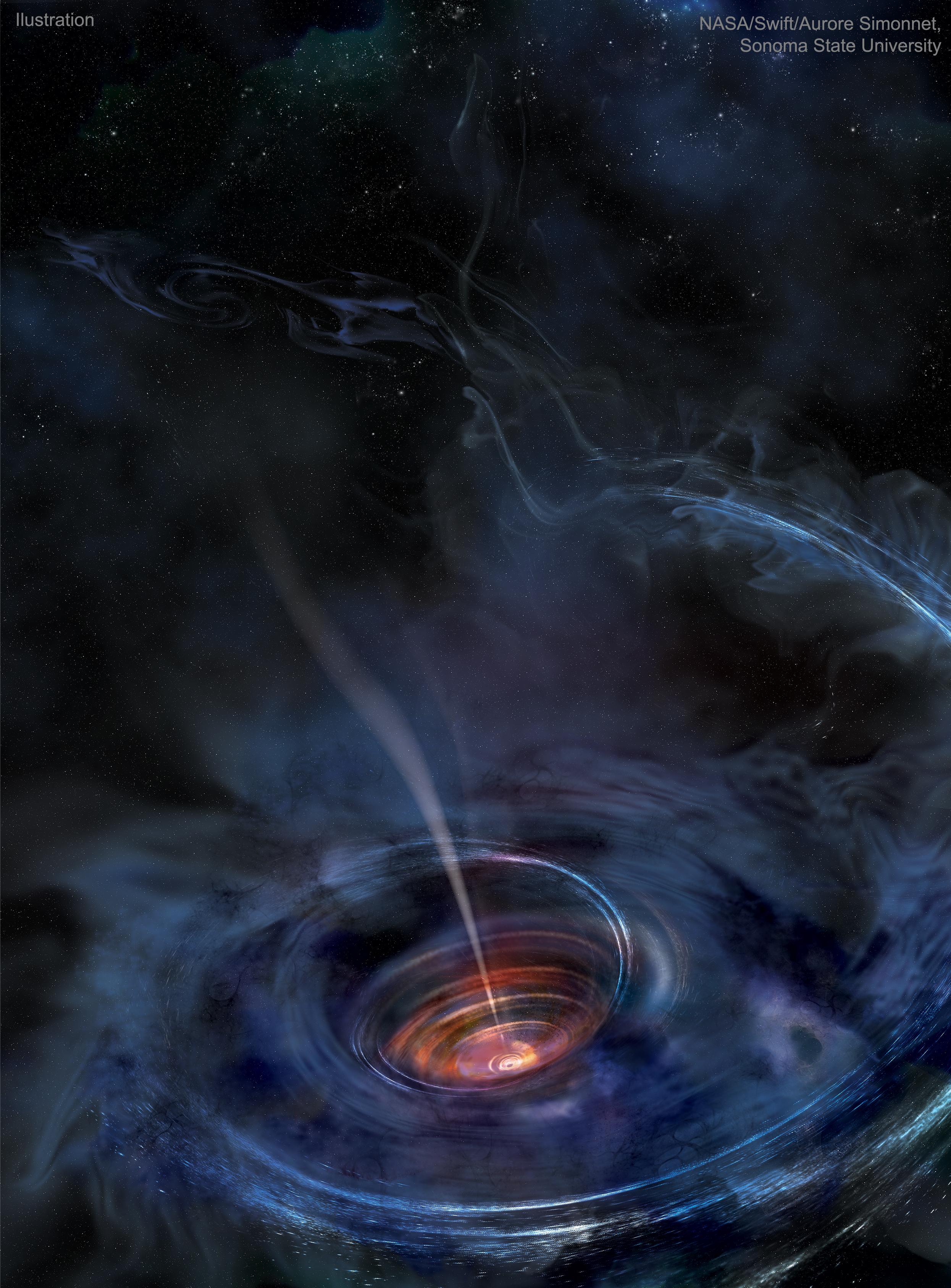
Alt...
2017 March 27
Black Hole Accreting with Jet
* Illustration Credit: NASA, Swift, Aurore Simonnet (Sonoma State U.)
Explanation:
What happens when a black hole devours a star? Many details remain unknown, but recent observations are providing new clues. In 2014, a powerful explosion was recorded by the ground-based robotic telescopes of the All Sky Automated Survey for SuperNovae (ASAS-SN) project, and followed up by instruments including NASA's Earth-orbiting Swift satellite. Computer modeling of these emissions fit a star being ripped apart by a distant supermassive black hole. The results of such a collision are portrayed in the featured artistic illustration. The black hole itself is a depicted as a tiny black dot in the center. As matter falls toward the hole, it collides with other matter and heats up. Surrounding the black hole is an accretion disk of hot matter that used to be the star, with a jet emanating from the black hole's spin axis.
Authors & editors: Robert Nemiroff (MTU) & Jerry Bonnell (UMCP)
NASA Official: Phillip Newman Specific rights apply.
NASA Web Privacy Policy and Important Notices
A service of: ASD at NASA / GSFC
& Michigan Tech. U.
2025 September 23
NGC 6357: Cathedral to Massive Stars
* Image Credit: NASA, ESA, CSA, STScI, JWST
https://www.nasa.gov/
https://www.esa.int/
https://www.asc-csa.gc.ca/eng/
https://www.stsci.edu/
https://science.nasa.gov/mission/webb/
* Processing: Alyssa Pagan (STScI)
https://www.friendsofnasa.org/2023/03/behind-mission-alyssa-pagan-james-webb.html
* Rollover: NASA, ESA, HST, & J. M. Apellániz (IAA, Spain)
https://www.iaa.es/
* Acknowledgement: D. De Martin (ESA/Hubble)
https://esahubble.org/
Explanation:
How massive can a normal star be? Estimates made from distance, brightness and standard solar models had given one star in the open cluster Pismis 24 over 200 times the mass of our Sun, making it one of the most massive stars known. This star is the brightest object located in the central cavity near the bottom center of the featured image taken with the Webb Space Telescope in infrared light. For comparison, a rollover image from the Hubble Space Telescope is also featured in visible light. Close inspection of the images, however, has shown that Pismis 24-1 derives its brilliant luminosity not from a single star but from three at least. Component stars would still remain near 100 solar masses, making them among the more massive stars currently on record. Toward the bottom of the image, stars are still forming in the associated emission nebula NGC 6357. Appearing perhaps like a Gothic cathedral, energetic stars near the center appear to be breaking out and illuminating a spectacular cocoon.
https://apod.nasa.gov/apod/ap250923.html
#space #nebula #cluster #astrophotography #photography #science #astronomy #nature #NASA #ESA #education

Alt...
2025 September 23
Stars dot the frame that has a blue background. Covering the lower part of the image, and the far right, are brown and tan nebular structures.
NGC 6357: Cathedral to Massive Stars
* Image Credit: NASA, ESA, CSA, STScI, JWST
* Processing: Alyssa Pagan (STScI)
* Rollover: NASA, ESA, HST, & J. M. Apellániz (IAA, Spain)
* Acknowledgement: D. De Martin (ESA/Hubble)
Explanation:
How massive can a normal star be? Estimates made from distance, brightness and standard solar models had given one star in the open cluster Pismis 24 over 200 times the mass of our Sun, making it one of the most massive stars known. This star is the brightest object located in the central cavity near the bottom center of the featured image taken with the Webb Space Telescope in infrared light. For comparison, a rollover image from the Hubble Space Telescope is also featured in visible light. Close inspection of the images, however, has shown that Pismis 24-1 derives its brilliant luminosity not from a single star but from three at least. Component stars would still remain near 100 solar masses, making them among the more massive stars currently on record. Toward the bottom of the image, stars are still forming in the associated emission nebula NGC 6357. Appearing perhaps like a Gothic cathedral, energetic stars near the center appear to be breaking out and illuminating a spectacular cocoon.
Authors & editors: Robert Nemiroff (MTU) & Jerry Bonnell (UMCP)

Alt...
WEBB Infrared Light Image
2025 September 21
Equinox Sunset
* Image Credit: Luca Vanzella
https://www.flickr.com/people/53851348@N05/
Explanation:
Does the Sun set in the same direction every day? No, the direction of sunset depends on the time of the year. Although the Sun always sets approximately toward the west, on an equinox like tomorrow the Sun sets directly toward the west. After tomorrow's September equinox, the Sun will set increasingly toward the southwest, reaching its maximum displacement at the December solstice. Before tomorrow's (today's) September equinox, the Sun had set toward the northwest, reaching its maximum displacement at the June solstice. The featured time-lapse image shows seven bands of the Sun setting one day each month from 2019 December through 2020 June. These image sequences were taken from Alberta, Canada -- well north of the Earth's equator -- and feature the city of Edmonton in the foreground. The middle band shows the Sun setting during an equinox -- in March. From this location, the Sun will set along this same equinox band again tomorrow.
https://earthsky.org/astronomy-essentials/everything-you-need-to-know-vernal-or-spring-equinox/
https://apod.nasa.gov/apod/ap250921.html
#space #earth #sun #astrophotography #photography #science #astronomy #physics #nature #NASA #education

Alt...
2025 September 21
A city skyline is shown behind some hills and a river. The path of the Sun is shown for several times during a year.
Equinox Sunset
* Image Credit: Luca Vanzella
Explanation:
Does the Sun set in the same direction every day? No, the direction of sunset depends on the time of the year. Although the Sun always sets approximately toward the west, on an equinox like tomorrow the Sun sets directly toward the west. After tomorrow's September equinox, the Sun will set increasingly toward the southwest, reaching its maximum displacement at the December solstice. Before tomorrow's September equinox, the Sun had set toward the northwest, reaching its maximum displacement at the June solstice. The featured time-lapse image shows seven bands of the Sun setting one day each month from 2019 December through 2020 June. These image sequences were taken from Alberta, Canada -- well north of the Earth's equator -- and feature the city of Edmonton in the foreground. The middle band shows the Sun setting during an equinox -- in March. From this location, the Sun will set along this same equinox band again tomorrow.
Authors & editors: Robert Nemiroff (MTU) & Jerry Bonnell (UMCP)
NASA Official: Amber Straughn Specific rights apply.
NASA Web Privacy, Accessibility, Notices;
A service of: ASD at NASA / GSFC,
NASA Science Activation
& Michigan Tech. U.
2014 March 19
Equinox on a Spinning Earth
* Image Credit: NASA, Meteosat, Robert Simmon
http://www.nasa.gov/
http://www.eumetsat.int/website/home/Satellites/CurrentSatellites/Meteosat/index.html
http://www.nasa.gov/centers/goddard/about/people/RSimmon.html
Explanation:
When does the line between day and night become vertical? Tomorrow. Tomorrow is an equinox on planet Earth, a time of year when day and night are most nearly equal. At an equinox, the Earth's terminator -- the dividing line between day and night -- becomes vertical and connects the north and south poles. The above time-lapse video demonstrates this by displaying an entire year on planet Earth in twelve seconds. From geosynchronous orbit, the Meteosat satellite recorded these infrared images of the Earth every day at the same local time. The video started at the September 2010 equinox with the terminator line being vertical. As the Earth revolved around the Sun, the terminator was seen to tilt in a way that provides less daily sunlight to the northern hemisphere, causing winter in the north. As the year progressed, the March 2011 equinox arrived halfway through the video, followed by the terminator tilting the other way, causing winter in the southern hemisphere -- and summer in the north. The captured year ends again with the September equinox, concluding another of billions of trips the Earth has taken -- and will take -- around the Sun.
https://en.wikipedia.org/wiki/Equinox
!>>https://earthsky.org/astronomy-essentials/everything-you-need-to-know-vernal-or-spring-equinox/
https://apod.nasa.gov/apod/ap140319.html
#space #earth #sun #astrophotography #photography #science #astronomy #physics #nature #NASA #education
TOPIC> Saturn
2025 September 22
The planet Saturn is pictured 6 times in a horizonal column, labelled by years with 2020 at the top and 2025 at the bottom. As the years progress, Saturn's ring appear less prominent.
Equinox at Saturn
* Image Credit & Copyright: Imran Sultan
https://www.instagram.com/imran.astro/
Explanation:
On Saturn, the rings tell you the season. On Earth, today marks an equinox, the time when the Earth's equator tilts directly toward the Sun. Since Saturn's grand rings orbit along the planet's equator, these rings appear most prominent -- from the direction of the Sun -- when the spin axis of Saturn points toward the Sun. Conversely, when Saturn's spin axis points to the side, an equinox occurs, and the edge-on rings are hard to see from not only the Sun -- but Earth. In the featured montage, images of Saturn between the years of 2020 and 2025 have been superposed to show the giant planet passing, with this year's equinox, from summer in the north to summer in the south. Yesterday, Saturn was coincidently about as close as it gets to planet Earth, and so this month the ringed giant's orb is relatively bright and visible throughout the night.
https://www.instagram.com/p/DOuLq6ADsV4/
https://spaceplace.nasa.gov/saturn-rings/en/
https://apod.nasa.gov/apod/ap250922.html
https://science.nasa.gov/saturn/
https://apod.nasa.gov/apod/ap250429.html
#space #saturn #astrophotography #photography #science #astronomy #physics #nature #NASA
Alt...
2025 September 22
The planet Saturn is pictured 6 times in a horizonal column, labelled by years with 2020 at the top and 2025 at the bottom. As the years progress, Saturn's ring appear less prominent.
Equinox at Saturn
* Image Credit & Copyright: Imran Sultan
Explanation:
On Saturn, the rings tell you the season. On Earth, today marks an equinox, the time when the Earth's equator tilts directly toward the Sun. Since Saturn's grand rings orbit along the planet's equator, these rings appear most prominent -- from the direction of the Sun -- when the spin axis of Saturn points toward the Sun. Conversely, when Saturn's spin axis points to the side, an equinox occurs, and the edge-on rings are hard to see from not only the Sun -- but Earth. In the featured montage, images of Saturn between the years of 2020 and 2025 have been superposed to show the giant planet passing, with this year's equinox, from summer in the north to summer in the south. Yesterday, Saturn was coincidently about as close as it gets to planet Earth, and so this month the ringed giant's orb is relatively bright and visible throughout the night.
Authors & editors: Robert Nemiroff (MTU) & Jerry Bonnell (UMCP)
NASA Official: Amber Straughn Specific rights apply.
NASA Web Privacy, Accessibility, Notices;
A service of: ASD at NASA / GSFC,
NASA Science Activation
& Michigan Tech. U.
![[?]](https://media.universeodon.com/accounts/avatars/109/501/736/783/125/826/original/387a622be46bcde9.png)

Daphnis and the Rings of Saturn
Credits: #NASA, JPL-Caltech, Space Science Institute, Cassini
#nature #space #astrophotography

Alt...
Daphnis and the Rings of Saturn
![[?]](https://files.mastodon.social/accounts/avatars/114/818/691/403/290/725/original/701a1383bba1eb86.jpg)
If, in a hypothetical situation, a benevolent Alien race comes to Earth & says that Earth will be annihilated by a gamma-ray burst in 5 years, which will be affirmed by NASA.
They are moving the entire human population to a habitable planet in another place. How will you react? Will you buy it?
#thoughtExperiment #science #knowledge #space #astronomy #research #scicomm #Astrodon #OpenScience #explore #aliens #earth #nasa #opinion #fediverse #philosophy #thought #mastodon #author #writing
![[?]](https://cdn.masto.host/mastodongamedevplace/accounts/avatars/109/859/285/072/781/117/original/52b616f54f20c98f.png)
Before and after of the game box art for Low Earth Orbit Adventures. Definitely going to do a v3 but on the right track.
#LowEarthOrbit #LEOAdventures #NASA #NASAPunk #gaming #games

Alt...
The game title "Low Earth Orbit Adventures" reflected in an astronaut's helmet while they are on a space walk above clouds and mountains

Alt...
The game title "Low Earth Orbit Adventures" floating over an astronaut while they tumble backwards with the Earth in the background.
How NASA’s Roman Mission Will Unveil Our Home Galaxy Using
Cosmic Dust
- NASA / Ashley Balzer
NASA’s Nancy Grace Roman Space Telescope will help scientists better understand our Milky Way galaxy’s less sparkly components — gas and dust strewn between stars, known as the interstellar medium.
One of Roman’s major observing programs, called the Galactic Plane Survey, will peer through our galaxy to its most distant edge, mapping roughly 20 billion stars—about four times more than have currently been mapped. Scientists will use data from these stars to study and map the dust their light travels through, contributing to the most complete picture yet of the Milky Way’s structure, star formation, and the origins of our solar system. [...]
Scientists know how our galaxy likely looks by combining observations of the Milky Way and other spiral galaxies. But dust clouds make it hard to work out the details on the opposite side of our galaxy. Imagine trying to map a neighborhood while looking through the windows of a house surrounded by a dense fog.
Roman will see through the “fog” of dust using a specialized camera and filters that observe infrared light — light with longer wavelengths than our eyes can detect. Infrared light is more likely to pass through dust clouds without scattering.
Light with shorter wavelengths, including blue light produced by stars, more easily scatters. That means stars shining through dust appear dimmer and redder than they actually are.
By comparing the observations with information on the source star’s characteristics, astronomers can disentangle the star’s distance from how much its colors have been reddened. Studying those effects reveals clues about the dust’s properties. [...]
* Credit: NASA/Laine Havens
* Music credit: Building Heroes by Enrico Cacace [BMI], Universal Production Music
#space #nebula #cosmic_dust #astrophotography #photography #science #astronomy #nature #NASA #ESA #education
2005 December 23
Hydrogen and Dust in the Rosette Nebula
* Credit: Nick Wright (University College London), IPHAS Collaboration
https://www.ucl.ac.uk/mathematical-physical-sciences/astrophysics
https://www.imperial.ac.uk/astrophysics
Explanation:
At the edge of a large molecular cloud in Monoceros, some 3,000 light years away, dark filaments of dust are silhouetted by luminous hydrogen gas. The close up view of the Rosette Nebula dramatically suggests that star formation is an on going process in the region, with dark filaments sculpted by winds and radiation from hot, young stars. Ultraviolet radiation from the young stars also strips electrons from the surrounding hydrogen atoms. As electrons and atoms recombine they emit longer wavelength, lower energy light in a well known characteristic pattern of bright spectral lines. At visible wavelengths, the strongest emission line in this pattern is in the red part of the spectrum and is known as "Hydrogen-alpha" or just H-alpha. Part of IPHAS, a survey of H-alpha emission in our Milky Way Galaxy, this image spans about 25 light-years.
https://apod.nasa.gov/apod/ap051223.html
#space #nebula #cluster #astrophotography #photography #science #astronomy #nature #NASA #ESA #education
Alt...
2005 December 23
Hydrogen and Dust in the Rosette Nebula
* Credit: Nick Wright (University College London), IPHAS Collaboration
Explanation:
At the edge of a large molecular cloud in Monoceros, some 3,000 light years away, dark filaments of dust are silhouetted by luminous hydrogen gas. The close up view of the Rosette Nebula dramatically suggests that star formation is an on going process in the region, with dark filaments sculpted by winds and radiation from hot, young stars. Ultraviolet radiation from the young stars also strips electrons from the surrounding hydrogen atoms. As electrons and atoms recombine they emit longer wavelength, lower energy light in a well known characteristic pattern of bright spectral lines. At visible wavelengths, the strongest emission line in this pattern is in the red part of the spectrum and is known as "Hydrogen-alpha" or just H-alpha. Part of IPHAS, a survey of H-alpha emission in our Milky Way Galaxy, this image spans about 25 light-years.
Authors & editors: Robert Nemiroff (MTU) & Jerry Bonnell (USRA)
NASA Web Site Statements, Warnings, and Disclaimers
NASA Official: Jay Norris. Specific rights apply.
A service of: EUD at NASA / GSFC
& Michigan Tech. U.
2016 November 19
IC 5070: A Dusty Pelican in the Swan
* Image Credit & Copyright: Steve Richards (Chanctonbury Observatory)
Explanation:
The recognizable profile of the Pelican Nebula soars nearly 2,000 light-years away in the high flying constellation Cygnus, the Swan. Also known as IC 5070, this interstellar cloud of gas and dust is appropriately found just off the "east coast" of the North America Nebula (NGC 7000), another surprisingly familiar looking emission nebula in Cygnus. Both Pelican and North America nebulae are part of the same large and complex star forming region, almost as nearby as the better-known Orion Nebula. From our vantage point, dark dust clouds (upper left) help define the Pelican's eye and long bill, while a bright front of ionized gas suggests the curved shape of the head and neck. This striking synthesized color view utilizes narrowband image data recording the emission of hydrogen and oxygen atoms in the cosmic cloud. The scene spans some 30 light-years at the estimated distance of the Pelican Nebula.
https://apod.nasa.gov/apod/ap161119.html
#space #nebula #cluster #astrophotography #photography #science #astronomy #nature #NASA #ESA #education
Alt...
2016 November 19
IC 5070: A Dusty Pelican in the Swan
* Image Credit & Copyright: Steve Richards (Chanctonbury Observatory)
Explanation:
The recognizable profile of the Pelican Nebula soars nearly 2,000 light-years away in the high flying constellation Cygnus, the Swan. Also known as IC 5070, this interstellar cloud of gas and dust is appropriately found just off the "east coast" of the North America Nebula (NGC 7000), another surprisingly familiar looking emission nebula in Cygnus. Both Pelican and North America nebulae are part of the same large and complex star forming region, almost as nearby as the better-known Orion Nebula. From our vantage point, dark dust clouds (upper left) help define the Pelican's eye and long bill, while a bright front of ionized gas suggests the curved shape of the head and neck. This striking synthesized color view utilizes narrowband image data recording the emission of hydrogen and oxygen atoms in the cosmic cloud. The scene spans some 30 light-years at the estimated distance of the Pelican Nebula.
Authors & editors: Robert Nemiroff (MTU) & Jerry Bonnell (UMCP)
NASA Official: Phillip Newman Specific rights apply.
NASA Web Privacy Policy and Important Notices
A service of: ASD at NASA / GSFC
& Michigan Tech. U.
2025 January 22
The North America Nebula
* Image Credit & Copyright: Dimitris Valianos
Explanation:
The North America nebula on the sky can do what the North America continent on Earth cannot -- form stars. Specifically, in analogy to the Earth-confined continent, the bright part that appears as the east coast is actually a hot bed of gas, dust, and newly formed stars known as the Cygnus Wall. The featured image shows the star forming wall lit and eroded by bright young stars and partly hidden by the dark dust they have created. The part of the North America nebula (NGC 7000) shown spans about 50 light years and lies about 1,500 light years away toward the constellation of the Swan (Cygnus).
https://apod.nasa.gov/apod/ap250122.html
#space #nebula #cluster #astrophotography #photography #science #astronomy #nature #NASA #ESA #education
Alt...
2025 January 22
A star field is dominated by a red and blue glowing nebula. This nebula appears, to some, to have the shape of North America and so is called the North America Nebula.
The North America Nebula
* Image Credit & Copyright: Dimitris Valianos
Explanation:
The North America nebula on the sky can do what the North America continent on Earth cannot -- form stars. Specifically, in analogy to the Earth-confined continent, the bright part that appears as the east coast is actually a hot bed of gas, dust, and newly formed stars known as the Cygnus Wall. The featured image shows the star forming wall lit and eroded by bright young stars and partly hidden by the dark dust they have created. The part of the North America nebula (NGC 7000) shown spans about 50 light years and lies about 1,500 light years away toward the constellation of the Swan (Cygnus).
Authors & editors: Robert Nemiroff (MTU) & Jerry Bonnell (UMCP)
NASA Official: Amber Straughn Specific rights apply.
NASA Web Privacy, Accessibility, Notices;
A service of: ASD at NASA / GSFC,
NASA Science Activation
& Michigan Tech. U.
2007 September 20
Northern Cygnus
* Credit & Copyright: Robert Gendler
http://www.robgendlerastropics.com/
Explanation:
Bright, hot, supergiant star Deneb lies at top center in this gorgeous skyscape. The 20 frame mosaic spans an impressive 12 degrees across the northern end of Cygnus the Swan. Crowded with stars and luminous gas clouds along the plane of our Milky Way Galaxy, Cygnus is also home to the dark, obscuring Northern Coal Sack Nebula, extending from Deneb toward the bottom center of the view. The reddish glow of NGC 7000, the North America Nebula, and IC 5070, the Pelican Nebula, are at the upper left, but many other nebulae and star clusters are identifiable throughout the wide field. Of course, Deneb itself is the alpha star of Cygnus and is also known to northern hemisphere skygazers for its place in two asterisms -- marking the top of the Northern Cross and a vertex of the Summer Triangle.
http://www.robgendlerastropics.com/Cygnusmosaic.html
https://en.wikipedia.org/wiki/Cygnus_(constellation)
https://apod.nasa.gov/apod/ap070920.html
#space #nebula #cluster #astrophotography #photography #science #astronomy #nature #NASA #ESA #education
Alt...
2007 September 20
Northern Cygnus
* Credit & Copyright: Robert Gendler
Explanation:
Bright, hot, supergiant star Deneb lies at top center in this gorgeous skyscape. The 20 frame mosaic spans an impressive 12 degrees across the northern end of Cygnus the Swan. Crowded with stars and luminous gas clouds along the plane of our Milky Way Galaxy, Cygnus is also home to the dark, obscuring Northern Coal Sack Nebula, extending from Deneb toward the bottom center of the view. The reddish glow of NGC 7000, the North America Nebula, and IC 5070, the Pelican Nebula, are at the upper left, but many other nebulae and star clusters are identifiable throughout the wide field. Of course, Deneb itself is the alpha star of Cygnus and is also known to northern hemisphere skygazers for its place in two asterisms -- marking the top of the Northern Cross and a vertex of the Summer Triangle.
Authors & editors: Robert Nemiroff (MTU) & Jerry Bonnell (UMCP)
NASA Official: Phillip Newman Specific rights apply.
NASA Web Privacy Policy and Important Notices
A service of: ASD at NASA / GSFC
2025 September 19
The NGC 6914 Complex
* Image Credit & Copyright: Tommy Lease
https://app.astrobin.com/u/Colorado_Astro#gallery
Explanation:
A study in contrasts, this colorful cosmic skyscape features stars, dust, and glowing gas in the vicinity of NGC 6914. The interstellar complex of nebulae lies some 6,000 light-years away, toward the high-flying northern constellation Cygnus and the plane of our Milky Way Galaxy. Obscuring interstellar dust clouds appear in silhouette while reddish hydrogen emission nebulae, along with the dusty blue reflection nebulae, fill the cosmic canvas. Ultraviolet radiation from the massive, hot, young stars of the extensive Cygnus OB2 association ionize the region's atomic hydrogen gas, producing the characteristic red glow as protons and electrons recombine. Embedded Cygnus OB2 stars also provide the blue starlight strongly reflected by the dust clouds. The over one degree wide telescopic field of view spans about 100 light-years at the estimated distance of NGC 6914.
https://www.nasa.gov/missions/roman-space-telescope/how-nasas-roman-mission-will-unveil-our-home-galaxy-using-cosmic-dust/
https://arxiv.org/abs/1003.2463
https://astronomy.swin.edu.au/cosmos/E/Emission+Nebula
https://astronomy.swin.edu.au/cosmos/E/Reflection+Nebula
https://apod.nasa.gov/apod/ap250919.html
#space #nebula #cluster #astrophotography #photography #science #astronomy #nature #NASA #ESA #education
Alt...
2025 September 19
The NGC 6914 Complex
* Image Credit & Copyright: Tommy Lease
Explanation:
A study in contrasts, this colorful cosmic skyscape features stars, dust, and glowing gas in the vicinity of NGC 6914. The interstellar complex of nebulae lies some 6,000 light-years away, toward the high-flying northern constellation Cygnus and the plane of our Milky Way Galaxy. Obscuring interstellar dust clouds appear in silhouette while reddish hydrogen emission nebulae, along with the dusty blue reflection nebulae, fill the cosmic canvas. Ultraviolet radiation from the massive, hot, young stars of the extensive Cygnus OB2 association ionize the region's atomic hydrogen gas, producing the characteristic red glow as protons and electrons recombine. Embedded Cygnus OB2 stars also provide the blue starlight strongly reflected by the dust clouds. The over one degree wide telescopic field of view spans about 100 light-years at the estimated distance of NGC 6914.
Authors & editors: Robert Nemiroff (MTU) & Jerry Bonnell (UMCP)
NASA Official: Amber Straughn Specific rights apply.
NASA Web Privacy, Accessibility, Notices;
A service of: ASD at NASA / GSFC,
NASA Science Activation
2024 July 8
Exoplanet Zoo: Other Stars
* Illustration Credit & Copyright: Martin Vargic, Halcyon Maps
https://www.facebook.com/martin.vargic.9/
Explanation:
Do other stars have planets like our Sun? Surely they do, and evidence includes slight star wobbles created by the gravity of orbiting exoplanets and slight star dimmings caused by orbiting planets moving in front. In all, there have now been over 5,500 exoplanets discovered, including thousands by NASA's space-based Kepler and TESS missions, and over 100 by ESO's ground-based HARPS instrument. Featured here is an illustrated guess as to what some of these exoplanets might look like. Neptune-type planets occupy the middle and are colored blue because of blue-scattering atmospheric methane they might contain. On the sides of the illustration, Jupiter-type planets are shown, colored tan and red from the scatterings of atmospheric gases that likely include small amounts of carbon. Interspersed are many Earth-type rocky planets of many colors. As more exoplanets are discovered and investigated, humanity is developing a better understanding of how common Earth-like planets are, and how common life might be in the universe.
https://apod.nasa.gov/apod/ap240708.html
#space #exoplanets #astrophotography #photography #science #astronomy #tech #NASA #ESA #education
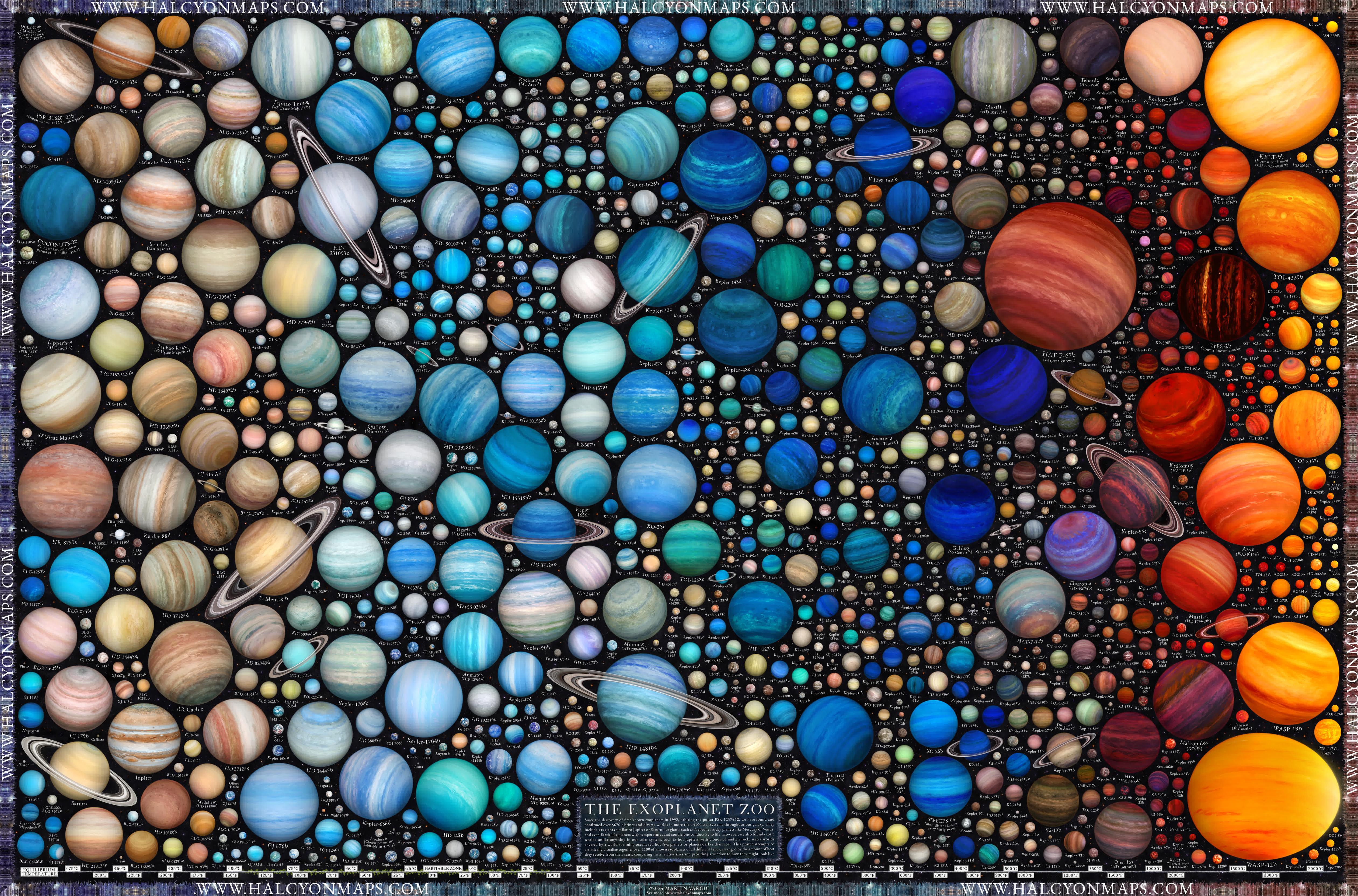
Alt...
2024 July 8
A graphic illustrates hundreds of possible exoplanets, with blue drawings of planets in the middle, red on the right, and tan on the left. Some exoplanets are drawn with rings.
Exoplanet Zoo: Other Stars
* Illustration Credit & Copyright: Martin Vargic, Halcyon Maps
Explanation:
Do other stars have planets like our Sun? Surely they do, and evidence includes slight star wobbles created by the gravity of orbiting exoplanets and slight star dimmings caused by orbiting planets moving in front. In all, there have now been over 5,500 exoplanets discovered, including thousands by NASA's space-based Kepler and TESS missions, and over 100 by ESO's ground-based HARPS instrument. Featured here is an illustrated guess as to what some of these exoplanets might look like. Neptune-type planets occupy the middle and are colored blue because of blue-scattering atmospheric methane they might contain. On the sides of the illustration, Jupiter-type planets are shown, colored tan and red from the scatterings of atmospheric gases that likely include small amounts of carbon. Interspersed are many Earth-type rocky planets of many colors. As more exoplanets are discovered and investigated, humanity is developing a better understanding of how common Earth-like planets are, and how common life might be in the universe.
Authors & editors: Robert Nemiroff (MTU) & Jerry Bonnell (UMCP)
NASA Official: Amber Straughn Specific rights apply.
The milestone comes 30 years after the first exoplanet was discovered around a star similar to our Sun, in 1995. (Prior to that, a few planets had been identified around stars that had burned all their fuel and collapsed.) Although researchers think there are billions of planets in the Milky Way galaxy, finding them remains a challenge. In addition to discovering many individual planets with fascinating characteristics as the total number of known exoplanets climbs, scientists are able to see how the general planet population compares to the planets of our own solar system.
For example, while our solar system hosts an equal number of rocky and giant planets, rocky planets appear to be more common in the universe. Researchers have also found a range of planets entirely different from those in our solar system. There are Jupiter-size planets that orbit closer to their parent star than Mercury orbits the Sun; planets that orbit two stars, no stars, and dead stars; planets covered in lava; some with the density of Styrofoam; and others with clouds made of gemstones.
“Each of the different types of planets we discover gives us information about the conditions under which planets can form and, ultimately, how common planets like Earth might be, and where we should be looking for them,” said Dawn Gelino, head of NASA’s Exoplanet Exploration Program (ExEP), located at the agency’s Jet Propulsion Laboratory in Southern California. “If we want to find out if we’re alone in the universe, all of this knowledge is essential.”
---
Scientists have found thousands of exoplanets (planets outside our solar system) throughout the galaxy. Most can be studied only indirectly, but scientists know they vary widely, as depicted in this artist’s concept, from small, rocky worlds and gas giants to water-rich planets and those as hot as stars.
CREDIT
NASA’s GSFC
#space #exoplanets #astrophotography #photography #science #astronomy #tech #NASA #ESA #education
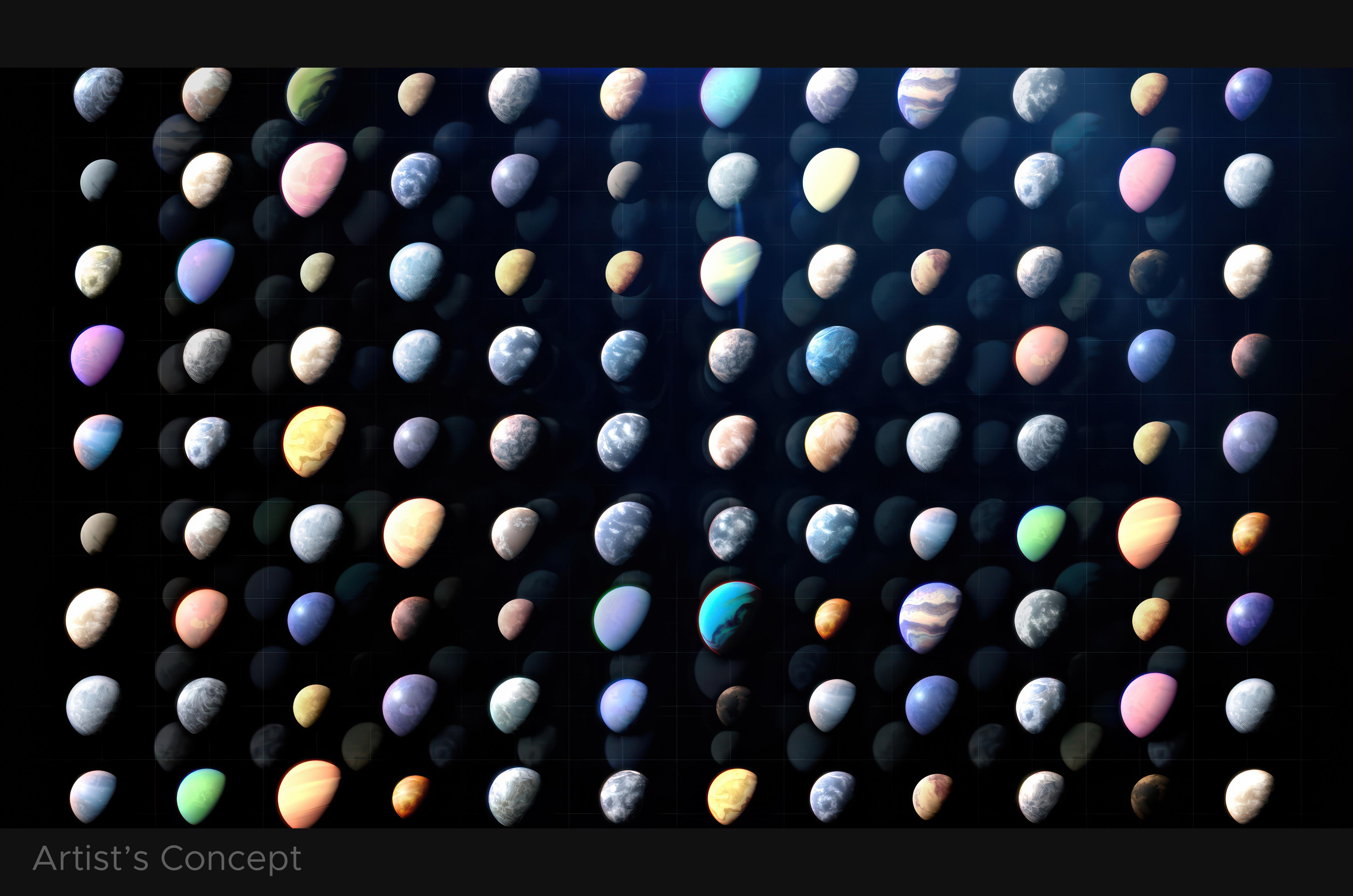
Alt...
Scientists have found thousands of exoplanets (planets outside our solar system) throughout the galaxy. Most can be studied only indirectly, but scientists know they vary widely, as depicted in this artist’s concept, from small, rocky worlds and gas giants to water-rich planets and those as hot as stars.
CREDIT
NASA’s Goddard Space Flight Center
NASA’s Tally of Planets Outside Our Solar System Reaches 6,000
The milestone highlights the accelerating rate of discoveries, just over three decades since the first exoplanets were found.
The official number of exoplanets — planets outside our solar system — tracked by NASA has reached 6,000. Confirmed planets are added to the count on a rolling basis by scientists from around the world, so no single planet is considered the 6,000th entry. The number is monitored by NASA’s Exoplanet Science Institute (NExScI), based at Caltech’s IPAC in Pasadena, California. There are more than 8,000 additional candidate planets awaiting confirmation, with NASA leading the world in searching for life in the universe.
CREDIT
NASA/JPL-Caltech
https://science.nasa.gov/exoplanets/discoveries-dashboard/
#space #exoplanets #astrophotography #photography #science #astronomy #tech #NASA #ESA #education
Alt...
It’s been 30 years since the discovery of the first planet around another star like our Sun. With every new discovery, scientists move closer to answering whether there are other planets like Earth that could host life as we know it.
CREDIT
NASA/JPL-Caltech