Search results for tag #astronomy
![[?]](https://files.defcon.social/dcsocial-s3/accounts/avatars/113/208/344/507/078/943/original/014820ad22daee1c.jpg)
2025 July 9
A Beautiful Trifid
* Image Credit & Copyright: Alessandro Cipolat Bares
https://www.flickr.com/photos/astrobares/
Explanation:
The beautiful Trifid Nebula is a cosmic study in contrasts. Also known as M20, it lies about 5,000 light-years away toward the nebula rich constellation Sagittarius. A star forming region in the plane of our galaxy, the Trifid does illustrate three different types of astronomical nebulae; red emission nebulae dominated by light from hydrogen atoms, blue reflection nebulae produced by dust reflecting starlight, and dark nebulae where dense dust clouds appear in silhouette. But, the red emission region roughly separated into three parts by obscuring dust lanes is what lends the Trifid its popular name. Pillars and jets sculpted by newborn stars, above and right of the emission nebula's center, appear in famous Hubble Space Telescope close-up images of the region. The Trifid Nebula is about 40 light-years across. Too faint to be seen by the unaided eye, in this deep telescopic view it almost covers the area of a full moon on planet Earth's sky.
https://science.nasa.gov/mission/hubble/science/explore-the-night-sky/hubble-messier-catalog/messier-20/
https://apod.nasa.gov/apod/ap080424.html
https://en.wikipedia.org/wiki/Trifid_Nebula
https://science.nasa.gov/asset/hubble/the-trifid-nebula-stellar-nursery-torn-apart-by-radiation-from-nearby-star/
#space #nebula #astrophotography #photography #science #astronomy #physics #nature #NASA #ESA
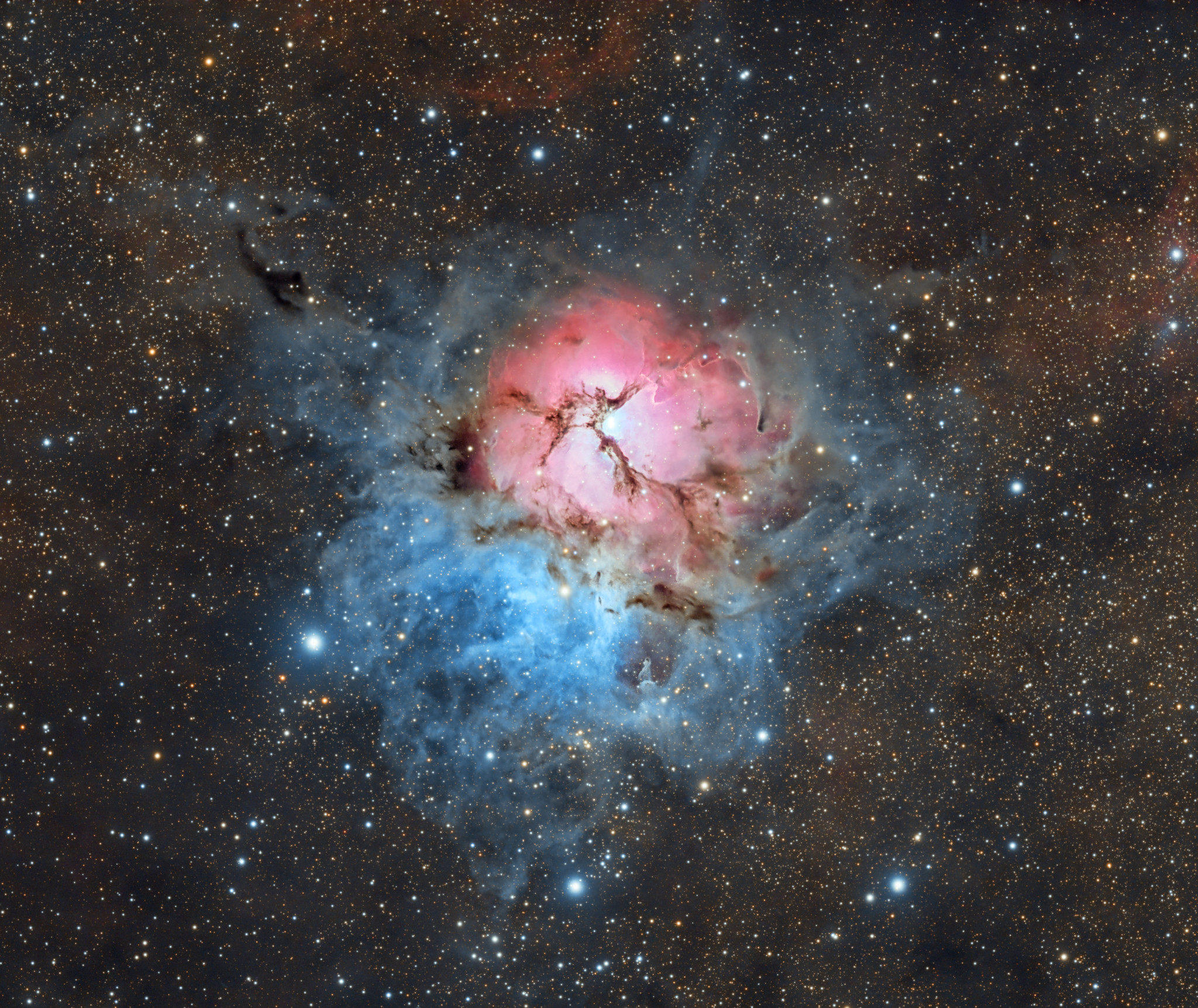
Alt...
2025 July 9
A Beautiful Trifid
* Image Credit & Copyright: Alessandro Cipolat Bares
Explanation:
The beautiful Trifid Nebula is a cosmic study in contrasts. Also known as M20, it lies about 5,000 light-years away toward the nebula rich constellation Sagittarius. A star forming region in the plane of our galaxy, the Trifid does illustrate three different types of astronomical nebulae; red emission nebulae dominated by light from hydrogen atoms, blue reflection nebulae produced by dust reflecting starlight, and dark nebulae where dense dust clouds appear in silhouette. But, the red emission region roughly separated into three parts by obscuring dust lanes is what lends the Trifid its popular name. Pillars and jets sculpted by newborn stars, above and right of the emission nebula's center, appear in famous Hubble Space Telescope close-up images of the region. The Trifid Nebula is about 40 light-years across. Too faint to be seen by the unaided eye, in this deep telescopic view it almost covers the area of a full moon on planet Earth's sky.
Authors & editors: Robert Nemiroff (MTU) & Jerry Bonnell (UMCP)
NASA Official: Amber Straughn Specific rights apply.
NASA Web Privacy, Accessibility, Notices;
A service of: ASD at NASA / GSFC,
NASA Science Activation
Messier 20 (The Trifid Nebula)
NASA Hubble Mission Team
Look for Messier 20, better known as the Trifid Nebula, in August.
Distance
9,000 light-years
constellation
Sagittarius
Discovered by Charles Messier in 1764, M20 is a star-forming nebula located 9,000 light-years away from Earth in the constellation Sagittarius. Also known as the Trifid Nebula, M20 has an apparent magnitude of 6.3 and can be spotted with a small telescope. It is best observed during August.
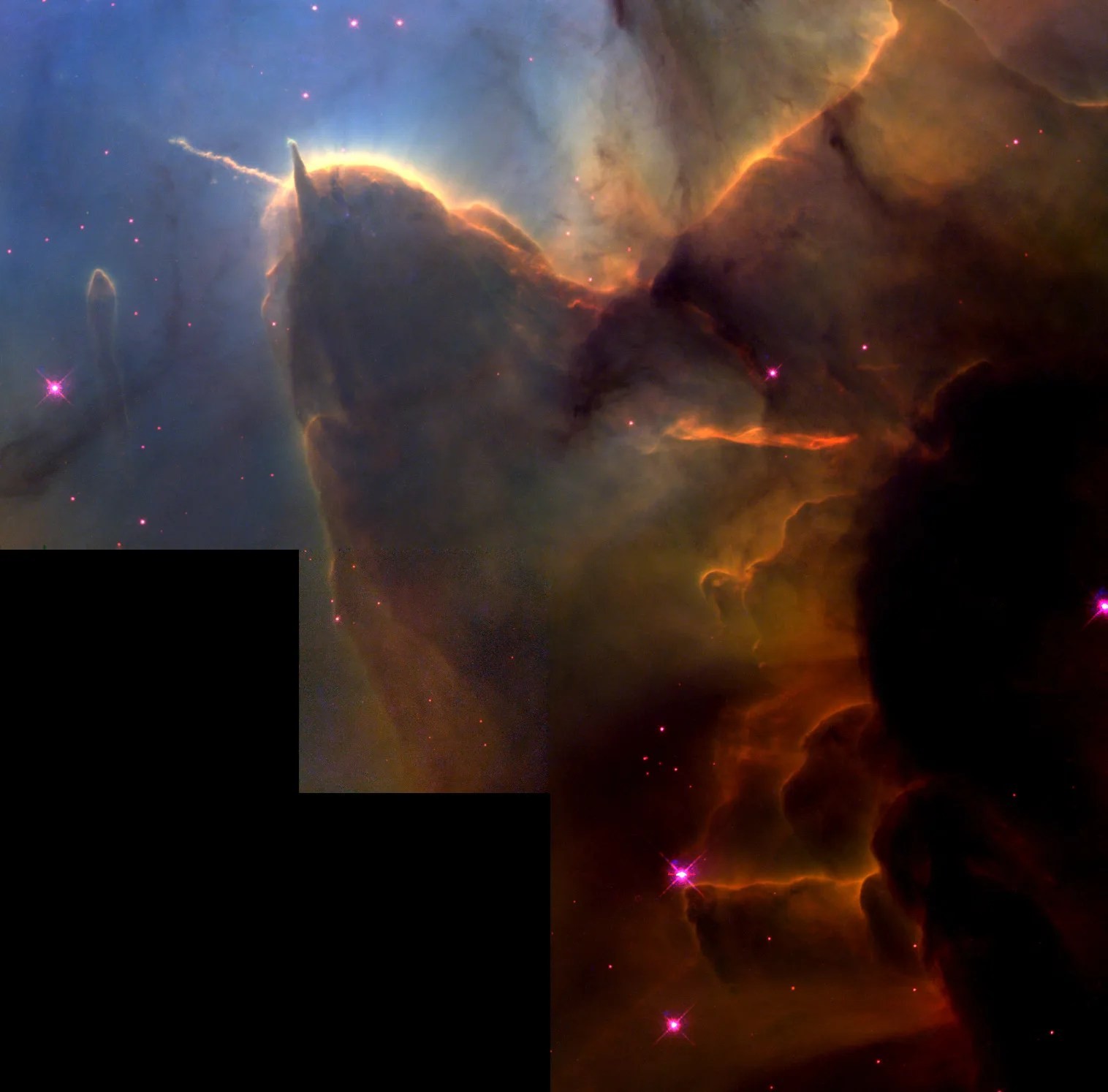
These images' stair-step appearances result from the design of the camera used to take the exposures. The camera consisted of four light detectors, one of which provided a higher resolution but had a smaller field of view than the other three. Because the detector with the higher resolution did not cover as much area as the others, black regions were left when the images from all four detectors were combined into one picture.
This Hubble image of M20 has been colorized to indicate the presence of oxygen, sulfur and hydrogen.
The video zooms into Hubble’s image of the heart of the Trifid Nebula. The zoom starts by looking at the Sagittarius constellation in the night sky and dissolves into the Lagoon Nebula. The video then goes deeper into the sky to show the Trifid Nebula, with the star birth region appearing as the final spectacular image.
CREDIT
NASA, Z. Levay and L. Barranger (STScI)
#space #nebula #astrophotography #photography #science #astronomy #physics #nature #NASA #ESA
This Hubble image reveals a star-forming cloud of gas and dust in M20 being torn apart by radiation from a massive nearby star, just beyond the top of the frame. Two thin, finger-like jets protrude from the head of a dense cloud in the upper left of the image, which might be forming new stars at their tips. The jets, each roughly three-quarters of a light-year long, are being eroded by the radiation from the massive star. The red in this image represents hydrogen and sulfur, while green represents oxygen.
CREDIT
NASA/ESA and Jeff Hester (Arizona State University)
#space #nebula #astrophotography #photography #science #astronomy #physics #nature #NASA #ESA
Alt...
This Hubble image reveals a star-forming cloud of gas and dust in M20 being torn apart by radiation from a massive nearby star, just beyond the top of the frame. Two thin, finger-like jets protrude from the head of a dense cloud in the upper left of the image, which might be forming new stars at their tips. The jets, each roughly three-quarters of a light-year long, are being eroded by the radiation from the massive star. The red in this image represents hydrogen and sulfur, while green represents oxygen.
CREDIT
NASA/ESA and Jeff Hester (Arizona State University)
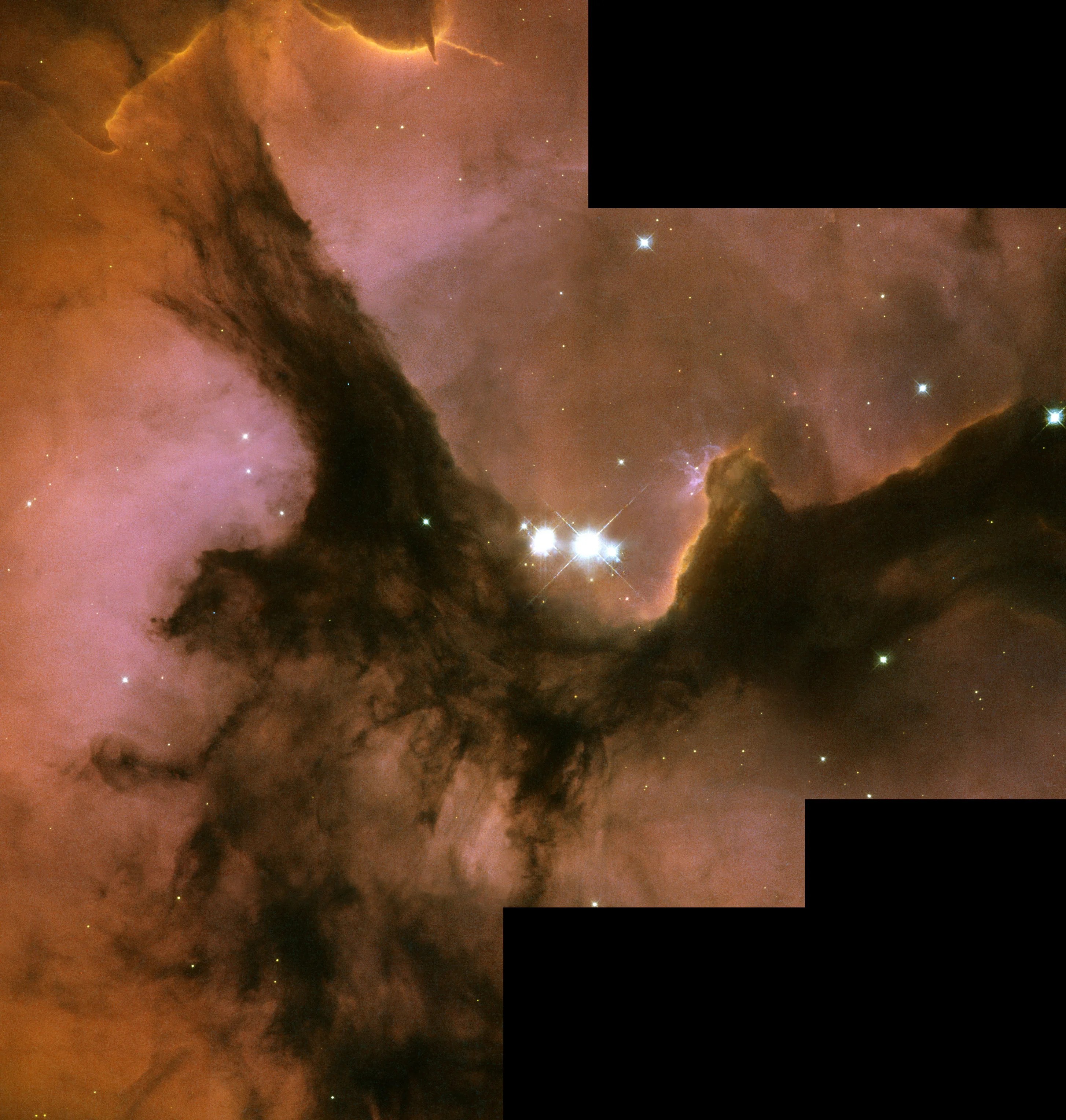
Alt...
NASA, ESA and the Hubble Heritage Team (AURA/STScI); Acknowledgment: F. Yusef-Zadeh (Northwestern Univ.)
2009 May 22
East of Antares
* Credit & Copyright: Yuri Beletsky (ESO)
http://www.eso.org/
Explanation:
East of Antares, dark markings sprawl through crowded star fields toward the center of our Milky Way Galaxy. Cataloged in the early 20th century by astronomer E. E. Barnard, the obscuring interstellar dust clouds include B59, B72, B77 and B78, seen in silhouette against the starry background. Here, their combined shape suggests a pipe stem and bowl, and so the dark nebula's popular name is the Pipe Nebula. The deep and expansive view was recorded in very dark Chilean skies. It covers a full 10 by 7 degree field in the pronounceable constellation Ophiuchus. The Pipe Nebula is part of the Ophiuchus dark cloud complex located at a distance of about 450 light-years. Dense cores of gas and dust within the Pipe Nebula are collapsing to form stars.
https://arxiv.org/abs/0904.4169
https://apod.nasa.gov/apod/ap090522.html
#space #nebula #astrophotography #photography #science #astronomy #physics #nature #NASA #ESA
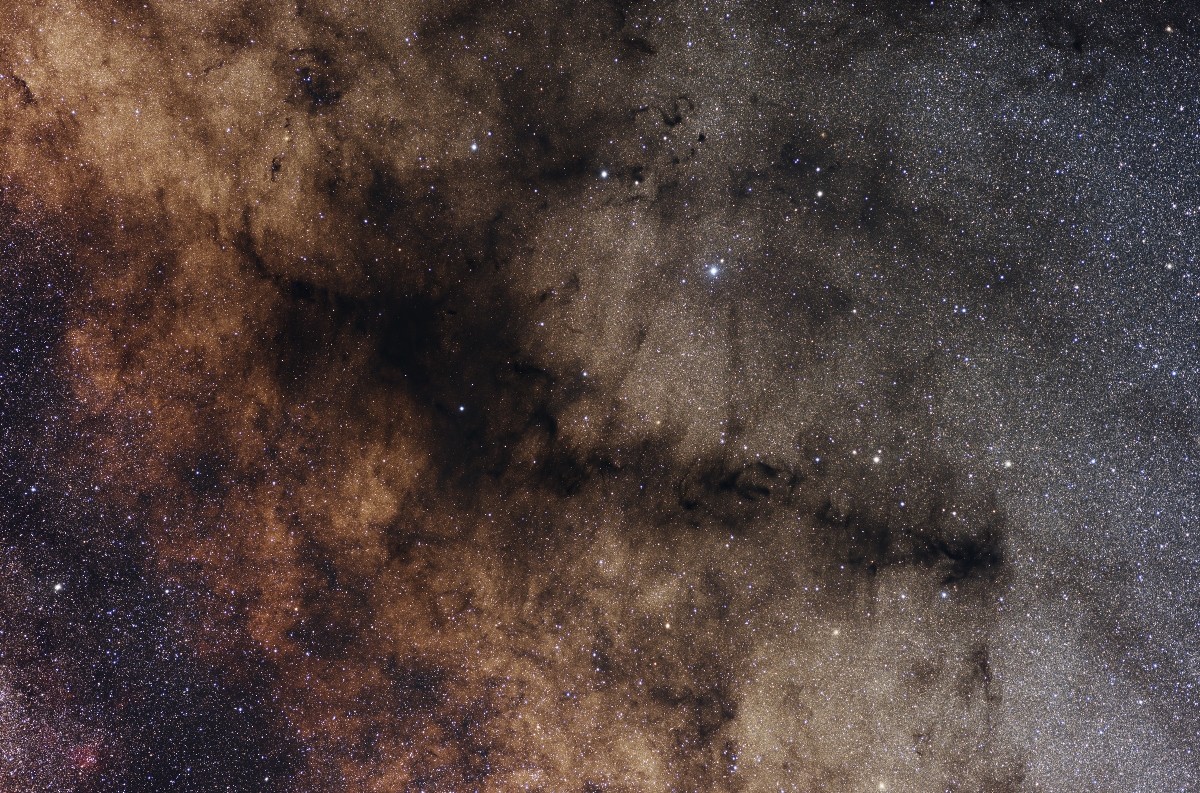
Alt...
2009 May 22
East of Antares
* Credit & Copyright: Yuri Beletsky (ESO)
Explanation:
East of Antares, dark markings sprawl through crowded star fields toward the center of our Milky Way Galaxy. Cataloged in the early 20th century by astronomer E. E. Barnard, the obscuring interstellar dust clouds include B59, B72, B77 and B78, seen in silhouette against the starry background. Here, their combined shape suggests a pipe stem and bowl, and so the dark nebula's popular name is the Pipe Nebula. The deep and expansive view was recorded in very dark Chilean skies. It covers a full 10 by 7 degree field in the pronounceable constellation Ophiuchus. The Pipe Nebula is part of the Ophiuchus dark cloud complex located at a distance of about 450 light-years. Dense cores of gas and dust within the Pipe Nebula are collapsing to form stars.
Authors & editors: Robert Nemiroff (MTU) & Jerry Bonnell (UMCP)
NASA Official: Phillip Newman Specific rights apply.
NASA Web Privacy Policy and Important Notices
A service of: ASD at NASA / GSFC
& Michigan Tech. U.
2009 May 21
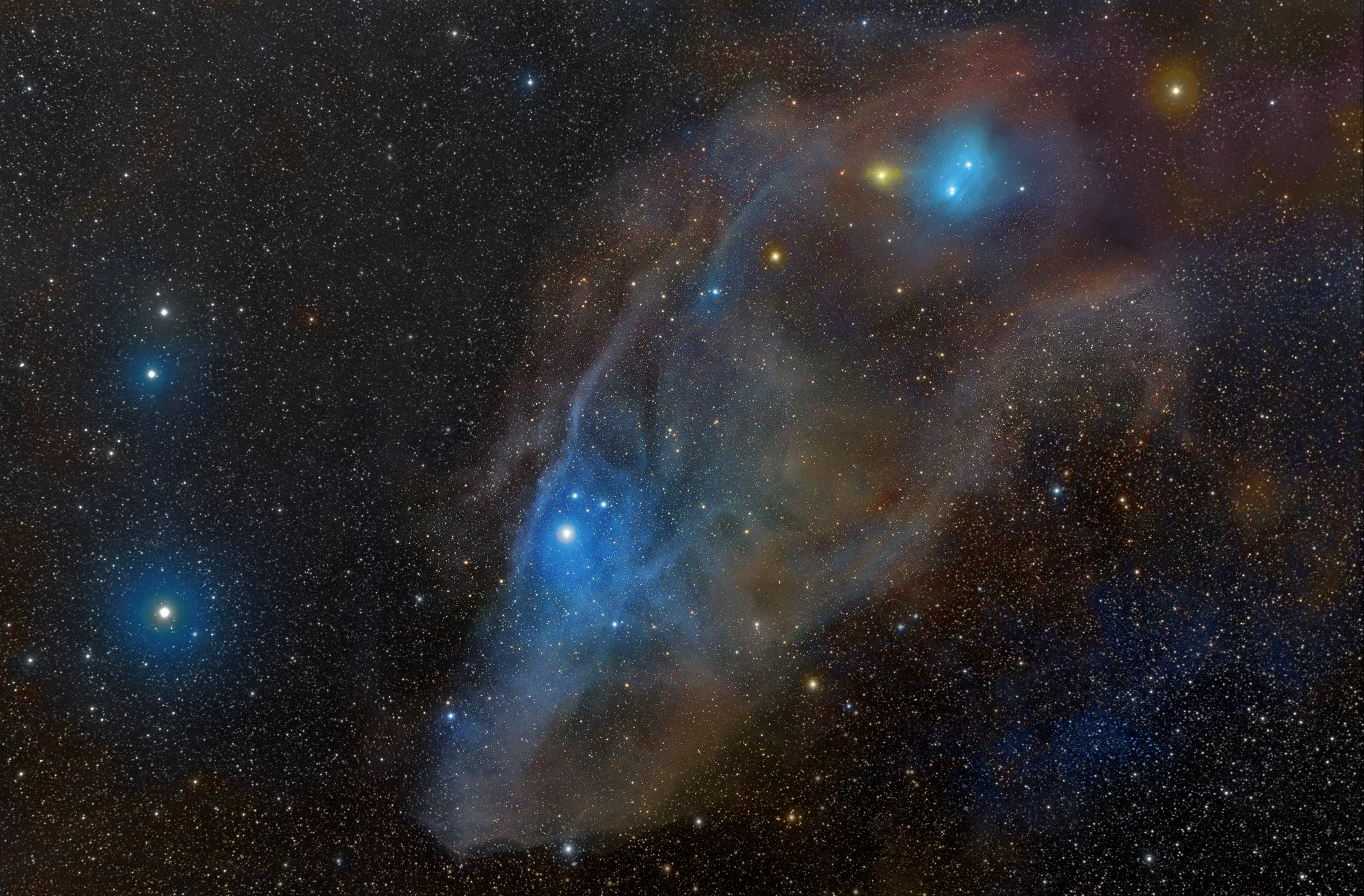
IC 4592: A Blue Horsehead
* Credit & Copyright: Rogelio Bernal Andreo
Explanation:
This complex of beautiful, dusty reflection nebulae lies in the constellation Scorpius along the plane of our Milky Way Galaxy. Its overall outline suggests a horsehead in profile, though it covers a much larger region than the better known Horsehead Nebula of Orion. The star near the eye of the horse and the center of the 5 degree wide field, is embedded in blue reflection nebula IC 4592 over 400 light-years away. At that distance, the view spans nearly 40 light-years. The horse's gaze seems fixed on Beta Scorpii, also named Graffias, the bright star at the lower left. Toward the top right, near the horse's ear, is another striking bluish reflection nebula, IC 4601. The characteristic blue hue of reflection nebulae is caused by the tendency of interstellar dust to more strongly scatter blue starlight.
https://apod.nasa.gov/apod/ap090521.html
#space #nebula #astrophotography #photography #science #astronomy #physics #nature #NASA #ESA
Alt...
2009 May 21
IC 4592: A Blue Horsehead
* Credit & Copyright: Rogelio Bernal Andreo
Explanation:
This complex of beautiful, dusty reflection nebulae lies in the constellation Scorpius along the plane of our Milky Way Galaxy. Its overall outline suggests a horsehead in profile, though it covers a much larger region than the better known Horsehead Nebula of Orion. The star near the eye of the horse and the center of the 5 degree wide field, is embedded in blue reflection nebula IC 4592 over 400 light-years away. At that distance, the view spans nearly 40 light-years. The horse's gaze seems fixed on Beta Scorpii, also named Graffias, the bright star at the lower left. Toward the top right, near the horse's ear, is another striking bluish reflection nebula, IC 4601. The characteristic blue hue of reflection nebulae is caused by the tendency of interstellar dust to more strongly scatter blue starlight.
Authors & editors: Robert Nemiroff (MTU) & Jerry Bonnell (UMCP)
NASA Official: Phillip Newman Specific rights apply.
NASA Web Privacy Policy and Important Notices
A service of: ASD at NASA / GSFC
& Michigan Tech. U.
2009 May 19
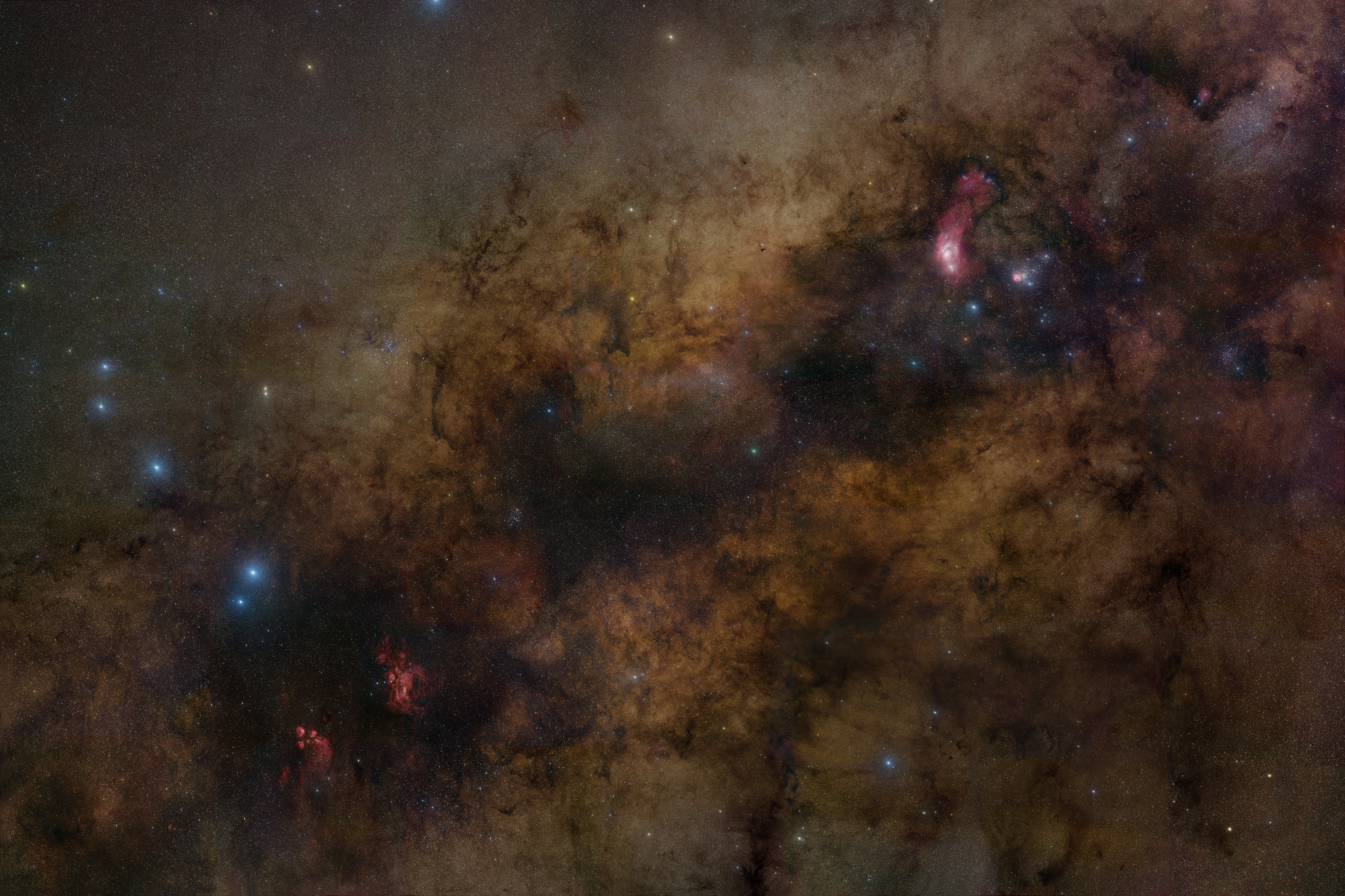
Sagittarius and the Central Milky Way
* Credit & Copyright: Robert Gendler
http://www.robgendlerastropics.com/Biography.html
Explanation:
What does the center of our Milky Way Galaxy look like? In visible light, no one knows! It is not possible to see the Galactic center in light our eyes are sensitive to because the thick dust in the plane of our Galaxy obscures it. If one looks in the direction of our Galaxy's center - which is toward the constellation of Sagittarius - many beautiful wonders become apparent, though. Large dust lanes and star clouds dominate the picture. As many as 30 Messier Objects are visible in the above spectacular image mosaic, including all types of nebulas and star clusters. Two notable nebula include the Lagoon Nebula (M8), a red patch just above and to the right of center, and slightly to its right is the red and blue Trifid Nebula (M20).
https://apod.nasa.gov/apod/ap090519.html
#space #nebula #astrophotography #photography #science #astronomy #physics #nature #NASA #ESA
Alt...
2009 May 19
Sagittarius and the Central Milky Way
* Credit & Copyright: Robert Gendler (robgendlerastropics.com)
Explanation:
What does the center of our Milky Way Galaxy look like? In visible light, no one knows! It is not possible to see the Galactic center in light our eyes are sensitive to because the thick dust in the plane of our Galaxy obscures it. If one looks in the direction of our Galaxy's center - which is toward the constellation of Sagittarius - many beautiful wonders become apparent, though. Large dust lanes and star clouds dominate the picture. As many as 30 Messier Objects are visible in the above spectacular image mosaic, including all types of nebulas and star clusters. Two notable nebula include the Lagoon Nebula (M8), a red patch just above and to the right of center, and slightly to its right is the red and blue Trifid Nebula (M20).
Authors & editors: Robert Nemiroff (MTU) & Jerry Bonnell (UMCP)
NASA Official: Phillip Newman Specific rights apply.
NASA Web Privacy Policy and Important Notices
A service of: ASD at NASA / GSFC
& Michigan Tech. U.
2007 August 4
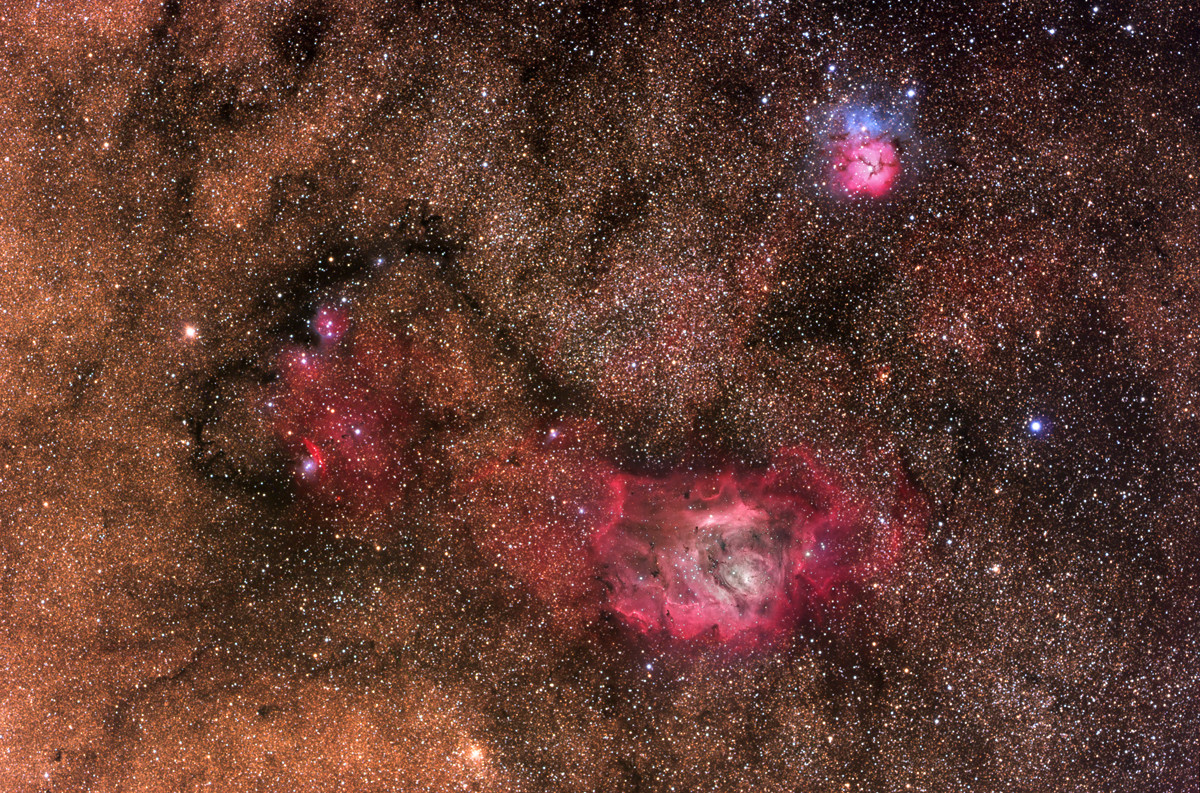
Sagittarius Triplet
* Credit & Copyright: Steve Mazlin, Jim Misti
http://www.mistisoftware.com/astronomy/index.htm
https://ourcolorfulcosmos.com/
Explanation:
These three bright nebulae are often featured in telescopic tours of the constellation Sagittarius and the crowded starfields of the central Milky Way. In fact, 18th century cosmic tourist Charles Messier cataloged two of them; M8, the nebula below and right of center, and colorful M20 at the upper right. The third, NGC 6559, is left of M8, separated from the the larger nebula by a dark dust lane. All three are stellar nurseries about five thousand light-years or so distant. The expansive M8, over a hundred light-years across, is also known as the Lagoon Nebula while M20's popular moniker is the Trifid. This stunning digital view is actually a collaborative composite recorded by 2 cameras and 2 telescopes about 2 thousand miles apart. The deep, wide image field was captured under dark Arizona skies. Both M8 and M20 were recorded in more detail from an observatory in Pennsylvania. Glowing hydrogen gas creates the dominant red color of the emission nebulae, with contrasting blue hues, most striking in the Trifid, due to dust reflected starlight.
https://apod.nasa.gov/apod/ap070804.html
#space #nebula #astrophotography #photography #science #astronomy #physics #nature #NASA #ESA
Alt...
2007 August 4
Sagittarius Triplet
* Credit & Copyright: Steve Mazlin, Jim Misti
Explanation:
These three bright nebulae are often featured in telescopic tours of the constellation Sagittarius and the crowded starfields of the central Milky Way. In fact, 18th century cosmic tourist Charles Messier cataloged two of them; M8, the nebula below and right of center, and colorful M20 at the upper right. The third, NGC 6559, is left of M8, separated from the the larger nebula by a dark dust lane. All three are stellar nurseries about five thousand light-years or so distant. The expansive M8, over a hundred light-years across, is also known as the Lagoon Nebula while M20's popular moniker is the Trifid. This stunning digital view is actually a collaborative composite recorded by 2 cameras and 2 telescopes about 2 thousand miles apart. The deep, wide image field was captured under dark Arizona skies. Both M8 and M20 were recorded in more detail from an observatory in Pennsylvania. Glowing hydrogen gas creates the dominant red color of the emission nebulae, with contrasting blue hues, most striking in the Trifid, due to dust reflected starlight.
Authors & editors: Robert Nemiroff (MTU) & Jerry Bonnell (UMCP)
NASA Official: Phillip Newman Specific rights apply.
NASA Web Privacy Policy and Important Notices
A service of: ASD at NASA / GSFC
& Michigan Tech. U.
2025 June 25
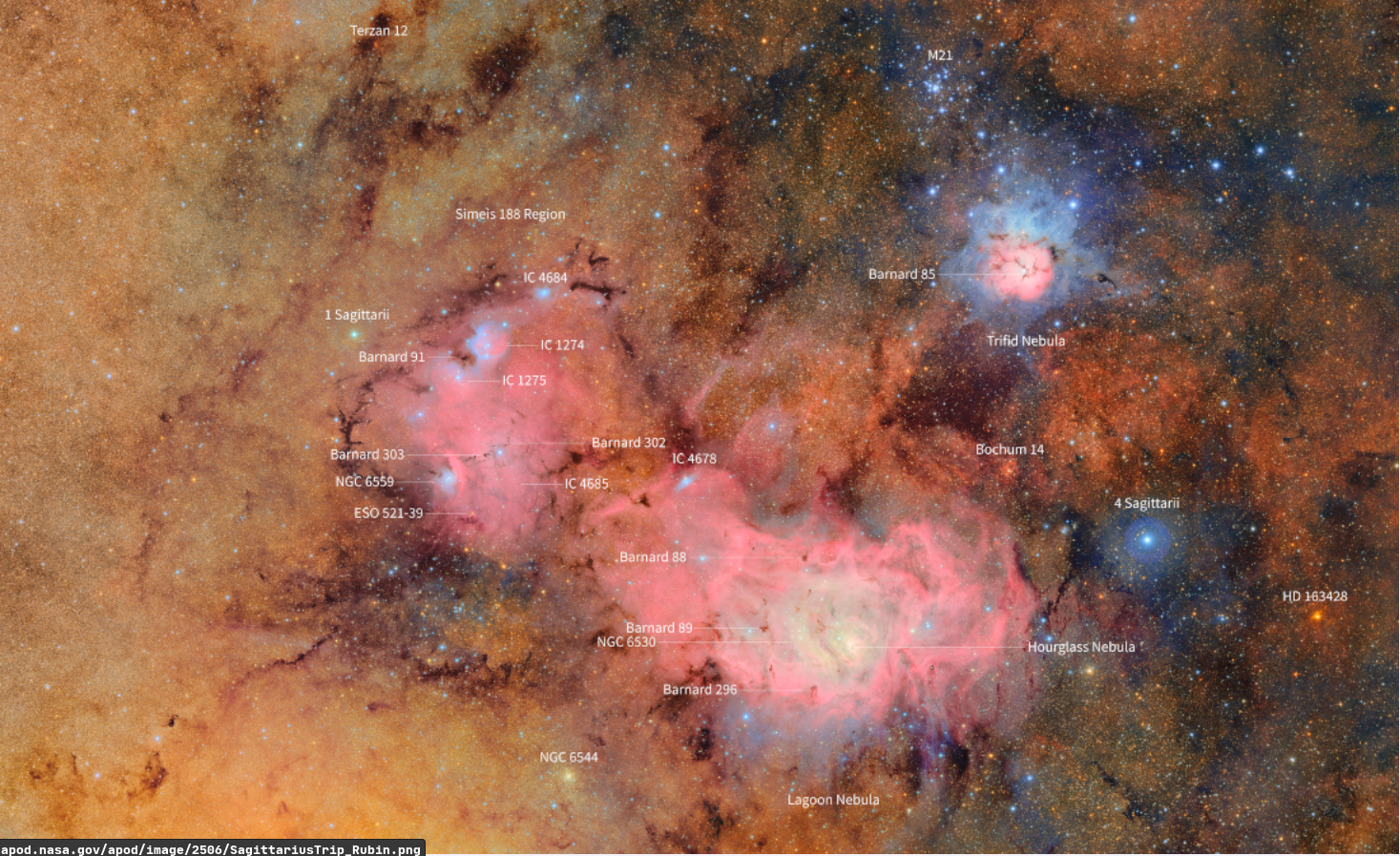
"Rubin's First Look"
A Sagittarius Skyscape
* Image Credit & License: NSF–DOE Vera C. Rubin Observatory
https://rubinobservatory.org/
Explanation:
This interstellar skyscape spans over 4 degrees across crowded starfields toward the constellation Sagittarius and the central Milky Way. A First Look image captured at the new NSF–DOE Vera C. Rubin Observatory, the bright nebulae and star clusters featured include famous stops on telescopic tours of the cosmos: Messier 8 and Messier 20. An expansive star-forming region over a hundred light-years across, Messier 8 is also known as the Lagoon Nebula. About 4,000 light-years away the Lagoon Nebula harbors a remarkable cluster of young, massive stars. Their intense radiation and stellar winds energize and agitate this cosmic lagoon's turbulent depths. Messier 20's popular moniker is the Trifid. Divided into three parts by dark interstellar dust lanes, the Trifid Nebula's glowing hydrogen gas creates its dominant red color. But contrasting blue hues in the colorful Trifid are due to dust reflected starlight. The Rubin Observatory visited the Trifid-Lagoon field to acquire all the image data during parts of four nights (May 1-4). At full resolution, Rubin's magnificent Sagittarius skyscape is 84,000 pixels wide and 51,500 pixels tall.
https://apod.nasa.gov/apod/ap250625.html
https://defcon.social/@grobi/114742138088169984
#space #nebula #astrophotography #photography #science #astronomy #physics #nature #NASA #ESA
Alt...
2025 June 25
Rubin's First Look: A Sagittarius Skyscape
* Image Credit & License: NSF–DOE Vera C. Rubin Observatory
Explanation:
This interstellar skyscape spans over 4 degrees across crowded starfields toward the constellation Sagittarius and the central Milky Way. A First Look image captured at the new NSF–DOE Vera C. Rubin Observatory, the bright nebulae and star clusters featured include famous stops on telescopic tours of the cosmos: Messier 8 and Messier 20. An expansive star-forming region over a hundred light-years across, Messier 8 is also known as the Lagoon Nebula. About 4,000 light-years away the Lagoon Nebula harbors a remarkable cluster of young, massive stars. Their intense radiation and stellar winds energize and agitate this cosmic lagoon's turbulent depths. Messier 20's popular moniker is the Trifid. Divided into three parts by dark interstellar dust lanes, the Trifid Nebula's glowing hydrogen gas creates its dominant red color. But contrasting blue hues in the colorful Trifid are due to dust reflected starlight. The Rubin Observatory visited the Trifid-Lagoon field to acquire all the image data during parts of four nights (May 1-4). At full resolution, Rubin's magnificent Sagittarius skyscape is 84,000 pixels wide and 51,500 pixels tall.
Authors & editors: Robert Nemiroff (MTU) & Jerry Bonnell (UMCP)
NASA Official: Amber Straughn Specific rights apply.
2025 March 10
NGC 1499: The California Nebula
* Image Credit & Copyright: Toni Fabiani Mendez
https://www.instagram.com/toni_fabiani/
Explanation:
Could Queen Calafia's mythical island exist in space? Perhaps not, but by chance the outline of this molecular space cloud echoes the outline of the state of California, USA. Our Sun has its home within the Milky Way's Orion Arm, only about 1,000 light-years from the California Nebula. Also known as NGC 1499, the classic emission nebula is around 100 light-years long. On the featured image, the most prominent glow of the California Nebula is the red light characteristic of hydrogen atoms recombining with long lost electrons, stripped away (ionized) by energetic starlight. The star most likely providing the energetic starlight that ionizes much of the nebular gas is the bright, hot, bluish Xi Persei just to the right of the nebula. A regular target for astrophotographers, the California Nebula can be spotted with a wide-field telescope under a dark sky toward the constellation of Perseus, not far from the Pleiades.
https://en.wikipedia.org/wiki/California_Nebula
https://apod.nasa.gov/apod/ap250310.html
#space #nebula #astrophotography #photography #science #astronomy #physics #nature #NASA #ESA
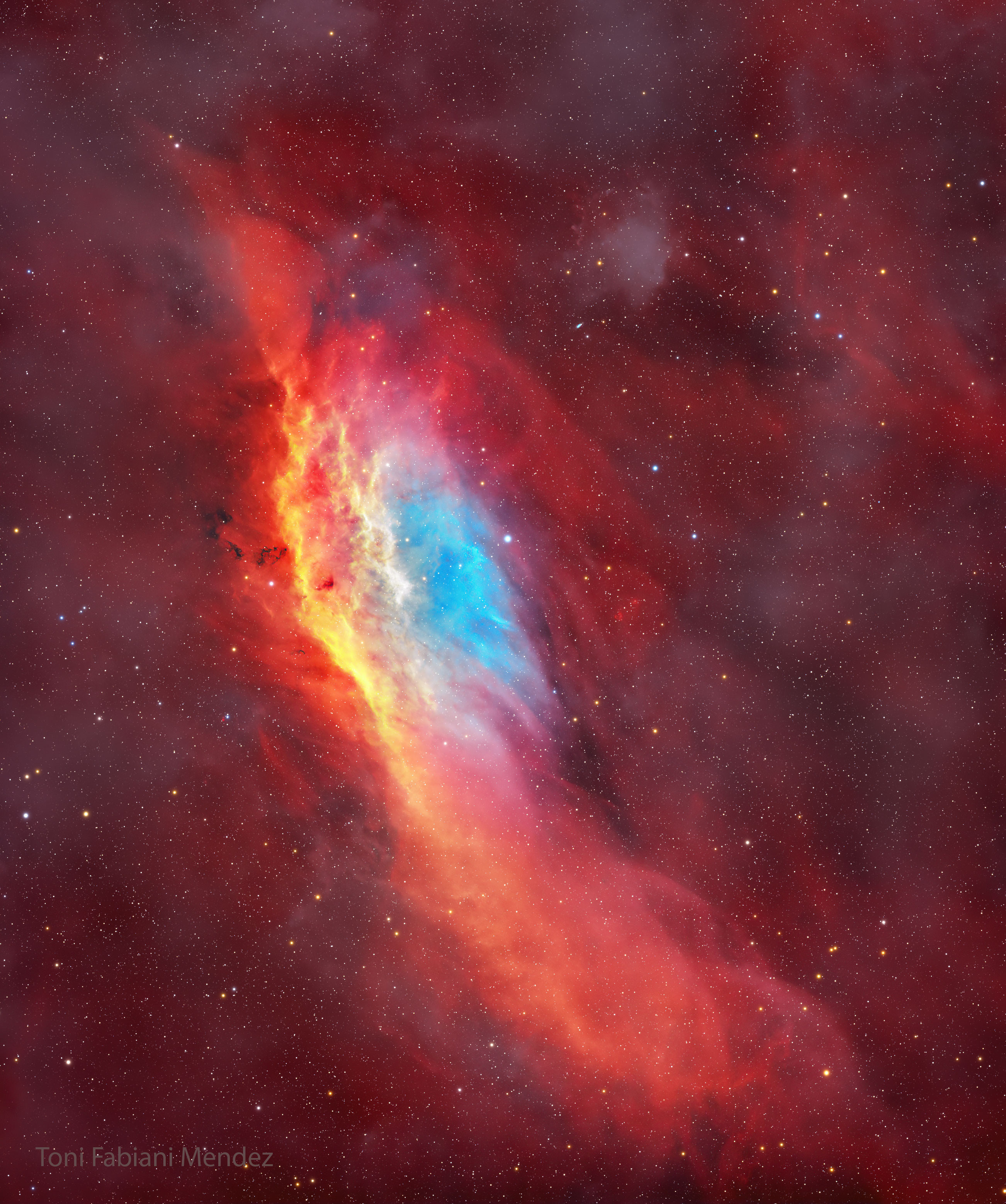
Alt...
2025 March 10
The starry image filled with a red glow features a red, yellow, and blue colored nebula. The nebula has, roughly, the shape of the US state of California.
NGC 1499: The California Nebula
* Image Credit & Copyright: Toni Fabiani Mendez
Explanation:
Could Queen Calafia's mythical island exist in space? Perhaps not, but by chance the outline of this molecular space cloud echoes the outline of the state of California, USA. Our Sun has its home within the Milky Way's Orion Arm, only about 1,000 light-years from the California Nebula. Also known as NGC 1499, the classic emission nebula is around 100 light-years long. On the featured image, the most prominent glow of the California Nebula is the red light characteristic of hydrogen atoms recombining with long lost electrons, stripped away (ionized) by energetic starlight. The star most likely providing the energetic starlight that ionizes much of the nebular gas is the bright, hot, bluish Xi Persei just to the right of the nebula. A regular target for astrophotographers, the California Nebula can be spotted with a wide-field telescope under a dark sky toward the constellation of Perseus, not far from the Pleiades.
Authors & editors: Robert Nemiroff (MTU) & Jerry Bonnell (UMCP)
NASA Official: Amber Straughn Specific rights apply.
NASA Web Privacy, Accessibility, Notices;
A service of: ASD at NASA / GSFC,
NASA Science Activation
& Michigan Tech. U.
2024 November 25
The Horsehead Nebula
* Image Credit & Copyright: Alex Lin (Chilescope)
https://app.astrobin.com/u/MadNug#gallery
https://en.wikipedia.org/wiki/CHILESCOPE
Explanation:
One of the most identifiable nebulas in the sky, the Horsehead Nebula in Orion, is part of a large, dark, molecular cloud. Also known as Barnard 33, the unusual shape was first discovered on a photographic plate in the late 1800s. The red glow originates from hydrogen gas predominantly behind the nebula, ionized by the nearby bright star Sigma Orionis. The darkness of the Horsehead is caused mostly by thick dust, although the lower part of the Horsehead's neck casts a shadow to the left. Streams of gas leaving the nebula are funneled by a strong magnetic field. Bright spots in the Horsehead Nebula's base are young stars just in the process of forming. Light takes about 1,500 years to reach us from the Horsehead Nebula. The featured image was taken from the Chilescope Observatory in the mountains of Chile.
https://apod.nasa.gov/apod/ap241125.html
#space #nebula #astrophotography #photography #science #astronomy #physics #nature #NASA #ESA
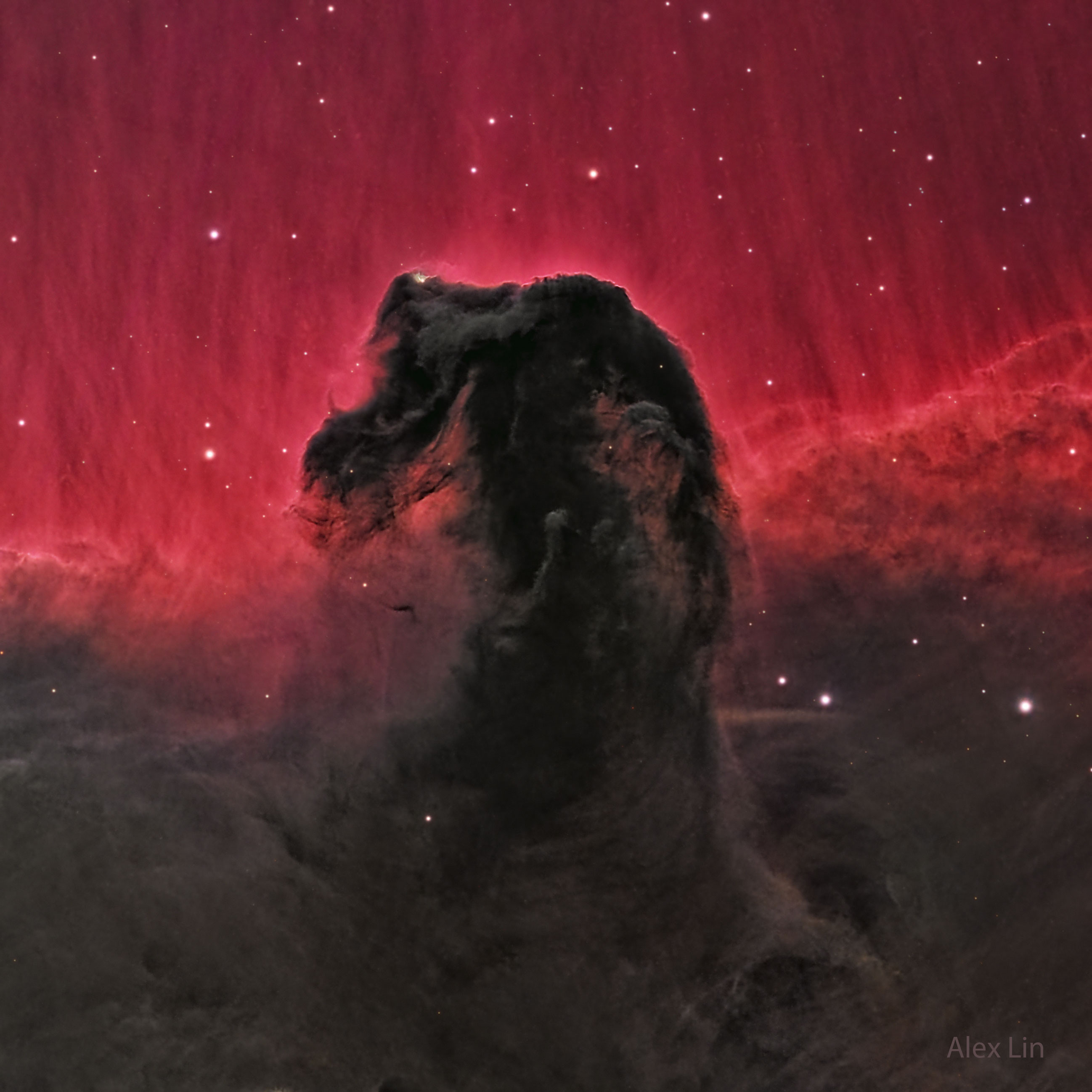
Alt...
2024 November 25
The top half glows red, while the bottom half is filled with dark dust. Protruding into the red is a dark dust lane that resembles a horse's head.
The Horsehead Nebula
* Image Credit & Copyright: Alex Lin (Chilescope)
Explanation:
One of the most identifiable nebulas in the sky, the Horsehead Nebula in Orion, is part of a large, dark, molecular cloud. Also known as Barnard 33, the unusual shape was first discovered on a photographic plate in the late 1800s. The red glow originates from hydrogen gas predominantly behind the nebula, ionized by the nearby bright star Sigma Orionis. The darkness of the Horsehead is caused mostly by thick dust, although the lower part of the Horsehead's neck casts a shadow to the left. Streams of gas leaving the nebula are funneled by a strong magnetic field. Bright spots in the Horsehead Nebula's base are young stars just in the process of forming. Light takes about 1,500 years to reach us from the Horsehead Nebula. The featured image was taken from the Chilescope Observatory in the mountains of Chile.
Authors & editors: Robert Nemiroff (MTU) & Jerry Bonnell (UMCP)
NASA Official: Amber Straughn Specific rights apply.
NASA Web Privacy, Accessibility, Notices;
A service of: ASD at NASA / GSFC,
NASA Science Activation
& Michigan Tech. U.
2025 July 10
Lynds Dark Nebula 1251
* Image Credit & Copyright: Cristiano Gualco
https://app.astrobin.com/u/CristianoGualco#gallery
Explanation:
Stars are forming in Lynds Dark Nebula (LDN) 1251. About 1,000 light-years away and drifting above the plane of our Milky Way galaxy, LDN 1251 is also less appetizingly known as "The Rotten Fish Nebula." The dusty molecular cloud is part of a complex of dark nebulae mapped toward the Cepheus flare region. Across the spectrum, astronomical explorations of the obscuring interstellar clouds reveal energetic shocks and outflows associated with newborn stars, including the telltale reddish glow from scattered Herbig-Haro objects hiding in the image. Distant background galaxies also lurk in the scene, almost buried behind the dusty expanse. This alluring telescopic frame spans almost three full moons on the sky. That corresponds to over 25 light-years at the estimated distance of LDN 1251.
https://app.astrobin.com/u/CristianoGualco?i=qyrq8r#gallery
https://ui.adsabs.harvard.edu/abs/1962ApJS....7....1L/abstract
https://arxiv.org/abs/1503.02934
https://arxiv.org/abs/0809.4761
https://chandra.harvard.edu/photo/scale_distance.html
https://science.nasa.gov/missions/hubble/awakening-newborn-stars/
https://apod.nasa.gov/apod/ap250710.html
#space #nebula #astrophotography #photography #science #astronomy #physics #nature #NASA #ESA
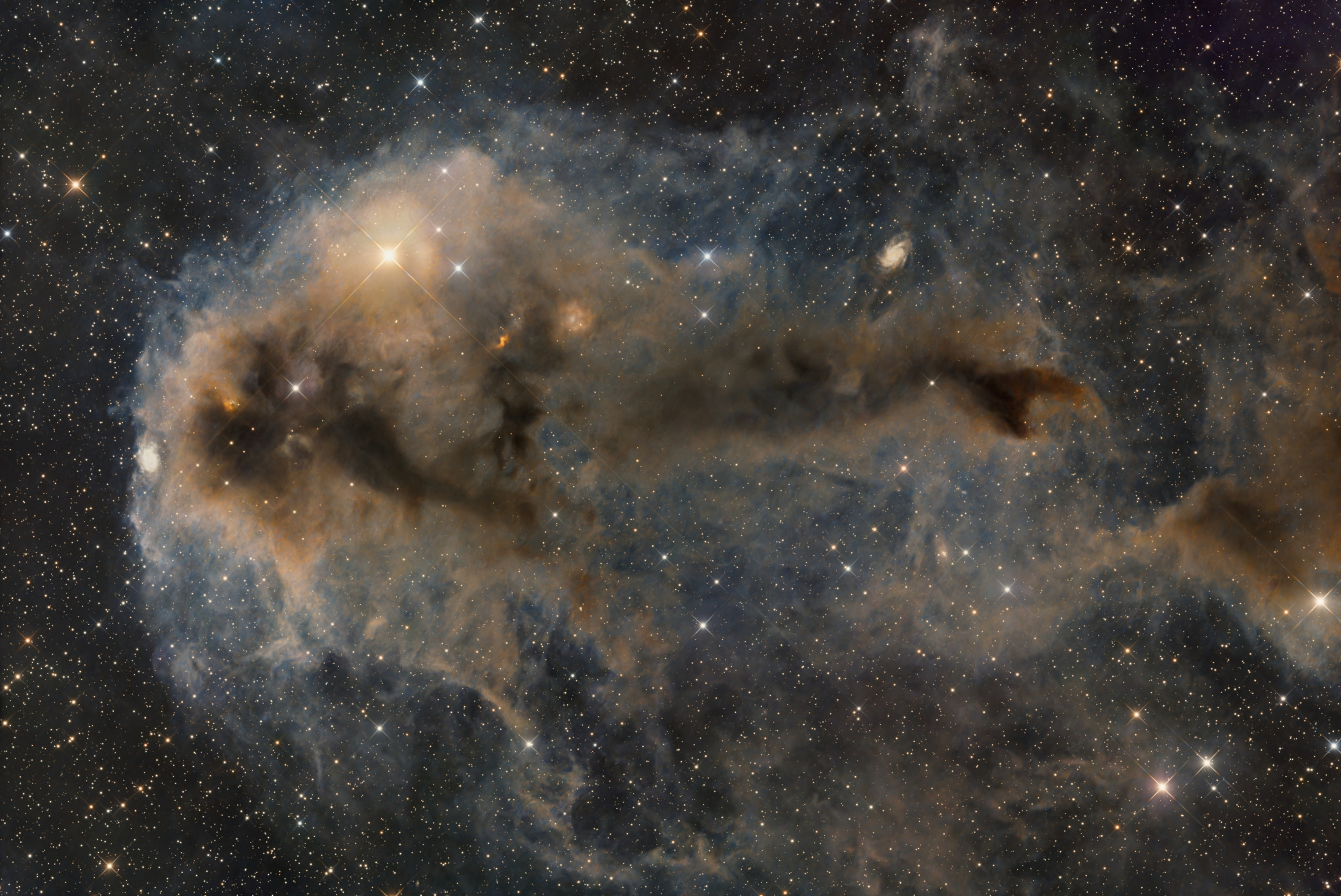
Alt...
2025 July 10
Lynds Dark Nebula 1251
* Image Credit & Copyright: Cristiano Gualco
Explanation:
Stars are forming in Lynds Dark Nebula (LDN) 1251. About 1,000 light-years away and drifting above the plane of our Milky Way galaxy, LDN 1251 is also less appetizingly known as "The Rotten Fish Nebula." The dusty molecular cloud is part of a complex of dark nebulae mapped toward the Cepheus flare region. Across the spectrum, astronomical explorations of the obscuring interstellar clouds reveal energetic shocks and outflows associated with newborn stars, including the telltale reddish glow from scattered Herbig-Haro objects hiding in the image. Distant background galaxies also lurk in the scene, almost buried behind the dusty expanse. This alluring telescopic frame spans almost three full moons on the sky. That corresponds to over 25 light-years at the estimated distance of LDN 1251.
Authors & editors: Robert Nemiroff (MTU) & Jerry Bonnell (UMCP)
NASA Official: Amber Straughn Specific rights apply.
NASA Web Privacy, Accessibility, Notices;
A service of: ASD at NASA / GSFC,
NASA Science Activation
& Michigan Tech. U.
"The next few posts are a real 'matter of the heart'"
2024 December 17
Near to the Heart Nebula
* Image Credit & Copyright: Jeff Horne & Drew Evans
https://www.instagram.com/jeffreyhorne
https://www.instagram.com/drewjevans
Explanation:
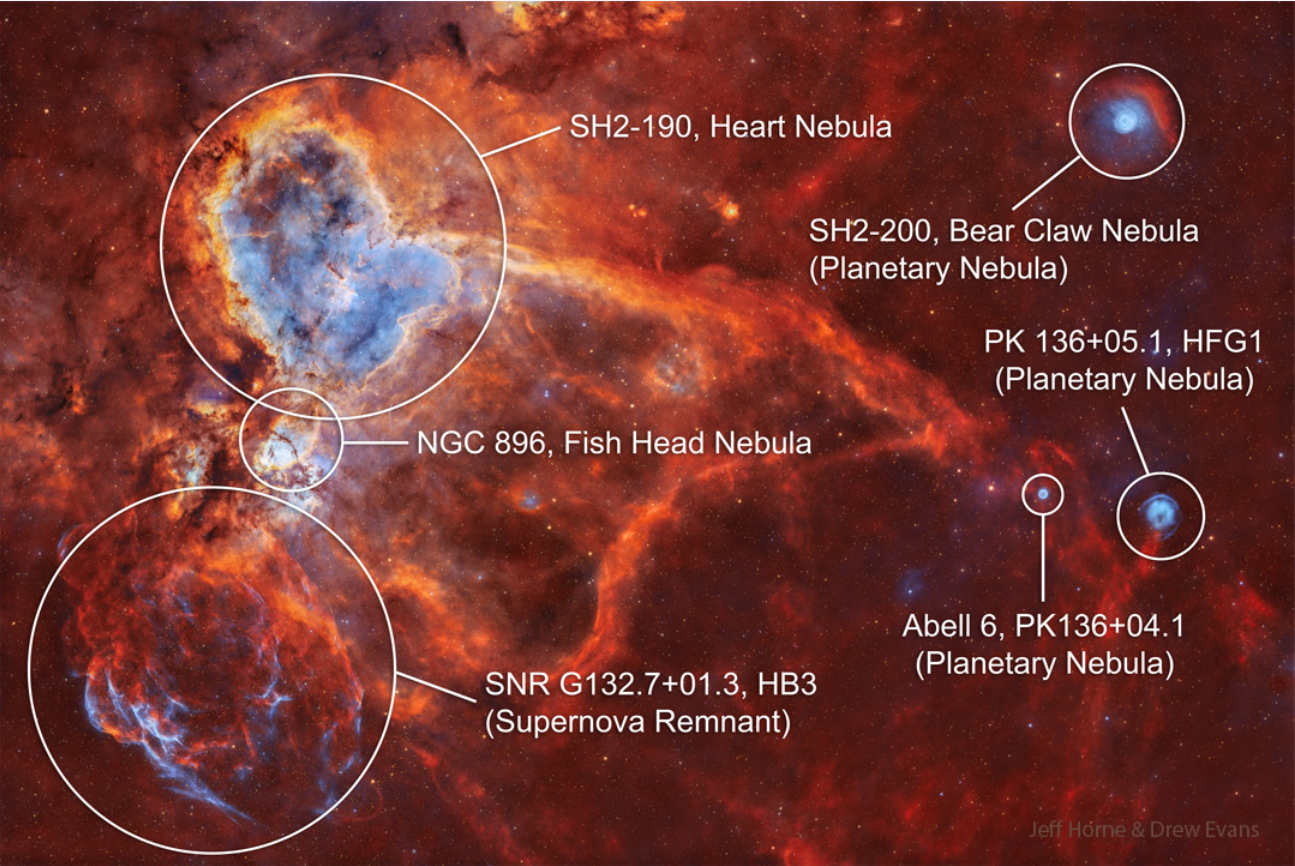
What excites the Heart Nebula? First, the large emission nebula on the upper left, catalogued as IC 1805, looks somewhat like a human heart. The nebula glows brightly in red light emitted by its most prominent element, hydrogen, but this long-exposure image was also blended with light emitted by sulfur (yellow) and oxygen (blue). In the center of the Heart Nebula are young stars from the open star cluster Melotte 15 that are eroding away several picturesque dust pillars with their atom-exciting energetic light and winds. The Heart Nebula is located about 7,500 light years away toward the constellation of Cassiopeia. This wide field image shows much more, though, including the Fishhead Nebula just below the Heart, a supernova remnant on the lower left, and three planetary nebulas on the image right. Taken over 57 nights, this image is so deep, though, that it clearly shows fainter long and complex filaments.
https://www.instagram.com/p/DC1wDJZvRO8/
https://apod.nasa.gov/apod/ap031022.html
https://apod.nasa.gov/apod/ap040917.html
Location:
https://en.wikipedia.org/wiki/Cassiopeia_(constellation)
Main Element:
https://en.wikipedia.org/wiki/Hydrogen
https://apod.nasa.gov/apod/ap241217.html
#space #nebula #astrophotography #photography #science #astronomy #physics #nature #NASA #ESA
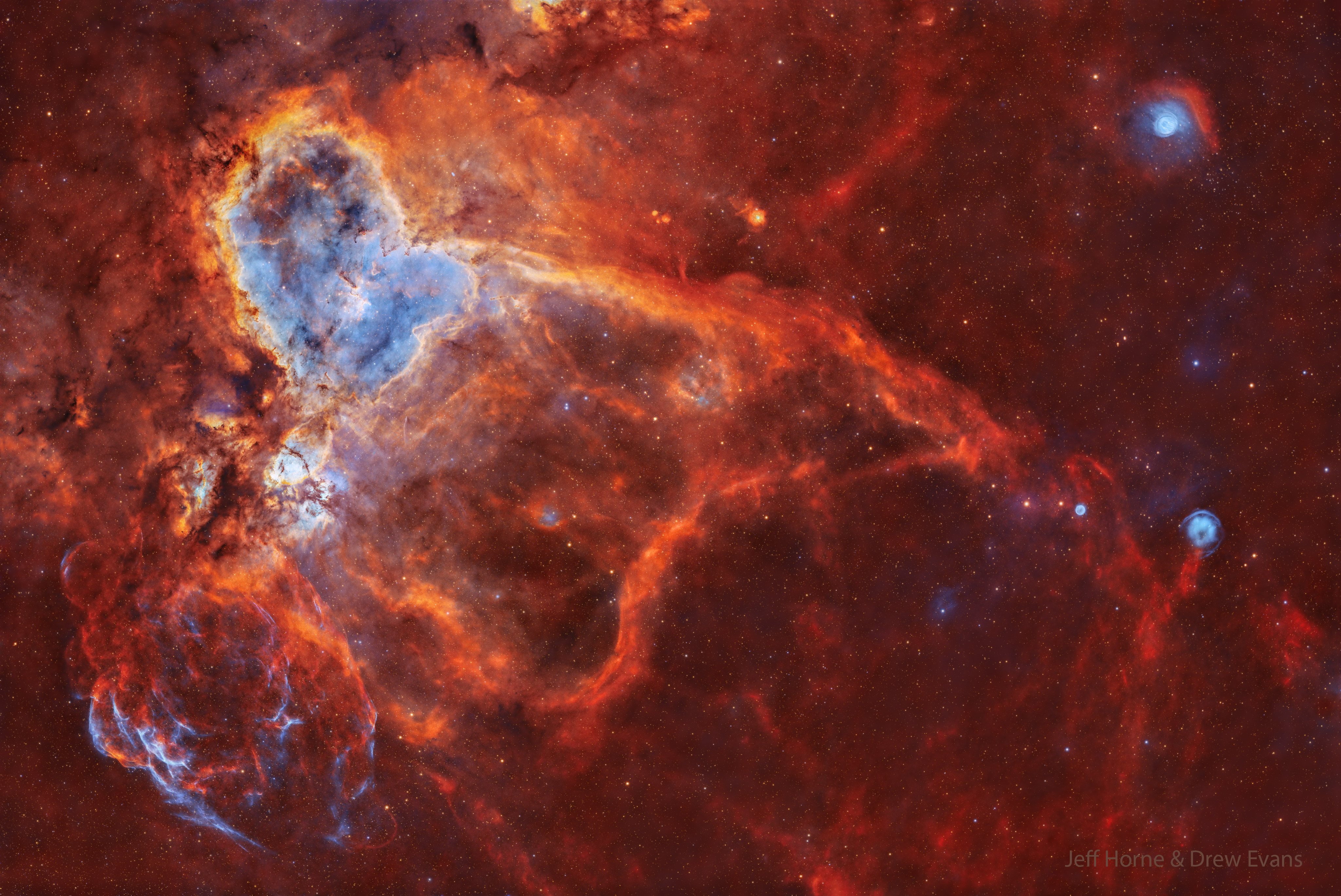
Alt...
2024 December 17
A wide star field is shown with several nebulae as identified by the image next to it. On the upper left is a large nebula named the Heart Nebula.
Near to the Heart Nebula
* Image Credit & Copyright: Jeff Horne & Drew Evans
Explanation:
What excites the Heart Nebula? First, the large emission nebula on the upper left, catalogued as IC 1805, looks somewhat like a human heart. The nebula glows brightly in red light emitted by its most prominent element, hydrogen, but this long-exposure image was also blended with light emitted by sulfur (yellow) and oxygen (blue). In the center of the Heart Nebula are young stars from the open star cluster Melotte 15 that are eroding away several picturesque dust pillars with their atom-exciting energetic light and winds. The Heart Nebula is located about 7,500 light years away toward the constellation of Cassiopeia. This wide field image shows much more, though, including the Fishhead Nebula just below the Heart, a supernova remnant on the lower left, and three planetary nebulas on the image right. Taken over 57 nights, this image is so deep, though, that it clearly shows fainter long and complex filaments.
Authors & editors: Robert Nemiroff (MTU) & Jerry Bonnell (UMCP)
NASA Official: Amber Straughn Specific rights apply.
NASA Web Privacy, Accessibility, Notices;
A service of: ASD at NASA / GSFC,
NASA Science Activation
& Michigan Tech. U.
Alt...
annotations
2018 February 14
In the Heart of the Heart Nebula
* Credit & Copyright: Alan Erickson
Explanation:
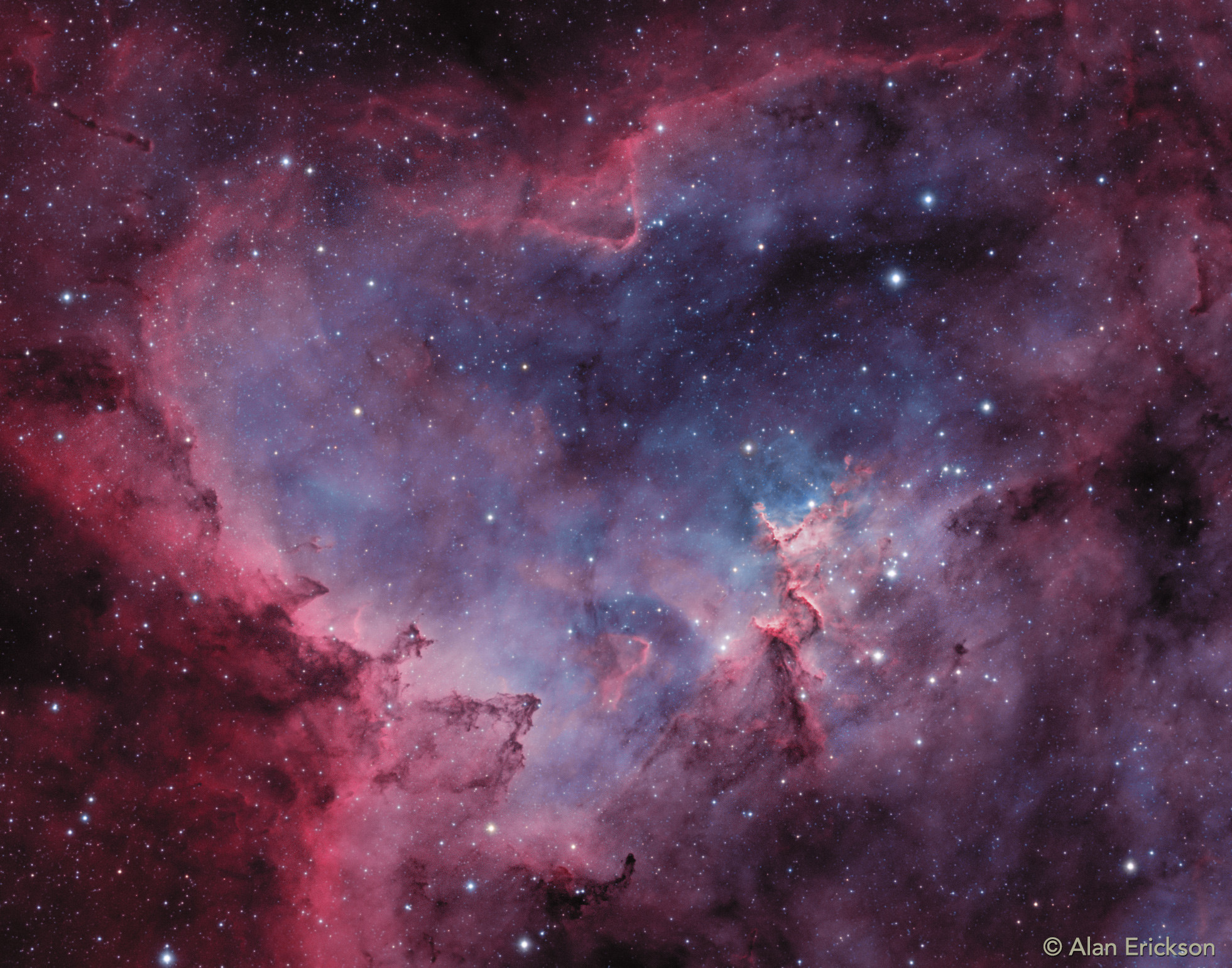
What's that inside the Heart Nebula? First, the large emission nebula dubbed IC 1805 looks, in whole, like a human heart. It's shape perhaps fitting of the Valentine's Day, this heart glows brightly in red light emitted by its most prominent element: hydrogen. The red glow and the larger shape are all created by a small group of stars near the nebula's center. In the heart of the Heart Nebula are young stars from the open star cluster Melotte 15 that are eroding away several picturesque dust pillars with their energetic light and winds. The open cluster of stars contains a few bright stars nearly 50 times the mass of our Sun, many dim stars only a fraction of the mass of our Sun, and an absent microquasar that was expelled millions of years ago. The Heart Nebula is located about 7,500 light years away toward the constellation of the mythological Queen of Aethiopia (Cassiopeia).
https://apod.nasa.gov/apod/ap180214.html
#space #nebula #astrophotography #photography #science #astronomy #physics #nature #NASA #ESA
Alt...
2018 February 14
In the Heart of the Heart Nebula
* Credit & Copyright: Alan Erickson
Explanation:
What's that inside the Heart Nebula? First, the large emission nebula dubbed IC 1805 looks, in whole, like a human heart. It's shape perhaps fitting of the Valentine's Day, this heart glows brightly in red light emitted by its most prominent element: hydrogen. The red glow and the larger shape are all created by a small group of stars near the nebula's center. In the heart of the Heart Nebula are young stars from the open star cluster Melotte 15 that are eroding away several picturesque dust pillars with their energetic light and winds. The open cluster of stars contains a few bright stars nearly 50 times the mass of our Sun, many dim stars only a fraction of the mass of our Sun, and an absent microquasar that was expelled millions of years ago. The Heart Nebula is located about 7,500 light years away toward the constellation of the mythological Queen of Aethiopia (Cassiopeia).
Authors & editors: Robert Nemiroff (MTU) & Jerry Bonnell (UMCP)
NASA Official: Phillip Newman Specific rights apply.
NASA Web Privacy Policy and Important Notices
A service of: ASD at NASA / GSFC
& Michigan Tech. U.
2013 December 27
Melotte 15 in the Heart
* Image Credit & Copyright: Jimmy Walker
https://www.darkskywalker.com/
Explanation:
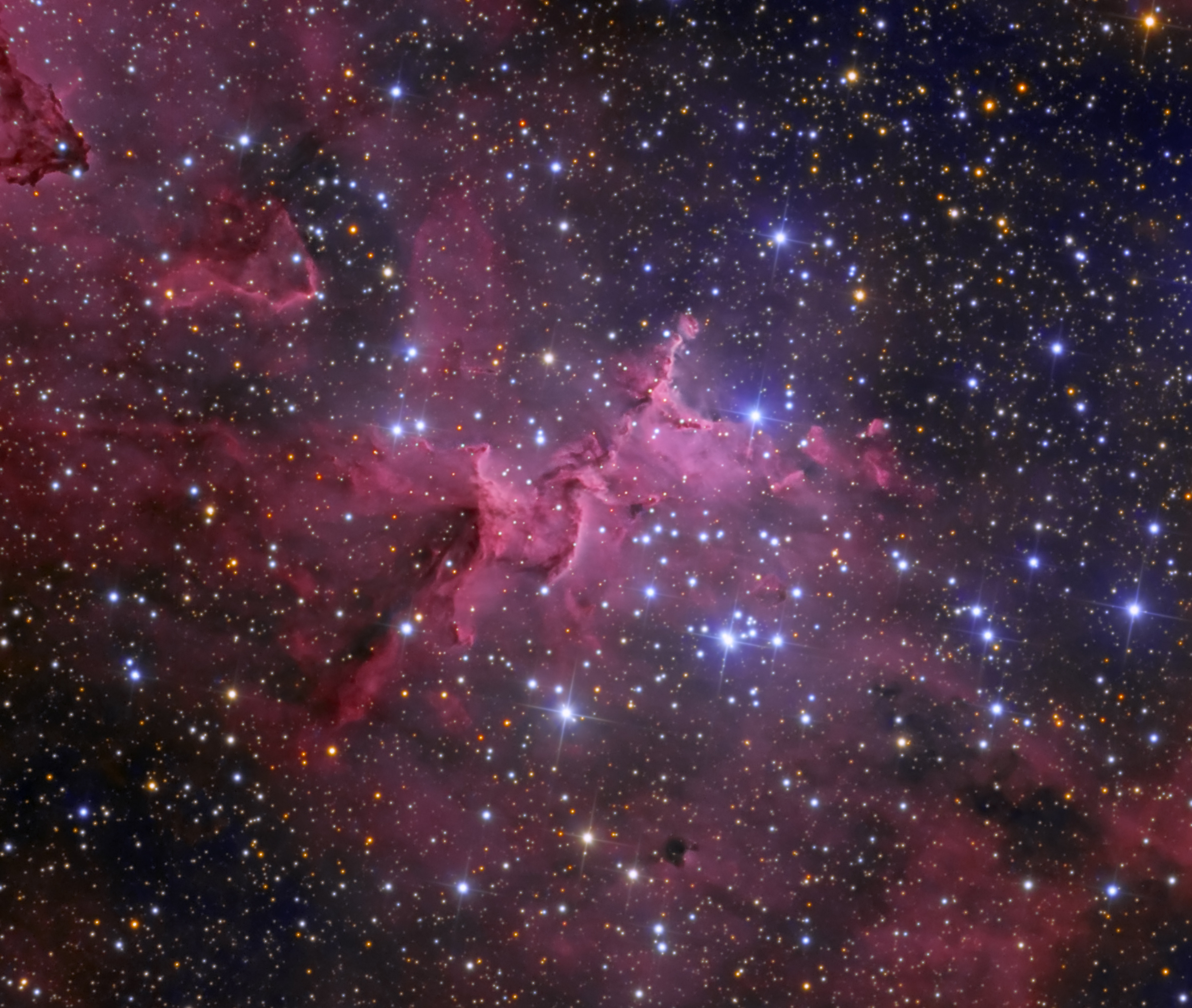
Cosmic clouds seem to form fantastic shapes in the central regions of emission nebula IC 1805. Of course, the clouds are sculpted by stellar winds and radiation from massive hot stars in the nebula's newborn star cluster, Melotte 15. About 1.5 million years young, the cluster stars are near the center of this colorful skyscape, along with dark dust clouds in silhouette. Dominated by emission from atomic hydrogen, the telescopic view spans about 30 light-years. But wider field images reveal that IC 1805's simpler, overall outline suggests its popular name - The Heart Nebula. IC 1805 is located along the northern Milky Way, about 7,500 light years distant toward the constellation Cassiopeia.
https://apod.nasa.gov/apod/ap131227.html
#space #nebula #astrophotography #photography #science #astronomy #physics #nature #NASA #ESA
Alt...
2013 December 27
Melotte 15 in the Heart
* Image Credit & Copyright: Jimmy Walker
Explanation:
Cosmic clouds seem to form fantastic shapes in the central regions of emission nebula IC 1805. Of course, the clouds are sculpted by stellar winds and radiation from massive hot stars in the nebula's newborn star cluster, Melotte 15. About 1.5 million years young, the cluster stars are near the center of this colorful skyscape, along with dark dust clouds in silhouette. Dominated by emission from atomic hydrogen, the telescopic view spans about 30 light-years. But wider field images reveal that IC 1805's simpler, overall outline suggests its popular name - The Heart Nebula. IC 1805 is located along the northern Milky Way, about 7,500 light years distant toward the constellation Cassiopeia.
Authors & editors: Robert Nemiroff (MTU) & Jerry Bonnell (UMCP)
NASA Official: Phillip Newman Specific rights apply.
NASA Web Privacy Policy and Important Notices
A service of: ASD at NASA / GSFC
& Michigan Tech. U.
2024 May 1
IC 1795: The Fishhead Nebula
* Image Credit & Copyright: Roberto Colombari & Mauro Narduzzi
https://www.flickr.com/people/110872523@N07/
https://app.astrobin.com/u/ToolMayNARD#gallery
Explanation:
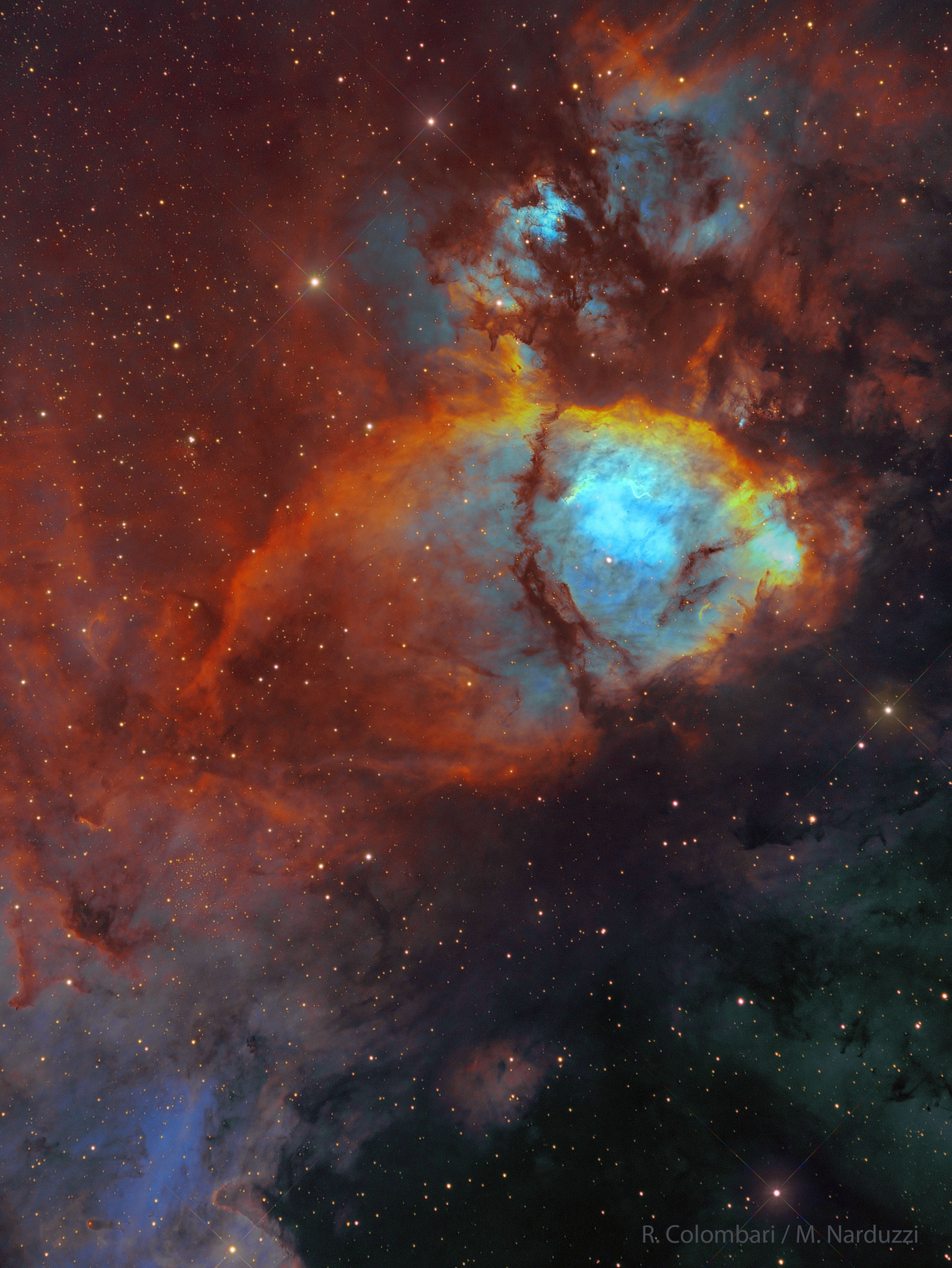
To some, this nebula looks like the head of a fish. However, this colorful cosmic portrait really features glowing gas and obscuring dust clouds in IC 1795, a star forming region in the northern constellation Cassiopeia. The nebula's colors were created by adopting the Hubble color palette for mapping narrowband emissions from oxygen, hydrogen, and sulfur atoms to blue, green and red colors, and further blending the data with images of the region recorded through broadband filters. Not far on the sky from the famous Double Star Cluster in Perseus, IC 1795 is itself located next to IC 1805, the Heart Nebula, as part of a complex of star forming regions that lie at the edge of a large molecular cloud. Located just over 6,000 light-years away, the larger star forming complex sprawls along the Perseus spiral arm of our Milky Way Galaxy. At that distance, IC 1795 would span about 70 light-years across.
https://apod.nasa.gov/apod/ap240501.html
#space #nebula #astrophotography #photography #science #astronomy #physics #nature #NASA #ESA
Alt...
2024 May 1
A colorful star forming region is shown that resembles a fish swimming to the right. Dark dust is apparent across the lower right, and a sparse starfield is visible all over the image.
IC 1795: The Fishhead Nebula
* Image Credit & Copyright: Roberto Colombari & Mauro Narduzzi
Explanation:
To some, this nebula looks like the head of a fish. However, this colorful cosmic portrait really features glowing gas and obscuring dust clouds in IC 1795, a star forming region in the northern constellation Cassiopeia. The nebula's colors were created by adopting the Hubble color palette for mapping narrowband emissions from oxygen, hydrogen, and sulfur atoms to blue, green and red colors, and further blending the data with images of the region recorded through broadband filters. Not far on the sky from the famous Double Star Cluster in Perseus, IC 1795 is itself located next to IC 1805, the Heart Nebula, as part of a complex of star forming regions that lie at the edge of a large molecular cloud. Located just over 6,000 light-years away, the larger star forming complex sprawls along the Perseus spiral arm of our Milky Way Galaxy. At that distance, IC 1795 would span about 70 light-years across.
Authors & editors: Robert Nemiroff (MTU) & Jerry Bonnell (UMCP)
NASA Official: Amber Straughn Specific rights apply.
NASA Web Privacy, Accessibility, Notices;
A service of: ASD at NASA / GSFC,
NASA Science Activation
& Michigan Tech. U.
The tiny open cluster at the center of the Heart Nebula (IC1805) is known as Melotte 15. But it’s not really the cluster we’re interested in, it’s the amazing, twisty bit of nebulosity there that steals the show. This image is the combination of data from two scopes: the Vixen R200SS Newtonian and the TS-Optics Photoline 130 refractor. Both have nearly the same focal length (922 and 908mm, respectively) with their correctors included. I shot the same target 48 hours apart in order to do a head-to-head comparison, but the results were so good for both scopes that I combined them into a single image.
Text credit
Charles Bracken
https://app.astrobin.com/i/flz30w
#space #nebula #astrophotography #photography #science #astronomy #physics #nature #NASA #ESA
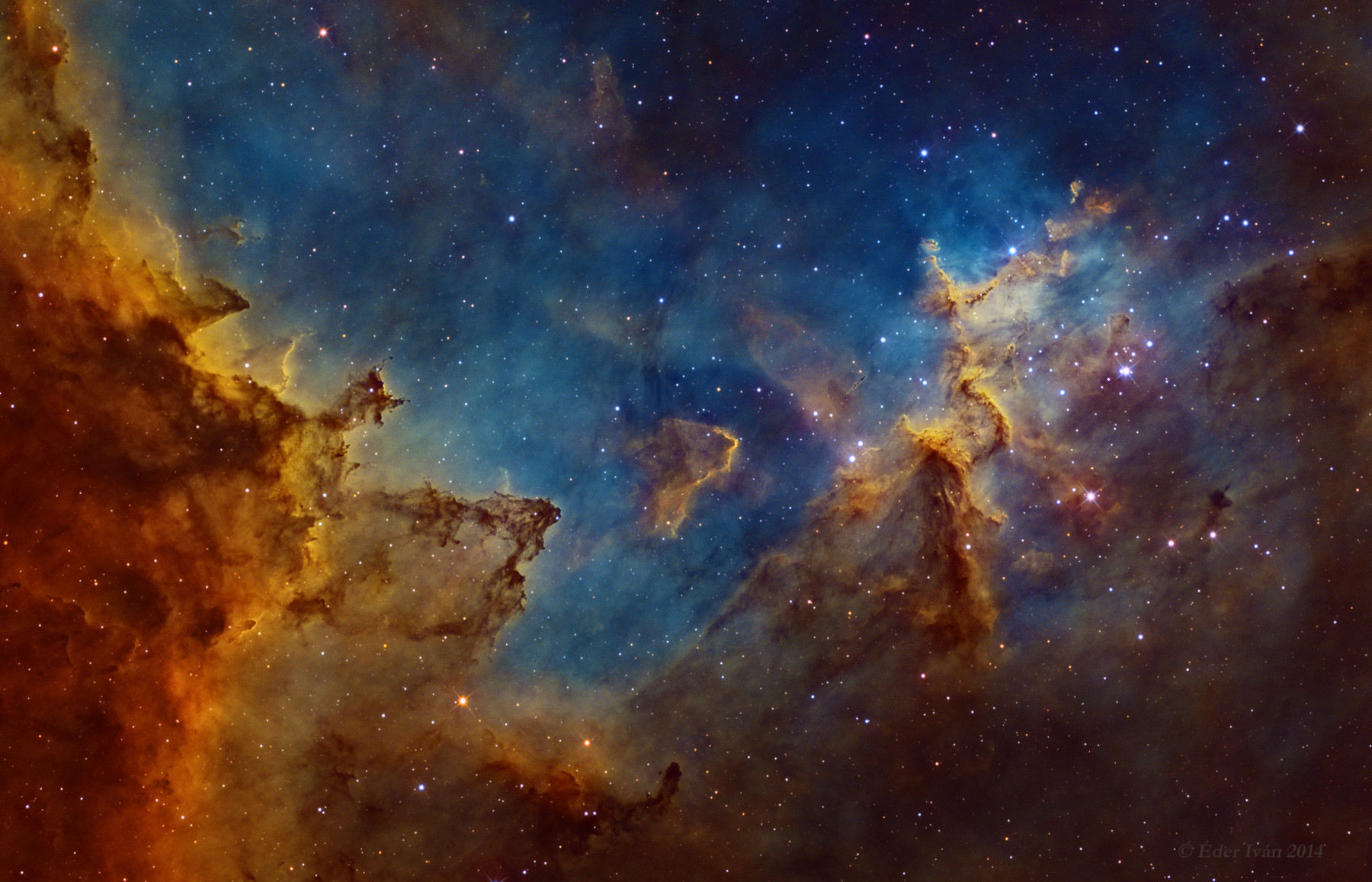
Alt...
2014 October 18
Melotte 15 in the Heart
* Image Credit & Copyright: Ivan Eder
Explanation:
Cosmic clouds form fantastic shapes in the central regions of emission nebula IC 1805. The clouds are sculpted by stellar winds and radiation from massive hot stars in the nebula's newborn star cluster, Melotte 15. About 1.5 million years young, the cluster stars are toward the right in this colorful skyscape, along with dark dust clouds in silhouette against glowing atomic gas. A composite of narrowband and broadband telescopic images, the view spans about 30 light-years and includes emission from ionized hydrogen, sulfur, and oxygen atoms mapped to green, red, and blue hues in the popular Hubble Palette. Wider field images reveal that IC 1805's simpler, overall outline suggests its popular name - The Heart Nebula. IC 1805 is located about 7,500 light years away toward the boastful constellation Cassiopeia.
Authors & editors: Robert Nemiroff (MTU) & Jerry Bonnell (UMCP)
NASA Official: Phillip Newman Specific rights apply.
NASA Web Privacy Policy and Important Notices
A service of: ASD at NASA / GSFC
& Michigan Tech. U.
2024 October 22
M16: Pillars of Star Creation
* Image Credit: NASA, ESA, CSA, STScI; Processing: Diego Pisano
https://www.instagram.com/_diegopisano_/
https://www.nasa.gov/
https://www.esa.int/
https://www.asc-csa.gc.ca/eng/
https://www.stsci.edu/
Explanation:
These dark pillars may look destructive, but they are creating stars. This pillar-capturing picture of the Eagle Nebula combines visible light exposures taken with the Hubble Space Telescope with infrared images taken with the James Webb Space Telescope to highlight evaporating gaseous globules (EGGs) emerging from pillars of molecular hydrogen gas and dust. The giant pillars are light years in length and are so dense that interior gas contracts gravitationally to form stars. At each pillar's end, the intense radiation of bright young stars causes low density material to boil away, leaving stellar nurseries of dense EGGs exposed. The Eagle Nebula, associated with the open star cluster M16, lies about 7000 light years away.
High Resolution:
https://apod.nasa.gov/apod/image/2410/M16_HubbleWebbPisano_6500.jpg
https://apod.nasa.gov/apod/ap241022.html
#space #nebula #astrophotography #photography #science #astronomy #physics #nature #NASA #ESA
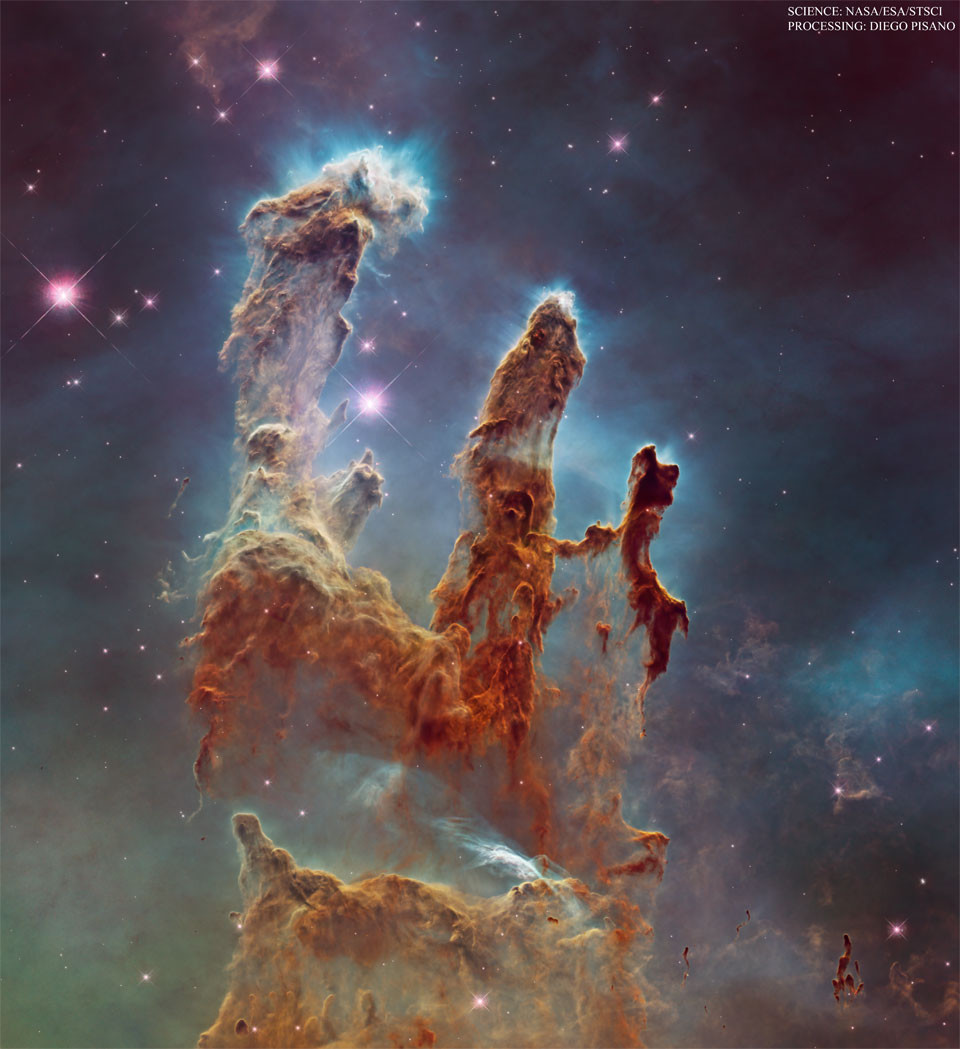
Alt...
2024 October 22
Three large interstellar dust pillars are shown against a starfield and a multicolored glowing background.
M16: Pillars of Star Creation
* Image Credit: NASA, ESA, CSA, STScI; Processing: Diego Pisano
Explanation:
These dark pillars may look destructive, but they are creating stars. This pillar-capturing picture of the Eagle Nebula combines visible light exposures taken with the Hubble Space Telescope with infrared images taken with the James Webb Space Telescope to highlight evaporating gaseous globules (EGGs) emerging from pillars of molecular hydrogen gas and dust. The giant pillars are light years in length and are so dense that interior gas contracts gravitationally to form stars. At each pillar's end, the intense radiation of bright young stars causes low density material to boil away, leaving stellar nurseries of dense EGGs exposed. The Eagle Nebula, associated with the open star cluster M16, lies about 7000 light years away.
Authors & editors: Robert Nemiroff (MTU) & Jerry Bonnell (UMCP)
NASA Official: Amber Straughn Specific rights apply.
NASA Web Privacy, Accessibility, Notices;
A service of: ASD at NASA / GSFC,
NASA Science Activation
& Michigan Tech. U.
Using data from NASA's Hubble and Webb space telescopes, astronomers and artists modeled the iconic Pillars of Creation in the Eagle Nebula (Messier 16 or M16) in three dimensions, creating a movie that allows viewers to fly past and among the pillars.
The new visualization helps viewers experience how two of the world's most powerful space telescopes work together to provide a more complex and holistic portrait of the pillars. Hubble sees objects that glow in visible light, at thousands of degrees. Webb's infrared vision, which is sensitive to cooler objects with temperatures of just hundreds of degrees, pierces through obscuring dust to see stars embedded in the pillars.
A bonus product from this visualization is a new 3D printable model of the Pillars of Creation. The base model of the four pillars used in the visualization has been adapted to the STL file format, so that viewers can download the model file and print it out on 3D printers. Examining the structure of the pillars in this tactile and interactive way adds new perspectives and insights to the overall experience.
Printable 3D Model:
https://universe-of-learning.org/contents/products/pillars-of-creation-3d-model
Credit:
* Producers: Greg Bacon and Frank Summers (STScI), NASA's Universe of Learning;
* Visualization: Greg Bacon, Ralf Crawford, Joseph DePasquale, Leah Hustak, Danielle Kirshenblat, Christian Nieves, Joseph Olmsted, Alyssa Pagan, and Frank Summers (STScI), Robert L. Hurt (Caltech, IPAC); Science
* Advisor: Anna McLeod (Durham University);
* Music: Joseph DePasquale (STScI)
https://science.nasa.gov/missions/hubble/new-hubble-webb-pillars-of-creation-visualization/
#space #nebula #astrophotography #photography #science #astronomy #physics #nature #NASA #ESA #education
Alt...
Using data from NASA's Hubble and Webb space telescopes, astronomers and artists modeled the iconic Pillars of Creation in the Eagle Nebula (Messier 16 or M16) in three dimensions, creating a movie that allows viewers to fly past and among the pillars.
Credit:
* Producers: Greg Bacon and Frank Summers (STScI), NASA's Universe of Learning;
* Visualization: Greg Bacon, Ralf Crawford, Joseph DePasquale, Leah Hustak, Danielle Kirshenblat, Christian Nieves, Joseph Olmsted, Alyssa Pagan, and Frank Summers (STScI), Robert L. Hurt (Caltech, IPAC); Science
* Advisor: Anna McLeod (Durham University);
* Music: Joseph DePasquale (STScI)
2024 September 18
A starfield is shown with a long blue-glowing nebula taking up much of the frame. The nebula appears, to some, similar to a fish or a mermaid.
The Mermaid Nebula Supernova Remnant
* Image Credit & Copyright: Neil Corke; Text: Natalia Lewandowska (SUNY Oswego)
https://app.astrobin.com/u/NeilCorke#gallery
https://ww1.oswego.edu/physics/profile/natalia-lewandowska
https://ww1.oswego.edu/physics/
Explanation:
New stars are born from the remnants of dead stars. The gaseous remnant of the gravitational collapse and subsequent death of a very massive star in our Milky Way created the G296.5+10.0 supernova remnant, of which the featured Mermaid Nebula is part. Also known as the Betta Fish Nebula, the Mermaid Nebula makes up part of an unusual subclass of supernova remnants that are two-sided and nearly circular. Originally discovered in X-rays, the filamentary nebula is a frequently studied source also in radio and gamma-ray light. The blue color visible here originates from doubly ionized oxygen (OIII), while the deep red is emitted by hydrogen gas. The nebula's mermaid-like shape has proven to be useful for measurements of the interstellar magnetic field.
https://apod.nasa.gov/apod/ap240918.html
#space #nebula #astrophotography #photography #science #astronomy #physics #nature #NASA #ESA
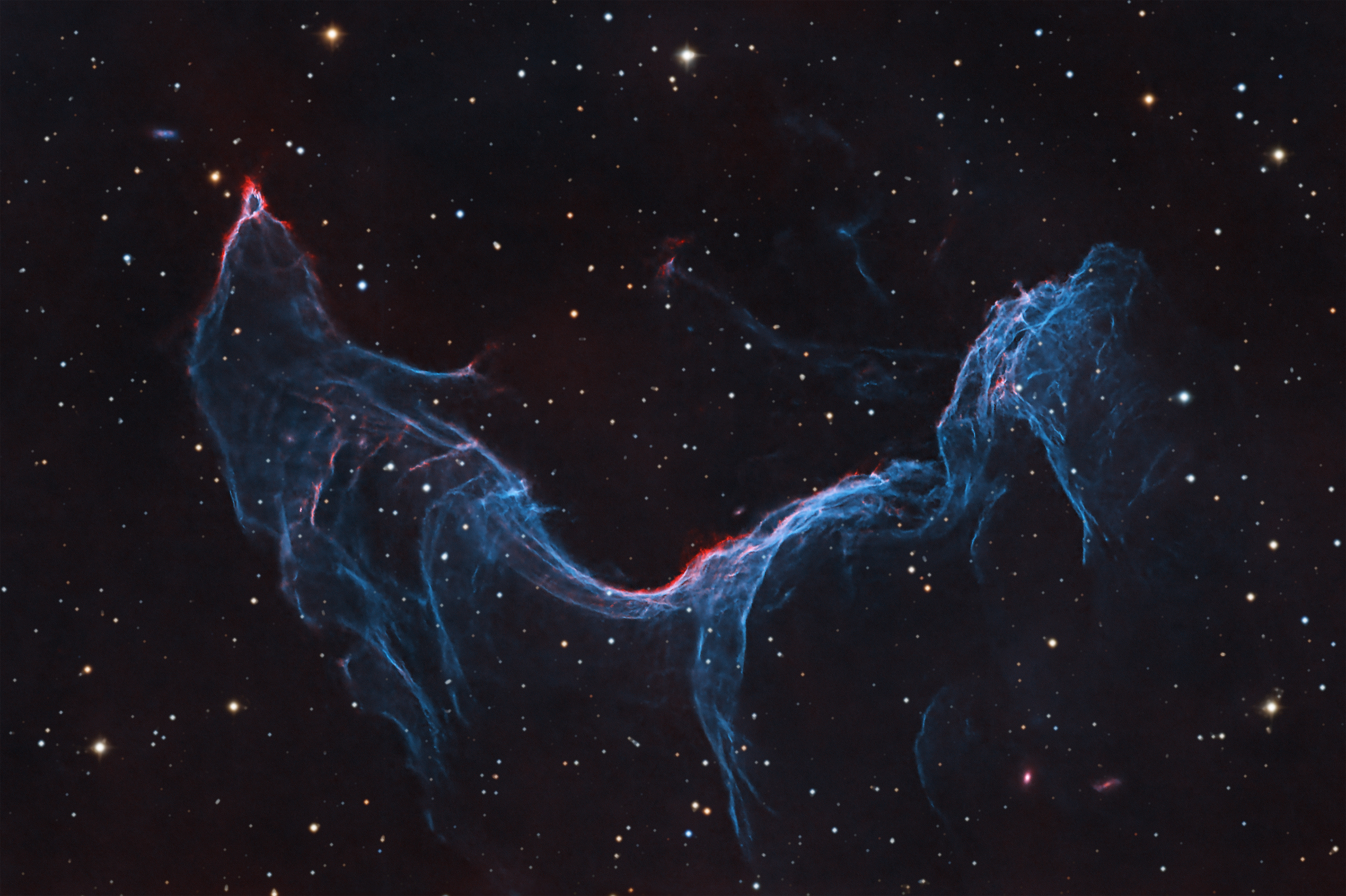
Alt...
2024 September 18
A starfield is shown with a long blue-glowing nebula taking up much of the frame. The nebula appears, to some, similar to a fish or a mermaid.
The Mermaid Nebula Supernova Remnant
* Image Credit & Copyright: Neil Corke; Text: Natalia Lewandowska (SUNY Oswego)
Explanation:
New stars are born from the remnants of dead stars. The gaseous remnant of the gravitational collapse and subsequent death of a very massive star in our Milky Way created the G296.5+10.0 supernova remnant, of which the featured Mermaid Nebula is part. Also known as the Betta Fish Nebula, the Mermaid Nebula makes up part of an unusual subclass of supernova remnants that are two-sided and nearly circular. Originally discovered in X-rays, the filamentary nebula is a frequently studied source also in radio and gamma-ray light. The blue color visible here originates from doubly ionized oxygen (OIII), while the deep red is emitted by hydrogen gas. The nebula's mermaid-like shape has proven to be useful for measurements of the interstellar magnetic field.
Authors & editors: Robert Nemiroff (MTU) & Jerry Bonnell (UMCP)
NASA Official: Amber Straughn Specific rights apply.
NASA Web Privacy, Accessibility, Notices;
A service of: ASD at NASA / GSFC,
NASA Science Activation
& Michigan Tech. U.
2025 July 13
Planetary Nebula Mz3: The Ant Nebula
* Image Credit: NASA, ESA, R. Sahai (JPL) et al., Hubble Heritage Team
https://www.nasa.gov/
https://www.esa.int/https://science.jpl.nasa.gov/people/Sahai/
https://www.jpl.nasa.gov/
Explanation:
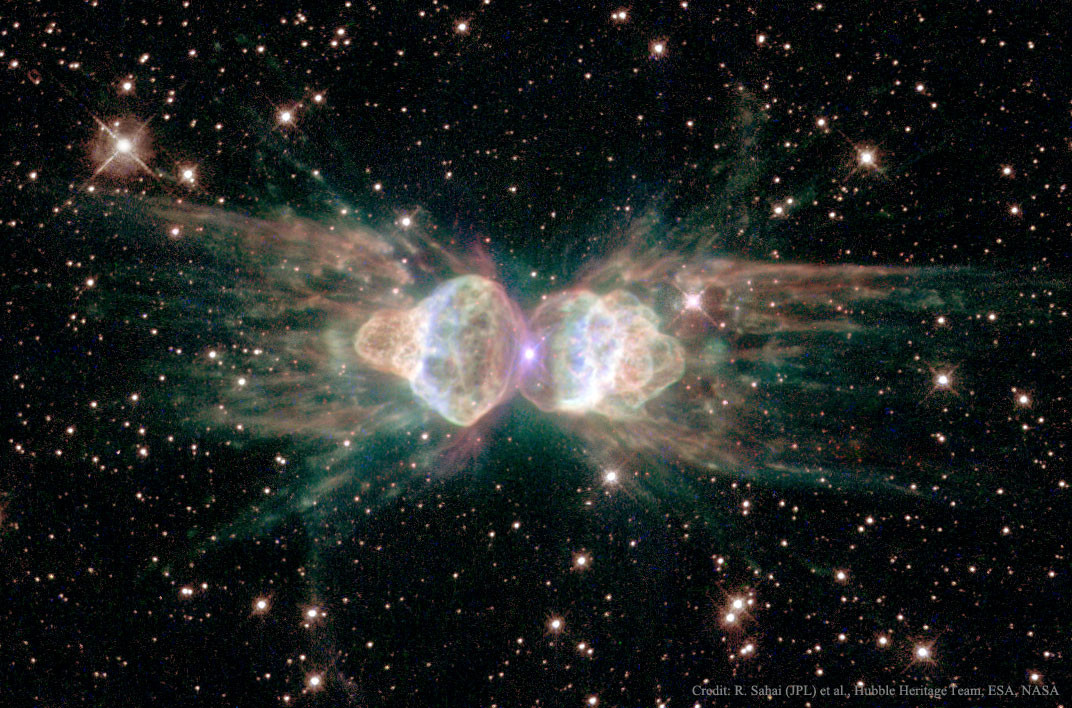
Why isn't this ant a big sphere? Planetary nebula Mz3 is being cast off by a star similar to our Sun that is, surely, round. Why then would the gas that is streaming away create an ant-shaped nebula that is distinctly not round? Clues might include the high 1000-kilometer per second speed of the expelled gas, the light-year long length of the structure, and the magnetism of the star featured here at the nebula's center. One possible answer is that Mz3 is hiding a second, dimmer star that orbits close in to the bright star. A competing hypothesis holds that the central star's own spin and magnetic field are channeling the gas. Since the central star appears to be so similar to our own Sun, astronomers hope that increased understanding of the history of this giant space ant can provide useful insight into the likely future of our own Sun and Earth.
https://esahubble.org/news/heic0101/
https://science.nasa.gov/asset/hubble/the-ant-nebula-menzel-3-fiery-lobes-protrude-from-dying-sun-like-star/
https://en.wikipedia.org/wiki/Mz_3
https://ui.adsabs.harvard.edu/abs/2004AJ....128.1694G/abstract
https://apod.nasa.gov/apod/ap971106.html
https://apod.nasa.gov/apod/ap250713.html
#space #nebula #astrophotography #photography #science #astronomy #physics #nature #NASA
Alt...
2025 July 13
A dark starfield appears around an unusually shaped nebula. The nebula has two main lobes on the left and the right and may seem to resemble an ant.
Planetary Nebula Mz3: The Ant Nebula
* Image Credit: NASA, ESA, R. Sahai (JPL) et al., Hubble Heritage Team
Explanation:
Why isn't this ant a big sphere? Planetary nebula Mz3 is being cast off by a star similar to our Sun that is, surely, round. Why then would the gas that is streaming away create an ant-shaped nebula that is distinctly not round? Clues might include the high 1000-kilometer per second speed of the expelled gas, the light-year long length of the structure, and the magnetism of the star featured here at the nebula's center. One possible answer is that Mz3 is hiding a second, dimmer star that orbits close in to the bright star. A competing hypothesis holds that the central star's own spin and magnetic field are channeling the gas. Since the central star appears to be so similar to our own Sun, astronomers hope that increased understanding of the history of this giant space ant can provide useful insight into the likely future of our own Sun and Earth.
Authors & editors: Robert Nemiroff (MTU) & Jerry Bonnell (UMCP)
NASA Official: Phillip Newman Specific rights apply.
NASA Web Privacy Policy and Important Notices
A service of: ASD at NASA / GSFC,
NASA Science Activation
& Michigan Tech. U.
2023 March 21
Dark Nebulae and Star Formation in Taurus
* Image Credit & Copyright: Vikas Chander
https://www.instagram.com/vikaschanderastrophotography/
Explanation:
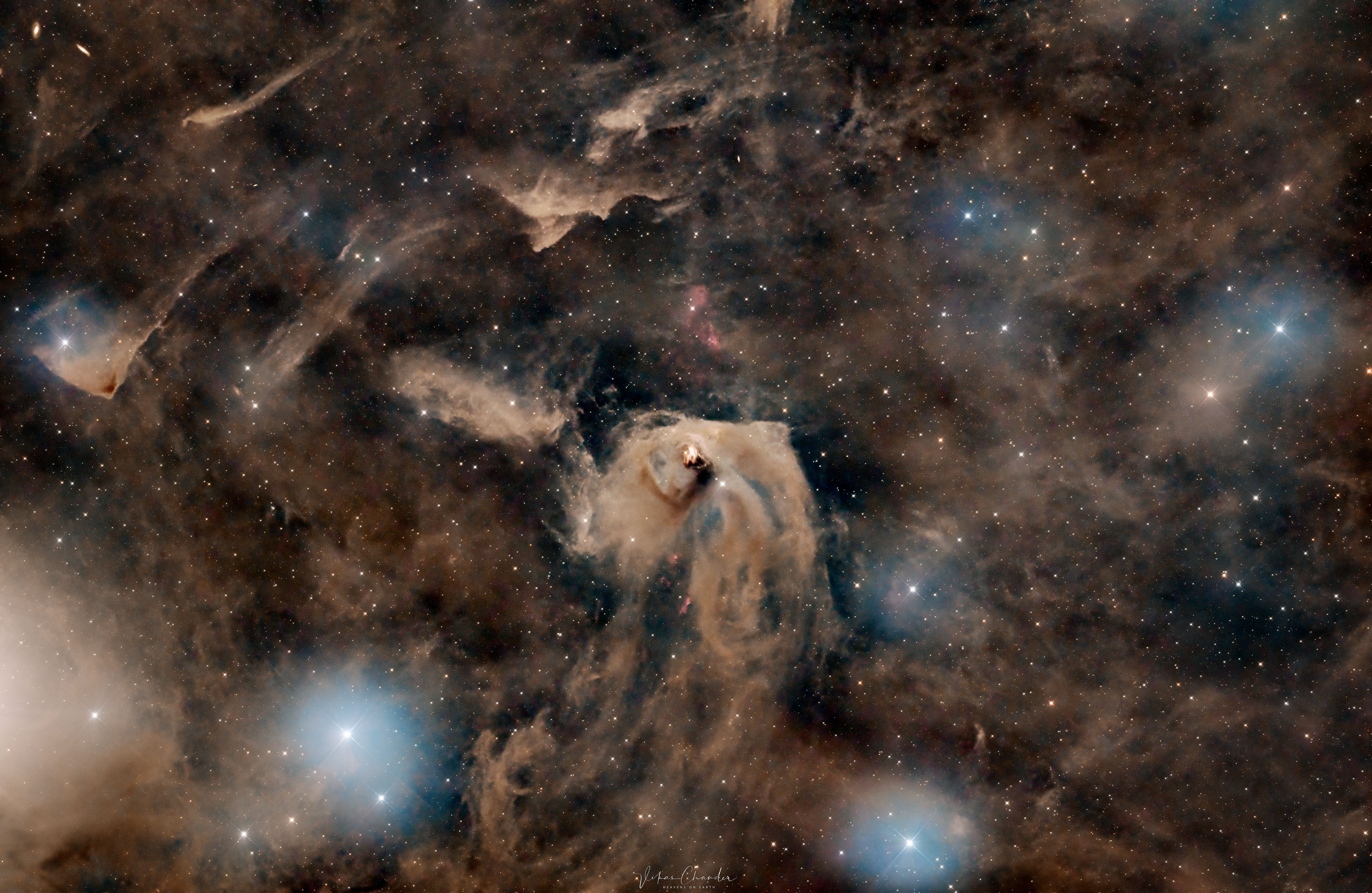
Can dust be beautiful? Yes, and it can also be useful. The Taurus molecular cloud has several bright stars, but it is the dark dust that really draws attention. The pervasive dust has waves and ripples and makes picturesque dust bunnies, but perhaps more importantly, it marks regions where interstellar gas is dense enough to gravitationally contract to form stars. In the image center is a light cloud lit by neighboring stars that is home not only to a famous nebula, but to a very young and massive famous star. Both the star, T Tauri, and the nebula, Hind's Variable Nebula, are seen to vary dramatically in brightness -- but not necessarily at the same time, adding to the mystery of this intriguing region. T Tauri and similar stars are now generally recognized to be Sun-like stars that are less than a few million years old and so still in the early stages of formation. The featured image spans about four degrees not far from the Pleiades star cluster, while the featured dust field lies about 400 light-years away.
https://apod.nasa.gov/apod/ap230321.html
#space #nebula #astrophotography #photography #science #astronomy #physics #nature #NASA
Alt...
2023 March 21
A star field strewn with bunches of brown dust is pictured. In the center is a bright area of light brown dust, and in the center of that is a bright region of star formation.
Dark Nebulae and Star Formation in Taurus
* Image Credit & Copyright: Vikas Chander
Explanation:
Can dust be beautiful? Yes, and it can also be useful. The Taurus molecular cloud has several bright stars, but it is the dark dust that really draws attention. The pervasive dust has waves and ripples and makes picturesque dust bunnies, but perhaps more importantly, it marks regions where interstellar gas is dense enough to gravitationally contract to form stars. In the image center is a light cloud lit by neighboring stars that is home not only to a famous nebula, but to a very young and massive famous star. Both the star, T Tauri, and the nebula, Hind's Variable Nebula, are seen to vary dramatically in brightness -- but not necessarily at the same time, adding to the mystery of this intriguing region. T Tauri and similar stars are now generally recognized to be Sun-like stars that are less than a few million years old and so still in the early stages of formation. The featured image spans about four degrees not far from the Pleiades star cluster, while the featured dust field lies about 400 light-years away.
Authors & editors: Robert Nemiroff (MTU) & Jerry Bonnell (UMCP)
NASA Official: Phillip Newman Specific rights apply.
2025 July 16
The Rosette Nebula from DECam
* Image Credit: CTIO, NOIRLab, DOE, NSF, AURA
https://noirlab.edu/public/programs/ctio/
https://noirlab.edu/
https://www.energy.gov/
https://www.nsf.gov/
https://www.aura-astronomy.org/
* Processing: T. A. Rector (U. Alaska Anchorage), D. de Martin (NSF’s NOIRLab) & M. Zamani
http://aftar.uaa.alaska.edu/
https://mahdizamani.com/about
https://www.uaa.alaska.edu/
https://www.nsf.gov/
https://noirlab.edu/public/
Explanation:
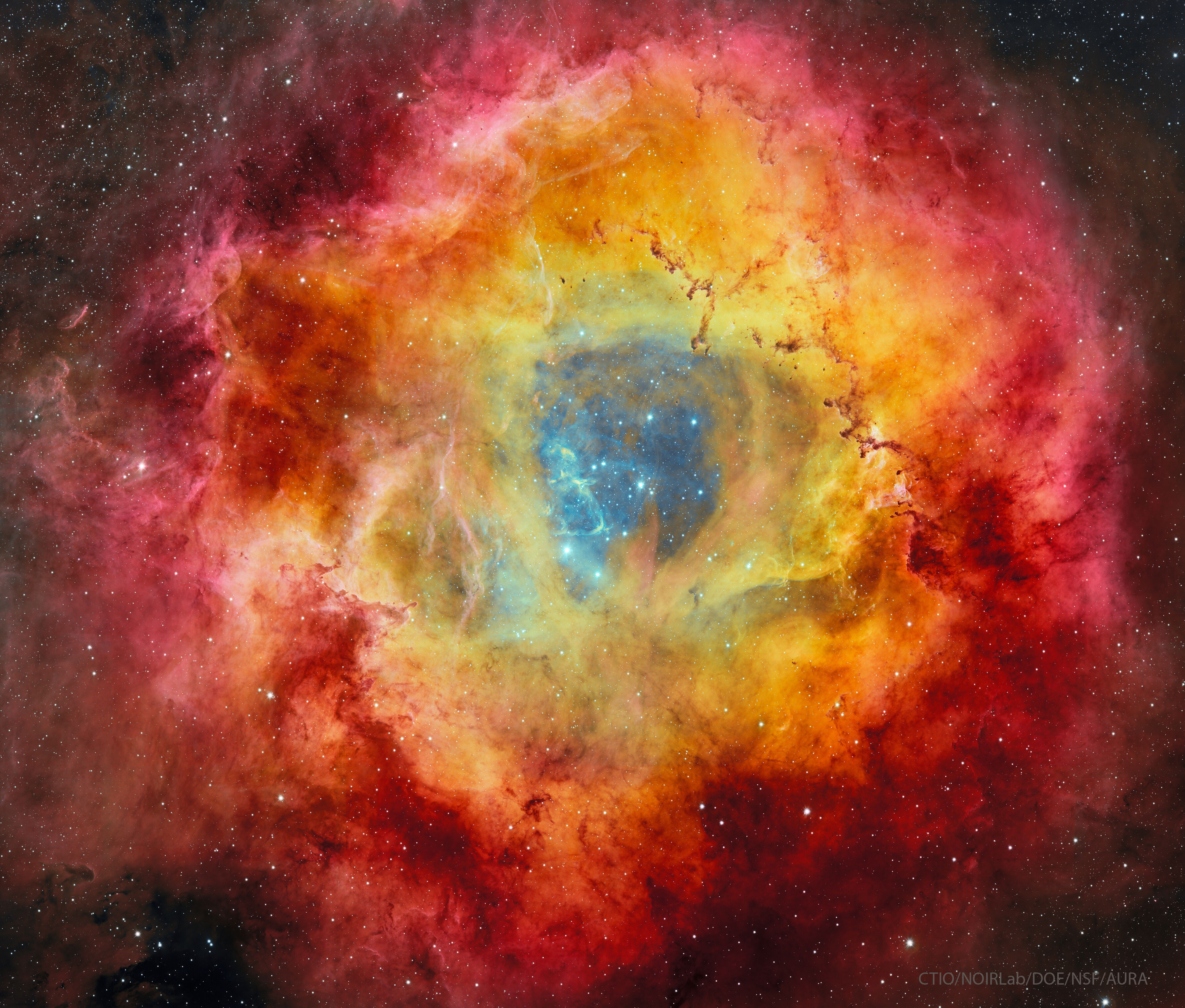
Would the Rosette Nebula by any other name look as sweet? The bland New General Catalog designation of NGC 2237 doesn't appear to diminish the appearance of this flowery emission nebula, as captured by the Dark Energy Camera (DECam) on the Blanco 4-meter telescope at the NSF's Cerro Tololo Inter-American Observatory in Chile. Inside the nebula lies an open cluster of bright young stars designated NGC 2244. These stars formed about four million years ago from the nebular material and their stellar winds are clearing a hole in the nebula's center, insulated by a layer of dust and hot gas. Ultraviolet light from the hot cluster stars causes the surrounding nebula to glow. The Rosette Nebula spans about 100 light-years across, lies about 5000 light-years away, and can be seen with a small telescope towards the constellation of the Unicorn (Monoceros).
https://en.wikipedia.org/wiki/Rosette_Nebula
https://noirlab.edu/public/images/noirlab2424a/
https://apod.nasa.gov/apod/ap000111.html
https://ui.adsabs.harvard.edu/abs/1993ApJ...414..664K/abstract
https://ui.adsabs.harvard.edu/abs/2000A%26A...358..553H/abstract
https://www.bartleby.com/lit-hub/familiar-quotations/1210-william-shakespeare-1564-1616-john-bartlett/
https://apod.nasa.gov/apod/ap030706.html
https://en.wikipedia.org/wiki/New_General_Catalogue
Location:
https://chandra.harvard.edu/photo/constellations/monoceros.html
https://noirlab.edu/public/programs/ctio/victor-blanco-4m-telescope/
https://noirlab.edu/public/programs/ctio/
https://noirlab.edu/public/programs/ctio/victor-blanco-4m-telescope/decam/
https://spaceplace.nasa.gov/constellations/en/
https://apod.nasa.gov/apod/ap250716.html
#space #nebula #astrophotography #photography #science #astronomy #physics #nature #NASA #education
Alt...
2025 July 16
A deep image of the Rosette Nebula is shown along with a field of stars. As many color filters were used, the flowery nebula takes on many colors with blue in the center, yellow and orange around the blue, and red around the outside.
The Rosette Nebula from DECam
* Image Credit: CTIO, NOIRLab, DOE, NSF, AURA
* Processing: T. A. Rector (U. Alaska Anchorage), D. de Martin (NSF’s NOIRLab) & M. Zamani
Explanation:
Would the Rosette Nebula by any other name look as sweet? The bland New General Catalog designation of NGC 2237 doesn't appear to diminish the appearance of this flowery emission nebula, as captured by the Dark Energy Camera (DECam) on the Blanco 4-meter telescope at the NSF's Cerro Tololo Inter-American Observatory in Chile. Inside the nebula lies an open cluster of bright young stars designated NGC 2244. These stars formed about four million years ago from the nebular material and their stellar winds are clearing a hole in the nebula's center, insulated by a layer of dust and hot gas. Ultraviolet light from the hot cluster stars causes the surrounding nebula to glow. The Rosette Nebula spans about 100 light-years across, lies about 5000 light-years away, and can be seen with a small telescope towards the constellation of the Unicorn (Monoceros).
Authors & editors: Robert Nemiroff (MTU) & Jerry Bonnell (UMCP)
NASA Official: Amber Straughn Specific rights apply.
2024 August 10
The Light, Dark, and Dusty Trifid
* Image Credit & Copyright: Robert Edelmaier and Gabriele Gegenbauer
https://www.astropicture.at/
Explanation:
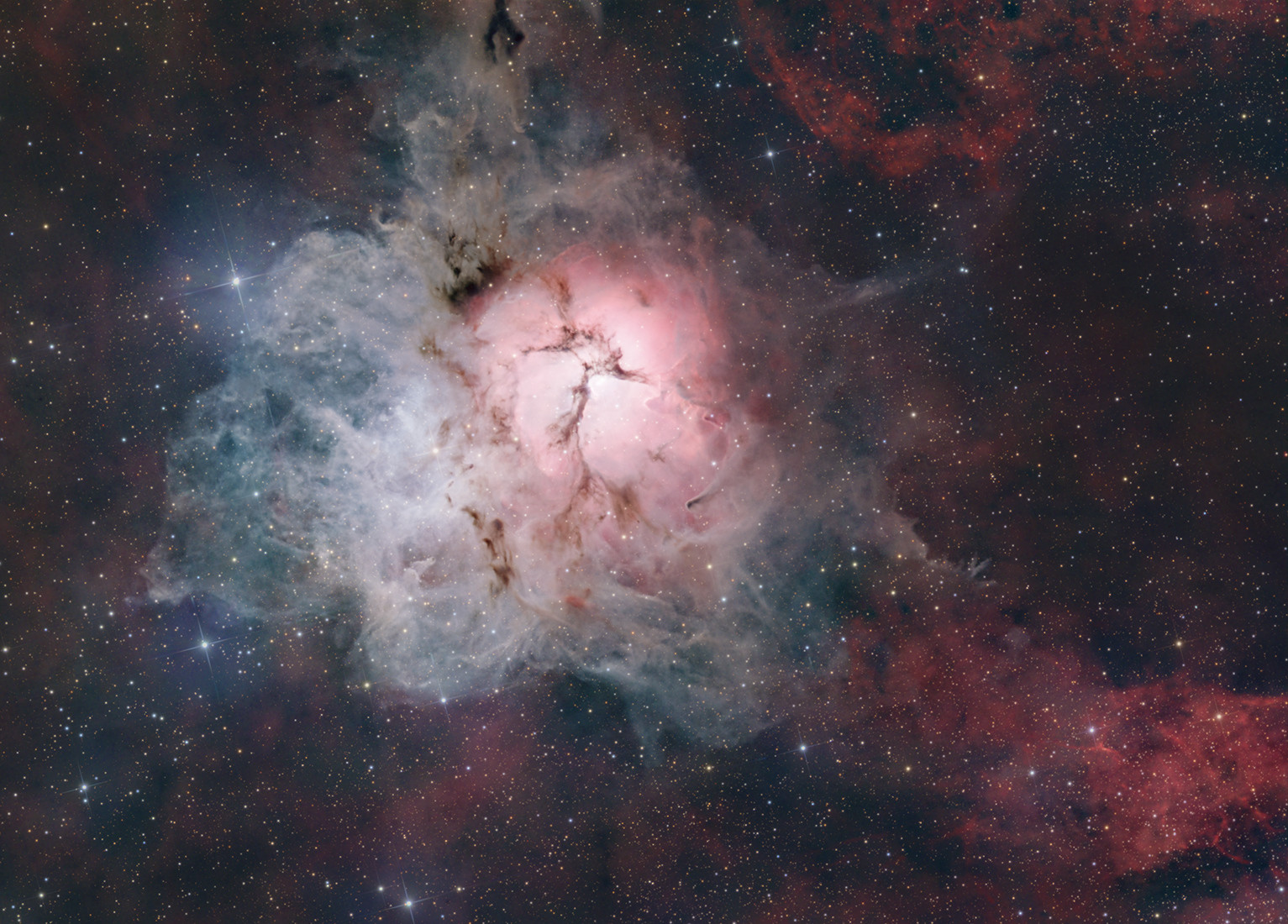
Messier 20, popularly known as the Trifid Nebula, lies about 5,000 light-years away toward the nebula rich constellation Sagittarius. A star forming region in the plane of our galaxy, the Trifid does illustrate three different types of astronomical nebulae; red emission nebulae dominated by light from hydrogen atoms, blue reflection nebulae produced by dust reflecting starlight, and dark nebulae where dense dust clouds appear in silhouette. The reddish emission region, roughly separated into three parts by obscuring dust lanes, is what lends the Trifid its popular name. The cosmic cloud complex is over 40 light-years across and would cover the area of a full moon on planet Earth's sky. But the Trifid Nebula is too faint to be seen by the unaided eye. Over 75 hours of image data captured under dark night skies was used to create this stunning telescopic view.
https://apod.nasa.gov/apod/ap240810.html
#space #nebula #astrophotography #photography #science #astronomy #physics #nature #NASA #education
Alt...
2024 August 10
The Light, Dark, and Dusty Trifid
* Image Credit & Copyright: Robert Edelmaier and Gabriele Gegenbauer
Explanation:
Messier 20, popularly known as the Trifid Nebula, lies about 5,000 light-years away toward the nebula rich constellation Sagittarius. A star forming region in the plane of our galaxy, the Trifid does illustrate three different types of astronomical nebulae; red emission nebulae dominated by light from hydrogen atoms, blue reflection nebulae produced by dust reflecting starlight, and dark nebulae where dense dust clouds appear in silhouette. The reddish emission region, roughly separated into three parts by obscuring dust lanes, is what lends the Trifid its popular name. The cosmic cloud complex is over 40 light-years across and would cover the area of a full moon on planet Earth's sky. But the Trifid Nebula is too faint to be seen by the unaided eye. Over 75 hours of image data captured under dark night skies was used to create this stunning telescopic view.
Authors & editors: Robert Nemiroff (MTU) & Jerry Bonnell (UMCP)
NASA Official: Amber Straughn Specific rights apply.
NASA Web Privacy, Accessibility Notices
A service of: ASD at NASA / GSFC,
NASA Science Activation
& Michigan Tech. U.
2025 July 21
Cat's Paw Nebula from Webb Space Telescope
* Image Credit: NASA, ESA, CSA, STScI
https://www.nasa.gov/
https://www.esa.int/
https://www.asc-csa.gc.ca/eng/
https://www.stsci.edu/
Explanation:
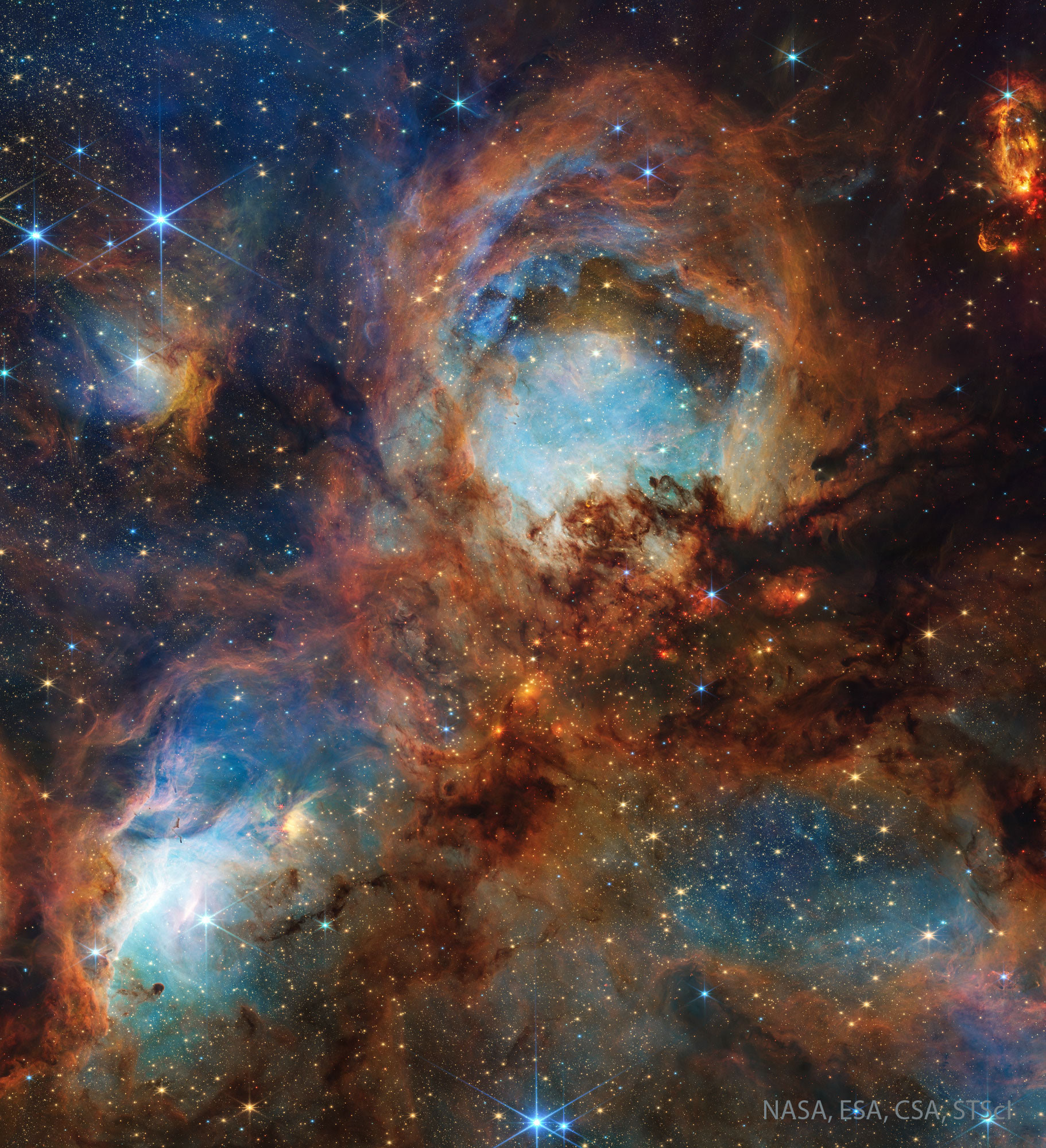
Nebulas are perhaps as famous for being identified with familiar shapes as perhaps cats are for getting into trouble. Still, no known cat could have created the vast Cat's Paw Nebula visible toward the constellation of the Scorpion (Scorpius). At 5,700 light years distant, Cat's Paw is an emission nebula within a larger molecular cloud. Alternatively known as the Bear Claw Nebula and cataloged as NGC 6334, stars nearly ten times the mass of our Sun have been born there in only the past few million years. Pictured here is a recently released image of the Cat's Paw taken in infrared light by the James Webb Space Telescope. This newly detailed view into the nebula helps provide insight for how turbulent molecular clouds turn gas into stars.
https://webbtelescope.org/contents/media/images/2025/129/01JY2AEHHAE4057AGG56YHW1CQ
https://en.wikipedia.org/wiki/NGC_6334
https://apod.nasa.gov/apod/ap250721.html
https://astronomy.swin.edu.au/cosmos/E/Emission+Nebula
https://www.giss.nasa.gov/research/briefs/archive/1998_canuto_01/
#space #nebula #astrophotography #photography #science #astronomy #physics #nature #NASA #education
Alt...
2025 July 21
In a starfield a nebula appears that has three main bright regions surrounding a dark central nebula.
Cat's Paw Nebula from Webb Space Telescope
* Image Credit: NASA, ESA, CSA, STScI
Explanation:
Nebulas are perhaps as famous for being identified with familiar shapes as perhaps cats are for getting into trouble. Still, no known cat could have created the vast Cat's Paw Nebula visible toward the constellation of the Scorpion (Scorpius). At 5,700 light years distant, Cat's Paw is an emission nebula within a larger molecular cloud. Alternatively known as the Bear Claw Nebula and cataloged as NGC 6334, stars nearly ten times the mass of our Sun have been born there in only the past few million years. Pictured here is a recently released image of the Cat's Paw taken in infrared light by the James Webb Space Telescope. This newly detailed view into the nebula helps provide insight for how turbulent molecular clouds turn gas into stars.
Authors & editors: Robert Nemiroff (MTU) & Jerry Bonnell (UMCP)
NASA Official: Amber Straughn Specific rights apply.
NASA Web Privacy, Accessibility, Notices;
A service of: ASD at NASA / GSFC,
NASA Science Activation
& Michigan Tech. U.
NASA’s Webb Scratches Beyond Surface of Cat’s Paw for 3rd Anniversary
NASA Webb Mission Team
It’s the cat’s meow! To celebrate its third year of revealing stunning scenes of the cosmos in infrared light, NASA’s James Webb Space Telescope has “clawed” back the thick, dusty layers of a section within the Cat’s Paw Nebula (NGC 6334). Focusing Webb’s NIRCam (Near-Infrared Camera) on a single “toe bean” within this active star-forming region revealed a subset of mini toe beans, which appear to contain young stars shaping the surrounding gas and dust.
Webb’s look at this particular area of the Cat’s Paw Nebula just scratches the surface of the telescope’s three years of groundbreaking science.
“Three years into its mission, Webb continues to deliver on its design – revealing previously hidden aspects of the universe, from the star formation process to some of the earliest galaxies,” said Shawn Domagal-Goldman, acting director of the Astrophysics Division at NASA Headquarters in Washington. “As it repeatedly breaks its own records, Webb is also uncovering unknowns for new generations of flagship missions to tackle. Whether it’s following up on the mysteries of dark matter with NASA’s nearly complete Nancy Grace Roman Space Telescope, or narrowing our search for life to Earth-like planets with the Habitable Worlds Observatory, the questions Webb has raised are just as exciting as the answers it’s giving us.”
[...]
The progression from a large molecular cloud to massive stars entails multiple steps, some of which are still not well understood by astronomers.
Video:
Zoom to the Cat's Paw Nebula
Credits:
* Video: Danielle Kirshenblat (STSCI)
* Narration: Danielle Kirshenblat (STSCI)
* Acknowledgement: Akira Fujii, VISTA and DSS
NASA, ESA, CSA, STSCI
#space #nebula #astrophotography #photography #science #astronomy #physics #nature #NASA #ESA #education
[...]
Located approximately 4,000 light-years away in the constellation Scorpius, the Cat’s Paw Nebula offers scientists the opportunity to study the turbulent cloud-to-star process in great detail. Webb’s observation of the nebula in near-infrared light builds upon previous studies by NASA’s Hubble and retired Spitzer Space Telescope in visible- and infrared-light, respectively.
With its sharp resolution, Webb shows never-before-seen structural details and features: Massive young stars are carving away at nearby gas and dust, while their bright starlight is producing a bright nebulous glow represented in blue. It’s a temporary scene where the disruptive young stars, with their relatively short lives and luminosity, have a brief but important role in the region’s larger story. As a consequence of these massive stars’ lively behavior, the local star formation process will eventually come to a stop.
Start with the toe bean at top center, which is nicknamed the “Opera House” for its circular, tiered-like structure. The primary drivers for the area’s cloudy blue glow are most likely toward its bottom: either the light from the bright yellowish stars or from a nearby source still hidden behind the dense, dark brown dust.
Just below the orange-brown tiers of dust is a bright yellow star with diffraction spikes. While this massive star has carved away at its immediate surroundings, it has been unable to push the gas and dust away to greater distances, creating a compact shell of surrounding material.
[...]
Credits:
* Producers: Greg Bacon (STScI), Frank Summers (STScI)
* Image Processing: Joe DePasquale (STScI)
* Music: Joe DePasquale (STScI)
* Designers: Ralf Crawford (STScI), Leah Hustak (STScI), Christian Nieves (STScI), Alyssa Pagan (STScI)
* Images: NASA, ESA, CSA, STScI; ESO/VISTA.
#space #nebula #astrophotography #photography #science #astronomy #physics #nature #NASA #education
Alt...
This visualization explores a subset of toe bean-reminiscent structures within a section of the Cat’s Paw Nebula, a massive, local star-forming region located approximately 4,000 light-years away in the constellation Scorpius.
This image by NASA’s James Webb Space Telescope in near-infrared light was released in honor of the telescope’s third science operations anniversary. Since it began science operations in July 2022, Webb’s observations of our universe have wowed scientists and the public alike.
Glide into the lower left toe bean, moving past many small yellow stars along the way, where filaments of gas and dust frame the cavernous area. The region’s nebulous glow, represented in blue, is from the bright light of massive young stars.
Float toward the top toe bean, which is nicknamed the “Opera House” for its circular, tiered-like structure. As you move, you’ll pass plumes of orange-brown dust that vary in density and small, fiery red clumps where star formation is occurring, albeit in an obscured manner.
Credits:
* Producers: Greg Bacon (STScI), Frank Summers (STScI)
* Image Processing: Joe DePasquale (STScI)
* Music: Joe DePasquale (STScI)
* Designers: Ralf Crawford (STScI), Leah Hustak (STScI), Christian Nieves (STScI), Alyssa Pagan (STScI)
* Images: NASA, ESA, CSA, STScI; ESO/VISTA.
2025 August 1
Small Dark Nebula
* Image Credit & Copyright: Peter Bresseler
https://pixlimit.com/
Explanation:
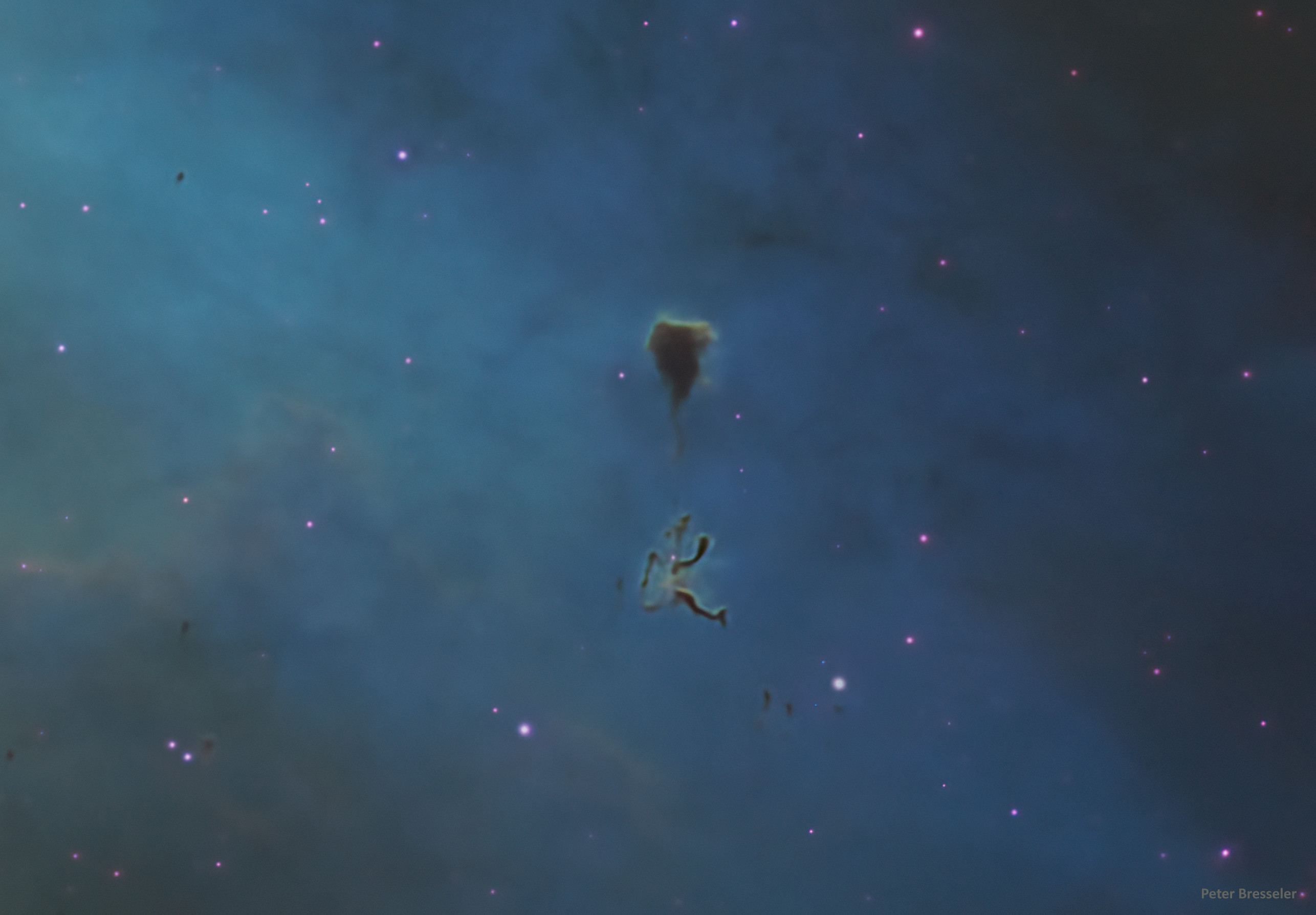
A small, dark, nebula looks isolated near the center of this telescopic close-up. The wedge-shaped cosmic cloudlet lies within a relatively crowded region of space though. About 7,000 light-years distant and filled with glowing gas and an embedded cluster of young stars, the region is known as M16 or the Eagle Nebula. Hubble's iconic images of the Eagle Nebula include the famous star-forming Pillars of Creation, towering structures of interstellar gas and dust 4 to 5 light-years long. But this small dark nebula, known to some as a Bok globule, is a fraction of a light-year across. The Bok globule stands out in silhouette against the expansive background of M16's diffuse glow. Found scattered within emission nebulae and star clusters, Bok globules are small interstellar clouds of cold molecular gas and obscuring dust that also form stars within their dense, collapsing cores.
https://ui.adsabs.harvard.edu/abs/1947ApJ...105..255B/abstract
http://hyperphysics.phy-astr.gsu.edu/hbase/Astro/gravc.html
https://apod.nasa.gov/apod/ap250801.html
#space #nebula #astrophotography #photography #science #astronomy #nature #NASA
Alt...
2025 August 1
Small Dark Nebula
* Image Credit & Copyright: Peter Bresseler
Explanation:
A small, dark, nebula looks isolated near the center of this telescopic close-up. The wedge-shaped cosmic cloudlet lies within a relatively crowded region of space though. About 7,000 light-years distant and filled with glowing gas and an embedded cluster of young stars, the region is known as M16 or the Eagle Nebula. Hubble's iconic images of the Eagle Nebula include the famous star-forming Pillars of Creation, towering structures of interstellar gas and dust 4 to 5 light-years long. But this small dark nebula, known to some as a Bok globule, is a fraction of a light-year across. The Bok globule stands out in silhouette against the expansive background of M16's diffuse glow. Found scattered within emission nebulae and star clusters, Bok globules are small interstellar clouds of cold molecular gas and obscuring dust that also form stars within their dense, collapsing cores.
Authors & editors: Robert Nemiroff (MTU) & Jerry Bonnell (UMCP)
NASA Official: Amber Straughn Specific rights apply.
NASA Web Privacy, Accessibility, Notices;
A service of: ASD at NASA / GSFC,
NASA Science Activation
& Michigan Tech. U.
2023 May 15
M16: Eagle Nebula Deep Field
* Image Credit & Copyright: Gianni Lacroce
https://app.astrobin.com/u/gianni.lacroce#gallery
Explanation:
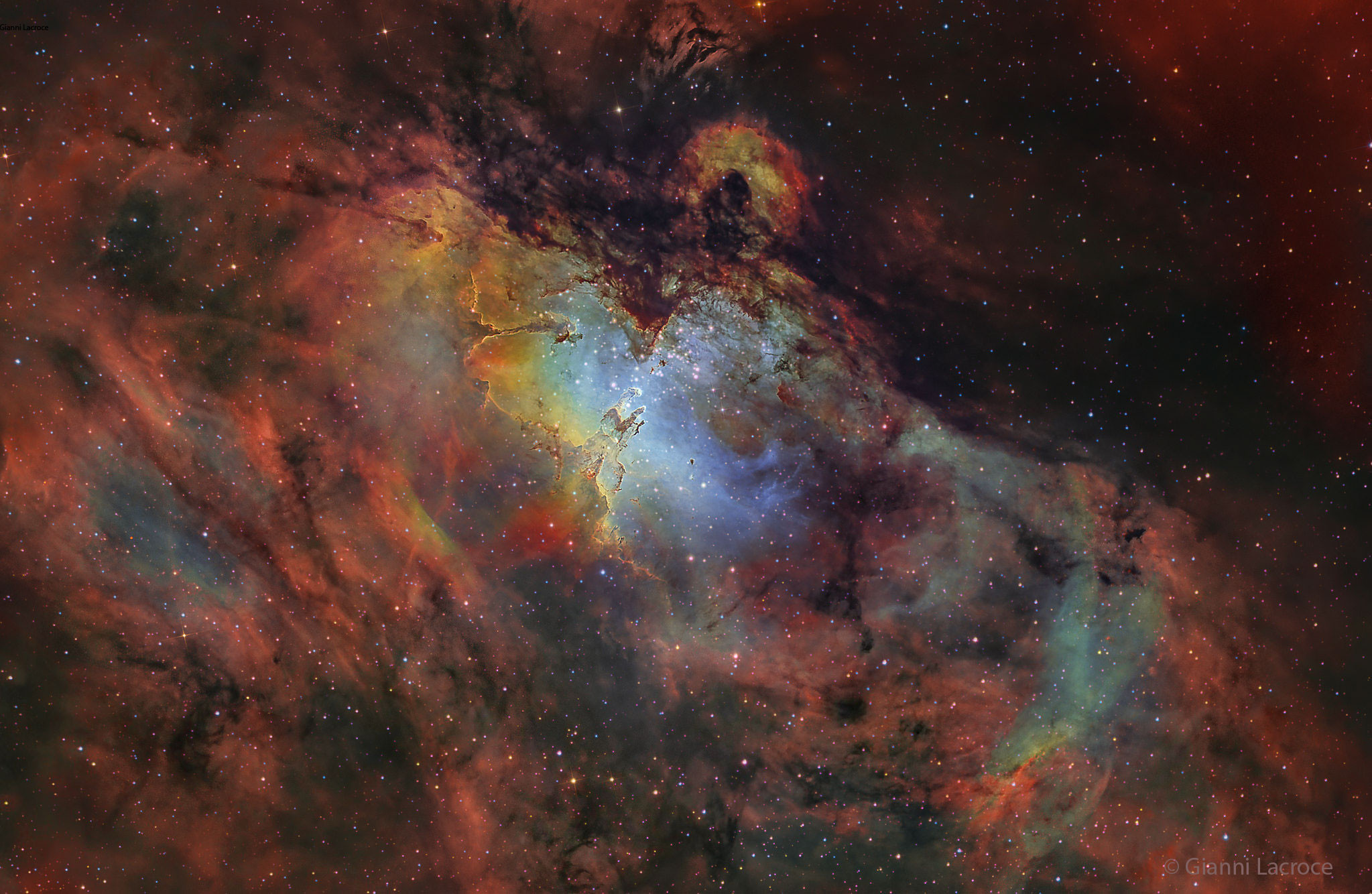
From afar, the whole thing looks like an eagle. A closer look at the Eagle Nebula, however, shows the bright region is actually a window into the center of a larger dark shell of dust. Through this window, a brightly-lit workshop appears where a whole open cluster of stars is being formed. In this cavity, tall pillars and round globules of dark dust and cold molecular gas remain where stars are still forming. Already visible are several young bright blue stars whose light and winds are burning away and pushing back the remaining filaments and walls of gas and dust. The Eagle emission nebula, tagged M16, lies about 6500 light years away, spans about 20 light-years, and is visible with binoculars toward the constellation of the Serpent (Serpens). This picture involved long and deep exposures and combined three specific emitted colors emitted by sulfur (colored as yellow), hydrogen (red), and oxygen (blue).
https://en.wikipedia.org/wiki/Eagle_Nebula
https://noirlab.edu/public/images/noao-02181/
https://apod.nasa.gov/apod/ap230515.html
#space #nebula #astrophotography #photography #science #astronomy #nature #NASA
Alt...
2023 May 15
A deep image of the Eagle Nebula in many scientifically assigned colors. The area around the nebula appears red, but the center is blue with unusual pillars visible.
M16: Eagle Nebula Deep Field
* Image Credit & Copyright: Gianni Lacroce
Explanation:
From afar, the whole thing looks like an eagle. A closer look at the Eagle Nebula, however, shows the bright region is actually a window into the center of a larger dark shell of dust. Through this window, a brightly-lit workshop appears where a whole open cluster of stars is being formed. In this cavity, tall pillars and round globules of dark dust and cold molecular gas remain where stars are still forming. Already visible are several young bright blue stars whose light and winds are burning away and pushing back the remaining filaments and walls of gas and dust. The Eagle emission nebula, tagged M16, lies about 6500 light years away, spans about 20 light-years, and is visible with binoculars toward the constellation of the Serpent (Serpens). This picture involved long and deep exposures and combined three specific emitted colors emitted by sulfur (colored as yellow), hydrogen (red), and oxygen (blue).
Authors & editors: Robert Nemiroff (MTU) & Jerry Bonnell (UMCP)
NASA Official: Phillip Newman Specific rights apply.
NASA Web Privacy Policy and Important Notices
A service of: ASD at NASA / GSFC,
NASA Science Activation
& Michigan Tech. U.
2025 August 4
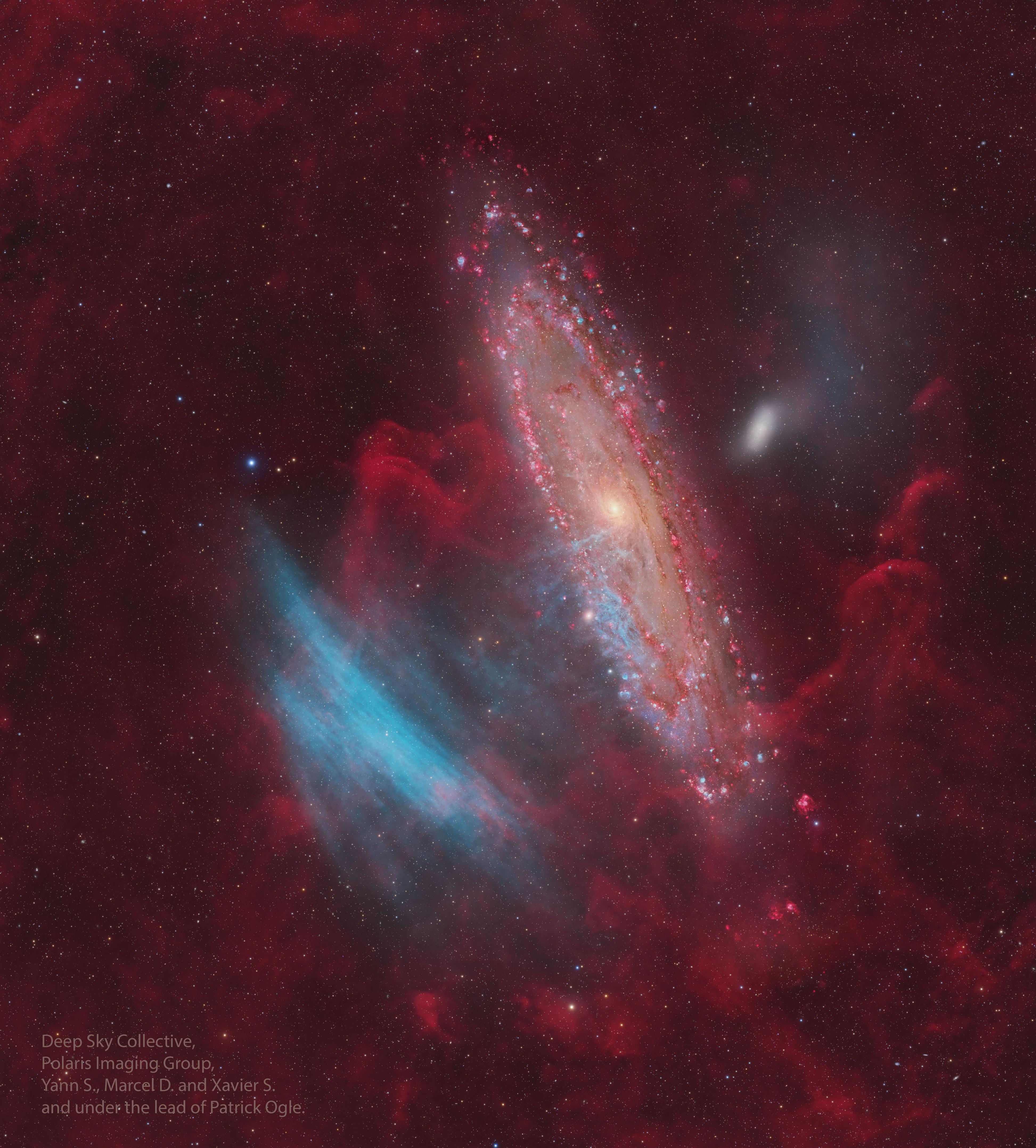
The Andromeda Galaxy is shown just right of center, while some unusual blue arcs appear to its left.
Blue Arcs Toward Andromeda
* Image Credit & Copyright: Ogle et al.
https://arxiv.org/abs/2507.15834
https://app.astrobin.com/i/ns2x09
Explanation:
What are these gigantic blue arcs near the Andromeda Galaxy (M31)? Discovered in 2022 by amateur astronomers, the faint arcs -- dubbed SDSO 1 -- span nearly the same angular size as M31 itself. At first, their origin was a mystery: are they actually near the Andromeda Galaxy, or alternatively near to our Sun? Now, over 550 hours of combined exposure and a collaboration between amateur and professional astronomers has revealed strong evidence for their true nature: SDSO 1 is not intergalactic, but a new class of planetary nebula within our galaxy. Dubbed a Ghost Planetary Nebula (GPN), SDSO 1 is the first recognized member of a new subclass of faded planetary nebulas, along with seven others also recently identified. Shown in blue are extremely faint oxygen emission from the shock waves, while the surrounding red is a hydrogen-emitting trail that indicates the GPN's age.
https://apod.nasa.gov/apod/ap230117.html
https://apod.nasa.gov/apod/ap250713.html
https://science.nasa.gov/category/universe/nebulae/planetary-nebulae/
https://arxiv.org/abs/2507.15834
https://iopscience.iop.org/article/10.3847/2515-5172/acaf7e
https://science.nasa.gov/asset/hubble/intergalactic-absorbtion-clouds/
https://www.astronomy.com/science/oxygen-the-color-of-life/
https://apod.nasa.gov/apod/ap250804.html
#space #nebula #astrophotography #photography #science #astronomy #nature #NASA
Alt...
2025 August 4
The Andromeda Galaxy is shown just right of center, while some unusual blue arcs appear to its left.
Blue Arcs Toward Andromeda
* Image Credit & Copyright: Ogle et al.
Explanation:
What are these gigantic blue arcs near the Andromeda Galaxy (M31)? Discovered in 2022 by amateur astronomers, the faint arcs -- dubbed SDSO 1 -- span nearly the same angular size as M31 itself. At first, their origin was a mystery: are they actually near the Andromeda Galaxy, or alternatively near to our Sun? Now, over 550 hours of combined exposure and a collaboration between amateur and professional astronomers has revealed strong evidence for their true nature: SDSO 1 is not intergalactic, but a new class of planetary nebula within our galaxy. Dubbed a Ghost Planetary Nebula (GPN), SDSO 1 is the first recognized member of a new subclass of faded planetary nebulas, along with seven others also recently identified. Shown in blue are extremely faint oxygen emission from the shock waves, while the surrounding red is a hydrogen-emitting trail that indicates the GPN's age.
Authors & editors: Robert Nemiroff (MTU) & Jerry Bonnell (UMCP)
NASA Official: Amber Straughn Specific rights apply.
NASA Web Privacy, Accessibility, Notices;
A service of: ASD at NASA / GSFC,
NASA Science Activation
& Michigan Tech. U.
2025 August 5
NGC 6072: A Complex Planetary Nebula from Webb
* Image Credit: NASA, ESA, CSA, STScI, JWST
https://science.nasa.gov/mission/webb/
https://www.stsci.edu/
https://www.asc-csa.gc.ca/eng/
https://www.esa.int/
https://www.nasa.gov/
Explanation:
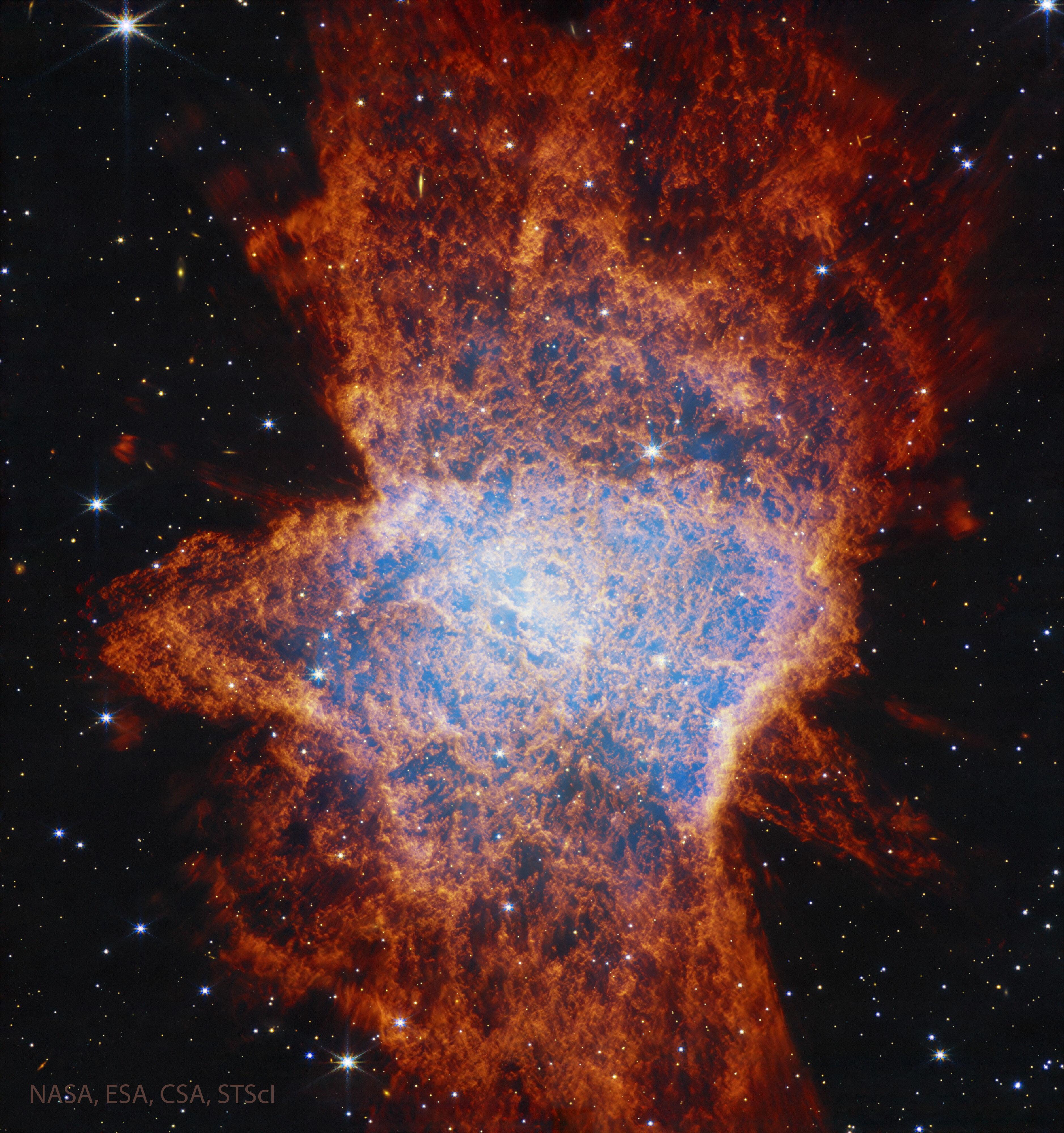
Why is this nebula so complex? The Webb Space Telescope has imaged a nebula in great detail that is thought to have emerged from a Sun-like star. NGC 6072 has been resolved into one of the more unusual and complex examples of planetary nebula. The featured image is in infrared light with the red color highlighting cool hydrogen gas. Study of previous images of NGC 6072 indicated several likely outflows and two disks inside the jumbled gas, while the new Webb image resolves new features likely including one disk's edge protruding on the central left. A leading origin hypothesis holds that the nebula's complexity is caused or enhanced by multiple outbursts from a star in a multi-star system near the center.
https://esawebb.org/images/weic2514a/
https://en.wikipedia.org/wiki/Planetary_nebula
https://ui.adsabs.harvard.edu/abs/2010ApJ...708...93K/abstract
https://apod.nasa.gov/apod/ap240627.html
https://webbtelescope.org/home
https://apod.nasa.gov/apod/ap010113.html
https://science.nasa.gov/universe/stars/multiple-star-systems/
https://apod.nasa.gov/apod/ap250805.html
#space #nebula #astrophotography #photography #science #astronomy #nature #NASA
Alt...
2025 August 5
A starfield is shown dominated by a complex nebula shown with many red filaments and with a light glow in a region near the center.
NGC 6072: A Complex Planetary Nebula from Webb
* Image Credit: NASA, ESA, CSA, STScI, JWST
Explanation:
Why is this nebula so complex? The Webb Space Telescope has imaged a nebula in great detail that is thought to have emerged from a Sun-like star. NGC 6072 has been resolved into one of the more unusual and complex examples of planetary nebula. The featured image is in infrared light with the red color highlighting cool hydrogen gas. Study of previous images of NGC 6072 indicated several likely outflows and two disks inside the jumbled gas, while the new Webb image resolves new features likely including one disk's edge protruding on the central left. A leading origin hypothesis holds that the nebula's complexity is caused or enhanced by multiple outbursts from a star in a multi-star system near the center.
Authors & editors: Robert Nemiroff (MTU) & Jerry Bonnell (UMCP)
NASA Official: Amber Straughn Specific rights apply.
NASA Web Privacy, Accessibility, Notices;
A service of: ASD at NASA / GSFC,
NASA Science Activation
& Michigan Tech. U.
2025 August 13
Trapezium: In the Heart of Orion
* Image Credit: Data: Hubble Legacy Archive
http://hla.stsci.edu/
* Processing: Robert Gendler
http://www.robgendlerastropics.com/
Explanation:
What lies in the heart of Orion? Trapezium: four bright stars, that can be found near the center of this sharp cosmic portrait. Gathered within a region about 1.5 light-years in radius, these stars dominate the core of the dense Orion Nebula Star Cluster. Ultraviolet ionizing radiation from the Trapezium stars, mostly from the brightest star Theta-1 Orionis C powers the complex star forming region's entire visible glow. About three million years old, the Orion Nebula Cluster was even more compact in its younger years and a dynamical study indicates that runaway stellar collisions at an earlier age may have formed a black hole with more than 100 times the mass of the Sun. The presence of a black hole within the cluster could explain the observed high velocities of the Trapezium stars. The Orion Nebula's distance of some 1,500 light-years make it one of the closest candidate black holes to Earth.
http://www.robgendlerastropics.com/TrapMosaic-HST-Gendler.html
https://en.wikipedia.org/wiki/Trapezium_Cluster
http://stars.astro.illinois.edu/sow/theta1ori.html
https://ui.adsabs.harvard.edu/abs/2012ApJ...757...37S/abstract
https://skyandtelescope.org/astronomy-news/a-black-hole-in-orion/
https://en.wikipedia.org/wiki/List_of_nearest_known_black_holes
https://science.nasa.gov/ems/10_ultravioletwaves/
https://spaceplace.nasa.gov/light-year/en/
https://apod.nasa.gov/apod/ap250813.html
#space #nebula #astrophotography #photography #science #astronomy #nature #NASA
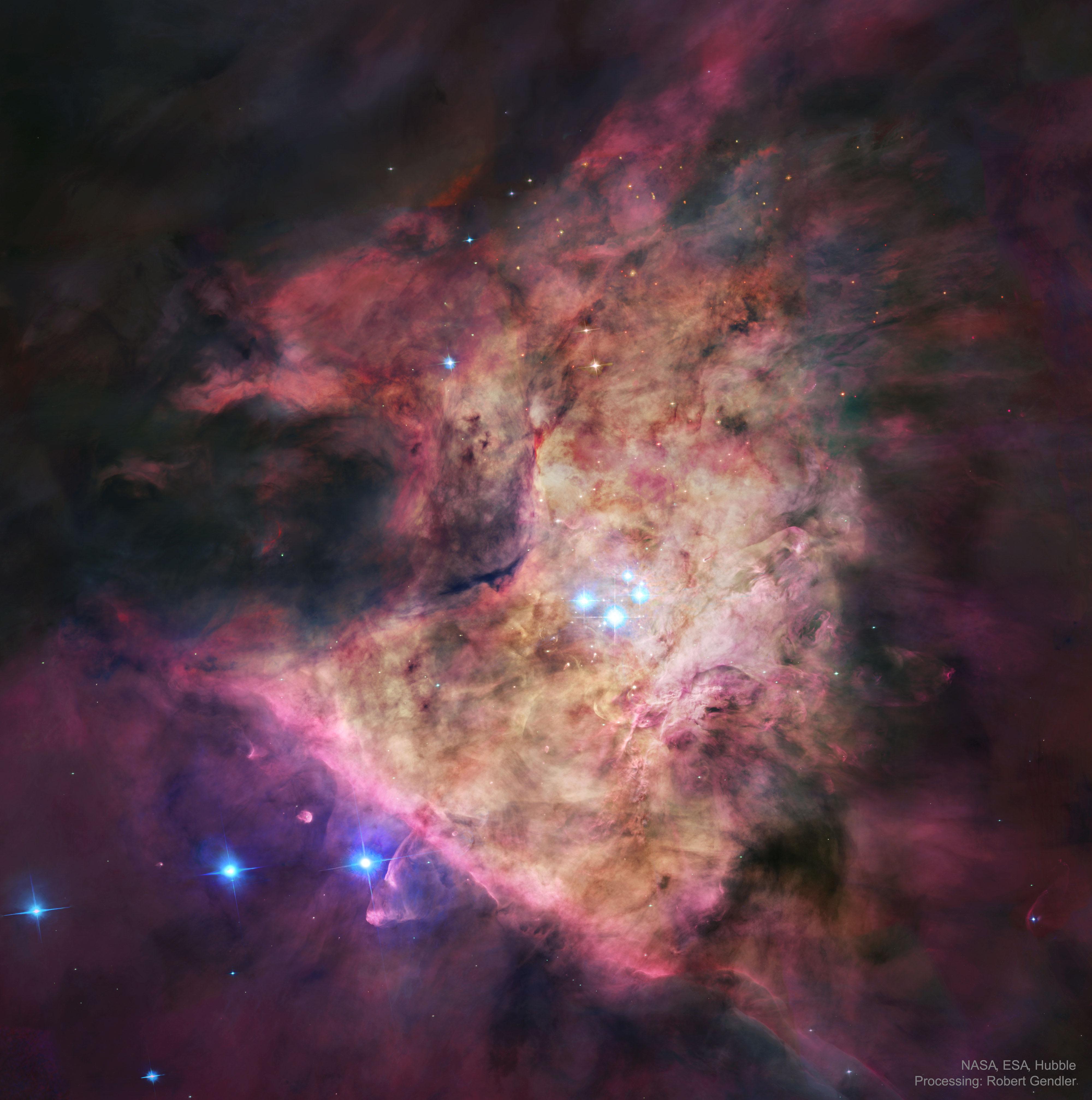
Alt...
2025 August 13
A bright nebula occupies the center of the frame. The nebula is complex but roughly tan in the center and red around the edges. In the center are four bright blue stars.
Trapezium: In the Heart of Orion
* Image Credit: Data: Hubble Legacy Archive,
* Processing: Robert Gendler
Explanation:
What lies in the heart of Orion? Trapezium: four bright stars, that can be found near the center of this sharp cosmic portrait. Gathered within a region about 1.5 light-years in radius, these stars dominate the core of the dense Orion Nebula Star Cluster. Ultraviolet ionizing radiation from the Trapezium stars, mostly from the brightest star Theta-1 Orionis C powers the complex star forming region's entire visible glow. About three million years old, the Orion Nebula Cluster was even more compact in its younger years and a dynamical study indicates that runaway stellar collisions at an earlier age may have formed a black hole with more than 100 times the mass of the Sun. The presence of a black hole within the cluster could explain the observed high velocities of the Trapezium stars. The Orion Nebula's distance of some 1,500 light-years make it one of the closest candidate black holes to Earth.
Authors & editors: Robert Nemiroff (MTU) & Jerry Bonnell (UMCP)
NASA Official: Amber Straughn Specific rights apply.
NASA Web Privacy, Accessibility, Notices;
A service of: ASD at NASA / GSFC,
NASA Science Activation
& Michigan Tech. U.
2024 November 4
M42: The Great Nebula in Orion
* Credit & Copyright: Fényes Lóránd
https://fenyeslorand.hu/
Explanation:
The Great Nebula in Orion, an immense, nearby starbirth region, is probably the most famous of all astronomical nebulas. Here, glowing gas surrounds hot young stars at the edge of an immense interstellar molecular cloud only 1500 light-years away. In the featured deep image in assigned colors highlighted by emission in oxygen and hydrogen, wisps and sheets of dust and gas are particularly evident. The Great Nebula in Orion can be found with the unaided eye near the easily identifiable belt of three stars in the popular constellation Orion. In addition to housing a bright open cluster of stars known as the Trapezium, the Orion Nebula contains many stellar nurseries. These nurseries contain much hydrogen gas, hot young stars, proplyds, and stellar jets spewing material at high speeds. Also known as M42, the Orion Nebula spans about 40 light years and is located in the same spiral arm of our Galaxy as the Sun.
https://en.wikipedia.org/wiki/Orion_Nebula
https://apod.nasa.gov/apod/ap241104.html
#space #nebula #astrophotography #photography #science #astronomy #nature #NASA
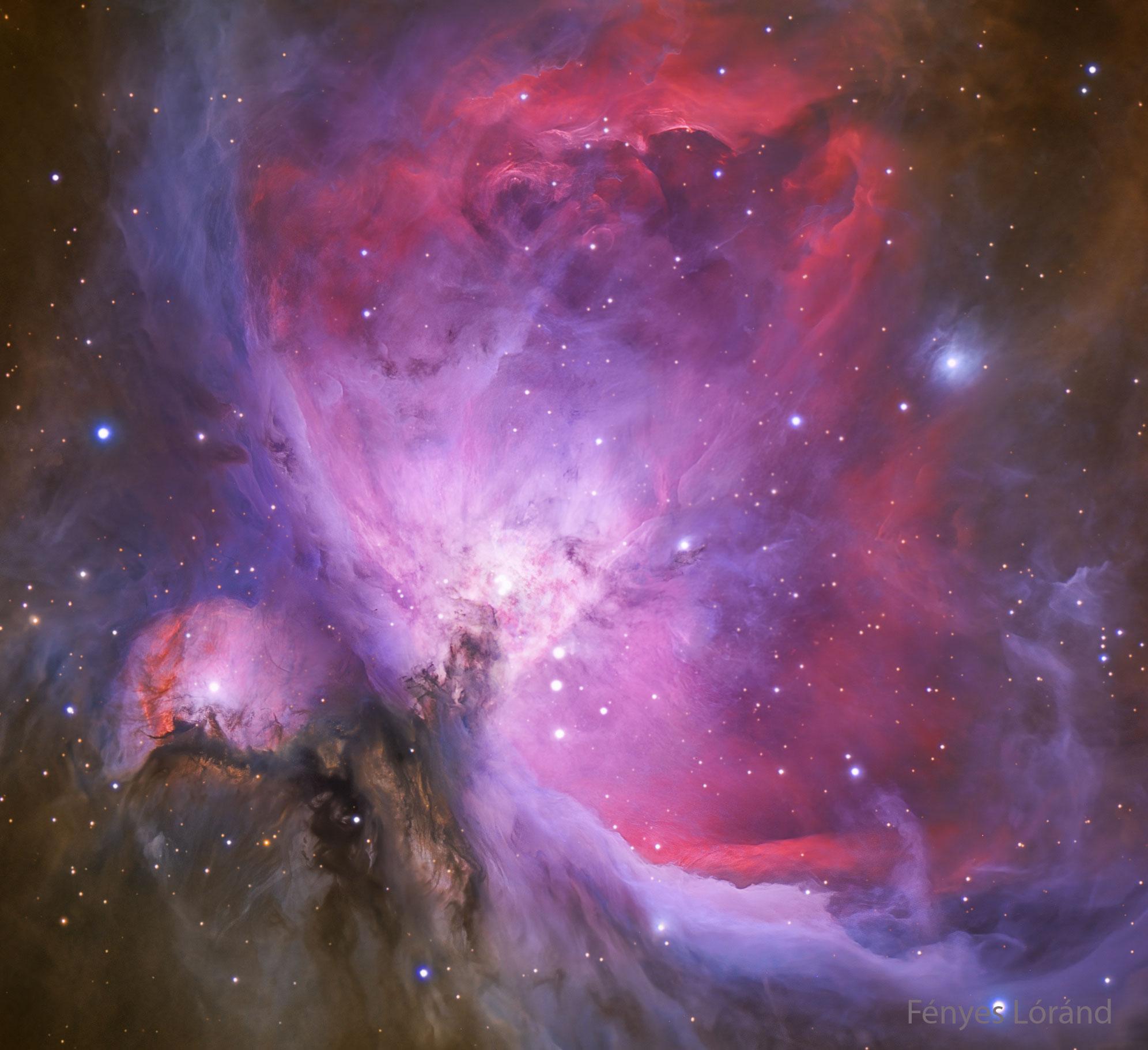
Alt...
2024 November 4
A starfield is shown with a nebula glowing in red, purple, and blue. Dark brown gas is also seen on the lower left. A small cluster of stars appears in the center.
M42: The Great Nebula in Orion
* Credit & Copyright: Fényes Lóránd
Explanation:
The Great Nebula in Orion, an immense, nearby starbirth region, is probably the most famous of all astronomical nebulas. Here, glowing gas surrounds hot young stars at the edge of an immense interstellar molecular cloud only 1500 light-years away. In the featured deep image in assigned colors highlighted by emission in oxygen and hydrogen, wisps and sheets of dust and gas are particularly evident. The Great Nebula in Orion can be found with the unaided eye near the easily identifiable belt of three stars in the popular constellation Orion. In addition to housing a bright open cluster of stars known as the Trapezium, the Orion Nebula contains many stellar nurseries. These nurseries contain much hydrogen gas, hot young stars, proplyds, and stellar jets spewing material at high speeds. Also known as M42, the Orion Nebula spans about 40 light years and is located in the same spiral arm of our Galaxy as the Sun.
Authors & editors: Robert Nemiroff (MTU) & Jerry Bonnell (UMCP)
NASA Official: Amber Straughn Specific rights apply.
NASA Web Privacy, Accessibility, Notices;
A service of: ASD at NASA / GSFC,
NASA Science Activation
& Michigan Tech. U.
2017 March 21
Fast Stars and Rogue Planets in the Orion Nebula
* Image Credit: NASA, ESA, Hubble
https://www.nasa.gov/
http://www.esa.int/
https://www.nasa.gov/mission_pages/hubble/story/index.html
Explanation:
Start with the constellation of Orion. Below Orion's belt is a fuzzy area known as the Great Nebula of Orion. In this nebula is a bright star cluster known as the Trapezium, marked by four bright stars near the image center. The newly born stars in the Trapezium and surrounding regions show the Orion Nebula to be one of the most active areas of star formation to be found in our area of the Galaxy. In Orion, supernova explosions and close interactions between stars have created rogue planets and stars that rapidly move through space. Some of these fast stars have been found by comparing different images of this region taken by the Hubble Space Telescope many years apart. Many of the stars in the featured image, taken in visible and near-infrared light, appear unusually red because they are seen through dust that scatters away much of their blue light.
https://apod.nasa.gov/apod/ap170321.html
#space #nebula #astrophotography #photography #science #astronomy #nature #NASA #ESA
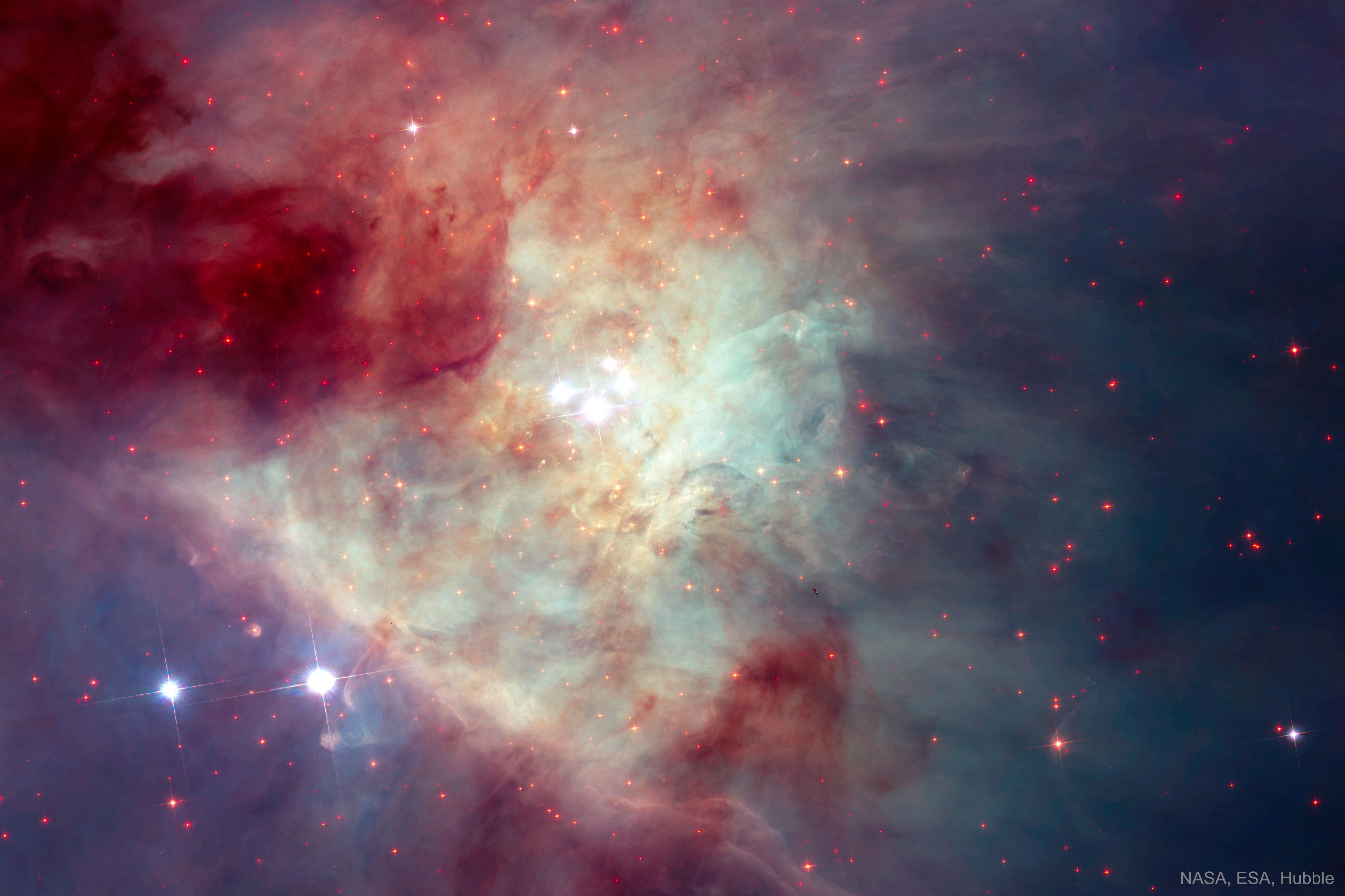
Alt...
2017 March 21
Fast Stars and Rogue Planets in the Orion Nebula
* Image Credit: NASA, ESA, Hubble
Explanation:
Start with the constellation of Orion. Below Orion's belt is a fuzzy area known as the Great Nebula of Orion. In this nebula is a bright star cluster known as the Trapezium, marked by four bright stars near the image center. The newly born stars in the Trapezium and surrounding regions show the Orion Nebula to be one of the most active areas of star formation to be found in our area of the Galaxy. In Orion, supernova explosions and close interactions between stars have created rogue planets and stars that rapidly move through space. Some of these fast stars have been found by comparing different images of this region taken by the Hubble Space Telescope many years apart. Many of the stars in the featured image, taken in visible and near-infrared light, appear unusually red because they are seen through dust that scatters away much of their blue light.
Authors & editors: Robert Nemiroff (MTU) & Jerry Bonnell (UMCP)
NASA Official: Phillip Newman Specific rights apply.
NASA Web Privacy Policy and Important Notices
A service of: ASD at NASA / GSFC
& Michigan Tech. U.
February 2, 1999
The Orion Nebula from Subaru
* Credit: CISCO, Subaru 8.3-m Telescope, NAOJ
https://de.wikipedia.org/wiki/Subaru-Teleskop
Explanation:
The Orion Nebula (M42) shows a host of treasures when viewed in infrared light. Some stars in the Trapezium, an open cluster of stars at the center, are only visible in infrared light. The orange feature above center is called the Kleinman-Low Nebula, and appears greatly affected by newly forming central star IRc2. The blue emission in this representative color photograph is caused by hot gas ionized by the Trapezium stars. This is one of the first photographs ever taken through Japan's new Subaru Telescope.
https://apod.nasa.gov/apod/ap990202.html
#space #nebula #astrophotography #photography #science #astronomy #nature #NASA
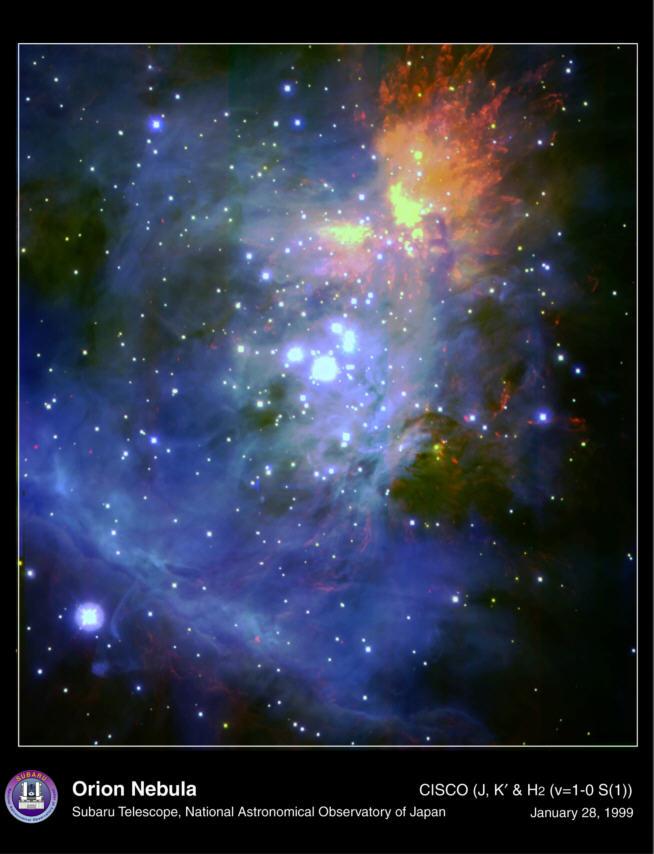
Alt...
February 2, 1999
The Orion Nebula from Subaru
* Credit: CISCO, Subaru 8.3-m Telescope, NAOJ
Explanation:
The Orion Nebula (M42) shows a host of treasures when viewed in infrared light. Some stars in the Trapezium, an open cluster of stars at the center, are only visible in infrared light. The orange feature above center is called the Kleinman-Low Nebula, and appears greatly affected by newly forming central star IRc2. The blue emission in this representative color photograph is caused by hot gas ionized by the Trapezium stars. This is one of the first photographs ever taken through Japan's new Subaru Telescope.
Authors & editors: Robert Nemiroff (MTU) & Jerry Bonnell (USRA)
NASA Technical Rep.: Jay Norris. Specific rights apply.
A service of: LHEA at NASA/ GSFC
& Michigan Tech. U.
2017 March 12
At the Heart of Orion
* Image Credit & Copyright: Christoph Kaltseis, CEDIC 2017
http://www.christoph-kaltseis.com/
https://www.cedic.at/en/cedic_slt.php
Explanation:
Near the center of this sharp cosmic portrait, at the heart of the Orion Nebula, are four hot, massive stars known as the Trapezium. Tightly gathered within a region about 1.5 light-years in radius, they dominate the core of the dense Orion Nebula Star Cluster. Ultraviolet ionizing radiation from the Trapezium stars, mostly from the brightest star Theta-1 Orionis C powers the complex star forming region's entire visible glow. About three million years old, the Orion Nebula Cluster was even more compact in its younger years and a dynamical study indicates that runaway stellar collisions at an earlier age may have formed a black hole with more than 100 times the mass of the Sun. The presence of a black hole within the cluster could explain the observed high velocities of the Trapezium stars. The Orion Nebula's distance of some 1,500 light-years would make it the closest known black hole to planet Earth.
https://apod.nasa.gov/apod/ap170312.html
#space #nebula #astrophotography #photography #science #astronomy #nature #NASA
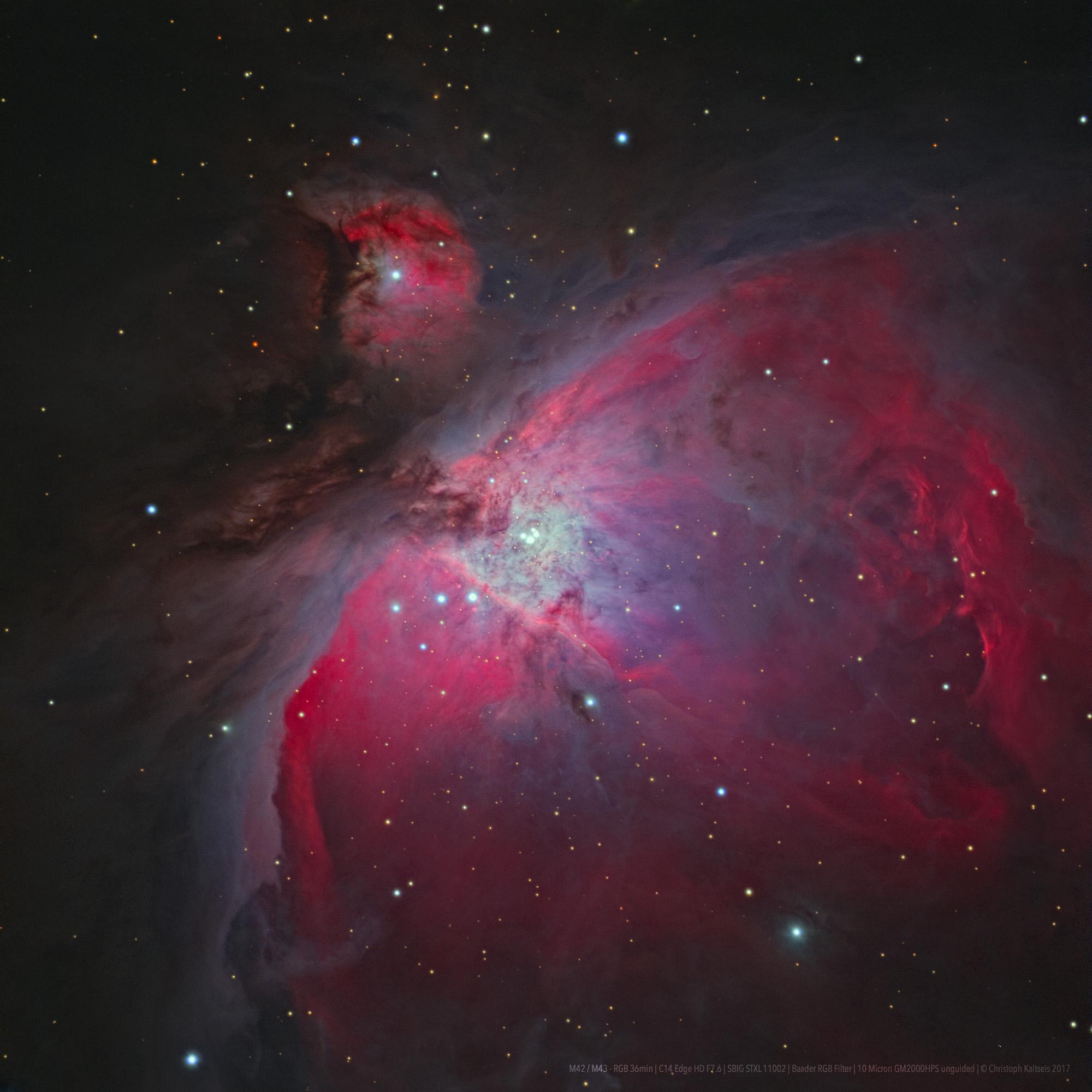
Alt...
2017 March 12
At the Heart of Orion
* Image Credit & Copyright: Christoph Kaltseis, CEDIC 2017
Explanation:
Near the center of this sharp cosmic portrait, at the heart of the Orion Nebula, are four hot, massive stars known as the Trapezium. Tightly gathered within a region about 1.5 light-years in radius, they dominate the core of the dense Orion Nebula Star Cluster. Ultraviolet ionizing radiation from the Trapezium stars, mostly from the brightest star Theta-1 Orionis C powers the complex star forming region's entire visible glow. About three million years old, the Orion Nebula Cluster was even more compact in its younger years and a dynamical study indicates that runaway stellar collisions at an earlier age may have formed a black hole with more than 100 times the mass of the Sun. The presence of a black hole within the cluster could explain the observed high velocities of the Trapezium stars. The Orion Nebula's distance of some 1,500 light-years would make it the closest known black hole to planet Earth.
Authors & editors: Robert Nemiroff (MTU) & Jerry Bonnell (UMCP)
NASA Official: Phillip Newman Specific rights apply.
NASA Web Privacy Policy and Important Notices
A service of: ASD at NASA / GSFC
& Michigan Tech. U.
2025 September 8
IRAS 04302: Butterfly Disk Planet Formation
* Image Credit: NASA, ESA, CSA, Webb
https://www.nasa.gov/
https://www.esa.int/
https://www.asc-csa.gc.ca/eng/
https://science.nasa.gov/mission/webb/
* Processing: M. Villenave et al.
https://www.youtube.com/watch?v=z_DAOxR98T4
https://arxiv.org/abs/2311.07668
Explanation:
This butterfly can hatch planets. The nebula fanning out from the star IRAS 04302+2247 may look like the wings of a butterfly, while the vertical brown stripe down the center may look like the butterfly's body -- but together they indicate an active planet-forming system. The featured picture was captured recently in infrared light by the Webb Space Telescope. Pictured, the vertical disk is thick with the gas and dust from which planets form. The disk shades visible and (most) infrared light from the central star, allowing a good view of the surrounding dust that reflects out light. In the next few million years, the dust disk will likely fragment into rings through the gravity of newly hatched planets. And a billion years from now, the remaining gas and dust will likely dissipate, leaving mainly the planets -- like in our Solar System.
https://esawebb.org/images/potm2508a/
https://arxiv.org/abs/2311.07668
https://apod.nasa.gov/apod/ap121026.html
https://apod.nasa.gov/apod/ap230511.html
https://en.wikipedia.org/wiki/Cosmic_dust
https://apod.nasa.gov/apod/ap250908.html
#space #nebula #astrophotography #photography #science #astronomy #nature #NASA #ESA #WEBB
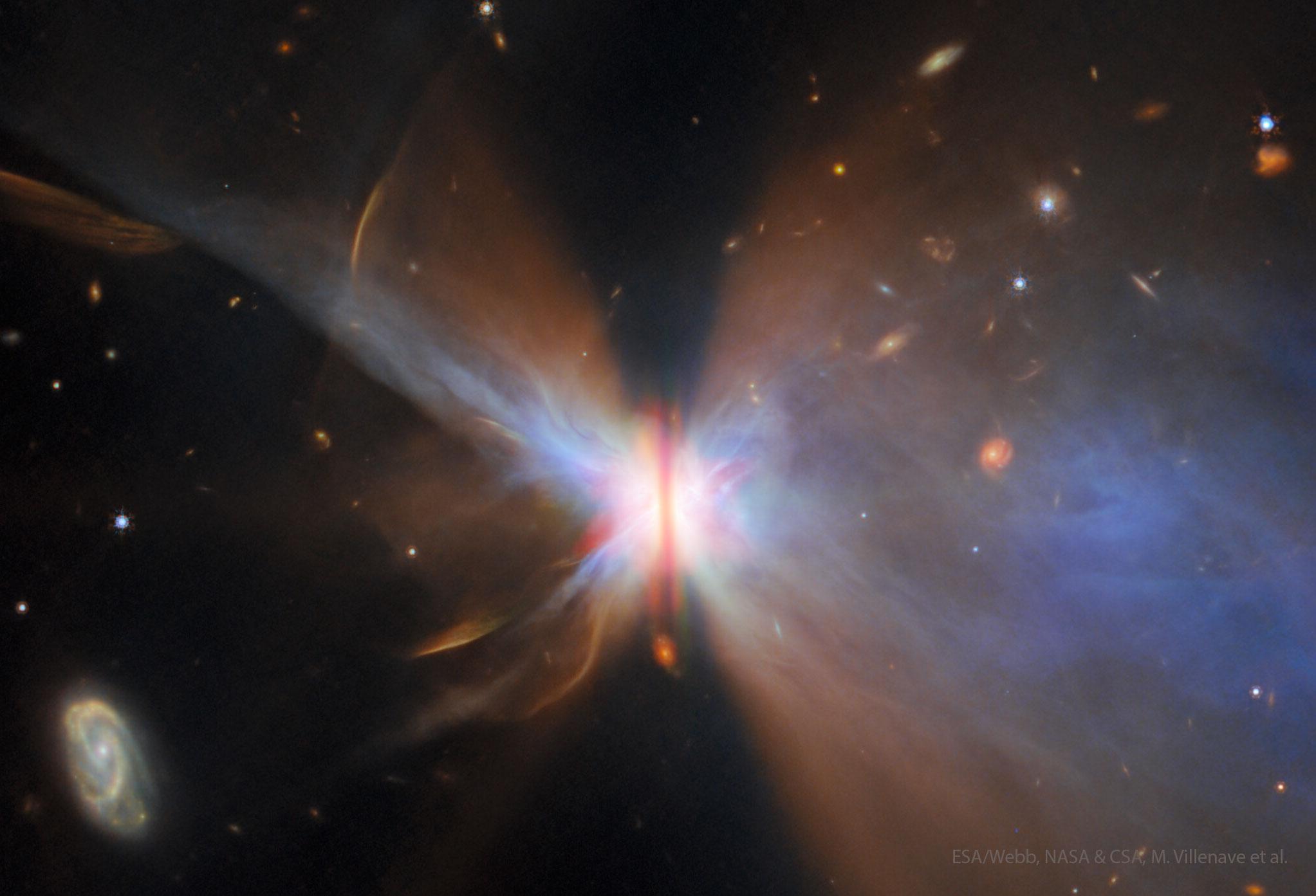
Alt...
2025 September 8
A starfield surrounds a nebula with a vertical brown bar across its center. Gas and dust fan out from the bar making the nebula appear like a colorful butterfly.
IRAS 04302: Butterfly Disk Planet Formation
* Image Credit: NASA, ESA, CSA, Webb; Processing: M. Villenave et al.
Explanation:
This butterfly can hatch planets. The nebula fanning out from the star IRAS 04302+2247 may look like the wings of a butterfly, while the vertical brown stripe down the center may look like the butterfly's body -- but together they indicate an active planet-forming system. The featured picture was captured recently in infrared light by the Webb Space Telescope. Pictured, the vertical disk is thick with the gas and dust from which planets form. The disk shades visible and (most) infrared light from the central star, allowing a good view of the surrounding dust that reflects out light. In the next few million years, the dust disk will likely fragment into rings through the gravity of newly hatched planets. And a billion years from now, the remaining gas and dust will likely dissipate, leaving mainly the planets -- like in our Solar System.
Authors & editors: Robert Nemiroff (MTU) & Jerry Bonnell (UMCP)
NASA Official: Amber Straughn Specific rights apply.
NASA Web Privacy, Accessibility, Notices;
A service of: ASD at NASA / GSFC,
NASA Science Activation
Pan video: IRAS 04302+2247
For this new Picture of the Month feature, the NASA/ESA/CSA James Webb Space Telescope has provided a fantastic new view of IRAS 04302+2247, a planet-forming disc located about 525 light-years away in a dark cloud within the Taurus star-forming region. With Webb, researchers can study the properties and growth of dust grains within protoplanetary discs like this one, shedding light on the earliest stages of planet formation.
In stellar nurseries across the galaxy, baby stars are forming in giant clouds of cold gas. As young stars grow, the gas surrounding them collects in narrow, dusty protoplanetary discs. This sets the scene for the formation of planets, and observations of distant protoplanetary discs can help researchers understand what took place roughly 4.5 billion years ago in our own Solar System, when the Sun, Earth, and the other planets formed.
IRAS 04302+2247, or IRAS 04302 for short, is a beautiful example of a protostar — a young star that is still gathering mass from its environment — surrounded by a protoplanetary disc in which baby planets might be forming. Webb is able to measure the disc at 65 billion kilometres across — several times the diameter of our Solar System. From Webb’s vantage point, IRAS 04302’s disc is oriented edge-on, so we see it as a narrow, dark line of dusty gas that blocks the light from the budding protostar at its centre. This dusty gas is fuel for planet formation, providing an environment within which young planets can bulk up and pack on mass.
Credit:
ESA/Webb, NASA & CSA, M. Villenave et al, N. Bartmann (ESA/Webb)
Music: Stellardrone - Twilight
https://esawebb.org/videos/potm2508a/
#space #nebula #astrophotography #photography #science #astronomy #nature #NASA #ESA #WEBB
![[?]](https://cdn.masto.host/appdotnet/accounts/avatars/000/001/724/original/8b70880494ca563d.png)
I played the hell out of The Halley Project on my Atari.
https://archive.org/details/atr_The_Halley_Project
Feelies: https://archive.org/details/halley-project-mission-technical-reference-guide-mindscape/Halley_Project_Astronomical_Values_Catalog_Mindscape/
#retrocomputing #atari #astronomy
![[?]](https://polymaths.social/fileserver/01HCMX6M1CZNEVJ4F5H58TT5XJ/attachment/original/01JHC5KM5K0V0J0436SPD3F86H.jpeg)


 🍵
🍵  [
[![[?]](https://cdn.masto.host/swisssocial/accounts/avatars/109/610/582/883/537/207/original/0e6a86a6c0df06cc.jpg)

#knowledge #wissen #Astronomy #astronomie
Sonnensystem
Hat der Mars doch einen festen Kern?
Neue Analysen von Marsbeben sprechen gegen einen komplett flüssigen Kern des Roten Planeten 🤓
https://www.scinexx.de/news/kosmos/hat-der-mars-doch-einen-festen-kern/
Visualization of total lunar eclipse viewed from the moon.
(converted to GIF with ffmpeg)
With the lunar horizon in the foreground, the Earth passes in front of the Sun, revealing the red ring of sunrises and sunsets along the limb of the Earth. The Earth and Sun are in Virgo for observers on the Moon. The bright star above them is beta Virginis.
On September 28, 2015 Universal Time (the evening of the 27th for the Americas), the Moon enters the Earth’s shadow, creating a total lunar eclipse. When viewed from the Moon, as in this animation, the Earth hides the Sun. A red ring, the sum of all Earth’s sunrises and sunsets, lines the Earth’s limb and casts a ruddy light on the lunar landscape. With the darkness of the eclipse, the stars come out.
The city lights of North and South America and of western Europe and Africa are visible on the night side of the Earth. The part of the Earth visible in this animation is the part where the lunar eclipse can be seen.
Credits:
NASA's Scientific Visualization Studio
* Visualizer: Ernie Wright (USRA)
* Producers: David Ladd (USRA)
Michelle Handleman (USRA)
* Scientists: John Keller (NASA/GSFC)
Noah Petro (NASA/GSFC)
https://svs.gsfc.nasa.gov/4341
FYI: https://defcon.social/@grobi/114893280006806716
#space #moon #astrophotography #photography #science #astronomy #nature #NASA #ESA #education
2025 September 5
47 Tucanae: Globular Star Cluster
* Image Credit & Copyright: Carlos Taylor
https://app.astrobin.com/u/CAPastrophotography#gallery
Explanation:
Also known as NGC 104, 47 Tucanae is a jewel of the southern sky. Not a star but a dense cluster of stars, it roams the halo of our Milky Way Galaxy along with some 200 other globular star clusters. The second brightest globular cluster (after Omega Centauri) as seen from planet Earth, 47 Tuc lies about 13,000 light-years away. It can be spotted with the naked eye close on the sky to the Small Magellanic Cloud in the constellation of the Toucan. The dense cluster is made up of hundreds of thousands of stars in a volume only about 120 light-years across. Red giant stars on the outskirts of the cluster are easy to pick out as yellowish stars in this sharp telescopic portrait. Tightly packed globular star cluster 47 Tuc is also home to a star with the closest known orbit around a black hole.
http://www.messier.seds.org/xtra/ngc/n0104.html
http://www.messier.seds.org/xtra/ngc/n0104.html
http://www.ianridpath.com/startales/tucana.html
https://app.astrobin.com/u/CAPastrophotography?i=y6g3ax#gallery
https://apod.nasa.gov/apod/ap250905.html
#space #cluster #astrophotography #photography #science #astronomy #physics #nature #NASA
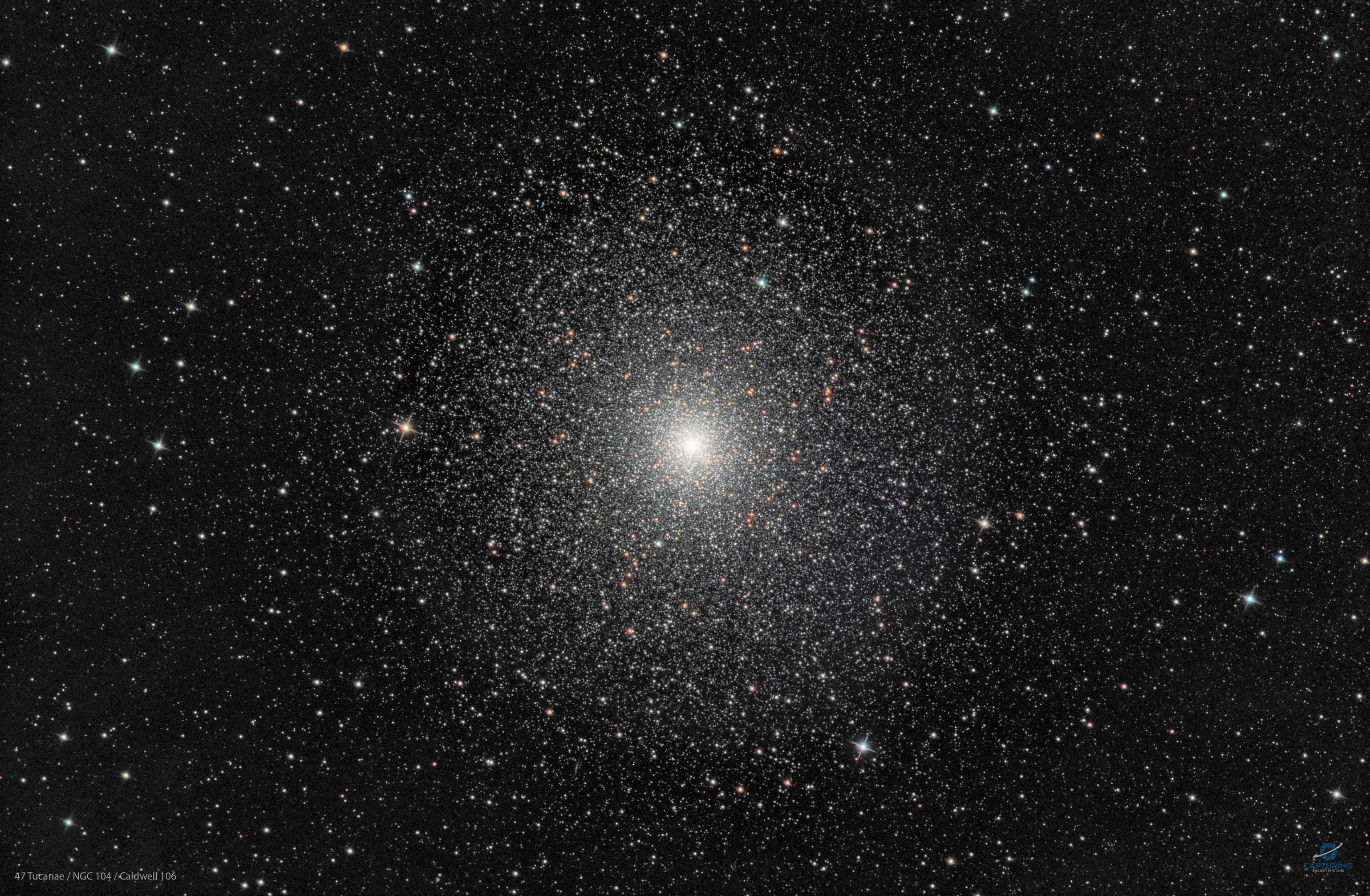
Alt...
2025 September 5
47 Tucanae: Globular Star Cluster
* Image Credit & Copyright: Carlos Taylor
Explanation:
Also known as NGC 104, 47 Tucanae is a jewel of the southern sky. Not a star but a dense cluster of stars, it roams the halo of our Milky Way Galaxy along with some 200 other globular star clusters. The second brightest globular cluster (after Omega Centauri) as seen from planet Earth, 47 Tuc lies about 13,000 light-years away. It can be spotted with the naked eye close on the sky to the Small Magellanic Cloud in the constellation of the Toucan. The dense cluster is made up of hundreds of thousands of stars in a volume only about 120 light-years across. Red giant stars on the outskirts of the cluster are easy to pick out as yellowish stars in this sharp telescopic portrait. Tightly packed globular star cluster 47 Tuc is also home to a star with the closest known orbit around a black hole.
Authors & editors: Robert Nemiroff (MTU) & Jerry Bonnell (UMCP)
NASA Official: Amber Straughn Specific rights apply.
NASA Web Privacy, Accessibility, Notices;
A service of: ASD at NASA / GSFC,
NASA Science Activation
& Michigan Tech. U.