Search results for tag #nasa
![[?]](https://files.defcon.social/dcsocial-s3/accounts/avatars/113/208/344/507/078/943/original/014820ad22daee1c.jpg)
Dawn of the Crab
* Image and Text Credit: Bradley E. Schaefer
https://www.lsu.edu/physics/people/faculty/schaefer.php
Explanation:
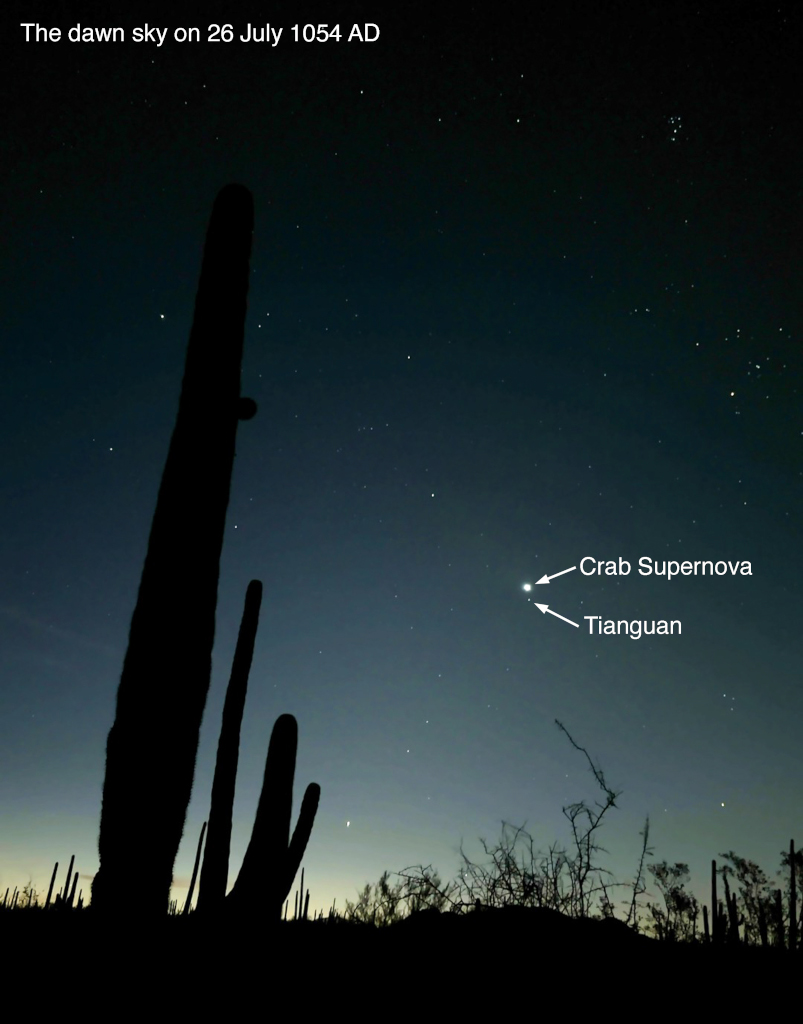
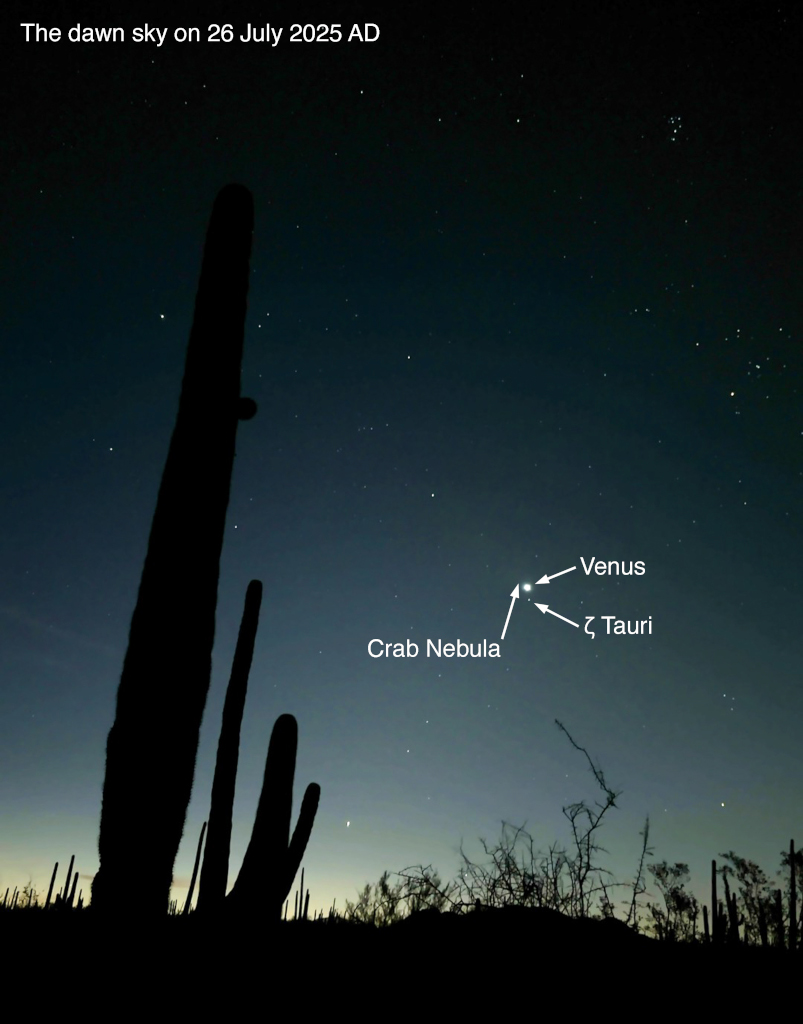
One of the all-time historic skyscapes occured in July 1054, when the Crab Supernova blazed into the dawn sky. Chinese court astrologers first saw the Guest Star on the morning of 4 July 1054 next to the star Tianguan (now cataloged as Zeta Tauri). The supernova peaked in late July 1054 a bit brighter than Venus, and was visible in the daytime for 23 days. The Guest Star was so bright that every culture around the world inevitably discovered the supernova independently, although only nine reports survive, including those from China, Japan, and Constantinople. This iPhone picture is from Signal Hill near Tucson on the morning of 26 July 2025, faithfully re-creates the year 1054 Dawn of the Crab, showing the sky as seen by Hohokam peoples. The planet Venus, as a stand-in for the supernova, is close to the position of what is now the Crab Nebula supernova remnant. Step outside on a summer dawn with bright Venus, and ask yourself "What would you have thought in ancient times when suddenly seeing the Dawn of the Crab?"
+ Crab Nebula:
https://en.wikipedia.org/wiki/SN_1054
https://apod.nasa.gov/apod/ap011227.html
+ Zeta Tauri:
https://www.star-facts.com/tianguan-zeta-tauri/
http://stars.astro.illinois.edu/sow/zetatau.html
+ Astrophysics:
https://ui.adsabs.harvard.edu/abs/2003LNP...598..195P/abstract
+ History:
https://ui.adsabs.harvard.edu/abs/2003LNP...598....7G/abstract
https://www.kyohaku.go.jp/eng/learn/home/dictio/shoseki/sadaie/
https://www.nytimes.com/1978/07/18/archives/old-text-is-linked-to-1054-supernova-scientific-journal-tells-of.html
+ Hystorical Chinese Astrology:
https://www.lehigh.edu/~dwp0/Assets/images/astroorigins.pdf
+ Cultural:
https://www.britannica.com/topic/Hohokam-culture
https://www.nps.gov/articles/000/signal-hill-petroglyphs.htm
+ Education:
https://spaceplace.nasa.gov/supernova/en/
https://apod.nasa.gov/apod/ap250808.html
#space_related #astrophotography #photography #science #history #astronomy #astrology #nature #NASA #culture #literature #education #Space_Culture_Club
Alt...
The Dawn Sky Of 26 July 1054 AD (with annotations)
2025 August 8
Dawn of the Crab
* Image and Text Credit: Bradley E. Schaefer
Explanation:
One of the all-time historic skyscapes occured in July 1054, when the Crab Supernova blazed into the dawn sky. Chinese court astrologers first saw the Guest Star on the morning of 4 July 1054 next to the star Tianguan (now cataloged as Zeta Tauri). The supernova peaked in late July 1054 a bit brighter than Venus, and was visible in the daytime for 23 days. The Guest Star was so bright that every culture around the world inevitably discovered the supernova independently, although only nine reports survive, including those from China, Japan, and Constantinople. This iPhone picture is from Signal Hill near Tucson on the morning of 26 July 2025, faithfully re-creates the year 1054 Dawn of the Crab, showing the sky as seen by Hohokam peoples. The planet Venus, as a stand-in for the supernova, is close to the position of what is now the Crab Nebula supernova remnant. Step outside on a summer dawn with bright Venus, and ask yourself "What would you have thought in ancient times when suddenly seeing the Dawn of the Crab?"
Authors & editors: Robert Nemiroff (MTU) & Jerry Bonnell (UMCP)
NASA Official: Amber Straughn Specific rights apply.
NASA Web Privacy, Accessibility, Notices;
A service of: ASD at NASA / GSFC,
NASA Science Activation
& Michigan Tech. U.
Alt...
The Dawn Sky Of 26 July 2025 AD (with annotations)
2025 August 10
Snapshot of alien captured on surveillance camera!
* Image Credit: Leading Safety Officer Rainer Zufall
https://www.rainerzufall.com/termine/
Explanation:
Since yesterday, Saturday, we have certainty that they live among us ALIENS! This unique photo of a surveillance camera at an emergency exit of the Goddart Space Flight Center is the unequivocal evidence. Both management and staff of the facility are now puzzling over what the obviously intended attempt to enter the facility was supposed to achieve, perhaps the extraterrestrial spaceman wanted to borrow a cup of fuel or had the crew run out of milk? Astronomers and astrobiologists suspect the origin of the nocturnal visitor in the area of NGC 6334, also known as "The Cat's Paw Nebula"
https://defcon.social/@grobi/114890269801928650
#space_related #Space_Culture_Club #earth #cats #astrophotography #photography #science #humor #astrobiology #nature #NASA #ESA

Alt...
2025 August 10
Snapshot of alien captured on surveillance camera!
* Image Credit: Leading Safety Officer Rainer Zufall
https://www.rainerzufall.com/termine/
Explanation:
Since yesterday, Saturday, we have certainty that they live among us ALIENS! This unique photo of a surveillance camera at an emergency exit of the Goddart Space Flight Center is the unequivocal evidence. Both management and staff of the facility are now puzzling over what the obviously intended attempt to enter the facility was supposed to achieve, perhaps the extraterrestrial spaceman wanted to borrow a cup of fuel or had the crew run out of milk? Astronomers and astrobiologists suspect the origin of the nocturnal visitor in the area of NGC 6334, also known as "The Cat's Paw Nebula"
2015 February 13
Aurora on Ice
* Image Credit & Copyright: Stéphane Vetter (Nuits sacrées)
http://www.nuitsacrees.fr/
Explanation:
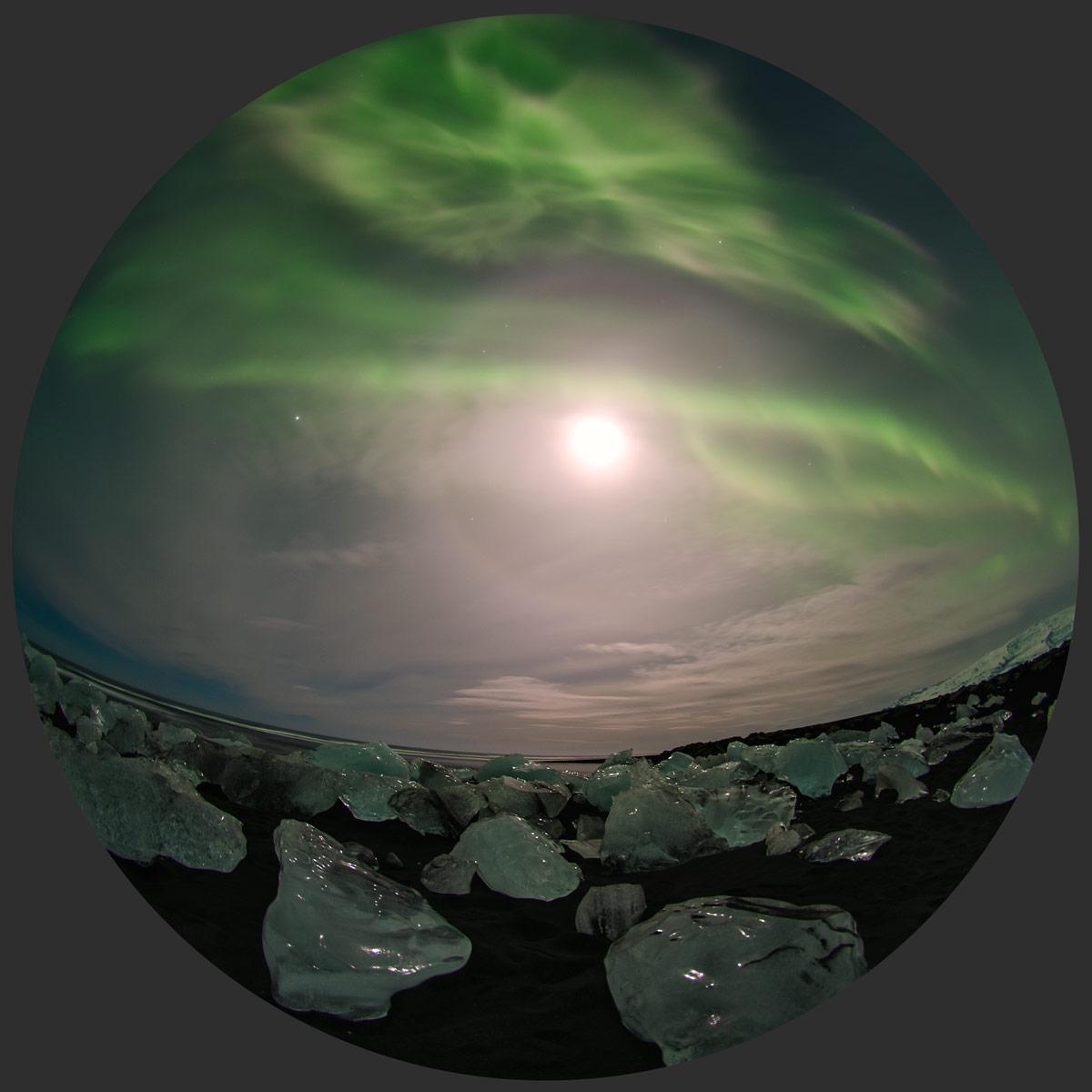
Not from a snowglobe, this expansive fisheye view of ice and sky was captured on February 1, from Jökulsárlón Beach, southeast Iceland, planet Earth. Chunks of glacial ice on the black sand beach glisten in the light of a nearly full moon surrounded by a shining halo. The 22 degree lunar halo itself is created by ice crystals in high, thin clouds refracting the moonlight. Despite the bright moonlight, curtains of aurora still dance through the surreal scene. In early February, their activity was triggered by Earth's restless magnetosphere and the energetic wind from a coronal hole near the Sun's south pole. Bright Jupiter, also near opposition, is visible at the left, beyond the icy lunar halo.
https://www.atoptics.co.uk/blog/22-degree-halo-22-halo-22-circular-halo/
https://apod.nasa.gov/apod/ap150213.html
#space #earth #aurora #astrophotography #photography #NASA #science #physics #nature #education #4sAur
Alt...
2015 February 13
Aurora on Ice
* Image Credit & Copyright: Stéphane Vetter (Nuits sacrées)
Explanation:
Not from a snowglobe, this expansive fisheye view of ice and sky was captured on February 1, from Jökulsárlón Beach, southeast Iceland, planet Earth. Chunks of glacial ice on the black sand beach glisten in the light of a nearly full moon surrounded by a shining halo. The 22 degree lunar halo itself is created by ice crystals in high, thin clouds refracting the moonlight. Despite the bright moonlight, curtains of aurora still dance through the surreal scene. In early February, their activity was triggered by Earth's restless magnetosphere and the energetic wind from a coronal hole near the Sun's south pole. Bright Jupiter, also near opposition, is visible at the left, beyond the icy lunar halo.
Authors & editors: Robert Nemiroff (MTU) & Jerry Bonnell (UMCP)
NASA Official: Phillip Newman Specific rights apply.
NASA Web Privacy Policy and Important Notices
A service of: ASD at NASA / GSFC
& Michigan Tech. U.
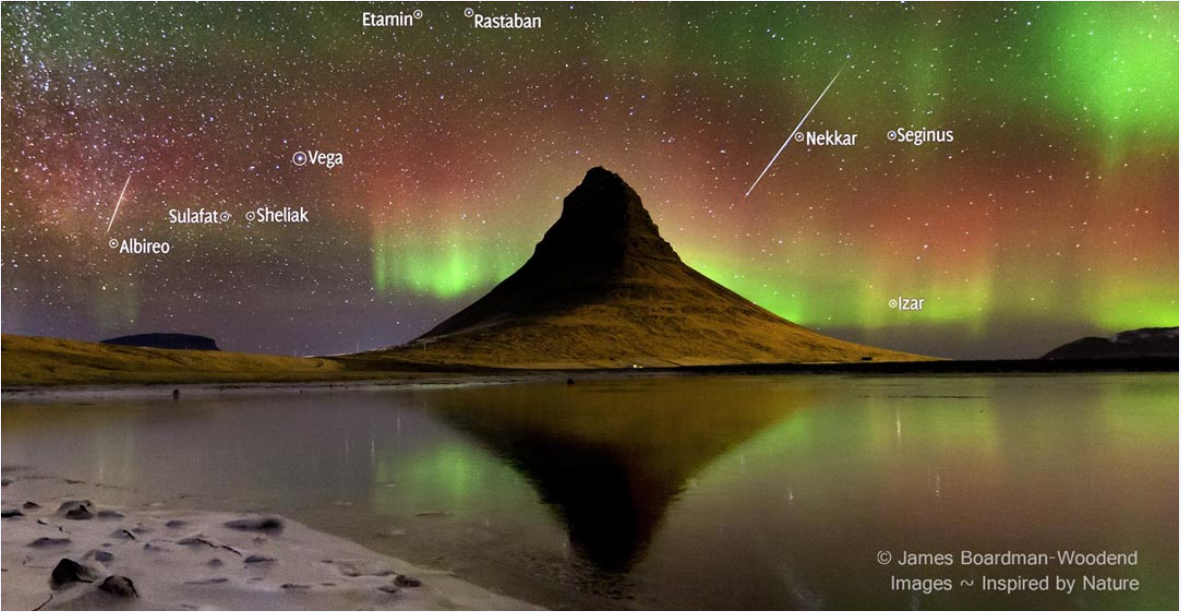
Annotations for previous post.
* Image Credit & Copyright: James Boardman-Woodend
https://www.flickr.com/photos/126180225@N06/
* Annotation: Judy Schmidt
Alt...
Annotations for previous post.
* Image Credit & Copyright: James Boardman-Woodend
https://www.flickr.com/photos/126180225@N06/
* Annotation: Judy Schmidt
2021 December 13
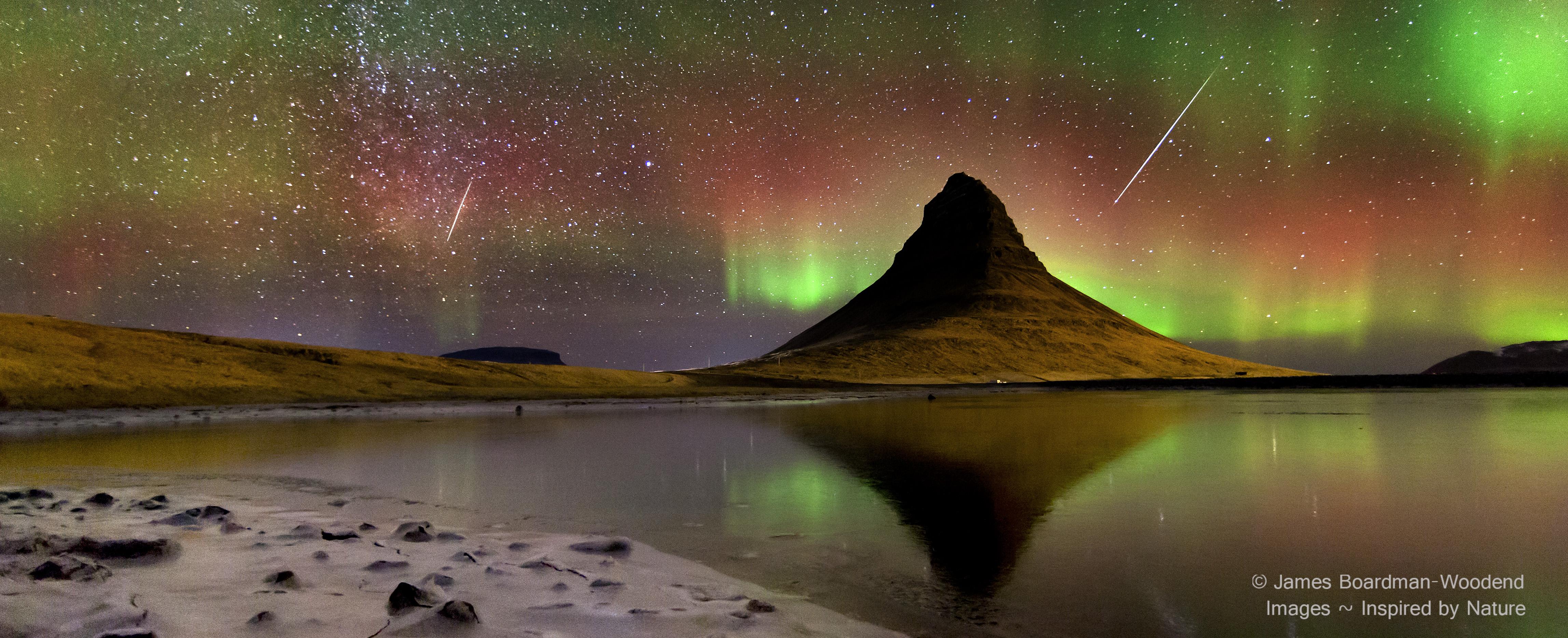
Meteors and Auroras over Iceland
* Image Credit & Copyright: James Boardman-Woodend
https://www.flickr.com/photos/126180225@N06/
* Annotation: Judy Schmidt (see next post)
Explanation:
What's going on behind that mountain? Quite a bit. First of all, the mountain itself, named Kirkjufell, is quite old and located in western Iceland near the town of Grundarfjörður. In front of the steeply-sloped structure lies a fjord that had just begun to freeze when the above image was taken -- in mid-December of 2012. Although quite faint to the unaided eye, the beautiful colors of background aurorae became quite apparent on the 25-second exposure. What makes this image of particular note, though, is that it also captures streaks from the Geminids meteor shower -- meteors that might not have been evident were the aurora much brighter. Far in the distance, on the left, is the band of our Milky Way Galaxy, while stars from our local part of the Milky Way appear spread across the background. Tonight the Geminids meteor shower peaks again and may well provide sky enthusiasts with their own memorable visual experiences.
https://apod.nasa.gov/apod/ap211213.html
#space #earth #aurora #astrophotography #photography #NASA #science #physics #nature #education #4sAur
Alt...
2021 December 13
The picture shows a volcano in Iceland in the foreground and both auroras and meteors from the 2012 Geminids in the background.
Meteors and Auroras over Iceland
* Image Credit & Copyright: James Boardman-Woodend
* Annotation: Judy Schmidt (see next post)
Explanation:
What's going on behind that mountain? Quite a bit. First of all, the mountain itself, named Kirkjufell, is quite old and located in western Iceland near the town of Grundarfjörður. In front of the steeply-sloped structure lies a fjord that had just begun to freeze when the above image was taken -- in mid-December of 2012. Although quite faint to the unaided eye, the beautiful colors of background aurorae became quite apparent on the 25-second exposure. What makes this image of particular note, though, is that it also captures streaks from the Geminids meteor shower -- meteors that might not have been evident were the aurora much brighter. Far in the distance, on the left, is the band of our Milky Way Galaxy, while stars from our local part of the Milky Way appear spread across the background. Tonight the Geminids meteor shower peaks again and may well provide sky enthusiasts with their own memorable visual experiences.
Authors & editors: Robert Nemiroff (MTU) & Jerry Bonnell (UMCP)
NASA Official: Phillip Newman Specific rights apply.
NASA Web Privacy Policy and Important Notices
A service of: ASD at NASA / GSFC
& Michigan Tech. U.
2021 October 30
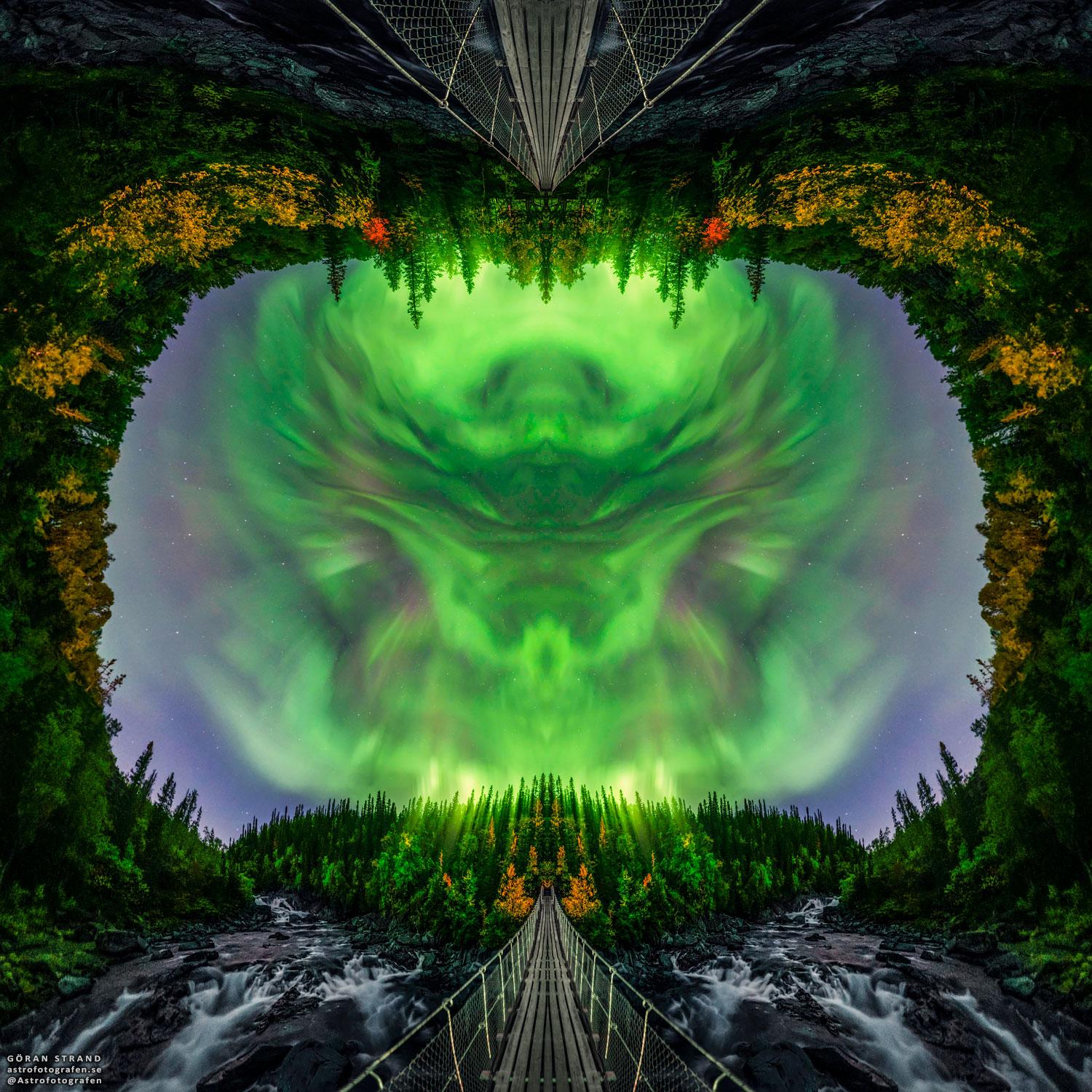
A Rorschach Aurora
* Image Credit & Copyright: Göran Strand
https://astrofotografen.se/
Explanation:
If you see this as a monster's face, don't panic. It's only pareidolia, often experienced as the tendency to see faces in patterns of light and shadow. In fact, the startling visual scene is actually a 180 degree panorama of Northern Lights, digitally mirrored like inkblots on a folded piece of paper. Frames used to construct it were captured on a September night from the middle of a waterfall-crossing suspension bridge in Jamtland, Sweden. With geomagnetic storms triggered by recent solar activity, auroral displays could be very active at planet Earth's high latitudes in the coming days. But if you see a monster's face in your own neighborhood tomorrow night, it might just be Halloween.
https://apod.nasa.gov/apod/ap211030.html
#space #earth #aurora #astrophotography #photography #NASA #science #physics #nature #education #4sAur
Alt...
2021 October 30
A Rorschach Aurora
* Image Credit & Copyright: Göran Strand
Explanation:
If you see this as a monster's face, don't panic. It's only pareidolia, often experienced as the tendency to see faces in patterns of light and shadow. In fact, the startling visual scene is actually a 180 degree panorama of Northern Lights, digitally mirrored like inkblots on a folded piece of paper. Frames used to construct it were captured on a September night from the middle of a waterfall-crossing suspension bridge in Jamtland, Sweden. With geomagnetic storms triggered by recent solar activity, auroral displays could be very active at planet Earth's high latitudes in the coming days. But if you see a monster's face in your own neighborhood tomorrow night, it might just be Halloween.
Authors & editors: Robert Nemiroff (MTU) & Jerry Bonnell (UMCP)
NASA Official: Phillip Newman Specific rights apply.
NASA Web Privacy Policy and Important Notices
A service of: ASD at NASA / GSFC
& Michigan Tech. U.
2022 October 30
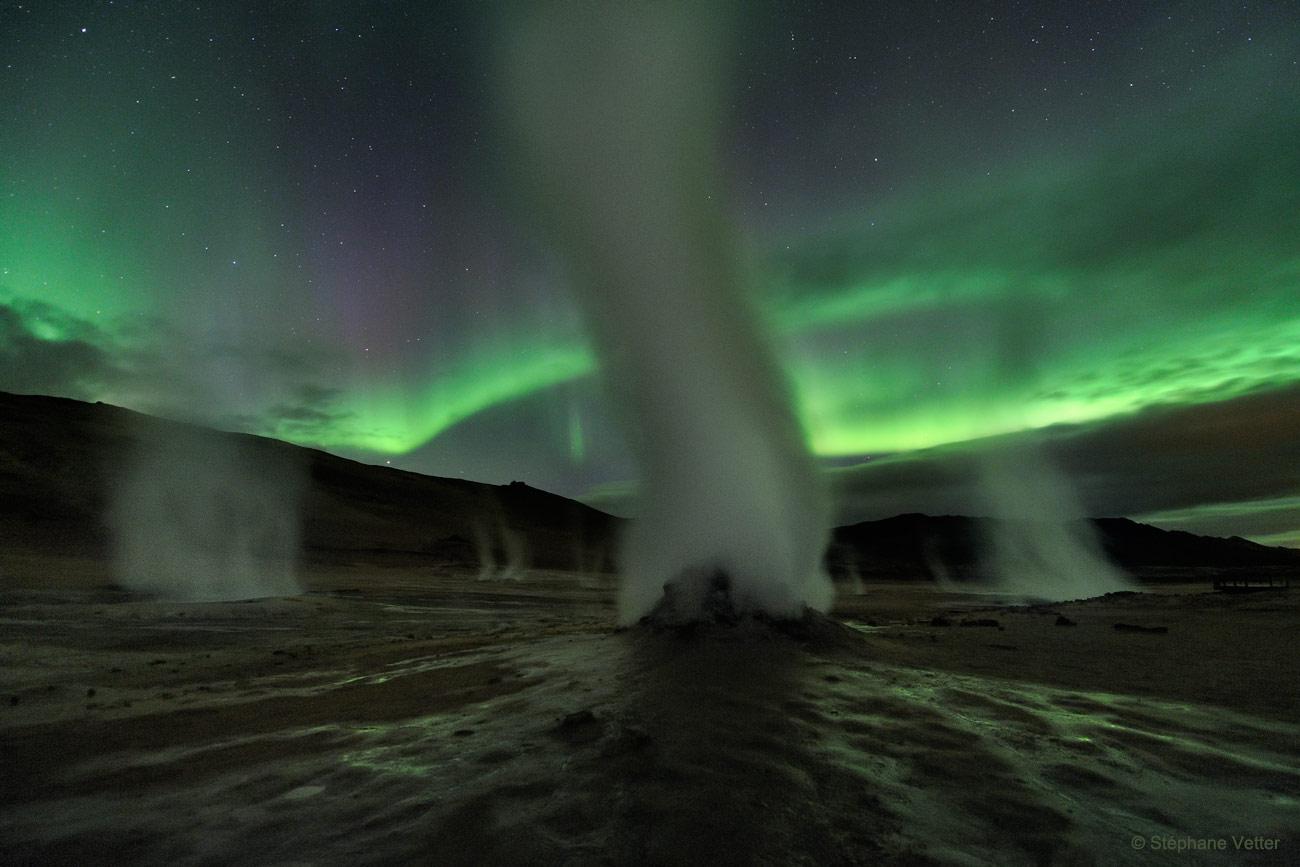
Night on a Spooky Planet
* Image Credit & Copyright: Stéphane Vetter (Nuits sacrées)
http://www.nuitsacrees.fr/
Explanation:
What spooky planet is this? Planet Earth of course, on a dark and stormy night in 2013 at Hverir, a geothermally active area along the volcanic landscape in northeastern Iceland. Triggered by solar activity, geomagnetic storms produced the auroral display in the starry night sky. The ghostly towers of steam and gas are venting from fumaroles and danced against the eerie greenish light. For now, auroral apparitions are increasing as our Sun approaches a maximum in its 11 year solar activity cycle. And pretty soon, ghostly shapes may dance in your neighborhood too.
https://apod.nasa.gov/apod/ap221030.html
#space #earth #aurora #astrophotography #photography #NASA #science #physics #nature #education #4sAur
Alt...
2022 October 30
The featured image shows steam rising from several separated vents at Hverir, a geothermally active field in Iceland. Green aurora rage in the background.
Night on a Spooky Planet
* Image Credit & Copyright: Stéphane Vetter (Nuits sacrées)
Explanation:
What spooky planet is this? Planet Earth of course, on a dark and stormy night in 2013 at Hverir, a geothermally active area along the volcanic landscape in northeastern Iceland. Triggered by solar activity, geomagnetic storms produced the auroral display in the starry night sky. The ghostly towers of steam and gas are venting from fumaroles and danced against the eerie greenish light. For now, auroral apparitions are increasing as our Sun approaches a maximum in its 11 year solar activity cycle. And pretty soon, ghostly shapes may dance in your neighborhood too.
Authors & editors: Robert Nemiroff (MTU) & Jerry Bonnell (UMCP)
NASA Official: Phillip Newman Specific rights apply.
NASA Web Privacy Policy and Important Notices
A service of: ASD at NASA / GSFC,
NASA Science Activation
& Michigan Tech. U.
The Heliosphere and Solar Wind
Just as planets with churning cores like Earth produce magnetic shields, the Sun’s dense, ever-roiling interior also produces a magnetic shield — on a much larger scale. The Sun’s magnetic shield is called the heliosphere, and it fills the solar system.
As the Sun seethes, it radiates its energy throughout the heliosphere. Planets and other objects in the solar system experience much of this radiation as a continuous stream of charged particles and magnetic fields blowing by. This stream of fields and particles is called the solar wind.
When the solar wind blows past Earth, it buffets Earth’s magnetosphere like a strong breeze flapping a flag.
https://science.nasa.gov/sun/what-is-the-solar-wind/
Credits:
NASA/Goddard Space Flight Center/Conceptual Image Lab/Jonathan North
** --> Uploading animated files in ".gif" format is a bit of a trick, because the originals are usually too big. The free software imagemagick does a great job here when it comes to resizing your file! You can try it yourself with the following command:
$convert(or "magick" depending on your version) in.gif -coalesce -resize (desired size eg:"256")x -deconstruct out-deconstruct.gif
#space #earth #aurora #astrophotography #photography #NASA #science #physics #nature #education #4sAur
"Other planets in our solar system also have the aurora phenomenon. You can also enjoy a solar light show there. In my simple mind, I think of a drive-in cinema with planets instead of cars and the sun as a projector. But there is probably a different movie on each planet..?"
2024 December 8
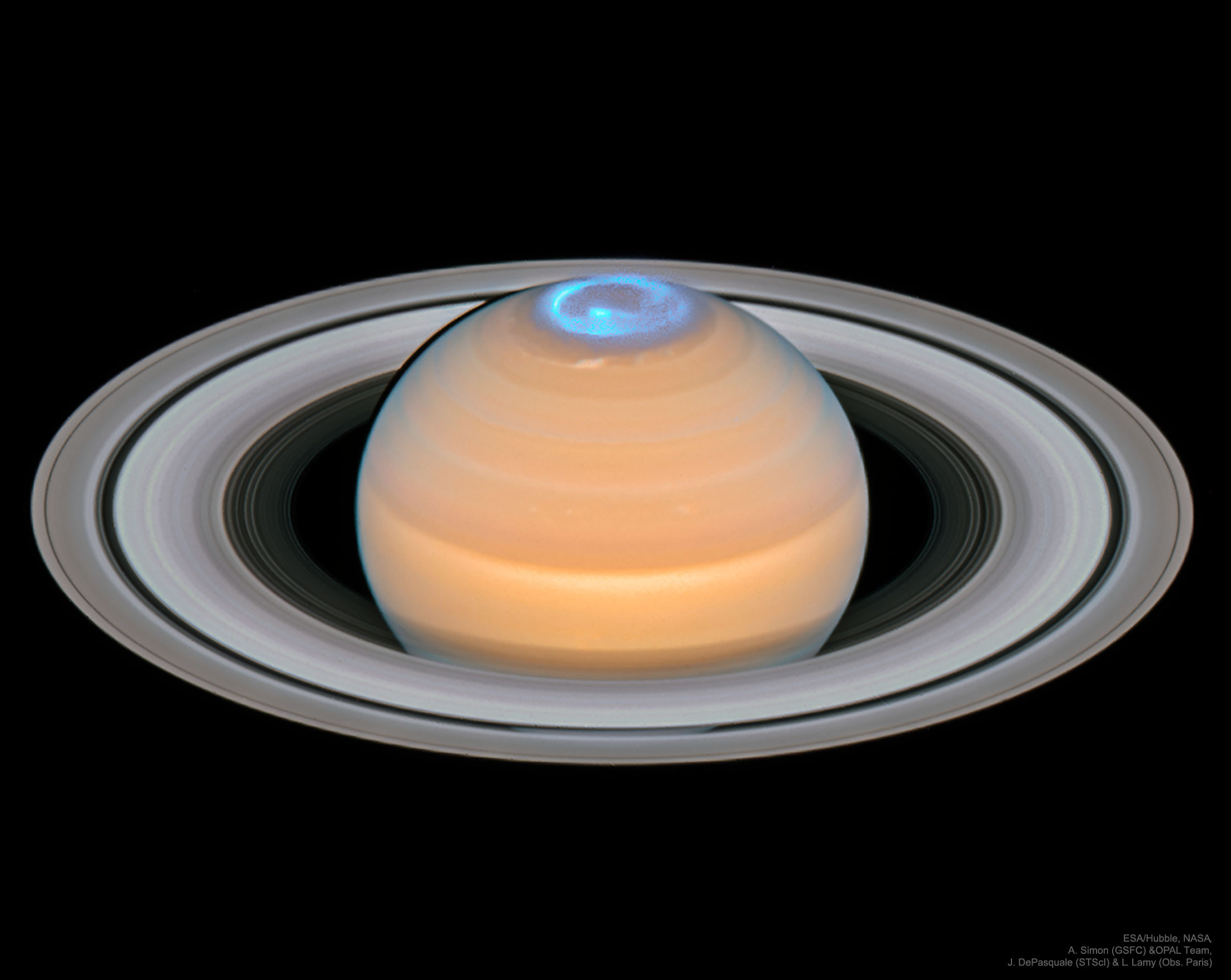
Aurora around Saturn's North Pole
* Image Credit: NASA, ESA, Hubble, OPAL Program, J. DePasquale (STScI), L. Lamy (Obs. Paris)
Explanation:
Are Saturn's auroras like Earth's? To help answer this question, the Hubble Space Telescope and the Cassini spacecraft monitored Saturn's North Pole simultaneously during Cassini's final orbits around the gas giant in September 2017. During this time, Saturn's tilt caused its North Pole to be clearly visible from Earth. The featured image is a composite of ultraviolet images of auroras and optical images of Saturn's clouds and rings, all taken by Hubble. Like on Earth, Saturn's northern auroras can make total or partial rings around the pole. Unlike on Earth, however, Saturn's auroras are frequently spirals -- and more likely to peak in brightness just before midnight and dawn. In contrast to Jupiter's auroras, Saturn's auroras appear better related to connecting Saturn's internal magnetic field to the nearby, variable, solar wind. Saturn's southern auroras were similarly imaged back in 2004 when the planet's South Pole was clearly visible to Earth.
https://en.wikipedia.org/wiki/Solar_wind
https://apod.nasa.gov/apod/ap050219.html
https://apod.nasa.gov/apod/ap241208.html
#space #earth #aurora #astrophotography #photography #NASA #science #physics #nature #education #4sAur
Alt...
2024 December 8
A picture of Saturn is shown with tan clouds and light rings. Surrounding the north pole at the top are bright blue swirls. Please see the explanation for more detailed information.
Aurora around Saturn's North Pole
* Image Credit: NASA, ESA, Hubble, OPAL Program, J. DePasquale (STScI), L. Lamy (Obs. Paris)
Explanation:
Are Saturn's auroras like Earth's? To help answer this question, the Hubble Space Telescope and the Cassini spacecraft monitored Saturn's North Pole simultaneously during Cassini's final orbits around the gas giant in September 2017. During this time, Saturn's tilt caused its North Pole to be clearly visible from Earth. The featured image is a composite of ultraviolet images of auroras and optical images of Saturn's clouds and rings, all taken by Hubble. Like on Earth, Saturn's northern auroras can make total or partial rings around the pole. Unlike on Earth, however, Saturn's auroras are frequently spirals -- and more likely to peak in brightness just before midnight and dawn. In contrast to Jupiter's auroras, Saturn's auroras appear better related to connecting Saturn's internal magnetic field to the nearby, variable, solar wind. Saturn's southern auroras were similarly imaged back in 2004 when the planet's South Pole was clearly visible to Earth.
Authors & editors: Robert Nemiroff (MTU) & Jerry Bonnell (UMCP)
NASA Official: Amber Straughn Specific rights apply.
" @p@raru.re but before that, we have to talk about Coronal Mass Ejections: "
Coronal Mass Ejections
Occasionally, magnetic storms on the Sun eject large amounts of solar material into the solar atmosphere. These huge, flying blobs of Sun-stuff are called coronal mass ejections, or CMEs.
If directed at Earth, fast-moving CMEs can reach our planet in as little as 15 hours. (The Sun is approximately 93 million miles away from Earth. A CME arriving here in 15 hours means that it’s traveling around 6.2 million miles per hour, or about 0.9% the speed of light. At those speeds, you could fly from San Francisco to Washington, D.C. in ~1.5 seconds!)
As they billow away from the Sun, fast CMEs can overtake slower-moving charged particles ahead of them in the solar wind. These particles are accelerated as they’re swept into the careening solar ejecta, increasing the risk and intensity of a radiation storm when they reach Earth.
Under certain conditions, CMEs can supercharge the magnetosphere as they blow past, creating powerful geomagnetic storms in response.
https://science.nasa.gov/sun/solar-storms-and-flares/#coronal-mass-ejection
#space #earth #aurora #astrophotography #photography #NASA #science #physics #nature #education #4sAur
This animation shows all L3 WISPR full-field observations from the twenty-first PSP Mission Encounter (2024-09-25 - 2024-10-05). We have superimposed a grid showing helioprojective longitude and latitude, and a scale representation of the size and location of the Sun in the observations using the SDO/HMI Carrington map for this time period. The velocity and distance metrics displayed on the movies correspond respectively to the spacecraft's heliocentric velocity in kilometers per second, and its distance from the Sun's center in units of solar radii (where 1 solar radius = 695,700km). The "FOV Range" label provides the plane-of-sky distance limits of the inner and outermost edges of the fields of view, in units of solar radii. The horizontal blue line indicates the orbital plane of PSP. The timespan of this composite movie covers only the nominal science window when the spacecraft was within 0.25 au; a limited amount of data outside of this range may be available at the below links.
You can download this movie directly as an 101MB mp4 file. This sequence is also available as data processed via the LW Algorithm developed by Dr. Guillermo Stenborg (JHUAPL) and detailed in Appendix A of Howard et al. 2022 (ApJ, 936, id.43. DOI 10.3847/1538-4357/ac7ff5). Please contact the team for access to this data, which will be posted here one year after the acquisition of those observations. Team contact information can be found in Section 1.2 of the WISPR User's Guide
https://wispr.nrl.navy.mil/sites/wispr.nrl.navy.mil/files/wispr_data_user_guide_v3.pdf [PDF link].
[Credit: NASA/NRL/JHUAPL. Movie processed/compiled by Guillermo Stenborg (JHUAPL) and Karl Battams (NRL). SDO inset courtesy of NASA/SDO and the AIA, EVE, and HMI science teams.]
/*grobi: for a better resolution go to:
https://wispr.nrl.navy.mil/encounter21-summary but that's a huge file !:D
#space #solarsystem #sun #parker #astrophotography #photography #science #astronomie #nature #NASA #4sAur
2024 October 16
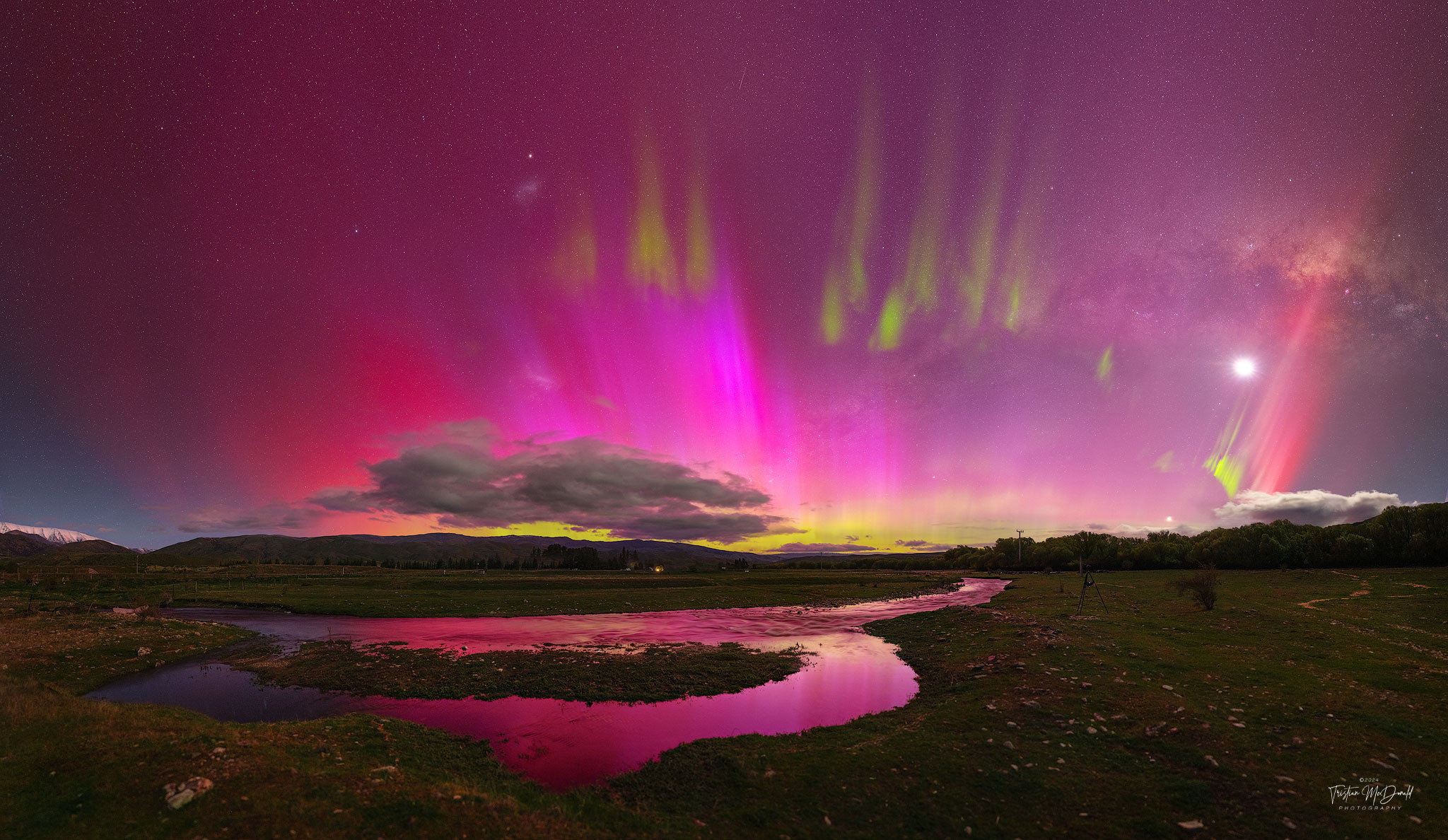
Colorful Aurora over New Zealand
* Image Credit & Copyright: Tristian McDonald
https://cre8tivestr3k.com/info-contact
Explanation:
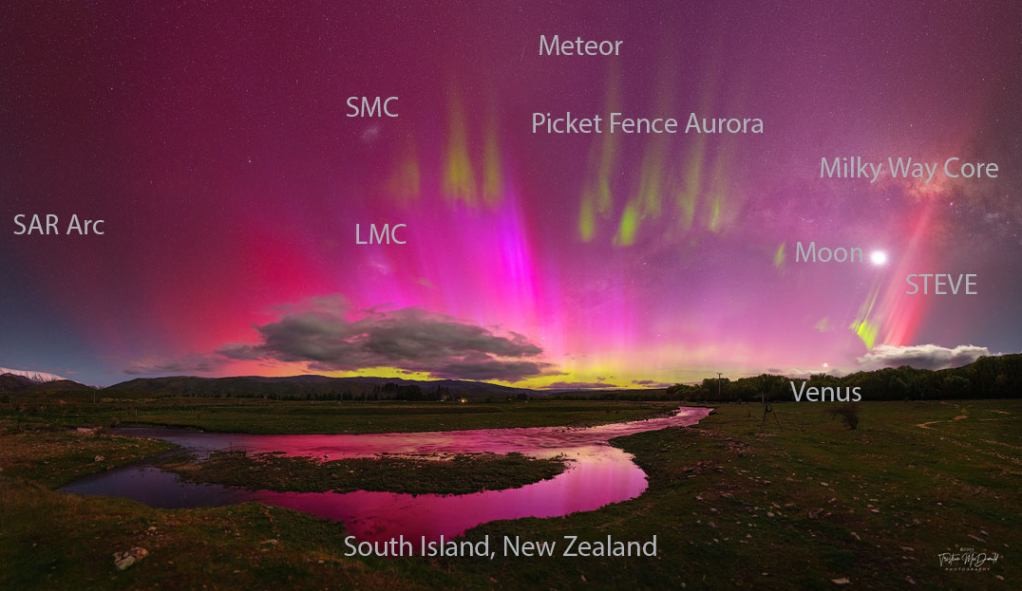
Sometimes the night sky is full of surprises. Take the sky over Lindis Pass, South Island, New Zealand one-night last week. Instead of a typically calm night sky filled with constant stars, a busy and dynamic night sky appeared. Suddenly visible were pervasive red aurora, green picket-fence aurora, a red SAR arc, a STEVE, a meteor, and the Moon. These outshone the center of our Milky Way Galaxy and both of its two satellite galaxies: the LMC and SMC. All of these were captured together on 28 exposures in five minutes, from which this panorama was composed. Auroras lit up many skies last week, as a Coronal Mass Ejection from the Sun unleashed a burst of particles toward our Earth that created colorful skies over latitudes usually too far from the Earth's poles to see them. More generally, night skies this month have other surprises, showing not only auroras -- but comets.
https://apod.nasa.gov/apod/ap241016.html
#space #earth #aurora #astrophotography #photography #NASA #science #nature #education #4sAur
Alt...
2024 October 16
A night sky is shown that appears mostly red due to pervasive aurora. In the foreground is covered by watery grasslands. Clouds are visible above the horizon. Thin green aurora are visible toward the top of the frame. In the background one can find the Moon, the LMC, SMC, Venus, a meteor, and the band of our Milky Way galaxy. Please see the explanation for more detailed information.
Colorful Aurora over New Zealand
* Image Credit & Copyright: Tristian McDonald
Explanation:
Sometimes the night sky is full of surprises. Take the sky over Lindis Pass, South Island, New Zealand one-night last week. Instead of a typically calm night sky filled with constant stars, a busy and dynamic night sky appeared. Suddenly visible were pervasive red aurora, green picket-fence aurora, a red SAR arc, a STEVE, a meteor, and the Moon. These outshone the center of our Milky Way Galaxy and both of its two satellite galaxies: the LMC and SMC. All of these were captured together on 28 exposures in five minutes, from which this panorama was composed. Auroras lit up many skies last week, as a Coronal Mass Ejection from the Sun unleashed a burst of particles toward our Earth that created colorful skies over latitudes usually too far from the Earth's poles to see them. More generally, night skies this month have other surprises, showing not only auroras -- but comets.
Authors & editors: Robert Nemiroff (MTU) & Jerry Bonnell (UMCP)
NASA Official: Amber Straughn Specific rights apply.
"A special box seat for the phenomenal earthly light shows belongs to the members of Expedition 71 and such wonderful views are part of the reward for the hard work. How nice that they share these beautiful pictures with us who stayed at home! We'll treat ourselves to a short film about it later .."
2024 September 13
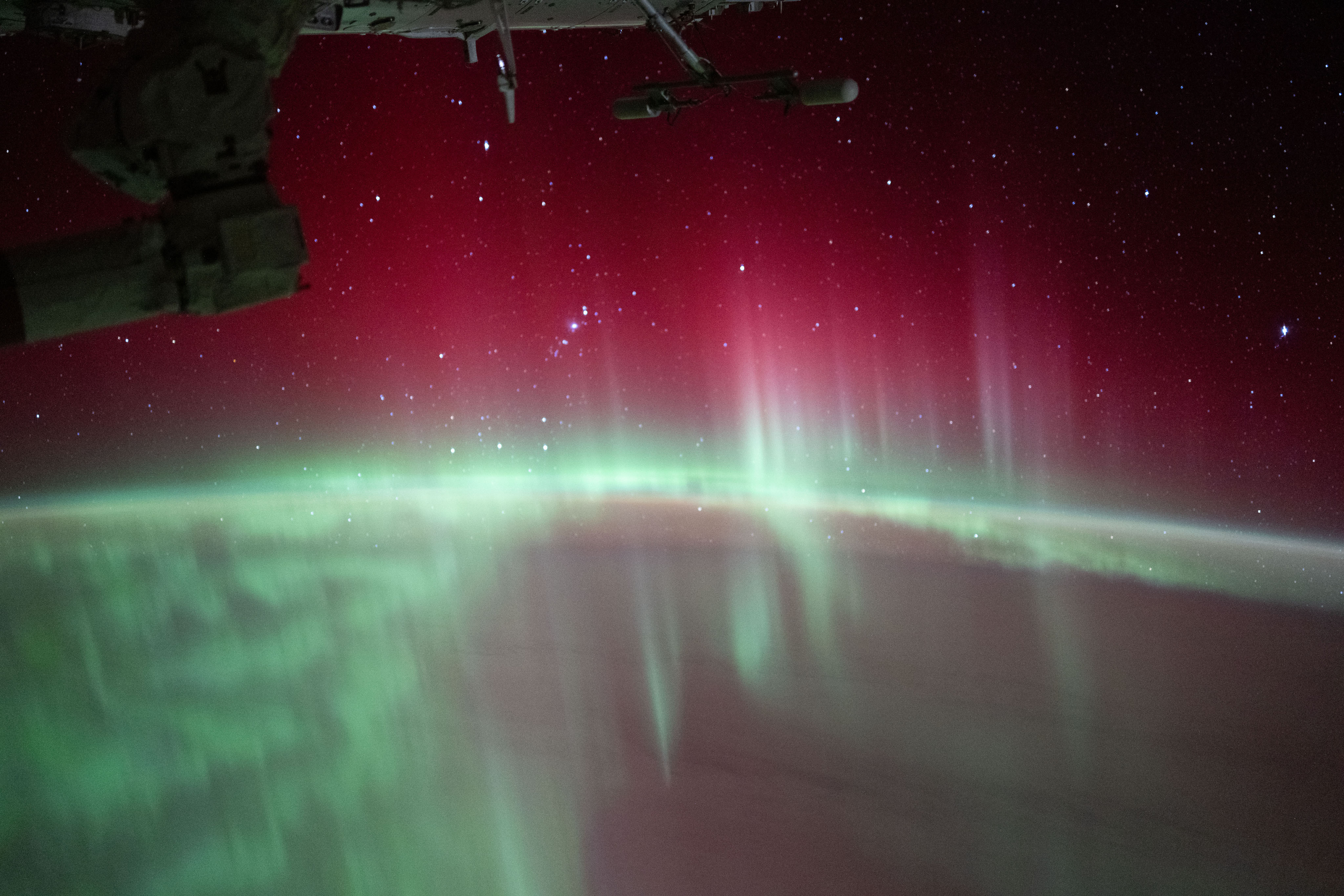
Aurora Australis and the International Space Station
* Image Credit: NASA, ISS Expedition 71
https://www.nasa.gov/mission/expedition-71/
Explanation:
This snapshot from the International Space Station was taken on August 11 while orbiting about 430 kilometers above the Indian Ocean, Southern Hemisphere, planet Earth. The spectacular view looks south and east, down toward the planet's horizon and through red and green curtains of aurora australis. The auroral glow is caused by emission from excited oxygen atoms in the extremely rarefied upper atmosphere still present at the level of the orbiting outpost. Green emission from atomic oxygen dominates this scene at altitudes of 100 to 250 kilometers, while red emission from atomic oxygen can extend as high as 500 kilometers altitude. Beyond the glow of these southern lights, this view from low Earth orbit reveals the starry sky from a southern hemisphere perspective. Stars in Orion's belt and the Orion Nebula are near the Earth's limb just left of center. Sirius, alpha star of Canis Major and brightest star in planet Earth's night is above center along the right edge of the southern orbital skyscape.
https://earthobservatory.nasa.gov/images/1346/aurora-australis
https://science.nasa.gov/earth/earth-atmosphere/earths-atmosphere-a-multi-layered-cake/
https://apod.nasa.gov/apod/ap240913.html
https://apod.nasa.gov/apod/ap240913.html
#space #earth #aurora #astrophotography #photography #NASA #science #nature #education #4sAur
Alt...
2024 September 13
Aurora Australis and the International Space Station
* Image Credit: NASA, ISS Expedition 71
Explanation:
This snapshot from the International Space Station was taken on August 11 while orbiting about 430 kilometers above the Indian Ocean, Southern Hemisphere, planet Earth. The spectacular view looks south and east, down toward the planet's horizon and through red and green curtains of aurora australis. The auroral glow is caused by emission from excited oxygen atoms in the extremely rarefied upper atmosphere still present at the level of the orbiting outpost. Green emission from atomic oxygen dominates this scene at altitudes of 100 to 250 kilometers, while red emission from atomic oxygen can extend as high as 500 kilometers altitude. Beyond the glow of these southern lights, this view from low Earth orbit reveals the starry sky from a southern hemisphere perspective. Stars in Orion's belt and the Orion Nebula are near the Earth's limb just left of center. Sirius, alpha star of Canis Major and brightest star in planet Earth's night is above center along the right edge of the southern orbital skyscape.
Authors & editors: Robert Nemiroff (MTU) & Jerry Bonnell (UMCP)
NASA Official: Phillip Newman Specific rights apply.
NASA Web Privacy Policy and Important Notices
A service of: ASD at NASA / GSFC,
NASA Science Activation
& Michigan Tech. U.
"And now finally (thank you p
@p@raru.re for your generous p atience) we come to the point of magnetic reconnection. I'll spare you as linking to Youtube and Google with this simulation generously provided by the Goddard Space Flight Center. "
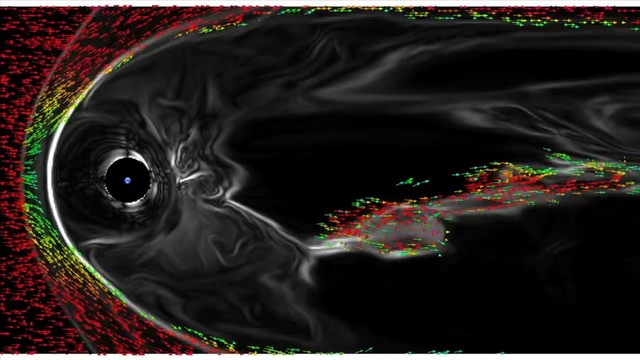
Magnetic Reconnection
As we’ve seen, the solar wind emanating from the Sun flows around Earth’s magnetosphere like a river rushing around a rock. This onrush of charged particles stretches Earth’s magnetosphere away from the Sun, creating a long wake known as the magnetotail.
The magnetic shields of the Sun and Earth are polarized, like refrigerators and the magnets that adhere to them. The polarity of Earth’s magnetic shield is mostly stable, but the Sun’s can vary due to its more dynamic nature.
Sometimes, the magnetic polarity of the solar wind is opposite that of Earth’s magnetosphere. When the solar wind buffets the magnetosphere under these conditions, the field lines of the Sun and Earth snap together, similar to when an everyday magnet connects to a fridge. This is called magnetic reconnection.
The continuously blowing solar wind then pushes these newly connected Sun-Earth field lines, wrapping them around the magnetosphere and stretching them out toward the magnetotail. Eventually, these field lines stretch to their limit and snap like a rubber band. This severs the direct Sun-Earth magnetic connection, releasing energy back along the field lines and reinstating the original magnetic configuration in the process.
https://en.wikipedia.org/wiki/Magnetic_reconnection
https://www.energy.gov/science/articles/solving-plasma-physics-mystery-magnetic-reconnection
https://heliophysics.ucar.edu/sites/default/files/heliophysics/resources/presentations/2012_Bhattacharjee_Reconnection.pdf
#space #earth #aurora #astrophotography #photography #NASA #science #physics #nature #education #4sAur
"And sometimes you don't even have to travel that far north, especially in the last year 2024, some of us suddenly and unexpectedly had such a light show on our doorstep"
2024 August 14
Meteors and Aurora over Germany
* Image Credit & Copyright: Chantal Anders
https://www.instagram.com/wetter_eule/
Explanation:
This was an unusual night. For one thing, the night sky of August 11 and 12, earlier this week, occurred near the peak of the annual Perseid Meteor Shower. Therefore, meteors streaked across the dark night as small bits cast off from Comet Swift-Tuttle came crashing into the Earth's atmosphere. Even more unusually, for central Germany at least, the night sky glowed purple. The red-blue hue was due to aurora caused by an explosion of particles from the Sun a few days before. This auroral storm was so intense that it was seen as far south as Texas and Italy, in Earth's northern hemisphere. The featured image composite was built from 7 exposures taken over 26 minutes from Ense, Germany. The Perseids occur predictably every August, but auroras visible this far south are more unusual and less predictable.
https://www.swpc.noaa.gov/news/severe-g4-geomagnetic-storms-observed-12-aug-2024
https://science.nasa.gov/solar-system/meteors-meteorites/perseids/
https://apod.nasa.gov/apod/ap240814.html
#space #earth #aurora #astrophotography #photography #NASA #science #nature #4sAur

Alt...
2024 August 14
A night sky filled with stars is colored partly purple by an aurora. Also visible are several streaks which are meteors in this image composite. In the foreground is a field and lone tree. Part of the tree slants at the nearly the same angle of the meteor streaks. Please see the explanation for more detailed information.
Meteors and Aurora over Germany
* Image Credit & Copyright: Chantal Anders
Explanation:
This was an unusual night. For one thing, the night sky of August 11 and 12, earlier this week, occurred near the peak of the annual Perseid Meteor Shower. Therefore, meteors streaked across the dark night as small bits cast off from Comet Swift-Tuttle came crashing into the Earth's atmosphere. Even more unusually, for central Germany at least, the night sky glowed purple. The red-blue hue was due to aurora caused by an explosion of particles from the Sun a few days before. This auroral storm was so intense that it was seen as far south as Texas and Italy, in Earth's northern hemisphere. The featured image composite was built from 7 exposures taken over 26 minutes from Ense, Germany. The Perseids occur predictably every August, but auroras visible this far south are more unusual and less predictable.
Authors & editors: Robert Nemiroff (MTU) & Jerry Bonnell (UMCP)
NASA Official: Amber Straughn Specific rights apply.
NASA Web Privacy, Accessibility, Notices;
A service of: ASD at NASA / GSFC,
NASA Science Activation
& Michigan Tech. U.
"These wonderful surprising moments in places where we do not expect those views are most likely caused by the following powerful phenomenon: "
Geomagnetic Substorms
While the huge auroral displays caused by geomagnetic storms are fun to see, they’re relatively rare since the Sun’s and Earth’s magnetic fields need to align just right for them to occur. Auroras that stay near the Arctic and Antarctic circles are much more frequent. They’re created by geomagnetic substorms, magnetic disturbances affecting portions of the magnetosphere. Geomagnetic storms, in contrast, are large-scale disturbances that distort the whole geomagnetic system. The everyday flow of charged particles within Earth’s magnetosphere can create small regions of magnetic imbalance that cause geomagnetic substorms.
https://en.wikipedia.org/wiki/Substorm
https://heliophysics.ucar.edu/sites/default/files/heliophysics/resources/presentations/2007_Toffoletto_GeomagneticStormsSubstorms.pdf
Credits:
NASA/Goddard Space Flight Center/UNH/J. Raeder
#space #earth #aurora #astrophotography #photography #NASA #science #physics #nature #education #4sAur
Alt...
This short video features commentary by David Sibeck, project scientist for NASA's Time History of Events and Macroscale Interactions During Substorms (THEMIS) mission, discussing a visualization of magnetic reconnection and geomagnetic substorms. Learn more about this video here: https://svs.gsfc.nasa.gov/11309
Credits:
NASA/Goddard Space Flight Center/UNH/J. Raeder
2024 June 12
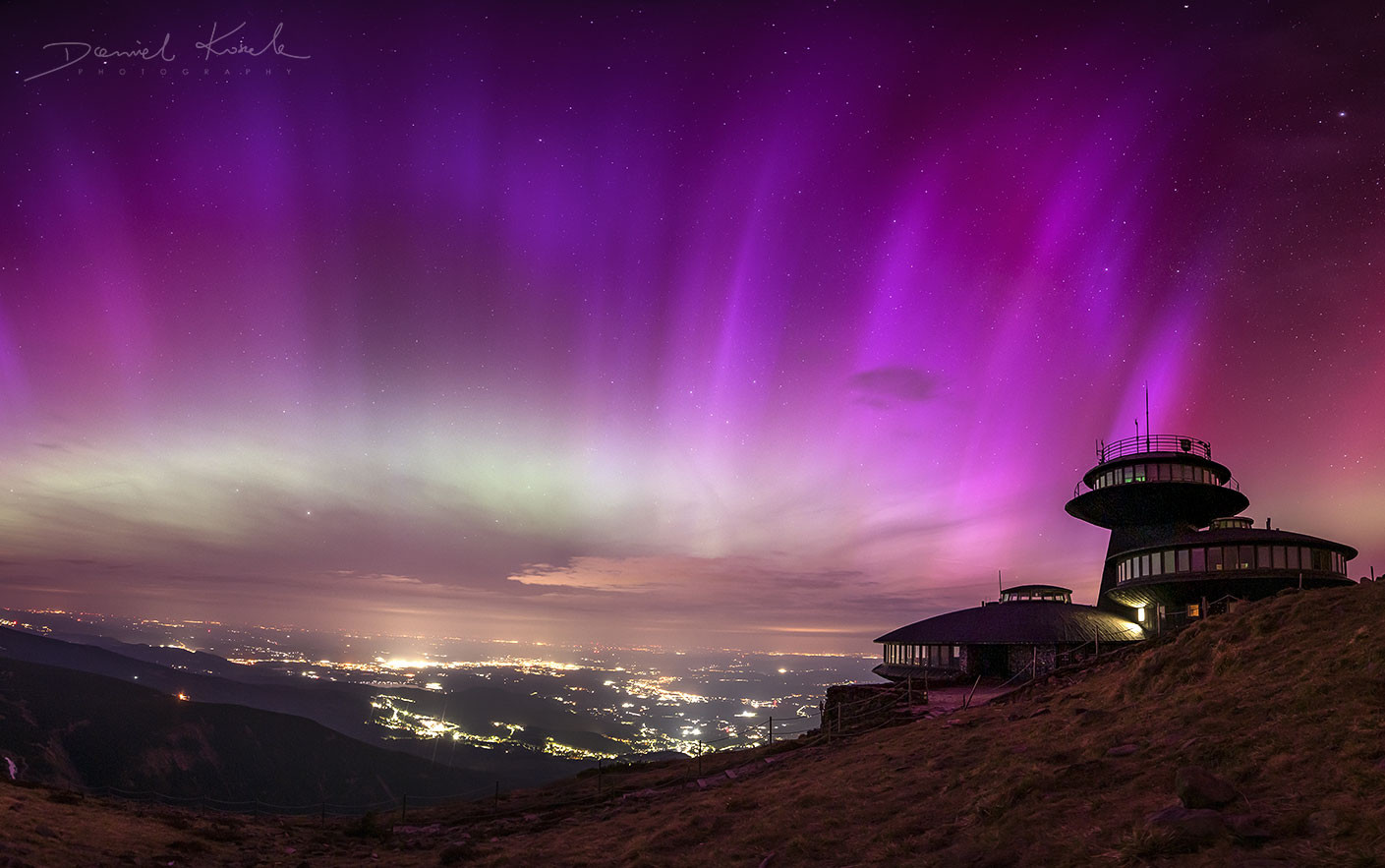
Aurora over Karkonosze Mountains
* Image Credit & Copyright: Daniel Koszela
https://www.instagram.com/danielkoszelaphotography/
Explanation:
It was the first time ever. At least, the first time this photographer had ever seen aurora from his home mountains. And what a spectacular aurora it was. The Karkonosze Mountains in Poland are usually too far south to see any auroras. But on the amazing night of May 10 - 11, purple and green colors lit up much of the night sky, a surprising spectacle that also appeared over many mid-latitude locations around the Earth. The featured image is a composite of six vertical exposures taken during the auroral peak. The futuristic buildings on the right are part of a meteorological observatory located on the highest peak of the Karkonosze Mountains. The purple color is primarily due to Sun-triggered, high-energy electrons impacting nitrogen molecules in Earth's atmosphere. Our Sun is reaching its maximum surface activity over the next two years, and although many more auroras are predicted, most will occur over regions closer to the Earth's poles.
https://theconversation.com/are-the-northern-lights-caused-by-particles-from-the-sun-not-exactly-174019
https://www.nasa.gov/news-release/solar-cycle-25-is-here-nasa-noaa-scientists-explain-what-that-means/
https://apod.nasa.gov/apod/ap240612.html
#space #earth #aurora #astrophotography #photography #NASA #science #nature #education
Alt...
2024 June 12
Purple striped aurora cover a star filled sky. Mountain peaks are visible on the sides, as well as a futuristic looking building on the right side. City lights are visible in the valley down below. Please see the explanation for more detailed information.
Aurora over Karkonosze Mountains
* Image Credit & Copyright: Daniel Koszela
Explanation:
It was the first time ever. At least, the first time this photographer had ever seen aurora from his home mountains. And what a spectacular aurora it was. The Karkonosze Mountains in Poland are usually too far south to see any auroras. But on the amazing night of May 10 - 11, purple and green colors lit up much of the night sky, a surprising spectacle that also appeared over many mid-latitude locations around the Earth. The featured image is a composite of six vertical exposures taken during the auroral peak. The futuristic buildings on the right are part of a meteorological observatory located on the highest peak of the Karkonosze Mountains. The purple color is primarily due to Sun-triggered, high-energy electrons impacting nitrogen molecules in Earth's atmosphere. Our Sun is reaching its maximum surface activity over the next two years, and although many more auroras are predicted, most will occur over regions closer to the Earth's poles.
Authors & editors: Robert Nemiroff (MTU) & Jerry Bonnell (UMCP)
NASA Official: Amber Straughn Specific rights apply.
2024 May 22
Green Aurora over Sweden
* Image Credit & Copyright: Göran Strand
https://astrofotografen.se/
Explanation:
It was bright and green and stretched across the sky. This striking aurora display was captured in 2016 just outside of Östersund, Sweden. Six photographic fields were merged to create the featured panorama spanning almost 180 degrees. Particularly striking aspects of this aurora include its sweeping arc-like shape and its stark definition. Lake Storsjön is seen in the foreground, while several familiar constellations and the star Polaris are visible through the aurora, far in the background. Coincidently, the aurora appears to avoid the Moon visible on the lower left. The aurora appeared a day after a large hole opened in the Sun's corona, allowing particularly energetic particles to flow out into the Solar System. The green color of the aurora is caused by oxygen atoms recombining with ambient electrons high in the Earth's atmosphere.
https://www.webexhibits.org/causesofcolor/4D.html
https://www.nasa.gov/image-article/earths-atmospheric-layers-3/
https://apod.nasa.gov/apod/ap240522.html
#space #earth #aurora #astrophotography #photography #NASA #science #nature

Alt...
2024 May 22
A big green arc is seen arching across the night sky. The arc fades away above into a green haze, while no green glow is seen below the arc. A dark sky filled with stars and constellations fills the background. Snow and distant trees line the foreground. Please see the explanation for more detailed information.
Green Aurora over Sweden
* Image Credit & Copyright: Göran Strand
Explanation:
It was bright and green and stretched across the sky. This striking aurora display was captured in 2016 just outside of Östersund, Sweden. Six photographic fields were merged to create the featured panorama spanning almost 180 degrees. Particularly striking aspects of this aurora include its sweeping arc-like shape and its stark definition. Lake Storsjön is seen in the foreground, while several familiar constellations and the star Polaris are visible through the aurora, far in the background. Coincidently, the aurora appears to avoid the Moon visible on the lower left. The aurora appeared a day after a large hole opened in the Sun's corona, allowing particularly energetic particles to flow out into the Solar System. The green color of the aurora is caused by oxygen atoms recombining with ambient electrons high in the Earth's atmosphere.
Authors & editors: Robert Nemiroff (MTU) & Jerry Bonnell (UMCP)
NASA Official: Amber Straughn Specific rights apply.
NASA Web Privacy, Accessibility, Notices;
A service of: ASD at NASA / GSFC,
NASA Science Activation
& Michigan Tech. U.
"I'm thinking about designing my next TOPIC> as 'FOLLOWERS ONLY' .. would that be ok for you?
Bots-requests would not be accepted."
"Would you like to see more auroras from orbit? Then go through this gate"
Auroras Seen from Orbit
The International Space Station orbits roughly 250 miles (400 km) above Earth's surface. At that height, astronauts regularly fly over (and sometimes through!) brilliant auroral displays. Many astronauts document their auroral experiences with photos and videos, but did you know the space station has high-definition cameras on board? Photos and time-lapses are uploaded regularly to NASA's online Gateway to Astronaut Photography of Earth.
https://eol.jsc.nasa.gov/
!>> https://eol.jsc.nasa.gov/beyondthephotography/crewearthobservationsvideos/Aurora.htm
#space #earth #aurora #astrophotography #photography #NASA #science #nature
2024 May 20
Aurora Dome Sky
* Image Credit & Copyright: Xuecheng Liu & Yuxuan Liu
Explanation:
It seemed like night, but part of the sky glowed purple. It was the now famous night of May 10, 2024, when people over much of the world reported beautiful aurora-filled skies. The featured image was captured this night during early morning hours from Arlington, Wisconsin, USA. The panorama is a composite of several 6-second exposures covering two thirds of the visible sky, with north in the center, and processed to heighten the colors and remove electrical wires. The photographer (in the foreground) reported that the aurora appeared to flow from a point overhead but illuminated the sky only toward the north. The aurora's energetic particles originated from CMEs ejected from our Sun over sunspot AR 3664 a few days before. This large active region rotated to the far side of the Sun last week, but may well survive to rotate back toward the Earth next week.
https://apod.nasa.gov/apod/ap240520.html
#space #earth #aurora #astrophotography #photography #NASA #science #nature

Alt...
2024 May 20
A large purple transparent dome appears to cover much of a starry sky. A person stands in a field looking toward the unusual spectacle. Please see the explanation for more detailed information.
Aurora Dome Sky
* Image Credit & Copyright: Xuecheng Liu & Yuxuan Liu
Explanation:
It seemed like night, but part of the sky glowed purple. It was the now famous night of May 10, 2024, when people over much of the world reported beautiful aurora-filled skies. The featured image was captured this night during early morning hours from Arlington, Wisconsin, USA. The panorama is a composite of several 6-second exposures covering two thirds of the visible sky, with north in the center, and processed to heighten the colors and remove electrical wires. The photographer (in the foreground) reported that the aurora appeared to flow from a point overhead but illuminated the sky only toward the north. The aurora's energetic particles originated from CMEs ejected from our Sun over sunspot AR 3664 a few days before. This large active region rotated to the far side of the Sun last week, but may well survive to rotate back toward the Earth next week.
Authors & editors: Robert Nemiroff (MTU) & Jerry Bonnell (UMCP)
NASA Official: Amber Straughn Specific rights apply.
NASA Web Privacy, Accessibility, Notices;
A service of: ASD at NASA / GSFC,
NASA Science Activation
& Michigan Tech. U.
2024 May 17
Aurora Banks Peninsula
* Image Credit & Copyright: Kavan Chay
https://www.instagram.com/kchayphotos/
Explanation:
This well-composed composite panoramic view looks due south from Banks Peninsula near Christchurch on New Zealand's South Island. The base of a tower-like rocky sea stack is awash in the foreground, with stars of the Southern Cross at the top of the frame and planet Earth's south celestial pole near center. Still, captured on May 11, vibrant aurora australis dominate the starry southern sea and skyscape. The shimmering southern lights were part of extensive auroral displays that entertained skywatchers in northern and southern hemispheres around planet Earth, caused by intense geomagnetic storms. The extreme spaceweather was triggered by the impact of coronal mass ejections launched from powerful solar active region AR 3664.
https://spaceweather.com/
https://science.nasa.gov/blogs/solar-cycle-25/
#space #earth #aurora #astrophotography #photography #NASA #science #nature

Alt...
2024 May 17
Aurora Banks Peninsula
* Image Credit & Copyright: Kavan Chay
Explanation:
This well-composed composite panoramic view looks due south from Banks Peninsula near Christchurch on New Zealand's South Island. The base of a tower-like rocky sea stack is awash in the foreground, with stars of the Southern Cross at the top of the frame and planet Earth's south celestial pole near center. Still, captured on May 11, vibrant aurora australis dominate the starry southern sea and skyscape. The shimmering southern lights were part of extensive auroral displays that entertained skywatchers in northern and southern hemispheres around planet Earth, caused by intense geomagnetic storms. The extreme spaceweather was triggered by the impact of coronal mass ejections launched from powerful solar active region AR 3664.
Authors & editors: Robert Nemiroff (MTU) & Jerry Bonnell (UMCP)
NASA Official: Amber Straughn Specific rights apply.
NASA Web Privacy, Accessibility Notices
A service of: ASD at NASA / GSFC,
NASA Science Activation
& Michigan Tech. U.
2024 May 16
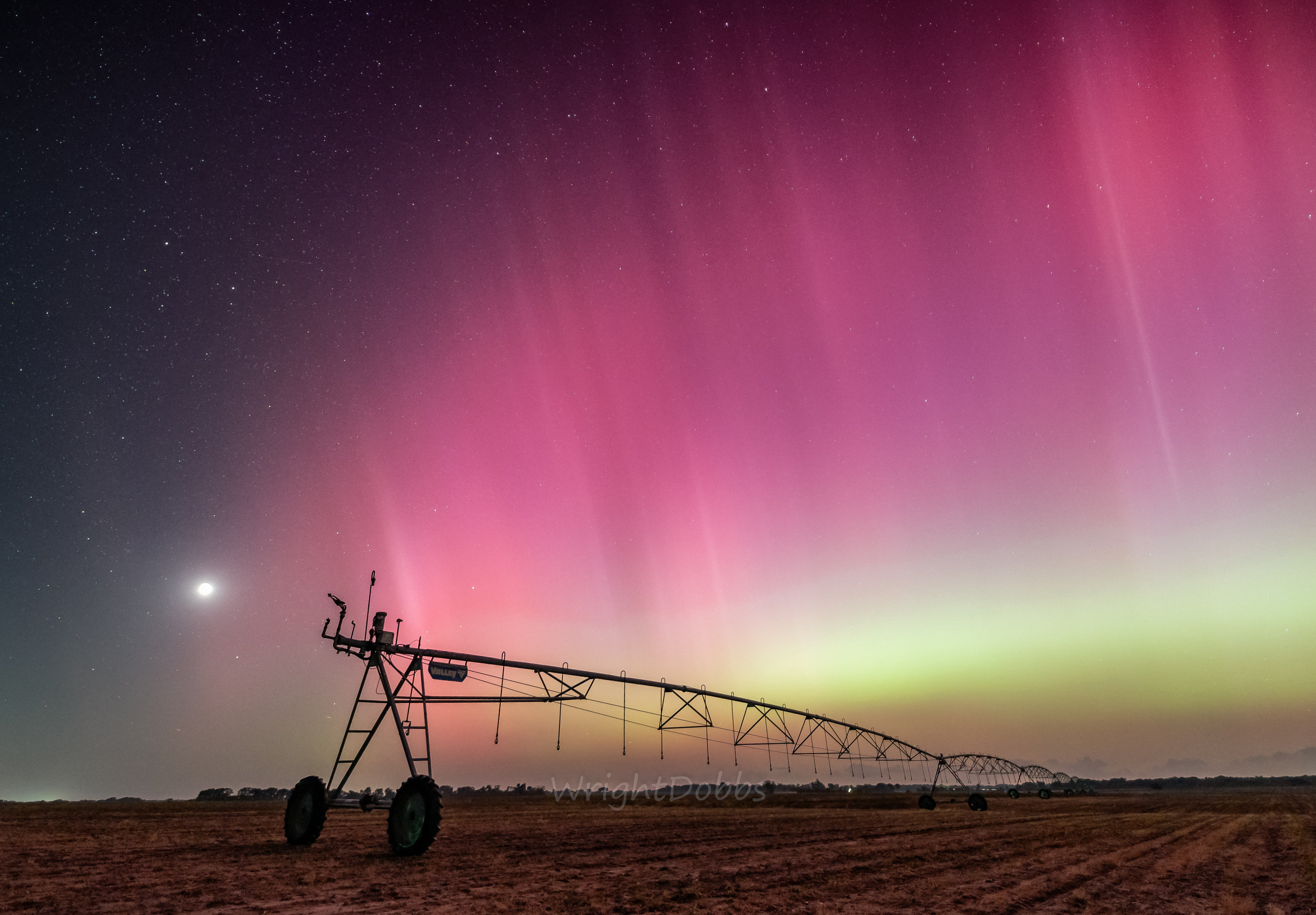
Aurora Georgia
* Image Credit & Copyright: Wright Dobbs
https://www.instagram.com/wrightdobbs/
Explanation:
A familiar sight from Georgia, USA, the Moon sets near the western horizon in this rural night skyscape. Captured on May 10 before local midnight, the image overexposes the Moon's bright waxing crescent at left in the frame. A long irrigation rig stretches across farmland about 15 miles north of the city of Bainbridge. Shimmering curtains of aurora shine across the starry sky, definitely an unfamiliar sight for southern Georgia nights. Last weekend, extreme geomagnetic storms triggered by the recent intense activity from solar active region AR 3664 brought epic displays of aurora, usually seen closer to the poles, to southern Georgia and even lower latitudes on planet Earth. As solar activity ramps up, more storms are possible.
https://apod.nasa.gov/apod/ap240516.html
#space #earth #aurora #astrophotography #photography #NASA #science #nature
Alt...
2024 May 16
Aurora Georgia
* Image Credit & Copyright: Wright Dobbs
Explanation:
A familiar sight from Georgia, USA, the Moon sets near the western horizon in this rural night skyscape. Captured on May 10 before local midnight, the image overexposes the Moon's bright waxing crescent at left in the frame. A long irrigation rig stretches across farmland about 15 miles north of the city of Bainbridge. Shimmering curtains of aurora shine across the starry sky, definitely an unfamiliar sight for southern Georgia nights. Last weekend, extreme geomagnetic storms triggered by the recent intense activity from solar active region AR 3664 brought epic displays of aurora, usually seen closer to the poles, to southern Georgia and even lower latitudes on planet Earth. As solar activity ramps up, more storms are possible.
Authors & editors: Robert Nemiroff (MTU) & Jerry Bonnell (UMCP)
NASA Official: Amber Straughn Specific rights apply.
NASA Web Privacy, Accessibility Notices
A service of: ASD at NASA / GSFC,
NASA Science Activation
& Michigan Tech. U.
2024 May 12
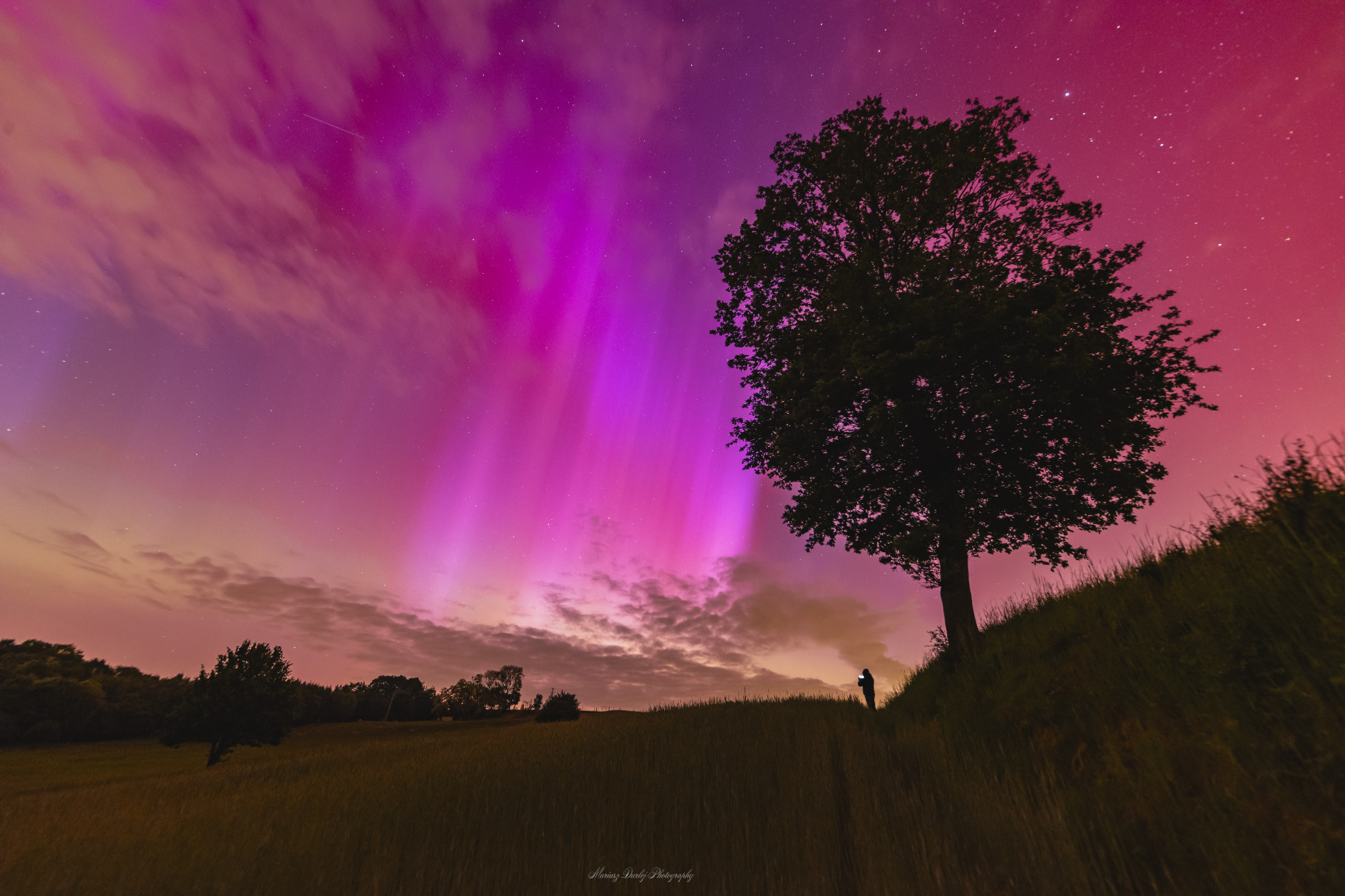
Red Aurora over Poland
* Image Credit & Copyright: Mariusz Durlej
https://tkalniakietrz.pl/wystawa-astrofotografii-mariusza-durleja/
Explanation:
Northern lights don't usually reach this far south. Magnetic chaos in the Sun's huge Active Region 3664, however, produced a surface explosion that sent a burst of electrons, protons, and more massive, charged nuclei into the Solar System. A few days later, that coronal mass ejection (CME) impacted the Earth and triggered auroras that are being reported unusually far from our planet's north and south poles. The free sky show might not be over -- the sunspot rich AR3664 has ejected even more CMEs that might also impact the Earth tonight or tomorrow. That active region is now near the Sun's edge, though, and will soon be rotating away from the Earth. Pictured, a red and rayed aurora was captured in a single 6-second exposure from Racibórz, Poland early last night. The photographer's friend, seeing an aurora for the first time, is visible in the distance also taking images of the beautifully colorful nighttime sky.
https://apod.nasa.gov/apod/ap240512.html
#space #earth #aurora #astrophotography #photography #NASA #science #nature
Alt...
2024 May 12
Red and purple aurora appear over a field in Poland. A tree is seen to the right, and a person stands in the distance holding a glowing phone. Please see the explanation for more detailed information.
Red Aurora over Poland
* Image Credit & Copyright: Mariusz Durlej
Explanation:
Northern lights don't usually reach this far south. Magnetic chaos in the Sun's huge Active Region 3664, however, produced a surface explosion that sent a burst of electrons, protons, and more massive, charged nuclei into the Solar System. A few days later, that coronal mass ejection (CME) impacted the Earth and triggered auroras that are being reported unusually far from our planet's north and south poles. The free sky show might not be over -- the sunspot rich AR3664 has ejected even more CMEs that might also impact the Earth tonight or tomorrow. That active region is now near the Sun's edge, though, and will soon be rotating away from the Earth. Pictured, a red and rayed aurora was captured in a single 6-second exposure from Racibórz, Poland early last night. The photographer's friend, seeing an aurora for the first time, is visible in the distance also taking images of the beautifully colorful nighttime sky.
Authors & editors: Robert Nemiroff (MTU) & Jerry Bonnell (UMCP)
NASA Official: Amber Straughn Specific rights apply.
NASA Web Privacy, Accessibility, Notices;
A service of: ASD at NASA / GSFC,
NASA Science Activation
& Michigan Tech. U.
"So honestly, if this mysterious Aurora doesn't remind you of Harry Potter, you either don't read any books or have and don't know any children .. (just joking)"
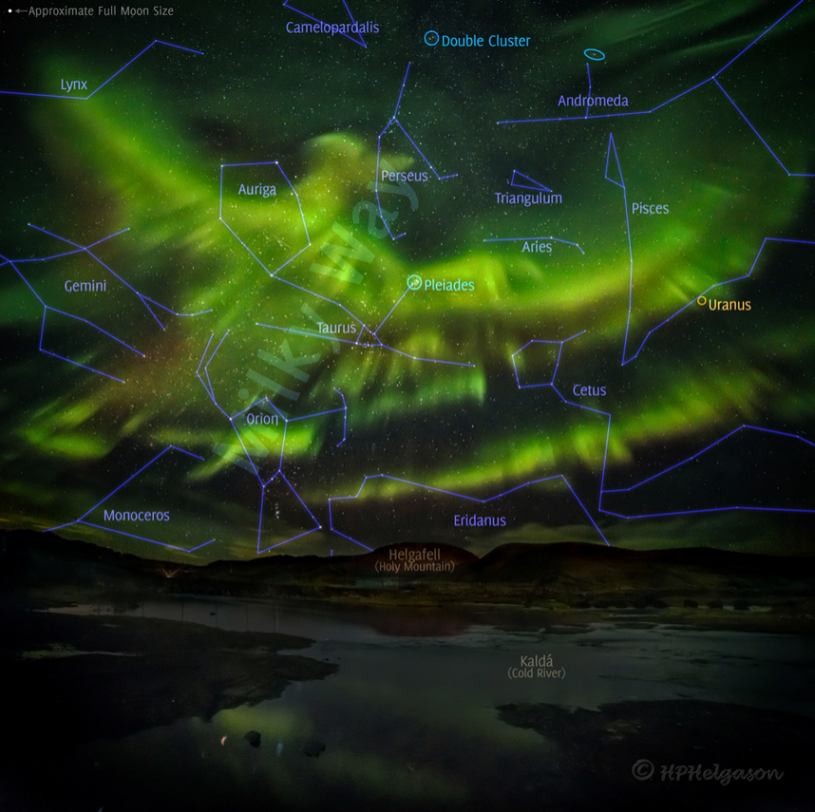
2024 February 25
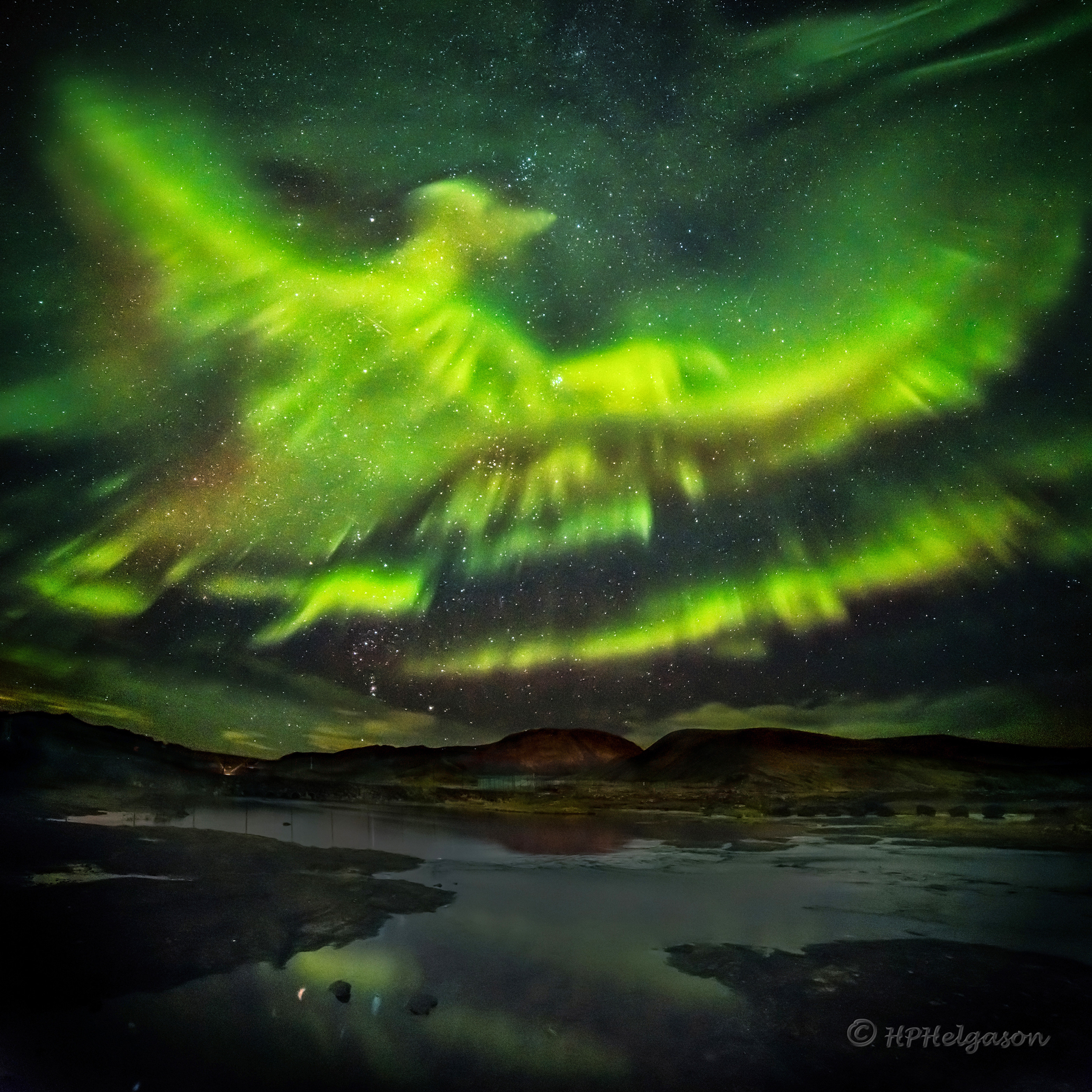
A green aurora fills a star filled sky. A mountain and a lake are in the foreground. The aurora may resemble, to some, a flying or rising Phoenix.
A Phoenix Aurora over Iceland
* Image Credit & Copyright: Hallgrimur P. Helgason; Rollover Annotation: Judy Schmidt
Explanation:
All of the other aurora watchers had gone home. By 3:30 am in Iceland, on a quiet September night, much of that night's auroras had died down. Suddenly, unexpectedly, a new burst of particles streamed down from space, lighting up the Earth's atmosphere once again. This time, surprisingly, pareidoliacally, the night lit up with an amazing shape reminiscent of a giant phoenix. With camera equipment at the ready, two quick sky images were taken, followed immediately by a third of the land. The mountain in the background is Helgafell, while the small foreground river is called Kaldá, both located about 30 kilometers north of Iceland's capital Reykjavík. Seasoned skywatchers will note that just above the mountain, toward the left, is the constellation of Orion, while the Pleiades star cluster is also visible just above the frame center. The 2016 aurora, which lasted only a minute and was soon gone forever -- would possibly be dismissed as a fanciful fable -- were it not captured in the featured, digitally-composed, image mosaic.
https://harrypotterinsights.com/the-enigmatic-phoenix-symbolism-and-significance-in-the-wizarding-world/
https://apod.nasa.gov/apod/ap240225.html
#space #earth #aurora #astrophotography #photography #NASA #science #nature
Alt...
2024 February 25
A green aurora fills a star filled sky. A mountain and a lake are in the foreground. The aurora may resemble, to some, a flying or rising Phoenix.
A Phoenix Aurora over Iceland
* Image Credit & Copyright: Hallgrimur P. Helgason; Rollover Annotation: Judy Schmidt
Explanation:
All of the other aurora watchers had gone home. By 3:30 am in Iceland, on a quiet September night, much of that night's auroras had died down. Suddenly, unexpectedly, a new burst of particles streamed down from space, lighting up the Earth's atmosphere once again. This time, surprisingly, pareidoliacally, the night lit up with an amazing shape reminiscent of a giant phoenix. With camera equipment at the ready, two quick sky images were taken, followed immediately by a third of the land. The mountain in the background is Helgafell, while the small foreground river is called Kaldá, both located about 30 kilometers north of Iceland's capital Reykjavík. Seasoned skywatchers will note that just above the mountain, toward the left, is the constellation of Orion, while the Pleiades star cluster is also visible just above the frame center. The 2016 aurora, which lasted only a minute and was soon gone forever -- would possibly be dismissed as a fanciful fable -- were it not captured in the featured, digitally-composed, image mosaic.
Authors & editors: Robert Nemiroff (MTU) & Jerry Bonnell (UMCP)
NASA Official: Amber Straughn; Specific rights apply.
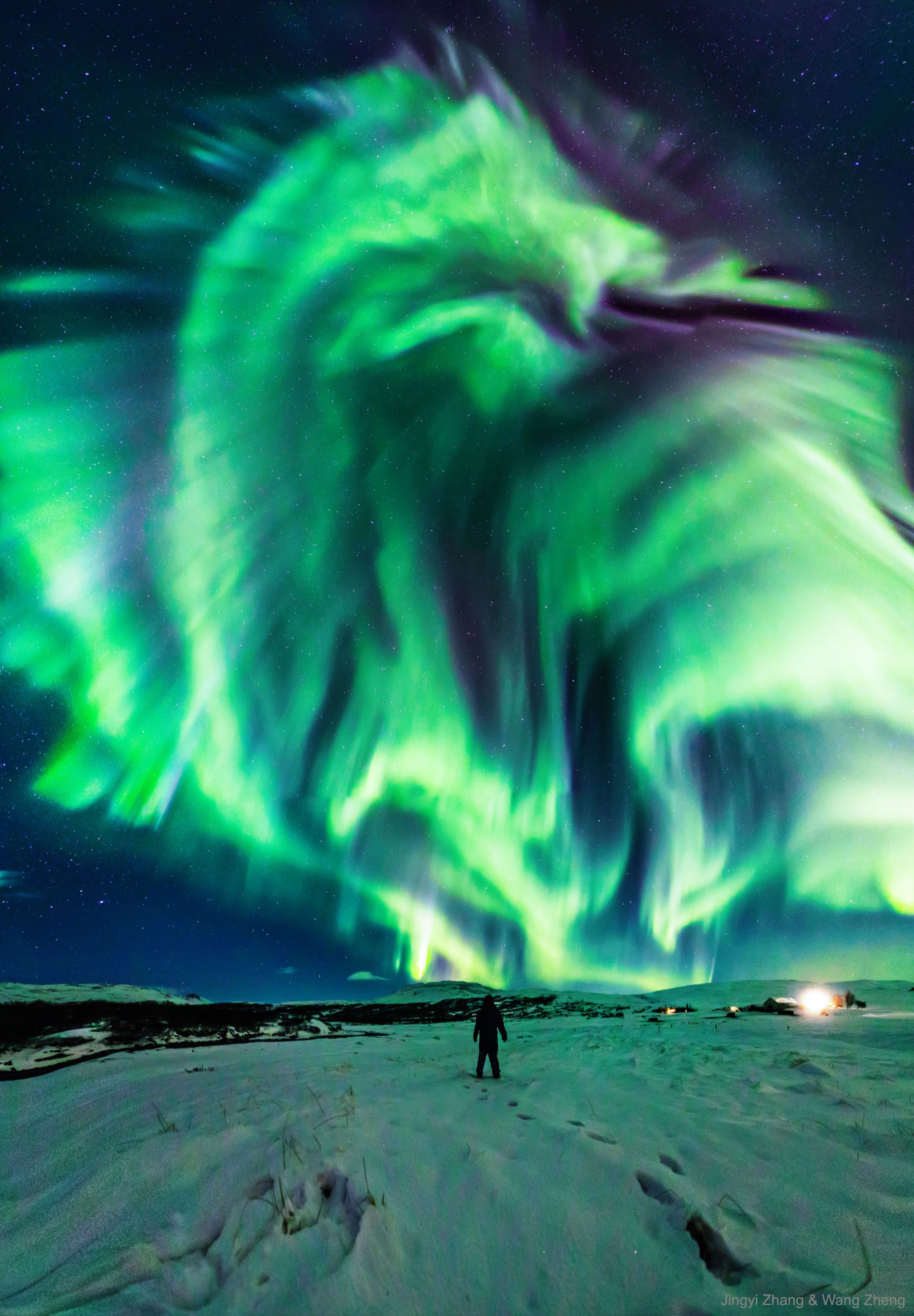
"Our solar film projector does not stop conjuring up magical mythical creatures on our atmospheric screen"
2024 January 14
Dragon Aurora over Iceland
* Image Credit & Copyright: Jingyi Zhang & Wang Zheng
Explanation:
Have you ever seen a dragon in the sky? Although real flying dragons don't exist, a huge dragon-shaped aurora developed in the sky over Iceland in 2019. The aurora was caused by a hole in the Sun's corona that expelled charged particles into a solar wind that followed a changing interplanetary magnetic field to Earth's magnetosphere. As some of those particles then struck Earth's atmosphere, they excited atoms which subsequently emitted light: aurora. This iconic display was so enthralling that the photographer's mother ran out to see it and was captured in the foreground. Our active Sun continues to show an unusually high number of prominences, filaments, sunspots, and large active regions as solar maximum approaches in 2025.
https://apod.nasa.gov/apod/ap240114.html
#space #earth #aurora #astrophotography #photography #NASA #science #nature
Alt...
2024 January 14
A person stands on snow and looks up at a starry sky. In the sky is a large green aurora that resembles a dragon.
Dragon Aurora over Iceland
* Image Credit & Copyright: Jingyi Zhang & Wang Zheng
Explanation:
Have you ever seen a dragon in the sky? Although real flying dragons don't exist, a huge dragon-shaped aurora developed in the sky over Iceland in 2019. The aurora was caused by a hole in the Sun's corona that expelled charged particles into a solar wind that followed a changing interplanetary magnetic field to Earth's magnetosphere. As some of those particles then struck Earth's atmosphere, they excited atoms which subsequently emitted light: aurora. This iconic display was so enthralling that the photographer's mother ran out to see it and was captured in the foreground. Our active Sun continues to show an unusually high number of prominences, filaments, sunspots, and large active regions as solar maximum approaches in 2025.
Authors & editors: Robert Nemiroff (MTU) & Jerry Bonnell (UMCP)
NASA Official: Ryan Smallcomb Specific rights apply.
NASA Web Privacy Policy and Important Notices
A service of: ASD at NASA / GSFC,
NASA Science Activation
& Michigan Tech. U.
".. and whoever drinks from this magical spring only once inevitably becomes a more peaceful, happier and better being. Just look at how Elon and Donald fared afterwards:
https://mstdn.ca/@seanb/114648824966395547 "
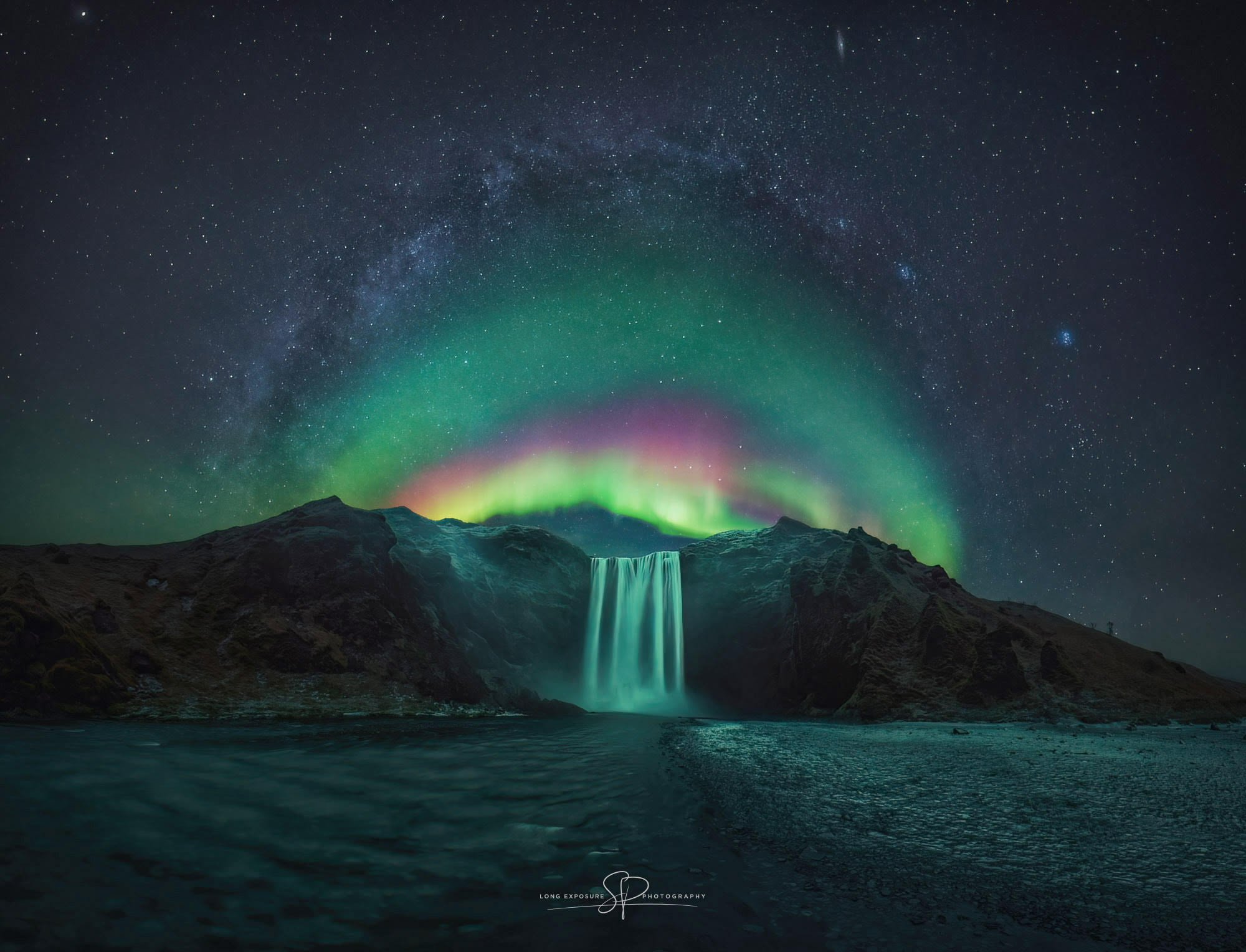
2023 December 27
Rainbow Aurora over Icelandic Waterfall
Image Credit & Copyright: Stefano Pellegrini
https://fotocult.it/stefano-pellegrini-intervista/
Explanation:
Yes, but can your aurora do this? First, yes, auroras can look like rainbows even though they are completely different phenomena. Auroras are caused by Sun-created particles being channeled into Earth's atmosphere by Earth's magnetic field, and create colors by exciting atoms at different heights. Conversely, rainbows are created by sunlight backscattering off falling raindrops, and different colors are refracted by slightly different angles. Unfortunately, auroras can’t create waterfalls, but if you plan well and are lucky enough, you can photograph them together. The featured picture is composed of several images taken on the same night last November near the Skógafoss waterfall in Iceland. The planning centered on capturing the central band of our Milky Way galaxy over the picturesque cascade. By luck, a spectacular aurora soon appeared just below the curving arch of the Milky Way. Far in the background, the Pleiades star cluster and the Andromeda galaxy can be found.
https://apod.nasa.gov/apod/ap231227.html
#space #earth #aurora #astrophotography #photography #NASA #science #nature
Alt...
2023 December 27
A waterfall is shown in the image center below a starry sky. Arching above the waterfall is a colorful aurora. Arching above the aurora is the central band of the Milky Way.
Rainbow Aurora over Icelandic Waterfall
Image Credit & Copyright: Stefano Pellegrini
Explanation:
Yes, but can your aurora do this? First, yes, auroras can look like rainbows even though they are completely different phenomena. Auroras are caused by Sun-created particles being channeled into Earth's atmosphere by Earth's magnetic field, and create colors by exciting atoms at different heights. Conversely, rainbows are created by sunlight backscattering off falling raindrops, and different colors are refracted by slightly different angles. Unfortunately, auroras can’t create waterfalls, but if you plan well and are lucky enough, you can photograph them together. The featured picture is composed of several images taken on the same night last November near the Skógafoss waterfall in Iceland. The planning centered on capturing the central band of our Milky Way galaxy over the picturesque cascade. By luck, a spectacular aurora soon appeared just below the curving arch of the Milky Way. Far in the background, the Pleiades star cluster and the Andromeda galaxy can be found.
Authors & editors: Robert Nemiroff (MTU) & Jerry Bonnell (UMCP)
NASA Official: Phillip Newman Specific rights apply.
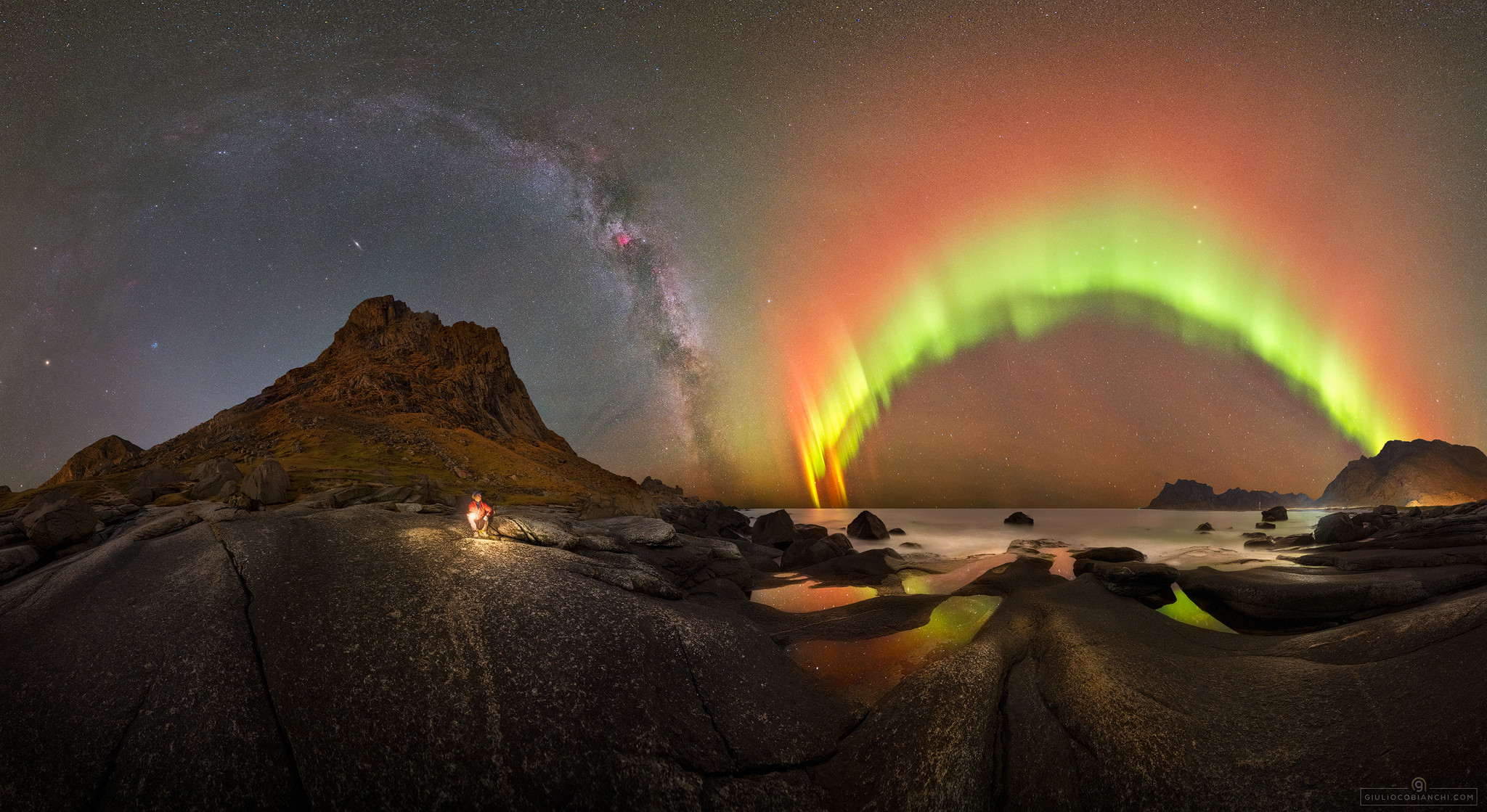
2023 December 12
Aurora and Milky Way over Norway
* Image Credit & Copyright: Giulio Cobianchi
https://giuliocobianchi.com/about/
Explanation:
What are these two giant arches across the sky? Perhaps the more familiar one, on the left, is the central band of our Milky Way Galaxy. This grand disk of stars and nebulas here appears to encircle much of the southern sky. Visible below the stellar arch is the rusty-orange planet Mars and the extended Andromeda galaxy. But this night had more! For a few minutes during this cold arctic night, a second giant arch appeared encircling part of the northern sky: an aurora. Auroras are much closer than stars as they are composed of glowing air high in Earth's atmosphere. Visible outside the green auroral arch is the group of stars popularly known as the Big Dipper. The featured digital composite of 20 images was captured in mid-November 2022 over the Lofoten Islands in Norway.
https://apod.nasa.gov/apod/ap231212.html
#space #earth #aurora #astrophotography #photography #NASA #physics #nature
Alt...
2023 December 12
A night sky filled with stars is shown behind a picturesque foreground. The foreground contains rounded rocks and a person before a distant sea. The background contains bands of the Milky Way and bright aurora.
Aurora and Milky Way over Norway
* Image Credit & Copyright: Giulio Cobianchi
Explanation:
What are these two giant arches across the sky? Perhaps the more familiar one, on the left, is the central band of our Milky Way Galaxy. This grand disk of stars and nebulas here appears to encircle much of the southern sky. Visible below the stellar arch is the rusty-orange planet Mars and the extended Andromeda galaxy. But this night had more! For a few minutes during this cold arctic night, a second giant arch appeared encircling part of the northern sky: an aurora. Auroras are much closer than stars as they are composed of glowing air high in Earth's atmosphere. Visible outside the green auroral arch is the group of stars popularly known as the Big Dipper. The featured digital composite of 20 images was captured in mid-November 2022 over the Lofoten Islands in Norway.
Authors & editors: Robert Nemiroff (MTU) & Jerry Bonnell (UMCP)
NASA Official: Phillip Newman Specific rights apply.
NASA Web Privacy Policy and Important Notices
A service of: ASD at NASA / GSFC,
NASA Science Activation
& Michigan Tech. U.
2023 November 25
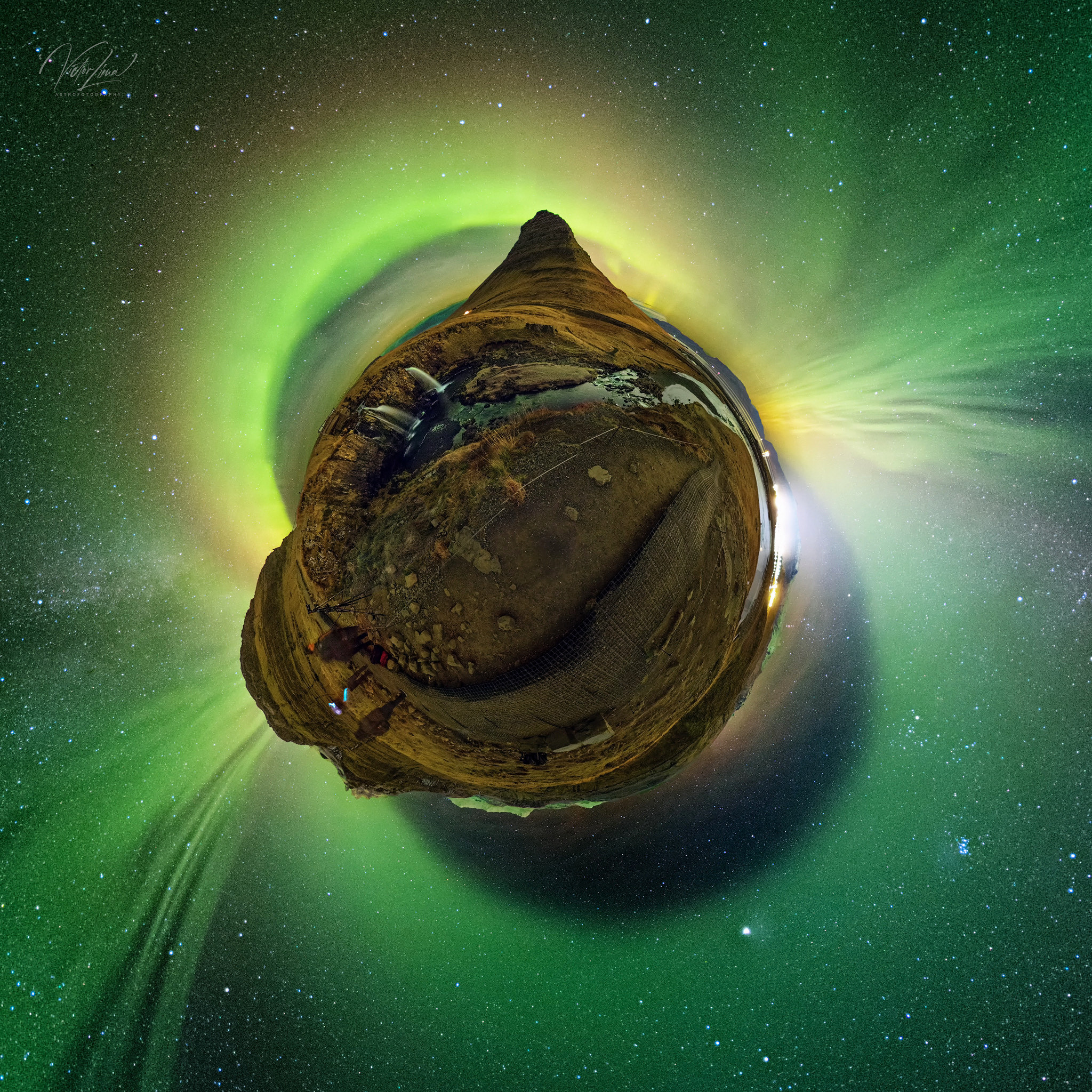
Little Planet Aurora
* Image Credit & Copyright: Victor Lima
https://www.trilhadeestrelas.com/about
https://app.astrobin.com/u/@victorlimaphoto#about
Explanation:
Immersed in an eerie greenish light, this rugged little planet appears to be home to stunning water falls and an impossibly tall mountain. It's planet Earth of course. On the night of November 9 the nadir-centered 360 degree mosaic was captured by digital camera from the Kirkjufell mountain area of western Iceland. Curtains of shimmering Aurora Borealis or Northern Lights provide the pale greenish illumination. The intense auroral display was caused by solar activity that rocked Earth's magnetosphere in early November and produced strong geomagnetic storms. Kirkjufell mountain itself stands at the top of the stereographic projection's circular horizon. Northern hemisphere skygazers will recognize the familiar stars of the Big Dipper just above Kirkjufell's peak. At lower right the compact Pleiades star cluster and truly giant planet Jupiter also shine in this little planet's night sky.
https://apod.nasa.gov/apod/ap231125.html
#space #earth #aurora #astrophotography #photography #NASA #science #nature
Alt...
2023 November 25
Little Planet Aurora
* Image Credit & Copyright: Victor Lima
Explanation:
Immersed in an eerie greenish light, this rugged little planet appears to be home to stunning water falls and an impossibly tall mountain. It's planet Earth of course. On the night of November 9 the nadir-centered 360 degree mosaic was captured by digital camera from the Kirkjufell mountain area of western Iceland. Curtains of shimmering Aurora Borealis or Northern Lights provide the pale greenish illumination. The intense auroral display was caused by solar activity that rocked Earth's magnetosphere in early November and produced strong geomagnetic storms. Kirkjufell mountain itself stands at the top of the stereographic projection's circular horizon. Northern hemisphere skygazers will recognize the familiar stars of the Big Dipper just above Kirkjufell's peak. At lower right the compact Pleiades star cluster and truly giant planet Jupiter also shine in this little planet's night sky.
Authors & editors: Robert Nemiroff (MTU) & Jerry Bonnell (UMCP)
NASA Official: Phillip Newman Specific rights apply.
NASA Web Privacy Policy and Important Notices
A service of: ASD at NASA / GSFC,
NASA Science Activation
& Michigan Tech. U.
2023 November 6
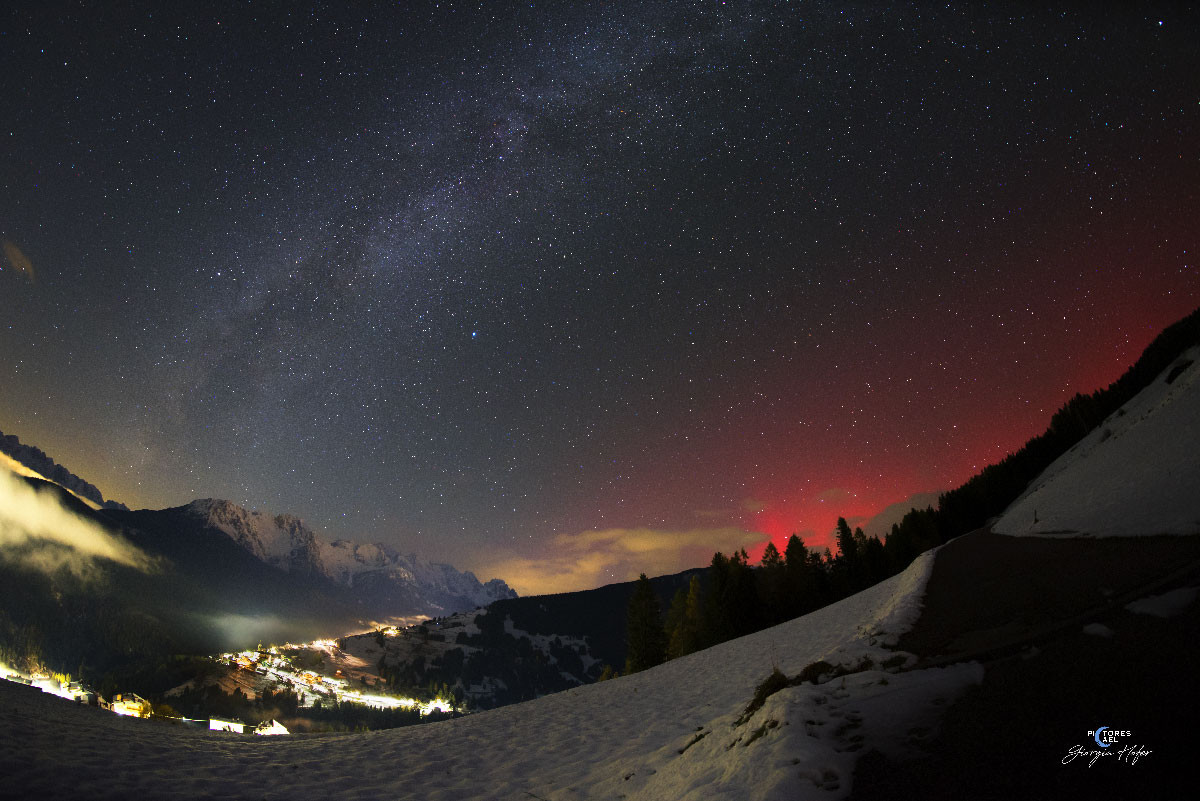
Red Aurora over Italy
* Image Credit & Copyright: Giorgia Hofer
https://www.giorgiahoferphotography.com/
Explanation:
What was that red glow on the horizon last night? Aurora. Our unusually active Sun produced a surface explosion a few days ago that sent out a burst of electrons, protons, and more massive charged nuclei. This coronal mass ejection (CME) triggered auroras here on Earth that are being reported unusually far south in Earth's northern hemisphere. For example, this was the first time that the astrophotographer captured aurora from her home country of Italy. Additionally, many images from these auroras appear quite red in color. In the featured image, the town of Comelico Superiore in the Italian Alps is visible in the foreground, with the central band of our Milky Way galaxy seen rising from the lower left. What draws the eye the most, though, is the bright red aurora on the far right. The featured image is a composite with the foreground and background images taken consecutively with the same camera and from the same location.
https://apod.nasa.gov/apod/ap231106.html
#space #earth #aurora #astrophotography #photography #NASA #science #nature
Alt...
2023 November 6
The night sky over a valley is shown complete with the central band of the Milky Way Galaxy crossing up from the lower left. On the right the sky just over the hill glows an unusual red: aurora.
Red Aurora over Italy
* Image Credit & Copyright: Giorgia Hofer
Explanation:
What was that red glow on the horizon last night? Aurora. Our unusually active Sun produced a surface explosion a few days ago that sent out a burst of electrons, protons, and more massive charged nuclei. This coronal mass ejection (CME) triggered auroras here on Earth that are being reported unusually far south in Earth's northern hemisphere. For example, this was the first time that the astrophotographer captured aurora from her home country of Italy. Additionally, many images from these auroras appear quite red in color. In the featured image, the town of Comelico Superiore in the Italian Alps is visible in the foreground, with the central band of our Milky Way galaxy seen rising from the lower left. What draws the eye the most, though, is the bright red aurora on the far right. The featured image is a composite with the foreground and background images taken consecutively with the same camera and from the same location.
Authors & editors: Robert Nemiroff (MTU) & Jerry Bonnell (UMCP)
NASA Official: Phillip Newman Specific rights apply.
NASA Web Privacy Policy and Important Notices
A service of: ASD at NASA / GSFC,
NASA Science Activation
& Michigan Tech. U.
"I'm thinking about designing my next TOPIC> as 'FOLLOWERS ONLY' .. would that be ok for you?
Bots-requests would not be accepted."
2023 November 5
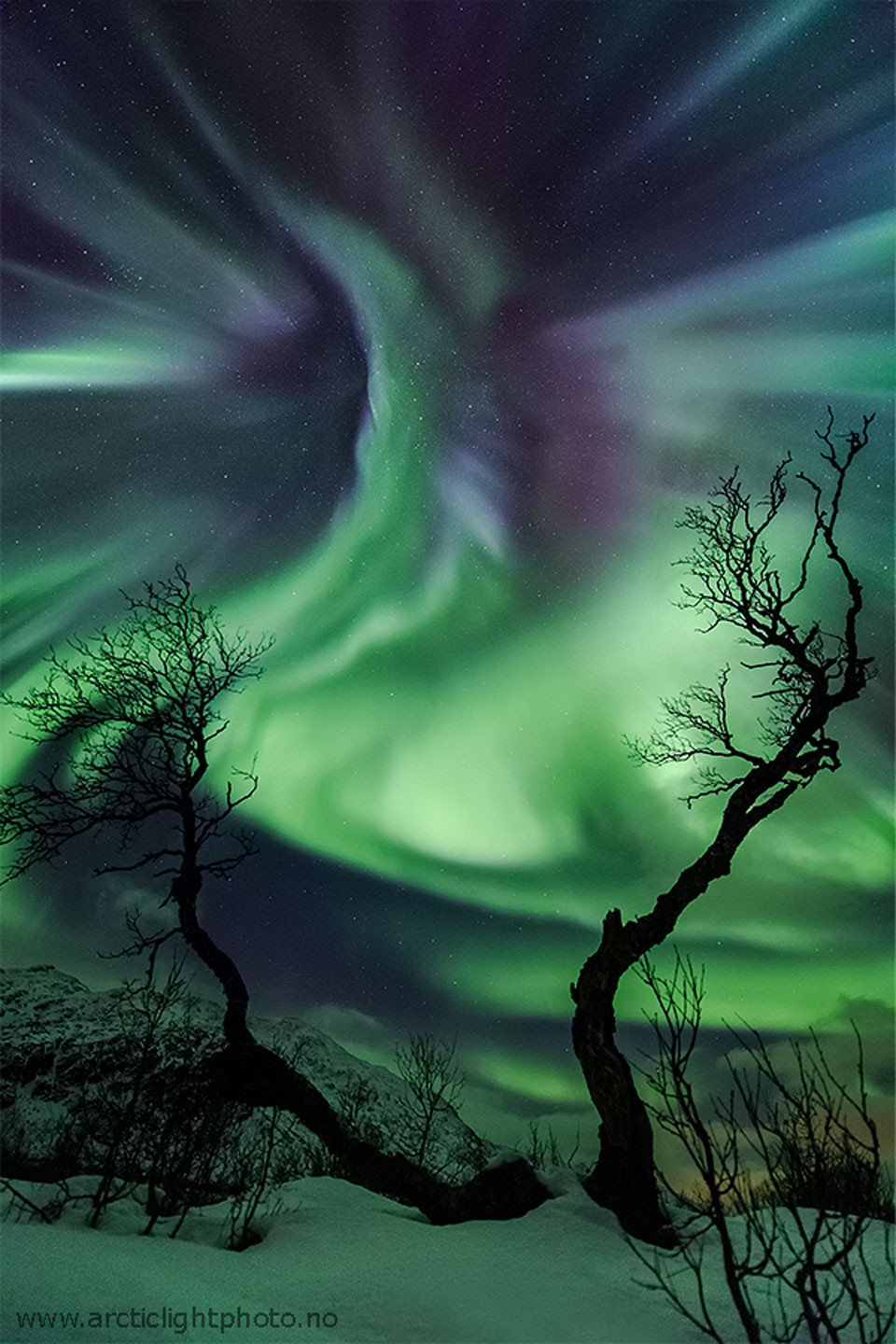
Creature Aurora Over Norway
* Image Credit & Copyright: Ole C. Salomonsen (Arctic Light Photo)
https://www.arcticlightphoto.no/about/
Explanation:
It was Halloween and the sky looked like a creature. Exactly which creature, the astrophotographer was unsure (but possibly you can suggest one). Exactly what caused this eerie apparition in 2013 was sure: one of the best auroral displays that year. This spectacular aurora had an unusually high degree of detail. Pictured here, the vivid green and purple auroral colors are caused by high atmospheric oxygen and nitrogen reacting to a burst of incoming electrons. Birch trees in Tromsø, Norway formed an also eerie foreground. Frequently, new photogenic auroras accompany new geomagnetic storms.
https://svs.gsfc.nasa.gov/31248/
https://annex.exploratorium.edu/learning_studio/auroras/difcolors.html
https://apod.nasa.gov/apod/ap231105.html
#space #earth #aurora #astrophotography #photography #NASA #science #nature
Alt...
2023 November 5
The night sky over a snowy tree-adorned landscape glows in green and purple. The auroral glow might appear to some to be shaped like a creature.
Creature Aurora Over Norway
* Image Credit & Copyright: Ole C. Salomonsen (Arctic Light Photo)
Explanation:
It was Halloween and the sky looked like a creature. Exactly which creature, the astrophotographer was unsure (but possibly you can suggest one). Exactly what caused this eerie apparition in 2013 was sure: one of the best auroral displays that year. This spectacular aurora had an unusually high degree of detail. Pictured here, the vivid green and purple auroral colors are caused by high atmospheric oxygen and nitrogen reacting to a burst of incoming electrons. Birch trees in Tromsø, Norway formed an also eerie foreground. Frequently, new photogenic auroras accompany new geomagnetic storms.
Authors & editors: Robert Nemiroff (MTU) & Jerry Bonnell (UMCP)
NASA Official: Phillip Newman Specific rights apply.
NASA Web Privacy Policy and Important Notices
A service of: ASD at NASA / GSFC,
NASA Science Activation
& Michigan Tech. U.
2023 October 22
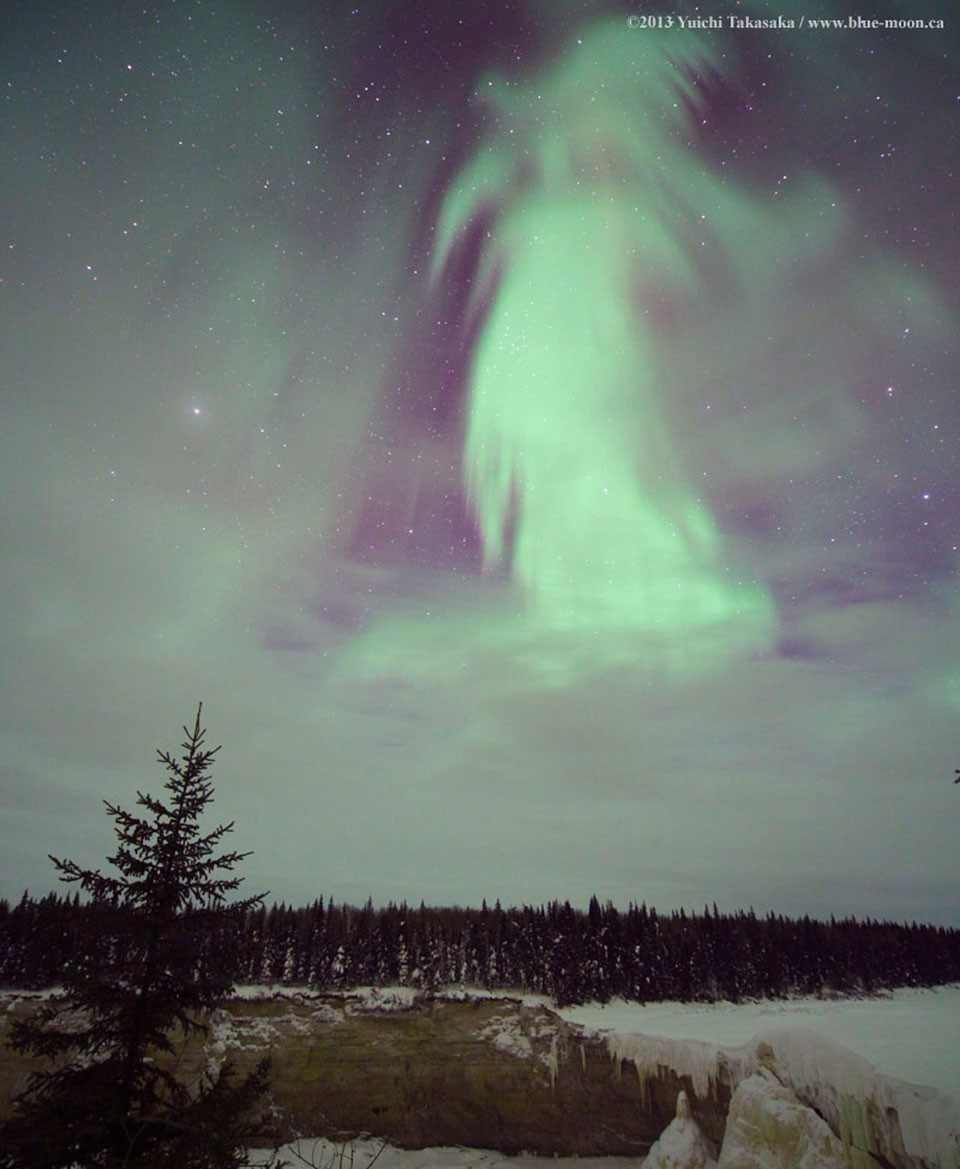
Ghost Aurora over Canada
* Image Credit & Copyright: Yuichi Takasaka, TWAN
http://www.blue-moon.ca/contact.html
https://twanight.org/profile/yuichi-takasaka/
Explanation:
What does this aurora look like to you? While braving the cold to watch the skies above northern Canada early one morning in 2013, a most unusual aurora appeared. The aurora definitely appeared to be shaped like something, but what? Two ghostly possibilities recorded by the astrophotographer were "witch" and "goddess of dawn", but please feel free to suggest your own Halloween-enhanced impressions. Regardless of fantastical pareidolic interpretations, the pictured aurora had a typical green color and was surely caused by the scientifically commonplace action of high-energy particles from space interacting with oxygen in Earth's upper atmosphere. In the image foreground, at the bottom, is a frozen Alexandra Falls, while evergreen trees cross the middle.
https://www.nasa.gov/image-article/earths-upper-atmosphere/
https://asterisk.apod.com/viewtopic.php?t=43394
http://blue-moon.ca/tonight%27s_aurora.html
https://apod.nasa.gov/apod/ap231022.html
#space #earth #aurora #astrophotography #photography #NASA #science #nature
Alt...
2023 October 22
A landscape is pictured with snow and a line of evergreen trees. In the sky is a field of stars but also notable green aurora. The largest aurora appears similar in form to a Halloween ghost,
Ghost Aurora over Canada
* Image Credit & Copyright: Yuichi Takasaka, TWAN
Explanation:
What does this aurora look like to you? While braving the cold to watch the skies above northern Canada early one morning in 2013, a most unusual aurora appeared. The aurora definitely appeared to be shaped like something, but what? Two ghostly possibilities recorded by the astrophotographer were "witch" and "goddess of dawn", but please feel free to suggest your own Halloween-enhanced impressions. Regardless of fantastical pareidolic interpretations, the pictured aurora had a typical green color and was surely caused by the scientifically commonplace action of high-energy particles from space interacting with oxygen in Earth's upper atmosphere. In the image foreground, at the bottom, is a frozen Alexandra Falls, while evergreen trees cross the middle.
Authors & editors: Robert Nemiroff (MTU) & Jerry Bonnell (UMCP)
NASA Official: Phillip Newman Specific rights apply.
NASA Web Privacy Policy and Important Notices
A service of: ASD at NASA / GSFC,
NASA Science Activation
& Michigan Tech. U.
"This thread on the subject of auroras will soon be continued. For today, however, I wish you a good, peaceful night and wonderful magical dreams .."
2023 July 30
Spiral Aurora over Icelandic Divide
* Image Credit & Copyright: Juan Carlos Casado (Starry Earth, TWAN)
https://twanight.org/profile/juan-carlos-casado/
https://www.flickr.com/photos/starryearth/albums/
Explanation:
Admire the beauty but fear the beast. The beauty is the aurora overhead, here taking the form of a great green spiral, seen between picturesque clouds with the bright Moon to the side and stars in the background. The beast is the wave of charged particles that creates the aurora but might, one day, impair civilization. In 1859, following notable auroras seen all across the globe, a pulse of charged particles from a coronal mass ejection (CME) associated with a solar flare impacted Earth's magnetosphere so forcefully that it created the Carrington Event. This assault from the Sun compressed the Earth's magnetic field so violently that it created high currents and sparks along telegraph wires, shocking many telegraph operators. Were a Carrington-class event to impact the Earth today, speculation holds that damage might occur to global power grids and electronics on a scale never yet experienced. The featured aurora was imaged in 2016 over Thingvallavatn Lake in Iceland, a lake that partly fills a fault that divides Earth's large Eurasian and North American tectonic plates.
https://apod.nasa.gov/apod/ap230730.html
#space #earth #aurora #astrophotography #photography #NASA #science #nature
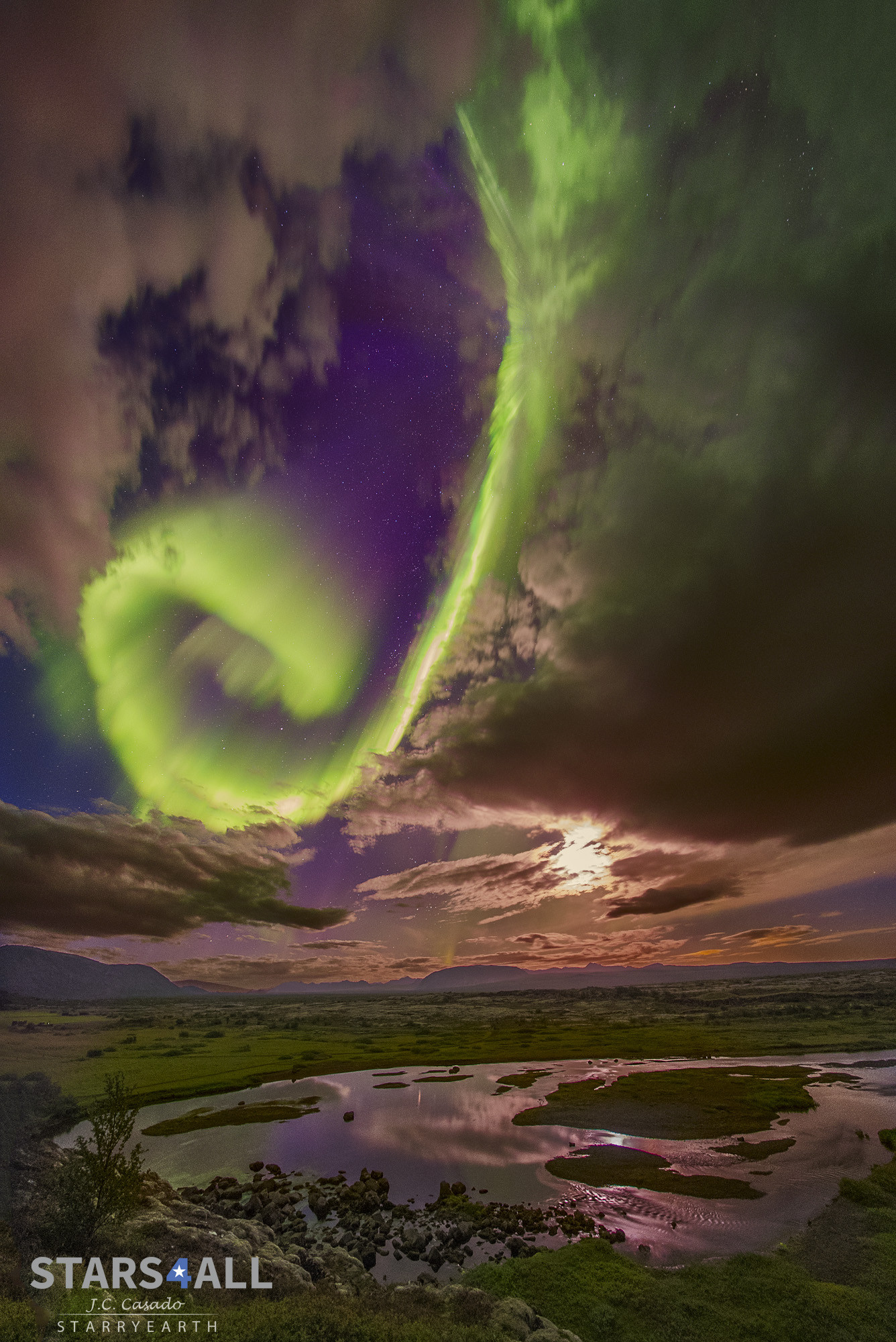
Alt...
2023 July 30
A bright green spiral aurora is seen in a break in the clouds before a purple background. The foreground contains green grassland and a circular lake.
Spiral Aurora over Icelandic Divide
* Image Credit & Copyright: Juan Carlos Casado (Starry Earth, TWAN)
Explanation:
Admire the beauty but fear the beast. The beauty is the aurora overhead, here taking the form of a great green spiral, seen between picturesque clouds with the bright Moon to the side and stars in the background. The beast is the wave of charged particles that creates the aurora but might, one day, impair civilization. In 1859, following notable auroras seen all across the globe, a pulse of charged particles from a coronal mass ejection (CME) associated with a solar flare impacted Earth's magnetosphere so forcefully that it created the Carrington Event. This assault from the Sun compressed the Earth's magnetic field so violently that it created high currents and sparks along telegraph wires, shocking many telegraph operators. Were a Carrington-class event to impact the Earth today, speculation holds that damage might occur to global power grids and electronics on a scale never yet experienced. The featured aurora was imaged in 2016 over Thingvallavatn Lake in Iceland, a lake that partly fills a fault that divides Earth's large Eurasian and North American tectonic plates.
Authors & editors: Robert Nemiroff (MTU) & Jerry Bonnell (UMCP)
NASA Official: Phillip Newman Specific rights apply.
"I wish you a wonderful and peaceful
good morning with this fantastic panorama by Jeff Dai"
2024 June 26
Timelapse: Aurora, SAR, and the Milky Way
* Video Credit & Copyright: Jeff Dai (TWAN);
https://twanight.org/profile/jeff-dai/
* Music: Ibaotu catalog number 771024 (Used with permission)
Explanation:
What's happening in the sky this unusual night? Most striking in the featured 4.5-hour 360-degree panoramic video, perhaps, is the pink and purple aurora. That's because this night, encompassing May 11, was famous for its auroral skies around the world. As the night progresses, auroral bands shimmer, the central band of our Milky Way Galaxy rises, and stars shift as the Earth rotates beneath them. Captured here simultaneously is a rare red band running above the aurora: a SAR arc, seen to change only slightly. The flashing below the horizon is caused by passing cars, while the moving spots in the sky are satellites and airplanes. The featured video was captured from Xinjiang, China with four separate cameras
https://apod.nasa.gov/apod/ap240626.html
#space #earth #aurora #astrophotography #photography #NASA #science #nature
2023 March 27
Aurora Over Arctic Henge
* Image Credit & Copyright: Cari Letelier
https://cariletelier.com/about/
Explanation:
Reports of powerful solar flares started a seven-hour quest north to capture modern monuments against an aurora-filled sky. The peaks of iconic Arctic Henge in Raufarhöfn in northern Iceland were already aligned with the stars: some are lined up toward the exact north from one side and toward exact south from the other. The featured image, taken after sunset late last month, looks directly south, but since the composite image covers so much of the sky, the north star Polaris is actually visible at the very top of the frame. Also visible are familiar constellations including the Great Bear (Ursa Major) on the left, and the Hunter (Orion) on the lower right. The quest was successful. The sky lit up dramatically with bright and memorable auroras that shimmered with amazing colors including red, pink, yellow, and green -- sometimes several at once.
https://apod.nasa.gov/apod/ap230327.html
#space #earth #aurora #astrophotography #photography #NASA #science #nature

Alt...
2023 March 27
Multi-colored aurora are seen above an unusual stone gateway, the first of several similar gateways seen in the distance.
Aurora Over Arctic Henge
* Image Credit & Copyright: Cari Letelier
Explanation:
Reports of powerful solar flares started a seven-hour quest north to capture modern monuments against an aurora-filled sky. The peaks of iconic Arctic Henge in Raufarhöfn in northern Iceland were already aligned with the stars: some are lined up toward the exact north from one side and toward exact south from the other. The featured image, taken after sunset late last month, looks directly south, but since the composite image covers so much of the sky, the north star Polaris is actually visible at the very top of the frame. Also visible are familiar constellations including the Great Bear (Ursa Major) on the left, and the Hunter (Orion) on the lower right. The quest was successful. The sky lit up dramatically with bright and memorable auroras that shimmered with amazing colors including red, pink, yellow, and green -- sometimes several at once.
Authors & editors: Robert Nemiroff (MTU) & Jerry Bonnell (UMCP)
NASA Official: Phillip Newman Specific rights apply.
NASA Web Privacy Policy and Important Notices
A service of: ASD at NASA / GSFC,
NASA Science Activation
& Michigan Tech. U.
2023 July 4
Aurora over Icelandic Waterfall
* Image Credit & Copyright: Cari Letelier
https://www.instagram.com/cariletelier/
Explanation:
It seemed like the sky exploded. The original idea was to photograph an aurora over a waterfall. After waiting for hours under opaque clouds, though, hope was running out. Others left. Then, unexpectedly, the clouds moved away. Suddenly, particles from a large solar magnetic storm were visible impacting the Earth's upper atmosphere with full effect. The night sky filled with colors and motion in a thrilling auroral display. Struggling to steady the camera from high Earthly winds, the 34 exposures that compose the featured image were taken. The resulting featured composite image shows the photogenic Godafoss (Goðafoss) waterfall in northern Iceland in front of a very active aurora in late February. The solar surface explosion that expelled the energetic particles occurred a few days before. Our Sun is showing an impressive amount of surface activity as it approaches solar maximum, indicating that more impressive auroras are likely to appear in Earth's northern and southern sky over the next few years.
https://apod.nasa.gov/apod/ap230704.html
#space #earth #aurora #astrophotography #photography #NASA #science #nature

Alt...
2023 July 4
Green aurora are seen against a blue sky over a series of picturesque waterfalls.
Aurora over Icelandic Waterfall
* Image Credit & Copyright: Cari Letelier
Explanation:
It seemed like the sky exploded. The original idea was to photograph an aurora over a waterfall. After waiting for hours under opaque clouds, though, hope was running out. Others left. Then, unexpectedly, the clouds moved away. Suddenly, particles from a large solar magnetic storm were visible impacting the Earth's upper atmosphere with full effect. The night sky filled with colors and motion in a thrilling auroral display. Struggling to steady the camera from high Earthly winds, the 34 exposures that compose the featured image were taken. The resulting featured composite image shows the photogenic Godafoss (Goðafoss) waterfall in northern Iceland in front of a very active aurora in late February. The solar surface explosion that expelled the energetic particles occurred a few days before. Our Sun is showing an impressive amount of surface activity as it approaches solar maximum, indicating that more impressive auroras are likely to appear in Earth's northern and southern sky over the next few years.
Authors & editors: Robert Nemiroff (MTU) & Jerry Bonnell (UMCP)
NASA Official: Phillip Newman Specific rights apply.
NASA Web Privacy Policy and Important Notices
A service of: ASD at NASA / GSFC,
NASA Science Activation
& Michigan Tech. U.
"I'm thinking about designing my next TOPIC> as 'FOLLOWERS ONLY' .. would that be ok for you?
Bots-requests would not be accepted."
"This huge photo of LI Hang was originally 4906x10451 pixels and 5.71 Mb too big to upload, but defcon.social is already very generous in terms of dimensions and file size. After editing it with the command: 'convert in.jpg -resize 3755x8000 out.jpg', I was able to upload it, but the file size had grown to 7.05 MB. That doesn't really make sense..
Does anyone know of a more appropriate imagemagick command without increasing the file size and without losing quality?
I would be happy about suggestions .."
@support
2023 July 2
Milky Way and Aurora over Antarctica
* Image Credit & Copyright: LI Hang
https://www.weibo.com/lihang999
https://www.laitimes.com/en/article/3s9q7_48yph.html
https://pole.whu.edu.cn/en/gb_news.php?modid=02002&id=35
Explanation:
It was one of the better skies of this long night. In parts of Antarctica, not only is it winter, but the Sun can spend weeks below the horizon. At China's Zhongshan Station, people sometimes venture out into the cold to photograph a spectacular night sky. The featured image from one such outing was taken in mid-July of 2015, just before the end of this polar night. Pointing up, the wide angle lens captured not only the ground at the bottom, but at the top as well. In the foreground, a colleague is taking pictures. In the distance, a spherical satellite receiver and several windmills are visible. Numerous stars dot the night sky, including Sirius and Canopus. Far in the background, stretching overhead from horizon to horizon, is the central band of our Milky Way Galaxy. Even further in the distance, visible as extended smudges near the top, are the Large and Small Magellanic Clouds, satellite galaxies near our huge Milky Way Galaxy.
https://apod.nasa.gov/apod/ap230702.html
#space #earth #aurora #astrophotography #photography #NASA #science #nature
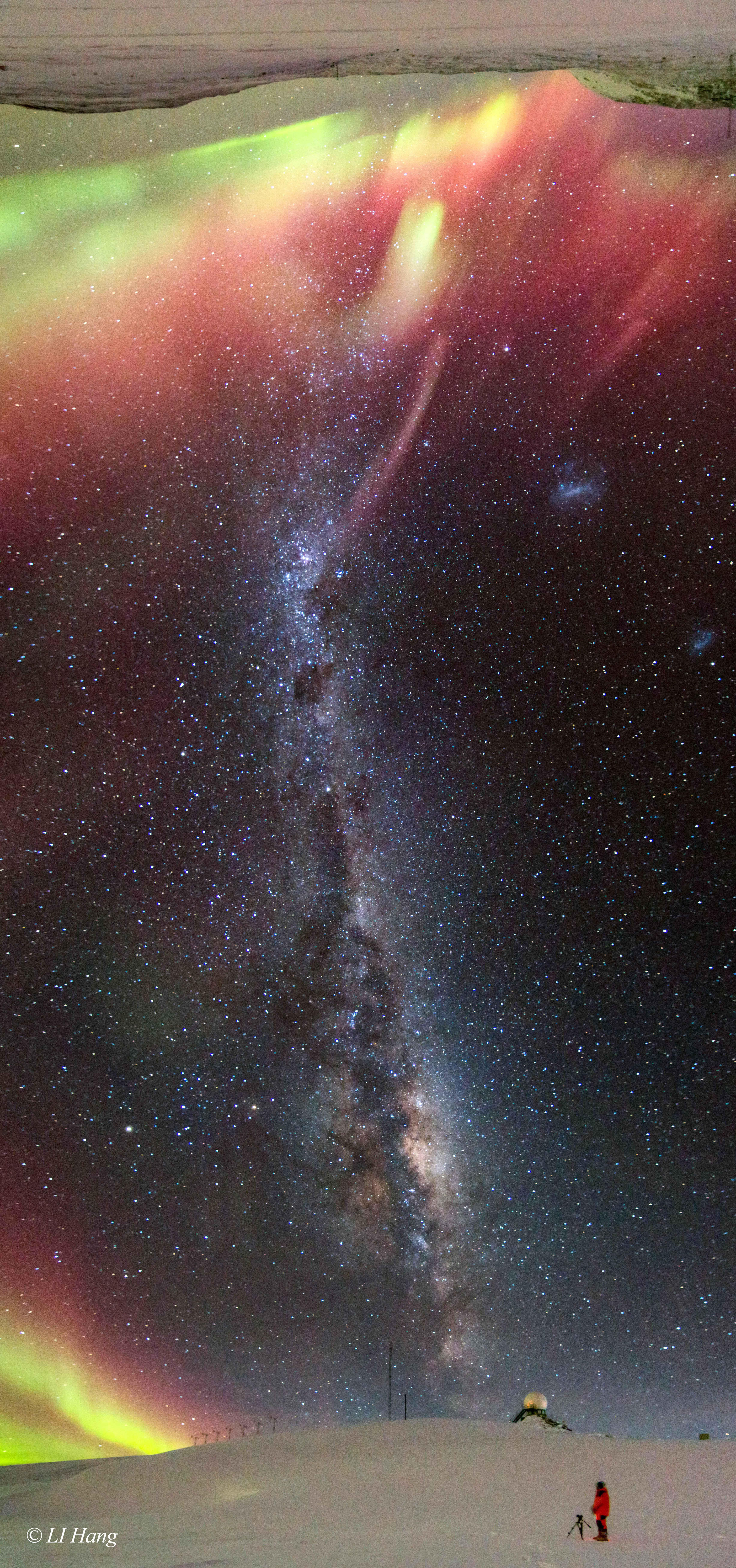
Alt...
2023 July 2
A long vertical image shows a band of the night sky from horizon at the bottom to the opposite horizon -- at the image top. A person stands on a snow covered landscape with the central band of the Milky Way running between horizons. Each horizon is lit by red, yellow, and green auroras.
Milky Way and Aurora over Antarctica
* Image Credit & Copyright: LI Hang
Explanation:
It was one of the better skies of this long night. In parts of Antarctica, not only is it winter, but the Sun can spend weeks below the horizon. At China's Zhongshan Station, people sometimes venture out into the cold to photograph a spectacular night sky. The featured image from one such outing was taken in mid-July of 2015, just before the end of this polar night. Pointing up, the wide angle lens captured not only the ground at the bottom, but at the top as well. In the foreground, a colleague is taking pictures. In the distance, a spherical satellite receiver and several windmills are visible. Numerous stars dot the night sky, including Sirius and Canopus. Far in the background, stretching overhead from horizon to horizon, is the central band of our Milky Way Galaxy. Even further in the distance, visible as extended smudges near the top, are the Large and Small Magellanic Clouds, satellite galaxies near our huge Milky Way Galaxy.
Authors & editors: Robert Nemiroff (MTU) & Jerry Bonnell (UMCP)
NASA Official: Phillip Newman Specific rights apply.
"Do you see their nests? A pretty hip and chic residential area for white storks:
https://ourtour.co.uk/home/storks-and-art-in-los-barruecos-caceres/
https://animal.dearjulius.com/2019/08/white-storks-in-spain.html
https://visit-western-spain.com/los-barruecos-natural-park/ "
2023 April 25
Northern Lights over Southern Europe
* Image Credit & Copyright: Lorenzo Cordero
https://www.instagram.com/elcielodecaceres/
Explanation:
Did you see an aurora over the past two nights (2023)? Many people who don't live in Earth's far north did. Reports of aurora came in not only from northern locales in the USA as Alaska, but as far south as Texas and Arizona. A huge auroral oval extended over Europe and Asia, too. Pictured, an impressively red aurora was captured last night near the town of Cáceres in central Spain. Auroras were also reported in parts of southern Spain. The auroras resulted from a strong Coronal Mass Event (CME) that occurred on the Sun a few days ago. Particles from the CME crossed the inner Solar System before colliding with the Earth's magnetosphere. From there, electrons and protons spiraled down the Earth's northern magnetic field lines and collided with oxygen and nitrogen in Earth's atmosphere, causing picturesque auroral glows. Our unusually active Sun may provide future opportunities to see the northern lights in southern skies.
https://apod.nasa.gov/apod/ap230425.html
#space #earth #aurora #astrophotography #photography #NASA #science #nature
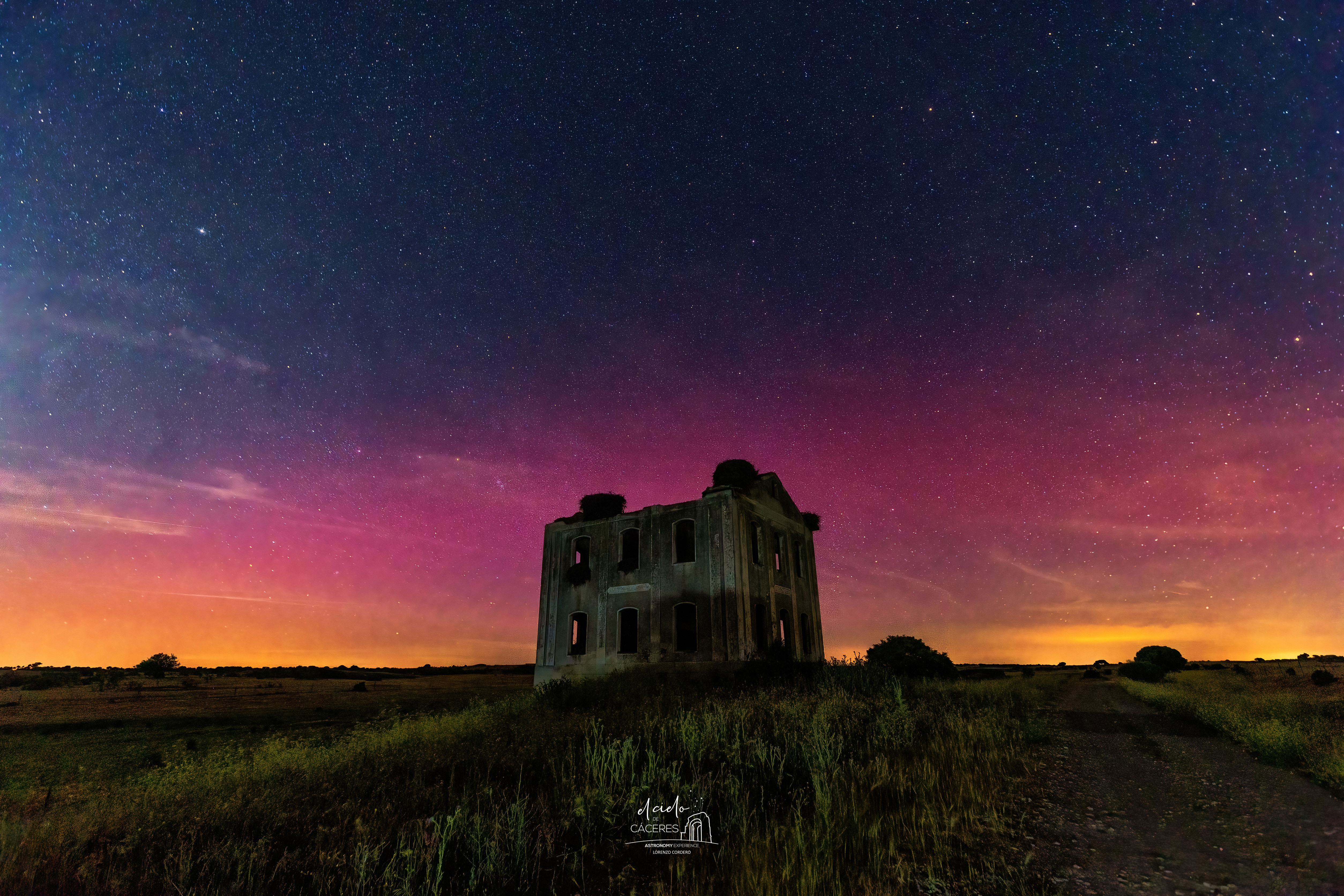
Alt...
2023 April 25
A dark rectangular building is seen across a green field with colorful aurora, mostly red, seen in the background sky. Past the aurora, the sky is also filled with stars.
Northern Lights over Southern Europe
* Image Credit & Copyright: Lorenzo Cordero
Explanation:
Did you see an aurora over the past two nights (2023)? Many people who don't live in Earth's far north did. Reports of aurora came in not only from northern locales in the USA as Alaska, but as far south as Texas and Arizona. A huge auroral oval extended over Europe and Asia, too. Pictured, an impressively red aurora was captured last night near the town of Cáceres in central Spain. Auroras were also reported in parts of southern Spain. The auroras resulted from a strong Coronal Mass Event (CME) that occurred on the Sun a few days ago. Particles from the CME crossed the inner Solar System before colliding with the Earth's magnetosphere. From there, electrons and protons spiraled down the Earth's northern magnetic field lines and collided with oxygen and nitrogen in Earth's atmosphere, causing picturesque auroral glows. Our unusually active Sun may provide future opportunities to see the northern lights in southern skies.
Authors & editors: Robert Nemiroff (MTU) & Jerry Bonnell (UMCP)
NASA Official: Phillip Newman Specific rights apply.
NASA Web Privacy Policy and Important Notices
A service of: ASD at NASA / GSFC,
NASA Science Activation
& Michigan Tech. U.
"I'm thinking about designing my next TOPIC> as 'FOLLOWERS ONLY' .. would that be ok for you?
Bots-requests would not be accepted."
".. so so..
so you would also dare to climb up there and stand for the snapshot at the snowy and icy abyss? But do you also dare to send this testimony of your daring to your mom on Mother's Day? Bet that not.."
2023 January 22
In Green Company: Aurora over Norway
* Image Credit & Copyright: Max Rive
https://www.instagram.com/maxrivephotography/
Explanation:
Raise your arms if you see an aurora. With those instructions, two nights went by with, well, clouds -- mostly. On the third night of returning to same peaks, though, the sky not only cleared up but lit up with a spectacular auroral display. Arms went high in the air, patience and experience paid off, and the creative featured image was captured as a composite from three separate exposures. The setting is a summit of the Austnesfjorden fjord close to the town of Svolvear on the Lofoten islands in northern Norway. The time was early 2014. Although our Sun passed the solar minimum of its 11-year cycle only a few years ago, surface activity is picking up and already triggering more spectacular auroras here on Earth.
https://apod.nasa.gov/apod/ap230122.html
#space #earth #aurora #astrophotography #photography #NASA #science #nature
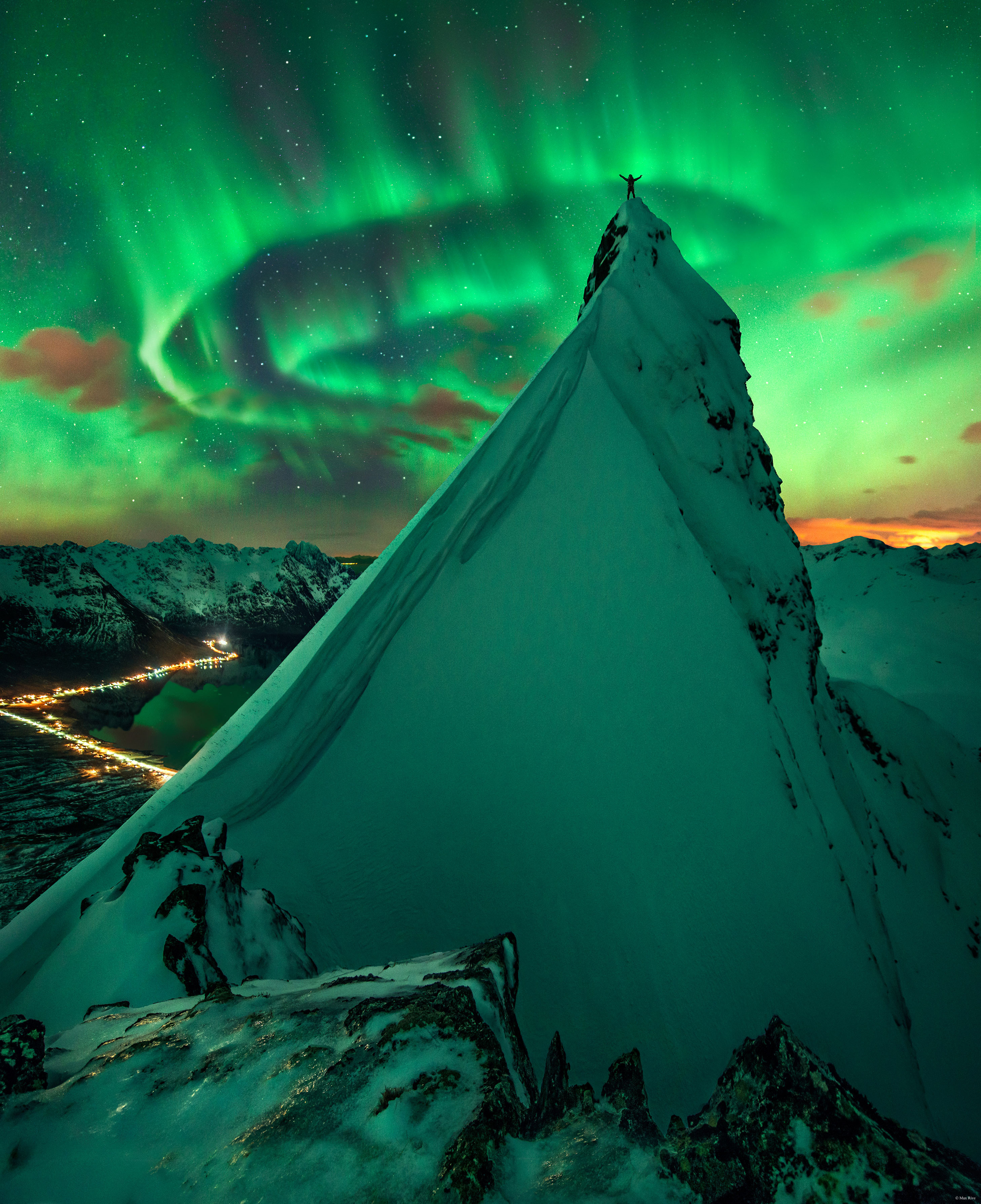
Alt...
2023 January 22
A person stands on a steep snow-covered hill with their arms raised. In the distance green aurora are visible. Past that stars are visible.
In Green Company: Aurora over Norway
* Image Credit & Copyright: Max Rive
Explanation:
Raise your arms if you see an aurora. With those instructions, two nights went by with, well, clouds -- mostly. On the third night of returning to same peaks, though, the sky not only cleared up but lit up with a spectacular auroral display. Arms went high in the air, patience and experience paid off, and the creative featured image was captured as a composite from three separate exposures. The setting is a summit of the Austnesfjorden fjord close to the town of Svolvear on the Lofoten islands in northern Norway. The time was early 2014. Although our Sun passed the solar minimum of its 11-year cycle only a few years ago, surface activity is picking up and already triggering more spectacular auroras here on Earth.
Authors & editors: Robert Nemiroff (MTU) & Jerry Bonnell (UMCP)
NASA Official: Phillip Newman Specific rights apply.
NASA Web Privacy Policy and Important Notices
A service of: ASD at NASA / GSFC,
NASA Science Activation
& Michigan Tech. U.
2023 January 11
Spiral Aurora over Iceland
* Image Credit & Copyright: Stefano Pellegrini
https://www.instagram.com/pels_photo/
https://www.livescience.com/planet-earth/arctic/northern-lights-photographer-of-the-year-winners
Explanation:
The scene may look like a fantasy, but it's really Iceland. The rock arch is named Gatklettur and located on the island's northwest coast. Some of the larger rocks in the foreground span a meter across. The fog over the rocks is really moving waves averaged over long exposures. The featured image is a composite of several foreground and background shots taken with the same camera and from the same location on the same night last November. The location was picked for its picturesque foreground, but the timing was planned for its colorful background: aurora. The spiral aurora, far behind the arch, was one of the brightest seen in the astrophotographer's life. The coiled pattern was fleeting, though, as auroral patterns waved and danced for hours during the cold night. Far in the background were the unchanging stars, with Earth's rotation causing them to appear to slowly circle the sky's northernmost point near Polaris.
https://apod.nasa.gov/apod/ap230111.html
#space #earth #aurora #astrophotography #photography #NASA #science #nature
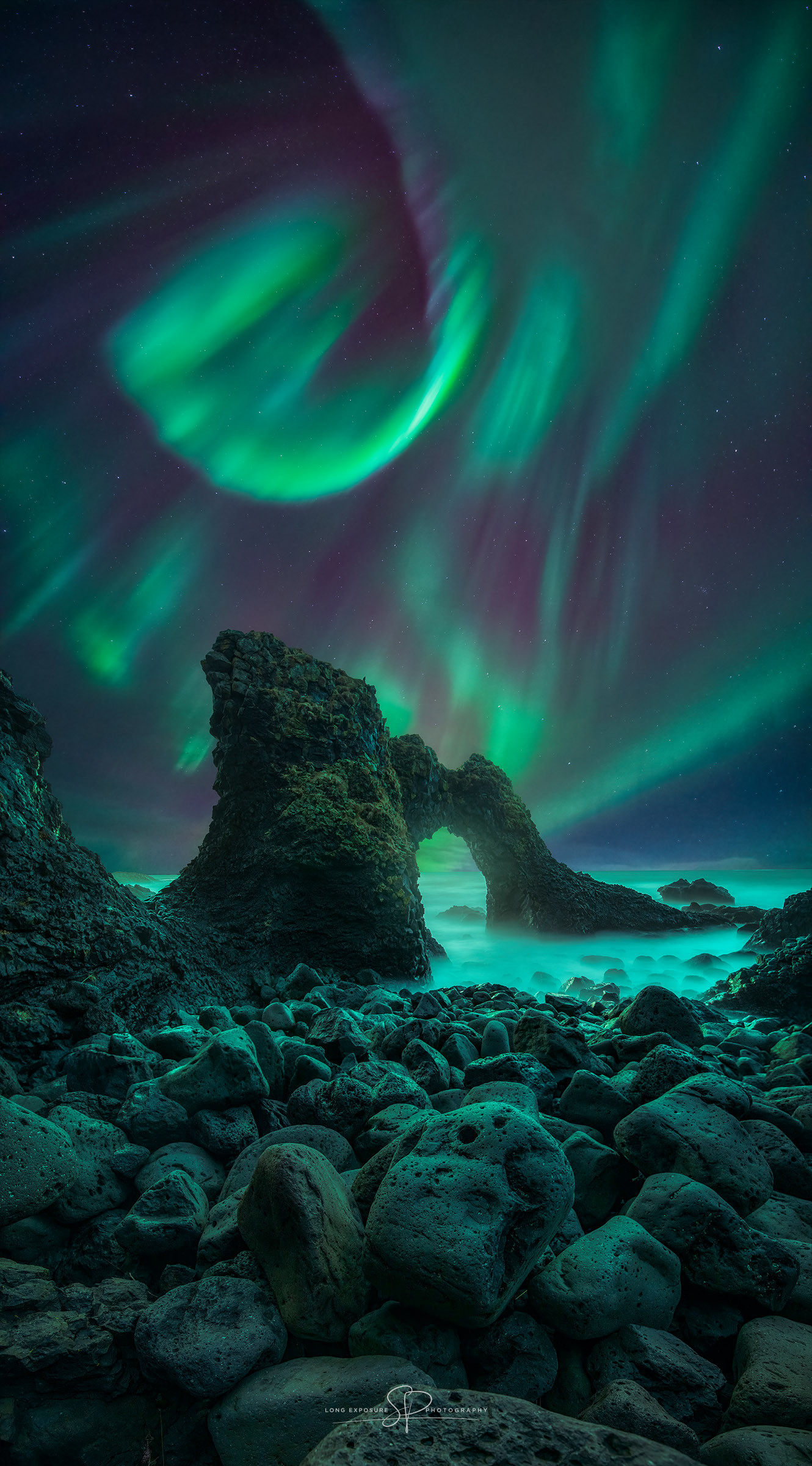
Alt...
2023 January 11
A green aurora is pictured above and beyond a dark rocky arch. Faint stars dot the background.
Spiral Aurora over Iceland
* Image Credit & Copyright: Stefano Pellegrini
Explanation:
The scene may look like a fantasy, but it's really Iceland. The rock arch is named Gatklettur and located on the island's northwest coast. Some of the larger rocks in the foreground span a meter across. The fog over the rocks is really moving waves averaged over long exposures. The featured image is a composite of several foreground and background shots taken with the same camera and from the same location on the same night last November. The location was picked for its picturesque foreground, but the timing was planned for its colorful background: aurora. The spiral aurora, far behind the arch, was one of the brightest seen in the astrophotographer's life. The coiled pattern was fleeting, though, as auroral patterns waved and danced for hours during the cold night. Far in the background were the unchanging stars, with Earth's rotation causing them to appear to slowly circle the sky's northernmost point near Polaris.
Authors & editors: Robert Nemiroff (MTU) & Jerry Bonnell (UMCP)
NASA Official: Phillip Newman Specific rights apply.
NASA Web Privacy Policy and Important Notices
A service of: ASD at NASA / GSFC,
NASA Science Activation
& Michigan Tech. U.
"I'm thinking about designing my next TOPIC> as 'FOLLOWERS ONLY' .. would that be ok for you?
Bots-requests would not be accepted."
2022 April 4
A Vortex Aurora over Iceland
* Image Credit & Copyright: Christophe Suarez
https://france3-regions.franceinfo.fr/provence-alpes-cote-d-azur/alpes-maritimes/nice/photos-je-suis-temoin-de-phenomenes-encore-tres-mysterieux-ce-chasseur-d-orages-immortalise-les-cadeaux-du-ciel-3020456.html
Explanation:
No, the car was not in danger of being vacuumed into space by the big sky vortex. For one reason, the vortex was really an aurora, and since auroras are created by particles striking the Earth from space, they do not create a vacuum. This rapidly developing auroral display was caused by a Coronal Mass Ejection from the Sun that passed by the Earth closely enough to cause a ripple in Earth's magnetosphere. The upper red parts of the aurora occur over 250 kilometers high with its red glow created by atmospheric atomic oxygen directly energized by incoming particles. The lower green parts of the aurora occur over 100 kilometers high with its green glow created by atmospheric atomic oxygen energized indirectly by collisions with first-energized molecular nitrogen. Below 100 kilometers, there is little atomic oxygen, which is why auroras end abruptly. The concentric cylinders depict a dramatic auroral corona as seen from the side. The featured image was created from a single 3-second exposure taken in mid-March over Lake Myvatn in Iceland.
https://science.nasa.gov/heliophysics/focus-areas/magnetosphere-ionosphere/
https://apod.nasa.gov/apod/ap220404.html
#space #earth #aurora #astrophotography #photography #NASA #science #physics #nature #education
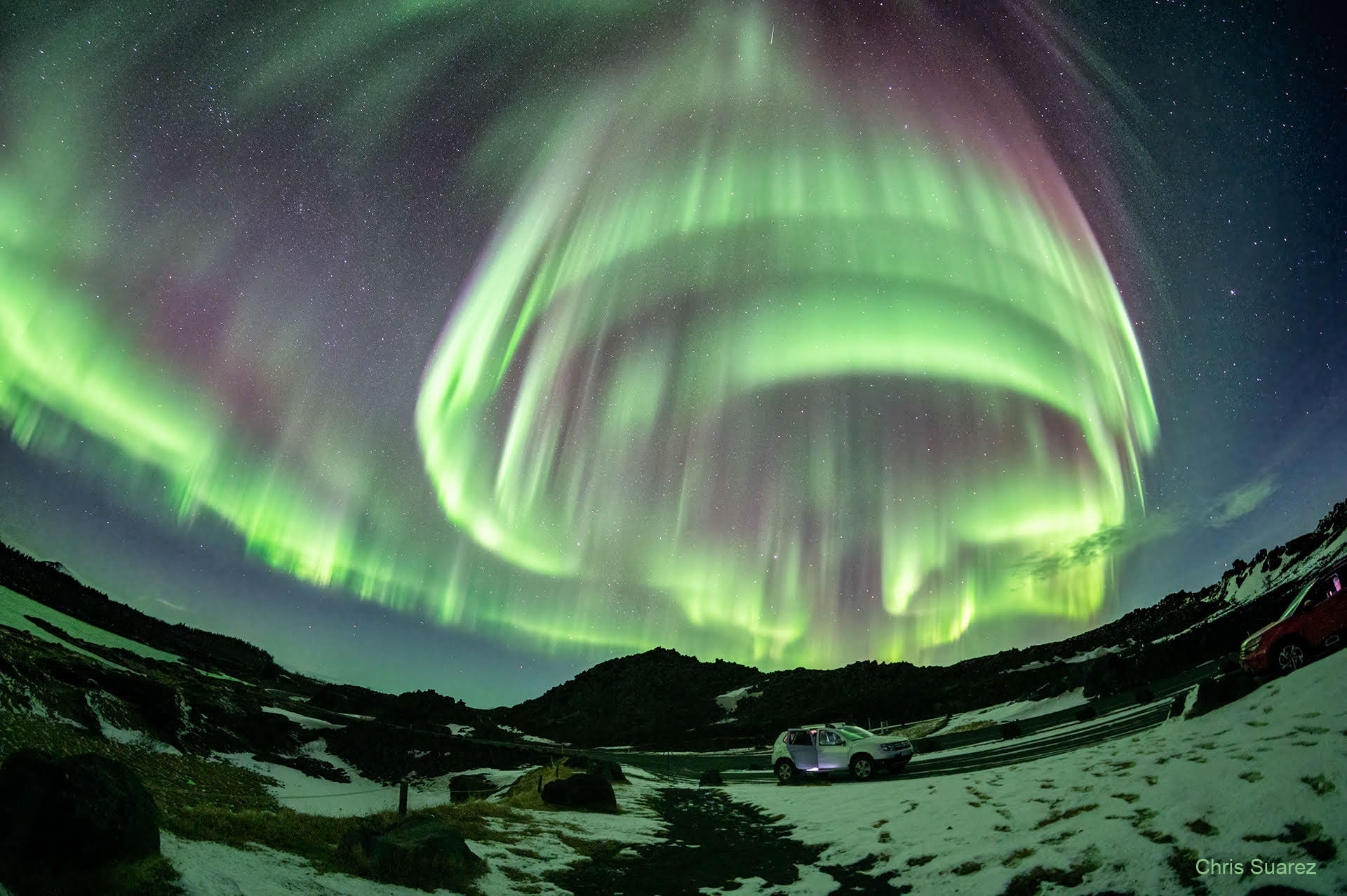
Alt...
2022 April 4
The featured image depicts a bright aurora that occurred over Iceland in March. The curvature of the aurora makes it look like a vortex.
A Vortex Aurora over Iceland
* Image Credit & Copyright: Christophe Suarez
Explanation:
No, the car was not in danger of being vacuumed into space by the big sky vortex. For one reason, the vortex was really an aurora, and since auroras are created by particles striking the Earth from space, they do not create a vacuum. This rapidly developing auroral display was caused by a Coronal Mass Ejection from the Sun that passed by the Earth closely enough to cause a ripple in Earth's magnetosphere. The upper red parts of the aurora occur over 250 kilometers high with its red glow created by atmospheric atomic oxygen directly energized by incoming particles. The lower green parts of the aurora occur over 100 kilometers high with its green glow created by atmospheric atomic oxygen energized indirectly by collisions with first-energized molecular nitrogen. Below 100 kilometers, there is little atomic oxygen, which is why auroras end abruptly. The concentric cylinders depict a dramatic auroral corona as seen from the side. The featured image was created from a single 3-second exposure taken in mid-March over Lake Myvatn in Iceland.
Authors & editors: Robert Nemiroff (MTU) & Jerry Bonnell (UMCP)
NASA Official: Phillip Newman Specific rights apply.
2022 March 22
A Whale of an Aurora over Swedish Forest
* Image Credit & Copyright: Göran Strand
https://astrofotografen.se/
Explanation:
What's that in the sky? An aurora. A large coronal mass ejection occurred on our Sun earlier this month, throwing a cloud of fast-moving electrons, protons, and ions toward the Earth. Part of this cloud impacted our Earth's magnetosphere and, bolstered by a sudden gap, resulted in spectacular auroras being seen at some high northern latitudes. Featured here is a particularly photogenic auroral corona captured above a forest in Sweden from a scenic perch overlooking the city of Östersund. To some, this shimmering green glow of recombining atmospheric oxygen might appear like a large whale, but feel free to share what it looks like to you. The unusually quiet Sun of the past few years has now passed. As our Sun now approaches a solar maximum in its 11-year solar magnetic cycle, dramatic auroras like this are sure to continue.
https://apod.nasa.gov/apod/ap220322.html
#space #earth #aurora #astrophotography #photography #NASA #science #physics #nature #education
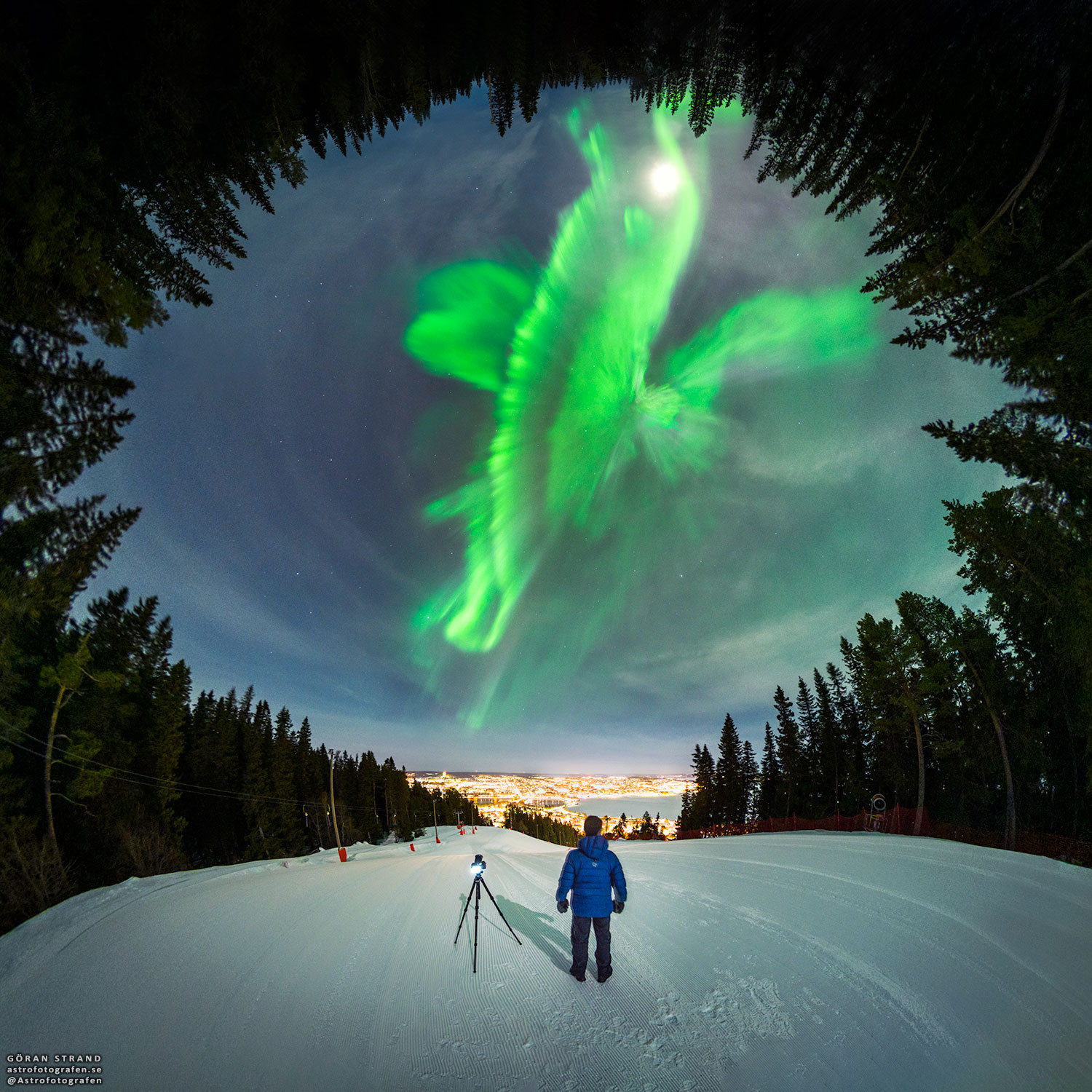
Alt...
2022 March 22
The featured image depicts a bright aurora captured earlier this month over Östersund, Sweden. To some, this coronal aurora may resemble a whale.
A Whale of an Aurora over Swedish Forest
* Image Credit & Copyright: Göran Strand
Explanation:
What's that in the sky? An aurora. A large coronal mass ejection occurred on our Sun earlier this month, throwing a cloud of fast-moving electrons, protons, and ions toward the Earth. Part of this cloud impacted our Earth's magnetosphere and, bolstered by a sudden gap, resulted in spectacular auroras being seen at some high northern latitudes. Featured here is a particularly photogenic auroral corona captured above a forest in Sweden from a scenic perch overlooking the city of Östersund. To some, this shimmering green glow of recombining atmospheric oxygen might appear like a large whale, but feel free to share what it looks like to you. The unusually quiet Sun of the past few years has now passed. As our Sun now approaches a solar maximum in its 11-year solar magnetic cycle, dramatic auroras like this are sure to continue.
Authors & editors: Robert Nemiroff (MTU) & Jerry Bonnell (UMCP)
NASA Official: Phillip Newman Specific rights apply.
NASA Web Privacy Policy and Important Notices
A service of: ASD at NASA / GSFC
& Michigan Tech. U.
"I'm thinking about designing my next TOPIC> as 'FOLLOWERS ONLY' .. would that be ok for you?
Bots-requests would not be accepted."
2022 February 20
Aurora Over White Dome Geyser
* Image Credit & Copyright: Robert Howell
Explanation:
Sometimes both heaven and Earth erupt. Colorful auroras erupted unexpectedly a few years ago, with green aurora appearing near the horizon and brilliant bands of red aurora blooming high overhead. A bright Moon lit the foreground of this picturesque scene, while familiar stars could be seen far in the distance. With planning, the careful astrophotographer shot this image mosaic in the field of White Dome Geyser in Yellowstone National Park in the western USA. Sure enough, just after midnight, White Dome erupted -- spraying a stream of water and vapor many meters into the air. Geyser water is heated to steam by scalding magma several kilometers below, and rises through rock cracks to the surface. About half of all known geysers occur in Yellowstone National Park. Although the geomagnetic storm that caused the auroras subsided within a day, eruptions of White Dome Geyser continue about every 30 minutes.
https://en.wikipedia.org/wiki/White_Dome_Geyser
https://apod.nasa.gov/apod/ap220220.html
#space #earth #aurora #astrophotography #photography #NASA #science #nature
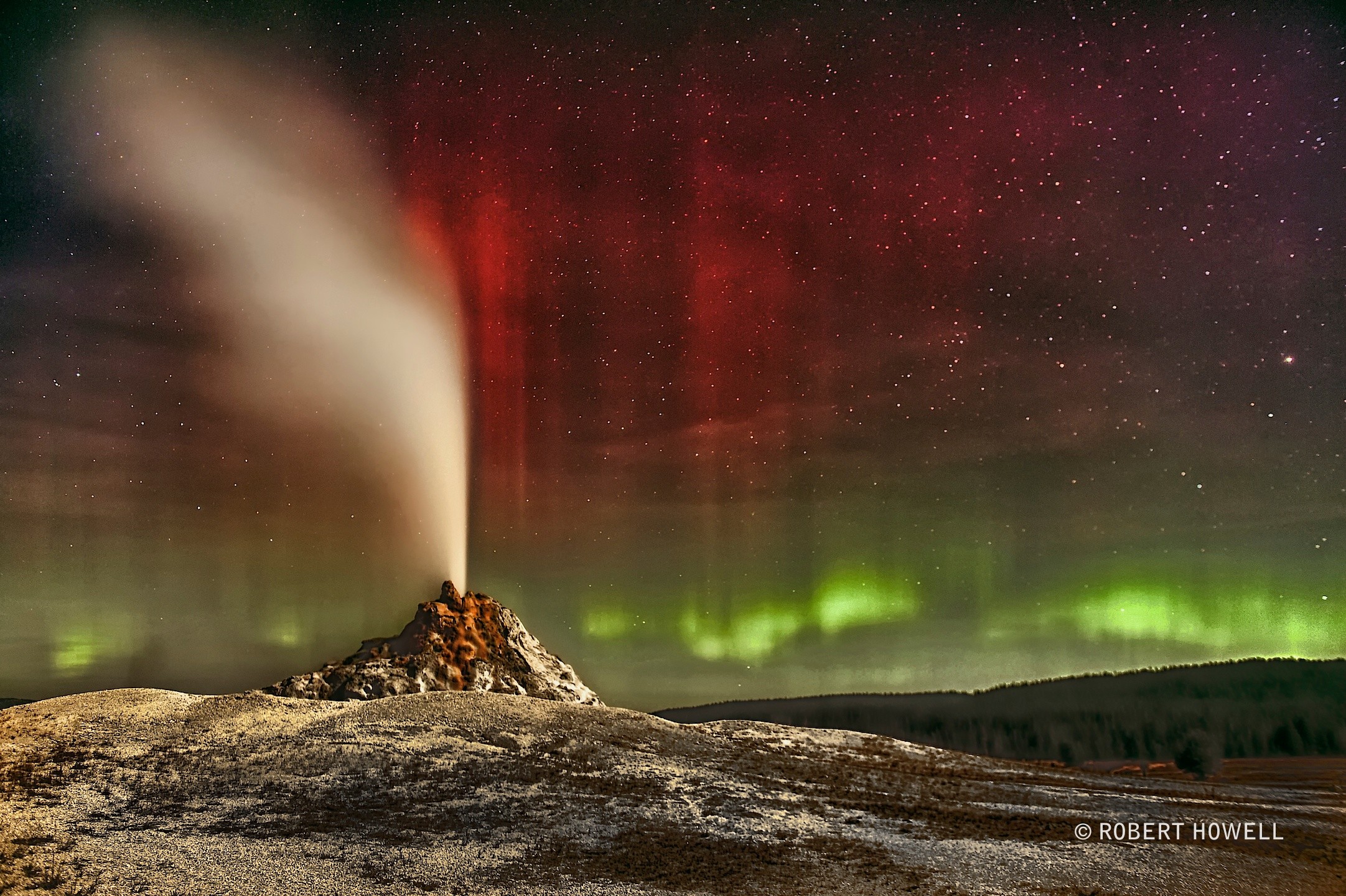
Alt...
2022 February 20
The featured image shows White Dome geyser erupting in Yellowstone National Park with colorful aurora in the background.
Aurora Over White Dome Geyser
* Image Credit & Copyright: Robert Howell
Explanation:
Sometimes both heaven and Earth erupt. Colorful auroras erupted unexpectedly a few years ago, with green aurora appearing near the horizon and brilliant bands of red aurora blooming high overhead. A bright Moon lit the foreground of this picturesque scene, while familiar stars could be seen far in the distance. With planning, the careful astrophotographer shot this image mosaic in the field of White Dome Geyser in Yellowstone National Park in the western USA. Sure enough, just after midnight, White Dome erupted -- spraying a stream of water and vapor many meters into the air. Geyser water is heated to steam by scalding magma several kilometers below, and rises through rock cracks to the surface. About half of all known geysers occur in Yellowstone National Park. Although the geomagnetic storm that caused the auroras subsided within a day, eruptions of White Dome Geyser continue about every 30 minutes.
Authors & editors: Robert Nemiroff (MTU) & Jerry Bonnell (UMCP)
NASA Official: Phillip Newman Specific rights apply.
NASA Web Privacy Policy and Important Notices
A service of: ASD at NASA / GSFC
& Michigan Tech. U.
"Ok, before I go to sleep
one more for the road ;-)
I wish you a good night's sleep and colorful beautiful dreams.. Thank you for your attention, the many boosts and favorites to today's two topics and your kind words! I was very happy about that. Please consider following if you are human and no bot I follow back. It's just more fun when you know who you're putting time and love into the posts and topics for, isn't it? This Topic will be continued anyways .. see you soon"
2022 February 8
Aurora and Light Pillars over Norway
* Image Credit & Copyright: Alexandre Correia
Explanation:
Which half of this sky is your favorite? On the left, the night sky is lit up by particles expelled from the Sun that later collided with Earth's upper atmosphere — creating bright auroras. On the right, the night glows with ground lights reflected by millions of tiny ice crystals falling from the sky — creating light pillars. And in the center, the astrophotographer presents your choices. The light pillars are vertical columns because the fluttering ice-crystals are mostly flat to the ground, and their colors are those of the ground lights. The auroras cover the sky and ground in the green hue of glowing oxygen, while their transparency is clear because you can see stars right through them. Distant stars dot the background, including bright stars from the iconic constellation of Orion. The featured image was captured in a single exposure two months ago near Kautokeino, Norway.
#space #earth #aurora #astrophotography #photography #NASA #science #physics #nature #education
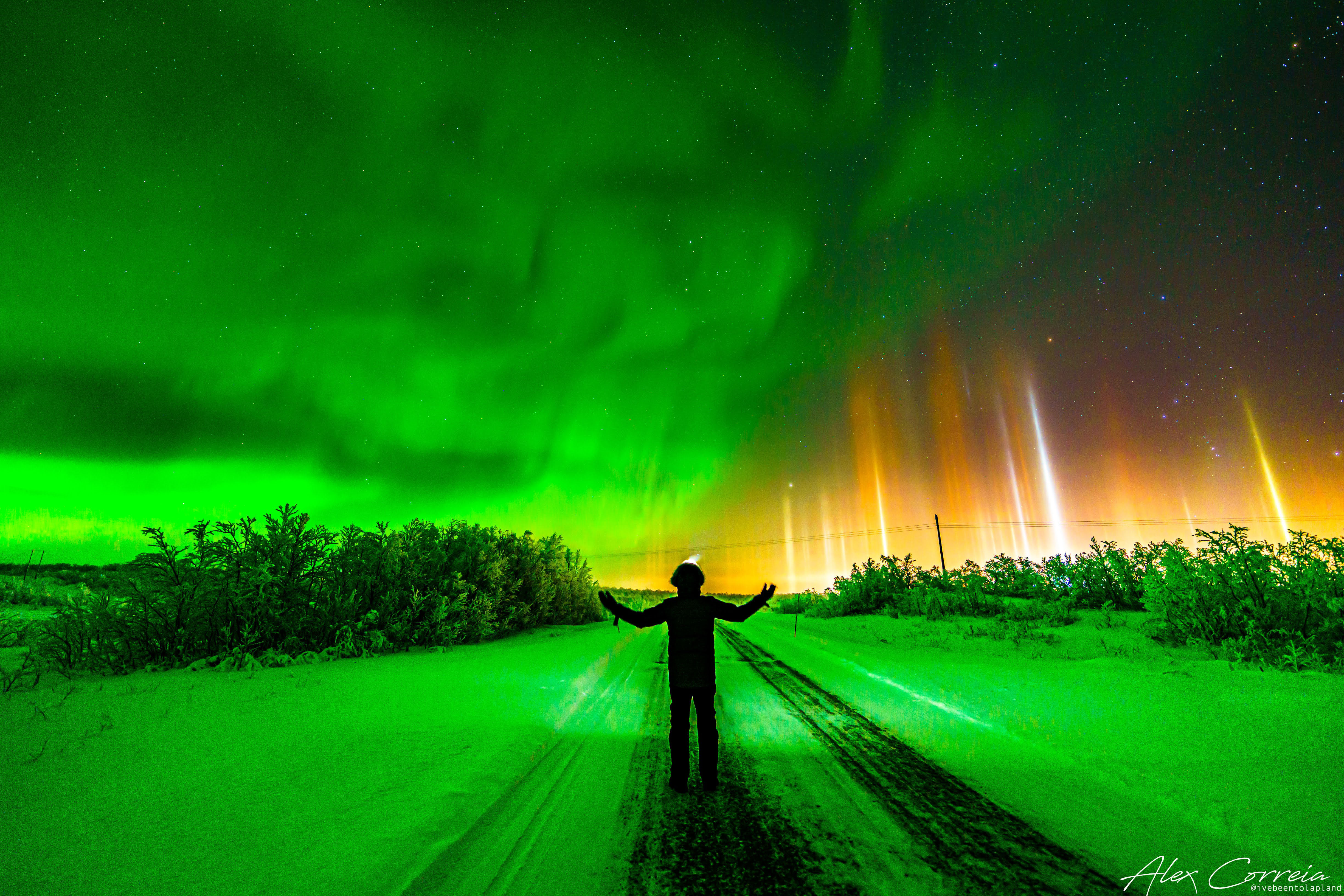
Alt...
2022 February 8
The featured image shows the photographer standing beneath a night sky with green aurora on the left and colorful light pillars on the right.
Aurora and Light Pillars over Norway
* Image Credit & Copyright: Alexandre Correia
Explanation:
Which half of this sky is your favorite? On the left, the night sky is lit up by particles expelled from the Sun that later collided with Earth's upper atmosphere — creating bright auroras. On the right, the night glows with ground lights reflected by millions of tiny ice crystals falling from the sky — creating light pillars. And in the center, the astrophotographer presents your choices. The light pillars are vertical columns because the fluttering ice-crystals are mostly flat to the ground, and their colors are those of the ground lights. The auroras cover the sky and ground in the green hue of glowing oxygen, while their transparency is clear because you can see stars right through them. Distant stars dot the background, including bright stars from the iconic constellation of Orion. The featured image was captured in a single exposure two months ago near Kautokeino, Norway.
Authors & editors: Robert Nemiroff (MTU) & Jerry Bonnell (UMCP)
NASA Official: Phillip Newman Specific rights apply.
NASA Web Privacy Policy and Important Notices
A service of: ASD at NASA / GSFC
& Michigan Tech. U.
2021 September 12
The picture shows a dramatic spiral-shaped aurora over Iceland.
A Spiral Aurora over Iceland
* Image Credit & Copyright: Davide Necchi
https://davnec.eu/a-proposito-del-necchi/
Explanation:
What's happened to the sky? Aurora! Captured in 2015, this aurora was noted by Icelanders for its great brightness and quick development. The aurora resulted from a solar storm, with high energy particles bursting out from the Sun and through a crack in Earth's protective magnetosphere a few days later. Although a spiral pattern can be discerned, creative humans might imagine the complex glow as an atmospheric apparition of any number of common icons. In the foreground of the featured image is the Ölfusá River while the lights illuminate a bridge in Selfoss City. Just beyond the low clouds is a nearly full Moon. The liveliness of the Sun -- and likely the resulting auroras on Earth -- is slowly increasing as the Sun emerges from a Solar minimum, a historically quiet period in its 11-year cycle.
https://apod.nasa.gov/apod/ap210912.html
#space #earth #aurora #astrophotography #photography #NASA #science #physics #nature
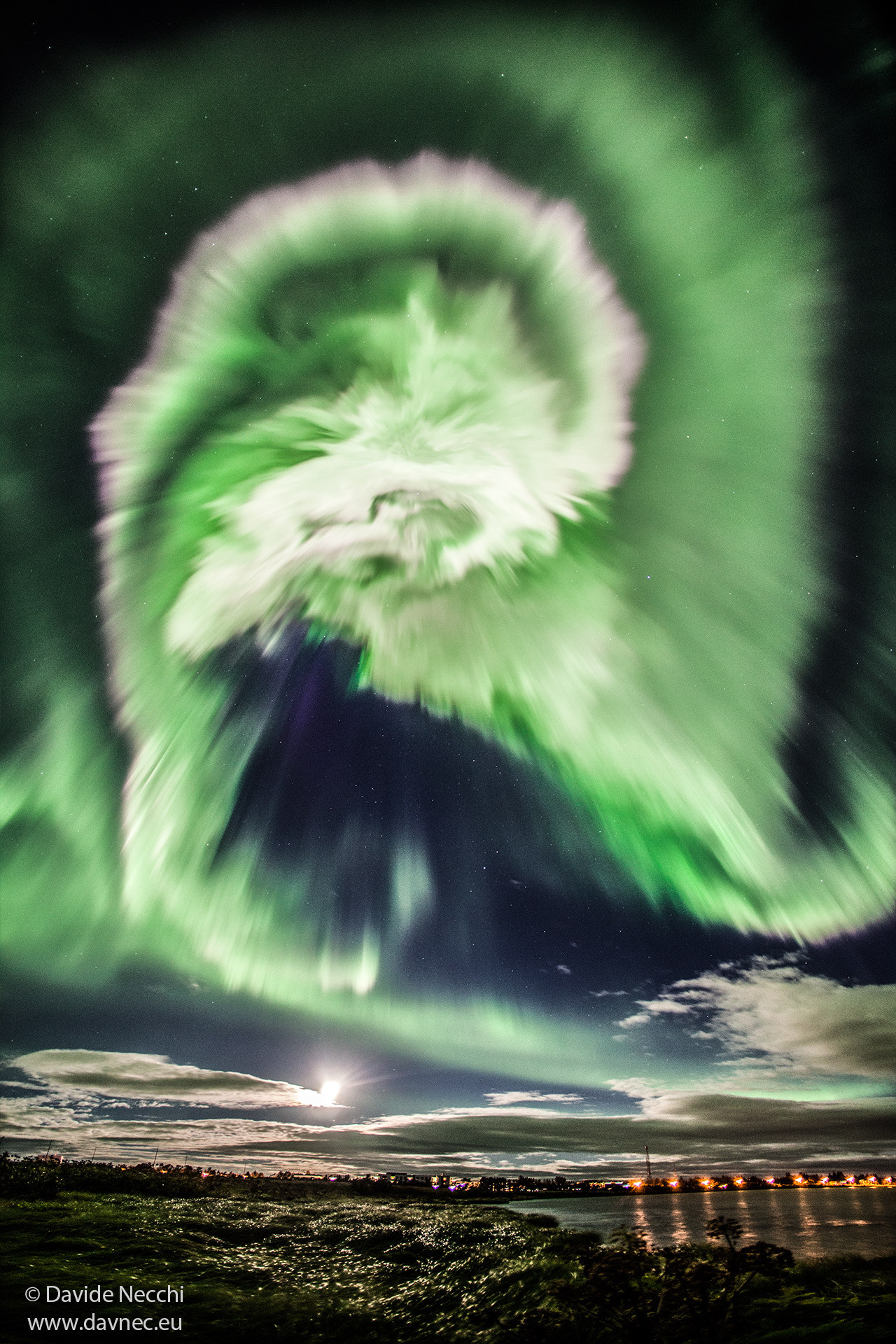
Alt...
2021 September 12
The picture shows a dramatic spiral-shaped aurora over Iceland.
A Spiral Aurora over Iceland
* Image Credit & Copyright: Davide Necchi
Explanation:
What's happened to the sky? Aurora! Captured in 2015, this aurora was noted by Icelanders for its great brightness and quick development. The aurora resulted from a solar storm, with high energy particles bursting out from the Sun and through a crack in Earth's protective magnetosphere a few days later. Although a spiral pattern can be discerned, creative humans might imagine the complex glow as an atmospheric apparition of any number of common icons. In the foreground of the featured image is the Ölfusá River while the lights illuminate a bridge in Selfoss City. Just beyond the low clouds is a nearly full Moon. The liveliness of the Sun -- and likely the resulting auroras on Earth -- is slowly increasing as the Sun emerges from a Solar minimum, a historically quiet period in its 11-year cycle.
Authors & editors: Robert Nemiroff (MTU) & Jerry Bonnell (UMCP)
NASA Official: Phillip Newman Specific rights apply.
NASA Web Privacy Policy and Important Notices
A service of: ASD at NASA / GSFC
& Michigan Tech. U.
"I really hope you had a wonderful day and an exiting timeline. Have colorful dreams and a peaceful night.
Stay tuned and dig deeper, some posts have a bunch of url's some of them lead to mind-blowing and eye-opening websites."
2021 May 30
Aurora over Clouds
* Image Credit & Copyright: Daniele Boffelli
Explanation:
Auroras usually occur high above the clouds. The auroral glow is created when fast-moving particles ejected from the Sun impact the Earth's magnetosphere, from which charged particles spiral along the Earth's magnetic field to strike atoms and molecules high in the Earth's atmosphere. An oxygen atom, for example, will glow in the green light commonly emitted by an aurora after being energized by such a collision. The lowest part of an aurora will typically occur about 100 kilometers up, while most clouds exist only below about 10 kilometers. The relative heights of clouds and auroras are shown clearly in the featured picture in 2015 from Dyrholaey, Iceland. There, a determined astrophotographer withstood high winds and initially overcast skies in an attempt to capture aurora over a picturesque lighthouse, only to take, by chance, the featured picture including elongated lenticular clouds, along the way.
https://apod.nasa.gov/apod/ap210530.html
#space #earth #aurora #astrophotography #photography #NASA #science #nature
Alt...
2021 May 30
The picture shows green aurora through odd lenticular clouds.
Aurora over Clouds
* Image Credit & Copyright: Daniele Boffelli
Explanation:
Auroras usually occur high above the clouds. The auroral glow is created when fast-moving particles ejected from the Sun impact the Earth's magnetosphere, from which charged particles spiral along the Earth's magnetic field to strike atoms and molecules high in the Earth's atmosphere. An oxygen atom, for example, will glow in the green light commonly emitted by an aurora after being energized by such a collision. The lowest part of an aurora will typically occur about 100 kilometers up, while most clouds exist only below about 10 kilometers. The relative heights of clouds and auroras are shown clearly in the featured picture in 2015 from Dyrholaey, Iceland. There, a determined astrophotographer withstood high winds and initially overcast skies in an attempt to capture aurora over a picturesque lighthouse, only to take, by chance, the featured picture including elongated lenticular clouds, along the way.
Authors & editors: Robert Nemiroff (MTU) & Jerry Bonnell (UMCP)
NASA Official: Phillip Newman Specific rights apply.
NASA Web Privacy Policy and Important Notices
A service of: ASD at NASA / GSFC
& Michigan Tech. U.
2018 April 10
Dragon Aurora over Norway
* Image Credit & Copyright: Marco Bastoni
Explanation:
What's that in the sky? An aurora. A large coronal hole opened last month, a few days before this image was taken, throwing a cloud of fast moving electrons, protons, and ions toward the Earth. Some of this cloud impacted our Earth's magnetosphere and resulted in spectacular auroras being seen at high northern latitudes. Featured here is a particularly photogenic auroral curtain captured above Tromsø Norway. To the astrophotographer, this shimmering green glow of recombining atmospheric oxygen appeared as a large dragon, but feel free to share what it looks like to you. Although now past Solar Maximum, our Sun continues to show occasional activity creating impressive auroras on Earth visible even last week.
https://apod.nasa.gov/apod/ap180410.html
#space #earth #aurora #astrophotography #photography #NASA #science #nature

Alt...
2018 April 10
Dragon Aurora over Norway
* Image Credit & Copyright: Marco Bastoni
Explanation:
What's that in the sky? An aurora. A large coronal hole opened last month, a few days before this image was taken, throwing a cloud of fast moving electrons, protons, and ions toward the Earth. Some of this cloud impacted our Earth's magnetosphere and resulted in spectacular auroras being seen at high northern latitudes. Featured here is a particularly photogenic auroral curtain captured above Tromsø Norway. To the astrophotographer, this shimmering green glow of recombining atmospheric oxygen appeared as a large dragon, but feel free to share what it looks like to you. Although now past Solar Maximum, our Sun continues to show occasional activity creating impressive auroras on Earth visible even last week.
Authors & editors: Robert Nemiroff (MTU) & Jerry Bonnell (UMCP)
NASA Official: Phillip Newman Specific rights apply.
NASA Web Privacy Policy and Important Notices
A service of: ASD at NASA / GSFC
& Michigan Tech. U.
2018 May 1
The Aurora and the Sunrise
* Image Credit: NASA, International Space Station, Ricky Arnold
https://www.nasa.gov/international-space-station/
Explanation:
On the International Space Station (ISS), you can only admire an aurora until the sun rises. Then the background Earth becomes too bright. Unfortunately, after sunset, the rapid orbit of the ISS around the Earth means that sunrise is usually less than 47 minutes away. In the featured image, a green aurora is visible below the ISS -- and on the horizon to the upper right, while sunrise approaches ominously from the upper left. Watching an aurora from space can be mesmerizing as its changing shape has been compared to a giant green amoeba. Auroras are composed of energetic electrons and protons from the Sun that impact the Earth's magnetic field and then spiral down toward the Earth so fast that they cause atmospheric atoms and molecules to glow. The ISS orbits at nearly the same height as auroras, many times flying right through an aurora's thin upper layers, an event that neither harms astronauts nor changes the shape of the aurora.
https://www.nasa.gov/image-article/flying-through-an-aurora/
https://apod.nasa.gov/apod/ap180501.html
#space #earth #aurora #astrophotography #photography #NASA #science #nature #education
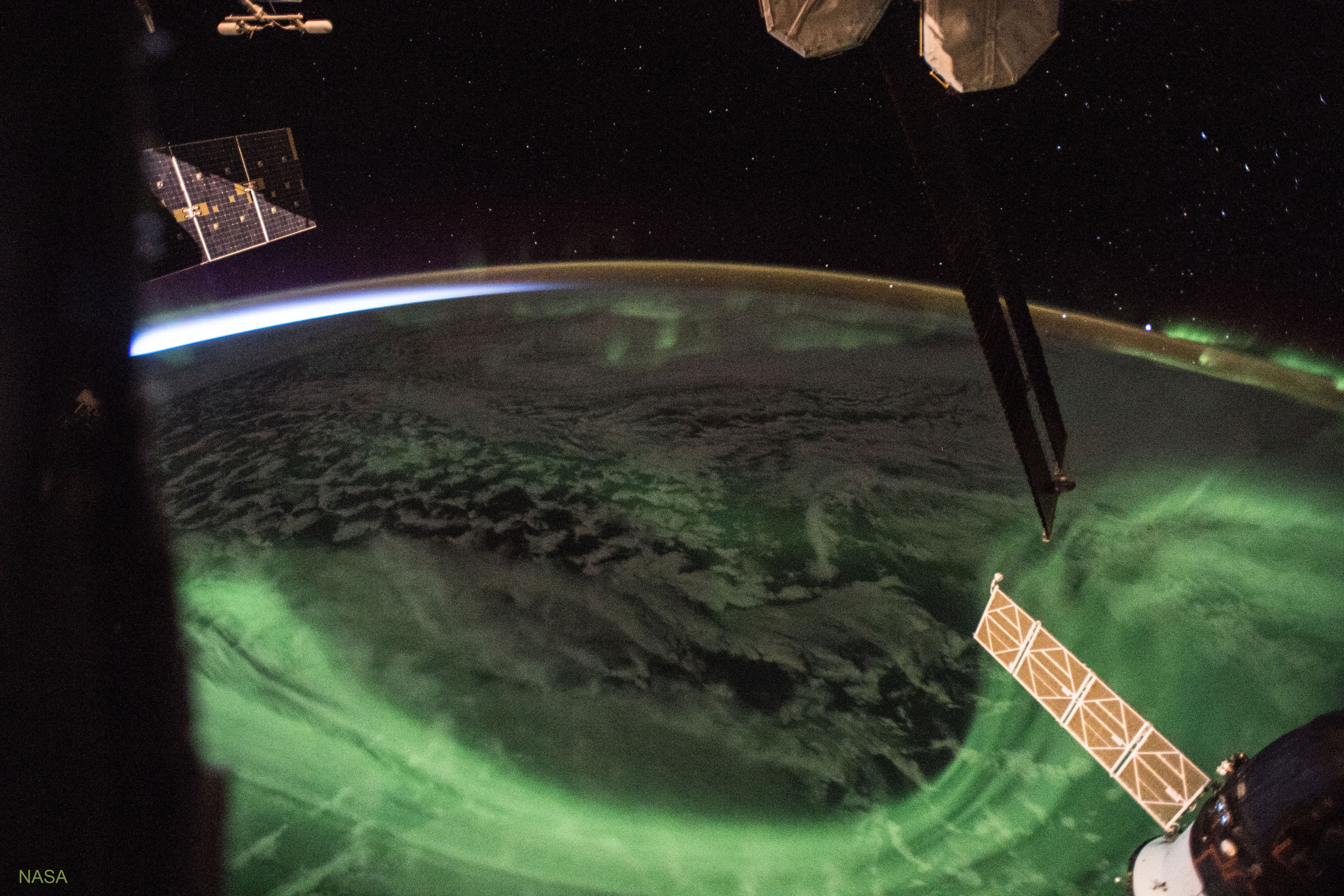
Alt...
2018 May 1
The Aurora and the Sunrise
* Image Credit: NASA, International Space Station, Ricky Arnold
Explanation:
On the International Space Station (ISS), you can only admire an aurora until the sun rises. Then the background Earth becomes too bright. Unfortunately, after sunset, the rapid orbit of the ISS around the Earth means that sunrise is usually less than 47 minutes away. In the featured image, a green aurora is visible below the ISS -- and on the horizon to the upper right, while sunrise approaches ominously from the upper left. Watching an aurora from space can be mesmerizing as its changing shape has been compared to a giant green amoeba. Auroras are composed of energetic electrons and protons from the Sun that impact the Earth's magnetic field and then spiral down toward the Earth so fast that they cause atmospheric atoms and molecules to glow. The ISS orbits at nearly the same height as auroras, many times flying right through an aurora's thin upper layers, an event that neither harms astronauts nor changes the shape of the aurora.
Authors & editors: Robert Nemiroff (MTU) & Jerry Bonnell (UMCP)
NASA Official: Phillip Newman Specific rights apply.
NASA Web Privacy Policy and Important Notices
A service of: ASD at NASA / GSFC
& Michigan Tech. U.
"Hey,
may i take you on a ride through the twilight into the night sky?? OK, buckle up and off we go .. scroll upwards if you dare to!"
2013 March 31
Flying Over the Earth at Night
* Video Credit: Gateway to Astronaut Photography, NASA
https://eol.jsc.nasa.gov/
http://www.nasa.gov/;
* Compilation: David Peterson https://www.youtube.com/user/Bitmeizer;
* Music: Freedom Fighters (Two Steps from Hell)
https://en.wikipedia.org/wiki/Two_Steps_from_Hell
Explanation:
Many wonders are visible when flying over the Earth at night. A compilation of such visual spectacles was captured recently from the International Space Station (ISS) and set to rousing music. Passing below are white clouds, orange city lights, lightning flashes in thunderstorms, and dark blue seas. On the horizon is the golden haze of Earth's thin atmosphere, frequently decorated by dancing auroras as the video progresses. The green parts of auroras typically remain below the space station, but the station flies right through the red and purple auroral peaks. Solar panels of the ISS are seen around the frame edges. The ominous wave of approaching brightness at the end of each sequence is just the dawn of the sunlit half of Earth, a dawn that occurs every 90 minutes.
https://apod.nasa.gov/apod/ap130331.html
#space #earth #aurora #astrophotography #photography #NASA #science #physics #nature #education #4sAur
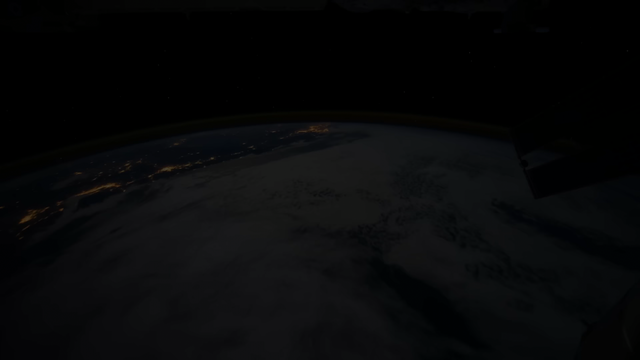
Alt...
2013 March 31
Flying Over the Earth at Night
* Video Credit: Gateway to Astronaut Photography, NASA ;
* Compilation: David Peterson (YouTube);
* Music: Freedom Fighters (Two Steps from Hell)
Explanation:
Many wonders are visible when flying over the Earth at night. A compilation of such visual spectacles was captured recently from the International Space Station (ISS) and set to rousing music. Passing below are white clouds, orange city lights, lightning flashes in thunderstorms, and dark blue seas. On the horizon is the golden haze of Earth's thin atmosphere, frequently decorated by dancing auroras as the video progresses. The green parts of auroras typically remain below the space station, but the station flies right through the red and purple auroral peaks. Solar panels of the ISS are seen around the frame edges. The ominous wave of approaching brightness at the end of each sequence is just the dawn of the sunlit half of Earth, a dawn that occurs every 90 minutes.
Authors & editors: Robert Nemiroff (MTU) & Jerry Bonnell (UMCP)
NASA Official: Phillip Newman Specific rights apply.
NASA Web Privacy Policy and Important Notices
A service of: ASD at NASA / GSFC
& Michigan Tech. U.
2024 August 16
Meteor Borealis
* Image Credit & Copyright: Jason Dain
Explanation:
A single exposure made with a camera pointed almost due north on August 12 recorded this bright Perseid meteor in the night sky west of Halifax, Nova Scotia, Canada. The meteor's incandescent trace is fleeting. It appears to cross the stars of the Big Dipper, famous northern asterism and celestial kitchen utensil, while shimmering curtains of aurora borealis, also known as the northern lights, dance in the night. Doubling the wow factor for night skywatchers near the peak of this year's Perseid meteor shower auroral activity on planet Earth was enhanced by geomagnetic storms. The intense space weather was triggered by flares from an active Sun.
https://apod.nasa.gov/apod/ap240816.htmlhttps://apod.nasa.gov/apod/ap240816.html
#space #earth #aurora #astrophotography #photography #NASA #science #physics #nature #education #4sAur

Alt...
2024 August 16
Meteor Borealis
* Image Credit & Copyright: Jason Dain
Explanation:
A single exposure made with a camera pointed almost due north on August 12 recorded this bright Perseid meteor in the night sky west of Halifax, Nova Scotia, Canada. The meteor's incandescent trace is fleeting. It appears to cross the stars of the Big Dipper, famous northern asterism and celestial kitchen utensil, while shimmering curtains of aurora borealis, also known as the northern lights, dance in the night. Doubling the wow factor for night skywatchers near the peak of this year's Perseid meteor shower auroral activity on planet Earth was enhanced by geomagnetic storms. The intense space weather was triggered by flares from an active Sun.
Authors & editors: Robert Nemiroff (MTU) & Jerry Bonnell (UMCP)
NASA Official: Amber Straughn Specific rights apply.
NASA Web Privacy, Accessibility Notices
A service of: ASD at NASA / GSFC,
NASA Science Activation
& Michigan Tech. U.
2011 September 23
September's Aurora
* Image Credit & Copyright: Yuichi Takasaka / TWAN / www.blue-moon.ca
https://twanight.org/profile/yuichi-takasaka/
Explanation:
September's equinox arrived that day at 0905 UT. As the Sun crosses the celestial equator heading south, spring begins in the southern hemisphere and autumn in the north. And though the seasonal connection is still puzzling, both spring and autumn bring an increase in geomagnetic storms. So as northern nights grow longer, the equinox also heralds the arrival of a good season for viewing aurora. Recorded earlier this month, these curtains of September's shimmering green light sprawl across a gorgeous night skyscape. In the foreground lies Hidden Lake Territorial Park near Yellowknife, Northwest Territories, Canada. Calm water reflects the aurora, with bright star trails peering through the mesmerizing sky glow. Of course, shining at altitudes of 100 kilometers or so, planet Earth's auroras are visible from space.
https://apod.nasa.gov/apod/ap110923.html
#space #earth #aurora #astrophotography #photography #NASA #science #physics #nature #education #4sAur

Alt...
2011 September 23
September's Aurora
* Image Credit & Copyright: Yuichi Takasaka / TWAN / www.blue-moon.ca
Explanation:
September's equinox arrives today at 0905 UT. As the Sun crosses the celestial equator heading south, spring begins in the southern hemisphere and autumn in the north. And though the seasonal connection is still puzzling, both spring and autumn bring an increase in geomagnetic storms. So as northern nights grow longer, the equinox also heralds the arrival of a good season for viewing aurora. Recorded earlier this month, these curtains of September's shimmering green light sprawl across a gorgeous night skyscape. In the foreground lies Hidden Lake Territorial Park near Yellowknife, Northwest Territories, Canada. Calm water reflects the aurora, with bright star trails peering through the mesmerizing sky glow. Of course, shining at altitudes of 100 kilometers or so, planet Earth's auroras are visible from space.
Authors & editors: Robert Nemiroff (MTU) & Jerry Bonnell (UMCP)
NASA Official: Phillip Newman Specific rights apply.
NASA Web Privacy Policy and Important Notices
A service of: ASD at NASA / GSFC
& Michigan Tech. U.