Search results for tag #astronomy
![[?]](https://files.defcon.social/dcsocial-s3/accounts/avatars/113/208/344/507/078/943/original/014820ad22daee1c.jpg)
2007 September 20
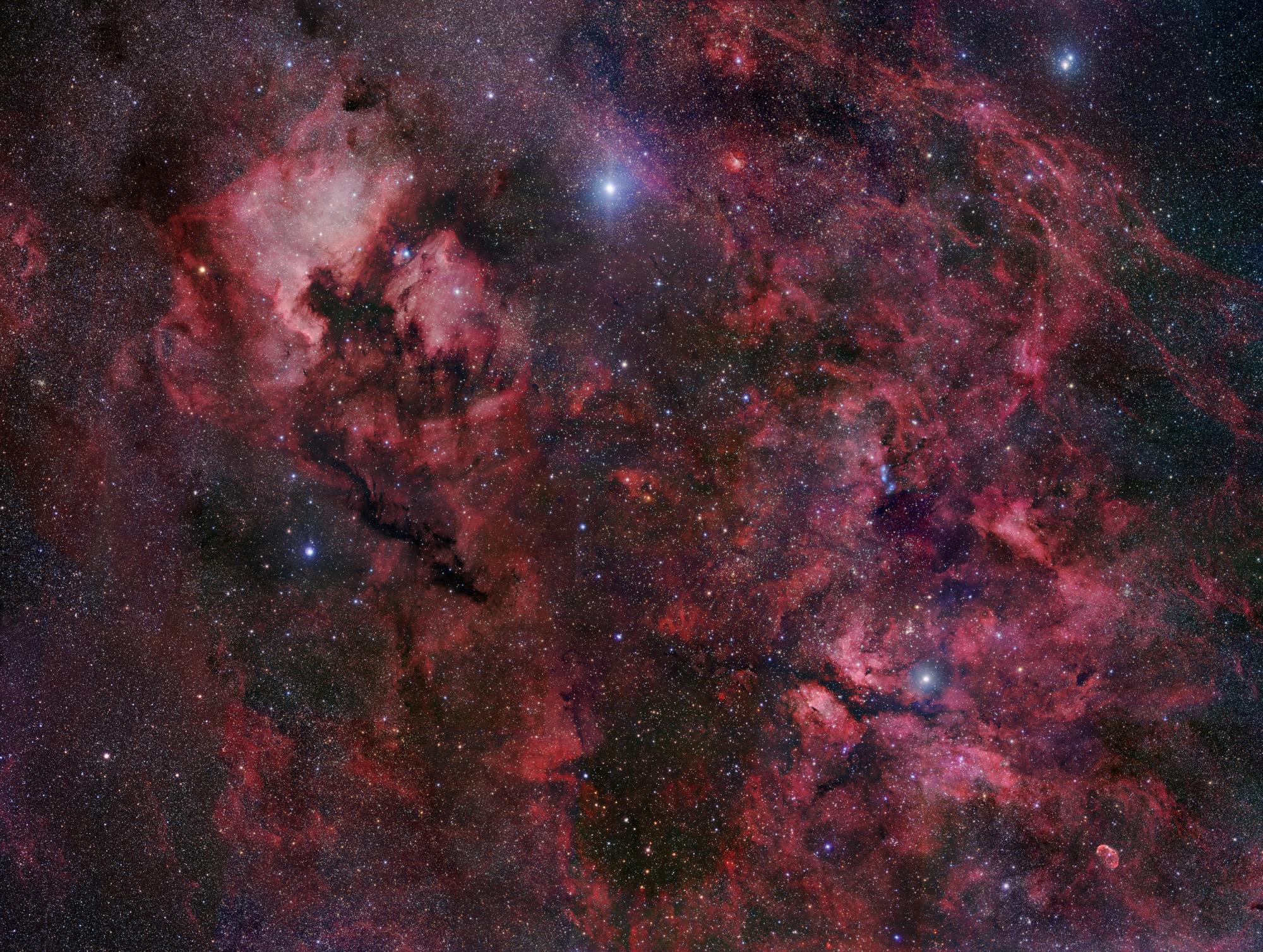
Northern Cygnus
* Credit & Copyright: Robert Gendler
http://www.robgendlerastropics.com/
Explanation:
Bright, hot, supergiant star Deneb lies at top center in this gorgeous skyscape. The 20 frame mosaic spans an impressive 12 degrees across the northern end of Cygnus the Swan. Crowded with stars and luminous gas clouds along the plane of our Milky Way Galaxy, Cygnus is also home to the dark, obscuring Northern Coal Sack Nebula, extending from Deneb toward the bottom center of the view. The reddish glow of NGC 7000, the North America Nebula, and IC 5070, the Pelican Nebula, are at the upper left, but many other nebulae and star clusters are identifiable throughout the wide field. Of course, Deneb itself is the alpha star of Cygnus and is also known to northern hemisphere skygazers for its place in two asterisms -- marking the top of the Northern Cross and a vertex of the Summer Triangle.
http://www.robgendlerastropics.com/Cygnusmosaic.html
https://en.wikipedia.org/wiki/Cygnus_(constellation)
https://apod.nasa.gov/apod/ap070920.html
#space #nebula #cluster #astrophotography #photography #science #astronomy #nature #NASA #ESA #education
Alt...
2007 September 20
Northern Cygnus
* Credit & Copyright: Robert Gendler
Explanation:
Bright, hot, supergiant star Deneb lies at top center in this gorgeous skyscape. The 20 frame mosaic spans an impressive 12 degrees across the northern end of Cygnus the Swan. Crowded with stars and luminous gas clouds along the plane of our Milky Way Galaxy, Cygnus is also home to the dark, obscuring Northern Coal Sack Nebula, extending from Deneb toward the bottom center of the view. The reddish glow of NGC 7000, the North America Nebula, and IC 5070, the Pelican Nebula, are at the upper left, but many other nebulae and star clusters are identifiable throughout the wide field. Of course, Deneb itself is the alpha star of Cygnus and is also known to northern hemisphere skygazers for its place in two asterisms -- marking the top of the Northern Cross and a vertex of the Summer Triangle.
Authors & editors: Robert Nemiroff (MTU) & Jerry Bonnell (UMCP)
NASA Official: Phillip Newman Specific rights apply.
NASA Web Privacy Policy and Important Notices
A service of: ASD at NASA / GSFC
2025 September 19
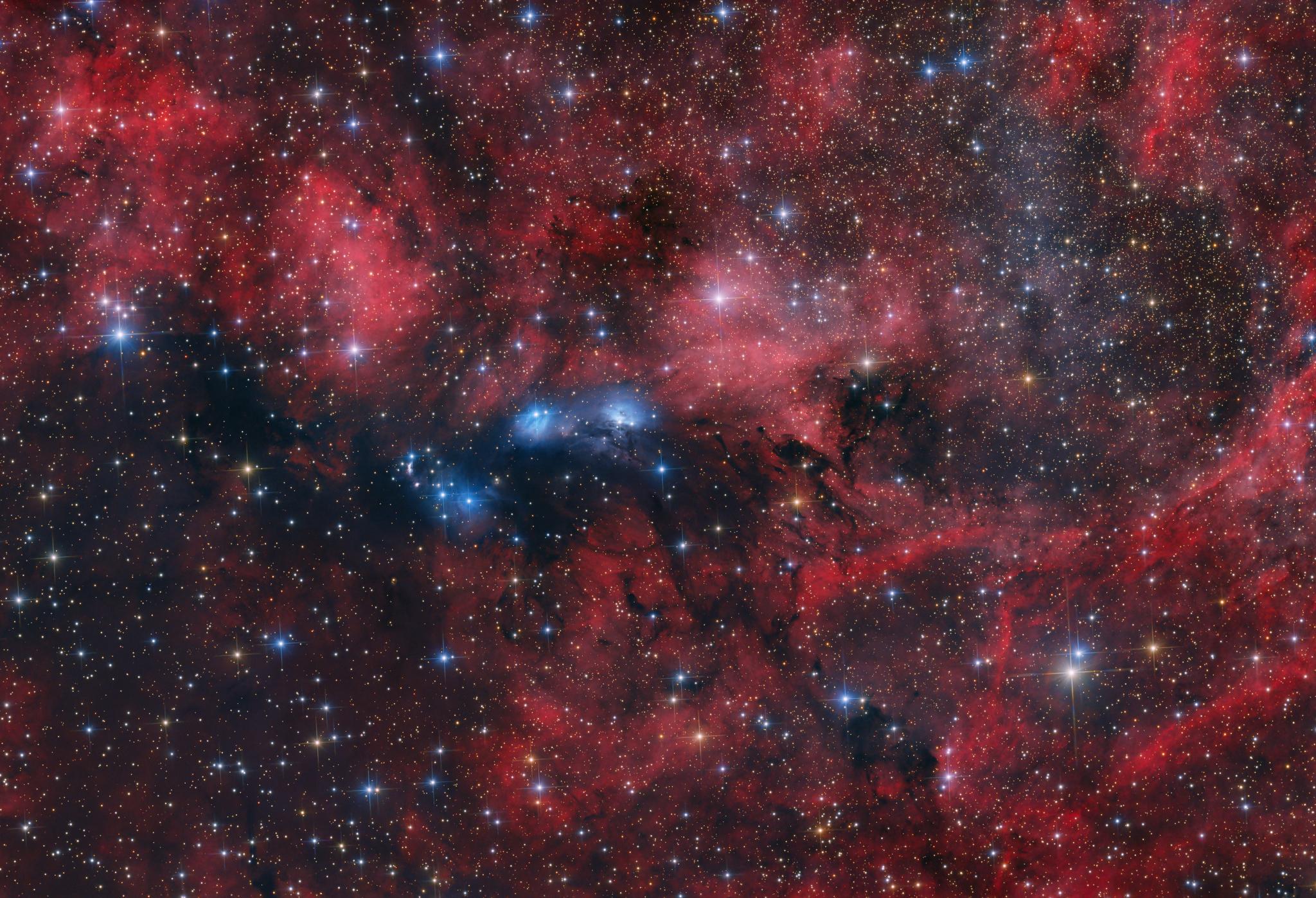
The NGC 6914 Complex
* Image Credit & Copyright: Tommy Lease
https://app.astrobin.com/u/Colorado_Astro#gallery
Explanation:
A study in contrasts, this colorful cosmic skyscape features stars, dust, and glowing gas in the vicinity of NGC 6914. The interstellar complex of nebulae lies some 6,000 light-years away, toward the high-flying northern constellation Cygnus and the plane of our Milky Way Galaxy. Obscuring interstellar dust clouds appear in silhouette while reddish hydrogen emission nebulae, along with the dusty blue reflection nebulae, fill the cosmic canvas. Ultraviolet radiation from the massive, hot, young stars of the extensive Cygnus OB2 association ionize the region's atomic hydrogen gas, producing the characteristic red glow as protons and electrons recombine. Embedded Cygnus OB2 stars also provide the blue starlight strongly reflected by the dust clouds. The over one degree wide telescopic field of view spans about 100 light-years at the estimated distance of NGC 6914.
https://www.nasa.gov/missions/roman-space-telescope/how-nasas-roman-mission-will-unveil-our-home-galaxy-using-cosmic-dust/
https://arxiv.org/abs/1003.2463
https://astronomy.swin.edu.au/cosmos/E/Emission+Nebula
https://astronomy.swin.edu.au/cosmos/E/Reflection+Nebula
https://apod.nasa.gov/apod/ap250919.html
#space #nebula #cluster #astrophotography #photography #science #astronomy #nature #NASA #ESA #education
Alt...
2025 September 19
The NGC 6914 Complex
* Image Credit & Copyright: Tommy Lease
Explanation:
A study in contrasts, this colorful cosmic skyscape features stars, dust, and glowing gas in the vicinity of NGC 6914. The interstellar complex of nebulae lies some 6,000 light-years away, toward the high-flying northern constellation Cygnus and the plane of our Milky Way Galaxy. Obscuring interstellar dust clouds appear in silhouette while reddish hydrogen emission nebulae, along with the dusty blue reflection nebulae, fill the cosmic canvas. Ultraviolet radiation from the massive, hot, young stars of the extensive Cygnus OB2 association ionize the region's atomic hydrogen gas, producing the characteristic red glow as protons and electrons recombine. Embedded Cygnus OB2 stars also provide the blue starlight strongly reflected by the dust clouds. The over one degree wide telescopic field of view spans about 100 light-years at the estimated distance of NGC 6914.
Authors & editors: Robert Nemiroff (MTU) & Jerry Bonnell (UMCP)
NASA Official: Amber Straughn Specific rights apply.
NASA Web Privacy, Accessibility, Notices;
A service of: ASD at NASA / GSFC,
NASA Science Activation
2024 July 8
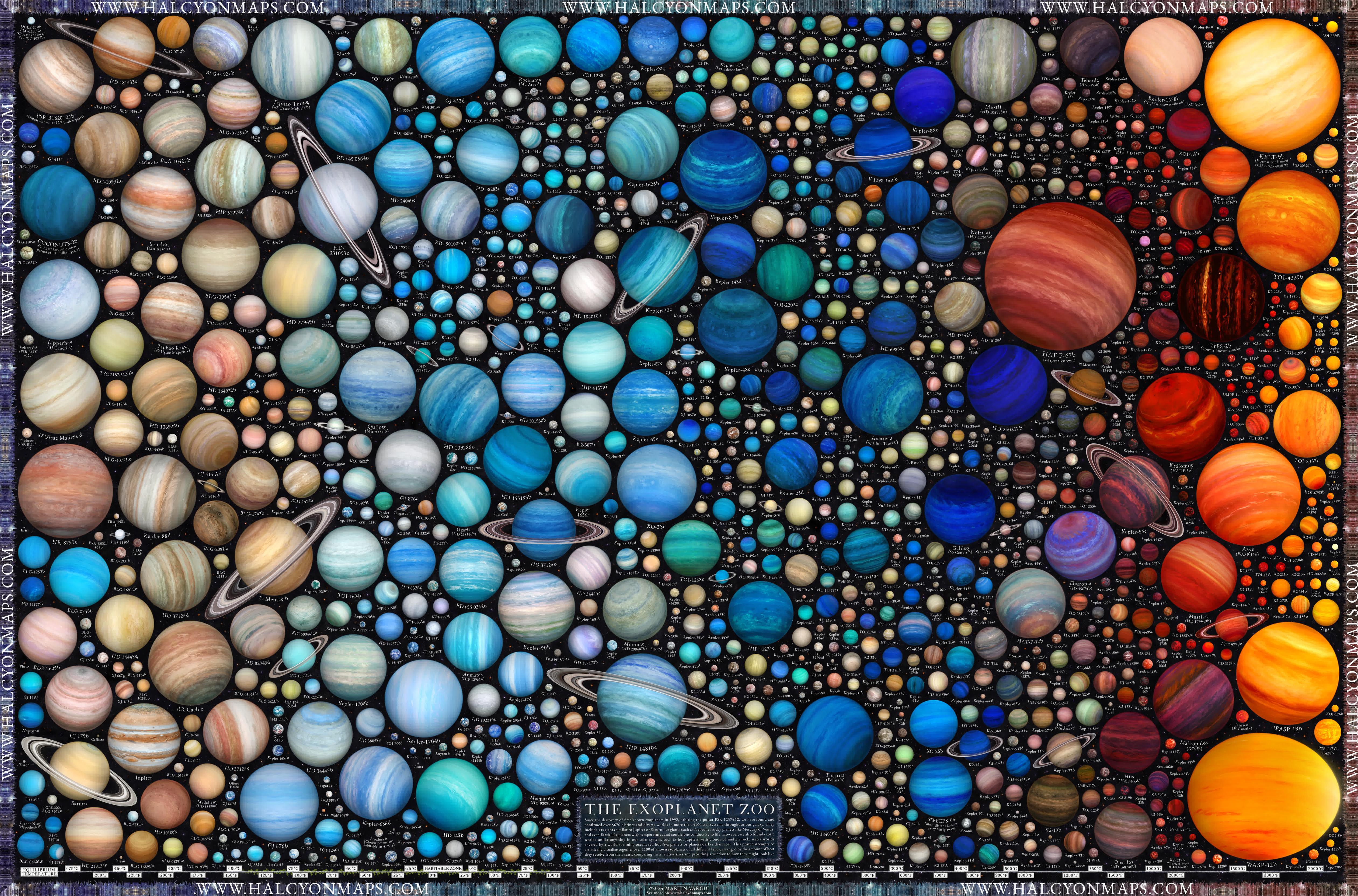
Exoplanet Zoo: Other Stars
* Illustration Credit & Copyright: Martin Vargic, Halcyon Maps
https://www.facebook.com/martin.vargic.9/
Explanation:
Do other stars have planets like our Sun? Surely they do, and evidence includes slight star wobbles created by the gravity of orbiting exoplanets and slight star dimmings caused by orbiting planets moving in front. In all, there have now been over 5,500 exoplanets discovered, including thousands by NASA's space-based Kepler and TESS missions, and over 100 by ESO's ground-based HARPS instrument. Featured here is an illustrated guess as to what some of these exoplanets might look like. Neptune-type planets occupy the middle and are colored blue because of blue-scattering atmospheric methane they might contain. On the sides of the illustration, Jupiter-type planets are shown, colored tan and red from the scatterings of atmospheric gases that likely include small amounts of carbon. Interspersed are many Earth-type rocky planets of many colors. As more exoplanets are discovered and investigated, humanity is developing a better understanding of how common Earth-like planets are, and how common life might be in the universe.
https://apod.nasa.gov/apod/ap240708.html
#space #exoplanets #astrophotography #photography #science #astronomy #tech #NASA #ESA #education
Alt...
2024 July 8
A graphic illustrates hundreds of possible exoplanets, with blue drawings of planets in the middle, red on the right, and tan on the left. Some exoplanets are drawn with rings.
Exoplanet Zoo: Other Stars
* Illustration Credit & Copyright: Martin Vargic, Halcyon Maps
Explanation:
Do other stars have planets like our Sun? Surely they do, and evidence includes slight star wobbles created by the gravity of orbiting exoplanets and slight star dimmings caused by orbiting planets moving in front. In all, there have now been over 5,500 exoplanets discovered, including thousands by NASA's space-based Kepler and TESS missions, and over 100 by ESO's ground-based HARPS instrument. Featured here is an illustrated guess as to what some of these exoplanets might look like. Neptune-type planets occupy the middle and are colored blue because of blue-scattering atmospheric methane they might contain. On the sides of the illustration, Jupiter-type planets are shown, colored tan and red from the scatterings of atmospheric gases that likely include small amounts of carbon. Interspersed are many Earth-type rocky planets of many colors. As more exoplanets are discovered and investigated, humanity is developing a better understanding of how common Earth-like planets are, and how common life might be in the universe.
Authors & editors: Robert Nemiroff (MTU) & Jerry Bonnell (UMCP)
NASA Official: Amber Straughn Specific rights apply.
The milestone comes 30 years after the first exoplanet was discovered around a star similar to our Sun, in 1995. (Prior to that, a few planets had been identified around stars that had burned all their fuel and collapsed.) Although researchers think there are billions of planets in the Milky Way galaxy, finding them remains a challenge. In addition to discovering many individual planets with fascinating characteristics as the total number of known exoplanets climbs, scientists are able to see how the general planet population compares to the planets of our own solar system.
For example, while our solar system hosts an equal number of rocky and giant planets, rocky planets appear to be more common in the universe. Researchers have also found a range of planets entirely different from those in our solar system. There are Jupiter-size planets that orbit closer to their parent star than Mercury orbits the Sun; planets that orbit two stars, no stars, and dead stars; planets covered in lava; some with the density of Styrofoam; and others with clouds made of gemstones.
“Each of the different types of planets we discover gives us information about the conditions under which planets can form and, ultimately, how common planets like Earth might be, and where we should be looking for them,” said Dawn Gelino, head of NASA’s Exoplanet Exploration Program (ExEP), located at the agency’s Jet Propulsion Laboratory in Southern California. “If we want to find out if we’re alone in the universe, all of this knowledge is essential.”
---
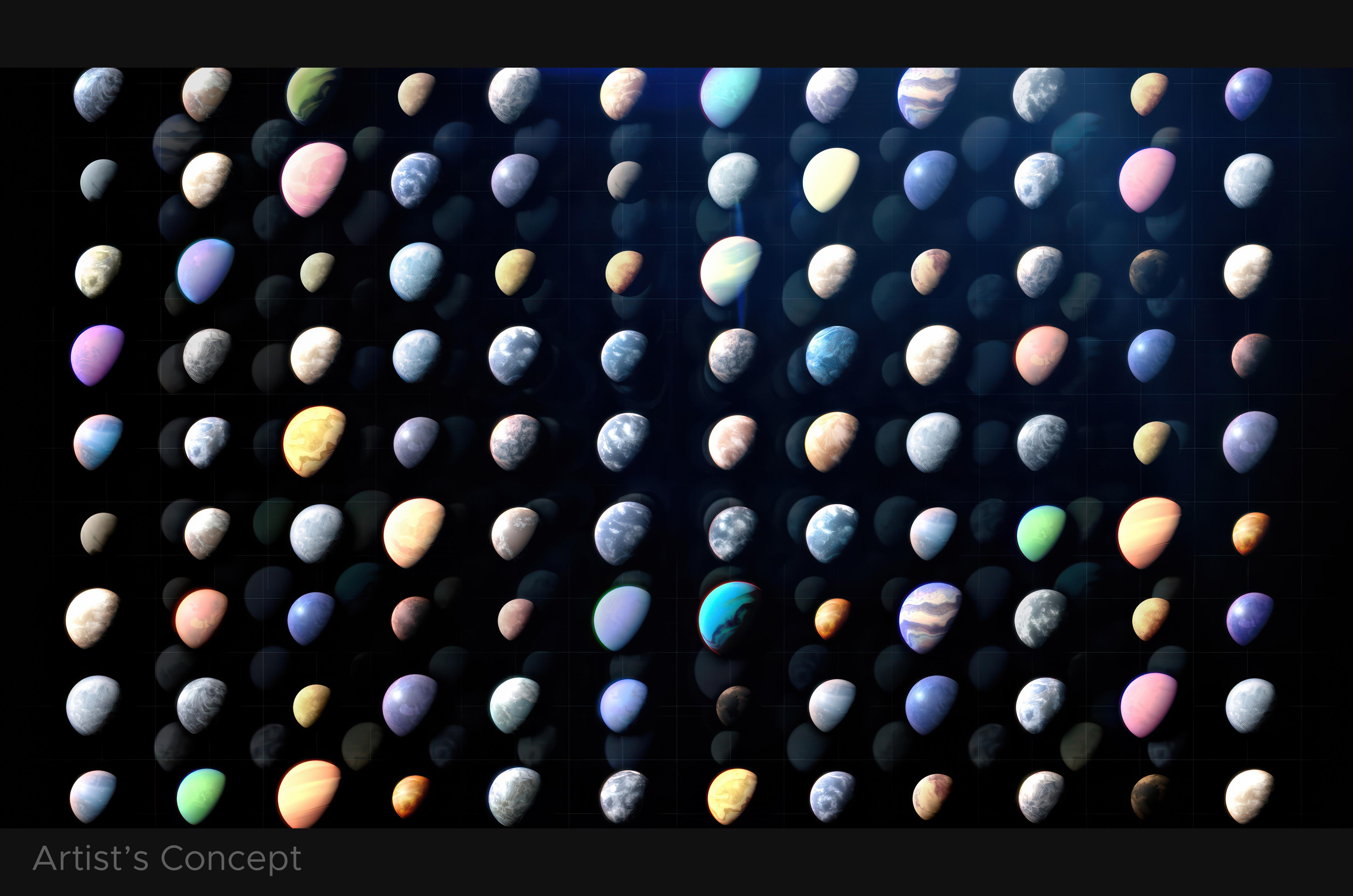
Scientists have found thousands of exoplanets (planets outside our solar system) throughout the galaxy. Most can be studied only indirectly, but scientists know they vary widely, as depicted in this artist’s concept, from small, rocky worlds and gas giants to water-rich planets and those as hot as stars.
CREDIT
NASA’s GSFC
#space #exoplanets #astrophotography #photography #science #astronomy #tech #NASA #ESA #education
Alt...
Scientists have found thousands of exoplanets (planets outside our solar system) throughout the galaxy. Most can be studied only indirectly, but scientists know they vary widely, as depicted in this artist’s concept, from small, rocky worlds and gas giants to water-rich planets and those as hot as stars.
CREDIT
NASA’s Goddard Space Flight Center
NASA’s Tally of Planets Outside Our Solar System Reaches 6,000
The milestone highlights the accelerating rate of discoveries, just over three decades since the first exoplanets were found.
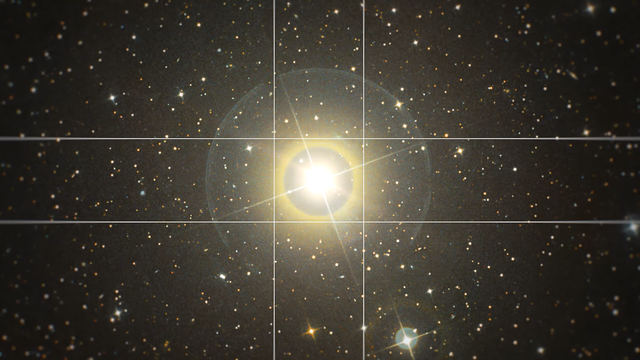
The official number of exoplanets — planets outside our solar system — tracked by NASA has reached 6,000. Confirmed planets are added to the count on a rolling basis by scientists from around the world, so no single planet is considered the 6,000th entry. The number is monitored by NASA’s Exoplanet Science Institute (NExScI), based at Caltech’s IPAC in Pasadena, California. There are more than 8,000 additional candidate planets awaiting confirmation, with NASA leading the world in searching for life in the universe.
CREDIT
NASA/JPL-Caltech
https://science.nasa.gov/exoplanets/discoveries-dashboard/
#space #exoplanets #astrophotography #photography #science #astronomy #tech #NASA #ESA #education
Alt...
It’s been 30 years since the discovery of the first planet around another star like our Sun. With every new discovery, scientists move closer to answering whether there are other planets like Earth that could host life as we know it.
CREDIT
NASA/JPL-Caltech
TOPIC> Exoplanets
Searching for other worlds
-- by Anthony Greicius
Fewer than 100 exoplanets have been directly imaged, because most planets are so faint they get lost in the light from their parent star. The other four methods of planet detection are indirect. With the transit method, for instance, astronomers look for a star to dim for a short period as an orbiting planet passes in front of it.
To account for the possibility that something other than an exoplanet is responsible for a particular signal, most exoplanet candidates must be confirmed by follow-up observations, often using an additional telescope, and that takes time. That’s why there is a long list of candidates in the NASA Exoplanet Archive (hosted by NExScI) waiting to be confirmed.
“We really need the whole community working together if we want to maximize our investments in these missions that are churning out exoplanets candidates,” said Aurora Kesseli, the deputy science lead for the NASA Exoplanet Archive at IPAC. “A big part of what we do at NExScI is build tools that help the community go out and turn candidate planets into confirmed planets.”
The rate of exoplanet discoveries has accelerated in recent years (the database reached 5,000 confirmed exoplanets just three years ago), and this trend seems likely to continue. Kesseli and her colleagues anticipate receiving thousands of additional exoplanet candidates from the ESA (European Space Agency) Gaia mission, which finds planets through a technique called astrometry, and NASA’s upcoming Nancy Grace Roman Space Telescope, which will discover thousands of new exoplanets primarily through a technique called gravitational microlensing.
CREDIT:
Jet Propulsion Laboratory, Pasadena, Calif.
#space #exoplanets #astrophotography #photography #science #astronomy #tech #NASA #ESA #education
Alt...
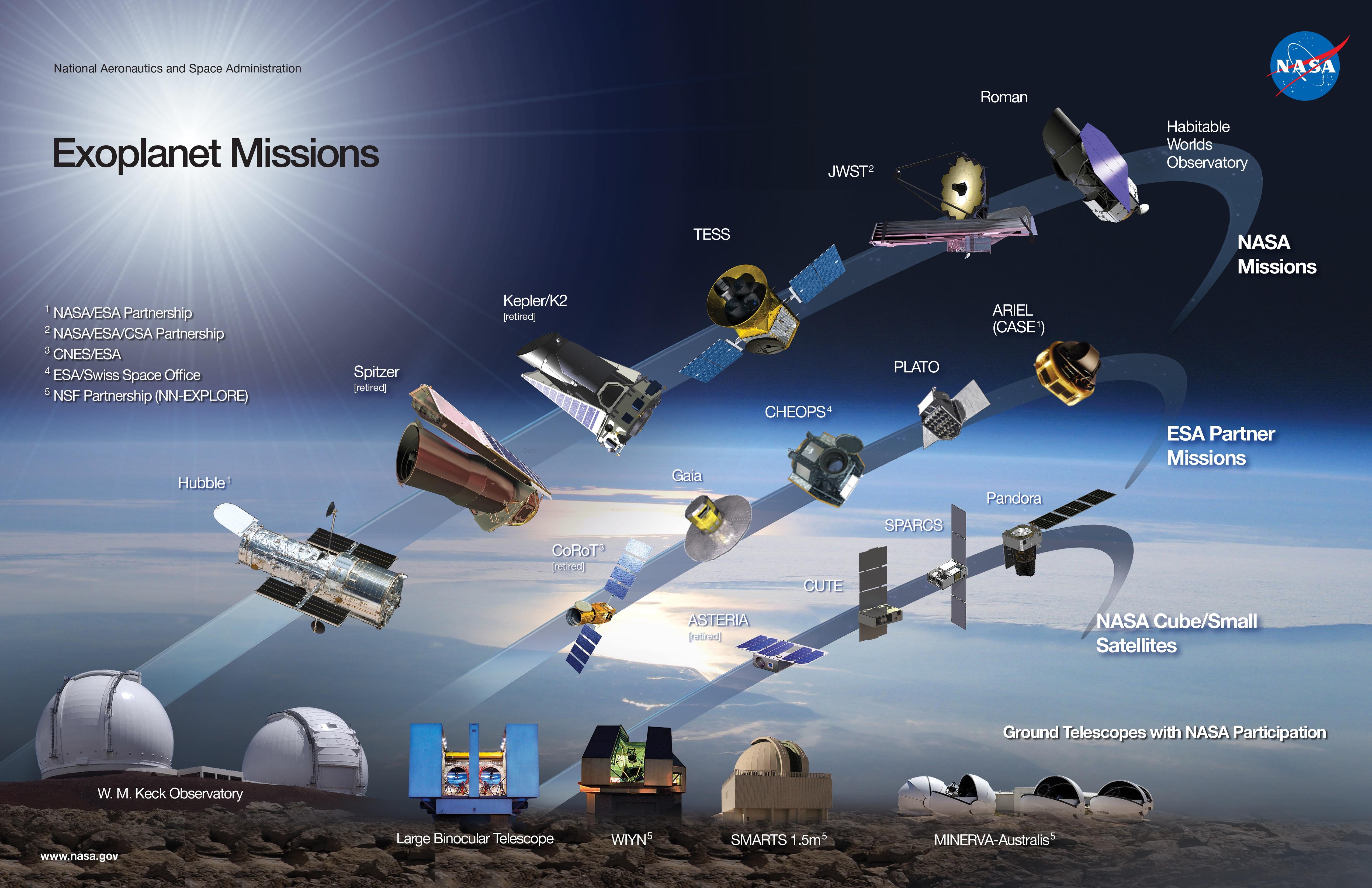
Many telescopes contribute to the search for and study of exoplanets, including some in space (artists concepts shown here) and on the ground. Doing the work are organizations around the world, including ESA (European Space Agency), CSA (Canadian Space Agency), and NSF (National Science Foundation).
CREDIT:
NASA/JPL-Caltech
From Wikipedia, the free encyclopedia
[...]
C/2025 R2 was not discovered earlier in part because of the Holetschek effect as the comet was less than 30 degrees from the Sun between August 7 - September 13. Between August and September the comet had rapidly brightened from magnitude 11 to magnitude 8. The comet is not likely in an outburst, however it is currently unknown how quickly it will dim or if it will completely disintegrate.
C/2025 R2 is officially the 20th comet discovered through SOHO's SWAN instrument according to its discoverer, Vladimir Bezugly.
C/2025 R2 (SWAN) came to perihelion one day after discovery on 12 September 2025 at a distance of 0.5 AU (75 million km) from the Sun. Earth will cross the comet's orbit around 5 October 2025 and it may produce a meteor shower. It will make its closest approach to Earth at a distance of 0.26 AU (39 million km; 24 million mi) on 19 October 2025. It will cross the celestial equator on 3 November 2025.
As the comet was discovered near perihelion, the closest approach to the Sun is reasonably well known. But the aphelion (farthest distance from the Sun) is currently constrained by the low spatial resolution of about 1° per pixel STEREO-A observations in August, and without the STEREO-A observations, there is only a short 4-day observation arc for the orbit determination. Aphelion is anywhere from 60+ AU from the Sun with an orbital period of hundreds to thousands of years. The Minor Planet Center (using observations through September 15th) estimates an orbital period of 1400 years with aphelion around 250 AU, and JPL (using observations through September 14th) estimates an orbital period of 20000 years with aphelion beyond 1000 AU. ..
Text Credits:
Contributors to Wikimedia projects
Image Credit:
Filipp Romanov
https://en.wikipedia.org/wiki/C/2025_R2_(SWAN)
#space #comets #astrophotography #photography #science #astronomy #nature #NASA #ESA #education
Alt...
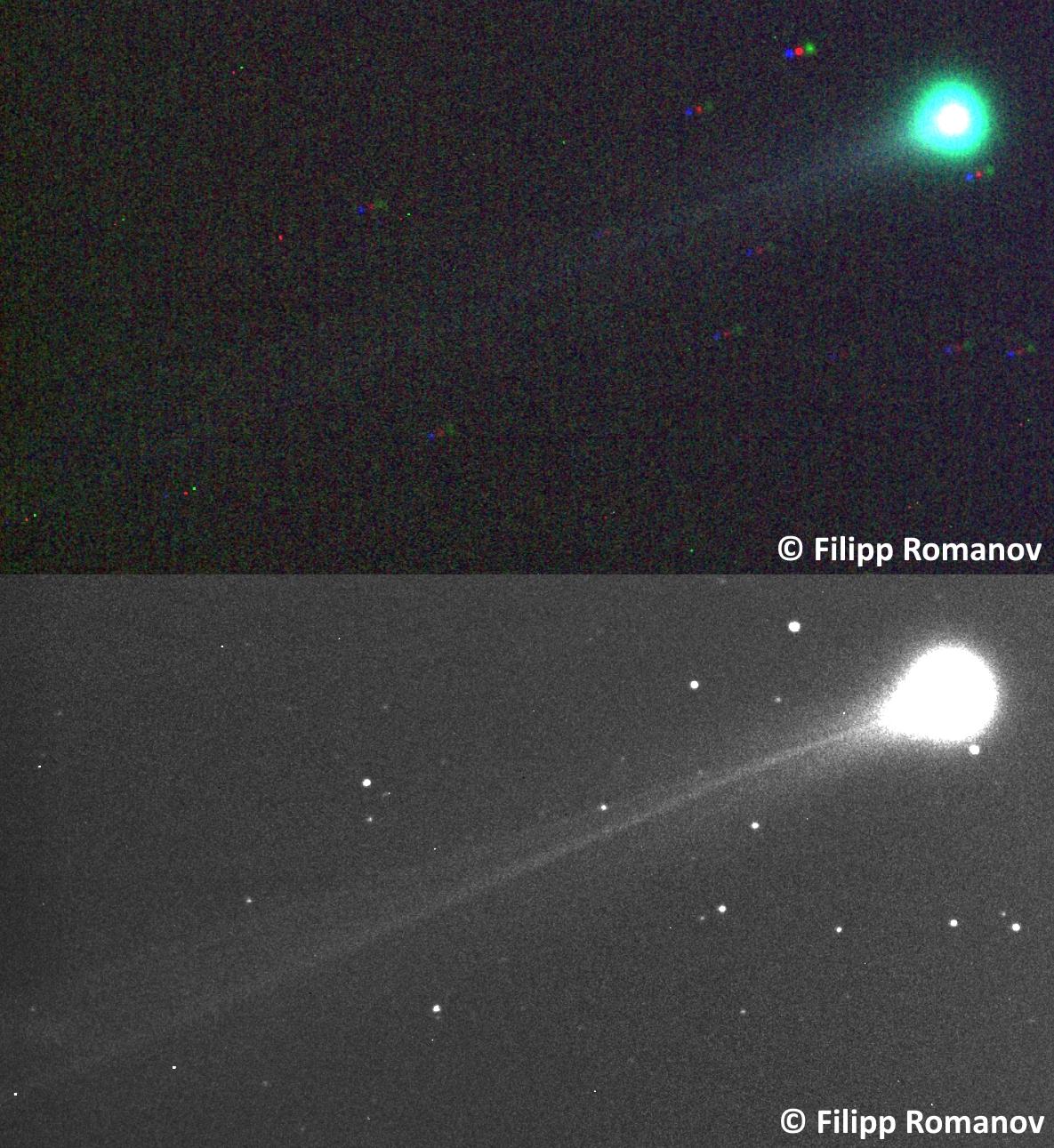
On 2025-09-13 I confirmed the new bright comet SWAN25B remotely using iTelescope.net T59 (0.51-m f/6.8 reflector + CCD) located at the Siding Spring Observatory, Australia. I measured: magnitude of the coma = +8.9 mag., coma diameter = 2 arcminutes with a straight tail (which becomes wider away from the coma) at least 18 arcminutes in length (up to the edge of the frame), PA = 112 degrees. Images: stacked 3x10 sec. (RGB) and single 60 sec. (Luminance filter).
Credit text & image
Filipp Romanov
Comet C/2025 R2 (SWAN) imaged from the Siding Spring Observatory on 13 September 2025 with a 0.5 m (20 in) telescope.
Discovery
Discovered by SOHO–SWAN
Vladimir Bezugly
Discovery date 11 September 2025
Designations Alternative designations
SWAN25B, CK25R020
Orbital characteristics
Epoch 13 September 2025 (JD 2460931.5)
Observation arc 32 days
Earliest precovery date 13 August 2025
Number of observations 83
Aphelion 1600±9000 AU
Perihelion 0.5035±0.0002 AU
Eccentricity 0.999±0.003
Orbital period 1400–20000(?) years
Inclination 4.47°±0.002°
Longitude of ascending node 335.7°
Argument of periapsis 307.77°
Last perihelion 12 September 2025
TJupiter 0.884
Earth MOID 0.047 AU
Jupiter MOID 0.042 AU
Physical characteristics
Comet total
magnitude (M1) 12.4±0.9
Comet nuclear
magnitude (M2) 10±2
Apparent magnitude
6.0
(2025-09-15)
Comet C/2025 R2 (SWAN)
Below the horizon. Rise: 9:47 | Tran: 14:46 | Set: 19:44
Alt: -29.26° Az: 70.51° Direction: East-North-East
Comet C/2025 R2 (SWAN) is in the constellation of Virgo, at a distance of 117,117,474.3 kilometers from Earth. The current Right Ascension is 13h 35m 39s and the Declination is -11° 36’ 24” (apparent coordinates). The latest observed magnitude of comet C/2025 R2 (SWAN) is 7.3 (data provided by COBS).
* URL'S associated with the images:
1. to 2. https://theskylive.com/planetarium?obj=c2025r2
3. 5. 6. https://theskylive.com/c2025r2-tracker
4. https://theskylive.com/3dsolarsystem?obj=c2025r2
On this website you can follow the current data of the comet live:
https://theskylive.com/c2025r2-info
CREDIT
TheSkyLive.com
----
From Wikipedia, the free encyclopedia:
C/2025 R2 (SWAN)
C/2025 R2 (SWAN), formerly known as SWAN25B, is a non-periodic comet discovered on 11 September 2025 by Vladimir Bezugly through SWAN imagery. As of 17 September 2025, the comet has an apparent magnitude of +6.9 with a solar elongation of 30 degrees and is observable near the star Spica in 50 mm (2.0 in) binoculars. It is better seen from the Southern hemisphere.
Observational history
The comet was first spotted in images from the SWAN instrument onboard the Solar and Heliospheric Observatory (SOHO) by amateur astronomer Vladimir Bezugly on 11 September 2025. The presence of the comet was confirmed by other amateur astronomers, having an estimated magnitude of 7.4 and featuring a tail about 2 degrees long. The comet upon discovery was located in the constellation of Virgo and it was better seen from the southern hemisphere as it was higher in the sky after sunset.
[...]
Please read more in next post.
Text Credits:
Contributors to Wikimedia projects
#space #comets #astrophotography #photography #science #astronomy #nature #NASA #ESA #education
Alt...
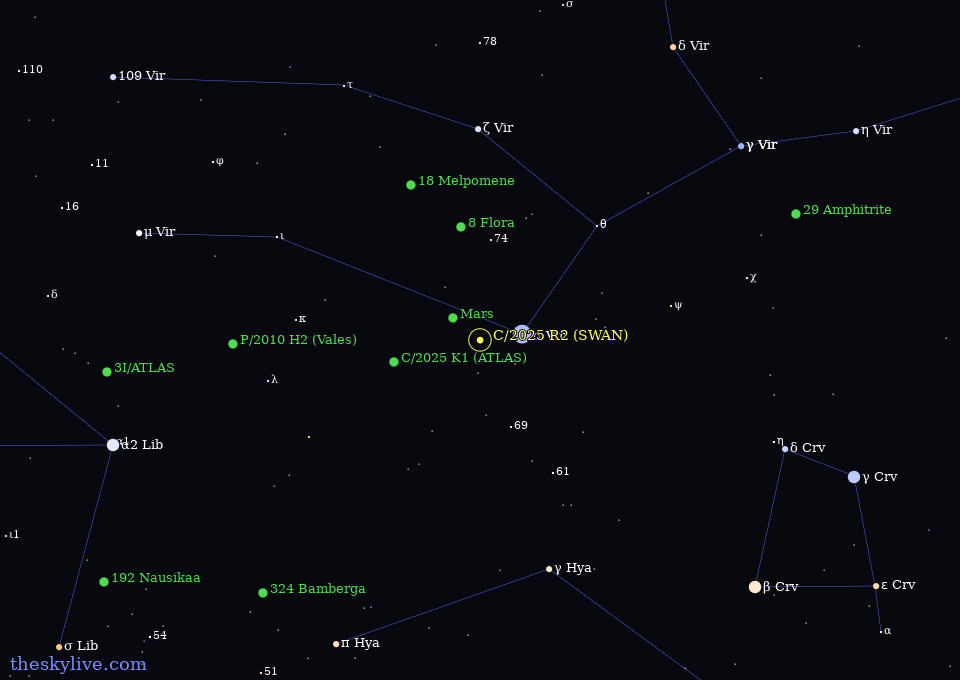
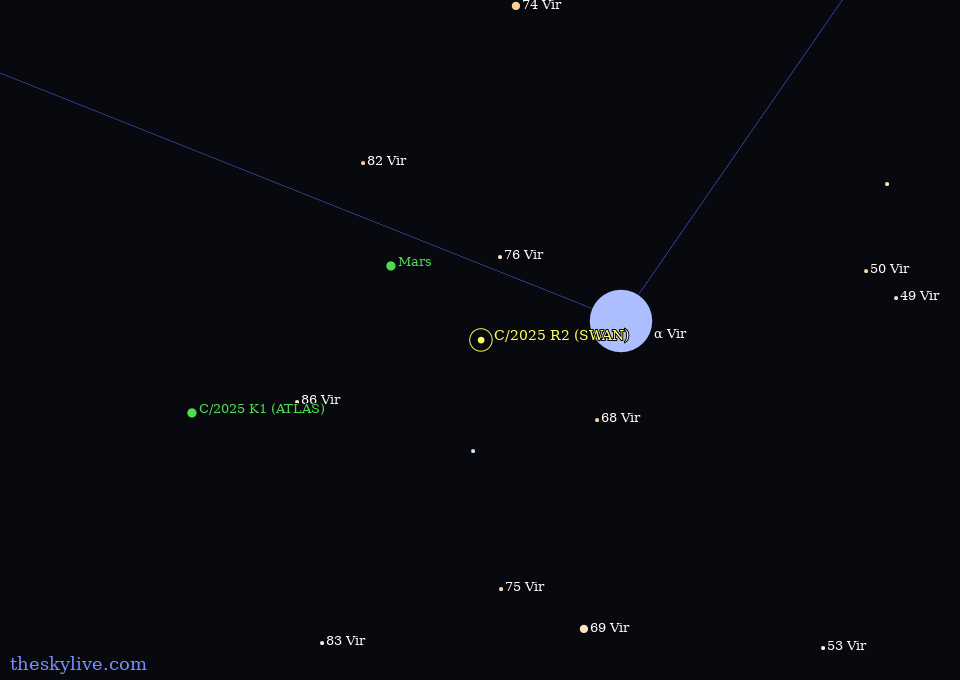
Star map showing the position of comet C/2025 R2 (SWAN) in the constellation of Virgo on September 18, 2025. Field of view: 50x30 degrees.
Alt...
Star map showing the position of comet C/2025 R2 (SWAN) in the constellation of Virgo on September 18, 2025. Field of view: 15x9 degrees.
Alt...
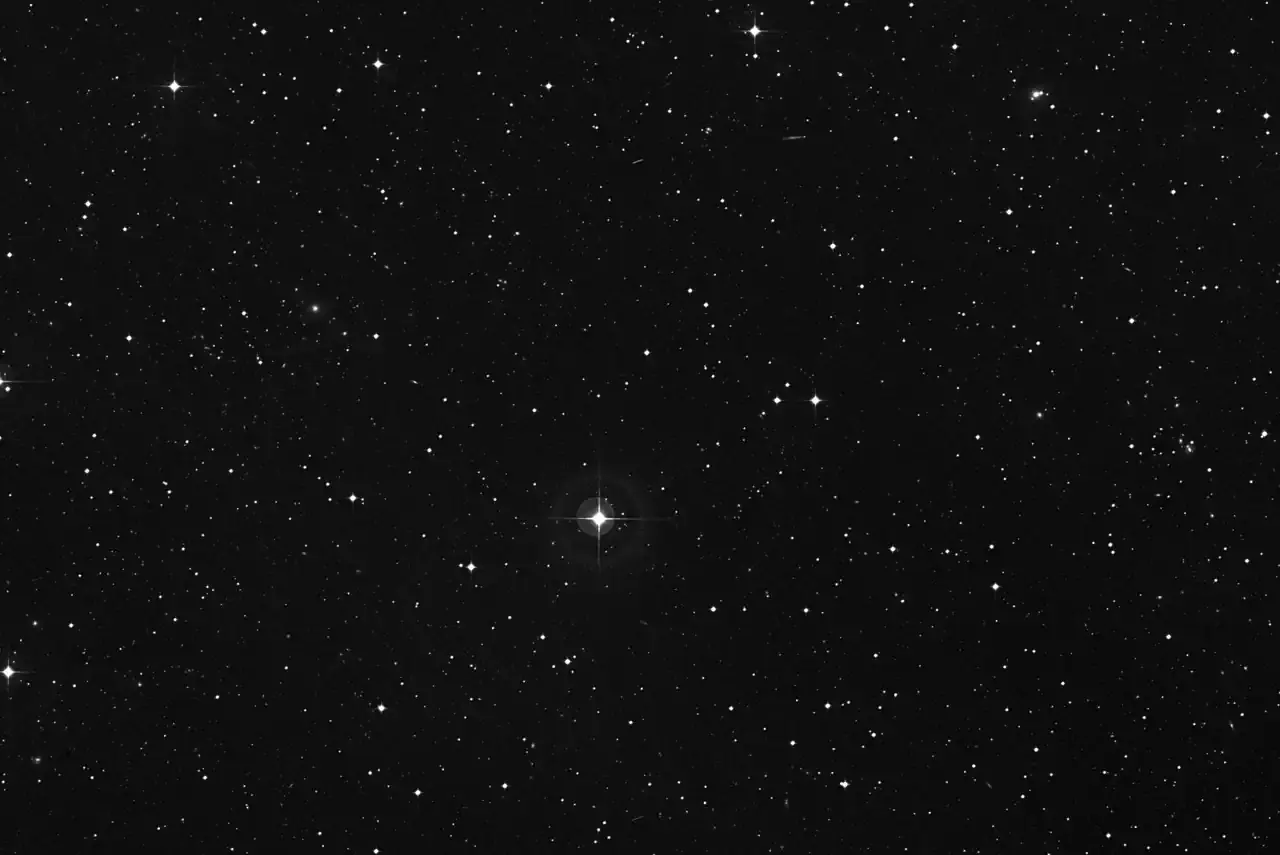
Simplified high-resolution deep sky chart showing the current position of comet C/2025 R2 (SWAN). Field of view: 60 x 40 arcminutes.
Alt...
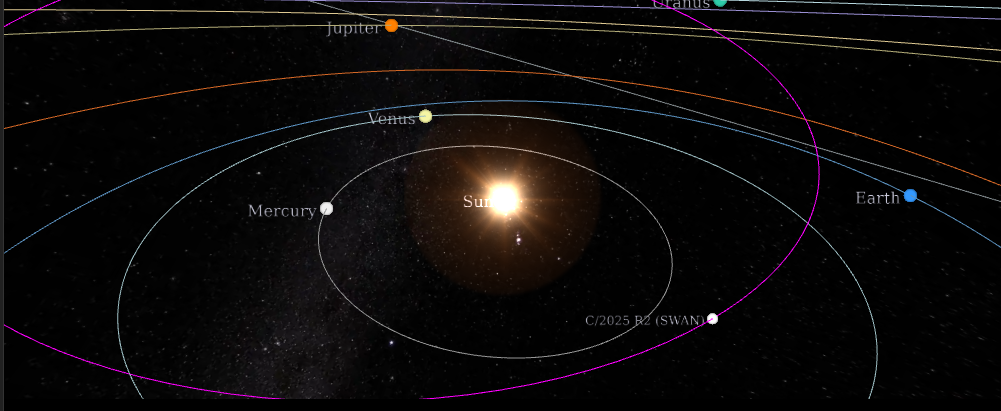
3D animated visualization of the orbit of comet C/2025 R2 (SWAN) relative to the other major objects in the Solar System.
Alt...
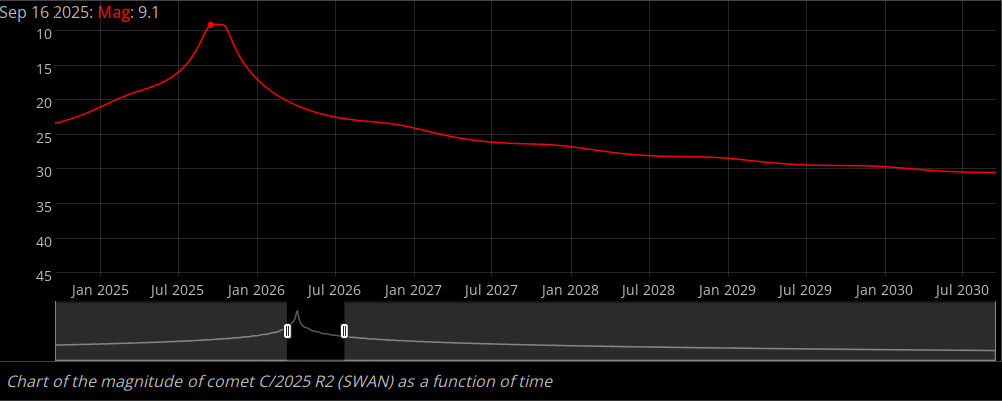
Light curve of comet C/2025 R2 (SWAN), i.e., its apparent magnitude as a function of time. The curve is calculated using the latest ephemerides provided by JPL Horizons. The magnitude data is sampled with the interval of 2 days. Because of this sampling, inaccuracies may occur for objects that have large variations of brightness over a few days. For comets, large discrepancies can arise between the calculated brightness and the observations due to their highly dynamic, and not always precisely predictable, behavior.
Alt...
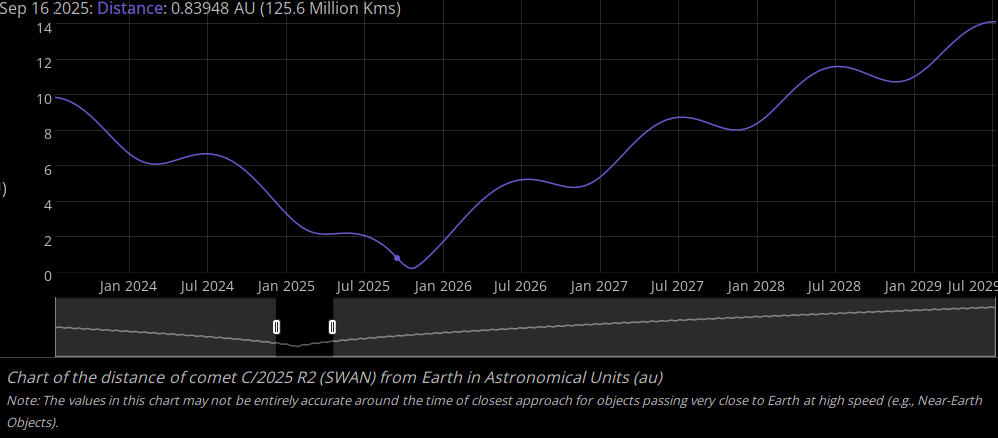
Distance of comet C/2025 R2 (SWAN) from Earth as a function of time. In the chart the distance is measured in Astronomical Units and the data is sampled with an interval of 1 day.
https://theskylive.com/3dsolarsystem?obj=c2025r2
Interactive 3D Orbit Visualization
#space #comets #astrophotography #photography #science #astronomy #nature #NASA #ESA #education
2025 September 18
Comet C/2025 R2 (SWAN)
* Image Credit & Copyright: Team Ciel Austral
https://www.cielaustral.com/
Explanation:
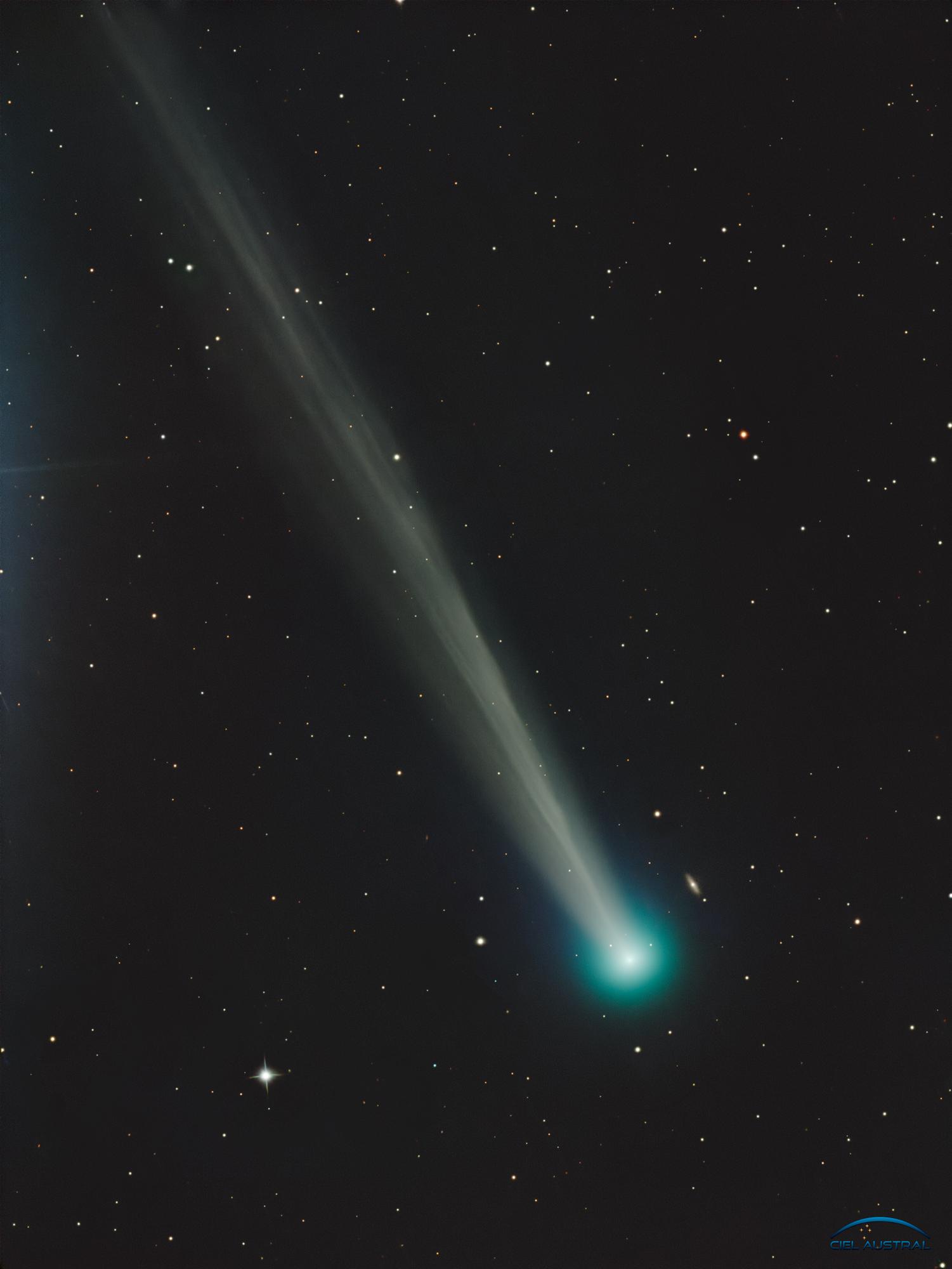
A new visitor from the outer Solar System, comet C/2025 R2 (SWAN) also known as SWAN25B was only discovered late last week, on September 11. That's just day before the comet reached perihelion, its closest approach to the Sun. First spotted by Vladimir Bezugly in images from the SWAN instrument on the sun-staring SOHO spacecraft, the comet was surprisingly bright but understandably difficult to see against the Sun's glare. Still close to the Sun on the sky, the greenish coma and tail of C/2025 R2 (SWAN) are captured in this telescopic snapshot from September 17. Spica, alpha star of the constellation Virgo, shines just beyond the upper left edge of the frame while the comet is about 6.5 light-minutes from planet Earth. Near the western horizon after sunset and slightly easier to see in binoculars from the southern hemisphere, this comet SWAN will pass near Zubenelgenubi, alpha star of Libra, on October 2. C/2025 R2 (SWAN) is scheduled to make its closest approach to our fair planet around October 20.
https://app.astrobin.com/i/i5qsgj
https://earthsky.org/space/new-comet-swan25b-2025/
https://cobs.si/obs_list?id=2659
https://en.wikipedia.org/wiki/C/2025_R2_(SWAN)#Observational_history
https://spaceplace.nasa.gov/comets/en/
https://science.nasa.gov/mission/soho/
https://apod.nasa.gov/apod/ap250918.html
#space #comets #astrophotography #photography #science #astronomy #nature #NASA #ESA #education
Alt...
2025 September 18
Comet C/2025 R2 (SWAN)
* Image Credit & Copyright: Team Ciel Austral
Explanation:
A new visitor from the outer Solar System, comet C/2025 R2 (SWAN) also known as SWAN25B was only discovered late last week, on September 11. That's just day before the comet reached perihelion, its closest approach to the Sun. First spotted by Vladimir Bezugly in images from the SWAN instrument on the sun-staring SOHO spacecraft, the comet was surprisingly bright but understandably difficult to see against the Sun's glare. Still close to the Sun on the sky, the greenish coma and tail of C/2025 R2 (SWAN) are captured in this telescopic snapshot from September 17. Spica, alpha star of the constellation Virgo, shines just beyond the upper left edge of the frame while the comet is about 6.5 light-minutes from planet Earth. Near the western horizon after sunset and slightly easier to see in binoculars from the southern hemisphere, this comet SWAN will pass near Zubenelgenubi, alpha star of Libra, on October 2. C/2025 R2 (SWAN) is scheduled to make its closest approach to our fair planet around October 20.
Authors & editors: Robert Nemiroff (MTU) & Jerry Bonnell (UMCP)
NASA Official: Amber Straughn Specific rights apply.
NASA Web Privacy, Accessibility, Notices;
A service of: ASD at NASA / GSFC,
NASA Science Activation
& Michigan Tech. U.
2025 September 15
Earth During a Powerful Solar Storm
* Video Credit: NASA's SVS, SWRC, CCMC, SWMF; T. Bridgman et al.
https://www.nasa.gov/
https://svs.gsfc.nasa.gov/
https://science.gsfc.nasa.gov/heliophysics/spaceweather
https://ccmc.gsfc.nasa.gov/
https://clasp.engin.umich.edu/research/theory-computational-methods/space-weather-modeling-framework/
https://svs.gsfc.nasa.gov/search/?people=Tom%20Bridgman
https://svs.gsfc.nasa.gov/4189/
Explanation:
Can our Sun become dangerous? Yes, sometimes. Every few years our Sun ejects a scary-large bubble of hot gas into the Solar System. Every hundred years or so, when the timing, location, and magnetic field connections are just right, such a Coronal Mass Ejection (CME) will hit the Earth. When this happens, the Earth not only experiences dramatic auroras, but its magnetic field gets quickly pushed back and compressed, which causes electric grids to surge. Some of these surges could be dangerous, affecting satellites and knocking out power grids -- which can take months to fix. Just such a storm -- called the Carrington Event -- occurred in 1859 and caused telegraph wires to spark. A similar CME passed near the Earth in 2012, and the featured animated video shows a computer model of what might have happened if it had been a direct hit. In this model, the Earth's magnetopause becomes so compressed that it went inside the orbit of geosynchronous communication satellites.
https://apod.nasa.gov/apod/ap250915.html
#space #sun #astrophotography #photography #science #astronomy #physics #nature #NASA
TOPIC> Our Sun
2025 July 30
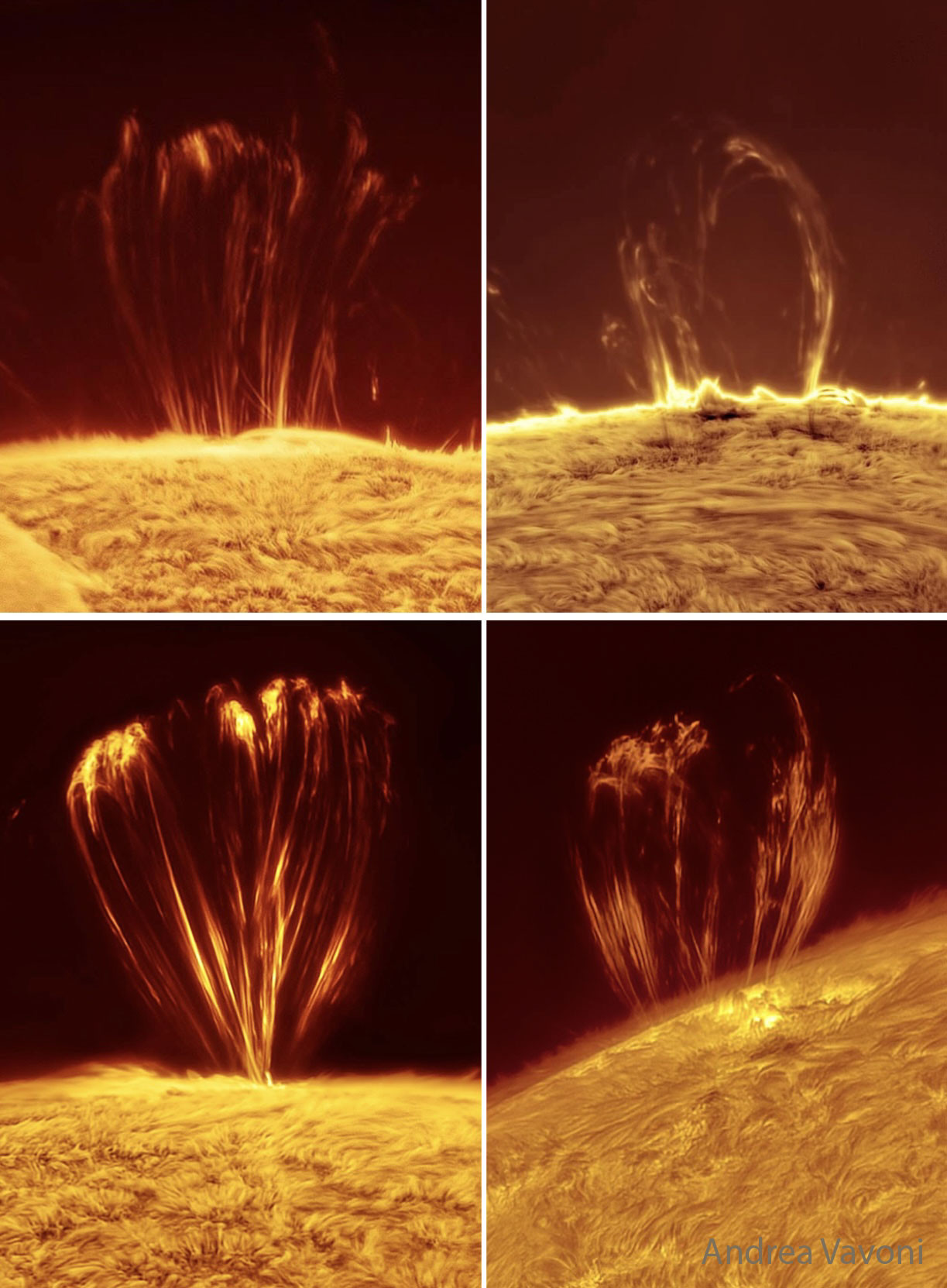
Four images of the Sun's edge are shown. In each a loop of bright material is captured above the Sun's surface.
Coronal Loops on the Sun
* Image Credit & Copyright: Andrea Vanoni
https://andreavanoni.wixsite.com/astrophotography/su-di-me
Explanation:
Our Sun frequently erupts in loops. Hot solar plasma jumps off the Sun's surface into prominences, with the most common type of prominence being a simple loop. The loop shape originates from the Sun's magnetic field, which is traced by spiraling electrons and protons. Many loops into the Sun's lower corona are large enough to envelop the Earth and are stable enough to last days. They commonly occur near active regions that also include dark sunspots. The featured panel shows four loops, each of which was captured near the Sun's edge during 2024 and 2025. The images were taken by a personal telescope in Mantova, Italy and in a very specific color of light emitted primarily by hydrogen. Some solar prominences suddenly break open and eject particles into the Solar System, setting up a space weather sequence that can affect the skies and wires of Earth.
https://science.nasa.gov/sun/
https://science.nasa.gov/solar-system/
SpacePlace:
https://spaceplace.nasa.gov/all-about-the-sun/en/
https://youtu.be/2g1epPppIOM
https://spaceplace.nasa.gov/spaceweather/en/
https://apod.nasa.gov/apod/ap250730.html
#space #sun #astrophotography #photography #science #astronomy #physics #nature #NASA
Alt...
2025 July 30
Four images of the Sun's edge are shown. In each a loop of bright material is captured above the Sun's surface.
Coronal Loops on the Sun
* Image Credit & Copyright: Andrea Vanoni
Explanation:
Our Sun frequently erupts in loops. Hot solar plasma jumps off the Sun's surface into prominences, with the most common type of prominence being a simple loop. The loop shape originates from the Sun's magnetic field, which is traced by spiraling electrons and protons. Many loops into the Sun's lower corona are large enough to envelop the Earth and are stable enough to last days. They commonly occur near active regions that also include dark sunspots. The featured panel shows four loops, each of which was captured near the Sun's edge during 2024 and 2025. The images were taken by a personal telescope in Mantova, Italy and in a very specific color of light emitted primarily by hydrogen. Some solar prominences suddenly break open and eject particles into the Solar System, setting up a space weather sequence that can affect the skies and wires of Earth.
Authors & editors: Robert Nemiroff (MTU) & Jerry Bonnell (UMCP)
NASA Official: Amber Straughn Specific rights apply.
NASA Web Privacy, Accessibility, Notices;
A service of: ASD at NASA / GSFC,
NASA Science Activation
& Michigan Tech. U.
2024 August 18
A Solar Prominence Eruption from SDO
* Image Credit: NASA/Goddard/SDO AIA Team
https://www.nasa.gov/
https://www.nasa.gov/goddard
https://sdo.gsfc.nasa.gov/
Explanation:
One of the most spectacular solar sights is an erupting prominence. In 2011, NASA's Sun-orbiting Solar Dynamic Observatory spacecraft imaged an impressively large prominence erupting from the surface. The dramatic explosion was captured in ultraviolet light in the featured time lapse video covering 90 minutes, where a new frame was taken every 24 seconds. The scale of the prominence is huge -- the entire Earth would easily fit under the flowing curtain of hot gas. A solar prominence is channeled and sometimes held above the Sun's surface by the Sun's magnetic field. A quiescent prominence typically lasts about a month and may erupt in a Coronal Mass Ejection (CME) expelling hot gas into the Solar System. The energy mechanism that creates a solar prominence is a continuing topic of research. Our Sun is again near solar maximum and so very active, featuring numerous erupting prominences and CMEs, one of which resulted in picturesque auroras just over the past week.
TOPIC> Auroras
https://defcon.social/@grobi/114646611195811889
https://apod.nasa.gov/apod/ap240818.html
#space #sun #astrophotography #photography #science #astronomy #physics #nature #NASA
Released Thursday, July 10, 2025
The Closest Images Ever Taken of the Sun’s Atmosphere
On its record-breaking pass by the Sun in December 2024, NASA’s Parker Solar Probe captured stunning new images from within the Sun’s atmosphere. These newly released images — taken closer to the Sun than we’ve ever been before — are helping scientists better understand the Sun’s influence across the solar system, including events that can affect Earth.
Parker Solar Probe started its closest approach to the Sun on Dec. 24, 2024, flying just 3.8 million miles from the solar surface. As it skimmed through the Sun’s outer atmosphere, called the corona, in the days around the perihelion, it collected data with an array of scientific instruments, including the Wide-Field Imager for Solar Probe, or WISPR.
Learn more - https://science.nasa.gov/science-research/heliophysics/nasas-parker-solar-probe-snaps-closest-ever-images-to-sun/
Credits:
NASA's Goddard Space Flight Center
NASA Scientific Visualization Studio
#space #sun #astrophotography #photography #science #astronomy #physics #nature #NASA
Alt...
Released Thursday, July 10, 2025
The Closest Images Ever Taken of the Sun’s Atmosphere
On its record-breaking pass by the Sun in December 2024, NASA’s Parker Solar Probe captured stunning new images from within the Sun’s atmosphere. These newly released images — taken closer to the Sun than we’ve ever been before — are helping scientists better understand the Sun’s influence across the solar system, including events that can affect Earth.
Parker Solar Probe started its closest approach to the Sun on Dec. 24, 2024, flying just 3.8 million miles from the solar surface. As it skimmed through the Sun’s outer atmosphere, called the corona, in the days around the perihelion, it collected data with an array of scientific instruments, including the Wide-Field Imager for Solar Probe, or WISPR.
Learn more - https://science.nasa.gov/science-research/heliophysics/nasas-parker-solar-probe-snaps-closest-ever-images-to-sun/
Credits:
NASA's Goddard Space Flight Center
NASA Scientific Visualization Studio
2025 August 11
Closest Ever Images Near the Sun
* Video Credit: NASA, JHUAPL, Naval Research Lab, Parker Solar Probe
https://www.nasa.gov/
https://www.jhuapl.edu/
https://www.nrl.navy.mil/
https://www.nasa.gov/content/goddard/parker-solar-probe
Explanation:
Everybody sees the Sun. Nobody's been there. Starting in 2018, though, NASA launched the robotic Parker Solar Probe (PSP) to investigate regions near to the Sun for the first time. The featured time-lapse video shows the view looking sideways from behind PSP's Sun shield in December during the closest approach of any human-made spacecraft to the Sun, looping down to only about five solar diameters above the Sun's hot surface. The PSP's Wide Field Imager for Solar Probe (WISPR) cameras took these images over seven hours, but they are digitally compressed here into about 5 seconds. The solar corona, including colliding coronal mass ejections (CMEs), is visible here in unprecedented detail, with stars passing far in the background. The Sun is not only Earth's dominant energy source, but its variable solar wind also compresses Earth's atmosphere, triggers auroras, affects power grids, and can even damage orbiting communication satellites.
https://svs.gsfc.nasa.gov/14865
https://parkersolarprobe.jhuapl.edu/
https://apod.nasa.gov/apod/ap180815.html
https://www.nature.com/articles/d41586-019-03665-3
https://science.nasa.gov/science-research/heliophysics/nasas-parker-solar-probe-snaps-closest-ever-images-to-sun/
https://en.wikipedia.org/wiki/Parker_Solar_Probe#Timeline
https://www.nasa.gov/image-article/what-coronal-mass-ejection-or-cme/
https://apod.nasa.gov/apod/ap000318.html
https://hesperia.gsfc.nasa.gov/rhessi3/mission/science/the-impact-of-flares/index.html
https://apod.nasa.gov/apod/ap250811.html
#space #sun #astrophotography #photography #science #astronomy #physics #nature #NASA
This animation shows all L3 WISPR full-field observations from the twenty-first PSP Mission Encounter (2024-09-25 - 2024-10-05). We have superimposed a grid showing helioprojective longitude and latitude, and a scale representation of the size and location of the Sun in the observations using the SDO/HMI Carrington map for this time period. The velocity and distance metrics displayed on the movies correspond respectively to the spacecraft's heliocentric velocity in kilometers per second, and its distance from the Sun's center in units of solar radii (where 1 solar radius = 695,700km). The "FOV Range" label provides the plane-of-sky distance limits of the inner and outermost edges of the fields of view, in units of solar radii. The horizontal blue line indicates the orbital plane of PSP. The timespan of this composite movie covers only the nominal science window when the spacecraft was within 0.25 au; a limited amount of data outside of this range may be available at the below links.
You can download this movie directly as an 101MB mp4 file. This sequence is also available as data processed via the LW Algorithm developed by Dr. Guillermo Stenborg (JHUAPL) and detailed in Appendix A of Howard et al. 2022 (ApJ, 936, id.43. DOI 10.3847/1538-4357/ac7ff5). Please contact the team for access to this data, which will be posted here one year after the acquisition of those observations. Team contact information can be found in Section 1.2 of the WISPR User's Guide
** https://wispr.nrl.navy.mil/sites/wispr.nrl.navy.mil/files/wispr_data_user_guide_v3.pdf [PDF link].
Credit:
* NASA/NRL/JHUAPL.
* Movie processed/compiled by Guillermo Stenborg (JHUAPL) and Karl Battams (NRL).
* SDO inset courtesy of NASA/SDO and the AIA, EVE, and HMI science teams.
/*grobi: this is a compressed and converted video-file for a better resolution go to:
** https://wispr.nrl.navy.mil/encounter21-summary (but that's a huge file !:D )
** the servers could be temporarily under maintenance
#space #sun #parker #astrophotography #photography #science #astronomy #physics #nature #NASA
2025 August 26
A Leaky Solar Prominence
Video Credit & Copyright: Andrea Girones
https://andreagirones.com/
Explanation:
What's hovering above the Sun? A solar prominence. A prominence is a crest of hot gas expelled from the Sun's surface that is held aloft by the Sun's magnetic field. Prominences can last for days, can suddenly explode into space, or just fall back to the Sun. What decides a prominence's fate is how the Sun's complex magnetic field changes -- the field's direction can act like an offramp for trapped solar particles. The 3-second (repeating) time-lapse featured video was captured earlier this month from Ottawa, Ontario, Canada. It shows the development of a larger-than-Earth prominence as it appears to leak solar plasma back to the Sun, over the course of an hour. What is unusual is that the prominence appears to hover -- more simple and typical prominences form magnetic loops that connect back to the surface. Many hours after this video ended, the hovering prominence disintegrated back into the Sun.
https://www.nasa.gov/image-article/what-solar-prominence/
https://solarscience.msfc.nasa.gov/the_key.shtml
https://apod.nasa.gov/apod/ap250826.html
#space #sun #astrophotography #photography #science #astronomy #physics #nature #NASA
..
some annotations for previous image and a nice infobanner by STARFRONT OBSERVATORIES
* Image Credit & Copyright: J. De Winter, C. Humbert, C. Robert & V. Sabet
https://www.instagram.com/dwj85
https://www.instagram.com/astro.berto54
https://www.instagram.com/charlesrbert
https://app.astrobin.com/u/victorf#gallery
* Text: Ogetay Kayali (MTU)
https://wwhttps://www.mtu.edu/physics/w.ogetay.com/
Please read more on:
https://www.astrobin.com/jliezm/?force-classic-view
#space #nebula #cluster #astrophotography #photography #science #astronomy #nature #NASA #ESA #education
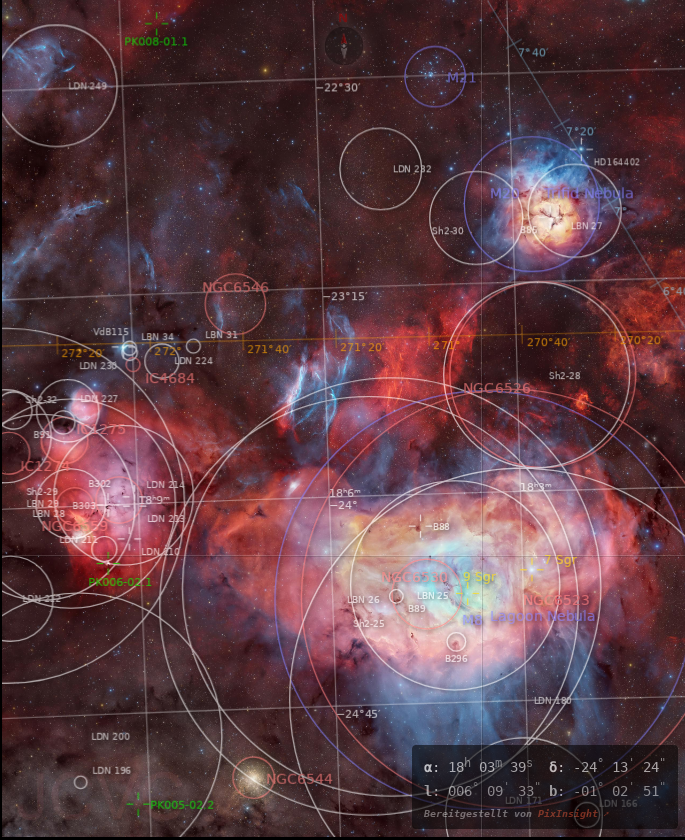
Alt...
Some annotations for the previous post from their astrobin account.
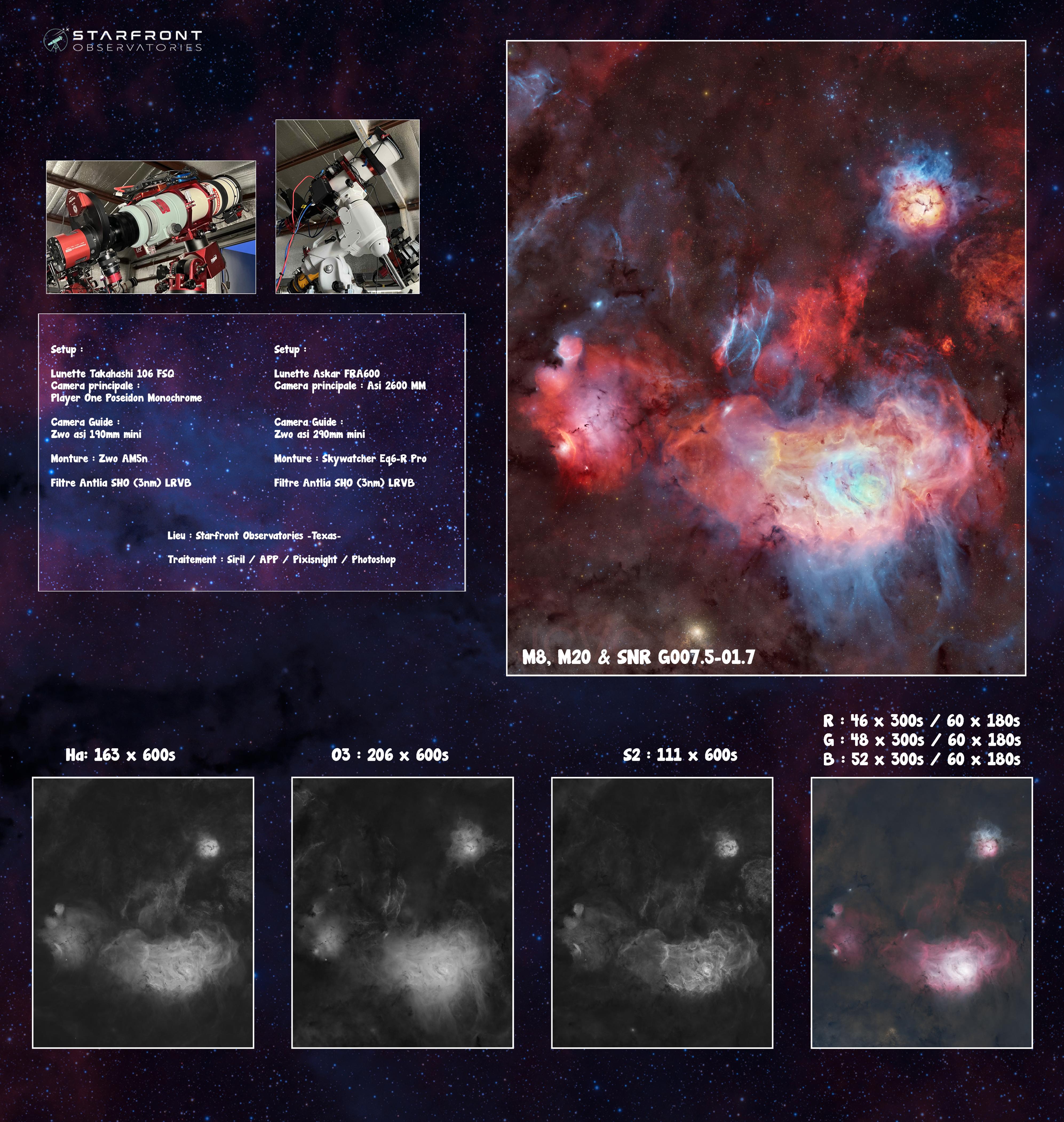
Alt...
a nice infobanner by STARFRONT OBSERVATORIES
The final result brings together three cosmic actors: the Lagoon and Trifid — stellar nurseries where countless new suns are born — and, right beside them, the delicate filaments left behind by a star at the very end of its life.
This contrast between creation and destruction, between stellar birth and stellar death, is what inspired the title of this mosaic.
Just a few weeks ago, Team FACT (@French Amateur Collaborative Telescope) released their own breathtaking take on this region. Not only was their processing exquisite, but their scientific analysis of the field was remarkable. We warmly encourage you to explore their description — without a doubt the finest explanation of this part of the sky that we know of
2025 September 17
Nebulas and Clusters in Sagittarius
* Image Credit & Copyright: J. De Winter, C. Humbert, C. Robert & V. Sabet
https://www.instagram.com/dwj85
https://www.instagram.com/astro.berto54
https://www.instagram.com/charlesrbert
https://app.astrobin.com/u/victorf#gallery
* Text: Ogetay Kayali (MTU)
https://www.ogetay.com/
https://www.mtu.edu/physics/
Explanation:
Can you spot famous celestial objects in this image? 18th-century astronomer Charles Messier cataloged only two of them: the bright Lagoon Nebula (M8) at the bottom, and the colorful Trifid Nebula (M20) at the upper right. The one on the left that resembles a cat's paw is NGC 6559, and it is much fainter than the other two. Even harder to spot are the thin blue filaments on the left, from supernova remnant (SNR G007.5-01.7). Their glow comes from small amounts of glowing oxygen atoms that are so faint that it took over 17 hours of exposure with just one blue color to bring up. Framing this scene of stellar birth and death are two star clusters: the open cluster M21 just above Trifid, and the globular cluster NGC 6544 at lower left.
https://app.astrobin.com/i/jliezm
https://science.nasa.gov/people/explore-the-night-sky-hubbleatms-messier-catalog-bio/
https://science.gsfc.nasa.gov/662/research/snrs.html
https://en.wikipedia.org/wiki/Doubly_ionized_oxygen
https://en.wikipedia.org/wiki/Open_cluster
https://en.wikipedia.org/wiki/Globular_cluster
https://en.wikipedia.org/wiki/Messier_21
https://apod.nasa.gov/apod/ap250917.html
#space #nebula #cluster #astrophotography #photography #science #astronomy #nature #NASA #education
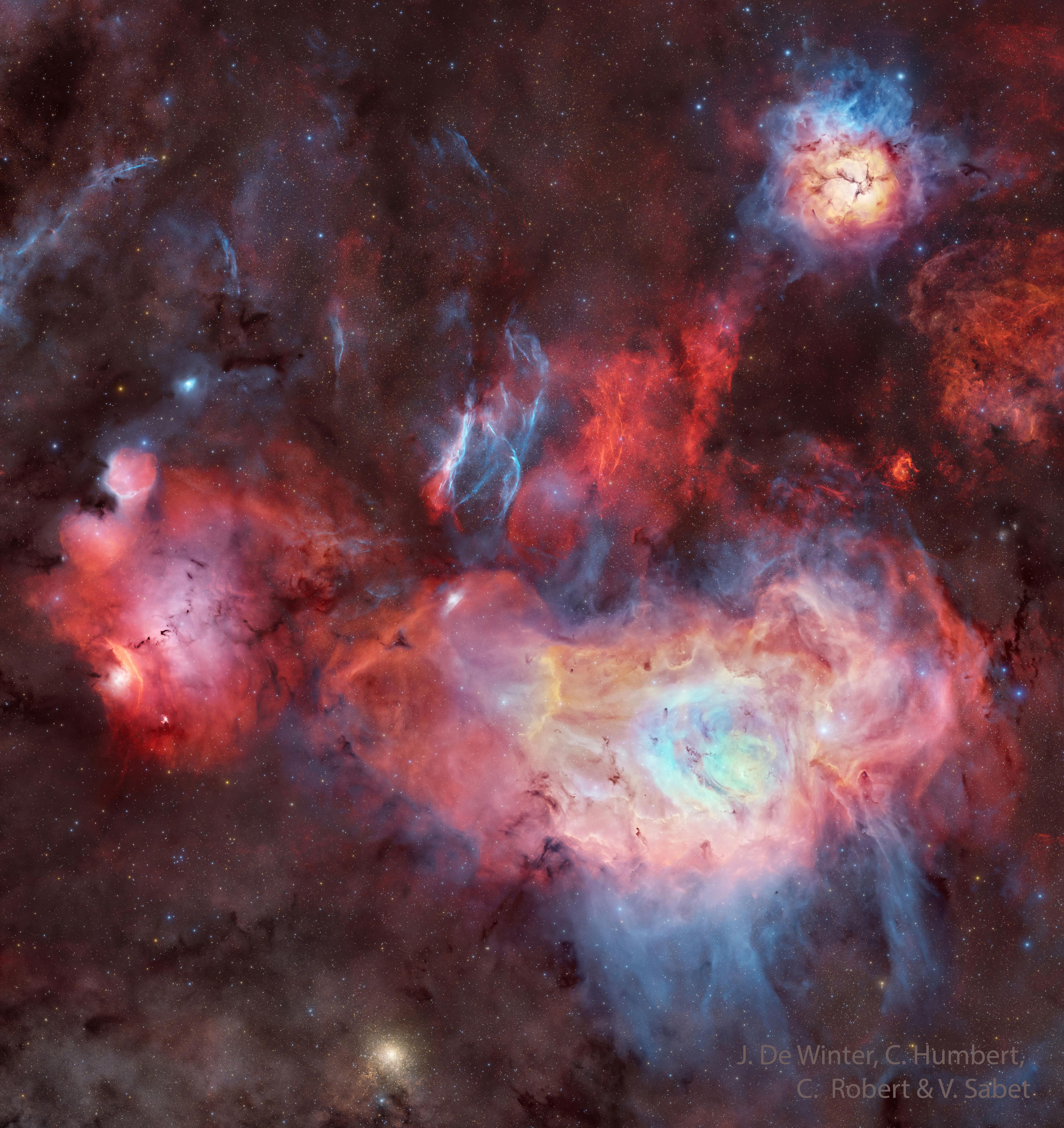
Alt...
2025 September 17
A starfield surrounds a several large nebulas that appear mostly red but also white and blue. Dark dust and blue filaments also populate the frame.
Nebulas and Clusters in Sagittarius
* Image Credit & Copyright: J. De Winter, C. Humbert, C. Robert & V. Sabet
* Text: Ogetay Kayali (MTU)
Explanation:
Can you spot famous celestial objects in this image? 18th-century astronomer Charles Messier cataloged only two of them: the bright Lagoon Nebula (M8) at the bottom, and the colorful Trifid Nebula (M20) at the upper right. The one on the left that resembles a cat's paw is NGC 6559, and it is much fainter than the other two. Even harder to spot are the thin blue filaments on the left, from supernova remnant (SNR G007.5-01.7). Their glow comes from small amounts of glowing oxygen atoms that are so faint that it took over 17 hours of exposure with just one blue color to bring up. Framing this scene of stellar birth and death are two star clusters: the open cluster M21 just above Trifid, and the globular cluster NGC 6544 at lower left.
Authors & editors: Robert Nemiroff (MTU) & Jerry Bonnell (UMCP)
NASA Official: Amber Straughn Specific rights apply.
NASA Web Privacy, Accessibility, Notices;
A service of: ASD at NASA / GSFC,
NASA Science Activation
& Michigan Tech. U.
TOPIC> Our Solar System
2025 September 14
Planets of the Solar System: Tilts and Spins
* Video Credit: NASA
https://www.nasa.gov/
* Animation: James O'Donoghue (U. Reading)
https://bsky.app/profile/interplanetary.bsky.social
https://www.reading.ac.uk/meteorology/
Explanation:
How does your favorite planet spin? Does it spin rapidly around a nearly vertical axis, or horizontally, or backwards? The featured video animates NASA images of all eight planets in our Solar System to show them spinning side-by-side for an easy comparison. In the time-lapse video, a day on Earth -- one Earth rotation -- takes just a few seconds. Jupiter rotates the fastest, while Venus spins not only the slowest (can you see it?), but backwards. The inner rocky planets across the top underwent dramatic spin-altering collisions during the early days of the Solar System. Why planets spin and tilt as they do remains a topic of research with much insight gained from modern computer modeling and the recent discovery and analysis of hundreds of exoplanets: planets orbiting other stars.
https://apod.nasa.gov/apod/ap250914.html
#space #planets #solarsystem #astrophotography #photography #nature #science #astronomy #physics #NASA #ESA #education
TOPIC> Comets
2025 September 16
New Comet SWAN25B over Mexico
* Image Credit & Copyright: Daniel Korona
Explanation:
A newly discovered comet is already visible with binoculars. The comet, C/2025 R2 (SWAN) and nicknamed SWAN25B, is brightening significantly as it emerges from the Sun's direction and might soon become visible on your smartphone -- if not your eyes. Although the brightnesses of comets are notoriously hard to predict, many comets appear brighter as they approach the Earth, with SWAN25B reaching only a quarter of the Earth-Sun distance near October 19. Nighttime skygazers will also be watching for a SWAN25B-spawned meteor shower around October 5 when our Earth passes through the plane of the comet's orbit. The unexpectedly bright comet was discovered by an amateur astronomer in images of the SWAN instrument on NASA's SOHO satellite. The comet is currently best observed in southern skies but is slowly moving north. The featured image was captured at sunset three days ago just above the western horizon in Zacatecas, Mexico.
https://earthsky.org/space/new-comet-swan25b-2025/
https://earthsky.org/space/new-comet-swan25b-2025/
https://soho.nascom.nasa.gov/data/summary/swan/
https://soho.nascom.nasa.gov/about/about.html
https://apod.nasa.gov/apod/ap250916.html
#space #comets #astrophotography #photography #science #astronomy #nature #NASA #ESA #education
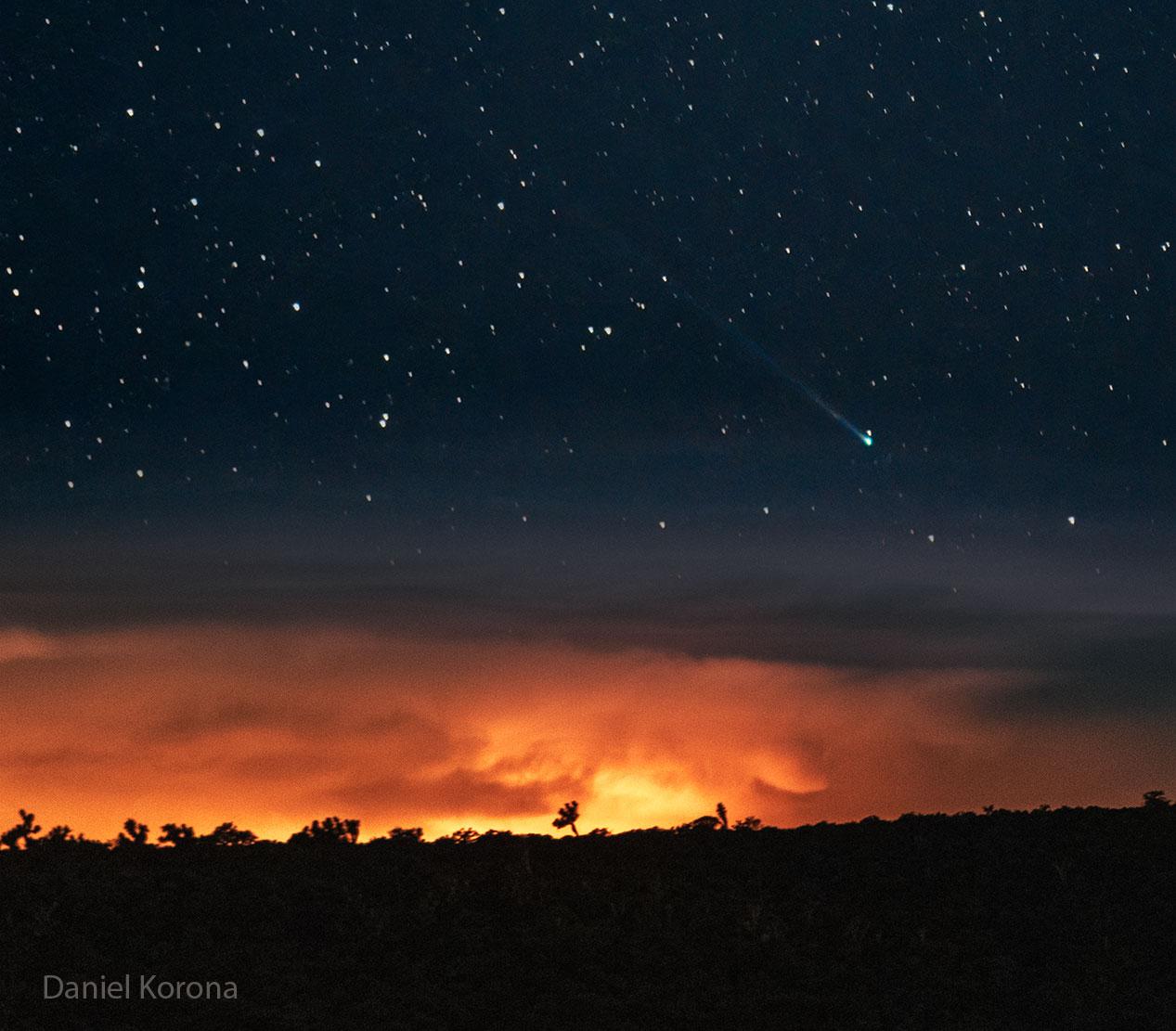
Alt...
2025 September 16
A starfield is seen above a horizon and an orange sunset. In the starfield, near the horizon, is a comet with a green head and long tail.
New Comet SWAN25B over Mexico
* Image Credit & Copyright: Daniel Korona
Explanation:
A newly discovered comet is already visible with binoculars. The comet, C/2025 R2 (SWAN) and nicknamed SWAN25B, is brightening significantly as it emerges from the Sun's direction and might soon become visible on your smartphone -- if not your eyes. Although the brightnesses of comets are notoriously hard to predict, many comets appear brighter as they approach the Earth, with SWAN25B reaching only a quarter of the Earth-Sun distance near October 19. Nighttime skygazers will also be watching for a SWAN25B-spawned meteor shower around October 5 when our Earth passes through the plane of the comet's orbit. The unexpectedly bright comet was discovered by an amateur astronomer in images of the SWAN instrument on NASA's SOHO satellite. The comet is currently best observed in southern skies but is slowly moving north. The featured image was captured at sunset three days ago just above the western horizon in Zacatecas, Mexico.
Authors & editors: Robert Nemiroff (MTU) & Jerry Bonnell (UMCP)
NASA Official: Amber Straughn Specific rights apply.
NASA Web Privacy, Accessibility, Notices;
A service of: ASD at NASA / GSFC,
NASA Science Activation
& Michigan Tech. U.
2025 September 12
Lunar Eclipse in Two Hemispheres
* Image Credit & Copyright: North - Zhouyue Zhu, South - Lucy Yunxi Hu
https://www.fantasticjoe.com/#/
https://www.astrolucyhu.com/about-lucy
Explanation:
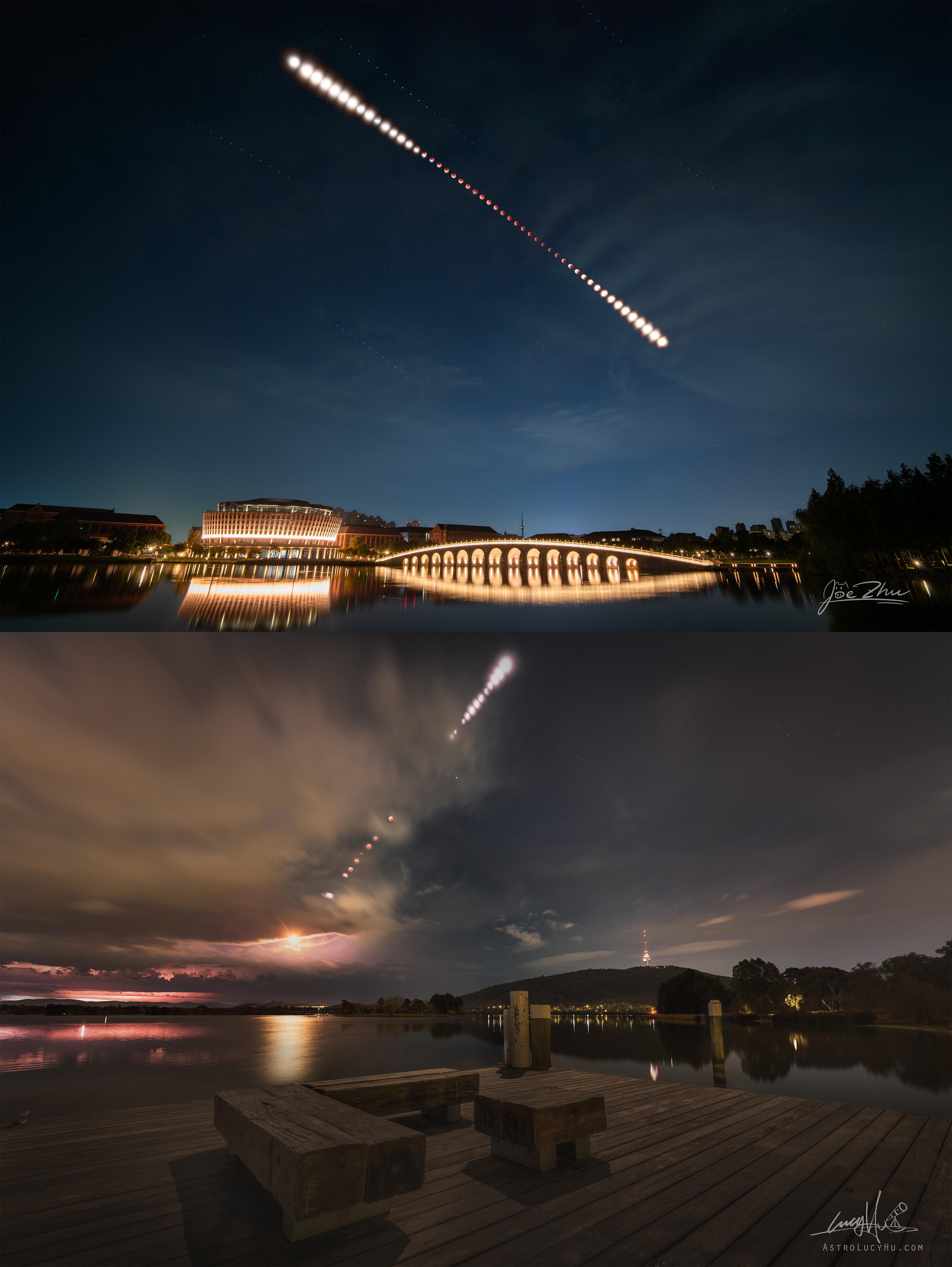
September's total lunar eclipse is tracked across night skies from both the northern and southern hemispheres of planet Earth in these two dramatic timelapse series. In the northern hemisphere sequence (top panel) the Moon’s trail arcs from the upper left to the lower right. It passes below bright planet Saturn, seen under mostly clear skies from the international campus of Zhejiang University in China at about 30 degrees north latitude. In contrast, the southern hemisphere view from Lake Griffin, Canberra, Australia at 35 degrees south latitude, records the Moon’s trail from the upper right to the lower left. Multiple lightning flashes from thunderstorms near the horizon appear reflected in the lake. Both sequences were photographed with 16mm wide-angle lenses and both cover the entire eclipse, with the darkened red Moon totally immersed in Earth's umbral shadow near center. But the different orientations of the Moon’s path across the sky reveal the perspective shifts caused by the views from northern vs. southern latitudes.
https://www.astrolucyhu.com/about-lucy
#space #moon #astrophotography #photography #science #astronomy #nature #NASA #education
Alt...
2025 September 12
Lunar Eclipse in Two Hemispheres
* Image Credit & Copyright: North - Zhouyue Zhu, South - Lucy Yunxi Hu
Explanation:
September's total lunar eclipse is tracked across night skies from both the northern and southern hemispheres of planet Earth in these two dramatic timelapse series. In the northern hemisphere sequence (top panel) the Moon’s trail arcs from the upper left to the lower right. It passes below bright planet Saturn, seen under mostly clear skies from the international campus of Zhejiang University in China at about 30 degrees north latitude. In contrast, the southern hemisphere view from Lake Griffin, Canberra, Australia at 35 degrees south latitude, records the Moon’s trail from the upper right to the lower left. Multiple lightning flashes from thunderstorms near the horizon appear reflected in the lake. Both sequences were photographed with 16mm wide-angle lenses and both cover the entire eclipse, with the darkened red Moon totally immersed in Earth's umbral shadow near center. But the different orientations of the Moon’s path across the sky reveal the perspective shifts caused by the views from northern vs. southern latitudes.
Authors & editors: Robert Nemiroff (MTU) & Jerry Bonnell (UMCP)
NASA Official: Amber Straughn Specific rights apply.
NASA Web Privacy, Accessibility, Notices;
A service of: ASD at NASA / GSFC,
NASA Science Activation
& Michigan Tech. U.
May 17, 2013
Bright Explosion on the Moon - NASA Science
by Alicia Cermak
For the past 8 years, NASA astronomers have been monitoring the Moon for signs of explosions caused by meteoroids hitting the lunar surface. "Lunar meteor showers" have turned out to be more common than anyone expected, with hundreds of detectable impacts occurring every year.
They've just seen the biggest explosion in the history of the program.
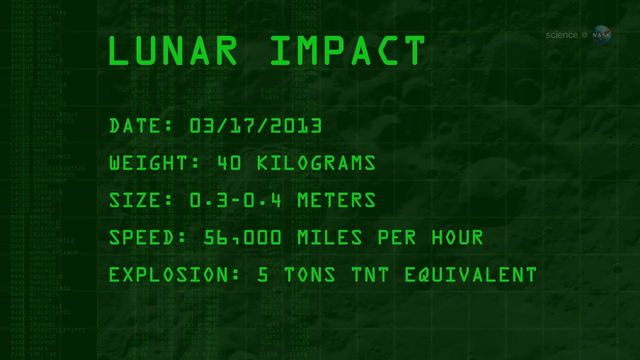
"On March 17, 2013, an object about the size of a small boulder hit the lunar surface in Mare Imbrium," says Bill Cooke of NASA's Meteoroid Environment Office. "It exploded in a flash nearly 10 times as bright as anything we've ever seen before."
Anyone looking at the Moon at the moment of impact could have seen the explosion--no telescope required. For about one second, the impact site was glowing like a 4th magnitude star.
Ron Suggs, an analyst at the Marshall Space Flight Center, was the first to notice the impact in a digital video recorded by one of the monitoring program's 14-inch telescopes. "It jumped right out at me, it was so bright," he recalls.
The 40 kg meteoroid measuring 0.3 to 0.4 meters wide hit the Moon traveling 56,000 mph. The resulting explosion1 packed as much punch as 5 tons of TNT.
These false-color frames extracted from the original black and white video show the explosion in progress. At its peak, the flash was as bright as a 4th magnitude star.
Cooke believes the lunar impact might have been part of a much larger event.
"On the night of March 17, NASA and University of Western Ontario all-sky cameras picked up an unusual number of deep-penetrating meteors right here on Earth," he says. "These fireballs were traveling along nearly identical orbits between Earth and the asteroid belt."
[...]
Read more: https://science.nasa.gov/science-research/planetary-science/16may_lunarimpact/
Credits:
Author: Dr. Tony Phillips | Production editor: Dr. Tony Phillips | Credit: Science@NASA
#space #moon #astrophotography #photography #science #astronomy #nature #NASA #education
Alt...
A ScienceCast video describes the bright lunar explosion of March 17, 2013.
2019 January 25
Moon Struck
* Image Credit & Copyright: Petr Horálek
https://www.petrhoralek.com/?page_id=20
Explanation:
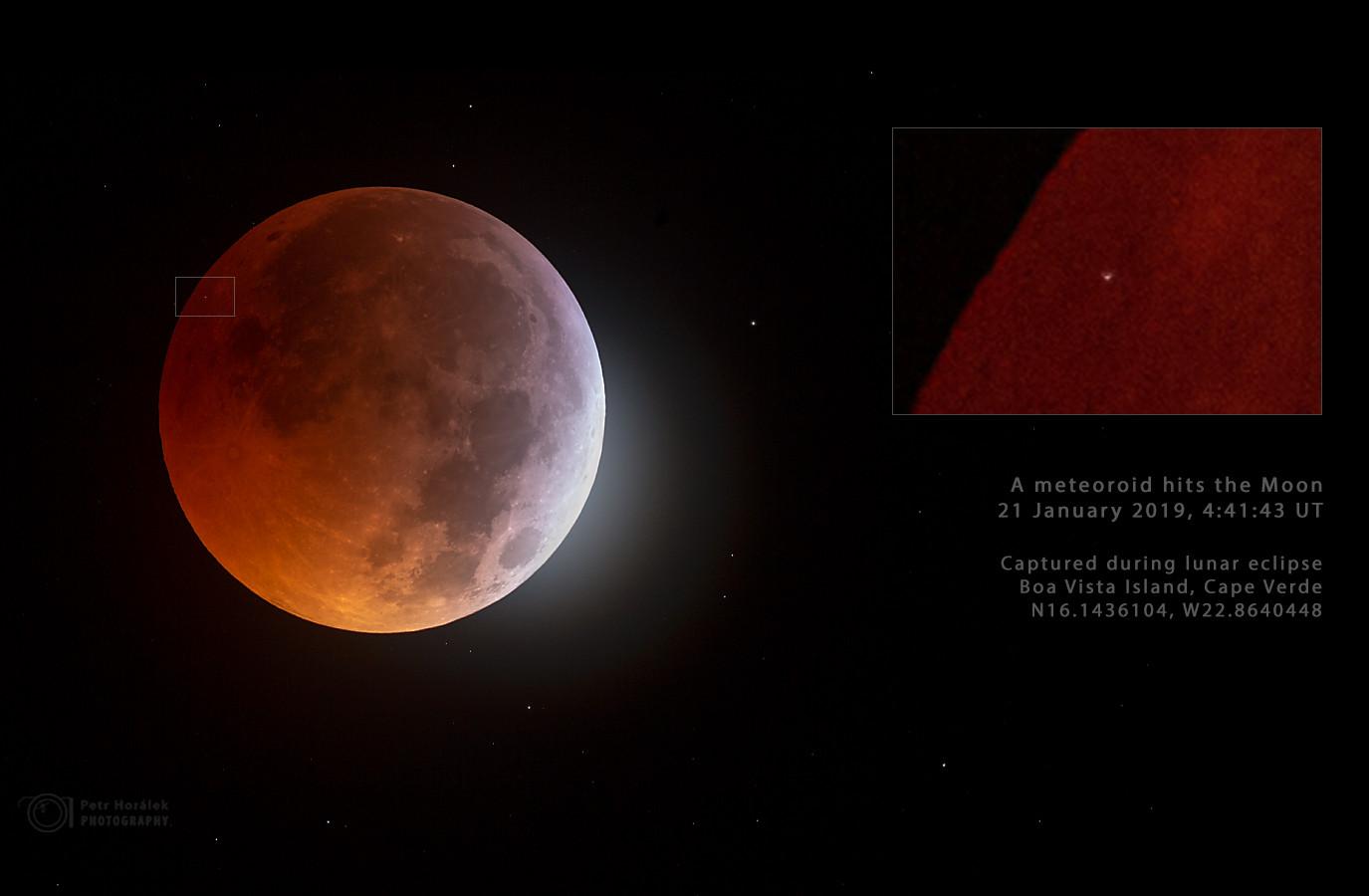
Craters produced by ancient impacts on the airless Moon have long been a familiar sight. But only since the 1990s have observers began to regularly record and study optical flashes on the lunar surface, likely explosions resulting from impacting meteoroids. Of course, the flashes are difficult to see against a bright, sunlit lunar surface. But during the January 21 total eclipse many imagers serendipitously captured a meteoroid impact flash against the dim red Moon. Found while examining images taken shortly before the total eclipse phase began, the flash is indicated in the inset above, near the Moon's darkened western limb. Estimates based on the flash duration recorded by the Moon Impact Detection and Analysis System (MIDAS) telescopes in southern Spain indicate the impactor's mass was about 10 kilograms and created a crater between seven and ten meters in diameter.
https://www.petrhoralek.com/?p=4458
https://www.scientificamerican.com/article/in-a-first-earthlings-spot-a-meteor-strike-the-eclipse-darkenhttps://spaceweather.com/archive.php?view=1&day=23&month=01&year=2019ed-moon/
https://spaceweathergallery.com/eclipse_gallery.html
https://apod.nasa.gov/apod/ap011208.html
https://apod.nasa.gov/apod/ap190125.html
#space #moon #astrophotography #photography #science #astronomy #nature #NASA #education
Alt...
2019 January 25
Moon Struck
* Image Credit & Copyright: Petr Horálek
Explanation:
Craters produced by ancient impacts on the airless Moon have long been a familiar sight. But only since the 1990s have observers began to regularly record and study optical flashes on the lunar surface, likely explosions resulting from impacting meteoroids. Of course, the flashes are difficult to see against a bright, sunlit lunar surface. But during the January 21 total eclipse many imagers serendipitously captured a meteoroid impact flash against the dim red Moon. Found while examining images taken shortly before the total eclipse phase began, the flash is indicated in the inset above, near the Moon's darkened western limb. Estimates based on the flash duration recorded by the Moon Impact Detection and Analysis System (MIDAS) telescopes in southern Spain indicate the impactor's mass was about 10 kilograms and created a crater between seven and ten meters in diameter.
Authors & editors: Robert Nemiroff (MTU) & Jerry Bonnell (UMCP)
NASA Official: Phillip Newman Specific rights apply.
NASA Web Privacy Policy and Important Notices
A service of: ASD at NASA / GSFC
& Michigan Tech. U.
2007 September 1
Kalamalka Lake Eclipse
* Credit & Copyright: Yuichi Takasaka
http://www.blue-moon.ca/
Explanation:
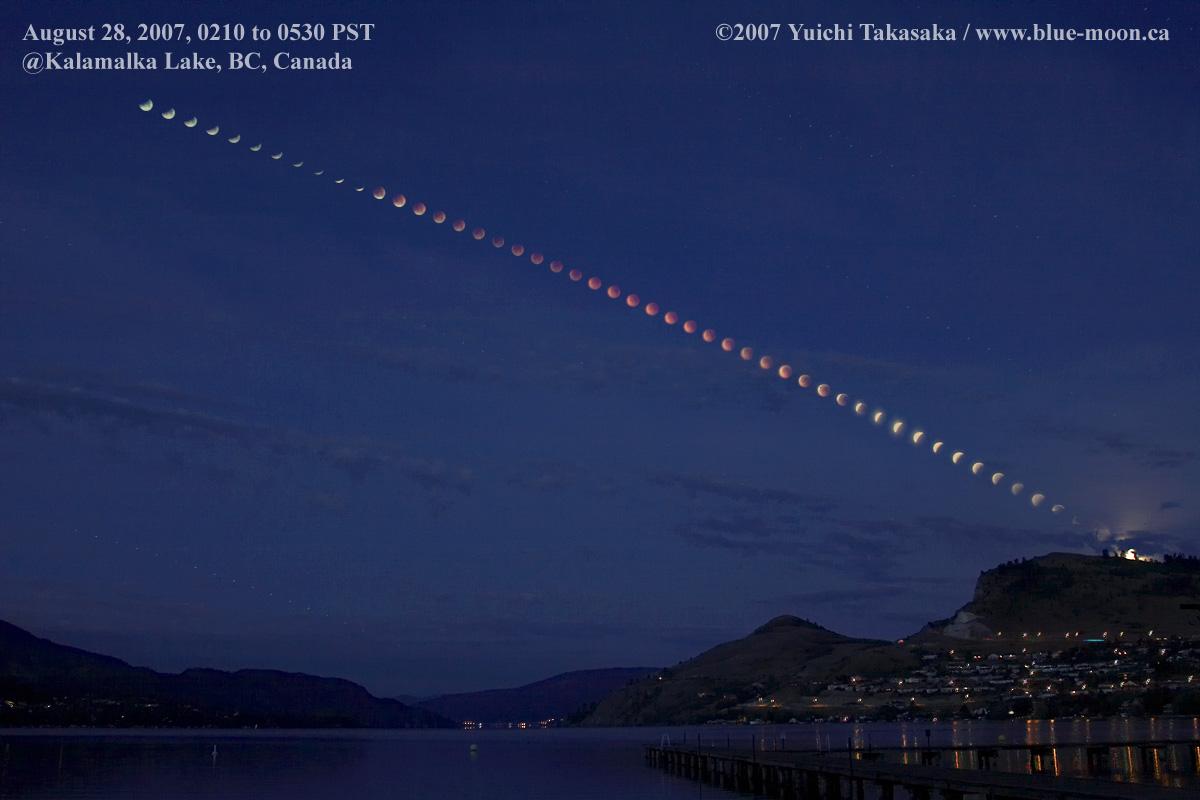
Recorded on August 28th, this serene total lunar eclipse sequence looks southwest down Kalamalka Lake toward the lights of Coldstream, British Columbia. An exposure every 4 minutes captured the Moon's position and eclipse phase, until the Moon set behind the town lights and a hill on the horizon. In fact, the sequence effectively measures the duration of the total phase of the eclipse. Around 270 BC, the Greek astronomer Aristarchus also measured the duration of lunar eclipses - though probably without the benefit of digital clocks and cameras. Still, using geometry, he devised a simple and impressively accurate way to calculate the Moon's distance, in terms of the radius of planet Earth, from the eclipse duration.
http://www.phy6.org/stargaze/Shipprc2.htm
https://www.mreclipse.com/Special/LEprimer.html
https://apod.nasa.gov/apod/ap070901.html
#space #moon #astrophotography #photography #science #astronomy #nature #NASA #education
Alt...
2007 September 1
Kalamalka Lake Eclipse
* Credit & Copyright: Yuichi Takasaka
Explanation:
Recorded on August 28th, this serene total lunar eclipse sequence looks southwest down Kalamalka Lake toward the lights of Coldstream, British Columbia. An exposure every 4 minutes captured the Moon's position and eclipse phase, until the Moon set behind the town lights and a hill on the horizon. In fact, the sequence effectively measures the duration of the total phase of the eclipse. Around 270 BC, the Greek astronomer Aristarchus also measured the duration of lunar eclipses - though probably without the benefit of digital clocks and cameras. Still, using geometry, he devised a simple and impressively accurate way to calculate the Moon's distance, in terms of the radius of planet Earth, from the eclipse duration.
Authors & editors: Robert Nemiroff (MTU) & Jerry Bonnell (UMCP)
NASA Official: Phillip Newman Specific rights apply.
NASA Web Privacy Policy and Important Notices
A service of: ASD at NASA / GSFC
& Michigan Tech. U.
![[?]](https://cdn.masto.host/allmyneighborsearth/accounts/avatars/114/706/953/347/742/654/original/ff9294a0e929b5e3.jpg)
I came across astronomer, Elizabeth Stanway's, Cosmic Stories blog, hosted on her university website. She covers many subjects: Science Fiction and Judgment Day, Linguistics, Prison and Science Fiction, how red dwarfs have been imagined in Science Fiction, and more.
Find her here @Tiylaya
https://warwick.ac.uk/fac/sci/physics/research/astro/people/stanway/sciencefiction/cosmicstories/
It's hard to find other sites like my Science Fiction and Ethics blog https://www.scifi.global/ so finding her blog was great....
2025 September 11
The Umbra of Earth
* Image Credit & Copyright: Wang Letian (Eyes at Night)
http://www.luckwlt.com/About%20Me.html
http://www.luckwlt.com/
Explanation:
The dark, inner shadow of planet Earth is called the umbra. Shaped like a cone extending into space, it has a circular cross section most easily seen during a lunar eclipse. And on the night of September 7/8 the Full Moon passed near the center of Earth's umbral cone, entertaining eclipse watchers around much of our fair planet, including parts of Antarctica, Australia, Asia, Europe, and Africa. Recorded from Zhangjiakou City, China, this timelapse composite image uses successive pictures from the total lunar eclipse, progressing left to right, to reveal the curved cross-section of the umbral shadow sliding across the Moon. Sunlight scattered by the atmosphere into Earth's umbra causes the lunar surface to appear reddened during totality. But close to the umbra's edge, the limb of the eclipsed Moon shows a distinct blue hue. The blue eclipsed moonlight originates as rays of sunlight pass through layers high in the upper stratosphere, colored by ozone that scatters red light and transmits blue. In the total phase of this leisurely lunar eclipse, the Moon was completely within the Earth's umbra for about 83 minutes.
https://science.nasa.gov/moon/eclipses/
https://en.wikipedia.org/wiki/Lunar_eclipse#Total_lunar_eclipse
https://earthsky.org/astronomy-essentials/total-lunar-eclipse-september-7-2025/
https://earthsky.org/astronomy-essentials/total-lunar-eclipse-september-7-2025/
https://apod.nasa.gov/apod/ap250911.html
#space #moon #astrophotography #photography #science #astronomy #nature #NASA #education
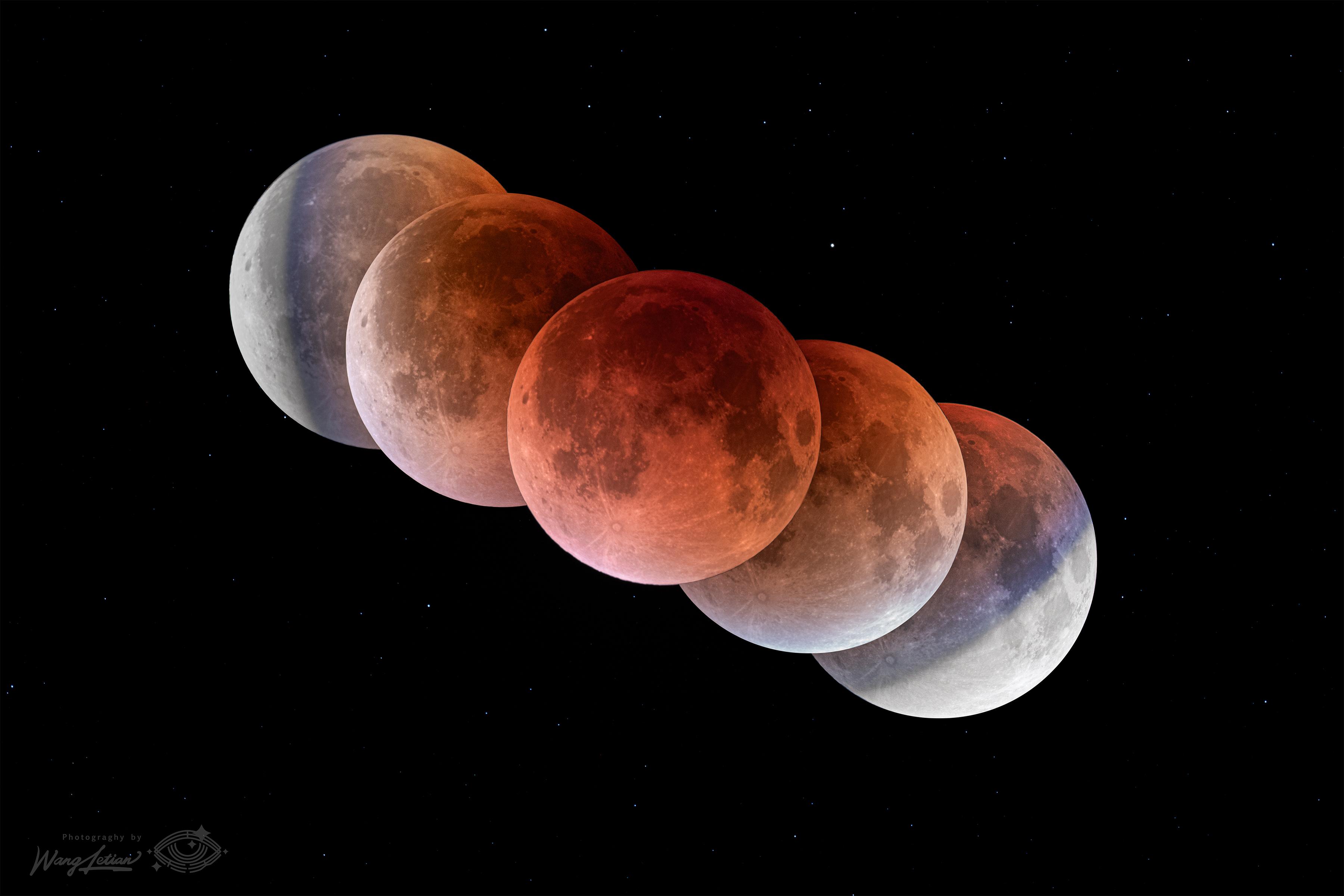
Alt...
2025 September 11
The Umbra of Earth
* Image Credit & Copyright: Wang Letian (Eyes at Night)
Explanation:
The dark, inner shadow of planet Earth is called the umbra. Shaped like a cone extending into space, it has a circular cross section most easily seen during a lunar eclipse. And on the night of September 7/8 the Full Moon passed near the center of Earth's umbral cone, entertaining eclipse watchers around much of our fair planet, including parts of Antarctica, Australia, Asia, Europe, and Africa. Recorded from Zhangjiakou City, China, this timelapse composite image uses successive pictures from the total lunar eclipse, progressing left to right, to reveal the curved cross-section of the umbral shadow sliding across the Moon. Sunlight scattered by the atmosphere into Earth's umbra causes the lunar surface to appear reddened during totality. But close to the umbra's edge, the limb of the eclipsed Moon shows a distinct blue hue. The blue eclipsed moonlight originates as rays of sunlight pass through layers high in the upper stratosphere, colored by ozone that scatters red light and transmits blue. In the total phase of this leisurely lunar eclipse, the Moon was completely within the Earth's umbra for about 83 minutes.
Authors & editors: Robert Nemiroff (MTU) & Jerry Bonnell (UMCP)
NASA Official: Amber Straughn Specific rights apply.
NASA Web Privacy, Accessibility, Notices;
A service of: ASD at NASA / GSFC,
NASA Science Activation
& Michigan Tech. U.
TOPIC> The Moon
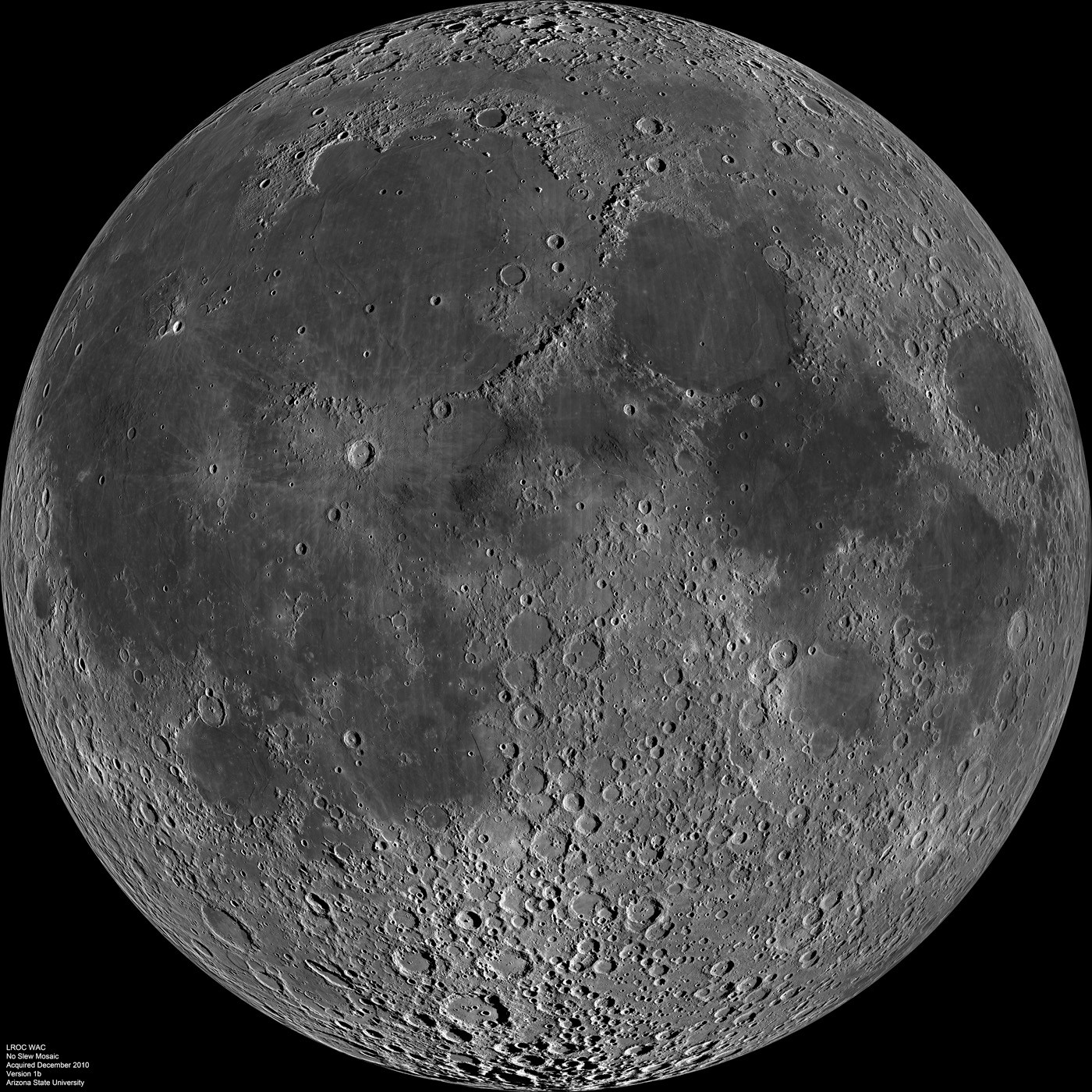
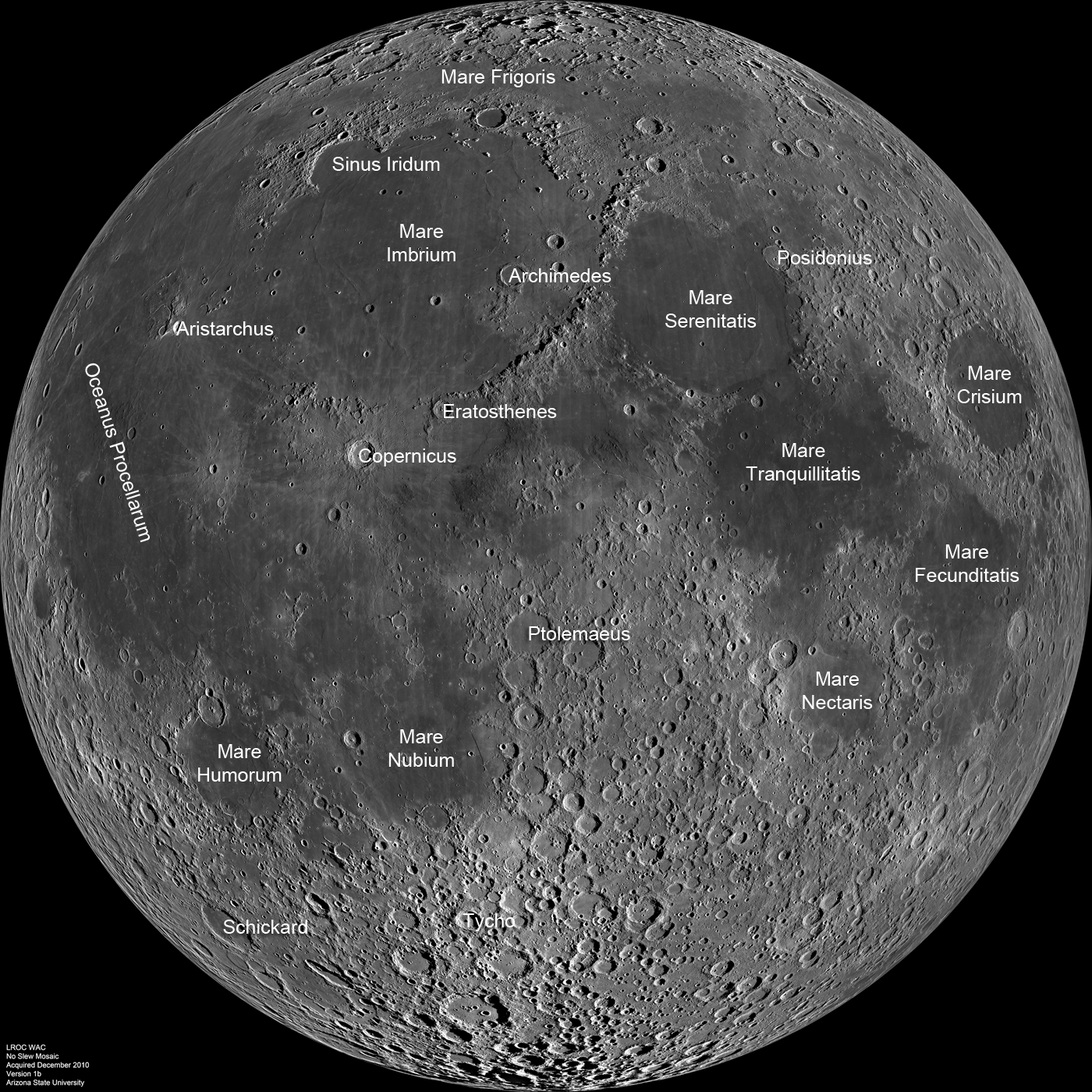
2025 July 20
Lunar Nearside
* Image Credit: NASA / GSFC / Arizona State Univ. / Lunar Reconnaissance Orbiter
https://www.nasa.gov/
https://www.gsfc.nasa.gov/
https://lroc.sese.asu.edu/index.html
Explanation:
About 1,300 images from the Lunar Reconnaissance Orbiter spacecraft's wide angle camera were used to compose this spectacular view of a familiar face - the lunar nearside. But why is there a lunar nearside? The Moon rotates on its axis and orbits the Earth at the same rate, about once every 28 days. Tidally locked in this configuration, the synchronous rotation always keeps one side, the nearside, facing Earth. As a result, featured in remarkable detail in the full resolution mosaic, the smooth, dark, lunar maria (actually lava-flooded impact basins), and rugged highlands, are well-known to earthbound skygazers. To find your favorite mare or large crater, just follow this link or slide your cursor over the picture. The LRO images used to construct the mosaic were recorded over a two week period in December 2010.
https://lroc.im-ldi.com/visit/exhibits/1/gallery/17
https://apod.nasa.gov/apod/ap250720.html
#space #moon #astrophotography #photography #science #astronomy #nature #NASA #ESA #education
Alt...
Moon Nearside mosaic
The Moon's diameter is 3474 km (2159 miles)
CREDIT
NASA/GSFC/Arizona State University
2025 July 20
Lunar Nearside
* Image Credit: NASA / GSFC / Arizona State Univ. / Lunar Reconnaissance Orbiter
Explanation:
About 1,300 images from the Lunar Reconnaissance Orbiter spacecraft's wide angle camera were used to compose this spectacular view of a familiar face - the lunar nearside. But why is there a lunar nearside? The Moon rotates on its axis and orbits the Earth at the same rate, about once every 28 days. Tidally locked in this configuration, the synchronous rotation always keeps one side, the nearside, facing Earth. As a result, featured in remarkable detail in the full resolution mosaic, the smooth, dark, lunar maria (actually lava-flooded impact basins), and rugged highlands, are well-known to earthbound skygazers. To find your favorite mare or large crater, just follow this link or slide your cursor over the picture. The LRO images used to construct the mosaic were recorded over a two week period in December 2010.
Authors & editors: Robert Nemiroff (MTU) & Jerry Bonnell (UMCP)
NASA Official: Amber Straughn Specific rights apply.
NASA Web Privacy, Accessibility, Notices;
A service of: ASD at NASA / GSFC,
NASA Science Activation
& Michigan Tech. U.
Alt...
Annotations Moon Nearside
Same WAC mosaic with major mare and craters labeled. The Moon's diameter is 3474 km (2159 miles)
CREDIT
NASA/GSFC/Arizona State University
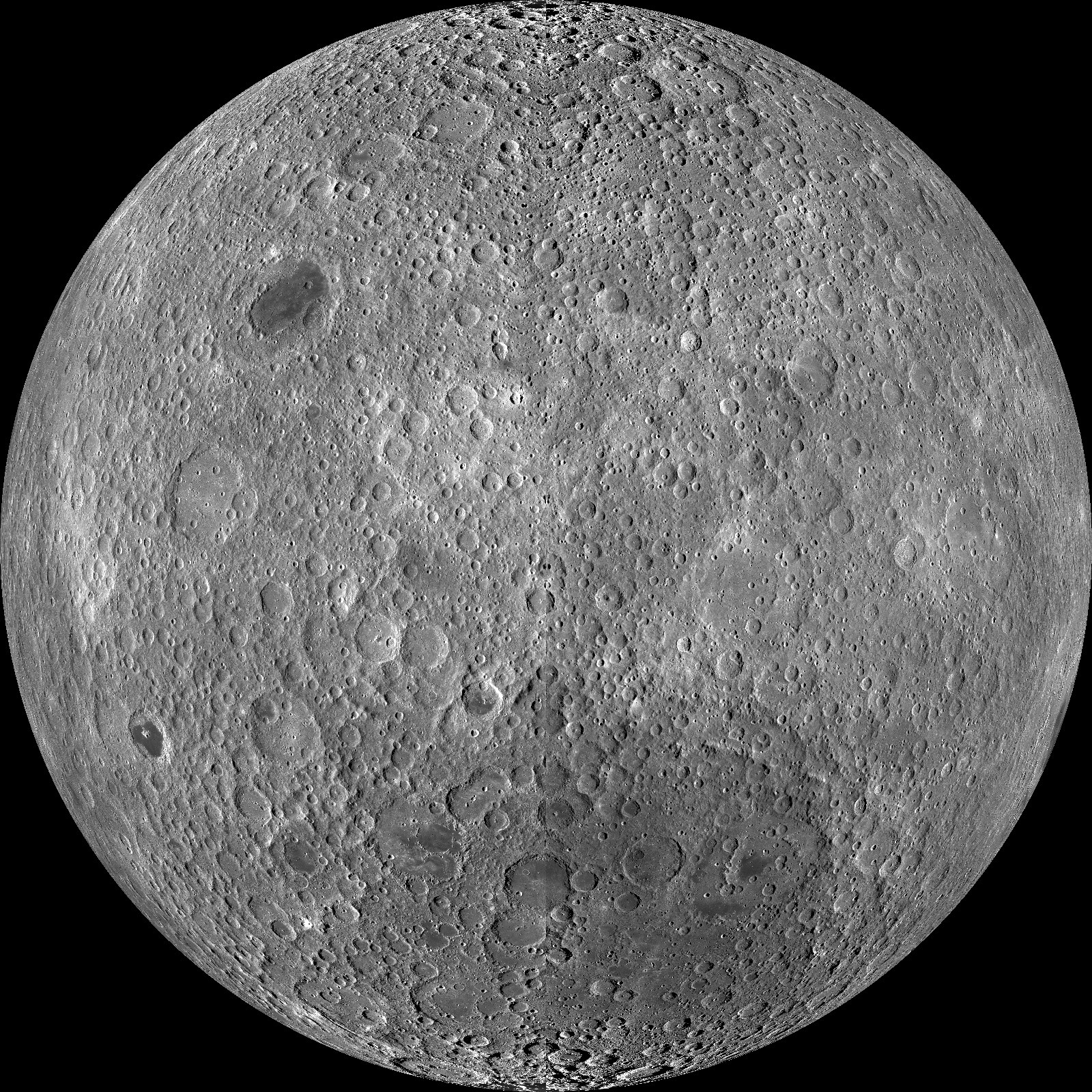
2025 June 28
Lunar Farside
* Image Credit: NASA / GSFC / Arizona State Univ. / Lunar Reconnaissance Orbiter
https://www.nasa.gov/
https://www.gsfc.nasa.gov/
https://lroc.sese.asu.edu/index.html
Explanation:
Tidally locked in synchronous rotation, the Moon always presents its familiar nearside to denizens of planet Earth. From lunar orbit, the Moon's farside can become familiar, though. In fact this sharp picture, a mosaic from the Lunar Reconnaissance Orbiter's wide angle camera, is centered on the lunar farside. Part of a global mosaic of over 15,000 images acquired between November 2009 and February 2011, the highest resolution version shows features at a scale of 100 meters per pixel. Surprisingly, the rough and battered surface of the farside looks very different from the nearside covered with smooth dark lunar maria. A likely explanation is that the farside crust is thicker, making it harder for molten material from the interior to flow to the surface and form dark, smooth maria.
https://apod.nasa.gov/apod/ap250628.html
#space #moon #astrophotography #photography #science #astronomy #nature #NASA #ESA #education
Alt...
The lunar farside as never seen before! LROC WAC orthographic projection centered at 180° longitude, 0° latitude
CREDIT
NASA/GSFC/Arizona State University
2025 June 28
Lunar Farside
* Image Credit: NASA / GSFC / Arizona State Univ. / Lunar Reconnaissance Orbiter
Explanation:
Tidally locked in synchronous rotation, the Moon always presents its familiar nearside to denizens of planet Earth. From lunar orbit, the Moon's farside can become familiar, though. In fact this sharp picture, a mosaic from the Lunar Reconnaissance Orbiter's wide angle camera, is centered on the lunar farside. Part of a global mosaic of over 15,000 images acquired between November 2009 and February 2011, the highest resolution version shows features at a scale of 100 meters per pixel. Surprisingly, the rough and battered surface of the farside looks very different from the nearside covered with smooth dark lunar maria. A likely explanation is that the farside crust is thicker, making it harder for molten material from the interior to flow to the surface and form dark, smooth maria.
Authors & editors: Robert Nemiroff (MTU) & Jerry Bonnell (UMCP)
NASA Official: Amber Straughn Specific rights apply.
NASA Web Privacy, Accessibility, Notices;
A service of: ASD at NASA / GSFC,
NASA Science Activation
& Michigan Tech. U.
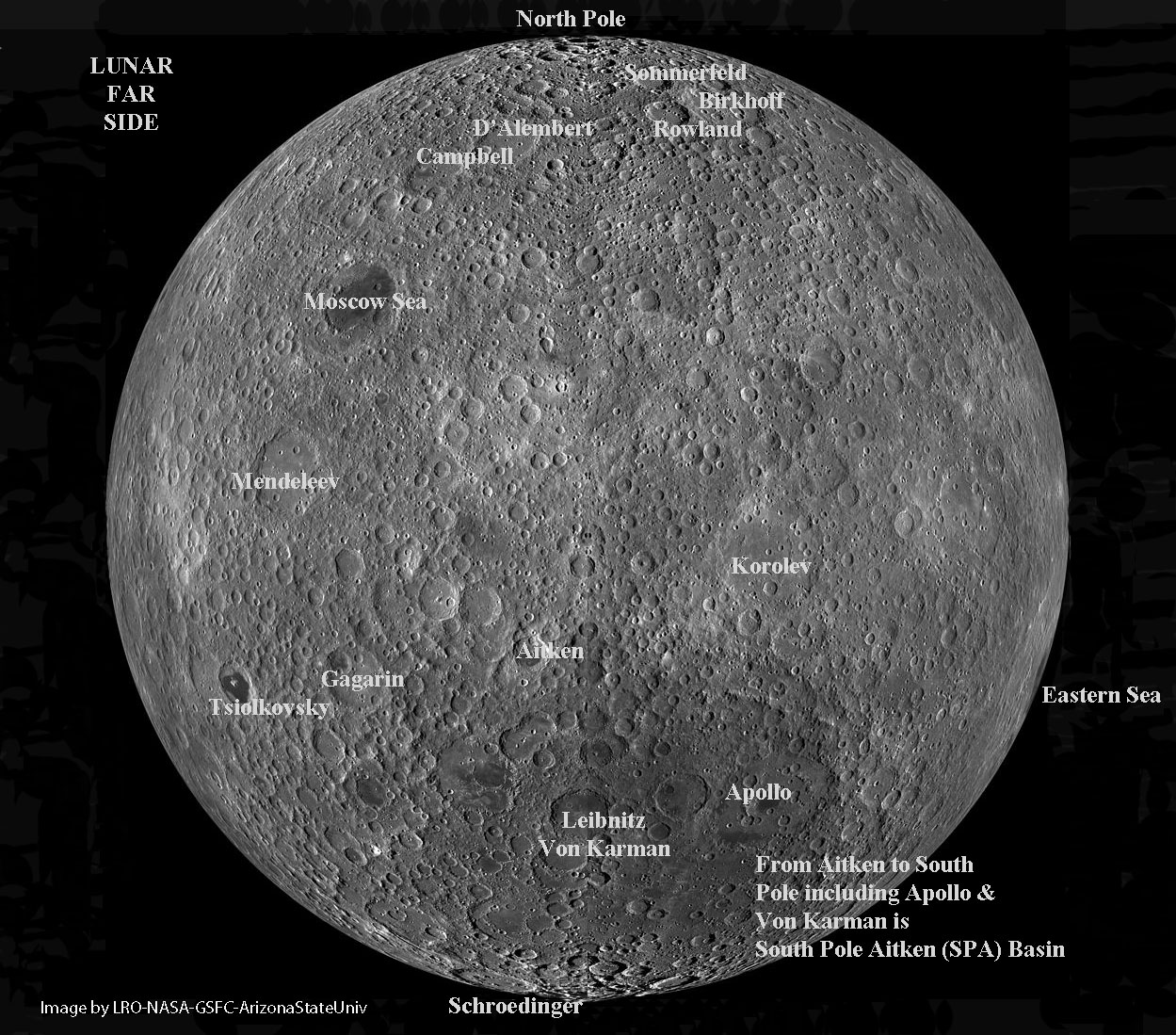
Alt...
Annotations for the lunar farside.
LROC WAC orthographic projection centered at 180° longitude, 0° latitude
CREDIT
NASA/GSFC/Arizona State University
* The annotations are still unofficial
Tidal locking
results in the Moon rotating about its axis in about the same time it takes to orbit the Earth. Except for libration effects, this results in it keeping the same face turned towards the Earth, as seen in the figure on the upper left. (The Moon is shown in polar view, and is not drawn to scale.)
+ Upper left:
> If the Moon didn't spin at all, then it would alternately show its near and far sides to the Earth while moving around our planet in orbit.
+ Upper right:
> If rotational frequency is larger than orbital frequency, a small torque counteracting the rotation arises, eventually locking the frequencies (situation depicted in green)
+ Down left:
> A simulation shows the variability in the portion of the Moon visible from Earth due to libration over the course of an orbit. Lighting phases from the Sun are not included.
+ Down right:
> Animation of the Moon as it cycles through its phases. The apparent wobbling of the Moon is known as libration
From Wikipedia, the free encyclopedia
CREDITS
Contributors to Wikimedia projects
* Stigmatella aurantiaca
* Jim McKeeth
* Tom Ruen
* Poopooman-ger
#space #moon #astrophotography #photography #science #astronomy #nature #NASA #ESA #education
Alt...
At left, the Moon rotates at the same rate it orbits the Earth, keeping the same face toward the planet. At right, if the Moon did not rotate then the face would change over the course of an orbit. Viewed from above; not to scale.
CREDIT
Stigmatella aurantiaca
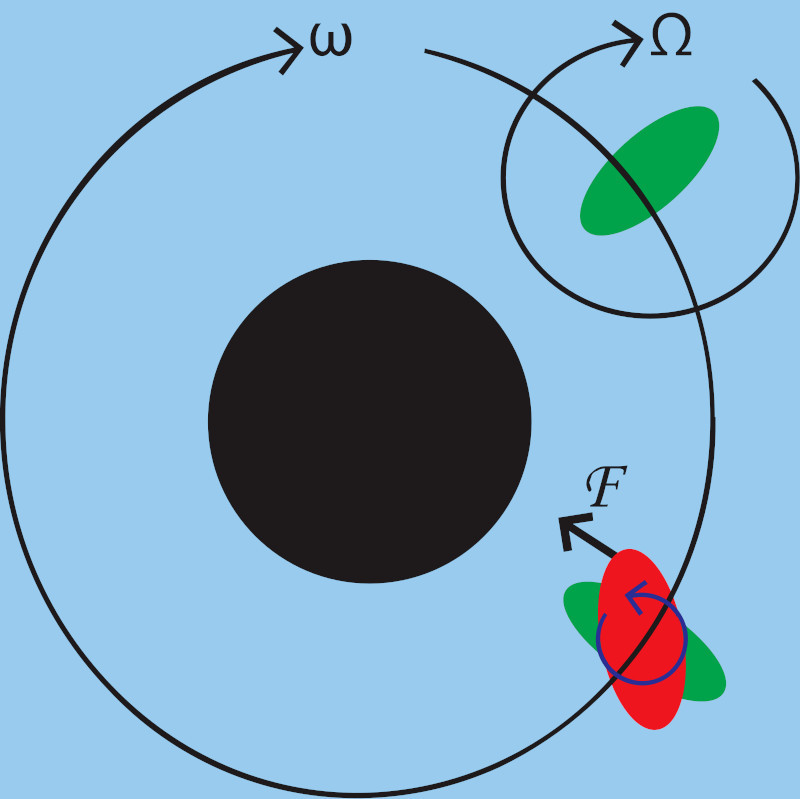
Alt...
If rotational frequency is larger than orbital frequency, a small torque counteracting the rotation arises, eventually locking the frequencies (situation depicted in green)
CREDIT
Jim McKeeth
Alt...
This simulation shows the variability in the portion of the Moon visible from Earth due to libration over the course of an orbit. Lighting phases from the Sun are not included.
One anomalistic lunar cycle (Apogee to Apogee) for April 2007. No phase shown.
CREDIT
Tom Ruen - Own work, created with "Full Sky Observatory" Source bitmap for projection from Nasa's Clementine Spacecraft: USGS: Global simple cylindrical projection at 10 km/pixel. Software: "Full Sky Observatory", by Tom Ruen, described at File:FullSkyAstronomySoftwareLogo.png Source book: "Astronomical Formulae for Calculators, 4th edition", Jean Meeus, 1988, published by "Willmann-Bell, Inc" Chapter 30 "Position of the Moon"
Alt...
Animation of the Moon as it cycles through its phases. The apparent wobbling of the Moon is known as libration.
CREDIT
Poopooman-ger
Orbit the Moon! - LROC WAC Global Mosaic and DTM
The Lunar Reconnaissance Orbiter Camera (LROC) WAC is a push-frame camera that captures seven color bands (321, 360, 415, 566, 604, 643, and 689 nm) with a 57-km swath (105-km swath in monochrome mode) from a 50 km orbit. One of the primary objectives of LROC is to provide a global 100 m/pixel monochrome (643 nm) base map with incidence angles between 55°-70° at the equator, lighting that is favorable for morphological interpretations. Each month, the WAC provides nearly complete coverage of the Moon under unique lighting. As an added bonus, the orbit-to-orbit image overlap provides stereo coverage. Reducing all these stereo images into a global topographic map is a big job, and is being led by LROC Team Members from the German Aerospace Center (Deutsches Zentrum für Luft- und Raumfahrt; DLR). Several preliminary WAC topographic products have appeared in LROC featured images (Orientale basin, Sinus Iridum). For a sneak preview of the WAC global DEM with the WAC global mosaic, view a rotating composite Moon (Full Res).
The global mosaic comprised of over 15,000 WAC images acquired between November 2009 and February 2011. The non-polar images were map projected onto the GLD100 shape model (WAC derived 100 m/pixel DTM), while polar images were map projected on the LOLA shape model. In addition, the LOLA derived crossover corrected ephemeris, and improved camera pointing, provide accurate positioning (100 m) of each WAC image.
CREDIT
LROC
WAC
DLR
https://lroc.im-ldi.com/images/298
#space #moon #astrophotography #photography #science #astronomy #nature #NASA #ESA #education
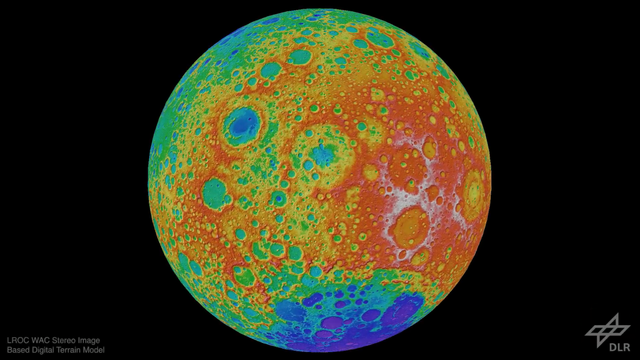
Alt...
LROC WAC Global Mosaic and DTM
The Lunar Reconnaissance Orbiter Camera (LROC) WAC is a push-frame camera that captures seven color bands (321, 360, 415, 566, 604, 643, and 689 nm) with a 57-km swath (105-km swath in monochrome mode) from a 50 km orbit. One of the primary objectives of LROC is to provide a global 100 m/pixel monochrome (643 nm) base map with incidence angles between 55°-70° at the equator, lighting that is favorable for morphological interpretations. Each month, the WAC provides nearly complete coverage of the Moon under unique lighting. As an added bonus, the orbit-to-orbit image overlap provides stereo coverage. Reducing all these stereo images into a global topographic map is a big job, and is being led by LROC Team Members from the German Aerospace Center (Deutsches Zentrum für Luft- und Raumfahrt; DLR). Several preliminary WAC topographic products have appeared in LROC featured images (Orientale basin, Sinus Iridum). For a sneak preview of the WAC global DEM with the WAC global mosaic, view a rotating composite Moon (Full Res).
The global mosaic comprised of over 15,000 WAC images acquired between November 2009 and February 2011. The non-polar images were map projected onto the GLD100 shape model (WAC derived 100 m/pixel DTM), while polar images were map projected on the LOLA shape model. In addition, the LOLA derived crossover corrected ephemeris, and improved camera pointing, provide accurate positioning (100 m) of each WAC image.
CREDIT
LROC
WAC
DLR
"I'm sorry for you Mastodon users due to insufficiently configured software on your server side you unfortunately only see a third of the displayed images. I can expressly recommend the platform defcon.social to scientifically and creatively interested and committed users of the Fediverse."
Moon Phases
In our entire solar system, the only object that shines with its own light is the Sun. That light always beams onto Earth and Moon from the direction of the Sun, illuminating half of our planet in its orbit and reflecting off the surface of the Moon to create moonlight. Sometimes the entire face of the Moon glows brightly. Other times we see only a thin crescent of light. Sometimes the Moon seems to disappear. These shifts are called moon phases.
The eight lunar phases are, in order: new moon, waxing crescent, first quarter, waxing gibbous, full moon, waning gibbous, third quarter, and waning crescent. The cycle repeats about once a month (every 29.5 days).
Like Earth, the Moon has a day side and a night side, which change as the Moon rotates. The Sun always illuminates half of the Moon while the other half remains dark, but how much we are able to see of that illuminated half changes as the Moon travels through its orbit.
Images:
1.
Position of the Moon and the Sun during each of the Moon’s phases
2. - 9.
All Moon Phases
Let’s take a look at the individual phases, and how the movements of the Moon and Sun appear to us as we watch from the Northern Hemisphere on Earth.
10.
Overview From Space
The Moon orbits Earth from a viewpoint above the North Pole in this animation. The blue gridlines show how the same side of the Moon always faces Earth. The size of the Earth and Moon are enlarged 20 times.
CREDITS:
* NASA's Scientific Visualization Studio
* NASA/JPL-Caltech
https://science.nasa.gov/moon/moon-phases/
#space #moon #astrophotography #photography #science #astronomy #nature #NASA #ESA #education #fediverse #mastodon #defconsocial
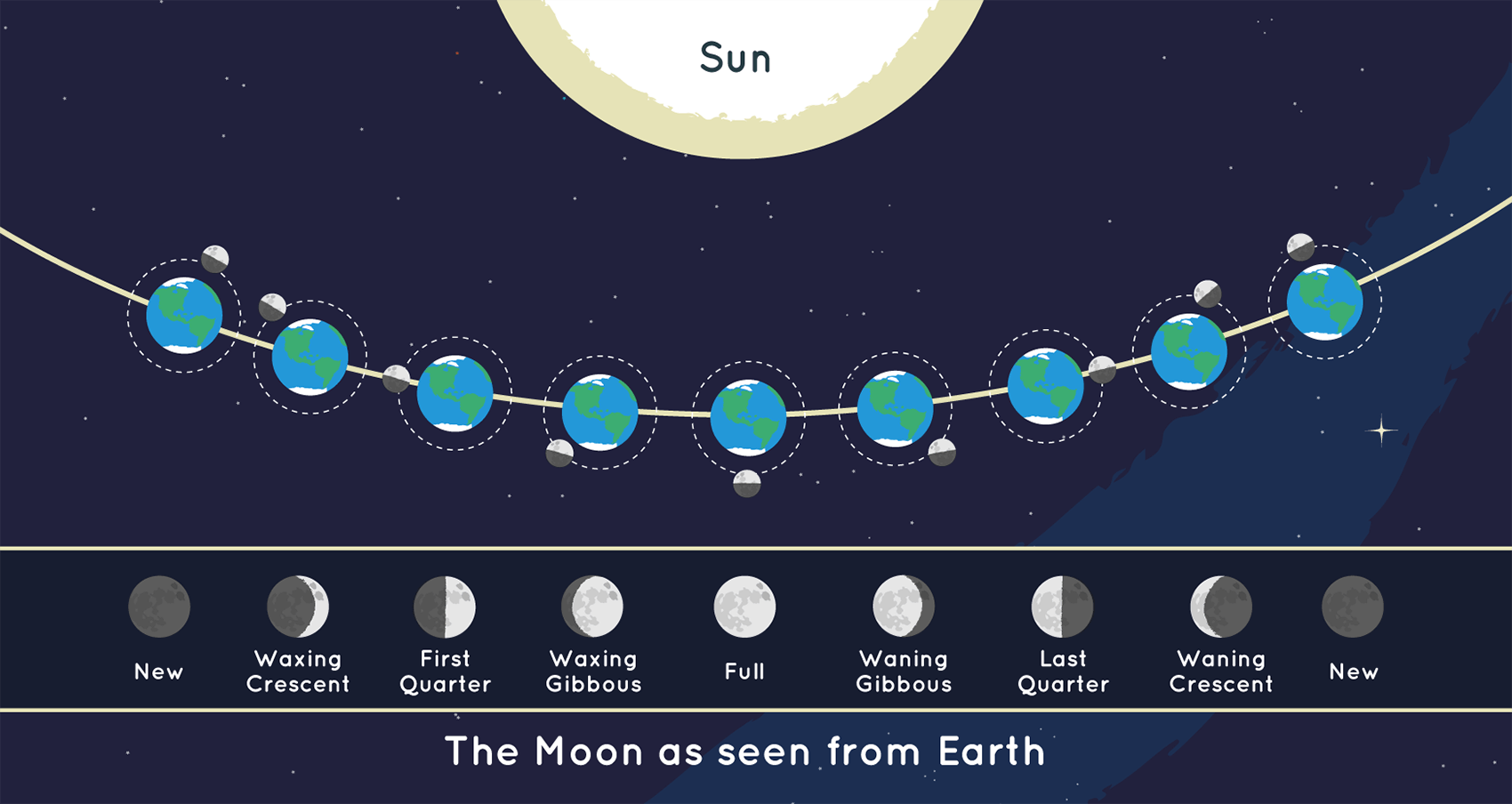
Alt...
This graphic shows the position of the Moon and the Sun during each of the Moon’s phases and the Moon as it appears from Earth during each phase.
CREDIT
NASA/JPL-Caltech
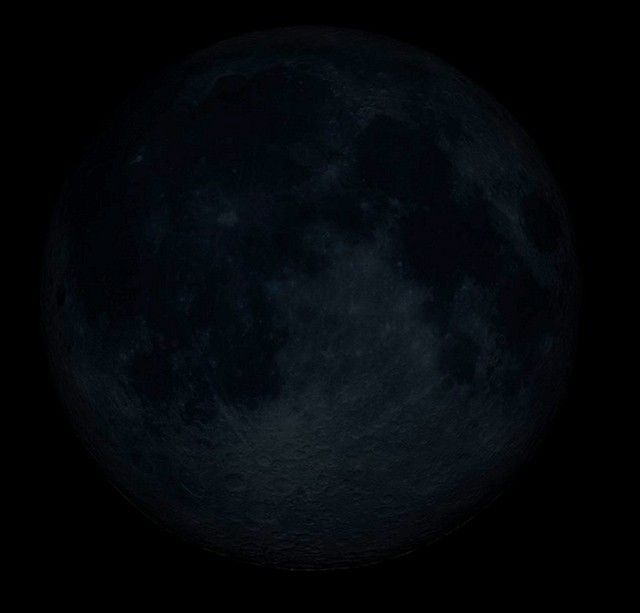
Alt...
New Moon
This is the invisible phase of the Moon, with the illuminated side of the Moon facing the Sun and the night side facing Earth. In this phase, the Moon is in the same part of the sky as the Sun and rises and sets with the Sun. Not only is the illuminated side facing away from the Earth, it’s also up during the day! Remember, in this phase, the Moon doesn’t usually pass directly between Earth and the Sun, due to the inclination of the Moon’s orbit. It only passes near the Sun from our perspective on Earth.
CREDIT
NASA/JPL-Caltech
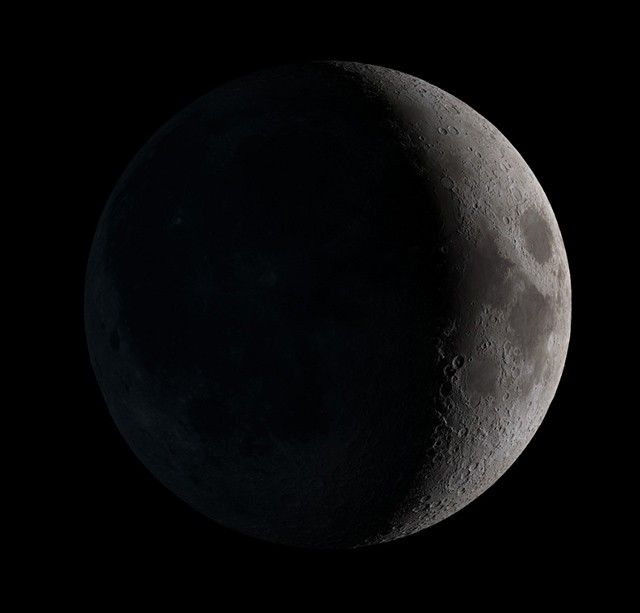
Alt...
Waxing Crescent
This silver sliver of a Moon occurs when the illuminated half of the Moon faces mostly away from Earth, with only a tiny portion visible to us from our planet. It grows daily as the Moon’s orbit carries the Moon’s dayside farther into view. Every day, the Moon rises a little bit later.
CREDIT
NASA/JPL-Caltech
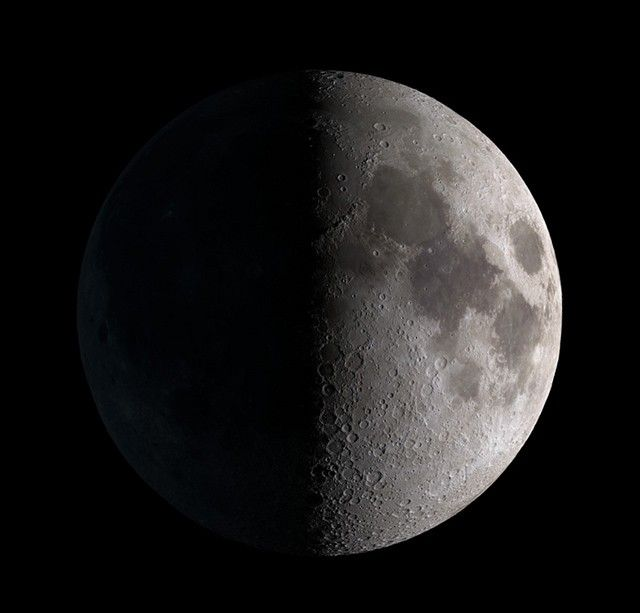
Alt...
First Quarter
The Moon is now a quarter of the way through its monthly journey and you see half of its illuminated side. People may casually call this a half moon, but remember, that’s not really what you’re witnessing in the sky. You’re seeing just a slice of the entire Moon ― half of the illuminated half. A first quarter moon rises around noon and sets around midnight. It’s high in the sky in the evening and makes for excellent viewing.
CREDIT
NASA/JPL-Caltech
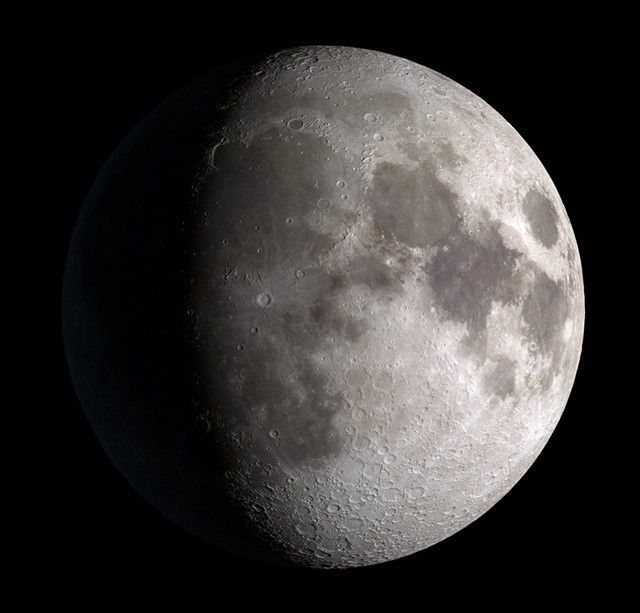
Alt...
Waxing Gibbous
Now most of the Moon’s dayside has come into view, and the Moon appears brighter in the sky.
CREDIT
NASA/JPL-Caltech
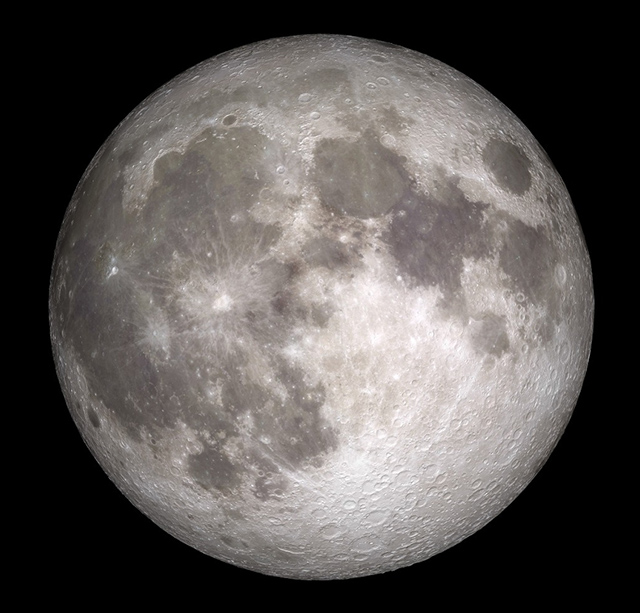
Alt...
Full Moon
This is as close as we come to seeing the Sun’s illumination of the entire day side of the Moon (so, technically, this would be the real half moon). The Moon is opposite the Sun, as viewed from Earth, revealing the Moon’s dayside. A full moon rises around sunset and sets around sunrise. The Moon will appear full for a couple of days before it moves into…
CREDIT
NASA/JPL-Caltech
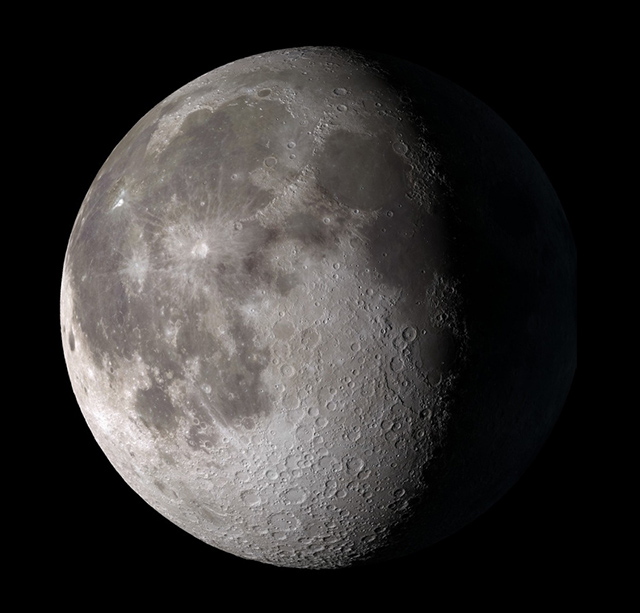
Alt...
Waning Gibbous
As the Moon begins its journey back toward the Sun, the opposite side of the Moon now reflects the Moon’s light. The lighted side appears to shrink, but the Moon’s orbit is simply carrying it out of view from our perspective. The Moon rises later and later each night.
CREDIT
NASA/JPL-Caltech
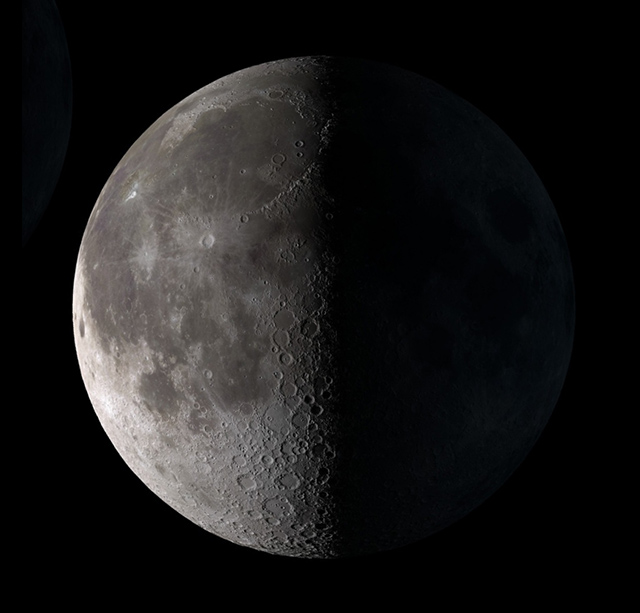
Alt...
Last Quarter
The Moon looks like it’s half illuminated from the perspective of Earth, but really you’re seeing half of the half of the Moon that’s illuminated by the Sun ― or a quarter. A last quarter moon, also known as a third quarter moon, rises around midnight and sets around noon.
CREDIT
NASA/JPL-Caltech
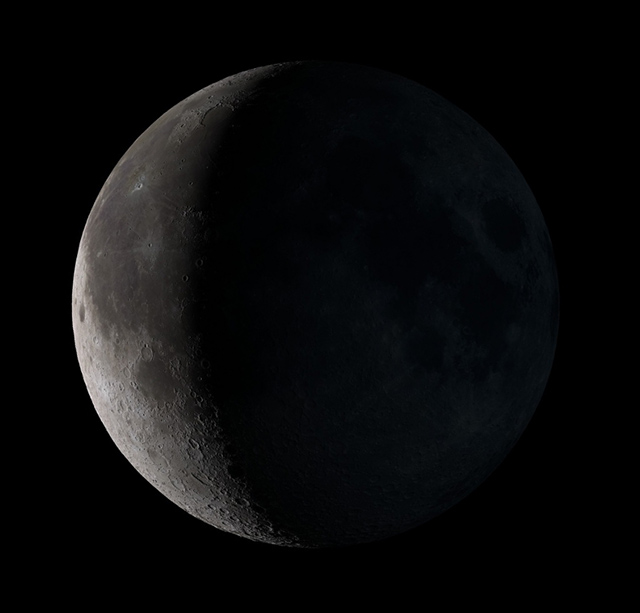
Alt...
Waning Crescent
The Moon is nearly back to the point in its orbit where its dayside directly faces the Sun, and all that we see from our perspective is a thin curve.
CREDIT
NASA/JPL-Caltech
Alt...
The Moon orbits Earth from a viewpoint above the North Pole in this animation. The blue gridlines show how the same side of the Moon always faces Earth. The size of the Earth and Moon are enlarged 20 times.
Overview From Space
Imagine you’re in a spaceship, traveling away from Earth. As you sail onward, you see our planet and its Moon locked together in their endless, circling, gravitational embrace. Your distant view gives you a unique perspective on the Moon that can be hard to visualize from the ground, where the Moon appears to sweep through the sky as an ever-changing globe of light.
From your astronaut’s viewpoint, you can see that the Moon is an average of 238,855 miles (384,399 km) from Earth, or about the space that could be occupied by 30 Earths. It travels around our planet once every 27.322 days in an elliptical orbit, an elongated circle. (It takes about 27.3 days to complete a revolution, but 29.5 days to change from new moon to new moon.) The Moon is tidally locked with Earth, which means that it spins on its axis exactly once each time it orbits our planet. Because of this, people on Earth only ever see one side of the Moon. We call this motion synchronous rotation.
CREDIT:
NASA's Scientific Visualization Studio
"Hello my dear moon addicts, I hope you enjoy this year's moon phases as much as I do. The best thing to do is to put on headphones, adopt a comfortable posture and a chilled drink would also be the order of the day, enjoy!"
This wonderful visualization shows the Moon's phase and libration at hourly intervals throughout 2025, as viewed from the Northern Hemisphere. Each frame represents one hour. In addition, this visualization shows the Moon's orbit position, sub-Earth and subsolar points, and distance from the Earth at true scale. Craters near the terminator are labeled, as are Apollo landing sites, maria, and other albedo features in sunlight.
https://svs.gsfc.nasa.gov/5415
https://svs.gsfc.nasa.gov/5415
* Video credit:
NASA’s Goddard Space Flight Center
* Data visualization by: Ernie Wright (USRA)
* Producer & Editor: James Tralie
* Music Provided by Universal Production Music: "Shine a Light," "Space and Time," and "Spiralling Stars" by Timothy James Cornick
#space #moon #astrophotography #photography #science #astronomy #nature #NASA #ESA #education
The main Moon phases
Diagram of the main lunar phases. With the Sun assumed to be far off to the right, the inner circle shows the positions of the Moon as seen from above Earth’s North Pole that correspond to the phases of the Moon that we see from Earth as shown on the outer circle.
When the Moon is in other different positions in its orbit around Earth, it will appear as a crescent and other partial shapes. As the Moon shifts from new Moon to full Moon — as it moves to where we can see more of the part brightened by the Sun — we say the Moon is waxing. During the other half of the time, when the Moon is passing from full Moon to new Moon, we say the Moon is waning.
There can also be “supermoons”. Because the Moon’s orbit is slightly oblong instead of a perfect circle, there are times when the Moon is closer to Earth than usual and appears larger in the sky. When that also coincides with full Moon or new Moon, it’s called a supermoon. A supermoon will look slightly larger than normal, but the change is not big enough to be obvious to the naked eye.
CREDIT
NASA
https://www.planetary.org/space-images/the-main-moon-phases
#space #moon #astrophotography #photography #science #astronomy #nature #NASA #ESA #education
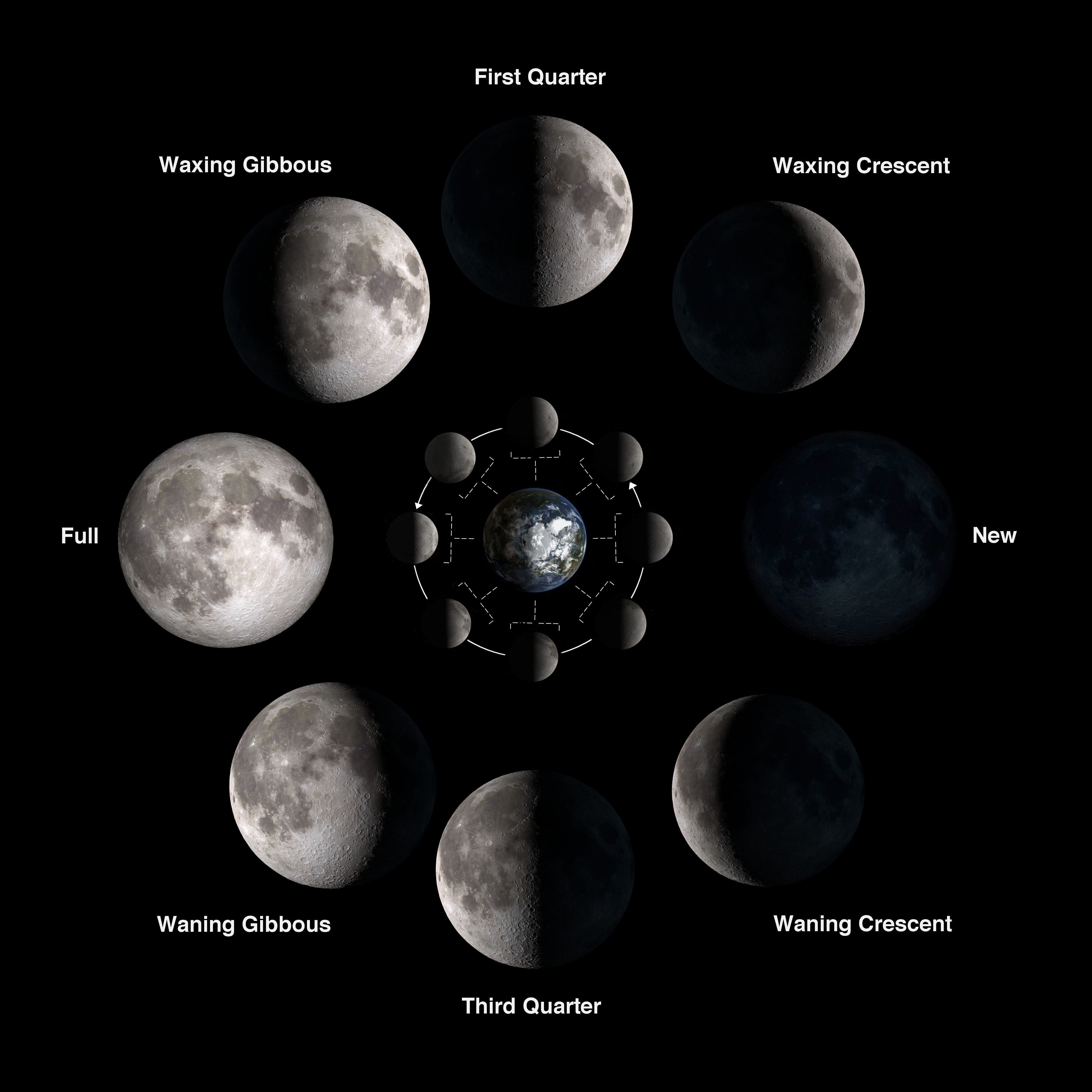
Alt...
The main Moon phases
Diagram of the main lunar phases, not to scale. With the Sun assumed to be far off to the right, the inner circle shows the positions of the Moon as seen from above Earth’s North Pole that correspond to the phases of the Moon that we see from Earth as shown on the outer circle.
CREDIT
NASA
Lunar eclipse
A lunar eclipse is an astronomical event that occurs when the Moon moves into the Earth's shadow, causing the Moon to be darkened. Such an alignment occurs during an eclipse season, approximately every six months, during the full moon phase, when the Moon's orbital plane is closest to the plane of the Earth's orbit.
This can occur only when the Sun, Earth, and Moon are exactly or very closely aligned (in syzygy) with Earth between the other two, which can happen only on the night of a full moon when the Moon is near either lunar node. The type and length of a lunar eclipse depend on the Moon's proximity to the lunar node.
When the Moon is totally eclipsed by the Earth (a "deep eclipse"), it takes on a reddish color that is caused by the planet when it completely blocks direct sunlight from reaching the Moon's surface, as the only light that is reflected from the lunar surface is what has been refracted by the Earth's atmosphere. This light appears reddish due to the Rayleigh scattering of blue light, the same reason sunrises and sunsets are more orange than during the day.
Unlike a solar eclipse, which can only be viewed from a relatively small area of the world, a lunar eclipse may be viewed from anywhere on the night side of Earth. A total lunar eclipse can last up to nearly two hours (while a total solar eclipse lasts only a few minutes at any given place) because the Moon's shadow is smaller. Also unlike solar eclipses, lunar eclipses are safe to view without any eye protection or special precautions.
TEXT
From Wikipedia, the free encyclopedia
VIDEO
Lunar Eclipse Essentials
Explainer Video about Lunar Eclipses
Updated April 22, 2022
Credit
* Scientific Visualization Studio/NASA
* Goddard Space Flight Center.
* Lead Producer: Chris Smith.
* Lead Visualizer: Ernie Wright.
* Producer: David Ladd.
* Technical Support: Aaron Lepsch.
#space #moon #astrophotography #photography #science #astronomy #nature #NASA #ESA #education
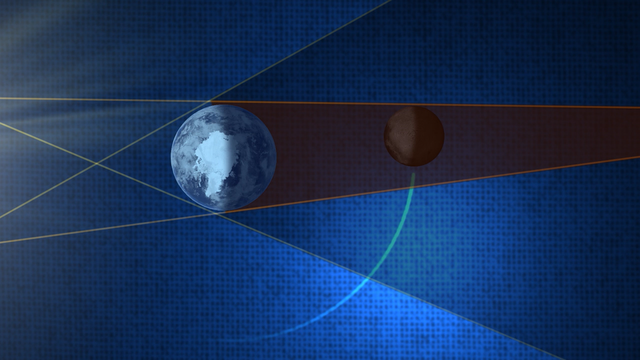
Alt...
Lunar Eclipse Essentials
Explainer Video about Lunar Eclipses
April 22, 2022
Credit
* Scientific Visualization Studio/NASA
* Goddard Space Flight Center.
* Lead Producer: Chris Smith.
* Lead Visualizer: Ernie Wright.
* Producer: David Ladd.
* Technical Support: Aaron Lepsch.
2025 August 30
A Two Percent Moon
* Image Credit & Copyright: Marina Prol
https://www.marinaprol.com/
Explanation:
A young crescent moon can be hard to see. That's because when the Moon shows it's crescent phase (young or old) it can never be far from the Sun in planet Earth's sky. And even though the sky is still bright, a slender sunlit lunar crescent is cleary visible in this early evening skyscape. The telephoto snapshot was captured on August 24, with the Moon very near the western horizon at sunset. Seen in a narrow crescent phase about 1.5 days old, the visible sunlit portion is a mere two percent of the surface of the Moon's familiar nearside. At the Canary Islands Space Centre, a steerable radio dish for communication with spacecraft is titled in the direction of the two percent Moon. The sunset sky's pastel pinkish coloring is partly due to fine sand and dust from the Sahara Desert blown by the prevailing winds.
https://svs.gsfc.nasa.gov/5415/
https://science.nasa.gov/skywatching/
https://apod.nasa.gov/apod/ap080411.html
https://apod.nasa.gov/apod/ap250830.html
#space #moon #astrophotography #photography #science #astronomy #nature #NASA #ESA #education
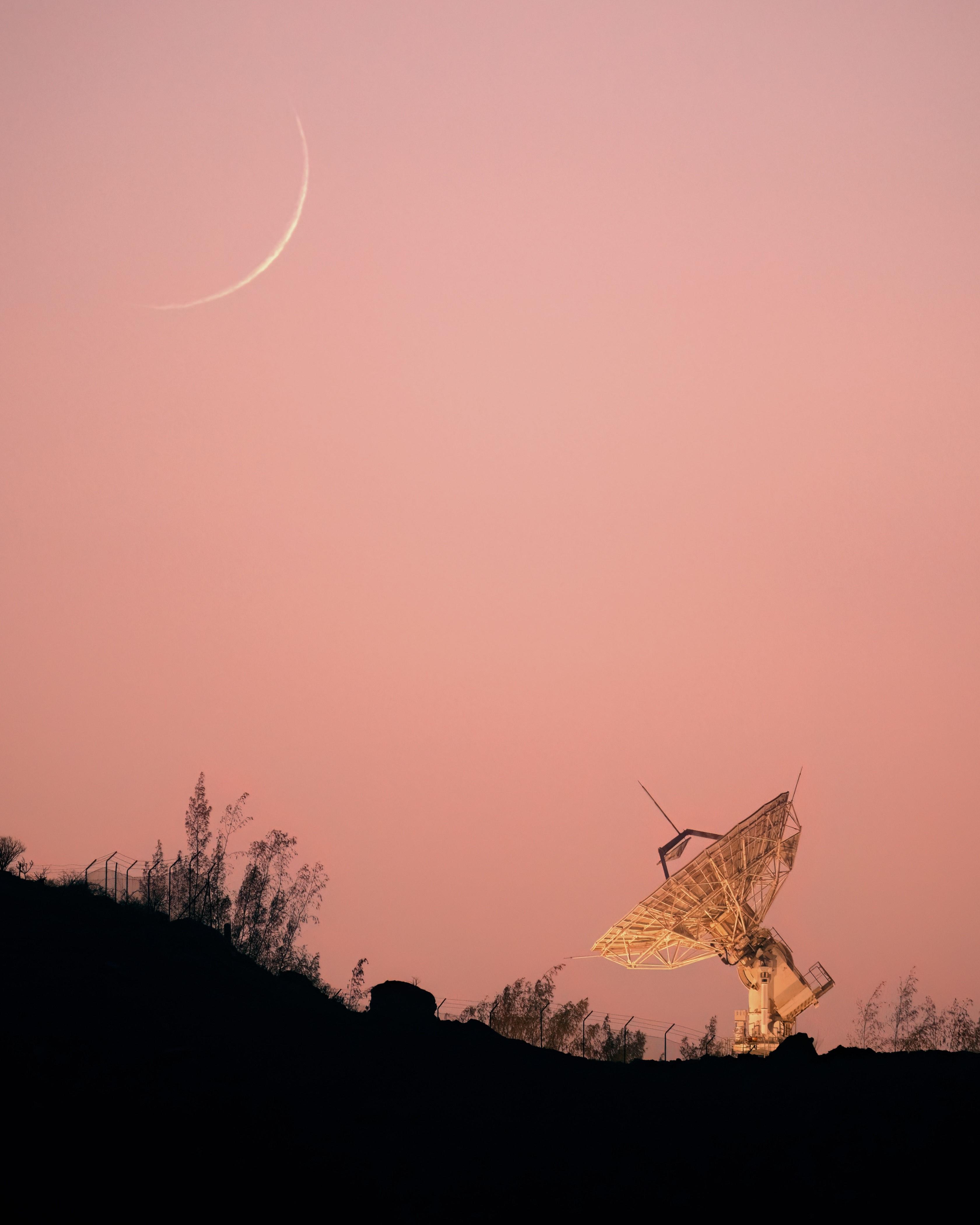
Alt...
2025 August 30
A Two Percent Moon
* Image Credit & Copyright: Marina Prol
Explanation:
A young crescent moon can be hard to see. That's because when the Moon shows it's crescent phase (young or old) it can never be far from the Sun in planet Earth's sky. And even though the sky is still bright, a slender sunlit lunar crescent is cleary visible in this early evening skyscape. The telephoto snapshot was captured on August 24, with the Moon very near the western horizon at sunset. Seen in a narrow crescent phase about 1.5 days old, the visible sunlit portion is a mere two percent of the surface of the Moon's familiar nearside. At the Canary Islands Space Centre, a steerable radio dish for communication with spacecraft is titled in the direction of the two percent Moon. The sunset sky's pastel pinkish coloring is partly due to fine sand and dust from the Sahara Desert blown by the prevailing winds.
Authors & editors: Robert Nemiroff (MTU) & Jerry Bonnell (UMCP)
NASA Official: Amber Straughn Specific rights apply.
NASA Web Privacy, Accessibility, Notices;
A service of: ASD at NASA / GSFC,
NASA Science Activation
& Michigan Tech. U.
2025 September 10
The Great Lacerta Nebula
* Image Credit & Copyright: Ian Moehring & Kevin Roylance
https://www.instagram.com/ianmoe66/
Explanation:
It is one of the largest nebulas on the sky -- why isn't it better known? Roughly the same angular size as the Andromeda Galaxy, the Great Lacerta Nebula can be found toward the constellation of the Lizard (Lacerta). The emission nebula is difficult to see with wide-field binoculars because it is so faint, but also usually difficult to see with a large telescope because it is so great in angle -- spanning about three degrees. The depth, breadth, waves, and beauty of the nebula -- cataloged as Sharpless 126 (Sh2-126) -- can best be seen and appreciated with a long duration camera exposure. The featured image is one such combined exposure -- in this case taken over three nights in August through dark skies in Moses Lake, Washington, USA. The hydrogen gas in the Great Lacerta Nebula glows red because it is excited by light from the bright star 10 Lacertae, one of the bright blue stars just to the left of the red-glowing nebula's center. Most of the stars and nebula are about 1,200 light years distant.
https://app.astrobin.com/i/6egtl5
https://astro4edu.org/resources/diagram/YQ69V022qi60/
https://science.nasa.gov/mission/hubble/science/explore-the-night-sky/hubble-messier-catalog/messier-31/
https://en.wikipedia.org/wiki/List_of_the_most_distant_astronomical_objects
https://science.nasa.gov/ems/03_behaviors/
https://www.geogebra.org/m/atq6mr3a
https://apod.nasa.gov/apod/ap250910.html
#space #nebula #astrophotography #photography #science #astronomy #nature #NASA
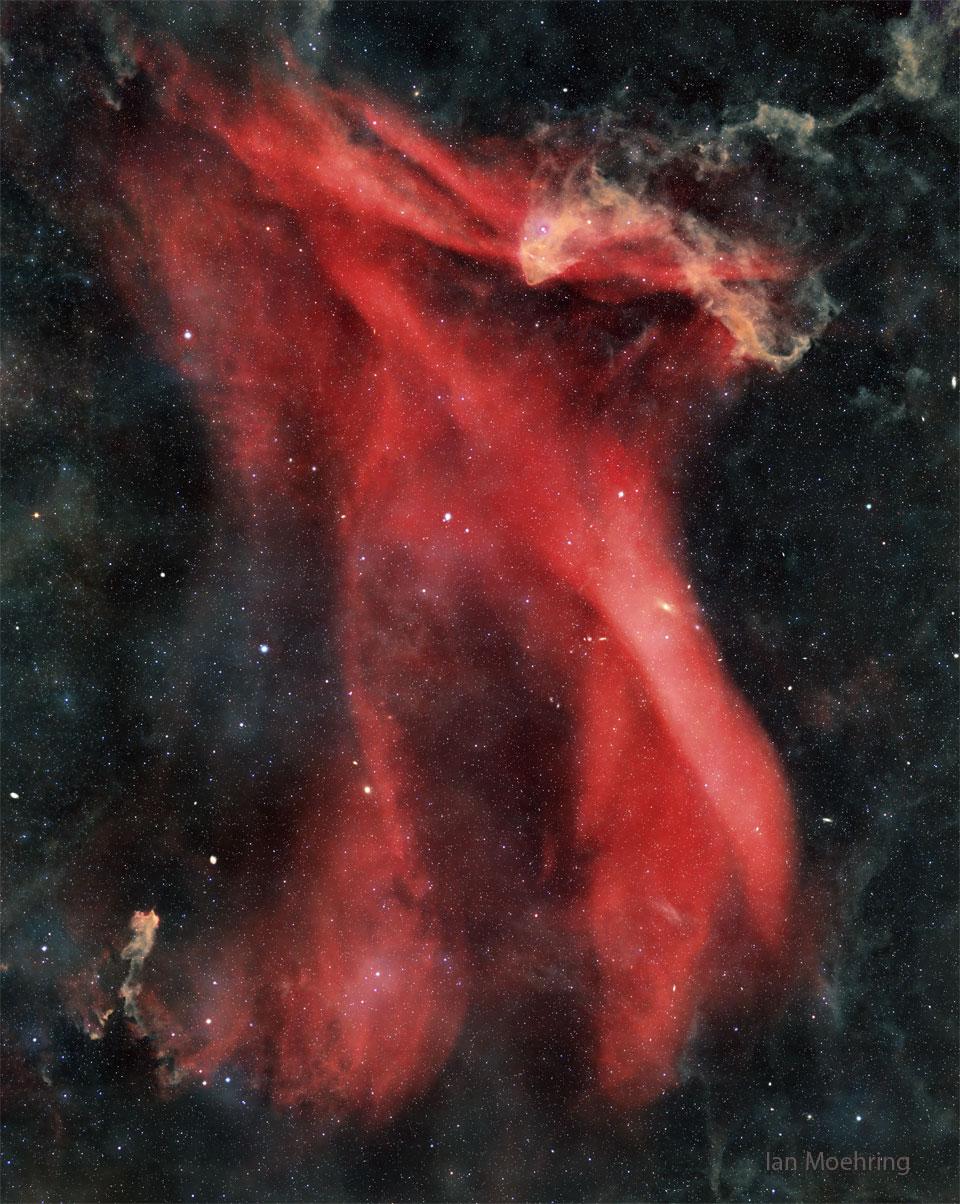
Alt...
2025 September 10
A starfield surrounds a large red nebula. The nebula has many flowing waves and folds.
The Great Lacerta Nebula
* Image Credit & Copyright: Ian Moehring & Kevin Roylance
Explanation:
It is one of the largest nebulas on the sky -- why isn't it better known? Roughly the same angular size as the Andromeda Galaxy, the Great Lacerta Nebula can be found toward the constellation of the Lizard (Lacerta). The emission nebula is difficult to see with wide-field binoculars because it is so faint, but also usually difficult to see with a large telescope because it is so great in angle -- spanning about three degrees. The depth, breadth, waves, and beauty of the nebula -- cataloged as Sharpless 126 (Sh2-126) -- can best be seen and appreciated with a long duration camera exposure. The featured image is one such combined exposure -- in this case taken over three nights in August through dark skies in Moses Lake, Washington, USA. The hydrogen gas in the Great Lacerta Nebula glows red because it is excited by light from the bright star 10 Lacertae, one of the bright blue stars just to the left of the red-glowing nebula's center. Most of the stars and nebula are about 1,200 light years distant.
Authors & editors: Robert Nemiroff (MTU) & Jerry Bonnell (UMCP)
NASA Official: Amber Straughn Specific rights apply.
NASA Web Privacy, Accessibility, Notices;
A service of: ASD at NASA / GSFC,
NASA Science Activation
& Michigan Tech. U.
<<_>>
[...]
The Helix remains recognizable at any of these wavelengths, but the combination shown here highlights some subtle differences.
The intense ultraviolet radiation from the white dwarf heats up the expelled layers of gas, which shine brightly in the infrared. GALEX has picked out the ultraviolet light pouring out of this system, shown throughout the nebula in blue, while Spitzer has snagged the detailed infrared signature of the dust and gas in yellow A portion of the extended field beyond the nebula, which was not observed by Spitzer, is from NASA’s all-sky Wide-field Infrared Survey Explorer (WISE). The white dwarf star itself is a tiny white pinprick right at the center of the nebula.
The brighter purple circle in the very center is the combined ultraviolet and infrared glow of a dusty disk circling the white dwarf (the disk itself is too small to be resolved). This dust was most likely kicked up by comets that survived the death of their star.
Before the star died, its comets, and possibly planets, would have orbited the star in an orderly fashion. When the star ran out of hydrogen to burn, and blew off its outer layers, the icy bodies and outer planets would have been tossed about and into each other, kicking up an ongoing cosmic dust storm. Any inner planets in the system would have burned up or been swallowed as their dying star expanded.
https://www.nasa.gov/image-article/helix-nebula-unraveling-seams/
Helix Nebula 3D model credit: INAF/Sal Orlando
[...] This 3D model is an impression derived from data obtained with several optical filters by NASA’s Hubble Space Telescope.
https://chandra.harvard.edu/deadstar/helix.html
#space #nebula #astrophotography #photography #science #astronomy #physics #nature #NASA #ESA
Alt...
Helix Nebula 3D model credit: INAF/Sal Orlando
As the planetary nebula is formed, the leftover stellar core eventually becomes a white dwarf star (see bright white spot at center). The Helix nebula, also known as NGC 7293, is located in the constellation Aquarius. It is one of the closest planetary nebulas to Earth, being less than 700 light-years away from us. This 3D model is an impression derived from data obtained with several optical filters by NASA’s Hubble Space Telescope.
April 16, 1996
Cometary Knots in the Helix Nebula
* Credit: R. O'Dell and K. Handron (Rice University), NASA
https://www.rice.edu/
http://www.nasa.gov/
Explanation:
Four hundred fifty light-years from Earth, the wind from a dying, sun-like star produced a planetary nebula popularly known as the Helix. While exploring the Helix's gaseous envelope with the Hubble Space Telescope (HST), astronomers discovered indications of 1,000s of striking "cometary knots" like those shown above. So called because of their resemblence to comets, they are actually much larger - their heads are several billion miles across (roughly twice the size of the our solar system itself) while their tails, pointing radially away from the central star, stretch over 100 billion miles. Previously known from ground based observations, the sheer number of cometary knots found in this single nebula is astonishing. What caused them to form? Hot, fast moving shells of nebular gas overrunning cooler, denser, slower shells ejected by the star during an earlier expansion may produce these droplet-like condensations as the two shells intermix and fragment. An intriguing possibility is that instead of dissipating over time, these objects, could collapse and form pluto-like bodies. If so, these icy worlds created near the end of a star's life, would be numerous in our galaxy.
https://apod.nasa.gov/apod/ap960416.html
#space #nebula #astrophotography #photography #science #astronomy #physics #nature #NASA #ESA
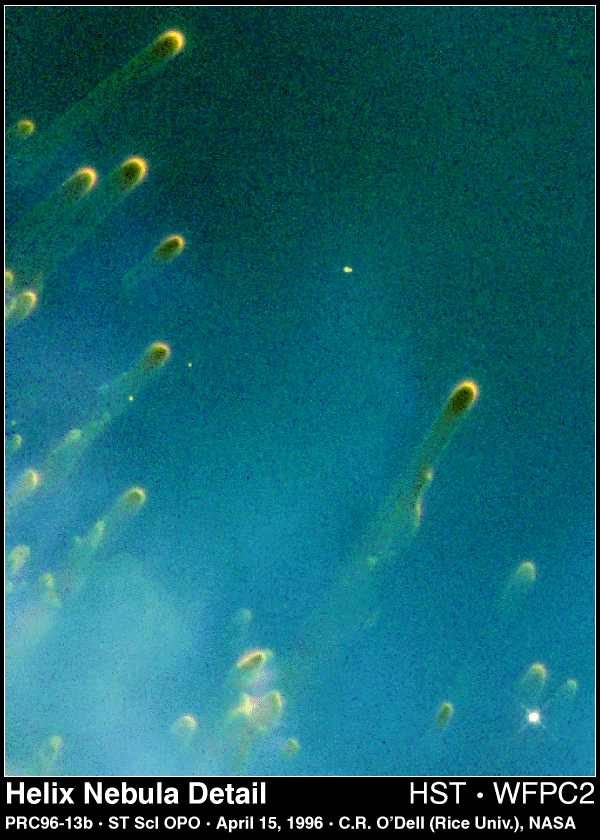
Alt...
April 16, 1996
Cometary Knots in the Helix Nebula
* Credit: R. O'Dell and K. Handron (Rice University), NASA
Explanation:
Four hundred fifty light-years from Earth, the wind from a dying, sun-like star produced a planetary nebula popularly known as the Helix. While exploring the Helix's gaseous envelope with the Hubble Space Telescope (HST), astronomers discovered indications of 1,000s of striking "cometary knots" like those shown above. So called because of their resemblence to comets, they are actually much larger - their heads are several billion miles across (roughly twice the size of the our solar system itself) while their tails, pointing radially away from the central star, stretch over 100 billion miles. Previously known from ground based observations, the sheer number of cometary knots found in this single nebula is astonishing. What caused them to form? Hot, fast moving shells of nebular gas overrunning cooler, denser, slower shells ejected by the star during an earlier expansion may produce these droplet-like condensations as the two shells intermix and fragment. An intriguing possibility is that instead of dissipating over time, these objects, could collapse and form pluto-like bodies. If so, these icy worlds created near the end of a star's life, would be numerous in our galaxy.
Authors & editors: Robert Nemiroff (GMU) & Jerry Bonnell (USRA).
NASA Technical Rep.: Sherri Calvo. Specific rights apply.
A service of: LHEA at NASA/ GSFC
This sonification (a translation of data from image into sound) depicts the optical data from the Hubble Space Telescope of the Helix Nebula. The sonification scans from left to right, where red light is assigned lower pitches and blue light is assigned higher pitches. Just as the frequencies of light increase from red to blue, frequencies of sound increase from low to high pitches.
Credit:
NASA, NOAO, ESA, the Hubble Helix Nebula Team, M. Meixner (STScI), & T.A. Rector (NRAO); Sonification: SYSTEM Sounds (M. Russo, A. Santaguida)
#space #nebula #astrophotography #photography #science #astronomy #physics #nature #NASA #ESA
"With this miracle of the universe, I have to think again and again of the beautiful old rose varieties when they fade in late summer and hold their petals with their last strength, and release their innermost ones for pollination. Therefore, let's approach slowly and carefully from the outside to the inside"
* Image Credits:
** top left:
+ Bray Falls
https://www.instagram.com/astrofalls/
** bottom left:
+ Taavi Niittee
https://app.astrobin.com/u/Astronoomiaklubi#gallery
** top right:
+ R. Corradi
https://www.ing.iac.es/
https://www.not.iac.es/general/photos/
** downright:
Data:
+ Michael Joner
http://wmo.byu.edu/
+ Romano Corradi
https://www.iac.es/
https://hla.stsci.edu/
Processing:
+ Robert Gendler
http://www.robgendlerastropics.com/
The Cat's Eye Nebula (also known as NGC 6543 and Caldwell 6) is a planetary nebula in the northern constellation of Draco, discovered by William Herschel on February 15, 1786. It was the first planetary nebula whose spectrum was investigated by the English amateur astronomer William Huggins, demonstrating that planetary nebulae were gaseous and not stellar in nature. Structurally, the object has had high-resolution images by the Hubble Space Telescope revealing knots, jets, bubbles and complex arcs, being illuminated by the central hot planetary nebula nucleus (PNN). It is a well-studied object that has been observed from radio to X-ray wavelengths. At the centre of the Cat's Eye Nebula is a dying Wolf–Rayet star, the sort of which can be seen in the Webb Telescope's image of WR 124. The Cat's Eye Nebula's central star shines at magnitude +11.4. Hubble Space Telescope images show a sort of dart board pattern of concentric rings emanating outwards from the centre. Text from https://en.wikipedia.org/wiki/Cat's_Eye_Nebula
#space #nebula #astrophotography #photography #science #astronomy #physics #nature #NASA #ESA
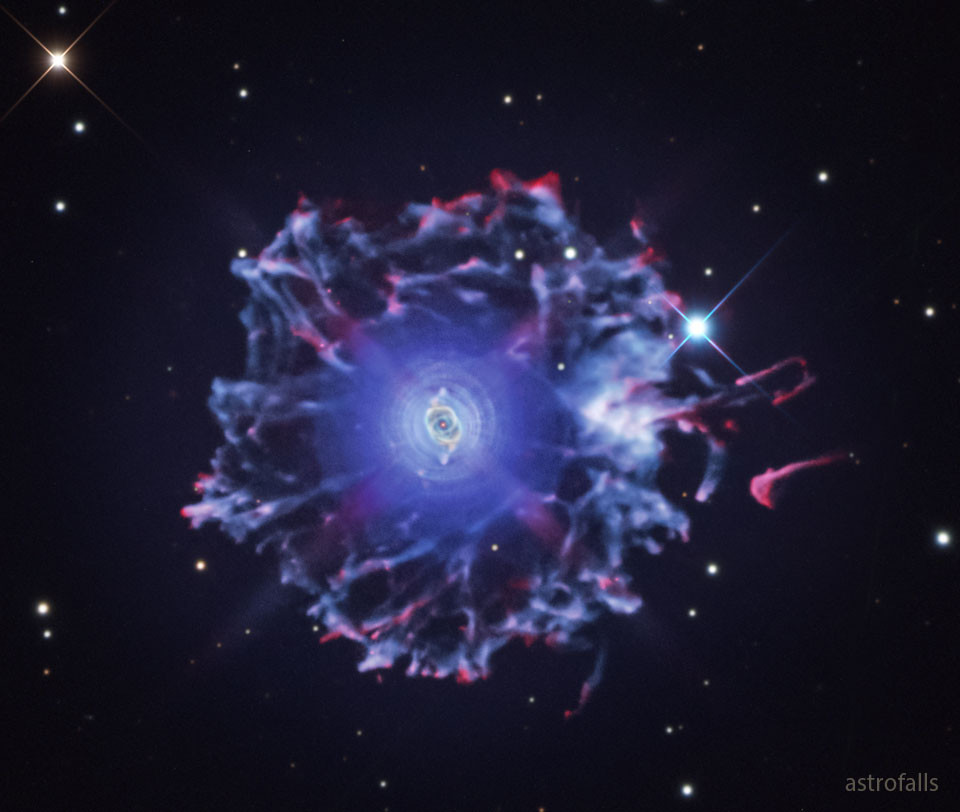
Alt...
2022 August 3
The featured image shows a wide field image of the Cat's Eye nebula showing it to be surrounded by a large halo with many vertexes.
Halo of the Cat's Eye
* Image Credit & Copyright: Bray Falls
Explanation:
What created the unusual halo around the Cat's Eye nebula? No one is sure. What is sure is that the Cat's Eye Nebula (NGC 6543) is one of the best known planetary nebulae on the sky. Although haunting symmetries are seen in the bright central region, this image was taken to feature its intricately structured outer halo, which spans over three light-years across. Planetary nebulae have long been appreciated as a final phase in the life of a Sun-like star. Only recently however, have some planetaries been found to have expansive halos, likely formed from material shrugged off during earlier puzzling episodes in the star's evolution. While the planetary nebula phase is thought to last for around 10,000 years, astronomers estimate the age of the outer filamentary portions of the Cat's Eye Nebula's halo to be 50,000 to 90,000 years.
Authors & editors: Robert Nemiroff (MTU) & Jerry Bonnell (UMCP)
NASA Official: Phillip Newman Specific rights apply.
NASA Web Privacy Policy and Important Notices
A service of: ASD at NASA / GSFC,
NASA Science Activation
& Michigan Tech. U.
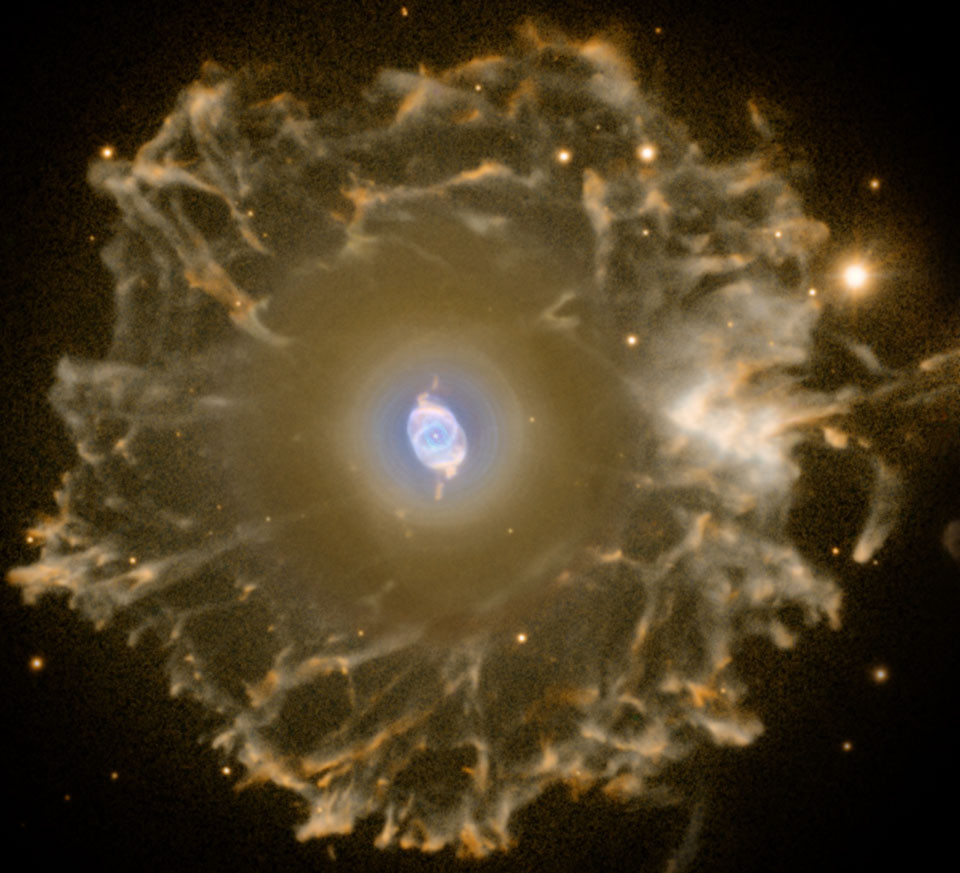
Alt...
2020 June 7
Halo of the Cat's Eye
* Image Credit & Copyright: R. Corradi (Isaac Newton Group), Nordic Optical Telescope
Explanation:
The Cat's Eye Nebula (NGC 6543) is one of the best known planetary nebulae in the sky. Its haunting symmetries are seen in the very central region of this stunning false-color picture, processed to reveal the enormous but extremely faint halo of gaseous material, over three light-years across, which surrounds the brighter, familiar planetary nebula. Made with data from the Nordic Optical Telescope in the Canary Islands, the composite picture shows extended emission from the nebula. Planetary nebulae have long been appreciated as a final phase in the life of a Sun-like star. Only much more recently however, have some planetaries been found to have halos like this one, likely formed of material shrugged off during earlier active episodes in the star's evolution. While the planetary nebula phase is thought to last for around 10,000 years, astronomers estimate the age of the outer filamentary portions of this halo to be 50,000 to 90,000 years.
Authors & editors: Robert Nemiroff (MTU) & Jerry Bonnell (UMCP)
NASA Official: Phillip Newman Specific rights apply.
NASA Web Privacy Policy and Important Notices
A service of: ASD at NASA / GSFC
& Michigan Tech. U.
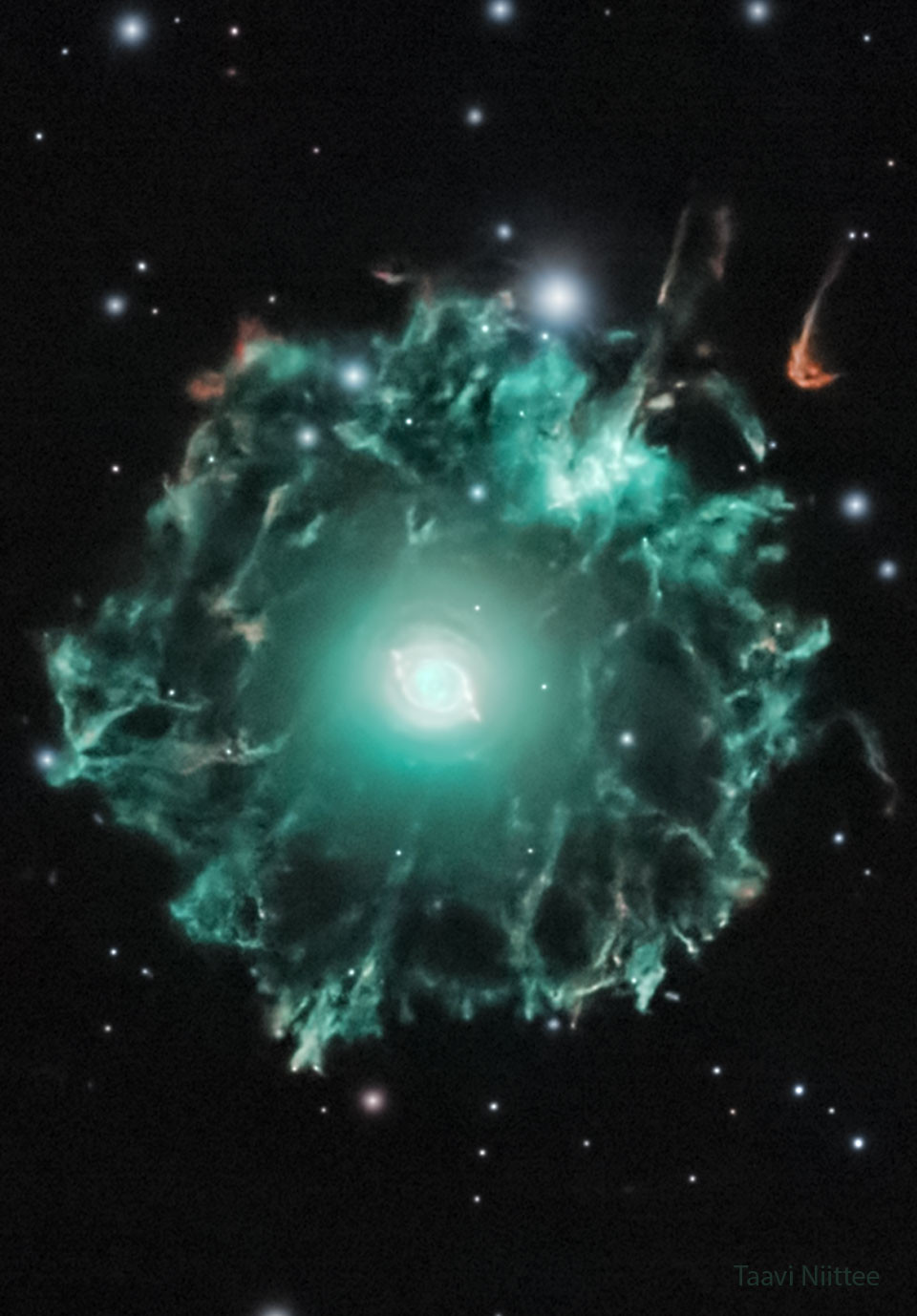
Alt...
2025 April 16
A dark starfield is dominated by a green nebula with intricate filaments all around. At the center is a bright glow surrounding a central star.
Halo of the Cat's Eye
* Image Credit & Copyright: Taavi Niittee (Tõrva Astronomy Club)
Explanation:
What created the unusual halo around the Cat's Eye Nebula? No one is sure. What is sure is that the Cat's Eye Nebula (NGC 6543) is one of the best known planetary nebulae on the sky. Although haunting symmetries are seen in the bright central region, this image was taken to feature its intricately structured outer halo, which spans over three light-years across. Planetary nebulae have long been appreciated as a final phase in the life of a Sun-like star. Only recently however, have some planetaries been found to have expansive halos, likely formed from material shrugged off during earlier puzzling episodes in the star's evolution. While the planetary nebula phase is thought to last for around 10,000 years, astronomers estimate the age of the outer filamentary portions of the Cat's Eye Nebula's halo to be 50,000 to 90,000 years.
Authors & editors: Robert Nemiroff (MTU) & Jerry Bonnell (UMCP)
NASA Official: Amber Straughn Specific rights apply.
NASA Web Privacy, Accessibility, Notices;
A service of: ASD at NASA / GSFC,
NASA Science Activation
& Michigan Tech. U.
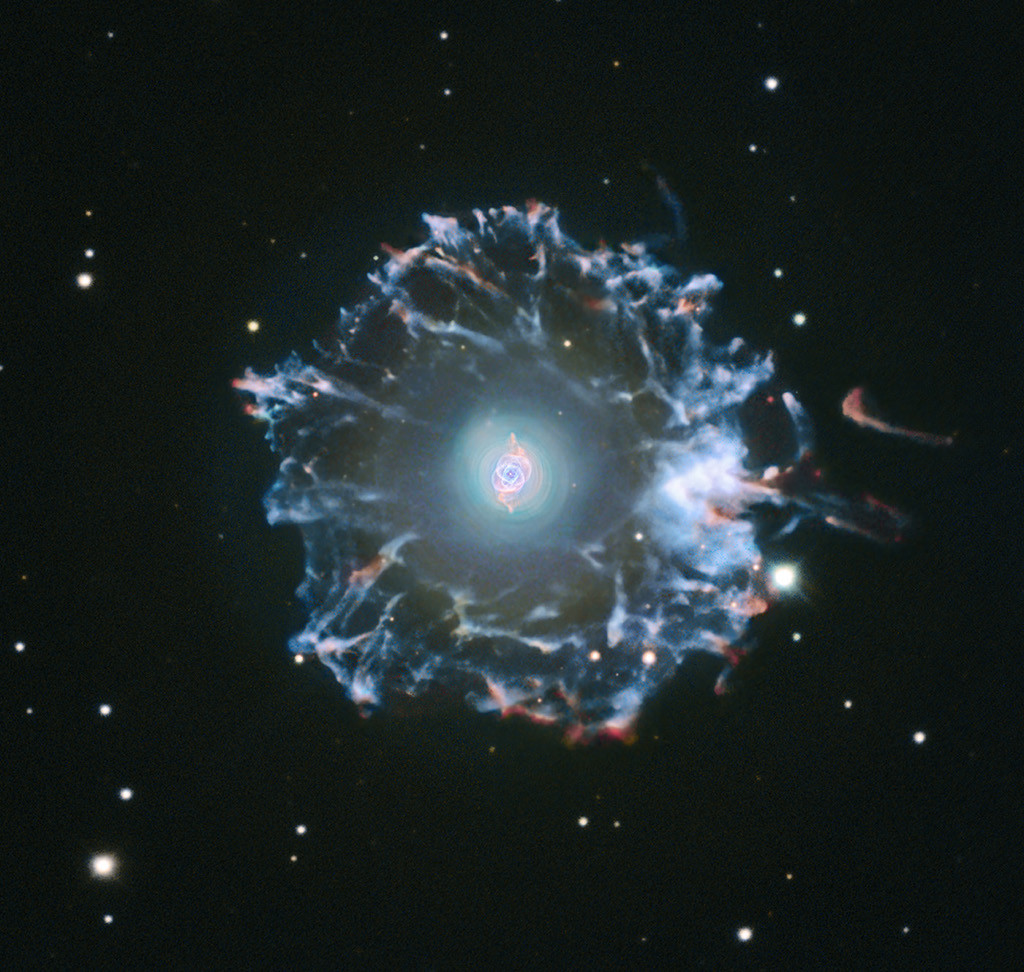
Alt...
2018 October 20
Halo of the Cat's Eye
* Image Credit & Copyright: Data: Michael Joner (West Mountain Observatory, BYU),
Romano Corradi (IAC), Hubble Legacy Archive -
* Processing: Robert Gendler
Explanation:
Not a Falcon 9 rocket launch after sunset, the Cat's Eye Nebula (NGC 6543) is one of the best known planetary nebulae in the sky. Its haunting symmetries are seen in the very central region of this composited picture, processed to reveal an enormous but extremely faint halo of gaseous material, over three light-years across. Made with data from ground- and space-based telescopes it shows the extended emission which surrounds the brighter, familiar planetary nebula. Planetary nebulae have long been appreciated as a final phase in the life of a sun-like star. But only more recently have some planetaries been found to have halos like this one, likely formed of material shrugged off during earlier active episodes in the star's evolution. While the planetary nebula phase is thought to last for around 10,000 years, astronomers estimate the outer filamentary portions of this halo to be 50,000 to 90,000 years old.
Authors & editors: Robert Nemiroff (MTU) & Jerry Bonnell (UMCP)
NASA Official: Phillip Newman Specific rights apply.
NASA Web Privacy Policy and Important Notices
A service of: ASD at NASA / GSFC
& Michigan Tech. U.
2024 January 7
The Cat's Eye Nebula in Optical and X-ray
* Image Credit: NASA, ESA, Hubble Legacy Archive; Chandra X-ray Obs.
https://www.nasa.gov/
https://www.esa.int/
https://hla.stsci.edu/
https://chandra.harvard.edu/about/;
* Processing & Copyright: Rudy Pohl
https://app.astrobin.com/u/Rudy_Pohl#gallery
Explanation:
To some it looks like a cat's eye. To others, perhaps like a giant cosmic conch shell. It is actually one of the brightest and most highly detailed planetary nebula known, composed of gas expelled in the brief yet glorious phase near the end of life of a Sun-like star. This nebula's dying central star may have produced the outer circular concentric shells by shrugging off outer layers in a series of regular convulsions. The formation of the beautiful, complex-yet-symmetric inner structures, however, is not well understood. The featured image is a composite of a digitally sharpened Hubble Space Telescope image with X-ray light captured by the orbiting Chandra Observatory. The exquisite floating space statue spans over half a light-year across. Of course, gazing into this Cat's Eye, humanity may well be seeing the fate of our sun, destined to enter its own planetary nebula phase of evolution ... in about 5 billion years.
https://ui.adsabs.harvard.edu/abs/2012ApJ...759L..28P/abstract
https://ui.adsabs.harvard.edu/abs/2004A%26A...417..637C/abstract
https://apod.nasa.gov/apod/ap011003.html
https://apod.nasa.gov/apod/ap240107.html
#space #nebula #astrophotography #photography #science #astronomy #physics #nature #NASA #ESA
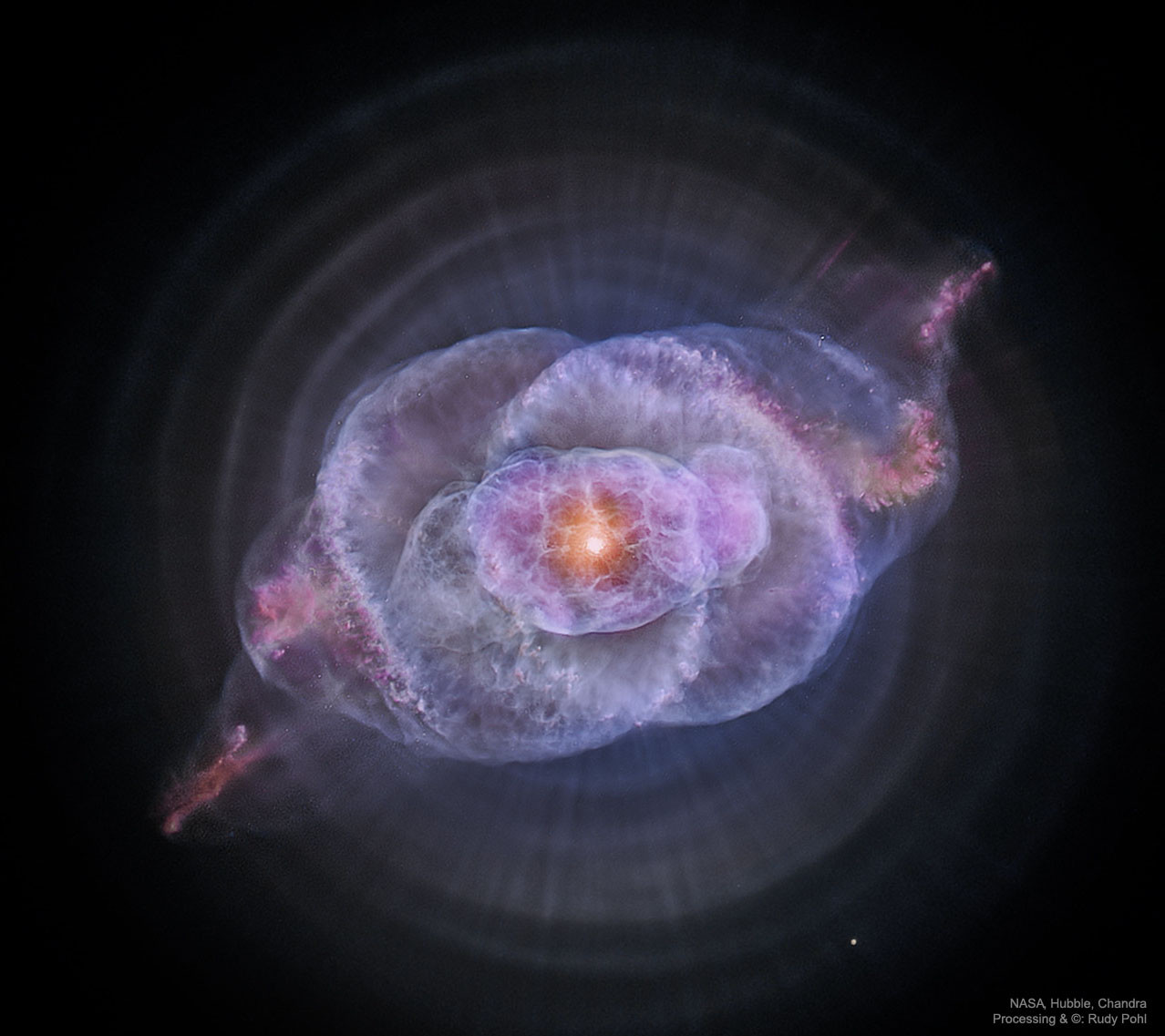
Alt...
2024 January 7
An image of the Cat's Eye Nebula shows an unsually shaped gas structure glowing in purple with a bright orange center.
The Cat's Eye Nebula in Optical and X-ray
* Image Credit: NASA, ESA, Hubble Legacy Archive; Chandra X-ray Obs.;
* Processing & Copyright: Rudy Pohl
Explanation:
To some it looks like a cat's eye. To others, perhaps like a giant cosmic conch shell. It is actually one of the brightest and most highly detailed planetary nebula known, composed of gas expelled in the brief yet glorious phase near the end of life of a Sun-like star. This nebula's dying central star may have produced the outer circular concentric shells by shrugging off outer layers in a series of regular convulsions. The formation of the beautiful, complex-yet-symmetric inner structures, however, is not well understood. The featured image is a composite of a digitally sharpened Hubble Space Telescope image with X-ray light captured by the orbiting Chandra Observatory. The exquisite floating space statue spans over half a light-year across. Of course, gazing into this Cat's Eye, humanity may well be seeing the fate of our sun, destined to enter its own planetary nebula phase of evolution ... in about 5 billion years.
Authors & editors: Robert Nemiroff (MTU) & Jerry Bonnell (UMCP)
NASA Official: Ryan Smallcomb Specific rights apply.
NASA Web Privacy Policy and Important Notices
A service of: ASD at NASA / GSFC,
NASA Science Activation
& Michigan Tech. U.
2022 July 10
In the Center of the Cat's Eye Nebula
* Credit: NASA, ESA, Hubble, HLA
https://www.nasa.gov/
http://www.esa.int/
https://www.nasa.gov/mission_pages/hubble/story/index.html
https://hla.stsci.edu/;
* Reprocessing & Copyright: Raul Villaverde
https://www.flickr.com/photos/113243238@N08/
Explanation:
Three thousand light-years away, a dying star throws off shells of glowing gas. This image from the Hubble Space Telescope reveals the Cat's Eye Nebula (NGC 6543), to be one of the most complex planetary nebulae known. Spanning half a light-year, the features seen in the Cat's Eye are so complex that astronomers suspect the bright central object may actually be a binary star system. The term planetary nebula, used to describe this general class of objects, is misleading. Although these objects may appear round and planet-like in small telescopes, high resolution images with large telescopes reveal them to be stars surrounded by cocoons of gas blown off in the late stages of stellar evolution. Gazing into this Cat's Eye, astronomers may well be seeing more than detailed structure, they may be seeing the fate of our Sun, destined to enter its own planetary nebula phase of evolution ... in about 5 billion years.
https://astronomy.swin.edu.au/cosmos/p/Planetary+Nebulae
https://apod.nasa.gov/apod/ap220710.html
#space #nebula #astrophotography #photography #science #astronomy #physics #nature #NASA #ESA
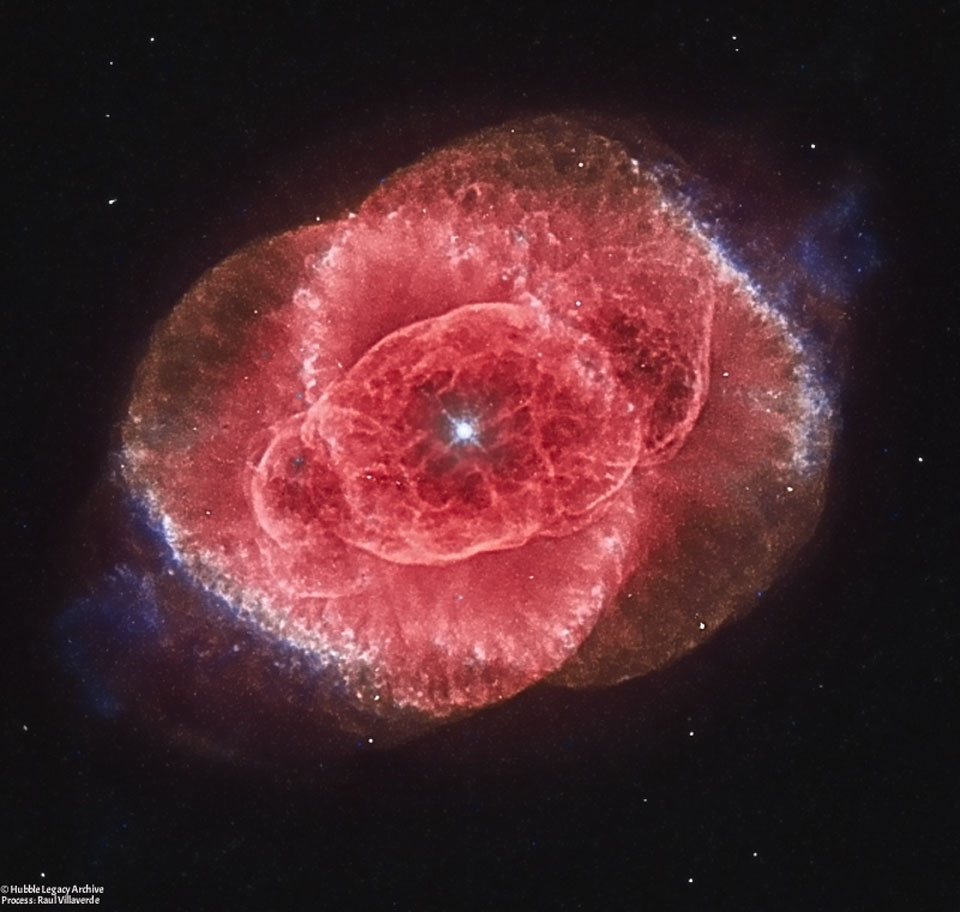
Alt...
2022 July 10
The featured image shows an image of the center of the Cat's Eye Nebula as taken by the Hubble Space Telescope. A bright star is in the center surrounded by a complex red nebula.
In the Center of the Cat's Eye Nebula
* Credit: NASA, ESA, Hubble, HLA;
* Reprocessing & Copyright: Raul Villaverde
Explanation:
Three thousand light-years away, a dying star throws off shells of glowing gas. This image from the Hubble Space Telescope reveals the Cat's Eye Nebula (NGC 6543), to be one of the most complex planetary nebulae known. Spanning half a light-year, the features seen in the Cat's Eye are so complex that astronomers suspect the bright central object may actually be a binary star system. The term planetary nebula, used to describe this general class of objects, is misleading. Although these objects may appear round and planet-like in small telescopes, high resolution images with large telescopes reveal them to be stars surrounded by cocoons of gas blown off in the late stages of stellar evolution. Gazing into this Cat's Eye, astronomers may well be seeing more than detailed structure, they may be seeing the fate of our Sun, destined to enter its own planetary nebula phase of evolution ... in about 5 billion years.
Authors & editors: Robert Nemiroff (MTU) & Jerry Bonnell (UMCP)
NASA Official: Phillip Newman Specific rights apply.
NASA Web Privacy Policy and Important Notices
A service of: ASD at NASA / GSFC
& Michigan Tech. U.
NASA's Hubble Space Telescope has captured a stunning image of the Cat's Eye Nebula, one of the most complex planetary nebulae known, with its intricate structure of concentric rings and high-density knots.
In this video, Dr. Ken Carpenter delves into the beauty of this cosmic jewel and discusses the critical role Hubble plays in unraveling the secrets of stellar evolution and the lifecycle of stars.
NASA's Hubble Space Telescope has captured a stunning image of the Cat's Eye Nebula, one of the most complex planetary nebulae known, with its intricate structure of concentric rings and high-density knots.
In this video, Dr. Ken Carpenter delves into the beauty of this cosmic jewel and discusses the critical role Hubble plays in unraveling the secrets of stellar evolution and the lifecycle of stars.
Credit: NASA's Goddard Space Flight Center
Producer, Director & Editor: James Leigh
Director of Photography: James Ball
Executive Producers: James Leigh & Matthew Duncan
Production & Post: Origin Films
Video Credits:
Hubble Space Telescope Animation:
ESA/Hubble - M. Kornmesser & L. L. Christensen
Music Credits:
"Transcode" by Lee Groves [PRS], and Peter George Marett [PRS] via Universal Production Music
#space #nebula #astrophotography #photography #science #astronomy #physics #nature #NASA #ESA
Alt...
NASA's Hubble Space Telescope has captured a stunning image of the Cat's Eye Nebula, one of the most complex planetary nebulae known, with its intricate structure of concentric rings and high-density knots.
In this video, Dr. Ken Carpenter delves into the beauty of this cosmic jewel and discusses the critical role Hubble plays in unraveling the secrets of stellar evolution and the lifecycle of stars.
Credit: NASA's Goddard Space Flight Center
Producer, Director & Editor: James Leigh
Director of Photography: James Ball
Executive Producers: James Leigh & Matthew Duncan
Production & Post: Origin Films
Video Credits:
Hubble Space Telescope Animation:
ESA/Hubble - M. Kornmesser & L. L. Christensen
Music Credits:
"Transcode" by Lee Groves [PRS], and Peter George Marett [PRS] via Universal Production Music
James Webb Telescope Reveals Enigmatic Rings of Planetary Nebula NGC 1514
The James Webb Space Telescope (JWST) has once again opened new windows into the cosmos, providing astronomers with unprecedented observations of a planetary nebula, NGC 1514, also known as the Crystal Ball Nebula. This remarkable nebula, located approximately 1,500 light years away from Earth, has intrigued scientists for years due to its distinct and puzzling features. New observations from JWST, published on February 28 on the arXiv pre-print server, offer a fresh perspective on the nebula’s enigmatic rings, which have now become one of the most intriguing features of this nebula. [...]
"In mid-April, I dedicated a more detailed thread of several exciting posts to this particularly beautiful Nebula, which by the way is not hourglass shaped in visible light and is therefore also called Crystal Ball Nebula. The link below leads to this thread about NGC 1541."
https://defcon.social/@grobi/114340294049034256
#space #nebula #astrophotography #photography #science #astronomy #physics #nature #NASA #ESA

Alt...
2025 April 15
A starfield is dominated by a multi-colored figure 8 in the middle, titled on a diagonal. The outsides of the nebula appear light colored, while the inside shows complex structure tinted red and purple. Please see the explanation for more detailed information.
Planetary Nebula NGC 1514 from Webb
* Image Credit: NASA, ESA, CSA, M. E. Ressler (JPL) et al.; Processing: Judy Schmidt
Explanation:
What happens when a star runs out of nuclear fuel? For stars like our Sun, the center condenses into a white dwarf while the outer atmosphere is expelled into space to appear as a planetary nebula. The expelled outer atmosphere of planetary nebula NGC 1514 appears to be a jumble of bubbles -- when seen in visible light. But the view from the James Webb Space Telescope in infrared, as featured here, confirms a different story: in this light the nebula shows a distinct hourglass shape, which is interpreted as a cylinder seen along a diagonal. If you look closely at the center of the nebula, you can also see a bright central star that is part of a binary system. More observations might better reveal how this nebula is evolving and how the central stars are working together to produce the interesting cylinder and bubbles observed.
Authors & editors: Robert Nemiroff (MTU) & Jerry Bonnell (UMCP)
NASA Official: Amber Straughn Specific rights apply.
NASA Web Privacy, Accessibility, Notices;
A service of: ASD at NASA / GSFC,
NASA Science Activation
& Michigan Tech. U.
"In visible light, NGC 1514 appears to us in this form. Are we dealing with a quick-change artist or a universal Camelion?? Just kidding .."
NGC 1514
From Wikipedia, the free encyclopedia
NGC 1514, also known as the Crystal Ball Nebula, is a planetary nebula in the zodiac constellation of Taurus, positioned to the north of the star Psi Tauri along the constellation border with Perseus. Distance to the nebula is 455 pc, according to its Gaia DR3 parallax.
It was discovered by William Herschel on November 13, 1790, describing it as
"a most singular phenomenon"
and forcing him to rethink his ideas on the construction of the heavens. Up until this point Herschel was convinced that all nebulae consisted of masses of stars too remote to resolve, but now here was a single star
"surrounded with a faintly luminous atmosphere".
He concluded:
"Our judgement I may venture to say, will be, that the nebulosity about the star is not of a starry nature."
https://en.wikipedia.org/wiki/William_Herschel
This is a double-shell nebula that is described as,
"a bright roundish amorphous PN"
with a radius of around 65″ and a faint halo that has a radius of 90″. It consists of an outer shell, an inner shell, and bright blobs. The inner shell appears to be distorted, but was likely originally spherical. An alternative description is of
"lumpy nebula composed of numerous small bubbles"
with a somewhat filamentary structure in the outer shell.
Infrared observations show a huge region of dust surrounds the planetary nebula, spanning 8.5 ly (2.6 pc). There is also a pair of rings forming what appears to be a diabolo-like structure, similar to those found in MyCn 18, but these are extremely faint and only visible in the mid-infrared.
[...]
>> more about NGC 1514:
https://defcon.social/@grobi/114340294049034256
* Image Credit and processing:
Göran Nilsson & The Liverpool Telescope
https://app.astrobin.com/u/gorann#gallery
https://telescope.livjm.ac.uk/
#space #nebula #astrophotography #photography #science #astronomy #physics #nature #NASA #ESA
Alt...
HaRGB image of the planetary nebula NGC 1514. Data from the Liverpool Telescope, a 2 m RC telescope on La Palma, processed by Göran Nilsson. 80 x 90s exposures totaling 2 hours
* Image Credit and processing:
Göran Nilsson & The Liverpool Telescope