soc.octade.net is a Fediverse instance that uses the ActivityPub protocol. In other words, users at this host can communicate with people that use software like Mastodon, Pleroma, Friendica, etc. all around the world.

This server runs the snac software and there is no automatic sign-up process.

Admin email
social@octade.net

Search results for tag #literature

[?]The Vulgar Tongue » 🤖 🌐
@TheVulgarTongue@zirk.us

BAKER-KNEE'D. One whose knees knock together in walking, as if kneading dough.

A selection from Francis Grose’s “Dictionary Of The Vulgar Tongue” (1785)

--
@histodons

Image imitating a page from an old document, text (as in main toot):

BAKER-KNEE'D. One whose knees knock together in walking, as if kneading dough.

A selection from Francis Grose’s “Dictionary Of The Vulgar Tongue” (1785)

Alt...Image imitating a page from an old document, text (as in main toot): BAKER-KNEE'D. One whose knees knock together in walking, as if kneading dough. A selection from Francis Grose’s “Dictionary Of The Vulgar Tongue” (1785)

    [?]Project Gutenberg » 🌐
    @gutenberg_org@mastodon.social

    Happy New Year!

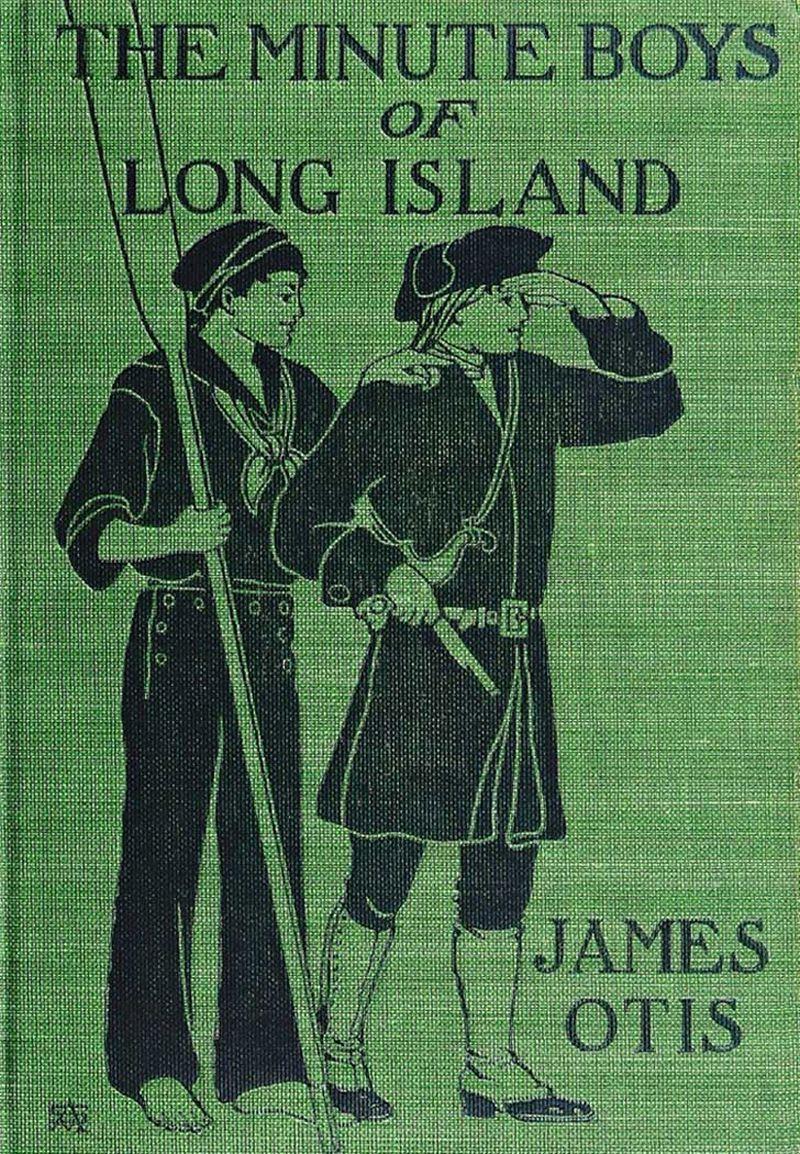
    This month's Distributed Proofreaders' Blog takes time out to talk about the Minute Boys juvenile series.

    blog.pgdp.net/2026/01/01/the-m

    Cover of the "The Minute Boys of Long Island" by James Otis. The cover shows two youths in colonel wear looking towards something to their left.

    Alt...Cover of the "The Minute Boys of Long Island" by James Otis. The cover shows two youths in colonel wear looking towards something to their left.

      [?]The Vulgar Tongue » 🤖 🌐
      @TheVulgarTongue@zirk.us

      To LAMB, or LAMBASTE. To beat. Lamb pye; a beating: from lambo.

      A selection from Francis Grose’s “Dictionary Of The Vulgar Tongue” (1785)

      --
      @histodons

      Image imitating a page from an old document, text (as in main toot):

To LAMB, or LAMBASTE. To beat. Lamb pye; a beating: from lambo.

A selection from Francis Grose’s “Dictionary Of The Vulgar Tongue” (1785)

      Alt...Image imitating a page from an old document, text (as in main toot): To LAMB, or LAMBASTE. To beat. Lamb pye; a beating: from lambo. A selection from Francis Grose’s “Dictionary Of The Vulgar Tongue” (1785)

        [?]The Vulgar Tongue » 🤖 🌐
        @TheVulgarTongue@zirk.us

        LAVENDER. Laid up in lavender; pawned.

        A selection from Francis Grose’s “Dictionary Of The Vulgar Tongue” (1785)

        --
        @histodons

        Image imitating a page from an old document, text (as in main toot):

LAVENDER. Laid up in lavender; pawned.

A selection from Francis Grose’s “Dictionary Of The Vulgar Tongue” (1785)

        Alt...Image imitating a page from an old document, text (as in main toot): LAVENDER. Laid up in lavender; pawned. A selection from Francis Grose’s “Dictionary Of The Vulgar Tongue” (1785)

          [?]The Vulgar Tongue » 🤖 🌐
          @TheVulgarTongue@zirk.us

          Hi!, I'm a bot posting selections from Francis Grose’s 1785 “Dictionary Of The Vulgar Tongue”, a compilation of slang terms, the coded language of the underclass and the demi-monde.

          [18th-century-content warning: possible racism, animal cruelty, homophobia, sexism, slut-shaming. Let me know of any problems.]

          Montage of dictionary items posted by this account

          Alt...Montage of dictionary items posted by this account

            [?]Philosophics » 🌐
            @microglyphics@mastodon.social

            Obligatory year-end post. I share my most and least favourite books of 2025.
            👉 philosophics.blog/2025/12/31/b
            I also congratulate myself on 1,000+ posts (overall) and 30,000+ views (2025).

            book covers

            Alt...book covers

              [?]Project Gutenberg » 🌐
              @gutenberg_org@mastodon.social

              Ash Wednesday by T.S. Eliot: A major long-form poem.

              Private Lives by Noël Coward: A famous and witty comedy play.

              The Bridge by Hart Crane: A famous modernist epic poem.

              domain
              4/

                [?]Project Gutenberg » 🌐
                @gutenberg_org@mastodon.social

                The Nancy Drew Series by Carolyn Keene.

                The Little Engine That Could by Watty Piper with illustrations by Lois Lenski.

                Swallows and Amazons by Arthur Ransome

                The Tale of Little Pig Robinson by Beatrix Potter.

                The Cat Who Went to Heaven by Elizabeth Coatsworth: It won the Newbery Medal for excellence in American children's literature in 1931.


                3/

                  [?]Project Gutenberg » 🌐
                  @gutenberg_org@mastodon.social

                  Cakes and Ale by W. Somerset Maugham: A popular social satire of the London literary world.

                  The Castle by Franz Kafka: The first English translation of this famous existentialist work.

                  Twenty Years at Hull-House by Jane Addams: The first American woman to be awarded the Nobel Peace Prize in 1931.


                  2/

                    [?]Project Gutenberg » 🌐
                    @gutenberg_org@mastodon.social

                    HAPPY PUBLIC DOMAIN DAY! And Happy New Year!

                    Books published in 1930 will enter the U.S. public domain, such as:

                    The Maltese Falcon by Dashiell Hammett: This novel introduced the world to the famous detective Sam Spade.
                    As I Lay Dying by William Faulkner: A masterpiece of American literature.
                    The Murder at the Vicarage by Agatha Christie: This was the first novel to feature the beloved character Miss Marple.


                    1/

                    An English logo of the 2025/26 Public Domain Day in Poland.

The centerpiece consists of four large numerals arranged horizontally, displaying "2025" with a unique transition effect. Each digit is rendered in white against solid black rectangular backgrounds:

The "2" appears in a standard, complete form
The "0" is also shown in complete form
The second "2" is again complete
The final digits show a split-flap or mechanical counter-style animation, with "6" visible on top and "5" on the bottom, divided by a horizontal line through the middle of the rectangle.

https://en.wikipedia.org/wiki/Public_Domain_Day#/media/File:Logo_PDD_2026.svg

                    Alt...An English logo of the 2025/26 Public Domain Day in Poland. The centerpiece consists of four large numerals arranged horizontally, displaying "2025" with a unique transition effect. Each digit is rendered in white against solid black rectangular backgrounds: The "2" appears in a standard, complete form The "0" is also shown in complete form The second "2" is again complete The final digits show a split-flap or mechanical counter-style animation, with "6" visible on top and "5" on the bottom, divided by a horizontal line through the middle of the rectangle. https://en.wikipedia.org/wiki/Public_Domain_Day#/media/File:Logo_PDD_2026.svg

                      [?]The Vulgar Tongue » 🤖 🌐
                      @TheVulgarTongue@zirk.us

                      DIRTY PUZZLE. A nasty slut.

                      A selection from Francis Grose’s “Dictionary Of The Vulgar Tongue” (1785)

                      --
                      @histodons

                      Image imitating a page from an old document, text (as in main toot):

DIRTY PUZZLE. A nasty slut.

A selection from Francis Grose’s “Dictionary Of The Vulgar Tongue” (1785)

                      Alt...Image imitating a page from an old document, text (as in main toot): DIRTY PUZZLE. A nasty slut. A selection from Francis Grose’s “Dictionary Of The Vulgar Tongue” (1785)

                        [?]Project Gutenberg » 🌐
                        @gutenberg_org@mastodon.social

                        Top 10 Most Read Pieces from 2025

                        via @publicdomainrev

                        It’s that time in December when we inevitably end up asking the question: what, exactly, captured people’s attention over the past year? The list below is one answer.

                        publicdomainreview.org/blog/20

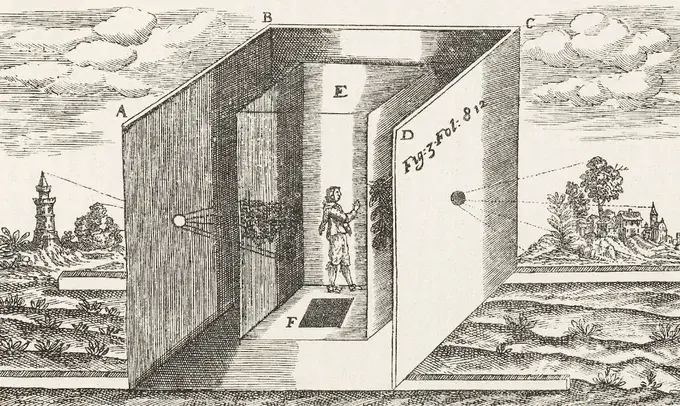
                        “Athanasius Kircher’s camera obscura”, illustration from Kirscher’s Ars magna lucis et umbrae (1671) reproduced in Josef Maria Eder’s Ausführliches Handbuch der Photographie (Detailed handbook of photography, 1905) —

The illustration shows a portable camera obscura constructed as a tent-like or box-like structure with labeled components (marked A through F). The device appears as a dark chamber with angled walls forming a peaked roof configuration. The structure has two main panels or walls meeting at angles, with openings and apparatus integrated into the design.

Key Components:

Point A: The left wall of the structure, shown with vertical line shading indicating the dark interior surface
Point B: The peak or top junction where the angled walls meet
Point C: The right wall section
Point D: What appears to be an opening or lens mounting area with descriptive text "Fig.3. 4 &c." indicating reference to other figures in the original work
Point E: A vertical column or mounting apparatus in the center
Point F: The floor or base platform where a figure stands

https://www.rijksmuseum.nl/en/collection/object/Fotoreproductie-van-een-prent-voorstellende-een-draagbare-camera-obscura--12b0cd8c581a73030dbcb772134f2df9

                        Alt...“Athanasius Kircher’s camera obscura”, illustration from Kirscher’s Ars magna lucis et umbrae (1671) reproduced in Josef Maria Eder’s Ausführliches Handbuch der Photographie (Detailed handbook of photography, 1905) — The illustration shows a portable camera obscura constructed as a tent-like or box-like structure with labeled components (marked A through F). The device appears as a dark chamber with angled walls forming a peaked roof configuration. The structure has two main panels or walls meeting at angles, with openings and apparatus integrated into the design. Key Components: Point A: The left wall of the structure, shown with vertical line shading indicating the dark interior surface Point B: The peak or top junction where the angled walls meet Point C: The right wall section Point D: What appears to be an opening or lens mounting area with descriptive text "Fig.3. 4 &c." indicating reference to other figures in the original work Point E: A vertical column or mounting apparatus in the center Point F: The floor or base platform where a figure stands https://www.rijksmuseum.nl/en/collection/object/Fotoreproductie-van-een-prent-voorstellende-een-draagbare-camera-obscura--12b0cd8c581a73030dbcb772134f2df9

                          [?]Philosophics » 🌐
                          @microglyphics@mastodon.social

                          I was chatting with ChatGPT and suggested that the Bible read like Ayn Rand. The response:

                          philosophics.blog/?utm_source=

                          That’s unkind to Ayn Rand. At least she knew she was writing fan fiction for her own temperament. If it’s literature, it’s literature in the same way a minutes-of-meeting document is prose.

                          Angels

                          Alt...Angels

                            [?]The Vulgar Tongue » 🤖 🌐
                            @TheVulgarTongue@zirk.us

                            TO NOSE. To bully.

                            A selection from Francis Grose’s “Dictionary Of The Vulgar Tongue” (1785)

                            --
                            @histodons

                            Image imitating a page from an old document, text (as in main toot):

TO NOSE. To bully.

A selection from Francis Grose’s “Dictionary Of The Vulgar Tongue” (1785)

                            Alt...Image imitating a page from an old document, text (as in main toot): TO NOSE. To bully. A selection from Francis Grose’s “Dictionary Of The Vulgar Tongue” (1785)

                              [?]Project Gutenberg » 🌐
                              @gutenberg_org@mastodon.social

                              What was your favorite book from PG's catalog in 2025?

                              gutenberg.org/

                                [?]The Vulgar Tongue » 🤖 🌐
                                @TheVulgarTongue@zirk.us

                                INKLE WEAVERS. Supposed to be a very brotherly set of people; 'as great as two inkle weavers' being a proverbial saying.

                                A selection from Francis Grose’s “Dictionary Of The Vulgar Tongue” (1785)

                                --
                                @histodons

                                Image imitating a page from an old document, text (as in main toot):

INKLE WEAVERS. Supposed to be a very brotherly set of people; 'as great as two inkle weavers' being a proverbial saying.

A selection from Francis Grose’s “Dictionary Of The Vulgar Tongue” (1785)

                                Alt...Image imitating a page from an old document, text (as in main toot): INKLE WEAVERS. Supposed to be a very brotherly set of people; 'as great as two inkle weavers' being a proverbial saying. A selection from Francis Grose’s “Dictionary Of The Vulgar Tongue” (1785)

                                  [?]Project Gutenberg » 🌐
                                  @gutenberg_org@mastodon.social

                                  Did Jane Austen Invent the Wellness Guy?

                                  "Chris Cohen on the Self-Optimization Obsessions of Austen’s Male Characters"

                                  lithub.com/did-jane-austen-inv

                                  Books by Austen at PG:

                                  gutenberg.org/ebooks/author/68

                                  "Persuasion, ch. 18. Admiral Croft is in earnest contemplation of some print, and doesn't see Anne Elliot." - picryl.com

                                  "Persuasion, ch. 18. Admiral Croft is in earnest contemplation of some print, and doesn't see Anne Elliot." - picryl.com

He is looking in a store window. Anne is standing next to him and looking at him.

                                  Alt..."Persuasion, ch. 18. Admiral Croft is in earnest contemplation of some print, and doesn't see Anne Elliot." - picryl.com He is looking in a store window. Anne is standing next to him and looking at him.

                                    [?]Project Gutenberg » 🌐
                                    @gutenberg_org@mastodon.social

                                    What was on summer reading lists 100 years ago, in 1925?

                                    In the summer of 1925, long before podcasts, audiobooks and even paperbacks, holiday reading meant hoping a hardback fit in your suitcase.

                                    By James Tugwell

                                    abc.net.au/news/2025-12-28/sum

                                    Ethel Florence Lindesay Richardson ('Henry Handel Richardson'), ca. 1935.

Elliott & Fry - State Library of NSW P1/1477

The photograph shows Richardson as a mature woman, turned slightly toward the camera in a three-quarter view. She gazes directly at the viewer with a calm expression.

Richardson has distinctive wavy hair styled in the fashion of the 1930s, with gentle finger waves framing her face. 

A luxurious dark fur coat or stole draped over her shoulders.

A light-colored blouse or dress with delicate lace or eyelet detailing along the neckline and front.

A pearl necklace that adds refinement to the ensemble

https://en.wikipedia.org/wiki/Henry_Handel_Richardson#/media/File:Henry_(ethel)_Richardson_SLNSW_FL3290825.jpg

                                    Alt...Ethel Florence Lindesay Richardson ('Henry Handel Richardson'), ca. 1935. Elliott & Fry - State Library of NSW P1/1477 The photograph shows Richardson as a mature woman, turned slightly toward the camera in a three-quarter view. She gazes directly at the viewer with a calm expression. Richardson has distinctive wavy hair styled in the fashion of the 1930s, with gentle finger waves framing her face. A luxurious dark fur coat or stole draped over her shoulders. A light-colored blouse or dress with delicate lace or eyelet detailing along the neckline and front. A pearl necklace that adds refinement to the ensemble https://en.wikipedia.org/wiki/Henry_Handel_Richardson#/media/File:Henry_(ethel)_Richardson_SLNSW_FL3290825.jpg

                                      [?]The Vulgar Tongue » 🤖 🌐
                                      @TheVulgarTongue@zirk.us

                                      MITE. A nick name for a cheesemonger: from the small insect of that name found in cheese.

                                      A selection from Francis Grose’s “Dictionary Of The Vulgar Tongue” (1785)

                                      --
                                      @histodons

                                      Image imitating a page from an old document, text (as in main toot):

MITE. A nick name for a cheesemonger: from the  small insect of that name found in cheese.

A selection from Francis Grose’s “Dictionary Of The Vulgar Tongue” (1785)

                                      Alt...Image imitating a page from an old document, text (as in main toot): MITE. A nick name for a cheesemonger: from the small insect of that name found in cheese. A selection from Francis Grose’s “Dictionary Of The Vulgar Tongue” (1785)

                                        [?]The Vulgar Tongue » 🤖 🌐
                                        @TheVulgarTongue@zirk.us

                                        SALT. Lecherous. A salt bitch: a bitch at heat, or proud bitch. Salt eel; a rope's end, used to correct boys, &c. at sea: you shall have a salt eel for supper.

                                        A selection from Francis Grose’s “Dictionary Of The Vulgar Tongue” (1785)

                                        --
                                        @histodons

                                        Image imitating a page from an old document, text (as in main toot):

SALT. Lecherous. A salt bitch: a bitch at heat, or proud bitch. Salt eel; a rope's end, used to correct boys, &c. at sea: you shall have a salt eel for supper.

A selection from Francis Grose’s “Dictionary Of The Vulgar Tongue” (1785)

                                        Alt...Image imitating a page from an old document, text (as in main toot): SALT. Lecherous. A salt bitch: a bitch at heat, or proud bitch. Salt eel; a rope's end, used to correct boys, &c. at sea: you shall have a salt eel for supper. A selection from Francis Grose’s “Dictionary Of The Vulgar Tongue” (1785)

                                          [?]The Vulgar Tongue » 🤖 🌐
                                          @TheVulgarTongue@zirk.us

                                          FIT. Suitable. It won't fit; It will not suit or do.

                                          A selection from Francis Grose’s “Dictionary Of The Vulgar Tongue” (1785)

                                          --
                                          @histodons

                                          Image imitating a page from an old document, text (as in main toot):

FIT. Suitable. It won't fit; It will not suit or do.

A selection from Francis Grose’s “Dictionary Of The Vulgar Tongue” (1785)

                                          Alt...Image imitating a page from an old document, text (as in main toot): FIT. Suitable. It won't fit; It will not suit or do. A selection from Francis Grose’s “Dictionary Of The Vulgar Tongue” (1785)

                                            [?]Project Gutenberg » 🌐
                                            @gutenberg_org@mastodon.social

                                            Banned in Texas

                                            Struggle over academic freedom in Texas state universities has a long history. Today it's often over race and gender; in the 1940s, it was over things like John Dos Passos's USA trilogy.

                                            By John Mark Ockerbloom

                                            everybodyslibraries.com/2025/1

                                            John Dos passos at PG:
                                            gutenberg.org/ebooks/author/20

                                            First complete edition (1937) of the U.S.A. trilogy is a series of three novels by American writer John Dos Passos.

The cover features a bold, modernist design with strong horizontal color blocking that evokes the American flag. The layout is striking and graphic, reflecting the ambitious scope of this major American literary work.

At the top, "U.S.A." appears in large, cream-colored sans-serif letters against a black background, with periods between each letter emphasizing the acronym nature of the title.

https://en.wikipedia.org/wiki/U.S.A._(trilogy)#/media/File:Dos_Passos_USA.jpg

                                            Alt...First complete edition (1937) of the U.S.A. trilogy is a series of three novels by American writer John Dos Passos. The cover features a bold, modernist design with strong horizontal color blocking that evokes the American flag. The layout is striking and graphic, reflecting the ambitious scope of this major American literary work. At the top, "U.S.A." appears in large, cream-colored sans-serif letters against a black background, with periods between each letter emphasizing the acronym nature of the title. https://en.wikipedia.org/wiki/U.S.A._(trilogy)#/media/File:Dos_Passos_USA.jpg

                                              [?]The Vulgar Tongue » 🤖 🌐
                                              @TheVulgarTongue@zirk.us

                                              JACOB. A ladder: perhaps from Jacob's dream. CANT. Also the common name for a jay, jays being usually taught to say, Poor Jacob! a cup of sack for Jacob.

                                              A selection from Francis Grose’s “Dictionary Of The Vulgar Tongue” (1785)

                                              --
                                              @histodons

                                              Image imitating a page from an old document, text (as in main toot):

JACOB. A ladder: perhaps from Jacob's dream. CANT. Also the common name for a jay, jays being usually taught to say, Poor Jacob! a cup of sack for Jacob.

A selection from Francis Grose’s “Dictionary Of The Vulgar Tongue” (1785)

                                              Alt...Image imitating a page from an old document, text (as in main toot): JACOB. A ladder: perhaps from Jacob's dream. CANT. Also the common name for a jay, jays being usually taught to say, Poor Jacob! a cup of sack for Jacob. A selection from Francis Grose’s “Dictionary Of The Vulgar Tongue” (1785)

                                                [?]The Vulgar Tongue » 🤖 🌐
                                                @TheVulgarTongue@zirk.us

                                                DEVIL'S BOOKS. Cards.

                                                A selection from Francis Grose’s “Dictionary Of The Vulgar Tongue” (1785)

                                                --
                                                @histodons

                                                Image imitating a page from an old document, text (as in main toot):

DEVIL'S BOOKS. Cards.

A selection from Francis Grose’s “Dictionary Of The Vulgar Tongue” (1785)

                                                Alt...Image imitating a page from an old document, text (as in main toot): DEVIL'S BOOKS. Cards. A selection from Francis Grose’s “Dictionary Of The Vulgar Tongue” (1785)

                                                  [?]The Vulgar Tongue » 🤖 🌐
                                                  @TheVulgarTongue@zirk.us

                                                  KICKERAPOO. Dead. NEGRO WORD.

                                                  A selection from Francis Grose’s “Dictionary Of The Vulgar Tongue” (1785)

                                                  --
                                                  @histodons

                                                  Image imitating a page from an old document, text (as in main toot):

KICKERAPOO. Dead. NEGRO WORD.

A selection from Francis Grose’s “Dictionary Of The Vulgar Tongue” (1785)

                                                  Alt...Image imitating a page from an old document, text (as in main toot): KICKERAPOO. Dead. NEGRO WORD. A selection from Francis Grose’s “Dictionary Of The Vulgar Tongue” (1785)

                                                    [?]Project Gutenberg » 🌐
                                                    @gutenberg_org@mastodon.social

                                                    [?]Project Gutenberg » 🌐
                                                    @gutenberg_org@mastodon.social

                                                    In the public domain soon, in libraries now

                                                    The Penn Libraries, where I work, has first editions of many of the works featured in my . From today through Public Domain Day, the Libraries social media will feature photos of some distinctive books from 1930.

                                                    By John Mark Ockerbloom

                                                    everybodyslibraries.com/2025/1

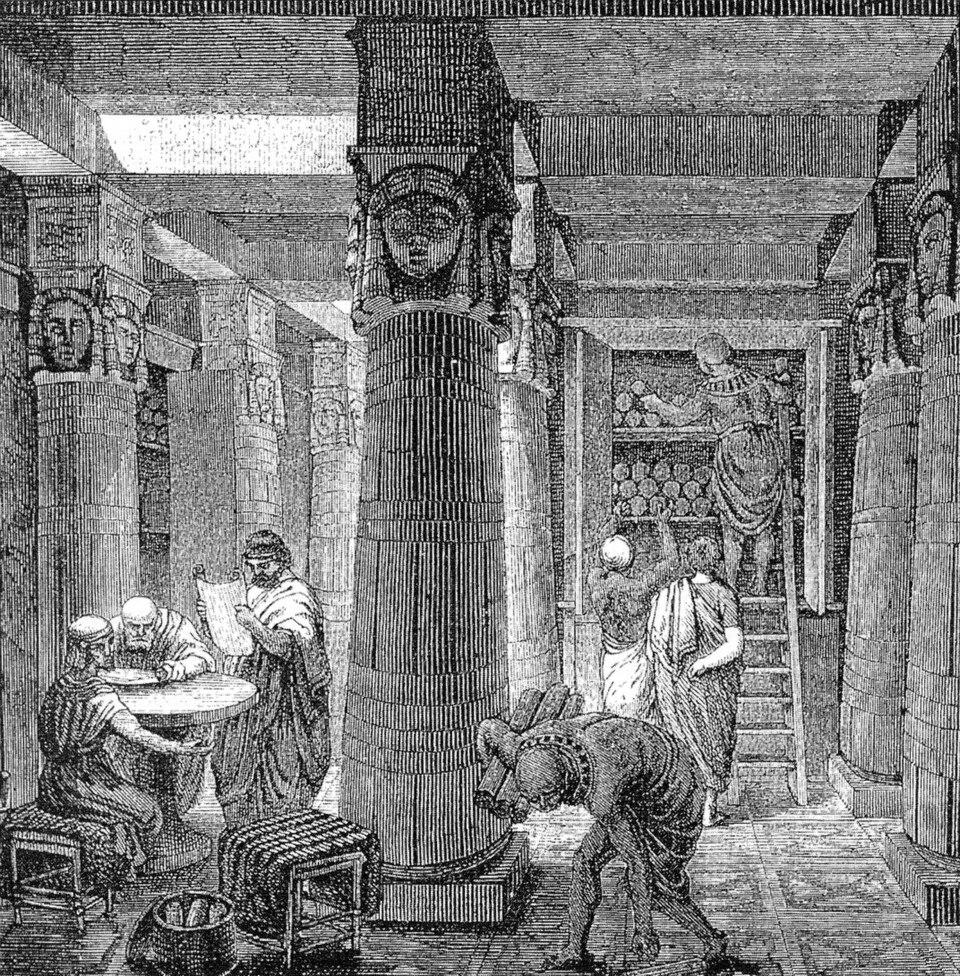
                                                    Artistic Rendering of the Library of Alexandria, based on some archaeological evidence.

The scene shows a grand interior space with impressive classical Egyptian-influenced architecture. A massive column dominates the center of the composition, featuring what appears to be a Hathor capital (a column top with the face of the goddess Hathor), characteristic of ancient Egyptian temple architecture. 

Several figures dressed in classical robes and togas are shown engaged in scholarly activities:

In the foreground left, two or three figures are seated around a table, appearing to read or discuss texts together;

In the center-right, a standing figure in robes appears to be studying or reading while standing near shelving;

Another figure is seated on steps or a platform in the middle distance;

A figure in the lower right foreground is bent over, possibly organizing or retrieving materials from lower storage

https://en.wikipedia.org/wiki/History_of_libraries#/media/File:Ancientlibraryalex.jpg

                                                    Alt...Artistic Rendering of the Library of Alexandria, based on some archaeological evidence. The scene shows a grand interior space with impressive classical Egyptian-influenced architecture. A massive column dominates the center of the composition, featuring what appears to be a Hathor capital (a column top with the face of the goddess Hathor), characteristic of ancient Egyptian temple architecture. Several figures dressed in classical robes and togas are shown engaged in scholarly activities: In the foreground left, two or three figures are seated around a table, appearing to read or discuss texts together; In the center-right, a standing figure in robes appears to be studying or reading while standing near shelving; Another figure is seated on steps or a platform in the middle distance; A figure in the lower right foreground is bent over, possibly organizing or retrieving materials from lower storage https://en.wikipedia.org/wiki/History_of_libraries#/media/File:Ancientlibraryalex.jpg

                                                      [?]The Vulgar Tongue » 🤖 🌐
                                                      @TheVulgarTongue@zirk.us

                                                      CAT IN PAN. To turn cat in pan, to change sides or parties; supposed originally to have been to turn CATE or CAKE in pan.

                                                      A selection from Francis Grose’s “Dictionary Of The Vulgar Tongue” (1785)

                                                      --
                                                      @histodons

                                                      Image imitating a page from an old document, text (as in main toot):

CAT IN PAN. To turn cat in pan, to change sides or parties; supposed originally to have been to turn CATE or CAKE in pan.

A selection from Francis Grose’s “Dictionary Of The Vulgar Tongue” (1785)

                                                      Alt...Image imitating a page from an old document, text (as in main toot): CAT IN PAN. To turn cat in pan, to change sides or parties; supposed originally to have been to turn CATE or CAKE in pan. A selection from Francis Grose’s “Dictionary Of The Vulgar Tongue” (1785)

                                                        [?]Project Gutenberg » 🌐
                                                        @gutenberg_org@mastodon.social

                                                        How Colette Was Inspired By Her Many Cats

                                                        Susannah Fullerton on the French Writer’s Feline Muses

                                                        lithub.com/how-colette-was-ins

                                                        Books by Colette at PG:

                                                        gutenberg.org/ebooks/author/20

                                                        Photograph of Colette

                                                        Alt...Photograph of Colette

                                                          [?]The Vulgar Tongue » 🤖 🌐
                                                          @TheVulgarTongue@zirk.us

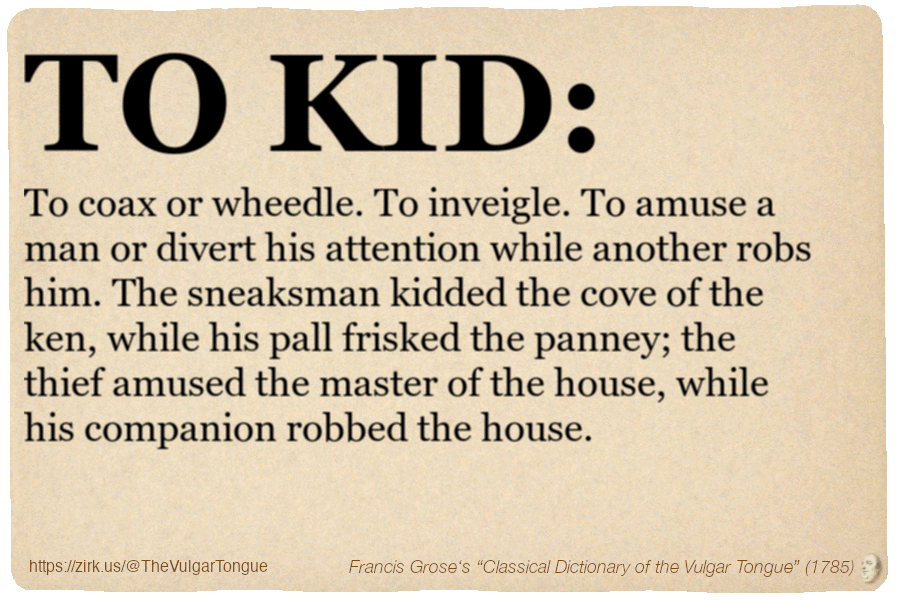
                                                          TO KID. To coax or wheedle. To inveigle. To amuse a man or divert his attention while another robs him. The sneaksman kidded the cove of the ken, while his pall frisked the panney; the thief amused the master of the house, while his companion robbed the house.

                                                          A selection from Francis Grose’s “Dictionary Of The Vulgar Tongue” (1785)

                                                          --
                                                          @histodons

                                                          Image imitating a page from an old document, text (as in main toot):

TO KID. To coax or wheedle. To inveigle. To amuse a man or divert his attention while another robs him. The sneaksman kidded the cove of the ken, while his pall frisked the panney; the thief amused the master of the house, while his companion robbed the house.

A selection from Francis Grose’s “Dictionary Of The Vulgar Tongue” (1785)

                                                          Alt...Image imitating a page from an old document, text (as in main toot): TO KID. To coax or wheedle. To inveigle. To amuse a man or divert his attention while another robs him. The sneaksman kidded the cove of the ken, while his pall frisked the panney; the thief amused the master of the house, while his companion robbed the house. A selection from Francis Grose’s “Dictionary Of The Vulgar Tongue” (1785)

                                                            [?]Project Gutenberg » 🌐
                                                            @gutenberg_org@mastodon.social

                                                            Victorian Illustrated Shakespeare Archive

                                                            The Victorian Illustrated Shakespeare Archive contains over 3000 illustrations from significant editions of Shakespeare's plays in the Victorian period.

                                                            by Michael John Goodman (thanks @Ross)

                                                            shakespeareillustration.org/

                                                            youtube.com/watch?v=AxpUqnmfcC

                                                              [?]Project Gutenberg » 🌐
                                                              @gutenberg_org@mastodon.social

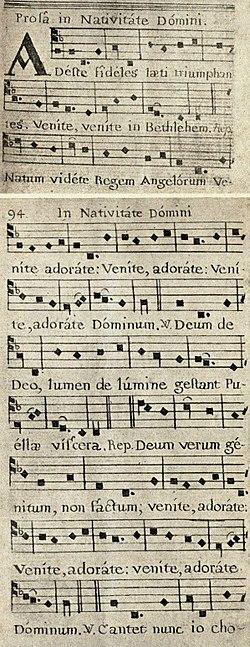
                                                              O come, let all 4,850 of us adore him

                                                              In 1925 the Associated Glee Clubs of America put on a concert like no other. 15 choral groups, with over 850 singers in all, came together in New York's Metropolitan Opera House to sing a program broadcast on radio across America.

                                                              By John Mark Ockerbloom

                                                              everybodyslibraries.com/2025/1

                                                              About Adeste Fideles:
                                                              en.wikipedia.org/wiki/O_Come,_

                                                              The earliest surviving manuscript of Adeste fideles, without attribution, attributed to John Francis Wade, dated to the 1740s.

It depicts a page from an aged music manuscript, displaying hand-copied musical notation on a staff system. The paper has a cream or beige tone characteristic of 18th-century documents, with some visible aging and wear.

The manuscript uses square notation on a four-line staff system, typical of plainchant and early sacred music notation. Black square and diamond-shaped notes are positioned on the lines and spaces, with various time values indicated by the note shapes. The music is written in what appears to be sections or verses, with multiple staves running down the page.

https://en.wikipedia.org/wiki/O_Come,_All_Ye_Faithful#/media/File:Adeste,_fideles_(earliest_version).jpg

                                                              Alt...The earliest surviving manuscript of Adeste fideles, without attribution, attributed to John Francis Wade, dated to the 1740s. It depicts a page from an aged music manuscript, displaying hand-copied musical notation on a staff system. The paper has a cream or beige tone characteristic of 18th-century documents, with some visible aging and wear. The manuscript uses square notation on a four-line staff system, typical of plainchant and early sacred music notation. Black square and diamond-shaped notes are positioned on the lines and spaces, with various time values indicated by the note shapes. The music is written in what appears to be sections or verses, with multiple staves running down the page. https://en.wikipedia.org/wiki/O_Come,_All_Ye_Faithful#/media/File:Adeste,_fideles_(earliest_version).jpg

                                                                [?]The Vulgar Tongue » 🤖 🌐
                                                                @TheVulgarTongue@zirk.us

                                                                CRAB SHELLS. Shoes. IRISH.

                                                                A selection from Francis Grose’s “Dictionary Of The Vulgar Tongue” (1785)

                                                                --
                                                                @histodons

                                                                Image imitating a page from an old document, text (as in main toot):

CRAB SHELLS. Shoes. IRISH.

A selection from Francis Grose’s “Dictionary Of The Vulgar Tongue” (1785)

                                                                Alt...Image imitating a page from an old document, text (as in main toot): CRAB SHELLS. Shoes. IRISH. A selection from Francis Grose’s “Dictionary Of The Vulgar Tongue” (1785)

                                                                  [?]The Vulgar Tongue » 🤖 🌐
                                                                  @TheVulgarTongue@zirk.us

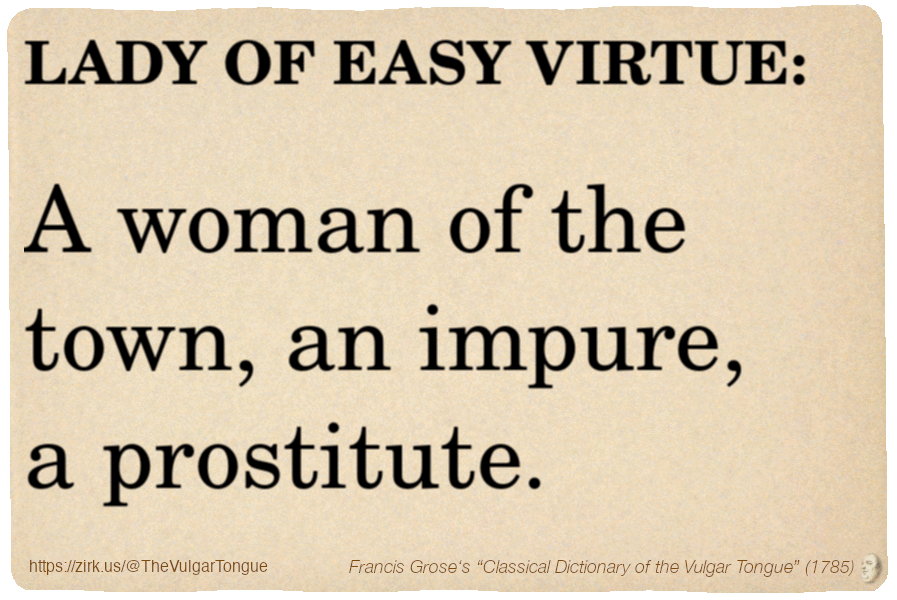
                                                                  LADY OF EASY VIRTUE. A woman of the town, an impure, a prostitute.

                                                                  A selection from Francis Grose’s “Dictionary Of The Vulgar Tongue” (1785)

                                                                  --
                                                                  @histodons

                                                                  Image imitating a page from an old document, text (as in main toot):

LADY OF EASY VIRTUE. A woman of the town, an impure, a prostitute.

A selection from Francis Grose’s “Dictionary Of The Vulgar Tongue” (1785)

                                                                  Alt...Image imitating a page from an old document, text (as in main toot): LADY OF EASY VIRTUE. A woman of the town, an impure, a prostitute. A selection from Francis Grose’s “Dictionary Of The Vulgar Tongue” (1785)

                                                                    [?]Project Gutenberg » 🌐
                                                                    @gutenberg_org@mastodon.social

                                                                    Yeats and the Occult Imagination

                                                                    Beneath his poems lay a lifelong devotion to magic, divination, and a visionary system that shaped his most prophetic work.

                                                                    By: Gus Mitchell

                                                                    daily.jstor.org/yeats-and-the-

                                                                    Yeats at PG:
                                                                    gutenberg.org/ebooks/author/17

                                                                    William B Yeats.

The photograph shows Yeats as a young man, likely in his twenties or early thirties, photographed from the chest up in a formal studio portrait style. He faces the camera directly with a serious, contemplative expression.

Yeats has distinctive features including dark, wavy hair swept back from his forehead. He wears small, round wire-rimmed spectacles (pince-nez style, which appear to be clipped to his nose with a cord or chain visible). His face is clean-shaven, revealing refined, angular features with a strong jawline and thoughtful expression.

https://upload.wikimedia.org/wikipedia/commons/2/24/WB_Yeats_nd.jpg

                                                                    Alt...William B Yeats. The photograph shows Yeats as a young man, likely in his twenties or early thirties, photographed from the chest up in a formal studio portrait style. He faces the camera directly with a serious, contemplative expression. Yeats has distinctive features including dark, wavy hair swept back from his forehead. He wears small, round wire-rimmed spectacles (pince-nez style, which appear to be clipped to his nose with a cord or chain visible). His face is clean-shaven, revealing refined, angular features with a strong jawline and thoughtful expression. https://upload.wikimedia.org/wikipedia/commons/2/24/WB_Yeats_nd.jpg

                                                                      [?]Project Gutenberg » 🌐
                                                                      @gutenberg_org@mastodon.social

                                                                      The debut of a dramatic duo

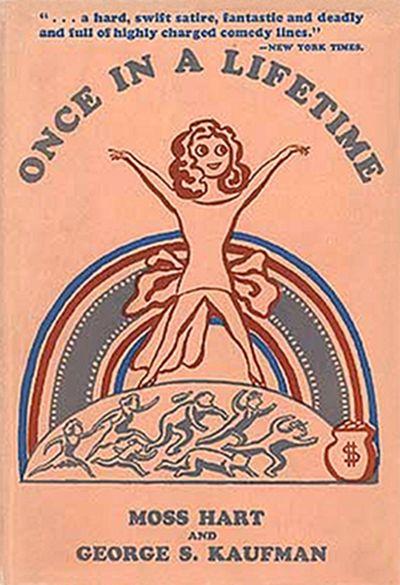
                                                                      Moss Hart wrote the first draft of Once in a Lifetime, a comedy about Hollywood's transition to "talkies", as a 25-year-old unknown.

                                                                      By John Mark Ockerbloom

                                                                      everybodyslibraries.com/2025/1

                                                                      More information about it:
                                                                      en.wikipedia.org/wiki/Once_in_

                                                                      Front cover of the dustjacket of the first edition of Once in a Lifetime (1930).

The artwork shows a simplified, almost abstract human figure at the top with arms raised upward in a celebratory or theatrical gesture. The figure has a circular head with a simplified face. Below this figure is a series of concentric semi-circular arcs in blue, cream, and gray tones that suggest either a rainbow, theater curtains, or radiating energy. At the bottom of these arcs are simplified cloud or wave-like shapes, creating a layered, tiered effect.

At the top of the cover, there's a quote from the New York Times praising the work as "a hard, swift satire, fantastic and deadly and full of highly charged comedy lines."

https://en.wikipedia.org/wiki/Once_in_a_Lifetime_(play)#/media/File:Once-in-a-lifetime.jpg

                                                                      Alt...Front cover of the dustjacket of the first edition of Once in a Lifetime (1930). The artwork shows a simplified, almost abstract human figure at the top with arms raised upward in a celebratory or theatrical gesture. The figure has a circular head with a simplified face. Below this figure is a series of concentric semi-circular arcs in blue, cream, and gray tones that suggest either a rainbow, theater curtains, or radiating energy. At the bottom of these arcs are simplified cloud or wave-like shapes, creating a layered, tiered effect. At the top of the cover, there's a quote from the New York Times praising the work as "a hard, swift satire, fantastic and deadly and full of highly charged comedy lines." https://en.wikipedia.org/wiki/Once_in_a_Lifetime_(play)#/media/File:Once-in-a-lifetime.jpg

                                                                        [?]Project Gutenberg » 🌐
                                                                        @gutenberg_org@mastodon.social

                                                                        Making Sense of Middle Earth: Exploring the World of J.R.R. Tol­kien

                                                                        Michael D.C. Drout Remembers the Impact of The Lord of the Rings and The Hobbit on His Childhood

                                                                        lithub.com/making-sense-of-mid

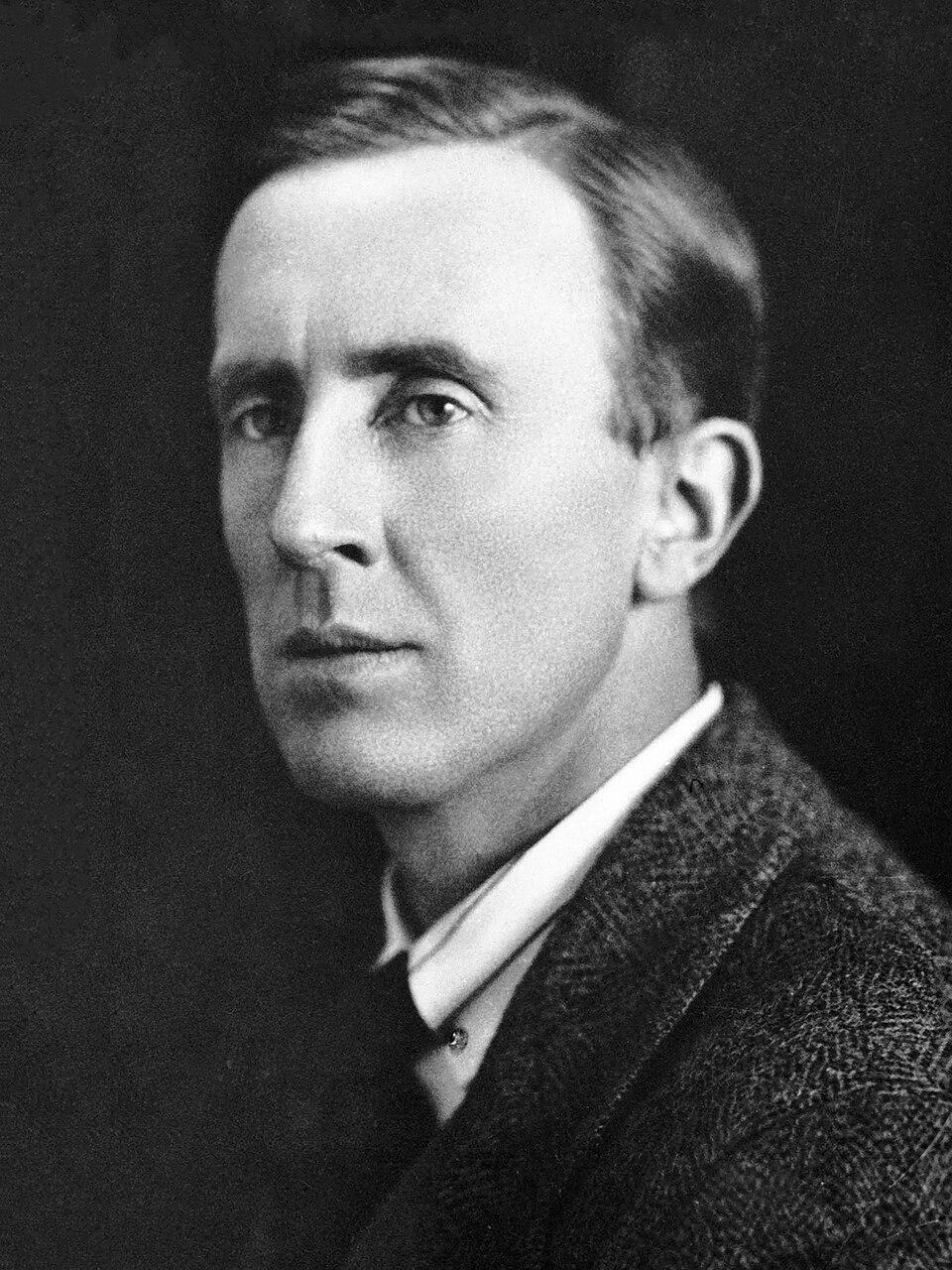
                                                                        Photograph of J. R. R. Tolkien in the 1920s on leaving Leeds University.

Tolkien is photographed from the chest up in a three-quarter view, with his body angled slightly to the left while his face turns toward the camera. 

He appears clean-shaven with a strong jawline and refined features. His hair is dark and neatly combed, parted on the side.

Tolkien wears formal professional clothing befitting an academic of the era: a dark tweed or wool jacket with a visible texture, a crisp white dress shirt with a high starched collar, and what appears to be a dark tie or cravat. 

https://en.wikipedia.org/wiki/J._R._R._Tolkien#/media/File:J._R._R._Tolkien,_ca._1925.jpg

                                                                        Alt...Photograph of J. R. R. Tolkien in the 1920s on leaving Leeds University. Tolkien is photographed from the chest up in a three-quarter view, with his body angled slightly to the left while his face turns toward the camera. He appears clean-shaven with a strong jawline and refined features. His hair is dark and neatly combed, parted on the side. Tolkien wears formal professional clothing befitting an academic of the era: a dark tweed or wool jacket with a visible texture, a crisp white dress shirt with a high starched collar, and what appears to be a dark tie or cravat. https://en.wikipedia.org/wiki/J._R._R._Tolkien#/media/File:J._R._R._Tolkien,_ca._1925.jpg

                                                                          [?]The Vulgar Tongue » 🤖 🌐
                                                                          @TheVulgarTongue@zirk.us

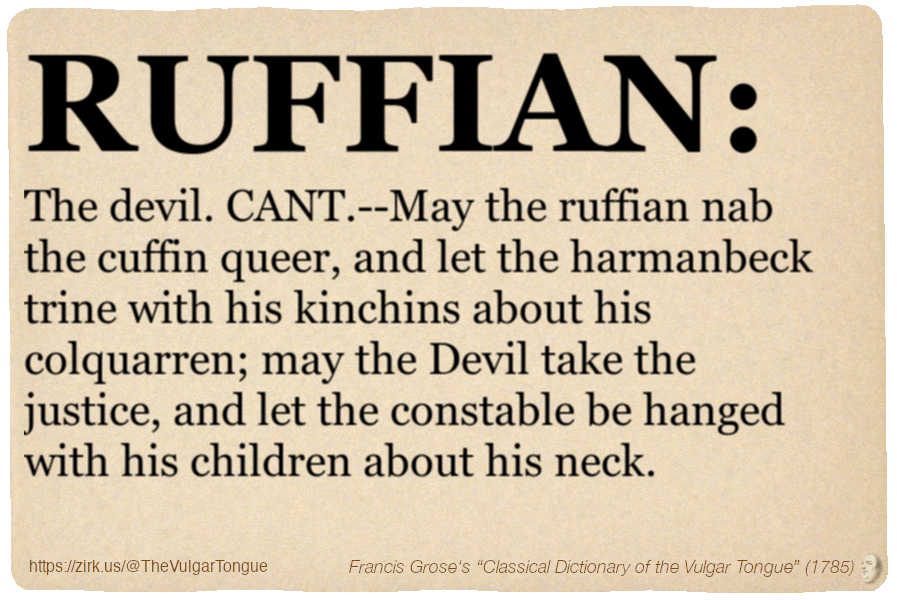
                                                                          RUFFIAN. The devil. CANT.--May the ruffian nab the cuffin queer, and let the harmanbeck trine with his kinchins about his colquarren; may the Devil take the justice, and let the constable be hanged with his children about his neck.

                                                                          A selection from Francis Grose’s “Dictionary Of The Vulgar Tongue” (1785)

                                                                          --
                                                                          @histodons

                                                                          Image imitating a page from an old document, text (as in main toot):

RUFFIAN. The devil. CANT.--May the ruffian nab the cuffin queer, and let the harmanbeck trine with his kinchins about his colquarren; may the Devil take the justice, and let the constable be hanged with his children about his neck. 

A selection from Francis Grose’s “Dictionary Of The Vulgar Tongue” (1785)

                                                                          Alt...Image imitating a page from an old document, text (as in main toot): RUFFIAN. The devil. CANT.--May the ruffian nab the cuffin queer, and let the harmanbeck trine with his kinchins about his colquarren; may the Devil take the justice, and let the constable be hanged with his children about his neck. A selection from Francis Grose’s “Dictionary Of The Vulgar Tongue” (1785)

                                                                            [?]The Vulgar Tongue » 🤖 🌐
                                                                            @TheVulgarTongue@zirk.us

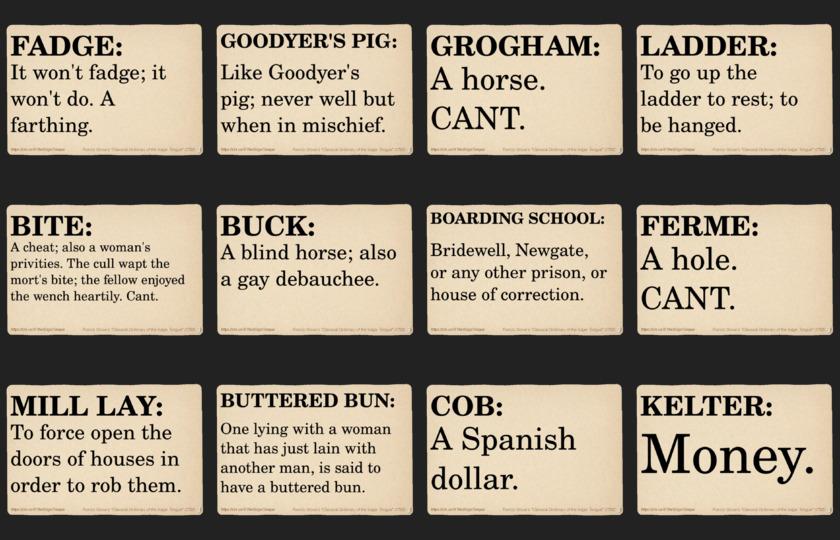
                                                                            Hi!, I'm a bot posting selections from Francis Grose’s 1785 “Dictionary Of The Vulgar Tongue”, a compilation of slang terms, the coded language of the underclass and the demi-monde.

                                                                            [18th-century-content warning: possible racism, animal cruelty, homophobia, sexism, slut-shaming. Let me know of any problems.]

                                                                            Montage of dictionary items posted by this account

                                                                            Alt...Montage of dictionary items posted by this account

                                                                              [?]The Vulgar Tongue » 🤖 🌐
                                                                              @TheVulgarTongue@zirk.us

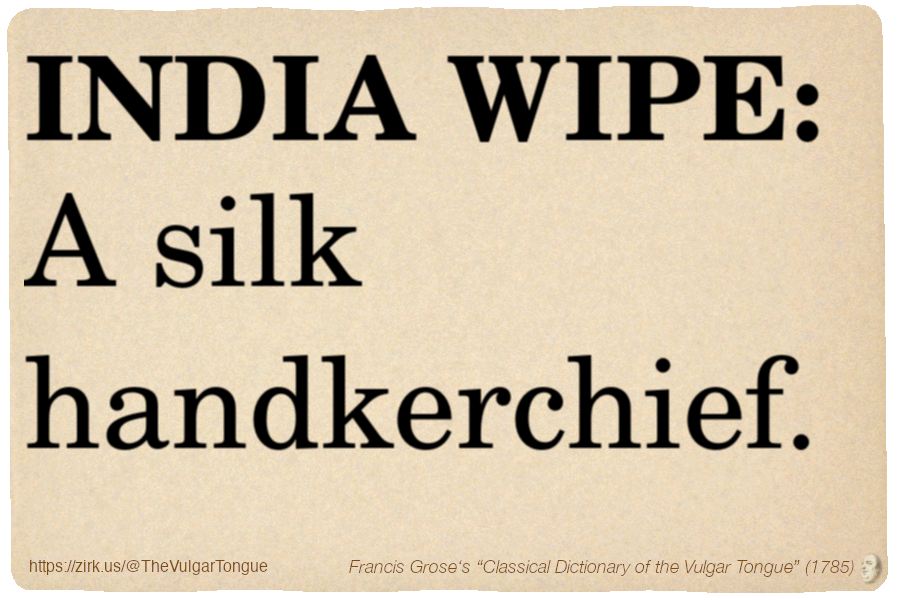
                                                                              INDIA WIPE. A silk handkerchief.

                                                                              A selection from Francis Grose’s “Dictionary Of The Vulgar Tongue” (1785)

                                                                              --
                                                                              @histodons

                                                                              Image imitating a page from an old document, text (as in main toot):

INDIA WIPE. A silk handkerchief.

A selection from Francis Grose’s “Dictionary Of The Vulgar Tongue” (1785)

                                                                              Alt...Image imitating a page from an old document, text (as in main toot): INDIA WIPE. A silk handkerchief. A selection from Francis Grose’s “Dictionary Of The Vulgar Tongue” (1785)

                                                                                [?]Project Gutenberg » 🌐
                                                                                @gutenberg_org@mastodon.social

                                                                                A Forgotten Louisa May Alcott Story Showcases the Author’s Twist on Charles Dickens’ ‘A Christmas Carol’

                                                                                "Written in 1882, “A Christmas Dream, and How It Came True,” covered many of the same themes as Dickens’ classic, albeit with a different audience in mind"

                                                                                smithsonianmag.com/history/a-f

                                                                                This story is in "Lulu's LIbrary, Volume I" at PG:

                                                                                gutenberg.org/ebooks/40682

                                                                                Photograph of Louisa May Alcott.

                                                                                Alt...Photograph of Louisa May Alcott.

                                                                                  [?]Project Gutenberg » 🌐
                                                                                  @gutenberg_org@mastodon.social

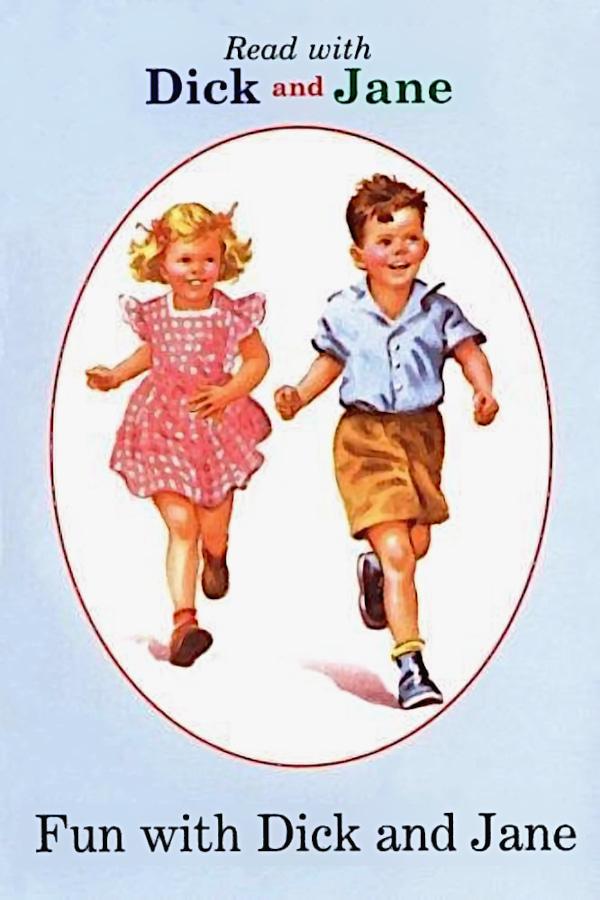
                                                                                  See Dick and Jane free

                                                                                  Given how much "Dick and Jane" have been used sardonically, one might think Zerna Sharp's schoolbook characters were already public domain.

                                                                                  By John Mark Ockerbloom

                                                                                  everybodyslibraries.com/2025/1

                                                                                  More information about Dick and Jane:
                                                                                  en.wikipedia.org/wiki/Dick_and

                                                                                  Cover of the book Fun With Dick and Jane by Zerna Sharp.

The cover shows two young children, a boy and a girl, running hand in hand toward the viewer. They’re smiling and appear energetic and cheerful.

The girl wears a short-sleeved pink dress with a patterned texture and matching shoes. Her hair is short and light-colored, styled neatly.

The boy wears a light blue short-sleeved shirt, tan shorts, white socks, and dark shoes. His hair is neatly combed, and he looks confident and happy as he runs.

They are framed inside a white oval set against a light blue background,

https://en.wikipedia.org/wiki/Dick_and_Jane#/media/File:Dick_and_Jane.jpg

                                                                                  Alt...Cover of the book Fun With Dick and Jane by Zerna Sharp. The cover shows two young children, a boy and a girl, running hand in hand toward the viewer. They’re smiling and appear energetic and cheerful. The girl wears a short-sleeved pink dress with a patterned texture and matching shoes. Her hair is short and light-colored, styled neatly. The boy wears a light blue short-sleeved shirt, tan shorts, white socks, and dark shoes. His hair is neatly combed, and he looks confident and happy as he runs. They are framed inside a white oval set against a light blue background, https://en.wikipedia.org/wiki/Dick_and_Jane#/media/File:Dick_and_Jane.jpg

                                                                                    [?]Project Gutenberg » 🌐
                                                                                    @gutenberg_org@mastodon.social

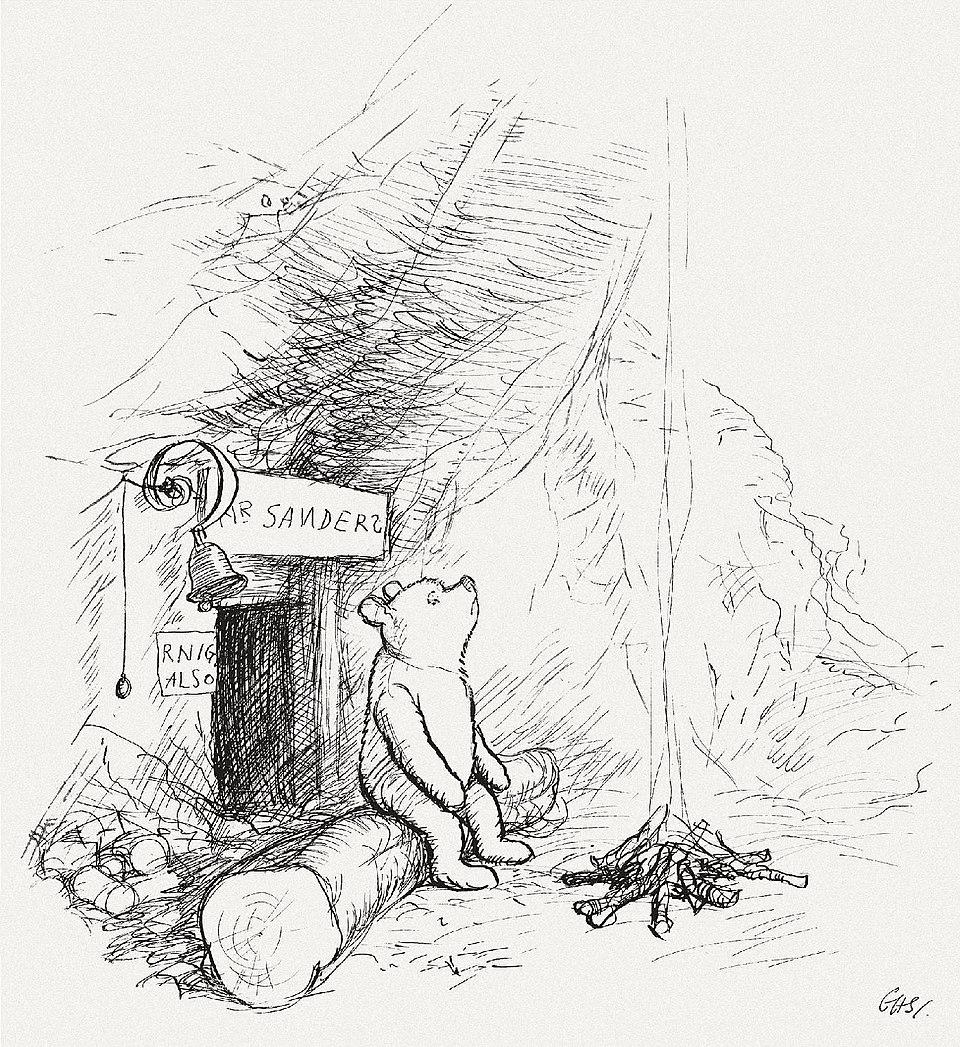
                                                                                    "Here is Edward Bear, coming downstairs now, bump, bump, bump, on the back of his head, behind Christopher Robin."
                                                                                    Opening lines.

                                                                                    in 1925.

                                                                                    Winnie-the-Pooh first appeared by name in a children's story in the London Evening News for Christmas Eve.

                                                                                    en.wikipedia.org/wiki/Winnie-t

                                                                                    Winnie-the-Pooh at PG:
                                                                                    gutenberg.org/ebooks/67098

                                                                                    Illustration to page 3 of Winnie-the-Pooh (1926) by artist E. H. Shepard.

The scene shows Winnie-the-Pooh sitting on a log at the base of a large tree. He’s leaning back slightly, head tilted upward, with a thoughtful, mildly puzzled expression. 

To Pooh’s left is a wooden signpost attached to the tree, with a bell on a cord hanging from it. The sign bears the name “MR SANDERS”, hinting at Pooh’s misunderstanding that this must be the name of whoever lives there. Below it, another small sign is partially visible. At the base of the tree are a few round objects, reinforcing the cozy, woodland setting.

https://en.wikipedia.org/wiki/Winnie-the-Pooh#/media/File:Pooh_Shepard1928.jpg

                                                                                    Alt...Illustration to page 3 of Winnie-the-Pooh (1926) by artist E. H. Shepard. The scene shows Winnie-the-Pooh sitting on a log at the base of a large tree. He’s leaning back slightly, head tilted upward, with a thoughtful, mildly puzzled expression. To Pooh’s left is a wooden signpost attached to the tree, with a bell on a cord hanging from it. The sign bears the name “MR SANDERS”, hinting at Pooh’s misunderstanding that this must be the name of whoever lives there. Below it, another small sign is partially visible. At the base of the tree are a few round objects, reinforcing the cozy, woodland setting. https://en.wikipedia.org/wiki/Winnie-the-Pooh#/media/File:Pooh_Shepard1928.jpg

                                                                                      [?]The Vulgar Tongue » 🤖 🌐
                                                                                      @TheVulgarTongue@zirk.us

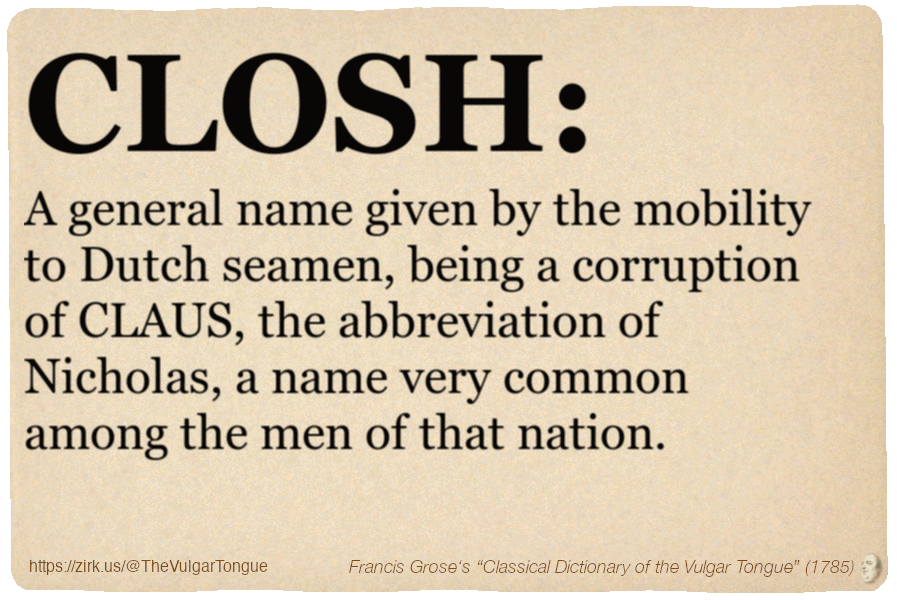
                                                                                      CLOSH. A general name given by the mobility to Dutch seamen, being a corruption of CLAUS, the abbreviation of Nicholas, a name very common among the men of that nation.

                                                                                      A selection from Francis Grose’s “Dictionary Of The Vulgar Tongue” (1785)

                                                                                      --
                                                                                      @histodons

                                                                                      Image imitating a page from an old document, text (as in main toot):

CLOSH. A general name given by the mobility to Dutch seamen, being a corruption of CLAUS, the abbreviation of Nicholas, a name very common among the men of that nation.

A selection from Francis Grose’s “Dictionary Of The Vulgar Tongue” (1785)

                                                                                      Alt...Image imitating a page from an old document, text (as in main toot): CLOSH. A general name given by the mobility to Dutch seamen, being a corruption of CLAUS, the abbreviation of Nicholas, a name very common among the men of that nation. A selection from Francis Grose’s “Dictionary Of The Vulgar Tongue” (1785)

                                                                                        [?]The Vulgar Tongue » 🤖 🌐
                                                                                        @TheVulgarTongue@zirk.us

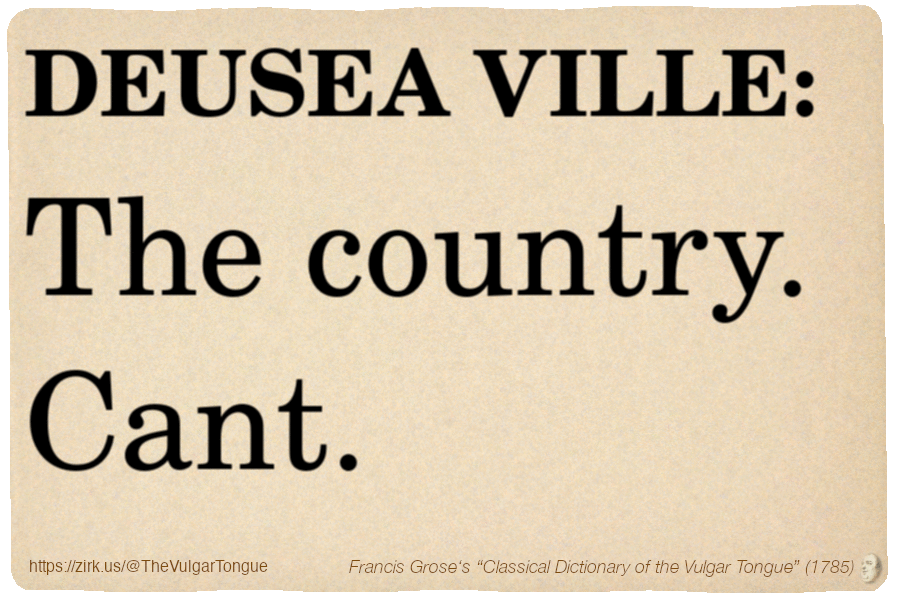
                                                                                        DEUSEA VILLE. The country. Cant.

                                                                                        A selection from Francis Grose’s “Dictionary Of The Vulgar Tongue” (1785)

                                                                                        --
                                                                                        @histodons

                                                                                        Image imitating a page from an old document, text (as in main toot):

DEUSEA VILLE. The country. Cant.

A selection from Francis Grose’s “Dictionary Of The Vulgar Tongue” (1785)

                                                                                        Alt...Image imitating a page from an old document, text (as in main toot): DEUSEA VILLE. The country. Cant. A selection from Francis Grose’s “Dictionary Of The Vulgar Tongue” (1785)

                                                                                          [?]Project Gutenberg » 🌐
                                                                                          @gutenberg_org@mastodon.social

                                                                                          The German version of The Nutcracker by E.T.A. Hoffmann (from our partner PG-DE) is available here:

                                                                                          projekt-gutenberg.org/etahoff/

                                                                                            [?]Project Gutenberg » 🌐
                                                                                            @gutenberg_org@mastodon.social

                                                                                            @magnus The German version (from our partner PG-DE) is available here;

                                                                                            projekt-gutenberg.org/etahoff/

                                                                                              [?]Project Gutenberg » 🌐
                                                                                              @gutenberg_org@mastodon.social

                                                                                              Making Sense of The Nutcracker’s Libretto

                                                                                              Early audiences loved it, even as critics questioned its structure. Returning to the story helps illuminate what makes the ballet so strangely captivating.

                                                                                              By: Angelica Frey

                                                                                              daily.jstor.org/making-sense-o

                                                                                              Ballet at PG:
                                                                                              gutenberg.org/ebooks/subject/2

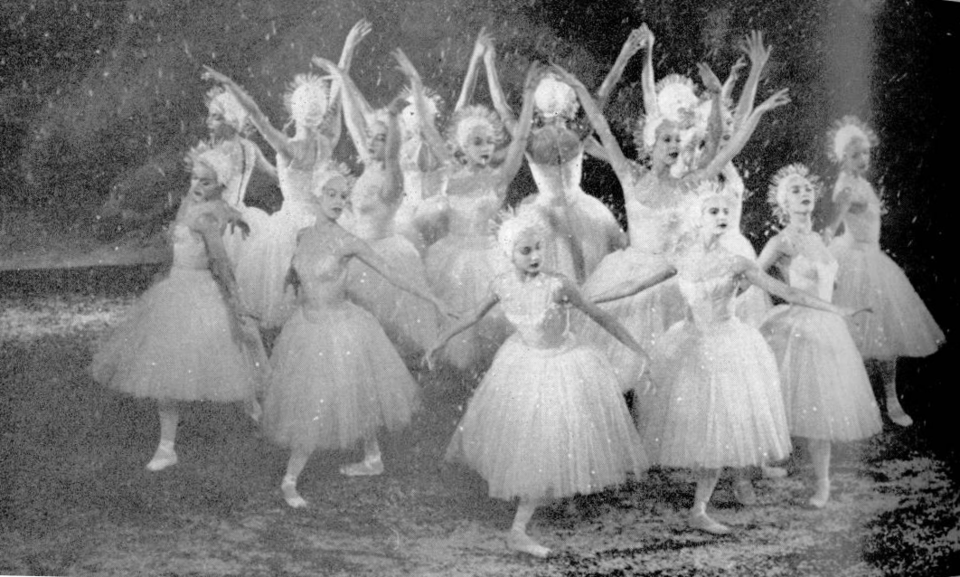
                                                                                              Snowflake Waltz in the White Forest (The Nutcracker Act I, Scene III) performed by The New York City Ballet in 1954.

Dance Magazine April 1954 issue page 20 by Fred Fehl

A historic 1954 photograph by Fred Fehl showing the New York City Ballet performing the iconic "Snowflake Waltz" from The Nutcracker Act I, Scene III. The ethereal black and white image captures the corps de ballet dancers in romantic white tutus with their arms raised gracefully, evoking falling snowflakes in the enchanted White Forest scene. Published in Dance Magazine, April 1954.

https://commons.wikimedia.org/wiki/File:Snowflake_Waltz_NYC_Ballet_1954.png

                                                                                              Alt...Snowflake Waltz in the White Forest (The Nutcracker Act I, Scene III) performed by The New York City Ballet in 1954. Dance Magazine April 1954 issue page 20 by Fred Fehl A historic 1954 photograph by Fred Fehl showing the New York City Ballet performing the iconic "Snowflake Waltz" from The Nutcracker Act I, Scene III. The ethereal black and white image captures the corps de ballet dancers in romantic white tutus with their arms raised gracefully, evoking falling snowflakes in the enchanted White Forest scene. Published in Dance Magazine, April 1954. https://commons.wikimedia.org/wiki/File:Snowflake_Waltz_NYC_Ballet_1954.png

                                                                                                [?]The Vulgar Tongue » 🤖 🌐
                                                                                                @TheVulgarTongue@zirk.us

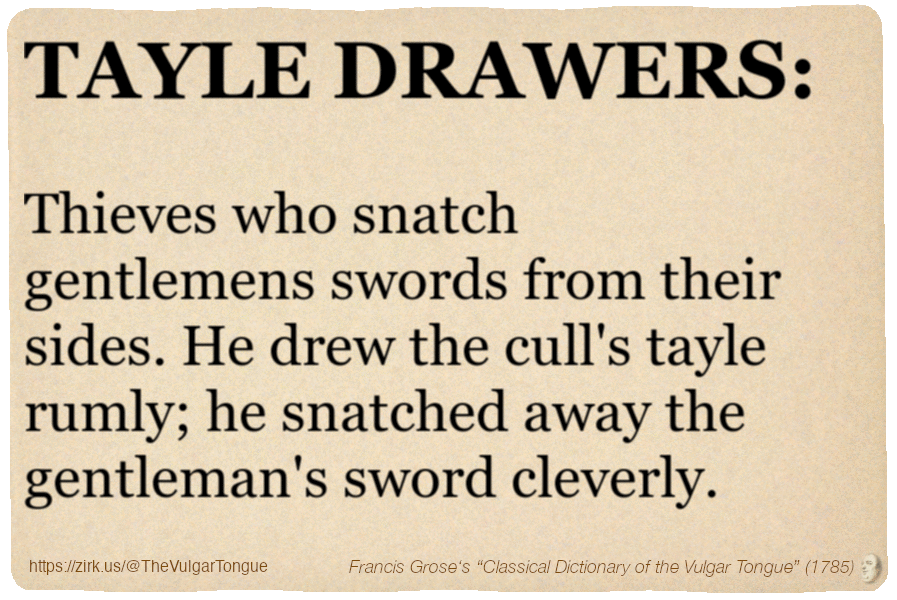
                                                                                                TAYLE DRAWERS. Thieves who snatch gentlemens swords from their sides. He drew the cull's tayle rumly; he snatched away the gentleman's sword cleverly.

                                                                                                A selection from Francis Grose’s “Dictionary Of The Vulgar Tongue” (1785)

                                                                                                --
                                                                                                @histodons

                                                                                                Image imitating a page from an old document, text (as in main toot):

TAYLE DRAWERS. Thieves who snatch gentlemens swords from their sides. He drew the cull's tayle rumly; he snatched away the gentleman's sword cleverly.

A selection from Francis Grose’s “Dictionary Of The Vulgar Tongue” (1785)

                                                                                                Alt...Image imitating a page from an old document, text (as in main toot): TAYLE DRAWERS. Thieves who snatch gentlemens swords from their sides. He drew the cull's tayle rumly; he snatched away the gentleman's sword cleverly. A selection from Francis Grose’s “Dictionary Of The Vulgar Tongue” (1785)

                                                                                                  [?]The Vulgar Tongue » 🤖 🌐
                                                                                                  @TheVulgarTongue@zirk.us

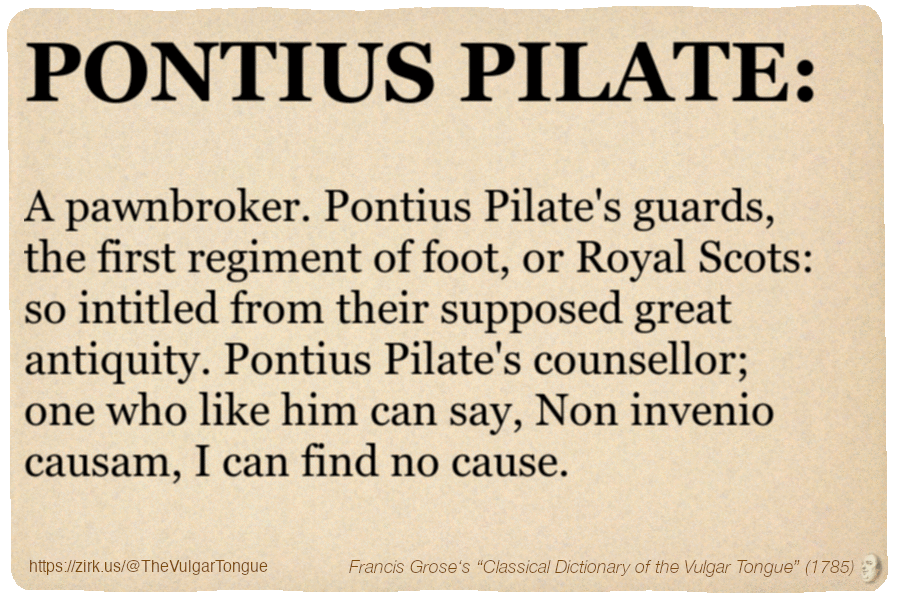
                                                                                                  PONTIUS PILATE. A pawnbroker. Pontius Pilate's guards, the first regiment of foot, or Royal Scots: so intitled from their supposed great antiquity. Pontius Pilate's counsellor; one who like him can say, Non invenio causam, I can find no cause.

                                                                                                  A selection from Francis Grose’s “Dictionary Of The Vulgar Tongue” (1785)

                                                                                                  --
                                                                                                  @histodons

                                                                                                  Image imitating a page from an old document, text (as in main toot):

PONTIUS PILATE. A pawnbroker. Pontius Pilate's guards, the first regiment of foot, or Royal Scots: so intitled from their supposed great antiquity. Pontius Pilate's counsellor; one who like him can say, Non invenio causam, I can find no cause.

A selection from Francis Grose’s “Dictionary Of The Vulgar Tongue” (1785)

                                                                                                  Alt...Image imitating a page from an old document, text (as in main toot): PONTIUS PILATE. A pawnbroker. Pontius Pilate's guards, the first regiment of foot, or Royal Scots: so intitled from their supposed great antiquity. Pontius Pilate's counsellor; one who like him can say, Non invenio causam, I can find no cause. A selection from Francis Grose’s “Dictionary Of The Vulgar Tongue” (1785)

                                                                                                    Back to top - More...