Search results for tag #nasa
![[?]](https://files.defcon.social/dcsocial-s3/accounts/avatars/113/208/344/507/078/943/original/014820ad22daee1c.jpg)
TOPIC> Star Clusters
2025 July 19
Messier 6
* Image Credit & Copyright: Xinran Li
https://app.astrobin.com/u/Flying_Dutchman#gallery
Explanation:
The sixth object in Charles Messier's famous catalog of things which are not comets, Messier 6 is a galactic or open star cluster. A gathering of 100 stars or so, all around 100 million years young, M6 lies some 1,600 light-years away toward the central Milky Way in the constellation Scorpius. Also cataloged as NGC 6405, the pretty star cluster's outline suggests its popular moniker, the Butterfly Cluster. Surrounded by diffuse reddish emission from the region's hydrogen gas the cluster's mostly hot and therefore blue stars are near the center of this colorful cosmic snapshot. But the brightest cluster member is a cool K-type giant star. Designated BM Scorpii it shines with a yellow-orange hue, seen near the end of one of the butterfly's antennae. This telescopic field of view spans nearly 2 Full Moons on the sky. That's 25 light-years at the estimated distance of Messier 6.
https://app.astrobin.com/i/7472xp
https://en.wikipedia.org/wiki/BM_Scorpii
https://en.wikipedia.org/wiki/Butterfly_Cluster
https://science.nasa.gov/image-detail/skychart-scorpiusm6m7-july-2024/
https://earthsky.org/clusters-nebulae-galaxies/m6-and-m7-deep-sky-gems-by-scorpius-tail/
https://science.nasa.gov/people/explore-the-night-sky-hubbleatms-messier-catalog-bio/
https://apod.nasa.gov/apod/ap250719.html
#space #cluster #astrophotography #photography #science #nature #NASA

Alt...
2025 July 19
Messier 6
* Image Credit & Copyright: Xinran Li
Explanation:
The sixth object in Charles Messier's famous catalog of things which are not comets, Messier 6 is a galactic or open star cluster. A gathering of 100 stars or so, all around 100 million years young, M6 lies some 1,600 light-years away toward the central Milky Way in the constellation Scorpius. Also cataloged as NGC 6405, the pretty star cluster's outline suggests its popular moniker, the Butterfly Cluster. Surrounded by diffuse reddish emission from the region's hydrogen gas the cluster's mostly hot and therefore blue stars are near the center of this colorful cosmic snapshot. But the brightest cluster member is a cool K-type giant star. Designated BM Scorpii it shines with a yellow-orange hue, seen near the end of one of the butterfly's antennae. This telescopic field of view spans nearly 2 Full Moons on the sky. That's 25 light-years at the estimated distance of Messier 6.
Authors & editors: Robert Nemiroff (MTU) & Jerry Bonnell (UMCP)
NASA Official: Amber Straughn Specific rights apply.
NASA Web Privacy, Accessibility, Notices;
A service of: ASD at NASA / GSFC,
NASA Science Activation
& Michigan Tech. U.
Globular Star Clusters
Ancient and giant, globular star clusters are stellar "dinosaurs" scattered throughout the universe. They can survive for billions of years, holding some of the oldest stars in the universe.
Globular star clusters contain anywhere from tens of thousands to millions of stars, packed tightly together in dense clumps ranging from 50 to 450 light-years across, and they can be found throughout the halo, or outer regions, of our own Milky Way galaxy. These stars formed within massive clouds of gas anywhere from about 8 to 13 billion years ago. Once formed, these roughly spherical star clusters were left without gas and dust to feed new star formation. There is, however, some evidence that some globular clusters can produce multiple generations of stars early in the cluster’s life.
Globular star clusters are associated with all types of galaxies. The Milky Way holds about 150 known globular clusters, many of which are in retrograde orbits, meaning they are orbiting the center of the galaxy in the opposite direction of most of the objects in the Milky Way. This indicates that our galaxy could have captured these clusters during an interaction with another galaxy. These clusters are born so dense and massive that they can remain a cluster even after being pulled apart by gravity over time.
Because they contain so many stars, globular clusters are often the most visibly obvious clusters. Sky watchers can see many of them with the unaided eye. The largest and brightest globular cluster in the Milky Way galaxy, Omega Centauri (NGC 5139), is one of the clusters visible without a telescope.
"Due to their strong compression of mass, they can also be used for gravitational lensing. https://defcon.social/@grobi/114653568101686376"
* Text excerpt from https://science.nasa.gov/universe/star-clusters-inside-the-universes-stellar-collections/
CREDIT
* Chelsea Gohd
NASA Universe Web Team
Please see ALT-Text for more information about Messier 2 (image below)
#space #cluster #astrophotography #photography #science #physics #nature #NASA

Alt...
This image shows a good example of globular star clusters:
Messier 2
* Image Credit: ESA/Hubble & NASA, G. Piotto et al.
Explanation:
After the Crab Nebula, this giant star cluster is the second entry in 18th century astronomer Charles Messier's famous list of things that are not comets. M2 is one of the largest globular star clusters now known to roam the halo of our Milky Way galaxy. Though Messier originally described it as a nebula without stars, this stunning Hubble image resolves stars across the cluster's central 40 light-years. Its population of stars numbers close to 150,000, concentrated within a total diameter of around 175 light-years. About 55,000 light-years distant toward the constellation Aquarius, this ancient denizen of the Milky Way, also known as NGC 7089, is 13 billion years old. An extended stellar debris stream, a signature of past gravitational tidal disruption, was recently found to be associated with Messier 2.
Authors & editors: Robert Nemiroff (MTU) & Jerry Bonnell (UMCP)
NASA Official: Amber Straughn Specific rights apply.
NASA Web Privacy Policy and Important Notices
A service of: ASD at NASA / GSFC,
NASA Science Activation
& Michigan Tech. U.
Open Clusters
Smaller than globular clusters, open clusters are more loosely bound groups that typically contain anywhere from tens to thousands of stars. Open star clusters have a core that typically measures a few light-years across that is surrounded by a corona, or the outermost part of a star’s atmosphere, that can stretch about tens of light-years out from the center.
Found in irregular galaxies and spiral galaxies like the Milky Way, open clusters contain both old and young stars and are generally much younger than globular clusters – typically they are less than a billion years old. Stars in open clusters are also more spread out, so these clusters are not very stable and the stars have a tendency to disperse after a few million years.
More plentiful in our galaxy than globular clusters, there are thousands of open clusters in the Milky Way, though it's thought that there could be many, many more. In the Milky Way, these clusters can be spotted in our galaxy's disk, both in and between its spiral arms.
* Text excerpt from https://science.nasa.gov/universe/star-clusters-inside-the-universes-stellar-collections/
CREDIT
* Chelsea Gohd
NASA Universe Web Team
Please see ALT-Text for more information about Messier 2 (image below)
#space #cluster #astrophotography #photography #science #physics #nature #NASA

Alt...
2025 February 27
Open Star Clusters M35 and NGC 2158
* Image Credit & Copyright: Evan Tsai, LATTE: Lulin-ASIAA Telescope
Explanation:
Framed in this single, starry, telescopic field of view are two open star clusters, M35 and NGC 2158. Located within the boundaries of the constellation Gemini, they do appear to be side by side. Its stars concentrated toward the upper right, M35 is relatively nearby, though. M35 (also cataloged as NGC 2168) is a mere 2800 light-years distant, with 400 or so stars spread out over a volume about 30 light-years across. Bright blue stars frequently distinguish younger open clusters like M35, whose age is estimated at 150 million years. At lower left, NGC 2158 is about four times more distant than M35 and much more compact, shining with the more yellowish light of a population of stars over 10 times older. In general, open star clusters are found along the plane of our Milky Way Galaxy. Loosely gravitationally bound, their member stars tend to be dispersed over billions of years as the open star clusters orbit the galactic center.
Authors & editors: Robert Nemiroff (MTU) & Jerry Bonnell (UMCP)
NASA Official: Amber Straughn Specific rights apply.
NASA Web Privacy Policy and Important Notices
A service of: ASD at NASA / GSFC,
NASA Science Activation
& Michigan Tech. U.
Stellar Associations
While globular and open clusters are generally referred to as the two main types of star clusters, there is a third variety of stellar groupings, called stellar associations, which are the most dispersed of the bunch. In fact, the vast majority of stars are born as members of a stellar association before they move apart.
In the Milky Way, the highest concentration of stellar associations is in the galaxy's spiral arms. Stellar associations are very loose clusters of 10 to upwards of 10,000 stars. While they might hold fewer stars than other types of clusters, because the stars are so spread out, stellar associations can be very large, averaging 700 light-years across.
Stellar associations are categorized based on the types of stars they contain. OB associations are made up of O and B-type stars that are young and massive (B-type stars are typically 2 to 15 times more massive than the Sun and O-type stars are usually 15 to 90 times as massive); R associations have young, bright stars with a medium mass between 3 to 10 times the mass of the Sun; and T associations contain mostly T Tauri stars that are fairly cool, young stars with low mass similar to the mass of our Sun.
[...]
Please see the reply for more Information about Stellar Associations
* Text excerpt from https://science.nasa.gov/universe/star-clusters-inside-the-universes-stellar-collections/
CREDIT
* Chelsea Gohd
NASA Universe Web Team
Please see ALT-Text for more information about NGC 206
(image below)
#space #cluster #astrophotography #photography #science #physics #nature #NASA

Alt...
2023 April 12
NGC 206 and the Star Clouds of Andromeda
* Image Credit & Copyright: Howard Trottier
Explanation:
The large stellar association cataloged as NGC 206 is nestled within the dusty arms of the neighboring Andromeda galaxy along with the galaxy's pinkish star-forming regions. Also known as M31, the spiral galaxy is a mere 2.5 million light-years away. NGC 206 is found right of center in this sharp and detailed close-up of the southwestern extent of Andromeda's disk. The bright, blue stars of NGC 206 indicate its youth. In fact, its youngest massive stars are less than 10 million years old. Much larger than the open or galactic clusters of young stars in the disk of our Milky Way galaxy, NGC 206 spans about 4,000 light-years. That's comparable in size to the giant stellar nurseries NGC 604 in nearby spiral M33 and the Tarantula Nebula in the Large Magellanic Cloud.
Authors & editors: Robert Nemiroff (MTU) & Jerry Bonnell (UMCP)
NASA Official: Phillip Newman Specific rights apply.
NASA Web Privacy Policy and Important Notices
A service of: ASD at NASA / GSFC,
NASA Science Activation
& Michigan Tech. U.
[...]
The stars in stellar associations are so spread out that they defy the image of a "cluster." Visually, the stars in these clusters might not look bound together at all. This is because, while the stars in stellar associations formed together and continue to move together through space, they have become gravitationally unbound. As a result, stellar associations are the least stable variety of star cluster. However, many of the brightest stars in constellations like Scorpius, Lupus, Centaurus, and Crux as well as the bright star Antares are all a part of a stellar association located about 400 light-years away.
Because they are not as obvious as their counterparts, stellar associations can be hard to spot. But scientists can still determine if stars are part of the same cluster or have common origins based on key factors like the stars’ age, movement, and sometimes even their chemical composition.
* Text excerpt from https://science.nasa.gov/universe/star-clusters-inside-the-universes-stellar-collections/
CREDIT
* Chelsea Gohd
NASA Universe Web Team
Please see ALT-Text for more information
(image below)
#space #cluster #astrophotography #photography #science #physics #nature #NASA
![Stellar Association
The Little Fox and the Giant Stars
New stars are the lifeblood of our Galaxy, and there is enough material revealed by this Herschel infrared image to build stars for millions of years to come.
Situated 8000 light-years away in the constellation Vulpecula – latin for little fox – the region in the image is known as Vulpecula OB1. It is a ‘stellar association’ in which a batch of truly giant ‘OB’ stars is being born.
The vast quantities of ultraviolet and other radiation emitted by these stars is compressing the surrounding cloud, causing nearby regions of dust and gas to begin the collapse into more new stars. In time, this process will ‘eat’ its way through the cloud, transforming some of the raw material into shining new stars.
The image was obtained as part of Herschel’s Hi-GAL key-project. This used the infrared space observatory’s instruments to image the entire galactic plane in five different infrared wavelengths.
These wavelengths reveal cold material, most of it between -220ºC and -260ºC. None of it can be seen at ordinary optical wavelengths, but this infrared view shows astronomers a surprising amount of structure in the cloud’s interior.
The surprise is that the Hi-GAL survey has revealed a spider’s web of filaments that stretches across the star-forming regions of our Galaxy. Part of this vast network can be seen in this image as a filigree of red and orange threads.
[...]
CREDIT
ESA/Herschel/PACS, SPIRE/Hi-GAL Project](https://files.defcon.social/dcsocial-s3/media_attachments/files/114/880/338/660/099/903/original/eb32e8ae41ed8ac6.jpg "Stellar Association
The Little Fox and the Giant Stars
New stars are the lifeblood of our Galaxy, and there is enough material revealed by this Herschel infrared image to build stars for millions of years to come.
Situated 8000 light-years away in the constellation Vulpecula – latin for little fox – the region in the image is known as Vulpecula OB1. It is a ‘stellar association’ in which a batch of truly giant ‘OB’ stars is being born.
The vast quantities of ultraviolet and other radiation emitted by these stars is compressing the surrounding cloud, causing nearby regions of dust and gas to begin the collapse into more new stars. In time, this process will ‘eat’ its way through the cloud, transforming some of the raw material into shining new stars.
The image was obtained as part of Herschel’s Hi-GAL key-project. This used the infrared space observatory’s instruments to image the entire galactic plane in five different infrared wavelengths.
These wavelengths reveal cold material, most of it between -220ºC and -260ºC. None of it can be seen at ordinary optical wavelengths, but this infrared view shows astronomers a surprising amount of structure in the cloud’s interior.
The surprise is that the Hi-GAL survey has revealed a spider’s web of filaments that stretches across the star-forming regions of our Galaxy. Part of this vast network can be seen in this image as a filigree of red and orange threads.
[...]
CREDIT
ESA/Herschel/PACS, SPIRE/Hi-GAL Project")
Alt...
Stellar Association
The Little Fox and the Giant Stars
New stars are the lifeblood of our Galaxy, and there is enough material revealed by this Herschel infrared image to build stars for millions of years to come.
Situated 8000 light-years away in the constellation Vulpecula – latin for little fox – the region in the image is known as Vulpecula OB1. It is a ‘stellar association’ in which a batch of truly giant ‘OB’ stars is being born.
The vast quantities of ultraviolet and other radiation emitted by these stars is compressing the surrounding cloud, causing nearby regions of dust and gas to begin the collapse into more new stars. In time, this process will ‘eat’ its way through the cloud, transforming some of the raw material into shining new stars.
The image was obtained as part of Herschel’s Hi-GAL key-project. This used the infrared space observatory’s instruments to image the entire galactic plane in five different infrared wavelengths.
These wavelengths reveal cold material, most of it between -220ºC and -260ºC. None of it can be seen at ordinary optical wavelengths, but this infrared view shows astronomers a surprising amount of structure in the cloud’s interior.
The surprise is that the Hi-GAL survey has revealed a spider’s web of filaments that stretches across the star-forming regions of our Galaxy. Part of this vast network can be seen in this image as a filigree of red and orange threads.
[...]
CREDIT
ESA/Herschel/PACS, SPIRE/Hi-GAL Project
2025 July 26
Globular Cluster Omega Centauri
* Image Credit & Copyright: Data acquisition - SkyFlux Team, Processing - Leo Shatz
https://app.astrobin.com/u/spinlock#gallery
Explanation:
Globular star cluster Omega Centauri packs about 10 million stars much older than the Sun into a volume some 150 light-years in diameter. Also known as NGC 5139, at a distance of 15,000 light-years it's the largest and brightest of 200 or so known globular clusters that roam the halo of our Milky Way galaxy. Though most star clusters consist of stars with the same age and composition, the enigmatic Omega Cen exhibits the presence of different stellar populations with a spread of ages and chemical abundances. In fact, Omega Cen may be the remnant core of a small galaxy merging with the Milky Way. With a yellowish hue, Omega Centauri's red giant stars are easy to pick out in this sharp telescopic view. A two-decade-long exploration of the dense star cluster with the Hubble Space Telescope has revealed evidence for a massive black hole near the center of Omega Centauri.
https://app.astrobin.com/i/7na4mz
https://ui.adsabs.harvard.edu/abs/2021A%26A...653L...8L/abstract
https://en.wikipedia.org/wiki/Globular_cluster
https://earthsky.org/clusters-nebulae-galaxies/omega-centauri-milky-ways-prize-star-cluster/
https://esahubble.org/news/heic0809/
https://apod.nasa.gov/apod/ap250726.html
About Intermediate-Mass Black Hole in Omega Centauri:
https://defcon.social/@grobi/114918173169808417
#space #cluster #astrophotography #photography #science #astronomy #physics #nature #NASA
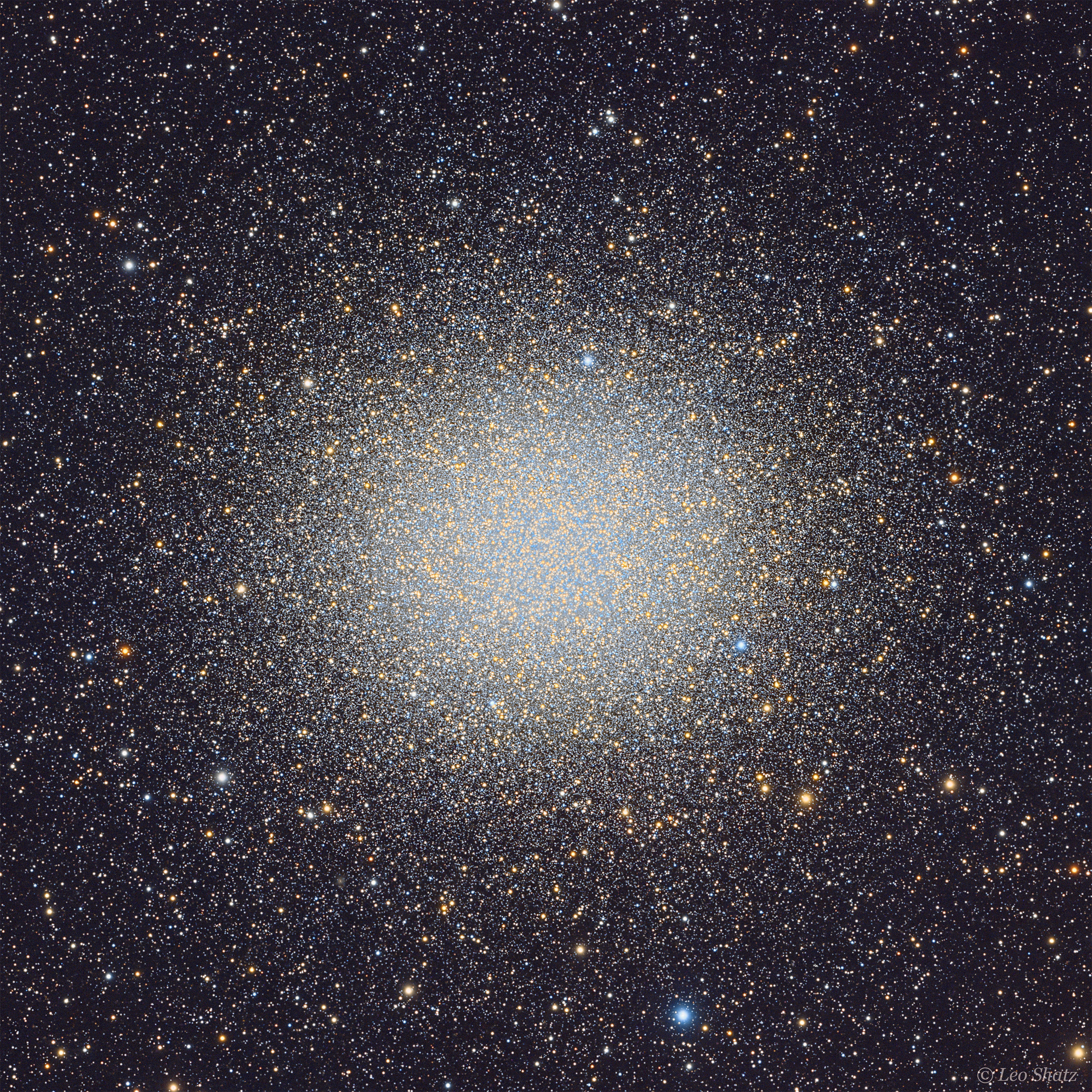
Alt...
2025 July 26
Globular Cluster Omega Centauri
* Image Credit & Copyright: Data acquisition - SkyFlux Team, Processing - Leo Shatz
Explanation:
Globular star cluster Omega Centauri packs about 10 million stars much older than the Sun into a volume some 150 light-years in diameter. Also known as NGC 5139, at a distance of 15,000 light-years it's the largest and brightest of 200 or so known globular clusters that roam the halo of our Milky Way galaxy. Though most star clusters consist of stars with the same age and composition, the enigmatic Omega Cen exhibits the presence of different stellar populations with a spread of ages and chemical abundances. In fact, Omega Cen may be the remnant core of a small galaxy merging with the Milky Way. With a yellowish hue, Omega Centauri's red giant stars are easy to pick out in this sharp telescopic view. A two-decade-long exploration of the dense star cluster with the Hubble Space Telescope has revealed evidence for a massive black hole near the center of Omega Centauri.
Authors & editors: Robert Nemiroff (MTU) & Jerry Bonnell (UMCP)
NASA Official: Amber Straughn Specific rights apply.
NASA Web Privacy, Accessibility, Notices;
A service of: ASD at NASA / GSFC,
NASA Science Activation
& Michigan Tech. U.
2025 August 7
The Double Cluster in Perseus
* Image Credit & Copyright: Ron Brecher
https://astrodoc.ca/about-me/
Explanation:
This stunning starfield spans about three full moons (1.5 degrees) across the heroic northern constellation of Perseus. It holds the famous pair of open star clusters, h and Chi Persei. Also cataloged as NGC 869 (right) and NGC 884, both clusters are about 7,000 light-years away and contain stars much younger and hotter than the Sun. Separated by only a few hundred light-years, the clusters are both 13 million years young based on the ages of their individual stars, evidence that both clusters were likely a product of the same star-forming region. Always a rewarding sight in binoculars or small telescopes, the Double Cluster is even visible to the unaided eye from dark locations.
https://astrodoc.ca/double-cluster-2025/
https://science.nasa.gov/mission/hubble/science/explore-the-night-sky/hubble-caldwell-catalog/caldwell-14/
http://www.messier.seds.org/xtra/ngc/n0869.html
https://arxiv.org/abs/astro-ph/0205130
https://astrobackyard.com/double-cluster-in-perseus/
https://en.wikipedia.org/wiki/Perseus_(constellation)
http://www.messier.seds.org/open.html
https://apod.nasa.gov/apod/ap250807.html
#space #cluster #astrophotography #photography #science #astronomy #physics #nature #NASA
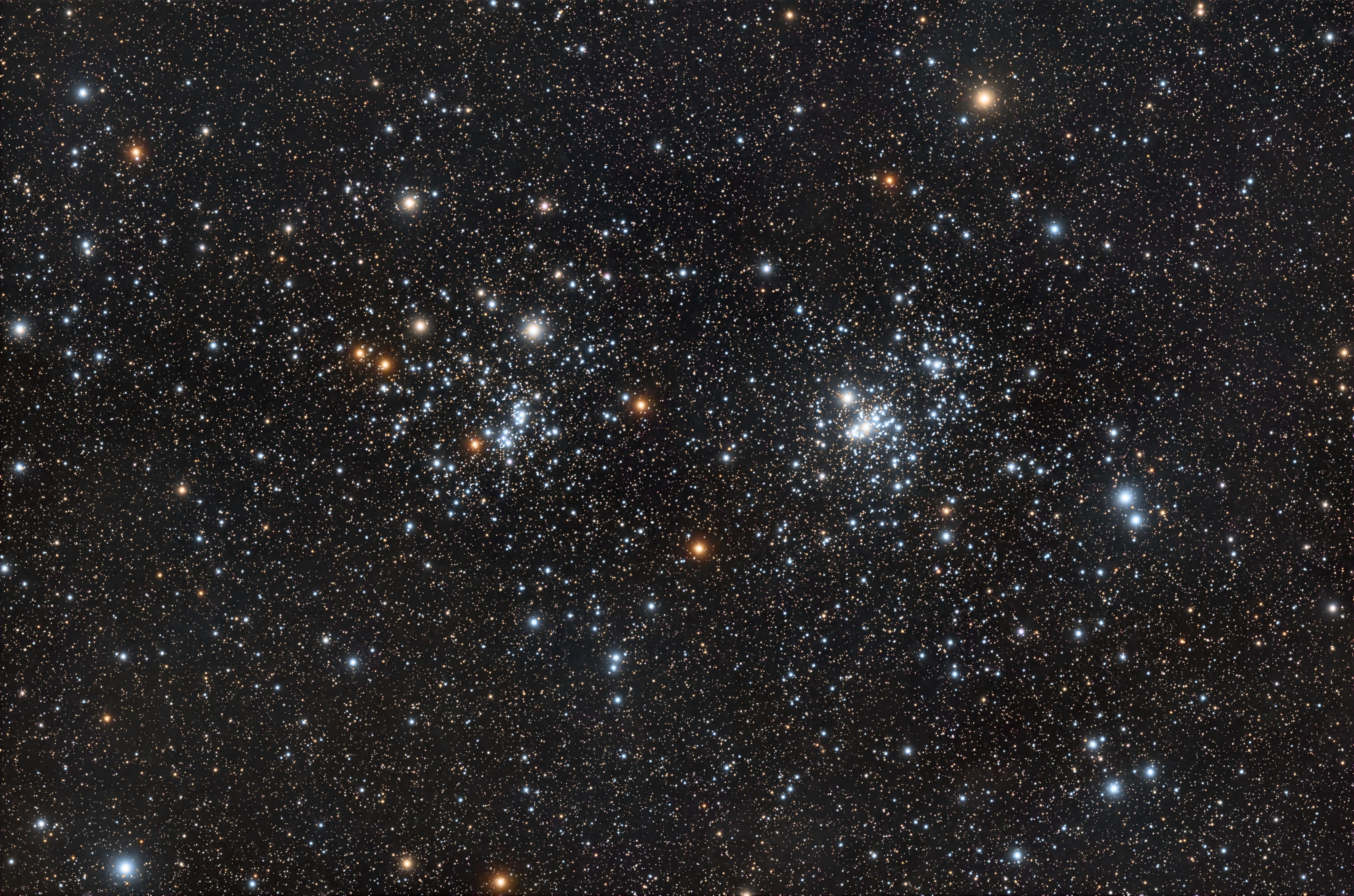
Alt...
2025 August 7
The Double Cluster in Perseus
* Image Credit & Copyright: Ron Brecher
Explanation:
This stunning starfield spans about three full moons (1.5 degrees) across the heroic northern constellation of Perseus. It holds the famous pair of open star clusters, h and Chi Persei. Also cataloged as NGC 869 (right) and NGC 884, both clusters are about 7,000 light-years away and contain stars much younger and hotter than the Sun. Separated by only a few hundred light-years, the clusters are both 13 million years young based on the ages of their individual stars, evidence that both clusters were likely a product of the same star-forming region. Always a rewarding sight in binoculars or small telescopes, the Double Cluster is even visible to the unaided eye from dark locations.
Authors & editors: Robert Nemiroff (MTU) & Jerry Bonnell (UMCP)
NASA Official: Amber Straughn Specific rights apply.
NASA Web Privacy, Accessibility, Notices;
A service of: ASD at NASA / GSFC,
NASA Science Activation
& Michigan Tech. U.
2025 August 14
M13: The Great Globular Cluster in Hercules
* Image Credit & Copyright: R. Jay Gabany
https://www.cosmotography.com/index.html
Explanation:
In 1716, English astronomer Edmond Halley noted, "This is but a little Patch, but it shews itself to the naked Eye, when the Sky is serene and the Moon absent." Of course, M13 is now less modestly recognized as the Great Globular Cluster in Hercules, one of the brightest globular star clusters in the northern sky. Sharp telescopic views like this one reveal the spectacular cluster's hundreds of thousands of stars. At a distance of 25,000 light-years, the cluster stars crowd into a region 150 light-years in diameter. Approaching the cluster core, upwards of 100 stars could be contained in a cube just 3 light-years on a side. For comparison with our neighborhood of the Milky Way, the closest star to the Sun is over 4 light-years away. Early telescopic observers of the great globular cluster also noted a curious convergence of three dark lanes with a spacing of about 120 degrees, seen here just below the cluster center. Known as the propeller in M13, the shape is likely a chance optical effect of the distribution of stars viewed from our perspective against the dense cluster core.
http://www.messier.seds.org/m/m013.html
https://science.nasa.gov/missions/hubble/a-celestial-snow-globe-of-stars/
https://www.cosmotography.com/images/small_ngc6205.html
https://en.wikipedia.org/wiki/Globular_cluster
http://www.messier.seds.org/xtra/similar/halley_pt.html
https://www.bbc.co.uk/history/historic_figures/halley_edmond.shtml
https://skyandtelescope.org/observing/gobs-of-globs-guide-to-16-spring-globular-clusters/
https://apod.nasa.gov/apod/ap250814.html
#space #cluster #astrophotography #photography #science #astronomy #physics #nature #NASA
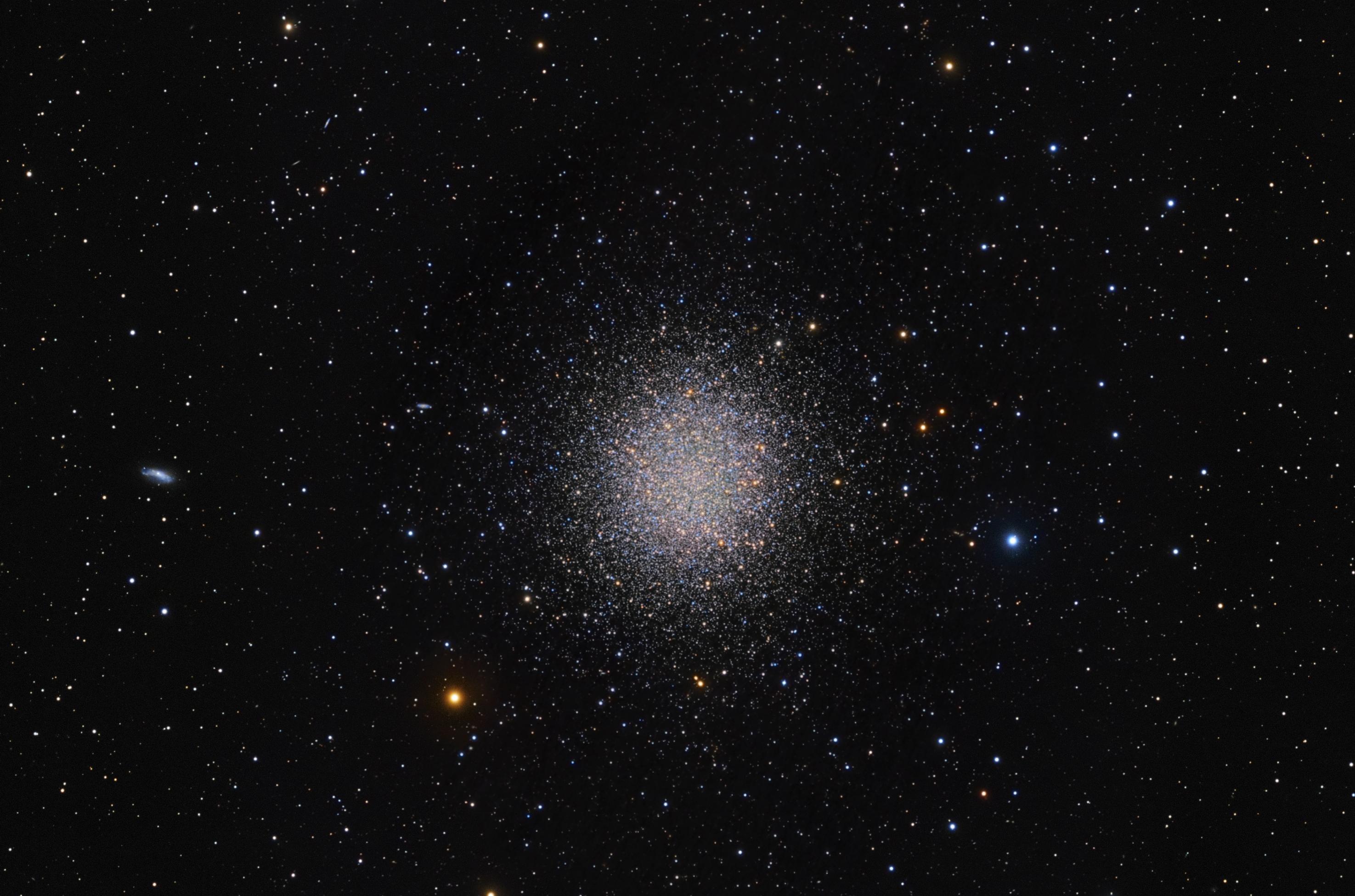
Alt...
2025 August 14
M13: The Great Globular Cluster in Hercules
* Image Credit & Copyright: R. Jay Gabany
Explanation:
In 1716, English astronomer Edmond Halley noted, "This is but a little Patch, but it shews itself to the naked Eye, when the Sky is serene and the Moon absent." Of course, M13 is now less modestly recognized as the Great Globular Cluster in Hercules, one of the brightest globular star clusters in the northern sky. Sharp telescopic views like this one reveal the spectacular cluster's hundreds of thousands of stars. At a distance of 25,000 light-years, the cluster stars crowd into a region 150 light-years in diameter. Approaching the cluster core, upwards of 100 stars could be contained in a cube just 3 light-years on a side. For comparison with our neighborhood of the Milky Way, the closest star to the Sun is over 4 light-years away. Early telescopic observers of the great globular cluster also noted a curious convergence of three dark lanes with a spacing of about 120 degrees, seen here just below the cluster center. Known as the propeller in M13, the shape is likely a chance optical effect of the distribution of stars viewed from our perspective against the dense cluster core.
Authors & editors: Robert Nemiroff (MTU) & Jerry Bonnell (UMCP)
NASA Official: Amber Straughn Specific rights apply.
NASA Web Privacy, Accessibility, Notices;
A service of: ASD at NASA / GSFC,
NASA Science Activation
& Michigan Tech. U.
To help understand the diversity of terrain and to piece together how Pluto’s surface has formed and evolved over time, mission scientists construct geological maps like the one shown upper left.
This map covers a portion of Pluto’s surface that measures 1,290 miles (2,070 kilometers) from top to bottom, and includes the vast nitrogen-ice plain informally named Sputnik Planum and surrounding terrain. As the key in the figure below indicates, the map is overlaid with colors that represent different geological terrains. Each terrain, or unit, is defined by its texture and morphology – smooth, pitted, craggy, hummocky or ridged, for example. How well a unit can be defined depends on the resolution of the images that cover it. All of the terrain in this map has been imaged at a resolution of approximately 1,050 feet (320 meters) per pixel or better, meaning scientists can map units with relative confidence The various blue and greenish units that fill the center of the map represent different textures seen across Sputnik Planum, from the cellular terrain in the center and north, to the smooth and pitted plains in the south. The black lines represent troughs that mark the boundaries of cellular regions in the nitrogen ice. The purple unit represents the chaotic, blocky mountain ranges that line Sputnik’s western border, and the pink unit represents the scattered, floating hills at its eastern edge. The possible cryovolcanic feature informally named Wright Mons is mapped in red in the southern corner of the map. The rugged highlands of the informally named Cthulhu Regio are mapped in dark brown along the western edge, pockmarked by many large impact craters, shown in yellow.
[...]
Please read more in the ALT-Text of the map (left image)
#space #pluto #astrophotography #photography #science #astronomy #nature #NASA #education
![[...]
By studying how the boundaries between units crosscut one another, mission scientists can determine which units overlie others, and assemble a relative chronology for the different units. For example, the yellow craters (at left, on the western edge of the map) must have formed after their surrounding terrain. Producing such maps is important for gauging what processes have operated where on Pluto, and when they occurred relative to other processes at work. The base map for this geologic map is a mosaic of 12 images obtained by the Long Range Reconnaissance Imager (LORRI) at a resolution of 1,280 feet (about 390 meters) per pixel. The mosaic was obtained at a range of approximately 48,000 miles (77,300 kilometers) from Pluto, about an hour and 40 minutes before New Horizons' closest approach on July 14, 2015. (Last Updated: Feb. 11, 2016 - Editor: Tricia Talbert) The original NASA image has been cropped by the uploader.
CREDIT
NASA / Johns Hopkins University Applied Physics Laboratory / Southwest Research Institute](https://files.defcon.social/dcsocial-s3/media_attachments/files/115/306/221/513/300/442/original/db3f7f42bc1db26b.jpg "[...]
By studying how the boundaries between units crosscut one another, mission scientists can determine which units overlie others, and assemble a relative chronology for the different units. For example, the yellow craters (at left, on the western edge of the map) must have formed after their surrounding terrain. Producing such maps is important for gauging what processes have operated where on Pluto, and when they occurred relative to other processes at work. The base map for this geologic map is a mosaic of 12 images obtained by the Long Range Reconnaissance Imager (LORRI) at a resolution of 1,280 feet (about 390 meters) per pixel. The mosaic was obtained at a range of approximately 48,000 miles (77,300 kilometers) from Pluto, about an hour and 40 minutes before New Horizons' closest approach on July 14, 2015. (Last Updated: Feb. 11, 2016 - Editor: Tricia Talbert) The original NASA image has been cropped by the uploader.
CREDIT
NASA / Johns Hopkins University Applied Physics Laboratory / Southwest Research Institute")
Alt...
[...]
By studying how the boundaries between units crosscut one another, mission scientists can determine which units overlie others, and assemble a relative chronology for the different units. For example, the yellow craters (at left, on the western edge of the map) must have formed after their surrounding terrain. Producing such maps is important for gauging what processes have operated where on Pluto, and when they occurred relative to other processes at work. The base map for this geologic map is a mosaic of 12 images obtained by the Long Range Reconnaissance Imager (LORRI) at a resolution of 1,280 feet (about 390 meters) per pixel. The mosaic was obtained at a range of approximately 48,000 miles (77,300 kilometers) from Pluto, about an hour and 40 minutes before New Horizons' closest approach on July 14, 2015. (Last Updated: Feb. 11, 2016 - Editor: Tricia Talbert) The original NASA image has been cropped by the uploader.
CREDIT
NASA / Johns Hopkins University Applied Physics Laboratory / Southwest Research Institute

Alt...
Annotated map of Sputnik Planitia on Pluto
- Geological mapping of Sputnik Planitia on Pluto, Icarus (2017), doi: 10.1016/j.icarus.2017.01.011
CREDIT
Oliver L. White, Jeffrey M. Moore, William B. McKinnon, John R. Spencer, Alan D. Howard, Paul M. Schenk, Ross A. Beyer, Francis Nimmo, Kelsi N. Singer, Orkan M. Umurhan, S. Alan Stern, Kimberly Ennico, Cathy B. Olkin, Harold A. Weaver, Leslie A. Young, Andrew F. Cheng, Tanguy Bertrand, Richard P. Binzel, Alissa M. Earle, Will M. Grundy, Tod R. Lauer, Silvia Protopapa, Stuart J. Robbins, Bernard Schmitt, the New Horizons Science Team
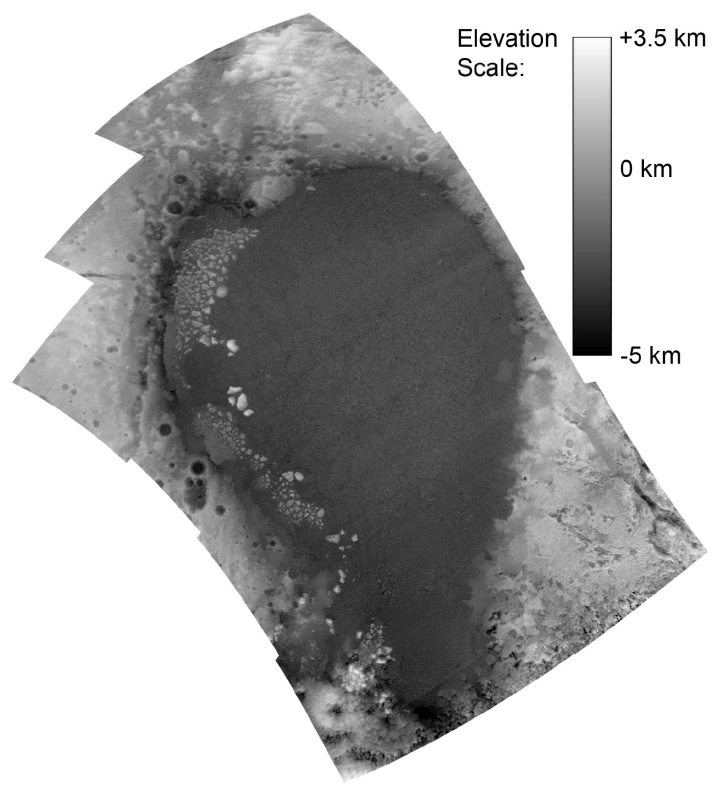
Alt...
A topographic image of the Sputnik Planitia basin, showing the rising scarps bordering the glacial plains. The banding is an artefact of the camera.
- Geological mapping of Sputnik Planitia on Pluto, Icarus (2017), doi: 10.1016/j.icarus.2017.01.011
CREDIT
Oliver L. White, Jeffrey M. Moore, William B. McKinnon, John R. Spencer, Alan D. Howard, Paul M. Schenk, Ross A. Beyer, Francis Nimmo, Kelsi N. Singer, Orkan M. Umurhan, S. Alan Stern, Kimberly Ennico, Cathy B. Olkin, Harold A. Weaver, Leslie A. Young, Andrew F. Cheng, Tanguy Bertrand, Richard P. Binzel, Alissa M. Earle, Will M. Grundy, Tod R. Lauer, Silvia Protopapa, Stuart J. Robbins, Bernard Schmitt, the New Horizons Science Team
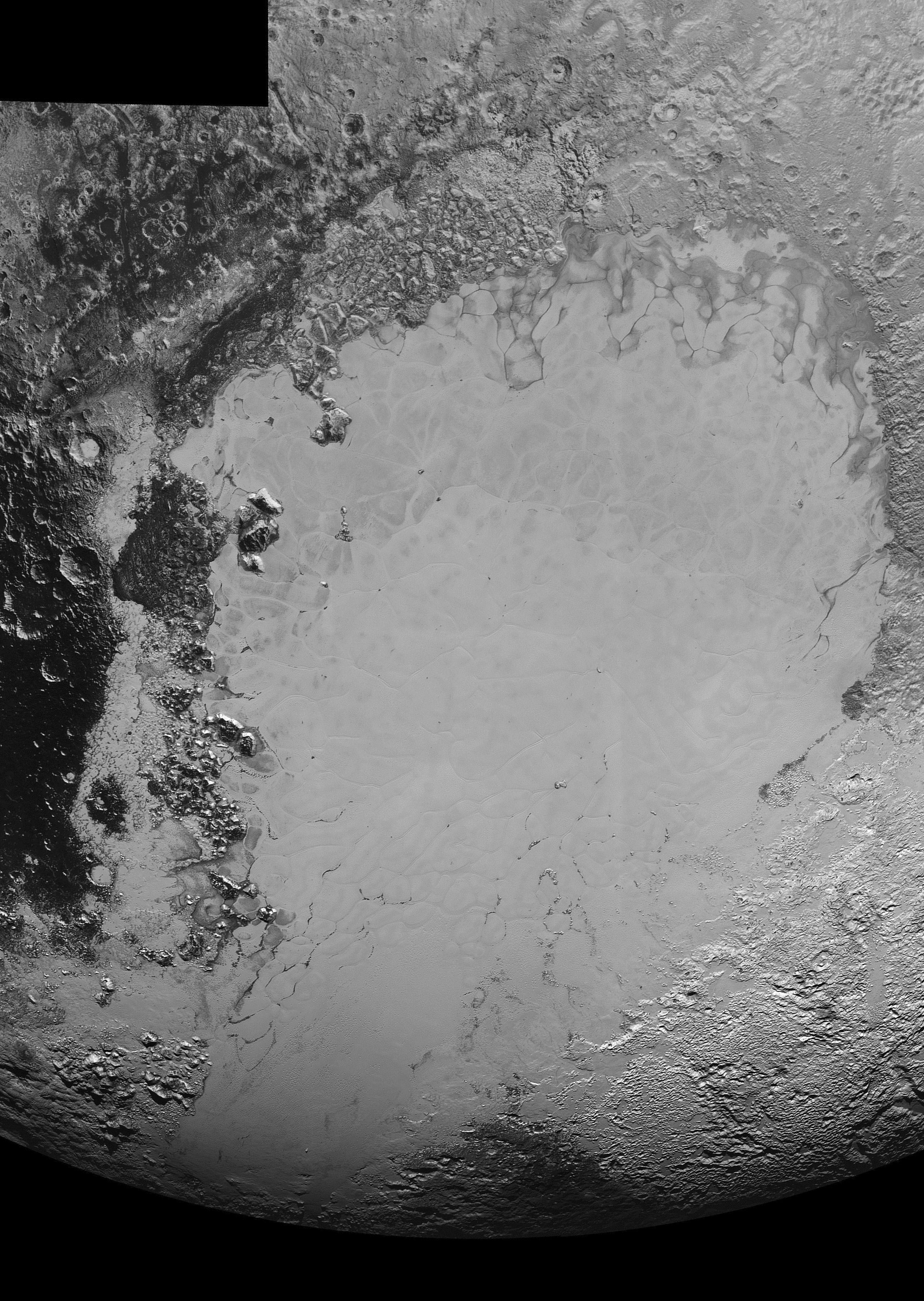
Alt...
Mosaic of high-resolution LORRI images of Pluto, sent back from NASA's New Horizons spacecraft from Sept. 5 to 7, 2015. The image is dominated by the informally-named icy plain Sputnik Planum, the smooth, bright region across the center. This image also features a tremendous variety of other landscapes surrounding Sputnik. The smallest visible features are 0.5 miles (0.8 kilometers) in size, and the mosaic covers a region roughly 1,000 miles (1600 kilometers) wide. The image was taken as New Horizons flew past Pluto on July 14, 2015, from a distance of 50,000 miles (80,000 kilometers). The Johns Hopkins University Applied Physics Laboratory in Laurel, Maryland, designed, built, and operates the New Horizons spacecraft, and manages the mission for NASA's Science Mission Directorate. The Southwest Research Institute, based in San Antonio, leads the science team, payload operations and encounter science planning. New Horizons is part of the New Frontiers Program managed by NASA's Marshall Space Flight Center in Huntsville, Alabama. UPLOADER NOTES: The original NASA image has been modified by the uploader as follows: rotating clockwise 90°, extending the lower border by 154 pixels, and converting from TIFF to JPEG format. North is to the upper right.
Secrets Revealed from Pluto’s ‘Twilight Zone’
NASA's New Horizons spacecraft took this stunning image of Pluto only a few minutes after closest approach on July 14, 2015. The image was obtained at a high phase angle -- that is, with the sun on the other side of Pluto, as viewed by New Horizons. Seen here, sunlight filters through and illuminates Pluto's complex atmospheric haze layers. The southern portions of the nitrogen ice plains informally named Sputnik Planum, as well as mountains of the informally named Norgay Montes, can also be seen across Pluto's crescent at the top of the image.
Looking back at Pluto with images like this gives New Horizons scientists information about Pluto's hazes and surface properties that they can't get from images taken on approach. The image was obtained by New Horizons' Ralph/Multispectral Visual Imaging Camera (MVIC) approximately 13,400 miles (21,550 kilometers) from Pluto, about 19 minutes after New Horizons' closest approach. The image has a resolution of 1,400 feet (430 meters) per pixel. Pluto's diameter is 1,475 miles (2,374 kilometers).
[...]
Please read about the annotations in ALT-Text.
CREDIT
The Johns Hopkins University Applied Physics Laboratory in Laurel, Maryland, designed, built, and operates the New Horizons spacecraft, and manages the mission for NASA's Science Mission Directorate. The Southwest Research Institute, based in San Antonio, leads the science team, payload operations and encounter science planning. New Horizons is part of the New Frontiers Program managed by NASA's Marshall Space Flight Center in Huntsville, Alabama.
https://science.nasa.gov/photojournal/secrets-revealed-from-plutos-twilight-zone/
#space #pluto #astrophotography #photography #science #astronomy #physics #nature #NASA #education
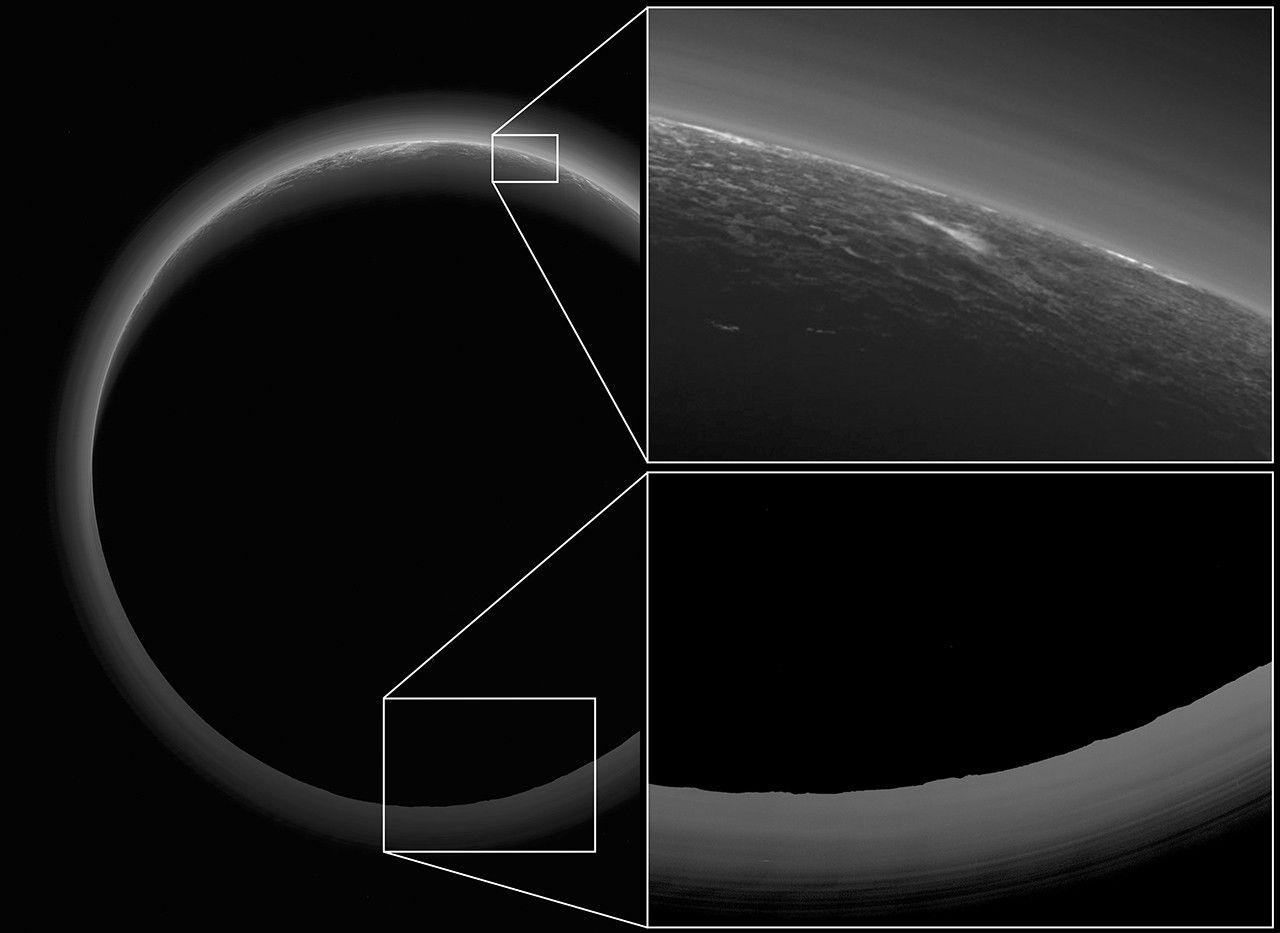
Alt...
Annotated Version of image in previous post
The inset at top right in the annotated version shows a detail of Pluto's crescent, including an intriguing bright wisp (near the center) measuring tens of miles across that may be a discreet, low-lying cloud in Pluto's atmosphere; if so, it would be the only one yet identified in New Horizons imagery. This cloud -- if that's what it is -- is visible for the same reason the haze layers are so bright: illumination from the sunlight grazing Pluto's surface at a low angle. Atmospheric models suggest that methane clouds can occasionally form in Pluto's atmosphere. The scene in this inset is 140 miles (230 kilometers) across.
The inset at bottom right shows more detail on the night side of Pluto. This terrain can be seen because it is illuminated from behind by hazes that silhouette the of the annotated version limb. The topography here appears quite rugged, and broad valleys and sharp peaks with relief totaling 3 miles (5 kilometers) are apparent. This image, made from closer range, is much better than the lower-resolution images of this same terrain taken several days before closest approach. These silhouetted terrains therefore act as a useful "anchor point," giving New Horizons scientists a rare, detailed glimpse at the lay of the land in this mysterious part of Pluto seen at high resolution only in twilight. The scene in this inset is 460 miles (750 kilometers) wide.
TOPIC> Pluto
2025 October 2
Pluto at Night
* Image Credit: NASA, Johns Hopkins Univ./APL, Southwest Research Institute
http://www.nasa.gov/
http://www.jhuapl.edu/
http://www.swri.edu/
Explanation:
The night side of Pluto spans this shadowy scene. In the stunning spacebased perspective, the Sun is 4.9 billion kilometers (almost 4.5 light-hours) behind the dim and distant world. It was captured by far flung New Horizons in July of 2015 when the spacecraft was at a range of some 21,000 kilometers from Pluto. That was about 19 minutes after its closest approach. A denizen of the Kuiper Belt in dramatic silhouette, the image also reveals Pluto's tenuous, surprisingly complex layers of hazy atmosphere. Near the top of the frame the crescent twilight landscape includes southern areas of nitrogen ice plains now formally known as Sputnik Planitia and rugged mountains of water-ice in the Norgay Montes.
https://science.nasa.gov/photojournal/secrets-revealed-from-plutos-twilight-zone/
https://science.nasa.gov/photojournal/new-horizons-best-close-up-of-plutos-surface/
https://en.wikipedia.org/wiki/Sputnik_Planitia
https://science.nasa.gov/solar-system/kuiper-belt/
https://apod.nasa.gov/apod/fap/ap251002.html
#NASA #inofficial #space #pluto #astrophotography #photography #science #astronomy #nature
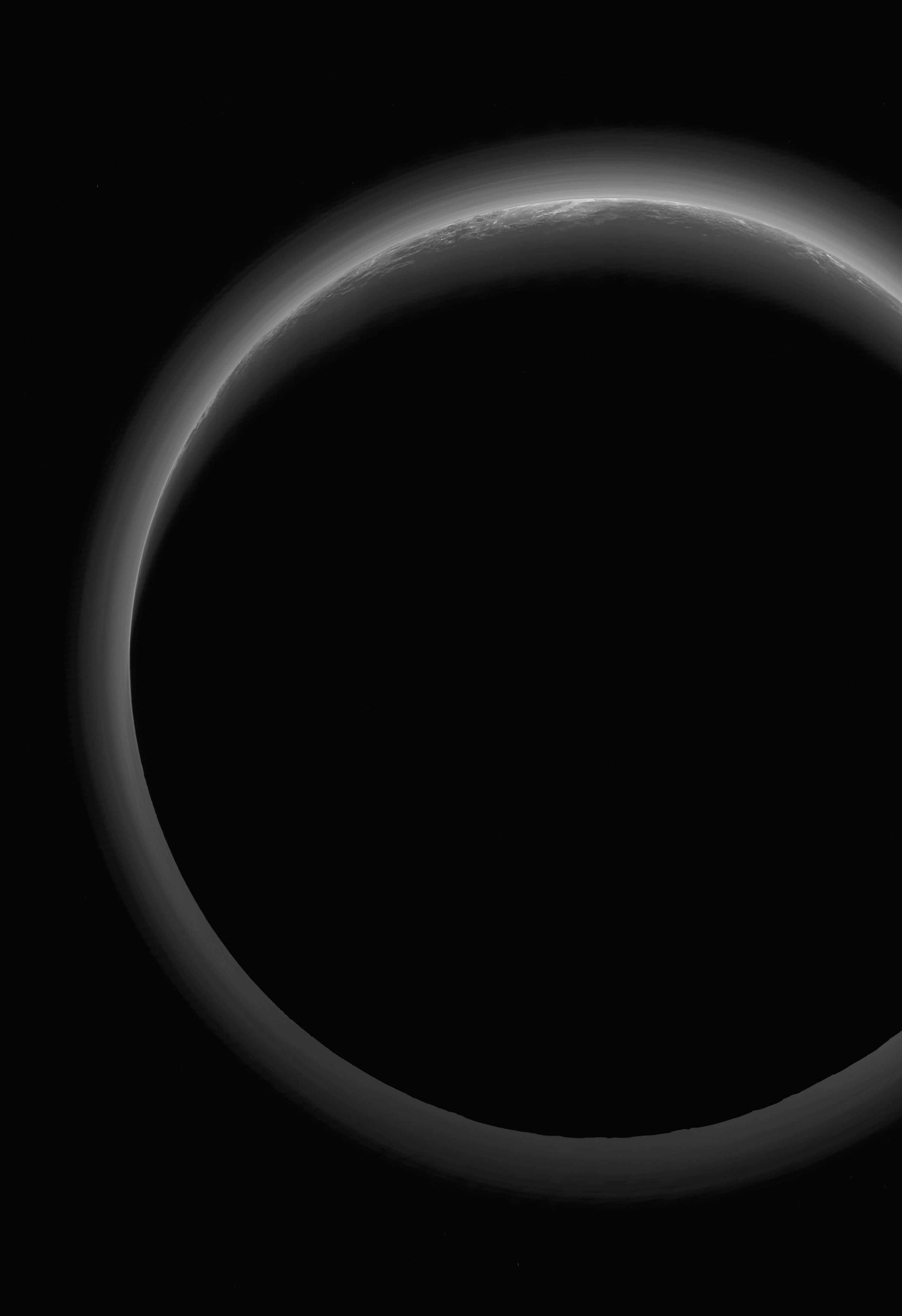
Alt...
2025 October 2
Pluto at Night
* Image Credit: NASA, Johns Hopkins Univ./APL, Southwest Research Institute
Explanation:
The night side of Pluto spans this shadowy scene. In the stunning spacebased perspective, the Sun is 4.9 billion kilometers (almost 4.5 light-hours) behind the dim and distant world. It was captured by far flung New Horizons in July of 2015 when the spacecraft was at a range of some 21,000 kilometers from Pluto. That was about 19 minutes after its closest approach. A denizen of the Kuiper Belt in dramatic silhouette, the image also reveals Pluto's tenuous, surprisingly complex layers of hazy atmosphere. Near the top of the frame the crescent twilight landscape includes southern areas of nitrogen ice plains now formally known as Sputnik Planitia and rugged mountains of water-ice in the Norgay Montes.
Authors & editors: Robert Nemiroff (MTU) & Jerry Bonnell (UMCP)
NASA Official: Amber Straughn Specific rights apply.
NASA Web Privacy, Accessibility, Notices;
A service of: ASD at NASA / GSFC,
NASA Science Activation
& Michigan Tech. U.
2025 August 6
Meteor before Galaxy
* Image Credit & Copyright: Fritz Helmut Hemmerich
https://www.flickr.com/people/fhhemmerich/
Explanation:
What's that green streak in front of the Andromeda galaxy? A meteor. While photographing the Andromeda galaxy in 2016, near the peak of the Perseid Meteor Shower, a small pebble from deep space crossed right in front of our Milky Way Galaxy's far-distant companion. The small meteor took only a fraction of a second to pass through this 10-degree field. The meteor flared several times while braking violently upon entering Earth's atmosphere. The green color was created, at least in part, by the meteor's gas glowing as it vaporized. Although the exposure was timed to catch a Perseid meteor, the orientation of the imaged streak seems a better match to a meteor from the Southern Delta Aquariids, a meteor shower that peaked a few weeks earlier. Not coincidentally, the Perseid Meteor Shower peaks next week, although this year the meteors will have to outshine a sky brightened by a nearly full moon.
https://apod.nasa.gov/apod/ap250806.html
#space #perseids #astrophotography #photography #science #astronomy #nature #NASA
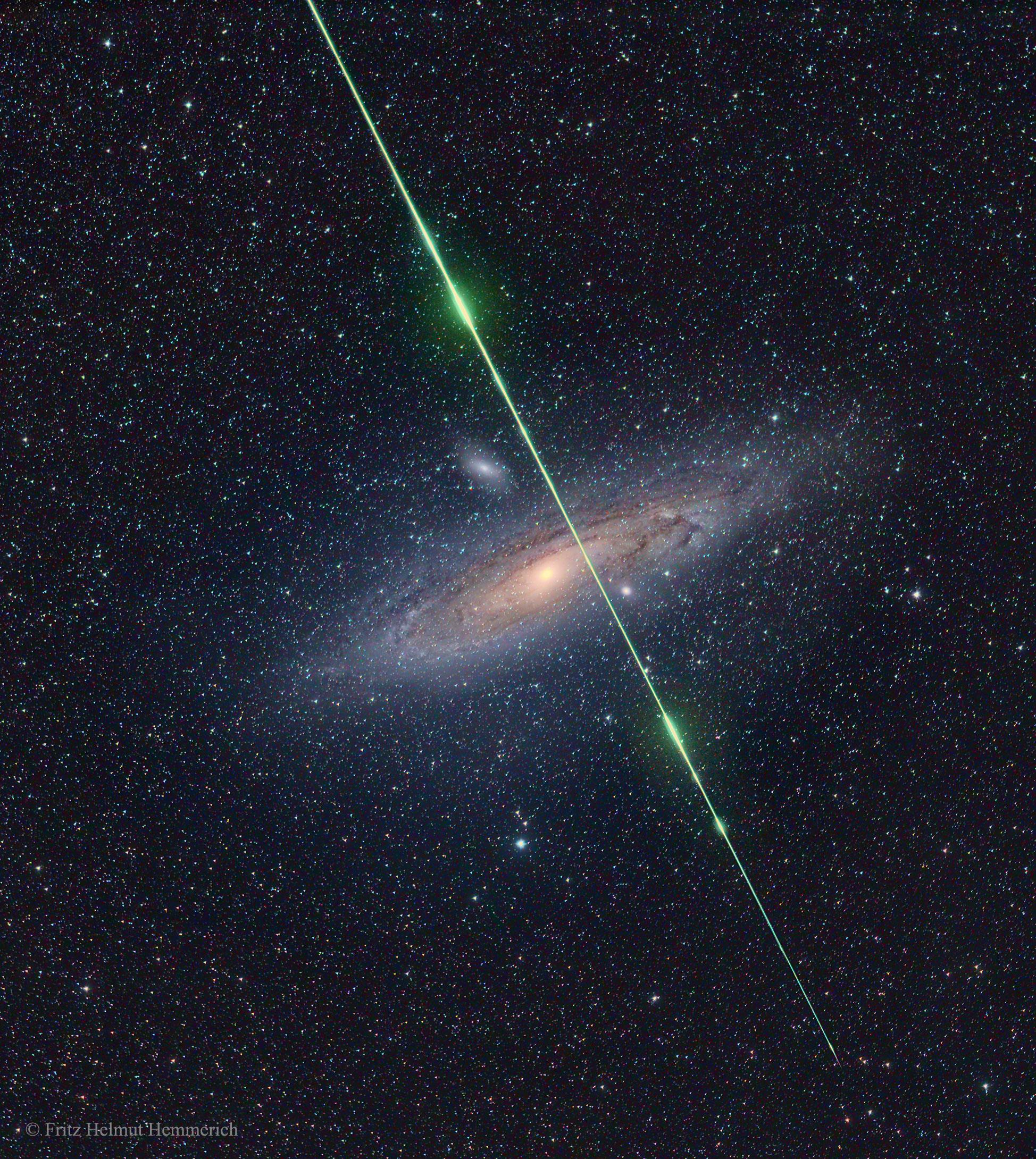
Alt...
2025 August 6
A starfield has the Andromeda galaxy in the center. Streaking down from the top is a green line with several bright segments -- a meteor captured coincidently. Please see the explanation for more detailed information.
Meteor before Galaxy
* Image Credit & Copyright: Fritz Helmut Hemmerich
Explanation:
What's that green streak in front of the Andromeda galaxy? A meteor. While photographing the Andromeda galaxy in 2016, near the peak of the Perseid Meteor Shower, a small pebble from deep space crossed right in front of our Milky Way Galaxy's far-distant companion. The small meteor took only a fraction of a second to pass through this 10-degree field. The meteor flared several times while braking violently upon entering Earth's atmosphere. The green color was created, at least in part, by the meteor's gas glowing as it vaporized. Although the exposure was timed to catch a Perseid meteor, the orientation of the imaged streak seems a better match to a meteor from the Southern Delta Aquariids, a meteor shower that peaked a few weeks earlier. Not coincidentally, the Perseid Meteor Shower peaks next week, although this year the meteors will have to outshine a sky brightened by a nearly full moon.
Authors & editors: Robert Nemiroff (MTU) & Jerry Bonnell (UMCP)
NASA Official: Amber Straughn Specific rights apply.
NASA Web Privacy, Accessibility, Notices;
A service of: ASD at NASA / GSFC,
NASA Science Activation
& Michigan Tech. U.
TOPIC> Perseids & Co. Meteor Showers
2023 August 24
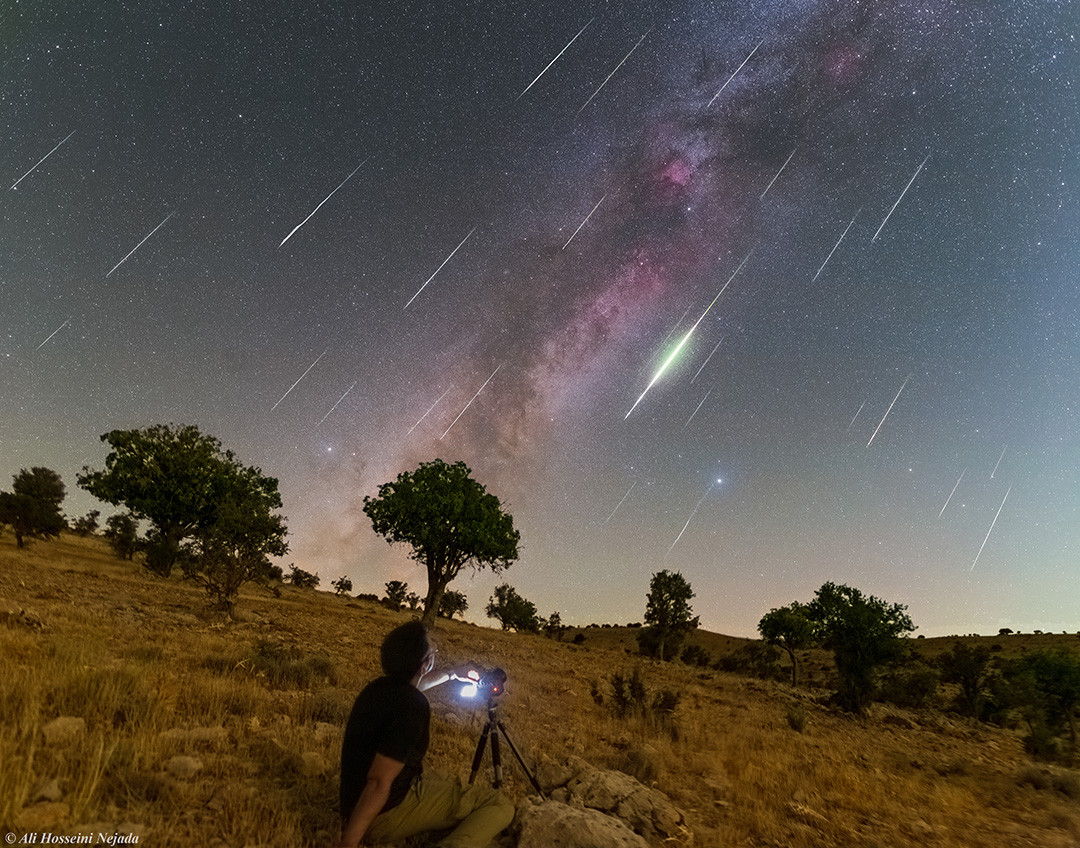
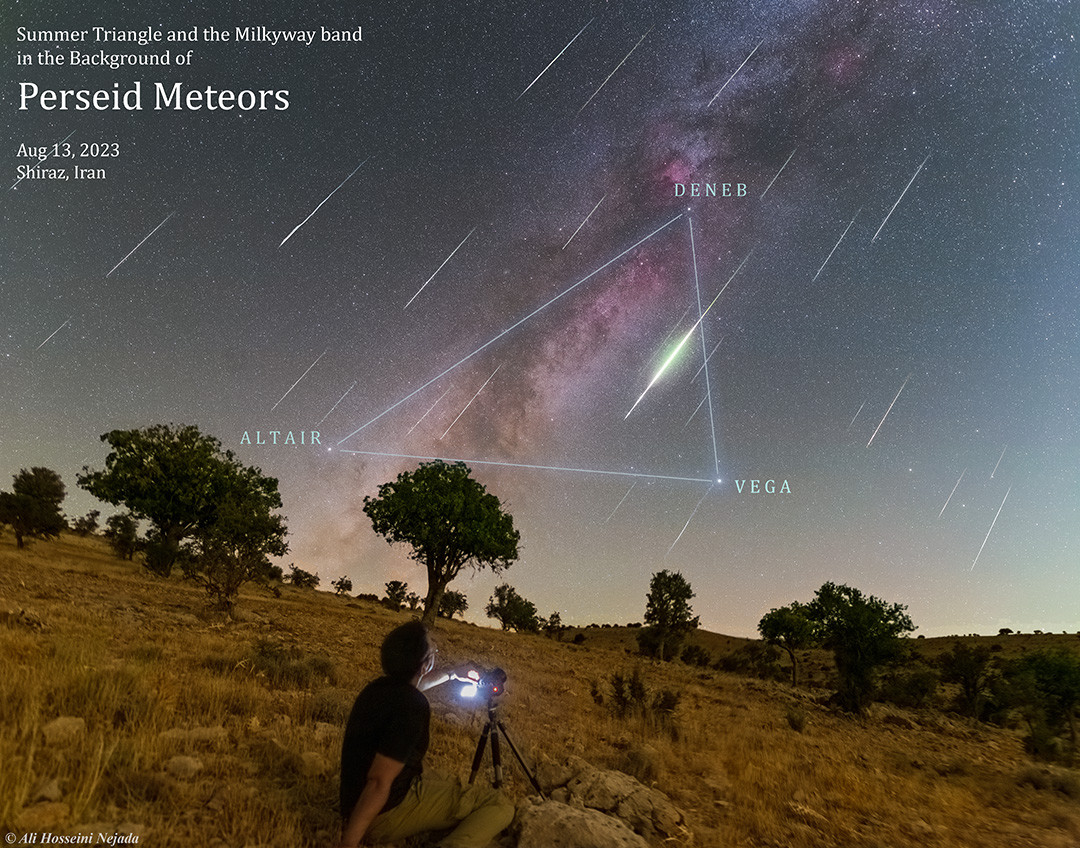
Meteors along the Milky Way
* Image Credit & Copyright: Ali Hosseini Nezhad
Explanation:
Under dark and mostly moonless night skies, many denizens of planet Earth were able to watch this year's Perseid meteor shower. Seen from a grassy hillside from Shiraz, Iran these Perseid meteors streak along the northern summer Milky Way before dawn on Sunday, August 13. Frames used to construct the composited image were captured near the active annual meteor shower's peak between 02:00 AM and 04:30 AM local time. Not in this night skyscape, the shower's radiant in the heroic constellation Perseus is far above the camera's field of view. But fans of northern summer nights can still spot a familiar asterism. Formed by bright stars Deneb, Vega, and Altair, the Summer Triangle spans the luminous band of the Milky Way.
https://apod.nasa.gov/apod/ap230824.html
#space #galaxy #perseids #astrophotography #photography #science #astronomy #nature #NASA
Alt...
2023 August 24
Meteors along the Milky Way
* Image Credit & Copyright: Ali Hosseini Nezhad
Explanation:
Under dark and mostly moonless night skies, many denizens of planet Earth were able to watch this year's Perseid meteor shower. Seen from a grassy hillside from Shiraz, Iran these Perseid meteors streak along the northern summer Milky Way before dawn on Sunday, August 13. Frames used to construct the composited image were captured near the active annual meteor shower's peak between 02:00 AM and 04:30 AM local time. Not in this night skyscape, the shower's radiant in the heroic constellation Perseus is far above the camera's field of view. But fans of northern summer nights can still spot a familiar asterism. Formed by bright stars Deneb, Vega, and Altair, the Summer Triangle spans the luminous band of the Milky Way.
Authors & editors: Robert Nemiroff (MTU) & Jerry Bonnell (UMCP)
NASA Official: Phillip Newman Specific rights apply.
NASA Web Privacy Policy and Important Notices
A service of: ASD at NASA / GSFC,
NASA Science Activation
& Michigan Tech. U.
Annotations for previous post.
#space #galaxy #perseids #astrophotography #photography #science #astronomy #nature #NASA
Alt...
Annotations for previous post.
2023 August 24
Meteors along the Milky Way
* Image Credit & Copyright: Ali Hosseini Nezhad
Explanation:
Under dark and mostly moonless night skies, many denizens of planet Earth were able to watch this year's Perseid meteor shower. Seen from a grassy hillside from Shiraz, Iran these Perseid meteors streak along the northern summer Milky Way before dawn on Sunday, August 13. Frames used to construct the composited image were captured near the active annual meteor shower's peak between 02:00 AM and 04:30 AM local time. Not in this night skyscape, the shower's radiant in the heroic constellation Perseus is far above the camera's field of view. But fans of northern summer nights can still spot a familiar asterism. Formed by bright stars Deneb, Vega, and Altair, the Summer Triangle spans the luminous band of the Milky Way.
Authors & editors: Robert Nemiroff (MTU) & Jerry Bonnell (UMCP)
NASA Official: Phillip Newman Specific rights apply.
NASA Web Privacy Policy and Important Notices
A service of: ASD at NASA / GSFC,
NASA Science Activation
& Michigan Tech. U.
Perseids
NASA Science Editorial Team
Perseids Meteor Shower
The Perseids meteor shower peaks in mid-August, and is the most popular meteor shower of the year.
About the Meteor Shower
The Perseids, which peaks in mid-August, is considered the best meteor shower of the year. With swift and bright meteors, Perseids frequently leave long "wakes" of light and color behind them as they streak through Earth's atmosphere. The Perseids are one of the most plentiful showers with about 50 to 100 meteors seen per hour. They occur with warm summer nighttime weather allowing sky watchers to comfortably view them.
Perseids are also known for their fireballs. Fireballs are larger explosions of light and color that can persist longer than an average meteor streak. This is due to the fact that fireballs originate from larger particles of cometary material. Fireballs are also brighter, with apparent magnitudes greater than -3.
Viewing Tips
The Perseids are best viewed in the Northern Hemisphere during the pre-dawn hours, though at times it is possible to view meteors from this shower as early as 10 p.m.
Where Do Meteors Come From?
Meteors come from leftover comet particles and bits from broken asteroids. When comets come around the Sun, they leave a dusty trail behind them. Every year Earth passes through these debris trails, which allows the bits to collide with our atmosphere and disintegrate to create fiery and colorful streaks in the sky.
The Comet
The pieces of space debris that interact with our atmosphere to create the Perseids originate from comet 109P/Swift-Tuttle. Swift-Tuttle takes 133 years to orbit the Sun once. It was Giovanni Schiaparelli who realized in 1865 that this comet was the source of the Perseids. Comet Swift-Tuttle last visited the inner solar system in 1992.
https://science.nasa.gov/solar-system/meteors-meteorites/perseids/
#space #galaxy #perseids #astrophotography #photography #science #astronomy #nature #NASA
Alt...
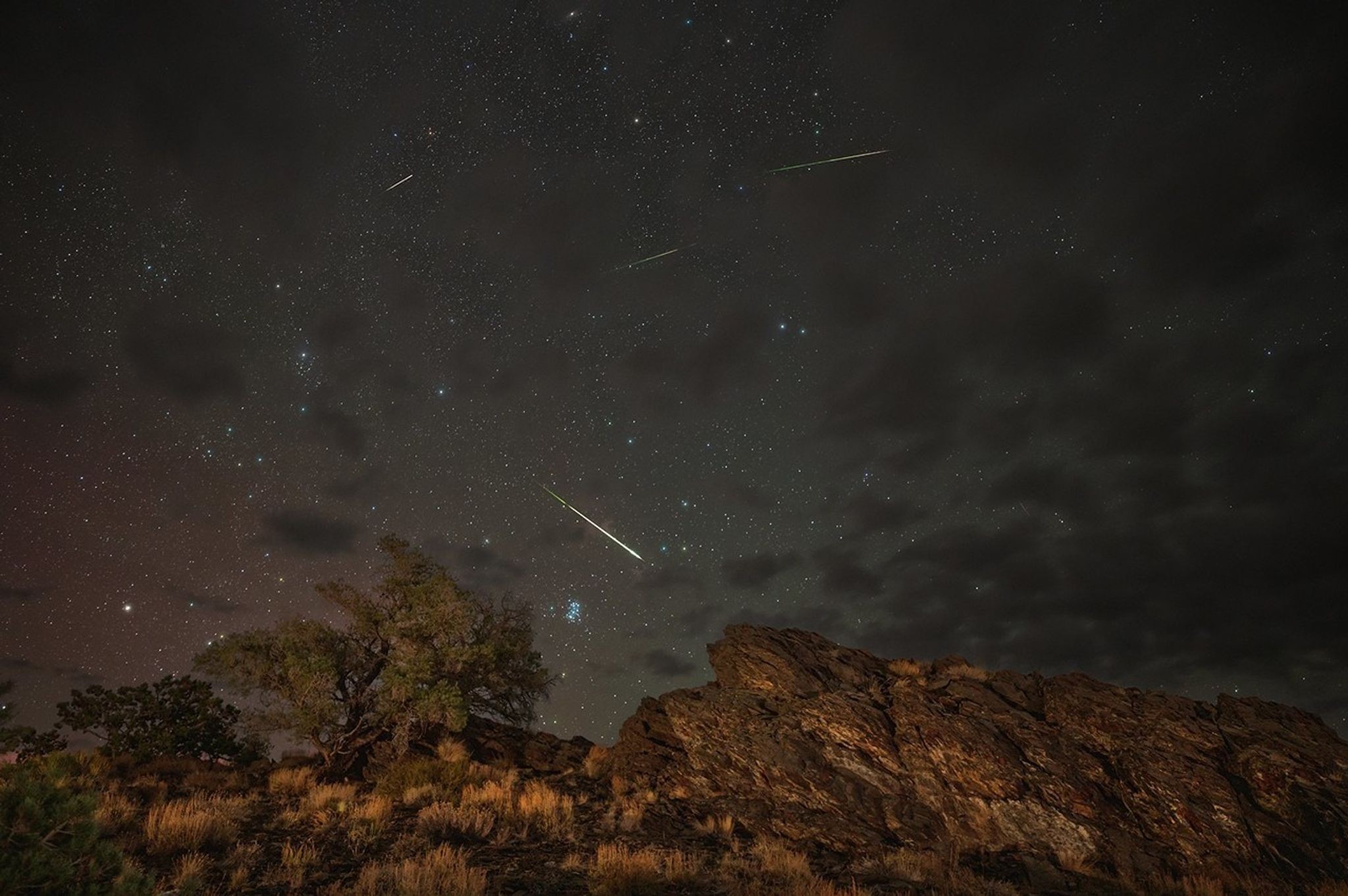
Meteors from the Perseids Meteor Shower streak across a partly cloudy sky above Inyo National Forest in Bishop, California, in 2024.
CREDIT
NASA/Preston Dyches
_____
Fast Facts
Comet of Origin 109P/Swift-Tuttle
Radiant Constellation Perseus
Active July 17 to Aug. 23, 2025 (Peak night: Aug. 12-13)
Observed Under Dark Skies About 25 meteors per hour
Meteor Velocity 37 miles (59 km) per second
____
The Comet
The pieces of space debris that interact with our atmosphere to create the Perseids originate from comet 109P/Swift-Tuttle. Swift-Tuttle takes 133 years to orbit the Sun once. It was Giovanni Schiaparelli who realized in 1865 that this comet was the source of the Perseids. Comet Swift-Tuttle last visited the inner solar system in 1992.
Comet Swift-Tuttle was discovered in 1862 by Lewis Swift and Horace Tuttle. Swift-Tuttle is a large comet: its nucleus is 16 miles (26 kilometers) across. (This is almost twice the size of the object hypothesized to have led to the demise of the dinosaurs.)
Their radiant – the point in the sky from which the Perseids appear to come – is the constellation Perseus. This is also where we get the name for the shower: Perseids. However, the constellation for which a meteor shower is named only serves to aid viewers in determining which shower they are viewing on a given night. The constellation is not the source of the meteors.
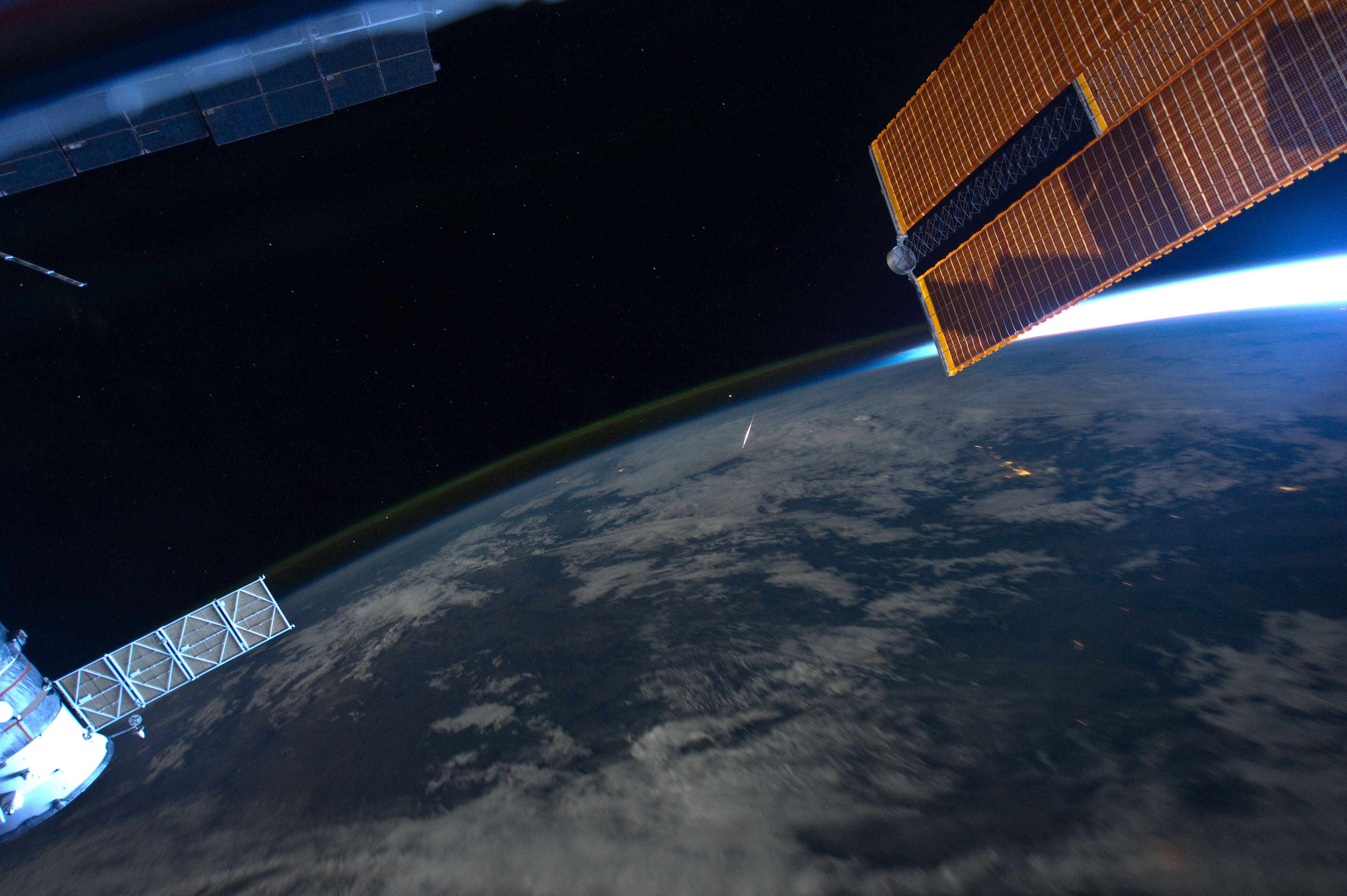
2024 August 9
A Perseid Below
* Image Credit: Ron Garan, ISS Expedition 28 Crew, NASA
https://www.nasa.gov/mission/expedition-28/
https://www.nasa.gov/
Explanation:
Denizens of planet Earth typically watch meteor showers by looking up. But this remarkable view, captured on August 13, 2011 by astronaut Ron Garan, caught a Perseid meteor by looking down. From Garan's perspective on board the International Space Station orbiting at an altitude of about 380 kilometers, the Perseid meteors streak below, swept up dust from comet Swift-Tuttle. The vaporizing comet dust grains are traveling at about 60 kilometers per second through the denser atmosphere around 100 kilometers above Earth's surface. In this case, the foreshortened meteor flash is near frame center, below the curving limb of the Earth and a layer of greenish airglow, just below bright star Arcturus. Want to look up at a meteor shower? You're in luck, as the 2024 Perseid meteor shower is active now and predicted to peak near August 12. With interfering bright moonlight absent, this year you'll likely see many Perseid meteors under clear, dark skies after midnight.
https://apod.nasa.gov/apod/ap240809.html
#space #galaxy #perseids #astrophotography #photography #science #astronomy #nature #NASA
Alt...
2024 August 9
A Perseid Below
* Image Credit: Ron Garan, ISS Expedition 28 Crew, NASA
Explanation:
Denizens of planet Earth typically watch meteor showers by looking up. But this remarkable view, captured on August 13, 2011 by astronaut Ron Garan, caught a Perseid meteor by looking down. From Garan's perspective on board the International Space Station orbiting at an altitude of about 380 kilometers, the Perseid meteors streak below, swept up dust from comet Swift-Tuttle. The vaporizing comet dust grains are traveling at about 60 kilometers per second through the denser atmosphere around 100 kilometers above Earth's surface. In this case, the foreshortened meteor flash is near frame center, below the curving limb of the Earth and a layer of greenish airglow, just below bright star Arcturus. Want to look up at a meteor shower? You're in luck, as the 2024 Perseid meteor shower is active now and predicted to peak near August 12. With interfering bright moonlight absent, this year you'll likely see many Perseid meteors under clear, dark skies after midnight.
Authors & editors: Robert Nemiroff (MTU) & Jerry Bonnell (UMCP)
NASA Official: Amber Straughn Specific rights apply.
NASA Web Privacy, Accessibility Notices
A service of: ASD at NASA / GSFC,
NASA Science Activation
& Michigan Tech. U.
"Our pets and farm animals also enjoy the annual variety full of short surprises in the night sky. It will start again soon! Do you already know when and where to look? Look here, there is everything:https://earthsky.org/astronomy-essentials/everything-you-need-to-know-perseid-meteor-shower/"
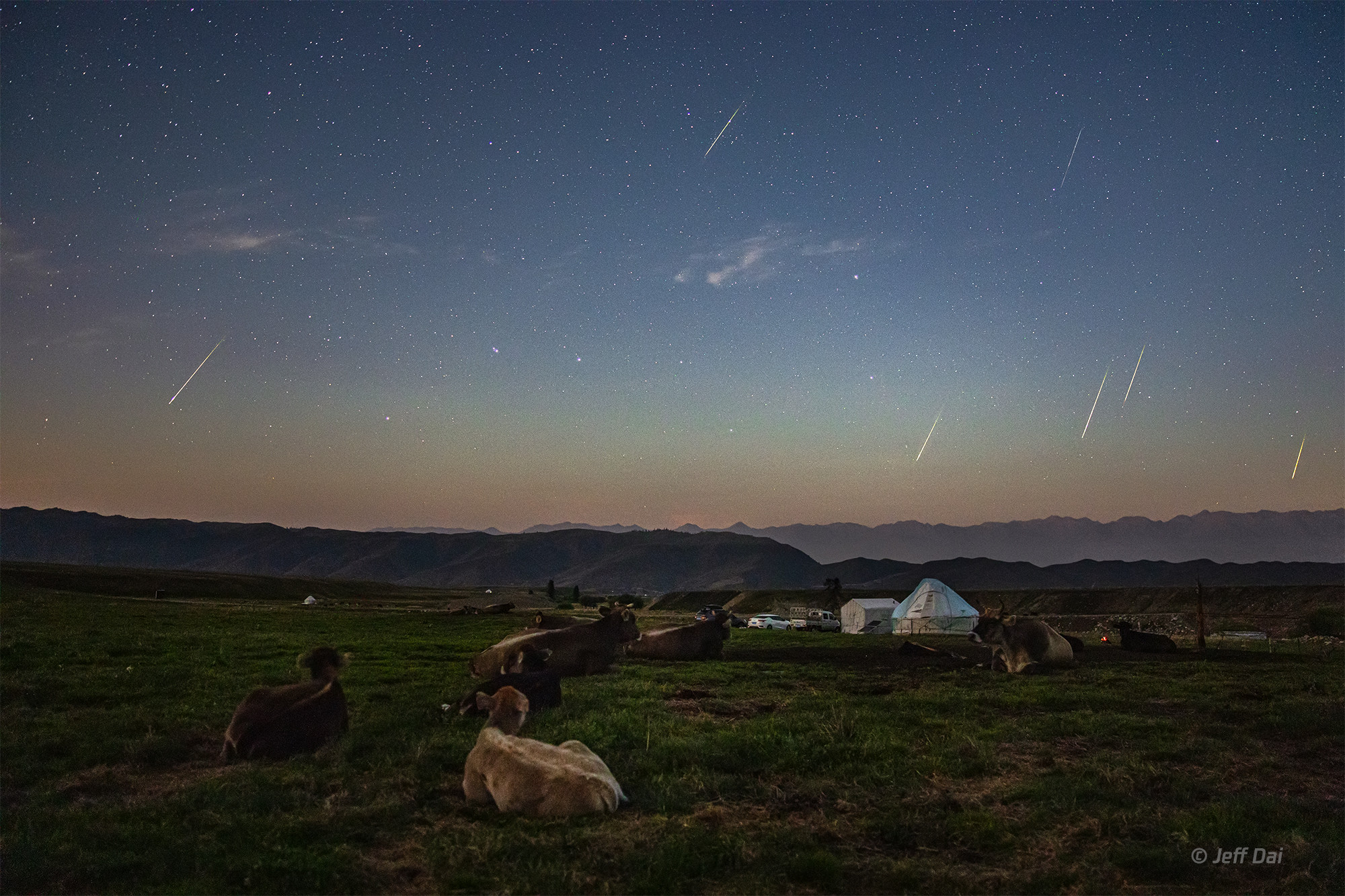
2019 August 15
The Perseids and the Plough
* Image Credit & Copyright: Jeff Dai (TWAN)
https://twanight.org/profile/jeff-dai/
Explanation:
Despite interfering moonlight, many denizens of planet Earth were able to watch this year's Perseid meteor shower. This pastoral scene includes local skygazers admiring the shower's brief, heavenly flashes in predawn hours near peak activity on August 13 from Nalati Grassland in Xinjiang, China. A composite, the image registers seven frames taken during a two hour span recording Perseid meteor streaks against a starry sky. Centered along the horizon is the Plough, the north's most famous asterism, though some might see the familiar celestial kitchen utensil known as the Big Dipper. Perhaps the year's most easily enjoyed meteor shower, Perseid meteors are produced as Earth itself sweeps through dust from periodic comet Swift-Tuttle. The dust particles are vaporized at altitudes of 100 kilometers or so as they plow through the atmosphere at 60 kilometers per second.
https://apod.nasa.gov/apod/ap190815.html
#space #galaxy #perseids #astrophotography #photography #science #astronomy #nature #NASA
Alt...
2019 August 15
The Perseids and the Plough
* Image Credit & Copyright: Jeff Dai (TWAN)
Explanation:
Despite interfering moonlight, many denizens of planet Earth were able to watch this year's Perseid meteor shower. This pastoral scene includes local skygazers admiring the shower's brief, heavenly flashes in predawn hours near peak activity on August 13 from Nalati Grassland in Xinjiang, China. A composite, the image registers seven frames taken during a two hour span recording Perseid meteor streaks against a starry sky. Centered along the horizon is the Plough, the north's most famous asterism, though some might see the familiar celestial kitchen utensil known as the Big Dipper. Perhaps the year's most easily enjoyed meteor shower, Perseid meteors are produced as Earth itself sweeps through dust from periodic comet Swift-Tuttle. The dust particles are vaporized at altitudes of 100 kilometers or so as they plow through the atmosphere at 60 kilometers per second.
Authors & editors: Robert Nemiroff (MTU) & Jerry Bonnell (UMCP)
NASA Official: Phillip Newman Specific rights apply.
NASA Web Privacy Policy and Important Notices
A service of: ASD at NASA / GSFC
& Michigan Tech. U.
2018 September 8
Real Time Perseid
* Video Credit & Copyright: Till Credner, AlltheSky.com
http://www.allthesky.com/
Explanation:
Bright meteors and dark night skies made this year's Perseid meteor shower a great time for a weekend campout. And while packing away their equipment, skygazers at a campsite in the mountains of southern Germany found at least one more reason to linger under the stars, witnessing this brief but colorful flash with their own eyes. Presented as a 50 frame gif, the two second long video was captured during the morning twilight of August 12. In real time it shows the development of the typical green train of a bright Perseid meteor. A much fainter Perseid is just visible farther to the right. Plowing through Earth's atmosphere at 60 kilometers per second, Perseids are fast enough to excite the characteristic green emission of atomic oxygen at altitudes of 100 kilometers or so.
https://apod.nasa.gov/apod/ap180908.html
#space #galaxy #perseids #astrophotography #photography #science #astronomy #nature #NASA
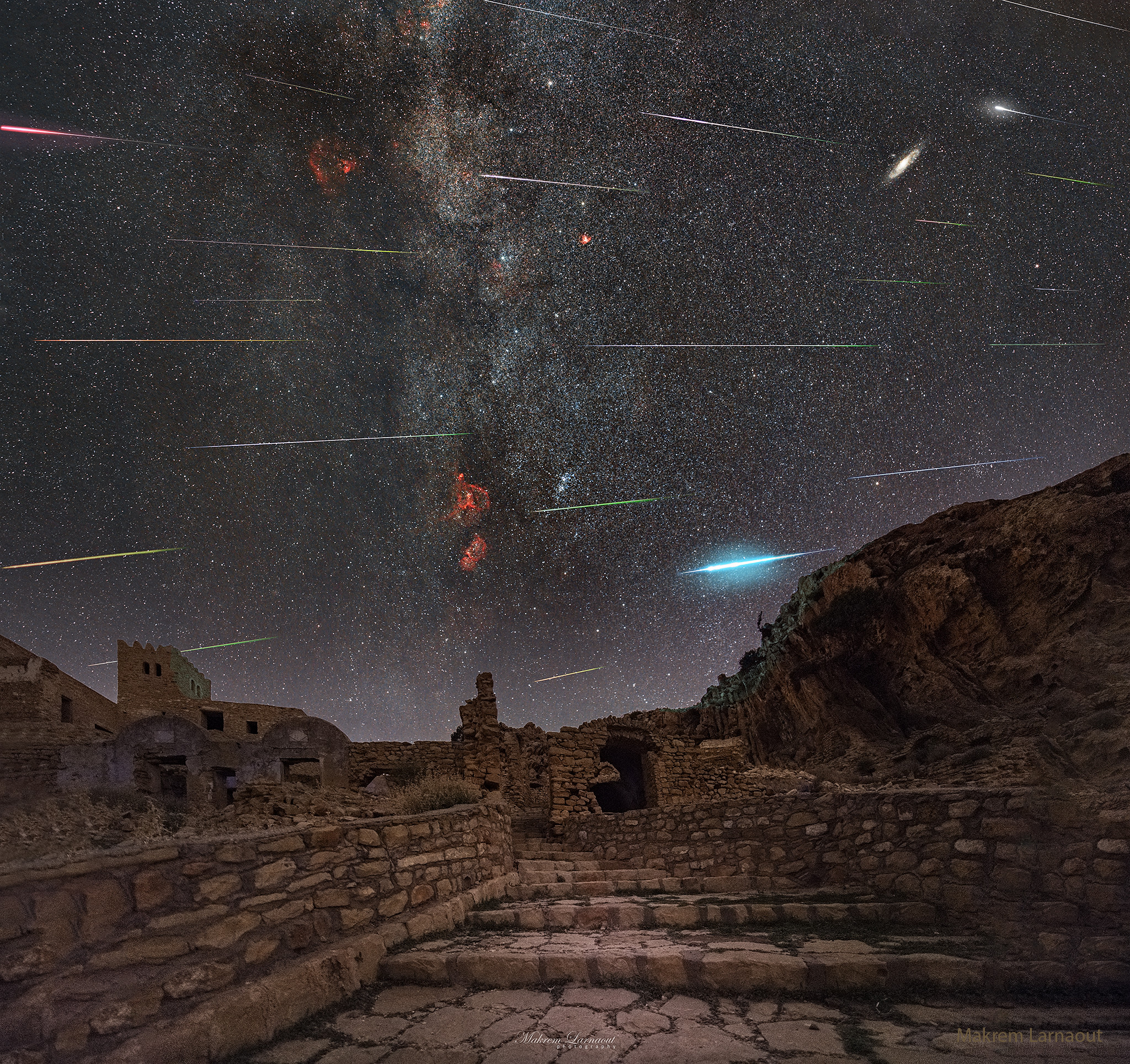
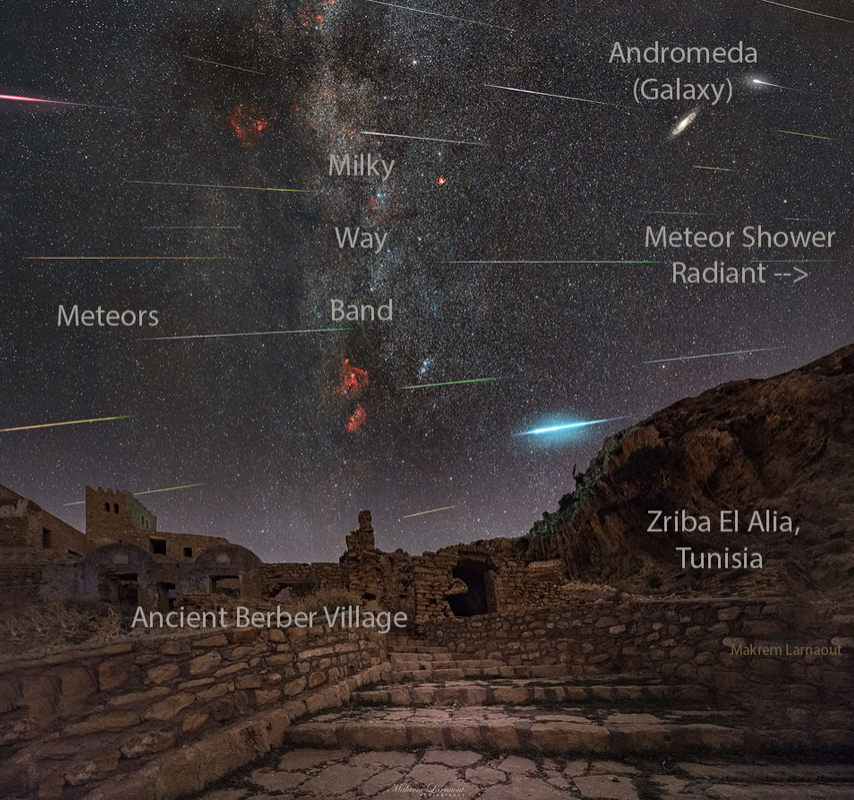
2022 August 16
A Meteor Wind over Tunisia
* Image Credit & Copyright: Makrem Larnaout
https://www.facebook.com/TheRoyalAstronomicalSociety
Explanation:
Does the Earth ever pass through a wind of meteors? Yes, and they are frequently visible as meteor showers. Almost all meteors are sand-sized debris that escaped from a Sun-orbiting comet or asteroid, debris that continues in an elongated orbit around the Sun. Circling the same Sun, our Earth can move through an orbiting debris stream, where it can appear, over time, as a meteor wind. The meteors that light up in Earth's atmosphere, however, are usually destroyed. Their streaks, though, can all be traced back to a single point on the sky called the radiant. The featured image composite was taken over two days in late July near the ancient Berber village Zriba El Alia in Tunisia, during the peak of the Southern Delta Aquariids meteor shower. The radiant is to the right of the image. A few days ago our Earth experienced the peak of a more famous meteor wind -- the Perseids.
https://apod.nasa.gov/apod/ap220816.html
#space #galaxy #perseids #astrophotography #photography #science #astronomy #nature #NASA
Alt...
2022 August 16
The featured image shows a composite image capturing many meteor streaks above the ruins of an ancient village.
A Meteor Wind over Tunisia
* Image Credit & Copyright: Makrem Larnaout
Explanation:
Does the Earth ever pass through a wind of meteors? Yes, and they are frequently visible as meteor showers. Almost all meteors are sand-sized debris that escaped from a Sun-orbiting comet or asteroid, debris that continues in an elongated orbit around the Sun. Circling the same Sun, our Earth can move through an orbiting debris stream, where it can appear, over time, as a meteor wind. The meteors that light up in Earth's atmosphere, however, are usually destroyed. Their streaks, though, can all be traced back to a single point on the sky called the radiant. The featured image composite was taken over two days in late July near the ancient Berber village Zriba El Alia in Tunisia, during the peak of the Southern Delta Aquariids meteor shower. The radiant is to the right of the image. A few days ago our Earth experienced the peak of a more famous meteor wind -- the Perseids.
Authors & editors: Robert Nemiroff (MTU) & Jerry Bonnell (UMCP)
NASA Official: Phillip Newman Specific rights apply.
NASA Web Privacy Policy and Important Notices
A service of: ASD at NASA / GSFC,
NASA Science Activation
& Michigan Tech. U.
Annotations for previous post.
#space #galaxy #perseids #astrophotography #photography #science #astronomy #nature #NASA
Alt...
Annotations for previous post.
2022 August 16
The featured image shows a composite image capturing many meteor streaks above the ruins of an ancient village.
A Meteor Wind over Tunisia
* Image Credit & Copyright: Makrem Larnaout
Explanation:
Does the Earth ever pass through a wind of meteors? Yes, and they are frequently visible as meteor showers. Almost all meteors are sand-sized debris that escaped from a Sun-orbiting comet or asteroid, debris that continues in an elongated orbit around the Sun. Circling the same Sun, our Earth can move through an orbiting debris stream, where it can appear, over time, as a meteor wind. The meteors that light up in Earth's atmosphere, however, are usually destroyed. Their streaks, though, can all be traced back to a single point on the sky called the radiant. The featured image composite was taken over two days in late July near the ancient Berber village Zriba El Alia in Tunisia, during the peak of the Southern Delta Aquariids meteor shower. The radiant is to the right of the image. A few days ago our Earth experienced the peak of a more famous meteor wind -- the Perseids.
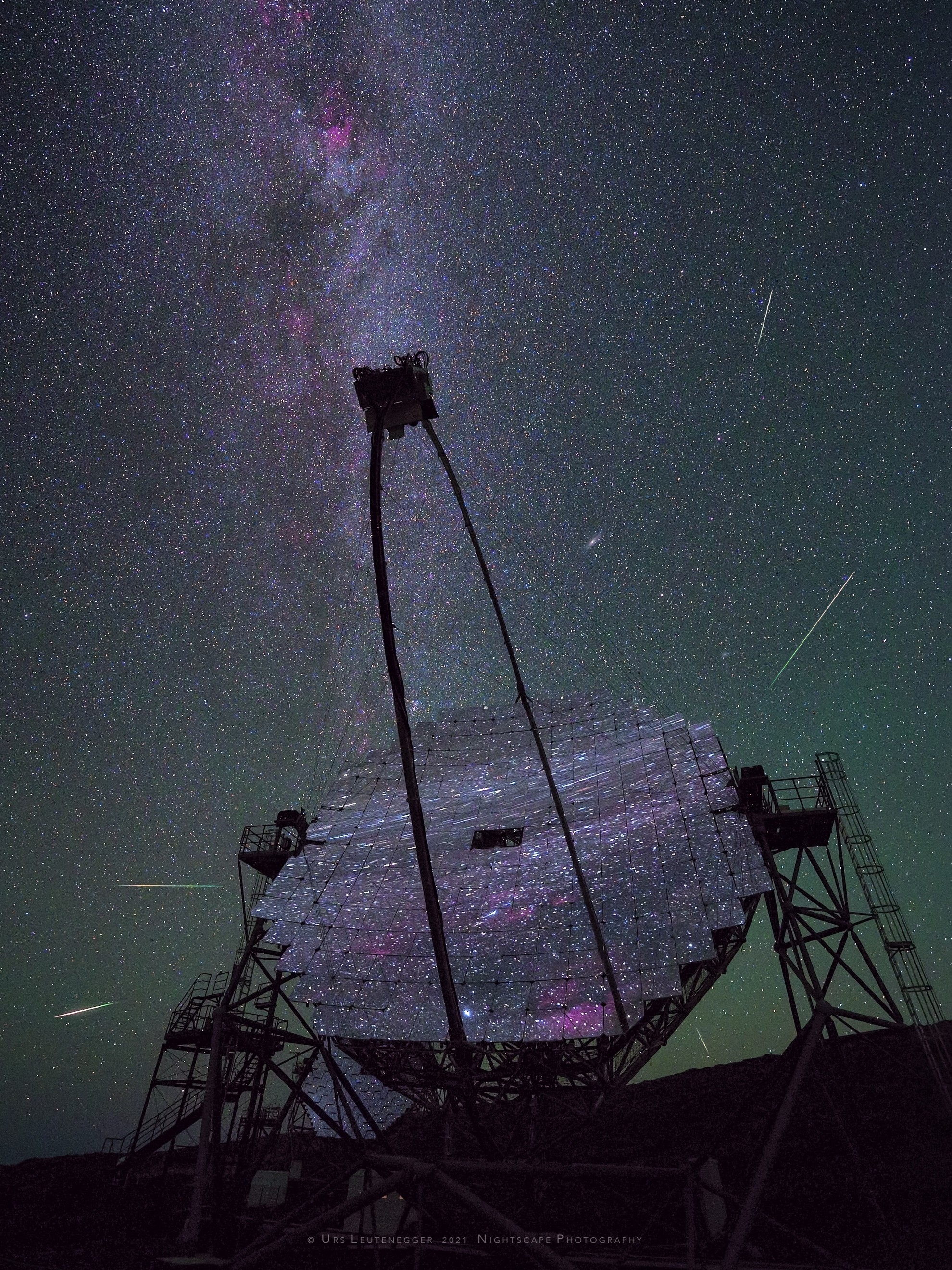
2022 August 11
Perseids and MAGIC
* Image Credit & Copyright: Urs Leutenegger
https://www.instagram.com/urs.leutenegger/?hl=en
Explanation:
On August 11, 2021 a multi-mirror, 17 meter-diameter MAGIC telescope reflected this starry night sky from the Roque de los Muchachos European Northern Observatory on the Canary Island of La Palma. MAGIC stands for Major Atmospheric Gamma Imaging Cherenkov. The telescopes can see the brief flashes of optical light produced in particle air showers as high-energy gamma rays impact the Earth's upper atmosphere. To the dark-adapted eye the mirror segments offer a tantalizing reflection of stars and nebulae along the plane of our Milky Way galaxy. But directly behind the segmented mirror telescope, low on the horizon, lies the constellation Perseus. And on that date the dramatic composite nightscape also captured meteors streaming from the radiant of the annual Perseid meteor shower. This year the Perseid shower activity will again peak around August 13 but perseid meteors will have to compete with the bright light of a Full Moon.
https://apod.nasa.gov/apod/ap220811.html
#space #galaxy #perseids #astrophotography #photography #science #astronomy #nature #NASA
Alt...
2022 August 11
Perseids and MAGIC
* Image Credit & Copyright: Urs Leutenegger
Explanation:
On August 11, 2021 a multi-mirror, 17 meter-diameter MAGIC telescope reflected this starry night sky from the Roque de los Muchachos European Northern Observatory on the Canary Island of La Palma. MAGIC stands for Major Atmospheric Gamma Imaging Cherenkov. The telescopes can see the brief flashes of optical light produced in particle air showers as high-energy gamma rays impact the Earth's upper atmosphere. To the dark-adapted eye the mirror segments offer a tantalizing reflection of stars and nebulae along the plane of our Milky Way galaxy. But directly behind the segmented mirror telescope, low on the horizon, lies the constellation Perseus. And on that date the dramatic composite nightscape also captured meteors streaming from the radiant of the annual Perseid meteor shower. This year the Perseid shower activity will again peak around August 13 but perseid meteors will have to compete with the bright light of a Full Moon.
Authors & editors: Robert Nemiroff (MTU) & Jerry Bonnell (UMCP)
NASA Official: Phillip Newman Specific rights apply.
NASA Web Privacy Policy and Important Notices
A service of: ASD at NASA / GSFC,
NASA Science Activation
& Michigan Tech. U.
2016 August 20
Gamma-rays and Comet Dust
* Image Credit & Copyright: Daniel López (El Cielo de Canarias)
https://www.elcielodecanarias.com/
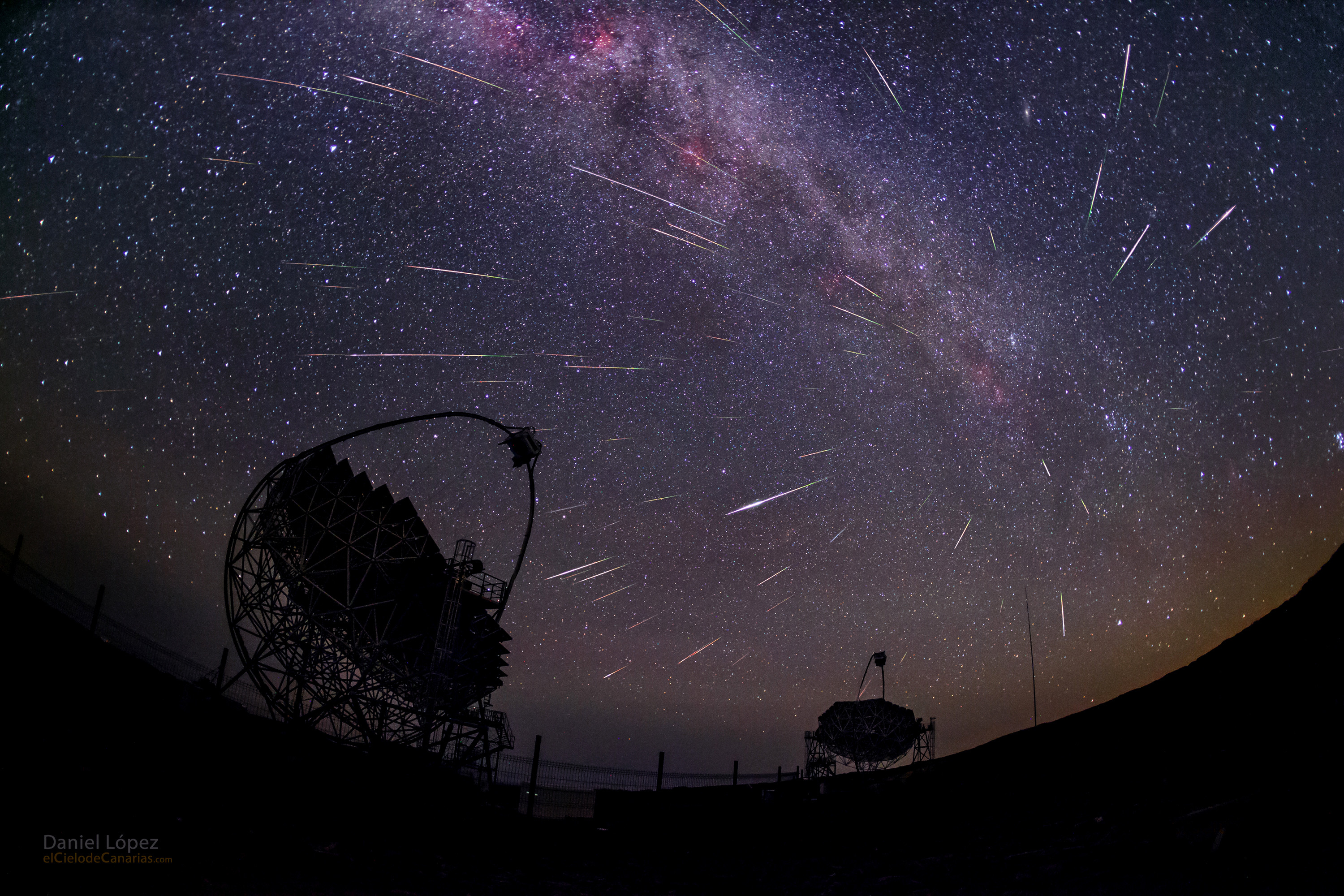
Explanation:
Gamma-rays and dust from periodic Comet Swift-Tuttle plowed through planet Earth's atmosphere on the night of August 11/12. Impacting at about 60 kilometers per second the grains of comet dust produced this year's remarkably active Perseid meteor shower. This composite wide-angle image of aligned shower meteors covers a 4.5 hour period on that Perseid night. In it the flashing meteor streaks can be traced back to the shower's origin on the sky. Alongside the Milky Way in the constellation Perseus, the radiant marks the direction along the perodic comet's orbit. Traveling at the speed of light, cosmic gamma-rays impacting Earth's atmosphere generated showers too, showers of high energy particles. Just as the meteor streaks point back to their origin, the even briefer flashes of light from the particles can be used to reconstruct the direction of the particle shower, to point back to the origin on the sky of the incoming gamma-ray. Unlike the meteors, the incredibly fast particle shower flashes can't be followed by eye. But both can be followed by the high speed cameras on the multi-mirrored dishes in the foreground. Of course, the dishes are MAGIC (Major Atmospheric Gamma Imaging Cherenkov) telescopes, an Earth-based gamma-ray observatory on the Canary Island of La Palma.
https://apod.nasa.gov/apod/ap160820.html
#space #galaxy #perseids #astrophotography #photography #science #astronomy #nature #NASA
Alt...
2016 August 20
Gamma-rays and Comet Dust
* Image Credit & Copyright: Daniel López (El Cielo de Canarias)
Explanation:
Gamma-rays and dust from periodic Comet Swift-Tuttle plowed through planet Earth's atmosphere on the night of August 11/12. Impacting at about 60 kilometers per second the grains of comet dust produced this year's remarkably active Perseid meteor shower. This composite wide-angle image of aligned shower meteors covers a 4.5 hour period on that Perseid night. In it the flashing meteor streaks can be traced back to the shower's origin on the sky. Alongside the Milky Way in the constellation Perseus, the radiant marks the direction along the perodic comet's orbit. Traveling at the speed of light, cosmic gamma-rays impacting Earth's atmosphere generated showers too, showers of high energy particles. Just as the meteor streaks point back to their origin, the even briefer flashes of light from the particles can be used to reconstruct the direction of the particle shower, to point back to the origin on the sky of the incoming gamma-ray. Unlike the meteors, the incredibly fast particle shower flashes can't be followed by eye. But both can be followed by the high speed cameras on the multi-mirrored dishes in the foreground. Of course, the dishes are MAGIC (Major Atmospheric Gamma Imaging Cherenkov) telescopes, an Earth-based gamma-ray observatory on the Canary Island of La Palma.
Authors & editors: Robert Nemiroff (MTU) & Jerry Bonnell (UMCP)
"To upload this video, I converted it and compressed it to a smaller file-size under #linux with the free software ffmpeg and the corresponding command:
'ffmpeg -i video_in.mkv -vcodec libx265 -crf 30 video_out.mp4'
Maybe you would like to post a corresponding video on a scientifically related topic, but it is perhaps too big? Then try ffmpeg.
Just for now let's enjoy this Perseids Night Timelaps together"
2021 September 28
Night of the Perseids
* Video Credit & Copyright: Vikas Chander & Dorje Angchuk
https://www.youtube.com/channel/UCa_53XIkP1fYEbHCWoMgIrg
* Music: Tea Time via PremiumBeat
https://www.premiumbeat.com/artist/yellow-tea
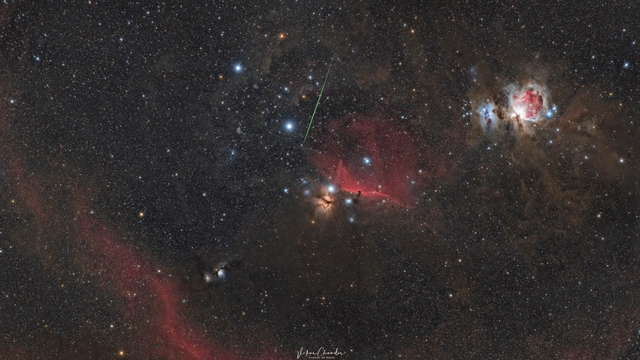
Explanation:
Have you ever experienced a meteor shower? To help capture the wonder, a video was taken during the peak of the recent Perseid meteor shower above the Indian Astronomical Observatory in Hanle, India, high up in the Himalayan mountains. Night descends as the video begins, with the central plane of our Milky Way Galaxy approaching from the left and Earth-orbiting satellites zipping by overhead. During the night, the flash of meteors that usually takes less than a second is artificially extended. The green glow of most meteors is typically caused by vaporizing nickel. As the video continues, Orion rises and meteors flare above the 2-meter Himalayan Chandra Telescope and the seven barrels of the High Energy Gamma Ray Telescope (Hagar). The 2 minute 30 second movie ends with the Sun rising, preceded by a false dawn of zodiacal light.
https://apod.nasa.gov/apod/ap210928.html
#space #galaxy #perseids #astrophotography #photography #science #astronomy #nature #NASA
Alt...
2021 September 28
Night of the Perseids
* Video Credit & Copyright: Vikas Chander & Dorje Angchuk
* Music: Tea Time via PremiumBeat
Explanation:
Have you ever experienced a meteor shower? To help capture the wonder, a video was taken during the peak of the recent Perseid meteor shower above the Indian Astronomical Observatory in Hanle, India, high up in the Himalayan mountains. Night descends as the video begins, with the central plane of our Milky Way Galaxy approaching from the left and Earth-orbiting satellites zipping by overhead. During the night, the flash of meteors that usually takes less than a second is artificially extended. The green glow of most meteors is typically caused by vaporizing nickel. As the video continues, Orion rises and meteors flare above the 2-meter Himalayan Chandra Telescope and the seven barrels of the High Energy Gamma Ray Telescope (Hagar). The 2 minute 30 second movie ends with the Sun rising, preceded by a false dawn of zodiacal light.
Authors & editors: Robert Nemiroff (MTU) & Jerry Bonnell (UMCP)
NASA Official: Phillip Newman Specific rights apply.
NASA Web Privacy Policy and Important Notices
A service of: ASD at NASA / GSFC
& Michigan Tech. U.
2023 August 23 (*)
The Meteor and the Galaxy
* Credit & Copyright: Jose Pedrero
https://www.instagram.com/josepedrero.jpart/
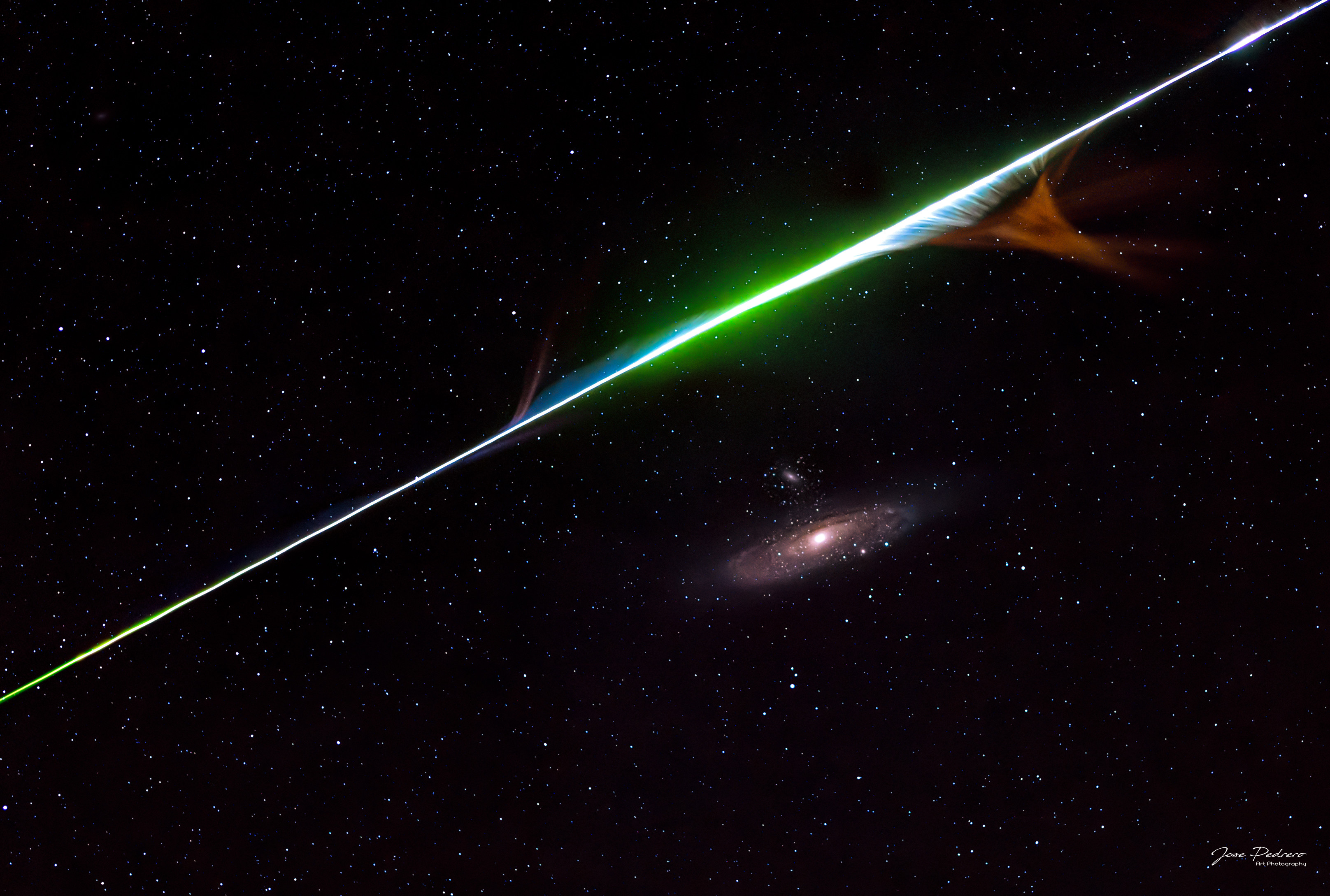
Explanation:
It came from outer space. It -- in this case a sand-sized bit of a comet nucleus -- was likely ejected many years ago from Sun-orbiting Comet Swift-Tuttle, but then continued to orbit the Sun alone. When the Earth crossed through this orbit, the piece of comet debris impacted the atmosphere of our fair planet and was seen as a meteor. This meteor deteriorated, causing gases to be emitted that glowed in colors emitted by its component elements. The featured image was taken last week(*) from Castilla La Mancha, Spain, during the peak night of the Perseids meteor shower. The picturesque meteor streak happened to appear in the only one of 50 frames that also included the Andromeda galaxy. Stars dot the frame, each much further away than the meteor. Compared to the stars, the Andromeda galaxy (M31) is, again, much further away.
https://apod.nasa.gov/apod/ap230823.html
#space #galaxy #perseids #astrophotography #photography #astroart #science #astronomy #nature #NASA
Alt...
2023 August 23
A color meteor streak is seen above the Andromeda spiral galaxy. Please see the explanation for more detailed information.
The Meteor and the Galaxy
* Credit & Copyright: Jose Pedrero
Explanation:
It came from outer space. It -- in this case a sand-sized bit of a comet nucleus -- was likely ejected many years ago from Sun-orbiting Comet Swift-Tuttle, but then continued to orbit the Sun alone. When the Earth crossed through this orbit, the piece of comet debris impacted the atmosphere of our fair planet and was seen as a meteor. This meteor deteriorated, causing gases to be emitted that glowed in colors emitted by its component elements. The featured image was taken last week from Castilla La Mancha, Spain, during the peak night of the Perseids meteor shower. The picturesque meteor streak happened to appear in the only one of 50 frames that also included the Andromeda galaxy. Stars dot the frame, each much further away than the meteor. Compared to the stars, the Andromeda galaxy (M31) is, again, much further away.
Authors & editors: Robert Nemiroff (MTU) & Jerry Bonnell (UMCP)
NASA Official: Phillip Newman Specific rights apply.
NASA Web Privacy Policy and Important Notices
A service of: ASD at NASA / GSFC,
NASA Science Activation
& Michigan Tech. U.
2018 August 17
Perseid Fireball and Persistent Train
* Image Credit & Copyright: Petr Horálek
http://www.astronom.cz/horalek/?page_id=20
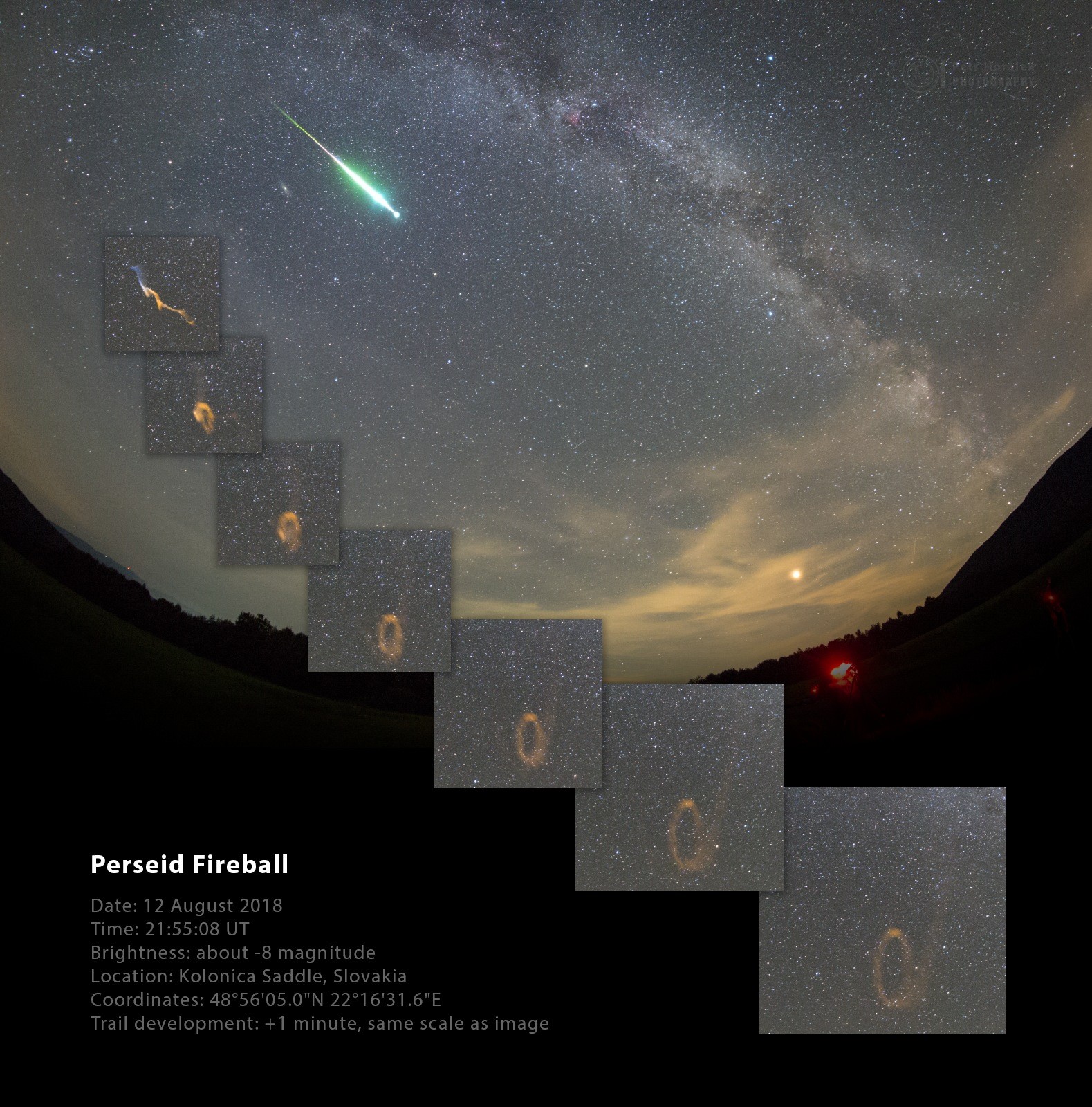
Explanation:
Before local midnight on August 12, this brilliant Perseid meteor flashed above the Poloniny Dark Sky Park, Slovakia, planet Earth. Streaking beside the summer Milky Way, its initial color is likely due to the shower meteor's characteristically high speed. Moving at about 60 kilometers per second, Perseid meteors can excite green emission from oxygen atoms while passing through the thin atmosphere at high altitudes. Also characteristic of bright meteors, this Perseid left a lingering visible trail known as a persistent train, wafting in the upper atmosphere. Its development is followed in the inset frames, exposures separated by one minute and shown at the scale of the original image. Compared to the brief flash of the meteor, the wraith-like trail really is persistent. After an hour faint remnants of this one could still be traced, expanding to over 80 degrees on the sky.
https://apod.nasa.gov/apod/ap180817.html
#space #galaxy #perseids #astrophotography #photography #science #astronomy #nature #NASA
Alt...
2018 August 17
Perseid Fireball and Persistent Train
* Image Credit & Copyright: Petr Horálek
Explanation:
Before local midnight on August 12, this brilliant Perseid meteor flashed above the Poloniny Dark Sky Park, Slovakia, planet Earth. Streaking beside the summer Milky Way, its initial color is likely due to the shower meteor's characteristically high speed. Moving at about 60 kilometers per second, Perseid meteors can excite green emission from oxygen atoms while passing through the thin atmosphere at high altitudes. Also characteristic of bright meteors, this Perseid left a lingering visible trail known as a persistent train, wafting in the upper atmosphere. Its development is followed in the inset frames, exposures separated by one minute and shown at the scale of the original image. Compared to the brief flash of the meteor, the wraith-like trail really is persistent. After an hour faint remnants of this one could still be traced, expanding to over 80 degrees on the sky.
Authors & editors: Robert Nemiroff (MTU) & Jerry Bonnell (UMCP)
NASA Official: Phillip Newman Specific rights apply.
NASA Web Privacy Policy and Important Notices
A service of: ASD at NASA / GSFC
& Michigan Tech. U.
Radiant (meteor shower)
From Wikipedia, the free encyclopedia
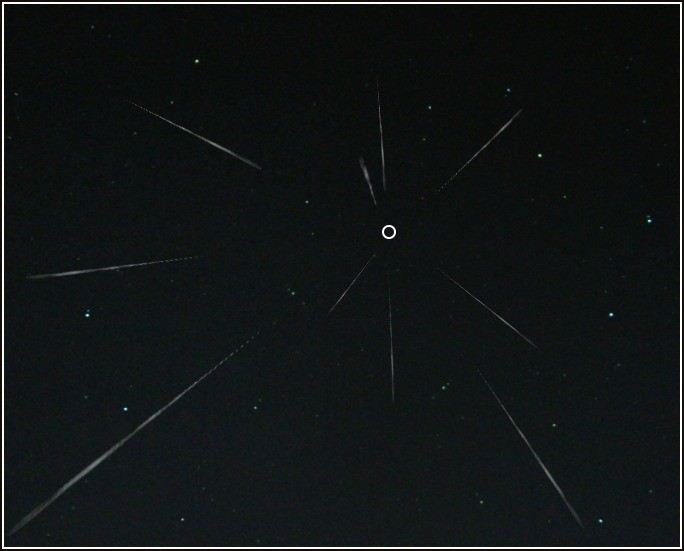
The radiant or apparent radiant of a meteor shower is the celestial point in the sky from which (from the point of view of a terrestrial observer) the paths of meteors appear to originate. The Perseids, for example, are meteors which appear to come from a point within the constellation of Perseus.
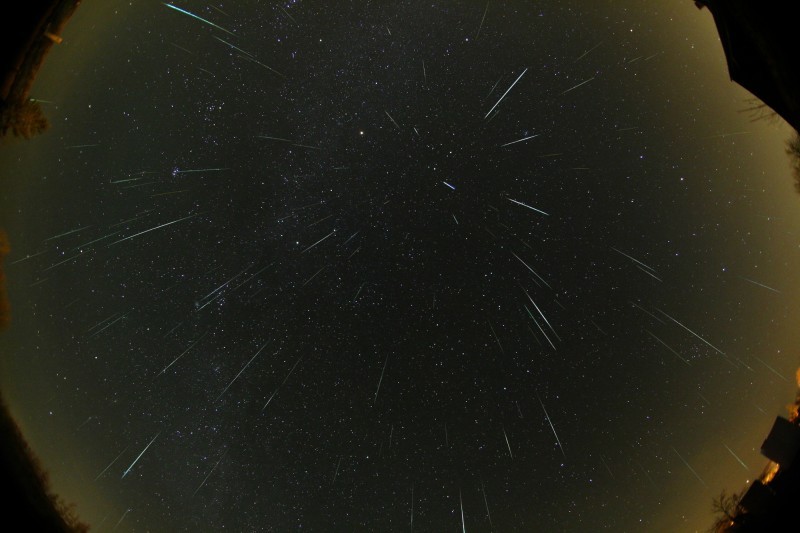
Meteor paths appear at random locations in the sky, but the apparent paths of two or more meteors from the same shower will diverge from the radiant. The radiant is the vanishing point of the meteor paths, which are parallel lines in three-dimensional space, as seen from the perspective of the observer, who views a two-dimensional projection against the sky. The geometric effect is identical to crepuscular rays, where parallel sunbeams appear to diverge.
A meteor that does not point back to the known radiant for a given shower is known as a sporadic and is not considered part of that shower.
Shower meteors may appear a short time before the radiant has risen in the observer's eastern sky. The radiant in such cases is above the horizon at the meteor's altitude.
During the active period of most showers, the radiant moves nearly one degree eastwards, parallel to the ecliptic, against the stellar background each day. This is called the radiant's diurnal drift, and is to a large degree due to the Earth's own orbital motion around the Sun, which also proceeds at nearly one degree a day. As the radiant is determined by the superposition of the motions of Earth and meteoroid, the changing orbital direction of the Earth towards the east causes the radiant to move to the east as well.
[...]
https://en.wikipedia.org/wiki/Radiant_(meteor_shower)
#space #galaxy #perseids #astrophotography #photography #science #astronomy #nature #NASA
Alt...
Image of a meteor shower, with the radiant marked by 'ᴏ'
CREDIT
Contributors of Wikimedia
Alt...
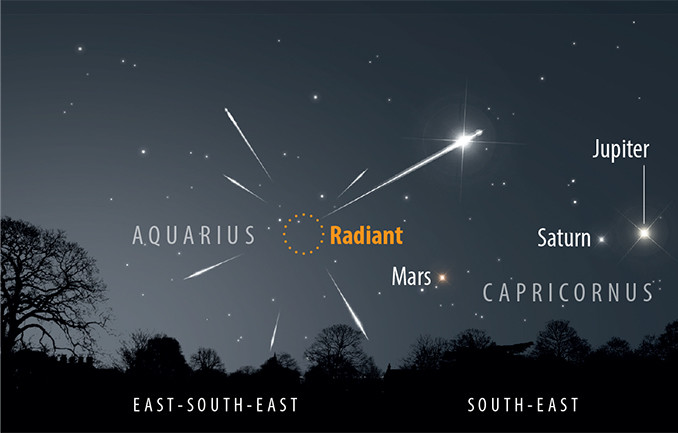
Eta Aquarid meteor shower reaches peak
5 May 2020 Mark Armstrong
Although the short-period comet 1P/Halley, the most famous comet of all, will not return to the inner Solar System until 2061, if you look out for some shooting stars in the pre-dawn sky courtesy of the Eta Aquarid meteor shower, you might see some of the debris Halley has left behind over the eons it has orbited the Sun.
The radiant of the Eta Aquarid meteor shower.
Graphic by Greg Smye-Rumsby.
From Wikipedia, the free encyclopedia
Radiant (meteor shower)
[...]
Meteor showers are mostly caused by the trails of dust and debris left in the wake of a comet. This dust continues to move along the comet's wake, and when the Earth moves through such debris, a meteor shower results. Because all of the debris is moving in roughly the same direction, the meteors which strike the atmosphere all "point" back to the direction of the comet's path.
As an exception, the Geminids are a shower caused by the object 3200 Phaethon, which is thought to be a Palladian asteroid.
The radiant is an important factor in observation. If the radiant point is at or below the horizon, then few if any meteors will be observed. This is because the atmosphere shields the Earth from most of the debris, and only those meteors which happen to be travelling exactly (or very near) tangential to the Earth's surface will be viewable.
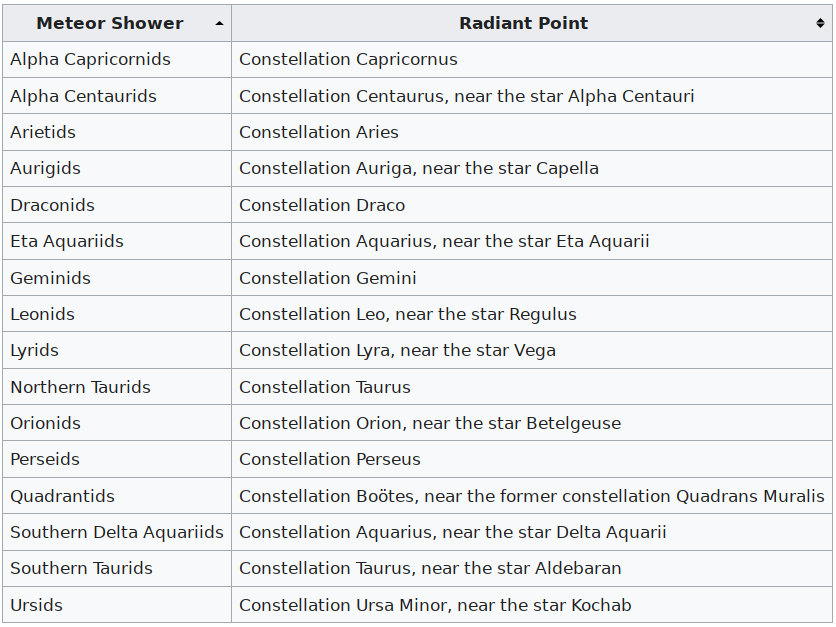
Here are the radiant points of some major meteor showers of the year.
CREDIT
Contributors to Wikimedia projects
https://en.wikipedia.org/wiki/Radiant_(meteor_shower)
#space #galaxy #perseids #astrophotography #photography #science #astronomy #nature #NASA
Alt...
Here are the radiant points of some major meteor showers of the year.
Alt...
Geminid meteors, clearly showing the position of the radiant
CREDIT
Berkó Ernő
2023 August 9
Meteor Shower: Perseids from Perseus
* Credit & Copyright: Petr Horálek / Institute of Physics in Opava
https://www.petrhoralek.com/#about-1
https://www.slu.cz/phys/en/
Explanation:
This is a good week to see meteors. Comet dust will rain down on planet Earth, streaking through dark skies during peak nights of the annual Perseid Meteor Shower. The featured composite image was taken during the 2018 Perseids from the Poloniny Dark Sky Park in Slovakia. The dome of the observatory in the foreground is on the grounds of Kolonica Observatory. Although the comet dust particles travel parallel to each other, the resulting shower meteors clearly seem to radiate from a single point on the sky in the eponymous constellation Perseus. The radiant effect is due to perspective, as the parallel tracks appear to converge at a distance, like train tracks. The Perseid Meteor Shower is expected to reach its highest peak on Saturday after midnight. Since a crescent Moon will rise only very late that night, cloudless skies will be darker than usual, making a high number of faint meteors potentially visible this year.
https://apod.nasa.gov/apod/ap230809.html
#space #galaxy #perseids #astrophotography #photography #science #astronomy #nature #NASA
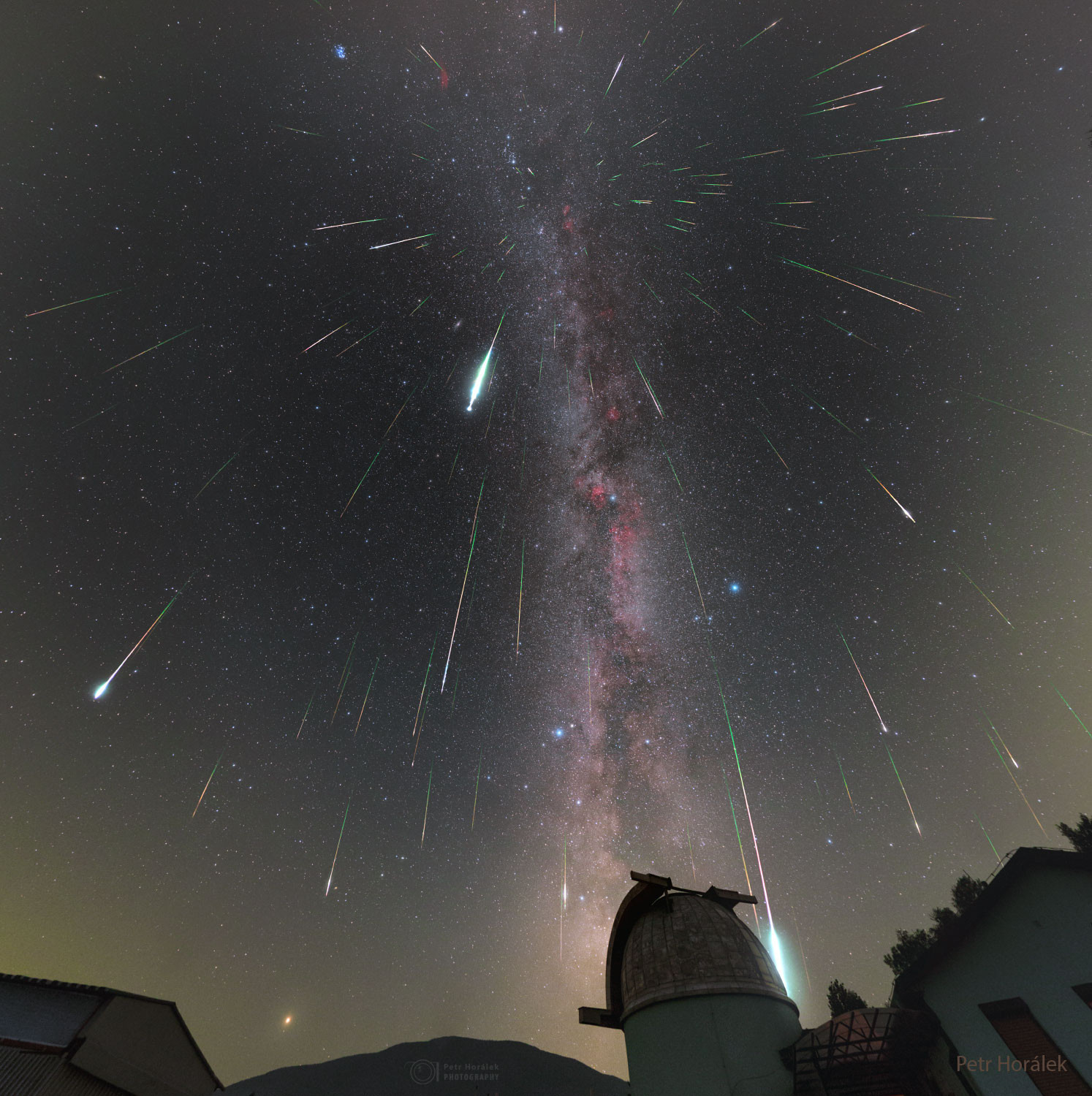
Alt...
2023 August 9
Mulitple streaks cover a night sky filled with stars. An observtory dome is visible in the foreground.
Meteor Shower: Perseids from Perseus
* Credit & Copyright: Petr Horálek / Institute of Physics in Opava
Explanation:
This is a good week to see meteors. Comet dust will rain down on planet Earth, streaking through dark skies during peak nights of the annual Perseid Meteor Shower. The featured composite image was taken during the 2018 Perseids from the Poloniny Dark Sky Park in Slovakia. The dome of the observatory in the foreground is on the grounds of Kolonica Observatory. Although the comet dust particles travel parallel to each other, the resulting shower meteors clearly seem to radiate from a single point on the sky in the eponymous constellation Perseus. The radiant effect is due to perspective, as the parallel tracks appear to converge at a distance, like train tracks. The Perseid Meteor Shower is expected to reach its highest peak on Saturday after midnight. Since a crescent Moon will rise only very late that night, cloudless skies will be darker than usual, making a high number of faint meteors potentially visible this year.
Authors & editors: Robert Nemiroff (MTU) & Jerry Bonnell (UMCP)
NASA Official: Phillip Newman Specific rights apply.
NASA Web Privacy Policy and Important Notices
A service of: ASD at NASA / GSFC,
NASA Science Activation
& Michigan Tech. U.
2025 August 2
Fireflies, Meteors, and Milky Way
* Image Credit & Copyright: Daniel Korona
Explanation:
Taken on July 29 and July 30, a registered and stacked series of exposures creates this dreamlike view of a northern summer night. Multiple firefly flashes streak across the foreground as the luminous Milky Way arcs above the horizon in the Sierra de Órganos national park of central Mexico, The collection of bright streaks aligned across the sky toward the upper left in the timelapse image are Delta Aquariid meteors. Currently active, the annual Delta Aquarid meteor shower shares August nights though, overlapping with the better-known Perseid meteor shower. This year that makes post-midnight, mostly moonless skies in early August very popular with late night skygazers. How can you tell a Delta Aquariid from a Perseid meteor? The streaks of Perseid meteors can be traced back to an apparent radiant in the constellation Perseus. Delta Aquariids appear to emerge from the more southerly constellation Aquarius, beyond the top left of this frame. Of course, the bioluminescent flashes of fireflies are common too on these northern summer nights. But how can you tell a firefly from a meteor? Just try to catch one.
https://apod.nasa.gov/apod/ap250802.html
#space #galaxy #perseids #astrophotography #photography #science #astronomy #nature #NASA
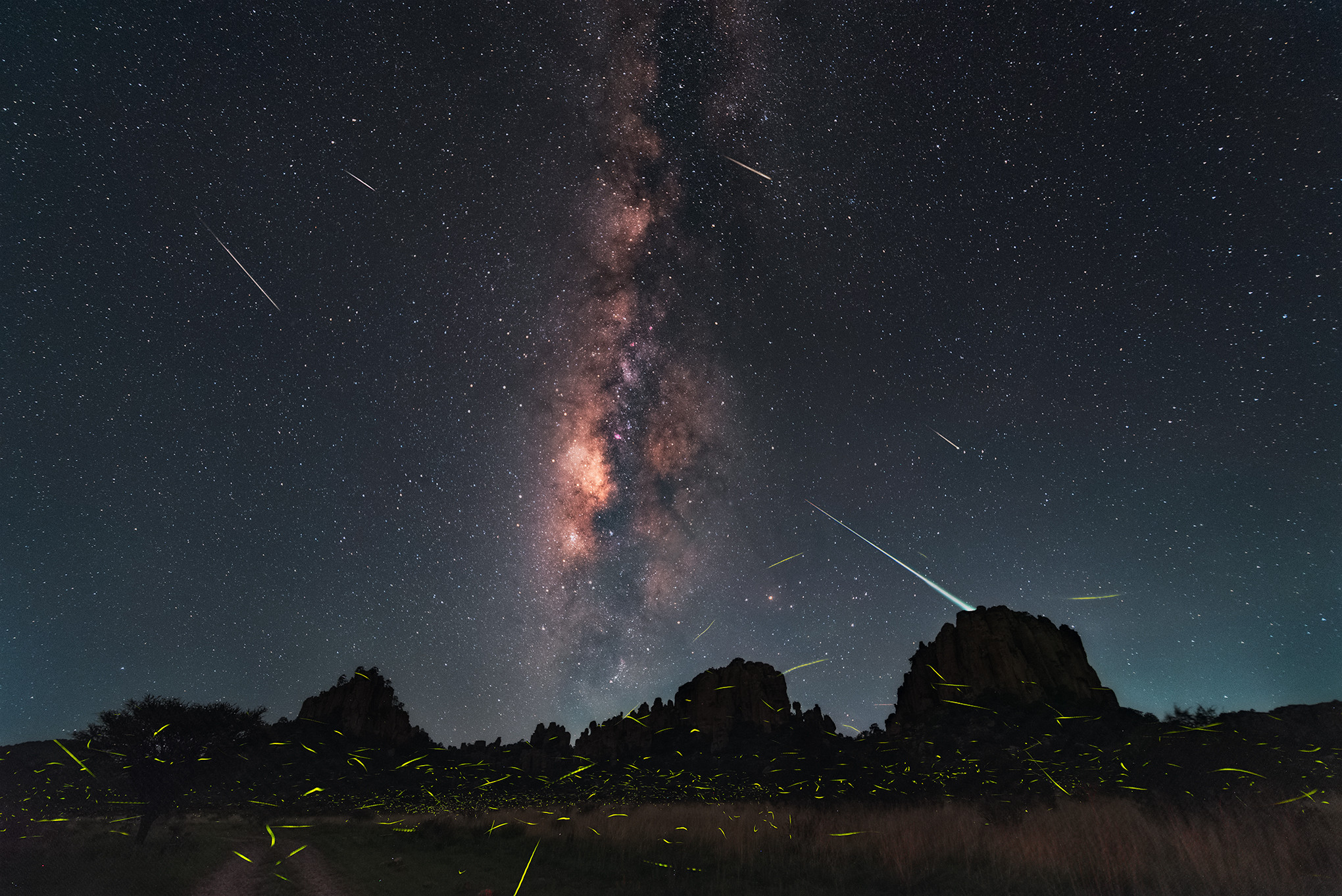
Alt...
2025 August 2
Fireflies, Meteors, and Milky Way
* Image Credit & Copyright: Daniel Korona
Explanation:
Taken on July 29 and July 30, a registered and stacked series of exposures creates this dreamlike view of a northern summer night. Multiple firefly flashes streak across the foreground as the luminous Milky Way arcs above the horizon in the Sierra de Órganos national park of central Mexico, The collection of bright streaks aligned across the sky toward the upper left in the timelapse image are Delta Aquariid meteors. Currently active, the annual Delta Aquarid meteor shower shares August nights though, overlapping with the better-known Perseid meteor shower. This year that makes post-midnight, mostly moonless skies in early August very popular with late night skygazers. How can you tell a Delta Aquariid from a Perseid meteor? The streaks of Perseid meteors can be traced back to an apparent radiant in the constellation Perseus. Delta Aquariids appear to emerge from the more southerly constellation Aquarius, beyond the top left of this frame. Of course, the bioluminescent flashes of fireflies are common too on these northern summer nights. But how can you tell a firefly from a meteor? Just try to catch one.
Authors & editors: Robert Nemiroff (MTU) & Jerry Bonnell (UMCP)
NASA Official: Amber Straughn Specific rights apply.
NASA Web Privacy, Accessibility, Notices;
A service of: ASD at NASA / GSFC,
NASA Science Activation
& Michigan Tech. U.
2025 August 3
Milky Way and Exploding Meteor
* Image Credit & Copyright: Andre van der Hoeven
https://www.flickr.com/photos/avdhoeven/
Explanation:
In about a week the Perseid Meteor Shower will reach its maximum. Grains of icy rock will streak across the sky as they evaporate during entry into Earth's atmosphere. These grains were shed from Comet Swift-Tuttle. The Perseids result from the annual crossing of the Earth through Comet Swift-Tuttle's orbit, and are typically the most active meteor shower of the year. Although it is hard to predict the level of activity in any meteor shower, in a clear dark sky an observer might see a meteor a minute. This year's Perseids peak just a few days after full moon, and so some faint meteors will be lost to the lunar skyglow. Meteor showers in general are best seen from a relaxing position, away from lights. Featured here is a meteor caught exploding during the 2015 Perseids above Austria next to the central band of our Milky Way Galaxy.
https://science.nasa.gov/solar-system/meteors-meteorites/perseids/
https://www.amsmeteors.org/meteor-showers/meteor-shower-calendar/
https://www.nasa.gov/general/what-is-earths-atmosphere/
https://apod.nasa.gov/apod/ap960219.html
https://en.wikipedia.org/wiki/Meteoroid#Meteors
https://www.space.com/32868-perseid-meteor-shower-guide.html
https://apod.nasa.gov/apod/ap250803.html
#space #galaxy #perseids #astrophotography #photography #science #astronomy #nature #NASA
2025 August 12
Perseids from Perseus
* Image Credit & Copyright: Marcin Rosadziński
https://astrodream.pl/o-mnie/
Explanation:
Where are all of these meteors coming from? In terms of direction on the sky, the pointed answer is the constellation of Perseus. That is why the meteor shower that peaks tonight is known as the Perseids -- the meteors all appear to come from a radiant toward Perseus. In terms of parent body, though, the sand-sized debris that makes up the Perseids meteors come from Comet Swift-Tuttle. The comet follows a well-defined orbit around our Sun, and the part of the orbit that approaches Earth is superposed in front of Perseus. Therefore, when Earth crosses this orbit, the radiant point of falling debris appears in Perseus. Featured here, a composite image taken over six nights and containing over 100 meteors from 2024 August Perseids meteor shower shows many bright meteors that streaked over the Bieszczady Mountains in Poland. This year's Perseids, usually one of the best meteor showers of the year, will compete with a bright moon that will rise, for many locations, soon after sunset.
https://astrodream.pl/galeria/
https://www.youtube.com/watch?v=CwrvN0Q9_Sg
https://apod.nasa.gov/apod/ap960219.html
https://en.wikipedia.org/wiki/Perseids
https://en.wikipedia.org/wiki/Meteoroid#Meteor
https://en.wikipedia.org/wiki/Radiant_(meteor_shower)
https://www.timeanddate.com/news/astronomy/perseid-meteor-shower-2025
https://www.amsmeteors.org/meteor-showers/2020-meteor-shower-list/
https://apod.nasa.gov/apod/ap180808.html
https://apod.nasa.gov/apod/ap250812.html
#space #galaxy #perseids #astrophotography #photography #science #astronomy #nature #NASA
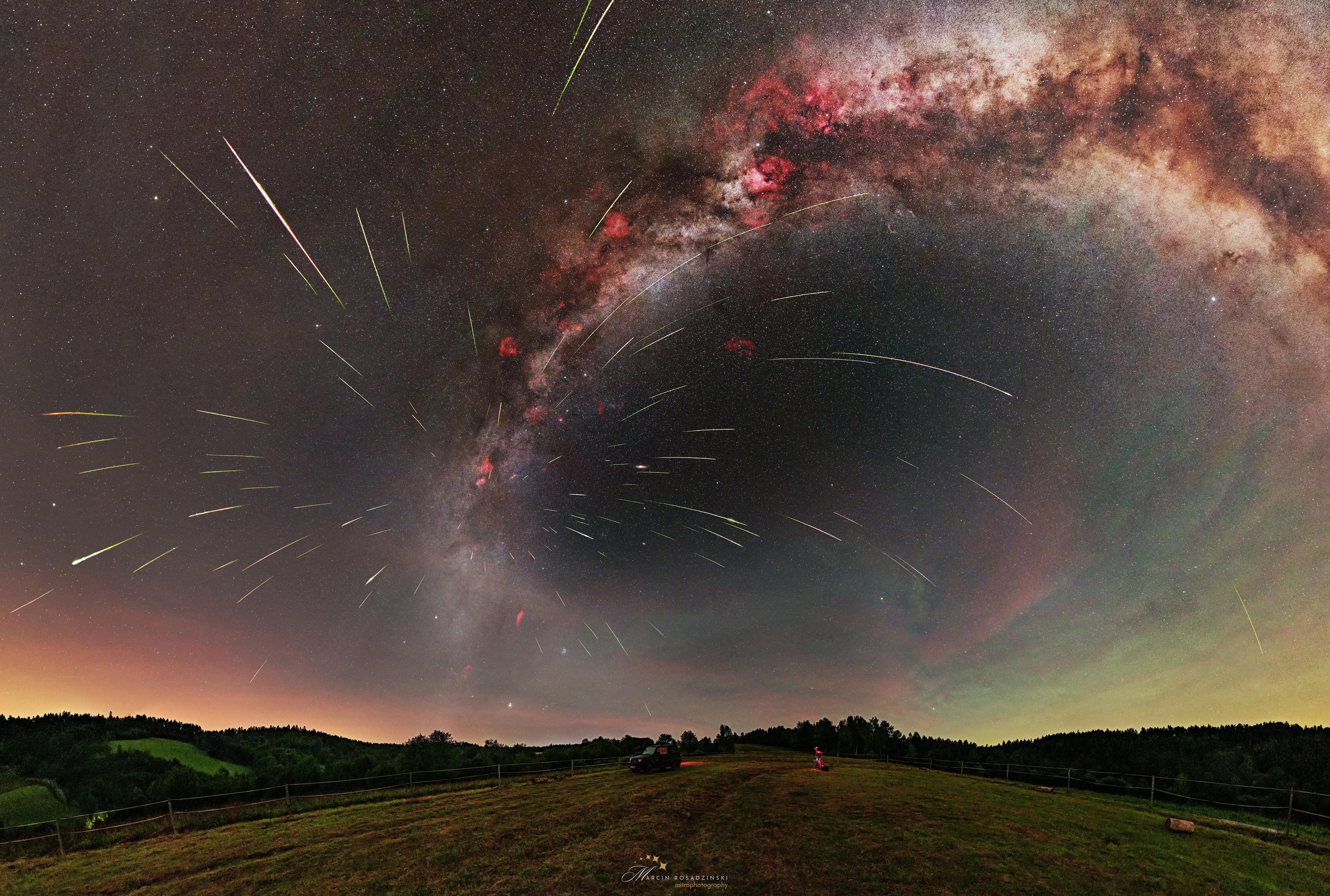
Alt...
2025 August 12
A starfield is shown above a grassy field with hills on the horizon. The band of our Milky Way Galaxy arches across toward the right. Many streaks appear emanating out from a place on the Milky Way just above the horizon.
Perseids from Perseus
* Image Credit & Copyright: Marcin Rosadziński
Explanation:
Where are all of these meteors coming from? In terms of direction on the sky, the pointed answer is the constellation of Perseus. That is why the meteor shower that peaks tonight is known as the Perseids -- the meteors all appear to come from a radiant toward Perseus. In terms of parent body, though, the sand-sized debris that makes up the Perseids meteors come from Comet Swift-Tuttle. The comet follows a well-defined orbit around our Sun, and the part of the orbit that approaches Earth is superposed in front of Perseus. Therefore, when Earth crosses this orbit, the radiant point of falling debris appears in Perseus. Featured here, a composite image taken over six nights and containing over 100 meteors from 2024 August Perseids meteor shower shows many bright meteors that streaked over the Bieszczady Mountains in Poland. This year's Perseids, usually one of the best meteor showers of the year, will compete with a bright moon that will rise, for many locations, soon after sunset.
Authors & editors: Robert Nemiroff (MTU) & Jerry Bonnell (UMCP)
NASA Official: Amber Straughn Specific rights apply.
Annotations for previous post.
https://apod.nasa.gov/apod/ap250812.html
#space #galaxy #perseids #astrophotography #photography #science #astronomy #nature #NASA
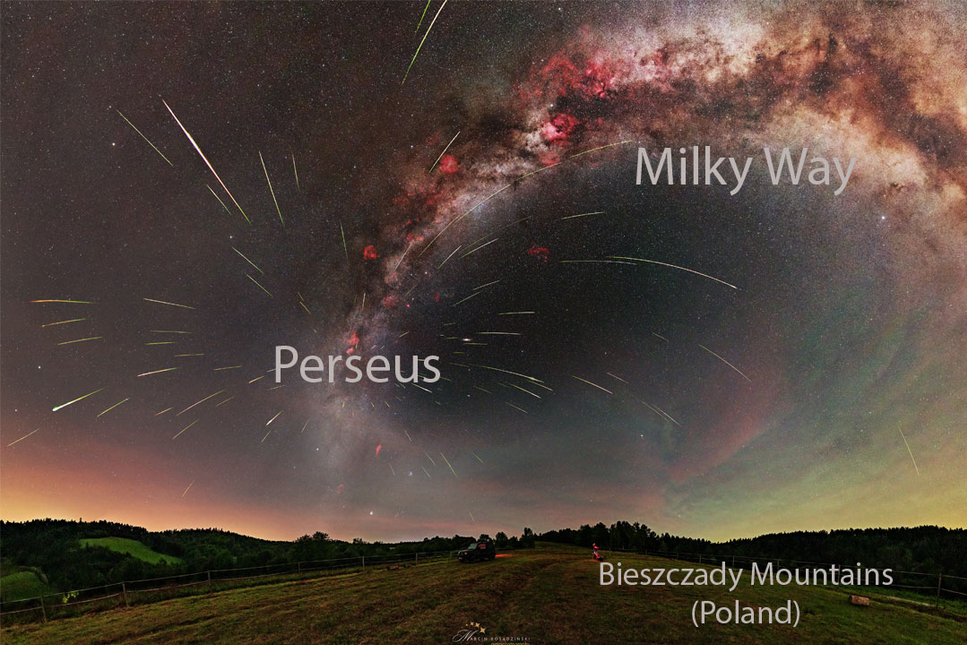
Alt...
Annotations for previous post.
Meteor Moment: Viewing Tips.
Rhiannon Blaauw, of NASA's Meteoroid Environment Office -- located at NASA's Marshall Space Flight Center in Huntsville, Alabama -- shares some tips and strategies to best view a meteor shower.
CREDIT
NASA's Marshall Space Flight Center - Huntsville, Alabama
#space #galaxy #perseids #astrophotography #photography #science #astronomy #nature #NASA

Alt...
Meteor Moment: Viewing Tips.
Rhiannon Blaauw, of NASA's Meteoroid Environment Office -- located at NASA's Marshall Space Flight Center in Huntsville, Alabama -- shares some tips and strategies to best view a meteor shower.
CREDIT
NASA's Marshall Space Flight Center - Huntsville, Alabama
2007 August 12
Raining Perseids
* Credit & Copyright: Fred Bruenjes
http://www.moonglow.net/ccd/index.html
Explanation:
Tonight is a good night to see meteors. Comet dust will rain down on planet Earth, streaking through dark skies in the annual Perseid meteor shower. While enjoying the anticipated space weather, astronomer Fred Bruenjes recorded a series of many 30 second long exposures spanning about six hours on the night of 2004 August 11/12 using a wide angle lens. Combining those frames which captured meteor flashes, he produced this dramatic view of the Perseids of summer. Although the comet dust particles are traveling parallel to each other, the resulting shower meteors clearly seem to radiate from a single point on the sky in the eponymous constellation Perseus. The radiant effect is due to perspective, as the parallel tracks appear to converge at a distance. Bruenjes notes that there are 51 Perseid meteors in the composite image, including one seen nearly head-on. This year, the Perseids Meteor Shower is expected to peak after midnight tonight, in the moonless early morning hours of August 12.
https://apod.nasa.gov/apod/ap070812.html
#space #galaxy #perseids #astrophotography #photography #science #astronomy #nature #NASA
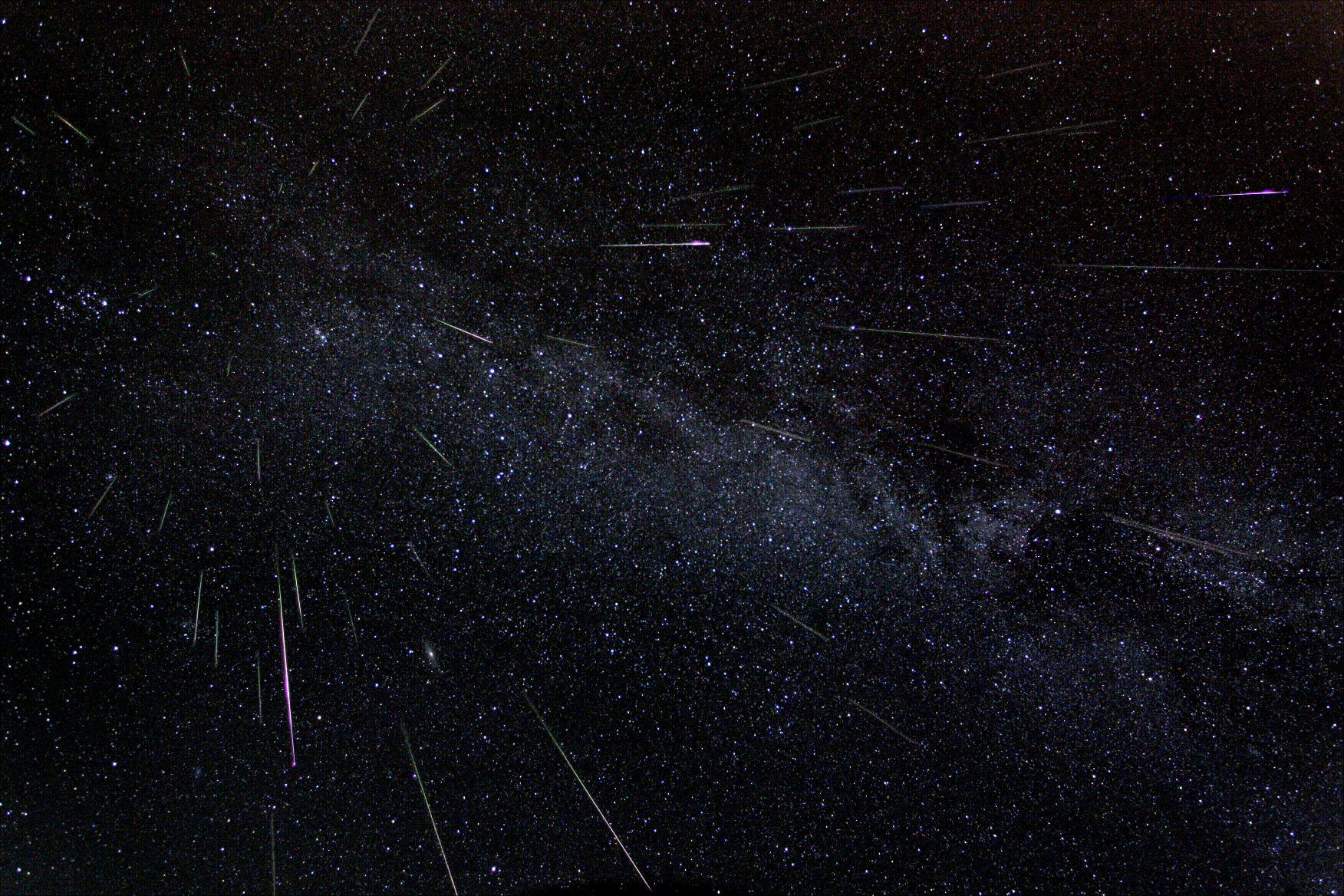
Alt...
2007 August 12
Raining Perseids
* Credit & Copyright: Fred Bruenjes
Explanation:
Tonight is a good night to see meteors. Comet dust will rain down on planet Earth, streaking through dark skies in the annual Perseid meteor shower. While enjoying the anticipated space weather, astronomer Fred Bruenjes recorded a series of many 30 second long exposures spanning about six hours on the night of 2004 August 11/12 using a wide angle lens. Combining those frames which captured meteor flashes, he produced this dramatic view of the Perseids of summer. Although the comet dust particles are traveling parallel to each other, the resulting shower meteors clearly seem to radiate from a single point on the sky in the eponymous constellation Perseus. The radiant effect is due to perspective, as the parallel tracks appear to converge at a distance. Bruenjes notes that there are 51 Perseid meteors in the composite image, including one seen nearly head-on. This year, the Perseids Meteor Shower is expected to peak after midnight tonight, in the moonless early morning hours of August 12.
Authors & editors: Robert Nemiroff (MTU) & Jerry Bonnell (USRA)
NASA Official: Phillip Newman Specific rights apply.
NASA Web Privacy Policy and Important Notices
A service of: ASD at NASA / GSFC
& Michigan Tech. U.
The 2025 Perseid meteor shower peaks on the night between August 12 and August 13. The Perseids usually put on a good show and this year may produce 50 to 75 meteors per hour at a dark site.
Like most meteor showers, the Lyrids are caused by the debris of a comet or asteroid that once crossed Earth's path. In this case, the shower is caused by debris from the comet Swift-Tuttle. Sightings of comet Swift-Tuttle have been recorded throughout history, with the comet’s orbit bringing it near Earth every 133 or so years. It last entered the inner Solar System in 1992. The debris from this comet is known to cause fireballs often.
The Perseid radiant is somewhat north on the sky’s dome, making it more visible from the Northern Hemisphere, but may also be somewhat visible from the Southern Hemisphere. Meteors will appear to come from an area near the constellation Perseus. Meteors will streak out from this area of the sky in all directions.
The best way to watch a meteor shower is from a dark sky site, so it helps to get away from city lights as much as you can. Skywatchers should go to the darkest place they can, let their eyes adjust, and look overhead — but avoid staring directly at the Moon.
Meteors are also known as shooting stars, but they aren't actually stars at all. Meteors are streaks of light in the sky caused by dust and small rocks burning up as they hit Earth's atmosphere at very high speeds — tens of kilometers per second.
These small particles create bright streaks of light you can see from the ground at night. In general, the bigger the piece of space dust, the brighter the meteor. If any pieces of the streaking rock survive to make it to the ground, they're called meteorites.
CREDITS:
The Planetary Society
#space #galaxy #perseids #astrophotography #photography #science #astronomy #nature #NASA
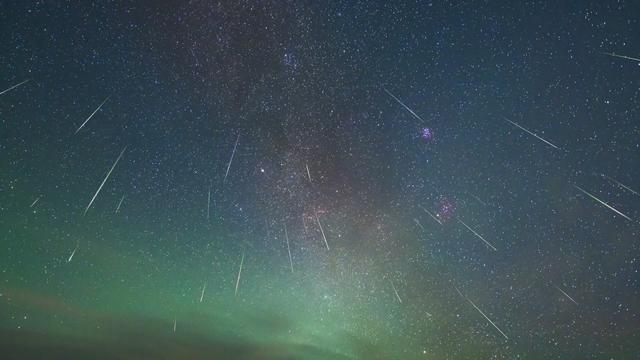
Alt...
Video about meteor showers
Meteors (also called shooting stars) are bright streaks of light in the sky caused by meteoroids — rocks as small as grains of dust and as large as small asteroids — burning up in the Earth’s atmosphere. As the Earth moves along its path in the Solar System it passes through various groups of meteoroids, causing meteor showers. Showers like the Perseids, Lyrids, Geminids, Leonids, and others happen at the same time each year, creating predictable spectacles in the night sky.
Space is full of dust, so on a typical night from a dark location, you might see up to 10 meteors per hour — no shower required! But during a meteor shower, especially on its peak night, you can probably expect to see a higher number of meteors.
2008 November 25
Fireball Over Edmonton
* Credit & Copyright Global Television Edmonton, YouTube
https://www.globaltv.com/
Explanation:
What if you're driving down the street and an object from space shoots across the sky right in front of you? Such was the case last week for many people in south central Canada. Specifically, an extremely bright fireball, presumably a desk-sized meteor from deep space, flashed across the sky just after sunset on 2008 November 20. The bright fireball was recorded on many images and movies, including the spectacular video shown above that was captured by a dashboard camera of a police cruiser in Edmonton, Alberta, Canada. Because at least two streaks appear to be visible, the falling object likely broke up into pieces as it fell deep into Earth's atmosphere. By triangulating fireball images from several simultaneously recorded sources, astronomers hope to find an approximate orbit from whence the object came, as well as the likely place(s) on Earth where large pieces would have impacted, were they to have survived entry. In the best case scenario, pieces would be recovered from a known deep space comet or asteroid, giving humanity an unprecedented look at an ancient object that likely holds clues to the early years of our Earth and the Solar System.
https://apod.nasa.gov/apod/ap081125.html
#space #galaxy #perseids #astrophotography #photography #science #astronomy #nature #NASA
Earthgrazer: The Great Daylight Fireball of 1972
* Credit & Copyright: James M. Baker
Explanation:
What is that streaking across the sky? A bright earthgrazing meteor. In 1972, an unusually bright meteor from space was witnessed bouncing off Earth's atmosphere, much like a skipping stone can bounce off of a calm lake. The impressive event lasted several seconds, was visible in daylight, and reportedly visible all the way from Utah, USA to Alberta, Canada. Pictured above, the fireball was photographed streaking above Teton mountains behind Jackson Lake, Wyoming, USA. The Great Daylight Fireball of 1972 was possibly the size of a small truck, and would likely have created an impressive airburst were it to have struck Earth more directly. Earthgrazing meteors are rare but are more commonly seen when the radiant of a meteor shower is just rising or setting. At that time, meteors closer to the Earth than earthgrazers would more usually strike the Earth near the horizon, while meteors further than earthgrazers would miss the Earth entirely.
https://en.wikipedia.org/wiki/1972_Great_Daylight_Fireball
https://apod.nasa.gov/apod/ap090302.html
#space #galaxy #perseids #astrophotography #photography #science #astronomy #nature #NASA

Alt...
2009 March 2
Earthgrazer: The Great Daylight Fireball of 1972
* Credit & Copyright: James M. Baker
Explanation:
What is that streaking across the sky? A bright earthgrazing meteor. In 1972, an unusually bright meteor from space was witnessed bouncing off Earth's atmosphere, much like a skipping stone can bounce off of a calm lake. The impressive event lasted several seconds, was visible in daylight, and reportedly visible all the way from Utah, USA to Alberta, Canada. Pictured above, the fireball was photographed streaking above Teton mountains behind Jackson Lake, Wyoming, USA. The Great Daylight Fireball of 1972 was possibly the size of a small truck, and would likely have created an impressive airburst were it to have struck Earth more directly. Earthgrazing meteors are rare but are more commonly seen when the radiant of a meteor shower is just rising or setting. At that time, meteors closer to the Earth than earthgrazers would more usually strike the Earth near the horizon, while meteors further than earthgrazers would miss the Earth entirely.
Authors & editors: Robert Nemiroff (MTU) & Jerry Bonnell (UMCP)
NASA Official: Phillip Newman Specific rights apply.
NASA Web Privacy Policy and Important Notices
A service of: ASD at NASA / GSFC
& Michigan Tech. U.
February 19, 1999
On The Trail Of A Fireball
* Credit: Courtesy P. Spurny, (Astronomical Institute, Ondrejov Observatory)
https://www.asu.cas.cz/en/about/about-the-institute
Explanation:
This exceptionally bright fireball meteor trail was photographed with a fish-eye camera at a Czech Republic station of the European Fireball Network on January 21, 1999. Of the star trails visible in this night-long exposure, the bright short arc in the upper left is due to Polaris, the north star. The breaks seen near the beginning of the fireball trail itself were produced by a shutter rotating 15 times a second. In all, three stations recorded the dazzling streak and their combined tracking information has revealed details of the meteor's brief atmospheric flight and previous interplanetary voyage. For example, the luminous trail is measured to begin at an altitude of 81.9 kilometers and covered 71.1 kilometers in 6.7 seconds. The projected prior orbit for the meteoroid corresponds to one typical for Apollo class asteroids which can cross Earth's orbit. In forty years of operations the European Network has multistation recordings of less than 10 or so fireballs as bright as this one. It is thought likely that a small (a few hundred grams) meteorite survived this fiery fall to Earth and landed near the Czech-Poland border.
https://apod.nasa.gov/apod/ap990219.html
#space #galaxy #perseids #astrophotography #photography #science #astronomy #nature #NASA
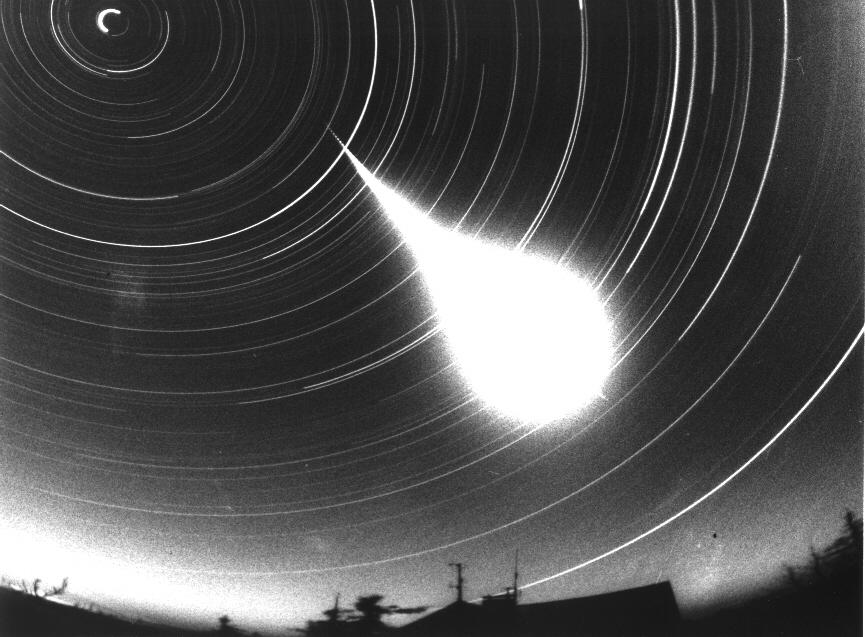
Alt...
February 19, 1999
On The Trail Of A Fireball
* Credit: Courtesy P. Spurny, (Astronomical Institute, Ondrejov Observatory)
Explanation:
This exceptionally bright fireball meteor trail was photographed with a fish-eye camera at a Czech Republic station of the European Fireball Network on January 21, 1999. Of the star trails visible in this night-long exposure, the bright short arc in the upper left is due to Polaris, the north star. The breaks seen near the beginning of the fireball trail itself were produced by a shutter rotating 15 times a second. In all, three stations recorded the dazzling streak and their combined tracking information has revealed details of the meteor's brief atmospheric flight and previous interplanetary voyage. For example, the luminous trail is measured to begin at an altitude of 81.9 kilometers and covered 71.1 kilometers in 6.7 seconds. The projected prior orbit for the meteoroid corresponds to one typical for Apollo class asteroids which can cross Earth's orbit. In forty years of operations the European Network has multistation recordings of less than 10 or so fireballs as bright as this one. It is thought likely that a small (a few hundred grams) meteorite survived this fiery fall to Earth and landed near the Czech-Poland border.
Authors & editors: Robert Nemiroff (MTU) & Jerry Bonnell (USRA)
NASA Technical Rep.: Jay Norris. Specific rights apply.
A service of: LHEA at NASA/ GSFC
& Michigan Tech. U.
2015 August 13
Moonless Meteors and the Milky Way
* Image Credit & Copyright: Petr Horálek
https://www.petrhoralek.com/?page_id=20
Explanation:
Have you watched the Perseid meteor shower? Though the annual shower's predicted peak was last night, meteor activity should continue tonight (August 13/14), best enjoyed by just looking up in clear, dark skies after midnight. Of course, this year's Perseid shower has the advantage of being active near the August 14 New Moon. Since the nearly New Moon doesn't rise before the morning twilight many fainter meteors are easier to spot until then, with no interference from bright moonlight. The Perseid meteor shower last occurred near a New Moon in 2013. That's when the exposures used to construct this image were made, under dark, moonless skies from Hvar Island off the coast of Croatia. The widefield composite includes 67 meteors streaming from the heroic constellation Perseus, the shower's radiant, captured during 2013 August 8-14 against a background of faint zodiacal light and the Milky Way.
https://www.petrhoralek.com/?p=42
https://apod.nasa.gov/apod/ap150813.html
#space #galaxy #perseids #astrophotography #photography #science #astronomy #nature #NASA
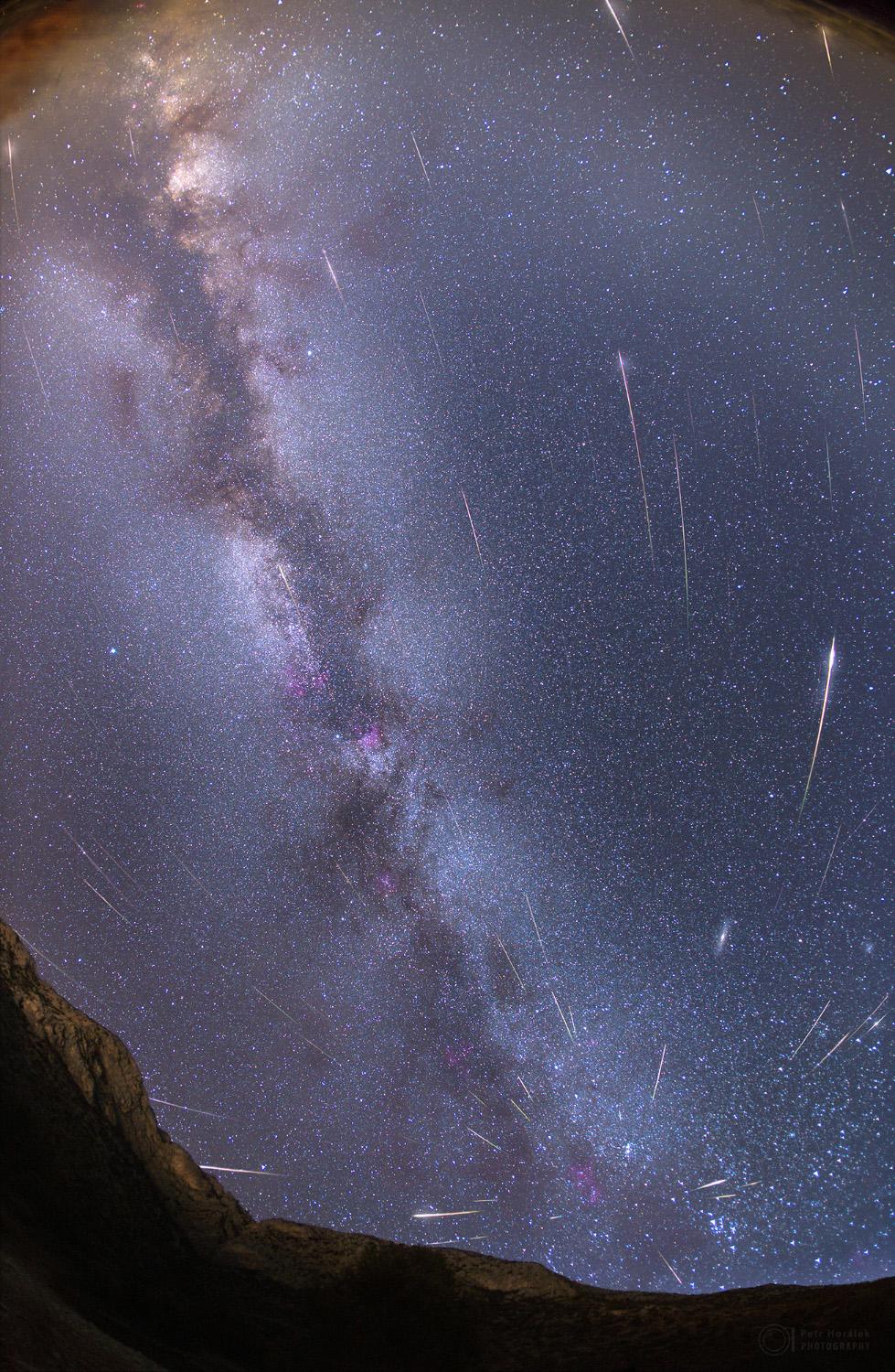
Alt...
2015 August 13
Moonless Meteors and the Milky Way
* Image Credit & Copyright: Petr Horálek
Explanation:
Have you watched the Perseid meteor shower? Though the annual shower's predicted peak was last night, meteor activity should continue tonight (August 13/14), best enjoyed by just looking up in clear, dark skies after midnight. Of course, this year's Perseid shower has the advantage of being active near the August 14 New Moon. Since the nearly New Moon doesn't rise before the morning twilight many fainter meteors are easier to spot until then, with no interference from bright moonlight. The Perseid meteor shower last occurred near a New Moon in 2013. That's when the exposures used to construct this image were made, under dark, moonless skies from Hvar Island off the coast of Croatia. The widefield composite includes 67 meteors streaming from the heroic constellation Perseus, the shower's radiant, captured during 2013 August 8-14 against a background of faint zodiacal light and the Milky Way.
Authors & editors: Robert Nemiroff (MTU) & Jerry Bonnell (UMCP)
NASA Official: Phillip Newman Specific rights apply.
NASA Web Privacy Policy and Important Notices
A service of: ASD at NASA / GSFC
& Michigan Tech. U.
2025 August 15
Moonlight, Planets, and Perseids
* Image Credit & Copyright: Jeff Dai (TWAN)
https://twanight.org/profile/jeff-dai/
Explanation:
In the predawn sky on August 13, two planets were close. And despite the glare of a waning gibbous Moon, bright Jupiter and even brighter Venus were hard to miss. Their brilliant close conjunction is posing above the eastern horizon in this early morning skyscape. The scene was captured in a single exposure from a site near Gansu, China, with light from both planets reflected in the still waters of a local pond. Also seen against the moonlight were flashes from the annual Perseid Meteor Shower, known for its bright, fast meteors. Near the much anticipated peak of activity, the shower meteors briefly combined with the two planets for a celestial spectacle even in moonlit skies.
https://science.nasa.gov/solar-system/whats-up-august-2025-skywatching-tips-from-nasa/#hds-sidebar-nav-1
https://science.nasa.gov/solar-system/whats-up-august-2025-skywatching-tips-from-nasa/#hds-sidebar-nav-1
https://www.nasa.gov/blogs/watch-the-skies/2025/08/08/bright-moonlight-could-interfere-with-view-of-perseids-peak/
https://earthsky.org/todays-image/venus-and-jupiter/
#space #galaxy #perseids #astrophotography #photography #science #astronomy #nature #NASA
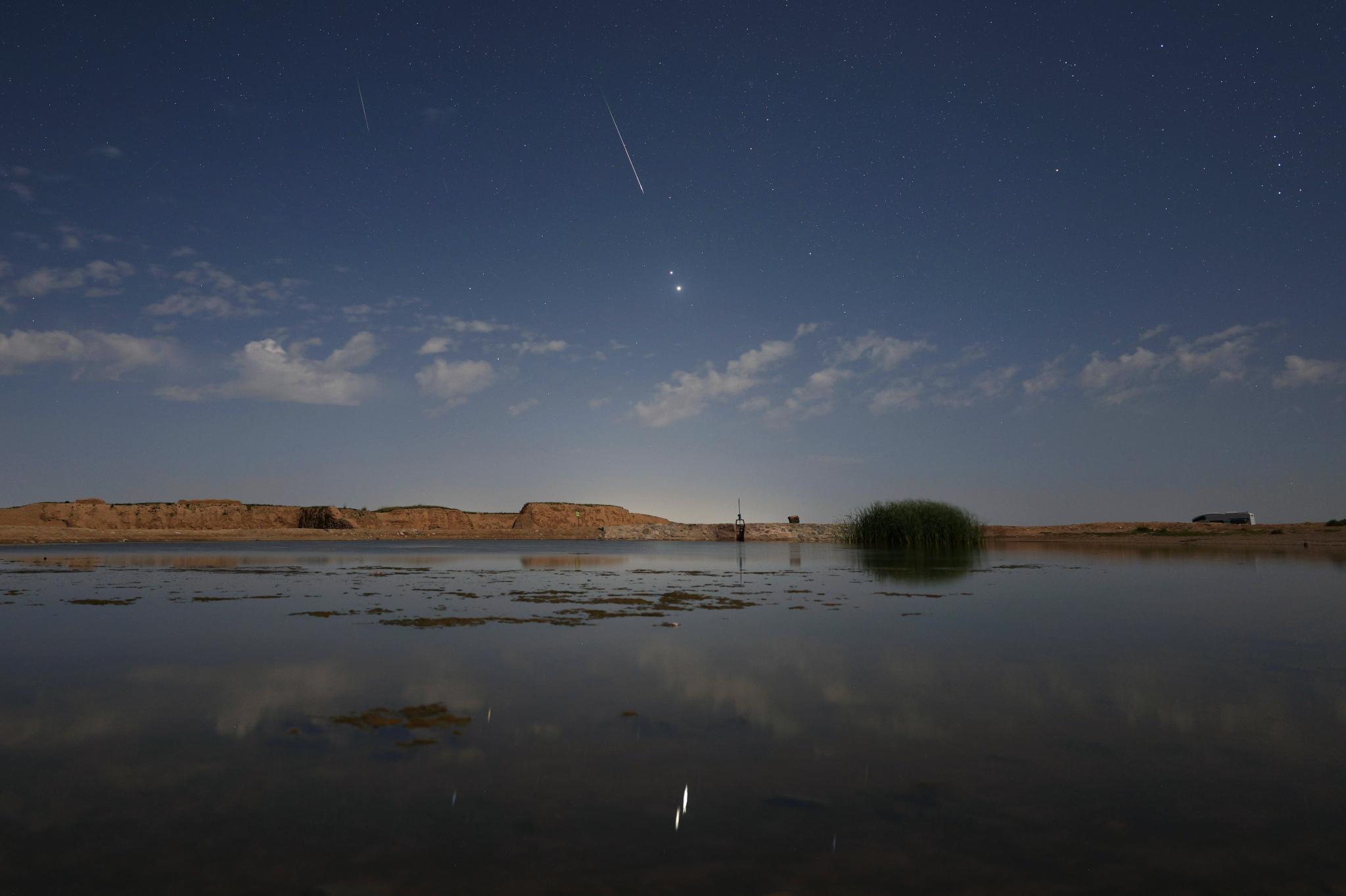
Alt...
2025 August 15
Moonlight, Planets, and Perseids
* Image Credit & Copyright: Jeff Dai (TWAN)
Explanation:
In the predawn sky on August 13, two planets were close. And despite the glare of a waning gibbous Moon, bright Jupiter and even brighter Venus were hard to miss. Their brilliant close conjunction is posing above the eastern horizon in this early morning skyscape. The scene was captured in a single exposure from a site near Gansu, China, with light from both planets reflected in the still waters of a local pond. Also seen against the moonlight were flashes from the annual Perseid Meteor Shower, known for its bright, fast meteors. Near the much anticipated peak of activity, the shower meteors briefly combined with the two planets for a celestial spectacle even in moonlit skies.
Authors & editors: Robert Nemiroff (MTU) & Jerry Bonnell (UMCP)
NASA Official: Amber Straughn Specific rights apply.
NASA Web Privacy, Accessibility, Notices;
A service of: ASD at NASA / GSFC,
NASA Science Activation
& Michigan Tech. U.
2025 August 16
A Cool GIF of a 2025 Perseid
* Image Credit & Copyright: Renaud & Olivier Coppe
https://app.astrobin.com/u/ren1450#gallery
Explanation:
The camera battery died about 2am local time on August 12, while shooting in the bright moonlit skies from a garden in Chastre, Brabant Wallon, Belgium, planet Earth. But not before it captured the frames used to compose this cool animated gif of a brilliant Perseid meteor and a lingering visible trail known as a persistent train. The Perseid meteor, a fast moving speck of dust from the tail of large periodic Comet Swift-Tuttle, was heated to incandescence by ram pressure and vaporized as it flashed through the upper atmosphere at 60 kilometers per second. Compared to the brief flash of the meteor, its wraith-like trail really is persistent. A characteristic of bright meteors, a smoke-like persistent train can often be followed for many minutes wafting in the winds at altitudes of 60 to 90 kilometers.
https://www.nasa.gov/blogs/watch-the-skies/2025/08/08/bright-moonlight-could-interfere-with-view-of-perseids-peak/
https://apod.nasa.gov/apod/ap180817.html
https://apod.nasa.gov/apod/ap250816.html
#space #galaxy #perseids #astrophotography #photography #science #astronomy #nature #NASA
109P/Swift-Tuttle
by Alicia Cermak - NASA
Comet Swift-Tuttle was discovered in 1862 independently by both Lewis Swift and Horace Tuttle.
Overview
Comet 109P/Swift-Tuttle takes 133 years to orbit the Sun once. Swift-Tuttle last reached perihelion (closest approach to the Sun) in 1992 and will return again in 2125.
Swift-Tuttle is a large comet – its nucleus is 16 miles (26 kilometers) across. (That is more than twice the size of the object hypothesized to have led the demise of the dinosaurs.)
The pieces of space debris that interact with our atmosphere to create the popular Perseids meteor shower originate from Swift-Tuttle. This annual meteor shower takes place each August, and peaks mid-month. It was Giovanni Schiaparelli who realized in 1865 that this comet was the source of the Perseids.
When comets come around the Sun, the dust they emit gradually spreads into a dusty trail around their orbits. Every year the Earth passes through these debris trails, which allows the bits to collide with our atmosphere where they disintegrate to create fiery and colorful streaks in the sky.
How This Comet Got Its Name
+ Comets are usually named for their discoverer(s) or for the name of the observatory/telescope used in the discovery. Since both Lewis Swift and Horace Tuttle discovered this comet it is named for them. The letter "P" indicates that Swift-Tuttle is a "periodic" comet. Periodic comets have an orbital period of less than 200 years
Credits
NASA/Preston Dyches
Alicia Cermak
https://science.nasa.gov/solar-system/comets/109p-swift-tuttle/
#space #galaxy #perseids #astrophotography #photography #science #astronomy #nature #NASA
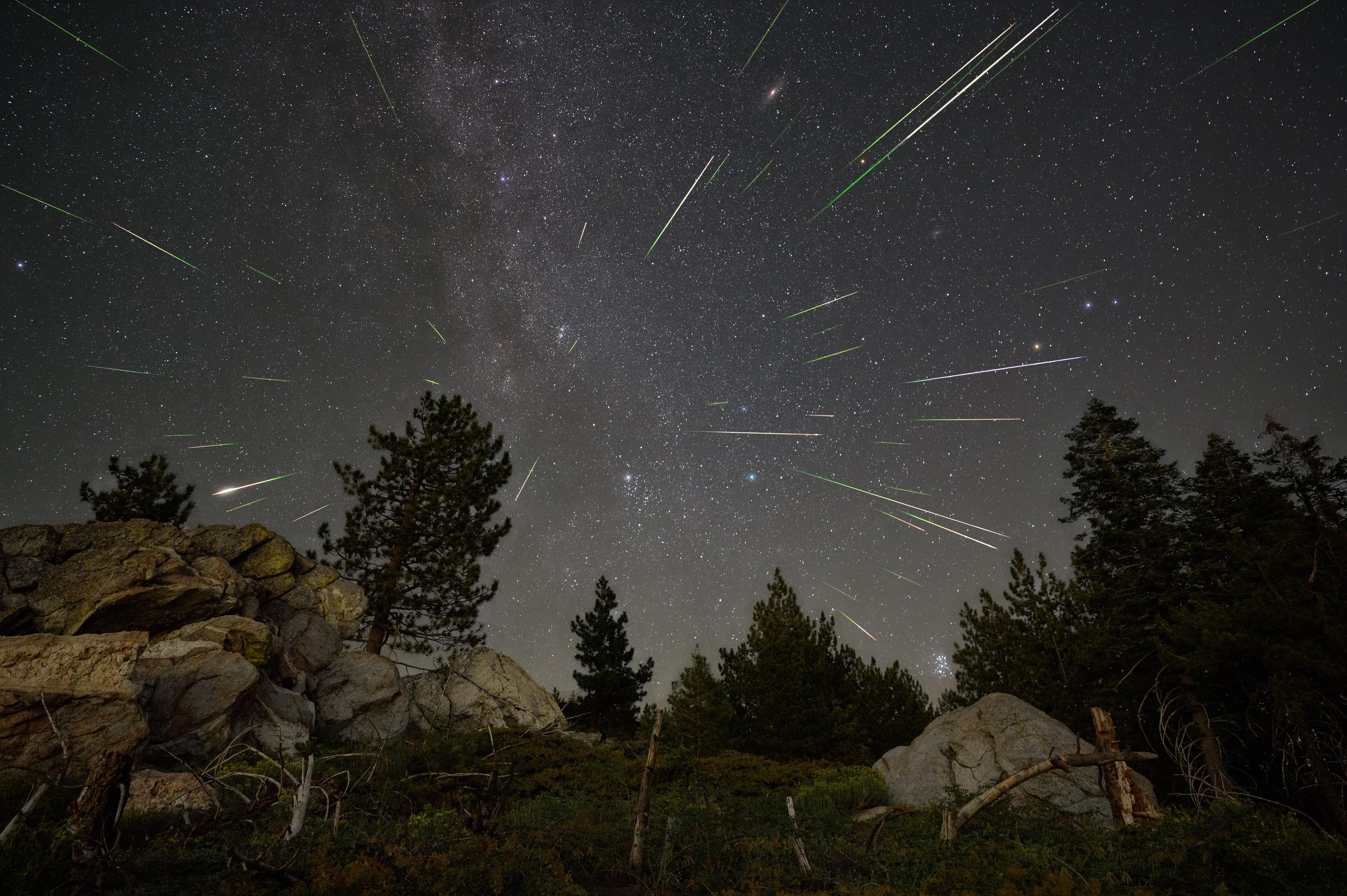
Alt...
A view of the 2023 Perseid meteor shower from the southernmost part of Sequoia National Forest, near Piute Peak. Debris from comet Swift-Tuttle creates the Perseids.
NASA/Preston Dyches
2025 August 20
Perseid Meteors from Durdle Door
* Image Credit & Copyright: Josh Dury
https://www.joshduryphoto-media.com/
Explanation:
What are those curved arcs in the sky? Meteors -- specifically, meteors from this year's Perseid meteor shower. Over the past few weeks, after the sky darkened, many images of Perseid meteors were captured separately and merged into a single frame, taken earlier. Although the meteors all traveled on straight paths, these paths appear slightly curved by the wide-angle lens of the capturing camera. The meteor streaks can all be traced back to a single point on the sky called the radiant, here just off the top of the frame in the constellation of Perseus. The same camera took a deep image of the background sky that brought up the central band of our Milky Way galaxy running nearly vertically through the featured image's center. The limestone arch in the foreground in Dorset, England is known as Durdle Door, a name thought to survive from a thousand years ago.
https://en.wikipedia.org/wiki/Durdle_Door
https://www.youtube.com/watch?v=JYDRQFA51N0
https://apod.nasa.gov/apod/ap240811.html
https://apod.nasa.gov/apod/ap250820.html
#space #galaxy #perseids #astrophotography #photography #science #astronomy #nature #NASA
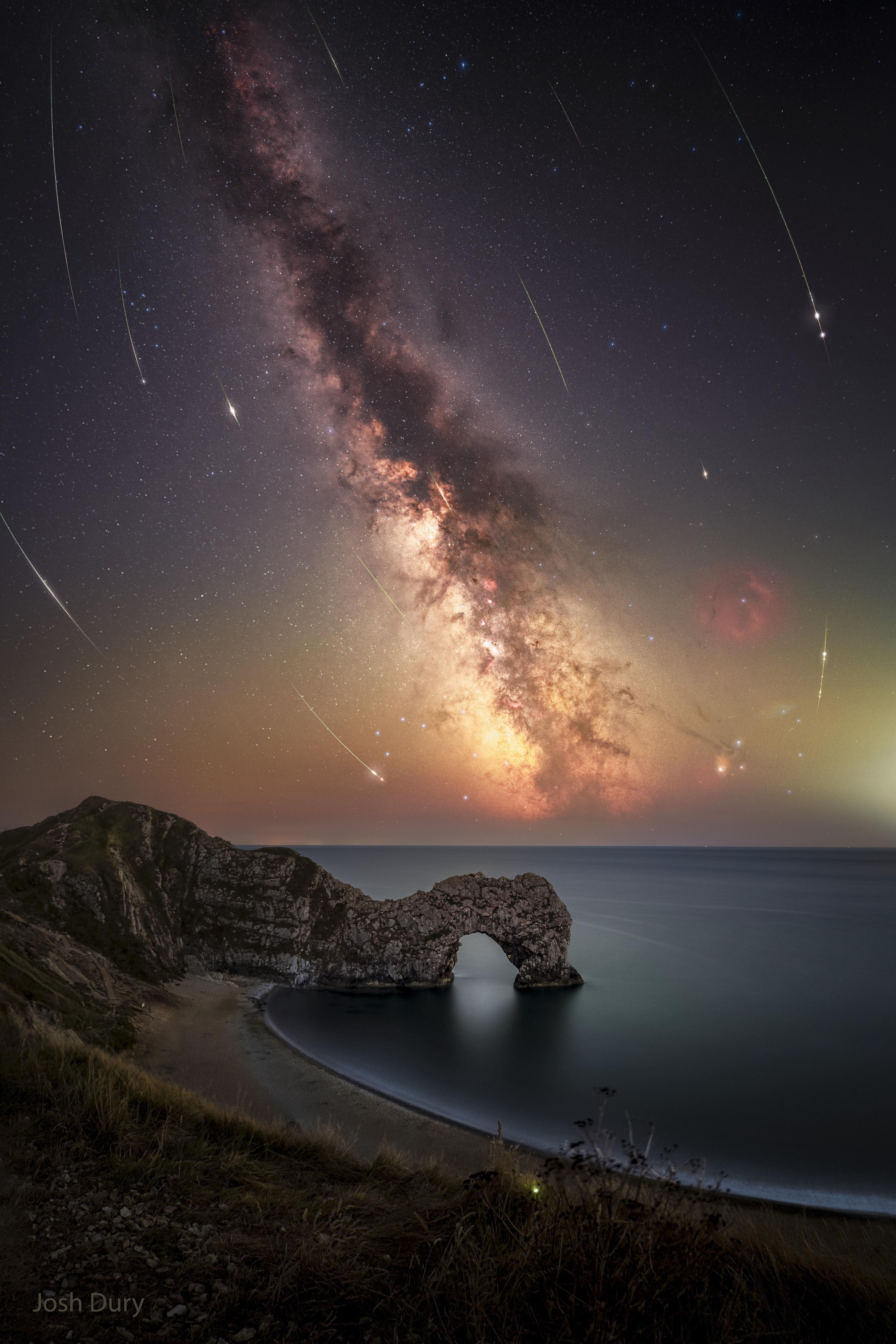
Alt...
2025 August 20
A deep sky is shown with the band of our Milky Way Galaxy running from the upper left to the lower right. The streaks or many curved meteors are seen. In the foreground a beach is seen with an unusual rock outcrop that has an opening.
Perseid Meteors from Durdle Door
* Image Credit & Copyright: Josh Dury
Explanation:
What are those curved arcs in the sky? Meteors -- specifically, meteors from this year's Perseid meteor shower. Over the past few weeks, after the sky darkened, many images of Perseid meteors were captured separately and merged into a single frame, taken earlier. Although the meteors all traveled on straight paths, these paths appear slightly curved by the wide-angle lens of the capturing camera. The meteor streaks can all be traced back to a single point on the sky called the radiant, here just off the top of the frame in the constellation of Perseus. The same camera took a deep image of the background sky that brought up the central band of our Milky Way galaxy running nearly vertically through the featured image's center. The limestone arch in the foreground in Dorset, England is known as Durdle Door, a name thought to survive from a thousand years ago.
Authors & editors: Robert Nemiroff (MTU) & Jerry Bonnell (UMCP)
NASA Official: Amber Straughn Specific rights apply.
NASA Web Privacy, Accessibility, Notices;
A service of: ASD at NASA / GSFC,
NASA Science Activation
& Michigan Tech. U.
2025 August 21
Mostly Perseids
* Image Credit & Copyright: Klaus Pillwatsch
https://www.instagram.com/p_i_k_a_s_s/
Explanation:
In this predawn skyscape recorded during the early morning hours of August 13, mostly Perseid meteors are raining down on planet Earth. You can easily identify the Perseid meteor streaks. They're the ones with trails that seem to converge on the annual meteor shower's radiant, a spot in the heroic constellation Perseus, located off the top of the frame. That's the direction in Earth's sky that looks along the orbit of this meteor shower's parent, periodic Comet Swift-Tuttle. Of course the scene is a composite, a combination of about 500 digital exposures to capture meteors registered with a single base frame exposure. But all exposures were taken during a period of around 2.5 hours from a wind farm near Mönchhof, Burgenland, Austria. Red lights on the individual wind turbine towers dot the foreground. In their spectacular close conjunction, bright planets Jupiter and Venus are poised above the eastern horizon.
https://apod.nasa.gov/apod/ap250821.html
#space #perseids #astrophotography #photography #science #astronomy #nature #NASA
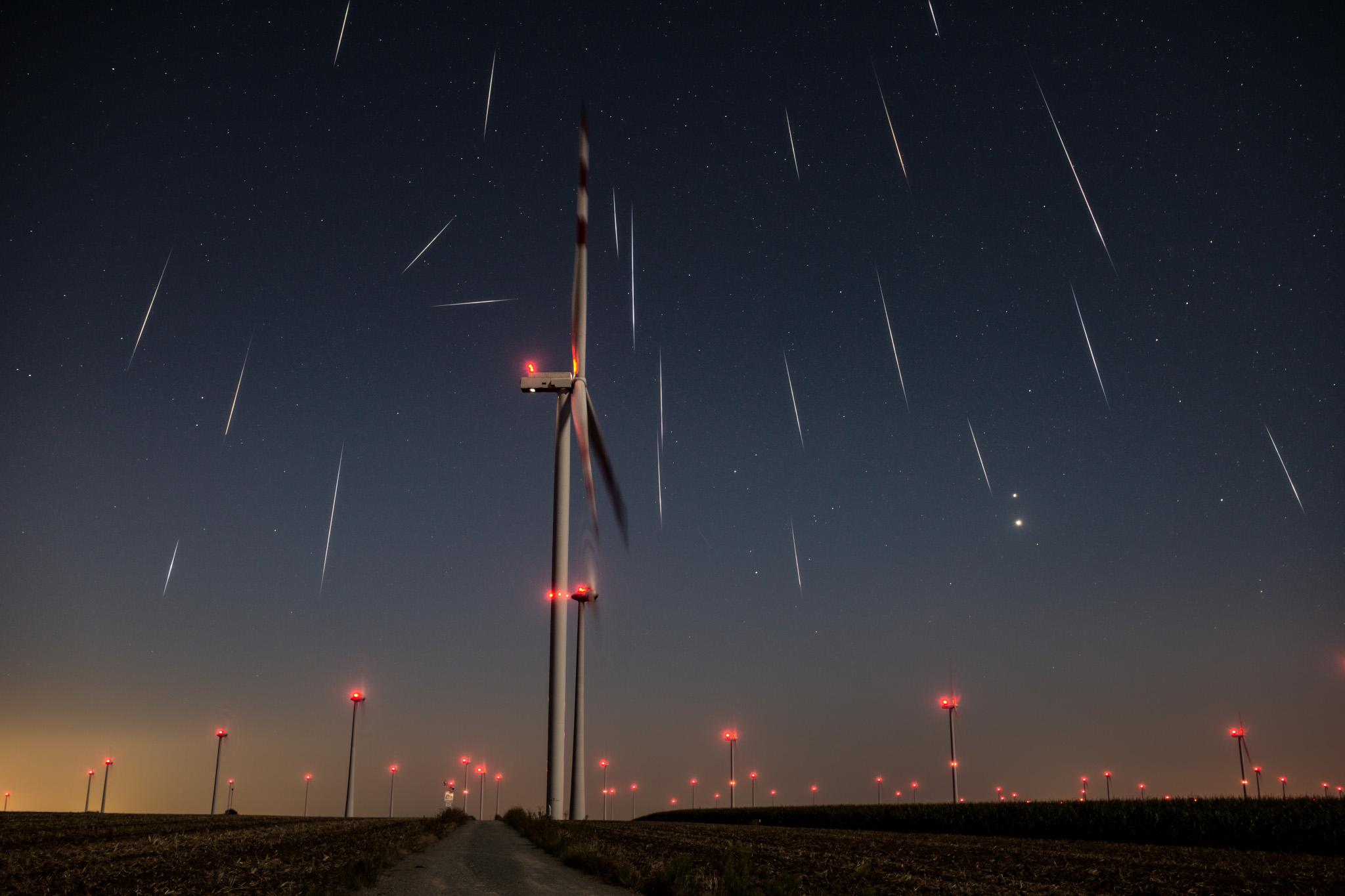
Alt...
2025 August 21
Mostly Perseids
* Image Credit & Copyright: Klaus Pillwatsch
Explanation:
In this predawn skyscape recorded during the early morning hours of August 13, mostly Perseid meteors are raining down on planet Earth. You can easily identify the Perseid meteor streaks. They're the ones with trails that seem to converge on the annual meteor shower's radiant, a spot in the heroic constellation Perseus, located off the top of the frame. That's the direction in Earth's sky that looks along the orbit of this meteor shower's parent, periodic Comet Swift-Tuttle. Of course the scene is a composite, a combination of about 500 digital exposures to capture meteors registered with a single base frame exposure. But all exposures were taken during a period of around 2.5 hours from a wind farm near Mönchhof, Burgenland, Austria. Red lights on the individual wind turbine towers dot the foreground. In their spectacular close conjunction, bright planets Jupiter and Venus are poised above the eastern horizon.
Authors & editors: Robert Nemiroff (MTU) & Jerry Bonnell (UMCP)
NASA Official: Amber Straughn Specific rights apply.
NASA Web Privacy, Accessibility, Notices;
A service of: ASD at NASA / GSFC,
NASA Science Activation
& Michigan Tech. U.
2025 August 25
The Meteor and the Star Cluster
* Image Credit & Copyright: Yousif Alqasimi & Essa Al Jasmi
https://www.instagram.com/alqasmyi/
https://www.instagram.com/eaqj/
Explanation:
Sometimes even the sky surprises you. To see more stars and faint nebulosity in the Pleiades star cluster (M45), long exposures are made. Many times, less interesting items appear on the exposures that were not intended -- but later edited out. These include stuck pixels, cosmic ray hits, frames with bright clouds or Earth's Moon, airplane trails, lens flares, faint satellite trails, and even insect trails. Sometimes, though, something really interesting is caught by chance. That was just the case a few weeks ago in al-Ula, Saudi Arabia when a bright meteor streaked across during an hour-long exposure of the Pleiades. Along with the famous bright blue stars, less famous and less bright blue stars, and blue-reflecting dust surrounding the star cluster, the fast rock fragment created a distinctive green glow, likely due to vaporized metals.
https://science.nasa.gov/mission/hubble/science/explore-the-night-sky/hubble-messier-catalog/messier-45/
https://en.wikipedia.org/wiki/Pleiades
https://apod.nasa.gov/apod/ap250825.html
#space #perseids #astrophotography #photography #science #astronomy #nature #NASA
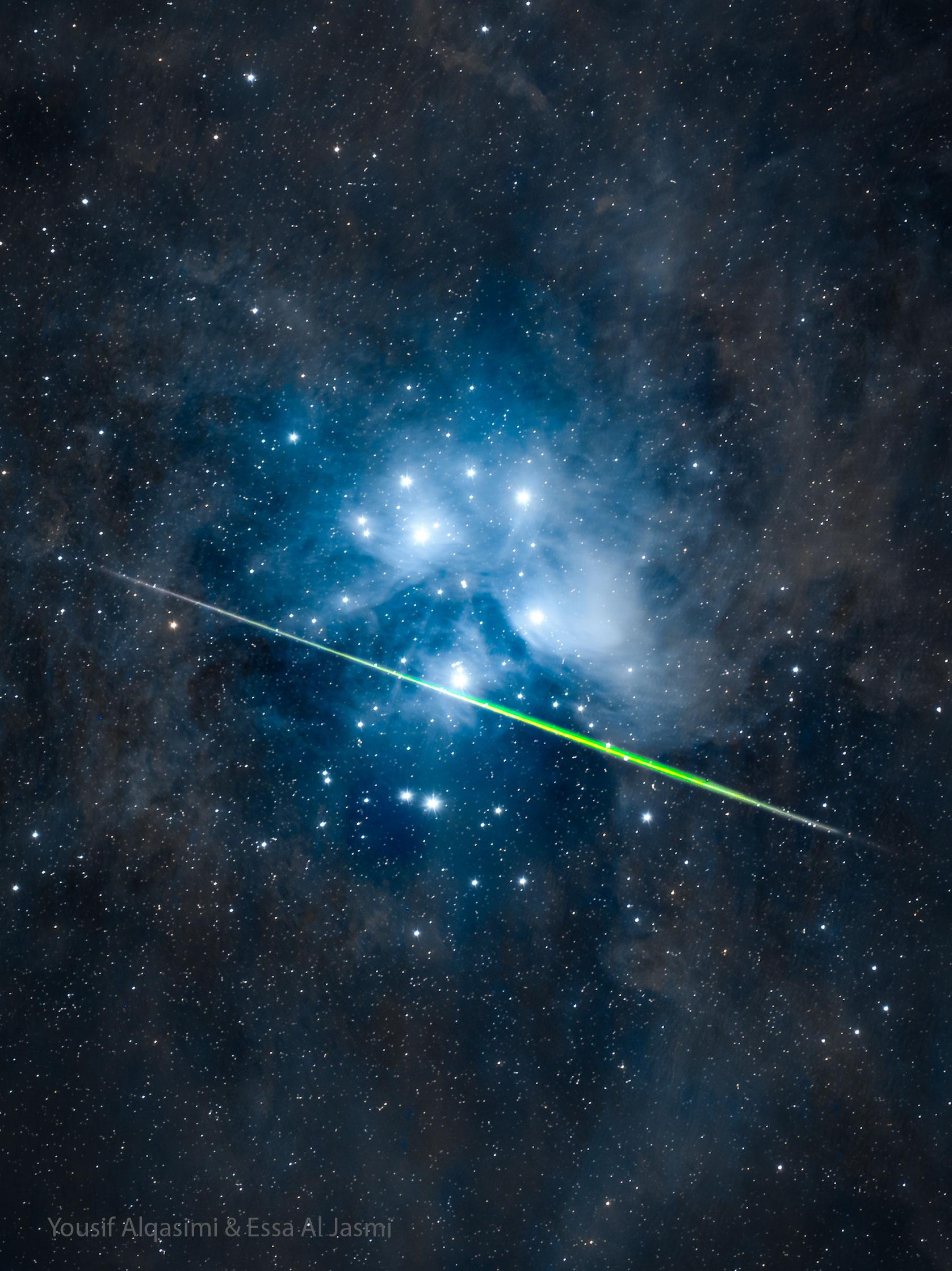
Alt...
2025 August 25
A starfield surrounds the bright blue stars of a star cluster: the Pleiades star cluster. Nearly horizontally across the cluster is a bright green streak, most likely a meteor.
The Meteor and the Star Cluster
* Image Credit & Copyright: Yousif Alqasimi & Essa Al Jasmi
Explanation:
Sometimes even the sky surprises you. To see more stars and faint nebulosity in the Pleiades star cluster (M45), long exposures are made. Many times, less interesting items appear on the exposures that were not intended -- but later edited out. These include stuck pixels, cosmic ray hits, frames with bright clouds or Earth's Moon, airplane trails, lens flares, faint satellite trails, and even insect trails. Sometimes, though, something really interesting is caught by chance. That was just the case a few weeks ago in al-Ula, Saudi Arabia when a bright meteor streaked across during an hour-long exposure of the Pleiades. Along with the famous bright blue stars, less famous and less bright blue stars, and blue-reflecting dust surrounding the star cluster, the fast rock fragment created a distinctive green glow, likely due to vaporized metals.
Authors & editors: Robert Nemiroff (MTU) & Jerry Bonnell (UMCP)
NASA Official: Amber Straughn Specific rights apply.
NASA Web Privacy, Accessibility, Notices;
A service of: ASD at NASA / GSFC,
NASA Science Activation
& Michigan Tech. U.
TOPIC> The Destruction of NASA’s Mission
They Make America .. Again!
Reality accuses Trump of financially undermining and ruining the institutions built up by state funds and thus promoted and developed by the community of US citizens, in order to then incorporate them with other greedy super-rich and appropriate them at a ridiculous price.
Even Vladimir Putin has already expressed his interest in institutions. If you don't see what's being played here yet, you probably can't be helped any more... Trump is more likely to make the earth a disc again than America great again ...
This clip of Orientale Basin was made with data from the Lunar Reconnaissance Orbiter by NASA's Scientific Visualization Studio.
Image credit: NASA’s Scientific Visualization Studio/Ernie Wright
https://moon.nasa.gov/observe-the-moon-night/participate/10-ways-to-observe-the-moon/
https://moon.nasa.gov/observe-the-moon-night/resources/moon-map/
#space #moon #astrophotography #photography #science #astronomy #nature #NASA #education
Join In!
The countdown is on.. for the International Observe the Moon Night 2025 on October 4!
https://moon.nasa.gov/observe-the-moon-night/
https://moon.nasa.gov/observe-the-moon-night/register/individual-participation/
#space #moon #astrophotography #photography #science #astronomy #nature #NASA #education
2025 October 4
The Rotating Moon
* Video Credit: NASA, Lunar Reconnaissance Orbiter, Arizona State U.
https://www.nasa.gov/
https://science.nasa.gov/mission/lro/
https://www.lroc.asu.edu/about/team
Explanation:
No one on Earth sees the Moon rotate like this. That's because the Moon is tidally locked in synchronous rotation, showing only one side to denizens of our fair planet. Still, given modern digital technology, combined with many detailed images returned by the Lunar Reconnaissance Orbiter (LRO), a high resolution virtual Moon rotation movie can be composed. In fact, the featured time-lapse video starts with a view of the familiar lunar nearside and quickly finds the Mare Orientale, a large crater with a dark center that is difficult to see from the Earth, rotating into view just below the equator. In a complete lunar rotation condensed into 24 seconds, the video clearly shows that the Earth-facing nearside of the Moon contains an abundance of dark lunar maria, while the lunar farside is dominated by bright lunar highlands. Of course you can just join other moon-watchers under hopefully clear skies tonight. Check out the sunlit portion of the lunar nearside on International Observe the Moon Night.
https://en.wikipedia.org/wiki/List_of_plains_on_the_Moon
https://en.wikipedia.org/wiki/Geology_of_the_Moon#Highlands
https://moon.nasa.gov/observe-the-moon-night/
https://lroc.im-ldi.com/about
https://apod.nasa.gov/apod/fap/ap251004.html
#space #moon #astrophotography #photography #science #astronomy #nature #NASA #education
The Moon’s Rotation
An enduring myth about the Moon is that it doesn't rotate. While it's true that the Moon keeps the same face to us, this only happens because the Moon rotates at the same rate as its orbital motion, a special case of tidal locking called synchronous rotation. The animation shows both the orbit and the rotation of the Moon. The yellow circle with the arrow and radial line have been added to make the rotation more apparent. The arrow indicates the direction of rotation. The radial line points to the center of the visible disk of the Moon at 0°N 0°E.
Credit:
NASA's Scientific Visualization Studio
Visualizer:
Ernie Wright (USRA)
Technical support
Laurence Schuler (ADNET Systems, Inc.)
Ian Jones (ADNET Systems, Inc.)
#space #moon #astrophotography #photography #science #astronomy #nature #NASA #education