Search results for tag #space
![[?]](https://files.defcon.social/dcsocial-s3/accounts/avatars/113/208/344/507/078/943/original/014820ad22daee1c.jpg)
Saturn
+ has 63 confirmed and named moons.
+ Only seven moons of the planet Saturn are visible.
+ Two of Saturn’s moons hold a certain potential for life in subsurface habitats.
A moon is essentially an astronomical body that describes an orbit around a planet, a dwarf planet, or an asteroid.
Earth has only one moon, but other planets have two or more moons or none at all. In the Solar System, Mercury and Venus do not have any moons, Mars has two small, close-orbiting moons called Phobos and Deimos, and Jupiter has as many as 80 moons.
In the case of Saturn, it has 63 confirmed and named moons, and another 20 are awaiting confirmation of discovery and official naming by the International Astronomical Union (IAU).
from
Maia Mulko
interestingengineering.com
https://interestingengineering.com/culture/facts-about-saturn-moons
#space #saturn #astrophotography #photography #science #astronomy #physics #nature #NASA #ESA #education
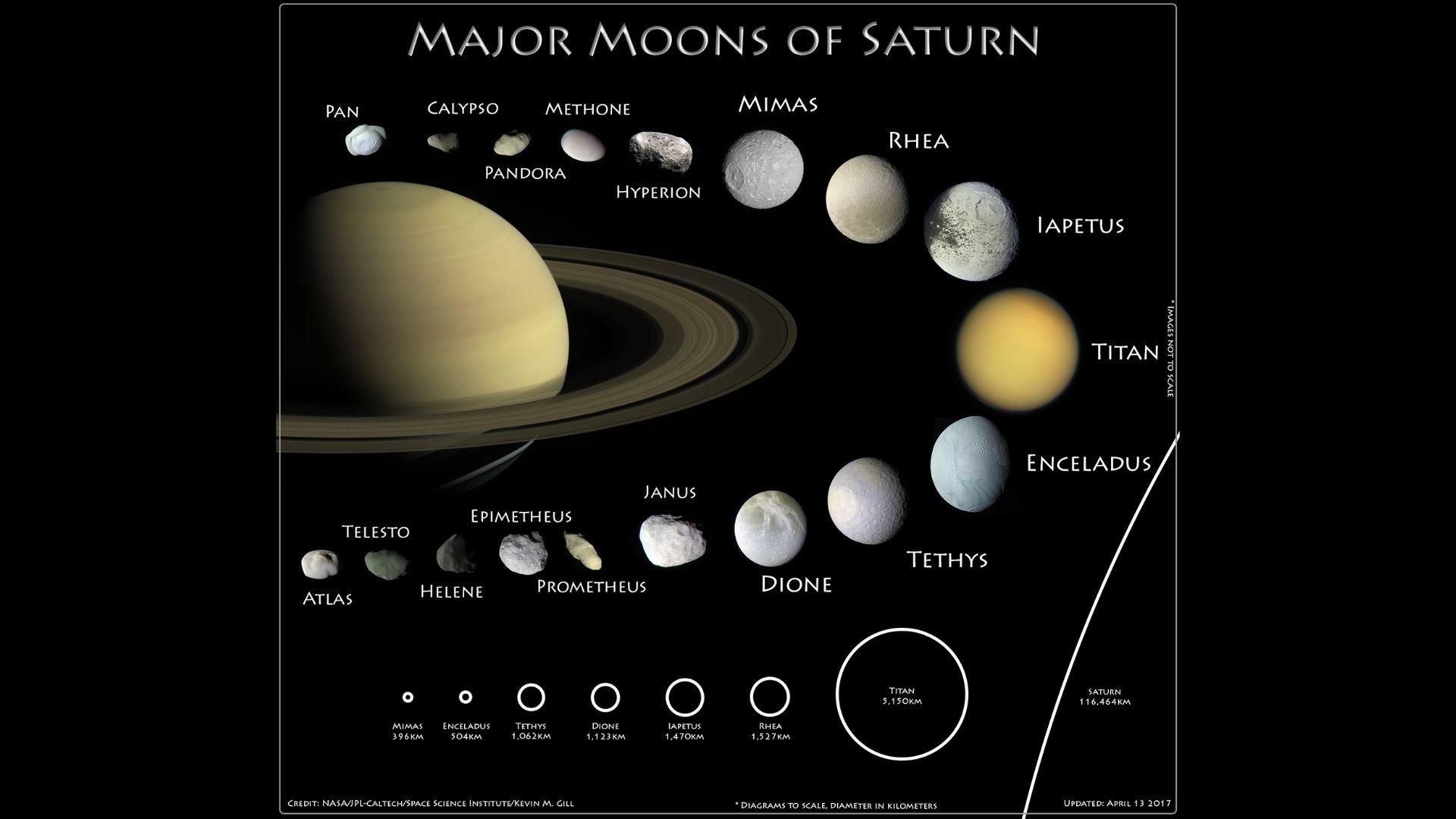
Alt...
Major moons of Saturn.
How many Saturn moons are visible?
Only seven moons of the planet Saturn are visible. Titan is the easiest to see because it is the biggest and brightest.
With a diameter of 3,199.7 miles (about 5,150 kilometers), Titan can be spotted even in urban skies with a 60-millimeter (2-inch) telescope.
SubTopic> Moons of Saturn
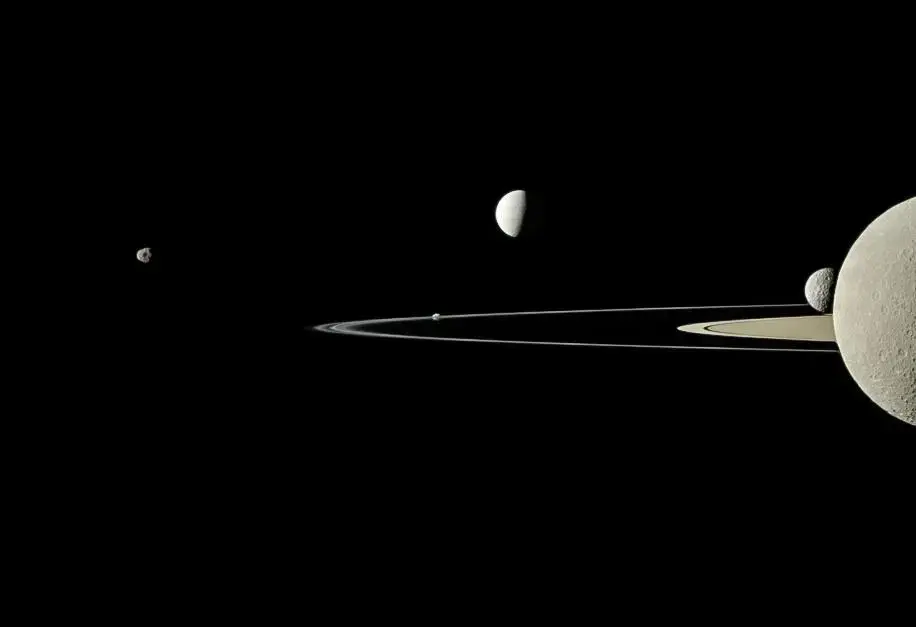
Group Portrait
On July 29, 2011, Cassini captured five of Saturn's moons in a single frame with its narrow-angle camera. This is a full-color look at a view that was originally published in September 2011 (see PIA14573).
Moons visible in this view: Janus (111 miles, or 179 kilometers across) is on the far left; Pandora (50 miles, or 81 kilometers across) orbits just beyond the thin F ring near the center of the image; brightly reflective Enceladus (313 miles, or 504 kilometers across) appears above center; Saturn's second largest moon, Rhea (949 miles, or 1,528 kilometers across), is bisected by the right edge of the image; and the smaller moon Mimas (246 miles, or 396 kilometers across) is seen just to the left of Rhea.
This view looks toward the northern, sunlit side of the rings from just above the ringplane. Rhea is closest to Cassini here. The rings are beyond Rhea and Mimas. Enceladus is beyond the rings. The view was acquired at a distance of approximately 684,000 miles (1.1 million kilometers) from Rhea and 1.1 million miles (1.8 million kilometers) from Enceladus.
PIA12797
Credits: NASA/JPL-Caltech/Space Science Institute
#space #saturn #astrophotography #photography #science #astronomy #physics #nature #NASA #ESA #education
Alt...
Image Addition Date:
07/30/2018
Target:
Saturn
Is a satellite of:
Sun
Mission(s):
Cassini
Huygens
Spacecraft(s):
Cassini Orbiter
Instrument(s):
Imaging Science Subsystem - Narrow Angle
Saturn's Rings
- NASA Science, Alicia Cermak
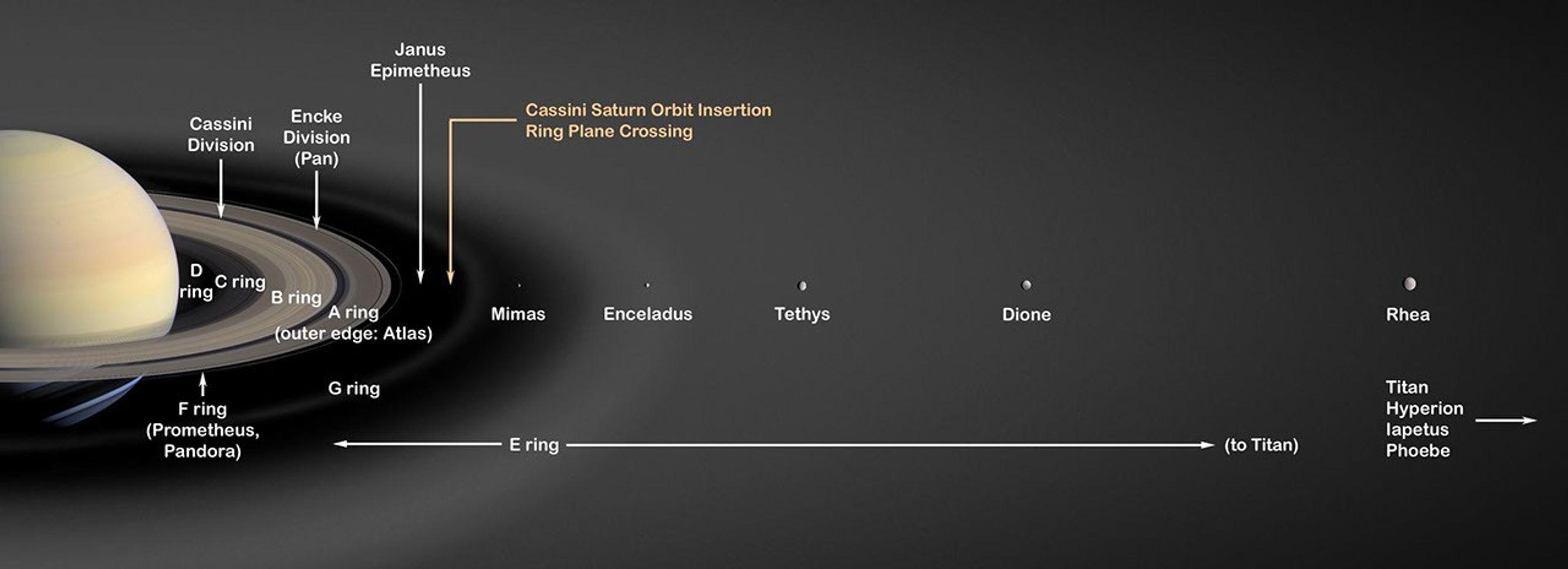
This is an artist's concept of Saturn's rings and major icy moons.
Saturn's rings make up an enormous, complex structure. From edge-to-edge, the ring system would not even fit in the distance between Earth and the Moon. The seven main rings are labeled in the order in which they were discovered. From the planet outward, they are D, C, B, A, F, G and E.
The D ring is very faint and closest to Saturn. The main rings are A, B and C. The outermost ring, easily seen with Earth-based telescopes, is the A ring. The Cassini Division is the largest gap in the rings and separates the B ring from the A ring. Just outside the A ring is the narrow F ring, shepherded by tiny moons, Pandora and Prometheus. Beyond that are two much fainter rings named G and E. Saturn's diffuse E ring is the largest planetary ring in our solar system, extending from Mimas' orbit to Titan's orbit, about 1 million kilometers (621,370 miles).
The particles in Saturn's rings are composed primarily of water ice and range in size from microns to tens of meters. The rings show a tremendous amount of structure on all scales; some of this structure is related to gravitational interactions with Saturn's many moons, but much of it remains unexplained. One moonlet, Pan, actually orbits inside the A ring in a 330-kilometer-wide (200-mile) gap called the Encke Gap. The main rings (A, B and C) are less than 100 meters (300 feet) thick in most places, compared to their radial extent of 62,120 kilometers (38,600 miles). The main rings are much younger than the age of the solar system, perhaps only a few hundred million years old. They may have formed from the breakup of one of Saturn's moons or from a comet or meteor that was torn apart by Saturn's gravity.
Credit: NASA/JPL
https://science.nasa.gov/resource/saturns-rings-2/
#space #saturn #astrophotography #photography #science #astronomy #physics #nature #NASA #ESA #education
Alt...
This is an artist's concept of Saturn's rings and major icy moons.
Saturn's rings make up an enormous, complex structure. From edge-to-edge, the ring system would not even fit in the distance between Earth and the Moon. The seven main rings are labeled in the order in which they were discovered. From the planet outward, they are D, C, B, A, F, G and E.
Credit: NASA/JPL
SubTopic> Moons of Saturn
The Saturn system
teems with natural satellites, from planet-sized Titan to small oddballs, shaped like potatoes or ravioli.
Saturn has 274 confirmed moons in its orbit, far more than any other planet in our solar system. In March 2025, astronomers confirmed the discovery of 128 small moons around Saturn — adding to the already large moon count.
Saturn's moons range in size from larger than the planet Mercury – the giant moon Titan – to as small as a sports arena. The small moon Enceladus has a global ocean under a thick, icy shell. Scientists have identified both moons as high-priority science destinations for future deep space missions.
Surrounded by more than 60 known moons, Saturn is home to some of the most fascinating landscapes in our solar system. From the jets of water that spray from Enceladus to the methane lakes on smoggy Titan, the Saturn system is a rich source of scientific discovery and still holds many mysteries. The farthest planet from Earth discovered by the unaided human eye, Saturn has been known since ancient times. The planet is named for the Roman god of agriculture and wealth, who was also the father of Jupiter.
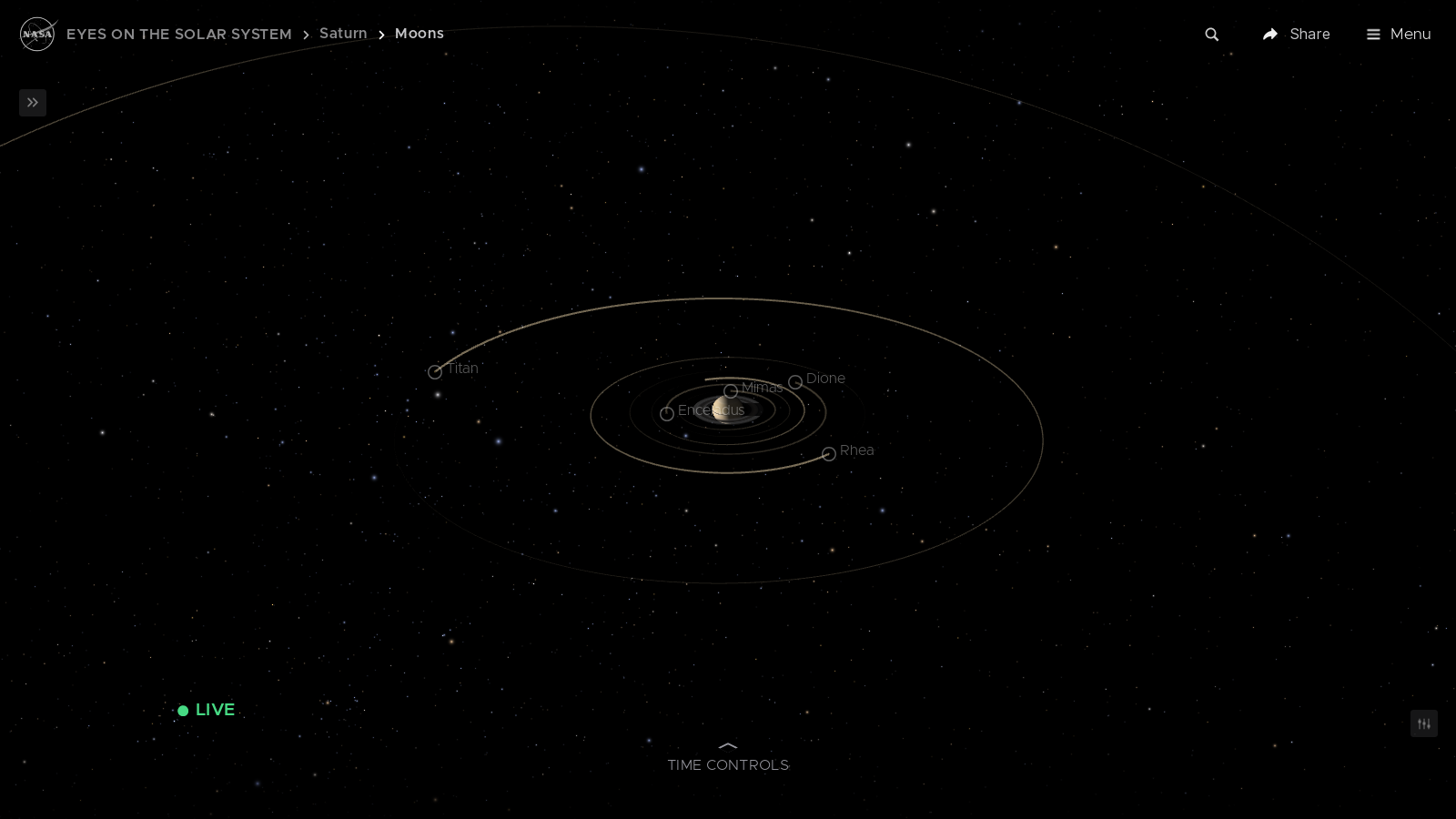
The following Link will take you to an interactive 3D api to explore the moon-system of Saturn:
https://eyes.nasa.gov/apps/solar-system/#/saturn/moons?embed=true
#space #saturn #astrophotography #photography #science #astronomy #physics #nature #NASA #ESA #education #apod
Alt...
Surrounded by more than 60 known moons, Saturn is home to some of the most fascinating landscapes in our solar system. From the jets of water that spray from Enceladus to the methane lakes on smoggy Titan, the Saturn system is a rich source of scientific discovery and still holds many mysteries. The farthest planet from Earth discovered by the unaided human eye, Saturn has been known since ancient times. The planet is named for the Roman god of agriculture and wealth, who was also the father of Jupiter.
The provided Link will take you to an interactive 3D api to explore the moon-system of Saturn
annotataed version of previews image
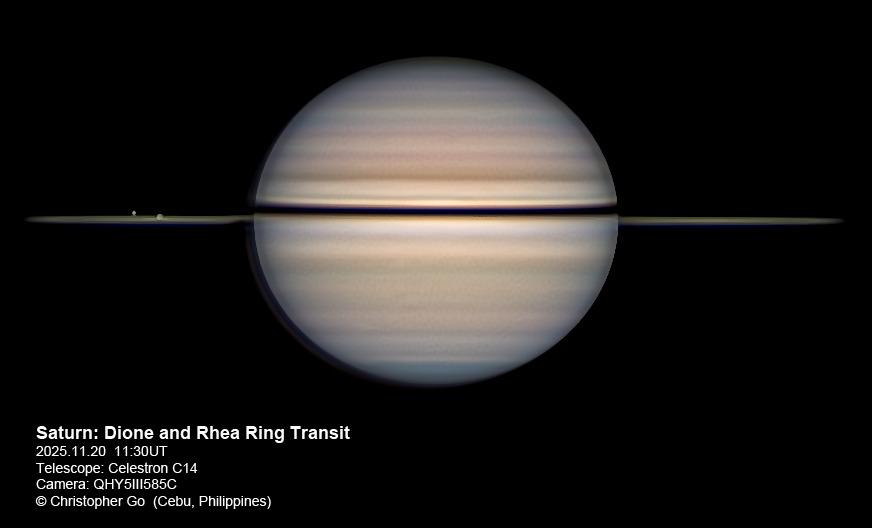
Dione and Rhea Ring Transit
* Image Credit & Copyright: Christopher Go
#space #saturn #astrophotography #photography #science #astronomy #physics #nature #NASA #ESA #education #apod
Alt...
annotataed version of previews image
Dione and Rhea Ring Transit
* Image Credit & Copyright: Christopher Go
2025 November 22
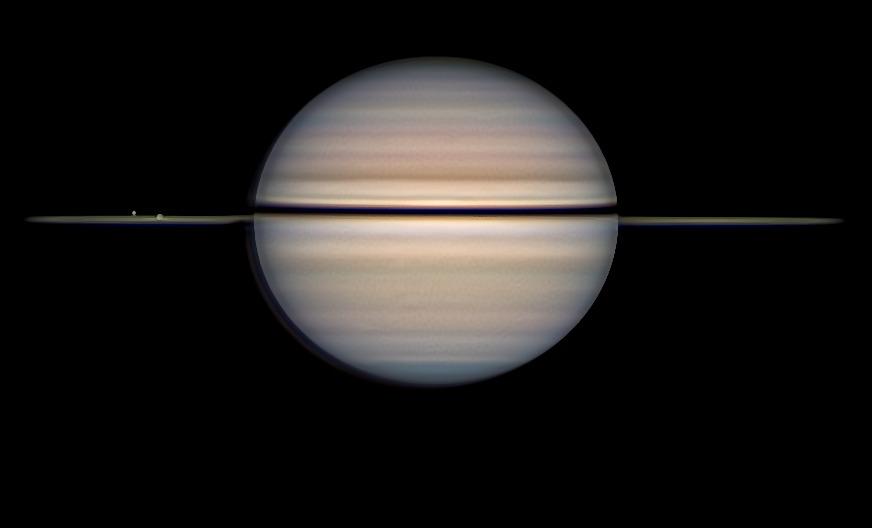
Dione and Rhea Ring Transit
* Image Credit & Copyright: Christopher Go
https://astro.christone.net/
Explanation:
Seen to the left of Saturn's banded planetary disk, small icy moons Dione and Rhea are caught passing in front of the gas giant's extensive ring system in this sharp telescopic snapshot. The remarkable image was recorded on November 20, when Saturn's rings were nearly edge-on when viewed from planet Earth. In fact, every 13 to 16 years the view from planet Earth aligns with Saturn's ring plane to produce a series of ring plane crossings. During a ring plane crossing, the interplanetary edge-on perspective makes the thin but otherwise bright rings seem to disappear. By November 23rd Saturn's rings will have reached a minimum angle for now, at their narrowest for viewing from planet Earth, but then start to widen again. Of course, Dione and Rhea orbit Saturn near the ring plane once every 2.7 and 4.5 days respectively, while the next series of Saturn ring plane crossings as seen from Earth will begin again in 2038.
https://science.nasa.gov/saturn/moons/dione/
https://science.nasa.gov/saturn/moons/rhea/
https://science.nasa.gov/resource/saturns-rings-2/
https://astro.christone.net/saturn/index.htm
https://science.nasa.gov/missions/hubble/hubble-views-saturn-ring-plane-crossing/
https://apod.nasa.gov/apod/fap/ap251116.html
https://science.nasa.gov/solar-system/whats-up-november-2025-skywatching-tips-from-nasa/
https://gizmodo.com/saturn-will-look-naked-in-the-night-sky-this-weekend-2000689525
https://science.nasa.gov/saturn/moons/
https://astro.christone.net/saturn/index.htm
https://apod.nasa.gov/apod/ap251122.html
#space #saturn #astrophotography #photography #science #astronomy #physics #nature #NASA #ESA #education #apod
Alt...
2025 November 22
Dione and Rhea Ring Transit
* Image Credit & Copyright: Christopher Go
Explanation:
Seen to the left of Saturn's banded planetary disk, small icy moons Dione and Rhea are caught passing in front of the gas giant's extensive ring system in this sharp telescopic snapshot. The remarkable image was recorded on November 20, when Saturn's rings were nearly edge-on when viewed from planet Earth. In fact, every 13 to 16 years the view from planet Earth aligns with Saturn's ring plane to produce a series of ring plane crossings. During a ring plane crossing, the interplanetary edge-on perspective makes the thin but otherwise bright rings seem to disappear. By November 23rd Saturn's rings will have reached a minimum angle for now, at their narrowest for viewing from planet Earth, but then start to widen again. Of course, Dione and Rhea orbit Saturn near the ring plane once every 2.7 and 4.5 days respectively, while the next series of Saturn ring plane crossings as seen from Earth will begin again in 2038.
Authors & editors: Robert Nemiroff (MTU) & Jerry Bonnell (UMCP)
NASA Official: Amber Straughn Specific rights apply.
NASA Web Privacy, Accessibility, Notices;
A service of: ASD at NASA / GSFC,
NASA Science Activation
& Michigan Tech. U.

![[?]](https://media.universeodon.com/accounts/avatars/109/501/736/783/125/826/original/387a622be46bcde9.png)

Spiral Galaxy M83: The Southern Pinwheel
Credits: #NASA, ESA, Hubble Heritage, STScI, AURA, W. P. Blair, JHU, et al.
#nature #space #astrophotography

Alt...
Spiral Galaxy M83: The Southern Pinwheel
2025 November 20
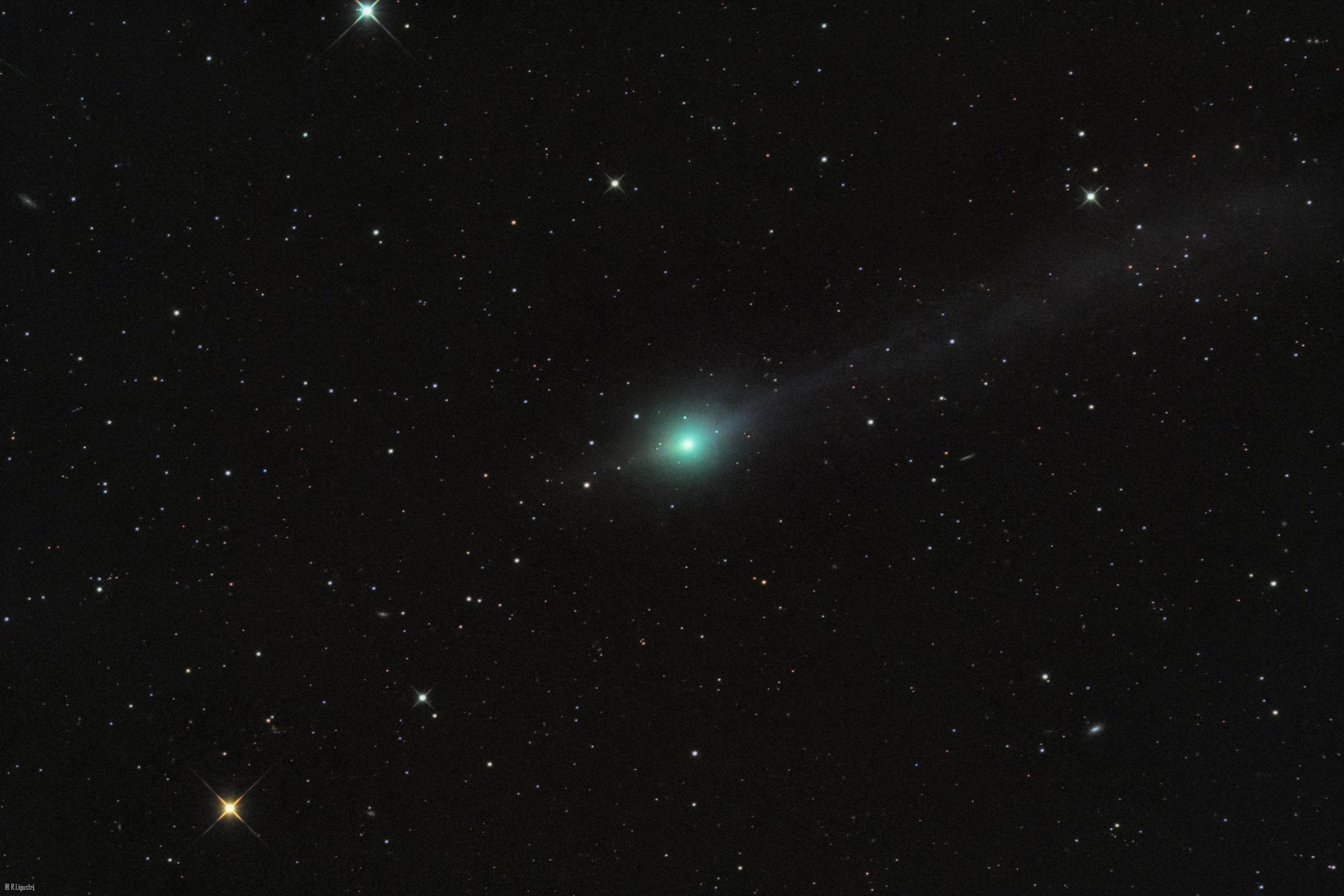
3I/ATLAS: A View from Planet Earth
Image Credit & Copyright: Rolando Ligustri
https://www.instagram.com/rolandoligustri/
Explanation:
Now outbound after its perihelion or closest approach to the Sun on October 29, Comet 3I/ATLAS is only the third known interstellar object to pass through our fair Solar System. Its greenish coma and faint tails are seen against a background of stars in the constellation Virgo in this view from planet Earth, recorded with a small telescope on November 14. But this interstellar interloper is the subject of an on-going, unprecedented Solar System-wide observing campaign involving spacecraft and space telescopes from Earth orbit to the surface of Mars and beyond. And while the comet from another star-system has recently grown brighter, you'll still need a telescope if you want to see 3I/ATLAS from planet Earth. It's now above the horizon in November morning skies and will make its closest approach to Earth, a comfortable 270 million kilometers distant, around December 19.
https://science.nasa.gov/solar-system/comets/3i-atlas/
https://www.instagram.com/rolandoligustri/p/DRCsqxPDFHM/
https://apod.nasa.gov/apod/ap250809.html
https://science.nasa.gov/solar-system/comets/3i-atlas/comet-3i-atlas-image-gallery/
https://science.nasa.gov/solar-system/view-interstellar-comet-3i-atlas-through-nasas-multiple-lenses/
https://www.arxiv.org/abs/2510.25035
https://earthsky.org/space/new-interstellar-object-candidate-heading-toward-the-sun-a11pl3z/
https://theskylive.com/c2025n1-info
https://apod.nasa.gov/apod/ap251121.html
#space #comets #astrophotography #photography #science #astronomy #nature #NASA #ESA #apod
Alt...
2025 November 20
3I/ATLAS: A View from Planet Earth
Image Credit & Copyright: Rolando Ligustri
Explanation:
Now outbound after its perihelion or closest approach to the Sun on October 29, Comet 3I/ATLAS is only the third known interstellar object to pass through our fair Solar System. Its greenish coma and faint tails are seen against a background of stars in the constellation Virgo in this view from planet Earth, recorded with a small telescope on November 14. But this interstellar interloper is the subject of an on-going, unprecedented Solar System-wide observing campaign involving spacecraft and space telescopes from Earth orbit to the surface of Mars and beyond. And while the comet from another star-system has recently grown brighter, you'll still need a telescope if you want to see 3I/ATLAS from planet Earth. It's now above the horizon in November morning skies and will make its closest approach to Earth, a comfortable 270 million kilometers distant, around December 19.
Authors & editors: Robert Nemiroff (MTU) & Jerry Bonnell (UMCP)
NASA Official: Amber Straughn Specific rights apply.
NASA Web Privacy, Accessibility, Notices;
A service of: ASD at NASA / GSFC,
NASA Science Activation
& Michigan Tech. U.
2025 November 20
Alnitak, Alnilam, Mintaka
* Image Credit & Copyright: Aygen Erkaslan
https://app.astrobin.com/u/a.erkaslan#gallery
Explanation:
Alnitak, Alnilam, and Mintaka are the bright bluish stars from east to west (upper right to lower left) along the diagonal in this cosmic vista. Otherwise known as the Belt of Orion, these three blue supergiant stars are hotter and much more massive than the Sun. They lie from 700 to 2,000 light-years away, born of Orion's well-studied interstellar clouds. In fact, clouds of gas and dust adrift in this region have some surprisingly familiar shapes, including the dark Horsehead Nebula and Flame Nebula near Alnitak at the upper right. The famous Orion Nebula itself is off the right edge of this colorful starfield. The telescopic frame spans almost 4 degrees on the sky.
http://stars.astro.illinois.edu/sow/alnitak.html
http://stars.astro.illinois.edu/sow/alnilam.html
http://stars.astro.illinois.edu/sow/mintaka.html
https://app.astrobin.com/u/a.erkaslan?i=6igdue#gallery
https://www.gb.nrao.edu/~rmaddale/Education/OrionTourCenter/optical.html
https://apod.nasa.gov/apod/ap200919.html
https://apod.nasa.gov/apod/ap250902.html
https://apod.nasa.gov/apod/ap251113.html
https://apod.nasa.gov/apod/ap120119.html
https://apod.nasa.gov/apod/ap251120.html
#space #nebula #astronomy #science #astrophotography #photography #nature #nebula #NASA #apod

Alt...
2025 November 20
Alnitak, Alnilam, Mintaka
* Image Credit & Copyright: Aygen Erkaslan
Explanation:
Alnitak, Alnilam, and Mintaka are the bright bluish stars from east to west (upper right to lower left) along the diagonal in this cosmic vista. Otherwise known as the Belt of Orion, these three blue supergiant stars are hotter and much more massive than the Sun. They lie from 700 to 2,000 light-years away, born of Orion's well-studied interstellar clouds. In fact, clouds of gas and dust adrift in this region have some surprisingly familiar shapes, including the dark Horsehead Nebula and Flame Nebula near Alnitak at the upper right. The famous Orion Nebula itself is off the right edge of this colorful starfield. The telescopic frame spans almost 4 degrees on the sky.
Authors & editors: Robert Nemiroff (MTU) & Jerry Bonnell (UMCP)
NASA Official: Amber Straughn Specific rights apply.
NASA Web Privacy, Accessibility, Notices;
A service of: ASD at NASA / GSFC,
NASA Science Activation
& Michigan Tech. U.
Annotated Hi-Res image for previews post.
Chamaeleon Dark Nebulas
* Image Credit & Copyright: Xinran Li & Houbo Zhou
https://apod.nasa.gov/apod/fap/ap251119.html
#space #nebula #astronomy #science #astrophotography #photography #nature #nebula #NASA #apod

Alt...
Annotated Hi-Res image for previews post.
The featured image shows a dark nebula complex involving thick dust appearing brown and making a big
Chamaeleon Dark Nebulas
* Image Credit & Copyright: Xinran Li & Houbo Zhou
Explanation:
Sometimes the dark dust of interstellar space has an angular elegance. Such is the case toward the far-south constellation of Chamaeleon. Normally too faint to see, dark dust is best known for blocking visible light from stars and galaxies behind it. In this 11.4-hour exposure, however, the dust is seen mostly in light of its own, with its strong red and near-infrared colors creating a brown hue. Contrastingly blue, a bright star Beta Chamaeleontis is visible on the upper right of the V, with the dust that surrounds it preferentially reflecting blue light from its primarily blue-white color. All of the pictured stars and dust occur in our own Milky Way Galaxy with one notable exception: a white spot just below Beta Chamaeleontis is the galaxy IC 3104 which lies far in the distance. Interstellar dust is mostly created in the cool atmospheres of giant stars and dispersed into space by stellar light, stellar winds, and stellar explosions such as supernovas.
2025 November 19
Chamaeleon Dark Nebulas
* Image Credit & Copyright: Xinran Li & Houbo Zhou
https://app.astrobin.com/u/Flying_Dutchman#gallery
Explanation:
Sometimes the dark dust of interstellar space has an angular elegance. Such is the case toward the far-south constellation of Chamaeleon. Normally too faint to see, dark dust is best known for blocking visible light from stars and galaxies behind it. In this 11.4-hour exposure, however, the dust is seen mostly in light of its own, with its strong red and near-infrared colors creating a brown hue. Contrastingly blue, a bright star Beta Chamaeleontis is visible on the upper right of the V, with the dust that surrounds it preferentially reflecting blue light from its primarily blue-white color. All of the pictured stars and dust occur in our own Milky Way Galaxy with one notable exception: a white spot just below Beta Chamaeleontis is the galaxy IC 3104 which lies far in the distance. Interstellar dust is mostly created in the cool atmospheres of giant stars and dispersed into space by stellar light, stellar winds, and stellar explosions such as supernovas.
https://en.wikipedia.org/wiki/Chamaeleon
https://en.wikipedia.org/wiki/Beta_Chamaeleontis
https://www.flickr.com/photos/hiroc/47807534932
http://www.werbeagentur.org/oldwexi/gallery.html
https://theskylive.com/sky/deepsky/ic3104-object
https://apod.nasa.gov/apod/ap180628.html
https://www.science.org/content/article/interstellar-dust-may-come-supernovae-after-all
https://en.wikipedia.org/wiki/List_of_stellar_explosion_types
https://en.wikipedia.org/wiki/Red_giant
https://astronomy.swin.edu.au/cosmos/d/Dust+Grain
https://apod.nasa.gov/apod/ap000318.html
https://science.nasa.gov/ems/07_infraredwaves/
https://apod.nasa.gov/apod/ap251119.html
#space #nebula #astronomy #science #astrophotography #photography #nature #nebula #NASA #apod

Alt...
2025 November 19
The featured image shows a dark nebula complex involving thick dust appearing brown and making a big
Chamaeleon Dark Nebulas
* Image Credit & Copyright: Xinran Li & Houbo Zhou
Explanation:
Sometimes the dark dust of interstellar space has an angular elegance. Such is the case toward the far-south constellation of Chamaeleon. Normally too faint to see, dark dust is best known for blocking visible light from stars and galaxies behind it. In this 11.4-hour exposure, however, the dust is seen mostly in light of its own, with its strong red and near-infrared colors creating a brown hue. Contrastingly blue, a bright star Beta Chamaeleontis is visible on the upper right of the V, with the dust that surrounds it preferentially reflecting blue light from its primarily blue-white color. All of the pictured stars and dust occur in our own Milky Way Galaxy with one notable exception: a white spot just below Beta Chamaeleontis is the galaxy IC 3104 which lies far in the distance. Interstellar dust is mostly created in the cool atmospheres of giant stars and dispersed into space by stellar light, stellar winds, and stellar explosions such as supernovas.
Authors & editors: Robert Nemiroff (MTU) & Jerry Bonnell (UMCP)
NASA Official: Amber Straughn Specific rights apply.
NASA Web Privacy, Accessibility, Notices;
A service of: ASD at NASA / GSFC,
NASA Science Activation
& Michigan Tech. U.
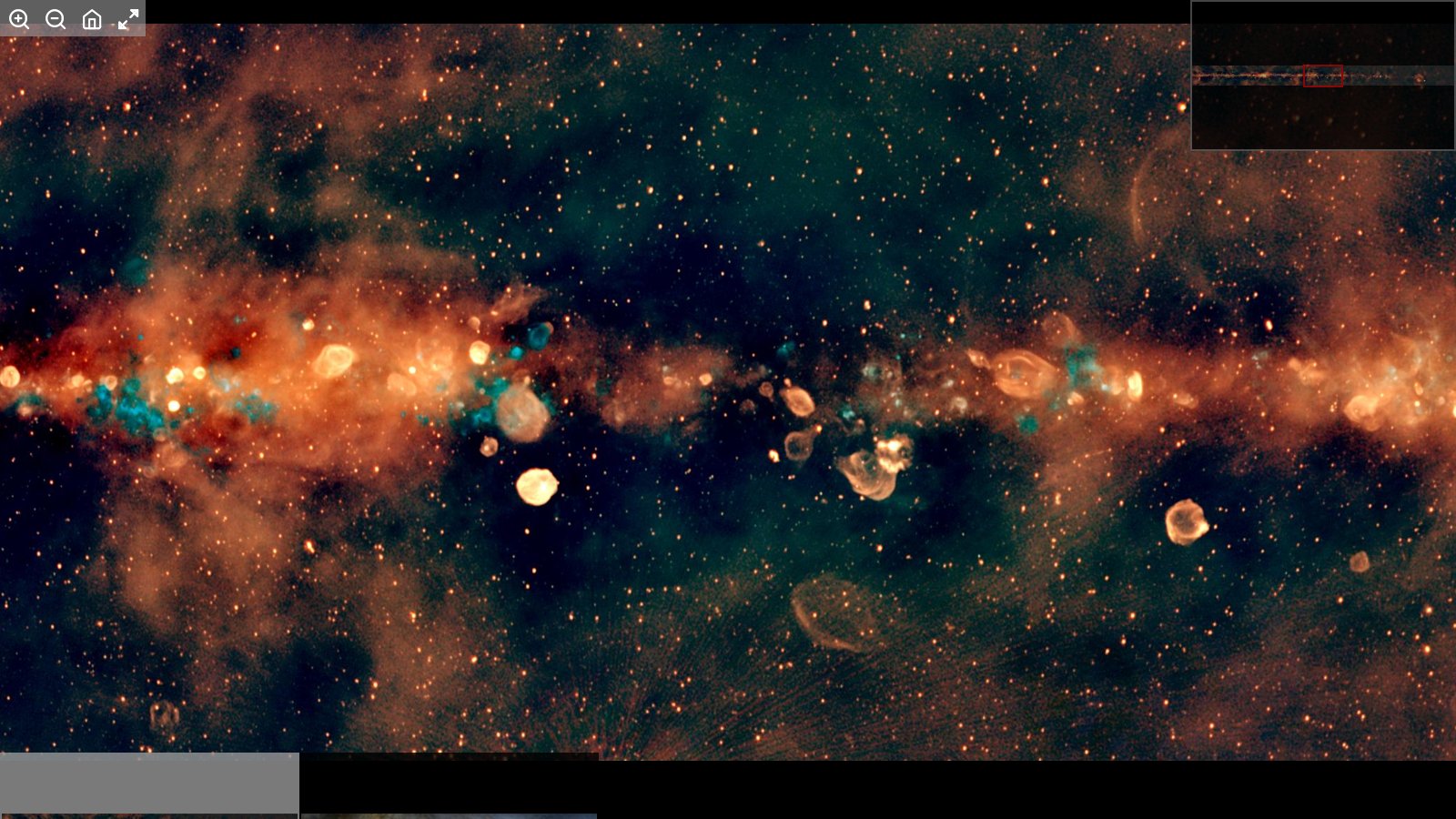
Explore and compare the Milky Way band in Visible Light and Radio Light with GLEAMX-deepzoom:
https://gleamx-deepzoom.pages.dev/
CREDIT
International Centre for Radio Astronomy Research (ICRAR)
#space #galaxy #milkyway #astrophotography #photography #science #astronomy #nature #NASA #apod
Alt...
Screenshot of the GLEAMX-deepzoom webpage
CREDIT
International Centre for Radio Astronomy Research (ICRAR)
2025 November 18
The Galactic Plane: Radio Versus Visible
* Image Credit: Radio: S. Mantovanini & the GLEAM team
https://www.researchgate.net/profile/Silvia_Mantovanini
https://www.mwatelescope.org/science/galactic-science/gleam/
* Visible: Axel Mellinger (milkywaysky.com)
https://milkywaysky.com/contact.html
Explanation:
What does the Milky Way look like in radio waves? To better find out, GLEAM surveyed the central band of our galaxy in high resolution radio light as imaged by the Murchison Widefield Array in Australia. As the featured video slowly scrolls, radio light (71 - 231 MHz) is seen on the left and visible light -- from the same field -- on the right. Differences are so great because most objects glow differently in radio and visible light, and because visible light is stopped by nearby interstellar dust. These differences are particularly apparent in the direction toward the center of our galaxy, seen about a third of the way through. Among the many features that appear in the radio, bright red patches are usually supernova remnants of exploded stars, while areas colored blue are stellar nurseries filled with bright young stars.
https://www.mwatelescope.org/science/galactic-science/gleam/
https://www.mwatelescope.org/
https://www.icrar.org/gleam-x-galactic-plane/
https://www.curtin.edu.au/news/media-release/a-new-expansive-view-of-the-milky-way-reveals-our-galaxy-in-unprecedented-radio-colour/
https://science.nasa.gov/ems/05_radiowaves/
https://science.nasa.gov/ems/09_visiblelight/
https://apod.nasa.gov/apod/ap250209.html
https://apod.nasa.gov/apod/ap241124.html
https://apod.nasa.gov/apod/ap250708.html
https://apod.nasa.gov/apod/ap100831.html
https://apod.nasa.gov/apod/ap250414.html
https://en.wikipedia.org/wiki/Supernova_remnant
https://apod.nasa.gov/apod/ap251118.html
#space #galaxy #milkyway #astrophotography #photography #science #astronomy #nature #NASA #apod
2025 November 17
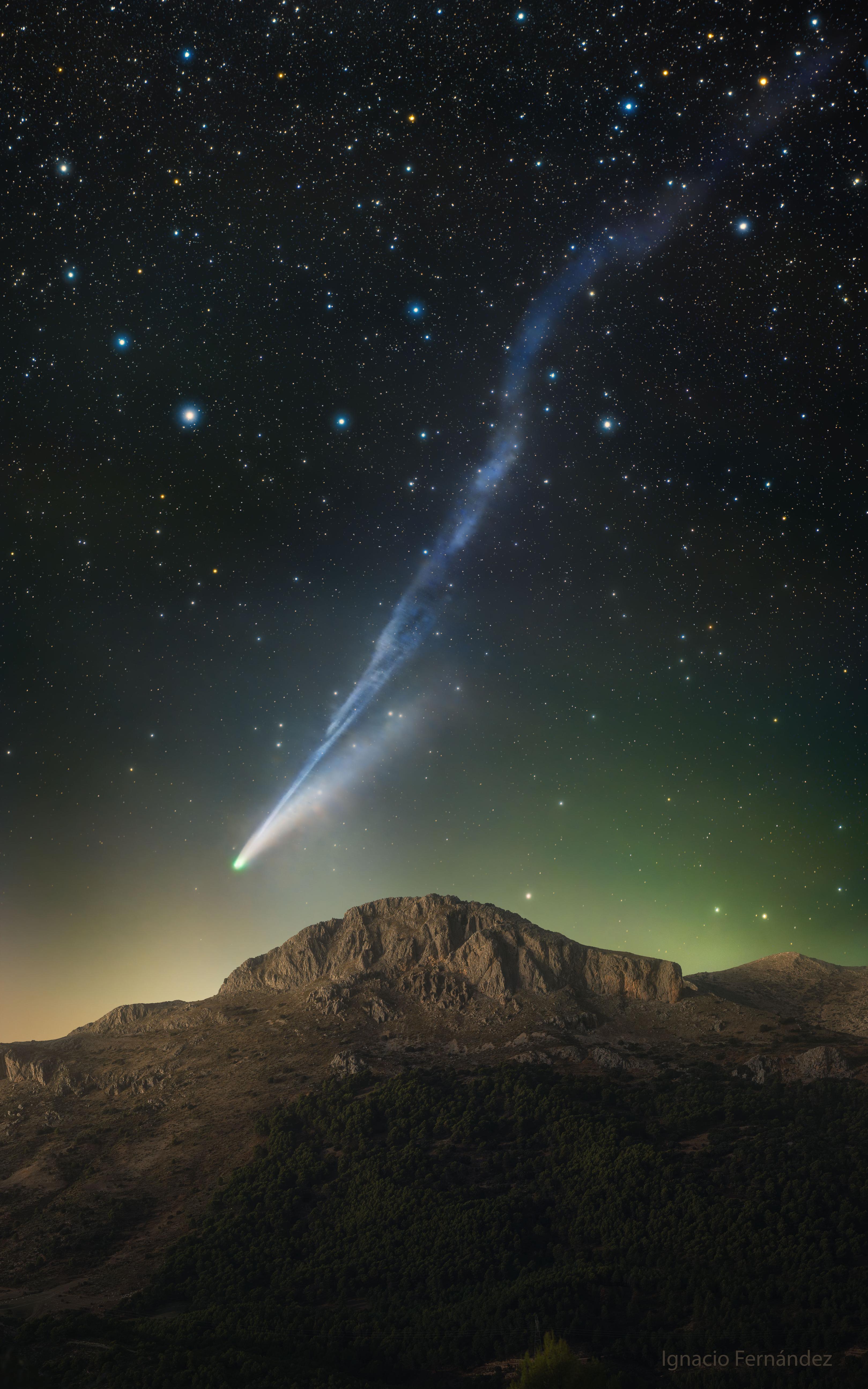
Comet Lemmon's Wandering Tail
* Image Credit: Ignacio Fernández
https://www.instagram.com/igneis.nightscapes/
Explanation:
What has happened to Comet Lemmon's tail? The answer is blowing in the wind — the wind from the Sun in this case. This continuous outflow of charged particles from the Sun has been quite variable of late, as the Sun emits bursts of energy, CMEs, that push out and deflect charged particles emitted by the comet itself. The result is a blue hued ion tail for Comet C/2025 A6 (Lemmon) that is not only impressively intricate but takes some unusual turns. This long-duration composite image taken from Alfacar, Spain last month captured this inner Solar System ionic tumult. Comet Lemmon is now fading as it heads out away from the Earth and Sun and back into the outer Solar System.
https://en.wikipedia.org/wiki/C/2025_A6_(Lemmon)
https://apod.nasa.gov/apod/ap220125.html
https://theskylive.com/c2025a6-info
https://science.nasa.gov/sun/what-is-the-solar-wind/
https://apod.nasa.gov/apod/ap240818.html
https://science.nasa.gov/science-research/heliophysics/nasa-noaa-sun-reaches-maximum-phase-in-11-year-solar-cycle/
https://www.jpl.nasa.gov/nmp/st5/SCIENCE/cme.html
https://science.nasa.gov/earth/facts/
https://apod.nasa.gov/apod/fap/ap251117.html
#space #comets #astrophotography #photography #science #astronomy #nature #NASA #ESA #education #apod
Alt...
2025 November 17
A starfield is shown above a mountain peak. Just above the mountain and extending up toward the upper right is a blue-tinted tail of a comet. The comet's head is just to the left of the peak.
Comet Lemmon's Wandering Tail
* Image Credit: Ignacio Fernández
Explanation:
What has happened to Comet Lemmon's tail? The answer is blowing in the wind — the wind from the Sun in this case. This continuous outflow of charged particles from the Sun has been quite variable of late, as the Sun emits bursts of energy, CMEs, that push out and deflect charged particles emitted by the comet itself. The result is a blue hued ion tail for Comet C/2025 A6 (Lemmon) that is not only impressively intricate but takes some unusual turns. This long-duration composite image taken from Alfacar, Spain last month captured this inner Solar System ionic tumult. Comet Lemmon is now fading as it heads out away from the Earth and Sun and back into the outer Solar System.
Authors & editors: Robert Nemiroff (MTU) & Jerry Bonnell (UMCP)
NASA Official: Amber Straughn Specific rights apply.
NASA Web Privacy, Accessibility, Notices;
A service of: ASD at NASA / GSFC,
NASA Science Activation
& Michigan Tech. U.
The Great Crossing
(Saturn's rings on the edge)
This movie sequence captures Saturn's rings during a ring plane crossing from the Cassini spacecraft's point of view. The movie begins with a view of the sunlit side of the rings. As the spacecraft speeds from south to north, the rings appear to tilt downward and collapse to a thin plane, and then open again to reveal the un-illuminated side of the ring plane, where sunlight filters through only dimly. The movie consists of 34 images taken over the course of 12 hours as Cassini pierced the ring plane. Six moons careen through the field of view during the sequence. The first large one is Enceladus, whose slanted motion from the upper left to center right nicely illustrates the inclination of its orbit with respect to the rings. The second large one, seen in the second half of the movie, is Mimas, going from right to left.
Saturn's rings are about 175,000 miles (282,000 km) across, but only about 3,200 feet (~1 km) thick. If you had a model of Saturn that wasCRED a meter stick wide (3 feet), its rings would be about 10,000 times thinner than a razor blade! Saturn and its rings would just fit in the distance between Earth and the Moon.
Saturn's rings probably formed when objects like comets, asteroids, or even moons broke up in orbit around Saturn due to Saturn's very strong gravity. The pieces of these objects kept colliding with each other and broke into even smaller pieces. These pieces gradually spread around Saturn to form its rings. The rings are thought to be short-lived compared to the age of the Solar System, meaning that if we lived at a very different time, we may not have seen rings around Saturn.
Saturn's rings are made of billions of pieces of ice, dust and rocks. (more in ALT-text)
CREDIT
NASA Jet Propulsion Laboratory,
https://coolcosmos.ipac.caltech.edu/ask/108-How-large-are-Saturn-s-rings-
#space #saturn #astrophotography #photography #science #astronomy #physics #nature #NASA #ESA #education #apod
2025 November 16
Crossing Saturn's Ring Plane
* Image Credit: NASA, ESA, JPL, ISS, Cassini Imaging Team
https://www.nasa.gov/
https://www.esa.int/
https://www.jpl.nasa.gov/
http://ciclops.org/iss/iss.php
http://ciclops.org/
* Processing: Fernando Garcia Navarro
Explanation:
If this is Saturn, where are the rings? When Saturn's "appendages" disappeared in 1612, Galileo did not understand why. Later that century, it became understood that Saturn's unusual protrusions were rings and that when the Earth crosses the ring plane, the edge-on rings will appear to disappear. This is because Saturn's rings are confined to a plane many times thinner, in proportion, than a razor blade. In modern times, the robotic Cassini spacecraft that orbited Saturn frequently crossed Saturn's ring plane during its mission to Saturn, from 2004 to 2017. A series of plane crossing images from 2005 February was dug out of the vast online Cassini raw image archive by interested Spanish amateur Fernando Garcia Navarro. Pictured here, digitally cropped and set in representative colors, is the striking result. Saturn's thin ring plane appears in blue, bands and clouds in Saturn's upper atmosphere appear in gold. Details of Saturn's rings can be seen in high dark shadows. The moons Dione and Enceladus appear as bumps in the rings.
https://asterisk.apod.com/viewtopic.php?f=9&t=18340&p=230228#p230227
https://slate.com/technology/2005/06/saturns-thin-blue-line.html
https://coolcosmos.ipac.caltech.edu/ask/108-How-large-are-Saturn-s-rings-
https://solarsystem.nasa.gov/cassini-raw-images/
https://science.nasa.gov/mission/cassini/
https://science.nasa.gov/mission/cassini/spacecraft/cassini-orbiter/
https://science.nasa.gov/mission/cassini/spacecraft/cassini-orbiter/
https://science.nasa.gov/saturn/moons/dione/
https://science.gsfc.nasa.gov/attic/huygensgcms/Shistory.htm
https://en.wikipedia.org/wiki/Galileo_Galilei
https://apod.nasa.gov/apod/ap251116.html
#space #saturn #astrophotography #photography #science #astronomy #physics #nature #NASA #ESA #education #apod
Alt...
2025 November 16
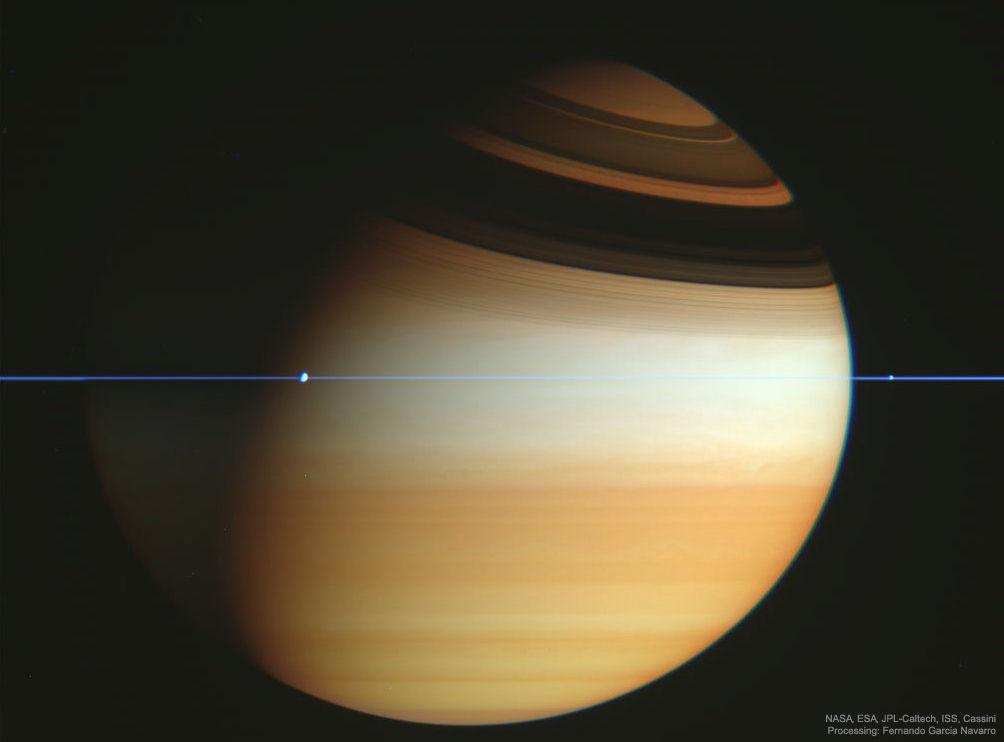
The planet Saturn is shown as an orange orb with bands. A blue line with bumps runs across the middle -- which is the rings seen sideways. The bumps are small moons.
Crossing Saturn's Ring Plane
* Image Credit: NASA, ESA, JPL, ISS, Cassini Imaging Team
* Processing: Fernando Garcia Navarro
Explanation:
If this is Saturn, where are the rings? When Saturn's "appendages" disappeared in 1612, Galileo did not understand why. Later that century, it became understood that Saturn's unusual protrusions were rings and that when the Earth crosses the ring plane, the edge-on rings will appear to disappear. This is because Saturn's rings are confined to a plane many times thinner, in proportion, than a razor blade. In modern times, the robotic Cassini spacecraft that orbited Saturn frequently crossed Saturn's ring plane during its mission to Saturn, from 2004 to 2017. A series of plane crossing images from 2005 February was dug out of the vast online Cassini raw image archive by interested Spanish amateur Fernando Garcia Navarro. Pictured here, digitally cropped and set in representative colors, is the striking result. Saturn's thin ring plane appears in blue, bands and clouds in Saturn's upper atmosphere appear in gold. Details of Saturn's rings can be seen in high dark shadows. The moons Dione and Enceladus appear as bumps in the rings.
Authors & editors: Robert Nemiroff (MTU) & Jerry Bonnell (UMCP)
NASA Official: Amber Straughn Specific rights apply.
Trapezium Zoom
Messier 42 (The Orion Nebula)
+ Distance: 1,500 light-years
+ Apparent Magnitude: 4.0
+ Constellation: Orion
+ Object Type: Nebula
+ Release Date: August 24, 2000
+ Science Release: Hubble Spies Brown Dwarfs in Nearby Stellar Nursery
Credit
Bryan Preston (STScI AVL)
https://science.nasa.gov/missions/hubble/hubble-spies-brown-dwarfs-in-nearby-stellar-nursery/
#space #nebula #astronomy #science #astrophotography #photography #nature #nebula #NASA #ESA
Messier 42 (The Orion Nebula)
* by Andrea Gianopoulos
You can spot Messier 42, better known as the Orion Nebula, with the unaided eye from a dark sky site.
Believed to be the cosmic fire of creation by the Maya of Mesoamerica, M42 blazes brightly in the constellation Orion. Popularly called the Orion Nebula, this stellar nursery has been known to many different cultures throughout human history. The nebula is only 1,500 light-years away, making it the closest large star-forming region to Earth and giving it a relatively bright apparent magnitude of 4. Because of its brightness and prominent location just below Orion’s belt, M42 can be spotted with the naked eye, while offering an excellent peek at stellar birth for those with telescopes. It is best observed during January.
The Mayan culture’s likening of the Orion Nebula to a cosmic fire of creation is very apt. The nebula is an enormous cloud of dust and gas where vast numbers of new stars are being forged. Its bright, central region is the home of four massive, young stars that shape the nebula. The four hefty stars are called the Trapezium because they are arranged in a trapezoidal pattern. Ultraviolet light unleashed by these stars is carving a cavity in the nebula and disrupting the growth of hundreds of smaller stars.
This stunning Hubble image offers the sharpest view of the Orion Nebula ever obtained. Created using 520 different Hubble exposures taken in multiple wavelengths of light, this mosaic contains over one billion pixels. Hubble imaged most of the nebula, but ground-based images were used to fill in the gaps in its observations. The orange color in the image can be attributed to hydrogen, green represents oxygen, and the red represents both sulfur and observations made in infrared light.
FYI:
https://science.nasa.gov/missions/hubble/hubble-panoramic-view-of-orion-nebula-reveals-thousands-of-stars/
https://science.nasa.gov/missions/hubble/hubble-discovery-of-runaway-star-yields-clues-to-breakup-of-multiple-star-system/
#space #nebula #astronomy #science #astrophotography #photography #nature #nebula #NASA #ESA

Alt...
This stunning Hubble image offers the sharpest view of the Orion Nebula ever obtained. Created using 520 different Hubble exposures taken in multiple wavelengths of light, this mosaic contains over one billion pixels. Hubble imaged most of the nebula, but ground-based images were used to fill in the gaps in its observations. The orange color in the image can be attributed to hydrogen, green represents oxygen, and the red represents both sulfur and observations made in infrared light.
Credit
NASA, ESA, M. Robberto (Space Telescope Science Institute/ESA) and the Hubble Space Telescope Orion Treasury Project Team

Alt...
Appearing like glistening precious stones, M42’s Trapezium cluster, named for the trapezoidal arrangement of its central massive stars, is seen in this infrared Hubble image. All of the members of the Trapezium were born together in this hotbed of star formation.
CREDIT
K.L. Luhman (Harvard-Smithsonian Center for Astrophysics, Cambridge, Mass.); and G. Schneider, E. Young, G. Rieke, A. Cotera, H. Chen, M. Rieke, R. Thompson (Steward Observatory, University of Arizona, Tucson, Ariz.) and NASA/ESA

Alt...
Resembling an interstellar Frisbee, the dark feature in these two Hubble images is a protoplanetary disk of dust seen edge-on around a newborn star in M42. The two images show the disk through two different sets of filters: one to probe the disk’s chemical composition (left) and another to reduce the brightness of the nebula, revealing brighter regions above and below the disk that betray the presence of the star (right). Because the disk is edge-on, its star is largely hidden, but the disk may be an embryonic planetary system in the making. Our solar system probably formed out of such a disk 4.5 billion years ago.
CREDIT
Mark McCaughrean (Max-Planck-Institute for Astronomy), C. Robert O'Dell (Rice University) and NASA
Hubble Spies Brown Dwarfs in Nearby Stellar Nursery
[...]
Appearing like glistening precious stones surrounding a setting of sparkling diamonds, more than 300 fledgling stars and brown dwarfs surround the brightest, most massive stars [center of picture] in Hubble's view of the Trapezium cluster's central region. All of the celestial objects in the Trapezium were born together in this hotbed of star formation. The cluster is named for the trapezoidal alignment of those central massive stars.
Brown dwarfs are gaseous objects with masses so low their cores never become hot enough to fuse hydrogen, the thermonuclear fuel stars like the Sun need to shine steadily. Instead, these gaseous objects fade and cool as they grow older. [...]
This finding, along with observations from ground-based telescopes, is further evidence that brown dwarfs, once considered exotic objects, are nearly as abundant as stars. The image and results appear in the Sept. 20 issue of the Astrophysical Journal.
The brown dwarfs are too dim to be seen in a visible-light image taken by the Hubble telescope's Wide Field and Planetary Camera 2 [picture at left]. This view also doesn't show the assemblage of infant stars seen in the near-infrared image. That's because the young stars are embedded in dense clouds of dust and gas. The Hubble telescope's near-infrared camera, the Near Infrared Camera and Multi-Object Spectrometer, penetrated those clouds to capture a view of those objects. The brown dwarfs are the faintest objects in the image. Surveying the cluster's central region, the Hubble telescope spied brown dwarfs with masses equaling 10 to 80 Jupiters. Researchers think there may be less massive brown dwarfs that are beyond the limits of Hubble's vision.
[...] (see more in ALT-text)
#space #nebula #astronomy #science #astrophot ography #photography #nature #nebula #NASA #ESA
![Probing deep within a neighborhood stellar nursery, NASA's Hubble Space Telescope uncovered a swarm of newborn brown dwarfs. The orbiting observatory's near-infrared camera revealed about 50 of these objects throughout the Orion Nebula's Trapezium cluster [image at right], about 1,500 light-years from Earth. Appearing like glistening precious stones surrounding a setting of sparkling diamonds, more than 300 fledgling stars and brown dwarfs surround the brightest, most massive stars [center of picture] in Hubble's view of the Trapezium cluster's central region. The brown dwarfs are too dim to be seen in an image taken by the Hubble telescope's visible-light camera [picture at left].
[...]
The near-infrared image was taken Jan. 17, 1998. Two near-infrared filters were used to obtain information on the colors of the stars at two wavelengths (1.1 and 1.6 microns). The Trapezium picture is 1 light-year across. This composite image was made from a "mosaic" of nine separate, but adjoining images. In this false-color image, blue corresponds to warmer, more massive stars, and red to cooler, less massive stars and brown dwarfs, and stars that are heavily obscured by dust.
The visible-light data were taken in 1994 and 1995.
Credit
* Near-infrared image: NASA; K.L. Luhman and G. Schneider, E. Young, G. Rieke, A. Cotera, H. Chen, M. Rieke, R. Thompson
* Visible-light image: NASA, C.R. O'Dell and S.K. Wong (Rice University)](https://files.defcon.social/dcsocial-s3/media_attachments/files/115/552/556/134/768/487/original/5241229082ac1174.jpg "Probing deep within a neighborhood stellar nursery, NASA's Hubble Space Telescope uncovered a swarm of newborn brown dwarfs. The orbiting observatory's near-infrared camera revealed about 50 of these objects throughout the Orion Nebula's Trapezium cluster [image at right], about 1,500 light-years from Earth. Appearing like glistening precious stones surrounding a setting of sparkling diamonds, more than 300 fledgling stars and brown dwarfs surround the brightest, most massive stars [center of picture] in Hubble's view of the Trapezium cluster's central region. The brown dwarfs are too dim to be seen in an image taken by the Hubble telescope's visible-light camera [picture at left].
[...]
The near-infrared image was taken Jan. 17, 1998. Two near-infrared filters were used to obtain information on the colors of the stars at two wavelengths (1.1 and 1.6 microns). The Trapezium picture is 1 light-year across. This composite image was made from a \"mosaic\" of nine separate, but adjoining images. In this false-color image, blue corresponds to warmer, more massive stars, and red to cooler, less massive stars and brown dwarfs, and stars that are heavily obscured by dust.
The visible-light data were taken in 1994 and 1995.
Credit
* Near-infrared image: NASA; K.L. Luhman and G. Schneider, E. Young, G. Rieke, A. Cotera, H. Chen, M. Rieke, R. Thompson
* Visible-light image: NASA, C.R. O'Dell and S.K. Wong (Rice University)")
Alt...
Probing deep within a neighborhood stellar nursery, NASA's Hubble Space Telescope uncovered a swarm of newborn brown dwarfs. The orbiting observatory's near-infrared camera revealed about 50 of these objects throughout the Orion Nebula's Trapezium cluster [image at right], about 1,500 light-years from Earth. Appearing like glistening precious stones surrounding a setting of sparkling diamonds, more than 300 fledgling stars and brown dwarfs surround the brightest, most massive stars [center of picture] in Hubble's view of the Trapezium cluster's central region. The brown dwarfs are too dim to be seen in an image taken by the Hubble telescope's visible-light camera [picture at left].
[...]
The near-infrared image was taken Jan. 17, 1998. Two near-infrared filters were used to obtain information on the colors of the stars at two wavelengths (1.1 and 1.6 microns). The Trapezium picture is 1 light-year across. This composite image was made from a "mosaic" of nine separate, but adjoining images. In this false-color image, blue corresponds to warmer, more massive stars, and red to cooler, less massive stars and brown dwarfs, and stars that are heavily obscured by dust.
The visible-light data were taken in 1994 and 1995.
Credit
* Near-infrared image: NASA; K.L. Luhman and G. Schneider, E. Young, G. Rieke, A. Cotera, H. Chen, M. Rieke, R. Thompson
* Visible-light image: NASA, C.R. O'Dell and S.K. Wong (Rice University)
Orion Nebula proplyd atlas
This atlas features 30 proplyds, or protoplanetary discs, that were recently discovered in the majestic Orion Nebula. Using the wide field channel on Hubble’s Advanced Camera for Surveys (ACS), astronomers discovered a total of 42 new discs that could be the seeds of planetary systems to come. Within the awe-inspiring, gaseous folds of Orion, researchers have identified two different types of discs around young and forming stars: those that lie close to the brightest star in the cluster (Theta 1 Orionis C) and those farther away from it. The bright star heats up the gas in the nearby discs, causing them to shine brightly. The discs that are farther away do not receive enough of the energetic radiation from the star to set the gas ablaze; thus, they can only be detected as dark silhouettes against the background of the bright nebula, as the dust that surrounds these discs absorbs background visible light. By studying these silhouetted discs, astronomers are better able to characterize the properties of the dust grains that are thought to bind together and possibly form planets like our own. In the brighter discs the excited material produces many glowing cusps, which all face the bright star, but from our point of view are randomly oriented through the nebula, so we see some edge on, and others face on, for instance. Other interesting features enhance the look of these captivating objects, such as emerging jets of matter and shock waves. The dramatic shock waves are formed when the stellar wind from the nearby massive star collides with the gas in the nebula, sculpting boomerang shapes or arrows or even, in the case of 181-825, a space jellyfish! [...] (see ALT-text)
Image Credit:
NASA, ESA, and L. Ricci (ESO)
https://science.nasa.gov/image-detail/orion-nebula-proplyd-atlas/
#space #nebula #astronomy #science #astrophotography #photography #nature #nebula #NASA #ESA
![Orion Nebula proplyd atlas
This atlas features 30 proplyds, or protoplanetary discs, that were recently discovered in the majestic Orion Nebula.
Image Credit:
NASA, ESA, and L. Ricci (ESO)
[...]
It is relatively rare to see visible images of proplyds, but the high resolution and sensitivity of Hubble and the Orion Nebula’s proximity to Earth allow for precise views of these potential planetary systems. This proplyd atlas is the first scientific outcome from the HST Treasury Program on the Orion Nebula.](https://files.defcon.social/dcsocial-s3/media_attachments/files/115/552/466/597/260/016/original/5e9edbed868bda03.jpg "Orion Nebula proplyd atlas
This atlas features 30 proplyds, or protoplanetary discs, that were recently discovered in the majestic Orion Nebula.
Image Credit:
NASA, ESA, and L. Ricci (ESO)
[...]
It is relatively rare to see visible images of proplyds, but the high resolution and sensitivity of Hubble and the Orion Nebula’s proximity to Earth allow for precise views of these potential planetary systems. This proplyd atlas is the first scientific outcome from the HST Treasury Program on the Orion Nebula.")
Alt...
Orion Nebula proplyd atlas
This atlas features 30 proplyds, or protoplanetary discs, that were recently discovered in the majestic Orion Nebula.
Image Credit:
NASA, ESA, and L. Ricci (ESO)
[...]
It is relatively rare to see visible images of proplyds, but the high resolution and sensitivity of Hubble and the Orion Nebula’s proximity to Earth allow for precise views of these potential planetary systems. This proplyd atlas is the first scientific outcome from the HST Treasury Program on the Orion Nebula.
2025 November 15
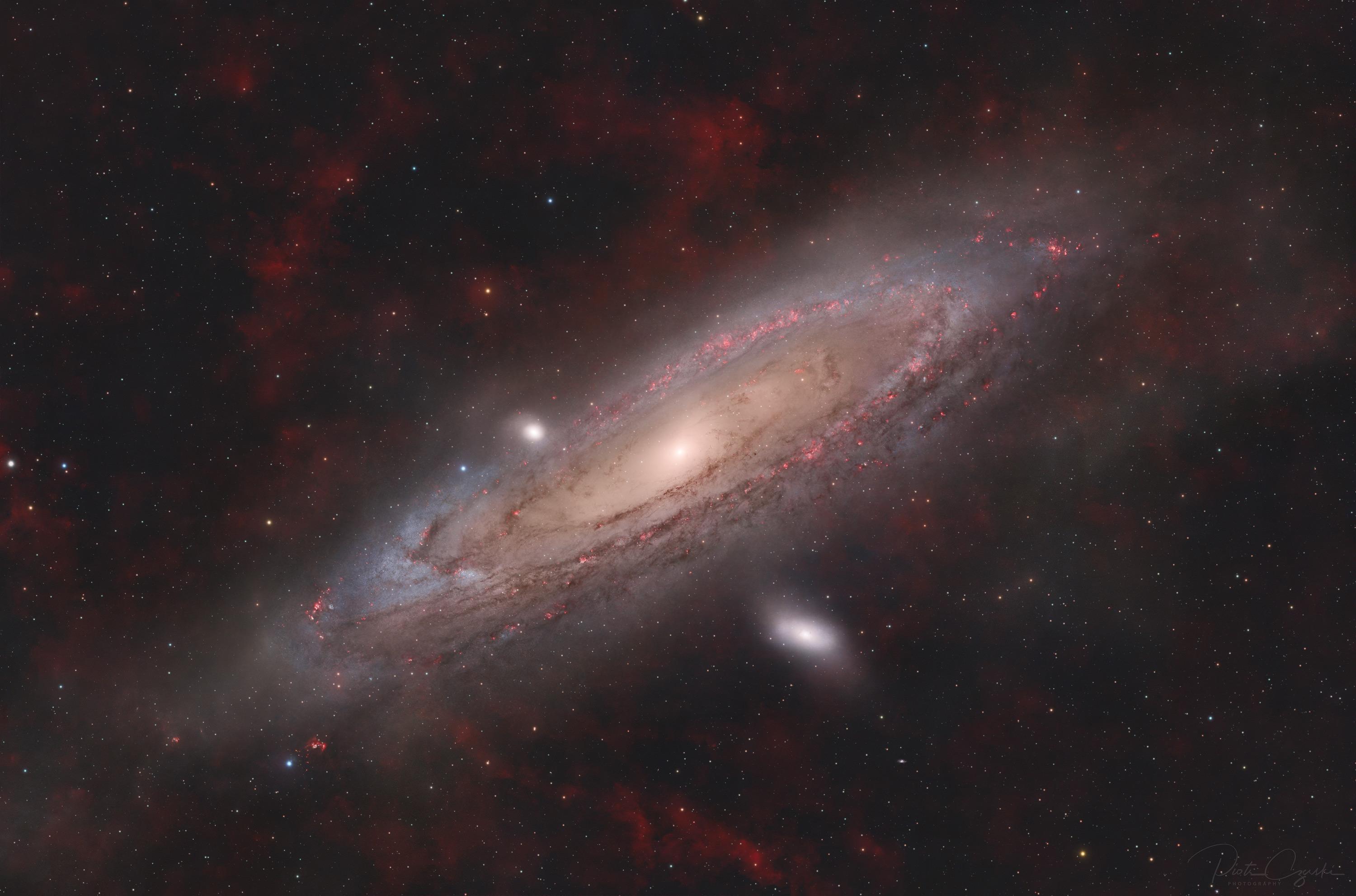
Andromeda and Friends
* Image Credit & Copyright: Piotr Czerski
https://app.astrobin.com/u/PiotrC#gallery
Explanation:
This magnificent extragalactic skyscape looks toward the Andromeda Galaxy, the closest large spiral galaxy to the Milky Way. It also accomplishes a Messier catalog trifecta by including Andromeda, cataloged as Messier 31 (M31), along with Messier 32 (M32), and Messier 110 (M110) in the same telescopic field of view. In this frame, M32 is just left of the Andromeda Galaxy's bright core with M110 below and to the right. M32 and M110 are both elliptical galaxies themselves and satellites of the larger spiral Andromeda. By combining 60 hours of broadband and narrowband image data, the deep telescopic view also reveals tantalizing details of dust lanes, young star clusters, and star-forming regions along Andromeda's spiral arms, and faint, foreground clouds of glowing hydrogen gas. For now, Andromeda and friends are some 2.5 million light-years from our own large spiral Milky Way.
https://app.astrobin.com/u/PiotrC?i=1y6644#gallery
https://science.nasa.gov/mission/hubble/science/explore-the-night-sky/hubble-messier-catalog/messier-31/
https://science.nasa.gov/mission/hubble/science/explore-the-night-sky/hubble-messier-catalog/messier-32/
https://science.nasa.gov/mission/hubble/science/explore-the-night-sky/hubble-messier-catalog/messier-110/
https://apod.nasa.gov/apod/fap/ap251115.html
#space #galaxy #astrophotography #photography #science #astronomy #nature #NASA #ESA #apod
Alt...
2025 November 15
Andromeda and Friends
* Image Credit & Copyright: Piotr Czerski
Explanation:
This magnificent extragalactic skyscape looks toward the Andromeda Galaxy, the closest large spiral galaxy to the Milky Way. It also accomplishes a Messier catalog trifecta by including Andromeda, cataloged as Messier 31 (M31), along with Messier 32 (M32), and Messier 110 (M110) in the same telescopic field of view. In this frame, M32 is just left of the Andromeda Galaxy's bright core with M110 below and to the right. M32 and M110 are both elliptical galaxies themselves and satellites of the larger spiral Andromeda. By combining 60 hours of broadband and narrowband image data, the deep telescopic view also reveals tantalizing details of dust lanes, young star clusters, and star-forming regions along Andromeda's spiral arms, and faint, foreground clouds of glowing hydrogen gas. For now, Andromeda and friends are some 2.5 million light-years from our own large spiral Milky Way.
Authors & editors: Robert Nemiroff (MTU) & Jerry Bonnell (UMCP)
NASA Official: Amber Straughn Specific rights apply.
NASA Web Privacy, Accessibility, Notices;
A service of: ASD at NASA / GSFC,
NASA Science Activation
& Michigan Tech. U.
2025 November 14
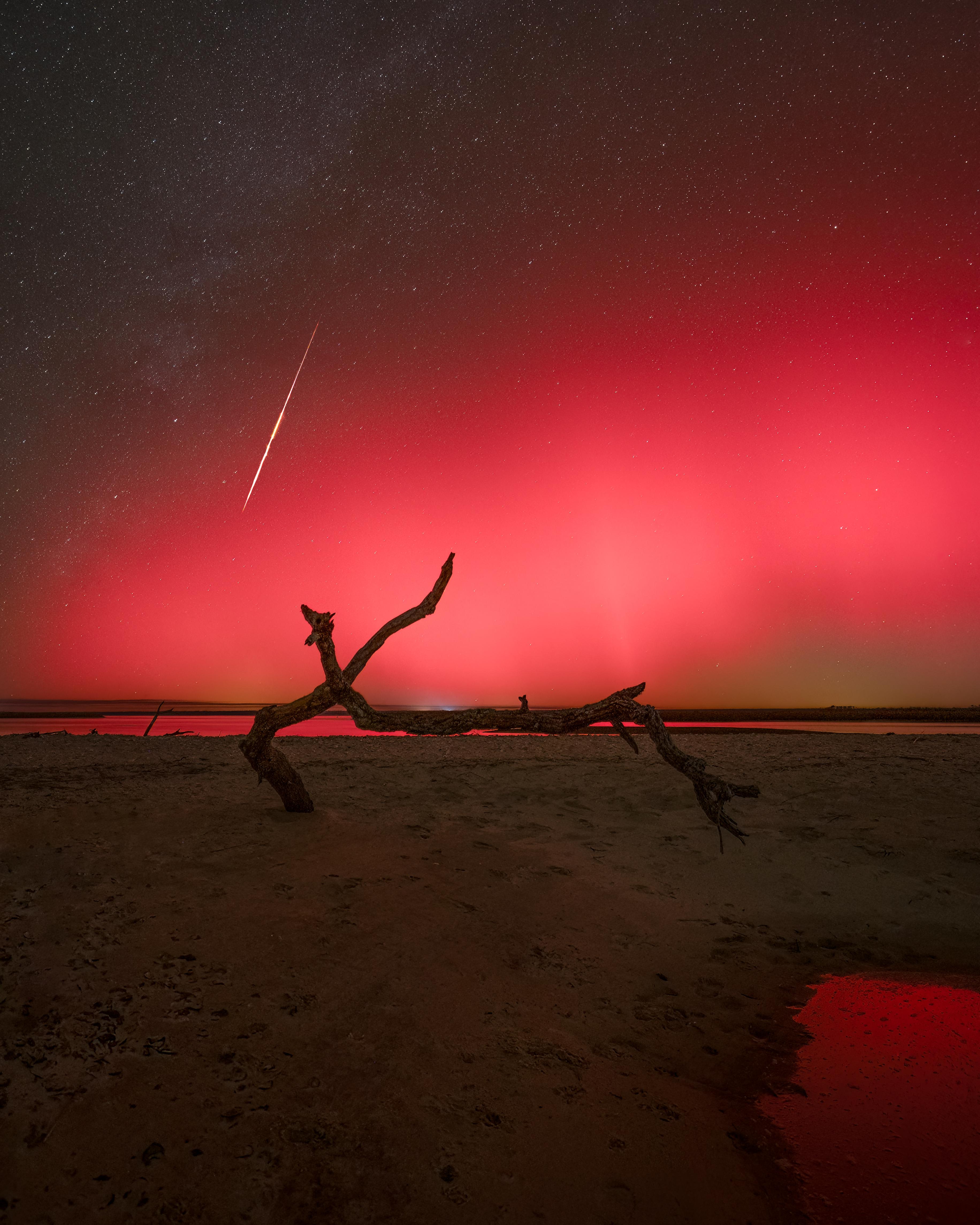
Florida Northern Lights
* Image Credit & Copyright: Samil Cabrera
https://www.instagram.com/astronycc/
Explanation:
Northern lights have come to Florida skies. In fact, the brilliant streak of a Northern Taurid meteor flashes through the starry night sky above the beach in this sea and skyscape, captured from Shired Island, Florida on November 11. Meteors from the annual Northern Taurid meteor shower are expected this time of year. But the digital camera exposure also records the shimmering glow of aurora, a phenomenon more often seen from our fair planet's higher geographical latitudes. Also known as aurora borealis, these northern lights are part of recent, wide spread auroral activity caused by strong geomagnetic storms. In the last few days, stormy spaceweather has been triggered by multiple Earth impacting coronal mass ejections and intense solar activity.
https://spaceweathergallery2.com/indiv_upload.php?upload_id=228413
https://www.swpc.noaa.gov/news/g3-strong-geomagnetic-storming-continues-g4-severe-still-expected
https://earthsky.org/astronomy-essentials/taurid-meteors-all-you-need-to-know/
https://earthsky.org/sun/sun-news-activity-solar-flare-cme-aurora-updates/
https://apod.nasa.gov/apod/ap251114.html
#space #earth #aurora #astrophotography #photography #NASA #science #physics #nature #education #4sAur #apod
Alt...
2025 November 14
Florida Northern Lights
* Image Credit & Copyright: Samil Cabrera
Explanation:
Northern lights have come to Florida skies. In fact, the brilliant streak of a Northern Taurid meteor flashes through the starry night sky above the beach in this sea and skyscape, captured from Shired Island, Florida on November 11. Meteors from the annual Northern Taurid meteor shower are expected this time of year. But the digital camera exposure also records the shimmering glow of aurora, a phenomenon more often seen from our fair planet's higher geographical latitudes. Also known as aurora borealis, these northern lights are part of recent, wide spread auroral activity caused by strong geomagnetic storms. In the last few days, stormy spaceweather has been triggered by multiple Earth impacting coronal mass ejections and intense solar activity.
Authors & editors: Robert Nemiroff (MTU) & Jerry Bonnell (UMCP)
NASA Official: Amber Straughn Specific rights apply.
NASA Web Privacy, Accessibility, Notices;
A service of: ASD at NASA / GSFC,
NASA Science Activation
& Michigan Tech. U.
2011 March 25
Auroral Substorm over Yellowknife
* Image Credit & Copyright: Kwon, O Chul
https://twanight.org/profile/kwon-o-chul/
Explanation:
Intense auroral activity flooded the night with shimmering colors on February 24, captured here from a lodge near the city of Yellowknife in northern Canada. The stunning sequence (left to right) of three all-sky exposures, taken at 30 second intervals, shows rapid changes in dancing curtains of northern lights against a starry background. What makes the northern lights dance? Measurements by NASA's fleet of THEMIS spacecraft indicate that these explosions of auroral activity are driven by sudden releases of energy in the Earth's magnetosphere called magnetic reconnection events. The reconnection events release energy when magnetic field lines snap like rubber bands, driving charged particles into the upper atmosphere. Stretching into space, these reconnection events occur in the magnetosphere on the Earth's night side at a distance about 1/3 of the way to the Moon.
https://apod.nasa.gov/apod/ap110325.html
#space #earth #aurora #astrophotography #photography #NASA #science #physics #nature #education #4sAur
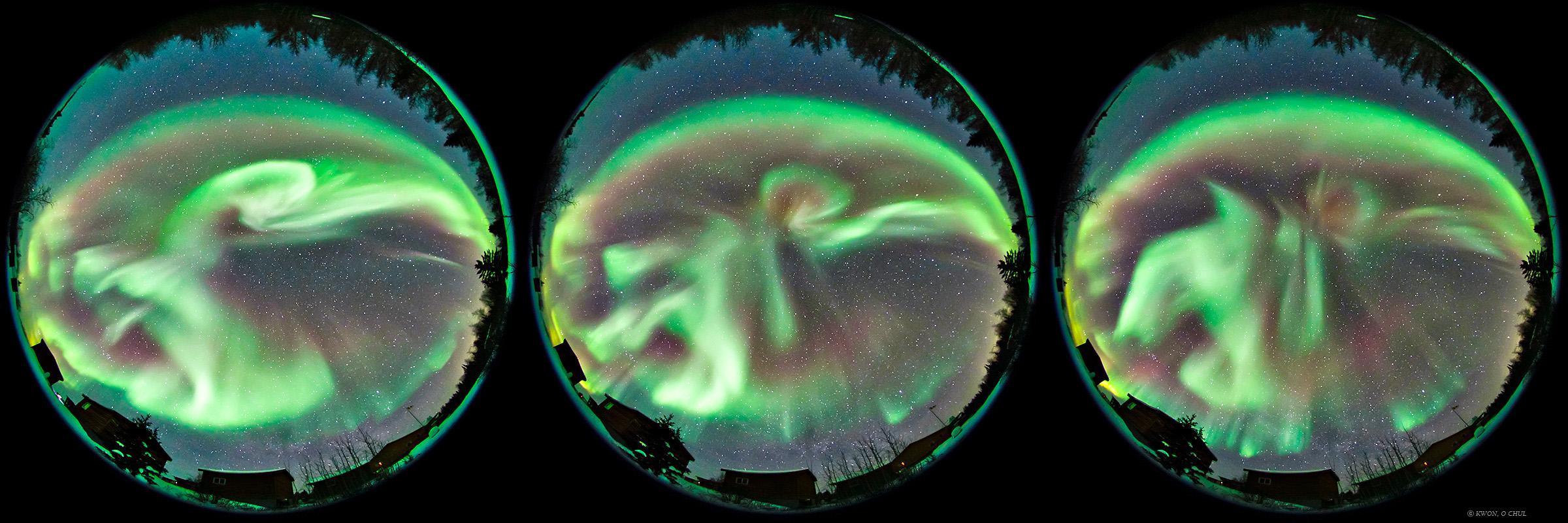
Alt...
2011 March 25
Auroral Substorm over Yellowknife
* Image Credit & Copyright: Kwon, O Chul (TWAN)
Explanation:
Intense auroral activity flooded the night with shimmering colors on February 24, captured here from a lodge near the city of Yellowknife in northern Canada. The stunning sequence (left to right) of three all-sky exposures, taken at 30 second intervals, shows rapid changes in dancing curtains of northern lights against a starry background. What makes the northern lights dance? Measurements by NASA's fleet of THEMIS spacecraft indicate that these explosions of auroral activity are driven by sudden releases of energy in the Earth's magnetosphere called magnetic reconnection events. The reconnection events release energy when magnetic field lines snap like rubber bands, driving charged particles into the upper atmosphere. Stretching into space, these reconnection events occur in the magnetosphere on the Earth's night side at a distance about 1/3 of the way to the Moon.
Authors & editors: Robert Nemiroff (MTU) & Jerry Bonnell (UMCP)
NASA Official: Phillip Newman Specific rights apply.
NASA Web Privacy Policy and Important Notices
A service of: ASD at NASA / GSFC
& Michigan Tech. U.
2025 November 13
Orion and the Running Man
* Image Credit & Copyright: R. Jay Gabany
https://www.cosmotography.com/index.html
Explanation:
Few cosmic vistas can excite the imagination like The Great Nebula in Orion. Visible as a faint, bland celestial smudge to the naked-eye, the nearest large star-forming region sprawls across this sharp colorful telescopic image. Designated M42 in the Messier Catalog, the Orion Nebula's glowing gas and dust surrounds hot, young stars. About 40 light-years across, M42 is at the edge of an immense interstellar molecular cloud only 1,500 light-years away that lies within the same spiral arm of our Milky Way galaxy as the Sun. Including dusty bluish reflection nebula NGC 1977, also known as the Running Man nebula at left in the frame, the natal nebulae represent only a small fraction of our galactic neighborhood's wealth of star-forming material. Within the well-studied stellar nursery, astronomers have also identified what appear to be numerous infant solar systems.
https://cosmotography.com/images/small_gabany_M42_2025.html
https://science.nasa.gov/asset/hubble/the-orion-nebulas-trapezium-cluster/
https://science.nasa.gov/mission/hubble/science/explore-the-night-sky/hubble-messier-catalog/messier-42/
https://en.wikipedia.org/wiki/Orion_molecular_cloud_complex
https://science.nasa.gov/image-detail/orion-nebula-proplyd-atlas/
https://science.nasa.gov/universe/
https://apod.nasa.gov/apod/ap251113.html
#space #nebula #astronomy #science #astrophotography #photography #nature #nebula #NASA #apod

Alt...
2025 November 13
Orion and the Running Man
* Image Credit & Copyright: R. Jay Gabany
Explanation:
Few cosmic vistas can excite the imagination like The Great Nebula in Orion. Visible as a faint, bland celestial smudge to the naked-eye, the nearest large star-forming region sprawls across this sharp colorful telescopic image. Designated M42 in the Messier Catalog, the Orion Nebula's glowing gas and dust surrounds hot, young stars. About 40 light-years across, M42 is at the edge of an immense interstellar molecular cloud only 1,500 light-years away that lies within the same spiral arm of our Milky Way galaxy as the Sun. Including dusty bluish reflection nebula NGC 1977, also known as the Running Man nebula at left in the frame, the natal nebulae represent only a small fraction of our galactic neighborhood's wealth of star-forming material. Within the well-studied stellar nursery, astronomers have also identified what appear to be numerous infant solar systems.
Authors & editors: Robert Nemiroff (MTU) & Jerry Bonnell (UMCP)
NASA Official: Amber Straughn Specific rights apply.
NASA Web Privacy, Accessibility, Notices;
A service of: ASD at NASA / GSFC,
NASA Science Activation
& Michigan Tech. U.
2025 November 12
A Super Lunar Corona
* Image Credit & Copyright: Eric Houck
https://www.instagram.com/a_guy_named_eric/
Explanation:
What are those colorful rings around the Moon? A corona. Rings like this will sometimes appear when the Moon is seen through thin clouds. The effect is created by the diffraction of light around individual, similarly-sized water droplets in an intervening but mostly transparent cloud. Since light of different colors has different wavelengths, each color diffracts differently. Lunar coronae are one of the few color diffraction effects that can be easily seen with the unaided eye. The featured image of a lunar corona was captured around last week's full Super Moon from near Knight's Ferry, California, USA. To the right of the full Moon is the giant orange star Botein. Similar coronae that form around the Sun are typically harder to see because of the Sun's great brightness.
https://en.wikipedia.org/wiki/Corona_(optical_phenomenon)
https://www.atoptics.co.uk/blog/corona-formation/
https://en.wikipedia.org/wiki/Diffraction
https://www.youtube.com/shorts/-zSIty9q73E
https://science.nasa.gov/moon/
https://science.nasa.gov/ems/01_intro/
https://defcon.social/@grobi/114964072917217796
https://en.wikipedia.org/wiki/Delta_Arietis
https://apod.nasa.gov/apod/ap251112.html
#space #earth #moon #astrophotography #photography #science #astronomy #physics #nature #NASA #apod
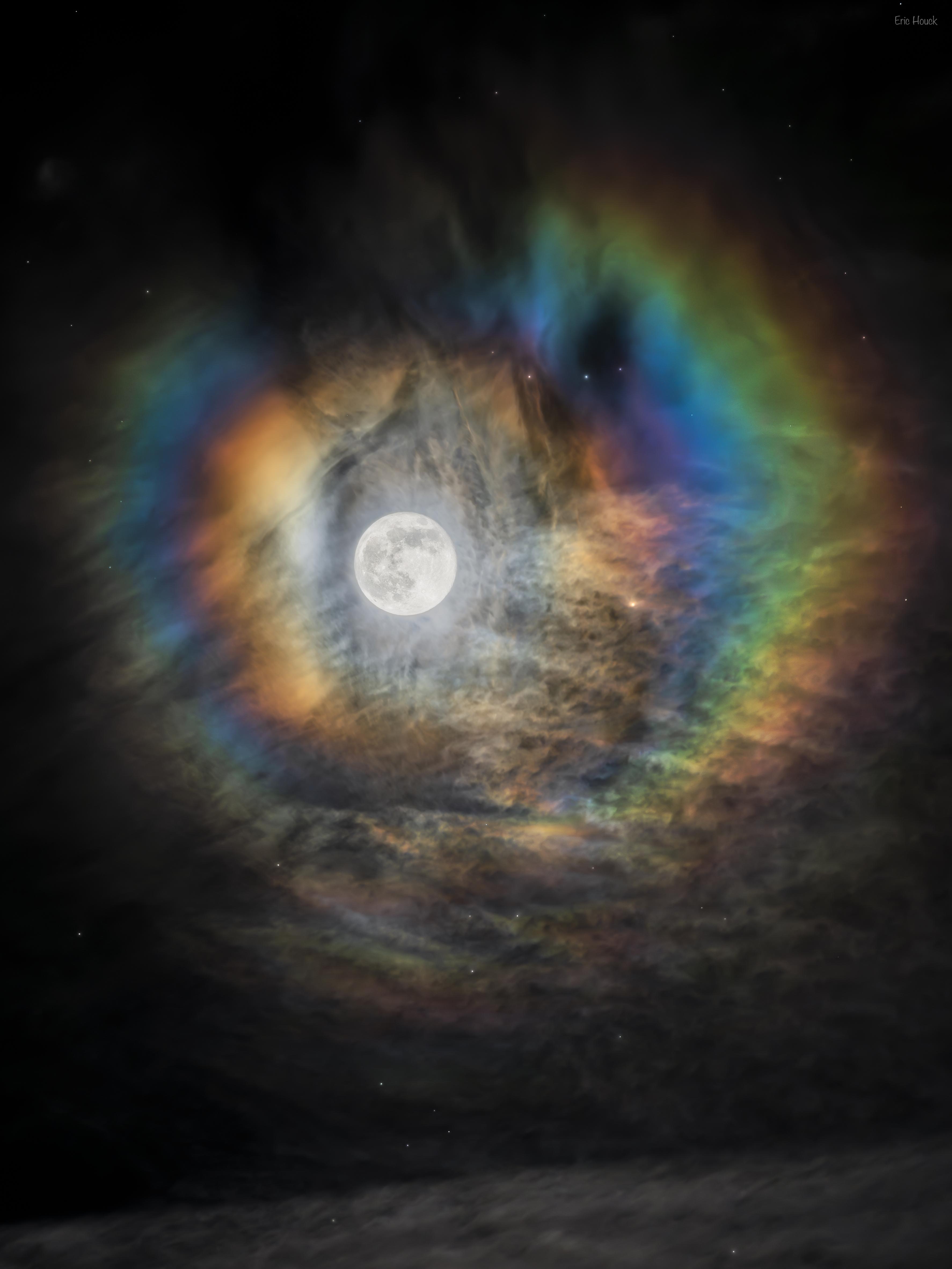
Alt...
2025 November 12
The Moon is pictured in the center. ARound the Moon are colorful rings. The rings are nearly circular but have gaps. This but structured clouds are seen around the scene and at the bottom of the frame.
A Super Lunar Corona
* Image Credit & Copyright: Eric Houck
Explanation:
What are those colorful rings around the Moon? A corona. Rings like this will sometimes appear when the Moon is seen through thin clouds. The effect is created by the diffraction of light around individual, similarly-sized water droplets in an intervening but mostly transparent cloud. Since light of different colors has different wavelengths, each color diffracts differently. Lunar coronae are one of the few color diffraction effects that can be easily seen with the unaided eye. The featured image of a lunar corona was captured around last week's full Super Moon from near Knight's Ferry, California, USA. To the right of the full Moon is the giant orange star Botein. Similar coronae that form around the Sun are typically harder to see because of the Sun's great brightness.
Authors & editors: Robert Nemiroff (MTU) & Jerry Bonnell (UMCP)
NASA Official: Amber Straughn Specific rights apply.
NASA Web Privacy, Accessibility, Notices;
A service of: ASD at NASA / GSFC,
NASA Science Activation
& Michigan Tech. U.
![[?]](https://o.mastodon.nz/accounts/avatars/109/521/605/731/610/544/original/1c9d9dffbbd19631.jpeg)

I’m always amazed when I remember that Olympus Mons (the tallest mountain in our solar system- on Mars) is so tall (27km above the surrounding terrain), but the average slope of the mountain is so shallow, that standing at the bottom of the mountain, its peak would be hidden behind the curvature of the planet.
Learned this a couple of years ago and it blows my mind. #space #mars #science #astronomy
Edit: Really did not expect this one to still be being boosted naturally 19h later… must blow others’ minds too (boosting again now myself cause it seems to have struck a chord).
Edit to add: I’ve since learned it’s also true for a lot of hills in the Scottish highlands too, but they’re nowhere near as big.
2025 November 11
Jupiter in Ultraviolet from Hubble
* Image Credit: NASA, ESA, Hubble
https://www.nasa.gov/
https://www.esa.int/
https://science.nasa.gov/mission/hubble/
Processing & License: Judy Schmidt
https://science.nasa.gov/people-of-nasa/meet-a-citizen-scientist-judy-schmidt/
Explanation:
Jupiter looks a bit different in ultraviolet light. To better interpret Jupiter's cloud motions and to help NASA's robotic Juno spacecraft understand the planetary context of the small fields that it sees, the Hubble Space Telescope was being directed to regularly image the entire Jovian giant. The colors of Jupiter being monitored go beyond the normal human visual range to include both ultraviolet and (not pictured) infrared light. Featured from 2017, Jupiter appears different in near ultraviolet light, partly because the amount of sunlight reflected back is distinct, giving differing cloud heights and latitudes discrepant brightnesses. In the near UV, Jupiter's poles appear relatively dark, as does its Great Red Spot and a smaller (optically) white oval to the right. The String of Pearl storms farther to the right, however, are brightest in near ultraviolet, and so here appear (false-color) pink. Jupiter's largest moon Ganymede appears on the upper left. Juno continues on a looping 33-day orbit around Jupiter, while Earth-orbiting Hubble is aging and now relies on a single stabilizing gyroscope.
https://www.flickr.com/photos/geckzilla/39448899094/in/photostream/
https://science.nasa.gov/resource/jupiter-in-blue-ultraviolet-and-near-infrared/
https://www.nasa.gov/image-article/hubble-provides-unique-ultraviolet-view-of-jupiter/
https://science.nasa.gov/ems/10_ultravioletwaves/
https://archive.stsci.edu/proposal_search.php?mission=hst&id=14661
https://astronomynow.com/2017/06/26/jupiters-string-of-pearls/
https://www.nasa.gov/centers-and-facilities/jpl/nasas-juno-mission-expands-into-the-future/
https://science.nasa.gov/jupiter/
https://science.nasa.gov/mission/juno/
https://science.nasa.gov/jupiter/jupiter-moons/ganymede/
https://science.nasa.gov/mission/hubble/observatory/design/hubble-one-gyro-mode/
https://science.nasa.gov/mission/hubble/overview/about-hubble/
https://apod.nasa.gov/apod/ap251111.html
#space #jupiter #atmosphere #astrophotography #photography #science #nature #NASA #ESA #Hubble #apod
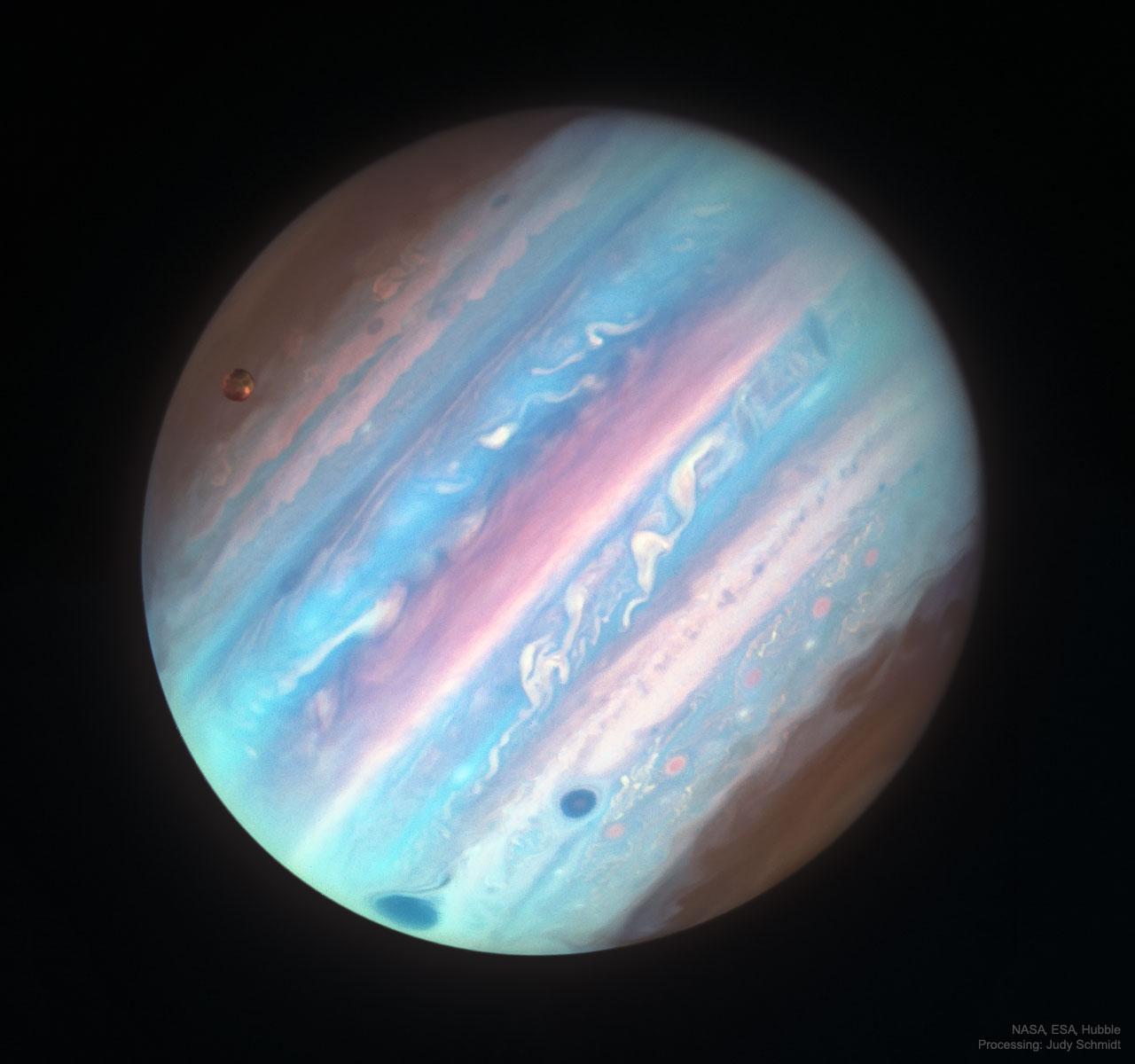
Alt...
2025 November 11
The planet Jupiter appears full frame in apparent colors of a variety of blues and some pink bands. The Great Red Spot is visible on the lower left as a dark spot.
Jupiter in Ultraviolet from Hubble
* Image Credit: NASA, ESA, Hubble; Processing & License: Judy Schmidt
Explanation:
Jupiter looks a bit different in ultraviolet light. To better interpret Jupiter's cloud motions and to help NASA's robotic Juno spacecraft understand the planetary context of the small fields that it sees, the Hubble Space Telescope was being directed to regularly image the entire Jovian giant. The colors of Jupiter being monitored go beyond the normal human visual range to include both ultraviolet and (not pictured) infrared light. Featured from 2017, Jupiter appears different in near ultraviolet light, partly because the amount of sunlight reflected back is distinct, giving differing cloud heights and latitudes discrepant brightnesses. In the near UV, Jupiter's poles appear relatively dark, as does its Great Red Spot and a smaller (optically) white oval to the right. The String of Pearl storms farther to the right, however, are brightest in near ultraviolet, and so here appear (false-color) pink. Jupiter's largest moon Ganymede appears on the upper left. Juno continues on a looping 33-day orbit around Jupiter, while Earth-orbiting Hubble is aging and now relies on a single stabilizing gyroscope.
Authors & editors: Robert Nemiroff (MTU) & Jerry Bonnell (UMCP)
TOPIC> Jupiter
Jupiter’s Great Red Spot Getting Taller as it Shrinks.
Though once big enough to swallow three Earths with room to spare, Jupiter’s Great Red Spot has been shrinking for a century and a half. Nobody is sure how long the storm will continue to contract or whether it will disappear altogether.
A new study suggests that it hasn’t all been downhill, though. The storm seems to have increased in area at least once along the way, and it’s growing taller as it gets smaller.
“Storms are dynamic, and that’s what we see with the Great Red Spot. It’s constantly changing in size and shape, and its winds shift, as well,” said Amy Simon, an expert in planetary atmospheres at NASA’s Goddard Space Flight Center in Greenbelt, Maryland, and lead author of the new paper, published in the Astronomical Journal.
Observations of Jupiter date back centuries, but the first confirmed sighting of the Great Red Spot was in 1831. (Researchers aren’t certain whether earlier observers who saw a red spot on Jupiter were looking at the same storm.)
Keen observers have long been able to measure the size and drift of the Great Red Spot by fitting their telescopes with an eyepiece scored with crosshairs. A continuous record of at least one observation of this kind per year dates back to 1878.
Simon and her colleagues drew on this rich archive of historical observations and combined them with data from NASA spacecraft, starting with the two Voyager missions in 1979. In particular, the group relied on a series of annual observations of Jupiter that team members have been conducting with NASA’s Hubble Space Telescope as part of the Outer Planets Atmospheres Legacy, or OPAL, project. The OPAL team scientists are based at Goddard, the University of California at Berkeley, and NASA’s Jet Propulsion Laboratory in Pasadena, California. ...
read more >>> https://science.nasa.gov/missions/hubble/jupiters-great-red-spot-getting-taller-as-it-shrinks-nasa-team-finds/
* Editor: NASA Hubble Mission
#space #jupiter #astrophotography #photography #science #nature #NASA
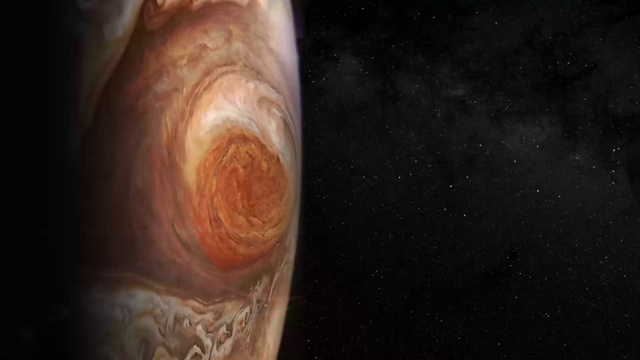
Alt...
Scientists have noticed that Jupiter's Great Red Spot has been getting smaller over time. Now, there's evidence the storm is actually growing taller as it shrinks. - This video is public domain and can be downloaded from NASA's Scientific Visualization Studio.
NASA's Goddard Space Flight Center
Pia26595 Juno Sees Turbulence In Jupiters Atmosphere | NASA Jet Propulsion Laboratory (JPL)
Jet Propulsion Laboratory https://www.jpl.nasa.gov/
1–2 minutes
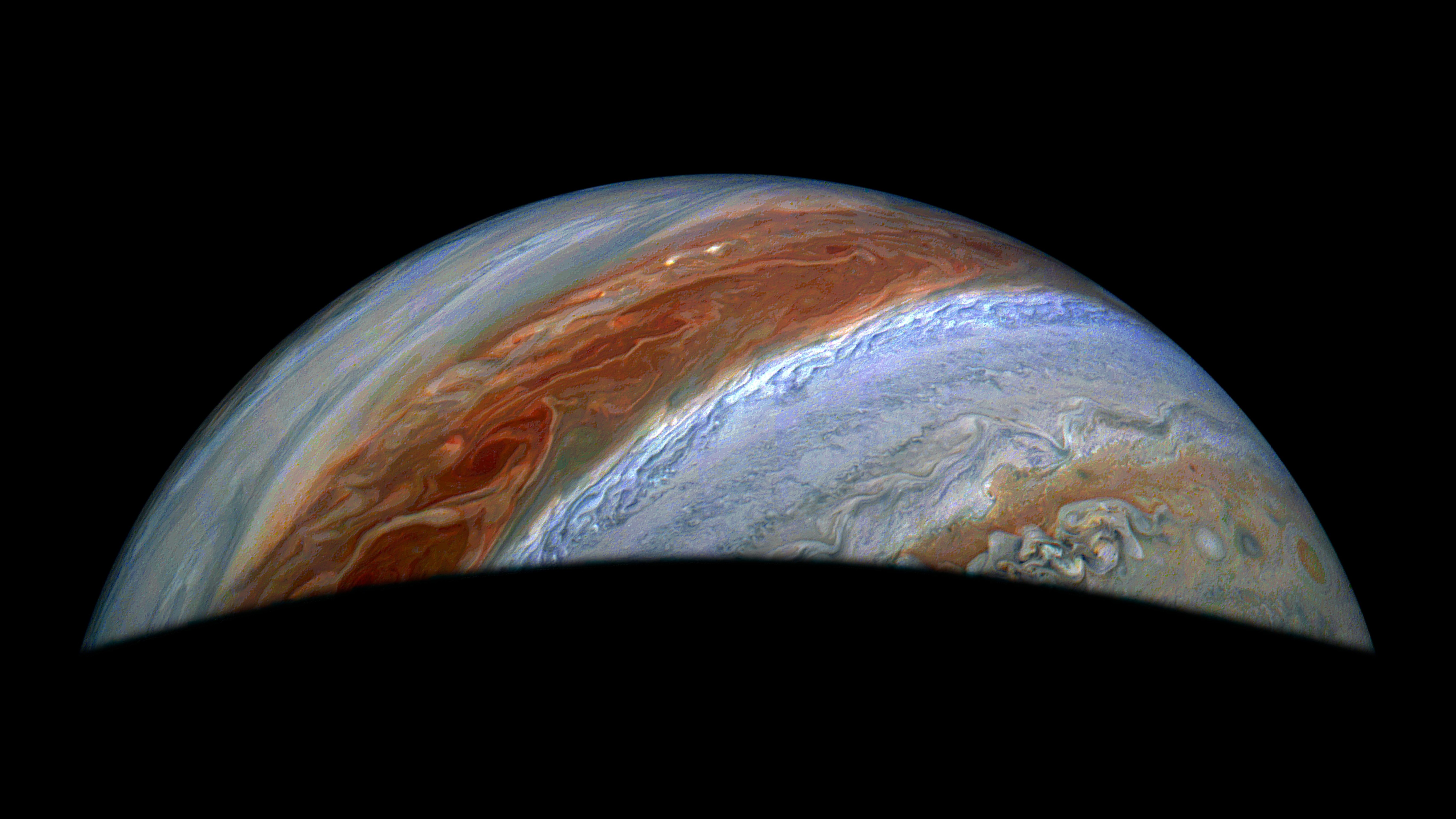
JunoCam, the visible light imager aboard NASA's Juno, captured this view of Jupiter's northern high latitudes during the spacecraft's 69th flyby of the giant planet on Jan. 28, 2025. Jupiter's belts and zones stand out in this enhanced color rendition, along with the turbulence along their edges caused by winds going in different directions.
The original JunoCam image used to produce this view was taken from an altitude of about 36,000 miles (58,000 kilometers) above Jupiter's cloud tops. Citizen scientist Jackie Branc processed the image.
JunoCam's raw images are available for the public to peruse and process into image products at https://missionjuno.swri.edu/junocam/processing. More information about NASA citizen science can be found at https://science.nasa.gov/citizen-science.
More information about Juno is at https://science.nasa.gov/mission/juno/ and https://missionjuno.swri.edu.
#space #jupiter #astrophotography #photography #science #nature #NASA
Alt...
Pia26595 Juno Sees Turbulence In Jupiters Atmosphere | NASA Jet Propulsion Laboratory (JPL)
Pia25730 Nasas Juno Mission Captures Close Ups Of Polar Storms On Jupiter | NASA Jet Propulsion Laboratory (JPL)
Jet Propulsion Laboratory https://www.jpl.nasa.gov/
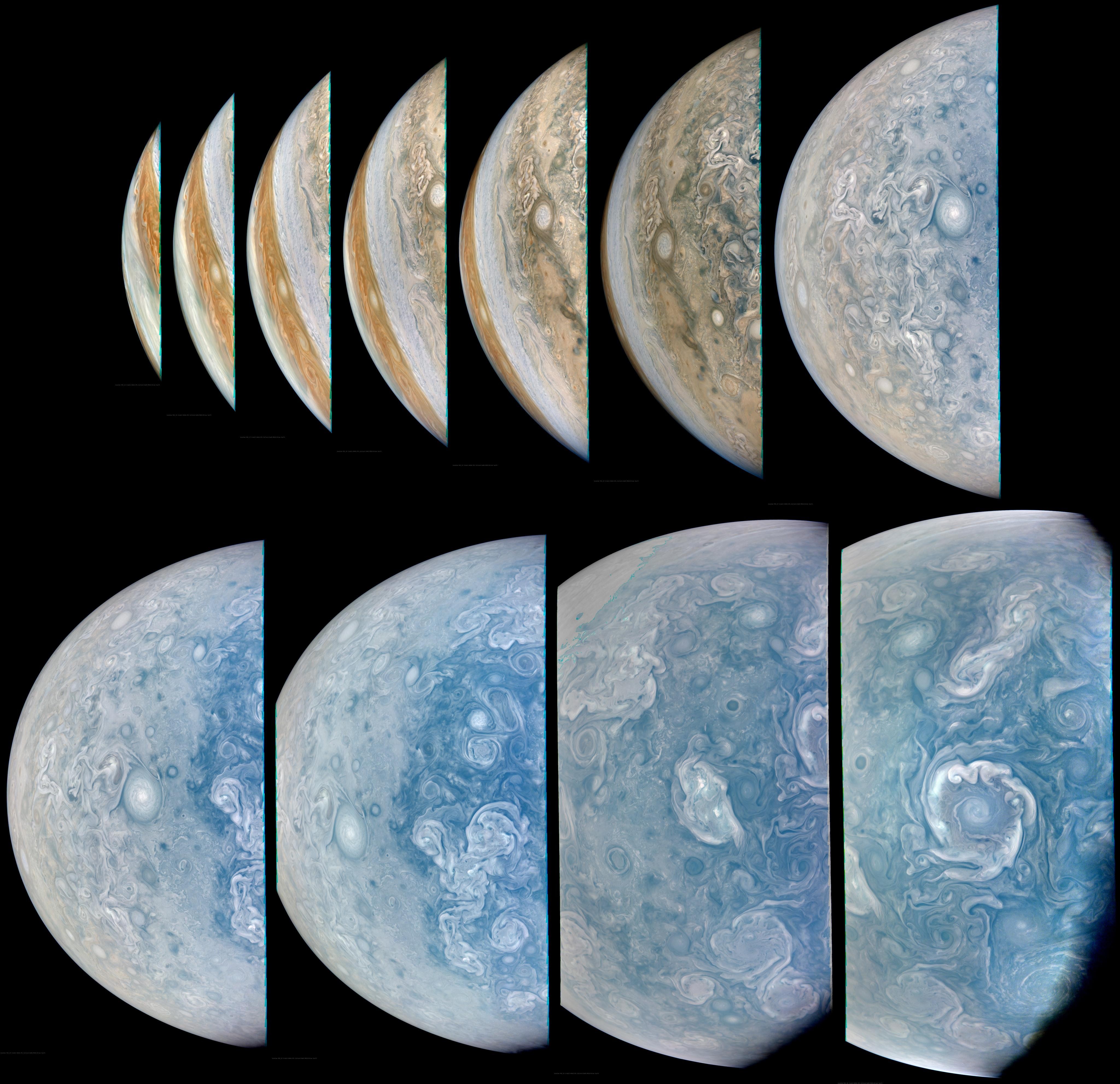
During its 65th close flyby of Jupiter on Sept. 20, 2024, NASA's Juno spacecraft captured this series of images as it approached the giant planet and swung low over its north polar region.
Juno's recent orbits have provided exceptionally clear views of Jupiter's circumpolar cyclones. At closest approach in this series of images, the Juno spacecraft was about 6,800 miles (11,000 kilometers) above the cloud tops, at a latitude of 82 degrees north of the equator.
Citizen scientist Brian Swift made this image using raw data from the JunoCam instrument, applying digital processing techniques to enhance color and clarity.
JunoCam's raw images are available for the public to peruse and process into image products at https://missionjuno.swri.edu/junocam/processing. More information about NASA citizen science can be found at https://science.nasa.gov/citizenscience and https://www.nasa.gov/solve/opportunities/citizenscience.
More information about Juno is at https://www.nasa.gov/juno and https://missionjuno.swri.edu. For more about this finding and other science results, see https://www.missionjuno.swri.edu/science-findings.
#space #jupiter #astrophotography #photography #science #nature #NASANASA's Juno Mission Captures
Alt...
Close-Ups of Polar Storms on Jupiter
Jan. 27, 2025
Pia25729 Nasas Juno Mission Captures The Colorful And Chaotic Clouds Of Jupiter | NASA Jet Propulsion Laboratory (JPL)
Jet Propulsion Laboratory https://www.jpl.nasa.gov/
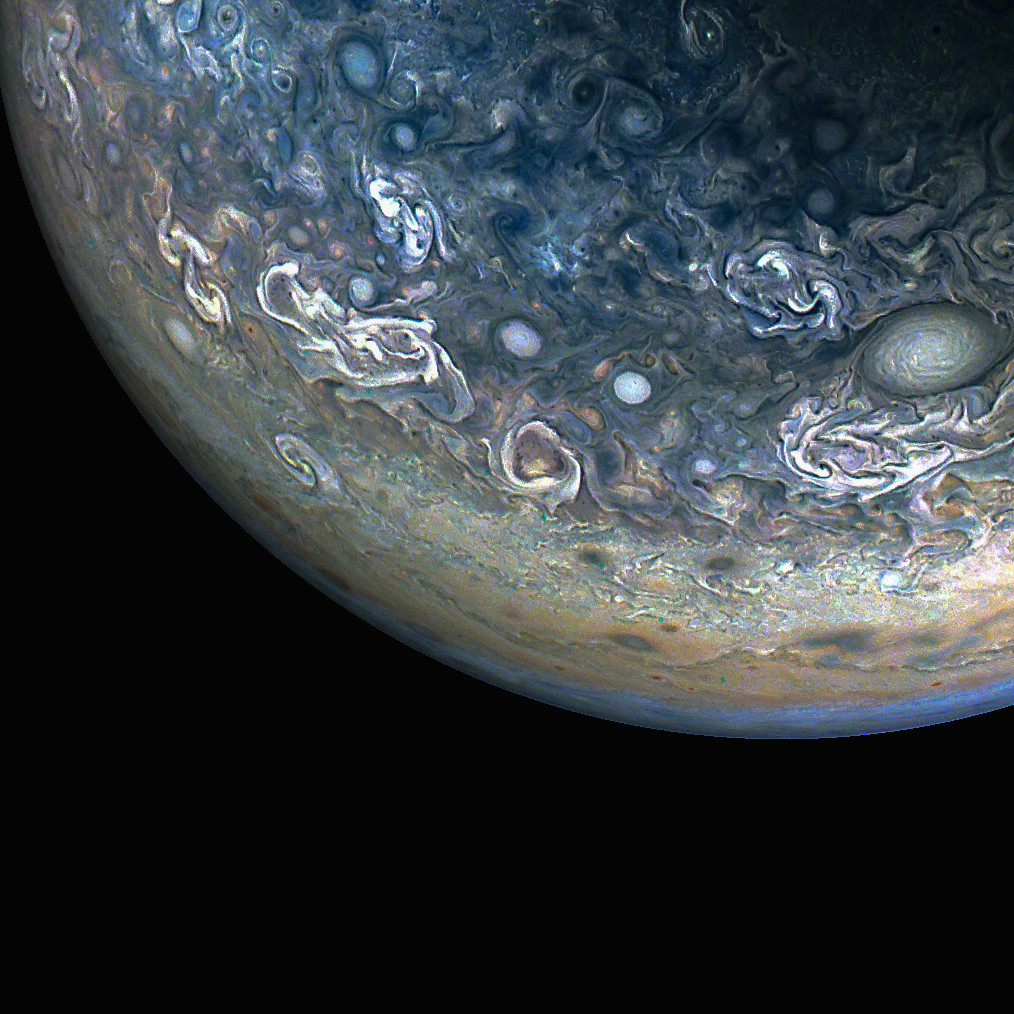
During its 61st close flyby of Jupiter on May 12, 2024, NASA's Juno spacecraft captured this color-enhanced view of the giant planet's northern hemisphere. It provides a detailed view of chaotic clouds and cyclonic storms in an area known to scientists as a folded filamentary region. In these regions, the zonal jets that create the familiar banded patterns in Jupiter's clouds break down, leading to turbulent patterns and cloud structures that rapidly evolve over the course of only a few days.
Citizen scientist Gary Eason made this image using raw data from the JunoCam instrument, applying digital processing techniques to enhance color and clarity.
At the time the raw image was taken, the Juno spacecraft was about 18,000 miles (29,000 kilometers) above Jupiter's cloud tops, at a latitude of about 68 degrees north of the equator.
JunoCam's raw images are available for the public to peruse and process into image products at https://missionjuno.swri.edu/junocam/processing. More information about NASA citizen science can be found at https://science.nasa.gov/citizenscience and https://www.nasa.gov/solve/opportunities/citizenscience.
More information about Juno is at https://www.nasa.gov/juno and https://missionjuno.swri.edu. For more about this finding and other science results, see https://www.missionjuno.swri.edu/science-findings.
#space #jupiter #astrophotography #photography #science #nature #NASA
Alt...
NASA’s Juno Mission Captures the Colorful and Chaotic Clouds of Jupiter
July 19, 2024
During its 61st close flyby of Jupiter on May 12, 2024, NASA's Juno spacecraft captured this color-enhanced view of the giant planet's northern hemisphere. It provides a detailed view of chaotic clouds and cyclonic storms in an area known to scientists as a folded filamentary region. In these regions, the zonal jets that create the familiar banded patterns in Jupiter's clouds break down, leading to turbulent patterns and cloud structures that rapidly evolve over the course of only a few days.
Pia26295 Nasas Juno Catches 3 Waves Of Jupiters Polar Cyclones | NASA Jet Propulsion Laboratory (JPL)
https://www.jpl.nasa.gov/
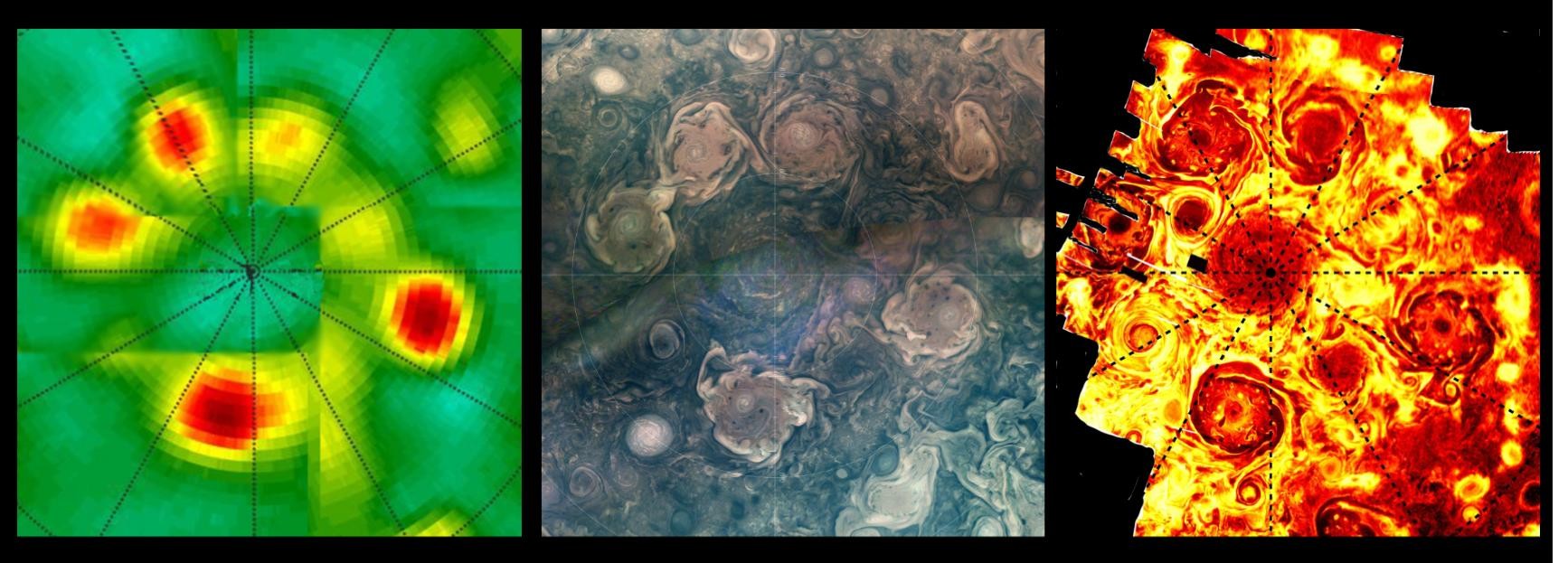
This composite shows views of Jupiter's northern polar cyclones in three different wavelengths of light – microwave, visible, and ultraviolet – as captured by NASA's Juno mission. These differing perspectives allowed Juno scientists to deduce that all Jovian polar cyclones are not created equal.
The infrared image, on the far right, was derived from data collected by the spacecraft's Jovian Infrared Auroral Mapper (JIRAM) instrument. The composite image at center was collected by the JunoCam visible-light imager. Though taken with separate instruments that record different wavelengths of light, both images depict Jupiter's northern polar storms as well defined and of similar size.
The data on the left, collected by Juno's Microwave Radiometer (MWR), shows the polar storms in another light. MWR enables Juno to see deep into Jupiter by recording the planet's microwave emissions. In the MWR graphic, the polar storms at the 4 and 6 o'clock positions have bright microwave signatures, indicating they extend well beneath the cloud tops, at least 62 miles (100 kilometers) below. The size of those two storms is comparable to what's found in the visible light and infrared light images, but the other storms, as seen through MWR, have a notably reduced emissions intensity.
Another disparity in the MWR graphic versus visible light and infrared can be seen in how the central cyclone is depicted by the data. ...
read more >>
https://www.jpl.nasa.gov/images/pia26295-nasas-juno-catches-3-waves-of-jupiters-polar-cyclones/
More information about Juno is at https://www.nasa.gov/juno and https://missionjuno.swri.edu. For more about this finding and other science results, see https://www.missionjuno.swri.edu/science-findings.
#space #jupiter #astrophotography #photography #science #nature #NASA
Alt...
Another disparity in the MWR graphic versus visible light and infrared can be seen in how the central cyclone is depicted by the data. In the infrared and visible light images, the central cyclone is evident; with MWR data, it all but disappears. This disparity indicates that the central cyclone's subsurface structure must be very different from the surrounding storms.
JIRAM "sees" in infrared light not visible to the human eye. It captures the infrared glow from the heat of Jupiter's upper atmosphere, probing the top of the weather layer, and gaps in the clouds allow glimpses as deep as 30 to 45 miles (50 to 70 kilometers) below Jupiter's cloud tops.
JunoCam's visible light images catch reflected sunlight, with a view that is very similar to what a human eye would see if a person could ride along with Juno. JunoCam's raw images are available for the public to peruse and process into image products at https://missionjuno.swri.edu/junocam/processing.
Like JIRAM, the MWR instrument records the glow of Jupiter's atmosphere, but the brightness results from the temperature at depths below anything achievable with previous spacecraft or Earth-based observations. The MWR's six radio channels peer progressively deeper below the visible cloud tops, with a range from the top of the clouds (for the highest frequency channel) to 200 miles (320 kilometers) or more below (for the lowest frequency channel).
Pia25728 Nasas Juno Mission Spots Jupiters Tiny Moon Amalthea | NASA Jet Propulsion Laboratory (JPL)
https://www.jpl.nasa.gov/
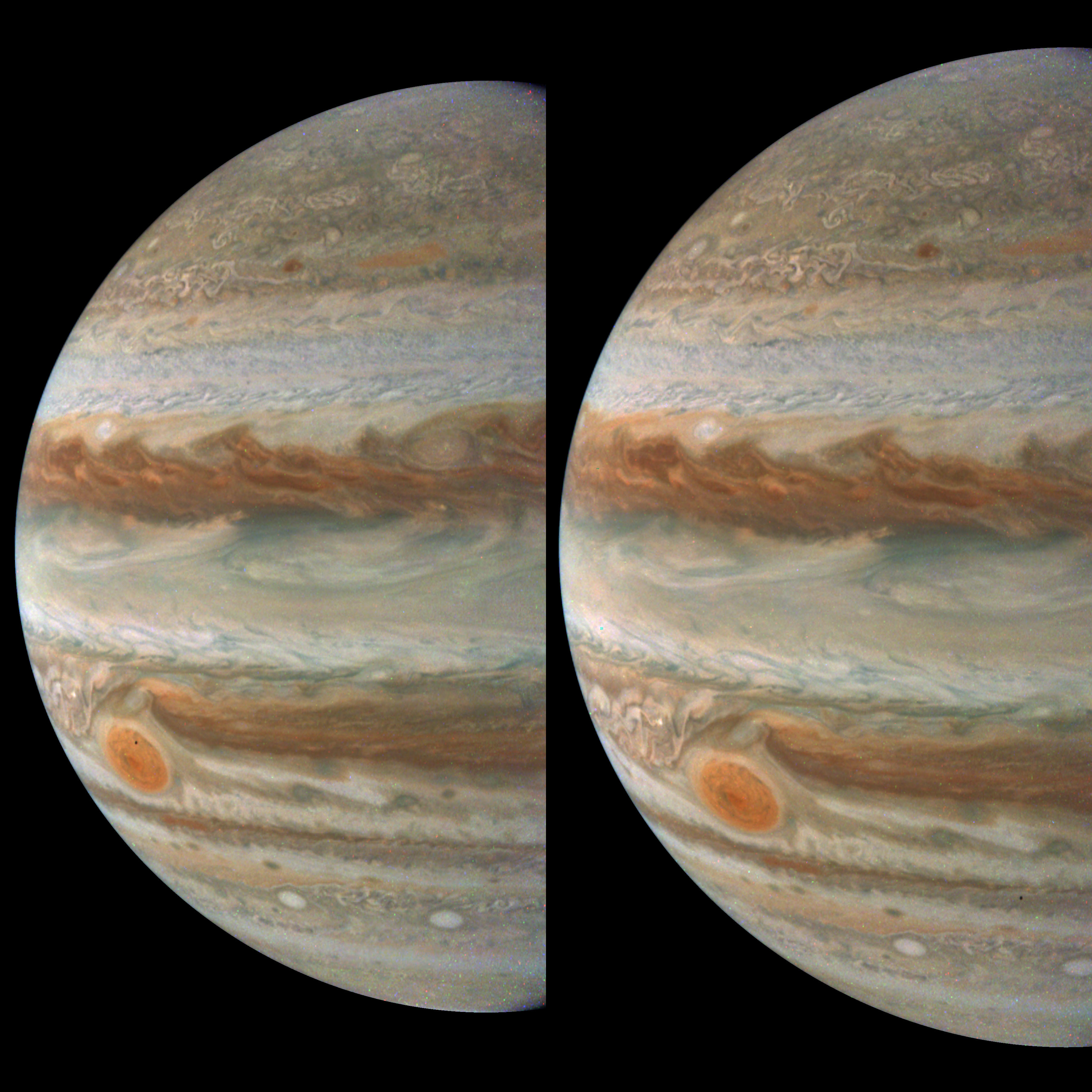
NASA’s Juno mission captured these views of Jupiter during its 59th close flyby of the giant planet on March 7, 2024. They provide a good look at Jupiter’s colorful belts and swirling storms, including the Great Red Spot. Close examination reveals something more: two glimpses of the tiny moon Amalthea (see Figure B below).
Figure B
With a radius of just 52 miles (84 kilometers), Amalthea has a potato-like shape, lacking the mass to pull itself into a sphere. In 2000, NASA’s Galileo spacecraft revealed some surface features, including impact craters, hills, and valleys. Amalthea circles Jupiter inside Io's orbit, which is the innermost of the planet’s four largest moons, taking 0.498 Earth days to complete one orbit.
Amalthea is the reddest object in the solar system, and observations indicate it gives out more heat than it receives from the Sun. This may be because, as it orbits within Jupiter's powerful magnetic field, electric currents are induced in the moon's core. Alternatively, the heat could be from tidal stresses caused by Jupiter’s gravity.
At the time that the first of these two images was taken, the Juno spacecraft was about 165,000 miles (265,000 kilometers) above Jupiter’s cloud tops, at a latitude of about 5 degrees north of the equator.
Citizen scientist Gerald Eichstädt made these images using raw data from the JunoCam instrument, applying processing techniques to enhance the clarity of the images.
JunoCam's raw images are available for the public to peruse and process into image products at https://missionjuno.swri.edu/junocam/processing. More information about NASA citizen science can be found at https://science.nasa.gov/citizenscience and https://www.nasa.gov/solve/opportunities/citizenscience.
#space #jupiter #astrophotography #photography #science #nature #NASA
Alt...
NASA’s Juno mission captured these views of Jupiter during its 59th close flyby of the giant planet on March 7, 2024. They provide a good look at Jupiter’s colorful belts and swirling storms, including the Great Red Spot. Close examination reveals something more: two glimpses of the tiny moon Amalthea (see Figure B right).
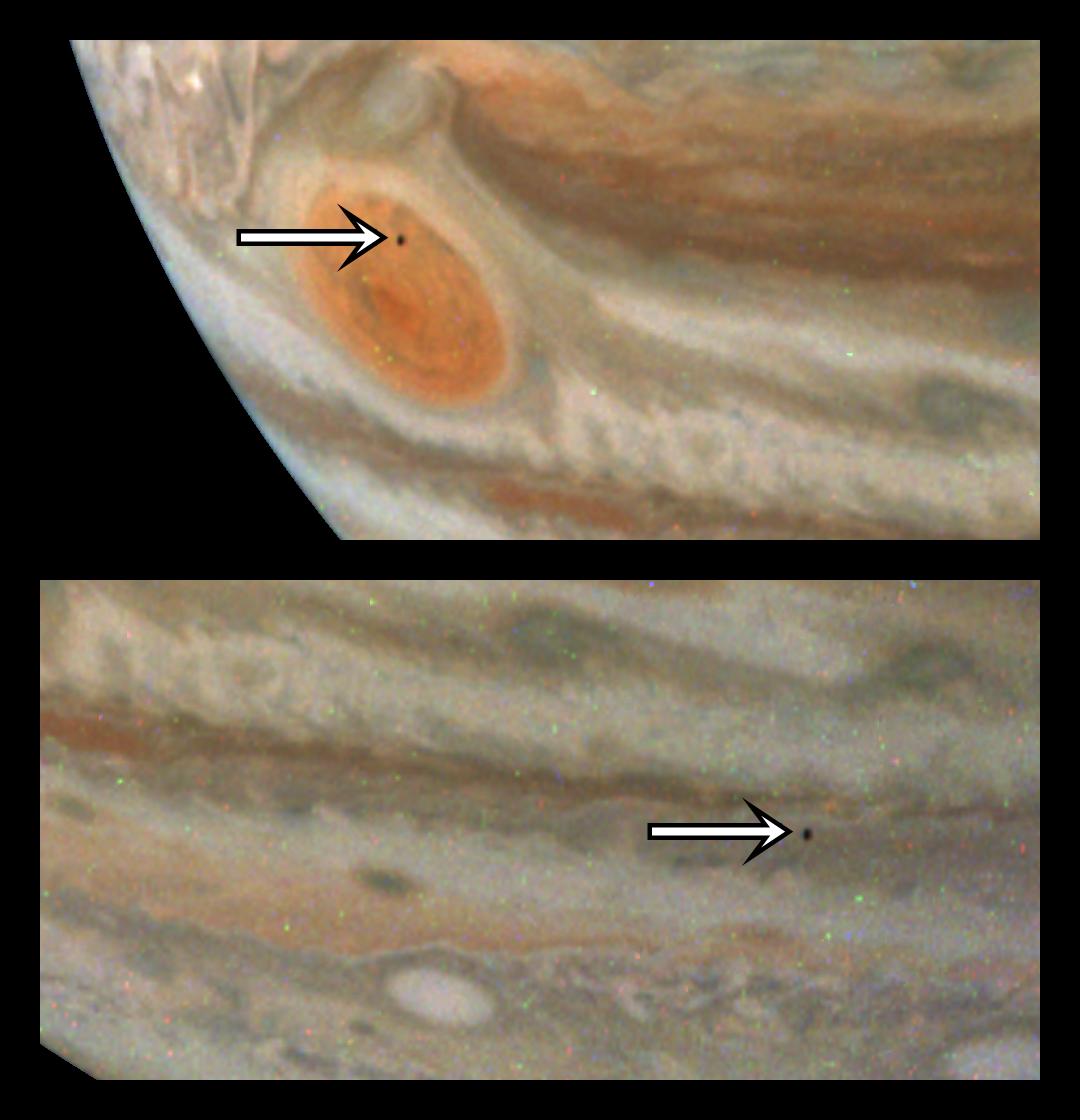
Alt...
NASA’s Juno mission captured these views of Jupiter during its 59th close flyby of the giant planet on March 7, 2024. They provide a good look at Jupiter’s colorful belts and swirling storms, including the Great Red Spot. Close examination reveals something more: two glimpses of the tiny moon Amalthea.
Credit: Image data: NASA/JPL-Caltech/SwRI/MSSS. Image processing by Gerald Eichstädt
Beneath Jupiter
* Image Credit & Copyright: NASA, Juno, SwRI, MSSS; Processing & License: Gerald Eichstädt & Seán Doran
https://www.uahirise.org/epo/made-with-hirise/doran/
https://www.planetary.org/profiles/gerald-eichstdt
https://www.msss.com/
http://www.swri.org/
https://science.nasa.gov/mission/juno/
https://www.nasa.gov/
Explanation:
Jupiter is stranger than we knew. NASA's Juno spacecraft has now completed over 70 swoops past Jupiter as it moves around its highly elliptical orbit. Pictured from 2017, Jupiter is seen from below where, surprisingly, the horizontal bands that cover most of the planet disappear into swirls and complex patterns. A line of white oval clouds is visible nearer to the equator. Impressive results from Juno show that Jupiter's weather phenomena can extend deep below its cloud tops, that Jupiter's center has a core that is unexpectedly large and soft, and that Jupiter's magnetic field varies greatly with location. Although Juno is scheduled to keep orbiting Jupiter further into 2025, at some time the robotic spacecraft will be maneuvered to plunge into the giant planet.
https://science.nasa.gov/jupiter/
https://apod.nasa.gov/apod/ap160626.html
https://apod.nasa.gov/apod/ap170213.html
https://apod.nasa.gov/apod/ap170228.htmlhttps://www.swri.org/newsroom/press-releases/swri-led-juno-mission-jupiter-delivers-first-science-results
https://www.jpl.nasa.gov/missions/juno/
https://en.wikipedia.org/wiki/Juno_(spacecraft)
https://www.astronomy.com/science/what-has-the-juno-spacecraft-taught-us-about-jupiter/
https://www.swri.org/newsroom/press-releases/swri-led-juno-mission-jupiter-delivers-first-science-results
https://www.jpl.nasa.gov/news/nasas-juno-mission-expands-into-the-future/
https://www.jpl.nasa.gov/news/press_kits/juno/overview/#:~:text=The%20final%20mission%20phase%20is,atmosphere%20and%20will%20burn%20up.
https://www.youtube.com/watch?v=6o9FiTf1vZE
https://apod.nasa.gov/apod/ap250525.html
#space #jupiter #astrophotography #photography #science #nature #NASA
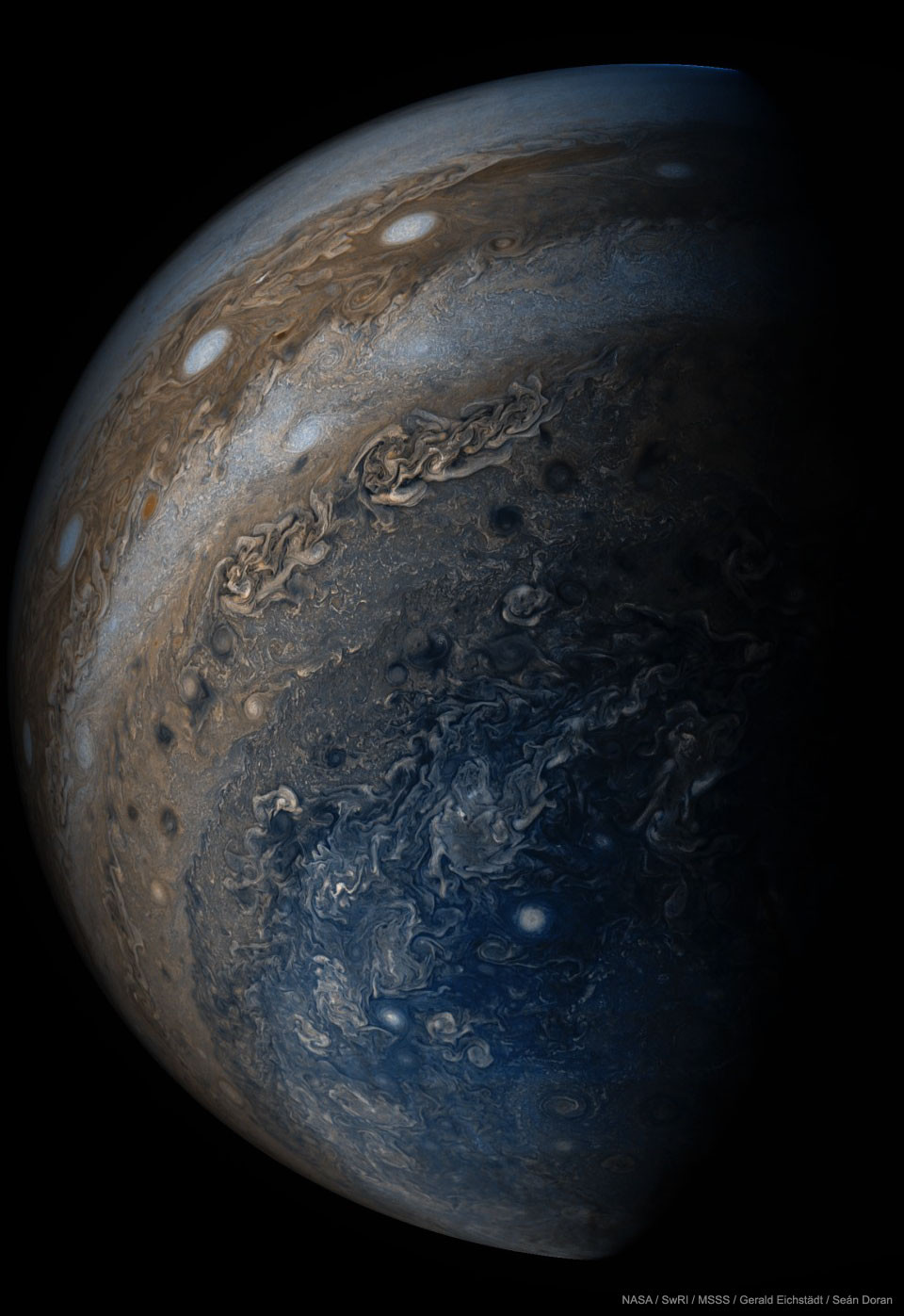
Alt...
2025 May 25
A close-up image is shown of the planet Jupiter. Many clouds are visible including clouds colored blue near the bottom, on the left, and white oval clouds on the upper right. Please see the explanation for more detailed information.
Beneath Jupiter
* Image Credit & Copyright: NASA, Juno, SwRI, MSSS; Processing & License: Gerald Eichstädt & Seán Doran
Explanation:
Jupiter is stranger than we knew. NASA's Juno spacecraft has now completed over 70 swoops past Jupiter as it moves around its highly elliptical orbit. Pictured from 2017, Jupiter is seen from below where, surprisingly, the horizontal bands that cover most of the planet disappear into swirls and complex patterns. A line of white oval clouds is visible nearer to the equator. Impressive results from Juno show that Jupiter's weather phenomena can extend deep below its cloud tops, that Jupiter's center has a core that is unexpectedly large and soft, and that Jupiter's magnetic field varies greatly with location. Although Juno is scheduled to keep orbiting Jupiter further into 2025, at some time the robotic spacecraft will be maneuvered to plunge into the giant planet.
Authors & editors: Robert Nemiroff (MTU) & Jerry Bonnell (UMCP)
NASA Official: Amber Straughn Specific rights apply.
NASA Web Privacy, Accessibility, Notices;
A service of: ASD at NASA / GSFC,
NASA Science Activation
& Michigan Tech. U.
Approaching Jupiter
* Video Composition & Copyright: Peter Rosén et al.
https://www.planetary.org/profiles/peter-rosen
* Music: The Awakening by Clemens Ruh
https://soundcloud.com/clemensruh
Explanation:
What would it look like to approach Jupiter? To help answer this, a team of 91 amateur astrophotographers took over 1,000 pictures of Jupiter from the Earth with the resulting images aligned and digitally merged into the featured time-lapse video. Image taking began in 2014 December and lasted just over three months. The resulting fictitious approach sequence has similarities to what was seen by NASA's robotic Juno spacecraft as it first approached the Jovian world last July. The video begins with Jupiter appearing as a small orb near the image center. As Jupiter nears from below, the planet looms ever larger while the rotation of its cloud bands becomes apparent. Jupiter's shrinking Great Red Spot rotates into view twice, at times showing unusual activity. Many white ovals are visible moving around the giant planet. The video ends as the imaginary spacecraft passes over Jupiter's North Pole.
https://www.planetary.org/articles/201170509-journey-to-jupiter
https://apod.nasa.gov/apod/ap170523.html
#space #jupiter #astrophotography #photography #science #nature #NASA
Alt...
2017 May 23
Approaching Jupiter
* Video Composition & Copyright: Peter Rosén et al.
* Music: The Awakening by Clemens Ruh
Explanation:
What would it look like to approach Jupiter? To help answer this, a team of 91 amateur astrophotographers took over 1,000 pictures of Jupiter from the Earth with the resulting images aligned and digitally merged into the featured time-lapse video. Image taking began in 2014 December and lasted just over three months. The resulting fictitious approach sequence has similarities to what was seen by NASA's robotic Juno spacecraft as it first approached the Jovian world last July. The video begins with Jupiter appearing as a small orb near the image center. As Jupiter nears from below, the planet looms ever larger while the rotation of its cloud bands becomes apparent. Jupiter's shrinking Great Red Spot rotates into view twice, at times showing unusual activity. Many white ovals are visible moving around the giant planet. The video ends as the imaginary spacecraft passes over Jupiter's North Pole.
Authors & editors: Robert Nemiroff (MTU) & Jerry Bonnell (UMCP)
NASA Official: Phillip Newman Specific rights apply.
NASA Web Privacy Policy and Important Notices
A service of: ASD at NASA / GSFC
& Michigan Tech. U.
The upper ammonia clouds visible at Jupiter's surface are organized in a dozen zonal bands parallel to the equator and are bounded by powerful zonal atmospheric flows (winds) known as jets, exhibiting a phenomenon known as atmospheric super-rotation. The bands alternate in color: the dark bands are called belts, while light ones are called zones. Zones, which are colder than belts, correspond to upwellings, while belts mark descending gas. The zones' lighter color is believed to result from ammonia ice; what gives the belts their darker colors is uncertain.
The origins of the banded structure and jets are not well understood, though a "shallow model" and a "deep model" exist.
[from: en.wikipedia.org]
* This small GIF i took from a NASA Video
please see Explanation and credits
Explanation:
This animation depicts Jupiter's planet wrapping cloud structure, commonly referred to as "belts" and "zones," and the jet streams that encompass them. The belts (white bands) and zones (reddish bands) are separated by strong east-west winds, or jet streams (depicted by black arrows), that move in opposite directions. These jets penetrate about 1,800 miles (3,000 kilometers) below the cloud level of Jupiter. Other components of the winds including north-south and up-down movements – have been a mystery and have now been uncovered with the latest data from the microwave radiometer instrument aboard NASA's Juno spacecraft.
The base composite image of Jupiter was created from images obtained by NASA's Cassini spacecraft.
* Credit
NASA/JPL-Caltech/SSI/Weizmann Institute of Science
* Instrument
Microwave Radiometer (MWR)
#space #jupiter #astrophotography #photography #science #nature #NASA
False colored morphing animation of Jupiter's clouds in motion
The Jovian atmosphere shows a wide range of active phenomena, including band instabilities, vortices (cyclones and anticyclones), storms and lightning. The vortices reveal themselves as large red, white or brown spots (ovals). The largest two spots are the Great Red Spot (GRS) and Oval BA, which is also red. These two and most of the other large spots are anticyclonic. Smaller anticyclones tend to be white. Vortices are thought to be relatively shallow structures with depths not exceeding several hundred kilometers. Located in the southern hemisphere, the GRS is the largest known vortex in the Solar System. It could engulf two or three Earths and has existed for at least three hundred years. Oval BA, south of GRS, is a red spot a third the size of GRS that formed in 2000 from the merging of three white ovals.
Jupiter has powerful storms, often accompanied by lightning strikes. The storms are a result of moist convection in the atmosphere connected to the evaporation and condensation of water. They are sites of strong upward motion of the air, which leads to the formation of bright and dense clouds. The storms form mainly in belt regions. The lightning strikes on Jupiter are hundreds of times more powerful than those seen on Earth, and are assumed to be associated with the water clouds. Recent Juno observations suggest Jovian lightning strikes occur above the altitude of water clouds (3-7 bars). A charge separation between falling liquid ammonia-water droplets and water ice particles may generate higher-altitude lightning. Upper-atmospheric lightning has also been observed 260 km above the 1 bar level.
* Credit:
NASA / JPL / SwRI / MSSS / Gerald Eichstädt
#space #jupiter #atmosphere #astrophotography #photography #science #nature #NASA
> from Wikipedia
The belts and zones that divide Jupiter's atmosphere with each their own names and characteristics.
They begin below the North and South Polar Regions, which extend from the poles to roughly 40–48° N/S. This bluish-gray regions are usually featureless.
The North North Temperate Region rarely shows more detail, due to limb darkening, foreshortening, and the general diffuseness of features. However, the North-North Temperate Belt (NNTB) is the northernmost distinct belt, though it occasionally disappears. Disturbances tend to be minor and short-lived. The North-North Temperate Zone (NNTZ) is perhaps more prominent, but also generally quiet.
The North Temperate Region is part of a latitudinal region easily observable from Earth. It also features the strongest prograde jet stream on the planet—a westerly current that forms the southern boundary of the North Temperate Belt (NTB). The NTB fades roughly once a decade, making the North Temperate Zone (NTZ) apparently merge into the North Tropical Zone (NTropZ). Other times, the NTZ is divided by a narrow belt into northern and southern components.
The North Tropical Region is composed of the NTropZ and the North Equatorial Belt (NEB). The NTropZ is generally stable in coloration, changing in tint only in tandem with activity on the NTB's southern jet stream. Like the NTZ, it too is sometimes divided by a narrow band, the NTropB. On rare occasions, the southern NTropZ plays host to "Little Red Spots". As the name suggests, these are northern equivalents of the Great Red Spot. Unlike the GRS, they tend to occur in pairs and are always short-lived, lasting a year on average.
Read more >>
https://en.wikipedia.org/wiki/Atmosphere_of_Jupiter#Specific_bands
Image Credit: Sakurambo at English Wikipedia
#space #jupiter #astrophotography #photography #science #nature #NASA
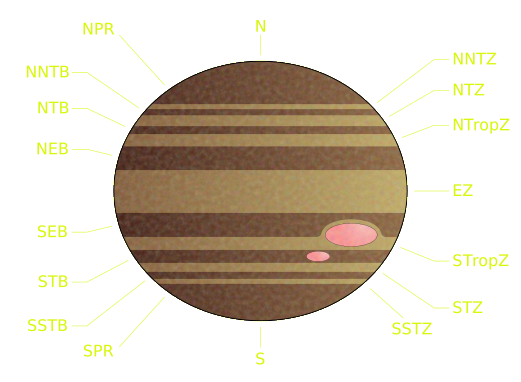
Alt...
Idealized illustration of Jupiter's cloud bands, labeled with their official abbreviations. Lighter zones are indicated to the right, darker belts to the left. The Great Red Spot and Oval BA are shown in the South Tropical Zone and South Temperate Belt, respectively.
Image Credit: Sakurambo at English Wikipedia
The colorful stripes of Jupiter run more than 1,000 miles deep and hold so much gas that their mass is about three times that of the entire Earth, three new studies find.
Jupiter's atmospheric stripes have been known for centuries; famed astronomer Galileo Galilei was the first to see the dark bands and bright zones on the largest planet in our solar system. "These bands are related to strong winds flowing on Jupiter," said Yohai Kaspi, lead author of one of the three studies and a planetary scientist at the Weizmann Institute of Science, in Rehovot, Israel.
However, until now, scientists were uncertain how deep those bands reached into Jupiter. NASA's Juno spacecraft orbits Jupiter every 53 days. As the planet's gravitational field tugs on Juno, the radio signals that the probe sends back to Earth shift a bit. The greater the mass under Juno, the stronger the gravitational pull the spacecraft and its radio waves experience. Because Juno's flybys are in different orbits each time, it can map the gravitational field of different parts of the planet.
As Jupiter's belts of winds can flow at speeds of about 223 mph (360 km/h), they disrupt how mass is spread across the planet. Therefore, mapping Jupiter's gravitational field can shed light on how deep these winds extend below the surface.
The researchers found that these stripes extend 1,800 miles (3,000 kilometers) deep, or about one-twentieth the distance to the center of the planet — far deeper than previously thought. "These flows on Jupiter contain about 1 percent of the mass of Jupiter, which is equal to about three Earth masses," Kaspi said. "In comparison, Earth's atmosphere is less than one-millionth the mass of Earth."
Read more >>
https://www.space.com/39907-jupiter-atmosphere-has-deep-stripes.html
* Credit: Charles Q. Choi
(Contributing Writer for space.com)
#space #jupiter #atmosphere #astrophotography #photography #science #nature #NASA
2025 September 1
Callisto: Dirty Battered Iceball
* Image Credit: NASA, JPL-Caltech, Voyager 2
https://www.nasa.gov/
https://www.jpl.nasa.gov/
https://science.nasa.gov/mission/voyager/voyager-2/
* Processing & License: Kevin M. Gill
https://www.flickr.com/people/kevinmgill/
Explanation:
Its surface is the most densely cratered in the Solar System -- but what's inside? Jupiter's moon Callisto is a battered ball of dirty ice that is larger than the planet Mercury. It was visited by NASA's Galileo spacecraft in the 1990s and 2000s, but the recently reprocessed featured image is from a flyby of NASA's Voyager 2 in 1979. The moon would appear darker if it weren't for the tapestry of light-colored fractured surface ice created by eons of impacts. The interior of Callisto is potentially even more interesting because therein might lie an internal layer of liquid water. This potential underground sea is a candidate to harbor life -- similar with sister moons Europa and Ganymede. Callisto is slightly larger than Luna, Earth's Moon, but because of its high ice content is slightly less massive. ESA's JUICE and NASA's Europa Clipper missions are now headed out to Jupiter to better investigate its largest moons.
https://science.nasa.gov/jupiter/jupiter-moons/callisto/
https://science.nasa.gov/mission/galileo/
https://apod.nasa.gov/apod/ap981106.html
https://www.jpl.nasa.gov/news/ocean-inside-jupiters-moon-callisto-may-have-cushioned-big-impact/
https://apod.nasa.gov/apod/ap250901.html
#space #jupiter #atmosphere #astrophotography #photography #science #nature #NASA
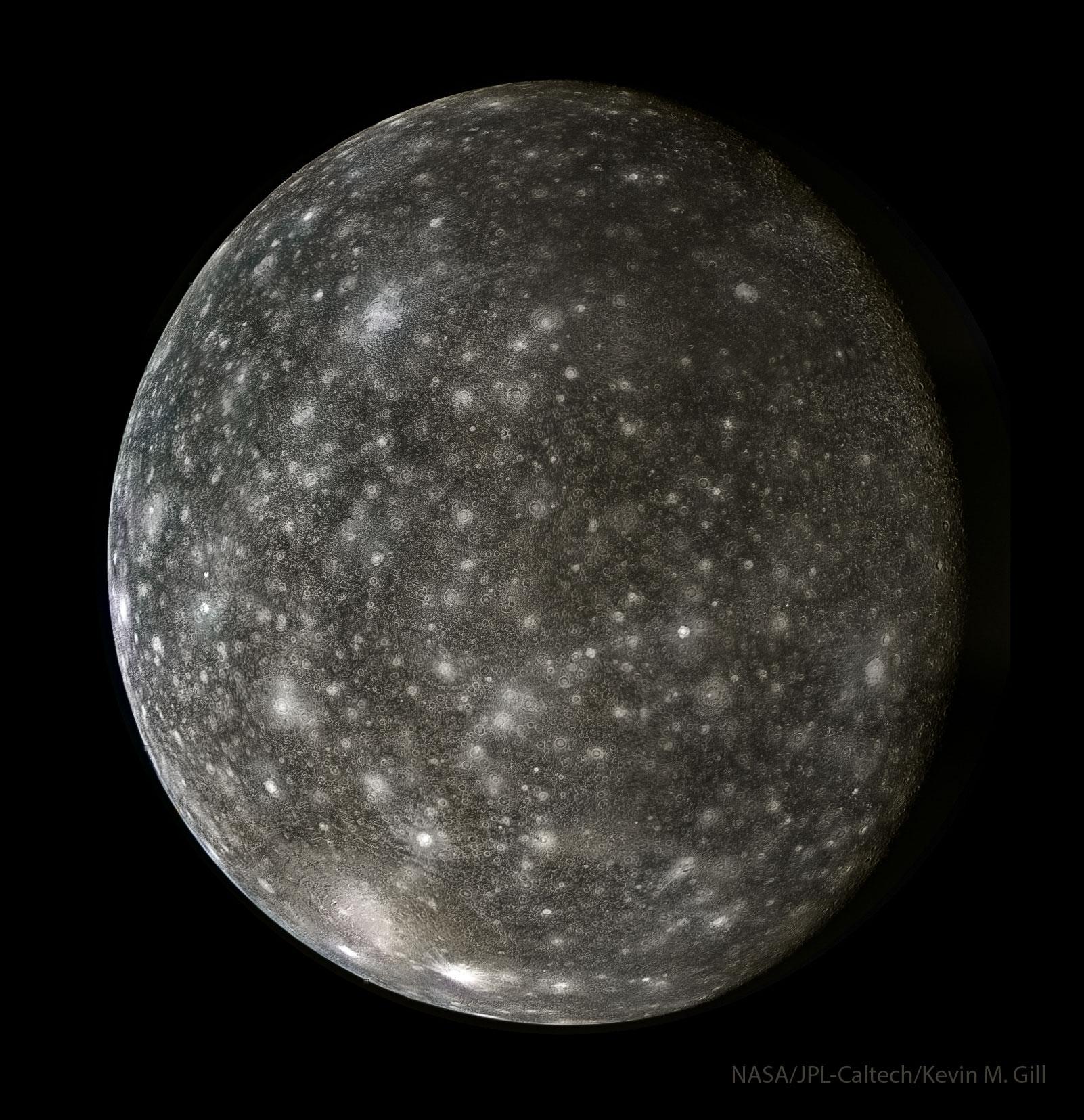
Alt...
2025 September 1
A dark spherical body is shown that has many light craters.
Callisto: Dirty Battered Iceball
* Image Credit: NASA, JPL-Caltech, Voyager 2
* Processing & License: Kevin M. Gill
Explanation:
Its surface is the most densely cratered in the Solar System -- but what's inside? Jupiter's moon Callisto is a battered ball of dirty ice that is larger than the planet Mercury. It was visited by NASA's Galileo spacecraft in the 1990s and 2000s, but the recently reprocessed featured image is from a flyby of NASA's Voyager 2 in 1979. The moon would appear darker if it weren't for the tapestry of light-colored fractured surface ice created by eons of impacts. The interior of Callisto is potentially even more interesting because therein might lie an internal layer of liquid water. This potential underground sea is a candidate to harbor life -- similar with sister moons Europa and Ganymede. Callisto is slightly larger than Luna, Earth's Moon, but because of its high ice content is slightly less massive. ESA's JUICE and NASA's Europa Clipper missions are now headed out to Jupiter to better investigate its largest moons.
Authors & editors: Robert Nemiroff (MTU) & Jerry Bonnell (UMCP)
NASA Official: Amber Straughn Specific rights apply.
NASA Web Privacy, Accessibility, Notices;
A service of: ASD at NASA / GSFC,
NASA Science Activation
& Michigan Tech. U.
![[?]](https://files.mastodon.online/accounts/avatars/109/298/185/928/165/179/original/8ed3da9f519c2f00.jpg)
Pluto’s ice mountains, frozen plains and layers of atmospheric haze backlit by a distant sun, as seen by the New Horizons spacecraft.
📸: NASA/JHUAPL/SwRI @wonderofscience #globalmuseum #Space #Pluto
![[?]](https://files.mastodon.social/accounts/avatars/111/389/433/739/003/113/original/a88eb493c68ded9f.jpeg)
#haiku / #senryu by new contributor, Ernesto P. Santiago. Ernesto lives in Greece. He enjoys souvlaki, with red pepper. #poem #writersblock #poetry #neutronstars #poetrylovers #greece #space #art #poetrycommunity #micropoetry #autumn

2025 November 10
Micro Moon vs. Super Moon
* Image Credit & Copyright: Şenol Şanlı"
https://www.instagram.com/snlsanli/
Explanation:
What was so super about Wednesday's supermoon? Last week, a full moon occurred that appeared slightly larger and brighter than usual. The reason is that the Moon's fully illuminated phase occurred within a short time from perigee - when the Moon was its closest to the Earth in its elliptical orbit. Although the precise conditions that define a supermoon vary, last Wednesday's supermoon was surely the closest, largest, and brightest full moon this year. One reason supermoons are popular is because they are so easy to see -- just go outside at sunset and watch an impressive full moon rise! Pictured here, Wednesday's supermoon is compared to April's micro moon -- when a full Moon occurs near the furthest part of the Moon's orbit -- so that it appears slightly smaller and dimmer than usual. Given many definitions, at least one supermoon occurs each year, with another one coming next month (moon-th).
https://science.nasa.gov/moon/
https://www.universetoday.com/articles/what-is-a-super-moon
https://svs.gsfc.nasa.gov/5415/
https://science.nasa.gov/moon/moon-phases/
https://en.wikipedia.org/wiki/Supermoon
https://ophysics.com/f6.html
https://en.wiktionary.org/wiki/perigee
https://apod.nasa.gov/apod/ap251110.html
#space #earth #moon #astrophotography #photography #science #astronomy #physics #nature #NASA #apod
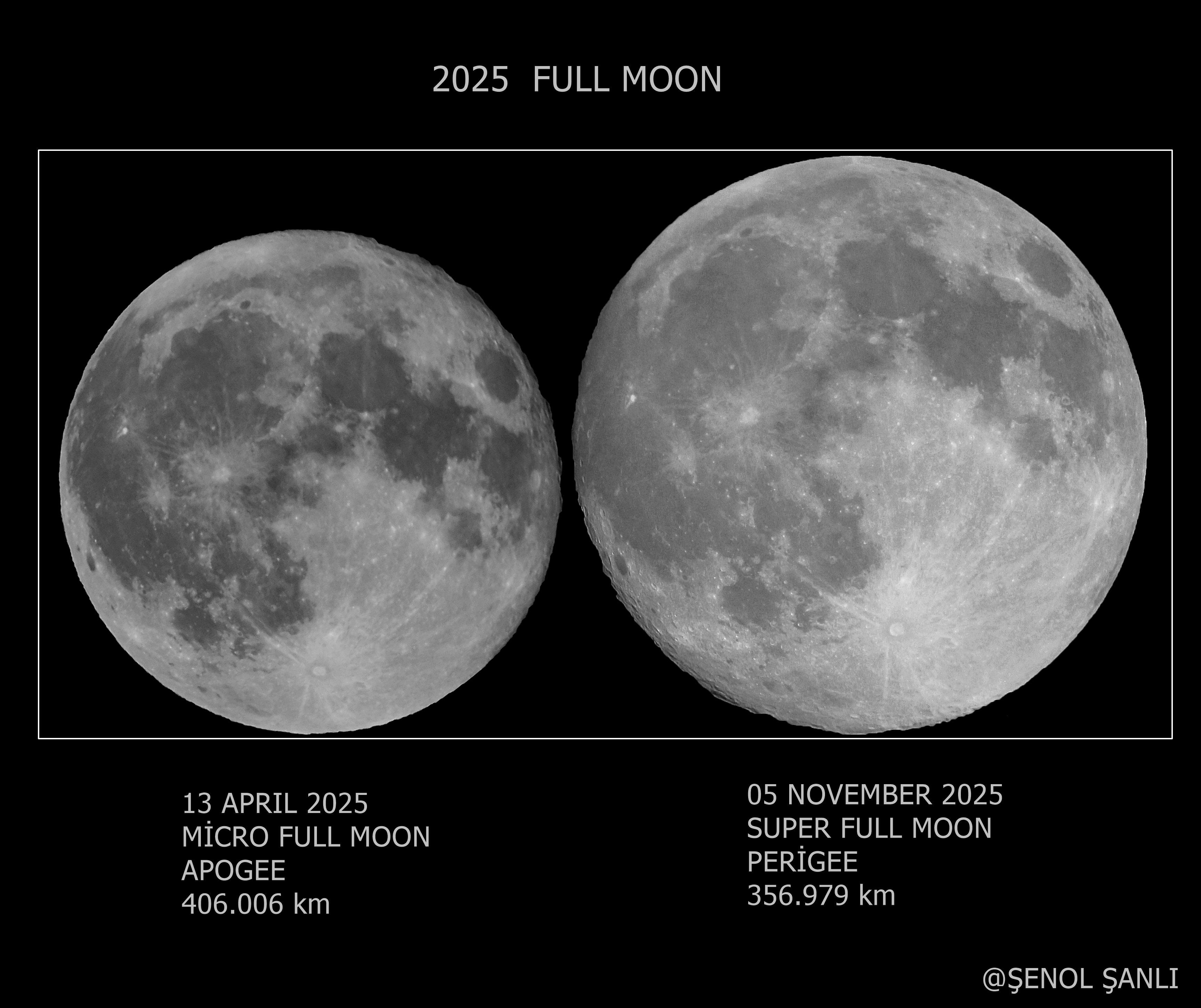
Alt...
2025 November 10
Two full Moons are shown. They are different sizes because the Micro Moon image on the left was captured when the Moon was near its furthest from the Earth, while the Super Moon on the right was captured when the Moon was near its closest to the Earth.
Micro Moon vs. Super Moon
* Image Credit & Copyright: Şenol Şanlı"
Explanation:
What was so super about Wednesday's supermoon? Last week, a full moon occurred that appeared slightly larger and brighter than usual. The reason is that the Moon's fully illuminated phase occurred within a short time from perigee - when the Moon was its closest to the Earth in its elliptical orbit. Although the precise conditions that define a supermoon vary, last Wednesday's supermoon was surely the closest, largest, and brightest full moon this year. One reason supermoons are popular is because they are so easy to see -- just go outside at sunset and watch an impressive full moon rise! Pictured here, Wednesday's supermoon is compared to April's micro moon -- when a full Moon occurs near the furthest part of the Moon's orbit -- so that it appears slightly smaller and dimmer than usual. Given many definitions, at least one supermoon occurs each year, with another one coming next month (moon-th).
Authors & editors: Robert Nemiroff (MTU) & Jerry Bonnell (UMCP)
NASA Official: Amber Straughn Specific rights apply.
NASA Web Privacy, Accessibility, Notices;
A service of: ASD at NASA / GSFC,
NASA Science Activation
& Michigan Tech
Annotations for previous post
https://apod.nasa.gov/apod/ap251109.html
#space #galaxy #milkyway #astrophotography #photography #science #astronomy #nature #NASA #apod
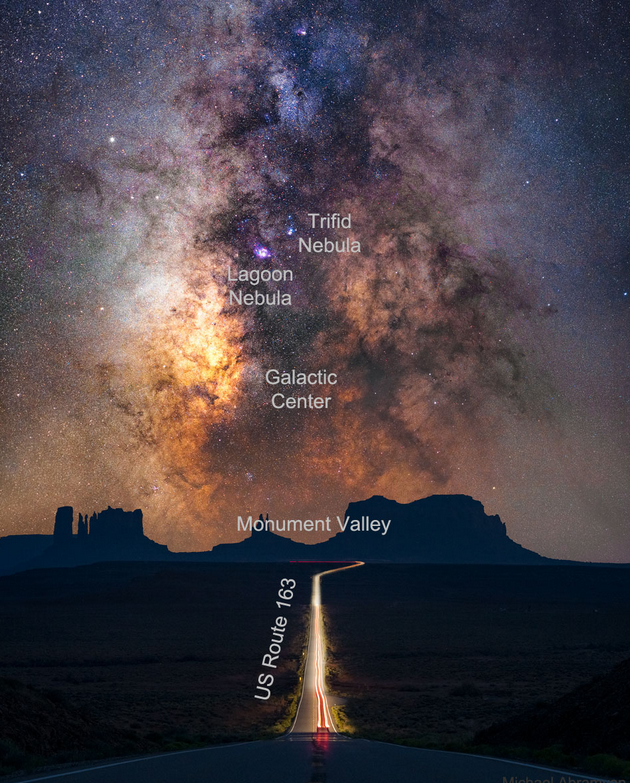
Alt...
Annotations for previous post
2025 November 9
Road to the Galactic Center
* Image Credit & Copyright: Michael Abramyan
https://www.instagram.com/mikeabramyan
Explanation:
Does the road to our galaxy's center go through Monument Valley? It doesn't have to, but if your road does -- take a picture. In this case, the road is US Route 163 and iconic buttes on the Navajo National Reservation populate the horizon. The band of Milky Way Galaxy stretches down from the sky and appears to be a continuation of the road on Earth. Filaments of dust darken the Milky Way, in contrast to billions of bright stars and several colorful glowing gas clouds including the Lagoon and Trifid nebulas. The featured picture is a composite of images taken with the same camera and from the same location -- Forest Gump Point in Utah, USA. The foreground was taken just after sunset in early 2021 September during the blue hour, while the background is a mosaic of four exposures captured a few hours later.
https://www.youtube.com/watch?v=0yTBvAhj7Nw&t=293s
https://en.wikipedia.org/wiki/United_States
https://en.wikipedia.org/wiki/Monument_Valley
https://en.wikipedia.org/wiki/Utah
https://en.wikipedia.org/wiki/Navajo_Nation
https://en.wikipedia.org/wiki/Navajo_Nation#Reservation_and_expansion
https://www.travelinusa.us/forrest-gump-point/
https://science.nasa.gov/earth/
https://science.nasa.gov/resource/the-milky-way-galaxy/
https://apod.nasa.gov/apod/ap251109.html
#space #galaxy #milkyway #astrophotography #photography #science #astronomy #nature #NASA #apod
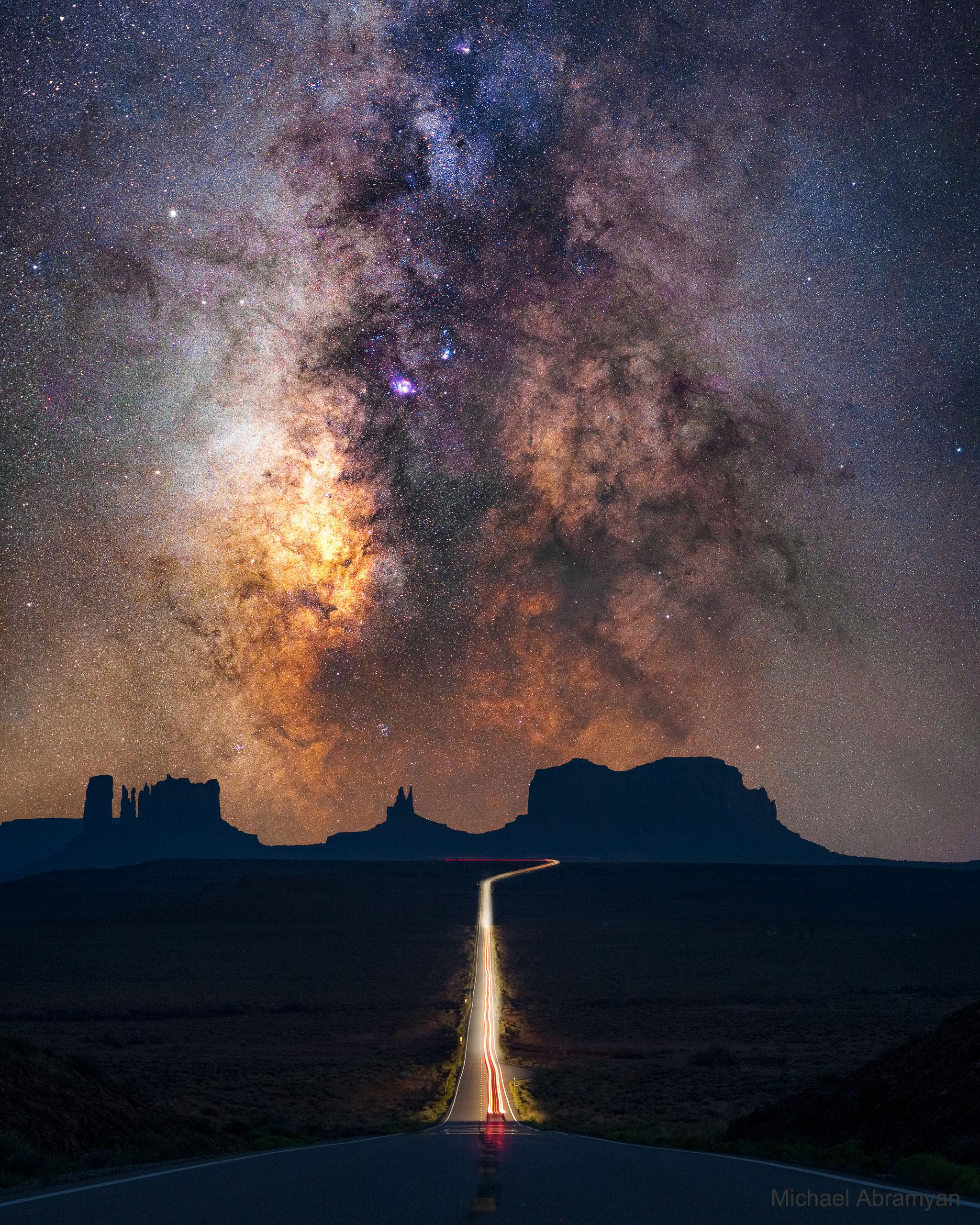
Alt...
2025 November 9
The picture shows the a composite image of Monument Valley, Utah, USA in the foreground, and the plane of the Milky Way Galaxy including the Galactic Center in the background.
Road to the Galactic Center
* Image Credit & Copyright: Michael Abramyan
Explanation:
Does the road to our galaxy's center go through Monument Valley? It doesn't have to, but if your road does -- take a picture. In this case, the road is US Route 163 and iconic buttes on the Navajo National Reservation populate the horizon. The band of Milky Way Galaxy stretches down from the sky and appears to be a continuation of the road on Earth. Filaments of dust darken the Milky Way, in contrast to billions of bright stars and several colorful glowing gas clouds including the Lagoon and Trifid nebulas. The featured picture is a composite of images taken with the same camera and from the same location -- Forest Gump Point in Utah, USA. The foreground was taken just after sunset in early 2021 September during the blue hour, while the background is a mosaic of four exposures captured a few hours later.
Authors & editors: Robert Nemiroff (MTU) & Jerry Bonnell (UMCP)
NASA Official: Amber Straughn Specific rights apply.
NASA Web Privacy, Accessibility, Notices;
A service of: ASD at NASA / GSFC,
NASA Science Activation
& Michigan Tech. U.
![[?]](https://cdn.masto.host/indiewebsocial/accounts/avatars/112/536/017/792/352/435/original/a07c2813d5f4cabd.png)
🚀 FAA restricts commercial rocket launches indefinitely due to air traffic risks from government shutdown / @Spacecom
2025 November 8
A Full Moon at Perigee
* Image Credit & Copyright: Betul Turksoy
https://www.instagram.com/betul_turksoy/p/DQqj4P-Dcgu/
Explanation:
What is big, bright, and beautiful, can wear a cape made of clouds, and is at the closest point in its elliptical orbit around planet Earth? A full moon at perigee of course, captured here near moonset in predawn skies on November 5 from Kayseri, Turkiye. Full moons that happen at (or very near) perigee, and so are slightly larger and brighter than full moons on average, have become popularly known as supermoons. In fact, this full moon at perigee is the closest and brightest of the three supermoons of 2025. Rising as the Sun sets, this full moon follows this October's Harvest Moon and is traditionally known to some as the Hunter's Moon.
https://science.nasa.gov/moon/supermoons/
https://astropixels.com/ephemeris/moon/fullperigee2001.html
https://earthsky.org/astronomy-essentials/everything-you-need-to-know-hunters-moon/
https://apod.nasa.gov/apod/fap/ap251108.html
#space #earth #moon #astrophotography #photography #science #astronomy #nature #NASA #apod
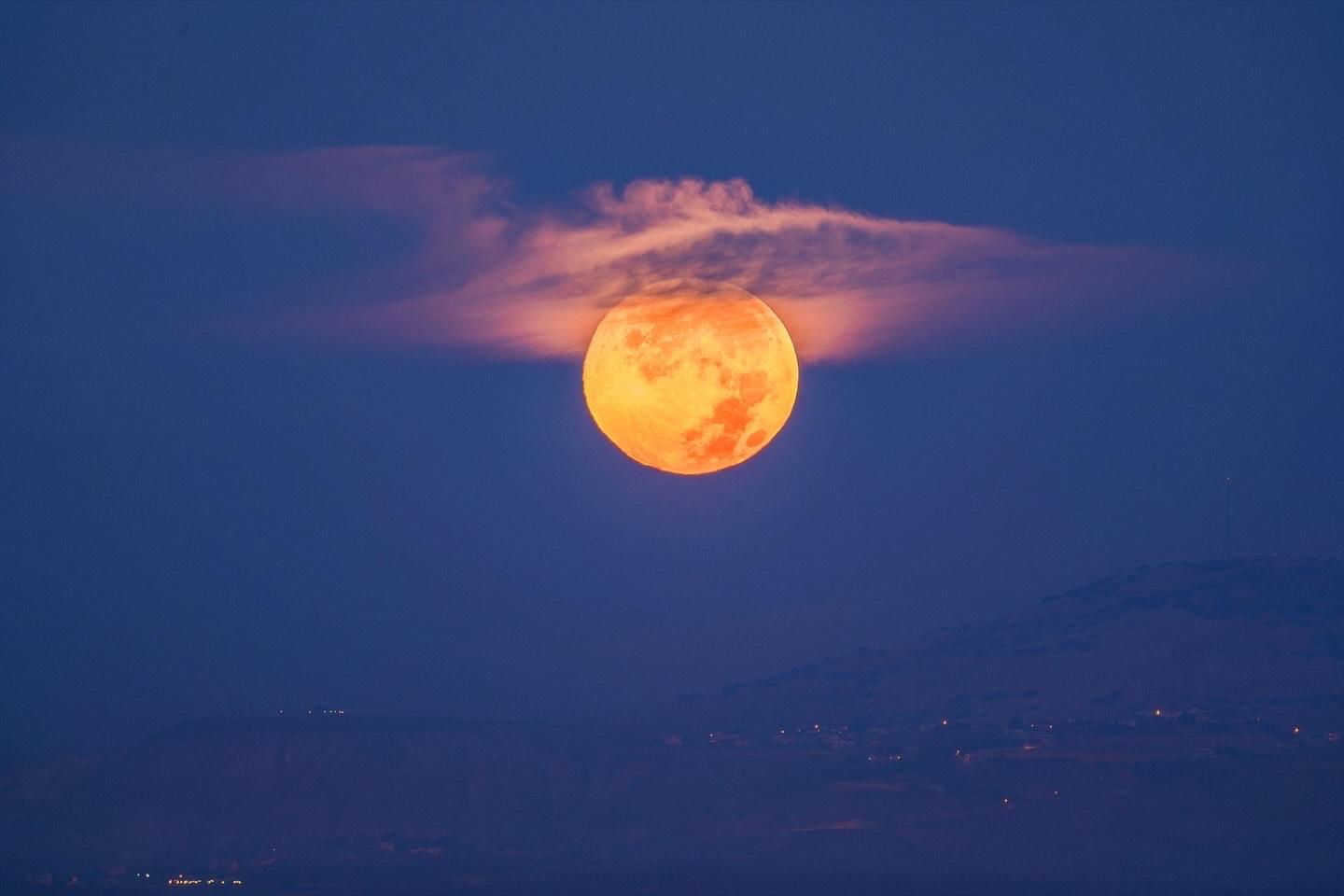
Alt...
2025 November 8
A Full Moon at Perigee
* Image Credit & Copyright: Betul Turksoy
Explanation:
What is big, bright, and beautiful, can wear a cape made of clouds, and is at the closest point in its elliptical orbit around planet Earth? A full moon at perigee of course, captured here near moonset in predawn skies on November 5 from Kayseri, Turkiye. Full moons that happen at (or very near) perigee, and so are slightly larger and brighter than full moons on average, have become popularly known as supermoons. In fact, this full moon at perigee is the closest and brightest of the three supermoons of 2025. Rising as the Sun sets, this full moon follows this October's Harvest Moon and is traditionally known to some as the Hunter's Moon.
Authors & editors: Robert Nemiroff (MTU) & Jerry Bonnell (UMCP)
NASA Official: Amber Straughn Specific rights apply.
NASA Web Privacy, Accessibility, Notices;
A service of: ASD at NASA / GSFC,
NASA Science Activation
& Michigan Tech. U.
![[?]](https://sbonline.nyc3.digitaloceanspaces.com/accounts/avatars/109/694/346/929/844/617/original/f4847180e4e3ef0e.jpg)
"The Vera Historia is not only the first detailed narrative about traveling through space to the moon in the Western tradition, it is also, arguably, the strangest."
https://publicdomainreview.org/essay/lucians-trips-to-the-moon/
2025 November 7
A Dark Seahorse in Cepheus
* Image Credit & Copyright: Jordi Jofre
https://app.astrobin.com/u/JJofre#gallery
Explanation:
Spanning light-years, this suggestive shape known as the Seahorse Nebula floats in silhouette against a rich background of of stars and glowing hydrogen gas. Seen toward the royal northern constellation of Cepheus, the dusty, dark nebula is part of a Milky Way molecular cloud some 1,200 light-years distant. It is also listed as Barnard 150 (B150), one of 182 dark markings of the sky cataloged in the early 20th century by astronomer E. E. Barnard. Packs of low mass stars are forming within, but their collapsing cores are only visible at long infrared wavelengths. Still, the luminous depths of the Milky Way in Cepheus add to this stunning galactic skyscape.
https://app.astrobin.com/i/pw6z9f
https://ui.adsabs.harvard.edu/abs/1916ApJ....43....1B/abstract
https://ui.adsabs.harvard.edu/abs/1919ApJ....49....1B/abstract
https://exhibit-archive.library.gatech.edu/barnard/
https://science.nasa.gov/ems/07_infraredwaves/
https://apod.nasa.gov/apod/ap251107.html
#space #nebula #astronomy #science #astrophotography #photography #nature #nebula #NASA #apod
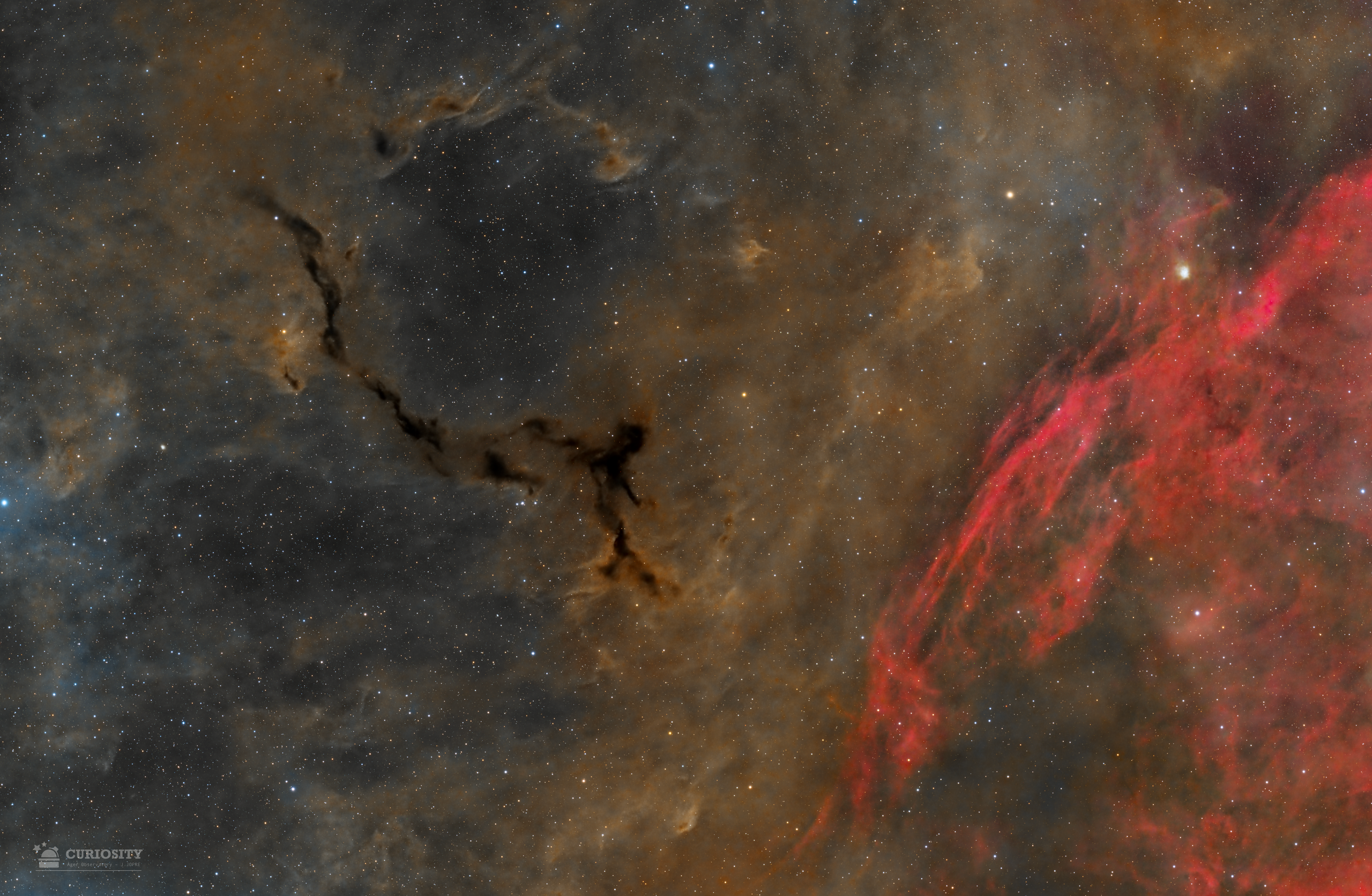
Alt...
2025 November 7
A Dark Seahorse in Cepheus
* Image Credit & Copyright: Jordi Jofre
Explanation:
Spanning light-years, this suggestive shape known as the Seahorse Nebula floats in silhouette against a rich background of of stars and glowing hydrogen gas. Seen toward the royal northern constellation of Cepheus, the dusty, dark nebula is part of a Milky Way molecular cloud some 1,200 light-years distant. It is also listed as Barnard 150 (B150), one of 182 dark markings of the sky cataloged in the early 20th century by astronomer E. E. Barnard. Packs of low mass stars are forming within, but their collapsing cores are only visible at long infrared wavelengths. Still, the luminous depths of the Milky Way in Cepheus add to this stunning galactic skyscape.
Authors & editors: Robert Nemiroff (MTU) & Jerry Bonnell (UMCP)
NASA Official: Amber Straughn Specific rights apply.
NASA Web Privacy, Accessibility, Notices;
A service of: ASD at NASA / GSFC,
NASA Science Activation
& Michigan Tech. U.