Search results for tag #nasa
![[?]](https://files.defcon.social/dcsocial-s3/accounts/avatars/113/208/344/507/078/943/original/014820ad22daee1c.jpg)
From Contributors to Wikimedia projects
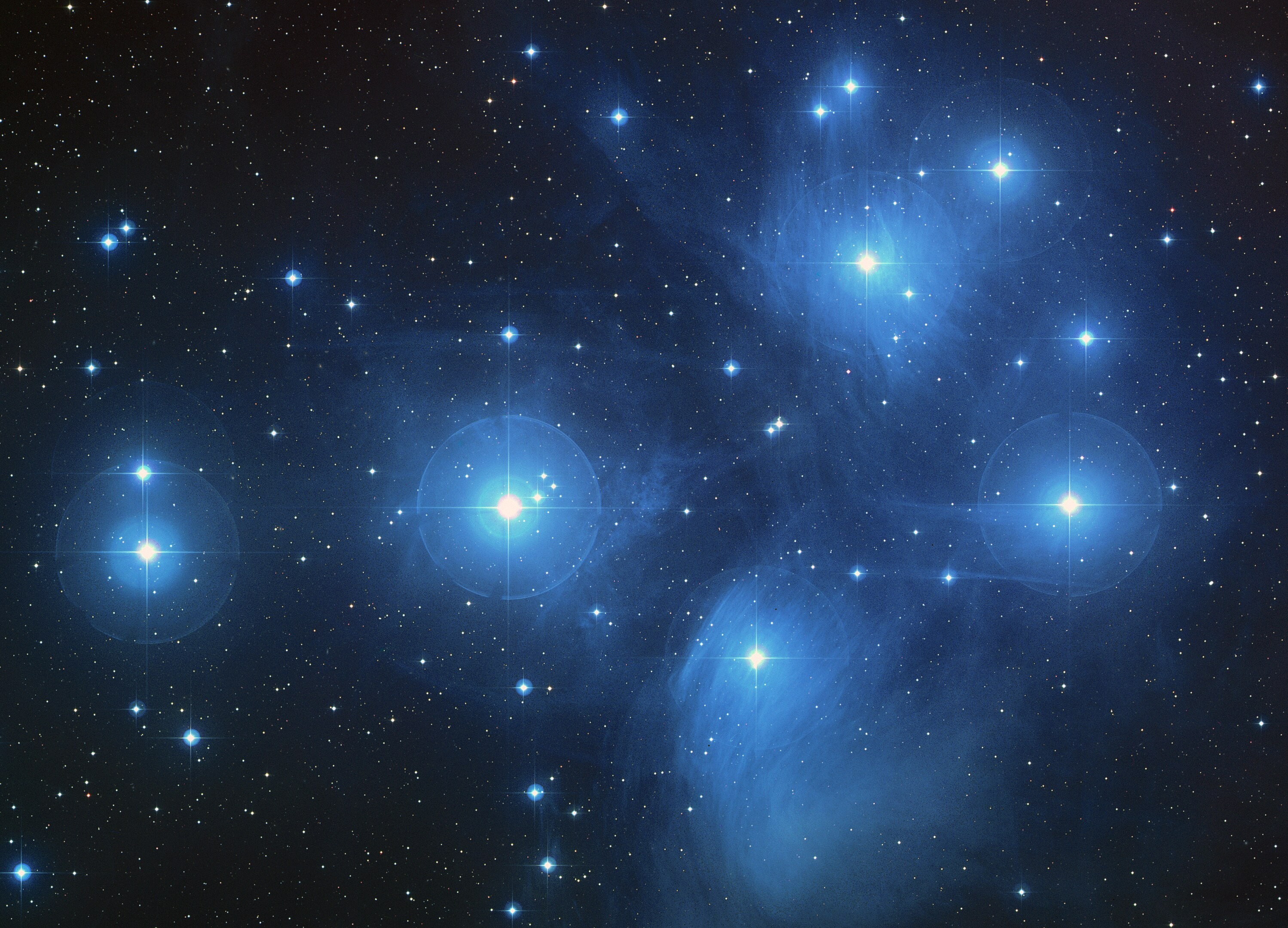
The Pleiades,
also known as Seven Sisters and Messier 45 (M45), is an asterism of an open star cluster containing young B-type stars in the northwest of the constellation Taurus. At a distance of about 444 light-years, it is among the nearest star clusters to Earth and the nearest Messier object to Earth, being the most obvious star cluster to the naked eye in the night sky. It is also observed to house the reflection nebula NGC 1432, an HII region. Around 2330 BC it marked the vernal point. Due to the brightness of its stars, the Pleiades is viewable from most areas on Earth, even in locations with significant light pollution.
The cluster is dominated by hot blue luminous stars that have formed within the last 100 million years. Reflection nebulae around the brightest stars were once thought to be leftover material from their formation, but are now considered likely to be an unrelated dust cloud in the interstellar medium through which the stars are currently passing. This dust cloud is estimated to be moving at a speed of approximately 18 km/s relative to the stars in the cluster.
Computer simulations have shown that the Pleiades were probably formed from a compact configuration that once resembled the Orion Nebula. Astronomers estimate that the cluster will survive for approximately another 250 million years, after which the clustering will be lost due to gravitational interactions with the galactic neighborhood.
Together with the open star cluster of the Hyades, the Pleiades form the Golden Gate of the Ecliptic. The Pleiades have been said to "resemble a tiny dipper," and should not be confused with the "Little Dipper," or Ursa Minor.
[...]
https://en.wikipedia.org/wiki/Pleiades
#space #pleiades #astrophotography #photography #science #astronomy #nature #NASA #education
Alt...
The Pleiades, an open cluster consisting of approximately 3,000 stars at a distance of 400 light-years (120 parsecs) from Earth in the constellation of Taurus. It is also known as ‘The Seven Sisters’, or the astronomical designations NGC 1432/35 and M45.
CREDIT
NASA, ESA, AURA/Caltech, Palomar Observatory The science team consists of: D. Soderblom and E. Nelan (STScI), F. Benedict and B. Arthur (U. Texas), and B. Jones (Lick Obs.)
The name, Pleiades, comes from Ancient Greek: Πλειάδες. It probably derives from plein (πλεῖν 'to sail') because of the cluster's importance in delimiting the sailing season in the Mediterranean Sea: "the season of navigation began with their heliacal rising". In Classical Greek mythology the name was used for seven divine sisters called the Pleiades. In time, the name was said to be derived from that of a mythical mother, Pleione, effectively meaning "daughters of Pleione". In reality, the ancient name of the star cluster related to sailing almost certainly came first in the culture, naming of a relationship to the sister deities followed, and eventually appearing in later myths, to interpret the group name, a mother, Pleione.
Alt...
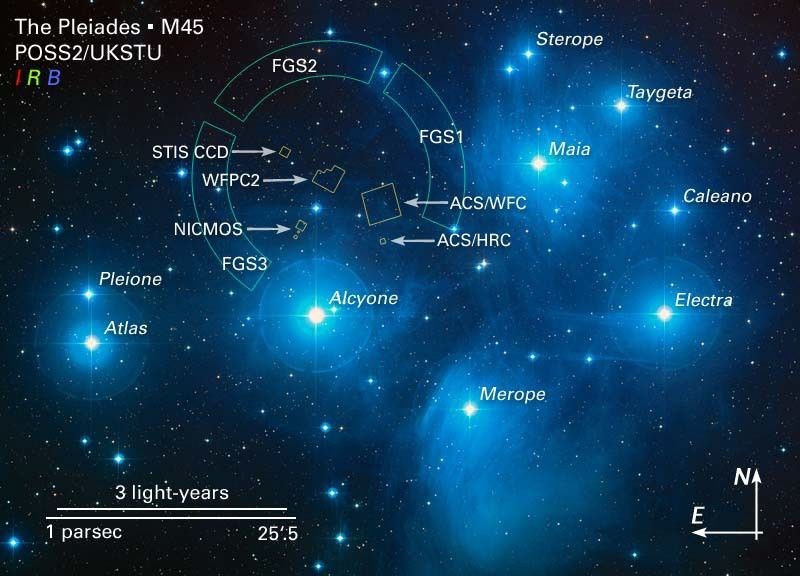
Annotated Image of the Pleiades and HST Field of View
Credit
NASA, ESA and AURA/Caltech
A color-composite image of the Pleiades from the Digitized Sky Survey
Observation data (J2000 epoch)
Right ascension 03h 47m 24s
Declination +24° 07′ 00″
Distance 444 ly on average (136.2±1.2 pc)
Apparent magnitude (V) 1.6
Apparent dimensions (V) 2°
Physical characteristics
Mass 800 M☉
Radius 20.34 light years
2024 September 3
Quarter Moon and Sister Stars
* Image Credit & Copyright: Alan Dyer, TWAN
https://www.amazingsky.com/About
https://twanight.org/profile/alan-dyer/
Explanation:
Last August two quite different sky icons were imaged rising together. Specifically, Earth's Moon shared the eastern sky with the sister stars of the Pleiades cluster, as viewed from Alberta, Canada. Astronomical images of the well-known Pleiades often show the star cluster's alluring blue reflection nebulas, but here they are washed-out by the orange moonrise sky. The half-lit Moon, known as a quarter moon, is overexposed, although the outline of the dim lunar night side can be seen by illuminating earthshine, light first reflected from the Earth. The featured image is a composite of eight successive exposures with brightnesses adjusted to match what the human eye would see. The Moon passes nearly -- or directly -- in front of the Pleaides once a month.
https://apod.nasa.gov/apod/ap240903.html
#space #pleiades #astrophotography #photography #science #astronomy #nature #NASA #education
Alt...
2024 September 3
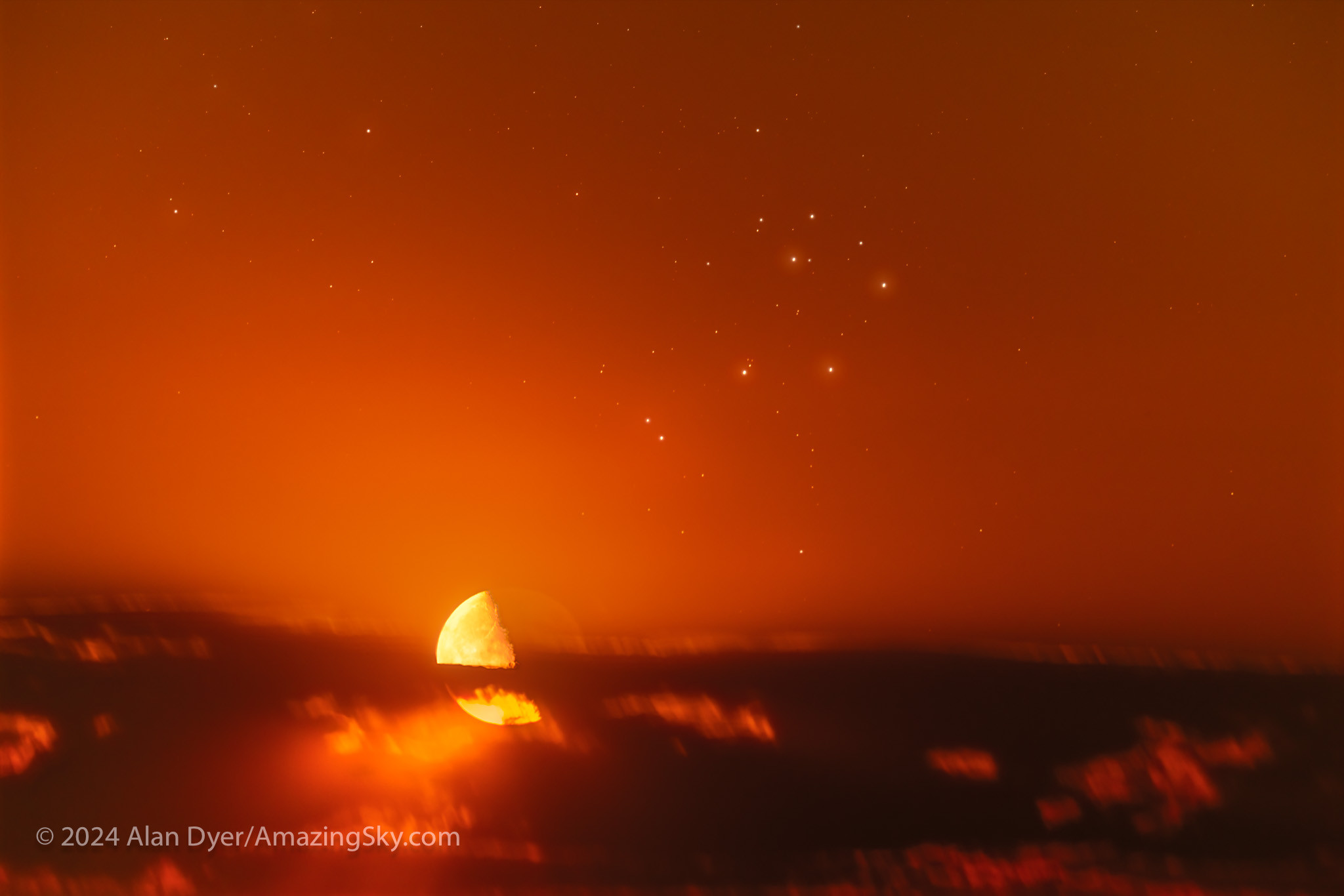
The featured image shows an orange sky with clouds across the bottom and several bright stars near the top center. Just at the top of the cloud deck on the left is a half-lit Moon.
Quarter Moon and Sister Stars
* Image Credit & Copyright: Alan Dyer, TWAN
Explanation:
Last August two quite different sky icons were imaged rising together. Specifically, Earth's Moon shared the eastern sky with the sister stars of the Pleiades cluster, as viewed from Alberta, Canada. Astronomical images of the well-known Pleiades often show the star cluster's alluring blue reflection nebulas, but here they are washed-out by the orange moonrise sky. The half-lit Moon, known as a quarter moon, is overexposed, although the outline of the dim lunar night side can be seen by illuminating earthshine, light first reflected from the Earth. The featured image is a composite of eight successive exposures with brightnesses adjusted to match what the human eye would see. The Moon passes nearly -- or directly -- in front of the Pleaides once a month.
Authors & editors: Robert Nemiroff (MTU) & Jerry Bonnell (UMCP)
NASA Official: Amber Straughn Specific rights apply.
NASA Web Privacy, Accessibility, Notices;
A service of: ASD at NASA / GSFC,
NASA Science Activation
& Michigan Tech. U.
2025 January 27
Pleiades over Half Dome
* Image Credit & Copyright: Dheera Venkatraman
https://dheera.net/about
Explanation:
Stars come in bunches. The most famous bunch of stars on the sky is the Pleiades, a bright cluster that can be easily seen with the unaided eye. The Pleiades lies only about 450 light years away, formed about 100 million years ago, and will likely last about another 250 million years. Our Sun was likely born in a star cluster, but now, being about 4.5 billion years old, its stellar birth companions have long since dispersed. The Pleiades star cluster is pictured over Half Dome, a famous rock structure in Yosemite National Park in California, USA. The featured image is a composite of 28 foreground exposures and 174 images of the stellar background, all taken from the same location and by the same camera on the same night in October 2019. After calculating the timing of a future juxtaposition of the Pleiades and Half Dome, the astrophotographer was unexpectedly rewarded by an electrical blackout, making the background sky unusually dark.
https://apod.nasa.gov/apod/ap250127.html
#space #pleiades #astrophotography #photography #science #astronomy #nature #NASA #education
Alt...
2025 January 27
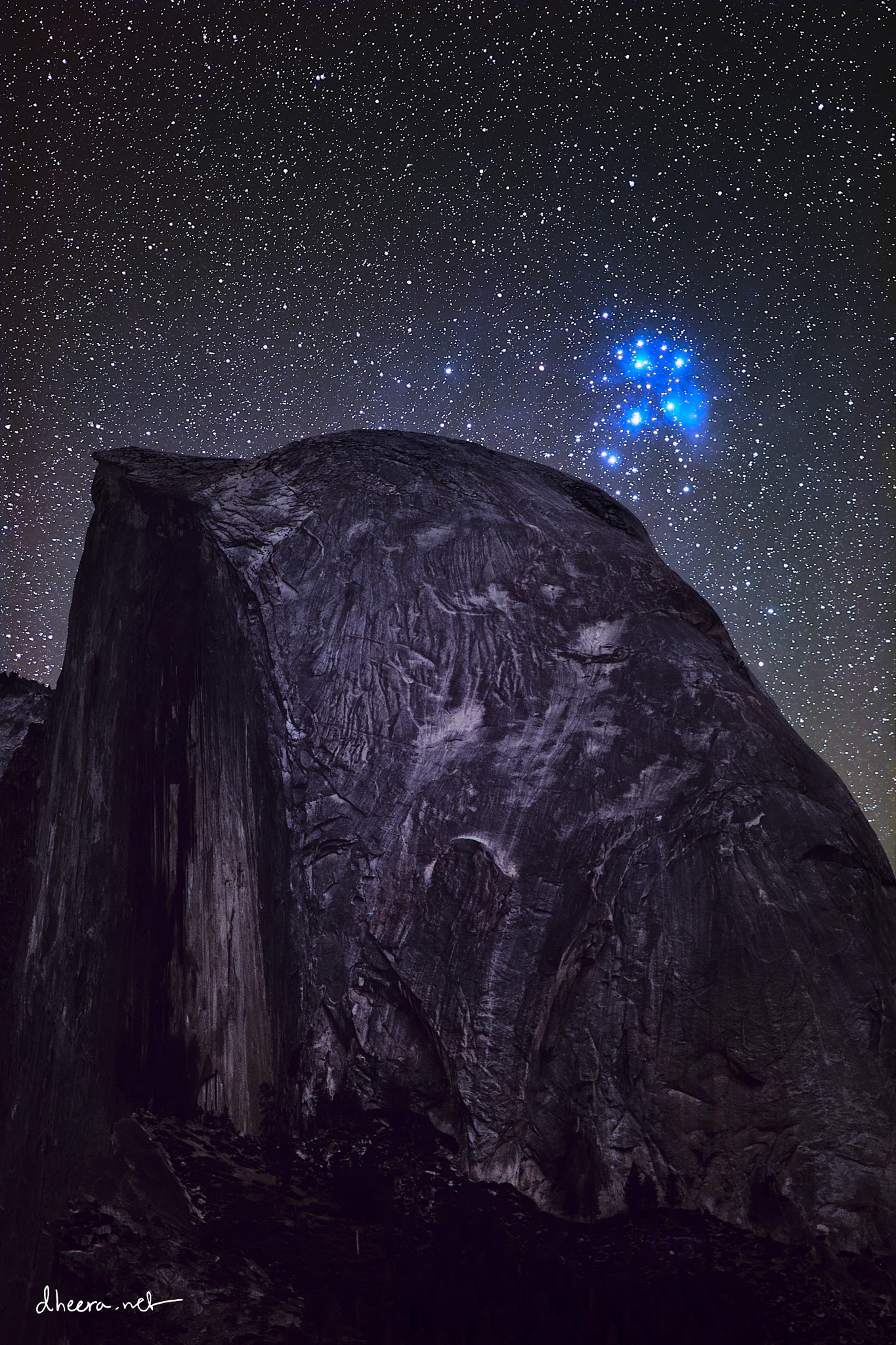
A cluster of bright blue stars is seen on the upper right while an unusual dome-like mountain occupies most of the frame.
Pleiades over Half Dome
* Image Credit & Copyright: Dheera Venkatraman
Explanation:
Stars come in bunches. The most famous bunch of stars on the sky is the Pleiades, a bright cluster that can be easily seen with the unaided eye. The Pleiades lies only about 450 light years away, formed about 100 million years ago, and will likely last about another 250 million years. Our Sun was likely born in a star cluster, but now, being about 4.5 billion years old, its stellar birth companions have long since dispersed. The Pleiades star cluster is pictured over Half Dome, a famous rock structure in Yosemite National Park in California, USA. The featured image is a composite of 28 foreground exposures and 174 images of the stellar background, all taken from the same location and by the same camera on the same night in October 2019. After calculating the timing of a future juxtaposition of the Pleiades and Half Dome, the astrophotographer was unexpectedly rewarded by an electrical blackout, making the background sky unusually dark.
Authors & editors: Robert Nemiroff (MTU) & Jerry Bonnell (UMCP)
NASA Official: Amber Straughn Specific rights apply.
NASA Web Privacy, Accessibility, Notices;
A service of: ASD at NASA / GSFC,
NASA Science Activation
& Michigan Tech. U.
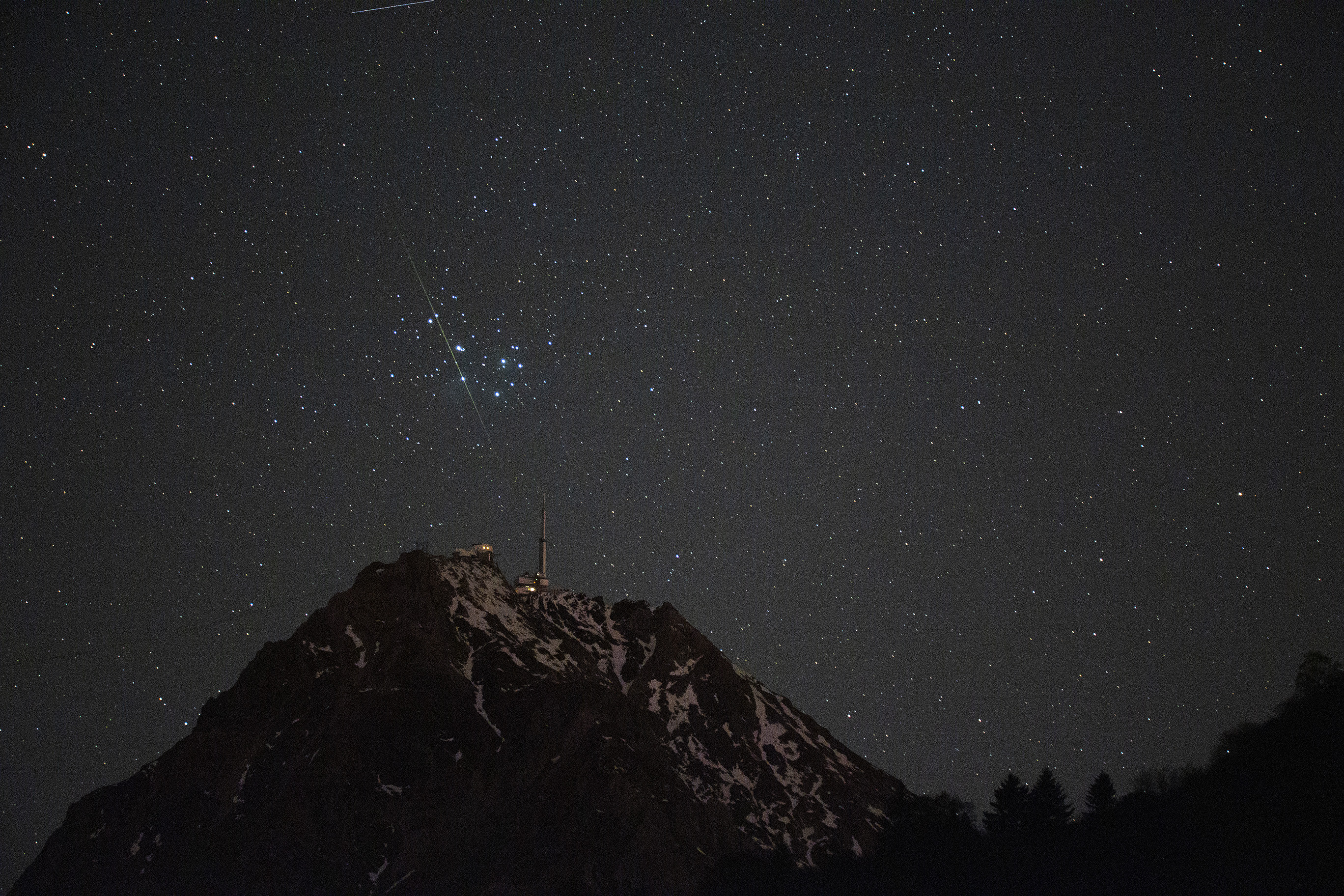
2023 December 9
Pic du Pleiades
* Image Credit & Copyright: Jean-Francois Graffand
http://www.echosduciel.fr/
Explanation:
Near dawn on November 19 the Pleiades stood in still dark skies over the French Pyrenees. But just before sunrise a serendipitous moment was captured in this single 3 second exposure; a bright meteor streak appeared to pierce the heart of the galactic star cluster. From the camera's perspective, star cluster and meteor were poised directly above the mountain top observatory on the Pic du Midi de Bigorre. And though astronomers might consider the Pleiades to be relatively close by, the grain of dust vaporizing as it plowed through planet Earth's upper atmosphere actually missed the cluster's tight grouping of young stars by about 400 light-years. While recording a night sky timelapse series, the camera and telephoto lens were fixed to a tripod on the Tour-de-France-cycled slopes of the Col du Tourmalet about 5 kilometers from the Pic du Midi.
https://apod.nasa.gov/apod/ap231209.html
#space #pleiades #astrophotography #photography #science #astronomy #nature #NASA
Alt...
2023 December 9
Pic du Pleiades
* Image Credit & Copyright: Jean-Francois Graffand
Explanation:
Near dawn on November 19 the Pleiades stood in still dark skies over the French Pyrenees. But just before sunrise a serendipitous moment was captured in this single 3 second exposure; a bright meteor streak appeared to pierce the heart of the galactic star cluster. From the camera's perspective, star cluster and meteor were poised directly above the mountain top observatory on the Pic du Midi de Bigorre. And though astronomers might consider the Pleiades to be relatively close by, the grain of dust vaporizing as it plowed through planet Earth's upper atmosphere actually missed the cluster's tight grouping of young stars by about 400 light-years. While recording a night sky timelapse series, the camera and telephoto lens were fixed to a tripod on the Tour-de-France-cycled slopes of the Col du Tourmalet about 5 kilometers from the Pic du Midi.
Authors & editors: Robert Nemiroff (MTU) & Jerry Bonnell (UMCP)
NASA Official: Phillip Newman Specific rights apply.
NASA Web Privacy Policy and Important Notices
A service of: ASD at NASA / GSFC,
NASA Science Activation
& Michigan Tech. U.
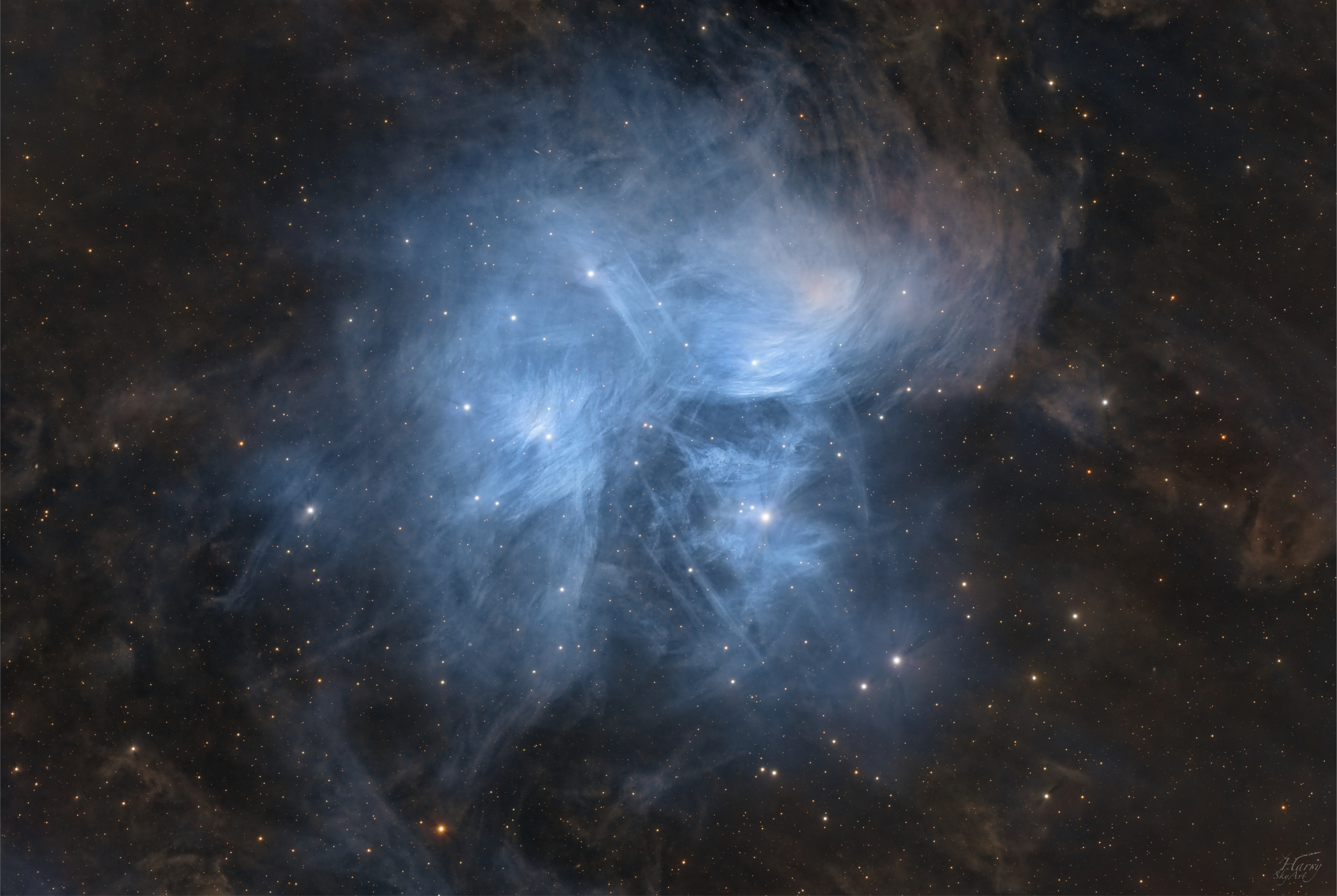
2023 January 5
Messier 45: The Daughters of Atlas and Pleione
* Image Credit & Copyright: Stefan Thrun
https://apod.nasa.gov/apod/ap230105.html
Explanation:
Hurtling through a cosmic dust cloud a mere 400 light-years away, the lovely Pleiades or Seven Sisters open star cluster is well-known for its striking blue reflection nebulae. It lies in the night sky toward the constellation Taurus and the Orion Arm of our Milky Way galaxy. The sister stars are not related to the dusty cloud though. They just happen to be passing through the same region of space. Known since antiquity as a compact grouping of stars, Galileo first sketched the star cluster viewed through his telescope with stars too faint to be seen by eye. Charles Messier recorded the position of the cluster as the 45th entry in his famous catalog of things which are not comets. In Greek myth, the Pleiades were seven daughters of the astronomical titan Atlas and sea-nymph Pleione. Their parents names are included in the cluster's nine brightest stars. This well-processed, color-calibrated telescopic image features pin-point stars and detailed filaments of interstellar dust captured in over 9 hours of exposure. It spans more than 20 light-years across the Pleiades star cluster.
https://apod.nasa.gov/apod/ap230105.html
#space #pleiades #astrophotography #photography #science #astronomy #nature #NASA
Alt...
2023 January 5
Messier 45: The Daughters of Atlas and Pleione
* Image Credit & Copyright: Stefan Thrun
Explanation:
Hurtling through a cosmic dust cloud a mere 400 light-years away, the lovely Pleiades or Seven Sisters open star cluster is well-known for its striking blue reflection nebulae. It lies in the night sky toward the constellation Taurus and the Orion Arm of our Milky Way galaxy. The sister stars are not related to the dusty cloud though. They just happen to be passing through the same region of space. Known since antiquity as a compact grouping of stars, Galileo first sketched the star cluster viewed through his telescope with stars too faint to be seen by eye. Charles Messier recorded the position of the cluster as the 45th entry in his famous catalog of things which are not comets. In Greek myth, the Pleiades were seven daughters of the astronomical titan Atlas and sea-nymph Pleione. Their parents names are included in the cluster's nine brightest stars. This well-processed, color-calibrated telescopic image features pin-point stars and detailed filaments of interstellar dust captured in over 9 hours of exposure. It spans more than 20 light-years across the Pleiades star cluster.
Authors & editors: Robert Nemiroff (MTU) & Jerry Bonnell (UMCP)
NASA Official: Phillip Newman Specific rights apply.
NASA Web Privacy Policy and Important Notices
A service of: ASD at NASA / GSFC,
NASA Science Activation
& Michigan Tech. U.
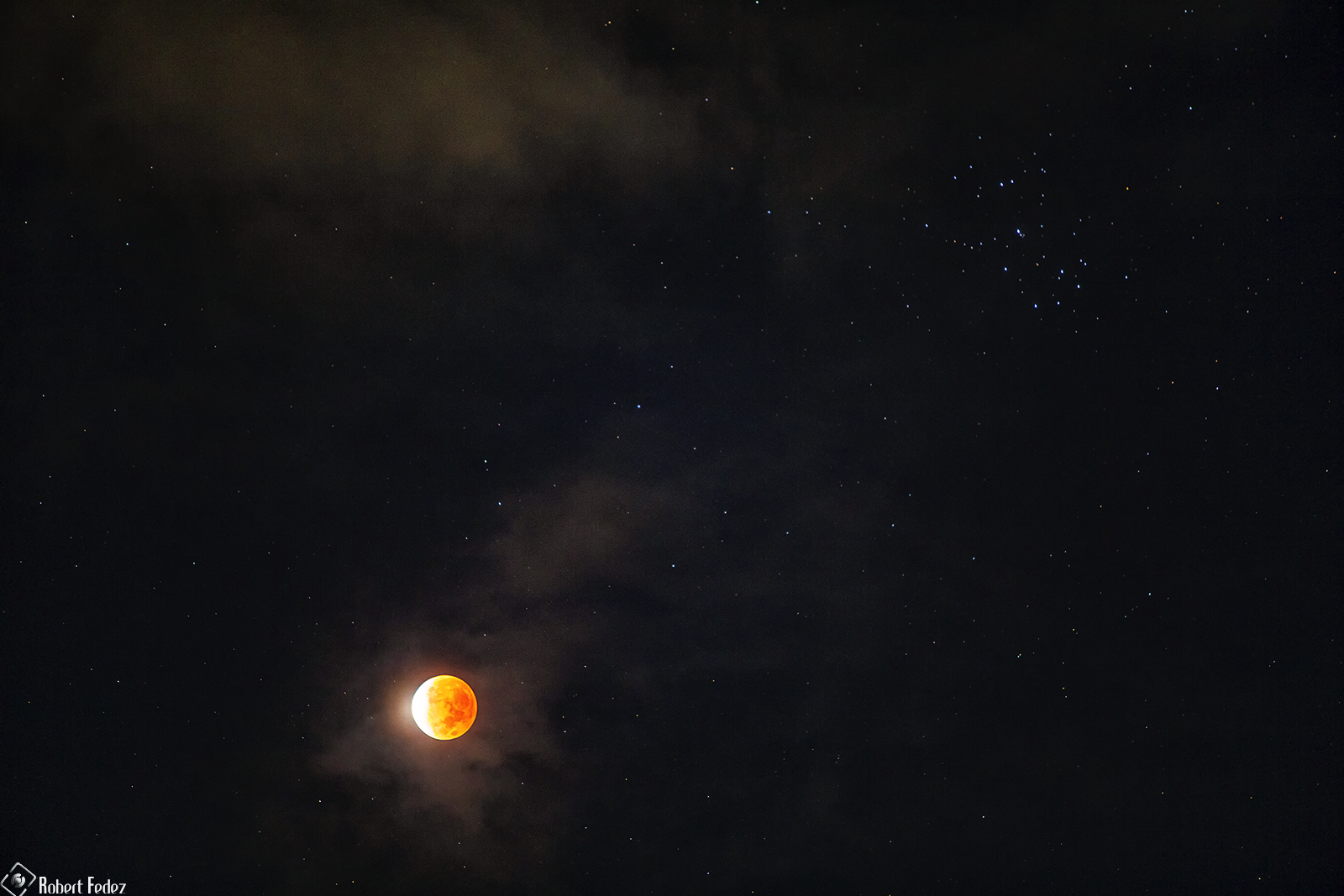
2021 November 20
An Almost Total Lunar Eclipse
* Image Credit & Copyright: Robert Fedez
https://app.astrobin.com/u/RobertFedez#gallery
Explanation:
Predawn hours of 2021 November 19 found the Moon in partly cloudy skies over Cancun, Mexico. Captured in this telephoto snapshot, the lunar disk is not quite entirely immersed in Earth's dark umbral shadow during a long partial lunar eclipse. The partial eclipse was deep though, deep enough to show the dimmed but reddened light in Earth's shadow. That's a sight often anticipated by fans of total lunar eclipses. Wandering through the constellation Taurus, the eclipsed Moon's dimmer light also made it easier to spot the Pleiades star cluster. The stars of the Seven Sisters share this frame at the upper right, with the almost totally eclipsed Moon.
https://apod.nasa.gov/apod/ap211120.html
#space #pleiades #moon #astrophotography #photography #science #astronomy #nature #NASA
Alt...
2021 November 20
An Almost Total Lunar Eclipse
* Image Credit & Copyright: Robert Fedez
Explanation:
Predawn hours of 2021 November 19 found the Moon in partly cloudy skies over Cancun, Mexico. Captured in this telephoto snapshot, the lunar disk is not quite entirely immersed in Earth's dark umbral shadow during a long partial lunar eclipse. The partial eclipse was deep though, deep enough to show the dimmed but reddened light in Earth's shadow. That's a sight often anticipated by fans of total lunar eclipses. Wandering through the constellation Taurus, the eclipsed Moon's dimmer light also made it easier to spot the Pleiades star cluster. The stars of the Seven Sisters share this frame at the upper right, with the almost totally eclipsed Moon.
Authors & editors: Robert Nemiroff (MTU) & Jerry Bonnell (UMCP)
NASA Official: Phillip Newman Specific rights apply.
NASA Web Privacy Policy and Important Notices
A service of: ASD at NASA / GSFC
& Michigan Tech. U.
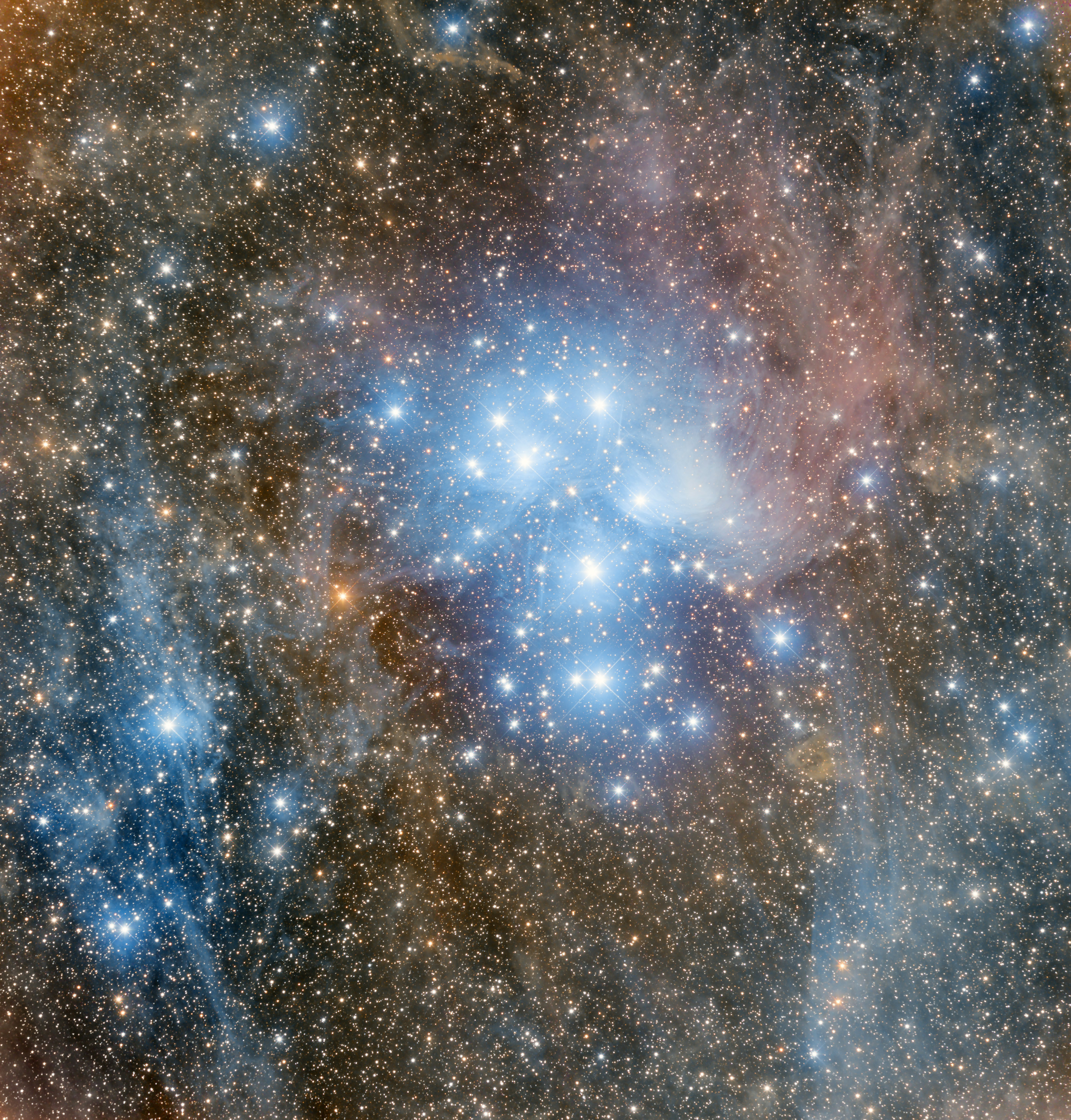
2019 November 7
Messier 45: The Daughters of Atlas and Pleione
* Image Credit & Copyright: Adam Block, Steward Observatory, University of Arizona
https://www.adamblockphhttps://duckduckgo.com/?t=ffab&q=astro++Jean-Francois+Graffand&atb=v480-1&ia=webotos.com/
https://astro.arizona.edu/
Commonly called the Pleiades or Seven Sisters, M45 is known as an open star cluster. It contains over a thousand stars that are loosely bound by gravity, but it is visually dominated by a handful of its brightest members.
One of these stars, Merope, is located just outside the frame of this image to the upper right. The colorful rays of light at the upper right, emanating from the star, are an optical phenomenon produced within the telescope. The nearly straight, blue-white wisps pointing toward the upper right are streams of large dust particles. As the cloud moves toward Merope, its smaller dust particles are slowed down by the star’s radiation pressure more than the larger particles are. The large dust particles continue on toward the star while the smaller particles are left behind at the lower left of the picture.
The Pleiades cluster has been observed since ancient times, so it has no known discoverer. However, Galileo Galilei, the Italian scientist best known for discovering the largest moons of Jupiter and championing a heliocentric model of the solar system, was the first to observe the Pleiades through a telescope. M45 is located an estimated distance of 445 light-years from Earth in the constellation Taurus, though this number is not universally agreed upon. It has an apparent magnitude of 1.6 and can be seen with the naked eye. The cluster is best observed during December.
https://apod.nasa.gov/apod/ap191107.html
#space #pleiades #astrophotography #photography #science #astronomy #nature #NASA
Alt...
2019 November 7
Messier 45: The Daughters of Atlas and Pleione
* Image Credit & Copyright: Adam Block, Steward Observatory, University of Arizona
Explanation:
Hurtling through a cosmic dust cloud a mere 400 light-years away, the lovely Pleiades or Seven Sisters open star cluster is well-known for its striking blue reflection nebulae. It lies in the night sky toward the constellation Taurus and the Orion Arm of our Milky Way Galaxy. The sister stars and cosmic dust cloud are not related though, they just happen to be passing through the same region of space. Known since antiquity as a compact grouping of stars, Galileo first sketched the star cluster viewed through his telescope with stars too faint to be seen by eye. Charles Messier recorded the position of the cluster as the 45th entry in his famous catalog of things which are not comets. In Greek myth, the Pleiades were seven daughters of the astronomical titan Atlas and sea-nymph Pleione. Their parents names are included in the cluster's nine brightest stars. This deep and wide telescopic image spans over 20 light-years across the Pleides star cluster.
Authors & editors: Robert Nemiroff (MTU) & Jerry Bonnell (UMCP)
NASA Official: Phillip Newman Specific rights apply.
NASA Web Privacy Policy and Important Notices
A service of: ASD at NASA / GSFC
& Michigan Tech. U.
2020 April 15
A Cosmic Triangle
* Image Credit & Copyright: Scott Aspinall
https://www.scottaspinall.com/
Explanation:
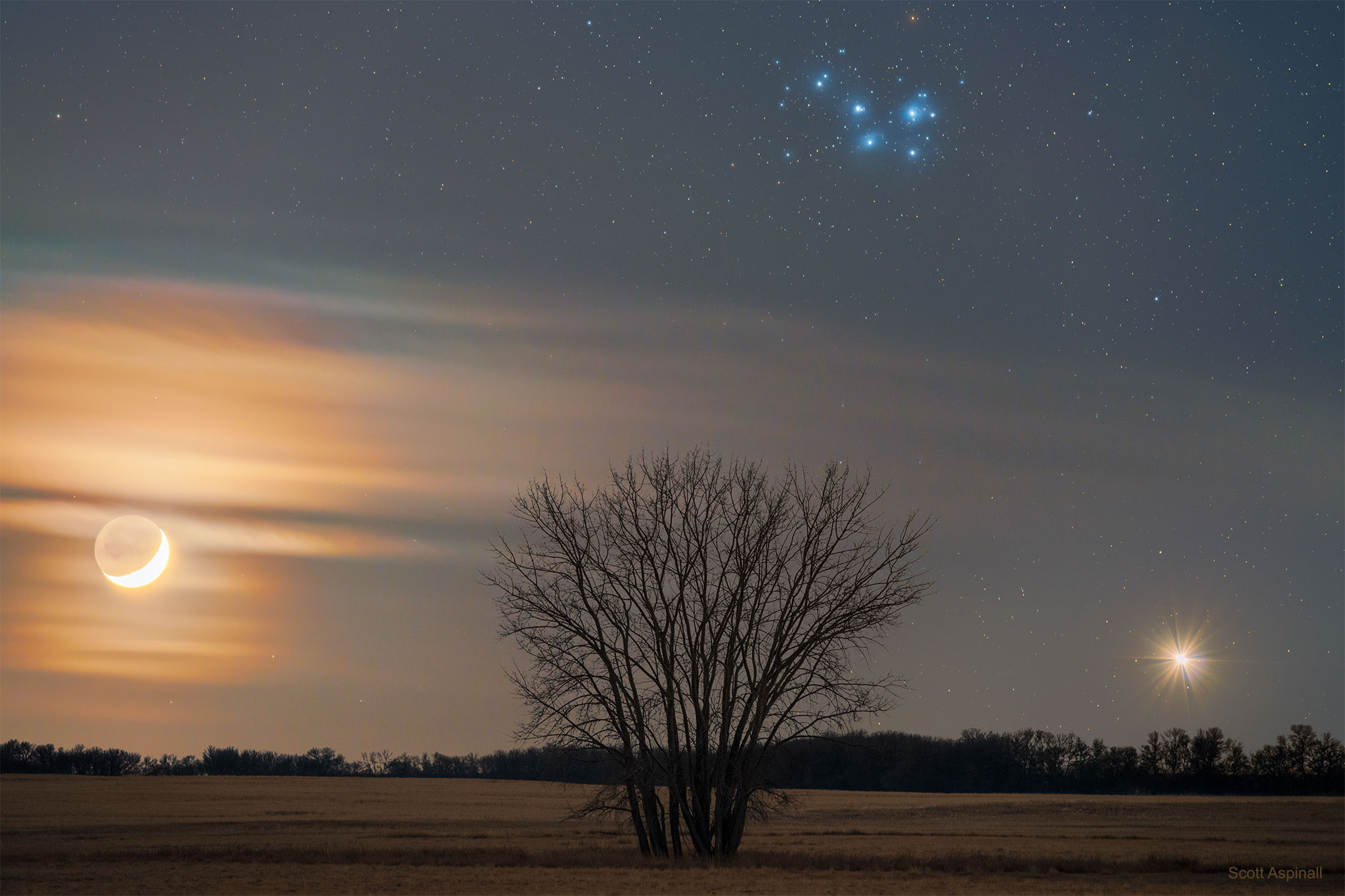
It was an astronomical triple play. Setting on the left, just after sunset near the end of March 2020, was our Moon -- showing a bright crescent phase. Setting on the right was Venus, the brightest planet in the evening sky last month -- and this month, too. With a small telescope, you could tell that Venus' phase was half, meaning that only half of the planet, as visible from Earth, was exposed to direct sunlight and brightly lit. High above and much further in the distance was the Pleiades star cluster. Although the Moon and Venus move with respect to the background stars, the Pleiades do not -- because they are background stars. In the beginning of this month, Venus appeared to move right in front of the Pleiades, a rare event that happens only once every eight years. The featured image captured this cosmic triangle with a series of exposures taken from the same camera over 70 minutes near Avonlea, Saskatchewan, Canada. The positions of the celestial objects was predicted. The only thing unpredicted was the existence of the foreground tree -- and the astrophotographer is still unsure what type of tree that is.
https://apod.nasa.gov/apod/ap200415.html
#space #pleiades #astrophotography #photography #science #astronomy #nature #NASA
Alt...
2020 April 15
A Cosmic Triangle
* Image Credit & Copyright: Scott Aspinall
Explanation:
It was an astronomical triple play. Setting on the left, just after sunset near the end of last month, was our Moon -- showing a bright crescent phase. Setting on the right was Venus, the brightest planet in the evening sky last month -- and this month, too. With a small telescope, you could tell that Venus' phase was half, meaning that only half of the planet, as visible from Earth, was exposed to direct sunlight and brightly lit. High above and much further in the distance was the Pleiades star cluster. Although the Moon and Venus move with respect to the background stars, the Pleiades do not -- because they are background stars. In the beginning of this month, Venus appeared to move right in front of the Pleiades, a rare event that happens only once every eight years. The featured image captured this cosmic triangle with a series of exposures taken from the same camera over 70 minutes near Avonlea, Saskatchewan, Canada. The positions of the celestial objects was predicted. The only thing unpredicted was the existence of the foreground tree -- and the astrophotographer is still unsure what type of tree that is.
Authors & editors: Robert Nemiroff (MTU) & Jerry Bonnell (UMCP)
NASA Official: Phillip Newman Specific rights apply.
NASA Web Privacy Policy and Important Notices
A service of: ASD at NASA / GSFC
& Michigan Tech. U.
2020 April 11
Venus and the Pleiades in April
* Image Credit & Copyright: Antonio Finazzi
Explanation:
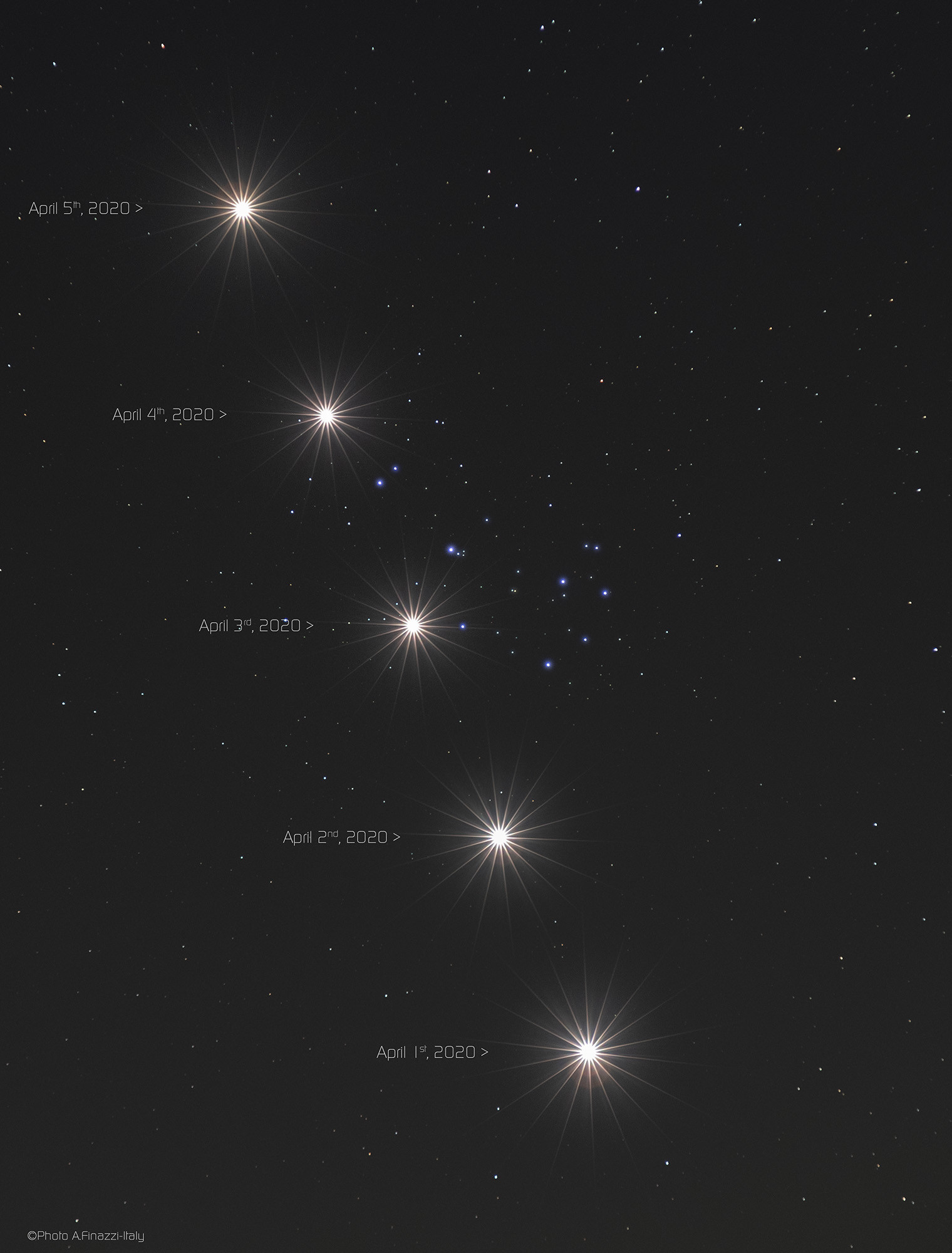
Shared around world in early April 2020 skies Venus, our brilliant evening star, wandered across the face of the lovely Pleiades star cluster. This timelapse image follows the path of the inner planet during the beautiful conjunction showing its daily approach to the stars of the Seven Sisters. From a composite of tracked exposures made with a telephoto lens, the field of view is also appropriate for binocular equipped skygazers. While the star cluster and planet were easily seen with the naked-eye, the spiky appearance of our sister planet in the picture is the result of a diffraction pattern produced by the camera's lens. All images were taken from a home garden in Chiuduno, Bergamo, Lombardy, Italy, fortunate in good weather and clear spring nights.
!>https://science.nasa.gov/venus/
!>https://apod.nasa.gov/apod/ap200402.html
https://apod.nasa.gov/apod/ap200411.html
#space #pleiades #astrophotography #photography #science #astronomy #nature #NASA
Alt...
2020 April 11
Venus and the Pleiades in April
* Image Credit & Copyright: Antonio Finazzi
Explanation:
Shared around world in early April 2020 skies Venus, our brilliant evening star, wandered across the face of the lovely Pleiades star cluster. This timelapse image follows the path of the inner planet during the beautiful conjunction showing its daily approach to the stars of the Seven Sisters. From a composite of tracked exposures made with a telephoto lens, the field of view is also appropriate for binocular equipped skygazers. While the star cluster and planet were easily seen with the naked-eye, the spiky appearance of our sister planet in the picture is the result of a diffraction pattern produced by the camera's lens. All images were taken from a home garden in Chiuduno, Bergamo, Lombardy, Italy, fortunate in good weather and clear spring nights.
Authors & editors: Robert Nemiroff (MTU) & Jerry Bonnell (UMCP)
NASA Official: Phillip Newman Specific rights apply.
NASA Web Privacy Policy and Important Notices
A service of: ASD at NASA / GSFC
& Michigan Tech. U.
2020 March 23
From the Pleiades to the Eridanus Loop
* Image Credit & Copyright: Hirofumi Okubo
https://www.flickr.com/people/bluemoonlife/
Explanation:
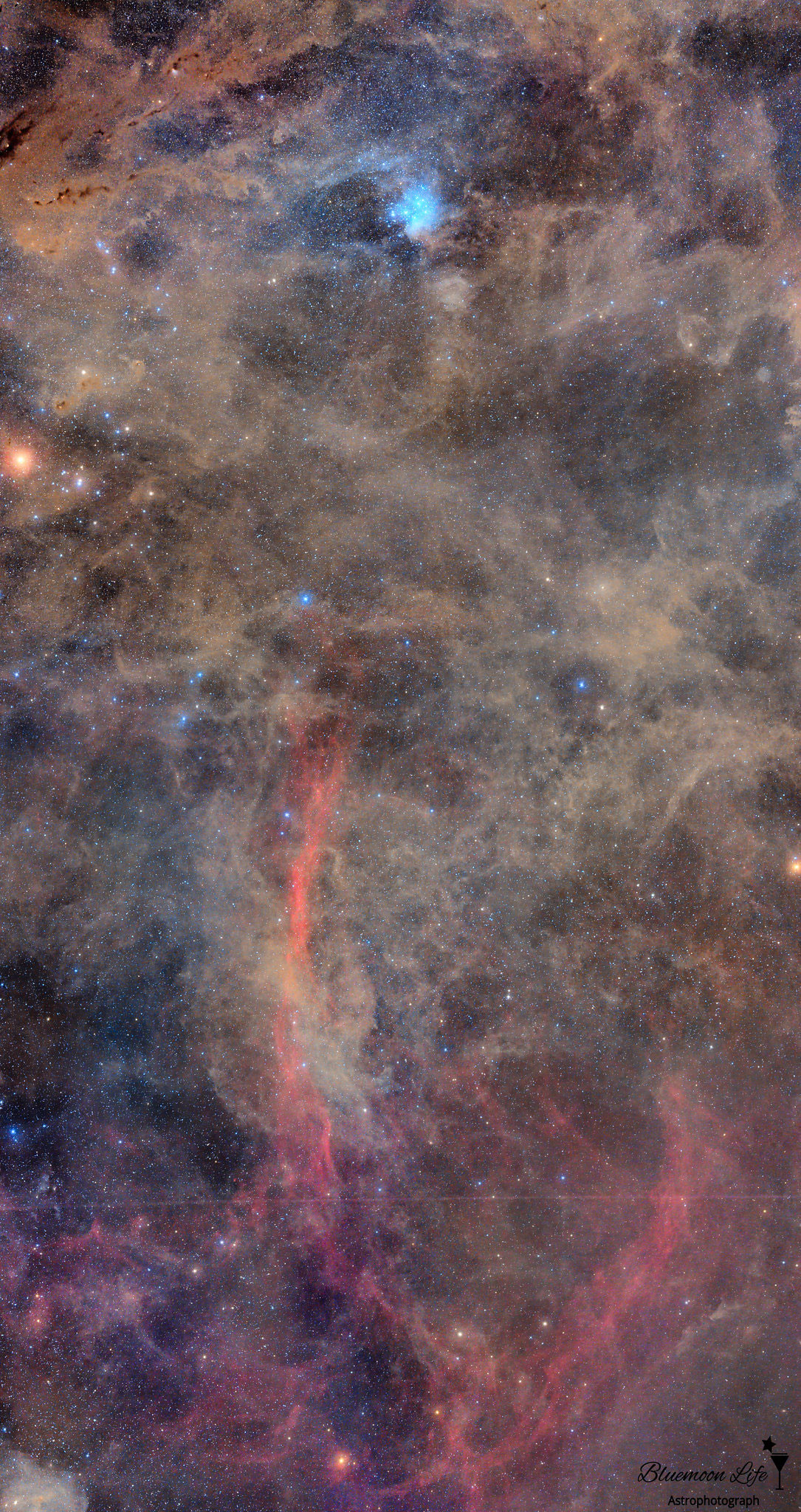
If you stare at an interesting patch of sky long enough, will it look different? In the case of Pleiades and Hyades star clusters -- and surrounding regions -- the answer is: yes, pretty different. Long duration camera exposures reveal an intricate network of interwoven interstellar dust and gas that was previously invisible not only to the eye but to lower exposure images. In the featured wide and deep mosaic, the dust stands out spectacularly, with the familiar Pleaides star cluster visible as the blue patch near the top of the image. Blue is the color of the Pleiades' most massive stars, whose distinctive light reflects from nearby fine dust. On the upper left is the Hyades star cluster surrounding the bright, orange, foreground-star Aldebaran. Red glowing emission nebula highlight the bottom of the image, including the curving vertical red ribbon known as the Eridanus Loop. The pervasive dust clouds appear typically in light brown and are dotted with unrelated stars.
https://apod.nasa.gov/apod/ap200323.html
#space #pleiades #astrophotography #photography #science #astronomy #nature #NASA
Alt...
2020 March 23
From the Pleiades to the Eridanus Loop
* Image Credit & Copyright: Hirofumi Okubo
Explanation:
If you stare at an interesting patch of sky long enough, will it look different? In the case of Pleiades and Hyades star clusters -- and surrounding regions -- the answer is: yes, pretty different. Long duration camera exposures reveal an intricate network of interwoven interstellar dust and gas that was previously invisible not only to the eye but to lower exposure images. In the featured wide and deep mosaic, the dust stands out spectacularly, with the familiar Pleaides star cluster visible as the blue patch near the top of the image. Blue is the color of the Pleiades' most massive stars, whose distinctive light reflects from nearby fine dust. On the upper left is the Hyades star cluster surrounding the bright, orange, foreground-star Aldebaran. Red glowing emission nebula highlight the bottom of the image, including the curving vertical red ribbon known as the Eridanus Loop. The pervasive dust clouds appear typically in light brown and are dotted with unrelated stars.
Authors & editors: Robert Nemiroff (MTU) & Jerry Bonnell (UMCP)
NASA Official: Phillip Newman Specific rights apply.
NASA Web Privacy Policy and Important Notices
A service of: ASD at NASA / GSFC
& Michigan Tech. U.
2025 October 31
Ghosts in Cassiopeia
* Image Credit & Copyright: Alex Rodriguez
https://www.instagram.com/astro_photo_alex/
Explanation:
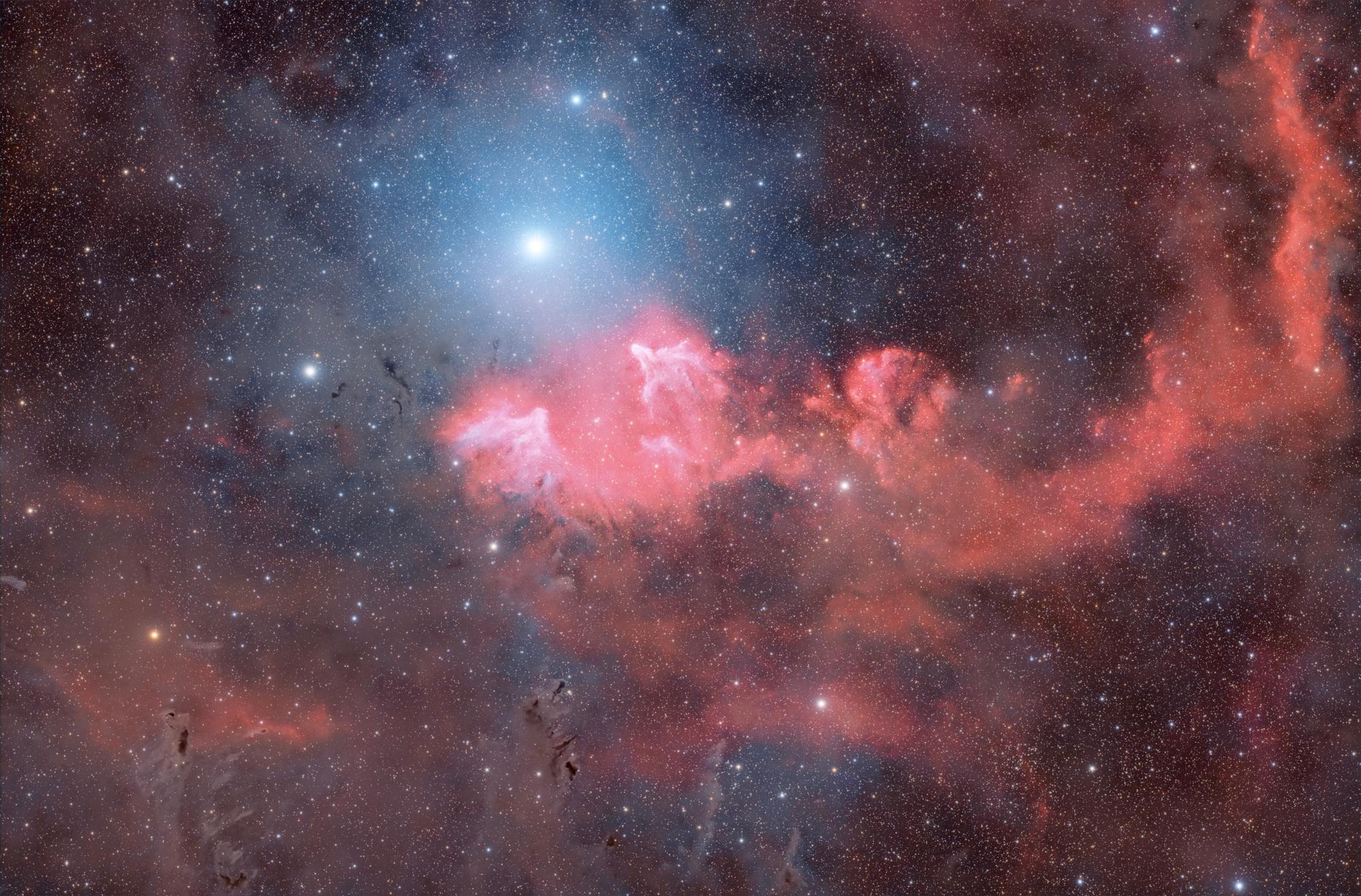
Halloween is an astronomy holiday and spooky shapes always seem to lurk in in planet Earth's night skies. In fact, near the center of this telescopic view toward the constellation Cassiopeia these swept-back interstellar clouds IC 59 (left) and IC 63 look ghostly on a cosmic scale. About 600 light-years distant, the clouds aren't actually ghosts. They are slowly disappearing though, under the influence of energetic radiation from hot, luminous star gamma Cas. The brightest bluish star in the frame, Gamma Cas is physically located only 3 to 4 light-years from the nebulae. Slightly closer to gamma Cas, IC 63 is dominated by red H-alpha light emitted as hydrogen atoms ionized by the hot star's ultraviolet radiation recombine with electrons. Farther from the star IC 59 also shows H-alpha emission, and both nebulae shine with the characteristic blue tint of dust reflected star light. The field of view spans about 2 degrees or 20 light-years at the estimated distance of the interstellar apparitions.
https://www.instagram.com/jro_rm/p/DQHN4wSjH-N/
https://arxiv.org/abs/1809.01419
https://arxiv.org/abs/1705.04313
https://www.aavso.org/vsots_gammacas
https://iopscience.iop.org/article/10.1086/426912
https://science.nasa.gov/exoplanets/immersive/galaxy-of-horrors/
https://apod.nasa.gov/apod/ap251031.html
#space #astronomy #science #astrophotography #photography #nature #nebula #NASA #apod
Alt...
2025 October 31
Ghosts in Cassiopeia
* Image Credit & Copyright: Alex Rodriguez
Explanation:
Halloween is an astronomy holiday and spooky shapes always seem to lurk in in planet Earth's night skies. In fact, near the center of this telescopic view toward the constellation Cassiopeia these swept-back interstellar clouds IC 59 (left) and IC 63 look ghostly on a cosmic scale. About 600 light-years distant, the clouds aren't actually ghosts. They are slowly disappearing though, under the influence of energetic radiation from hot, luminous star gamma Cas. The brightest bluish star in the frame, Gamma Cas is physically located only 3 to 4 light-years from the nebulae. Slightly closer to gamma Cas, IC 63 is dominated by red H-alpha light emitted as hydrogen atoms ionized by the hot star's ultraviolet radiation recombine with electrons. Farther from the star IC 59 also shows H-alpha emission, and both nebulae shine with the characteristic blue tint of dust reflected star light. The field of view spans about 2 degrees or 20 light-years at the estimated distance of the interstellar apparitions.
Authors & editors: Robert Nemiroff (MTU) & Jerry Bonnell (UMCP)
NASA Official: Amber Straughn Specific rights apply.
NASA Web Privacy, Accessibility, Notices;
A service of: ASD at NASA / GSFC,
NASA Science Activation
& Michigan Tech. U.
2025 October 30
Lynds Dark Nebula 43
* Image Credit & Copyright:
https://www.cielaustral.com/
Explanation:
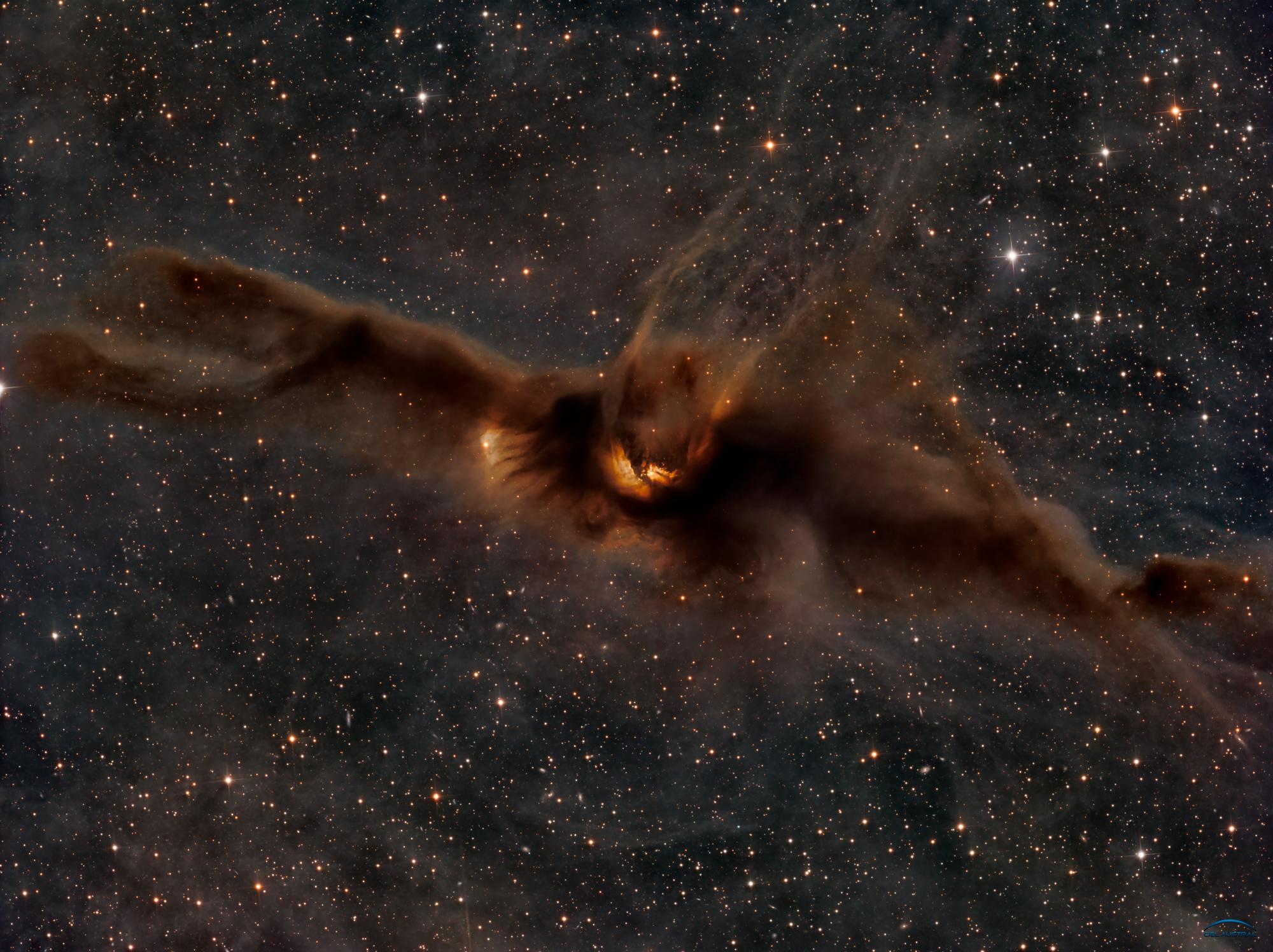
Sure, Halloween is an astronomy holiday. But astronomers always enjoy scanning the heavens for spook-tacular galaxies, stars, and nebulae. This favorite is item number 43 from the Beverly Lynds 1962 Catalog of Dark Nebulae, fondly known as the Cosmic Bat nebula. While its visage looks alarmingly like a scary flying mammal, Lynds Dark Nebula 43 is over 12 light-years across. Glowing with eerie light, stars are forming within the dusty interstellar molecular cloud that is dense enough to appear in silhouette against a luminous background of Milky Way stars. Watch out. This Cosmic Bat nebula is a mere 400 light-years distant toward the serpent-bearing constellation Ophiucus.
https://www.cielaustral.com/galerie/photo173.htm
https://ui.adsabs.harvard.edu/abs/1962ApJS....7....1L/abstract
https://ui.adsabs.harvard.edu/abs/2023ApJ...952...29K/abstract
https://earthsky.org/astronomy-essentials/halloween-derived-from-ancient-celtic-cross-quarter-day/
https://science.nasa.gov/exoplanets/immersive/galaxy-of-horrors/
https://apod.nasa.gov/apod/fap/ap251030.html
#space #astronomy #science #astrophotography #photography #nature #nebula #NASA #Webb #apod
Alt...
2025 October 30
Lynds Dark Nebula 43
* Image Credit & Copyright: Stéphane Vetter (Nuits sacrées)
Explanation:
Sure, Halloween is an astronomy holiday. But astronomers always enjoy scanning the heavens for spook-tacular galaxies, stars, and nebulae. This favorite is item number 43 from the Beverly Lynds 1962 Catalog of Dark Nebulae, fondly known as the Cosmic Bat nebula. While its visage looks alarmingly like a scary flying mammal, Lynds Dark Nebula 43 is over 12 light-years across. Glowing with eerie light, stars are forming within the dusty interstellar molecular cloud that is dense enough to appear in silhouette against a luminous background of Milky Way stars. Watch out. This Cosmic Bat nebula is a mere 400 light-years distant toward the serpent-bearing constellation Ophiucus.
Authors & editors: Robert Nemiroff (MTU) & Jerry Bonnell (UMCP)
NASA Official: Amber Straughn Specific rights apply.
NASA Web Privacy, Accessibility, Notices;
A service of: ASD at NASA / GSFC,
NASA Science Activation
& Michigan Tech. U.
2025 October 29
Dust Shapes of the Ghost Nebula
* Image Credit & Copyright: Kent Wood
https://ssr.app.astrobin.com/u/kvwood#gallery
Explanation:
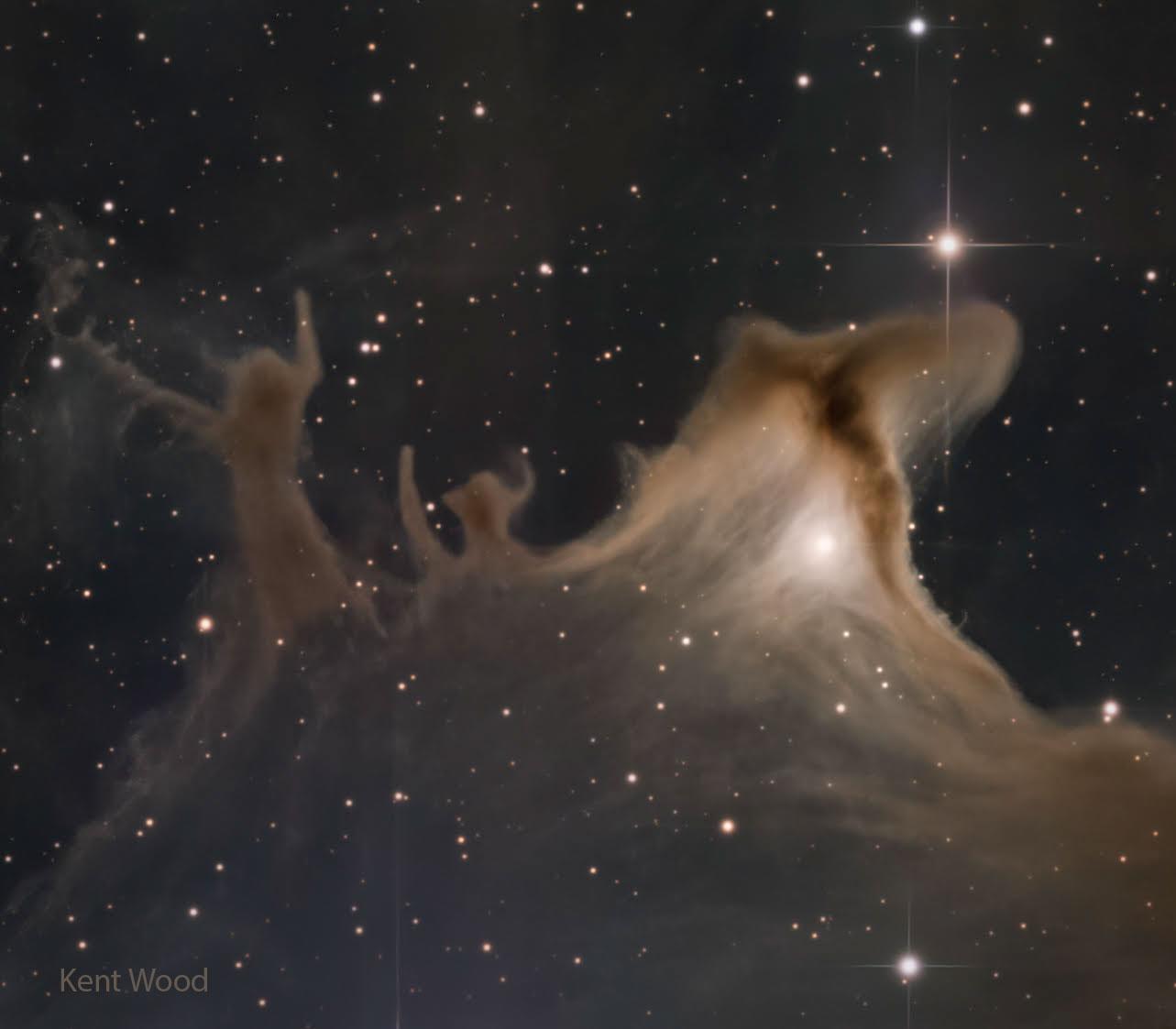
Do any shapes seem to jump out at you from this interstellar field of stars and dust? The jeweled expanse, filled with faint, starlight-reflecting clouds, drifts through the night in the royal constellation of Cepheus. Far from your own neighborhood on planet Earth, these ghostly apparitions lurk along the plane of the Milky Way at the edge of the Cepheus Flare molecular cloud complex some 1,200 light-years away. Over two light-years across and brighter than the other spooky chimeras, VdB 141 or Sh2-136 is also known as the Ghost Nebula, seen across the middle of the featured image. Within the reflection nebula are the telltale signs of dense cores collapsing in the early stages of star formation.
https://www.flickr.com/photos/kvwood/54828050686/in/dateposted-public/
https://en.wikipedia.org/wiki/Cepheus_(constellation)
https://en.wikipedia.org/wiki/Ghost_Nebula
https://noirlab.edu/public/images/noao-vdb141/
https://en.wikipedia.org/wiki/Reflection_nebula
https://arxiv.org/abs/0809.4761
https://ui.adsabs.harvard.edu/abs/2009ApJS..185..451K/abstract
https://www.jpl.nasa.gov/news/a-ghostly-trio-from-nasas-spitzer-space-telescope/
https://en.wikipedia.org/wiki/Chimera_(mythology)
👻 https://i.pinimg.com/736x/eb/62/1a/eb621ac58b9948269119f140ca2f8feb.jpg
https://apod.nasa.gov/apod/ap251029.html
#space #astronomy #science #astrophotography #photography #nature #nebula #NASA #apod
Alt...
2025 October 29
A dark star field surrounds an unusual clump of brown dust. To some, the dust clumps appear as shapes of people or monsters. Please see the explanation for more detailed information.
Dust Shapes of the Ghost Nebula
* Image Credit & Copyright: Kent Wood
Explanation:
Do any shapes seem to jump out at you from this interstellar field of stars and dust? The jeweled expanse, filled with faint, starlight-reflecting clouds, drifts through the night in the royal constellation of Cepheus. Far from your own neighborhood on planet Earth, these ghostly apparitions lurk along the plane of the Milky Way at the edge of the Cepheus Flare molecular cloud complex some 1,200 light-years away. Over two light-years across and brighter than the other spooky chimeras, VdB 141 or Sh2-136 is also known as the Ghost Nebula, seen across the middle of the featured image. Within the reflection nebula are the telltale signs of dense cores collapsing in the early stages of star formation.
Authors & editors: Robert Nemiroff (MTU) & Jerry Bonnell (UMCP)
NASA Official: Amber Straughn Specific rights apply.
NASA Web Privacy, Accessibility, Notices;
A service of: ASD at NASA / GSFC,
NASA Science Activation
& Michigan Tech. U.
2025 October 28
NGC 6995: The Bat Nebula
* Image Credit & Copyright: Francis Bozon & Jean-Luc Gangloff
Explanation:
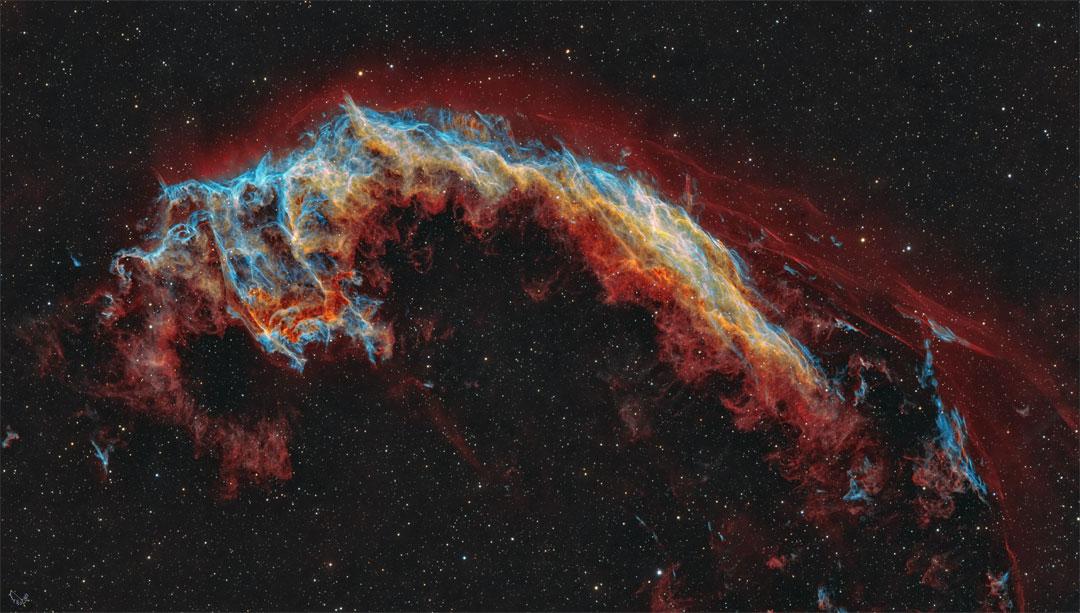
Can you see the bat? It haunts this cosmic close-up of the eastern Veil Nebula. The Veil Nebula itself is a large supernova remnant, the expanding debris cloud from the death explosion of a massive star. While the Veil is roughly circular in shape and covers nearly 3 degrees on the sky toward the constellation of the Swan (Cygnus), NGC 6995, known informally as the Bat Nebula, spans only 1/2 degree, about the apparent size of the Moon. That translates to 12 light-years at the Veil's estimated distance, a reassuring 1,400 light-years from planet Earth. In the composite of image data recorded through several narrow band filters, with emission from hydrogen atoms in the remnant shown in red and with strong emission from oxygen atoms shown in hues of blue. Of course, in the western part of the Veil lies another seasonal apparition: the Witch's Broom Nebula.
https://chandra.harvard.edu/photo/scale_distance.html
https://periodic.lanl.gov/1.shtml
https://apod.nasa.gov/apod/ap251022.html
#space #nebula #cluster #astrophotography #photography #science #astronomy #nature #NASA #ESA #apod #education
Alt...
2025 October 22
NGC 6995: The Bat Nebula
* Image Credit & Copyright: Francis Bozon & Jean-Luc Gangloff
Explanation:
Can you see the bat? It haunts this cosmic close-up of the eastern Veil Nebula. The Veil Nebula itself is a large supernova remnant, the expanding debris cloud from the death explosion of a massive star. While the Veil is roughly circular in shape and covers nearly 3 degrees on the sky toward the constellation of the Swan (Cygnus), NGC 6995, known informally as the Bat Nebula, spans only 1/2 degree, about the apparent size of the Moon. That translates to 12 light-years at the Veil's estimated distance, a reassuring 1,400 light-years from planet Earth. In the composite of image data recorded through several narrow band filters, with emission from hydrogen atoms in the remnant shown in red and with strong emission from oxygen atoms shown in hues of blue. Of course, in the western part of the Veil lies another seasonal apparition: the Witch's Broom Nebula.
2025 October 27
Two Tails of Comet Lemmon
* Image Credit: Massimo Penna
Explanation:
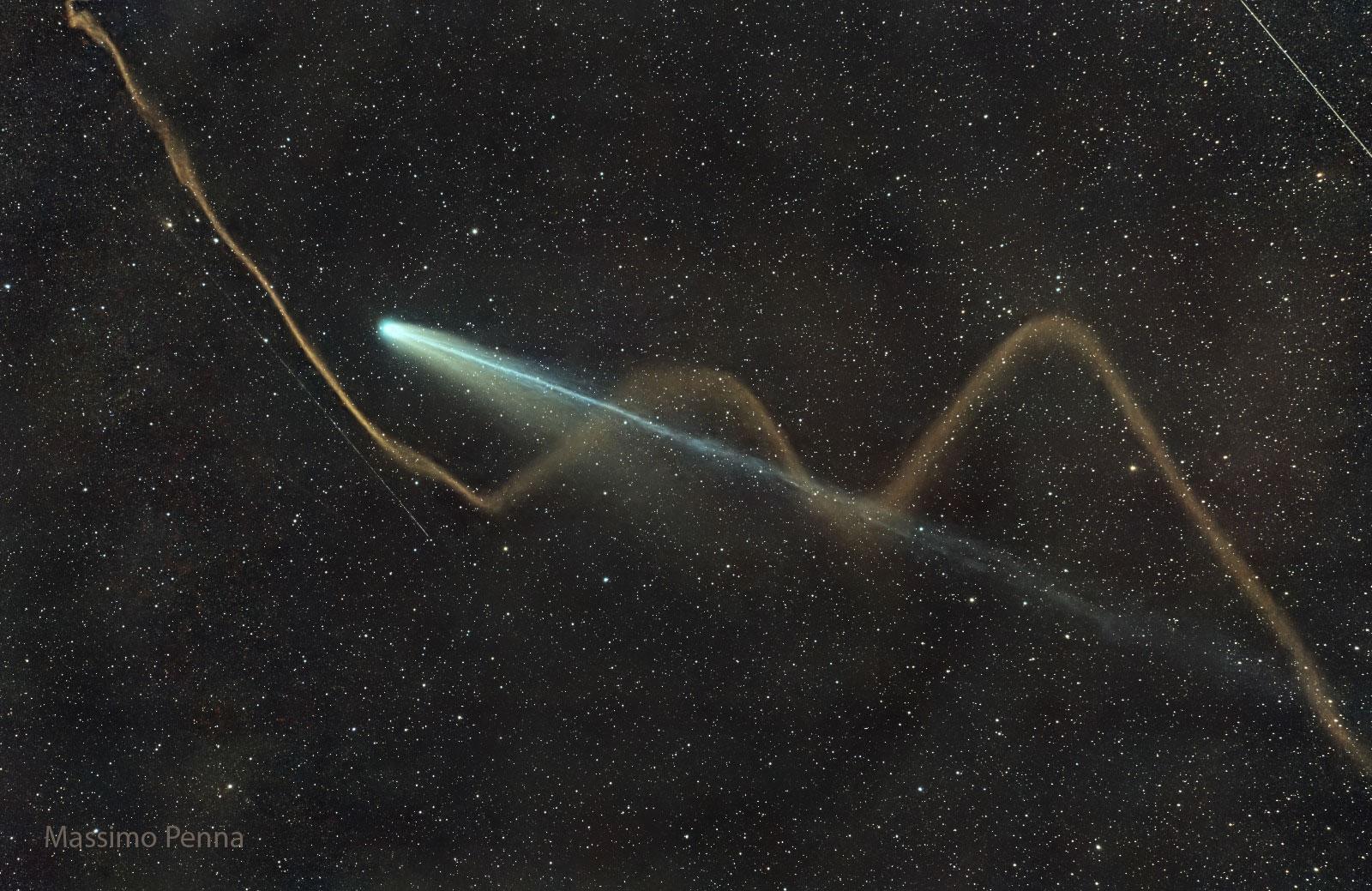
How many bright tails does Comet Lemmon have? Two. In the featured image it appears to have three, but why? The reason is that the zigzagging brown filament is a persistent meteor train that by luck appeared in front of the distant comet C/2025 A6 (Lemmon). A meteor train is the hot gas and fine dust that remains in the Earth's atmosphere and disperses in the seconds after a bright meteor flashes by. The two bright tails are the blue ion tail stretching across the image, and the white dust tail nearer the green coma on the upper left. All real comet tails originate from the nucleus of the comet inside the coma. The image was captured a few days ago from Manciano, Italy. This week, from mid-northern locations, Comet Lemmon will remain faintly visible in the northwest sky after sunset.
https://apod.nasa.gov/apod/fap/ap251027.html
https://www.virtualtelescope.eu/2025/10/26/comet-c-2025-a6-lemmon-and-a-meteor-red-afterglow-an-epic-image-24-oct-2025/
https://en.wikipedia.org/wiki/Coma_(comet)
https://en.wikipedia.org/wiki/Comet_tail
https://www.space.com/stargazing/see-comet-lemmon-cross-paths-with-a-cosmic-serpent-this-weekend
https://apod.nasa.gov/apod/ap251027.html
#space #comets #astrophotography #photography #science #astronomy #nature #NASA #ESA #education #apod
Alt...
2025 October 27
A dark sky shows bright comet with its tails extending diagonally from the lower left. Two tails are visible for the comet -- a long blue tail and a shorter wider white tail. Oddly, a wiggly tan stream appears to be a third tail -- but is actually the dust from a dissipated meteor. Please see the explanation for more detailed information.
Two Tails of Comet Lemmon
* Image Credit: Massimo Penna
Explanation:
How many bright tails does Comet Lemmon have? Two. In the featured image it appears to have three, but why? The reason is that the zigzagging brown filament is a persistent meteor train that by luck appeared in front of the distant comet C/2025 A6 (Lemmon). A meteor train is the hot gas and fine dust that remains in the Earth's atmosphere and disperses in the seconds after a bright meteor flashes by. The two bright tails are the blue ion tail stretching across the image, and the white dust tail nearer the green coma on the upper left. All real comet tails originate from the nucleus of the comet inside the coma. The image was captured a few days ago from Manciano, Italy. This week, from mid-northern locations, Comet Lemmon will remain faintly visible in the northwest sky after sunset.
Authors & editors: Robert Nemiroff (MTU) & Jerry Bonnell (UMCP)
NASA Official: Amber Straughn Specific rights apply.
NASA Web Privacy, Accessibility, Notices;
A service of: ASD at NASA / GSFC,
NASA Science Activation
& Michigan Tech. U.
2025 October 23
SWAN, Swan, Eagle
* Image Credit & Copyright: Adam Block
https://www.adamblockphotos.com/
Explanation:
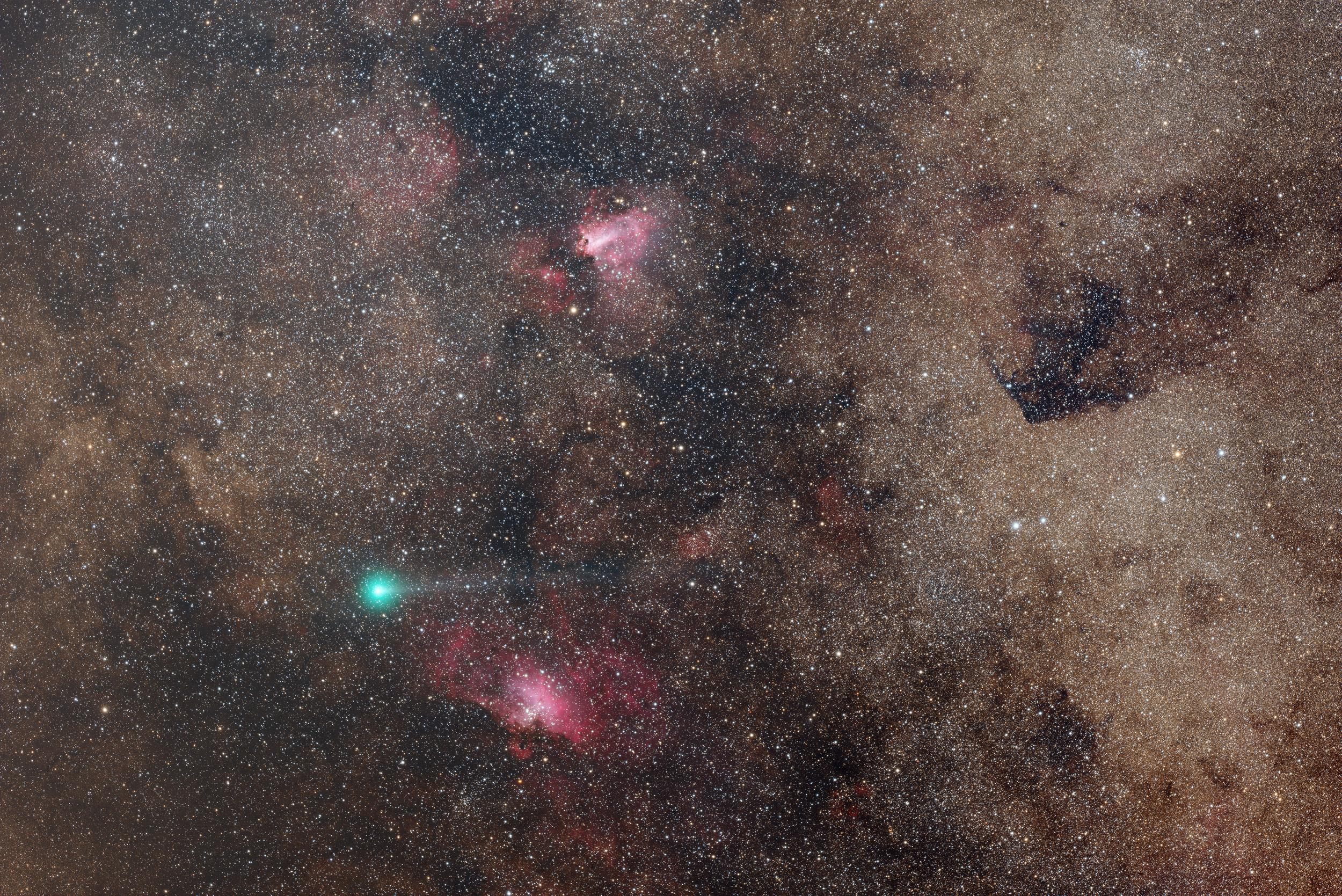
Comet C/2025 R2 (SWAN) sports a greenish coma and fainter tail, seen against congeries of stars and dusty interstellar clouds in this 7 degree wide telescopic field of view from October 17. On that date, the new visitor to the inner Solar System obligingly posed with two other celestial birds seen toward the center of our Milky Way. Messier 16, near the bottom of the frame, and Messier 17 are also known to deep skywatchers as the Eagle and the Swan nebulae. While the comet coma's greenish glow recorded in the image is due to diatomic carbon gas fluorescing in sunlight, reddish hues seen in the nebulae, star forming regions some 5,000 light-years distant, are characteristic of ionized hydrogen gas. Comet SWAN is outbound now but still a good comet for binoculars and small telescopes that can look close to the southern horizon in the northern hemisphere's early evening skies. C/2025 R2 (SWAN) was closest to our fair planet on October 20, a mere 2.2 light-minutes away.
https://app.astrobin.com/i/rkicdu
https://en.wikipedia.org/wiki/Sidereus_Nuncius#Stars
https://earthsky.org/astronomy-essentials/visible-planets-tonight-mars-jupiter-venus-saturn-mercury/
https://apod.nasa.gov/apod/ap251023.html
#space #comets #astrophotography #photography #science #astronomy #nature #NASA #ESA #education #apod
Alt...
2025 October 23
SWAN, Swan, Eagle
* Image Credit & Copyright: Adam Block
Explanation:
Comet C/2025 R2 (SWAN) sports a greenish coma and fainter tail, seen against congeries of stars and dusty interstellar clouds in this 7 degree wide telescopic field of view from October 17. On that date, the new visitor to the inner Solar System obligingly posed with two other celestial birds seen toward the center of our Milky Way. Messier 16, near the bottom of the frame, and Messier 17 are also known to deep skywatchers as the Eagle and the Swan nebulae. While the comet coma's greenish glow recorded in the image is due to diatomic carbon gas fluorescing in sunlight, reddish hues seen in the nebulae, star forming regions some 5,000 light-years distant, are characteristic of ionized hydrogen gas. Comet SWAN is outbound now but still a good comet for binoculars and small telescopes that can look close to the southern horizon in the northern hemisphere's early evening skies. C/2025 R2 (SWAN) was closest to our fair planet on October 20, a mere 2.2 light-minutes away.
Authors & editors: Robert Nemiroff (MTU) & Jerry Bonnell (UMCP)
NASA Official: Amber Straughn Specific rights apply.
NASA Web Privacy, Accessibility, Notices;
A service of: ASD at NASA / GSFC,
NASA Science Activation
& Michigan Tech. U.
2025 Shuttober 26
Halloween and the Ghost Head Nebula
* Image Credit: NASA, ESA, Mohammad Heydari-Malayeri (Observatoire de Paris) et al.,
https://www.nasa.gov/
https://www.esa.int/
https://www.iau.org/Iau/Shared_Content/Contacts/ContactLayouts/Obituary.aspx?ID=29332
https://www.observatoiredeparis.psl.eu/
Explanation:
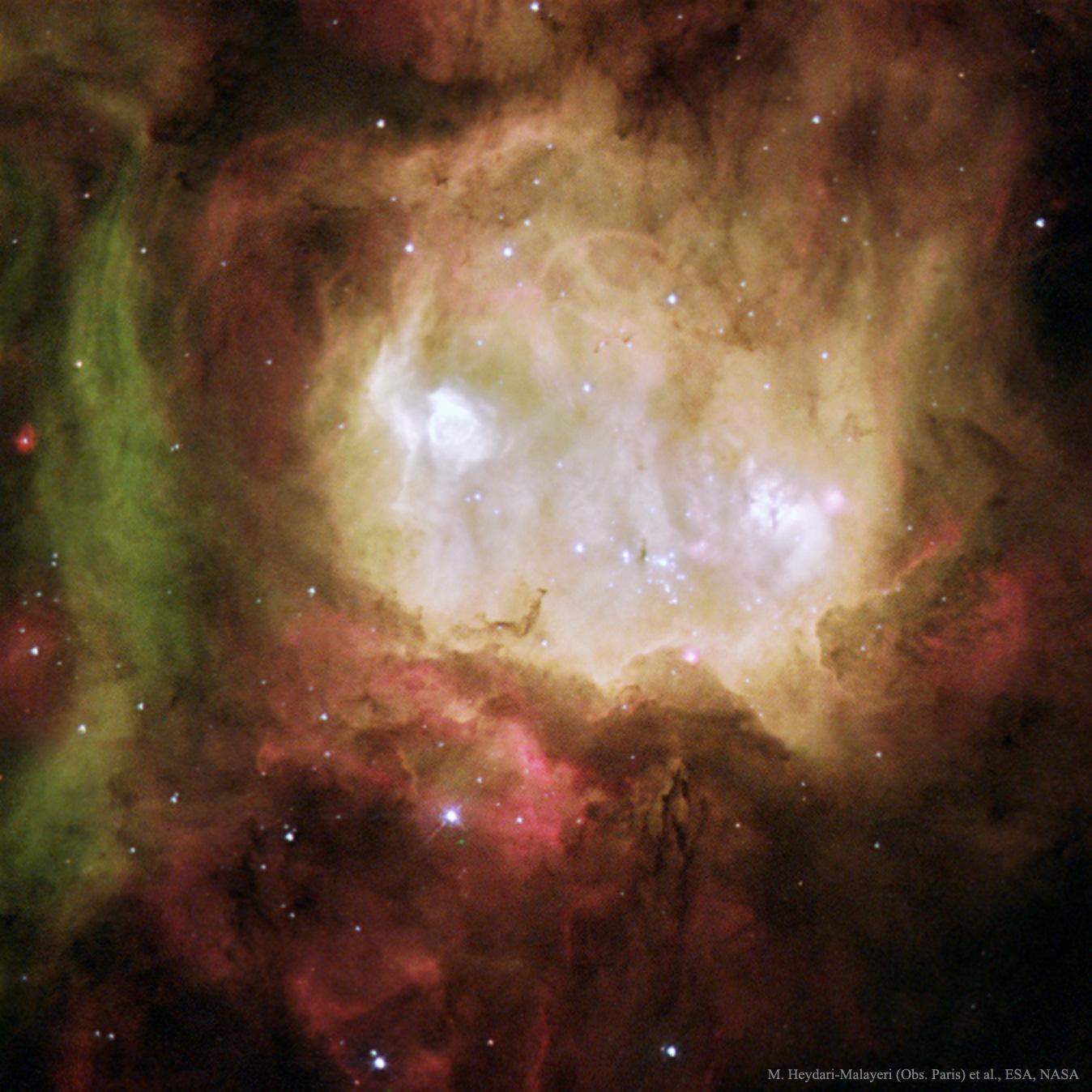
Halloween's origin is ancient and astronomical. Since the fifth century BC, Halloween has been celebrated as a cross-quarter day, a day halfway between an equinox (equal day / equal night) and a solstice (minimum day / maximum night in the northern hemisphere). With a modern calendar however, even though Halloween later this week, the real cross-quarter day will occur the next week. Another cross-quarter day is Groundhog Day. Halloween's modern celebration retains historic roots in dressing to scare away the spirits of the dead. Perhaps a fitting tribute to this ancient holiday is this view of the Ghost Head Nebula taken with the Hubble Space Telescope. Similar to the icon of a fictional ghost, NGC 2080 is actually a star forming region in the Large Magellanic Cloud, a satellite galaxy of our own Milky Way Galaxy. The Ghost Head Nebula (NGC 2080) spans about 50 light-years and is shown in representative colors.
https://science.nasa.gov/photojournal/pj-ghost-head-nebula/
https://en.wikipedia.org/wiki/NGC_2080
https://en.wikipedia.org/wiki/Halloween
https://www.neopagan.net/Halloween-Origins.html
👻 https://en.wikipedia.org/wiki/Casper_the_Friendly_Ghost
https://earthsky.org/astronomy-essentials/halloween-derived-from-ancient-celtic-cross-quarter-day/
https://www.webexhibits.org//calendars/year-countries.html
https://en.wikipedia.org/wiki/Quarter_days
https://en.wikipedia.org/wiki/Groundhog_Day
🎃 https://www.boredpanda.com/blog/wp-content/uploads/2016/10/halloween-cat-costumes-19-57f75fe01d15b__605.jpg
https://apod.nasa.gov/apod/fap/ap251026.html
#space #astronomy #science #astrophotography #photography #nature #nebula #NASA #Webb #apod
Alt...
2025 October 26
A white nebula appears in a colorful star field. To some, the nebula appears like a ghost. Please see the explanation for more detailed information.
Halloween and the Ghost Head Nebula
* Image Credit: NASA, ESA, Mohammad Heydari-Malayeri (Observatoire de Paris) et al.,
Explanation:
Halloween's origin is ancient and astronomical. Since the fifth century BC, Halloween has been celebrated as a cross-quarter day, a day halfway between an equinox (equal day / equal night) and a solstice (minimum day / maximum night in the northern hemisphere). With a modern calendar however, even though Halloween later this week, the real cross-quarter day will occur the next week. Another cross-quarter day is Groundhog Day. Halloween's modern celebration retains historic roots in dressing to scare away the spirits of the dead. Perhaps a fitting tribute to this ancient holiday is this view of the Ghost Head Nebula taken with the Hubble Space Telescope. Similar to the icon of a fictional ghost, NGC 2080 is actually a star forming region in the Large Magellanic Cloud, a satellite galaxy of our own Milky Way Galaxy. The Ghost Head Nebula (NGC 2080) spans about 50 light-years and is shown in representative colors.
Authors & editors: Robert Nemiroff (MTU) & Jerry Bonnell (UMCP)
NASA Official: Amber Straughn Specific rights apply.
NASA Web Privacy, Accessibility, Notices;
A service of: ASD at NASA / GSFC,
NASA Science Activation
& Michigan Tech. U.
"I want to wish you a nice Hallowwen time! May all ghosts and spirits on your ways be kind .. (Better keep some candies along ..)"
If you are fortunate enough to be able to do this, you may want to allow [the following website] to continue.
https://earthsky.org/astronomy-essentials/halloween-derived-from-ancient-celtic-cross-quarter-day/
Video Credit:
Written and produced by Kelly Kizer Whitt
https://earthsky.org/author/kellywhitt/
EarthSky.org:
https://earthsky.org/
Subscribe:
https://subscribe.earthsky.org/
Store:
https://earthskystore.org/
Team and About:
https://earthsky.org/about/
#space #astronomy #science #astrophotography #photography #nature #nebula #NASA #Webb #apod
Zoom in to Rho Ophiuchi !
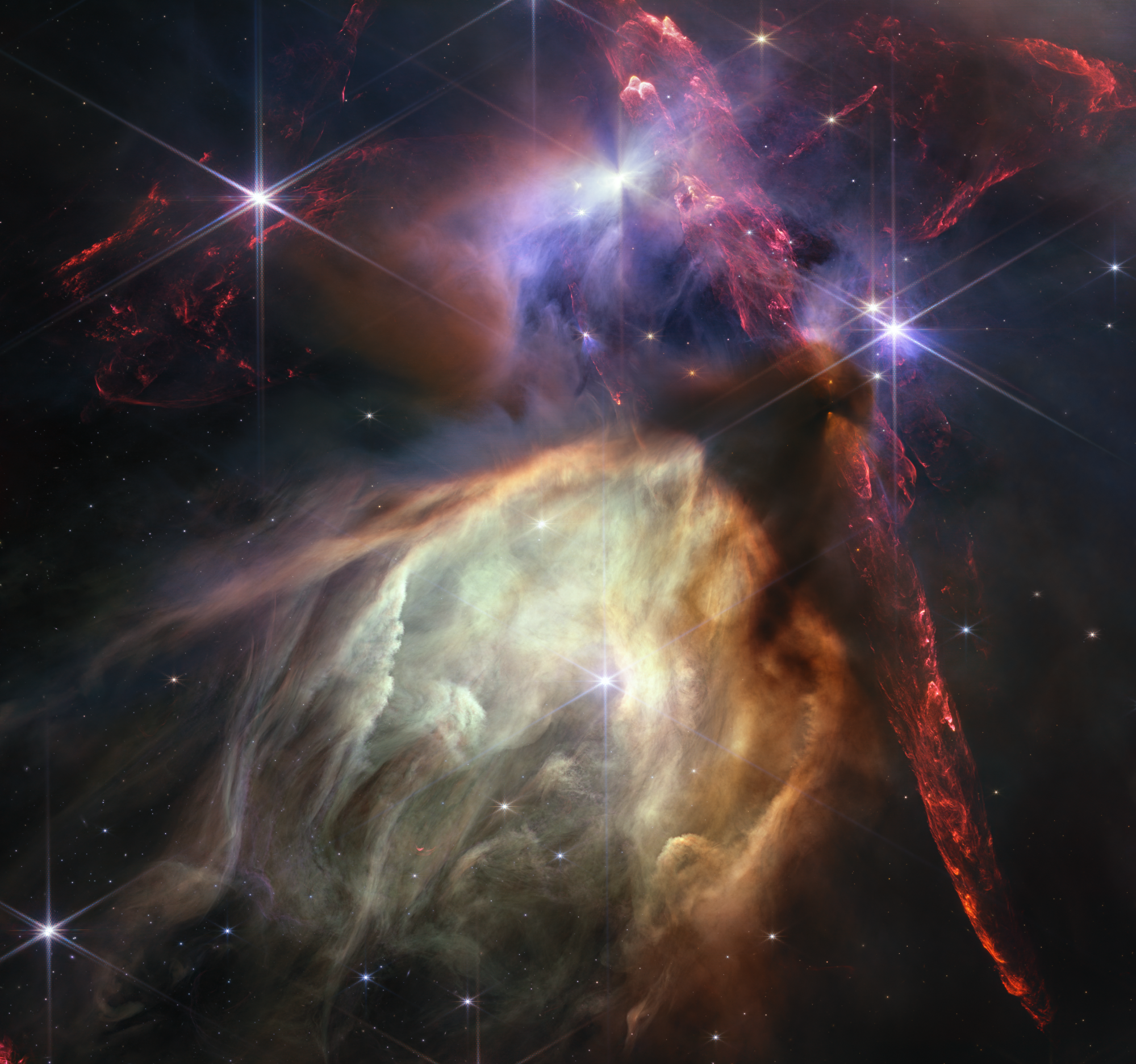
Travel to the Rho Ophiuchi cloud complex. The journey begins with a ground-based image by astrophotographer Akira Fujii, then transitions into a plate from the Digitized Sky Survey. Next a two-color image from the now-retired infrared NASA Spitzer Space Telescope appears, and then finally the video arrives at the James Webb Space Telescope’s image of the star-forming region.
The star-forming region captured in Webb’s image is small and not particularly active compared to other well-known star-forming regions. It is the region’s proximity to Earth (390 light-years) that allows Webb to capture it in such detail, emphasizing the structure of jets bursting from young solar-mass stars, and a dusty “cave” of glowing polycyclic aromatic hydrocarbons.
Credit
Animation: NASA, ESA, CSA, Alyssa Pagan (STScI); Acknowledgment: Caltech/IPAC, Caltech, DSS, Akira Fujii
#space #astronomy #science #astrophotography #photography #nature #nebula #NASA #Webb #apod
2025 October 25
Webb's Rho Ophiuchi
* Image Credit: NASA, ESA, CSA, STScI, Klaus Pontoppidan (STScI),
https://www.nasa.gov/
https://www.esa.int/
https://www.asc-csa.gc.ca/eng/
https://www.stsci.edu/
Explanation:
A mere 390 light-years away, Sun-like stars and future planetary systems are forming in the Rho Ophiuchi molecular cloud complex, the closest star-forming region to our fair planet. The James Webb Space Telescope's NIRCam peered into the nearby natal chaos to capture this infrared image at an inspiring scale. The frame spans less than a light-year across the Rho Ophiuchi region and contains about 50 young stars. Brighter stars clearly show Webb's characteristic pattern of diffraction spikes. Huge jets of shocked molecular hydrogen blasting from newborn stars are red in the image, with the large, yellowish dusty cavity carved out by the energetic young star near its center. Near some stars in the stunning image are shadows cast by their protoplanetary disks. The spectacular cosmic snapshot was released in 2023 to celebrate the successful first year of Webb's exploration of the Universe.
https://science.nasa.gov/missions/webb/webb-celebrates-first-year-of-science-with-close-up-on-birth-of-sun-like-stars/
https://science.nasa.gov/asset/webb/rho-ophiuchi-nircam-compass-image/
https://science.nasa.gov/asset/webb/rho-ophiuchi-video-tour/
https://ui.adsabs.harvard.edu/abs/1996A%26A...314..477B/abstract
https://science.nasa.gov/mission/webb/
https://en.wikipedia.org/wiki/James_E._Webb
https://apod.nasa.gov/apod/fap/ap251025.html
#space #astronomy #science #astrophotography #photography #nature #nebula #NASA #education #apod
Alt...
2025 October 25
Webb's Rho Ophiuchi
* Image Credit: NASA, ESA, CSA, STScI, Klaus Pontoppidan (STScI),
Explanation:
A mere 390 light-years away, Sun-like stars and future planetary systems are forming in the Rho Ophiuchi molecular cloud complex, the closest star-forming region to our fair planet. The James Webb Space Telescope's NIRCam peered into the nearby natal chaos to capture this infrared image at an inspiring scale. The frame spans less than a light-year across the Rho Ophiuchi region and contains about 50 young stars. Brighter stars clearly show Webb's characteristic pattern of diffraction spikes. Huge jets of shocked molecular hydrogen blasting from newborn stars are red in the image, with the large, yellowish dusty cavity carved out by the energetic young star near its center. Near some stars in the stunning image are shadows cast by their protoplanetary disks. The spectacular cosmic snapshot was released in 2023 to celebrate the successful first year of Webb's exploration of the Universe.
Authors & editors: Robert Nemiroff (MTU) & Jerry Bonnell (UMCP)
NASA Official: Amber Straughn Specific rights apply.
NASA Web Privacy, Accessibility, Notices;
A service of: ASD at NASA / GSFC,
NASA Science Activation
& Michigan Tech. U.
TOPIC>
In The Neighbourhood
NGC 6366 vs 47 Ophiuchi
* Image Credit & Copyright: Massimo Di Fusco
https://app.astrobin.com/u/massimo.difusco#gallery
https://www.astronomy.com/picture-of-the-day/photo/cloak-of-the-owl/
https://www.optolong.com/cms/document/detail/id/418.html
https://www.optolong.com/cms/document/detail/id/431.html
Explanation:
Most globular star clusters roam the halo of our Milky Way galaxy, but globular cluster NGC 6366 lies close to the galactic plane. About 12,000 light-years away toward the constellation Ophiuchus, the cluster's starlight is dimmed and reddened by the Milky Way's interstellar dust when viewed from planet Earth. As a result, the stars of NGC 6366 look almost golden in this telescopic scene, especially when seen next to relatively bright, bluish, and nearby star 47 Ophiuchi. Compared to the hundred thousand stars or so gravitationally bound in distant NGC 6366, 47 Oph itself is a binary star system a mere 100 light-years away. Still, the co-orbiting stars of 47 Oph are too close together to be individually distinguished in the image.
https://ui.adsabs.harvard.edu/abs/2015A%26A...584A..59S/abstract
https://ui.adsabs.harvard.edu/abs/2015AJ....149..110W/abstract
https://science.nasa.gov/universe/star-clusters-inside-the-universes-stellar-collections/#hds-sidebar-nav-1
https://apod.nasa.gov/apod/ap250512.html
https://app.astrobin.com/u/massimo.difusco#gallery
https://spaceplace.nasa.gov/satellite-galaxies/en/
https://apod.nasa.gov/apod/ap250523.html
#space #cluster #milkyway #astrophotography #photography #science #nature #NASA #education

Alt...
2025 May 23
NGC 6366 vs 47 Ophiuchi
* Image Credit & Copyright: Massimo Di Fusco
Explanation:
Most globular star clusters roam the halo of our Milky Way galaxy, but globular cluster NGC 6366 lies close to the galactic plane. About 12,000 light-years away toward the constellation Ophiuchus, the cluster's starlight is dimmed and reddened by the Milky Way's interstellar dust when viewed from planet Earth. As a result, the stars of NGC 6366 look almost golden in this telescopic scene, especially when seen next to relatively bright, bluish, and nearby star 47 Ophiuchi. Compared to the hundred thousand stars or so gravitationally bound in distant NGC 6366, 47 Oph itself is a binary star system a mere 100 light-years away. Still, the co-orbiting stars of 47 Oph are too close together to be individually distinguished in the image.
Authors & editors: Robert Nemiroff (MTU) & Jerry Bonnell (UMCP)
NASA Official: Amber Straughn Specific rights apply.
NASA Web Privacy Policy and Important Notices
A service of: ASD at NASA / GSFC,
NASA Science Activation
& Michigan Tech. U.

Alt...
NGC 6366 is a globular cluster 11700 light years away from Earth in the constellation Ophiuchus that is reddened due to extinction by dust in the galactic plane. Therefore, it looks almost golden and forms a beautiful color contrast against the blue foreground star HD 157950. It is designated as XI in the Shapley–Sawyer Concentration Class and was discovered by the German astronomer Friedrich August Theodor Winnecke on 12 April 1860. NGC 6366 is similar in composition to M 71 or NGC 6342. It is metal-rich for a globular cluster, and all of its stars appears to have formed in the same epoch.
* Image credit
Massimo Di Fusco
From Wikipedia, the free encyclopedia
NGC 6366
NGC 6366 is a globular cluster located in the constellation Ophiuchus. It is designated as XI in the Shapley–Sawyer Concentration Class and was discovered by the German astronomer Friedrich August Theodor Winnecke on 12 April 1860. It is at a distance of 11,700 light years away from Earth.
NGC 6366 is similar in composition to M 71 or NGC 6342. It is metal-rich for a globular cluster, and all of its stars appears to have formed in the same epoch.
Color rendering is done by Aladin-software (2000A&AS..143...33B.)
Based on observations made with the NASA/ESA Hubble Space Telescope, and obtained from the Hubble Legacy Archive, which is a collaboration between the Space Telescope Science Institute (STScI/NASA), the Space Telescope European Coordinating Facility (ST-ECF/ESA) and the Canadian Astronomy Data Centre (CADC/NRC/CSA).
FYI: https://iopscience.iop.org/article/10.1088/0004-6256/137/1/246
#space #cluster #milkyway #astrophotography #photography #science #nature #NASA #ESA #hubble #education

Alt...
NGC 6366 is a globular cluster located in the constellation Ophiuchus. It is designated as XI in the Shapley–Sawyer Concentration Class and was discovered by the German astronomer Friedrich August Theodor Winnecke on 12 April 1860. It is at a distance of 11,700 light years away from Earth.
NGC 6366 is similar in composition to M 71 or NGC 6342. It is metal-rich for a globular cluster, and all of its stars appears to have formed in the same epoch.
Color rendering is done by Aladin-software (2000A&AS..143...33B.)
Based on observations made with the NASA/ESA Hubble Space Telescope, and obtained from the Hubble Legacy Archive, which is a collaboration between the Space Telescope Science Institute (STScI/NASA), the Space Telescope European Coordinating Facility (ST-ECF/ESA) and the Canadian Astronomy Data Centre (CADC/NRC/CSA).
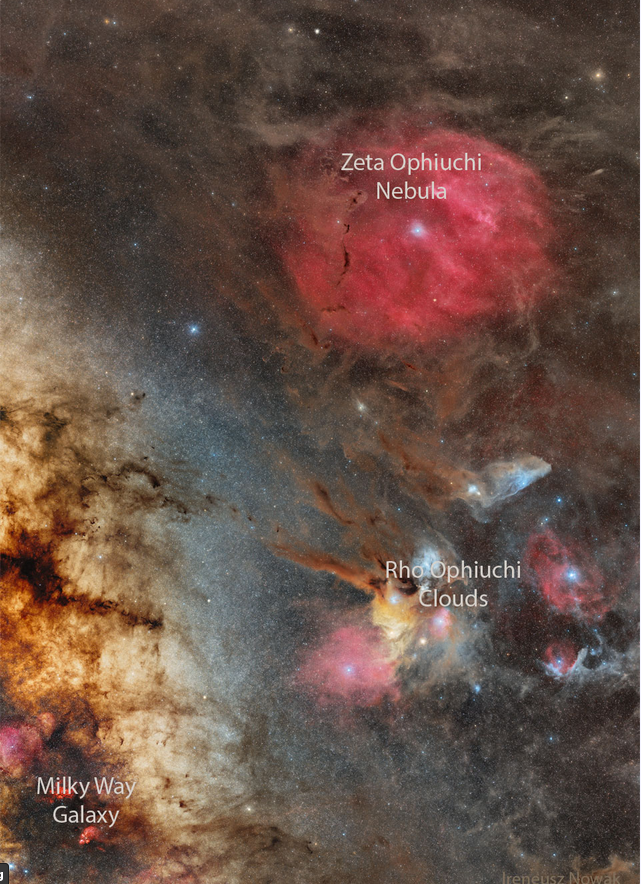
Zeta and Rho Ophiuchi with Milky Way
* Image Credit & Copyright: Ireneusz Nowak
https://app.astrobin.com/u/iro#gallery
Explanation:
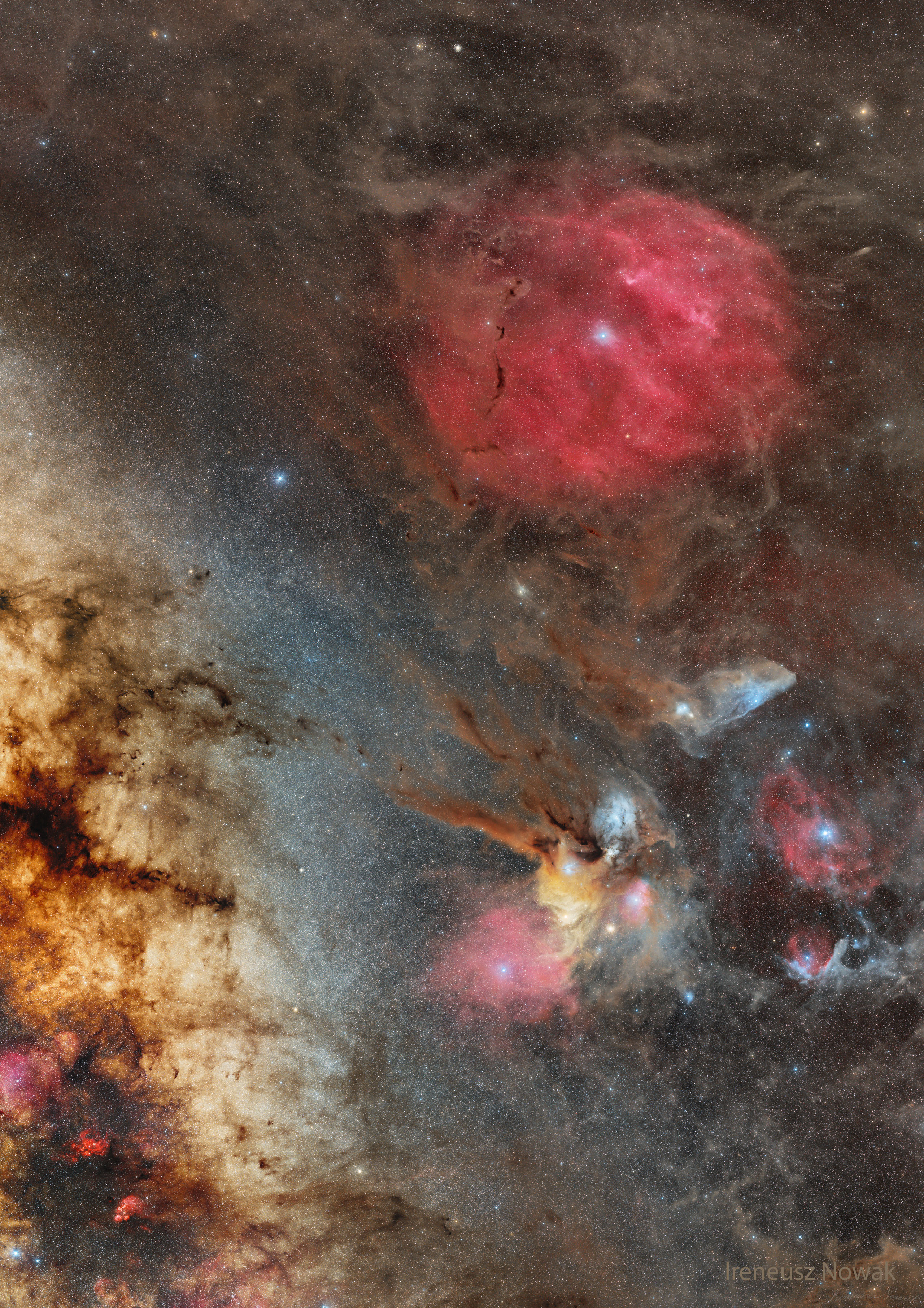
Behold one of the most photogenic regions of the night sky, captured impressively. Featured, the band of our Milky Way Galaxy runs diagonally along the bottom-left corner, while the colorful Rho Ophiuchi cloud complex is visible just right of center and the large red circular Zeta Ophiuchi Nebula appears near the top. In general, red emanates from nebulas glowing in the light of excited hydrogen gas, while blue marks interstellar dust preferentially reflecting the light of bright young stars. Thick dust usually appears dark brown. Many iconic objects of the night sky appear, including (can you find them?) the bright star Antares, the globular star cluster M4, and the Blue Horsehead nebula. This wide field composite, taken over 17 hours, was captured from South Africa last June.
https://app.astrobin.com/i/i40hmc
https://apod.nasa.gov/apod/ap240104.html
https://apod.nasa.gov/apod/ap220126.html
https://apod.nasa.gov/apod/ap230129.html
https://apod.nasa.gov/apod/ap250527.html
#space #nebula #astrophotography #photography #science #nature #NASA
Alt...
2025 May 27
A very colorful sky field is shown featuring many stars and nebulas that appear red, yellow, blue, and brown. Please see the explanation for more detailed information.
Zeta and Rho Ophiuchi with Milky Way
* Image Credit & Copyright: Ireneusz Nowak
Explanation:
Behold one of the most photogenic regions of the night sky, captured impressively. Featured, the band of our Milky Way Galaxy runs diagonally along the bottom-left corner, while the colorful Rho Ophiuchi cloud complex is visible just right of center and the large red circular Zeta Ophiuchi Nebula appears near the top. In general, red emanates from nebulas glowing in the light of excited hydrogen gas, while blue marks interstellar dust preferentially reflecting the light of bright young stars. Thick dust usually appears dark brown. Many iconic objects of the night sky appear, including (can you find them?) the bright star Antares, the globular star cluster M4, and the Blue Horsehead nebula. This wide field composite, taken over 17 hours, was captured from South Africa last June.
Authors & editors: Robert Nemiroff (MTU) & Jerry Bonnell (UMCP)
NASA Official: Amber Straughn Specific rights apply.
NASA Web Privacy, Accessibility, Notices;
A service of: ASD at NASA / GSFC,
NASA Science Activation
& Michigan Tech. U.
2025 June 25
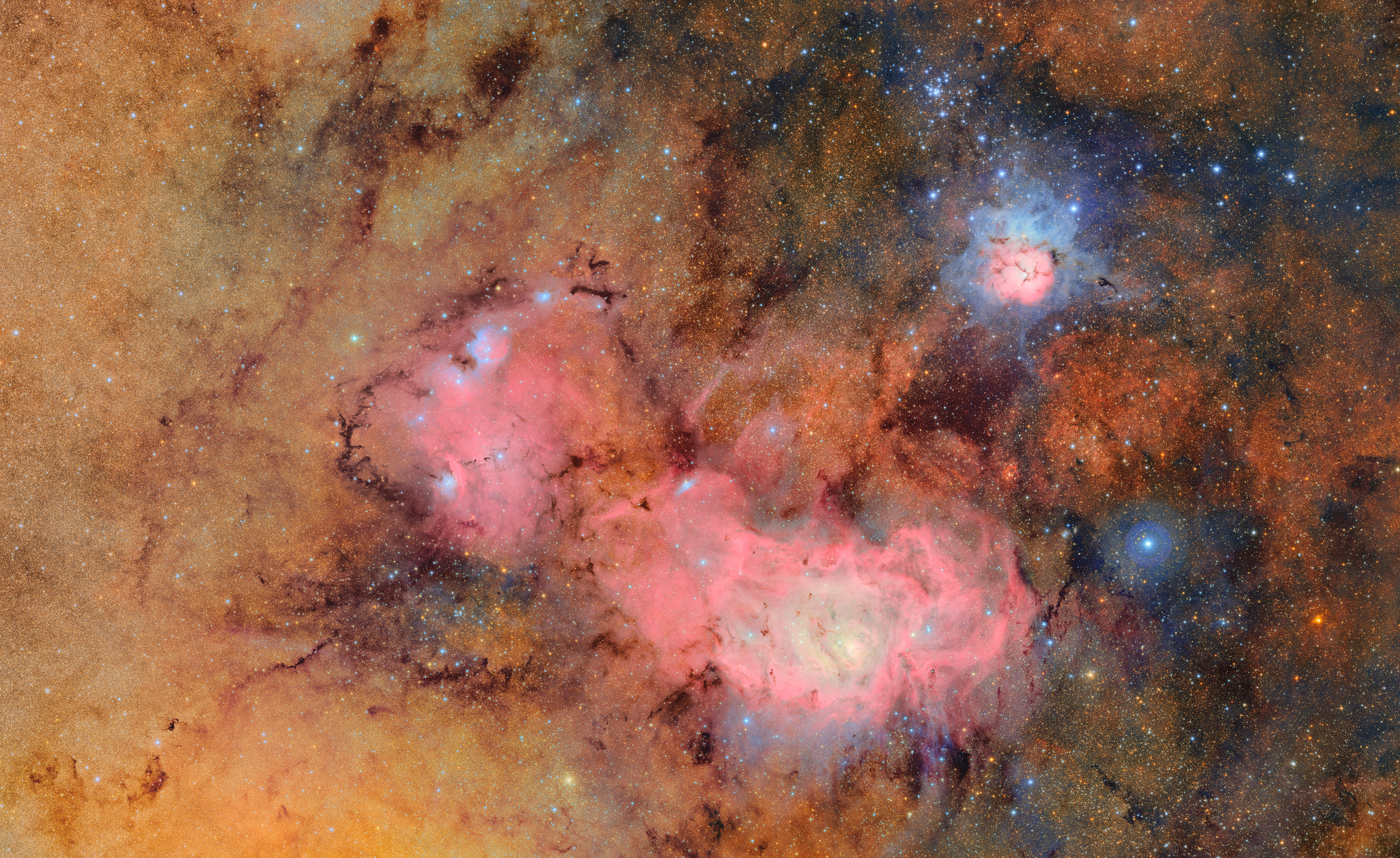
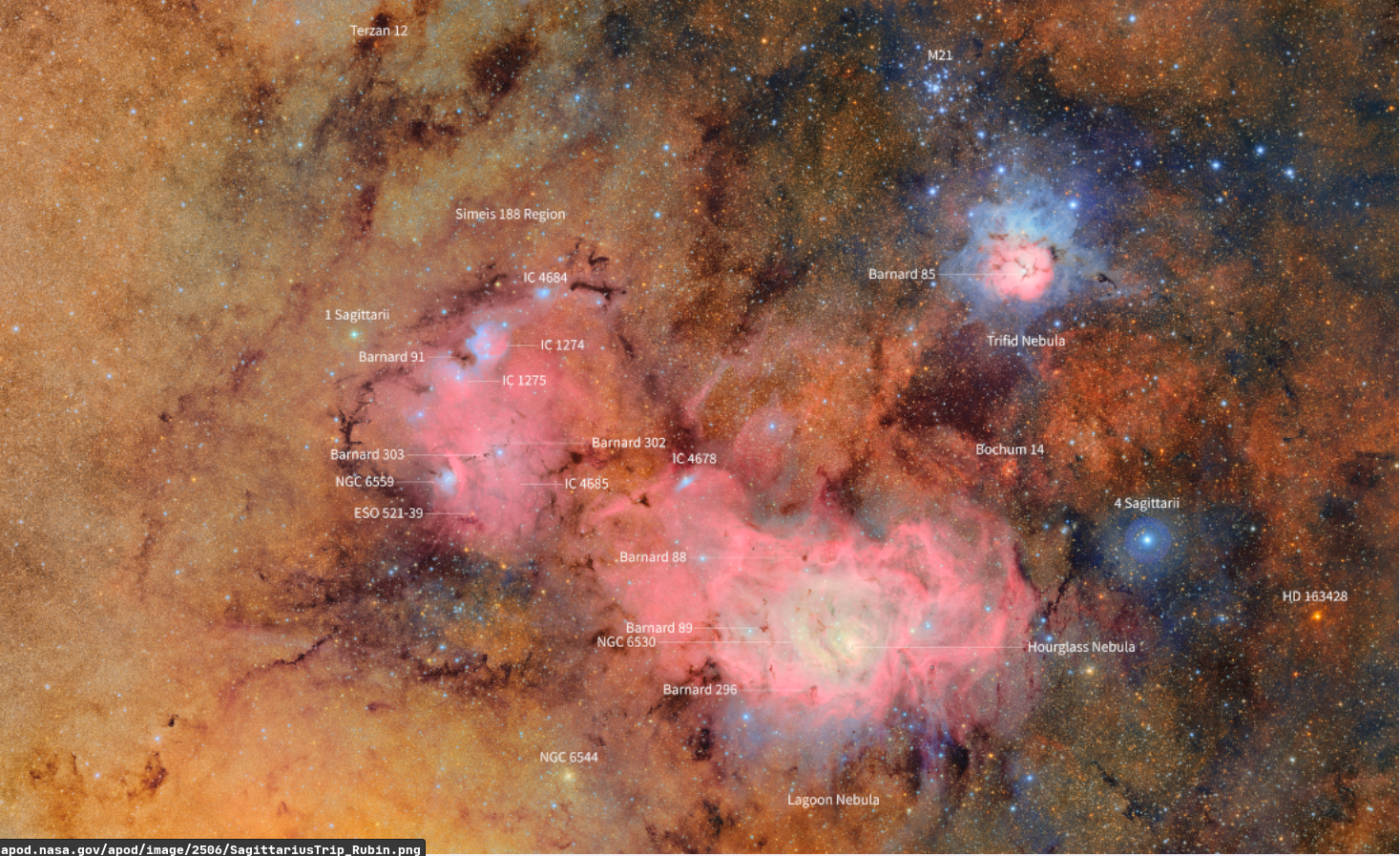
Rubin's First Look: A Sagittarius Skyscape
* Image Credit & License: NSF–DOE Vera C. Rubin Observatory
https://rubinobservatory.org/
Explanation:
This interstellar skyscape spans over 4 degrees across crowded starfields toward the constellation Sagittarius and the central Milky Way. A First Look image captured at the new NSF–DOE Vera C. Rubin Observatory, the bright nebulae and star clusters featured include famous stops on telescopic tours of the cosmos: Messier 8 and Messier 20. An expansive star-forming region over a hundred light-years across, Messier 8 is also known as the Lagoon Nebula. About 4,000 light-years away the Lagoon Nebula harbors a remarkable cluster of young, massive stars. Their intense radiation and stellar winds energize and agitate this cosmic lagoon's turbulent depths. Messier 20's popular moniker is the Trifid. Divided into three parts by dark interstellar dust lanes, the Trifid Nebula's glowing hydrogen gas creates its dominant red color. But contrasting blue hues in the colorful Trifid are due to dust reflected starlight. The Rubin Observatory visited the Trifid-Lagoon field to acquire all the image data during parts of four nights (May 1-4). At full resolution, Rubin's magnificent Sagittarius skyscape is 84,000 pixels wide and 51,500 pixels tall.
https://rubinobservatory.org/gallery/collections/first-look-gallery/n4kvj0cemd5pbdqgtjdgp2jg2t
https://science.nasa.gov/mission/hubble/science/explore-the-night-sky/hubble-messier-catalog/messier-8/
https://science.nasa.gov/mission/hubble/science/explore-the-night-sky/hubble-messier-catalog/messier-20/
https://apod.nasa.gov/apod/ap230928.html
https://apod.nasa.gov/apod/ap250625.html
#space #galaxy #milkyway #astrophotography #photography #science #astronomy #NASA
Alt...
2025 June 25
Rubin's First Look: A Sagittarius Skyscape
* Image Credit & License: NSF–DOE Vera C. Rubin Observatory
Explanation:
This interstellar skyscape spans over 4 degrees across crowded starfields toward the constellation Sagittarius and the central Milky Way. A First Look image captured at the new NSF–DOE Vera C. Rubin Observatory, the bright nebulae and star clusters featured include famous stops on telescopic tours of the cosmos: Messier 8 and Messier 20. An expansive star-forming region over a hundred light-years across, Messier 8 is also known as the Lagoon Nebula. About 4,000 light-years away the Lagoon Nebula harbors a remarkable cluster of young, massive stars. Their intense radiation and stellar winds energize and agitate this cosmic lagoon's turbulent depths. Messier 20's popular moniker is the Trifid. Divided into three parts by dark interstellar dust lanes, the Trifid Nebula's glowing hydrogen gas creates its dominant red color. But contrasting blue hues in the colorful Trifid are due to dust reflected starlight. The Rubin Observatory visited the Trifid-Lagoon field to acquire all the image data during parts of four nights (May 1-4). At full resolution, Rubin's magnificent Sagittarius skyscape is 84,000 pixels wide and 51,500 pixels tall.
Authors & editors: Robert Nemiroff (MTU) & Jerry Bonnell (UMCP)
NASA Official: Amber Straughn Specific rights apply.
2023 January 29
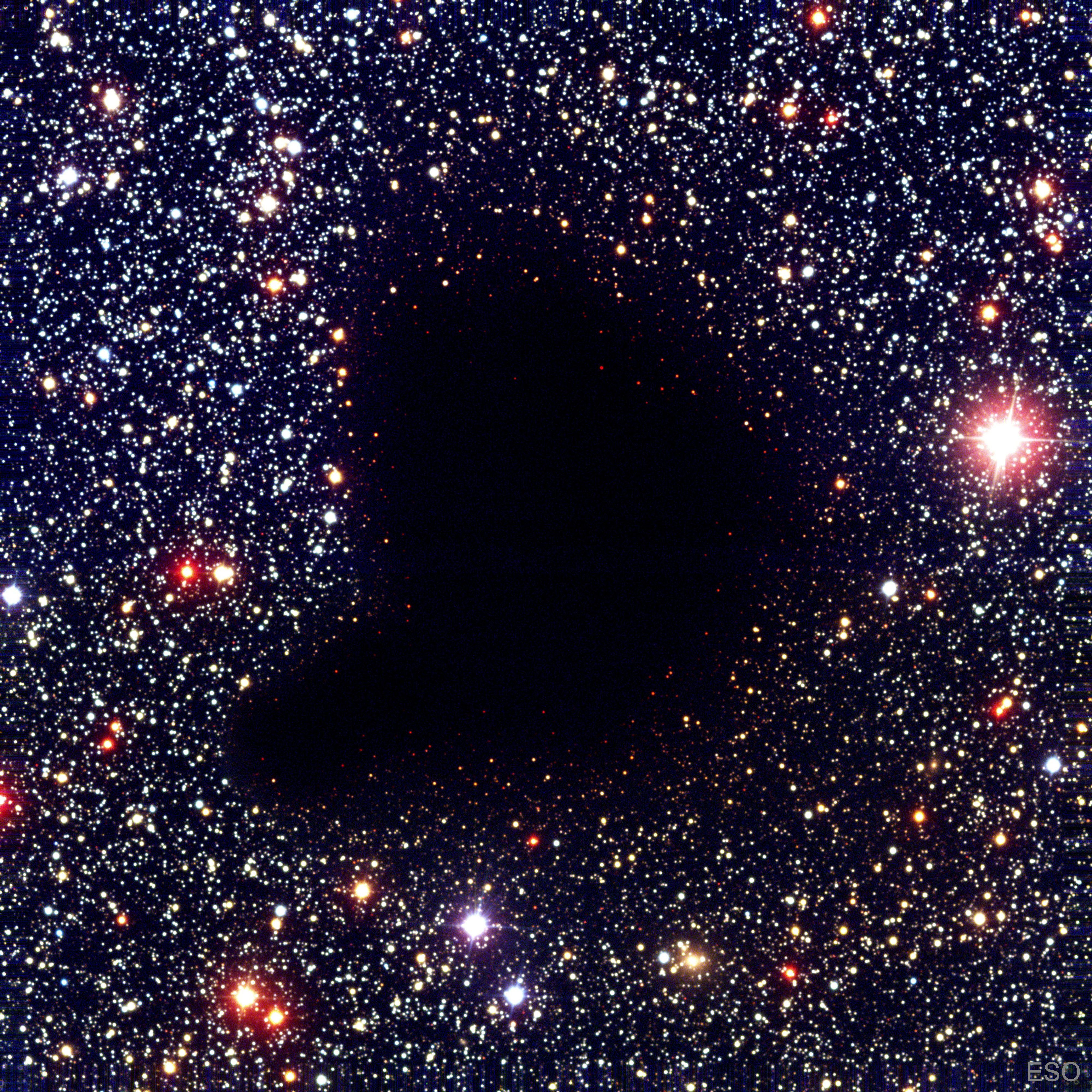
Barnard 68: Dark Molecular Cloud
* Image Credit: FORS Team, 8.2-meter VLT Antu, ESO
https://www.eso.org/projects/vlt/
https://www.eso.org/sci/facilities/paranal/instruments/fors.html
https://www.eso.org/public/
Explanation:
Where did all the stars go? What used to be considered a hole in the sky is now known to astronomers as a dark molecular cloud. Here, a high concentration of dust and molecular gas absorb practically all the visible light emitted from background stars. The eerily dark surroundings help make the interiors of molecular clouds some of the coldest and most isolated places in the universe. One of the most notable of these dark absorption nebulae is a cloud toward the constellation Ophiuchus known as Barnard 68, pictured here. That no stars are visible in the center indicates that Barnard 68 is relatively nearby, with measurements placing it about 500 light-years away and half a light-year across. It is not known exactly how molecular clouds like Barnard 68 form, but it is known that these clouds are themselves likely places for new stars to form. In fact, Barnard 68 itself has been found likely to collapse and form a new star system. It is possible to look right through the cloud in infrared light.
https://www.eso.org/public/news/eso0102/
https://en.wikipedia.org/wiki/Barnard_68
https://en.wikipedia.org/wiki/Molecule
https://apod.nasa.gov/apod/ap030706.html
https://apod.nasa.gov/apod/ap970430.html
https://ui.adsabs.harvard.edu/abs/2009ApJ...695.1308B/abstract
https://www.eso.org/public/videos/eso9934a/
https://www.eso.org/public/news/eso9934/
https://astronomy.swin.edu.au/cosmos/m/Molecular+Cloud
https://apod.nasa.gov/apod/ap201206.html
https://apod.nasa.gov/apod/ap221020.html
https://science.nasa.gov/universe/stars/
https://starchild.gsfc.nasa.gov/docs/StarChild/questions/question19.html
https://apod.nasa.gov/apod/dark_nebulae.html
https://en.wikipedia.org/wiki/Ophiuchus
https://science.nasa.gov/ems/07_infraredwaves/
https://apod.nasa.gov/apod/ap230129.html
#space #cluster #cloud #nebula #astrophotography #photography #science #astronomy #physics #nature #NASA #education
Alt...
2023 January 29
A dark comma-shaped cloud appears in the middle of a dense field of stars. No stars are visible through the center of the cloud.
Barnard 68: Dark Molecular Cloud
* Image Credit: FORS Team, 8.2-meter VLT Antu, ESO
Explanation:
Where did all the stars go? What used to be considered a hole in the sky is now known to astronomers as a dark molecular cloud. Here, a high concentration of dust and molecular gas absorb practically all the visible light emitted from background stars. The eerily dark surroundings help make the interiors of molecular clouds some of the coldest and most isolated places in the universe. One of the most notable of these dark absorption nebulae is a cloud toward the constellation Ophiuchus known as Barnard 68, pictured here. That no stars are visible in the center indicates that Barnard 68 is relatively nearby, with measurements placing it about 500 light-years away and half a light-year across. It is not known exactly how molecular clouds like Barnard 68 form, but it is known that these clouds are themselves likely places for new stars to form. In fact, Barnard 68 itself has been found likely to collapse and form a new star system. It is possible to look right through the cloud in infrared light.
Authors & editors: Robert Nemiroff (MTU) & Jerry Bonnell (UMCP)
NASA Official: Phillip Newman Specific rights apply.
NASA Web Privacy Policy and Important Notices
A service of: ASD at NASA / GSFC,
NASA Science Activation
& Michigan Tech. U.
"Welcome back to
TOPIC> 'In The Neighbourhood'
with this stunning image. Please also read how much time and effort it took to create it and you will agree with me that this is astronomy with real passion."
2009 September 25
Gigagalaxy Zoom: Galactic Center
* Credit: ESO / Stéphane Guisard - Copyright: Stéphane Guisard
http://sguisard.astrosurf.com/
Explanation:
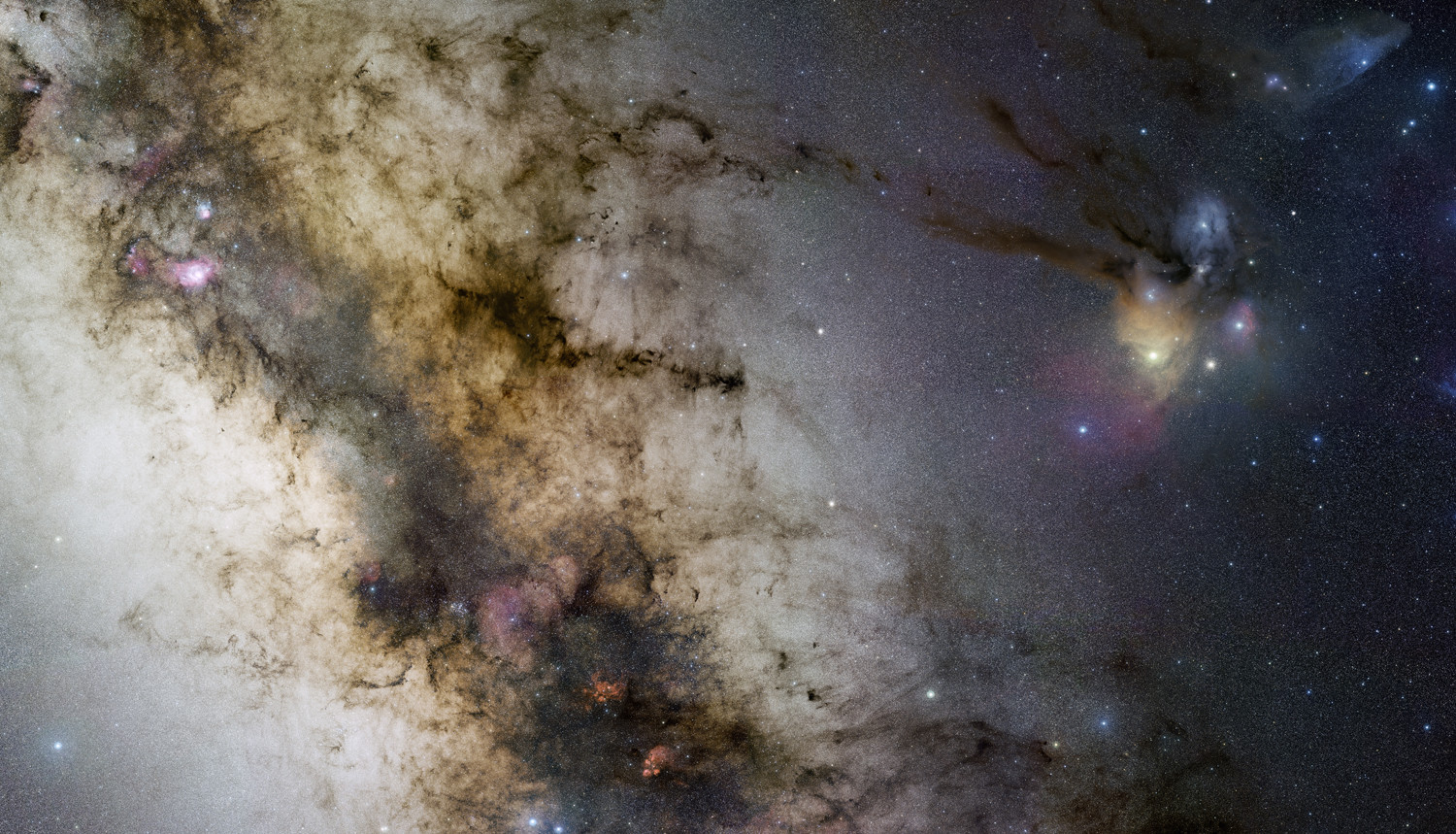
From Sagittarius to Scorpius, the central Milky Way is a truly beautiful part of planet Earth's night sky. The gorgeous region is captured here, an expansive gigapixel mosaic of 52 fields spanning 34 by 20 degrees in 1200 individual images and 200 hours of exposure time. Part of ESO's Gigagalaxy Zoom Project, the images were collected over 29 nights with a small telescope under the exceptionally clear, dark skies of the ESO Paranal Observatory in Chile. The breathtaking cosmic vista shows off intricate dust lanes, bright nebulae, and star clusters scattered through our galaxy's rich central starfields. Starting on the left, look for the Lagoon and Trifid nebulae, the Cat's Paw, the Pipe dark nebula, and the colorful clouds of Rho Ophiuchi and Antares (right).
https://apod.nasa.gov/apod/ap090925.html
#space #galaxy #milkyway #astrophotography #photography #science #astronomy #nature #NASA #ESO
Alt...
2009 September 25
Gigagalaxy Zoom: Galactic Center
* Credit: ESO / Stéphane Guisard - Copyright: Stéphane Guisard
Explanation:
From Sagittarius to Scorpius, the central Milky Way is a truly beautiful part of planet Earth's night sky. The gorgeous region is captured here, an expansive gigapixel mosaic of 52 fields spanning 34 by 20 degrees in 1200 individual images and 200 hours of exposure time. Part of ESO's Gigagalaxy Zoom Project, the images were collected over 29 nights with a small telescope under the exceptionally clear, dark skies of the ESO Paranal Observatory in Chile. The breathtaking cosmic vista shows off intricate dust lanes, bright nebulae, and star clusters scattered through our galaxy's rich central starfields. Starting on the left, look for the Lagoon and Trifid nebulae, the Cat's Paw, the Pipe dark nebula, and the colorful clouds of Rho Ophiuchi and Antares (right).
Authors & editors: Robert Nemiroff (MTU) & Jerry Bonnell (UMCP)
NASA Official: Phillip Newman Specific rights apply.
NASA Web Privacy Policy and Important Notices
A service of: ASD at NASA / GSFC
& Michigan Tech. U.
A Farewell to Saturn ..
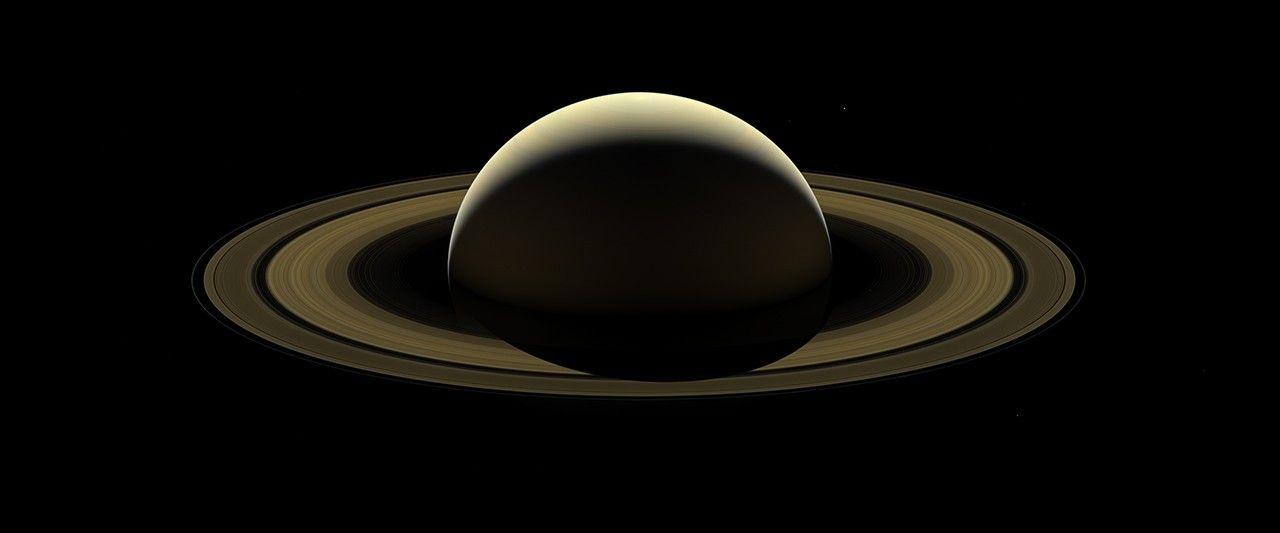
After more than 13 years at Saturn, and with its fate sealed, NASA's Cassini spacecraft bid farewell to the Saturnian system by firing the shutters of its wide-angle camera and capturing this last, full mosaic of Saturn and its rings two days before the spacecraft's dramatic plunge into the planet's atmosphere.
[...] *
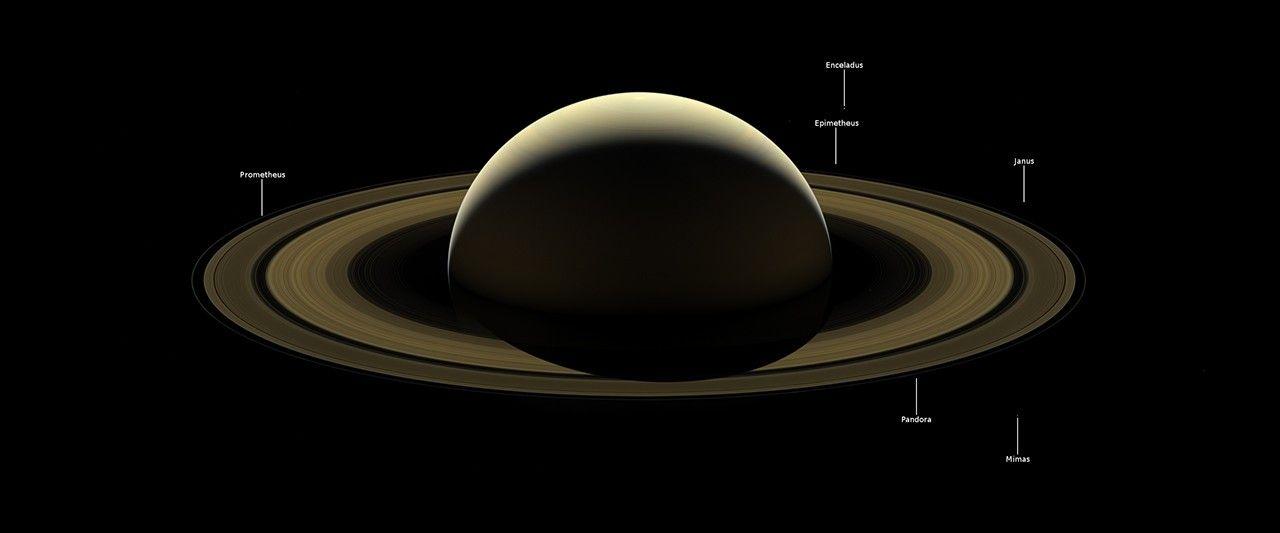
Six of Saturn's moons -- Enceladus, Epimetheus, Janus, Mimas, Pandora and Prometheus -- make a faint appearance in this image. (Numerous stars are also visible in the background.)
A second version of the mosaic is provided in which the planet and its rings have been brightened, with the fainter regions brightened by a greater amount. (The moons and stars have also been brightened by a factor of 15 in this version.)
The ice-covered moon Enceladus -- home to a global subsurface ocean that erupts into space -- can be seen at the 1 o'clock position. Directly below Enceladus, just outside the F ring (the thin, farthest ring from the planet seen in this image) lies the small moon Epimetheus. Following the F ring clock-wise from Epimetheus, the next moon seen is Janus. At about the 4:30 position and outward from the F ring is Mimas. Inward of Mimas and still at about the 4:30 position is the F-ring-disrupting moon, Pandora. Moving around to the 10 o'clock position, just inside of the F ring, is the moon Prometheus.
[...] *
Credits:
NASA/JPL-Caltech/Space Science Institute
* More Information about the images in ALT-Text
https://science.nasa.gov/photojournal/a-farewell-to-saturn/
> Movie about Casini's "Grand Finale":
https://defcon.social/@grobi/115319525500258829
#space #saturn #astrophotography #photography #science #astronomy #physics #nature #NASA #ESA #education #apod
Alt...
A Farewell to Saturn
(Brightened Version)
During the observation, a total of 80 wide-angle images were acquired in just over two hours. This view is constructed from 42 of those wide-angle shots, taken using the red, green and blue spectral filters, combined and mosaicked together to create a natural-color view.
This view looks toward the sunlit side of the rings from about 15 degrees above the ring plane. Cassini was approximately 698,000 miles (1.1 million kilometers) from Saturn, on its final approach to the planet, when the images in this mosaic were taken. Image scale on Saturn is about 42 miles (67 kilometers) per pixel. The image scale on the moons varies from 37 to 50 miles (59 to 80 kilometers) pixel. The phase angle (the Sun-planet-spacecraft angle) is 138 degrees.
Credits:
NASA/JPL-Caltech/Space Science Institute
Alt...
A Farewell to Saturn
(Annotated Version)
Six of Saturn's moons -- Enceladus, Epimetheus, Janus, Mimas, Pandora and Prometheus -- make a faint appearance in this image. (Numerous stars are also visible in the background.)
This view looks toward the sunlit side of the rings from about 15 degrees above the ring plane. Cassini was approximately 698,000 miles (1.1 million kilometers) from Saturn, on its final approach to the planet, when the images in this mosaic were taken. Image scale on Saturn is about 42 miles (67 kilometers) per pixel. The image scale on the moons varies from 37 to 50 miles (59 to 80 kilometers) pixel. The phase angle (the Sun-planet-spacecraft angle) is 138 degrees.
Credits:
NASA/JPL-Caltech/Space Science Institute
2025 October 24
Saturn at Night
* Image Credit: NASA, JPL-Caltech, Space Science Institute, Mindaugas Macijauskas
https://www.nasa.gov/
https://www.jpl.nasa.gov/
https://www.spacescience.org/index.php
https://www.flickr.com/photos/m_macijauskas/
Explanation:
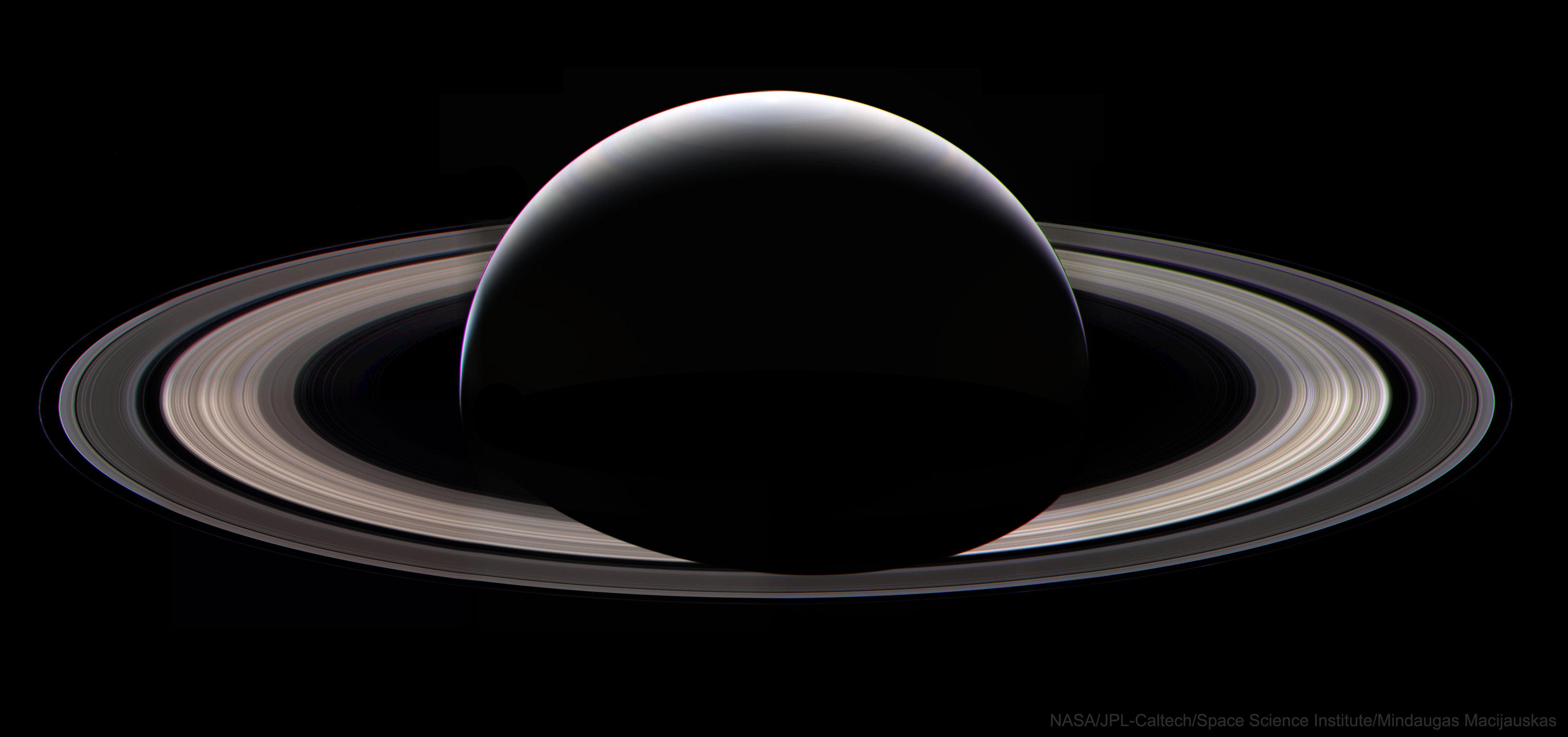
Saturn is bright in Earth's night skies. Telescopic views of the outer gas giant planet and its beautiful rings often make it a star at star parties. But this stunning view of Saturn's rings and night side just isn't possible from telescopes in the vicinity of planet Earth. Peering out from the inner Solar System they can only bring Saturn's day side into view. In fact, this image of Saturn's slender sunlit crescent with night's shadow cast across its broad and complex ring system was captured by the Cassini spacecraft. A robot spacecraft from planet Earth, Cassini called Saturn orbit home for 13 years before it was directed to dive into the atmosphere of the gas giant on September 15, 2017. This magnificent mosaic is composed of frames recorded by Cassini's wide-angle camera only two days before its grand final plunge. Saturn's night will not be seen again until another spaceship from Earth calls.
https://esahubble.org/news/heic1917/
https://www.flickr.com/photos/m_macijauskas/23826951188/
https://science.nasa.gov/photojournal/a-farewell-to-saturn/
https://nightsky.jpl.nasa.gov/clubs/
https://earthsky.org/astronomy-essentials/visible-planets-tonight-mars-jupiter-venus-saturn-mercury/
https://apod.nasa.gov/apod/ap251024.html
#space #saturn #astrophotography #photography #science #astronomy #physics #nature #NASA #ESA #education #apod
Alt...
2025 October 24
Saturn at Night
* Image Credit: NASA, JPL-Caltech, Space Science Institute, Mindaugas Macijauskas
Explanation:
Saturn is bright in Earth's night skies. Telescopic views of the outer gas giant planet and its beautiful rings often make it a star at star parties. But this stunning view of Saturn's rings and night side just isn't possible from telescopes in the vicinity of planet Earth. Peering out from the inner Solar System they can only bring Saturn's day side into view. In fact, this image of Saturn's slender sunlit crescent with night's shadow cast across its broad and complex ring system was captured by the Cassini spacecraft. A robot spacecraft from planet Earth, Cassini called Saturn orbit home for 13 years before it was directed to dive into the atmosphere of the gas giant on September 15, 2017. This magnificent mosaic is composed of frames recorded by Cassini's wide-angle camera only two days before its grand final plunge. Saturn's night will not be seen again until another spaceship from Earth calls.
Authors & editors: Robert Nemiroff (MTU) & Jerry Bonnell (UMCP)
NASA Official: Amber Straughn Specific rights apply.
NASA Web Privacy, Accessibility, Notices;
A service of: ASD at NASA / GSFC,
NASA Science Activation
& Michigan Tech. U.
"A farewell to Mister Eclipse .."
Dr Fred Espenak (1953–2025)
by Jay Anderson
https://skyandtelescope.org/astronomy-news/fred-espenak-1953-2025/
The renowned eclipse chaser and popularizer passed away in Arizona after a life of adventure.
Fred Espenak, who laid the foundation for modern-day eclipse chasing, died of idiopathic pulmonary fibrosis on June 1st. He announced his diagnosis and his impending passing on April 15th on social media and on the Solar Eclipse Message List (SEML) forum as he prepared to enter hospice care, sparking an outpouring of sorrow, sympathy, good wishes, and thank-you’s for his life’s work.
Fred’s fascination with the lunar shadow began with an off-the-track partial eclipse in 1963 and was cemented several years later by the total solar eclipse that traveled along the U.S. Eastern Seaboard in 1970. Upon his death 55 years later, he had witnessed 52 solar eclipses of various types, of which 31 were total. He had also helped countless others prepare for and experience the wonder of totality, thanks to his dedication to outreach.
There were many stories along the way, but he was fond of telling of his most rewarding eclipse-chasing experience — a trip to India in 1995 to catch 41 seconds of totality, during which he noticed a high-school chemistry teacher watching her first eclipse. “Nice hair,” he thought. Several eclipses and a decade later, he and Patricia Totten, the lady with the hair, were married. It was a particularly fond pairing, as visitors to his Arizona home could attest.
FYI:
https://mreclipse.com/
https://en.wikipedia.org/wiki/Fred_Espenak
https://apod.nasa.gov/apod/ap250612.html
#farewell #space #NASA #astrophotography #photography #science #astronomy #nature #tech #space_related #Space_Culture_Club
Alt...
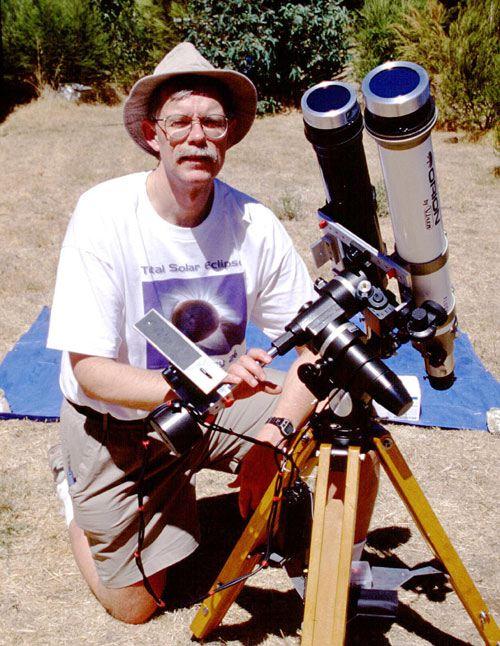
Goddard Researcher and eclipse chaser Dr. Fred Espenak. with his solar telescope in 2009
Image Credit:
NASA Goddard Space Flight Center from Greenbelt, MD, USA
Constant Contact Use. Please leave this field blank.
The renowned eclipse chaser and popularizer passed away in Arizona after a life of adventure.
Man with white hair and white moustache sitting at table with a globe covered in yellow lines marking past and future eclipses
Fred Espenak, with a globe of solar eclipse tracks for the 21st century
Patricia Totten Espenak
Fred Espenak, who laid the foundation for modern-day eclipse chasing, died of idiopathic pulmonary fibrosis on June 1st. He announced his diagnosis and his impending passing on April 15th on social media and on the Solar Eclipse Message List (SEML) forum as he prepared to enter hospice care, sparking an outpouring of sorrow, sympathy, good wishes, and thank-you’s for his life’s work.
Fred’s fascination with the lunar shadow began with an off-the-track partial eclipse in 1963 and was cemented several years later by the total solar eclipse that traveled along the U.S. Eastern Seaboard in 1970. Upon his death 55 years later, he had witnessed 52 solar eclipses of various types, of which 31 were total. He had also helped countless others prepare for and experience the wonder of totality, thanks to his dedication to outreach.
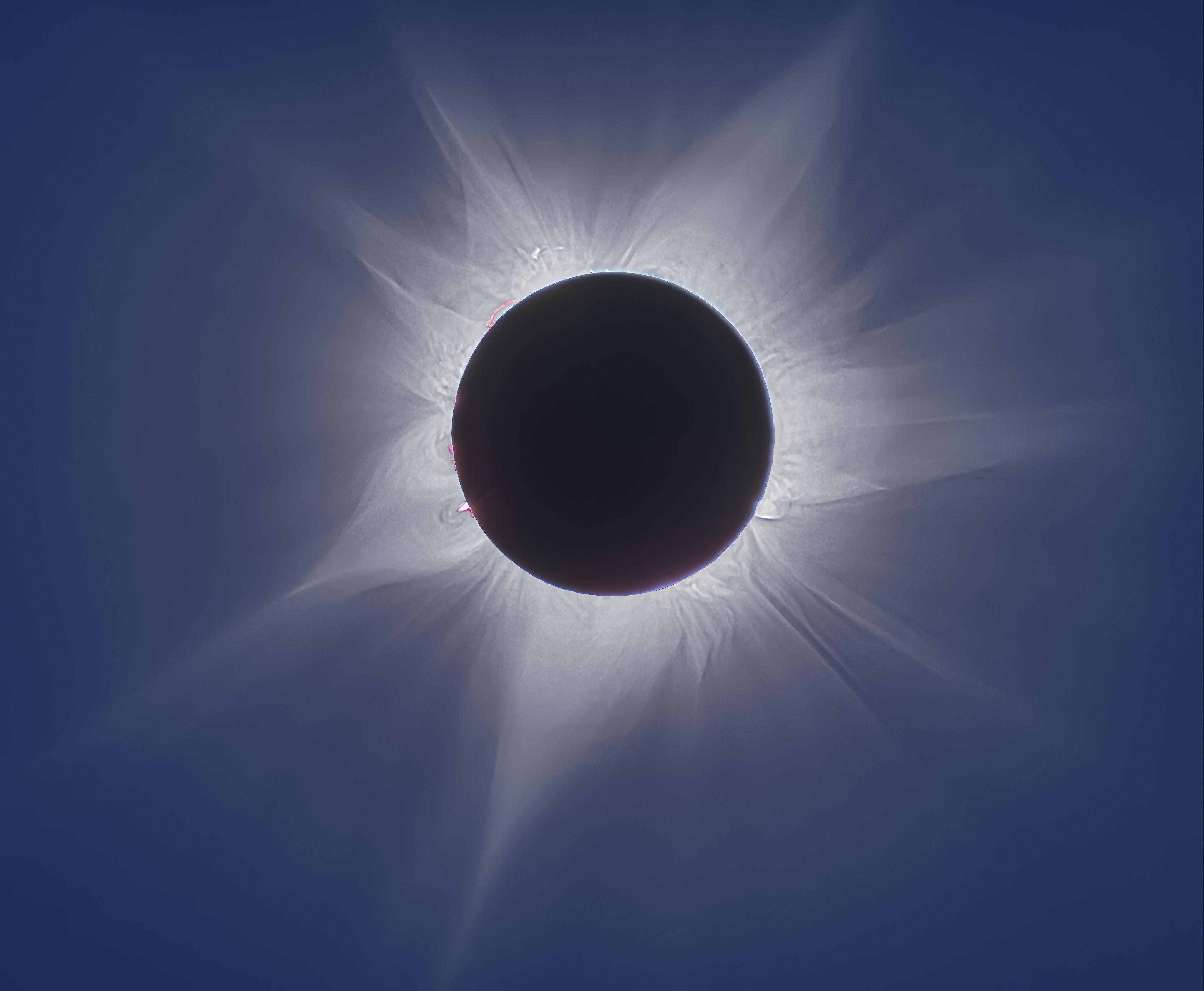
Alt...
2025 June 12
Solar Eclipse
Image Credit & Copyright: Fred Espenak
Explanation:
On April 20, 2023 the shadow of a New Moon raced across planet Earth's southern hemisphere. When viewed along a narrow path that mostly avoided landfall, the Moon in silhouette created a hybrid solar eclipse. Hybrid eclipses are rare and can be seen as a total eclipse or an annular "ring of fire" eclipse depending on the observer's position. Viewers of this much anticipated hybrid event were able to witness a total solar eclipse while anchored in the Indian Ocean near the centerline of the eclipse track off the coast of western Australia. This ship-borne image from renowned eclipse chaser Fred Espenak captured the eclipsed Sun's magnificent outer atmosphere, or solar corona, streaming into space. The composite of 11 exposures ranging from 1/2000 to 1/2 second, taken during the 62 seconds of totality, records an extended range of brightness to follow alluring details of the corona not quite visible to the eye.
Authors & editors: Robert Nemiroff (MTU) & Jerry Bonnell (UMCP)
NASA Official: Amber Straughn Specific rights apply.
NASA Web Privacy Policy and Important Notices
A service of: ASD at NASA / GSFC,
NASA Science Activation
& Michigan Tech. U.
2025 October 22
Comet Lemmon over the High Tatras
* Image Credit & Copyright: Tomáš Slovinský & Constantine Themelis
https://www.instagram.com/slovinsky.art/
https://www.instagram.com/constantinethemelis/
Explanation:
Comet Lemmon putting on a show for cameras around the globe. Passing nearest to the Earth this week, the photogenic comet C/2025 A6 (Lemmon) is now extending two long tails : a blue ion tail and a white dust tail. The ion tail is pushed away from the Sun by the ever-present by ever-changing solar wind, and shows structure also created by how much gas is ejected at any one moment. It glows because it is ionized by high energy sunlight. The dust tail is pushed away from the comet by sunlight and shines by reflecting sunlight. The featured image is an enhanced composite of 50 exposures all taken two days ago from Mlynica, Slovakia. The mountains in the foreground are the High Tatras that partly separate Slovakia from Poland. Although Comet Lemmon is best visible in long camera exposures, the shedding ice ball has become faintly visible in northern skies even to unaided eyes through dark skies toward the west after sunset.
https://spaceplace.nasa.gov/comets/en/anatomy-of-a-comet.en.jpg
https://astronomy.swin.edu.au/cosmos/c/cometary+tails
http://www.star.ucl.ac.uk/~apod/apod/ap251019.html
https://apod.nasa.gov/apod/ap251022.html
#space #comets #astrophotography #photography #science #astronomy #nature #NASA #ESA #education #apod
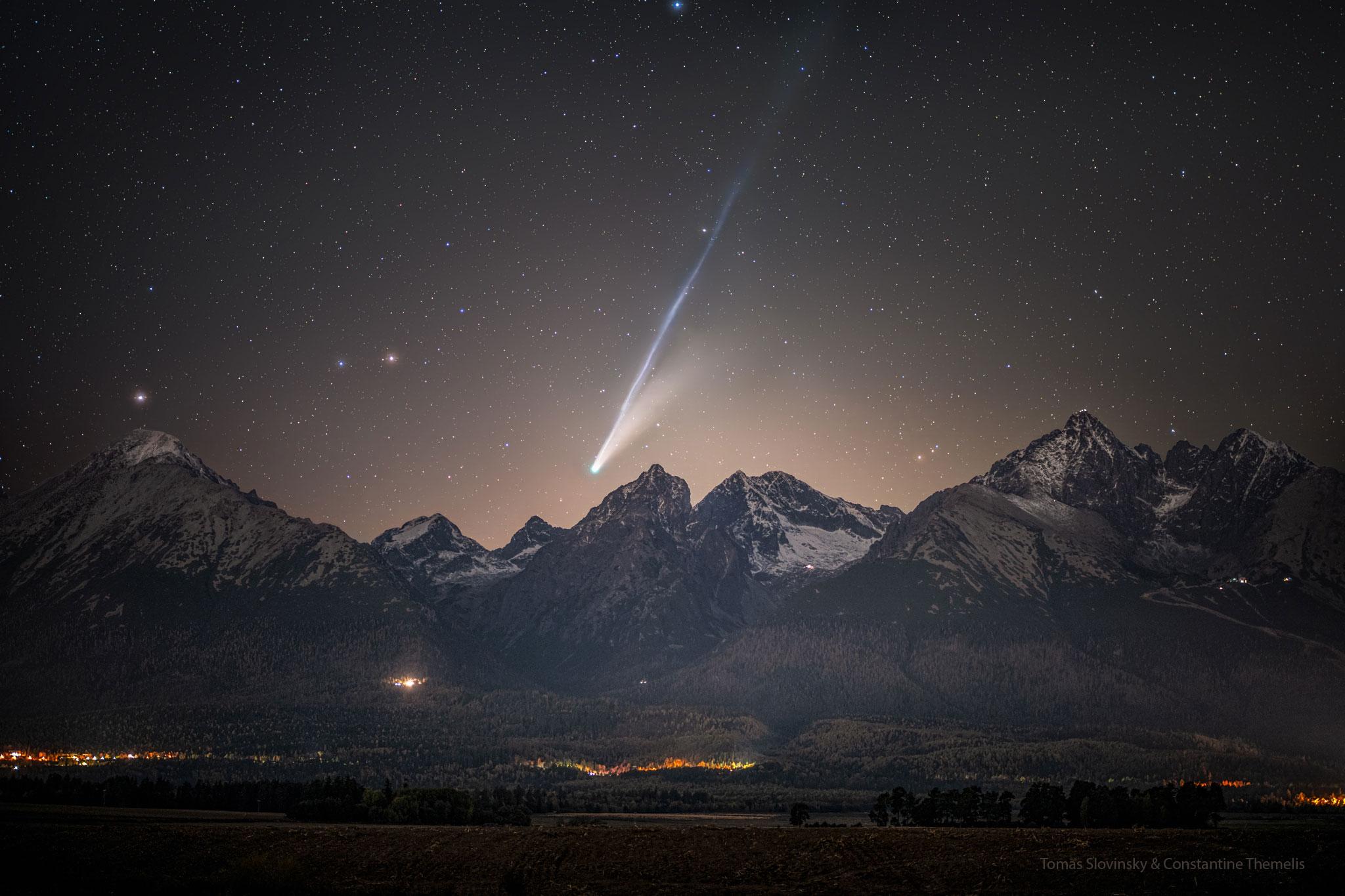
Alt...
2025 October 22
A mountain range is shown in the foreground with a bright comet visible above it. The comet shows tails that are long and bright with the longer tail appearing light blue.
Comet Lemmon over the High Tatras
* Image Credit & Copyright: Tomáš Slovinský & Constantine Themelis
Explanation:
Comet Lemmon putting on a show for cameras around the globe. Passing nearest to the Earth this week, the photogenic comet C/2025 A6 (Lemmon) is now extending two long tails : a blue ion tail and a white dust tail. The ion tail is pushed away from the Sun by the ever-present by ever-changing solar wind, and shows structure also created by how much gas is ejected at any one moment. It glows because it is ionized by high energy sunlight. The dust tail is pushed away from the comet by sunlight and shines by reflecting sunlight. The featured image is an enhanced composite of 50 exposures all taken two days ago from Mlynica, Slovakia. The mountains in the foreground are the High Tatras that partly separate Slovakia from Poland. Although Comet Lemmon is best visible in long camera exposures, the shedding ice ball has become faintly visible in northern skies even to unaided eyes through dark skies toward the west after sunset.
Authors & editors: Robert Nemiroff (MTU) & Jerry Bonnell (UMCP)
NASA Official: Amber Straughn Specific rights apply.
NASA Web Privacy, Accessibility, Notices;
A service of: ASD at NASA / GSFC,
NASA Science Activation
& Michigan Tech. U.
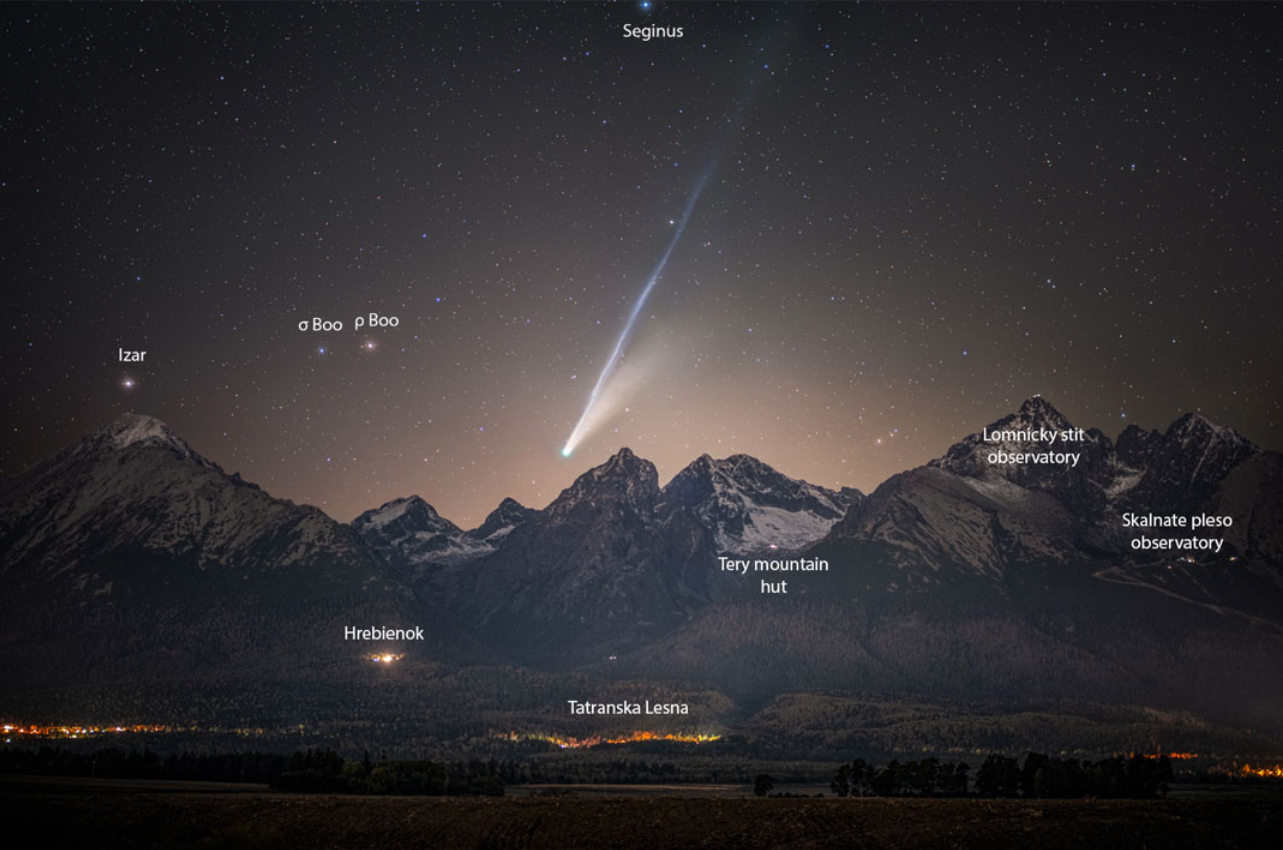
Alt...
Annotations for featured image
2025 October 13
Lemmon Tree
* Image Credit & Copyright: Uroš Fink
https://www.instagram.com/urosfink/
Explanation:
The tree is not in danger. That's because the comet pictured just above it, Comet C/2025 A6 (Lemmon), is far in the distance, well away from the Earth. Comet Lemmon now continues to brighten as it arcs through the inner Solar System, even though it has passed its nearest to the Sun -- because it is now approaching the Earth. The comet will likely appear brightest when it is at its closest to the Earth next week, then closing to about half the Earth-Sun distance. Comet Lemmon may then be visible to the unaided eye, but it is more likely to be imaged by a camera phone -- if you know where to look. Comet Lemmon, previously best visible in the morning, is now also visible in the evening sky for northern observers: look above the western horizon just after sunset. The featured image, centered on an unsuspecting European beech tree, was taken in Slovenia about ten days ago.
https://apod.nasa.gov/apod/ap251013.html
#space #comets #astrophotography #photography #science #astronomy #nature #NASA #ESA #education
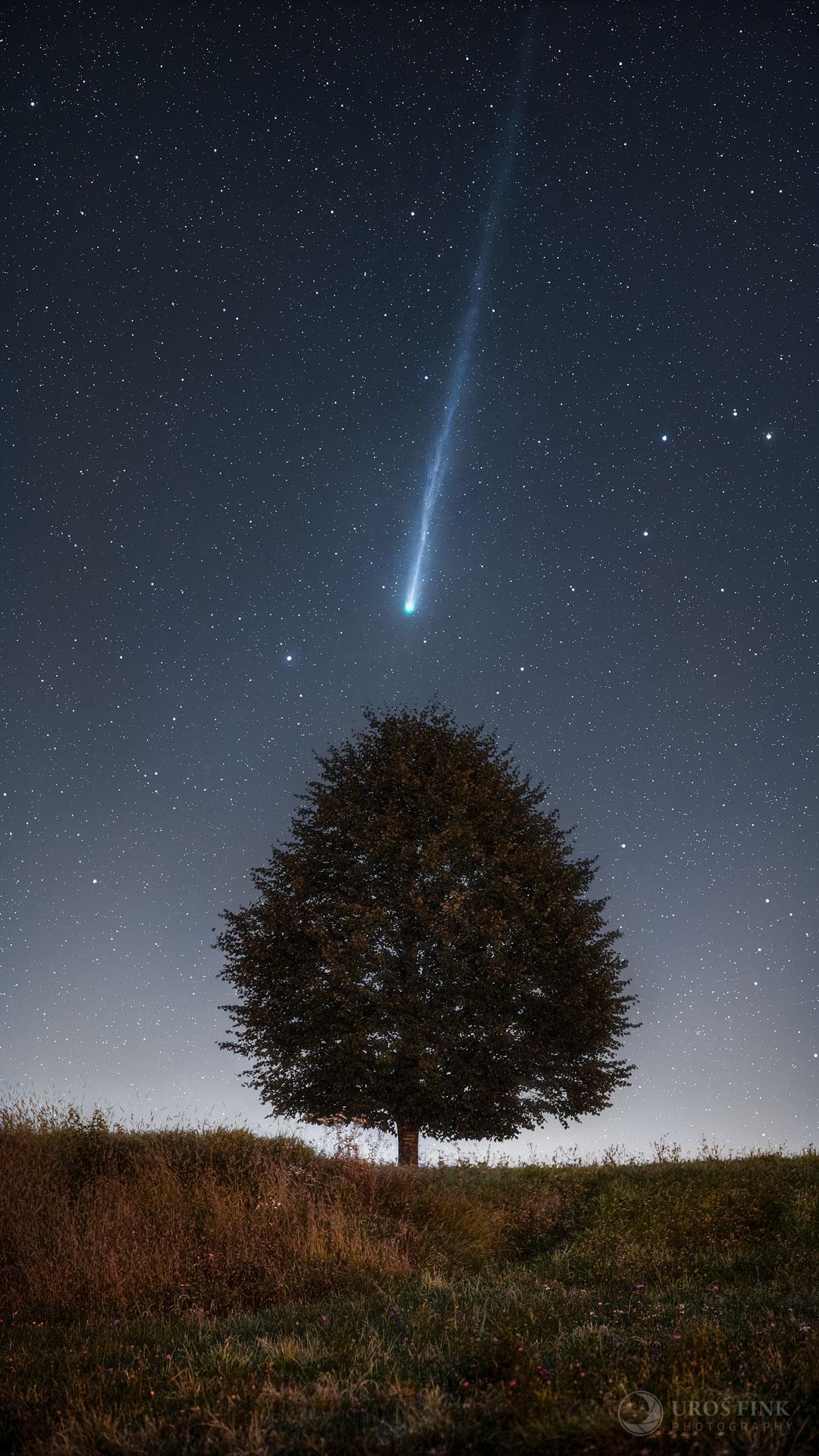
Alt...
2025 October 13
A tree is seen silhouetted against a night sky filled with stars. Above the tree with its tail pointing nearly vertically is a comet: Comet Lemmon.
Lemmon Tree
* Image Credit & Copyright: Uroš Fink
Explanation:
The tree is not in danger. That's because the comet pictured just above it, Comet C/2025 A6 (Lemmon), is far in the distance, well away from the Earth. Comet Lemmon now continues to brighten as it arcs through the inner Solar System, even though it has passed its nearest to the Sun -- because it is now approaching the Earth. The comet will likely appear brightest when it is at its closest to the Earth next week, then closing to about half the Earth-Sun distance. Comet Lemmon may then be visible to the unaided eye, but it is more likely to be imaged by a camera phone -- if you know where to look. Comet Lemmon, previously best visible in the morning, is now also visible in the evening sky for northern observers: look above the western horizon just after sunset. The featured image, centered on an unsuspecting European beech tree, was taken in Slovenia about ten days ago.
Authors & editors: Robert Nemiroff (MTU) & Jerry Bonnell (UMCP)
NASA Official: Amber Straughn Specific rights apply.
NASA Web Privacy, Accessibility, Notices;
A service of: ASD at NASA / GSFC,
NASA Science Activation
& Michigan Tech. U.
2022 May 12
Young Stars of NGC 346
* Image Credit: NASA, ESA -
https://www.nasa.gov/
https://www.esa.int/
* acknowledgement: Antonella Nota (ESA/STScI) et al.
https://www.stsci.edu/
Explanation:
The massive stars of NGC 346 are short lived, but very energetic. The star cluster is embedded in the largest star forming region in the Small Magellanic Cloud, some 210,000 light-years distant. Their winds and radiation sweep out an interstellar cavern in the gas and dust cloud about 200 light-years across, triggering star formation and sculpting the region's dense inner edge. Cataloged as N66, the star forming region also appears to contain a large population of infant stars. A mere 3 to 5 million years old and not yet burning hydrogen in their cores, the infant stars are strewn about the embedded star cluster. In this false-color Hubble Space Telescope image, visible and near-infrared light are seen as blue and green, while light from atomic hydrogen emission is red.
https://science.nasa.gov/asset/hubble/young-stars-sculpt-gas-with-powerful-outflows-in-the-small-magellanic-cloud/
https://chandra.harvard.edu/edu/formal/stellar_ev/story/index2.html
https://apod.nasa.gov/apod/ap220512.html
#space #cluster #astrophotography #photography #science #astronomy #physics #nature #NASA
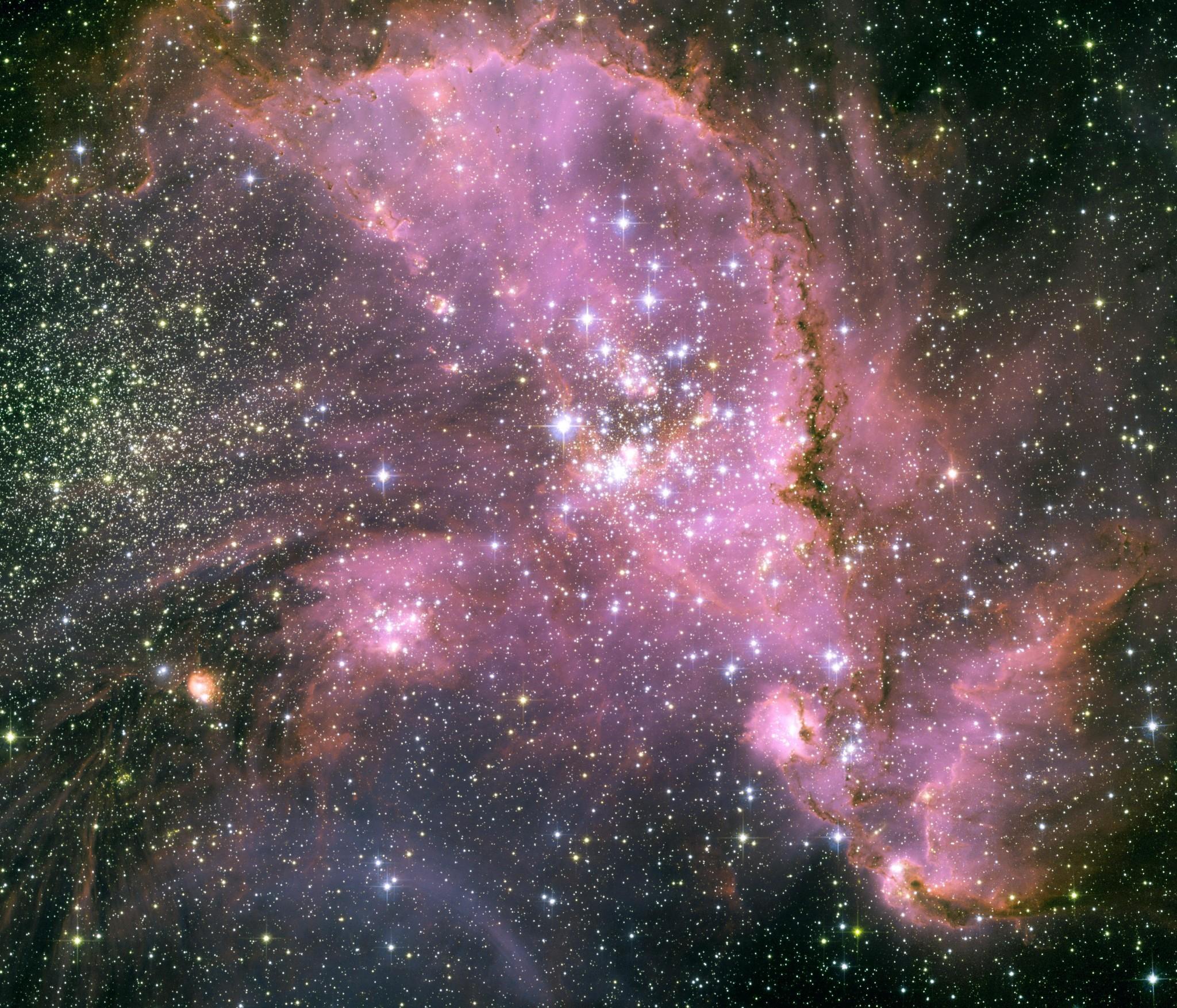
Alt...
2022 May 12
Young Stars of NGC 346
* Image Credit: NASA, ESA -
* acknowledgement: Antonella Nota (ESA/STScI) et al.,
Explanation:
The massive stars of NGC 346 are short lived, but very energetic. The star cluster is embedded in the largest star forming region in the Small Magellanic Cloud, some 210,000 light-years distant. Their winds and radiation sweep out an interstellar cavern in the gas and dust cloud about 200 light-years across, triggering star formation and sculpting the region's dense inner edge. Cataloged as N66, the star forming region also appears to contain a large population of infant stars. A mere 3 to 5 million years old and not yet burning hydrogen in their cores, the infant stars are strewn about the embedded star cluster. In this false-color Hubble Space Telescope image, visible and near-infrared light are seen as blue and green, while light from atomic hydrogen emission is red.
Authors & editors: Robert Nemiroff (MTU) & Jerry Bonnell (UMCP)
NASA Official: Phillip Newman Specific rights apply.
NASA Web Privacy Policy and Important Notices
A service of: ASD at NASA / GSFC
& Michigan Tech. U.
2024 October 27
LDN 43: The Cosmic Bat Nebula
* Credit & Copyright: Mark Hanson and Mike Selby
https://www.hansonastronomy.com/bio
https://throughlightandtime.com/about/
* Text: Michelle Thaller (NASA's GSFC)
https://science.nasa.gov/people/michelle-thaller/
https://www.nasa.gov/
https://www.nasa.gov/goddard
Explanation:
What is the most spook-tacular nebula in the galaxy? One contender is LDN 43, which bears an astonishing resemblance to a vast cosmic bat flying amongst the stars on a dark Halloween night. Located about 1400 light years away in the constellation Ophiuchus, this molecular cloud is dense enough to block light not only from background stars, but from wisps of gas lit up by the nearby reflection nebula LBN 7. Far from being a harbinger of death, this 12-light year-long filament of gas and dust is actually a stellar nursery. Glowing with eerie light, the bat is lit up from inside by dense gaseous knots that have just formed young stars.
https://www.jthommes.com/Astro/LBN7_LDN43.htm
https://chandra.harvard.edu/photo/constellations/ophiuchus.html
https://en.wikipedia.org/wiki/Molecular_cloud
https://apod.nasa.gov/apod/ap230129.html
https://astronomy.swin.edu.au/cosmos/r/Reflection+Nebula
https://apod.nasa.gov/apod/ap030706.html
https://apod.nasa.gov/apod/ap241027.html
#space #nebula #cluster #astrophotography #photography #science #astronomy #nature #NASA #ESA
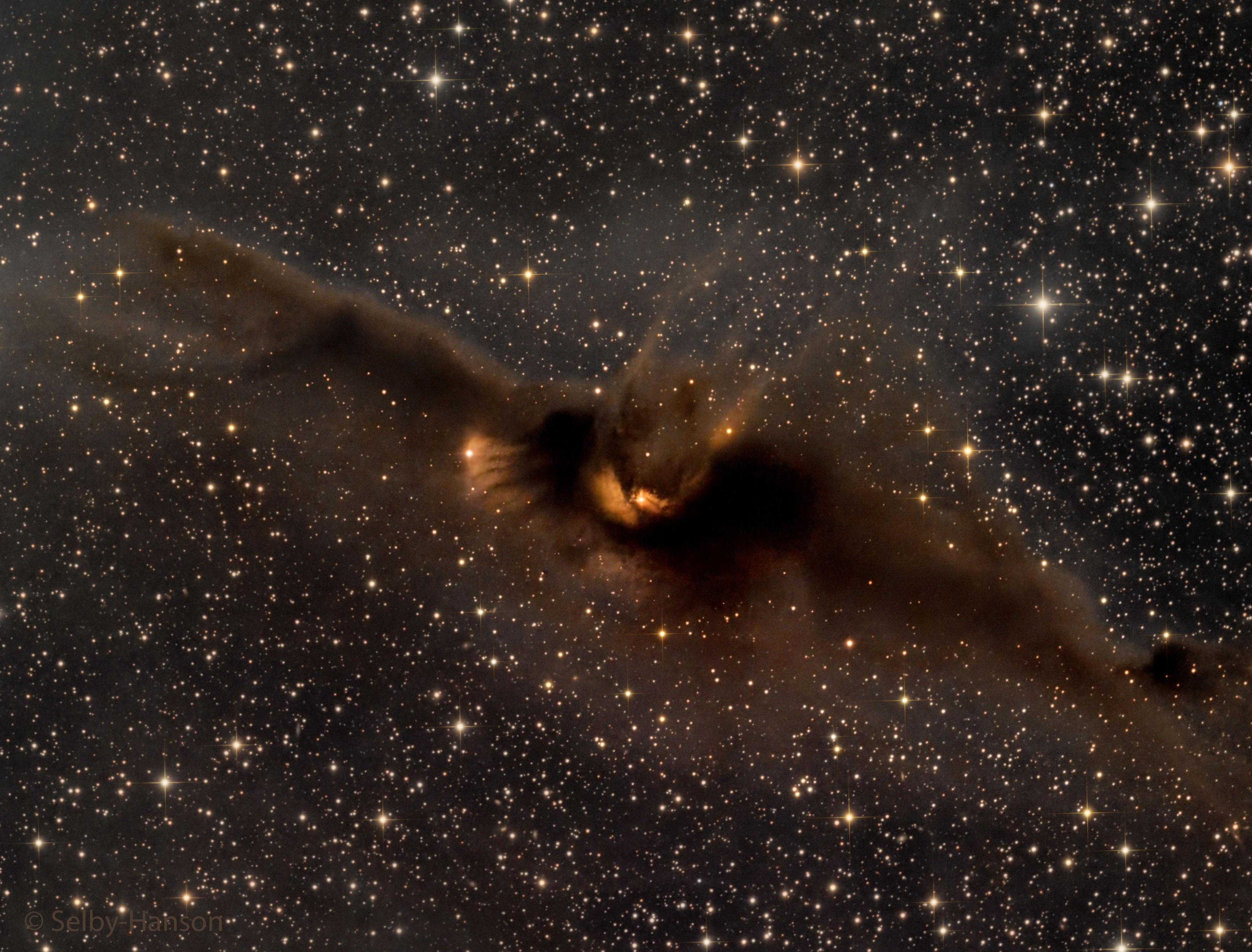
Alt...
2024 October 27
A starfield is shown with a large brown dust nebula in the center. The nebula appears, to some, to be shaped like a bat. One of the stars in the dust nebula even appears to be the eye of the bat.
LDN 43: The Cosmic Bat Nebula
* Credit & Copyright: Mark Hanson and Mike Selby
* Text: Michelle Thaller (NASA's GSFC)
Explanation:
What is the most spook-tacular nebula in the galaxy? One contender is LDN 43, which bears an astonishing resemblance to a vast cosmic bat flying amongst the stars on a dark Halloween night. Located about 1400 light years away in the constellation Ophiuchus, this molecular cloud is dense enough to block light not only from background stars, but from wisps of gas lit up by the nearby reflection nebula LBN 7. Far from being a harbinger of death, this 12-light year-long filament of gas and dust is actually a stellar nursery. Glowing with eerie light, the bat is lit up from inside by dense gaseous knots that have just formed young stars.
Authors & editors: Robert Nemiroff (MTU) & Jerry Bonnell (UMCP)
NASA Official: Amber Straughn Specific rights apply.
NASA Web Privacy, Accessibility, Notices;
A service of: ASD at NASA / GSFC,
NASA Science Activation
& Michigan Tech. U.
2025 October 22
NGC 6995: The Bat Nebula
* Image Credit & Copyright: Francis Bozon & Jean-Luc Gangloff
Explanation:
Can you see the bat? It haunts this cosmic close-up of the eastern Veil Nebula. The Veil Nebula itself is a large supernova remnant, the expanding debris cloud from the death explosion of a massive star. While the Veil is roughly circular in shape and covers nearly 3 degrees on the sky toward the constellation of the Swan (Cygnus), NGC 6995, known informally as the Bat Nebula, spans only 1/2 degree, about the apparent size of the Moon. That translates to 12 light-years at the Veil's estimated distance, a reassuring 1,400 light-years from planet Earth. In the composite of image data recorded through several narrow band filters, with emission from hydrogen atoms in the remnant shown in red and with strong emission from oxygen atoms shown in hues of blue. Of course, in the western part of the Veil lies another seasonal apparition: the Witch's Broom Nebula.
https://chandra.harvard.edu/photo/scale_distance.html
https://periodic.lanl.gov/1.shtml
https://apod.nasa.gov/apod/ap251022.html
#space #nebula #cluster #astrophotography #photography #science #astronomy #nature #NASA #ESA #apod #education
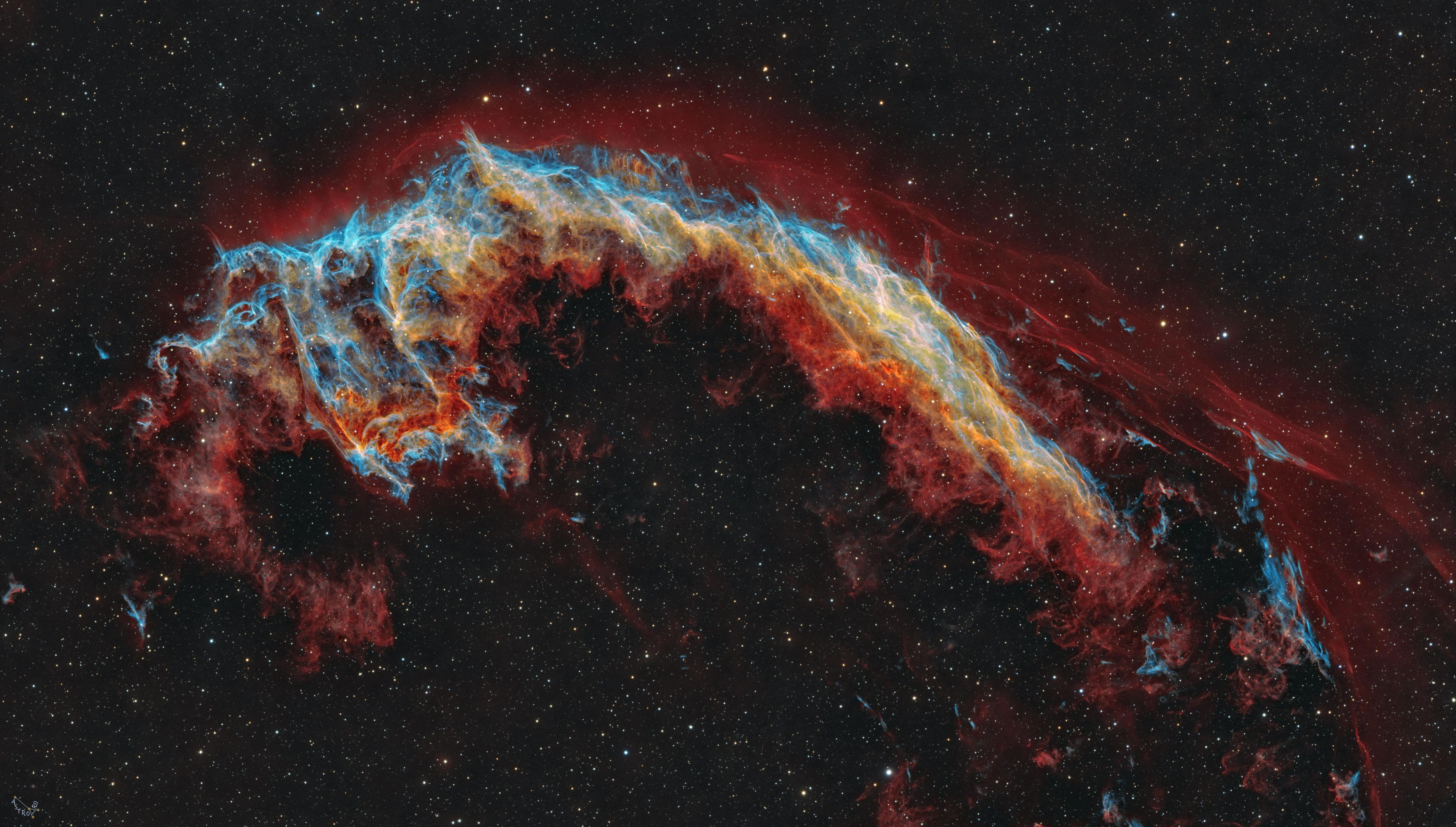
Alt...
2025 October 22
The featured image shows a starfield with a multi- colored nebula in the center. The nebula is quite filamentary but appears to some like a bat.
NGC 6995: The Bat Nebula
* Image Credit & Copyright: Francis Bozon-Gangloff
Explanation:
Can you see the bat? It haunts this cosmic close-up of the eastern Veil Nebula. The Veil Nebula itself is a large supernova remnant, the expanding debris cloud from the death explosion of a massive star. While the Veil is roughly circular in shape and covers nearly 3 degrees on the sky toward the constellation of the Swan (Cygnus), NGC 6995, known informally as the Bat Nebula, spans only 1/2 degree, about the apparent size of the Moon. That translates to 12 light-years at the Veil's estimated distance, a reassuring 1,400 light-years from planet Earth. In the composite of image data recorded through several narrow band filters, with emission from hydrogen atoms in the remnant shown in red and with strong emission from oxygen atoms shown in hues of blue. Of course, in the western part of the Veil lies another seasonal apparition: the Witch's Broom Nebula.
Authors & editors: Robert Nemiroff (MTU) & Jerry Bonnell (UMCP)
NASA Official: Amber Straughn Specific rights apply.
NASA Web Privacy, Accessibility, Notices;
A service of: ASD at NASA / GSFC,
NASA Science Activation
& Michigan Tech. U.
2025 October 21
IC 1805: The Heart Nebula
* Image Credit & Copyright: Toni Fabiani
https://app.astrobin.com/u/Toni_Fabiani#gallery
Explanation:
What electrifies the Heart Nebula? First, the large emission nebula on the left, catalogued as IC 1805, looks somewhat like a human heart. The nebula glows brightly in red light emitted by its most prominent element, hydrogen, but this long-exposure image was also blended with light emitted by sulfur (yellow) and oxygen (blue). In the center of the Heart Nebula are young stars from the open star cluster Melotte 15 that are eroding away several picturesque dust pillars with their atom-exciting energetic light and winds. The Heart Nebula is located about 7,500 light years away toward the constellation of Cassiopeia. At the top right of the Heart Nebula is the companion Fishhead Nebula. This wide and deep image clearly shows that glowing gas surrounds the Heart Nebula in all directions.
https://apod.nasa.gov/apod/ap251021.html
#space #nebula #cluster #astrophotography #photography #science #astronomy #nature #NASA #ESA #apod #education
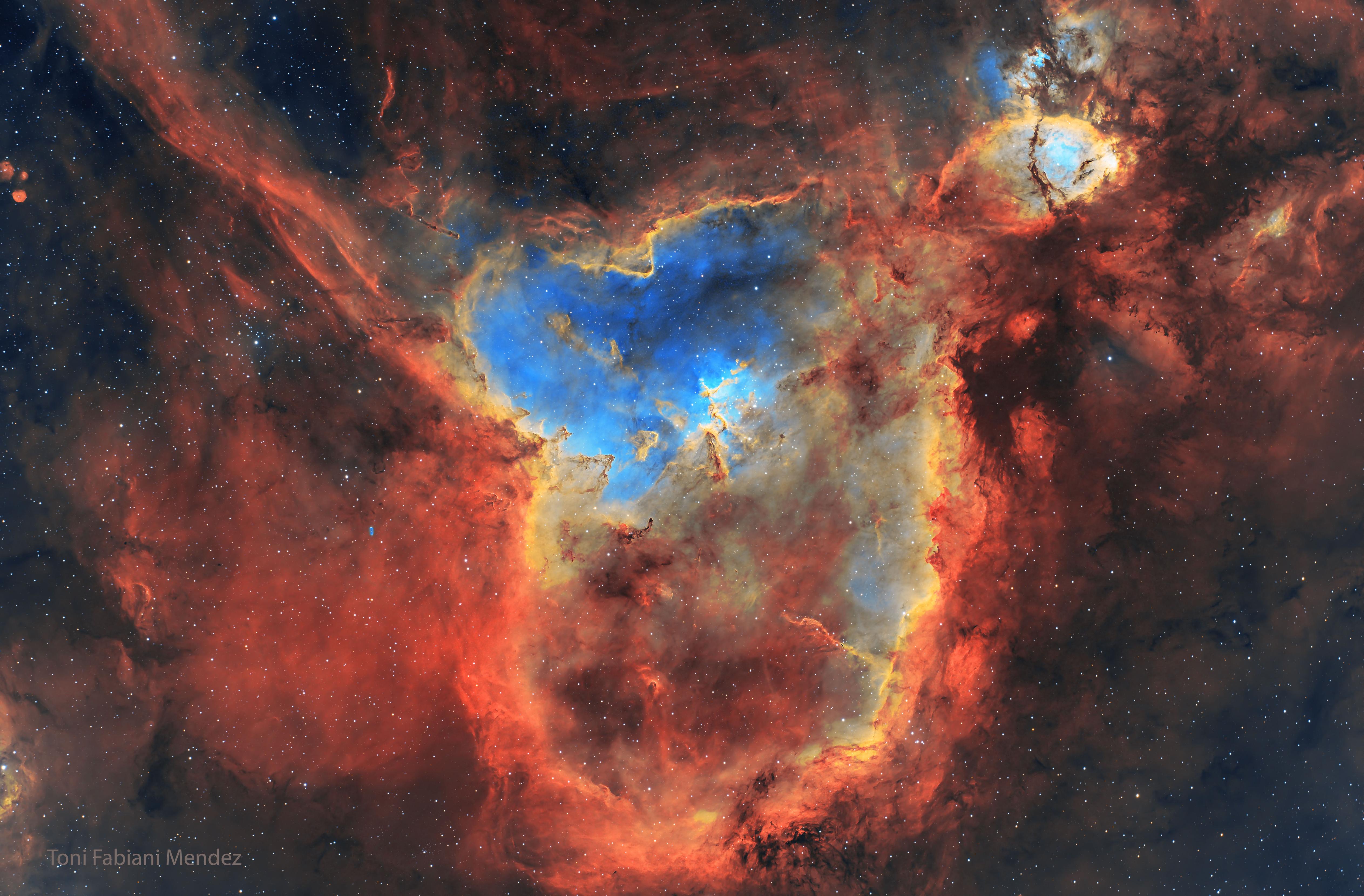
Alt...
2025 October 21
A starfield is shown filled with colorful gas glowing in different colors, and dark dust.
IC 1805: The Heart Nebula
* Image Credit & Copyright: Toni Fabiani
Explanation:
What electrifies the Heart Nebula? First, the large emission nebula on the left, catalogued as IC 1805, looks somewhat like a human heart. The nebula glows brightly in red light emitted by its most prominent element, hydrogen, but this long-exposure image was also blended with light emitted by sulfur (yellow) and oxygen (blue). In the center of the Heart Nebula are young stars from the open star cluster Melotte 15 that are eroding away several picturesque dust pillars with their atom-exciting energetic light and winds. The Heart Nebula is located about 7,500 light years away toward the constellation of Cassiopeia. At the top right of the Heart Nebula is the companion Fishhead Nebula. This wide and deep image clearly shows that glowing gas surrounds the Heart Nebula in all directions.
Authors & editors: Robert Nemiroff (MTU) & Jerry Bonnell (UMCP)
NASA Official: Amber Straughn Specific rights apply.
NASA Web Privacy, Accessibility, Notices;
A service of: ASD at NASA / GSFC,
NASA Science Activation
& Michigan Tech. U.
2025 October 20
Finding Comet Lemmon
* Image Credit & Copyright: Petr Horalek / Institute of Physics in Opava
https://www.petrhoralek.com/#about-1
https://www.slu.cz/phys/en/
Explanation:
Tonight, if you can see the stars of the Big Dipper, then you can find comet Lemmon in your evening sky. After sunset, look for the faint but extended comet above your northwestern horizon -- but below the handle of the famous celestial kitchen utensil of the north. It might be easier to see this visitor to the inner Solar System through your camera phone, which is better at picking up faint objects. Either way, look for a fuzzy green 'star' with a tail, though probably not so long a tail as in this impressive snapshot taken over Seč Lake in the Czech Republic two nights ago. Recent photographs of C/2025 A6 (Lemmon) often show a detailed and changing ion tail which extends farther than the eye can follow. This Sun-orbiting comet is now near its closest approach to Earth and will pass its closest to the Sun in early November.
https://theskylive.com/c2025a6-info
https://www.petrhoralek.com/?p=25820
https://www.wired.com/story/how-to-see-comet-lemmon-this-october/
https://apod.nasa.gov/apod/ap251020.html
#space #comets #astrophotography #photography #science #astronomy #nature #NASA #ESA #education
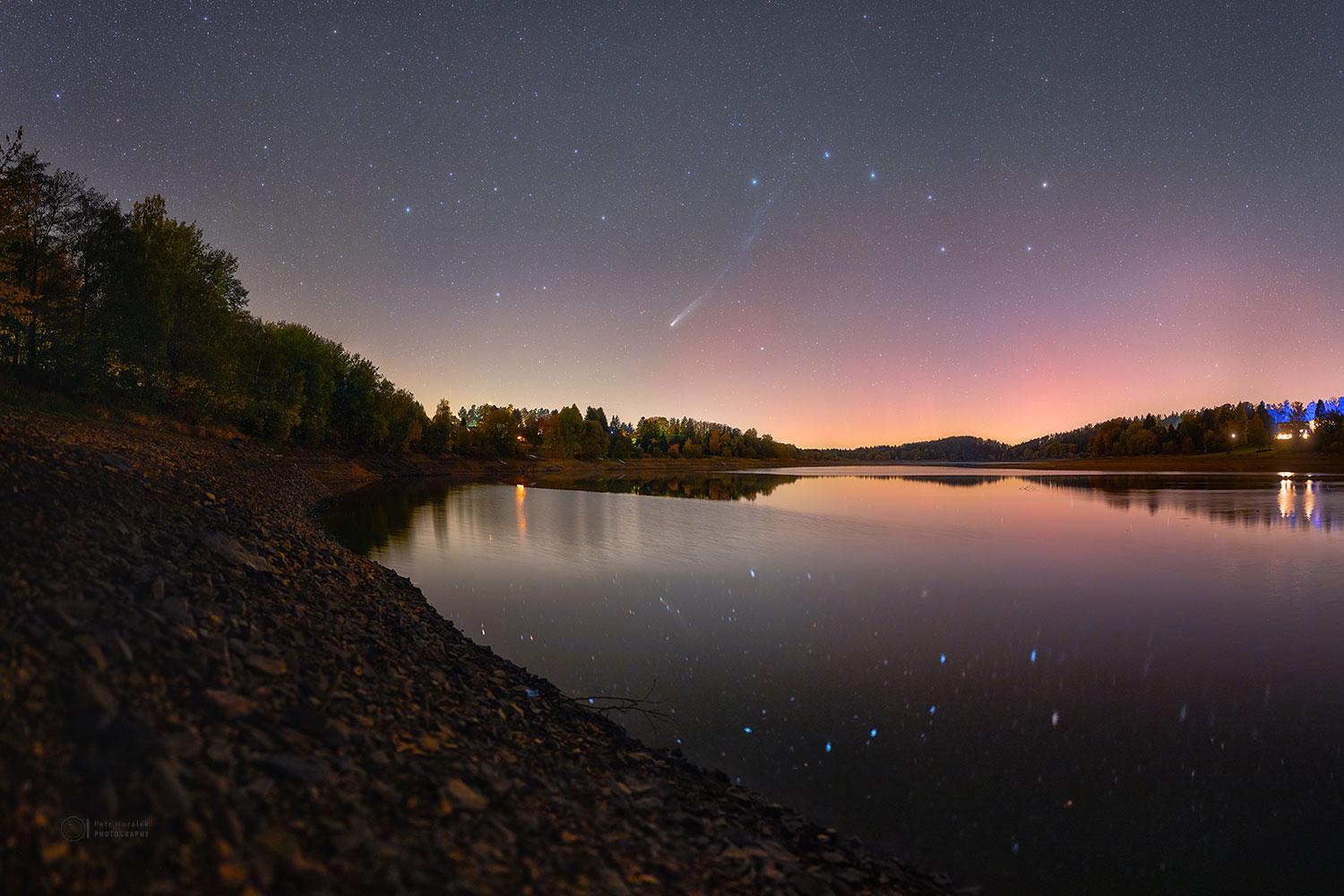
Alt...
2025 October 20
A night sky is seen over a lake. The sky contains numerous stars including the Big Dipper asterism. Prominent in the sky is a comet with a long tail. Both the Big Dipper and the comet are seen reflected in the still water of the lake.
Finding Comet Lemmon
* Image Credit & Copyright: Petr Horalek / Institute of Physics in Opava
Explanation:
Tonight, if you can see the stars of the Big Dipper, then you can find comet Lemmon in your evening sky. After sunset, look for the faint but extended comet above your northwestern horizon -- but below the handle of the famous celestial kitchen utensil of the north. It might be easier to see this visitor to the inner Solar System through your camera phone, which is better at picking up faint objects. Either way, look for a fuzzy green 'star' with a tail, though probably not so long a tail as in this impressive snapshot taken over Seč Lake in the Czech Republic two nights ago. Recent photographs of C/2025 A6 (Lemmon) often show a detailed and changing ion tail which extends farther than the eye can follow. This Sun-orbiting comet is now near its closest approach to Earth and will pass its closest to the Sun in early November.
Authors & editors: Robert Nemiroff (MTU) & Jerry Bonnell (UMCP)
NASA Official: Amber Straughn Specific rights apply.
NASA Web Privacy, Accessibility, Notices;
A service of: ASD at NASA / GSFC,
NASA Science Activation
& Michigan Tech. U.
2025 October 11
Manicouagan Impact Crater from Space
* Image Credit: NASA, International Space Station Expedition 59
Explanation:
Orbiting 400 kilometers above Quebec, Canada, planet Earth, the International Space Station Expedition 59 crew captured this snapshot of the broad St. Lawrence River and curiously circular Lake Manicouagan on April 11, 2019. Right of center, the ring-shaped lake is a modern reservoir within the eroded remnant of an ancient 100 kilometer diameter impact crater. The ancient crater is very conspicuous from orbit, a visible reminder that Earth is vulnerable to rocks from space. Over 200 million years old, the Manicouagan crater was likely caused by the impact of a rocky body about 5 kilometers in diameter. Currently, there is no known asteroid with a significant probability of impacting Earth in the next century. Each month, NASA’s Planetary Defense Coordination Office releases an update featuring the most recent figures on near-Earth object close approaches, and other facts about comets and asteroids that could pose a potential impact hazard with Earth.
#space #comets #astrophotography #photography #science #astronomy #nature #NASA #ESA #education #apod

Alt...
2025 October 11

Manicouagan Impact Crater from Space
Image Credit: NASA, International Space Station Expedition 59
Explanation: Orbiting 400 kilometers above Quebec, Canada, planet Earth, the International Space Station Expedition 59 crew captured this snapshot of the broad St. Lawrence River and curiously circular Lake Manicouagan on April 11, 2019. Right of center, the ring-shaped lake is a modern reservoir within the eroded remnant of an ancient 100 kilometer diameter impact crater. The ancient crater is very conspicuous from orbit, a visible reminder that Earth is vulnerable to rocks from space. Over 200 million years old, the Manicouagan crater was likely caused by the impact of a rocky body about 5 kilometers in diameter. Currently, there is no known asteroid with a significant probability of impacting Earth in the next century. Each month, NASA’s Planetary Defense Coordination Office releases an update featuring the most recent figures on near-Earth object close approaches, and other facts about comets and asteroids that could pose a potential impact hazard with Earth
Authors & editors: Robert Nemiroff (MTU) & Jerry Bonnell (UMCP)
NASA Official: Amber Straughn Specific rights apply.
NASA Web Privacy, Accessibility, Notices;
A service of: ASD at NASA / GSFC,
NASA Science Activation
& Michigan Tech. U.
WIde Separation Planets In Time (WISPIT): A Gap-clearing Planet in a Multi-ringed
Disk around the Young Solar-type Star WISPIT 2
CREDIT:
Richelle F. van Capelleveen1 aa, Christian Ginski2aa, Matthew A. Kenworthy1 aa, Jake Byrne2 aa, Chloe Lawlor2 aa,
Dan McLachlan2aa, Eric E. Mamajek3aa, Tomas Stolker1 aa, Myriam Benisty4 aa, Alexander J. Bohn1aa, Laird M. Close5 aa,
Carsten Dominik6 aa, Sebastiaan Haffert1,5aa, Rico Landman1aa, Jie Ma7 aa, Ignas Snellen1 aa, Ryo Tazaki8 aa,
Nienke van der Marel1 aa, Lukas Welzel1 aa, and Yapeng Zhang9aa1 Leiden Observatory, Leiden University, Postbus 9513, 2300 RA Leiden, The Netherlands; capelleveen@strw.leidenuniv.nl
2 School of Natural Sciences, Center for Astronomy, University of Galway, Galway, H91 CF50, Ireland
3 Jet Propulsion Laboratory, California Institute of Technology, 4800 Oak Grove Drive, M/S 321-162, Pasadena, CA 91109, USA
4 Max-Planck-Institut für Astronomie, Königstuhl 17, 69117 Heidelberg, Germany
5 Steward Observatory, University of Arizona, 933 N. Cherry Avenue, Tucson, AZ 85719, USA
6 Anton Pannekoek Institute for Astronomy, University of Amsterdam, Science Park 904, 1098 XH Amsterdam, The Netherlands
7 Université Grenoble Alpes, CNRS, Institut de Planétologie et d’Astrophysique (IPAG), F-38000, France
8 Department of Earth Science and Astronomy, The University of Tokyo, Tokyo 153-8902, Japan
9 Department of Astronomy, California Institute of Technology, Pasadena, CA 91125, USA
Received 2025 July 3; revised 2025 July 28; accepted 2025 August 2; published 2025 August 26
.. please see:
https://iopscience.iop.org/article/10.3847/2041-8213/adf721/pdf
#space #exoplanets #astrophotography #photography #science #astronomy #nature #NASA #ESA #ESO
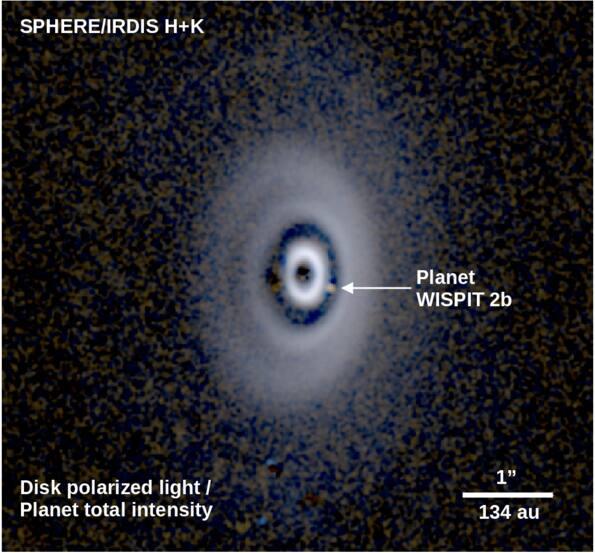
Alt...
Figure 1. Shown here is a SPHERE/IRDIS multiband image of the WISPIT 2 system. The H-band Qϕ image was added as the blue channel and the median combination of H-band and Ks-band Qϕ images was added as the green channel. The red channel is a combination of a Ks-band Qϕ image and a Ks-band cADI image in which we masked all but the gap containing the thermal emission from WISPIT 2b. For more details, see Appendix G.
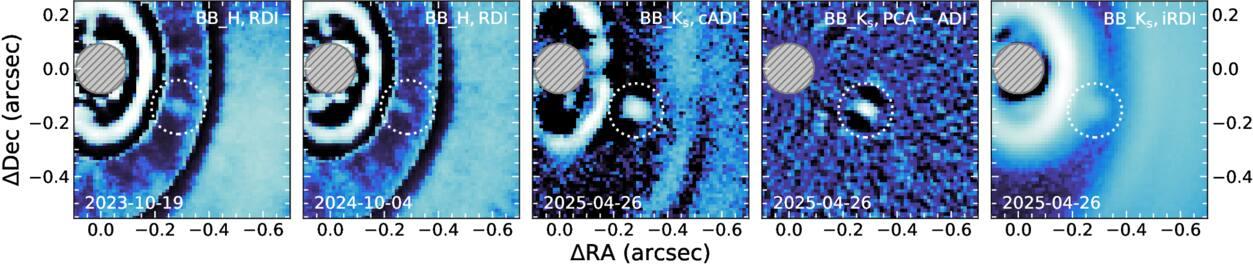
Alt...
Figure 4. All detections of the embedded planet WISPIT 2b in the various observation epochs and filters are shown. We indicate the embedded planet position with a white, dotted circle. The coronagraph position is indicated with a gray, hashed mask. For the 2025 Ks-band data, we show that the embedded planet is recovered with classical and PCA-based ADI as well as in iRDI.
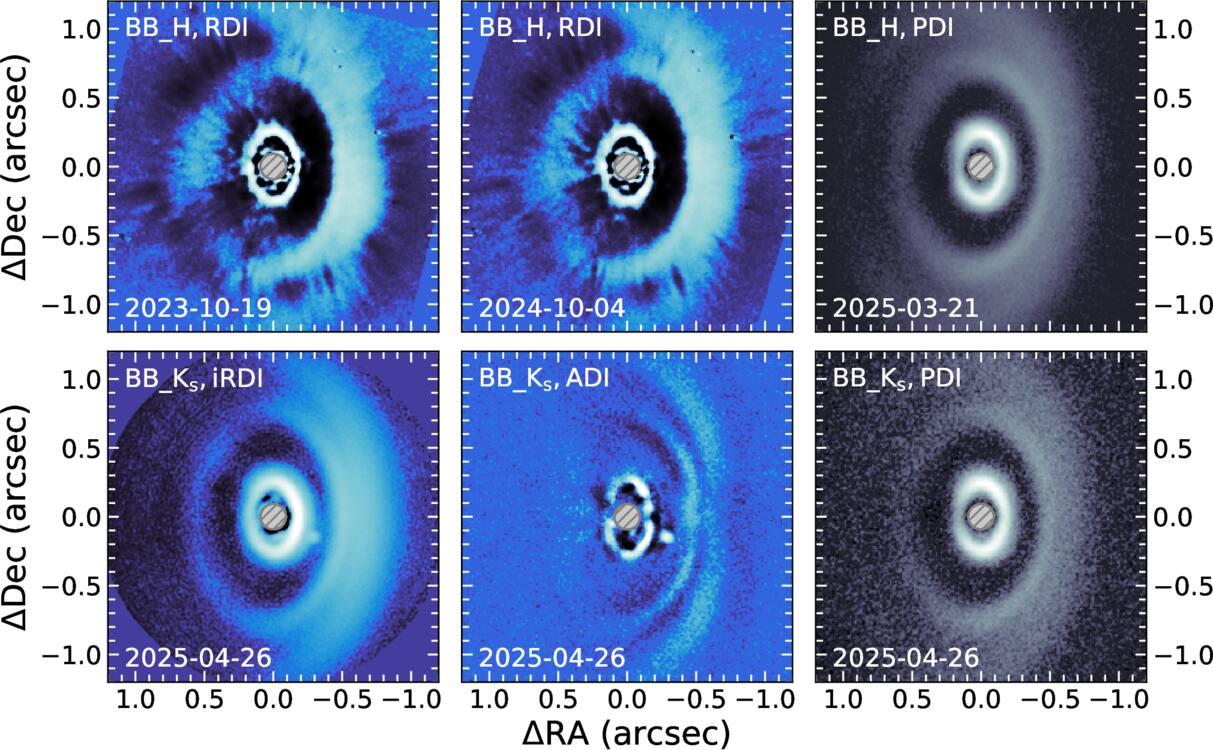
Alt...
Figure 3. SPHERE/IRDIS observations of the WISPIT 2 system are shown here. The gray, hashed disk in the image center indicates the size of the coronagraphic mask. The differential imaging method and observed wave band for each image are indicated in the top-left corner. Blue-hued images reduced with the ADI or RDI (50 principal components) methods are showing total intensity, sensitive to disk scattered light and thermal emission from embedded planets. The gray-hued images are Qϕ images (reduced with the PDI method) showing linearly polarized scattered light, not sensitive to thermal emission.
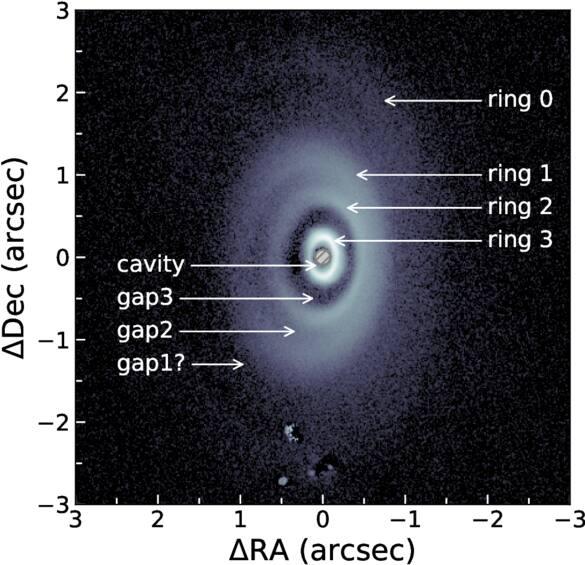
Alt...
Figure 5. Polarized light Qϕ image of the WISPIT 2 system taken in the H band. We indicate the various substructures that we are detecting within the scattered light signal of the planet-forming disk. Clusters of bad pixels from the detector are seen near the lower edge of the image.
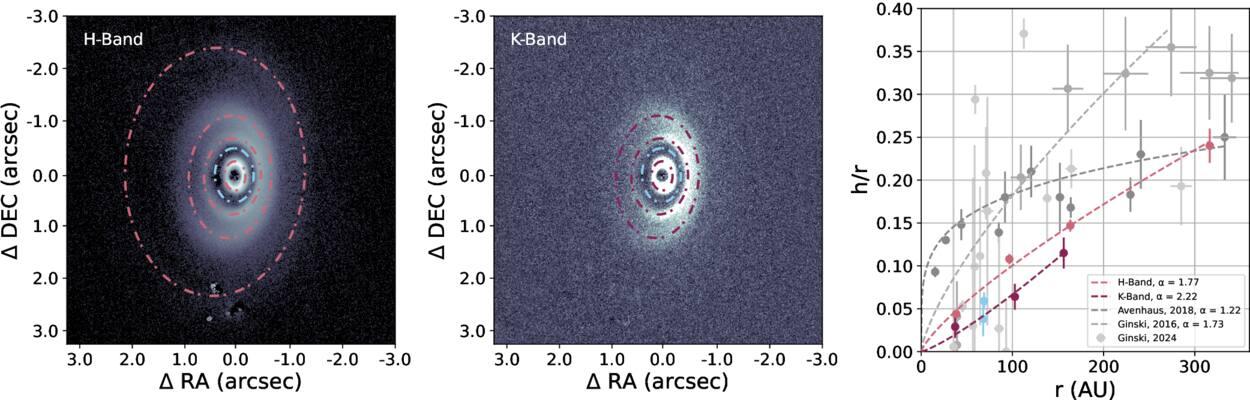
Alt...
Figure 6. Left and middle panels: geometric fitting of the disk in both H-band and Ks-band images. Right panel: the aspect ratio (h/r) vs. radius (au) of both bands. For comparison, we include the literature measurements of C. Ginski et al. (2016), H. Avenhaus et al. (2018),and C. Ginski et al. (2024) for a total of 17 disks (some of which also have a multiple ringed substructure) as gray data points.
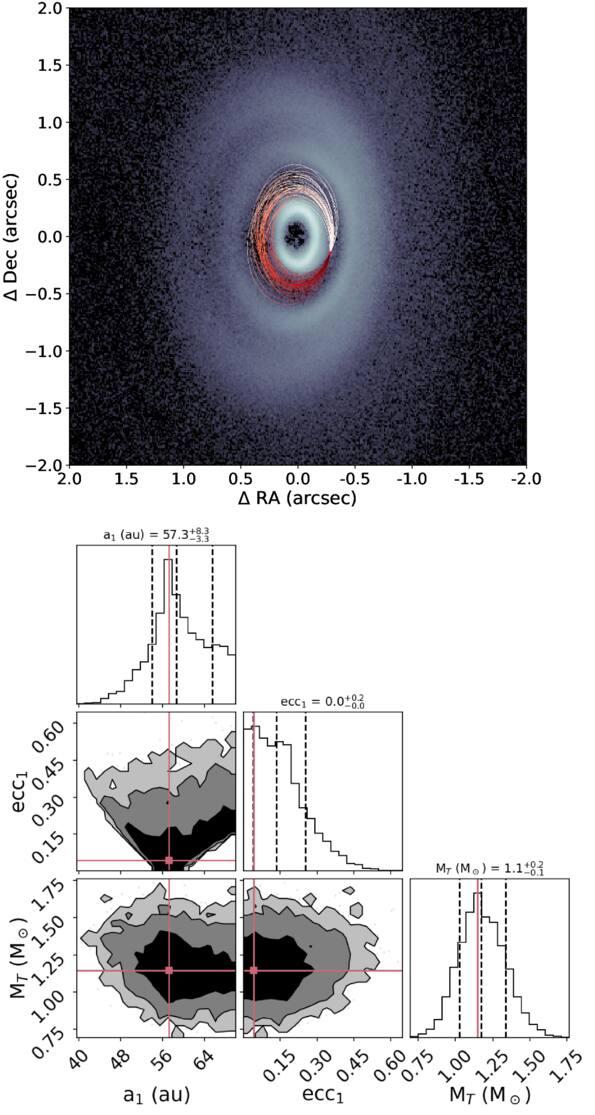
Alt...
Figure 8. Top panel: predicted orbits of the planet (known astrometry denoted by red star) overlaid on the H-band polarized scattered light image. Bottom panel: extracted orbital elements and total system mass.
2025 August 27
WISPIT 2b: Exoplanet Carves Gap in Birth Disk
* Image Credit: ESO, VLT, SPHERE
https://www.eso.org/
https://www.eso.org/public/teles-instr/paranal-observatory/vlt/
https://www.eso.org/sci/facilities/paranal/instruments/sphere.html
* Processing & Copyright: ESO, Richelle van Capelleveen (Leiden Obs.) et al.
https://richellevc.github.io/
https://www.universiteitleiden.nl/en/science/astronomy
https://iopscience.iop.org/article/10.3847/2041-8213/adf721
https://www.eso.org/
* Text: Ogetay Kayali (MTU)
https://www.ogetay.com/
https://www.mtu.edu/physics/
Explanation:
That yellow spot -- what is it? It's a young planet outside our Solar System. The featured image from the Very Large Telescope in Chile surprisingly captures a distant scene much like our own Solar System's birth, some 4.5 billion years ago. Although we can't look into the past and see Earth's formation directly, telescopes let us watch similar processes unfolding around distant stars. At the center of this frame lies a young Sun-like star, hidden behind a coronagraph that blocks its bright glare. Surrounding the star is a bright, dusty protoplanetary disk -- the raw material of planets. Gaps and concentric rings mark where a newborn world is gathering gas and dust under its gravity, clearing the way as it orbits the star. Although astronomers have imaged disk-embedded planets before, this is the first-ever observation of an exoplanet actively carving a gap within a disk -- the earliest direct glimpse of planetary sculpting in action.
https://www.astronomie.nl/nieuws/en/discovery-of-the-first-ring-shaping-embedded-planet-around-a-young-solar-analog-4637
https://en.wikipedia.org/wiki/Protoplanetary_disk
https://apod.nasa.gov/apod/ap231017.html
https://en.wikipedia.org/wiki/Coronagraph
https://apod.nasa.gov/apod/ap250827.html
#space #exoplanets #astrophotography #photography #science #astronomy #nature #NASA #ESA #ESO
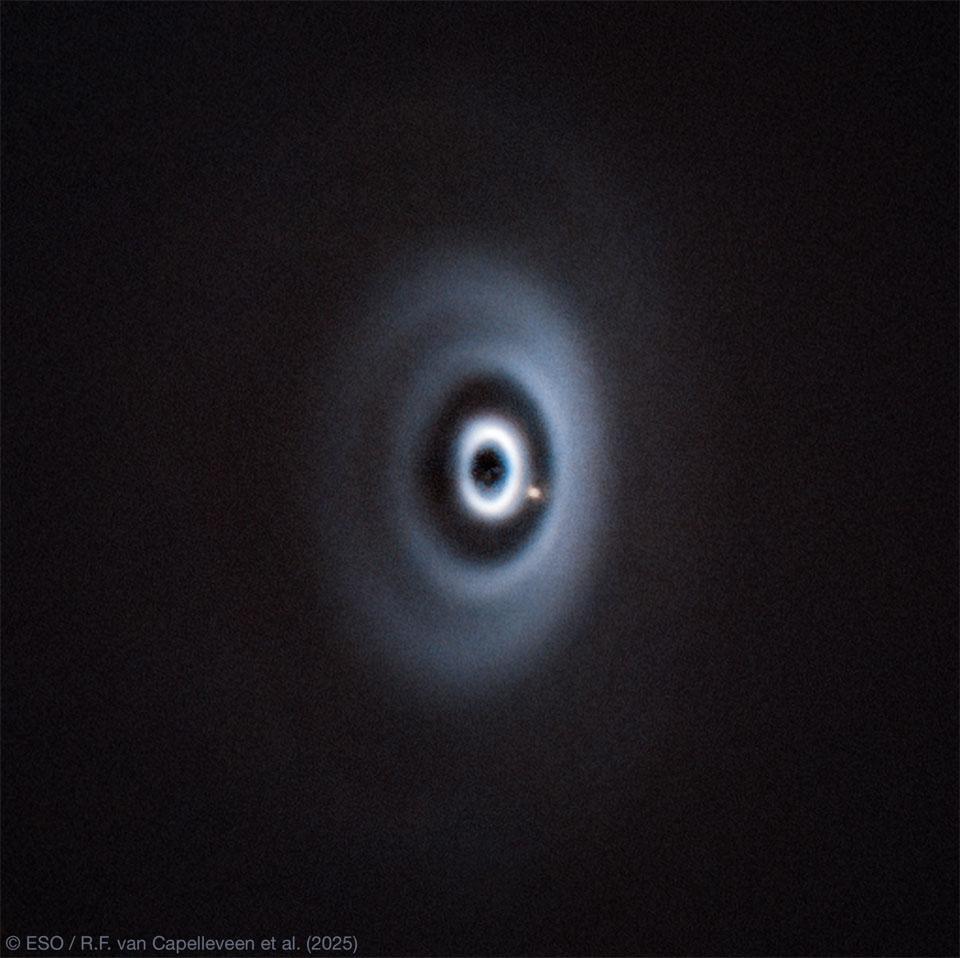
Alt...
2025 August 27
A dark field has a series of light-colored elliptical rings in the center. Between two of the rings is a yellow-colored spot.
WISPIT 2b: Exoplanet Carves Gap in Birth Disk
* Image Credit: ESO, VLT, SPHERE
* Processing & Copyright: ESO, Richelle van Capelleveen (Leiden Obs.) et al.
* Text: Ogetay Kayali (MTU)
Explanation:
That yellow spot -- what is it? It's a young planet outside our Solar System. The featured image from the Very Large Telescope in Chile surprisingly captures a distant scene much like our own Solar System's birth, some 4.5 billion years ago. Although we can't look into the past and see Earth's formation directly, telescopes let us watch similar processes unfolding around distant stars. At the center of this frame lies a young Sun-like star, hidden behind a coronagraph that blocks its bright glare. Surrounding the star is a bright, dusty protoplanetary disk -- the raw material of planets. Gaps and concentric rings mark where a newborn world is gathering gas and dust under its gravity, clearing the way as it orbits the star. Although astronomers have imaged disk-embedded planets before, this is the first-ever observation of an exoplanet actively carving a gap within a disk -- the earliest direct glimpse of planetary sculpting in action.
Authors & editors: Robert Nemiroff (MTU) & Jerry Bonnell (UMCP)
NASA Official: Amber Straughn Specific rights apply.
2025 October 10
50 Light-years to 51 Pegasi
* Image Credit & Copyright: José Rodrigues
https://joserodrigues.space/
Explanation:
It's only 50 light-years to 51 Pegasi. That star's position is indicated in this snapshot from August 2025, taken on a night with mostly brighter stars visible above the dome at Observatoire de Haute-Provence in France. Thirty years ago, in October of 1995, astronomers Michel Mayor and Didier Queloz announced a profound discovery made at the observatory. Using a precise spectrograph they had detected a planet orbiting 51 Peg, the first known exoplanet orbiting a sun-like star. Mayor and Queloz had used the spectrograph to measure changes in the star's radial velocity, a regular wobble caused by the gravitational tug of the orbiting planet. Designated 51 Pegasi b, the planet was determined to have a mass at least half of Jupiter's mass and an orbital period of 4.2 days. That made the exoplanet much closer to its parent star than Mercury is to the Sun. Their discovery was quickly confirmed and Mayor and Queloz were ultimately awarded the Nobel Prize in physics in 2019. Now recognized as the prototype for the class of exoplanets fondly known as hot Jupiters, 51 Pegasi b was formally named Dimidium, Latin for half, in 2015. Since its discovery 30 years ago, over 6,000 exoplanets have been found.
https://ui.adsabs.harvard.edu/abs/1995Natur.378..355M/abstract
https://www.planetary.org/articles/color-shifting-stars-the-radial-velocity-method
https://arxiv.org/abs/1801.06117
https://earthsky.org/space/this-date-in-science-first-planet-discovered-around-sunlike-star/
3D (INTERACTIVE):
https://eyes.nasa.gov/apps/exo/#/planet/51_Peg_b
https://apod.nasa.gov/apod/ap251010.html
#space #exoplanets #astrophotography #photography #science #astronomy #tech #NASA #ESA #education #apod
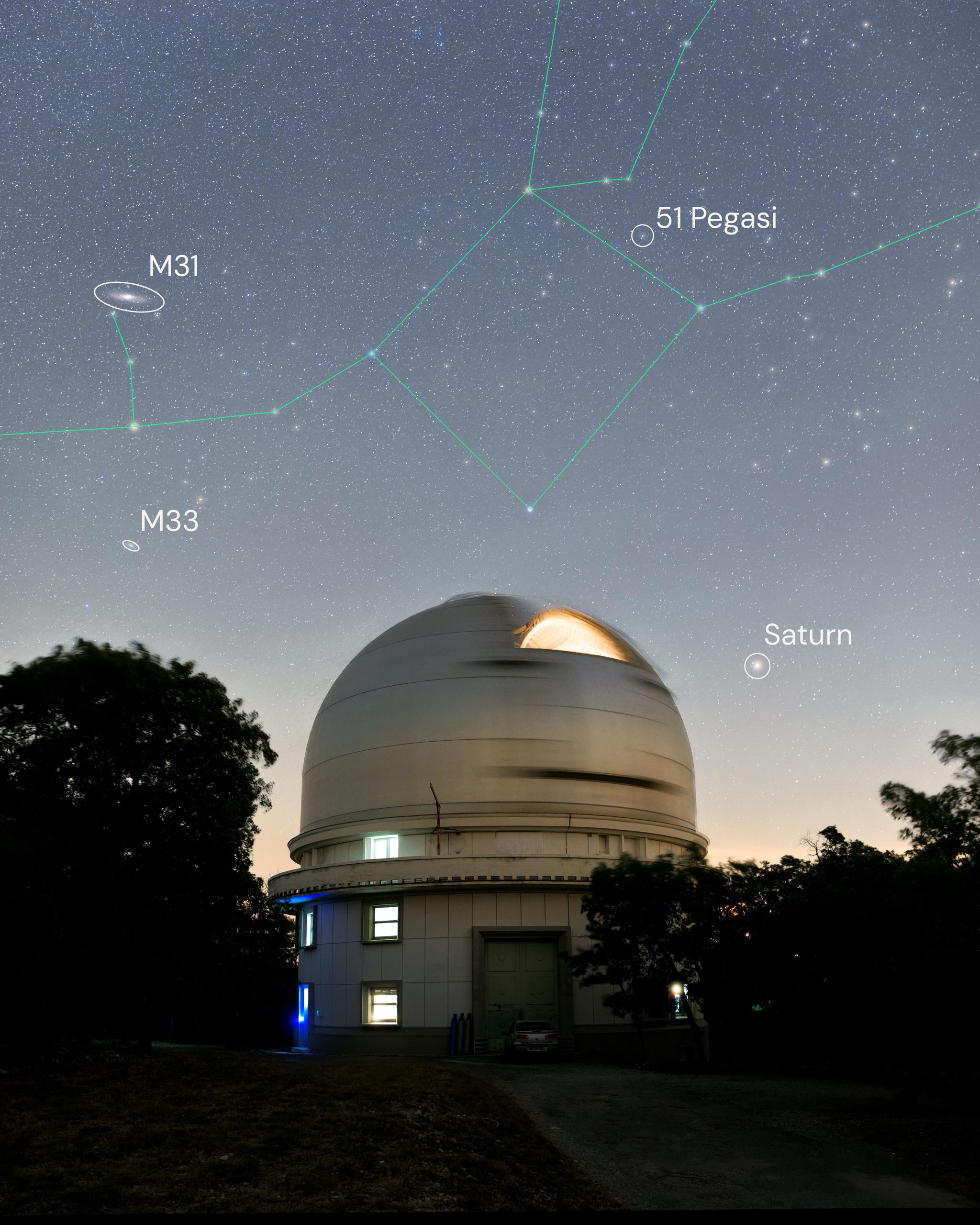
Alt...
2025 October 10
50 Light-years to 51 Pegasi
* Image Credit & Copyright: José Rodrigues
Explanation:
It's only 50 light-years to 51 Pegasi. That star's position is indicated in this snapshot from August 2025, taken on a night with mostly brighter stars visible above the dome at Observatoire de Haute-Provence in France. Thirty years ago, in October of 1995, astronomers Michel Mayor and Didier Queloz announced a profound discovery made at the observatory. Using a precise spectrograph they had detected a planet orbiting 51 Peg, the first known exoplanet orbiting a sun-like star. Mayor and Queloz had used the spectrograph to measure changes in the star's radial velocity, a regular wobble caused by the gravitational tug of the orbiting planet. Designated 51 Pegasi b, the planet was determined to have a mass at least half of Jupiter's mass and an orbital period of 4.2 days. That made the exoplanet much closer to its parent star than Mercury is to the Sun. Their discovery was quickly confirmed and Mayor and Queloz were ultimately awarded the Nobel Prize in physics in 2019. Now recognized as the prototype for the class of exoplanets fondly known as hot Jupiters, 51 Pegasi b was formally named Dimidium, Latin for half, in 2015. Since its discovery 30 years ago, over 6,000 exoplanets have been found.
Authors & editors: Robert Nemiroff (MTU) & Jerry Bonnell (UMCP)
NASA Official: Amber Straughn Specific rights apply.
2025 October 9
The Jenga Moon
* Image Credit & Copyright: Mike Carroll
https://www.instagram.com/jerseyportraits/?hl=en
Explanation:
That big, bright, beautiful Full Moon you watched rise on the night of October 6 was the Harvest Moon. Famed in festival, story, and song, Harvest Moon is just the traditional name of the full moon nearest the time of the northern hemisphere's autumnal equinox. According to lore the name is a fitting one. Despite the diminishing daylight hours, as the growing season drew to a close in the north, farmers could harvest crops by the light of a full moon shining on from dusk to dawn. Later this year than usual, in 2025 October's Harvest Moon was also known to some as a supermoon, a term becoming a traditional name for a full moon near the time of lunar perigee. And this telephoto snapshot of the (almost) full moon rising above a conspicuous skyscraper in New York city, taken on October 5, is suggestive of yet another full moon moniker.
https://science.nasa.gov/moon/supermoons/
https://en.wikipedia.org/wiki/56_Leonard_Street
https://en.wikipedia.org/wiki/56_Leonard_Street
#space #earth #moon #astrophotography #photography #science #astronomy #nature #NASA #apod
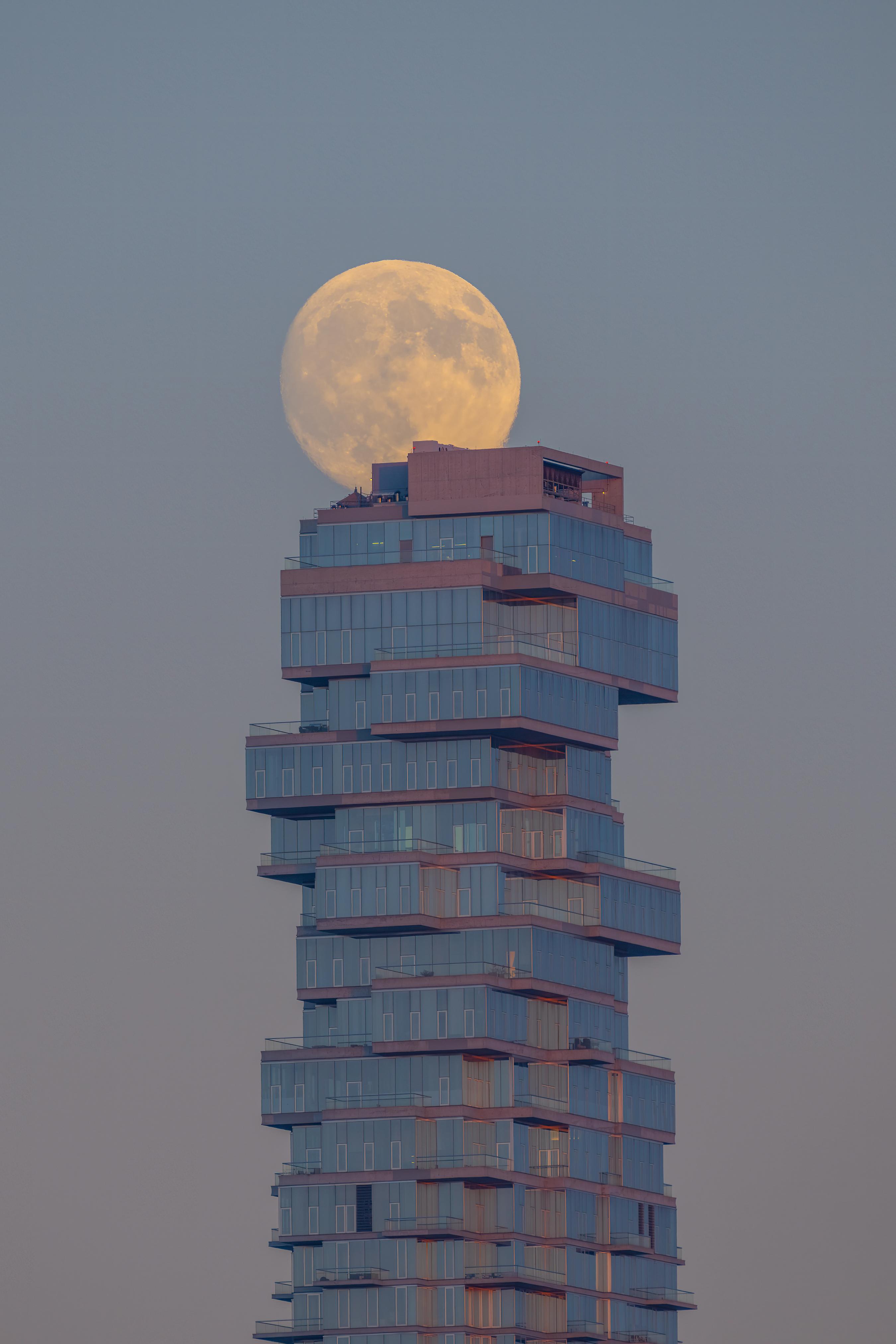
Alt...
2025 October 9
The Jenga Moon
* Image Credit & Copyright: Mike Carroll
Explanation:
That big, bright, beautiful Full Moon you watched rise on the night of October 6 was the Harvest Moon. Famed in festival, story, and song, Harvest Moon is just the traditional name of the full moon nearest the time of the northern hemisphere's autumnal equinox. According to lore the name is a fitting one. Despite the diminishing daylight hours, as the growing season drew to a close in the north, farmers could harvest crops by the light of a full moon shining on from dusk to dawn. Later this year than usual, in 2025 October's Harvest Moon was also known to some as a supermoon, a term becoming a traditional name for a full moon near the time of lunar perigee. And this telephoto snapshot of the (almost) full moon rising above a conspicuous skyscraper in New York city, taken on October 5, is suggestive of yet another full moon moniker.
Authors & editors: Robert Nemiroff (MTU) & Jerry Bonnell (UMCP)
NASA Official: Amber Straughn Specific rights apply.
NASA Web Privacy, Accessibility, Notices;
A service of: ASD at NASA / GSFC,
NASA Science Activation
& Michigan Tech. U.
TOPIC> "Full Moon"
~*~
Above the Dock
Above the quiet dock in mid night,
Tangled in the tall mast’s corded height,
Hangs the moon. What seemed so far away
Is but a child’s balloon, forgotten after play.
T. E. Hulme
1883 –
1917
~*~
2025 July 12
Clouds and the Golden Moon
* Image Credit & Copyright:
https://www.instagram.com/alexsandromota805/p/DL8VjPIy8Ed/
Explanation:
As the Sun set, a bright Full Moon rose on July 10. Its golden light illuminates clouds drifting through southern hemisphere skies in this well-composed telephoto image from Conceição do Coité, Bahia, Brazil. The brightest lunar phase is captured here with both a short and long exposure. The two exposures were combined to reveal details of the lunar surface in bright moonlight and a subtle iridescence along the dramatically backlit cloudscape. Of course, July's Full Moon is a winter moon in the southern hemisphere. But in the north it's known to some as the Thunder Moon, likely a nod to the sounds of this northern summer month's typically stormy weather.
https://www.instagram.com/alexsandromota805/p/DL8VjPIy8Ed/
https://moon.nasa.gov/moon-observation/daily-moon-guide/?intent=021
https://apod.nasa.gov/apod/archivepix.html
#space #moon #astrophotography #photography #science #nature #NASA
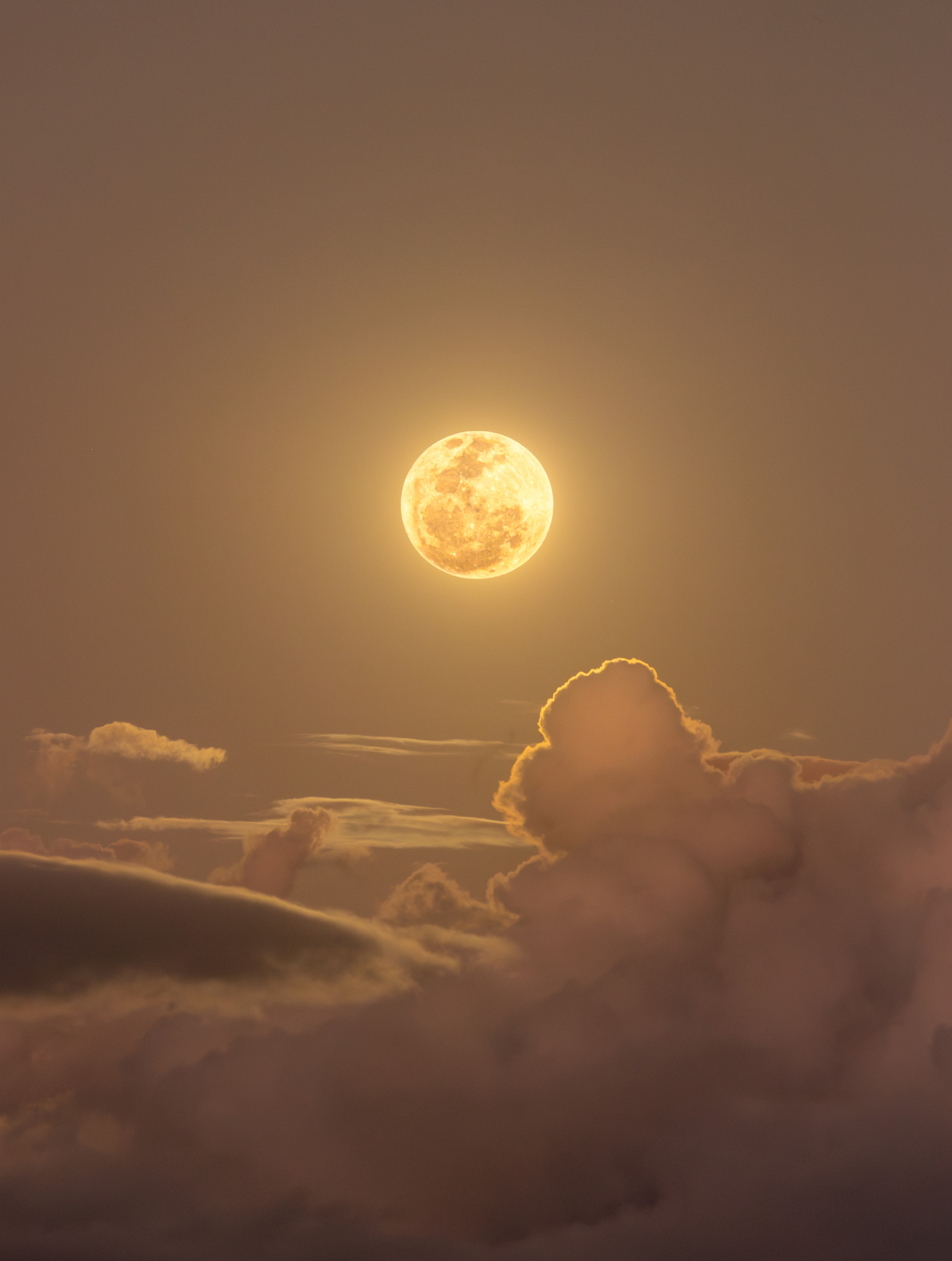
Alt...
2025 July 12
Clouds and the Golden Moon
* Image Credit & Copyright: Alexsandro Mota
Explanation:
As the Sun set, a bright Full Moon rose on July 10. Its golden light illuminates clouds drifting through southern hemisphere skies in this well-composed telephoto image from Conceição do Coité, Bahia, Brazil. The brightest lunar phase is captured here with both a short and long exposure. The two exposures were combined to reveal details of the lunar surface in bright moonlight and a subtle iridescence along the dramatically backlit cloudscape. Of course, July's Full Moon is a winter moon in the southern hemisphere. But in the north it's known to some as the Thunder Moon, likely a nod to the sounds of this northern summer month's typically stormy weather.
Authors & editors: Robert Nemiroff (MTU) & Jerry Bonnell (UMCP)
NASA Official: Amber Straughn Specific rights apply.
NASA Web Privacy, Accessibility, Notices;
A service of: ASD at NASA / GSFC,
NASA Science Activation
& Michigan Tech. U.
2024 August 24
South Pacific Shadowset
* Image Credit & Copyright: Jin Wang
Explanation:
The full Moon and Earth's shadow set together in this island skyscape. The alluring scene was captured Tuesday morning, August 20, from Fiji, South Pacific Ocean, planet Earth. For early morning risers shadowset in the western sky is a daily apparition. Still, the grey-blue shadow is often overlooked in favor of a brighter eastern horizon. Extending through the dense atmosphere, Earth's setting shadow is bounded above by a pinkish glow or anti-twilight arch. Known as the Belt of Venus, the arch's lovely color is due to backscattering of reddened light from the opposite horizon's rising Sun. Of course, the setting Moon's light is reddened by the long sight-line through the atmosphere. But on that date the full Moon could be called a seasonal Blue Moon, the third full Moon in a season with four full Moons. And even though the full Moon is always impressive near the horizon, August's full Moon is considered by some the first of four consecutive full Supermoons in 2024.
https://apod.nasa.gov/apod/ap240824.html
#space #earth #moon #atmosphere #astrophotography #photography #science #astronomy #nature #NASA
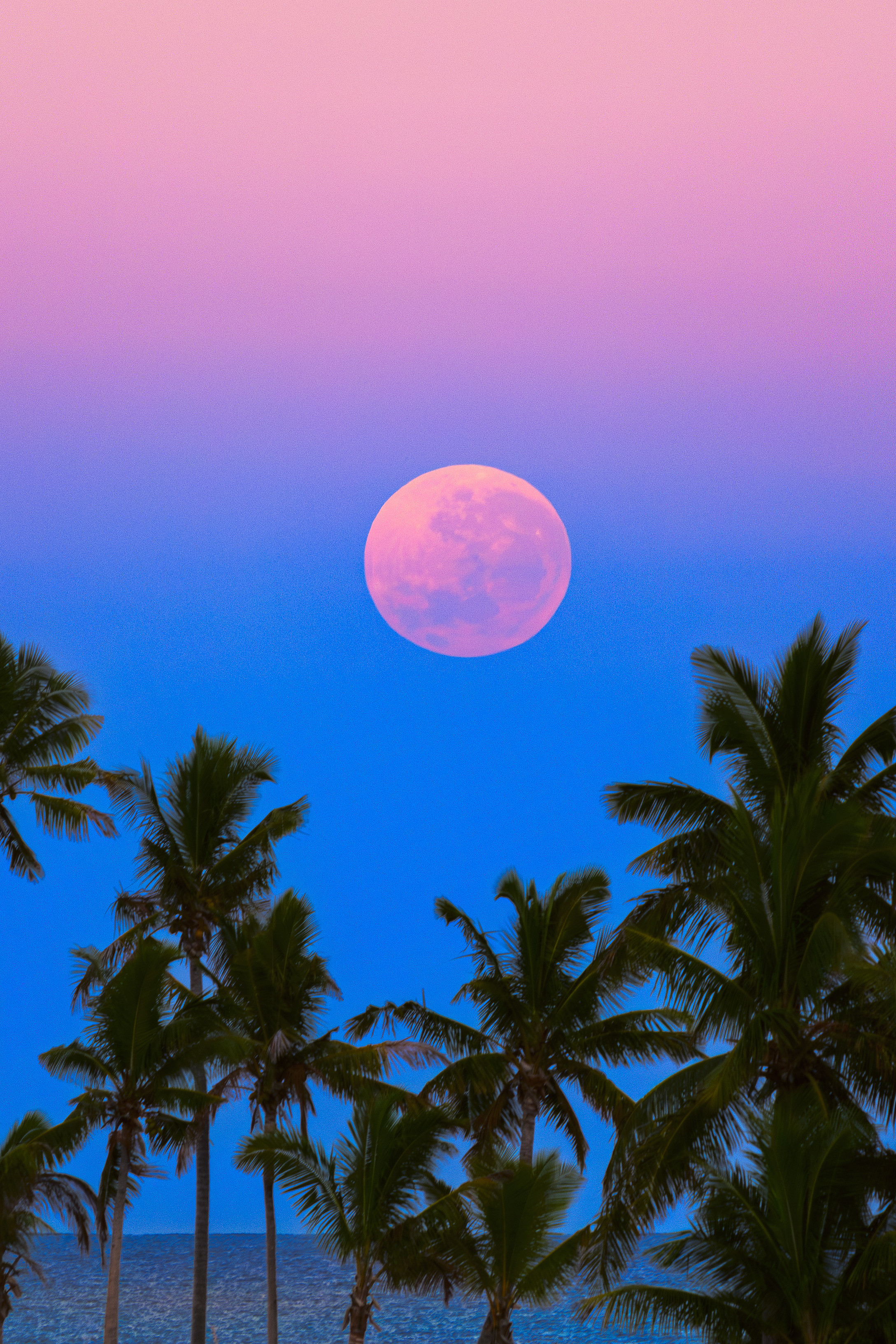
Alt...
2024 August 24
South Pacific Shadowset
* Image Credit & Copyright: Jin Wang
Explanation:
The full Moon and Earth's shadow set together in this island skyscape. The alluring scene was captured Tuesday morning, August 20, from Fiji, South Pacific Ocean, planet Earth. For early morning risers shadowset in the western sky is a daily apparition. Still, the grey-blue shadow is often overlooked in favor of a brighter eastern horizon. Extending through the dense atmosphere, Earth's setting shadow is bounded above by a pinkish glow or anti-twilight arch. Known as the Belt of Venus, the arch's lovely color is due to backscattering of reddened light from the opposite horizon's rising Sun. Of course, the setting Moon's light is reddened by the long sight-line through the atmosphere. But on that date the full Moon could be called a seasonal Blue Moon, the third full Moon in a season with four full Moons. And even though the full Moon is always impressive near the horizon, August's full Moon is considered by some the first of four consecutive full Supermoons in 2024.
Authors & editors: Robert Nemiroff (MTU) & Jerry Bonnell (UMCP)
NASA Official: Amber Straughn Specific rights apply.
NASA Web Privacy, Accessibility Notices
A service of: ASD at NASA / GSFC,
NASA Science Activation
& Michigan Tech. U.
2024 August 20
Supermoon Beyond the Temple of Poseidon
* Image Credit: Alexandros Maragos
https://www.instagram.com/p/C-3NZVEOdaV/
Explanation:
A supermoon occurred yesterday. And tonight's moon should also look impressive. Supermoons appear slightly larger and brighter than most full moons because they reach their full phase when slightly nearer to the Earth -- closer than 90 percent of all full moons. This supermoon was also a blue moon given the definition that it is the third of four full moons occurring during a single season. Blue moons are not usually blue, and a different definition holds that a blue moon is the second full moon that occurs during a single month. The featured image captured the blue supermoon right near its peak size yesterday as it was rising beyond the Temple of Poseidon in Greece. This supermoon is particularly unusual in that it is the first of four successive supermoons, the next three occurring in September, October, and November.
https://apod.nasa.gov/apod/ap240820.html
#space #earth #moon #atmosphere #astrophotography #photography #science #astronomy #nature #NASA
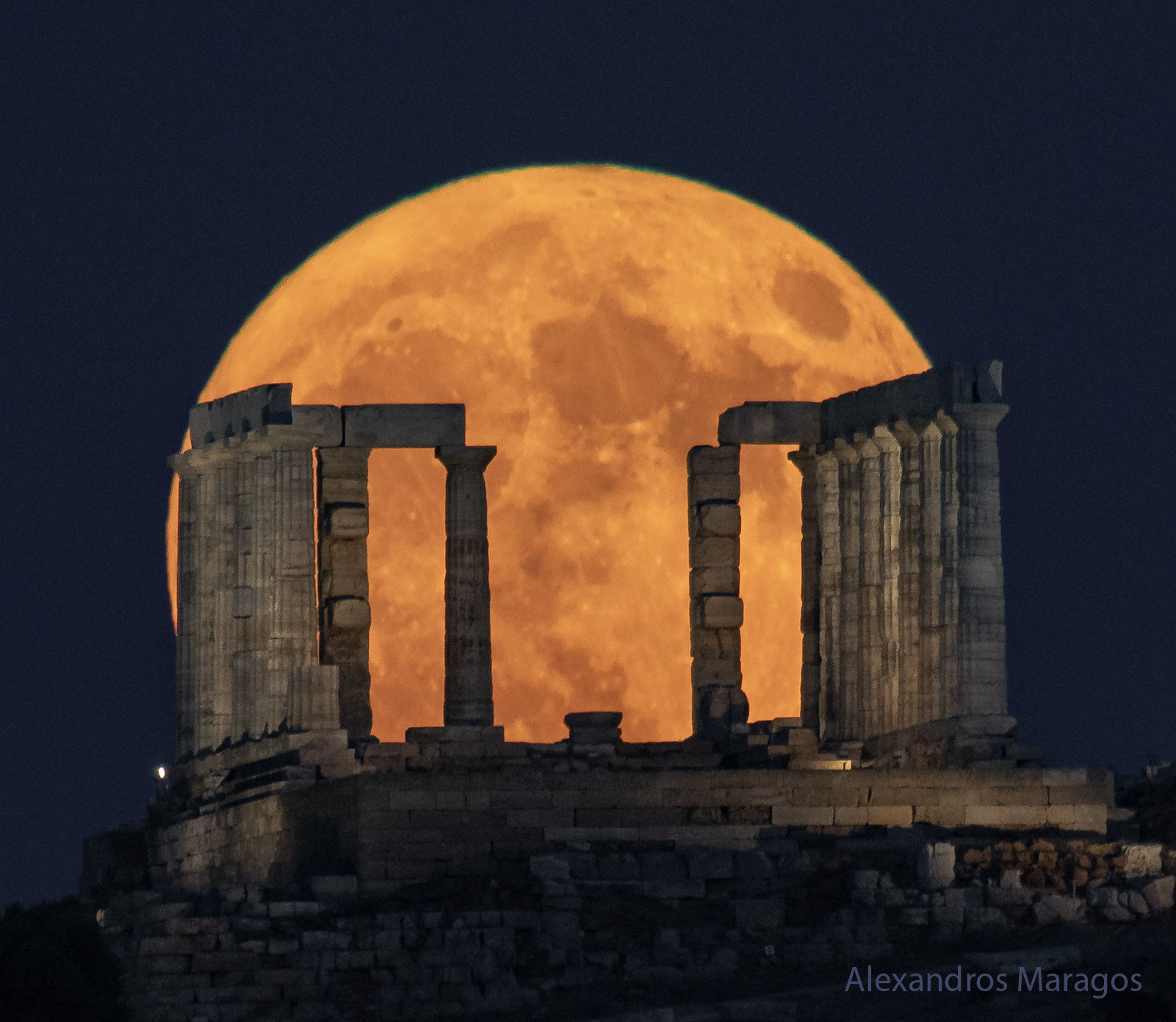
Alt...
2024 August 20
A large and orange-tinted moon is pictured rising beyond the pillars of an ancient structure. The foreground is dark and the night sky behind the Moon appear blue.
Supermoon Beyond the Temple of Poseidon
* Image Credit: Alexandros Maragos
Explanation:
A supermoon occurred yesterday. And tonight's moon should also look impressive. Supermoons appear slightly larger and brighter than most full moons because they reach their full phase when slightly nearer to the Earth -- closer than 90 percent of all full moons. This supermoon was also a blue moon given the definition that it is the third of four full moons occurring during a single season. Blue moons are not usually blue, and a different definition holds that a blue moon is the second full moon that occurs during a single month. The featured image captured the blue supermoon right near its peak size yesterday as it was rising beyond the Temple of Poseidon in Greece. This supermoon is particularly unusual in that it is the first of four successive supermoons, the next three occurring in September, October, and November.
Authors & editors: Robert Nemiroff (MTU) & Jerry Bonnell (UMCP)
NASA Official: Amber Straughn Specific rights apply.
NASA Web Privacy, Accessibility, Notices;
A service of: ASD at NASA / GSFC,
NASA Science Activation
& Michigan Tech. U.
2024 June 20
Sandy and the Moon Halo
* Image Credit & Copyright: Marcella Giulia Pace
https://greenflash.photo/about-me/
Explanation:
Last Year April's Full Moon shines through high clouds near the horizon, casting shadows in this garden-at-night skyscape. Along with canine sentinel Sandy watching the garden gate, the wide-angle snapshot also captured the bright Moon's 22 degree ice halo.
https://apod.nasa.gov/apod/ap240620.html
#space #earth #moon #atmosphere #astrophotography #photography #science #astronomy #nature #NASA
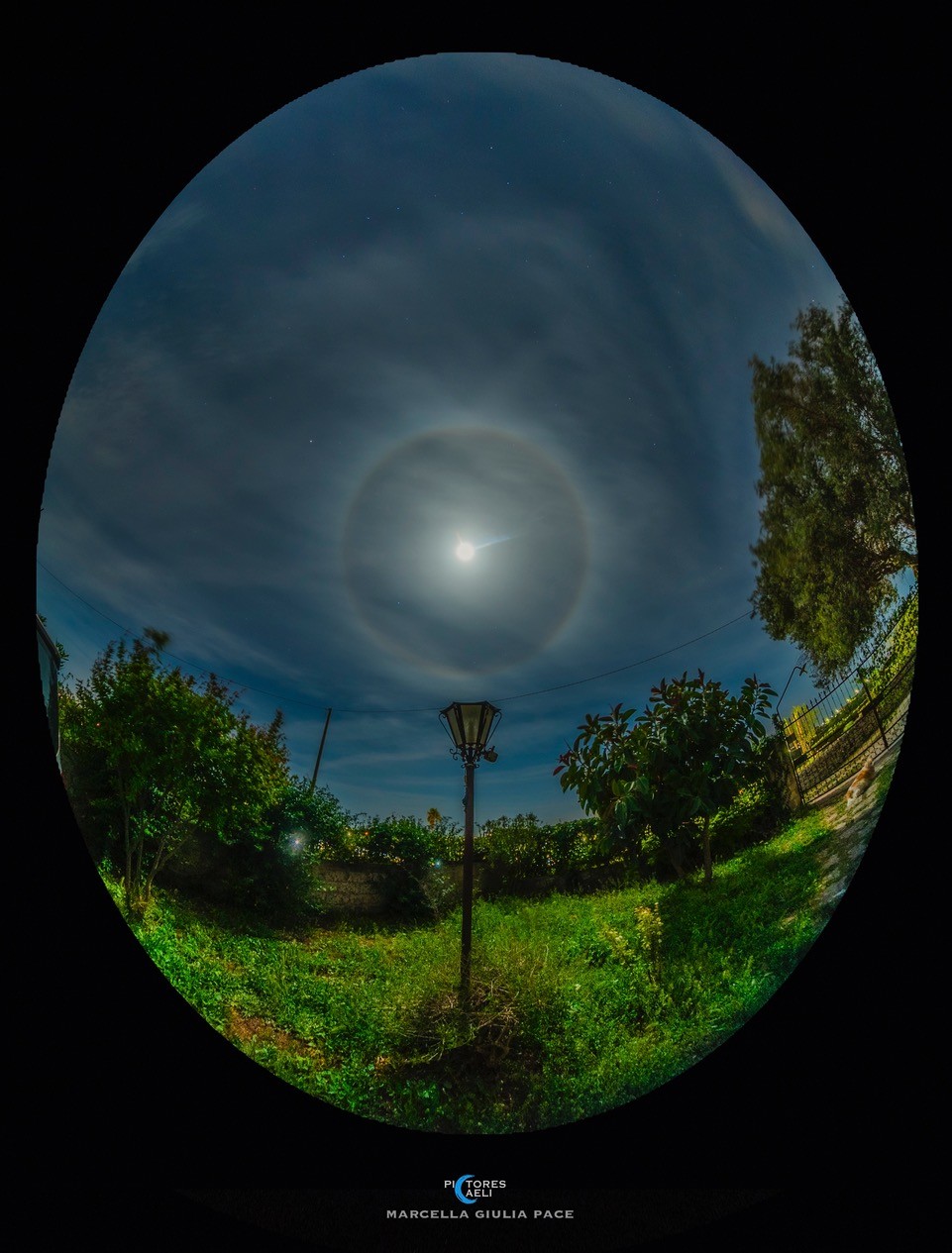
Alt...
2024 June 20
Sandy and the Moon Halo
* Image Credit & Copyright: Marcella Giulia Pace
Explanation:
Last Year April's Full Moon shines through high clouds near the horizon, casting shadows in this garden-at-night skyscape. Along with canine sentinel Sandy watching the garden gate, the wide-angle snapshot also captured the bright Moon's 22 degree ice halo.
Authors & editors: Robert Nemiroff (MTU) & Jerry Bonnell (UMCP)
NASA Official: Amber Straughn Specific rights apply.
NASA Web Privacy, Accessibility Notices
A service of: ASD at NASA / GSFC,
NASA Science Activation
& Michigan Tech. U.
2024 January 27
Full Observatory Moon
* Image Credit & Copyright: Yuri Beletsky (Carnegie Las Campanas Observatory, TWAN)
https://www.instagram.com/yuribeletsky/
https://carnegiescience.edu/
https://www.lco.cl/
Explanation:
A popular name for (2024) January's full moon in the northern hemisphere is the Full Wolf Moon. As the new year's first full moon, it rises over Las Campanas Observatory in this dramatic Earth-and-moonscape. Peering from the foreground like astronomical eyes are the observatory's twin 6.5 meter diameter Magellan telescopes. The snapshot was captured with telephoto lens across rugged terrain in the Chilean Atacama Desert, taken at a distance of about 9 miles from the observatory and about 240,000 miles from the lunar surface. Of course the first full moon of the lunar new year, known to some as the Full Snow Moon, will rise on February 24.
https://apod.nasa.gov/apod/ap240127.html
#space #earth #moon #atmosphere #astrophotography #photography #science #astronomy #nature #NASA
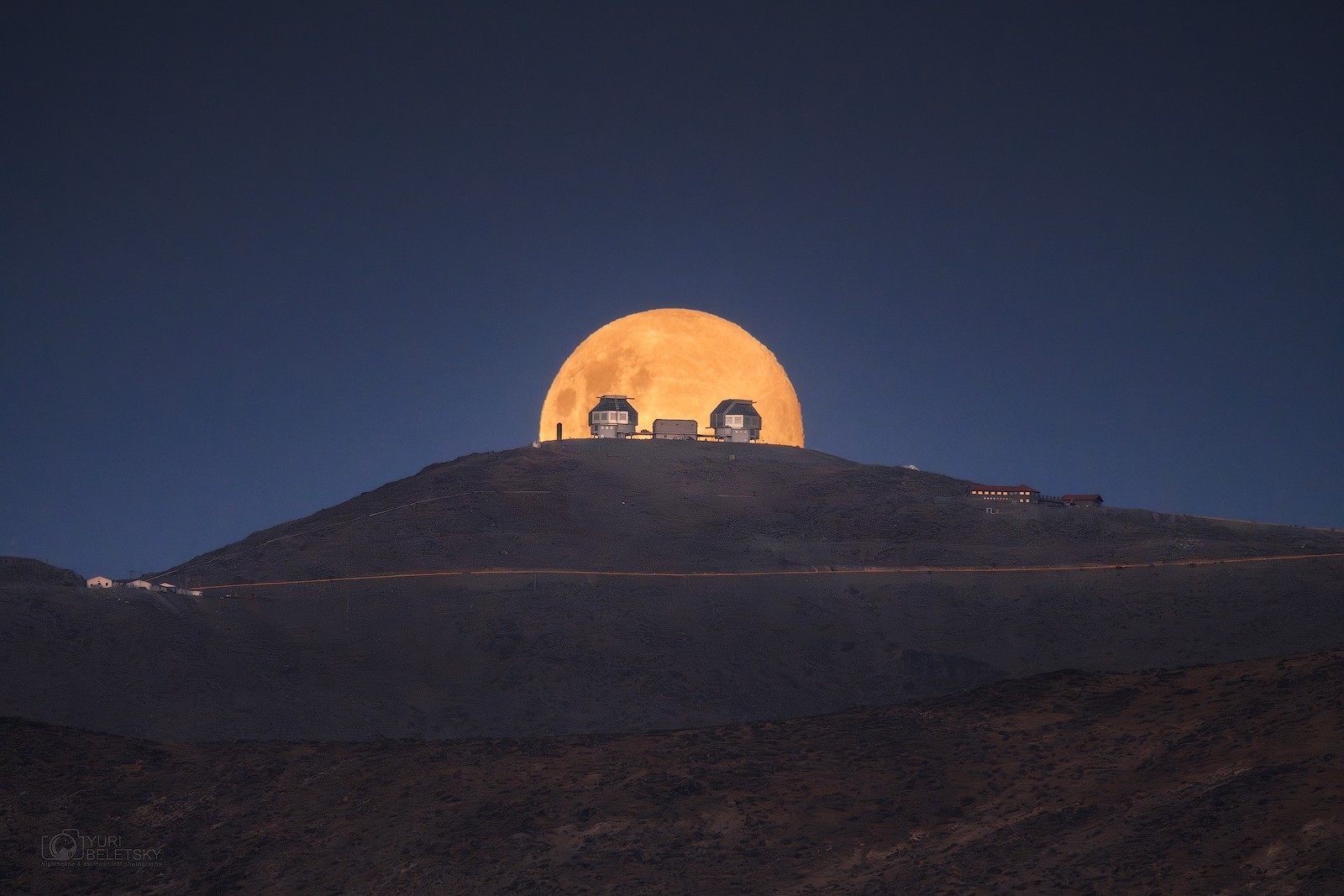
Alt...
2024 January 27
Full Observatory Moon
* Image Credit & Copyright: Yuri Beletsky (Carnegie Las Campanas Observatory, TWAN)
Explanation:
A popular name for (2024) January's full moon in the northern hemisphere is the Full Wolf Moon. As the new year's first full moon, it rises over Las Campanas Observatory in this dramatic Earth-and-moonscape. Peering from the foreground like astronomical eyes are the observatory's twin 6.5 meter diameter Magellan telescopes. The snapshot was captured with telephoto lens across rugged terrain in the Chilean Atacama Desert, taken at a distance of about 9 miles from the observatory and about 240,000 miles from the lunar surface. Of course the first full moon of the lunar new year, known to some as the Full Snow Moon, will rise on February 24.
Authors & editors: Robert Nemiroff (MTU) & Jerry Bonnell (UMCP)
NASA Official: Amber Straughn Specific rights apply.
NASA Web Privacy Policy and Important Notices
A service of: ASD at NASA / GSFC,
NASA Science Activation
& Michigan Tech. U.
2024 January 2
Rocket Transits Rippling Moon
* Image Credit & Copyright: Steven Madow
https://www.instagram.com/stevenmadow/
Explanation:
Can a rocket make the Moon ripple? No, but it can make a background moon appear wavy. The rocket, in this case, was a SpaceX Falcon Heavy that blasted off from NASA's Kennedy Space Center last week. In the featured launch picture, the rocket's exhaust plume glows beyond its projection onto the distant, rising, and nearly full moon. Oddly, the Moon's lower edge shows unusual drip-like ripples. The Moon itself, far in the distance, was really unchanged. The physical cause of these apparent ripples was pockets of relatively hot or rarefied air deflecting moonlight less strongly than pockets of relatively cool or compressed air: refraction. Although the shot was planned, the timing of the launch had to be just right for the rocket to be transiting the Moon during this single exposure.
https://apod.nasa.gov/apod/ap240102.html
#space #earth #moon #atmosphere #astrophotography #photography #science #astronomy #nature #NASA
Alt...
2024 January 2
A rocket is pictured ascending during launch. A nearly full moon is behind it. The rocket exhaust, itself visible, causes the bottom of the Moon to appear unusually rippled.
Rocket Transits Rippling Moon
* Image Credit & Copyright: Steven Madow
Explanation:
Can a rocket make the Moon ripple? No, but it can make a background moon appear wavy. The rocket, in this case, was a SpaceX Falcon Heavy that blasted off from NASA's Kennedy Space Center last week. In the featured launch picture, the rocket's exhaust plume glows beyond its projection onto the distant, rising, and nearly full moon. Oddly, the Moon's lower edge shows unusual drip-like ripples. The Moon itself, far in the distance, was really unchanged. The physical cause of these apparent ripples was pockets of relatively hot or rarefied air deflecting moonlight less strongly than pockets of relatively cool or compressed air: refraction. Although the shot was planned, the timing of the launch had to be just right for the rocket to be transiting the Moon during this single exposure.
Authors & editors: Robert Nemiroff (MTU) & Jerry Bonnell (UMCP)
NASA Official: Ryan Smallcomb Specific rights apply.
NASA Web Privacy Policy and Important Notices
A service of: ASD at NASA / GSFC,
NASA Science Activation
& Michigan Tech. U.
2023 December 30
The Persistence of Moonlight
* Image Credit & Copyright: Giacomo Venturin
Explanation:
Known to some in the northern hemisphere as December's Cold Moon or the Long Night Moon, the last full moon of 2023 is rising in this surreal mountain and skyscape. The Daliesque scene was captured in a single exposure with a camera and long telephoto lens near Monte Grappa, Italy. The full moon is not melting, though. Its stretched and distorted appearance near the horizon is caused as refraction along the line of sight changes and creates shifting images or mirages of the bright lunar disk. The changes in atmospheric refraction correspond to atmospheric layers with sharply different temperatures and densities. Other effects of atmospheric refraction produced by the long sight-line to this full moon rising include the thin red rim seen faintly on the distorted lower edge of the Moon and a thin green rim along the top.
https://apod.nasa.gov/apod/ap231230.html
#space #earth #moon #atmosphere #astrophotography #photography #science #astronomy #nature #NASA
Alt...
2023 December 30
The Persistence of Moonlight
* Image Credit & Copyright: Giacomo Venturin
Explanation:
Known to some in the northern hemisphere as December's Cold Moon or the Long Night Moon, the last full moon of 2023 is rising in this surreal mountain and skyscape. The Daliesque scene was captured in a single exposure with a camera and long telephoto lens near Monte Grappa, Italy. The full moon is not melting, though. Its stretched and distorted appearance near the horizon is caused as refraction along the line of sight changes and creates shifting images or mirages of the bright lunar disk. The changes in atmospheric refraction correspond to atmospheric layers with sharply different temperatures and densities. Other effects of atmospheric refraction produced by the long sight-line to this full moon rising include the thin red rim seen faintly on the distorted lower edge of the Moon and a thin green rim along the top.
Authors & editors: Robert Nemiroff (MTU) & Jerry Bonnell (UMCP)
NASA Official: Phillip Newman Specific rights apply.
NASA Web Privacy Policy and Important Notices
A service of: ASD at NASA / GSFC,
NASA Science Activation
& Michigan Tech. U.
2023 September 30
A Harvest Moon over Tuscany
* Image Credit & Copyright: Antonio Tartarini
Explanation:
For northern hemisphere dwellers, September's Full Moon was the Harvest Moon. Reflecting warm hues at sunset, it rises behind cypress trees huddled on a hill top in Tuscany, Italy in this telephoto view from September 28. Famed in festival, story, and song, Harvest Moon is just the traditional name of the full moon nearest the autumnal equinox. According to lore the name is a fitting one. Despite the diminishing daylight hours as the growing season drew to a close, farmers could harvest crops by the light of a full moon shining on from dusk to dawn. This Harvest Moon was also known to some as a supermoon, a term becoming a traditional name for a full moon near perigee. It was the fourth and final supermoon for 2023.
https://earthsky.org/astronomy-essentials/harvest-moon-2/
https://apod.nasa.gov/apod/ap230930.html
#space #earth #moon #atmosphere #astrophotography #photography #science #astronomy #nature #NASA
Alt...
2023 September 30
A Harvest Moon over Tuscany
* Image Credit & Copyright: Antonio Tartarini
Explanation:
For northern hemisphere dwellers, September's Full Moon was the Harvest Moon. Reflecting warm hues at sunset, it rises behind cypress trees huddled on a hill top in Tuscany, Italy in this telephoto view from September 28. Famed in festival, story, and song, Harvest Moon is just the traditional name of the full moon nearest the autumnal equinox. According to lore the name is a fitting one. Despite the diminishing daylight hours as the growing season drew to a close, farmers could harvest crops by the light of a full moon shining on from dusk to dawn. This Harvest Moon was also known to some as a supermoon, a term becoming a traditional name for a full moon near perigee. It was the fourth and final supermoon for 2023.
Authors & editors: Robert Nemiroff (MTU) & Jerry Bonnell (UMCP)
NASA Official: Phillip Newman Specific rights apply.
NASA Web Privacy Policy and Important Notices
A service of: ASD at NASA / GSFC,
NASA Science Activation
& Michigan Tech. U.
"So really... on the way back to the peak of normal I say "Good Night" for today with this composition of Mars and the Moon, I dream of a mandolin, like AJ Lee's but everything in its time.. I am happy that several friends of mine were convinced to meet 1 time a week for house music after the summer holidays. Making music together is something great and gives so much strength for everyday life, doesn't it? The Brothers Comatose & AJ Lee (previous post) are an inspiring example!"
2022 December 15
Full Moon, Full Mars
* Image Credit & Copyright: Tomas Slovinsky
https://www.tomasslovinsky.com/#about
Explanation:
On (2022) December 8 a full Moon and a full Mars were close, both bright and opposite the Sun in planet Earth's sky. In fact Mars was occulted, passing behind the Moon when viewed from some locations across Europe and North America. Seen from the city of Kosice in eastern Slovakia, the lunar occultation of Mars happened just before sunrise. The tantalizing spectacle was recorded in this telescopic timelapse sequence of exposures. It took about an hour for the Red Planet to disappear behind the lunar disk and then reappear as a warm-hued full Moon, the last full Moon of 2022, sank toward the western horizon. The next lunar occultation of bright planet Mars will be in the new year on January 3, when the Moon is in a waxing gibbous phase. Lunar occultations are only ever visible from a fraction of the Earth's surface, though. The January 3 occultation of Mars will be visible from parts of the South Atlantic, southern Africa, and the Indian Ocean.
https://apod.nasa.gov/apod/ap221215.html
#space #earth #moon #atmosphere #astrophotography #photography #science #astronomy #nature #NASA #SilentSunsday
Alt...
2022 December 15
Full Moon, Full Mars
* Image Credit & Copyright: Tomas Slovinsky
Explanation:
On (2022) December 8 a full Moon and a full Mars were close, both bright and opposite the Sun in planet Earth's sky. In fact Mars was occulted, passing behind the Moon when viewed from some locations across Europe and North America. Seen from the city of Kosice in eastern Slovakia, the lunar occultation of Mars happened just before sunrise. The tantalizing spectacle was recorded in this telescopic timelapse sequence of exposures. It took about an hour for the Red Planet to disappear behind the lunar disk and then reappear as a warm-hued full Moon, the last full Moon of 2022, sank toward the western horizon. The next lunar occultation of bright planet Mars will be in the new year on January 3, when the Moon is in a waxing gibbous phase. Lunar occultations are only ever visible from a fraction of the Earth's surface, though. The January 3 occultation of Mars will be visible from parts of the South Atlantic, southern Africa, and the Indian Ocean.
Authors & editors: Robert Nemiroff (MTU) & Jerry Bonnell (UMCP)
NASA Official: Phillip Newman Specific rights apply.
NASA Web Privacy Policy and Important Notices
A service of: ASD at NASA / GSFC,
NASA Science Activation
& Michigan Tech. U.