Search results for tag #nasa
![[?]](https://files.defcon.social/dcsocial-s3/accounts/avatars/113/208/344/507/078/943/original/014820ad22daee1c.jpg)
A zoom into the center of NGC 1300 that reveals the fine details captured by Hubble's Advanced Camera for Surveys across the spiral arms, and dust lanes in the disk and bar.
Credit:
NASA, ESA, and G. Bacon (STScI); Acknowledgment: NASA, ESA, A. Fujii, Digitized Sky Survey (DSS), STScI/AURA, Palomar/Caltech, and UKSTU/AAO, and the Hubble Heritage Team (STScI/AURA)
#space #galaxy #astrophotography #photography #science #astronomy #nature #NASA
Messier 63
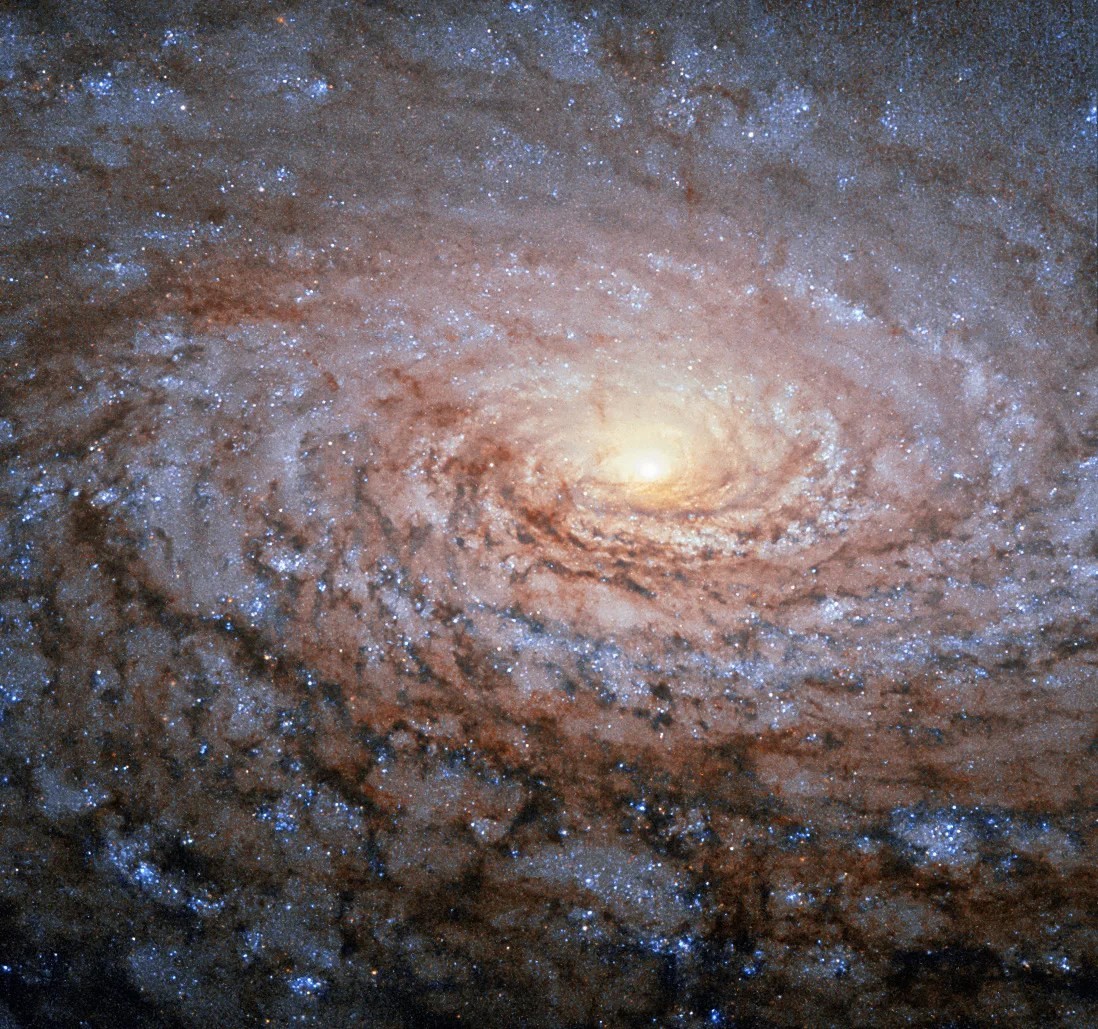
This flocculent galaxy is a type of spiral without well defined spiral arms.
Star formation is one of the most important processes in shaping the universe. In addition to birthing new stars, it gives rise to planetary systems and plays a pivotal role in the evolution of galaxies. Yet there is still much that astronomers do not understand about this fundamental process. The driving force behind star formation is particularly unclear for a type of galaxy called a flocculent spiral. Unlike grand-design spiral galaxies, flocculent spiral galaxies do not have well defined spiral arms. Instead, they appear to have many discontinuous arms.
M63, also known as the Sunflower galaxy, is one such flocculent spiral galaxy. Although it only has two arms, many appear to be winding around its yellow core in this image captured by Hubble. The arms shine with the radiation from recently formed blue stars and can be more clearly seen in infrared observations. By imaging flocculent spiral galaxies like M63, astronomers hope to gain a better understanding of how stars form in such systems.
The Sunflower galaxy was discovered in 1779 by the French astronomer Pierre Méchain and was the first of 24 objects that Méchain would contribute to Charles Messier’s catalog. The galaxy is located roughly 27 million light-years from Earth in the constellation Canes Venatici. It has an apparent magnitude of 9.3 and appears as a faint patch of light in small telescopes. The best time to observe M63 is during May.
Credit:
ESA/Hubble & NASA
#space #galaxy #astrophotography #photography #science #astronomy #nature #NASA #ESA
Alt...
The arrangement of the spiral arms in the galaxy Messier 63, seen here in a new image from the NASA/ESA Hubble Space Telescope, recall the pattern at the centre of a sunflower. So the nickname for this cosmic object — the Sunflower Galaxy — is no coincidence. Discovered by Pierre Mechain in 1779, the galaxy later made it as the 63rd entry into fellow French astronomer Charles Messier’s famous catalogue, published in 1781. The two astronomers spotted the Sunflower Galaxy’s glow in the small, northern constellation Canes Venatici (the Hunting Dogs). We now know this galaxy is about 27 million light-years away and belongs to the M51 Group — a group of galaxies, named after its brightest member, Messier 51, another spiral-shaped galaxy dubbed the Whirlpool Galaxy. Galactic arms, sunflowers and whirlpools are only a few examples of nature’s apparent preference for spirals. For galaxies like Messier 63 the winding arms shine bright because of the presence of recently formed, blue–white giant stars, readily seen in this Hubble image.
Credit:
ESA/Hubble & NASA
Messier 64
This dusty galaxy is also known as the "Black Eye" or "Evil Eye" galaxy.
Easily identified by the spectacular band of dark dust that partially obscures its bright core, Messier 64, or the Black Eye Galaxy, is characterized by its bizarre internal motion. The gas in the outer regions of this spiral galaxy is rotating in the opposite direction from the gas and stars in its inner regions. This strange behavior may be the result of a merger between M64 and a satellite galaxy over a billion years ago.
New stars are forming in the region where the oppositely rotating gases collide, are compressed, and then contract. Particularly noticeable in this stunning Hubble image of the galaxy’s core are recently formed hot, blue stars and pink clouds of glowing hydrogen gas that fluoresce when exposed to ultraviolet light from the newly-formed stars.
English astronomer Edward Pigott first spotted M64 in March of 1719, just 12 days before German astronomer Johann Elert Bode, and roughly a year before Charles Messier independently rediscovered it in March of 1780. The galaxy is located 17 million light-years from Earth in the constellation Coma Berenices. The best time of year to look for the Black Eye Galaxy is May. Its apparent magnitude of 9.8 requires a moderately sized telescope and dark sky site.
This dusty galaxy is also known as the "Black Eye" or "Evil Eye" galaxy.
Credit:
NASA and the Hubble Heritage Team (AURA/STScI); Acknowledgment: S. Smartt (Institute of Astronomy) and D. Richstone (U. Michigan)
#space #galaxy #astrophotography #photography #science #astronomy #nature #NASA #ESA

Alt...
This image taken with the Hubble Space Telescope features NGC 4826, otherwise known as M64— a spiral galaxy located 17 million light-years away in the constellation of Coma Berenices (Berenice’s Hair). This galaxy is often referred to as the “Black Eye” or “Evil Eye” Galaxy because of the dark band of dust that sweeps across one side of its bright nucleus. M64 is known by astronomers for its strange internal motion.
Credit:
NASA and the Hubble Heritage Team (AURA/STScI); Acknowledgment: S. Smartt (Institute of Astronomy) and D. Richstone (U. Michigan)
M74M74
Phantom Galaxy across the spectrum
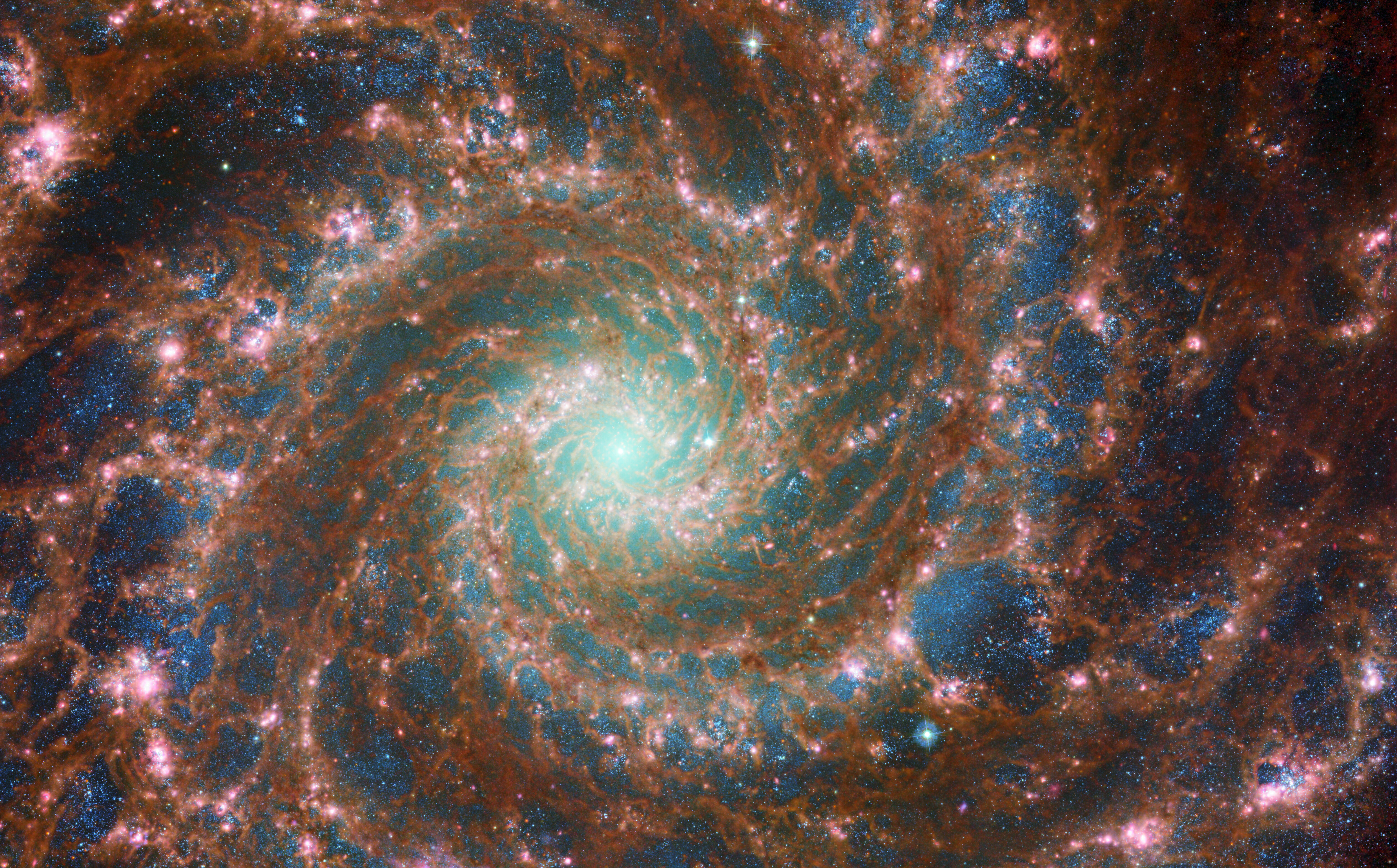
The Phantom Galaxy is around 32 million light-years away from Earth in the constellation Pisces, and lies almost face-on to Earth. This, coupled with its well-defined spiral arms, makes it a favourite target for astronomers studying the origin and structure of galactic spirals.
M74 is a particular class of spiral galaxy known as a ‘grand design spiral’, meaning that its spiral arms are prominent and well-defined, unlike the patchy and ragged structure seen in some spiral galaxies.
With Hubble’s venerable Advanced Camera for Surveys (ACS) and Webb’s powerful Mid-InfraRed Instrument (MIRI) capturing a range of wavelengths, this new image has remarkable depth. The red colours mark dust threaded through the arms of the galaxy, lighter oranges being areas of hotter dust. The young stars throughout the arms and the nuclear core are picked out in blue. Heavier, older stars towards the galaxy’s centre are shown in cyan and green, projecting a spooky glow from the core of the Phantom Galaxy. Bubbles of star formation are also visible in pink across the arms. Such a variety of galactic features is rare to see in a single image.
Scientists combine data from telescopes operating across the electromagnetic spectrum to truly understand astronomical objects. In this way, data from Hubble and Webb compliment each other to provide a comprehensive view of the spectacular M74 galaxy.
CREDIT
ESA/Webb, NASA & CSA, J. Lee and the PHANGS-JWST Team; ESA/Hubble & NASA, R. Chandar Acknowledgement: J. Schmidt
#space #galaxy #astrophotography #photography #science #astronomy #nature #NASA #ESA
Alt...
M74 shines at its brightest in this combined optical/mid-infrared image, featuring data from both the NASA/ESA Hubble Space Telescope and the NASA/ESA/CSA James Webb Space Telescope.
CREDIT
ESA/Webb, NASA & CSA, J. Lee and the PHANGS-JWST Team; ESA/Hubble & NASA, R. Chandar Acknowledgement: J. Schmidt
Multi-observatory views of M74
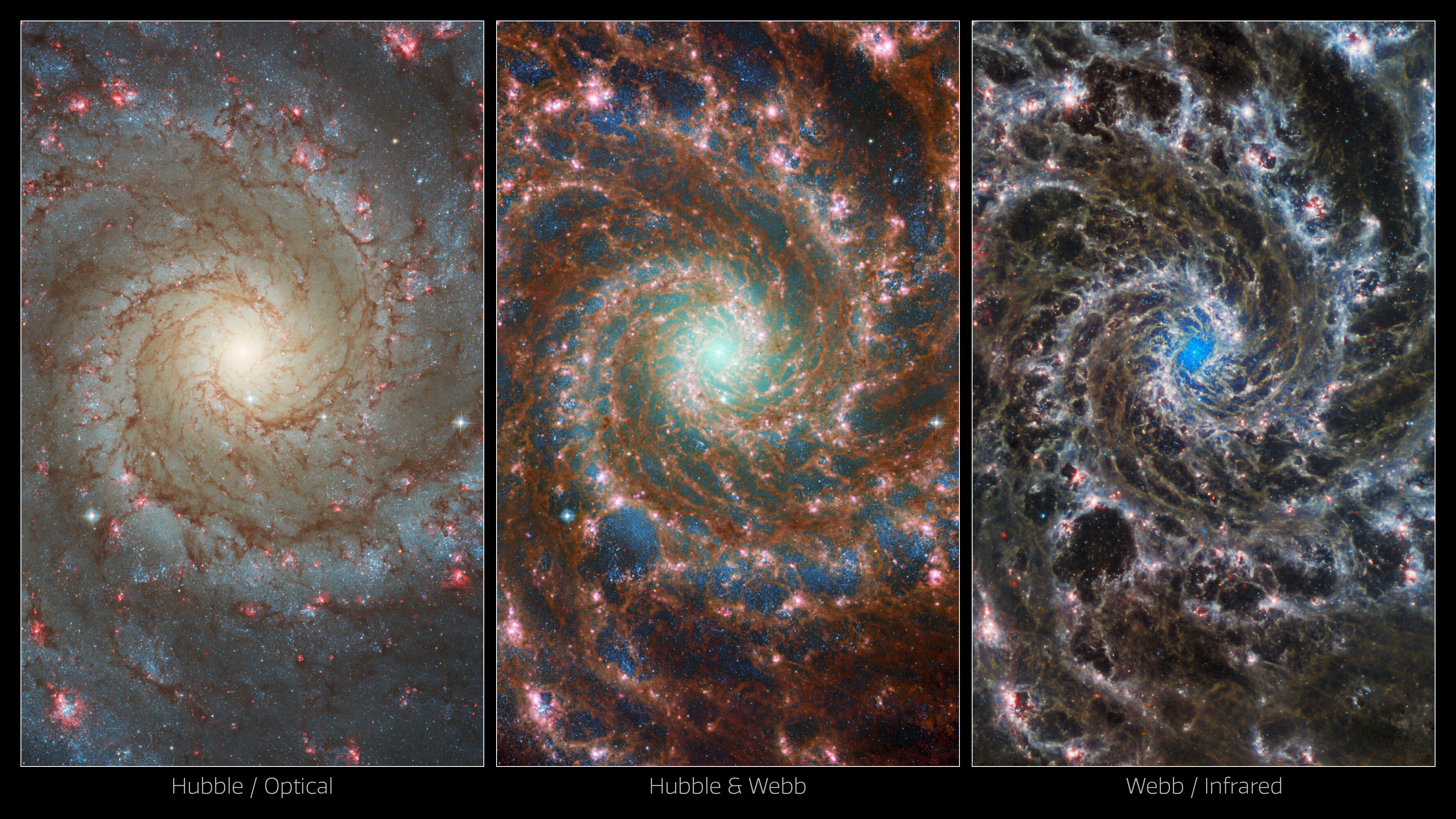
New images of the Phantom Galaxy, M74, showcase the power of space observatories working together in multiple wavelengths.
* see ALT-Text for more
Webb’s sharp vision has revealed delicate filaments of gas and dust in the grandiose spiral arms of M74, which wind outwards from the centre of the image. A lack of gas in the nuclear region also provides an unobscured view of the nuclear star cluster at the galaxy's centre.
Webb gazed into M74 with its Mid-InfraRed Instrument (MIRI) in order to learn more about the earliest phases of star formation in the local Universe. These observations are part of a larger effort to chart 19 nearby star-forming galaxies in the infrared by the international PHANGS collaboration. Those galaxies have already been observed using the NASA/ESA Hubble Space Telescope and ground-based observatories.
The addition of crystal-clear Webb observations at longer wavelengths will allow astronomers to pinpoint star-forming regions in the galaxies, accurately measure the masses and ages of star clusters, and gain insights into the nature of the small grains of dust drifting in interstellar space.
Hubble observations of M74 have revealed particularly bright areas of star formation known as HII regions. Hubble’s sharp vision at ultraviolet and visible wavelengths complements Webb’s unparalleled sensitivity at infrared wavelengths, as do observations from ground-based radio telescopes such as the Atacama Large Millimeter/submillimeter Array, ALMA.
By combining data from telescopes operating across the electromagnetic spectrum, scientists can gain greater insight into astronomical objects than by using a single observatory – even one as powerful as Webb!
CREDIT
ESA/Webb, NASA & CSA, J. Lee and the PHANGS-JWST Team; ESA/Hubble & NASA, R. Chandar Acknowledgement: J. Schmidt
#space #galaxy #astrophotography #photography #science #astronomy #nature #NASA #ESA
Alt...
New images of the Phantom Galaxy, M74, showcase the power of space observatories working together in multiple wavelengths.
On the left, the NASA/ESA Hubble Space Telescope’s view of the galaxy ranges from the older, redder stars towards the centre, to younger and bluer stars in its spiral arms, to the most active stellar formation in the red bubbles of H II regions. On the right, the NASA/ESA/CSA James Webb Space Telescope’s image is strikingly different, instead highlighting the masses of gas and dust within the galaxy’s arms, and the dense cluster of stars at its core. The combined image in the centre merges these two for a truly unique look at this “grand design” spiral galaxy.
Scientists combine data from telescopes operating across the electromagnetic spectrum to truly understand astronomical objects. In this way, data from Hubble and Webb compliment each other to provide a comprehensive view of the spectacular M74 galaxy.
CREDIT
ESA/Webb, NASA & CSA, J. Lee and the PHANGS-JWST Team; ESA/Hubble & NASA, R. Chandar Acknowledgement: J. Schmidt
07/11/2023
Euclid’s view of spiral galaxy IC 342
Over its lifetime, our dark Universe detective will image billions of galaxies, revealing the hidden influence that dark matter and dark energy have on them.
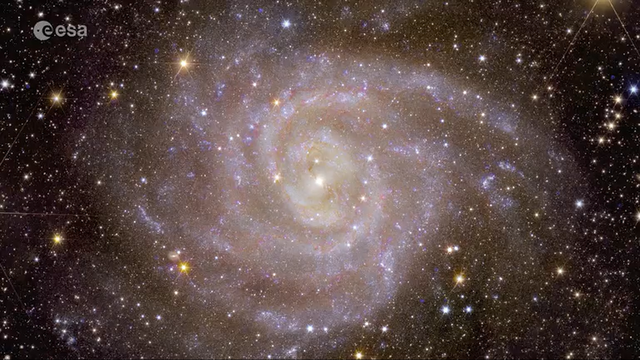
That’s why it’s fitting that one of the first galaxies that Euclid observed is nicknamed the ‘Hidden Galaxy’. This galaxy, also known as IC 342 or Caldwell 5, is difficult to observe because it lies behind the busy disc of our Milky Way, and so dust, gas and stars obscure our view.
Euclid could take this beautiful and sharp image thanks to its incredible sensitivity and superb optics. Most important here is that Euclid used its near-infrared instrument to peer through the dust and measure the light from the many cool and low-mass stars that dominate the galaxy's mass.
“That’s what is so brilliant about Euclid images. In one shot, it can see the whole galaxy in all its beautiful detail,” explains Euclid Consortium scientist Leslie Hunt of the National Institute for Astrophysics in Italy, on behalf of a broader team working on showcasing galaxies imaged by Euclid.
“This image might look normal, as if every telescope can make such an image, but that is not true. What’s so special here is that we have a wide view covering the entire galaxy, but we can also zoom in to distinguish single stars and star clusters. This makes it possible to trace the history of star formation and better understand how stars formed and evolved over the lifetime of the galaxy.”
CREDIT
ESA/Euclid/Euclid Consortium/NASA, image processing by J.-C. Cuillandre (CEA Paris-Saclay), G. Anselmi
#space #galaxy #astrophotography #photography #science #astronomy #nature #NASA #ESA
Alt...
Over its lifetime, our dark Universe detective will image billions of galaxies, revealing the hidden influence that dark matter and dark energy have on them.
That’s why it’s fitting that one of the first galaxies that Euclid observed is nicknamed the ‘Hidden Galaxy’. This galaxy, also known as IC 342 or Caldwell 5, is difficult to observe because it lies behind the busy disc of our Milky Way, and so dust, gas and stars obscure our view.
Euclid could take this beautiful and sharp image thanks to its incredible sensitivity and superb optics. Most important here is that Euclid used its near-infrared instrument to peer through the dust and measure the light from the many cool and low-mass stars that dominate the galaxy's mass.
CREDIT
ESA/Euclid/Euclid Consortium/NASA, image processing by J.-C. Cuillandre (CEA Paris-Saclay), G. Anselmi
IC 342
is located around 11 million light-years from Earth, very nearby our own galaxy (in astronomical distances). It is as large as the full Moon on the sky. And as a spiral galaxy, it is considered a look-alike of the Milky Way. “It is difficult to study our own galaxy as we are within it and can only see it edge on. So, by studying galaxies like IC 342, we can learn a lot about galaxies like our own,” adds Leslie.
Euclid is not the first to observe the Hidden Galaxy. The NASA/ESA Hubble Space Telescope has previously imaged its core. But until now it has been impossible to study the star-formation history of the entire galaxy. Additionally, scientists have already spotted many globular clusters in this image, some of which have not been previously identified.
Euclid will observe billions of similar but more distant galaxies, all distributed along a ‘cosmic web’ of dark matter filaments. In this way, it will provide a 3D view of the dark matter distribution in our Universe. The map of the distribution of galaxies over cosmic time will also teach us about dark energy, which accelerates the expansion of the Universe.
CREDIT
ESA/Euclid/Euclid Consortium/NASA, image processing by J.-C. Cuillandre (CEA Paris-Saclay), G. Anselmi
#space #galaxy #astrophotography #photography #science #astronomy #nature #NASA #ESA
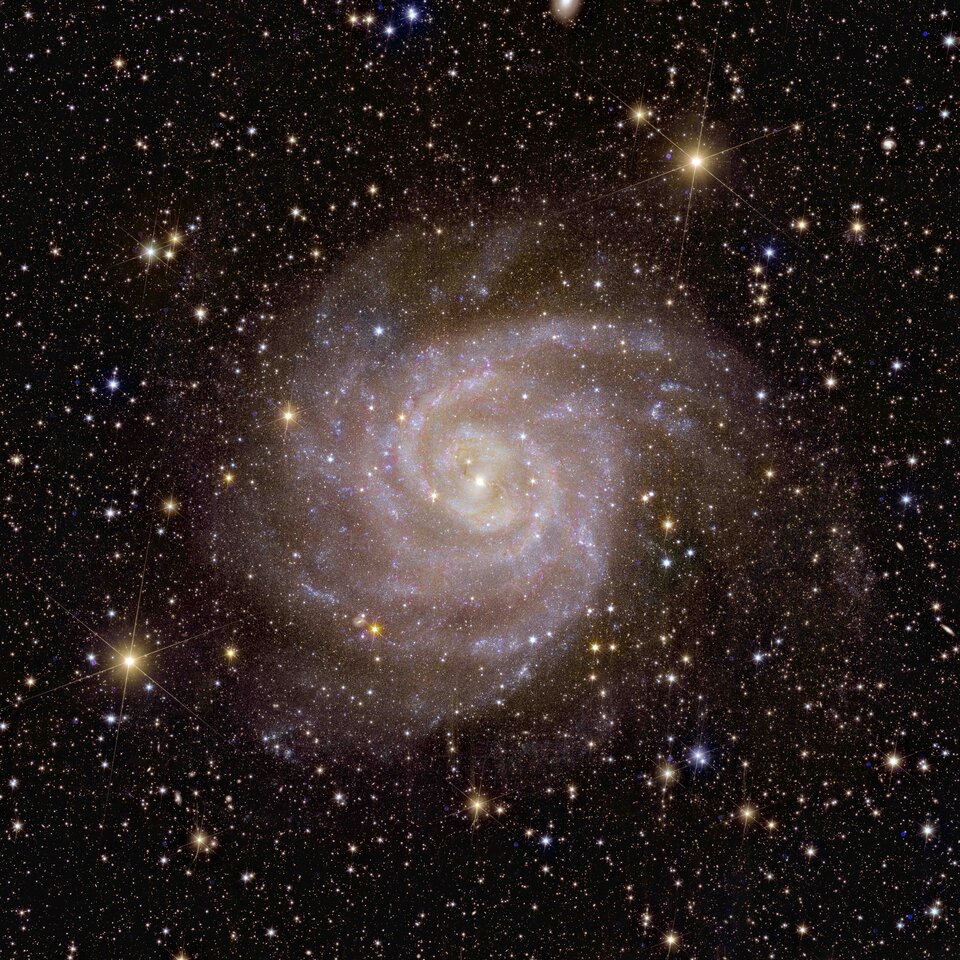
Alt...
Euclid’s view of spiral galaxy IC 342
A big spiral galaxy is visible face-on in white/pink colours at the centre of this square astronomical image. The galaxy covers almost the entire image and appears whiter at its centre where more stars are located. Its spiral arms stretch out across the image and appear fainter at the edges. The entire image is speckled with stars ranging in colour from blue to white to yellow/red, across a black background of space. Blue stars are younger and red stars are older. A few of the stars are a bit larger than the rest, with six diffraction spikes.
Technical details: The data in this image were taken in just about one hour of observation. This colour image was obtained by combining VIS data and NISP photometry in Y and H bands; its size is 8800 x 8800 pixels. VIS and NISP enable observing astronomical sources in four different wavelength ranges. Aesthetics choices led to the selection of three out of these four bands to be cast onto the traditional Red-Green-Blue colour channels used to represent images on our digital screens (RGB). The blue, green, red channels capture the Universe seen by Euclid around the wavelength 0.7, 1.1, and 1.7 micron respectively.
CREDIT
ESA/Euclid/Euclid Consortium/NASA, image processing by J.-C. Cuillandre (CEA Paris-Saclay), G. Anselmi
Finding globular clusters in Euclid’s view of spiral galaxy IC342
In Euclid’s image of spiral galaxy IC342, the locations of several globular clusters are shown. Globular clusters are compact collections of hundreds of thousands of stars held together by gravity. Globular clusters tend to be old, with red colors, while star clusters may be less compact and blue. In spiral galaxies, like our Milky Way, these globular clusters are mostly found in the galactic halo.
from arxiv:
"We examine the star cluster populations in the three nearby galaxies IC 342, NGC 2403, and Holmberg II, observed as part of the Euclid Early Release Observations programme. Our main focus is on old globular clusters (GCs), for which the wide field-of-view and excellent image quality of Euclid offer substantial advantages over previous work. For IC 342 this is the first study of stellar clusters other than its nuclear cluster. After selection based on size and magnitude criteria, followed by visual inspection, we identify 111 old (> 1 Gyr) GC candidates in IC 342, 50 in NGC 2403 (of which 15 were previously known), [...] "
https://arxiv.org/abs/2503.16637
https://arxiv.org/pdf/2503.16637
* note by grobi: "Could these mass-holding clusters be useful for gravitational lensing? The Euclid team is talking about 7000 possible candidates by the end of 2026 and 100000 candidates by the end of the mission. Which would mean that very soon we will be able to look much further into the depths of space-time than we can even imagine today.
Exciting times from an astronomical point of view, right? Feel free to check out the following post from the TOPIC> Gravitational Lensing
https://defcon.social/@grobi/114682791891969004 Enjoy!"
#space #galaxy #astrophotography #photography #science #astronomy #nature #NASA #ESA
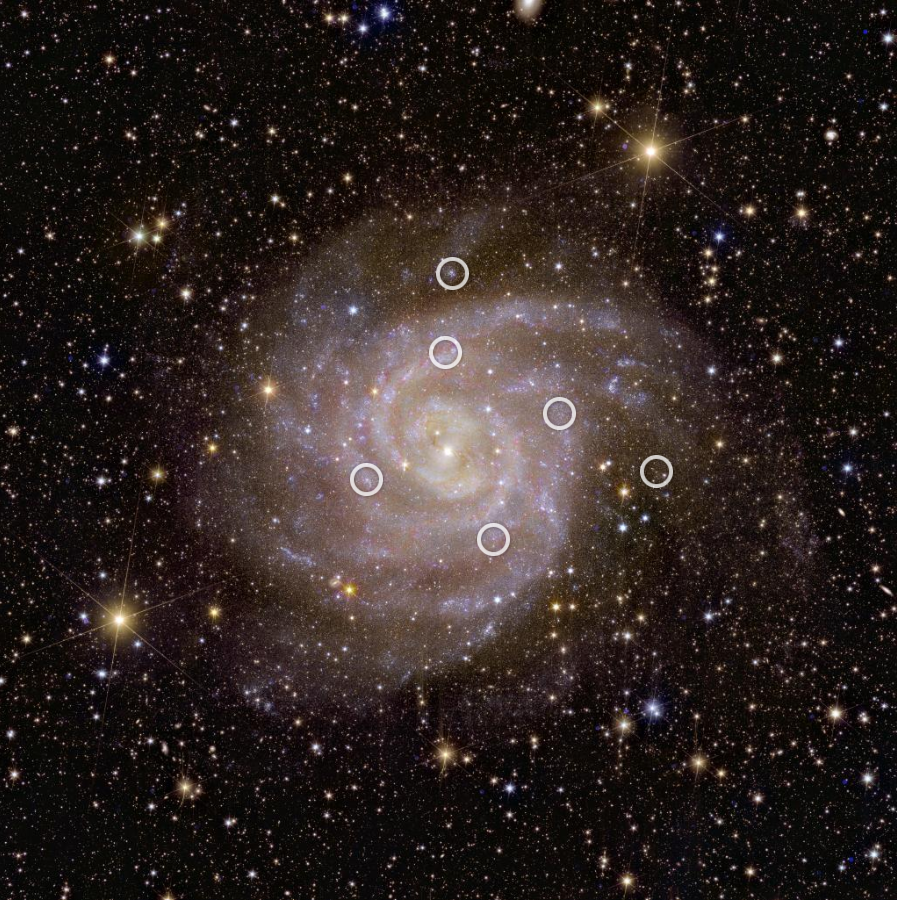
Alt...
Finding globular clusters in Euclid’s view of spiral galaxy IC342
A big spiral galaxy is visible face-on in white/pink colours at the centre of this square astronomical image. The galaxy covers almost the entire image and appears whiter at its centre where more stars are located. Its spiral arms stretch out across the image and appear fainter at the edges. The entire image is speckled with stars ranging in colour from blue to white to yellow/red, across a black background of space. Blue stars are younger and red stars are older. A few of the stars are a bit larger than the rest, with six diffraction spikes.
2022 May 17
NGC 1316: After Galaxies Collide
* Image Credit & Copyright:
** Capture: Greg Turgeon;
** Processing: Kiko Fairbairn
https://www.instagram.com/gregturgeon_astro/
https://www.instagram.com/kikofairbairn/
Explanation:
Astronomers turn detectives when trying to figure out the cause of startling sights like NGC 1316. Investigations indicate that NGC 1316 is an enormous elliptical galaxy that started, about 100 million years ago, to devour a smaller spiral galaxy neighbor,
NGC 1317,
just on the upper right. Supporting evidence includes the dark dust lanes characteristic of a spiral galaxy, and faint swirls and shells of stars and gas visible in this wide and deep image. One thing that >remains unexplained is the unusually small globular star clusters, seen as faint dots on the image. Most elliptical galaxies have more and brighter globular clusters than NGC 1316. Yet the observed globulars are too old to have been created by the recent spiral collision. One hypothesis is that these globulars survive from an even earlier galaxy that was subsumed into NGC 1316. Another surprising attribute of NGC 1316, also known as Fornax A, is its giant lobes of gas that glow brightly in radio waves.
https://en.wikipedia.org/wiki/NGC_1317
https://en.wikipedia.org/wiki/NGC_1317
https://apod.nasa.gov/apod/ap220517.html
#space #galaxy #astrophotography #photography #science #astronomy #nature #NASA #ESA
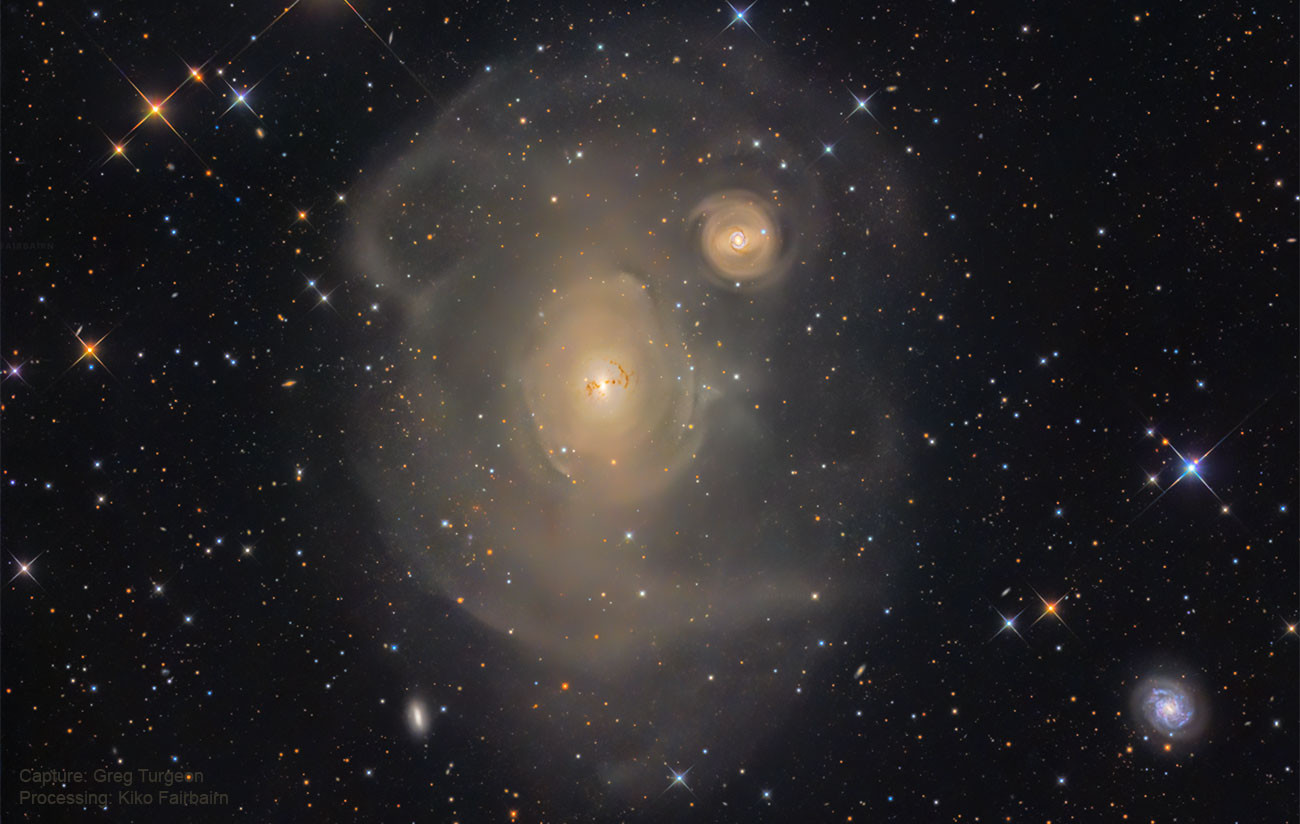
Alt...
2022 May 17
The featured image shows a deep image of the giant elliptical galaxy NGC 1316 featuring many concentric shells which embed a smaller galaxy.
NGC 1316: After Galaxies Collide
* Image Credit & Copyright:
** Capture: Greg Turgeon;
** Processing: Kiko Fairbairn
Explanation:
Astronomers turn detectives when trying to figure out the cause of startling sights like NGC 1316. Investigations indicate that NGC 1316 is an enormous elliptical galaxy that started, about 100 million years ago, to devour a smaller spiral galaxy neighbor, NGC 1317, just on the upper right. Supporting evidence includes the dark dust lanes characteristic of a spiral galaxy, and faint swirls and shells of stars and gas visible in this wide and deep image. One thing that >remains unexplained is the unusually small globular star clusters, seen as faint dots on the image. Most elliptical galaxies have more and brighter globular clusters than NGC 1316. Yet the observed globulars are too old to have been created by the recent spiral collision. One hypothesis is that these globulars survive from an even earlier galaxy that was subsumed into NGC 1316. Another surprising attribute of NGC 1316, also known as Fornax A, is its giant lobes of gas that glow brightly in radio waves.
Authors & editors: Robert Nemiroff (MTU) & Jerry Bonnell (UMCP)
NASA Official: Phillip Newman Specific rights apply.
NASA Web Privacy Policy and Important Notices
A service of: ASD at NASA / GSFC
& Michigan Tech. U.
2022 September 22
NGC 7331 Close Up
* Image Credit & License: ESA/Hubble & NASA/D. Milisavljevic (Purdue University)
Explanation:
Big, beautiful spiral galaxy NGC 7331 is often touted as an analog to our own Milky Way. About 50 million light-years distant in the northern constellation Pegasus, NGC 7331 was recognized early on as a spiral nebula and is actually one of the brighter galaxies not included in Charles Messier's famous 18th century catalog. Since the galaxy's disk is inclined to our line-of-sight, long telescopic exposures often result in an image that evokes a strong sense of depth. This Hubble Space Telescope close-up spans some 40,000 light-years. The galaxy's magnificent spiral arms feature dark obscuring dust lanes, bright bluish clusters of massive young stars, and the telltale reddish glow of active star forming regions. The bright yellowish central regions harbor populations of older, cooler stars. Like the Milky Way, a supermassive black hole lies at the core of spiral galaxy NGC 7331.
https://apod.nasa.gov/apod/ap220922.html
#space #galaxy #astrophotography #photography #science #astronomy #nature #NASA #ESA
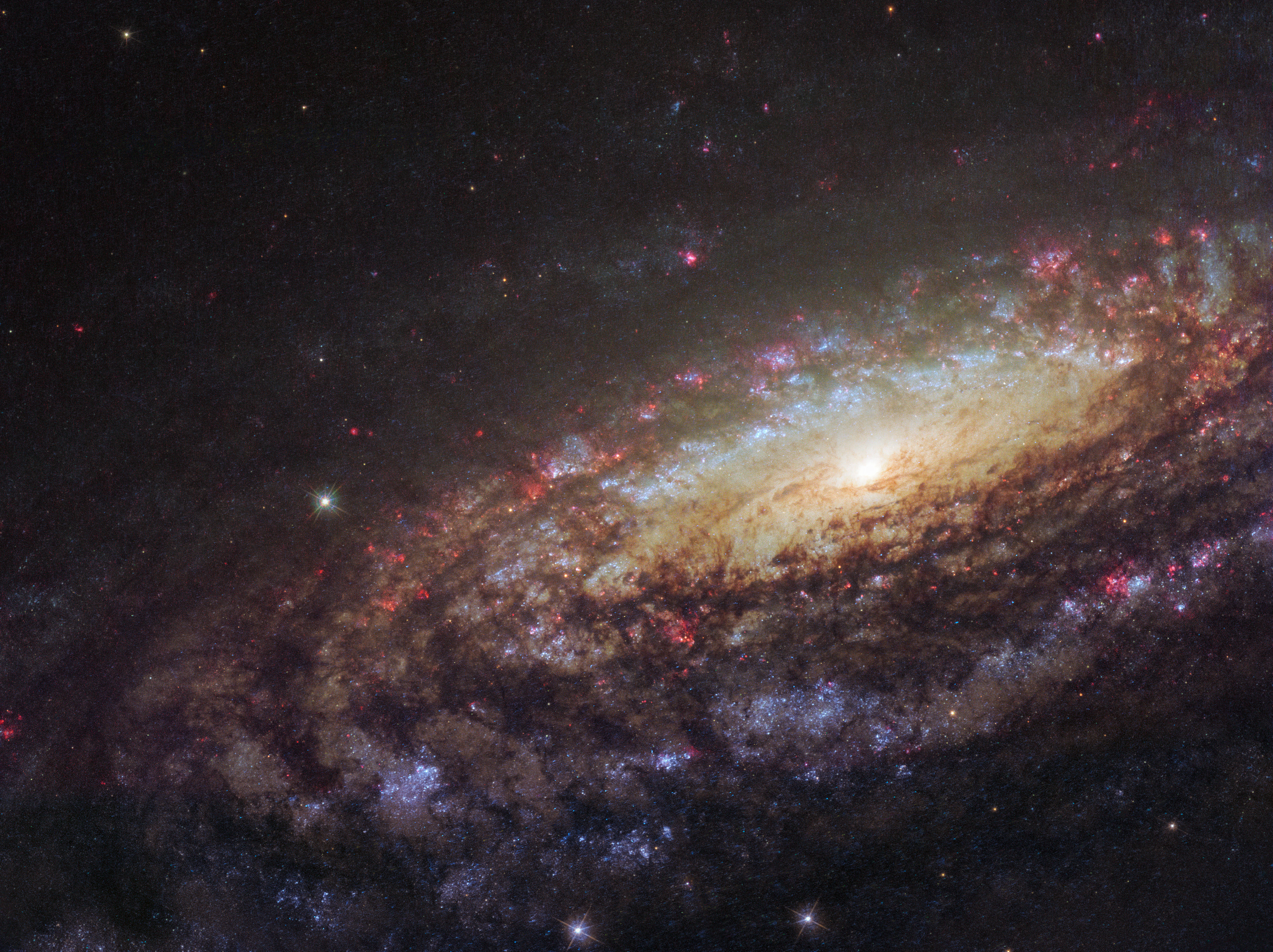
Alt...
2022 September 22
NGC 7331 Close Up
* Image Credit & License: ESA/Hubble & NASA/D. Milisavljevic (Purdue University)
Explanation:
Big, beautiful spiral galaxy NGC 7331 is often touted as an analog to our own Milky Way. About 50 million light-years distant in the northern constellation Pegasus, NGC 7331 was recognized early on as a spiral nebula and is actually one of the brighter galaxies not included in Charles Messier's famous 18th century catalog. Since the galaxy's disk is inclined to our line-of-sight, long telescopic exposures often result in an image that evokes a strong sense of depth. This Hubble Space Telescope close-up spans some 40,000 light-years. The galaxy's magnificent spiral arms feature dark obscuring dust lanes, bright bluish clusters of massive young stars, and the telltale reddish glow of active star forming regions. The bright yellowish central regions harbor populations of older, cooler stars. Like the Milky Way, a supermassive black hole lies at the core of spiral galaxy NGC 7331.
Authors & editors: Robert Nemiroff (MTU) & Jerry Bonnell (UMCP)
NASA Official: Phillip Newman Specific rights apply.
NASA Web Privacy Policy and Important Notices
A service of: ASD at NASA / GSFC,
NASA Science Activation
& Michigan Tech. U.
2025 August 18
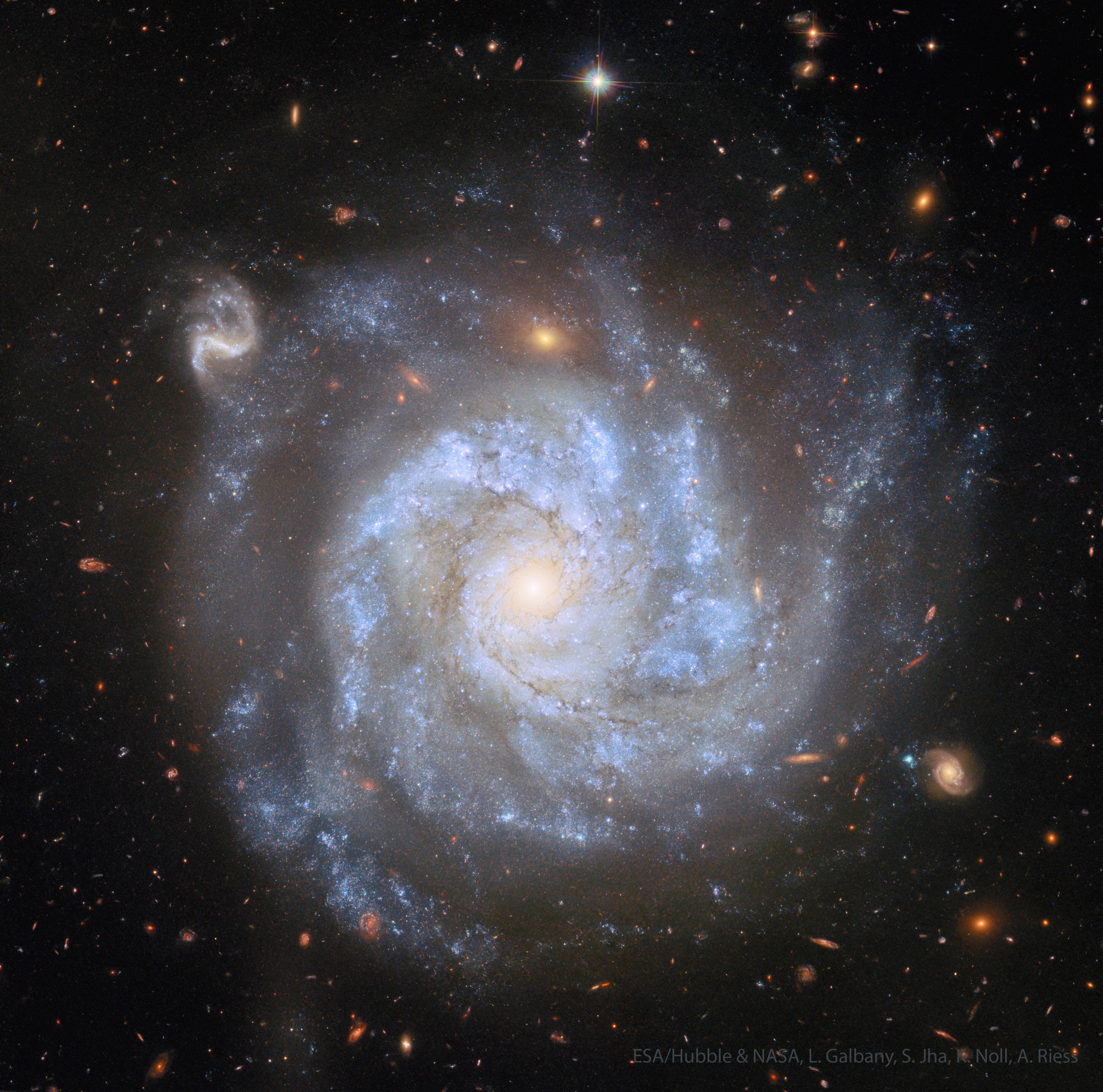
NGC 1309: A Useful Spiral Galaxy
* Image Credit: NASA, ESA, Hubble
https://www.nasa.gov/
https://www.esa.int/
https://science.nasa.gov/mission/hubble/overview/about-hubble/
* Processing: L. Galbany, S. Jha, K. Noll, A. Riess
https://lgalbany.github.io/
Explanation:
This galaxy is not only pretty -- it's useful. A gorgeous spiral some 100 million light-years distant, NGC 1309 lies on the banks of the constellation of the River (Eridanus). NGC 1309 spans about 30,000 light-years, making it about one third the size of our larger Milky Way galaxy. Bluish clusters of young stars and dust lanes are seen to trace out NGC 1309's spiral arms as they wind around an older yellowish star population at its core. Not just another pretty face-on spiral galaxy, observations of NGC 1309's two recent supernovas and multiple Cepheid variable stars contribute to the calibration of the expansion of the Universe. Still, after you get over this beautiful galaxy's grand design, check out the array of more distant background galaxies also recorded in this sharp image from the Hubble Space Telescope.
https://esahubble.org/images/potw2530a/
https://en.wikipedia.org/wiki/NGC_1309
zoom in >> https://esahubble.org/images/potw2530a/zoomable/
https://lco.global/spacebook/distance/cepheid-variable-stars-supernovae-and-distance-measurement/
http://www.hawastsoc.org/deepsky/eri/index.html
https://apod.nasa.gov/apod/ap250818.html
#space #galaxy #astrophotography #photography #science #astronomy #nature #NASA #ESA
Alt...
2025 August 18
A large spiral galaxy appears with stars in the foreground and smaller galaxies far in the background. The picturesque spiral has dark dust lanes between blue arms.
NGC 1309: A Useful Spiral Galaxy
* Image Credit: NASA, ESA, Hubble
* Processing: L. Galbany, S. Jha, K. Noll, A. Riess
Explanation:
This galaxy is not only pretty -- it's useful. A gorgeous spiral some 100 million light-years distant, NGC 1309 lies on the banks of the constellation of the River (Eridanus). NGC 1309 spans about 30,000 light-years, making it about one third the size of our larger Milky Way galaxy. Bluish clusters of young stars and dust lanes are seen to trace out NGC 1309's spiral arms as they wind around an older yellowish star population at its core. Not just another pretty face-on spiral galaxy, observations of NGC 1309's two recent supernovas and multiple Cepheid variable stars contribute to the calibration of the expansion of the Universe. Still, after you get over this beautiful galaxy's grand design, check out the array of more distant background galaxies also recorded in this sharp image from the Hubble Space Telescope.
Authors & editors: Robert Nemiroff (MTU) & Jerry Bonnell (UMCP)
NASA Official: Amber Straughn Specific rights apply.
NASA Web Privacy, Accessibility, Notices;
A service of: ASD at NASA / GSFC,
NASA Science Activation
& Michigan Tech. U.
2025 November 4
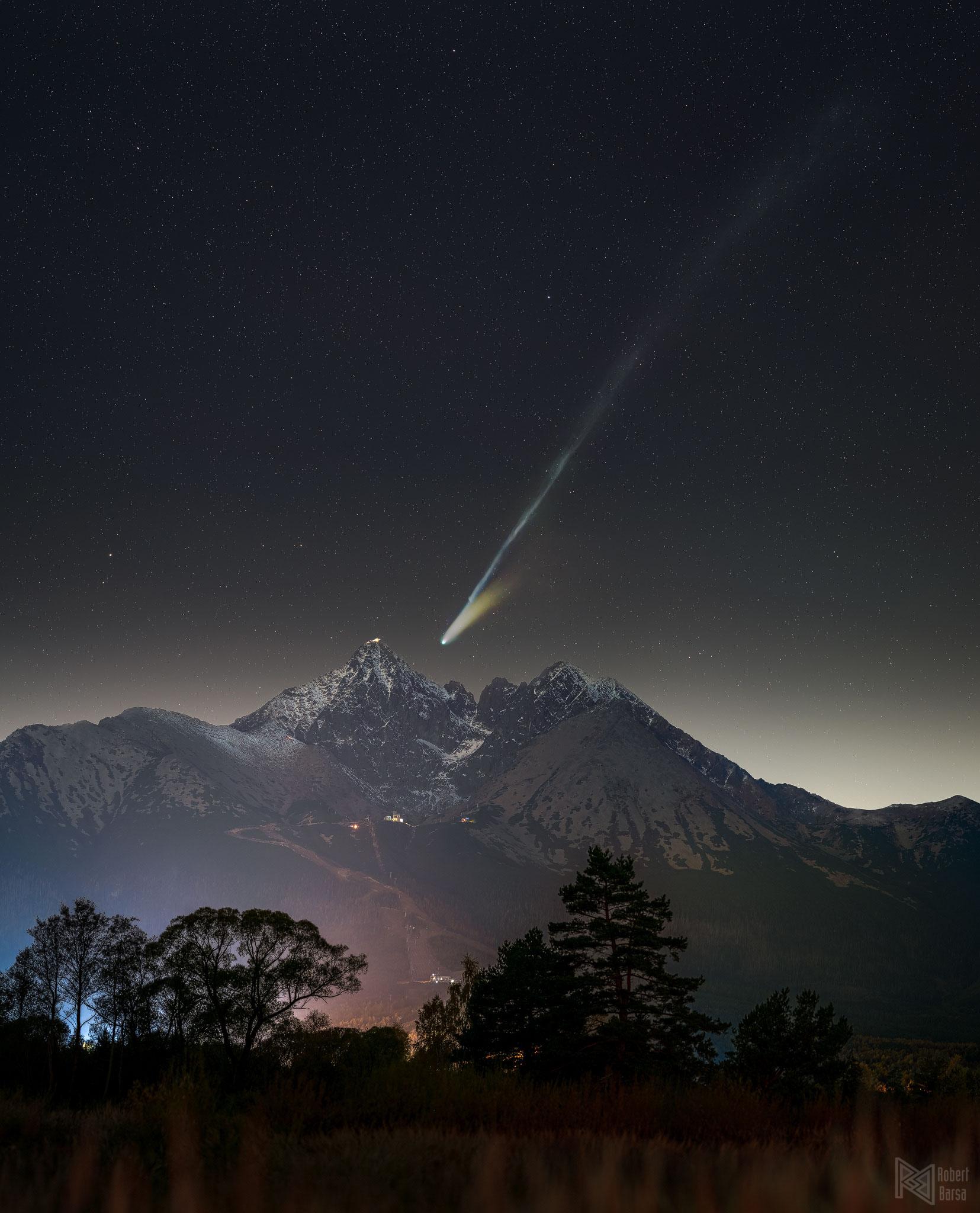
Comet Lemmon Beyond Lomnický Peak
* Image Credit & Copyright: Robert Barsa
http://astrofotografia.sk/
Explanation:
Comet Lemmon has been putting on a show for cameras around the globe. Passing nearest to Earth in late October, the photogenic comet C/2025 A6 (Lemmon) sprouted two long and picturesque tails: a blue ion tail and a white dust tail. The ion tail is pushed away from the coma by the ever-present but ever-changing solar wind, at one point extending over 20 times the diameter of the full Moon -- as captured in this long-duration exposure. The shorter and wider dust tail is pushed away from the coma and shines by reflecting sunlight. The featured picture, captured two weeks ago, framed the comet behind Lomnický Peak of the High Tatra Mountains, home to the Slovakian Lomnický Stit Observatory. Comet Lemmon is now fading as it heads away from planet Earth. The huge shedding snowball will round the Sun later this week.
https://www.instagram.com/p/DQUSyhYAp2q/
https://en.wikipedia.org/wiki/C/2025_A6_(Lemmon)
https://astronomy.swin.edu.au/cosmos/C/cometary+dust+tail
https://astro4edu.org/resources/glossary/term/61/
https://spaceplace.nasa.gov/comets/en/anatomy-of-a-comet.en.jpg
https://science.nasa.gov/sun/what-is-the-solar-wind/
https://theskylive.com/c2025a6-info
https://web.astro.sk/en/research/observatories/lomnicky-stit-observatory/
https://www.youtube.com/watch?v=Sh9uHKMYWM8
https://apod.nasa.gov/apod/ap251104.html
#space #comets #astrophotography #photography #science #astronomy #nature #NASA #ESA #education #apod
Alt...
2025 November 4
An image of the night sky over distant mountains features a comet with long tails. One of the tails goes nearly to the edge of the picture on the upper right.
Comet Lemmon Beyond Lomnický Peak
* Image Credit & Copyright: Robert Barsa
Explanation:
Comet Lemmon has been putting on a show for cameras around the globe. Passing nearest to Earth in late October, the photogenic comet C/2025 A6 (Lemmon) sprouted two long and picturesque tails: a blue ion tail and a white dust tail. The ion tail is pushed away from the coma by the ever-present but ever-changing solar wind, at one point extending over 20 times the diameter of the full Moon -- as captured in this long-duration exposure. The shorter and wider dust tail is pushed away from the coma and shines by reflecting sunlight. The featured picture, captured two weeks ago, framed the comet behind Lomnický Peak of the High Tatra Mountains, home to the Slovakian Lomnický Stit Observatory. Comet Lemmon is now fading as it heads away from planet Earth. The huge shedding snowball will round the Sun later this week.
Authors & editors: Robert Nemiroff (MTU) & Jerry Bonnell (UMCP)
NASA Official: Amber Straughn Specific rights apply.
NASA Web Privacy, Accessibility, Notices;
A service of: ASD at NASA / GSFC,
NASA Science Activation
& Michigan Tech. U.
![[?]](https://files.mstdn.party/accounts/avatars/109/412/668/953/833/198/original/0f95655ae0a3a89e.jpg)
Magical Outer Space for your Indoor Space
Wall Art and more: https://joegiacaloneart.pixels.com/collections/space
#nasa #OuterSpace #stars #science #artprints #wallart #homedecor #photography #magical #buyintoart

Magical Outer Space for your Indoor Space
Wall Art and more: https://joegiacaloneart.pixels.com/collections/space
#nasa #OuterSpace #stars #science #artprints #wallart #homedecor #photography #magical #buyintoart

Magical Outer Space for your Indoor Space
Wall Art and more: https://fineartamerica.com/profiles/joegiacaloneart/collections/space
#fineartamerica #nasa #OuterSpace #stars #science
#wallart #homedecor #photography #magical

Magical Outer Space for your Indoor Space
Wall Art and more: https://fineartamerica.com/profiles/joegiacaloneart/collections/space
#fineartamerica #nasa #OuterSpace #stars #science #wallart #homedecor #photography #magical

2025 November 3
A Double Helix Lunar Eclipse
* Image Credit & Copyright: Chunlin Liu
Explanation:
The image was timed to capture a total lunar eclipse -- but it came with quite a twist. First, the eclipse: the fully Earth-shadowed Moon is visible as the orange orb near the top. The eclipsed Moon's orange color is caused by a slight amount of red light scattered first by Earth's atmosphere, adding a color like a setting Sun. Now, the twist: one of the apparent double helix bands is the Milky Way, the central disk of our home galaxy. The second band is zodiacal light, sunlight scattered by dust in our Solar System. The reason they cross is because the plane where dust orbits our Sun is tilted relative to the plane where stars orbit our Galaxy. This well-known tilt is shown dramatically in the featured wide-angle Mercator-projected picture, spanning from horizon to horizon, captured in early September from Mingantu Observing Station in Inner Mongolia, China.
https://www.timeanddate.com/eclipse/lunar/2025-september-7
https://en.wikipedia.org/wiki/Ecliptic
https://science.nasa.gov/moon/eclipses/
https://science.nasa.gov/earth/earth-atmosphere/earths-atmosphere-a-multi-layered-cake/
https://science.nasa.gov/resource/the-milky-way-galaxy/
https://en.wikipedia.org/wiki/Galactic_plane
https://en.wikipedia.org/wiki/Ecliptic
https://en.wikipedia.org/wiki/Mercator_projection
https://english.nao.cas.cn/Research2015/Research_Divisions2015/solar/202012/t20201217_256816.html
https://apod.nasa.gov/apod/ap251103.html
#space #galaxy #milkyway #astrophotography #photography #science #astronomy #nature #NASA #apod

Alt...
2025 November 3
A wide angle image of the night sky is punctuated by a radio telescope on the lower left. Two bands of light run through the sky: the Milky Way and zodiacal light. The bands intertwine like a double helix. Near the top is an orange orb that is a totally eclipsed moon.
A Double Helix Lunar Eclipse
* Image Credit & Copyright: Chunlin Liu
Explanation:
The image was timed to capture a total lunar eclipse -- but it came with quite a twist. First, the eclipse: the fully Earth-shadowed Moon is visible as the orange orb near the top. The eclipsed Moon's orange color is caused by a slight amount of red light scattered first by Earth's atmosphere, adding a color like a setting Sun. Now, the twist: one of the apparent double helix bands is the Milky Way, the central disk of our home galaxy. The second band is zodiacal light, sunlight scattered by dust in our Solar System. The reason they cross is because the plane where dust orbits our Sun is tilted relative to the plane where stars orbit our Galaxy. This well-known tilt is shown dramatically in the featured wide-angle Mercator-projected picture, spanning from horizon to horizon, captured in early September from Mingantu Observing Station in Inner Mongolia, China.
Authors & editors: Robert Nemiroff (MTU) & Jerry Bonnell (UMCP)
NASA Official: Amber Straughn Specific rights apply.
NASA Web Privacy, Accessibility, Notices;
A service of: ASD at NASA / GSFC,
NASA Science Activation
& Michigan Tech. U.
TOPIC>
Milkyway From Earth
2025 July 2
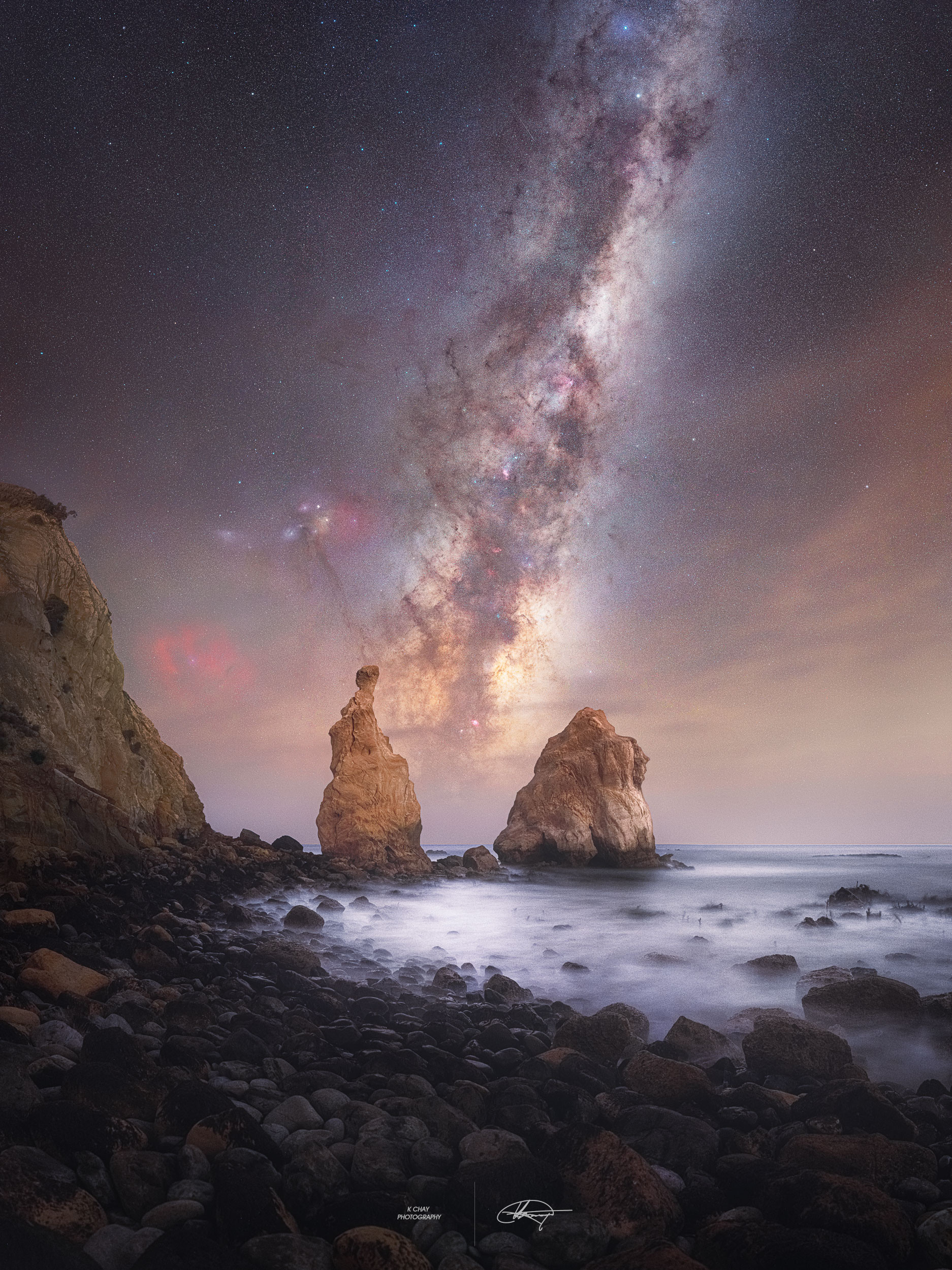
Milky Way Through Otago Spires
* Image Credit & Copyright: Kavan Chay
https://www.instagram.com/kchayphotos/;
* Text: Ogetay Kayali (Michigan Tech U.)
https://www.ogetay.com/
https://www.mtu.edu/physics/
Explanation:
Does the Milky Way always rise between these two rocks? No. Capturing this stunning alignment took careful planning: being in the right place at the right time. In the featured image taken in June 2024 from Otago, New Zealand, the bright central core of our Milky Way Galaxy, home to the many of our Galaxy's 400 billion stars, can be seen between two picturesque rocks spires. For observers in Earth's Northern Hemisphere, the core is only visible throughout the summer. As Earth orbits the Sun, different parts of the Milky Way become visible at different angles at different times of the night. As Earth rotates, the orientation of the Milky Way in the sky also shifts -- sometimes standing vertically as seen in the featured image, and other times stretching parallel to the horizon, making it harder to see. In early June, observers can watch it emerge low on the horizon after sunset and gradually arc upward to reveal its full grandeur.
https://www.instagram.com/p/C8qW2gMJcaF/
https://apod.nasa.gov/apod/ap250702.html
#space #milkyway #astrophotography #photography #nature #NewZealand #NASA
Alt...
2025 July 2
A skyscape is seen above an water inlet. Two rock spires rise from the sea, and the central band of our Milky Way Galaxy is seen between them.
Milky Way Through Otago Spires
* Image Credit & Copyright: Kavan Chay; Text: Ogetay Kayali (Michigan Tech U.)
Explanation:
Does the Milky Way always rise between these two rocks? No. Capturing this stunning alignment took careful planning: being in the right place at the right time. In the featured image taken in June 2024 from Otago, New Zealand, the bright central core of our Milky Way Galaxy, home to the many of our Galaxy's 400 billion stars, can be seen between two picturesque rocks spires. For observers in Earth's Northern Hemisphere, the core is only visible throughout the summer. As Earth orbits the Sun, different parts of the Milky Way become visible at different angles at different times of the night. As Earth rotates, the orientation of the Milky Way in the sky also shifts -- sometimes standing vertically as seen in the featured image, and other times stretching parallel to the horizon, making it harder to see. In early June, observers can watch it emerge low on the horizon after sunset and gradually arc upward to reveal its full grandeur.
Authors & editors: Robert Nemiroff (MTU) & Jerry Bonnell (UMCP)
NASA Official: Amber Straughn Specific rights apply.
NASA Web Privacy, Accessibility, Notices;
A service of: ASD at NASA / GSFC,
NASA Science Activation
& Michigan Tech. U.
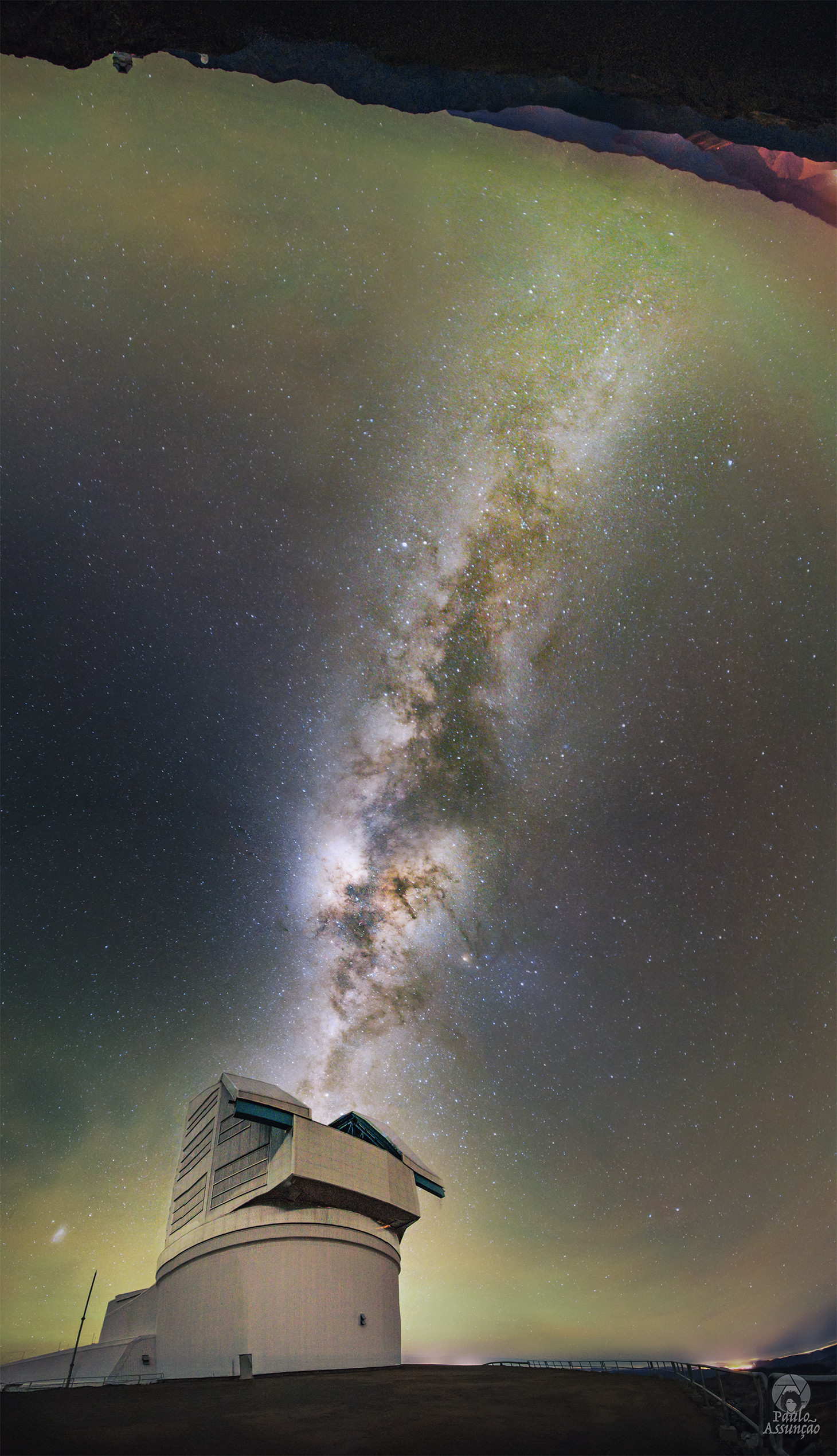
A Milky Road to the Rubin Observatory
* Image Credit: NSF, DOE, Rubin Obs., Paulo Assunção Lago (Rubin Obs.)
https://www.instagram.com/passuncao.ph/
https://rubinobservatory.org/
https://www.energy.gov/
https://www.nsf.gov/
Explanation:
Is the sky the same every night? No -- the night sky changes every night in many ways. To better explore how the night sky changes, the USA's NSF and DOE commissioned the Vera C. Rubin Observatory in Cerro Pachón, Chile. In final testing before routine operations, Rubin will begin to explore these nightly changes -- slight differences that can tell us much about our amazing universe and its surprising zoo of objects. With a mirror over 8 meters across, Rubin will continually reimage the entire visible sky every few nights to discover new supernovas, potentially dangerous asteroids, faint comets, and variable stars -- as well as mapping out the visible universe's large-scale structure. Pictured, the distant central band of our Milky Way Galaxy appears to flow out from the newly operational observatory. Taken last month, the featured picture is a composite of 21 images across the night sky, capturing airglow on the horizon and the Small Magellanic Cloud galaxy on the lower left.
https://www.nsf.gov/
https://ui.adsabs.harvard.edu/abs/1999PASP..111..886N/abstract
https://ui.adsabs.harvard.edu/abs/2003AJ....125.2740N/abstract
https://apod.nasa.gov/apod/ap250604.html
#space #earth #observatory #milkyway #astrophotography #photography #science #nature #NASA
Alt...
2025 June 4
A large telescope appears on the left. The band of our Milky Way Galaxy extends from the telescope to the upper right of the image. The horizon has a slight glow. Please see the explanation for more detailed information.
A Milky Road to the Rubin Observatory
* Image Credit: NSF, DOE, Rubin Obs., Paulo Assunção Lago (Rubin Obs.)
Explanation:
Is the sky the same every night? No -- the night sky changes every night in many ways. To better explore how the night sky changes, the USA's NSF and DOE commissioned the Vera C. Rubin Observatory in Cerro Pachón, Chile. In final testing before routine operations, Rubin will begin to explore these nightly changes -- slight differences that can tell us much about our amazing universe and its surprising zoo of objects. With a mirror over 8 meters across, Rubin will continually reimage the entire visible sky every few nights to discover new supernovas, potentially dangerous asteroids, faint comets, and variable stars -- as well as mapping out the visible universe's large-scale structure. Pictured, the distant central band of our Milky Way Galaxy appears to flow out from the newly operational observatory. Taken last month, the featured picture is a composite of 21 images across the night sky, capturing airglow on the horizon and the Small Magellanic Cloud galaxy on the lower left.
Authors & editors: Robert Nemiroff (MTU) & Jerry Bonnell (UMCP)
NASA Official: Amber Straughn Specific rights apply.
2011 September 24
Mangaia's Milky Way
* Image Credit & Copyright: Tunç Tezel (TWAN)
https://twanight.org/profile/tunc-tezel/
Explanation:
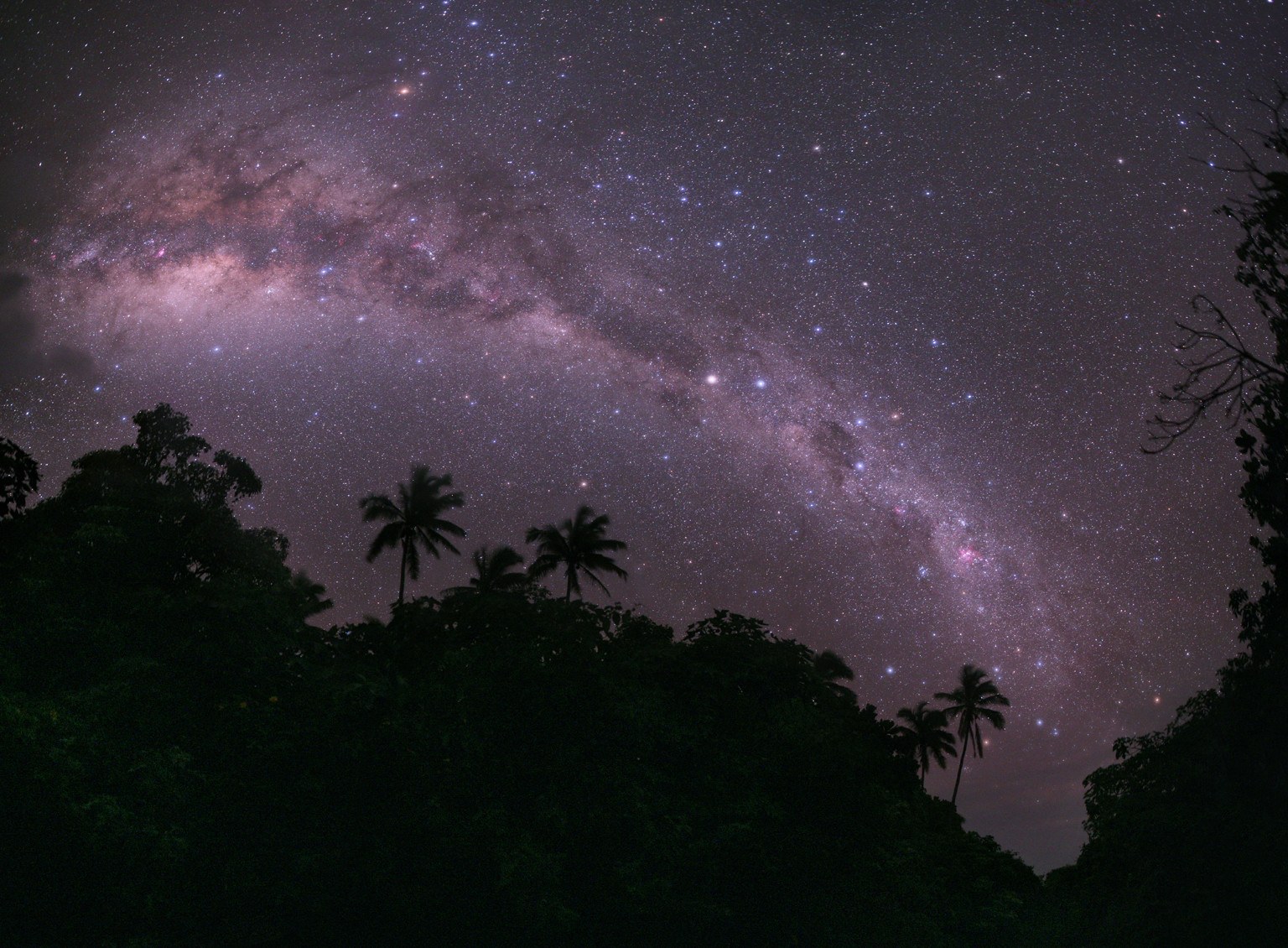
From Sagittarius to Carina, the Milky Way Galaxy shines in this dark night sky above planet Earth's lush island paradise of Mangaia. Familiar to denizens of the southern hemisphere, the gorgeous skyscape includes the bulging galactic center at the upper left and bright stars Alpha and Beta Centauri just right of center. About 10 kilometers wide, volcanic Mangaia is the southernmost of the Cook Islands. Geologists estimate that at 18 million years old it is the oldest island in the Pacific Ocean. Of course, the Milky Way is somewhat older, with the galaxy's oldest stars estimated to be over 13 billion years old. (Editor's note: This image holds the distinction of being selected as winner in the Royal Observatory, Greenwich, Astronomy Photographer of the Year competition in the Earth and Space category.)
https://apod.nasa.gov/apod/ap110924.html
#space #milkyway #astrophotography #photography #nature #science #astronomy #NASA
Alt...
2011 September 24
Mangaia's Milky Way
* Image Credit & Copyright: Tunç Tezel (TWAN)
Explanation:
From Sagittarius to Carina, the Milky Way Galaxy shines in this dark night sky above planet Earth's lush island paradise of Mangaia. Familiar to denizens of the southern hemisphere, the gorgeous skyscape includes the bulging galactic center at the upper left and bright stars Alpha and Beta Centauri just right of center. About 10 kilometers wide, volcanic Mangaia is the southernmost of the Cook Islands. Geologists estimate that at 18 million years old it is the oldest island in the Pacific Ocean. Of course, the Milky Way is somewhat older, with the galaxy's oldest stars estimated to be over 13 billion years old. (Editor's note: This image holds the distinction of being selected as winner in the Royal Observatory, Greenwich, Astronomy Photographer of the Year competition in the Earth and Space category.)
Authors & editors: Robert Nemiroff (MTU) & Jerry Bonnell (UMCP)
NASA Official: Phillip Newman Specific rights apply.
NASA Web Privacy Policy and Important Notices
A service of: ASD at NASA / GSFC
& Michigan Tech. U.
2025 May 20
Milky Way over Maunakea
* Image Credit & Copyright: Marzena Rogozinska
https://www.instagram.com/marzena_astrophotography/
Explanation:
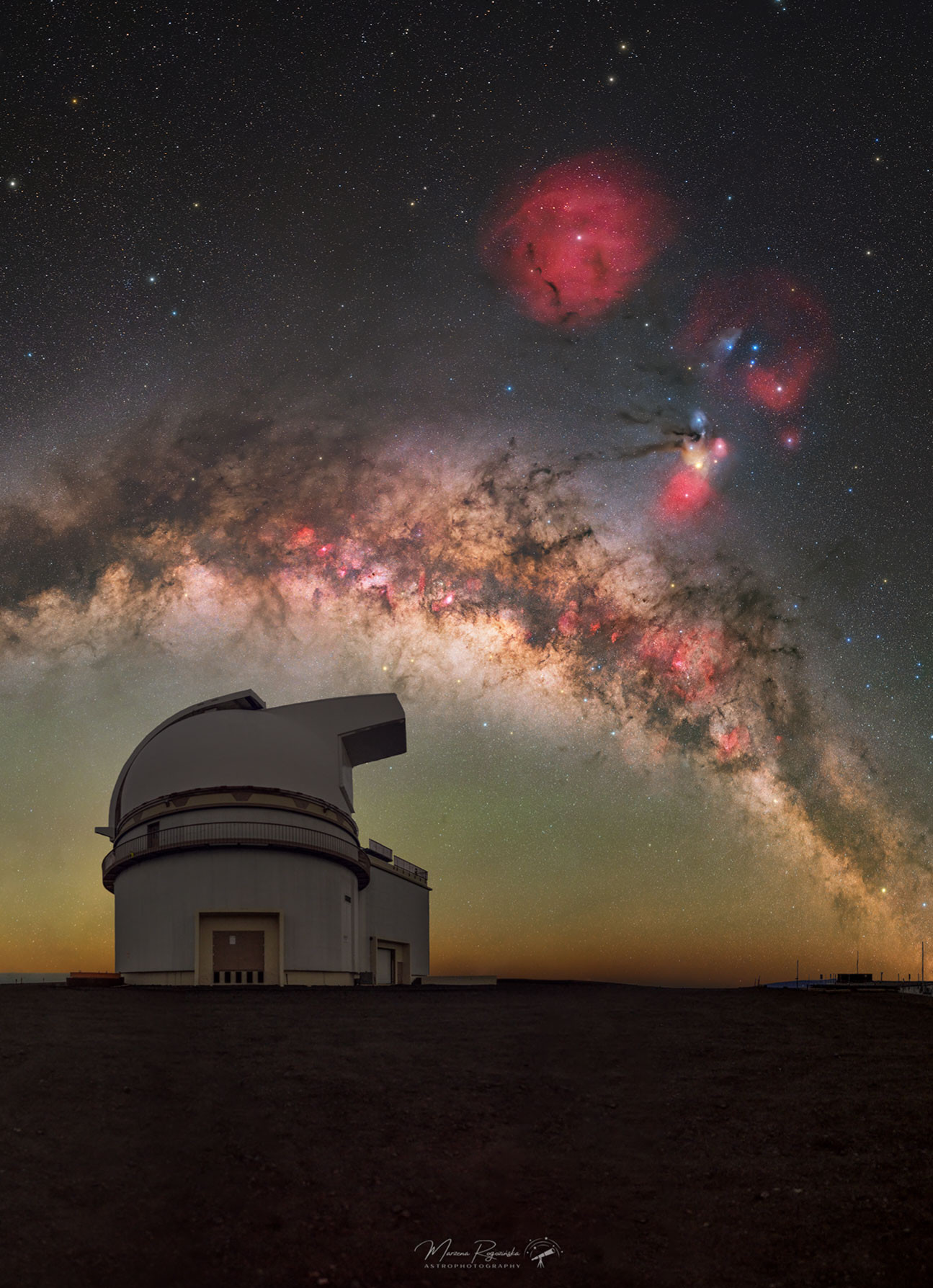
Have you ever seen the band of our Milky Way Galaxy? In a clear sky from a dark location at the right time, a faint band of light becomes visible across the sky. Soon after your eyes become dark adapted, you might spot the band for the first time. It may then become obvious. Then spectacular. One reason for your growing astonishment might be the realization that this fuzzy swath, the Milky Way, contains billions of stars. Visible in the featured image, high above in the night sky, the band of the Milky Way Galaxy arcs. Also visible are the colorful clouds of Rho Ophiuchi on the right, and the red and circular Zeta Ophiuchi nebula near the top center. Taken in late February from Maunakea, Hawaii, USA, the foreground telescope is the University of Hawaii's 2.2-Meter Telescope. Fortunately, you don’t need to be near the top of a Hawaiian volcano to see the Milky Way.
https://apod.nasa.gov/apod/ap250520.html
#space #milkyway #astrophotography #photography #science #astronomy #nature #NASA
Alt...
2025 May 20
A wide starfield is shown with the dark and light band arching horizontally across the middle. On the right is a colorful and complex nebula, and near the top center is a red circular nebula.
Milky Way over Maunakea
* Image Credit & Copyright: Marzena Rogozinska
Explanation:
Have you ever seen the band of our Milky Way Galaxy? In a clear sky from a dark location at the right time, a faint band of light becomes visible across the sky. Soon after your eyes become dark adapted, you might spot the band for the first time. It may then become obvious. Then spectacular. One reason for your growing astonishment might be the realization that this fuzzy swath, the Milky Way, contains billions of stars. Visible in the featured image, high above in the night sky, the band of the Milky Way Galaxy arcs. Also visible are the colorful clouds of Rho Ophiuchi on the right, and the red and circular Zeta Ophiuchi nebula near the top center. Taken in late February from Maunakea, Hawaii, USA, the foreground telescope is the University of Hawaii's 2.2-Meter Telescope. Fortunately, you don’t need to be near the top of a Hawaiian volcano to see the Milky Way.
Authors & editors: Robert Nemiroff (MTU) & Jerry Bonnell (UMCP)
NASA Official: Amber Straughn Specific rights apply.
NASA Web Privacy, Accessibility, Notices;
A service of: ASD at NASA / GSFC,
NASA Science Activation
& Michigan Tech. U.
2025 February 9
Milky Way over the Australian Pinnacles
* Image Credit & Copyright: Michael Goh
https://astrophotobear.com/about/
Explanation:
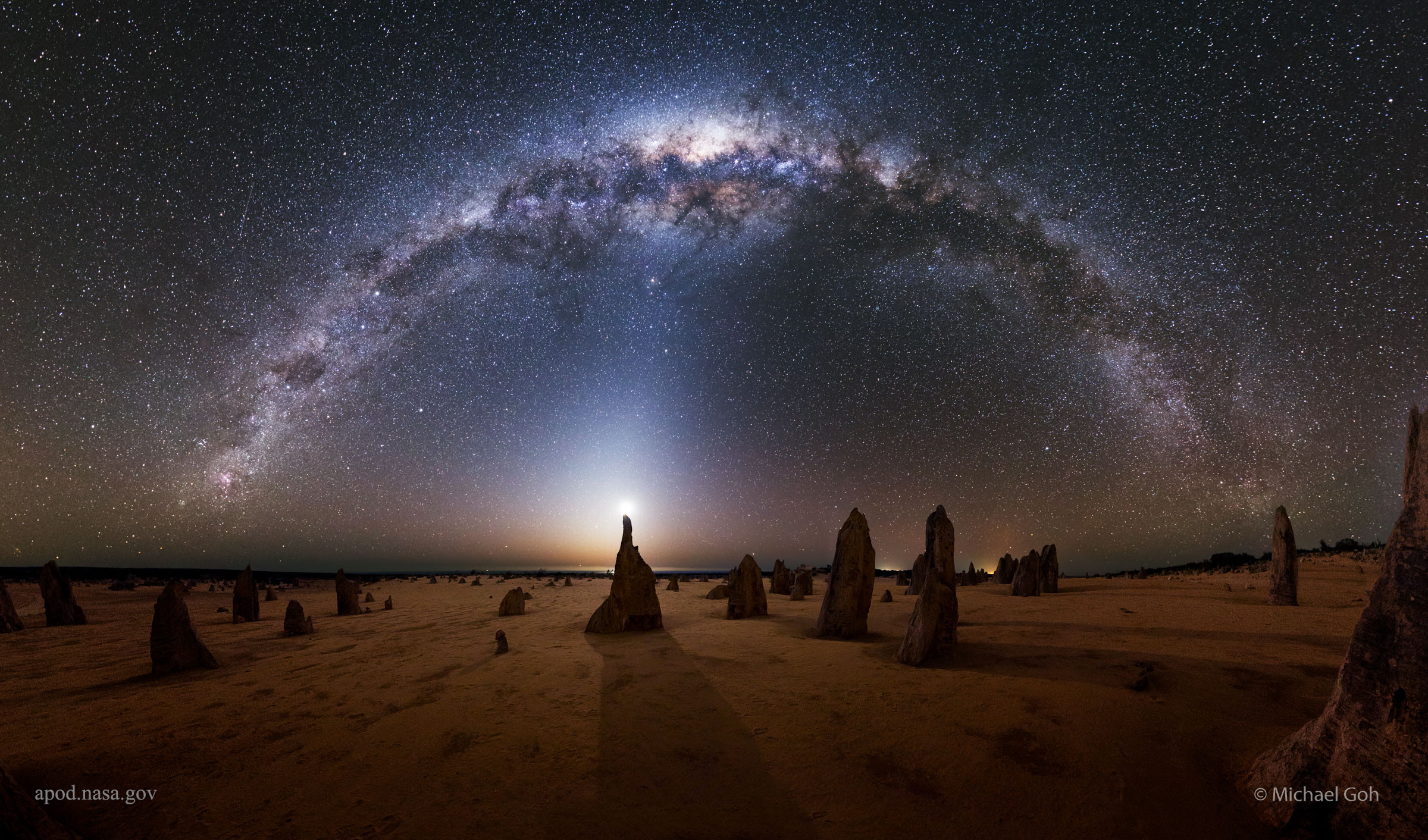
What strange world is this? Earth. In the foreground of the featured image are the Pinnacles, unusual rock spires in Nambung National Park in Western Australia. Made of ancient sea shells (limestone), how these human-sized picturesque spires formed remains unknown. In the background, just past the end of the central Pinnacle, is a bright crescent Moon. The eerie glow around the Moon is mostly zodiacal light, sunlight reflected by dust grains orbiting between the planets in the Solar System. Arching across the top is the central band of our Milky Way Galaxy. Many famous stars and nebulas are also visible in the background night sky. The featured 29-panel panorama was taken and composed in 2015 September after detailed planning that involved the Moon, the rock spires, and their corresponding shadows. Even so, the strong zodiacal light was a pleasant surprise.
https://apod.nasa.gov/apod/ap250209.html
#space #milkyway #astrophotography #photography #science #astronomy #nature #NASA
Alt...
2025 February 9
A flat landscape is shown at night that appears mostly brown. Numerous unusual rock spires are seen rising from the group. Above, a full star field is seen with the arch of our Milky Way Galaxy curving from left to right.
Milky Way over the Australian Pinnacles
* Image Credit & Copyright: Michael Goh
Explanation:
What strange world is this? Earth. In the foreground of the featured image are the Pinnacles, unusual rock spires in Nambung National Park in Western Australia. Made of ancient sea shells (limestone), how these human-sized picturesque spires formed remains unknown. In the background, just past the end of the central Pinnacle, is a bright crescent Moon. The eerie glow around the Moon is mostly zodiacal light, sunlight reflected by dust grains orbiting between the planets in the Solar System. Arching across the top is the central band of our Milky Way Galaxy. Many famous stars and nebulas are also visible in the background night sky. The featured 29-panel panorama was taken and composed in 2015 September after detailed planning that involved the Moon, the rock spires, and their corresponding shadows. Even so, the strong zodiacal light was a pleasant surprise.
Authors & editors: Robert Nemiroff (MTU) & Jerry Bonnell (UMCP)
NASA Official: Amber Straughn Specific rights apply.
NASA Web Privacy, Accessibility, Notices;
A service of: ASD at NASA / GSFC,
NASA Science Activation
& Michigan Tech. U.
2024 November 5
Milky Way over Easter Island
* Credit & Copyright: Josh Dury
https://www.instagram.com/josh_dury_photomedia/
Explanation:
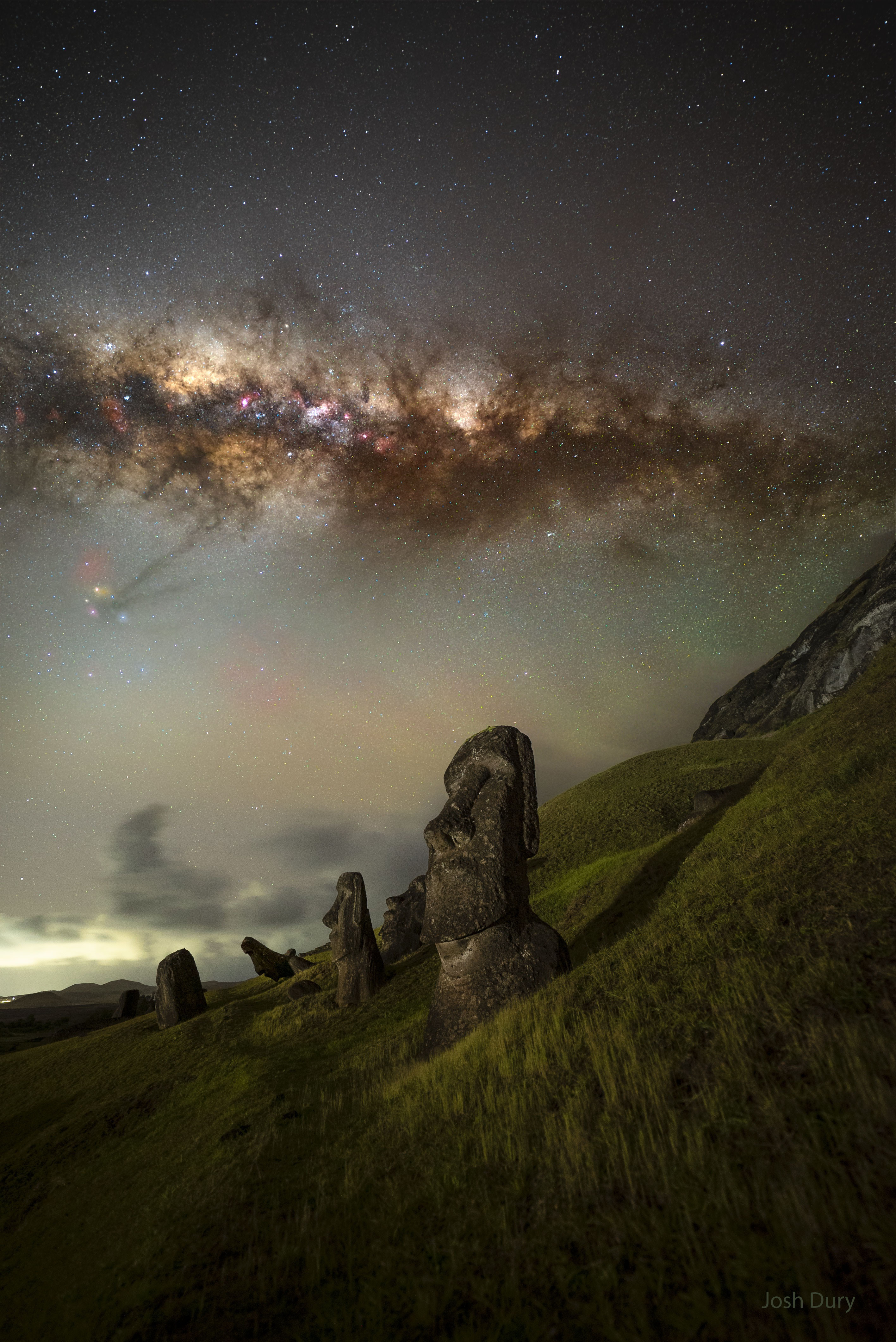
Why were the statues on Easter Island built? No one is sure. What is sure is that over 900 large stone statues called moais exist there. The Rapa Nui (Easter Island) moais stand, on average, over twice as tall as a person and have over 200 times as much mass. It is thought that the unusual statues were created about 600 years ago in the images of local leaders of a vibrant and ancient civilization. Rapa Nui has been declared by UNESCO to a World Heritage Site. Pictured here, some of the stone giants were imaged last month under the central band of our Milky Way galaxy. Previously unknown moais are still being discovered.
https://www.theguardian.com/world/2023/mar/02/new-easter-island-moai-statue-discovered-in-volcano-crater
https://apod.nasa.gov/apod/ap241105.html
#space #milkyway #astrophotography #photography #science #astronomy #nature #NASA
Alt...
2024 November 5
A grassy hill appears in the foreground with tall statues of human heads embeddd. High overhead the central band of the Milky Way galaxy crosses horizontally. Above the Milky Way is a dark sky filled with stars.
Milky Way over Easter Island
* Credit & Copyright: Josh Dury
Explanation:
Why were the statues on Easter Island built? No one is sure. What is sure is that over 900 large stone statues called moais exist there. The Rapa Nui (Easter Island) moais stand, on average, over twice as tall as a person and have over 200 times as much mass. It is thought that the unusual statues were created about 600 years ago in the images of local leaders of a vibrant and ancient civilization. Rapa Nui has been declared by UNESCO to a World Heritage Site. Pictured here, some of the stone giants were imaged last month under the central band of our Milky Way galaxy. Previously unknown moais are still being discovered.
Authors & editors: Robert Nemiroff (MTU) & Jerry Bonnell (UMCP)
NASA Official: Amber Straughn Specific rights apply.
NASA Web Privacy, Accessibility, Notices;
A service of: ASD at NASA / GSFC,
NASA Science Activation
& Michigan Tech. U.
2024 August 7
Milky Way Behind Three Merlons
* Image Credit & Copyright: Donato Lioce; Text: Natalia Lewandowska (SUNY Oswego)
https://www.instagram.com/donamour_photography/
https://ww1.oswego.edu/physics/profile/natalia-lewandowska
Explanation:
To some, they look like battlements, here protecting us against the center of the Milky Way. The Three Merlons, also called the Three Peaks of Lavaredo, stand tall today because they are made of dense dolomite rock which has better resisted erosion than surrounding softer rock. They formed about 250 million years ago and so are comparable in age with one of the great extinctions of life on Earth. A leading hypothesis is that this great extinction was triggered by an asteroid about 10-km across, larger in size than Mount Everest, impacting the Earth. Humans have gazed up at the stars in the Milky Way and beyond for centuries, making these battlefield-like formations, based in the Sexten Dolomites, a popular place for current and ancient astronomers.
https://apod.nasa.gov/apod/ap240807.html
#space #milkyway #astrophotography #photography #science #astronomy #nature #NASA
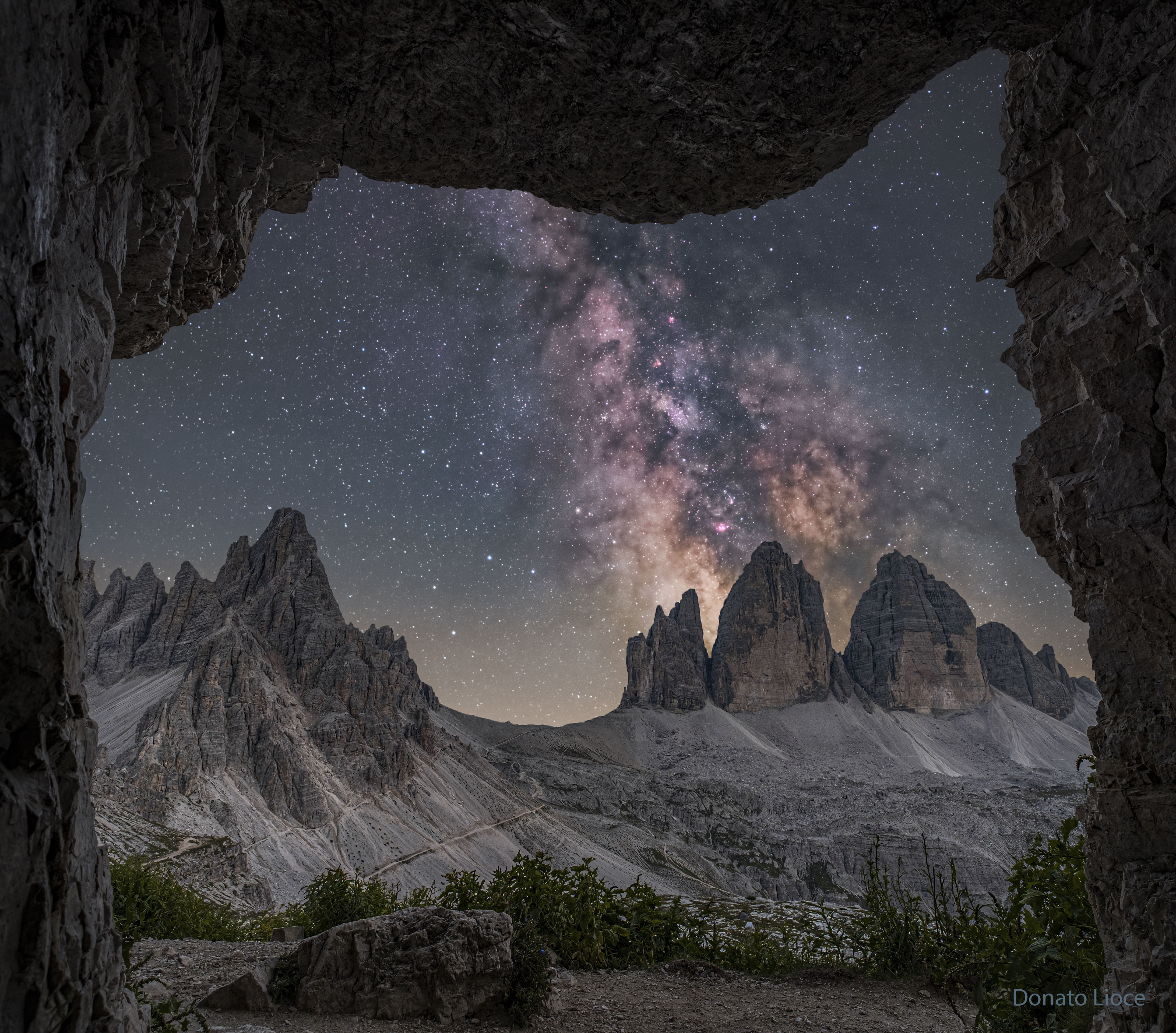
Alt...
2024 August 7
A starry sky is seen through a rectangular rock opening. Three rocky peaks appear toward the right, while other peaks appear toward the left. Rising above the right peaks is the central band of our Milky Way Galaxy.
Milky Way Behind Three Merlons
* Image Credit & Copyright: Donato Lioce; Text: Natalia Lewandowska (SUNY Oswego)
Explanation:
To some, they look like battlements, here protecting us against the center of the Milky Way. The Three Merlons, also called the Three Peaks of Lavaredo, stand tall today because they are made of dense dolomite rock which has better resisted erosion than surrounding softer rock. They formed about 250 million years ago and so are comparable in age with one of the great extinctions of life on Earth. A leading hypothesis is that this great extinction was triggered by an asteroid about 10-km across, larger in size than Mount Everest, impacting the Earth. Humans have gazed up at the stars in the Milky Way and beyond for centuries, making these battlefield-like formations, based in the Sexten Dolomites, a popular place for current and ancient astronomers.
Authors & editors: Robert Nemiroff (MTU) & Jerry Bonnell (UMCP)
NASA Official: Amber Straughn Specific rights apply.
NASA Web Privacy, Accessibility, Notices;
A service of: ASD at NASA / GSFC,
NASA Science Activation
& Michigan Tech. U.
2024 August 5
Milky Way Over Tunisia
* Image Credit & Copyright: Makrem Larnaout
https://app.astrobin.com/u/Makrem_Larnaout#gallery
Explanation:
That's no moon. On the ground, that's the Lars Homestead in Tunisia. And that's not just any galaxy. That's the central band of our own Milky Way galaxy. Last, that's not just any meteor. It is a bright fireball likely from last year's Perseids meteor shower. The featured image composite combines consecutive exposures taken by the same camera from the same location. This year's Perseids peak during the coming weekend is expected to show the most meteors after the first quarter moon sets, near midnight. To best experience a meteor shower, you should have clear and dark skies, a comfortable seat, and patience.
https://www.atlasobscura.com/places/lars-homestead
https://apod.nasa.gov/apod/ap240805.html
#space #milkyway #astrophotography #photography #science #astronomy #nature #NASA #starwars

Alt...
2024 August 5
A starry sky is seen above a structure with an iconic dome. A person in shadow stands at the entrance. Sloping down in the sky is the central band of our Milky Way Galaxy. Just below the Milky Way is the streak of a bright meteor.
Milky Way Over Tunisia
* Image Credit & Copyright: Makrem Larnaout
Explanation:
That's no moon. On the ground, that's the Lars Homestead in Tunisia. And that's not just any galaxy. That's the central band of our own Milky Way galaxy. Last, that's not just any meteor. It is a bright fireball likely from last year's Perseids meteor shower. The featured image composite combines consecutive exposures taken by the same camera from the same location. This year's Perseids peak during the coming weekend is expected to show the most meteors after the first quarter moon sets, near midnight. To best experience a meteor shower, you should have clear and dark skies, a comfortable seat, and patience.
Authors & editors: Robert Nemiroff (MTU) & Jerry Bonnell (UMCP)
NASA Official: Amber Straughn Specific rights apply.
NASA Web Privacy, Accessibility, Notices;
A service of: ASD at NASA / GSFC,
NASA Science Activation
& Michigan Tech. U.
2010 August 12
Perseid Prelude
* Credit & Copyright: Tamas Ladanyi (TWAN)
https://twanight.org/profile/tamas-ladanyi/
Explanation:
Each August, as planet Earth swings through dust trailing along the orbit of periodic comet Swift-Tuttle, skygazers can enjoy the Perseid Meteor Shower. The shower should build to its peak now, best seen from later tonight after moonset, until dawn tomorrow morning when Earth moves through the denser part of the wide dust trail. But shower meteors have been spotted for many days, like this bright Perseid streaking through skies near Lake Balaton, Hungary on August 8. In the foreground is the region's Church of St. Andrew ruin, with bright Jupiter dominating the sky to its right. Two galaxies lie in the background of the wide-angle, 3 frame panorama; our own Milky Way's luminous arc, and the faint smudge of the more distant Andromeda Galaxy just above the ruin's leftmost wall. If you watch for Perseid meteors tonight, be sure and check out the early evening sky show too, featuring bright planets and a young crescent Moon near the western horizon after sunset.
https://apod.nasa.gov/apod/ap100812.html
#space #milkyway #astrophotography #photography #science #astronomy #nature #NASA

Alt...
2010 August 12
Perseid Prelude
* Credit & Copyright: Tamas Ladanyi (TWAN)
Explanation:
Each August, as planet Earth swings through dust trailing along the orbit of periodic comet Swift-Tuttle, skygazers can enjoy the Perseid Meteor Shower. The shower should build to its peak now, best seen from later tonight after moonset, until dawn tomorrow morning when Earth moves through the denser part of the wide dust trail. But shower meteors have been spotted for many days, like this bright Perseid streaking through skies near Lake Balaton, Hungary on August 8. In the foreground is the region's Church of St. Andrew ruin, with bright Jupiter dominating the sky to its right. Two galaxies lie in the background of the wide-angle, 3 frame panorama; our own Milky Way's luminous arc, and the faint smudge of the more distant Andromeda Galaxy just above the ruin's leftmost wall. If you watch for Perseid meteors tonight, be sure and check out the early evening sky show too, featuring bright planets and a young crescent Moon near the western horizon after sunset.
Authors & editors: Robert Nemiroff (MTU) & Jerry Bonnell (UMCP)
NASA Official: Phillip Newman Specific rights apply.
NASA Web Privacy Policy and Important Notices
A service of: ASD at NASA / GSFC
& Michigan Tech. U.
2024 July 29
Milky Way over Uluru
* Image Credit & Copyright: Max Inwood
https://www.instagram.com/max.nti/
Explanation:
What's happening above Uluru? A United Nations World Heritage Site, Uluru is an extraordinary 350-meter high mountain in central Australia that rises sharply from nearly flat surroundings. Composed of sandstone, Uluru has slowly formed over the past 300 million years as softer rock eroded away. The Uluru region has been a home to humans for over 22,000 years. Recorded last month, the starry sky above Uluru includes the central band of our Milky Way galaxy, complete with complex dark filaments of dust, bright red emission nebulas, and billions of stars.
https://apod.nasa.gov/apod/ap240729.html
#space #galaxy #milkyway #astrophotography #photography #science #astronomy #NASA

Alt...
2024 July 29
A starry sky is shown with the busy central band of our Milky Way Galaxy showing rising diagonally from the lower right. In the foreground are flat grasslands leading up to a huge orange rock mound named Uluru.
Milky Way over Uluru
* Image Credit & Copyright: Max Inwood
Explanation:
What's happening above Uluru? A United Nations World Heritage Site, Uluru is an extraordinary 350-meter high mountain in central Australia that rises sharply from nearly flat surroundings. Composed of sandstone, Uluru has slowly formed over the past 300 million years as softer rock eroded away. The Uluru region has been a home to humans for over 22,000 years. Recorded last month, the starry sky above Uluru includes the central band of our Milky Way galaxy, complete with complex dark filaments of dust, bright red emission nebulas, and billions of stars.
Authors & editors: Robert Nemiroff (MTU) & Jerry Bonnell (UMCP)
NASA Official: Amber Straughn Specific rights apply.
NASA Web Privacy, Accessibility, Notices;
A service of: ASD at NASA / GSFC,
NASA Science Activation
& Michigan Tech. U.
2024 July 21
King of Wings Hoodoo under the Milky Way
* Image Credit & Copyright: Wayne Pinkston (LightCrafter Photography)
https://waynepinkstonphoto.com/
Explanation:
This rock structure is not only surreal -- it's real. Perhaps the reason it's not more famous is that it is smaller than one might guess: the capstone rock overhangs only a few meters. Even so, the King of Wings outcrop, located in New Mexico, USA, is a fascinating example of an unusual type of rock structure called a hoodoo. Hoodoos may form when a layer of hard rock overlays a layer of eroding softer rock. Figuring out the details of incorporating this hoodoo into a night-sky photoshoot took over a year. Besides waiting for a suitably picturesque night behind a sky with few clouds, the foreground had to be artificially lit just right relative to the natural glow of the background. After much planning and waiting, the final shot, featured here, was taken in May 2016. Mimicking the horizontal bar, the background sky features the band of our Milky Way Galaxy stretching overhead.
https://apod.nasa.gov/apod/ap240721.html
#space #galaxy #milkyway #astrophotography #photography #science #astronomy #nature #NASA

Alt...
2024 July 21
The band of the Milky Way runs across a night sky filled with stars. Colorful clouds are on the right horizon. A strange rock structure appears in the image center with a base and an extended arm that seems to point to the colorful horizon.
King of Wings Hoodoo under the Milky Way
* Image Credit & Copyright: Wayne Pinkston (LightCrafter Photography)
Explanation:
This rock structure is not only surreal -- it's real. Perhaps the reason it's not more famous is that it is smaller than one might guess: the capstone rock overhangs only a few meters. Even so, the King of Wings outcrop, located in New Mexico, USA, is a fascinating example of an unusual type of rock structure called a hoodoo. Hoodoos may form when a layer of hard rock overlays a layer of eroding softer rock. Figuring out the details of incorporating this hoodoo into a night-sky photoshoot took over a year. Besides waiting for a suitably picturesque night behind a sky with few clouds, the foreground had to be artificially lit just right relative to the natural glow of the background. After much planning and waiting, the final shot, featured here, was taken in May 2016. Mimicking the horizontal bar, the background sky features the band of our Milky Way Galaxy stretching overhead.
Authors & editors: Robert Nemiroff (MTU) & Jerry Bonnell (UMCP)
NASA Official: Amber Straughn Specific rights apply.
2024 July 5
Mount Etna Milky Way
* Image Credit & Copyright: Gianni Tumino
https://www.facebook.com/giovanni.tumino.58
Explanation:
A glow from the summit of Mount Etna, famous active stratovolcano of planet Earth, stands out along the horizon in this mountain and night skyscape. Bands of diffuse light from congeries of innumerable stars along the Milky Way galaxy stretch across the sky above. In silhouette, the Milky Way's massive dust clouds are clumped along the galactic plane. Also familiar to northern skygazers are bright stars Deneb, Vega, and Altair, the Summer Triangle straddling dark nebulae and luminous star clouds poised over the volcanic peak. The deep combined exposures reveal the light of active star forming regions along the Milky Way, echoing Etna's ruddy hue in the northern hemisphere summer's night.
https://apod.nasa.gov/apod/ap240705.html
#space #galaxy #milkyway #astrophotography #photography #science #astronomy #nature #NASA

Alt...
2024 July 5
Mount Etna Milky Way
* Image Credit & Copyright: Gianni Tumino
Explanation:
A glow from the summit of Mount Etna, famous active stratovolcano of planet Earth, stands out along the horizon in this mountain and night skyscape. Bands of diffuse light from congeries of innumerable stars along the Milky Way galaxy stretch across the sky above. In silhouette, the Milky Way's massive dust clouds are clumped along the galactic plane. Also familiar to northern skygazers are bright stars Deneb, Vega, and Altair, the Summer Triangle straddling dark nebulae and luminous star clouds poised over the volcanic peak. The deep combined exposures reveal the light of active star forming regions along the Milky Way, echoing Etna's ruddy hue in the northern hemisphere summer's night.
Authors & editors: Robert Nemiroff (MTU) & Jerry Bonnell (UMCP)
NASA Official: Amber Straughn Specific rights apply.
NASA Web Privacy, Accessibility Notices
A service of: ASD at NASA / GSFC,
NASA Science Activation
& Michigan Tech. U.
2024 May 29
Stairway to the Milky Way
* Image Credit & Copyright: Marcin Rosadziński
https://researchinpoland.org/news/polish-astrophotographer-selected-milky-way-photographer-of-the-year-2025/
Explanation:
What happens if you ascend this stairway to the Milky Way? Before answering that, let's understand the beautiful sky you will see. Most eye-catching is the grand arch of the Milky Way Galaxy, the band that is the central disk of our galaxy which is straight but distorted by the wide-angle nature of this composite image. Many stars well in front of the Milk Way will be visible, with the bright white star just below the stellar arch being Altair, and the bright blue star above it being Vega. The air glows green on the left, just above the yellow cloud deck. The featured image was taken last month on Portugal's Madeira Island in the North Atlantic Ocean. Oh, and what happens after you reach the top of these stairs and admire the amazing sky is, quite probably, that you then descend down the stairs on the other side.
https://apod.nasa.gov/apod/ap240529.html
#space #galaxy #milkyway #astrophotography #photography #science #astronomy #nature #NASA

Alt...
2024 May 29
A star filled sky shows the arch of the central band of our Milky Way galaxy across the top of the image. In the foreground is a rocky landscape with a hill ahead and a pathway that leads to stairs up that hill.
Stairway to the Milky Way
* Image Credit & Copyright: Marcin Rosadziński
Explanation:
What happens if you ascend this stairway to the Milky Way? Before answering that, let's understand the beautiful sky you will see. Most eye-catching is the grand arch of the Milky Way Galaxy, the band that is the central disk of our galaxy which is straight but distorted by the wide-angle nature of this composite image. Many stars well in front of the Milk Way will be visible, with the bright white star just below the stellar arch being Altair, and the bright blue star above it being Vega. The air glows green on the left, just above the yellow cloud deck. The featured image was taken last month on Portugal's Madeira Island in the North Atlantic Ocean. Oh, and what happens after you reach the top of these stairs and admire the amazing sky is, quite probably, that you then descend down the stairs on the other side.
Authors & editors: Robert Nemiroff (MTU) & Jerry Bonnell (UMCP)
NASA Official: Amber Straughn Specific rights apply.
NASA Web Privacy, Accessibility, Notices;
A service of: ASD at NASA / GSFC,
NASA Science Activation
& Michigan Tech. U.
2023 December 1
Milky Way Rising
* Image Credit & Copyright: José Rodrigues
https://joserodrigues.space/
Explanation:
The core of the Milky Way is rising beyond the Chilean mountain-top La Silla Observatory in this deep night skyscape. Seen toward the constellation Sagittarius, our home galaxy's center is flanked on the left, by the European Southern Observatory's New Technology Telescope which pioneered the use of active optics to accurately control the shape of large telescope mirrors. To the right stands the ESO 3.6-meter Telescope, home of the exoplanet hunting HARPS and NIRPS spectrographs. Between them, the galaxy's central bulge is filled with obscuring clouds of interstellar dust, bright stars, clusters, and nebulae. Prominent reddish hydrogen emission from the star-forming Lagoon Nebula, M8, is near center. The Trifid Nebula, M20, combines blue light of a dusty reflection nebula with reddish emission just left of the cosmic Lagoon. Both are popular stops on telescopic tours of the galactic center. The composited image is a stack of separate exposures for ground and sky made in April 2023, all captured consecutively with the same framing and camera equipment.
https://apod.nasa.gov/apod/ap231201.html
#space #galaxy #milkyway #astrophotography #photography #science #astronomy #nature #NASA
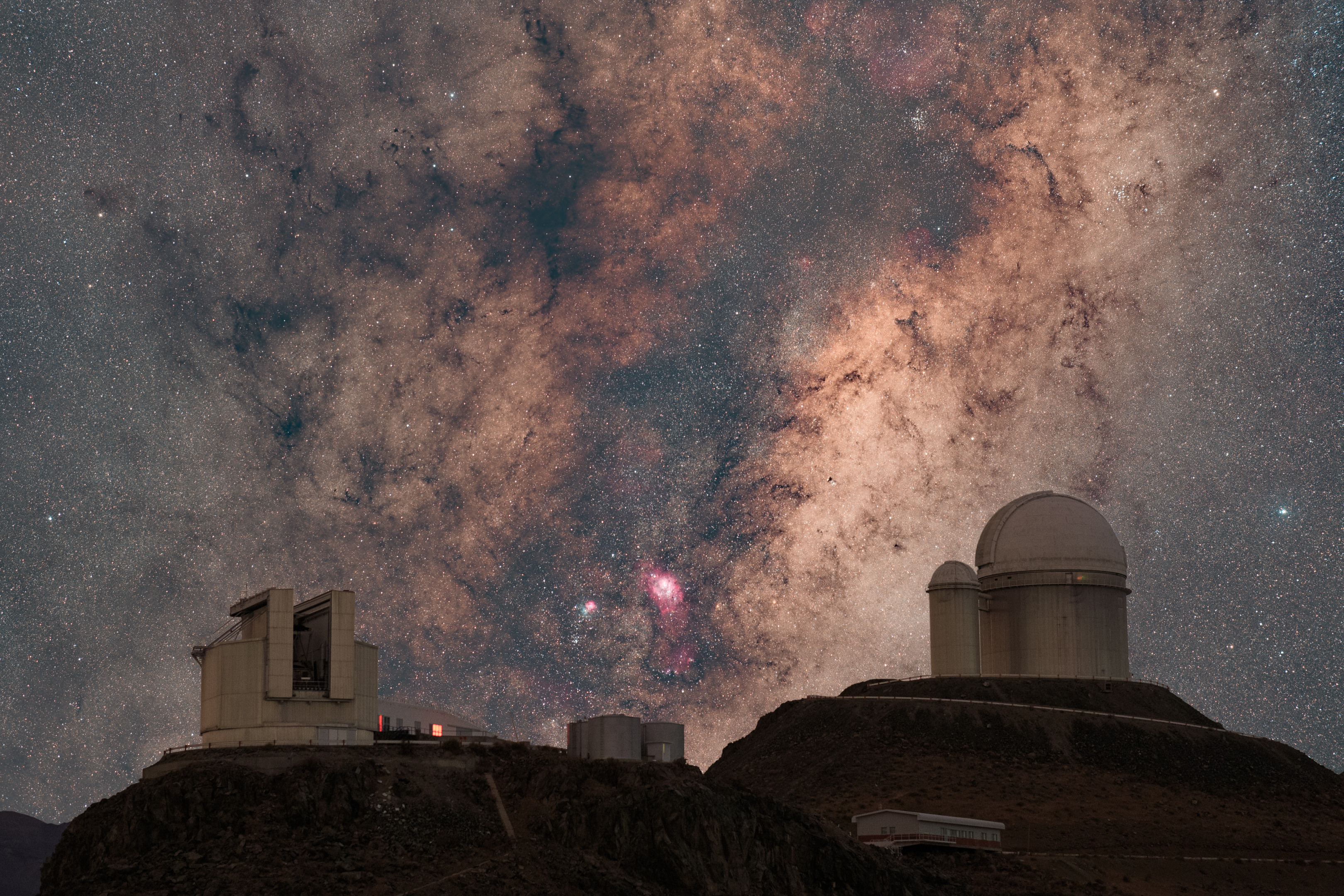
Alt...
2023 December 1
Milky Way Rising
* Image Credit & Copyright: José Rodrigues
Explanation:
The core of the Milky Way is rising beyond the Chilean mountain-top La Silla Observatory in this deep night skyscape. Seen toward the constellation Sagittarius, our home galaxy's center is flanked on the left, by the European Southern Observatory's New Technology Telescope which pioneered the use of active optics to accurately control the shape of large telescope mirrors. To the right stands the ESO 3.6-meter Telescope, home of the exoplanet hunting HARPS and NIRPS spectrographs. Between them, the galaxy's central bulge is filled with obscuring clouds of interstellar dust, bright stars, clusters, and nebulae. Prominent reddish hydrogen emission from the star-forming Lagoon Nebula, M8, is near center. The Trifid Nebula, M20, combines blue light of a dusty reflection nebula with reddish emission just left of the cosmic Lagoon. Both are popular stops on telescopic tours of the galactic center. The composited image is a stack of separate exposures for ground and sky made in April 2023, all captured consecutively with the same framing and camera equipment.
Authors & editors: Robert Nemiroff (MTU) & Jerry Bonnell (UMCP)
NASA Official: Phillip Newman Specific rights apply.
NASA Web Privacy Policy and Important Notices
A service of: ASD at NASA / GSFC,
NASA Science Activation
& Michigan Tech. U.
2023 September 27
STEVE and Milky Way Cross over Rural Road
* Image Credit & Copyright: Theresa Clarke
Explanation:
Not every road ends in a STEVE. A week ago, a sky enthusiast's journey began with a goal: to photograph an aurora over Lake Huron. Driving through rural Ontario, Canada, the forecasted sky show started unexpectedly early, causing the photographer to stop before arriving at the scenic Great Lake. Aurora images were taken toward the north -- but over land, not sea. While waiting for a second round of auroras, a peculiar band of light was noticed to the west. Slowly, the photographer and friends realized that this western band was likely an unusual type of aurora: a Strong Thermal Emission Velocity Enhancement (STEVE). Moreover, this STEVE was putting on quite a show: appearing intertwined with the central band of our Milky Way Galaxy while intersecting the horizon just near the end of the country road. After capturing this cosmic X on camera, the photographer paused to appreciate the unexpected awesomeness of finding extraordinary beauty in an ordinary setting.
https://apod.nasa.gov/apod/ap230927.html
#space #galaxy #milkyway #astrophotography #photography #science #astronomy #nature #NASA
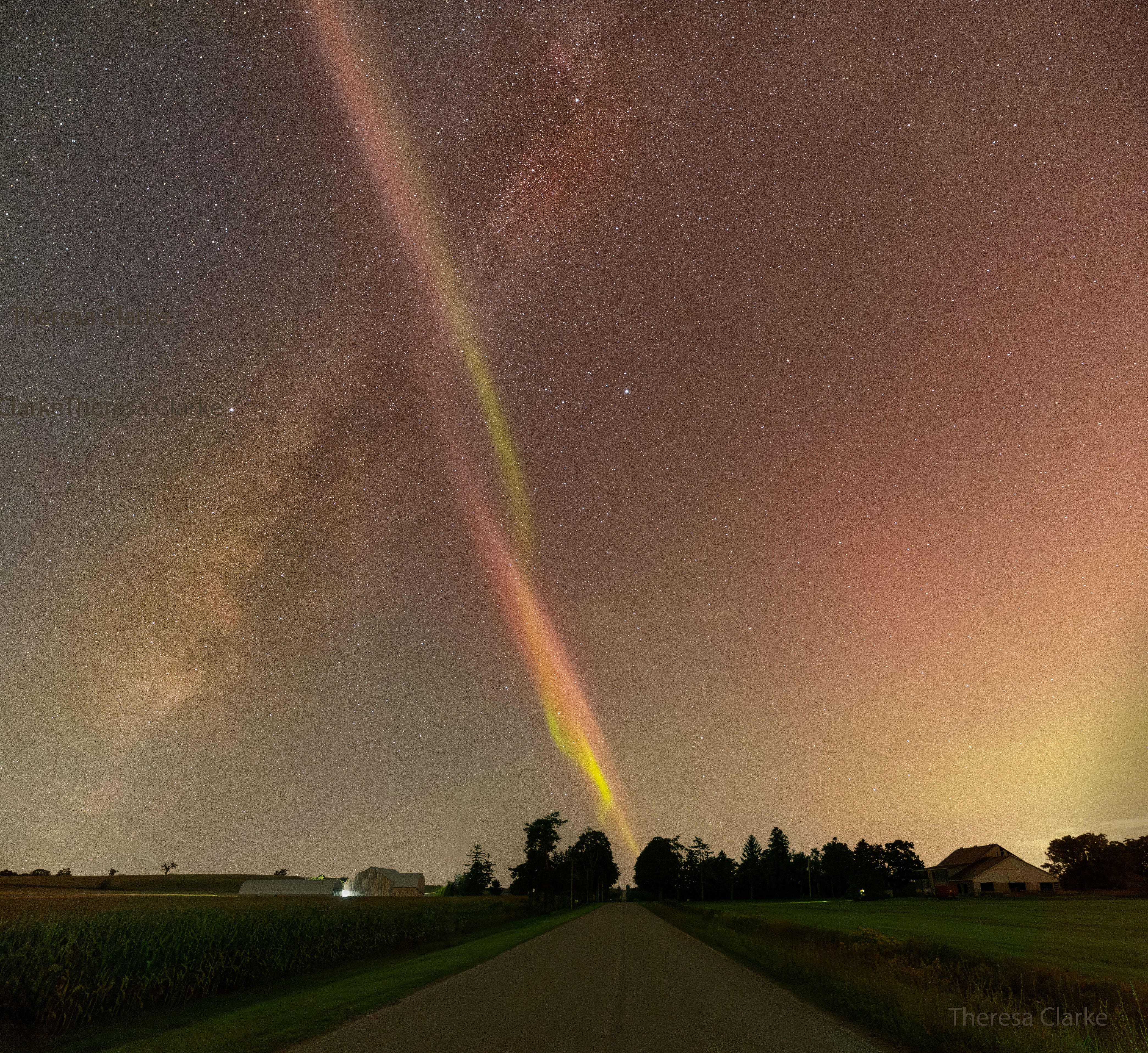
Alt...
2023 September 27
A rural road is pictured running to the horizon with rural grassy fields on both sides. Rising from the lower left is the central band of our Milky Way Galaxy. Rising from the horizon -- just at the visible end of the road, is a thin twisting band of light twisting green and red bands -- a STEVE. The STEVE crosses in front of the Milky Way band making a big
STEVE and Milky Way Cross over Rural Road
* Image Credit Theresa Clarke
Explanation:
Not every road ends in a STEVE. A week ago, a sky enthusiast's journey began with a goal: to photograph an aurora over Lake Huron. Driving through rural Ontario, Canada, the forecasted sky show started unexpectedly early, causing the photographer to stop before arriving at the scenic Great Lake. Aurora images were taken toward the north -- but over land, not sea. While waiting for a second round of auroras, a peculiar band of light was noticed to the west. Slowly, the photographer and friends realized that this western band was likely an unusual type of aurora: a Strong Thermal Emission Velocity Enhancement (STEVE). Moreover, this STEVE was putting on quite a show: appearing intertwined with the central band of our Milky Way Galaxy while intersecting the horizon just near the end of the country road. After capturing this cosmic X on camera, the photographer paused to appreciate the unexpected awesomeness of finding extraordinary beauty in an ordinary setting.
Authors & editors: Robert Nemiroff & Jerry Bonnell
2023 July 16
Meteor and Milky Way over the Alps
* Image Credit & Copyright: Nicholas Roemmelt (Venture Photography)
https://www.facebook.com/DrNicholasRoemmeltPhotography/
https://www.venture.photography/bio
Explanation:
Now this was a view with a thrill. From Mount Tschirgant in the Alps, you can see not only nearby towns and distant Tyrolean peaks, but also, weather permitting, stars, nebulas, and the band of the Milky Way Galaxy. What made the arduous climb worthwhile this night, though, was another peak -- the peak of the 2018 Perseids Meteor Shower. As hoped, dispersing clouds allowed a picturesque sky-gazing session that included many faint meteors, all while a carefully positioned camera took a series of exposures. Suddenly, a thrilling meteor -- bright and colorful -- slashed down right next to the nearly vertical band of the Milky Way. As luck would have it, the camera caught it too. Therefore, a new image in the series was quickly taken with one of the sky-gazers posing on the nearby peak. Later, all of the images were digitally combined.
https://apod.nasa.gov/apod/ap230716.html
#space #galaxy #milkyway #astrophotography #photography #science #astronomy #nature #NASA
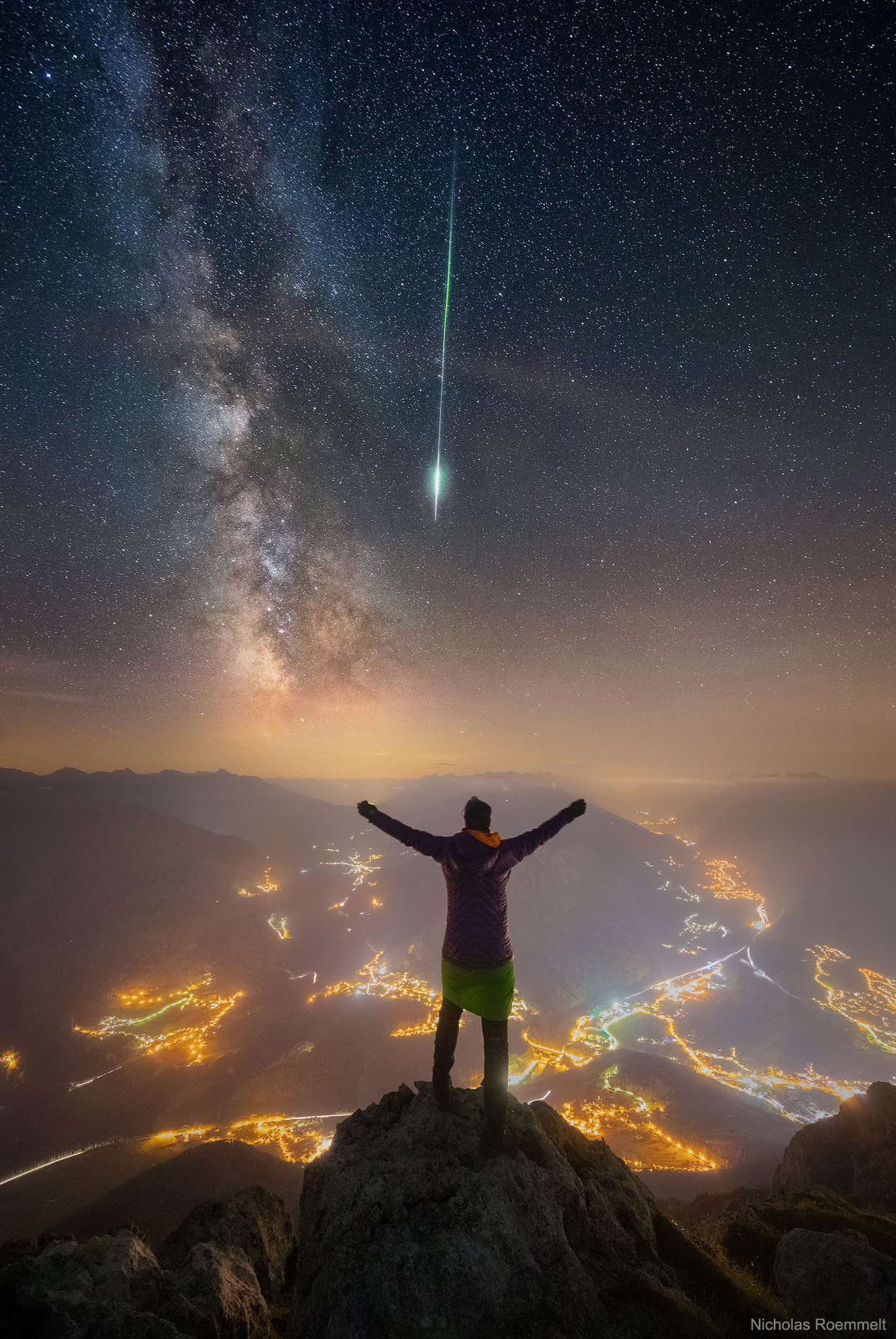
Alt...
2023 July 16
A person is seen facing away, standing on a peak. Other mountain peaks surround them. City lights are seen in towns and along roads below. Stars in the night sky are above. The band of the Milky Way galaxy slants down from the upper left. A bright green meteor streak slants down from above.
Meteor and Milky Way over the Alps
* Image Credit & Copyright: Nicholas Roemmelt (Venture Photography)
Explanation:
Now this was a view with a thrill. From Mount Tschirgant in the Alps, you can see not only nearby towns and distant Tyrolean peaks, but also, weather permitting, stars, nebulas, and the band of the Milky Way Galaxy. What made the arduous climb worthwhile this night, though, was another peak -- the peak of the 2018 Perseids Meteor Shower. As hoped, dispersing clouds allowed a picturesque sky-gazing session that included many faint meteors, all while a carefully positioned camera took a series of exposures. Suddenly, a thrilling meteor -- bright and colorful -- slashed down right next to the nearly vertical band of the Milky Way. As luck would have it, the camera caught it too. Therefore, a new image in the series was quickly taken with one of the sky-gazers posing on the nearby peak. Later, all of the images were digitally combined.
Authors & editors: Robert Nemiroff (MTU) & Jerry Bonnell (UMCP)
NASA Official: Phillip Newman Specific rights apply.
2025 July 23
Fireball over Cape San Blas
* Image Credit & Copyright: Jason Rice
https://www.instagram.com/p/DLa5D4sxVag/
Explanation:
Have you ever seen a fireball? In astronomy, a fireball is a very bright meteor -- one at least as bright as Venus and possibly brighter than even a full Moon. Fireballs are rare -- if you see one you are likely to remember it for your whole life. Physically, a fireball is a small rock that originated from an asteroid or comet that typically leaves a fading smoke trail of gas and dust as it shoots through the Earth's atmosphere. It is unlikely that any single large ground strike occurred -- much of the rock likely vaporized as it broke up into many small pieces. The featured picture was captured last week from a deadwood beach in Cape San Blas, Florida, USA.
https://www.amsmeteors.org/fireballs/faqf/
https://science.nasa.gov/solar-system/meteors-meteorites/
https://science.nasa.gov/solar-system/asteroids/
https://apod.nasa.gov/apod/ap231126.html
https://en.wikipedia.org/wiki/Comet_nucleus
https://apod.nasa.gov/apod/ap190430.html
https://www.instagram.com/p/DLa5D4sxVag/?img_index=2
https://apod.nasa.gov/apod/ap250723.html
#space #galaxy #milkyway #astrophotography #photography #science #astronomy #nature #NASA

Alt...
2025 July 23
A bright streak is pictured through a starry sky over a beach spotted with the husks of dead trees. The rollover shows the resulting smoke trail from the bright meteor.
Fireball over Cape San Blas
* Image Credit & Copyright: Jason Rice
Explanation:
Have you ever seen a fireball? In astronomy, a fireball is a very bright meteor -- one at least as bright as Venus and possibly brighter than even a full Moon. Fireballs are rare -- if you see one you are likely to remember it for your whole life. Physically, a fireball is a small rock that originated from an asteroid or comet that typically leaves a fading smoke trail of gas and dust as it shoots through the Earth's atmosphere. It is unlikely that any single large ground strike occurred -- much of the rock likely vaporized as it broke up into many small pieces. The featured picture was captured last week from a deadwood beach in Cape San Blas, Florida, USA.
Authors & editors: Robert Nemiroff (MTU) & Jerry Bonnell (UMCP)
NASA Official: Amber Straughn Specific rights apply.
NASA Web Privacy, Accessibility, Notices;
A service of: ASD at NASA / GSFC,
NASA Science Activation
& Michigan Tech. U.
2025 July 25
Twelve Years of Kappa Cygnids
* Image Credit & Copyright: Petr Horálek, Josef Kujal, Tomáš Slovinský
https://www.petrhoralek.com/#about-1
https://www.instagram.com/josef.kujal/
https://www.tomasslovinsky.com/#about
* Acknowledgement: Mahdi Zamani
https://mahdizamani.com/
Explanation:
Meteors from the Kappa Cygnid meteor shower are captured in this time-lapse composite skyscape. The minor meteor shower, with a radiant not far from its eponymous star Kappa Cygni, peaks in mid-August, almost at the same time as the much better-known and better-observed Perseid meteor shower. But, seen to have a peak rate of only about 3 meteors per hour, Kappa Cygnids are vastly outnumbered by the more popular, prolific Perseid shower's meteors that emanate from the heroic constellation Perseus. To capture dozens of Kappa Cygnids, this long term astro-imaging project compiled meteors in exposures selected from over 51 August nights during the years 2012 through 2024. Most of the exposures with identified Kappa Cygnid meteors were made in August 2021, a high point of the shower's known 7-year activity cycle. All twelve years worth of Kappa Cygnids are registered against a base sea and night skyscape of the Milky Way above Elafonisi Beach, Crete, Greece, also recorded in August of 2021.
https://www.petrhoralek.com/?p=25643
https://en.wikipedia.org/wiki/Kappa_Cygnids
https://ui.adsabs.harvard.edu/abs/2025A%26A...695A..83B/abstract
https://en.wikipedia.org/wiki/Radiant_(meteor_shower)
https://apod.nasa.gov/apod/ap250725.html
#space #galaxy #milkyway #astrophotography #photography #science #astronomy #nature #NASA
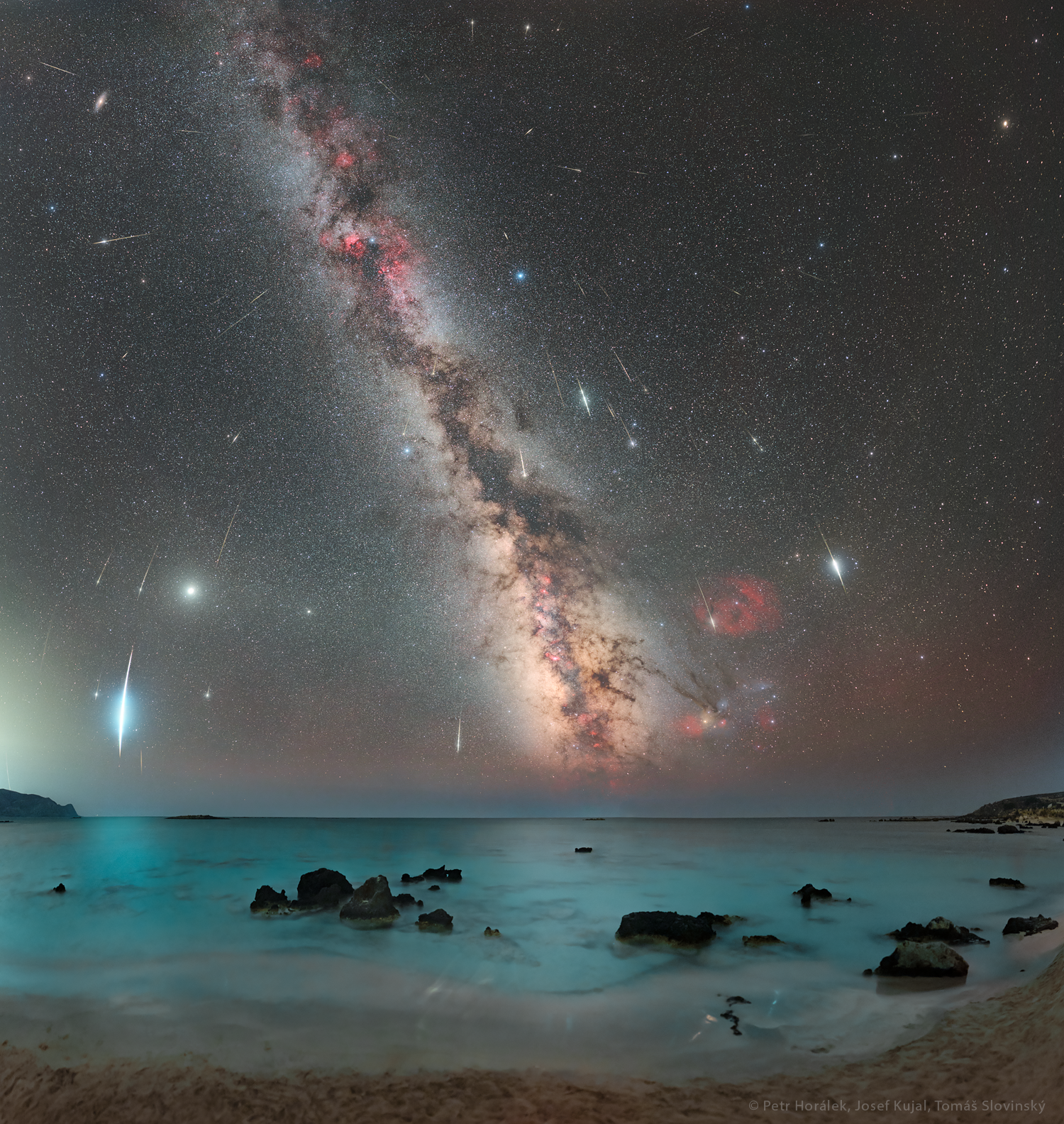
Alt...
2025 July 25
Twelve Years of Kappa Cygnids
* Image Credit & Copyright: Petr Horálek, Josef Kujal, Tomáš Slovinský;
* Acknowledgement: Mahdi Zamani
Explanation:
Meteors from the Kappa Cygnid meteor shower are captured in this time-lapse composite skyscape. The minor meteor shower, with a radiant not far from its eponymous star Kappa Cygni, peaks in mid-August, almost at the same time as the much better-known and better-observed Perseid meteor shower. But, seen to have a peak rate of only about 3 meteors per hour, Kappa Cygnids are vastly outnumbered by the more popular, prolific Perseid shower's meteors that emanate from the heroic constellation Perseus. To capture dozens of Kappa Cygnids, this long term astro-imaging project compiled meteors in exposures selected from over 51 August nights during the years 2012 through 2024. Most of the exposures with identified Kappa Cygnid meteors were made in August 2021, a high point of the shower's known 7-year activity cycle. All twelve years worth of Kappa Cygnids are registered against a base sea and night skyscape of the Milky Way above Elafonisi Beach, Crete, Greece, also recorded in August of 2021.
Authors & editors: Robert Nemiroff (MTU) & Jerry Bonnell (UMCP)
NASA Official: Amber Straughn Specific rights apply.
NASA Web Privacy, Accessibility, Notices;
A service of: ASD at NASA / GSFC,
NASA Science Activation
& Michigan Tech. U.
Wall Art and more... The Space Collection
https://fineartamerica.com/profiles/joegiacaloneart/collections/space
#space #nasa #spaceexploration #science #wallart
#fantasy #imagination #magical #wonder #StarsEverywhere
#fineartamerica #mastoart

Wall Art and more... The Space Collection
https://fineartamerica.com/profiles/joegiacaloneart/collections/space
#space #nasa #spaceexploration #science #wallart
#fantasy #imagination #magical #wonder #StarsEverywhere
#fineartamerica

Wall Art and more... The Space Collection
https://fineartamerica.com/profiles/joegiacaloneart/collections/space
#space #nasa #spaceexploration #science #wallart
#fantasy #imagination #magical #wonder #StarsEverywhere
#fineartamerica

Wall Art and more... The Space Collection
https://fineartamerica.com/profiles/joegiacaloneart/collections/space
#space #nasa #spaceexploration #science #wallart
#fantasy #imagination #magical #wonder #StarsEverywhere

Wall Art and more... The Space Collection
https://fineartamerica.com/profiles/joegiacaloneart/collections/space
#space #nasa #spaceexploration #science #wallart
#fantasy #imagination #magical #wonder #StarsEverywhere
#BuyIntoArt

Wall Art and more... The Space Collection
https://fineartamerica.com/profiles/joegiacaloneart/collections/space
#space #nasa #spaceexploration #science #wallart
#fantasy #imagination #magical #wonder #StarsEverywhere
#BuyIntoArt

Unveiling a 36 billion solar mass black hole at the centre of the Cosmic Horseshoe gravitational lens
Supermassive black holes (SMBHs) are found at the centre of every massive galaxy, with their masses tightly connected to their host galaxies through a co-evolution over cosmic time. For massive ellipticals, the SMBH mass strongly correlates with the host central stellar velocity dispersion, via the relation. However, SMBH mass measurements have traditionally relied on central stellar dynamics in nearby galaxies, limiting our ability to explore the SMBHs across cosmic time. In this work, we present a self-consistent analysis combining 2D stellar dynamics and lens modelling of the Cosmic Horseshoe gravitational lens system, one of the most massive lens galaxies ever observed. Using MUSE integral-field spectroscopy and high-resolution Hubble Space Telescope imaging, we simultaneously model the radial arc – sensible to the inner mass structure – with host stellar kinematics to constrain the galaxy’s central mass distribution and SMBH mass. Bayesian model comparison yields a detection of an ultramassive black hole with , consistent across various systematic tests. Our findings place the Cosmic Horseshoe above the relation, supporting an emerging trend observed in brightest cluster galaxies and other massive galaxies, which suggests a steeper relationship at the highest masses, potentially driven by a different co-evolution of SMBHs and their host galaxies. Future surveys will uncover more radial arcs, enabling the detection of SMBHs over a broader redshift and mass range. These discoveries will further refine our understanding of the relation and its evolution across cosmic time.
https://academic.oup.com/mnras/article/541/4/2853/8213862?login=false
https://academic.oup.com/mnras/article-pdf/541/4/2853/63890019/staf1036.pdf
CREDIT
Carlos R Melo-Carneiro,
Thomas E Collett,
Lindsay J Oldham,
Wolfgang Enzi,
Cristina Furlanetto,
Ana L Chies-Santos,
Tian Li
#space #galaxy #astrophotography #photography #science #physics #nature #NASA #ESA #hubble #webb #education #apod
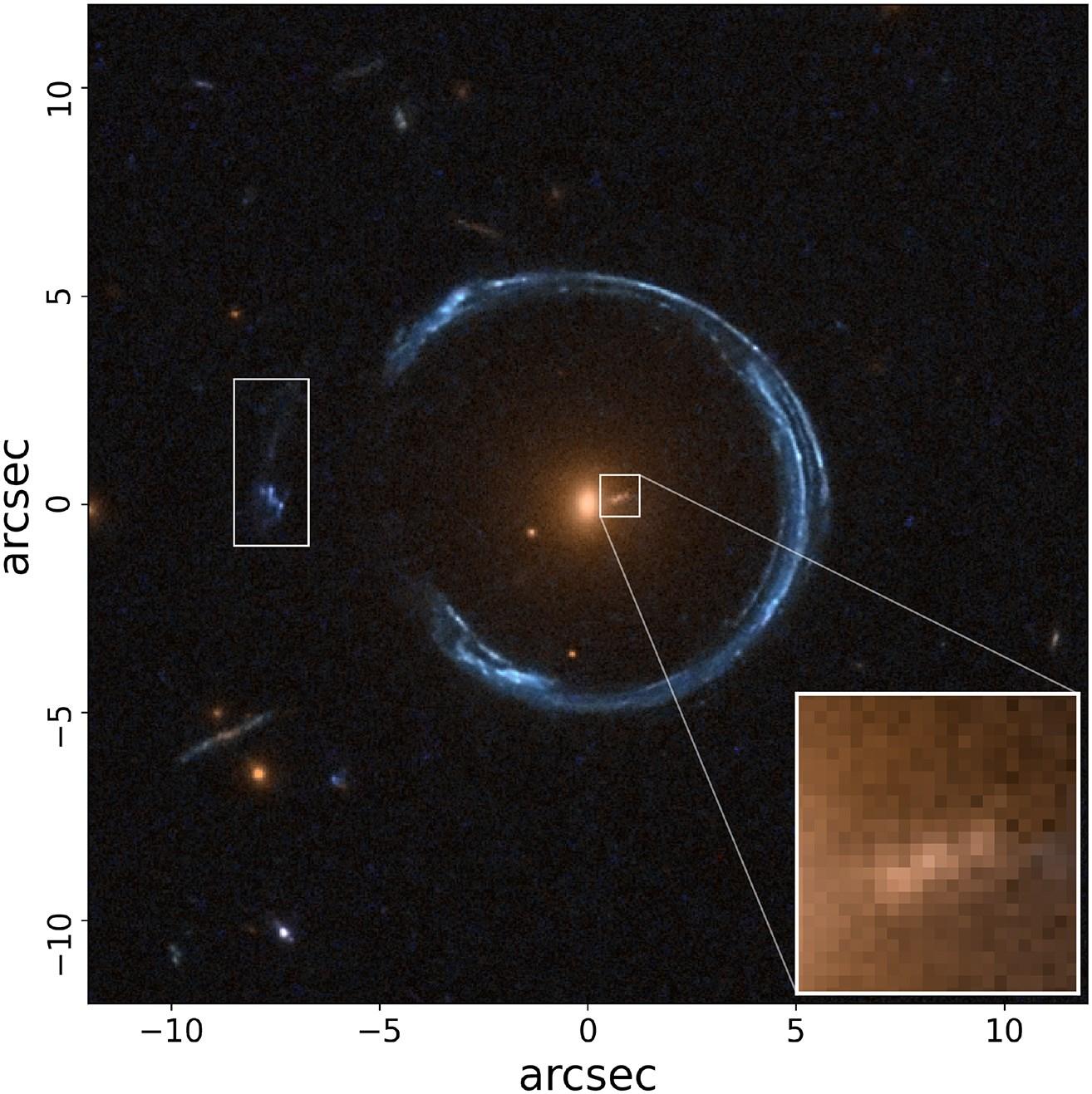
Alt...
Figure 1.
HST/WFC3 colour composite image of the Cosmic Horseshoe, created using the F814W, F606W, and F475W filters. The system is composed by the main deflector; the eponymous Einstein ring of the Cosmic Horseshoe; and the radial arc and its counter-image, both highlighted. The inset shows the radial arc. The figure is oriented such that north is up and east is left.
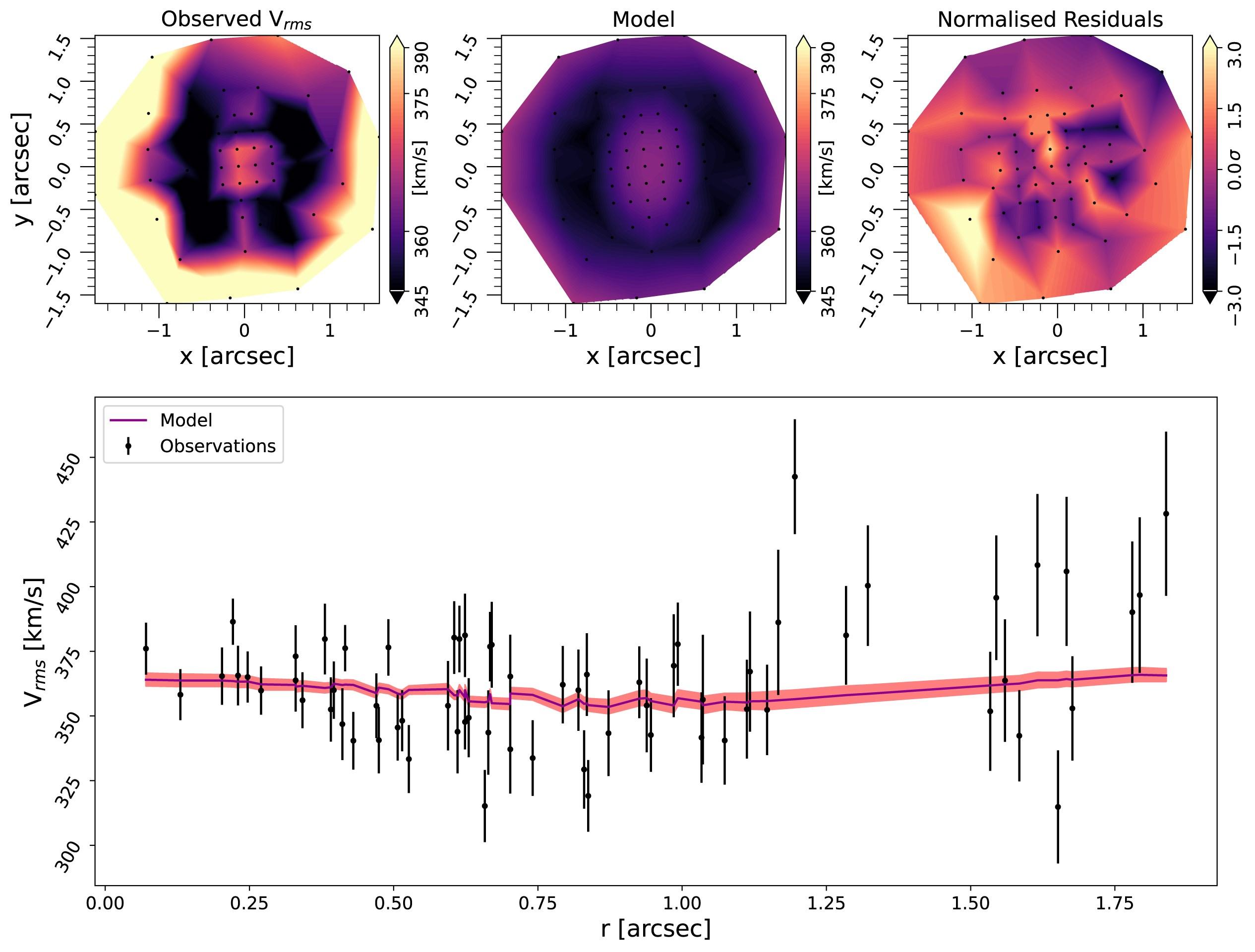
Alt...
Figure 2.
Stellar dynamics fiducial model. The top panels show the observed
kinematic map (left), the median kinematic model (centre), and the normalized residuals (right). The bottom panel presents the radial kinematic profile (black dots) alongside the median model and its
credible region. The black dots in the top panels mark the centroids of the Voronoi bins.
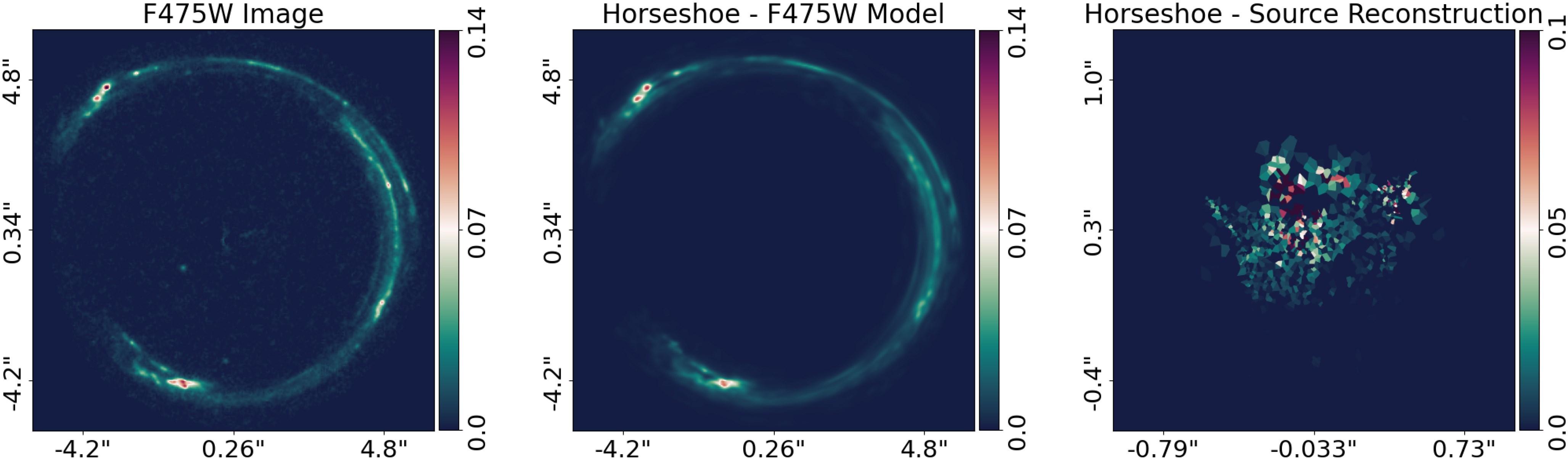
Alt...
Figure 3.
Fits to the Cosmic Horseshoe in the F475W filter. From left to right, the panels display the lens-subtracted image, the highest-likelihood EPL model, and the reconstructed source s2 at z=2.381. To enhance the efficiency of the lens modelling, a mask has been applied around the lensed source and only modelled pixels within the masked region, as shown in the central panel. All images are in units of electrons per second.
Alt...
Figure 4.
Two-dimensional posterior distributions for the parameters of the fiducial model. Only parameters that show a strong degeneracy with the SMBH mass are displayed. The inset plot on the top-right present the covariance between the SMBH mass and Einstein mass within the Cosmic Horseshoe ring. Contours are the 1 and 2σ credible intervals, respectively.
Alt...
Figure 5.
Highest-likelihood lens model under the fiducial configuration. The panels, from top left to bottom right, show the observed image, lensed source model, normalized residuals, and source reconstruction. All images are in units of electrons per second.
Alt...
Figure 6.
Two-dimensional posterior distributions for the parameters of model M2, which differs from the fiducial model by assuming a gNFW halo. Only the inner DM density slope, the SMBH mass, and the Einstein mass are displayed. The brown dashed lines show the posterior median of the fiducial model for comparison. Contours are the 1σ and 2σ
credible intervals, respectively.
Alt...
Figure 7.
M3 anisotropy profile. The solid line shows the orbital anisotropy profile of the stars, and the grey band represents the 1σ credible band. The brown point is the constant anisotropy inferred by the fiducial model M1, with its associated error bar. The horizontal dashed line corresponds to the isotropic case.
Alt...
Figure 8.
Two-dimensional posterior distributions for the parameters of model M4, which differs from the fiducial model by a gradient mass-to-light ratio. Only the three mass-to-light ratios, the SMBH mass, and the Einstein mass are displayed. The brown dashed lines show the posterior median of the fiducial model for comparison. Contours are the 1σ and 2σ credible intervals, respectively. The top-right inset shows the projected radial stellar mass-to-light profiles for the fiducial model (brown) and model M4 in black. The shaded regions are the level.
Alt...
Figure 9.
Model results of mass configuration M14, which differs from the fiducial model by not including an SMBH. The upper panels display, left to right, the highest-likelihood lens model, the normalized residuals, and the source reconstruction. The bottom panels are, left to right, the median dynamical model, the normalized residuals, and the radial kinematic profile with the median model. All top images are in units of electrons per second.
Alt...
Figure 10.
Relationship between mass and the host effective velocity dispersion. The black solid line represents the relation from den Bosch (2016), with the dashed and dotted lines showing the and scatter, respectively. The UMBH at the centre of the Cosmic Horseshoe’s main lens is marked by a star, with a measured mass of . Other UMBHs that deviate significantly from the relation are also shown: NGC 4889 and NGC 3842 (McConnell et al. 2011), NGC 1601 (Thomas et al. 2016), Holm 15A (Mehrgan et al. 2019), and Abell 1201 (Nightingale et al. 2023). These systems are typically BCGs, and except Abell 1201 at , they are all nearby systems. The Cosmic Horseshoe, at , represents one of the most massive SMBHs measured and is an outlier from the main relation. The SMBH mass compilation is from den Bosch (2016).
Alt...
Figure 11.
Surface mass density profile for three models – fiducial (upper) and other two that uses a gNFW profile: M2 (middle) and M9 (lower). The M2 model resembles the fiducial model but with the DM inner slope as a free parameter, while M9 incorporates both a variable mass-to-light ratio and a variable anisotropy profile. The blue lines represent the stellar component, purple lines represents the DM component, and in black we show the total (DM+stellar + BH) surface density. The shaded regions indicate the credible intervals for each component. The horizontal dashed lines represent the effective radius and the Einstein radius
2025 November 2
A Horseshoe Einstein Ring from Hubble
* Image Credit: ESA/Hubble & NASA
https://www.esa.int/
https://esahubble.org/
https://www.nasa.gov/
Explanation:
What's large and blue and can wrap itself around an entire galaxy? A gravitational lens mirage. Pictured here, the gravity of a massive elliptical galaxy (luminous red galaxy: LRG) has gravitationally distorted the light from a much more distant blue galaxy. More typically, such light bending results in two discernible images of the distant galaxy, but here the lens alignment is so precise that the background galaxy is distorted into a horseshoe -- a nearly complete ring: an Einstein ring. Although LRG 3-757 was discovered in 2007 in data from the Sloan Digital Sky Survey (SDSS), the image shown above is a follow-up observation taken with the Hubble Space Telescope's Wide Field Camera 3. A recent lens analysis of the central galaxy indicates that it likely hosts the single most massive black hole yet discovered: 36 billion times the mass of our Sun.
https://esahubble.org/images/potw1151a/
https://academic.oup.com/mnras/article/541/4/2853/8213862?login=false
https://en.wikipedia.org/wiki/Gravitational_lens
https://www.stsci.edu/hst
https://www.stsci.edu/hst/instrumentation/wfc3
https://ui.adsabs.harvard.edu/abs/2001AJ....122.2267E/abstract
https://www.sdss.org/
https://apod.nasa.gov/apod/ap251102.html
#space #galaxy #astrophotography #photography #science #physics #nature #NASA #ESA #hubble #webb #education #apod
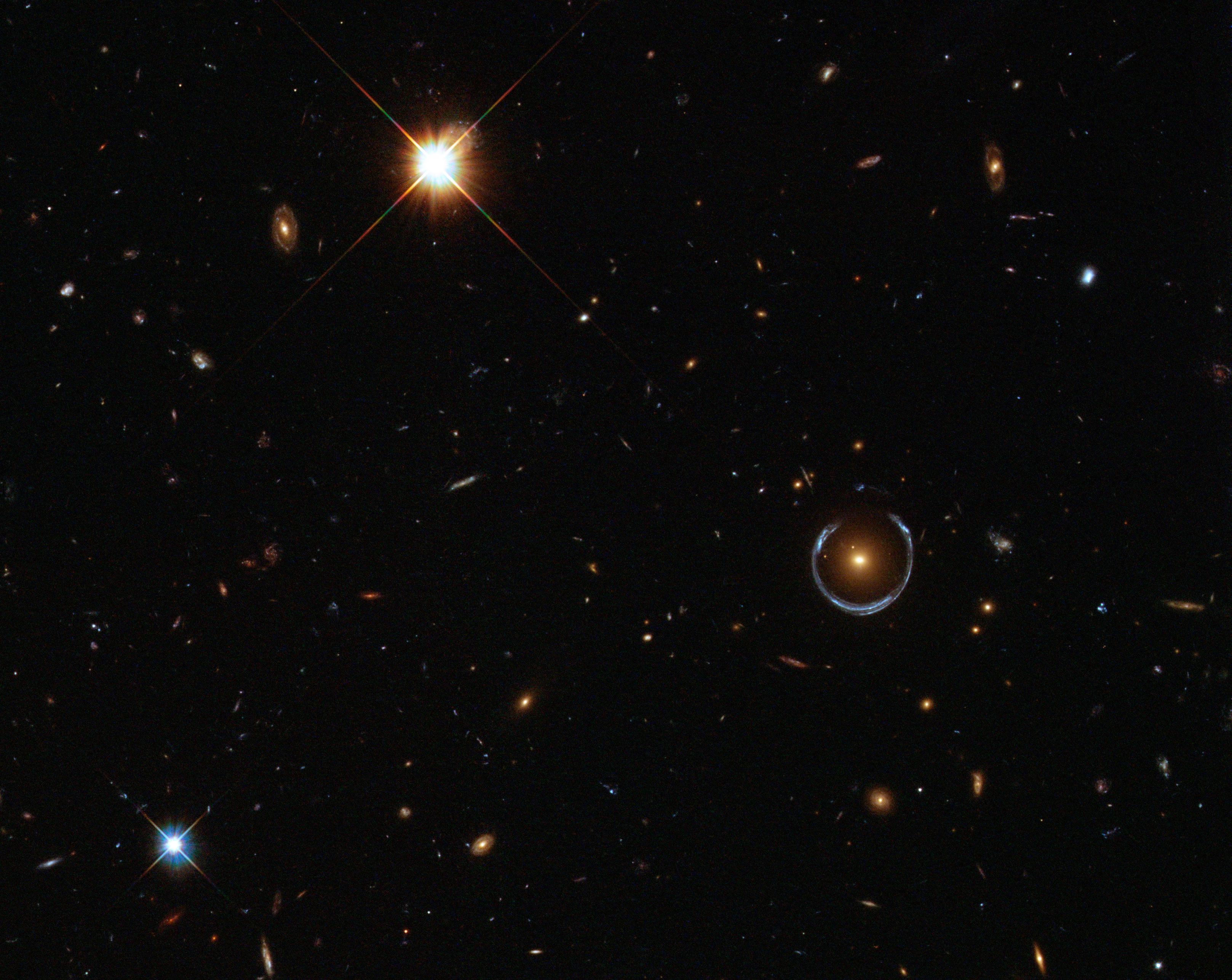
Alt...
2025 November 2
A dark star field with several small galaxies features a yellowish galaxy in the center. Surrounding this galaxy is a blue nearly circular horseshoe shaped object.
A Horseshoe Einstein Ring from Hubble
* Image Credit: ESA/Hubble & NASA
Explanation:
What's large and blue and can wrap itself around an entire galaxy? A gravitational lens mirage. Pictured here, the gravity of a massive elliptical galaxy (luminous red galaxy: LRG) has gravitationally distorted the light from a much more distant blue galaxy. More typically, such light bending results in two discernible images of the distant galaxy, but here the lens alignment is so precise that the background galaxy is distorted into a horseshoe -- a nearly complete ring: an Einstein ring. Although LRG 3-757 was discovered in 2007 in data from the Sloan Digital Sky Survey (SDSS), the image shown above is a follow-up observation taken with the Hubble Space Telescope's Wide Field Camera 3. A recent lens analysis of the central galaxy indicates that it likely hosts the single most massive black hole yet discovered: 36 billion times the mass of our Sun.
Authors & editors: Robert Nemiroff (MTU) & Jerry Bonnell (UMCP)
NASA Official: Amber Straughn Specific rights apply.
NASA Web Privacy, Accessibility, Notices;
A service of: ASD at NASA / GSFC,
NASA Science Activation
& Michigan Tech. U.
Galileo's Observations on the Pleiades
Galileo decided to demonstrate the great number of stars that actually existed by depicting a few star systems that were known to all and including the additional stars that he had observed. He chose to depict the entire constellations of Orion and the Pleiades, but soon decided that Orion was just too large, and so he only sketched the belt and sword region of Orion. Below are the drawings Galileo made of Orion and the Pleiades as put forth in his publication Sidereus Nuncius, pages 60 and 61.
CREDIT
Rice University Library
Houston, Texas
https://galileo.library.rice.edu/lib/student_work/astronomy95/orionpleiades.html
https://archive.org/details/Sidereusnuncius00Gali/page/n37/mode/2up
#space #pleiades #astrophotography #photography #science #astronomy #nature #NASA
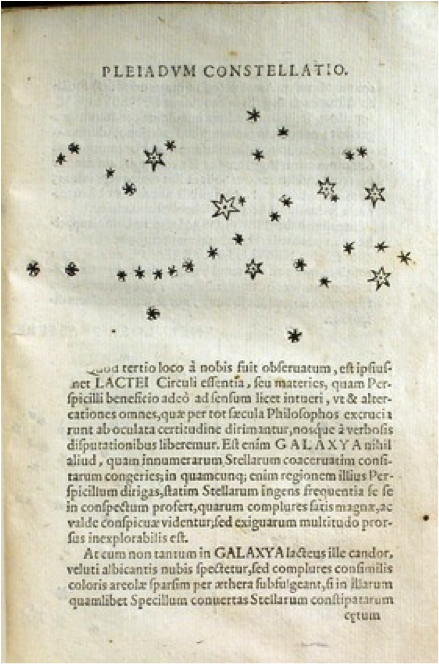
Alt...
Galileo's drawings of the Pleiades star cluster from Sidereus Nuncius
Image of a page from Sidereus Nuncius showing Galileo's drawings of the stars in the Pleiades star cluster.
CREDIT
History of Science Collections, University of Oklahoma Libraries
Astronomical role of M45 in antiquity
The M45 group played an important role in ancient times for the establishment of many calendars thanks to the combination of two remarkable elements. The first, which is still valid, is its unique and easily identifiable appearance on the celestial vault near the ecliptic. The second, essential for the ancients, is that in the middle of the third millennium BC, this asterism (a prominent pattern or group of stars that is smaller than a constellation) marked the vernal point.
The importance of this asterism is also evident in northern Europe. The Pleiades cluster is displayed on the Nebra sky disc that was found in Germany and is dated to around 1600 BC. On the disk the cluster is represented in a high position between the Sun and the Moon.
CREDIT
Contributors to Wikimedia projects
----
In ancient Greece and the Mediterranean, the first appearance of the Pleiades before sunrise denoted the start of the navigation season, according to EarthSky. In fact, the name Pleiades probably comes from the ancient Greek word "to sail."
Even the modern holiday of Halloween may be related to Pleiades. Many think that Halloween is descended, in part, from the old pagan festival of Samhain, celebrated by the ancient Celts and Druids of the British Isles. These ancient people may have observed the midnight culmination of Pleiades, or when Pleiades reached its highest point in the sky, at midnight on the day of this festival, which would have been celebrated around the time of Halloween. They believed that this signified the time of the thinnest separation between the world of the living and the world of the dead.
CREDIT
Chris Mihos
Warner Professor of Astronomy at Case Western Reserve University.
#space #pleiades #astrophotography #photography #science #astronomy #nature #NASA
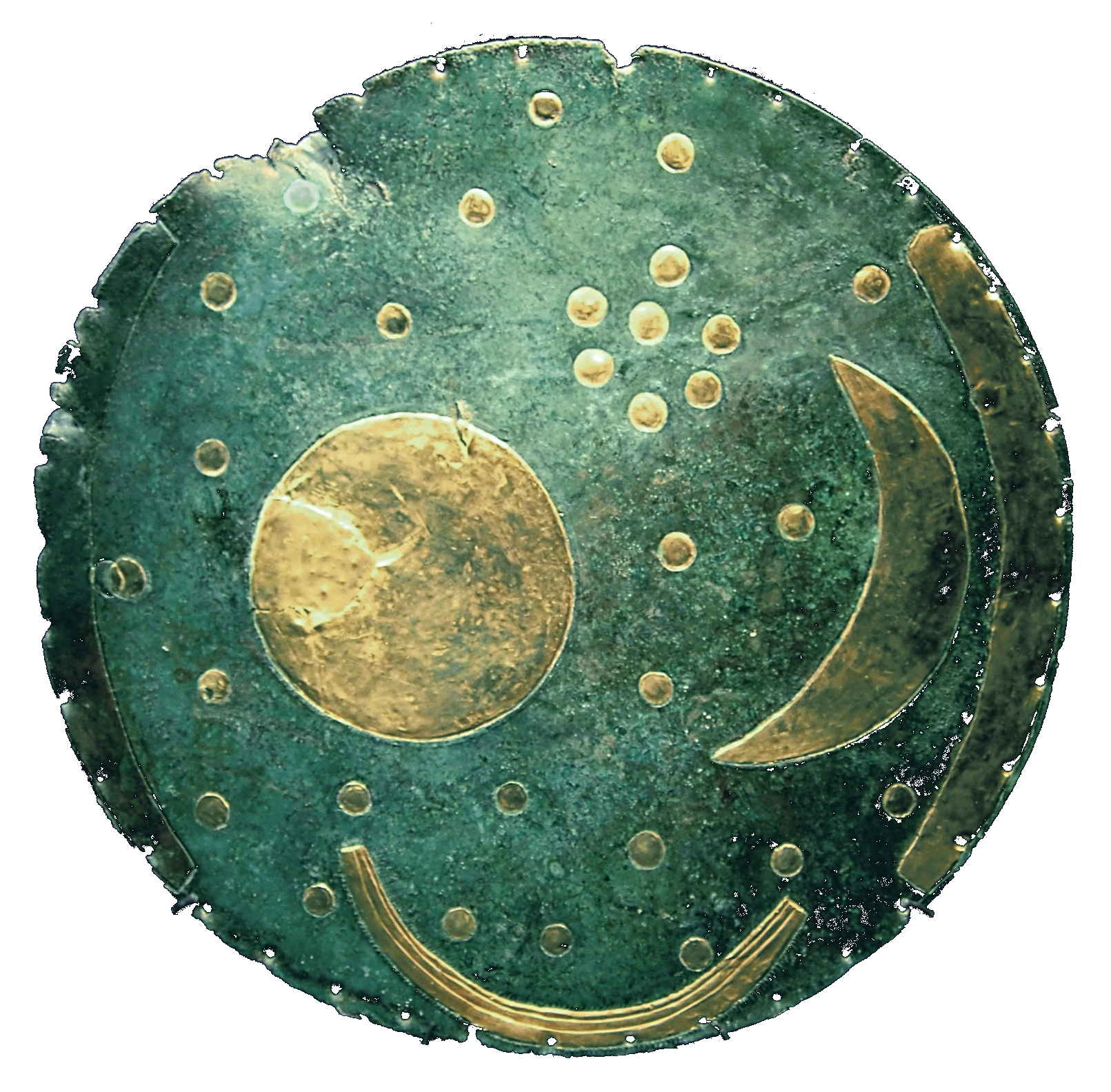
Alt...
On the Nebra sky disc, dated circa 1600 BC, the cluster of seven dots in the upper right portion of the disk is believed to be the Pleiades.
CREDIT
Dbachmann
photograph taken when the artefact was on display in Basel, Switzerland in December 2006
2025 November 1
Pleiades from Planet Earth
* Image Credit & Copyright: Max Inwood
https://www.instagram.com/max.nti/
Explanation:
The lovely Pleiades star cluster shines in Earth's night sky, a compact group of stars some 400 light-years distant toward the constellation Taurus and the Orion Arm of our Milky Way galaxy. Recognized since ancient times, the remarkable celestial gathering is visible to the unaided eye. The Pleiades cluster is also well-placed for viewing from both northern and southern hemispheres, and over the centuries has become connected to many cultural traditions and celebrations, including the cross-quarter day celebration Halloween. In Greek myth, the Pleiades were seven daughters of the astronomical titan Atlas and sea-nymph Pleione. Galileo first sketched the star cluster viewed through his telescope with stars too faint to be seen by eye and Charles Messier recorded the position of the cluster as the 45th entry in his well-known catalog of things which are not comets. In this dramatic night skyscape from planet Earth, the stars of the Pleiades appear embedded in dusty blue reflection nebulae, poised above Mt Sefton, one of the tallest peaks in New Zealand. There known as Matariki, the star cluster is associated with the celebration of the Maori new year.
https://www.smithsonianmag.com/science-nature/a-brief-and-amazing-history-of-the-pleiades-stars-that-captivated-ancient-civilizations-and-inspired-poets-180987529/
https://en.wikipedia.org/wiki/Pleiades_(Greek_mythology)
https://science.nasa.gov/mission/hubble/science/explore-the-night-sky/hubble-messier-catalog/
https://www.tepapa.govt.nz/discover-collections/read-watch-play/matariki-maori-new-year/what-and-who-matariki/what-matariki
https://science.nasa.gov/resource/the-milky-way-galaxy/
https://apod.nasa.gov/apod/ap251101.html
#space #pleiades #astrophotography #photography #science #astronomy #nature #NASA #apod
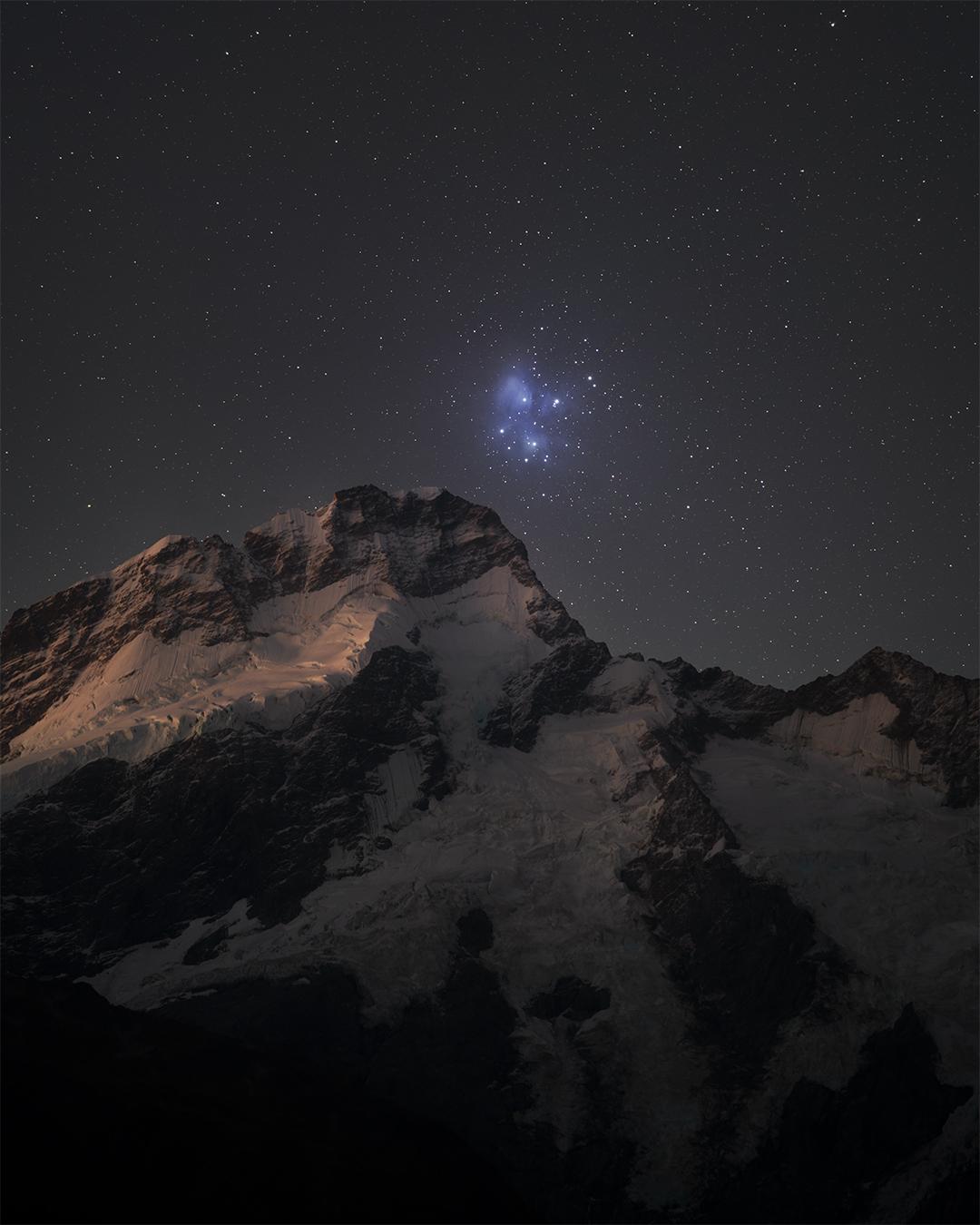
Alt...
2025 November 1
Pleiades from Planet Earth
* Image Credit & Copyright: Max Inwood
Explanation:
The lovely Pleiades star cluster shines in Earth's night sky, a compact group of stars some 400 light-years distant toward the constellation Taurus and the Orion Arm of our Milky Way galaxy. Recognized since ancient times, the remarkable celestial gathering is visible to the unaided eye. The Pleiades cluster is also well-placed for viewing from both northern and southern hemispheres, and over the centuries has become connected to many cultural traditions and celebrations, including the cross-quarter day celebration Halloween. In Greek myth, the Pleiades were seven daughters of the astronomical titan Atlas and sea-nymph Pleione. Galileo first sketched the star cluster viewed through his telescope with stars too faint to be seen by eye and Charles Messier recorded the position of the cluster as the 45th entry in his well-known catalog of things which are not comets. In this dramatic night skyscape from planet Earth, the stars of the Pleiades appear embedded in dusty blue reflection nebulae, poised above Mt Sefton, one of the tallest peaks in New Zealand. There known as Matariki, the star cluster is associated with the celebration of the Maori new year.
Authors & editors: Robert Nemiroff (MTU) & Jerry Bonnell (UMCP)
NASA Official: Amber Straughn Specific rights apply.
TOPIC> The Pleiades
2025 July 8
The Pleiades in Red and Blue
* Image Credit & Copyright: Ogetay Kayali (Michigan Tech U.)
* Text: Ogetay Kayali (Michigan Tech U.)
https://www.ogetay.com/
https://www.mtu.edu/physics/
Explanation:
If you have looked at the sky and seen a group of stars about the size of the full Moon, that's the Pleiades (M45). Perhaps the most famous star cluster in the sky, its brightest stars can be seen even from the light-polluted cities. But your unaided eye can also see its nebulosity -- the gas and dust surrounding it -- under dark skies. However, telescopes can catch even more. The bright blue stars of the Pleiades, also known as the Seven Sisters, light up their surrounding dust, causing it to appear a diffuse blue that can only be seen under long exposures. But that's not all. The cosmic dust appears to stretch upward like ethereal arms. And the entire structure is surrounded by a reddish glow from the most abundant element in the universe: hydrogen. The featured image is composed of nearly 25 hours of exposure and was captured last year from Starfront Observatory, in Texas, USA
https://app.astrobin.com/i/zcwwdj
https://en.wikipedia.org/wiki/Hydrogen-alpha
https://science.nasa.gov/universe/star-clusters-inside-the-universes-stellar-collections/
About Light Pollution:
https://apod.nasa.gov/apod/ap200408.html
https://apod.nasa.gov/apod/ap230308.html
https://starfront.space/
Cosmik Dust:
https://herscheltelescope.org.uk/science/infrared/dust/
https://apod.nasa.gov/apod/ap230108.html
https://en.wikipedia.org/wiki/Hydrogen-alpha
https://apod.nasa.gov/apod/ap250708.html
#space #pleiades #astrophotography #photography #science #astronomy #nature #NASA #education
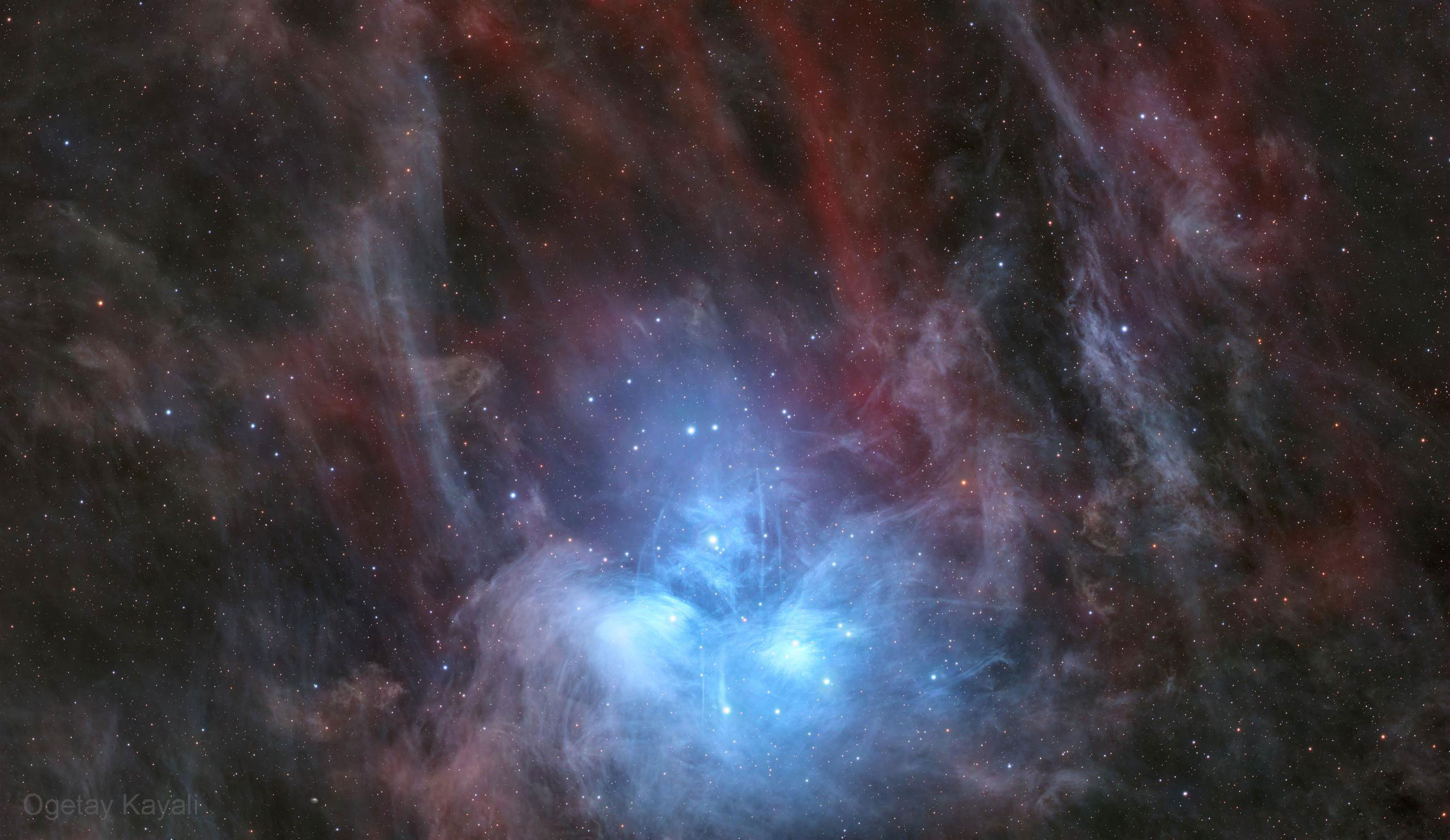
Alt...
2025 July 8
A cluster of bright blue stars is seen near the bottom of this starfield. Nebula around the stars is blue near the stars but red elsewhere.
The Pleiades in Red and Blue
* Image Credit & Copyright: Ogetay Kayali (Michigan Tech U.) Text: Ogetay Kayali (Michigan Tech U.)
Explanation:
If you have looked at the sky and seen a group of stars about the size of the full Moon, that's the Pleiades (M45). Perhaps the most famous star cluster in the sky, its brightest stars can be seen even from the light-polluted cities. But your unaided eye can also see its nebulosity -- the gas and dust surrounding it -- under dark skies. However, telescopes can catch even more. The bright blue stars of the Pleiades, also known as the Seven Sisters, light up their surrounding dust, causing it to appear a diffuse blue that can only be seen under long exposures. But that's not all. The cosmic dust appears to stretch upward like ethereal arms. And the entire structure is surrounded by a reddish glow from the most abundant element in the universe: hydrogen. The featured image is composed of nearly 25 hours of exposure and was captured last year from Starfront Observatory, in Texas, USA
Authors & editors: Robert Nemiroff (MTU) & Jerry Bonnell (UMCP)
NASA Official: Amber Straughn Specific rights apply.
NASA Web Privacy, Accessibility, Notices;
A service of: ASD at NASA / GSFC,
NASA Science Activation
& Michigan Tech. U.
2021 April 6
Mars and the Pleiades Beyond Vinegar Hill
* Image Credit & Copyright: Kristine Richer
https://www.instagram.com/kristinerosephotography/
Explanation:
Is this just a lonely tree on an empty hill? To start, perhaps, but look beyond. There, a busy universe may wait to be discovered. First, physically, to the left of the tree, is the planet Mars. The red planet, which is the new home to NASA's Perseverance rover, remains visible this month at sunset above the western horizon. To the tree's right is the Pleiades, a bright cluster of stars dominated by several bright blue stars. The featured picture is a composite of several separate foreground and background images taken within a few hours of each other, early last month, from the same location on Vinegar Hill in Milford, Nova Scotia, Canada. At that time, Mars was passing slowly, night after night, nearly in front of the distant Seven Sisters star cluster. The next time Mars will pass angularly as close to the Pleiades as it did in March will be in 2038.
https://apod.nasa.gov/apod/ap210406.html
#space #pleiades #astrophotography #photography #science #astronomy #nature #NASA #education
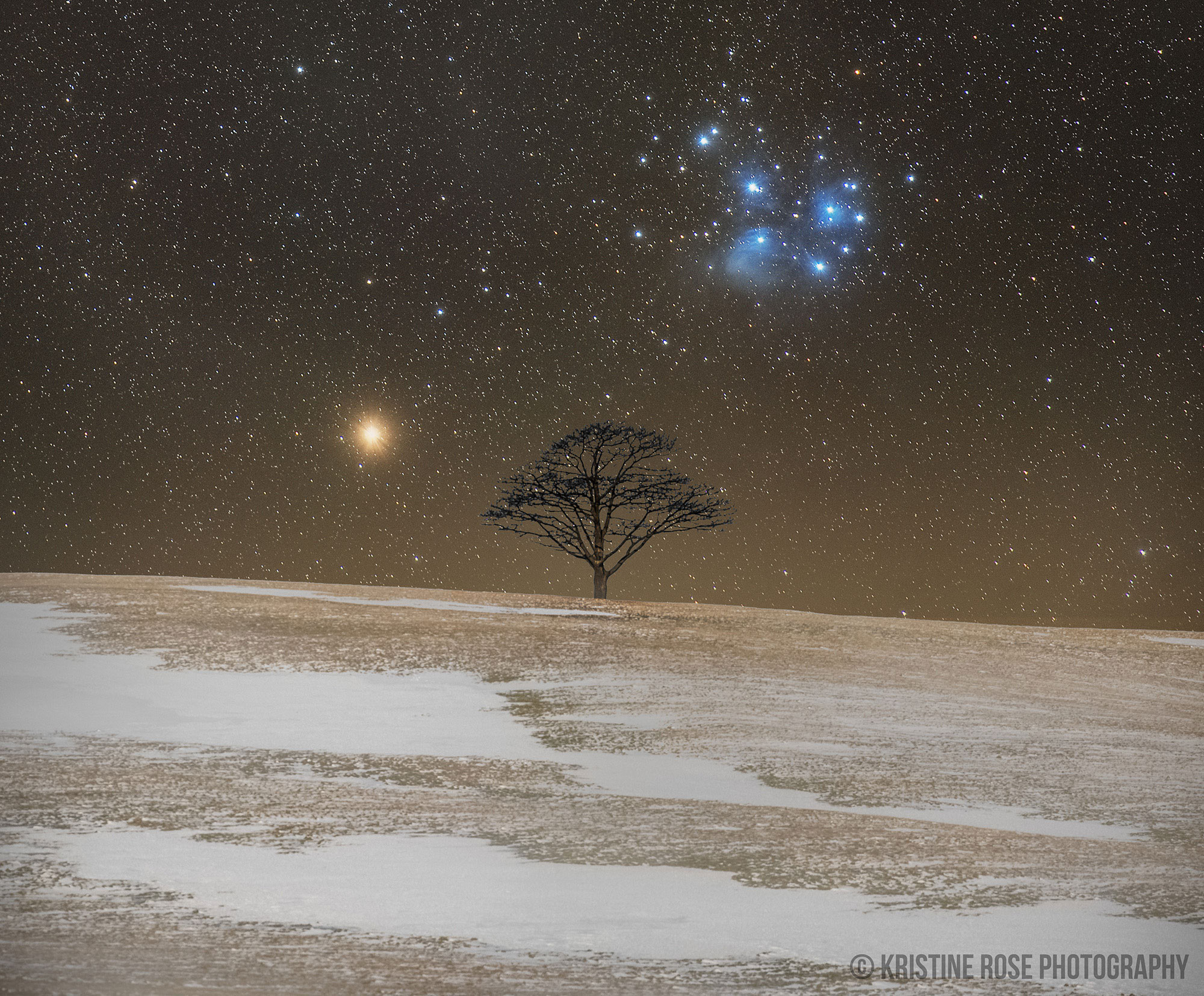
Alt...
2021 April 6
Mars and the Pleiades star cluster set behind one-tree hill.
Mars and the Pleiades Beyond Vinegar Hill
* Image Credit & Copyright: Kristine Richer
Explanation:
Is this just a lonely tree on an empty hill? To start, perhaps, but look beyond. There, a busy universe may wait to be discovered. First, physically, to the left of the tree, is the planet Mars. The red planet, which is the new home to NASA's Perseverance rover, remains visible this month at sunset above the western horizon. To the tree's right is the Pleiades, a bright cluster of stars dominated by several bright blue stars. The featured picture is a composite of several separate foreground and background images taken within a few hours of each other, early last month, from the same location on Vinegar Hill in Milford, Nova Scotia, Canada. At that time, Mars was passing slowly, night after night, nearly in front of the distant Seven Sisters star cluster. The next time Mars will pass angularly as close to the Pleiades as it did in March will be in 2038.
Authors & editors: Robert Nemiroff (MTU) & Jerry Bonnell (UMCP)
NASA Official: Amber Straughn Specific rights apply.
NASA Web Privacy, Accessibility, Notices;
A service of: ASD at NASA / GSFC,
NASA Science Activation
& Michigan Tech. U.
2024 September 29
Seven Dusty Sisters
* Image Credit: WISE, IRSA, NASA
https://www.jpl.nasa.gov/missions/wide-field-infrared-survey-explorer-wise
http://irsa.ipac.caltech.edu/Missions/wise.html
https://www.nasa.gov/
* Processing & Copyright : Francesco Antonucci
https://www.astrobin.com/users/FrankAntonucci/
Explanation:
Is this really the famous Pleiades star cluster? Known for its iconic blue stars, the Pleiades is shown here in infrared light where the surrounding dust outshines the stars. Here, three infrared colors have been mapped into visual colors (R=24, G=12, B=4.6 microns). The base images were taken by NASA's orbiting Wide Field Infrared Survey Explorer (WISE) spacecraft. Cataloged as M45 and nicknamed the Seven Sisters, the Pleiades star cluster is by chance situated in a passing dust cloud. The light and winds from the massive Pleiades stars preferentially repel smaller dust particles, causing the dust to become stratified into filaments, as seen. The featured image spans about 20 light years at the distance of the Pleiades, which lies about 450 light years distant toward the constellation of the Bull (Taurus).
https://arxiv.org/abs/0810.1592
https://apod.nasa.gov/apod/ap240929.html
#space #pleiades #astrophotography #photography #science #astronomy #nature #NASA #education
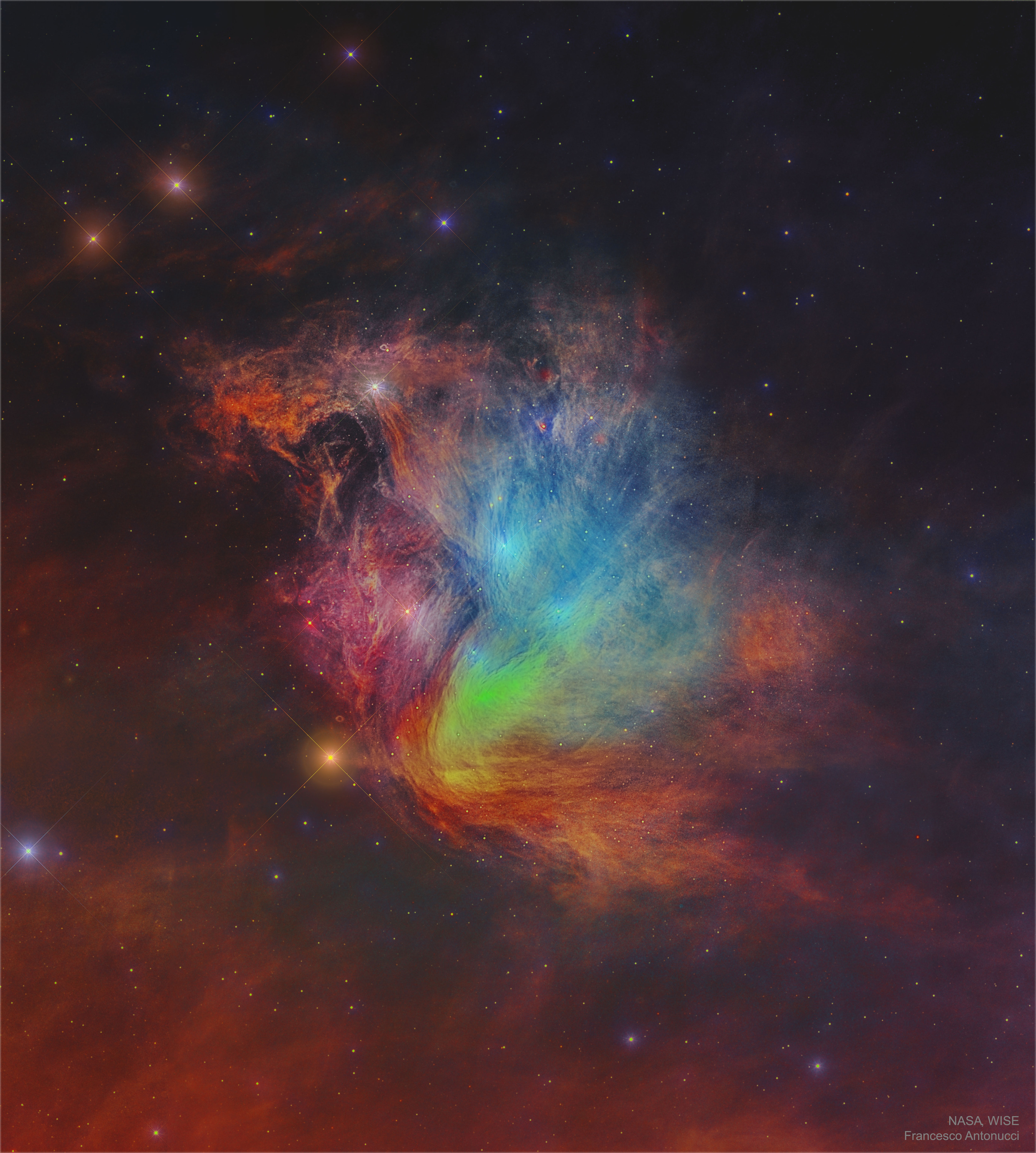
Alt...
2024 September 29
A famous Pleiades star cluster is shown but showing numerous parallel and curved filaments in different colors. The image is in several colors of infrared light. A rollover image shows the cluster in visible light with its familiar blue light.
Seven Dusty Sisters
* Image Credit: WISE, IRSA, NASA; Processing &
* Copyright : Francesco Antonucci
Explanation:
Is this really the famous Pleiades star cluster? Known for its iconic blue stars, the Pleiades is shown here in infrared light where the surrounding dust outshines the stars. Here, three infrared colors have been mapped into visual colors (R=24, G=12, B=4.6 microns). The base images were taken by NASA's orbiting Wide Field Infrared Survey Explorer (WISE) spacecraft. Cataloged as M45 and nicknamed the Seven Sisters, the Pleiades star cluster is by chance situated in a passing dust cloud. The light and winds from the massive Pleiades stars preferentially repel smaller dust particles, causing the dust to become stratified into filaments, as seen. The featured image spans about 20 light years at the distance of the Pleiades, which lies about 450 light years distant toward the constellation of the Bull (Taurus).
Authors & editors: Robert Nemiroff (MTU) & Jerry Bonnell (UMCP)
NASA Official: Amber Straughn Specific rights apply.
NASA Web Privacy, Accessibility, Notices;
A service of: ASD at NASA / GSFC,
NASA Science Activation
& Michigan Tech. U.
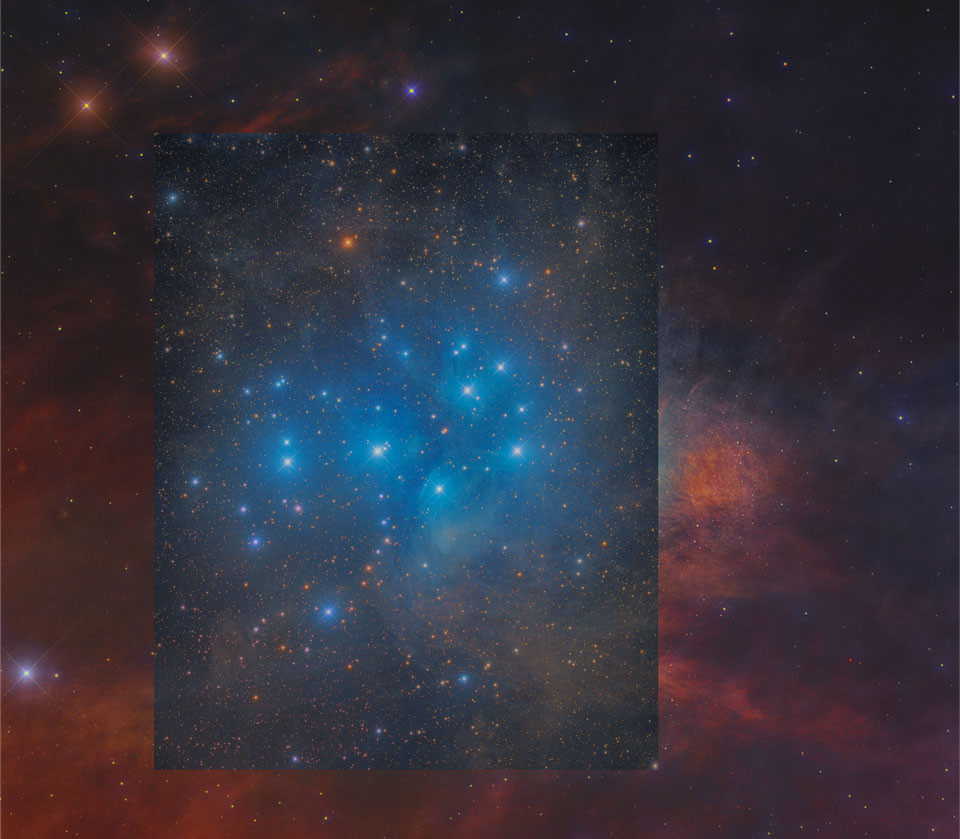
Alt...
A rollover image shows the cluster in visible light with its familiar blue light.
2024 August 15
Late Night Vallentuna
* Image Credit & Copyright: P-M Hedén (Clear Skies, TWAN)
https://www.clearskies.se/
http://www.twanight.org/
Explanation:
Bright Mars and even brighter Jupiter are in close conjunction just above the pine trees in this post-midnight skyscape from Vallentuna, Sweden. Taken on August 12 during a geomagnetic storm, the snapshot records the glow of aurora borealis or northern lights, beaming from the left side of the frame. Of course on that date Perseid meteors rained through planet Earth's skies, grains of dust from the shower's parent, periodic comet Swift-Tuttle. The meteor streak at the upper right is a Perseid plowing through the atmosphere at about 60 kilometers per second. Also well-known in Earth's night sky, the bright Pleiades star cluster shines below the Perseid meteor streak. In Greek myth, the Pleiades were seven daughters of the astronomical titan Atlas and sea-nymph Pleione. The Pleiades and their parents' names are given to the cluster's nine brightest stars.
https://en.wikipedia.org/wiki/Pleiades_(Greek_mythology)
https://apod.nasa.gov/apod/ap240815.html
#space #pleiades #astrophotography #photography #science #astronomy #nature #NASA #education
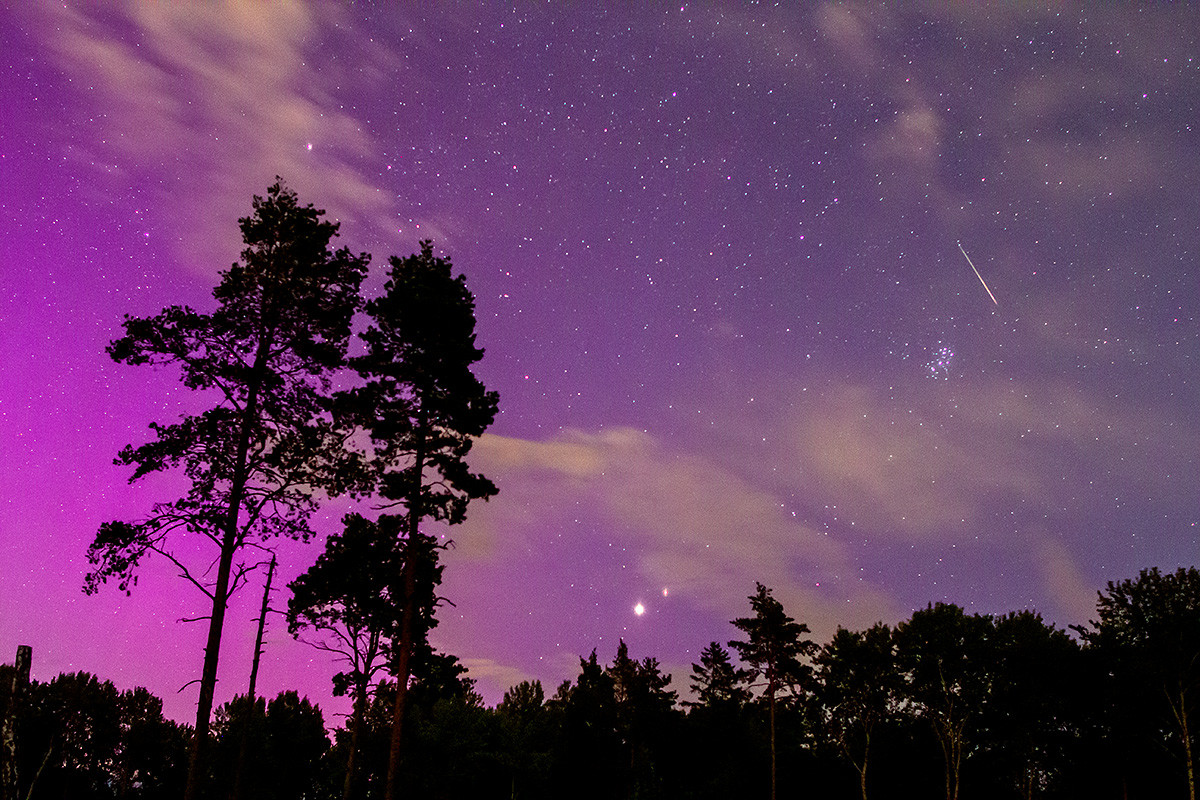
Alt...
2024 August 15
Late Night Vallentuna
* Image Credit & Copyright: P-M Hedén (Clear Skies, TWAN)
Explanation:
Bright Mars and even brighter Jupiter are in close conjunction just above the pine trees in this post-midnight skyscape from Vallentuna, Sweden. Taken on August 12 during a geomagnetic storm, the snapshot records the glow of aurora borealis or northern lights, beaming from the left side of the frame. Of course on that date Perseid meteors rained through planet Earth's skies, grains of dust from the shower's parent, periodic comet Swift-Tuttle. The meteor streak at the upper right is a Perseid plowing through the atmosphere at about 60 kilometers per second. Also well-known in Earth's night sky, the bright Pleiades star cluster shines below the Perseid meteor streak. In Greek myth, the Pleiades were seven daughters of the astronomical titan Atlas and sea-nymph Pleione. The Pleiades and their parents' names are given to the cluster's nine brightest stars.
Authors & editors: Robert Nemiroff (MTU) & Jerry Bonnell (UMCP)
NASA Official: Amber Straughn Specific rights apply.
NASA Web Privacy, Accessibility Notices
A service of: ASD at NASA / GSFC,
NASA Science Activation
& Michigan Tech. U.