Search results for tag #astronomy
![[?]](https://files.defcon.social/dcsocial-s3/accounts/avatars/113/208/344/507/078/943/original/014820ad22daee1c.jpg)
2024 August 15
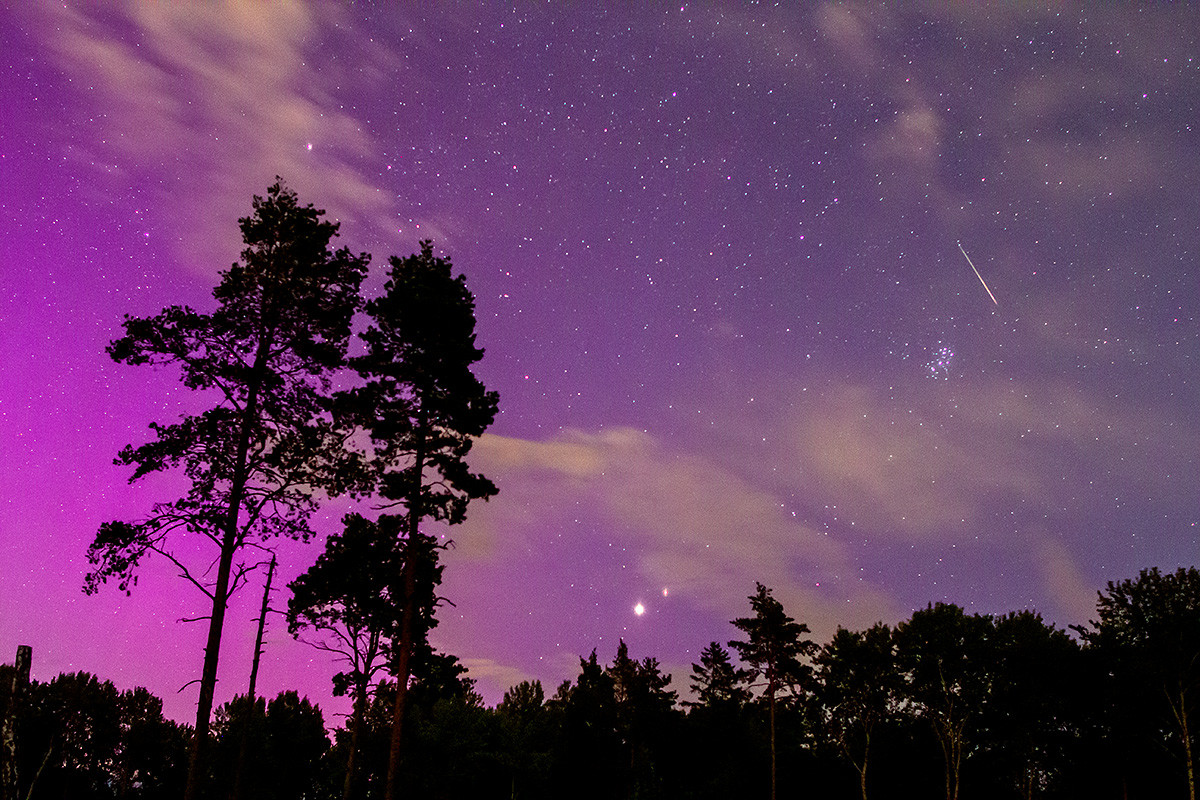
Late Night Vallentuna
* Image Credit & Copyright: P-M Hedén (Clear Skies, TWAN)
https://www.clearskies.se/
http://www.twanight.org/
Explanation:
Bright Mars and even brighter Jupiter are in close conjunction just above the pine trees in this post-midnight skyscape from Vallentuna, Sweden. Taken on August 12 during a geomagnetic storm, the snapshot records the glow of aurora borealis or northern lights, beaming from the left side of the frame. Of course on that date Perseid meteors rained through planet Earth's skies, grains of dust from the shower's parent, periodic comet Swift-Tuttle. The meteor streak at the upper right is a Perseid plowing through the atmosphere at about 60 kilometers per second. Also well-known in Earth's night sky, the bright Pleiades star cluster shines below the Perseid meteor streak. In Greek myth, the Pleiades were seven daughters of the astronomical titan Atlas and sea-nymph Pleione. The Pleiades and their parents' names are given to the cluster's nine brightest stars.
https://en.wikipedia.org/wiki/Pleiades_(Greek_mythology)
https://apod.nasa.gov/apod/ap240815.html
#space #pleiades #astrophotography #photography #science #astronomy #nature #NASA #education
Alt...
2024 August 15
Late Night Vallentuna
* Image Credit & Copyright: P-M Hedén (Clear Skies, TWAN)
Explanation:
Bright Mars and even brighter Jupiter are in close conjunction just above the pine trees in this post-midnight skyscape from Vallentuna, Sweden. Taken on August 12 during a geomagnetic storm, the snapshot records the glow of aurora borealis or northern lights, beaming from the left side of the frame. Of course on that date Perseid meteors rained through planet Earth's skies, grains of dust from the shower's parent, periodic comet Swift-Tuttle. The meteor streak at the upper right is a Perseid plowing through the atmosphere at about 60 kilometers per second. Also well-known in Earth's night sky, the bright Pleiades star cluster shines below the Perseid meteor streak. In Greek myth, the Pleiades were seven daughters of the astronomical titan Atlas and sea-nymph Pleione. The Pleiades and their parents' names are given to the cluster's nine brightest stars.
Authors & editors: Robert Nemiroff (MTU) & Jerry Bonnell (UMCP)
NASA Official: Amber Straughn Specific rights apply.
NASA Web Privacy, Accessibility Notices
A service of: ASD at NASA / GSFC,
NASA Science Activation
& Michigan Tech. U.
From Contributors to Wikimedia projects
The Pleiades,
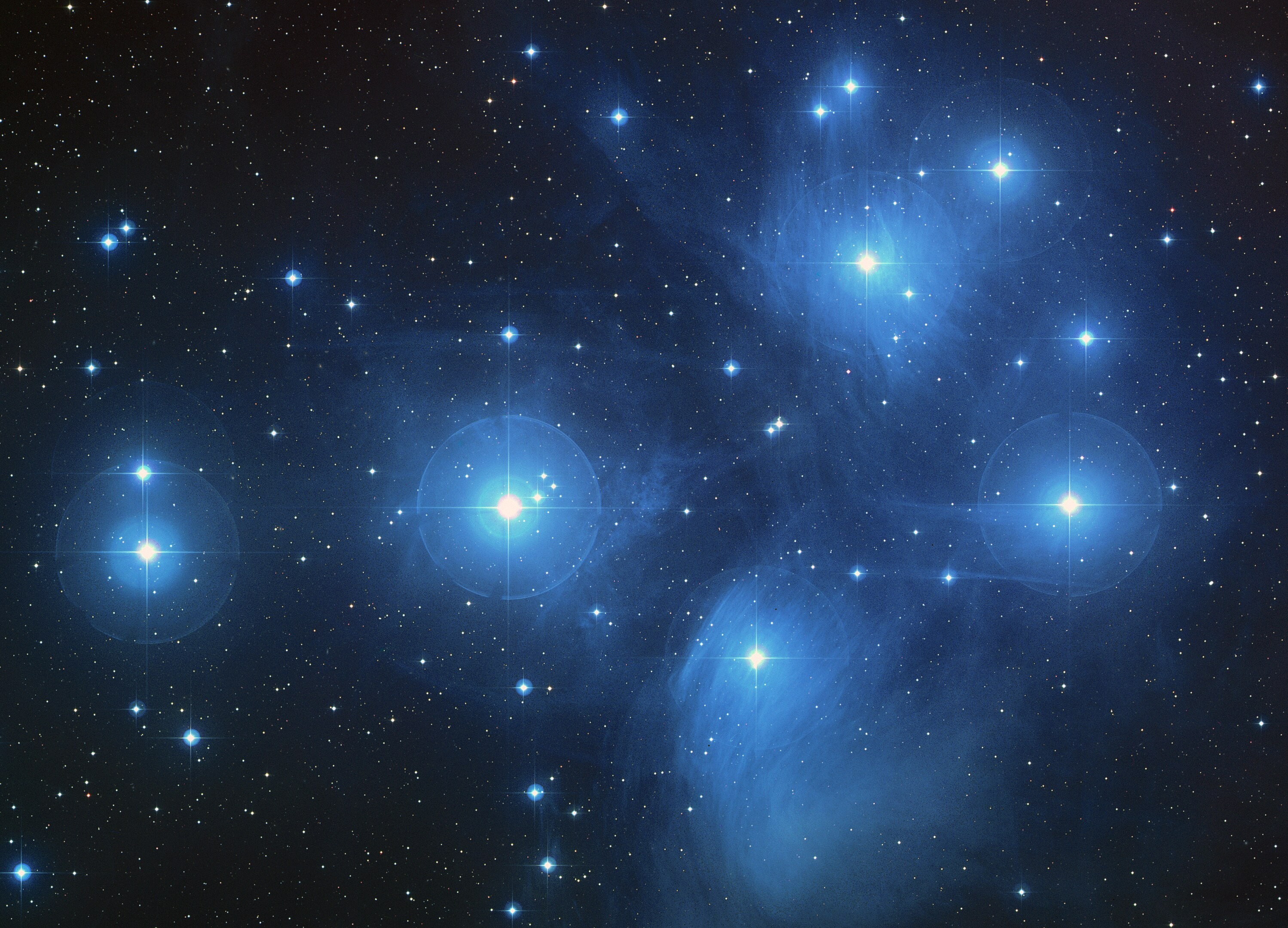
also known as Seven Sisters and Messier 45 (M45), is an asterism of an open star cluster containing young B-type stars in the northwest of the constellation Taurus. At a distance of about 444 light-years, it is among the nearest star clusters to Earth and the nearest Messier object to Earth, being the most obvious star cluster to the naked eye in the night sky. It is also observed to house the reflection nebula NGC 1432, an HII region. Around 2330 BC it marked the vernal point. Due to the brightness of its stars, the Pleiades is viewable from most areas on Earth, even in locations with significant light pollution.
The cluster is dominated by hot blue luminous stars that have formed within the last 100 million years. Reflection nebulae around the brightest stars were once thought to be leftover material from their formation, but are now considered likely to be an unrelated dust cloud in the interstellar medium through which the stars are currently passing. This dust cloud is estimated to be moving at a speed of approximately 18 km/s relative to the stars in the cluster.
Computer simulations have shown that the Pleiades were probably formed from a compact configuration that once resembled the Orion Nebula. Astronomers estimate that the cluster will survive for approximately another 250 million years, after which the clustering will be lost due to gravitational interactions with the galactic neighborhood.
Together with the open star cluster of the Hyades, the Pleiades form the Golden Gate of the Ecliptic. The Pleiades have been said to "resemble a tiny dipper," and should not be confused with the "Little Dipper," or Ursa Minor.
[...]
https://en.wikipedia.org/wiki/Pleiades
#space #pleiades #astrophotography #photography #science #astronomy #nature #NASA #education
Alt...
The Pleiades, an open cluster consisting of approximately 3,000 stars at a distance of 400 light-years (120 parsecs) from Earth in the constellation of Taurus. It is also known as ‘The Seven Sisters’, or the astronomical designations NGC 1432/35 and M45.
CREDIT
NASA, ESA, AURA/Caltech, Palomar Observatory The science team consists of: D. Soderblom and E. Nelan (STScI), F. Benedict and B. Arthur (U. Texas), and B. Jones (Lick Obs.)
The name, Pleiades, comes from Ancient Greek: Πλειάδες. It probably derives from plein (πλεῖν 'to sail') because of the cluster's importance in delimiting the sailing season in the Mediterranean Sea: "the season of navigation began with their heliacal rising". In Classical Greek mythology the name was used for seven divine sisters called the Pleiades. In time, the name was said to be derived from that of a mythical mother, Pleione, effectively meaning "daughters of Pleione". In reality, the ancient name of the star cluster related to sailing almost certainly came first in the culture, naming of a relationship to the sister deities followed, and eventually appearing in later myths, to interpret the group name, a mother, Pleione.
Alt...
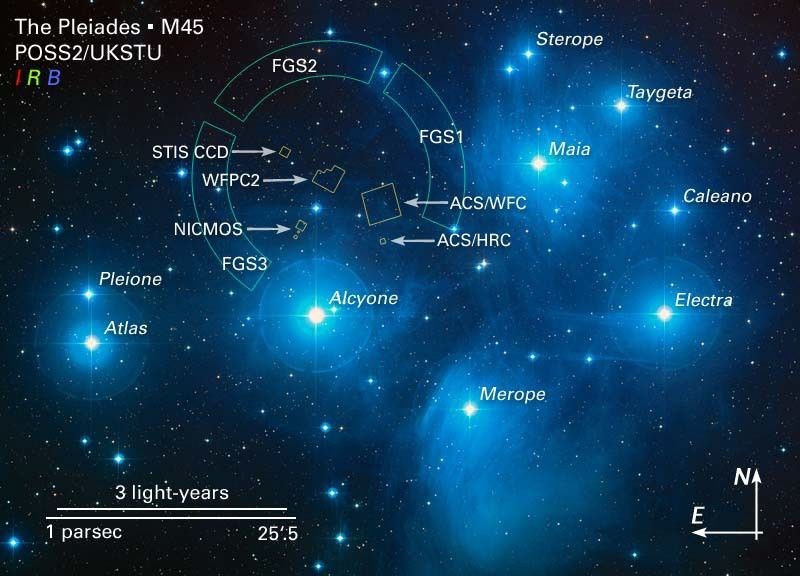
Annotated Image of the Pleiades and HST Field of View
Credit
NASA, ESA and AURA/Caltech
A color-composite image of the Pleiades from the Digitized Sky Survey
Observation data (J2000 epoch)
Right ascension 03h 47m 24s
Declination +24° 07′ 00″
Distance 444 ly on average (136.2±1.2 pc)
Apparent magnitude (V) 1.6
Apparent dimensions (V) 2°
Physical characteristics
Mass 800 M☉
Radius 20.34 light years
2024 September 3
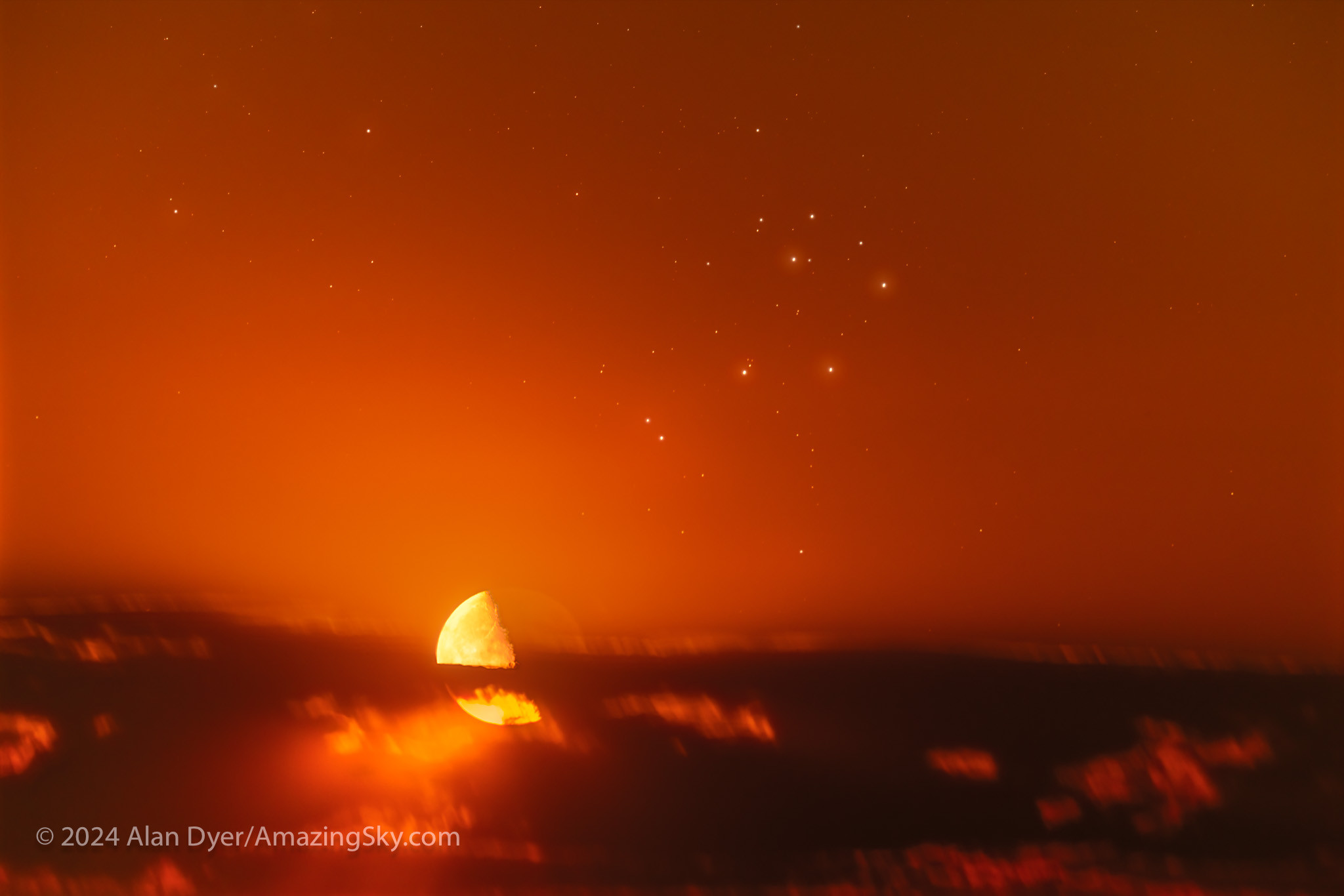
Quarter Moon and Sister Stars
* Image Credit & Copyright: Alan Dyer, TWAN
https://www.amazingsky.com/About
https://twanight.org/profile/alan-dyer/
Explanation:
Last August two quite different sky icons were imaged rising together. Specifically, Earth's Moon shared the eastern sky with the sister stars of the Pleiades cluster, as viewed from Alberta, Canada. Astronomical images of the well-known Pleiades often show the star cluster's alluring blue reflection nebulas, but here they are washed-out by the orange moonrise sky. The half-lit Moon, known as a quarter moon, is overexposed, although the outline of the dim lunar night side can be seen by illuminating earthshine, light first reflected from the Earth. The featured image is a composite of eight successive exposures with brightnesses adjusted to match what the human eye would see. The Moon passes nearly -- or directly -- in front of the Pleaides once a month.
https://apod.nasa.gov/apod/ap240903.html
#space #pleiades #astrophotography #photography #science #astronomy #nature #NASA #education
Alt...
2024 September 3
The featured image shows an orange sky with clouds across the bottom and several bright stars near the top center. Just at the top of the cloud deck on the left is a half-lit Moon.
Quarter Moon and Sister Stars
* Image Credit & Copyright: Alan Dyer, TWAN
Explanation:
Last August two quite different sky icons were imaged rising together. Specifically, Earth's Moon shared the eastern sky with the sister stars of the Pleiades cluster, as viewed from Alberta, Canada. Astronomical images of the well-known Pleiades often show the star cluster's alluring blue reflection nebulas, but here they are washed-out by the orange moonrise sky. The half-lit Moon, known as a quarter moon, is overexposed, although the outline of the dim lunar night side can be seen by illuminating earthshine, light first reflected from the Earth. The featured image is a composite of eight successive exposures with brightnesses adjusted to match what the human eye would see. The Moon passes nearly -- or directly -- in front of the Pleaides once a month.
Authors & editors: Robert Nemiroff (MTU) & Jerry Bonnell (UMCP)
NASA Official: Amber Straughn Specific rights apply.
NASA Web Privacy, Accessibility, Notices;
A service of: ASD at NASA / GSFC,
NASA Science Activation
& Michigan Tech. U.
2025 January 27
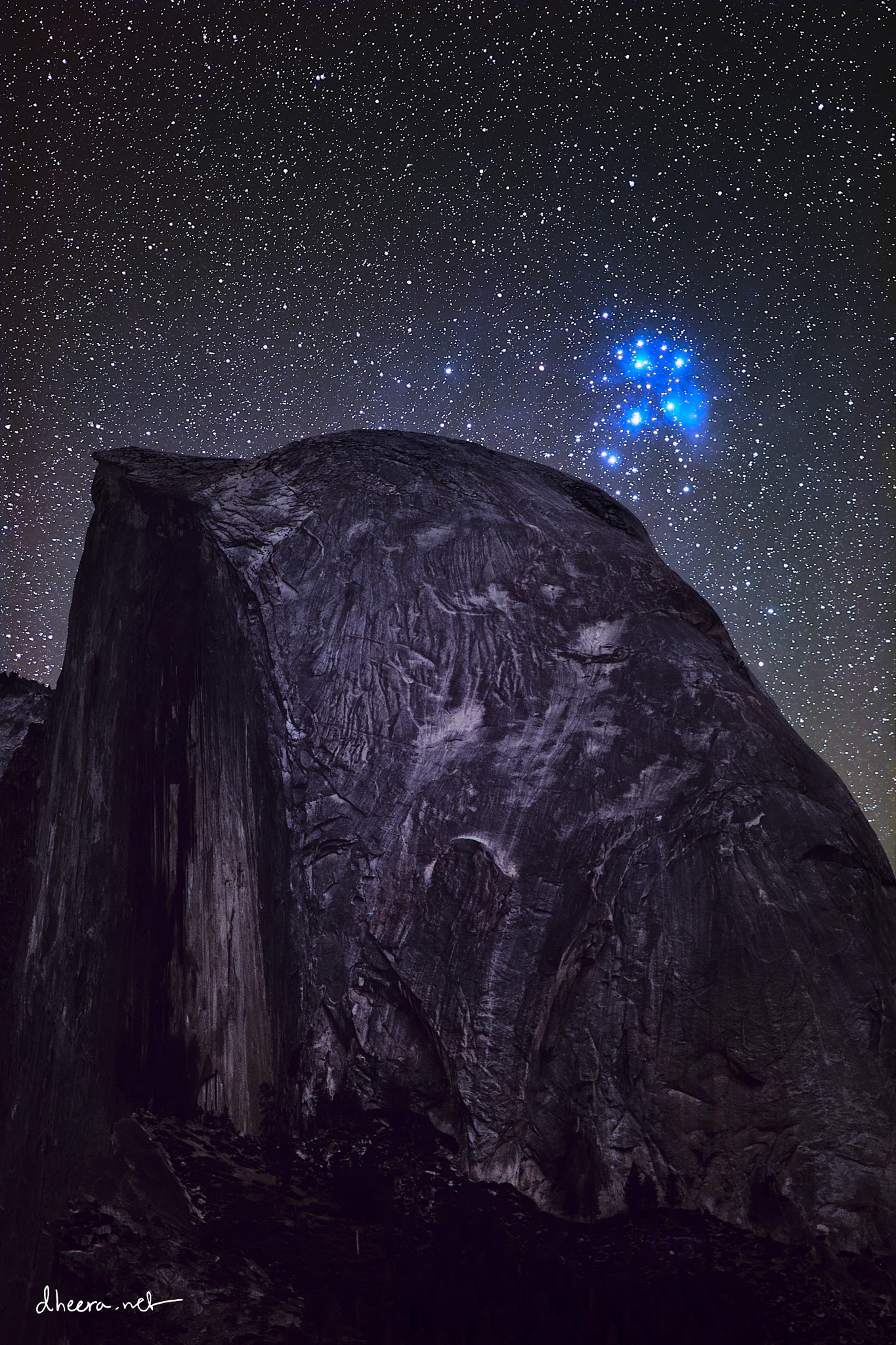
Pleiades over Half Dome
* Image Credit & Copyright: Dheera Venkatraman
https://dheera.net/about
Explanation:
Stars come in bunches. The most famous bunch of stars on the sky is the Pleiades, a bright cluster that can be easily seen with the unaided eye. The Pleiades lies only about 450 light years away, formed about 100 million years ago, and will likely last about another 250 million years. Our Sun was likely born in a star cluster, but now, being about 4.5 billion years old, its stellar birth companions have long since dispersed. The Pleiades star cluster is pictured over Half Dome, a famous rock structure in Yosemite National Park in California, USA. The featured image is a composite of 28 foreground exposures and 174 images of the stellar background, all taken from the same location and by the same camera on the same night in October 2019. After calculating the timing of a future juxtaposition of the Pleiades and Half Dome, the astrophotographer was unexpectedly rewarded by an electrical blackout, making the background sky unusually dark.
https://apod.nasa.gov/apod/ap250127.html
#space #pleiades #astrophotography #photography #science #astronomy #nature #NASA #education
Alt...
2025 January 27
A cluster of bright blue stars is seen on the upper right while an unusual dome-like mountain occupies most of the frame.
Pleiades over Half Dome
* Image Credit & Copyright: Dheera Venkatraman
Explanation:
Stars come in bunches. The most famous bunch of stars on the sky is the Pleiades, a bright cluster that can be easily seen with the unaided eye. The Pleiades lies only about 450 light years away, formed about 100 million years ago, and will likely last about another 250 million years. Our Sun was likely born in a star cluster, but now, being about 4.5 billion years old, its stellar birth companions have long since dispersed. The Pleiades star cluster is pictured over Half Dome, a famous rock structure in Yosemite National Park in California, USA. The featured image is a composite of 28 foreground exposures and 174 images of the stellar background, all taken from the same location and by the same camera on the same night in October 2019. After calculating the timing of a future juxtaposition of the Pleiades and Half Dome, the astrophotographer was unexpectedly rewarded by an electrical blackout, making the background sky unusually dark.
Authors & editors: Robert Nemiroff (MTU) & Jerry Bonnell (UMCP)
NASA Official: Amber Straughn Specific rights apply.
NASA Web Privacy, Accessibility, Notices;
A service of: ASD at NASA / GSFC,
NASA Science Activation
& Michigan Tech. U.
2023 December 9
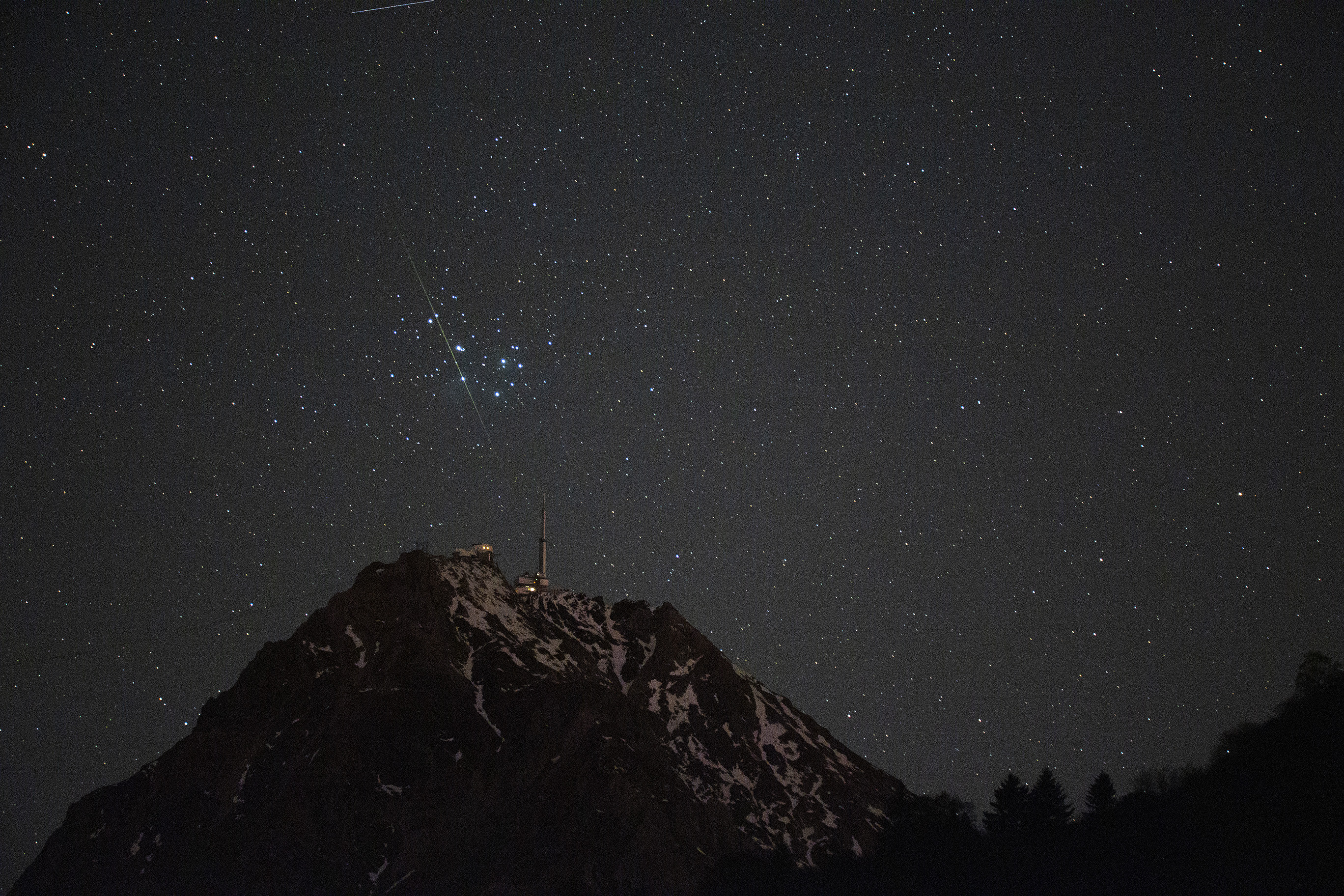
Pic du Pleiades
* Image Credit & Copyright: Jean-Francois Graffand
http://www.echosduciel.fr/
Explanation:
Near dawn on November 19 the Pleiades stood in still dark skies over the French Pyrenees. But just before sunrise a serendipitous moment was captured in this single 3 second exposure; a bright meteor streak appeared to pierce the heart of the galactic star cluster. From the camera's perspective, star cluster and meteor were poised directly above the mountain top observatory on the Pic du Midi de Bigorre. And though astronomers might consider the Pleiades to be relatively close by, the grain of dust vaporizing as it plowed through planet Earth's upper atmosphere actually missed the cluster's tight grouping of young stars by about 400 light-years. While recording a night sky timelapse series, the camera and telephoto lens were fixed to a tripod on the Tour-de-France-cycled slopes of the Col du Tourmalet about 5 kilometers from the Pic du Midi.
https://apod.nasa.gov/apod/ap231209.html
#space #pleiades #astrophotography #photography #science #astronomy #nature #NASA
Alt...
2023 December 9
Pic du Pleiades
* Image Credit & Copyright: Jean-Francois Graffand
Explanation:
Near dawn on November 19 the Pleiades stood in still dark skies over the French Pyrenees. But just before sunrise a serendipitous moment was captured in this single 3 second exposure; a bright meteor streak appeared to pierce the heart of the galactic star cluster. From the camera's perspective, star cluster and meteor were poised directly above the mountain top observatory on the Pic du Midi de Bigorre. And though astronomers might consider the Pleiades to be relatively close by, the grain of dust vaporizing as it plowed through planet Earth's upper atmosphere actually missed the cluster's tight grouping of young stars by about 400 light-years. While recording a night sky timelapse series, the camera and telephoto lens were fixed to a tripod on the Tour-de-France-cycled slopes of the Col du Tourmalet about 5 kilometers from the Pic du Midi.
Authors & editors: Robert Nemiroff (MTU) & Jerry Bonnell (UMCP)
NASA Official: Phillip Newman Specific rights apply.
NASA Web Privacy Policy and Important Notices
A service of: ASD at NASA / GSFC,
NASA Science Activation
& Michigan Tech. U.
2023 January 5
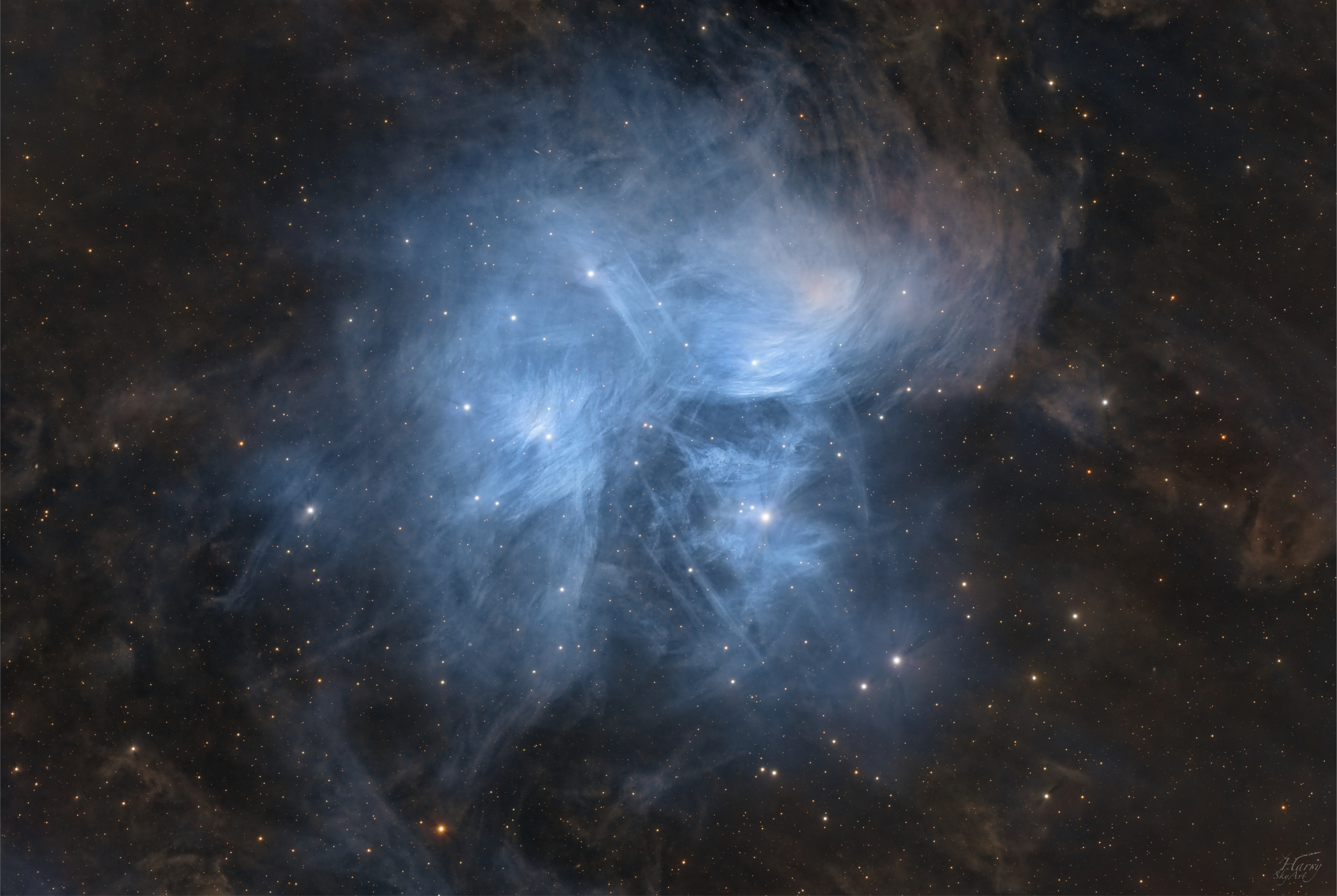
Messier 45: The Daughters of Atlas and Pleione
* Image Credit & Copyright: Stefan Thrun
https://apod.nasa.gov/apod/ap230105.html
Explanation:
Hurtling through a cosmic dust cloud a mere 400 light-years away, the lovely Pleiades or Seven Sisters open star cluster is well-known for its striking blue reflection nebulae. It lies in the night sky toward the constellation Taurus and the Orion Arm of our Milky Way galaxy. The sister stars are not related to the dusty cloud though. They just happen to be passing through the same region of space. Known since antiquity as a compact grouping of stars, Galileo first sketched the star cluster viewed through his telescope with stars too faint to be seen by eye. Charles Messier recorded the position of the cluster as the 45th entry in his famous catalog of things which are not comets. In Greek myth, the Pleiades were seven daughters of the astronomical titan Atlas and sea-nymph Pleione. Their parents names are included in the cluster's nine brightest stars. This well-processed, color-calibrated telescopic image features pin-point stars and detailed filaments of interstellar dust captured in over 9 hours of exposure. It spans more than 20 light-years across the Pleiades star cluster.
https://apod.nasa.gov/apod/ap230105.html
#space #pleiades #astrophotography #photography #science #astronomy #nature #NASA
Alt...
2023 January 5
Messier 45: The Daughters of Atlas and Pleione
* Image Credit & Copyright: Stefan Thrun
Explanation:
Hurtling through a cosmic dust cloud a mere 400 light-years away, the lovely Pleiades or Seven Sisters open star cluster is well-known for its striking blue reflection nebulae. It lies in the night sky toward the constellation Taurus and the Orion Arm of our Milky Way galaxy. The sister stars are not related to the dusty cloud though. They just happen to be passing through the same region of space. Known since antiquity as a compact grouping of stars, Galileo first sketched the star cluster viewed through his telescope with stars too faint to be seen by eye. Charles Messier recorded the position of the cluster as the 45th entry in his famous catalog of things which are not comets. In Greek myth, the Pleiades were seven daughters of the astronomical titan Atlas and sea-nymph Pleione. Their parents names are included in the cluster's nine brightest stars. This well-processed, color-calibrated telescopic image features pin-point stars and detailed filaments of interstellar dust captured in over 9 hours of exposure. It spans more than 20 light-years across the Pleiades star cluster.
Authors & editors: Robert Nemiroff (MTU) & Jerry Bonnell (UMCP)
NASA Official: Phillip Newman Specific rights apply.
NASA Web Privacy Policy and Important Notices
A service of: ASD at NASA / GSFC,
NASA Science Activation
& Michigan Tech. U.
2021 November 20
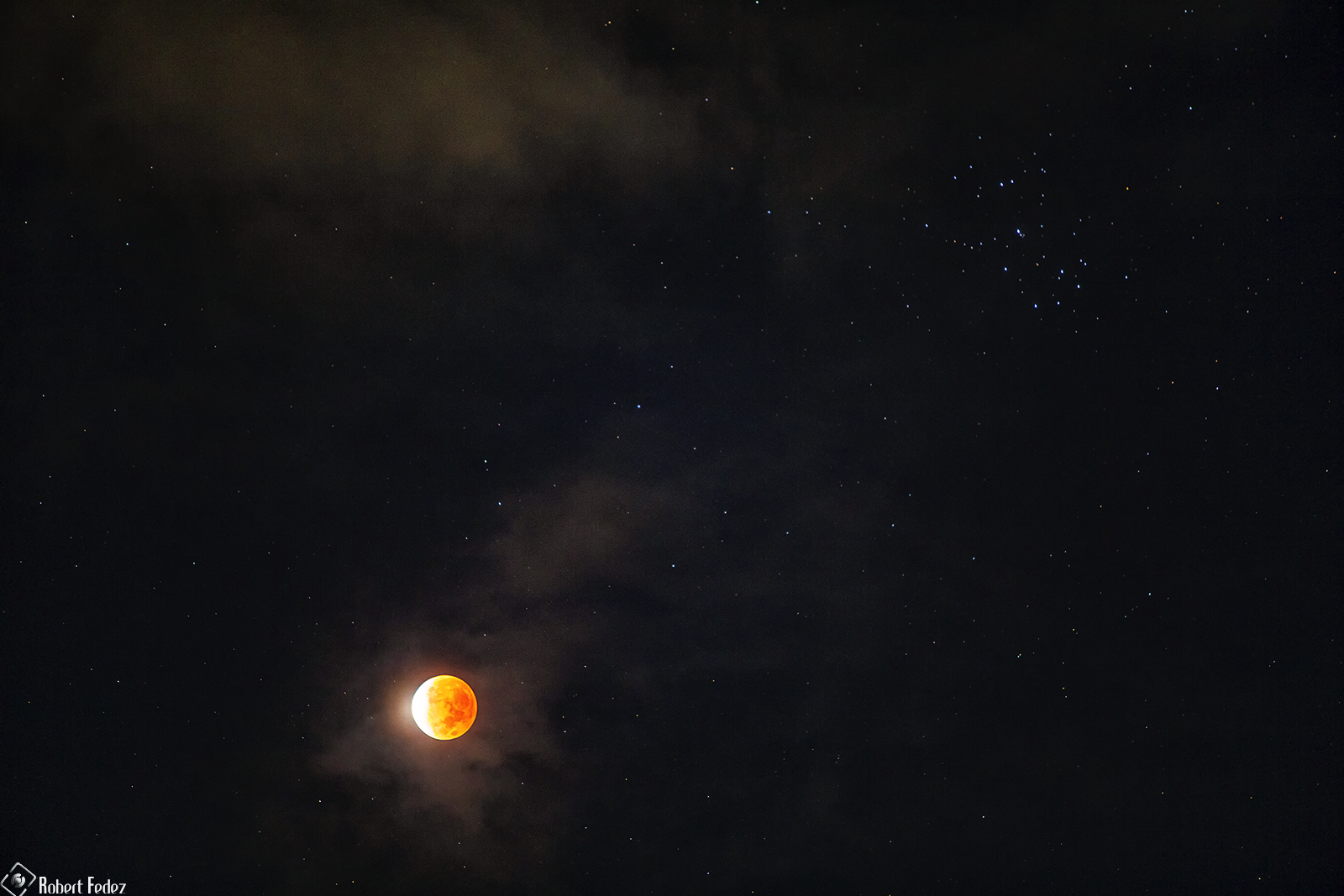
An Almost Total Lunar Eclipse
* Image Credit & Copyright: Robert Fedez
https://app.astrobin.com/u/RobertFedez#gallery
Explanation:
Predawn hours of 2021 November 19 found the Moon in partly cloudy skies over Cancun, Mexico. Captured in this telephoto snapshot, the lunar disk is not quite entirely immersed in Earth's dark umbral shadow during a long partial lunar eclipse. The partial eclipse was deep though, deep enough to show the dimmed but reddened light in Earth's shadow. That's a sight often anticipated by fans of total lunar eclipses. Wandering through the constellation Taurus, the eclipsed Moon's dimmer light also made it easier to spot the Pleiades star cluster. The stars of the Seven Sisters share this frame at the upper right, with the almost totally eclipsed Moon.
https://apod.nasa.gov/apod/ap211120.html
#space #pleiades #moon #astrophotography #photography #science #astronomy #nature #NASA
Alt...
2021 November 20
An Almost Total Lunar Eclipse
* Image Credit & Copyright: Robert Fedez
Explanation:
Predawn hours of 2021 November 19 found the Moon in partly cloudy skies over Cancun, Mexico. Captured in this telephoto snapshot, the lunar disk is not quite entirely immersed in Earth's dark umbral shadow during a long partial lunar eclipse. The partial eclipse was deep though, deep enough to show the dimmed but reddened light in Earth's shadow. That's a sight often anticipated by fans of total lunar eclipses. Wandering through the constellation Taurus, the eclipsed Moon's dimmer light also made it easier to spot the Pleiades star cluster. The stars of the Seven Sisters share this frame at the upper right, with the almost totally eclipsed Moon.
Authors & editors: Robert Nemiroff (MTU) & Jerry Bonnell (UMCP)
NASA Official: Phillip Newman Specific rights apply.
NASA Web Privacy Policy and Important Notices
A service of: ASD at NASA / GSFC
& Michigan Tech. U.
2019 November 7
Messier 45: The Daughters of Atlas and Pleione
* Image Credit & Copyright: Adam Block, Steward Observatory, University of Arizona
https://www.adamblockphhttps://duckduckgo.com/?t=ffab&q=astro++Jean-Francois+Graffand&atb=v480-1&ia=webotos.com/
https://astro.arizona.edu/
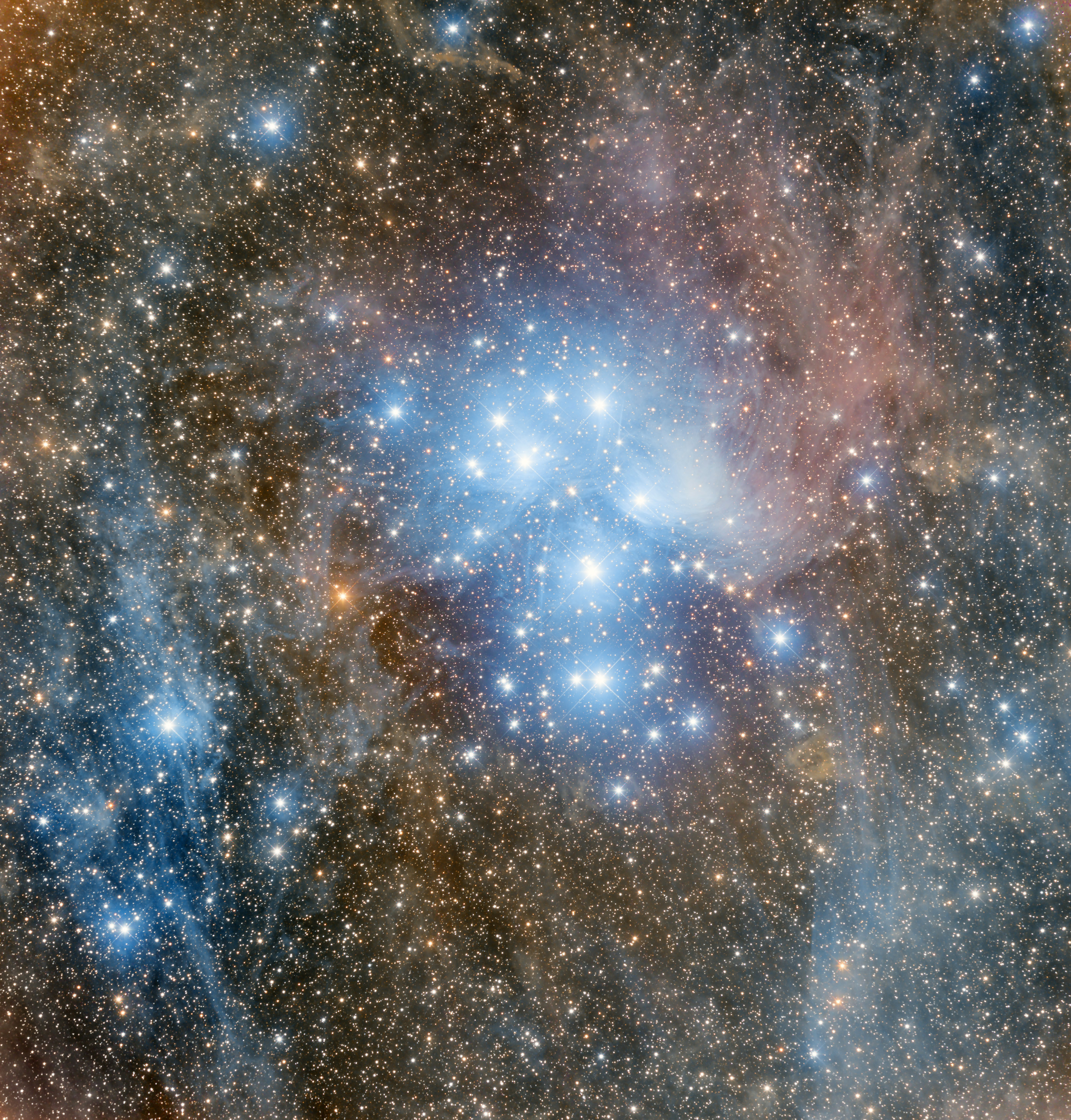
Commonly called the Pleiades or Seven Sisters, M45 is known as an open star cluster. It contains over a thousand stars that are loosely bound by gravity, but it is visually dominated by a handful of its brightest members.
One of these stars, Merope, is located just outside the frame of this image to the upper right. The colorful rays of light at the upper right, emanating from the star, are an optical phenomenon produced within the telescope. The nearly straight, blue-white wisps pointing toward the upper right are streams of large dust particles. As the cloud moves toward Merope, its smaller dust particles are slowed down by the star’s radiation pressure more than the larger particles are. The large dust particles continue on toward the star while the smaller particles are left behind at the lower left of the picture.
The Pleiades cluster has been observed since ancient times, so it has no known discoverer. However, Galileo Galilei, the Italian scientist best known for discovering the largest moons of Jupiter and championing a heliocentric model of the solar system, was the first to observe the Pleiades through a telescope. M45 is located an estimated distance of 445 light-years from Earth in the constellation Taurus, though this number is not universally agreed upon. It has an apparent magnitude of 1.6 and can be seen with the naked eye. The cluster is best observed during December.
https://apod.nasa.gov/apod/ap191107.html
#space #pleiades #astrophotography #photography #science #astronomy #nature #NASA
Alt...
2019 November 7
Messier 45: The Daughters of Atlas and Pleione
* Image Credit & Copyright: Adam Block, Steward Observatory, University of Arizona
Explanation:
Hurtling through a cosmic dust cloud a mere 400 light-years away, the lovely Pleiades or Seven Sisters open star cluster is well-known for its striking blue reflection nebulae. It lies in the night sky toward the constellation Taurus and the Orion Arm of our Milky Way Galaxy. The sister stars and cosmic dust cloud are not related though, they just happen to be passing through the same region of space. Known since antiquity as a compact grouping of stars, Galileo first sketched the star cluster viewed through his telescope with stars too faint to be seen by eye. Charles Messier recorded the position of the cluster as the 45th entry in his famous catalog of things which are not comets. In Greek myth, the Pleiades were seven daughters of the astronomical titan Atlas and sea-nymph Pleione. Their parents names are included in the cluster's nine brightest stars. This deep and wide telescopic image spans over 20 light-years across the Pleides star cluster.
Authors & editors: Robert Nemiroff (MTU) & Jerry Bonnell (UMCP)
NASA Official: Phillip Newman Specific rights apply.
NASA Web Privacy Policy and Important Notices
A service of: ASD at NASA / GSFC
& Michigan Tech. U.
2020 April 15
A Cosmic Triangle
* Image Credit & Copyright: Scott Aspinall
https://www.scottaspinall.com/
Explanation:
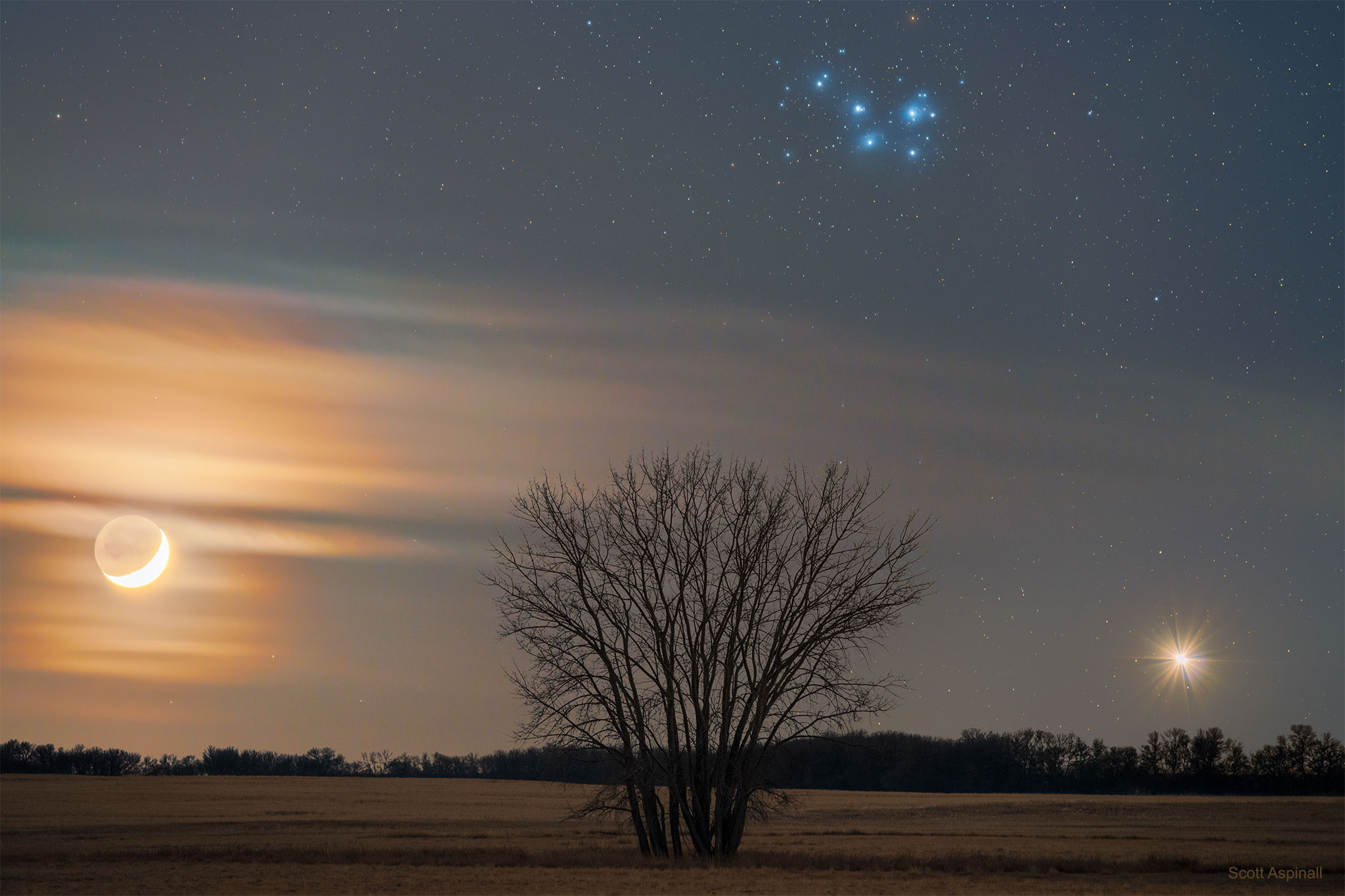
It was an astronomical triple play. Setting on the left, just after sunset near the end of March 2020, was our Moon -- showing a bright crescent phase. Setting on the right was Venus, the brightest planet in the evening sky last month -- and this month, too. With a small telescope, you could tell that Venus' phase was half, meaning that only half of the planet, as visible from Earth, was exposed to direct sunlight and brightly lit. High above and much further in the distance was the Pleiades star cluster. Although the Moon and Venus move with respect to the background stars, the Pleiades do not -- because they are background stars. In the beginning of this month, Venus appeared to move right in front of the Pleiades, a rare event that happens only once every eight years. The featured image captured this cosmic triangle with a series of exposures taken from the same camera over 70 minutes near Avonlea, Saskatchewan, Canada. The positions of the celestial objects was predicted. The only thing unpredicted was the existence of the foreground tree -- and the astrophotographer is still unsure what type of tree that is.
https://apod.nasa.gov/apod/ap200415.html
#space #pleiades #astrophotography #photography #science #astronomy #nature #NASA
Alt...
2020 April 15
A Cosmic Triangle
* Image Credit & Copyright: Scott Aspinall
Explanation:
It was an astronomical triple play. Setting on the left, just after sunset near the end of last month, was our Moon -- showing a bright crescent phase. Setting on the right was Venus, the brightest planet in the evening sky last month -- and this month, too. With a small telescope, you could tell that Venus' phase was half, meaning that only half of the planet, as visible from Earth, was exposed to direct sunlight and brightly lit. High above and much further in the distance was the Pleiades star cluster. Although the Moon and Venus move with respect to the background stars, the Pleiades do not -- because they are background stars. In the beginning of this month, Venus appeared to move right in front of the Pleiades, a rare event that happens only once every eight years. The featured image captured this cosmic triangle with a series of exposures taken from the same camera over 70 minutes near Avonlea, Saskatchewan, Canada. The positions of the celestial objects was predicted. The only thing unpredicted was the existence of the foreground tree -- and the astrophotographer is still unsure what type of tree that is.
Authors & editors: Robert Nemiroff (MTU) & Jerry Bonnell (UMCP)
NASA Official: Phillip Newman Specific rights apply.
NASA Web Privacy Policy and Important Notices
A service of: ASD at NASA / GSFC
& Michigan Tech. U.
2020 April 11
Venus and the Pleiades in April
* Image Credit & Copyright: Antonio Finazzi
Explanation:
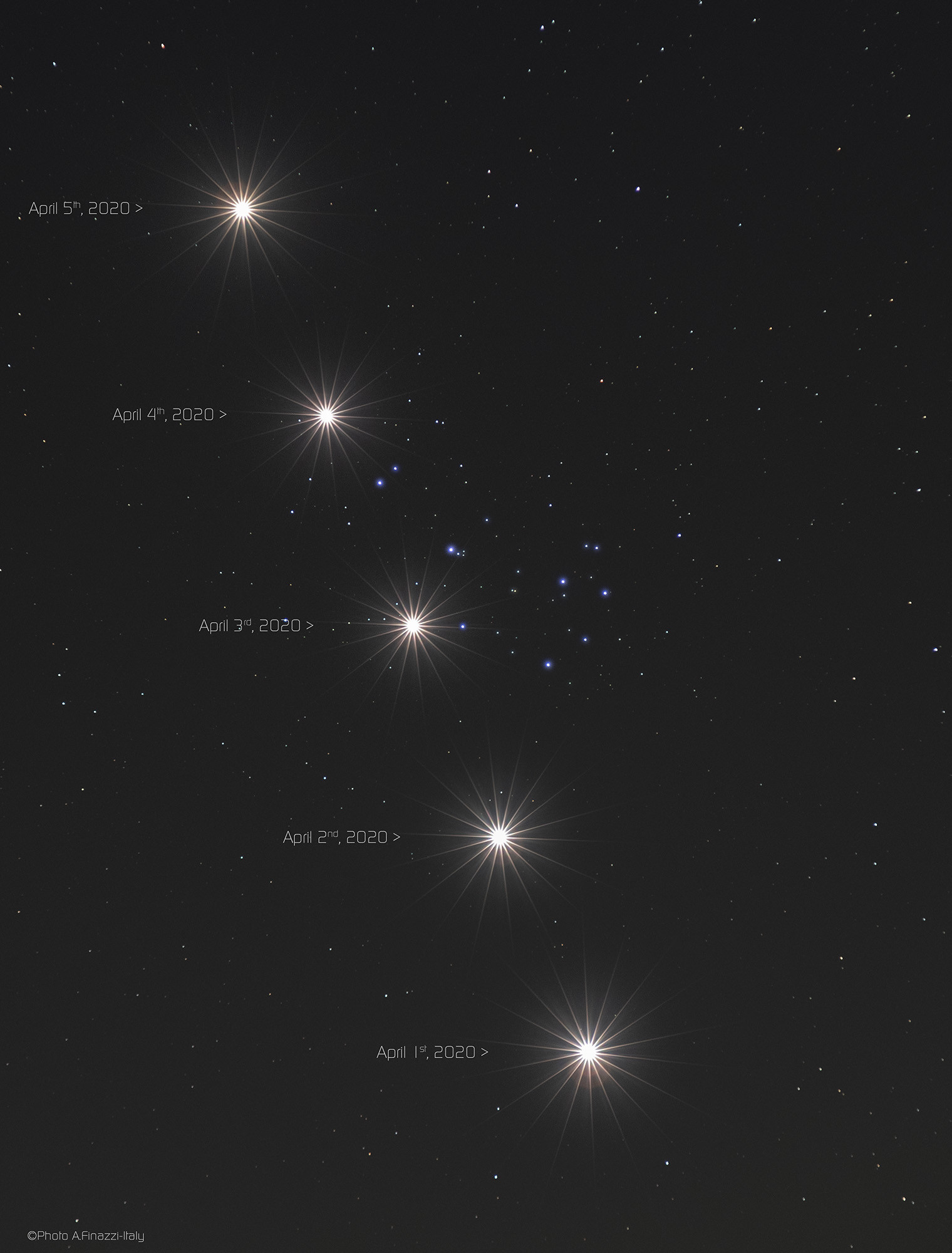
Shared around world in early April 2020 skies Venus, our brilliant evening star, wandered across the face of the lovely Pleiades star cluster. This timelapse image follows the path of the inner planet during the beautiful conjunction showing its daily approach to the stars of the Seven Sisters. From a composite of tracked exposures made with a telephoto lens, the field of view is also appropriate for binocular equipped skygazers. While the star cluster and planet were easily seen with the naked-eye, the spiky appearance of our sister planet in the picture is the result of a diffraction pattern produced by the camera's lens. All images were taken from a home garden in Chiuduno, Bergamo, Lombardy, Italy, fortunate in good weather and clear spring nights.
!>https://science.nasa.gov/venus/
!>https://apod.nasa.gov/apod/ap200402.html
https://apod.nasa.gov/apod/ap200411.html
#space #pleiades #astrophotography #photography #science #astronomy #nature #NASA
Alt...
2020 April 11
Venus and the Pleiades in April
* Image Credit & Copyright: Antonio Finazzi
Explanation:
Shared around world in early April 2020 skies Venus, our brilliant evening star, wandered across the face of the lovely Pleiades star cluster. This timelapse image follows the path of the inner planet during the beautiful conjunction showing its daily approach to the stars of the Seven Sisters. From a composite of tracked exposures made with a telephoto lens, the field of view is also appropriate for binocular equipped skygazers. While the star cluster and planet were easily seen with the naked-eye, the spiky appearance of our sister planet in the picture is the result of a diffraction pattern produced by the camera's lens. All images were taken from a home garden in Chiuduno, Bergamo, Lombardy, Italy, fortunate in good weather and clear spring nights.
Authors & editors: Robert Nemiroff (MTU) & Jerry Bonnell (UMCP)
NASA Official: Phillip Newman Specific rights apply.
NASA Web Privacy Policy and Important Notices
A service of: ASD at NASA / GSFC
& Michigan Tech. U.
2020 March 23
From the Pleiades to the Eridanus Loop
* Image Credit & Copyright: Hirofumi Okubo
https://www.flickr.com/people/bluemoonlife/
Explanation:
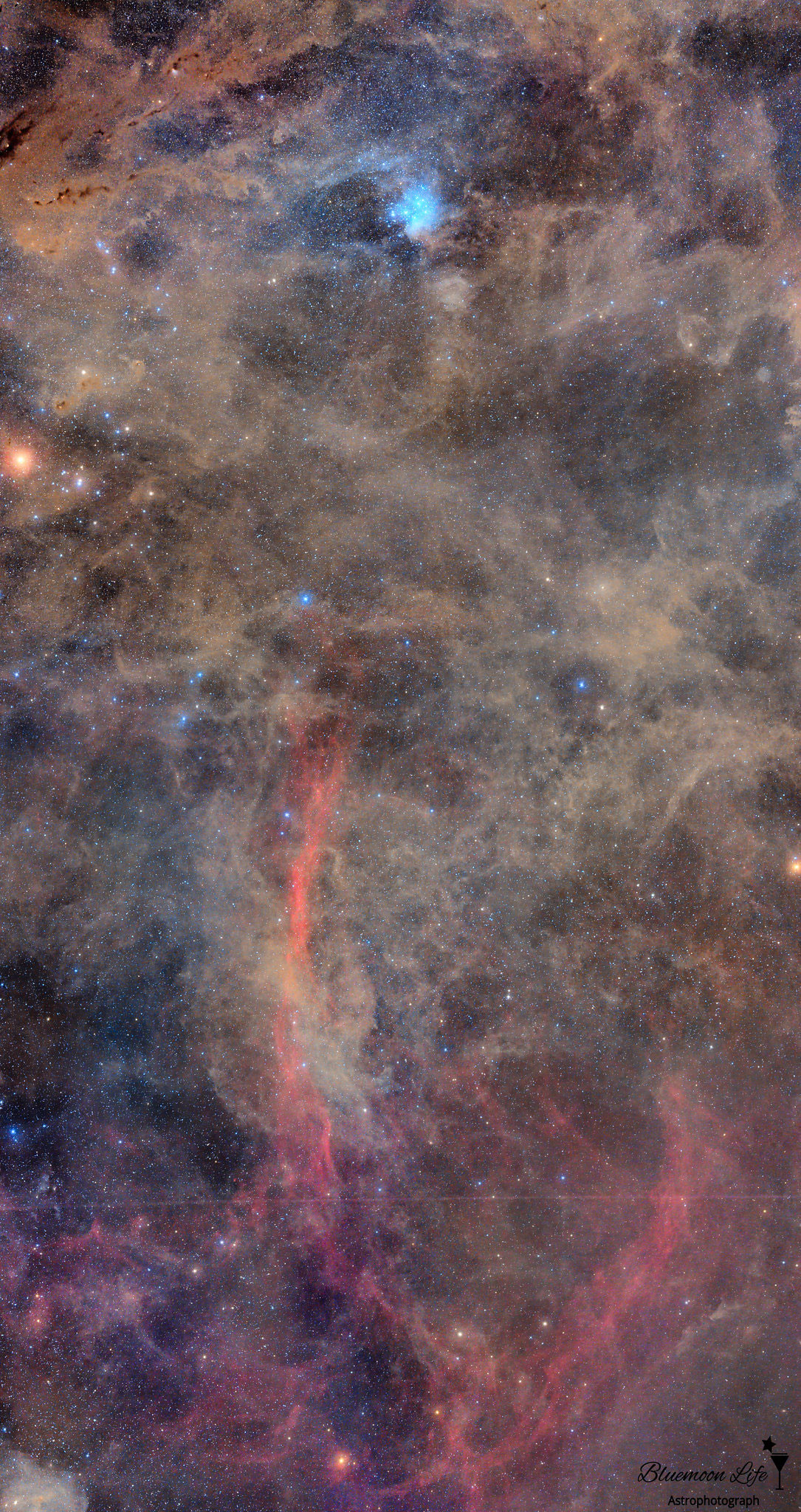
If you stare at an interesting patch of sky long enough, will it look different? In the case of Pleiades and Hyades star clusters -- and surrounding regions -- the answer is: yes, pretty different. Long duration camera exposures reveal an intricate network of interwoven interstellar dust and gas that was previously invisible not only to the eye but to lower exposure images. In the featured wide and deep mosaic, the dust stands out spectacularly, with the familiar Pleaides star cluster visible as the blue patch near the top of the image. Blue is the color of the Pleiades' most massive stars, whose distinctive light reflects from nearby fine dust. On the upper left is the Hyades star cluster surrounding the bright, orange, foreground-star Aldebaran. Red glowing emission nebula highlight the bottom of the image, including the curving vertical red ribbon known as the Eridanus Loop. The pervasive dust clouds appear typically in light brown and are dotted with unrelated stars.
https://apod.nasa.gov/apod/ap200323.html
#space #pleiades #astrophotography #photography #science #astronomy #nature #NASA
Alt...
2020 March 23
From the Pleiades to the Eridanus Loop
* Image Credit & Copyright: Hirofumi Okubo
Explanation:
If you stare at an interesting patch of sky long enough, will it look different? In the case of Pleiades and Hyades star clusters -- and surrounding regions -- the answer is: yes, pretty different. Long duration camera exposures reveal an intricate network of interwoven interstellar dust and gas that was previously invisible not only to the eye but to lower exposure images. In the featured wide and deep mosaic, the dust stands out spectacularly, with the familiar Pleaides star cluster visible as the blue patch near the top of the image. Blue is the color of the Pleiades' most massive stars, whose distinctive light reflects from nearby fine dust. On the upper left is the Hyades star cluster surrounding the bright, orange, foreground-star Aldebaran. Red glowing emission nebula highlight the bottom of the image, including the curving vertical red ribbon known as the Eridanus Loop. The pervasive dust clouds appear typically in light brown and are dotted with unrelated stars.
Authors & editors: Robert Nemiroff (MTU) & Jerry Bonnell (UMCP)
NASA Official: Phillip Newman Specific rights apply.
NASA Web Privacy Policy and Important Notices
A service of: ASD at NASA / GSFC
& Michigan Tech. U.
2025 October 31
Ghosts in Cassiopeia
* Image Credit & Copyright: Alex Rodriguez
https://www.instagram.com/astro_photo_alex/
Explanation:
Halloween is an astronomy holiday and spooky shapes always seem to lurk in in planet Earth's night skies. In fact, near the center of this telescopic view toward the constellation Cassiopeia these swept-back interstellar clouds IC 59 (left) and IC 63 look ghostly on a cosmic scale. About 600 light-years distant, the clouds aren't actually ghosts. They are slowly disappearing though, under the influence of energetic radiation from hot, luminous star gamma Cas. The brightest bluish star in the frame, Gamma Cas is physically located only 3 to 4 light-years from the nebulae. Slightly closer to gamma Cas, IC 63 is dominated by red H-alpha light emitted as hydrogen atoms ionized by the hot star's ultraviolet radiation recombine with electrons. Farther from the star IC 59 also shows H-alpha emission, and both nebulae shine with the characteristic blue tint of dust reflected star light. The field of view spans about 2 degrees or 20 light-years at the estimated distance of the interstellar apparitions.
https://www.instagram.com/jro_rm/p/DQHN4wSjH-N/
https://arxiv.org/abs/1809.01419
https://arxiv.org/abs/1705.04313
https://www.aavso.org/vsots_gammacas
https://iopscience.iop.org/article/10.1086/426912
https://science.nasa.gov/exoplanets/immersive/galaxy-of-horrors/
https://apod.nasa.gov/apod/ap251031.html
#space #astronomy #science #astrophotography #photography #nature #nebula #NASA #apod
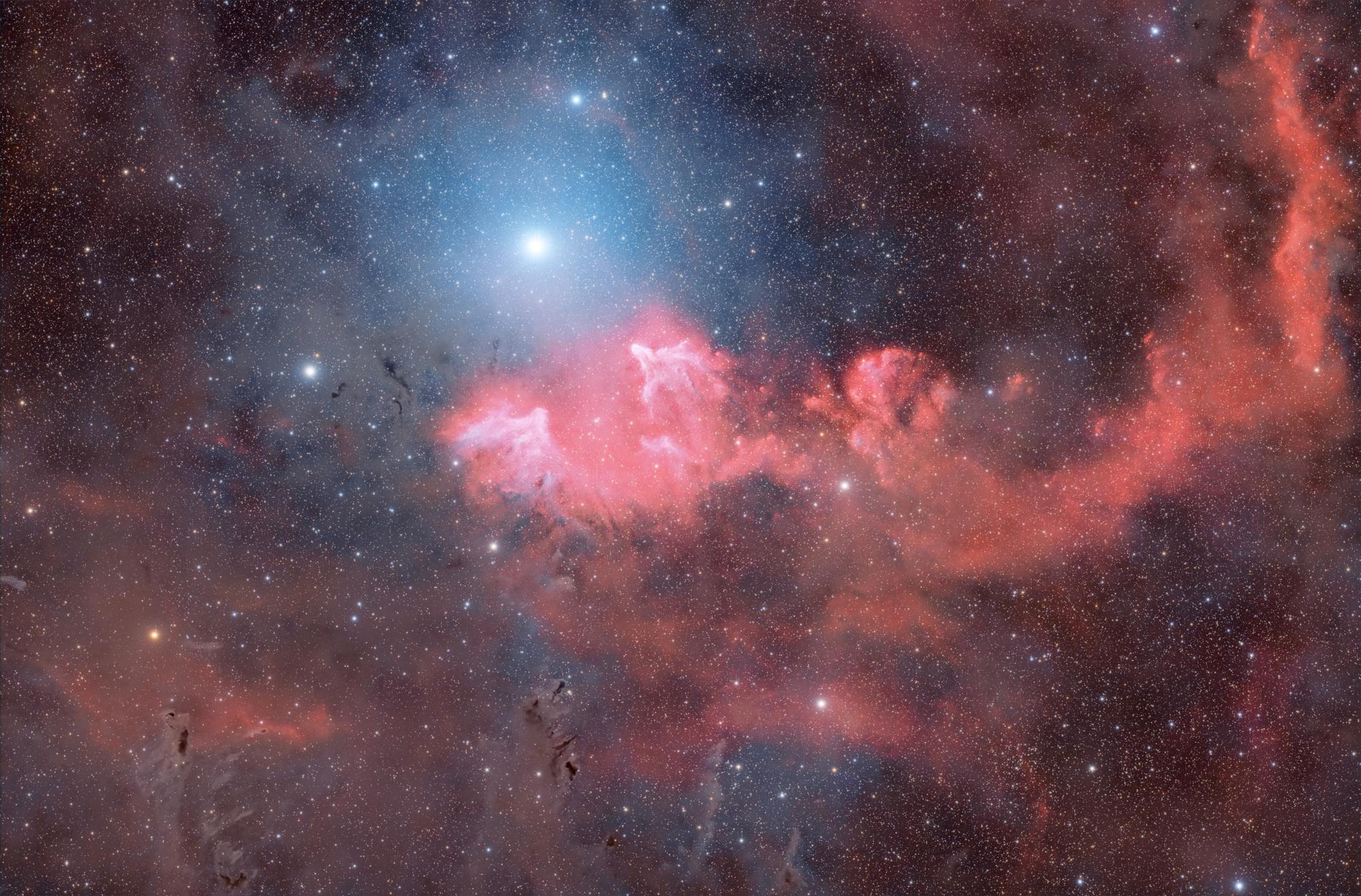
Alt...
2025 October 31
Ghosts in Cassiopeia
* Image Credit & Copyright: Alex Rodriguez
Explanation:
Halloween is an astronomy holiday and spooky shapes always seem to lurk in in planet Earth's night skies. In fact, near the center of this telescopic view toward the constellation Cassiopeia these swept-back interstellar clouds IC 59 (left) and IC 63 look ghostly on a cosmic scale. About 600 light-years distant, the clouds aren't actually ghosts. They are slowly disappearing though, under the influence of energetic radiation from hot, luminous star gamma Cas. The brightest bluish star in the frame, Gamma Cas is physically located only 3 to 4 light-years from the nebulae. Slightly closer to gamma Cas, IC 63 is dominated by red H-alpha light emitted as hydrogen atoms ionized by the hot star's ultraviolet radiation recombine with electrons. Farther from the star IC 59 also shows H-alpha emission, and both nebulae shine with the characteristic blue tint of dust reflected star light. The field of view spans about 2 degrees or 20 light-years at the estimated distance of the interstellar apparitions.
Authors & editors: Robert Nemiroff (MTU) & Jerry Bonnell (UMCP)
NASA Official: Amber Straughn Specific rights apply.
NASA Web Privacy, Accessibility, Notices;
A service of: ASD at NASA / GSFC,
NASA Science Activation
& Michigan Tech. U.
2025 October 30
Lynds Dark Nebula 43
* Image Credit & Copyright:
https://www.cielaustral.com/
Explanation:
Sure, Halloween is an astronomy holiday. But astronomers always enjoy scanning the heavens for spook-tacular galaxies, stars, and nebulae. This favorite is item number 43 from the Beverly Lynds 1962 Catalog of Dark Nebulae, fondly known as the Cosmic Bat nebula. While its visage looks alarmingly like a scary flying mammal, Lynds Dark Nebula 43 is over 12 light-years across. Glowing with eerie light, stars are forming within the dusty interstellar molecular cloud that is dense enough to appear in silhouette against a luminous background of Milky Way stars. Watch out. This Cosmic Bat nebula is a mere 400 light-years distant toward the serpent-bearing constellation Ophiucus.
https://www.cielaustral.com/galerie/photo173.htm
https://ui.adsabs.harvard.edu/abs/1962ApJS....7....1L/abstract
https://ui.adsabs.harvard.edu/abs/2023ApJ...952...29K/abstract
https://earthsky.org/astronomy-essentials/halloween-derived-from-ancient-celtic-cross-quarter-day/
https://science.nasa.gov/exoplanets/immersive/galaxy-of-horrors/
https://apod.nasa.gov/apod/fap/ap251030.html
#space #astronomy #science #astrophotography #photography #nature #nebula #NASA #Webb #apod
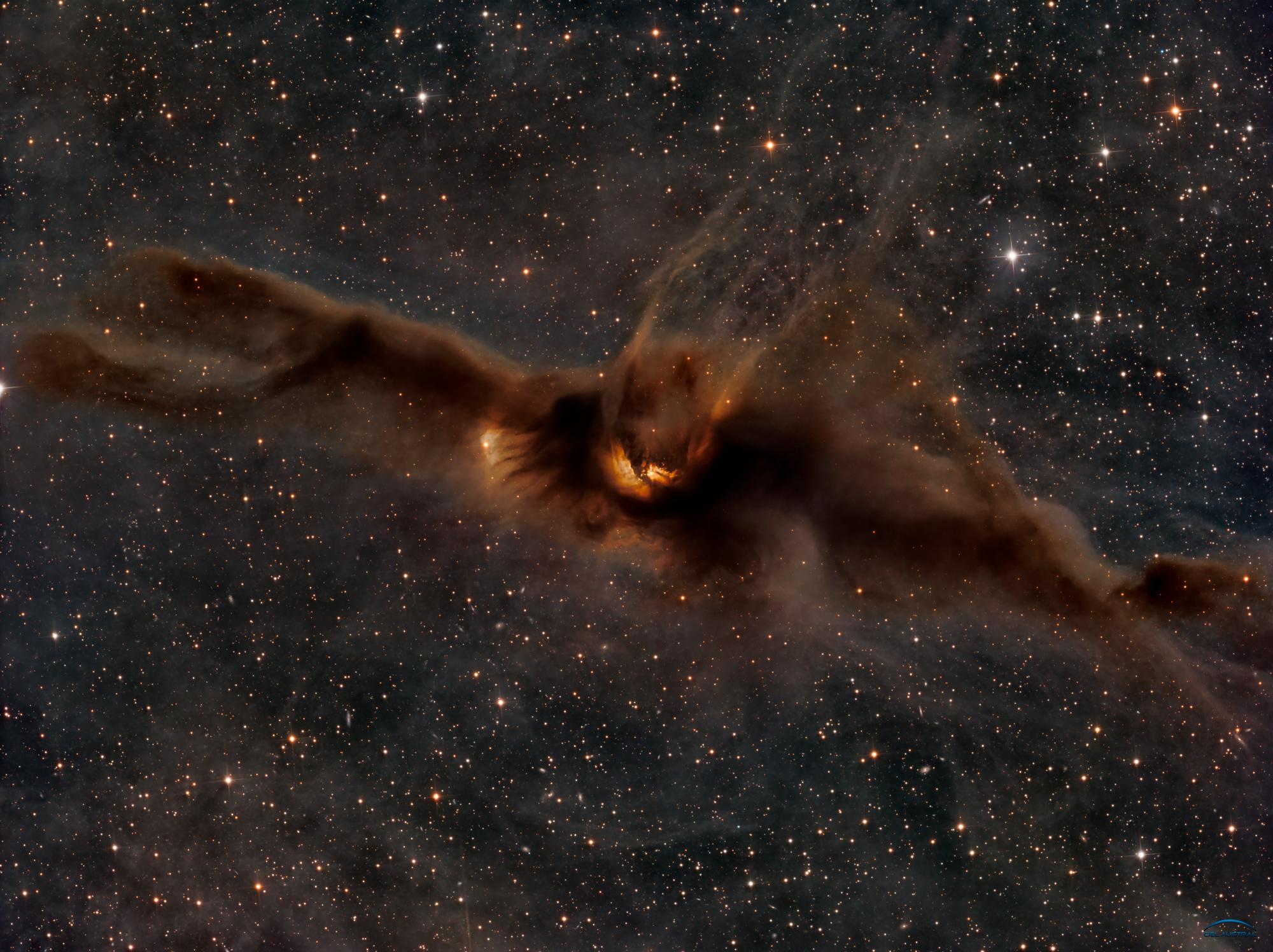
Alt...
2025 October 30
Lynds Dark Nebula 43
* Image Credit & Copyright: Stéphane Vetter (Nuits sacrées)
Explanation:
Sure, Halloween is an astronomy holiday. But astronomers always enjoy scanning the heavens for spook-tacular galaxies, stars, and nebulae. This favorite is item number 43 from the Beverly Lynds 1962 Catalog of Dark Nebulae, fondly known as the Cosmic Bat nebula. While its visage looks alarmingly like a scary flying mammal, Lynds Dark Nebula 43 is over 12 light-years across. Glowing with eerie light, stars are forming within the dusty interstellar molecular cloud that is dense enough to appear in silhouette against a luminous background of Milky Way stars. Watch out. This Cosmic Bat nebula is a mere 400 light-years distant toward the serpent-bearing constellation Ophiucus.
Authors & editors: Robert Nemiroff (MTU) & Jerry Bonnell (UMCP)
NASA Official: Amber Straughn Specific rights apply.
NASA Web Privacy, Accessibility, Notices;
A service of: ASD at NASA / GSFC,
NASA Science Activation
& Michigan Tech. U.
![[?]](https://files.mastodon.social/accounts/avatars/110/441/535/131/897/219/original/0ddf9d4dd12a5dee.png)
The Americas’ oldest book is an intricate work of Maya astronomy
Created in the 11th or 12th century, the Códice Maya de México (the Maya Codex of Mexico) is the oldest of these works and the only one to predate the arrival of the conquistadors in the 16th century.
https://aeon.co/videos/the-americas-oldest-book-is-an-intricate-work-of-maya-astronomy

Alt...
Page 9 of the Grolier Codex, a supposedly pre-Columbian Maya screenfold book, the authenticity of which is disputed.
A standing deity figure dominates the page, facing left, highly stylized with elaborate headdress and glyphic adornment.
To the left margin is a column of Maya day-signs or numerals — a vertical series of repeating glyph blocks, likely used for calendrical or Venus-cycle notation.
The deity holds or is interacting with what appears to be a stone projectile or weapon.
https://en.wikipedia.org/wiki/Maya_Codex_of_Mexico#/media/File:Grolier_Codex,_page_9.jpg
2025 October 29
Dust Shapes of the Ghost Nebula
* Image Credit & Copyright: Kent Wood
https://ssr.app.astrobin.com/u/kvwood#gallery
Explanation:
Do any shapes seem to jump out at you from this interstellar field of stars and dust? The jeweled expanse, filled with faint, starlight-reflecting clouds, drifts through the night in the royal constellation of Cepheus. Far from your own neighborhood on planet Earth, these ghostly apparitions lurk along the plane of the Milky Way at the edge of the Cepheus Flare molecular cloud complex some 1,200 light-years away. Over two light-years across and brighter than the other spooky chimeras, VdB 141 or Sh2-136 is also known as the Ghost Nebula, seen across the middle of the featured image. Within the reflection nebula are the telltale signs of dense cores collapsing in the early stages of star formation.
https://www.flickr.com/photos/kvwood/54828050686/in/dateposted-public/
https://en.wikipedia.org/wiki/Cepheus_(constellation)
https://en.wikipedia.org/wiki/Ghost_Nebula
https://noirlab.edu/public/images/noao-vdb141/
https://en.wikipedia.org/wiki/Reflection_nebula
https://arxiv.org/abs/0809.4761
https://ui.adsabs.harvard.edu/abs/2009ApJS..185..451K/abstract
https://www.jpl.nasa.gov/news/a-ghostly-trio-from-nasas-spitzer-space-telescope/
https://en.wikipedia.org/wiki/Chimera_(mythology)
👻 https://i.pinimg.com/736x/eb/62/1a/eb621ac58b9948269119f140ca2f8feb.jpg
https://apod.nasa.gov/apod/ap251029.html
#space #astronomy #science #astrophotography #photography #nature #nebula #NASA #apod
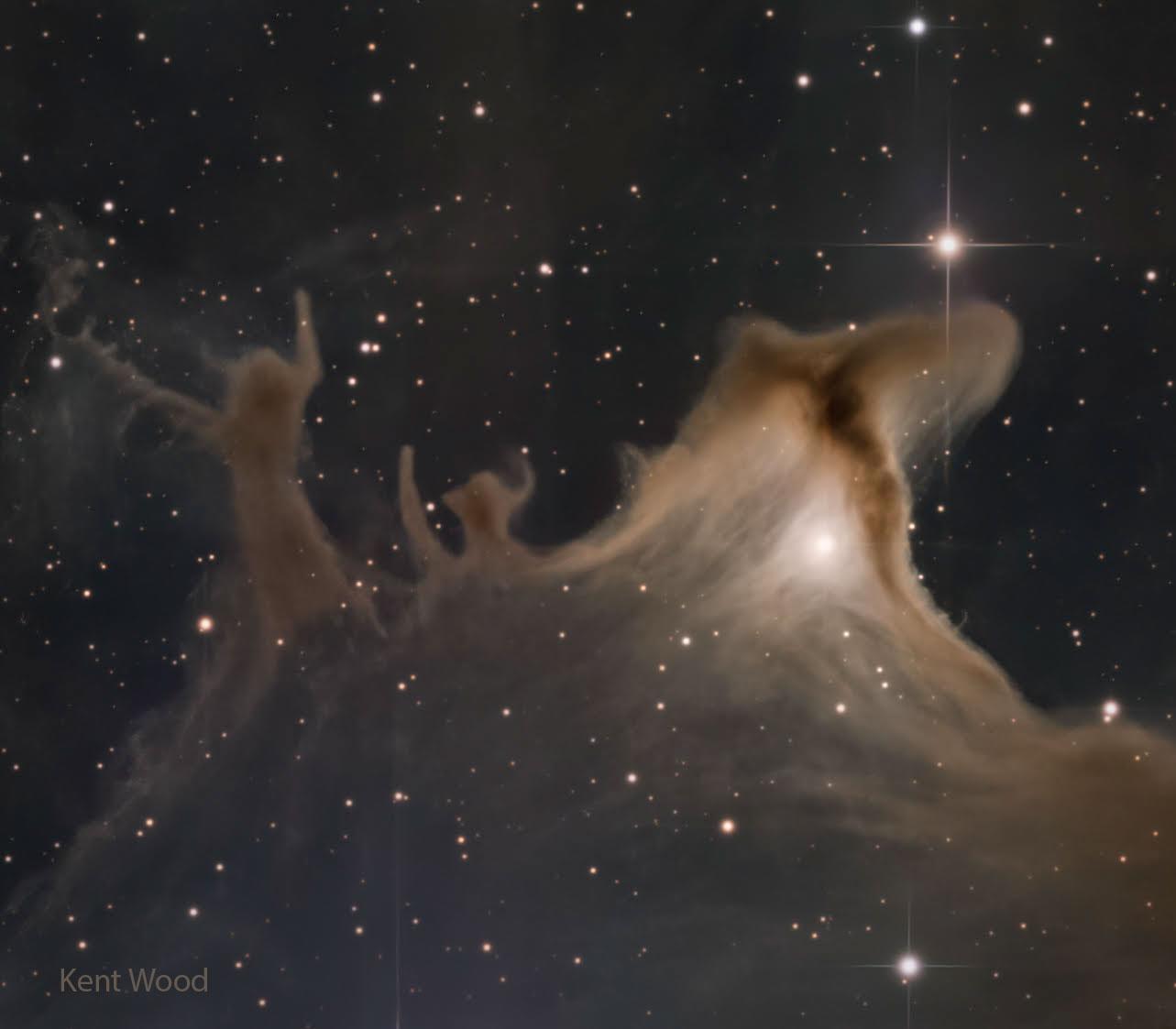
Alt...
2025 October 29
A dark star field surrounds an unusual clump of brown dust. To some, the dust clumps appear as shapes of people or monsters. Please see the explanation for more detailed information.
Dust Shapes of the Ghost Nebula
* Image Credit & Copyright: Kent Wood
Explanation:
Do any shapes seem to jump out at you from this interstellar field of stars and dust? The jeweled expanse, filled with faint, starlight-reflecting clouds, drifts through the night in the royal constellation of Cepheus. Far from your own neighborhood on planet Earth, these ghostly apparitions lurk along the plane of the Milky Way at the edge of the Cepheus Flare molecular cloud complex some 1,200 light-years away. Over two light-years across and brighter than the other spooky chimeras, VdB 141 or Sh2-136 is also known as the Ghost Nebula, seen across the middle of the featured image. Within the reflection nebula are the telltale signs of dense cores collapsing in the early stages of star formation.
Authors & editors: Robert Nemiroff (MTU) & Jerry Bonnell (UMCP)
NASA Official: Amber Straughn Specific rights apply.
NASA Web Privacy, Accessibility, Notices;
A service of: ASD at NASA / GSFC,
NASA Science Activation
& Michigan Tech. U.
2025 October 28
NGC 6995: The Bat Nebula
* Image Credit & Copyright: Francis Bozon & Jean-Luc Gangloff
Explanation:
Can you see the bat? It haunts this cosmic close-up of the eastern Veil Nebula. The Veil Nebula itself is a large supernova remnant, the expanding debris cloud from the death explosion of a massive star. While the Veil is roughly circular in shape and covers nearly 3 degrees on the sky toward the constellation of the Swan (Cygnus), NGC 6995, known informally as the Bat Nebula, spans only 1/2 degree, about the apparent size of the Moon. That translates to 12 light-years at the Veil's estimated distance, a reassuring 1,400 light-years from planet Earth. In the composite of image data recorded through several narrow band filters, with emission from hydrogen atoms in the remnant shown in red and with strong emission from oxygen atoms shown in hues of blue. Of course, in the western part of the Veil lies another seasonal apparition: the Witch's Broom Nebula.
https://chandra.harvard.edu/photo/scale_distance.html
https://periodic.lanl.gov/1.shtml
https://apod.nasa.gov/apod/ap251022.html
#space #nebula #cluster #astrophotography #photography #science #astronomy #nature #NASA #ESA #apod #education
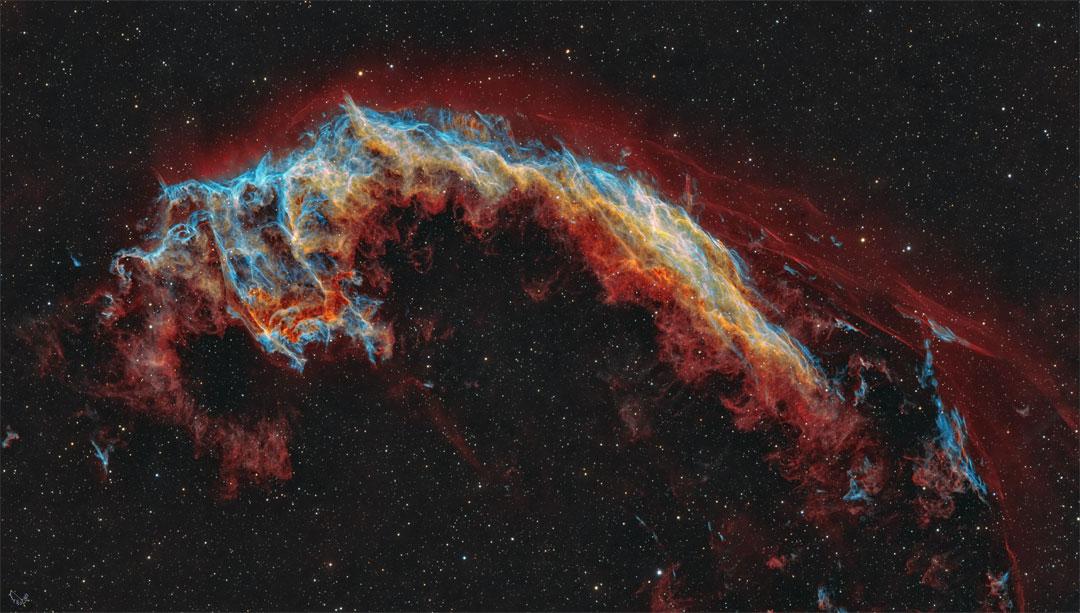
Alt...
2025 October 22
NGC 6995: The Bat Nebula
* Image Credit & Copyright: Francis Bozon & Jean-Luc Gangloff
Explanation:
Can you see the bat? It haunts this cosmic close-up of the eastern Veil Nebula. The Veil Nebula itself is a large supernova remnant, the expanding debris cloud from the death explosion of a massive star. While the Veil is roughly circular in shape and covers nearly 3 degrees on the sky toward the constellation of the Swan (Cygnus), NGC 6995, known informally as the Bat Nebula, spans only 1/2 degree, about the apparent size of the Moon. That translates to 12 light-years at the Veil's estimated distance, a reassuring 1,400 light-years from planet Earth. In the composite of image data recorded through several narrow band filters, with emission from hydrogen atoms in the remnant shown in red and with strong emission from oxygen atoms shown in hues of blue. Of course, in the western part of the Veil lies another seasonal apparition: the Witch's Broom Nebula.
![[?]](https://static.mamot.fr/accounts/avatars/000/005/136/original/b5257a79106f0fd6.jpg)
It won't be my best picture, but it was worth it taking the gear out (to the balcony 😬 )
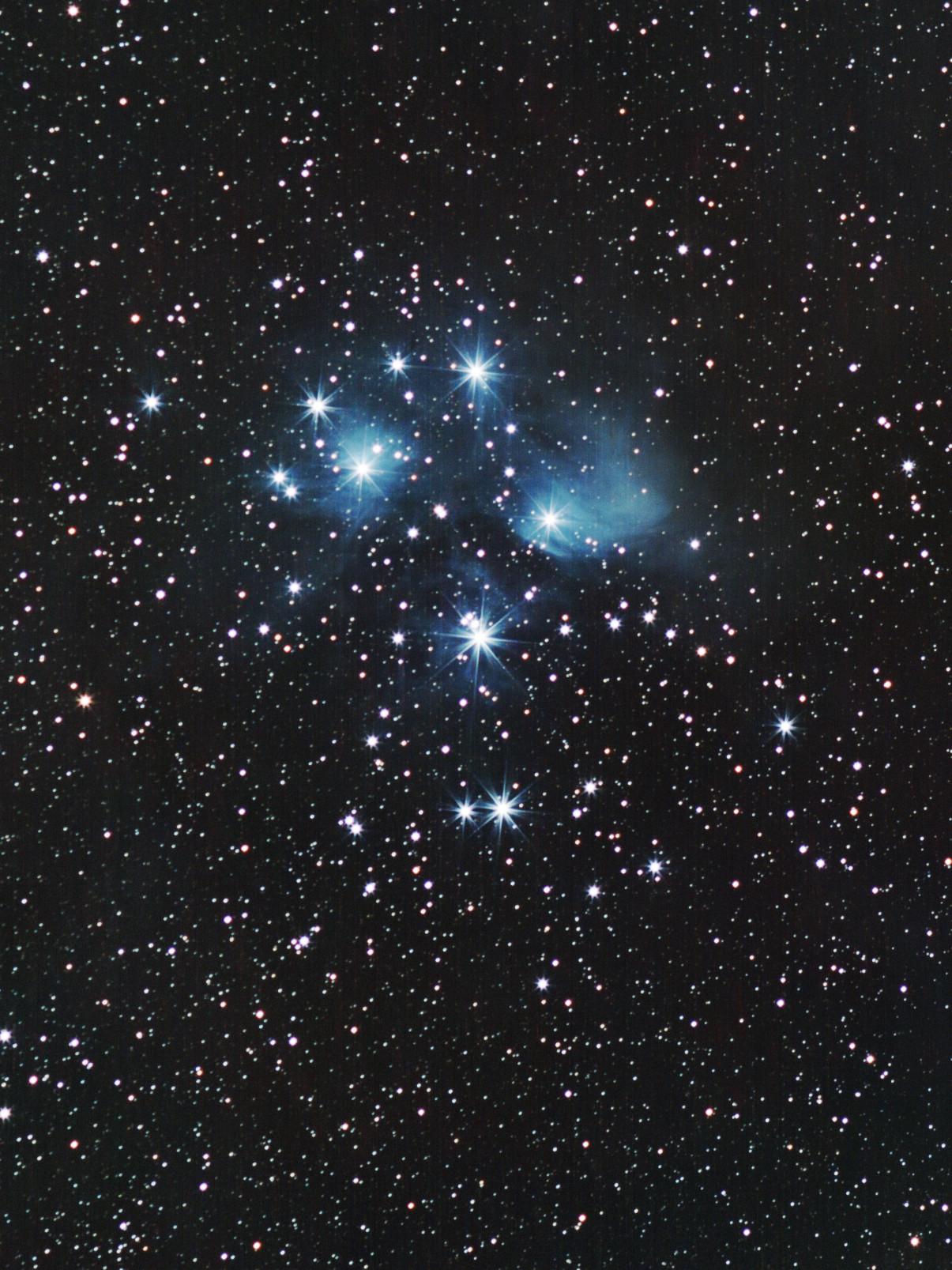
Alt...
The Pleiades, blue stars with bluish clouds
2025 October 27
Two Tails of Comet Lemmon
* Image Credit: Massimo Penna
Explanation:
How many bright tails does Comet Lemmon have? Two. In the featured image it appears to have three, but why? The reason is that the zigzagging brown filament is a persistent meteor train that by luck appeared in front of the distant comet C/2025 A6 (Lemmon). A meteor train is the hot gas and fine dust that remains in the Earth's atmosphere and disperses in the seconds after a bright meteor flashes by. The two bright tails are the blue ion tail stretching across the image, and the white dust tail nearer the green coma on the upper left. All real comet tails originate from the nucleus of the comet inside the coma. The image was captured a few days ago from Manciano, Italy. This week, from mid-northern locations, Comet Lemmon will remain faintly visible in the northwest sky after sunset.
https://apod.nasa.gov/apod/fap/ap251027.html
https://www.virtualtelescope.eu/2025/10/26/comet-c-2025-a6-lemmon-and-a-meteor-red-afterglow-an-epic-image-24-oct-2025/
https://en.wikipedia.org/wiki/Coma_(comet)
https://en.wikipedia.org/wiki/Comet_tail
https://www.space.com/stargazing/see-comet-lemmon-cross-paths-with-a-cosmic-serpent-this-weekend
https://apod.nasa.gov/apod/ap251027.html
#space #comets #astrophotography #photography #science #astronomy #nature #NASA #ESA #education #apod
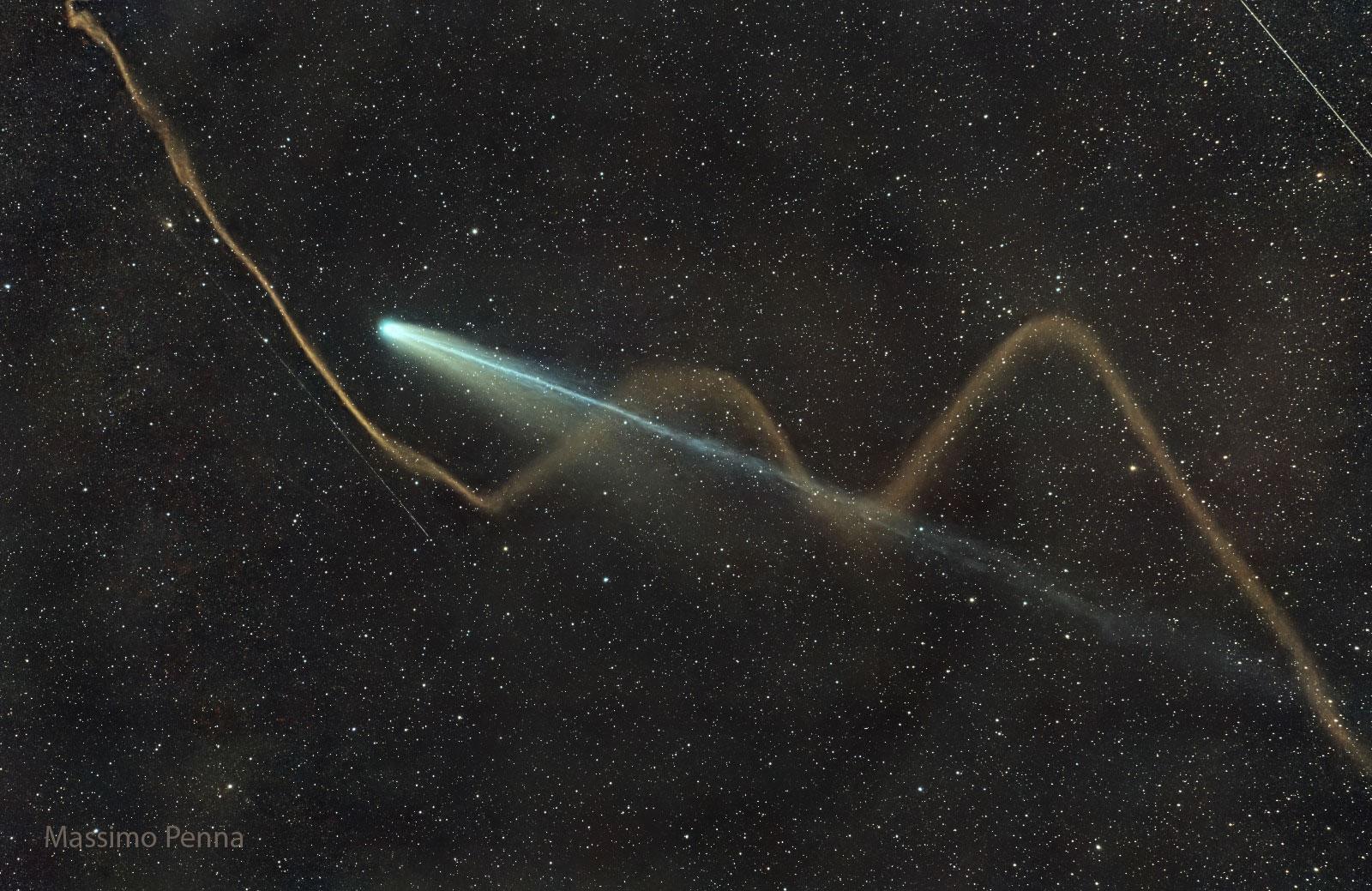
Alt...
2025 October 27
A dark sky shows bright comet with its tails extending diagonally from the lower left. Two tails are visible for the comet -- a long blue tail and a shorter wider white tail. Oddly, a wiggly tan stream appears to be a third tail -- but is actually the dust from a dissipated meteor. Please see the explanation for more detailed information.
Two Tails of Comet Lemmon
* Image Credit: Massimo Penna
Explanation:
How many bright tails does Comet Lemmon have? Two. In the featured image it appears to have three, but why? The reason is that the zigzagging brown filament is a persistent meteor train that by luck appeared in front of the distant comet C/2025 A6 (Lemmon). A meteor train is the hot gas and fine dust that remains in the Earth's atmosphere and disperses in the seconds after a bright meteor flashes by. The two bright tails are the blue ion tail stretching across the image, and the white dust tail nearer the green coma on the upper left. All real comet tails originate from the nucleus of the comet inside the coma. The image was captured a few days ago from Manciano, Italy. This week, from mid-northern locations, Comet Lemmon will remain faintly visible in the northwest sky after sunset.
Authors & editors: Robert Nemiroff (MTU) & Jerry Bonnell (UMCP)
NASA Official: Amber Straughn Specific rights apply.
NASA Web Privacy, Accessibility, Notices;
A service of: ASD at NASA / GSFC,
NASA Science Activation
& Michigan Tech. U.
2025 October 23
SWAN, Swan, Eagle
* Image Credit & Copyright: Adam Block
https://www.adamblockphotos.com/
Explanation:
Comet C/2025 R2 (SWAN) sports a greenish coma and fainter tail, seen against congeries of stars and dusty interstellar clouds in this 7 degree wide telescopic field of view from October 17. On that date, the new visitor to the inner Solar System obligingly posed with two other celestial birds seen toward the center of our Milky Way. Messier 16, near the bottom of the frame, and Messier 17 are also known to deep skywatchers as the Eagle and the Swan nebulae. While the comet coma's greenish glow recorded in the image is due to diatomic carbon gas fluorescing in sunlight, reddish hues seen in the nebulae, star forming regions some 5,000 light-years distant, are characteristic of ionized hydrogen gas. Comet SWAN is outbound now but still a good comet for binoculars and small telescopes that can look close to the southern horizon in the northern hemisphere's early evening skies. C/2025 R2 (SWAN) was closest to our fair planet on October 20, a mere 2.2 light-minutes away.
https://app.astrobin.com/i/rkicdu
https://en.wikipedia.org/wiki/Sidereus_Nuncius#Stars
https://earthsky.org/astronomy-essentials/visible-planets-tonight-mars-jupiter-venus-saturn-mercury/
https://apod.nasa.gov/apod/ap251023.html
#space #comets #astrophotography #photography #science #astronomy #nature #NASA #ESA #education #apod
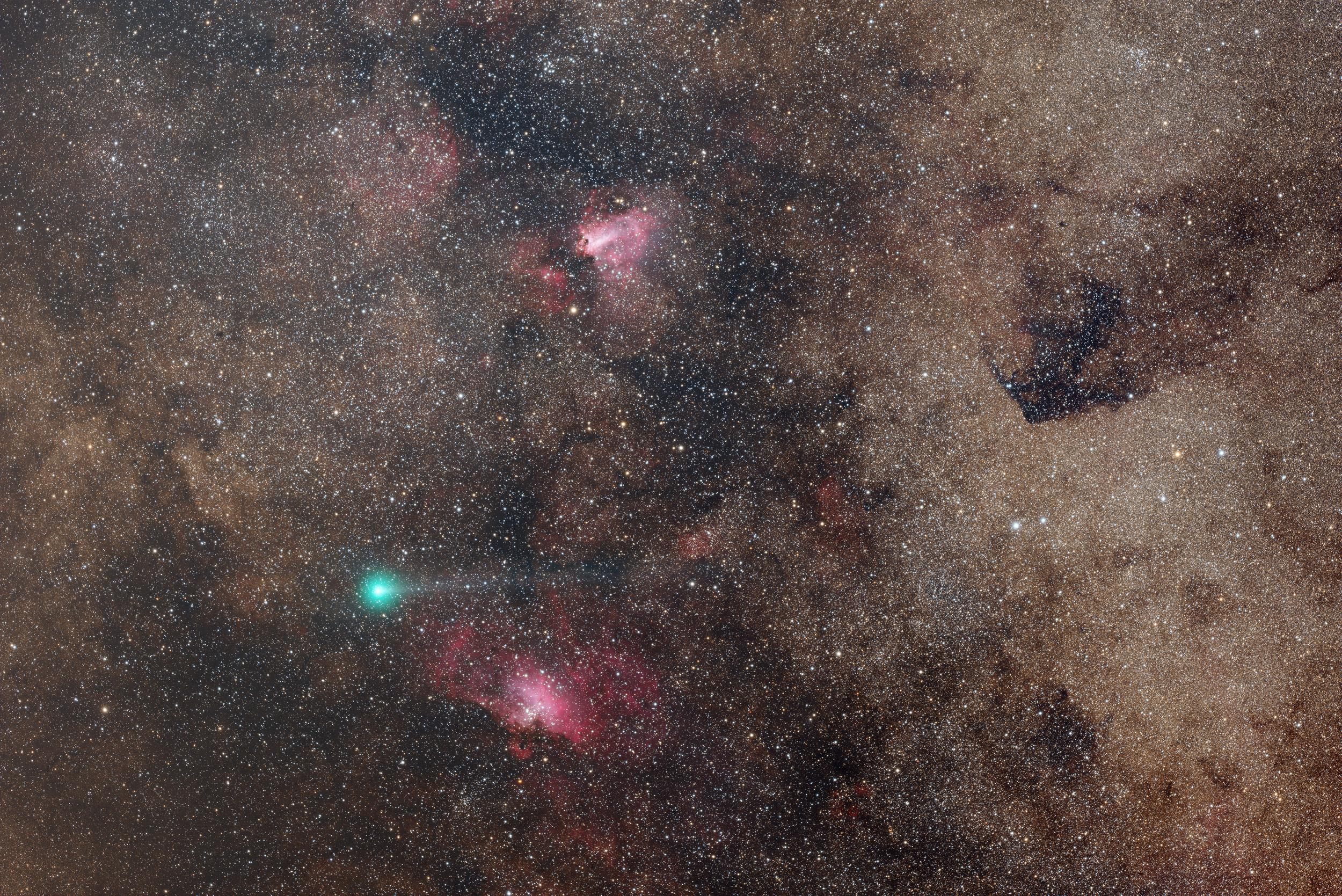
Alt...
2025 October 23
SWAN, Swan, Eagle
* Image Credit & Copyright: Adam Block
Explanation:
Comet C/2025 R2 (SWAN) sports a greenish coma and fainter tail, seen against congeries of stars and dusty interstellar clouds in this 7 degree wide telescopic field of view from October 17. On that date, the new visitor to the inner Solar System obligingly posed with two other celestial birds seen toward the center of our Milky Way. Messier 16, near the bottom of the frame, and Messier 17 are also known to deep skywatchers as the Eagle and the Swan nebulae. While the comet coma's greenish glow recorded in the image is due to diatomic carbon gas fluorescing in sunlight, reddish hues seen in the nebulae, star forming regions some 5,000 light-years distant, are characteristic of ionized hydrogen gas. Comet SWAN is outbound now but still a good comet for binoculars and small telescopes that can look close to the southern horizon in the northern hemisphere's early evening skies. C/2025 R2 (SWAN) was closest to our fair planet on October 20, a mere 2.2 light-minutes away.
Authors & editors: Robert Nemiroff (MTU) & Jerry Bonnell (UMCP)
NASA Official: Amber Straughn Specific rights apply.
NASA Web Privacy, Accessibility, Notices;
A service of: ASD at NASA / GSFC,
NASA Science Activation
& Michigan Tech. U.
2025 Shuttober 26
Halloween and the Ghost Head Nebula
* Image Credit: NASA, ESA, Mohammad Heydari-Malayeri (Observatoire de Paris) et al.,
https://www.nasa.gov/
https://www.esa.int/
https://www.iau.org/Iau/Shared_Content/Contacts/ContactLayouts/Obituary.aspx?ID=29332
https://www.observatoiredeparis.psl.eu/
Explanation:
Halloween's origin is ancient and astronomical. Since the fifth century BC, Halloween has been celebrated as a cross-quarter day, a day halfway between an equinox (equal day / equal night) and a solstice (minimum day / maximum night in the northern hemisphere). With a modern calendar however, even though Halloween later this week, the real cross-quarter day will occur the next week. Another cross-quarter day is Groundhog Day. Halloween's modern celebration retains historic roots in dressing to scare away the spirits of the dead. Perhaps a fitting tribute to this ancient holiday is this view of the Ghost Head Nebula taken with the Hubble Space Telescope. Similar to the icon of a fictional ghost, NGC 2080 is actually a star forming region in the Large Magellanic Cloud, a satellite galaxy of our own Milky Way Galaxy. The Ghost Head Nebula (NGC 2080) spans about 50 light-years and is shown in representative colors.
https://science.nasa.gov/photojournal/pj-ghost-head-nebula/
https://en.wikipedia.org/wiki/NGC_2080
https://en.wikipedia.org/wiki/Halloween
https://www.neopagan.net/Halloween-Origins.html
👻 https://en.wikipedia.org/wiki/Casper_the_Friendly_Ghost
https://earthsky.org/astronomy-essentials/halloween-derived-from-ancient-celtic-cross-quarter-day/
https://www.webexhibits.org//calendars/year-countries.html
https://en.wikipedia.org/wiki/Quarter_days
https://en.wikipedia.org/wiki/Groundhog_Day
🎃 https://www.boredpanda.com/blog/wp-content/uploads/2016/10/halloween-cat-costumes-19-57f75fe01d15b__605.jpg
https://apod.nasa.gov/apod/fap/ap251026.html
#space #astronomy #science #astrophotography #photography #nature #nebula #NASA #Webb #apod
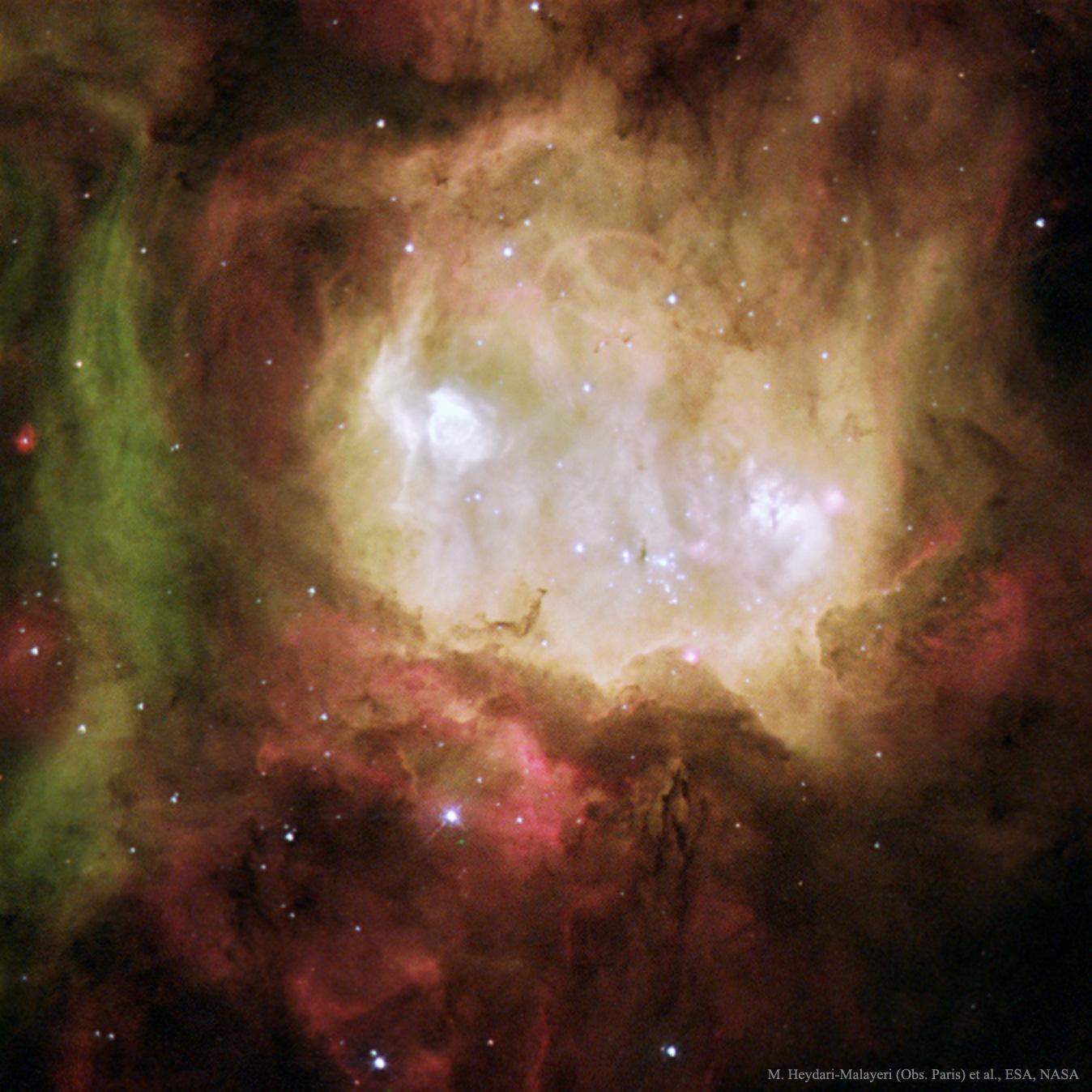
Alt...
2025 October 26
A white nebula appears in a colorful star field. To some, the nebula appears like a ghost. Please see the explanation for more detailed information.
Halloween and the Ghost Head Nebula
* Image Credit: NASA, ESA, Mohammad Heydari-Malayeri (Observatoire de Paris) et al.,
Explanation:
Halloween's origin is ancient and astronomical. Since the fifth century BC, Halloween has been celebrated as a cross-quarter day, a day halfway between an equinox (equal day / equal night) and a solstice (minimum day / maximum night in the northern hemisphere). With a modern calendar however, even though Halloween later this week, the real cross-quarter day will occur the next week. Another cross-quarter day is Groundhog Day. Halloween's modern celebration retains historic roots in dressing to scare away the spirits of the dead. Perhaps a fitting tribute to this ancient holiday is this view of the Ghost Head Nebula taken with the Hubble Space Telescope. Similar to the icon of a fictional ghost, NGC 2080 is actually a star forming region in the Large Magellanic Cloud, a satellite galaxy of our own Milky Way Galaxy. The Ghost Head Nebula (NGC 2080) spans about 50 light-years and is shown in representative colors.
Authors & editors: Robert Nemiroff (MTU) & Jerry Bonnell (UMCP)
NASA Official: Amber Straughn Specific rights apply.
NASA Web Privacy, Accessibility, Notices;
A service of: ASD at NASA / GSFC,
NASA Science Activation
& Michigan Tech. U.
"I want to wish you a nice Hallowwen time! May all ghosts and spirits on your ways be kind .. (Better keep some candies along ..)"
If you are fortunate enough to be able to do this, you may want to allow [the following website] to continue.
https://earthsky.org/astronomy-essentials/halloween-derived-from-ancient-celtic-cross-quarter-day/
Video Credit:
Written and produced by Kelly Kizer Whitt
https://earthsky.org/author/kellywhitt/
EarthSky.org:
https://earthsky.org/
Subscribe:
https://subscribe.earthsky.org/
Store:
https://earthskystore.org/
Team and About:
https://earthsky.org/about/
#space #astronomy #science #astrophotography #photography #nature #nebula #NASA #Webb #apod
![[?]](https://cdn.masto.host/swisssocial/accounts/avatars/109/610/582/883/537/207/original/0e6a86a6c0df06cc.jpg)

#knowledge #wissen #wissenschaft #science #archaeology #archaologie #Astronomy #Astronomie
Astronomen finden nahe, lebensfreundliche Supererde
18 Lichtjahre entfernter Exoplanet liegt genau in der habitablen Zone seines Sterns 🤓
https://www.scinexx.de/news/kosmos/nahe-lebensfreundliche-supererde-entdeckt/
#knowledge #wissen #wissenschaft #science #Astronomy #Astronomie
Komet Lemmon ist jetzt am besten zu sehen
Wie man Komet C/2025 A6 (Lemmon) am Himmel findet und was das Besondere an ihm ist 🤓
https://www.scinexx.de/news/kosmos/komet-lemmon-ist-jetzt-am-besten-zu-sehen/
#knowledge #wissen #Physik
#physics #wissenschaft #science #Astronomy
Rätsel um die Gravitation vertieft sich
Experimente zum Nachweis der Quantengravitation können irreführen 🤓
https://www.scinexx.de/news/physik/raetsel-um-die-gravitation-vertieft-sich/
Zoom in to Rho Ophiuchi !
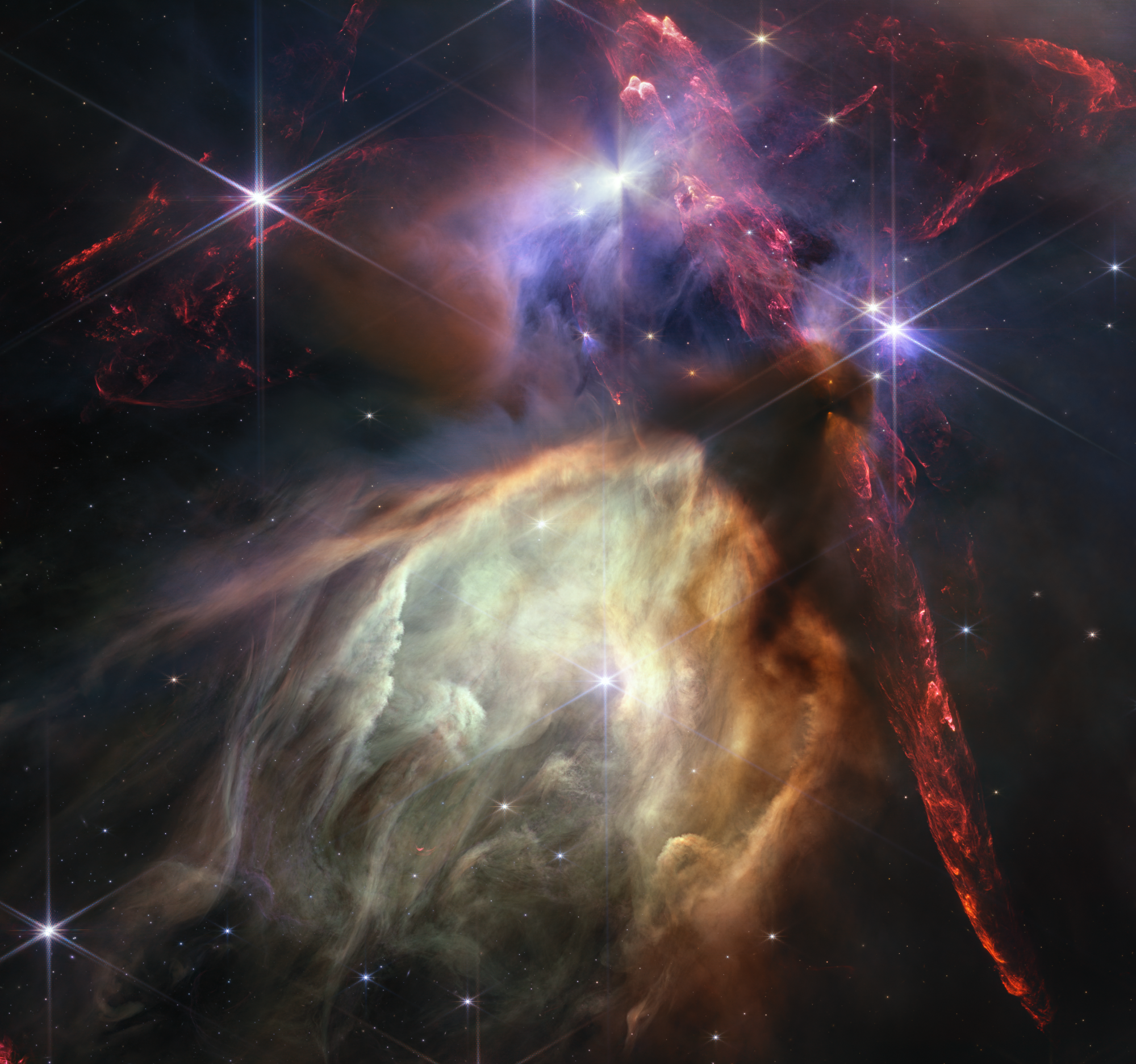
Travel to the Rho Ophiuchi cloud complex. The journey begins with a ground-based image by astrophotographer Akira Fujii, then transitions into a plate from the Digitized Sky Survey. Next a two-color image from the now-retired infrared NASA Spitzer Space Telescope appears, and then finally the video arrives at the James Webb Space Telescope’s image of the star-forming region.
The star-forming region captured in Webb’s image is small and not particularly active compared to other well-known star-forming regions. It is the region’s proximity to Earth (390 light-years) that allows Webb to capture it in such detail, emphasizing the structure of jets bursting from young solar-mass stars, and a dusty “cave” of glowing polycyclic aromatic hydrocarbons.
Credit
Animation: NASA, ESA, CSA, Alyssa Pagan (STScI); Acknowledgment: Caltech/IPAC, Caltech, DSS, Akira Fujii
#space #astronomy #science #astrophotography #photography #nature #nebula #NASA #Webb #apod
2025 October 25
Webb's Rho Ophiuchi
* Image Credit: NASA, ESA, CSA, STScI, Klaus Pontoppidan (STScI),
https://www.nasa.gov/
https://www.esa.int/
https://www.asc-csa.gc.ca/eng/
https://www.stsci.edu/
Explanation:
A mere 390 light-years away, Sun-like stars and future planetary systems are forming in the Rho Ophiuchi molecular cloud complex, the closest star-forming region to our fair planet. The James Webb Space Telescope's NIRCam peered into the nearby natal chaos to capture this infrared image at an inspiring scale. The frame spans less than a light-year across the Rho Ophiuchi region and contains about 50 young stars. Brighter stars clearly show Webb's characteristic pattern of diffraction spikes. Huge jets of shocked molecular hydrogen blasting from newborn stars are red in the image, with the large, yellowish dusty cavity carved out by the energetic young star near its center. Near some stars in the stunning image are shadows cast by their protoplanetary disks. The spectacular cosmic snapshot was released in 2023 to celebrate the successful first year of Webb's exploration of the Universe.
https://science.nasa.gov/missions/webb/webb-celebrates-first-year-of-science-with-close-up-on-birth-of-sun-like-stars/
https://science.nasa.gov/asset/webb/rho-ophiuchi-nircam-compass-image/
https://science.nasa.gov/asset/webb/rho-ophiuchi-video-tour/
https://ui.adsabs.harvard.edu/abs/1996A%26A...314..477B/abstract
https://science.nasa.gov/mission/webb/
https://en.wikipedia.org/wiki/James_E._Webb
https://apod.nasa.gov/apod/fap/ap251025.html
#space #astronomy #science #astrophotography #photography #nature #nebula #NASA #education #apod
Alt...
2025 October 25
Webb's Rho Ophiuchi
* Image Credit: NASA, ESA, CSA, STScI, Klaus Pontoppidan (STScI),
Explanation:
A mere 390 light-years away, Sun-like stars and future planetary systems are forming in the Rho Ophiuchi molecular cloud complex, the closest star-forming region to our fair planet. The James Webb Space Telescope's NIRCam peered into the nearby natal chaos to capture this infrared image at an inspiring scale. The frame spans less than a light-year across the Rho Ophiuchi region and contains about 50 young stars. Brighter stars clearly show Webb's characteristic pattern of diffraction spikes. Huge jets of shocked molecular hydrogen blasting from newborn stars are red in the image, with the large, yellowish dusty cavity carved out by the energetic young star near its center. Near some stars in the stunning image are shadows cast by their protoplanetary disks. The spectacular cosmic snapshot was released in 2023 to celebrate the successful first year of Webb's exploration of the Universe.
Authors & editors: Robert Nemiroff (MTU) & Jerry Bonnell (UMCP)
NASA Official: Amber Straughn Specific rights apply.
NASA Web Privacy, Accessibility, Notices;
A service of: ASD at NASA / GSFC,
NASA Science Activation
& Michigan Tech. U.
Rho Ophiuchi (ρ Ophiuchi)
From Wikipedia, the free encyclopedia
* Image Credit:
Adam Block/Steward Observatory/University of Arizona
https://www.adamblockphotos.com/about.html see ©-notes in Alt-Text
Rho Ophiuchi is a multiple star system in the constellation Ophiuchus. The central system has an apparent magnitude of 4.63. Based on the central system's parallax, it is located about 450 light-years distant. The other stars in the system are slightly farther away.
The central system is known as Rho Ophiuchi AB. It consists of three blue-colored subgiants or main-sequence stars, designated Rho Ophiuchi Aa, Ab and B, respectively. Rho Ophiuchi Aa-Ab is a spectroscopic binary with an orbital period of 88 days and an orbital period of 1.1 astronomical units. Farther away is the B companion, a visual binary whose sky-projected distance from the inner pair appears to be 3.1″, corresponding to a separation of at least 344 AU. However, the actual separation is larger, and the two take about 2,400 years to complete an orbit. The two stars dominate the radiation field around the Rho Ophiuchi cloud complex.
Rho Ophiuchi A emits X-rays, and exhibits strong variability in emission over periods of about 1.2 days, corresponding to its rotation period. The X-ray variability is due to the strong magnetic field of the secondary companion, Rho Ophiuchi Ab, whose dipole strength is 4 kG.
Several other stars are located close to Rho Ophiuchi AB. HD 147932 is located 2.5 arcminutes away (at least 17,000 AU), and is known as Rho Ophiuchi C. HD 147888 is located 2.82 arcminutes away (at least 19,000 AU), and is known as Rho Ophiuchi DE.[11] Stars C and D are both B-type main-sequence stars, and D itself is another binary with an orbital period of around 680 years.
https://en.wikipedia.org/wiki/Rho_Ophiuchi
#space #astronomy #science #astrophotography #photography #nature #nebula
Alt...
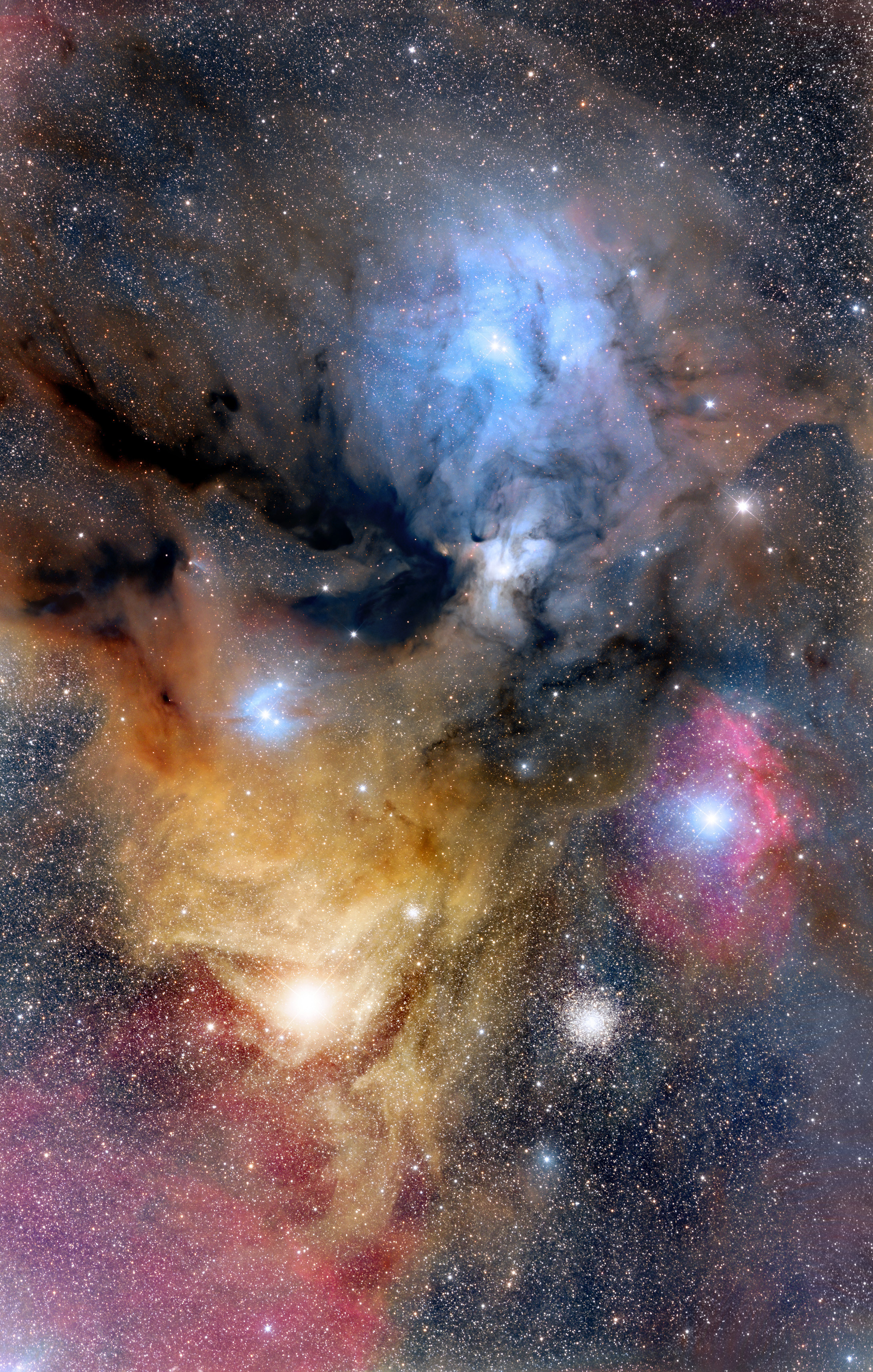
Nebulae in emission, reflection and absorption (dark clouds of dust) are included in this widefield image.
Rho Ophiuchi cloud complex (N is up): Antares is the bright star that looks yellow in this image, σ Scorpii is in the red nebula (Sh2-9), and the globular cluster M4 is in between. Rho Ophiuchi is the small group of stars in the blue nebulosity (IC 4604).
Rho Ophiuchi is the namesake of the Rho Ophiuchi cloud complex. It is a nebula of gas and dust, which the Rho Ophiuchi system is embedded in. It is one of the easiest star forming regions to observe, as it is one of the nearest, and it is visible from both hemispheres.
The interstellar extinction (AV) of Rho Ophiuchi is measured to be 1.45 magnitudes, meaning the dust and gas in front of Rho Ophiuchi absorbs light from the system, making it appear 1.45 magnitudes dimmer than it would be if there were no dust or gas. Additionally, gas and dust also scatters more higher-frequency light, leaving the light appearing more reddish. The interstellar reddening (EB−V) of Rho Ophiuchi has been measured to be 0.47 magnitudes.
From Wikipedia, the free encyclopedia
* Image Credit:
Adam Block/Steward Observatory/University of Arizona
©-notes:
The image found on this page (only) is licensed under a Creative Commons Attribution-ShareAlike 3.0 United States License. Although larger versions of this image are available and can be found elsewhere, they are NOT to be used without the express permission of Adam Block.
Alt...
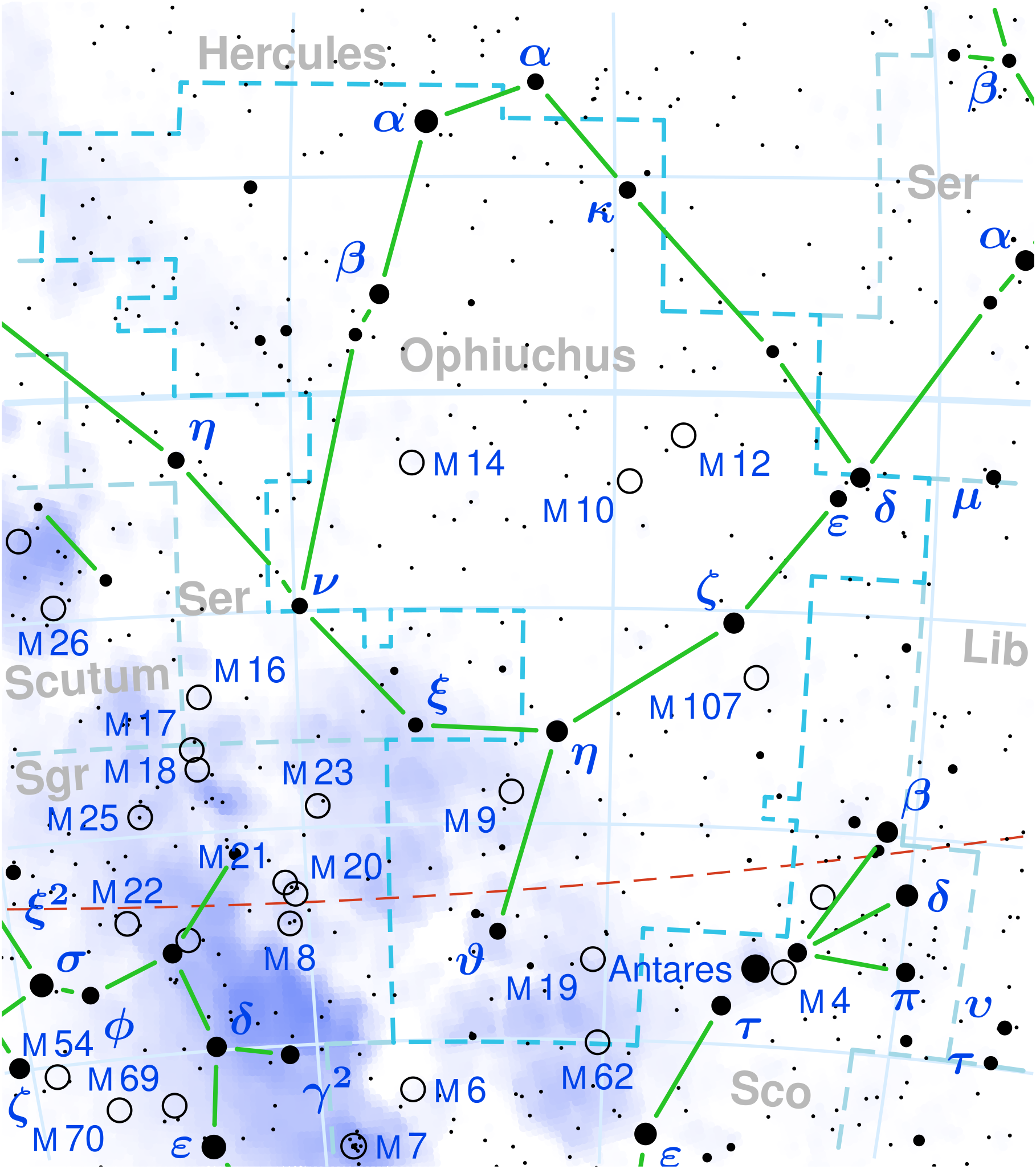
This is a celestial map of the constellation Ophiuchus, the Serpent Holder.
Copyright © 2003 Torsten Bronger.
It was created by Torsten Bronger using the program PP3 on 2003/08/18. At PP3's homepage, you also get the input scripts necessary for re-compiling the map.
The yellow dashed lines are constellation boundaries, the red dashed line is the ecliptic, and the shades of blue show Milky Way areas of different brightness. The map contains all Messier objects, except for colliding ones. The underlying database contains all stars brighter than 6.5. All coordinates refer to equinox 2000.0.
The map is calculated with the equidistant azimuthal projection (the zenith being in the center of the image). The north pole is to the top. The (horizontal) lines of equal declination are drawn for 0°, ±10°, ±20° etc. The lines of equal rectascension are drawn for all 24 hours. Towards the rim there is a very slight magnification (and distortion).
The Rho Ophiuchi cloud complex, a small star forming region, is located 390 light years away. The closest star forming region to Earth. A chaotic scene resembling explosions frozen in time, this new image from NASA's James Webb Space Telescope displays a field of about 50 young stars, many of them similar in mass to our sun.
A region that would look black in visible light is revealed in the infrared with Webb sensitive instruments. The detail in Webb's portrait of starbirth is unprecedented. The scene is dominated by a giant cavity that has been carved by a single star. That star, S1, is more massive than our sun and emits ultraviolet photons that have carved out a bubble.
The yellow orange color comes from tiny sooty grains that astronomers call polycyclic aromatic hydrocarbons. Streamers of gas and dust form structures and textures unlike anything we have seen before. The striking large red vertical band is a protostellar outflow, twin powerful Jets of material that occurred during the early stages of star formation.
The projecting cone is the result of material that's been ejected through the jet. The entire structure glows red due to molecular hydrogen being energized as material from the jets collides with interstellar gas.
Like most young stars young solar systems also form in multiples. And we can see several brand new solar systems making their way into the universe via the very same processes that shaped our own cosmic home. Planet forming disks block the star's light casting telltale shadows across space.
* Video Credits:
NASA, ESA, CSA, Greg Bacon (STScI)
#space #astronomy #science #astrophotography #photography #nature #nebula
NASA's James Webb Space Telescope continues to wow with an action-packed image belying a relatively quiet star-forming region.
July 12, 2023
Leah Ramsay - Space Telescope Science Institute, Baltimore
Christine Pulliam - Space Telescope Science Institute, Baltimore
NASA’s James Webb Space Telescope caps a successful first year of science, and stunning imagery, with a detailed view of the closest star-forming region to Earth, the Rho Ophiuchi cloud complex, resulting in a dynamic image that belies the region’s relative quiet – and practically begs for explanation of what exactly we are looking at. While dual jets have been seen
blasting out of new stars before, the texture that Webb’s NIRCam instrument reveals in the multiple jets crisscrossing the image is unprecedented. In striking contrast, the lower half of the image is dominated by a glowing cave of dust being lit up and eroded by the most massive star in the scene. Its stellar neighbors are the mass of our Sun or smaller, with some displaying the telltale shadows of protoplanetary disks—meaning we are looking at planetary systems potentially similar to our own in their earliest stages.
>> Full Press Release:
https://webbtelescope.org/contents/news-releases/2023/news-2023-128#heading-full-article
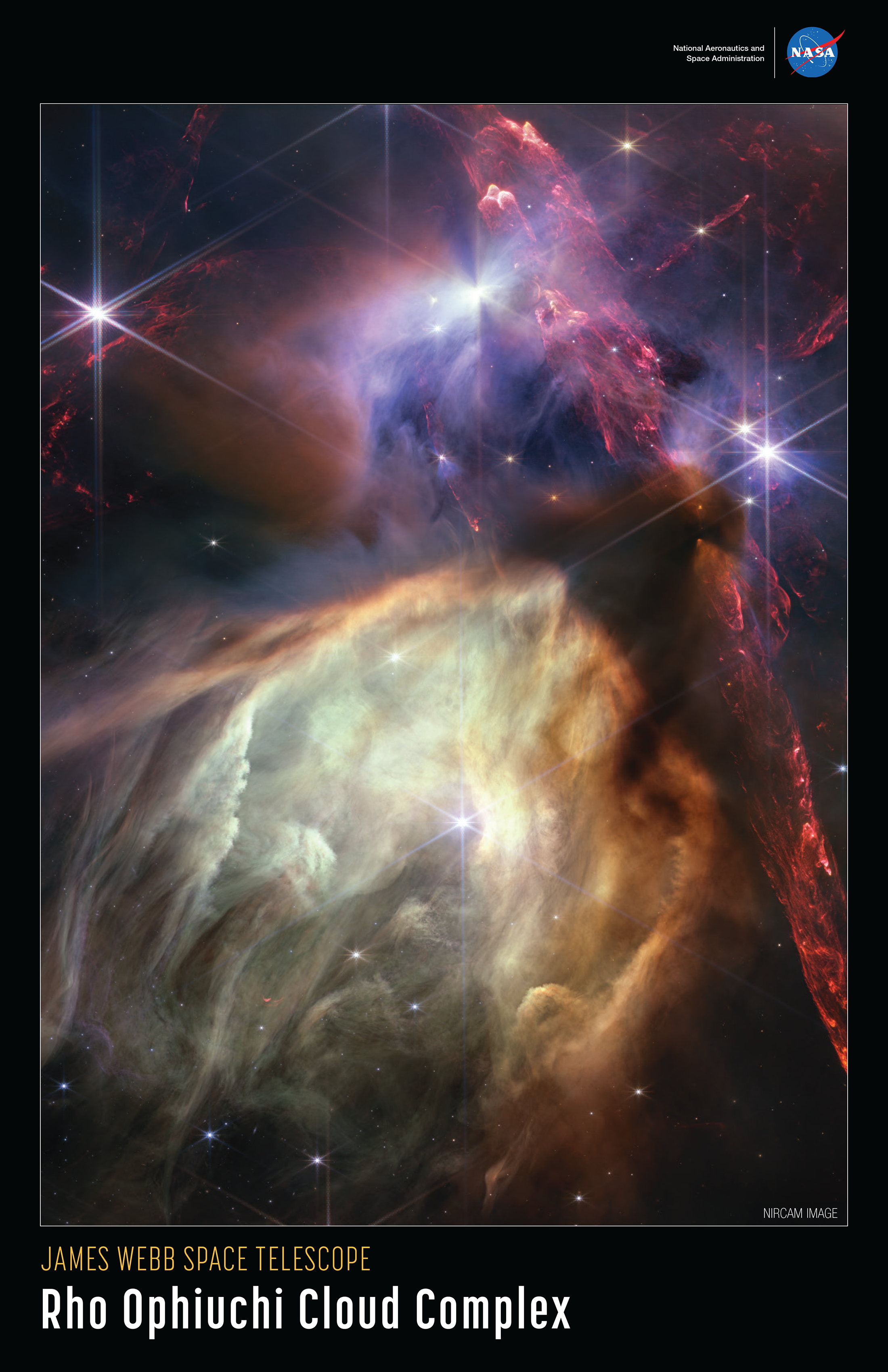
Download and print a poster featuring the Rho Ophiuchi Cloud Complex captured by NASA's James Webb Space Telescope to post at home, school, work, or around your neighborhood!
The poster is available single or double-sided, in several print-ready sizes. The double-sided versions include the image on the front and a description in English and Spanish on the back.
Downloads:
>> https://webbtelescope.org/contents/media/products/01HK5C5QY2A6NKMDGXA25WZ9QA
#space #nebula #astronomy #science #astrophotography #photography #nature
Alt...
Download and print a poster featuring the Rho Ophiuchi Cloud Complex captured by NASA's James Webb Space Telescope to post at home, school, work, or around your neighborhood!
The poster is available single or double-sided, in several print-ready sizes. The double-sided versions include the image on the front and a description in English and Spanish on the back.
For a full description of the image and Webb's observations of the Rho Ophiuchi Cloud Complex, read the complete
* Image Credits: NASA, ESA, CSA, STScI
* Design: Elizabeth Wheatley (STScI)
2025 June 25
Rubin's First Look: A Sagittarius Skyscape
* Image Credit & License: NSF–DOE Vera C. Rubin Observatory
https://rubinobservatory.org/
Explanation:
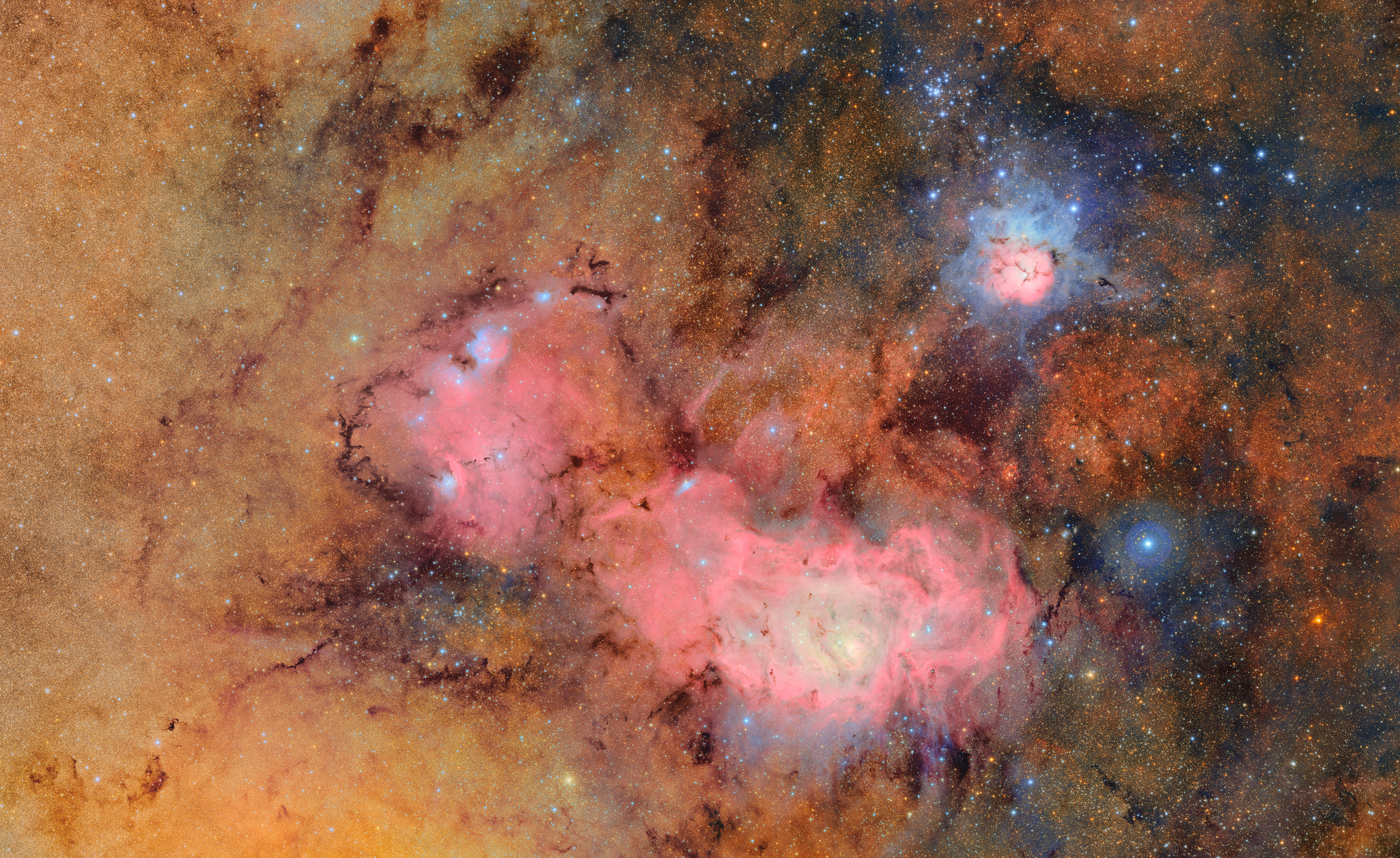
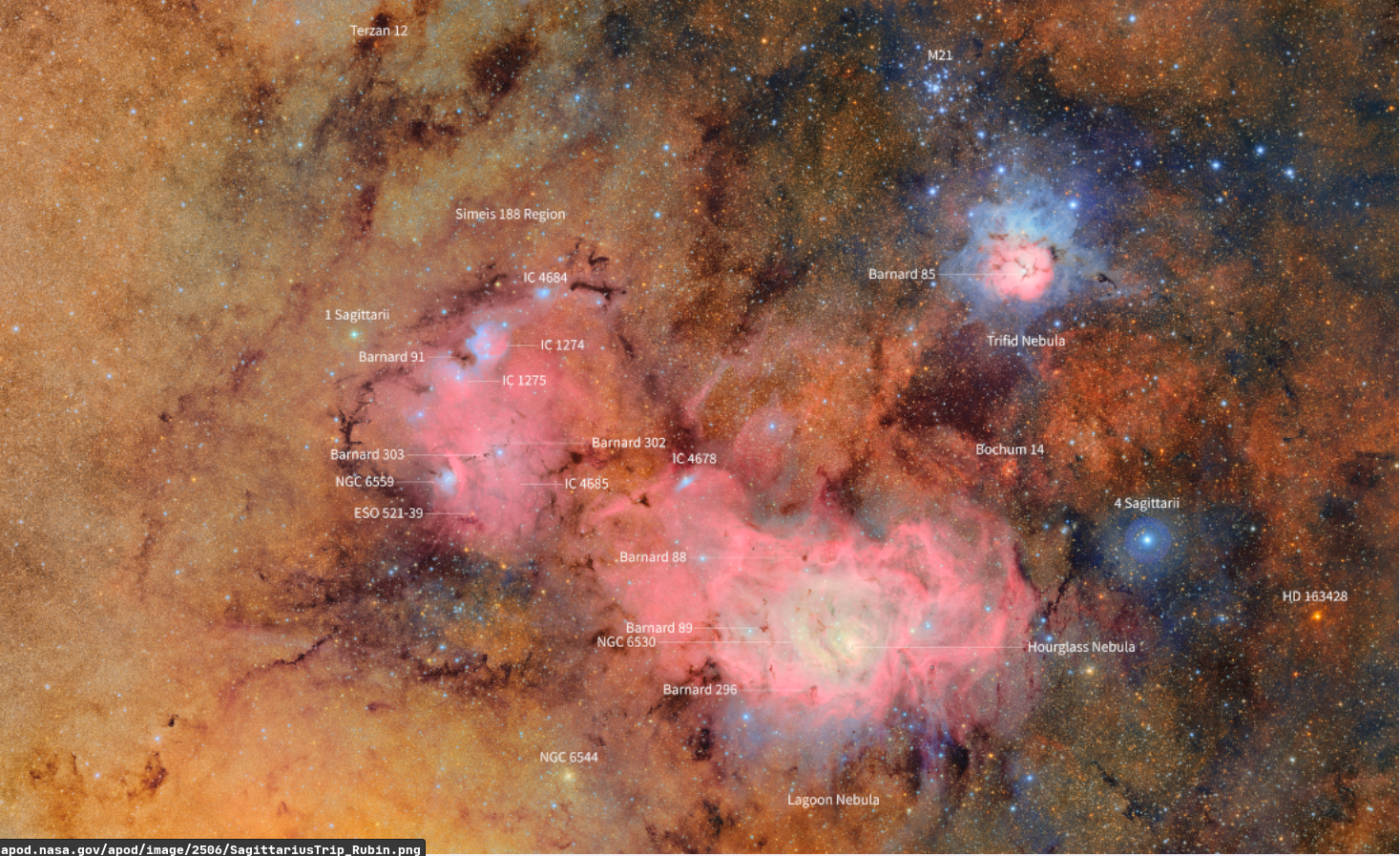
This interstellar skyscape spans over 4 degrees across crowded starfields toward the constellation Sagittarius and the central Milky Way. A First Look image captured at the new NSF–DOE Vera C. Rubin Observatory, the bright nebulae and star clusters featured include famous stops on telescopic tours of the cosmos: Messier 8 and Messier 20. An expansive star-forming region over a hundred light-years across, Messier 8 is also known as the Lagoon Nebula. About 4,000 light-years away the Lagoon Nebula harbors a remarkable cluster of young, massive stars. Their intense radiation and stellar winds energize and agitate this cosmic lagoon's turbulent depths. Messier 20's popular moniker is the Trifid. Divided into three parts by dark interstellar dust lanes, the Trifid Nebula's glowing hydrogen gas creates its dominant red color. But contrasting blue hues in the colorful Trifid are due to dust reflected starlight. The Rubin Observatory visited the Trifid-Lagoon field to acquire all the image data during parts of four nights (May 1-4). At full resolution, Rubin's magnificent Sagittarius skyscape is 84,000 pixels wide and 51,500 pixels tall.
https://rubinobservatory.org/gallery/collections/first-look-gallery/n4kvj0cemd5pbdqgtjdgp2jg2t
https://science.nasa.gov/mission/hubble/science/explore-the-night-sky/hubble-messier-catalog/messier-8/
https://science.nasa.gov/mission/hubble/science/explore-the-night-sky/hubble-messier-catalog/messier-20/
https://apod.nasa.gov/apod/ap230928.html
https://apod.nasa.gov/apod/ap250625.html
#space #galaxy #milkyway #astrophotography #photography #science #astronomy #NASA
Alt...
2025 June 25
Rubin's First Look: A Sagittarius Skyscape
* Image Credit & License: NSF–DOE Vera C. Rubin Observatory
Explanation:
This interstellar skyscape spans over 4 degrees across crowded starfields toward the constellation Sagittarius and the central Milky Way. A First Look image captured at the new NSF–DOE Vera C. Rubin Observatory, the bright nebulae and star clusters featured include famous stops on telescopic tours of the cosmos: Messier 8 and Messier 20. An expansive star-forming region over a hundred light-years across, Messier 8 is also known as the Lagoon Nebula. About 4,000 light-years away the Lagoon Nebula harbors a remarkable cluster of young, massive stars. Their intense radiation and stellar winds energize and agitate this cosmic lagoon's turbulent depths. Messier 20's popular moniker is the Trifid. Divided into three parts by dark interstellar dust lanes, the Trifid Nebula's glowing hydrogen gas creates its dominant red color. But contrasting blue hues in the colorful Trifid are due to dust reflected starlight. The Rubin Observatory visited the Trifid-Lagoon field to acquire all the image data during parts of four nights (May 1-4). At full resolution, Rubin's magnificent Sagittarius skyscape is 84,000 pixels wide and 51,500 pixels tall.
Authors & editors: Robert Nemiroff (MTU) & Jerry Bonnell (UMCP)
NASA Official: Amber Straughn Specific rights apply.
2023 January 29
Barnard 68: Dark Molecular Cloud
* Image Credit: FORS Team, 8.2-meter VLT Antu, ESO
https://www.eso.org/projects/vlt/
https://www.eso.org/sci/facilities/paranal/instruments/fors.html
https://www.eso.org/public/
Explanation:
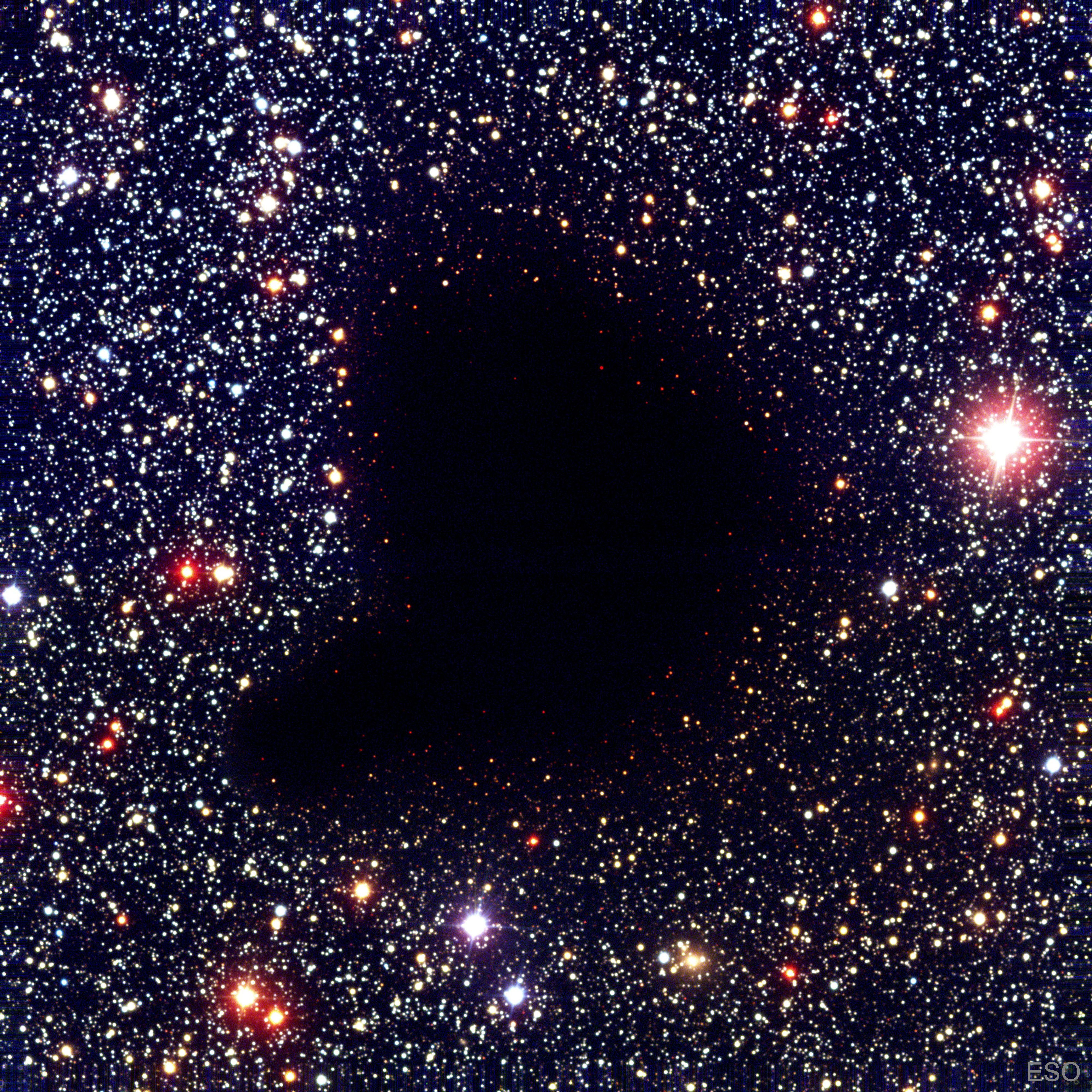
Where did all the stars go? What used to be considered a hole in the sky is now known to astronomers as a dark molecular cloud. Here, a high concentration of dust and molecular gas absorb practically all the visible light emitted from background stars. The eerily dark surroundings help make the interiors of molecular clouds some of the coldest and most isolated places in the universe. One of the most notable of these dark absorption nebulae is a cloud toward the constellation Ophiuchus known as Barnard 68, pictured here. That no stars are visible in the center indicates that Barnard 68 is relatively nearby, with measurements placing it about 500 light-years away and half a light-year across. It is not known exactly how molecular clouds like Barnard 68 form, but it is known that these clouds are themselves likely places for new stars to form. In fact, Barnard 68 itself has been found likely to collapse and form a new star system. It is possible to look right through the cloud in infrared light.
https://www.eso.org/public/news/eso0102/
https://en.wikipedia.org/wiki/Barnard_68
https://en.wikipedia.org/wiki/Molecule
https://apod.nasa.gov/apod/ap030706.html
https://apod.nasa.gov/apod/ap970430.html
https://ui.adsabs.harvard.edu/abs/2009ApJ...695.1308B/abstract
https://www.eso.org/public/videos/eso9934a/
https://www.eso.org/public/news/eso9934/
https://astronomy.swin.edu.au/cosmos/m/Molecular+Cloud
https://apod.nasa.gov/apod/ap201206.html
https://apod.nasa.gov/apod/ap221020.html
https://science.nasa.gov/universe/stars/
https://starchild.gsfc.nasa.gov/docs/StarChild/questions/question19.html
https://apod.nasa.gov/apod/dark_nebulae.html
https://en.wikipedia.org/wiki/Ophiuchus
https://science.nasa.gov/ems/07_infraredwaves/
https://apod.nasa.gov/apod/ap230129.html
#space #cluster #cloud #nebula #astrophotography #photography #science #astronomy #physics #nature #NASA #education
Alt...
2023 January 29
A dark comma-shaped cloud appears in the middle of a dense field of stars. No stars are visible through the center of the cloud.
Barnard 68: Dark Molecular Cloud
* Image Credit: FORS Team, 8.2-meter VLT Antu, ESO
Explanation:
Where did all the stars go? What used to be considered a hole in the sky is now known to astronomers as a dark molecular cloud. Here, a high concentration of dust and molecular gas absorb practically all the visible light emitted from background stars. The eerily dark surroundings help make the interiors of molecular clouds some of the coldest and most isolated places in the universe. One of the most notable of these dark absorption nebulae is a cloud toward the constellation Ophiuchus known as Barnard 68, pictured here. That no stars are visible in the center indicates that Barnard 68 is relatively nearby, with measurements placing it about 500 light-years away and half a light-year across. It is not known exactly how molecular clouds like Barnard 68 form, but it is known that these clouds are themselves likely places for new stars to form. In fact, Barnard 68 itself has been found likely to collapse and form a new star system. It is possible to look right through the cloud in infrared light.
Authors & editors: Robert Nemiroff (MTU) & Jerry Bonnell (UMCP)
NASA Official: Phillip Newman Specific rights apply.
NASA Web Privacy Policy and Important Notices
A service of: ASD at NASA / GSFC,
NASA Science Activation
& Michigan Tech. U.
"Welcome back to
TOPIC> 'In The Neighbourhood'
with this stunning image. Please also read how much time and effort it took to create it and you will agree with me that this is astronomy with real passion."
2009 September 25
Gigagalaxy Zoom: Galactic Center
* Credit: ESO / Stéphane Guisard - Copyright: Stéphane Guisard
http://sguisard.astrosurf.com/
Explanation:
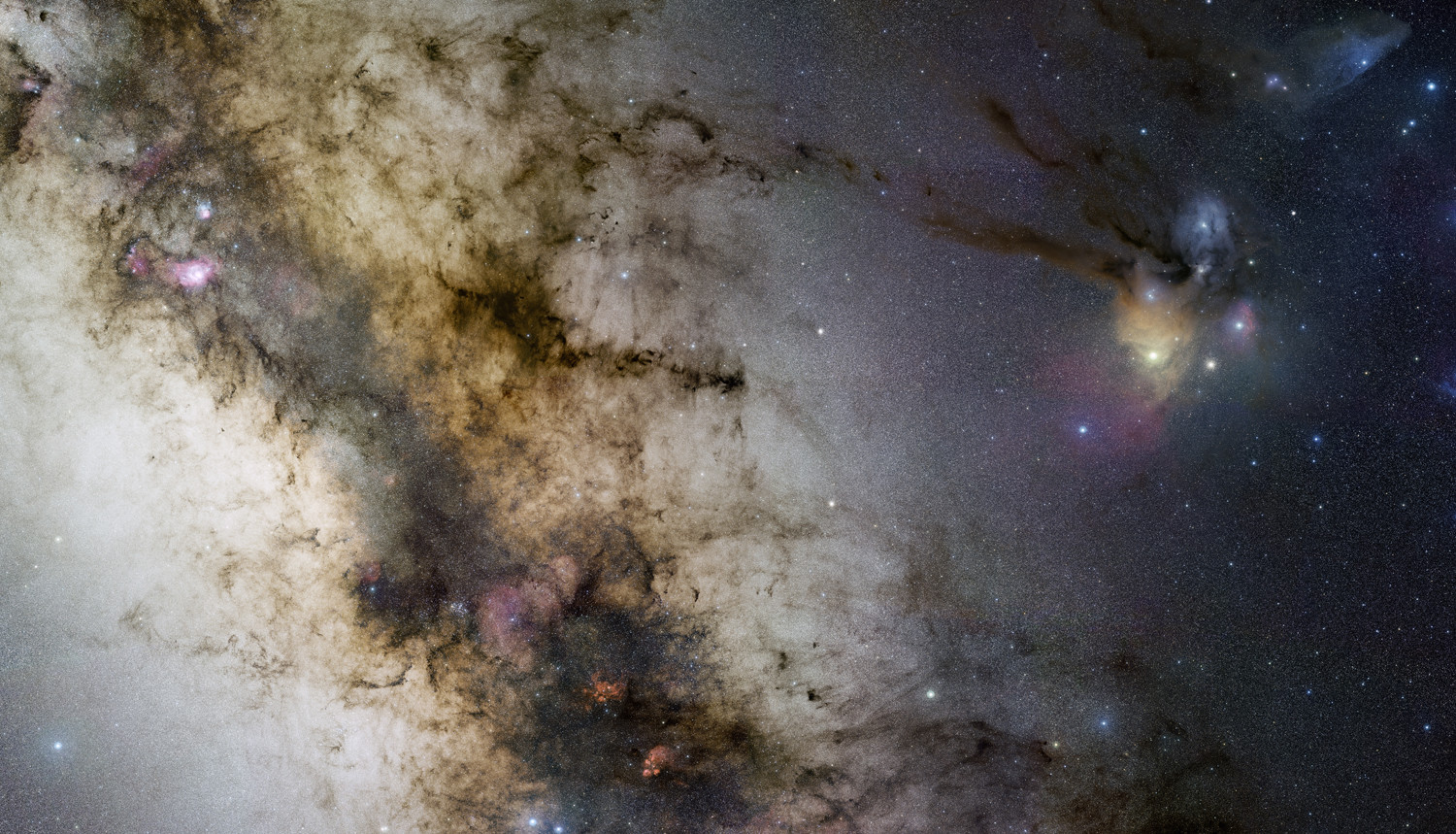
From Sagittarius to Scorpius, the central Milky Way is a truly beautiful part of planet Earth's night sky. The gorgeous region is captured here, an expansive gigapixel mosaic of 52 fields spanning 34 by 20 degrees in 1200 individual images and 200 hours of exposure time. Part of ESO's Gigagalaxy Zoom Project, the images were collected over 29 nights with a small telescope under the exceptionally clear, dark skies of the ESO Paranal Observatory in Chile. The breathtaking cosmic vista shows off intricate dust lanes, bright nebulae, and star clusters scattered through our galaxy's rich central starfields. Starting on the left, look for the Lagoon and Trifid nebulae, the Cat's Paw, the Pipe dark nebula, and the colorful clouds of Rho Ophiuchi and Antares (right).
https://apod.nasa.gov/apod/ap090925.html
#space #galaxy #milkyway #astrophotography #photography #science #astronomy #nature #NASA #ESO
Alt...
2009 September 25
Gigagalaxy Zoom: Galactic Center
* Credit: ESO / Stéphane Guisard - Copyright: Stéphane Guisard
Explanation:
From Sagittarius to Scorpius, the central Milky Way is a truly beautiful part of planet Earth's night sky. The gorgeous region is captured here, an expansive gigapixel mosaic of 52 fields spanning 34 by 20 degrees in 1200 individual images and 200 hours of exposure time. Part of ESO's Gigagalaxy Zoom Project, the images were collected over 29 nights with a small telescope under the exceptionally clear, dark skies of the ESO Paranal Observatory in Chile. The breathtaking cosmic vista shows off intricate dust lanes, bright nebulae, and star clusters scattered through our galaxy's rich central starfields. Starting on the left, look for the Lagoon and Trifid nebulae, the Cat's Paw, the Pipe dark nebula, and the colorful clouds of Rho Ophiuchi and Antares (right).
Authors & editors: Robert Nemiroff (MTU) & Jerry Bonnell (UMCP)
NASA Official: Phillip Newman Specific rights apply.
NASA Web Privacy Policy and Important Notices
A service of: ASD at NASA / GSFC
& Michigan Tech. U.
2014 May 4
A Scorpius Sky Spectacular
* Image Credit & Copyright: Stéphane Guisard, TWAN
http://sguisard.astrosurf.com/
http://sguisard.astrosurf.com/Pagim/Scorpius_constellation-LHRVB-50mm.html#Top
Explanation:
If Scorpius looked this good to the unaided eye, humans might remember it better. Scorpius more typically appears as a few bright stars in a well-known but rarely pointed out zodiacal constellation. To get a spectacular image like this, though, one needs a good camera, color filters, and a digital image processor. To bring out detail, the above image not only involved long duration exposures taken in several colors, but one exposure in a very specific red color emitted by hydrogen. The resulting image shows many breathtaking features. Vertically across the image left is part of the plane of our Milky Way Galaxy. Visible there are vast clouds of bright stars and long filaments of dark dust. Jutting out diagonally from the Milky Way in the image center are dark dust bands known as the Dark River. This river connects to several bright stars on the right that are part of Scorpius' head and claws, and include the bright star Antares. Above and right of Antares is an even brighter planet Jupiter. Numerous red emission nebulas and blue reflection nebulas are visible throughout the image. Scorpius appears prominently in southern skies after sunset during the middle of the year.
https://www.allthesky.com/constellations/scorpius/
https://apod.nasa.gov/apod/ap140504.html
#space #astronomy #science #astrophotography #photography #nature #nebula
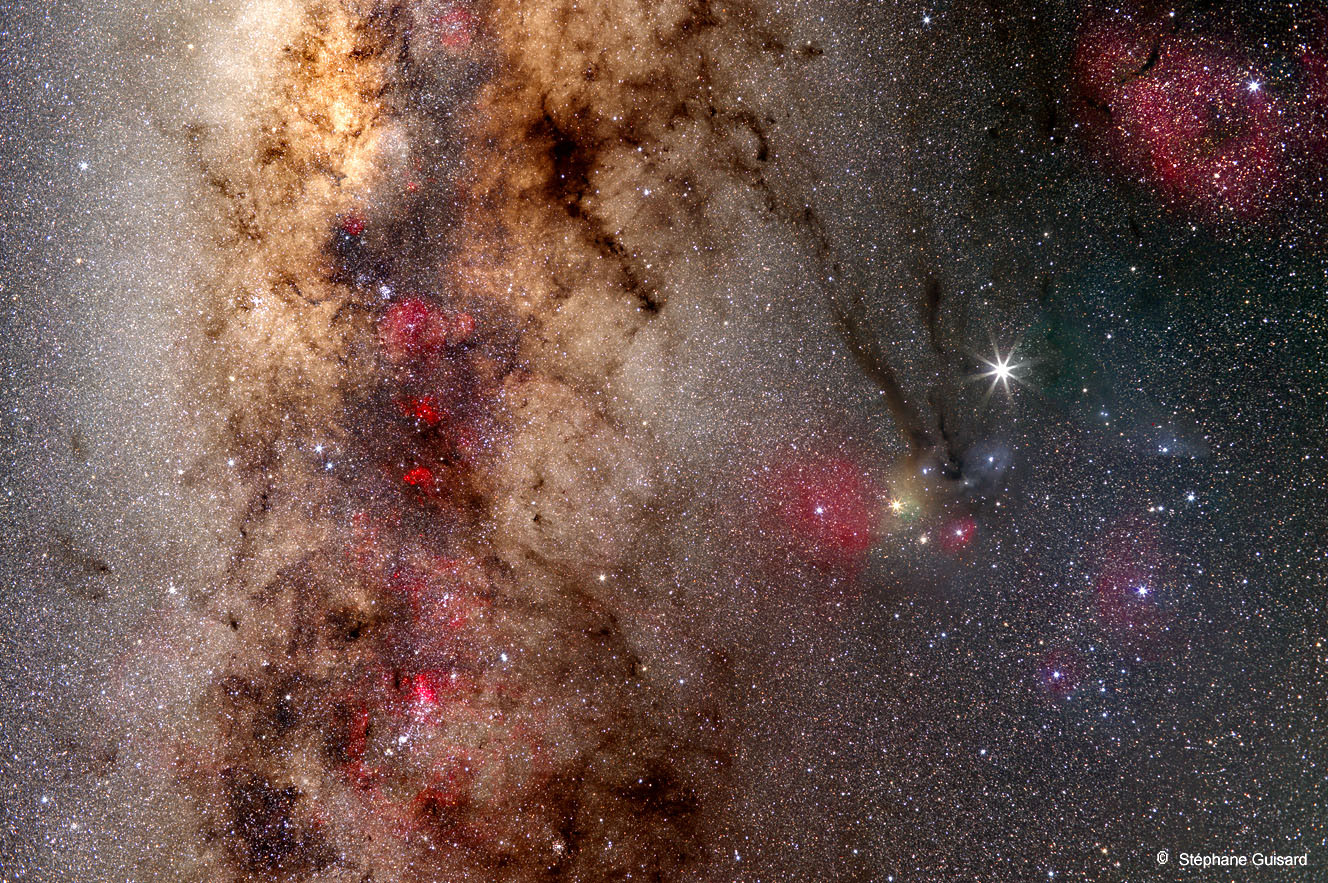
Alt...
2014 May 4
A Scorpius Sky Spectacular
* Image Credit & Copyright: Stéphane Guisard, TWAN
Explanation:
If Scorpius looked this good to the unaided eye, humans might remember it better. Scorpius more typically appears as a few bright stars in a well-known but rarely pointed out zodiacal constellation. To get a spectacular image like this, though, one needs a good camera, color filters, and a digital image processor. To bring out detail, the above image not only involved long duration exposures taken in several colors, but one exposure in a very specific red color emitted by hydrogen. The resulting image shows many breathtaking features. Vertically across the image left is part of the plane of our Milky Way Galaxy. Visible there are vast clouds of bright stars and long filaments of dark dust. Jutting out diagonally from the Milky Way in the image center are dark dust bands known as the Dark River. This river connects to several bright stars on the right that are part of Scorpius' head and claws, and include the bright star Antares. Above and right of Antares is an even brighter planet Jupiter. Numerous red emission nebulas and blue reflection nebulas are visible throughout the image. Scorpius appears prominently in southern skies after sunset during the middle of the year.
Authors & editors: Robert Nemiroff (MTU) & Jerry Bonnell (UMCP)
NASA Official: Phillip Newman Specific rights apply.
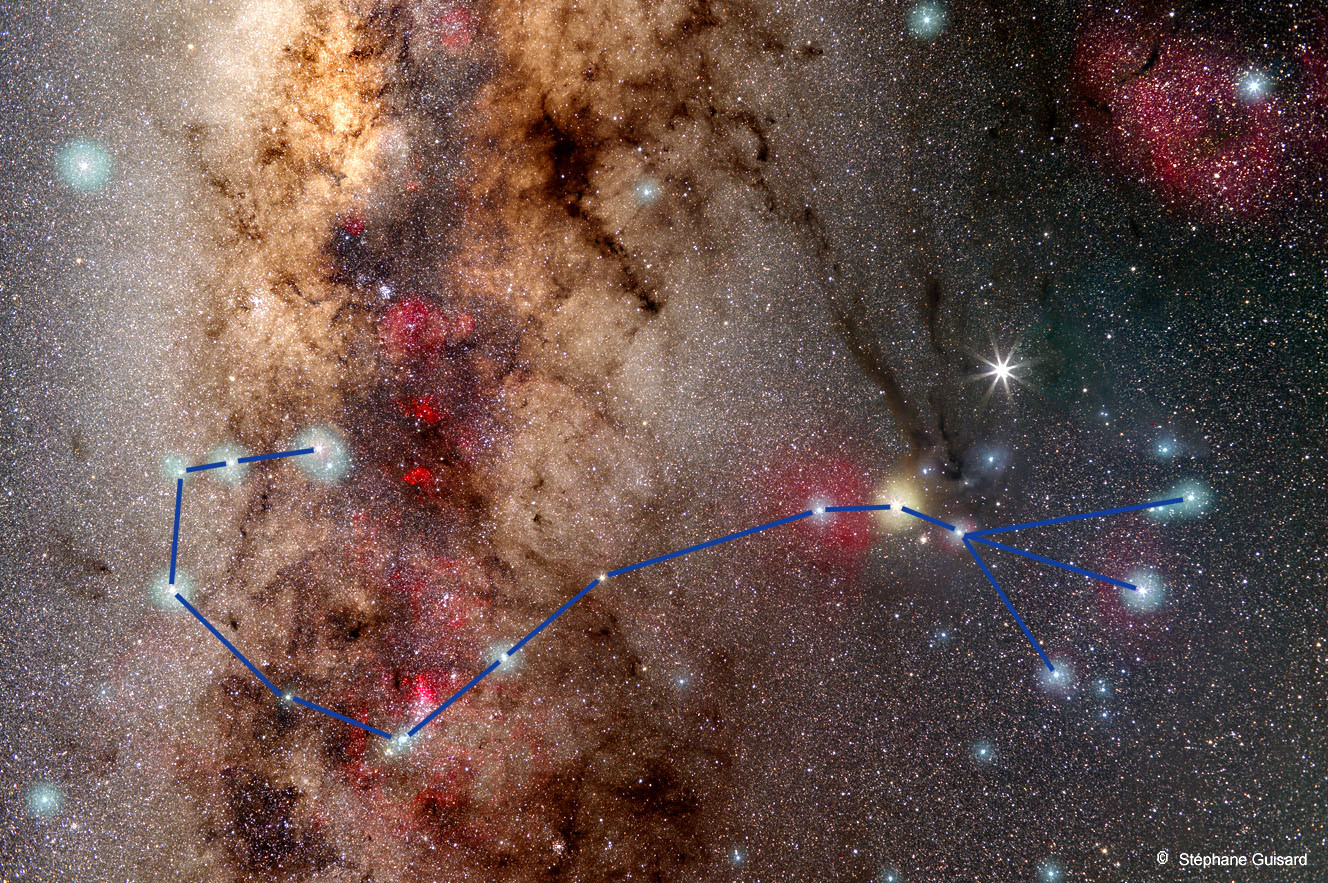
Alt...
Image with Scorpius constellation drawn
2025 August 10
Zodiacal Road
* Image Credit & Copyright: Ruslan Merzlyakov (astrorms)
https://iceland-photo-tours.com/articles/photographer-interviews/interview-with-ruslan-merzlyakov
Explanation:
What's that strange light down the road? Dust orbiting the Sun. At certain times of the year, a band of sun-reflecting dust from the inner Solar System appears prominently just after sunset -- or just before sunrise -- and is called zodiacal light. Although the origin of this dust is still being researched, a leading hypothesis holds that zodiacal dust originates mostly from faint Jupiter-family comets and slowly spirals into the Sun. Recent analysis of dust emitted by Comet 67P, visited by ESA's robotic Rosetta spacecraft, bolsters this hypothesis. Pictured when climbing a road up to Teide National Park in the Canary Islands of Spain, a bright triangle of zodiacal light appeared in the distance soon after sunset. Captured on June 21, 2019, the scene includes bright Regulus, the alpha star of the constellation Leo, standing above center toward the left. The Beehive Star Cluster (M44) can be spotted below center, closer to the horizon and also immersed in the zodiacal glow.
+ Phenomenon
https://en.wikipedia.org/wiki/Zodiacal_light#Origin
+ Origin
https://science.nasa.gov/solar-system/
https://astronomy.swin.edu.au/cosmos/J/Jupiter-family+Comets
https://apod.nasa.gov/apod/ap010813.html
https://apod.nasa.gov/apod/ap151118.html
https://www.esa.int/Science_Exploration/Space_Science/Rosetta/Europe_s_comet_chaser
https://en.wikipedia.org/wiki/Regulus
+ Education
https://www.scienceabc.com/nature/universe/how-are-so-many-stars-named-and-identified.html
https://apod.nasa.gov/apod/ap250810.html
#space #earth #dust #zodiacal_glow #astrophotography #photography #science #astronomy #physics #nature #nebula
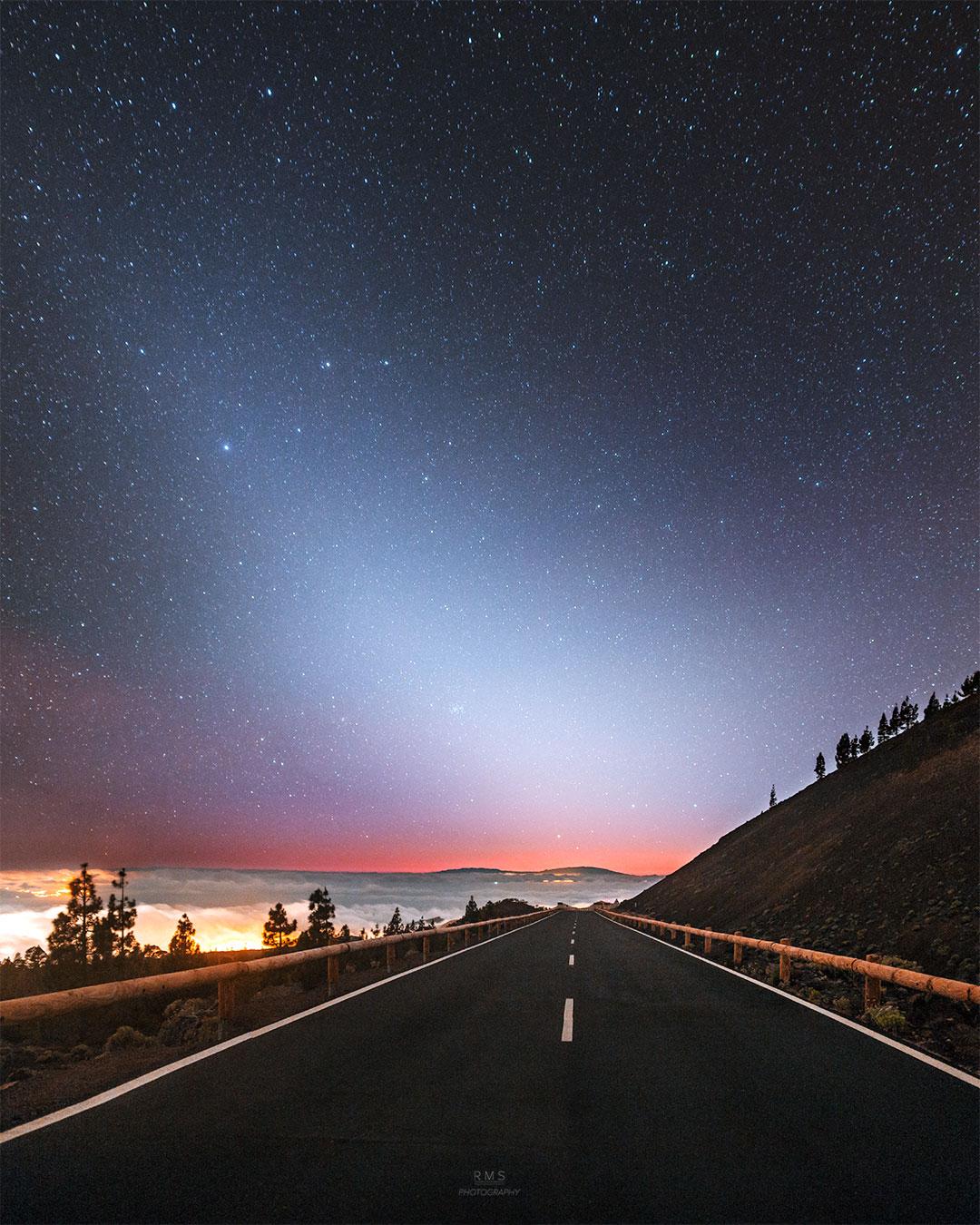
Alt...
2025 August 10
A night sky is shown above a road going off into the distance. An unusual area of brightened sky that does not block background stars appears diagonally from the lower right across the sky.
Zodiacal Road
* Image Credit & Copyright: Ruslan Merzlyakov (astrorms)
Explanation:
What's that strange light down the road? Dust orbiting the Sun. At certain times of the year, a band of sun-reflecting dust from the inner Solar System appears prominently just after sunset -- or just before sunrise -- and is called zodiacal light. Although the origin of this dust is still being researched, a leading hypothesis holds that zodiacal dust originates mostly from faint Jupiter-family comets and slowly spirals into the Sun. Recent analysis of dust emitted by Comet 67P, visited by ESA's robotic Rosetta spacecraft, bolsters this hypothesis. Pictured when climbing a road up to Teide National Park in the Canary Islands of Spain, a bright triangle of zodiacal light appeared in the distance soon after sunset. Captured on June 21, 2019, the scene includes bright Regulus, the alpha star of the constellation Leo, standing above center toward the left. The Beehive Star Cluster (M44) can be spotted below center, closer to the horizon and also immersed in the zodiacal glow.
Authors & editors: Robert Nemiroff (MTU) & Jerry Bonnell (UMCP)
NASA Official: Amber Straughn Specific rights apply.
2025 August 29
A Dark Veil in Ophiuchus
* Image Credit & Copyright: Katelyn Beecroft
https://app.astrobin.com/u/kates.universe#gallery
Explanation:
The diffuse hydrogen-alpha glow of emission region Sh2-27 fills this cosmic scene. The field of view spans nearly 3 degrees across the nebula-rich constellation Ophiuchus toward the central Milky Way. A Dark Veil of wispy interstellar dust clouds draped across the foreground is chiefly identified as LDN 234 and LDN 204 from the 1962 Catalog of Dark Nebulae by American astronomer Beverly Lynds. Sh2-27 itself is the large but faint HII region surrounding runaway O-type star Zeta Ophiuchi. Along with the Zeta Oph HII region, LDN 234 and LDN 204 are likely 500 or so light-years away. At that distance, this telescopic frame would be about 25 light-years wide.
https://ui.adsabs.harvard.edu/abs/2015ApJ...800..132C/abstract
https://skyandtelescope.org/astronomy-news/beverly-turner-lynds-1929-2024/
https://apod.nasa.gov/apod/ap250829.html
#space #astronomy #science #astrophotography #photography #nature #nebula
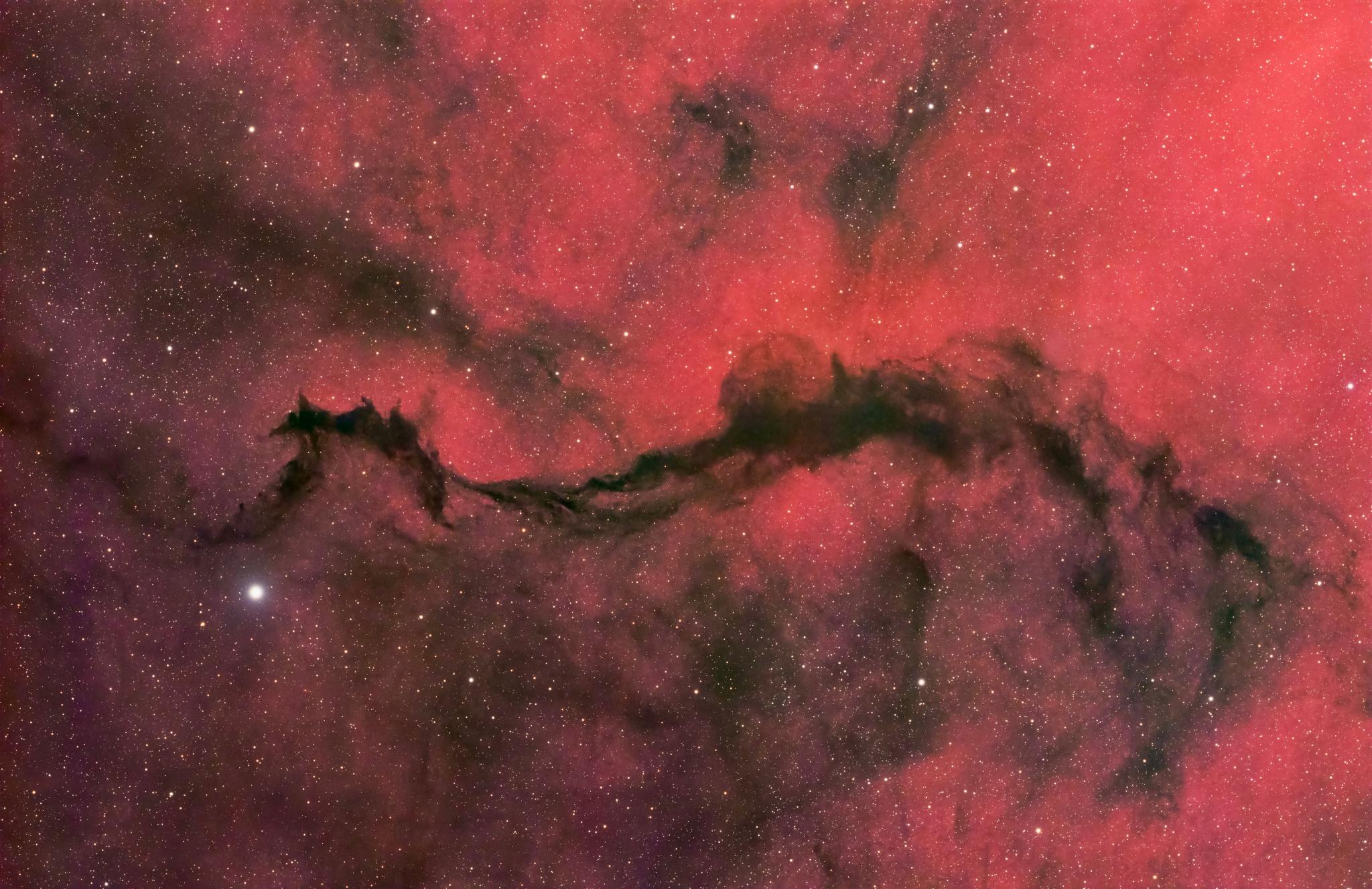
Alt...
2025 August 29
A Dark Veil in Ophiuchus
* Image Credit & Copyright: Katelyn Beecroft
Explanation:
The diffuse hydrogen-alpha glow of emission region Sh2-27 fills this cosmic scene. The field of view spans nearly 3 degrees across the nebula-rich constellation Ophiuchus toward the central Milky Way. A Dark Veil of wispy interstellar dust clouds draped across the foreground is chiefly identified as LDN 234 and LDN 204 from the 1962 Catalog of Dark Nebulae by American astronomer Beverly Lynds. Sh2-27 itself is the large but faint HII region surrounding runaway O-type star Zeta Ophiuchi. Along with the Zeta Oph HII region, LDN 234 and LDN 204 are likely 500 or so light-years away. At that distance, this telescopic frame would be about 25 light-years wide.
Authors & editors: Robert Nemiroff (MTU) & Jerry Bonnell (UMCP)
NASA Official: Amber Straughn Specific rights apply.
NASA Web Privacy, Accessibility, Notices;
A service of: ASD at NASA / GSFC,
NASA Science Activation
& Michigan Tech. U.
A Farewell to Saturn ..
After more than 13 years at Saturn, and with its fate sealed, NASA's Cassini spacecraft bid farewell to the Saturnian system by firing the shutters of its wide-angle camera and capturing this last, full mosaic of Saturn and its rings two days before the spacecraft's dramatic plunge into the planet's atmosphere.
[...] *
Six of Saturn's moons -- Enceladus, Epimetheus, Janus, Mimas, Pandora and Prometheus -- make a faint appearance in this image. (Numerous stars are also visible in the background.)
A second version of the mosaic is provided in which the planet and its rings have been brightened, with the fainter regions brightened by a greater amount. (The moons and stars have also been brightened by a factor of 15 in this version.)
The ice-covered moon Enceladus -- home to a global subsurface ocean that erupts into space -- can be seen at the 1 o'clock position. Directly below Enceladus, just outside the F ring (the thin, farthest ring from the planet seen in this image) lies the small moon Epimetheus. Following the F ring clock-wise from Epimetheus, the next moon seen is Janus. At about the 4:30 position and outward from the F ring is Mimas. Inward of Mimas and still at about the 4:30 position is the F-ring-disrupting moon, Pandora. Moving around to the 10 o'clock position, just inside of the F ring, is the moon Prometheus.
[...] *
Credits:
NASA/JPL-Caltech/Space Science Institute
* More Information about the images in ALT-Text
https://science.nasa.gov/photojournal/a-farewell-to-saturn/
> Movie about Casini's "Grand Finale":
https://defcon.social/@grobi/115319525500258829
#space #saturn #astrophotography #photography #science #astronomy #physics #nature #NASA #ESA #education #apod
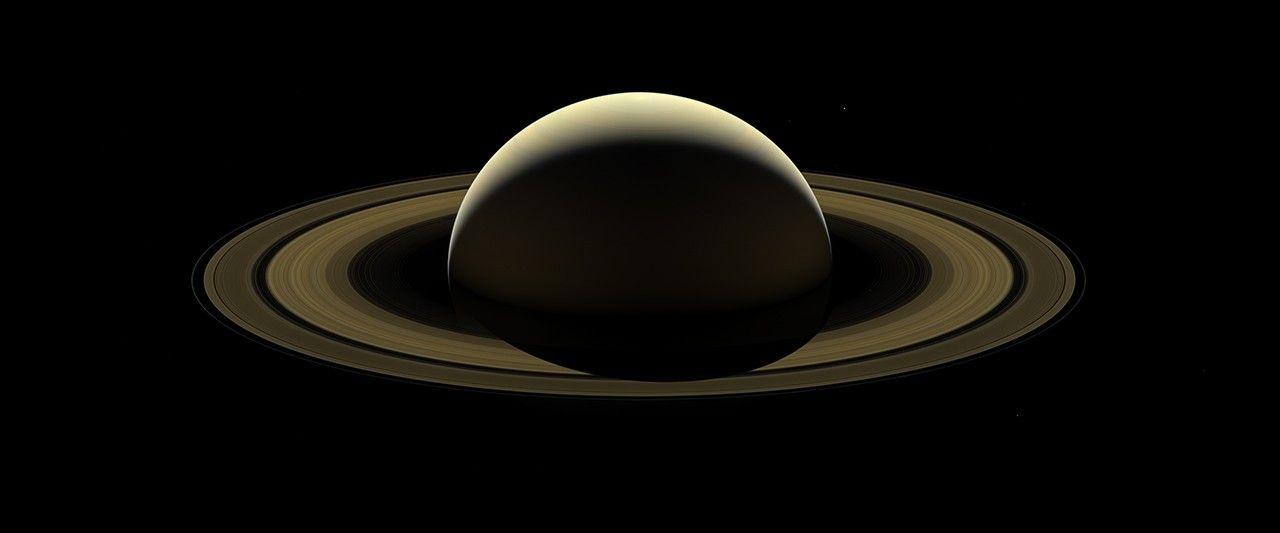
Alt...
A Farewell to Saturn
(Brightened Version)
During the observation, a total of 80 wide-angle images were acquired in just over two hours. This view is constructed from 42 of those wide-angle shots, taken using the red, green and blue spectral filters, combined and mosaicked together to create a natural-color view.
This view looks toward the sunlit side of the rings from about 15 degrees above the ring plane. Cassini was approximately 698,000 miles (1.1 million kilometers) from Saturn, on its final approach to the planet, when the images in this mosaic were taken. Image scale on Saturn is about 42 miles (67 kilometers) per pixel. The image scale on the moons varies from 37 to 50 miles (59 to 80 kilometers) pixel. The phase angle (the Sun-planet-spacecraft angle) is 138 degrees.
Credits:
NASA/JPL-Caltech/Space Science Institute
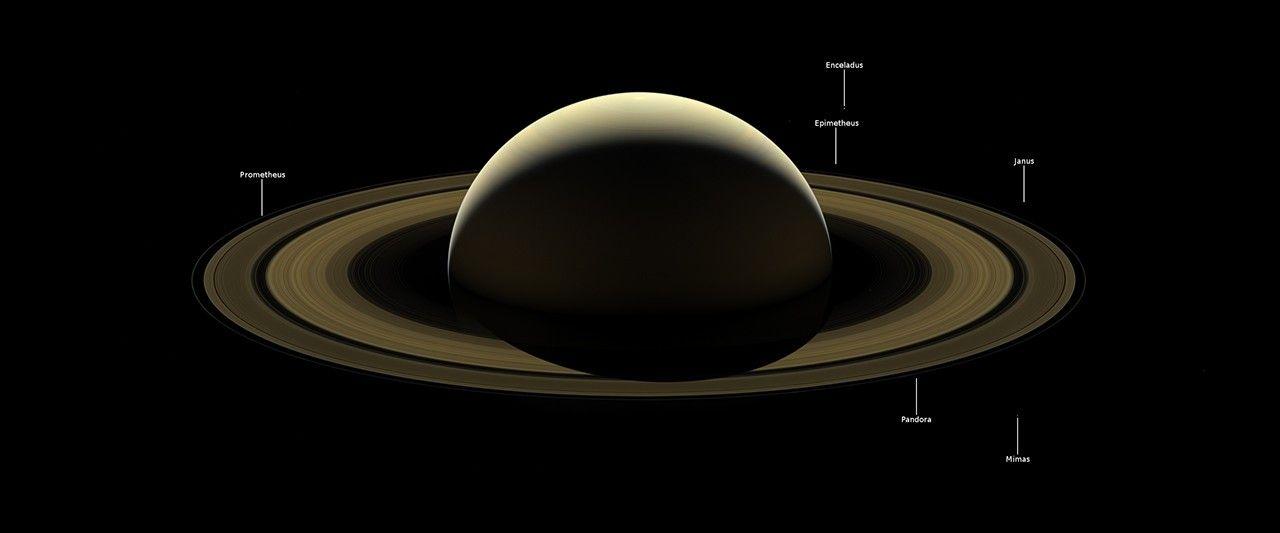
Alt...
A Farewell to Saturn
(Annotated Version)
Six of Saturn's moons -- Enceladus, Epimetheus, Janus, Mimas, Pandora and Prometheus -- make a faint appearance in this image. (Numerous stars are also visible in the background.)
This view looks toward the sunlit side of the rings from about 15 degrees above the ring plane. Cassini was approximately 698,000 miles (1.1 million kilometers) from Saturn, on its final approach to the planet, when the images in this mosaic were taken. Image scale on Saturn is about 42 miles (67 kilometers) per pixel. The image scale on the moons varies from 37 to 50 miles (59 to 80 kilometers) pixel. The phase angle (the Sun-planet-spacecraft angle) is 138 degrees.
Credits:
NASA/JPL-Caltech/Space Science Institute
2025 October 24
Saturn at Night
* Image Credit: NASA, JPL-Caltech, Space Science Institute, Mindaugas Macijauskas
https://www.nasa.gov/
https://www.jpl.nasa.gov/
https://www.spacescience.org/index.php
https://www.flickr.com/photos/m_macijauskas/
Explanation:
Saturn is bright in Earth's night skies. Telescopic views of the outer gas giant planet and its beautiful rings often make it a star at star parties. But this stunning view of Saturn's rings and night side just isn't possible from telescopes in the vicinity of planet Earth. Peering out from the inner Solar System they can only bring Saturn's day side into view. In fact, this image of Saturn's slender sunlit crescent with night's shadow cast across its broad and complex ring system was captured by the Cassini spacecraft. A robot spacecraft from planet Earth, Cassini called Saturn orbit home for 13 years before it was directed to dive into the atmosphere of the gas giant on September 15, 2017. This magnificent mosaic is composed of frames recorded by Cassini's wide-angle camera only two days before its grand final plunge. Saturn's night will not be seen again until another spaceship from Earth calls.
https://esahubble.org/news/heic1917/
https://www.flickr.com/photos/m_macijauskas/23826951188/
https://science.nasa.gov/photojournal/a-farewell-to-saturn/
https://nightsky.jpl.nasa.gov/clubs/
https://earthsky.org/astronomy-essentials/visible-planets-tonight-mars-jupiter-venus-saturn-mercury/
https://apod.nasa.gov/apod/ap251024.html
#space #saturn #astrophotography #photography #science #astronomy #physics #nature #NASA #ESA #education #apod
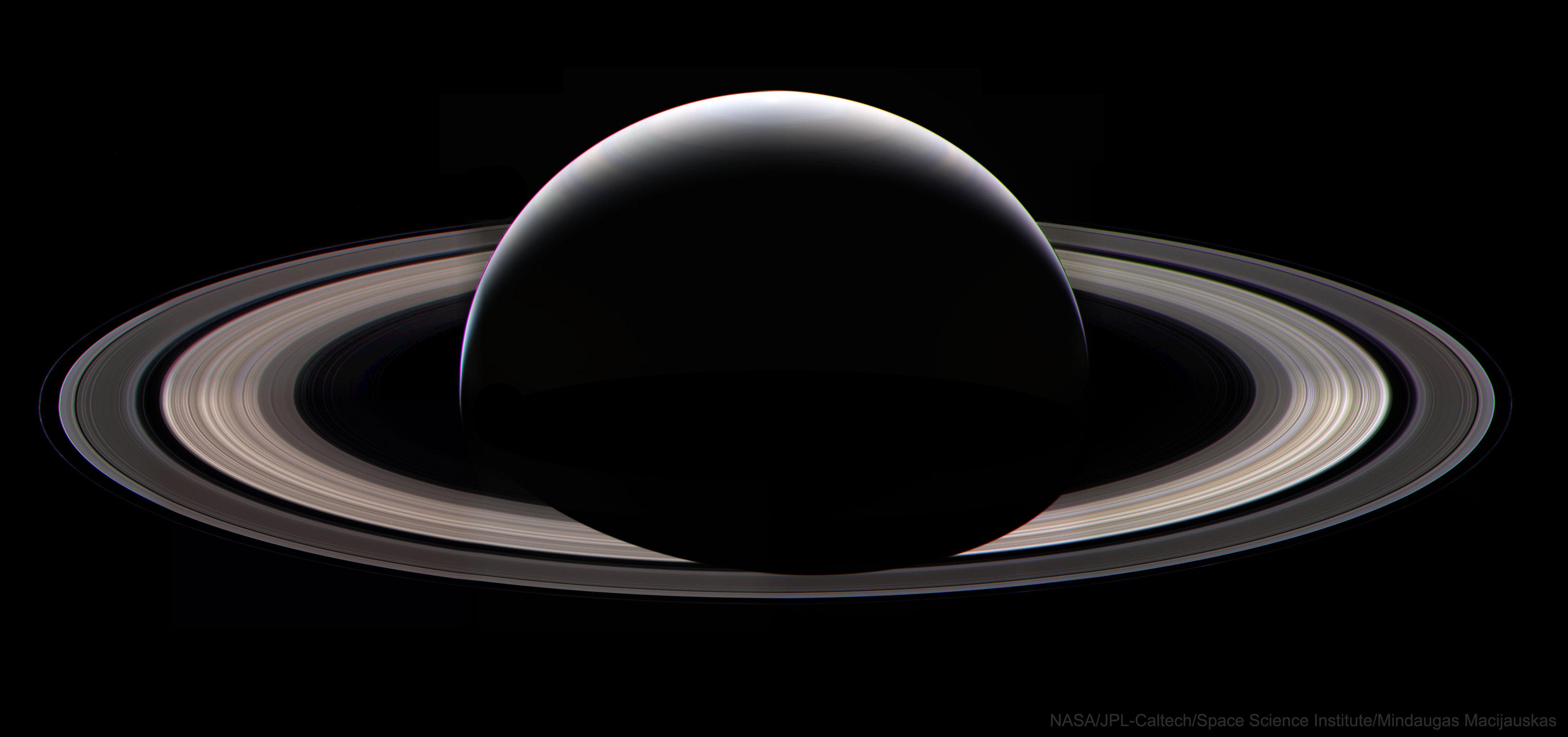
Alt...
2025 October 24
Saturn at Night
* Image Credit: NASA, JPL-Caltech, Space Science Institute, Mindaugas Macijauskas
Explanation:
Saturn is bright in Earth's night skies. Telescopic views of the outer gas giant planet and its beautiful rings often make it a star at star parties. But this stunning view of Saturn's rings and night side just isn't possible from telescopes in the vicinity of planet Earth. Peering out from the inner Solar System they can only bring Saturn's day side into view. In fact, this image of Saturn's slender sunlit crescent with night's shadow cast across its broad and complex ring system was captured by the Cassini spacecraft. A robot spacecraft from planet Earth, Cassini called Saturn orbit home for 13 years before it was directed to dive into the atmosphere of the gas giant on September 15, 2017. This magnificent mosaic is composed of frames recorded by Cassini's wide-angle camera only two days before its grand final plunge. Saturn's night will not be seen again until another spaceship from Earth calls.
Authors & editors: Robert Nemiroff (MTU) & Jerry Bonnell (UMCP)
NASA Official: Amber Straughn Specific rights apply.
NASA Web Privacy, Accessibility, Notices;
A service of: ASD at NASA / GSFC,
NASA Science Activation
& Michigan Tech. U.
"A farewell to Mister Eclipse .."
Dr Fred Espenak (1953–2025)
by Jay Anderson
https://skyandtelescope.org/astronomy-news/fred-espenak-1953-2025/
The renowned eclipse chaser and popularizer passed away in Arizona after a life of adventure.
Fred Espenak, who laid the foundation for modern-day eclipse chasing, died of idiopathic pulmonary fibrosis on June 1st. He announced his diagnosis and his impending passing on April 15th on social media and on the Solar Eclipse Message List (SEML) forum as he prepared to enter hospice care, sparking an outpouring of sorrow, sympathy, good wishes, and thank-you’s for his life’s work.
Fred’s fascination with the lunar shadow began with an off-the-track partial eclipse in 1963 and was cemented several years later by the total solar eclipse that traveled along the U.S. Eastern Seaboard in 1970. Upon his death 55 years later, he had witnessed 52 solar eclipses of various types, of which 31 were total. He had also helped countless others prepare for and experience the wonder of totality, thanks to his dedication to outreach.
There were many stories along the way, but he was fond of telling of his most rewarding eclipse-chasing experience — a trip to India in 1995 to catch 41 seconds of totality, during which he noticed a high-school chemistry teacher watching her first eclipse. “Nice hair,” he thought. Several eclipses and a decade later, he and Patricia Totten, the lady with the hair, were married. It was a particularly fond pairing, as visitors to his Arizona home could attest.
FYI:
https://mreclipse.com/
https://en.wikipedia.org/wiki/Fred_Espenak
https://apod.nasa.gov/apod/ap250612.html
#farewell #space #NASA #astrophotography #photography #science #astronomy #nature #tech #space_related #Space_Culture_Club
Alt...
Goddard Researcher and eclipse chaser Dr. Fred Espenak. with his solar telescope in 2009
Image Credit:
NASA Goddard Space Flight Center from Greenbelt, MD, USA
Constant Contact Use. Please leave this field blank.
The renowned eclipse chaser and popularizer passed away in Arizona after a life of adventure.
Man with white hair and white moustache sitting at table with a globe covered in yellow lines marking past and future eclipses
Fred Espenak, with a globe of solar eclipse tracks for the 21st century
Patricia Totten Espenak
Fred Espenak, who laid the foundation for modern-day eclipse chasing, died of idiopathic pulmonary fibrosis on June 1st. He announced his diagnosis and his impending passing on April 15th on social media and on the Solar Eclipse Message List (SEML) forum as he prepared to enter hospice care, sparking an outpouring of sorrow, sympathy, good wishes, and thank-you’s for his life’s work.
Fred’s fascination with the lunar shadow began with an off-the-track partial eclipse in 1963 and was cemented several years later by the total solar eclipse that traveled along the U.S. Eastern Seaboard in 1970. Upon his death 55 years later, he had witnessed 52 solar eclipses of various types, of which 31 were total. He had also helped countless others prepare for and experience the wonder of totality, thanks to his dedication to outreach.
Alt...
2025 June 12
Solar Eclipse
Image Credit & Copyright: Fred Espenak
Explanation:
On April 20, 2023 the shadow of a New Moon raced across planet Earth's southern hemisphere. When viewed along a narrow path that mostly avoided landfall, the Moon in silhouette created a hybrid solar eclipse. Hybrid eclipses are rare and can be seen as a total eclipse or an annular "ring of fire" eclipse depending on the observer's position. Viewers of this much anticipated hybrid event were able to witness a total solar eclipse while anchored in the Indian Ocean near the centerline of the eclipse track off the coast of western Australia. This ship-borne image from renowned eclipse chaser Fred Espenak captured the eclipsed Sun's magnificent outer atmosphere, or solar corona, streaming into space. The composite of 11 exposures ranging from 1/2000 to 1/2 second, taken during the 62 seconds of totality, records an extended range of brightness to follow alluring details of the corona not quite visible to the eye.
Authors & editors: Robert Nemiroff (MTU) & Jerry Bonnell (UMCP)
NASA Official: Amber Straughn Specific rights apply.
NASA Web Privacy Policy and Important Notices
A service of: ASD at NASA / GSFC,
NASA Science Activation
& Michigan Tech. U.
2025 October 22
Comet Lemmon over the High Tatras
* Image Credit & Copyright: Tomáš Slovinský & Constantine Themelis
https://www.instagram.com/slovinsky.art/
https://www.instagram.com/constantinethemelis/
Explanation:
Comet Lemmon putting on a show for cameras around the globe. Passing nearest to the Earth this week, the photogenic comet C/2025 A6 (Lemmon) is now extending two long tails : a blue ion tail and a white dust tail. The ion tail is pushed away from the Sun by the ever-present by ever-changing solar wind, and shows structure also created by how much gas is ejected at any one moment. It glows because it is ionized by high energy sunlight. The dust tail is pushed away from the comet by sunlight and shines by reflecting sunlight. The featured image is an enhanced composite of 50 exposures all taken two days ago from Mlynica, Slovakia. The mountains in the foreground are the High Tatras that partly separate Slovakia from Poland. Although Comet Lemmon is best visible in long camera exposures, the shedding ice ball has become faintly visible in northern skies even to unaided eyes through dark skies toward the west after sunset.
https://spaceplace.nasa.gov/comets/en/anatomy-of-a-comet.en.jpg
https://astronomy.swin.edu.au/cosmos/c/cometary+tails
http://www.star.ucl.ac.uk/~apod/apod/ap251019.html
https://apod.nasa.gov/apod/ap251022.html
#space #comets #astrophotography #photography #science #astronomy #nature #NASA #ESA #education #apod
Alt...
2025 October 22
A mountain range is shown in the foreground with a bright comet visible above it. The comet shows tails that are long and bright with the longer tail appearing light blue.
Comet Lemmon over the High Tatras
* Image Credit & Copyright: Tomáš Slovinský & Constantine Themelis
Explanation:
Comet Lemmon putting on a show for cameras around the globe. Passing nearest to the Earth this week, the photogenic comet C/2025 A6 (Lemmon) is now extending two long tails : a blue ion tail and a white dust tail. The ion tail is pushed away from the Sun by the ever-present by ever-changing solar wind, and shows structure also created by how much gas is ejected at any one moment. It glows because it is ionized by high energy sunlight. The dust tail is pushed away from the comet by sunlight and shines by reflecting sunlight. The featured image is an enhanced composite of 50 exposures all taken two days ago from Mlynica, Slovakia. The mountains in the foreground are the High Tatras that partly separate Slovakia from Poland. Although Comet Lemmon is best visible in long camera exposures, the shedding ice ball has become faintly visible in northern skies even to unaided eyes through dark skies toward the west after sunset.
Authors & editors: Robert Nemiroff (MTU) & Jerry Bonnell (UMCP)
NASA Official: Amber Straughn Specific rights apply.
NASA Web Privacy, Accessibility, Notices;
A service of: ASD at NASA / GSFC,
NASA Science Activation
& Michigan Tech. U.
Alt...
Annotations for featured image
2025 October 13
Lemmon Tree
* Image Credit & Copyright: Uroš Fink
https://www.instagram.com/urosfink/
Explanation:
The tree is not in danger. That's because the comet pictured just above it, Comet C/2025 A6 (Lemmon), is far in the distance, well away from the Earth. Comet Lemmon now continues to brighten as it arcs through the inner Solar System, even though it has passed its nearest to the Sun -- because it is now approaching the Earth. The comet will likely appear brightest when it is at its closest to the Earth next week, then closing to about half the Earth-Sun distance. Comet Lemmon may then be visible to the unaided eye, but it is more likely to be imaged by a camera phone -- if you know where to look. Comet Lemmon, previously best visible in the morning, is now also visible in the evening sky for northern observers: look above the western horizon just after sunset. The featured image, centered on an unsuspecting European beech tree, was taken in Slovenia about ten days ago.
https://apod.nasa.gov/apod/ap251013.html
#space #comets #astrophotography #photography #science #astronomy #nature #NASA #ESA #education
Alt...
2025 October 13
A tree is seen silhouetted against a night sky filled with stars. Above the tree with its tail pointing nearly vertically is a comet: Comet Lemmon.
Lemmon Tree
* Image Credit & Copyright: Uroš Fink
Explanation:
The tree is not in danger. That's because the comet pictured just above it, Comet C/2025 A6 (Lemmon), is far in the distance, well away from the Earth. Comet Lemmon now continues to brighten as it arcs through the inner Solar System, even though it has passed its nearest to the Sun -- because it is now approaching the Earth. The comet will likely appear brightest when it is at its closest to the Earth next week, then closing to about half the Earth-Sun distance. Comet Lemmon may then be visible to the unaided eye, but it is more likely to be imaged by a camera phone -- if you know where to look. Comet Lemmon, previously best visible in the morning, is now also visible in the evening sky for northern observers: look above the western horizon just after sunset. The featured image, centered on an unsuspecting European beech tree, was taken in Slovenia about ten days ago.
Authors & editors: Robert Nemiroff (MTU) & Jerry Bonnell (UMCP)
NASA Official: Amber Straughn Specific rights apply.
NASA Web Privacy, Accessibility, Notices;
A service of: ASD at NASA / GSFC,
NASA Science Activation
& Michigan Tech. U.
2022 May 12
Young Stars of NGC 346
* Image Credit: NASA, ESA -
https://www.nasa.gov/
https://www.esa.int/
* acknowledgement: Antonella Nota (ESA/STScI) et al.
https://www.stsci.edu/
Explanation:
The massive stars of NGC 346 are short lived, but very energetic. The star cluster is embedded in the largest star forming region in the Small Magellanic Cloud, some 210,000 light-years distant. Their winds and radiation sweep out an interstellar cavern in the gas and dust cloud about 200 light-years across, triggering star formation and sculpting the region's dense inner edge. Cataloged as N66, the star forming region also appears to contain a large population of infant stars. A mere 3 to 5 million years old and not yet burning hydrogen in their cores, the infant stars are strewn about the embedded star cluster. In this false-color Hubble Space Telescope image, visible and near-infrared light are seen as blue and green, while light from atomic hydrogen emission is red.
https://science.nasa.gov/asset/hubble/young-stars-sculpt-gas-with-powerful-outflows-in-the-small-magellanic-cloud/
https://chandra.harvard.edu/edu/formal/stellar_ev/story/index2.html
https://apod.nasa.gov/apod/ap220512.html
#space #cluster #astrophotography #photography #science #astronomy #physics #nature #NASA
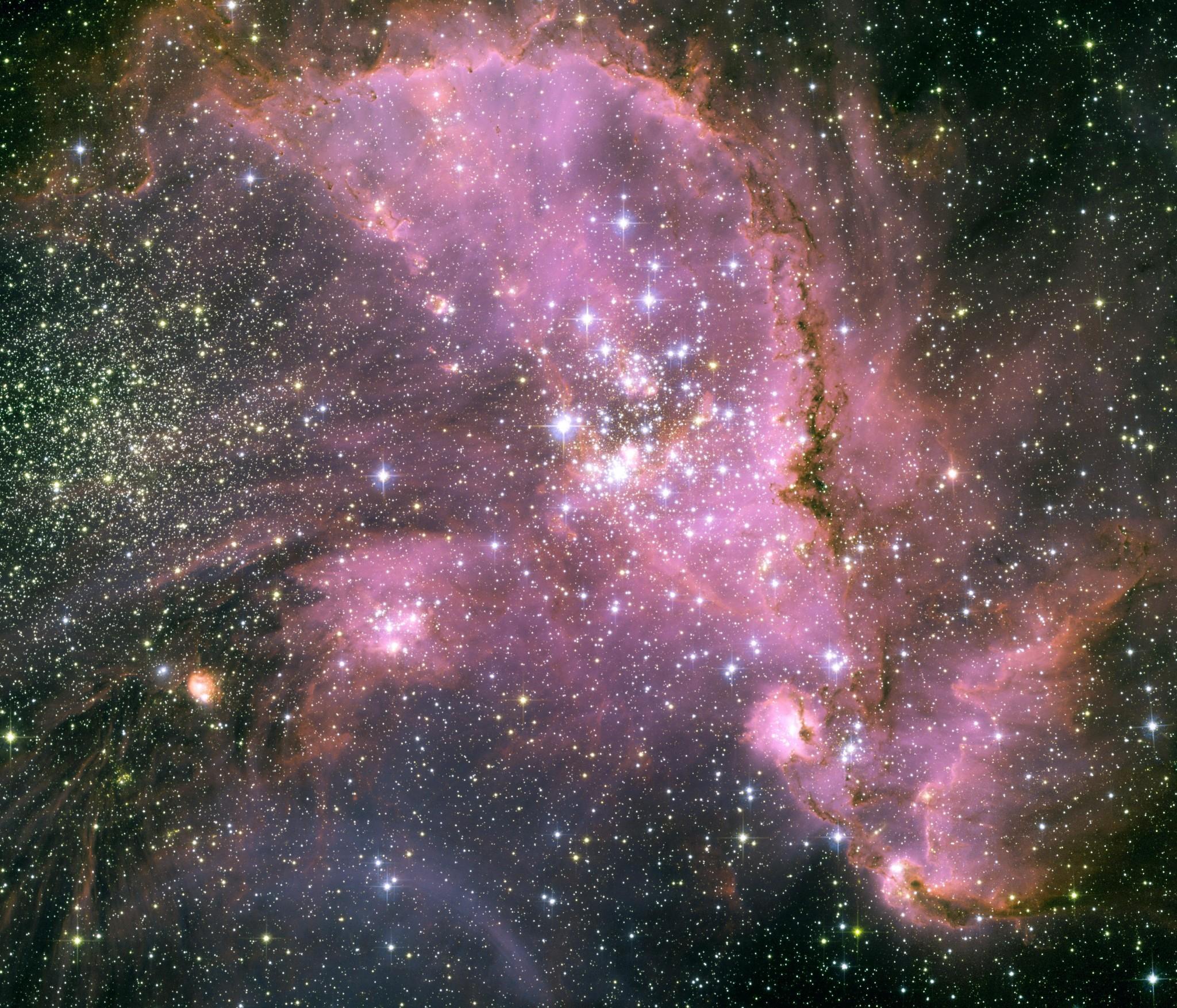
Alt...
2022 May 12
Young Stars of NGC 346
* Image Credit: NASA, ESA -
* acknowledgement: Antonella Nota (ESA/STScI) et al.,
Explanation:
The massive stars of NGC 346 are short lived, but very energetic. The star cluster is embedded in the largest star forming region in the Small Magellanic Cloud, some 210,000 light-years distant. Their winds and radiation sweep out an interstellar cavern in the gas and dust cloud about 200 light-years across, triggering star formation and sculpting the region's dense inner edge. Cataloged as N66, the star forming region also appears to contain a large population of infant stars. A mere 3 to 5 million years old and not yet burning hydrogen in their cores, the infant stars are strewn about the embedded star cluster. In this false-color Hubble Space Telescope image, visible and near-infrared light are seen as blue and green, while light from atomic hydrogen emission is red.
Authors & editors: Robert Nemiroff (MTU) & Jerry Bonnell (UMCP)
NASA Official: Phillip Newman Specific rights apply.
NASA Web Privacy Policy and Important Notices
A service of: ASD at NASA / GSFC
& Michigan Tech. U.
2024 October 27
LDN 43: The Cosmic Bat Nebula
* Credit & Copyright: Mark Hanson and Mike Selby
https://www.hansonastronomy.com/bio
https://throughlightandtime.com/about/
* Text: Michelle Thaller (NASA's GSFC)
https://science.nasa.gov/people/michelle-thaller/
https://www.nasa.gov/
https://www.nasa.gov/goddard
Explanation:
What is the most spook-tacular nebula in the galaxy? One contender is LDN 43, which bears an astonishing resemblance to a vast cosmic bat flying amongst the stars on a dark Halloween night. Located about 1400 light years away in the constellation Ophiuchus, this molecular cloud is dense enough to block light not only from background stars, but from wisps of gas lit up by the nearby reflection nebula LBN 7. Far from being a harbinger of death, this 12-light year-long filament of gas and dust is actually a stellar nursery. Glowing with eerie light, the bat is lit up from inside by dense gaseous knots that have just formed young stars.
https://www.jthommes.com/Astro/LBN7_LDN43.htm
https://chandra.harvard.edu/photo/constellations/ophiuchus.html
https://en.wikipedia.org/wiki/Molecular_cloud
https://apod.nasa.gov/apod/ap230129.html
https://astronomy.swin.edu.au/cosmos/r/Reflection+Nebula
https://apod.nasa.gov/apod/ap030706.html
https://apod.nasa.gov/apod/ap241027.html
#space #nebula #cluster #astrophotography #photography #science #astronomy #nature #NASA #ESA
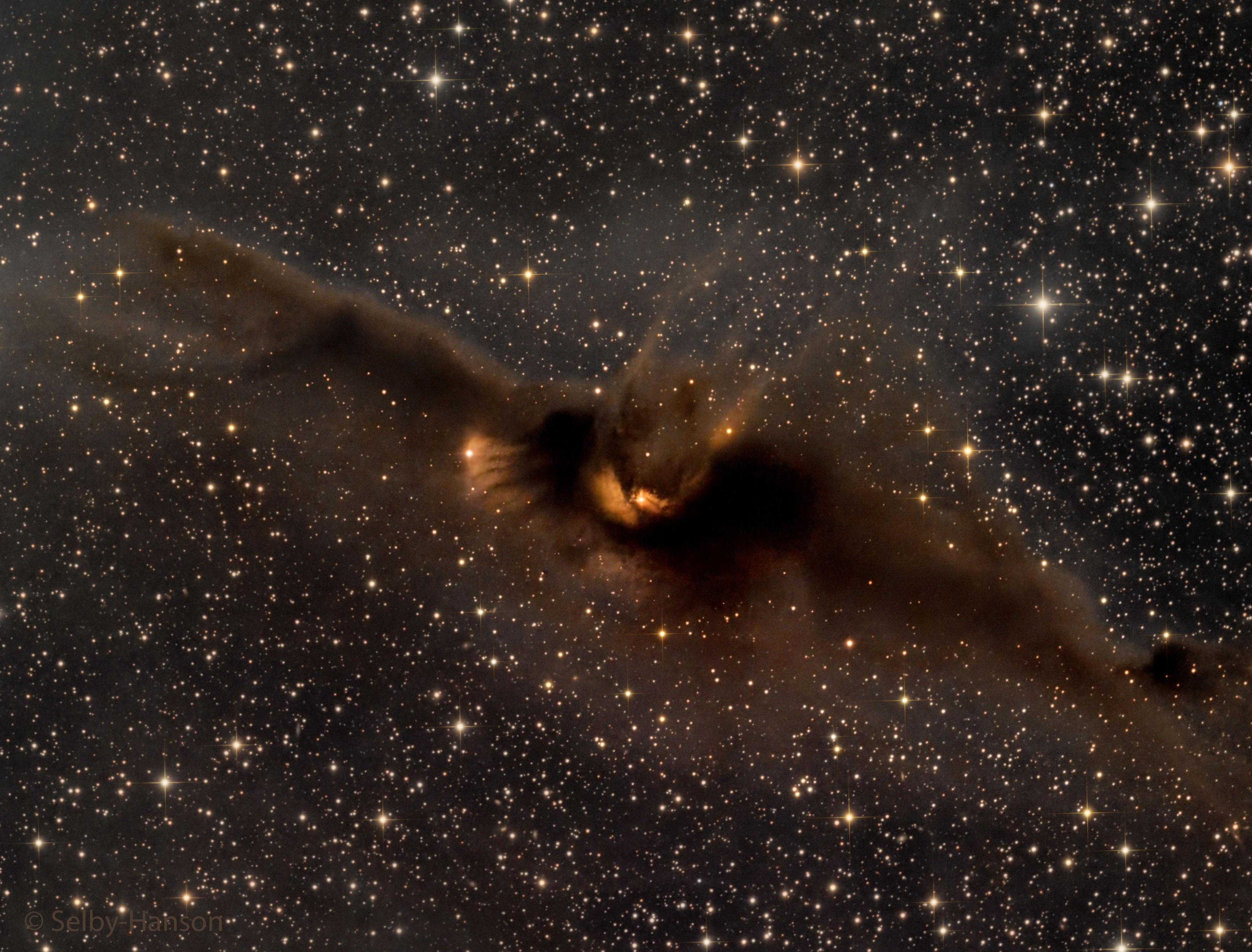
Alt...
2024 October 27
A starfield is shown with a large brown dust nebula in the center. The nebula appears, to some, to be shaped like a bat. One of the stars in the dust nebula even appears to be the eye of the bat.
LDN 43: The Cosmic Bat Nebula
* Credit & Copyright: Mark Hanson and Mike Selby
* Text: Michelle Thaller (NASA's GSFC)
Explanation:
What is the most spook-tacular nebula in the galaxy? One contender is LDN 43, which bears an astonishing resemblance to a vast cosmic bat flying amongst the stars on a dark Halloween night. Located about 1400 light years away in the constellation Ophiuchus, this molecular cloud is dense enough to block light not only from background stars, but from wisps of gas lit up by the nearby reflection nebula LBN 7. Far from being a harbinger of death, this 12-light year-long filament of gas and dust is actually a stellar nursery. Glowing with eerie light, the bat is lit up from inside by dense gaseous knots that have just formed young stars.
Authors & editors: Robert Nemiroff (MTU) & Jerry Bonnell (UMCP)
NASA Official: Amber Straughn Specific rights apply.
NASA Web Privacy, Accessibility, Notices;
A service of: ASD at NASA / GSFC,
NASA Science Activation
& Michigan Tech. U.
2025 October 22
NGC 6995: The Bat Nebula
* Image Credit & Copyright: Francis Bozon & Jean-Luc Gangloff
Explanation:
Can you see the bat? It haunts this cosmic close-up of the eastern Veil Nebula. The Veil Nebula itself is a large supernova remnant, the expanding debris cloud from the death explosion of a massive star. While the Veil is roughly circular in shape and covers nearly 3 degrees on the sky toward the constellation of the Swan (Cygnus), NGC 6995, known informally as the Bat Nebula, spans only 1/2 degree, about the apparent size of the Moon. That translates to 12 light-years at the Veil's estimated distance, a reassuring 1,400 light-years from planet Earth. In the composite of image data recorded through several narrow band filters, with emission from hydrogen atoms in the remnant shown in red and with strong emission from oxygen atoms shown in hues of blue. Of course, in the western part of the Veil lies another seasonal apparition: the Witch's Broom Nebula.
https://chandra.harvard.edu/photo/scale_distance.html
https://periodic.lanl.gov/1.shtml
https://apod.nasa.gov/apod/ap251022.html
#space #nebula #cluster #astrophotography #photography #science #astronomy #nature #NASA #ESA #apod #education
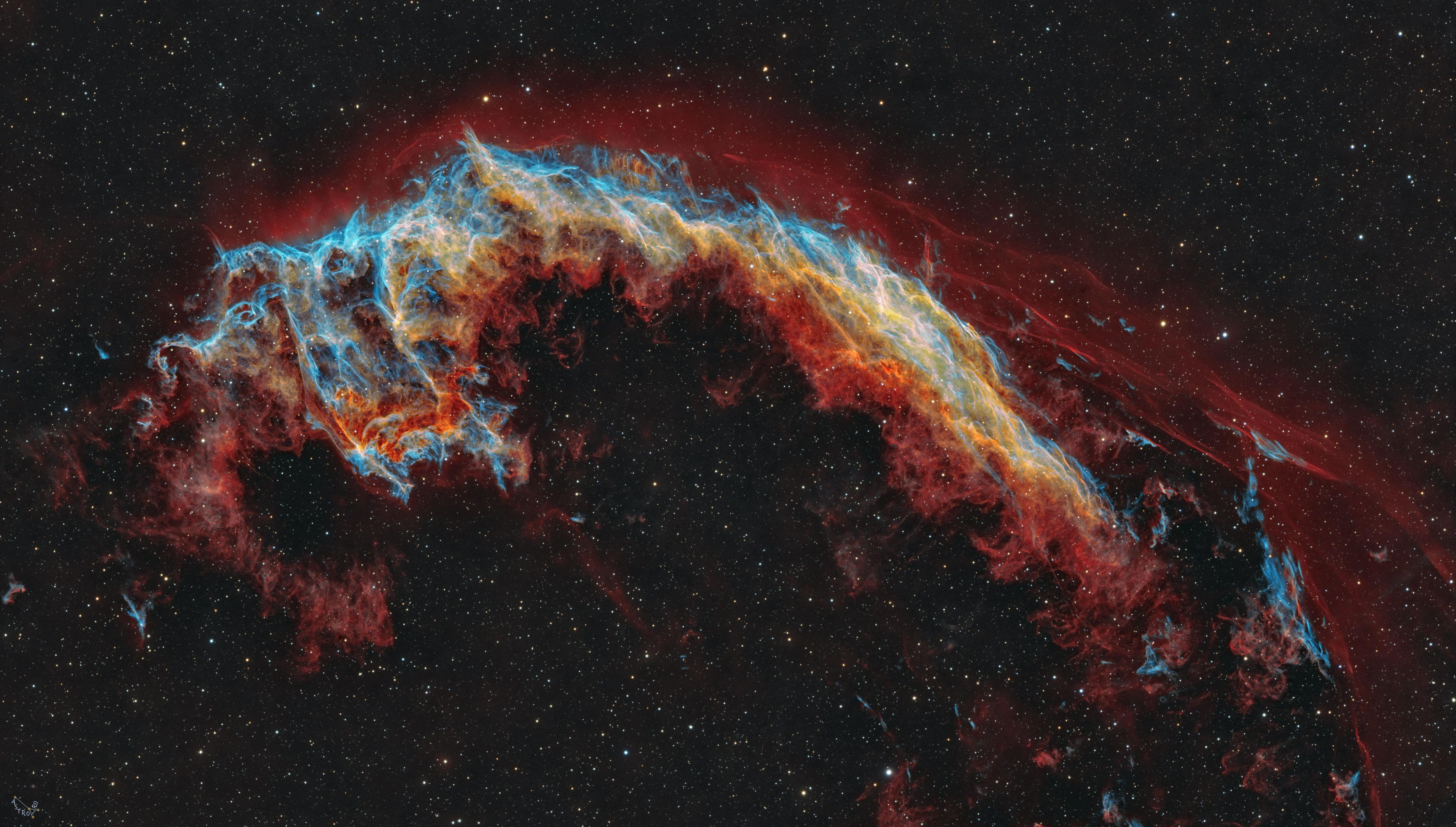
Alt...
2025 October 22
The featured image shows a starfield with a multi- colored nebula in the center. The nebula is quite filamentary but appears to some like a bat.
NGC 6995: The Bat Nebula
* Image Credit & Copyright: Francis Bozon-Gangloff
Explanation:
Can you see the bat? It haunts this cosmic close-up of the eastern Veil Nebula. The Veil Nebula itself is a large supernova remnant, the expanding debris cloud from the death explosion of a massive star. While the Veil is roughly circular in shape and covers nearly 3 degrees on the sky toward the constellation of the Swan (Cygnus), NGC 6995, known informally as the Bat Nebula, spans only 1/2 degree, about the apparent size of the Moon. That translates to 12 light-years at the Veil's estimated distance, a reassuring 1,400 light-years from planet Earth. In the composite of image data recorded through several narrow band filters, with emission from hydrogen atoms in the remnant shown in red and with strong emission from oxygen atoms shown in hues of blue. Of course, in the western part of the Veil lies another seasonal apparition: the Witch's Broom Nebula.
Authors & editors: Robert Nemiroff (MTU) & Jerry Bonnell (UMCP)
NASA Official: Amber Straughn Specific rights apply.
NASA Web Privacy, Accessibility, Notices;
A service of: ASD at NASA / GSFC,
NASA Science Activation
& Michigan Tech. U.
2025 October 21
IC 1805: The Heart Nebula
* Image Credit & Copyright: Toni Fabiani
https://app.astrobin.com/u/Toni_Fabiani#gallery
Explanation:
What electrifies the Heart Nebula? First, the large emission nebula on the left, catalogued as IC 1805, looks somewhat like a human heart. The nebula glows brightly in red light emitted by its most prominent element, hydrogen, but this long-exposure image was also blended with light emitted by sulfur (yellow) and oxygen (blue). In the center of the Heart Nebula are young stars from the open star cluster Melotte 15 that are eroding away several picturesque dust pillars with their atom-exciting energetic light and winds. The Heart Nebula is located about 7,500 light years away toward the constellation of Cassiopeia. At the top right of the Heart Nebula is the companion Fishhead Nebula. This wide and deep image clearly shows that glowing gas surrounds the Heart Nebula in all directions.
https://apod.nasa.gov/apod/ap251021.html
#space #nebula #cluster #astrophotography #photography #science #astronomy #nature #NASA #ESA #apod #education
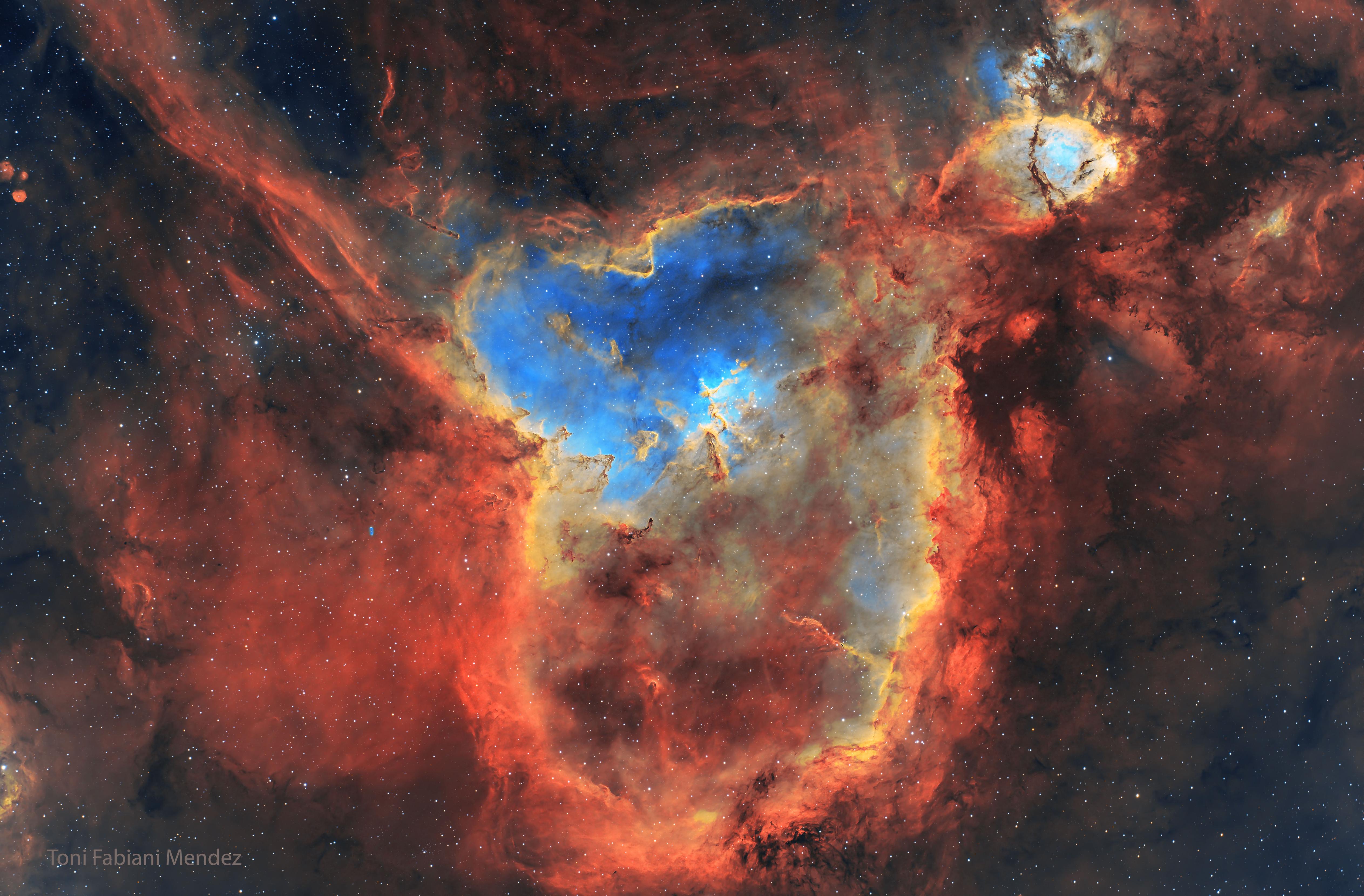
Alt...
2025 October 21
A starfield is shown filled with colorful gas glowing in different colors, and dark dust.
IC 1805: The Heart Nebula
* Image Credit & Copyright: Toni Fabiani
Explanation:
What electrifies the Heart Nebula? First, the large emission nebula on the left, catalogued as IC 1805, looks somewhat like a human heart. The nebula glows brightly in red light emitted by its most prominent element, hydrogen, but this long-exposure image was also blended with light emitted by sulfur (yellow) and oxygen (blue). In the center of the Heart Nebula are young stars from the open star cluster Melotte 15 that are eroding away several picturesque dust pillars with their atom-exciting energetic light and winds. The Heart Nebula is located about 7,500 light years away toward the constellation of Cassiopeia. At the top right of the Heart Nebula is the companion Fishhead Nebula. This wide and deep image clearly shows that glowing gas surrounds the Heart Nebula in all directions.
Authors & editors: Robert Nemiroff (MTU) & Jerry Bonnell (UMCP)
NASA Official: Amber Straughn Specific rights apply.
NASA Web Privacy, Accessibility, Notices;
A service of: ASD at NASA / GSFC,
NASA Science Activation
& Michigan Tech. U.
2025 October 20
Finding Comet Lemmon
* Image Credit & Copyright: Petr Horalek / Institute of Physics in Opava
https://www.petrhoralek.com/#about-1
https://www.slu.cz/phys/en/
Explanation:
Tonight, if you can see the stars of the Big Dipper, then you can find comet Lemmon in your evening sky. After sunset, look for the faint but extended comet above your northwestern horizon -- but below the handle of the famous celestial kitchen utensil of the north. It might be easier to see this visitor to the inner Solar System through your camera phone, which is better at picking up faint objects. Either way, look for a fuzzy green 'star' with a tail, though probably not so long a tail as in this impressive snapshot taken over Seč Lake in the Czech Republic two nights ago. Recent photographs of C/2025 A6 (Lemmon) often show a detailed and changing ion tail which extends farther than the eye can follow. This Sun-orbiting comet is now near its closest approach to Earth and will pass its closest to the Sun in early November.
https://theskylive.com/c2025a6-info
https://www.petrhoralek.com/?p=25820
https://www.wired.com/story/how-to-see-comet-lemmon-this-october/
https://apod.nasa.gov/apod/ap251020.html
#space #comets #astrophotography #photography #science #astronomy #nature #NASA #ESA #education
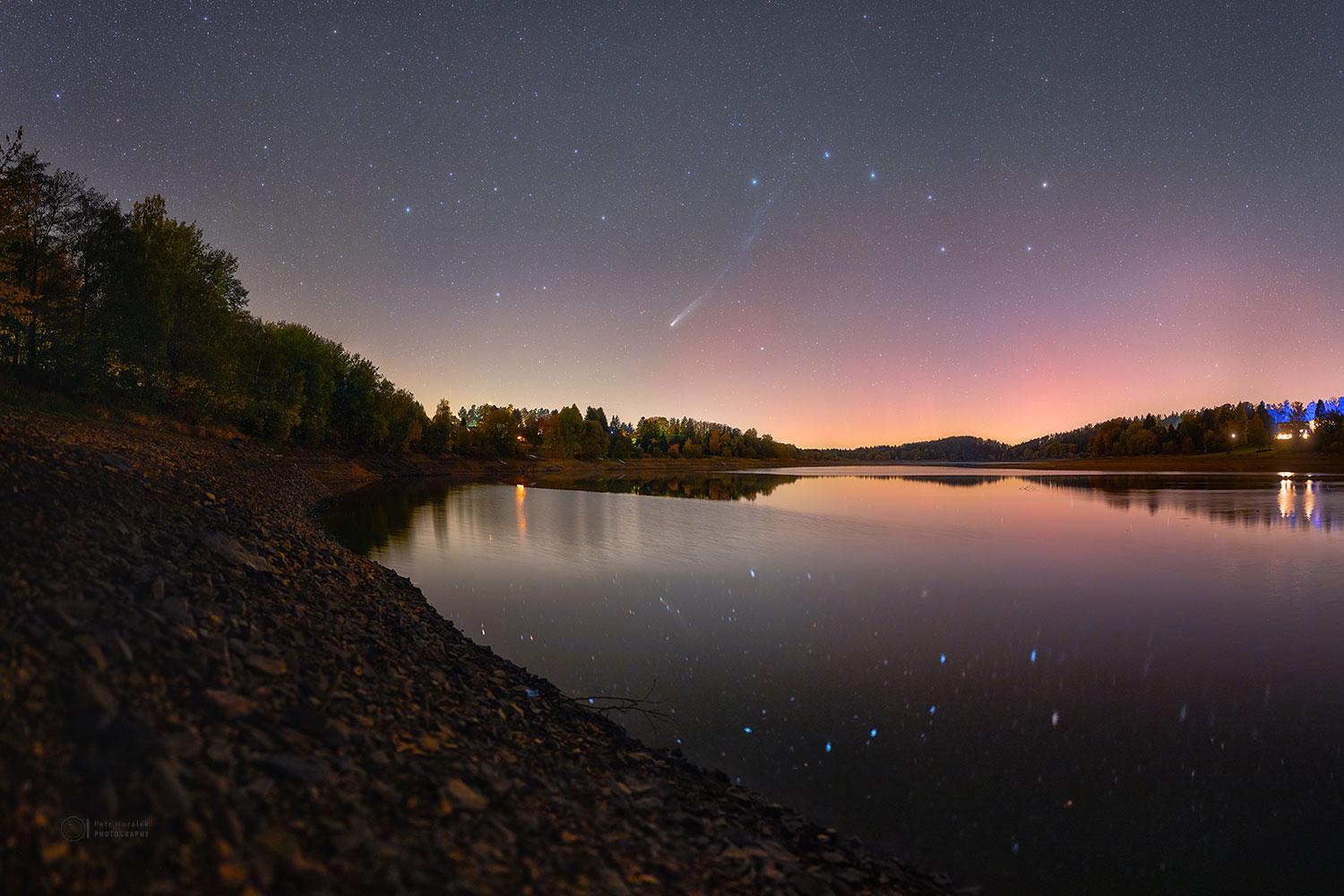
Alt...
2025 October 20
A night sky is seen over a lake. The sky contains numerous stars including the Big Dipper asterism. Prominent in the sky is a comet with a long tail. Both the Big Dipper and the comet are seen reflected in the still water of the lake.
Finding Comet Lemmon
* Image Credit & Copyright: Petr Horalek / Institute of Physics in Opava
Explanation:
Tonight, if you can see the stars of the Big Dipper, then you can find comet Lemmon in your evening sky. After sunset, look for the faint but extended comet above your northwestern horizon -- but below the handle of the famous celestial kitchen utensil of the north. It might be easier to see this visitor to the inner Solar System through your camera phone, which is better at picking up faint objects. Either way, look for a fuzzy green 'star' with a tail, though probably not so long a tail as in this impressive snapshot taken over Seč Lake in the Czech Republic two nights ago. Recent photographs of C/2025 A6 (Lemmon) often show a detailed and changing ion tail which extends farther than the eye can follow. This Sun-orbiting comet is now near its closest approach to Earth and will pass its closest to the Sun in early November.
Authors & editors: Robert Nemiroff (MTU) & Jerry Bonnell (UMCP)
NASA Official: Amber Straughn Specific rights apply.
NASA Web Privacy, Accessibility, Notices;
A service of: ASD at NASA / GSFC,
NASA Science Activation
& Michigan Tech. U.
2025 October 11
Manicouagan Impact Crater from Space
* Image Credit: NASA, International Space Station Expedition 59
Explanation:
Orbiting 400 kilometers above Quebec, Canada, planet Earth, the International Space Station Expedition 59 crew captured this snapshot of the broad St. Lawrence River and curiously circular Lake Manicouagan on April 11, 2019. Right of center, the ring-shaped lake is a modern reservoir within the eroded remnant of an ancient 100 kilometer diameter impact crater. The ancient crater is very conspicuous from orbit, a visible reminder that Earth is vulnerable to rocks from space. Over 200 million years old, the Manicouagan crater was likely caused by the impact of a rocky body about 5 kilometers in diameter. Currently, there is no known asteroid with a significant probability of impacting Earth in the next century. Each month, NASA’s Planetary Defense Coordination Office releases an update featuring the most recent figures on near-Earth object close approaches, and other facts about comets and asteroids that could pose a potential impact hazard with Earth.
#space #comets #astrophotography #photography #science #astronomy #nature #NASA #ESA #education #apod

Alt...
2025 October 11

Manicouagan Impact Crater from Space
Image Credit: NASA, International Space Station Expedition 59
Explanation: Orbiting 400 kilometers above Quebec, Canada, planet Earth, the International Space Station Expedition 59 crew captured this snapshot of the broad St. Lawrence River and curiously circular Lake Manicouagan on April 11, 2019. Right of center, the ring-shaped lake is a modern reservoir within the eroded remnant of an ancient 100 kilometer diameter impact crater. The ancient crater is very conspicuous from orbit, a visible reminder that Earth is vulnerable to rocks from space. Over 200 million years old, the Manicouagan crater was likely caused by the impact of a rocky body about 5 kilometers in diameter. Currently, there is no known asteroid with a significant probability of impacting Earth in the next century. Each month, NASA’s Planetary Defense Coordination Office releases an update featuring the most recent figures on near-Earth object close approaches, and other facts about comets and asteroids that could pose a potential impact hazard with Earth
Authors & editors: Robert Nemiroff (MTU) & Jerry Bonnell (UMCP)
NASA Official: Amber Straughn Specific rights apply.
NASA Web Privacy, Accessibility, Notices;
A service of: ASD at NASA / GSFC,
NASA Science Activation
& Michigan Tech. U.
#knowledge #wissen #history #Geschichte #wissenschaft #science #archaeology #archaologie #Astronomy #Paläontologie #Paleontology
Evolution
Neandertaler: Förderte giftiges Blei sein Aussterben?
Archaische Genvariante reagierte sensibler auf erhöhte Bleiwerte als die des Homo sapiens 🤓
https://www.scinexx.de/news/archaeologie/neandertaler-foerderte-giftiges-blei-sein-aussterben/
#knowledge #wissen #wissenschaft #science #Astronomy #Astronomie
Neues zu Beteigeuzes „Buddy“
Röntgen- und UV-Daten liefern neue Informationen zum kleinen Begleitstern des Roten Überriesen 🤓
https://www.scinexx.de/news/kosmos/neues-zu-beteigeuzes-buddy/
#knowledge #wissen #wissenschaft #science #Astronomy #Astronomie
Sonnensystem
Was wäre wenn – ein Super-Sonnensturm kommt?
ESA-Bodenteam probt Reaktion auf einen Sonnensturm der Carrington-Klasse 🤓
https://www.scinexx.de/news/kosmos/was-waere-wenn-ein-super-sonnensturm-trifft/