Search results for tag #education
![[?]](https://files.defcon.social/dcsocial-s3/accounts/avatars/113/208/344/507/078/943/original/014820ad22daee1c.jpg)
2015 February 13
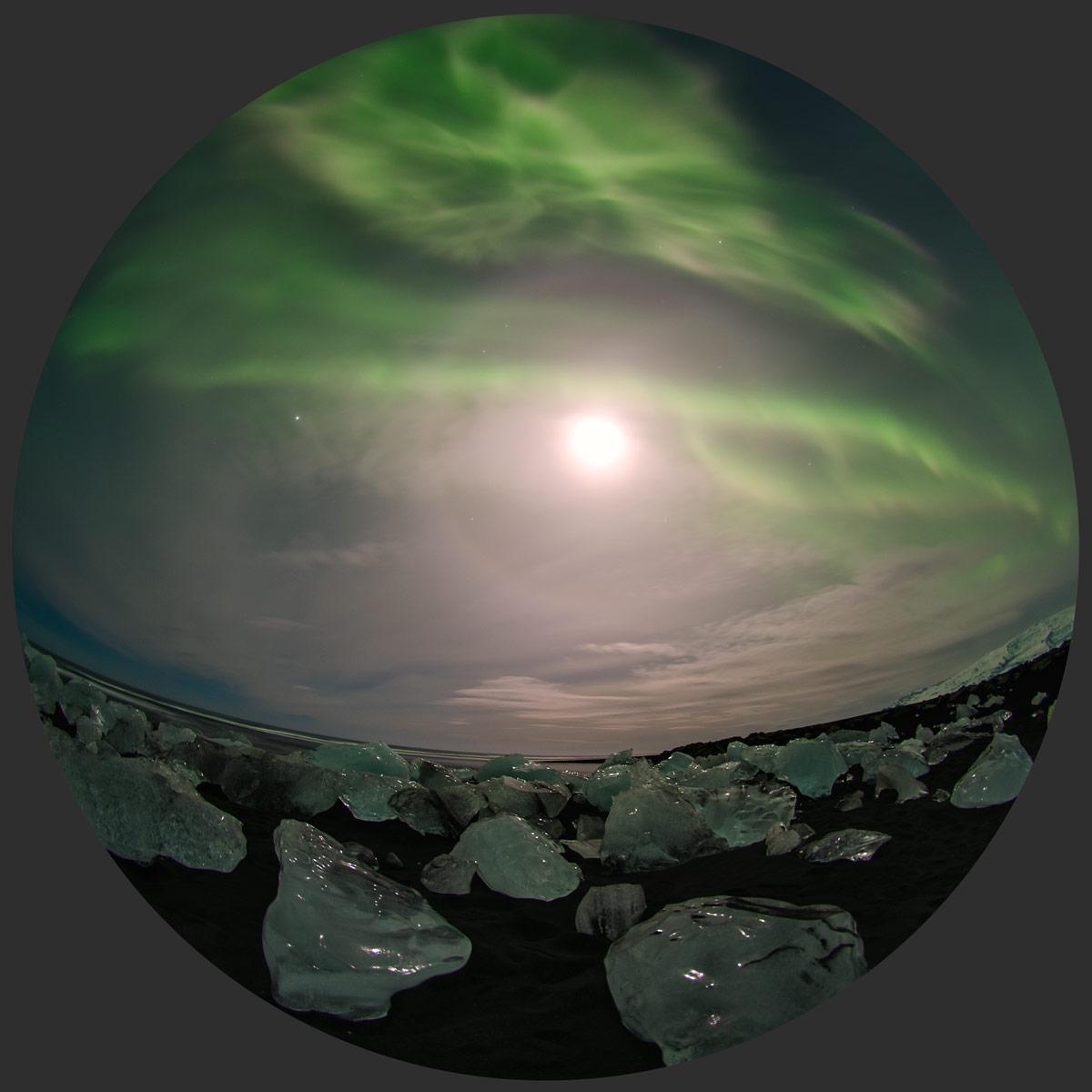
Aurora on Ice
* Image Credit & Copyright: Stéphane Vetter (Nuits sacrées)
http://www.nuitsacrees.fr/
Explanation:
Not from a snowglobe, this expansive fisheye view of ice and sky was captured on February 1, from Jökulsárlón Beach, southeast Iceland, planet Earth. Chunks of glacial ice on the black sand beach glisten in the light of a nearly full moon surrounded by a shining halo. The 22 degree lunar halo itself is created by ice crystals in high, thin clouds refracting the moonlight. Despite the bright moonlight, curtains of aurora still dance through the surreal scene. In early February, their activity was triggered by Earth's restless magnetosphere and the energetic wind from a coronal hole near the Sun's south pole. Bright Jupiter, also near opposition, is visible at the left, beyond the icy lunar halo.
https://www.atoptics.co.uk/blog/22-degree-halo-22-halo-22-circular-halo/
https://apod.nasa.gov/apod/ap150213.html
#space #earth #aurora #astrophotography #photography #NASA #science #physics #nature #education #4sAur
Alt...
2015 February 13
Aurora on Ice
* Image Credit & Copyright: Stéphane Vetter (Nuits sacrées)
Explanation:
Not from a snowglobe, this expansive fisheye view of ice and sky was captured on February 1, from Jökulsárlón Beach, southeast Iceland, planet Earth. Chunks of glacial ice on the black sand beach glisten in the light of a nearly full moon surrounded by a shining halo. The 22 degree lunar halo itself is created by ice crystals in high, thin clouds refracting the moonlight. Despite the bright moonlight, curtains of aurora still dance through the surreal scene. In early February, their activity was triggered by Earth's restless magnetosphere and the energetic wind from a coronal hole near the Sun's south pole. Bright Jupiter, also near opposition, is visible at the left, beyond the icy lunar halo.
Authors & editors: Robert Nemiroff (MTU) & Jerry Bonnell (UMCP)
NASA Official: Phillip Newman Specific rights apply.
NASA Web Privacy Policy and Important Notices
A service of: ASD at NASA / GSFC
& Michigan Tech. U.
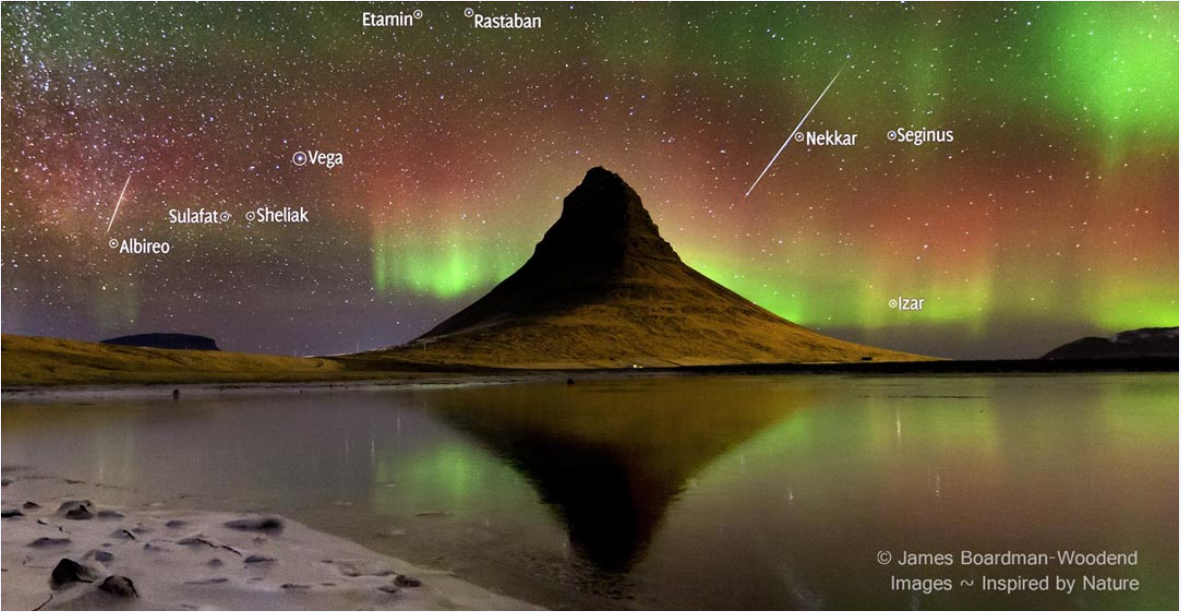
Annotations for previous post.
* Image Credit & Copyright: James Boardman-Woodend
https://www.flickr.com/photos/126180225@N06/
* Annotation: Judy Schmidt
Alt...
Annotations for previous post.
* Image Credit & Copyright: James Boardman-Woodend
https://www.flickr.com/photos/126180225@N06/
* Annotation: Judy Schmidt
2021 December 13
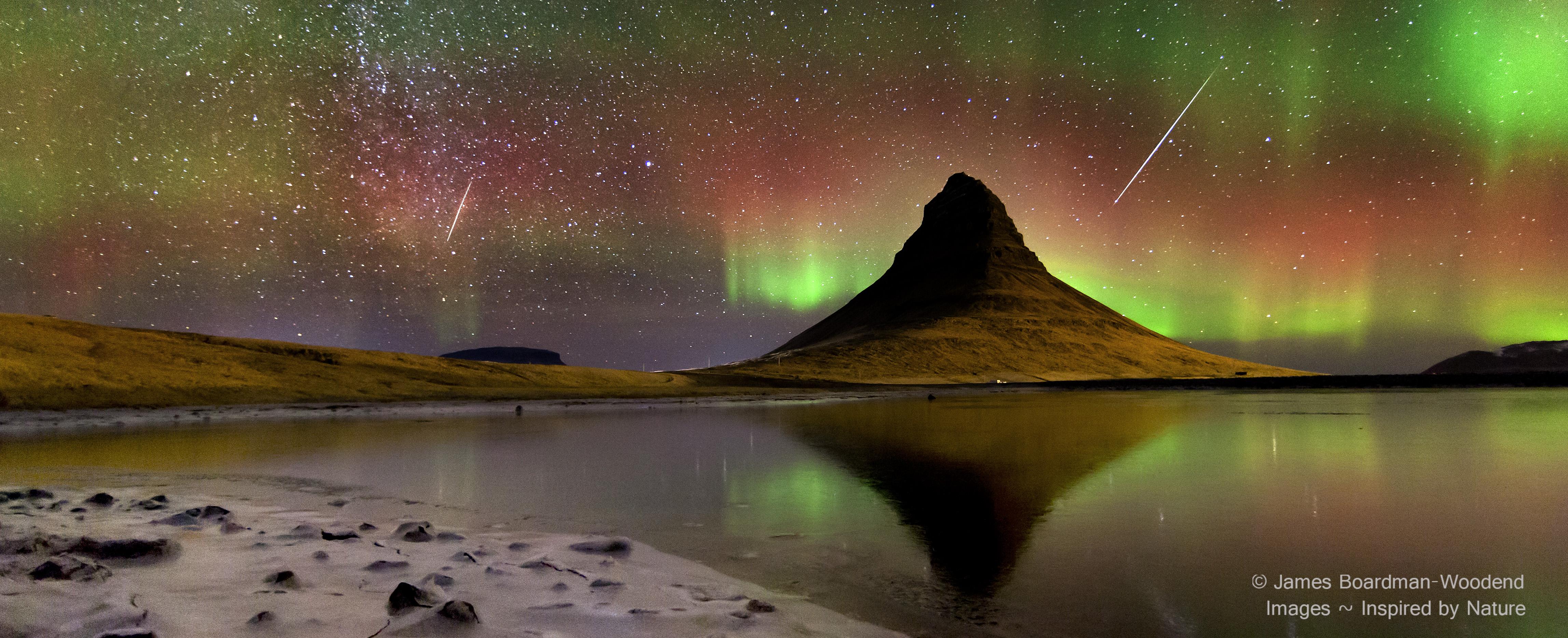
Meteors and Auroras over Iceland
* Image Credit & Copyright: James Boardman-Woodend
https://www.flickr.com/photos/126180225@N06/
* Annotation: Judy Schmidt (see next post)
Explanation:
What's going on behind that mountain? Quite a bit. First of all, the mountain itself, named Kirkjufell, is quite old and located in western Iceland near the town of Grundarfjörður. In front of the steeply-sloped structure lies a fjord that had just begun to freeze when the above image was taken -- in mid-December of 2012. Although quite faint to the unaided eye, the beautiful colors of background aurorae became quite apparent on the 25-second exposure. What makes this image of particular note, though, is that it also captures streaks from the Geminids meteor shower -- meteors that might not have been evident were the aurora much brighter. Far in the distance, on the left, is the band of our Milky Way Galaxy, while stars from our local part of the Milky Way appear spread across the background. Tonight the Geminids meteor shower peaks again and may well provide sky enthusiasts with their own memorable visual experiences.
https://apod.nasa.gov/apod/ap211213.html
#space #earth #aurora #astrophotography #photography #NASA #science #physics #nature #education #4sAur
Alt...
2021 December 13
The picture shows a volcano in Iceland in the foreground and both auroras and meteors from the 2012 Geminids in the background.
Meteors and Auroras over Iceland
* Image Credit & Copyright: James Boardman-Woodend
* Annotation: Judy Schmidt (see next post)
Explanation:
What's going on behind that mountain? Quite a bit. First of all, the mountain itself, named Kirkjufell, is quite old and located in western Iceland near the town of Grundarfjörður. In front of the steeply-sloped structure lies a fjord that had just begun to freeze when the above image was taken -- in mid-December of 2012. Although quite faint to the unaided eye, the beautiful colors of background aurorae became quite apparent on the 25-second exposure. What makes this image of particular note, though, is that it also captures streaks from the Geminids meteor shower -- meteors that might not have been evident were the aurora much brighter. Far in the distance, on the left, is the band of our Milky Way Galaxy, while stars from our local part of the Milky Way appear spread across the background. Tonight the Geminids meteor shower peaks again and may well provide sky enthusiasts with their own memorable visual experiences.
Authors & editors: Robert Nemiroff (MTU) & Jerry Bonnell (UMCP)
NASA Official: Phillip Newman Specific rights apply.
NASA Web Privacy Policy and Important Notices
A service of: ASD at NASA / GSFC
& Michigan Tech. U.
2021 October 30
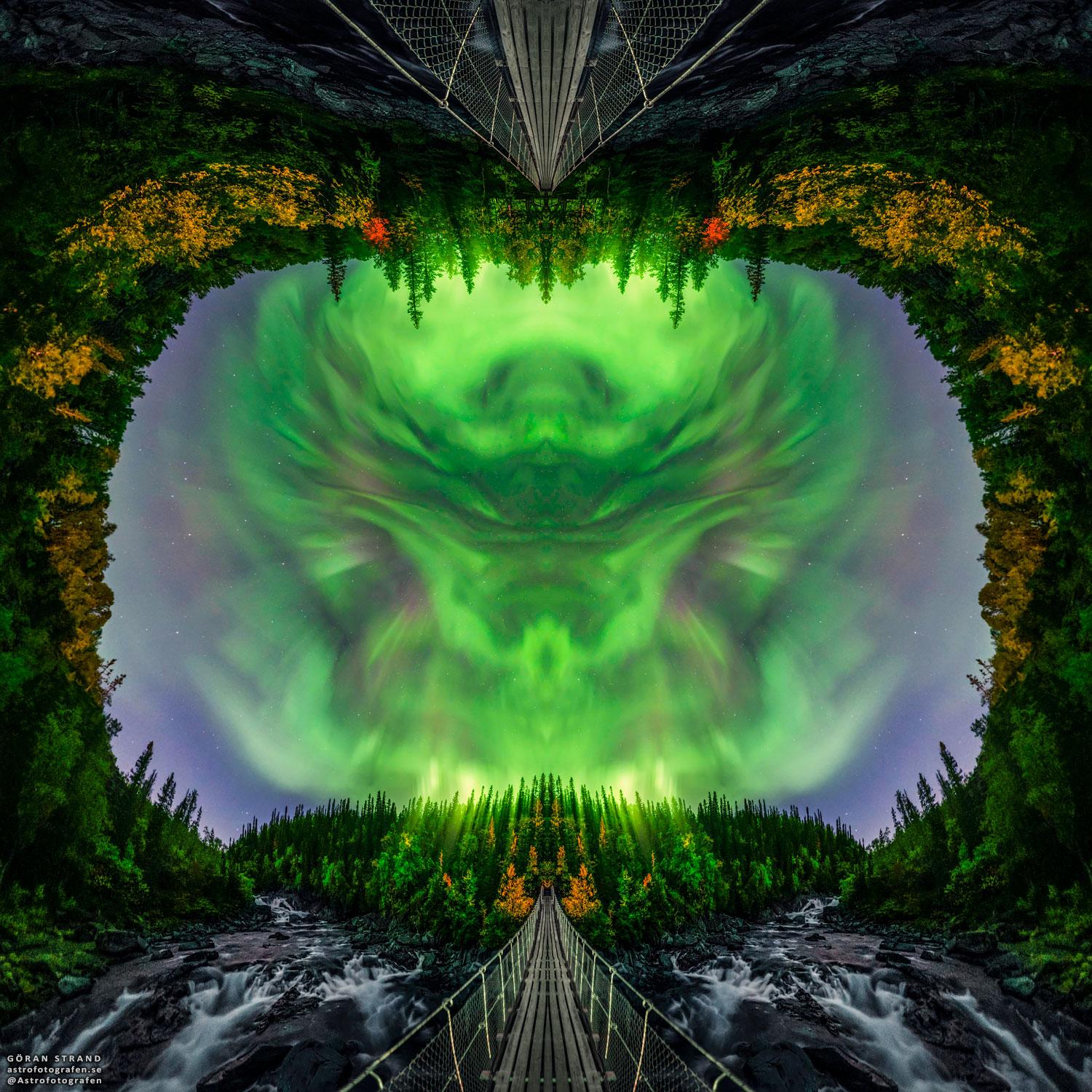
A Rorschach Aurora
* Image Credit & Copyright: Göran Strand
https://astrofotografen.se/
Explanation:
If you see this as a monster's face, don't panic. It's only pareidolia, often experienced as the tendency to see faces in patterns of light and shadow. In fact, the startling visual scene is actually a 180 degree panorama of Northern Lights, digitally mirrored like inkblots on a folded piece of paper. Frames used to construct it were captured on a September night from the middle of a waterfall-crossing suspension bridge in Jamtland, Sweden. With geomagnetic storms triggered by recent solar activity, auroral displays could be very active at planet Earth's high latitudes in the coming days. But if you see a monster's face in your own neighborhood tomorrow night, it might just be Halloween.
https://apod.nasa.gov/apod/ap211030.html
#space #earth #aurora #astrophotography #photography #NASA #science #physics #nature #education #4sAur
Alt...
2021 October 30
A Rorschach Aurora
* Image Credit & Copyright: Göran Strand
Explanation:
If you see this as a monster's face, don't panic. It's only pareidolia, often experienced as the tendency to see faces in patterns of light and shadow. In fact, the startling visual scene is actually a 180 degree panorama of Northern Lights, digitally mirrored like inkblots on a folded piece of paper. Frames used to construct it were captured on a September night from the middle of a waterfall-crossing suspension bridge in Jamtland, Sweden. With geomagnetic storms triggered by recent solar activity, auroral displays could be very active at planet Earth's high latitudes in the coming days. But if you see a monster's face in your own neighborhood tomorrow night, it might just be Halloween.
Authors & editors: Robert Nemiroff (MTU) & Jerry Bonnell (UMCP)
NASA Official: Phillip Newman Specific rights apply.
NASA Web Privacy Policy and Important Notices
A service of: ASD at NASA / GSFC
& Michigan Tech. U.
2022 October 30
Night on a Spooky Planet
* Image Credit & Copyright: Stéphane Vetter (Nuits sacrées)
http://www.nuitsacrees.fr/
Explanation:
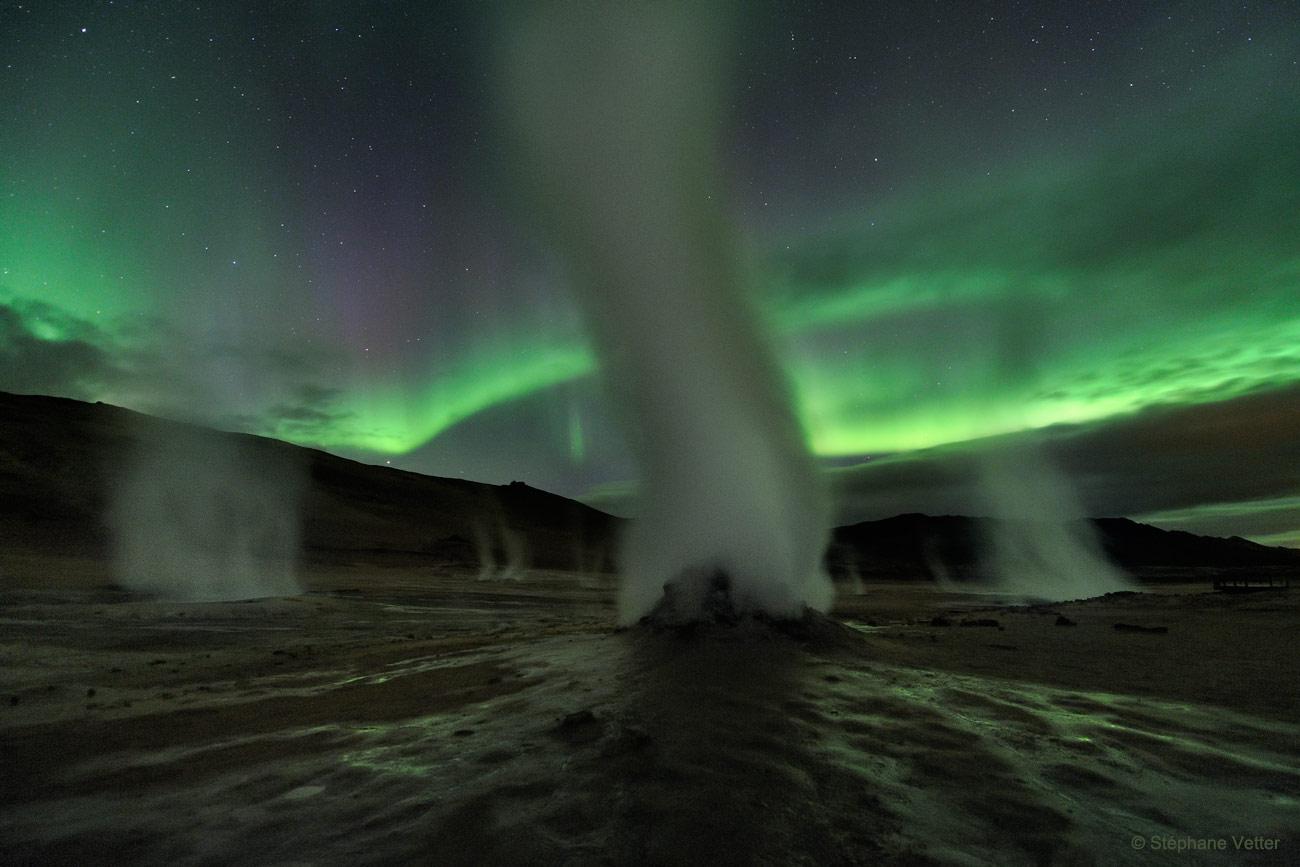
What spooky planet is this? Planet Earth of course, on a dark and stormy night in 2013 at Hverir, a geothermally active area along the volcanic landscape in northeastern Iceland. Triggered by solar activity, geomagnetic storms produced the auroral display in the starry night sky. The ghostly towers of steam and gas are venting from fumaroles and danced against the eerie greenish light. For now, auroral apparitions are increasing as our Sun approaches a maximum in its 11 year solar activity cycle. And pretty soon, ghostly shapes may dance in your neighborhood too.
https://apod.nasa.gov/apod/ap221030.html
#space #earth #aurora #astrophotography #photography #NASA #science #physics #nature #education #4sAur
Alt...
2022 October 30
The featured image shows steam rising from several separated vents at Hverir, a geothermally active field in Iceland. Green aurora rage in the background.
Night on a Spooky Planet
* Image Credit & Copyright: Stéphane Vetter (Nuits sacrées)
Explanation:
What spooky planet is this? Planet Earth of course, on a dark and stormy night in 2013 at Hverir, a geothermally active area along the volcanic landscape in northeastern Iceland. Triggered by solar activity, geomagnetic storms produced the auroral display in the starry night sky. The ghostly towers of steam and gas are venting from fumaroles and danced against the eerie greenish light. For now, auroral apparitions are increasing as our Sun approaches a maximum in its 11 year solar activity cycle. And pretty soon, ghostly shapes may dance in your neighborhood too.
Authors & editors: Robert Nemiroff (MTU) & Jerry Bonnell (UMCP)
NASA Official: Phillip Newman Specific rights apply.
NASA Web Privacy Policy and Important Notices
A service of: ASD at NASA / GSFC,
NASA Science Activation
& Michigan Tech. U.
The Heliosphere and Solar Wind
Just as planets with churning cores like Earth produce magnetic shields, the Sun’s dense, ever-roiling interior also produces a magnetic shield — on a much larger scale. The Sun’s magnetic shield is called the heliosphere, and it fills the solar system.
As the Sun seethes, it radiates its energy throughout the heliosphere. Planets and other objects in the solar system experience much of this radiation as a continuous stream of charged particles and magnetic fields blowing by. This stream of fields and particles is called the solar wind.
When the solar wind blows past Earth, it buffets Earth’s magnetosphere like a strong breeze flapping a flag.
https://science.nasa.gov/sun/what-is-the-solar-wind/
Credits:
NASA/Goddard Space Flight Center/Conceptual Image Lab/Jonathan North
** --> Uploading animated files in ".gif" format is a bit of a trick, because the originals are usually too big. The free software imagemagick does a great job here when it comes to resizing your file! You can try it yourself with the following command:
$convert(or "magick" depending on your version) in.gif -coalesce -resize (desired size eg:"256")x -deconstruct out-deconstruct.gif
#space #earth #aurora #astrophotography #photography #NASA #science #physics #nature #education #4sAur
"Other planets in our solar system also have the aurora phenomenon. You can also enjoy a solar light show there. In my simple mind, I think of a drive-in cinema with planets instead of cars and the sun as a projector. But there is probably a different movie on each planet..?"
2024 December 8
Aurora around Saturn's North Pole
* Image Credit: NASA, ESA, Hubble, OPAL Program, J. DePasquale (STScI), L. Lamy (Obs. Paris)
Explanation:
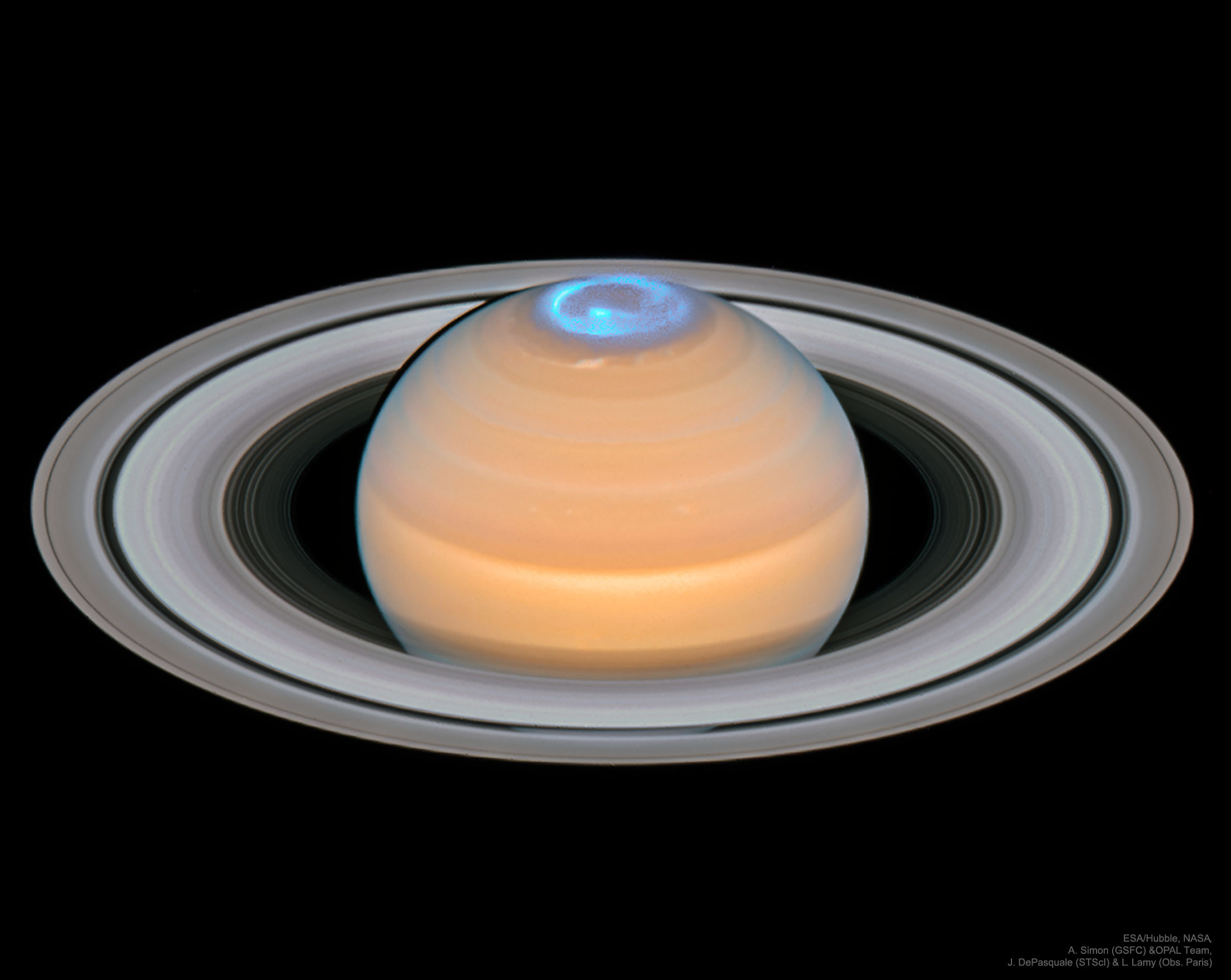
Are Saturn's auroras like Earth's? To help answer this question, the Hubble Space Telescope and the Cassini spacecraft monitored Saturn's North Pole simultaneously during Cassini's final orbits around the gas giant in September 2017. During this time, Saturn's tilt caused its North Pole to be clearly visible from Earth. The featured image is a composite of ultraviolet images of auroras and optical images of Saturn's clouds and rings, all taken by Hubble. Like on Earth, Saturn's northern auroras can make total or partial rings around the pole. Unlike on Earth, however, Saturn's auroras are frequently spirals -- and more likely to peak in brightness just before midnight and dawn. In contrast to Jupiter's auroras, Saturn's auroras appear better related to connecting Saturn's internal magnetic field to the nearby, variable, solar wind. Saturn's southern auroras were similarly imaged back in 2004 when the planet's South Pole was clearly visible to Earth.
https://en.wikipedia.org/wiki/Solar_wind
https://apod.nasa.gov/apod/ap050219.html
https://apod.nasa.gov/apod/ap241208.html
#space #earth #aurora #astrophotography #photography #NASA #science #physics #nature #education #4sAur
Alt...
2024 December 8
A picture of Saturn is shown with tan clouds and light rings. Surrounding the north pole at the top are bright blue swirls. Please see the explanation for more detailed information.
Aurora around Saturn's North Pole
* Image Credit: NASA, ESA, Hubble, OPAL Program, J. DePasquale (STScI), L. Lamy (Obs. Paris)
Explanation:
Are Saturn's auroras like Earth's? To help answer this question, the Hubble Space Telescope and the Cassini spacecraft monitored Saturn's North Pole simultaneously during Cassini's final orbits around the gas giant in September 2017. During this time, Saturn's tilt caused its North Pole to be clearly visible from Earth. The featured image is a composite of ultraviolet images of auroras and optical images of Saturn's clouds and rings, all taken by Hubble. Like on Earth, Saturn's northern auroras can make total or partial rings around the pole. Unlike on Earth, however, Saturn's auroras are frequently spirals -- and more likely to peak in brightness just before midnight and dawn. In contrast to Jupiter's auroras, Saturn's auroras appear better related to connecting Saturn's internal magnetic field to the nearby, variable, solar wind. Saturn's southern auroras were similarly imaged back in 2004 when the planet's South Pole was clearly visible to Earth.
Authors & editors: Robert Nemiroff (MTU) & Jerry Bonnell (UMCP)
NASA Official: Amber Straughn Specific rights apply.
" @p@raru.re but before that, we have to talk about Coronal Mass Ejections: "
Coronal Mass Ejections
Occasionally, magnetic storms on the Sun eject large amounts of solar material into the solar atmosphere. These huge, flying blobs of Sun-stuff are called coronal mass ejections, or CMEs.
If directed at Earth, fast-moving CMEs can reach our planet in as little as 15 hours. (The Sun is approximately 93 million miles away from Earth. A CME arriving here in 15 hours means that it’s traveling around 6.2 million miles per hour, or about 0.9% the speed of light. At those speeds, you could fly from San Francisco to Washington, D.C. in ~1.5 seconds!)
As they billow away from the Sun, fast CMEs can overtake slower-moving charged particles ahead of them in the solar wind. These particles are accelerated as they’re swept into the careening solar ejecta, increasing the risk and intensity of a radiation storm when they reach Earth.
Under certain conditions, CMEs can supercharge the magnetosphere as they blow past, creating powerful geomagnetic storms in response.
https://science.nasa.gov/sun/solar-storms-and-flares/#coronal-mass-ejection
#space #earth #aurora #astrophotography #photography #NASA #science #physics #nature #education #4sAur
2024 October 16
Colorful Aurora over New Zealand
* Image Credit & Copyright: Tristian McDonald
https://cre8tivestr3k.com/info-contact
Explanation:
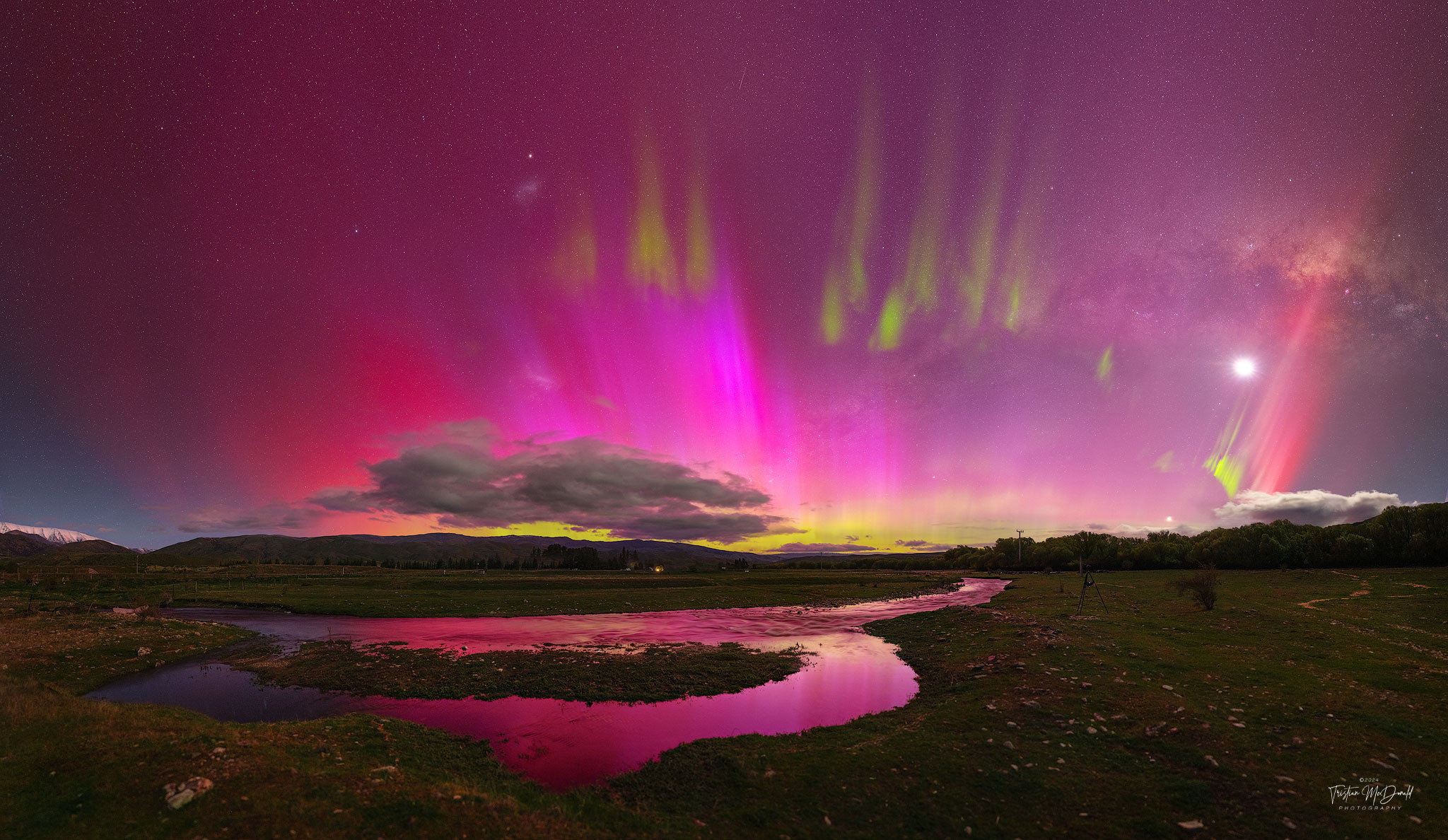
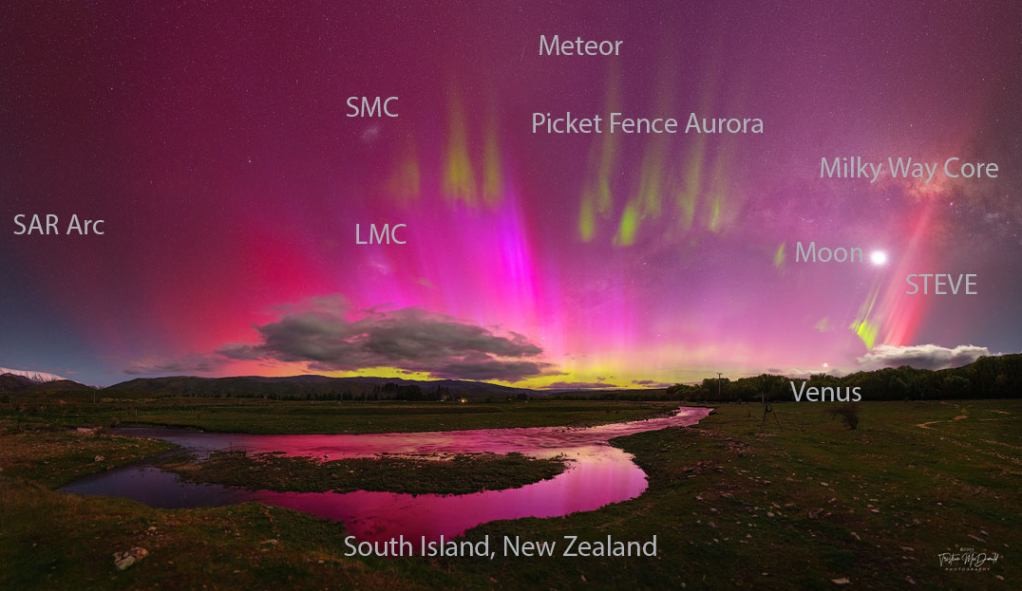
Sometimes the night sky is full of surprises. Take the sky over Lindis Pass, South Island, New Zealand one-night last week. Instead of a typically calm night sky filled with constant stars, a busy and dynamic night sky appeared. Suddenly visible were pervasive red aurora, green picket-fence aurora, a red SAR arc, a STEVE, a meteor, and the Moon. These outshone the center of our Milky Way Galaxy and both of its two satellite galaxies: the LMC and SMC. All of these were captured together on 28 exposures in five minutes, from which this panorama was composed. Auroras lit up many skies last week, as a Coronal Mass Ejection from the Sun unleashed a burst of particles toward our Earth that created colorful skies over latitudes usually too far from the Earth's poles to see them. More generally, night skies this month have other surprises, showing not only auroras -- but comets.
https://apod.nasa.gov/apod/ap241016.html
#space #earth #aurora #astrophotography #photography #NASA #science #nature #education #4sAur
Alt...
2024 October 16
A night sky is shown that appears mostly red due to pervasive aurora. In the foreground is covered by watery grasslands. Clouds are visible above the horizon. Thin green aurora are visible toward the top of the frame. In the background one can find the Moon, the LMC, SMC, Venus, a meteor, and the band of our Milky Way galaxy. Please see the explanation for more detailed information.
Colorful Aurora over New Zealand
* Image Credit & Copyright: Tristian McDonald
Explanation:
Sometimes the night sky is full of surprises. Take the sky over Lindis Pass, South Island, New Zealand one-night last week. Instead of a typically calm night sky filled with constant stars, a busy and dynamic night sky appeared. Suddenly visible were pervasive red aurora, green picket-fence aurora, a red SAR arc, a STEVE, a meteor, and the Moon. These outshone the center of our Milky Way Galaxy and both of its two satellite galaxies: the LMC and SMC. All of these were captured together on 28 exposures in five minutes, from which this panorama was composed. Auroras lit up many skies last week, as a Coronal Mass Ejection from the Sun unleashed a burst of particles toward our Earth that created colorful skies over latitudes usually too far from the Earth's poles to see them. More generally, night skies this month have other surprises, showing not only auroras -- but comets.
Authors & editors: Robert Nemiroff (MTU) & Jerry Bonnell (UMCP)
NASA Official: Amber Straughn Specific rights apply.
"A special box seat for the phenomenal earthly light shows belongs to the members of Expedition 71 and such wonderful views are part of the reward for the hard work. How nice that they share these beautiful pictures with us who stayed at home! We'll treat ourselves to a short film about it later .."
2024 September 13
Aurora Australis and the International Space Station
* Image Credit: NASA, ISS Expedition 71
https://www.nasa.gov/mission/expedition-71/
Explanation:
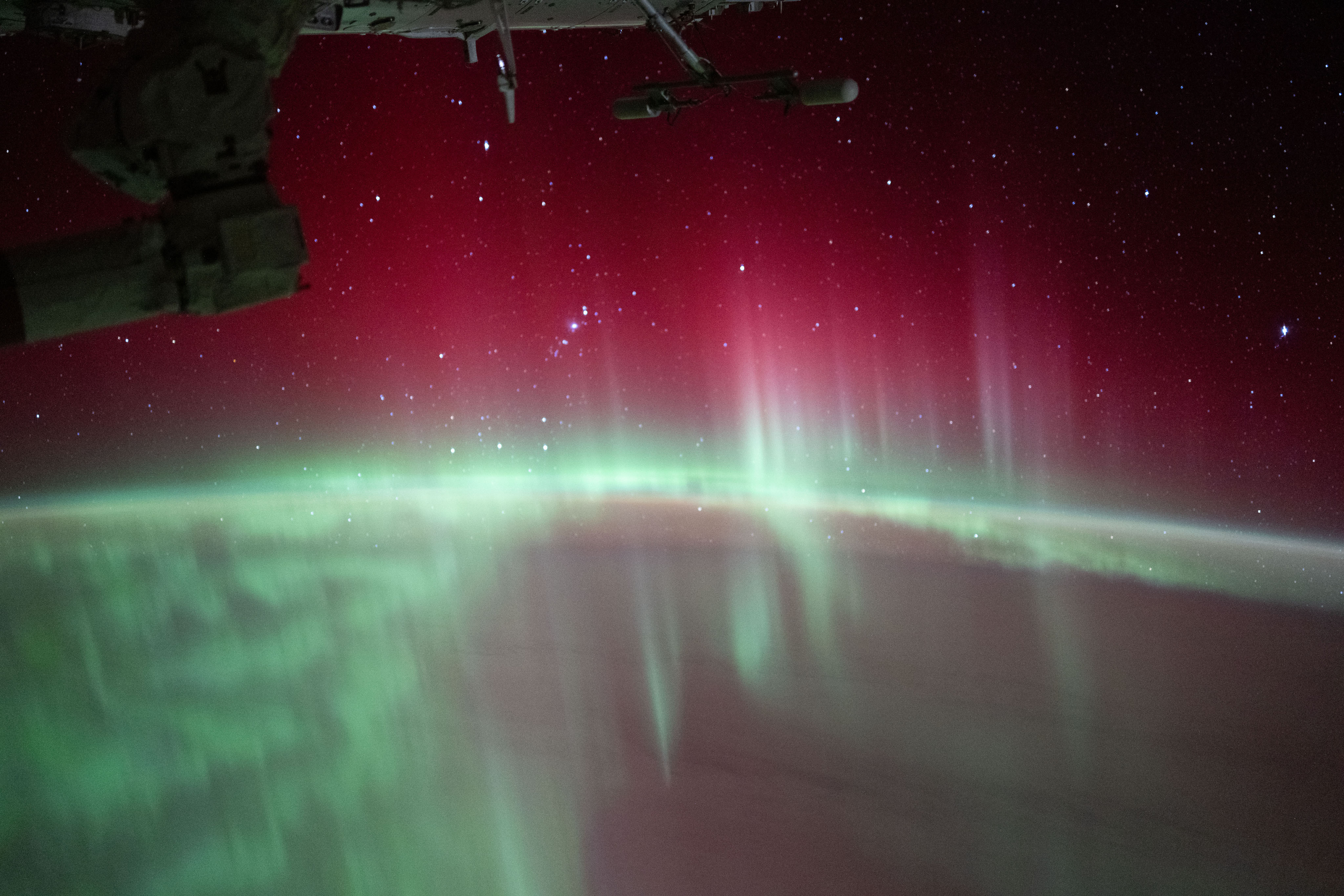
This snapshot from the International Space Station was taken on August 11 while orbiting about 430 kilometers above the Indian Ocean, Southern Hemisphere, planet Earth. The spectacular view looks south and east, down toward the planet's horizon and through red and green curtains of aurora australis. The auroral glow is caused by emission from excited oxygen atoms in the extremely rarefied upper atmosphere still present at the level of the orbiting outpost. Green emission from atomic oxygen dominates this scene at altitudes of 100 to 250 kilometers, while red emission from atomic oxygen can extend as high as 500 kilometers altitude. Beyond the glow of these southern lights, this view from low Earth orbit reveals the starry sky from a southern hemisphere perspective. Stars in Orion's belt and the Orion Nebula are near the Earth's limb just left of center. Sirius, alpha star of Canis Major and brightest star in planet Earth's night is above center along the right edge of the southern orbital skyscape.
https://earthobservatory.nasa.gov/images/1346/aurora-australis
https://science.nasa.gov/earth/earth-atmosphere/earths-atmosphere-a-multi-layered-cake/
https://apod.nasa.gov/apod/ap240913.html
https://apod.nasa.gov/apod/ap240913.html
#space #earth #aurora #astrophotography #photography #NASA #science #nature #education #4sAur
Alt...
2024 September 13
Aurora Australis and the International Space Station
* Image Credit: NASA, ISS Expedition 71
Explanation:
This snapshot from the International Space Station was taken on August 11 while orbiting about 430 kilometers above the Indian Ocean, Southern Hemisphere, planet Earth. The spectacular view looks south and east, down toward the planet's horizon and through red and green curtains of aurora australis. The auroral glow is caused by emission from excited oxygen atoms in the extremely rarefied upper atmosphere still present at the level of the orbiting outpost. Green emission from atomic oxygen dominates this scene at altitudes of 100 to 250 kilometers, while red emission from atomic oxygen can extend as high as 500 kilometers altitude. Beyond the glow of these southern lights, this view from low Earth orbit reveals the starry sky from a southern hemisphere perspective. Stars in Orion's belt and the Orion Nebula are near the Earth's limb just left of center. Sirius, alpha star of Canis Major and brightest star in planet Earth's night is above center along the right edge of the southern orbital skyscape.
Authors & editors: Robert Nemiroff (MTU) & Jerry Bonnell (UMCP)
NASA Official: Phillip Newman Specific rights apply.
NASA Web Privacy Policy and Important Notices
A service of: ASD at NASA / GSFC,
NASA Science Activation
& Michigan Tech. U.
"And now finally (thank you p
@p@raru.re for your generous p atience) we come to the point of magnetic reconnection. I'll spare you as linking to Youtube and Google with this simulation generously provided by the Goddard Space Flight Center. "
Magnetic Reconnection
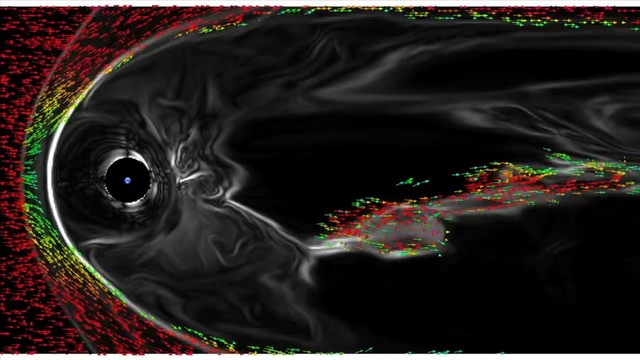
As we’ve seen, the solar wind emanating from the Sun flows around Earth’s magnetosphere like a river rushing around a rock. This onrush of charged particles stretches Earth’s magnetosphere away from the Sun, creating a long wake known as the magnetotail.
The magnetic shields of the Sun and Earth are polarized, like refrigerators and the magnets that adhere to them. The polarity of Earth’s magnetic shield is mostly stable, but the Sun’s can vary due to its more dynamic nature.
Sometimes, the magnetic polarity of the solar wind is opposite that of Earth’s magnetosphere. When the solar wind buffets the magnetosphere under these conditions, the field lines of the Sun and Earth snap together, similar to when an everyday magnet connects to a fridge. This is called magnetic reconnection.
The continuously blowing solar wind then pushes these newly connected Sun-Earth field lines, wrapping them around the magnetosphere and stretching them out toward the magnetotail. Eventually, these field lines stretch to their limit and snap like a rubber band. This severs the direct Sun-Earth magnetic connection, releasing energy back along the field lines and reinstating the original magnetic configuration in the process.
https://en.wikipedia.org/wiki/Magnetic_reconnection
https://www.energy.gov/science/articles/solving-plasma-physics-mystery-magnetic-reconnection
https://heliophysics.ucar.edu/sites/default/files/heliophysics/resources/presentations/2012_Bhattacharjee_Reconnection.pdf
#space #earth #aurora #astrophotography #photography #NASA #science #physics #nature #education #4sAur
"These wonderful surprising moments in places where we do not expect those views are most likely caused by the following powerful phenomenon: "
Geomagnetic Substorms
While the huge auroral displays caused by geomagnetic storms are fun to see, they’re relatively rare since the Sun’s and Earth’s magnetic fields need to align just right for them to occur. Auroras that stay near the Arctic and Antarctic circles are much more frequent. They’re created by geomagnetic substorms, magnetic disturbances affecting portions of the magnetosphere. Geomagnetic storms, in contrast, are large-scale disturbances that distort the whole geomagnetic system. The everyday flow of charged particles within Earth’s magnetosphere can create small regions of magnetic imbalance that cause geomagnetic substorms.
https://en.wikipedia.org/wiki/Substorm
https://heliophysics.ucar.edu/sites/default/files/heliophysics/resources/presentations/2007_Toffoletto_GeomagneticStormsSubstorms.pdf
Credits:
NASA/Goddard Space Flight Center/UNH/J. Raeder
#space #earth #aurora #astrophotography #photography #NASA #science #physics #nature #education #4sAur
Alt...
This short video features commentary by David Sibeck, project scientist for NASA's Time History of Events and Macroscale Interactions During Substorms (THEMIS) mission, discussing a visualization of magnetic reconnection and geomagnetic substorms. Learn more about this video here: https://svs.gsfc.nasa.gov/11309
Credits:
NASA/Goddard Space Flight Center/UNH/J. Raeder
2024 June 12
Aurora over Karkonosze Mountains
* Image Credit & Copyright: Daniel Koszela
https://www.instagram.com/danielkoszelaphotography/
Explanation:
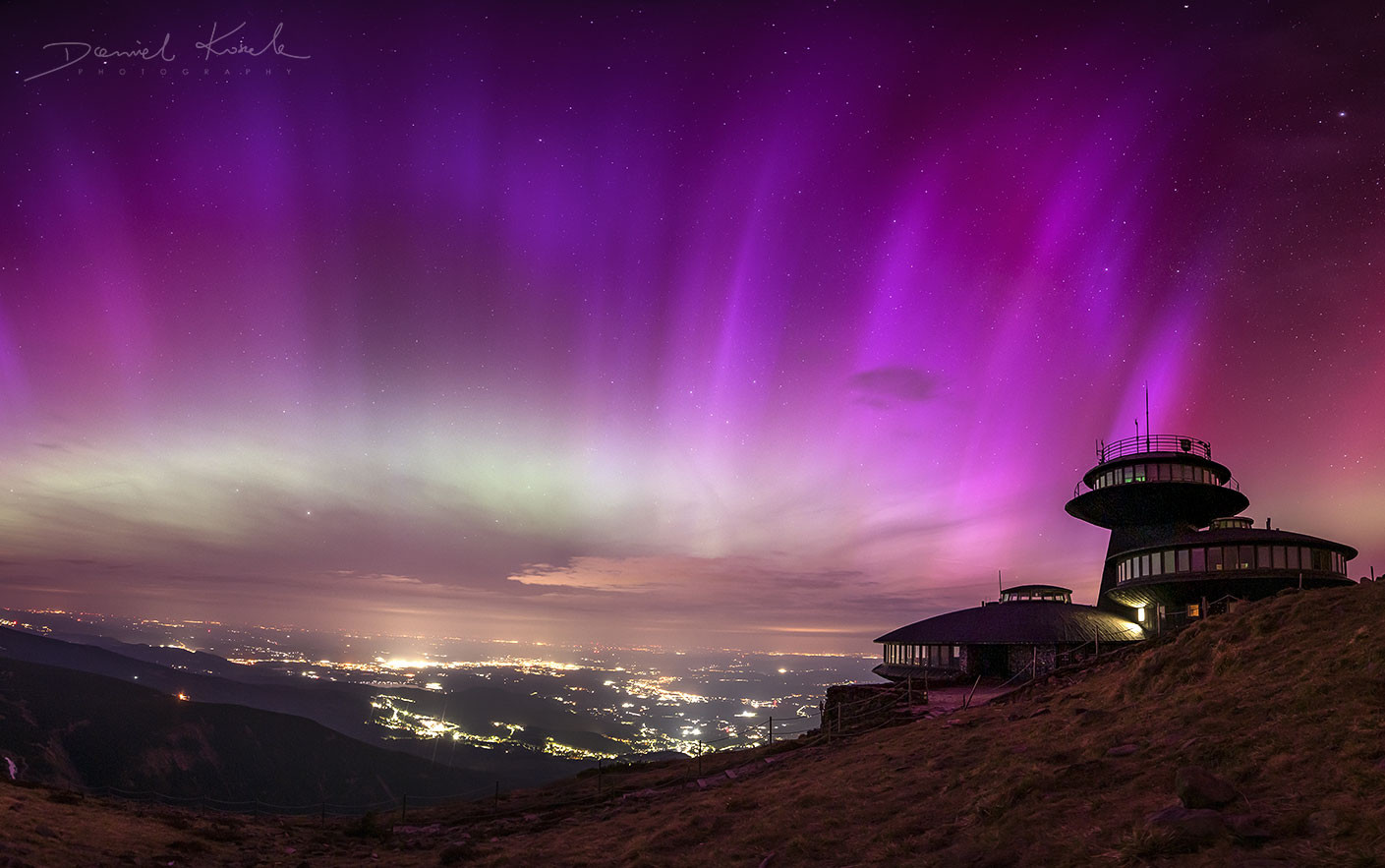
It was the first time ever. At least, the first time this photographer had ever seen aurora from his home mountains. And what a spectacular aurora it was. The Karkonosze Mountains in Poland are usually too far south to see any auroras. But on the amazing night of May 10 - 11, purple and green colors lit up much of the night sky, a surprising spectacle that also appeared over many mid-latitude locations around the Earth. The featured image is a composite of six vertical exposures taken during the auroral peak. The futuristic buildings on the right are part of a meteorological observatory located on the highest peak of the Karkonosze Mountains. The purple color is primarily due to Sun-triggered, high-energy electrons impacting nitrogen molecules in Earth's atmosphere. Our Sun is reaching its maximum surface activity over the next two years, and although many more auroras are predicted, most will occur over regions closer to the Earth's poles.
https://theconversation.com/are-the-northern-lights-caused-by-particles-from-the-sun-not-exactly-174019
https://www.nasa.gov/news-release/solar-cycle-25-is-here-nasa-noaa-scientists-explain-what-that-means/
https://apod.nasa.gov/apod/ap240612.html
#space #earth #aurora #astrophotography #photography #NASA #science #nature #education
Alt...
2024 June 12
Purple striped aurora cover a star filled sky. Mountain peaks are visible on the sides, as well as a futuristic looking building on the right side. City lights are visible in the valley down below. Please see the explanation for more detailed information.
Aurora over Karkonosze Mountains
* Image Credit & Copyright: Daniel Koszela
Explanation:
It was the first time ever. At least, the first time this photographer had ever seen aurora from his home mountains. And what a spectacular aurora it was. The Karkonosze Mountains in Poland are usually too far south to see any auroras. But on the amazing night of May 10 - 11, purple and green colors lit up much of the night sky, a surprising spectacle that also appeared over many mid-latitude locations around the Earth. The featured image is a composite of six vertical exposures taken during the auroral peak. The futuristic buildings on the right are part of a meteorological observatory located on the highest peak of the Karkonosze Mountains. The purple color is primarily due to Sun-triggered, high-energy electrons impacting nitrogen molecules in Earth's atmosphere. Our Sun is reaching its maximum surface activity over the next two years, and although many more auroras are predicted, most will occur over regions closer to the Earth's poles.
Authors & editors: Robert Nemiroff (MTU) & Jerry Bonnell (UMCP)
NASA Official: Amber Straughn Specific rights apply.
"I'm thinking about designing my next TOPIC> as 'FOLLOWERS ONLY' .. would that be ok for you?
Bots-requests would not be accepted."
2022 April 4
A Vortex Aurora over Iceland
* Image Credit & Copyright: Christophe Suarez
https://france3-regions.franceinfo.fr/provence-alpes-cote-d-azur/alpes-maritimes/nice/photos-je-suis-temoin-de-phenomenes-encore-tres-mysterieux-ce-chasseur-d-orages-immortalise-les-cadeaux-du-ciel-3020456.html
Explanation:
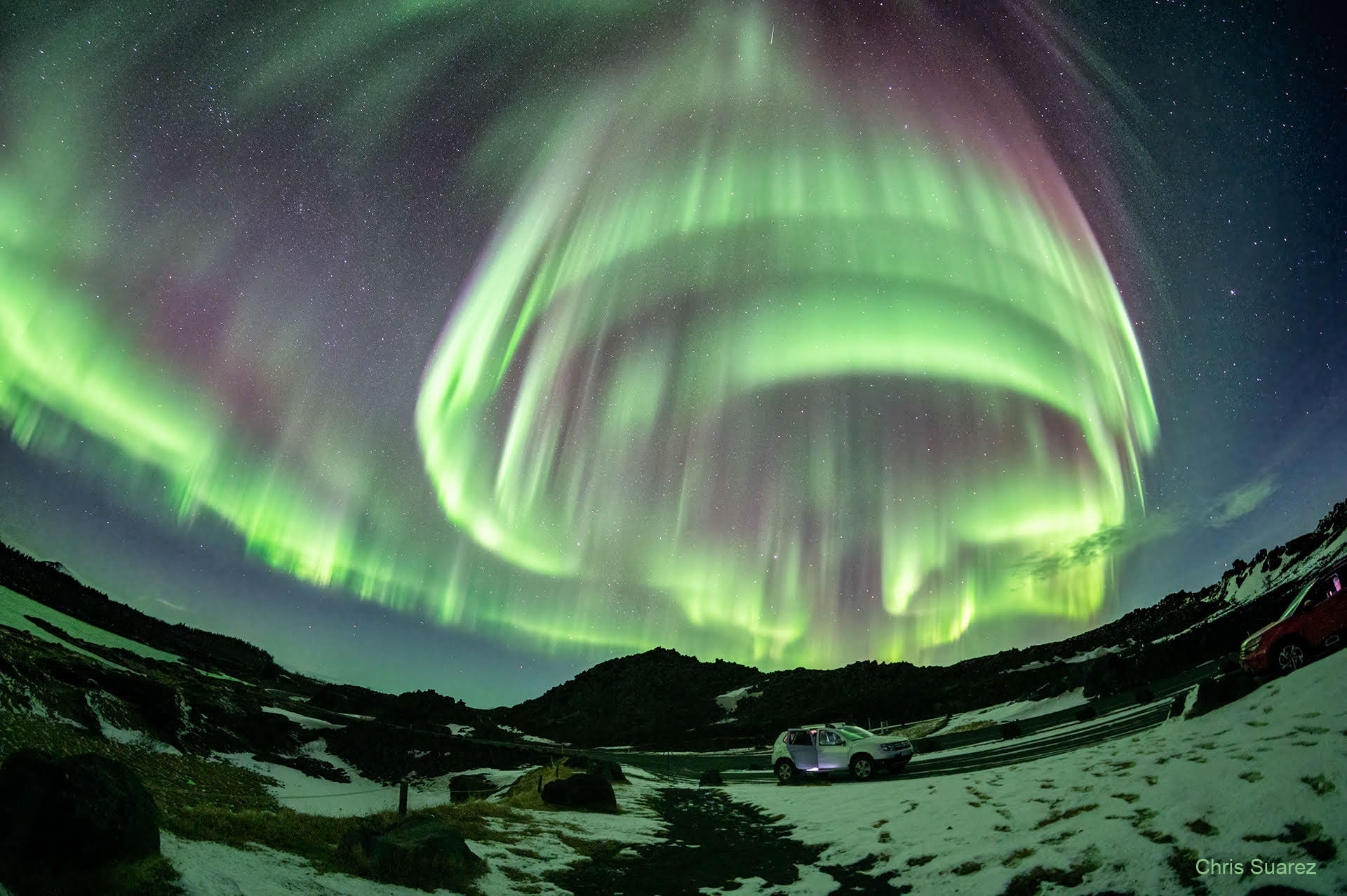
No, the car was not in danger of being vacuumed into space by the big sky vortex. For one reason, the vortex was really an aurora, and since auroras are created by particles striking the Earth from space, they do not create a vacuum. This rapidly developing auroral display was caused by a Coronal Mass Ejection from the Sun that passed by the Earth closely enough to cause a ripple in Earth's magnetosphere. The upper red parts of the aurora occur over 250 kilometers high with its red glow created by atmospheric atomic oxygen directly energized by incoming particles. The lower green parts of the aurora occur over 100 kilometers high with its green glow created by atmospheric atomic oxygen energized indirectly by collisions with first-energized molecular nitrogen. Below 100 kilometers, there is little atomic oxygen, which is why auroras end abruptly. The concentric cylinders depict a dramatic auroral corona as seen from the side. The featured image was created from a single 3-second exposure taken in mid-March over Lake Myvatn in Iceland.
https://science.nasa.gov/heliophysics/focus-areas/magnetosphere-ionosphere/
https://apod.nasa.gov/apod/ap220404.html
#space #earth #aurora #astrophotography #photography #NASA #science #physics #nature #education
Alt...
2022 April 4
The featured image depicts a bright aurora that occurred over Iceland in March. The curvature of the aurora makes it look like a vortex.
A Vortex Aurora over Iceland
* Image Credit & Copyright: Christophe Suarez
Explanation:
No, the car was not in danger of being vacuumed into space by the big sky vortex. For one reason, the vortex was really an aurora, and since auroras are created by particles striking the Earth from space, they do not create a vacuum. This rapidly developing auroral display was caused by a Coronal Mass Ejection from the Sun that passed by the Earth closely enough to cause a ripple in Earth's magnetosphere. The upper red parts of the aurora occur over 250 kilometers high with its red glow created by atmospheric atomic oxygen directly energized by incoming particles. The lower green parts of the aurora occur over 100 kilometers high with its green glow created by atmospheric atomic oxygen energized indirectly by collisions with first-energized molecular nitrogen. Below 100 kilometers, there is little atomic oxygen, which is why auroras end abruptly. The concentric cylinders depict a dramatic auroral corona as seen from the side. The featured image was created from a single 3-second exposure taken in mid-March over Lake Myvatn in Iceland.
Authors & editors: Robert Nemiroff (MTU) & Jerry Bonnell (UMCP)
NASA Official: Phillip Newman Specific rights apply.
2022 March 22
A Whale of an Aurora over Swedish Forest
* Image Credit & Copyright: Göran Strand
https://astrofotografen.se/
Explanation:
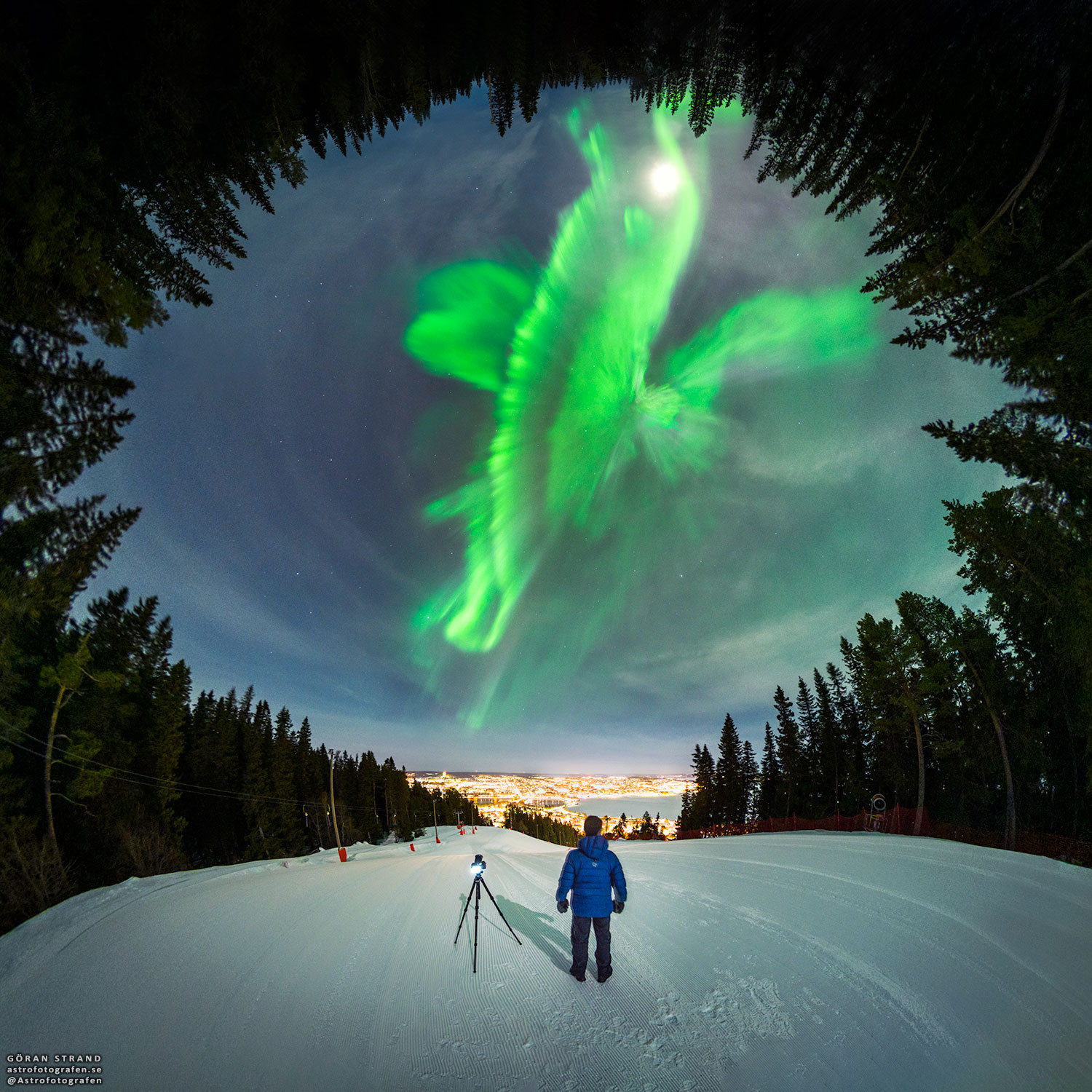
What's that in the sky? An aurora. A large coronal mass ejection occurred on our Sun earlier this month, throwing a cloud of fast-moving electrons, protons, and ions toward the Earth. Part of this cloud impacted our Earth's magnetosphere and, bolstered by a sudden gap, resulted in spectacular auroras being seen at some high northern latitudes. Featured here is a particularly photogenic auroral corona captured above a forest in Sweden from a scenic perch overlooking the city of Östersund. To some, this shimmering green glow of recombining atmospheric oxygen might appear like a large whale, but feel free to share what it looks like to you. The unusually quiet Sun of the past few years has now passed. As our Sun now approaches a solar maximum in its 11-year solar magnetic cycle, dramatic auroras like this are sure to continue.
https://apod.nasa.gov/apod/ap220322.html
#space #earth #aurora #astrophotography #photography #NASA #science #physics #nature #education
Alt...
2022 March 22
The featured image depicts a bright aurora captured earlier this month over Östersund, Sweden. To some, this coronal aurora may resemble a whale.
A Whale of an Aurora over Swedish Forest
* Image Credit & Copyright: Göran Strand
Explanation:
What's that in the sky? An aurora. A large coronal mass ejection occurred on our Sun earlier this month, throwing a cloud of fast-moving electrons, protons, and ions toward the Earth. Part of this cloud impacted our Earth's magnetosphere and, bolstered by a sudden gap, resulted in spectacular auroras being seen at some high northern latitudes. Featured here is a particularly photogenic auroral corona captured above a forest in Sweden from a scenic perch overlooking the city of Östersund. To some, this shimmering green glow of recombining atmospheric oxygen might appear like a large whale, but feel free to share what it looks like to you. The unusually quiet Sun of the past few years has now passed. As our Sun now approaches a solar maximum in its 11-year solar magnetic cycle, dramatic auroras like this are sure to continue.
Authors & editors: Robert Nemiroff (MTU) & Jerry Bonnell (UMCP)
NASA Official: Phillip Newman Specific rights apply.
NASA Web Privacy Policy and Important Notices
A service of: ASD at NASA / GSFC
& Michigan Tech. U.
"Ok, before I go to sleep
one more for the road ;-)
I wish you a good night's sleep and colorful beautiful dreams.. Thank you for your attention, the many boosts and favorites to today's two topics and your kind words! I was very happy about that. Please consider following if you are human and no bot I follow back. It's just more fun when you know who you're putting time and love into the posts and topics for, isn't it? This Topic will be continued anyways .. see you soon"
2022 February 8
Aurora and Light Pillars over Norway
* Image Credit & Copyright: Alexandre Correia
Explanation:
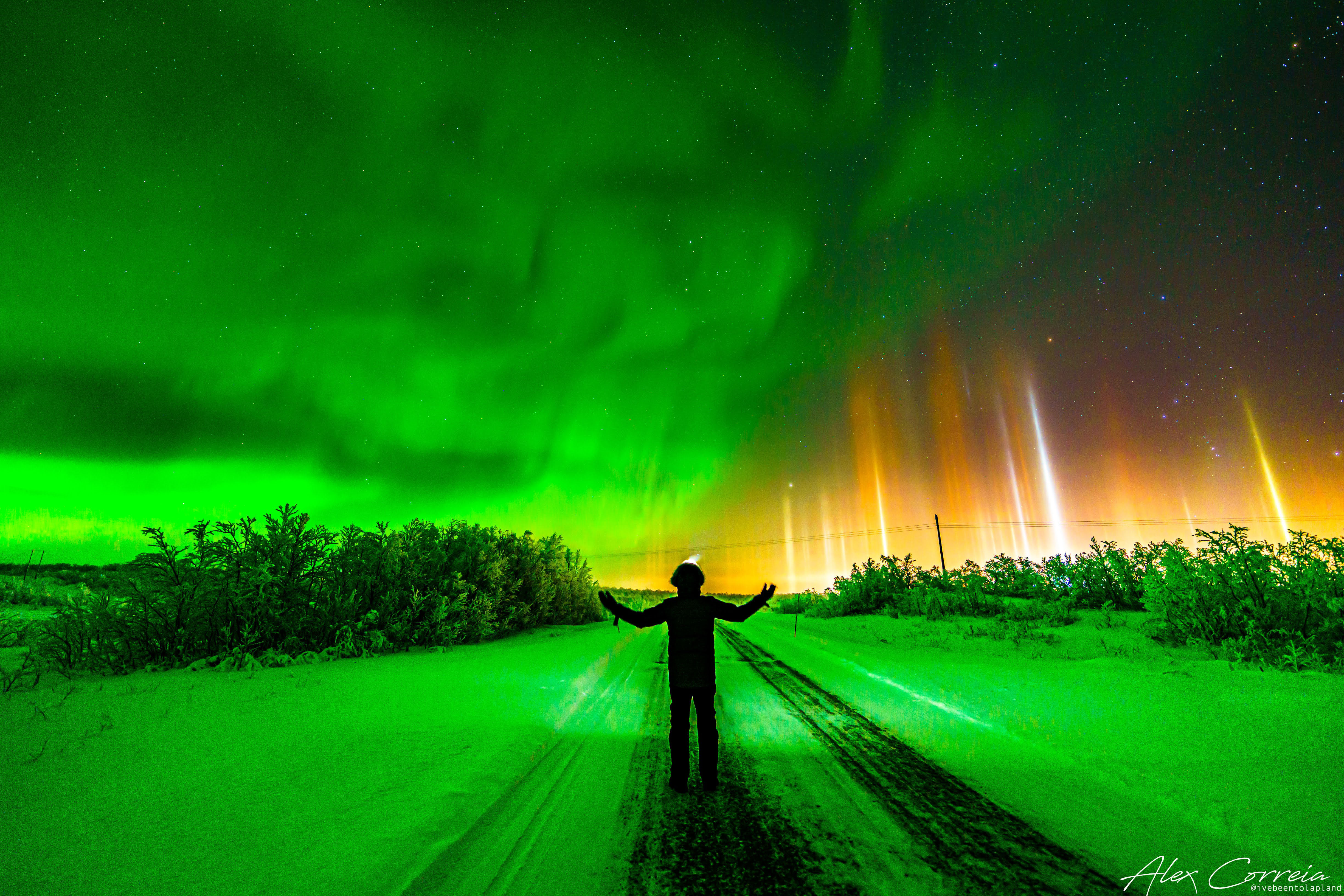
Which half of this sky is your favorite? On the left, the night sky is lit up by particles expelled from the Sun that later collided with Earth's upper atmosphere — creating bright auroras. On the right, the night glows with ground lights reflected by millions of tiny ice crystals falling from the sky — creating light pillars. And in the center, the astrophotographer presents your choices. The light pillars are vertical columns because the fluttering ice-crystals are mostly flat to the ground, and their colors are those of the ground lights. The auroras cover the sky and ground in the green hue of glowing oxygen, while their transparency is clear because you can see stars right through them. Distant stars dot the background, including bright stars from the iconic constellation of Orion. The featured image was captured in a single exposure two months ago near Kautokeino, Norway.
#space #earth #aurora #astrophotography #photography #NASA #science #physics #nature #education
Alt...
2022 February 8
The featured image shows the photographer standing beneath a night sky with green aurora on the left and colorful light pillars on the right.
Aurora and Light Pillars over Norway
* Image Credit & Copyright: Alexandre Correia
Explanation:
Which half of this sky is your favorite? On the left, the night sky is lit up by particles expelled from the Sun that later collided with Earth's upper atmosphere — creating bright auroras. On the right, the night glows with ground lights reflected by millions of tiny ice crystals falling from the sky — creating light pillars. And in the center, the astrophotographer presents your choices. The light pillars are vertical columns because the fluttering ice-crystals are mostly flat to the ground, and their colors are those of the ground lights. The auroras cover the sky and ground in the green hue of glowing oxygen, while their transparency is clear because you can see stars right through them. Distant stars dot the background, including bright stars from the iconic constellation of Orion. The featured image was captured in a single exposure two months ago near Kautokeino, Norway.
Authors & editors: Robert Nemiroff (MTU) & Jerry Bonnell (UMCP)
NASA Official: Phillip Newman Specific rights apply.
NASA Web Privacy Policy and Important Notices
A service of: ASD at NASA / GSFC
& Michigan Tech. U.
2018 May 1
The Aurora and the Sunrise
* Image Credit: NASA, International Space Station, Ricky Arnold
https://www.nasa.gov/international-space-station/
Explanation:
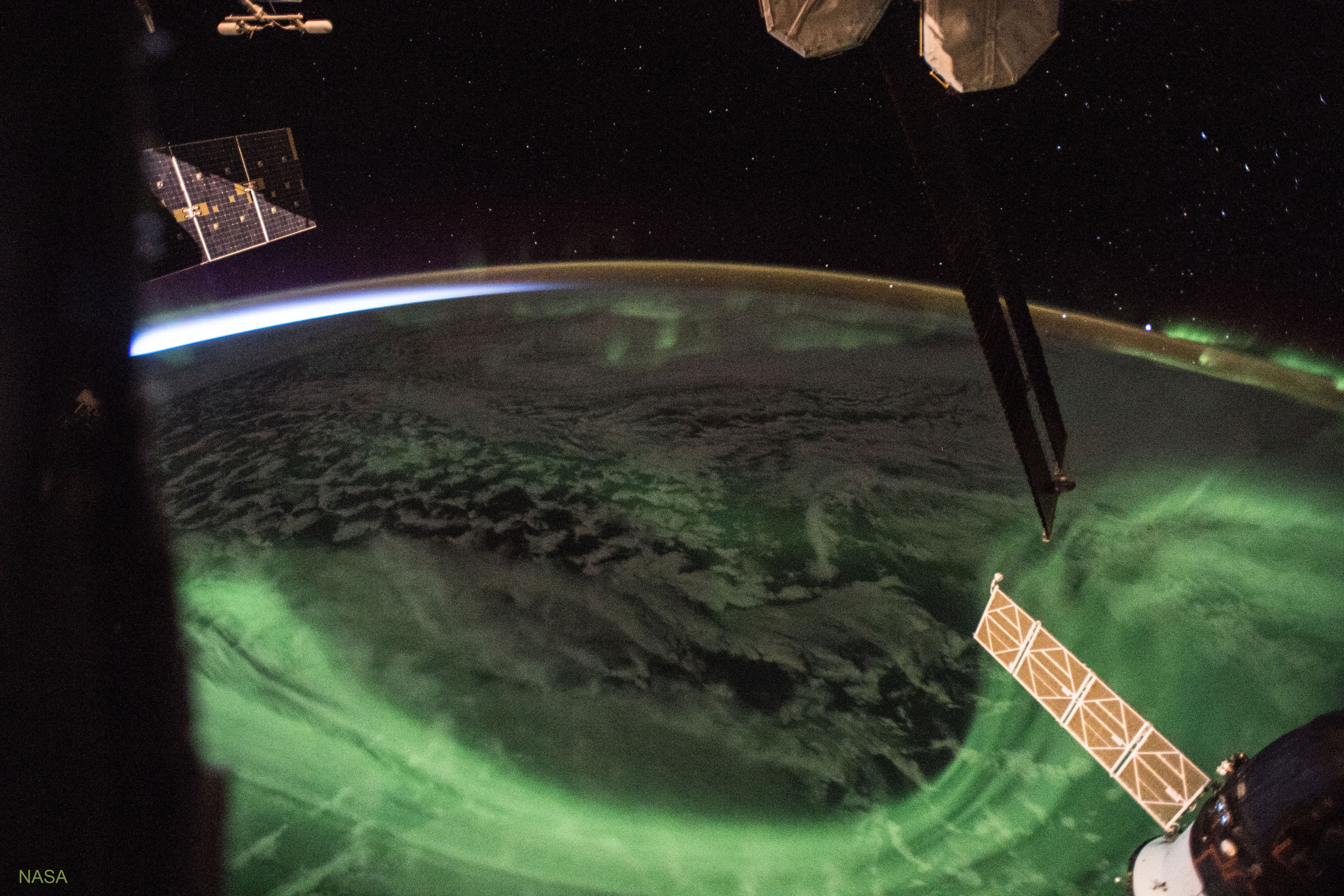
On the International Space Station (ISS), you can only admire an aurora until the sun rises. Then the background Earth becomes too bright. Unfortunately, after sunset, the rapid orbit of the ISS around the Earth means that sunrise is usually less than 47 minutes away. In the featured image, a green aurora is visible below the ISS -- and on the horizon to the upper right, while sunrise approaches ominously from the upper left. Watching an aurora from space can be mesmerizing as its changing shape has been compared to a giant green amoeba. Auroras are composed of energetic electrons and protons from the Sun that impact the Earth's magnetic field and then spiral down toward the Earth so fast that they cause atmospheric atoms and molecules to glow. The ISS orbits at nearly the same height as auroras, many times flying right through an aurora's thin upper layers, an event that neither harms astronauts nor changes the shape of the aurora.
https://www.nasa.gov/image-article/flying-through-an-aurora/
https://apod.nasa.gov/apod/ap180501.html
#space #earth #aurora #astrophotography #photography #NASA #science #nature #education
Alt...
2018 May 1
The Aurora and the Sunrise
* Image Credit: NASA, International Space Station, Ricky Arnold
Explanation:
On the International Space Station (ISS), you can only admire an aurora until the sun rises. Then the background Earth becomes too bright. Unfortunately, after sunset, the rapid orbit of the ISS around the Earth means that sunrise is usually less than 47 minutes away. In the featured image, a green aurora is visible below the ISS -- and on the horizon to the upper right, while sunrise approaches ominously from the upper left. Watching an aurora from space can be mesmerizing as its changing shape has been compared to a giant green amoeba. Auroras are composed of energetic electrons and protons from the Sun that impact the Earth's magnetic field and then spiral down toward the Earth so fast that they cause atmospheric atoms and molecules to glow. The ISS orbits at nearly the same height as auroras, many times flying right through an aurora's thin upper layers, an event that neither harms astronauts nor changes the shape of the aurora.
Authors & editors: Robert Nemiroff (MTU) & Jerry Bonnell (UMCP)
NASA Official: Phillip Newman Specific rights apply.
NASA Web Privacy Policy and Important Notices
A service of: ASD at NASA / GSFC
& Michigan Tech. U.
"Hey,
may i take you on a ride through the twilight into the night sky?? OK, buckle up and off we go .. scroll upwards if you dare to!"
2013 March 31
Flying Over the Earth at Night
* Video Credit: Gateway to Astronaut Photography, NASA
https://eol.jsc.nasa.gov/
http://www.nasa.gov/;
* Compilation: David Peterson https://www.youtube.com/user/Bitmeizer;
* Music: Freedom Fighters (Two Steps from Hell)
https://en.wikipedia.org/wiki/Two_Steps_from_Hell
Explanation:
Many wonders are visible when flying over the Earth at night. A compilation of such visual spectacles was captured recently from the International Space Station (ISS) and set to rousing music. Passing below are white clouds, orange city lights, lightning flashes in thunderstorms, and dark blue seas. On the horizon is the golden haze of Earth's thin atmosphere, frequently decorated by dancing auroras as the video progresses. The green parts of auroras typically remain below the space station, but the station flies right through the red and purple auroral peaks. Solar panels of the ISS are seen around the frame edges. The ominous wave of approaching brightness at the end of each sequence is just the dawn of the sunlit half of Earth, a dawn that occurs every 90 minutes.
https://apod.nasa.gov/apod/ap130331.html
#space #earth #aurora #astrophotography #photography #NASA #science #physics #nature #education #4sAur
Alt...
2013 March 31
Flying Over the Earth at Night
* Video Credit: Gateway to Astronaut Photography, NASA ;
* Compilation: David Peterson (YouTube);
* Music: Freedom Fighters (Two Steps from Hell)
Explanation:
Many wonders are visible when flying over the Earth at night. A compilation of such visual spectacles was captured recently from the International Space Station (ISS) and set to rousing music. Passing below are white clouds, orange city lights, lightning flashes in thunderstorms, and dark blue seas. On the horizon is the golden haze of Earth's thin atmosphere, frequently decorated by dancing auroras as the video progresses. The green parts of auroras typically remain below the space station, but the station flies right through the red and purple auroral peaks. Solar panels of the ISS are seen around the frame edges. The ominous wave of approaching brightness at the end of each sequence is just the dawn of the sunlit half of Earth, a dawn that occurs every 90 minutes.
Authors & editors: Robert Nemiroff (MTU) & Jerry Bonnell (UMCP)
NASA Official: Phillip Newman Specific rights apply.
NASA Web Privacy Policy and Important Notices
A service of: ASD at NASA / GSFC
& Michigan Tech. U.
2024 August 16
Meteor Borealis
* Image Credit & Copyright: Jason Dain
Explanation:
A single exposure made with a camera pointed almost due north on August 12 recorded this bright Perseid meteor in the night sky west of Halifax, Nova Scotia, Canada. The meteor's incandescent trace is fleeting. It appears to cross the stars of the Big Dipper, famous northern asterism and celestial kitchen utensil, while shimmering curtains of aurora borealis, also known as the northern lights, dance in the night. Doubling the wow factor for night skywatchers near the peak of this year's Perseid meteor shower auroral activity on planet Earth was enhanced by geomagnetic storms. The intense space weather was triggered by flares from an active Sun.
https://apod.nasa.gov/apod/ap240816.htmlhttps://apod.nasa.gov/apod/ap240816.html
#space #earth #aurora #astrophotography #photography #NASA #science #physics #nature #education #4sAur

Alt...
2024 August 16
Meteor Borealis
* Image Credit & Copyright: Jason Dain
Explanation:
A single exposure made with a camera pointed almost due north on August 12 recorded this bright Perseid meteor in the night sky west of Halifax, Nova Scotia, Canada. The meteor's incandescent trace is fleeting. It appears to cross the stars of the Big Dipper, famous northern asterism and celestial kitchen utensil, while shimmering curtains of aurora borealis, also known as the northern lights, dance in the night. Doubling the wow factor for night skywatchers near the peak of this year's Perseid meteor shower auroral activity on planet Earth was enhanced by geomagnetic storms. The intense space weather was triggered by flares from an active Sun.
Authors & editors: Robert Nemiroff (MTU) & Jerry Bonnell (UMCP)
NASA Official: Amber Straughn Specific rights apply.
NASA Web Privacy, Accessibility Notices
A service of: ASD at NASA / GSFC,
NASA Science Activation
& Michigan Tech. U.
2011 September 23
September's Aurora
* Image Credit & Copyright: Yuichi Takasaka / TWAN / www.blue-moon.ca
https://twanight.org/profile/yuichi-takasaka/
Explanation:
September's equinox arrived that day at 0905 UT. As the Sun crosses the celestial equator heading south, spring begins in the southern hemisphere and autumn in the north. And though the seasonal connection is still puzzling, both spring and autumn bring an increase in geomagnetic storms. So as northern nights grow longer, the equinox also heralds the arrival of a good season for viewing aurora. Recorded earlier this month, these curtains of September's shimmering green light sprawl across a gorgeous night skyscape. In the foreground lies Hidden Lake Territorial Park near Yellowknife, Northwest Territories, Canada. Calm water reflects the aurora, with bright star trails peering through the mesmerizing sky glow. Of course, shining at altitudes of 100 kilometers or so, planet Earth's auroras are visible from space.
https://apod.nasa.gov/apod/ap110923.html
#space #earth #aurora #astrophotography #photography #NASA #science #physics #nature #education #4sAur

Alt...
2011 September 23
September's Aurora
* Image Credit & Copyright: Yuichi Takasaka / TWAN / www.blue-moon.ca
Explanation:
September's equinox arrives today at 0905 UT. As the Sun crosses the celestial equator heading south, spring begins in the southern hemisphere and autumn in the north. And though the seasonal connection is still puzzling, both spring and autumn bring an increase in geomagnetic storms. So as northern nights grow longer, the equinox also heralds the arrival of a good season for viewing aurora. Recorded earlier this month, these curtains of September's shimmering green light sprawl across a gorgeous night skyscape. In the foreground lies Hidden Lake Territorial Park near Yellowknife, Northwest Territories, Canada. Calm water reflects the aurora, with bright star trails peering through the mesmerizing sky glow. Of course, shining at altitudes of 100 kilometers or so, planet Earth's auroras are visible from space.
Authors & editors: Robert Nemiroff (MTU) & Jerry Bonnell (UMCP)
NASA Official: Phillip Newman Specific rights apply.
NASA Web Privacy Policy and Important Notices
A service of: ASD at NASA / GSFC
& Michigan Tech. U.
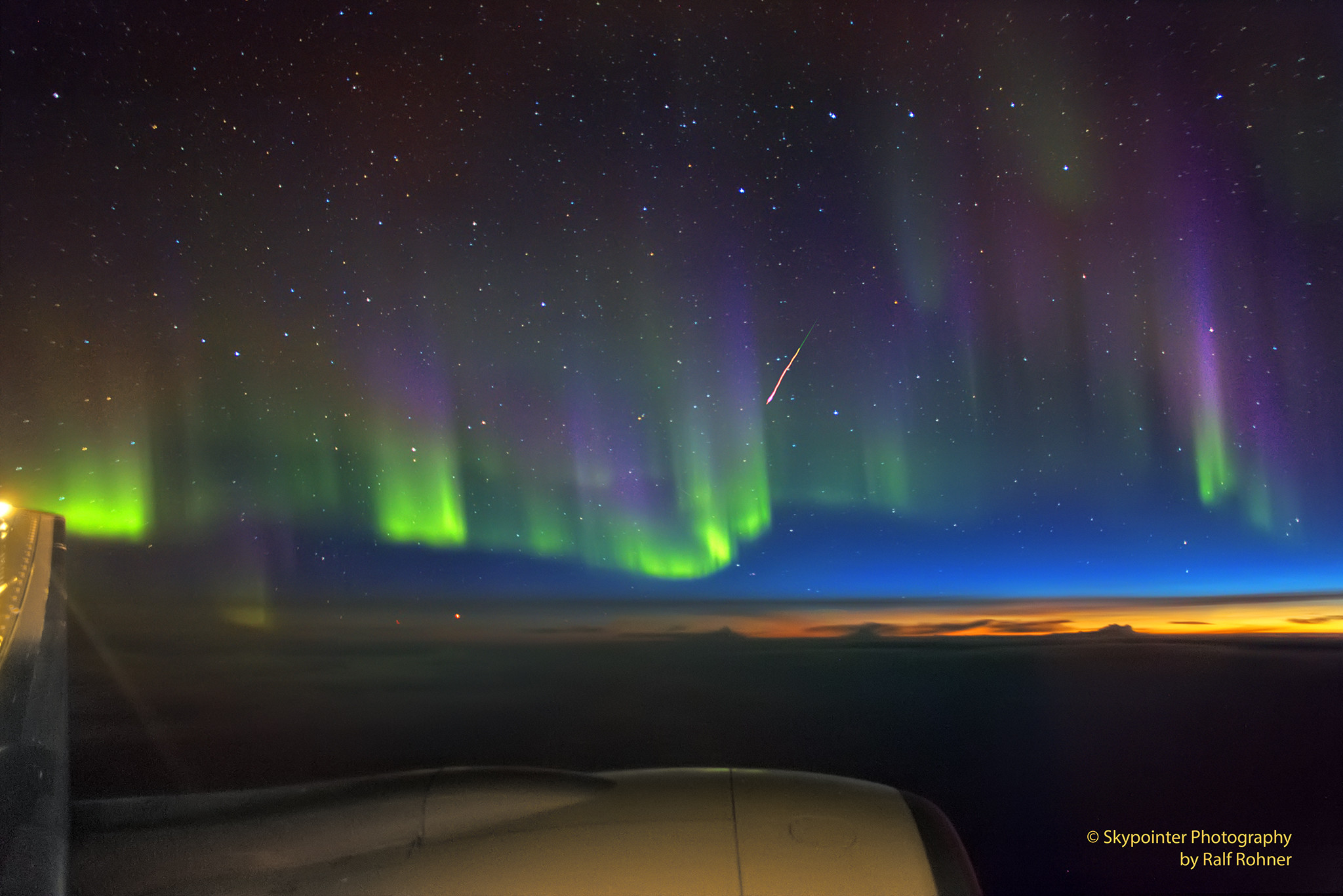
2018 September 22
Window Seat over Hudson Bay
* Image Credit & Copyright: Ralf Rohner
https://ralf-rohner.pixels.com/
Explanation:
On the August 18 night flight from San Francisco to Zurich, a window seat offered this tantalizing view when curtains of light draped a colorful glow across the sky over Hudson Bay. Constructed by digitally stacking six short exposures made with a hand held camera, the scene records the shimmering aurora borealis or northern lights just as the approaching high altitude sunrise illuminated the northeastern horizon. It also caught the flash of a Perseid meteor streaking beneath the handle stars of the Big Dipper of the north. A few days past the meteor shower's peak, its trail still points across the sky toward Perseus. Beautiful aurorae and shower meteors both occur in Earth's upper atmosphere at altitudes of 100 kilometers or so, far above commercial airline flights. The aurora are caused by energetic charged particles from the magnetosphere, while meteors are trails of comet dust.
https://apod.nasa.gov/apod/ap180922.html
#space #earth #aurora #astrophotography #photography #NASA #science #physics #nature #education #4sAur
Alt...
2018 September 22
Window Seat over Hudson Bay
* Image Credit & Copyright: Ralf Rohner
Explanation:
On the August 18 night flight from San Francisco to Zurich, a window seat offered this tantalizing view when curtains of light draped a colorful glow across the sky over Hudson Bay. Constructed by digitally stacking six short exposures made with a hand held camera, the scene records the shimmering aurora borealis or northern lights just as the approaching high altitude sunrise illuminated the northeastern horizon. It also caught the flash of a Perseid meteor streaking beneath the handle stars of the Big Dipper of the north. A few days past the meteor shower's peak, its trail still points across the sky toward Perseus. Beautiful aurorae and shower meteors both occur in Earth's upper atmosphere at altitudes of 100 kilometers or so, far above commercial airline flights. The aurora are caused by energetic charged particles from the magnetosphere, while meteors are trails of comet dust.
Authors & editors: Robert Nemiroff (MTU) & Jerry Bonnell (UMCP)
NASA Official: Phillip Newman Specific rights apply.
NASA Web Privacy Policy and Important Notices
A service of: ASD at NASA / GSFC
& Michigan Tech. U.
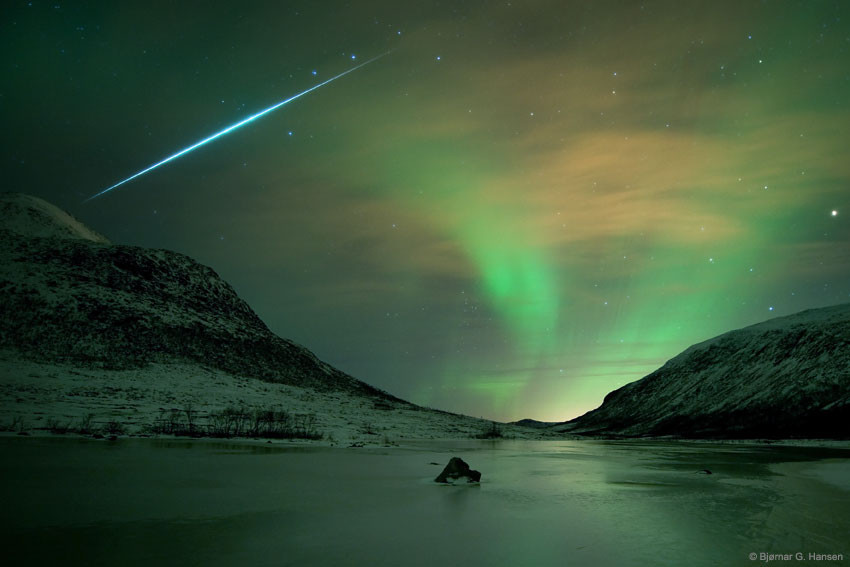
2018 December 9
Aurora Shimmer, Meteor Flash
* Image Credit & Copyright: Bjørnar G. Hansen
Explanation:
Some night skies are serene and passive -- others shimmer and flash. The later, in the form of auroras and meteors, haunted skies over the island of Kvaløya, near Tromsø Norway on 2009 December 13. This 30 second long exposure records a shimmering auroral glow gently lighting the wintery coastal scene. A study in contrasts, the image also captures the sudden flash of a fireball meteor from the excellent Geminid meteor shower of 2009. Streaking past familiar stars in the handle of the Big Dipper, the trail points back toward the constellation Gemini, off the top of the view. Both auroras and meteors occur in Earth's upper atmosphere at altitudes of 100 kilometers or so, but aurora caused by energetic charged particles from the magnetosphere, while meteors are trails of cosmic dust. Nine years after this photograph was taken, toward the end of this week, the yearly 2018 Geminids meteor shower will peak again, although this time their flashes will compete with the din of a half-lit first-quarter moon during the first half of the night.
https://apod.nasa.gov/apod/ap181209.html
#space #earth #aurora #astrophotography #photography #NASA #science #physics #nature #education #4sAur
Alt...
2018 December 9
Aurora Shimmer, Meteor Flash
* Image Credit & Copyright: Bjørnar G. Hansen
Explanation:
Some night skies are serene and passive -- others shimmer and flash. The later, in the form of auroras and meteors, haunted skies over the island of Kvaløya, near Tromsø Norway on 2009 December 13. This 30 second long exposure records a shimmering auroral glow gently lighting the wintery coastal scene. A study in contrasts, the image also captures the sudden flash of a fireball meteor from the excellent Geminid meteor shower of 2009. Streaking past familiar stars in the handle of the Big Dipper, the trail points back toward the constellation Gemini, off the top of the view. Both auroras and meteors occur in Earth's upper atmosphere at altitudes of 100 kilometers or so, but aurora caused by energetic charged particles from the magnetosphere, while meteors are trails of cosmic dust. Nine years after this photograph was taken, toward the end of this week, the yearly 2018 Geminids meteor shower will peak again, although this time their flashes will compete with the din of a half-lit first-quarter moon during the first half of the night.
Authors & editors: Robert Nemiroff (MTU) & Jerry Bonnell (UMCP)
NASA Official: Phillip Newman Specific rights apply.
NASA Web Privacy Policy and Important Notices
A service of: ASD at NASA / GSFC
& Michigan Tech. U.
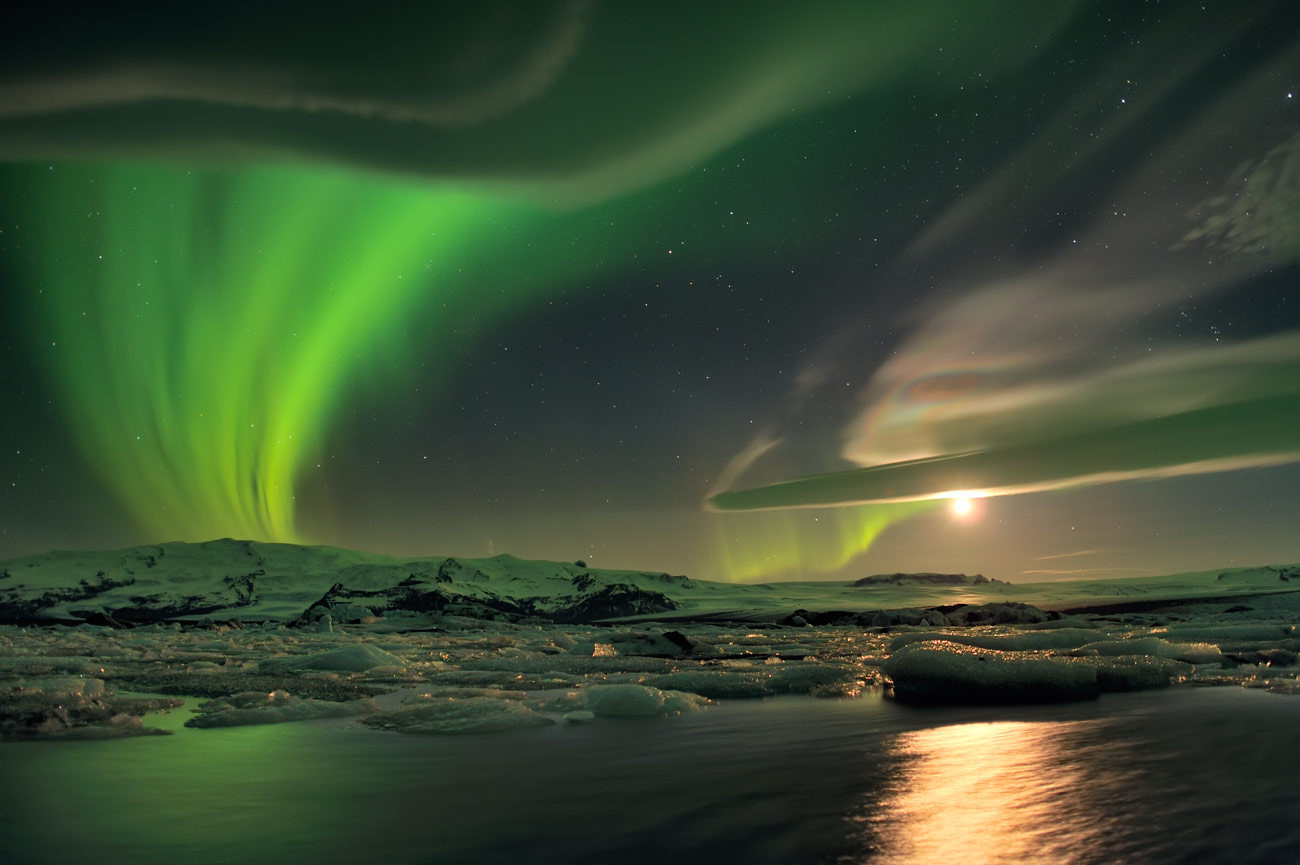
2013 November 18
Aurora and Unusual Clouds Over Iceland
* Image Credit & Copyright: Stéphane Vetter (Nuits sacrées)
http://www.nuitsacrees.fr/
Explanation:
What's happening in the sky? On this cold winter night in Iceland, quite a lot. First, in the foreground, lies the largest glacier in Iceland: Vatnajokull. On the far left, bright green auroras appear to emanate from the glacier as if it was a volcano. Aurora light is reflected by the foreground lake Jökulsárlón. On the far right is a long and unusual lenticular cloud tinged with green light emitted from another aurora well behind it. Just above this lenticular cloud are unusual iridescent lenticular clouds displaying a broad spectral range of colors. Far beyond the lenticular is the setting Moon, while far beyond even the Moon are setting stars. The above image was captured in late March of 2012.
#space #earth #aurora #astrophotography #photography #NASA #science #physics #nature #education #4sAur
Alt...
2013 November 18
Aurora and Unusual Clouds Over Iceland
* Image Credit & Copyright: Stéphane Vetter (Nuits sacrées)
Explanation:
What's happening in the sky? On this cold winter night in Iceland, quite a lot. First, in the foreground, lies the largest glacier in Iceland: Vatnajokull. On the far left, bright green auroras appear to emanate from the glacier as if it was a volcano. Aurora light is reflected by the foreground lake Jökulsárlón. On the far right is a long and unusual lenticular cloud tinged with green light emitted from another aurora well behind it. Just above this lenticular cloud are unusual iridescent lenticular clouds displaying a broad spectral range of colors. Far beyond the lenticular is the setting Moon, while far beyond even the Moon are setting stars. The above image was captured in late March of 2012.
Authors & editors: Robert Nemiroff (MTU) & Jerry Bonnell (UMCP)
NASA Official: Phillip Newman Specific rights apply.
NASA Web Privacy Policy and Important Notices
A service of: ASD at NASA / GSFC
& Michigan Tech. U.
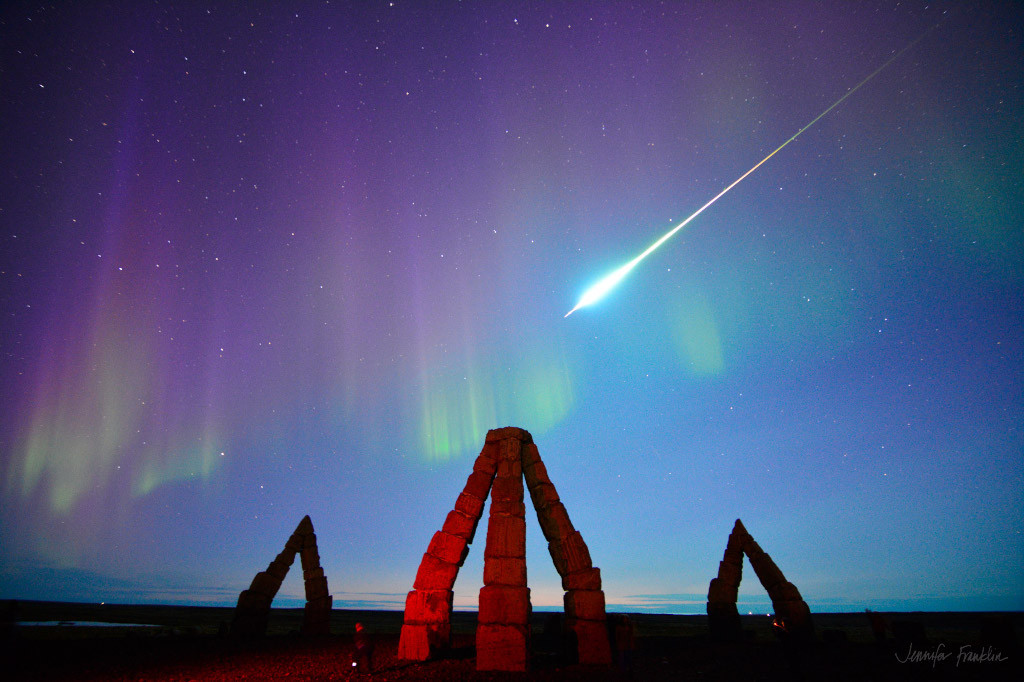
2023 September 16
Fireball over Iceland
* Image Credit & Copyright: Jennifer Franklin
Explanation:
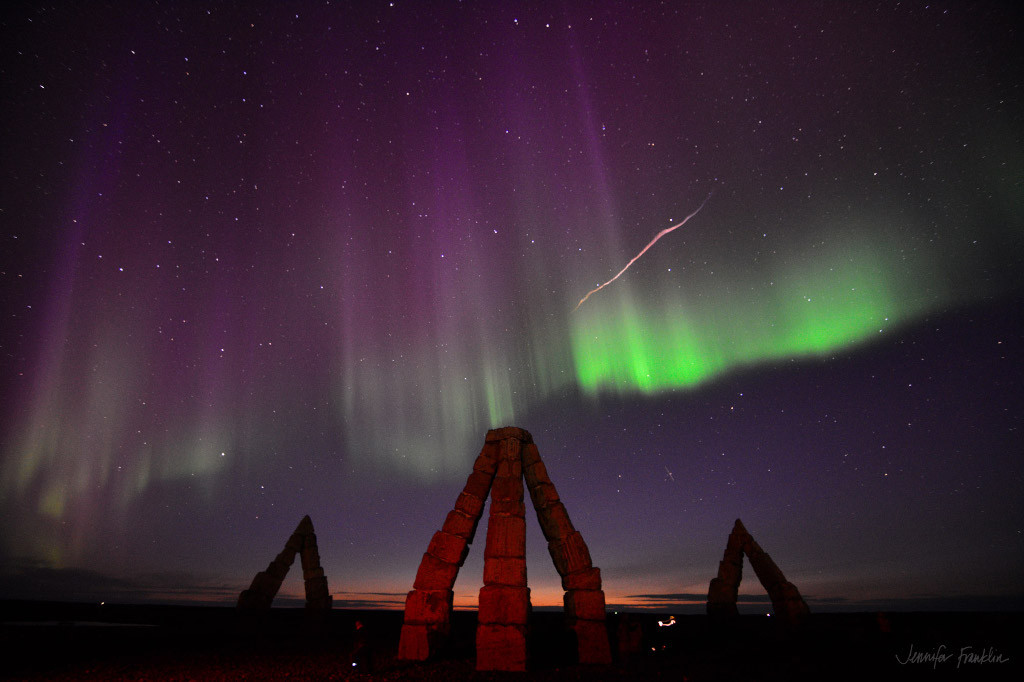
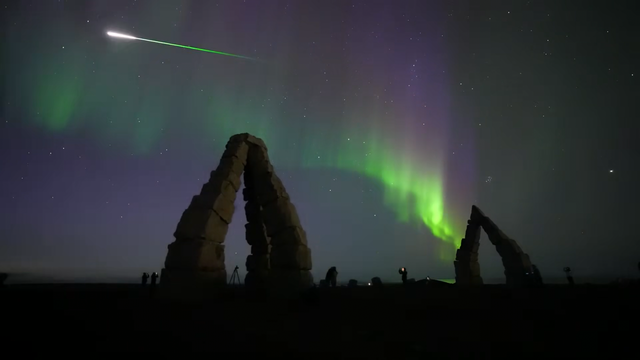
On September 12, from a location just south of the Arctic Circle, stones of Iceland's modern Arctic Henge point skyward in this startling scene. Entertaining an intrepid group of aurora hunters during a geomagnetic storm, alluring northern lights dance across the darkened sky when a stunning fireball meteor explodes. Awestruck, the camera-equipped skygazers captured video and still images of the boreal bolide, at its peak about as bright as a full moon. Though quickly fading from view, the fireball left a lingering visible trail or persistent train. The wraith-like trail was seen for minutes wafting in the upper atmosphere at altitudes of 60 to 90 kilometers along with the auroral glow.
https://apod.nasa.gov/apod/ap230916.html
#space #earth #aurora #astrophotography #photography #NASA #science #physics #nature #education #4sAur
Alt...
2023 September 16
Fireball over Iceland
* Image Credit & Copyright: Jennifer Franklin
Explanation:
On September 12, from a location just south of the Arctic Circle, stones of Iceland's modern Arctic Henge point skyward in this startling scene. Entertaining an intrepid group of aurora hunters during a geomagnetic storm, alluring northern lights dance across the darkened sky when a stunning fireball meteor explodes. Awestruck, the camera-equipped skygazers captured video and still images of the boreal bolide, at its peak about as bright as a full moon. Though quickly fading from view, the fireball left a lingering visible trail or persistent train. The wraith-like trail was seen for minutes wafting in the upper atmosphere at altitudes of 60 to 90 kilometers along with the auroral glow.
Authors & editors: Robert Nemiroff (MTU) & Jerry Bonnell (UMCP)
NASA Official: Phillip Newman Specific rights apply.
NASA Web Privacy Policy and Important Notices
A service of: ASD at NASA / GSFC,
NASA Science Activation
& Michigan Tech. U.
Alt...
Persistent train in auroral sky
Fireball Above Iceland
by Babak Tafreshi
https://print.babaktafreshi.com/talks-workshops-tours
"On 2023 September 13, near the northern most point of Iceland, the night sky exploded with the northern lights and a spectacular fireball, above the Arctic Henge monument. I was about to move our group to another spot when this tennis-ball sized space rock entered the earth atmosphere and burned at an altitude of 60-90 km above us, becoming as bright as the full moon for a moment. Such meteors are very rare to witness. Even for a frequent observer like me it took three decades to finally record one in video!
I was on my biannual Aurora PhotoTour. My Icelandic colleague Stjornu Saevar appears near the clip’s end, on a phone interview with the local media about the meteor."
CREDIT
Babak Tafreshi
#space #earth #aurora #astrophotography #photography #NASA #science #physics #nature #education #4sAur
Alt...
On 2023 September 13, near the northern most point of Iceland, the night sky exploded with the northern lights and a spectacular fireball, above the Arctic Henge monument. I was about to move our group to another spot when this tennis-ball sized space rock entered the earth atmosphere and burned at an altitude of 60-90 km above us, becoming as bright as the full moon for a moment. Such meteors are very rare to witness. Even for a frequent observer like me it took three decades to finally record one in video!
I was on my biannual Aurora PhotoTour. My Icelandic colleague Stjornu Saevar appears near the clip’s end, on a phone interview with the local media about the meteor.
CREDIT
Babak Tafreshi
2025 September 26
A SWAN, an ATLAS, and Mars
* Image Credit & Copyright: Adam Block
https://www.adamblockphotos.com/
Explanation:
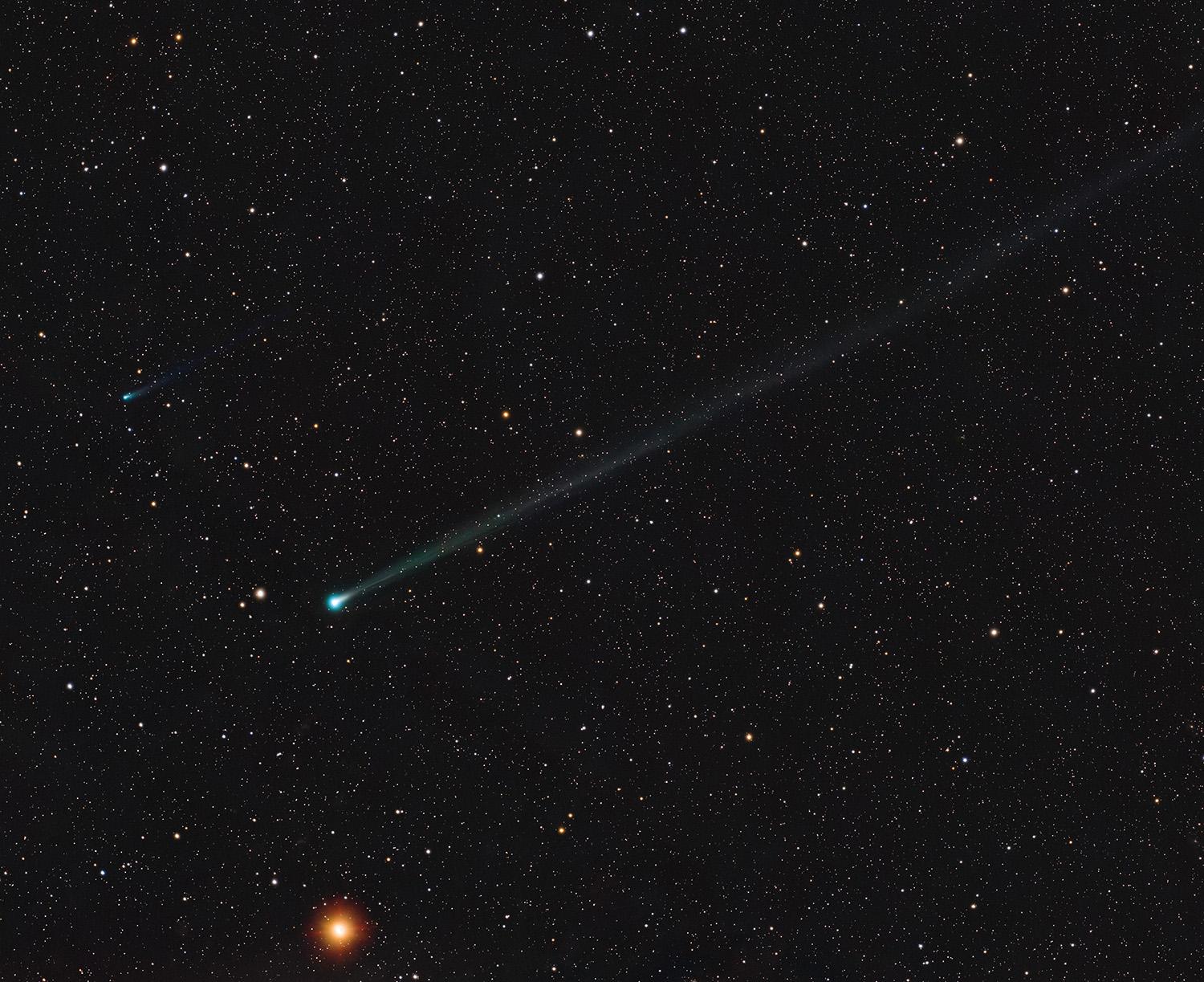
A new visitor to the inner Solar System, comet C/2025 R2 (SWAN) sports a long ion tail extending diagonally across this almost 7 degree wide telescopic field of view recorded on September 21. A fainter fellow comet also making its inner Solar System debut, C/2025 K1 (ATLAS), can be spotted above and left of SWAN's greenish coma, just visible against the background sea of stars in the constellation Virgo. Both new comets were only discovered in 2025 and are joined in this celestial frame by ruddy planet Mars (bottom), a more familiar wanderer in planet Earth's night skies. The comets may appear to be in a race, nearly neck and neck in their voyage through the inner Solar System and around the Sun. But this comet SWAN has already reached its perihelion or closest approach to the Sun on September 12 and is now outbound along its orbit. This comet ATLAS is still inbound though, and will make its perihelion passage on October 8.
https://app.astrobin.com/i/vf43w6
https://www.skyatnightmagazine.com/news/c-2025-k1-atlas
https://theskylive.com/c2025k1-info
https://theskylive.com/c2025k1-info
https://apod.nasa.gov/apod/ap250926.html
#space #comets #astrophotography #photography #science #astronomy #nature #NASA #ESA #education
Alt...
2025 September 26
A SWAN, an ATLAS, and Mars
* Image Credit & Copyright: Adam Block
Explanation:
A new visitor to the inner Solar System, comet C/2025 R2 (SWAN) sports a long ion tail extending diagonally across this almost 7 degree wide telescopic field of view recorded on September 21. A fainter fellow comet also making its inner Solar System debut, C/2025 K1 (ATLAS), can be spotted above and left of SWAN's greenish coma, just visible against the background sea of stars in the constellation Virgo. Both new comets were only discovered in 2025 and are joined in this celestial frame by ruddy planet Mars (bottom), a more familiar wanderer in planet Earth's night skies. The comets may appear to be in a race, nearly neck and neck in their voyage through the inner Solar System and around the Sun. But this comet SWAN has already reached its perihelion or closest approach to the Sun on September 12 and is now outbound along its orbit. This comet ATLAS is still inbound though, and will make its perihelion passage on October 8.
Authors & editors: Robert Nemiroff (MTU) & Jerry Bonnell (UMCP)
NASA Official: Amber Straughn Specific rights apply.
NASA Web Privacy, Accessibility, Notices;
A service of: ASD at NASA / GSFC,
NASA Science Activation
& Michigan Tech. U.
2025 September 24
GW250114: Rotating Black Holes Collide
* Illustration Credit: Aurore Simonnet (SSU/EdEon), LVK, URI; LIGO Collaboration
https://auroresimonnet.com/about-me/
https://phys-astro.sonoma.edu/
https://edeon.sonoma.edu/
https://www.ligo.caltech.edu/page/ligo-scientific-collaboration
Explanation:
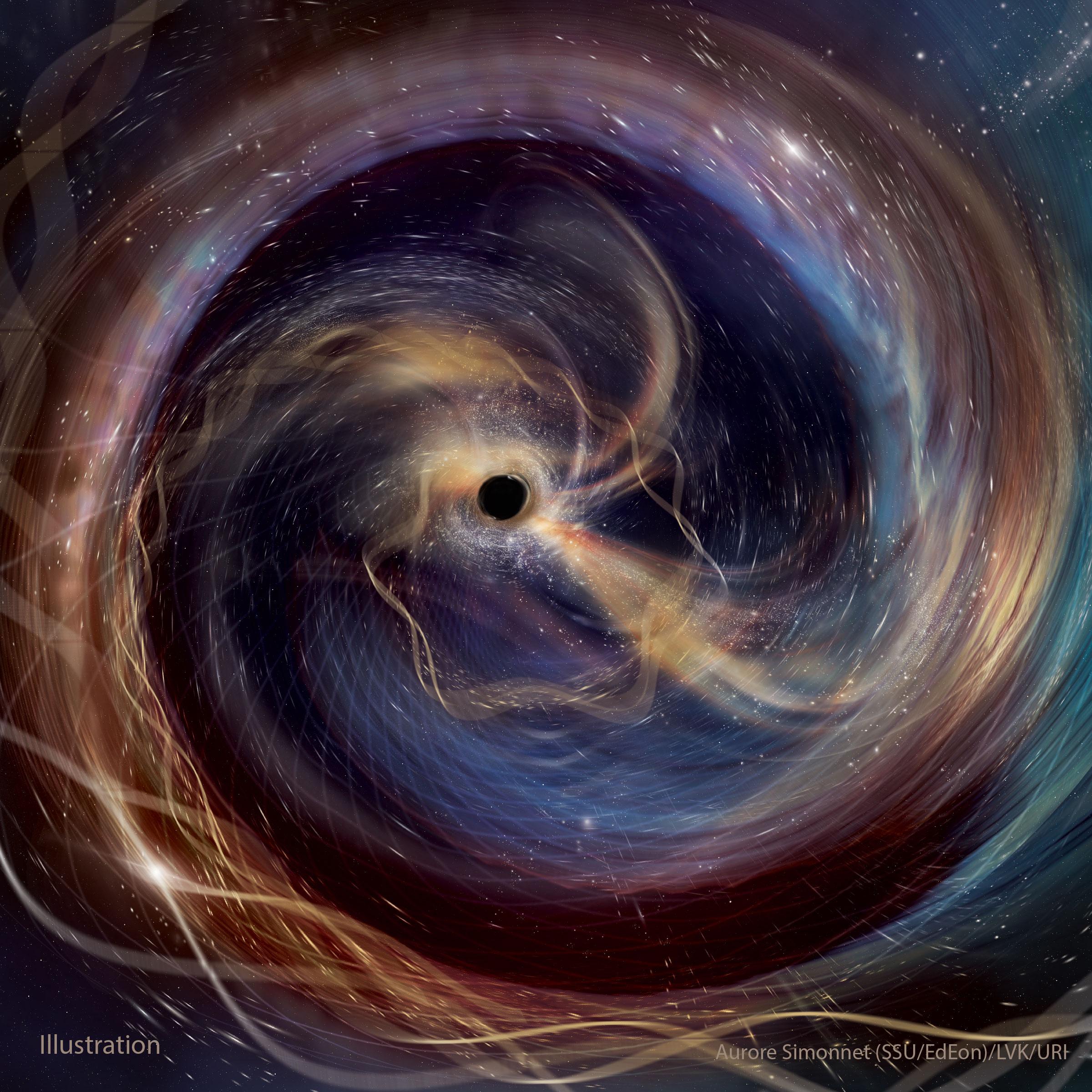
It was the strongest gravitational wave signal yet measured -- what did it show? GW250114 was detected by both arms of the Laser Interferometer Gravitational-wave Observatory (LIGO) in Washington and Louisiana USA earlier this year. Analysis showed that the event was created when two black holes, each of mass around 33 times the mass of the Sun, coalesced into one larger black hole with a mass of around 63 solar masses. Even though the event happened about a billion light years away, the signal was so strong that the spin of all black holes, as well as initial ringing of the final black hole, was deduced with exceptional accuracy. Furthermore, it was confirmed better than before, as previously predicted, that the total event horizon area of the combined black hole was greater than those of the merging black holes. Featured, an artist's illustration depicts an imaginative and conceptual view from near one of the black holes before collision.
https://www.ligo.caltech.edu/
https://www.caltech.edu/about/news/first-overtones-heard-ringing-black-hole
https://science.nasa.gov/universe/black-holes/anatomy/
https://apod.nasa.gov/apod/ap190414.html
https://apod.nasa.gov/htmltest/rjn_bht.html
https://spaceplace.nasa.gov/black-holes/en/
https://apod.nasa.gov/apod/ap191001.html
https://en.wikipedia.org/wiki/Black_hole_thermodynamics#Second_law_2
https://en.wikipedia.org/wiki/GW250114
https://apod.nasa.gov/apod/ap250924.html
#space #blackhole #astrophysics #astrophotography #photography #astronomy #science #nature #NASA #ESA #education
Alt...
2025 September 24
Artwork depicts a colorful version of two black holes nearing collision from between the black holes. Swirling gas is depicted with wavey lined depicting gravitational waves ringing and an artificial grid depicting spacetime shown distorting.
GW250114: Rotating Black Holes Collide
* Illustration Credit: Aurore Simonnet (SSU/EdEon), LVK, URI; LIGO Collaboration
Explanation:
It was the strongest gravitational wave signal yet measured -- what did it show? GW250114 was detected by both arms of the Laser Interferometer Gravitational-wave Observatory (LIGO) in Washington and Louisiana USA earlier this year. Analysis showed that the event was created when two black holes, each of mass around 33 times the mass of the Sun, coalesced into one larger black hole with a mass of around 63 solar masses. Even though the event happened about a billion light years away, the signal was so strong that the spin of all black holes, as well as initial ringing of the final black hole, was deduced with exceptional accuracy. Furthermore, it was confirmed better than before, as previously predicted, that the total event horizon area of the combined black hole was greater than those of the merging black holes. Featured, an artist's illustration depicts an imaginative and conceptual view from near one of the black holes before collision.
Authors & editors: Robert Nemiroff (MTU) & Jerry Bonnell (UMCP)
NASA Official: Amber Straughn Specific rights apply.
What Is a Black Hole?
The Short Answer:
A black hole is an area of such immense gravity that nothing -- not even light -- can escape from it.
https://spaceplace.nasa.gov/black-holes/en/
#space #blackhole #astroart #astronomy #science #nature #NASA #education
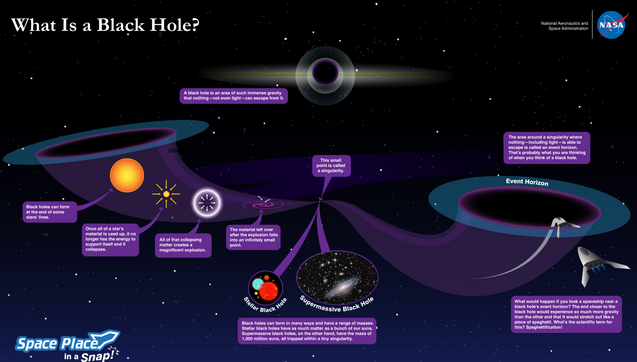
Alt...
converted and compressed video version
explaining black holes for young students
Download a poster of this animation from NASA Space Place:
8.5 x 11 inches:
https://spaceplace.nasa.gov/black-holes/en/BlackHoles-poster_8.5x11.pdf
8.5 x 13 inches
https://spaceplace.nasa.gov/black-holes/en/BlackHoles-poster_8.5x13.pdf
11 x 17 inches
https://spaceplace.nasa.gov/black-holes/en/BlackHoles-poster_11x17.pdf
https://spaceplace.nasa.gov/black-holes/en/
you might also like:
https://www.jpl.nasa.gov/edu/resources/teachable-moment/how-scientists-captured-the-first-image-of-a-black-hole/
#space #blackhole #astronomy #science #nature #NASA #education
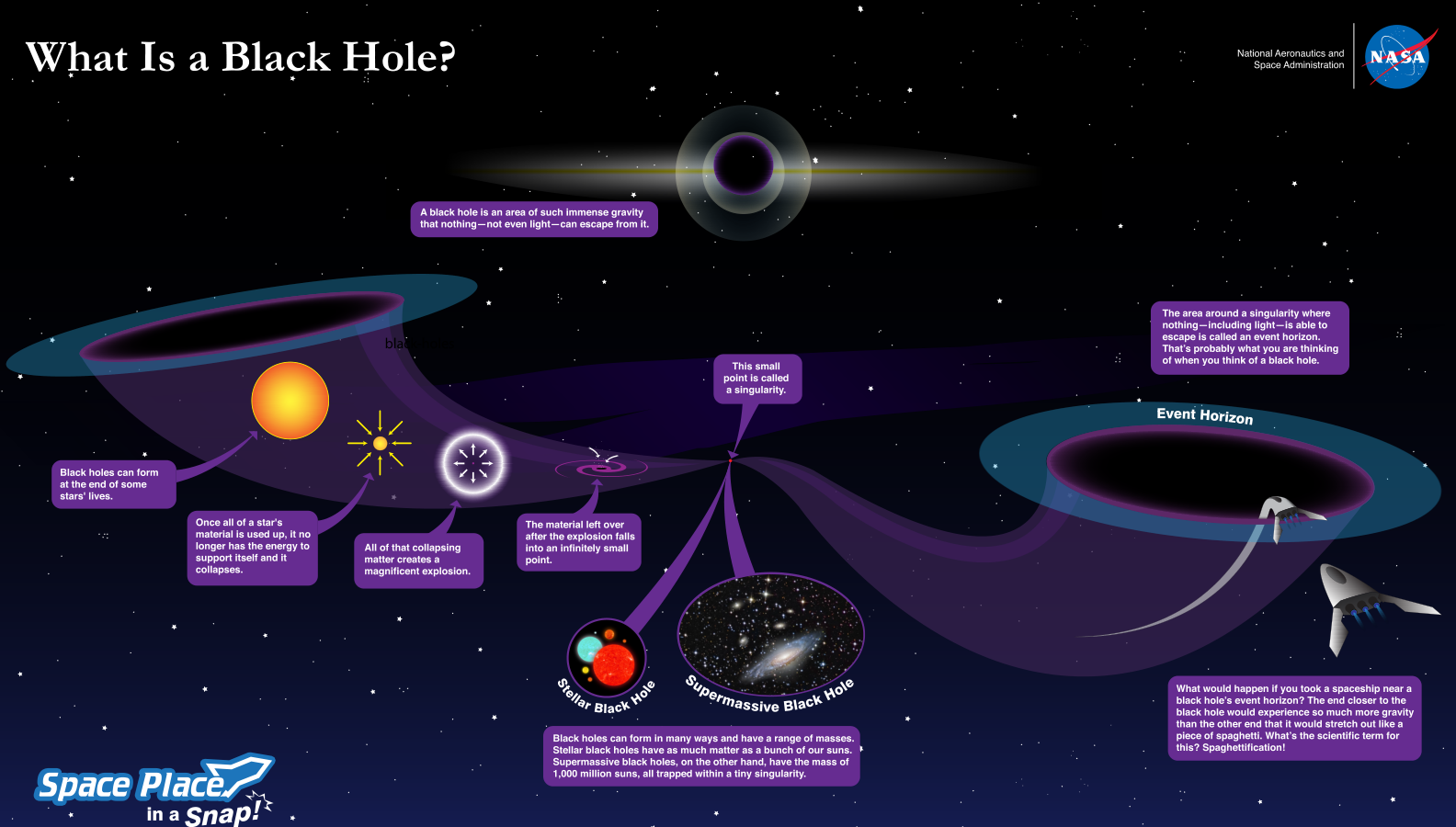
Alt...
Image of tutorial poster for schools explaining black holes
click links to download from NASA SpacePlace web page above
2025 September 23
NGC 6357: Cathedral to Massive Stars
* Image Credit: NASA, ESA, CSA, STScI, JWST
https://www.nasa.gov/
https://www.esa.int/
https://www.asc-csa.gc.ca/eng/
https://www.stsci.edu/
https://science.nasa.gov/mission/webb/
* Processing: Alyssa Pagan (STScI)
https://www.friendsofnasa.org/2023/03/behind-mission-alyssa-pagan-james-webb.html
* Rollover: NASA, ESA, HST, & J. M. Apellániz (IAA, Spain)
https://www.iaa.es/
* Acknowledgement: D. De Martin (ESA/Hubble)
https://esahubble.org/
Explanation:
How massive can a normal star be? Estimates made from distance, brightness and standard solar models had given one star in the open cluster Pismis 24 over 200 times the mass of our Sun, making it one of the most massive stars known. This star is the brightest object located in the central cavity near the bottom center of the featured image taken with the Webb Space Telescope in infrared light. For comparison, a rollover image from the Hubble Space Telescope is also featured in visible light. Close inspection of the images, however, has shown that Pismis 24-1 derives its brilliant luminosity not from a single star but from three at least. Component stars would still remain near 100 solar masses, making them among the more massive stars currently on record. Toward the bottom of the image, stars are still forming in the associated emission nebula NGC 6357. Appearing perhaps like a Gothic cathedral, energetic stars near the center appear to be breaking out and illuminating a spectacular cocoon.
https://apod.nasa.gov/apod/ap250923.html
#space #nebula #cluster #astrophotography #photography #science #astronomy #nature #NASA #ESA #education

Alt...
2025 September 23
Stars dot the frame that has a blue background. Covering the lower part of the image, and the far right, are brown and tan nebular structures.
NGC 6357: Cathedral to Massive Stars
* Image Credit: NASA, ESA, CSA, STScI, JWST
* Processing: Alyssa Pagan (STScI)
* Rollover: NASA, ESA, HST, & J. M. Apellániz (IAA, Spain)
* Acknowledgement: D. De Martin (ESA/Hubble)
Explanation:
How massive can a normal star be? Estimates made from distance, brightness and standard solar models had given one star in the open cluster Pismis 24 over 200 times the mass of our Sun, making it one of the most massive stars known. This star is the brightest object located in the central cavity near the bottom center of the featured image taken with the Webb Space Telescope in infrared light. For comparison, a rollover image from the Hubble Space Telescope is also featured in visible light. Close inspection of the images, however, has shown that Pismis 24-1 derives its brilliant luminosity not from a single star but from three at least. Component stars would still remain near 100 solar masses, making them among the more massive stars currently on record. Toward the bottom of the image, stars are still forming in the associated emission nebula NGC 6357. Appearing perhaps like a Gothic cathedral, energetic stars near the center appear to be breaking out and illuminating a spectacular cocoon.
Authors & editors: Robert Nemiroff (MTU) & Jerry Bonnell (UMCP)

Alt...
WEBB Infrared Light Image
2025 September 21
Equinox Sunset
* Image Credit: Luca Vanzella
https://www.flickr.com/people/53851348@N05/
Explanation:
Does the Sun set in the same direction every day? No, the direction of sunset depends on the time of the year. Although the Sun always sets approximately toward the west, on an equinox like tomorrow the Sun sets directly toward the west. After tomorrow's September equinox, the Sun will set increasingly toward the southwest, reaching its maximum displacement at the December solstice. Before tomorrow's (today's) September equinox, the Sun had set toward the northwest, reaching its maximum displacement at the June solstice. The featured time-lapse image shows seven bands of the Sun setting one day each month from 2019 December through 2020 June. These image sequences were taken from Alberta, Canada -- well north of the Earth's equator -- and feature the city of Edmonton in the foreground. The middle band shows the Sun setting during an equinox -- in March. From this location, the Sun will set along this same equinox band again tomorrow.
https://earthsky.org/astronomy-essentials/everything-you-need-to-know-vernal-or-spring-equinox/
https://apod.nasa.gov/apod/ap250921.html
#space #earth #sun #astrophotography #photography #science #astronomy #physics #nature #NASA #education

Alt...
2025 September 21
A city skyline is shown behind some hills and a river. The path of the Sun is shown for several times during a year.
Equinox Sunset
* Image Credit: Luca Vanzella
Explanation:
Does the Sun set in the same direction every day? No, the direction of sunset depends on the time of the year. Although the Sun always sets approximately toward the west, on an equinox like tomorrow the Sun sets directly toward the west. After tomorrow's September equinox, the Sun will set increasingly toward the southwest, reaching its maximum displacement at the December solstice. Before tomorrow's September equinox, the Sun had set toward the northwest, reaching its maximum displacement at the June solstice. The featured time-lapse image shows seven bands of the Sun setting one day each month from 2019 December through 2020 June. These image sequences were taken from Alberta, Canada -- well north of the Earth's equator -- and feature the city of Edmonton in the foreground. The middle band shows the Sun setting during an equinox -- in March. From this location, the Sun will set along this same equinox band again tomorrow.
Authors & editors: Robert Nemiroff (MTU) & Jerry Bonnell (UMCP)
NASA Official: Amber Straughn Specific rights apply.
NASA Web Privacy, Accessibility, Notices;
A service of: ASD at NASA / GSFC,
NASA Science Activation
& Michigan Tech. U.
2014 March 19
Equinox on a Spinning Earth
* Image Credit: NASA, Meteosat, Robert Simmon
http://www.nasa.gov/
http://www.eumetsat.int/website/home/Satellites/CurrentSatellites/Meteosat/index.html
http://www.nasa.gov/centers/goddard/about/people/RSimmon.html
Explanation:
When does the line between day and night become vertical? Tomorrow. Tomorrow is an equinox on planet Earth, a time of year when day and night are most nearly equal. At an equinox, the Earth's terminator -- the dividing line between day and night -- becomes vertical and connects the north and south poles. The above time-lapse video demonstrates this by displaying an entire year on planet Earth in twelve seconds. From geosynchronous orbit, the Meteosat satellite recorded these infrared images of the Earth every day at the same local time. The video started at the September 2010 equinox with the terminator line being vertical. As the Earth revolved around the Sun, the terminator was seen to tilt in a way that provides less daily sunlight to the northern hemisphere, causing winter in the north. As the year progressed, the March 2011 equinox arrived halfway through the video, followed by the terminator tilting the other way, causing winter in the southern hemisphere -- and summer in the north. The captured year ends again with the September equinox, concluding another of billions of trips the Earth has taken -- and will take -- around the Sun.
https://en.wikipedia.org/wiki/Equinox
!>>https://earthsky.org/astronomy-essentials/everything-you-need-to-know-vernal-or-spring-equinox/
https://apod.nasa.gov/apod/ap140319.html
#space #earth #sun #astrophotography #photography #science #astronomy #physics #nature #NASA #education
How NASA’s Roman Mission Will Unveil Our Home Galaxy Using
Cosmic Dust
- NASA / Ashley Balzer
NASA’s Nancy Grace Roman Space Telescope will help scientists better understand our Milky Way galaxy’s less sparkly components — gas and dust strewn between stars, known as the interstellar medium.
One of Roman’s major observing programs, called the Galactic Plane Survey, will peer through our galaxy to its most distant edge, mapping roughly 20 billion stars—about four times more than have currently been mapped. Scientists will use data from these stars to study and map the dust their light travels through, contributing to the most complete picture yet of the Milky Way’s structure, star formation, and the origins of our solar system. [...]
Scientists know how our galaxy likely looks by combining observations of the Milky Way and other spiral galaxies. But dust clouds make it hard to work out the details on the opposite side of our galaxy. Imagine trying to map a neighborhood while looking through the windows of a house surrounded by a dense fog.
Roman will see through the “fog” of dust using a specialized camera and filters that observe infrared light — light with longer wavelengths than our eyes can detect. Infrared light is more likely to pass through dust clouds without scattering.
Light with shorter wavelengths, including blue light produced by stars, more easily scatters. That means stars shining through dust appear dimmer and redder than they actually are.
By comparing the observations with information on the source star’s characteristics, astronomers can disentangle the star’s distance from how much its colors have been reddened. Studying those effects reveals clues about the dust’s properties. [...]
* Credit: NASA/Laine Havens
* Music credit: Building Heroes by Enrico Cacace [BMI], Universal Production Music
#space #nebula #cosmic_dust #astrophotography #photography #science #astronomy #nature #NASA #ESA #education
2005 December 23
Hydrogen and Dust in the Rosette Nebula
* Credit: Nick Wright (University College London), IPHAS Collaboration
https://www.ucl.ac.uk/mathematical-physical-sciences/astrophysics
https://www.imperial.ac.uk/astrophysics
Explanation:
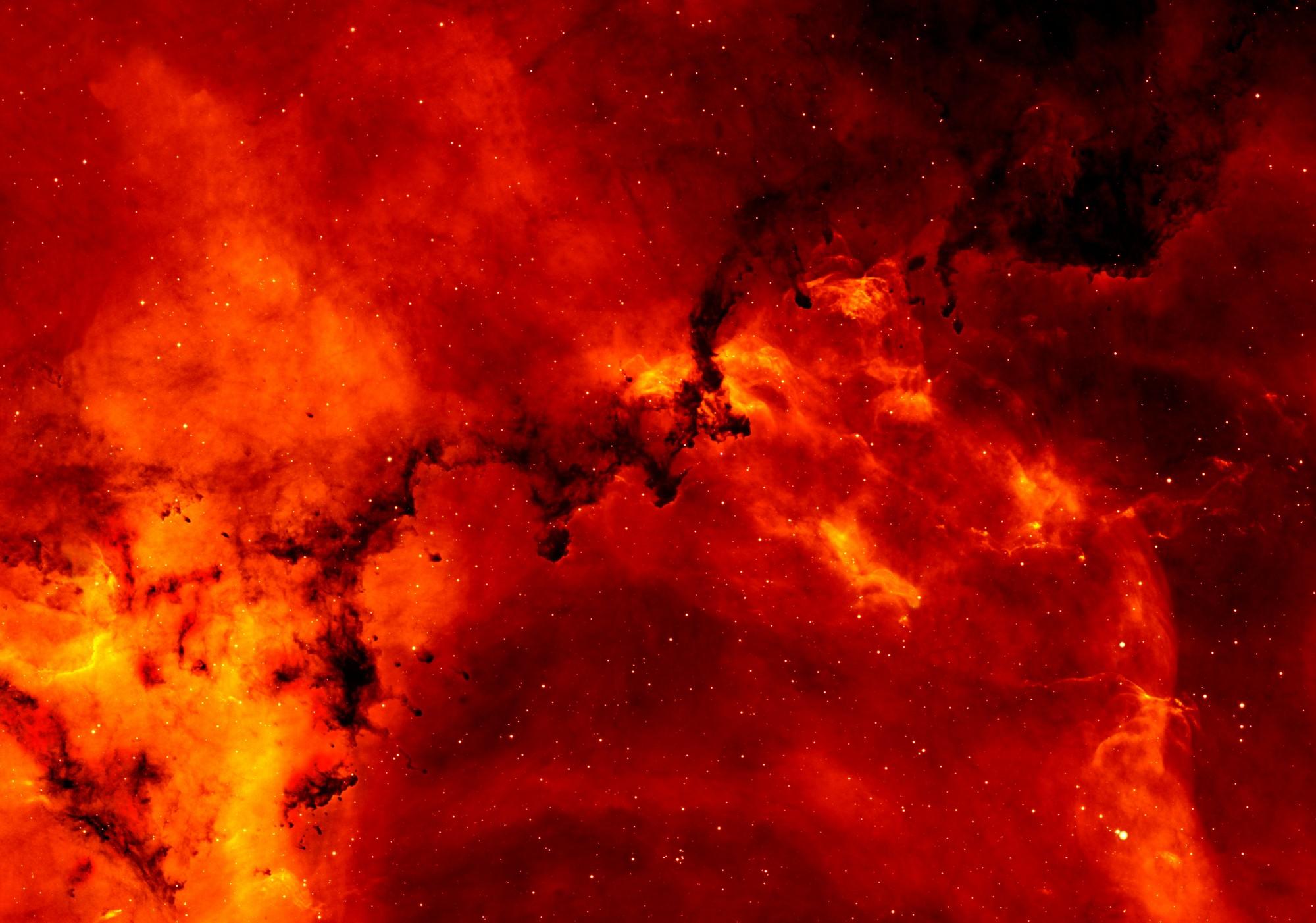
At the edge of a large molecular cloud in Monoceros, some 3,000 light years away, dark filaments of dust are silhouetted by luminous hydrogen gas. The close up view of the Rosette Nebula dramatically suggests that star formation is an on going process in the region, with dark filaments sculpted by winds and radiation from hot, young stars. Ultraviolet radiation from the young stars also strips electrons from the surrounding hydrogen atoms. As electrons and atoms recombine they emit longer wavelength, lower energy light in a well known characteristic pattern of bright spectral lines. At visible wavelengths, the strongest emission line in this pattern is in the red part of the spectrum and is known as "Hydrogen-alpha" or just H-alpha. Part of IPHAS, a survey of H-alpha emission in our Milky Way Galaxy, this image spans about 25 light-years.
https://apod.nasa.gov/apod/ap051223.html
#space #nebula #cluster #astrophotography #photography #science #astronomy #nature #NASA #ESA #education
Alt...
2005 December 23
Hydrogen and Dust in the Rosette Nebula
* Credit: Nick Wright (University College London), IPHAS Collaboration
Explanation:
At the edge of a large molecular cloud in Monoceros, some 3,000 light years away, dark filaments of dust are silhouetted by luminous hydrogen gas. The close up view of the Rosette Nebula dramatically suggests that star formation is an on going process in the region, with dark filaments sculpted by winds and radiation from hot, young stars. Ultraviolet radiation from the young stars also strips electrons from the surrounding hydrogen atoms. As electrons and atoms recombine they emit longer wavelength, lower energy light in a well known characteristic pattern of bright spectral lines. At visible wavelengths, the strongest emission line in this pattern is in the red part of the spectrum and is known as "Hydrogen-alpha" or just H-alpha. Part of IPHAS, a survey of H-alpha emission in our Milky Way Galaxy, this image spans about 25 light-years.
Authors & editors: Robert Nemiroff (MTU) & Jerry Bonnell (USRA)
NASA Web Site Statements, Warnings, and Disclaimers
NASA Official: Jay Norris. Specific rights apply.
A service of: EUD at NASA / GSFC
& Michigan Tech. U.
2016 November 19
IC 5070: A Dusty Pelican in the Swan
* Image Credit & Copyright: Steve Richards (Chanctonbury Observatory)
Explanation:
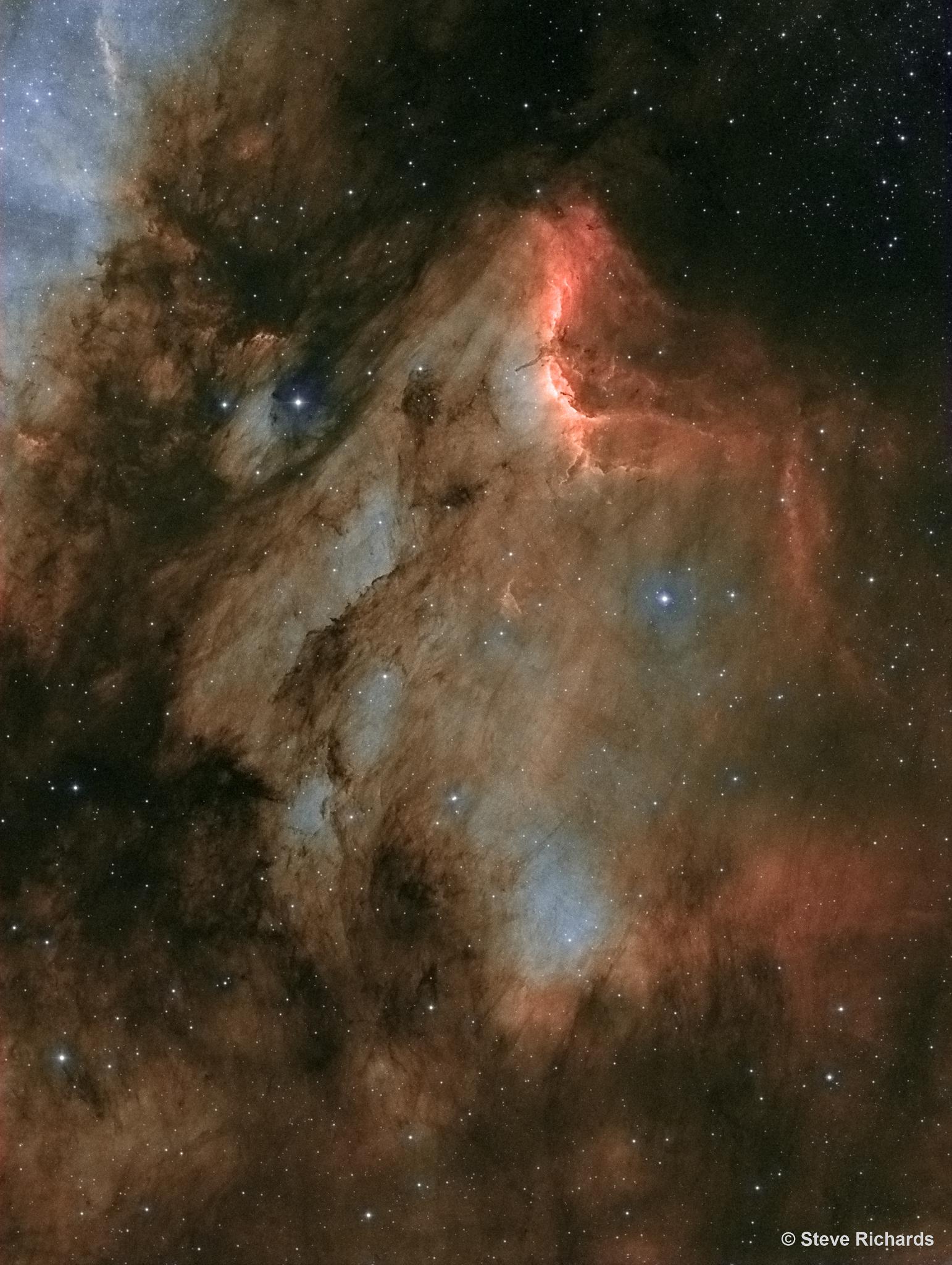
The recognizable profile of the Pelican Nebula soars nearly 2,000 light-years away in the high flying constellation Cygnus, the Swan. Also known as IC 5070, this interstellar cloud of gas and dust is appropriately found just off the "east coast" of the North America Nebula (NGC 7000), another surprisingly familiar looking emission nebula in Cygnus. Both Pelican and North America nebulae are part of the same large and complex star forming region, almost as nearby as the better-known Orion Nebula. From our vantage point, dark dust clouds (upper left) help define the Pelican's eye and long bill, while a bright front of ionized gas suggests the curved shape of the head and neck. This striking synthesized color view utilizes narrowband image data recording the emission of hydrogen and oxygen atoms in the cosmic cloud. The scene spans some 30 light-years at the estimated distance of the Pelican Nebula.
https://apod.nasa.gov/apod/ap161119.html
#space #nebula #cluster #astrophotography #photography #science #astronomy #nature #NASA #ESA #education
Alt...
2016 November 19
IC 5070: A Dusty Pelican in the Swan
* Image Credit & Copyright: Steve Richards (Chanctonbury Observatory)
Explanation:
The recognizable profile of the Pelican Nebula soars nearly 2,000 light-years away in the high flying constellation Cygnus, the Swan. Also known as IC 5070, this interstellar cloud of gas and dust is appropriately found just off the "east coast" of the North America Nebula (NGC 7000), another surprisingly familiar looking emission nebula in Cygnus. Both Pelican and North America nebulae are part of the same large and complex star forming region, almost as nearby as the better-known Orion Nebula. From our vantage point, dark dust clouds (upper left) help define the Pelican's eye and long bill, while a bright front of ionized gas suggests the curved shape of the head and neck. This striking synthesized color view utilizes narrowband image data recording the emission of hydrogen and oxygen atoms in the cosmic cloud. The scene spans some 30 light-years at the estimated distance of the Pelican Nebula.
Authors & editors: Robert Nemiroff (MTU) & Jerry Bonnell (UMCP)
NASA Official: Phillip Newman Specific rights apply.
NASA Web Privacy Policy and Important Notices
A service of: ASD at NASA / GSFC
& Michigan Tech. U.
2025 January 22
The North America Nebula
* Image Credit & Copyright: Dimitris Valianos
Explanation:
The North America nebula on the sky can do what the North America continent on Earth cannot -- form stars. Specifically, in analogy to the Earth-confined continent, the bright part that appears as the east coast is actually a hot bed of gas, dust, and newly formed stars known as the Cygnus Wall. The featured image shows the star forming wall lit and eroded by bright young stars and partly hidden by the dark dust they have created. The part of the North America nebula (NGC 7000) shown spans about 50 light years and lies about 1,500 light years away toward the constellation of the Swan (Cygnus).
https://apod.nasa.gov/apod/ap250122.html
#space #nebula #cluster #astrophotography #photography #science #astronomy #nature #NASA #ESA #education
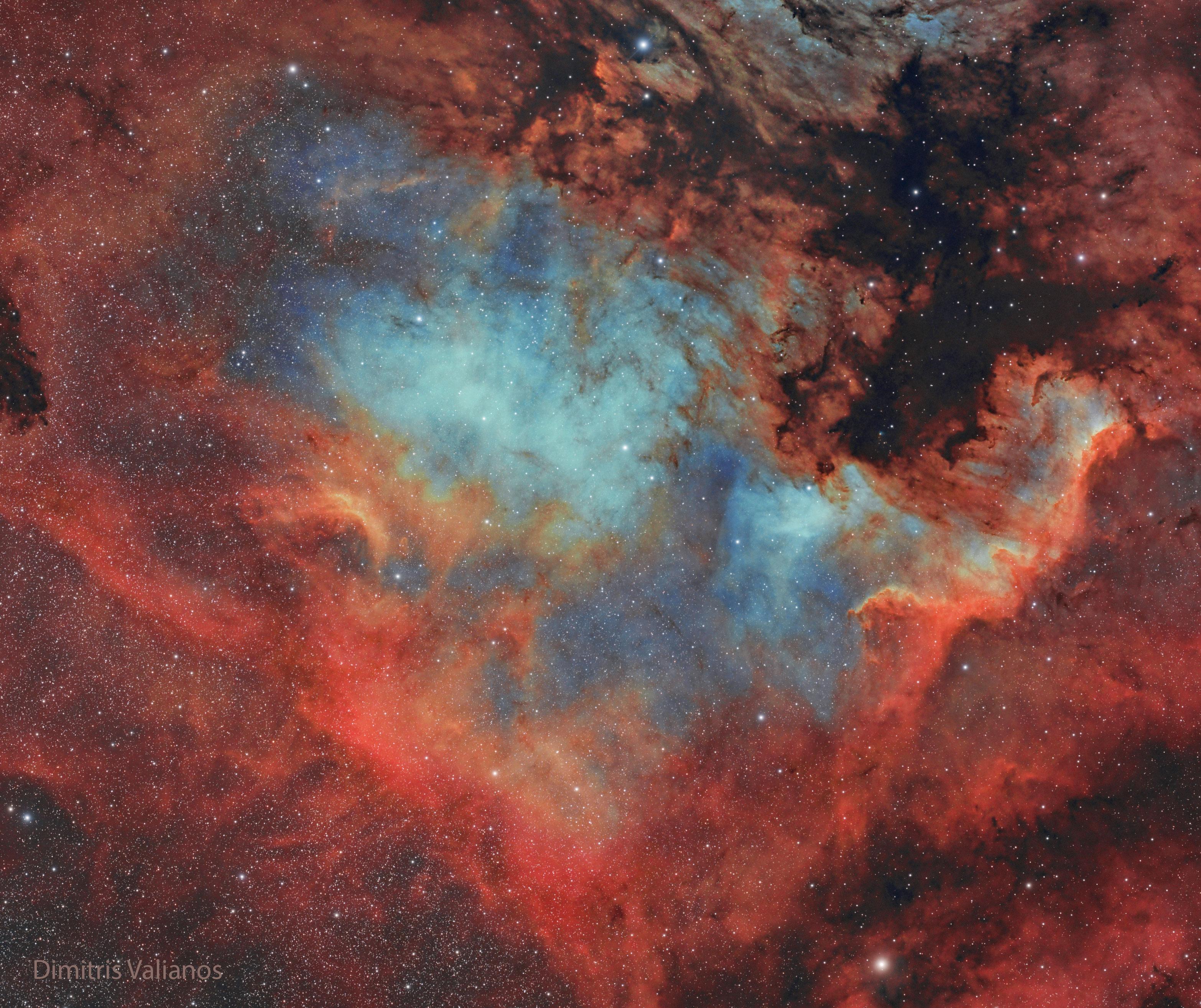
Alt...
2025 January 22
A star field is dominated by a red and blue glowing nebula. This nebula appears, to some, to have the shape of North America and so is called the North America Nebula.
The North America Nebula
* Image Credit & Copyright: Dimitris Valianos
Explanation:
The North America nebula on the sky can do what the North America continent on Earth cannot -- form stars. Specifically, in analogy to the Earth-confined continent, the bright part that appears as the east coast is actually a hot bed of gas, dust, and newly formed stars known as the Cygnus Wall. The featured image shows the star forming wall lit and eroded by bright young stars and partly hidden by the dark dust they have created. The part of the North America nebula (NGC 7000) shown spans about 50 light years and lies about 1,500 light years away toward the constellation of the Swan (Cygnus).
Authors & editors: Robert Nemiroff (MTU) & Jerry Bonnell (UMCP)
NASA Official: Amber Straughn Specific rights apply.
NASA Web Privacy, Accessibility, Notices;
A service of: ASD at NASA / GSFC,
NASA Science Activation
& Michigan Tech. U.
2007 September 20
Northern Cygnus
* Credit & Copyright: Robert Gendler
http://www.robgendlerastropics.com/
Explanation:
Bright, hot, supergiant star Deneb lies at top center in this gorgeous skyscape. The 20 frame mosaic spans an impressive 12 degrees across the northern end of Cygnus the Swan. Crowded with stars and luminous gas clouds along the plane of our Milky Way Galaxy, Cygnus is also home to the dark, obscuring Northern Coal Sack Nebula, extending from Deneb toward the bottom center of the view. The reddish glow of NGC 7000, the North America Nebula, and IC 5070, the Pelican Nebula, are at the upper left, but many other nebulae and star clusters are identifiable throughout the wide field. Of course, Deneb itself is the alpha star of Cygnus and is also known to northern hemisphere skygazers for its place in two asterisms -- marking the top of the Northern Cross and a vertex of the Summer Triangle.
http://www.robgendlerastropics.com/Cygnusmosaic.html
https://en.wikipedia.org/wiki/Cygnus_(constellation)
https://apod.nasa.gov/apod/ap070920.html
#space #nebula #cluster #astrophotography #photography #science #astronomy #nature #NASA #ESA #education
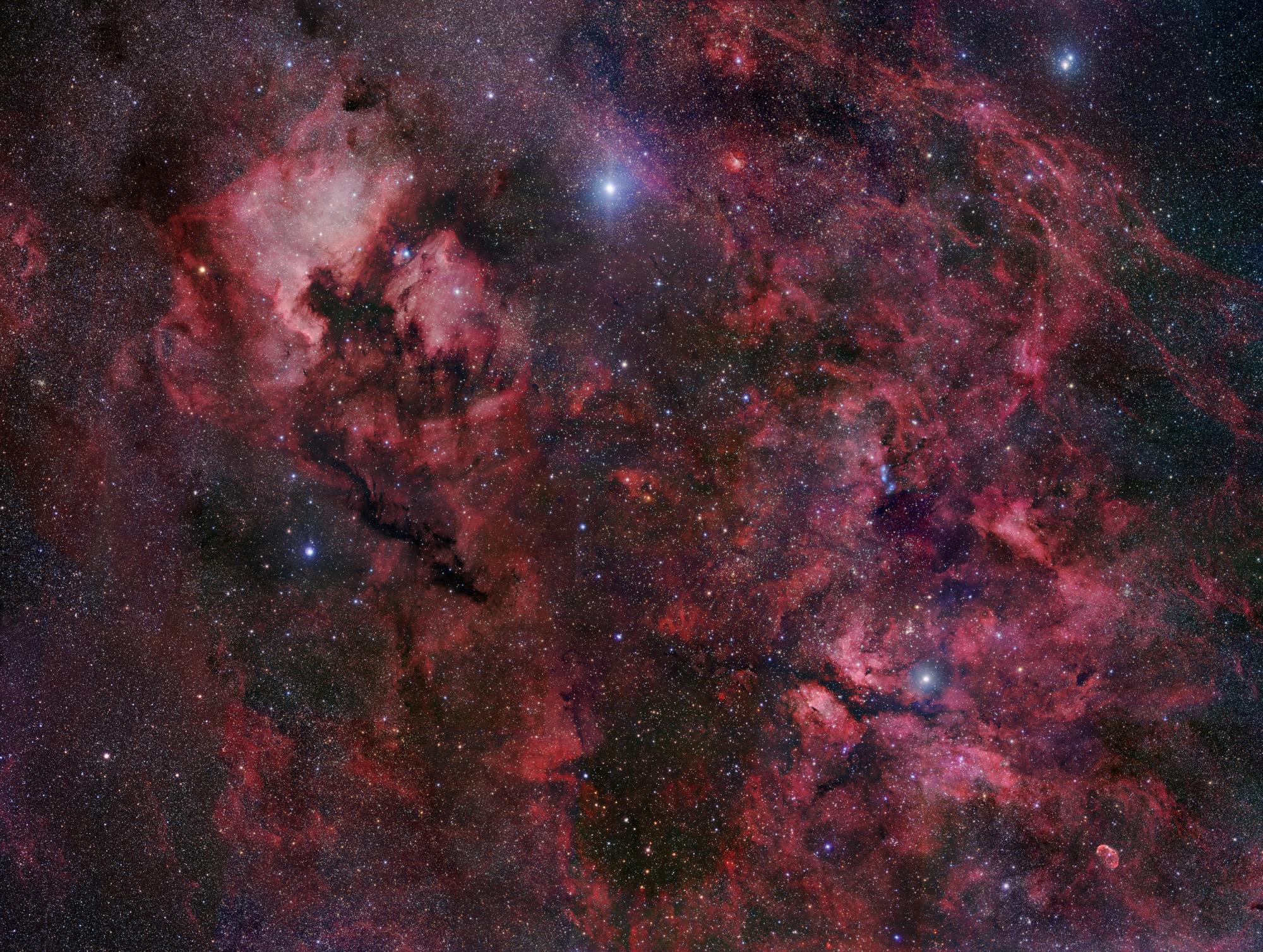
Alt...
2007 September 20
Northern Cygnus
* Credit & Copyright: Robert Gendler
Explanation:
Bright, hot, supergiant star Deneb lies at top center in this gorgeous skyscape. The 20 frame mosaic spans an impressive 12 degrees across the northern end of Cygnus the Swan. Crowded with stars and luminous gas clouds along the plane of our Milky Way Galaxy, Cygnus is also home to the dark, obscuring Northern Coal Sack Nebula, extending from Deneb toward the bottom center of the view. The reddish glow of NGC 7000, the North America Nebula, and IC 5070, the Pelican Nebula, are at the upper left, but many other nebulae and star clusters are identifiable throughout the wide field. Of course, Deneb itself is the alpha star of Cygnus and is also known to northern hemisphere skygazers for its place in two asterisms -- marking the top of the Northern Cross and a vertex of the Summer Triangle.
Authors & editors: Robert Nemiroff (MTU) & Jerry Bonnell (UMCP)
NASA Official: Phillip Newman Specific rights apply.
NASA Web Privacy Policy and Important Notices
A service of: ASD at NASA / GSFC
2025 September 19
The NGC 6914 Complex
* Image Credit & Copyright: Tommy Lease
https://app.astrobin.com/u/Colorado_Astro#gallery
Explanation:
A study in contrasts, this colorful cosmic skyscape features stars, dust, and glowing gas in the vicinity of NGC 6914. The interstellar complex of nebulae lies some 6,000 light-years away, toward the high-flying northern constellation Cygnus and the plane of our Milky Way Galaxy. Obscuring interstellar dust clouds appear in silhouette while reddish hydrogen emission nebulae, along with the dusty blue reflection nebulae, fill the cosmic canvas. Ultraviolet radiation from the massive, hot, young stars of the extensive Cygnus OB2 association ionize the region's atomic hydrogen gas, producing the characteristic red glow as protons and electrons recombine. Embedded Cygnus OB2 stars also provide the blue starlight strongly reflected by the dust clouds. The over one degree wide telescopic field of view spans about 100 light-years at the estimated distance of NGC 6914.
https://www.nasa.gov/missions/roman-space-telescope/how-nasas-roman-mission-will-unveil-our-home-galaxy-using-cosmic-dust/
https://arxiv.org/abs/1003.2463
https://astronomy.swin.edu.au/cosmos/E/Emission+Nebula
https://astronomy.swin.edu.au/cosmos/E/Reflection+Nebula
https://apod.nasa.gov/apod/ap250919.html
#space #nebula #cluster #astrophotography #photography #science #astronomy #nature #NASA #ESA #education
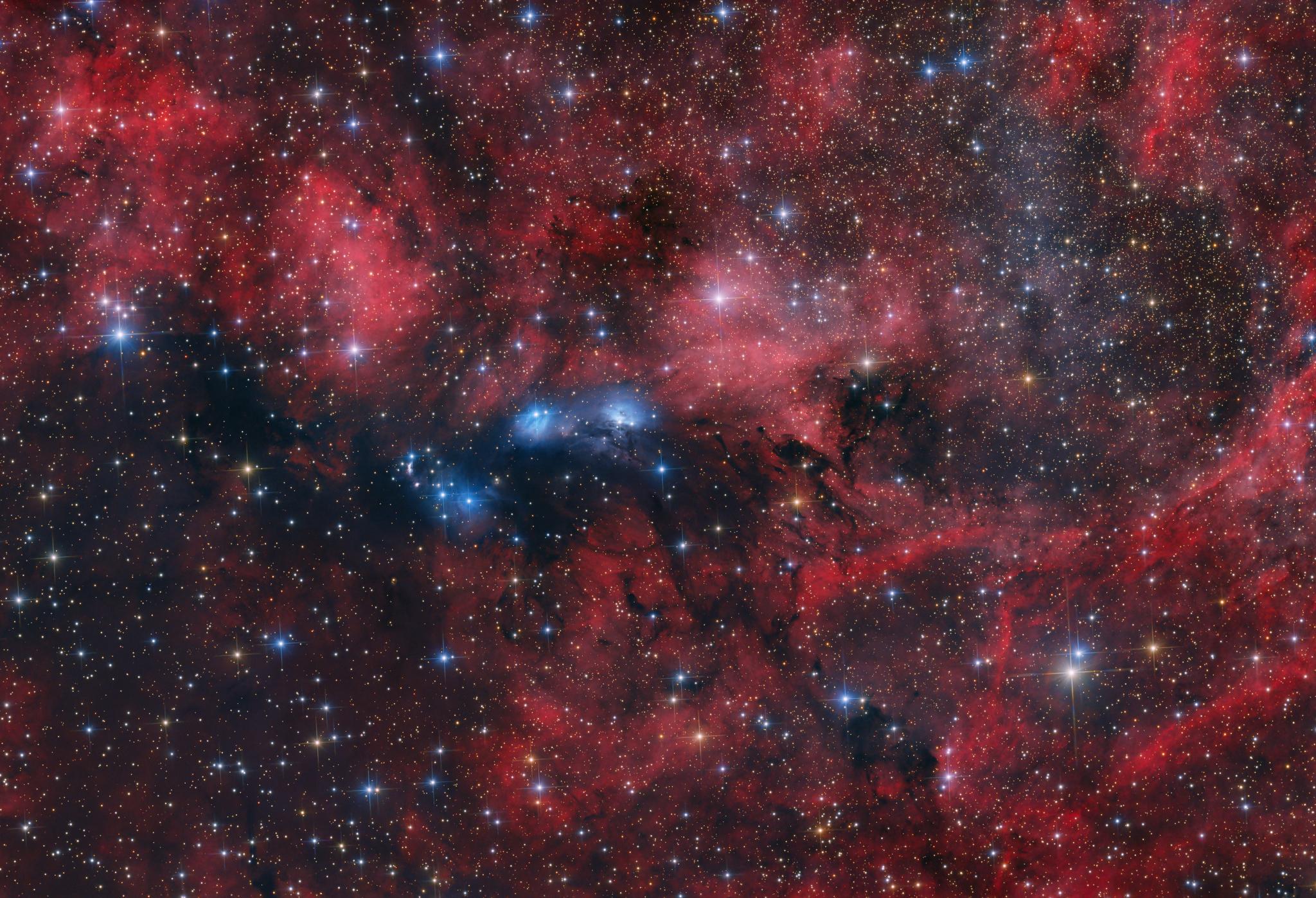
Alt...
2025 September 19
The NGC 6914 Complex
* Image Credit & Copyright: Tommy Lease
Explanation:
A study in contrasts, this colorful cosmic skyscape features stars, dust, and glowing gas in the vicinity of NGC 6914. The interstellar complex of nebulae lies some 6,000 light-years away, toward the high-flying northern constellation Cygnus and the plane of our Milky Way Galaxy. Obscuring interstellar dust clouds appear in silhouette while reddish hydrogen emission nebulae, along with the dusty blue reflection nebulae, fill the cosmic canvas. Ultraviolet radiation from the massive, hot, young stars of the extensive Cygnus OB2 association ionize the region's atomic hydrogen gas, producing the characteristic red glow as protons and electrons recombine. Embedded Cygnus OB2 stars also provide the blue starlight strongly reflected by the dust clouds. The over one degree wide telescopic field of view spans about 100 light-years at the estimated distance of NGC 6914.
Authors & editors: Robert Nemiroff (MTU) & Jerry Bonnell (UMCP)
NASA Official: Amber Straughn Specific rights apply.
NASA Web Privacy, Accessibility, Notices;
A service of: ASD at NASA / GSFC,
NASA Science Activation
2024 July 8
Exoplanet Zoo: Other Stars
* Illustration Credit & Copyright: Martin Vargic, Halcyon Maps
https://www.facebook.com/martin.vargic.9/
Explanation:
Do other stars have planets like our Sun? Surely they do, and evidence includes slight star wobbles created by the gravity of orbiting exoplanets and slight star dimmings caused by orbiting planets moving in front. In all, there have now been over 5,500 exoplanets discovered, including thousands by NASA's space-based Kepler and TESS missions, and over 100 by ESO's ground-based HARPS instrument. Featured here is an illustrated guess as to what some of these exoplanets might look like. Neptune-type planets occupy the middle and are colored blue because of blue-scattering atmospheric methane they might contain. On the sides of the illustration, Jupiter-type planets are shown, colored tan and red from the scatterings of atmospheric gases that likely include small amounts of carbon. Interspersed are many Earth-type rocky planets of many colors. As more exoplanets are discovered and investigated, humanity is developing a better understanding of how common Earth-like planets are, and how common life might be in the universe.
https://apod.nasa.gov/apod/ap240708.html
#space #exoplanets #astrophotography #photography #science #astronomy #tech #NASA #ESA #education
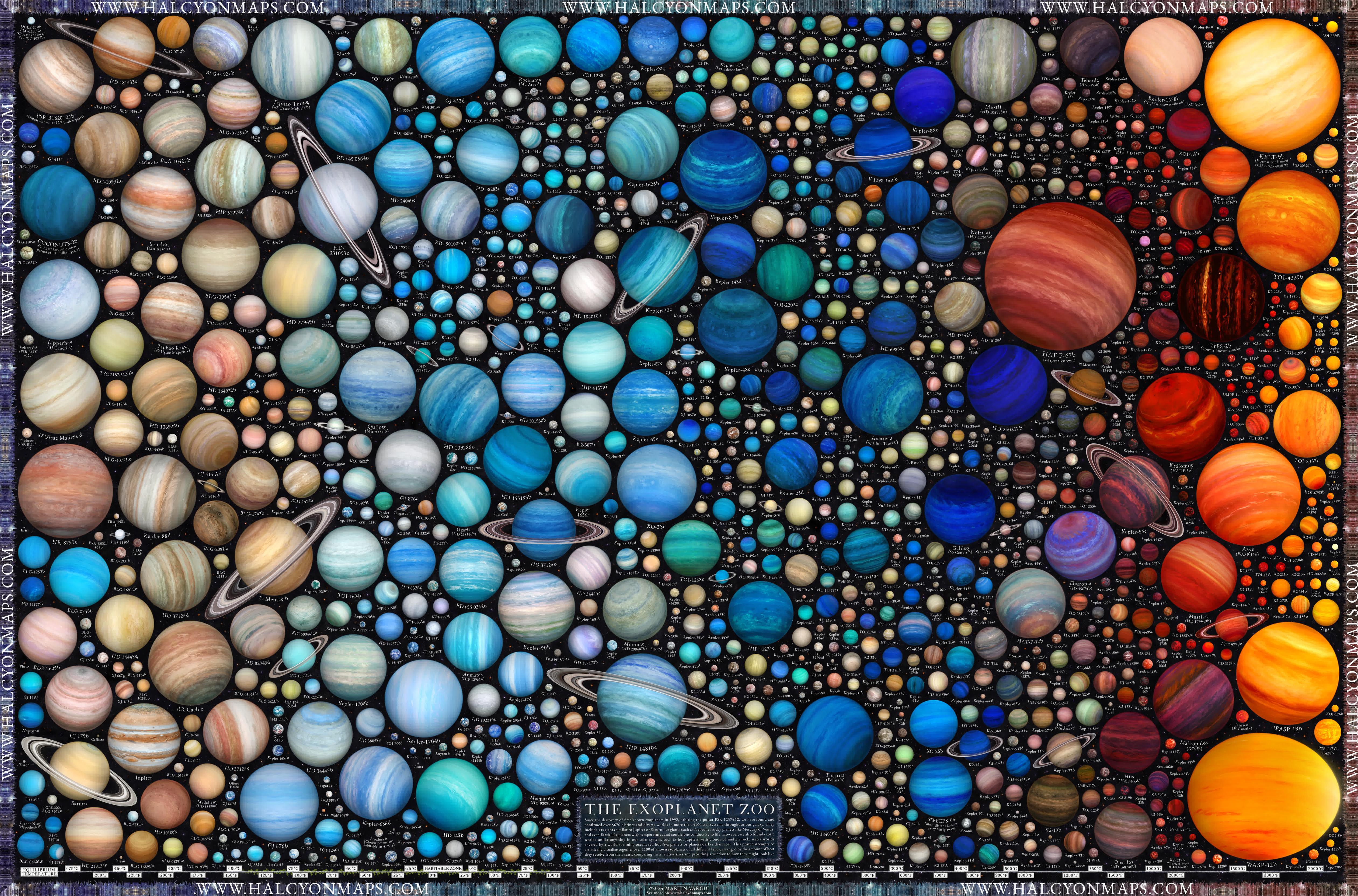
Alt...
2024 July 8
A graphic illustrates hundreds of possible exoplanets, with blue drawings of planets in the middle, red on the right, and tan on the left. Some exoplanets are drawn with rings.
Exoplanet Zoo: Other Stars
* Illustration Credit & Copyright: Martin Vargic, Halcyon Maps
Explanation:
Do other stars have planets like our Sun? Surely they do, and evidence includes slight star wobbles created by the gravity of orbiting exoplanets and slight star dimmings caused by orbiting planets moving in front. In all, there have now been over 5,500 exoplanets discovered, including thousands by NASA's space-based Kepler and TESS missions, and over 100 by ESO's ground-based HARPS instrument. Featured here is an illustrated guess as to what some of these exoplanets might look like. Neptune-type planets occupy the middle and are colored blue because of blue-scattering atmospheric methane they might contain. On the sides of the illustration, Jupiter-type planets are shown, colored tan and red from the scatterings of atmospheric gases that likely include small amounts of carbon. Interspersed are many Earth-type rocky planets of many colors. As more exoplanets are discovered and investigated, humanity is developing a better understanding of how common Earth-like planets are, and how common life might be in the universe.
Authors & editors: Robert Nemiroff (MTU) & Jerry Bonnell (UMCP)
NASA Official: Amber Straughn Specific rights apply.
The milestone comes 30 years after the first exoplanet was discovered around a star similar to our Sun, in 1995. (Prior to that, a few planets had been identified around stars that had burned all their fuel and collapsed.) Although researchers think there are billions of planets in the Milky Way galaxy, finding them remains a challenge. In addition to discovering many individual planets with fascinating characteristics as the total number of known exoplanets climbs, scientists are able to see how the general planet population compares to the planets of our own solar system.
For example, while our solar system hosts an equal number of rocky and giant planets, rocky planets appear to be more common in the universe. Researchers have also found a range of planets entirely different from those in our solar system. There are Jupiter-size planets that orbit closer to their parent star than Mercury orbits the Sun; planets that orbit two stars, no stars, and dead stars; planets covered in lava; some with the density of Styrofoam; and others with clouds made of gemstones.
“Each of the different types of planets we discover gives us information about the conditions under which planets can form and, ultimately, how common planets like Earth might be, and where we should be looking for them,” said Dawn Gelino, head of NASA’s Exoplanet Exploration Program (ExEP), located at the agency’s Jet Propulsion Laboratory in Southern California. “If we want to find out if we’re alone in the universe, all of this knowledge is essential.”
---
Scientists have found thousands of exoplanets (planets outside our solar system) throughout the galaxy. Most can be studied only indirectly, but scientists know they vary widely, as depicted in this artist’s concept, from small, rocky worlds and gas giants to water-rich planets and those as hot as stars.
CREDIT
NASA’s GSFC
#space #exoplanets #astrophotography #photography #science #astronomy #tech #NASA #ESA #education
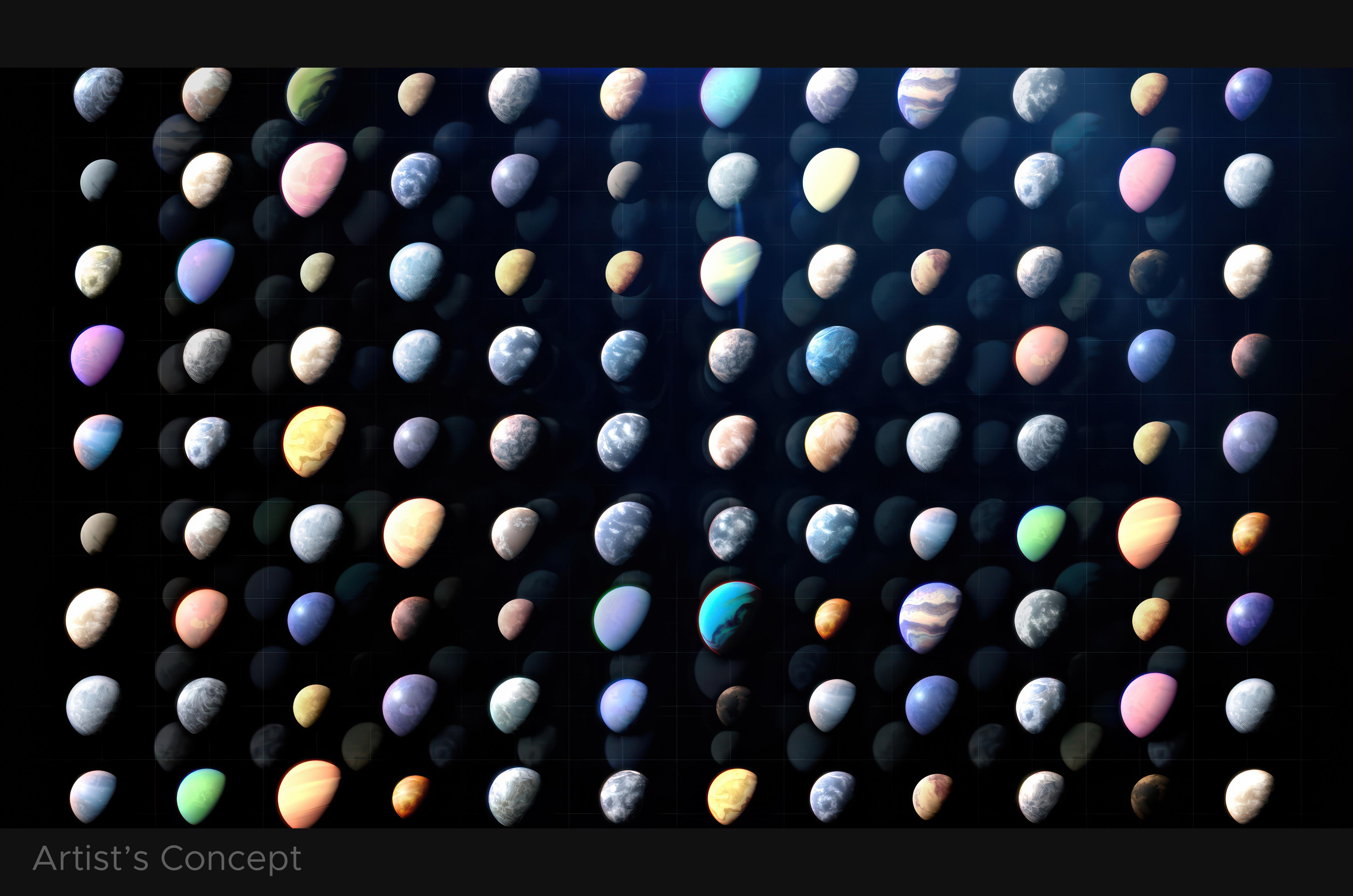
Alt...
Scientists have found thousands of exoplanets (planets outside our solar system) throughout the galaxy. Most can be studied only indirectly, but scientists know they vary widely, as depicted in this artist’s concept, from small, rocky worlds and gas giants to water-rich planets and those as hot as stars.
CREDIT
NASA’s Goddard Space Flight Center
NASA’s Tally of Planets Outside Our Solar System Reaches 6,000
The milestone highlights the accelerating rate of discoveries, just over three decades since the first exoplanets were found.
The official number of exoplanets — planets outside our solar system — tracked by NASA has reached 6,000. Confirmed planets are added to the count on a rolling basis by scientists from around the world, so no single planet is considered the 6,000th entry. The number is monitored by NASA’s Exoplanet Science Institute (NExScI), based at Caltech’s IPAC in Pasadena, California. There are more than 8,000 additional candidate planets awaiting confirmation, with NASA leading the world in searching for life in the universe.
CREDIT
NASA/JPL-Caltech
https://science.nasa.gov/exoplanets/discoveries-dashboard/
#space #exoplanets #astrophotography #photography #science #astronomy #tech #NASA #ESA #education
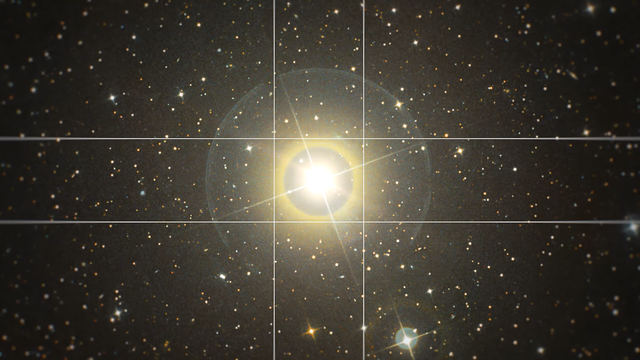
Alt...
It’s been 30 years since the discovery of the first planet around another star like our Sun. With every new discovery, scientists move closer to answering whether there are other planets like Earth that could host life as we know it.
CREDIT
NASA/JPL-Caltech
Microlensing - NASA Science
-- jmbrill
Gravitational lensing is an observational effect that occurs because the presence of mass warps the fabric of space-time, sort of like the dent a bowling ball makes when set on a trampoline. The effect is extreme around very massive objects, like black holes and entire galaxies. But even stars and planets cause a detectable degree of warping, called microlensing.
Here’s how it works. Light travels in a straight line, but if space-time is bent – which happens near something massive, like a star – light follows the curve. Any time two stars align closely from our vantage point, light from the more distant star curves as it travels through the warped space-time around the nearer star.
If the alignment is especially close, the nearer star acts like a natural cosmic lens, magnifying light from the background star. Planets orbiting the lens star can produce a similar effect on a smaller scale.
Familiar and exotic worlds
The techniques commonly used to find other worlds are biased toward planets that tend to be very different from those in our solar system. The transit method, for example, is best at finding sub-Neptune-like planets that have orbits much smaller than Mercury’s. For a solar system like our own, transit studies could miss every planet.
Roman’s Galactic Bulge Time Domain Survey will help us find analogs to every planet in our solar system except Mercury, whose small orbit and low mass combine to put it beyond the mission’s reach. Roman will find planets that are the mass of Earth and even smaller – perhaps even large moons, like Jupiter’s moon Ganymede.
Roman will find planets in other poorly studied categories, too. Microlensing is best suited to finding worlds from the habitable zone of their star and farther out.
[...]
Please read more:
https://www.nasa.gov/universe/exoplanets/nasas-tally-of-planets-outside-our-solar-system-reaches-6000/#hds-sidebar-nav-1
CREDIT
science.nasa.gov
#space #galaxy #astrophotography #photography #science #physics #nature #NASA #ESA #education
TOPIC> Exoplanets
Searching for other worlds
-- by Anthony Greicius
Fewer than 100 exoplanets have been directly imaged, because most planets are so faint they get lost in the light from their parent star. The other four methods of planet detection are indirect. With the transit method, for instance, astronomers look for a star to dim for a short period as an orbiting planet passes in front of it.
To account for the possibility that something other than an exoplanet is responsible for a particular signal, most exoplanet candidates must be confirmed by follow-up observations, often using an additional telescope, and that takes time. That’s why there is a long list of candidates in the NASA Exoplanet Archive (hosted by NExScI) waiting to be confirmed.
“We really need the whole community working together if we want to maximize our investments in these missions that are churning out exoplanets candidates,” said Aurora Kesseli, the deputy science lead for the NASA Exoplanet Archive at IPAC. “A big part of what we do at NExScI is build tools that help the community go out and turn candidate planets into confirmed planets.”
The rate of exoplanet discoveries has accelerated in recent years (the database reached 5,000 confirmed exoplanets just three years ago), and this trend seems likely to continue. Kesseli and her colleagues anticipate receiving thousands of additional exoplanet candidates from the ESA (European Space Agency) Gaia mission, which finds planets through a technique called astrometry, and NASA’s upcoming Nancy Grace Roman Space Telescope, which will discover thousands of new exoplanets primarily through a technique called gravitational microlensing.
CREDIT:
Jet Propulsion Laboratory, Pasadena, Calif.
#space #exoplanets #astrophotography #photography #science #astronomy #tech #NASA #ESA #education
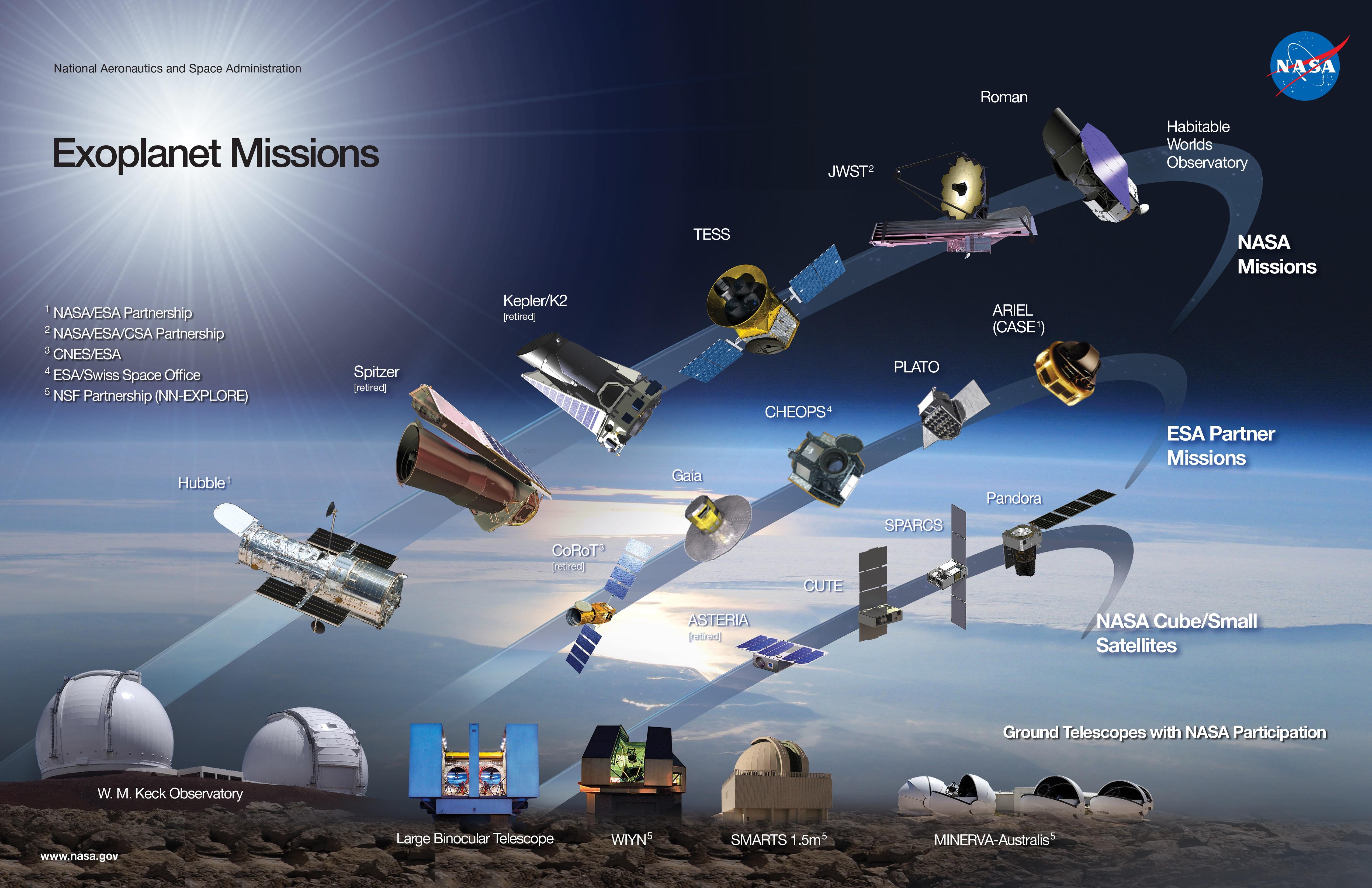
Alt...
Many telescopes contribute to the search for and study of exoplanets, including some in space (artists concepts shown here) and on the ground. Doing the work are organizations around the world, including ESA (European Space Agency), CSA (Canadian Space Agency), and NSF (National Science Foundation).
CREDIT:
NASA/JPL-Caltech
From Wikipedia, the free encyclopedia
[...]
C/2025 R2 was not discovered earlier in part because of the Holetschek effect as the comet was less than 30 degrees from the Sun between August 7 - September 13. Between August and September the comet had rapidly brightened from magnitude 11 to magnitude 8. The comet is not likely in an outburst, however it is currently unknown how quickly it will dim or if it will completely disintegrate.
C/2025 R2 is officially the 20th comet discovered through SOHO's SWAN instrument according to its discoverer, Vladimir Bezugly.
C/2025 R2 (SWAN) came to perihelion one day after discovery on 12 September 2025 at a distance of 0.5 AU (75 million km) from the Sun. Earth will cross the comet's orbit around 5 October 2025 and it may produce a meteor shower. It will make its closest approach to Earth at a distance of 0.26 AU (39 million km; 24 million mi) on 19 October 2025. It will cross the celestial equator on 3 November 2025.
As the comet was discovered near perihelion, the closest approach to the Sun is reasonably well known. But the aphelion (farthest distance from the Sun) is currently constrained by the low spatial resolution of about 1° per pixel STEREO-A observations in August, and without the STEREO-A observations, there is only a short 4-day observation arc for the orbit determination. Aphelion is anywhere from 60+ AU from the Sun with an orbital period of hundreds to thousands of years. The Minor Planet Center (using observations through September 15th) estimates an orbital period of 1400 years with aphelion around 250 AU, and JPL (using observations through September 14th) estimates an orbital period of 20000 years with aphelion beyond 1000 AU. ..
Text Credits:
Contributors to Wikimedia projects
Image Credit:
Filipp Romanov
https://en.wikipedia.org/wiki/C/2025_R2_(SWAN)
#space #comets #astrophotography #photography #science #astronomy #nature #NASA #ESA #education
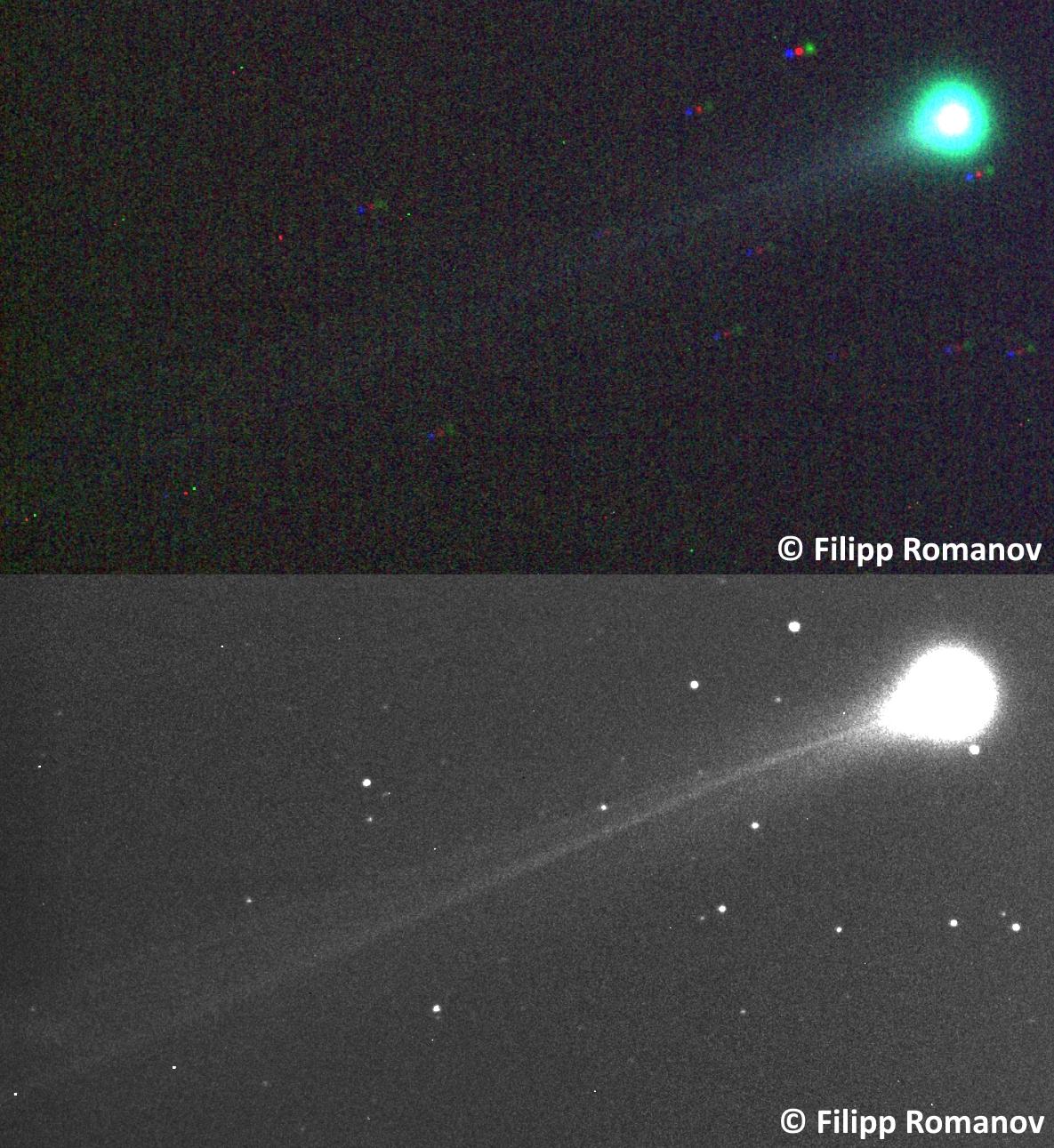
Alt...
On 2025-09-13 I confirmed the new bright comet SWAN25B remotely using iTelescope.net T59 (0.51-m f/6.8 reflector + CCD) located at the Siding Spring Observatory, Australia. I measured: magnitude of the coma = +8.9 mag., coma diameter = 2 arcminutes with a straight tail (which becomes wider away from the coma) at least 18 arcminutes in length (up to the edge of the frame), PA = 112 degrees. Images: stacked 3x10 sec. (RGB) and single 60 sec. (Luminance filter).
Credit text & image
Filipp Romanov
Comet C/2025 R2 (SWAN) imaged from the Siding Spring Observatory on 13 September 2025 with a 0.5 m (20 in) telescope.
Discovery
Discovered by SOHO–SWAN
Vladimir Bezugly
Discovery date 11 September 2025
Designations Alternative designations
SWAN25B, CK25R020
Orbital characteristics
Epoch 13 September 2025 (JD 2460931.5)
Observation arc 32 days
Earliest precovery date 13 August 2025
Number of observations 83
Aphelion 1600±9000 AU
Perihelion 0.5035±0.0002 AU
Eccentricity 0.999±0.003
Orbital period 1400–20000(?) years
Inclination 4.47°±0.002°
Longitude of ascending node 335.7°
Argument of periapsis 307.77°
Last perihelion 12 September 2025
TJupiter 0.884
Earth MOID 0.047 AU
Jupiter MOID 0.042 AU
Physical characteristics
Comet total
magnitude (M1) 12.4±0.9
Comet nuclear
magnitude (M2) 10±2
Apparent magnitude
6.0
(2025-09-15)
Comet C/2025 R2 (SWAN)
Below the horizon. Rise: 9:47 | Tran: 14:46 | Set: 19:44
Alt: -29.26° Az: 70.51° Direction: East-North-East
Comet C/2025 R2 (SWAN) is in the constellation of Virgo, at a distance of 117,117,474.3 kilometers from Earth. The current Right Ascension is 13h 35m 39s and the Declination is -11° 36’ 24” (apparent coordinates). The latest observed magnitude of comet C/2025 R2 (SWAN) is 7.3 (data provided by COBS).
* URL'S associated with the images:
1. to 2. https://theskylive.com/planetarium?obj=c2025r2
3. 5. 6. https://theskylive.com/c2025r2-tracker
4. https://theskylive.com/3dsolarsystem?obj=c2025r2
On this website you can follow the current data of the comet live:
https://theskylive.com/c2025r2-info
CREDIT
TheSkyLive.com
----
From Wikipedia, the free encyclopedia:
C/2025 R2 (SWAN)
C/2025 R2 (SWAN), formerly known as SWAN25B, is a non-periodic comet discovered on 11 September 2025 by Vladimir Bezugly through SWAN imagery. As of 17 September 2025, the comet has an apparent magnitude of +6.9 with a solar elongation of 30 degrees and is observable near the star Spica in 50 mm (2.0 in) binoculars. It is better seen from the Southern hemisphere.
Observational history
The comet was first spotted in images from the SWAN instrument onboard the Solar and Heliospheric Observatory (SOHO) by amateur astronomer Vladimir Bezugly on 11 September 2025. The presence of the comet was confirmed by other amateur astronomers, having an estimated magnitude of 7.4 and featuring a tail about 2 degrees long. The comet upon discovery was located in the constellation of Virgo and it was better seen from the southern hemisphere as it was higher in the sky after sunset.
[...]
Please read more in next post.
Text Credits:
Contributors to Wikimedia projects
#space #comets #astrophotography #photography #science #astronomy #nature #NASA #ESA #education
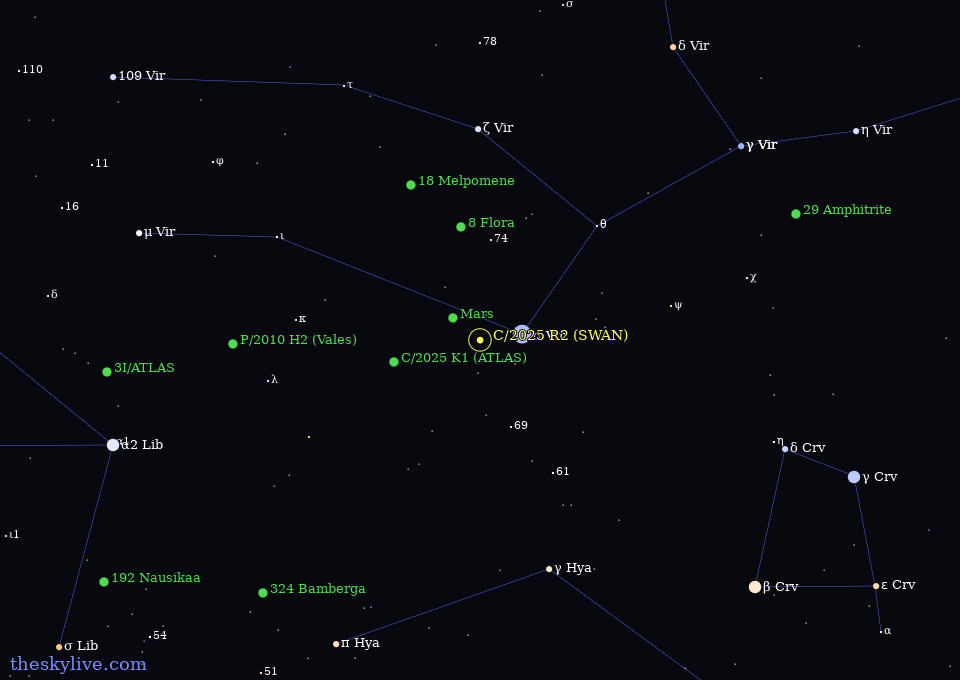
Alt...
Star map showing the position of comet C/2025 R2 (SWAN) in the constellation of Virgo on September 18, 2025. Field of view: 50x30 degrees.
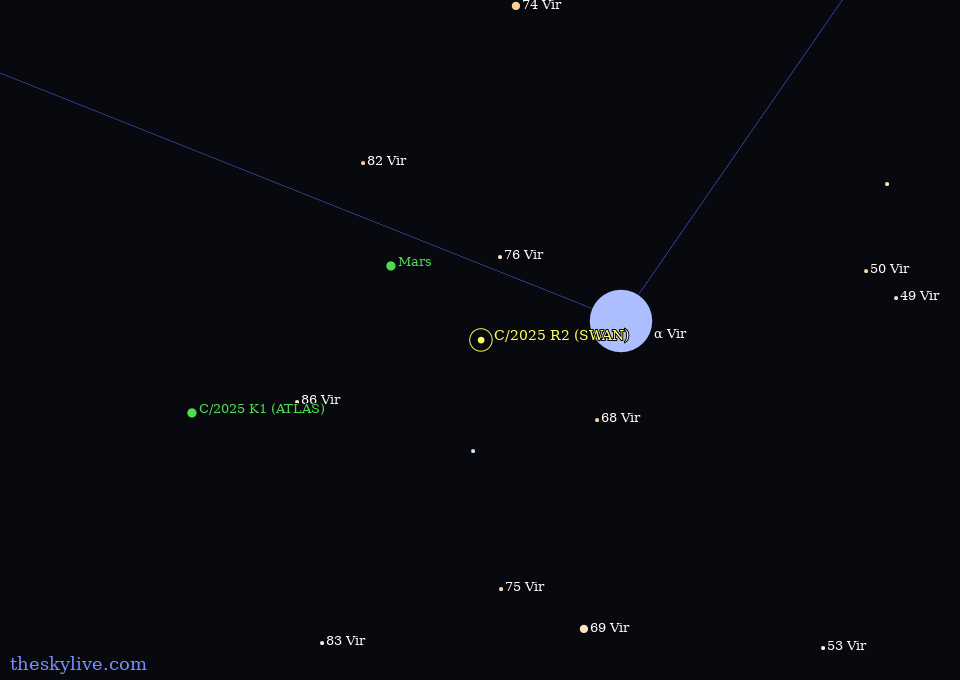
Alt...
Star map showing the position of comet C/2025 R2 (SWAN) in the constellation of Virgo on September 18, 2025. Field of view: 15x9 degrees.
Alt...
Simplified high-resolution deep sky chart showing the current position of comet C/2025 R2 (SWAN). Field of view: 60 x 40 arcminutes.
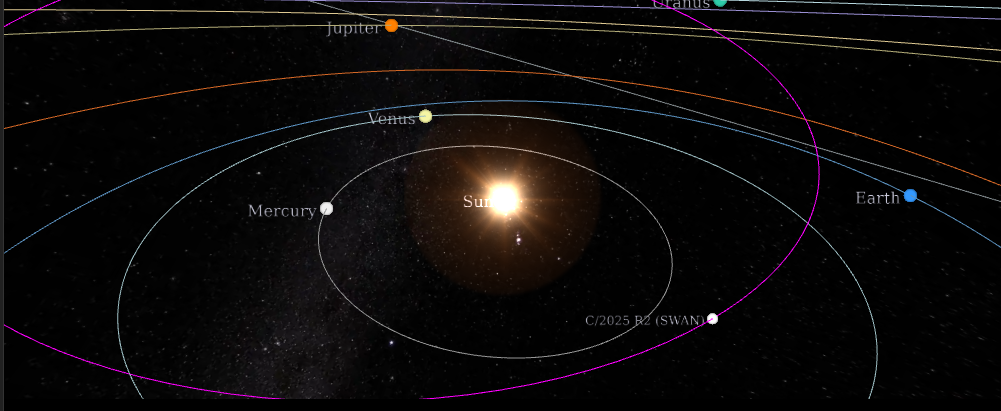
Alt...
3D animated visualization of the orbit of comet C/2025 R2 (SWAN) relative to the other major objects in the Solar System.
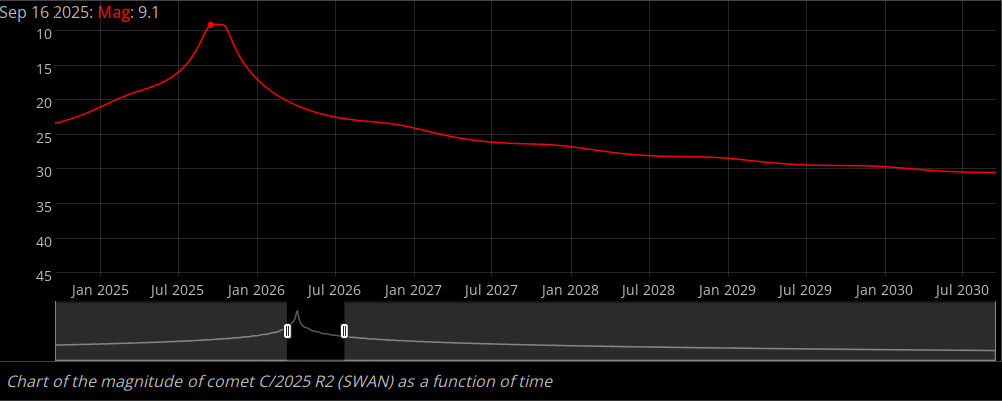
Alt...
Light curve of comet C/2025 R2 (SWAN), i.e., its apparent magnitude as a function of time. The curve is calculated using the latest ephemerides provided by JPL Horizons. The magnitude data is sampled with the interval of 2 days. Because of this sampling, inaccuracies may occur for objects that have large variations of brightness over a few days. For comets, large discrepancies can arise between the calculated brightness and the observations due to their highly dynamic, and not always precisely predictable, behavior.
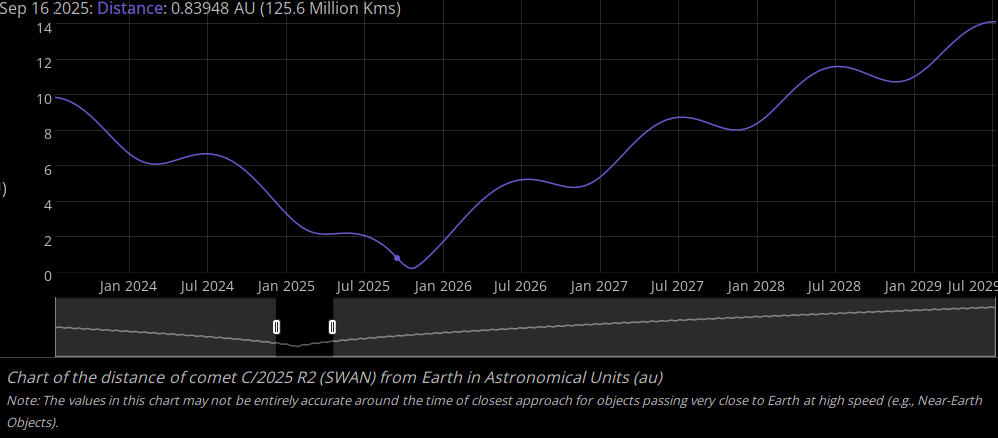
Alt...
Distance of comet C/2025 R2 (SWAN) from Earth as a function of time. In the chart the distance is measured in Astronomical Units and the data is sampled with an interval of 1 day.