Search results for tag #astronomy
![[?]](https://cdn.masto.host/mastodongamedevplace/accounts/avatars/109/859/285/072/781/117/original/52b616f54f20c98f.png)
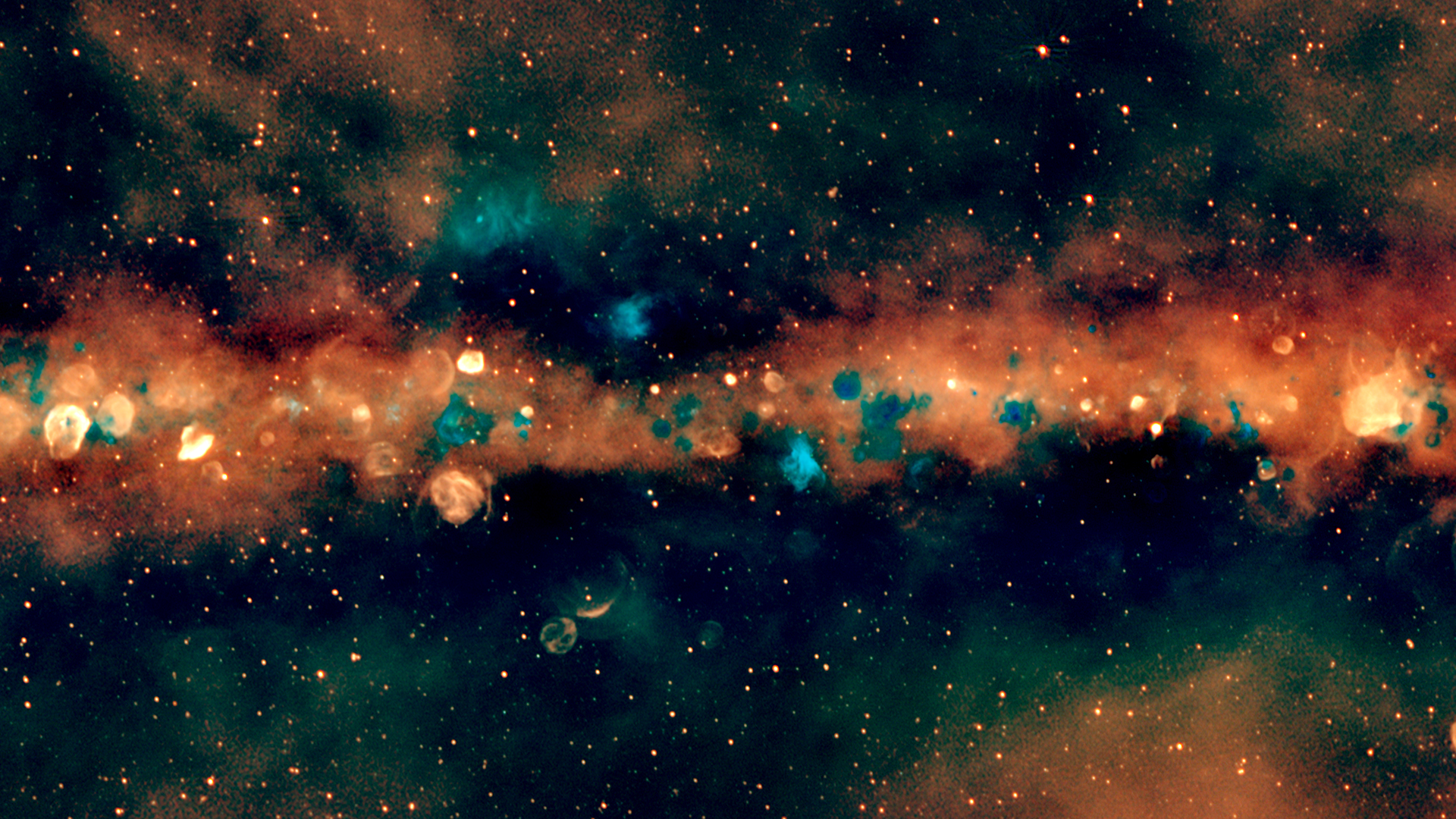
Look at this beautiful new radio telescope mosaic of the Milky Way showing stars being born and dying.
The orange and red areas "show dying stars that have exploded, known as supernova remnants" and "the blue areas show places where new stars are being born".
https://www.abc.net.au/news/2025-11-11/milky-way-radio-map-shows-where-stars-live-and-die/105976276
Alt...
A picture of the milky way galaxy as seen from Earth. It is a long cloud of crossing the entire image of dust and stars. Every so often there is a large puff of dust, indicating where a star has exploded or is being formed. The distances involved are vast. Picture: Silvia Mantovanini & the GLEAM-X team
![[?]](https://files.defcon.social/dcsocial-s3/accounts/avatars/113/208/344/507/078/943/original/014820ad22daee1c.jpg)
2025 November 10
Micro Moon vs. Super Moon
* Image Credit & Copyright: Şenol Şanlı"
https://www.instagram.com/snlsanli/
Explanation:
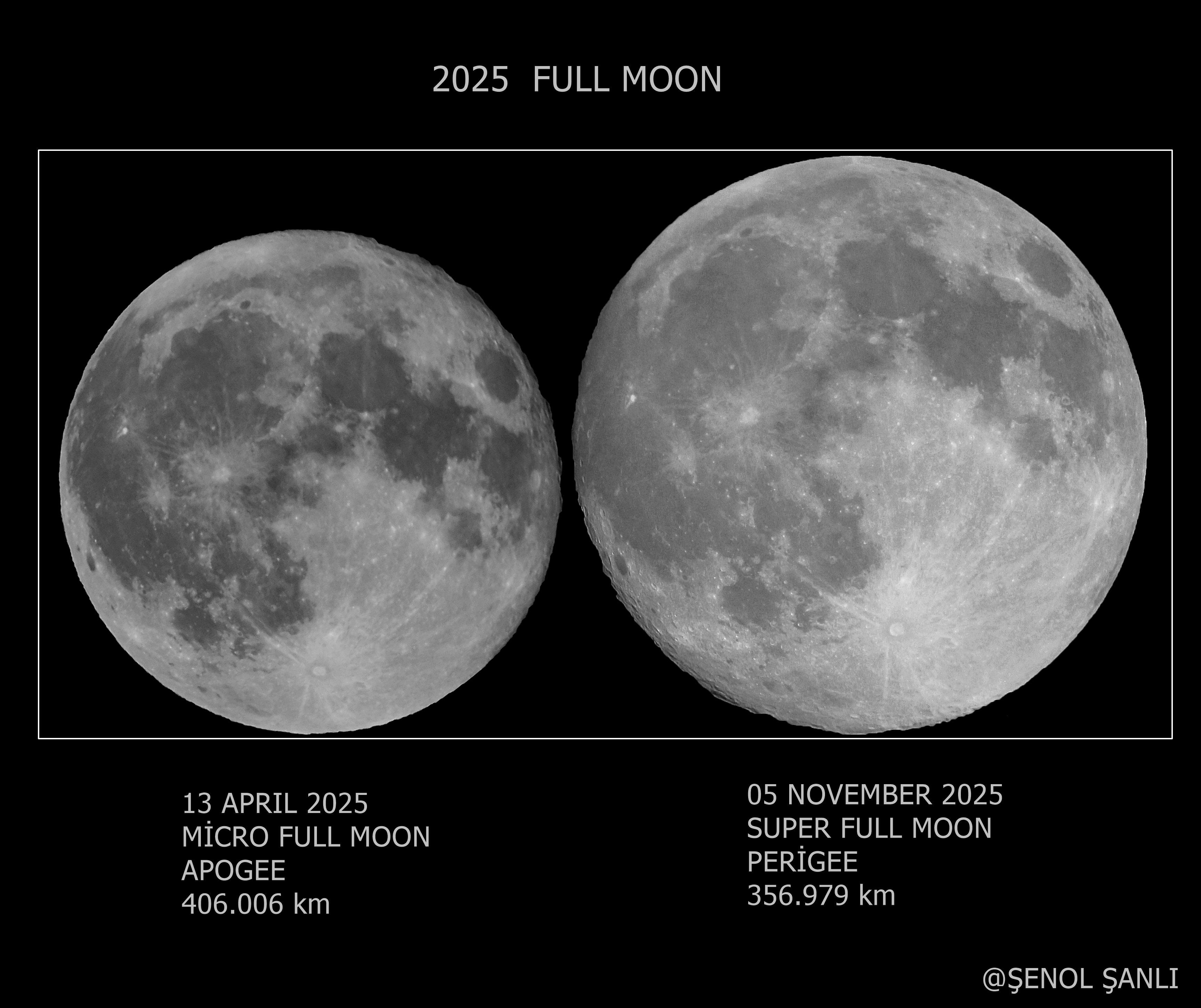
What was so super about Wednesday's supermoon? Last week, a full moon occurred that appeared slightly larger and brighter than usual. The reason is that the Moon's fully illuminated phase occurred within a short time from perigee - when the Moon was its closest to the Earth in its elliptical orbit. Although the precise conditions that define a supermoon vary, last Wednesday's supermoon was surely the closest, largest, and brightest full moon this year. One reason supermoons are popular is because they are so easy to see -- just go outside at sunset and watch an impressive full moon rise! Pictured here, Wednesday's supermoon is compared to April's micro moon -- when a full Moon occurs near the furthest part of the Moon's orbit -- so that it appears slightly smaller and dimmer than usual. Given many definitions, at least one supermoon occurs each year, with another one coming next month (moon-th).
https://science.nasa.gov/moon/
https://www.universetoday.com/articles/what-is-a-super-moon
https://svs.gsfc.nasa.gov/5415/
https://science.nasa.gov/moon/moon-phases/
https://en.wikipedia.org/wiki/Supermoon
https://ophysics.com/f6.html
https://en.wiktionary.org/wiki/perigee
https://apod.nasa.gov/apod/ap251110.html
#space #earth #moon #astrophotography #photography #science #astronomy #physics #nature #NASA #apod
Alt...
2025 November 10
Two full Moons are shown. They are different sizes because the Micro Moon image on the left was captured when the Moon was near its furthest from the Earth, while the Super Moon on the right was captured when the Moon was near its closest to the Earth.
Micro Moon vs. Super Moon
* Image Credit & Copyright: Şenol Şanlı"
Explanation:
What was so super about Wednesday's supermoon? Last week, a full moon occurred that appeared slightly larger and brighter than usual. The reason is that the Moon's fully illuminated phase occurred within a short time from perigee - when the Moon was its closest to the Earth in its elliptical orbit. Although the precise conditions that define a supermoon vary, last Wednesday's supermoon was surely the closest, largest, and brightest full moon this year. One reason supermoons are popular is because they are so easy to see -- just go outside at sunset and watch an impressive full moon rise! Pictured here, Wednesday's supermoon is compared to April's micro moon -- when a full Moon occurs near the furthest part of the Moon's orbit -- so that it appears slightly smaller and dimmer than usual. Given many definitions, at least one supermoon occurs each year, with another one coming next month (moon-th).
Authors & editors: Robert Nemiroff (MTU) & Jerry Bonnell (UMCP)
NASA Official: Amber Straughn Specific rights apply.
NASA Web Privacy, Accessibility, Notices;
A service of: ASD at NASA / GSFC,
NASA Science Activation
& Michigan Tech
Annotations for previous post
https://apod.nasa.gov/apod/ap251109.html
#space #galaxy #milkyway #astrophotography #photography #science #astronomy #nature #NASA #apod
Alt...
Annotations for previous post
2025 November 9
Road to the Galactic Center
* Image Credit & Copyright: Michael Abramyan
https://www.instagram.com/mikeabramyan
Explanation:
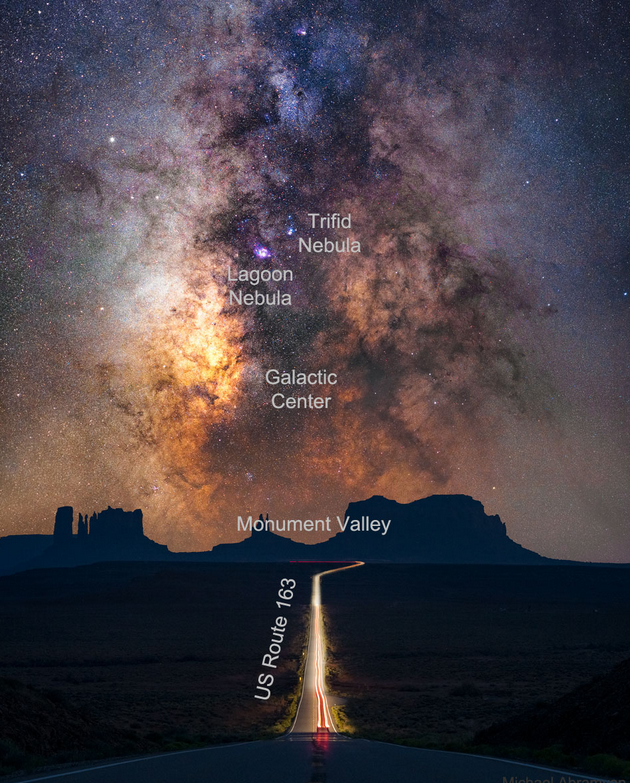
Does the road to our galaxy's center go through Monument Valley? It doesn't have to, but if your road does -- take a picture. In this case, the road is US Route 163 and iconic buttes on the Navajo National Reservation populate the horizon. The band of Milky Way Galaxy stretches down from the sky and appears to be a continuation of the road on Earth. Filaments of dust darken the Milky Way, in contrast to billions of bright stars and several colorful glowing gas clouds including the Lagoon and Trifid nebulas. The featured picture is a composite of images taken with the same camera and from the same location -- Forest Gump Point in Utah, USA. The foreground was taken just after sunset in early 2021 September during the blue hour, while the background is a mosaic of four exposures captured a few hours later.
https://www.youtube.com/watch?v=0yTBvAhj7Nw&t=293s
https://en.wikipedia.org/wiki/United_States
https://en.wikipedia.org/wiki/Monument_Valley
https://en.wikipedia.org/wiki/Utah
https://en.wikipedia.org/wiki/Navajo_Nation
https://en.wikipedia.org/wiki/Navajo_Nation#Reservation_and_expansion
https://www.travelinusa.us/forrest-gump-point/
https://science.nasa.gov/earth/
https://science.nasa.gov/resource/the-milky-way-galaxy/
https://apod.nasa.gov/apod/ap251109.html
#space #galaxy #milkyway #astrophotography #photography #science #astronomy #nature #NASA #apod
Alt...
2025 November 9
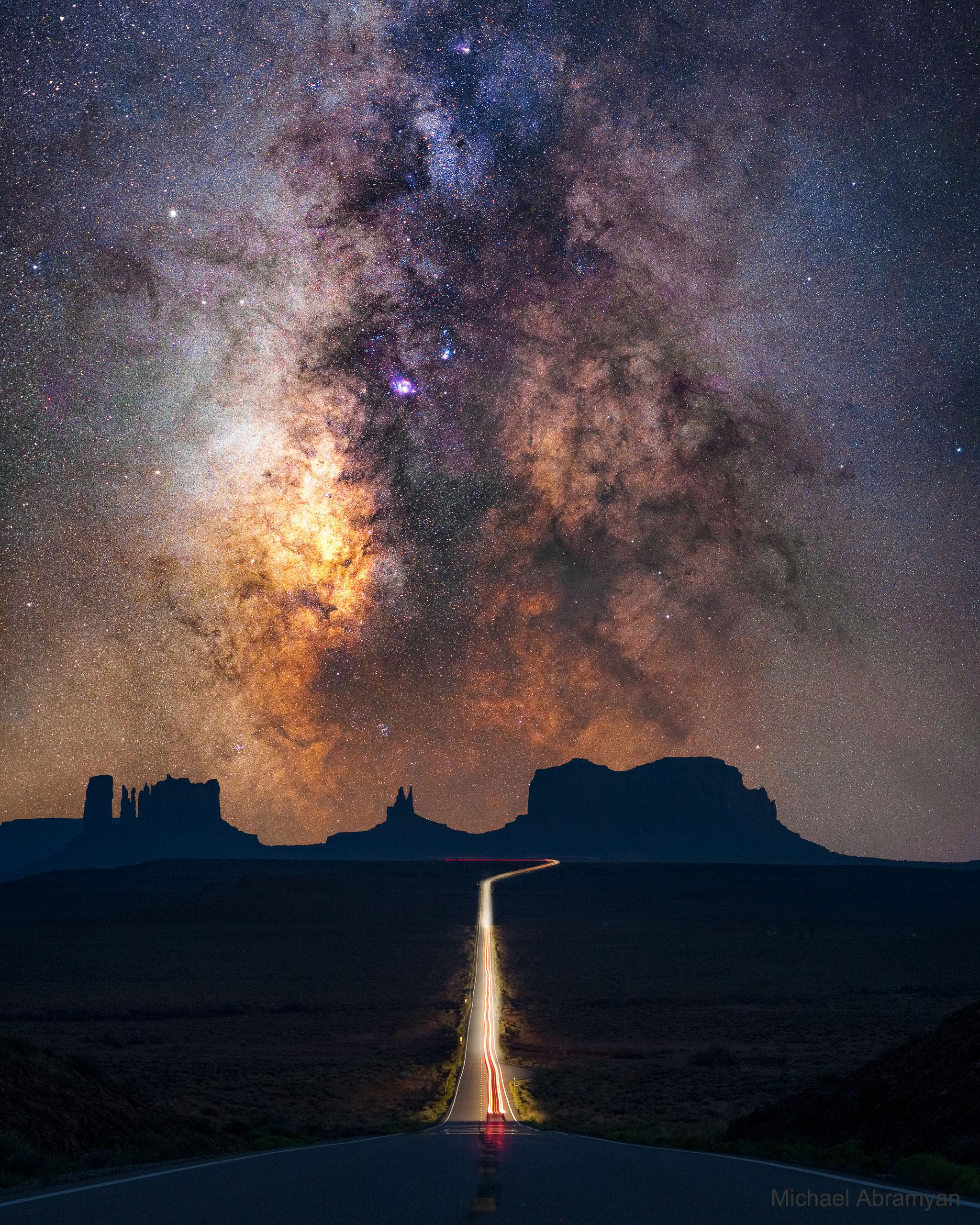
The picture shows the a composite image of Monument Valley, Utah, USA in the foreground, and the plane of the Milky Way Galaxy including the Galactic Center in the background.
Road to the Galactic Center
* Image Credit & Copyright: Michael Abramyan
Explanation:
Does the road to our galaxy's center go through Monument Valley? It doesn't have to, but if your road does -- take a picture. In this case, the road is US Route 163 and iconic buttes on the Navajo National Reservation populate the horizon. The band of Milky Way Galaxy stretches down from the sky and appears to be a continuation of the road on Earth. Filaments of dust darken the Milky Way, in contrast to billions of bright stars and several colorful glowing gas clouds including the Lagoon and Trifid nebulas. The featured picture is a composite of images taken with the same camera and from the same location -- Forest Gump Point in Utah, USA. The foreground was taken just after sunset in early 2021 September during the blue hour, while the background is a mosaic of four exposures captured a few hours later.
Authors & editors: Robert Nemiroff (MTU) & Jerry Bonnell (UMCP)
NASA Official: Amber Straughn Specific rights apply.
NASA Web Privacy, Accessibility, Notices;
A service of: ASD at NASA / GSFC,
NASA Science Activation
& Michigan Tech. U.
2025 November 8
A Full Moon at Perigee
* Image Credit & Copyright: Betul Turksoy
https://www.instagram.com/betul_turksoy/p/DQqj4P-Dcgu/
Explanation:
What is big, bright, and beautiful, can wear a cape made of clouds, and is at the closest point in its elliptical orbit around planet Earth? A full moon at perigee of course, captured here near moonset in predawn skies on November 5 from Kayseri, Turkiye. Full moons that happen at (or very near) perigee, and so are slightly larger and brighter than full moons on average, have become popularly known as supermoons. In fact, this full moon at perigee is the closest and brightest of the three supermoons of 2025. Rising as the Sun sets, this full moon follows this October's Harvest Moon and is traditionally known to some as the Hunter's Moon.
https://science.nasa.gov/moon/supermoons/
https://astropixels.com/ephemeris/moon/fullperigee2001.html
https://earthsky.org/astronomy-essentials/everything-you-need-to-know-hunters-moon/
https://apod.nasa.gov/apod/fap/ap251108.html
#space #earth #moon #astrophotography #photography #science #astronomy #nature #NASA #apod
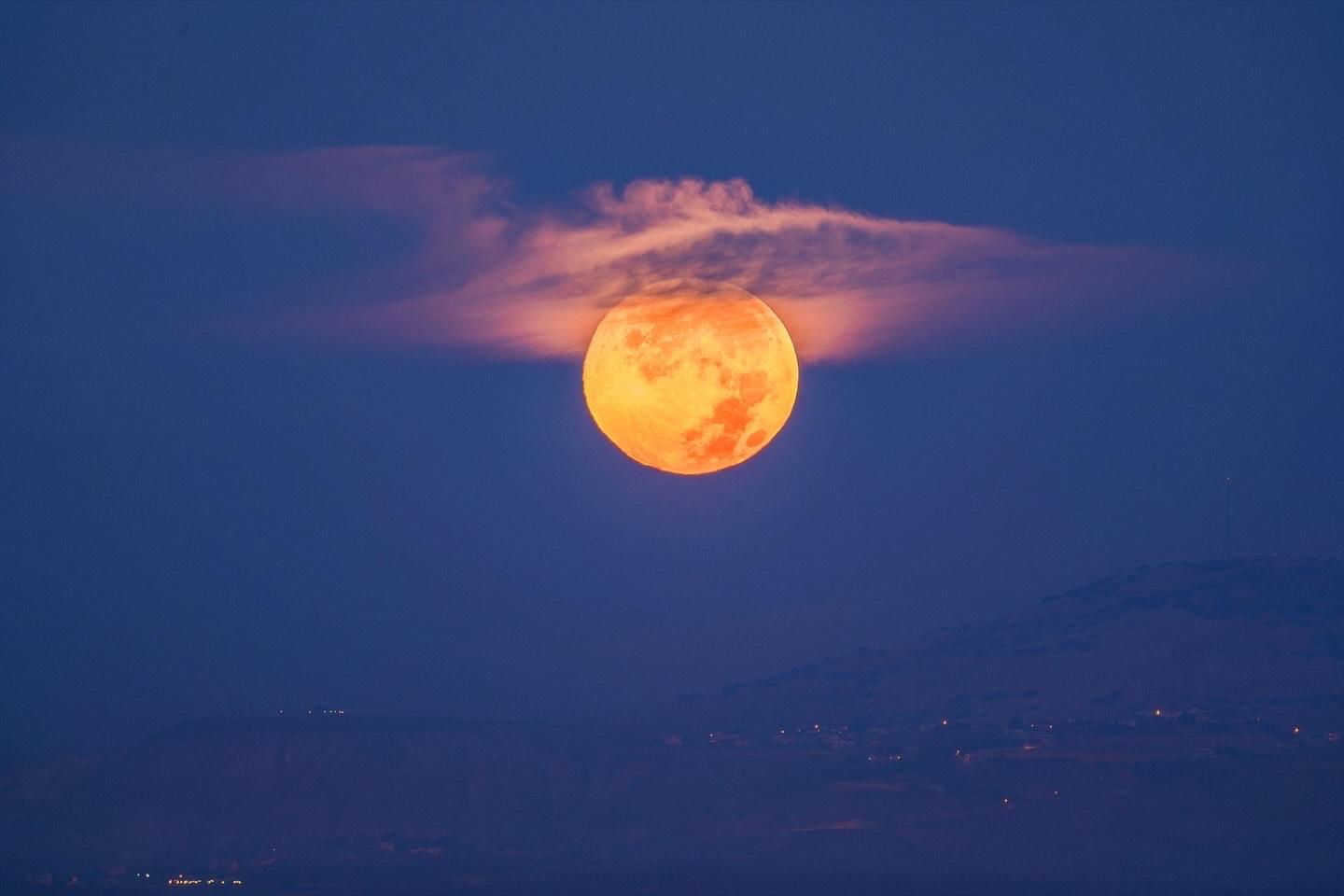
Alt...
2025 November 8
A Full Moon at Perigee
* Image Credit & Copyright: Betul Turksoy
Explanation:
What is big, bright, and beautiful, can wear a cape made of clouds, and is at the closest point in its elliptical orbit around planet Earth? A full moon at perigee of course, captured here near moonset in predawn skies on November 5 from Kayseri, Turkiye. Full moons that happen at (or very near) perigee, and so are slightly larger and brighter than full moons on average, have become popularly known as supermoons. In fact, this full moon at perigee is the closest and brightest of the three supermoons of 2025. Rising as the Sun sets, this full moon follows this October's Harvest Moon and is traditionally known to some as the Hunter's Moon.
Authors & editors: Robert Nemiroff (MTU) & Jerry Bonnell (UMCP)
NASA Official: Amber Straughn Specific rights apply.
NASA Web Privacy, Accessibility, Notices;
A service of: ASD at NASA / GSFC,
NASA Science Activation
& Michigan Tech. U.
2025 November 7
A Dark Seahorse in Cepheus
* Image Credit & Copyright: Jordi Jofre
https://app.astrobin.com/u/JJofre#gallery
Explanation:
Spanning light-years, this suggestive shape known as the Seahorse Nebula floats in silhouette against a rich background of of stars and glowing hydrogen gas. Seen toward the royal northern constellation of Cepheus, the dusty, dark nebula is part of a Milky Way molecular cloud some 1,200 light-years distant. It is also listed as Barnard 150 (B150), one of 182 dark markings of the sky cataloged in the early 20th century by astronomer E. E. Barnard. Packs of low mass stars are forming within, but their collapsing cores are only visible at long infrared wavelengths. Still, the luminous depths of the Milky Way in Cepheus add to this stunning galactic skyscape.
https://app.astrobin.com/i/pw6z9f
https://ui.adsabs.harvard.edu/abs/1916ApJ....43....1B/abstract
https://ui.adsabs.harvard.edu/abs/1919ApJ....49....1B/abstract
https://exhibit-archive.library.gatech.edu/barnard/
https://science.nasa.gov/ems/07_infraredwaves/
https://apod.nasa.gov/apod/ap251107.html
#space #nebula #astronomy #science #astrophotography #photography #nature #nebula #NASA #apod
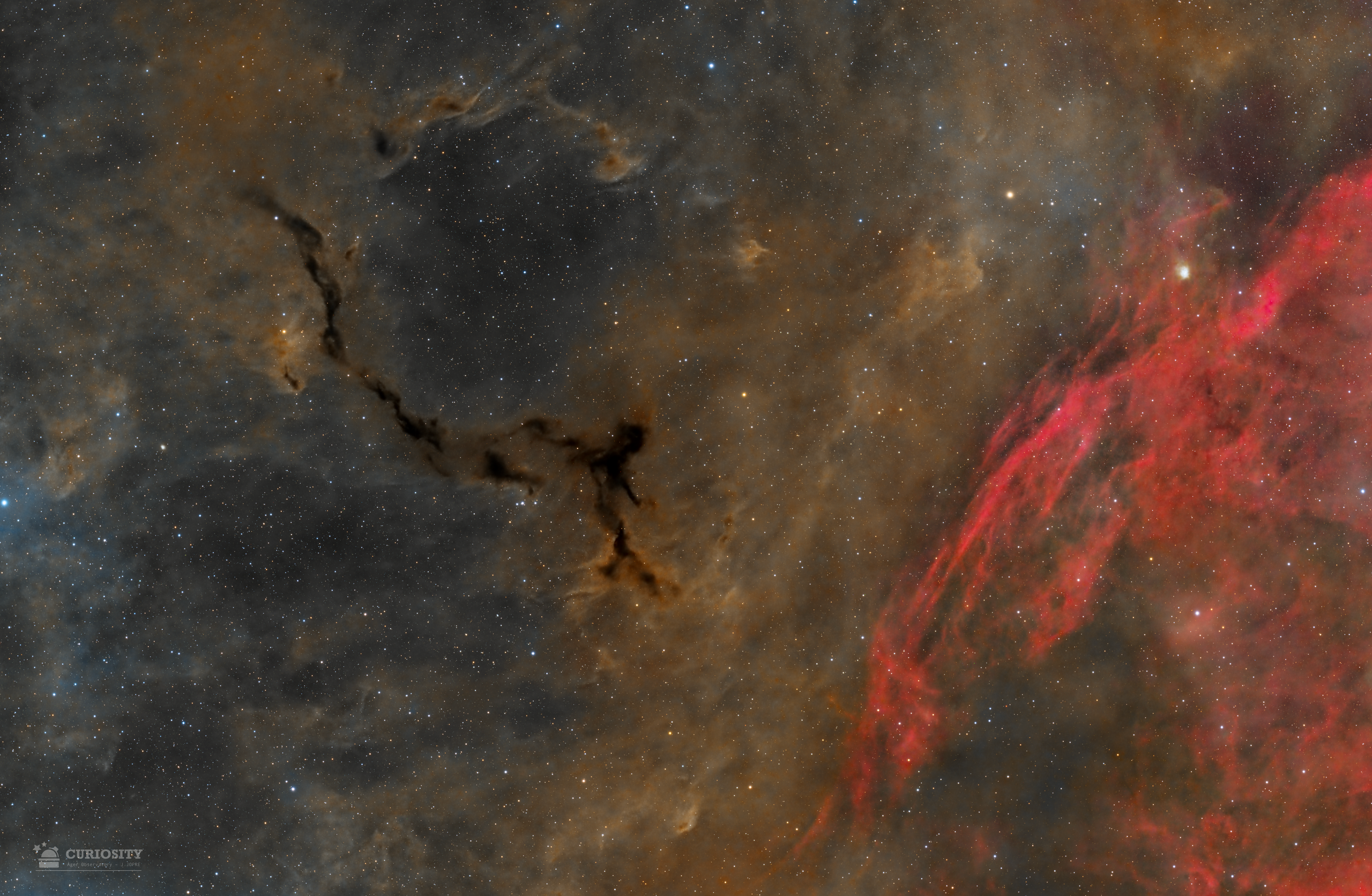
Alt...
2025 November 7
A Dark Seahorse in Cepheus
* Image Credit & Copyright: Jordi Jofre
Explanation:
Spanning light-years, this suggestive shape known as the Seahorse Nebula floats in silhouette against a rich background of of stars and glowing hydrogen gas. Seen toward the royal northern constellation of Cepheus, the dusty, dark nebula is part of a Milky Way molecular cloud some 1,200 light-years distant. It is also listed as Barnard 150 (B150), one of 182 dark markings of the sky cataloged in the early 20th century by astronomer E. E. Barnard. Packs of low mass stars are forming within, but their collapsing cores are only visible at long infrared wavelengths. Still, the luminous depths of the Milky Way in Cepheus add to this stunning galactic skyscape.
Authors & editors: Robert Nemiroff (MTU) & Jerry Bonnell (UMCP)
NASA Official: Amber Straughn Specific rights apply.
NASA Web Privacy, Accessibility, Notices;
A service of: ASD at NASA / GSFC,
NASA Science Activation
& Michigan Tech. U.
2025 November 6
NGC 253: Dusty Island Universe
* Image Credit & Copyright: Adam Block
https://www.adamblockphotos.com/
Explanation:
Shiny NGC 253 is one of the brightest spiral galaxies visible, and also one of the dustiest. Some call it the Silver Coin Galaxy for its appearance in small telescopes, or just the Sculptor Galaxy for its location within the boundaries of the southern constellation Sculptor. Discovered in 1783 by mathematician and astronomer Caroline Herschel, the dusty island universe lies a mere 10 million light-years away. About 70 thousand light-years across, NGC 253 is the largest member of the Sculptor Group of Galaxies, the nearest to our own Local Group of Galaxies. In addition to its spiral dust lanes, tendrils of dust seem to be rising from its galactic disk laced with young star clusters and star forming regions in this colorful galaxy portrait. The high dust content accompanies frantic star formation, earning NGC 253 the designation of a starburst galaxy. NGC 253 is also known to be a strong source of high-energy x-rays and gamma rays, likely due to black holes near the galaxy's center.
https://www.adamblockphotos.com/ngc-253.html
https://science.nasa.gov/asset/hubble/spiral-galaxy-ngc-253-left-and-its-core-full-of-star-formation/
https://www.arxiv.org/abs/astro-ph/0509430
https://chandra.harvard.edu/photo/2001/0012/index.html
https://www.nasa.gov/universe/nasa-missions-unmask-magnetar-eruptions-in-nearby-galaxies/
http://www.messier.seds.org/more/local.html
http://www.messier.seds.org/xtra/ngc/sclgr.html
http://www.messier.seds.org/xtra/ngc/n0253.html
https://www.rmg.co.uk/stories/space-astronomy/caroline-herschel-first-paid-female-astronomer
https://apod.nasa.gov/apod/fap/ap251106.html
#space #galaxy #astrophotography #photography #science #astronomy #nature #NASA #ESA #apod
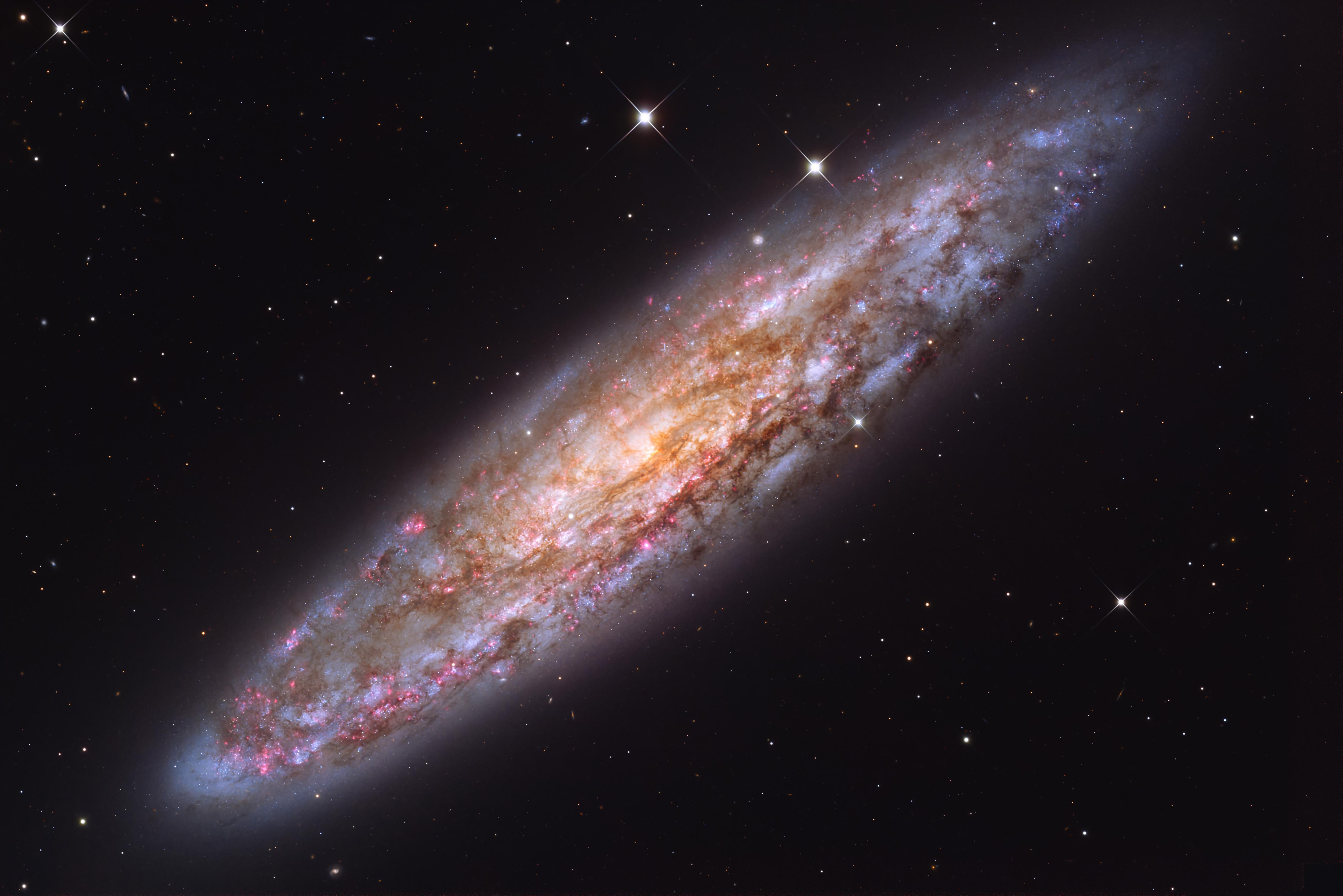
Alt...
2025 November 6
NGC 253: Dusty Island Universe
* Image Credit & Copyright: Adam Block
Explanation:
Shiny NGC 253 is one of the brightest spiral galaxies visible, and also one of the dustiest. Some call it the Silver Coin Galaxy for its appearance in small telescopes, or just the Sculptor Galaxy for its location within the boundaries of the southern constellation Sculptor. Discovered in 1783 by mathematician and astronomer Caroline Herschel, the dusty island universe lies a mere 10 million light-years away. About 70 thousand light-years across, NGC 253 is the largest member of the Sculptor Group of Galaxies, the nearest to our own Local Group of Galaxies. In addition to its spiral dust lanes, tendrils of dust seem to be rising from its galactic disk laced with young star clusters and star forming regions in this colorful galaxy portrait. The high dust content accompanies frantic star formation, earning NGC 253 the designation of a starburst galaxy. NGC 253 is also known to be a strong source of high-energy x-rays and gamma rays, likely due to black holes near the galaxy's center.
Authors & editors: Robert Nemiroff (MTU) & Jerry Bonnell (UMCP)
NASA Official: Amber Straughn Specific rights apply.
NASA Web Privacy, Accessibility, Notices;
A service of: ASD at NASA / GSFC,
NASA Science Activation
& Michigan Tech. U.
![[?]](https://cdn.masto.host/swisssocial/accounts/avatars/109/610/582/883/537/207/original/0e6a86a6c0df06cc.jpg)

#knowledge #wissen #wissenschaft #science #archaeology #archaologie #Astronomy #astronomie
Sonnensystem
Raumsonde nimmt 3I/ATLAS ins Visier
Glücklicher Zufall bietet der Jupitersonde JUICE beste Sicht auf den interstellaren Kometen 🤓
https://www.scinexx.de/news/kosmos/raumsonde-nimmt-3i-atlas-ins-visier/
#knowledge #wissen #wissenschaft #science #astronomie #Astronomy #physics #Physik
Kosmos: Blick hinter den „Vorhang“ möglich?
Drei "Zeitzeugen" könnten Einblick in die ersten 380.000 Jahre nach dem Urknall geben 🤓
https://www.scinexx.de/news/kosmos/kosmos-blick-hinter-den-vorhang-moeglich/
Pan: NGC 3370
Release date: 22 October 2025, 15:55
Today’s ESA/Hubble Picture of the Week features a galaxy that Hubble has captured multiple times over more than 20 years. The galaxy is called NGC 3370, and it is a spiral galaxy located nearly 90 million light-years away in the constellation Leo (The Lion).
What is it about this galaxy that makes it a popular target for researchers? NGC 3370 is home to two kinds of objects that astronomers prize for their usefulness in determining distances to faraway galaxies: Cepheid variable stars and Type Ia supernovae.
Cepheid variable stars change in both size and temperature as they pulsate. As a result, the luminosity of these stars varies over a period of days to months. It does so in a way that reveals something important: the more luminous a Cepheid variable star is, the more slowly it pulsates. By measuring how long a Cepheid variable’s brightness takes to complete one cycle, astronomers can determine how bright the star actually is. Paired with how bright the star appears from Earth, this information gives the distance to the star and its home galaxy.
Type Ia supernovae provide a way to measure distances in a single explosive burst rather than through regular brightness variations. Type Ia supernovae happen when the dead core of a star ignites in a sudden flare of nuclear fusion. These explosions peak at very similar luminosities, and much like for a Cepheid variable star, knowing the intrinsic brightness of a supernova explosion allows for its distance to be measured. Observations of Cepheid variable stars and Type Ia supernovae are both critical for precisely measuring how fast our Universe is expanding.
[...]
https://esahubble.org/videos/potw2542a/
Credit:
ESA/Hubble & NASA, A. Riess, K. Noll, N. Bartmann (ESA/Hubble)
Music: Stellardrone - Ascent
#space #galaxy #astrophotography #photography #science #astronomy #nature #NASA #ESA #apod
Type 1a Supernova Animation
This animation represents a binary star system in which a white dwarf accretes matter from a normal companion star. Matter streaming from the red star accumulates on the white dwarf until the dwarf explodes. With its partner destroyed, the normal star careens into space. This scenario results in what astronomers refer to as a Type Ia supernova.
Credits: NASA's Goddard Space Flight Center/Walt Feimer
#space #nebula #astrophotography #photography #science #astronomy #physics #nature #NASA #ESA
2020 May 11
Behind Betelgeuse
* Image Credit & Copyright: Adam Block, Steward Observatory, University of Arizona
https://www.adamblockphotos.com/
https://astro.arizona.edu/
Explanation:
What's behind Betelgeuse? One of the brighter and more unusual stars in the sky, the red supergiant star Betelgeuse can be found in the direction of famous constellation Orion. Betelgeuse, however, is actually well in front of many of the constellation's other bright stars, and also in front of the greater Orion Molecular Cloud Complex. Numerically, light takes about 700 years to reach us from Betelgeuse, but about 1,300 years to reach us from the Orion Nebula and its surrounding dust and gas. All but the largest telescopes see Betelgeuse as only a point of light, but a point so bright that the inherent blurriness created by the telescope and Earth's atmosphere make it seem extended. In the featured long-exposure image, thousands of stars in our Milky Way Galaxy can be seen in the background behind Betelgeuse, as well as dark dust from the Orion Molecular Cloud, and some red-glowing emission from hydrogen gas on the outskirts of the more distant Lambda Orionis Ring.
Betelgeuse has recovered from appearing unusually dim over the past six months (2020), but is still expected to explode in a spectacular supernova sometime in the next (about) 100,000 years.
https://apod.nasa.gov/apod/ap200511.html
#space #nova #astrophotography #photography #science #astronomy #physics #nature #NASA #education
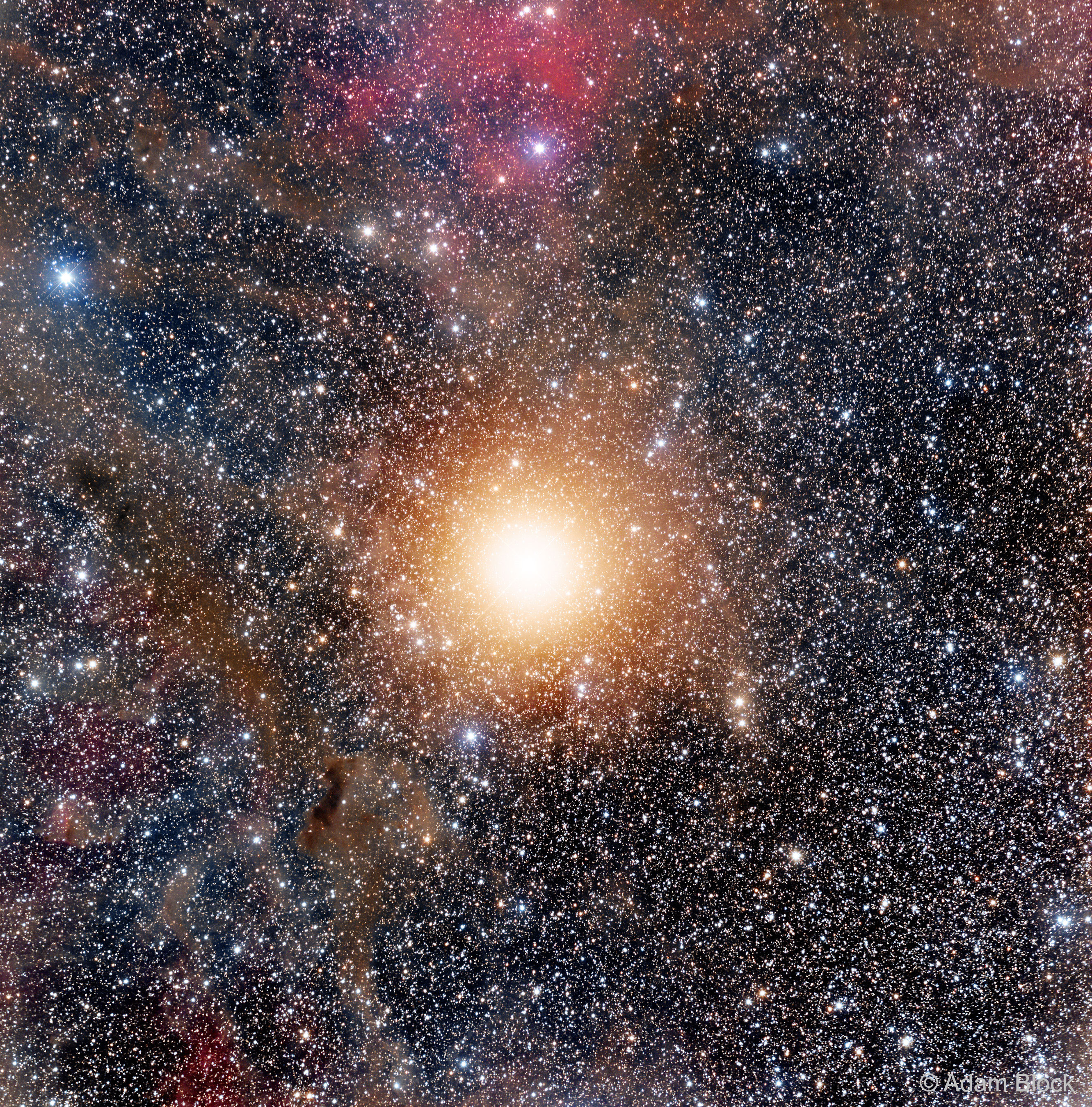
Alt...
2020 May 11
Behind Betelgeuse
* Image Credit & Copyright: Adam Block, Steward Observatory, University of Arizona
Explanation:
What's behind Betelgeuse? One of the brighter and more unusual stars in the sky, the red supergiant star Betelgeuse can be found in the direction of famous constellation Orion. Betelgeuse, however, is actually well in front of many of the constellation's other bright stars, and also in front of the greater Orion Molecular Cloud Complex. Numerically, light takes about 700 years to reach us from Betelgeuse, but about 1,300 years to reach us from the Orion Nebula and its surrounding dust and gas. All but the largest telescopes see Betelgeuse as only a point of light, but a point so bright that the inherent blurriness created by the telescope and Earth's atmosphere make it seem extended. In the featured long-exposure image, thousands of stars in our Milky Way Galaxy can be seen in the background behind Betelgeuse, as well as dark dust from the Orion Molecular Cloud, and some red-glowing emission from hydrogen gas on the outskirts of the more distant Lambda Orionis Ring. Betelgeuse has recovered from appearing unusually dim over the past six months, but is still expected to explode in a spectacular supernova sometime in the next (about) 100,000 years.
Authors & editors: Robert Nemiroff (MTU) & Jerry Bonnell (UMCP)
NASA Official: Phillip Newman Specific rights apply.
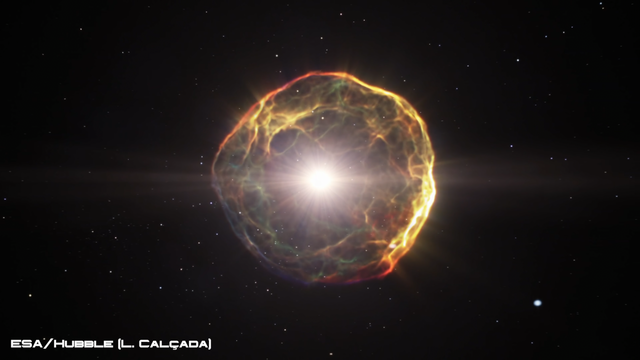
What Will It Look Like When Betelgeuse Goes Supernova?
640 light years away, there is a colossal star that is on the verge of exploding in a magnificent supernova. But what will it look like from Earth?
Video Credit:
V101 SPACE
https://www.youtube.com/@V101SPACE
To upload this video, I converted it and compressed it to less than a tenth of the original size under linux with the free software ffmpeg and the corresponding command:
'ffmpeg -i video_in.webm -vcodec libx265 -crf 40 video_out.mp4'
Maybe you would like to post a corresponding video on a scientifically related topic, but it is perhaps too big? Then try ffmpeg.
Often the compression factor '-crf 28' is enough, but in this particular case I had to go up to '-crf 40', because the original is a 4K UHD video and has a file size of 377MB. The compressed version here has a file size of only 28.4MB .
Of course, the quality of the video decreases, but it is enough to illustrate the topic.
Want to see the video in all its glory? Then visit the channel https://www.youtube.com/@V101SPACE and let Rob explain exciting space-related topics to you
#space #nova #astrophotography #photography #science #astronomy #physics #nature #NASA #ESA #education #UNIX #LINUX #FOSS #FSF
Alt...
640 light years away, there is a colossal star that is on the verge of exploding in a magnificent supernova. But what will it look like from Earth?
Video Credit:
V101 SPACE
https://www.youtube.com/@V101SPACE
To upload this video, I converted it and compressed it to less than a tenth of the original size under linux with the free software ffmpeg and the corresponding command:
'ffmpeg -i video_in.webm -vcodec libx265 -crf 40 video_out.mp4'
Maybe you would like to post a corresponding video on a scientifically related topic, but it is perhaps too big? Then try ffmpeg. Often the compression factor 'crf -28' is enough, but in this particular case I had to go up to 'crf -40', because the original is a 4K UHD video and has a file size of 377MB. The compressed version here has a file size of only 28.4MB .
Of course, the quality of the video decreases, but it is enough to illustrate the topic.
Want to see the video in all its glory? Then visit the channel https://www.youtube.com/@V101SPACE and let Rob explain exciting space-related topics to you
2024 April 3
Unusual Nebula Pa 30
* Image Credit: NASA, ESA, USAF, NSF
https://umanitoba.ca/science/physics-and-astronomy
https://physics.dartmouth.edu/
https://www.nsf.gov/
https://www.af.mil/
https://www.esa.int/
https://www.nasa.gov/;
* Processing: G. Ferrand https://gillesferrand.github.io/ (U. Manitoba), J. English http://www2.physics.umanitoba.ca/u/english/ (U. Manitoba), R. A. Fesen https://physics.dartmouth.edu/people/robert-fesen (Dartmouth), C. Treyturik (U. Manitoba);
* Text: G. Ferrand & J. English
Explanation:
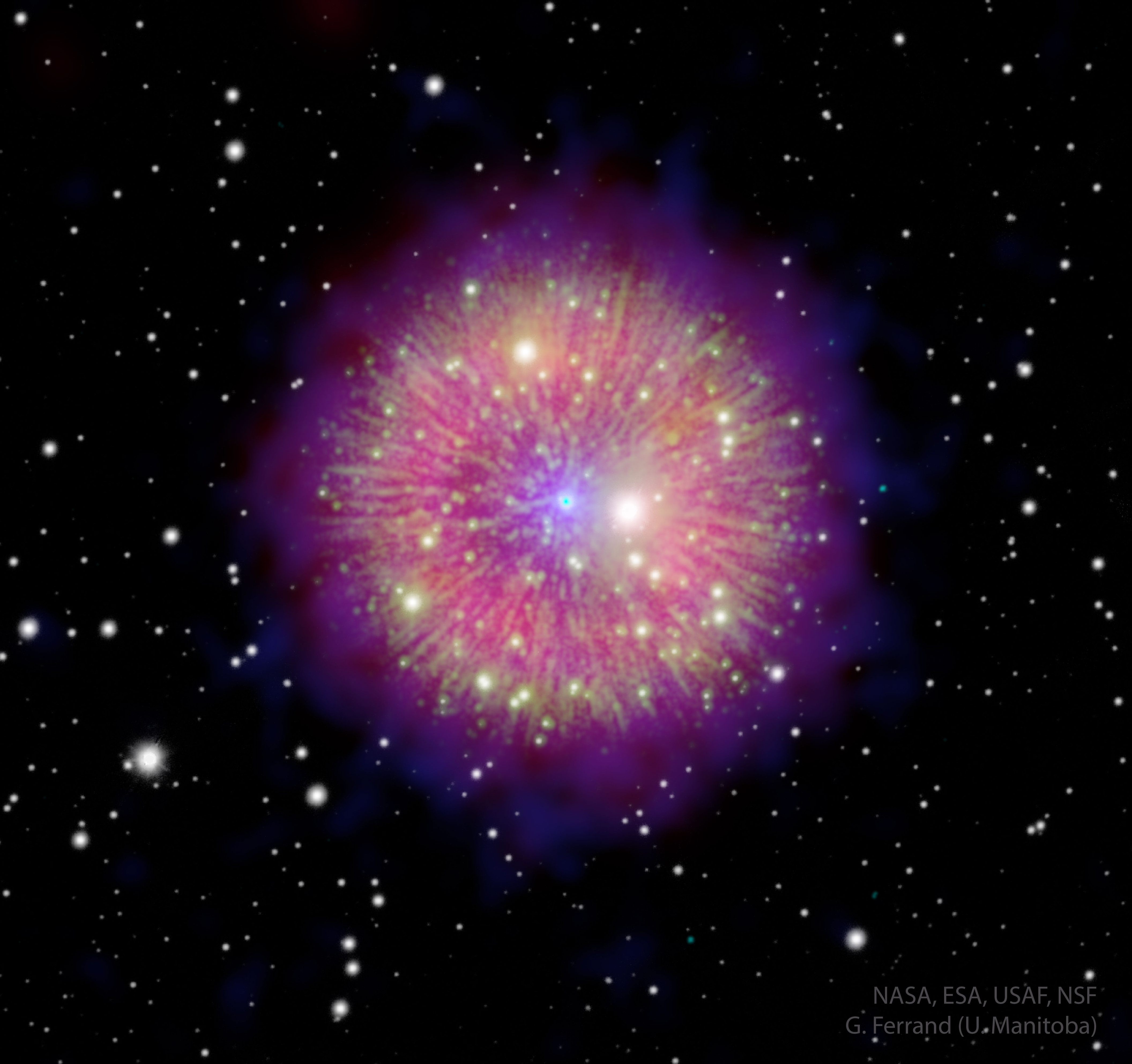
What created this unusual celestial firework? The nebula, dubbed Pa 30, appears in the same sky direction now as a bright "guest star" did in the year 1181. Although Pa 30's filaments look similar to that created by a nova (for example GK Per), and a planetary nebula (for example NGC 6751), some astronomers now propose that it was created by a rare type of supernova: a thermonuclear Type Iax, and so is (also) named SN 1181. In this model, the supernova was not the result of the detonation of a single star, but rather a blast that occurred when two white dwarf stars spiraled together and merged. The blue dot in the center is hypothesized to be a zombie star, the remnant white dwarf that somehow survived this supernova-level explosion. The featured image combines images and data obtained with infrared (WISE), visible (MDM, Pan-STARRS), and X-ray (Chandra, XMM) telescopes. Future observations and analyses may tell us more.
https://apod.nasa.gov/apod/ap240403.html
#space #nova #astrophotography #photography #science #astronomy #physics #nature #NASA #education
Alt...
2024 April 3
A nebula is shown that appears like a firework. Radial filaments connect a glowing halo to a star in the center that appears as a blue dot.
Unusual Nebula Pa 30
* Image Credit: NASA, ESA, USAF, NSF;
* Processing: G. Ferrand (U. Manitoba), J. English (U. Manitoba), R. A. Fesen (Dartmouth), C. Treyturik (U. Manitoba);
* Text: G. Ferrand & J. English
Explanation:
What created this unusual celestial firework? The nebula, dubbed Pa 30, appears in the same sky direction now as a bright "guest star" did in the year 1181. Although Pa 30's filaments look similar to that created by a nova (for example GK Per), and a planetary nebula (for example NGC 6751), some astronomers now propose that it was created by a rare type of supernova: a thermonuclear Type Iax, and so is (also) named SN 1181. In this model, the supernova was not the result of the detonation of a single star, but rather a blast that occurred when two white dwarf stars spiraled together and merged. The blue dot in the center is hypothesized to be a zombie star, the remnant white dwarf that somehow survived this supernova-level explosion. The featured image combines images and data obtained with infrared (WISE), visible (MDM, Pan-STARRS), and X-ray (Chandra, XMM) telescopes. Future observations and analyses may tell us more.
Authors & editors: Robert Nemiroff (MTU) & Jerry Bonnell (UMCP)
NASA Official: Amber Straughn Specific rights apply.
2021 August 22
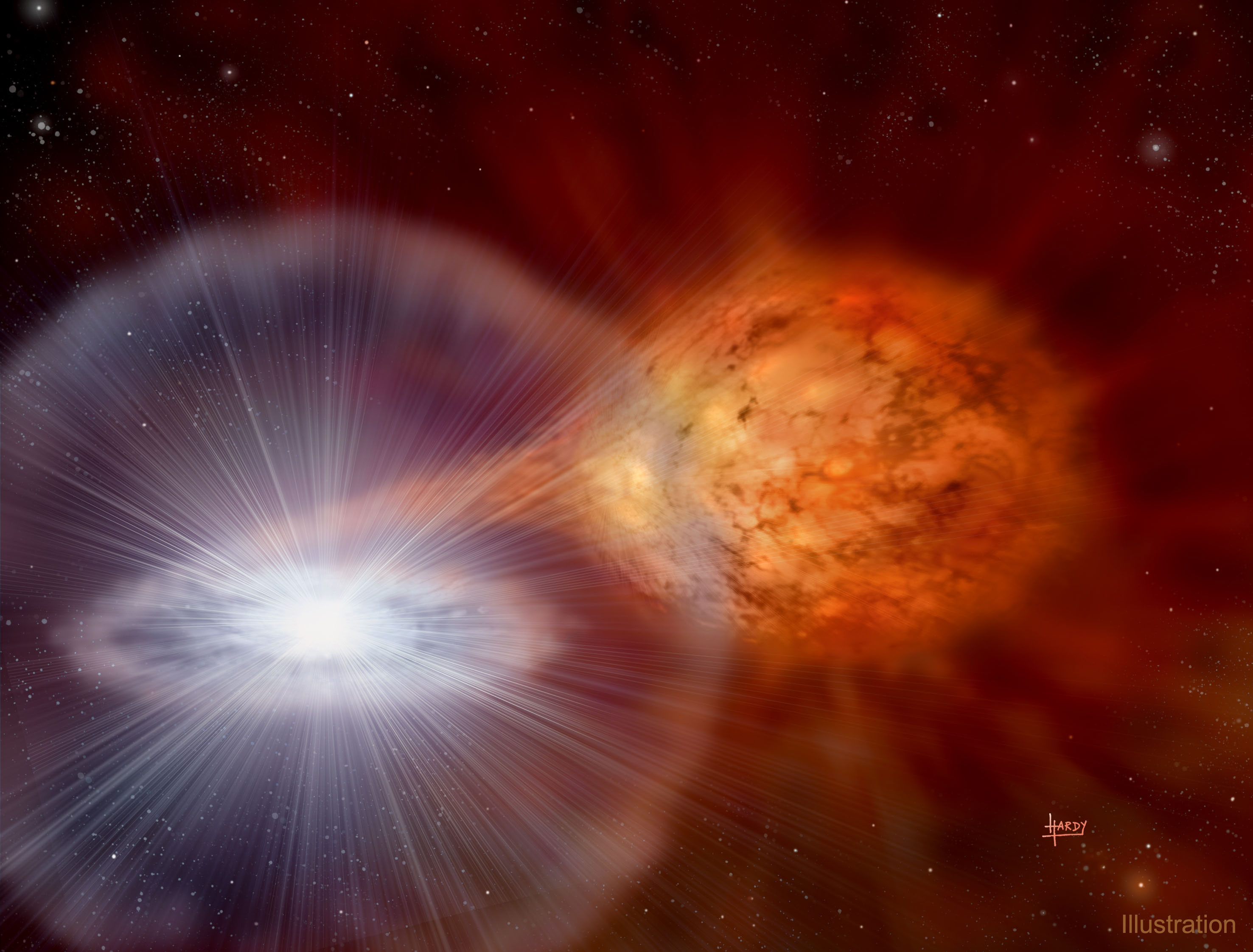
The picture shows an illustration of binary star system RS Ophiuchus during a nova-causing explosion.
Explosions from White Dwarf Star RS Oph
* Illustration Credit & Copyright: David A. Hardy & PPARC
https://www.astroart.org/hardy-profile
https://en.wikipedia.org/wiki/Particle_Physics_and_Astronomy_Research_Council
Explanation:
Spectacular explosions keep occurring in the binary star system named RS Ophiuchi. Every 20 years or so, the red giant star dumps enough hydrogen gas onto its companion white dwarf star to set off a brilliant thermonuclear explosion on the white dwarf's surface. At about 5,000 light years distant, the resulting nova explosions cause the RS Oph system to brighten up by a huge factor and become visible to the unaided eye. The red giant star is depicted on the right of the above drawing, while the white dwarf is at the center of the bright accretion disk on the left. As the stars orbit each other, a stream of gas moves from the giant star to the white dwarf. Astronomers speculate that at some time in the next 100,000 years, enough matter will have accumulated on the white dwarf to push it over the Chandrasekhar Limit, causing a much more powerful and final explosion known as a supernova. Starting early this month, RS Oph was again seen exploding in a bright nova.
https://ui.adsabs.harvard.edu/abs/2001ApJ...558..323H/abstract
https://apod.nasa.gov/apod/ap210822.html
#space #nova #astrophotography #photography #science #astronomy #physics #nature #NASA #education
Alt...
2021 August 22
The picture shows an illustration of binary star system RS Ophiuchus during a nova-causing explosion.
Explosions from White Dwarf Star RS Oph
* Illustration Credit & Copyright: David A. Hardy & PPARC
Explanation:
Spectacular explosions keep occurring in the binary star system named RS Ophiuchi. Every 20 years or so, the red giant star dumps enough hydrogen gas onto its companion white dwarf star to set off a brilliant thermonuclear explosion on the white dwarf's surface. At about 5,000 light years distant, the resulting nova explosions cause the RS Oph system to brighten up by a huge factor and become visible to the unaided eye. The red giant star is depicted on the right of the above drawing, while the white dwarf is at the center of the bright accretion disk on the left. As the stars orbit each other, a stream of gas moves from the giant star to the white dwarf. Astronomers speculate that at some time in the next 100,000 years, enough matter will have accumulated on the white dwarf to push it over the Chandrasekhar Limit, causing a much more powerful and final explosion known as a supernova. Starting early this month, RS Oph was again seen exploding in a bright nova.
Authors & editors: Robert Nemiroff (MTU) & Jerry Bonnell (UMCP)
NASA Official: Phillip Newman Specific rights apply.
NASA Web Privacy Policy and Important Notices
A service of: ASD at NASA / GSFC
& Michigan Tech. U.
"The extreme temporary light emissions of a nova are often visible to the naked eye from Earth. Even with several spectacular visible phenomena, such as this night sky, the nova remains recognizable to the trained eye. Due to their short-term glow and later dimming, it seemed to earlier cultures as if there were celestial bodies that could appear and disappear out of nowhere. In ancient China, astronomers called these 'Guest Stars' More on this in the next post"
2021 August 16
Perseid Meteor, Red Sprites, and Nova RS Ophiuchus
* Image Credit & Copyright: Daniel Korona
Explanation:
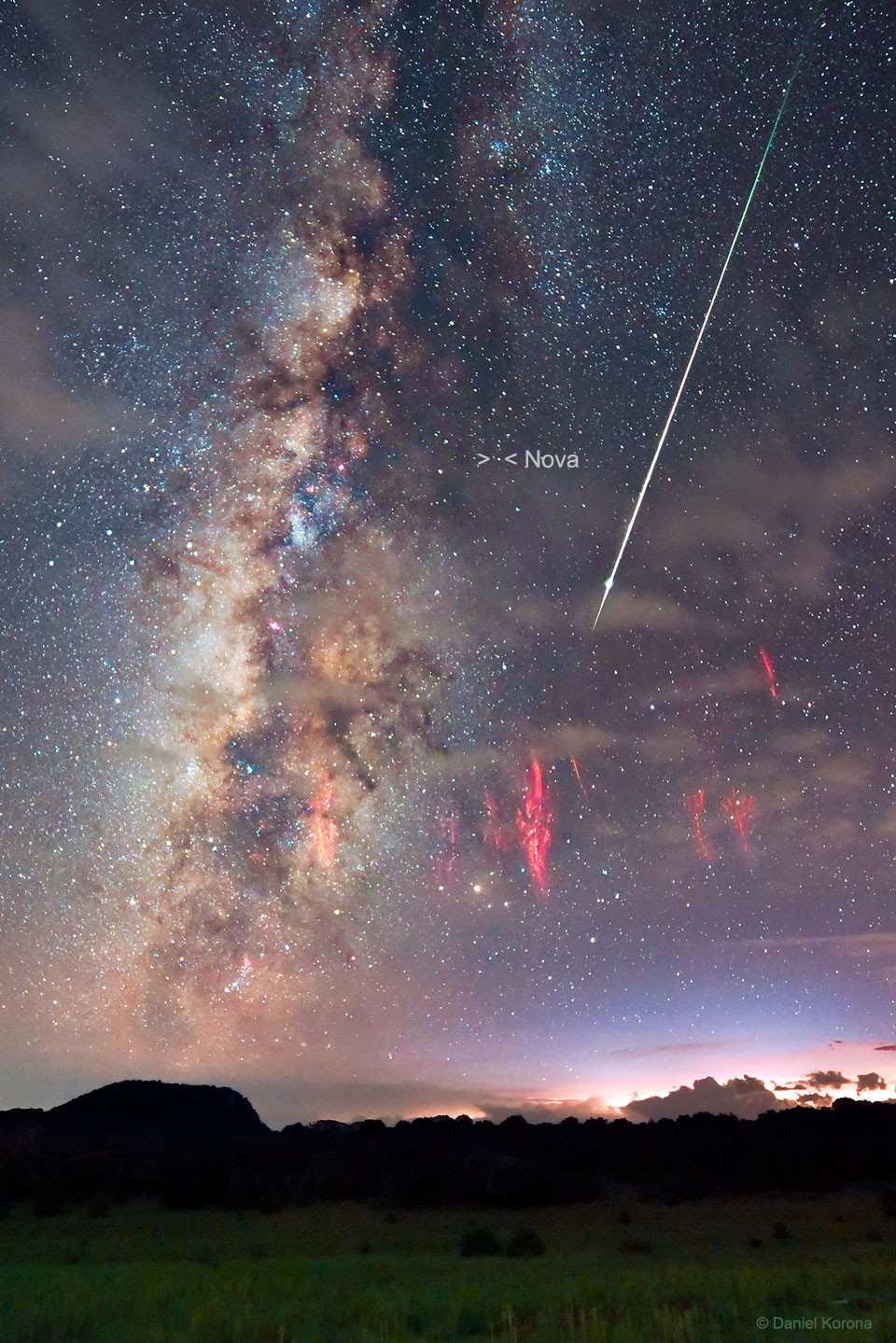
This was an unusual sky. It wasn't unusual because of the central band the Milky Way Galaxy, visible along the image left. Most dark skies show part of the Milky Way. It wasn't unusual because of the bright meteor visible on the upper right. Many images taken during last week's Perseid Meteor Shower show meteors, although this Perseid was particularly bright. This sky wasn't unusual because of the red sprites, visible on the lower right. Although this type of lightning has only been noted in the past few decades, images of sprites are becoming more common. This sky wasn't unusual because of the nova, visible just above the image center. Novas bright enough to be seen with the unaided eye occur every few years, with pictured Nova RS Ophiuchus discovered about a week ago. What was most unusual, though, was to capture all these things together, in a single night, on a single sky. The unusual sky occurred above Zacatecas, Mexico.
https://apod.nasa.gov/apod/ap210816.html
#space #nova #astrophotography #photography #science #astronomy #physics #nature #NASA #education
Alt...
2021 August 16
Perseid Meteor, Red Sprites, and Nova RS Ophiuchus
* Image Credit & Copyright: Daniel Korona
Explanation:
This was an unusual sky. It wasn't unusual because of the central band the Milky Way Galaxy, visible along the image left. Most dark skies show part of the Milky Way. It wasn't unusual because of the bright meteor visible on the upper right. Many images taken during last week's Perseid Meteor Shower show meteors, although this Perseid was particularly bright. This sky wasn't unusual because of the red sprites, visible on the lower right. Although this type of lightning has only been noted in the past few decades, images of sprites are becoming more common. This sky wasn't unusual because of the nova, visible just above the image center. Novas bright enough to be seen with the unaided eye occur every few years, with pictured Nova RS Ophiuchus discovered about a week ago. What was most unusual, though, was to capture all these things together, in a single night, on a single sky. The unusual sky occurred above Zacatecas, Mexico.
Authors & editors: Robert Nemiroff (MTU) & Jerry Bonnell (UMCP)
NASA Official: Phillip Newman Specific rights apply.
NASA Web Privacy Policy and Important Notices
A service of: ASD at NASA / GSFC
& Michigan Tech. U.
Guest star (astronomy)
From Wikipedia, the free encyclopedia
In Chinese astronomy, a guest star (Chinese: pinyin: kèxīng) is a star which has suddenly appeared in a place where no star had previously been observed and becomes invisible again after some time. The term is a literal translation from ancient Chinese astronomical records.
Modern astronomy recognizes that guest stars are manifestations of cataclysmic variable stars: novae and supernovae. The term "guest star" is used in the context of ancient records, since the exact classification of an astronomical event in question is based on interpretations of old records, including inference, rather than on direct observations.
In ancient Chinese astronomy, guest stars were one of the three types of highly transient objects (bright heavenly bodies). The other two were comets with tails (Chinese: pinyin: huìxīng; lit. 'broom star') and comets without tails (Chinese: pinyin: beìxīng; lit. 'fuzzy star'), with the former term being used for all comets in modern astronomy.
The earliest Chinese record of guest stars is contained in Han Shu,the history of Han dynasty (206 BC – AD 220), and all subsequent dynastic histories had such records. These contain one of the clearest early descriptions consistent with a supernova, posited to be left over by object SN 185, thus identified as a supernova remnant of the exact year AD 185. Chronicles of the contemporary Europeans are more vague when consulted for supernovae candidates. Whether this was due to the weather or other reasons, astronomers have questioned why the remnant attributed to Chinese observations of a guest star in AD 1054 (see SN 1054) is missing from the European records.
https://en.wikipedia.org/wiki/Historical_comet_observations_in_China
https://en.wikipedia.org/wiki/Guest_star_(astronomy)
#space #nova #astrophotography #photography #science #astronomy #physics #history #nature #NASA #education #China

Alt...
The guest star reported by Chinese astronomers in 1054 and cited in the highlighted passages in this text from 1414 is identified as SN 1054
"Obviously, the ancient document shown in the previous post is a testimony of the famous ancient supernova SN 1054"
The Crab Nebula is an expanding remnant of a star's supernova explosion. Japanese and Chinese astronomers recorded this violent event nearly 1,000 years ago in 1054 AD, as did likely the Native Americans. The glowing relic has been expanding since the star exploded, and it is now approximately 11 light-years in width.
Constellation: Taurus
Distance: 6,500 light-years (2.0 kiloparsecs)
Animation showing the Crab Supernova explosion and its remant.
* Animation Credit:
ESA/Hubble (M. Kornmesser & L. L. Christensen)
#space #nova #astrophotography #photography #science #astronomy #physics #nature #history #NASA #education
Oct 18, 2019
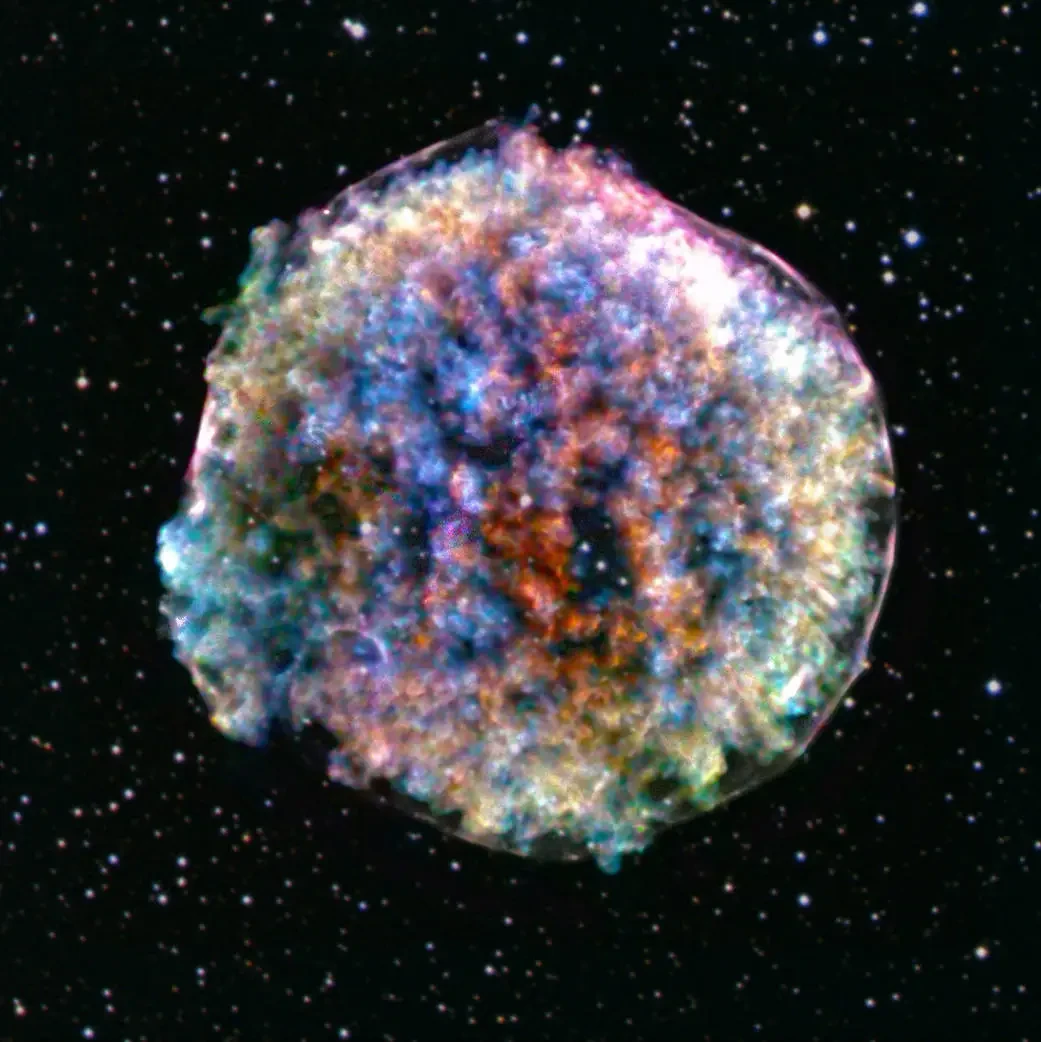
The Tycho Supernova: Death of a Star - NASA
* Image Credit: X-ray: NASA/CXC/RIKEN & GSFC/T. Sato et al; Optical: DSS
Explanation:
In 1572, Danish astronomer Tycho Brahe was among those who noticed a new bright object in the constellation Cassiopeia. Adding fuel to the intellectual fire that Copernicus started, Tycho showed this “new star” was far beyond the Moon, and that it was possible for the universe beyond the Sun and planets to change.
Astronomers now know that Tycho’s new star was not new at all. Rather it signaled the death of a star in a supernova, an explosion so bright that it can outshine the light from an entire galaxy. This particular supernova was a Type Ia, which occurs when a white dwarf star pulls material from, or merges with, a nearby companion star until a violent explosion is triggered. The white dwarf star is obliterated, sending its debris hurtling into space.
In its two decades of operation, NASA’s Chandra X-ray Observatory has captured unparalleled X-ray images of many supernova remnants.
Chandra reveals an intriguing pattern of bright clumps and fainter areas in Tycho. What caused this thicket of knots in the aftermath of this explosion? Did the explosion itself cause this clumpiness, or was it something that happened afterward?
https://www.nasa.gov/image-article/tycho-supernova-death-of-star/
#space #nova #astrophotography #photography #science #astronomy #physics #nature #NASA #education
Alt...
This latest image of Tycho from Chandra is providing clues. To emphasize the clumps in the image and the three-dimensional nature of Tycho, scientists selected two narrow ranges of X-ray energies to isolate material (silicon, colored red) moving away from Earth, and moving towards us (also silicon, colored blue). The other colors in the image (yellow, green, blue-green, orange and purple) show a broad range of different energies and elements, and a mixture of directions of motion. In this new composite image, Chandra’s X-ray data have been combined with an optical image of the stars in the same field of view from the Digitized Sky Survey.
Image Credit: X-ray: NASA/CXC/RIKEN & GSFC/T. Sato et al; Optical: DSS
Webb Reveals Never-Before-Seen Details in Cassiopeia A - NASA
[...]
Editor’s Note: The story below has been updated to clarify that the supernova was 340 years ago from Earth’s perspective.
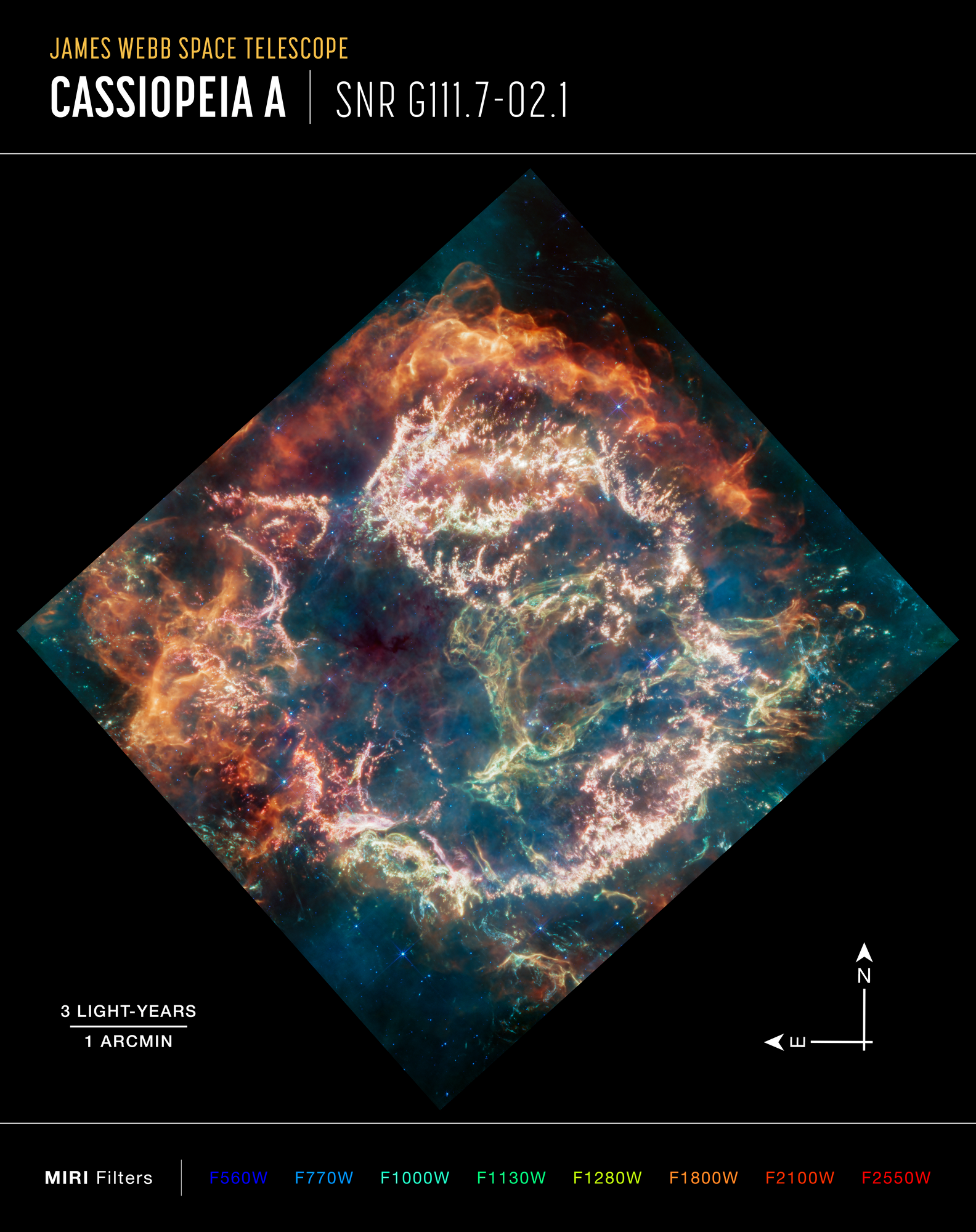
The explosion of a star is a dramatic event, but the remains the star leaves behind can be even more dramatic. A new mid-infrared image from NASA’s James Webb Space Telescope provides one stunning example. It shows the supernova remnant Cassiopeia A (Cas A), created by a stellar explosion 340 years ago from Earth’s perspective. Cas A is the youngest known remnant from an exploding, massive star in our galaxy, which makes it a unique opportunity to learn more about how such supernovae occur.
“Cas A represents our best opportunity to look at the debris field of an exploded star and run a kind of stellar autopsy to understand what type of star was there beforehand and how that star exploded,” said Danny Milisavljevic of Purdue University in West Lafayette, Indiana, principal investigator of the Webb program that captured these observations.
“Compared to previous infrared images, we see incredible detail that we haven’t been able to access before,” added Tea Temim of Princeton University in Princeton, New Jersey, a co-investigator on the program.
Cassiopeia A is a prototypical supernova remnant that has been widely studied by a number of ground-based and space-based observatories, including NASA’s Chandra X-ray Observatory. The multi-wavelength observations can be combined to provide scientists with a more comprehensive understanding of the remnant.
[...]
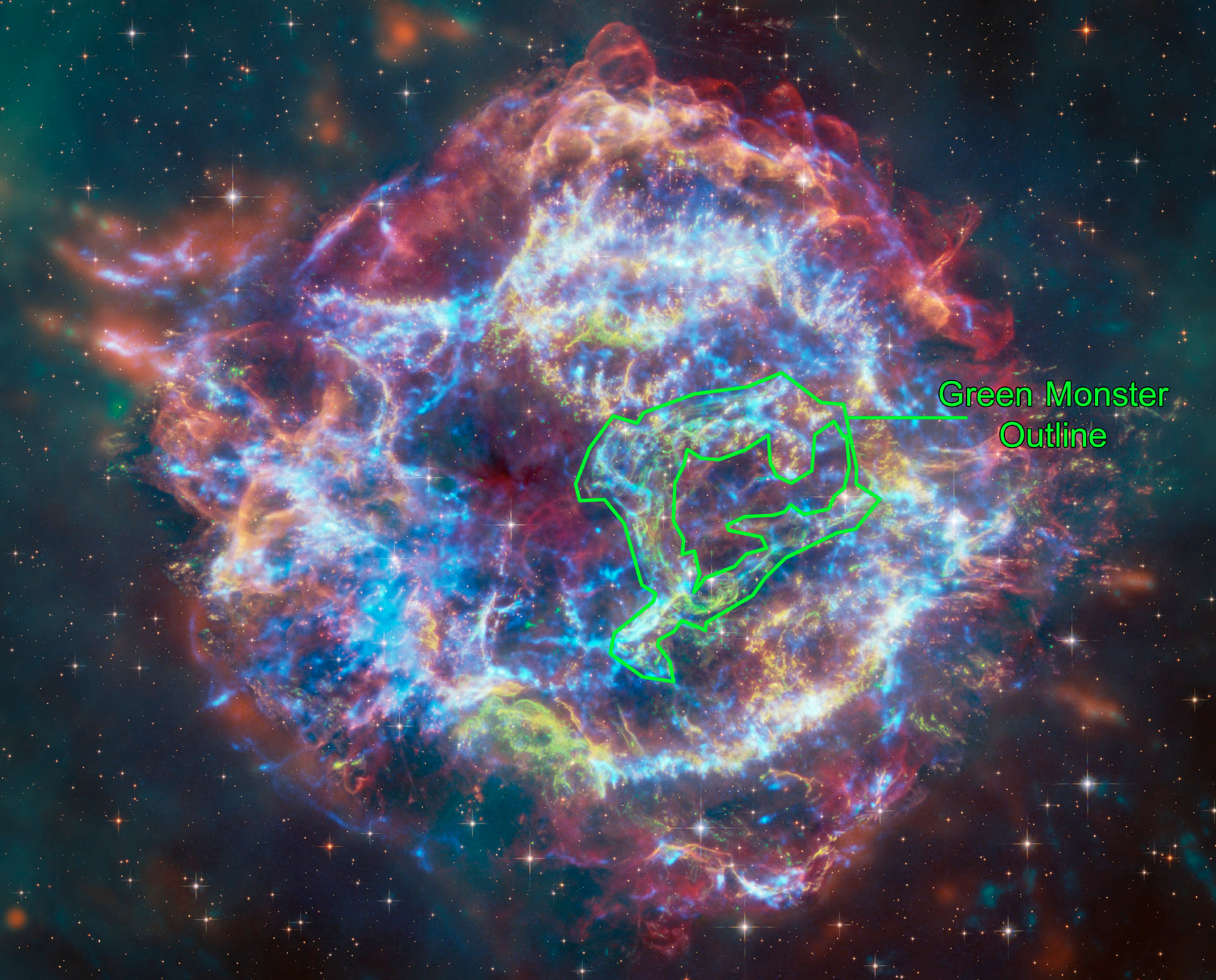
Perhaps most prominently, a loop represented in green extends across the right side of the central cavity. “We’ve nicknamed it the Green Monster in honor of Fenway Park in Boston. If you look closely, you’ll notice that it’s pockmarked with what look like mini-bubbles,” said Milisavljevic.
[...]
https://www.nasa.gov/universe/webb-reveals-never-before-seen-details-in-cassiopeia-a/
#space #nova #astrophotography #photography #science #astronomy #physics #nature #NASA #education
Alt...
Cassiopeia A (Cas A) is a supernova remnant located about 11,000 light-years from Earth in the constellation Cassiopeia. It spans approximately 10 light-years. This new image uses data from Webb’s Mid-Infrared Instrument (MIRI) to reveal Cas A in a new light.
On the remnant’s exterior, particularly at the top and left, lie curtains of material appearing orange and red due to emission from warm dust. This marks where ejected material from the exploded star is ramming into surrounding circumstellar material.
Interior to this outer shell lie mottled filaments of bright pink studded with clumps and knots. This represents material from the star itself, and likely shines due to a mix of various heavy elements and dust emission. The stellar material can also be seen as fainter wisps near the cavity’s interior.
A loop represented in green extends across the right side of the central cavity. Its shape and complexity are unexpected and challenging for scientists to understand.
This image combines various filters with the color red assigned to 25.5 microns (F2550W), orange-red to 21 microns (F2100W), orange to 18 microns (F1800W), yellow to 12.8 microns (F1280W), green to 11.3 microns (F1130W), cyan to 10 microns (F1000W), light blue to 7.7 microns (F770W), and blue to 5.6 microns (F560W). The data comes from general observer
Chandra Reveals Elementary Nature of Cassiopeia A
Where do most of the elements essential for life on Earth come from? The answer: inside the furnaces of stars and the explosions that mark the end of some stars' lives.
Astronomers have long studied exploded stars and their remains — known as "supernova remnants" — to better understand exactly how stars produce and then disseminate many of the elements observed on Earth, and in the cosmos at large.
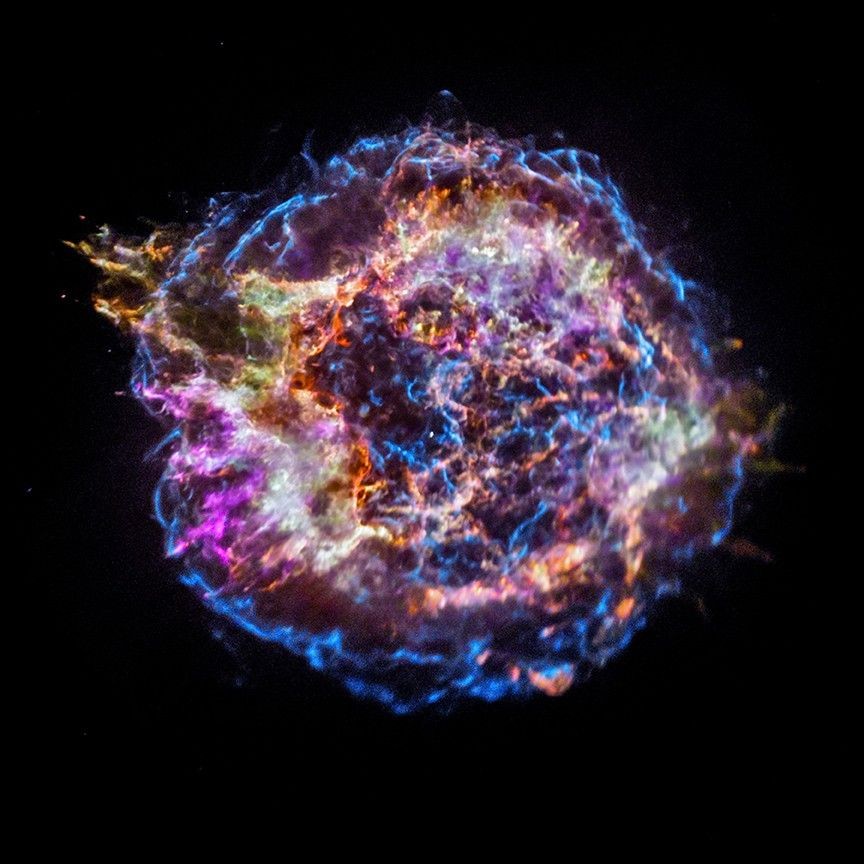
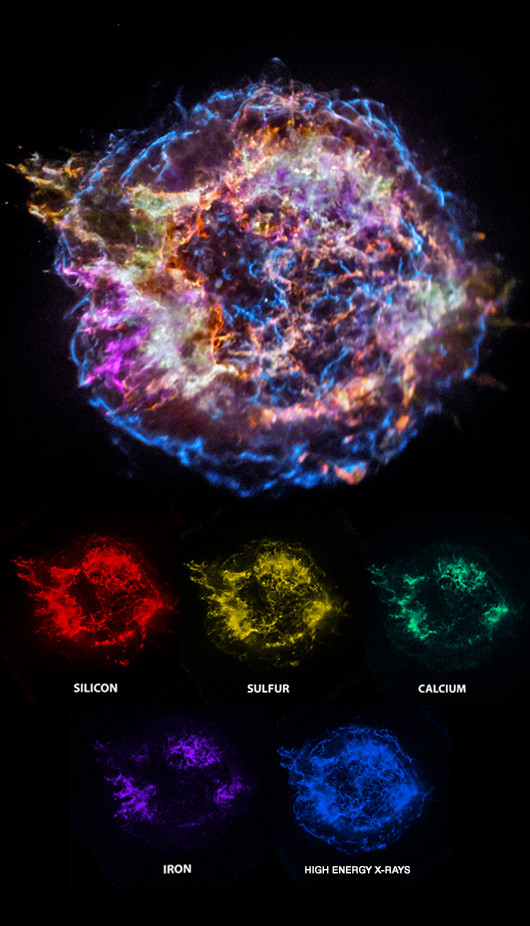
Due to its unique evolutionary status, Cassiopeia A (Cas A) is one of the most intensely studied of these supernova remnants. A new image from NASA's Chandra X-ray Observatory shows the location of different elements in the remains of the explosion: silicon (red), sulfur (yellow), calcium (green) and iron (purple). Each of these elements produces X-rays within narrow energy ranges, allowing maps of their location to be created. The blue color shows high energy X-ray emission, and the blue outer ring in particular is a representation of the expanding blast wave.
X-ray telescopes such as Chandra are important to study supernova remnants and the elements they produce because these events generate extremely high temperatures — millions of degrees — even thousands of years after the explosion. This means that many supernova remnants, including Cas A, glow most strongly at X-ray wavelengths that are undetectable with other types of telescopes.
Chandra's sharp X-ray vision allows astronomers to gather detailed information about the elements that objects like Cas A produce. For example, they are not only able to identify many of the elements that are present, but how much of each are being expelled into interstellar space.
https://chandra.harvard.edu/photo/2017/casa_life/
#space #nova #astrophotography #photography #science #astronomy #physics #nature #NASA #education
Alt...
An image from NASA’s Chandra X-ray Observatory shows the location of several elements produced by the explosion of a massive star. Cassiopeia A is a well-known supernova remnant located about 11,000 light years from Earth. Supernova remnants and the elements they produce are very hot — millions of degrees — and glow strongly in X-ray light. Chandra's sharp X-ray vision allows scientists to determine both the amount and location of these crucial elements objects like Cas A produce.
Credit: NASA/CXC/SAO
Historical Date: December 12, 2017
[...]
X-ray telescopes such as Chandra are important to study supernova remnants and the elements they produce because these events generate extremely high temperatures — millions of degrees — even thousands of years after the explosion. This means that many supernova remnants, including Cas A, glow most strongly at X-ray wavelengths that are undetectable with other types of telescopes.
Chandra's sharp X-ray vision allows astronomers to gather detailed information about the elements that objects like Cas A produce. For example, they are not only able to identify many of the elements that are present, but how much of each are being expelled into interstellar space.
The Chandra data indicate that the supernova that produced Cas A has churned out prodigious amounts of key cosmic ingredients. Cas A has dispersed about 10,000 Earth masses worth of sulfur alone, and about 20,000 Earth masses of silicon. The iron in Cas A has the mass of about 70,000 times that of the Earth, and astronomers detect a whopping one million Earth masses worth of oxygen being ejected into space from Cas A, equivalent to about three times the mass of the Sun. (Even though oxygen is the most abundant element in Cas A, its X-ray emission is spread across a wide range of energies and cannot be isolated in this image, unlike the other elements that are shown.)
While the exact date is not confirmed https://chandra.harvard.edu/graphics/resources/illustrations/historicsnr_infograph.pdf, many experts think that the stellar explosion that created Cas A occurred around the year 1680 in Earth's timeframe. Astronomers estimate that the doomed star was about five times the mass of the Sun just before it exploded. The star is estimated to have started its life with a mass about 16 times that of the Sun, and lost roughly two-thirds of this mass in a vigorous wind blowing off the star several hundred thousand years before the explosion. [...]
https://chandra.harvard.edu/photo/2017/casa_life/
#space #nova #astrophotography #photography #science #astronomy #physics #nature #NASA #education
Alt...
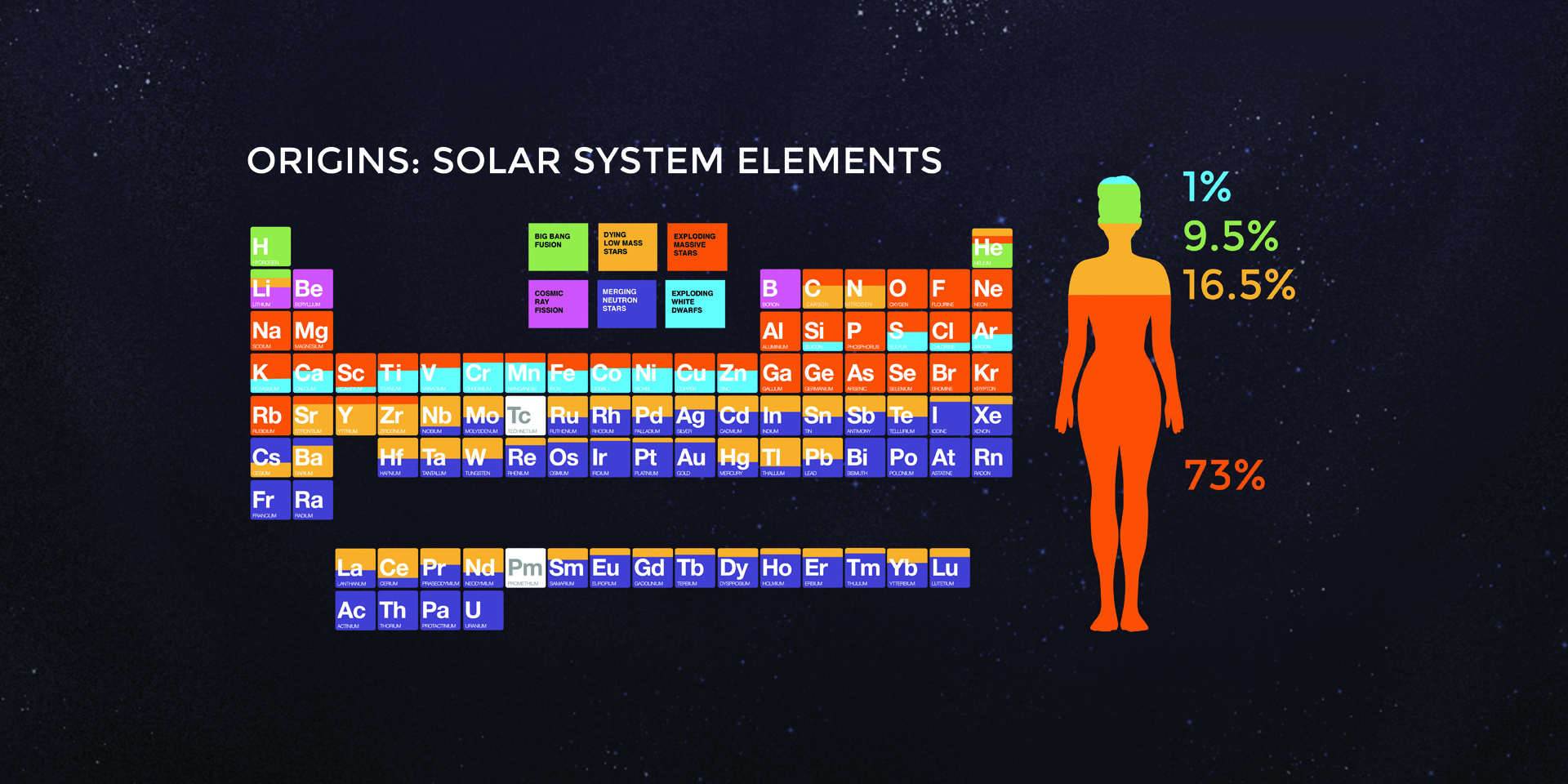
Location of elements in Cassiopeia A.
Credit: NASA/CXC/SAO
Alt...
Periodic Table of Elements.
Astronomers have found other elements in Cas A in addition to the ones shown in this new Chandra image. Carbon, nitrogen, phosphorus and hydrogen have also been detected using various telescopes that observe different parts of the electromagnetic spectrum. Combined with the detection of oxygen, this means all of the elements needed to make DNA, the molecule that carries genetic information, are found in Cas A.
Oxygen is the most abundant element in the human body (about 65% by mass), calcium helps form and maintain healthy bones and teeth, and iron is a vital part of red blood cells that carry oxygen through the body. All of the oxygen in the Solar System comes from exploding massive stars. About half of the calcium and about 40% of the iron also come from these explosions, with the balance of these elements being supplied by explosions of smaller mass, white dwarf stars.
Credit: NASA/CXC/K. Divona; Reference: SDSS blog, J. Johnson
[...]
Earlier in its lifetime, the star began fusing hydrogen and helium in its core into heavier elements through the process known as "nucleosynthesis." The energy made by the fusion of heavier and heavier elements balanced the star against the force of gravity. These reactions continued until they formed iron in the core of the star. At this point, further nucleosynthesis would consume rather than produce energy, so gravity then caused the star to implode and form a dense stellar core known as a neutron star.
The exact means by which a massive explosion is produced after the implosion is complicated, and a subject of intense study, but eventually the infalling material outside the neutron star was transformed by further nuclear reactions as it was expelled outward by the supernova explosion.
Chandra has repeatedly observed Cas A since the telescope was launched into space in 1999. The different datasets have revealed new information about the neutron star in Cas A, the details of the explosion, and specifics of how the debris is ejected into space.
* Credits:
NASA's Marshall Space Flight Center in Huntsville, Alabama, manages the Chandra program for NASA's Science Mission Directorate in Washington. The Smithsonian Astrophysical Observatory in Cambridge, Massachusetts, controls Chandra's science and flight operations.
https://chandra.harvard.edu/photo/2017/casa_life/
** Note by grobi:
"To upload this video, I converted it and compressed it to a smaller file-size under linux with the free software ffmpeg and the corresponding command:
'ffmpeg -i video_in.mkv -vcodec libx265 -crf 28 video_out.mp4'
Maybe you would like to post a corresponding video on a scientifically related topic, but it is perhaps too big? Then try ffmpeg."
#space #nova #astrophotography #photography #science #astronomy #physics #nature #NASA #education
Astronomers Solve Mystery of ‘Green Monster’ Feature in Cassiopeia A | Sci.News
[...]
Although astronomers think that this happened around the year 1680, there are no verifiable historical records to confirm this.
A curious structure dubbed the Green Monster was first identified in infrared data from the NASA/ESA/CSA James Webb Space Telescope in April 2023, but its origin was not clear.
However, by combining the Webb data with X-rays from NASA’s Chandra X-ray Observatory, astronomers think they have hunted down the source of this feature.
“We already suspected the Green Monster was created by a blast wave from the exploded star slamming into material surrounding it. Chandra helped us clinch the case,” said Dr. Jacco Vink, an astronomer at the University of Amsterdam.
When a massive star exploded to create Cassiopeia A about 340 years ago, from Earth’s perspective, it created a ball of matter and light that expanded outward. In the outer parts of Cassiopeia A the blast wave is striking surrounding gas that was ejected by the star between about 10,000 and 100,000 years before the explosion.
That formed a favorable environment for dust formation after the ejected stellar material cooled down.
The Chandra data reveal hot gas, mostly from supernova debris including elements like silicon and iron, but also from energetic electrons spiraling around magnetic field lines in the blast wave.
These electrons light up as thin arcs near the blast wave, and also show up in parts of the interior.
Webb highlights infrared emission from dust that is warmed up because it is embedded in the hot gas seen by Chandra, and from much cooler supernova debris.
Despite this chaotic stellar scene, the Green Monster clearly stood out in the original Webb image.
[...]
https://www.sci.news/astronomy/green-monster-feature-cassiopeia-a-12593.html
#space #nova #astrophotography #photography #science #astronomy #physics #nature #NASA #education
Alt...
New research suggests that the Green Monster — a curious structure first spotted in Webb data in April 2023 — came from that blast wave slamming into material surrounding the Cassiopeia A supernova remnant.
This composite image shows the Green Monster structure within the supernova remnant Cassiopeia A.
* Image credit: NASA / CXC / SAO / ESA / STScI / CSA / Milisavljevic et al. / JPL / Caltech / J. Schmidt / K. Arcand.
Using NASA’s James Webb Space Telescope, astronomers uncovered a mysterious feature within the remnant, nicknamed the “Green Monster,” alongside a puzzling network of ejecta filaments forming a web of oxygen-rich material. When combined with X-rays from Chandra, the data helped astronomers shed light on the origin of the Green Monster and revealed new insights into the explosion that created Cas A about 340 years ago, from Earth’s perspective.
#space #nova #astrophotography #photography #science #astronomy #physics #nature #NASA #education
How Stars Explode:
Four Ways to Make a Supernova
What makes a star go boom? By understanding supernovae – stellar explosions – scientists can unlock mysteries that are key to what we are made of and the fate of our universe.
https://exoplanets.nasa.gov/news/1493/kepler-beyond-planets-finding-exploding-stars/
CREDIT
Jet Propulsion Laboratory
#space #nova #supernova #astrophotography #photography #science #physics #astronomy #nature #NASA #ESA
2021 August 18
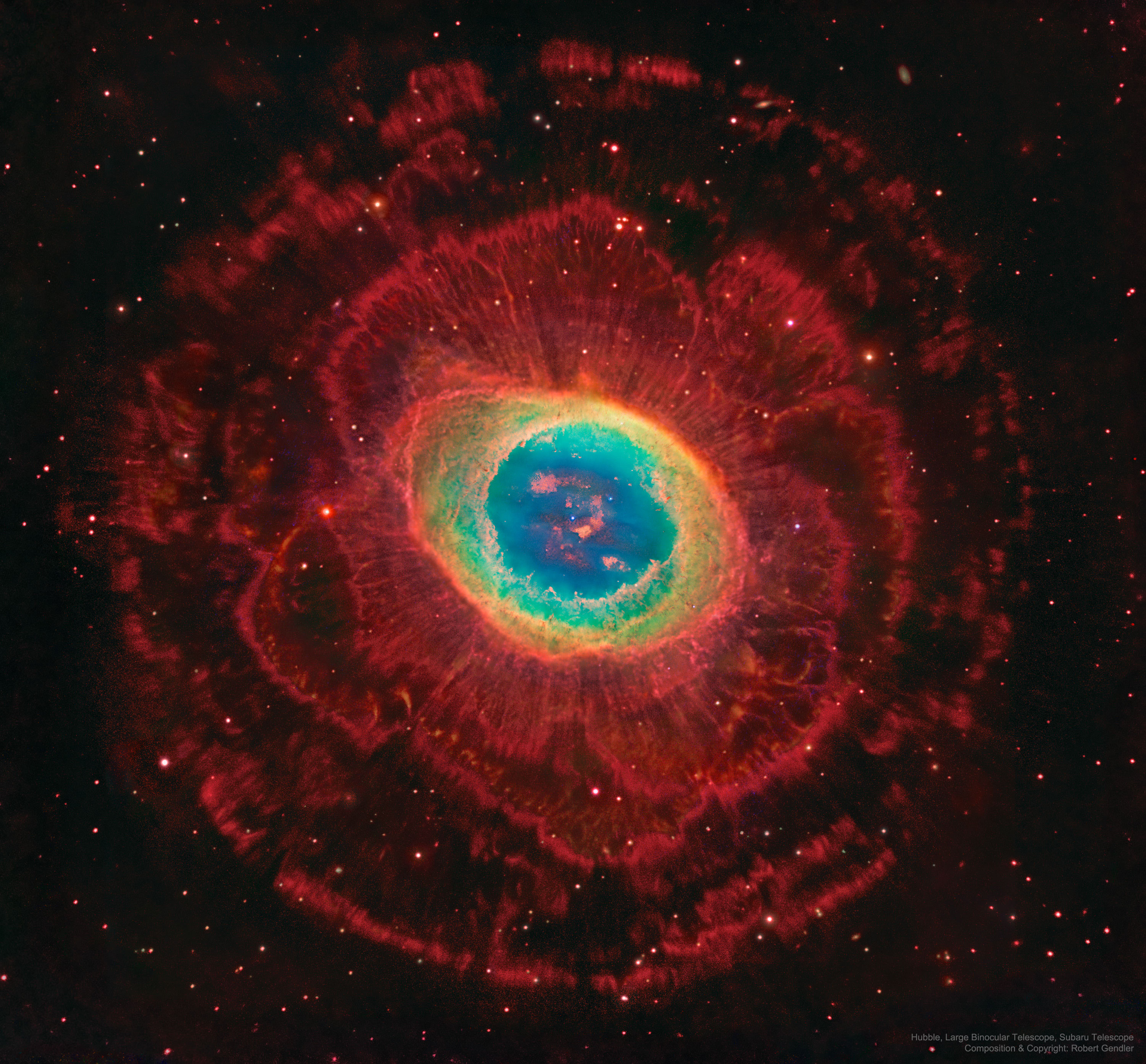
The picture shows a wide field image M57, the Ring Nebula, showing several outer rings not normally seen.
Rings Around the Ring Nebula
* Image Credit: Hubble, Large Binocular Telescope, Subaru Telescope
https://hla.stsci.edu/
http://www.lbto.org/
https://subarutelescope.org/en/;
* Composition & Copyright: Robert Gendler
http://www.robgendlerastropics.com/Biography2.html
Explanation:
The Ring Nebula (M57), is more complicated than it appears through a small telescope. The easily visible central ring is about one light-year across, but this remarkably deep exposure - a collaborative effort combining data from three different large telescopes - explores the looping filaments of glowing gas extending much farther from the nebula's central star. This composite image includes red light emitted by hydrogen as well as visible and infrared light. The Ring Nebula is an elongated planetary nebula, a type of nebula created when a Sun-like star evolves to throw off its outer atmosphere to become a white dwarf star. The Ring Nebula is about 2,500 light-years away toward the musical constellation Lyra.
http://www.robgendlerastropics.com/M57-HST-LBT.html
https://apod.nasa.gov/apod/random_apod.html
#space #nova #astrophotography #photography #science #astronomy #physics #nature #NASA #education #flowers
Alt...
2021 August 18
The picture shows a wide field image M57, the Ring Nebula, showing several outer rings not normally seen.
Rings Around the Ring Nebula
* Image Credit: Hubble, Large Binocular Telescope, Subaru Telescope;
* Composition & Copyright: Robert Gendler
Explanation:
The Ring Nebula (M57), is more complicated than it appears through a small telescope. The easily visible central ring is about one light-year across, but this remarkably deep exposure - a collaborative effort combining data from three different large telescopes - explores the looping filaments of glowing gas extending much farther from the nebula's central star. This composite image includes red light emitted by hydrogen as well as visible and infrared light. The Ring Nebula is an elongated planetary nebula, a type of nebula created when a Sun-like star evolves to throw off its outer atmosphere to become a white dwarf star. The Ring Nebula is about 2,500 light-years away toward the musical constellation Lyra.
Authors & editors: Robert Nemiroff (MTU) & Jerry Bonnell (UMCP)
NASA Official: Phillip Newman Specific rights apply.
NASA Web Privacy Policy and Important Notices
A service of: ASD at NASA / GSFC
& Michigan Tech. U.
This video begins with a ground-based view of the constellation Lyra and zooms into Hubble’s image of the Ring Nebula. It ends with a 3-D model that showcases the structure of the nebula.
Credit:
NASA, ESA, and G. Bacon, F. Summers and Mary Estacion (STScI)
#space #nova #astrophotography #photography #science #astronomy #physics #nature #NASA #education
10 Years ago ..
2016 February 9
The Rise and Fall of Supernova 2015F
* Video Credit & Copyright: Changsu Choi & Myungshin Im (Seoul National University)
https://physics.snu.ac.kr/en
Explanation:
Sit back and watch a star explode. The actual supernova occurred back when dinosaurs roamed the Earth, but images of the spectacular event began arriving last year. Supernova 2015F was discovered in nearby spiral galaxy NGC 2442 by Berto Monard in 2015 March and was unusually bright -- enough to be seen with only a small telescope. The pattern of brightness variation indicated a Type Ia supernova -- a type of stellar explosion that results when an Earth-size white dwarf gains so much mass that its core crosses the threshold of nuclear fusion, possibly caused by a lower mass white-dwarf companion spiraling into it. Finding and tracking Type Ia supernovae are particularly important because their intrinsic brightness can be calibrated, making their apparent brightness a good measure of their distance -- and hence useful toward calibrating the distance scale of the entire universe. The featured video tracked the stellar disruption from before explosion images arrived, as it brightened, and for several months as the fission-powered supernova glow faded. The remnants of SN2015F are now too dim to see without a large telescope. Just yesterday, however, the night sky lit up once again, this time with an even brighter supernova in an even closer galaxy: Centaurus A.
https://apod.nasa.gov/apod/ap160209.html
#space #nova #supernova #astrophotography #photography #science #physics #astronomy #nature #NASA #ESA
Type Ia supernova
From Wikipedia, the free encyclopedia
At the core of a planetary nebula, Henize 2-428, two white dwarf stars slightly under one solar mass each are expected to merge and create a Type Ia supernova destroying both in about 700 million years (artist's impression).
A Type Ia supernova (read: "type one-A") is a type of supernova that occurs in binary systems (two stars orbiting one another) in which one of the stars is a white dwarf. The other star can be anything from a giant star to an even smaller white dwarf.
Physically, carbon–oxygen white dwarfs with a low rate of rotation are limited to below 1.44 solar masses (M☉). Beyond this "critical mass", they reignite and in some cases trigger a supernova explosion; this critical mass is often referred to as the Chandrasekhar mass, but is marginally different from the absolute Chandrasekhar limit, where electron degeneracy pressure is unable to prevent catastrophic collapse. If a white dwarf gradually accretes mass from a binary companion, or merges with a second white dwarf, the general hypothesis is that a white dwarf's core will reach the ignition temperature for carbon fusion as it approaches the Chandrasekhar mass. Within a few seconds of initiation of nuclear fusion, a substantial fraction of the matter in the white dwarf undergoes a runaway reaction, releasing enough energy (1×1044 J) to unbind the star in a supernova explosion.
The Type Ia category of supernova produces a fairly consistent peak luminosity because of the fixed critical mass at which a white dwarf will explode. Their consistent peak luminosity allows these explosions to be used as standard candles to measure the distance to their host galaxies: the visual magnitude of a type Ia supernova, as observed from Earth, indicates its distance from Earth.
[...]
More Info in ALT-Texts
Read more:
https://en.wikipedia.org/wiki/Type_Ia_supernova
#space #nova #supernova #astrophotography #photography #science #physics #astronomy #nature #NASA #ESA
Alt...
This artist’s impression video shows the central part of the planetary nebula Henize 2-428. The core of this unique object consists of two white dwarf stars, each with a mass a little less than that of the Sun. They are expected to slowly draw closer to each other and merge in around 700 million years. This event will create a dazzling supernova of Type Ia and destroy both stars.
CREDIT
ESO/L. Calçada
1)
[...]
The Type Ia supernova is a subcategory in the Minkowski–Zwicky supernova classification scheme, which was devised by German-American astronomer Rudolph Minkowski and Swiss astronomer Fritz Zwicky. There are several means by which a supernova of this type can form, but they share a common underlying mechanism. Theoretical astronomers long believed the progenitor star for this type of supernova is a white dwarf, and empirical evidence for this was found in 2014 when a Type Ia supernova was observed in the galaxy Messier 82. When a slowly-rotating carbon–oxygen white dwarf accretes matter from a companion, it can exceed the Chandrasekhar limit of about 1.44 M☉, beyond which it can no longer support its weight with electron degeneracy pressure. In the absence of a countervailing process, the white dwarf would collapse to form a neutron star, in an accretion-induced non-ejective process, as normally occurs in the case of a white dwarf that is primarily composed of magnesium, neon, and oxygen. [...]
![2)
G299 Type Ia supernova remnant.
G299 was left over by a particular class of supernovas called Type Ia. Astronomers think that a Type Ia supernova is a thermonuclear explosion – involving the fusion of elements and release of vast amounts of energy − of a white dwarf star in a tight orbit with a companion star. If the white dwarf’s partner is a typical, Sun-like star, the white dwarf can become unstable and explode as it draws material from its companion. Alternatively, the white dwarf is in orbit with another white dwarf, the two may merge and can trigger an explosion.
[...]
The current view among astronomers who model Type Ia supernova explosions, however, is that this limit is never actually attained and collapse is never initiated. Instead, the increase in pressure and density due to the increasing weight raises the temperature of the core, and as the white dwarf approaches about 99% of the limit, a period of convection ensues, lasting approximately 1,000 years. At some point in this simmering phase, a deflagration flame front is born, powered by carbon fusion. The details of the ignition are still unknown, including the location and number of points where the flame begins. Oxygen fusion is initiated shortly thereafter, but this fuel is not consumed as completely as carbon.
Once fusion begins, the temperature of the white dwarf increases. [...]](https://files.defcon.social/dcsocial-s3/media_attachments/files/114/858/179/983/990/092/original/af65981fd9477bb9.png "2)
G299 Type Ia supernova remnant.
G299 was left over by a particular class of supernovas called Type Ia. Astronomers think that a Type Ia supernova is a thermonuclear explosion – involving the fusion of elements and release of vast amounts of energy − of a white dwarf star in a tight orbit with a companion star. If the white dwarf’s partner is a typical, Sun-like star, the white dwarf can become unstable and explode as it draws material from its companion. Alternatively, the white dwarf is in orbit with another white dwarf, the two may merge and can trigger an explosion.
[...]
The current view among astronomers who model Type Ia supernova explosions, however, is that this limit is never actually attained and collapse is never initiated. Instead, the increase in pressure and density due to the increasing weight raises the temperature of the core, and as the white dwarf approaches about 99% of the limit, a period of convection ensues, lasting approximately 1,000 years. At some point in this simmering phase, a deflagration flame front is born, powered by carbon fusion. The details of the ignition are still unknown, including the location and number of points where the flame begins. Oxygen fusion is initiated shortly thereafter, but this fuel is not consumed as completely as carbon.
Once fusion begins, the temperature of the white dwarf increases. [...]")
Alt...
2)
G299 Type Ia supernova remnant.
G299 was left over by a particular class of supernovas called Type Ia. Astronomers think that a Type Ia supernova is a thermonuclear explosion – involving the fusion of elements and release of vast amounts of energy − of a white dwarf star in a tight orbit with a companion star. If the white dwarf’s partner is a typical, Sun-like star, the white dwarf can become unstable and explode as it draws material from its companion. Alternatively, the white dwarf is in orbit with another white dwarf, the two may merge and can trigger an explosion.
[...]
The current view among astronomers who model Type Ia supernova explosions, however, is that this limit is never actually attained and collapse is never initiated. Instead, the increase in pressure and density due to the increasing weight raises the temperature of the core, and as the white dwarf approaches about 99% of the limit, a period of convection ensues, lasting approximately 1,000 years. At some point in this simmering phase, a deflagration flame front is born, powered by carbon fusion. The details of the ignition are still unknown, including the location and number of points where the flame begins. Oxygen fusion is initiated shortly thereafter, but this fuel is not consumed as completely as carbon.
Once fusion begins, the temperature of the white dwarf increases. [...]
![The Progenitor of a Type Ia Supernova
CREDIT
NASA, ESA and A. Feild (STScI); vectorisation by chris
3)
[...]
A main sequence star supported by thermal pressure can expand and cool which automatically regulates the increase in thermal energy. However, degeneracy pressure is independent of temperature; white dwarfs are unable to regulate temperature in the manner of normal stars, so they are vulnerable to runaway fusion reactions. The flare accelerates dramatically, in part due to the Rayleigh–Taylor instability and interactions with turbulence. It is still a matter of considerable debate whether this flare transforms into a supersonic detonation from a subsonic deflagration.
Regardless of the exact details of how the supernova ignites, it is generally accepted that a substantial fraction of the carbon and oxygen in the white dwarf fuses into heavier elements within a period of only a few seconds, with the accompanying release of energy increasing the internal temperature to billions of degrees. The energy released (1–2×1044 J) is more than sufficient to unbind the star; that is, the individual particles making up the white dwarf gain enough kinetic energy to fly apart from each other. The star explodes violently and releases a shock wave in which matter is typically ejected at speeds on the order of 5,000–20,000 km/s, roughly 6% of the speed of light. The energy released in the explosion also causes an extreme increase in luminosity. [...]](https://files.defcon.social/dcsocial-s3/media_attachments/files/114/858/207/295/301/749/original/8d9863452a3ff9a5.png "The Progenitor of a Type Ia Supernova
CREDIT
NASA, ESA and A. Feild (STScI); vectorisation by chris
3)
[...]
A main sequence star supported by thermal pressure can expand and cool which automatically regulates the increase in thermal energy. However, degeneracy pressure is independent of temperature; white dwarfs are unable to regulate temperature in the manner of normal stars, so they are vulnerable to runaway fusion reactions. The flare accelerates dramatically, in part due to the Rayleigh–Taylor instability and interactions with turbulence. It is still a matter of considerable debate whether this flare transforms into a supersonic detonation from a subsonic deflagration.
Regardless of the exact details of how the supernova ignites, it is generally accepted that a substantial fraction of the carbon and oxygen in the white dwarf fuses into heavier elements within a period of only a few seconds, with the accompanying release of energy increasing the internal temperature to billions of degrees. The energy released (1–2×1044 J) is more than sufficient to unbind the star; that is, the individual particles making up the white dwarf gain enough kinetic energy to fly apart from each other. The star explodes violently and releases a shock wave in which matter is typically ejected at speeds on the order of 5,000–20,000 km/s, roughly 6% of the speed of light. The energy released in the explosion also causes an extreme increase in luminosity. [...]")
Alt...
The Progenitor of a Type Ia Supernova
CREDIT
NASA, ESA and A. Feild (STScI); vectorisation by chris
3)
[...]
A main sequence star supported by thermal pressure can expand and cool which automatically regulates the increase in thermal energy. However, degeneracy pressure is independent of temperature; white dwarfs are unable to regulate temperature in the manner of normal stars, so they are vulnerable to runaway fusion reactions. The flare accelerates dramatically, in part due to the Rayleigh–Taylor instability and interactions with turbulence. It is still a matter of considerable debate whether this flare transforms into a supersonic detonation from a subsonic deflagration.
Regardless of the exact details of how the supernova ignites, it is generally accepted that a substantial fraction of the carbon and oxygen in the white dwarf fuses into heavier elements within a period of only a few seconds, with the accompanying release of energy increasing the internal temperature to billions of degrees. The energy released (1–2×1044 J) is more than sufficient to unbind the star; that is, the individual particles making up the white dwarf gain enough kinetic energy to fly apart from each other. The star explodes violently and releases a shock wave in which matter is typically ejected at speeds on the order of 5,000–20,000 km/s, roughly 6% of the speed of light. The energy released in the explosion also causes an extreme increase in luminosity. [...]
![Supercomputer simulation of the explosion phase of the deflagration-to-detonation model of supernova formation.
4)
[...]
The typical visual absolute magnitude of Type Ia supernovae is Mv = −19.3 (about 5 billion times brighter than the Sun), with little variation. The Type Ia supernova leaves no compact remnant, but the whole mass of the former white dwarf dissipates through space.
The theory of this type of supernova is similar to that of novae, in which a white dwarf accretes matter more slowly and does not approach the Chandrasekhar limit. In the case of a nova, the infalling matter causes a hydrogen fusion surface explosion that does not disrupt the star.
Type Ia supernovae differ from Type II supernovae, which are caused by the cataclysmic explosion of the outer layers of a massive star as its core collapses, powered by release of gravitational potential energy via neutrino emission.
One model for the formation of this category of supernova is a close binary star system. The progenitor binary system consists of main sequence stars, with the primary possessing more mass than the secondary. Being greater in mass, the primary is the first of the pair to evolve onto the asymptotic giant branch, where the star's envelope expands considerably. If the two stars share a common envelope then the system can lose significant amounts of mass, reducing the angular momentum, orbital radius and period.
[...]](https://files.defcon.social/dcsocial-s3/media_attachments/files/114/858/292/746/664/789/original/a66a570d62d6c619.jpg "Supercomputer simulation of the explosion phase of the deflagration-to-detonation model of supernova formation.
4)
[...]
The typical visual absolute magnitude of Type Ia supernovae is Mv = −19.3 (about 5 billion times brighter than the Sun), with little variation. The Type Ia supernova leaves no compact remnant, but the whole mass of the former white dwarf dissipates through space.
The theory of this type of supernova is similar to that of novae, in which a white dwarf accretes matter more slowly and does not approach the Chandrasekhar limit. In the case of a nova, the infalling matter causes a hydrogen fusion surface explosion that does not disrupt the star.
Type Ia supernovae differ from Type II supernovae, which are caused by the cataclysmic explosion of the outer layers of a massive star as its core collapses, powered by release of gravitational potential energy via neutrino emission.
One model for the formation of this category of supernova is a close binary star system. The progenitor binary system consists of main sequence stars, with the primary possessing more mass than the secondary. Being greater in mass, the primary is the first of the pair to evolve onto the asymptotic giant branch, where the star's envelope expands considerably. If the two stars share a common envelope then the system can lose significant amounts of mass, reducing the angular momentum, orbital radius and period.
[...]")
Alt...
Supercomputer simulation of the explosion phase of the deflagration-to-detonation model of supernova formation.
4)
[...]
The typical visual absolute magnitude of Type Ia supernovae is Mv = −19.3 (about 5 billion times brighter than the Sun), with little variation. The Type Ia supernova leaves no compact remnant, but the whole mass of the former white dwarf dissipates through space.
The theory of this type of supernova is similar to that of novae, in which a white dwarf accretes matter more slowly and does not approach the Chandrasekhar limit. In the case of a nova, the infalling matter causes a hydrogen fusion surface explosion that does not disrupt the star.
Type Ia supernovae differ from Type II supernovae, which are caused by the cataclysmic explosion of the outer layers of a massive star as its core collapses, powered by release of gravitational potential energy via neutrino emission.
One model for the formation of this category of supernova is a close binary star system. The progenitor binary system consists of main sequence stars, with the primary possessing more mass than the secondary. Being greater in mass, the primary is the first of the pair to evolve onto the asymptotic giant branch, where the star's envelope expands considerably. If the two stars share a common envelope then the system can lose significant amounts of mass, reducing the angular momentum, orbital radius and period.
[...]
2025 February 3
A starfield is shown with a large spherical nebula in the center. The nebula shows a great deal of internal structure.
Wolf-Rayet Star 124: Stellar Wind Machine
* Image Credit: Hubble Legacy Archive, NASA, ESA
https://hla.stsci.edu/
https://www.nasa.gov/
https://www.esa.int/
* Processing & License: Judy Schmidt
https://www.flickr.com/photos/geckzilla/
Explanation:
Some stars explode in slow motion. Rare, massive Wolf-Rayet stars are so tumultuous and hot that they are slowly disintegrating right before our telescopes. Glowing gas globs each typically over 30 times more massive than the Earth are being expelled by violent stellar winds. Wolf-Rayet star WR 124, visible near the featured image center, is thus creating the surrounding nebula known as M1-67, which spans six light years across. Details of why this star has been slowly blowing itself apart over the past 20,000 years remains a topic of research. WR 124 lies 15,000 light-years away towards the constellation of the Arrow (Sagitta). The fate of any given Wolf-Rayet star likely depends on how massive it is, but many are thought to end their lives with spectacular explosions such as supernovas or gamma-ray bursts.
https://apod.nasa.gov/apod/ap250203.html
#space #nova #supernova #astrophotography #photography #science #physics #astronomy #nature #NASA #ESA

Alt...
2025 February 3
A starfield is shown with a large spherical nebula in the center. The nebula shows a great deal of internal structure.
Wolf-Rayet Star 124: Stellar Wind Machine
* Image Credit: Hubble Legacy Archive, NASA, ESA
* Processing & License: Judy Schmidt
Explanation:
Some stars explode in slow motion. Rare, massive Wolf-Rayet stars are so tumultuous and hot that they are slowly disintegrating right before our telescopes. Glowing gas globs each typically over 30 times more massive than the Earth are being expelled by violent stellar winds. Wolf-Rayet star WR 124, visible near the featured image center, is thus creating the surrounding nebula known as M1-67, which spans six light years across. Details of why this star has been slowly blowing itself apart over the past 20,000 years remains a topic of research. WR 124 lies 15,000 light-years away towards the constellation of the Arrow (Sagitta). The fate of any given Wolf-Rayet star likely depends on how massive it is, but many are thought to end their lives with spectacular explosions such as supernovas or gamma-ray bursts.
Authors & editors: Robert Nemiroff (MTU) & Jerry Bonnell (UMCP)
NASA Official: Amber Straughn Specific rights apply.
NASA Web Privacy, Accessibility, Notices;
A service of: ASD at NASA / GSFC,
NASA Science Activation
& Michigan Tech. U.
2018 April 19
NGC 7635: The Bubble Nebula
* Image Credit: NASA, ESA, Hubble Heritage Team -
https://www.nasa.gov/
https://www.spacetelescope.org/
https://heritage.stsci.edu/
* Reprocessing by Maksim Kakitsev
https://www.flickr.com/photos/wildespace/39512823160/
Explanation:
Blown by the wind from a massive star, this interstellar apparition has a surprisingly familiar shape. Cataloged as NGC 7635, it is also known simply as The Bubble Nebula. Although it looks delicate, the 7 light-year diameter bubble offers evidence of violent processes at work. Above and left of the Bubble's center is a hot, O-type star, several hundred thousand times more luminous and some 45 times more massive than the Sun. A fierce stellar wind and intense radiation from that star has blasted out the structure of glowing gas against denser material in a surrounding molecular cloud. The intriguing Bubble Nebula and associated cloud complex lie a mere 7,100 light-years away toward the boastful constellation Cassiopeia. This sharp, tantalizing view of the cosmic bubble is a composite of Hubble Space Telescope image data from 2016, reprocessed to present the nebula's intense narrowband emission in an approximate true color scheme.
https://apod.nasa.gov/apod/ap180419.html
#space #nova #supernova #astrophotography #photography #science #physics #astronomy #nature #NASA #ESA

Alt...
2018 April 19
NGC 7635: The Bubble Nebula
* Image Credit: NASA, ESA, Hubble Heritage Team -
* Reprocessing by Maksim Kakitsev
Explanation:
Blown by the wind from a massive star, this interstellar apparition has a surprisingly familiar shape. Cataloged as NGC 7635, it is also known simply as The Bubble Nebula. Although it looks delicate, the 7 light-year diameter bubble offers evidence of violent processes at work. Above and left of the Bubble's center is a hot, O-type star, several hundred thousand times more luminous and some 45 times more massive than the Sun. A fierce stellar wind and intense radiation from that star has blasted out the structure of glowing gas against denser material in a surrounding molecular cloud. The intriguing Bubble Nebula and associated cloud complex lie a mere 7,100 light-years away toward the boastful constellation Cassiopeia. This sharp, tantalizing view of the cosmic bubble is a composite of Hubble Space Telescope image data from 2016, reprocessed to present the nebula's intense narrowband emission in an approximate true color scheme.
Authors & editors: Robert Nemiroff (MTU) & Jerry Bonnell (UMCP)
NASA Official: Phillip Newman Specific rights apply.
NASA Web Privacy Policy and Important Notices
A service of: ASD at NASA / GSFC
& Michigan Tech. U.
2002 August 30
Semeis 147: Supernova Remnant
* Credit & Copyright: Steve Mandel
Explanation:
It's easy to get lost following the intricate filaments in this stunningly detailed image of faint supernova remnant Simeis 147. Seen towards the constellation Taurus it covers nearly 3 degrees (6 full moons) on the sky corresponding to a width of 150 light-years at the stellar debris cloud's estimated distance of 3,000 light-years. On three separate nights in December 2001 and January 2002 astronomer Steve Mandel accumulated a total of over eight hours of exposure time to compose this image. He used an astronomical CCD camera, telephoto lens, and his specially designed adapter to allow such wide-field digital imaging. He also used a narrow H-alpha filter to transmit only the the light from recombining hydrogen atoms in the expanding nebulosity, defining the regions of shocked, glowing gas. This supernova remnant has an apparent age of about 100,000 years (light from the original explosion first reached Earth 100,000 years ago) but it is not the only aftermath of the massive stellar explosion. The cosmic catastrophe also left behind a spinning neutron star or pulsar, all that remains of the star's dense core.
https://apod.nasa.gov/apod/ap020830.html
#space #nebula #astrophotography #photography #science #astronomy #physics #nature #NASA
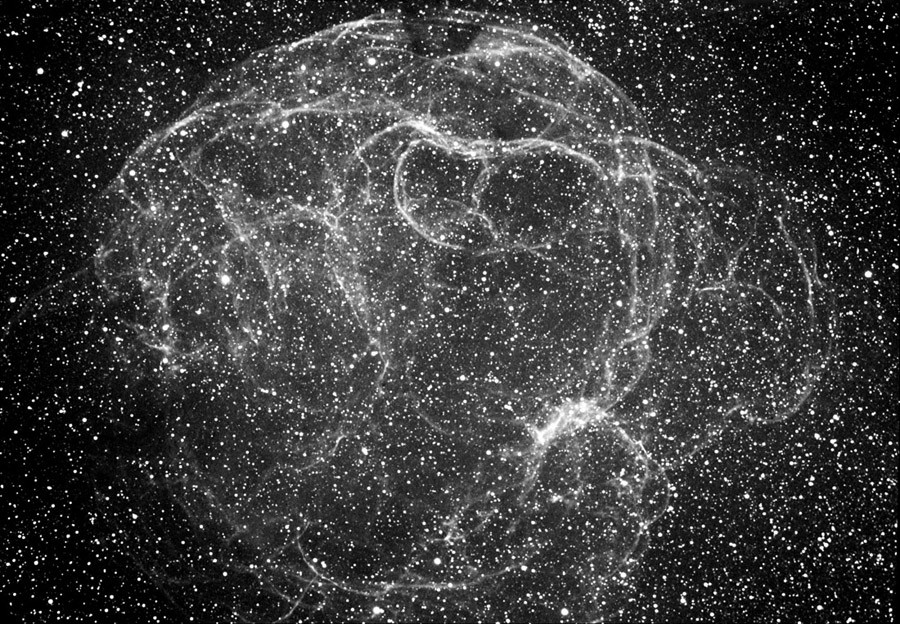
Alt...
2002 August 30
Semeis 147: Supernova Remnant
* Credit & Copyright: Steve Mandel
Explanation:
It's easy to get lost following the intricate filaments in this stunningly detailed image of faint supernova remnant Simeis 147. Seen towards the constellation Taurus it covers nearly 3 degrees (6 full moons) on the sky corresponding to a width of 150 light-years at the stellar debris cloud's estimated distance of 3,000 light-years. On three separate nights in December 2001 and January 2002 astronomer Steve Mandel accumulated a total of over eight hours of exposure time to compose this image. He used an astronomical CCD camera, telephoto lens, and his specially designed adapter to allow such wide-field digital imaging. He also used a narrow H-alpha filter to transmit only the the light from recombining hydrogen atoms in the expanding nebulosity, defining the regions of shocked, glowing gas. This supernova remnant has an apparent age of about 100,000 years (light from the original explosion first reached Earth 100,000 years ago) but it is not the only aftermath of the massive stellar explosion. The cosmic catastrophe also left behind a spinning neutron star or pulsar, all that remains of the star's dense core.
Authors & editors: Robert Nemiroff (MTU) & Jerry Bonnell (USRA)
NASA Technical Rep.: Jay Norris. Specific rights apply.
A service of: LHEA at NASA/ GSFC
& Michigan Tech. U.
2025 July 22
A Double Detonation Supernova
* Image Credit: ESO, P. Das et al.; Background stars (NASA/Hubble): K. Noll et al.
https://www.eso.org/
https://www.unsw.edu.au/hdr/priyam-das
https://science.nasa.gov/mission/hubble/
Explanation:
Can some supernovas explode twice? Yes, when the first explosion acts like a detonator for the second. This is a leading hypothesis for the cause of supernova remnant (SNR) 0509-67.5. In this two-star system, gravity causes the larger and fluffier star to give up mass to a smaller and denser white dwarf companion. Eventually the white dwarf's near-surface temperature goes so high that it explodes, creating a shock wave that goes both out and in -- and so triggers a full Type Ia supernova near the center. Recent images of the SNR 0509-67.5 system, like the featured image from the Very Large Telescope in Chile, show two shells with radii and compositions consistent with the double detonation hypothesis. This system, SNR 0509-67.5 is also famous for two standing mysteries: why its bright supernova wasn't noted 400 years ago, and why no visible companion star remains.
https://www.eso.org/public/images/eso2511a/
https://ui.adsabs.harvard.edu/abs/2025NatAs.tmp..135D/abstract
https://en.wikipedia.org/wiki/Detonator
https://apod.nasa.gov/apod/ap970219.html
https://en.wikipedia.org/wiki/Roche_lobe
https://apod.nasa.gov/apod/ap950910.html
https://science.nasa.gov/universe/stars/types/#white-dwarfs
https://en.wikipedia.org/wiki/Type_Ia_supernova
https://apod.nasa.gov/apod/ap250722.html
#space #nebula #astrophotography #photography #science #astronomy #physics #nature #NASA #ESA #education
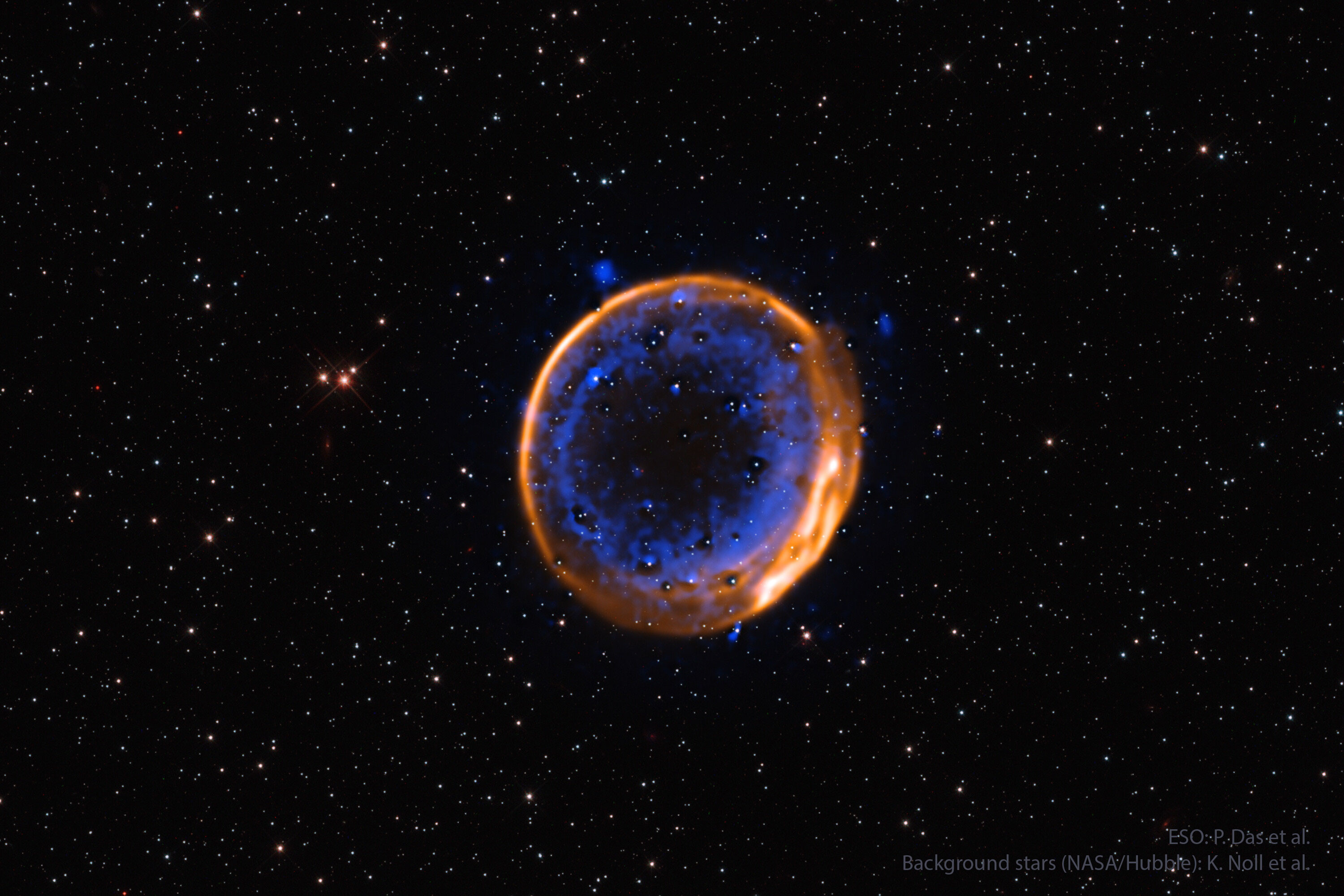
Alt...
2025 July 22
A nearly circular nebula with two rings is shown. The outer ring appears orange while while the inner rings is more complex and appears blue.
A Double Detonation Supernova
* Image Credit: ESO, P. Das et al.; Background stars (NASA/Hubble): K. Noll et al.
Explanation:
Can some supernovas explode twice? Yes, when the first explosion acts like a detonator for the second. This is a leading hypothesis for the cause of supernova remnant (SNR) 0509-67.5. In this two-star system, gravity causes the larger and fluffier star to give up mass to a smaller and denser white dwarf companion. Eventually the white dwarf's near-surface temperature goes so high that it explodes, creating a shock wave that goes both out and in -- and so triggers a full Type Ia supernova near the center. Recent images of the SNR 0509-67.5 system, like the featured image from the Very Large Telescope in Chile, show two shells with radii and compositions consistent with the double detonation hypothesis. This system, SNR 0509-67.5 is also famous for two standing mysteries: why its bright supernova wasn't noted 400 years ago, and why no visible companion star remains.
Authors & editors: Robert Nemiroff (MTU) & Jerry Bonnell (UMCP)
NASA Official: Amber Straughn Specific rights apply.
NASA Web Privacy, Accessibility, Notices;
A service of: ASD at NASA / GSFC,
NASA Science Activation
& Michigan Tech. U.
Animation of a double-detonation supernova
This animation illustrates the supernova remnant SNR 0509-67.5, the leftovers of a star that died with a double-detonation. These two blasts imprinted a characteristic layered structure in the expanding material around the star. At the end of the animation we show a real image captured with ESO’s Very Large Telescope (VLT), which displays different chemical elements in different colours. The are two concentric shells of calcium, seen here in blue, a telltale sign that the star met its end with two detonations.
For more details, check: https://www.eso.org/public/news/eso2511/.
Credit:
ESO/M. Kornmesser/P. Das et al. Background stars, final image (Hubble): K. Noll et al.
#space #nebula #astrophotography #photography #science #astronomy #physics #nature #NASA #ESA #education
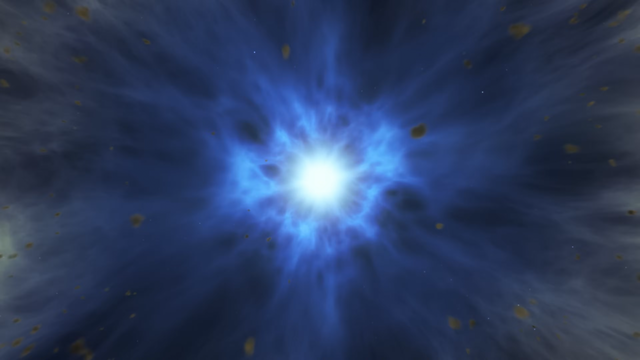
Alt...
This animation illustrates the supernova remnant SNR 0509-67.5, the leftovers of a star that died with a double-detonation. These two blasts imprinted a characteristic layered structure in the expanding material around the star. At the end of the animation we show a real image captured with ESO’s Very Large Telescope (VLT), which displays different chemical elements in different colours. The are two concentric shells of calcium, seen here in blue, a telltale sign that the star met its end with two detonations.
Credit:
ESO/M. Kornmesser/P. Das et al. Background stars, final image (Hubble): K. Noll et al.
2012 January 12
The Case of the Missing Supernova Companion
* Image Credit:
** X-ray: NASA/CXC/SAO/J.
Hughes et al.
https://chandra.harvard.edu/
https://www.physics.rutgers.edu/~jackph/
** Optical: NASA/ESA/Hubble Heritage Team (STScI /AURA)
https://science.nasa.gov/mission/hubble/multimedia/hubble-images/
https://www.stsci.edu/
Explanation:
Where's the other star? At the center of this supernova remnant should be the companion star to the star that blew up. Identifying this star is important for understanding just how Type Ia supernova detonate, which in turn could lead to a better understanding of why the brightness of such explosions are so predictable, which in turn is key to calibrating the entire nature of our universe. The trouble is that even a careful inspection of the center of SNR 0509-67.5 has not found any star at all. This indicates that the companion is intrinsically very faint -- much more faint that many types of bright giant stars that had been previous candidates. In fact, the implication is that the companion star might have to be a faint white dwarf, similar to -- but less massive than -- the star that detonated. SNR 0509-67.5 is shown above in both visible light, shining in red as imaged by the Hubble Space Telescope, and X-ray light, shown in false-color green as imaged by the Chandra X-ray Observatory. Putting your cursor over the picture will highlight the central required location for the missing companion star.
https://apod.nasa.gov/apod/ap120112.html#space #nebula #astrophotography #photography #science #astronomy #physics #nature #NASA #ESA #education
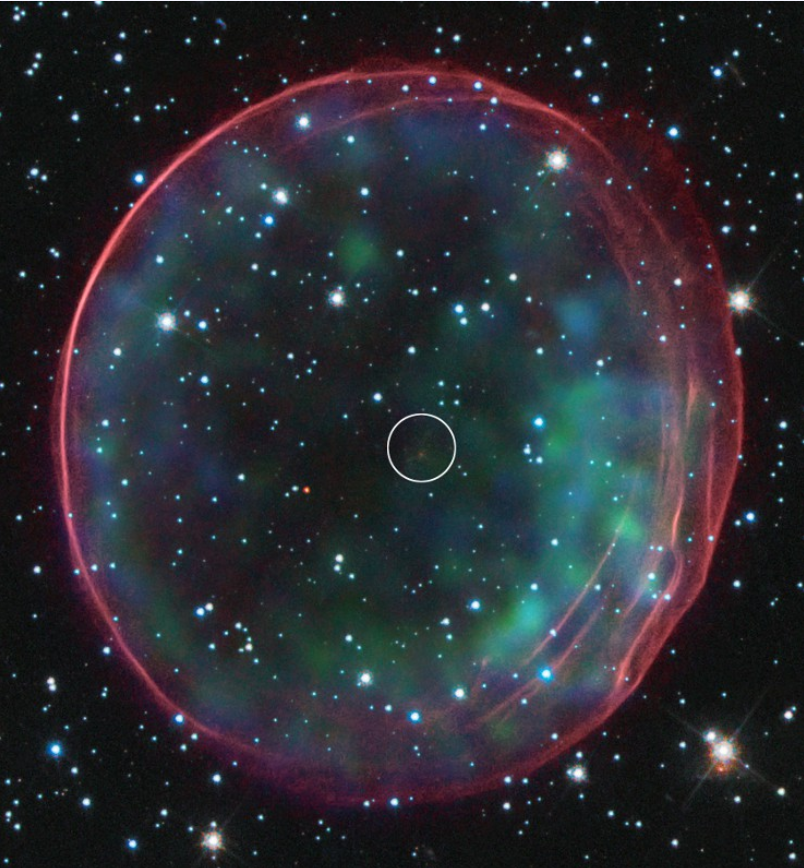
Alt...
2012 January 12
The Case of the Missing Supernova Companion
* Image Credit:
** X-ray: NASA/CXC/SAO/J. Hughes et al.,
** Optical: NASA/ESA/Hubble Heritage Team (STScI /AURA)
Explanation:
Where's the other star? At the center of this supernova remnant should be the companion star to the star that blew up. Identifying this star is important for understanding just how Type Ia supernova detonate, which in turn could lead to a better understanding of why the brightness of such explosions are so predictable, which in turn is key to calibrating the entire nature of our universe. The trouble is that even a careful inspection of the center of SNR 0509-67.5 has not found any star at all. This indicates that the companion is intrinsically very faint -- much more faint that many types of bright giant stars that had been previous candidates. In fact, the implication is that the companion star might have to be a faint white dwarf, similar to -- but less massive than -- the star that detonated. SNR 0509-67.5 is shown above in both visible light, shining in red as imaged by the Hubble Space Telescope, and X-ray light, shown in false-color green as imaged by the Chandra X-ray Observatory. Putting your cursor over the picture will highlight the central required location for the missing companion star.
Authors & editors: Robert Nemiroff (MTU) & Jerry Bonnell (UMCP)
NASA Official: Phillip Newman Specific rights apply.
2011 January 25
The Rippled Red Ribbons of SNR 0509
* Credit: NASA, ESA, and the Hubble Heritage Team (STScI/AURA); Acknowledgment: J. Hughes (Rutgers U.)
https://www.nasa.gov/
https://www.spacetelescope.org/
https://heritage.stsci.edu/
https://www.stsci.edu/portal/
https://www.aura-astronomy.org/
Explanation:
What is causing the picturesque ripples of supernova remnant SNR 0509-67.5? The ripples, as well as the greater nebula, were imaged in unprecedented detail by the Hubble Space Telescope in 2006 and again late last year. The red color was recoded by a Hubble filter that left only the light emitted by energetic hydrogen. The precise reason for the ripples remains unknown, with two considered origin hypotheses relating them to relatively dense portions of either ejected or impacted gas. The reason for the broader red glowing ring is more clear, with expansion speed and light echos relating it to a classic Type Ia supernova explosion that must have occurred about 400 years earlier. SNR 0509 currently spans about 23 light years and lies about 160,000 light years away toward the constellation of the dolphinfish (Dorado) in the Large Magellanic Cloud. The expanding ring carries with it another great mystery, however: why wasn't this supernova seen 400 years ago when light from the initial blast should have passed the Earth?
https://en.wikipedia.org/wiki/SNR_0509-67.5
https://apod.nasa.gov/apod/ap110125.html
#space #nebula #astrophotography #photography #science #astronomy #physics #nature #NASA #ESA #education
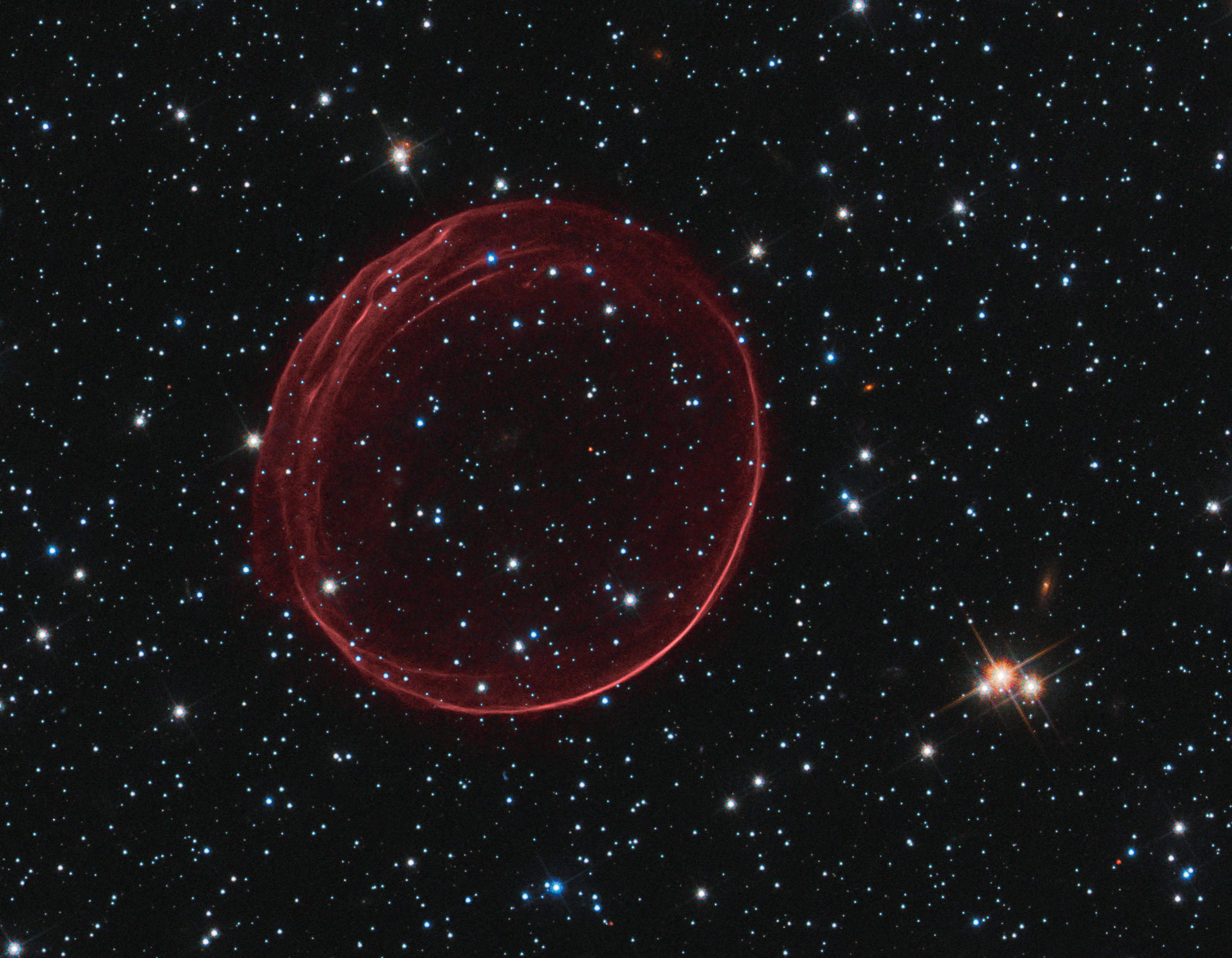
Alt...
2011 January 25
The Rippled Red Ribbons of SNR 0509
* Credit: NASA, ESA, and the Hubble Heritage Team (STScI/AURA); Acknowledgment: J. Hughes (Rutgers U.)
Explanation:
What is causing the picturesque ripples of supernova remnant SNR 0509-67.5? The ripples, as well as the greater nebula, were imaged in unprecedented detail by the Hubble Space Telescope in 2006 and again late last year. The red color was recoded by a Hubble filter that left only the light emitted by energetic hydrogen. The precise reason for the ripples remains unknown, with two considered origin hypotheses relating them to relatively dense portions of either ejected or impacted gas. The reason for the broader red glowing ring is more clear, with expansion speed and light echos relating it to a classic Type Ia supernova explosion that must have occurred about 400 years earlier. SNR 0509 currently spans about 23 light years and lies about 160,000 light years away toward the constellation of the dolphinfish (Dorado) in the Large Magellanic Cloud. The expanding ring carries with it another great mystery, however: why wasn't this supernova seen 400 years ago when light from the initial blast should have passed the Earth?
Authors & editors: Robert Nemiroff (MTU) & Jerry Bonnell (UMCP)
NASA Official: Phillip Newman Specific rights apply.
NASA Web Privacy Policy and Important Notices
A service of: ASD at NASA / GSFC
& Michigan Tech. U.
Double detonation: new image shows remains of star destroyed by pair of explosions
2 July 2025
For the first time, astronomers have obtained visual evidence that a star met its end by detonating twice. By studying the centuries-old remains of supernova SNR 0509-67.5 with the European Southern Observatory’s Very Large Telescope (ESO’s VLT), they have found patterns that confirm its star suffered a pair of explosive blasts. Published today, this discovery shows some of the most important explosions in the Universe in a new light.
Most supernovae are the explosive deaths of massive stars, but one important variety comes from an unassuming source. White dwarfs, the small, inactive cores left over after stars like our Sun burn out their nuclear fuel, can produce what astronomers call a Type Ia supernova.
"The explosions of white dwarfs play a crucial role in astronomy,” says Priyam Das, a PhD student at the University of New South Wales Canberra, Australia, who led the study on SNR 0509-67.5 published today in Nature Astronomy. Much of our knowledge of how the Universe expands rests on Type Ia supernovae, and they are also the primary source of iron on our planet, including the iron in our blood. “Yet, despite their importance, the long-standing puzzle of the exact mechanism triggering their explosion remains unsolved," he adds.
All models that explain Type Ia supernovae begin with a white dwarf in a pair of stars. If it orbits close enough to the other star in this pair, the dwarf can steal material from its partner. In the most established theory behind Type Ia supernovae, the white dwarf [...]
VIDEO:
Zooming into a star that detonated twice
For more details, check: https://www.eso.org/public/news/eso2511/.
Credit:
ESO/L. Calçada/N. Risinger (skysurvey.org)/VMC Survey/Digitized Sky Survey 2/P. Das et al. Background stars (Hubble): K. Noll et al. Music: Azul Cobalto
#space #nebula #astrophotography #photography #science #astronomy #physics #nature #NASA #ESA #education
2008 January 15
Double Supernova Remnants DEM L316
* Credit & Copyright: Gemini Observatory, GMOS-South, NSF
https://www.gemini.edu/
https://www.nsf.gov/
Explanation:
Are these two supernova shells related? To help find out, the 8-meter Gemini Telescope located high atop a mountain in Chile was pointed at the unusual, huge, double-lobed cloud dubbed DEM L316. The resulting image, shown above, yields tremendous detail. Inspection of the image as well as data taken by the orbiting Chandra X-Ray Observatory indicate how different the two supernova remnants are. In particular, the smaller shell appears to be the result of Type Ia supernova where a white dwarf exploded, while the larger shell appears to be the result of a Type II supernova where a massive normal star exploded. Since those two stellar types evolve on such different time scales, they likely did not form together and so are likely not physically associated. Considering also that no evidence exists that the shells are colliding, the two shells are now hypothesized to be superposed by chance. DEM L316 lies about 160,000 light years away in the neighboring Large Magellanic Cloud (LMC) galaxy, spans about 140 light-years across, and appears toward the southern constellation of the Swordfish (Dorado).
https://apod.nasa.gov/apod/ap080115.html
#space #nebula #astrophotography #photography #science #astronomy #physics #nature #NASA #ESA #education
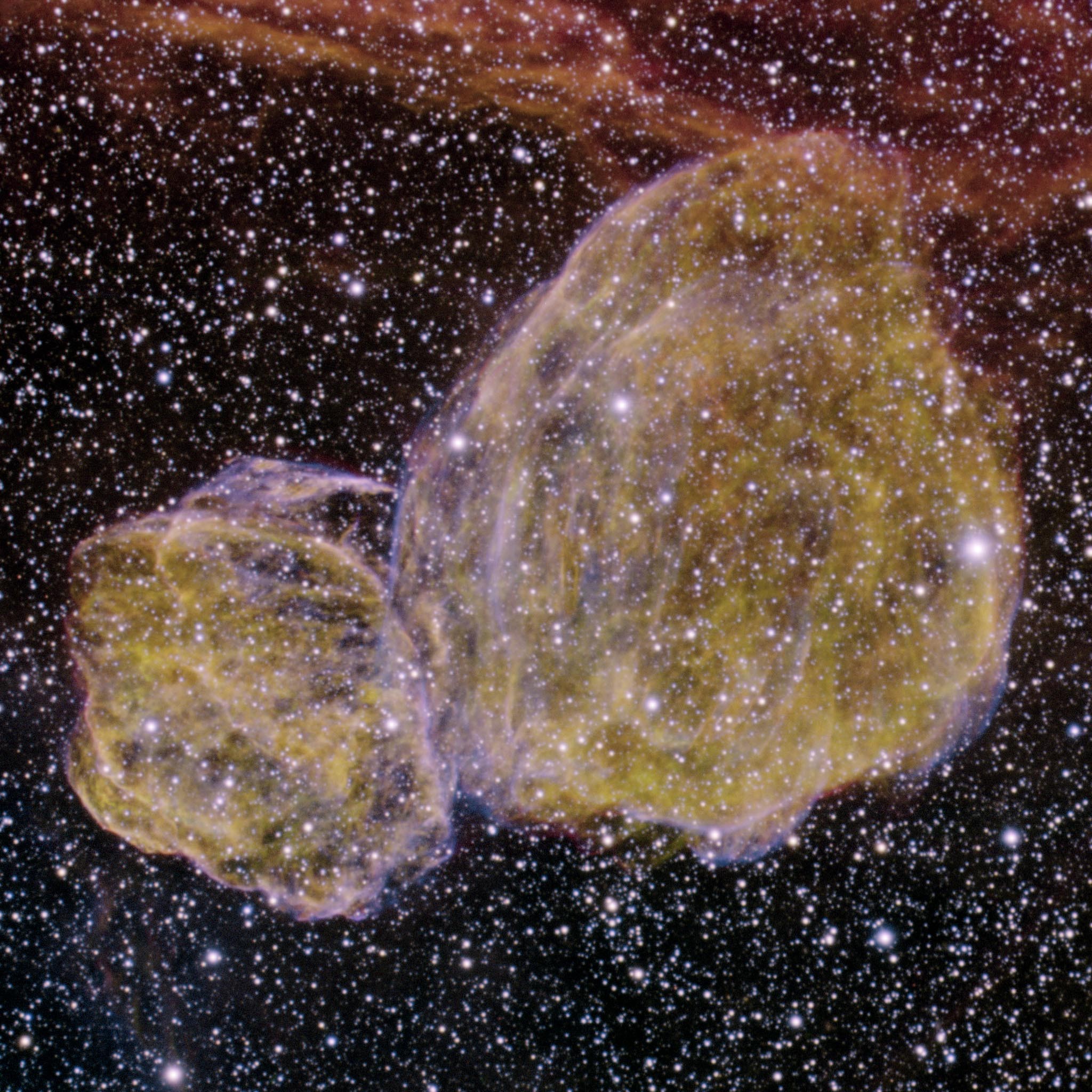
Alt...
2008 January 15
Double Supernova Remnants DEM L316
* Credit & Copyright: Gemini Observatory, GMOS-South, NSF
Explanation:
Are these two supernova shells related? To help find out, the 8-meter Gemini Telescope located high atop a mountain in Chile was pointed at the unusual, huge, double-lobed cloud dubbed DEM L316. The resulting image, shown above, yields tremendous detail. Inspection of the image as well as data taken by the orbiting Chandra X-Ray Observatory indicate how different the two supernova remnants are. In particular, the smaller shell appears to be the result of Type Ia supernova where a white dwarf exploded, while the larger shell appears to be the result of a Type II supernova where a massive normal star exploded. Since those two stellar types evolve on such different time scales, they likely did not form together and so are likely not physically associated. Considering also that no evidence exists that the shells are colliding, the two shells are now hypothesized to be superposed by chance. DEM L316 lies about 160,000 light years away in the neighboring Large Magellanic Cloud (LMC) galaxy, spans about 140 light-years across, and appears toward the southern constellation of the Swordfish (Dorado).
Authors & editors: Robert Nemiroff (MTU) & Jerry Bonnell (UMCP)
NASA Official: Phillip Newman Specific rights apply.
NASA Web Privacy Policy and Important Notices
A service of: ASD at NASA / GSFC
& Michigan Tech. U.
2025 July 29
A Helix Nebula Deep Field
* Image Credit & Copyright: George Chatzifrantzis
https://app.astrobin.com/u/pithagoras#gallery
Explanation:
Is the Helix Nebula looking at you? No, not in any biological sense, but it does look quite like an eye. The Helix Nebula is so named because it also appears that you are looking down the axis of a helix. In actuality, it is now understood to have a surprisingly complex geometry, including radial filaments and extended outer loops. The Helix Nebula (aka NGC 7293) is one of brightest and closest examples of a planetary nebula, a gas cloud created at the end of the life of a Sun-like star. The remnant central stellar core, destined to become a white dwarf star, glows in light so energetic it causes the previously expelled gas to fluoresce. The featured picture, taken in red, green, and blue but highlighted by light emitted primarily by hydrogen was created from 12 hours of exposure through a personal telescope located in Greece. A close-up of the inner edge of the Helix Nebula shows complex gas knots the origin of which are still being researched.
https://chandra.harvard.edu/deadstar/helix.html
https://en.wikipedia.org/wiki/Helix_Nebula
https://en.wikipedia.org/wiki/Planetary_nebula
https://mathworld.wolfram.com/Helix.html
http://www.astronomyknowhow.com/hydrogen-alpha.htm
https://youtu.be/WnWIt0iz00A
https://apod.nasa.gov/apod/ap250729.html
#space #nebula #astrophotography #photography #science #astronomy #physics #nature #NASA #ESA #education
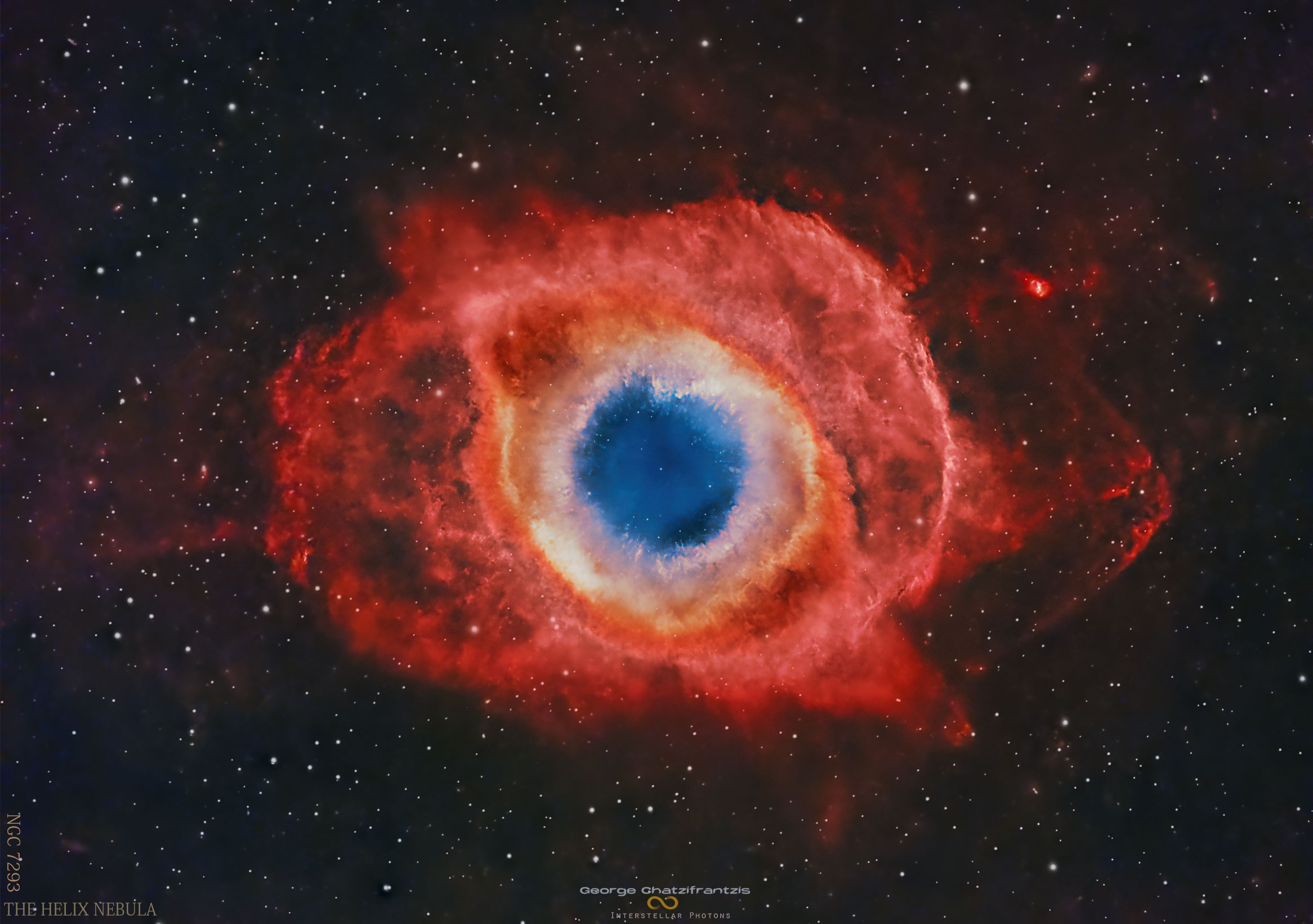
Alt...
2025 July 29
A nearly circular nebula with a blue core surrounded by small white knots, an orange ring and expansive red strucures.
A Helix Nebula Deep Field
* Image Credit & Copyright: George Chatzifrantzis
Explanation:
Is the Helix Nebula looking at you? No, not in any biological sense, but it does look quite like an eye. The Helix Nebula is so named because it also appears that you are looking down the axis of a helix. In actuality, it is now understood to have a surprisingly complex geometry, including radial filaments and extended outer loops. The Helix Nebula (aka NGC 7293) is one of brightest and closest examples of a planetary nebula, a gas cloud created at the end of the life of a Sun-like star. The remnant central stellar core, destined to become a white dwarf star, glows in light so energetic it causes the previously expelled gas to fluoresce. The featured picture, taken in red, green, and blue but highlighted by light emitted primarily by hydrogen was created from 12 hours of exposure through a personal telescope located in Greece. A close-up of the inner edge of the Helix Nebula shows complex gas knots the origin of which are still being researched.
Authors & editors: Robert Nemiroff (MTU) & Jerry Bonnell (UMCP)
NASA Official: Amber Straughn Specific rights apply.
NASA Web Privacy, Accessibility, Notices;
A service of: ASD at NASA / GSFC,
NASA Science Activation
& Michigan Tech. U.
2023 May 7
The Helix Nebula from CFHT
* Image Credit: CFHT, Coelum, MegaCam, J.-C. Cuillandre (CFHT) & G. A. Anselmi (Coelum)
https://www.cfht.hawaii.edu/
https://www.coelum.com/
https://www.cfht.hawaii.edu/Instruments/Imaging/Megacam/
https://www.cfht.hawaii.edu/~jcc/
Explanation:
Will our Sun look like this one day? The Helix Nebula is one of brightest and closest examples of a planetary nebula, a gas cloud created at the end of the life of a Sun-like star. The outer gasses of the star expelled into space appear from our vantage point as if we are looking down a helix. The remnant central stellar core, destined to become a white dwarf star, glows in light so energetic it causes the previously expelled gas to fluoresce. The Helix Nebula, given a technical designation of NGC 7293, lies about 700 light-years away towards the constellation of the Water Bearer (Aquarius) and spans about 2.5 light-years. The featured picture was taken with the Canada-France-Hawaii Telescope (CFHT) located atop a dormant volcano in Hawaii, USA. A close-up of the inner edge of the Helix Nebula shows complex gas knots of unknown origin.
https://en.wikipedia.org/wiki/Aquarius_(constellation)
https://apod.nasa.gov/apod/ap230507.html
#space #nebula #astrophotography #photography #science #astronomy #physics #nature #NASA #ESA #education
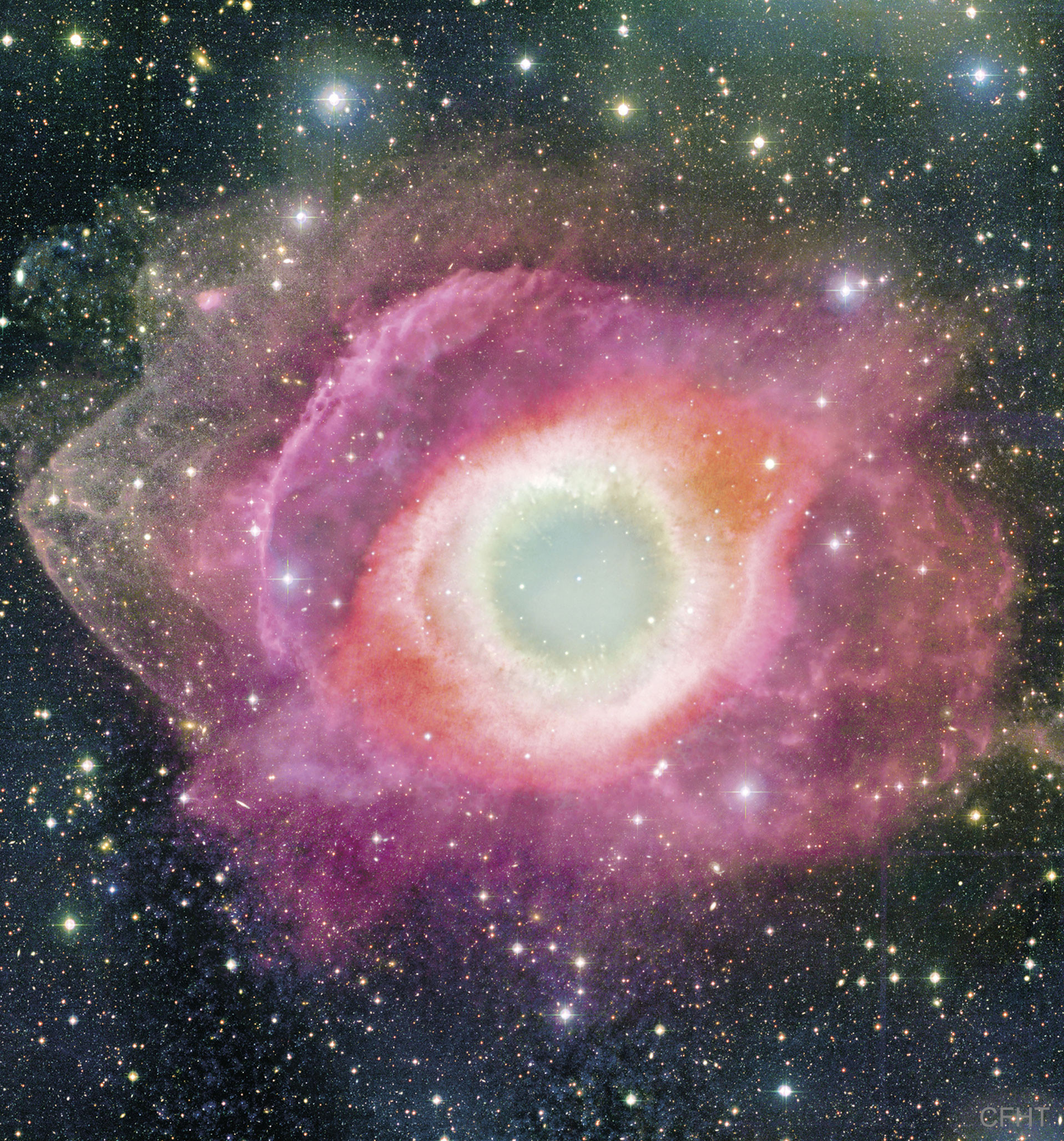
Alt...
2023 May 7
A colorful circular nebula is shown that is beige in the center, red further out, and gas violet rings even further out.
The Helix Nebula from CFHT
* Image Credit: CFHT, Coelum, MegaCam, J.-C. Cuillandre (CFHT) & G. A. Anselmi (Coelum)
Explanation:
Will our Sun look like this one day? The Helix Nebula is one of brightest and closest examples of a planetary nebula, a gas cloud created at the end of the life of a Sun-like star. The outer gasses of the star expelled into space appear from our vantage point as if we are looking down a helix. The remnant central stellar core, destined to become a white dwarf star, glows in light so energetic it causes the previously expelled gas to fluoresce. The Helix Nebula, given a technical designation of NGC 7293, lies about 700 light-years away towards the constellation of the Water Bearer (Aquarius) and spans about 2.5 light-years. The featured picture was taken with the Canada-France-Hawaii Telescope (CFHT) located atop a dormant volcano in Hawaii, USA. A close-up of the inner edge of the Helix Nebula shows complex gas knots of unknown origin.
Authors & editors: Robert Nemiroff (MTU) & Jerry Bonnell (UMCP)
NASA Official: Phillip Newman Specific rights apply.
NASA Web Privacy Policy and Important Notices
A service of: ASD at NASA / GSFC,
NASA Science Activation
& Michigan Tech. U.
Helix Nebula Zoom
The Helix Nebula, NGC 7293, lies about 700 light-years away in the constellation of Aquarius (the Water Bearer). It is one of the closest and most spectacular examples of a planetary nebula. These exotic objects have nothing to do with planets, but are the final blooming of Sun-like stars before their retirement as white dwarfs. Shells of gas are blown off from a star’s surface, often in intricate and beautiful patterns, and shine under the harsh ultraviolet radiation from the faint, but very hot, central star. The main ring of the Helix Nebula is about two light-years across or half the distance between the Sun and its closest stellar neighbour.
[...] * see ALT-Text
Although the Helix looks very much like a doughnut, studies have shown that it possibly consists of at least two separate discs with outer rings and filaments. The brighter inner disc seems to be expanding at about 100 000 km/h and to have taken about 12 000 years to have formed.
Because the Helix is relatively close — it covers an area of the sky about a quarter of the full Moon — it can be studied in much greater detail than most other planetary nebulae and has been found to have an unexpected and complex structure. All around the inside of the ring are small blobs, known as “cometary knots”, with faint tails extending away from the central star. They look remarkably like droplets of liquid running down a sheet of glass. Although they look tiny, each knot is about as large as our Solar System. These knots have been extensively studied, both with the ESO Very Large Telescope and with the NASA/ESA Hubble Space Telescope, but remain only partially understood.
https://www.eso.org/public/videos/eso0907a/
CREDIT
ESO
(European Organisation for Astronomical Research in the Southern Hemisphere)
#space #nebula #astrophotography #photography #science #astronomy #physics #nature #NASA #ESA #education
Alt...
Zoom Into The Helix Nebula
The Helix Nebula, NGC 7293, lies about 700 light-years away in the constellation of Aquarius (the Water Bearer). It is one of the closest and most spectacular examples of a planetary nebula. These exotic objects have nothing to do with planets, but are the final blooming of Sun-like stars before their retirement as white dwarfs. Shells of gas are blown off from a stars surface, often in intricate and beautiful patterns, and shine under the harsh ultraviolet radiation from the faint, but very hot, central star. The main ring of the Helix Nebula is about two light-years across or half the distance between the Sun and its closest stellar neighbour.
* [Despite being photographically very spectacular the Helix is hard to see visually as its light is thinly spread over a large area of sky and the history of its discovery is rather obscure. It first appears in a list of new objects compiled by the German astronomer Karl Ludwig Harding in 1824. The name Helix comes from the rough corkscrew shape seen in the earlier photographs.]
Although the Helix looks very much like a doughnut, studies have shown that it possibly consists of at least two separate discs with outer rings and filaments. The brighter inner disc seems to be expanding at about 100 000 km/h and to have taken about 12 000 years to have formed.
CREDIT
ESO
(European Organisation for Astronomical Research in the Southern Hemisphere )
2008 April 13
Curious Cometary Knots in the Helix Nebula
* Credit: C. R. O'Dell and K. Handron (Rice University), NASA
http://www.nasa.gov/
Explanation:
What causes unusual knots of gas and dust in planetary nebulas? Seen also in the Ring Nebula, the Dumbbell Nebula and NGC 2392, the knots' existence was not initially predicted and their origins are still not well understood. Pictured above is a fascinating image of the Helix Nebula by the Hubble Space Telescope showing tremendous detail of its mysterious gaseous knots. The above cometary knots have masses similar to the Earth but have radii typically several times the orbit of Pluto. One hypothesis for the fragmentation and evolution of the knots includes existing gas being driven out by a less dense but highly energetic stellar wind of the central evolving star. The Helix Nebula is the closest example of a planetary nebula created at the end of the life of a Sun-like star. The Helix Nebula, given a technical designation of NGC 7293, lies about 700 light-years away towards the constellation of Aquarius.
https://en.wikipedia.org/wiki/Rayleigh%E2%80%93Taylor_instability
https://en.wikipedia.org/wiki/Stellar_wind
https://ui.adsabs.harvard.edu/abs/2020MNRAS.491..758A/abstract
https://apod.nasa.gov/apod/ap080413.html
#space #nebula #astrophotography #photography #science #astronomy #physics #nature #NASA #ESA #education
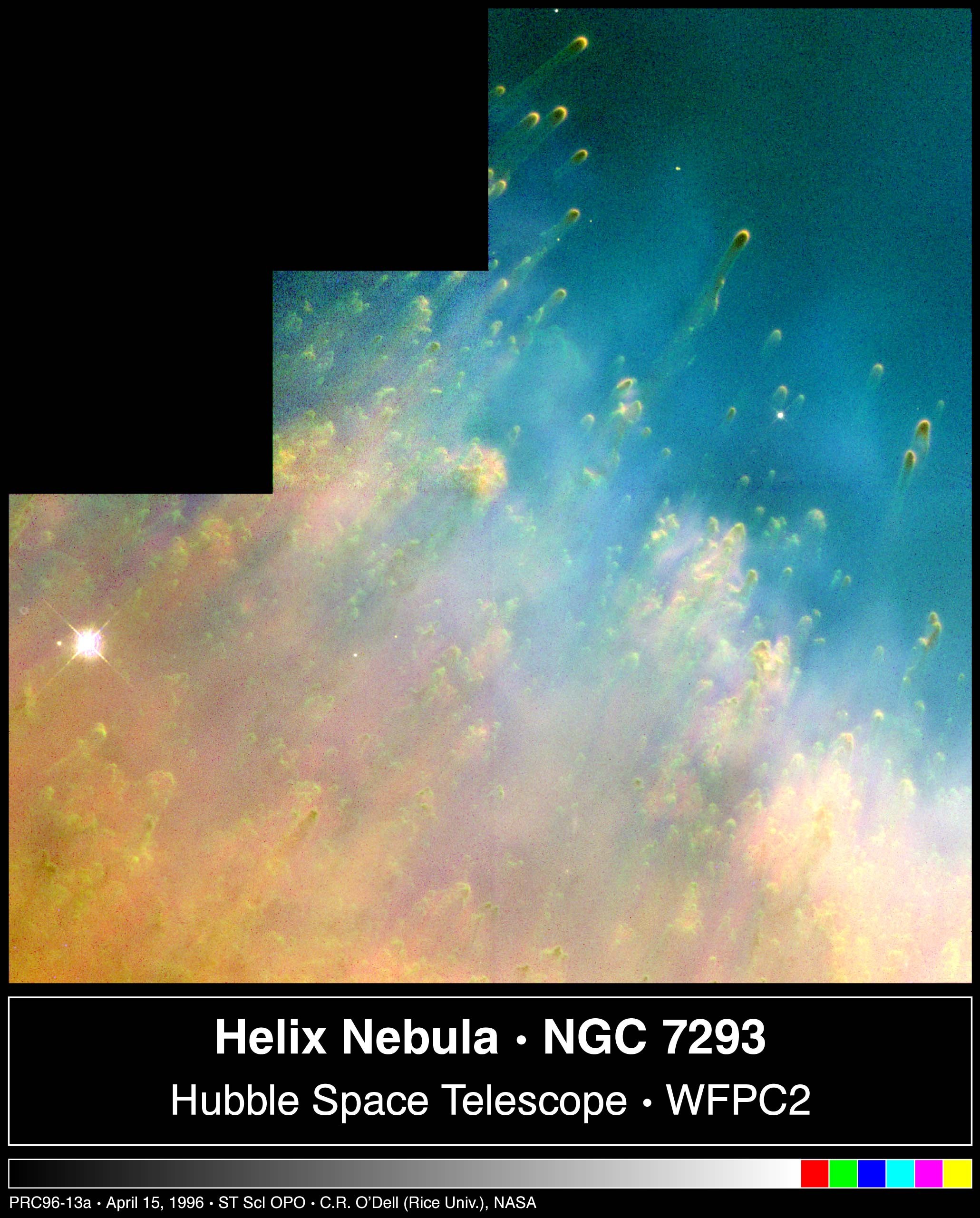
Alt...
2008 April 13
Curious Cometary Knots in the Helix Nebula
* Credit: C. R. O'Dell and K. Handron (Rice University), NASA
Explanation:
What causes unusual knots of gas and dust in planetary nebulas? Seen also in the Ring Nebula, the Dumbbell Nebula and NGC 2392, the knots' existence was not initially predicted and their origins are still not well understood. Pictured above is a fascinating image of the Helix Nebula by the Hubble Space Telescope showing tremendous detail of its mysterious gaseous knots. The above cometary knots have masses similar to the Earth but have radii typically several times the orbit of Pluto. One hypothesis for the fragmentation and evolution of the knots includes existing gas being driven out by a less dense but highly energetic stellar wind of the central evolving star. The Helix Nebula is the closest example of a planetary nebula created at the end of the life of a Sun-like star. The Helix Nebula, given a technical designation of NGC 7293, lies about 700 light-years away towards the constellation of Aquarius.
Authors & editors: Robert Nemiroff (MTU) & Jerry Bonnell (UMCP)
NASA Official: Phillip Newman Specific rights apply.
NASA Web Privacy Policy and Important Notices
A service of: ASD at NASA / GSFC
& Michigan Tech. U.
From Wikipedia, the free encyclopedia
[...]
The Helix Nebula is thought to be shaped like a prolate spheroid with strong density concentrations toward the filled disk along the equatorial plane, whose major axis is inclined about 21° to 37° from our vantage point. The size of the inner disk is 8×19 arcmin in diameter (0.52 pc); the outer torus is 12×22 arcmin in diameter (0.77 pc); and the outer-most ring is about 25 arcmin in diameter (1.76 pc). The outer-most ring appears flattened on one side due to it colliding with the ambient interstellar medium.
Expansion of the whole planetary nebula structure is estimated to have occurred in the last 6,560 years, and 12,100 years for the inner disk. Spectroscopically, the outer ring's expansion rate is 40 km/s, and about 32 km/s for the inner disk.
The Helix Nebula was the first planetary nebula discovered to contain cometary knots. Its main ring contains knots of nebulosity, which have now been detected in several nearby planetary nebulae, especially those with a molecular envelope like the Ring nebula and the Dumbbell Nebula.
These knots are radially symmetrical (from the CS) and are described as "cometary", each centered on a core of neutral molecular gas and containing bright local photoionization fronts or cusps towards the central star and tails away from it. All tails extend away from the Planetary Nebula Nucleus (PNN) in a radial direction. Excluding the tails, each knot is approximately the size of the Solar System, while each of the cusp knots are optically thick due to Lyc photons from the CS. There are about 40,000 cometary knots in the Helix Nebula.
[...] * more in the ALT-Text
CREDIT
+ Text excerpt
by Contributors to Wikimedia projects
+ Video credit
Magnetosheath (YT)
https://www.youtube.com/channel/UC2wcz4CLDO7CrSKOUl9o8qg/about
#space #nebula #astrophotography #photography #science #astronomy #physics #nature #NASA #ESA #education
2021 October 14
NGC 7293: The Helix Nebula
* Image Credit & Copyright: Ignacio Diaz Bobillo
https://www.pampaskies.com/gallery3/index.php
Explanation:
A mere seven hundred light years from Earth, toward the constellation Aquarius, a sun-like star is dying. Its last few thousand years have produced the Helix Nebula (NGC 7293), a well studied and nearby example of a Planetary Nebula, typical of this final phase of stellar evolution. A total of 90 hours of exposure time have gone in to creating this expansive view of the nebula. Combining narrow band image data from emission lines of hydrogen atoms in red and oxygen atoms in blue-green hues, it shows remarkable details of the Helix's brighter inner region about 3 light-years across. The white dot at the Helix's center is this Planetary Nebula's hot, central star. A simple looking nebula at first glance, the Helix is now understood to have a surprisingly complex geometry.
https://www.pampaskies.com/gallery3/Deep-Space-Objects/Helix_Oxygen_crop2_small
https://science.nasa.gov/missions/hubble/a-new-twist-on-an-old-nebula/
https://apod.nasa.gov/apod/ap211014.html
#space #nebula #astrophotography #photography #science #astronomy #physics #nature #NASA #ESA #education
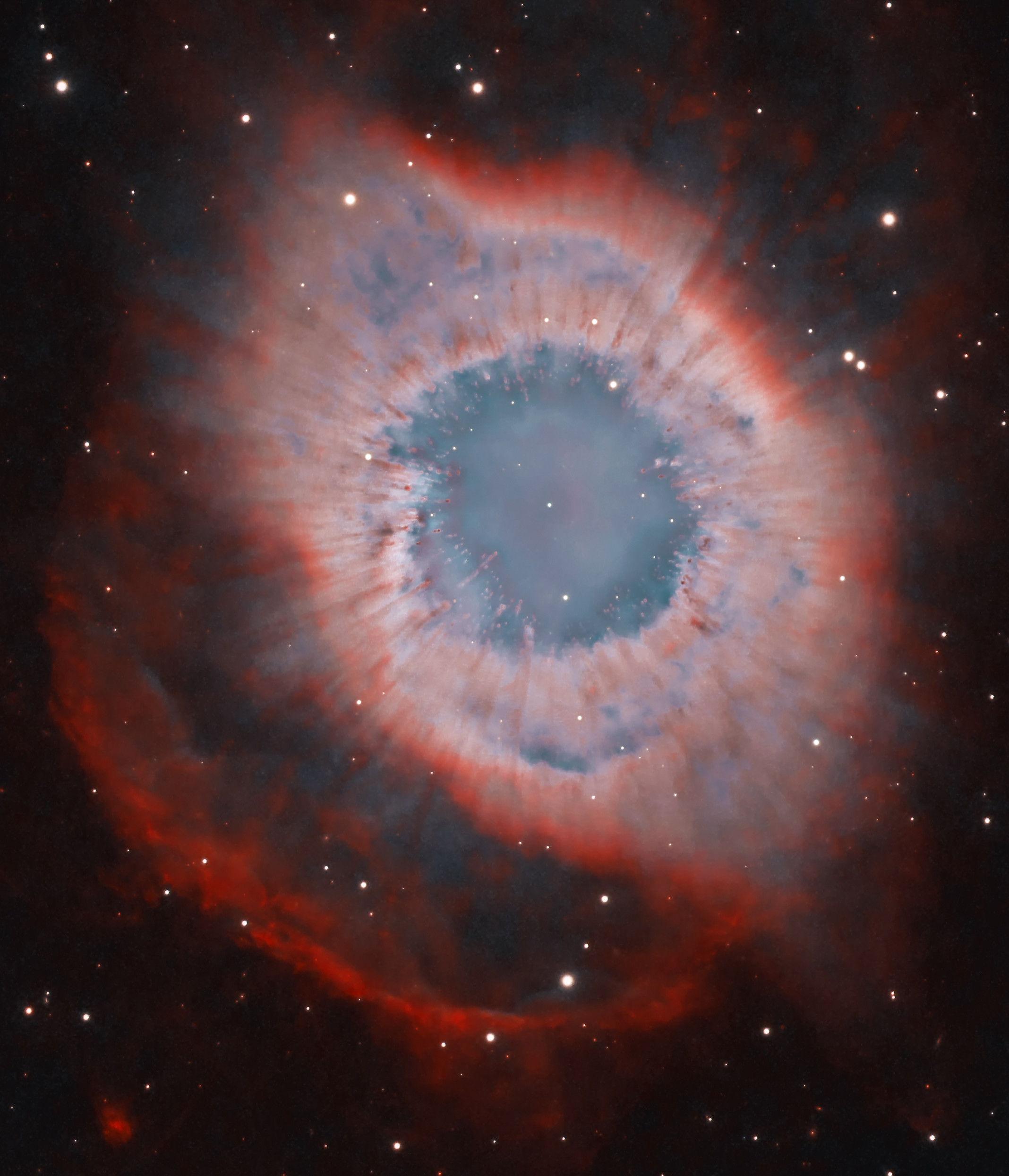
Alt...
2021 October 14
NGC 7293: The Helix Nebula
* Image Credit & Copyright: Ignacio Diaz Bobillo
Explanation:
A mere seven hundred light years from Earth, toward the constellation Aquarius, a sun-like star is dying. Its last few thousand years have produced the Helix Nebula (NGC 7293), a well studied and nearby example of a Planetary Nebula, typical of this final phase of stellar evolution. A total of 90 hours of exposure time have gone in to creating this expansive view of the nebula. Combining narrow band image data from emission lines of hydrogen atoms in red and oxygen atoms in blue-green hues, it shows remarkable details of the Helix's brighter inner region about 3 light-years across. The white dot at the Helix's center is this Planetary Nebula's hot, central star. A simple looking nebula at first glance, the Helix is now understood to have a surprisingly complex geometry.
Authors & editors: Robert Nemiroff (MTU) & Jerry Bonnell (UMCP)
NASA Official: Phillip Newman Specific rights apply.
NASA Web Privacy Policy and Important Notices
A service of: ASD at NASA / GSFC
& Michigan Tech. U.
2009 December 31
Dust and the Helix Nebula
* NASA, JPL-Caltech, Kate Su (Steward Obs., U. Arizona), et al.
http://ssc.spitzer.caltech.edu/
https://astro.arizona.edu/
https://arxiv.org/abs/astro-ph/0702296
http://www.nasa.gov/home/index.html
Explanation:
Dust makes this cosmic eye look red. The eerie Spitzer Space Telescope image shows infrared radiation from the well-studied Helix Nebula (NGC 7293) a mere 700 light-years away in the constellation Aquarius. The two light-year diameter shroud of dust and gas around a central white dwarf has long been considered an excellent example of a planetary nebula, representing the final stages in the evolution of a sun-like star. But the Spitzer data show the nebula's central star itself is immersed in a surprisingly bright infrared glow. Models suggest the glow is produced by a dust debris disk. Even though the nebular material was ejected from the star many thousands of years ago, the close-in dust could be generated by collisions in a reservoir of objects analogous to our own solar system's Kuiper Belt or cometary Oort cloud. Formed in the distant planetary system, the comet-like bodies would have otherwise survived even the dramatic late stages of the star's evolution.
https://coolcosmos.ipac.caltech.edu//
http://maps.seds.org/Stars_en/Fig/aquarius.html
https://apod.nasa.gov/apod/ap041210.html
http://www2.ess.ucla.edu/~jewitt/kb.html
!> https://en.wikipedia.org/wiki/Stellar_evolution
https://apod.nasa.gov/apod/ap091231.html
#space #nebula #astrophotography #photography #science #astronomy #physics #nature #NASA #ESA #education
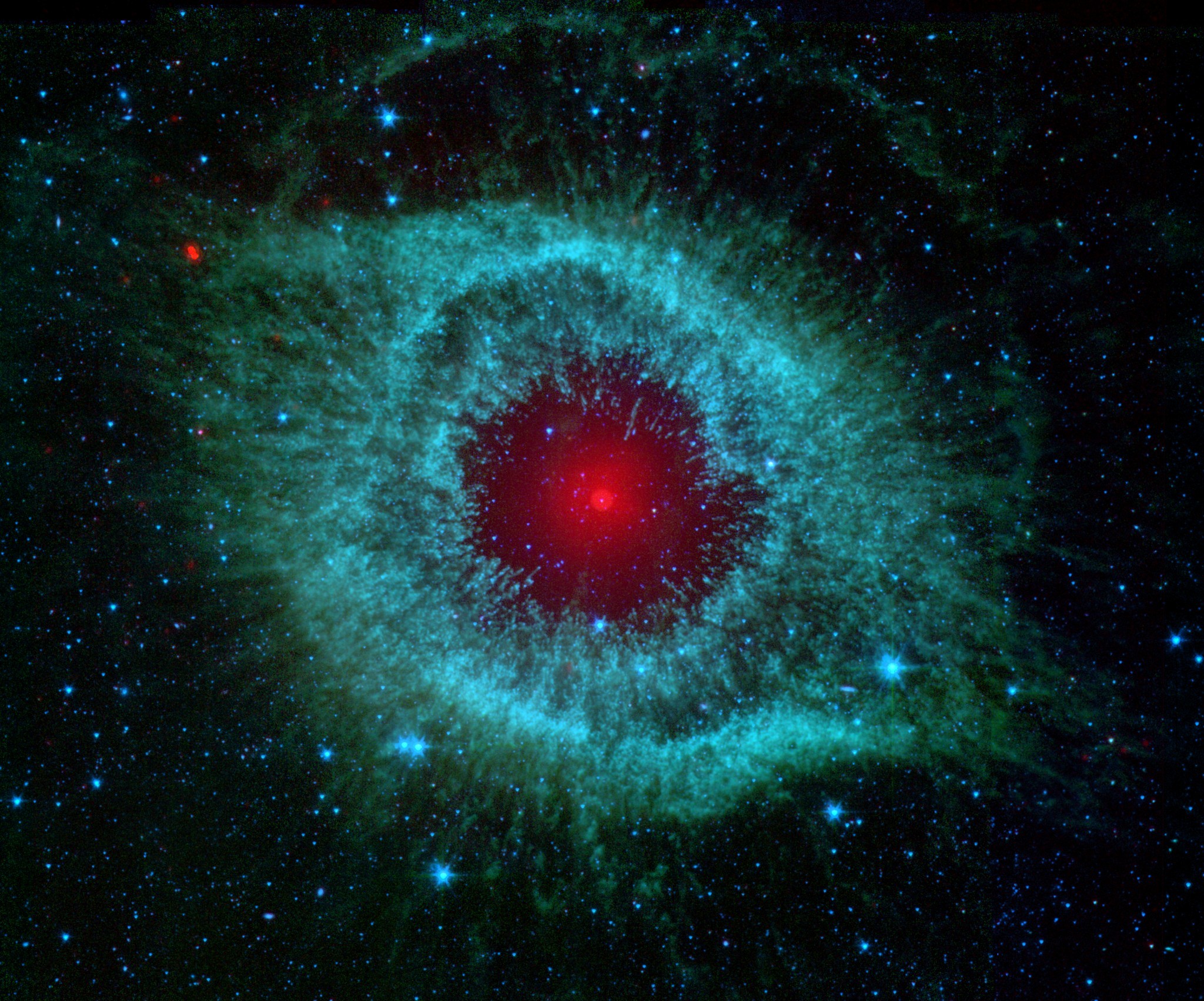
Alt...
2009 December 31
Dust and the Helix Nebula
* NASA, JPL-Caltech, Kate Su (Steward Obs., U. Arizona), et al.
Explanation:
Dust makes this cosmic eye look red. The eerie Spitzer Space Telescope image shows infrared radiation from the well-studied Helix Nebula (NGC 7293) a mere 700 light-years away in the constellation Aquarius. The two light-year diameter shroud of dust and gas around a central white dwarf has long been considered an excellent example of a planetary nebula, representing the final stages in the evolution of a sun-like star. But the Spitzer data show the nebula's central star itself is immersed in a surprisingly bright infrared glow. Models suggest the glow is produced by a dust debris disk. Even though the nebular material was ejected from the star many thousands of years ago, the close-in dust could be generated by collisions in a reservoir of objects analogous to our own solar system's Kuiper Belt or cometary Oort cloud. Formed in the distant planetary system, the comet-like bodies would have otherwise survived even the dramatic late stages of the star's evolution.
Authors & editors: Robert Nemiroff (MTU) & Jerry Bonnell (UMCP)
NASA Official: Phillip Newman Specific rights apply.
NASA Web Privacy Policy and Important Notices
A service of: ASD at NASA / GSFC
& Michigan Tech. U.
2006 January 12
Infrared Helix
* Credit: J. Hora (Harvard-Smithsonian CfA) et al., (SSC/Caltech), JPL-Caltech, NASA
https://www.cfa.harvard.edu/
https://irsa.ipac.caltech.edu/data/SPITZER/docs/
http://www.jpl.nasa.gov/
http://www.nasa.gov/home/index.html
Explanation:
Over six hundred light years from Earth, in the constellation Aquarius, a sun-like star is dying. Its last few thousand years have produced the Helix Nebula (NGC 7293), a well studied and nearby example of a Planetary Nebula, typical of this final phase of stellar evolution. Emission in this infrared Spitzer Space Telescope image of the Helix comes mostly from the nebula's molecular hydrogen gas. The gas appears to be clumpy, forming thousands of comet-shaped knots each spanning about twice the size of our solar system. Bluer, more energetic radiation is seen to come from the heads with redder emission from the tails, suggesting that they are more shielded from the central star's winds and intense ultraviolet radiation. The nebula itself is about 2.5 light-years across. The Sun is expected to go through its own Planetary Nebula phase ... in another 5 billion years.
!> http://hawastsoc.org/deepsky/aqr/index.html
https://apod.nasa.gov/apod/ap060112.html
#space #nebula #astrophotography #photography #science #astronomy #physics #nature #NASA #ESA #education
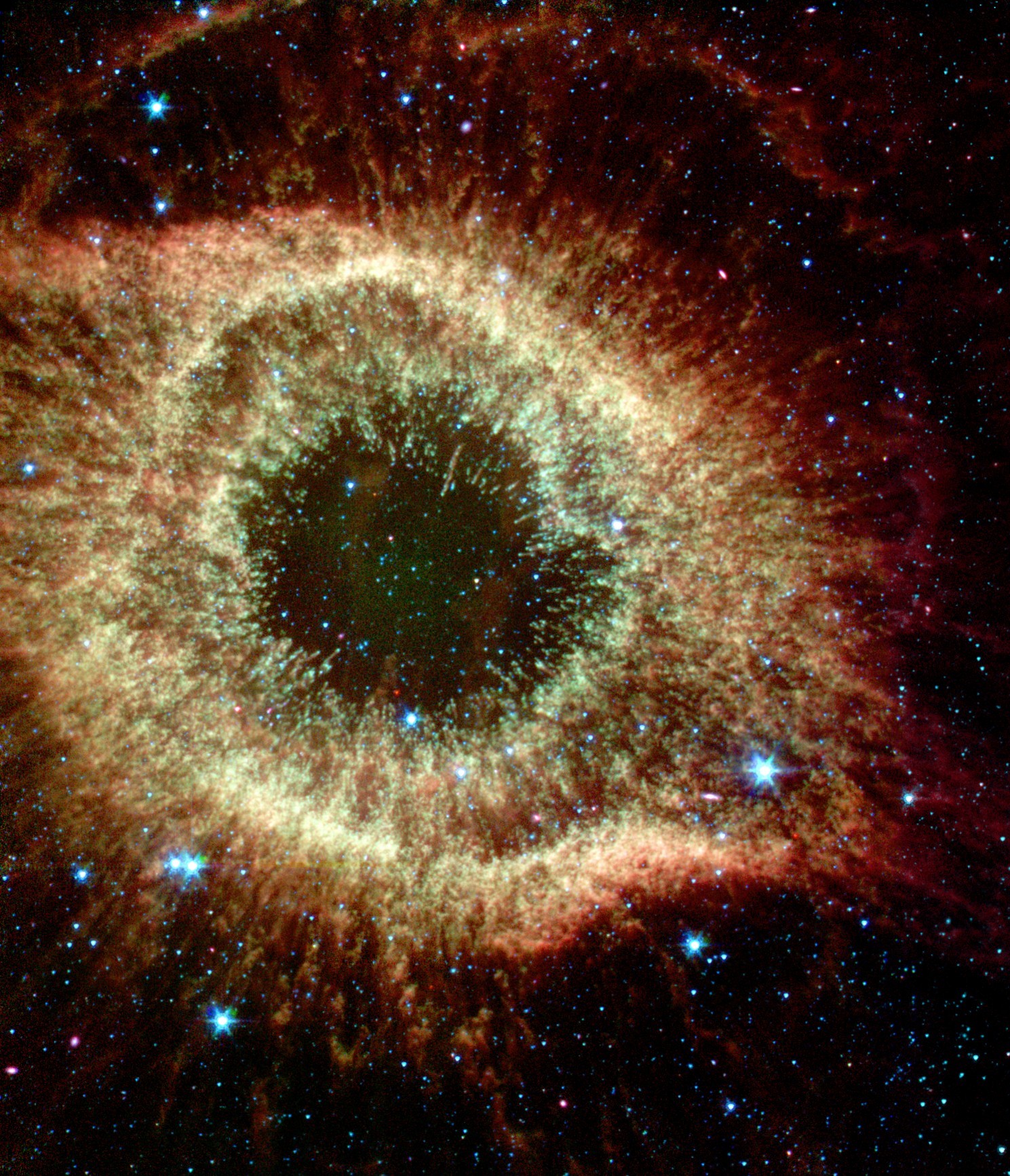
Alt...
2006 January 12
Infrared Helix
* Credit: J. Hora (Harvard-Smithsonian CfA) et al., (SSC/Caltech), JPL-Caltech, NASA
Explanation:
Over six hundred light years from Earth, in the constellation Aquarius, a sun-like star is dying. Its last few thousand years have produced the Helix Nebula (NGC 7293), a well studied and nearby example of a Planetary Nebula, typical of this final phase of stellar evolution. Emission in this infrared Spitzer Space Telescope image of the Helix comes mostly from the nebula's molecular hydrogen gas. The gas appears to be clumpy, forming thousands of comet-shaped knots each spanning about twice the size of our solar system. Bluer, more energetic radiation is seen to come from the heads with redder emission from the tails, suggesting that they are more shielded from the central star's winds and intense ultraviolet radiation. The nebula itself is about 2.5 light-years across. The Sun is expected to go through its own Planetary Nebula phase ... in another 5 billion years.
Authors & editors: Robert Nemiroff (MTU) & Jerry Bonnell (USRA)
NASA Web Site Statements, Warnings, and Disclaimers
NASA Official: Jay Norris. Specific rights apply.
A service of: EUD at NASA / GSFC
& Michigan Tech. U.
2025 July 31
Supernova 2025rbs in NGC 7331
* Image Credit: Ben Godson (University of Warwick)
https://warwick.ac.uk/fac/sci/physics/research/astro/people/bengodson/
Explanation:
A long time ago in a galaxy 50 million light-years away, a star exploded. Light from that supernova was first detected by telescopes on planet Earth on July 14th though, and the extragalactic transient is now known to astronomers as supernova 2025rbs. Presently the brightest supernova in planet Earth's sky, 2025rbs is a Type Ia supernova, likely caused by the thermonuclear detonation of a white dwarf star that accreted material from a companion in a binary star system. Type Ia supernovae are used as standard candles to establish the distance scale of the universe. The host galaxy of 2025rbs is NGC 7331. Itself a bright spiral galaxy in the northern constellation Pegasus, NGC 7331 is often touted as an analog to our own Milky Way.
https://goto-observatory.org/bright-supernova-2025rbs-discovered-by-goto/
https://www.wis-tns.org/object/2025rbs
https://rochesterastronomy.org/supernova.html
https://apod.nasa.gov/apod/ap250731.html
#space #supernova #astrophotography #photography #science #astronomy #physics #nature #NASA #ESA #education

Alt...
2025 July 31
Supernova 2025rbs in NGC 7331
* Image Credit: Ben Godson (University of Warwick)
Explanation:
A long time ago in a galaxy 50 million light-years away, a star exploded. Light from that supernova was first detected by telescopes on planet Earth on July 14th though, and the extragalactic transient is now known to astronomers as supernova 2025rbs. Presently the brightest supernova in planet Earth's sky, 2025rbs is a Type Ia supernova, likely caused by the thermonuclear detonation of a white dwarf star that accreted material from a companion in a binary star system. Type Ia supernovae are used as standard candles to establish the distance scale of the universe. The host galaxy of 2025rbs is NGC 7331. Itself a bright spiral galaxy in the northern constellation Pegasus, NGC 7331 is often touted as an analog to our own Milky Way.
Authors & editors: Robert Nemiroff (MTU) & Jerry Bonnell (UMCP)
NASA Official: Amber Straughn Specific rights apply.
NASA Web Privacy, Accessibility, Notices;
A service of: ASD at NASA / GSFC,
NASA Science Activation
& Michigan Tech. U.Authors & editors: Robert Nemiroff (MTU) & Jerry Bonnell (UMCP)
NASA Official: Amber Straughn Specific rights apply.
NASA Web Privacy, Accessibility, Notices;
A service of: ASD at NASA / GSFC,
NASA Science Activation
& Michigan Tech. U.
Type Ia Supernovae
By jmbrill
Roman will use type Ia supernovae to measure cosmic distances, which will help us understand how the universe has expanded over time.
* Video Credit:
NASA Goddard's Scientific Visualization Studio
Roman will see thousands of exploding stars called supernovae across vast stretches of time and space. Using these observations, astronomers aim to shine a light on several cosmic mysteries – primarily dark energy. Roman will use type Ia supernovae to measure cosmic distances, which will help us understand how the universe has expanded over time.
Roman’s supernova survey will help clear up clashing measurements of how fast the universe is currently expanding, and even provide a new way to probe the distribution of dark matter, which is detectable only through its gravitational effects. One of the mission’s primary science goals involves using supernovae to help pin down the nature of dark energy – the unexplained cosmic pressure that’s speeding up the expansion of the universe.
Roman will use multiple methods to investigate dark energy. One involves surveying the sky for a special type of exploding star, called a type Ia supernova.
Many supernovae occur when massive stars run out of fuel, rapidly collapse under their own weight, and then explode because of strong shock waves that propel out of their interiors. These supernovae occur about once every 50 years in our Milky Way galaxy. But evidence shows that type Ia supernovae originate from some binary star systems that contain at least one white dwarf – the small, hot core remnant of a Sun-like star. Type Ia supernovae are much rarer, happening roughly once every 500 years in the Milky Way.
[...]
Read more in next reply
https://science.nasa.gov/mission/roman-space-telescope/type-ia-supernovae/
You might also be interested in:
TOPIC> "As Far As We Can See" https://defcon.social/@grobi/114626118056153533
#space #supernova #astrophotography #photography #science #astronomy #physics #nature #NASA #ESA #education
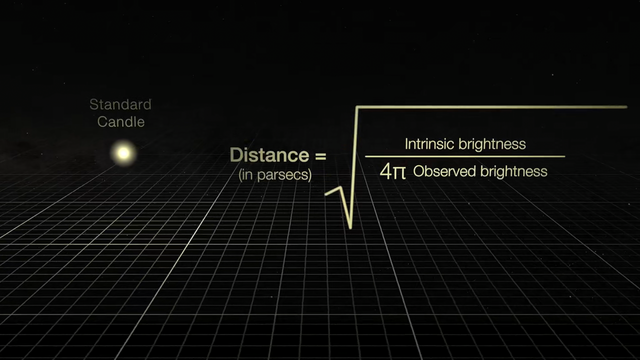
Alt...
NASA’s upcoming Nancy Grace Roman Space Telescope will see thousands of exploding stars called supernovae across vast stretches of time and space. Using these observations, astronomers aim to shine a light on several cosmic mysteries, providing a window onto the universe’s distant past and hazy present.
Read more: http://www.nasa.gov/feature/goddard/2...
Roman’s supernova survey will help clear up clashing measurements of how fast the universe is currently expanding, and even provide a new way to probe the distribution of dark matter, which is detectable only through its gravitational effects. One of the mission’s primary science goals involves using supernovae to help pin down the nature of dark energy – the unexplained cosmic pressure that’s speeding up the expansion of the universe.
Roman will use multiple methods to investigate dark energy. One involves surveying the sky for a special type of exploding star, called a type Ia supernova.
Music: "Relentless Data" from Universal Production Music
Video credit: NASA's Goddard Space Flight Center
Scott Wiessinger (USRA): Producer
Ashley Balzer (ADNET): Science Writer
Adriana Manrique Gutierrez (USRA): Lead Animator
Claire Andreoli (NASA/GSFC): Public Affairs Officer
Barb Mattson (University of Maryland College Park): Narrator
Scott Wiessinger (USRA): Animator
Scott Wiessinger (USRA): Writer
Scott Wiessinger (USRA): Editor
By jmbrill
[...]
In some cases, the dwarf may siphon material from its companion. This ultimately triggers a runaway reaction that detonates the thief once it reaches a specific point where it has gained so much mass that it becomes unstable. Astronomers have also found evidence supporting another scenario, involving two white dwarfs that spiral toward each other until they merge. If their combined mass is high enough that it leads to instability, they, too, may produce a type Ia supernova.
These explosions peak at a similar, known intrinsic brightness, making type Ia supernovae so-called standard candles – objects or events that emit a specific amount of light, allowing scientists to find their distance with a straightforward formula. Because of this, astronomers can determine how far away the supernovae are by simply measuring how bright they appear.
Astronomers will also use Roman to study the light of these supernovae to find out how quickly they appear to be moving away from us. By comparing how fast they’re receding at different distances, scientists will trace cosmic expansion over time. This will help us understand whether and how dark energy has changed throughout the history of the universe.
Previous type Ia supernova surveys have concentrated on the relatively nearby universe, largely due to instrument limitations. Roman’s infrared vision, gigantic field of view, and exquisite sensitivity will dramatically extend the search, pulling the cosmic curtains far enough aside to allow astronomers to spot thousands of distant type Ia supernovae.
Roman will study dark energy’s influence in detail over more than half of the universe’s history, when it was between about 4 and 12 billion years old. Exploring this relatively unprobed region will help scientists add crucial pieces to the dark energy puzzle.
Video Credit:
NGSVS
https://science.nasa.gov/mission/roman-space-telescope/type-ia-supernovae/
#space #supernova #astrophotography #photography #science #astronomy #physics #nature #NASA #ESA #education