Search results for tag #education
![[?]](https://files.mastodon.green/accounts/avatars/108/202/636/915/154/983/original/5174eb3c4dc21e57.jpg)
So disappointed that her reaction is 'ready to take on the unions'.
Perhaps a better route might be to engage and discuss. And this from a Labour minister - I despair.
#education
![[?]](https://s3.masto.ai/accounts/avatars/109/303/982/217/898/173/original/84b53833e9214e09.png)
#NewMexico joins countries such as #Norway & #Belgium that offer #free #universal #childcare for #children under 3, & #Bulgaria, where early childhood #education is free for all children until elementary school. New Mexico is going further by offering no-cost child care for children up to age 13.
Under the program, #families, regardless of income, can receive #state #vouchers to cover #public & #private #childcare fees. It culminates efforts #NewMexico has made to expand access to #free #child #care since the governor & state legislature created the Early Childhood #Education & Care Department in 2019.
The launch comes as other #Democratic-run states, cities & counties eye a step popular among working families.
In US first, #NewMexico launches #free #childcare for all
Saturday NM became the first #US state to offer free child care to all residents in a bid to boost its #economy & lift #education & #ChildWelfare levels…
NM Gov Michelle Lujan Grisham (D) told reporters #child #care was "the backbone of creating a system of support for families that allows them to work, to go to college, to do all the things they need to do to continue to lift New Mexico out of #poverty."
#law
https://www.reuters.com/world/us/us-first-new-mexico-launches-free-child-care-all-2025-11-01/?utm_source=braze&utm_medium=notifications&utm_campaign=2025_engagement
![[?]](https://files.defcon.social/dcsocial-s3/accounts/avatars/113/208/344/507/078/943/original/014820ad22daee1c.jpg)
TOPIC> The Pleiades
2025 July 8
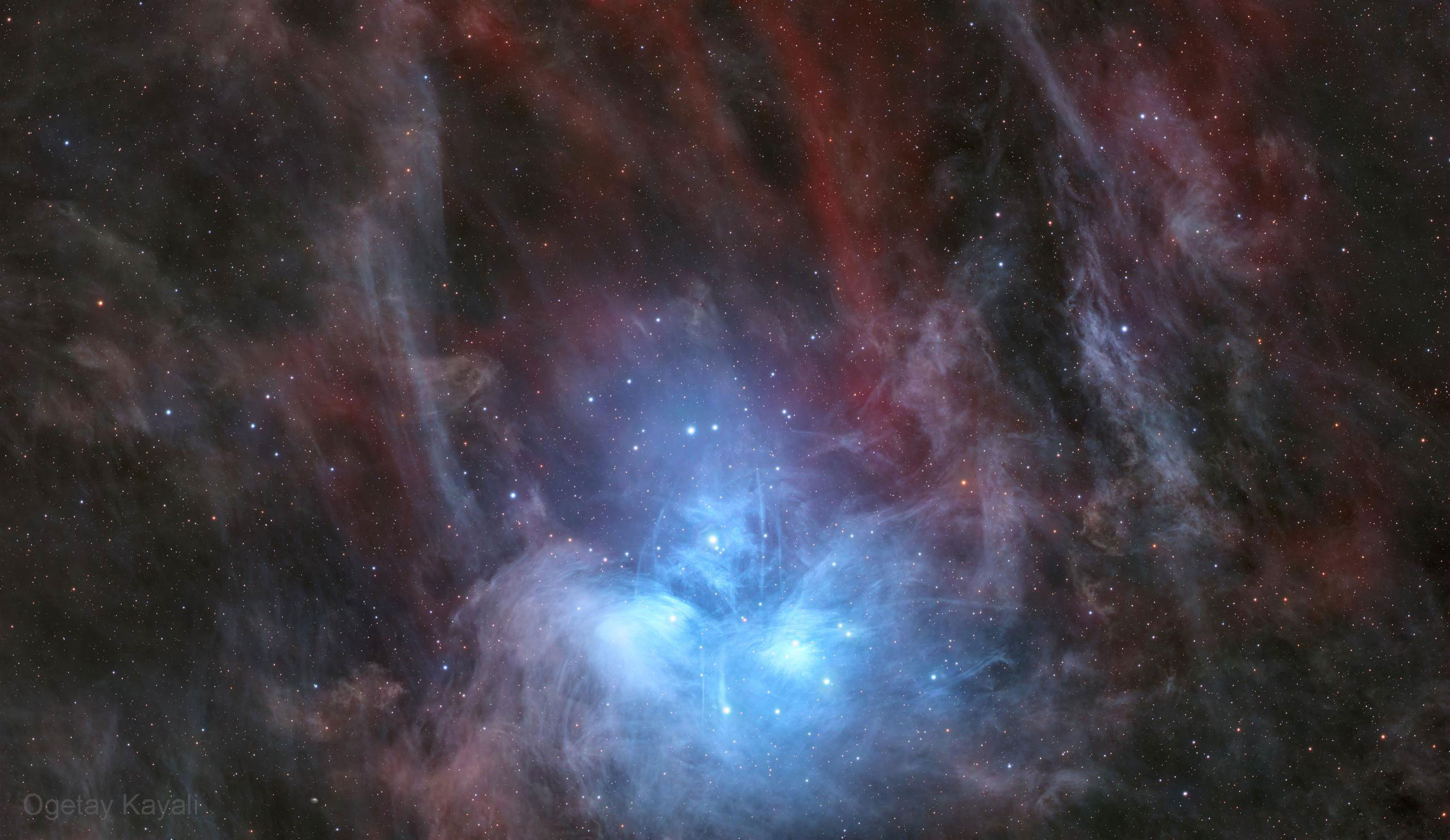
The Pleiades in Red and Blue
* Image Credit & Copyright: Ogetay Kayali (Michigan Tech U.)
* Text: Ogetay Kayali (Michigan Tech U.)
https://www.ogetay.com/
https://www.mtu.edu/physics/
Explanation:
If you have looked at the sky and seen a group of stars about the size of the full Moon, that's the Pleiades (M45). Perhaps the most famous star cluster in the sky, its brightest stars can be seen even from the light-polluted cities. But your unaided eye can also see its nebulosity -- the gas and dust surrounding it -- under dark skies. However, telescopes can catch even more. The bright blue stars of the Pleiades, also known as the Seven Sisters, light up their surrounding dust, causing it to appear a diffuse blue that can only be seen under long exposures. But that's not all. The cosmic dust appears to stretch upward like ethereal arms. And the entire structure is surrounded by a reddish glow from the most abundant element in the universe: hydrogen. The featured image is composed of nearly 25 hours of exposure and was captured last year from Starfront Observatory, in Texas, USA
https://app.astrobin.com/i/zcwwdj
https://en.wikipedia.org/wiki/Hydrogen-alpha
https://science.nasa.gov/universe/star-clusters-inside-the-universes-stellar-collections/
About Light Pollution:
https://apod.nasa.gov/apod/ap200408.html
https://apod.nasa.gov/apod/ap230308.html
https://starfront.space/
Cosmik Dust:
https://herscheltelescope.org.uk/science/infrared/dust/
https://apod.nasa.gov/apod/ap230108.html
https://en.wikipedia.org/wiki/Hydrogen-alpha
https://apod.nasa.gov/apod/ap250708.html
#space #pleiades #astrophotography #photography #science #astronomy #nature #NASA #education
Alt...
2025 July 8
A cluster of bright blue stars is seen near the bottom of this starfield. Nebula around the stars is blue near the stars but red elsewhere.
The Pleiades in Red and Blue
* Image Credit & Copyright: Ogetay Kayali (Michigan Tech U.) Text: Ogetay Kayali (Michigan Tech U.)
Explanation:
If you have looked at the sky and seen a group of stars about the size of the full Moon, that's the Pleiades (M45). Perhaps the most famous star cluster in the sky, its brightest stars can be seen even from the light-polluted cities. But your unaided eye can also see its nebulosity -- the gas and dust surrounding it -- under dark skies. However, telescopes can catch even more. The bright blue stars of the Pleiades, also known as the Seven Sisters, light up their surrounding dust, causing it to appear a diffuse blue that can only be seen under long exposures. But that's not all. The cosmic dust appears to stretch upward like ethereal arms. And the entire structure is surrounded by a reddish glow from the most abundant element in the universe: hydrogen. The featured image is composed of nearly 25 hours of exposure and was captured last year from Starfront Observatory, in Texas, USA
Authors & editors: Robert Nemiroff (MTU) & Jerry Bonnell (UMCP)
NASA Official: Amber Straughn Specific rights apply.
NASA Web Privacy, Accessibility, Notices;
A service of: ASD at NASA / GSFC,
NASA Science Activation
& Michigan Tech. U.
2021 April 6
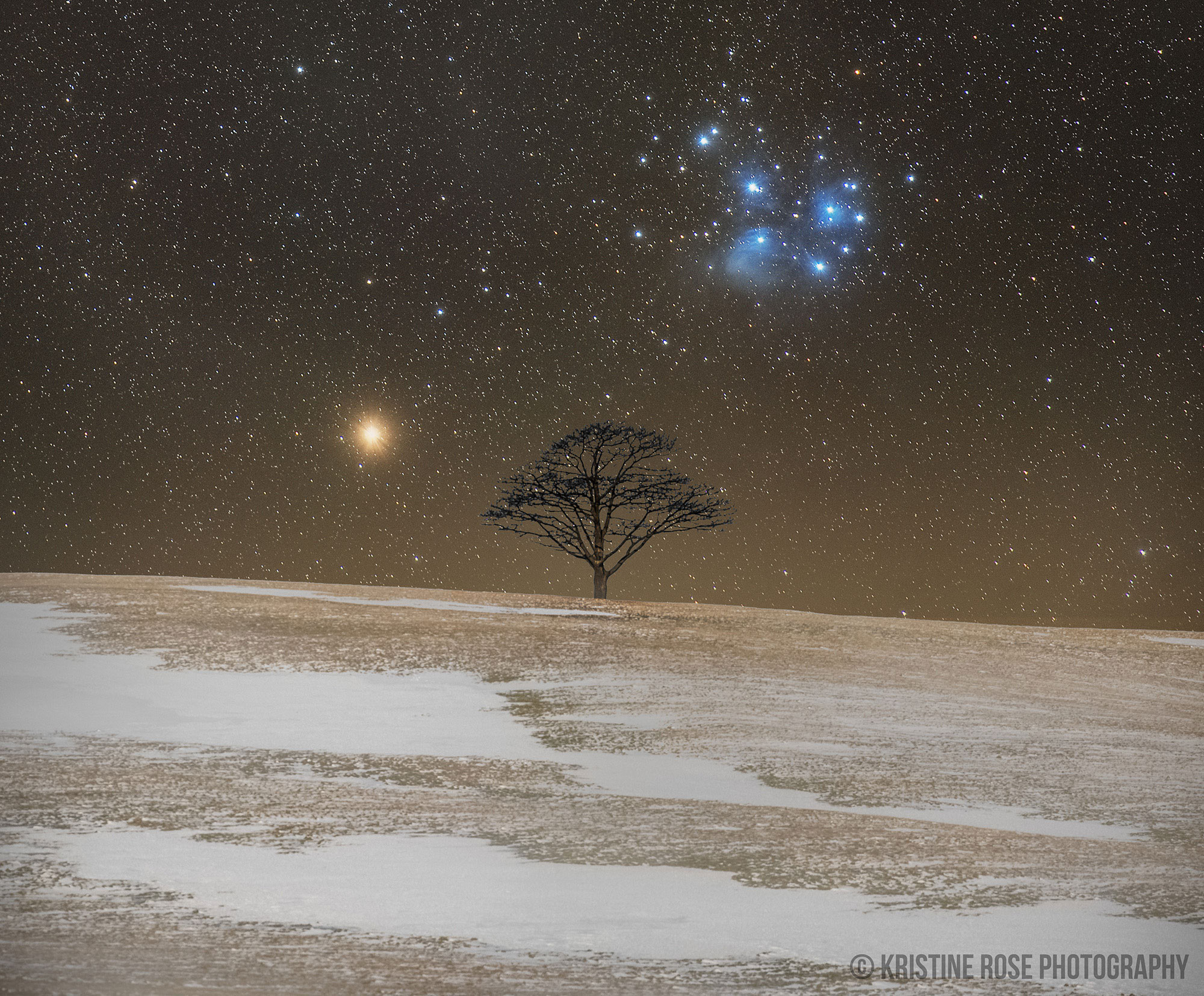
Mars and the Pleiades Beyond Vinegar Hill
* Image Credit & Copyright: Kristine Richer
https://www.instagram.com/kristinerosephotography/
Explanation:
Is this just a lonely tree on an empty hill? To start, perhaps, but look beyond. There, a busy universe may wait to be discovered. First, physically, to the left of the tree, is the planet Mars. The red planet, which is the new home to NASA's Perseverance rover, remains visible this month at sunset above the western horizon. To the tree's right is the Pleiades, a bright cluster of stars dominated by several bright blue stars. The featured picture is a composite of several separate foreground and background images taken within a few hours of each other, early last month, from the same location on Vinegar Hill in Milford, Nova Scotia, Canada. At that time, Mars was passing slowly, night after night, nearly in front of the distant Seven Sisters star cluster. The next time Mars will pass angularly as close to the Pleiades as it did in March will be in 2038.
https://apod.nasa.gov/apod/ap210406.html
#space #pleiades #astrophotography #photography #science #astronomy #nature #NASA #education
Alt...
2021 April 6
Mars and the Pleiades star cluster set behind one-tree hill.
Mars and the Pleiades Beyond Vinegar Hill
* Image Credit & Copyright: Kristine Richer
Explanation:
Is this just a lonely tree on an empty hill? To start, perhaps, but look beyond. There, a busy universe may wait to be discovered. First, physically, to the left of the tree, is the planet Mars. The red planet, which is the new home to NASA's Perseverance rover, remains visible this month at sunset above the western horizon. To the tree's right is the Pleiades, a bright cluster of stars dominated by several bright blue stars. The featured picture is a composite of several separate foreground and background images taken within a few hours of each other, early last month, from the same location on Vinegar Hill in Milford, Nova Scotia, Canada. At that time, Mars was passing slowly, night after night, nearly in front of the distant Seven Sisters star cluster. The next time Mars will pass angularly as close to the Pleiades as it did in March will be in 2038.
Authors & editors: Robert Nemiroff (MTU) & Jerry Bonnell (UMCP)
NASA Official: Amber Straughn Specific rights apply.
NASA Web Privacy, Accessibility, Notices;
A service of: ASD at NASA / GSFC,
NASA Science Activation
& Michigan Tech. U.
2024 September 29
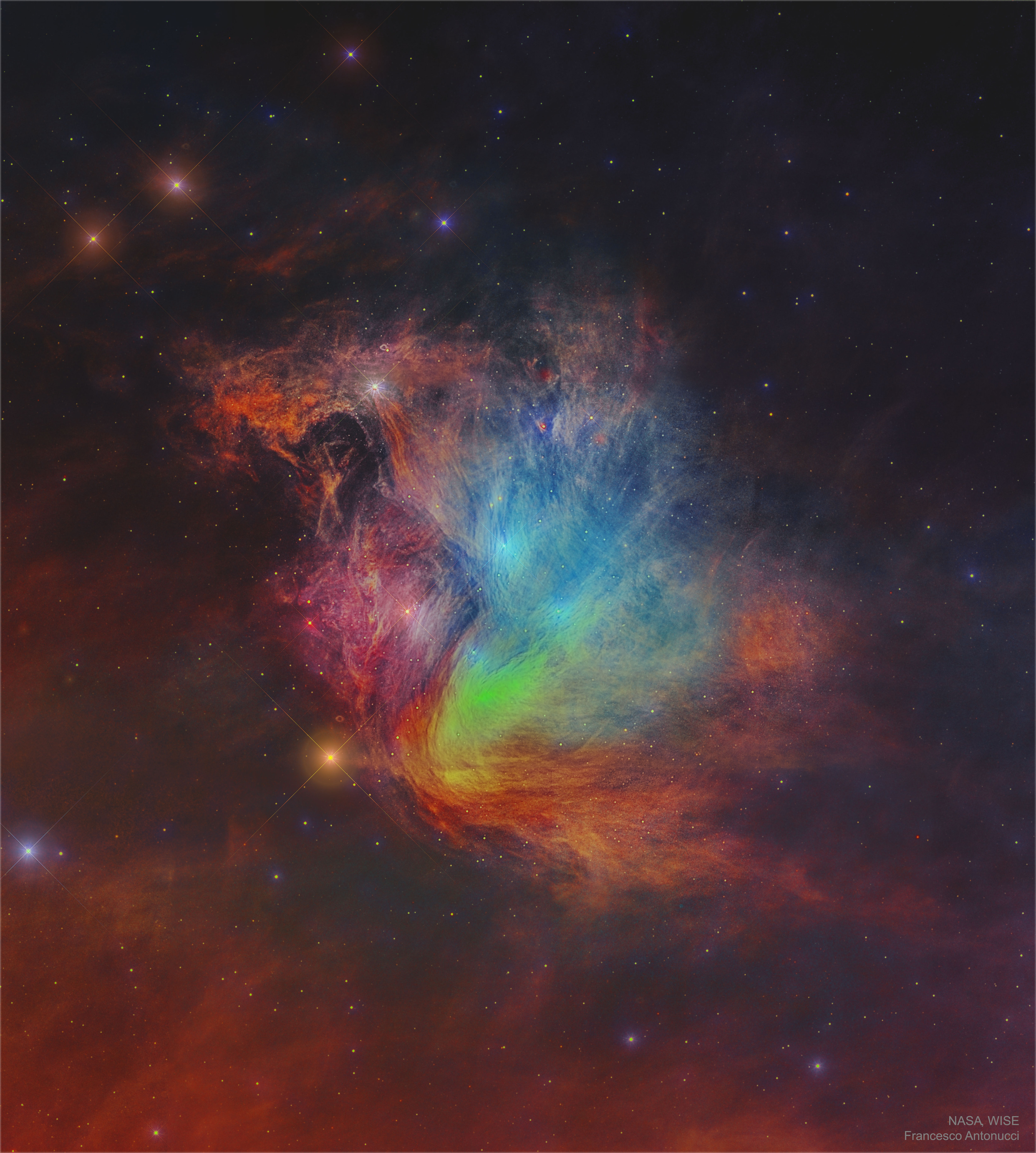
Seven Dusty Sisters
* Image Credit: WISE, IRSA, NASA
https://www.jpl.nasa.gov/missions/wide-field-infrared-survey-explorer-wise
http://irsa.ipac.caltech.edu/Missions/wise.html
https://www.nasa.gov/
* Processing & Copyright : Francesco Antonucci
https://www.astrobin.com/users/FrankAntonucci/
Explanation:
Is this really the famous Pleiades star cluster? Known for its iconic blue stars, the Pleiades is shown here in infrared light where the surrounding dust outshines the stars. Here, three infrared colors have been mapped into visual colors (R=24, G=12, B=4.6 microns). The base images were taken by NASA's orbiting Wide Field Infrared Survey Explorer (WISE) spacecraft. Cataloged as M45 and nicknamed the Seven Sisters, the Pleiades star cluster is by chance situated in a passing dust cloud. The light and winds from the massive Pleiades stars preferentially repel smaller dust particles, causing the dust to become stratified into filaments, as seen. The featured image spans about 20 light years at the distance of the Pleiades, which lies about 450 light years distant toward the constellation of the Bull (Taurus).
https://arxiv.org/abs/0810.1592
https://apod.nasa.gov/apod/ap240929.html
#space #pleiades #astrophotography #photography #science #astronomy #nature #NASA #education
Alt...
2024 September 29
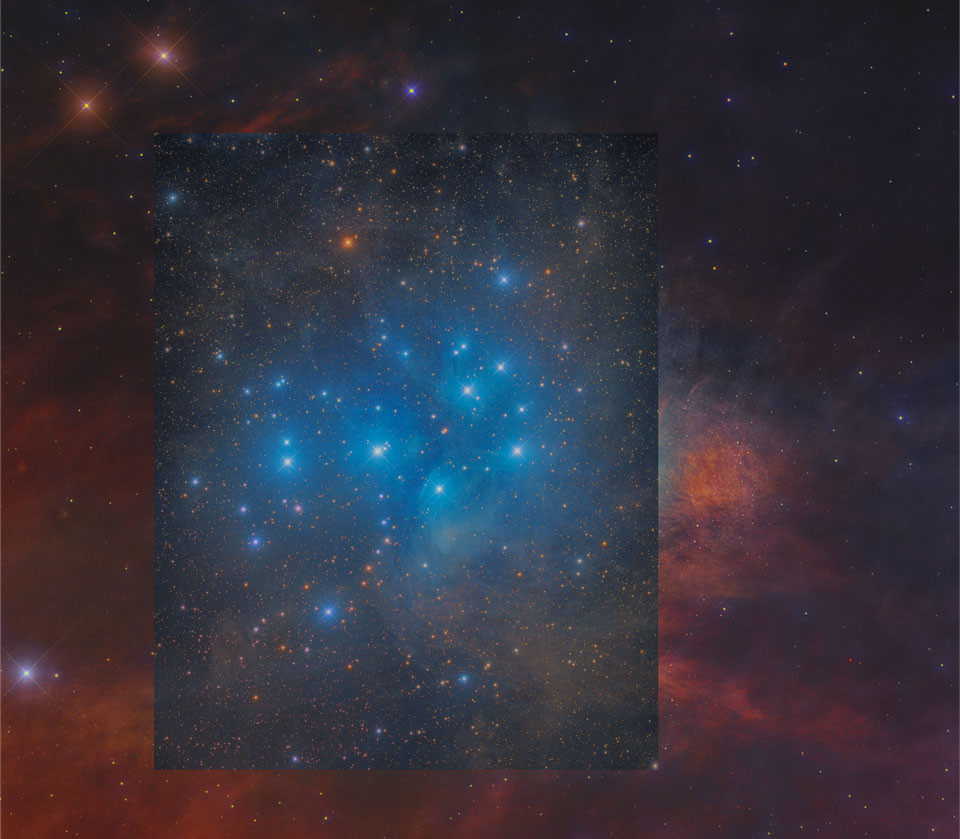
A famous Pleiades star cluster is shown but showing numerous parallel and curved filaments in different colors. The image is in several colors of infrared light. A rollover image shows the cluster in visible light with its familiar blue light.
Seven Dusty Sisters
* Image Credit: WISE, IRSA, NASA; Processing &
* Copyright : Francesco Antonucci
Explanation:
Is this really the famous Pleiades star cluster? Known for its iconic blue stars, the Pleiades is shown here in infrared light where the surrounding dust outshines the stars. Here, three infrared colors have been mapped into visual colors (R=24, G=12, B=4.6 microns). The base images were taken by NASA's orbiting Wide Field Infrared Survey Explorer (WISE) spacecraft. Cataloged as M45 and nicknamed the Seven Sisters, the Pleiades star cluster is by chance situated in a passing dust cloud. The light and winds from the massive Pleiades stars preferentially repel smaller dust particles, causing the dust to become stratified into filaments, as seen. The featured image spans about 20 light years at the distance of the Pleiades, which lies about 450 light years distant toward the constellation of the Bull (Taurus).
Authors & editors: Robert Nemiroff (MTU) & Jerry Bonnell (UMCP)
NASA Official: Amber Straughn Specific rights apply.
NASA Web Privacy, Accessibility, Notices;
A service of: ASD at NASA / GSFC,
NASA Science Activation
& Michigan Tech. U.
Alt...
A rollover image shows the cluster in visible light with its familiar blue light.
2024 August 15
Late Night Vallentuna
* Image Credit & Copyright: P-M Hedén (Clear Skies, TWAN)
https://www.clearskies.se/
http://www.twanight.org/
Explanation:
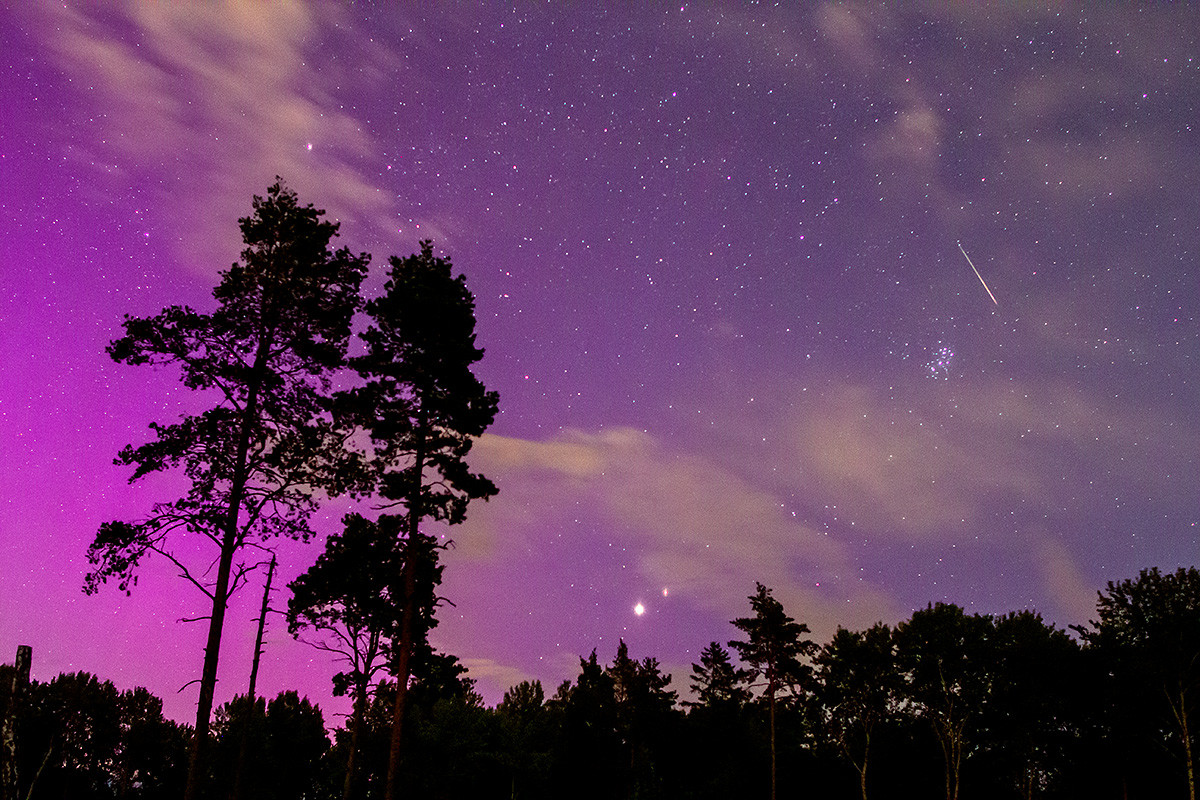
Bright Mars and even brighter Jupiter are in close conjunction just above the pine trees in this post-midnight skyscape from Vallentuna, Sweden. Taken on August 12 during a geomagnetic storm, the snapshot records the glow of aurora borealis or northern lights, beaming from the left side of the frame. Of course on that date Perseid meteors rained through planet Earth's skies, grains of dust from the shower's parent, periodic comet Swift-Tuttle. The meteor streak at the upper right is a Perseid plowing through the atmosphere at about 60 kilometers per second. Also well-known in Earth's night sky, the bright Pleiades star cluster shines below the Perseid meteor streak. In Greek myth, the Pleiades were seven daughters of the astronomical titan Atlas and sea-nymph Pleione. The Pleiades and their parents' names are given to the cluster's nine brightest stars.
https://en.wikipedia.org/wiki/Pleiades_(Greek_mythology)
https://apod.nasa.gov/apod/ap240815.html
#space #pleiades #astrophotography #photography #science #astronomy #nature #NASA #education
Alt...
2024 August 15
Late Night Vallentuna
* Image Credit & Copyright: P-M Hedén (Clear Skies, TWAN)
Explanation:
Bright Mars and even brighter Jupiter are in close conjunction just above the pine trees in this post-midnight skyscape from Vallentuna, Sweden. Taken on August 12 during a geomagnetic storm, the snapshot records the glow of aurora borealis or northern lights, beaming from the left side of the frame. Of course on that date Perseid meteors rained through planet Earth's skies, grains of dust from the shower's parent, periodic comet Swift-Tuttle. The meteor streak at the upper right is a Perseid plowing through the atmosphere at about 60 kilometers per second. Also well-known in Earth's night sky, the bright Pleiades star cluster shines below the Perseid meteor streak. In Greek myth, the Pleiades were seven daughters of the astronomical titan Atlas and sea-nymph Pleione. The Pleiades and their parents' names are given to the cluster's nine brightest stars.
Authors & editors: Robert Nemiroff (MTU) & Jerry Bonnell (UMCP)
NASA Official: Amber Straughn Specific rights apply.
NASA Web Privacy, Accessibility Notices
A service of: ASD at NASA / GSFC,
NASA Science Activation
& Michigan Tech. U.
From Contributors to Wikimedia projects
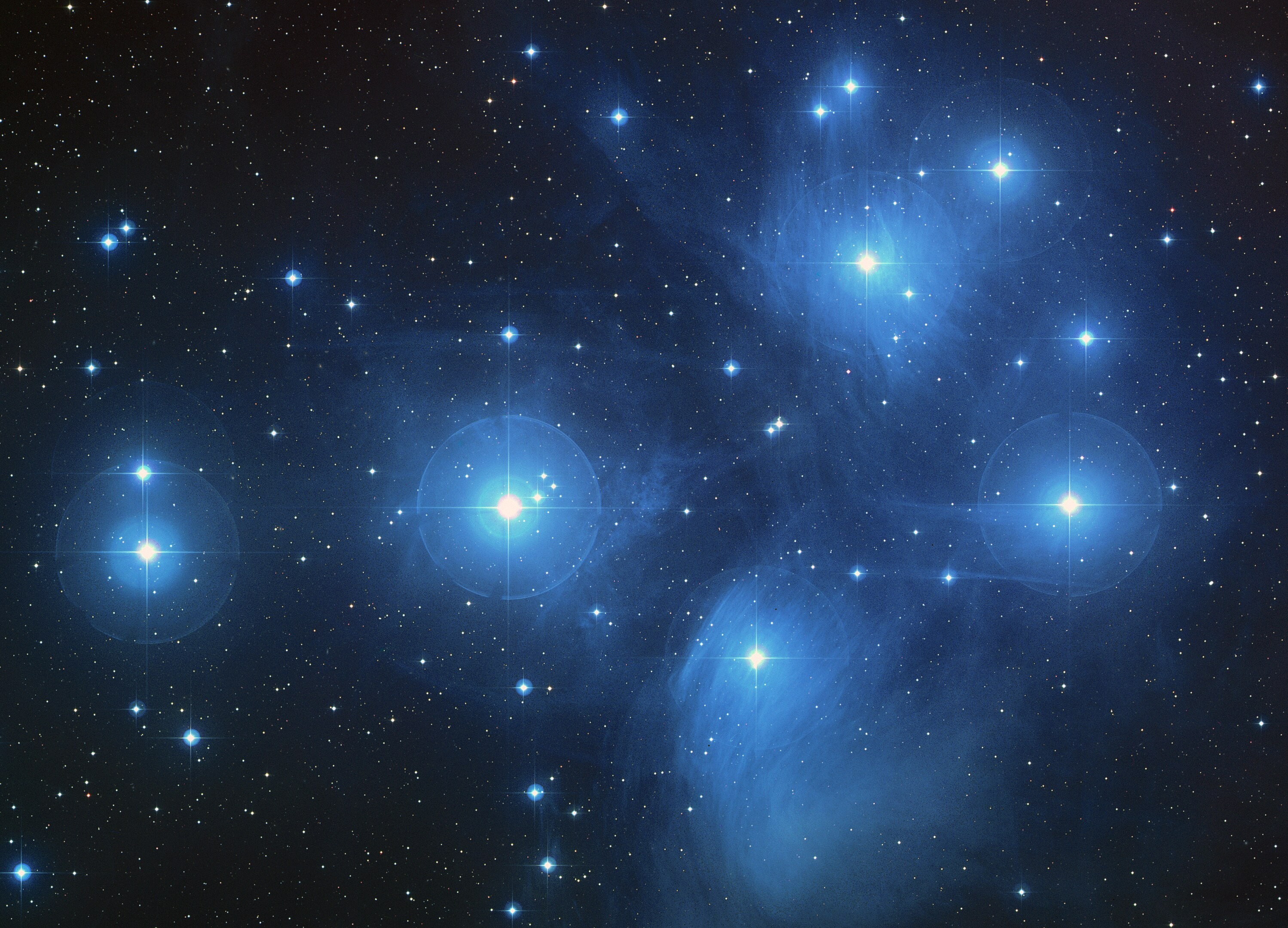
The Pleiades,
also known as Seven Sisters and Messier 45 (M45), is an asterism of an open star cluster containing young B-type stars in the northwest of the constellation Taurus. At a distance of about 444 light-years, it is among the nearest star clusters to Earth and the nearest Messier object to Earth, being the most obvious star cluster to the naked eye in the night sky. It is also observed to house the reflection nebula NGC 1432, an HII region. Around 2330 BC it marked the vernal point. Due to the brightness of its stars, the Pleiades is viewable from most areas on Earth, even in locations with significant light pollution.
The cluster is dominated by hot blue luminous stars that have formed within the last 100 million years. Reflection nebulae around the brightest stars were once thought to be leftover material from their formation, but are now considered likely to be an unrelated dust cloud in the interstellar medium through which the stars are currently passing. This dust cloud is estimated to be moving at a speed of approximately 18 km/s relative to the stars in the cluster.
Computer simulations have shown that the Pleiades were probably formed from a compact configuration that once resembled the Orion Nebula. Astronomers estimate that the cluster will survive for approximately another 250 million years, after which the clustering will be lost due to gravitational interactions with the galactic neighborhood.
Together with the open star cluster of the Hyades, the Pleiades form the Golden Gate of the Ecliptic. The Pleiades have been said to "resemble a tiny dipper," and should not be confused with the "Little Dipper," or Ursa Minor.
[...]
https://en.wikipedia.org/wiki/Pleiades
#space #pleiades #astrophotography #photography #science #astronomy #nature #NASA #education
Alt...
The Pleiades, an open cluster consisting of approximately 3,000 stars at a distance of 400 light-years (120 parsecs) from Earth in the constellation of Taurus. It is also known as ‘The Seven Sisters’, or the astronomical designations NGC 1432/35 and M45.
CREDIT
NASA, ESA, AURA/Caltech, Palomar Observatory The science team consists of: D. Soderblom and E. Nelan (STScI), F. Benedict and B. Arthur (U. Texas), and B. Jones (Lick Obs.)
The name, Pleiades, comes from Ancient Greek: Πλειάδες. It probably derives from plein (πλεῖν 'to sail') because of the cluster's importance in delimiting the sailing season in the Mediterranean Sea: "the season of navigation began with their heliacal rising". In Classical Greek mythology the name was used for seven divine sisters called the Pleiades. In time, the name was said to be derived from that of a mythical mother, Pleione, effectively meaning "daughters of Pleione". In reality, the ancient name of the star cluster related to sailing almost certainly came first in the culture, naming of a relationship to the sister deities followed, and eventually appearing in later myths, to interpret the group name, a mother, Pleione.
Alt...
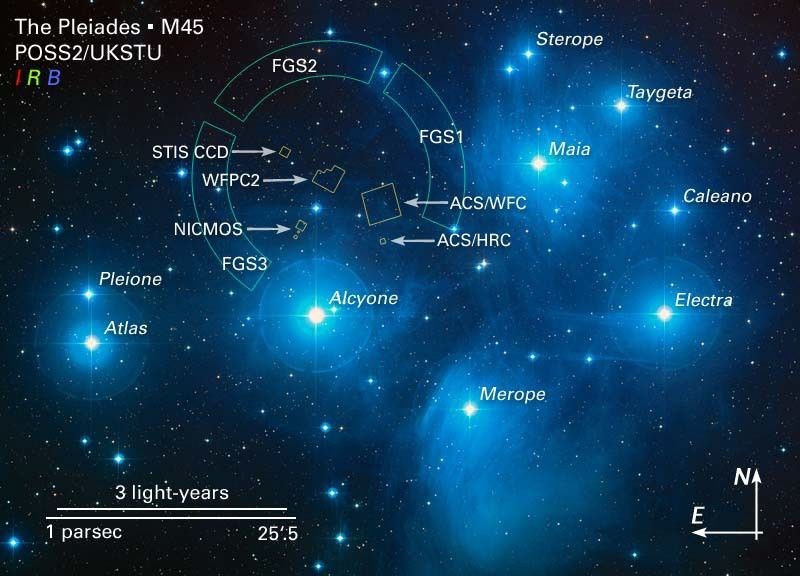
Annotated Image of the Pleiades and HST Field of View
Credit
NASA, ESA and AURA/Caltech
A color-composite image of the Pleiades from the Digitized Sky Survey
Observation data (J2000 epoch)
Right ascension 03h 47m 24s
Declination +24° 07′ 00″
Distance 444 ly on average (136.2±1.2 pc)
Apparent magnitude (V) 1.6
Apparent dimensions (V) 2°
Physical characteristics
Mass 800 M☉
Radius 20.34 light years
2024 September 3
Quarter Moon and Sister Stars
* Image Credit & Copyright: Alan Dyer, TWAN
https://www.amazingsky.com/About
https://twanight.org/profile/alan-dyer/
Explanation:
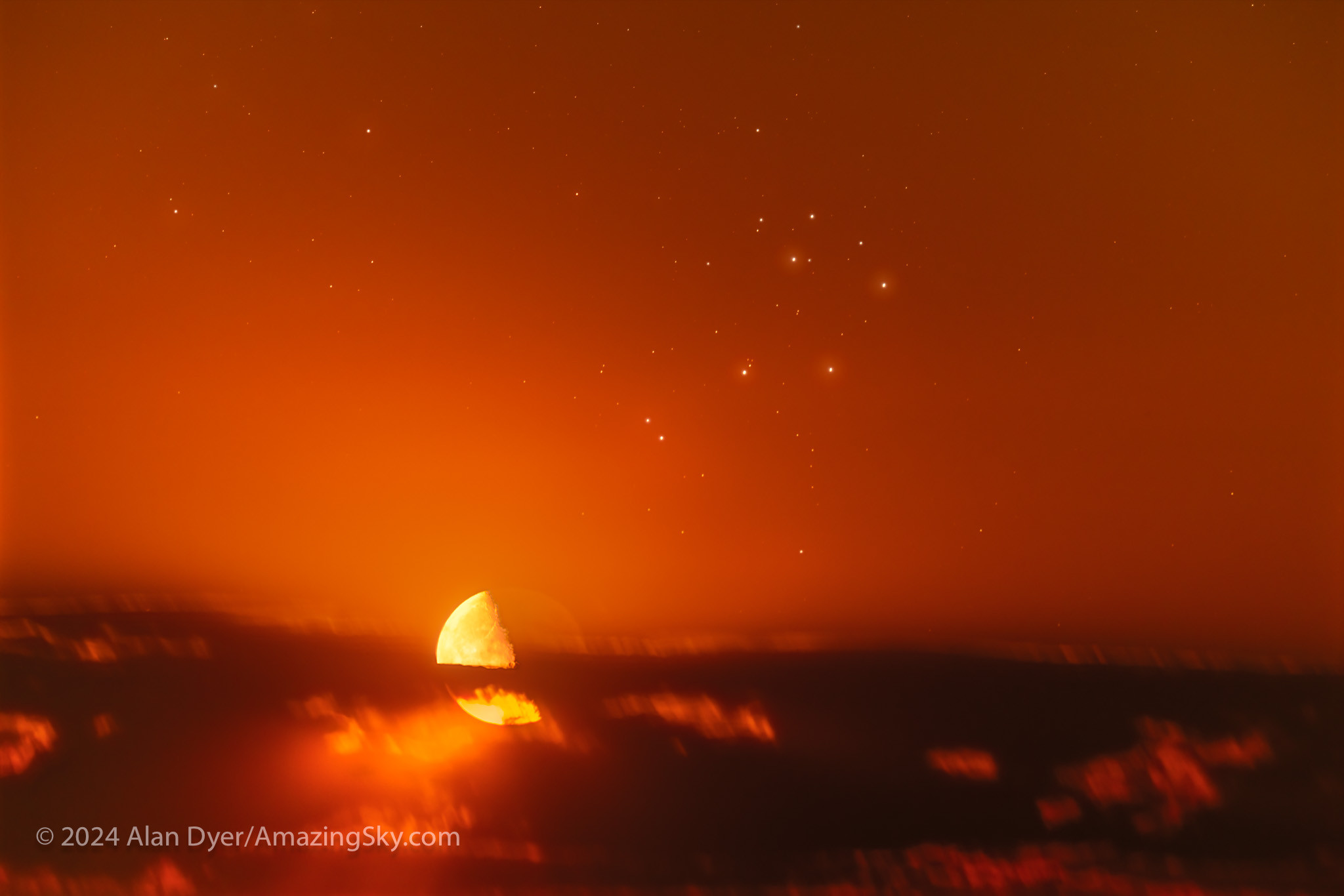
Last August two quite different sky icons were imaged rising together. Specifically, Earth's Moon shared the eastern sky with the sister stars of the Pleiades cluster, as viewed from Alberta, Canada. Astronomical images of the well-known Pleiades often show the star cluster's alluring blue reflection nebulas, but here they are washed-out by the orange moonrise sky. The half-lit Moon, known as a quarter moon, is overexposed, although the outline of the dim lunar night side can be seen by illuminating earthshine, light first reflected from the Earth. The featured image is a composite of eight successive exposures with brightnesses adjusted to match what the human eye would see. The Moon passes nearly -- or directly -- in front of the Pleaides once a month.
https://apod.nasa.gov/apod/ap240903.html
#space #pleiades #astrophotography #photography #science #astronomy #nature #NASA #education
Alt...
2024 September 3
The featured image shows an orange sky with clouds across the bottom and several bright stars near the top center. Just at the top of the cloud deck on the left is a half-lit Moon.
Quarter Moon and Sister Stars
* Image Credit & Copyright: Alan Dyer, TWAN
Explanation:
Last August two quite different sky icons were imaged rising together. Specifically, Earth's Moon shared the eastern sky with the sister stars of the Pleiades cluster, as viewed from Alberta, Canada. Astronomical images of the well-known Pleiades often show the star cluster's alluring blue reflection nebulas, but here they are washed-out by the orange moonrise sky. The half-lit Moon, known as a quarter moon, is overexposed, although the outline of the dim lunar night side can be seen by illuminating earthshine, light first reflected from the Earth. The featured image is a composite of eight successive exposures with brightnesses adjusted to match what the human eye would see. The Moon passes nearly -- or directly -- in front of the Pleaides once a month.
Authors & editors: Robert Nemiroff (MTU) & Jerry Bonnell (UMCP)
NASA Official: Amber Straughn Specific rights apply.
NASA Web Privacy, Accessibility, Notices;
A service of: ASD at NASA / GSFC,
NASA Science Activation
& Michigan Tech. U.
2025 January 27
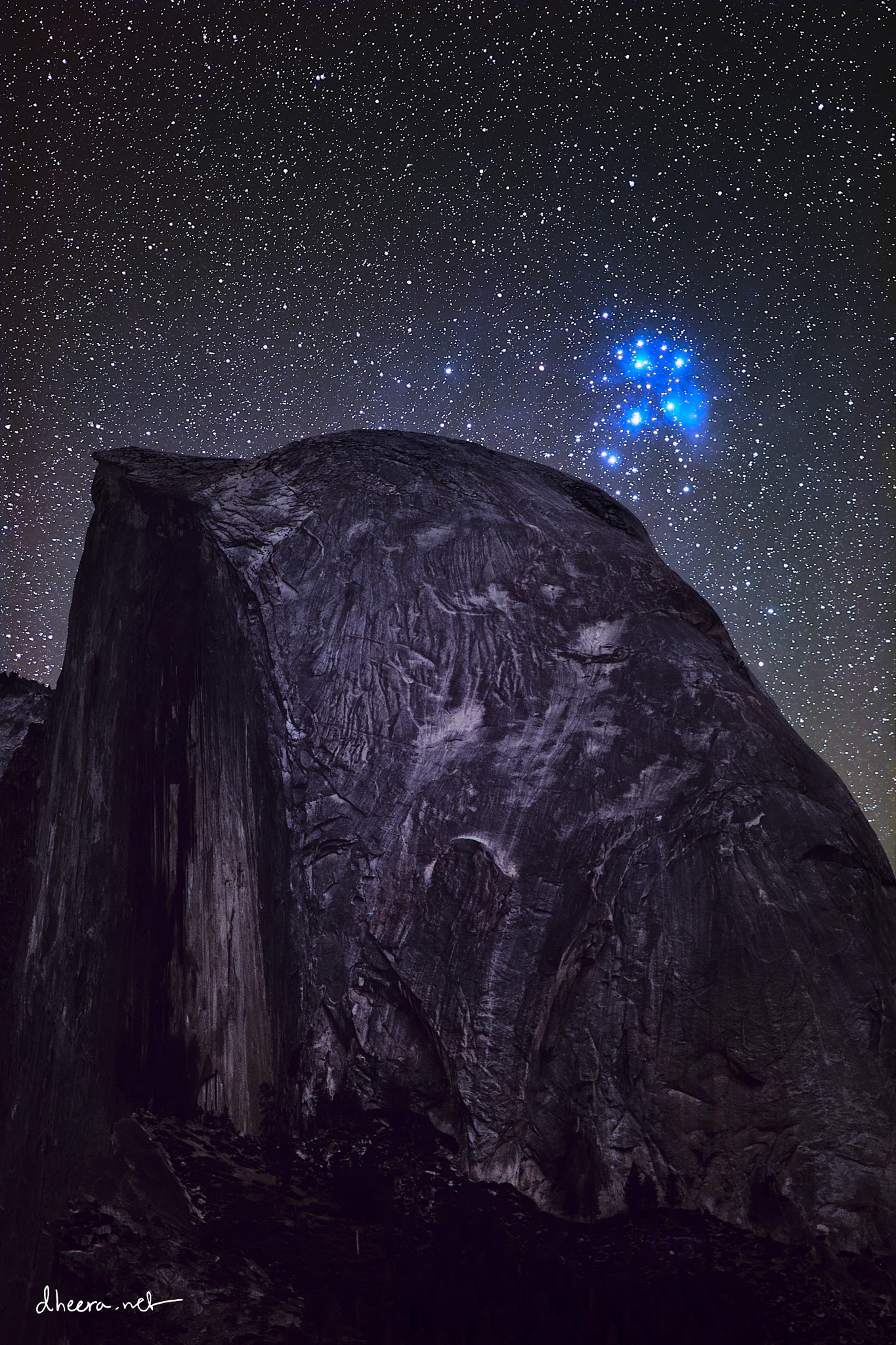
Pleiades over Half Dome
* Image Credit & Copyright: Dheera Venkatraman
https://dheera.net/about
Explanation:
Stars come in bunches. The most famous bunch of stars on the sky is the Pleiades, a bright cluster that can be easily seen with the unaided eye. The Pleiades lies only about 450 light years away, formed about 100 million years ago, and will likely last about another 250 million years. Our Sun was likely born in a star cluster, but now, being about 4.5 billion years old, its stellar birth companions have long since dispersed. The Pleiades star cluster is pictured over Half Dome, a famous rock structure in Yosemite National Park in California, USA. The featured image is a composite of 28 foreground exposures and 174 images of the stellar background, all taken from the same location and by the same camera on the same night in October 2019. After calculating the timing of a future juxtaposition of the Pleiades and Half Dome, the astrophotographer was unexpectedly rewarded by an electrical blackout, making the background sky unusually dark.
https://apod.nasa.gov/apod/ap250127.html
#space #pleiades #astrophotography #photography #science #astronomy #nature #NASA #education
Alt...
2025 January 27
A cluster of bright blue stars is seen on the upper right while an unusual dome-like mountain occupies most of the frame.
Pleiades over Half Dome
* Image Credit & Copyright: Dheera Venkatraman
Explanation:
Stars come in bunches. The most famous bunch of stars on the sky is the Pleiades, a bright cluster that can be easily seen with the unaided eye. The Pleiades lies only about 450 light years away, formed about 100 million years ago, and will likely last about another 250 million years. Our Sun was likely born in a star cluster, but now, being about 4.5 billion years old, its stellar birth companions have long since dispersed. The Pleiades star cluster is pictured over Half Dome, a famous rock structure in Yosemite National Park in California, USA. The featured image is a composite of 28 foreground exposures and 174 images of the stellar background, all taken from the same location and by the same camera on the same night in October 2019. After calculating the timing of a future juxtaposition of the Pleiades and Half Dome, the astrophotographer was unexpectedly rewarded by an electrical blackout, making the background sky unusually dark.
Authors & editors: Robert Nemiroff (MTU) & Jerry Bonnell (UMCP)
NASA Official: Amber Straughn Specific rights apply.
NASA Web Privacy, Accessibility, Notices;
A service of: ASD at NASA / GSFC,
NASA Science Activation
& Michigan Tech. U.
![[?]](https://files.techhub.social/accounts/avatars/115/321/136/132/964/233/original/db1afda53aac9c0f.png)
![[?]](https://gamerplus.org/system/accounts/avatars/114/497/966/782/841/054/original/c3c1b4d840d49021.png)
@zleap materials, but have like the-class-of-2025 server is continuous, it just federates and defederates with ascending levels as the class participants implicitly all complete those levels. I am not aware of precedent for it, this just seems to be a novel interaction particular to activitypub 2 protocol / the fediverse. #education #fedi
![[?]](https://files.mastodon.social/accounts/avatars/000/155/698/original/6b0711d166369387.png)
🎤 Upcoming at SeaGL 2025:
📍 03:00 PM on November 08
🗣️ "What is Free Software?"
👥 Speaker(s): Charles Faisandier
📍 Room: Room 332
🏷️ Track: Education
📝 This presentation covers the differences between free software, open source software, and proprietar...
#SeaGL2025 #education #FLOSS #opensource #linux
🔗 https://pretalx.seagl.org/2025/talk/QXWX7X/

🎤 Upcoming at SeaGL 2025:
📍 02:00 PM on November 08
🗣️ "Today I Learned.... The 2025 FLOSS Research Roundup"
👥 Speaker(s): Kaylea Champion
📍 Room: Room 332
🏷️ Track: Education
📝 Friends, it's time once again to review the newest research findings about FLOSS. What's new in 2025...
#SeaGL2025 #education #research #ai #FLOSS #opensource
🔗 https://pretalx.seagl.org/2025/talk/QAZYWP/

Illston has said she believes the evidence will ultimately show the #MassFirings were #illegal & in excess of authority.
The #Trump admin has slashed #jobs in #education, #health & other areas it says are favored by #Democrats. The admin has also said it will not tap roughly $5 billion in contingency funds to keep benefits through #SNAP flowing into November.
#law #OrchestratedShutdown #PowerGrab #TheCrueltyIsThePoint #plutocracy
2025 October 28
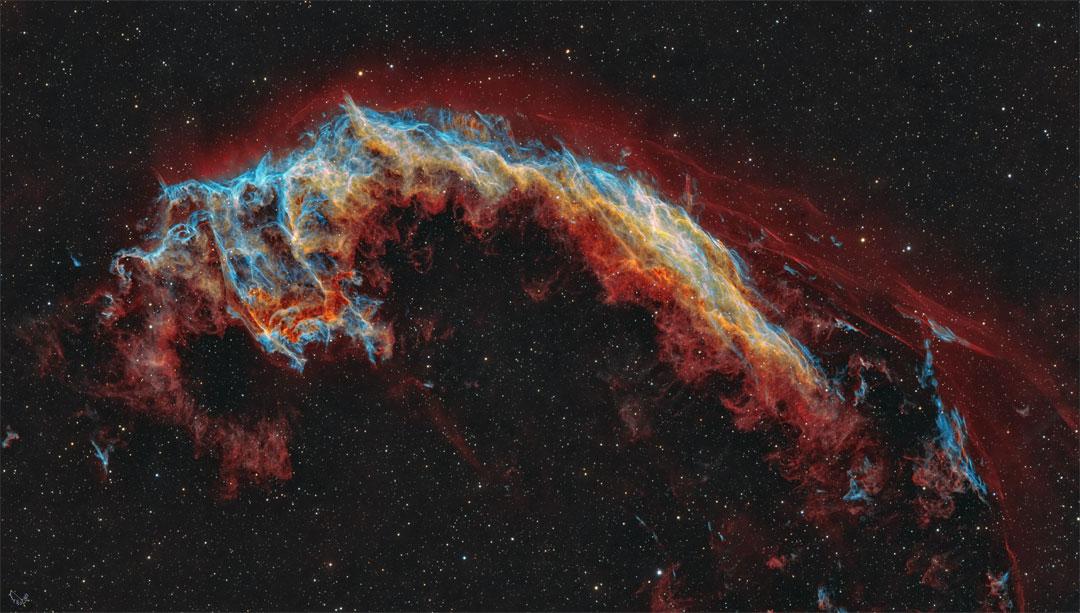
NGC 6995: The Bat Nebula
* Image Credit & Copyright: Francis Bozon & Jean-Luc Gangloff
Explanation:
Can you see the bat? It haunts this cosmic close-up of the eastern Veil Nebula. The Veil Nebula itself is a large supernova remnant, the expanding debris cloud from the death explosion of a massive star. While the Veil is roughly circular in shape and covers nearly 3 degrees on the sky toward the constellation of the Swan (Cygnus), NGC 6995, known informally as the Bat Nebula, spans only 1/2 degree, about the apparent size of the Moon. That translates to 12 light-years at the Veil's estimated distance, a reassuring 1,400 light-years from planet Earth. In the composite of image data recorded through several narrow band filters, with emission from hydrogen atoms in the remnant shown in red and with strong emission from oxygen atoms shown in hues of blue. Of course, in the western part of the Veil lies another seasonal apparition: the Witch's Broom Nebula.
https://chandra.harvard.edu/photo/scale_distance.html
https://periodic.lanl.gov/1.shtml
https://apod.nasa.gov/apod/ap251022.html
#space #nebula #cluster #astrophotography #photography #science #astronomy #nature #NASA #ESA #apod #education
Alt...
2025 October 22
NGC 6995: The Bat Nebula
* Image Credit & Copyright: Francis Bozon & Jean-Luc Gangloff
Explanation:
Can you see the bat? It haunts this cosmic close-up of the eastern Veil Nebula. The Veil Nebula itself is a large supernova remnant, the expanding debris cloud from the death explosion of a massive star. While the Veil is roughly circular in shape and covers nearly 3 degrees on the sky toward the constellation of the Swan (Cygnus), NGC 6995, known informally as the Bat Nebula, spans only 1/2 degree, about the apparent size of the Moon. That translates to 12 light-years at the Veil's estimated distance, a reassuring 1,400 light-years from planet Earth. In the composite of image data recorded through several narrow band filters, with emission from hydrogen atoms in the remnant shown in red and with strong emission from oxygen atoms shown in hues of blue. Of course, in the western part of the Veil lies another seasonal apparition: the Witch's Broom Nebula.
#California, the nation’s largest Democratic-led state, has passed a #law restricting what #teachers can say in the classroom, & has walked back an effort to require high school students to take classes in ethnic studies.
…these developments have also set off alarms among #FreeSpeech advocates, as the #Trump admin pushes to punish speech it dislikes & to impose its patriotic vision of #US #history on #schools.
In the #Trump era, #history & #civics education are under a microscope.
Several major #curriculum #publishers have withdrawn products from the market, while others have found that #teachers are shying away from lessons that were once uncontroversial, on topics as basic as constitutional limits on executive power.
How #Politics Is Changing the Way #History Is Taught
History lessons are being wiped from the internet, & #California is retreating from ethnic studies, as #education swings away from curriculums that are seen as too progressive.
#law #AcademicFreedom
https://www.nytimes.com/2025/10/27/us/history-lessons-ethnic-studies-retreat.html?smid=nytcore-ios-share&referringSource=articleShare
![[?]](https://cdn.masto.host/dicecamp/accounts/avatars/109/305/905/987/366/934/original/361275ee4a21d618.jpg)
Anyone have suggestions on where to get affordable, new Chromebooks in bulk for a school (and no, there's no choice for the brand of hardware)?
2025 October 27
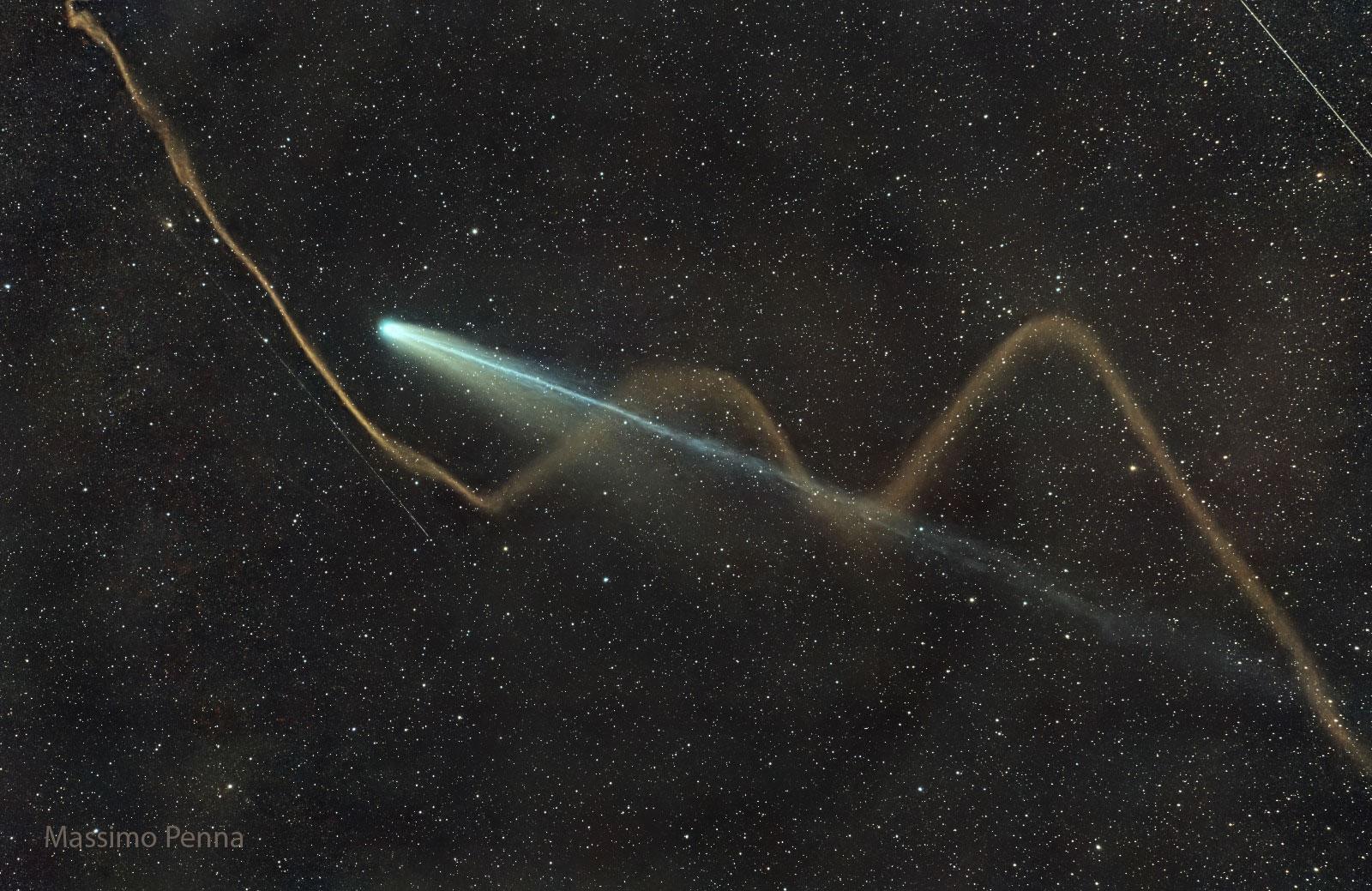
Two Tails of Comet Lemmon
* Image Credit: Massimo Penna
Explanation:
How many bright tails does Comet Lemmon have? Two. In the featured image it appears to have three, but why? The reason is that the zigzagging brown filament is a persistent meteor train that by luck appeared in front of the distant comet C/2025 A6 (Lemmon). A meteor train is the hot gas and fine dust that remains in the Earth's atmosphere and disperses in the seconds after a bright meteor flashes by. The two bright tails are the blue ion tail stretching across the image, and the white dust tail nearer the green coma on the upper left. All real comet tails originate from the nucleus of the comet inside the coma. The image was captured a few days ago from Manciano, Italy. This week, from mid-northern locations, Comet Lemmon will remain faintly visible in the northwest sky after sunset.
https://apod.nasa.gov/apod/fap/ap251027.html
https://www.virtualtelescope.eu/2025/10/26/comet-c-2025-a6-lemmon-and-a-meteor-red-afterglow-an-epic-image-24-oct-2025/
https://en.wikipedia.org/wiki/Coma_(comet)
https://en.wikipedia.org/wiki/Comet_tail
https://www.space.com/stargazing/see-comet-lemmon-cross-paths-with-a-cosmic-serpent-this-weekend
https://apod.nasa.gov/apod/ap251027.html
#space #comets #astrophotography #photography #science #astronomy #nature #NASA #ESA #education #apod
Alt...
2025 October 27
A dark sky shows bright comet with its tails extending diagonally from the lower left. Two tails are visible for the comet -- a long blue tail and a shorter wider white tail. Oddly, a wiggly tan stream appears to be a third tail -- but is actually the dust from a dissipated meteor. Please see the explanation for more detailed information.
Two Tails of Comet Lemmon
* Image Credit: Massimo Penna
Explanation:
How many bright tails does Comet Lemmon have? Two. In the featured image it appears to have three, but why? The reason is that the zigzagging brown filament is a persistent meteor train that by luck appeared in front of the distant comet C/2025 A6 (Lemmon). A meteor train is the hot gas and fine dust that remains in the Earth's atmosphere and disperses in the seconds after a bright meteor flashes by. The two bright tails are the blue ion tail stretching across the image, and the white dust tail nearer the green coma on the upper left. All real comet tails originate from the nucleus of the comet inside the coma. The image was captured a few days ago from Manciano, Italy. This week, from mid-northern locations, Comet Lemmon will remain faintly visible in the northwest sky after sunset.
Authors & editors: Robert Nemiroff (MTU) & Jerry Bonnell (UMCP)
NASA Official: Amber Straughn Specific rights apply.
NASA Web Privacy, Accessibility, Notices;
A service of: ASD at NASA / GSFC,
NASA Science Activation
& Michigan Tech. U.
2025 October 23
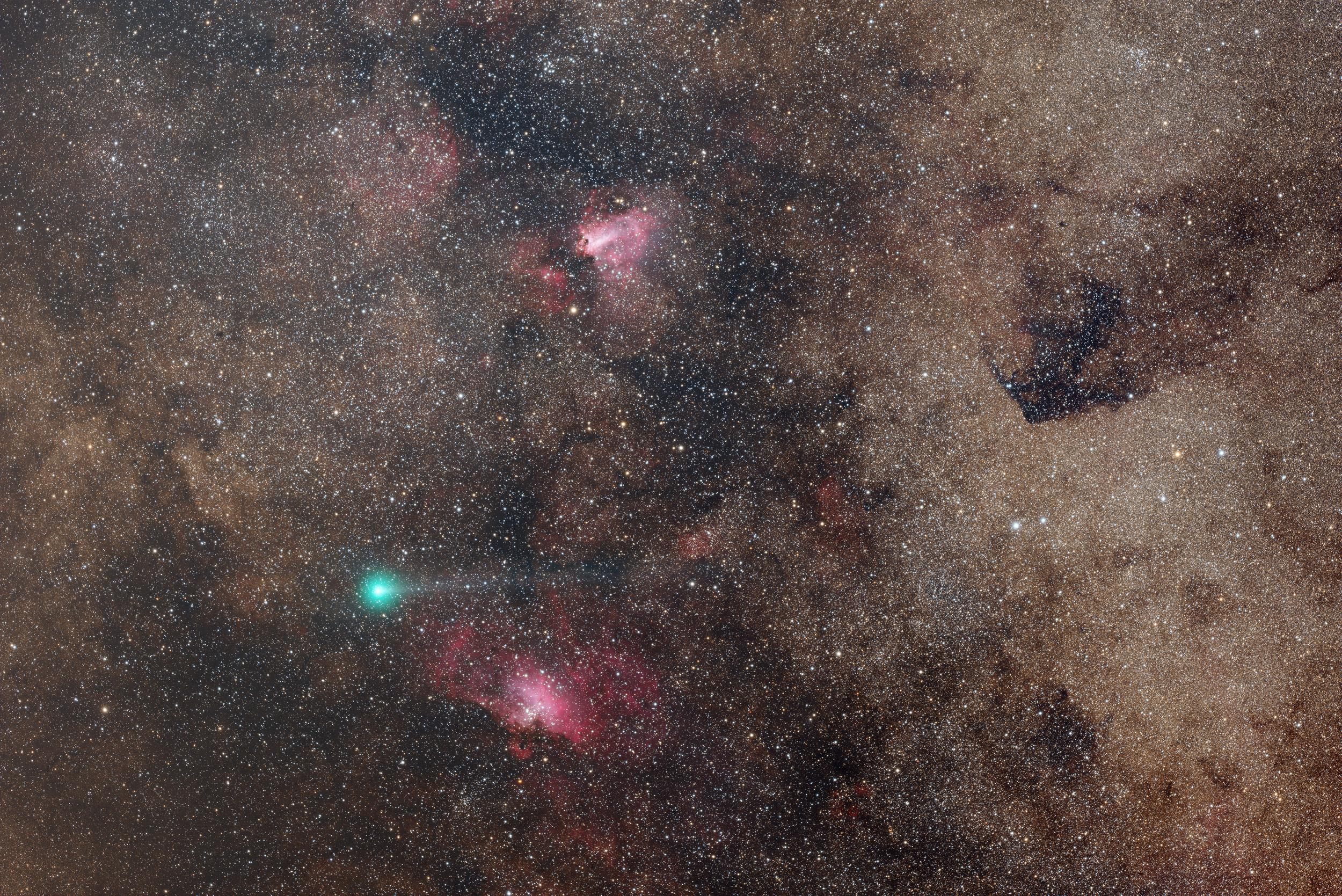
SWAN, Swan, Eagle
* Image Credit & Copyright: Adam Block
https://www.adamblockphotos.com/
Explanation:
Comet C/2025 R2 (SWAN) sports a greenish coma and fainter tail, seen against congeries of stars and dusty interstellar clouds in this 7 degree wide telescopic field of view from October 17. On that date, the new visitor to the inner Solar System obligingly posed with two other celestial birds seen toward the center of our Milky Way. Messier 16, near the bottom of the frame, and Messier 17 are also known to deep skywatchers as the Eagle and the Swan nebulae. While the comet coma's greenish glow recorded in the image is due to diatomic carbon gas fluorescing in sunlight, reddish hues seen in the nebulae, star forming regions some 5,000 light-years distant, are characteristic of ionized hydrogen gas. Comet SWAN is outbound now but still a good comet for binoculars and small telescopes that can look close to the southern horizon in the northern hemisphere's early evening skies. C/2025 R2 (SWAN) was closest to our fair planet on October 20, a mere 2.2 light-minutes away.
https://app.astrobin.com/i/rkicdu
https://en.wikipedia.org/wiki/Sidereus_Nuncius#Stars
https://earthsky.org/astronomy-essentials/visible-planets-tonight-mars-jupiter-venus-saturn-mercury/
https://apod.nasa.gov/apod/ap251023.html
#space #comets #astrophotography #photography #science #astronomy #nature #NASA #ESA #education #apod
Alt...
2025 October 23
SWAN, Swan, Eagle
* Image Credit & Copyright: Adam Block
Explanation:
Comet C/2025 R2 (SWAN) sports a greenish coma and fainter tail, seen against congeries of stars and dusty interstellar clouds in this 7 degree wide telescopic field of view from October 17. On that date, the new visitor to the inner Solar System obligingly posed with two other celestial birds seen toward the center of our Milky Way. Messier 16, near the bottom of the frame, and Messier 17 are also known to deep skywatchers as the Eagle and the Swan nebulae. While the comet coma's greenish glow recorded in the image is due to diatomic carbon gas fluorescing in sunlight, reddish hues seen in the nebulae, star forming regions some 5,000 light-years distant, are characteristic of ionized hydrogen gas. Comet SWAN is outbound now but still a good comet for binoculars and small telescopes that can look close to the southern horizon in the northern hemisphere's early evening skies. C/2025 R2 (SWAN) was closest to our fair planet on October 20, a mere 2.2 light-minutes away.
Authors & editors: Robert Nemiroff (MTU) & Jerry Bonnell (UMCP)
NASA Official: Amber Straughn Specific rights apply.
NASA Web Privacy, Accessibility, Notices;
A service of: ASD at NASA / GSFC,
NASA Science Activation
& Michigan Tech. U.
2025 October 25
Webb's Rho Ophiuchi
* Image Credit: NASA, ESA, CSA, STScI, Klaus Pontoppidan (STScI),
https://www.nasa.gov/
https://www.esa.int/
https://www.asc-csa.gc.ca/eng/
https://www.stsci.edu/
Explanation:
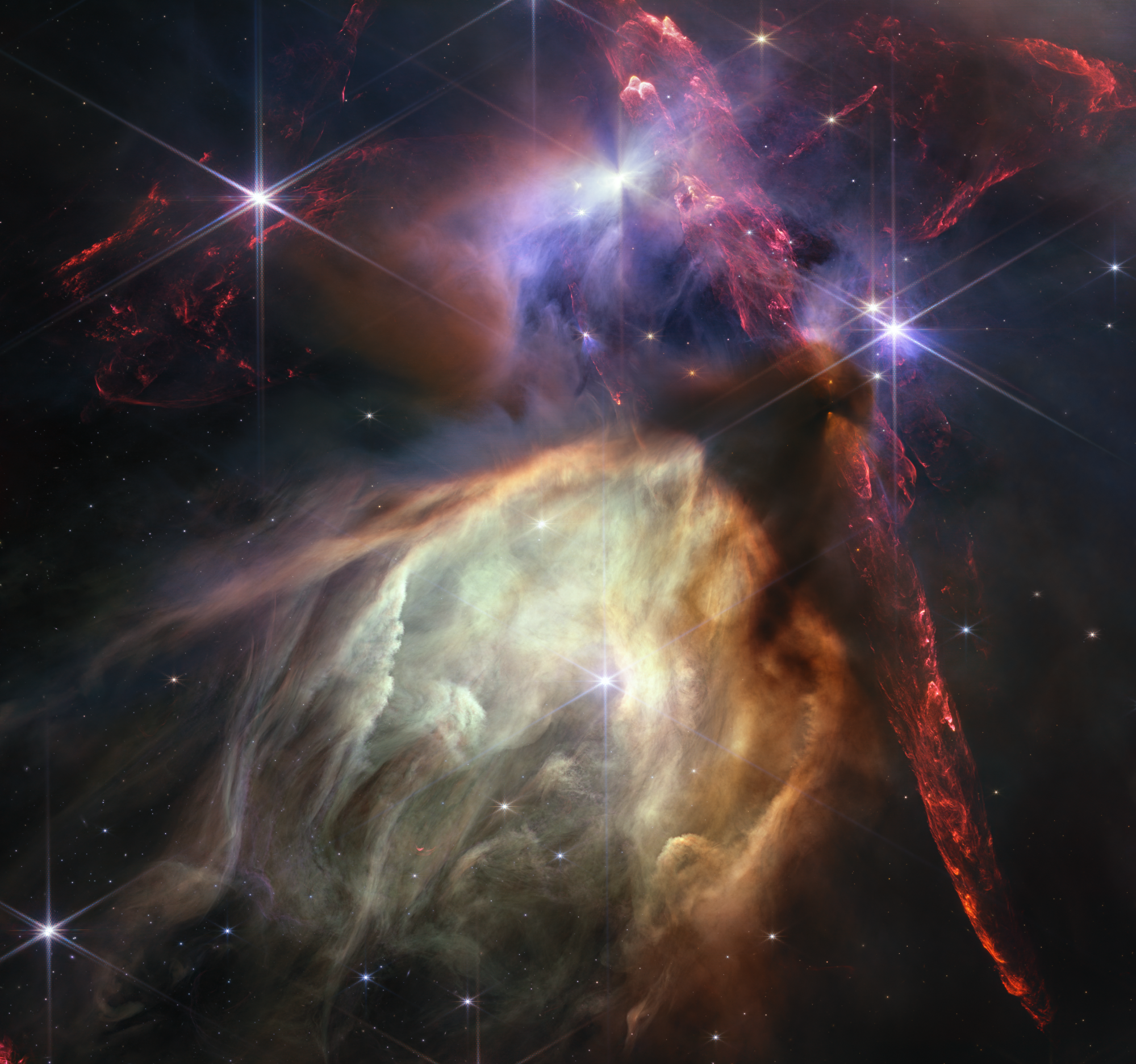
A mere 390 light-years away, Sun-like stars and future planetary systems are forming in the Rho Ophiuchi molecular cloud complex, the closest star-forming region to our fair planet. The James Webb Space Telescope's NIRCam peered into the nearby natal chaos to capture this infrared image at an inspiring scale. The frame spans less than a light-year across the Rho Ophiuchi region and contains about 50 young stars. Brighter stars clearly show Webb's characteristic pattern of diffraction spikes. Huge jets of shocked molecular hydrogen blasting from newborn stars are red in the image, with the large, yellowish dusty cavity carved out by the energetic young star near its center. Near some stars in the stunning image are shadows cast by their protoplanetary disks. The spectacular cosmic snapshot was released in 2023 to celebrate the successful first year of Webb's exploration of the Universe.
https://science.nasa.gov/missions/webb/webb-celebrates-first-year-of-science-with-close-up-on-birth-of-sun-like-stars/
https://science.nasa.gov/asset/webb/rho-ophiuchi-nircam-compass-image/
https://science.nasa.gov/asset/webb/rho-ophiuchi-video-tour/
https://ui.adsabs.harvard.edu/abs/1996A%26A...314..477B/abstract
https://science.nasa.gov/mission/webb/
https://en.wikipedia.org/wiki/James_E._Webb
https://apod.nasa.gov/apod/fap/ap251025.html
#space #astronomy #science #astrophotography #photography #nature #nebula #NASA #education #apod
Alt...
2025 October 25
Webb's Rho Ophiuchi
* Image Credit: NASA, ESA, CSA, STScI, Klaus Pontoppidan (STScI),
Explanation:
A mere 390 light-years away, Sun-like stars and future planetary systems are forming in the Rho Ophiuchi molecular cloud complex, the closest star-forming region to our fair planet. The James Webb Space Telescope's NIRCam peered into the nearby natal chaos to capture this infrared image at an inspiring scale. The frame spans less than a light-year across the Rho Ophiuchi region and contains about 50 young stars. Brighter stars clearly show Webb's characteristic pattern of diffraction spikes. Huge jets of shocked molecular hydrogen blasting from newborn stars are red in the image, with the large, yellowish dusty cavity carved out by the energetic young star near its center. Near some stars in the stunning image are shadows cast by their protoplanetary disks. The spectacular cosmic snapshot was released in 2023 to celebrate the successful first year of Webb's exploration of the Universe.
Authors & editors: Robert Nemiroff (MTU) & Jerry Bonnell (UMCP)
NASA Official: Amber Straughn Specific rights apply.
NASA Web Privacy, Accessibility, Notices;
A service of: ASD at NASA / GSFC,
NASA Science Activation
& Michigan Tech. U.
TOPIC>
In The Neighbourhood
NGC 6366 vs 47 Ophiuchi
* Image Credit & Copyright: Massimo Di Fusco
https://app.astrobin.com/u/massimo.difusco#gallery
https://www.astronomy.com/picture-of-the-day/photo/cloak-of-the-owl/
https://www.optolong.com/cms/document/detail/id/418.html
https://www.optolong.com/cms/document/detail/id/431.html
Explanation:
Most globular star clusters roam the halo of our Milky Way galaxy, but globular cluster NGC 6366 lies close to the galactic plane. About 12,000 light-years away toward the constellation Ophiuchus, the cluster's starlight is dimmed and reddened by the Milky Way's interstellar dust when viewed from planet Earth. As a result, the stars of NGC 6366 look almost golden in this telescopic scene, especially when seen next to relatively bright, bluish, and nearby star 47 Ophiuchi. Compared to the hundred thousand stars or so gravitationally bound in distant NGC 6366, 47 Oph itself is a binary star system a mere 100 light-years away. Still, the co-orbiting stars of 47 Oph are too close together to be individually distinguished in the image.
https://ui.adsabs.harvard.edu/abs/2015A%26A...584A..59S/abstract
https://ui.adsabs.harvard.edu/abs/2015AJ....149..110W/abstract
https://science.nasa.gov/universe/star-clusters-inside-the-universes-stellar-collections/#hds-sidebar-nav-1
https://apod.nasa.gov/apod/ap250512.html
https://app.astrobin.com/u/massimo.difusco#gallery
https://spaceplace.nasa.gov/satellite-galaxies/en/
https://apod.nasa.gov/apod/ap250523.html
#space #cluster #milkyway #astrophotography #photography #science #nature #NASA #education

Alt...
2025 May 23
NGC 6366 vs 47 Ophiuchi
* Image Credit & Copyright: Massimo Di Fusco
Explanation:
Most globular star clusters roam the halo of our Milky Way galaxy, but globular cluster NGC 6366 lies close to the galactic plane. About 12,000 light-years away toward the constellation Ophiuchus, the cluster's starlight is dimmed and reddened by the Milky Way's interstellar dust when viewed from planet Earth. As a result, the stars of NGC 6366 look almost golden in this telescopic scene, especially when seen next to relatively bright, bluish, and nearby star 47 Ophiuchi. Compared to the hundred thousand stars or so gravitationally bound in distant NGC 6366, 47 Oph itself is a binary star system a mere 100 light-years away. Still, the co-orbiting stars of 47 Oph are too close together to be individually distinguished in the image.
Authors & editors: Robert Nemiroff (MTU) & Jerry Bonnell (UMCP)
NASA Official: Amber Straughn Specific rights apply.
NASA Web Privacy Policy and Important Notices
A service of: ASD at NASA / GSFC,
NASA Science Activation
& Michigan Tech. U.

Alt...
NGC 6366 is a globular cluster 11700 light years away from Earth in the constellation Ophiuchus that is reddened due to extinction by dust in the galactic plane. Therefore, it looks almost golden and forms a beautiful color contrast against the blue foreground star HD 157950. It is designated as XI in the Shapley–Sawyer Concentration Class and was discovered by the German astronomer Friedrich August Theodor Winnecke on 12 April 1860. NGC 6366 is similar in composition to M 71 or NGC 6342. It is metal-rich for a globular cluster, and all of its stars appears to have formed in the same epoch.
* Image credit
Massimo Di Fusco
From Wikipedia, the free encyclopedia
NGC 6366
NGC 6366 is a globular cluster located in the constellation Ophiuchus. It is designated as XI in the Shapley–Sawyer Concentration Class and was discovered by the German astronomer Friedrich August Theodor Winnecke on 12 April 1860. It is at a distance of 11,700 light years away from Earth.
NGC 6366 is similar in composition to M 71 or NGC 6342. It is metal-rich for a globular cluster, and all of its stars appears to have formed in the same epoch.
Color rendering is done by Aladin-software (2000A&AS..143...33B.)
Based on observations made with the NASA/ESA Hubble Space Telescope, and obtained from the Hubble Legacy Archive, which is a collaboration between the Space Telescope Science Institute (STScI/NASA), the Space Telescope European Coordinating Facility (ST-ECF/ESA) and the Canadian Astronomy Data Centre (CADC/NRC/CSA).
FYI: https://iopscience.iop.org/article/10.1088/0004-6256/137/1/246
#space #cluster #milkyway #astrophotography #photography #science #nature #NASA #ESA #hubble #education

Alt...
NGC 6366 is a globular cluster located in the constellation Ophiuchus. It is designated as XI in the Shapley–Sawyer Concentration Class and was discovered by the German astronomer Friedrich August Theodor Winnecke on 12 April 1860. It is at a distance of 11,700 light years away from Earth.
NGC 6366 is similar in composition to M 71 or NGC 6342. It is metal-rich for a globular cluster, and all of its stars appears to have formed in the same epoch.
Color rendering is done by Aladin-software (2000A&AS..143...33B.)
Based on observations made with the NASA/ESA Hubble Space Telescope, and obtained from the Hubble Legacy Archive, which is a collaboration between the Space Telescope Science Institute (STScI/NASA), the Space Telescope European Coordinating Facility (ST-ECF/ESA) and the Canadian Astronomy Data Centre (CADC/NRC/CSA).
2023 January 29
Barnard 68: Dark Molecular Cloud
* Image Credit: FORS Team, 8.2-meter VLT Antu, ESO
https://www.eso.org/projects/vlt/
https://www.eso.org/sci/facilities/paranal/instruments/fors.html
https://www.eso.org/public/
Explanation:
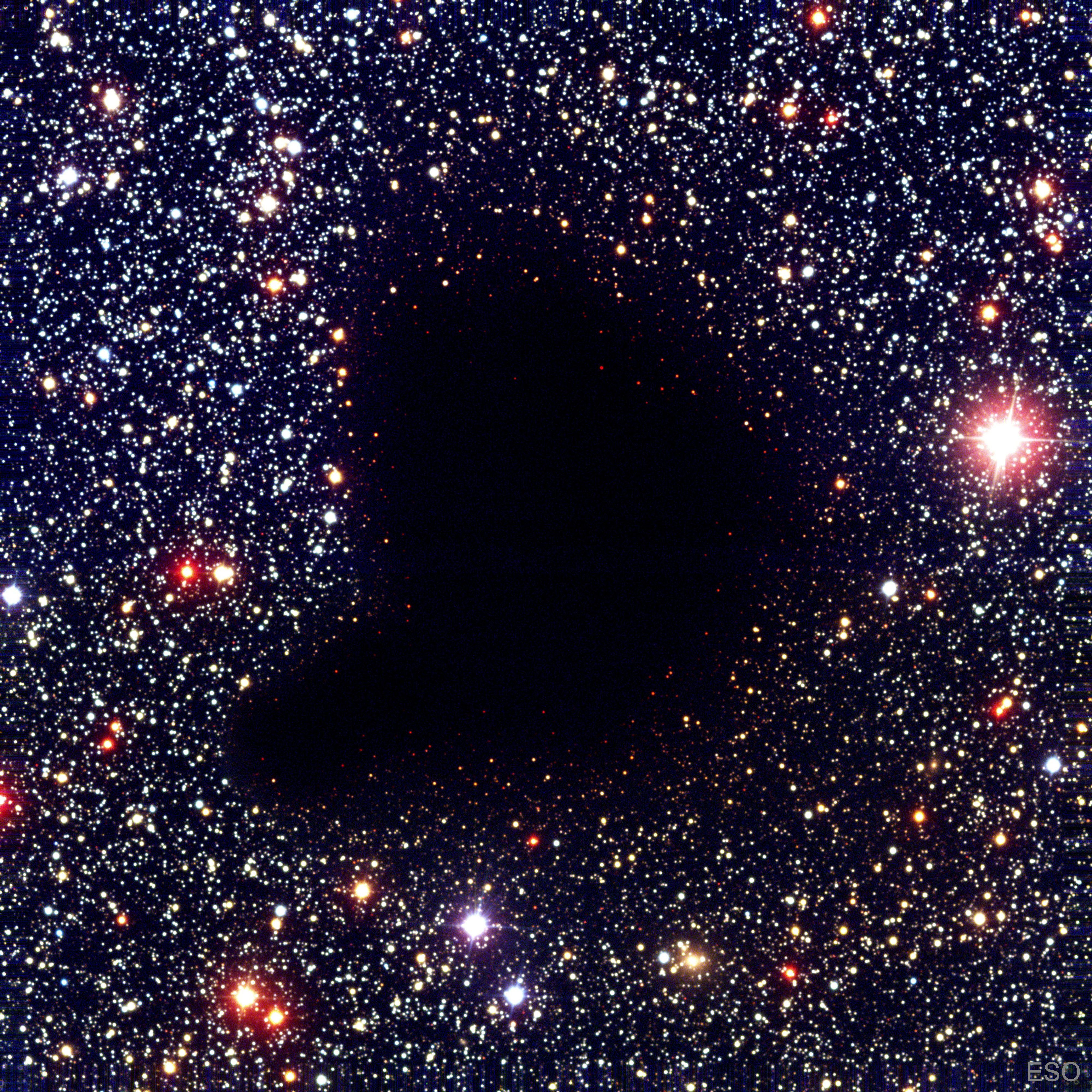
Where did all the stars go? What used to be considered a hole in the sky is now known to astronomers as a dark molecular cloud. Here, a high concentration of dust and molecular gas absorb practically all the visible light emitted from background stars. The eerily dark surroundings help make the interiors of molecular clouds some of the coldest and most isolated places in the universe. One of the most notable of these dark absorption nebulae is a cloud toward the constellation Ophiuchus known as Barnard 68, pictured here. That no stars are visible in the center indicates that Barnard 68 is relatively nearby, with measurements placing it about 500 light-years away and half a light-year across. It is not known exactly how molecular clouds like Barnard 68 form, but it is known that these clouds are themselves likely places for new stars to form. In fact, Barnard 68 itself has been found likely to collapse and form a new star system. It is possible to look right through the cloud in infrared light.
https://www.eso.org/public/news/eso0102/
https://en.wikipedia.org/wiki/Barnard_68
https://en.wikipedia.org/wiki/Molecule
https://apod.nasa.gov/apod/ap030706.html
https://apod.nasa.gov/apod/ap970430.html
https://ui.adsabs.harvard.edu/abs/2009ApJ...695.1308B/abstract
https://www.eso.org/public/videos/eso9934a/
https://www.eso.org/public/news/eso9934/
https://astronomy.swin.edu.au/cosmos/m/Molecular+Cloud
https://apod.nasa.gov/apod/ap201206.html
https://apod.nasa.gov/apod/ap221020.html
https://science.nasa.gov/universe/stars/
https://starchild.gsfc.nasa.gov/docs/StarChild/questions/question19.html
https://apod.nasa.gov/apod/dark_nebulae.html
https://en.wikipedia.org/wiki/Ophiuchus
https://science.nasa.gov/ems/07_infraredwaves/
https://apod.nasa.gov/apod/ap230129.html
#space #cluster #cloud #nebula #astrophotography #photography #science #astronomy #physics #nature #NASA #education
Alt...
2023 January 29
A dark comma-shaped cloud appears in the middle of a dense field of stars. No stars are visible through the center of the cloud.
Barnard 68: Dark Molecular Cloud
* Image Credit: FORS Team, 8.2-meter VLT Antu, ESO
Explanation:
Where did all the stars go? What used to be considered a hole in the sky is now known to astronomers as a dark molecular cloud. Here, a high concentration of dust and molecular gas absorb practically all the visible light emitted from background stars. The eerily dark surroundings help make the interiors of molecular clouds some of the coldest and most isolated places in the universe. One of the most notable of these dark absorption nebulae is a cloud toward the constellation Ophiuchus known as Barnard 68, pictured here. That no stars are visible in the center indicates that Barnard 68 is relatively nearby, with measurements placing it about 500 light-years away and half a light-year across. It is not known exactly how molecular clouds like Barnard 68 form, but it is known that these clouds are themselves likely places for new stars to form. In fact, Barnard 68 itself has been found likely to collapse and form a new star system. It is possible to look right through the cloud in infrared light.
Authors & editors: Robert Nemiroff (MTU) & Jerry Bonnell (UMCP)
NASA Official: Phillip Newman Specific rights apply.
NASA Web Privacy Policy and Important Notices
A service of: ASD at NASA / GSFC,
NASA Science Activation
& Michigan Tech. U.
![[?]](https://files.mastodon.social/accounts/avatars/113/635/103/853/964/473/original/0a4435eaf8d5c473.png)
Computer Science Courses that Don't Exist, But Should via @RunxiYu https://lobste.rs/s/c9qt43 #education
https://prog21.dadgum.com/210.html
![[?]](https://files.mastodon.social/accounts/avatars/108/131/017/378/560/705/original/2a9783630e6f09d3.jpg)
Next up: chromosome analysis for all! 🥳
#Gattaca
Also, I still question why the hell schools should need students' birth certificates anyway. Test incoming kiddos' proficiency in various subjects and put them in the class they're ready for. Sheesh.
https://www.theguardian.com/us-news/2025/oct/21/arizona-basketball-team-birth-certificate
I don't even know what other hashtags to put on this.
#TerriblePrecedents
#TransExclusion
#RedTape
#dystopia
#bigotry
#BigotryHurtsEverybody
#Idiocracy
#schools
#schoolsport
#education
#IHateThisTimeline
A Farewell to Saturn ..
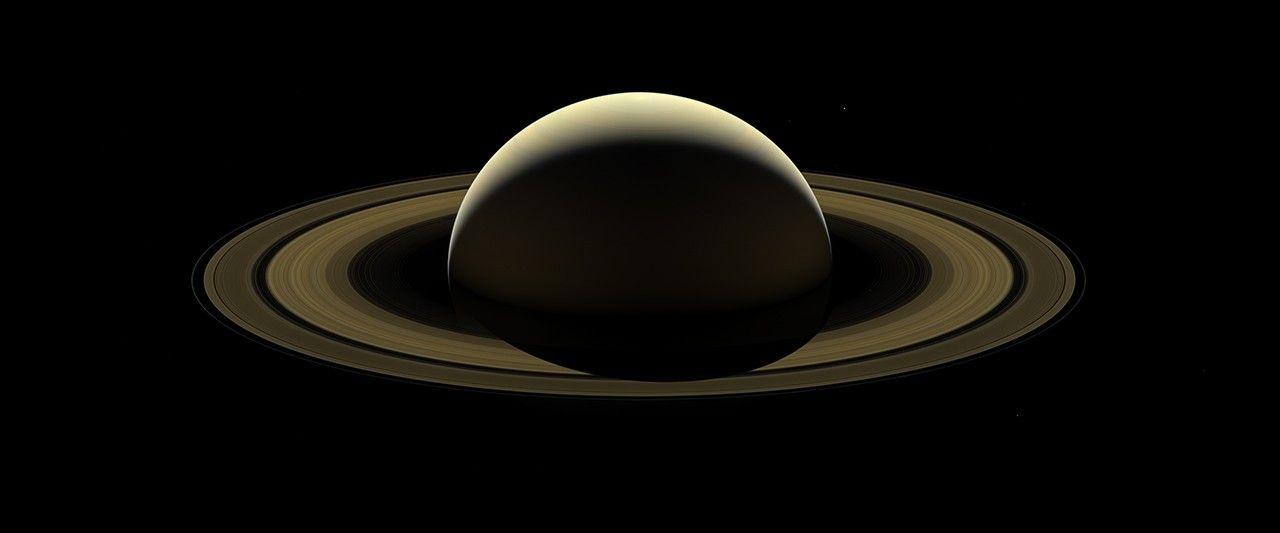
After more than 13 years at Saturn, and with its fate sealed, NASA's Cassini spacecraft bid farewell to the Saturnian system by firing the shutters of its wide-angle camera and capturing this last, full mosaic of Saturn and its rings two days before the spacecraft's dramatic plunge into the planet's atmosphere.
[...] *
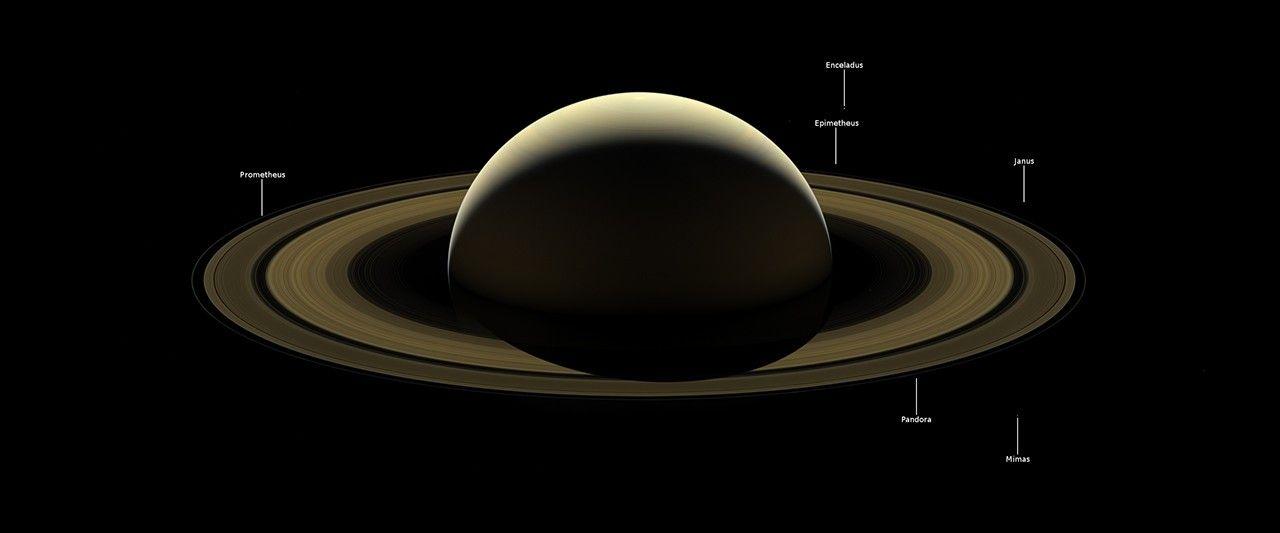
Six of Saturn's moons -- Enceladus, Epimetheus, Janus, Mimas, Pandora and Prometheus -- make a faint appearance in this image. (Numerous stars are also visible in the background.)
A second version of the mosaic is provided in which the planet and its rings have been brightened, with the fainter regions brightened by a greater amount. (The moons and stars have also been brightened by a factor of 15 in this version.)
The ice-covered moon Enceladus -- home to a global subsurface ocean that erupts into space -- can be seen at the 1 o'clock position. Directly below Enceladus, just outside the F ring (the thin, farthest ring from the planet seen in this image) lies the small moon Epimetheus. Following the F ring clock-wise from Epimetheus, the next moon seen is Janus. At about the 4:30 position and outward from the F ring is Mimas. Inward of Mimas and still at about the 4:30 position is the F-ring-disrupting moon, Pandora. Moving around to the 10 o'clock position, just inside of the F ring, is the moon Prometheus.
[...] *
Credits:
NASA/JPL-Caltech/Space Science Institute
* More Information about the images in ALT-Text
https://science.nasa.gov/photojournal/a-farewell-to-saturn/
> Movie about Casini's "Grand Finale":
https://defcon.social/@grobi/115319525500258829
#space #saturn #astrophotography #photography #science #astronomy #physics #nature #NASA #ESA #education #apod
Alt...
A Farewell to Saturn
(Brightened Version)
During the observation, a total of 80 wide-angle images were acquired in just over two hours. This view is constructed from 42 of those wide-angle shots, taken using the red, green and blue spectral filters, combined and mosaicked together to create a natural-color view.
This view looks toward the sunlit side of the rings from about 15 degrees above the ring plane. Cassini was approximately 698,000 miles (1.1 million kilometers) from Saturn, on its final approach to the planet, when the images in this mosaic were taken. Image scale on Saturn is about 42 miles (67 kilometers) per pixel. The image scale on the moons varies from 37 to 50 miles (59 to 80 kilometers) pixel. The phase angle (the Sun-planet-spacecraft angle) is 138 degrees.
Credits:
NASA/JPL-Caltech/Space Science Institute
Alt...
A Farewell to Saturn
(Annotated Version)
Six of Saturn's moons -- Enceladus, Epimetheus, Janus, Mimas, Pandora and Prometheus -- make a faint appearance in this image. (Numerous stars are also visible in the background.)
This view looks toward the sunlit side of the rings from about 15 degrees above the ring plane. Cassini was approximately 698,000 miles (1.1 million kilometers) from Saturn, on its final approach to the planet, when the images in this mosaic were taken. Image scale on Saturn is about 42 miles (67 kilometers) per pixel. The image scale on the moons varies from 37 to 50 miles (59 to 80 kilometers) pixel. The phase angle (the Sun-planet-spacecraft angle) is 138 degrees.
Credits:
NASA/JPL-Caltech/Space Science Institute
2025 October 24
Saturn at Night
* Image Credit: NASA, JPL-Caltech, Space Science Institute, Mindaugas Macijauskas
https://www.nasa.gov/
https://www.jpl.nasa.gov/
https://www.spacescience.org/index.php
https://www.flickr.com/photos/m_macijauskas/
Explanation:
Saturn is bright in Earth's night skies. Telescopic views of the outer gas giant planet and its beautiful rings often make it a star at star parties. But this stunning view of Saturn's rings and night side just isn't possible from telescopes in the vicinity of planet Earth. Peering out from the inner Solar System they can only bring Saturn's day side into view. In fact, this image of Saturn's slender sunlit crescent with night's shadow cast across its broad and complex ring system was captured by the Cassini spacecraft. A robot spacecraft from planet Earth, Cassini called Saturn orbit home for 13 years before it was directed to dive into the atmosphere of the gas giant on September 15, 2017. This magnificent mosaic is composed of frames recorded by Cassini's wide-angle camera only two days before its grand final plunge. Saturn's night will not be seen again until another spaceship from Earth calls.
https://esahubble.org/news/heic1917/
https://www.flickr.com/photos/m_macijauskas/23826951188/
https://science.nasa.gov/photojournal/a-farewell-to-saturn/
https://nightsky.jpl.nasa.gov/clubs/
https://earthsky.org/astronomy-essentials/visible-planets-tonight-mars-jupiter-venus-saturn-mercury/
https://apod.nasa.gov/apod/ap251024.html
#space #saturn #astrophotography #photography #science #astronomy #physics #nature #NASA #ESA #education #apod
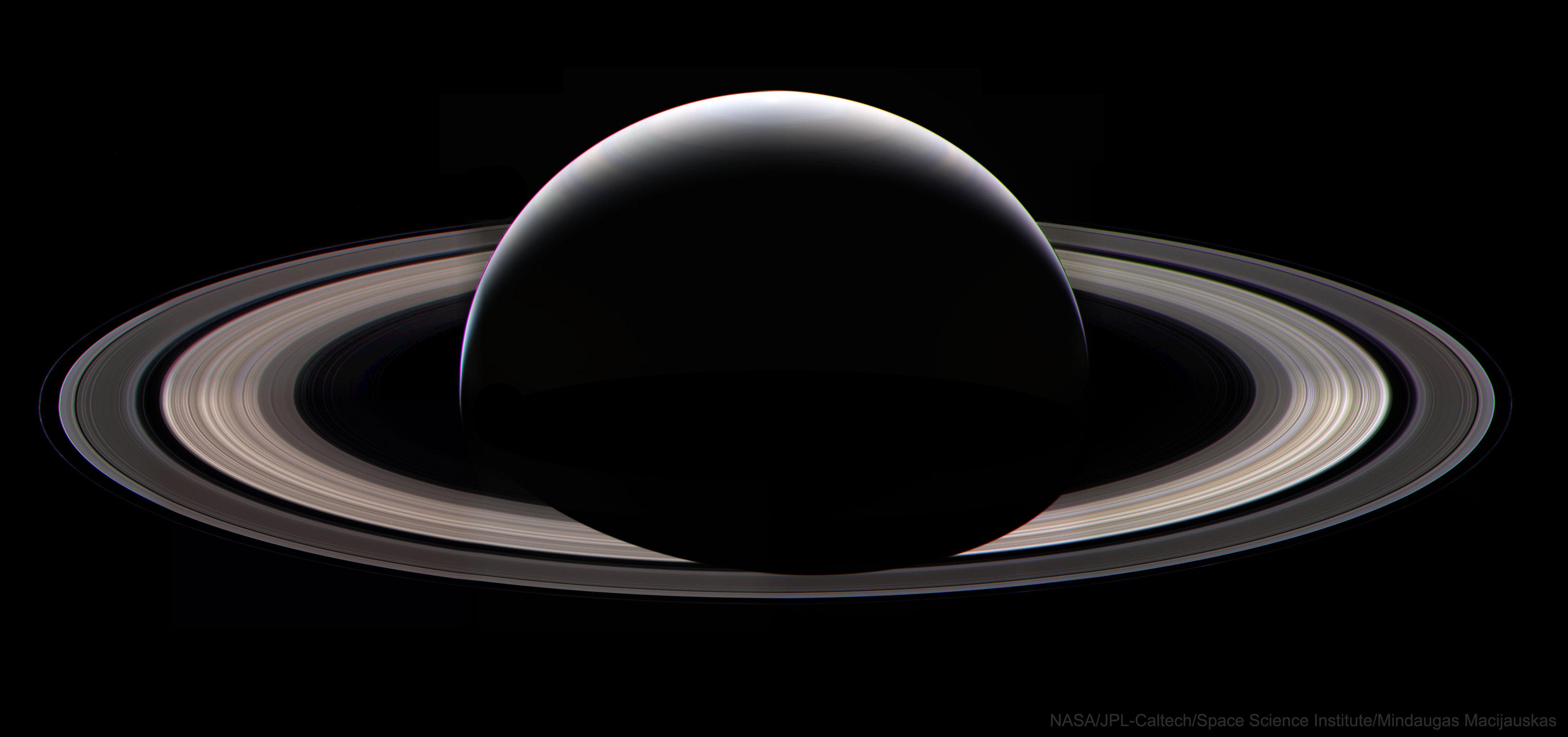
Alt...
2025 October 24
Saturn at Night
* Image Credit: NASA, JPL-Caltech, Space Science Institute, Mindaugas Macijauskas
Explanation:
Saturn is bright in Earth's night skies. Telescopic views of the outer gas giant planet and its beautiful rings often make it a star at star parties. But this stunning view of Saturn's rings and night side just isn't possible from telescopes in the vicinity of planet Earth. Peering out from the inner Solar System they can only bring Saturn's day side into view. In fact, this image of Saturn's slender sunlit crescent with night's shadow cast across its broad and complex ring system was captured by the Cassini spacecraft. A robot spacecraft from planet Earth, Cassini called Saturn orbit home for 13 years before it was directed to dive into the atmosphere of the gas giant on September 15, 2017. This magnificent mosaic is composed of frames recorded by Cassini's wide-angle camera only two days before its grand final plunge. Saturn's night will not be seen again until another spaceship from Earth calls.
Authors & editors: Robert Nemiroff (MTU) & Jerry Bonnell (UMCP)
NASA Official: Amber Straughn Specific rights apply.
NASA Web Privacy, Accessibility, Notices;
A service of: ASD at NASA / GSFC,
NASA Science Activation
& Michigan Tech. U.
![[?]](https://media.oldfriends.live/oldfriends/accounts/avatars/109/380/043/893/518/808/original/7b0a791cfbb5b18e.gif)
The Ohio GOP guts school funding, spends over a billion dollars of taxpayer money last year on private school vouchers, all with the goal of taking over public school systems... #Education #EdChoice #USPol
🔗 New Richmond, #Ohio School District placed in 'fiscal caution' due to budget shortfalls
The #UniversityOfVirginia, facing immense pressure from the White House, struck a deal with the #Trump admin on Wednesday that removed, at least temporarily, the threat of a federal *investigation*.
The #DOJ announced the deal. It was the first time a public #university had cut a far-reaching agreement with the Trump admin, which is carrying out an extraordinary campaign to shift the ideological tilt of the higher #education system.
#law #AcademicFreedom #FirstAmendment
https://www.nytimes.com/2025/10/22/us/politics/university-of-virginia-trump-agreement.html?smid=nytcore-ios-share&referringSource=articleShare
![[?]](https://cdn.masto.host/zirkus/accounts/avatars/109/363/471/129/904/593/original/366278842762c266.png)
2025 October 22
Comet Lemmon over the High Tatras
* Image Credit & Copyright: Tomáš Slovinský & Constantine Themelis
https://www.instagram.com/slovinsky.art/
https://www.instagram.com/constantinethemelis/
Explanation:
Comet Lemmon putting on a show for cameras around the globe. Passing nearest to the Earth this week, the photogenic comet C/2025 A6 (Lemmon) is now extending two long tails : a blue ion tail and a white dust tail. The ion tail is pushed away from the Sun by the ever-present by ever-changing solar wind, and shows structure also created by how much gas is ejected at any one moment. It glows because it is ionized by high energy sunlight. The dust tail is pushed away from the comet by sunlight and shines by reflecting sunlight. The featured image is an enhanced composite of 50 exposures all taken two days ago from Mlynica, Slovakia. The mountains in the foreground are the High Tatras that partly separate Slovakia from Poland. Although Comet Lemmon is best visible in long camera exposures, the shedding ice ball has become faintly visible in northern skies even to unaided eyes through dark skies toward the west after sunset.
https://spaceplace.nasa.gov/comets/en/anatomy-of-a-comet.en.jpg
https://astronomy.swin.edu.au/cosmos/c/cometary+tails
http://www.star.ucl.ac.uk/~apod/apod/ap251019.html
https://apod.nasa.gov/apod/ap251022.html
#space #comets #astrophotography #photography #science #astronomy #nature #NASA #ESA #education #apod
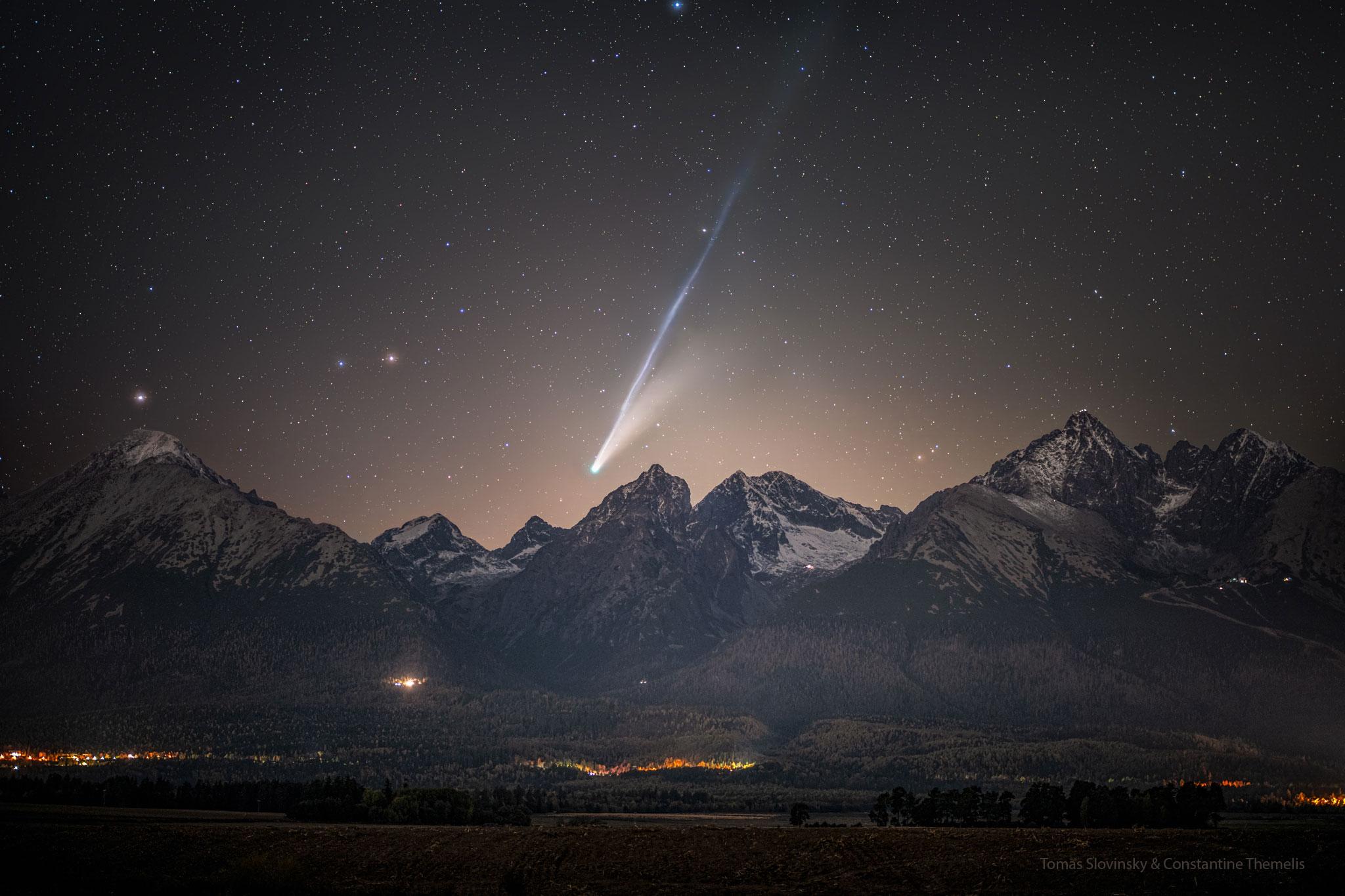
Alt...
2025 October 22
A mountain range is shown in the foreground with a bright comet visible above it. The comet shows tails that are long and bright with the longer tail appearing light blue.
Comet Lemmon over the High Tatras
* Image Credit & Copyright: Tomáš Slovinský & Constantine Themelis
Explanation:
Comet Lemmon putting on a show for cameras around the globe. Passing nearest to the Earth this week, the photogenic comet C/2025 A6 (Lemmon) is now extending two long tails : a blue ion tail and a white dust tail. The ion tail is pushed away from the Sun by the ever-present by ever-changing solar wind, and shows structure also created by how much gas is ejected at any one moment. It glows because it is ionized by high energy sunlight. The dust tail is pushed away from the comet by sunlight and shines by reflecting sunlight. The featured image is an enhanced composite of 50 exposures all taken two days ago from Mlynica, Slovakia. The mountains in the foreground are the High Tatras that partly separate Slovakia from Poland. Although Comet Lemmon is best visible in long camera exposures, the shedding ice ball has become faintly visible in northern skies even to unaided eyes through dark skies toward the west after sunset.
Authors & editors: Robert Nemiroff (MTU) & Jerry Bonnell (UMCP)
NASA Official: Amber Straughn Specific rights apply.
NASA Web Privacy, Accessibility, Notices;
A service of: ASD at NASA / GSFC,
NASA Science Activation
& Michigan Tech. U.
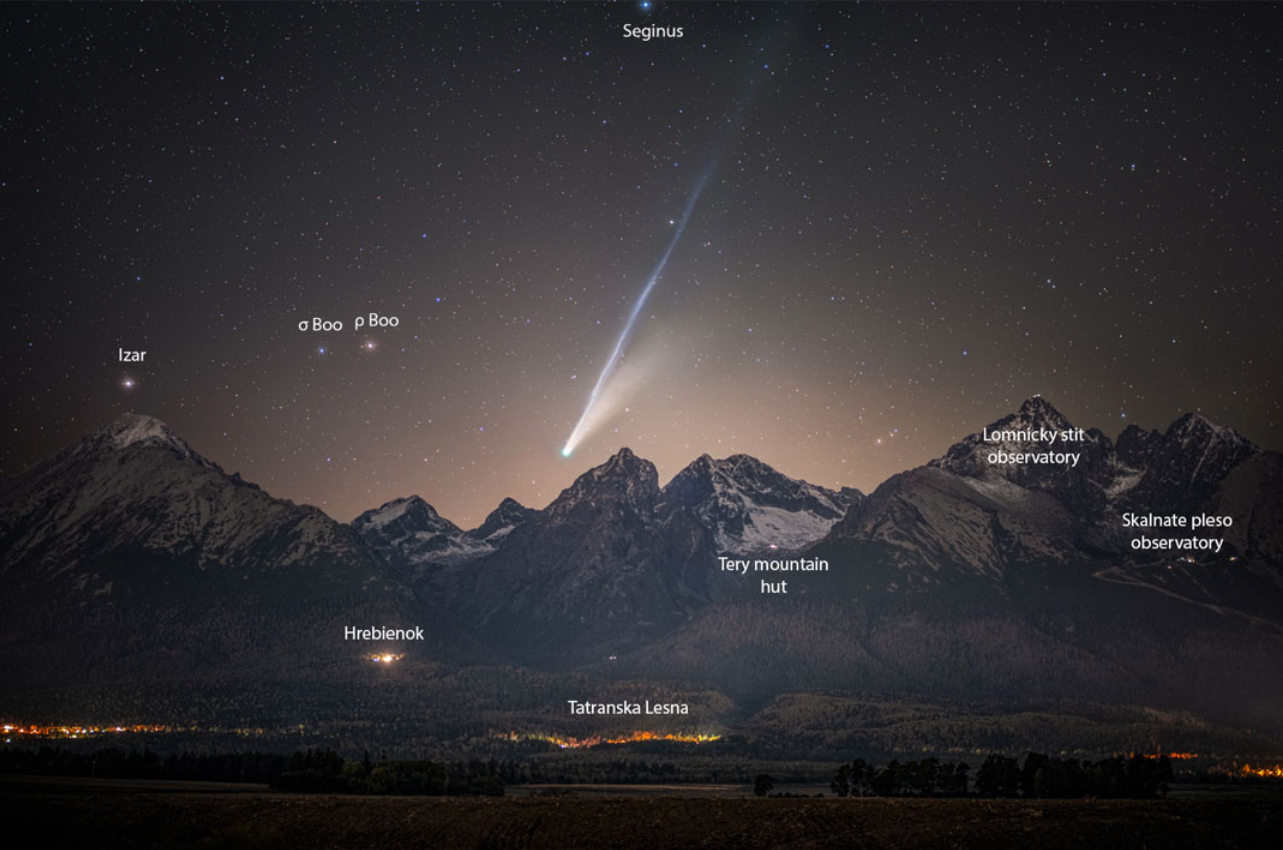
Alt...
Annotations for featured image
2025 October 13
Lemmon Tree
* Image Credit & Copyright: Uroš Fink
https://www.instagram.com/urosfink/
Explanation:
The tree is not in danger. That's because the comet pictured just above it, Comet C/2025 A6 (Lemmon), is far in the distance, well away from the Earth. Comet Lemmon now continues to brighten as it arcs through the inner Solar System, even though it has passed its nearest to the Sun -- because it is now approaching the Earth. The comet will likely appear brightest when it is at its closest to the Earth next week, then closing to about half the Earth-Sun distance. Comet Lemmon may then be visible to the unaided eye, but it is more likely to be imaged by a camera phone -- if you know where to look. Comet Lemmon, previously best visible in the morning, is now also visible in the evening sky for northern observers: look above the western horizon just after sunset. The featured image, centered on an unsuspecting European beech tree, was taken in Slovenia about ten days ago.
https://apod.nasa.gov/apod/ap251013.html
#space #comets #astrophotography #photography #science #astronomy #nature #NASA #ESA #education
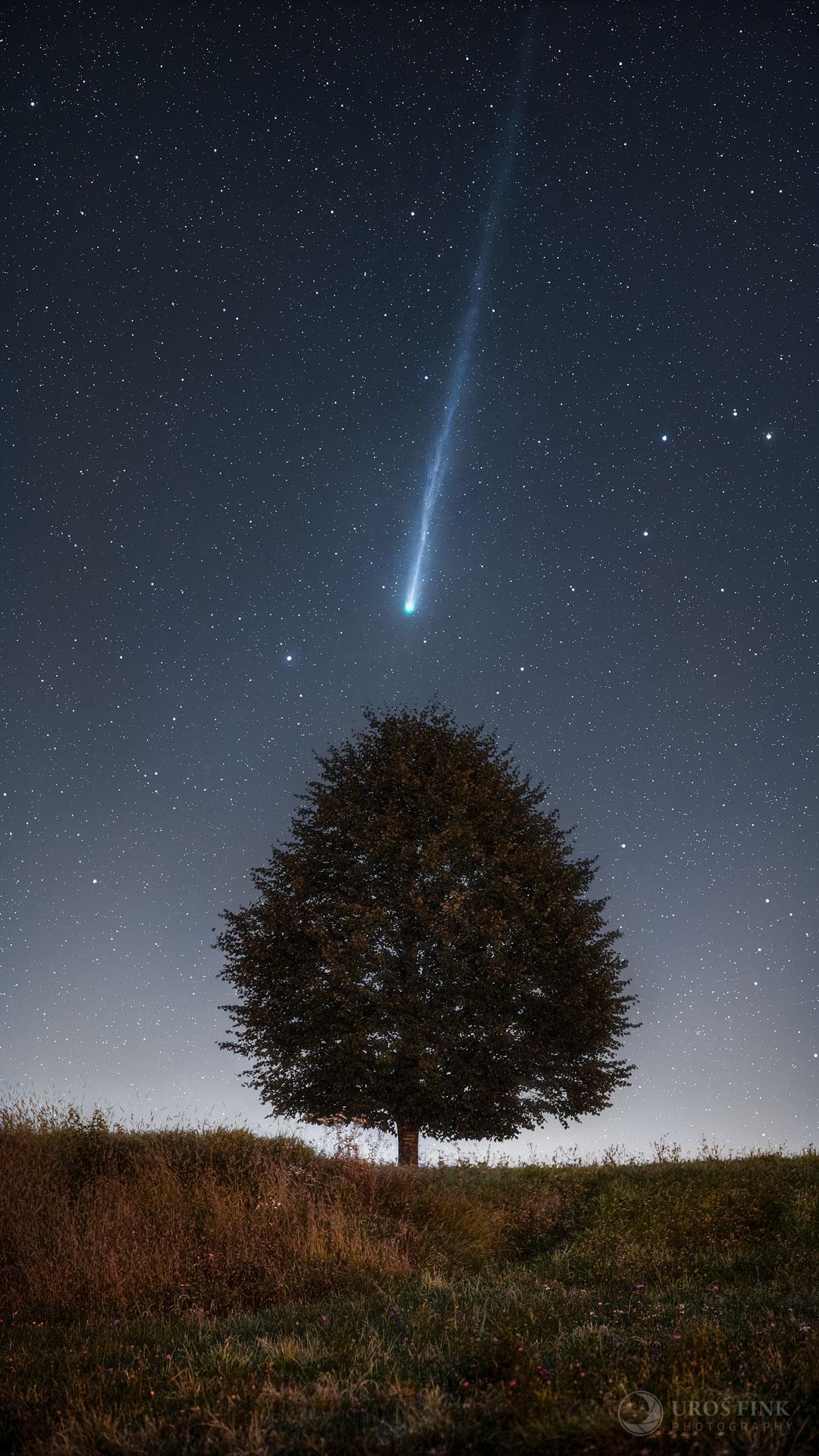
Alt...
2025 October 13
A tree is seen silhouetted against a night sky filled with stars. Above the tree with its tail pointing nearly vertically is a comet: Comet Lemmon.
Lemmon Tree
* Image Credit & Copyright: Uroš Fink
Explanation:
The tree is not in danger. That's because the comet pictured just above it, Comet C/2025 A6 (Lemmon), is far in the distance, well away from the Earth. Comet Lemmon now continues to brighten as it arcs through the inner Solar System, even though it has passed its nearest to the Sun -- because it is now approaching the Earth. The comet will likely appear brightest when it is at its closest to the Earth next week, then closing to about half the Earth-Sun distance. Comet Lemmon may then be visible to the unaided eye, but it is more likely to be imaged by a camera phone -- if you know where to look. Comet Lemmon, previously best visible in the morning, is now also visible in the evening sky for northern observers: look above the western horizon just after sunset. The featured image, centered on an unsuspecting European beech tree, was taken in Slovenia about ten days ago.
Authors & editors: Robert Nemiroff (MTU) & Jerry Bonnell (UMCP)
NASA Official: Amber Straughn Specific rights apply.
NASA Web Privacy, Accessibility, Notices;
A service of: ASD at NASA / GSFC,
NASA Science Activation
& Michigan Tech. U.
 Ohio switches to private vendor to manage #EdChoice funds
Oh hell no. Even less public info and oversight will be available for the plus billion dollar per year school voucher program #Education #USPol #Ohio .
In June, a Franklin County judge ruled that the EdChoice program is unconstitutional. It gets to operate while the appeal moves through the courts, though.
2025 October 22
NGC 6995: The Bat Nebula
* Image Credit & Copyright: Francis Bozon & Jean-Luc Gangloff
Explanation:
Can you see the bat? It haunts this cosmic close-up of the eastern Veil Nebula. The Veil Nebula itself is a large supernova remnant, the expanding debris cloud from the death explosion of a massive star. While the Veil is roughly circular in shape and covers nearly 3 degrees on the sky toward the constellation of the Swan (Cygnus), NGC 6995, known informally as the Bat Nebula, spans only 1/2 degree, about the apparent size of the Moon. That translates to 12 light-years at the Veil's estimated distance, a reassuring 1,400 light-years from planet Earth. In the composite of image data recorded through several narrow band filters, with emission from hydrogen atoms in the remnant shown in red and with strong emission from oxygen atoms shown in hues of blue. Of course, in the western part of the Veil lies another seasonal apparition: the Witch's Broom Nebula.
https://chandra.harvard.edu/photo/scale_distance.html
https://periodic.lanl.gov/1.shtml
https://apod.nasa.gov/apod/ap251022.html
#space #nebula #cluster #astrophotography #photography #science #astronomy #nature #NASA #ESA #apod #education
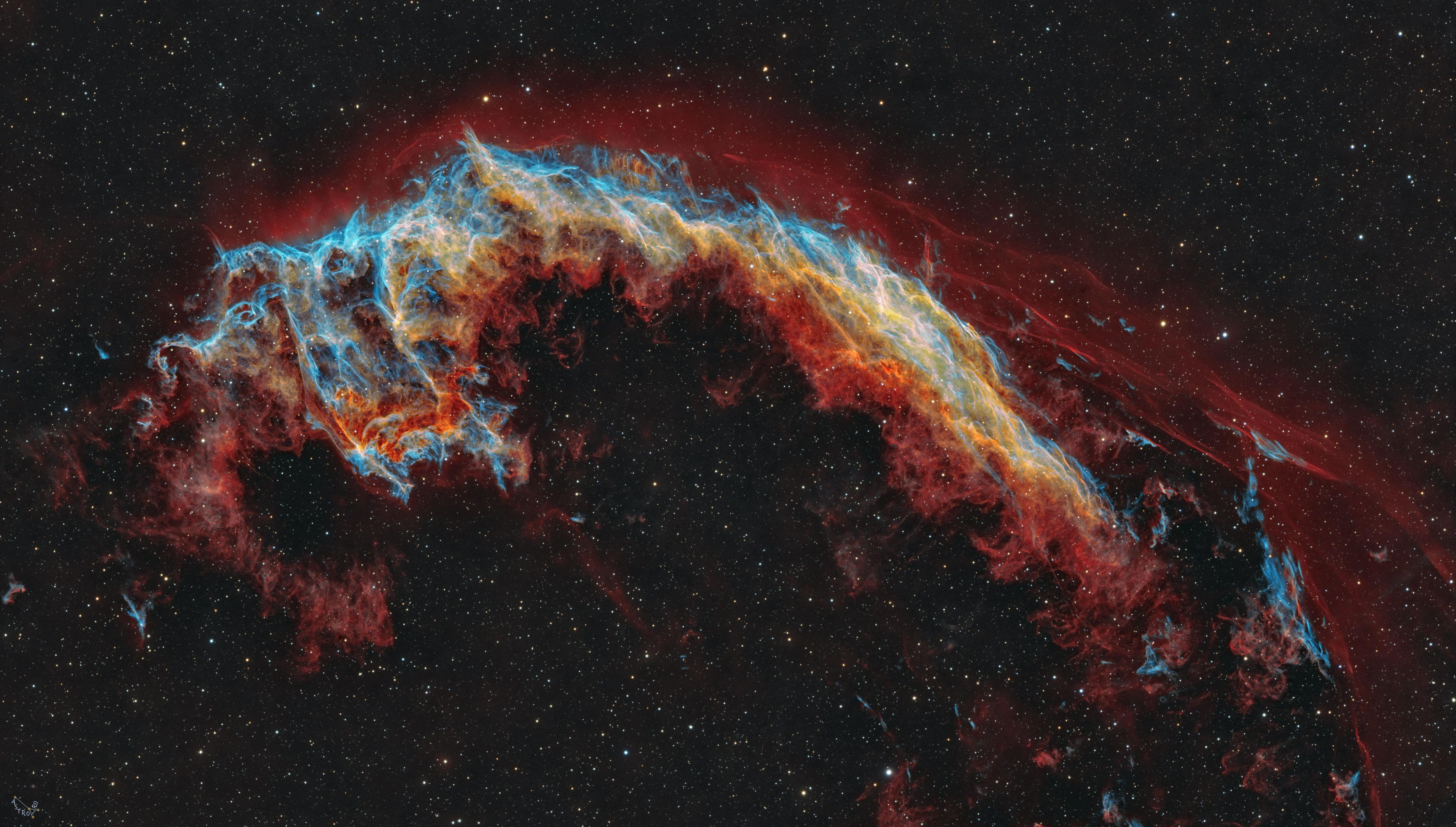
Alt...
2025 October 22
The featured image shows a starfield with a multi- colored nebula in the center. The nebula is quite filamentary but appears to some like a bat.
NGC 6995: The Bat Nebula
* Image Credit & Copyright: Francis Bozon-Gangloff
Explanation:
Can you see the bat? It haunts this cosmic close-up of the eastern Veil Nebula. The Veil Nebula itself is a large supernova remnant, the expanding debris cloud from the death explosion of a massive star. While the Veil is roughly circular in shape and covers nearly 3 degrees on the sky toward the constellation of the Swan (Cygnus), NGC 6995, known informally as the Bat Nebula, spans only 1/2 degree, about the apparent size of the Moon. That translates to 12 light-years at the Veil's estimated distance, a reassuring 1,400 light-years from planet Earth. In the composite of image data recorded through several narrow band filters, with emission from hydrogen atoms in the remnant shown in red and with strong emission from oxygen atoms shown in hues of blue. Of course, in the western part of the Veil lies another seasonal apparition: the Witch's Broom Nebula.
Authors & editors: Robert Nemiroff (MTU) & Jerry Bonnell (UMCP)
NASA Official: Amber Straughn Specific rights apply.
NASA Web Privacy, Accessibility, Notices;
A service of: ASD at NASA / GSFC,
NASA Science Activation
& Michigan Tech. U.
The #Trump admin is exploring moving the $15B program that supports #students w/ #disabilities to a different agency within the federal govt as it works to close the #Education Dept altogether, a department ofcl said Tuesday.
The effort comes on the heels of the agency’s decision this month to lay off the vast majority of employees working on #SpecialEducation services & months after *Education* Secy [pro wrestling promoter] Linda McMahon talked about moving the program to #HHS.
I am so afraid for the future
#Trump admin seeks to move #SpecialEducation to #RFKJr’s #HHS
The move would affect the $15 billion #IDEA program & comes as the admin seeks to close down the federal #Education Department
#law
https://www.washingtonpost.com/education/2025/10/21/trump-special-education-move/
2025 October 21
IC 1805: The Heart Nebula
* Image Credit & Copyright: Toni Fabiani
https://app.astrobin.com/u/Toni_Fabiani#gallery
Explanation:
What electrifies the Heart Nebula? First, the large emission nebula on the left, catalogued as IC 1805, looks somewhat like a human heart. The nebula glows brightly in red light emitted by its most prominent element, hydrogen, but this long-exposure image was also blended with light emitted by sulfur (yellow) and oxygen (blue). In the center of the Heart Nebula are young stars from the open star cluster Melotte 15 that are eroding away several picturesque dust pillars with their atom-exciting energetic light and winds. The Heart Nebula is located about 7,500 light years away toward the constellation of Cassiopeia. At the top right of the Heart Nebula is the companion Fishhead Nebula. This wide and deep image clearly shows that glowing gas surrounds the Heart Nebula in all directions.
https://apod.nasa.gov/apod/ap251021.html
#space #nebula #cluster #astrophotography #photography #science #astronomy #nature #NASA #ESA #apod #education
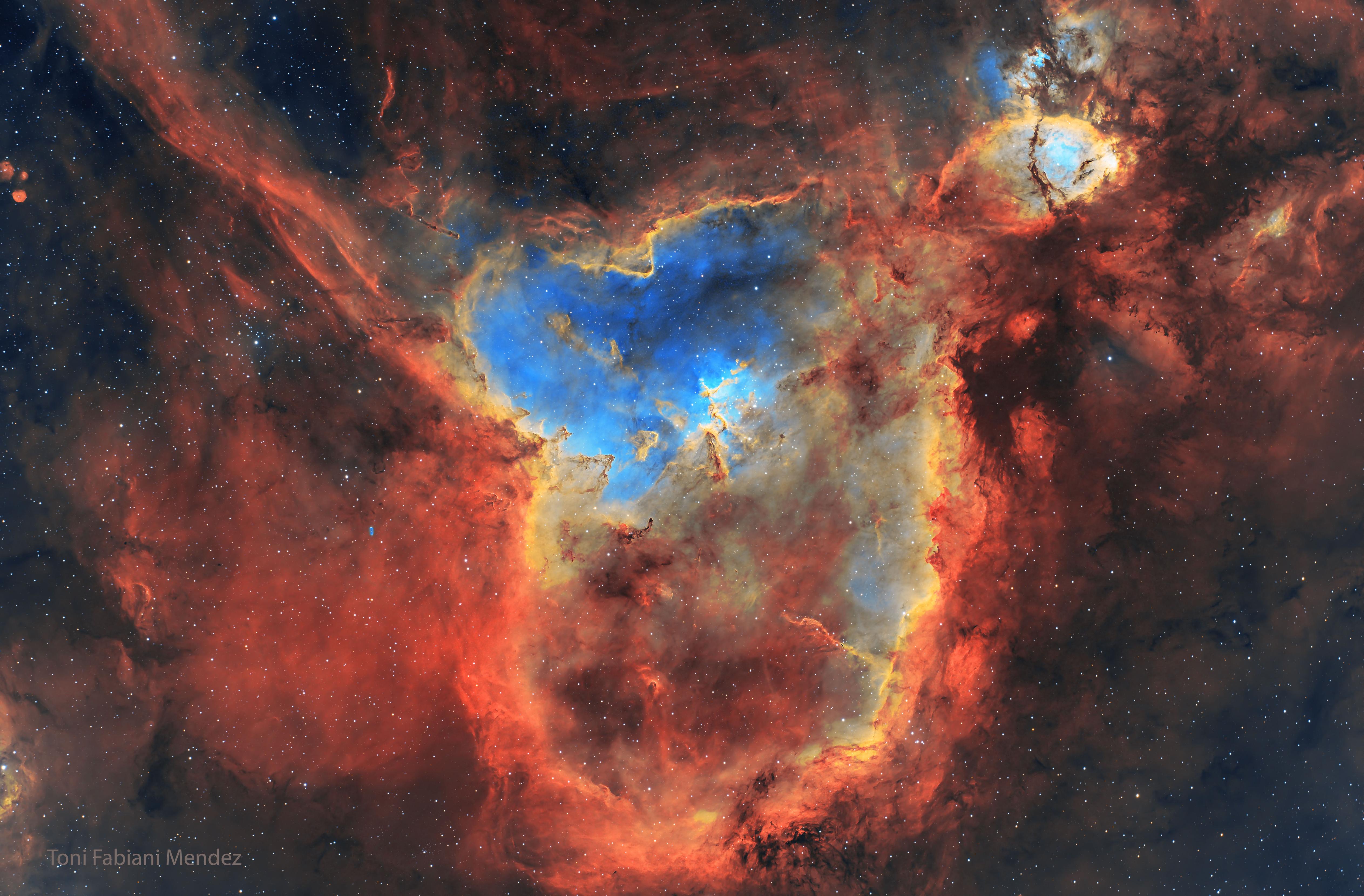
Alt...
2025 October 21
A starfield is shown filled with colorful gas glowing in different colors, and dark dust.
IC 1805: The Heart Nebula
* Image Credit & Copyright: Toni Fabiani
Explanation:
What electrifies the Heart Nebula? First, the large emission nebula on the left, catalogued as IC 1805, looks somewhat like a human heart. The nebula glows brightly in red light emitted by its most prominent element, hydrogen, but this long-exposure image was also blended with light emitted by sulfur (yellow) and oxygen (blue). In the center of the Heart Nebula are young stars from the open star cluster Melotte 15 that are eroding away several picturesque dust pillars with their atom-exciting energetic light and winds. The Heart Nebula is located about 7,500 light years away toward the constellation of Cassiopeia. At the top right of the Heart Nebula is the companion Fishhead Nebula. This wide and deep image clearly shows that glowing gas surrounds the Heart Nebula in all directions.
Authors & editors: Robert Nemiroff (MTU) & Jerry Bonnell (UMCP)
NASA Official: Amber Straughn Specific rights apply.
NASA Web Privacy, Accessibility, Notices;
A service of: ASD at NASA / GSFC,
NASA Science Activation
& Michigan Tech. U.
2025 October 20
Finding Comet Lemmon
* Image Credit & Copyright: Petr Horalek / Institute of Physics in Opava
https://www.petrhoralek.com/#about-1
https://www.slu.cz/phys/en/
Explanation:
Tonight, if you can see the stars of the Big Dipper, then you can find comet Lemmon in your evening sky. After sunset, look for the faint but extended comet above your northwestern horizon -- but below the handle of the famous celestial kitchen utensil of the north. It might be easier to see this visitor to the inner Solar System through your camera phone, which is better at picking up faint objects. Either way, look for a fuzzy green 'star' with a tail, though probably not so long a tail as in this impressive snapshot taken over Seč Lake in the Czech Republic two nights ago. Recent photographs of C/2025 A6 (Lemmon) often show a detailed and changing ion tail which extends farther than the eye can follow. This Sun-orbiting comet is now near its closest approach to Earth and will pass its closest to the Sun in early November.
https://theskylive.com/c2025a6-info
https://www.petrhoralek.com/?p=25820
https://www.wired.com/story/how-to-see-comet-lemmon-this-october/
https://apod.nasa.gov/apod/ap251020.html
#space #comets #astrophotography #photography #science #astronomy #nature #NASA #ESA #education
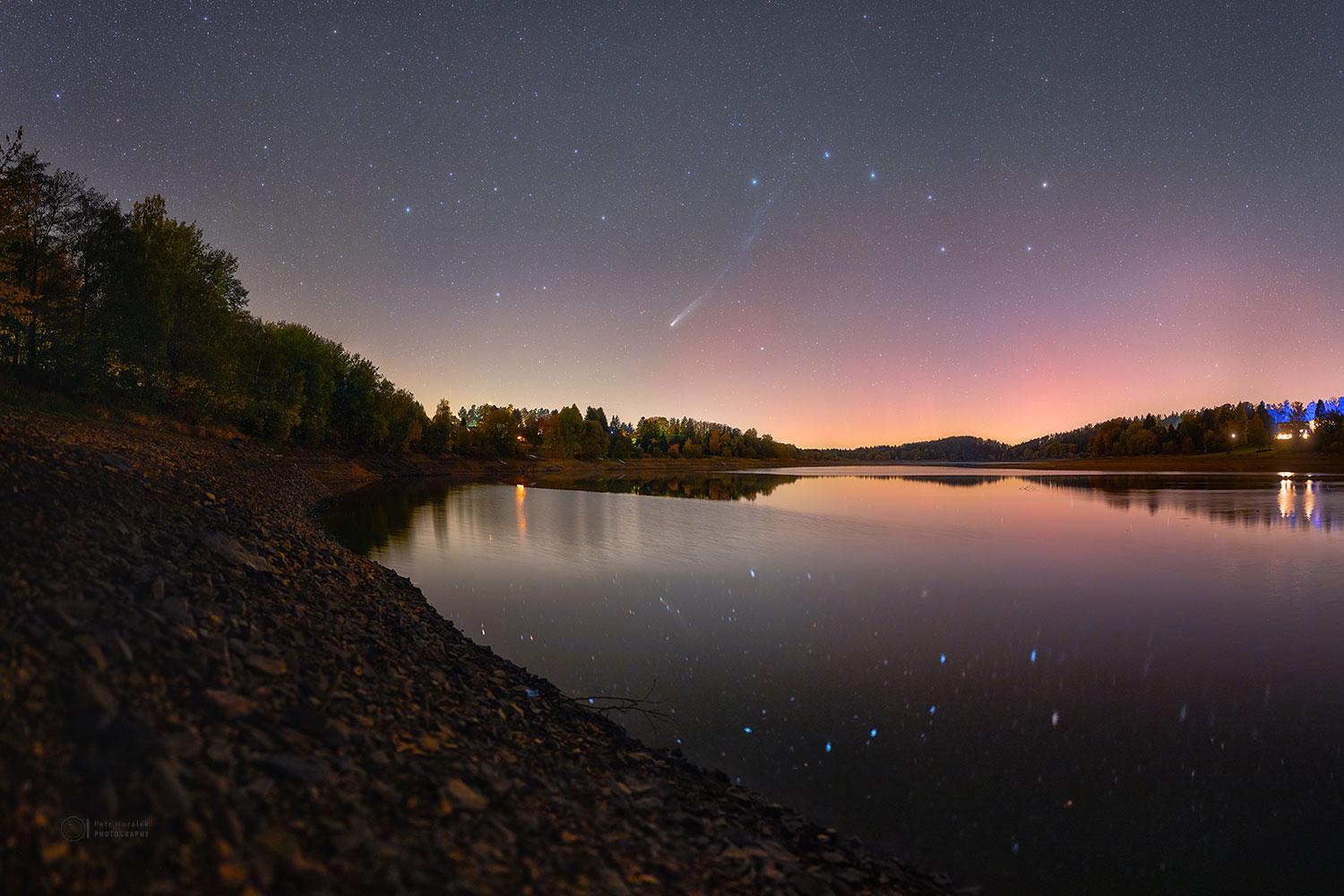
Alt...
2025 October 20
A night sky is seen over a lake. The sky contains numerous stars including the Big Dipper asterism. Prominent in the sky is a comet with a long tail. Both the Big Dipper and the comet are seen reflected in the still water of the lake.
Finding Comet Lemmon
* Image Credit & Copyright: Petr Horalek / Institute of Physics in Opava
Explanation:
Tonight, if you can see the stars of the Big Dipper, then you can find comet Lemmon in your evening sky. After sunset, look for the faint but extended comet above your northwestern horizon -- but below the handle of the famous celestial kitchen utensil of the north. It might be easier to see this visitor to the inner Solar System through your camera phone, which is better at picking up faint objects. Either way, look for a fuzzy green 'star' with a tail, though probably not so long a tail as in this impressive snapshot taken over Seč Lake in the Czech Republic two nights ago. Recent photographs of C/2025 A6 (Lemmon) often show a detailed and changing ion tail which extends farther than the eye can follow. This Sun-orbiting comet is now near its closest approach to Earth and will pass its closest to the Sun in early November.
Authors & editors: Robert Nemiroff (MTU) & Jerry Bonnell (UMCP)
NASA Official: Amber Straughn Specific rights apply.
NASA Web Privacy, Accessibility, Notices;
A service of: ASD at NASA / GSFC,
NASA Science Activation
& Michigan Tech. U.
2025 October 11
Manicouagan Impact Crater from Space
* Image Credit: NASA, International Space Station Expedition 59
Explanation:
Orbiting 400 kilometers above Quebec, Canada, planet Earth, the International Space Station Expedition 59 crew captured this snapshot of the broad St. Lawrence River and curiously circular Lake Manicouagan on April 11, 2019. Right of center, the ring-shaped lake is a modern reservoir within the eroded remnant of an ancient 100 kilometer diameter impact crater. The ancient crater is very conspicuous from orbit, a visible reminder that Earth is vulnerable to rocks from space. Over 200 million years old, the Manicouagan crater was likely caused by the impact of a rocky body about 5 kilometers in diameter. Currently, there is no known asteroid with a significant probability of impacting Earth in the next century. Each month, NASA’s Planetary Defense Coordination Office releases an update featuring the most recent figures on near-Earth object close approaches, and other facts about comets and asteroids that could pose a potential impact hazard with Earth.
#space #comets #astrophotography #photography #science #astronomy #nature #NASA #ESA #education #apod

Alt...
2025 October 11

Manicouagan Impact Crater from Space
Image Credit: NASA, International Space Station Expedition 59
Explanation: Orbiting 400 kilometers above Quebec, Canada, planet Earth, the International Space Station Expedition 59 crew captured this snapshot of the broad St. Lawrence River and curiously circular Lake Manicouagan on April 11, 2019. Right of center, the ring-shaped lake is a modern reservoir within the eroded remnant of an ancient 100 kilometer diameter impact crater. The ancient crater is very conspicuous from orbit, a visible reminder that Earth is vulnerable to rocks from space. Over 200 million years old, the Manicouagan crater was likely caused by the impact of a rocky body about 5 kilometers in diameter. Currently, there is no known asteroid with a significant probability of impacting Earth in the next century. Each month, NASA’s Planetary Defense Coordination Office releases an update featuring the most recent figures on near-Earth object close approaches, and other facts about comets and asteroids that could pose a potential impact hazard with Earth
Authors & editors: Robert Nemiroff (MTU) & Jerry Bonnell (UMCP)
NASA Official: Amber Straughn Specific rights apply.
NASA Web Privacy, Accessibility, Notices;
A service of: ASD at NASA / GSFC,
NASA Science Activation
& Michigan Tech. U.
![[?]](https://gs.leftic.club/system/accounts/avatars/111/077/014/684/293/734/original/78fc4800646ad7cf.png)
Ils et elles veulent devenir infirmier, avocate ou mathématicien, mais l'État les en empêche
https://basta.media/ils-et-elles-veulent-devenir-infirmier-avocate-ou-mathematicien-etat-les-en-empeche-droit-a-l-ecole
Des milliers d'enfants et d'adolescents n'ont pas accès à l'école en France. Des jeunes qui ont connu ces difficultés se mobilisent avec l'association Ecole pour tous pour que ça n'arrivent pas à d'autres et pour le droit à l'éducation. Témoignages.
#Politique #Portraits #Education #Discriminations