Search results for tag #nature
![[?]](https://files.defcon.social/dcsocial-s3/accounts/avatars/113/208/344/507/078/943/original/014820ad22daee1c.jpg)
2025 September 3
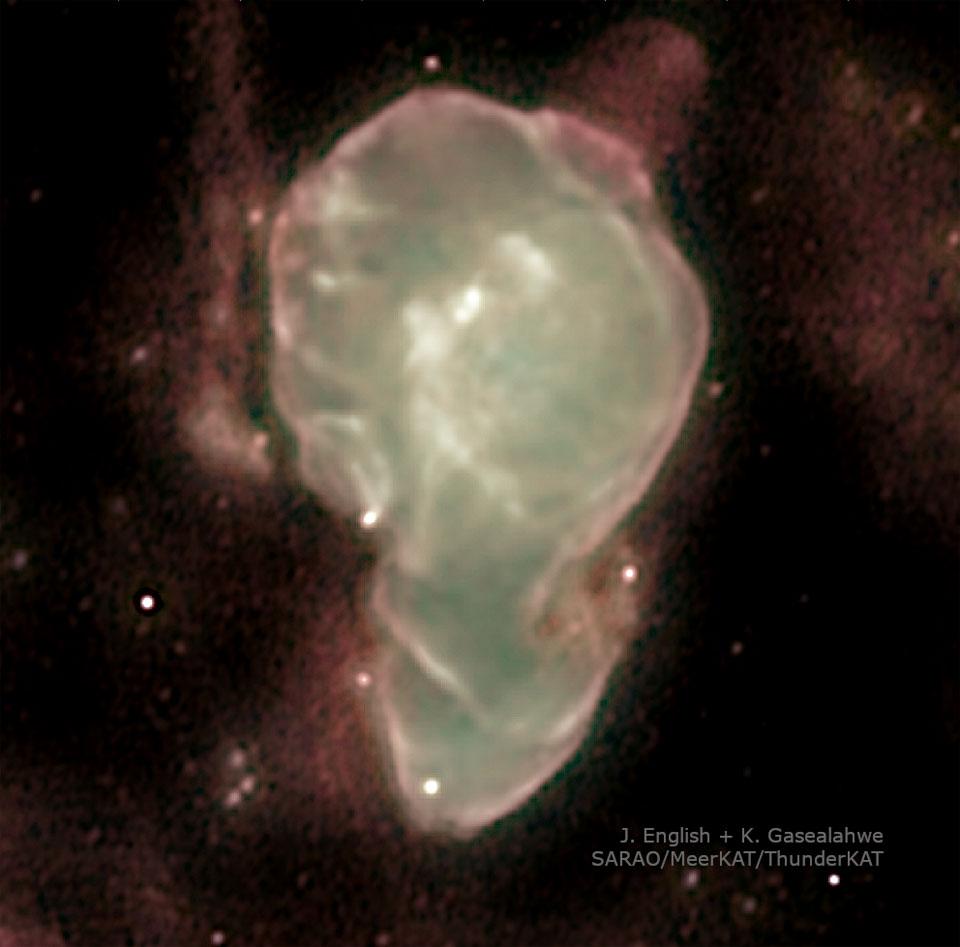
Cir X-1: Jets in the Africa Nebula
* Image Credit: J. English (U. Manitoba) & K. Gasealahwe (U. Cape Town), SARAO, MeerKAT, ThunderKAT
http://www2.physics.umanitoba.ca/u/english/
https://umanitoba.ca/science/physics-and-astronomy
https://www.researchgate.net/profile/Kelebogile-Gasealahwe
https://science.uct.ac.za/departments/astronomy
https://www.sarao.ac.za/
https://www.sarao.ac.za/science/meerkat/
* Science: K. Gasealahwe, K. Savard (U. Oxford) et al.
https://www.physics.ox.ac.uk/our-people/savard
https://www.physics.ox.ac.uk/
https://arxiv.org/abs/2507.22998
* Text: J. English & K. Savard
Explanation:
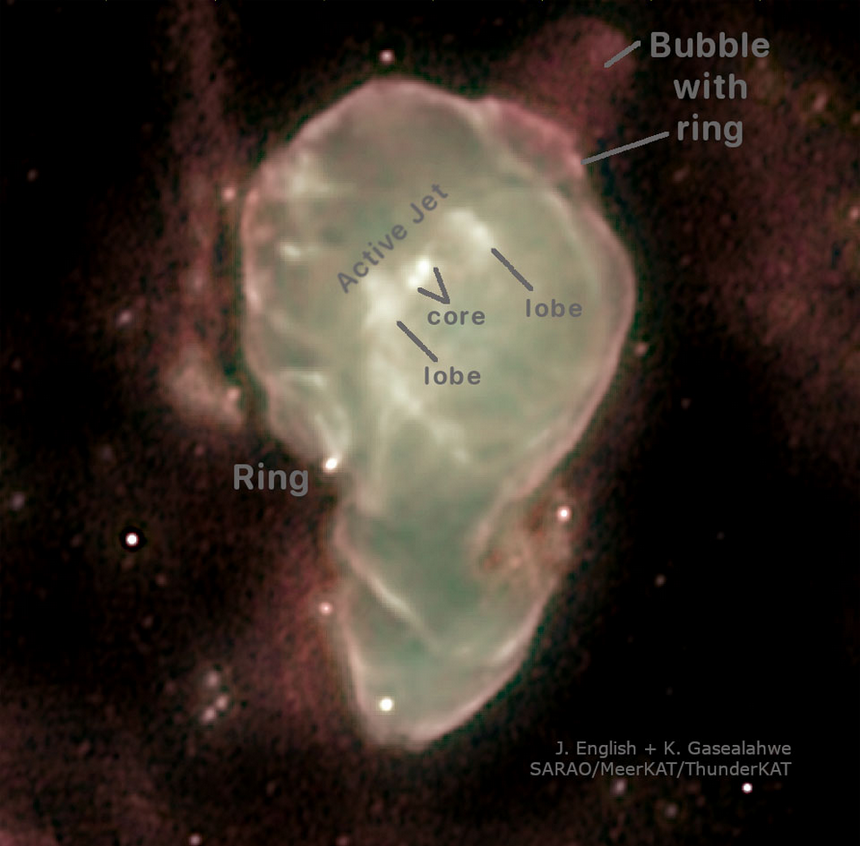
How soon do jets form when a supernova gives birth to a neutron star? The Africa Nebula provides clues. This supernova remnant surrounds Circinus X-1, an X-ray emitting neutron star and the companion star it orbits. The image, from the ThunderKAT collaboration on the MeerKAT radio telescope situated in South Africa, shows the bright core-and-lobe structure of Cir X-1’s currently active jets inside the nebula. A mere 4600 years old, Cir X-1 could be the "Little Sister" of microquasar SS 433*. However, the newly discovered bubble exiting from a ring-like hole in the upper right of the nebula, along with a ring to the bottom left, demonstrate that other jets previously existed. Computer simulations indicate those jets formed within 100 years of the explosion and lasted up to 1000 years. Surprisingly, to create the observed bubble, the jets need to be more powerful than young neutron stars were previously thought to produce.
https://en.wikipedia.org/wiki/Circinus_X-1
https://science.nasa.gov/universe/neutron-stars-are-weird/
https://apod.nasa.gov/apod/ap250903.html
#space #nebula #astrophotography #photography #science #astronomy #physics #nature #NASA #ESA
Alt...
2025 September 3
A nebula is shown that appears roughly the shape of Africa. The complex radio image shows rings and jets.
Cir X-1: Jets in the Africa Nebula
* Image Credit: J. English (U. Manitoba) & K. Gasealahwe (U. Cape Town), SARAO, MeerKAT, ThunderKAT
* Science: K. Gasealahwe, K. Savard (U. Oxford) et al.
* Text: J. English & K. Savard
Explanation:
How soon do jets form when a supernova gives birth to a neutron star? The Africa Nebula provides clues. This supernova remnant surrounds Circinus X-1, an X-ray emitting neutron star and the companion star it orbits. The image, from the ThunderKAT collaboration on the MeerKAT radio telescope situated in South Africa, shows the bright core-and-lobe structure of Cir X-1’s currently active jets inside the nebula. A mere 4600 years old, Cir X-1 could be the "Little Sister" of microquasar SS 433*. However, the newly discovered bubble exiting from a ring-like hole in the upper right of the nebula, along with a ring to the bottom left, demonstrate that other jets previously existed. Computer simulations indicate those jets formed within 100 years of the explosion and lasted up to 1000 years. Surprisingly, to create the observed bubble, the jets need to be more powerful than young neutron stars were previously thought to produce.
Authors & editors: Robert Nemiroff (MTU) & Jerry Bonnell (UMCP)
NASA Official: Amber Straughn Specific rights apply.
Alt...
Image with annotaions
![[?]](https://media.universeodon.com/accounts/avatars/109/362/535/847/508/379/original/d813a009e1e1ccbe.png)
Lily Pads on Blue Water
This photograph captures several yellow floating hearts (Nymphoides peltata) drifting across deep blue water. Some of the lily pads are bright green, others tinged with yellow, and long, slender stems trail downward, disappearing into the quiet depths below.
If you love flowers and foliageor just enjoy discovering their beauty and names like I do—come explore my gallery of blooms captured in moments of wonder and curiosity.
https://swede1952-photographs.pixels.com
#photo #photography #photographer #photographylovers #nature #lake #plants #lilypads

Alt...
"A handful of lily pads drift across a still surface of deep blue water—each pad a soft punctuation mark in an otherwise uninterrupted field of color. The water is rich and saturated, almost cobalt, with no visible ripples or movement. It holds the lily pads like a canvas holds brushstrokes—deliberate, spaced, serene.
The pads themselves vary in tone: some are bright green, others tinged with yellow, suggesting age or seasonal shift. Their shapes are mostly round, with gentle notches and imperfections that make them feel organic, not ornamental. Thin stems connect a few of them, visible just beneath the surface like faint lines in a drawing.
There’s no frog, no flower, no breeze—just the quiet presence of floating leaves and the suggestion of depth below. The composition is minimal, almost meditative. The pads seem to hover, not just on water, but in time—suspended between growth and decay, motion and stillness.
In the bottom left corner, the image bears the signature “© Swede’s Photographs,” a subtle watermark that doesn’t intrude on the scene’s rhythm. The overall mood is tranquil, abstract, and quietly precise." - Copilot
![[?]](https://stockroom.wandering.shop/accounts/avatars/109/289/497/260/777/824/original/3f079a05cbbf52ff.jpg)
#PhotoOfTheDay is of snowy terrain atop Mauna Kea on the Big Island of Hawaii. (Still the only time I've hiked in Hawaiian snow!)
#photo #photography #hawaii #nature #14er

Alt...
A snowy hill with a lake-like depression (micro caldera?) is seen on the side of Mauna Kea's vast peak area, with many fluffy clouds in the background.
The Pause That Hunts
I was photographing a Carolina Chickadee this morning when a juvenile Cooper’s Hawk (Accipiter cooperii) suddenly popped into the frame. How often does that happen, right? Just milliseconds before, the chickadee had been perched with a sunflower seed on the small horizontal branch directly above the hawk. Lucky, lucky, lucky.
Check out breathtaking photos of magnificent birds of prey, visit my photo gallery here:
https://swede1952-photographs.pixels.com
#photo #photography #photographer #photographylovers #wildlife #nature #bird #birds #birding #birdwatching #birdphotography #hawk #birdofprey #raptor #CoopersHawk

Alt...
"A juvenile Cooper’s Hawk perches on a sturdy tree branch, surrounded by a mix of green leaves and early autumn tones—faint yellows and browns just beginning to whisper change. The hawk’s plumage is mottled brown and white, with vertical streaks down its chest like brushstrokes on parchment. Its eyes are a vivid yellow, round and unblinking, scanning the scene with the intensity of a creature built for precision.
The beak is sharply curved, pale at the base and dark at the tip—made for tearing, not decoration. Its talons grip the branch with quiet authority, claws curled into bark like punctuation marks. The tail feathers hang long and patterned, alternating bands of black and white that echo the hawk’s youth—still growing, still learning, but already formidable.
The background is softly blurred, a wash of forest tones that isolates the hawk in sharp relief. It’s not in flight, not in motion, but the posture suggests readiness—like a thought held just before action. The bird is alert but not alarmed, perched in a moment of suspended decision.
The image is signed “© Swede’s Photographs” in the bottom right corner, a subtle credit that doesn’t intrude on the hawk’s quiet dominance." - Copilot
Good morning. 😴😳☕
2 September 2025
I was awakened this morning by my wife nudging me—not quite a shove, more like a weary suggestion that I get moving. She must’ve heard Charlie grumbling or shifting around.
My head’s not in the game. I’m dazed and running late—only eight minutes until mealtime. Feeding Charlie twice a day, on time, is my job, and I take it seriously. He eats well: some kind of chicken blend from Science Diet that actually looks decent, like tuna with peas and carrots. He gets dry food too, so he’s not hurting.
For his afternoon meal, I dress it up—chicken surprise surrounded by dog biscuits and a Beggin strip. It’s practically gourmet. Still, when I sit down to eat, he positions himself just so, in my line of sight, and stares like I owe him money.
“May your coffee be strong and your morning filled with dog wags.” — PetPress
#photo #photography #photographer #photographylovers #nature #morning #dogs #coffee

Alt...
Feathers Against the Forest
"A cluster of pampas grass (Cortaderia selloana) rises from the lower edge of the frame like a soft explosion—tall, feathery plumes catching the light against a backdrop of shadowed forest. The plumes are pale tan, almost silvery in places, and they sway upward with a kind of ornamental defiance, each one slightly different in posture but unified in texture. They resemble oversized paintbrushes dipped in dusk.
At the base, long green blades curve outward like ribbons of grass, sharp and slender, anchoring the vertical drama above. The background is a dense wall of tree trunks and foliage, dark and quiet, which makes the pampas grass stand out like a lit match in a cave. The contrast is striking—light against shadow, softness against structure.
There’s no wind visible, but the plumes seem to hold motion anyway, as if remembering a breeze. The scene feels both wild and curated, like nature staging its own still life. It’s the kind of moment that could be missed in passing, but once noticed, insists on being remembered." - Copilot
![[?]](https://cdn.masto.host/writing/accounts/avatars/109/299/455/625/901/304/original/f5ba2e44000eaf18.png)
#Today 02
Good day!
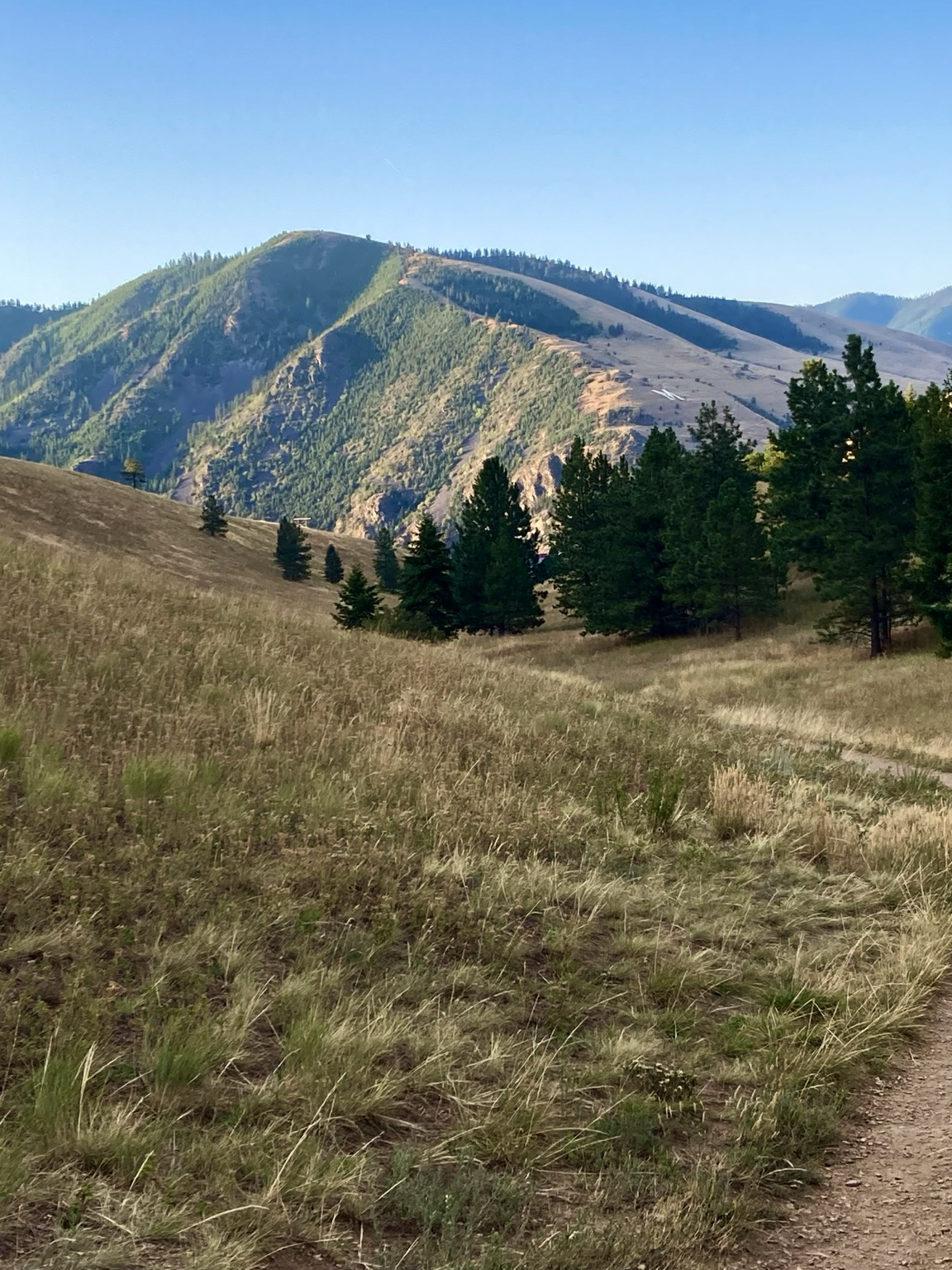
Mount Sentinel, which is really just a promontory on a bigger mountain. I’ve climbed both.
There’s a huge M on the mountain just above the foreground trees.
Unseen, the university sits at its feet. Each year, students repaint the M.
Be everwell.
#WritingLife #AmWriting #WritingCommunity #Aging #HealthyLiving #HealthyLifestyle #GetOutside #Hiking #Trails #Wildlife #HikingAdventures #Nature #NaturePhotography #NatureLover #Photography #LandscapePhotography
Alt...
A trail descends through golden grass in a shallow gulch, a stand of pine trees to the right. In the background is Mount Sentinel. Its north side on the left is steeper, more wooded, and is dotted with cliffs. Its west side on the right is more gentle and covered more in grass than trees. It also has the horizontal lines that are the remains of Glacial Lake Missoula. The clear sky is an early morning blue.
![[?]](https://files.ohai.social/accounts/avatars/109/442/865/191/846/808/original/df60dbba9571ece4.png)
Harpy eagle (Harpia harpyja) is the largest raptor in the Americas. Males & females share identical plumage, the bird's legs are as thick as a person's arm. They’re apex predators, they take iguanas, parrots, porcupines, raccoons, and even foxes and black vultures. #birds #wildlife #nature #birdsofmastodon #biology
![[?]](https://files.mastodon.social/accounts/avatars/113/594/284/246/350/110/original/c4fa29ebf91a45f2.png) CR séances Assemblée Nationale » 🤖 🌐
CR séances Assemblée Nationale » 🤖 🌐
@homohortus@mastodon.social
L’ère prométhéenne : domination de la nature, dialectique de la raison et l’oubli de Spinoza
L’#èreProméthéenne, analysée par #Adorno, #Horkheimer, #Merchant et #Anders, interroge la #dominationModerne de la #nature et la #criseDeLaRationalité. #Spinoza, pourtant, proposait déjà une voie #alternative à la #dialectiqueDeLaRaison – une voie trop souvent négligée par l’École de Francfort. #philosophie #postPolitique #postCroissance #Serres #èrePostProméthéenne L’ère…