Search results for tag #linux
![[?]](https://files.mastodon.social/accounts/avatars/114/368/991/106/654/640/original/4055052cf2bcf4e8.png)
🔐 Tor Browser 14.5.8 released — now available for all platforms
This update includes key security patches from Firefox, updated Tor (0.4.8.19), and OpenSSL (3.5.4). 🔧
Fixes include Safest mode search issues, HTTPS exception bugs, and Snowflake bridge updates. 🛠️
YEC 2025 UI changes also implemented across desktop and Android. 📱💻
🔗 https://blog.torproject.org/new-release-tor-browser-1458/
#Tor #Privacy #CyberSecurity #Firefox #OpenSource #TorBrowser #Linux #Android #iOS #TechNews #Encryption #SecurityUpdate #OpenSSL #Snowflake
![[?]](https://media.infosec.space/infosec-space/accounts/avatars/111/903/301/848/665/104/original/92fdee3f80aa1325.png)

@anselmschueler @aliceif @bill88t @BrodieOnLinux @landley yeah, and unlike #Rust. #Perl doesn't bring much to the table even on paper...
- Like the folks at @AsahiLinux did a lot of good work with Rust and speedran #Apple - #ARM64 support for #Linux...
![[?]](https://files.mastodon.social/accounts/avatars/113/635/103/853/964/473/original/0a4435eaf8d5c473.png)
nmail: Terminal-based email client for Linux and macOS https://lobste.rs/s/a2ebrr #email #linux #mac
https://github.com/d99kris/nmail
My First Contribution to Linux https://lobste.rs/s/xlqurj #linux #programming
https://vkoskiv.com/first-linux-patch/
![[?]](https://files.techhub.social/accounts/avatars/109/323/309/634/558/368/original/1d9ff9b407980217.png)

How and why EasyOS is different https://lobste.rs/s/y3yauw #linux
https://easyos.org/about/how-and-why-easyos-is-different.html
Announcing GoboLinux 017.01 - Passing the Torch https://lobste.rs/s/nsrig5 #linux
https://gobolinux.org//news/119.html
![[?]](https://media.neuromatch.social/accounts/avatars/109/559/012/727/204/229/original/7ad24f018793a08a.jpeg)
Which distribution of #Linux is the most similar to #Windows and works from scratch, without needing to use the command line? Does that even exist?
Context: I have mostly used Windows my whole life, but I'd like to use #win10eol to move some of my computers to Linux. I have tried Linux before (mostly #Ubuntu) and kept having problems, whether big or small, that wasted a lot of my time. I want to try again but do not have time to try dozens of Linux distributions. I know that if it works like Windows (i.e. same keyboard shortcuts, same settings), it will probably work for me. Any suggestions? 🙏
What on Earth Does Pointer Provenance Have to do With RCU? via @fanf https://lobste.rs/s/re3nzo #c #c++ #linux
https://people.kernel.org/paulmck/what-on-earth-does-lifetime-end-pointer-zap-have-to-do-with-rcu
The Paperweight Dilemma (2023) https://lobste.rs/s/cqcnhu #culture #hardware #linux
https://blog.mobian.org/posts/2023/09/30/paperweight-dilemma/


A Mac-like experience on Linux https://lobste.rs/s/6fhm1u #linux #mac
https://pointieststick.com/2025/10/04/a-mac-like-experience-on-linux/
![[?]](https://files.mastodon.social/accounts/avatars/109/360/345/478/716/398/original/e5c113be80cf52ef.png)
This is a screenshot of my laptop running #alpinelinux with #kdeplasma6 with #wayland
I am running #Applewin which is a Windows-based #AppleII #emulator but it is running in #Linux using the #qapple build that uses #qt6
I also have a #terminal window with my own #6502asm emulator showing the cycles counts for the code that flips the screen every 6 and 7 cycles between lo-res graphics and text mode.

Alt...
This is a screenshot of my laptop running Alpine Linux with KDE Plasma 6 in Wayland. I am running AppleWin, an Windows-based Apple II emulator, in Linux using the qapple build that uses qt6. I also have a terminal window with my own 6502 emulator showing the cycles counts for the code that flips the screen every 6 and 7 cycles between lo-res graphics and text mode.
![[?]](https://files.bitbang.social/accounts/avatars/109/451/243/609/920/113/original/733448def38e4305.png)
@pngwen OK, I have...
* K&R, C
* Crafting Interpreters, interpreters
* Several Forth books, minimalism
* Dragon Book, compilers
* Lion's book, OS development
* Art of Computer Programming, encyclopedic series on algorithms
* Gang of Four Book, Design Patterns
Am I missing anything?
![[?]](https://files.flyovercountry.social/accounts/avatars/109/390/372/615/478/805/original/d3353c377531a46c.jpg)
![[?]](https://files.defcon.social/dcsocial-s3/accounts/avatars/113/208/344/507/078/943/original/014820ad22daee1c.jpg)
TOPIC>
Useful Code
The Sequencer: Detect one-dimensional sequences in complex datasets
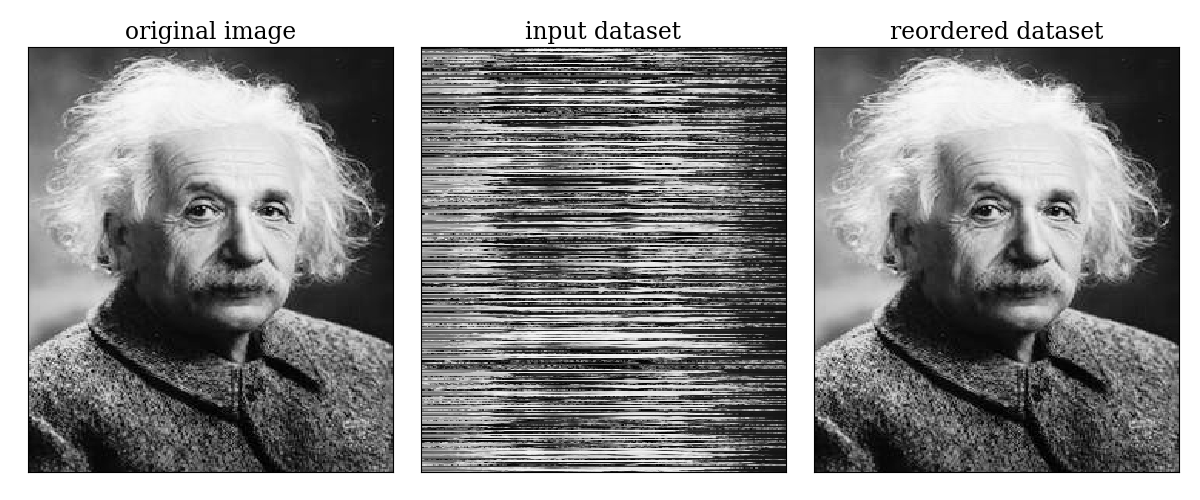
The Sequencer reveals the main sequence in a dataset if one exists. To do so, it reorders objects within a set to produce the most elongated manifold describing their similarities which are measured in a multi-scale manner and using a collection of metrics. To be generic, it combines information from four different metrics: the Euclidean Distance, the Kullback-Leibler Divergence, the Monge-Wasserstein or Earth Mover Distance, and the Energy Distance. It considers different scales of the data by dividing each object in the input data into separate parts (chunks), and estimating pair-wise similarities between the chunks. It then aggregates the information in each of the chunks into a single estimator for each metric+scale.
https://github.com/dalya/Sequencer
#space #tech #science #astronomy #code #python #unix #linux #commandline #plotting
Alt...
Shuffled image rows
The Sequencer reorders the objects in the input dataset according to a detected sequence, if such sequence exists in the dataset. A good example of a perfect one-dimensional sequence is a natural image: the rows within a natural image form a well-defined sequence. Therefore, we can shuffle the rows in a natural image, and apply the Sequencer to the shuffled dataset. The following figure shows the result of applying the Sequencer to a shuffled natural image. The left panel shows the original image. The middle panel shows the same image after we have shuffled its rows. The shuffled image serves as the input dataset to the Sequencer, where each row is considered as a separate object. The output of the Sequencer is shown in the right panel, where we reordered the rows according to the detected sequence. The Sequencer successfully identified the one-dimensional trend spanned by the different rows.
Command Line Orbit Plotting
OK Binaries Interactive Catalog
https://github.com/mb2448/ok-binaries/
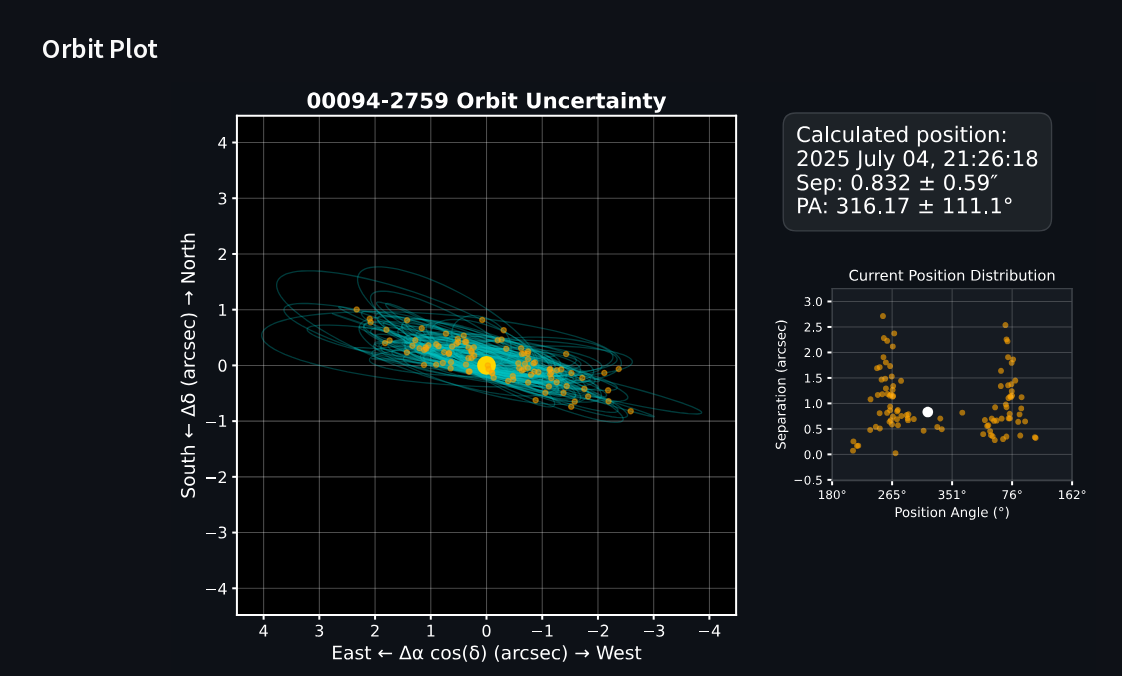
OK Binaries is a tool for identifying suitable calibration binaries from the Washington Double Star (WDS) Sixth Orbit Catalog. It calculates orbital positions at any epoch, propagates uncertainties using Monte Carlo sampling, and generates orbit plots. The web app includes automated daily updates of binary positions and a searchable interface with filters for position, magnitude, separation, and other orbital parameters. OK Binaries can be used online, as a standalone offline browser app, or via the command line.
https://github.com/mb2448/ok-binaries/
https://ok-binaries.streamlit.app/
#space #tech #science #astronomy #code #python #unix #linux #commandline #plotting
Alt...
WDS 00094-2759 - BU 391AB
HIP 761 • HD 493
Orbital Elements
Period (P) 575.65y ± 247.6
Periastron (T) 2087.66 ± 104.9
Semi-major axis (a) 1.614″ ± 0.49
Eccentricity (e) 0.5022 ± 0.31
Inclination (i) 98.72° ± 3.9
Longitude of periastron (ω) 272.7° ± 42.6
Node (Ω) 76.73° ± 6.5
Additional Information
Grade: 4 (1=Definitive, 9=Indeterminate)
Equinox: —
Last observation: 2013
Reference: Izm2019
Notes
kap 1 Scl
CLUES: Clustering tool for analyzing spectral data
CLUES (CLustering UnsupErvised with Sequencer) analyzes spectral and IFU data. This fully interpretable clustering tool uses machine learning to classify and reduce the effective dimensionality of data sets. It combines multiple unsupervised clustering methods with multiscale distance measures using Sequencer (ascl:2105.006) to find representative end-member spectra that can be analyzed with detailed mineralogical modeling and follow-up observations. CLUES has been used on Spitzer IRS data and debris disk science, and can be applied to other high-dimensional spectral data sets, including mineral spectroscopy in general areas of astrophysics and remote sensing.
https://github.com/Ompha/CLUES
https://ui.adsabs.harvard.edu/abs/2021ApJ...916...91B/abstract
https://ui.adsabs.harvard.edu/abs/2025ApJS..276...65L/abstract
#space #tech #science #astronomy #code #python #JupyterNotebook #unix #linux

Alt...
Welcome
Ha! You've stumbled upon this machine-learning classification tools for spectra and IFU data!
Linus Torvalds Lashes Out At RISC-V Big Endian Plans - Phoronix via @jmmv https://lobste.rs/s/bsf7e1 #linux #rant
https://www.phoronix.com/news/Torvalds-No-RISC-V-BE
"To upload this video, I converted it and compressed it to a smaller file-size under #linux with the free software ffmpeg and the corresponding command:
'ffmpeg -i video_in.mkv -vcodec libx265 -crf 30 video_out.mp4'
Maybe you would like to post a corresponding video on a scientifically related topic, but it is perhaps too big? Then try ffmpeg.
Just for now let's enjoy this Perseids Night Timelaps together"
2021 September 28
Night of the Perseids
* Video Credit & Copyright: Vikas Chander & Dorje Angchuk
https://www.youtube.com/channel/UCa_53XIkP1fYEbHCWoMgIrg
* Music: Tea Time via PremiumBeat
https://www.premiumbeat.com/artist/yellow-tea
Explanation:
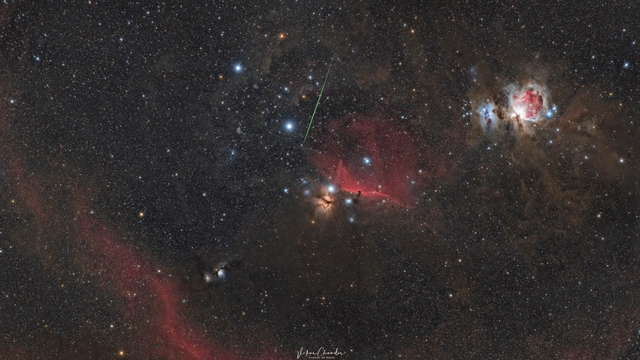
Have you ever experienced a meteor shower? To help capture the wonder, a video was taken during the peak of the recent Perseid meteor shower above the Indian Astronomical Observatory in Hanle, India, high up in the Himalayan mountains. Night descends as the video begins, with the central plane of our Milky Way Galaxy approaching from the left and Earth-orbiting satellites zipping by overhead. During the night, the flash of meteors that usually takes less than a second is artificially extended. The green glow of most meteors is typically caused by vaporizing nickel. As the video continues, Orion rises and meteors flare above the 2-meter Himalayan Chandra Telescope and the seven barrels of the High Energy Gamma Ray Telescope (Hagar). The 2 minute 30 second movie ends with the Sun rising, preceded by a false dawn of zodiacal light.
https://apod.nasa.gov/apod/ap210928.html
#space #galaxy #perseids #astrophotography #photography #science #astronomy #nature #NASA
Alt...
2021 September 28
Night of the Perseids
* Video Credit & Copyright: Vikas Chander & Dorje Angchuk
* Music: Tea Time via PremiumBeat
Explanation:
Have you ever experienced a meteor shower? To help capture the wonder, a video was taken during the peak of the recent Perseid meteor shower above the Indian Astronomical Observatory in Hanle, India, high up in the Himalayan mountains. Night descends as the video begins, with the central plane of our Milky Way Galaxy approaching from the left and Earth-orbiting satellites zipping by overhead. During the night, the flash of meteors that usually takes less than a second is artificially extended. The green glow of most meteors is typically caused by vaporizing nickel. As the video continues, Orion rises and meteors flare above the 2-meter Himalayan Chandra Telescope and the seven barrels of the High Energy Gamma Ray Telescope (Hagar). The 2 minute 30 second movie ends with the Sun rising, preceded by a false dawn of zodiacal light.
Authors & editors: Robert Nemiroff (MTU) & Jerry Bonnell (UMCP)
NASA Official: Phillip Newman Specific rights apply.
NASA Web Privacy Policy and Important Notices
A service of: ASD at NASA / GSFC
& Michigan Tech. U.
![[?]](https://kolektiva.social/system/accounts/avatars/109/386/893/837/446/750/original/8d0a5fd51889b89b.png)
People complain that Linux is complicated or breaks easily. Maybe, but not my experience. Windows on the other hand... it is unstable, buggy and very hard to use. It also seems unfixable. At least when I have a problem with my mint installation, someone can sort it out for me.
Maybe people who use Linux do weird and wonderful things so they are always finding edge cases. I promise you if you just use it for word processing, your emails, watching films and browsing the web it is so much better than windows.
#Linux, #Windows, #AnnoyedThatIHaveToRestartMyMachineBecauseAnUpdateOrSomethingBrokeSomethingElseMaybe
![[?]](https://media.social.qoto.org/accounts/avatars/000/536/037/original/586c7abcda18ed45.jpg)
@aburka #Alternative titles for this pic:
Developing Tech, not Developing People.
#Social Tech without the Social interaction regularly in Society
Playing #Playstation #Linux 
and not really improving Society 🔃
Talking to #computers all day.
Unhealthy. Incomplete #Harmony.
#Mastodon as an empty software with nobody doing the social work / organising audio chat events.
What’s the difference between files and directories in a Unix-like filesystem? https://lobste.rs/s/i1dy7u #linux #unix
https://jack23247.github.io/blog/linux/inodes/
![[?]](https://cdn.social.linux.pizza/system/accounts/avatars/000/074/143/original/7867Kaleidoscope_07263244.png)
![[?]](https://cdn.masto.host/dobbstown/accounts/avatars/110/608/177/495/931/064/original/8e8120c1eec2309c.jpg)
I don't play video games, this probably popped up for me because I follow #linux , but my monitor is 1920x1080 and works great for what I do with it. The most intense thing is probably photo editing, as I'm an amateur art photographer.
I have also done some puttering around in CAD with it in the past, but seeing as I have no use for CAD I haven't used a CAD program in a bit.

![[?]](https://cdn.masto.host/retrogaidencom/accounts/avatars/112/281/202/751/309/557/original/4e2344e9c012a474.gif)
@franklesniak yet noone I know wants that shit - not even for free - because #Qualcomm refuses to provide proper #mainline #Linux support for these.
Bcachefs removed from the mainline kernel https://lobste.rs/s/bt97wm #linux
https://lwn.net/Articles/1040120/
io_uring is not an event system (2021) via @RunxiYu https://lobste.rs/s/w8sx2z #linux #performance
https://despairlabs.com/blog/posts/2021-06-16-io-uring-is-not-an-event-system/
![[?]](https://assets.toot.cafe/accounts/avatars/000/136/992/original/afc2a7f1365fe462.jpg)
I can't find anything about this online. Any ideas???
Alt...
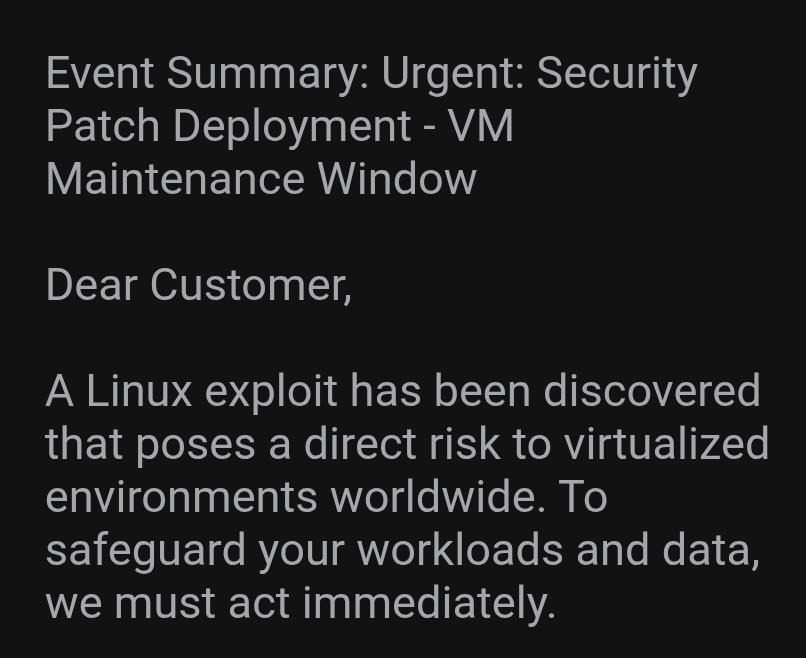
Event Summary: Urgent: Security Patch Deployment - VM Maintenance Window
Dear Customer,
A Linux exploit has been discovered that poses a direct risk to virtualized environments worldwide. To safeguard your workloads and data, we must act immediately.