Search results for tag #education
![[?]](https://s3.masto.ai/accounts/avatars/109/303/982/217/898/173/original/84b53833e9214e09.png)
The new directive goes further with more specific requirements. The cable says consular officials must consider a range of specific details about people seeking #visas, including their #age, #health, #family status, #finances, #education, #skills & any past use of public assistance regardless of the country. It also says they should assess applicants’ #English proficiency & can do so by conducting interviews in English.
#Trump #law #immigration #discrimination #ableism #EconomicDiscrimination
![[?]](https://cdn.masto.host/zirkus/accounts/avatars/109/363/471/129/904/593/original/366278842762c266.png)
The University of Nottingham is suspending its modern language courses with immediate effect, but this is not the first nor will it be the last university to reduce or end its language courses (Nottingham is also suspending a range of other subjects).
With the continued reduction in language teaching across the education sector its hardly a surprise, but as a society if we think AI & Google Translate are a satisfactory alternatives we will likely be disappointed, to say the least.
![[?]](https://files.mastodon.social/accounts/avatars/113/635/103/853/964/473/original/0a4435eaf8d5c473.png)
Software design patterns; Are there test cases or recipes for specific patterns? https://lobste.rs/s/ityd7h #ask #education #programming
Special Educational Needs & Disabilities provision is clearly in need of major reform;
with the National Audit Office suggesting its financially unsustainable & more and more families & their children being let down by the SEND system there is widespread recognition of crisis.
But rather than focus on the children, I cannot help but think this actually reflects a widespread failure of our education system to properly embrace learning diversity?
Very displeased with one of my Alma Maters!
#Cornell Reaches Deal with #Trump Admin to Restore #Research #Funding
The Ivy League #university had warned of #layoffs after the Trump admin stripped it of funds this year. The cuts were among the deepest in higher #education.
#law #FirstAmendment #AcademicFreedom #extortion
https://www.nytimes.com/2025/11/07/us/cornell-deal-trump-administration.html?smid=nytcore-ios-share&referringSource=articleShare
![[?]](https://cdn.toad.social/accounts/avatars/109/445/054/979/275/176/original/f4cd3985267c0654.jpg)

"Black people along with majorities of all people of color helped push the blue wave.
Together, these coalitions helped turn the tide, not just for a party, but for a vision of a pluralistic, multiracial democracy."
Jemar Tisby offers a graph breaking down votes in the Virginia governor's election by gender and ethnicity (see below).
#BlueWave #Trump #Republicans #Democrats #race #ethnicity #gender #education
/3

Alt...
A graph breaking down votes in the Virginia governor's election by gender and ethnicity, showing that white men were the one demographic that voted in majority for the Republican
"The racial divide runs parallel to an educational one—especially among white voters. White men without college degrees supported the Republican candidate by a staggering 71%, while even college-educated white men gave her a majority at 52%. White women, however, split more evenly.
Just over half (54%) voted for the Democrat, and that number jumped to 65% among white women with graduate degrees."
#BlueWave #Trump #Republicans #Democrats #race #ethnicity #gender #education
/2
"From coast to coast, voters delivered decisive victories that political analysts quickly dubbed a 'blue wave.'
But beneath the headlines and hashtags lies a deeper story about race, gender, and education—about who showed up, who shifted, and what these patterns say about the future of democracy in America."
~ Jemar Tisby
#BlueWave #Trump #Republicans #Democrats #race #ethnicity #gender #education
/1
https://jemartisby.substack.com/p/the-blue-wave-and-the-racial-color
![[?]](https://files.defcon.social/dcsocial-s3/accounts/avatars/113/208/344/507/078/943/original/014820ad22daee1c.jpg)
2020 May 11
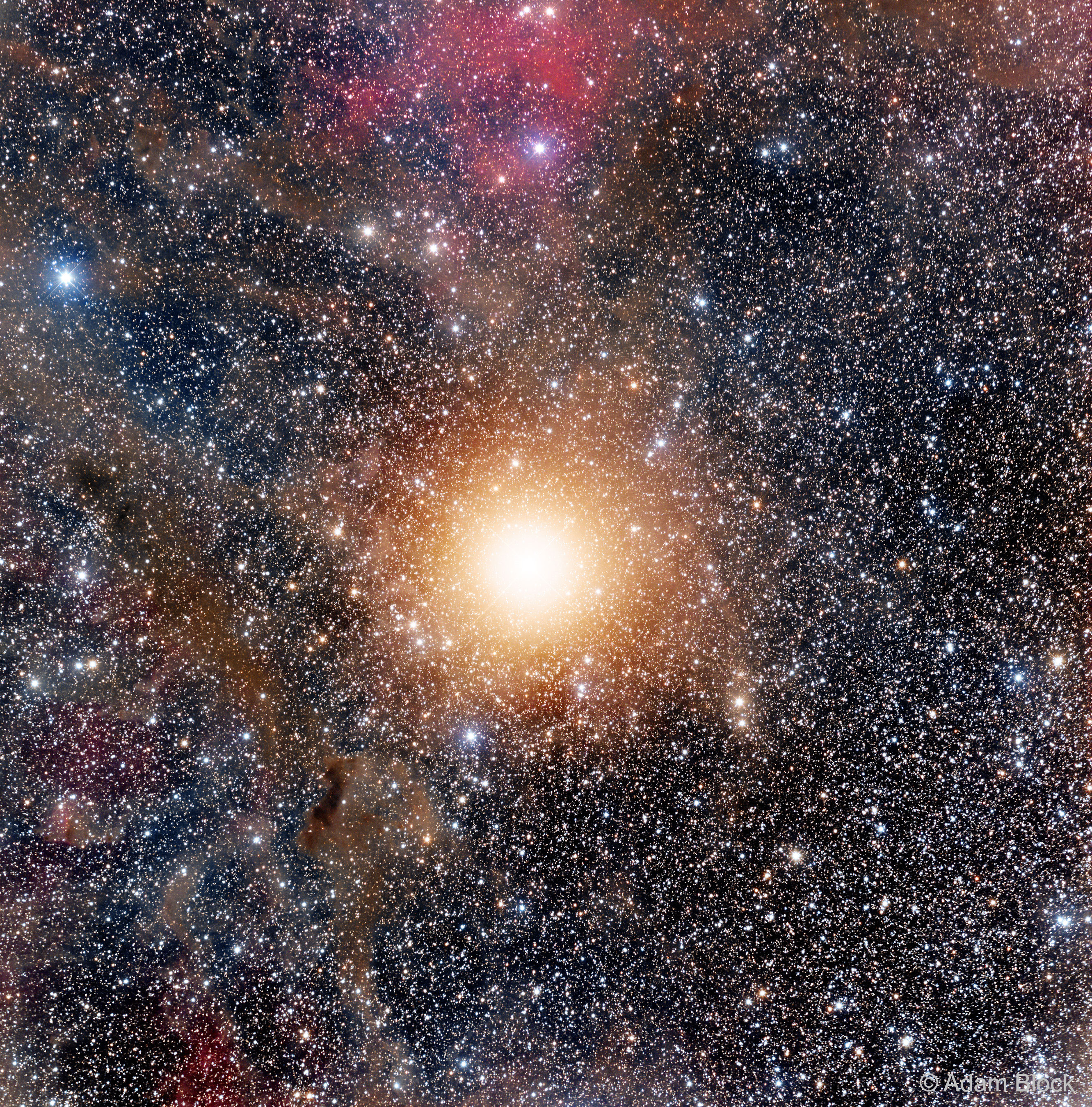
Behind Betelgeuse
* Image Credit & Copyright: Adam Block, Steward Observatory, University of Arizona
https://www.adamblockphotos.com/
https://astro.arizona.edu/
Explanation:
What's behind Betelgeuse? One of the brighter and more unusual stars in the sky, the red supergiant star Betelgeuse can be found in the direction of famous constellation Orion. Betelgeuse, however, is actually well in front of many of the constellation's other bright stars, and also in front of the greater Orion Molecular Cloud Complex. Numerically, light takes about 700 years to reach us from Betelgeuse, but about 1,300 years to reach us from the Orion Nebula and its surrounding dust and gas. All but the largest telescopes see Betelgeuse as only a point of light, but a point so bright that the inherent blurriness created by the telescope and Earth's atmosphere make it seem extended. In the featured long-exposure image, thousands of stars in our Milky Way Galaxy can be seen in the background behind Betelgeuse, as well as dark dust from the Orion Molecular Cloud, and some red-glowing emission from hydrogen gas on the outskirts of the more distant Lambda Orionis Ring.
Betelgeuse has recovered from appearing unusually dim over the past six months (2020), but is still expected to explode in a spectacular supernova sometime in the next (about) 100,000 years.
https://apod.nasa.gov/apod/ap200511.html
#space #nova #astrophotography #photography #science #astronomy #physics #nature #NASA #education
Alt...
2020 May 11
Behind Betelgeuse
* Image Credit & Copyright: Adam Block, Steward Observatory, University of Arizona
Explanation:
What's behind Betelgeuse? One of the brighter and more unusual stars in the sky, the red supergiant star Betelgeuse can be found in the direction of famous constellation Orion. Betelgeuse, however, is actually well in front of many of the constellation's other bright stars, and also in front of the greater Orion Molecular Cloud Complex. Numerically, light takes about 700 years to reach us from Betelgeuse, but about 1,300 years to reach us from the Orion Nebula and its surrounding dust and gas. All but the largest telescopes see Betelgeuse as only a point of light, but a point so bright that the inherent blurriness created by the telescope and Earth's atmosphere make it seem extended. In the featured long-exposure image, thousands of stars in our Milky Way Galaxy can be seen in the background behind Betelgeuse, as well as dark dust from the Orion Molecular Cloud, and some red-glowing emission from hydrogen gas on the outskirts of the more distant Lambda Orionis Ring. Betelgeuse has recovered from appearing unusually dim over the past six months, but is still expected to explode in a spectacular supernova sometime in the next (about) 100,000 years.
Authors & editors: Robert Nemiroff (MTU) & Jerry Bonnell (UMCP)
NASA Official: Phillip Newman Specific rights apply.
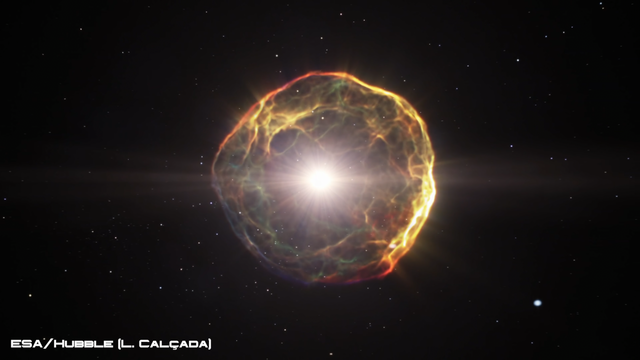
What Will It Look Like When Betelgeuse Goes Supernova?
640 light years away, there is a colossal star that is on the verge of exploding in a magnificent supernova. But what will it look like from Earth?
Video Credit:
V101 SPACE
https://www.youtube.com/@V101SPACE
To upload this video, I converted it and compressed it to less than a tenth of the original size under linux with the free software ffmpeg and the corresponding command:
'ffmpeg -i video_in.webm -vcodec libx265 -crf 40 video_out.mp4'
Maybe you would like to post a corresponding video on a scientifically related topic, but it is perhaps too big? Then try ffmpeg.
Often the compression factor '-crf 28' is enough, but in this particular case I had to go up to '-crf 40', because the original is a 4K UHD video and has a file size of 377MB. The compressed version here has a file size of only 28.4MB .
Of course, the quality of the video decreases, but it is enough to illustrate the topic.
Want to see the video in all its glory? Then visit the channel https://www.youtube.com/@V101SPACE and let Rob explain exciting space-related topics to you
#space #nova #astrophotography #photography #science #astronomy #physics #nature #NASA #ESA #education #UNIX #LINUX #FOSS #FSF
Alt...
640 light years away, there is a colossal star that is on the verge of exploding in a magnificent supernova. But what will it look like from Earth?
Video Credit:
V101 SPACE
https://www.youtube.com/@V101SPACE
To upload this video, I converted it and compressed it to less than a tenth of the original size under linux with the free software ffmpeg and the corresponding command:
'ffmpeg -i video_in.webm -vcodec libx265 -crf 40 video_out.mp4'
Maybe you would like to post a corresponding video on a scientifically related topic, but it is perhaps too big? Then try ffmpeg. Often the compression factor 'crf -28' is enough, but in this particular case I had to go up to 'crf -40', because the original is a 4K UHD video and has a file size of 377MB. The compressed version here has a file size of only 28.4MB .
Of course, the quality of the video decreases, but it is enough to illustrate the topic.
Want to see the video in all its glory? Then visit the channel https://www.youtube.com/@V101SPACE and let Rob explain exciting space-related topics to you
2024 April 3
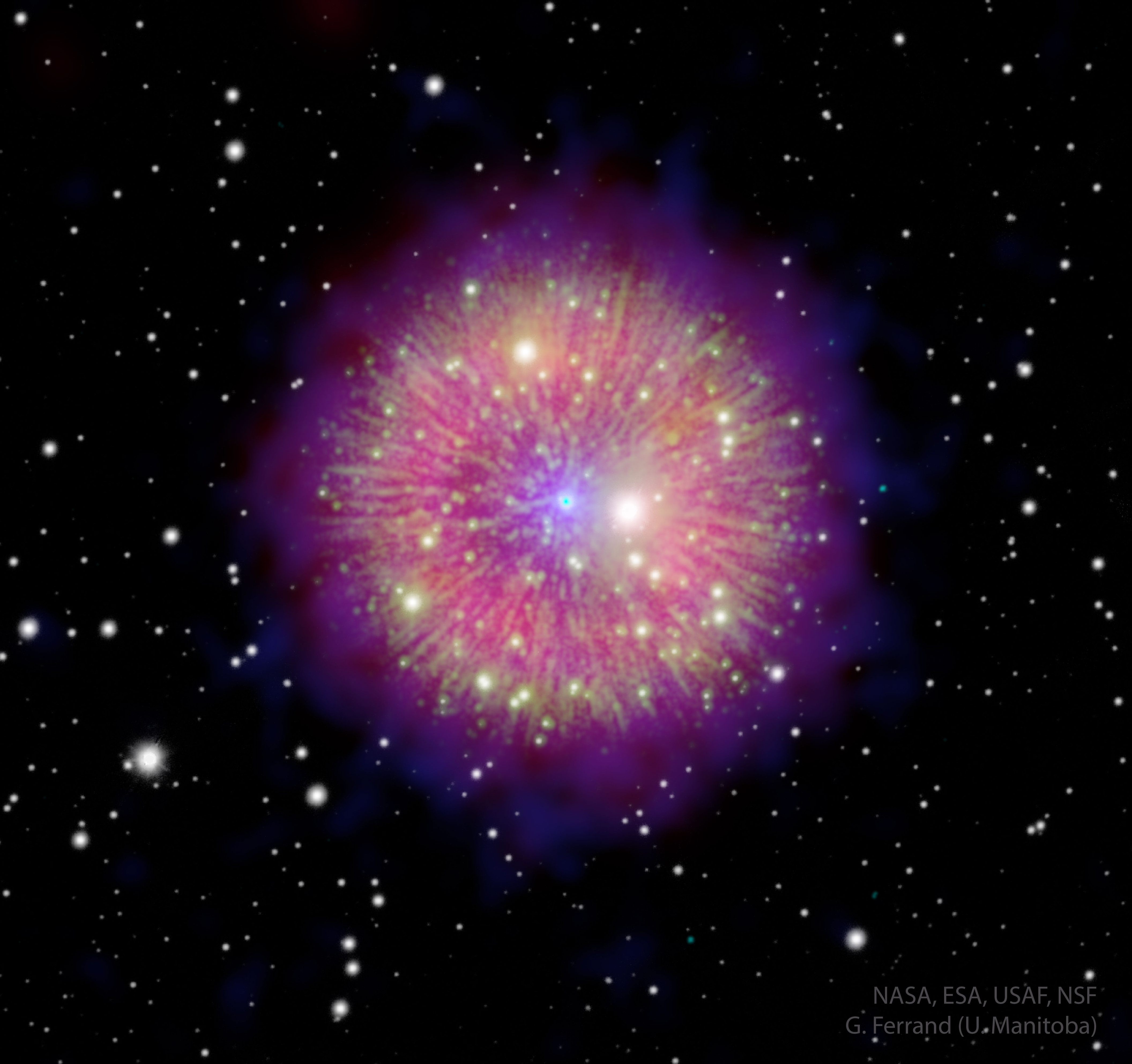
Unusual Nebula Pa 30
* Image Credit: NASA, ESA, USAF, NSF
https://umanitoba.ca/science/physics-and-astronomy
https://physics.dartmouth.edu/
https://www.nsf.gov/
https://www.af.mil/
https://www.esa.int/
https://www.nasa.gov/;
* Processing: G. Ferrand https://gillesferrand.github.io/ (U. Manitoba), J. English http://www2.physics.umanitoba.ca/u/english/ (U. Manitoba), R. A. Fesen https://physics.dartmouth.edu/people/robert-fesen (Dartmouth), C. Treyturik (U. Manitoba);
* Text: G. Ferrand & J. English
Explanation:
What created this unusual celestial firework? The nebula, dubbed Pa 30, appears in the same sky direction now as a bright "guest star" did in the year 1181. Although Pa 30's filaments look similar to that created by a nova (for example GK Per), and a planetary nebula (for example NGC 6751), some astronomers now propose that it was created by a rare type of supernova: a thermonuclear Type Iax, and so is (also) named SN 1181. In this model, the supernova was not the result of the detonation of a single star, but rather a blast that occurred when two white dwarf stars spiraled together and merged. The blue dot in the center is hypothesized to be a zombie star, the remnant white dwarf that somehow survived this supernova-level explosion. The featured image combines images and data obtained with infrared (WISE), visible (MDM, Pan-STARRS), and X-ray (Chandra, XMM) telescopes. Future observations and analyses may tell us more.
https://apod.nasa.gov/apod/ap240403.html
#space #nova #astrophotography #photography #science #astronomy #physics #nature #NASA #education
Alt...
2024 April 3
A nebula is shown that appears like a firework. Radial filaments connect a glowing halo to a star in the center that appears as a blue dot.
Unusual Nebula Pa 30
* Image Credit: NASA, ESA, USAF, NSF;
* Processing: G. Ferrand (U. Manitoba), J. English (U. Manitoba), R. A. Fesen (Dartmouth), C. Treyturik (U. Manitoba);
* Text: G. Ferrand & J. English
Explanation:
What created this unusual celestial firework? The nebula, dubbed Pa 30, appears in the same sky direction now as a bright "guest star" did in the year 1181. Although Pa 30's filaments look similar to that created by a nova (for example GK Per), and a planetary nebula (for example NGC 6751), some astronomers now propose that it was created by a rare type of supernova: a thermonuclear Type Iax, and so is (also) named SN 1181. In this model, the supernova was not the result of the detonation of a single star, but rather a blast that occurred when two white dwarf stars spiraled together and merged. The blue dot in the center is hypothesized to be a zombie star, the remnant white dwarf that somehow survived this supernova-level explosion. The featured image combines images and data obtained with infrared (WISE), visible (MDM, Pan-STARRS), and X-ray (Chandra, XMM) telescopes. Future observations and analyses may tell us more.
Authors & editors: Robert Nemiroff (MTU) & Jerry Bonnell (UMCP)
NASA Official: Amber Straughn Specific rights apply.
2021 August 22
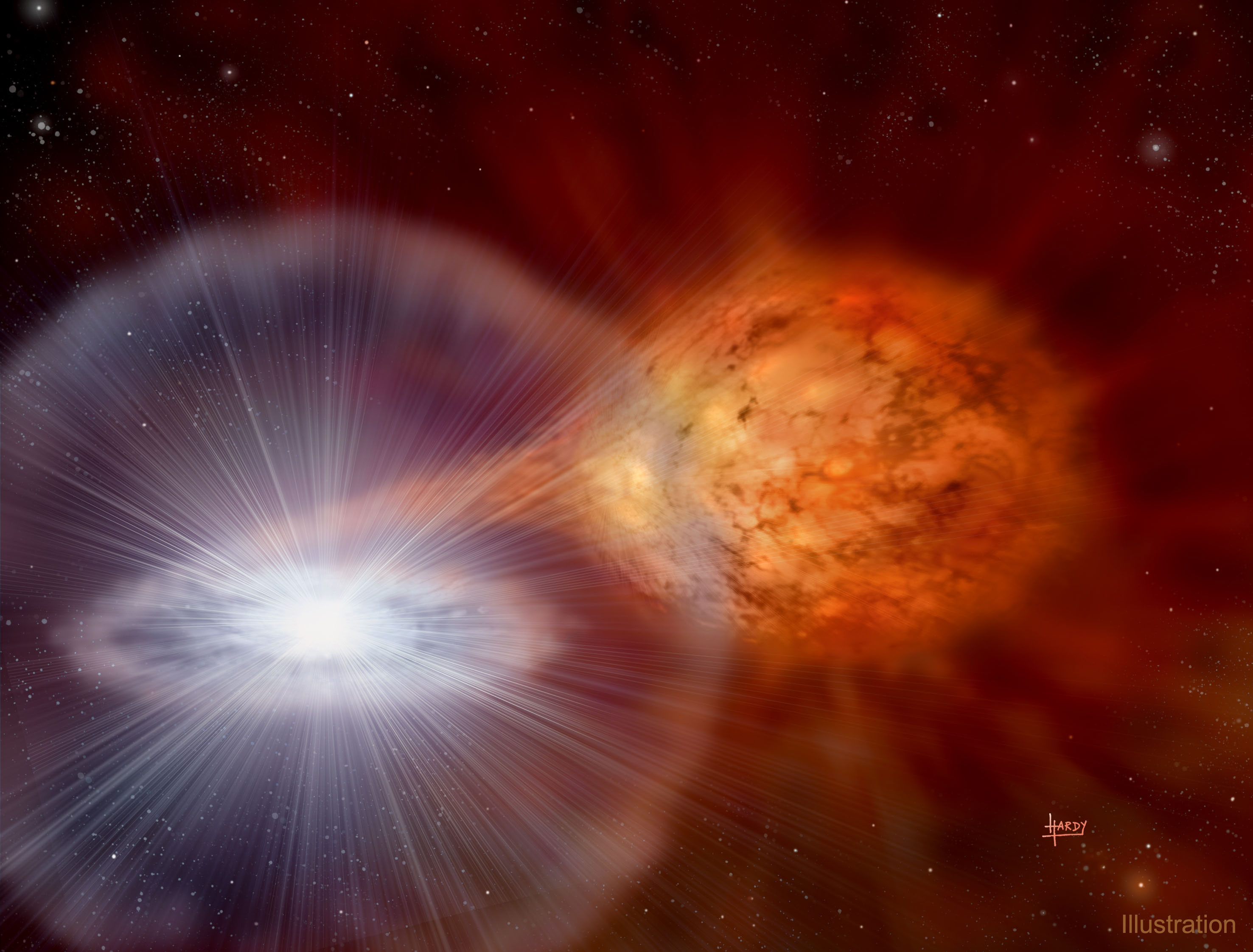
The picture shows an illustration of binary star system RS Ophiuchus during a nova-causing explosion.
Explosions from White Dwarf Star RS Oph
* Illustration Credit & Copyright: David A. Hardy & PPARC
https://www.astroart.org/hardy-profile
https://en.wikipedia.org/wiki/Particle_Physics_and_Astronomy_Research_Council
Explanation:
Spectacular explosions keep occurring in the binary star system named RS Ophiuchi. Every 20 years or so, the red giant star dumps enough hydrogen gas onto its companion white dwarf star to set off a brilliant thermonuclear explosion on the white dwarf's surface. At about 5,000 light years distant, the resulting nova explosions cause the RS Oph system to brighten up by a huge factor and become visible to the unaided eye. The red giant star is depicted on the right of the above drawing, while the white dwarf is at the center of the bright accretion disk on the left. As the stars orbit each other, a stream of gas moves from the giant star to the white dwarf. Astronomers speculate that at some time in the next 100,000 years, enough matter will have accumulated on the white dwarf to push it over the Chandrasekhar Limit, causing a much more powerful and final explosion known as a supernova. Starting early this month, RS Oph was again seen exploding in a bright nova.
https://ui.adsabs.harvard.edu/abs/2001ApJ...558..323H/abstract
https://apod.nasa.gov/apod/ap210822.html
#space #nova #astrophotography #photography #science #astronomy #physics #nature #NASA #education
Alt...
2021 August 22
The picture shows an illustration of binary star system RS Ophiuchus during a nova-causing explosion.
Explosions from White Dwarf Star RS Oph
* Illustration Credit & Copyright: David A. Hardy & PPARC
Explanation:
Spectacular explosions keep occurring in the binary star system named RS Ophiuchi. Every 20 years or so, the red giant star dumps enough hydrogen gas onto its companion white dwarf star to set off a brilliant thermonuclear explosion on the white dwarf's surface. At about 5,000 light years distant, the resulting nova explosions cause the RS Oph system to brighten up by a huge factor and become visible to the unaided eye. The red giant star is depicted on the right of the above drawing, while the white dwarf is at the center of the bright accretion disk on the left. As the stars orbit each other, a stream of gas moves from the giant star to the white dwarf. Astronomers speculate that at some time in the next 100,000 years, enough matter will have accumulated on the white dwarf to push it over the Chandrasekhar Limit, causing a much more powerful and final explosion known as a supernova. Starting early this month, RS Oph was again seen exploding in a bright nova.
Authors & editors: Robert Nemiroff (MTU) & Jerry Bonnell (UMCP)
NASA Official: Phillip Newman Specific rights apply.
NASA Web Privacy Policy and Important Notices
A service of: ASD at NASA / GSFC
& Michigan Tech. U.
"The extreme temporary light emissions of a nova are often visible to the naked eye from Earth. Even with several spectacular visible phenomena, such as this night sky, the nova remains recognizable to the trained eye. Due to their short-term glow and later dimming, it seemed to earlier cultures as if there were celestial bodies that could appear and disappear out of nowhere. In ancient China, astronomers called these 'Guest Stars' More on this in the next post"
2021 August 16
Perseid Meteor, Red Sprites, and Nova RS Ophiuchus
* Image Credit & Copyright: Daniel Korona
Explanation:
This was an unusual sky. It wasn't unusual because of the central band the Milky Way Galaxy, visible along the image left. Most dark skies show part of the Milky Way. It wasn't unusual because of the bright meteor visible on the upper right. Many images taken during last week's Perseid Meteor Shower show meteors, although this Perseid was particularly bright. This sky wasn't unusual because of the red sprites, visible on the lower right. Although this type of lightning has only been noted in the past few decades, images of sprites are becoming more common. This sky wasn't unusual because of the nova, visible just above the image center. Novas bright enough to be seen with the unaided eye occur every few years, with pictured Nova RS Ophiuchus discovered about a week ago. What was most unusual, though, was to capture all these things together, in a single night, on a single sky. The unusual sky occurred above Zacatecas, Mexico.
https://apod.nasa.gov/apod/ap210816.html
#space #nova #astrophotography #photography #science #astronomy #physics #nature #NASA #education
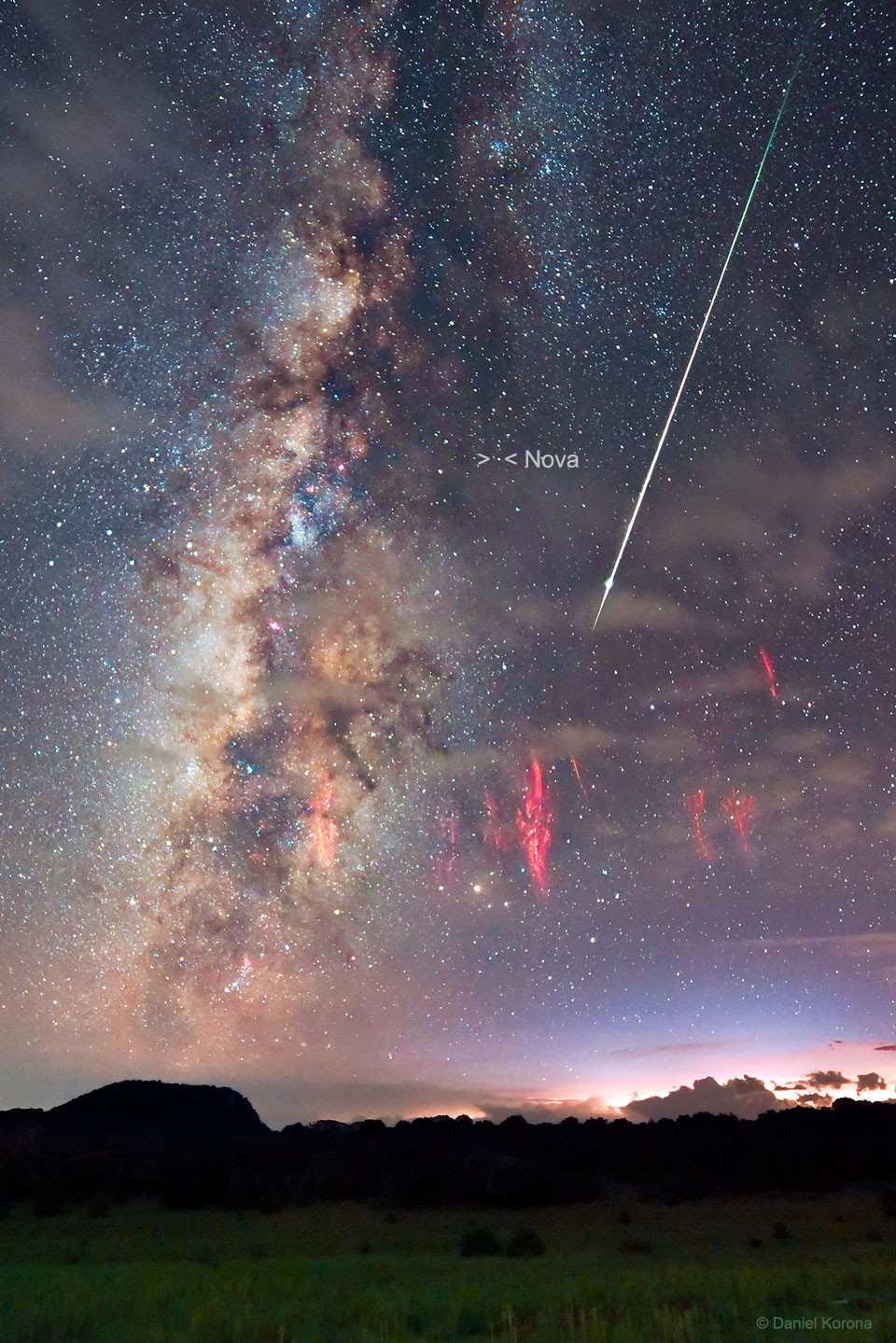
Alt...
2021 August 16
Perseid Meteor, Red Sprites, and Nova RS Ophiuchus
* Image Credit & Copyright: Daniel Korona
Explanation:
This was an unusual sky. It wasn't unusual because of the central band the Milky Way Galaxy, visible along the image left. Most dark skies show part of the Milky Way. It wasn't unusual because of the bright meteor visible on the upper right. Many images taken during last week's Perseid Meteor Shower show meteors, although this Perseid was particularly bright. This sky wasn't unusual because of the red sprites, visible on the lower right. Although this type of lightning has only been noted in the past few decades, images of sprites are becoming more common. This sky wasn't unusual because of the nova, visible just above the image center. Novas bright enough to be seen with the unaided eye occur every few years, with pictured Nova RS Ophiuchus discovered about a week ago. What was most unusual, though, was to capture all these things together, in a single night, on a single sky. The unusual sky occurred above Zacatecas, Mexico.
Authors & editors: Robert Nemiroff (MTU) & Jerry Bonnell (UMCP)
NASA Official: Phillip Newman Specific rights apply.
NASA Web Privacy Policy and Important Notices
A service of: ASD at NASA / GSFC
& Michigan Tech. U.
Guest star (astronomy)
From Wikipedia, the free encyclopedia
In Chinese astronomy, a guest star (Chinese: pinyin: kèxīng) is a star which has suddenly appeared in a place where no star had previously been observed and becomes invisible again after some time. The term is a literal translation from ancient Chinese astronomical records.
Modern astronomy recognizes that guest stars are manifestations of cataclysmic variable stars: novae and supernovae. The term "guest star" is used in the context of ancient records, since the exact classification of an astronomical event in question is based on interpretations of old records, including inference, rather than on direct observations.
In ancient Chinese astronomy, guest stars were one of the three types of highly transient objects (bright heavenly bodies). The other two were comets with tails (Chinese: pinyin: huìxīng; lit. 'broom star') and comets without tails (Chinese: pinyin: beìxīng; lit. 'fuzzy star'), with the former term being used for all comets in modern astronomy.
The earliest Chinese record of guest stars is contained in Han Shu,the history of Han dynasty (206 BC – AD 220), and all subsequent dynastic histories had such records. These contain one of the clearest early descriptions consistent with a supernova, posited to be left over by object SN 185, thus identified as a supernova remnant of the exact year AD 185. Chronicles of the contemporary Europeans are more vague when consulted for supernovae candidates. Whether this was due to the weather or other reasons, astronomers have questioned why the remnant attributed to Chinese observations of a guest star in AD 1054 (see SN 1054) is missing from the European records.
https://en.wikipedia.org/wiki/Historical_comet_observations_in_China
https://en.wikipedia.org/wiki/Guest_star_(astronomy)
#space #nova #astrophotography #photography #science #astronomy #physics #history #nature #NASA #education #China

Alt...
The guest star reported by Chinese astronomers in 1054 and cited in the highlighted passages in this text from 1414 is identified as SN 1054
"Obviously, the ancient document shown in the previous post is a testimony of the famous ancient supernova SN 1054"
The Crab Nebula is an expanding remnant of a star's supernova explosion. Japanese and Chinese astronomers recorded this violent event nearly 1,000 years ago in 1054 AD, as did likely the Native Americans. The glowing relic has been expanding since the star exploded, and it is now approximately 11 light-years in width.
Constellation: Taurus
Distance: 6,500 light-years (2.0 kiloparsecs)
Animation showing the Crab Supernova explosion and its remant.
* Animation Credit:
ESA/Hubble (M. Kornmesser & L. L. Christensen)
#space #nova #astrophotography #photography #science #astronomy #physics #nature #history #NASA #education
Oct 18, 2019
The Tycho Supernova: Death of a Star - NASA
* Image Credit: X-ray: NASA/CXC/RIKEN & GSFC/T. Sato et al; Optical: DSS
Explanation:
In 1572, Danish astronomer Tycho Brahe was among those who noticed a new bright object in the constellation Cassiopeia. Adding fuel to the intellectual fire that Copernicus started, Tycho showed this “new star” was far beyond the Moon, and that it was possible for the universe beyond the Sun and planets to change.
Astronomers now know that Tycho’s new star was not new at all. Rather it signaled the death of a star in a supernova, an explosion so bright that it can outshine the light from an entire galaxy. This particular supernova was a Type Ia, which occurs when a white dwarf star pulls material from, or merges with, a nearby companion star until a violent explosion is triggered. The white dwarf star is obliterated, sending its debris hurtling into space.
In its two decades of operation, NASA’s Chandra X-ray Observatory has captured unparalleled X-ray images of many supernova remnants.
Chandra reveals an intriguing pattern of bright clumps and fainter areas in Tycho. What caused this thicket of knots in the aftermath of this explosion? Did the explosion itself cause this clumpiness, or was it something that happened afterward?
https://www.nasa.gov/image-article/tycho-supernova-death-of-star/
#space #nova #astrophotography #photography #science #astronomy #physics #nature #NASA #education
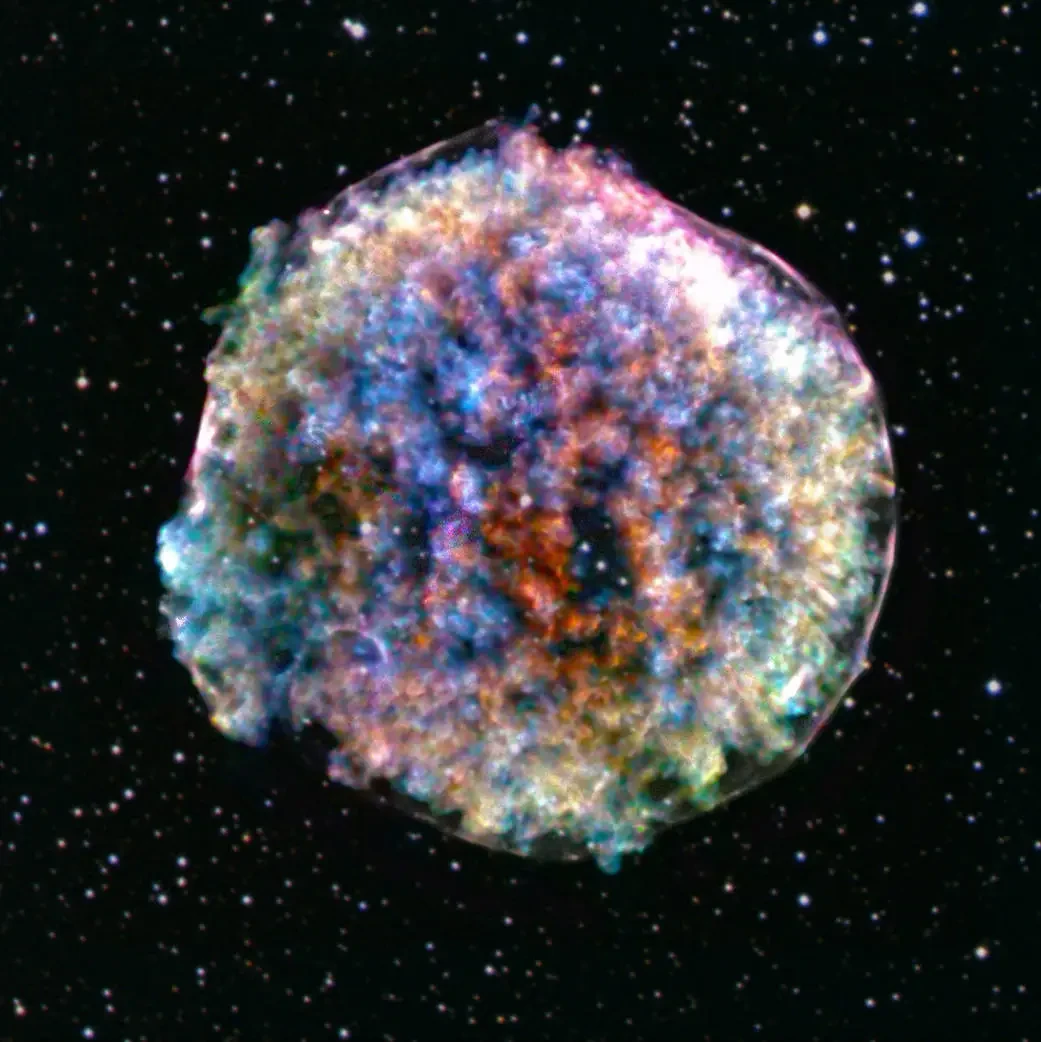
Alt...
This latest image of Tycho from Chandra is providing clues. To emphasize the clumps in the image and the three-dimensional nature of Tycho, scientists selected two narrow ranges of X-ray energies to isolate material (silicon, colored red) moving away from Earth, and moving towards us (also silicon, colored blue). The other colors in the image (yellow, green, blue-green, orange and purple) show a broad range of different energies and elements, and a mixture of directions of motion. In this new composite image, Chandra’s X-ray data have been combined with an optical image of the stars in the same field of view from the Digitized Sky Survey.
Image Credit: X-ray: NASA/CXC/RIKEN & GSFC/T. Sato et al; Optical: DSS
Webb Reveals Never-Before-Seen Details in Cassiopeia A - NASA
[...]
Editor’s Note: The story below has been updated to clarify that the supernova was 340 years ago from Earth’s perspective.
The explosion of a star is a dramatic event, but the remains the star leaves behind can be even more dramatic. A new mid-infrared image from NASA’s James Webb Space Telescope provides one stunning example. It shows the supernova remnant Cassiopeia A (Cas A), created by a stellar explosion 340 years ago from Earth’s perspective. Cas A is the youngest known remnant from an exploding, massive star in our galaxy, which makes it a unique opportunity to learn more about how such supernovae occur.
“Cas A represents our best opportunity to look at the debris field of an exploded star and run a kind of stellar autopsy to understand what type of star was there beforehand and how that star exploded,” said Danny Milisavljevic of Purdue University in West Lafayette, Indiana, principal investigator of the Webb program that captured these observations.
“Compared to previous infrared images, we see incredible detail that we haven’t been able to access before,” added Tea Temim of Princeton University in Princeton, New Jersey, a co-investigator on the program.
Cassiopeia A is a prototypical supernova remnant that has been widely studied by a number of ground-based and space-based observatories, including NASA’s Chandra X-ray Observatory. The multi-wavelength observations can be combined to provide scientists with a more comprehensive understanding of the remnant.
[...]
Perhaps most prominently, a loop represented in green extends across the right side of the central cavity. “We’ve nicknamed it the Green Monster in honor of Fenway Park in Boston. If you look closely, you’ll notice that it’s pockmarked with what look like mini-bubbles,” said Milisavljevic.
[...]
https://www.nasa.gov/universe/webb-reveals-never-before-seen-details-in-cassiopeia-a/
#space #nova #astrophotography #photography #science #astronomy #physics #nature #NASA #education
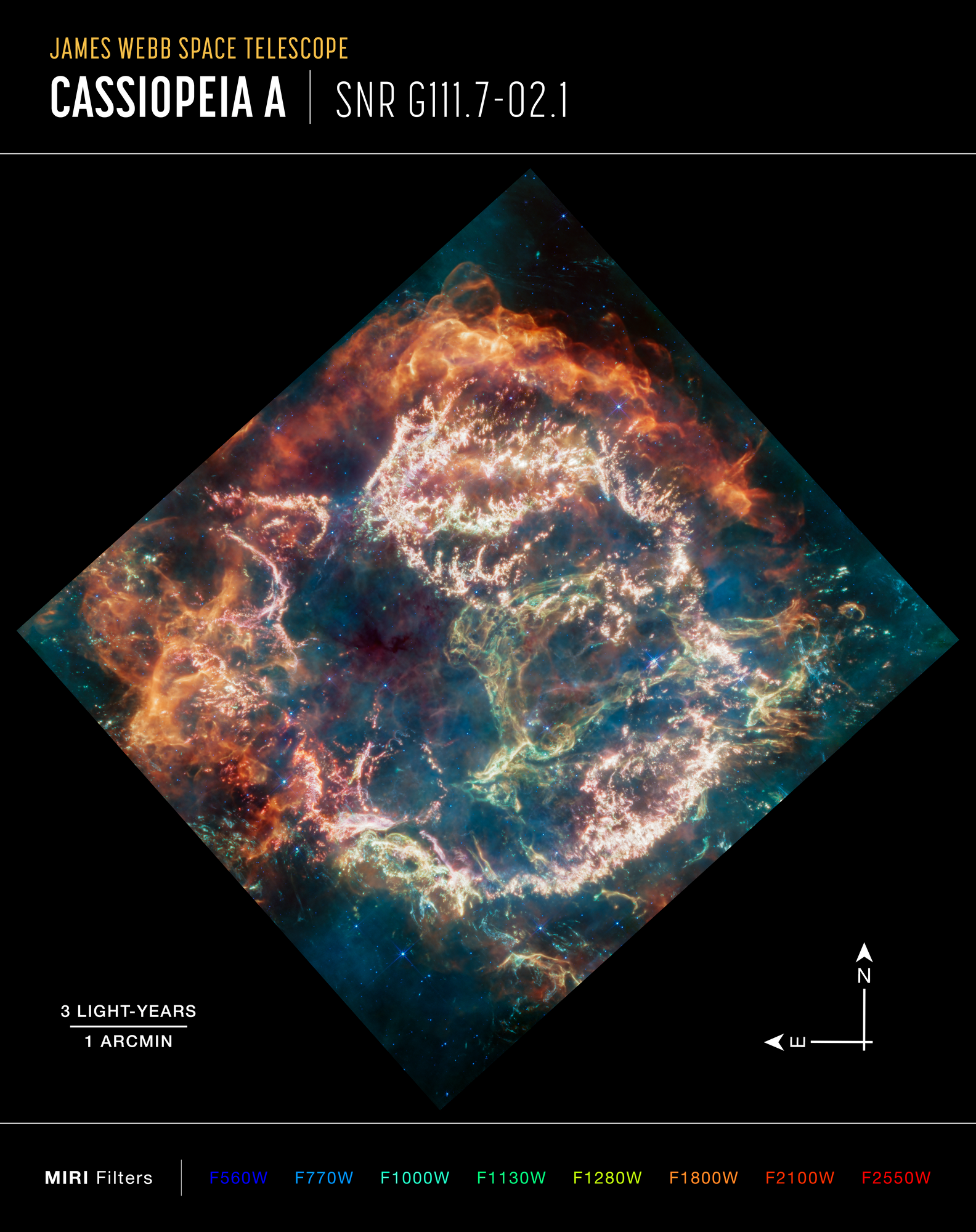
Alt...
Cassiopeia A (Cas A) is a supernova remnant located about 11,000 light-years from Earth in the constellation Cassiopeia. It spans approximately 10 light-years. This new image uses data from Webb’s Mid-Infrared Instrument (MIRI) to reveal Cas A in a new light.
On the remnant’s exterior, particularly at the top and left, lie curtains of material appearing orange and red due to emission from warm dust. This marks where ejected material from the exploded star is ramming into surrounding circumstellar material.
Interior to this outer shell lie mottled filaments of bright pink studded with clumps and knots. This represents material from the star itself, and likely shines due to a mix of various heavy elements and dust emission. The stellar material can also be seen as fainter wisps near the cavity’s interior.
A loop represented in green extends across the right side of the central cavity. Its shape and complexity are unexpected and challenging for scientists to understand.
This image combines various filters with the color red assigned to 25.5 microns (F2550W), orange-red to 21 microns (F2100W), orange to 18 microns (F1800W), yellow to 12.8 microns (F1280W), green to 11.3 microns (F1130W), cyan to 10 microns (F1000W), light blue to 7.7 microns (F770W), and blue to 5.6 microns (F560W). The data comes from general observer
Chandra Reveals Elementary Nature of Cassiopeia A
Where do most of the elements essential for life on Earth come from? The answer: inside the furnaces of stars and the explosions that mark the end of some stars' lives.
Astronomers have long studied exploded stars and their remains — known as "supernova remnants" — to better understand exactly how stars produce and then disseminate many of the elements observed on Earth, and in the cosmos at large.
Due to its unique evolutionary status, Cassiopeia A (Cas A) is one of the most intensely studied of these supernova remnants. A new image from NASA's Chandra X-ray Observatory shows the location of different elements in the remains of the explosion: silicon (red), sulfur (yellow), calcium (green) and iron (purple). Each of these elements produces X-rays within narrow energy ranges, allowing maps of their location to be created. The blue color shows high energy X-ray emission, and the blue outer ring in particular is a representation of the expanding blast wave.
X-ray telescopes such as Chandra are important to study supernova remnants and the elements they produce because these events generate extremely high temperatures — millions of degrees — even thousands of years after the explosion. This means that many supernova remnants, including Cas A, glow most strongly at X-ray wavelengths that are undetectable with other types of telescopes.
Chandra's sharp X-ray vision allows astronomers to gather detailed information about the elements that objects like Cas A produce. For example, they are not only able to identify many of the elements that are present, but how much of each are being expelled into interstellar space.
https://chandra.harvard.edu/photo/2017/casa_life/
#space #nova #astrophotography #photography #science #astronomy #physics #nature #NASA #education
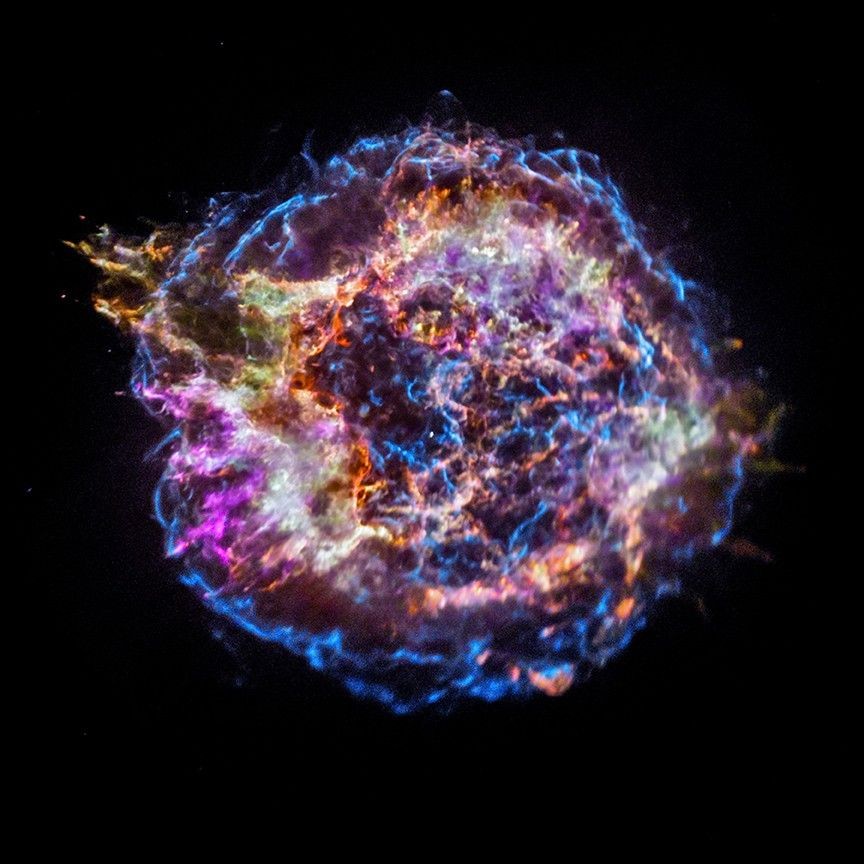
Alt...
An image from NASA’s Chandra X-ray Observatory shows the location of several elements produced by the explosion of a massive star. Cassiopeia A is a well-known supernova remnant located about 11,000 light years from Earth. Supernova remnants and the elements they produce are very hot — millions of degrees — and glow strongly in X-ray light. Chandra's sharp X-ray vision allows scientists to determine both the amount and location of these crucial elements objects like Cas A produce.
Credit: NASA/CXC/SAO
Historical Date: December 12, 2017
[...]
X-ray telescopes such as Chandra are important to study supernova remnants and the elements they produce because these events generate extremely high temperatures — millions of degrees — even thousands of years after the explosion. This means that many supernova remnants, including Cas A, glow most strongly at X-ray wavelengths that are undetectable with other types of telescopes.
Chandra's sharp X-ray vision allows astronomers to gather detailed information about the elements that objects like Cas A produce. For example, they are not only able to identify many of the elements that are present, but how much of each are being expelled into interstellar space.
The Chandra data indicate that the supernova that produced Cas A has churned out prodigious amounts of key cosmic ingredients. Cas A has dispersed about 10,000 Earth masses worth of sulfur alone, and about 20,000 Earth masses of silicon. The iron in Cas A has the mass of about 70,000 times that of the Earth, and astronomers detect a whopping one million Earth masses worth of oxygen being ejected into space from Cas A, equivalent to about three times the mass of the Sun. (Even though oxygen is the most abundant element in Cas A, its X-ray emission is spread across a wide range of energies and cannot be isolated in this image, unlike the other elements that are shown.)
While the exact date is not confirmed https://chandra.harvard.edu/graphics/resources/illustrations/historicsnr_infograph.pdf, many experts think that the stellar explosion that created Cas A occurred around the year 1680 in Earth's timeframe. Astronomers estimate that the doomed star was about five times the mass of the Sun just before it exploded. The star is estimated to have started its life with a mass about 16 times that of the Sun, and lost roughly two-thirds of this mass in a vigorous wind blowing off the star several hundred thousand years before the explosion. [...]
https://chandra.harvard.edu/photo/2017/casa_life/
#space #nova #astrophotography #photography #science #astronomy #physics #nature #NASA #education
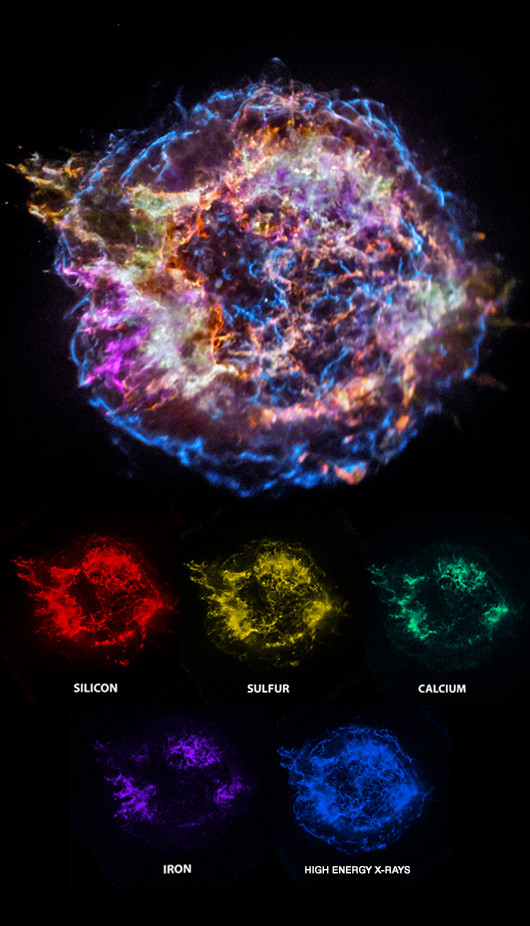
Alt...
Location of elements in Cassiopeia A.
Credit: NASA/CXC/SAO
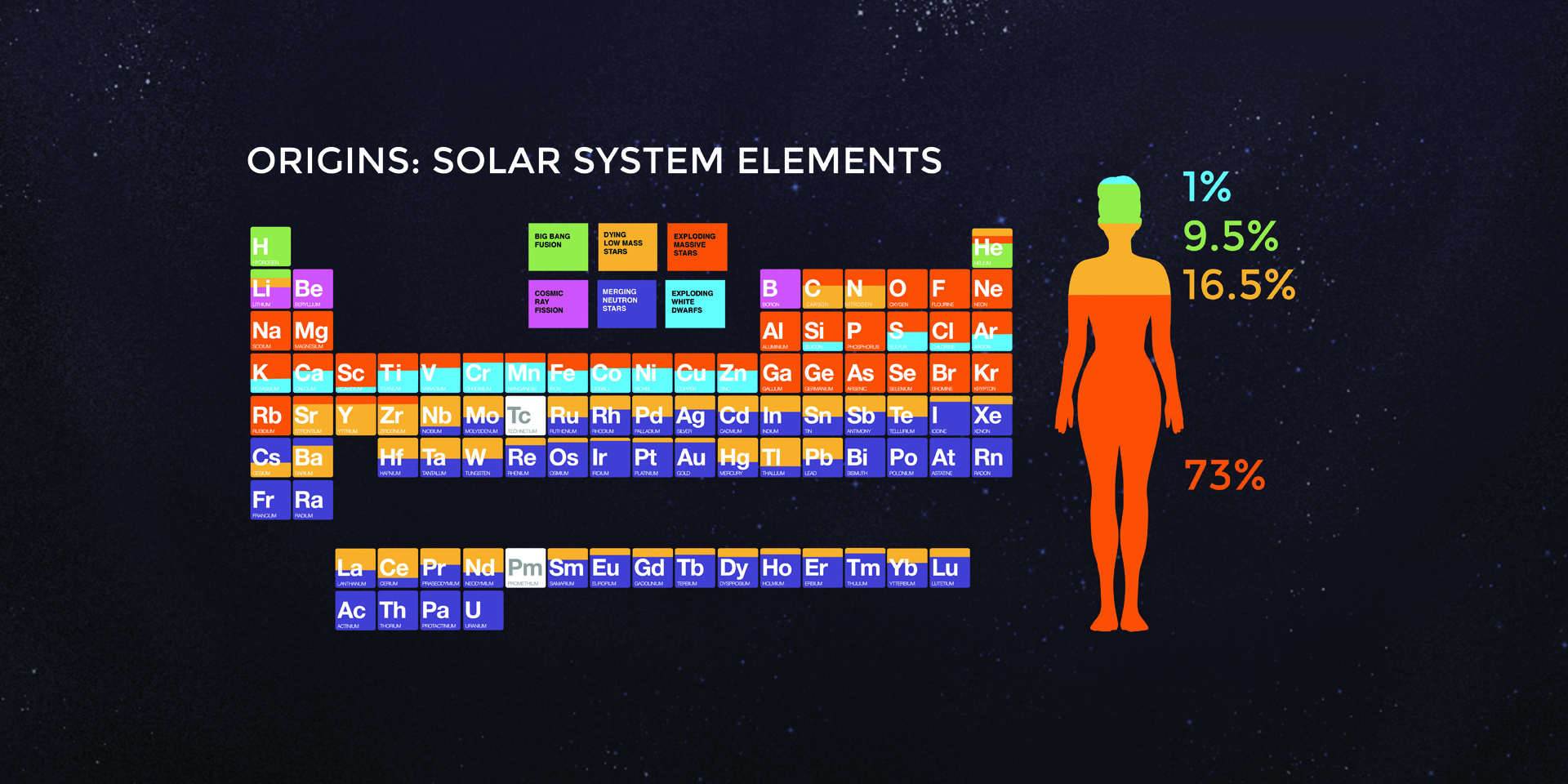
Alt...
Periodic Table of Elements.
Astronomers have found other elements in Cas A in addition to the ones shown in this new Chandra image. Carbon, nitrogen, phosphorus and hydrogen have also been detected using various telescopes that observe different parts of the electromagnetic spectrum. Combined with the detection of oxygen, this means all of the elements needed to make DNA, the molecule that carries genetic information, are found in Cas A.
Oxygen is the most abundant element in the human body (about 65% by mass), calcium helps form and maintain healthy bones and teeth, and iron is a vital part of red blood cells that carry oxygen through the body. All of the oxygen in the Solar System comes from exploding massive stars. About half of the calcium and about 40% of the iron also come from these explosions, with the balance of these elements being supplied by explosions of smaller mass, white dwarf stars.
Credit: NASA/CXC/K. Divona; Reference: SDSS blog, J. Johnson
[...]
Earlier in its lifetime, the star began fusing hydrogen and helium in its core into heavier elements through the process known as "nucleosynthesis." The energy made by the fusion of heavier and heavier elements balanced the star against the force of gravity. These reactions continued until they formed iron in the core of the star. At this point, further nucleosynthesis would consume rather than produce energy, so gravity then caused the star to implode and form a dense stellar core known as a neutron star.
The exact means by which a massive explosion is produced after the implosion is complicated, and a subject of intense study, but eventually the infalling material outside the neutron star was transformed by further nuclear reactions as it was expelled outward by the supernova explosion.
Chandra has repeatedly observed Cas A since the telescope was launched into space in 1999. The different datasets have revealed new information about the neutron star in Cas A, the details of the explosion, and specifics of how the debris is ejected into space.
* Credits:
NASA's Marshall Space Flight Center in Huntsville, Alabama, manages the Chandra program for NASA's Science Mission Directorate in Washington. The Smithsonian Astrophysical Observatory in Cambridge, Massachusetts, controls Chandra's science and flight operations.
https://chandra.harvard.edu/photo/2017/casa_life/
** Note by grobi:
"To upload this video, I converted it and compressed it to a smaller file-size under linux with the free software ffmpeg and the corresponding command:
'ffmpeg -i video_in.mkv -vcodec libx265 -crf 28 video_out.mp4'
Maybe you would like to post a corresponding video on a scientifically related topic, but it is perhaps too big? Then try ffmpeg."
#space #nova #astrophotography #photography #science #astronomy #physics #nature #NASA #education
Astronomers Solve Mystery of ‘Green Monster’ Feature in Cassiopeia A | Sci.News
[...]
Although astronomers think that this happened around the year 1680, there are no verifiable historical records to confirm this.
A curious structure dubbed the Green Monster was first identified in infrared data from the NASA/ESA/CSA James Webb Space Telescope in April 2023, but its origin was not clear.
However, by combining the Webb data with X-rays from NASA’s Chandra X-ray Observatory, astronomers think they have hunted down the source of this feature.
“We already suspected the Green Monster was created by a blast wave from the exploded star slamming into material surrounding it. Chandra helped us clinch the case,” said Dr. Jacco Vink, an astronomer at the University of Amsterdam.
When a massive star exploded to create Cassiopeia A about 340 years ago, from Earth’s perspective, it created a ball of matter and light that expanded outward. In the outer parts of Cassiopeia A the blast wave is striking surrounding gas that was ejected by the star between about 10,000 and 100,000 years before the explosion.
That formed a favorable environment for dust formation after the ejected stellar material cooled down.
The Chandra data reveal hot gas, mostly from supernova debris including elements like silicon and iron, but also from energetic electrons spiraling around magnetic field lines in the blast wave.
These electrons light up as thin arcs near the blast wave, and also show up in parts of the interior.
Webb highlights infrared emission from dust that is warmed up because it is embedded in the hot gas seen by Chandra, and from much cooler supernova debris.
Despite this chaotic stellar scene, the Green Monster clearly stood out in the original Webb image.
[...]
https://www.sci.news/astronomy/green-monster-feature-cassiopeia-a-12593.html
#space #nova #astrophotography #photography #science #astronomy #physics #nature #NASA #education
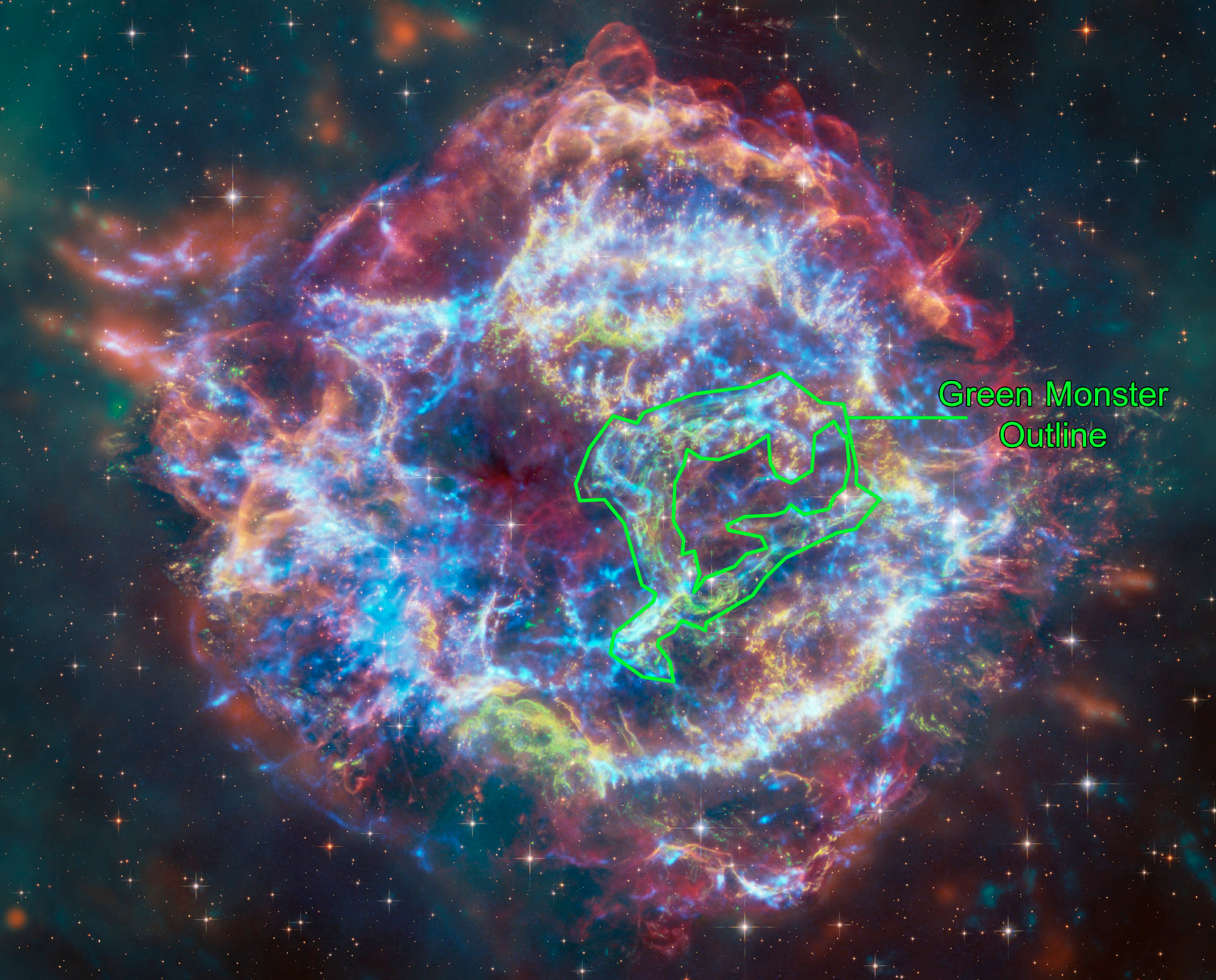
Alt...
New research suggests that the Green Monster — a curious structure first spotted in Webb data in April 2023 — came from that blast wave slamming into material surrounding the Cassiopeia A supernova remnant.
This composite image shows the Green Monster structure within the supernova remnant Cassiopeia A.
* Image credit: NASA / CXC / SAO / ESA / STScI / CSA / Milisavljevic et al. / JPL / Caltech / J. Schmidt / K. Arcand.
Using NASA’s James Webb Space Telescope, astronomers uncovered a mysterious feature within the remnant, nicknamed the “Green Monster,” alongside a puzzling network of ejecta filaments forming a web of oxygen-rich material. When combined with X-rays from Chandra, the data helped astronomers shed light on the origin of the Green Monster and revealed new insights into the explosion that created Cas A about 340 years ago, from Earth’s perspective.
#space #nova #astrophotography #photography #science #astronomy #physics #nature #NASA #education
2021 August 18
The picture shows a wide field image M57, the Ring Nebula, showing several outer rings not normally seen.
Rings Around the Ring Nebula
* Image Credit: Hubble, Large Binocular Telescope, Subaru Telescope
https://hla.stsci.edu/
http://www.lbto.org/
https://subarutelescope.org/en/;
* Composition & Copyright: Robert Gendler
http://www.robgendlerastropics.com/Biography2.html
Explanation:
The Ring Nebula (M57), is more complicated than it appears through a small telescope. The easily visible central ring is about one light-year across, but this remarkably deep exposure - a collaborative effort combining data from three different large telescopes - explores the looping filaments of glowing gas extending much farther from the nebula's central star. This composite image includes red light emitted by hydrogen as well as visible and infrared light. The Ring Nebula is an elongated planetary nebula, a type of nebula created when a Sun-like star evolves to throw off its outer atmosphere to become a white dwarf star. The Ring Nebula is about 2,500 light-years away toward the musical constellation Lyra.
http://www.robgendlerastropics.com/M57-HST-LBT.html
https://apod.nasa.gov/apod/random_apod.html
#space #nova #astrophotography #photography #science #astronomy #physics #nature #NASA #education #flowers
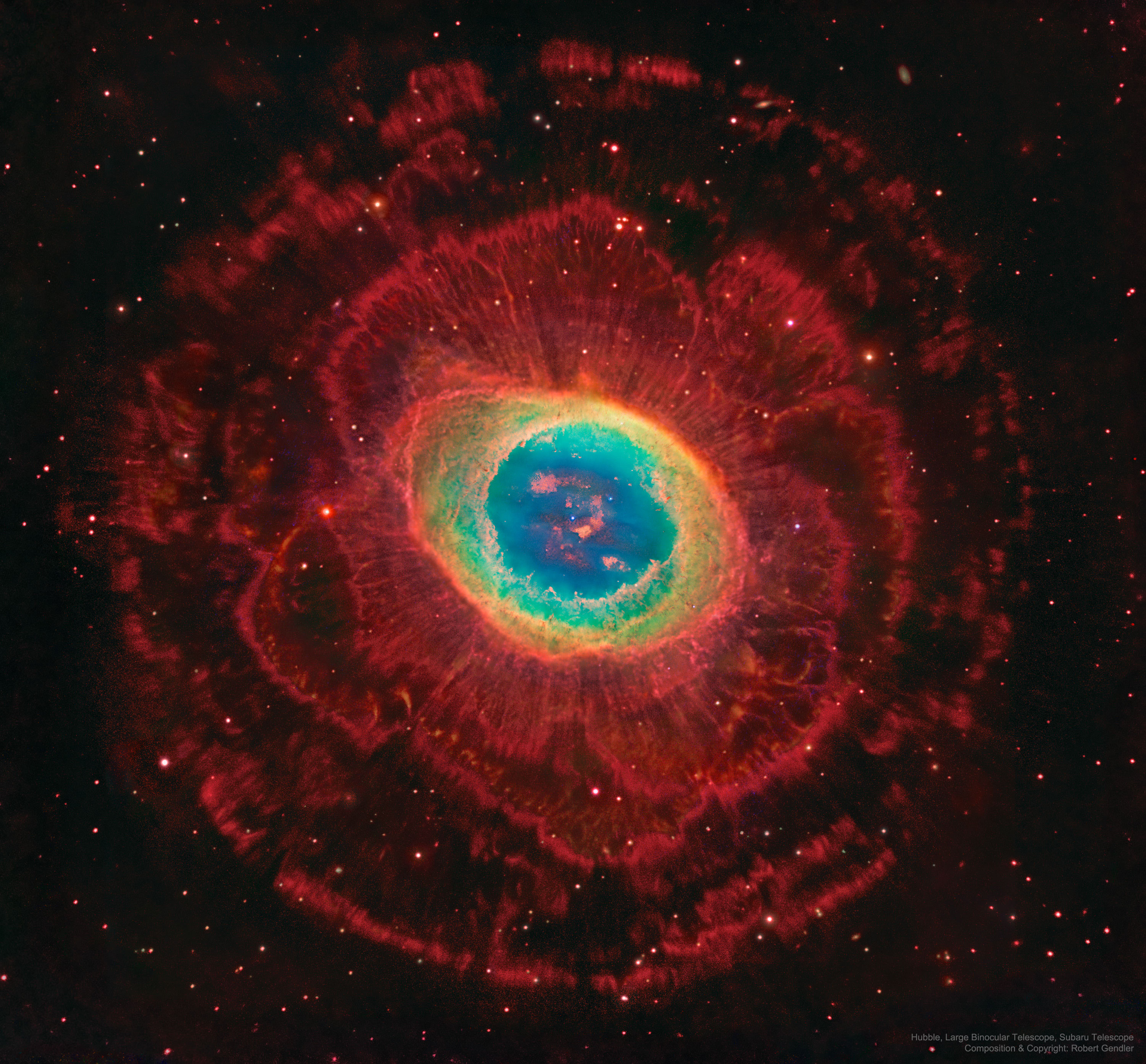
Alt...
2021 August 18
The picture shows a wide field image M57, the Ring Nebula, showing several outer rings not normally seen.
Rings Around the Ring Nebula
* Image Credit: Hubble, Large Binocular Telescope, Subaru Telescope;
* Composition & Copyright: Robert Gendler
Explanation:
The Ring Nebula (M57), is more complicated than it appears through a small telescope. The easily visible central ring is about one light-year across, but this remarkably deep exposure - a collaborative effort combining data from three different large telescopes - explores the looping filaments of glowing gas extending much farther from the nebula's central star. This composite image includes red light emitted by hydrogen as well as visible and infrared light. The Ring Nebula is an elongated planetary nebula, a type of nebula created when a Sun-like star evolves to throw off its outer atmosphere to become a white dwarf star. The Ring Nebula is about 2,500 light-years away toward the musical constellation Lyra.
Authors & editors: Robert Nemiroff (MTU) & Jerry Bonnell (UMCP)
NASA Official: Phillip Newman Specific rights apply.
NASA Web Privacy Policy and Important Notices
A service of: ASD at NASA / GSFC
& Michigan Tech. U.
This video begins with a ground-based view of the constellation Lyra and zooms into Hubble’s image of the Ring Nebula. It ends with a 3-D model that showcases the structure of the nebula.
Credit:
NASA, ESA, and G. Bacon, F. Summers and Mary Estacion (STScI)
#space #nova #astrophotography #photography #science #astronomy #physics #nature #NASA #education
2025 July 22
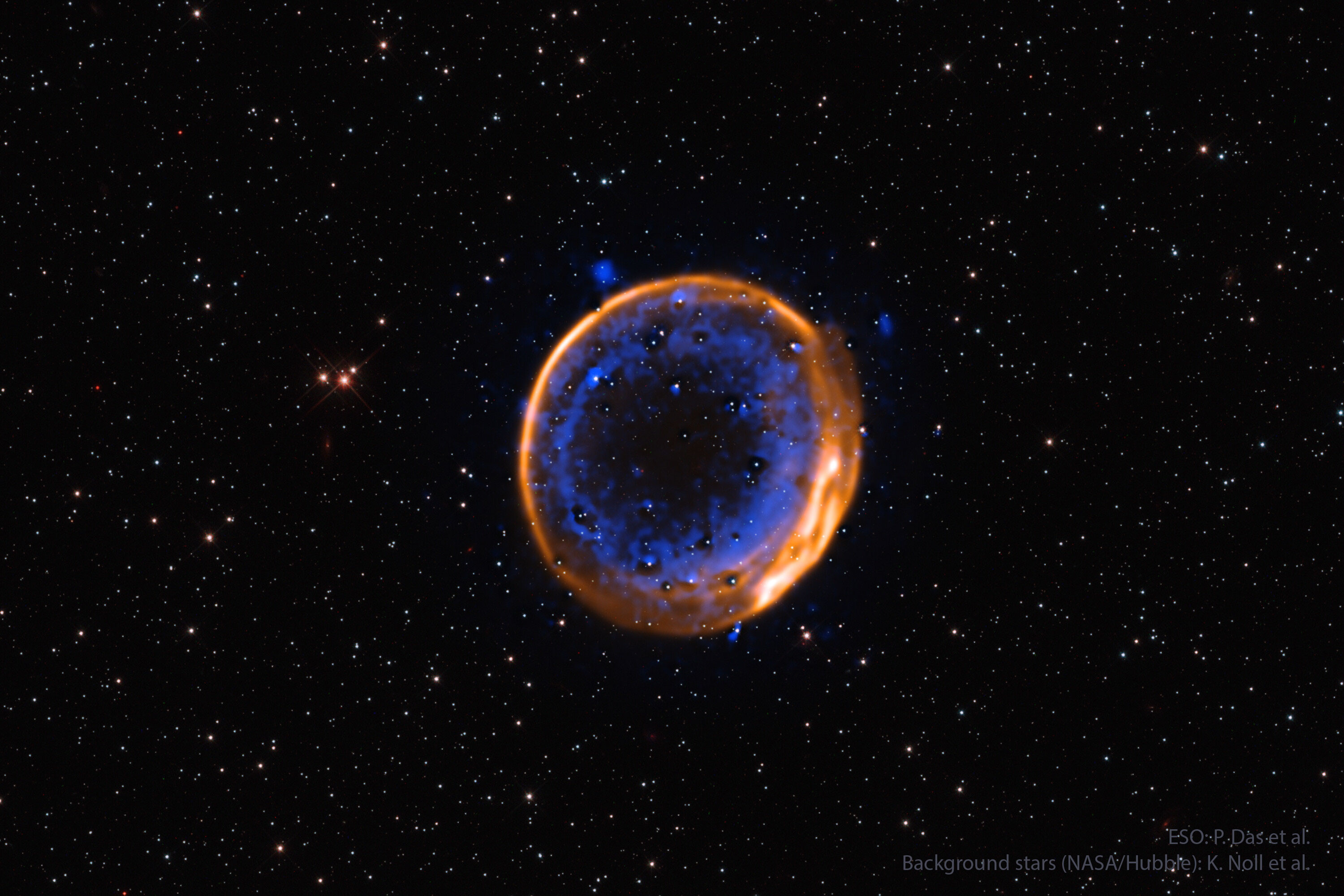
A Double Detonation Supernova
* Image Credit: ESO, P. Das et al.; Background stars (NASA/Hubble): K. Noll et al.
https://www.eso.org/
https://www.unsw.edu.au/hdr/priyam-das
https://science.nasa.gov/mission/hubble/
Explanation:
Can some supernovas explode twice? Yes, when the first explosion acts like a detonator for the second. This is a leading hypothesis for the cause of supernova remnant (SNR) 0509-67.5. In this two-star system, gravity causes the larger and fluffier star to give up mass to a smaller and denser white dwarf companion. Eventually the white dwarf's near-surface temperature goes so high that it explodes, creating a shock wave that goes both out and in -- and so triggers a full Type Ia supernova near the center. Recent images of the SNR 0509-67.5 system, like the featured image from the Very Large Telescope in Chile, show two shells with radii and compositions consistent with the double detonation hypothesis. This system, SNR 0509-67.5 is also famous for two standing mysteries: why its bright supernova wasn't noted 400 years ago, and why no visible companion star remains.
https://www.eso.org/public/images/eso2511a/
https://ui.adsabs.harvard.edu/abs/2025NatAs.tmp..135D/abstract
https://en.wikipedia.org/wiki/Detonator
https://apod.nasa.gov/apod/ap970219.html
https://en.wikipedia.org/wiki/Roche_lobe
https://apod.nasa.gov/apod/ap950910.html
https://science.nasa.gov/universe/stars/types/#white-dwarfs
https://en.wikipedia.org/wiki/Type_Ia_supernova
https://apod.nasa.gov/apod/ap250722.html
#space #nebula #astrophotography #photography #science #astronomy #physics #nature #NASA #ESA #education
Alt...
2025 July 22
A nearly circular nebula with two rings is shown. The outer ring appears orange while while the inner rings is more complex and appears blue.
A Double Detonation Supernova
* Image Credit: ESO, P. Das et al.; Background stars (NASA/Hubble): K. Noll et al.
Explanation:
Can some supernovas explode twice? Yes, when the first explosion acts like a detonator for the second. This is a leading hypothesis for the cause of supernova remnant (SNR) 0509-67.5. In this two-star system, gravity causes the larger and fluffier star to give up mass to a smaller and denser white dwarf companion. Eventually the white dwarf's near-surface temperature goes so high that it explodes, creating a shock wave that goes both out and in -- and so triggers a full Type Ia supernova near the center. Recent images of the SNR 0509-67.5 system, like the featured image from the Very Large Telescope in Chile, show two shells with radii and compositions consistent with the double detonation hypothesis. This system, SNR 0509-67.5 is also famous for two standing mysteries: why its bright supernova wasn't noted 400 years ago, and why no visible companion star remains.
Authors & editors: Robert Nemiroff (MTU) & Jerry Bonnell (UMCP)
NASA Official: Amber Straughn Specific rights apply.
NASA Web Privacy, Accessibility, Notices;
A service of: ASD at NASA / GSFC,
NASA Science Activation
& Michigan Tech. U.
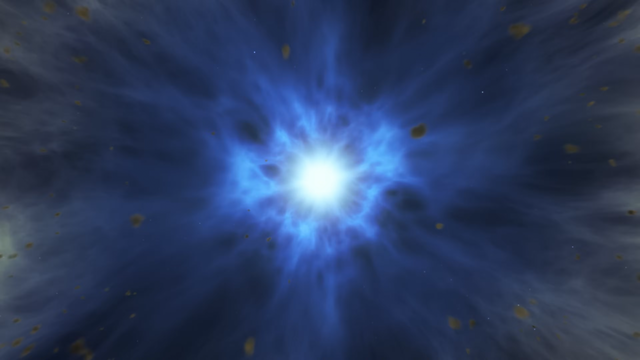
Animation of a double-detonation supernova
This animation illustrates the supernova remnant SNR 0509-67.5, the leftovers of a star that died with a double-detonation. These two blasts imprinted a characteristic layered structure in the expanding material around the star. At the end of the animation we show a real image captured with ESO’s Very Large Telescope (VLT), which displays different chemical elements in different colours. The are two concentric shells of calcium, seen here in blue, a telltale sign that the star met its end with two detonations.
For more details, check: https://www.eso.org/public/news/eso2511/.
Credit:
ESO/M. Kornmesser/P. Das et al. Background stars, final image (Hubble): K. Noll et al.
#space #nebula #astrophotography #photography #science #astronomy #physics #nature #NASA #ESA #education
Alt...
This animation illustrates the supernova remnant SNR 0509-67.5, the leftovers of a star that died with a double-detonation. These two blasts imprinted a characteristic layered structure in the expanding material around the star. At the end of the animation we show a real image captured with ESO’s Very Large Telescope (VLT), which displays different chemical elements in different colours. The are two concentric shells of calcium, seen here in blue, a telltale sign that the star met its end with two detonations.
Credit:
ESO/M. Kornmesser/P. Das et al. Background stars, final image (Hubble): K. Noll et al.
2012 January 12
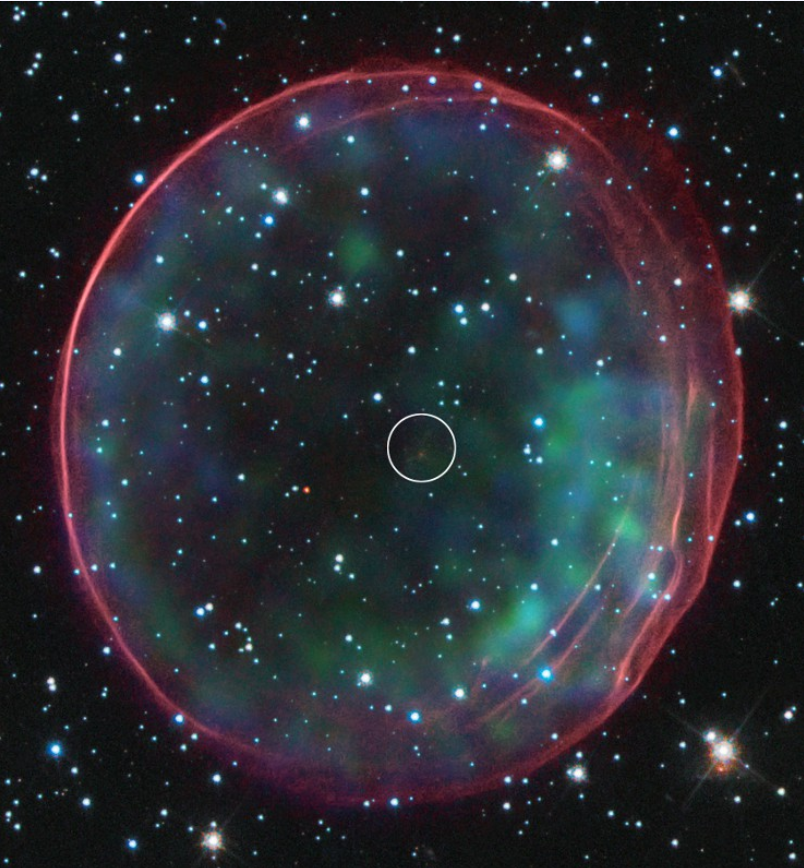
The Case of the Missing Supernova Companion
* Image Credit:
** X-ray: NASA/CXC/SAO/J.
Hughes et al.
https://chandra.harvard.edu/
https://www.physics.rutgers.edu/~jackph/
** Optical: NASA/ESA/Hubble Heritage Team (STScI /AURA)
https://science.nasa.gov/mission/hubble/multimedia/hubble-images/
https://www.stsci.edu/
Explanation:
Where's the other star? At the center of this supernova remnant should be the companion star to the star that blew up. Identifying this star is important for understanding just how Type Ia supernova detonate, which in turn could lead to a better understanding of why the brightness of such explosions are so predictable, which in turn is key to calibrating the entire nature of our universe. The trouble is that even a careful inspection of the center of SNR 0509-67.5 has not found any star at all. This indicates that the companion is intrinsically very faint -- much more faint that many types of bright giant stars that had been previous candidates. In fact, the implication is that the companion star might have to be a faint white dwarf, similar to -- but less massive than -- the star that detonated. SNR 0509-67.5 is shown above in both visible light, shining in red as imaged by the Hubble Space Telescope, and X-ray light, shown in false-color green as imaged by the Chandra X-ray Observatory. Putting your cursor over the picture will highlight the central required location for the missing companion star.
https://apod.nasa.gov/apod/ap120112.html#space #nebula #astrophotography #photography #science #astronomy #physics #nature #NASA #ESA #education
Alt...
2012 January 12
The Case of the Missing Supernova Companion
* Image Credit:
** X-ray: NASA/CXC/SAO/J. Hughes et al.,
** Optical: NASA/ESA/Hubble Heritage Team (STScI /AURA)
Explanation:
Where's the other star? At the center of this supernova remnant should be the companion star to the star that blew up. Identifying this star is important for understanding just how Type Ia supernova detonate, which in turn could lead to a better understanding of why the brightness of such explosions are so predictable, which in turn is key to calibrating the entire nature of our universe. The trouble is that even a careful inspection of the center of SNR 0509-67.5 has not found any star at all. This indicates that the companion is intrinsically very faint -- much more faint that many types of bright giant stars that had been previous candidates. In fact, the implication is that the companion star might have to be a faint white dwarf, similar to -- but less massive than -- the star that detonated. SNR 0509-67.5 is shown above in both visible light, shining in red as imaged by the Hubble Space Telescope, and X-ray light, shown in false-color green as imaged by the Chandra X-ray Observatory. Putting your cursor over the picture will highlight the central required location for the missing companion star.
Authors & editors: Robert Nemiroff (MTU) & Jerry Bonnell (UMCP)
NASA Official: Phillip Newman Specific rights apply.
2011 January 25
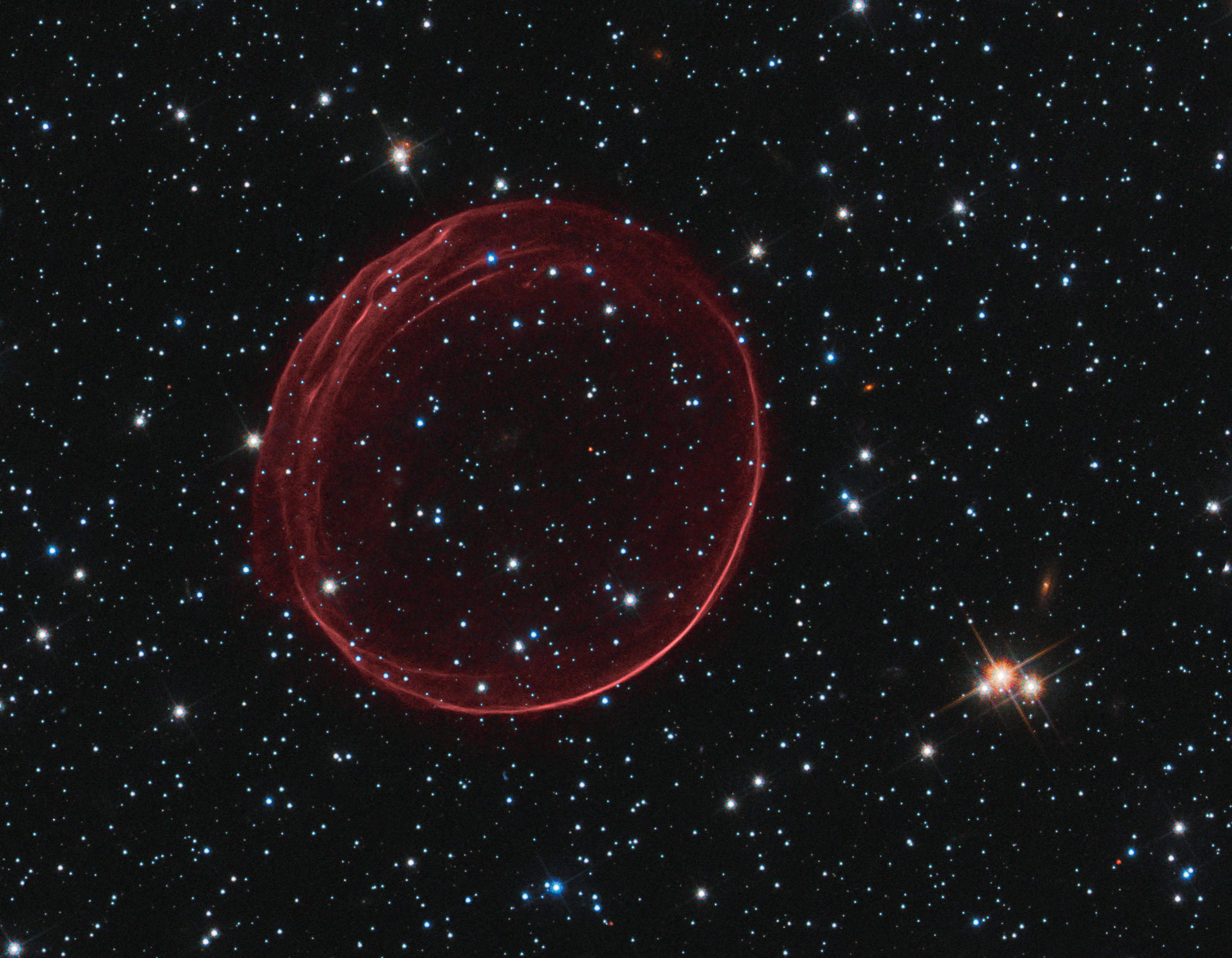
The Rippled Red Ribbons of SNR 0509
* Credit: NASA, ESA, and the Hubble Heritage Team (STScI/AURA); Acknowledgment: J. Hughes (Rutgers U.)
https://www.nasa.gov/
https://www.spacetelescope.org/
https://heritage.stsci.edu/
https://www.stsci.edu/portal/
https://www.aura-astronomy.org/
Explanation:
What is causing the picturesque ripples of supernova remnant SNR 0509-67.5? The ripples, as well as the greater nebula, were imaged in unprecedented detail by the Hubble Space Telescope in 2006 and again late last year. The red color was recoded by a Hubble filter that left only the light emitted by energetic hydrogen. The precise reason for the ripples remains unknown, with two considered origin hypotheses relating them to relatively dense portions of either ejected or impacted gas. The reason for the broader red glowing ring is more clear, with expansion speed and light echos relating it to a classic Type Ia supernova explosion that must have occurred about 400 years earlier. SNR 0509 currently spans about 23 light years and lies about 160,000 light years away toward the constellation of the dolphinfish (Dorado) in the Large Magellanic Cloud. The expanding ring carries with it another great mystery, however: why wasn't this supernova seen 400 years ago when light from the initial blast should have passed the Earth?
https://en.wikipedia.org/wiki/SNR_0509-67.5
https://apod.nasa.gov/apod/ap110125.html
#space #nebula #astrophotography #photography #science #astronomy #physics #nature #NASA #ESA #education
Alt...
2011 January 25
The Rippled Red Ribbons of SNR 0509
* Credit: NASA, ESA, and the Hubble Heritage Team (STScI/AURA); Acknowledgment: J. Hughes (Rutgers U.)
Explanation:
What is causing the picturesque ripples of supernova remnant SNR 0509-67.5? The ripples, as well as the greater nebula, were imaged in unprecedented detail by the Hubble Space Telescope in 2006 and again late last year. The red color was recoded by a Hubble filter that left only the light emitted by energetic hydrogen. The precise reason for the ripples remains unknown, with two considered origin hypotheses relating them to relatively dense portions of either ejected or impacted gas. The reason for the broader red glowing ring is more clear, with expansion speed and light echos relating it to a classic Type Ia supernova explosion that must have occurred about 400 years earlier. SNR 0509 currently spans about 23 light years and lies about 160,000 light years away toward the constellation of the dolphinfish (Dorado) in the Large Magellanic Cloud. The expanding ring carries with it another great mystery, however: why wasn't this supernova seen 400 years ago when light from the initial blast should have passed the Earth?
Authors & editors: Robert Nemiroff (MTU) & Jerry Bonnell (UMCP)
NASA Official: Phillip Newman Specific rights apply.
NASA Web Privacy Policy and Important Notices
A service of: ASD at NASA / GSFC
& Michigan Tech. U.
Double detonation: new image shows remains of star destroyed by pair of explosions
2 July 2025
For the first time, astronomers have obtained visual evidence that a star met its end by detonating twice. By studying the centuries-old remains of supernova SNR 0509-67.5 with the European Southern Observatory’s Very Large Telescope (ESO’s VLT), they have found patterns that confirm its star suffered a pair of explosive blasts. Published today, this discovery shows some of the most important explosions in the Universe in a new light.
Most supernovae are the explosive deaths of massive stars, but one important variety comes from an unassuming source. White dwarfs, the small, inactive cores left over after stars like our Sun burn out their nuclear fuel, can produce what astronomers call a Type Ia supernova.
"The explosions of white dwarfs play a crucial role in astronomy,” says Priyam Das, a PhD student at the University of New South Wales Canberra, Australia, who led the study on SNR 0509-67.5 published today in Nature Astronomy. Much of our knowledge of how the Universe expands rests on Type Ia supernovae, and they are also the primary source of iron on our planet, including the iron in our blood. “Yet, despite their importance, the long-standing puzzle of the exact mechanism triggering their explosion remains unsolved," he adds.
All models that explain Type Ia supernovae begin with a white dwarf in a pair of stars. If it orbits close enough to the other star in this pair, the dwarf can steal material from its partner. In the most established theory behind Type Ia supernovae, the white dwarf [...]
VIDEO:
Zooming into a star that detonated twice
For more details, check: https://www.eso.org/public/news/eso2511/.
Credit:
ESO/L. Calçada/N. Risinger (skysurvey.org)/VMC Survey/Digitized Sky Survey 2/P. Das et al. Background stars (Hubble): K. Noll et al. Music: Azul Cobalto
#space #nebula #astrophotography #photography #science #astronomy #physics #nature #NASA #ESA #education
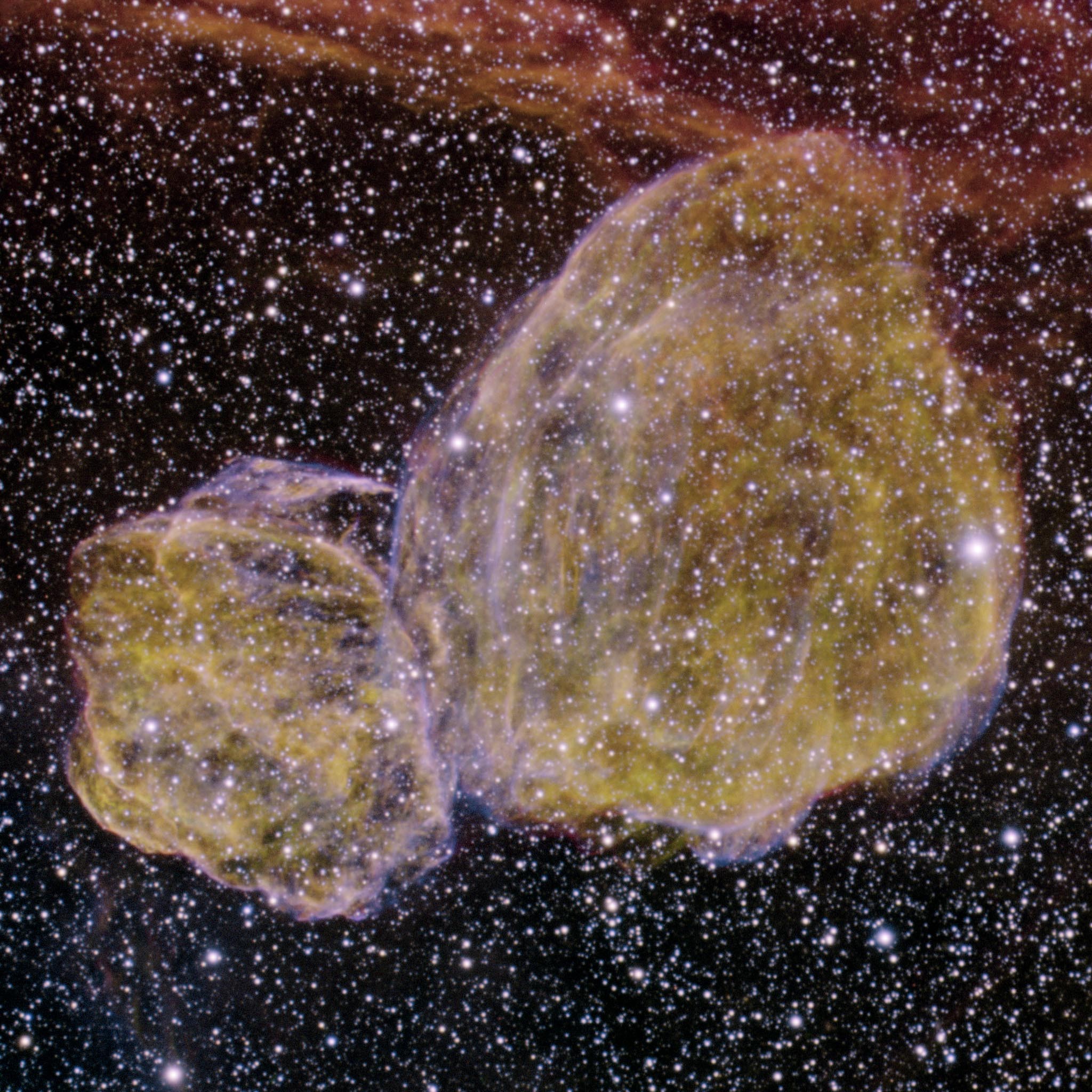
2008 January 15
Double Supernova Remnants DEM L316
* Credit & Copyright: Gemini Observatory, GMOS-South, NSF
https://www.gemini.edu/
https://www.nsf.gov/
Explanation:
Are these two supernova shells related? To help find out, the 8-meter Gemini Telescope located high atop a mountain in Chile was pointed at the unusual, huge, double-lobed cloud dubbed DEM L316. The resulting image, shown above, yields tremendous detail. Inspection of the image as well as data taken by the orbiting Chandra X-Ray Observatory indicate how different the two supernova remnants are. In particular, the smaller shell appears to be the result of Type Ia supernova where a white dwarf exploded, while the larger shell appears to be the result of a Type II supernova where a massive normal star exploded. Since those two stellar types evolve on such different time scales, they likely did not form together and so are likely not physically associated. Considering also that no evidence exists that the shells are colliding, the two shells are now hypothesized to be superposed by chance. DEM L316 lies about 160,000 light years away in the neighboring Large Magellanic Cloud (LMC) galaxy, spans about 140 light-years across, and appears toward the southern constellation of the Swordfish (Dorado).
https://apod.nasa.gov/apod/ap080115.html
#space #nebula #astrophotography #photography #science #astronomy #physics #nature #NASA #ESA #education
Alt...
2008 January 15
Double Supernova Remnants DEM L316
* Credit & Copyright: Gemini Observatory, GMOS-South, NSF
Explanation:
Are these two supernova shells related? To help find out, the 8-meter Gemini Telescope located high atop a mountain in Chile was pointed at the unusual, huge, double-lobed cloud dubbed DEM L316. The resulting image, shown above, yields tremendous detail. Inspection of the image as well as data taken by the orbiting Chandra X-Ray Observatory indicate how different the two supernova remnants are. In particular, the smaller shell appears to be the result of Type Ia supernova where a white dwarf exploded, while the larger shell appears to be the result of a Type II supernova where a massive normal star exploded. Since those two stellar types evolve on such different time scales, they likely did not form together and so are likely not physically associated. Considering also that no evidence exists that the shells are colliding, the two shells are now hypothesized to be superposed by chance. DEM L316 lies about 160,000 light years away in the neighboring Large Magellanic Cloud (LMC) galaxy, spans about 140 light-years across, and appears toward the southern constellation of the Swordfish (Dorado).
Authors & editors: Robert Nemiroff (MTU) & Jerry Bonnell (UMCP)
NASA Official: Phillip Newman Specific rights apply.
NASA Web Privacy Policy and Important Notices
A service of: ASD at NASA / GSFC
& Michigan Tech. U.
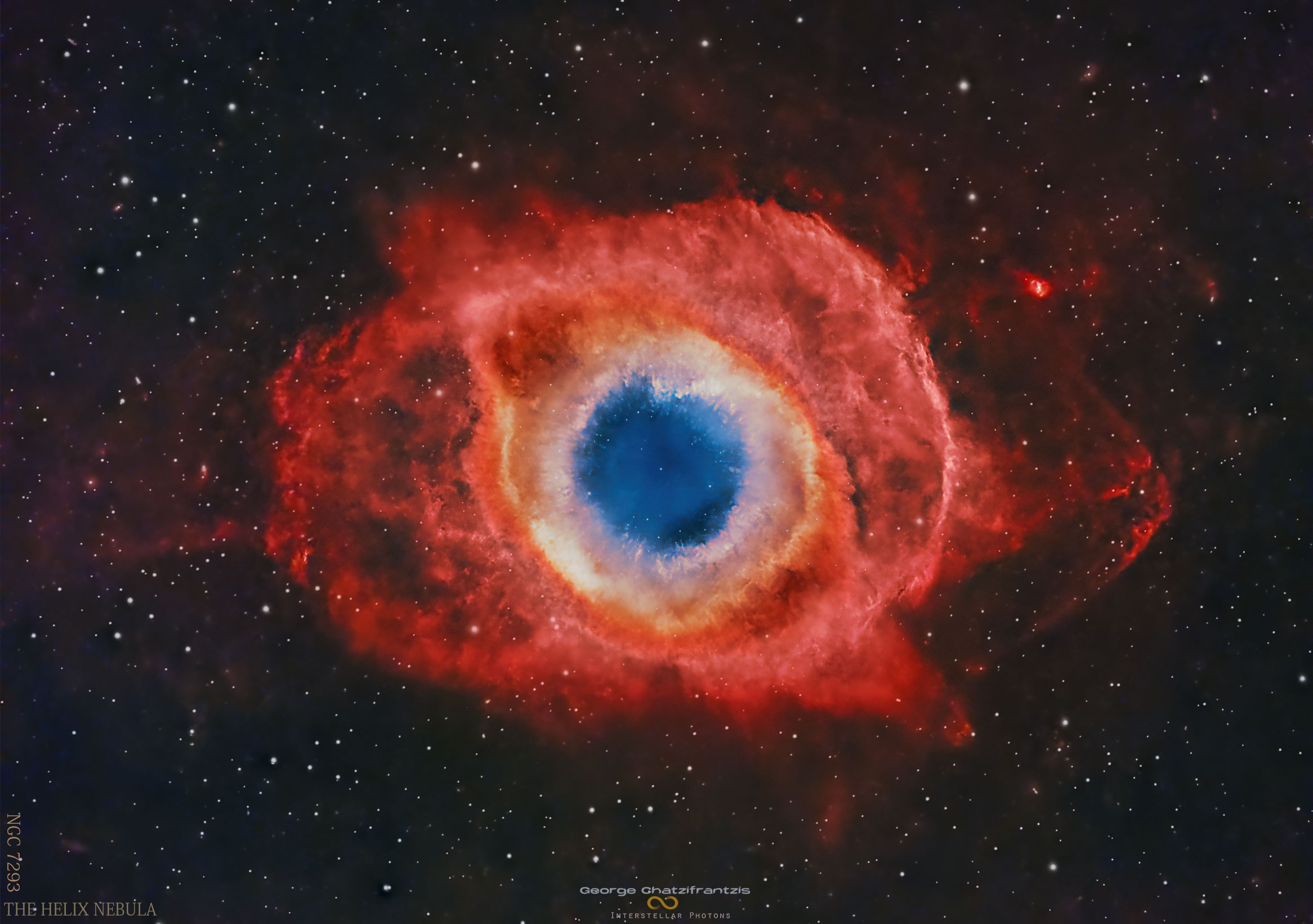
2025 July 29
A Helix Nebula Deep Field
* Image Credit & Copyright: George Chatzifrantzis
https://app.astrobin.com/u/pithagoras#gallery
Explanation:
Is the Helix Nebula looking at you? No, not in any biological sense, but it does look quite like an eye. The Helix Nebula is so named because it also appears that you are looking down the axis of a helix. In actuality, it is now understood to have a surprisingly complex geometry, including radial filaments and extended outer loops. The Helix Nebula (aka NGC 7293) is one of brightest and closest examples of a planetary nebula, a gas cloud created at the end of the life of a Sun-like star. The remnant central stellar core, destined to become a white dwarf star, glows in light so energetic it causes the previously expelled gas to fluoresce. The featured picture, taken in red, green, and blue but highlighted by light emitted primarily by hydrogen was created from 12 hours of exposure through a personal telescope located in Greece. A close-up of the inner edge of the Helix Nebula shows complex gas knots the origin of which are still being researched.
https://chandra.harvard.edu/deadstar/helix.html
https://en.wikipedia.org/wiki/Helix_Nebula
https://en.wikipedia.org/wiki/Planetary_nebula
https://mathworld.wolfram.com/Helix.html
http://www.astronomyknowhow.com/hydrogen-alpha.htm
https://youtu.be/WnWIt0iz00A
https://apod.nasa.gov/apod/ap250729.html
#space #nebula #astrophotography #photography #science #astronomy #physics #nature #NASA #ESA #education
Alt...
2025 July 29
A nearly circular nebula with a blue core surrounded by small white knots, an orange ring and expansive red strucures.
A Helix Nebula Deep Field
* Image Credit & Copyright: George Chatzifrantzis
Explanation:
Is the Helix Nebula looking at you? No, not in any biological sense, but it does look quite like an eye. The Helix Nebula is so named because it also appears that you are looking down the axis of a helix. In actuality, it is now understood to have a surprisingly complex geometry, including radial filaments and extended outer loops. The Helix Nebula (aka NGC 7293) is one of brightest and closest examples of a planetary nebula, a gas cloud created at the end of the life of a Sun-like star. The remnant central stellar core, destined to become a white dwarf star, glows in light so energetic it causes the previously expelled gas to fluoresce. The featured picture, taken in red, green, and blue but highlighted by light emitted primarily by hydrogen was created from 12 hours of exposure through a personal telescope located in Greece. A close-up of the inner edge of the Helix Nebula shows complex gas knots the origin of which are still being researched.
Authors & editors: Robert Nemiroff (MTU) & Jerry Bonnell (UMCP)
NASA Official: Amber Straughn Specific rights apply.
NASA Web Privacy, Accessibility, Notices;
A service of: ASD at NASA / GSFC,
NASA Science Activation
& Michigan Tech. U.
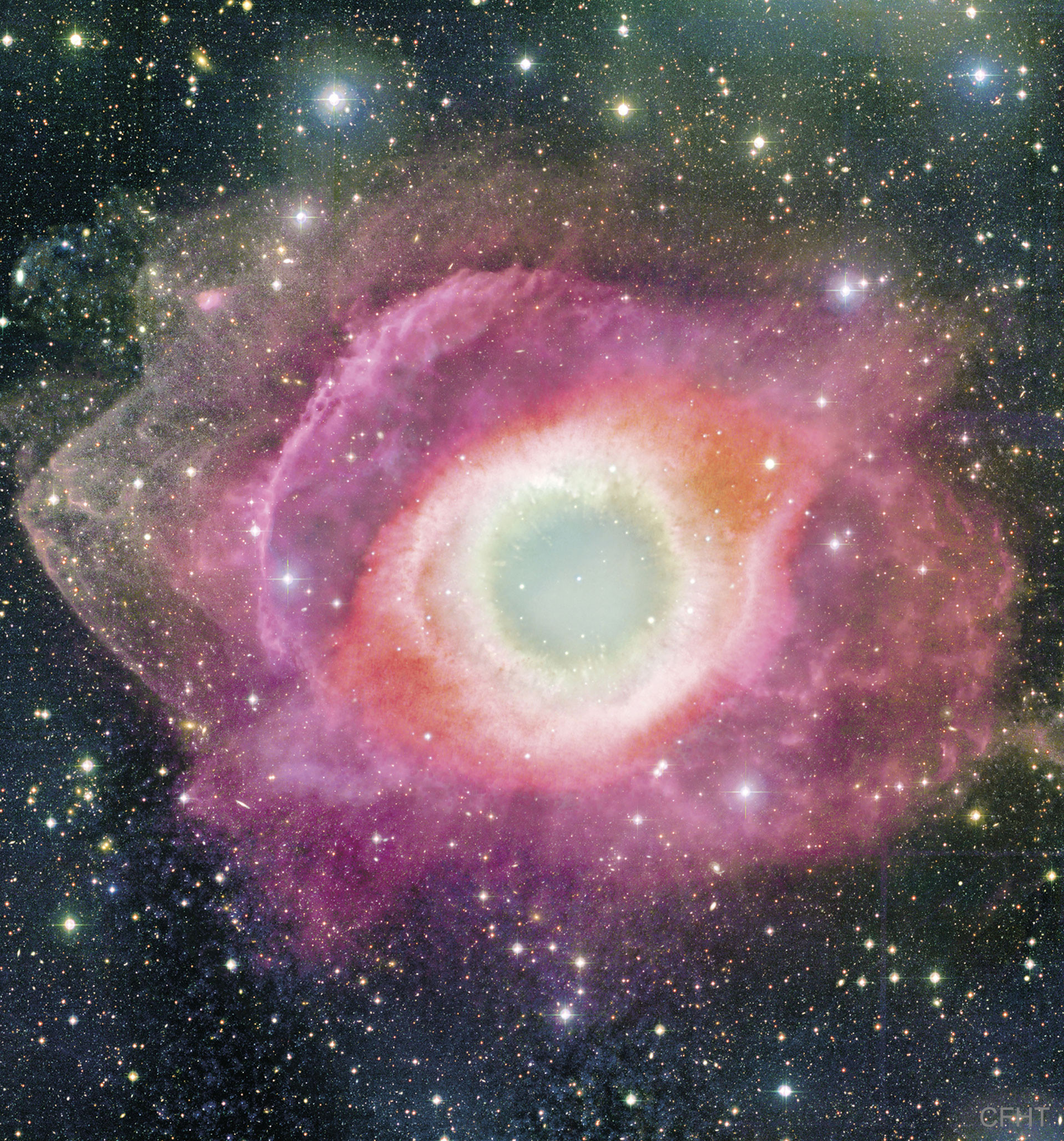
2023 May 7
The Helix Nebula from CFHT
* Image Credit: CFHT, Coelum, MegaCam, J.-C. Cuillandre (CFHT) & G. A. Anselmi (Coelum)
https://www.cfht.hawaii.edu/
https://www.coelum.com/
https://www.cfht.hawaii.edu/Instruments/Imaging/Megacam/
https://www.cfht.hawaii.edu/~jcc/
Explanation:
Will our Sun look like this one day? The Helix Nebula is one of brightest and closest examples of a planetary nebula, a gas cloud created at the end of the life of a Sun-like star. The outer gasses of the star expelled into space appear from our vantage point as if we are looking down a helix. The remnant central stellar core, destined to become a white dwarf star, glows in light so energetic it causes the previously expelled gas to fluoresce. The Helix Nebula, given a technical designation of NGC 7293, lies about 700 light-years away towards the constellation of the Water Bearer (Aquarius) and spans about 2.5 light-years. The featured picture was taken with the Canada-France-Hawaii Telescope (CFHT) located atop a dormant volcano in Hawaii, USA. A close-up of the inner edge of the Helix Nebula shows complex gas knots of unknown origin.
https://en.wikipedia.org/wiki/Aquarius_(constellation)
https://apod.nasa.gov/apod/ap230507.html
#space #nebula #astrophotography #photography #science #astronomy #physics #nature #NASA #ESA #education
Alt...
2023 May 7
A colorful circular nebula is shown that is beige in the center, red further out, and gas violet rings even further out.
The Helix Nebula from CFHT
* Image Credit: CFHT, Coelum, MegaCam, J.-C. Cuillandre (CFHT) & G. A. Anselmi (Coelum)
Explanation:
Will our Sun look like this one day? The Helix Nebula is one of brightest and closest examples of a planetary nebula, a gas cloud created at the end of the life of a Sun-like star. The outer gasses of the star expelled into space appear from our vantage point as if we are looking down a helix. The remnant central stellar core, destined to become a white dwarf star, glows in light so energetic it causes the previously expelled gas to fluoresce. The Helix Nebula, given a technical designation of NGC 7293, lies about 700 light-years away towards the constellation of the Water Bearer (Aquarius) and spans about 2.5 light-years. The featured picture was taken with the Canada-France-Hawaii Telescope (CFHT) located atop a dormant volcano in Hawaii, USA. A close-up of the inner edge of the Helix Nebula shows complex gas knots of unknown origin.
Authors & editors: Robert Nemiroff (MTU) & Jerry Bonnell (UMCP)
NASA Official: Phillip Newman Specific rights apply.
NASA Web Privacy Policy and Important Notices
A service of: ASD at NASA / GSFC,
NASA Science Activation
& Michigan Tech. U.
Helix Nebula Zoom
The Helix Nebula, NGC 7293, lies about 700 light-years away in the constellation of Aquarius (the Water Bearer). It is one of the closest and most spectacular examples of a planetary nebula. These exotic objects have nothing to do with planets, but are the final blooming of Sun-like stars before their retirement as white dwarfs. Shells of gas are blown off from a star’s surface, often in intricate and beautiful patterns, and shine under the harsh ultraviolet radiation from the faint, but very hot, central star. The main ring of the Helix Nebula is about two light-years across or half the distance between the Sun and its closest stellar neighbour.
[...] * see ALT-Text
Although the Helix looks very much like a doughnut, studies have shown that it possibly consists of at least two separate discs with outer rings and filaments. The brighter inner disc seems to be expanding at about 100 000 km/h and to have taken about 12 000 years to have formed.
Because the Helix is relatively close — it covers an area of the sky about a quarter of the full Moon — it can be studied in much greater detail than most other planetary nebulae and has been found to have an unexpected and complex structure. All around the inside of the ring are small blobs, known as “cometary knots”, with faint tails extending away from the central star. They look remarkably like droplets of liquid running down a sheet of glass. Although they look tiny, each knot is about as large as our Solar System. These knots have been extensively studied, both with the ESO Very Large Telescope and with the NASA/ESA Hubble Space Telescope, but remain only partially understood.
https://www.eso.org/public/videos/eso0907a/
CREDIT
ESO
(European Organisation for Astronomical Research in the Southern Hemisphere)
#space #nebula #astrophotography #photography #science #astronomy #physics #nature #NASA #ESA #education
Alt...
Zoom Into The Helix Nebula
The Helix Nebula, NGC 7293, lies about 700 light-years away in the constellation of Aquarius (the Water Bearer). It is one of the closest and most spectacular examples of a planetary nebula. These exotic objects have nothing to do with planets, but are the final blooming of Sun-like stars before their retirement as white dwarfs. Shells of gas are blown off from a stars surface, often in intricate and beautiful patterns, and shine under the harsh ultraviolet radiation from the faint, but very hot, central star. The main ring of the Helix Nebula is about two light-years across or half the distance between the Sun and its closest stellar neighbour.
* [Despite being photographically very spectacular the Helix is hard to see visually as its light is thinly spread over a large area of sky and the history of its discovery is rather obscure. It first appears in a list of new objects compiled by the German astronomer Karl Ludwig Harding in 1824. The name Helix comes from the rough corkscrew shape seen in the earlier photographs.]
Although the Helix looks very much like a doughnut, studies have shown that it possibly consists of at least two separate discs with outer rings and filaments. The brighter inner disc seems to be expanding at about 100 000 km/h and to have taken about 12 000 years to have formed.
CREDIT
ESO
(European Organisation for Astronomical Research in the Southern Hemisphere )
2008 April 13
Curious Cometary Knots in the Helix Nebula
* Credit: C. R. O'Dell and K. Handron (Rice University), NASA
http://www.nasa.gov/
Explanation:
What causes unusual knots of gas and dust in planetary nebulas? Seen also in the Ring Nebula, the Dumbbell Nebula and NGC 2392, the knots' existence was not initially predicted and their origins are still not well understood. Pictured above is a fascinating image of the Helix Nebula by the Hubble Space Telescope showing tremendous detail of its mysterious gaseous knots. The above cometary knots have masses similar to the Earth but have radii typically several times the orbit of Pluto. One hypothesis for the fragmentation and evolution of the knots includes existing gas being driven out by a less dense but highly energetic stellar wind of the central evolving star. The Helix Nebula is the closest example of a planetary nebula created at the end of the life of a Sun-like star. The Helix Nebula, given a technical designation of NGC 7293, lies about 700 light-years away towards the constellation of Aquarius.
https://en.wikipedia.org/wiki/Rayleigh%E2%80%93Taylor_instability
https://en.wikipedia.org/wiki/Stellar_wind
https://ui.adsabs.harvard.edu/abs/2020MNRAS.491..758A/abstract
https://apod.nasa.gov/apod/ap080413.html
#space #nebula #astrophotography #photography #science #astronomy #physics #nature #NASA #ESA #education
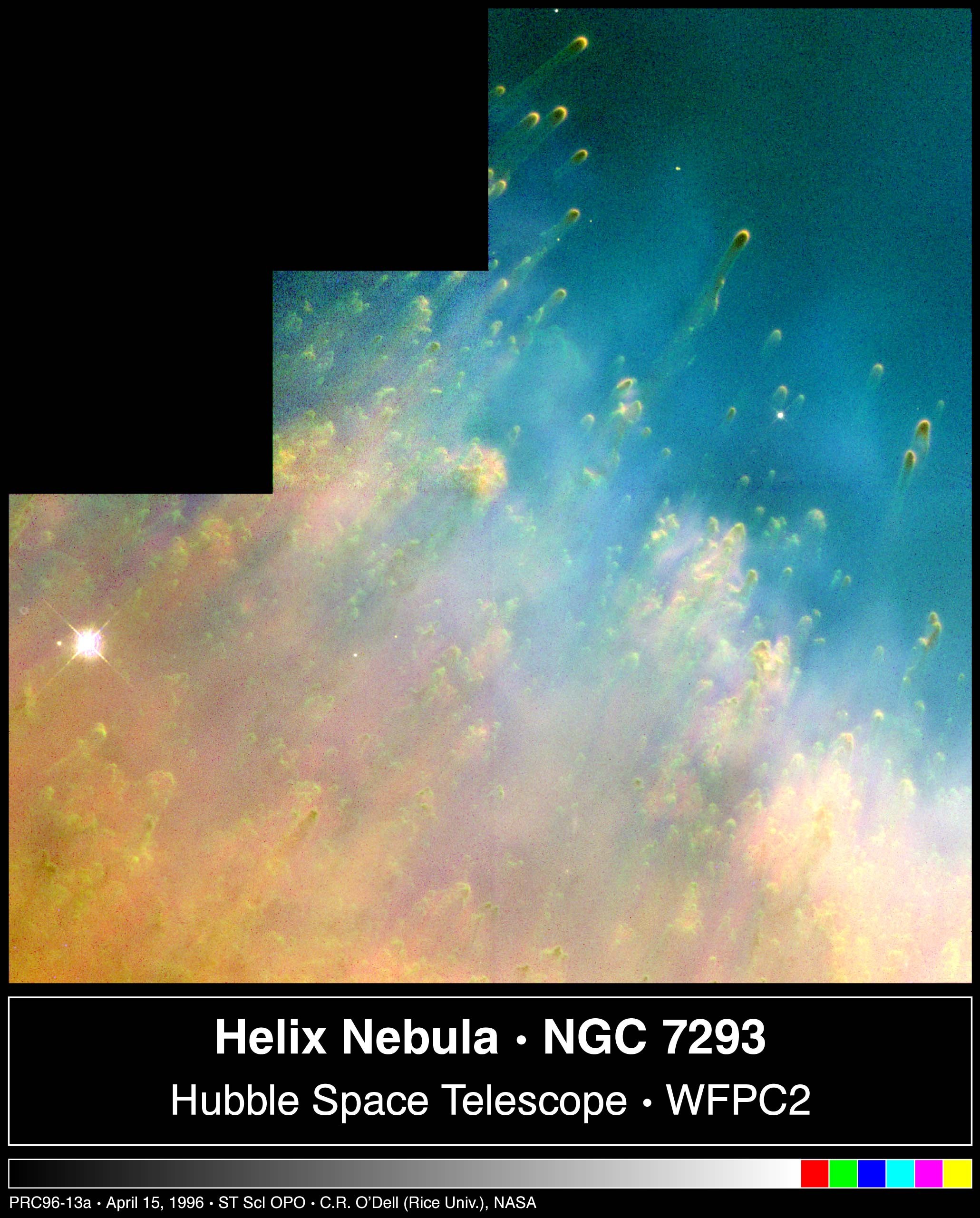
Alt...
2008 April 13
Curious Cometary Knots in the Helix Nebula
* Credit: C. R. O'Dell and K. Handron (Rice University), NASA
Explanation:
What causes unusual knots of gas and dust in planetary nebulas? Seen also in the Ring Nebula, the Dumbbell Nebula and NGC 2392, the knots' existence was not initially predicted and their origins are still not well understood. Pictured above is a fascinating image of the Helix Nebula by the Hubble Space Telescope showing tremendous detail of its mysterious gaseous knots. The above cometary knots have masses similar to the Earth but have radii typically several times the orbit of Pluto. One hypothesis for the fragmentation and evolution of the knots includes existing gas being driven out by a less dense but highly energetic stellar wind of the central evolving star. The Helix Nebula is the closest example of a planetary nebula created at the end of the life of a Sun-like star. The Helix Nebula, given a technical designation of NGC 7293, lies about 700 light-years away towards the constellation of Aquarius.
Authors & editors: Robert Nemiroff (MTU) & Jerry Bonnell (UMCP)
NASA Official: Phillip Newman Specific rights apply.
NASA Web Privacy Policy and Important Notices
A service of: ASD at NASA / GSFC
& Michigan Tech. U.
From Wikipedia, the free encyclopedia
[...]
The Helix Nebula is thought to be shaped like a prolate spheroid with strong density concentrations toward the filled disk along the equatorial plane, whose major axis is inclined about 21° to 37° from our vantage point. The size of the inner disk is 8×19 arcmin in diameter (0.52 pc); the outer torus is 12×22 arcmin in diameter (0.77 pc); and the outer-most ring is about 25 arcmin in diameter (1.76 pc). The outer-most ring appears flattened on one side due to it colliding with the ambient interstellar medium.
Expansion of the whole planetary nebula structure is estimated to have occurred in the last 6,560 years, and 12,100 years for the inner disk. Spectroscopically, the outer ring's expansion rate is 40 km/s, and about 32 km/s for the inner disk.
The Helix Nebula was the first planetary nebula discovered to contain cometary knots. Its main ring contains knots of nebulosity, which have now been detected in several nearby planetary nebulae, especially those with a molecular envelope like the Ring nebula and the Dumbbell Nebula.
These knots are radially symmetrical (from the CS) and are described as "cometary", each centered on a core of neutral molecular gas and containing bright local photoionization fronts or cusps towards the central star and tails away from it. All tails extend away from the Planetary Nebula Nucleus (PNN) in a radial direction. Excluding the tails, each knot is approximately the size of the Solar System, while each of the cusp knots are optically thick due to Lyc photons from the CS. There are about 40,000 cometary knots in the Helix Nebula.
[...] * more in the ALT-Text
CREDIT
+ Text excerpt
by Contributors to Wikimedia projects
+ Video credit
Magnetosheath (YT)
https://www.youtube.com/channel/UC2wcz4CLDO7CrSKOUl9o8qg/about
#space #nebula #astrophotography #photography #science #astronomy #physics #nature #NASA #ESA #education
2021 October 14
NGC 7293: The Helix Nebula
* Image Credit & Copyright: Ignacio Diaz Bobillo
https://www.pampaskies.com/gallery3/index.php
Explanation:
A mere seven hundred light years from Earth, toward the constellation Aquarius, a sun-like star is dying. Its last few thousand years have produced the Helix Nebula (NGC 7293), a well studied and nearby example of a Planetary Nebula, typical of this final phase of stellar evolution. A total of 90 hours of exposure time have gone in to creating this expansive view of the nebula. Combining narrow band image data from emission lines of hydrogen atoms in red and oxygen atoms in blue-green hues, it shows remarkable details of the Helix's brighter inner region about 3 light-years across. The white dot at the Helix's center is this Planetary Nebula's hot, central star. A simple looking nebula at first glance, the Helix is now understood to have a surprisingly complex geometry.
https://www.pampaskies.com/gallery3/Deep-Space-Objects/Helix_Oxygen_crop2_small
https://science.nasa.gov/missions/hubble/a-new-twist-on-an-old-nebula/
https://apod.nasa.gov/apod/ap211014.html
#space #nebula #astrophotography #photography #science #astronomy #physics #nature #NASA #ESA #education
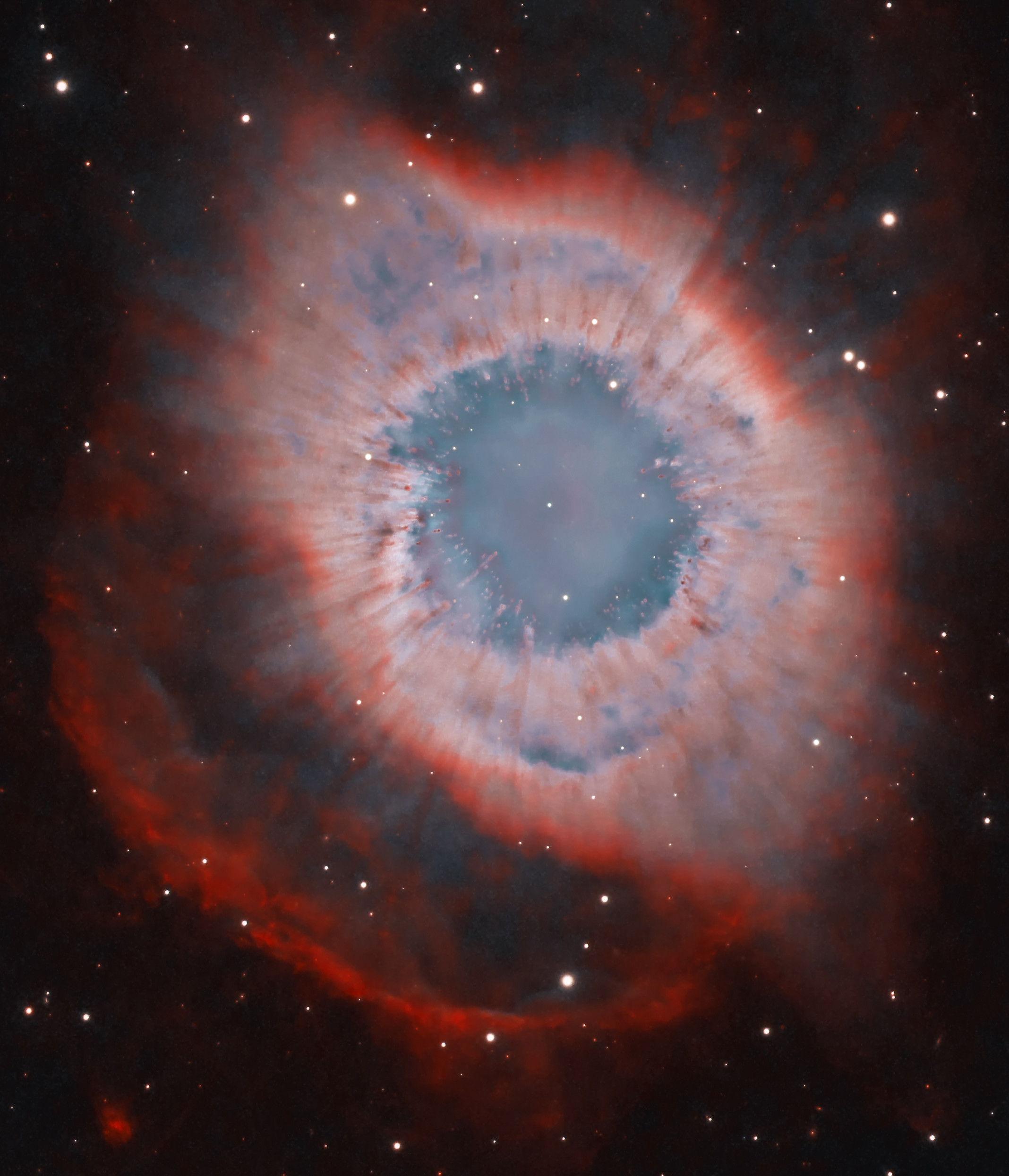
Alt...
2021 October 14
NGC 7293: The Helix Nebula
* Image Credit & Copyright: Ignacio Diaz Bobillo
Explanation:
A mere seven hundred light years from Earth, toward the constellation Aquarius, a sun-like star is dying. Its last few thousand years have produced the Helix Nebula (NGC 7293), a well studied and nearby example of a Planetary Nebula, typical of this final phase of stellar evolution. A total of 90 hours of exposure time have gone in to creating this expansive view of the nebula. Combining narrow band image data from emission lines of hydrogen atoms in red and oxygen atoms in blue-green hues, it shows remarkable details of the Helix's brighter inner region about 3 light-years across. The white dot at the Helix's center is this Planetary Nebula's hot, central star. A simple looking nebula at first glance, the Helix is now understood to have a surprisingly complex geometry.
Authors & editors: Robert Nemiroff (MTU) & Jerry Bonnell (UMCP)
NASA Official: Phillip Newman Specific rights apply.
NASA Web Privacy Policy and Important Notices
A service of: ASD at NASA / GSFC
& Michigan Tech. U.
2009 December 31
Dust and the Helix Nebula
* NASA, JPL-Caltech, Kate Su (Steward Obs., U. Arizona), et al.
http://ssc.spitzer.caltech.edu/
https://astro.arizona.edu/
https://arxiv.org/abs/astro-ph/0702296
http://www.nasa.gov/home/index.html
Explanation:
Dust makes this cosmic eye look red. The eerie Spitzer Space Telescope image shows infrared radiation from the well-studied Helix Nebula (NGC 7293) a mere 700 light-years away in the constellation Aquarius. The two light-year diameter shroud of dust and gas around a central white dwarf has long been considered an excellent example of a planetary nebula, representing the final stages in the evolution of a sun-like star. But the Spitzer data show the nebula's central star itself is immersed in a surprisingly bright infrared glow. Models suggest the glow is produced by a dust debris disk. Even though the nebular material was ejected from the star many thousands of years ago, the close-in dust could be generated by collisions in a reservoir of objects analogous to our own solar system's Kuiper Belt or cometary Oort cloud. Formed in the distant planetary system, the comet-like bodies would have otherwise survived even the dramatic late stages of the star's evolution.
https://coolcosmos.ipac.caltech.edu//
http://maps.seds.org/Stars_en/Fig/aquarius.html
https://apod.nasa.gov/apod/ap041210.html
http://www2.ess.ucla.edu/~jewitt/kb.html
!> https://en.wikipedia.org/wiki/Stellar_evolution
https://apod.nasa.gov/apod/ap091231.html
#space #nebula #astrophotography #photography #science #astronomy #physics #nature #NASA #ESA #education
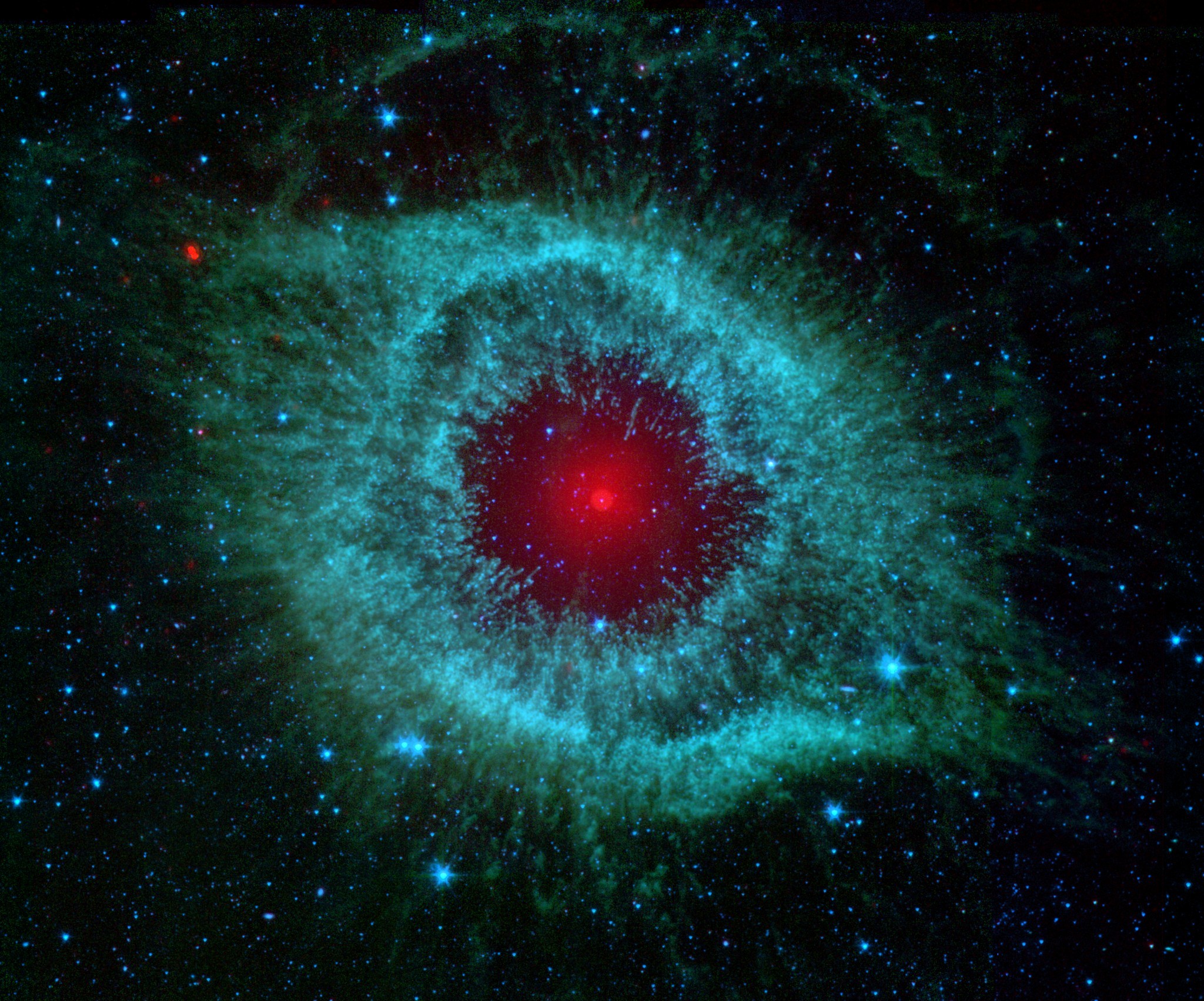
Alt...
2009 December 31
Dust and the Helix Nebula
* NASA, JPL-Caltech, Kate Su (Steward Obs., U. Arizona), et al.
Explanation:
Dust makes this cosmic eye look red. The eerie Spitzer Space Telescope image shows infrared radiation from the well-studied Helix Nebula (NGC 7293) a mere 700 light-years away in the constellation Aquarius. The two light-year diameter shroud of dust and gas around a central white dwarf has long been considered an excellent example of a planetary nebula, representing the final stages in the evolution of a sun-like star. But the Spitzer data show the nebula's central star itself is immersed in a surprisingly bright infrared glow. Models suggest the glow is produced by a dust debris disk. Even though the nebular material was ejected from the star many thousands of years ago, the close-in dust could be generated by collisions in a reservoir of objects analogous to our own solar system's Kuiper Belt or cometary Oort cloud. Formed in the distant planetary system, the comet-like bodies would have otherwise survived even the dramatic late stages of the star's evolution.
Authors & editors: Robert Nemiroff (MTU) & Jerry Bonnell (UMCP)
NASA Official: Phillip Newman Specific rights apply.
NASA Web Privacy Policy and Important Notices
A service of: ASD at NASA / GSFC
& Michigan Tech. U.
2006 January 12
Infrared Helix
* Credit: J. Hora (Harvard-Smithsonian CfA) et al., (SSC/Caltech), JPL-Caltech, NASA
https://www.cfa.harvard.edu/
https://irsa.ipac.caltech.edu/data/SPITZER/docs/
http://www.jpl.nasa.gov/
http://www.nasa.gov/home/index.html
Explanation:
Over six hundred light years from Earth, in the constellation Aquarius, a sun-like star is dying. Its last few thousand years have produced the Helix Nebula (NGC 7293), a well studied and nearby example of a Planetary Nebula, typical of this final phase of stellar evolution. Emission in this infrared Spitzer Space Telescope image of the Helix comes mostly from the nebula's molecular hydrogen gas. The gas appears to be clumpy, forming thousands of comet-shaped knots each spanning about twice the size of our solar system. Bluer, more energetic radiation is seen to come from the heads with redder emission from the tails, suggesting that they are more shielded from the central star's winds and intense ultraviolet radiation. The nebula itself is about 2.5 light-years across. The Sun is expected to go through its own Planetary Nebula phase ... in another 5 billion years.
!> http://hawastsoc.org/deepsky/aqr/index.html
https://apod.nasa.gov/apod/ap060112.html
#space #nebula #astrophotography #photography #science #astronomy #physics #nature #NASA #ESA #education
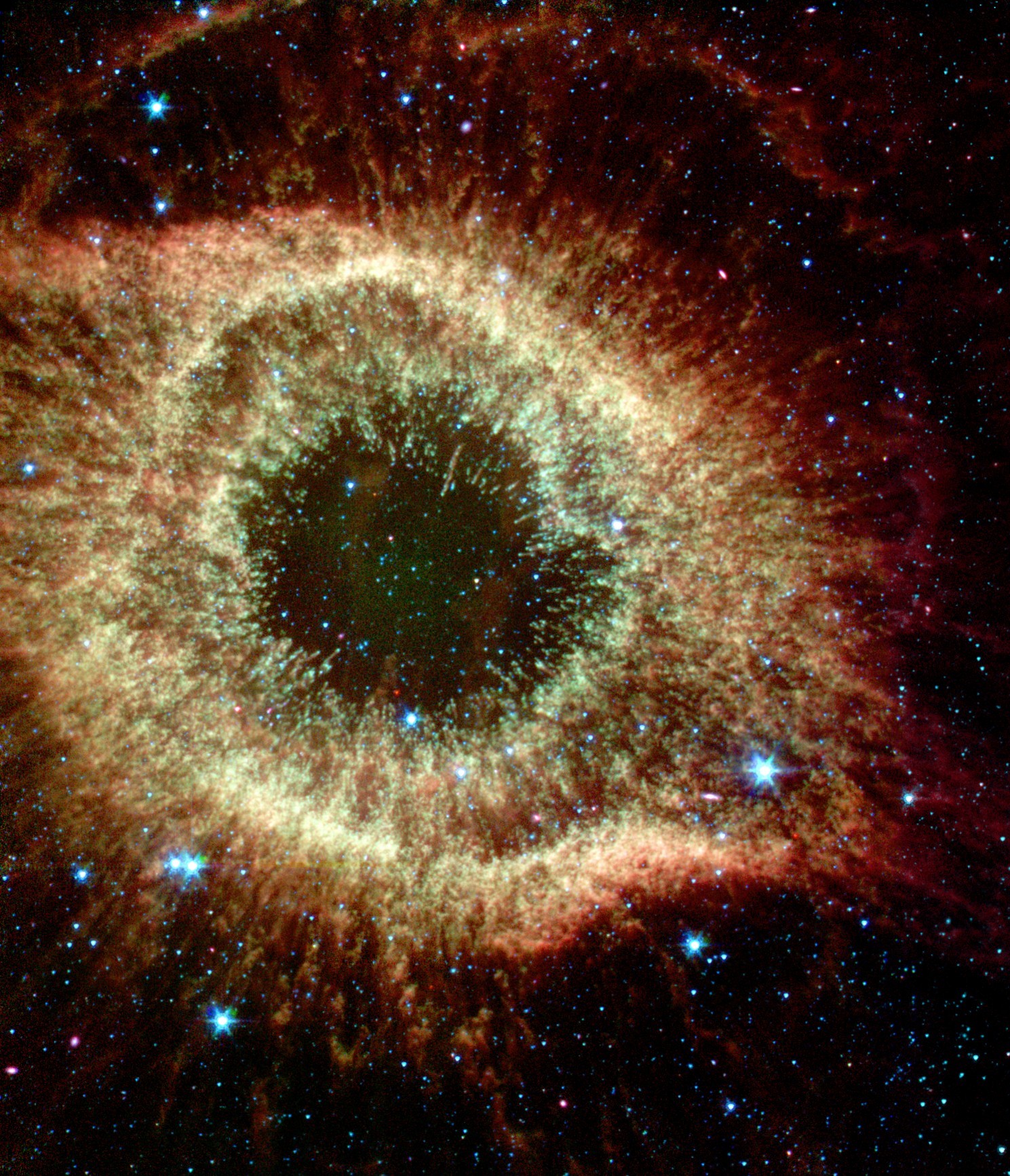
Alt...
2006 January 12
Infrared Helix
* Credit: J. Hora (Harvard-Smithsonian CfA) et al., (SSC/Caltech), JPL-Caltech, NASA
Explanation:
Over six hundred light years from Earth, in the constellation Aquarius, a sun-like star is dying. Its last few thousand years have produced the Helix Nebula (NGC 7293), a well studied and nearby example of a Planetary Nebula, typical of this final phase of stellar evolution. Emission in this infrared Spitzer Space Telescope image of the Helix comes mostly from the nebula's molecular hydrogen gas. The gas appears to be clumpy, forming thousands of comet-shaped knots each spanning about twice the size of our solar system. Bluer, more energetic radiation is seen to come from the heads with redder emission from the tails, suggesting that they are more shielded from the central star's winds and intense ultraviolet radiation. The nebula itself is about 2.5 light-years across. The Sun is expected to go through its own Planetary Nebula phase ... in another 5 billion years.
Authors & editors: Robert Nemiroff (MTU) & Jerry Bonnell (USRA)
NASA Web Site Statements, Warnings, and Disclaimers
NASA Official: Jay Norris. Specific rights apply.
A service of: EUD at NASA / GSFC
& Michigan Tech. U.
2025 July 31
Supernova 2025rbs in NGC 7331
* Image Credit: Ben Godson (University of Warwick)
https://warwick.ac.uk/fac/sci/physics/research/astro/people/bengodson/
Explanation:
A long time ago in a galaxy 50 million light-years away, a star exploded. Light from that supernova was first detected by telescopes on planet Earth on July 14th though, and the extragalactic transient is now known to astronomers as supernova 2025rbs. Presently the brightest supernova in planet Earth's sky, 2025rbs is a Type Ia supernova, likely caused by the thermonuclear detonation of a white dwarf star that accreted material from a companion in a binary star system. Type Ia supernovae are used as standard candles to establish the distance scale of the universe. The host galaxy of 2025rbs is NGC 7331. Itself a bright spiral galaxy in the northern constellation Pegasus, NGC 7331 is often touted as an analog to our own Milky Way.
https://goto-observatory.org/bright-supernova-2025rbs-discovered-by-goto/
https://www.wis-tns.org/object/2025rbs
https://rochesterastronomy.org/supernova.html
https://apod.nasa.gov/apod/ap250731.html
#space #supernova #astrophotography #photography #science #astronomy #physics #nature #NASA #ESA #education

Alt...
2025 July 31
Supernova 2025rbs in NGC 7331
* Image Credit: Ben Godson (University of Warwick)
Explanation:
A long time ago in a galaxy 50 million light-years away, a star exploded. Light from that supernova was first detected by telescopes on planet Earth on July 14th though, and the extragalactic transient is now known to astronomers as supernova 2025rbs. Presently the brightest supernova in planet Earth's sky, 2025rbs is a Type Ia supernova, likely caused by the thermonuclear detonation of a white dwarf star that accreted material from a companion in a binary star system. Type Ia supernovae are used as standard candles to establish the distance scale of the universe. The host galaxy of 2025rbs is NGC 7331. Itself a bright spiral galaxy in the northern constellation Pegasus, NGC 7331 is often touted as an analog to our own Milky Way.
Authors & editors: Robert Nemiroff (MTU) & Jerry Bonnell (UMCP)
NASA Official: Amber Straughn Specific rights apply.
NASA Web Privacy, Accessibility, Notices;
A service of: ASD at NASA / GSFC,
NASA Science Activation
& Michigan Tech. U.Authors & editors: Robert Nemiroff (MTU) & Jerry Bonnell (UMCP)
NASA Official: Amber Straughn Specific rights apply.
NASA Web Privacy, Accessibility, Notices;
A service of: ASD at NASA / GSFC,
NASA Science Activation
& Michigan Tech. U.
Type Ia Supernovae
By jmbrill
Roman will use type Ia supernovae to measure cosmic distances, which will help us understand how the universe has expanded over time.
* Video Credit:
NASA Goddard's Scientific Visualization Studio
Roman will see thousands of exploding stars called supernovae across vast stretches of time and space. Using these observations, astronomers aim to shine a light on several cosmic mysteries – primarily dark energy. Roman will use type Ia supernovae to measure cosmic distances, which will help us understand how the universe has expanded over time.
Roman’s supernova survey will help clear up clashing measurements of how fast the universe is currently expanding, and even provide a new way to probe the distribution of dark matter, which is detectable only through its gravitational effects. One of the mission’s primary science goals involves using supernovae to help pin down the nature of dark energy – the unexplained cosmic pressure that’s speeding up the expansion of the universe.
Roman will use multiple methods to investigate dark energy. One involves surveying the sky for a special type of exploding star, called a type Ia supernova.
Many supernovae occur when massive stars run out of fuel, rapidly collapse under their own weight, and then explode because of strong shock waves that propel out of their interiors. These supernovae occur about once every 50 years in our Milky Way galaxy. But evidence shows that type Ia supernovae originate from some binary star systems that contain at least one white dwarf – the small, hot core remnant of a Sun-like star. Type Ia supernovae are much rarer, happening roughly once every 500 years in the Milky Way.
[...]
Read more in next reply
https://science.nasa.gov/mission/roman-space-telescope/type-ia-supernovae/
You might also be interested in:
TOPIC> "As Far As We Can See" https://defcon.social/@grobi/114626118056153533
#space #supernova #astrophotography #photography #science #astronomy #physics #nature #NASA #ESA #education
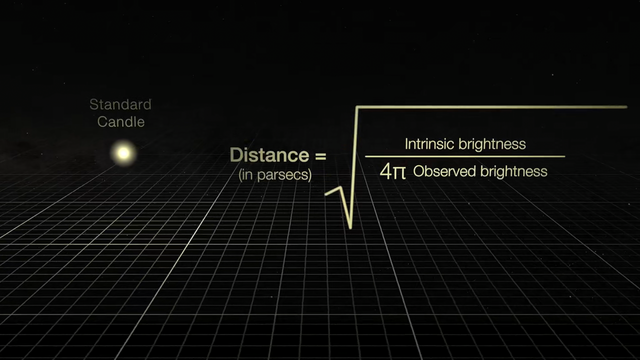
Alt...
NASA’s upcoming Nancy Grace Roman Space Telescope will see thousands of exploding stars called supernovae across vast stretches of time and space. Using these observations, astronomers aim to shine a light on several cosmic mysteries, providing a window onto the universe’s distant past and hazy present.
Read more: http://www.nasa.gov/feature/goddard/2...
Roman’s supernova survey will help clear up clashing measurements of how fast the universe is currently expanding, and even provide a new way to probe the distribution of dark matter, which is detectable only through its gravitational effects. One of the mission’s primary science goals involves using supernovae to help pin down the nature of dark energy – the unexplained cosmic pressure that’s speeding up the expansion of the universe.
Roman will use multiple methods to investigate dark energy. One involves surveying the sky for a special type of exploding star, called a type Ia supernova.
Music: "Relentless Data" from Universal Production Music
Video credit: NASA's Goddard Space Flight Center
Scott Wiessinger (USRA): Producer
Ashley Balzer (ADNET): Science Writer
Adriana Manrique Gutierrez (USRA): Lead Animator
Claire Andreoli (NASA/GSFC): Public Affairs Officer
Barb Mattson (University of Maryland College Park): Narrator
Scott Wiessinger (USRA): Animator
Scott Wiessinger (USRA): Writer
Scott Wiessinger (USRA): Editor
By jmbrill
[...]
In some cases, the dwarf may siphon material from its companion. This ultimately triggers a runaway reaction that detonates the thief once it reaches a specific point where it has gained so much mass that it becomes unstable. Astronomers have also found evidence supporting another scenario, involving two white dwarfs that spiral toward each other until they merge. If their combined mass is high enough that it leads to instability, they, too, may produce a type Ia supernova.
These explosions peak at a similar, known intrinsic brightness, making type Ia supernovae so-called standard candles – objects or events that emit a specific amount of light, allowing scientists to find their distance with a straightforward formula. Because of this, astronomers can determine how far away the supernovae are by simply measuring how bright they appear.
Astronomers will also use Roman to study the light of these supernovae to find out how quickly they appear to be moving away from us. By comparing how fast they’re receding at different distances, scientists will trace cosmic expansion over time. This will help us understand whether and how dark energy has changed throughout the history of the universe.
Previous type Ia supernova surveys have concentrated on the relatively nearby universe, largely due to instrument limitations. Roman’s infrared vision, gigantic field of view, and exquisite sensitivity will dramatically extend the search, pulling the cosmic curtains far enough aside to allow astronomers to spot thousands of distant type Ia supernovae.
Roman will study dark energy’s influence in detail over more than half of the universe’s history, when it was between about 4 and 12 billion years old. Exploring this relatively unprobed region will help scientists add crucial pieces to the dark energy puzzle.
Video Credit:
NGSVS
https://science.nasa.gov/mission/roman-space-telescope/type-ia-supernovae/
#space #supernova #astrophotography #photography #science #astronomy #physics #nature #NASA #ESA #education
2025 November 4
Comet Lemmon Beyond Lomnický Peak
* Image Credit & Copyright: Robert Barsa
http://astrofotografia.sk/
Explanation:
Comet Lemmon has been putting on a show for cameras around the globe. Passing nearest to Earth in late October, the photogenic comet C/2025 A6 (Lemmon) sprouted two long and picturesque tails: a blue ion tail and a white dust tail. The ion tail is pushed away from the coma by the ever-present but ever-changing solar wind, at one point extending over 20 times the diameter of the full Moon -- as captured in this long-duration exposure. The shorter and wider dust tail is pushed away from the coma and shines by reflecting sunlight. The featured picture, captured two weeks ago, framed the comet behind Lomnický Peak of the High Tatra Mountains, home to the Slovakian Lomnický Stit Observatory. Comet Lemmon is now fading as it heads away from planet Earth. The huge shedding snowball will round the Sun later this week.
https://www.instagram.com/p/DQUSyhYAp2q/
https://en.wikipedia.org/wiki/C/2025_A6_(Lemmon)
https://astronomy.swin.edu.au/cosmos/C/cometary+dust+tail
https://astro4edu.org/resources/glossary/term/61/
https://spaceplace.nasa.gov/comets/en/anatomy-of-a-comet.en.jpg
https://science.nasa.gov/sun/what-is-the-solar-wind/
https://theskylive.com/c2025a6-info
https://web.astro.sk/en/research/observatories/lomnicky-stit-observatory/
https://www.youtube.com/watch?v=Sh9uHKMYWM8
https://apod.nasa.gov/apod/ap251104.html
#space #comets #astrophotography #photography #science #astronomy #nature #NASA #ESA #education #apod
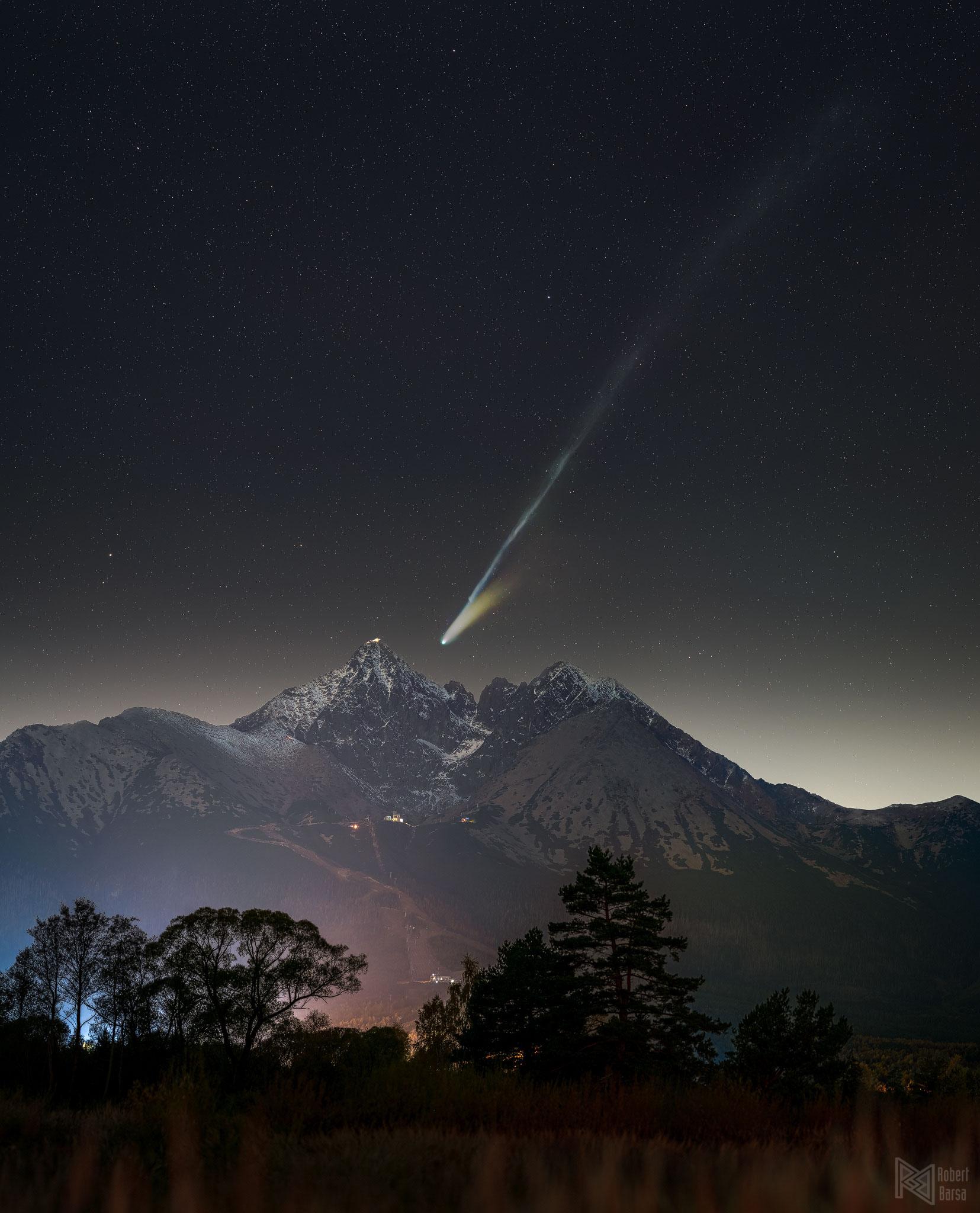
Alt...
2025 November 4
An image of the night sky over distant mountains features a comet with long tails. One of the tails goes nearly to the edge of the picture on the upper right.
Comet Lemmon Beyond Lomnický Peak
* Image Credit & Copyright: Robert Barsa
Explanation:
Comet Lemmon has been putting on a show for cameras around the globe. Passing nearest to Earth in late October, the photogenic comet C/2025 A6 (Lemmon) sprouted two long and picturesque tails: a blue ion tail and a white dust tail. The ion tail is pushed away from the coma by the ever-present but ever-changing solar wind, at one point extending over 20 times the diameter of the full Moon -- as captured in this long-duration exposure. The shorter and wider dust tail is pushed away from the coma and shines by reflecting sunlight. The featured picture, captured two weeks ago, framed the comet behind Lomnický Peak of the High Tatra Mountains, home to the Slovakian Lomnický Stit Observatory. Comet Lemmon is now fading as it heads away from planet Earth. The huge shedding snowball will round the Sun later this week.
Authors & editors: Robert Nemiroff (MTU) & Jerry Bonnell (UMCP)
NASA Official: Amber Straughn Specific rights apply.
NASA Web Privacy, Accessibility, Notices;
A service of: ASD at NASA / GSFC,
NASA Science Activation
& Michigan Tech. U.
Control structures in programming languages https://lobste.rs/s/tbdvn9 #education #ml
http://xavierleroy.org/control-structures/
Unveiling a 36 billion solar mass black hole at the centre of the Cosmic Horseshoe gravitational lens
Supermassive black holes (SMBHs) are found at the centre of every massive galaxy, with their masses tightly connected to their host galaxies through a co-evolution over cosmic time. For massive ellipticals, the SMBH mass strongly correlates with the host central stellar velocity dispersion, via the relation. However, SMBH mass measurements have traditionally relied on central stellar dynamics in nearby galaxies, limiting our ability to explore the SMBHs across cosmic time. In this work, we present a self-consistent analysis combining 2D stellar dynamics and lens modelling of the Cosmic Horseshoe gravitational lens system, one of the most massive lens galaxies ever observed. Using MUSE integral-field spectroscopy and high-resolution Hubble Space Telescope imaging, we simultaneously model the radial arc – sensible to the inner mass structure – with host stellar kinematics to constrain the galaxy’s central mass distribution and SMBH mass. Bayesian model comparison yields a detection of an ultramassive black hole with , consistent across various systematic tests. Our findings place the Cosmic Horseshoe above the relation, supporting an emerging trend observed in brightest cluster galaxies and other massive galaxies, which suggests a steeper relationship at the highest masses, potentially driven by a different co-evolution of SMBHs and their host galaxies. Future surveys will uncover more radial arcs, enabling the detection of SMBHs over a broader redshift and mass range. These discoveries will further refine our understanding of the relation and its evolution across cosmic time.
https://academic.oup.com/mnras/article/541/4/2853/8213862?login=false
https://academic.oup.com/mnras/article-pdf/541/4/2853/63890019/staf1036.pdf
CREDIT
Carlos R Melo-Carneiro,
Thomas E Collett,
Lindsay J Oldham,
Wolfgang Enzi,
Cristina Furlanetto,
Ana L Chies-Santos,
Tian Li
#space #galaxy #astrophotography #photography #science #physics #nature #NASA #ESA #hubble #webb #education #apod
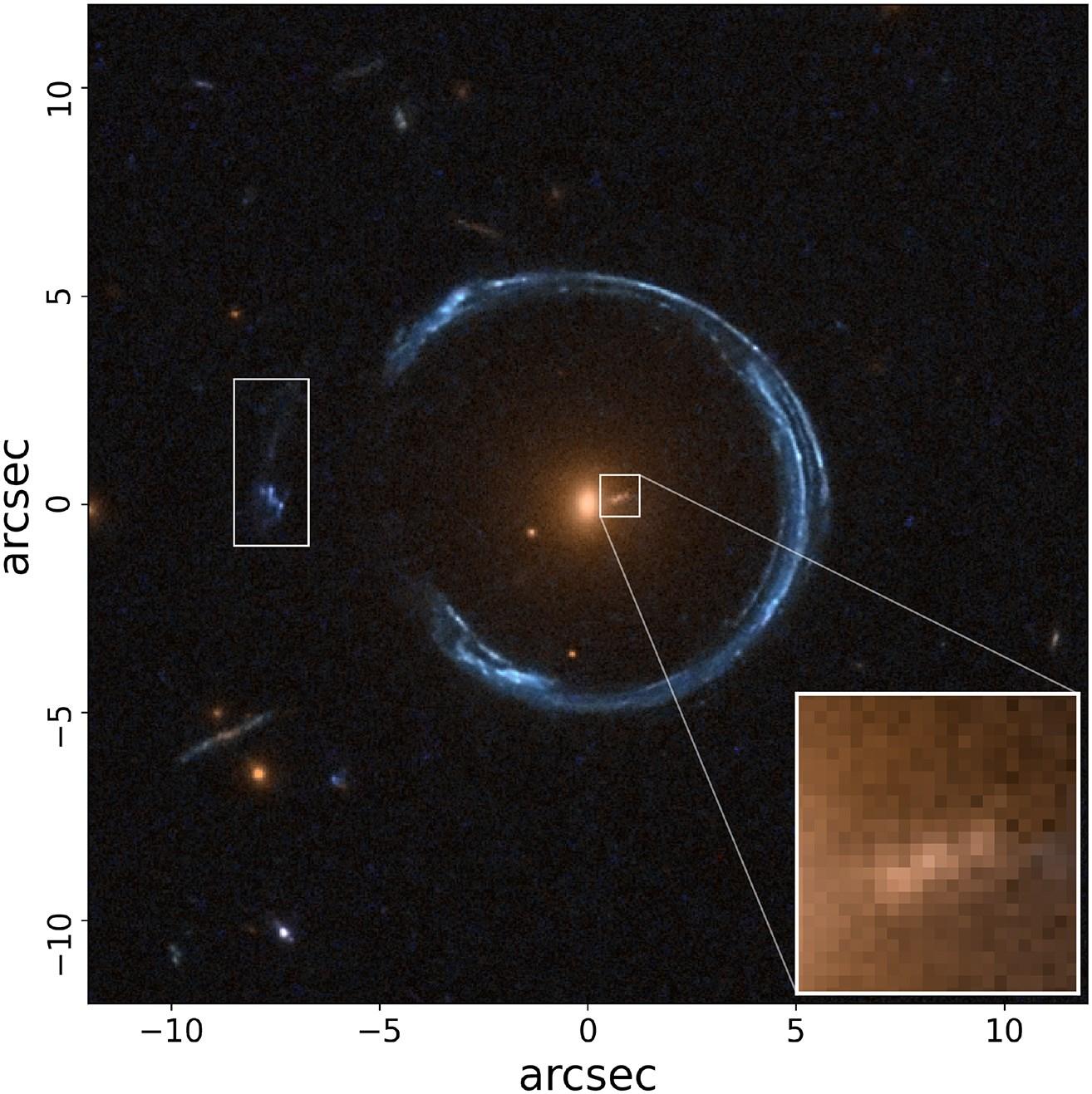
Alt...
Figure 1.
HST/WFC3 colour composite image of the Cosmic Horseshoe, created using the F814W, F606W, and F475W filters. The system is composed by the main deflector; the eponymous Einstein ring of the Cosmic Horseshoe; and the radial arc and its counter-image, both highlighted. The inset shows the radial arc. The figure is oriented such that north is up and east is left.
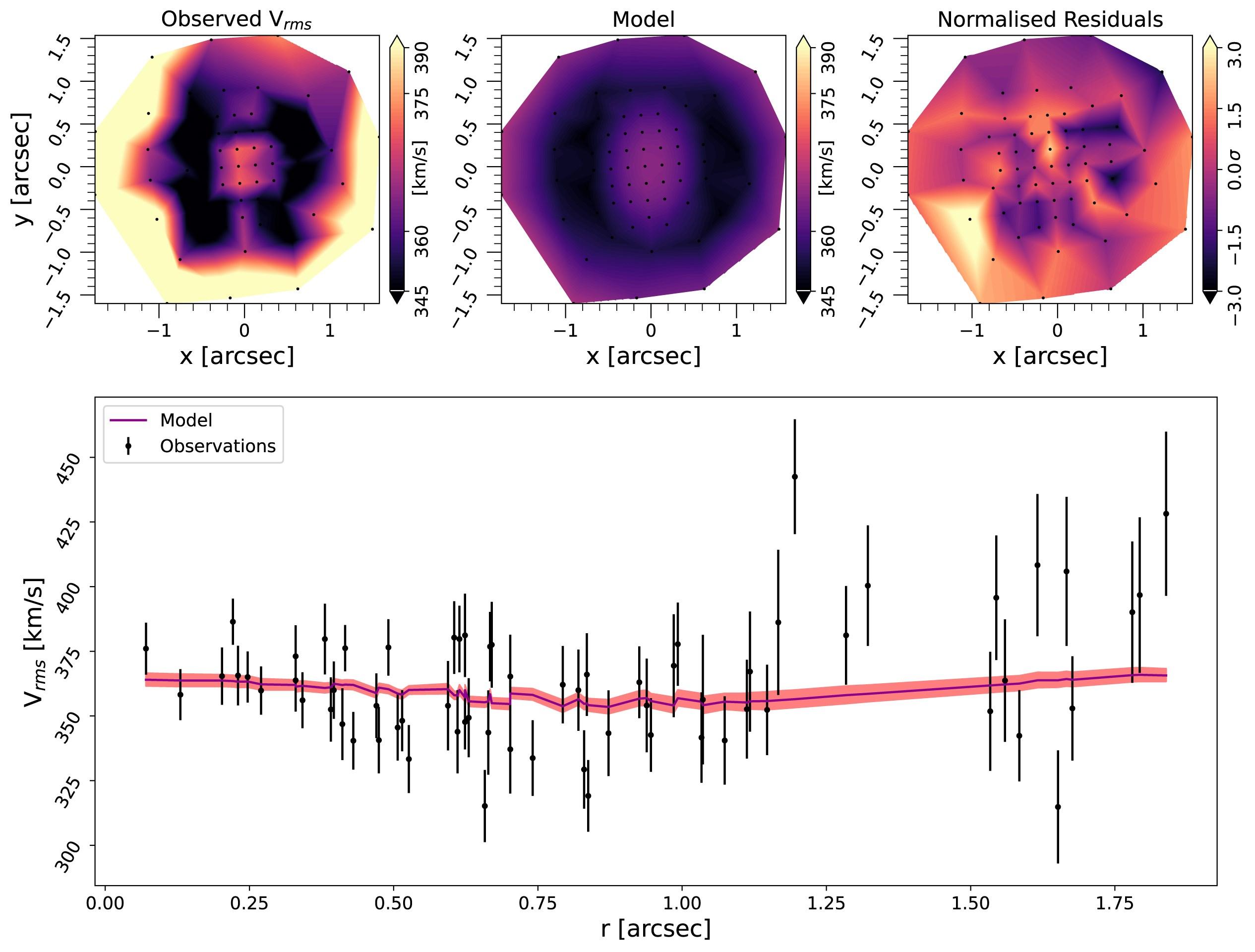
Alt...
Figure 2.
Stellar dynamics fiducial model. The top panels show the observed
kinematic map (left), the median kinematic model (centre), and the normalized residuals (right). The bottom panel presents the radial kinematic profile (black dots) alongside the median model and its
credible region. The black dots in the top panels mark the centroids of the Voronoi bins.
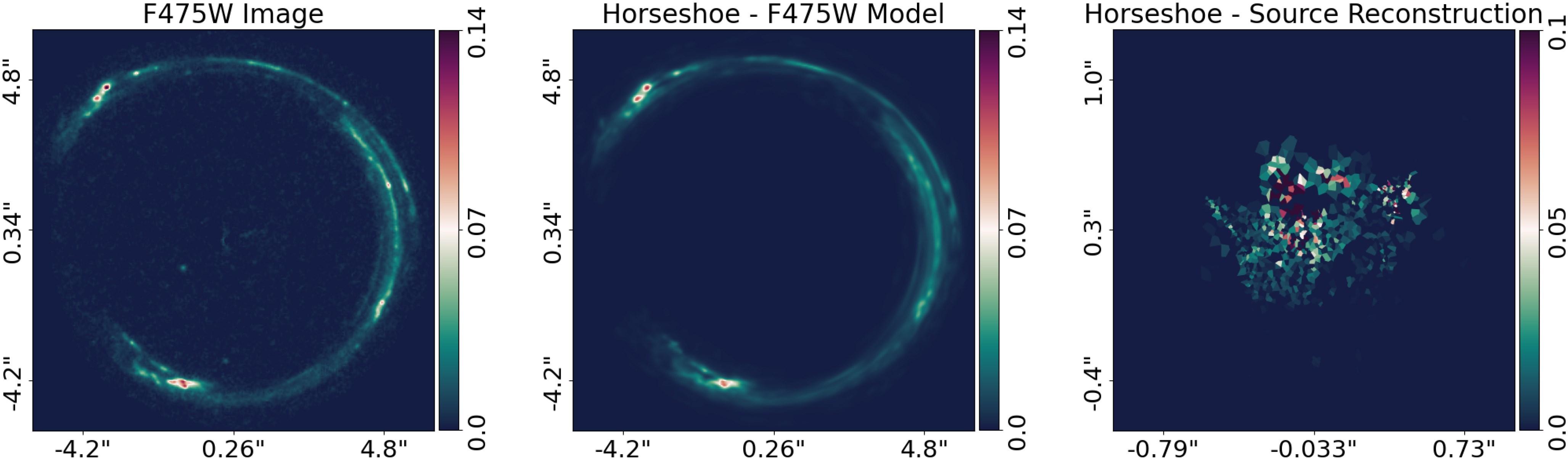
Alt...
Figure 3.
Fits to the Cosmic Horseshoe in the F475W filter. From left to right, the panels display the lens-subtracted image, the highest-likelihood EPL model, and the reconstructed source s2 at z=2.381. To enhance the efficiency of the lens modelling, a mask has been applied around the lensed source and only modelled pixels within the masked region, as shown in the central panel. All images are in units of electrons per second.
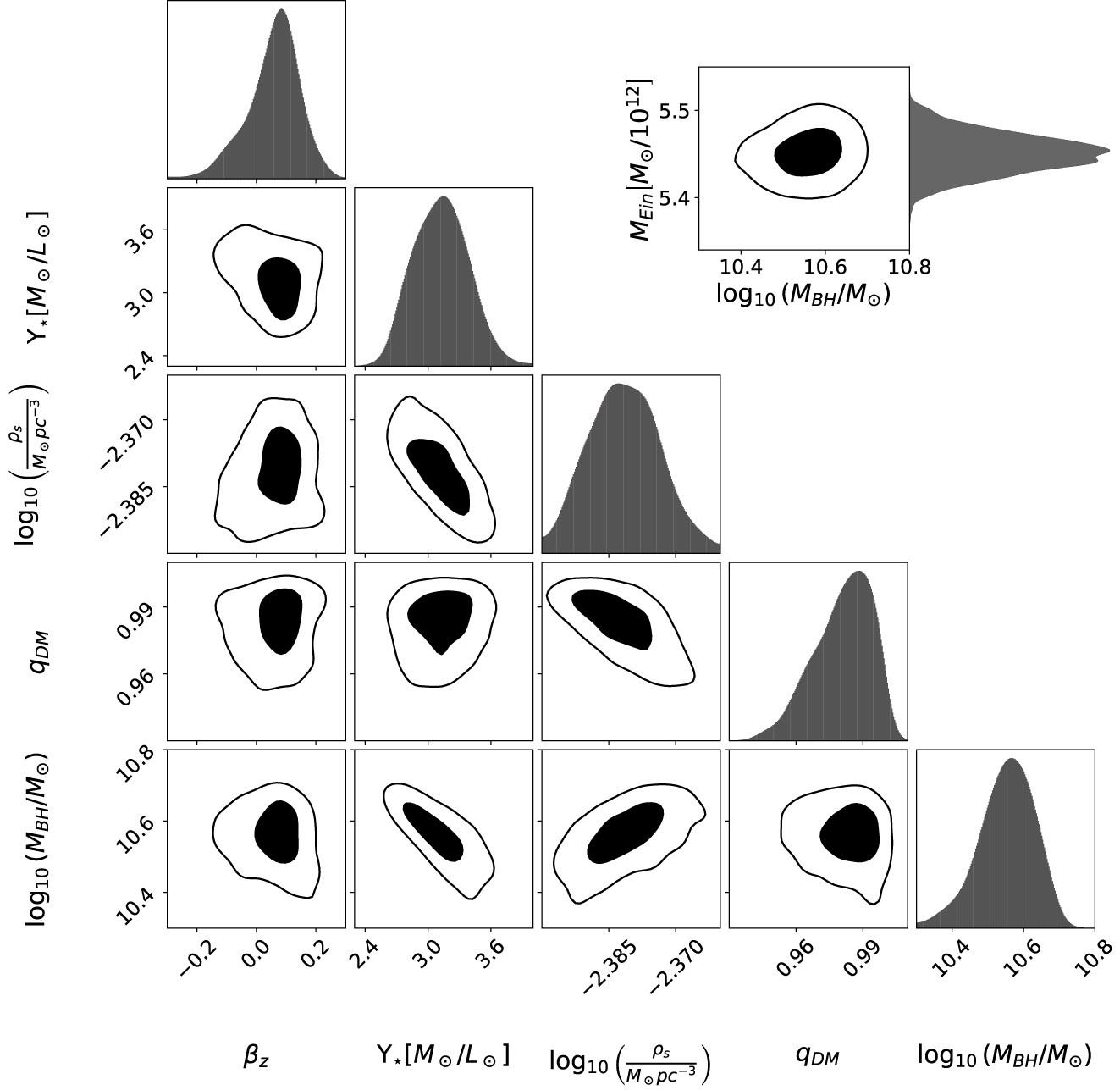
Alt...
Figure 4.
Two-dimensional posterior distributions for the parameters of the fiducial model. Only parameters that show a strong degeneracy with the SMBH mass are displayed. The inset plot on the top-right present the covariance between the SMBH mass and Einstein mass within the Cosmic Horseshoe ring. Contours are the 1 and 2σ credible intervals, respectively.
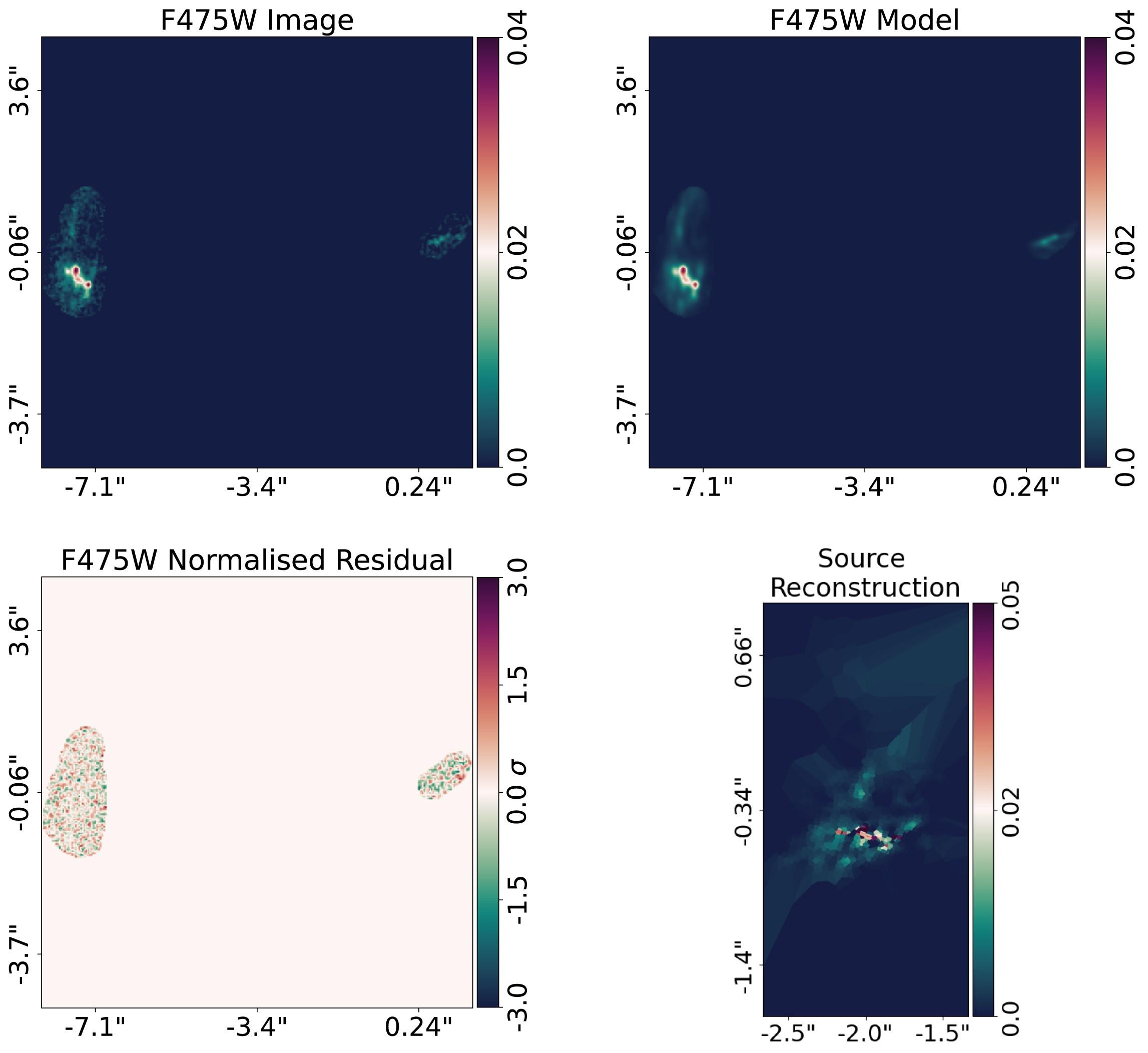
Alt...
Figure 5.
Highest-likelihood lens model under the fiducial configuration. The panels, from top left to bottom right, show the observed image, lensed source model, normalized residuals, and source reconstruction. All images are in units of electrons per second.
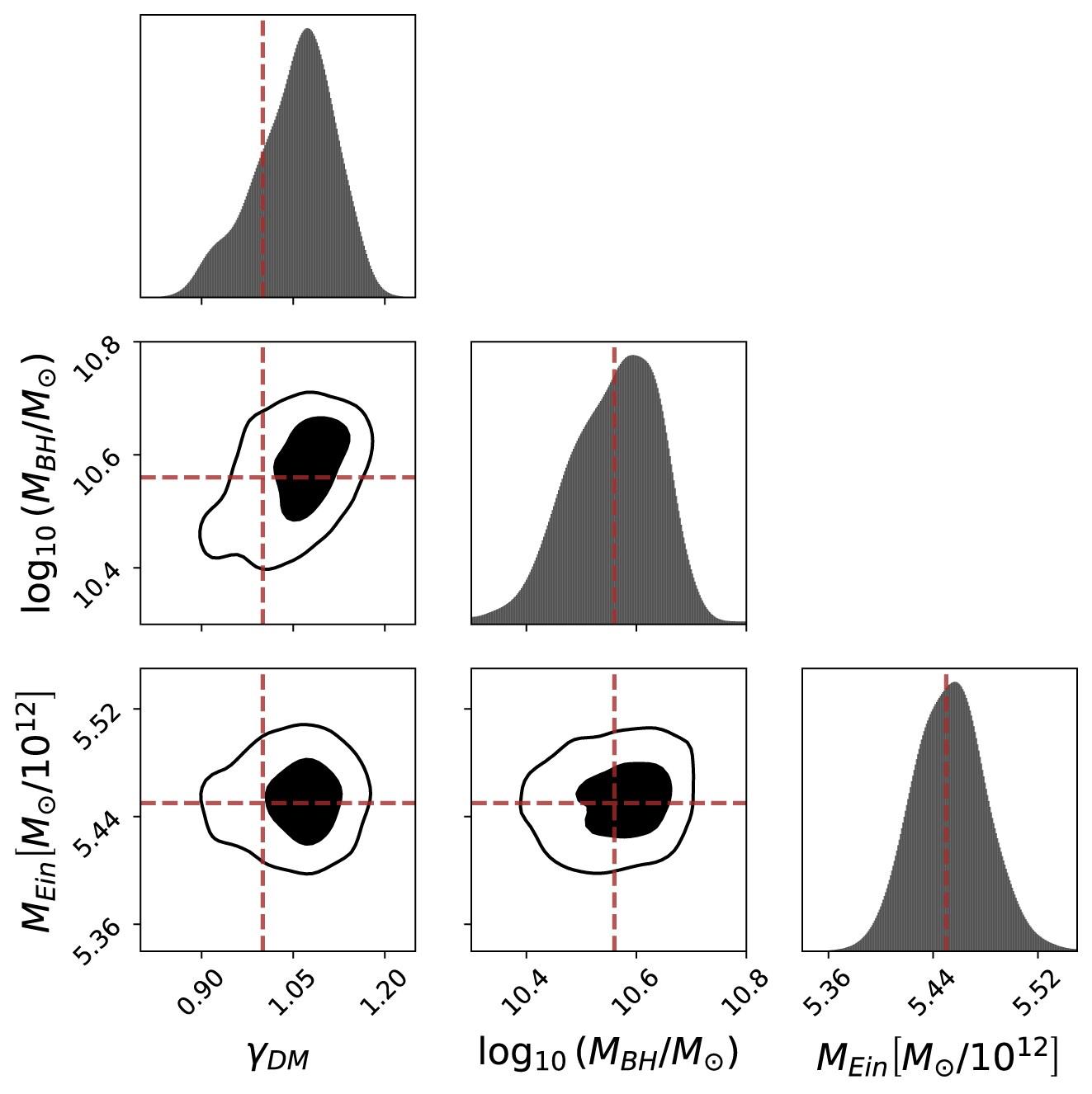
Alt...
Figure 6.
Two-dimensional posterior distributions for the parameters of model M2, which differs from the fiducial model by assuming a gNFW halo. Only the inner DM density slope, the SMBH mass, and the Einstein mass are displayed. The brown dashed lines show the posterior median of the fiducial model for comparison. Contours are the 1σ and 2σ
credible intervals, respectively.
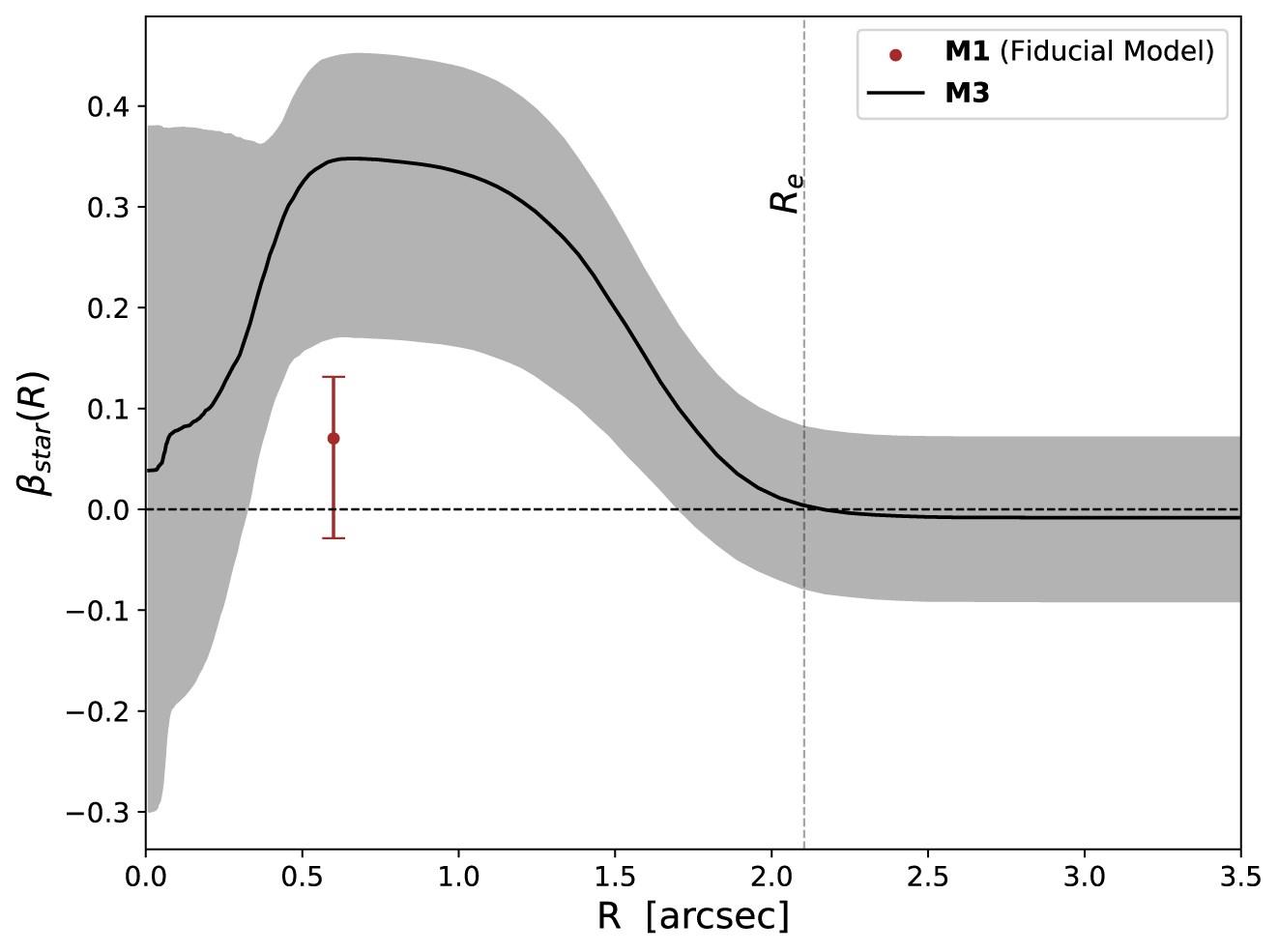
Alt...
Figure 7.
M3 anisotropy profile. The solid line shows the orbital anisotropy profile of the stars, and the grey band represents the 1σ credible band. The brown point is the constant anisotropy inferred by the fiducial model M1, with its associated error bar. The horizontal dashed line corresponds to the isotropic case.
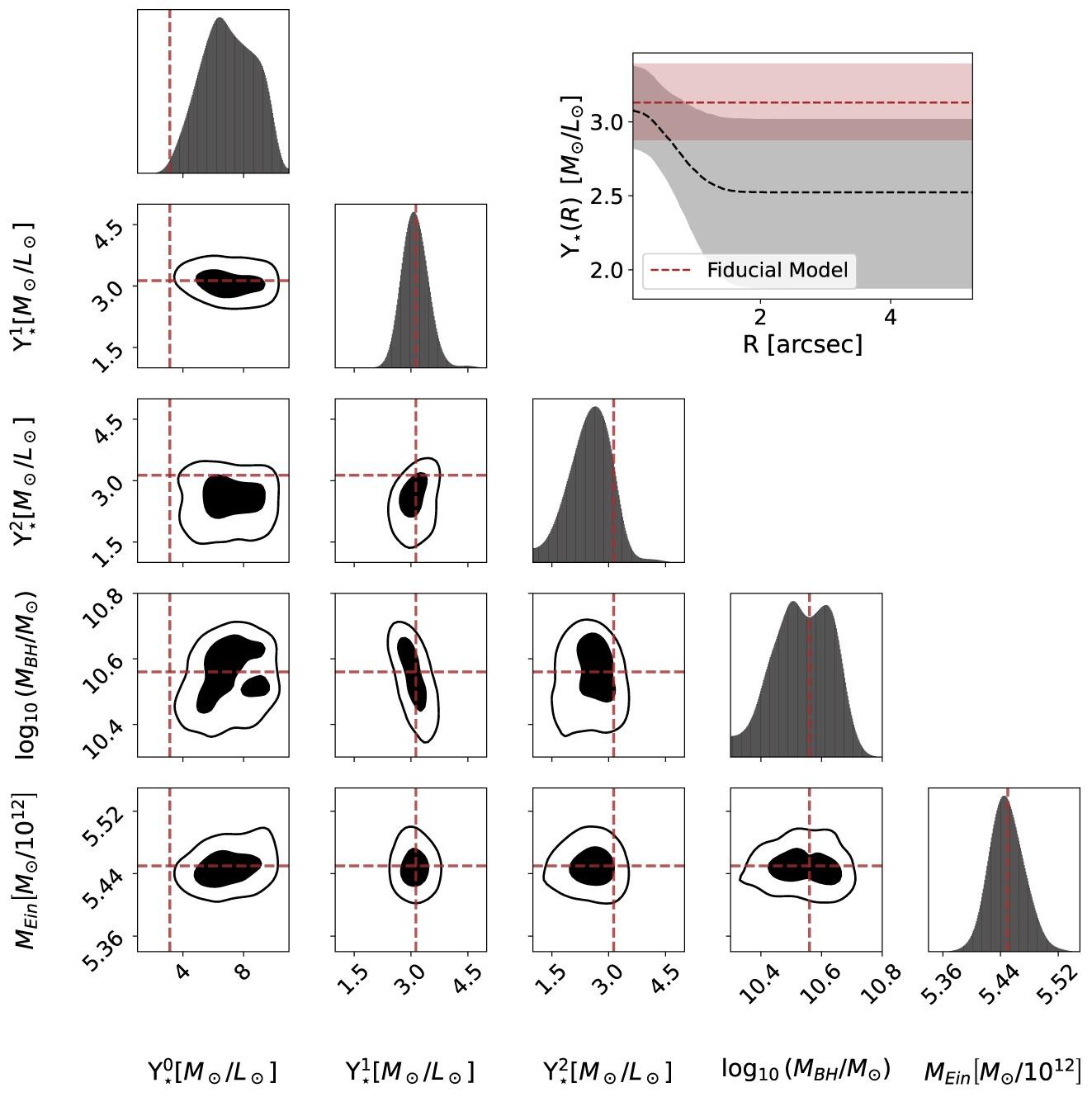
Alt...
Figure 8.
Two-dimensional posterior distributions for the parameters of model M4, which differs from the fiducial model by a gradient mass-to-light ratio. Only the three mass-to-light ratios, the SMBH mass, and the Einstein mass are displayed. The brown dashed lines show the posterior median of the fiducial model for comparison. Contours are the 1σ and 2σ credible intervals, respectively. The top-right inset shows the projected radial stellar mass-to-light profiles for the fiducial model (brown) and model M4 in black. The shaded regions are the level.
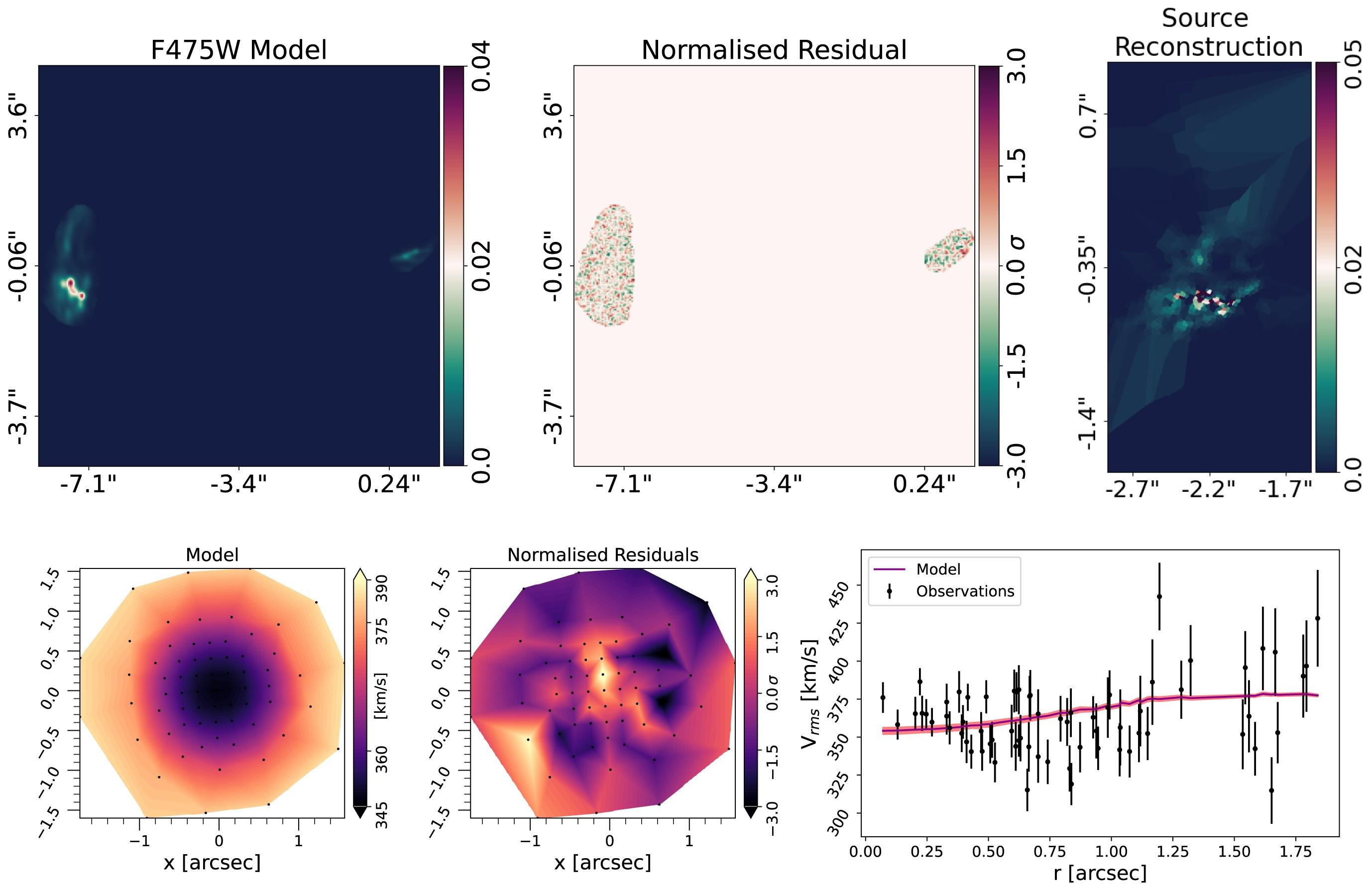
Alt...
Figure 9.
Model results of mass configuration M14, which differs from the fiducial model by not including an SMBH. The upper panels display, left to right, the highest-likelihood lens model, the normalized residuals, and the source reconstruction. The bottom panels are, left to right, the median dynamical model, the normalized residuals, and the radial kinematic profile with the median model. All top images are in units of electrons per second.
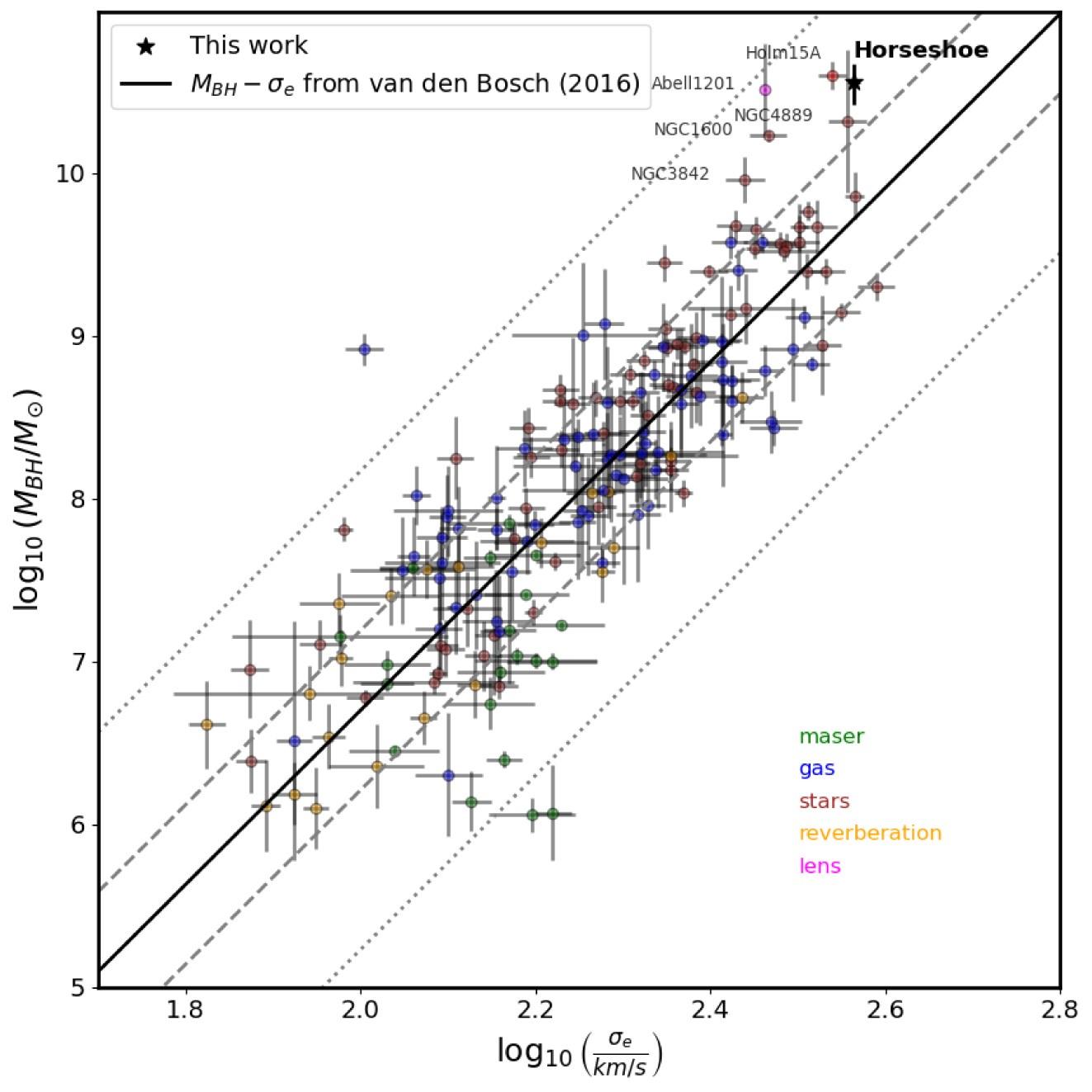
Alt...
Figure 10.
Relationship between mass and the host effective velocity dispersion. The black solid line represents the relation from den Bosch (2016), with the dashed and dotted lines showing the and scatter, respectively. The UMBH at the centre of the Cosmic Horseshoe’s main lens is marked by a star, with a measured mass of . Other UMBHs that deviate significantly from the relation are also shown: NGC 4889 and NGC 3842 (McConnell et al. 2011), NGC 1601 (Thomas et al. 2016), Holm 15A (Mehrgan et al. 2019), and Abell 1201 (Nightingale et al. 2023). These systems are typically BCGs, and except Abell 1201 at , they are all nearby systems. The Cosmic Horseshoe, at , represents one of the most massive SMBHs measured and is an outlier from the main relation. The SMBH mass compilation is from den Bosch (2016).
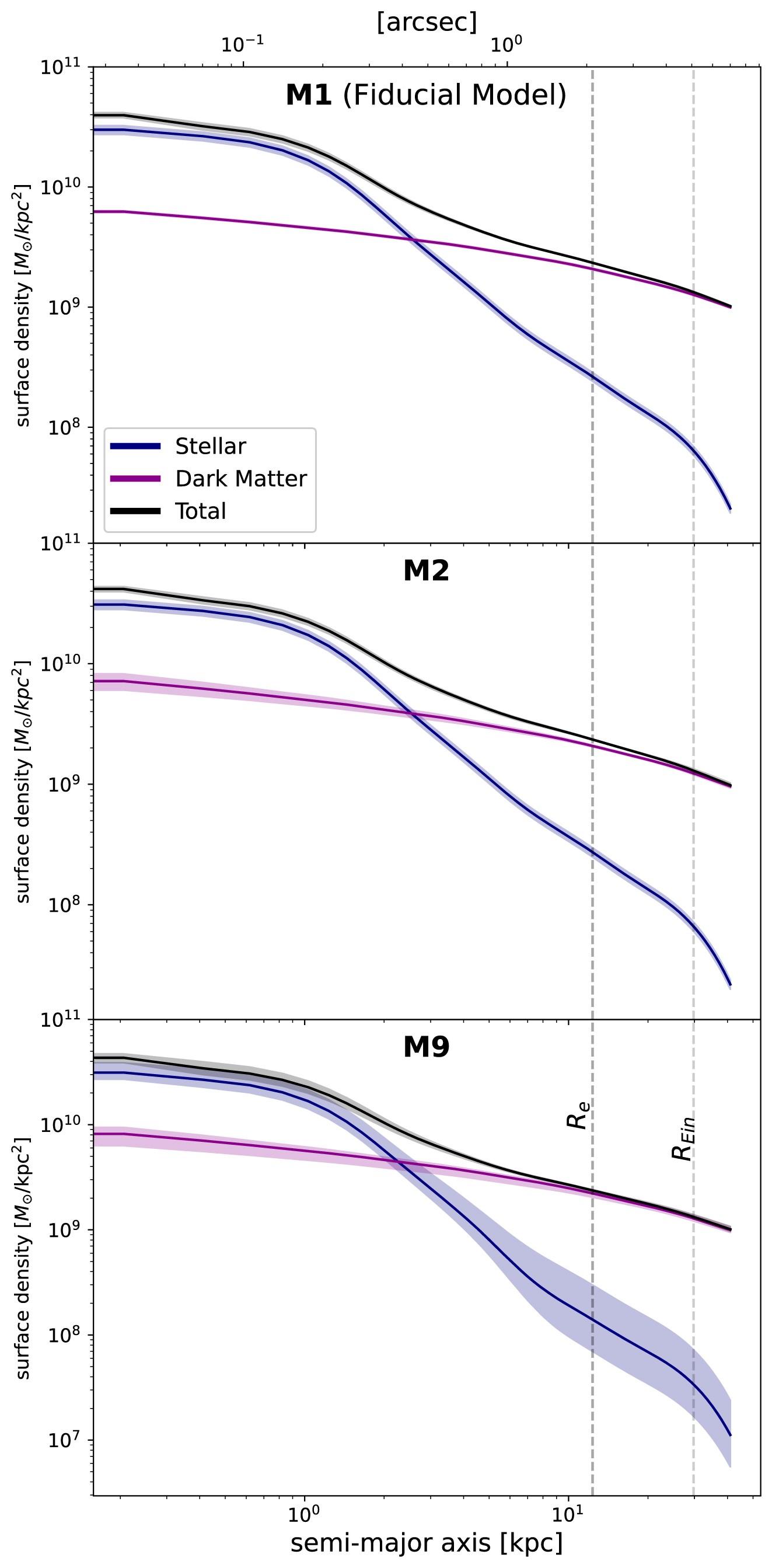
Alt...
Figure 11.
Surface mass density profile for three models – fiducial (upper) and other two that uses a gNFW profile: M2 (middle) and M9 (lower). The M2 model resembles the fiducial model but with the DM inner slope as a free parameter, while M9 incorporates both a variable mass-to-light ratio and a variable anisotropy profile. The blue lines represent the stellar component, purple lines represents the DM component, and in black we show the total (DM+stellar + BH) surface density. The shaded regions indicate the credible intervals for each component. The horizontal dashed lines represent the effective radius and the Einstein radius
![[?]](https://files.techhub.social/accounts/avatars/115/321/136/132/964/233/original/db1afda53aac9c0f.png)
2025 November 2
A Horseshoe Einstein Ring from Hubble
* Image Credit: ESA/Hubble & NASA
https://www.esa.int/
https://esahubble.org/
https://www.nasa.gov/
Explanation:
What's large and blue and can wrap itself around an entire galaxy? A gravitational lens mirage. Pictured here, the gravity of a massive elliptical galaxy (luminous red galaxy: LRG) has gravitationally distorted the light from a much more distant blue galaxy. More typically, such light bending results in two discernible images of the distant galaxy, but here the lens alignment is so precise that the background galaxy is distorted into a horseshoe -- a nearly complete ring: an Einstein ring. Although LRG 3-757 was discovered in 2007 in data from the Sloan Digital Sky Survey (SDSS), the image shown above is a follow-up observation taken with the Hubble Space Telescope's Wide Field Camera 3. A recent lens analysis of the central galaxy indicates that it likely hosts the single most massive black hole yet discovered: 36 billion times the mass of our Sun.
https://esahubble.org/images/potw1151a/
https://academic.oup.com/mnras/article/541/4/2853/8213862?login=false
https://en.wikipedia.org/wiki/Gravitational_lens
https://www.stsci.edu/hst
https://www.stsci.edu/hst/instrumentation/wfc3
https://ui.adsabs.harvard.edu/abs/2001AJ....122.2267E/abstract
https://www.sdss.org/
https://apod.nasa.gov/apod/ap251102.html
#space #galaxy #astrophotography #photography #science #physics #nature #NASA #ESA #hubble #webb #education #apod
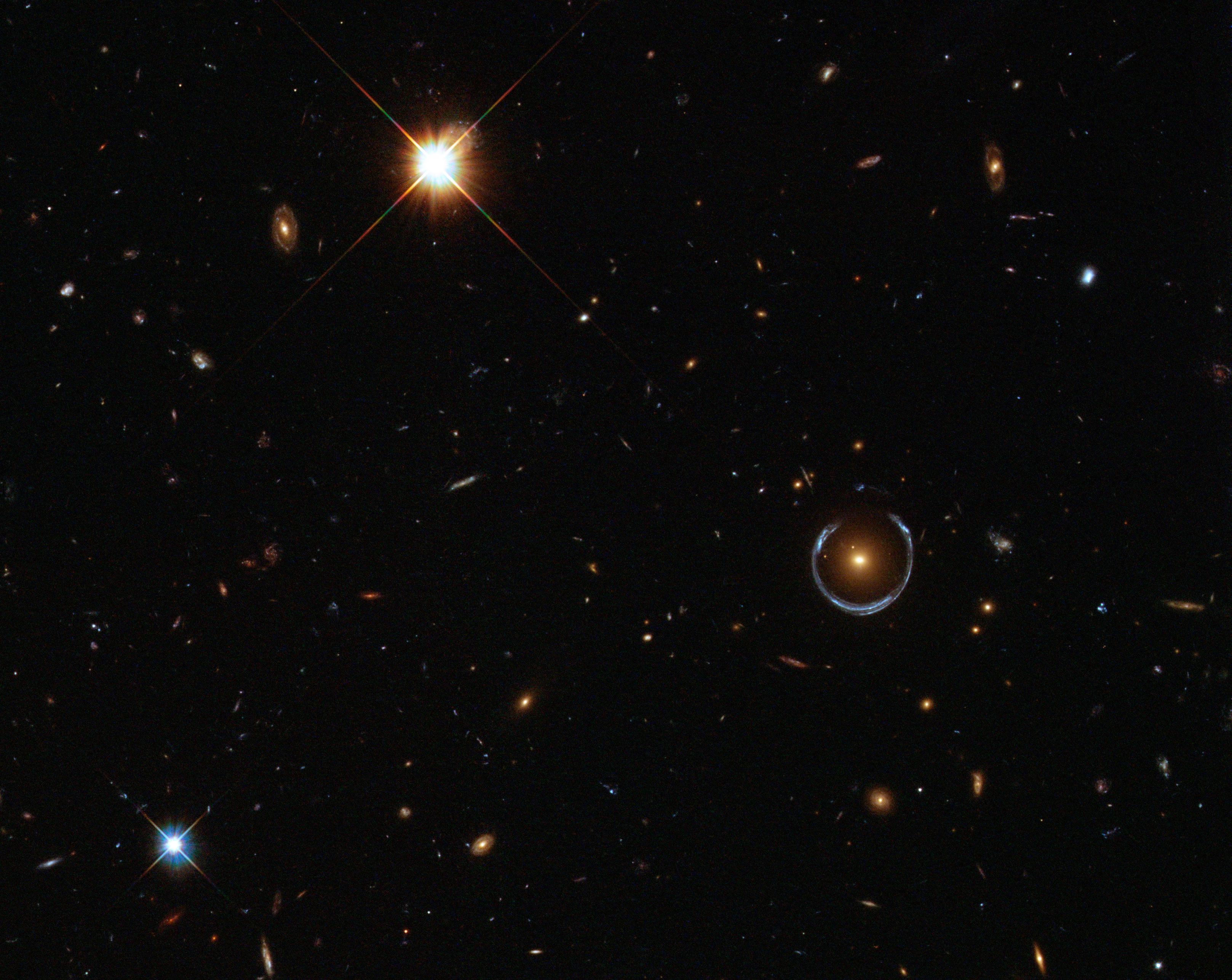
Alt...
2025 November 2
A dark star field with several small galaxies features a yellowish galaxy in the center. Surrounding this galaxy is a blue nearly circular horseshoe shaped object.
A Horseshoe Einstein Ring from Hubble
* Image Credit: ESA/Hubble & NASA
Explanation:
What's large and blue and can wrap itself around an entire galaxy? A gravitational lens mirage. Pictured here, the gravity of a massive elliptical galaxy (luminous red galaxy: LRG) has gravitationally distorted the light from a much more distant blue galaxy. More typically, such light bending results in two discernible images of the distant galaxy, but here the lens alignment is so precise that the background galaxy is distorted into a horseshoe -- a nearly complete ring: an Einstein ring. Although LRG 3-757 was discovered in 2007 in data from the Sloan Digital Sky Survey (SDSS), the image shown above is a follow-up observation taken with the Hubble Space Telescope's Wide Field Camera 3. A recent lens analysis of the central galaxy indicates that it likely hosts the single most massive black hole yet discovered: 36 billion times the mass of our Sun.
Authors & editors: Robert Nemiroff (MTU) & Jerry Bonnell (UMCP)
NASA Official: Amber Straughn Specific rights apply.
NASA Web Privacy, Accessibility, Notices;
A service of: ASD at NASA / GSFC,
NASA Science Activation
& Michigan Tech. U.