Search results for tag #nature
![[?]](https://files.defcon.social/dcsocial-s3/accounts/avatars/113/208/344/507/078/943/original/014820ad22daee1c.jpg)
2010 March 21
Equinox + 1
* Credit & Copyright: Joe Orman
https://joeorman.net/Gallery.html
Explanation:
Twice a year, at the Spring and Fall equinox, the Sun rises due east. In an emphatic demonstration of this celestial alignment, photographer Joe Orman recorded this inspiring image of the Sun rising exactly along the east-west oriented Western Canal, in Tempe, Arizona, USA. But he waited until one day after the northern Spring equinox, in 2001, to photograph the striking view. Why was the rising Sun due east one day after the equinox? At Tempe's latitude the Sun rises at an angle, arcing southward as it climbs above the horizon. Because the distant mountains hide the true horizon, the Sun shifts slightly southward by the time it clears the mountain tops. Waiting 24 hours allowed the Sun to rise just north of east and arc back to an exactly eastern alignment for the photo. Today is another Equinox + 1 day, with the Sun crossing the celestial equator yesterday at about 17:32 Universal Time.
https://joeorman.net/Sun/Sun_010321_2.html
https://joeorman.net/Sun/Sun_05.html
https://apod.nasa.gov/apod/ap100321.html
#space #earth #sun #astrophotography #photography #science #astronomy #nature

Alt...
2010 March 21
Equinox + 1
* Credit & Copyright: Joe Orman
Explanation:
Twice a year, at the Spring and Fall equinox, the Sun rises due east. In an emphatic demonstration of this celestial alignment, photographer Joe Orman recorded this inspiring image of the Sun rising exactly along the east-west oriented Western Canal, in Tempe, Arizona, USA. But he waited until one day after the northern Spring equinox, in 2001, to photograph the striking view. Why was the rising Sun due east one day after the equinox? At Tempe's latitude the Sun rises at an angle, arcing southward as it climbs above the horizon. Because the distant mountains hide the true horizon, the Sun shifts slightly southward by the time it clears the mountain tops. Waiting 24 hours allowed the Sun to rise just north of east and arc back to an exactly eastern alignment for the photo. Today is another Equinox + 1 day, with the Sun crossing the celestial equator yesterday at about 17:32 Universal Time.
Authors & editors: Robert Nemiroff (MTU) & Jerry Bonnell (UMCP)
NASA Official: Phillip Newman Specific rights apply.
NASA Web Privacy Policy and Important Notices
A service of: ASD at NASA / GSFC
& Michigan Tech. U.
2025 September 21
Equinox Sunset
* Image Credit: Luca Vanzella
https://www.flickr.com/people/53851348@N05/
Explanation:
Does the Sun set in the same direction every day? No, the direction of sunset depends on the time of the year. Although the Sun always sets approximately toward the west, on an equinox like tomorrow the Sun sets directly toward the west. After tomorrow's September equinox, the Sun will set increasingly toward the southwest, reaching its maximum displacement at the December solstice. Before tomorrow's (today's) September equinox, the Sun had set toward the northwest, reaching its maximum displacement at the June solstice. The featured time-lapse image shows seven bands of the Sun setting one day each month from 2019 December through 2020 June. These image sequences were taken from Alberta, Canada -- well north of the Earth's equator -- and feature the city of Edmonton in the foreground. The middle band shows the Sun setting during an equinox -- in March. From this location, the Sun will set along this same equinox band again tomorrow.
https://earthsky.org/astronomy-essentials/everything-you-need-to-know-vernal-or-spring-equinox/
https://apod.nasa.gov/apod/ap250921.html
#space #earth #sun #astrophotography #photography #science #astronomy #physics #nature #NASA #education

Alt...
2025 September 21
A city skyline is shown behind some hills and a river. The path of the Sun is shown for several times during a year.
Equinox Sunset
* Image Credit: Luca Vanzella
Explanation:
Does the Sun set in the same direction every day? No, the direction of sunset depends on the time of the year. Although the Sun always sets approximately toward the west, on an equinox like tomorrow the Sun sets directly toward the west. After tomorrow's September equinox, the Sun will set increasingly toward the southwest, reaching its maximum displacement at the December solstice. Before tomorrow's September equinox, the Sun had set toward the northwest, reaching its maximum displacement at the June solstice. The featured time-lapse image shows seven bands of the Sun setting one day each month from 2019 December through 2020 June. These image sequences were taken from Alberta, Canada -- well north of the Earth's equator -- and feature the city of Edmonton in the foreground. The middle band shows the Sun setting during an equinox -- in March. From this location, the Sun will set along this same equinox band again tomorrow.
Authors & editors: Robert Nemiroff (MTU) & Jerry Bonnell (UMCP)
NASA Official: Amber Straughn Specific rights apply.
NASA Web Privacy, Accessibility, Notices;
A service of: ASD at NASA / GSFC,
NASA Science Activation
& Michigan Tech. U.
2014 March 19
Equinox on a Spinning Earth
* Image Credit: NASA, Meteosat, Robert Simmon
http://www.nasa.gov/
http://www.eumetsat.int/website/home/Satellites/CurrentSatellites/Meteosat/index.html
http://www.nasa.gov/centers/goddard/about/people/RSimmon.html
Explanation:
When does the line between day and night become vertical? Tomorrow. Tomorrow is an equinox on planet Earth, a time of year when day and night are most nearly equal. At an equinox, the Earth's terminator -- the dividing line between day and night -- becomes vertical and connects the north and south poles. The above time-lapse video demonstrates this by displaying an entire year on planet Earth in twelve seconds. From geosynchronous orbit, the Meteosat satellite recorded these infrared images of the Earth every day at the same local time. The video started at the September 2010 equinox with the terminator line being vertical. As the Earth revolved around the Sun, the terminator was seen to tilt in a way that provides less daily sunlight to the northern hemisphere, causing winter in the north. As the year progressed, the March 2011 equinox arrived halfway through the video, followed by the terminator tilting the other way, causing winter in the southern hemisphere -- and summer in the north. The captured year ends again with the September equinox, concluding another of billions of trips the Earth has taken -- and will take -- around the Sun.
https://en.wikipedia.org/wiki/Equinox
!>>https://earthsky.org/astronomy-essentials/everything-you-need-to-know-vernal-or-spring-equinox/
https://apod.nasa.gov/apod/ap140319.html
#space #earth #sun #astrophotography #photography #science #astronomy #physics #nature #NASA #education
TOPIC> Sunrises & Sunsets
2016 March 20
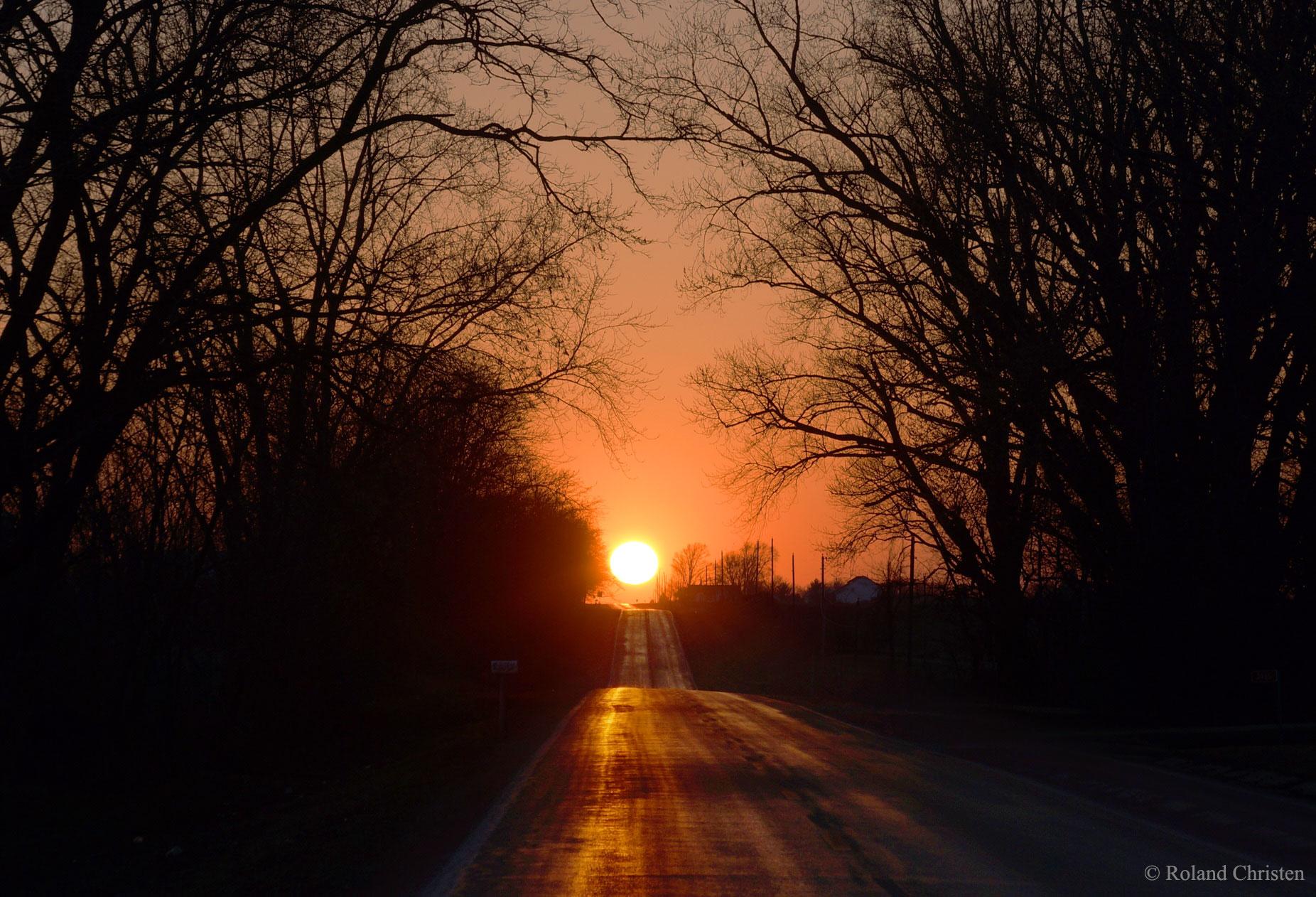
A Picturesque Equinox Sunset
* Image Credit & Copyright: Roland Christen
Explanation:
What's that at the end of the road? The Sun. Many towns have roads that run east - west, and on two days each year, the Sun rises and sets right down the middle. Today is one of those days: an equinox. Not only is today a day of equal night ("aequus"-"nox") and day time, but also a day when the sun rises precisely to the east and sets due west. Featured here is a picturesque road in northwest Illinois, USA that runs approximately east -west. The image was taken one year ago today, during the March Equinox of 2015, and shows the Sun down the road at sunset. In many cultures, this March equinox is taken to be the first day of a season, typically spring in Earth's northern hemisphere, and autumn in the south. Does your favorite street run east - west? Tonight at sunset, with a quick glance, you can actually find out.
https://en.wiktionary.org/wiki/equinox
https://en.wikipedia.org/wiki/March_equinox
https://scijinks.gov/solstice/
https://www.earthobservatory.nasa.gov/images/6125/winter-and-summer-solstice
#space #earth #sun #astrophotography #photography #science #astronomy #nature
https://apod.nasa.gov/apod/ap160320.html
Alt...
2016 March 20
A Picturesque Equinox Sunset
* Image Credit & Copyright: Roland Christen
Explanation:
What's that at the end of the road? The Sun. Many towns have roads that run east - west, and on two days each year, the Sun rises and sets right down the middle. Today is one of those days: an equinox. Not only is today a day of equal night ("aequus"-"nox") and day time, but also a day when the sun rises precisely to the east and sets due west. Featured here is a picturesque road in northwest Illinois, USA that runs approximately east -west. The image was taken one year ago today, during the March Equinox of 2015, and shows the Sun down the road at sunset. In many cultures, this March equinox is taken to be the first day of a season, typically spring in Earth's northern hemisphere, and autumn in the south. Does your favorite street run east - west? Tonight at sunset, with a quick glance, you can actually find out.
Authors & editors: Robert Nemiroff (MTU) & Jerry Bonnell (UMCP)
NASA Official: Phillip Newman Specific rights apply.
NASA Web Privacy Policy and Important Notices
A service of: ASD at NASA / GSFC
& Michigan Tech. U.
![[?]](https://hub.volse.no/photo/profile/l/6?rev=1756238619)


#TET #sweden #motorcycle #nature #campinglife #travel
TOPIC> Saturn
2025 September 22
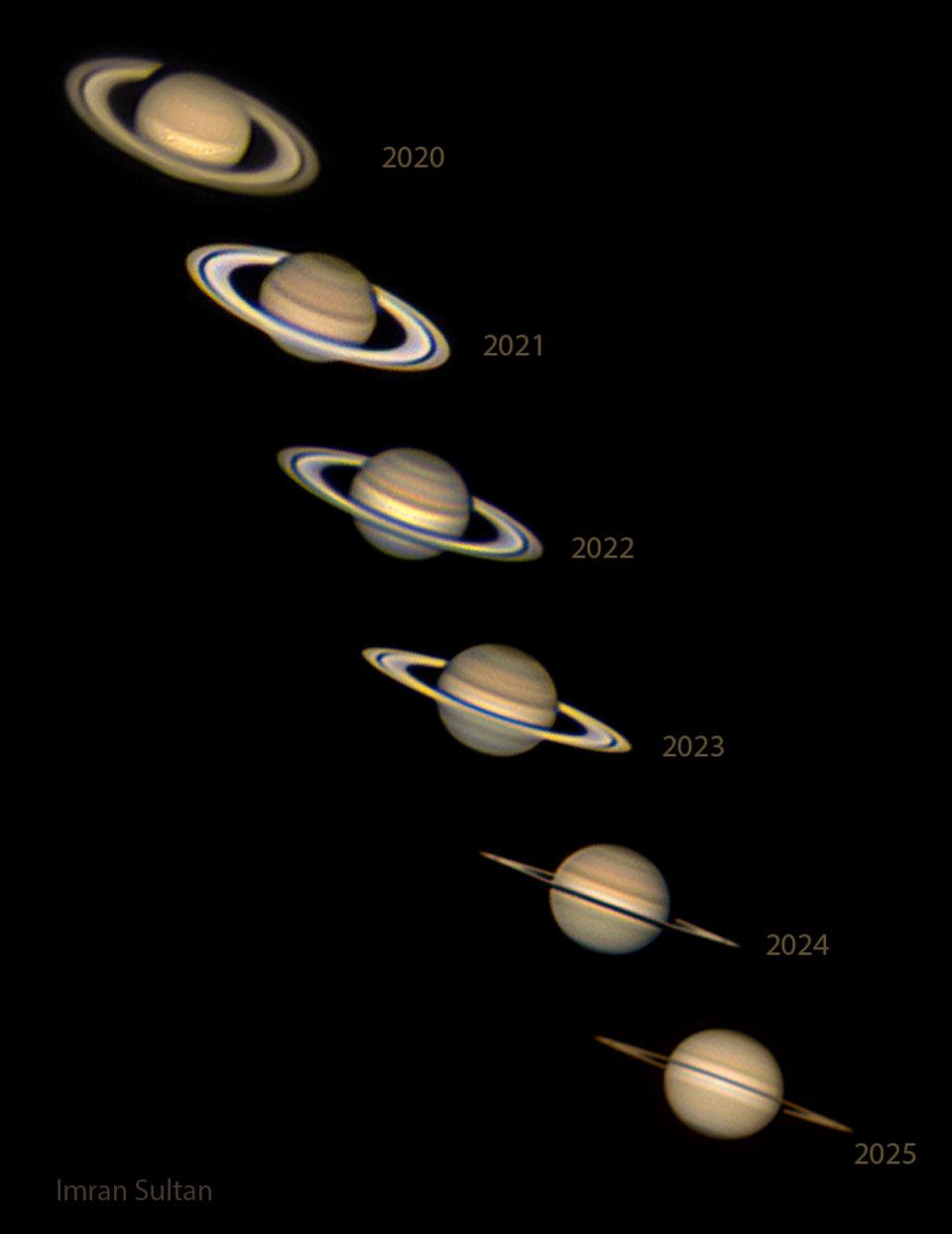
The planet Saturn is pictured 6 times in a horizonal column, labelled by years with 2020 at the top and 2025 at the bottom. As the years progress, Saturn's ring appear less prominent.
Equinox at Saturn
* Image Credit & Copyright: Imran Sultan
https://www.instagram.com/imran.astro/
Explanation:
On Saturn, the rings tell you the season. On Earth, today marks an equinox, the time when the Earth's equator tilts directly toward the Sun. Since Saturn's grand rings orbit along the planet's equator, these rings appear most prominent -- from the direction of the Sun -- when the spin axis of Saturn points toward the Sun. Conversely, when Saturn's spin axis points to the side, an equinox occurs, and the edge-on rings are hard to see from not only the Sun -- but Earth. In the featured montage, images of Saturn between the years of 2020 and 2025 have been superposed to show the giant planet passing, with this year's equinox, from summer in the north to summer in the south. Yesterday, Saturn was coincidently about as close as it gets to planet Earth, and so this month the ringed giant's orb is relatively bright and visible throughout the night.
https://www.instagram.com/p/DOuLq6ADsV4/
https://spaceplace.nasa.gov/saturn-rings/en/
https://apod.nasa.gov/apod/ap250922.html
https://science.nasa.gov/saturn/
https://apod.nasa.gov/apod/ap250429.html
#space #saturn #astrophotography #photography #science #astronomy #physics #nature #NASA
Alt...
2025 September 22
The planet Saturn is pictured 6 times in a horizonal column, labelled by years with 2020 at the top and 2025 at the bottom. As the years progress, Saturn's ring appear less prominent.
Equinox at Saturn
* Image Credit & Copyright: Imran Sultan
Explanation:
On Saturn, the rings tell you the season. On Earth, today marks an equinox, the time when the Earth's equator tilts directly toward the Sun. Since Saturn's grand rings orbit along the planet's equator, these rings appear most prominent -- from the direction of the Sun -- when the spin axis of Saturn points toward the Sun. Conversely, when Saturn's spin axis points to the side, an equinox occurs, and the edge-on rings are hard to see from not only the Sun -- but Earth. In the featured montage, images of Saturn between the years of 2020 and 2025 have been superposed to show the giant planet passing, with this year's equinox, from summer in the north to summer in the south. Yesterday, Saturn was coincidently about as close as it gets to planet Earth, and so this month the ringed giant's orb is relatively bright and visible throughout the night.
Authors & editors: Robert Nemiroff (MTU) & Jerry Bonnell (UMCP)
NASA Official: Amber Straughn Specific rights apply.
NASA Web Privacy, Accessibility, Notices;
A service of: ASD at NASA / GSFC,
NASA Science Activation
& Michigan Tech. U.
![[?]](https://cdn.masto.host/socelnet/accounts/avatars/109/355/496/809/872/483/original/4bb481e7a50769d3.jpg)
Many thanks to the art lover from the Netherlands for purchasing a ArtFrame with my acrylic painting "Little Robin." May it fill your heart and your home with joy!
https://www.artheroes.de/de/motiv/Kleines-Rotkehlchen/1147331/132
#thankyou #sale #art #painting #TraditionalArt #kunst #contemporaryArt #birds #BirdsOfMastodon #BirdArt #birding #nature #NatureLover #BirdWatching #wildlife #vogel #cute #animals #handmade #robin #MastoArt #FediArt #FediGiftShop #artist #arte #InteriorDesign #MastodonArt #creativeToots #BuyIntoArt #pink

Alt...
Little Robin is an acrylic painting in contemporary square format by artist Karen Kaspar.
A cute fluffy little European Robin bird is sitting on a branch and is looking to the left side.The background is abstracted in vibrant shades of pink.
![[?]](https://cdn.masto.host/socelnet/accounts/avatars/109/331/216/096/518/560/original/c61d0053547c5a81.jpg)
Colorful Dragonfly!
NEW in my Color Fusion on White Series!
ART
https://fineartamerica.com/featured/colorful-dragonfly-on-white-sharon-cummings.html
#art #artwork #fediart #mastoart #dragonfly #dragonflies #bug #bugs #insect #insects #entomology #nature #colorful #colorfulart #garden #gardens #gardening #gardener #summer #SharonCummingsArt #buyintoart #homedecor #handmade #handmadeart #fedigiftshop

Alt...
Colorful dragonfly on crisp white by artist Sharon Cummings.
![[?]](https://files.mstdn.party/accounts/avatars/109/412/668/953/833/198/original/0f95655ae0a3a89e.jpg)
Find the beauty of Landscapes and Nature
Visit the Collection: https://fineartamerica.com/profiles/joegiacaloneart/collections/landscapes+and+nature
#landscape #nature #wallart #art #ArtPrints
#homedecor #interiorstyling #outdoors #mastoart #BuyIntoArt


Find the beauty of Landscapes and Nature
Visit the Collection: https://fineartamerica.com/profiles/joegiacaloneart/collections/landscapes+and+nature
#landscape #nature #wallart #art #ArtPrints #homedecor #interiorstyling #outdoors #MastoArt #BuyIntoArt


![[?]](data:image/png;base64, iVBORw0KGgoAAAANSUhEUgAAAEAAAABAAQAAAACCEkxzAAAAUUlEQVQoz43R0QkAMQwCUDdw/y3dwEvsvzlL4X1IoQkAisKmwfAFT3RgJHbQezpSRoXEqeqCL9BJBf7h3QbOCCxV5EVWMEMwG7K1/WODtlvxAYTtEsDU9F34AAAAAElFTkSuQmCC)
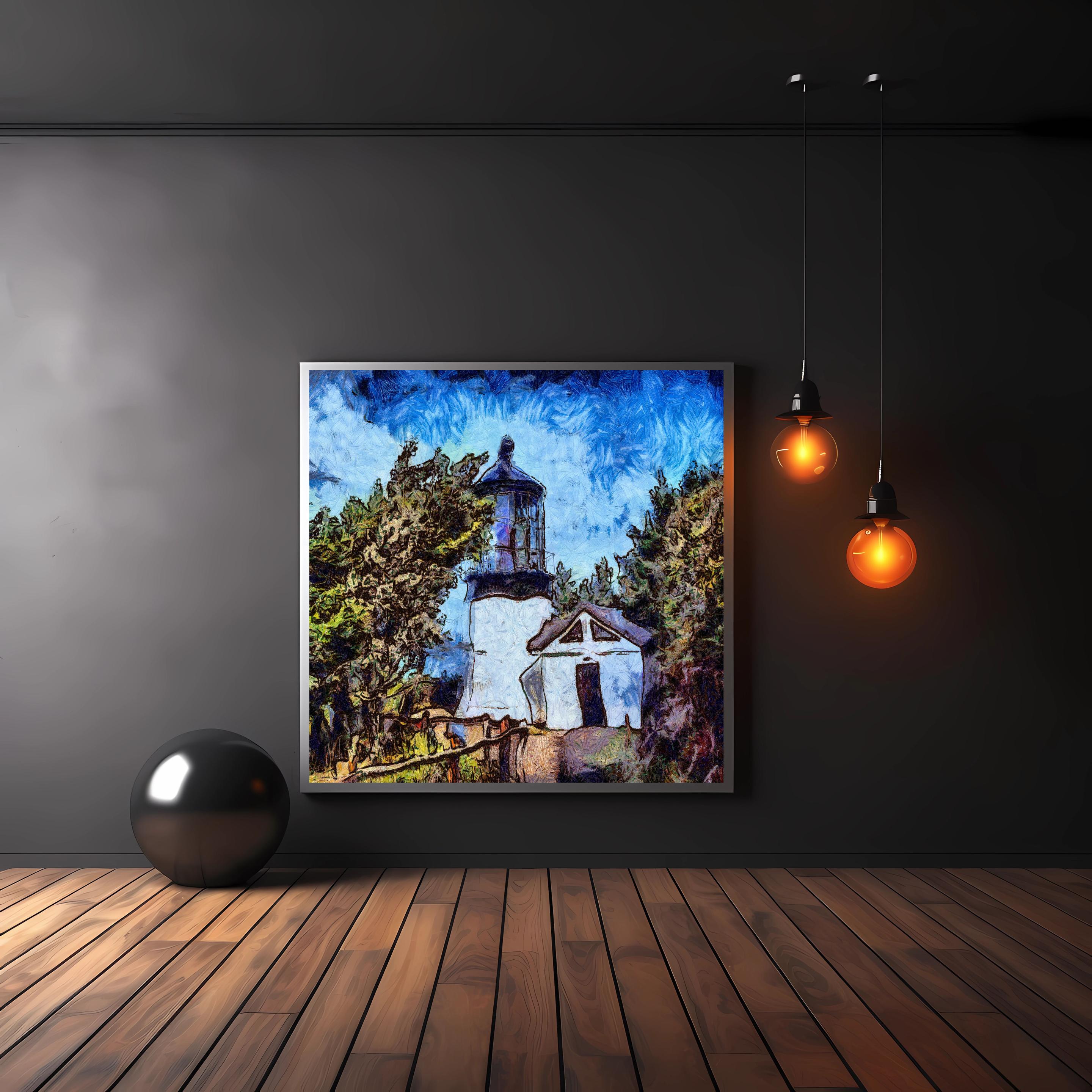
Cape Meares Light...Shortest Lighthouse on the Oregon Coast! Prints and much more for sale at: https://pixels.com/featured/cape-meares-light-thom-zehrfeld.html #Lighthouse #LighthouseArt #CapeMearesLighthouse #OregonCoast #PNW #ArtForSale #BuyIntoArt #Art #ThomZehrfeldPhotography #PhotographyIsArt #Photography
#ArtMatters #MastoArt #Mastodon #ArtforInteriorDesign #HospitalityInteriors
#InteriorDesign #Wallart #InteriorDecorating #WallArtForSale #PhotoOfTheDay #FediGiftShop #GiftIdeas #FediArt #Prints #FediArtShop #Colorful #Nature
Alt...
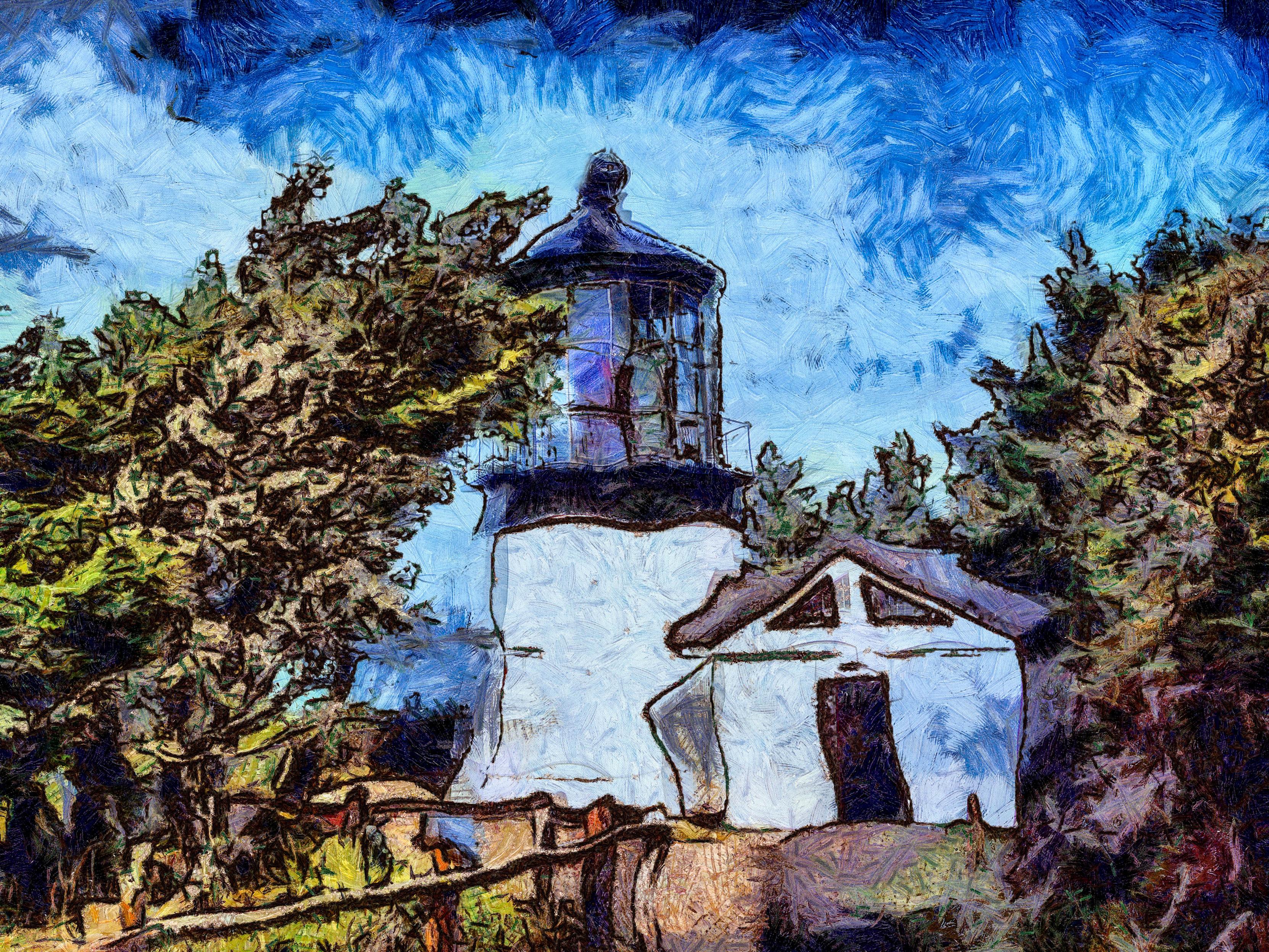
Cape Meares Light...Shortest Lighthouse on the Oregon Coast! Prints and much more for sale at: https://pixels.com/featured/cape-meares-light-thom-zehrfeld.html #Lighthouse #LighthouseArt #CapeMearesLighthouse #OregonCoast #PNW #ArtForSale #BuyIntoArt #Art #ThomZehrfeldPhotography #PhotographyIsArt #Photography
#ArtMatters #MastoArt #Mastodon #ArtforInteriorDesign #HospitalityInteriors
#InteriorDesign #Wallart #InteriorDecorating #WallArtForSale #PhotoOfTheDay #FediGiftShop #GiftIdeas #FediArt #Prints #FediArtShop #Colorful #Nature
Alt...
Cape Meares Light...Shortest Lighthouse on the Oregon Coast! Prints and much more for sale at: https://pixels.com/featured/cape-meares-light-thom-zehrfeld.html #Lighthouse #LighthouseArt #CapeMearesLighthouse #OregonCoast #PNW #ArtForSale #BuyIntoArt #Art #ThomZehrfeldPhotography #PhotographyIsArt #Photography
#ArtMatters #MastoArt #Mastodon #ArtforInteriorDesign #HospitalityInteriors
#InteriorDesign #Wallart #InteriorDecorating #WallArtForSale #PhotoOfTheDay #FediGiftShop #GiftIdeas #FediArt #Prints #FediArtShop #Colorful #Nature
![[?]](https://social.trom.tf/photo/profile/experimentmapass.jpeg?ts=1683022163)
![[?]](https://media.nerdculture.de/accounts/avatars/109/286/106/605/002/524/original/4e0ae78ad6fa0dca.png)
My little wren friend! I’ve not had much luck getting pix of them. They’re even faster than the kinglets. It was birds galore today though, so wonderful
Bewick’s wren
#backyardbirds #birdwatching #birding #birds #wildlife #nature #birdphotography

Alt...
Tiny little Bewick’s wren about to eat. Brown with a white eyebrow,lighter belly and long barred tail
How NASA’s Roman Mission Will Unveil Our Home Galaxy Using
Cosmic Dust
- NASA / Ashley Balzer
NASA’s Nancy Grace Roman Space Telescope will help scientists better understand our Milky Way galaxy’s less sparkly components — gas and dust strewn between stars, known as the interstellar medium.
One of Roman’s major observing programs, called the Galactic Plane Survey, will peer through our galaxy to its most distant edge, mapping roughly 20 billion stars—about four times more than have currently been mapped. Scientists will use data from these stars to study and map the dust their light travels through, contributing to the most complete picture yet of the Milky Way’s structure, star formation, and the origins of our solar system. [...]
Scientists know how our galaxy likely looks by combining observations of the Milky Way and other spiral galaxies. But dust clouds make it hard to work out the details on the opposite side of our galaxy. Imagine trying to map a neighborhood while looking through the windows of a house surrounded by a dense fog.
Roman will see through the “fog” of dust using a specialized camera and filters that observe infrared light — light with longer wavelengths than our eyes can detect. Infrared light is more likely to pass through dust clouds without scattering.
Light with shorter wavelengths, including blue light produced by stars, more easily scatters. That means stars shining through dust appear dimmer and redder than they actually are.
By comparing the observations with information on the source star’s characteristics, astronomers can disentangle the star’s distance from how much its colors have been reddened. Studying those effects reveals clues about the dust’s properties. [...]
* Credit: NASA/Laine Havens
* Music credit: Building Heroes by Enrico Cacace [BMI], Universal Production Music
#space #nebula #cosmic_dust #astrophotography #photography #science #astronomy #nature #NASA #ESA #education
2005 December 23
Hydrogen and Dust in the Rosette Nebula
* Credit: Nick Wright (University College London), IPHAS Collaboration
https://www.ucl.ac.uk/mathematical-physical-sciences/astrophysics
https://www.imperial.ac.uk/astrophysics
Explanation:
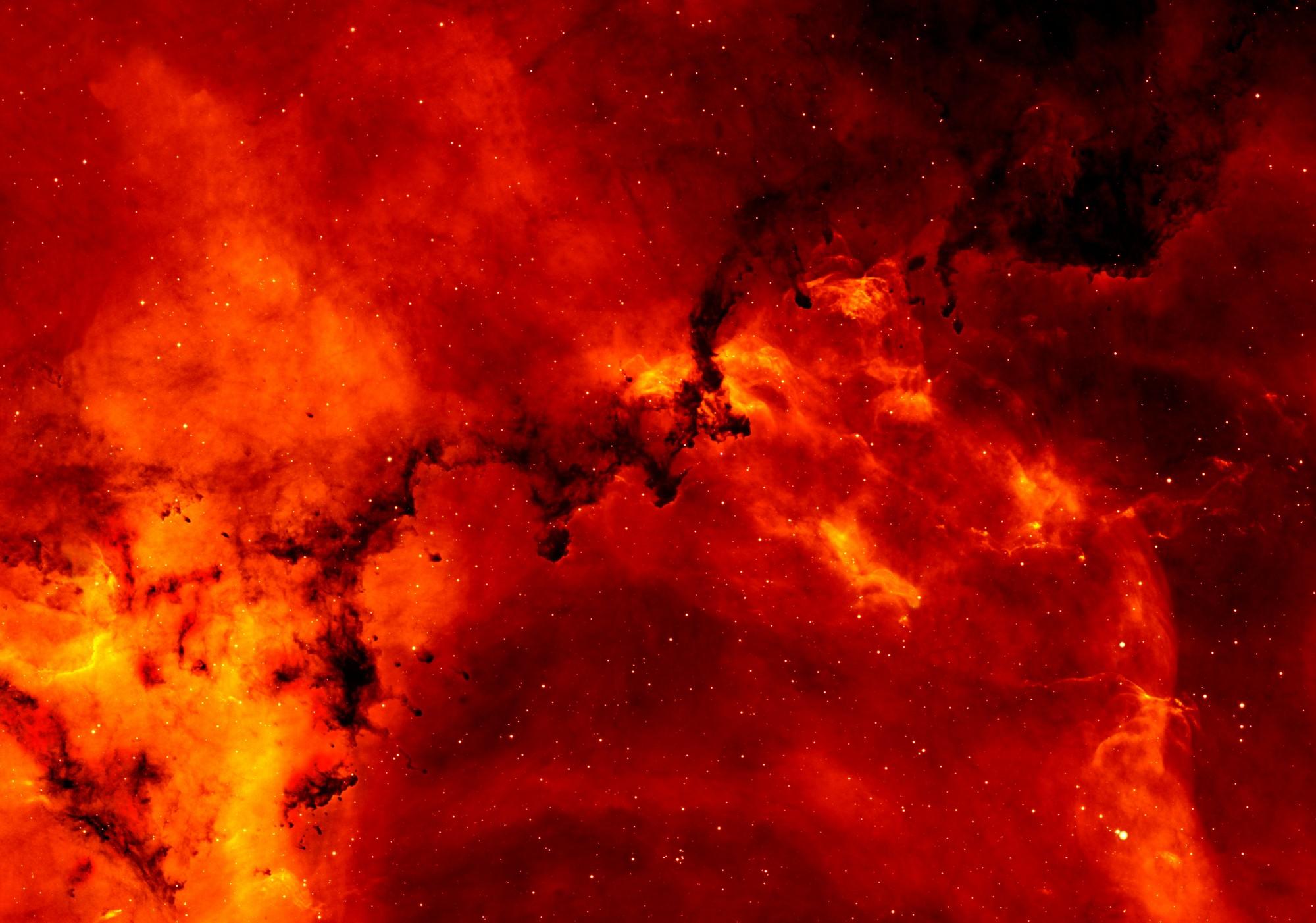
At the edge of a large molecular cloud in Monoceros, some 3,000 light years away, dark filaments of dust are silhouetted by luminous hydrogen gas. The close up view of the Rosette Nebula dramatically suggests that star formation is an on going process in the region, with dark filaments sculpted by winds and radiation from hot, young stars. Ultraviolet radiation from the young stars also strips electrons from the surrounding hydrogen atoms. As electrons and atoms recombine they emit longer wavelength, lower energy light in a well known characteristic pattern of bright spectral lines. At visible wavelengths, the strongest emission line in this pattern is in the red part of the spectrum and is known as "Hydrogen-alpha" or just H-alpha. Part of IPHAS, a survey of H-alpha emission in our Milky Way Galaxy, this image spans about 25 light-years.
https://apod.nasa.gov/apod/ap051223.html
#space #nebula #cluster #astrophotography #photography #science #astronomy #nature #NASA #ESA #education
Alt...
2005 December 23
Hydrogen and Dust in the Rosette Nebula
* Credit: Nick Wright (University College London), IPHAS Collaboration
Explanation:
At the edge of a large molecular cloud in Monoceros, some 3,000 light years away, dark filaments of dust are silhouetted by luminous hydrogen gas. The close up view of the Rosette Nebula dramatically suggests that star formation is an on going process in the region, with dark filaments sculpted by winds and radiation from hot, young stars. Ultraviolet radiation from the young stars also strips electrons from the surrounding hydrogen atoms. As electrons and atoms recombine they emit longer wavelength, lower energy light in a well known characteristic pattern of bright spectral lines. At visible wavelengths, the strongest emission line in this pattern is in the red part of the spectrum and is known as "Hydrogen-alpha" or just H-alpha. Part of IPHAS, a survey of H-alpha emission in our Milky Way Galaxy, this image spans about 25 light-years.
Authors & editors: Robert Nemiroff (MTU) & Jerry Bonnell (USRA)
NASA Web Site Statements, Warnings, and Disclaimers
NASA Official: Jay Norris. Specific rights apply.
A service of: EUD at NASA / GSFC
& Michigan Tech. U.
2016 November 19
IC 5070: A Dusty Pelican in the Swan
* Image Credit & Copyright: Steve Richards (Chanctonbury Observatory)
Explanation:
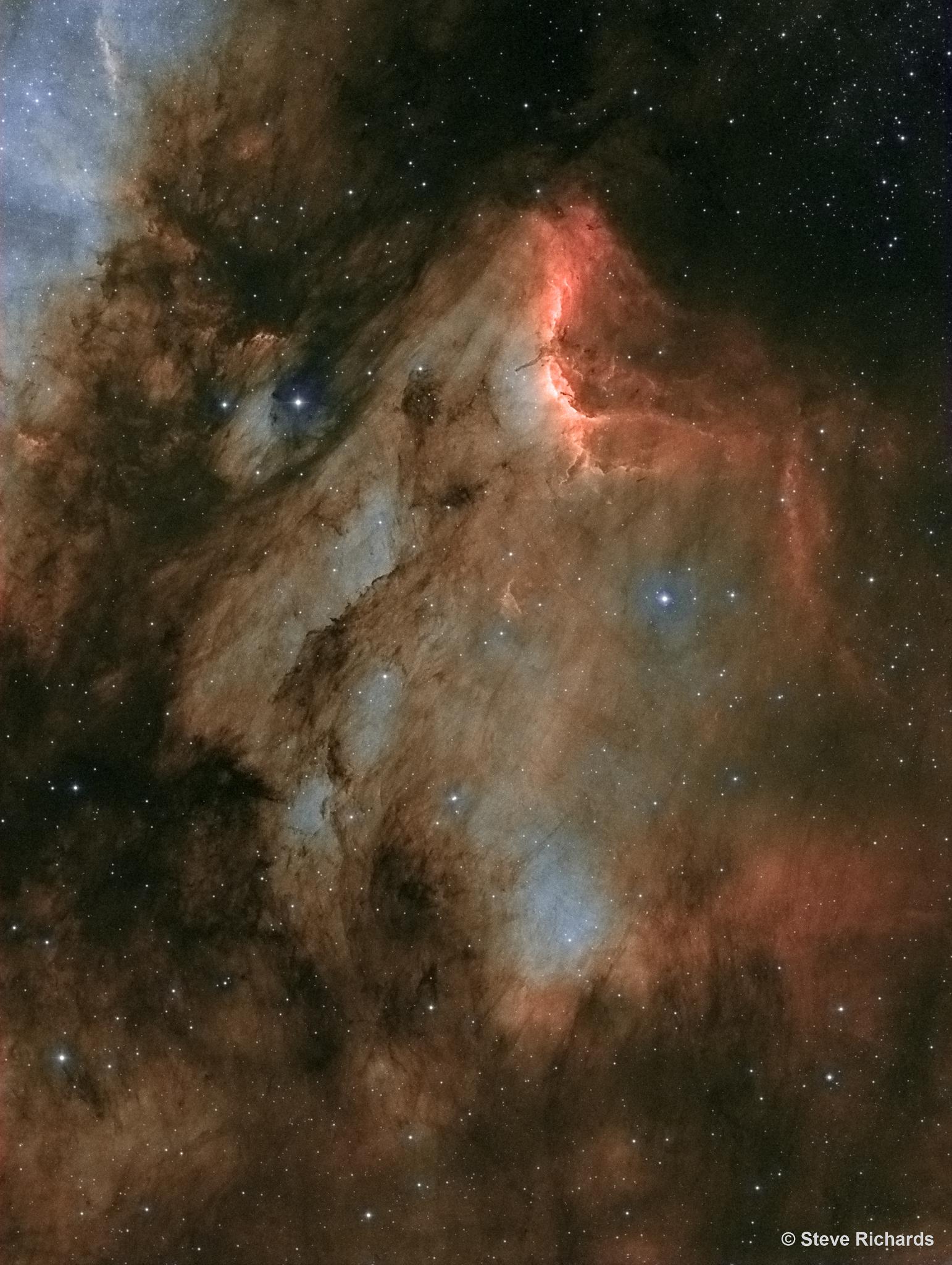
The recognizable profile of the Pelican Nebula soars nearly 2,000 light-years away in the high flying constellation Cygnus, the Swan. Also known as IC 5070, this interstellar cloud of gas and dust is appropriately found just off the "east coast" of the North America Nebula (NGC 7000), another surprisingly familiar looking emission nebula in Cygnus. Both Pelican and North America nebulae are part of the same large and complex star forming region, almost as nearby as the better-known Orion Nebula. From our vantage point, dark dust clouds (upper left) help define the Pelican's eye and long bill, while a bright front of ionized gas suggests the curved shape of the head and neck. This striking synthesized color view utilizes narrowband image data recording the emission of hydrogen and oxygen atoms in the cosmic cloud. The scene spans some 30 light-years at the estimated distance of the Pelican Nebula.
https://apod.nasa.gov/apod/ap161119.html
#space #nebula #cluster #astrophotography #photography #science #astronomy #nature #NASA #ESA #education
Alt...
2016 November 19
IC 5070: A Dusty Pelican in the Swan
* Image Credit & Copyright: Steve Richards (Chanctonbury Observatory)
Explanation:
The recognizable profile of the Pelican Nebula soars nearly 2,000 light-years away in the high flying constellation Cygnus, the Swan. Also known as IC 5070, this interstellar cloud of gas and dust is appropriately found just off the "east coast" of the North America Nebula (NGC 7000), another surprisingly familiar looking emission nebula in Cygnus. Both Pelican and North America nebulae are part of the same large and complex star forming region, almost as nearby as the better-known Orion Nebula. From our vantage point, dark dust clouds (upper left) help define the Pelican's eye and long bill, while a bright front of ionized gas suggests the curved shape of the head and neck. This striking synthesized color view utilizes narrowband image data recording the emission of hydrogen and oxygen atoms in the cosmic cloud. The scene spans some 30 light-years at the estimated distance of the Pelican Nebula.
Authors & editors: Robert Nemiroff (MTU) & Jerry Bonnell (UMCP)
NASA Official: Phillip Newman Specific rights apply.
NASA Web Privacy Policy and Important Notices
A service of: ASD at NASA / GSFC
& Michigan Tech. U.
2025 January 22
The North America Nebula
* Image Credit & Copyright: Dimitris Valianos
Explanation:
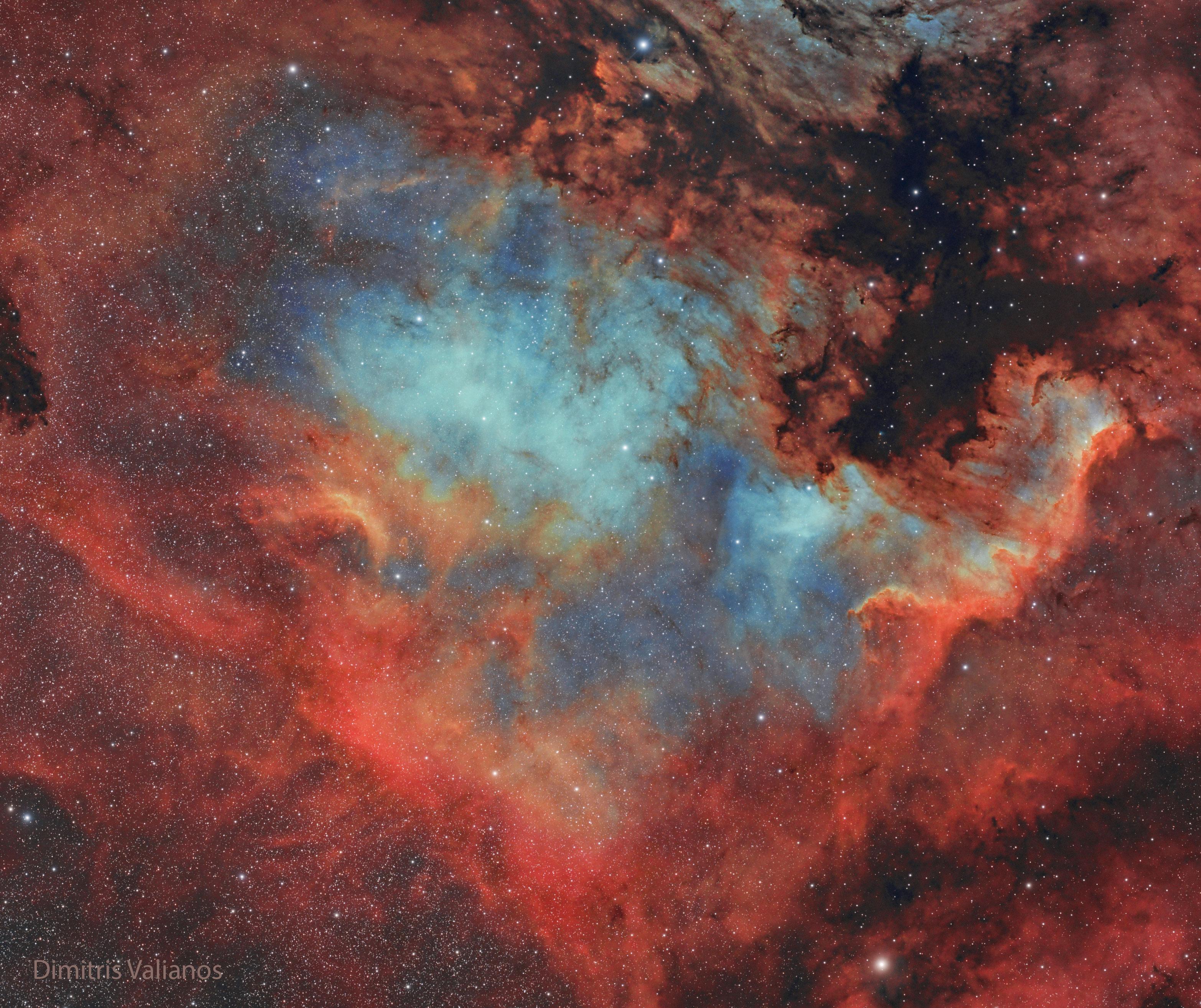
The North America nebula on the sky can do what the North America continent on Earth cannot -- form stars. Specifically, in analogy to the Earth-confined continent, the bright part that appears as the east coast is actually a hot bed of gas, dust, and newly formed stars known as the Cygnus Wall. The featured image shows the star forming wall lit and eroded by bright young stars and partly hidden by the dark dust they have created. The part of the North America nebula (NGC 7000) shown spans about 50 light years and lies about 1,500 light years away toward the constellation of the Swan (Cygnus).
https://apod.nasa.gov/apod/ap250122.html
#space #nebula #cluster #astrophotography #photography #science #astronomy #nature #NASA #ESA #education
Alt...
2025 January 22
A star field is dominated by a red and blue glowing nebula. This nebula appears, to some, to have the shape of North America and so is called the North America Nebula.
The North America Nebula
* Image Credit & Copyright: Dimitris Valianos
Explanation:
The North America nebula on the sky can do what the North America continent on Earth cannot -- form stars. Specifically, in analogy to the Earth-confined continent, the bright part that appears as the east coast is actually a hot bed of gas, dust, and newly formed stars known as the Cygnus Wall. The featured image shows the star forming wall lit and eroded by bright young stars and partly hidden by the dark dust they have created. The part of the North America nebula (NGC 7000) shown spans about 50 light years and lies about 1,500 light years away toward the constellation of the Swan (Cygnus).
Authors & editors: Robert Nemiroff (MTU) & Jerry Bonnell (UMCP)
NASA Official: Amber Straughn Specific rights apply.
NASA Web Privacy, Accessibility, Notices;
A service of: ASD at NASA / GSFC,
NASA Science Activation
& Michigan Tech. U.
2007 September 20
Northern Cygnus
* Credit & Copyright: Robert Gendler
http://www.robgendlerastropics.com/
Explanation:
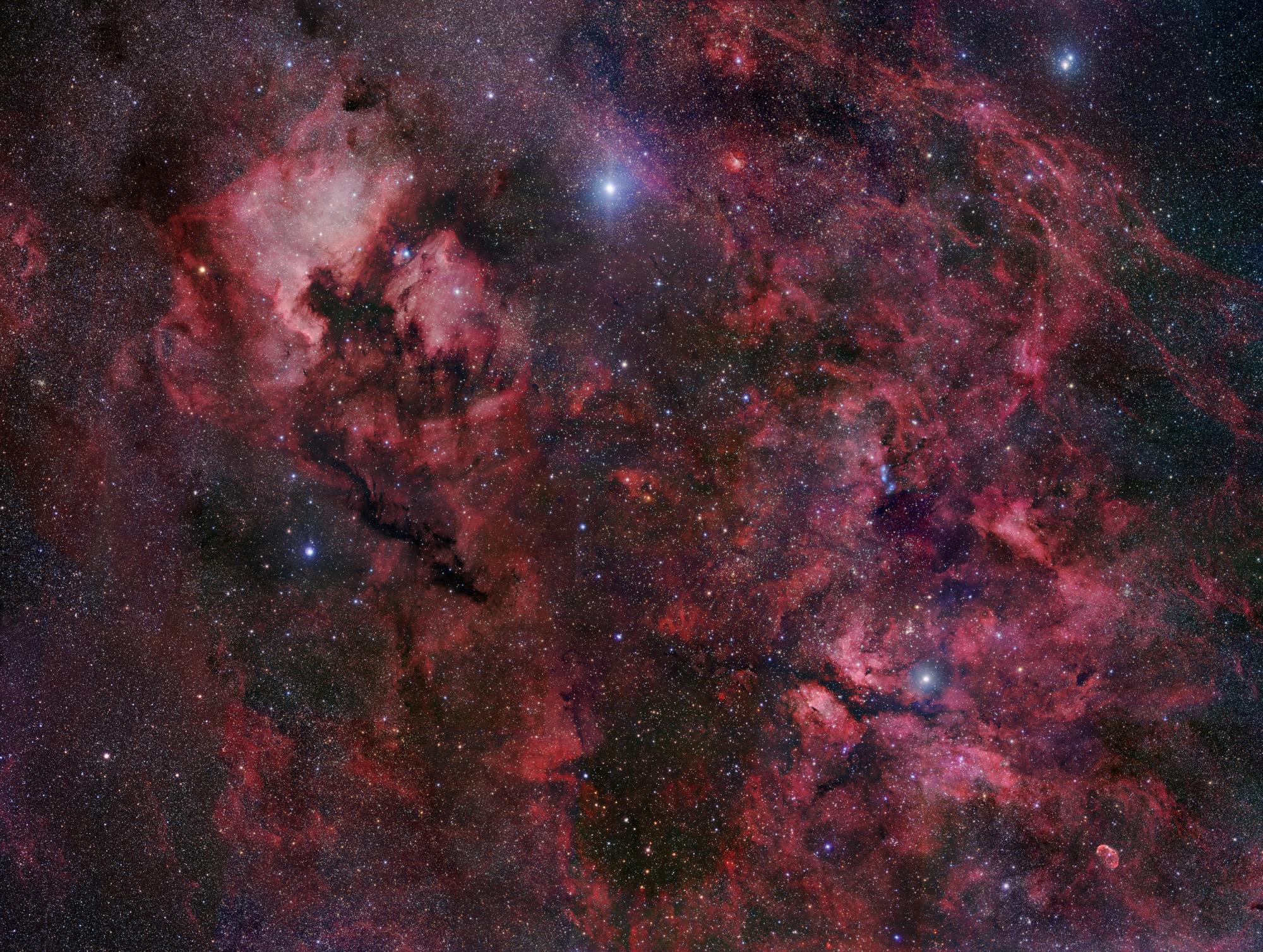
Bright, hot, supergiant star Deneb lies at top center in this gorgeous skyscape. The 20 frame mosaic spans an impressive 12 degrees across the northern end of Cygnus the Swan. Crowded with stars and luminous gas clouds along the plane of our Milky Way Galaxy, Cygnus is also home to the dark, obscuring Northern Coal Sack Nebula, extending from Deneb toward the bottom center of the view. The reddish glow of NGC 7000, the North America Nebula, and IC 5070, the Pelican Nebula, are at the upper left, but many other nebulae and star clusters are identifiable throughout the wide field. Of course, Deneb itself is the alpha star of Cygnus and is also known to northern hemisphere skygazers for its place in two asterisms -- marking the top of the Northern Cross and a vertex of the Summer Triangle.
http://www.robgendlerastropics.com/Cygnusmosaic.html
https://en.wikipedia.org/wiki/Cygnus_(constellation)
https://apod.nasa.gov/apod/ap070920.html
#space #nebula #cluster #astrophotography #photography #science #astronomy #nature #NASA #ESA #education
Alt...
2007 September 20
Northern Cygnus
* Credit & Copyright: Robert Gendler
Explanation:
Bright, hot, supergiant star Deneb lies at top center in this gorgeous skyscape. The 20 frame mosaic spans an impressive 12 degrees across the northern end of Cygnus the Swan. Crowded with stars and luminous gas clouds along the plane of our Milky Way Galaxy, Cygnus is also home to the dark, obscuring Northern Coal Sack Nebula, extending from Deneb toward the bottom center of the view. The reddish glow of NGC 7000, the North America Nebula, and IC 5070, the Pelican Nebula, are at the upper left, but many other nebulae and star clusters are identifiable throughout the wide field. Of course, Deneb itself is the alpha star of Cygnus and is also known to northern hemisphere skygazers for its place in two asterisms -- marking the top of the Northern Cross and a vertex of the Summer Triangle.
Authors & editors: Robert Nemiroff (MTU) & Jerry Bonnell (UMCP)
NASA Official: Phillip Newman Specific rights apply.
NASA Web Privacy Policy and Important Notices
A service of: ASD at NASA / GSFC
2025 September 19
The NGC 6914 Complex
* Image Credit & Copyright: Tommy Lease
https://app.astrobin.com/u/Colorado_Astro#gallery
Explanation:
A study in contrasts, this colorful cosmic skyscape features stars, dust, and glowing gas in the vicinity of NGC 6914. The interstellar complex of nebulae lies some 6,000 light-years away, toward the high-flying northern constellation Cygnus and the plane of our Milky Way Galaxy. Obscuring interstellar dust clouds appear in silhouette while reddish hydrogen emission nebulae, along with the dusty blue reflection nebulae, fill the cosmic canvas. Ultraviolet radiation from the massive, hot, young stars of the extensive Cygnus OB2 association ionize the region's atomic hydrogen gas, producing the characteristic red glow as protons and electrons recombine. Embedded Cygnus OB2 stars also provide the blue starlight strongly reflected by the dust clouds. The over one degree wide telescopic field of view spans about 100 light-years at the estimated distance of NGC 6914.
https://www.nasa.gov/missions/roman-space-telescope/how-nasas-roman-mission-will-unveil-our-home-galaxy-using-cosmic-dust/
https://arxiv.org/abs/1003.2463
https://astronomy.swin.edu.au/cosmos/E/Emission+Nebula
https://astronomy.swin.edu.au/cosmos/E/Reflection+Nebula
https://apod.nasa.gov/apod/ap250919.html
#space #nebula #cluster #astrophotography #photography #science #astronomy #nature #NASA #ESA #education
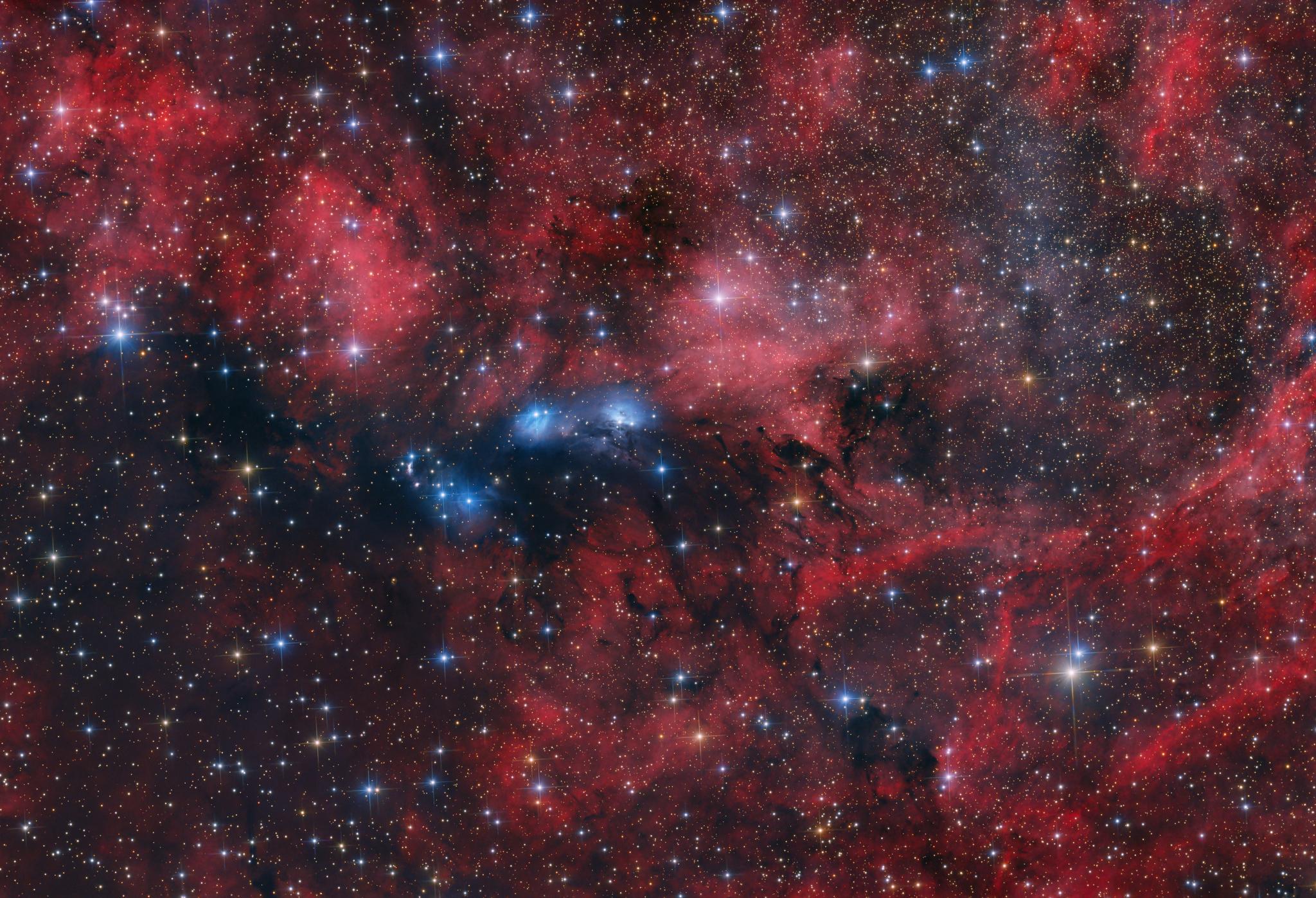
Alt...
2025 September 19
The NGC 6914 Complex
* Image Credit & Copyright: Tommy Lease
Explanation:
A study in contrasts, this colorful cosmic skyscape features stars, dust, and glowing gas in the vicinity of NGC 6914. The interstellar complex of nebulae lies some 6,000 light-years away, toward the high-flying northern constellation Cygnus and the plane of our Milky Way Galaxy. Obscuring interstellar dust clouds appear in silhouette while reddish hydrogen emission nebulae, along with the dusty blue reflection nebulae, fill the cosmic canvas. Ultraviolet radiation from the massive, hot, young stars of the extensive Cygnus OB2 association ionize the region's atomic hydrogen gas, producing the characteristic red glow as protons and electrons recombine. Embedded Cygnus OB2 stars also provide the blue starlight strongly reflected by the dust clouds. The over one degree wide telescopic field of view spans about 100 light-years at the estimated distance of NGC 6914.
Authors & editors: Robert Nemiroff (MTU) & Jerry Bonnell (UMCP)
NASA Official: Amber Straughn Specific rights apply.
NASA Web Privacy, Accessibility, Notices;
A service of: ASD at NASA / GSFC,
NASA Science Activation
![[?]](https://cdn.masto.host/photog/accounts/avatars/109/534/980/724/232/945/original/979585f457334be5.jpg)
Large icebergs float serenely in the Arctic waters near Ilulissat Greenland beneath a dramatic and colorful sky. The sunset casts a soft glow over the icy landscape, highlighting the immense scale and beauty.
https://joan-carroll.pixels.com/featured/majestic-arctic-icebergs-at-sunset-joan-carroll.html
#iceberg #greenland #ilulissat #reflections #icebergs #nature #scenery #ocean #tranquility #seascape #landscape #unesco #worldheritage #buyart #wallart #artforsale #artstore #wallartforsale #giftideas @joancarroll #BuyIntoArt #AYearForArt

Alt...
Large icebergs float serenely in the Arctic waters near Ilulissat Greenland beneath a dramatic and colorful sky. The sunset casts a soft glow over the icy landscape, highlighting the immense scale and beauty.
![[?]](https://cdn.masto.host/photog/accounts/avatars/109/357/208/052/677/232/original/7dc136ccd6fbec06.jpg)
A Sharp-shinned Hawk on a nice branch
See it bigger here: https://jan-luit.pixels.com/featured/a-sharp-shinned-hawk-sitting-on-a-fancy-branch-jan-luit.html
#WildlifePhotography #NaturePhotography #Photography #fotografie #Arte #AYearForArt #BuyIntoArt #FediGiftShop #Artist #mastoart #Fediart #Art #PhotographyIsArt #birdsofmastodon #Birdwatching #Birding #Birds #Vogel #Animals #Wildlife #Nature #Natuur #GiveArt #Giftidea #Fotografia #Hawk

Alt...
The head of the bird is one quarter from the top and just left of the middle of the photo.
The bird is sitting on a fancy branch and facing to the right.
You can see the back of the bird.
Microlensing - NASA Science
-- jmbrill
Gravitational lensing is an observational effect that occurs because the presence of mass warps the fabric of space-time, sort of like the dent a bowling ball makes when set on a trampoline. The effect is extreme around very massive objects, like black holes and entire galaxies. But even stars and planets cause a detectable degree of warping, called microlensing.
Here’s how it works. Light travels in a straight line, but if space-time is bent – which happens near something massive, like a star – light follows the curve. Any time two stars align closely from our vantage point, light from the more distant star curves as it travels through the warped space-time around the nearer star.
If the alignment is especially close, the nearer star acts like a natural cosmic lens, magnifying light from the background star. Planets orbiting the lens star can produce a similar effect on a smaller scale.
Familiar and exotic worlds
The techniques commonly used to find other worlds are biased toward planets that tend to be very different from those in our solar system. The transit method, for example, is best at finding sub-Neptune-like planets that have orbits much smaller than Mercury’s. For a solar system like our own, transit studies could miss every planet.
Roman’s Galactic Bulge Time Domain Survey will help us find analogs to every planet in our solar system except Mercury, whose small orbit and low mass combine to put it beyond the mission’s reach. Roman will find planets that are the mass of Earth and even smaller – perhaps even large moons, like Jupiter’s moon Ganymede.
Roman will find planets in other poorly studied categories, too. Microlensing is best suited to finding worlds from the habitable zone of their star and farther out.
[...]
Please read more:
https://www.nasa.gov/universe/exoplanets/nasas-tally-of-planets-outside-our-solar-system-reaches-6000/#hds-sidebar-nav-1
CREDIT
science.nasa.gov
#space #galaxy #astrophotography #photography #science #physics #nature #NASA #ESA #education
TOPIC>
Gravitational Lensing
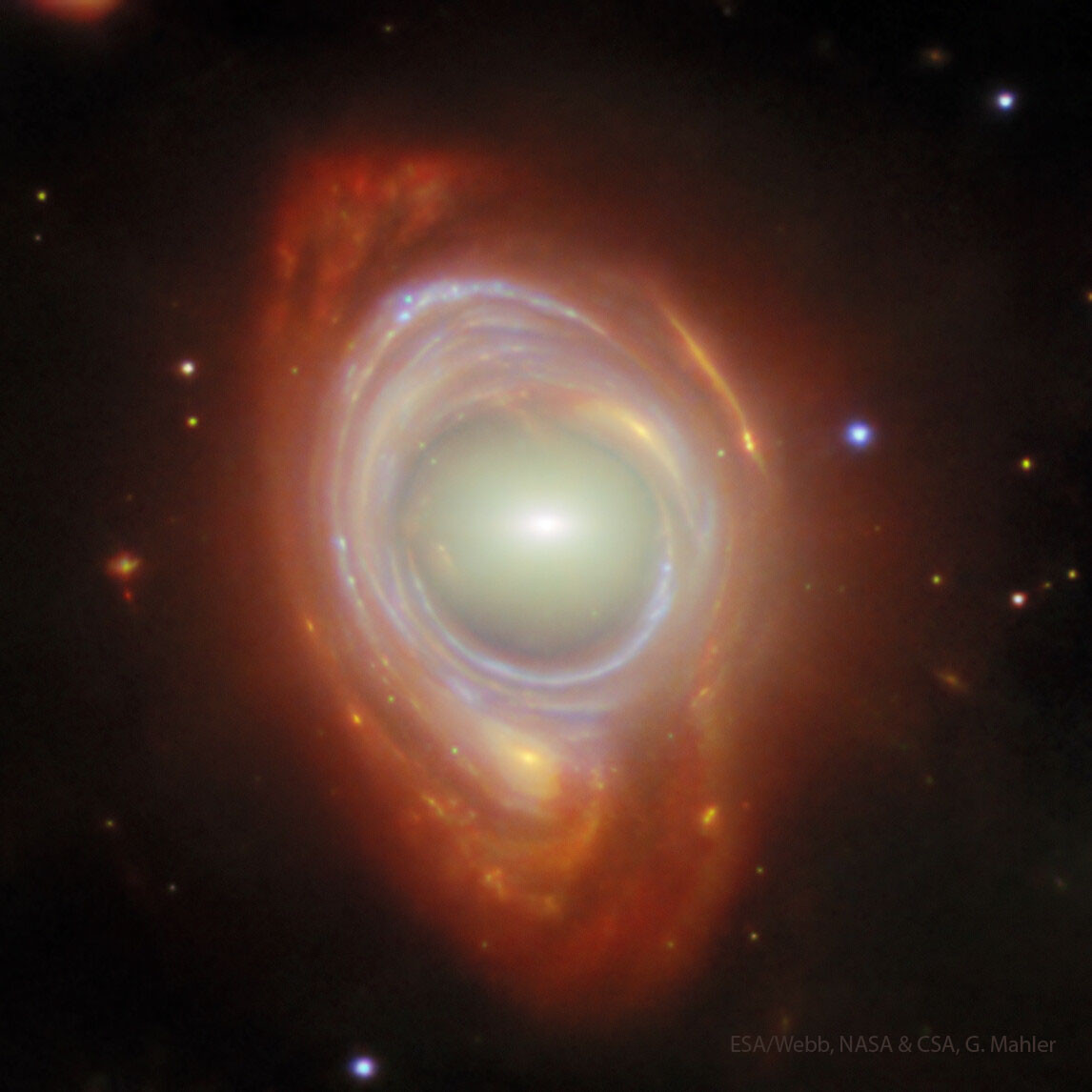
Galaxy Lenses Galaxy from Webb
* Image Credit: ESA/Webb, NASA & CSA, G. Mahler
https://orbi.uliege.be/profile?uid=p288273
https://www.asc-csa.gc.ca/eng/
https://esawebb.org/
https://www.nasa.gov/
Explanation:
Is this one galaxy or two? Although it looks like one, the answer is two. One path to this happening is when a small galaxy collides with a larger galaxy and ends up in the center. But in the featured image, something more rare is going on. Here, the central light-colored elliptical galaxy is much closer than the blue and red-colored spiral galaxy that surrounds it. This can happen when near and far galaxies are exactly aligned, causing the gravity of the near galaxy to pull the light from the far galaxy around it in an effect called gravitational lensing. The featured galaxy double was taken by the Webb Space Telescope and shows a complete Einstein ring, with great detail visible for both galaxies. Galaxy lenses like this can reveal new information about the mass distribution of the foreground lens and the light distribution of the background source.
https://www.esa.int/ESA_Multimedia/Images/2025/03/Webb_spies_a_spiral_through_a_cosmic_lens
https://esawebb.org/images/potm2503a/
https://science.nasa.gov/wp-content/uploads/2023/04/stsci-h-p2005b-f-4096x2160-1-jpg.webp
https://webbtelescope.org/home
https://science.nasa.gov/mission/hubble/science/science-behind-the-discoveries/hubble-gravitational-lenses/
https://science.nasa.gov/mission/hubble/science/science-behind-the-discoveries/hubble-gravitational-lenses/
https://www.ucdavis.edu/news/newly-discovered-gravitational-lenses-could-reveal-ancient-galaxies-and-nature-dark-matter
https://science.nasa.gov/mission/hubble/science/science-highlights/shining-a-light-on-dark-matter/
https://spaceplace.nasa.gov/galaxy/en/
https://science.nasa.gov/universe/galaxies/types/#elliptical-galaxies
https://science.nasa.gov/universe/galaxies/types/#spiral-galaxies
https://apod.nasa.gov/apod/ap220705.html
https://apod.nasa.gov/apod/ap160420.html
https://apod.nasa.gov/apod/ap201018.html
https://apod.nasa.gov/apod/ap250421.html
#space #galaxy #astrophotography #photography #science #physics #nature #NASA #ESA
Alt...
2025 April 21
What looks like a single spiral galaxy is shown with a white center surrounded by inner blue arms and outer red arms. Please see the explanation for more detailed information.
Galaxy Lenses Galaxy from Webb
* Image Credit: ESA/Webb, NASA & CSA, G. Mahler
Explanation:
Is this one galaxy or two? Although it looks like one, the answer is two. One path to this happening is when a small galaxy collides with a larger galaxy and ends up in the center. But in the featured image, something more rare is going on. Here, the central light-colored elliptical galaxy is much closer than the blue and red-colored spiral galaxy that surrounds it. This can happen when near and far galaxies are exactly aligned, causing the gravity of the near galaxy to pull the light from the far galaxy around it in an effect called gravitational lensing. The featured galaxy double was taken by the Webb Space Telescope and shows a complete Einstein ring, with great detail visible for both galaxies. Galaxy lenses like this can reveal new information about the mass distribution of the foreground lens and the light distribution of the background source.
Authors & editors: Robert Nemiroff (MTU) & Jerry Bonnell (UMCP)
NASA Official: Amber Straughn Specific rights apply.
NASA Web Privacy, Accessibility, Notices;
A service of: ASD at NASA / GSFC,
NASA Science Activation
& Michigan Tech. U.
2025 February 26
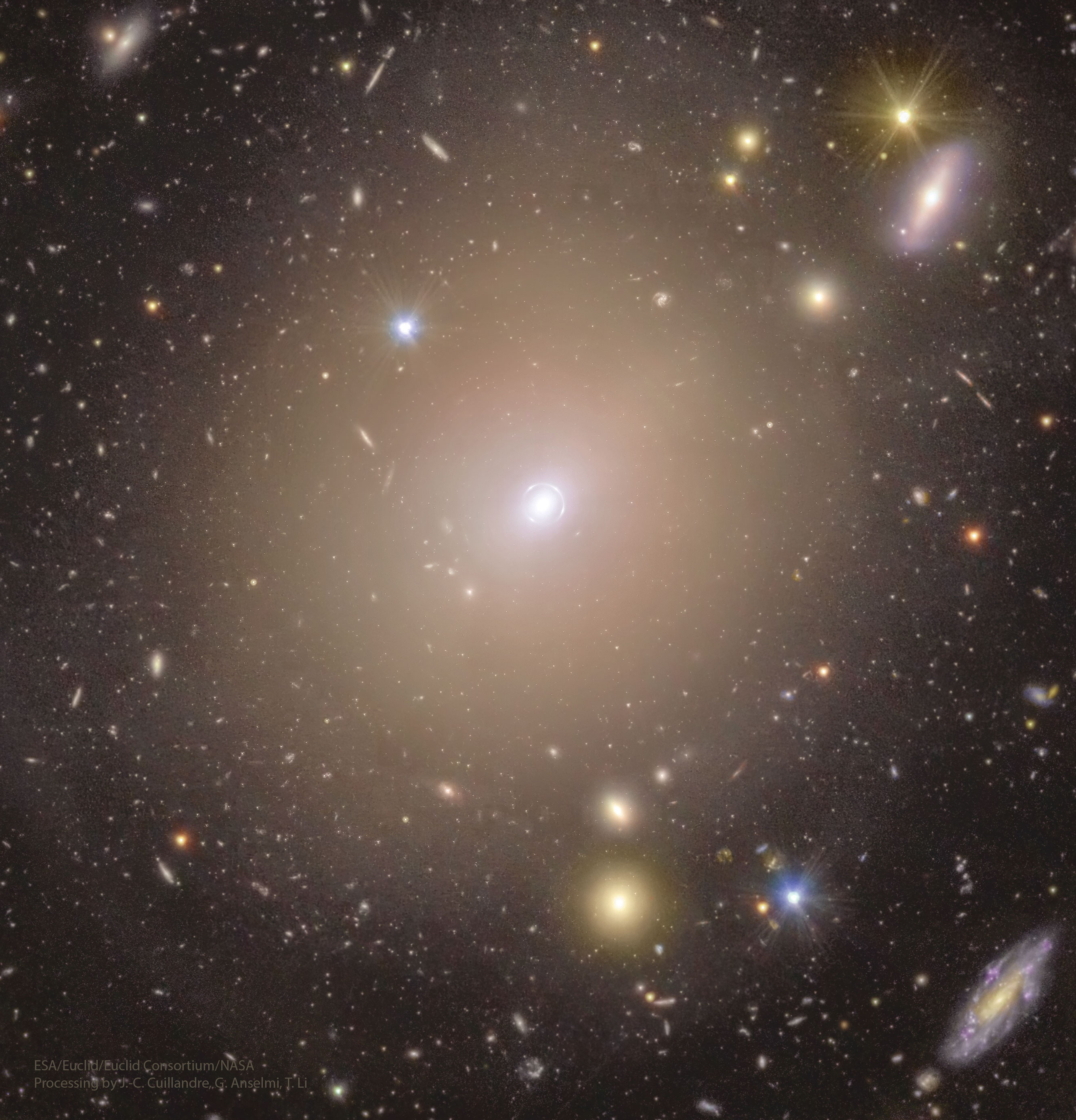
Einstein Ring Surrounds Nearby Galaxy Center
* Image Credit & Copyright: ESA, NASA, Euclid Consortium;
https://www.nasa.gov/
https://www.esa.int/
https://www.euclid-ec.org/consortium/about-ec/
* Processing: J.-C. Cuillandre, G. Anselmi, T. Li
https://www.cfht.hawaii.edu/~jcc/
Explanation:
Do you see the ring? If you look very closely at the center of the featured galaxy NGC 6505, a ring becomes evident. It is the gravity of NGC 6505, the nearby (z = 0.042) elliptical galaxy that you can easily see, that is magnifying and distorting the image of a distant galaxy into a complete circle. To create a complete Einstein ring there must be perfect alignment of the nearby galaxy's center and part of the background galaxy. Analysis of this ring and the multiple images of the background galaxy help to determine the mass and fraction of dark matter in NGC 6505's center, as well as uncover previously unseen details in the distorted galaxy. The featured image was captured by ESA's Earth-orbiting Euclid telescope in 2023 and released earlier this month.
https://www.jpl.nasa.gov/news/euclid-discovers-einstein-ring-in-our-cosmic-backyard/
https://www.euclid-ec.org/einstein-ring-in-ngc-6505/
https://en.wikipedia.org/wiki/NGC_6505
https://arxiv.org/abs/2502.06505
https://science.nasa.gov/dark-matter/
https://www.esa.int/Science_Exploration/Space_Science/Euclid_overview
https://apod.nasa.gov/apod/ap250226.html
#space #galaxy #astrophotography #photography #science #physics #nature #NASA #ESA
Alt...
2025 February 26
A cluster of galaxies is shown with many galaxies around the cluster center. A close look at this center shows that it is encompassed by a narrow ring of light.
Einstein Ring Surrounds Nearby Galaxy Center
* Image Credit & Copyright: ESA, NASA, Euclid Consortium; Processing: J.-C. Cuillandre, G. Anselmi, T. Li
Explanation:
Do you see the ring? If you look very closely at the center of the featured galaxy NGC 6505, a ring becomes evident. It is the gravity of NGC 6505, the nearby (z = 0.042) elliptical galaxy that you can easily see, that is magnifying and distorting the image of a distant galaxy into a complete circle. To create a complete Einstein ring there must be perfect alignment of the nearby galaxy's center and part of the background galaxy. Analysis of this ring and the multiple images of the background galaxy help to determine the mass and fraction of dark matter in NGC 6505's center, as well as uncover previously unseen details in the distorted galaxy. The featured image was captured by ESA's Earth-orbiting Euclid telescope in 2023 and released earlier this month.
Authors & editors: Robert Nemiroff (MTU) & Jerry Bonnell (UMCP)
NASA Official: Amber Straughn Specific rights apply.
NASA Web Privacy, Accessibility, Notices;
A service of: ASD at NASA / GSFC,
NASA Science Activation
& Michigan Tech. U.
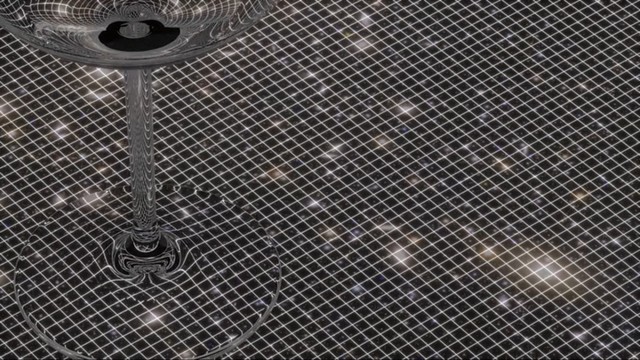
ESA's Euclid mission is surveying the sky to explore the composition and evolution of the dark Universe.
But how can Euclid see the invisible? Watch this video to learn about the light-bending effect that enables scientists to trace how dark matter is distributed in the Universe.
By making use of Euclid’s flagship simulation, the video illustrates how dark-matter filaments subtly alter the shape of galaxies. Light travelling to us from vastly distant galaxies is bent and distorted by concentrations of matter along its way. The effect is called gravitational lensing because matter (both ‘normal’ and dark matter) acts as a kind of magnifying glass.
Scientists distinguish between strong and weak gravitational lensing. In strong gravitational lensing distortions of background galaxies or other light sources are very apparent, resulting in arcs, multiple images or so-called Einstein rings. In weak lensing, background sources appear only mildly stretched or displaced. This means we can only detect this effect by analysing large numbers of sources in a statistical way.
The further we look, the more prominent the distortions from weak gravitational lensing are, because there are more dark-matter structures acting as lenses between us and the light sources.
Euclid will measure the distorted shapes of billions of galaxies over 10 billion years of cosmic history, providing a 3D view of the dark matter distribution in our Universe. This will shed light on the nature of this mysterious component.
The map of the distribution of galaxies over cosmic time will also teach us about dark energy, which affects how quickly the Universe expands. By charting the Universe’s large-scale structure in unprecedented detail, Euclid will enable scientists to trace how the expansion has changed over time.
* CREDIT
ESA/Euclid Consortium/Cacao Cinema
#space #galaxy #astrophotography #photography #science #physics #nature #NASA #ESA
Alt...
To understand more about the dark Universe, ESA’s Euclid will measure a phenomenon known as ‘weak lensing’, based on the principle of gravitational lensing.
* CREDIT
ESA/Euclid Consortium/Cacao Cinema
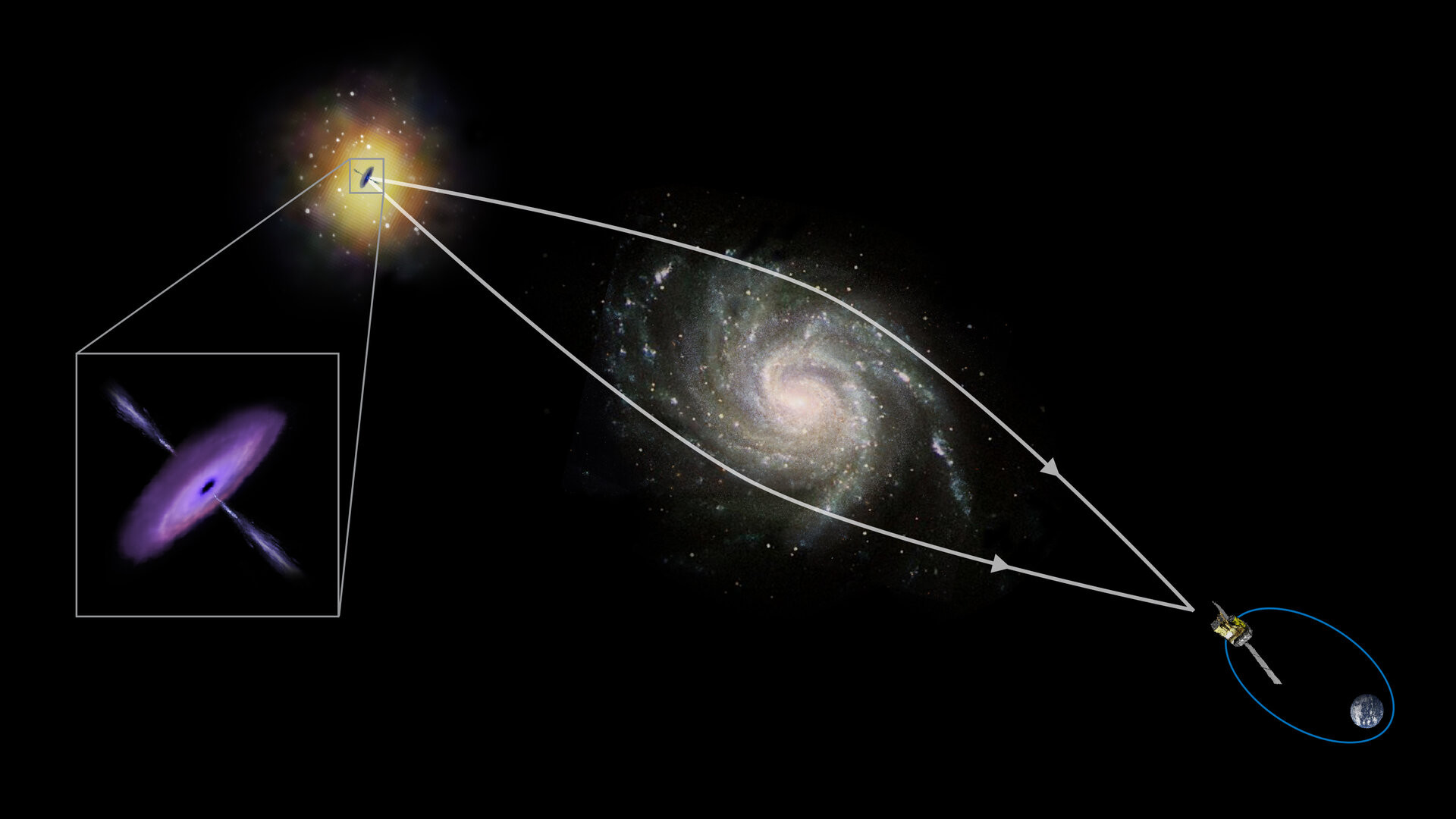
A team of astronomers used the magnifying effect of the stars located in a spiral galaxy to ‘zoom in’ to another galaxy, known as PKS 1830-211, that lies along the same line of sight from Earth but is much farther away. Thanks to this unusual set-up, they could pick out very small structures in the distant galaxy, corresponding to the vicinity of the supermassive black hole. The black hole is devouring material from its surroundings while firing powerful jets of particles that emit light up to the high energies of gamma rays. Observing these jets with ESA’s Integral and NASA’s Fermi and Swift satellites, the astronomers could measure the size of the region around the black hole where they originate.
Our telescopes will never be powerful enough to reveal these inner regions, but the intervening gravitational lens made the measurement possible. This is the first time that gravitational microlensing has been used with gamma rays to dissect the high-energy processes taking place around a supermassive black hole.
CREDIT
ESA/ATG medialab
#space #galaxy #astrophotography #photography #science #physics #nature #NASA #ESA
Alt...
Massive cosmic objects, from single stars to galaxy clusters, bend and focus the light that flows around them with their gravity, acting like giant magnifying glasses. This effect is called gravitational lensing or, when it is detected on tiny patches on the sky, microlensing.
2022 July 5
A Molten Galaxy Einstein Ring
* Image Credit: ESA/Hubble & NASA, S. Jha;
https://www.physics.rutgers.edu/~saurabh/
https://www.esa.int/
https://esahubble.org/
https://www.nasa.gov/
* Processing: Jonathan Lodge
https://www.instagram.com/jjlodge/
Explanation:
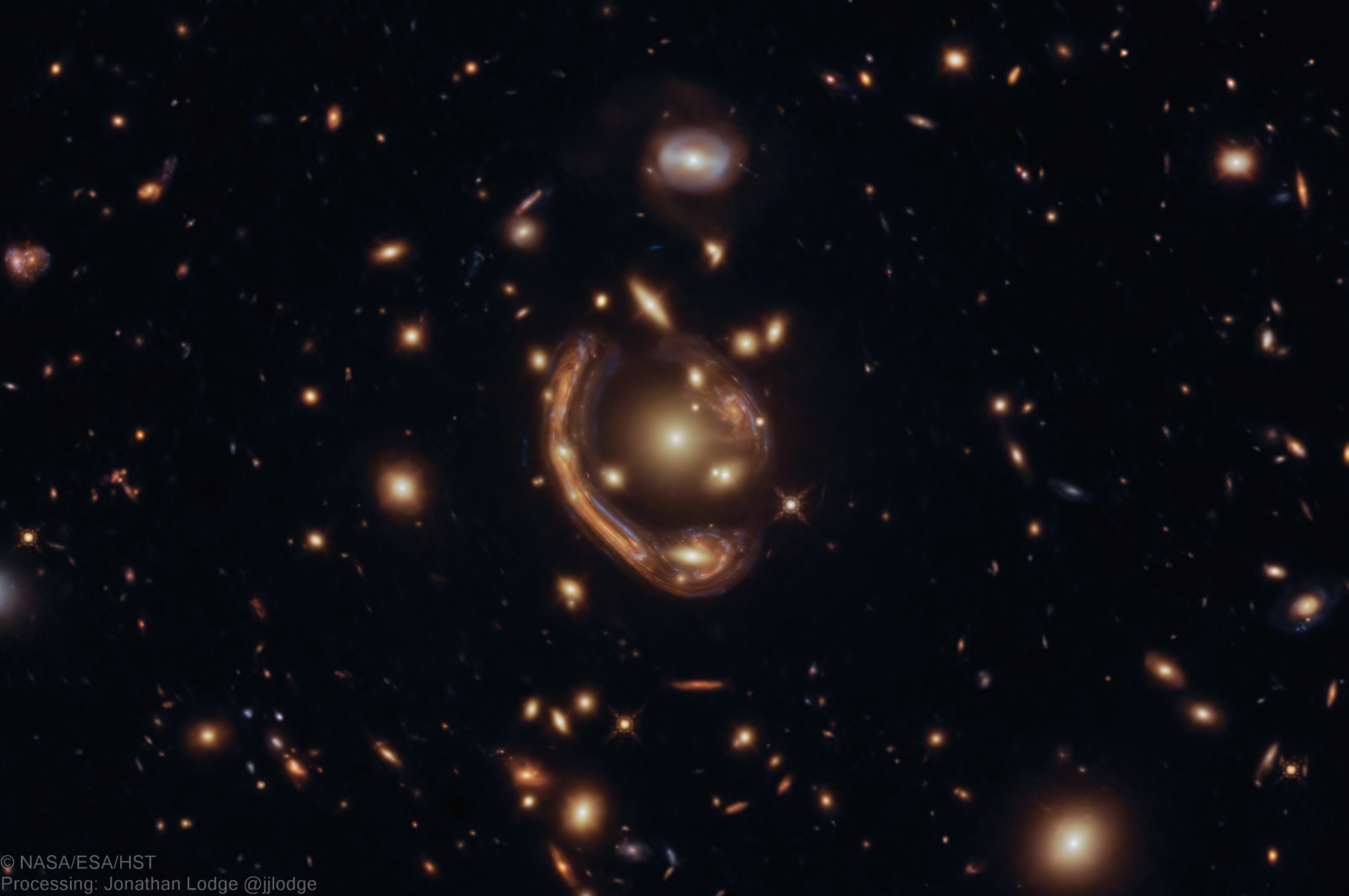
It is difficult to hide a galaxy behind a cluster of galaxies. The closer cluster's gravity will act like a huge lens, pulling images of the distant galaxy around the sides and greatly distorting them. This is just the case observed in the featured image recently re-processed image from the Hubble Space Telescope. The cluster GAL-CLUS-022058c is composed of many galaxies and is lensing the image of a yellow-red background galaxy into arcs seen around the image center. Dubbed a molten Einstein ring for its unusual shape, four images of the same background galaxy have been identified. Typically, a foreground galaxy cluster can only create such smooth arcs if most of its mass is smoothly distributed -- and therefore not concentrated in the cluster galaxies visible. Analyzing the positions of these gravitational arcs gives astronomers a method to estimate the dark matter distribution in galaxy clusters, as well as infer when the stars in these early galaxies began to form.
https://apod.nasa.gov/apod/ap210802.html
https://apod.nasa.gov/apod/ap210823.html
https://science.nasa.gov/missions/hubble/hubble-sees-a-molten-ring/
https://science.nasa.gov/missions/
https://esahubble.org/images/potw2050a/
https://en.wikipedia.org/wiki/Gravitational_lens
https://noirlab.edu/science/programs/ctio/telescopes/soar-telescope/news/gravitational-arcs-galaxy-cluster-abel-370
https://apod.nasa.gov/apod/ap220705.html
#space #galaxy #astrophotography #photography #science #physics #nature #NASA #ESA
Alt...
2022 July 5
The featured image shows a distant galaxy distorted into a giant arc around the center of a galaxy cluster by gravitational lensing.
A Molten Galaxy Einstein Ring
* Image Credit: ESA/Hubble & NASA, S. Jha; Processing: Jonathan Lodge
Explanation:
It is difficult to hide a galaxy behind a cluster of galaxies. The closer cluster's gravity will act like a huge lens, pulling images of the distant galaxy around the sides and greatly distorting them. This is just the case observed in the featured image recently re-processed image from the Hubble Space Telescope. The cluster GAL-CLUS-022058c is composed of many galaxies and is lensing the image of a yellow-red background galaxy into arcs seen around the image center. Dubbed a molten Einstein ring for its unusual shape, four images of the same background galaxy have been identified. Typically, a foreground galaxy cluster can only create such smooth arcs if most of its mass is smoothly distributed -- and therefore not concentrated in the cluster galaxies visible. Analyzing the positions of these gravitational arcs gives astronomers a method to estimate the dark matter distribution in galaxy clusters, as well as infer when the stars in these early galaxies began to form.
Authors & editors: Robert Nemiroff (MTU) & Jerry Bonnell (UMCP)
NASA Official: Phillip Newman Specific rights apply.
NASA Web Privacy Policy and Important Notices
A service of: ASD at NASA / GSFC
& Michigan Tech. U.
A Gallery of Einstein Rings - NASA Science
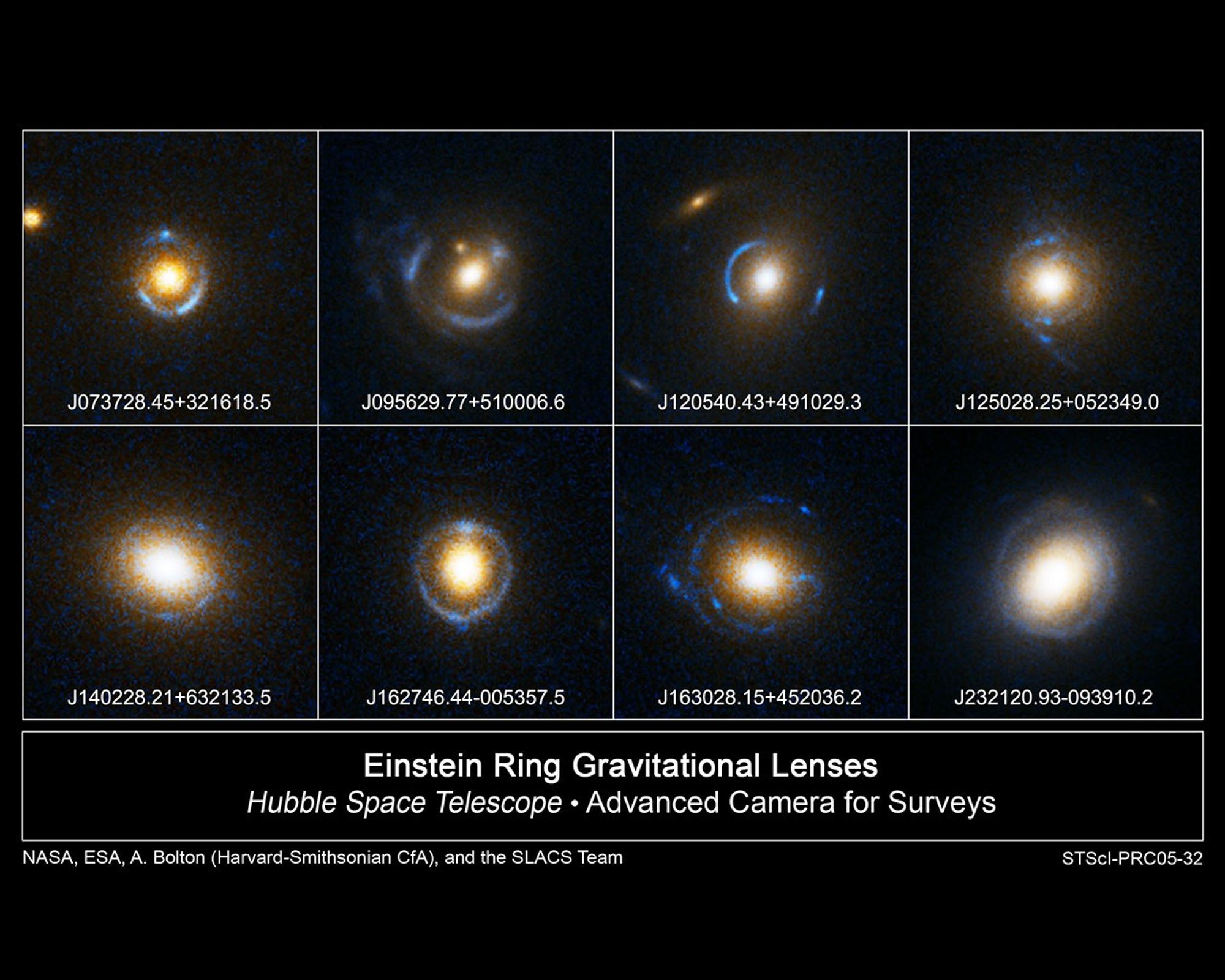
The thin blue bull's-eye patterns in these eight Hubble Space Telescope images appear like neon signs floating over reddish-white blobs. The blobs are giant elliptical galaxies roughly 2 to 4 billion light-years away. The bull's-eye patterns are created as the light from galaxies twice as far away is distorted into circular shapes by the gravity of the giant elliptical galaxies. This phenomenon is called gravitational lensing, first predicted by Albert Einstein almost a century ago. Gravitational lensing occurs when the gravitational field from a massive object warps space and deflects light from a distant object behind it.
The bull's-eye patterns are so-called "Einstein rings," which are the most elegant manifestation of the lensing phenomenon. Einstein rings are produced when two galaxies are almost perfectly aligned, one behind the other.
The images were taken between August 2004 and March 2005 by the Hubble telescope's Advanced Camera for Surveys. They are part of an ongoing survey, called the Sloan Lens ACS (or SLACS) Survey, of about 150 galaxies to hunt for gravitational lenses. So far, the survey has netted 19 new gravitational lenses, adding significantly to the 100 or so previously known lenses. The survey also has identified eight new Einstein rings. Only three such rings had been seen previously in visible light.
Credit:
NASA, ESA, and the SLACS Survey team: A. Bolton (Harvard/ Smithsonian), S. Burles (MIT), L. Koopmans (Kapteyn), T. Treu (UCSB), and L. Moustakas (JPL/Caltech)
https://science.nasa.gov/asset/hubble/a-gallery-of-einstein-rings/
#space #galaxy #astrophotography #photography #science #physics #nature #NASA #ESA
Alt...
A Gallery of Einstein Rings - NASA Science
The Hubble image was created from HST data from proposal 10174. Members of the SLACS team include: A. Bolton (Harvard-Smithsonian CfA), S. Burles (Massachusetts Institute of Technology), L. Koopmans (Kapteyn Astronomical Institute), T. Treu (University of California - Santa Barbara), and L. Moustakas (Jet Propulsion Lab/Caltech).
2022 May 11
Gravity's Grin
* Image Credit: X-ray - NASA / CXC / J. Irwin et al. ;
http://arxiv.org/abs/1505.05501
https://chandra.harvard.edu/
http://chandra.harvard.edu/
* Optical - NASA/STScI
http://www.stsci.edu/
Explanation:
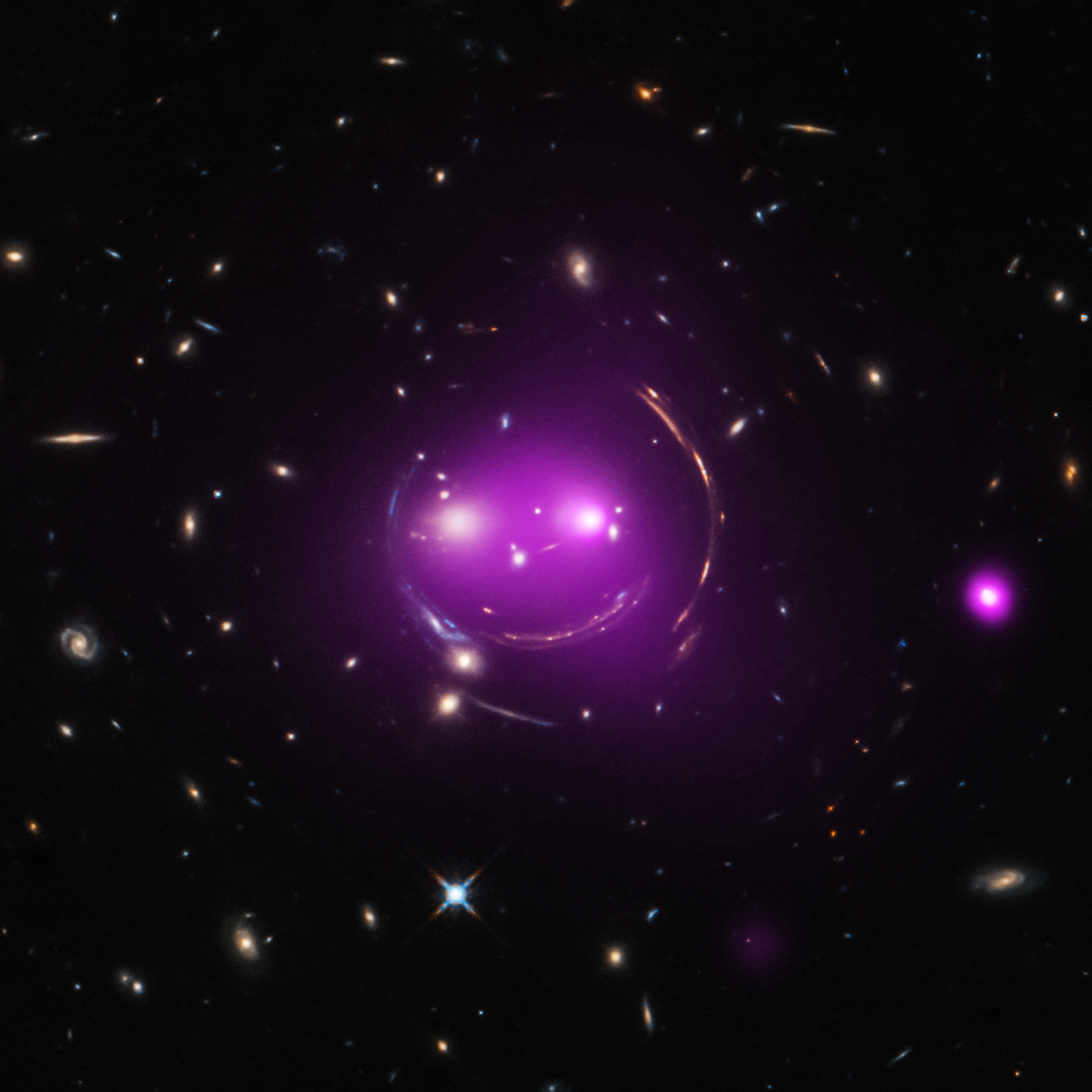
Albert Einstein's general theory of relativity, published over 100 years ago, predicted the phenomenon of gravitational lensing. And that's what gives these distant galaxies such a whimsical appearance, seen through the looking glass of X-ray and optical image data from the Chandra and Hubble space telescopes. Nicknamed the Cheshire Cat galaxy group, the group's two large elliptical galaxies are suggestively framed by arcs. The arcs are optical images of distant background galaxies lensed by the foreground group's total distribution of gravitational mass. Of course, that gravitational mass is dominated by dark matter. The two large elliptical "eye" galaxies represent the brightest members of their own galaxy groups which are merging. Their relative collisional speed of nearly 1,350 kilometers/second heats gas to millions of degrees producing the X-ray glow shown in purple hues. Curiouser about galaxy group mergers? The Cheshire Cat group grins in the constellation Ursa Major, some 4.6 billion light-years away.
https://en.wikipedia.org/wiki/List_of_scientific_publications_by_Albert_Einstein
https://chandra.harvard.edu/photo/2015/cheshirecat/
https://apod.nasa.gov/apod/ap111221.html
https://www.lsst.org/science/dark-matter
https://apod.nasa.gov/apod/ap220511.html
#space #galaxy #astrophotography #photography #science #physics #nature #NASA #ESA
Alt...
2022 May 11
Gravity's Grin
* Image Credit: X-ray - NASA / CXC / J. Irwin et al. ; Optical - NASA/STScI
Explanation:
Albert Einstein's general theory of relativity, published over 100 years ago, predicted the phenomenon of gravitational lensing. And that's what gives these distant galaxies such a whimsical appearance, seen through the looking glass of X-ray and optical image data from the Chandra and Hubble space telescopes. Nicknamed the Cheshire Cat galaxy group, the group's two large elliptical galaxies are suggestively framed by arcs. The arcs are optical images of distant background galaxies lensed by the foreground group's total distribution of gravitational mass. Of course, that gravitational mass is dominated by dark matter. The two large elliptical "eye" galaxies represent the brightest members of their own galaxy groups which are merging. Their relative collisional speed of nearly 1,350 kilometers/second heats gas to millions of degrees producing the X-ray glow shown in purple hues. Curiouser about galaxy group mergers? The Cheshire Cat group grins in the constellation Ursa Major, some 4.6 billion light-years away.
Authors & editors: Robert Nemiroff (MTU) & Jerry Bonnell (UMCP)
NASA Official: Phillip Newman Specific rights apply.
NASA Web Privacy Policy and Important Notices
A service of: ASD at NASA / GSFC
& Michigan Tech. U.
2023 November 10
UHZ1: Distant Galaxy and Black Hole
* Image Credit: X-ray: NASA/CXC/SAO/Ákos Bogdán; Infrared: NASA/ESA/CSA/STScI;
https://chandra.harvard.edu/
* Image Processing: NASA/CXC/SAO/L. Frattare & K. Arcand
Explanation:
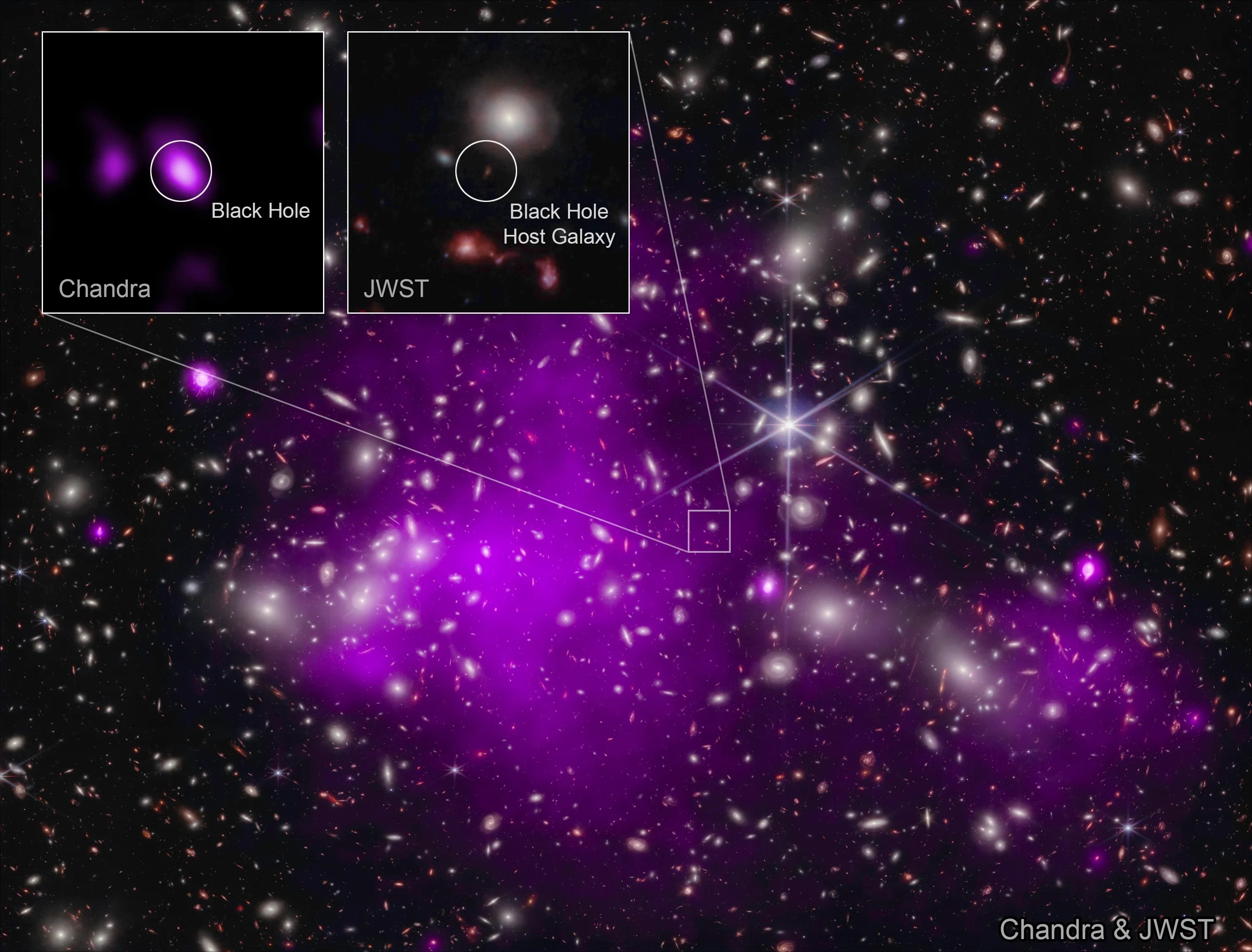
Dominated by dark matter, massive cluster of galaxies Abell 2744 is known to some as Pandora's Cluster. It lies 3.5 billion light-years away toward the constellation Sculptor. Using the galaxy cluster's enormous mass as a gravitational lens to warp spacetime and magnify even more distant objects directly behind it, astronomers have found a background galaxy, UHZ1, at a remarkable redshift of Z=10.1. That puts UHZ1 far beyond Abell 2744, at a distance of 13.2 billion light-years, seen when our universe was about 3 percent of its current age. UHZ1 is identified in the insets of this composited image combining X-rays (purple hues) from the spacebased Chandra X-ray Observatory and infrared light from the James Webb Space Telescope. The X-ray emission from UHZ1 detected in the Chandra data is the telltale signature of a growing supermassive black hole at the center of the ultra high redshift galaxy. That makes UHZ1's growing black hole the most distant black hole ever detected in X-rays, a result that now hints at how and when the first supermassive black holes in the universe formed.
https://chandra.si.edu/photo/2023/uhz1/
https://webbtelescope.org/contents/news-releases/2023/news-2023-107
https://apod.nasa.gov/apod/ap130408.html
https://arxiv.org/abs/2308.02750
https://arxiv.org/abs/2305.15458
https://apod.nasa.gov/apod/ap231110.html
#space #galaxy #astrophotography #photography #science #physics #nature #NASA #ESA
Alt...
2023 November 10
UHZ1: Distant Galaxy and Black Hole
* Image Credit: X-ray: NASA/CXC/SAO/Ákos Bogdán; Infrared: NASA/ESA/CSA/STScI;
* Image Processing: NASA/CXC/SAO/L. Frattare & K. Arcand
Explanation:
Dominated by dark matter, massive cluster of galaxies Abell 2744 is known to some as Pandora's Cluster. It lies 3.5 billion light-years away toward the constellation Sculptor. Using the galaxy cluster's enormous mass as a gravitational lens to warp spacetime and magnify even more distant objects directly behind it, astronomers have found a background galaxy, UHZ1, at a remarkable redshift of Z=10.1. That puts UHZ1 far beyond Abell 2744, at a distance of 13.2 billion light-years, seen when our universe was about 3 percent of its current age. UHZ1 is identified in the insets of this composited image combining X-rays (purple hues) from the spacebased Chandra X-ray Observatory and infrared light from the James Webb Space Telescope. The X-ray emission from UHZ1 detected in the Chandra data is the telltale signature of a growing supermassive black hole at the center of the ultra high redshift galaxy. That makes UHZ1's growing black hole the most distant black hole ever detected in X-rays, a result that now hints at how and when the first supermassive black holes in the universe formed.
Authors & editors: Robert Nemiroff (MTU) & Jerry Bonnell (UMCP)
NASA Official: Phillip Newman Specific rights apply.
"Let's see what our telescopes are capable of with the help of gravitational lensing:"
Take a Tour of Pandora's Cluster
NASA's James Webb Space Telescope presents a new view of Abell 2744, also known as Pandora's cluster, displaying various depths of space in a single image. Ranging from a foreground star in our own galaxy ... to the mega cluster forming as multiple massive galaxy clusters merge 4 billion light years away ... to the even more distant galaxies behind the cluster, whose light is magnified and distorted by the mega-clusters' warping of space time. Without the cluster's magnification boost, even the Webb Telescope could not see these faint, extremely distant galaxies. Some features that Webb shows distinctly like this dusty red galaxy were not detected at all when the Hubble Space Telescope studied the region. Astronomers are using this image to choose certain galaxies for follow up to get precise distance measurements and details about intriguing features.
This small red dot is a distant source of infrared light that has so far defied characterization. It must be extremely compact because even with the visual stretching caused by the cluster's warped space-time, it still appears as a tiny dot. One theory is that it is a glowing disk of gas surrounding a supermassive Black hole in the early universe. Webb's follow-up observations will further reveal the wonders of Pandora's cluster, and uncover a new understanding of the universe.
Credits
*Video
STScI, Danielle Kirshenblat
* Music
PremiumBeat Music, Klaus Hergersheimer
* Science
Ivo Labbe (Swinburne), Rachel Bezanson (University of Pittsburgh)
* Image Processing
STScI, Alyssa Pagan
https://webbtelescope.org/contents/media/videos/2023/107/01GS5SCDZKWA0Q1MYJ3PHVY3TQ?news=true
#space #galaxy #astrophotography #photography #science #physics #nature #NASA #ESA
NASA Telescopes Discover Record-Breaking Black Hole
The main image of this release features a glimpse of a black hole in an early stage of its development, just 470 million years after the Big Bang.
The composite image shows data from NASA's Chandra X-ray Observatory and James Webb Space Telescope. It features scores of seemingly tiny celestial objects in a sea of black. This is the galaxy cluster Abell 2744. When magnified, the tiny white, orange, and purple celestial objects are revealed to be spiral and elliptical galaxies, and gleaming stars. Many of these colorful specks appear to float in a neon purple cloud of X-ray gas in the center of the image, some 3.5 billion light-years from Earth.
Just to the right of center, at the edge of the purple gas cloud, is a tiny orange speck. This speck is far in the distance, well beyond the Abell galaxy cluster. It represents a galaxy 13.2 billion light-years from Earth containing a supermassive black hole.
In this composite image packed with celestial objects, the tiny orange speck is easily overlooked. Therefore, the main image of the release is also presented fully labelled. In the labelled version of the image, a thin box outlines the distant galaxy, and two enlargements are inset at our upper left. In the enlargement showing Chandra data, a hazy, neon purple oval with a light pink core is shown. This purple oval represents intense X-rays from a growing supermassive black hole estimated to weigh between 10 and 100 million suns. The purple oval is not visible in the composite image because of the way the Chandra data was processed.
This black hole is located in the distant galaxy in the center of the enlargement showing Webb data.
https://chandra.si.edu/photo/2023/uhz1/
* video compressed with
$ ffmpeg -i in.mp4 -vcodec libx265 -crf 20 out.mp4
#space #galaxy #astrophotography #photography #science #physics #nature #NASA #ESA
TOPIC> Gravitational Lensing
starts here:
https://defcon.social/@grobi/114374350096488478
Gravitational Lensing - Nature's Boost
For me, this is the most wonderful scientific statement on the phenomenon of gravitational lensing!
Senior Project Scientist Dr. Jennifer Wiseman calls this 'miracle' 'Nature's Boost'.
See the sparkle in her eyes and hear the enthusiasm in her voice when she explains this phenomenon to us in her understandable and accessible way.
It is not that scientists do not see miracles or are not touched by those .. for them it is just not a sin or a drama to fathom the background to newly discovered phenomena.
* video converted and compressed with
$ ffmpeg -i in.mp4 -vcodec libx265 -crf 25 out.mp4
#space #galaxy #astrophotography #photography #science #physics #nature #NASA #ESA
Gravitational Lensing Today
Excerpts from "Hubble Gravitational Lenses" by Andrea Gianopoulos and "For the First Time Hubble Directly Measures Mass of a Lone White Dwarf" by NASA Hubble Mission Team
Today, Hubble astronomers continue to use the century-old General Relativity/Eddington Experiment to measure distant objects in the universe. For the first time, they measured the mass of a lone white dwarf — the dense, burned-out remnant of a Sun-like star — by seeing how much its gravity deflected the light from a background star. The researchers found that the white dwarf, called LAWD 37, is 56 percent the mass of our Sun, which agrees with earlier theoretical predictions of the white dwarf's mass and corroborated current theories of how white dwarfs evolve as the end product of a typical star's evolution.
When the mass of the lensing object is much larger, like a large galaxy or cluster of galaxies, the effects of gravitational lensing can resemble a house of mirrors. The gravitational lens not only bends and magnifies the light of distant objects, but distorts it in both space and time.
One example of this spacetime distortion lies in the galaxy cluster 0024+1654, seen above. The gravitational lens forms as a result of the cluster's tremendous gravitational field that bends light to magnify, brighten, and stretches the image of a more distant object. How distorted the image becomes and how many copies are made depends on the alignment between the foreground cluster and the more distant galaxy, which is behind the cluster. In this photograph, light from the distant galaxy bends as it passes through the cluster, dividing the galaxy into five separate images. The light also distorted the galaxy's image from a normal spiral shape into a more arc-shaped object.
https://science.nasa.gov/mission/hubble/science/science-behind-the-discoveries/hubble-gravitational-lenses/
https://science.nasa.gov/missions/hubble/for-the-first-time-hubble-directly-measures-mass-of-a-lone-white-dwarf/
#space #galaxy #astrophotography #photography #science #physics #nature #NASA #ESA
Euclid Opens Data Treasure Chest: Insights into the Depths of the Universe ESA's
Euclid mission publishes first survey data.
19. March 2025 Today, the European Space Agency's Euclid mission released its first batch of survey data, including a preview of its deep fields. Here, hundreds of thousands of galaxies in different shapes and sizes are the focus and show an insight into their large-scale arrangement in the cosmic web. The data sharing covers a huge area of the sky in three mosaics. It also includes numerous galaxy clusters, active galactic nuclei and transient phenomena, as well as the first classification study of more than 380 000 galaxies and 500 gravitational lensing candidates compiled by combined artificial intelligence and citizen science initiatives. All this paves the way for the wide range of topics that the detective of the dark universe Euclid will tackle with his extensive data set.
Euclid combines high-resolution imaging with large sky coverage for the first time.
"Euclid's unique observational capabilities could help to better determine the expansion rate of the universe through gravitational-wave observations," explains Miguel Zumalacárregui, group leader in the Department of Astrophysical and Cosmological Relativity at @mpi_grav in the Potsdam Science Park. To this end, the researchers want to correlate gravitational waves measured by @LIGO, Virgo and KAGRA with Euclid's galaxy catalogues. In addition, the large number of gravitational lensing systems discovered by Euclid plays an important role. "Euclid's observations could also be crucial for the detection of the first gravitational waves, which are split into multiple images by gravitational lensing," Zumalacárregui adds.
https://www.aei.mpg.de/1240587/euclid-opens-data-treasure-trove-offers-glimpse-of-deep-fields
#space #galaxy #astrophotography #photography #science #physics #nature #NASA #ESA
Alt...
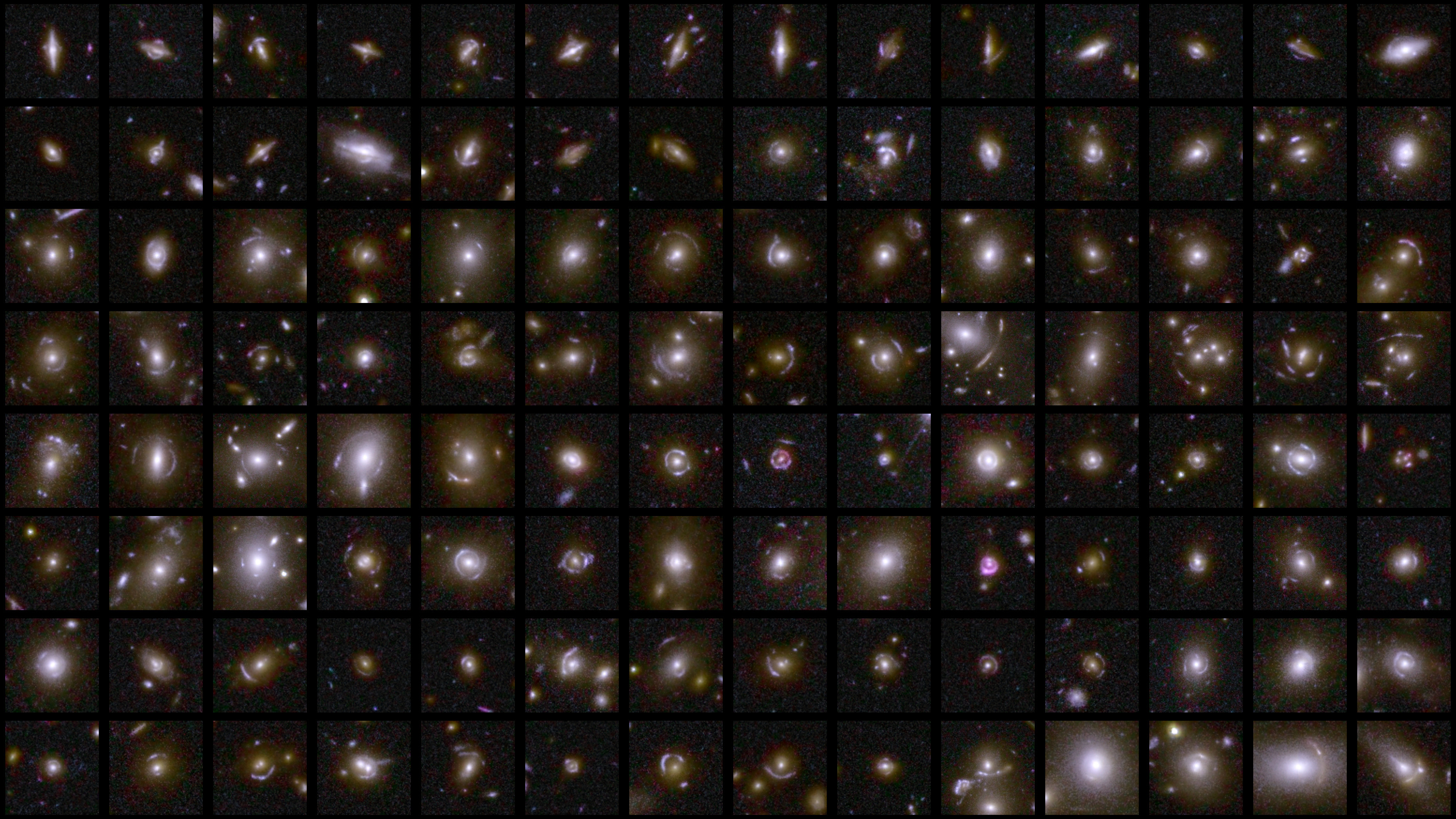
This image shows examples of gravitational lenses that Euclid captured in its first observations of the Deep Field areas.
Using an initial sweep by artificial intelligence models, followed by citizen science inspection, expert vetting and modelling, a first catalogue of 500 galaxy-galaxy strong lens candidates was created, almost all of which were previously unknown. This type of lensing happens when a foreground galaxy and its halo of dark matter acts as a lens, distorting the image of a background galaxy along the line of sight towards Euclid.
With the help of these models, Euclid will capture some 7000 candidates in the major cosmology data release planned for the end of 2026, and in the order of 100 000 galaxy-galaxy strong lenses by the end of the mission, around 100 times more than currently known.
Credits:
ESA/Euclid/Euclid Consortium/NASA,
* image processing by M. Walmsley, M. Huertas-Company, J.-C. Cuillandre
From Wikipedia, the free encyclopedia
A gravitational lens is matter,
such as a cluster of galaxies or a point particle, that bends light from a distant source as it travels toward an observer. The amount of gravitational lensing is described by Albert Einstein's general theory of relativity. If light is treated as corpuscles travelling at the speed of light, Newtonian physics also predicts the bending of light, but only half of that predicted by general relativity.
Orest Khvolson (1924) and Frantisek Link (1936) are generally credited with being the first to discuss the effect in print, but it is more commonly associated with Einstein, who made unpublished calculations on it in 1912 and published an article on the subject in 1936.
In 1937, Fritz Zwicky posited that galaxy clusters could act as gravitational lenses, a claim confirmed in 1979 by observation of the Twin QSO SBS 0957+561.
Unlike an optical lens, a point-like gravitational lens produces a maximum deflection of light that passes closest to its center, and a minimum deflection of light that travels furthest from its center. Consequently, a gravitational lens has no single focal point, but a focal line. The term "lens" in the context of gravitational light deflection was first used by O. J. Lodge, who remarked that it is "not permissible to say that the solar gravitational field acts like a lens, for it has no focal length". If the (light) source, the massive lensing object, and the observer lie in a straight line, the original light source will appear as a ring around the massive lensing object (provided the lens has circular symmetry). If there is any misalignment, the observer will see an arc segment instead.
>>
#space #galaxy #astrophotography #photography #science #physics #nature #NASA #ESA
<<_>>
From Wikipedia, the free encyclopedia
This phenomenon was first mentioned in 1924 by the St. Petersburg physicist Orest Khvolson, and quantified by Albert Einstein in 1936. It is usually referred to in the literature as an Einstein ring, since Khvolson did not concern himself with the flux or radius of the ring image. More commonly, where the lensing mass is complex (such as a galaxy group or cluster) and does not cause a spherical distortion of spacetime, the source will resemble partial arcs scattered around the lens. The observer may then see multiple distorted images of the same source; the number and shape of these depending upon the relative positions of the source, lens, and observer, and the shape of the gravitational well of the lensing object.
[TODAY:
Using an initial sweep by artificial intelligence models, followed by citizen science inspection, expert vetting and modelling, a first catalogue of 500 galaxy-galaxy strong lens candidates was created, almost all of which were previously unknown. This type of lensing happens when a foreground galaxy and its halo of dark matter acts as a lens, distorting the image of a background galaxy along the line of sight towards Euclid.
With the help of these models, Euclid will capture some 7000 candidates in the major cosmology data release planned for the end of 2026, and in the order of 100 000 galaxy-galaxy strong lenses by the end of the mission, around 100 times more than currently known.]
#space #galaxy #astrophotography #photography #science #physics #nature #NASA #ESA
From Wikipedia, the free encyclopedia
[...]
C/2025 R2 was not discovered earlier in part because of the Holetschek effect as the comet was less than 30 degrees from the Sun between August 7 - September 13. Between August and September the comet had rapidly brightened from magnitude 11 to magnitude 8. The comet is not likely in an outburst, however it is currently unknown how quickly it will dim or if it will completely disintegrate.
C/2025 R2 is officially the 20th comet discovered through SOHO's SWAN instrument according to its discoverer, Vladimir Bezugly.
C/2025 R2 (SWAN) came to perihelion one day after discovery on 12 September 2025 at a distance of 0.5 AU (75 million km) from the Sun. Earth will cross the comet's orbit around 5 October 2025 and it may produce a meteor shower. It will make its closest approach to Earth at a distance of 0.26 AU (39 million km; 24 million mi) on 19 October 2025. It will cross the celestial equator on 3 November 2025.
As the comet was discovered near perihelion, the closest approach to the Sun is reasonably well known. But the aphelion (farthest distance from the Sun) is currently constrained by the low spatial resolution of about 1° per pixel STEREO-A observations in August, and without the STEREO-A observations, there is only a short 4-day observation arc for the orbit determination. Aphelion is anywhere from 60+ AU from the Sun with an orbital period of hundreds to thousands of years. The Minor Planet Center (using observations through September 15th) estimates an orbital period of 1400 years with aphelion around 250 AU, and JPL (using observations through September 14th) estimates an orbital period of 20000 years with aphelion beyond 1000 AU. ..
Text Credits:
Contributors to Wikimedia projects
Image Credit:
Filipp Romanov
https://en.wikipedia.org/wiki/C/2025_R2_(SWAN)
#space #comets #astrophotography #photography #science #astronomy #nature #NASA #ESA #education
Alt...
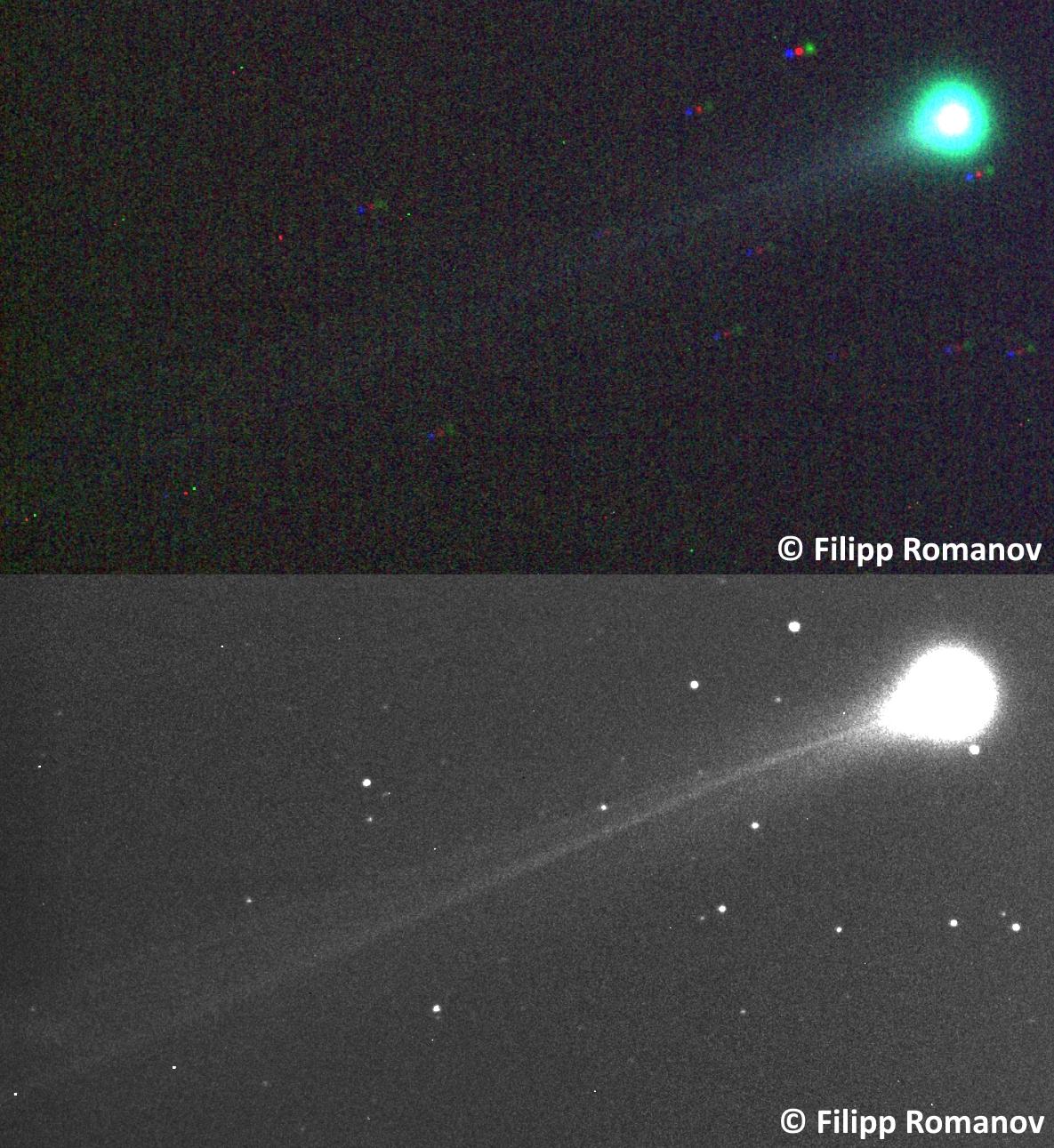
On 2025-09-13 I confirmed the new bright comet SWAN25B remotely using iTelescope.net T59 (0.51-m f/6.8 reflector + CCD) located at the Siding Spring Observatory, Australia. I measured: magnitude of the coma = +8.9 mag., coma diameter = 2 arcminutes with a straight tail (which becomes wider away from the coma) at least 18 arcminutes in length (up to the edge of the frame), PA = 112 degrees. Images: stacked 3x10 sec. (RGB) and single 60 sec. (Luminance filter).
Credit text & image
Filipp Romanov
Comet C/2025 R2 (SWAN) imaged from the Siding Spring Observatory on 13 September 2025 with a 0.5 m (20 in) telescope.
Discovery
Discovered by SOHO–SWAN
Vladimir Bezugly
Discovery date 11 September 2025
Designations Alternative designations
SWAN25B, CK25R020
Orbital characteristics
Epoch 13 September 2025 (JD 2460931.5)
Observation arc 32 days
Earliest precovery date 13 August 2025
Number of observations 83
Aphelion 1600±9000 AU
Perihelion 0.5035±0.0002 AU
Eccentricity 0.999±0.003
Orbital period 1400–20000(?) years
Inclination 4.47°±0.002°
Longitude of ascending node 335.7°
Argument of periapsis 307.77°
Last perihelion 12 September 2025
TJupiter 0.884
Earth MOID 0.047 AU
Jupiter MOID 0.042 AU
Physical characteristics
Comet total
magnitude (M1) 12.4±0.9
Comet nuclear
magnitude (M2) 10±2
Apparent magnitude
6.0
(2025-09-15)